AB 828: Sustainable groundwater management: managed wetlands.
- Session Year: 2023-2024
- House: Assembly
- Latest Version Date: 2024-08-31
Current Status:
Failed
(2024-09-25: Vetoed by Governor.)
Introduced
In Committee
First Chamber
In Committee
Second Chamber
Enacted
(1)Existing law, the Sustainable Groundwater Management Act, requires all groundwater basins designated as high- or medium-priority basins by the Department of Water Resources to be managed under a groundwater sustainability plan or coordinated groundwater sustainability plans, except as specified. Existing law defines various terms for purposes of the act.
This bill would add various defined terms for purposes of the act, including the terms managed wetland and small community water system.
(2)Existing law authorizes any local agency or combination of local agencies overlying a groundwater basin to decide to become a groundwater sustainability agency for that basin and imposes specified duties upon that agency or combination of agencies, as provided. Existing law grants a groundwater sustainability agency specified authority and authorizes a groundwater sustainability agency to regulate groundwater extraction using that authority.
This bill would prohibit a groundwater sustainability agency from using that authority regarding the establishment of groundwater extraction allocations for small community water systems serving disadvantaged communities from permitted public water supply wells and to managed wetland extractors, except as specified. The bill would prohibit these provisions from applying to a groundwater basin with a groundwater sustainability plan that has been approved by the department after January 1, 2025.
(3)Existing law requires a groundwater sustainability plan, where appropriate and in collaboration with the appropriate local agencies, to contain certain information, including control of saline water intrusion, wellhead protection areas and recharge areas, a well abandonment and well destruction program, well construction policies, and impacts on groundwater-dependent ecosystems.
This bill would additionally require the information regarding a groundwater sustainability plan to include, among other things, the plans water supply and economic impacts on managed wetlands, managed wetland extractors, and small community water systems serving disadvantaged communities.
(4)Existing law authorizes a groundwater sustainability agency that adopts a groundwater sustainability plan to impose fees on the extraction of groundwater from the basin to fund costs of groundwater management, as specified.
This bill would prohibit a groundwater sustainability agency from imposing a fee upon a small community water system serving a disadvantaged community or imposing a fee for managed wetland purposes, provided the water use for each user does not increase above the extractors average annual extraction from 2015 to 2020, inclusive, as determined by a groundwater sustainability agency using recognized methods to establish average groundwater use. The bill would prohibit these provisions from applying to a groundwater basin with a groundwater sustainability plan that has been approved by the department after January 1, 2025.
(1)Existing law, the Sustainable Groundwater Management Act, requires all groundwater basins designated as high- or medium-priority basins by the Department of Water Resources to be managed under a groundwater sustainability plan or coordinated groundwater sustainability plans, except as specified. Existing law defines various terms for purposes of the act.
This bill would add various defined terms for purposes of the act, including the terms managed wetland and small community water system.
(2)Existing law authorizes any local agency or combination of local agencies overlying a groundwater basin to decide to become a groundwater sustainability agency for that basin and imposes specified duties upon that agency or combination of agencies, as provided. Existing law grants a groundwater sustainability agency specified authority and authorizes a groundwater sustainability agency to regulate groundwater extraction using that authority.
This bill would prohibit a groundwater sustainability agency from using that authority regarding the establishment of groundwater extraction allocations for small community water systems serving disadvantaged communities from permitted public water supply wells and to managed wetland extractors, except as specified. The bill would prohibit these provisions from applying to a groundwater basin with a groundwater sustainability plan that has been approved by the department after January 1, 2025.
(3)Existing law requires a groundwater sustainability plan, where appropriate and in collaboration with the appropriate local agencies, to contain certain information, including control of saline water intrusion, wellhead protection areas and recharge areas, a well abandonment and well destruction program, well construction policies, and impacts on groundwater-dependent ecosystems.
This bill would additionally require the information regarding a groundwater sustainability plan to include, among other things, the plans water supply and economic impacts on managed wetlands, managed wetland extractors, and small community water systems serving disadvantaged communities.
(3)(4)Existing law authorizes a groundwater sustainability agency that adopts a groundwater sustainability plan to impose fees on the extraction of groundwater from the basin to fund costs of groundwater management, as specified.
This bill would prohibit a groundwater sustainability agency from imposing a fee upon a small community water system serving a disadvantaged community or managed wetland purposes, provided the water use for each user does not increase above the extractors average annual extraction from 2015 to 2020, inclusive, as determined by a groundwater sustainability agency using recognized methods to establish average groundwater use. The bill would prohibit these provisions from applying to a groundwater basin with a groundwater sustainability plan that has been approved by the department after January 1, 2025.
(4)The bill would repeal its provisions on January 1, 2028.(1)Existing law, the Sustainable Groundwater Management Act, requires all groundwater basins designated as high- or medium-priority basins by the Department of Water Resources that are designated as basins subject to critical conditions of overdraft to be managed under a groundwater sustainability plan or coordinated groundwater sustainability plans, except as specified. Existing law defines various terms for purposes of the act.
This bill would add various defined terms for purposes of the act, including the terms managed wetland and small community water system.
(2)Existing law authorizes any local agency or combination of local agencies overlying a groundwater basin to decide to become a groundwater sustainability agency for that basin and imposes specified duties upon that agency or combination of agencies, as provided. Existing law grants a groundwater sustainability agency specified authority and authorizes a groundwater sustainability agency to regulate groundwater extraction using that authority.
This bill would prohibit a groundwater sustainability agency from using that authority regarding the establishment of groundwater extraction allocations for small community water systems serving disadvantaged communities from permitted public water supply wells and to managed wetland extractors, except as specified. The bill would authorize a small community water system serving a disadvantaged community to increase its annual average usage by 10% over its average annual extraction to accommodate population growth without incurring restrictions from a groundwater sustainability agency.
(3)Existing law authorizes a groundwater sustainability agency that adopts a groundwater sustainability plan to impose fees on the extraction of groundwater from the basin to fund costs of groundwater management, as specified.
This bill would prohibit a groundwater sustainability agency from imposing a fee upon a small community water system serving a disadvantaged community or managed wetland purposes, provided the water use for each user does not increase above the extractors average annual extraction from 2015 to 2020, inclusive, as determined by a groundwater sustainability agency using recognized methods to establish average groundwater use. The bill would authorize a small community water system serving a disadvantaged community to increase its annual average usage by 10% over its average annual extraction between 2015 and 2020 to accommodate population growth without incurring fees from a groundwater sustainability agency, provided that it continues to meet the requirements to qualify as a small community water system.
(4)The bill would repeal its provisions on January 1, 2028.
(1)Existing law, the Sustainable Groundwater Management Act, requires all groundwater basins designated as high- or medium-priority basins by the Department of Water Resources that are designated as basins subject to critical conditions of overdraft to be managed under a groundwater sustainability plan or coordinated groundwater sustainability plans by January 31, 2020, and requires all other groundwater basins designated as high- or medium-priority basins to be managed under a groundwater sustainability plan or coordinated groundwater sustainability plans by January 31, 2022, or coordinated groundwater sustainability plans, except as specified. Existing law defines various terms for purposes of the act.
This bill would add various defined terms for purposes of the act, including the term managed wetland. terms managed wetland and small community water system.
(2)Existing law authorizes any local agency or combination of local agencies overlying a groundwater basin to decide to become a groundwater sustainability agency for that basin and imposes specified duties upon that agency or combination of agencies, as provided. Existing law grants a groundwater sustainability agency specified authority and authorizes a groundwater sustainability agency to regulate groundwater extraction using that authority.
This bill would prohibit a groundwater sustainability agency from using that authority regarding the establishment of groundwater extraction allocations for small community water systems serving disadvantaged communities or from permitted public water supply wells and to managed wetland extractors, except as specified. The bill would authorize a small community water system serving a disadvantaged community to increase its annual average usage by 10% over its average annual extraction to accommodate population growth without incurring restrictions from a groundwater sustainability agency.
(3)Existing law authorizes a groundwater sustainability agency that adopts a groundwater sustainability plan to impose fees on the extraction of groundwater from the basin to fund costs of groundwater management, as specified.
This bill would prohibit a groundwater sustainability agency from imposing a fee upon a small community water system serving a disadvantaged community or on a managed wetland extractor, purposes, provided the water use for each user does not increase above the extractors average annual extraction from 2015 to 2020. 2020, inclusive, as determined by a groundwater sustainability agency using recognized methods to establish average groundwater use. The bill would authorize a small community water system serving a disadvantaged community to increase its annual average usage by 10% over its average annual extraction between 2015 and 2020 to accommodate population growth without incurring fees from a groundwater sustainability agency, provided that it continues to meet the requirements to qualify as a small community water system.
(4)Existing law requires the department to periodically review the groundwater sustainability plans developed by groundwater sustainability agencies and to evaluate whether a plan conforms to specified requirements and is likely to achieve the sustainability goal for the basin covered by the groundwater sustainability plan.This bill would require the department, when reviewing a plan and any annual updates, to ensure that the plan advances the human right to water policy and conforms to the no net loss policy for wetlands, as provided.(5)Existing law authorizes the State Water Resources Control Board to, after notice and a public hearing, designate a high- or medium-priority basin as a probationary basin, if the board makes specified findings. Existing law authorizes the board to request that the department conduct additional assessments utilizing the specified regulations and make specified determinations regarding the groundwater extractions of the basin.This bill would authorize the department to make additional determinations that establish requirements to ensure that the groundwater sustainability agencys groundwater sustainability plan conforms to the human right to water policy and to the no net loss policy for wetlands, as provided.(6)Existing law authorizes the board, after notice and a public hearing, to adopt an interim plan for a probationary basin, and, if the board adopts the plan, requires the plan to include specified information.This bill would require the interim plan to include a finding that the plan supports the human right to water policy and that the plan conforms to the no net loss policy for wetlands, as provided.(1)Existing law, the Sustainable Groundwater Management Act, requires all groundwater basins designated as high- or medium-priority basins by the Department of Water Resources that are designated as basins subject to critical conditions of overdraft to be managed under a groundwater sustainability plan or coordinated groundwater sustainability plans by January 31, 2020, and requires all other groundwater basins designated as high- or medium-priority basins to be managed under a groundwater sustainability plan or coordinated groundwater sustainability plans by January 31, 2022, except as specified. Existing law defines various terms for purposes of the act.
This bill would add various defined terms for purposes of the act, including the term managed wetland.
(2)Existing law authorizes any local agency or combination of local agencies overlying a groundwater basin to decide to become a groundwater sustainability agency for that basin and imposes specified duties upon that agency or combination of agencies, as provided. Existing law grants a groundwater sustainability agency specified authority and authorizes a groundwater sustainability agency to regulate groundwater extraction using that authority.
This bill would prohibit a groundwater sustainability agency from using that authority regarding the establishment of groundwater extraction allocations for small community water systems serving disadvantaged communities or to managed wetland extractors, except as specified. The bill would authorize a small community water system serving a disadvantaged community to increase its annual average usage by 10% over its average annual extraction to accommodate population growth without incurring restrictions from a groundwater sustainability agency.
(3)Existing law authorizes a groundwater sustainability agency that adopts a groundwater sustainability plan to impose fees on the extraction of groundwater from the basin to fund costs of groundwater management, as specified.
This bill would prohibit a groundwater sustainability agency from imposing a fee upon a small community water system serving a disadvantaged community or on a managed wetland extractor, provided the water use for each user does not increase above the extractors average annual extraction from 2015 to 2020.
(4)Existing law requires the department to periodically review the groundwater sustainability plans developed by groundwater sustainability agencies and to evaluate whether a plan conforms to specified requirements and is likely to achieve the sustainability goal for the basin covered by the groundwater sustainability plan.
This bill would require the department, when reviewing a plan and any annual updates, to ensure that the plan advances the human right to water policy and conforms to the no net loss policy for wetlands, as provided.
(5)Existing law authorizes the State Water Resources Control Board to, after notice and a public hearing, designate a high- or medium-priority basin as a probationary basin, if the board makes specified findings. Existing law authorizes the board to request that the department conduct additional assessments utilizing the specified regulations and make specified determinations regarding the groundwater extractions of the basin.
This bill would authorize the department to make additional determinations that establish requirements to ensure that the groundwater sustainability agencys groundwater sustainability plan conforms to the human right to water policy and to the no net loss policy for wetlands, as provided.
(6)Existing law authorizes the board, after notice and a public hearing, to adopt an interim plan for a probationary basin, and, if the board adopts the plan, requires the plan to include specified information.
This bill would require the interim plan to include a finding that the plan supports the human right to water policy and that the plan conforms to the no net loss policy for wetlands, as provided.
Existing law, the Sustainable Groundwater Management Act, requires all groundwater basins designated as high- or medium-priority basins by the Department of Water Resources that are designated as basins subject to critical conditions of overdraft to be managed under a groundwater sustainability plan or coordinated groundwater sustainability plans by January 31, 2020, and requires all other groundwater basins designated as high- or medium-priority basins to be managed under a groundwater sustainability plan or coordinated groundwater sustainability plans by January 31, 2022, except as specified. Existing law defines various terms for purposes of the act.
Existing law requires all relevant state agencies, as described, to consider the policies of the act, and any groundwater sustainability plans adopted pursuant to the act, when revising or adopting policies, regulations, or criteria, or when issuing orders or determinations, where pertinent.This bill would make a nonsubstantive change to the latter requirement. add various defined terms for purposes of the act, including the term managed wetland.
Existing law, the Sustainable Groundwater Management Act, requires all groundwater basins designated as high- or medium-priority basins by the Department of Water Resources that are designated as basins subject to critical conditions of overdraft to be managed under a groundwater sustainability plan or coordinated groundwater sustainability plans by January 31, 2020, and requires all other groundwater basins designated as high- or medium-priority basins to be managed under a groundwater sustainability plan or coordinated groundwater sustainability plans by January 31, 2022, except as specified.
Existing law requires all relevant state agencies, as described, to consider the policies of the act, and any groundwater sustainability plans adopted pursuant to the act, when revising or adopting policies, regulations, or criteria, or when issuing orders or determinations, where pertinent.
This bill would make a nonsubstantive change to the latter requirement.
The Legislature finds and declares all of the following:
(a)The Legislature recognized the human right to water in 2012 with the passage of AB 685. A decade later, communities still struggle to access safe and affordable drinking water.
(b)More than 85 percent of Californias community water systems are dependent upon groundwater for drinking water and sanitation. For hundreds of small water systems, groundwater is their only water source.
(c)Disadvantaged communities served by domestic wells and small community water systems are negatively and disproportionately impacted by unsustainable groundwater use and resulting dry wells and worsening water quality.
(d)Many groundwater sustainability plans fail to adequately consider or address the impacts of their plans on domestic well users and households served by small community water systems.
(e)Managed wetlands are an important public trust resource and beneficial user of groundwater because they provide significant habitat for migratory waterfowl of the Pacific flyway, for endangered species, and for many other resident wildlife and fish populations. Wetlands provide additional public benefits, including water quality improvement, groundwater recharge, flood protection, stream bank stabilization, wildlife-dependent recreation, and opportunities for scientific research.
(f)Approximately 5 percent of historic wetlands remain in California. Consistent with Executive Order No. W-59-93, it is the policy of the state to ensure that no net loss of managed wetland acreage or habitat values results from implementation of the Sustainable Groundwater Management Act.
(g)Protecting managed wetlands that are subject to the Sustainable Groundwater Management Act will avoid a net loss of wetlands and allow groundwater sustainability agencies to prioritize groundwater sustainability for agricultural, municipal, and industrial water users.
SEC. 2.Section 10721 of the Water Code is amended to read:10721.Unless the context otherwise requires, the following definitions govern the construction of this part:
(a)Adjudication action means an action filed in the superior or federal district court to determine the rights to extract groundwater from a basin or store water within a basin, including, but not limited to, actions to quiet title respecting rights to extract or store groundwater or an action brought to impose a physical solution on a basin.
(b)Basin means a groundwater basin or subbasin identified and defined in Bulletin 118 or as modified pursuant to Chapter 3 (commencing with Section 10722).
(c)Bulletin 118 means the departments report entitled Californias Groundwater: Bulletin 118 updated in 2003, as it may be subsequently updated or revised in accordance with Section 12924.
(d)Coordination agreement means a legal agreement adopted between two or more groundwater sustainability agencies that provides the basis for coordinating multiple agencies or groundwater sustainability plans within a basin pursuant to this part.
(e)De minimis extractor means a person who extracts, for domestic purposes, two acre-feet or less per year.
(f)Disadvantaged community has the same meaning as defined in Section 79505.5.
(g)Governing body means the legislative body of a groundwater sustainability agency.
(h)Groundwater means water beneath the surface of the earth within the zone below the water table in which the soil is completely saturated with water, but does not include water that flows in known and definite channels unless included pursuant to Section 10722.5.
(i)Groundwater extraction facility means a device or method for extracting groundwater from within a basin.
(j)Groundwater recharge or recharge means the augmentation of groundwater, by natural or artificial means.
(k)Groundwater sustainability agency means one or more local agencies that implement the provisions of this part. For purposes of imposing fees pursuant to Chapter 8 (commencing with Section 10730) or taking action to enforce a groundwater sustainability plan, groundwater sustainability agency also means each local agency comprising the groundwater sustainability agency if the plan authorizes separate agency action.
(l)Groundwater sustainability plan or plan means a plan of a groundwater sustainability agency proposed or adopted pursuant to this part.
(m)Groundwater sustainability program means a coordinated and ongoing activity undertaken to benefit a basin, pursuant to a groundwater sustainability plan.
(n)In-lieu use means the use of surface water by persons that could otherwise extract groundwater in order to leave groundwater in the basin.
(o)Local agency means a local public agency that has water supply, water management, or land use responsibilities within a groundwater basin.
(p)(1)Managed wetland means the portion of a publicly or privately owned property that receives seasonal, semipermanent, or permanent flooding that is supplemental to natural rainfall or runoff to simulate natural processes that promote food production, habitat for the benefit of wetland-dependent species, and is designated as, or administered as, any of the following:
(A)State wildlife area or ecological reserve.
(B)National wildlife refuge.
(C)Central Valley Project Improvement Act wetland habitat area.
(D)Conservation easement held by a federal or state resource agency, a local agency whose primary function is managing land or water for wetland habitat purposes, or a nongovernmental conservation organization.
(E)Wildlife habitat contract or other conservation agreement of no less than 10 years in duration administered by the Department of Fish and Wildlife, Wildlife Conservation Board, United States Fish and Wildlife Service, or Natural Resources Conservation Service.
(2)The term managed wetland does not include land managed for commercial crop production, or an artificial wetland constructed primarily as a groundwater bank or recharge basin, tailwater recirculation or sedimentation pond, evaporation pond, irrigation or stock watering pond, area that filters urban or industrial stormwater runoff, or wastewater treatment pond, even if the land is part of a conservation easement, or any federally reserved water rights.
(q)Managed wetland extractor means a person who extracts groundwater for managed wetland purposes.
(r)Operator means a person operating a groundwater extraction facility. The owner of a groundwater extraction facility shall be conclusively presumed to be the operator unless a satisfactory showing is made to the governing body of the groundwater sustainability agency that the groundwater extraction facility actually is operated by some other person.
(s)Owner means a person owning a groundwater extraction facility or an interest in a groundwater extraction facility other than a lien to secure the payment of a debt or other obligation.
(t)Personal information has the same meaning as defined in Section 1798.3 of the Civil Code.
(u)Planning and implementation horizon means a 50-year time period over which a groundwater sustainability agency determines that plans and measures will be implemented in a basin to ensure that the basin is operated within its sustainable yield.
(v)Public water system has the same meaning as defined in Section 116275 of the Health and Safety Code.
(w)Recharge area means the area that supplies water to an aquifer in a groundwater basin.
(x)Small community water system means a community water system, as defined in Section 116275 of the Health and Safety Code, that serves no more than 3,300 connections or a yearlong population of no more than 10,000 persons.
(y)Sustainability goal means the existence and implementation of one or more groundwater sustainability plans that achieve sustainable groundwater management by identifying and causing the implementation of measures targeted to ensure that the applicable basin is operated within its sustainable yield.
(z)Sustainable groundwater management means the management and use of groundwater in a manner that can be maintained during the planning and implementation horizon without causing undesirable results.
(aa)Sustainable yield means the maximum quantity of water, calculated over a base period representative of long-term conditions in the basin and including any temporary surplus, that can be withdrawn annually from a groundwater supply without causing an undesirable result.
(ab)Undesirable result means one or more of the following effects caused by groundwater conditions occurring throughout the basin:
(1)Chronic lowering of groundwater levels indicating a significant and unreasonable depletion of supply if continued over the planning and implementation horizon. Overdraft during a period of drought is not sufficient to establish a chronic lowering of groundwater levels if extractions and groundwater recharge are managed as necessary to ensure that reductions in groundwater levels or storage during a period of drought are offset by increases in groundwater levels or storage during other periods.
(2)Significant and unreasonable reduction of groundwater storage.
(3)Significant and unreasonable seawater intrusion.
(4)Significant and unreasonable degraded water quality, including the migration of contaminant plumes that impair water supplies.
(5)Significant and unreasonable land subsidence that substantially interferes with surface land uses.
(6)Depletions of interconnected surface water that have significant and unreasonable adverse impacts on beneficial uses of the surface water.
(ac)Water budget means an accounting of the total groundwater and surface water entering and leaving a basin including the changes in the amount of water stored.
(ad)Watermaster means a watermaster appointed by a court or pursuant to other law.
(ae)Water year means the period from October 1 through the following September 30, inclusive.
(af)Wellhead protection area means the surface and subsurface area surrounding a water well or well field that supplies a public water system through which contaminants are reasonably likely to migrate toward the water well or well field.
SEC. 3.Section 10726.4 of the Water Code is amended to read:10726.4.(a)A groundwater sustainability agency shall have the following additional authority and may regulate groundwater extraction using that authority:
(1)To impose spacing requirements on new groundwater well construction to minimize well interference and impose reasonable operating regulations on existing groundwater wells to minimize well interference, including requiring extractors to operate on a rotation basis.
(2)To control groundwater extractions by regulating, limiting, or suspending extractions from individual groundwater wells or extractions from groundwater wells in the aggregate, construction of new groundwater wells, enlargement of existing groundwater wells, or reactivation of abandoned groundwater wells, or otherwise establishing groundwater extraction allocations. Those actions shall be consistent with the applicable elements of the city or county general plan, unless there is insufficient sustainable yield in the basin to serve a land use designated in the city or county general plan. A limitation on extractions by a groundwater sustainability agency shall not be construed to be a final determination of rights to extract groundwater from the basin or any portion of the basin.
(3)To authorize temporary and permanent transfers of groundwater extraction allocations within the agencys boundaries, if the total quantity of groundwater extracted in any water year is consistent with the provisions of the groundwater sustainability plan. The transfer is subject to applicable city and county ordinances.
(4)To establish accounting rules to allow unused groundwater extraction allocations issued by the agency to be carried over from one year to another and voluntarily transferred, if the total quantity of groundwater extracted in any five-year period is consistent with the provisions of the groundwater sustainability plan.
(b)Paragraph (2) of subdivision (a) shall not apply to the establishment of groundwater extraction allocations for small community water systems serving disadvantaged communities from permitted public water supply wells and shall not apply to managed wetland extractors. If a small community water system or a managed wetland extractor increases its extraction of groundwater over the average amount extracted annually between the years 2015 through 2020 as established by a groundwater sustainability agency using recognized methods, a groundwater sustainability agency shall have the authority to regulate usage above that amount. This subdivision does not prevent a small community water system or managed wetland extractor from receiving a groundwater recharge credit, as may be determined by the groundwater sustainability agency.
(c)If a groundwater sustainability agency reasonably determines that groundwater extractions for managed wetlands are directly causing undesirable results, including land subsidence or degradation of groundwater quality, a groundwater sustainability agency may use the authority described in subdivision (a) to develop and implement corrective actions, in cooperation with the affected managed wetland extractor.
(d)If a person is both a managed wetland extractor and a groundwater extractor for other purposes, any exemptions that apply to a managed wetland extractor shall apply only for groundwater extracted solely for managed wetland purposes.
(e)This section does not authorize a groundwater sustainability agency to issue permits for the construction, modification, or abandonment of groundwater wells, except as authorized by a county with authority to issue those permits. A groundwater sustainability agency may request of the county, and the county shall consider, that the county forward permit requests for the construction of new groundwater wells, the enlarging of existing groundwater wells, and the reactivation of abandoned groundwater wells to the groundwater sustainability agency before permit approval.
(f)Subdivisions (b) to (d), inclusive, shall not apply to a groundwater basin with a groundwater sustainability plan that has been approved by the department after January 1, 2025, pursuant to Chapter 10 (commencing with Section 10733) or, if applicable, with an interim plan pursuant to Chapter 11 (commencing with Section 10735).
SEC. 4.Section 10727.4 of the Water Code is amended to read:10727.4.In addition to the requirements of Section 10727.2, a groundwater sustainability plan shall include, where appropriate and in collaboration with the appropriate local agencies, all of the following:
(a)Control of saline water intrusion.
(b)Wellhead protection areas and recharge areas.
(c)Migration of contaminated groundwater.
(d)A well abandonment and well destruction program.
(e)Replenishment of groundwater extractions.
(f)Activities implementing, opportunities for, and removing impediments to, conjunctive use or underground storage.
(g)Well construction policies.
(h)Measures addressing groundwater contamination cleanup, groundwater recharge, in-lieu use, diversions to storage, conservation, water recycling, conveyance, and extraction projects.
(i)Efficient water management practices, as defined in Section 10902, for the delivery of water and water conservation methods to improve the efficiency of water use.
(j)Efforts to develop relationships with state and federal regulatory agencies.
(k)Processes to review land use plans and efforts to coordinate with land use planning agencies to assess activities that potentially create risks to groundwater quality or quantity.
(l)Impacts on groundwater-dependent ecosystems.
(m)The plans impacts on, but not limited to, both of the following:
(1)Water supply and economic impacts on managed wetlands and managed wetland extractors.
(2)Water supply and economic impacts on small community water systems serving disadvantaged communities.
(n)A list of small community water systems that serve disadvantaged communities and extract water from the basin, the estimated population served by each of those systems, and the water consumption of each of those systems.
(o)A list of managed wetlands subject to the plan, the acreage of each of the wetlands, and water consumption of each wetland area.
SEC. 5.Section 10730.2 of the Water Code is amended to read:10730.2.(a)A groundwater sustainability agency that adopts a groundwater sustainability plan pursuant to this part may impose fees on the extraction of groundwater from the basin to fund costs of groundwater management, including, but not limited to, the costs of the following:
(1)Administration, operation, and maintenance, including a prudent reserve.
(2)Acquisition of lands or other property, facilities, and services.
(3)Supply, production, treatment, or distribution of water.
(4)Other activities necessary or convenient to implement the plan.
(b)Until a groundwater sustainability plan is adopted pursuant to this part, a local agency may impose fees in accordance with the procedures provided in this section for the purposes of Part 2.75 (commencing with Section 10750) as long as a groundwater management plan adopted before January 1, 2015, is in effect.
(c)Fees imposed pursuant to this section shall be adopted in accordance with subdivisions (a) and (b) of Section 6 of Article XIII D of the California Constitution.
(d)Fees imposed pursuant to this section may include fixed fees and fees charged on a volumetric basis, including, but not limited to, fees that increase based on the quantity of groundwater produced annually, the year in which the production of groundwater commenced from a groundwater extraction facility, and impacts to the basin.
(e)A groundwater sustainability agency shall not impose a fee upon a small community water system serving a disadvantaged community or impose a fee for managed wetland purposes, provided the water use for each user does not increase above the extractors average annual extraction from 2015 to 2020, inclusive, as determined by a groundwater sustainability agency using recognized methods to establish average groundwater use.
(f)The power granted by this section is in addition to any powers a groundwater sustainability agency has under any other law.
(g)Subdivision (e) shall not apply to a groundwater basin with a groundwater sustainability plan that has been approved by the department after January 1, 2025, pursuant to Chapter 10 (commencing with Section 10733) or, if applicable, with an interim plan pursuant to Chapter 11 (commencing with Section 10735).
The Legislature finds and declares all of the following:
(a)The Legislature recognized the human right to water in 2012 with the passage of AB 685. A decade later, communities still struggle to access safe and affordable drinking water.
(b)More than 85 percent of Californias community water systems are dependent upon groundwater for drinking water and sanitation. For hundreds of small water systems, groundwater is their only water source.
(c)Disadvantaged communities served by domestic wells and small community water systems are negatively and disproportionately impacted by unsustainable groundwater use and resulting dry wells and worsening water quality.
(d)Many groundwater sustainability plans fail to adequately consider or address the impacts of their plans on domestic well users and households served by small community water systems.
(e)Managed wetlands are an important public trust resource and beneficial user of groundwater because they provide significant habitat for migratory waterfowl of the Pacific flyway, for endangered species, and for many other resident wildlife and fish populations. Wetlands provide additional public benefits, including water quality improvement, groundwater recharge, flood protection, stream bank stabilization, wildlife-dependent recreation, and opportunities for scientific research.
(f)Approximately 5 percent of historic wetlands remain in California. Consistent with Executive Order No. W-59-93, it is the policy of the state to ensure that no net loss of managed wetland acreage or habitat values results from implementation of the Sustainable Groundwater Management Act.
(g)Protecting managed wetlands that are subject to the Sustainable Groundwater Management Act will avoid a net loss of wetlands and allow groundwater sustainability agencies to prioritize groundwater sustainability for agricultural, municipal, and industrial water users.
SEC. 2.Section 10721 of the Water Code is amended to read:10721.Unless the context otherwise requires, the following definitions govern the construction of this part:
(a)Adjudication action means an action filed in the superior or federal district court to determine the rights to extract groundwater from a basin or store water within a basin, including, but not limited to, actions to quiet title respecting rights to extract or store groundwater or an action brought to impose a physical solution on a basin.
(b)Basin means a groundwater basin or subbasin identified and defined in Bulletin 118 or as modified pursuant to Chapter 3 (commencing with Section 10722).
(c)Bulletin 118 means the departments report entitled Californias Groundwater: Bulletin 118 updated in 2003, as it may be subsequently updated or revised in accordance with Section 12924.
(d)Coordination agreement means a legal agreement adopted between two or more groundwater sustainability agencies that provides the basis for coordinating multiple agencies or groundwater sustainability plans within a basin pursuant to this part.
(e)De minimis extractor means a person who extracts, for domestic purposes, two acre-feet or less per year.
(f)Disadvantaged community has the same meaning as defined in Section 79505.5.
(g)Governing body means the legislative body of a groundwater sustainability agency.
(h)Groundwater means water beneath the surface of the earth within the zone below the water table in which the soil is completely saturated with water, but does not include water that flows in known and definite channels unless included pursuant to Section 10722.5.
(i)Groundwater extraction facility means a device or method for extracting groundwater from within a basin.
(j)Groundwater recharge or recharge means the augmentation of groundwater, by natural or artificial means.
(k)Groundwater sustainability agency means one or more local agencies that implement the provisions of this part. For purposes of imposing fees pursuant to Chapter 8 (commencing with Section 10730) or taking action to enforce a groundwater sustainability plan, groundwater sustainability agency also means each local agency comprising the groundwater sustainability agency if the plan authorizes separate agency action.
(l)Groundwater sustainability plan or plan means a plan of a groundwater sustainability agency proposed or adopted pursuant to this part.
(m)Groundwater sustainability program means a coordinated and ongoing activity undertaken to benefit a basin, pursuant to a groundwater sustainability plan.
(n)In-lieu use means the use of surface water by persons that could otherwise extract groundwater in order to leave groundwater in the basin.
(o)Local agency means a local public agency that has water supply, water management, or land use responsibilities within a groundwater basin.
(p)(1)Managed wetland means the portion of a publicly or privately owned property that receives seasonal, semipermanent, or permanent flooding that is supplemental to natural rainfall or runoff to simulate natural processes that promote food production, habitat for the benefit of wetland-dependent species, and is designated as, or administered as, any of the following:
(A)State wildlife area or ecological reserve.
(B)National wildlife refuge.
(C)Central Valley Project Improvement Act wetland habitat area.
(D)Conservation easement held by a federal or state resource agency, a local agency whose primary function is managing land or water for wetland habitat purposes, or a nongovernmental conservation organization.
(E)Wildlife habitat contract or other conservation agreement of no less than 10 years in duration administered by the Department of Fish and Wildlife, Wildlife Conservation Board, United States Fish and Wildlife Service, or Natural Resources Conservation Service.
(2)The term managed wetland does not include land managed for commercial crop production, or an artificial wetland constructed primarily as a groundwater bank or recharge basin, tailwater recirculation or sedimentation pond, evaporation pond, irrigation or stock watering pond, area that filters urban or industrial stormwater runoff, or wastewater treatment pond, even if the land is part of a conservation easement. easement, or any federally reserved water rights.
(q)Managed wetland extractor means a person who extracts groundwater for managed wetland purposes.
(r)Operator means a person operating a groundwater extraction facility. The owner of a groundwater extraction facility shall be conclusively presumed to be the operator unless a satisfactory showing is made to the governing body of the groundwater sustainability agency that the groundwater extraction facility actually is operated by some other person.
(s)Owner means a person owning a groundwater extraction facility or an interest in a groundwater extraction facility other than a lien to secure the payment of a debt or other obligation.
(t)Personal information has the same meaning as defined in Section 1798.3 of the Civil Code.
(u)Planning and implementation horizon means a 50-year time period over which a groundwater sustainability agency determines that plans and measures will be implemented in a basin to ensure that the basin is operated within its sustainable yield.
(v)Public water system has the same meaning as defined in Section 116275 of the Health and Safety Code.
(w)Recharge area means the area that supplies water to an aquifer in a groundwater basin.
(x)Small community water system means a community water system, as defined in Section 116275 of the Health and Safety Code, that serves no more than 3,300 connections or a yearlong population of no more than 10,000 persons.
(y)Sustainability goal means the existence and implementation of one or more groundwater sustainability plans that achieve sustainable groundwater management by identifying and causing the implementation of measures targeted to ensure that the applicable basin is operated within its sustainable yield.
(z)Sustainable groundwater management means the management and use of groundwater in a manner that can be maintained during the planning and implementation horizon without causing undesirable results.
(aa)Sustainable yield means the maximum quantity of water, calculated over a base period representative of long-term conditions in the basin and including any temporary surplus, that can be withdrawn annually from a groundwater supply without causing an undesirable result.
(ab)Undesirable result means one or more of the following effects caused by groundwater conditions occurring throughout the basin:
(1)Chronic lowering of groundwater levels indicating a significant and unreasonable depletion of supply if continued over the planning and implementation horizon. Overdraft during a period of drought is not sufficient to establish a chronic lowering of groundwater levels if extractions and groundwater recharge are managed as necessary to ensure that reductions in groundwater levels or storage during a period of drought are offset by increases in groundwater levels or storage during other periods.
(2)Significant and unreasonable reduction of groundwater storage.
(3)Significant and unreasonable seawater intrusion.
(4)Significant and unreasonable degraded water quality, including the migration of contaminant plumes that impair water supplies.
(5)Significant and unreasonable land subsidence that substantially interferes with surface land uses.
(6)Depletions of interconnected surface water that have significant and unreasonable adverse impacts on beneficial uses of the surface water.
(ac)Water budget means an accounting of the total groundwater and surface water entering and leaving a basin including the changes in the amount of water stored.
(ad)Watermaster means a watermaster appointed by a court or pursuant to other law.
(ae)Water year means the period from October 1 through the following September 30, inclusive.
(af)Wellhead protection area means the surface and subsurface area surrounding a water well or well field that supplies a public water system through which contaminants are reasonably likely to migrate toward the water well or well field.
SEC. 3.Section 10726.4 of the Water Code is amended to read:10726.4.(a)A groundwater sustainability agency shall have the following additional authority and may regulate groundwater extraction using that authority:
(1)To impose spacing requirements on new groundwater well construction to minimize well interference and impose reasonable operating regulations on existing groundwater wells to minimize well interference, including requiring extractors to operate on a rotation basis.
(2)To control groundwater extractions by regulating, limiting, or suspending extractions from individual groundwater wells or extractions from groundwater wells in the aggregate, construction of new groundwater wells, enlargement of existing groundwater wells, or reactivation of abandoned groundwater wells, or otherwise establishing groundwater extraction allocations. Those actions shall be consistent with the applicable elements of the city or county general plan, unless there is insufficient sustainable yield in the basin to serve a land use designated in the city or county general plan. A limitation on extractions by a groundwater sustainability agency shall not be construed to be a final determination of rights to extract groundwater from the basin or any portion of the basin.
(3)To authorize temporary and permanent transfers of groundwater extraction allocations within the agencys boundaries, if the total quantity of groundwater extracted in any water year is consistent with the provisions of the groundwater sustainability plan. The transfer is subject to applicable city and county ordinances.
(4)To establish accounting rules to allow unused groundwater extraction allocations issued by the agency to be carried over from one year to another and voluntarily transferred, if the total quantity of groundwater extracted in any five-year period is consistent with the provisions of the groundwater sustainability plan.
(b)Paragraph (2) of subdivision (a) shall not apply to the establishment of groundwater extraction allocations for small community water systems serving disadvantaged communities from permitted public water supply wells and shall not apply to managed wetland extractors. If a small community water system or a managed wetland extractor increases its extraction of groundwater over the average amount extracted annually between the years 2015 through 2020 as established by a groundwater sustainability agency using recognized methods, a groundwater sustainability agency shall have the authority to regulate usage above that amount. This subdivision does not prevent a small community water system or managed wetland extractor from receiving a groundwater recharge credit, as may be determined by the groundwater sustainability agency.
(c)If a groundwater sustainability agency reasonably determines that groundwater extractions for managed wetlands are directly causing undesirable results, including land subsidence or degradation of groundwater quality, a groundwater sustainability agency may use the authority described in subdivision (a) to develop and implement corrective actions, in cooperation with the affected managed wetland extractor.
(d)If a person is both a managed wetland extractor and a groundwater extractor for other purposes, any exemptions that apply to a managed wetland extractor shall apply only for groundwater extracted solely for managed wetland purposes.
(e)This section does not authorize a groundwater sustainability agency to issue permits for the construction, modification, or abandonment of groundwater wells, except as authorized by a county with authority to issue those permits. A groundwater sustainability agency may request of the county, and the county shall consider, that the county forward permit requests for the construction of new groundwater wells, the enlarging of existing groundwater wells, and the reactivation of abandoned groundwater wells to the groundwater sustainability agency before permit approval.
(f)Subdivisions (b) to (d), inclusive, shall not apply to a groundwater basin with a groundwater sustainability plan that has been approved by the department after January 1, 2025, pursuant to Chapter 10 (commencing with Section 10733) or, if applicable, with an interim plan pursuant to Chapter 11 (commencing with Section 10735).
SEC. 4.Section 10727.4 of the Water Code is amended to read:10727.4.In addition to the requirements of Section 10727.2, a groundwater sustainability plan shall include, where appropriate and in collaboration with the appropriate local agencies, all of the following:
(a)Control of saline water intrusion.
(b)Wellhead protection areas and recharge areas.
(c)Migration of contaminated groundwater.
(d)A well abandonment and well destruction program.
(e)Replenishment of groundwater extractions.
(f)Activities implementing, opportunities for, and removing impediments to, conjunctive use or underground storage.
(g)Well construction policies.
(h)Measures addressing groundwater contamination cleanup, groundwater recharge, in-lieu use, diversions to storage, conservation, water recycling, conveyance, and extraction projects.
(i)Efficient water management practices, as defined in Section 10902, for the delivery of water and water conservation methods to improve the efficiency of water use.
(j)Efforts to develop relationships with state and federal regulatory agencies.
(k)Processes to review land use plans and efforts to coordinate with land use planning agencies to assess activities that potentially create risks to groundwater quality or quantity.
(l)Impacts on groundwater-dependent ecosystems.
(m)The plans impacts on, but not limited to, both of the following:
(1)Water supply and economic impacts on managed wetlands and managed wetland extractors.
(2)Water supply and economic impacts on small community water systems serving disadvantaged communities.
(n)A list of small community water systems that serve disadvantaged communities and extract water from the basin, the estimated population served by each of those systems, and the water consumption of each of those systems.
(o)A list of managed wetlands subject to the plan, the acreage of each of the wetlands, and water consumption of each wetland area.
SEC. 5.Section 10730.2 of the Water Code is amended to read:10730.2.(a)A groundwater sustainability agency that adopts a groundwater sustainability plan pursuant to this part may impose fees on the extraction of groundwater from the basin to fund costs of groundwater management, including, but not limited to, the costs of the following:
(1)Administration, operation, and maintenance, including a prudent reserve.
(2)Acquisition of lands or other property, facilities, and services.
(3)Supply, production, treatment, or distribution of water.
(4)Other activities necessary or convenient to implement the plan.
(b)Until a groundwater sustainability plan is adopted pursuant to this part, a local agency may impose fees in accordance with the procedures provided in this section for the purposes of Part 2.75 (commencing with Section 10750) as long as a groundwater management plan adopted before January 1, 2015, is in effect.
(c)Fees imposed pursuant to this section shall be adopted in accordance with subdivisions (a) and (b) of Section 6 of Article XIII D of the California Constitution.
(d)Fees imposed pursuant to this section may include fixed fees and fees charged on a volumetric basis, including, but not limited to, fees that increase based on the quantity of groundwater produced annually, the year in which the production of groundwater commenced from a groundwater extraction facility, and impacts to the basin.
(e)A groundwater sustainability agency shall not impose a fee upon a small community water system serving a disadvantaged community or impose a fee for managed wetland purposes, provided the water use for each user does not increase above the extractors average annual extraction from 2015 to 2020, inclusive, as determined by a groundwater sustainability agency using recognized methods to establish average groundwater use.
(f)The power granted by this section is in addition to any powers a groundwater sustainability agency has under any other law.
(g)Subdivision (e) shall not apply to a groundwater basin with a groundwater sustainability plan that has been approved by the department after January 1, 2025, pursuant to Chapter 10 (commencing with Section 10733) or, if applicable, with an interim plan pursuant to Chapter 11 (commencing with Section 10735).
The Legislature finds and declares all of the following:
(a)The Legislature recognized the human right to water in 2012 with the passage of AB 685. A decade later, communities still struggle to access safe and affordable drinking water.
(b)More than 85 percent of Californias community water systems are dependent upon groundwater for drinking water and sanitation. For hundreds of small water systems, groundwater is their only water source.
(c)Disadvantaged communities served by domestic wells and small community water systems are negatively and disproportionately impacted by unsustainable groundwater use and resulting dry wells and worsening water quality.
(d)Many groundwater sustainability plans fail to adequately consider or address the impacts of their plans on domestic well users and households served by small community water systems.
(e)Managed wetlands are an important public trust resource and beneficial user of groundwater because they provide significant habitat for migratory waterfowl of the Pacific flyway, for endangered species, and for many other resident wildlife and fish populations. Wetlands provide additional public benefits, including water quality improvement, groundwater recharge, flood protection, stream bank stabilization, wildlife dependent wildlife-dependent recreation, and opportunities for scientific research.
(f)Approximately 5 percent of historic wetlands remain in California. Consistent with Executive Order No. W-59-93, it is the policy of the state to assure ensure that no net loss of managed wetland acreage or habitat values results from implementation of the Sustainable Groundwater Management Act.
(g)Protecting managed wetlands that are subject to the Sustainable Groundwater Management Act will avoid a net loss of wetlands and allow groundwater sustainability agencies to prioritize groundwater sustainability for agricultural, municipal, and industrial water users.
SEC. 2.Section 10721 of the Water Code is amended to read:10721.(a)Unless the context otherwise requires, the following definitions govern the construction of this part:
(1)(a)Adjudication action means an action filed in the superior or federal district court to determine the rights to extract groundwater from a basin or store water within a basin, including, but not limited to, actions to quiet title respecting rights to extract or store groundwater or an action brought to impose a physical solution on a basin.
(2)(b)Basin means a groundwater basin or subbasin identified and defined in Bulletin 118 or as modified pursuant to Chapter 3 (commencing with Section 10722).
(3)(c)Bulletin 118 means the departments report entitled Californias Groundwater: Bulletin 118 updated in 2003, as it may be subsequently updated or revised in accordance with Section 12924.
(4)(d)Coordination agreement means a legal agreement adopted between two or more groundwater sustainability agencies that provides the basis for coordinating multiple agencies or groundwater sustainability plans within a basin pursuant to this part.
(5)(e)De minimis extractor means a person who extracts, for domestic purposes, two acre-feet or less per year.
(6)(f)Disadvantaged community has the same meaning as defined in Section 79505.5.
(7)(g)Governing body means the legislative body of a groundwater sustainability agency.
(8)(h)Groundwater means water beneath the surface of the earth within the zone below the water table in which the soil is completely saturated with water, but does not include water that flows in known and definite channels unless included pursuant to Section 10722.5.
(9)(i)Groundwater extraction facility means a device or method for extracting groundwater from within a basin.
(10)(j)Groundwater recharge or recharge means the augmentation of groundwater, by natural or artificial means.
(11)(k)Groundwater sustainability agency means one or more local agencies that implement the provisions of this part. For purposes of imposing fees pursuant to Chapter 8 (commencing with Section 10730) or taking action to enforce a groundwater sustainability plan, groundwater sustainability agency also means each local agency comprising the groundwater sustainability agency if the plan authorizes separate agency action.
(12)(l)Groundwater sustainability plan or plan means a plan of a groundwater sustainability agency proposed or adopted pursuant to this part.
(13)(m)Groundwater sustainability program means a coordinated and ongoing activity undertaken to benefit a basin, pursuant to a groundwater sustainability plan.
(14)(n)In-lieu use means the use of surface water by persons that could otherwise extract groundwater in order to leave groundwater in the basin.
(15)(o)Local agency means a local public agency that has water supply, water management, or land use responsibilities within a groundwater basin.
(16)(A)(p)(1)Managed wetland means the portion of a publicly or privately owned property that receives seasonal, semipermanent, or permanent flooding that is supplemental to natural rainfall or runoff to simulate natural processes that promote food production, habitat for the benefit of wetland-dependent species, and is designated as, or administered as, any of the following:
(i)(A)State wildlife area or ecological reserve.
(ii)(B)National wildlife refuge.
(iii)(C)Central Valley Project Improvement Act wetland habitat area.
(iv)(D)Conservation easement held by a federal or state resource agency, a local agency whose primary function is managing land or water for wetland habitat purposes, or a nongovernmental conservation organization.
(v)(E)Wildlife habitat contract or other conservation agreement of no less than 10 years in duration administered by the Department of Fish and Wildlife, Wildlife Conservation Board, United States Fish and Wildlife Service, or Natural Resources Conservation Service.
(B)(2)The term managed wetland does not include land managed for commercial crop production, or an artificial wetland constructed primarily as a groundwater bank or recharge basin, tailwater recirculation or sedimentation pond, evaporation pond, irrigation or stock watering pond, area that filters urban or industrial stormwater runoff, or wastewater treatment pond, even if the land is part of a conservation easement.
(17)(q)Managed wetland extractor means a person who extracts groundwater for managed wetland purposes.
(18)(r)Operator means a person operating a groundwater extraction facility. The owner of a groundwater extraction facility shall be conclusively presumed to be the operator unless a satisfactory showing is made to the governing body of the groundwater sustainability agency that the groundwater extraction facility actually is operated by some other person.
(19)(s)Owner means a person owning a groundwater extraction facility or an interest in a groundwater extraction facility other than a lien to secure the payment of a debt or other obligation.
(20)(t)Personal information has the same meaning as defined in Section 1798.3 of the Civil Code.
(21)(u)Planning and implementation horizon means a 50-year time period over which a groundwater sustainability agency determines that plans and measures will be implemented in a basin to ensure that the basin is operated within its sustainable yield.
(22)(v)Public water system has the same meaning as defined in Section 116275 of the Health and Safety Code.
(23)(w)Recharge area means the area that supplies water to an aquifer in a groundwater basin.
(24)(x)Small community water system means a community water system, as defined in Section 116275 of the Health and Safety Code, that serves no more than 3,300 connections or a yearlong population of no more than 10,000 persons.
(25)(y)Sustainability goal means the existence and implementation of one or more groundwater sustainability plans that achieve sustainable groundwater management by identifying and causing the implementation of measures targeted to ensure that the applicable basin is operated within its sustainable yield.
(26)(z)Sustainable groundwater management means the management and use of groundwater in a manner that can be maintained during the planning and implementation horizon without causing undesirable results.
(27)(aa)Sustainable yield means the maximum quantity of water, calculated over a base period representative of long-term conditions in the basin and including any temporary surplus, that can be withdrawn annually from a groundwater supply without causing an undesirable result.
(28)(ab)Undesirable result means one or more of the following effects caused by groundwater conditions occurring throughout the basin:
(A)(1)Chronic lowering of groundwater levels indicating a significant and unreasonable depletion of supply if continued over the planning and implementation horizon. Overdraft during a period of drought is not sufficient to establish a chronic lowering of groundwater levels if extractions and groundwater recharge are managed as necessary to ensure that reductions in groundwater levels or storage during a period of drought are offset by increases in groundwater levels or storage during other periods.
(B)(2)Significant and unreasonable reduction of groundwater storage.
(C)(3)Significant and unreasonable seawater intrusion.
(D)(4)Significant and unreasonable degraded water quality, including the migration of contaminant plumes that impair water supplies.
(E)(5)Significant and unreasonable land subsidence that substantially interferes with surface land uses.
(F)(6)Depletions of interconnected surface water that have significant and unreasonable adverse impacts on beneficial uses of the surface water.
(29)(ac)Water budget means an accounting of the total groundwater and surface water entering and leaving a basin including the changes in the amount of water stored.
(30)(ad)Watermaster means a watermaster appointed by a court or pursuant to other law.
(31)(ae)Water year means the period from October 1 through the following September 30, inclusive.
(32)(af)Wellhead protection area means the surface and subsurface area surrounding a water well or well field that supplies a public water system through which contaminants are reasonably likely to migrate toward the water well or well field.
(b)This section shall remain in effect only until January 1, 2028, and as of that date is repealed.SEC. 3.Section 10721 is added to the Water Code, to read:10721.(a)Unless the context otherwise requires, the following definitions govern the construction of this part:(1)Adjudication action means an action filed in the superior or federal district court to determine the rights to extract groundwater from a basin or store water within a basin, including, but not limited to, actions to quiet title respecting rights to extract or store groundwater or an action brought to impose a physical solution on a basin.(2)Basin means a groundwater basin or subbasin identified and defined in Bulletin 118 or as modified pursuant to Chapter 3 (commencing with Section 10722).(3)Bulletin 118 means the departments report entitled Californias Groundwater: Bulletin 118 updated in 2003, as it may be subsequently updated or revised in accordance with Section 12924.(4)Coordination agreement means a legal agreement adopted between two or more groundwater sustainability agencies that provides the basis for coordinating multiple agencies or groundwater sustainability plans within a basin pursuant to this part.(5)De minimis extractor means a person who extracts, for domestic purposes, two acre-feet or less per year.(6)Governing body means the legislative body of a groundwater sustainability agency.(7)Groundwater means water beneath the surface of the earth within the zone below the water table in which the soil is completely saturated with water, but does not include water that flows in known and definite channels unless included pursuant to Section 10722.5.(8)Groundwater extraction facility means a device or method for extracting groundwater from within a basin.(9)Groundwater recharge or recharge means the augmentation of groundwater, by natural or artificial means.(10)Groundwater sustainability agency means one or more local agencies that implement the provisions of this part. For purposes of imposing fees pursuant to Chapter 8 (commencing with Section 10730) or taking action to enforce a groundwater sustainability plan, groundwater sustainability agency also means each local agency comprising the groundwater sustainability agency if the plan authorizes separate agency action.(11)Groundwater sustainability plan or plan means a plan of a groundwater sustainability agency proposed or adopted pursuant to this part.(12)Groundwater sustainability program means a coordinated and ongoing activity undertaken to benefit a basin, pursuant to a groundwater sustainability plan.(13)In-lieu use means the use of surface water by persons that could otherwise extract groundwater in order to leave groundwater in the basin.(14)Local agency means a local public agency that has water supply, water management, or land use responsibilities within a groundwater basin.(15)Operator means a person operating a groundwater extraction facility. The owner of a groundwater extraction facility shall be conclusively presumed to be the operator unless a satisfactory showing is made to the governing body of the groundwater sustainability agency that the groundwater extraction facility actually is operated by some other person.(16)Owner means a person owning a groundwater extraction facility or an interest in a groundwater extraction facility other than a lien to secure the payment of a debt or other obligation.(17)Personal information has the same meaning as defined in Section 1798.3 of the Civil Code.(18)Planning and implementation horizon means a 50-year time period over which a groundwater sustainability agency determines that plans and measures will be implemented in a basin to ensure that the basin is operated within its sustainable yield.(19)Public water system has the same meaning as defined in Section 116275 of the Health and Safety Code.(20)Recharge area means the area that supplies water to an aquifer in a groundwater basin.(21)Sustainability goal means the existence and implementation of one or more groundwater sustainability plans that achieve sustainable groundwater management by identifying and causing the implementation of measures targeted to ensure that the applicable basin is operated within its sustainable yield.(22)Sustainable groundwater management means the management and use of groundwater in a manner that can be maintained during the planning and implementation horizon without causing undesirable results.(23)Sustainable yield means the maximum quantity of water, calculated over a base period representative of long-term conditions in the basin and including any temporary surplus, that can be withdrawn annually from a groundwater supply without causing an undesirable result.(24)Undesirable result means one or more of the following effects caused by groundwater conditions occurring throughout the basin:(A)Chronic lowering of groundwater levels indicating a significant and unreasonable depletion of supply if continued over the planning and implementation horizon. Overdraft during a period of drought is not sufficient to establish a chronic lowering of groundwater levels if extractions and groundwater recharge are managed as necessary to ensure that reductions in groundwater levels or storage during a period of drought are offset by increases in groundwater levels or storage during other periods.(B)Significant and unreasonable reduction of groundwater storage.(C)Significant and unreasonable seawater intrusion.(D)Significant and unreasonable degraded water quality, including the migration of contaminant plumes that impair water supplies.(E)Significant and unreasonable land subsidence that substantially interferes with surface land uses.(F)Depletions of interconnected surface water that have significant and unreasonable adverse impacts on beneficial uses of the surface water.(25)Water budget means an accounting of the total groundwater and surface water entering and leaving a basin including the changes in the amount of water stored.(26)Watermaster means a watermaster appointed by a court or pursuant to other law.(27)Water year means the period from October 1 through the following September 30, inclusive.(28)Wellhead protection area means the surface and subsurface area surrounding a water well or well field that supplies a public water system through which contaminants are reasonably likely to migrate toward the water well or well field.(b)This section shall become operative on January 1, 2028.SEC. 4.SEC. 3.Section 10726.4 of the Water Code is amended to read:10726.4.(a)A groundwater sustainability agency shall have the following additional authority and may regulate groundwater extraction using that authority:
(1)To impose spacing requirements on new groundwater well construction to minimize well interference and impose reasonable operating regulations on existing groundwater wells to minimize well interference, including requiring extractors to operate on a rotation basis.
(2)To control groundwater extractions by regulating, limiting, or suspending extractions from individual groundwater wells or extractions from groundwater wells in the aggregate, construction of new groundwater wells, enlargement of existing groundwater wells, or reactivation of abandoned groundwater wells, or otherwise establishing groundwater extraction allocations. Those actions shall be consistent with the applicable elements of the city or county general plan, unless there is insufficient sustainable yield in the basin to serve a land use designated in the city or county general plan. A limitation on extractions by a groundwater sustainability agency shall not be construed to be a final determination of rights to extract groundwater from the basin or any portion of the basin.
(3)To authorize temporary and permanent transfers of groundwater extraction allocations within the agencys boundaries, if the total quantity of groundwater extracted in any water year is consistent with the provisions of the groundwater sustainability plan. The transfer is subject to applicable city and county ordinances.
(4)To establish accounting rules to allow unused groundwater extraction allocations issued by the agency to be carried over from one year to another and voluntarily transferred, if the total quantity of groundwater extracted in any five-year period is consistent with the provisions of the groundwater sustainability plan.
(b)Paragraph (2) of subdivision (a) shall not apply to the establishment of groundwater extraction allocations for small community water systems serving disadvantaged communities from permitted public water supply wells and shall not apply to managed wetland extractors. If a small community water system or a managed wetland extractor increases its extraction of groundwater over the average amount extracted annually between the years 2015 through 2020 as established by a groundwater sustainability agency using recognized methods, a groundwater sustainability agency shall have the authority to regulate usage above that amount. This subdivision does not prevent a small community water system or managed wetland extractor from receiving a groundwater recharge credit, as may be determined by the groundwater sustainability agency.
(c)If a groundwater sustainability agency reasonably determines that groundwater extractions for managed wetlands are directly causing undesirable results, including land subsidence or degradation of groundwater quality, a groundwater sustainability agency may use the authority described in subdivision (a) to develop and implement corrective actions, in cooperation with the affected managed wetland extractor.
(d)If a person is both a managed wetland extractor and a groundwater extractor for other purposes, any exemptions that apply to a managed wetland extractor shall apply only for groundwater extracted solely for managed wetland purposes.
(e)This section does not authorize a groundwater sustainability agency to issue permits for the construction, modification, or abandonment of groundwater wells, except as authorized by a county with authority to issue those permits. A groundwater sustainability agency may request of the county, and the county shall consider, that the county forward permit requests for the construction of new groundwater wells, the enlarging of existing groundwater wells, and the reactivation of abandoned groundwater wells to the groundwater sustainability agency before permit approval.
(f)Subdivisions (b) to (d), inclusive, shall not apply to a groundwater basin with a groundwater sustainability plan that has been approved by the department after January 1, 2025, pursuant to Chapter 10 (commencing with Section 10733) or, if applicable, with an interim plan pursuant to Chapter 11 (commencing with Section 10735).
(f)This section shall remain in effect only until January 1, 2028, and as of that date is repealed.SEC. 5.Section 10726.4 is added to the Water Code, to read:10726.4.(a)A groundwater sustainability agency shall have the following additional authority and may regulate groundwater extraction using that authority:(1)To impose spacing requirements on new groundwater well construction to minimize well interference and impose reasonable operating regulations on existing groundwater wells to minimize well interference, including requiring extractors to operate on a rotation basis.(2)To control groundwater extractions by regulating, limiting, or suspending extractions from individual groundwater wells or extractions from groundwater wells in the aggregate, construction of new groundwater wells, enlargement of existing groundwater wells, or reactivation of abandoned groundwater wells, or otherwise establishing groundwater extraction allocations. Those actions shall be consistent with the applicable elements of the city or county general plan, unless there is insufficient sustainable yield in the basin to serve a land use designated in the city or county general plan. A limitation on extractions by a groundwater sustainability agency shall not be construed to be a final determination of rights to extract groundwater from the basin or any portion of the basin.(3)To authorize temporary and permanent transfers of groundwater extraction allocations within the agencys boundaries, if the total quantity of groundwater extracted in any water year is consistent with the provisions of the groundwater sustainability plan. The transfer is subject to applicable city and county ordinances.(4)To establish accounting rules to allow unused groundwater extraction allocations issued by the agency to be carried over from one year to another and voluntarily transferred, if the total quantity of groundwater extracted in any five-year period is consistent with the provisions of the groundwater sustainability plan.(b)This section does not authorize a groundwater sustainability agency to issue permits for the construction, modification, or abandonment of groundwater wells, except as authorized by a county with authority to issue those permits. A groundwater sustainability agency may request of the county, and the county shall consider, that the county forward permit requests for the construction of new groundwater wells, the enlarging of existing groundwater wells, and the reactivation of abandoned groundwater wells to the groundwater sustainability agency before permit approval.(c)This section shall become operative on January 1, 2028.SEC. 4.Section 10727.4 of the Water Code is amended to read:10727.4.In addition to the requirements of Section 10727.2, a groundwater sustainability plan shall include, where appropriate and in collaboration with the appropriate local agencies, all of the following:
(a)Control of saline water intrusion.
(b)Wellhead protection areas and recharge areas.
(c)Migration of contaminated groundwater.
(d)A well abandonment and well destruction program.
(e)Replenishment of groundwater extractions.
(f)Activities implementing, opportunities for, and removing impediments to, conjunctive use or underground storage.
(g)Well construction policies.
(h)Measures addressing groundwater contamination cleanup, groundwater recharge, in-lieu use, diversions to storage, conservation, water recycling, conveyance, and extraction projects.
(i)Efficient water management practices, as defined in Section 10902, for the delivery of water and water conservation methods to improve the efficiency of water use.
(j)Efforts to develop relationships with state and federal regulatory agencies.
(k)Processes to review land use plans and efforts to coordinate with land use planning agencies to assess activities that potentially create risks to groundwater quality or quantity.
(l)Impacts on groundwater dependent groundwater-dependent ecosystems.
(m)The plans impacts on, but not limited to, both of the following:
(1)Water supply and economic impacts on managed wetlands and managed wetland extractors.
(2)Water supply and economic impacts on small community water systems serving disadvantaged communities.
(n)A list of small community water systems that serve disadvantaged communities and extract water from the basin, the estimated population served by each of those systems, and the water consumption of each of those systems.
(o)A list of managed wetlands subject to the plan, the acreage of each of the wetlands, and water consumption of each wetland area.
SEC. 6.SEC. 5.Section 10730.2 of the Water Code is amended to read:10730.2.(a)A groundwater sustainability agency that adopts a groundwater sustainability plan pursuant to this part may impose fees on the extraction of groundwater from the basin to fund costs of groundwater management, including, but not limited to, the costs of the following:
(1)Administration, operation, and maintenance, including a prudent reserve.
(2)Acquisition of lands or other property, facilities, and services.
(3)Supply, production, treatment, or distribution of water.
(4)Other activities necessary or convenient to implement the plan.
(b)Until a groundwater sustainability plan is adopted pursuant to this part, a local agency may impose fees in accordance with the procedures provided in this section for the purposes of Part 2.75 (commencing with Section 10750) as long as a groundwater management plan adopted before January 1, 2015, is in effect.
(c)Fees imposed pursuant to this section shall be adopted in accordance with subdivisions (a) and (b) of Section 6 of Article XIII D of the California Constitution.
(d)Fees imposed pursuant to this section may include fixed fees and fees charged on a volumetric basis, including, but not limited to, fees that increase based on the quantity of groundwater produced annually, the year in which the production of groundwater commenced from a groundwater extraction facility, and impacts to the basin.
(e)A groundwater sustainability agency shall not impose a fee upon a small community water system serving a disadvantaged community or managed wetland purposes, provided the water use for each user does not increase above the extractors average annual extraction from 2015 to 2020, inclusive, as determined by a groundwater sustainability agency using recognized methods to establish average groundwater use.
(f)The power granted by this section is in addition to any powers a groundwater sustainability agency has under any other law.
(g)This section shall remain in effect only until January 1, 2028, and as of that date is repealed.(g)Subdivision (e) shall not apply to a groundwater basin with a groundwater sustainability plan that has been approved by the department after January 1, 2025, pursuant to Chapter 10 (commencing with Section 10733) or, if applicable, with an interim plan pursuant to Chapter 11 (commencing with Section 10735).
SEC. 7.Section 10730.2 is added to the Water Code, to read:10730.2.(a)A groundwater sustainability agency that adopts a groundwater sustainability plan pursuant to this part may impose fees on the extraction of groundwater from the basin to fund costs of groundwater management, including, but not limited to, the costs of the following:(1)Administration, operation, and maintenance, including a prudent reserve.(2)Acquisition of lands or other property, facilities, and services.(3)Supply, production, treatment, or distribution of water.(4)Other activities necessary or convenient to implement the plan.(b)Until a groundwater sustainability plan is adopted pursuant to this part, a local agency may impose fees in accordance with the procedures provided in this section for the purposes of Part 2.75 (commencing with Section 10750) as long as a groundwater management plan adopted before January 1, 2015, is in effect.(c)Fees imposed pursuant to this section shall be adopted in accordance with subdivisions (a) and (b) of Section 6 of Article XIIID of the California Constitution.(d)Fees imposed pursuant to this section may include fixed fees and fees charged on a volumetric basis, including, but not limited to, fees that increase based on the quantity of groundwater produced annually, the year in which the production of groundwater commenced from a groundwater extraction facility, and impacts to the basin.(e)The power granted by this section is in addition to any powers a groundwater sustainability agency has under any other law.(f)This section shall become operative on January 1, 2028.The Legislature finds and declares all of the following:
(a)The Legislature recognized the human right to water in 2012 with the passage of AB 685. A decade later, communities still struggle to access safe and affordable drinking water.
(b)More than 85 percent of Californias community water systems are dependent upon groundwater for drinking water and sanitation. For hundreds of small water systems, groundwater is their only water source.
(c)Disadvantaged communities served by domestic wells and small community water systems are negatively and disproportionately impacted by unsustainable groundwater use and resulting dry wells and worsening water quality.
(d)Many groundwater sustainability plans fail to adequately consider or address the impacts of their plans on domestic well users and households served by small community water systems.
(e)Managed wetlands are an important public trust resource and beneficial user of groundwater because they provide significant habitat for migratory waterfowl of the Pacific flyway, for endangered species, and for many other resident wildlife and fish populations. Wetlands provide additional public benefits, including water quality improvement, groundwater recharge, flood protection, stream bank stabilization, wildlife dependent recreation, and opportunities for scientific research.
(f)Approximately 5 percent of historic wetlands remain in California. Consistent with Executive Order No. W-59-93, it is the policy of the state to assure that no net loss of managed wetland acreage or habitat values results from implementation of the Sustainable Groundwater Management Act.
(g)Protecting managed wetlands that are subject to the Sustainable Groundwater Management Act will avoid a net loss of wetlands and allow groundwater sustainability agencies to prioritize groundwater sustainability for agricultural, municipal, and industrial water users.
SEC. 2.Section 10721 of the Water Code is amended to read:10721.(a)Unless the context otherwise requires, the following definitions govern the construction of this part:
(a)(1)Adjudication action means an action filed in the superior or federal district court to determine the rights to extract groundwater from a basin or store water within a basin, including, but not limited to, actions to quiet title respecting rights to extract or store groundwater or an action brought to impose a physical solution on a basin.
(b)(2)Basin means a groundwater basin or subbasin identified and defined in Bulletin 118 or as modified pursuant to Chapter 3 (commencing with Section 10722).
(c)(3)Bulletin 118 means the departments report entitled Californias Groundwater: Bulletin 118 updated in 2003, as it may be subsequently updated or revised in accordance with Section 12924.
(d)(4)Coordination agreement means a legal agreement adopted between two or more groundwater sustainability agencies that provides the basis for coordinating multiple agencies or groundwater sustainability plans within a basin pursuant to this part.
(e)(5)De minimis extractor means a person who extracts, for domestic purposes, two acre-feet or less per year.
(f)(6)Disadvantaged community has the same meaning as defined as in Section 79505.5.
(g)(7)Governing body means the legislative body of a groundwater sustainability agency.
(h)(8)Groundwater means water beneath the surface of the earth within the zone below the water table in which the soil is completely saturated with water, but does not include water that flows in known and definite channels unless included pursuant to Section 10722.5.
(i)(9)Groundwater extraction facility means a device or method for extracting groundwater from within a basin.
(j)(10)Groundwater recharge or recharge means the augmentation of groundwater, by natural or artificial means.
(k)(11)Groundwater sustainability agency means one or more local agencies that implement the provisions of this part. For purposes of imposing fees pursuant to Chapter 8 (commencing with Section 10730) or taking action to enforce a groundwater sustainability plan, groundwater sustainability agency also means each local agency comprising the groundwater sustainability agency if the plan authorizes separate agency action.
(l)(12)Groundwater sustainability plan or plan means a plan of a groundwater sustainability agency proposed or adopted pursuant to this part.
(m)(13)Groundwater sustainability program means a coordinated and ongoing activity undertaken to benefit a basin, pursuant to a groundwater sustainability plan.
(n)(14)In-lieu use means the use of surface water by persons that could otherwise extract groundwater in order to leave groundwater in the basin.
(o)(15)Local agency means a local public agency that has water supply, water management, or land use responsibilities within a groundwater basin.
(p)(1)(16)(A)Managed wetland means the portion of a publicly or privately owned property that receives seasonal, semipermanent, or permanent flooding that is supplemental to natural rainfall or runoff to simulate natural processes that promote food production, habitat for the benefit of wetland dependent wetland-dependent species, and is designated as, or administered as, any of the following:
(A)(i)State wildlife area or ecological reserve.
(B)(ii)National wildlife refuge.
(C)(iii)Central Valley Project Improvement Act wetland habitat area.
(D)(iv)Conservation easement held by a federal or state resource agency, a local agency whose primary function is managing land or water for wetland habitat purposes, or a nongovernmental conservation organization.
(E)(v)Wildlife habitat contract or other conservation agreement of no less than 10 years in duration administered by the Department of Fish and Wildlife, Wildlife Conservation Board, United States Fish and Wildlife Service, or Natural Resources Conservation Service.
(2)(B)The term managed wetland does not include land managed for commercial crop production, or an artificial wetland constructed primarily as a groundwater bank or recharge basin, tailwater recirculation or sedimentation pond, evaporation pond, irrigation or stock watering pond, area that filters urban or industrial stormwater runoff, or wastewater treatment pond, even if the land is part of a conservation easement.
(q)(17)Managed wetland extractor means a person who extracts groundwater for managed wetland purposes.
(r)(18)Operator means a person operating a groundwater extraction facility. The owner of a groundwater extraction facility shall be conclusively presumed to be the operator unless a satisfactory showing is made to the governing body of the groundwater sustainability agency that the groundwater extraction facility actually is operated by some other person.
(s)(19)Owner means a person owning a groundwater extraction facility or an interest in a groundwater extraction facility other than a lien to secure the payment of a debt or other obligation.
(t)(20)Personal information has the same meaning as defined in Section 1798.3 of the Civil Code.
(u)(21)Planning and implementation horizon means a 50-year time period over which a groundwater sustainability agency determines that plans and measures will be implemented in a basin to ensure that the basin is operated within its sustainable yield.
(v)(22)Public water system has the same meaning as defined in Section 116275 of the Health and Safety Code.
(w)(23)Recharge area means the area that supplies water to an aquifer in a groundwater basin.
(x)(24)Small community water system means a community water system, as defined in Section 116275 of the Health and Safety Code, that serves no more than 3,300 connections or a yearlong population of no more than 10,000 persons.
(y)(25)Sustainability goal means the existence and implementation of one or more groundwater sustainability plans that achieve sustainable groundwater management by identifying and causing the implementation of measures targeted to ensure that the applicable basin is operated within its sustainable yield.
(z)(26)Sustainable groundwater management means the management and use of groundwater in a manner that can be maintained during the planning and implementation horizon without causing undesirable results.
(aa)(27)Sustainable yield means the maximum quantity of water, calculated over a base period representative of long-term conditions in the basin and including any temporary surplus, that can be withdrawn annually from a groundwater supply without causing an undesirable result.
(ab)(28)Undesirable result means one or more of the following effects caused by groundwater conditions occurring throughout the basin:
(1)(A)Chronic lowering of groundwater levels indicating a significant and unreasonable depletion of supply if continued over the planning and implementation horizon. Overdraft during a period of drought is not sufficient to establish a chronic lowering of groundwater levels if extractions and groundwater recharge are managed as necessary to ensure that reductions in groundwater levels or storage during a period of drought are offset by increases in groundwater levels or storage during other periods.
(2)(B)Significant and unreasonable reduction of groundwater storage.
(3)(C)Significant and unreasonable seawater intrusion.
(4)(D)Significant and unreasonable degraded water quality, including the migration of contaminant plumes that impair water supplies.
(5)(E)Significant and unreasonable land subsidence that substantially interferes with surface land uses.
(6)(F)Depletions of interconnected surface water that have significant and unreasonable adverse impacts on beneficial uses of the surface water.
(ac)(29)Water budget means an accounting of the total groundwater and surface water entering and leaving a basin including the changes in the amount of water stored.
(ad)(30)Watermaster means a watermaster appointed by a court or pursuant to other law.
(ae)(31)Water year means the period from October 1 through the following September 30, inclusive.
(af)(32)Wellhead protection area means the surface and subsurface area surrounding a water well or well field that supplies a public water system through which contaminants are reasonably likely to migrate toward the water well or well field.
(b)This section shall remain in effect only until January 1, 2028, and as of that date is repealed.
SEC. 3.Section 10721 is added to the Water Code, to read:10721.(a)Unless the context otherwise requires, the following definitions govern the construction of this part:
(1)Adjudication action means an action filed in the superior or federal district court to determine the rights to extract groundwater from a basin or store water within a basin, including, but not limited to, actions to quiet title respecting rights to extract or store groundwater or an action brought to impose a physical solution on a basin.
(2)Basin means a groundwater basin or subbasin identified and defined in Bulletin 118 or as modified pursuant to Chapter 3 (commencing with Section 10722).
(3)Bulletin 118 means the departments report entitled Californias Groundwater: Bulletin 118 updated in 2003, as it may be subsequently updated or revised in accordance with Section 12924.
(4)Coordination agreement means a legal agreement adopted between two or more groundwater sustainability agencies that provides the basis for coordinating multiple agencies or groundwater sustainability plans within a basin pursuant to this part.
(5)De minimis extractor means a person who extracts, for domestic purposes, two acre-feet or less per year.
(6)Governing body means the legislative body of a groundwater sustainability agency.
(7)Groundwater means water beneath the surface of the earth within the zone below the water table in which the soil is completely saturated with water, but does not include water that flows in known and definite channels unless included pursuant to Section 10722.5.
(8)Groundwater extraction facility means a device or method for extracting groundwater from within a basin.
(9)Groundwater recharge or recharge means the augmentation of groundwater, by natural or artificial means.
(10)Groundwater sustainability agency means one or more local agencies that implement the provisions of this part. For purposes of imposing fees pursuant to Chapter 8 (commencing with Section 10730) or taking action to enforce a groundwater sustainability plan, groundwater sustainability agency also means each local agency comprising the groundwater sustainability agency if the plan authorizes separate agency action.
(11)Groundwater sustainability plan or plan means a plan of a groundwater sustainability agency proposed or adopted pursuant to this part.
(12)Groundwater sustainability program means a coordinated and ongoing activity undertaken to benefit a basin, pursuant to a groundwater sustainability plan.
(13)In-lieu use means the use of surface water by persons that could otherwise extract groundwater in order to leave groundwater in the basin.
(14)Local agency means a local public agency that has water supply, water management, or land use responsibilities within a groundwater basin.
(15)Operator means a person operating a groundwater extraction facility. The owner of a groundwater extraction facility shall be conclusively presumed to be the operator unless a satisfactory showing is made to the governing body of the groundwater sustainability agency that the groundwater extraction facility actually is operated by some other person.
(16)Owner means a person owning a groundwater extraction facility or an interest in a groundwater extraction facility other than a lien to secure the payment of a debt or other obligation.
(17)Personal information has the same meaning as defined in Section 1798.3 of the Civil Code.
(18)Planning and implementation horizon means a 50-year time period over which a groundwater sustainability agency determines that plans and measures will be implemented in a basin to ensure that the basin is operated within its sustainable yield.
(19)Public water system has the same meaning as defined in Section 116275 of the Health and Safety Code.
(20)Recharge area means the area that supplies water to an aquifer in a groundwater basin.
(21)Sustainability goal means the existence and implementation of one or more groundwater sustainability plans that achieve sustainable groundwater management by identifying and causing the implementation of measures targeted to ensure that the applicable basin is operated within its sustainable yield.
(22)Sustainable groundwater management means the management and use of groundwater in a manner that can be maintained during the planning and implementation horizon without causing undesirable results.
(23)Sustainable yield means the maximum quantity of water, calculated over a base period representative of long-term conditions in the basin and including any temporary surplus, that can be withdrawn annually from a groundwater supply without causing an undesirable result.
(24)Undesirable result means one or more of the following effects caused by groundwater conditions occurring throughout the basin:
(A)Chronic lowering of groundwater levels indicating a significant and unreasonable depletion of supply if continued over the planning and implementation horizon. Overdraft during a period of drought is not sufficient to establish a chronic lowering of groundwater levels if extractions and groundwater recharge are managed as necessary to ensure that reductions in groundwater levels or storage during a period of drought are offset by increases in groundwater levels or storage during other periods.
(B)Significant and unreasonable reduction of groundwater storage.
(C)Significant and unreasonable seawater intrusion.
(D)Significant and unreasonable degraded water quality, including the migration of contaminant plumes that impair water supplies.
(E)Significant and unreasonable land subsidence that substantially interferes with surface land uses.
(F)Depletions of interconnected surface water that have significant and unreasonable adverse impacts on beneficial uses of the surface water.
(25)Water budget means an accounting of the total groundwater and surface water entering and leaving a basin including the changes in the amount of water stored.
(26)Watermaster means a watermaster appointed by a court or pursuant to other law.
(27)Water year means the period from October 1 through the following September 30, inclusive.
(28)Wellhead protection area means the surface and subsurface area surrounding a water well or well field that supplies a public water system through which contaminants are reasonably likely to migrate toward the water well or well field.
(b)This section shall become operative on January 1, 2028.
SEC. 3.SEC. 4.Section 10726.4 of the Water Code is amended to read:10726.4.(a)A groundwater sustainability agency shall have the following additional authority and may regulate groundwater extraction using that authority:
(1)To impose spacing requirements on new groundwater well construction to minimize well interference and impose reasonable operating regulations on existing groundwater wells to minimize well interference, including requiring extractors to operate on a rotation basis.
(2)To control groundwater extractions by regulating, limiting, or suspending extractions from individual groundwater wells or extractions from groundwater wells in the aggregate, construction of new groundwater wells, enlargement of existing groundwater wells, or reactivation of abandoned groundwater wells, or otherwise establishing groundwater extraction allocations. Those actions shall be consistent with the applicable elements of the city or county general plan, unless there is insufficient sustainable yield in the basin to serve a land use designated in the city or county general plan. A limitation on extractions by a groundwater sustainability agency shall not be construed to be a final determination of rights to extract groundwater from the basin or any portion of the basin.
(3)To authorize temporary and permanent transfers of groundwater extraction allocations within the agencys boundaries, if the total quantity of groundwater extracted in any water year is consistent with the provisions of the groundwater sustainability plan. The transfer is subject to applicable city and county ordinances.
(4)To establish accounting rules to allow unused groundwater extraction allocations issued by the agency to be carried over from one year to another and voluntarily transferred, if the total quantity of groundwater extracted in any five-year period is consistent with the provisions of the groundwater sustainability plan.
(b)Subdivision Paragraph (2) of subdivision (a) shall not apply to the establishment of groundwater extraction allocations for small community water systems serving disadvantaged communities from permitted public water supply wells and shall not apply to managed wetland extractors. If a small community water system or a managed wetland extractor increases its extraction of groundwater over the average amount extracted annually between the years 2015 through 2020 as established by a groundwater sustainability agency using recognized methods, a groundwater sustainability agency shall have the authority to regulate usage above that amount. This subdivision does not prevent a small community water system or managed wetland extractor from receiving a groundwater recharge credit, as may be determined by the groundwater sustainability agency.
(c)A small community water system serving a disadvantaged community may increase its annual average usage by 10 percent over its average annual extraction to accommodate population growth without incurring restrictions from a groundwater sustainability agency.(d)(c)If a groundwater sustainability agency reasonably determines that groundwater extractions for managed wetlands are directly causing undesirable results, including land subsidence or degradation of groundwater quality, a groundwater sustainability agency may use the authority described in subdivision (a) to develop and implement corrective actions, in cooperation with the affected managed wetland extractor.
(e)(d)If a person is both a managed wetland extractor and a groundwater extractor for other purposes, any exemptions that apply to a managed wetland extractor shall apply only for groundwater extracted solely for managed wetland purposes.
(f)(e)This section does not authorize a groundwater sustainability agency to issue permits for the construction, modification, or abandonment of groundwater wells, except as authorized by a county with authority to issue those permits. A groundwater sustainability agency may request of the county, and the county shall consider, that the county forward permit requests for the construction of new groundwater wells, the enlarging of existing groundwater wells, and the reactivation of abandoned groundwater wells to the groundwater sustainability agency before permit approval.
(f)This section shall remain in effect only until January 1, 2028, and as of that date is repealed.
SEC. 5.Section 10726.4 is added to the Water Code, to read:10726.4.(a)A groundwater sustainability agency shall have the following additional authority and may regulate groundwater extraction using that authority:
(1)To impose spacing requirements on new groundwater well construction to minimize well interference and impose reasonable operating regulations on existing groundwater wells to minimize well interference, including requiring extractors to operate on a rotation basis.
(2)To control groundwater extractions by regulating, limiting, or suspending extractions from individual groundwater wells or extractions from groundwater wells in the aggregate, construction of new groundwater wells, enlargement of existing groundwater wells, or reactivation of abandoned groundwater wells, or otherwise establishing groundwater extraction allocations. Those actions shall be consistent with the applicable elements of the city or county general plan, unless there is insufficient sustainable yield in the basin to serve a land use designated in the city or county general plan. A limitation on extractions by a groundwater sustainability agency shall not be construed to be a final determination of rights to extract groundwater from the basin or any portion of the basin.
(3)To authorize temporary and permanent transfers of groundwater extraction allocations within the agencys boundaries, if the total quantity of groundwater extracted in any water year is consistent with the provisions of the groundwater sustainability plan. The transfer is subject to applicable city and county ordinances.
(4)To establish accounting rules to allow unused groundwater extraction allocations issued by the agency to be carried over from one year to another and voluntarily transferred, if the total quantity of groundwater extracted in any five-year period is consistent with the provisions of the groundwater sustainability plan.
(b)This section does not authorize a groundwater sustainability agency to issue permits for the construction, modification, or abandonment of groundwater wells, except as authorized by a county with authority to issue those permits. A groundwater sustainability agency may request of the county, and the county shall consider, that the county forward permit requests for the construction of new groundwater wells, the enlarging of existing groundwater wells, and the reactivation of abandoned groundwater wells to the groundwater sustainability agency before permit approval.
(c)This section shall become operative on January 1, 2028.
SEC. 4.SEC. 6.Section 10730.2 of the Water Code is amended to read:10730.2.(a)A groundwater sustainability agency that adopts a groundwater sustainability plan pursuant to this part may impose fees on the extraction of groundwater from the basin to fund costs of groundwater management, including, but not limited to, the costs of the following:
(1)Administration, operation, and maintenance, including a prudent reserve.
(2)Acquisition of lands or other property, facilities, and services.
(3)Supply, production, treatment, or distribution of water.
(4)Other activities necessary or convenient to implement the plan.
(b)Until a groundwater sustainability plan is adopted pursuant to this part, a local agency may impose fees in accordance with the procedures provided in this section for the purposes of Part 2.75 (commencing with Section 10750) as long as a groundwater management plan adopted before January 1, 2015, is in effect.
(c)Fees imposed pursuant to this section shall be adopted in accordance with subdivisions (a) and (b) of Section 6 of Article XIII D of the California Constitution.
(d)Fees imposed pursuant to this section may include fixed fees and fees charged on a volumetric basis, including, but not limited to, fees that increase based on the quantity of groundwater produced annually, the year in which the production of groundwater commenced from a groundwater extraction facility, and impacts to the basin.
(e)A groundwater sustainability agency shall not impose a fee upon a small community water system serving a disadvantaged community or managed wetland purposes, provided the water use for each user does not increase above the extractors average annual extraction from 2015 to 2020, inclusive, as determined by a groundwater sustainability agency using recognized methods to establish average groundwater use.
(f)A small community water system serving a disadvantaged community may increase its annual average usage by 10 percent over its average annual extraction between 2015 and 2020 to accommodate population growth without incurring fees from a groundwater sustainability agency, provided that it continues to meet the requirements to qualify as a small community water system.(g)(f)The power granted by this section is in addition to any powers a groundwater sustainability agency has under any other law.
(g)This section shall remain in effect only until January 1, 2028, and as of that date is repealed.
SEC. 7.Section 10730.2 is added to the Water Code, to read:10730.2.(a)A groundwater sustainability agency that adopts a groundwater sustainability plan pursuant to this part may impose fees on the extraction of groundwater from the basin to fund costs of groundwater management, including, but not limited to, the costs of the following:
(1)Administration, operation, and maintenance, including a prudent reserve.
(2)Acquisition of lands or other property, facilities, and services.
(3)Supply, production, treatment, or distribution of water.
(4)Other activities necessary or convenient to implement the plan.
(b)Until a groundwater sustainability plan is adopted pursuant to this part, a local agency may impose fees in accordance with the procedures provided in this section for the purposes of Part 2.75 (commencing with Section 10750) as long as a groundwater management plan adopted before January 1, 2015, is in effect.
(c)Fees imposed pursuant to this section shall be adopted in accordance with subdivisions (a) and (b) of Section 6 of Article XIIID of the California Constitution.
(d)Fees imposed pursuant to this section may include fixed fees and fees charged on a volumetric basis, including, but not limited to, fees that increase based on the quantity of groundwater produced annually, the year in which the production of groundwater commenced from a groundwater extraction facility, and impacts to the basin.
(e)The power granted by this section is in addition to any powers a groundwater sustainability agency has under any other law.
(f)This section shall become operative on January 1, 2028.
The Legislature finds and declares all of the following:
(a)The Legislature recognized the human right to water in 2012 with the passage of AB 685. A decade later, communities still struggle to access safe and affordable drinking water.
(b)More than 85 percent of Californias community water systems are dependent upon groundwater for drinking water and sanitation. For hundreds of small water systems, groundwater is their only water source.
(c)Disadvantaged communities served by domestic wells and small community water systems are negatively and disproportionately impacted by unsustainable groundwater use and resulting dry wells and worsening water quality.
(d)Many groundwater sustainability plans fail to adequately consider or address the impacts of their plans on domestic well users and households served by small community water systems.
(e)Managed wetlands are an important public trust resource and beneficial user of groundwater because they provide significant habitat for migratory waterfowl of the Pacific flyway, for endangered species, and for many other resident wildlife and fish populations. Wetlands provide additional public benefits, including water quality improvement, groundwater recharge, flood protection, stream bank stabilization, wildlife dependent recreation, and opportunities for scientific research.
(f)Approximately 5 percent of historic wetlands remain in California. Consistent with Executive Order No. W-59-93, it is the policy of the state to assure that no net loss of managed wetland acreage or habitat values results from implementation of the Sustainable Groundwater Management Act.
(g)Protecting managed wetlands that are subject to the Sustainable Groundwater Management Act will avoid a net loss of wetlands and allow groundwater sustainability agencies to prioritize groundwater sustainability for agricultural, municipal, and industrial water users.
SEC. 2.Section 10721 of the Water Code is amended to read:10721.Unless the context otherwise requires, the following definitions govern the construction of this part:
(a)Adjudication action means an action filed in the superior or federal district court to determine the rights to extract groundwater from a basin or store water within a basin, including, but not limited to, actions to quiet title respecting rights to extract or store groundwater or an action brought to impose a physical solution on a basin.
(b)Basin means a groundwater basin or subbasin identified and defined in Bulletin 118 or as modified pursuant to Chapter 3 (commencing with Section 10722).
(c)Bulletin 118 means the departments report entitled Californias Groundwater: Bulletin 118 updated in 2003, as it may be subsequently updated or revised in accordance with Section 12924.
(d)Coordination agreement means a legal agreement adopted between two or more groundwater sustainability agencies that provides the basis for coordinating multiple agencies or groundwater sustainability plans within a basin pursuant to this part.
(e)De minimis extractor means a person who extracts, for domestic purposes, two acre-feet or less per year.
(f)Disadvantaged community has the same meaning as defined as in Section 79505.5.
(f)(g)Governing body means the legislative body of a groundwater sustainability agency.
(g)(h)Groundwater means water beneath the surface of the earth within the zone below the water table in which the soil is completely saturated with water, but does not include water that flows in known and definite channels unless included pursuant to Section 10722.5.
(h)(i)Groundwater extraction facility means a device or method for extracting groundwater from within a basin.
(i)(j)Groundwater recharge or recharge means the augmentation of groundwater, by natural or artificial means.
(j)(k)Groundwater sustainability agency means one or more local agencies that implement the provisions of this part. For purposes of imposing fees pursuant to Chapter 8 (commencing with Section 10730) or taking action to enforce a groundwater sustainability plan, groundwater sustainability agency also means each local agency comprising the groundwater sustainability agency if the plan authorizes separate agency action.
(k)(l)Groundwater sustainability plan or plan means a plan of a groundwater sustainability agency proposed or adopted pursuant to this part.
(l)(m)Groundwater sustainability program means a coordinated and ongoing activity undertaken to benefit a basin, pursuant to a groundwater sustainability plan.
(m)(n)In-lieu use means the use of surface water by persons that could otherwise extract groundwater in order to leave groundwater in the basin.
(n)Interim milestone means a quantifiable interim step that demonstrates consistent progress toward meeting a sustainability goal in a period that is as short as practicable.(o)Local agency means a local public agency that has water supply, water management, or land use responsibilities within a groundwater basin.
(p)(1)Managed wetland means the portion of a publicly or privately owned wetland property that receives seasonal, semipermanent, or permanent flooding that is supplemental to natural rainfall or runoff to simulate natural processes that promote food production, habitat for the benefit of wetland dependent species, and is designated as, or administered as, any of the following:
(A)State wildlife area. area or ecological reserve.
(B)National wildlife refuge.
(C)Central Valley Project Improvement Act wetland habitat area.
(D)Conservation easement held by a federal or state resource agency, a local agency whose primary function is managing land or water for wetland habitat purposes, or a nongovernmental conservation organization.
(E)Wildlife habitat contract or other conservation agreement of no less than 10 years in duration administered by the Department of Fish and Wildlife, Wildlife Conservation Board, United States Fish and Wildlife Service, or Natural Resources Conservation Service.
(2)The term managed wetland does not include land managed for commercial crop production, or an artificial wetland constructed primarily as a groundwater bank or recharge basin, tailwater recirculation or sedimentation pond, evaporation pond, irrigation or stock watering pond, area that filters urban or industrial stormwater runoff, or wastewater treatment pond. pond, even if the land is part of a conservation easement.
(q)Managed wetland extractor means a person who extracts groundwater solely for managed wetland purposes.
(r)Operator means a person operating a groundwater extraction facility. The owner of a groundwater extraction facility shall be conclusively presumed to be the operator unless a satisfactory showing is made to the governing body of the groundwater sustainability agency that the groundwater extraction facility actually is operated by some other person.
(s)Owner means a person owning a groundwater extraction facility or an interest in a groundwater extraction facility other than a lien to secure the payment of a debt or other obligation.
(t)Personal information has the same meaning as defined in Section 1798.3 of the Civil Code.
(u)Planning and implementation horizon means a 50-year time period over which a groundwater sustainability agency determines that plans and measures will be implemented in a basin to ensure that the basin is operated within its sustainable yield.
(v)Public water system has the same meaning as defined in Section 116275 of the Health and Safety Code.
(w)Recharge area means the area that supplies water to an aquifer in a groundwater basin.
(x)Small community water system means a system serving community water system, as defined in Section 116275 of the Health and Safety Code, that serves no more than 3,300 connections or fewer. a yearlong population of no more than 10,000 persons.
(y)Sustainability goal means the existence and implementation of one or more groundwater sustainability plans that achieve sustainable groundwater management by identifying and causing the implementation of measures targeted to ensure that the applicable basin is operated within its sustainable yield.
(z)Sustainable groundwater management means the management and use of groundwater in a manner that can be maintained during the planning and implementation horizon without causing undesirable results.
(aa)Sustainable yield means the maximum quantity of water, calculated over a base period representative of long-term conditions in the basin and including any temporary surplus, that can be withdrawn annually from a groundwater supply without causing an undesirable result.
(ab)Undesirable result means one or more of the following effects caused by groundwater conditions occurring throughout the basin:
(1)Chronic lowering of groundwater levels indicating a significant and unreasonable depletion of supply if continued over the planning and implementation horizon. Overdraft during a period of drought is not sufficient to establish a chronic lowering of groundwater levels if extractions and groundwater recharge are managed as necessary to ensure that reductions in groundwater levels or storage during a period of drought are offset by increases in groundwater levels or storage during other periods.
(2)Significant and unreasonable reduction of groundwater storage.
(3)Significant and unreasonable seawater intrusion.
(4)Significant and unreasonable degraded water quality, including the migration of contaminant plumes that impair water supplies.
(5)Significant and unreasonable land subsidence that substantially interferes with surface land uses.
(6)Depletions of interconnected surface water that have significant and unreasonable adverse impacts on beneficial uses of the surface water.
(ac)Water budget means an accounting of the total groundwater and surface water entering and leaving a basin including the changes in the amount of water stored.
(ad)Watermaster means a watermaster appointed by a court or pursuant to other law.
(ae)Water year means the period from October 1 through the following September 30, inclusive.
(af)Wellhead protection area means the surface and subsurface area surrounding a water well or well field that supplies a public water system through which contaminants are reasonably likely to migrate toward the water well or well field.
SEC. 3.Section 10726.4 of the Water Code is amended to read:10726.4.(a)A groundwater sustainability agency shall have the following additional authority and may regulate groundwater extraction using that authority:
(1)To impose spacing requirements on new groundwater well construction to minimize well interference and impose reasonable operating regulations on existing groundwater wells to minimize well interference, including requiring extractors to operate on a rotation basis.
(2)To control groundwater extractions by regulating, limiting, or suspending extractions from individual groundwater wells or extractions from groundwater wells in the aggregate, construction of new groundwater wells, enlargement of existing groundwater wells, or reactivation of abandoned groundwater wells, or otherwise establishing groundwater extraction allocations. Those actions shall be consistent with the applicable elements of the city or county general plan, unless there is insufficient sustainable yield in the basin to serve a land use designated in the city or county general plan. A limitation on extractions by a groundwater sustainability agency shall not be construed to be a final determination of rights to extract groundwater from the basin or any portion of the basin.
(3)To authorize temporary and permanent transfers of groundwater extraction allocations within the agencys boundaries, if the total quantity of groundwater extracted in any water year is consistent with the provisions of the groundwater sustainability plan. The transfer is subject to applicable city and county ordinances.
(4)To establish accounting rules to allow unused groundwater extraction allocations issued by the agency to be carried over from one year to another and voluntarily transferred, if the total quantity of groundwater extracted in any five-year period is consistent with the provisions of the groundwater sustainability plan.
(b)Subdivision (a) shall not apply to the establishment of groundwater extraction allocations for small community water systems serving disadvantaged communities or from permitted public water supply wells and shall not apply to managed wetland extractors. If a small community water system or a managed wetland extractor increases its extraction of groundwater over the average amount extracted annually between the years 2015 through 2020, 2020 as established by a groundwater sustainability agency using recognized methods, a groundwater sustainability agency shall have the authority to regulate usage above that amount. This subdivision does not prevent a small community water system or managed wetland extractor from receiving a groundwater recharge credit, as may be determined by the groundwater sustainability agency.
(c)A small community water system serving a disadvantaged community may increase its annual average usage by 10 percent over its average annual extraction to accommodate population growth without incurring restrictions from a groundwater sustainability agency.
(d)If a groundwater sustainability agency reasonably determines that groundwater extractions for managed wetlands are directly causing undesirable results, including land subsidence or degradation of groundwater quality, a groundwater sustainability agency may use the authority described in subdivision (a) to develop and implement corrective actions, in cooperation with the affected managed wetland extractor.
(e)If a person is both a managed wetland extractor and a groundwater extractor for other purposes, any exemptions that apply to a managed wetland extractor shall apply only for groundwater extracted solely for managed wetland purposes.
(f)This section does not authorize a groundwater sustainability agency to issue permits for the construction, modification, or abandonment of groundwater wells, except as authorized by a county with authority to issue those permits. A groundwater sustainability agency may request of the county, and the county shall consider, that the county forward permit requests for the construction of new groundwater wells, the enlarging of existing groundwater wells, and the reactivation of abandoned groundwater wells to the groundwater sustainability agency before permit approval.
SEC. 4.Section 10730.2 of the Water Code is amended to read:10730.2.(a)A groundwater sustainability agency that adopts a groundwater sustainability plan pursuant to this part may impose fees on the extraction of groundwater from the basin to fund costs of groundwater management, including, but not limited to, the costs of the following:
(1)Administration, operation, and maintenance, including a prudent reserve.
(2)Acquisition of lands or other property, facilities, and services.
(3)Supply, production, treatment, or distribution of water.
(4)Other activities necessary or convenient to implement the plan.
(b)Until a groundwater sustainability plan is adopted pursuant to this part, a local agency may impose fees in accordance with the procedures provided in this section for the purposes of Part 2.75 (commencing with Section 10750) as long as a groundwater management plan adopted before January 1, 2015, is in effect.
(c)Fees imposed pursuant to this section shall be adopted in accordance with subdivisions (a) and (b) of Section 6 of Article XIII D of the California Constitution.
(d)Fees imposed pursuant to this section may include fixed fees and fees charged on a volumetric basis, including, but not limited to, fees that increase based on the quantity of groundwater produced annually, the year in which the production of groundwater commenced from a groundwater extraction facility, and impacts to the basin.
(e)A groundwater sustainability agency shall not impose a fee upon a small community water system serving a disadvantaged community or on a managed wetland extractor, purposes, provided the water use for each user does not increase above the extractors average annual extraction from 2015 to 2020, inclusive. inclusive, as determined by a groundwater sustainability agency using recognized methods to establish average groundwater use.
(f)A small community water system serving a disadvantaged community may increase its annual average usage by 10 percent over its average annual extraction between 2015 and 2020 to accommodate population growth without incurring fees from a groundwater sustainability agency. agency, provided that it continues to meet the requirements to qualify as a small community water system.
(g)The power granted by this section is in addition to any powers a groundwater sustainability agency has under any other law.
SEC. 5.Section 10733 of the Water Code is amended to read:10733.(a)The department shall periodically review the groundwater sustainability plans developed by groundwater sustainability agencies pursuant to this part to evaluate whether a plan conforms with Sections 10727.2 and 10727.4 and is likely to achieve the sustainability goal for the basin covered by the groundwater sustainability plan.(b)If a groundwater sustainability agency develops multiple groundwater sustainability plans for a basin, the department shall evaluate whether the plans conform with Sections 10727.2, 10727.4, and 10727.6 and are together likely to achieve the sustainability goal for the basin covered by the groundwater sustainability plans.(c)The department shall evaluate whether a groundwater sustainability plan adversely affects the ability of an adjacent basin to implement their groundwater sustainability plan or impedes achievement of sustainability goals in an adjacent basin.(d)The department shall periodically review a groundwater sustainability plan and any annual updates developed by a groundwater sustainability agency to ensure that the plan advances the human right to water pursuant to Section 106.3.(e)The department shall periodically review a groundwater sustainability plan and any annual updates developed by a groundwater sustainability agency to ensure that the plan conforms to the no net loss policy for wetlands pursuant to Executive Order No. W-59-93.SEC. 6.Section 10735.2 of the Water Code is amended to read:10735.2.(a)The board, after notice and a public hearing, may designate a high- or medium-priority basin as a probationary basin, if the board finds one or more of the following applies to the basin:(1)After June 30, 2017, none of the following have occurred:(A) A local agency has decided to become a groundwater sustainability agency that intends to develop a groundwater sustainability plan for the entire basin.(B) A collection of local agencies has formed a groundwater sustainability agency or prepared agreements to develop one or more groundwater sustainability plans that will collectively serve as a groundwater sustainability plan for the entire basin.(C) A local agency has submitted an alternative that has been approved or is pending approval pursuant to Section 10733.6. If the department disapproves an alternative pursuant to Section 10733.6, the board shall not act under this paragraph until at least 180 days after the department disapproved the alternative.(2) The basin is subject to paragraph (1) of subdivision (a) of Section 10720.7, and after January 31, 2020, none of the following have occurred:(A) A groundwater sustainability agency has adopted a groundwater sustainability plan for the entire basin.(B) A collection of local agencies has adopted groundwater sustainability plans that collectively serve as a groundwater sustainability plan for the entire basin.(C)The department has approved an alternative pursuant to Section 10733.6.(3)The basin is subject to paragraph (1) of subdivision (a) of Section 10720.7 and after January 31, 2020, the department, in consultation with the board, determines that a groundwater sustainability plan is inadequate or that the groundwater sustainability program is not being implemented in a manner that will likely achieve the sustainability goal.(4)The basin is subject to paragraph (2) of subdivision (a) of Section 10720.7, and after January 31, 2022, none of the following have occurred:(A)A groundwater sustainability agency has adopted a groundwater sustainability plan for the entire basin.(B)A collection of local agencies has adopted groundwater sustainability plans that collectively serve as a groundwater sustainability plan for the entire basin.(C)The department has approved an alternative pursuant to Section 10733.6.(5)The basin is subject to paragraph (2) of subdivision (a) of Section 10720.7, and either of the following have occurred:(A)After January 31, 2022, both of the following have occurred:(i)The department, in consultation with the board, determines that a groundwater sustainability plan is inadequate or that the groundwater sustainability plan is not being implemented in a manner that will likely achieve the sustainability goal.(ii)The board determines that the basin is in a condition of long-term overdraft.(B)After January 31, 2025, both of the following have occurred:(i)The department, in consultation with the board, determines that a groundwater sustainability plan is inadequate or that the groundwater sustainability plan is not being implemented in a manner that will likely achieve the sustainability goal.(ii)The board determines that the basin is in a condition where groundwater extractions result in significant depletions of interconnected surface waters.(b)In making the findings associated with paragraph (3) or (5) of subdivision (a), the department and board may rely on periodic assessments the department has prepared pursuant to Chapter 10 (commencing with Section 10733). The board may request that the department conduct additional assessments utilizing the regulations developed pursuant to Chapter 10 (commencing with Section 10733) and make determinations pursuant to this section. The board shall post on its internet website and provide at least 30 days for the public to comment on any determinations provided by the department pursuant to this subdivision.(c)(1) The determination may exclude a class or category of extractions from the requirement for reporting pursuant to Part 5.2 (commencing with Section 5200) of Division 2 if those extractions are subject to a local plan or program that adequately manages groundwater within the portion of the basin to which that plan or program applies, or if those extractions are likely to have a minimal impact on basin withdrawals.(2)The determination may require reporting of a class or category of extractions that would otherwise be exempt from reporting pursuant to paragraph (1) of subdivision (c) of Section 5202 if those extractions are likely to have a substantial impact on basin withdrawals or requiring reporting of those extractions is reasonably necessary to obtain information for purposes of this chapter.(3)The determination may establish requirements for information required to be included in reports of groundwater extraction, for installation of measuring devices, or for use of a methodology, measuring device, or both, pursuant to Part 5.2 (commencing with Section 5200) of Division 2.(4)The determination may modify the water year or reporting date for a report of groundwater extraction pursuant to Section 5202.(5)The determination may establish requirements to ensure that the plan conforms to the human right to water, pursuant to Section 106.3.(6)The determination may establish requirements to ensure that the plan conforms to the no net loss policy for wetlands pursuant to Executive Order No. W-59-93.(d)If the board finds that litigation challenging the formation of a groundwater sustainability agency prevented its formation before July 1, 2017, pursuant to paragraph (1) of subdivision (a) or prevented a groundwater sustainability program from being implemented in a manner likely to achieve the sustainability goal pursuant to paragraph (2), (3), (4), or (5) of subdivision (a), the board shall not designate a basin as a probationary basin for a period of time equal to the delay caused by the litigation.(e)The board shall exclude from probationary status any portion of a basin for which a groundwater sustainability agency demonstrates compliance with the sustainability goal.SEC. 7.Section 10735.8 of the Water Code is amended to read:10735.8.(a)The board, after notice and a public hearing, may adopt an interim plan for a probationary basin.(b)The interim plan shall include all of the following:(1)Identification of the actions that are necessary to correct a condition of long-term overdraft or a condition where groundwater extractions result in significant depletions of interconnected surface waters, including recommendations for appropriate action by any person.(2)A time schedule for the actions to be taken.(3)A description of the monitoring to be undertaken to determine effectiveness of the plan.(c)The interim plan may include the following:(1)Restrictions on groundwater extraction.(2)A physical solution.(3)Principles and guidelines for the administration of rights to surface waters that are connected to the basin.(d) Except as provided in subdivision (e), the interim plan shall be consistent with water right priorities, subject to Section 2 of Article X of the California Constitution.(e)The board shall include in its interim plan a finding that the plan supports the human right to water, pursuant to Section 106.3.(f)The board shall include in its interim plan a finding that the plan conforms to the no net loss policy for wetlands pursuant to Executive Order No. W-59-93.(g)The board shall include in its interim plan a groundwater sustainability plan, or any element of a plan, that the board finds complies with the sustainability goal for that portion of the basin or would help meet the sustainability goal for the basin. Where, in the judgment of the board, an adjudication action can be relied on as part of the interim plan, either throughout the basin or in an area within the basin, the board may rely on, or incorporate elements of, that adjudication into the interim plan adopted by the board.(h)In carrying out activities that may affect the probationary basin, state entities shall comply with an interim plan adopted by the board pursuant to this section unless otherwise directed or authorized by statute and the state entity shall indicate to the board in writing the authority for not complying with the interim plan.(i)(1)After the board adopts an interim plan under this section, the board shall determine if a groundwater sustainability plan or an adjudication action is adequate to eliminate the condition of long-term overdraft or condition where groundwater extractions result in significant depletions of interconnected surface waters, upon petition of either of the following:(A)A groundwater sustainability agency that has adopted a groundwater sustainability plan for the probationary basin or a portion thereof.(B)A person authorized to file the petition by a judicial order or decree entered in an adjudication action in the probationary basin.(2)The board shall act on a petition filed pursuant to paragraph (1) within 90 days after the petition is complete. If the board, in consultation with the department, determines that the groundwater sustainability plan or adjudication action is adequate, the board shall rescind the interim plan adopted by the board for the probationary basin, except as provided in paragraphs (3) and (4).(3)Upon request of the petitioner, the board may amend an interim plan adopted under this section to eliminate portions of the interim plan, while allowing other portions of the interim plan to continue in effect.(4)The board may decline to rescind an interim plan adopted pursuant to this section if the board determines that the petitioner has not provided adequate assurances that the groundwater sustainability plan or judicial order or decree will be implemented.(5)This subdivision is not a limitation on the authority of the board to stay its proceedings under this section or to rescind or amend an interim plan adopted pursuant to this section based on the progress made by a groundwater sustainability agency or in an adjudication action, even if the board cannot make a determination of adequacy in accordance with paragraph (1).(j)Before January 1, 2025, the state board shall not establish an interim plan under this section to remedy a condition where the groundwater extractions result in significant depletions of interconnected surface waters.(k)The boards authority to adopt an interim plan under this section does not alter the law establishing water rights priorities or any other authority of the board.The Legislature finds and declares all of the following:
(a)The Legislature recognized the human right to water in 2012 with the passage of AB 685. A decade later, communities still struggle to access safe and affordable drinking water.
(b)More than 85 percent of Californias community water systems are dependent upon groundwater for drinking water and sanitation. For hundreds of small water systems, groundwater is their only water source.
(c)Disadvantaged communities served by domestic wells and small community water systems are negatively and disproportionately impacted by unsustainable groundwater use and resulting dry wells and worsening water quality.
(d)Many groundwater sustainability plans fail to adequately consider or address the impacts of their plans on domestic well users and households served by small community water systems.
(e)Managed wetlands are an important public trust resource and beneficial user of groundwater because they provide significant habitat for migratory waterfowl of the Pacific flyway, for endangered species, and for many other resident wildlife and fish populations. Wetlands provide additional public benefits, including water quality improvement, groundwater recharge, flood protection, stream bank stabilization, wildlife dependent recreation, and opportunities for scientific research.
(f)Approximately 5 percent of historic wetlands remain in California. Consistent with Executive Order No. W-59-93, it is the policy of the state to assure that no net loss of managed wetland acreage or habitat values results from implementation of the Sustainable Groundwater Management Act.
(g)Protecting managed wetlands that are subject to the Sustainable Groundwater Management Act will avoid a net loss of wetlands and allow groundwater sustainability agencies to prioritize groundwater sustainability for agricultural, municipal, and industrial water users.
SEC. 2.Section 10721 of the Water Code is amended to read:10721.Unless the context otherwise requires, the following definitions govern the construction of this part:
(a)Adjudication action means an action filed in the superior or federal district court to determine the rights to extract groundwater from a basin or store water within a basin, including, but not limited to, actions to quiet title respecting rights to extract or store groundwater or an action brought to impose a physical solution on a basin.
(b)Basin means a groundwater basin or subbasin identified and defined in Bulletin 118 or as modified pursuant to Chapter 3 (commencing with Section 10722).
(c)Bulletin 118 means the departments report entitled Californias Groundwater: Bulletin 118 updated in 2003, as it may be subsequently updated or revised in accordance with Section 12924.
(d)Coordination agreement means a legal agreement adopted between two or more groundwater sustainability agencies that provides the basis for coordinating multiple agencies or groundwater sustainability plans within a basin pursuant to this part.
(e)De minimis extractor means a person who extracts, for domestic purposes, two acre-feet or less per year.
(f)Governing body means the legislative body of a groundwater sustainability agency.
(g)Groundwater means water beneath the surface of the earth within the zone below the water table in which the soil is completely saturated with water, but does not include water that flows in known and definite channels unless included pursuant to Section 10722.5.
(h)Groundwater extraction facility means a device or method for extracting groundwater from within a basin.
(i)Groundwater recharge or recharge means the augmentation of groundwater, by natural or artificial means.
(j)Groundwater sustainability agency means one or more local agencies that implement the provisions of this part. For purposes of imposing fees pursuant to Chapter 8 (commencing with Section 10730) or taking action to enforce a groundwater sustainability plan, groundwater sustainability agency also means each local agency comprising the groundwater sustainability agency if the plan authorizes separate agency action.
(k)Groundwater sustainability plan or plan means a plan of a groundwater sustainability agency proposed or adopted pursuant to this part.
(l)Groundwater sustainability program means a coordinated and ongoing activity undertaken to benefit a basin, pursuant to a groundwater sustainability plan.
(m)In-lieu use means the use of surface water by persons that could otherwise extract groundwater in order to leave groundwater in the basin.
(n)Interim milestone means a quantifiable interim step that demonstrates consistent progress toward meeting a sustainability goal in a period that is as short as practicable.
(n)(o)Local agency means a local public agency that has water supply, water management, or land use responsibilities within a groundwater basin.
(o)(p)(1)Managed wetland means a publicly or privately owned wetland that receives seasonal, semipermanent, or permanent flooding to simulate natural processes that promote food production, habitat for the benefit of wetland dependent species, and is designated as, or administered as, any of the following:
(A)State wildlife area.
(B)National wildlife refuge.
(C)Central Valley Project Improvement Act wetland habitat area.
(D)Conservation easement held by a federal or state resource agency, a local agency whose primary function is managing land or water for wetland habitat purposes, or a nongovernmental conservation organization.
(E)Wildlife habitat contract or other conservation agreement of no less than 10 years in duration administered by the Department of Fish and Wildlife, Wildlife Conservation Board, U.S. United States Fish and Wildlife Service, or Natural Resources Conservation Service.
(2)The term managed wetland does not include land managed for commercial crop production, or an artificial wetland constructed primarily as a groundwater bank or recharge basin, tailwater recirculation or sedimentation pond, evaporation pond, irrigation or stock watering pond, area that filters urban or industrial stormwater runoff, or wastewater treatment pond.
(p)(q)Managed wetland extractor means a person who extracts groundwater solely for managed wetland purposes.
(q)(r)Operator means a person operating a groundwater extraction facility. The owner of a groundwater extraction facility shall be conclusively presumed to be the operator unless a satisfactory showing is made to the governing body of the groundwater sustainability agency that the groundwater extraction facility actually is operated by some other person.
(r)(s)Owner means a person owning a groundwater extraction facility or an interest in a groundwater extraction facility other than a lien to secure the payment of a debt or other obligation.
(s)(t)Personal information has the same meaning as defined in Section 1798.3 of the Civil Code.
(t)(u)Planning and implementation horizon means a 50-year time period over which a groundwater sustainability agency determines that plans and measures will be implemented in a basin to ensure that the basin is operated within its sustainable yield.
(u)(v)Public water system has the same meaning as defined in Section 116275 of the Health and Safety Code.
(v)(w)Recharge area means the area that supplies water to an aquifer in a groundwater basin.
(w)(x)Small community water system means a system serving 3,300 connections or fewer.
(x)(y)Sustainability goal means the existence and implementation of one or more groundwater sustainability plans that achieve sustainable groundwater management by identifying and causing the implementation of measures targeted to ensure that the applicable basin is operated within its sustainable yield.
(y)(z)Sustainable groundwater management means the management and use of groundwater in a manner that can be maintained during the planning and implementation horizon without causing undesirable results.
(z)(aa)Sustainable yield means the maximum quantity of water, calculated over a base period representative of long-term conditions in the basin and including any temporary surplus, that can be withdrawn annually from a groundwater supply without causing an undesirable result.
(aa)(ab)Undesirable result means one or more of the following effects caused by groundwater conditions occurring throughout the basin:
(1)Chronic lowering of groundwater levels indicating a significant and unreasonable depletion of supply if continued over the planning and implementation horizon. Overdraft during a period of drought is not sufficient to establish a chronic lowering of groundwater levels if extractions and groundwater recharge are managed as necessary to ensure that reductions in groundwater levels or storage during a period of drought are offset by increases in groundwater levels or storage during other periods.
(2)Significant and unreasonable reduction of groundwater storage.
(3)Significant and unreasonable seawater intrusion.
(4)Significant and unreasonable degraded water quality, including the migration of contaminant plumes that impair water supplies.
(5)Significant and unreasonable land subsidence that substantially interferes with surface land uses.
(6)Depletions of interconnected surface water that have significant and unreasonable adverse impacts on beneficial uses of the surface water.
(ab)(ac)Water budget means an accounting of the total groundwater and surface water entering and leaving a basin including the changes in the amount of water stored.
(ac)(ad)Watermaster means a watermaster appointed by a court or pursuant to other law.
(ad)(ae)Water year means the period from October 1 through the following September 30, inclusive.
(ae)(af)Wellhead protection area means the surface and subsurface area surrounding a water well or well field that supplies a public water system through which contaminants are reasonably likely to migrate toward the water well or well field.
SEC. 3.Section 10726.4 of the Water Code is amended to read:10726.4.(a)A groundwater sustainability agency shall have the following additional authority and may regulate groundwater extraction using that authority:
(1)To impose spacing requirements on new groundwater well construction to minimize well interference and impose reasonable operating regulations on existing groundwater wells to minimize well interference, including requiring extractors to operate on a rotation basis.
(2)To control groundwater extractions by regulating, limiting, or suspending extractions from individual groundwater wells or extractions from groundwater wells in the aggregate, construction of new groundwater wells, enlargement of existing groundwater wells, or reactivation of abandoned groundwater wells, or otherwise establishing groundwater extraction allocations. Those actions shall be consistent with the applicable elements of the city or county general plan, unless there is insufficient sustainable yield in the basin to serve a land use designated in the city or county general plan. A limitation on extractions by a groundwater sustainability agency shall not be construed to be a final determination of rights to extract groundwater from the basin or any portion of the basin.
(3)To authorize temporary and permanent transfers of groundwater extraction allocations within the agencys boundaries, if the total quantity of groundwater extracted in any water year is consistent with the provisions of the groundwater sustainability plan. The transfer is subject to applicable city and county ordinances.
(4)To establish accounting rules to allow unused groundwater extraction allocations issued by the agency to be carried over from one year to another and voluntarily transferred, if the total quantity of groundwater extracted in any five-year period is consistent with the provisions of the groundwater sustainability plan.
(b)Subdivision (a) shall not apply to the establishment of groundwater extraction allocations for small community water systems serving disadvantaged communities or to managed wetland extractors. If a small community water system or a managed wetland extractor increases its extraction of groundwater over the average amount extracted annually between the years 2015 through 2020, a groundwater sustainability agency shall have the authority to regulate usage above that amount.
(c)A small community water system serving a disadvantaged community may increase its annual average usage by 10 percent over its average annual extraction to accommodate population growth without incurring restrictions from a groundwater sustainability agency.
(d)If a groundwater sustainability agency reasonably determines that groundwater extractions for managed wetlands are directly causing undesirable results, including land subsidence or degradation of groundwater quality, a groundwater sustainability agency may use the authority described in subdivision (a) to develop and implement corrective actions, in cooperation with the affected managed wetland extractor.
(e)If a person is both a managed wetland extractor and a groundwater extractor for other purposes, any exemptions that apply to a managed wetland extractor shall apply only for groundwater extracted solely for managed wetland purposes.
(b)(f)This section does not authorize a groundwater sustainability agency to issue permits for the construction, modification, or abandonment of groundwater wells, except as authorized by a county with authority to issue those permits. A groundwater sustainability agency may request of the county, and the county shall consider, that the county forward permit requests for the construction of new groundwater wells, the enlarging of existing groundwater wells, and the reactivation of abandoned groundwater wells to the groundwater sustainability agency before permit approval.
SEC. 4.Section 10730.2 of the Water Code is amended to read:10730.2.(a)A groundwater sustainability agency that adopts a groundwater sustainability plan pursuant to this part may impose fees on the extraction of groundwater from the basin to fund costs of groundwater management, including, but not limited to, the costs of the following:
(1)Administration, operation, and maintenance, including a prudent reserve.
(2)Acquisition of lands or other property, facilities, and services.
(3)Supply, production, treatment, or distribution of water.
(4)Other activities necessary or convenient to implement the plan.
(b) Until a groundwater sustainability plan is adopted pursuant to this part, a local agency may impose fees in accordance with the procedures provided in this section for the purposes of Part 2.75 (commencing with Section 10750) as long as a groundwater management plan adopted before January 1, 2015, is in effect.
(c)Fees imposed pursuant to this section shall be adopted in accordance with subdivisions (a) and (b) of Section 6 of Article XIII D of the California Constitution.
(d)Fees imposed pursuant to this section may include fixed fees and fees charged on a volumetric basis, including, but not limited to, fees that increase based on the quantity of groundwater produced annually, the year in which the production of groundwater commenced from a groundwater extraction facility, and impacts to the basin.
(e)A groundwater sustainability agency shall not impose a fee upon a small community water system serving a disadvantaged community or on a managed wetland extractor, provided the water use for each user does not increase above the extractors average annual extraction from 2015 to 2020, inclusive.
(f)A small community water system serving a disadvantaged community may increase its annual average usage by 10 percent over its average annual extraction to accommodate population growth without incurring fees from a groundwater sustainability agency.
(e)(g)The power granted by this section is in addition to any powers a groundwater sustainability agency has under any other law.
SEC. 5.Section 10733 of the Water Code is amended to read:10733.(a)The department shall periodically review the groundwater sustainability plans developed by groundwater sustainability agencies pursuant to this part to evaluate whether a plan conforms with Sections 10727.2 and 10727.4 and is likely to achieve the sustainability goal for the basin covered by the groundwater sustainability plan.
(b)If a groundwater sustainability agency develops multiple groundwater sustainability plans for a basin, the department shall evaluate whether the plans conform with Sections 10727.2, 10727.4, and 10727.6 and are together likely to achieve the sustainability goal for the basin covered by the groundwater sustainability plans.
(c)The department shall evaluate whether a groundwater sustainability plan adversely affects the ability of an adjacent basin to implement their groundwater sustainability plan or impedes achievement of sustainability goals in an adjacent basin.
(d)The department shall periodically review a groundwater sustainability plan and any annual updates developed by a groundwater sustainability agency to ensure that the plan advances the human right to water pursuant to Section 106.3.
(e)The department shall periodically review a groundwater sustainability plan and any annual updates developed by a groundwater sustainability agency to ensure that the plan conforms to the no net loss policy for wetlands pursuant to Executive Order No. W-59-93.
SEC. 6.Section 10735.2 of the Water Code is amended to read:10735.2.(a)The board, after notice and a public hearing, may designate a high- or medium-priority basin as a probationary basin, if the board finds one or more of the following applies to the basin:
(1)After June 30, 2017, none of the following have occurred:
(A) A local agency has decided to become a groundwater sustainability agency that intends to develop a groundwater sustainability plan for the entire basin.
(B) A collection of local agencies has formed a groundwater sustainability agency or prepared agreements to develop one or more groundwater sustainability plans that will collectively serve as a groundwater sustainability plan for the entire basin.
(C) A local agency has submitted an alternative that has been approved or is pending approval pursuant to Section 10733.6. If the department disapproves an alternative pursuant to Section 10733.6, the board shall not act under this paragraph until at least 180 days after the department disapproved the alternative.
(2) The basin is subject to paragraph (1) of subdivision (a) of Section 10720.7, and after January 31, 2020, none of the following have occurred:
(A) A groundwater sustainability agency has adopted a groundwater sustainability plan for the entire basin.
(B) A collection of local agencies has adopted groundwater sustainability plans that collectively serve as a groundwater sustainability plan for the entire basin.
(C)The department has approved an alternative pursuant to Section 10733.6.
(3)The basin is subject to paragraph (1) of subdivision (a) of Section 10720.7 and after January 31, 2020, the department, in consultation with the board, determines that a groundwater sustainability plan is inadequate or that the groundwater sustainability program is not being implemented in a manner that will likely achieve the sustainability goal.
(4)The basin is subject to paragraph (2) of subdivision (a) of Section 10720.7, and after January 31, 2022, none of the following have occurred:
(A)A groundwater sustainability agency has adopted a groundwater sustainability plan for the entire basin.
(B)A collection of local agencies has adopted groundwater sustainability plans that collectively serve as a groundwater sustainability plan for the entire basin.
(C)The department has approved an alternative pursuant to Section 10733.6.
(5)The basin is subject to paragraph (2) of subdivision (a) of Section 10720.7, and either of the following have occurred:
(A)After January 31, 2022, both of the following have occurred:
(i)The department, in consultation with the board, determines that a groundwater sustainability plan is inadequate or that the groundwater sustainability plan is not being implemented in a manner that will likely achieve the sustainability goal.
(ii)The board determines that the basin is in a condition of long-term overdraft.
(B)After January 31, 2025, both of the following have occurred:
(i)The department, in consultation with the board, determines that a groundwater sustainability plan is inadequate or that the groundwater sustainability plan is not being implemented in a manner that will likely achieve the sustainability goal.
(ii)The board determines that the basin is in a condition where groundwater extractions result in significant depletions of interconnected surface waters.
(b)In making the findings associated with paragraph (3) or (5) of subdivision (a), the department and board may rely on periodic assessments the department has prepared pursuant to Chapter 10 (commencing with Section 10733). The board may request that the department conduct additional assessments utilizing the regulations developed pursuant to Chapter 10 (commencing with Section 10733) and make determinations pursuant to this section. The board shall post on its Internet Web site internet website and provide at least 30 days for the public to comment on any determinations provided by the department pursuant to this subdivision.
(c)(1) The determination may exclude a class or category of extractions from the requirement for reporting pursuant to Part 5.2 (commencing with Section 5200) of Division 2 if those extractions are subject to a local plan or program that adequately manages groundwater within the portion of the basin to which that plan or program applies, or if those extractions are likely to have a minimal impact on basin withdrawals.
(2)The determination may require reporting of a class or category of extractions that would otherwise be exempt from reporting pursuant to paragraph (1) of subdivision (c) of Section 5202 if those extractions are likely to have a substantial impact on basin withdrawals or requiring reporting of those extractions is reasonably necessary to obtain information for purposes of this chapter.
(3)The determination may establish requirements for information required to be included in reports of groundwater extraction, for installation of measuring devices, or for use of a methodology, measuring device, or both, pursuant to Part 5.2 (commencing with Section 5200) of Division 2.
(4)The determination may modify the water year or reporting date for a report of groundwater extraction pursuant to Section 5202.
(5)The determination may establish requirements to ensure that the plan conforms to the human right to water, pursuant to Section 106.3.
(6)The determination may establish requirements to ensure that the plan conforms to the no net loss policy for wetlands pursuant to Executive Order No. W-59-93.
(d)If the board finds that litigation challenging the formation of a groundwater sustainability agency prevented its formation before July 1, 2017, pursuant to paragraph (1) of subdivision (a) or prevented a groundwater sustainability program from being implemented in a manner likely to achieve the sustainability goal pursuant to paragraph (2), (3), (4), or (5) of subdivision (a), the board shall not designate a basin as a probationary basin for a period of time equal to the delay caused by the litigation.
(e)The board shall exclude from probationary status any portion of a basin for which a groundwater sustainability agency demonstrates compliance with the sustainability goal.
SEC. 7.Section 10735.8 of the Water Code is amended to read:10735.8.(a)The board, after notice and a public hearing, may adopt an interim plan for a probationary basin.
(b)The interim plan shall include all of the following:
(1)Identification of the actions that are necessary to correct a condition of long-term overdraft or a condition where groundwater extractions result in significant depletions of interconnected surface waters, including recommendations for appropriate action by any person.
(2)A time schedule for the actions to be taken.
(3)A description of the monitoring to be undertaken to determine effectiveness of the plan.
(c)The interim plan may include the following:
(1)Restrictions on groundwater extraction.
(2)A physical solution.
(3)Principles and guidelines for the administration of rights to surface waters that are connected to the basin.
(d) Except as provided in subdivision (e), the interim plan shall be consistent with water right priorities, subject to Section 2 of Article X of the California Constitution.
(e)The board shall include in its interim plan a finding that the plan supports the human right to water, pursuant to Section 106.3.
(f)The board shall include in its interim plan a finding that the plan conforms to the no net loss policy for wetlands pursuant to Executive Order No. W-59-93.
(e)(g)The board shall include in its interim plan a groundwater sustainability plan, or any element of a plan, that the board finds complies with the sustainability goal for that portion of the basin or would help meet the sustainability goal for the basin. Where, in the judgment of the board, an adjudication action can be relied on as part of the interim plan, either throughout the basin or in an area within the basin, the board may rely on, or incorporate elements of, that adjudication into the interim plan adopted by the board.
(f)(h)In carrying out activities that may affect the probationary basin, state entities shall comply with an interim plan adopted by the board pursuant to this section unless otherwise directed or authorized by statute and the state entity shall indicate to the board in writing the authority for not complying with the interim plan.
(g)(i)(1)After the board adopts an interim plan under this section, the board shall determine if a groundwater sustainability plan or an adjudication action is adequate to eliminate the condition of long-term overdraft or condition where groundwater extractions result in significant depletions of interconnected surface waters, upon petition of either of the following:
(A)A groundwater sustainability agency that has adopted a groundwater sustainability plan for the probationary basin or a portion thereof.
(B)A person authorized to file the petition by a judicial order or decree entered in an adjudication action in the probationary basin.
(2)The board shall act on a petition filed pursuant to paragraph (1) within 90 days after the petition is complete. If the board, in consultation with the department, determines that the groundwater sustainability plan or adjudication action is adequate, the board shall rescind the interim plan adopted by the board for the probationary basin, except as provided in paragraphs (3) and (4).
(3)Upon request of the petitioner, the board may amend an interim plan adopted under this section to eliminate portions of the interim plan, while allowing other portions of the interim plan to continue in effect.
(4)The board may decline to rescind an interim plan adopted pursuant to this section if the board determines that the petitioner has not provided adequate assurances that the groundwater sustainability plan or judicial order or decree will be implemented.
(5)This subdivision is not a limitation on the authority of the board to stay its proceedings under this section or to rescind or amend an interim plan adopted pursuant to this section based on the progress made by a groundwater sustainability agency or in an adjudication action, even if the board cannot make a determination of adequacy in accordance with paragraph (1).
(h)(j)Before January 1, 2025, the state board shall not establish an interim plan under this section to remedy a condition where the groundwater extractions result in significant depletions of interconnected surface waters.
(i)(k)The boards authority to adopt an interim plan under this section does not alter the law establishing water rights priorities or any other authority of the board.
The Legislature finds and declares all of the following:
(a)The Legislature recognized the human right to water in 2012 with the passage of AB 685. A decade later, communities still struggle to access safe and affordable drinking water.
(b)More than 85 percent of Californias community water systems are dependent upon groundwater for drinking water and sanitation. For hundreds of small water systems, groundwater is their only water source.
(c)Disadvantaged communities served by domestic wells and small community water systems are negatively and disproportionately impacted by unsustainable groundwater use and resulting dry wells and worsening water quality.
(d)Many groundwater sustainability plans fail to adequately consider or address the impacts of their plans on domestic well users and households served by small community water systems.
(e)Managed wetlands are an important public trust resource and beneficial user of groundwater because they provide significant habitat for migratory waterfowl of the Pacific flyway, for endangered species, and for many other resident wildlife and fish populations. Wetlands provide additional public benefits, including water quality improvement, groundwater recharge, flood protection, stream bank stabilization, wildlife dependent recreation, and opportunities for scientific research.
(f)Approximately 5 percent of historic wetlands remain in California. Consistent with Executive Order No. W-59-93, it is the policy of the state to assure that no net loss of managed wetland acreage or habitat values results from implementation of the Sustainable Groundwater Management Act.
(g)Protecting managed wetlands that are subject to the Sustainable Groundwater Management Act will avoid a net loss of wetlands and allow groundwater sustainability agencies to prioritize groundwater sustainability for agricultural, municipal, and industrial water users.
SEC. 2.Section 10721 of the Water Code is amended to read:10721.Unless the context otherwise requires, the following definitions govern the construction of this part:
(a)Adjudication action means an action filed in the superior or federal district court to determine the rights to extract groundwater from a basin or store water within a basin, including, but not limited to, actions to quiet title respecting rights to extract or store groundwater or an action brought to impose a physical solution on a basin.
(b)Basin means a groundwater basin or subbasin identified and defined in Bulletin 118 or as modified pursuant to Chapter 3 (commencing with Section 10722).
(c)Bulletin 118 means the departments report entitled Californias Groundwater: Bulletin 118 updated in 2003, as it may be subsequently updated or revised in accordance with Section 12924.
(d)Coordination agreement means a legal agreement adopted between two or more groundwater sustainability agencies that provides the basis for coordinating multiple agencies or groundwater sustainability plans within a basin pursuant to this part.
(e)De minimis extractor means a person who extracts, for domestic purposes, two acre-feet or less per year.
(f)Governing body means the legislative body of a groundwater sustainability agency.
(g)Groundwater means water beneath the surface of the earth within the zone below the water table in which the soil is completely saturated with water, but does not include water that flows in known and definite channels unless included pursuant to Section 10722.5.
(h)Groundwater extraction facility means a device or method for extracting groundwater from within a basin.
(i)Groundwater recharge or recharge means the augmentation of groundwater, by natural or artificial means.
(j)Groundwater sustainability agency means one or more local agencies that implement the provisions of this part. For purposes of imposing fees pursuant to Chapter 8 (commencing with Section 10730) or taking action to enforce a groundwater sustainability plan, groundwater sustainability agency also means each local agency comprising the groundwater sustainability agency if the plan authorizes separate agency action.
(k)Groundwater sustainability plan or plan means a plan of a groundwater sustainability agency proposed or adopted pursuant to this part.
(l)Groundwater sustainability program means a coordinated and ongoing activity undertaken to benefit a basin, pursuant to a groundwater sustainability plan.
(m)In-lieu use means the use of surface water by persons that could otherwise extract groundwater in order to leave groundwater in the basin.
(n)Local agency means a local public agency that has water supply, water management, or land use responsibilities within a groundwater basin.
(o)(1)Managed wetland means a publicly or privately owned wetland that receives seasonal, semipermanent, or permanent flooding to simulate natural processes that promote food production, habitat for the benefit of wetland dependent species, and is designated as, or administered as, any of the following:
(A)State wildlife area.
(B)National wildlife refuge.
(C)Central Valley Project Improvement Act wetland habitat area.
(D)Conservation easement held by a federal or state resource agency, a local agency whose primary function is managing land or water for wetland habitat purposes, or a nongovernmental conservation organization.
(E)Wildlife habitat contract or other conservation agreement of no less than 10 years in duration administered by the Department of Fish and Wildlife, Wildlife Conservation Board, U.S. Fish and Wildlife Service, or Natural Resources Conservation Service.
(2)The term managed wetland does not include land managed for commercial crop production, or an artificial wetland constructed primarily as a groundwater bank or recharge basin, tailwater recirculation or sedimentation pond, evaporation pond, irrigation or stock watering pond, area that filters urban or industrial stormwater runoff, or wastewater treatment pond.
(p)Managed wetland extractor means a person who extracts groundwater solely for managed wetland purposes.
(o)(q)Operator means a person operating a groundwater extraction facility. The owner of a groundwater extraction facility shall be conclusively presumed to be the operator unless a satisfactory showing is made to the governing body of the groundwater sustainability agency that the groundwater extraction facility actually is operated by some other person.
(p)(r)Owner means a person owning a groundwater extraction facility or an interest in a groundwater extraction facility other than a lien to secure the payment of a debt or other obligation.
(q)(s)Personal information has the same meaning as defined in Section 1798.3 of the Civil Code.
(r)(t)Planning and implementation horizon means a 50-year time period over which a groundwater sustainability agency determines that plans and measures will be implemented in a basin to ensure that the basin is operated within its sustainable yield.
(s)(u)Public water system has the same meaning as defined in Section 116275 of the Health and Safety Code.
(t)(v)Recharge area means the area that supplies water to an aquifer in a groundwater basin.
(w)Small community water system means a system serving 3,300 connections or fewer.
(u)(x)Sustainability goal means the existence and implementation of one or more groundwater sustainability plans that achieve sustainable groundwater management by identifying and causing the implementation of measures targeted to ensure that the applicable basin is operated within its sustainable yield.
(v)(y)Sustainable groundwater management means the management and use of groundwater in a manner that can be maintained during the planning and implementation horizon without causing undesirable results.
(w)(z)Sustainable yield means the maximum quantity of water, calculated over a base period representative of long-term conditions in the basin and including any temporary surplus, that can be withdrawn annually from a groundwater supply without causing an undesirable result.
(x)(aa)Undesirable result means one or more of the following effects caused by groundwater conditions occurring throughout the basin:
(1)Chronic lowering of groundwater levels indicating a significant and unreasonable depletion of supply if continued over the planning and implementation horizon. Overdraft during a period of drought is not sufficient to establish a chronic lowering of groundwater levels if extractions and groundwater recharge are managed as necessary to ensure that reductions in groundwater levels or storage during a period of drought are offset by increases in groundwater levels or storage during other periods.
(2)Significant and unreasonable reduction of groundwater storage.
(3)Significant and unreasonable seawater intrusion.
(4)Significant and unreasonable degraded water quality, including the migration of contaminant plumes that impair water supplies.
(5)Significant and unreasonable land subsidence that substantially interferes with surface land uses.
(6)Depletions of interconnected surface water that have significant and unreasonable adverse impacts on beneficial uses of the surface water.
(y)(ab)Water budget means an accounting of the total groundwater and surface water entering and leaving a basin including the changes in the amount of water stored.
(z)(ac)Watermaster means a watermaster appointed by a court or pursuant to other law.
(aa)(ad)Water year means the period from October 1 through the following September 30, inclusive.
(ab)(ae)Wellhead protection area means the surface and subsurface area surrounding a water well or well field that supplies a public water system through which contaminants are reasonably likely to migrate toward the water well or well field.
SECTION 1.Section 10720.9 of the Water Code is amended to read:10720.9.All relevant state agencies, including, but not limited to, the board, the regional water quality control boards, the department, and the Department of Fish and Wildlife, shall consider the policies of this part, and any groundwater sustainability plans adopted pursuant to this part, when revising or adopting policies, regulations, or criteria, or when issuing orders or determinations, when pertinent.All relevant state agencies, including, but not limited to, the board, the regional water quality control boards, the department, and the Department of Fish and Wildlife, shall consider the policies of this part, and any groundwater sustainability plans adopted pursuant to this part, when revising or adopting policies, regulations, or criteria, or when issuing orders or determinations, where when pertinent.
|
Date
|
Status
|
|---|---|
| Sep 25, 2024 | Vetoed by Governor. |
| Sep 10, 2024 | Enrolled and presented to the Governor at 4:30 p.m. |
| Aug 28, 2024 | Senate amendments concurred in. To Engrossing and Enrolling. (Ayes 53. Noes 17.). |
| Aug 28, 2024 | In Assembly. Concurrence in Senate amendments pending. May be considered on or after August 30 pursuant to Assembly Rule 77. |
| Aug 28, 2024 | Assembly Rule 77 suspended. |
| Aug 27, 2024 | Read third time. Passed. Ordered to the Assembly. (Ayes 29. Noes 10.). |
| Aug 21, 2024 | Read second time. Ordered to third reading. |
| Aug 20, 2024 | Read third time and amended. Ordered to second reading. |
| Aug 13, 2024 | Read second time. Ordered to third reading. |
| Aug 12, 2024 | From committee: Be ordered to second reading pursuant to Senate Rule 28.8. |
| Jul 31, 2024 | In committee: Hearing postponed by committee. |
| Jul 1, 2024 | Read second time and amended. Re-referred to Com. on APPR. |
| Jun 27, 2024 | From committee: Amend, and do pass as amended and re-refer to Com. on APPR. (Ayes 7. Noes 4.) (June 25). |
| May 1, 2024 | Referred to Com. on N.R. & W. |
| Jan 29, 2024 | In Senate. Read first time. To Com. on RLS. for assignment. |
| Jan 29, 2024 | Read third time. Passed. Ordered to the Senate. (Ayes 47. Noes 15. Page 3954.) |
| Jan 22, 2024 | Read second time. Ordered to third reading. |
| Jan 18, 2024 | From committee: Do pass. (Ayes 11. Noes 3.) (January 18). |
| Jan 12, 2024 | Re-referred to Com. on APPR. |
| Jan 11, 2024 | Read second time and amended. |
| Jan 10, 2024 | From committee: Amend, and do pass as amended and re-refer to Com. on APPR. (Ayes 8. Noes 2.) (January 9). |
| Jan 4, 2024 | Re-referred to Com. on W., P., & W. |
| Jan 3, 2024 | From committee chair, with author's amendments: Amend, and re-refer to Com. on W., P., & W. Read second time and amended. |
| Apr 18, 2023 | Re-referred to Com. on W., P., & W. |
| Apr 17, 2023 | From committee chair, with author's amendments: Amend, and re-refer to Com. on W., P., & W. Read second time and amended. |
| Mar 27, 2023 | In committee: Hearing postponed by committee. |
| Mar 6, 2023 | Re-referred to Com. on W., P., & W. |
| Mar 2, 2023 | Referred to Com. on W., P., & W. |
| Mar 2, 2023 | From committee chair, with author's amendments: Amend, and re-refer to Com. on W., P., & W. Read second time and amended. |
| Feb 14, 2023 | From printer. May be heard in committee March 16. |
| Feb 13, 2023 | Read first time. To print. |
|
Date
|
Description
|
Location
|
Votes
|
|
|---|---|---|---|---|
| Aug 28, 2024 | AB 828 Connolly Concurrence in Senate Amendments | Assembly Floor |
Passed |
|
| Aug 27, 2024 | Assembly 3rd Reading AB828 Connolly By Cortese | Senate Floor |
Passed |
|
| Jun 25, 2024 | Do pass as amended, but first amend, and re-refer to the Committee on [Appropriations] | Senate Standing Committee on Natural Resources and Water |
Passed |
|
| Jan 29, 2024 | AB 828 Connolly Assembly Third Reading | Assembly Floor |
Passed |
|
| Jan 18, 2024 | Do pass. | Assembly Standing Committee on Appropriations |
Passed |
|
| Jan 9, 2024 | Do pass as amended and be re-referred to the Committee on [Appropriations] | Assembly Standing Committee on Water, Parks, and Wildlife |
Passed |
This list shows positions taken on this bill by organizations on the date displayed, which is linked to the original source.
Positions by individuals are not included.
|
Organization
|
Position
|
Date
|
|---|---|---|
| American Rivers | ** Support | |
| Association Of California Water Agencies | ** Against | |
| Audubon California | ** Support | |
| Backcountry Hunters and Anglers, California Chapter | ** Support | |
| Ban Single Use Plastic | ** Support | |
| Cal Chamber | ** Against | |
| Cal-Ore Wetlands and Waterfowl Council | ** Support | |
| California Advocates | * Against | Jan 9, 2024 |
| California Association Of Wheat Growers | ** Against | |
| California Association Of Winegrape Growers | ** Against | |
| California Bean Shippers Association | ** Against | |
| California Bowmen Hunters/State Archery Association | ** Support | |
| California Coastkeeper Alliance | ** Support | |
| California Democratic Party | ** Support | |
| California Farm Bureau | ** Against | |
| California Grain & Feed Association | ** Against | |
| California Hawking Club | ** Support | |
| California Houndsmen For Conservation | ** Support | |
| California Municipal Utilities Association | ** Against | |
| California Rural Legal Assistance Foundation | ** Support | |
| California Seed Association | ** Against | |
| California Waterfowl Association | ** Support | |
| CivicWell | ** Support | |
| Clean Water Action | ** Support | |
| cleanearth4kids.org | ** Support | |
| Community Water Center | ** Support | |
| Defenders Of Wildlife | * Support | Jun 25, 2024 |
| Delta Waterfowl | ** Support | |
| East Grasslands Wetland Association | ** Support | |
| Elsinore Valley Municipal Water District | ** Against | |
| Environmental Working Group | ** Support | |
| Facts: Families Advocating for Chemical & Toxics Safety | ** Support | |
| Friends of the River | ** Support | |
| Grassland Water District | ** Support | |
| Gualco Group | * Against | Jan 18, 2024 |
| Kern County Water Agency | ** Against | |
| Kings River Conservation District | ** Against | |
| Kings River Interests | * Against | Jan 18, 2024 |
| Leadership Counsel for Justice & Accountability | ** Support | |
| League Of Women Voters Of California | ** Support | |
| Modesto Irrigation District | ** Against | |
| North County Watch | ** Support | |
| Pacific Egg & Poultry Association | ** Against | |
| Planning Conservation League | * Support | Jun 25, 2024 |
| Point Blue Conservation Science | ** Support | |
| Reeb Government Relations | * Against | Jan 9, 2024 |
| Restore Hetch Hetchy | ** Support | |
| San Diego County Wildlife Federation | ** Support | |
| Sea And Sage Audubon Society | ** Support | |
| South San Joaquin Irrigation District | ** Against | |
| Sustainable Conservation | ** Support | |
| The Black Brant Group | ** Support | |
| The Nature Conservancy | ** Support | |
| Tulare Basin Wetlands Association | ** Support | |
| Tuolumne River Trust | ** Support | |
| UC Santa Barbara Department of Anthropology | ** Support | |
| University of California Santa Barbara Department of Anthropology | ** Support | |
| Valley Ag Water Coalition | ** Against | |
| Western Growers Association | ** Against |
GOVERNOR'S VETO
GV Bill Id:AB 828
Author:(Connolly)
As Enrolled Ver:August 31, 2024
2/3 vote
SUMMARY
Exempts groundwater use by managed wetlands and small community water systems serving disadvantaged communities (DAC) from specified authorities of groundwater sustainability agencies (GSA) to regulate groundwater pumping and assess fees under the Sustainable Groundwater Management Act (SGMA).
- Provides the provisions of this bill do not apply to a groundwater basin that has a groundwater sustainability plan (GSP) approved by the Department of Water Resources (DWR) after January 1, 2025.
- Requires a GSP to include the following additional information:
- Its impacts on water supply and economic impacts on managed wetlands and small community water systems serving DACs;
- A list of small community water systems that serve DACs and extract water from the basin, the estimated population served by each of those systems, and the water consumption of each of those systems; and
- A list of managed wetlands subject to the plan, the acreage of each of the wetlands, and water consumption of each wetland area.
- Defines the terms "DAC," "managed wetland," "managed wetland extractor," and "small community water system" for purposes of this bill and SGMA implementation.
Governor's Veto Message
"This bill excludes small community water systems serving disadvantaged communities and managed wetlands from Groundwater Sustainability Agency…extraction limits and fees.
Ensuring safe and reliable drinking water for disadvantaged communities remains a key priority for this Administration. In the last five years, we have distributed more than $1 billion in grants to disadvantaged communities to rectify failing drinking water systems. While I appreciate the author's intent to address the needs of small water systems serving these communities, excluding some groundwater extractors from GSAs does not align with the goals of the Sustainable Groundwater Management Act…to analyze groundwater basins comprehensively to ensure future long-term sustainability.
Groundwater accounts for 40 to 60% of our water supplies, and many communities, especially in the Central Valley, are groundwater-dependent. SGMA serves as a critical buffer to protect drinking water supplies against the impacts of drought and climate change. Successful implementation of SGMA is also integral to protecting state infrastructure from the effects of subsidence.
On September 16th, we marked the 10-year anniversary of the enactment of SGMA. While I am proud of all the milestones we have met, and the investments my Administration has made, I also recognize there is still much we need to accomplish. I believe we should continue to implement the SGMA framework as is without creating exceptions for certain groundwater extractors."
COMMENTS
Passed in 2014, SGMA provides a comprehensive framework to manage groundwater resources in overdrafted groundwater basins (i.e., those basins deemed high- or medium-priority by DWR). To comply with SGMA, local agencies in overdrafted basins had to form a GSA by 2017 and develop GSPs by 2020 or 2022 that will lead to sustainable groundwater management over 20 years. SGMA defines sustainable groundwater management as the avoidance of "undesirable results." SGMA's explicit intent is to keep management of groundwater resources at the local level while allowing for state intervention if local agencies are unsuccessful or get off track in meeting their sustainability goals. SGMA also intends for GSAs to have flexibility to address conditions unique to their particular basin and states that it does not alter groundwater rights.
DWR must review GSPs and determine whether GSPs are "adequate" and will lead to sustainable groundwater management. To date, DWR has deemed six critically overdrafted basins (Tule, Tulare Lake, Kern County, Kaweah, Delta-Mendota, and Chowchilla) to be "inadequate," citing various deficiencies. The majority do not adequately address chronic lowering of groundwater levels and land subsidence and several do not use consistent data or definitions of undesirable results. Generally, these inadequate GSPs do not adequately account for groundwater use by small community water systems serving DACs or managed wetlands, but DWR does not identify these as deficiencies that need to be corrected.
There are roughly 220,000 acres of managed wetlands remaining in the Central Valley, according to the 2020 Central Valley Joint Venture (CVJV) Implementation Plan. This number represents less than 5% of the Central Valley's historic wetlands. The CVJV Implementation Plan estimates that wetlands need between 2.5 AF and 7.4 AF per acre annually depending on habitat type (5.1 AF for seasonal wetlands, 7.4 AF for semi-permanent wetlands, 2.5 AF for winter flooding of rice fields, and five AF for rice growing), time of year, and other factors. A lot of this water demand is met with surface water supplied through the federal Central Valley Project as required under Central Valley Project Improvement Act (CVPIA). Under CVPIA, refuges are supposed to receive their historical average supplies ("Level 2") of 422,251 AF annually and incremental ("Level 4") supplies of an additional 133,264 AF. Level 4 supplies usually go unmet, particularly in dry years. What portion of the remaining wetland need is met by surface water and groundwater supplies is not well-defined.
Small community water systems have up to 3,300 service connections or serve a year-long population no greater than 10,000 individuals. There are approximately 2,500 small community water systems in California (Public Policy Institute of California, April 2023) representing more than half of the 4,002 systems regulated for drinking water by the State Water Resources Control Board (State Water Board), though it is unclear how many of these systems serve a DAC. In many of the basins covered by SGMA, it is very likely that small community water systems are serving a DAC and would, therefore, be subject to this bill. It is challenging to estimate how much groundwater a small community water system uses in a basin subject to SGMA. A typical rule of thumb is that one AF of water is sufficient to meet the needs of two average California households for one year; however, water use varies greatly across regions and between rural and urban settings. If a system serves several hundred (or more) connections and relies exclusively on groundwater, it would represent a not insignificant use of groundwater in a basin's overall groundwater budget.
According to the Author
"Wetlands are a critical natural resource for our state, and small, rural communities are being hit the hardest by the state's depleting groundwater resources. These [DACs] usually depend on a single source for their water supply, leaving them vulnerable to drought and affordability challenges. [This bill] brings California closer to protecting safe and clean water accessibility for all California communities."
Arguments in Support
A coalition of environmental and community water organizations writes, "SGMA requires a GSA to consider the interests of environmental users and small drinking water systems1 in GSPs. However, several proposed GSPs did not thoroughly identify managed wetlands and small water systems serving disadvantaged communities, or their water needs, and did not analyze impacts from GSA management actions on those users. Moreover, several GSPs propose a one- size-fits-all cap on groundwater allocations, which will cut supplies for small community water systems and managed wetlands at the same rates as agricultural users. This approach will deprive some small communities of access to safe and affordable water and will cause some of the state's last wetlands to go dry."
Arguments in Opposition
The Valley Ag Water Coalition (Ag Coalition) writes, "[This bill] would prohibit a GSA from imposing a fee upon a small community water system serving a disadvantaged community or on a managed wetland, as specified. This means a GSA would be unable to regulate or impose fees on those uses of water as compared to all other groundwater extractors. Such a move is counterintuitive to the purpose of SGMA, which envisions a comprehensive and well-informed groundwater regulatory framework." The Ag Coalition further states, "[this bill] directly undercuts the ability of a GSA to raise funds to implement their GSPs. Subdivision (d) of Section 10720.1 of the [Water Code] states legislative intent to provide local groundwater agencies with the authority and the technical and financial assistance necessary to sustainably manage groundwater. [This bill], by exempting certain groundwater extractors from paying GSA fees, is contrary to the legislative intent behind SGMA and sets up GSAs to fail. In addition, by exempting certain classes of water users from paying fees, this bill may prevent GSAs from complying with constitutional requirements to assess proportionate charges on all beneficiaries for their services, per Propositions 218 and 26."
FISCAL COMMENTS
According to the Assembly Appropriations Committee, this bill will have the following fiscal impact:
- Cost savings of an unknown amount to the Department of Fish and Wildlife (DFW). Currently, DFW, in its role as a landowner subject to SGMA, is responsible for paying fees to GSAs for any groundwater that it extracts and uses to flood the wetlands that it manages within the basin. This bill, by providing that a GSA shall not impose a fee on groundwater use by managed wetlands, as specified, will result in cost savings to the department. DFW notes it is difficult to quantify these savings, because SGMA implementation is only recently underway and many GSPs are yet to be finalized. As more GSPs are finalized, DFW anticipates fees to increase.
- The State Water Board and DWR do not anticipate any costs as a result of this bill.
VOTES
ASM WATER, PARKS, AND WILDLIFE: 8-2-5
YES: Papan, Addis, Bennett, Bonta, Hart, Luz Rivas, Schiavo, Weber
NO: Mathis, Davies
ABS, ABST OR NV: Alanis, Alvarez, Megan Dahle, Garcia, Villapudua
ASM APPROPRIATIONS: 11-3-2
YES: Holden, Arambula, Wood, Calderon, Connolly, Mike Fong, Grayson, Haney, Hart, Lowenthal, Pellerin
NO: Sanchez, Dixon, Ta
ABS, ABST OR NV: Megan Dahle, Villapudua
ASSEMBLY FLOOR: 47-15-18
YES: Aguiar-Curry, Arambula, Bennett, Berman, Boerner, Bonta, Bryan, Calderon, Juan Carrillo, Wendy Carrillo, Cervantes, Connolly, Mike Fong, Friedman, Gabriel, Garcia, Gipson, Haney, Hart, Holden, Jackson, Jones-Sawyer, Kalra, Lee, Low, Lowenthal, Maienschein, McCarty, McKinnor, Muratsuchi, Ortega, Papan, Pellerin, Ramos, Rendon, Reyes, Luz Rivas, Santiago, Schiavo, Ting, Ward, Weber, Wicks, Wilson, Wood, Zbur, Robert Rivas
NO: Alanis, Bains, Chen, Davies, Dixon, Essayli, Flora, Hoover, Lackey, Mathis, Jim Patterson, Joe Patterson, Sanchez, Ta, Wallis
ABS, ABST OR NV: Addis, Alvarez, Bauer-Kahan, Megan Dahle, Vince Fong, Gallagher, Grayson, Irwin, Stephanie Nguyen, Pacheco, Petrie-Norris, Quirk-Silva, Rodriguez, Blanca Rubio, Soria, Valencia, Villapudua, Waldron
SENATE FLOOR: 29-10-1
YES: Allen, Archuleta, Ashby, Atkins, Becker, Blakespear, Bradford, Caballero, Cortese, Dodd, Durazo, Eggman, Gonzalez, Laird, Limón, McGuire, Menjivar, Min, Newman, Padilla, Portantino, Roth, Rubio, Skinner, Smallwood-Cuevas, Stern, Umberg, Wahab, Wiener
NO: Alvarado-Gil, Dahle, Grove, Hurtado, Jones, Nguyen, Niello, Ochoa Bogh, Seyarto, Wilk
ABS, ABST OR NV: Glazer
ASSEMBLY FLOOR: 53-17-9
YES: Addis, Aguiar-Curry, Alvarez, Arambula, Bauer-Kahan, Bennett, Berman, Boerner, Bonta, Bryan, Calderon, Juan Carrillo, Wendy Carrillo, Connolly, Mike Fong, Friedman, Gabriel, Garcia, Gipson, Haney, Hart, Holden, Irwin, Jackson, Jones-Sawyer, Kalra, Lee, Low, Lowenthal, Maienschein, McCarty, McKinnor, Muratsuchi, Pacheco, Papan, Pellerin, Petrie-Norris, Quirk-Silva, Ramos, Rendon, Reyes, Luz Rivas, Rodriguez, Blanca Rubio, Santiago, Schiavo, Ting, Ward, Weber, Wicks, Wilson, Zbur, Robert Rivas
NO: Alanis, Bains, Chen, Megan Dahle, Davies, Dixon, Essayli, Flora, Hoover, Lackey, Mathis, Jim Patterson, Joe Patterson, Sanchez, Ta, Waldron, Wallis
ABS, ABST OR NV: Cervantes, Gallagher, Grayson, Stephanie Nguyen, Ortega, Soria, Valencia, Villapudua, Wood
UPDATED
VERSION: August 31, 2024
CONSULTANT: Pablo Garza / W., P., & W. / (916) 319-2096 FN: 0005172
SENATE RULES COMMITTEE Office of Senate Floor Analyses (916) 651-1520 Fax: (916) 327-4478 | AB 828 |
THIRD READING
Bill No: AB 828
Author: Connolly (D)
Amended: 8/20/24 in Senate
Vote: 21
SENATE NATURAL RES. & WATER COMMITTEE: 7-4, 6/25/24
AYES: Min, Allen, Eggman, Laird, Limón, Padilla, Stern
NOES: Seyarto, Dahle, Grove, Hurtado
SENATE APPROPRIATIONS COMMITTEE: Senate Rule 28.8
ASSEMBLY FLOOR: 47-15, 1/29/24 - See last page for vote
SUBJECT: Sustainable groundwater management: managed wetlands
SOURCE: Audubon California
Clean Water Action
DIGEST:
This bill requires a groundwater sustainability plan (GSP) to include, among other things, the plan’s water supply and economic impacts on managed wetlands and small community water systems serving disadvantaged communities (DACs). This bill also temporarily exempts managed wetlands and small community water systems serving DACs from specified authorities of groundwater sustainability agencies (GSA) to regulate groundwater pumping under the Sustainable Groundwater Management Act (SGMA) until a GSP has been approved after January 1, 2025.
Senate Floor Amendments of 8/20/24 are technical in nature to clarify that the definition of a “managed wetland” does not include federally reserved water rights and to clarify that the fee exemption from GSA authority applies to small community water systems serving DACs and managed wetlands.
ANALYSIS:
Existing law:
- Provides, under SGMA, that local agencies must sustainably manage groundwater in high- or medium-priority basins by 2040.
- Defines sustainable management of groundwater as the avoidance of the following six “undesirable results:” (a) chronic lowering of groundwater levels; (b) reduction of groundwater storage; (c) seawater intrusion; (d) degraded water quality; (e) land subsidence; and (f) depletions of interconnected surface water. (Water Code (WC) §§10720 et seq.)
- Requires critically overdrafted groundwater basins to be managed under a GSP by January 31, 2020, and high- or medium-priority groundwater basins to be managed under a GSP by January 31, 2022. (WC §10720.7)
- Requires a GSA to consider the interests of all beneficial uses and users of groundwater in implementing SGMA. (WC §10723.2)
- Grants various authorities to GSAs, including the authority to impose spacing requirements on groundwater wells, to regulate, limit, or suspend pumping from groundwater wells, and to establish groundwater allocations and accounting rules for carrying over or transferring groundwater pumping extractions. (WC §10726.4)
- Requires a GSA in a basin subject to SGMA to develop a GSP that has various components, including a description of the physical setting of the basin, measureable objectives to achieve sustainable management, how groundwater levels and quality will be monitored, and monitoring sites and protocols. (WC §10727)
- Requires GSAs to encourage the involvement of diverse social, cultural, and economic elements of a basin’s population during development and implementation of a GSP. (WC §10727.8)
- Provides that a GSA may impose fees on groundwater extraction to fund the costs of groundwater management. (WC §10730.2)
- Defines “de minimis extractor” as a person who pumps two acre-feet (AF) or less of groundwater annually for domestic purposes. (WC §10721)
- Defines “small community water system” as a community water system that serves no more than 3,300 service connections or a yearlong population of no more than 10,000 persons. (Health and Safety Code §116275)
This bill:
- Defines the following terms for the purposes of this bill:
- “Disadvantaged community,” consistent with WC Section 79505.5, as a community with an annual median household income that is less than 80% of the statewide annual median.
- “Managed wetland” as the portion of public or private property that is flooded to promote habitat and food production and that is designated or administered as any of the following: a state wildlife area or ecological reserve, a national wildlife refuge, a federal Central Valley Project Improvement Act (CVPIA) wetland habitat area, a conservation easement held by a public agency or nongovernmental conservation organization, or a wildlife habitat contract of no less than 10 years in duration administered by specified agencies.
- “Managed wetland extractor” as a person who extracts groundwater for managed wetlands.
- “Small community water system” as a system serving no more than 3,300 connections or a year-long population of no more than 10,000 individuals, consistent with Health and Safety Code Section 116275.
- Requires a GSP to include the following information:
- The plan’s impacts on water supply and economic impacts on managed wetlands, managed wetland extractors, and small community water systems serving DACs.
- A list of small community water systems that serve DACs and extract water from the basin, the estimated population served by each of those systems, and the water consumption of each of those systems.
- A list of managed wetlands subject to the plan, the acreage of each of the wetlands, and water consumption of each wetland area.
- Exempts, temporarily, managed wetlands and small community water systems serving DACs from specified authorities of GSAs under SGMA. These authorities include regulating groundwater usage through the establishment of groundwater pumping allocations and imposing a fee on groundwater pumping. These exemptions will not apply if any groundwater pumping by these users increases above the average amount of groundwater they pumped annually from 2015 to 2020.
- These temporary exemptions will terminate once either the Department of Water Resources (DWR) approves a GSP or the State Water Resources Control Board (State Water Board) adopts an interim plan after January 1, 2025.
- Provides that if a GSA reasonably determines that a managed wetland is directly causing undesirable results, including land subsidence or groundwater quality degradation, it may exercise its authority to regulate said managed wetland’s groundwater pumping to implement corrective actions in cooperation with the managed wetland extractor.
Background
Sustainable Groundwater Management Act. Passed in 2014, SGMA provides a comprehensive framework to manage groundwater resources in overdrafted groundwater basins (i.e. those basins deemed high- or medium-priority by the DWR). To comply with SGMA, local agencies in overdrafted basins had to form a GSA by 2017 and develop GSPs by 2020 or 2022 that will lead to sustainable groundwater management over 20 years. SGMA defines sustainable groundwater management as the avoidance of “undesirable results,” as specified. SGMA’s explicit intent is to keep management of groundwater resources at the local level while allowing for state intervention if local agencies are unsuccessful or get off track in meeting their sustainability goals. SGMA also intends for GSAs to have flexibility to address conditions unique to their particular basin and states that it does not alter groundwater rights.
GSPs for critically overdrafted basins. These plans were submitted in January 2020 and DWR deemed the GSPs for 11 basins to be “adequate” (or approved) and the GSPs for six basins (Tule, Tulare Lake, Kern County, Kaweah, Delta-Mendota, and Chowchilla) to be “inadequate.” The inadequate basins have been referred to the State Water Board for further corrections and/or designation as a probationary basin. Of the remaining three critically overdrafted basins, one is being managed pursuant to an approved alternative submittal (Pajaro Valley), one is adjudicated (Los Osos), and the final one is in an adjudication proceeding (Borrego Valley).
DWR cites various deficiencies in the GSPs for the six inadequate basins. The majority of GSPs do not adequately address chronic lowering of groundwater levels and land subsidence. Several GSPs that involve multiple agencies do not use consistent data or definitions of undesirable results. The Chowchilla GSP does not adequately examine whether there are interconnected surface waters in the basin, and the Tule and Tulare GSPs do not adequately address degraded water quality, among other deficiencies.
GSPs for “high” and “medium” priority groundwater basins. These plans were due January 30, 2022. Six GSPs that were submitted in advance of the January 2022 deadline have been deemed “adequate,” and, in July 2023, DWR determined that GSPs for an additional 10 basins are “adequate”. In January of this year, the final round of reviews for 17 plans were released; DWR approved ten plans and deemed seven plans incomplete.
Wetlands in California. Prior to European colonization of the state, around five million acres of wetlands supported lush aquatic vegetation and provided habitat for hundreds of species of fish and wildlife as well as food, clothing, protection from predators, and transportation for native people. Over 90% of the state's wetlands have been drained, mostly for agricultural purposes, and California now only has about 454,000 acres of nonagricultural wetlands. The remaining wetlands are vulnerable to development, roads, farming practices, hydromodification, pollutants, invasive species, climate change, and a host of other potential stressors.
Small community water systems. Community water systems serve at least 15 service connections used by yearlong residents or regularly serve at least 25 yearlong residents. 86% of regulated community water systems in the state are considered “small,” servicing less than 3,300 service connections. There are approximately 2,500 small community water systems in California regulated for drinking water by the State Water Board, serving approximately 8% of the population.
Comments
Groundwater Sustainability Assessments. The co-sponsors of this bill, Audubon California and Clean Water Action, were joint authors of an analysis that found many GSPs for critically overdrafted basins did not adequately account for the groundwater needs of DACs and the environment. The report includes results from their review of 31 GSPs in 2020 and 64 GSPs in 2022 to evaluate how well drinking water users, disadvantaged communities, the environment, stakeholder involvement, and climate change were addressed in GSPs. The report provides recommendations that include requiring all GSAs to analyze the impacts of sustainable management criteria on DACs and the environment as beneficial users of groundwater and certain GSA reporting requirements in annual reports, among others.
FISCAL EFFECT: Appropriation: No Fiscal Com.: Yes Local: No
SUPPORT: (Verified 8/20/24)
Audubon California (co-source)
Clean Water Action (co-source)
American Rivers
Backcountry Hunters and Anglers, California Chapter
Ban Single Use Plastic
Cal-ore Wetlands and Waterfowl Council
California Bowmen Hunters/State Archery Association
California Coastkeeper Alliance
California Democratic Party
California Hawking Club
California Houndsmen for Conservation
California Rural Legal Assistance Foundation
California Waterfowl Association
Civicwell
Cleanearth4kids.org
Community Water Center
Delta Waterfowl
East Grasslands Wetland Association
Environmental Working Group
Facts: Families Advocating for Chemical & Toxics Safety
Friends of the River
Grassland Water District
Leadership Counsel for Justice & Accountability
League of Women Voters of California
North County Watch
Point Blue Conservation Science
Restore Hetch Hetchy
San Diego County Wildlife Federation
Sea and Sage Audubon Society
Sustainable Conservation
The Black Brant Group
The Nature Conservancy
Tulare Basin Wetlands Association
Tuolumne River Trust
University of California Santa Barbara Department of Anthropology
OPPOSITION: (Verified 8/20/24)
Association of California Water Agencies
Cal Chamber
California Association of Wheat Growers
California Association of Winegrape Growers
California Bean Shippers Association
California Farm Bureau
California Grain & Feed Association
California Municipal Utilities Association
California Seed Association
Elsinore Valley Municipal Water District
Kern County Water Agency
Kings River Conservation District
Modesto Irrigation District
Pacific Egg & Poultry Association
South San Joaquin Irrigation District
Valley Ag Water Coalition
Western Growers Association
ARGUMENTS IN SUPPORT: According to the author, “Wetlands are a critical natural resource for our state, and small, rural communities are being hit the hardest by the state’s depleting groundwater resources. These disadvantaged communities usually depend on a single source for their water supply, leaving them vulnerable to drought and affordability challenges. AB 828 brings California closer to protecting safe and clean water accessibility for all California communities.”
A coalition of environmental and community water organizations writes, “SGMA requires a GSA to consider the interests of environmental users and small drinking water systems1 in GSPs. However, several proposed GSPs did not thoroughly identify managed wetlands and small water systems serving disadvantaged communities, or their water needs, and did not analyze impacts from GSA management actions on those users. Moreover, several GSPs propose a one- size-fits-all cap on groundwater allocations, which will cut supplies for small community water systems and managed wetlands at the same rates as agricultural users. This approach will deprive some small communities of access to safe and affordable water and will cause some of the state’s last wetlands to go dry.”
ARGUMENTS IN OPPOSITION: The Valley Ag Water Coalition writes, “AB 828 would prohibit a GSA from imposing a fee upon a small community water system serving a disadvantaged community or on a managed wetland, as specified. This means a GSA would be unable to regulate or impose fees on those uses of water as compared to all other groundwater extractors. Such a move is counterintuitive to the purpose of SGMA, which envisions a comprehensive and well-informed groundwater regulatory framework.” The Coalition further states, “AB 828 directly undercuts the ability of a GSA to raise funds to implement their GSPs. Subdivision (d) of Section 10720.1 of the WC states legislative intent to provide local groundwater agencies with the authority and the technical and financial assistance necessary to sustainably manage groundwater. AB 828, by exempting certain groundwater extractors from paying GSA fees, is contrary to the legislative intent behind SGMA and sets up GSAs to fail. In addition, by exempting certain classes of water users from paying fees, this bill may prevent GSAs from complying with constitutional requirements to assess proportionate charges on all beneficiaries for their services, per Propositions 218 and 26.”
ASSEMBLY FLOOR: 47-15, 1/29/24
AYES: Aguiar-Curry, Arambula, Bennett, Berman, Boerner, Bonta, Bryan, Calderon, Juan Carrillo, Wendy Carrillo, Cervantes, Connolly, Mike Fong, Friedman, Gabriel, Garcia, Gipson, Haney, Hart, Holden, Jackson, Jones-Sawyer, Kalra, Lee, Low, Lowenthal, Maienschein, McCarty, McKinnor, Muratsuchi, Ortega, Papan, Pellerin, Ramos, Rendon, Reyes, Luz Rivas, Santiago, Schiavo, Ting, Ward, Weber, Wicks, Wilson, Wood, Zbur, Robert Rivas
NOES: Alanis, Bains, Chen, Davies, Dixon, Essayli, Flora, Hoover, Lackey, Mathis, Jim Patterson, Joe Patterson, Sanchez, Ta, Wallis
NO VOTE RECORDED: Addis, Alvarez, Bauer-Kahan, Megan Dahle, Vince Fong, Gallagher, Grayson, Irwin, Stephanie Nguyen, Pacheco, Petrie-Norris, Quirk-Silva, Rodriguez, Blanca Rubio, Soria, Valencia, Villapudua, Waldron
Prepared by: Paul Jacobs / N.R. & W. / (916) 651-4116
8/21/24 16:12:20
**** END ****
SENATE RULES COMMITTEE Office of Senate Floor Analyses (916) 651-1520 Fax: (916) 327-4478 | AB 828 |
THIRD READING
Bill No: AB 828
Author: Connolly (D)
Amended: 7/1/24 in Senate
Vote: 21
SENATE NATURAL RES. & WATER COMMITTEE: 7-4, 6/25/24
AYES: Min, Allen, Eggman, Laird, Limón, Padilla, Stern
NOES: Seyarto, Dahle, Grove, Hurtado
SENATE APPROPRIATIONS COMMITTEE: Senate Rule 28.8
ASSEMBLY FLOOR: 47-15, 1/29/24 - See last page for vote
SUBJECT: Sustainable groundwater management: managed wetlands
SOURCE: Audubon California
Clean Water Action
DIGEST:
This bill requires a groundwater sustainability plan (GSP) to include, among other things, the plan’s water supply and economic impacts on managed wetlands and small community water systems serving disadvantaged communities (DACs). This bill also temporarily exempts managed wetlands and small community water systems serving DACs from specified authorities of groundwater sustainability agencies (GSA) to regulate groundwater pumping under the Sustainable Groundwater Management Act (SGMA) until a GSP has been approved after January 1, 2025.
ANALYSIS:
Existing law:
- Provides, under SGMA, that local agencies must sustainably manage groundwater in high- or medium-priority basins by 2040.
- Defines sustainable management of groundwater as the avoidance of the following six “undesirable results:” (a) chronic lowering of groundwater levels; (b) reduction of groundwater storage; (c) seawater intrusion; (d) degraded water quality; (e) land subsidence; and (f) depletions of interconnected surface water. (Water Code (WC) §§10720 et seq.)
- Requires critically overdrafted groundwater basins to be managed under a GSP by January 31, 2020, and high- or medium-priority groundwater basins to be managed under a GSP by January 31, 2022. (WC §10720.7)
- Requires a GSA to consider the interests of all beneficial uses and users of groundwater in implementing SGMA. (WC §10723.2)
- Grants various authorities to GSAs, including the authority to impose spacing requirements on groundwater wells, to regulate, limit, or suspend pumping from groundwater wells, and to establish groundwater allocations and accounting rules for carrying over or transferring groundwater pumping extractions. (WC §10726.4)
- Requires a GSA in a basin subject to SGMA to develop a GSP that has various components, including a description of the physical setting of the basin, measureable objectives to achieve sustainable management, how groundwater levels and quality will be monitored, and monitoring sites and protocols. (WC §10727)
- Requires GSAs to encourage the involvement of diverse social, cultural, and economic elements of a basin’s population during development and implementation of a GSP. (WC §10727.8)
- Provides that a GSA may impose fees on groundwater extraction to fund the costs of groundwater management. (WC §10730.2)
- Defines “de minimis extractor” as a person who pumps two acre-feet (AF) or less of groundwater annually for domestic purposes. (WC §10721)
- Defines “small community water system” as a community water system that serves no more than 3,300 service connections or a yearlong population of no more than 10,000 persons. (Health and Safety Code §116275)
This bill:
- Defines the following terms for the purposes of this bill:
- “Disadvantaged community,” consistent with WC Section 79505.5, as a community with an annual median household income that is less than 80% of the statewide annual median.
- “Managed wetland” as the portion of public or private property that is flooded to promote habitat and food production and that is designated or administered as any of the following: a state wildlife area or ecological reserve, a national wildlife refuge, a federal Central Valley Project Improvement Act (CVPIA) wetland habitat area, a conservation easement held by a public agency or nongovernmental conservation organization, or a wildlife habitat contract of no less than 10 years in duration administered by specified agencies.
- “Managed wetland extractor” as a person who extracts groundwater for managed wetlands.
- “Small community water system” as a system serving no more than 3,300 connections or a year-long population of no more than 10,000 individuals, consistent with Health and Safety Code Section 116275.
- Requires a GSP to include the following information:
- The plan’s impacts on water supply and economic impacts on managed wetlands, managed wetland extractors, and small community water systems serving DACs.
- A list of small community water systems that serve DACs and extract water from the basin, the estimated population served by each of those systems, and the water consumption of each of those systems.
- A list of managed wetlands subject to the plan, the acreage of each of the wetlands, and water consumption of each wetland area.
- Exempts, temporarily, managed wetlands and small community water systems serving DACs from specified authorities of GSAs under SGMA. These authorities include regulating groundwater usage through the establishment of groundwater pumping allocations and imposing a fee on groundwater pumping. These exemptions will not apply if any groundwater pumping by these users increases above the average amount of groundwater they pumped annually from 2015 to 2020.
- These temporary exemptions will terminate once either the Department of Water Resources (DWR) approves a GSP or the State Water Resources Control Board (State Water Board) adopts an interim plan after January 1, 2025.
- Provides that if a GSA reasonably determines that a managed wetland is directly causing undesirable results, including land subsidence or groundwater quality degradation, it may exercise its authority to regulate said managed wetland’s groundwater pumping to implement corrective actions in cooperation with the managed wetland extractor.
Background
Sustainable Groundwater Management Act. Passed in 2014, SGMA provides a comprehensive framework to manage groundwater resources in overdrafted groundwater basins (i.e. those basins deemed high- or medium-priority by the DWR). To comply with SGMA, local agencies in overdrafted basins had to form a GSA by 2017 and develop GSPs by 2020 or 2022 that will lead to sustainable groundwater management over 20 years. SGMA defines sustainable groundwater management as the avoidance of “undesirable results,” as specified. SGMA’s explicit intent is to keep management of groundwater resources at the local level while allowing for state intervention if local agencies are unsuccessful or get off track in meeting their sustainability goals. SGMA also intends for GSAs to have flexibility to address conditions unique to their particular basin and states that it does not alter groundwater rights.
GSPs for critically overdrafted basins. These plans were submitted in January 2020 and DWR deemed the GSPs for 11 basins to be “adequate” (or approved) and the GSPs for six basins (Tule, Tulare Lake, Kern County, Kaweah, Delta-Mendota, and Chowchilla) to be “inadequate.” The inadequate basins have been referred to the State Water Board for further corrections and/or designation as a probationary basin. Of the remaining three critically overdrafted basins, one is being managed pursuant to an approved alternative submittal (Pajaro Valley), one is adjudicated (Los Osos), and the final one is in an adjudication proceeding (Borrego Valley).
DWR cites various deficiencies in the GSPs for the six inadequate basins. The majority of GSPs do not adequately address chronic lowering of groundwater levels and land subsidence. Several GSPs that involve multiple agencies do not use consistent data or definitions of undesirable results. The Chowchilla GSP does not adequately examine whether there are interconnected surface waters in the basin, and the Tule and Tulare GSPs do not adequately address degraded water quality, among other deficiencies.
GSPs for “high” and “medium” priority groundwater basins. These plans were due January 30, 2022. Six GSPs that were submitted in advance of the January 2022 deadline have been deemed “adequate,” and, in July 2023, DWR determined that GSPs for an additional 10 basins are “adequate”. In January of this year, the final round of reviews for 17 plans were released; DWR approved ten plans and deemed seven plans incomplete.
Wetlands in California. Prior to European colonization of the state, around five million acres of wetlands supported lush aquatic vegetation and provided habitat for hundreds of species of fish and wildlife as well as food, clothing, protection from predators, and transportation for native people. Over 90% of the state's wetlands have been drained, mostly for agricultural purposes, and California now only has about 454,000 acres of nonagricultural wetlands. The remaining wetlands are vulnerable to development, roads, farming practices, hydromodification, pollutants, invasive species, climate change, and a host of other potential stressors.
Small community water systems. Community water systems serve at least 15 service connections used by yearlong residents or regularly serve at least 25 yearlong residents. 86% of regulated community water systems in the state are considered “small,” servicing less than 3,300 service connections. There are approximately 2,500 small community water systems in California regulated for drinking water by the State Water Board, serving approximately 8% of the population.
Comments
Groundwater Sustainability Assessments. The co-sponsors of this bill, Audubon California and Clean Water Action, were joint authors of an analysis that found many GSPs for critically overdrafted basins did not adequately account for the groundwater needs of DACs and the environment. The report includes results from their review of 31 GSPs in 2020 and 64 GSPs in 2022 to evaluate how well drinking water users, disadvantaged communities, the environment, stakeholder involvement, and climate change were addressed in GSPs. The report provides recommendations that include requiring all GSAs to analyze the impacts of sustainable management criteria on DACs and the environment as beneficial users of groundwater and certain GSA reporting requirements in annual reports, among others.
FISCAL EFFECT: Appropriation: No Fiscal Com.: Yes Local: No
SUPPORT: (Verified 8/12/24)
Audubon California (co-source)
Clean Water Action (co-source)
American Rivers
Backcountry Hunters and Anglers, California Chapter
Ban Single Use Plastic
Cal-ore Wetlands and Waterfowl Council
California Bowmen Hunters/State Archery Association
California Coastkeeper Alliance
California Democratic Party
California Hawking Club
California Houndsmen for Conservation
California Rural Legal Assistance Foundation
California Waterfowl Association
Civicwell
Community Water Center
Delta Waterfowl
East Grasslands Wetland Association
Environmental Working Group
Facts: Families Advocating for Chemical & Toxics Safety
Friends of the River
Grassland Water District
Leadership Counsel for Justice & Accountability
League of Women Voters of California
North County Watch
Point Blue Conservation Science
Restore Hetch Hetchy
San Diego County Wildlife Federation
Sea and Sage Audubon Society
Sustainable Conservation
The Black Brant Group
The Nature Conservancy
Tulare Basin Wetlands Association
Tuolumne River Trust
University of California Santa Barbara Department of Anthropology
OPPOSITION: (Verified 8/12/24)
Association of California Water Agencies
Cal Chamber
California Association of Wheat Growers
California Association of Winegrape Growers
California Bean Shippers Association
California Farm Bureau
California Grain & Feed Association
California Municipal Utilities Association
California Seed Association
Elsinore Valley Municipal Water District
Kings River Conservation District
Modesto Irrigation District
Pacific Egg & Poultry Association
South San Joaquin Irrigation District
Valley Ag Water Coalition
Western Growers Association
ARGUMENTS IN SUPPORT: According to the author, “Wetlands are a critical natural resource for our state, and small, rural communities are being hit the hardest by the state’s depleting groundwater resources. These disadvantaged communities usually depend on a single source for their water supply, leaving them vulnerable to drought and affordability challenges. AB 828 brings California closer to protecting safe and clean water accessibility for all California communities.”
A coalition of environmental and community water organizations writes, “SGMA requires a GSA to consider the interests of environmental users and small drinking water systems1 in GSPs. However, several proposed GSPs did not thoroughly identify managed wetlands and small water systems serving disadvantaged communities, or their water needs, and did not analyze impacts from GSA management actions on those users. Moreover, several GSPs propose a one- size-fits-all cap on groundwater allocations, which will cut supplies for small community water systems and managed wetlands at the same rates as agricultural users. This approach will deprive some small communities of access to safe and affordable water and will cause some of the state’s last wetlands to go dry.”
ARGUMENTS IN OPPOSITION: The Valley Ag Water Coalition writes, “AB 828 would prohibit a GSA from imposing a fee upon a small community water system serving a disadvantaged community or on a managed wetland, as specified. This means a GSA would be unable to regulate or impose fees on those uses of water as compared to all other groundwater extractors. Such a move is counterintuitive to the purpose of SGMA, which envisions a comprehensive and well-informed groundwater regulatory framework.” The Coalition further states, “AB 828 directly undercuts the ability of a GSA to raise funds to implement their GSPs. Subdivision (d) of Section 10720.1 of the WC states legislative intent to provide local groundwater agencies with the authority and the technical and financial assistance necessary to sustainably manage groundwater. AB 828, by exempting certain groundwater extractors from paying GSA fees, is contrary to the legislative intent behind SGMA and sets up GSAs to fail. In addition, by exempting certain classes of water users from paying fees, this bill may prevent GSAs from complying with constitutional requirements to assess proportionate charges on all beneficiaries for their services, per Propositions 218 and 26.”
ASSEMBLY FLOOR: 47-15, 1/29/24
AYES: Aguiar-Curry, Arambula, Bennett, Berman, Boerner, Bonta, Bryan, Calderon, Juan Carrillo, Wendy Carrillo, Cervantes, Connolly, Mike Fong, Friedman, Gabriel, Garcia, Gipson, Haney, Hart, Holden, Jackson, Jones-Sawyer, Kalra, Lee, Low, Lowenthal, Maienschein, McCarty, McKinnor, Muratsuchi, Ortega, Papan, Pellerin, Ramos, Rendon, Reyes, Luz Rivas, Santiago, Schiavo, Ting, Ward, Weber, Wicks, Wilson, Wood, Zbur, Robert Rivas
NOES: Alanis, Bains, Chen, Davies, Dixon, Essayli, Flora, Hoover, Lackey, Mathis, Jim Patterson, Joe Patterson, Sanchez, Ta, Wallis
NO VOTE RECORDED: Addis, Alvarez, Bauer-Kahan, Megan Dahle, Vince Fong, Gallagher, Grayson, Irwin, Stephanie Nguyen, Pacheco, Petrie-Norris, Quirk-Silva, Rodriguez, Blanca Rubio, Soria, Valencia, Villapudua, Waldron
Prepared by: Paul Jacobs / N.R. & W. / (916) 651-4116
8/19/24 13:51:21
**** END ****
SENATE RULES COMMITTEE Office of Senate Floor Analyses (916) 651-1520 Fax: (916) 327-4478 | AB 828 |
THIRD READING
Bill No: AB 828
Author: Connolly (D)
Amended: 7/1/24 in Senate
Vote: 21
SENATE NATURAL RES. & WATER COMMITTEE: 7-4, 6/25/24
AYES: Min, Allen, Eggman, Laird, Limón, Padilla, Stern
NOES: Seyarto, Dahle, Grove, Hurtado
SENATE APPROPRIATIONS COMMITTEE: Senate Rule 28.8
ASSEMBLY FLOOR: 47-15, 1/29/24 - See last page for vote
SUBJECT: Sustainable groundwater management: managed wetlands
SOURCE: Audubon California
Clean Water Action
DIGEST:
This bill requires a groundwater sustainability plan (GSP) to include, among other things, the plan’s water supply and economic impacts on managed wetlands and small community water systems serving disadvantaged communities (DACs). This bill also temporarily exempts managed wetlands and small community water systems serving DACs from specified authorities of groundwater sustainability agencies (GSA) to regulate groundwater pumping under the Sustainable Groundwater Management Act (SGMA) until a GSP has been approved after January 1, 2025.
ANALYSIS:
Existing law:
- Provides, under SGMA, that local agencies must sustainably manage groundwater in high- or medium-priority basins by 2040.
- Defines sustainable management of groundwater as the avoidance of the following six “undesirable results:” (a) chronic lowering of groundwater levels; (b) reduction of groundwater storage; (c) seawater intrusion; (d) degraded water quality; (e) land subsidence; and (f) depletions of interconnected surface water. (Water Code (WC) §§10720 et seq.)
- Requires critically overdrafted groundwater basins to be managed under a GSP by January 31, 2020, and high- or medium-priority groundwater basins to be managed under a GSP by January 31, 2022. (WC §10720.7)
- Requires a GSA to consider the interests of all beneficial uses and users of groundwater in implementing SGMA. (WC §10723.2)
- Grants various authorities to GSAs, including the authority to impose spacing requirements on groundwater wells, to regulate, limit, or suspend pumping from groundwater wells, and to establish groundwater allocations and accounting rules for carrying over or transferring groundwater pumping extractions. (WC §10726.4)
- Requires a GSA in a basin subject to SGMA to develop a GSP that has various components, including a description of the physical setting of the basin, measureable objectives to achieve sustainable management, how groundwater levels and quality will be monitored, and monitoring sites and protocols. (WC §10727)
- Requires GSAs to encourage the involvement of diverse social, cultural, and economic elements of a basin’s population during development and implementation of a GSP. (WC §10727.8)
- Provides that a GSA may impose fees on groundwater extraction to fund the costs of groundwater management. (WC §10730.2)
- Defines “de minimis extractor” as a person who pumps two acre-feet (AF) or less of groundwater annually for domestic purposes. (WC §10721)
- Defines “small community water system” as a community water system that serves no more than 3,300 service connections or a yearlong population of no more than 10,000 persons. (Health and Safety Code §116275)
This bill:
- Defines the following terms for the purposes of this bill:
- “Disadvantaged community,” consistent with WC Section 79505.5, as a community with an annual median household income that is less than 80% of the statewide annual median.
- “Managed wetland” as the portion of public or private property that is flooded to promote habitat and food production and that is designated or administered as any of the following: a state wildlife area or ecological reserve, a national wildlife refuge, a federal Central Valley Project Improvement Act (CVPIA) wetland habitat area, a conservation easement held by a public agency or nongovernmental conservation organization, or a wildlife habitat contract of no less than 10 years in duration administered by specified agencies.
- “Managed wetland extractor” as a person who extracts groundwater for managed wetlands.
- “Small community water system” as a system serving no more than 3,300 connections or a year-long population of no more than 10,000 individuals, consistent with Health and Safety Code Section 116275.
- Requires a GSP to include the following information:
- The plan’s impacts on water supply and economic impacts on managed wetlands, managed wetland extractors, and small community water systems serving DACs.
- A list of small community water systems that serve DACs and extract water from the basin, the estimated population served by each of those systems, and the water consumption of each of those systems.
- A list of managed wetlands subject to the plan, the acreage of each of the wetlands, and water consumption of each wetland area.
- Exempts, temporarily, managed wetlands and small community water systems serving DACs from specified authorities of GSAs under SGMA. These authorities include regulating groundwater usage through the establishment of groundwater pumping allocations and imposing a fee on groundwater pumping. These exemptions will not apply if any groundwater pumping by these users increases above the average amount of groundwater they pumped annually from 2015 to 2020.
- These temporary exemptions will terminate once either the Department of Water Resources (DWR) approves a GSP or the State Water Resources Control Board (State Water Board) adopts an interim plan after January 1, 2025.
- Provides that if a GSA reasonably determines that a managed wetland is directly causing undesirable results, including land subsidence or groundwater quality degradation, it may exercise its authority to regulate said managed wetland’s groundwater pumping to implement corrective actions in cooperation with the managed wetland extractor.
Background
Sustainable Groundwater Management Act. Passed in 2014, SGMA provides a comprehensive framework to manage groundwater resources in overdrafted groundwater basins (i.e. those basins deemed high- or medium-priority by the DWR). To comply with SGMA, local agencies in overdrafted basins had to form a GSA by 2017 and develop GSPs by 2020 or 2022 that will lead to sustainable groundwater management over 20 years. SGMA defines sustainable groundwater management as the avoidance of “undesirable results,” as specified. SGMA’s explicit intent is to keep management of groundwater resources at the local level while allowing for state intervention if local agencies are unsuccessful or get off track in meeting their sustainability goals. SGMA also intends for GSAs to have flexibility to address conditions unique to their particular basin and states that it does not alter groundwater rights.
GSPs for critically overdrafted basins. These plans were submitted in January 2020 and DWR deemed the GSPs for 11 basins to be “adequate” (or approved) and the GSPs for six basins (Tule, Tulare Lake, Kern County, Kaweah, Delta-Mendota, and Chowchilla) to be “inadequate.” The inadequate basins have been referred to the State Water Board for further corrections and/or designation as a probationary basin. Of the remaining three critically overdrafted basins, one is being managed pursuant to an approved alternative submittal (Pajaro Valley), one is adjudicated (Los Osos), and the final one is in an adjudication proceeding (Borrego Valley).
DWR cites various deficiencies in the GSPs for the six inadequate basins. The majority of GSPs do not adequately address chronic lowering of groundwater levels and land subsidence. Several GSPs that involve multiple agencies do not use consistent data or definitions of undesirable results. The Chowchilla GSP does not adequately examine whether there are interconnected surface waters in the basin, and the Tule and Tulare GSPs do not adequately address degraded water quality, among other deficiencies.
GSPs for “high” and “medium” priority groundwater basins. These plans were due January 30, 2022. Six GSPs that were submitted in advance of the January 2022 deadline have been deemed “adequate,” and, in July 2023, DWR determined that GSPs for an additional 10 basins are “adequate”. In January of this year, the final round of reviews for 17 plans were released; DWR approved ten plans and deemed seven plans incomplete.
Wetlands in California. Prior to European colonization of the state, around five million acres of wetlands supported lush aquatic vegetation and provided habitat for hundreds of species of fish and wildlife as well as food, clothing, protection from predators, and transportation for native people. Over 90% of the state's wetlands have been drained, mostly for agricultural purposes, and California now only has about 454,000 acres of nonagricultural wetlands. The remaining wetlands are vulnerable to development, roads, farming practices, hydromodification, pollutants, invasive species, climate change, and a host of other potential stressors.
Small community water systems. Community water systems serve at least 15 service connections used by yearlong residents or regularly serve at least 25 yearlong residents. 86% of regulated community water systems in the state are considered “small,” servicing less than 3,300 service connections. There are approximately 2,500 small community water systems in California regulated for drinking water by the State Water Board, serving approximately 8% of the population.
Comments
Groundwater Sustainability Assessments. The co-sponsors of this bill, Audubon California and Clean Water Action, were joint authors of an analysis that found many GSPs for critically overdrafted basins did not adequately account for the groundwater needs of DACs and the environment. The report includes results from their review of 31 GSPs in 2020 and 64 GSPs in 2022 to evaluate how well drinking water users, disadvantaged communities, the environment, stakeholder involvement, and climate change were addressed in GSPs. The report provides recommendations that include requiring all GSAs to analyze the impacts of sustainable management criteria on DACs and the environment as beneficial users of groundwater and certain GSA reporting requirements in annual reports, among others.
FISCAL EFFECT: Appropriation: No Fiscal Com.: Yes Local: No
SUPPORT: (Verified 8/12/24)
Audubon California (co-source)
Clean Water Action (co-source)
American Rivers
Backcountry Hunters and Anglers, California Chapter
Ban Single Use Plastic
Cal-ore Wetlands and Waterfowl Council
California Bowmen Hunters/State Archery Association
California Coastkeeper Alliance
California Democratic Party
California Hawking Club
California Houndsmen for Conservation
California Rural Legal Assistance Foundation
California Waterfowl Association
Civicwell
Community Water Center
Delta Waterfowl
East Grasslands Wetland Association
Environmental Working Group
Facts: Families Advocating for Chemical & Toxics Safety
Friends of the River
Grassland Water District
Leadership Counsel for Justice & Accountability
League of Women Voters of California
North County Watch
Point Blue Conservation Science
Restore Hetch Hetchy
San Diego County Wildlife Federation
Sea and Sage Audubon Society
Sustainable Conservation
The Black Brant Group
The Nature Conservancy
Tulare Basin Wetlands Association
Tuolumne River Trust
University of California Santa Barbara Department of Anthropology
OPPOSITION: (Verified 8/12/24)
Cal Chamber
California Association of Wheat Growers
California Association of Winegrape Growers
California Bean Shippers Association
California Farm Bureau
California Grain & Feed Association
California Seed Association
Elsinore Valley Municipal Water District
Kings River Conservation District
Modesto Irrigation District
Pacific Egg & Poultry Association
South San Joaquin Irrigation District
Valley Ag Water Coalition
Western Growers Association
ARGUMENTS IN SUPPORT: According to the author, “Wetlands are a critical natural resource for our state, and small, rural communities are being hit the hardest by the state’s depleting groundwater resources. These disadvantaged communities usually depend on a single source for their water supply, leaving them vulnerable to drought and affordability challenges. AB 828 brings California closer to protecting safe and clean water accessibility for all California communities.”
A coalition of environmental and community water organizations writes, “SGMA requires a GSA to consider the interests of environmental users and small drinking water systems1 in GSPs. However, several proposed GSPs did not thoroughly identify managed wetlands and small water systems serving disadvantaged communities, or their water needs, and did not analyze impacts from GSA management actions on those users. Moreover, several GSPs propose a one- size-fits-all cap on groundwater allocations, which will cut supplies for small community water systems and managed wetlands at the same rates as agricultural users. This approach will deprive some small communities of access to safe and affordable water and will cause some of the state’s last wetlands to go dry.”
ARGUMENTS IN OPPOSITION: The Valley Ag Water Coalition writes, “AB 828 would prohibit a GSA from imposing a fee upon a small community water system serving a disadvantaged community or on a managed wetland, as specified. This means a GSA would be unable to regulate or impose fees on those uses of water as compared to all other groundwater extractors. Such a move is counterintuitive to the purpose of SGMA, which envisions a comprehensive and well-informed groundwater regulatory framework.” The Coalition further states, “AB 828 directly undercuts the ability of a GSA to raise funds to implement their GSPs. Subdivision (d) of Section 10720.1 of the WC states legislative intent to provide local groundwater agencies with the authority and the technical and financial assistance necessary to sustainably manage groundwater. AB 828, by exempting certain groundwater extractors from paying GSA fees, is contrary to the legislative intent behind SGMA and sets up GSAs to fail. In addition, by exempting certain classes of water users from paying fees, this bill may prevent GSAs from complying with constitutional requirements to assess proportionate charges on all beneficiaries for their services, per Propositions 218 and 26.”
ASSEMBLY FLOOR: 47-15, 1/29/24
AYES: Aguiar-Curry, Arambula, Bennett, Berman, Boerner, Bonta, Bryan, Calderon, Juan Carrillo, Wendy Carrillo, Cervantes, Connolly, Mike Fong, Friedman, Gabriel, Garcia, Gipson, Haney, Hart, Holden, Jackson, Jones-Sawyer, Kalra, Lee, Low, Lowenthal, Maienschein, McCarty, McKinnor, Muratsuchi, Ortega, Papan, Pellerin, Ramos, Rendon, Reyes, Luz Rivas, Santiago, Schiavo, Ting, Ward, Weber, Wicks, Wilson, Wood, Zbur, Robert Rivas
NOES: Alanis, Bains, Chen, Davies, Dixon, Essayli, Flora, Hoover, Lackey, Mathis, Jim Patterson, Joe Patterson, Sanchez, Ta, Wallis
NO VOTE RECORDED: Addis, Alvarez, Bauer-Kahan, Megan Dahle, Vince Fong, Gallagher, Grayson, Irwin, Stephanie Nguyen, Pacheco, Petrie-Norris, Quirk-Silva, Rodriguez, Blanca Rubio, Soria, Valencia, Villapudua, Waldron
Prepared by: Paul Jacobs / N.R. & W. / (916) 651-4116
8/14/24 14:03:09
**** END ****
SENATE COMMITTEE ON NATURAL RESOURCES AND WATER
Senator Dave Min, Chair
2023 - 2024 Regular
Bill No: AB 828 Hearing Date: June 25, 2024
Author: | |||
Version: | Amended | ||
Urgency: | Fiscal: | ||
Consultant: | |||
Subject: Sustainable groundwater management: managed wetlands
SUMMARY
This bill would exempt groundwater use by managed wetlands and small community water systems serving disadvantaged communities (DAC) from specified authorities of groundwater sustainability agencies (GSA) to regulate groundwater pumping under the Sustainable Groundwater Management Act (SGMA).
BACKGROUND AND EXISTING LAW
Background:
Sustainable Groundwater Management Act. Passed in 2014, SGMA provides a comprehensive framework to manage groundwater resources in overdrafted groundwater basins (i.e. those basins deemed high- or medium-priority by the Department of Water Resources (DWR)). To comply with SGMA, local agencies in overdrafted basins had to form a GSA by 2017 and develop groundwater sustainability plans (GSPs) by 2020 or 2022 that will lead to sustainable groundwater management over 20 years. SGMA defines sustainable groundwater management as the avoidance of “undesirable results,” as specified. SGMA’s explicit intent is to keep management of groundwater resources at the local level while allowing for state intervention if local agencies are unsuccessful or get off track in meeting their sustainability goals. SGMA also intends for GSAs to have flexibility to address conditions unique to their particular basin and states that it does not alter groundwater rights.
One of the first steps GSAs have had to take is to identify groundwater users and uses in their basins and develop a corresponding groundwater budget. In many instances GSAs have developed, or are still developing, groundwater pumping allocations that apportion an allowable amount of groundwater pumping to groundwater users in the basin that the GSA manages. GSPs vary, but in many cases the groundwater pumping allocation represents the amount of groundwater a user may pump in a given year without incurring fees or penalties. Oftentimes, a user may pump and use more groundwater than their allocation, but the GSA will typically charge a pumper a significant fee per acre-foot (AF) of water pumped in excess of their allocation in order to dissuade groundwater pumpers from exceeding their pumping allocations (in some GSPs, certain groundwater users have received a pumping allocation of zero and typically have to pay fees for every AF of groundwater pumped and used). In some cases, GSAs also permit the trade or sale of groundwater pumping extractions amongst users in their basin. A groundwater pumping allocation does not represent a given landowner’s groundwater rights.
GSPs for critically overdrafted basins. These plans were submitted in January 2020 and DWR deemed the GSPs for 11 basins to be “adequate” (or approved) and the GSPs for six basins (Tule, Tulare Lake, Kern County, Kaweah, Delta-Mendota, and Chowchilla) to be “inadequate.” The inadequate basins have been referred to the State Water Resources Control Board (State Water Board) for further corrections and/or designation as a probationary basin. Of the remaining three critically overdrafted basins, one is being managed pursuant to an approved alternative submittal (Pajaro Valley), one is adjudicated (Los Osos), and the final one is in an adjudication proceeding (Borrego Valley).
DWR cites various deficiencies in the GSPs for the six inadequate basins. The majority of GSPs do not adequately address chronic lowering of groundwater levels and land subsidence. Several GSPs that involve multiple agencies do not use consistent data or definitions of undesirable results. The Chowchilla GSP does not adequately examine whether there are interconnected surface waters in the basin, and the Tule and Tulare GSPs do not adequately address degraded water quality, among other deficiencies.
GSPs for “high” and “medium” priority groundwater basins. These plans were due January 30, 2022. Six GSPs that were submitted in advance of the January 2022 deadline have been deemed “adequate,” and, in July 2023, DWR determined that GSPs for an additional 10 basins are “adequate”. In January of this year, the final round of reviews for 17 plans were released; DWR approved ten plans and deemed seven plans incomplete.
Wetlands in California. A wetland encompasses a wide variety of land types and includes desert playas, washes, and oases, marshes, meadows, bogs, fens, sag ponds, vernal pools, tidal flats, tidal marshes, and even wastewater treatment ponds. Generally, wetlands are lower elevation lands that are covered, either seasonally or permanently, with shallow water. Wetlands occur in all regions of California and in both coastal (brackish or saline water) and inland areas (typically freshwater). Wetlands form where rainfall or water runoff accumulates and where groundwater saturates the topsoil.
Prior to European colonization of the state, around 5 million acres of wetlands supported lush aquatic vegetation and provided habitat for hundreds of species of fish and wildlife as well as food, clothing, protection from predators, and transportation for native people. Over 90% of the state's wetlands have been drained, mostly for agricultural purposes, and California now only has about 454,000 acres of nonagricultural wetlands.[1] The remaining wetlands are vulnerable to development, roads, farming practices, hydromodification, pollutants, invasive species, climate change, and a host of other potential stressors.[2]
California's wetlands have significant environmental and economic value for humans and wildlife. These benefits include water storage, groundwater recharge, pollution control, nutrient cycling, shoreline protection, maintenance of biodiversity, recreation, education, and carbon sequestration. While at the time of statehood, wetlands were perceived more negatively and terms such as “swamp” or “mire” were used to describe wetland areas, wetlands have come to be increasingly valued for the many benefits they provide to society.
According to the 2020 Central Valley Joint Venture (CVJV) Implementation Plan, roughly 220,000 acres of managed wetlands remain in the Central Valley. This number represents less than 5% of the Central Valley’s historic wetlands. The Implementation Plan estimates that wetlands need between 2.5 AF and 7.4 AF per acre of water annually depending on habitat type (5.1 AF for seasonal wetlands, 7.4 AF for semi-permanent wetlands, 2.5 AF for winter flooding of rice fields, and 5 AF for rice growing), time of year, and other factors. A lot of this water demand is met with surface water supplied as required through the federal Central Valley Project Improvement Act (CVPIA). Under CVPIA, refuges are supposed to receive their historical average supplies (“Level 2”) of 422,251 AF annually and incremental (“Level 4”) supplies of an additional 133,264 AF. Level 4 supplies usually go unmet, particularly in dry years. What portion of the remaining wetland need is met by surface water and groundwater supplies is not well-defined.
The CVJV Implementation Plan notes that SGMA implementation is likely to pose challenges for wetland managers, particularly in the southern San Joaquin Valley as these wetlands “rely on groundwater as a source – and for some the only source – of water supply…. Implementation of SGMA in these areas is likely to reduce groundwater availability to a fraction of what is needed to manage wetlands.” Finally, the CVJV Implementation Plan contends that it will be difficult for wetland managers to compete with other users (e.g., agriculture) in the groundwater trading programs that many GSPs are proposing.
Small community water systems. Community water systems serve at least 15 service connections used by yearlong residents or regularly serve at least 25 yearlong residents. Eighty-six percent of regulated community water systems in the state are considered “small,” servicing less than 3,300 service connections. There are approximately 2,500 small community water systems in California regulated for drinking water by the State Water Board, serving approximately 8% of the population.
According to the State Water Board report, Communities that Rely on Contaminated Groundwater, released in January 2013, 682 community public water systems, which serve nearly 21 million people, rely on contaminated groundwater as a primary source of drinking water. The report points out that an additional two million Californians rely on groundwater from either a private domestic well or a smaller groundwater-reliant system that is not regulated by the state, the water quality of which is uncertain. The findings from State Water Board report, and a 2012 University of California at Davis study, Addressing Nitrate in California's Drinking Water, suggest that drinking water contamination in California disproportionally affects small, rural, and low-income communities that depend mostly on groundwater as their drinking water source.
Three of the most commonly detected pollutants in contaminated water in California are arsenic, perchlorate, and nitrates. While arsenic is naturally occurring, perchlorate contamination is generally a result of military and industrial uses. High concentrations of nitrate in groundwater are primarily caused by human activities, including fertilizer application (synthetic and manure), animal operations, industrial sources (wastewater treatment and food processing facilities), and septic systems. Agricultural fertilizers and animal wastes applied to cropland are by far the largest regional sources of nitrate in groundwater.
AB 685 (Eng, Chapter 524, Statutes of 2012) declares it state policy that every human has the right to safe, clean, affordable, and accessible water adequate for human consumption, cooking, and sanitary purposes. The State Water Board administers two programs that provide financial assistance to water systems so that they can make capital and other improvements to provide safe drinking water—the Drinking Water State Revolving Fund and the Safe and Affordable Funding for Equity and Resilience Drinking Water Program.
Existing law:
- Provides, under SGMA, that local agencies must sustainably manage groundwater in high- or medium-priority basins by 2040. Defines sustainable management of groundwater as the avoidance of the following six “undesirable results:” (a) chronic lowering of groundwater levels; (b) reduction of groundwater storage; (c) seawater intrusion; (d) degraded water quality; (e) land subsidence; and (f) depletions of interconnected surface water. Water Code (WC) §§10720 et seq..
- Requires critically overdrafted groundwater basins to be managed under a GSP by January 31, 2020, and high- or medium-priority groundwater basins to be managed under a GSP by January 31, 2022. WC §10720.7.
- Requires a GSA to consider the interests of all beneficial uses and users of groundwater in implementing SGMA. WC §10723.2.
- Grants various authorities to GSAs, including the authority to impose spacing requirements on groundwater wells, to regulate, limit, or suspend pumping from groundwater wells, and to establish groundwater allocations and accounting rules for carrying over or transferring groundwater pumping extractions. WC §10726.4.
- Requires a GSA in a basin subject to SGMA to develop a GSP that has various components, including a description of the physical setting of the basin, measureable objectives to achieve sustainable management, how groundwater levels and quality will be monitored, and monitoring sites and protocols. WC §10727.
- Requires GSAs to encourage the involvement of diverse social, cultural, and economic elements of a basin’s population during development and implementation of a GSP. WC §10727.8.
- Provides that a GSA may impose fees on groundwater extraction to fund the costs of groundwater management. WC §10730.2.
- Defines “de minimis extractor” as a person who pumps two AF or less of groundwater annually for domestic purposes. WC §10721.
- Defines “small community water system” as a community water system that serves no more than 3,300 service connections or a yearlong population of no more than 10,000 persons. Health and Safety Code §116275.
PROPOSED LAW
This bill would:
- Provide that a GSA’s authority to regulate groundwater usage through the establishment of groundwater pumping allocations shall not apply to small community water systems serving DACs with water from a permitted public water supply well nor to managed wetland extractors. Provide, however, that a GSA may regulate any groundwater pumping by these users if their groundwater use increases above the average amount of groundwater they pumped annually from 2015 to 2020.
- Provide that a small community water system serving a DAC or managed wetland extractor may receive a groundwater recharge credit established by a GSA.
- Provide that if a GSA reasonably determines that a managed wetland is directly causing undesirable results, including land subsidence or groundwater quality degradation, it may exercise its authority to regulate said managed wetland’s groundwater pumping to implement corrective actions in cooperation with the managed wetland extractor.
- Provide that a GSA shall not impose a fee on groundwater pumping for small community water systems serving DACs or managed wetland purposes unless pumping for either of these purposes exceeds its average annual groundwater use from 2015 to 2020.
- Define the following terms for the purposes of this bill:
- “Disadvantaged community,” consistent with WC §79505.5, as a community with an annual median household income that is less than 80% of the statewide annual median.
- “Managed wetland” as the portion of public or private property that is flooded to promote habitat and food production and that is designated or administered as any of the following: a state wildlife area or ecological reserve, a national wildlife refuge, a CVPIA wetland habitat area, a conservation easement held by a public agency or nongovernmental conservation organization, or a wildlife habitat contract of no less than 10 years in duration administered by specified agencies;
- “Managed wetland extractor” as a person who extracts groundwater for managed wetlands; and
- “Small community water system” as a system serving no more than 3,300 connections or a year-long population of no more than 10,000 individuals, consistent with Health and Safety Code §116275.
- Sunset the provisions of this bill on January 1, 2028.
ARGUMENTS IN SUPPORT
According to the author, “Wetlands are a critical natural resource for our state, and small, rural communities are being hit the hardest by the state’s depleting groundwater resources. These disadvantaged communities usually depend on a single source for their water supply, leaving them vulnerable to drought and affordability challenges. AB 828 brings California closer to protecting safe and clean water accessibility for all California communities.”
A coalition of environmental and community water organizations writes, “SGMA requires a Groundwater Sustainability Agency (GSA) to consider the interests of environmental users and small drinking water systems1 in Groundwater Sustainability Plans (GSPs). However, several proposed GSPs did not thoroughly identify managed wetlands and small water systems serving disadvantaged communities, or their water needs, and did not analyze impacts from GSA management actions on those users. Moreover, several GSPs propose a one- size-fits-all cap on groundwater allocations, which will cut supplies for small community water systems and managed wetlands at the same rates as agricultural users. This approach will deprive some small communities of access to safe and affordable water and will cause some of the state’s last wetlands to go dry.”
“Small community water systems in disadvantaged communities are especially vulnerable to drought and over-pumping by neighboring water users. They are also often faced with affordability challenges to accessing water, which will be aggravated if GSAs can sharply curtail their water allocations and charge high fees to communities just trying to meet their basic water needs.”
“Managed wetlands are of special concern because California has lost over 90% of its historic wetlands, resulting in steep population declines of migratory birds on the Pacific Flyway. These declines are projected to worsen due to ongoing habitat loss and climate change. Managed wetlands provide essential habitat for birds and other wildlife and recreational and economic opportunities throughout the state. AB 828 applies only to managed wetlands on public lands or administered under an easement held by a public agency.”
“The bill was amended in the Assembly Water Parks and Wildlife committee to include a sunset for the exemption. The bill author and sponsors have worked with the committee to better define the sunset and add language to DWR’s review of SGMA to protect managed wetlands and small community water systems serving disadvantaged communities. As amended, AB 828 offers a measured and reasonable approach to protect safe and clean water accessibility for all California communities and safeguard the dwindling managed wetland acreage from the implementation of SGMA.”
“For these reasons, we urge an “Aye” vote on AB 828.”
ARGUMENTS IN OPPOSITION
The Valley Ag Water Coalition writes, “AB 828 would prohibit a GSA from imposing a fee upon a small community water system serving a disadvantaged community or on a managed wetland, as specified. This means a GSA would be unable to regulate or impose fees on those uses of water as compared to all other groundwater extractors. Such a move is counterintuitive to the purpose of SGMA, which envisions a comprehensive and well-informed groundwater regulatory framework.” The Coalition further states, “AB 828 directly undercuts the ability of a GSA to raise funds to implement their groundwater sustainability plans (GSPs). Subdivision (d) of Section 10720.1 of the Water Code states legislative intent to provide local groundwater agencies with the authority and the technical and financial assistance necessary to
sustainably manage groundwater. AB 828, by exempting certain groundwater extractors from paying GSA fees, is contrary to the legislative intent behind SGMA and sets up GSAs to fail. In addition, by exempting certain classes of water users from paying fees, this bill may prevent GSAs from complying with constitutional requirements to assess proportionate charges on all beneficiaries for their services, per Propositions 218 and 26.”
The Coalition discusses inappropriate preferences by stating, “Medium- and high-priority basins, as determined by DWR, have many beneficial uses designated by the State Water Resources Control Board, including agricultural, municipal and industrial, and wildlife habitat, among others. AB 828 would set two beneficial use designations above all others. And in placing wetlands above agricultural use, AB 828 would be inconsistent with state policy enumerated under Section 106 of the Water Code. By prioritizing two uses of groundwater above all other designated beneficial uses of water, AB 828 assumes reductions in groundwater extractions should only apply to agriculture and places the use of groundwater to grow food and fiber at the bottom of the priority list, which threatens food security, on-farm investment, investment in the storage and delivery systems that provide agricultural water supply, farmworker jobs, and the overall socioeconomic health of rural communities by reducing property tax revenue that supports public schools, police officers, and firefighters in those communities. This reprioritization of water use is in direct conflict with Section 106 of the Water Code, which specifies that domestic water use has the highest priority and irrigation the second highest.”
In conclusion the Coalition states, “VAWC believes that everyone who pumps groundwater, with the exception of the existing de minimus pumpers, should contribute to the cost of achieving sustainability in our groundwater basins. SGMA requires GSAs to implement their plans upon adoption. The work of imposing fees on groundwater extractors is complete in many areas and underway in others. AB 828 would greatly complicate the implementation of SGMA at a critical time when GSAs are undertaking the hard work to become sustainable over the next 16 to 18 years.”
COMMENTS
Groundwater Sustainability Assessments. The co-sponsors of this bill, Audubon California and Clean Water Action, were joint authors of an analysis that found many GSPs for critically overdrafted basins did not adequately account for the groundwater needs of DACs and the environment.[3] The report includes results from their review of 31 GSPs in 2020 and 64 GSPs in 2022 to evaluate how well drinking water users, disadvantaged communities, the environment, stakeholder involvement, and climate change were addressed in GSPs. The report provides recommendations to DWR on how to protect vulnerable drinking water users and DACs as SGMA is being implemented.
Among other things, the report evaluated whether GSPs provided a description of direct and indirect impacts on disadvantaged communities and drinking water users and groundwater dependent ecosystems and instream habitats within interconnected surface waters when defining undesirable results and minimum thresholds for chronic lowering of groundwater levels and degraded water quality. The authors did this by reviewing GSPs, DWR determination letters, and State Water Board comment letters. Their review found that almost all GSPs (except two) failed to consider impacts of their sustainable management criteria on DACs and the environment. DWR evaluations and State Water Board comment letters noted similar deficiencies in consideration of beneficial users. These deficiencies were also identified as required corrective actions by DWR in determination letters for incomplete basins.
However, the report found that DWR’s determinations were broad and lacked details for issues relating to disadvantaged communities, drinking water users, and the environment. Without specific guidance to consider these users in future plans, the report concludes that it is unclear whether these issues will be addressed in future GSPs. Finally, the report provides recommendations that include requiring all GSAs to analyze the impacts of sustainable management criteria on DACs and the environment as beneficial users of groundwater and certain GSA reporting requirements in annual reports, among others.
SGMA is all-inclusive. SGMA requires that a GSA must consider and conduct outreach to a broad range of stakeholders, such as beneficial users of water, environmental interests, DACs, tribes, and others. SGMA was created to ensure groundwater basins throughout the state are managed to reliably meet the needs of all users, while mitigating changes in the quality and quantity of groundwater. While the report discussed above found that GSPs are not sufficiently addressing the impacts of certain vulnerable groundwater users, exempting certain users from the original design of an all-inclusive management strategy might not be the best pathway to resolve these issues. Additionally, SGMA was given a long lead time for implementation and has only started to implement the state agency review requirements. This consideration makes it too early to conclude that SGMA has completely failed these water users without any other options other than exemptions.
It appears to be too early to pursue exemptions ahead of other solutions, particularly those that were articulated as recommendations in the report. While the Assembly Water Parks and Wildlife Committee imposed a sunset on the exemptions introduced in this bill, it is clear that the intent of the sponsors is to acquire a long-term exemption from the Legislature and a sunset extension will likely be pursued at a later date. Rather than pursuing the strategy of exemptions, implementing the recommendations from the report mentioned above may be a better pathway to address the issues and findings from their report.
Committee amendments. The Committee may wish to consider the following amendments:
- Require GSPs to include water supply and economic impacts on managed wetlands and small community water systems serving disadvantaged communities. Clarifying that the impacts on these vulnerable groundwater users needs to be included in a GSP supports the recommendation of the Groundwater Sustainability Assessments report that will also result in both DWR and the State Water Board including these impacts in their reviews. To be clear, this is not adding a new priority or preference to the list of items needing to be addressed in GSPs, it is just clarifying impacts that should have already been addressed but arguably have not been. See Amendment 1 (m).
- Change the exemptions sunset to a short-term flexible timeline based on adequate approvals of GSPs. One aspect the Committee may wish to consider is that it is understandable that the needs of DAC and managed wetlands groundwater users remain vulnerable under SGMA until their impacts are incorporated and addressed according to Amendment 1 articulated above. In that regard, the Committee may wish to maintain a short-term exemption until either DWR approves a GSP or the State Water Board adopts an interim plan for a probationary basin. See Amendment 2.
- Require GSAs to report on details relating to small community water systems and managed wetlands. It is challenging to estimate how much groundwater small community water systems or managed wetlands use in a basin subject to SGMA. This requirement will give GSAs and the Legislature a better understanding on water use by these users. See Amendment 1 (n) and (o).
SUGGESTED AMENDMENTS
AMENDMENT 1:
10727.4 (m) The plan’s impacts on, but not limited to, the following:
(1) Water supply and economic impacts on managed wetlands and managed wetland extractors.
(2) Water supply and economic impacts on small community water systems serving disadvantaged communities.
(n) A list of small community water systems that serve disadvantaged communities and extract water from the basin, the estimated population served by each of those systems, and the water consumption of each of those systems.
(o) A list of managed wetlands subject to the plan, the acreage of each of the wetlands, and water consumption of each wetland area.
AMENDMENT 2: Strike section 10721 (b) and sections 3, 5 and 7 in their entirety.
Section 10726.4 (f) This section shall remain in effect only until January 1, 2028, and as of that date is repealed. Subdivisions (b), (c), and (d) shall not apply to a groundwater basin with a groundwater sustainability plan that has been approved by the department pursuant to Chapter 10 (commencing with Section 10733) or, if applicable, with an interim plan pursuant to Chapter 11 (commencing with Section 10735).
Section 10730.2 (g) This section shall remain in effect only until January 1, 2028, and as of that date is repealed. Subdivision (e) shall not apply to a groundwater basin with a groundwater sustainability plan that has been approved by the department pursuant to Chapter 10 (commencing with Section 10733) or, if applicable, with an interim plan pursuant to Chapter 11 (commencing with Section 10735).
SUPPORT
Audubon California (co-sponsor)
Clean Water Action (co-sponsor)
American Rivers
Backcountry Hunters and Anglers, California Chapter
Ban SUP (Single Use Plastic)
Black Brant Group
Cal-ore Wetlands and Waterfowl Council
California Bowmen Hunters/State Archery Association
California Coastkeeper Alliance
California Democratic Party
California Hawking Club
California Houndsmen for Conservation
California Rural Legal Assistance Foundation
California Rural Legal Assistance Foundation (CRLA Foundation)
California Waterfowl Association
Civicwell
Community Water Center
Delta Waterfowl
East Grasslands Wetland Association
Environmental Working Group
Facts: Families Advocating for Chemical & Toxics Safety
Friends of the River
Grassland Water District
Leadership Counsel for Justice & Accountability
League of Women Voters of California
North County Watch
Point Blue Conservation Science
Restore Hetch Hetchy
San Diego County Wildlife Federation
Sea and Sage Audubon Society
Sustainable Conservation
The Black Brant Group
The Nature Conservancy
Tulare Basin Wetlands Association
Tuolumne River Trust
UC Santa Barbara Department of Anthropology
OPPOSITION
Cal Chamber
California Association of Wheat Growers
California Association of Winegrape Growers
California Bean Shippers Association
California Farm Bureau
California Grain & Feed Association
California Seed Association
Elsinore Valley Municipal Water District
Kings River Conservation District
Modesto Irrigation District
Pacific Egg & Poultry Association
South San Joaquin Irrigation District
Valley Ag Water Coalition
Western Growers Association
-- END --
According to the US Fish and Wildlife Service: https://www.fws.gov/sites/default/files/documents/National-Water-Summary-Wetland-Resources-california.pdf ↑
See California Wetland Program Plan, 2023-2028: https://www.epa.gov/system/files/documents/2023-07/CA%20WPP_2023_Final_Signed.pdf ↑
Arthur, S., N. Atume, J.P. Ortiz-Partida, M.M. Rohde. 2022. Groundwater Sustainability Assessments: A Review of the Department of Water Resources’ Determinations on Groundwater Sustainability Plans in Critically Overdrafted Basins. Groundwater Leadership Forum. https://cleanwater.org/sites/default/files/docs/publications/2022%20California%20-%20NGO-DWR-Determinations-Analysis-2022.pdf ↑
ASSEMBLY THIRD READING
ATR Bill Id:AB 828
Author:(Connolly)
As Amended Ver:January 11, 2024
Majority vote
SUMMARY
Exempts groundwater use by managed wetlands and small community water systems serving disadvantaged communities (DAC) from specified authorities of groundwater sustainability agencies (GSA) to regulate groundwater pumping under the Sustainable Groundwater Management Act (SGMA).
Major Provisions
- Provides that a GSA's authority to regulate groundwater usage through the establishment of groundwater pumping allocations shall not apply to small community water systems serving DACs with water from a permitted public water supply well nor to managed wetland extractors. Provides, however, that a GSA may regulate any groundwater pumping by these users if their groundwater use increases above the average amount of groundwater they pumped annually from 2015 to 2020.
- Provides that if a GSA reasonably determines that a managed wetland is directly causing problems associated with groundwater overdraft (i.e., "undesirable results" such as land subsidence), it may exercise its authority to regulate said managed wetland's groundwater pumping to implement corrective actions in cooperation with the managed wetland extractor.
- Provides that a GSA shall not impose a fee on groundwater pumping for small community water systems serving DACs or managed wetland purposes unless pumping for either of these purposes exceeds its average annual groundwater use from 2015 to 2020.
- Sunsets the provisions of this bill on January 1, 2028.
COMMENTS
Passed in 2014, SGMA provides a comprehensive framework to manage groundwater resources in overdrafted groundwater basins (i.e., those basins deemed high- or medium-priority by Department of Fish and Wildlife (DWR)). To comply with SGMA, local agencies in overdrafted basins had to form a GSA by 2017 and develop groundwater sustainability plan (GSPs) by 2020 or 2022 that will lead to sustainable groundwater management over 20 years. SGMA defines sustainable groundwater management as the avoidance of "undesirable results." SGMA's explicit intent is to keep management of groundwater resources at the local level while allowing for state intervention if local agencies are unsuccessful or get off track in meeting their sustainability goals. SGMA also intends for GSAs to have flexibility to address conditions unique to their particular basin and states that it does not alter groundwater rights.
One of the first steps GSAs have had to take is to identify groundwater users and uses in their basins and develop a corresponding groundwater budget. In many instances GSAs have developed, or are still developing, groundwater pumping allocations that apportion an allowable amount of groundwater pumping to groundwater users in the basin that the GSA manages. GSPs vary, but in many cases the groundwater pumping allocation represents the amount of groundwater a user may pump in a given year without incurring fees or penalties. Oftentimes, a user may pump and use more groundwater than their allocation, but the GSA will typically charge a pumper a significant fee per AF of water pumped in excess of their allocation in order to dissuade groundwater pumpers from exceeding their pumping allocations (in some GSPs, certain groundwater users have received a pumping allocation of zero and typically have to pay fees for every AF of groundwater pumped and used).
GSPs for critically overdrafted basins were submitted in January 2020 and DWR deemed the GSPs for 11 basins to be "adequate" (or approved) and the GSPs for six basins (Tule, Tulare Lake, Kern County, Kaweah, Delta-Mendota, and Chowchilla) to be "inadequate." The inadequate basins have been referred to the State Water Resources Control Board for further corrections and/or designation as a probationary basin. Of the remaining three critically overdrafted basins, one is being managed pursuant to an approved alternative submittal (Pajaro Valley), one is adjudicated (Los Osos), and the final is in an adjudication proceeding (Borrego Valley).
DWR cites various deficiencies in the GSPs for the six inadequate basins. The majority do not adequately address chronic lowering of groundwater levels and land subsidence; several that involve multiple agencies do not use consistent data or definitions of undesirable results; the Chowchilla GSP does not adequately examine whether there are interconnected surface waters in the basin; and the Tule and Tulare GSPs do not adequately address degraded water quality, among other deficiencies. Generally, these inadequate GSPs do not adequately account for groundwater use by small community water systems serving DACs or managed wetlands, but DWR does not identify these as deficiencies that need to be corrected in the GSPs either.
GSPs for non-critically overdrafted groundwater basins were due January 30, 2022. To date, DWR has deemed that 26 GSPs for these basins are "adequate." DWR has determined that seven of GSPs for non-critically overdrated basins are "incomplete;" these basins have six months to correct deficiencies identified by DWR.
There are roughly 220,000 acres of managed wetlands remaining in the Central Valley, according to the 2020 Central Valley Joint Venture (CVJV) Implementation Plan. This number represents less than 5% of the Central Valley's historic wetlands. The Implementation Plan estimates that wetlands need between 2.5 AF and 7.4 AF per acre annually depending on habitat type (5.1 AF for seasonal wetlands, 7.4 AF for semi-permanent wetlands, 2.5 AF for winter flooding of rice fields, and 5 AF for rice growing), time of year, and other factors. A lot of this water demand is met with surface water supplied through the federal Central Valley Project as required under CVPIA. Under CVPIA, refuges are supposed to receive their historical average supplies ("Level 2") of 422,251 AF annually and incremental ("Level 4") supplies of an additional 133,264 AF. Level 4 supplies usually go unmet, particularly in dry years. What portion of the remaining wetland need is met by surface water and groundwater supplies is not well-defined.
This bill exempts small community water systems if they serve a DAC from certain regulatory authorities of GSAs. These systems have up to 3,300 service connections or serve a year-long population no greater than 10,000 individuals. There are approximately 2,500 small community water systems in California (Public Policy Institute of California, April 2023) representing more than half of the 4,002 systems regulated for drinking water by the State Water Resources Control Board, though it is unclear how many of these systems serve a DAC. In many of the basins covered by SGMA, it is very likely that small community water systems are serving a DAC and would, therefore, be subject to this bill. It is challenging to estimate how much groundwater a small community water system uses in a basin subject to SGMA. A typical rule of thumb is that one AF of water is sufficient to meet the needs of two average California households for one year; however, water use varies greatly across regions and between rural and urban settings. If a system serves several hundred (or more) connections and relies exclusively on groundwater, it would represent a not insignificant use of groundwater in a basin's overall groundwater budget.
According to the Author
The author argues that, generally speaking, GSPs have not done an adequate job identifying managed wetlands and small community water systems in their basins, the groundwater needs of these users, or the adverse impacts that GSP management actions will have on these users. The co-sponsors of this bill, Audubon California and Clean Water Action, were joint authors of an analysis (Groundwater Sustainability Assessments, August 2022) that finds that many GSPs for critically overdrafted basins did not adequately account for the groundwater needs of DACs and the environment.
The author asserts that this is problematic because the value of "California's managed wetlands and their contribution to vital ecosystems cannot be understated" and that GSAs "should recognize these important regions in their plans as well as the impact their plans are having on our small, rural water systems." The author maintains that this bill will help to ensure that the groundwater needs of managed wetlands and small, rural water systems are better-accounted for in GSPs going forward.
Arguments in Support
Audubon California and Clean Water Action are co-sponsors of this bill and argue that SGMA requires that a GSA considers the interests of all groundwater users, including environmental users and disadvantaged communities, in its implementation of a GSP, but that in practice, many GSAs are falling short of this requirement. The co-sponsors maintain that small water systems are often solely dependent on groundwater and face affordability and technical challenges and need to be accounted for in GSPs. Likewise, the co-sponsors assert that less than 5% of the state's historic wetlands remain and, given the many public benefits these wetlands provide, the state cannot afford to lose more. The co-sponsors contend that this bill "protects small community water systems and managed wetlands from pumping reductions and fines under [SGMA] to ensure that vulnerable communities and wildlife have safe and affordable water supplies."
Arguments in Opposition
The Valley Ag Water Coalition (Coalition) opposes this bill arguing that it is premature and problematic given that basins have already submitted their GSPs and are working diligently to implement those GSPs, including six basins that are working with the State Water Board and DWR to correct deficiencies in their GSPs. The Coalition also maintains that this bill is not necessary given that SGMA already requires GSAs to consider the interests of small community water systems and groundwater dependent ecosystems in their GSPs. Finally, the Coalition maintains that this bill "places the use of groundwater to grow food and fiber at the bottom of the priority list, which threatens food security, on-farm investment, investment in the storage and delivery systems that provide agricultural water supply, farmworker jobs, and the overall socioeconomic health of rural communities."
FISCAL COMMENTS
According to the Assembly Appropriations Committee, this bill will have the following fiscal impact:
- Cost savings of an unknown amount to the Department of Fish and Wildlife (DFW). Currently, DFW, in its role as a landowner subject to SGMA, is responsible for paying fees to GSAs for any groundwater that it extracts and uses to flood the wetlands that it manages within the basin. This bill, by providing that a GSA shall not impose a fee on groundwater use by managed wetlands, as specified, will result in cost savings to the department. DFW notes it is difficult to quantify these savings, because SGMA implementation is only recently underway and many GSPs are yet to be finalized. As more GSPs are finalized, DFW anticipates fees to increase.
- The State Water Resources Control Board (State Water Board) and the Department of Water Resources (DWR) do not anticipate any costs as a result of this bill.
VOTES
ASM WATER, PARKS, AND WILDLIFE: 8-2-5
YES: Papan, Addis, Bennett, Bonta, Hart, Luz Rivas, Schiavo, Weber
NO: Mathis, Davies
ABS, ABST OR NV: Alanis, Alvarez, Megan Dahle, Garcia, Villapudua
ASM APPROPRIATIONS: 11-3-2
YES: Holden, Arambula, Wood, Calderon, Connolly, Mike Fong, Grayson, Haney, Hart, Lowenthal, Pellerin
NO: Sanchez, Dixon, Ta
ABS, ABST OR NV: Megan Dahle, Villapudua
UPDATED
VERSION: January 11, 2024
CONSULTANT: Pablo Garza / W., P., & W. / (916) 319-2096 FN: 0002607
Date of Hearing: January 18, 2024
ASSEMBLY COMMITTEE ON APPROPRIATIONS
Chris Holden, Chair
ABPCA Bill Id:AB 828
Author:(Connolly) – As Amended Ver:January 11, 2024
Policy Committee: | Water, Parks and Wildlife | Vote: | 8 - 2 |
|
| ||
|
|
Urgency: No State Mandated Local Program: No Reimbursable: No
SUMMARY:
This bill exempts, until January 1, 2028, groundwater use by managed wetlands and small community water systems serving disadvantaged communities (DACs) from specified authorities of groundwater sustainability agencies (GSAs) to regulate groundwater pumping under the Sustainable Groundwater Management Act (SGMA).
Specifically, this bill, among other things:
- Provides that a GSA’s authority to regulate groundwater extraction through the establishment of groundwater extraction allocations shall not apply to small community water systems serving DACs from permitted water supply wells nor to managed wetland extractors.
- Provides that if a small water community water system or a managed wetland extractor increases its extraction of groundwater over the average amount extracted annually from 2015 to 2020, a GSA has the authority to regulate usage above that amount.
- Provides that a small community water system serving a DAC or managed wetland extractor may receive a groundwater recharge credit established by a GSA.
- Provides that if a GSA reasonably determines that groundwater extraction for a managed wetland is directly causing undesirable results, a GSA may exercise its authority to implement corrective actions, in cooperation with the affected managed wetland extractor.
- Provides that a GSA shall not impose a fee on groundwater extraction on a small community water system serving a DAC or managed wetland purposes, provided the water use for each user does not increase above the extractor’s average annual extraction from 2015 to 2020.
- Sunsets on January 1, 2028.
FISCAL EFFECT:
1) Cost savings of an unknown amount to the Department of Fish and Wildlife (DFW). Currently, DFW, in its role as a landowner subject to SGMA, is responsible for paying fees to GSAs for any groundwater that it extracts and uses to flood the wetlands that it manages within the basin. This bill, by providing that a GSA shall not impose a fee on groundwater use by managed wetlands, as specified, will result in cost savings to the department. DFW notes it is difficult to quantify these savings, because SGMA implementation is only recently underway and many Groundwater Sustainability Plans (GSPs) are yet to be finalized. As more GSPs are finalized, DFW anticipates fees to increase.
2) The State Water Resources Control Board (State Water Board) and the Department of Water Resources (DWR) do not anticipate any costs as a result of this bill.
COMMENTS:
1) Purpose. According to the author:
Wetlands are a critical natural resources for our state, and small, rural communities are being hit the hardest by the state’s depleting groundwater resources. These disadvantaged communities usually depend on a single source for their water supply, leaving them vulnerable to drought and affordability challenges. AB 828 brings California closer to protecting safe and clean water accessibility for all California communities.
2) Background. SGMA. Signed into law in 2014, SGMA established a statewide framework to help protect groundwater resources over the long term. SGMA requires local agencies to form GSAs for medium- and high-priority basins as designated by DWR. A GSA, which is made up of one or more local agencies overlying a groundwater basin, is required to develop and implement a GSP. GSPs provide a roadmap for how groundwater basins will reach long-term sustainability without causing specific undesirable results. DWR has issued determinations regarding the adequacy of GSPs for critically overdrafted basins and a handful of medium- and high- priority basins. DWR has approved some of the plans and found others to be inadequate, thereby triggering state intervention. State intervention is a process that could result in the State Water Board temporarily managing groundwater resources until local agencies are able and willing to do so adequately.
Wetlands and Small Community Water Systems. According to the supporters of the bill, while SGMA requires a GSA to consider the interests of environmental users and small drinking water systems in its GSP, in practice, many GSAs are falling short of this requirement. They note that several GSPs propose a one-size-fits-all cap on groundwater allocations, which will cut supplies for small community water systems and managed wetlands at the same rates as agricultural users – thereby depriving some small communities of access to safe and affordable water and causing some of the state’s last wetlands to go dry.
Fees. SGMA authorizes a GSA that adopts a GSP to impose fees on the extraction of groundwater from the basin to fund the costs of groundwater management. One of the first steps GSAs have had to take under SGMA is to identify groundwater users and uses in their basins and develop corresponding groundwater budgets. In many instances, GSAs have developed, or are still developing, groundwater pumping allocations that apportion an allowable amount of groundwater pumping to groundwater users in the basin that the GSA manages. Oftentimes, a user may pump and use more groundwater than their allocation, but the GSA will typically charge a pumper a significant fee per acre-foot of water pumped in excess of their allocation in order to dissuade pumpers from exceeding their allocations. This bill prohibits a GSA from imposing a fee on a small community water system serving a DAC or managed wetland purposes, provided the water use for each user does not increase above the extractor’s average annual extraction from 2015 to 2020.
As noted earlier, the State Water Board may place a basin in probation if DWR finds that the GSA is failing to sustainably manage its groundwater. As part of the state intervention process, the State Water Board is required to recover its programmatic costs. Most groundwater pumpers in basins subject to state intervention will be required to pay the State Water Board fees. This bill does not impact fees imposed by the State Water Board.
As part of the fiscal year (FY) 2023-24 budget, the State Water Board received $4.8 million to support 19 new positions in response to an increase in workload resulting from DWR determining that six basins have inadequate GSPs, thereby triggering State Water Board authority for those basins. However, fee revenues are difficult to predict and depend on many factors, and the State Water Board may not receive SGMA fees for two years or more after its state intervention work begins – thereby necessitating General Fund support to begin its work. While it is theoretically possible that exempting small community water systems serving DACs and managed wetlands from a GSA’s authority to establish groundwater extraction allocations could increase the likelihood that a GSP that would otherwise have been deemed adequate by DWR is – because of the exemptions in this bill – deemed inadequate (thereby triggering state intervention and, in turn, increased General Fund workload costs for the State Water Board), this scenario seems unlikely. While it is not clear precisely how much groundwater is used by small community water systems serving DACs or managed wetlands, the overwhelming majority of groundwater in basins subject to SGMA is used for irrigated agriculture.
Opposition. Writing in opposition, a coalition of business and agricultural groups argue that prohibiting GSAs from regulating certain uses of water and prioritizing two uses of groundwater above all other beneficial uses is “counterintuitive to the purpose of SGMA, which envisioned a comprehensive and well-informed groundwater regulatory framework.” They further argue that exempting certain groundwater pumpers from paying GSA fees undercuts the ability of GSAs to raise funds to implement their GSPs. Finally, the opposition contends that by exempting certain classes of water users from the fee base, this bill may prevent GSAs from complying with constitutional requirements to assess proportionate and fair charges on all beneficiaries of their services, per Propositions 218 and 26. The coalition notes: “This means that the remaining water users, such as agricultural uses and municipal uses not covered by the narrow definition of a small community water system, would face disproportionately high fees.”
Analysis Prepared by: Nikita Koraddi / APPR. / (916) 319-2081
Date of Hearing: January 9, 2024
ASSEMBLY COMMITTEE ON WATER, PARKS, AND WILDLIFE
Diane Papan, Chair
ABPCA Bill Id:AB 828 (
Author:Connolly) – As Amended Ver:January 3, 2024
SUBJECT: Sustainable groundwater management: managed wetlands
SUMMARY: Exempts groundwater use by managed wetlands and small community water systems serving disadvantaged communities (DAC) from specified authorities of groundwater sustainability agencies (GSA) to regulate groundwater pumping under the Sustainable Groundwater Management Act (SGMA). Specifically, this bill:
- Provides that a GSA’s authority to regulate groundwater usage through the establishment of groundwater pumping allocations shall not apply to small community water systems serving DACs with water from a permitted public water supply well nor to managed wetland extractors. Provides, however, that a GSA may regulate any groundwater pumping by these users if their groundwater use increases above the average amount of groundwater they pumped annually from 2015 to 2020.
- Provides that a small community water system serving a DAC or managed wetland extractor may receive a groundwater recharge credit established by a GSA.
- Provides that a small community water system serving a DAC may increase its annual average groundwater usage by 10% over its extraction allocation to accommodate growth.
- Provides that if a GSA reasonably determines that a managed wetland is directly causing undesirable results, including land subsidence or groundwater quality degradation, it may exercise its authority to regulate said managed wetland’s groundwater pumping to implement corrective actions in cooperation with the managed wetland extractor.
- Provides that a GSA shall not impose a fee on groundwater pumping for small community water systems serving DACs or managed wetland purposes unless pumping for either of these purposes exceeds its average annual groundwater use from 2015 to 2020. A small community water system serving a DAC may increase its average usage by 10% annually to accommodate population growth without incurring a groundwater pumping fee.
- Defines the following terms for the purposes of this bill:
- “Disadvantaged community,” consistent with Water Code §79505.5, as a community with an annual median household income that is less than 80% of the statewide annual median.
- “Managed wetland” as the portion of public or private property that is flooded to promote habitat and food production and that is designated or administered as any of the following: a state wildlife area or ecological reserve, a national wildlife refuge, a Central Valley Project Improvement Act (CVPIA) of 1992 wetland habitat area, a conservation easement held by a public agency or nongovernmental conservation organization, or a wildlife habitat contract of no less than 10 years in duration administered by specified agencies;
- “Managed wetland extractor” as a person who extracts groundwater for managed wetlands; and
- “Small community water system” as a system serving no more than 3,300 connections or a year-long population of no more than 10,000 individuals consistent with Health and Safety Code §116275.
EXISTING LAW:
- Provides, under SGMA, that local agencies must sustainably manage groundwater in high- or medium-priority basins by 2040. Defines sustainable management of groundwater as the avoidance of the following six “undesirable results:” (a) chronic lowering of groundwater levels; (b) reduction of groundwater storage; (c) seawater intrusion; (d) degraded water quality; (e) land subsidence; and (f) depletions of interconnected surface water (Water Code § 10720 et seq.).
- Requires critically overdrafted groundwater basins to be managed under a groundwater sustainability plan (GSP) by January 31, 2020 and high- or medium-priority groundwater basins to be managed under a GSP by January 31, 2022 (Water Code § 10720.7).
- Requires a GSA to consider the interests of all beneficial uses and users of groundwater in implementing SGMA (Water Code § 10723.2).
- Grants various authorities to GSAs including the authority to impose spacing requirements on groundwater wells, to regulate, limit, or suspend pumping from groundwater wells, and to establish groundwater allocations and accounting rules for carrying over or transferring groundwater pumping extractions (Water Code § 10726.4).
- Requires a GSA in a basin subject to SGMA to develop a GSP that has various components including, a description of the physical setting of the basin, measureable objectives to achieve sustainable management, how groundwater levels and quality will be monitored, and monitoring sites and protocols (Water Code § 10727).
- Requires GSAs to encourage the involvement of diverse social, cultural, and economic elements of a basin’s population during development and implementation of a GSP (Water Code § 10727.8).
- Provides that a GSA may impose fees on groundwater extraction to fund the costs of groundwater management (Water Code § 10730.2).
- Defines “de minimis extractor” as a person who pumps two acre-feet (AF) or less of groundwater annually for domestic purposes (Water Code § 10721).
- Defines “small community water system” as a community water system that serves no more than 3,300 service connections or a yearlong population of no more than 10,000 persons (Health and Safety Code § 116275).
FISCAL EFFECT: Unknown. This bill is keyed fiscal.
COMMENTS:
- Purpose of this bill. Nearly 10 years have passed since the enactment of SGMA and local agencies around the state have begun SGMA implementation in earnest. The deadlines for GSP submittal were in January 2020 for critically overdrafted basins and January 2022 for the remaining high- and medium- priority basins. At this point, DWR has issued determinations regarding the adequacy of GSPs for critically overdrafted basins and a handful of medium- and high- priority basins. Despite meeting this important milestone, the author argues that, generally speaking, GSPs did not do a thorough job identifying managed wetlands and small community water systems in their basins, the groundwater needs of these users, or the adverse impacts that GSP management actions will have on these users. The co-sponsors of this bill, Audubon California and Clean Water Action, were joint authors of an analysis (Groundwater Sustainability Assessments, August 2022) that finds that many GSPs for critically overdrafted basins did not adequately account for the groundwater needs of DACs and the environment.
The author asserts that this is problematic because the value of “California’s managed wetlands and their contribution to vital ecosystems cannot be understated” and that GSAs “should recognize these important regions in their plans as well as the impact their plans are having on our small, rural water systems.” The author maintains that this bill will help to ensure that the groundwater needs of managed wetlands and small, rural water systems are better-accounted for in GSPs going forward. - Background. Passed in 2014, SGMA provides a comprehensive framework to manage groundwater resources in overdrafted groundwater basins (i.e., those basins deemed high- or medium-priority by DWR). To comply with SGMA, local agencies in overdrafted basins had to form a GSA by 2017 and develop GSPs by 2020 or 2022 that will lead to sustainable groundwater management over 20 years. SGMA defines sustainable groundwater management as the avoidance of “undesirable results” (see #1, above, under Existing Law). SGMA’s explicit intent is to keep management of groundwater resources at the local level while allowing for state intervention if local agencies are unsuccessful or get off track in meeting their sustainability goals. SGMA also intends for GSAs to have flexibility to address conditions unique to their particular basin and states that it does not alter groundwater rights.
One of the first steps GSAs have had to take is to identify groundwater users and uses in their basins and develop a corresponding groundwater budget. In many instances GSAs have developed, or are still developing, groundwater pumping allocations that apportion an allowable amount of groundwater pumping to groundwater users in the basin that the GSA manages. GSPs vary, but in many cases the groundwater pumping allocation represents the amount of groundwater a user may pump in a given year without incurring fees or penalties. Oftentimes, a user may pump and use more groundwater than their allocation, but the GSA will typically charge a pumper a significant fee per AF of water pumped in excess of their allocation in order to dissuade groundwater pumpers from exceeding their pumping allocations (in some GSPs, certain groundwater users have received a pumping allocation of zero and typically have to pay fees for every AF of groundwater pumped and used). In some cases, GSAs also permit the trade or sale of groundwater pumping extractions amongst users in their basin. A groundwater pumping allocation does not represent a given landowner’s groundwater rights.
GSPs for critically overdrafted basins. These plans were submitted in January 2020 and DWR deemed the GSPs for 11 basins to be “adequate” (or approved) and the GSPs for six basins (Tule, Tulare Lake, Kern County, Kaweah, Delta-Mendota, and Chowchilla) to be “inadequate.” The inadequate basins have been referred to the State Water Resources Control Board for further corrections and/or designation as a probationary basin. Of the remaining three critically overdrafted basins, one is being managed pursuant to an approved alternative submittal (Pajaro Valley), one is adjudicated (Los Osos), and the final is in an adjudication proceeding (Borrego Valley).
DWR cites various deficiencies in the GSPs for the six inadequate basins. The majority do not adequately address chronic lowering of groundwater levels and land subsidence; several that involve multiple agencies do not use consistent data or definitions of undesirable results; the Chowchilla GSP does not adequately examine whether there are interconnected surface waters in the basin; and the Tule and Tulare GSPs do not adequately address degraded water quality, among other deficiencies. Generally, these inadequate GSPs do not adequately account for groundwater use by small community water systems serving DACs or managed wetlands, but DWR does not identify these as deficiencies that need to be corrected in the GSPs either.
GSPs for “high” and “medium” priority groundwater basins. These plans were due January 30, 2022. Of these, six GSPS that were submitted in advance of the January 2022 deadline have been deemed “adequate” and DWR determined that GSPs for an additional 10 basins are “adequate” in July 2023. DWR must release determinations for the remaining non-critically overdrafted basins by the end of January.
Central Valley wetlands. According to the 2020 Central Valley Joint Venture (CVJV) Implementation Plan, roughly 220,000 acres of managed wetlands remain in the Central Valley. This number represents less than 5% of the Central Valley’s historic wetlands. The Implementation Plan estimates that wetlands need between 2.5 AF and 7.4 AF per acre annually depending on habitat type (5.1 AF for seasonal wetlands, 7.4 AF for semi-permanent wetlands, 2.5 AF for winter flooding of rice fields, and 5 AF for rice growing), time of year, and other factors. A lot of this water demand is met with surface water supplied through the federal Central Valley Project as required under CVPIA. Under CVPIA, refuges are supposed to receive their historical average supplies (“Level 2”) of 422,251 AF annually and incremental (“Level 4”) supplies of an additional 133,264 AF. Level 4 supplies usually go unmet, particularly in dry years. What portion of the remaining wetland need is met by surface water and groundwater supplies is not well-defined.
The CVJV Implementation Plan does note that SGMA implementation is likely to pose challenges for wetland managers, particularly in the southern San Joaquin Valley as these wetlands “rely on groundwater as a source – and for some the only source – of water supply…. Implementation of SGMA in these areas is likely to reduce groundwater availability to a fraction of what is needed to manage wetlands.” Finally, the CVJV Implementation Plan contends that it will be difficult for wetland managers to compete with other users (e.g., agriculture) in the groundwater trading programs that many GSPs are proposing.
Small community water systems. This bill exempts these systems if they serve a DAC from certain regulatory authorities of GSAs. These systems have up to 3,300 service connections or serve a year-long population no greater than 10,000 individuals. There are approximately 2,500 small community water systems in California (Public Policy Institute of California, April 2023) representing more than half of the 4,002 systems regulated for drinking water by the State Water Resources Control Board, though it is unclear how many of these systems serve a DAC. In many of the basins covered by SGMA, it is very likely that small community water systems are serving a DAC and would, therefore, be subject to this bill. It is challenging to estimate how much groundwater a small community water system uses in a basin subject to SGMA. A typical rule of thumb is that one AF of water is sufficient to meet the needs of two average California households for one year; however, water use varies greatly across regions and between rural and urban settings. If a system serves several hundred (or more) connections and relies exclusively on groundwater, it would represent a not insignificant use of groundwater in a basin’s overall groundwater budget. - Proposed committee amendments. The current version of this bill represents a significant policy change to SGMA. To ensure that this bill is narrowly directed at achieving its goals of better protecting small community water systems and managed wetlands, limit the scope of this bill to the current groundwater use of small community water systems and managed wetlands, and allow GSAs more time to adequately ensure these groundwater users are adequately accounted for in their GSPs, the Committee may wish to consider the following amendments:
Amendment 1
As currently drafted, this bill is somewhat ambiguous. It provides that small community water systems serving DACs and managed wetlands are exempt from a GSA’s authority to establish “groundwater extraction allocations” but references Water Code §10726.4(a) which grants a number of authorities, including the imposition of well-spacing requirements, the establishment of trading programs, and the establishment of accounting rules, among others. The sponsors maintain that their intent is only to exempt these users from a GSA’s authority relating to the establishment of groundwater allocations. In order to be more precise and avoid confusion as to the application of this bill, amend proposed Water Code §10726.4(b) of this bill as follows:
On page 9, line 25 following “Subdivision (a)” insert: (2).
Amendment 2
To limit the exceptions in this bill to the average annual use by a small community water system during a baseline period of 2015 to 2020 and ensure that any increase in groundwater use above this baseline is subject to all authorities of a GSA, amend proposed Water Code §10726.4(c) this bill as follows:
On page 9, line 39, strike the following:
(c) A small community water system serving a disadvantaged community may increase its annual average usage by 10 percent over its average annual extraction to accommodate population growth without incurring restrictions from a groundwater sustainability agency.
(d)
Amendment 3
Similar to Amendment 2, in order to ensure a GSA can assess fees on increases in groundwater use by a small community water system serving a DAC above the 2015 to 2020 baseline, amend proposed Water Code§10730.2(f) of this bill as follows:
On page 11, beginning on line 19, strike the following:
(f) A small community water system serving a disadvantaged community may increase its annual average usage by 10 percent over its average annual extraction between 2015 and 2020 to accommodate population growth without incurring fees from a groundwater sustainability agency, provided that it continues to meet the requirements to qualify as a small community water system.
(g)
Amendment 4
To encourage GSAs to better account for the groundwater needs of small community water systems and managed wetlands in their GSPs, sunset the provisions of this bill after three years on December 31, 2027.
- Arguments in support. Audubon California and Clean Water Action are co-sponsors of this bill and argue that SGMA requires that a GSA considers the interests of all groundwater users, including environmental users and disadvantaged communities, in its implementation of a GSP, but that in practice, many GSAs are falling short of this requirement. The co-sponsors maintain that small water systems are often solely dependent on groundwater and face affordability and technical challenges and need to be accounted for in GSPs. Likewise, the co-sponsors assert that less than 5% of the state’s historic wetlands remain and, given the many public benefits these wetlands provide, the state cannot afford to lose more. The co-sponsors contend that this bill “protects small community water systems and managed wetlands from pumping reductions and fines under [SGMA] to ensure that vulnerable communities and wildlife have safe and affordable water supplies.”
- Arguments in opposition. The Valley Ag Water Coalition (Coalition) opposes this bill arguing that it is premature and problematic given that basins have already submitted their GSPs and are working diligently to implement those GSPs, including six basins that are working with the State Water Board and DWR to correct deficiencies in their GSPs. The Coalition also maintains that this bill is not necessary given that SGMA already requires GSAs to consider the interests of small community water systems and groundwater dependent ecosystems in their GSPs. Finally, the Coalition maintains that this bill “places the use of groundwater to grow food and fiber at the bottom of the priority list, which threatens food security, on-farm investment, investment in the storage and delivery systems that provide agricultural water supply, farmworker jobs, and the overall socioeconomic health of rural communities.”
- Related legislation. AB 321 (Mathis), Chapter 67, Statutes of 2017, clarifies the definition of “agricultural users” to include “farmers, ranchers, and dairy professionals” for the purposes of defining the beneficial users of groundwater that a GSA must consider in the implementation of SGMA.
REGISTERED SUPPORT / OPPOSITION:
Support
Audubon California (co-sponsor)
Clean Water Action (co-sponsor)
American Rivers
Ban SUP (Single Use Plastic)
Black Brant Group, The
CAL-ORE Wetlands and Waterfowl Council
California Bowmen Hunters/State Archery Association
California Coastkeeper Alliance
California Hawking Club
California Houndsmen for Conservation
California Rural Legal Assistance Foundation (CRLA Foundation)
California Waterfowl Association
Civicwell
Communitiy Water Center
Delta Waterfowl
Environmental Working Group
Friends of the River
Grassland Water District
Leadership Counsel for Justice & Accountability
North County Watch
Point Blue Conservation Science
Restore Hetch Hetchy
San Diego County Wildlife Federation
Sustainable Conservation
The Nature Conservancy
Tulare Basin Wetlands Association
Tuolumne River Trust
UC Santa Barbara Department of Anthropology
Opposition
California Chamber of Commerce
California Association of Wheat Growers
California Association of Winegrape Growers
California Bean Shippers Association
California Farm Bureau
California Grain & Feed Association
California Seed Association
Kings River Conservation District
Modesto Irrigation District
Pacific Egg & Poultry Association
Valley Ag Water Coalition
Western Growers Association
Analysis Prepared by: Pablo Garza / W., P., & W. / (916) 319-2096
Discussed in Hearing
 1MIN
Assembly Floor
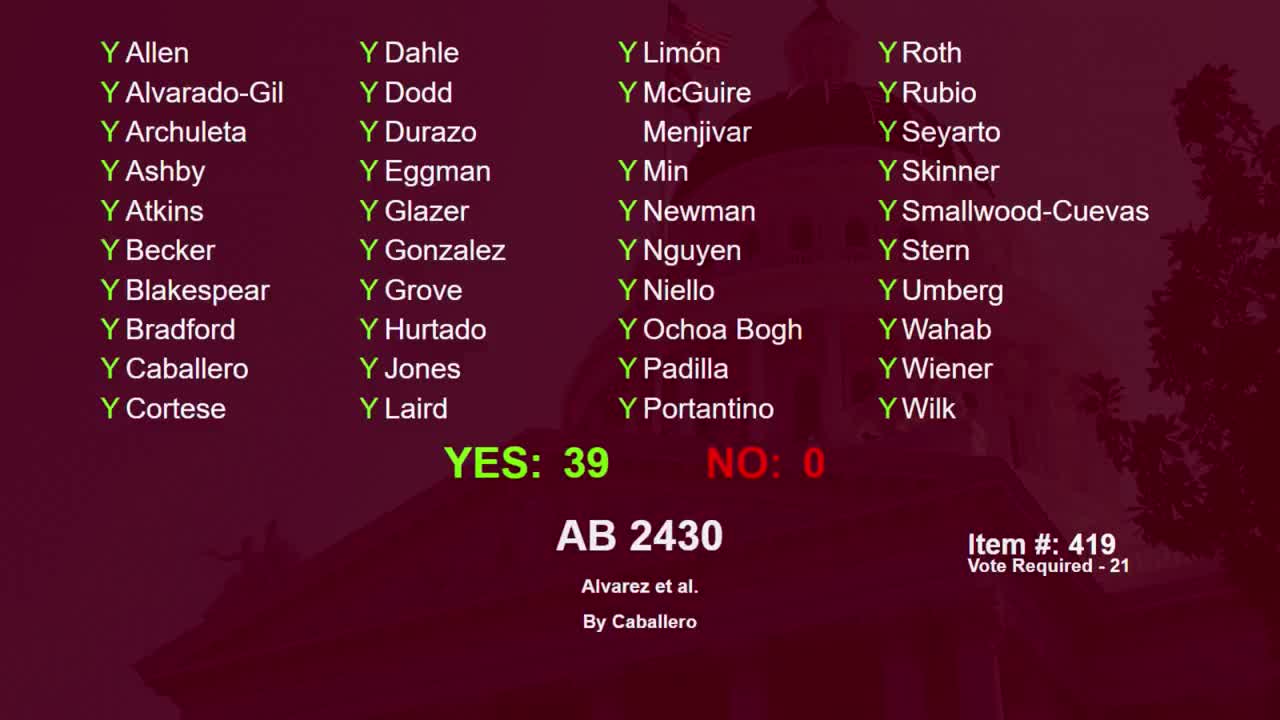 5MIN
Senate Floor
 23MIN
Senate Standing Committee on Natural Resources and Water
 4MIN
Assembly Floor
 9MIN
Assembly Standing Committee on Appropriations
 44MIN
Assembly Standing Committee on Water, Parks, and Wildlife
Bill Author

Bill Co-Author(s):