AB 838: California Water Affordability and Infrastructure Transparency Act of 2023.
- Session Year: 2023-2024
- House: Assembly
- Latest Version Date: 2023-03-21
Current Status:
Failed
(2024-02-01: From committee: Filed with the Chief Clerk pursuant to Joint Rule 56.)
Introduced
In Committee
First Chamber
In Committee
Second Chamber
Enacted
Existing law, the California Safe Drinking Water Act, requires the State Water Resources Control Board to administer provisions relating to the regulation of drinking water to protect public health. Existing law declares it to be the established policy of the state that every human being has the right to safe, clean, affordable, and accessible water adequate for human consumption, cooking, and sanitary purposes. The act prohibits a person from operating a public water system unless the person first submits an application to the state board and receives a permit to operate the system, as specified. The act requires a public water system to submit a technical report to the state board as a part of the permit application or when otherwise required by the state board, as specified, and to submit the report in the form and format and at intervals specified by the state board. Existing law provides that a specified violation of the act is a crime.
This bill would require, on beginning January 1, 2025, and annually thereafter, thereafter at intervals determined by the state board, public water systems to provide specified information and data related to customer water bills and efforts to replace aging infrastructure to the state board. By requiring information and data to be provided to the state board, this bill would expand the scope of a crime and create a state-mandated local program.
The California Constitution requires the state to reimburse local agencies and school districts for certain costs mandated by the state. Statutory provisions establish procedures for making that reimbursement.
This bill would provide that no reimbursement is required by this act for a specified reason.
Existing law, the California Safe Drinking Water Act, requires the State Water Resources Control Board to administer provisions relating to the regulation of drinking water to protect public health. Existing law declares it to be the established policy of the state that every human being has the right to safe, clean, affordable, and accessible water adequate for human consumption, cooking, and sanitary purposes. The act prohibits a person from operating a public water system unless the person first submits an application to the state board and receives a permit to operate the system, as specified. The act requires a public water system to submit a technical report to the state board as a part of the permit application or when otherwise required by the state board, as specified, and to submit the report in the form and format and at intervals specified by the state board. Existing law provides that a specified violation of the act is a crime.
This bill would require, on January 1, 2025, and annually thereafter, public water systems to provide specified information and data related to customer water bills and efforts to replace aging infrastructure to the state board. By requiring information and data to be provided to the state board, this bill would expand the scope of a crime and create a state-mandated local program.
The California Constitution requires the state to reimburse local agencies and school districts for certain costs mandated by the state. Statutory provisions establish procedures for making that reimbursement.
This bill would provide that no reimbursement is required by this act for a specified reason.
This bill shall be known as the California Water Affordability and Infrastructure Transparency Act of 2023.
SEC. 2.The Legislature finds and declares all of the following:(a)In 2022, approximately 150,000 residents of the City of Jackson, Mississippi, were forced to go without potable drinking water as a result of the catastrophic failure of the citys water system.(b)The failure of the City of Jacksons water system was the result of decades of neglect, deferred maintenance, and underinvestment, leaving the citys water infrastructure in a state of crisis.(c)The disaster in the City of Jackson is the most recent example of underinvestment in critical water infrastructure. Similar scenarios have played out in the City of Flint, Michigan, and the City of Newark, New Jersey.(d)Even in California, the State Water Resources Control Board has identified approximately 345 water systems that fail to meet the goals of the states human right to safe, clean, affordable, and accessible water, established by Assembly Bill 685 (Chapter 524 of the Statutes of 2012).(e)The State Water Resources Control Board has estimated that 21 percent of water systems in California have water rates that are unaffordable, even for basic needs.(f)Proper analysis of affordability issues is hampered, however, by the lack of adequate data about actual water bills paid by customers, as opposed to hypothetical amounts calculated using arbitrarily selected amounts of water consumption.(g)The public has a right to know how well water suppliers are maintaining the infrastructure in their communities and how their water bills compare to those in other communities.(h)Transparency regarding water affordability and infrastructure not only helps to keep the public informed, but also keeps water suppliers accountable. Recent research concludes that there is a correlation between increased transparency on the part of water suppliers and the reduced incidence of violations of the Safe Drinking Water Act.SEC. 3.SEC. 2.Section 116530 of the Health and Safety Code is amended to read:116530.(a)A public water system shall submit a technical report to the state board as part of the permit application or when otherwise required by the state board. This report may include, but not be limited to, detailed plans and specifications, water quality information, physical descriptions of the existing or proposed system, information related to technical, managerial, and financial capacity and sustainability, and information related to achieving the goals of Section 106.3 of the Water Code, including affordability and accessibility.
(b)A public water system shall submit the report in the form and format and at intervals specified by the state board.
(c)Beginning January 1, 2025, and annually thereafter, thereafter at intervals determined by the state board, a public water system shall provide to the state board both of the following:
(1)Information and data related to the average water bill paid by customers, including, but not limited, to limited to, all of the following:
(A)The median dollar amount billed to customer accounts in the prior calendar year.
(B)The total dollar amount billed to customer accounts in the prior calendar year.
(C)If the public water system differentiates between customer classifications, separate information and data may be provided for each customer classification.
(2)Information and data related to the public water systems completed and planned efforts to replace aging infrastructure, including, but not limited to, both of the following:
(A)The total cost of all infrastructure improvements completed in the prior calendar year.
(B)The percentage of water main replaced in the prior calendar year.
(d)For purposes of this section, the following definitions apply:
(1)Median dollar amount billed shall be calculated by identifying the middle value of all of the water bills presented to customers.
(2)Water main means any pipeline, except for user service lines, within the distribution system.
(e)For purposes of this section, a water corporation may submit data for each ratemaking area, as identified by the Public Utilities Commission, as opposed to at the public water system level.
SEC. 4.SEC. 3.No reimbursement is required by this act pursuant to Section 6 of Article XIIIB of the California Constitution because the only costs that may be incurred by a local agency or school district will be incurred because this act creates a new crime or infraction, eliminates a crime or infraction, or changes the penalty for a crime or infraction, within the meaning of Section 17556 of the Government Code, or changes the definition of a crime within the meaning of Section 6 of Article XIIIB of the California Constitution.
This bill shall be known as the California Water Affordability and Infrastructure Transparency Act of 2023.
SEC. 2.The Legislature finds and declares all of the following:
(a)In 2022, approximately 150,000 residents of the City of Jackson, Mississippi, were forced to go without potable drinking water as a result of the catastrophic failure of the citys water system.
(b)The failure of the City of Jacksons water system was the result of decades of neglect, deferred maintenance, and underinvestment, leaving the citys water infrastructure in a state of crisis.
(c)The disaster in the City of Jackson is the most recent example of underinvestment in critical water infrastructure. Similar scenarios have played out in the City of Flint, Michigan, and the City of Newark, New Jersey.
(d)Even in California, the State Water Resources Control Board has identified approximately 345 water systems that fail to meet the goals of the states human right to safe, clean, affordable, and accessible water, established by Assembly Bill 685 (Chapter 524 of the Statutes of 2012).
(e)The State Water Resources Control Board has estimated that 21 percent of water systems in California have water rates that are unaffordable, even for basic needs.
(f)Proper analysis of affordability issues is hampered, however, by the lack of adequate data about actual water bills paid by customers, as opposed to hypothetical amounts calculated using arbitrarily selected amounts of water consumption.
(g)The public has a right to know how well water suppliers are maintaining the infrastructure in their communities and how their water bills compare to those in other communities.
(h)Transparency regarding water affordability and infrastructure not only helps to keep the public informed, but also keeps water suppliers accountable. Recent research concludes that there is a correlation between increased transparency on the part of water suppliers and the reduced incidence of violations of the Safe Drinking Water Act.
SEC. 3.Section 116530 of the Health and Safety Code is amended to read:116530.(a)A public water system shall submit a technical report to the state board as part of the permit application or when otherwise required by the state board. This report may include, but not be limited to, detailed plans and specifications, water quality information, physical descriptions of the existing or proposed system, information related to technical, managerial, and financial capacity and sustainability, and information related to achieving the goals of Section 106.3 of the Water Code, including affordability and accessibility.
(b)A public water system shall submit the report in the form and format and at intervals specified by the state board.
(c)Beginning January 1, 2025, and annually thereafter, a public water system shall provide to the state board both of the following:
(1)Information and data related to the average water bill paid by customers, including, but not limited, to all of the following:
(A)The median dollar amount billed to customer accounts in the prior calendar year.
(B)The total dollar amount billed to customer accounts in the prior calendar year.
(C)If the public water system differentiates between customer classifications, separate information and data may be provided for each customer classification.
(2)Information and data related to the public water systems completed and planned efforts to replace aging infrastructure, including, but not limited to, both of the following:
(A)The total cost of all infrastructure improvements completed in the prior calendar year.
(B)The percentage of water main replaced in the prior calendar year.
(d)For purposes of this section, the following definitions apply:
(1)Median dollar amount billed shall be calculated by identifying the middle value of all of the water bills presented to customers.
(2)Water main means any pipeline, except for user service lines, within the distribution system.
(e)For purposes of this section, a water corporation may submit data for each ratemaking area, as identified by the Public Utilities Commission, as opposed to at the public water system level.
SEC. 4.No reimbursement is required by this act pursuant to Section 6 of Article XIIIB of the California Constitution because the only costs that may be incurred by a local agency or school district will be incurred because this act creates a new crime or infraction, eliminates a crime or infraction, or changes the penalty for a crime or infraction, within the meaning of Section 17556 of the Government Code, or changes the definition of a crime within the meaning of Section 6 of Article XIIIB of the California Constitution.
|
Date
|
Status
|
|---|---|
| Feb 1, 2024 | From committee: Filed with the Chief Clerk pursuant to Joint Rule 56. |
| Jan 31, 2024 | Died pursuant to Art. IV, Sec. 10(c) of the Constitution. |
| May 18, 2023 | In committee: Held under submission. |
| Apr 19, 2023 | In committee: Set, first hearing. Referred to APPR. suspense file. |
| Mar 29, 2023 | From committee: Do pass and re-refer to Com. on APPR. (Ayes 9. Noes 0.) (March 28). Re-referred to Com. on APPR. |
| Mar 22, 2023 | Re-referred to Com. on E.S. & T.M. |
| Mar 21, 2023 | From committee chair, with author's amendments: Amend, and re-refer to Com. on E.S. & T.M. Read second time and amended. |
| Feb 23, 2023 | Referred to Com. on E.S. & T.M. |
| Feb 15, 2023 | From printer. May be heard in committee March 17. |
| Feb 14, 2023 | Read first time. To print. |
|
Date
|
Description
|
Location
|
Votes
|
|
|---|---|---|---|---|
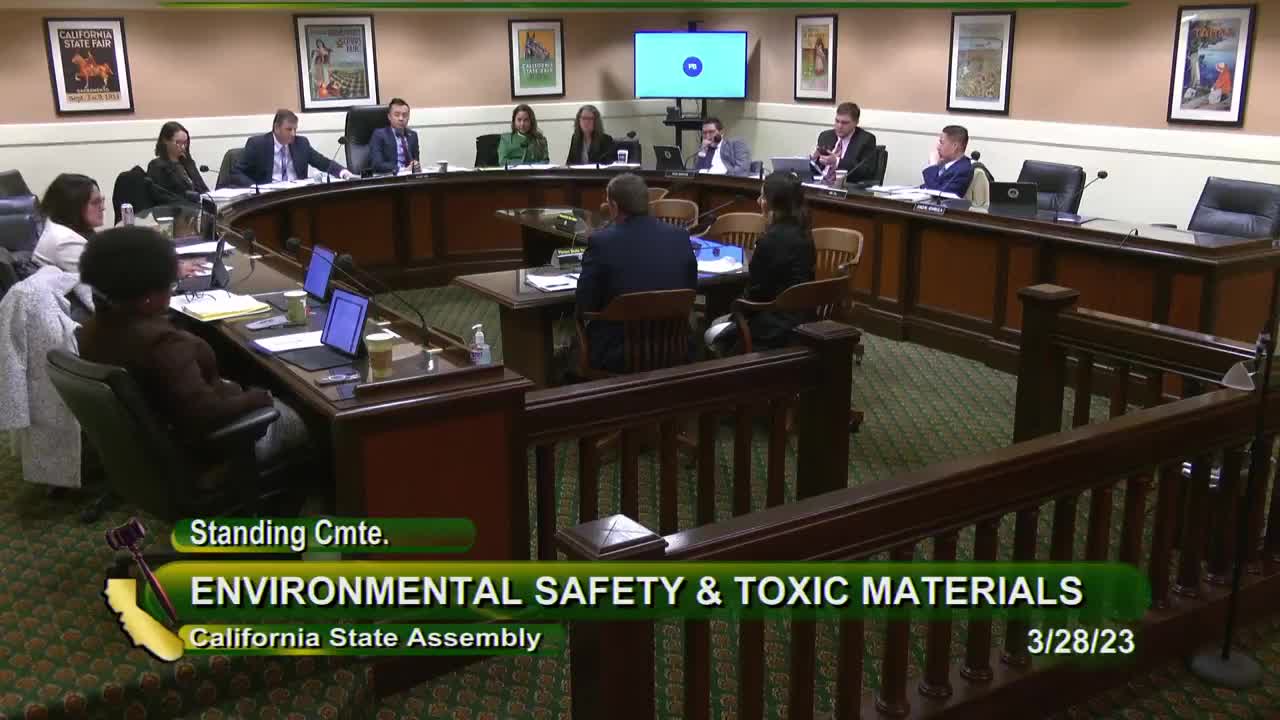
| Mar 28, 2023 | Do pass and be re-referred to the Committee on [Appropriations] | Assembly Standing Committee on Environmental Safety and Toxic Materials |
Passed |
This list shows positions taken on this bill by organizations on the date displayed, which is linked to the original source.
Positions by individuals are not included.
|
Organization
|
Position
|
Date
|
|---|---|---|
| CA African American Chamber of Commerce | ** Support | |
| California American Water | * Support | Mar 28, 2023 |
| California Hispanic Chamber Of Commerce | ** Support | |
| California Municipal Utilities Association | * Against | Mar 28, 2023 |
| California Senior Advocates League | ** Support | |
| California Water Association | ** Support | |
| California Water Service Company | * Support | Mar 28, 2023 |
| El Dorado Irrigation District | * Against | Mar 28, 2023 |
| Kern County Taxpayers Association | ** Support | |
| League of United Latin America Citizens | ** Support | |
| Political Solutions LLC | * Support | Mar 28, 2023 |
| Reeb Government Relations | * Against | Mar 28, 2023 |
| Sustainable Silicon Valley | ** Support |
Date of Hearing: April 19, 2023
ASSEMBLY COMMITTEE ON APPROPRIATIONS
Chris Holden, Chair
ABPCA Bill Id:AB 838
Author:(Connolly) – As Amended Ver:March 21, 2023
Policy Committee: | Environmental Safety and Toxic Materials | Vote: | 9 - 0 |
|
| ||
|
|
Urgency: No State Mandated Local Program: Yes Reimbursable: No
SUMMARY:
This bill requires a public water system to report on the average water bill paid by customers and the public water system’s completed and planned efforts to replace aging infrastructure.
Specifically, this bill, among other things:
- Requires, beginning January 1, 2025, and thereafter at intervals determined by the State Water Board, a public water system to provide to the State Water Board both of the following:
- Information and data related to the average water bill paid by customers, including the median and total dollar amounts billed to customer accounts in the prior calendar year. Provides that if the public water system differentiates between customer classifications, separate information and data may be provided for each customer classification.
- Information and data related to the public water system’s completed and planned efforts to replace aging infrastructure, including the total cost of all infrastructure improvements completed in the prior calendar year and the percentage of water mains replaced in the prior calendar year.
- Provides that a water corporation may submit the data required by this bill for each ratemaking area, as identified by the California Public Utilities Commission, as opposed to at the public water system level.
FISCAL EFFECT:
The State Water Board estimates ongoing annual costs of approximately $225,000 from the Safe Drinking Water Account (SDWA), absent a General Fund appropriation, to implement the requirements of this bill. The SDWA is funded by fees paid by public water systems.
COMMENTS:
1) Purpose. According to the author:
Many California families are struggling and falling behind on their water bills, and more transparency is needed to ensure that water rates are equitable and affordable for those who need our help the most. We must also be attentive to the needs of our aging water infrastructure to stay ahead of a crisis that could leave hundreds of thousands of families throughout the state without a secure source of clean drinking water. AB 838 is a common sense solution to improve accountability for our ratepayers and state agencies.
2) Public Water Systems. Nearly a million Californians lack access to safe drinking water because they receive water from systems that do not meet water quality standards. The State Water Board regulates the operation of roughly 7,400 public water systems throughout the state and disburses federal and state assistance to help them improve their water quality. According to the State Water’s Board 2022 Drinking Water Needs Assessment, 346 public water systems were identified as failing, 508 as “at-risk”, and an additional 453 as “potentially at-risk”.
3) Electronic Annual Report (eAR). The eAR is a survey of public water systems, currently required annually, which is used by the State Water Board to collect critical water system information intended to assess the status of compliance with specific regulatory requirements (such as source water capacity); to provide updated contact and inventory information (such as population and number of service connections); and, to provide information that is used to assess the financial capacity of water systems. For 2023, the eAR survey was released to all public water systems on March 13th with reports due by May 13th. State Water Board staff are responsible for all aspects of the eAR process, including creating the survey, maintenance, and programming. Additionally, staff from the Division of Drinking Water district offices follow up with systems that do not file reports on time. According to the State Water Board, the additional information required by this bill could be incorporated into either the eAR or the SAFER Clearinghouse, which is a new reporting platform to streamline drought and conservation data reporting from public water systems.
4) Support and Opposition. The California Water Service, the sponsor of this bill, contends that while the information currently collected through the eAR process is useful, it is insufficient:
First, because the Water Board does not currently collect information on actual water bills paid by customers, the only means by which affordability can be measured is by comparing theoretical monthly water bills based on hypothetical amounts of monthly water use. AB 838 closes this gap by asking water utilities to report median monthly water bills. This information will allow for a more thorough and in-depth analysis of water affordability in California. Second, because the Water Board does not currently collect information on the types of infrastructure improvements water utilities are completing, the state is left with an incomplete picture of where additional assistance – be it technical or financial – may be needed to ensure customers are receiving safe, reliable water utility service. AB 838 addresses this challenge by asking water utilities to report on the percentage of water mains that it has replaced. Main replacement rates are generally a good barometer of how proactive a utility is in maintaining, upgrading, and replacing its infrastructure. Additionally, proactive main replacements programs are a central component of water conservation efforts as they help to minimize water lost due to leaks. Finally, as the Water Board has updated the Electronic Annual Report over the last several years, some have questioned whether it has the statutory authority to collect financial, including data on water rates, or infrastructure investment information from water utilities. AB 838 addresses this by plainly providing the Water Board with statutory authority to collect these types of information from water utilities.
Writing in opposition, the California Municipal Utilities Association states:
CMUA’s members support transparency and actively engage with the public through their local governing boards and other means. That includes disclosures on rate structures and infrastructure needs. However, data collection to just collect it without a stated specific purpose or benefit, is not appropriate. Notwithstanding the fact the Board can, and in many instances, already collects this data, requiring information on infrastructure is not going to result in additional investment and comparing bills in different communities will not improve affordability given the unique needs of each water system. In addition, carving out specific data requirements in statute opens up the door to the Board having to adjust statute every year for changes in the EAR. Further, while the author’s desire is to ensure the public has more access to this data, submitting it through the EAR is unlikely to achieve that goal.
Analysis Prepared by: Nikita Koraddi / APPR. / (916) 319-2081
Date of Hearing: March 28, 2023
ASSEMBLY COMMITTEE ON ENVIRONMENTAL SAFETY AND TOXIC MATERIALS
Alex Lee, Chair
ABPCA Bill Id:AB 838 (
Author:Connolly) – As Amended Ver:March 21, 2023
SUBJECT: California Water Affordability and Infrastructure Transparency Act of 2023
SUMMARY: Requires, beginning January 1, 2025, and thereafter at intervals determined by the State Water Resources Control Board (State Water Board), a public water system to provide to the State Water Board specified information and data related to the average water bill paid by customers and the public water system’s completed and planned efforts to replace aging infrastructure. Specifically, this bill:
- Requires, beginning January 1, 2025, and thereafter at intervals determined by the State Water Board, a public water system to provide to the State Water Board both of the following:
- Information and data related to the average water bill paid by customers, including, but not limited to, all of the following:
- The median dollar amount billed to customer accounts in the prior calendar year;
- The total dollar amount billed to customer accounts in the prior calendar year; and,
- If the public water system differentiates between customer classifications, separate information and data may be provided for each customer classification.
- Information and data related to the public water system’s completed and planned efforts to replace aging infrastructure, including, but not limited to, both of the following:
- The total cost of all infrastructure improvements completed in the prior calendar year; and,
- The percentage of water main replaced in the prior calendar year.
- Information and data related to the average water bill paid by customers, including, but not limited to, all of the following:
- Requires that "median dollar amount billed" is calculated by identifying the middle value of all of the water bills presented to customers.
- Defines "water main" as any pipeline, except for user service lines, within the distribution system.
- Provides that a water corporation may submit the data required by this bill for each ratemaking area, as identified by the Public Utilities Commission, as opposed to at the public water system level.
EXISTING LAW:
- Authorizes, pursuant to the federal Safe Drinking Water Act (SDWA), the United States Environmental Protection Agency (US EPA) to set standards for drinking water quality and to oversee the states, localities, and water suppliers who implement those standards. (42 United States Code § 300 (f) et seq.)
- Declares that it is the established policy of the state that every human being has the right to safe, clean, affordable, and accessible water adequate for human consumption, cooking, and sanitary purposes. (Water Code § 106.3(a))
- Requires all relevant state agencies to consider the human right to water state policy when revising, adopting, or establishing policies, regulations, and grant criteria when those policies, regulations, and criteria are pertinent to the uses of water. (Water Code § 106.3 (b))
- Defines a "public water system" as a system for the provision of water for human consumption through pipes or other constructed conveyances that has 15 or more service connections or regularly serves at least 25 individuals daily at least 60 days out of the year. A public water system includes the following:
- Any collection, treatment, storage, and distribution facilities under control of the operator of the system that are used primarily in connection with the system;
- Any collection or pretreatment storage facilities not under the control of the operator that are used primarily in connection with the system; and,
- Any water system that treats water on behalf of one or more public water systems for the purpose of rendering it safe for human consumption. (Health and Safety Code (HSC) § 116275)
- Requires, once every five years, the State Water Board to submit to the Legislature a comprehensive Safe Drinking Water Plan for California. Requires the Safe Drinking Water Plan to include, but not be limited to, the following information:
- Estimated costs of requiring public drinking water systems that have less than 10,000 service connections to meet primary drinking water standards and public health goals;
- A discussion of alternative methods of financing the construction, installation, and operation of new treatment technologies, including, but not limited to user charges, state or local taxes, state planning and construction grants, loans, and loan guarantees;
- A discussion of sources of revenue presently available, and projected to be available, to public water systems to meet current and future expenses; and,
- An analysis of the current cost of drinking water paid by residential, business, and industrial consumers based on a statewide survey of large, medium, and small public water systems. (HSC § 116355)
- Requires a public water system to submit a technical report to the State Water Board as part of the permit application or when otherwise required by the State Water Board. Authorizes this report to include, but does not limit it to, detailed plans and specifications; water quality information; physical descriptions of the existing or proposed system; information related to technical, managerial, and financial capacity and sustainability; and, information related to achieving the goals of the state’s human right to water policy, including affordability and accessibility. (HSC § 116530(a))
- Requires a public water system to submit the report in the form and format and at intervals specified by the State Water Board. (HSC § 116530(b))
- Requires, by July 1, 2018, a community water system to compile an inventory of known lead user service lines in use in its distribution system and identify areas that may have lead user service lines in use in its distribution system. (HSC § 116885 (a))
- Requires, by July 1, 2020, a community water system that has identified known lead user service lines in use in its distribution system as provided in subdivision (a) to provide a timeline for replacement of known lead user service lines in use in its distribution system to the State Water Board. (HSC § 116885 (b))
- Requires an urban and community water system to report the number of annual discontinuations of residential service for inability to pay on the urban and community water system’s Internet Web site, if an Internet Web site exists, and to the State Water Board. Requires the State Water Board to post on its Internet Web site the information reported. (HSC § 116918)
- Requires a small water supplier and a nontransient noncommunity water system that is a school to each report annually specified water supply condition information to the State Water Board through the state board’s Electronic Annual Reporting (eAR) System or other reporting tool, as directed by the State Water Board. (Water Code § 10609.61)
FISCAL EFFECT: Unknown.
COMMENTS:
Need for the bill: According to the author, "Many California families are struggling and falling behind on their water bills, and more transparency is needed to ensure that water rates are equitable and affordable for those who need our help the most. We must also be attentive to the needs of our aging water infrastructure to stay ahead of a crisis that could leave hundreds of thousands of families throughout the state without a secure source of clean drinking water. AB 838 is a common sense solution to improve accountability for our ratepayers and state agencies."
Human right to water: In 2012, by enacting Assembly Bill (AB) 685 (Eng, Chapter 524, Statutes of 2012), California became the first state with a Human Right to Water law. AB 685 established state policy that every human being has the right to safe, clean, affordable, and accessible water adequate for human consumption, cooking, and sanitation. Water supply issues, contaminants, costs of treatment and distribution systems, climate change, the number and nature of small public water systems, especially in disadvantaged communities, and many other factors continue to challenge progress in implementing the Human Right to Water goals.
Drinking water systems in California: According to a July 2022 report by the California State Auditor, "California is one of the most prosperous states in the country, and yet, fundamental inequities still exist, including access to safe drinking water. In fact, nearly a million Californians lack access to safe drinking water because they receive water from systems that do not meet water quality standards. The [State Water Board] regulates the operation of roughly 7,400 drinking water systems throughout the State and disburses federal and state assistance to help them improve their water quality. As of December 2021, the State Water Board reported that more than 370 water systems were classified as failing water systems because they exceeded the maximum contaminant levels for safe drinking water. These failing water systems provide water to more than 920,000 people. Nearly 240 of these water systems have been failing for at least three years, and more than 150 have been failing for five years. Further, for 2022, the State Water Board’s data show that an additional 432 water systems serving more than 1 million people are at risk of failing."
Health effects of drinking water contaminants: The US EPA reports that there is a broad range of health effects associated with exposure to drinking water contaminants. Ingestion or exposure to pathogens at sufficient doses can result in gastrointestinal illness with symptoms such as diarrhea, nausea, stomach cramps, and vomiting. Exposure to higher doses of chemicals, metals, or radionuclides through drinking water can produce biological responses, toxicological effects, and more severe health impacts including cancer, developmental or reproductive effects, neurological effects, and organ damage.
Electronic Annual Report: The electronic Annual Report (eAR) is a survey of public water systems, currently required annually, which is used by the State Water Board to collect critical water system information intended to assess the status of compliance with specific regulatory requirements (such as source water capacity); to provide updated contact and inventory information (such as population and number of service connections); and, to provide information that is used to assess the financial capacity of water systems.
History of the annual report: According to the State Water Board, the "Annual Report to the Drinking Water Program" began in the mid-1980's as a hard copy report submitted to the Division of Drinking Water (DDW) district offices. (The DDW was previously called the Drinking Water Program and was housed at the Department of Public Health and its predecessor agencies. The administration of this program was transferred to the State Water Board in July, 2014). The DDW field staff and local primacy agencies (LPAs) require the annual report per Section 116530 of the Health & Safety Code, and they have used this information in the conduct of sanitary surveys of public water systems. In 2009, the Annual Report moved online where it was dubbed the electronic Annual Report (eAR). There was a Large Water System and Small Water System survey, based on system size at the cutoff of 1,000 service connections or a population of 3,300. Over the following 11 years, eARs were developed for release to public water systems and field office staff tasked with review. In 2020, the State Water Board redeveloped the eAR onto a new reporting platform offering advancements in customization and performance.
Current uses of the eAR: In addition to DDW field staff and county LPA representatives, the eAR serves as a platform for information gathering from public water systems to the State Water Board. Current drivers of eAR data collection, as listed by the State Water Board, include, among others:
- Recommendations for the Implementation of a Statewide Low-Income Water Rate Assistance Program, as required by AB 401 (Dodd, Chapter 662, Statutes of 2015)
- The Needs Assessment, as required under the Safe and Affordable Funding for Equity and Resilience (SAFER) program established by SB 200 (Monning, Chapter 120, Statutes of 2019)
- Other data requirements for the SAFER program, including data for drinking water risk indicators
- Water shutoff reporting under SB 998 (Dodd, Chapter 891, Statutes of 2018)
- The development of the Safe Drinking Water Plan
- Drought planning for small water suppliers and rural communities under SB 552 (Hertzberg, Chapter 552, Statutes of 2021)
- Division of Administrative Services utilizes eAR information for fee billing
- Division of Financial Assistance uses the information in the Operator Certification Unit
- Office of Research, Performance, and Planning uses the eAR information for implementation of urban water use efficiency requirements under AB 1668 (Friedman, Chapter 15, Statutes of 2018) and SB 606 (Hertzberg, Chapter 14, Statutes of 2018)
The State Water Board reports that other users of eAR data include people tasked with managing and developing the following programs and activities:
- California Water Plan
- Urban Water Management Plan
- The Truckee River Operating Agreement (TROA)
- Sustainable Groundwater Management Act (SGMA) Groundwater Management
- Drought Risk Index- County Drought Advisory Group
- Department of Water Resources Public Water Systems Statistics Surveys
Current data gathered by the eAR: The eAR system is used to collect critical information that public water systems are required to annually report to the State Water Board’s DDW. This includes information about the population served, service connections, water sources, amount of water supplied and delivered, recycled water, customer charges, income, water affordability, water quality, backflow assemblies, operator certification, system improvements, customer complaints, emergency plans, conservation plans, and climate change impacts and measures.
In more detail, water systems are required to report on, in addition to other things, information, if any, on customer assistance programs designed to address customer affordability challenges; residential and non-residential customer charges, rate structures, and other service fees borne by customers to support the water system; and, annual revenues and incurred expenses. The latter information is used to assess the financial resiliency of water systems.
In addition, public water systems are required to report on updated service connection counts by types and metering status, and on improvements and modifications to the treatment or distribution system completed in the reporting year or planned for the future.
This bill: This bill requires public water systems to report additional information through the eAR to the State Water Board. Specifically, AB 838 will require, beginning January 1, 2025, and thereafter at intervals determined by the State Water Board, a public water system to provide to the State Water Board, specified information and data related to the average water bill paid by customers and the public water system’s completed and planned efforts to replace aging infrastructure.
The author’s office argues that these changes are needed because, "customers have the right to know what infrastructure investments their water utilities are making and to be able to easily compare that information to other communities in the state… Just as residents have a right to know how well water suppliers are maintaining the infrastructure in their communities, the public also has a right to know how their actual water bills compare to those in other communities. Here too, transparency regarding water affordability provides valuable information to the public and gives policy makers the information they need to craft solutions to the state’s water affordability challenges."
Arguments in support:
The sponsor of the bill, California Water Service (Cal Water), writes in support, "Current law requires water utilities in California to submit various information to the State Water Resources Control Board (Water Board). This information is collected through the Water Board’s Electronic Annual Report. While the current data is incredibly useful, it is insufficient in several important regards.
First, because the Water Board does not currently collect information on actual water bills paid by customers, the only means by which affordability can be measured is by comparing theoretical monthly water bills based on hypothetical amounts of monthly water use. AB 838 closes this gap by asking water utilities to report median monthly water bills. This information will allow for a more thorough and in-depth analysis of water affordability in California.
Second, because the Water Board does not currently collect information on the types of infrastructure improvements water utilities are completing, the state is left with an incomplete picture of where additional assistance – be it technical or financial – may be needed to ensure customers are receiving safe, reliable water utility service. AB 838 addresses this challenge by asking water utilities to report on the percentage of water mains that it has replaced. Main replacement rates are generally a good barometer of how proactive a utility is in maintaining, upgrading, and replacing its infrastructure. Additionally, proactive main replacements programs are a central component of water conservation efforts as they help to minimize water lost due to leaks.
Finally, as the Water Board has updated the Electronic Annual Report over the last several years, some have questioned whether it has the statutory authority to collect financial, including data on water rates, or infrastructure investment information from water utilities. AB 838 addresses this by plainly providing the Water Board with statutory authority to collect these types of information from water utilities."
The California Water Association (CWA) argues, "Disclosure of bill payments and infrastructure costs are vital to for a comprehensive and accurate analysis of the state’s water needs. AB 838 provides greater transparency and provides valuable information to the public and gives policy makers the information they need to craft solutions to the state’s water affordability challenges."
Arguments in opposition:
The California Municipal Utilities Association (CMUA) writes in opposition, "… the State Board requires the submittal of information from public water systems through the Electronic Annual Report. Section 116530 of the Health and Safety Code gives the Board broad authority to ask for data through this process for a variety of purposes that they feel is appropriate… The EAR already requires a robust amount of information, including details related to customer charges and financial data. And the language already gives the State Board authority to ask for data related to infrastructure and affordability… CMUA’s members support transparency and actively engage with the public through their local governing boards and other means. That includes disclosures on rate structures and infrastructure needs. However, data collection to just collect it without a stated specific purpose or benefit, is not appropriate. Notwithstanding the fact the Board can, and in many instances, already collects this data, requiring information on infrastructure is not going to result in additional investment and comparing bills in different communities will not improve affordability given the unique needs of each water system. In addition, carving out specific data requirements in statute opens up the door to the Board having to adjust statute every year for changes in the EAR. Further, while the author’s desire is to ensure the public has more access to this data, submitting it through the EAR is unlikely to achieve that goal."
The El Dorado Irrigation District (EID) argues, "The [State Water] Board directly enforces the California Safe Drinking Water Act for all public water systems but does not exercise authority for rate setting or capital expenditures. The [State Water] Board does not have jurisdiction over public water system rate setting. And the [State Water] Board does not have the staff capacity or resources to interpret data and information that would be submitted by 750 public water systems. Further, the information gathered would have little meaning as each system is different, including source of supply, level of treatment, elevational differences in service area, miles of distribution line per customer, age of system, et cetera.…The burden imposed on public water systems to calculate the average water bill paid by customers on an annual basis and submit data on infrastructure investments regarding replacement would be wasted effort. Spending on new infrastructure in anticipation of population growth as well as expenditures on infrastructure; e.g., drinking water and wastewater treatment facilities, to comply with new regulations also is important. This legislation would not address either of the latter expenditures."
Previous related legislation:
- SB 200 (Monning, Chapter 120, Statutes of 2019). Establishes the Safe and Affordable Drinking Water Fund to provide $130 million per year that will be used to develop and implement sustainable solutions for small systems with violations of drinking water standards. Requires the State Water Board to create an annual expenditure plan for the fund. Requires the expenditure plan to be based on a needs assessment, which the State Water Board annually conducts to identify the overall resources needed to bring failing water systems.
- AB 685 (Eng, Chapter 524, Statutes of 2012). Declares that it is the established policy of the state that every human being has the right to clean, affordable, and accessible water adequate for human consumption, cooking, and sanitary purposes and requires relevant state agencies, including the Department of Water Resources, the State Water Board, and the State Department of Public Health, to consider this state policy when revising, adopting, or establishing policies, regulations, and grant criteria pertinent to the human uses of water.
REGISTERED SUPPORT / OPPOSITION:
Support
California Water Service Company (Sponsor)
CA African American Chamber of Commerce
California American Water, a Wholly Owned Subsidiary of American Water Works
California Hispanic Chamber of Commerce
California Senior Advocates League
California Water Association
Kern County Taxpayers Association
League of United Latin America Citizens
Sustainable Silicon Valley
Opposition
California Municipal Utilities Association
El Dorado Irrigation District
Analysis Prepared by: Shannon McKinney / E.S. & T.M. /
Discussed in Hearing
 8MIN
Assembly Standing Committee on Environmental Safety and Toxic Materials
Bill Author

Bill Co-Author(s):