AB 844: Zero-emission trucks: insurance.
- Session Year: 2023-2024
- House: Assembly
- Latest Version Date: 2023-10-07
Current Status:
Passed
(2023-10-07: Chaptered by Secretary of State - Chapter 347, Statutes of 2023.)
Introduced
In Committee
First Chamber
In Committee
Second Chamber
Enacted
What does this bill do?
This bill tells the California Department of Insurance to study and address the availability and cost of insurance for heavy‑duty trucks and fleets that use zero‑emission technologies, affecting insurers, truck owners, and fleet operators. The department must collect data from insurance companies and publish the results in aggregate for the public while keeping individual company reports confidential. It must also create a consumer website showing which insurers offer coverage for battery, hydrogen, or other zero‑emission trucks and develop a strategy (including options like a risk pool) to fill insurance gaps.
The summary is provided by generative AI which can make mistakes. For original language, please view the details in the table below.
Existing law establishes the Air Quality Improvement Program, administered by the State Air Resources Board, for the purposes of funding projects related to, among other things, the reduction of criteria air pollutants and improvement of air quality. As part of the funding plan for the Air Quality Improvement Program, existing law requires the state board to include a 3-year investment strategy for zero- and near-zero-emission heavy-duty vehicles and equipment commensurate with meeting state greenhouse gas emissions reduction goals.
Existing law provides for the regulation of insurance by the Department of Insurance, which is under the control of the Insurance Commissioner.
This bill would require the department to implement specific data collections on the availability and affordability of insurance for heavy-duty trucks and truck fleets. The bill would require the department to issue a bulletin on or before February 1, 2024, to initiate the first data collection, and would require admitted insurers to respond on or before May 1, 2024. The bill would require the surveys and data calls to include specified information, including, among other things, whether an insurance company offers insurance for zero-emission truck options. The bill would require the information to be submitted to the commissioner and to be confidential, as specified. The bill would require the commissioner to publish the information in the aggregate, and would prohibit the identification of an individual respondent or insurer, except as specified. The bill would require the commissioner to establish and maintain a link on the departments internet website that provides public access to this aggregate information.
This bill would require the department, in consultation with the State Air Resources Board, to create a consumer-focused online insurance information resource tool for the public to use to readily find information and insurance options for battery-powered, hydrogen-powered, or other zero-emission advanced truck technology to provide a one-stop for the public. The bill would also require the department, in consultation with the state board, to create a strategy, on or before January 1, 2025, to address insurance gaps for new heavy-duty truck technologies, as specified.
Existing constitutional provisions require that a statute that limits the right of access to the meetings of public bodies or the writings of public officials and agencies be adopted with findings demonstrating the interest protected by the limitation and the need for protecting that interest.
This bill would make legislative findings to that effect.
Existing law establishes the Air Quality Improvement Program, administered by the State Air Resources Board, for the purposes of funding projects related to, among other things, the reduction of criteria air pollutants and improvement of air quality. As part of the funding plan for the Air Quality Improvement Program, existing law requires the state board to include a 3-year investment strategy for zero- and near-zero-emission heavy-duty vehicles and equipment commensurate with meeting state greenhouse gas emissions reduction goals.
Existing law provides for the regulation of insurance by the Department of Insurance, which is under the control of the Insurance Commissioner.
This bill would require the department to implement specific data collections on the availability and affordability of insurance for heavy-duty trucks and truck fleets. The bill would require the department to issue a bulletin on or before February 1, 2024, to initiate the first data collection, and would require admitted insurers to respond on or before May 1, 2024. The bill would require the surveys and data calls to include specified information, including, among other things, whether an insurance company offers insurance for zero-emission truck options. The bill would require the information to be submitted to the commissioner and to be confidential, as specified. The bill would require the commissioner to establish and maintain a link on the departments internet website that provides public access to this information.
This bill would require the department, in consultation with the State Air Resources Board, to create a consumer-focused online insurance information resource tool for the public to use to readily find information and insurance options for battery-powered, hydrogen-powered, or other zero-emission advanced truck technology to provide a one-stop for the public. The bill would also require the department, in consultation with the state board, to create a strategy, on or before January 1, 2025, to address insurance gaps for new heavy-duty truck technologies, as specified.
Existing constitutional provisions require that a statute that limits the right of access to the meetings of public bodies or the writings of public officials and agencies be adopted with findings demonstrating the interest protected by the limitation and the need for protecting that interest.
This bill would make legislative findings to that effect.
(1)Existing
Existing law establishes the Air Quality Improvement Program, administered by the State Air Resources Board, for the purposes of funding projects related to, among other things, the reduction of criteria air pollutants and improvement of air quality. As part of the funding plan for the Air Quality Improvement Program, existing law requires the state board to include a 3-year investment strategy for zero- and near-zero-emission heavy-duty vehicles and equipment commensurate with meeting state greenhouse gas emissions reduction goals.
This bill would require the state board, as part of the 3-year investment strategy, to provide an assessment, in consultation with the Department of Insurance, of the availability and affordability of insurance for advanced fleet technologies for heavy-duty vehicles and the role of insurance markets in meeting state greenhouse gas emissions reduction goals. The bill would also require the state board, in consultation with the department, to create a strategy, on or before January 1, 2025, to address insurance gaps for new heavy-duty truck technologies, as specified.(2)Existing
Existing law provides for the regulation of insurance by the Department of Insurance, which is under the control of the Insurance Commissioner.
This bill would require the department to implement specific data collections on the availability and affordability of insurance for heavy-duty trucks and truck fleets. The bill would require the department to issue a bulletin on or before February 1, 2024, to initiate the first data collection, and would require admitted insurers to respond on or before May 1, 2024. The bill would require the surveys and data calls to include specified information, including, among other things, whether an insurance company offers insurance for zero-emission truck options. The bill would require the information to be submitted to the commissioner and to be confidential, as specified.
This bill would require the department, in consultation with the State Air Resources Board, to create a tool for the public to use to readily find information and insurance options for battery-powered, hydrogen-powered, or other zero-emission advanced truck technology to provide a one-stop for the public. The bill would also require the department, in consultation with the state board, to create a strategy, on or before January 1, 2025, to address insurance gaps for new heavy-duty truck technologies, as specified.
Existing constitutional provisions require that a statute that limits the right of access to the meetings of public bodies or the writings of public officials and agencies be adopted with findings demonstrating the interest protected by the limitation and the need for protecting that interest.
This bill would make legislative findings to that effect.
(1)Existing law establishes the Air Quality Improvement Program, administered by the State Air Resources Board, for the purposes of funding projects related to, among other things, the reduction of criteria air pollutants and improvement of air quality. As part of the funding plan for the Air Quality Improvement Program, existing law requires the state board to include a 3-year investment strategy for zero- and near-zero-emission heavy-duty vehicles and equipment commensurate with meeting state greenhouse gas emissions reduction goals.
This bill would require the state board, as part of the 3-year investment strategy, to provide an assessment, in consultation with the Department of Insurance, of the availability and affordability of insurance for advanced fleet technologies for heavy-duty vehicles and the role of insurance markets in meeting state greenhouse gas emissions reduction goals. The bill would also require the state board, in consultation with the department, to create a strategy, on or before January 1, 2025, to address insurance gaps for new heavy-duty truck technologies, as specified.
(2)Existing law provides for the regulation of insurance by the Department of Insurance, which is under the control of the Insurance Commissioner.
This bill would require the department to implement specific data collections on the availability and affordability of insurance for heavy-duty trucks and truck fleets. The bill would require the department to issue a bulletin on or before February 1, 2024, to initiate the first data collection, and would require admitted insurers to respond on or before May 1, 2024. The bill would require the surveys and data calls to include specified information, including, among other things, whether an insurance company offers insurance for zero-emission truck options. The bill would require the information to be submitted to the commissioner and to be confidential, as specified.
This bill would require the department, in consultation with the State Air Resources Board, to create a tool for the public to use to readily find information and insurance options for battery-powered, hydrogen-powered, or other zero-emission advanced truck technology to provide a one-stop for the public.
Existing constitutional provisions require that a statute that limits the right of access to the meetings of public bodies or the writings of public officials and agencies be adopted with findings demonstrating the interest protected by the limitation and the need for protecting that interest.
This bill would make legislative findings to that effect.
The Legislature finds and declares the following:
(a)Reducing emissions from mobile pollution sources, including heavy-duty trucks, saves lives and provides health benefits by reducing the formation of ozone, greenhouse gas emissions, fine particulate matter (PM2.5), and toxic diesel particulate matter (PM). These emissions cause health impacts that disproportionately harm vulnerable and disadvantaged communities near freeways that serve as major transit routes for large, heavy-duty trucks.
(b)Deployment of increasing numbers of zero-emission heavy-duty trucks is an essential part of the states strategy to meet specific emissions reductions targets for both criteria pollutants and greenhouse gases, including 2030 targets for reducing emissions of the super pollutant black carbon, which is a pollutant that is commonly released by dieselpowered trucks.
(c)The state continues to develop rules and incentives to achieve 100% zero emission truck fleets. In 2020, the State Air Resources Board approved the Advanced Clean Trucks regulation (Sections 1963 to 1963.5, inclusive, and Sections 2012 to 2012.2, inclusive, of Title 13 of the California Code of Regulations), ensuring that truck manufacturers produce and sell zero-emission medium- and heavy-duty trucks as an increasing portion of their sales from 2024 to 2035. The regulation is anticipated to result in 100,000 zero-emission trucks by 2030 and 300,000 by 2035. In 2021, the State Air Resources Board initiated an Advanced Clean Fleet regulatory process that includes provisions to require all drayage trucks entering seaports and intermodal railyards to be zero emission by 2035, and would end the sale of combustion-powered trucks in California by 2040. Furthermore, in the past five years, the state has appropriated over $1,000,000,000 in incentives, through programs administered by the State Air Resources Board, to incentivize zero-emission medium- and heavy-duty trucks.
(d)New technologies, without long histories of actuarial information, can face challenges finding insurance. Fleets adopting zero-emission technologies may be facing a limited market for insurance, which could slow deployment of zero-emission heavy-duty trucks.
(e)A robust data source can strengthen insurance markets by providing both consumers and insurers aggregated loss information to increase understanding of this emerging insurance market, identify potential barriers for expanding insurance options, and provide both the insurance regulator and air quality regulator with critical information to inform policy alternatives.
SEC. 2.Article 10.9 (commencing with Section 938) is added to Chapter 1 of Part 2 of Division 1 of the Insurance Code, to read:10.9.Zero-Emission Heavy-Duty Truck Data Reporting938.(a)The Department of Insurance shall implement specific data collections on the availability and affordability of insurance for heavy-duty trucks and truck fleets that utilize advanced fuels and related technologies to better understand emerging markets important to the State of Californias climate change goals, expand insurance options by establishing more robust data for consumers and insurers, and identify potential barriers to zero-emission technologies in the transportation sector. The focus of the data collections shall be zero-emission technologies that reduce greenhouse gas emissions and improve air quality when compared with conventional or fully commercialized alternatives, including those defined by the State Air Resources Board.
(b)The department shall issue a bulletin on or before February 1, 2024, to initiate the first data collection. Admitted insurers shall respond on or before May 1, 2024. Data collections shall include surveys and data calls from insurance companies licensed to write insurance through the admitted market. The surveys and data calls shall include, but are not limited to, all of the following information:
(1)Whether an insurance company offers insurance for zero-emission truck options.
(2)Loss experience information per claim over a specified time period, such as annually, including, but not limited to, all of the following:
(A)Type of loss, which may include both liability and physical damage type losses.
(B)Type of medium- and heavy-duty truck.
(C)Date of loss.
(D)Amount of losses incurred and paid in United States dollars.
(3)The number of vehicles covered under insurance policies,
(4)Policy level experience, including, but not limited to, premium per type of medium- and heavy-duty truck insured, the time the truck is insured from effective start date to end date of coverage, and type of coverage, which may include both liability and physical damage type coverage.
(5)Minimum, maximum, and average overall coverage limit of the policy, and per type of medium- and heavy-duty truck within a truck fleet.
(c)The information required by this section shall be submitted to the commissioner. The commissioner may specify, by bulletin, the manner of submission and format of the reporting required pursuant to subdivision (a).
(d)Notwithstanding subdivision (e), the commissioner shall publish information compiled from the data submitted pursuant to this section in the aggregate and shall not identify an individual respondent or insurer, except to support consumer understanding of insurance options as specified in subdivision (a) of Section 938.1. The commissioner shall establish and maintain a link on the departments internet website that provides public access to the aggregate information required to be disclosed pursuant to this subdivision.
(e)Information submitted to the commissioner, as required by this section, shall be confidential pursuant to Section 7929.000 of the Government Code and exempt from the California Public Records Act (Division 10 (commencing with Section 7920.000) of Title 1 of the Government Code). Additionally, that information shall not be subject to subpoena or subpoena duces tecum. Testimony by the commissioner, the commissioners staff, an employee of the department, or a person to whom the reporting required by this section was disclosed, regarding the contents of any report submitted pursuant to this section, shall be inadmissible as evidence in a civil proceeding.
938.1.(a)The Department of Insurance, in consultation with the State Air Resources Board, shall create a consumer-focused online insurance information resource tool, based on data collected pursuant to Section 938, for the public to use to readily find information and insurance options for battery-powered, hydrogen-powered, or other zero-emission advanced truck technology, including which insurance companies offer insurance for trucks or fleets using different zero-emission technologies and any relevant coverage limits or fleet size specifications, to provide a one-stop for the public.
(b)The Department of Insurance, in consultation with the State Air Resources Board, shall provide an assessment of all of the following:
(1)The availability and affordability of insurance for existing and emerging advanced fleet technologies being deployed for heavy-duty vehicles.
(2)The role of insurance markets in meeting the goals of Chapter 4.1 (commencing with Section 39710) of Part 2 of Division 26 of the Health and Safety Code and the greenhouse gas reduction and short-lived climate pollutant emissions reduction goals of the state.
(c)On or before January 1, 2025, the Department of Insurance, in consultation with the State Air Resources Board, shall create a strategy to address current and future insurance gaps for new heavy-duty truck technologies, including consideration for establishing a risk pool and other tools to offer insurance to truck fleet businesses and individual truck owners who are unable to find insurance in the private insurance markets. This strategy shall include an evaluation of all of the following:
(1)The number of companies offering insurance for zero-emission truck fleets, or individual zero-emission trucks, in the current market.
(2)The impact of existing electric and hydrogen truck insurance policies on emissions reductions from the heavy-duty truck sector.
(3)Availability of actuarial loss data for electric and hydrogen trucks, or fleets of those trucks.
(4)Coverage limits most appropriate for zero-emission truck fleets, based on the common size and characteristics of zero-emission trucking fleets.
(5)Additional insurance related information, including information collected pursuant to Section 938.
(6)Important timelines and specific checkpoints for monitoring insurance accessibility in advance of major regulatory deadlines for transitioning medium- and heavy-duty fleets to zero-emission technologies, and state goals for increasing the percentage of zero-emission trucks and buses in the state.
(d)The State Air Resources Board shall provide information necessary to support the Department of Insurance in the development of the evaluation described in subdivision (c), including, but not limited to, the information required by paragraphs (2) and (6) of subdivision (c).
SEC. 3.The Legislature finds and declares that Section 2 of this act, which adds Article 10.9 (commencing with Section 938) to Chapter 1 of Part 2 of Division 1 of the Insurance Code, imposes a limitation on the publics right of access to the meetings of public bodies or the writings of public officials and agencies within the meaning of Section 3 of Article I of the California Constitution. Pursuant to that constitutional provision, the Legislature makes the following findings to demonstrate the interest protected by this limitation and the need for protecting that interest:
In order to protect proprietary insurer information, it is necessary for information reported to the Insurance Commissioner by insurers pursuant to Section 3 of this act to remain confidential.
The Legislature finds and declares the following:
(a)Reducing emissions from mobile pollution sources, including heavy-duty trucks, saves lives and provides health benefits by reducing the formation of ozone, greenhouse gas emissions, fine particulate matter (PM2.5), and toxic diesel particulate matter (PM). These emissions cause health impacts that disproportionately harm vulnerable and disadvantaged communities near freeways that serve as major transit routes for large, heavy-duty trucks.
(b)Deployment of increasing numbers of zero-emission heavy-duty trucks is an essential part of the states strategy to meet specific emissions reductions targets for both criteria pollutants and greenhouse gases, including 2030 targets for reducing emissions of the super pollutant black carbon, which is a pollutant that is commonly released by dieselpowered trucks.
(c)The state continues to develop rules and incentives to achieve 100% zero emission truck fleets. In 2020, the State Air Resources Board approved the Advanced Clean Trucks regulation (Sections 1963 to 1963.5, inclusive, and Sections 2012 to 2012.2, inclusive, of Title 13 of the California Code of Regulations), ensuring that truck manufacturers produce and sell zero-emission medium- and heavy-duty trucks as an increasing portion of their sales from 2024 to 2035. The regulation is anticipated to result in 100,000 zero-emission trucks by 2030 and 300,000 by 2035. In 2021, the State Air Resources Board initiated an Advanced Clean Fleet regulatory process that includes provisions to require all drayage trucks entering seaports and intermodal railyards to be zero emission by 2035, and would end the sale of combustion-powered trucks in California by 2040. Furthermore, in the past five years, the state has appropriated over $1,000,000,000 in incentives, through programs administered by the State Air Resources Board, to incentivize zero-emission medium- and heavy-duty trucks.
(d)New technologies, without long histories of actuarial information, can face challenges finding insurance. Fleets adopting zero-emission technologies may be facing a limited market for insurance, which could slow deployment of zero-emission heavy-duty trucks.
(e)A robust data source can strengthen insurance markets by providing both consumers and insurers aggregated loss information to increase understanding of this emerging insurance market, identify potential barriers for expanding insurance options, and provide both the insurance regulator and air quality regulator with critical information to inform policy alternatives.
SEC. 2.Article 10.9 (commencing with Section 938) is added to Chapter 1 of Part 2 of Division 1 of the Insurance Code, to read:10.9.Zero-Emission Heavy-Duty Truck Data Reporting938.(a)The Department of Insurance shall implement specific data collections on the availability and affordability of insurance for heavy-duty trucks and truck fleets that utilize advanced fuels and related technologies to better understand emerging markets important to the State of Californias climate change goals, expand insurance options by establishing more robust data for consumers and insurers, and identify potential barriers to zero-emission technologies in the transportation sector. The focus of the data collections shall be zero-emission technologies that reduce greenhouse gas emissions and improve air quality when compared with conventional or fully commercialized alternatives, including those defined by the State Air Resources Board.
(b)The department shall issue a bulletin on or before February 1, 2024, to initiate the first data collection. Admitted insurers shall respond on or before May 1, 2024. Data collections shall include surveys and data calls from insurance companies licensed to write insurance through the admitted market. The surveys and data calls shall include, but are not limited to, all of the following information:
(1)Whether an insurance company offers insurance for zero-emission truck options.
(2)Loss experience information per claim over a specified time period, such as annually, including, but not limited to, all of the following:
(A)Type of loss, which may include both liability and physical damage type losses.
(B)Type of medium- and heavy-duty truck.
(C)Date of loss.
(D)Amount of losses incurred and paid in United States dollars.
(3)The number of vehicles covered under insurance policies,
(4)Policy level experience, including, but not limited to, premium per type of medium- and heavy-duty truck insured, the time the truck is insured from effective start date to end date of coverage, and type of coverage, which may include both liability and physical damage type coverage.
(5)Minimum, maximum, and average overall coverage limit of the policy, and per type of medium- and heavy-duty truck within a truck fleet.
(c)The information required by this section shall be submitted to the commissioner. The commissioner may specify, by bulletin, the manner of submission and format of the reporting required pursuant to subdivision (a).
(d)The commissioner shall establish and maintain a link on the departments internet website that provides public access to the information submitted pursuant to this section. The Notwithstanding subdivision (e), the commissioner shall publish the information compiled from the data submitted pursuant to this section in the aggregate and shall not identify an individual respondent or insurer, except to support consumer understanding of insurance options as specified in subdivision (a) of Section 938.1. The commissioner shall establish and maintain a link on the departments internet website that provides public access to the aggregate information required to be disclosed pursuant to this subdivision.
(e)Information submitted to the commissioner, as required by this section, shall be confidential pursuant to Section 7929.000 of the Government Code and exempt from the California Public Records Act (Division 10 (commencing with Section 7920.000) of Title 1 of the Government Code). Additionally, that information shall not be subject to subpoena or subpoena duces tecum. Testimony by the commissioner, the commissioners staff, an employee of the department, or a person to whom the reporting required by this section was disclosed, regarding the contents of any report submitted pursuant to this section, shall be inadmissible as evidence in a civil proceeding.
938.1.(a)The Department of Insurance, in consultation with the State Air Resources Board, shall create a consumer-focused online insurance information resource tool, based on data collected pursuant to Section 938, for the public to use to readily find information and insurance options for battery-powered, hydrogen-powered, or other zero-emission advanced truck technology, including which insurance companies offer insurance for trucks or fleets using different zero-emission technologies and any relevant coverage limits or fleet size specifications, to provide a one-stop for the public.
(b)The Department of Insurance, in consultation with the State Air Resources Board, shall provide an assessment of all of the following:
(1)The availability and affordability of insurance for existing and emerging advanced fleet technologies being deployed for heavy-duty vehicles.
(2)The role of insurance markets in meeting the goals of Chapter 4.1 (commencing with Section 39710) of Part 2 of Division 26 of the Health and Safety Code and the greenhouse gas reduction and short-lived climate pollutant emissions reduction goals of the state.
(c)On or before January 1, 2025, the Department of Insurance, in consultation with the State Air Resources Board, shall create a strategy to address current and future insurance gaps for new heavy-duty truck technologies, including consideration for establishing a risk pool and other tools to offer insurance to truck fleet businesses and individual truck owners who are unable to find insurance in the private insurance markets. This strategy shall include an evaluation of all of the following:
(1)The number of companies offering insurance for zero-emission truck fleets, or individual zero-emission trucks, in the current market.
(2)The impact of existing electric and hydrogen truck insurance policies on emissions reductions from the heavy-duty truck sector.
(3)Availability of actuarial loss data for electric and hydrogen trucks, or fleets of those trucks.
(4)Coverage limits most appropriate for zero-emission truck fleets, based on the common size and characteristics of zero-emission trucking fleets.
(5)Additional insurance related information, including information collected pursuant to Section 938.
(6)Important timelines and specific checkpoints for monitoring insurance accessibility in advance of major regulatory deadlines for transitioning medium- and heavy-duty fleets to zero-emission technologies, and state goals for increasing the percentage of zero-emission trucks and buses in the state.
(d)The State Air Resources Board shall provide information necessary to support the Department of Insurance in the development of the evaluation described in subdivision (c), including, but not limited to, the information required by paragraphs (2) and (6) of subdivision (c).
SEC. 3.The Legislature finds and declares that Section 2 of this act, which adds Article 10.9 (commencing with Section 938) to Chapter 1 of Part 2 of Division 1 of the Insurance Code, imposes a limitation on the publics right of access to the meetings of public bodies or the writings of public officials and agencies within the meaning of Section 3 of Article I of the California Constitution. Pursuant to that constitutional provision, the Legislature makes the following findings to demonstrate the interest protected by this limitation and the need for protecting that interest:
In order to protect proprietary insurer information, it is necessary for information reported to the Insurance Commissioner by insurers pursuant to Section 3 of this act to remain confidential.
The Legislature finds and declares the following:
(a)Reducing emissions from mobile pollution sources, including heavy-duty trucks, saves lives and provides health benefits by reducing the formation of ozone, greenhouse gas emissions, fine particulate matter (PM2.5), and toxic diesel particulate matter (PM). These emissions cause health impacts that disproportionately harm vulnerable and disadvantaged communities near freeways that serve as major transit routes for large, heavy-duty trucks.
(b)Deployment of increasing numbers of zero-emission heavy-duty trucks is an essential part of the states strategy to meet specific emissions reductions targets for both criteria pollutants and greenhouse gases, including 2030 targets for reducing emissions of the super pollutant black carbon, which is a pollutant that is commonly released by dieselpowered trucks.
(c)The state continues to develop rules and incentives to achieve 100% zero emission truck fleets. In 2020, the State Air Resources Board approved the Advanced Clean Trucks regulation (Sections 1963 to 1963.5, inclusive, and Sections 2012 to 2012.2, inclusive, of Title 13 of the California Code of Regulations), ensuring that truck manufacturers produce and sell zero-emission medium- and heavy-duty trucks as an increasing portion of their sales from 2024 to 2035. The regulation is anticipated to result in 100,000 zero-emission trucks by 2030 and 300,000 by 2035. In 2021, the State Air Resources Board initiated an Advanced Clean Fleet regulatory process that includes provisions to require all drayage trucks entering seaports and intermodal railyards to be zero emission by 2035, and would end the sale of combustion-powered trucks in California by 2040. Furthermore, in the past five years, the state has appropriated over $1,000,000,000 in incentives, through programs administered by the State Air Resources Board, to incentivize zero-emission medium- and heavy-duty trucks.
(d)New technologies, without long histories of actuarial information, can face challenges finding insurance. Fleets adopting zero-emission technologies may be facing a limited market for insurance, which could slow deployment of zero-emission heavy-duty trucks.
(e)A robust data source can strengthen insurance markets by providing both consumers and insurers aggregated loss information to increase understanding of this emerging insurance market, identify potential barriers for expanding insurance options, and provide both the insurance regulator and air quality regulator with critical information to inform policy alternatives.
SEC. 2.Article 10.9 (commencing with Section 938) is added to Chapter 1 of Part 2 of Division 1 of the Insurance Code, to read:10.9.Zero-Emission Heavy-Duty Truck Data Reporting938.(a)The Department of Insurance shall implement specific data collections on the availability and affordability of insurance for heavy-duty trucks and truck fleets that utilize advanced fuels and related technologies to better understand emerging markets important to the State of Californias climate change goals, expand insurance options by establishing more robust data for consumers and insurers, and identify potential barriers to zero-emission technologies in the transportation sector. The focus of the data collections shall be zero-emission technologies that reduce greenhouse gas emissions and improve air quality when compared with conventional or fully commercialized alternatives, including those defined by the State Air Resources Board.
(b)The department shall issue a bulletin on or before February 1, 2024, to initiate the first data collection. Admitted insurers shall respond on or before May 1, 2024. Data collections shall include surveys and data calls from insurance companies licensed to write insurance through the admitted market. The surveys and data calls shall include, but are not limited to, all of the following information:
(1)Whether an insurance company offers insurance for zero-emission truck options.
(2)Loss experience information per claim over a specified time period, such as annually, including, but not limited to, all of the following:
(A)Type of loss, which may include both liability and physical damage type losses.
(B)Type of medium- and heavy-duty truck.
(C)Date of loss.
(D)Amount of losses incurred and paid in United States dollars.
(3)The number of vehicles covered under insurance policies,
(4)Policy level experience, including, but not limited to, premium per type of medium- and heavy-duty truck insured, the time the truck is insured from effective start date to end date of coverage, and type of coverage, which may include both liability and physical damage type coverage.
(5)Minimum, maximum, and average overall coverage limit of the policy, and per type of medium- and heavy-duty truck within a truck fleet.
(c)The information required by this section shall be submitted to the commissioner. The commissioner may specify, by bulletin, the manner of submission and format of the reporting required pursuant to subdivision (a).
(d)The commissioner shall establish and maintain a link on the departments internet website that provides public access to the information submitted pursuant to this section. The commissioner shall publish the information submitted pursuant to this section in the aggregate and shall not identify an individual respondent or insurer, except to support consumer understanding of insurance options as specified in subdivision (a) of Section 938.1.
(d)(e)Information submitted to the commissioner, as required by this section, shall be confidential pursuant to Section 7929.000 of the Government Code and exempt from the California Public Records Act (Division 10 (commencing with Section 7920.000) of Title 1 of the Government Code). Additionally, that information shall not be subject to subpoena or subpoena duces tecum. Testimony by the commissioner, the commissioners staff, an employee of the department, or a person to whom the reporting required by this section was disclosed, regarding the contents of any report submitted pursuant to this section, shall be inadmissible as evidence in a civil proceeding.
938.1.(a)The Department of Insurance, in consultation with the State Air Resources Board, shall create a tool consumer-focused online insurance information resource tool, based on data collected pursuant to Section 938, for the public to use to readily find information and insurance options for battery-powered, hydrogen-powered, or other zero-emission advanced truck technology technology, including which insurance companies offer insurance for trucks or fleets using different zero-emission technologies and any relevant coverage limits or fleet size specifications, to provide a one-stop for the public.
(b)The Department of Insurance, in consultation with the State Air Resources Board, shall provide an assessment of all of the following:
(1)The availability and affordability of insurance for existing and emerging advanced fleet technologies being deployed for heavy-duty vehicles.
(2)The role of insurance markets in meeting the goals of Chapter 4.1 (commencing with Section 39710) of Part 2 of Division 26 of the Health and Safety Code and the greenhouse gas reduction and short-lived climate pollutant emissions reduction goals of the state.
(c)On or before January 1, 2025, the Department of Insurance, in consultation with the State Air Resources Board, shall create a strategy to address current and future insurance gaps for new heavy-duty truck technologies, including consideration for establishing a risk pool and other tools to offer insurance to truck fleet businesses and individual truck owners who are unable to find insurance in the private insurance markets. This strategy shall include an evaluation of all of the following:
(1)The number of companies offering insurance for zero-emission truck fleets, or individual zero-emission trucks, in the current market.
(2)The impact of existing electric and hydrogen truck insurance policies on emissions reductions from the heavy-duty truck sector.
(3)Availability of actuarial loss data for electric and hydrogen trucks, or fleets of those trucks.
(4)Coverage limits most appropriate for zero-emission truck fleets, based on the common size and characteristics of zero-emission trucking fleets.
(5)Additional insurance related information, including information collected pursuant to Section 938.
(6)Important timelines and specific checkpoints for monitoring insurance accessibility in advance of major regulatory deadlines for transitioning medium- and heavy-duty fleets to zero-emissions zero-emission technologies, and state goals for increasing the percentage of zero-emission trucks and buses in the state.
(d)The State Air Resources Board shall provide information necessary to support the Department of Insurance in the development of the evaluation described in subdivision (c), including, but not limited to, the information required by paragraphs (2) and (6) of subdivision (c).
SEC. 3.The Legislature finds and declares that Section 2 of this act, which adds Article 10.9 (commencing with Section 938) to Chapter 1 of Part 2 of Division 1 of the Insurance Code, imposes a limitation on the publics right of access to the meetings of public bodies or the writings of public officials and agencies within the meaning of Section 3 of Article I of the California Constitution. Pursuant to that constitutional provision, the Legislature makes the following findings to demonstrate the interest protected by this limitation and the need for protecting that interest:
In order to protect proprietary insurer information, it is necessary for information reported to the Insurance Commissioner by insurers pursuant to Section 3 of this act to remain confidential.
The Legislature finds and declares the following:
(a)Reducing emissions from mobile pollution sources, including heavy-duty trucks, saves lives and provides health benefits by reducing the formation of ozone, greenhouse gas emissions, fine particulate matter (PM2.5), and toxic diesel particulate matter (PM). These emissions cause health impacts that disproportionately harm vulnerable and disadvantaged communities near freeways that serve as major transit routes for large, heavy-duty trucks.
(b)Deployment of increasing numbers of zero-emission heavy-duty trucks is an essential part of the states strategy to meet specific emissions reductions targets for both criteria pollutants and greenhouse gases, including 2030 targets for reducing emissions of the super pollutant black carbon, which is a pollutant that is commonly released by dieselpowered trucks.
(c)The state continues to develop rules and incentives to achieve 100% zero emission truck fleets. In 2020, the State Air Resources Board approved the Advanced Clean Trucks regulation (Sections 1963 to 1963.5, inclusive, and Sections 2012 to 2012.2, inclusive, of Title 13 of the California Code of Regulations), ensuring that truck manufacturers produce and sell zero-emission medium- and heavy-duty trucks as an increasing portion of their sales from 2024 to 2035. The regulation is anticipated to result in 100,000 zero-emission trucks by 2030 and 300,000 by 2035. In 2021, the State Air Resources Board initiated an Advanced Clean Fleet regulatory process that includes provisions to require all drayage trucks entering seaports and intermodal railyards to be zero emission by 2035, and would end the sale of combustion-powered trucks in California by 2040. Furthermore, in the past five years, the state has appropriated over $1,000,000,000 in incentives, through programs administered by the State Air Resources Board, to incentivize zero-emission medium- and heavy-duty trucks.
(d)New technologies, without long histories of actuarial information, can face challenges finding insurance. Fleets adopting zero-emission technologies may be facing a limited market for insurance, which could slow deployment of zero-emission heavy-duty trucks.
(e)A robust data source can strengthen insurance markets by providing both consumers and insurers aggregated loss information to increase understanding of this emerging insurance market, identify potential barriers for expanding insurance options, and provide both the insurance regulator and air quality regulator with critical information to inform policy alternatives.
SEC. 2.Section 39719.2 of the Health and Safety Code is amended to read:39719.2.(a)The California Clean Truck, Bus, and Off-Road Vehicle and Equipment Technology Program is hereby created, to be administered by the state board in conjunction with the State Energy Resources Conservation and Development Commission. The program, from moneys appropriated from the fund for the purposes of the program, shall fund development, demonstration, precommercial pilot, and early commercial deployment of zero- and near-zero-emission truck, bus, and off-road vehicle and equipment technologies. Priority shall be given to projects benefiting disadvantaged communities pursuant to the requirements of Sections 39711 and 39713.(b)Projects eligible for funding pursuant to this section include, but are not limited to, the following:(1)Technology development, demonstration, precommercial pilots, and early commercial deployments of zero- and near-zero-emission medium- and heavy-duty truck technology, including projects that help to facilitate clean goods movement corridors. This includes peer-to-peer truck sharing platform demonstration. Until December 31, 2021, no less than 20 percent of funding made available for purposes of this paragraph shall support early commercial deployment of existing zero- and near-zero-emission heavy-duty truck technology.(2)Zero- and near-zero-emission bus technology development, demonstration, precommercial pilots, and early commercial deployments, including pilots of multiple vehicles at one site or region.(3)Zero- and near-zero-emission off-road vehicle and equipment technology development, demonstration, precommercial pilots, and early commercial deployments, including vehicles and equipment in the port, agricultural, marine, construction, and rail sectors.(4)Purchase incentives, which may include point-of-sale, for commercially available zero- and near-zero-emission truck, bus, and off-road vehicle and equipment technologies and fueling infrastructure to support early market deployments of alternative technologies and to increase manufacturer volumes and accelerate market acceptance.(5)Projects that support greater commercial motor vehicle and equipment freight efficiency and greenhouse gas emissions reductions, including, but not limited to, advanced intelligent transportation systems, autonomous vehicles, grid integration and integrated storage solutions, charging management demonstration and analytics, and other freight information and operations technologies.(c)The state board, in consultation with the State Energy Resources Conservation and Development Commission, shall develop guidance through the existing Air Quality Improvement Program funding plan process for the implementation of this section that is consistent with the California Global Warming Solutions Act of 2006 (Division 25.5 (commencing with Section 38500)) and this chapter.(d)The guidance developed pursuant to subdivision (c) shall do all of the following:(1)Outline performance criteria and metrics for deployment incentives. The goal shall be to design a simple and predictable structure that provides incentives for truck, bus, and off-road vehicle and equipment technologies that provide significant greenhouse gas reduction and air quality benefits.(2)(A)Ensure that program investments are coordinated with funding programs developed pursuant to the California Alternative and Renewable Fuel, Vehicle Technology, Clean Air, and Carbon Reduction Act of 2007 (Chapter 8.9 (commencing with Section 44270) of Part 5).(B)The State Energy Resources Conservation and Development Commission shall advise the state board on how to allocate money for vehicle charging infrastructure consistent with the commissions investment plan strategies on charging infrastructure.(3)Promote projects that assist the state in reaching its climate goals beyond 2030, consistent with Section 38566.(4)Promote investments in medium- and heavy-duty trucking, including, but not limited to, vocational trucks, short-haul and long-haul trucks, buses, and off-road vehicles and equipment, including, but not limited to, port equipment, agricultural equipment, marine equipment, and rail equipment.(5)Implement purchase incentives for eligible technologies to increase the use of the cleanest vehicles in disadvantaged communities.(6)Allow for remanufactured and retrofitted vehicles to qualify for purchase incentives if those vehicles meet warranty and emissions requirements, as determined by the state board.(7)Establish a competitive process for the allocation of moneys for projects funded pursuant to this section.(8)Leverage, to the maximum extent feasible, federal or private funding.(9)Ensure that the results of emissions reductions or benefits can be measured or quantified.(10)Ensure that activities undertaken pursuant to this section complement, and do not interfere with, efforts to achieve and maintain federal and state ambient air quality standards and to reduce toxic air contaminants.(e)In evaluating potential projects to be funded pursuant to this section, the state board shall give priority to projects that demonstrate one or more of the following characteristics:(1)Benefit disadvantaged communities pursuant to Sections 39711 and 39713 or communities with a community emissions reduction program implemented pursuant to Section 44391.2.(2)The ability to leverage additional public and private funding.(3)The potential for cobenefits or multiple-benefit attributes.(4)The potential for the project to be replicated.(5)Regional benefit, with focus on collaboration between multiple entities.(6)Support for technologies with broad market and emissions reduction potential.(7)Support for projects addressing technology and market barriers not addressed by other programs.(8)Support for enabling technologies that benefit multiple technology pathways.(f)In implementing this section, the state board, in consultation with the State Energy Resources Conservation and Development Commission, shall create an annual framework and plan. The framework and plan shall be developed with public input and may use existing investment plan processes and workshops as well as existing state and third-party research and technology roadmaps. The framework and plan shall do all of the following:(1)Articulate an overarching vision for technology development, demonstration, precommercial pilot, and early commercial deployments, with a focus on moving technologies through the commercialization process.(2)Outline technology categories and performance criteria for technologies and applications that may be considered for funding pursuant to this section. This shall include technologies for medium- and heavy-duty trucking, including, but not limited to, vocational trucks, short-haul and long-haul trucks, buses, and off-road vehicles and equipment, including, but not limited to, port equipment, agricultural equipment, construction equipment, marine equipment, and rail equipment.(3)Describe the roles of the relevant agencies and the process for coordination.(g)For purposes of this section, zero- and near-zero-emission means vehicles, fuels, and related technologies that reduce greenhouse gas emissions and improve air quality when compared with conventional or fully commercialized alternatives, as defined by the state board in consultation with the State Energy Resources Conservation and Development Commission. Zero- and near-zero-emission may include, but is not limited to, zero-emission technology, enabling technologies that provide a pathway to emissions reductions, advanced or alternative fuel engines for long-haul trucks, and hybrid or alternative fuel technologies for trucks and off-road equipment.(h)(1)In addition to the requirements of Section 44258.4, commencing with the funding plan for the 201920 fiscal year of the Air Quality Improvement Program (Article 3 (commencing with Section 44274) of Chapter 8.9 of Part 5), the state board shall include a three-year investment strategy that includes the immediate fiscal year and a forecast of estimated funding needs for the subsequent two fiscal years for zero- and near-zero-emission heavy-duty vehicles and equipment commensurate with meeting the goals of this chapter and the goals of the state.(2)The three-year investment strategy shall do all of the following:(A)Describe the role of public investments in supporting the demonstration and deployment of advanced technologies.(B)Provide an assessment of available funding and the investment needed.(C)Provide a description of the state boards portfolio of investments.(3)The state board, in consultation with the Department of Insurance, shall include in the investment strategy an assessment of both of the following:(A)The availability and affordability of insurance for existing and emerging advanced fleet technologies being deployed for heavy-duty vehicles.(B)The role of insurance markets in meeting the goals of this chapter and the goals of the state.(4)The state board, in consultation with the State Energy Resources Conservation and Development Commission, shall include in the investment strategy information related to milestones achieved by the states schoolbus incentive programs and the projected need for funding taking into consideration the states schoolbus inventory, turnover, and useful life.(i)On or before January 1, 2025, the state board, in consultation with the Department of Insurance, shall create a strategy to address current and future insurance gaps for new heavy-duty truck technologies, including consideration for establishing a risk pool and other tools to offer insurance to truck fleet businesses and individual truck owners who are unable to find insurance in the private insurance markets. This strategy shall include an evaluation of all of the following:(1)The number of companies offering insurance for zero-emission truck fleets, or individual zero-emission trucks, in the current market.(2)Availability of actuarial loss data for zero-emission trucks, or fleets of those trucks.(3)Coverage limits most appropriate for zero-emission truck fleets, based on the common size and characteristics of zero-emission trucking fleets.(4)Additional insurance-related information, including information collected pursuant to Section 938 of the Insurance Code.(5)Important timelines and specific checkpoints for monitoring insurance accessibility in advance of major regulatory deadlines for transitioning medium- and heavy-duty fleets to zero-emissions technologies, and state goals for increasing the percentage of zero-emission trucks and buses in the state.(6)Additional factors related to insurance availability and affordability that may accelerate or inhibit the objectives of subdivisions (a) and (b).SEC. 3.SEC. 2.Article 10.9 (commencing with Section 938) is added to Chapter 1 of Part 2 of Division 1 of the Insurance Code, to read:10.9.Zero-Emission Heavy-Duty Truck Data Reporting938.(a)The Department of Insurance shall implement specific data collections on the availability and affordability of insurance for heavy-duty trucks and truck fleets that utilize advanced fuels and related technologies to better understand emerging markets important to the State of Californias climate change goals, expand insurance options by establishing more robust data for consumers and insurers, and identify potential barriers to zero-emission technologies in the transportation sector. The focus of the data collections shall be zero-emission technologies that reduce greenhouse gas emissions and improve air quality when compared with conventional or fully commercialized alternatives, including those defined by the State Air Resources Board.
(b)The department shall issue a bulletin on or before February 1, 2024, to initiate the first data collection. Admitted insurers shall respond on or before May 1, 2024. Data collections shall include surveys and data calls from insurance companies licensed to write insurance through the admitted market. The surveys and data calls shall include, but are not limited to, all of the following information:
(1)Whether an insurance company offers insurance for zero-emission truck options.
(2)Loss experience information per claim over a specified time period, such as annually, including, but not limited to, all of the following:
(A)Type of loss, which may include both liability and physical damage type losses.
(B)Type of medium- and heavy-duty truck.
(C)Date of loss.
(D)Amount of losses incurred and paid in United States dollars.
(3)The number of vehicles covered under insurance policies,
(4)Policy level experience, including, but not limited to, premium per type of medium- and heavy-duty truck insured, the time the truck is insured from effective start date to end date of coverage, and type of coverage, which may include both liability and physical damage type coverage.
(5)Minimum, maximum, and average overall coverage limit of the policy, and per type of medium- and heavy-duty truck within a truck fleet.
(c)The information required by this section shall be submitted to the commissioner. The commissioner may specify, by bulletin, the manner of submission and format of the reporting required pursuant to subdivision (a).
(d)Information submitted to the commissioner, as required by this section, shall be confidential pursuant to Section 7929.000 of the Government Code and exempt from the California Public Records Act (Division 10 (commencing with Section 7920.000) of Title 1 of the Government Code). Additionally, that information shall not be subject to subpoena or subpoena duces tecum. Testimony by the commissioner, the commissioners staff, an employee of the department, or a person to whom the reporting required by this section was disclosed, regarding the contents of any report submitted pursuant to this section, shall be inadmissible as evidence in a civil proceeding.
938.1.(a)The Department of Insurance, in consultation with the State Air Resources Board, shall create a tool for the public to use to readily find information and insurance options for battery-powered, hydrogen-powered, or other zero-emission advanced truck technology to provide a one-stop for the public.
(b)The Department of Insurance, in consultation with the State Air Resources Board, shall provide an assessment of all of the following:
(1)The availability and affordability of insurance for existing and emerging advanced fleet technologies being deployed for heavy-duty vehicles.
(2)The role of insurance markets in meeting the goals of Chapter 4.1 (commencing with Section 39710) of Part 2 of Division 26 of the Health and Safety Code and the greenhouse gas reduction and short-lived climate pollutant emissions reduction goals of the state.
(c)On or before January 1, 2025, the Department of Insurance, in consultation with the State Air Resources Board, shall create a strategy to address current and future insurance gaps for new heavy-duty truck technologies, including consideration for establishing a risk pool and other tools to offer insurance to truck fleet businesses and individual truck owners who are unable to find insurance in the private insurance markets. This strategy shall include an evaluation of all of the following:
(1)The number of companies offering insurance for zero-emission truck fleets, or individual zero-emission trucks, in the current market.
(2)The impact of existing electric and hydrogen truck insurance policies on emissions reductions from the heavy-duty truck sector.
(3)Availability of actuarial loss data for electric and hydrogen trucks, or fleets of those trucks.
(4)Coverage limits most appropriate for zero-emission truck fleets, based on the common size and characteristics of zero-emission trucking fleets.
(5)Additional insurance related information, including information collected pursuant to Section 938.
(6)Important timelines and specific checkpoints for monitoring insurance accessibility in advance of major regulatory deadlines for transitioning medium- and heavy-duty fleets to zero-emissions technologies, and state goals for increasing the percentage of zero-emission trucks and buses in the state.
(d)The State Air Resources Board shall provide information necessary to support the Department of Insurance in the development of the evaluation described in subdivision (c), including, but not limited to, the information required by paragraphs (2) and (6) of subdivision (c).
SEC. 4.SEC. 3.The Legislature finds and declares that Section 3 2 of this act, which adds Article 10.9 (commencing with Section 938) to Chapter 1 of Part 2 of Division 1 of the Insurance Code, imposes a limitation on the publics right of access to the meetings of public bodies or the writings of public officials and agencies within the meaning of Section 3 of Article I of the California Constitution. Pursuant to that constitutional provision, the Legislature makes the following findings to demonstrate the interest protected by this limitation and the need for protecting that interest:
In order to protect proprietary insurer information, it is necessary for information reported to the Insurance Commissioner by insurers pursuant to Section 3 of this act to remain confidential.
The Legislature finds and declares the following:
(a)Reducing emissions from mobile pollution sources, including heavy-duty trucks, saves lives and provides health benefits by reducing the formation of ozone, greenhouse gas emissions, fine particulate matter (PM2.5), and toxic diesel particulate matter (PM). These emissions cause health impacts that disproportionately harm vulnerable and disadvantaged communities near freeways that serve as major transit routes for large, heavy-duty trucks.
(b)Deployment of increasing numbers of zero-emission heavy-duty trucks is an essential part of the states strategy to meet specific emissions reductions targets for both criteria pollutants and greenhouse gases, including 2030 targets for reducing emissions of the super pollutant black carbon, which is a pollutant that is commonly released by dieselpowered trucks.
(c)The state continues to develop rules and incentives to achieve 100% zero emission truck fleets. In 2020, the State Air Resources Board approved the Advanced Clean Trucks regulation (Sections 1963 to 1963.5, inclusive, and Sections 2012 to 2012.2, inclusive, of Title 13 of the California Code of Regulations), ensuring that truck manufacturers produce and sell zero-emission medium- and heavy-duty trucks as an increasing portion of their sales from 2024 to 2035. The regulation is anticipated to result in 100,000 zero-emission trucks by 2030 and 300,000 by 2035. In 2021, the State Air Resources Board initiated an Advanced Clean Fleet regulatory process that includes provisions to require all drayage trucks entering seaports and intermodal railyards to be zero emission by 2035, and would end the sale of combustion-powered trucks in California by 2040. Furthermore, in the past five years, the state has appropriated over $1,000,000,000 in incentives, through programs administered by the State Air Resources Board, to incentivize zero-emission medium- and heavy-duty trucks.
(d)New technologies, without long histories of actuarial information, can face challenges finding insurance. Fleets adopting zero-emission technologies may be facing a limited market for insurance, which could slow deployment of zero-emission heavy-duty trucks.
(e)A robust data source can strengthen insurance markets by providing both consumers and insurers aggregated loss information to increase understanding of this emerging insurance market, identify potential barriers for expanding insurance options, and provide both the insurance regulator and air quality regulator with critical information to inform policy alternatives.
SEC. 2.Section 39719.2 of the Health and Safety Code is amended to read:39719.2.(a)The California Clean Truck, Bus, and Off-Road Vehicle and Equipment Technology Program is hereby created, to be administered by the state board in conjunction with the State Energy Resources Conservation and Development Commission. The program, from moneys appropriated from the fund for the purposes of the program, shall fund development, demonstration, precommercial pilot, and early commercial deployment of zero- and near-zero-emission truck, bus, and off-road vehicle and equipment technologies. Priority shall be given to projects benefiting disadvantaged communities pursuant to the requirements of Sections 39711 and 39713.
(b)Projects eligible for funding pursuant to this section include, but are not limited to, the following:
(1)Technology development, demonstration, precommercial pilots, and early commercial deployments of zero- and near-zero-emission medium- and heavy-duty truck technology, including projects that help to facilitate clean goods movement corridors. This includes peer-to-peer truck sharing platform demonstration. Until December 31, 2021, no less than 20 percent of funding made available for purposes of this paragraph shall support early commercial deployment of existing zero- and near-zero-emission heavy-duty truck technology.
(2)Zero- and near-zero-emission bus technology development, demonstration, precommercial pilots, and early commercial deployments, including pilots of multiple vehicles at one site or region.
(3)Zero- and near-zero-emission off-road vehicle and equipment technology development, demonstration, precommercial pilots, and early commercial deployments, including vehicles and equipment in the port, agricultural, marine, construction, and rail sectors.
(4)Purchase incentives, which may include point-of-sale, for commercially available zero- and near-zero-emission truck, bus, and off-road vehicle and equipment technologies and fueling infrastructure to support early market deployments of alternative technologies and to increase manufacturer volumes and accelerate market acceptance.
(5)Projects that support greater commercial motor vehicle and equipment freight efficiency and greenhouse gas emissions reductions, including, but not limited to, advanced intelligent transportation systems, autonomous vehicles, grid integration and integrated storage solutions, charging management demonstration and analytics, and other freight information and operations technologies.
(c)The state board, in consultation with the State Energy Resources Conservation and Development Commission, shall develop guidance through the existing Air Quality Improvement Program funding plan process for the implementation of this section that is consistent with the California Global Warming Solutions Act of 2006 (Division 25.5 (commencing with Section 38500)) and this chapter.
(d)The guidance developed pursuant to subdivision (c) shall do all of the following:
(1)Outline performance criteria and metrics for deployment incentives. The goal shall be to design a simple and predictable structure that provides incentives for truck, bus, and off-road vehicle and equipment technologies that provide significant greenhouse gas reduction and air quality benefits.
(2)(A)Ensure that program investments are coordinated with funding programs developed pursuant to the California Alternative and Renewable Fuel, Vehicle Technology, Clean Air, and Carbon Reduction Act of 2007 (Chapter 8.9 (commencing with Section 44270) of Part 5).
(B)The State Energy Resources Conservation and Development Commission shall advise the state board on how to allocate money for vehicle charging infrastructure consistent with the commissions investment plan strategies on charging infrastructure.
(3)Promote projects that assist the state in reaching its climate goals beyond 2030, consistent with Section 38566.
(4)Promote investments in medium- and heavy-duty trucking, including, but not limited to, vocational trucks, short-haul and long-haul trucks, buses, and off-road vehicles and equipment, including, but not limited to, port equipment, agricultural equipment, marine equipment, and rail equipment.
(5)Implement purchase incentives for eligible technologies to increase the use of the cleanest vehicles in disadvantaged communities.
(6)Allow for remanufactured and retrofitted vehicles to qualify for purchase incentives if those vehicles meet warranty and emissions requirements, as determined by the state board.
(7)Establish a competitive process for the allocation of moneys for projects funded pursuant to this section.
(8)Leverage, to the maximum extent feasible, federal or private funding.
(9)Ensure that the results of emissions reductions or benefits can be measured or quantified.
(10)Ensure that activities undertaken pursuant to this section complement, and do not interfere with, efforts to achieve and maintain federal and state ambient air quality standards and to reduce toxic air contaminants.
(e)In evaluating potential projects to be funded pursuant to this section, the state board shall give priority to projects that demonstrate one or more of the following characteristics:
(1)Benefit disadvantaged communities pursuant to Sections 39711 and 39713 or communities with a community emissions reduction program implemented pursuant to Section 44391.2.
(2)The ability to leverage additional public and private funding.
(3)The potential for cobenefits or multiple-benefit attributes.
(4)The potential for the project to be replicated.
(5)Regional benefit, with focus on collaboration between multiple entities.
(6)Support for technologies with broad market and emissions reduction potential.
(7)Support for projects addressing technology and market barriers not addressed by other programs.
(8)Support for enabling technologies that benefit multiple technology pathways.
(f)In implementing this section, the state board, in consultation with the State Energy Resources Conservation and Development Commission, shall create an annual framework and plan. The framework and plan shall be developed with public input and may use existing investment plan processes and workshops as well as existing state and third-party research and technology roadmaps. The framework and plan shall do all of the following:
(1)Articulate an overarching vision for technology development, demonstration, precommercial pilot, and early commercial deployments, with a focus on moving technologies through the commercialization process.
(2)Outline technology categories and performance criteria for technologies and applications that may be considered for funding pursuant to this section. This shall include technologies for medium- and heavy-duty trucking, including, but not limited to, vocational trucks, short-haul and long-haul trucks, buses, and off-road vehicles and equipment, including, but not limited to, port equipment, agricultural equipment, construction equipment, marine equipment, and rail equipment.
(3)Describe the roles of the relevant agencies and the process for coordination.
(g)For purposes of this section, zero- and near-zero-emission means vehicles, fuels, and related technologies that reduce greenhouse gas emissions and improve air quality when compared with conventional or fully commercialized alternatives, as defined by the state board in consultation with the State Energy Resources Conservation and Development Commission. Zero- and near-zero-emission may include, but is not limited to, zero-emission technology, enabling technologies that provide a pathway to emissions reductions, advanced or alternative fuel engines for long-haul trucks, and hybrid or alternative fuel technologies for trucks and off-road equipment.
(h)(1)In addition to the requirements of Section 44258.4, commencing with the funding plan for the 201920 fiscal year of the Air Quality Improvement Program (Article 3 (commencing with Section 44274) of Chapter 8.9 of Part 5), the state board shall include a three-year investment strategy that includes the immediate fiscal year and a forecast of estimated funding needs for the subsequent two fiscal years for zero- and near-zero-emission heavy-duty vehicles and equipment commensurate with meeting the goals of this chapter and the goals of the state.
(2)The three-year investment strategy shall do all of the following:
(A)Describe the role of public investments in supporting the demonstration and deployment of advanced technologies.
(B)Provide an assessment of available funding and the investment needed.
(C)Provide a description of the state boards portfolio of investments.
(3)The state board, in consultation with the Department of Insurance, shall include in the investment strategy an assessment of both of the following:
(A)The availability and affordability of insurance for existing and emerging advanced fleet technologies being deployed for heavy-duty vehicles.
(B)The role of insurance markets in meeting the goals of this chapter and the goals of the state.
(3)(4)The state board, in consultation with the State Energy Resources Conservation and Development Commission, shall include in the investment strategy information related to milestones achieved by the states schoolbus incentive programs and the projected need for funding taking into consideration the states schoolbus inventory, turnover, and useful life.
(i)On or before January 1, 2025, the state board, in consultation with the Department of Insurance, shall create a strategy to address current and future insurance gaps for new heavy-duty truck technologies, including consideration for establishing a risk pool and other tools to offer insurance to truck fleet businesses and individual truck owners who are unable to find insurance in the private insurance markets. This strategy shall include an evaluation of all of the following:
(1)The number of companies offering insurance for zero-emission truck fleets, or individual zero-emission trucks, in the current market.
(2)Availability of actuarial loss data for zero-emission trucks, or fleets of those trucks.
(3)Coverage limits most appropriate for zero-emission truck fleets, based on the common size and characteristics of zero-emission trucking fleets.
(4)Additional insurance-related information, including information collected pursuant to Section 938 of the Insurance Code.
(5)Important timelines and specific checkpoints for monitoring insurance accessibility in advance of major regulatory deadlines for transitioning medium- and heavy-duty fleets to zero-emissions technologies, and state goals for increasing the percentage of zero-emission trucks and buses in the state.
(6)Additional factors related to insurance availability and affordability that may accelerate or inhibit the objectives of subdivisions (a) and (b).
SEC. 3.Article 10.9 (commencing with Section 938) is added to Chapter 1 of Part 2 of Division 1 of the Insurance Code, to read:10.9.Zero-Emission Heavy-Duty Truck Data Reporting938.(a)The Department of Insurance shall implement specific data collections on the availability and affordability of insurance for heavy-duty trucks and truck fleets that utilize advanced fuels and related technologies to better understand emerging markets important to the State of Californias climate change goals, expand insurance options by establishing more robust data for consumers and insurers, and identify potential barriers to zero-emission technologies in the transportation sector. The focus of the data collections shall be zero-emission technologies that reduce greenhouse gas emissions and improve air quality when compared with conventional or fully commercialized alternatives, including those defined by the State Air Resources Board.
(b)The department shall issue a bulletin on or before February 1, 2024, to initiate the first data collection. Admitted insurers shall respond on or before May 1, 2024. Data collections shall include surveys and data calls from insurance companies licensed to write insurance through the admitted market. The surveys and data calls shall include, but are not limited to, all of the following information:
(1)Whether an insurance company offers insurance for zero-emission truck options.
(2)Loss experience information per claim over a specified time period, such as annually, including, but not limited to, all of the following:
(A)Type of loss, which may include both liability and physical damage type losses.
(B)Type of medium- and heavy-duty truck.
(C)Date of loss.
(D)Amount of losses incurred and paid in United States dollars.
(3)The number of vehicles covered under insurance policies,
(4)Policy level experience, including, but not limited to, premium per type of medium- and heavy-duty truck insured, the time the truck is insured from effective start date to end date of coverage, and type of coverage, which may include both liability and physical damage type coverage.
(5)Minimum, maximum, and average overall coverage limit of the policy, and per type of medium- and heavy-duty truck within a truck fleet.
(c)The information required by this section shall be submitted to the commissioner. The commissioner may specify, by bulletin, the manner of submission and format of the reporting required pursuant to subdivision (a).
(d)Information submitted to the commissioner, as required by this section, shall be confidential pursuant to Section 7929.000 of the Government Code and exempt from the California Public Records Act (Division 10 (commencing with Section 7920.000) of Title 1 of the Government Code). Additionally, that information shall not be subject to subpoena or subpoena duces tecum. Testimony by the commissioner, the commissioners staff, an employee of the department, or a person to whom the reporting required by this section was disclosed, regarding the contents of any report submitted pursuant to this section, shall be inadmissible as evidence in a civil proceeding.
938.1.The Department of Insurance, in consultation with the State Air Resources Board, shall create a tool for the public to use to readily find information and insurance options for battery-powered, hydrogen-powered, or other zero-emission advanced truck technology to provide a one-stop for the public.
SEC. 4.The Legislature finds and declares that Section 3 of this act, which adds Article 10.9 (commencing with Section 938) to Chapter 1 of Part 2 of Division 1 of the Insurance Code, imposes a limitation on the publics right of access to the meetings of public bodies or the writings of public officials and agencies within the meaning of Section 3 of Article I of the California Constitution. Pursuant to that constitutional provision, the Legislature makes the following findings to demonstrate the interest protected by this limitation and the need for protecting that interest:
In order to protect proprietary insurer information, it is necessary for information reported to the Insurance Commissioner by insurers pursuant to Section 3 of this act to remain confidential.
|
Date
|
Status
|
|---|---|
| Oct 7, 2023 | Chaptered by Secretary of State - Chapter 347, Statutes of 2023. |
| Oct 7, 2023 | Approved by the Governor. |
| Sep 14, 2023 | Enrolled and presented to the Governor at 4:30 p.m. |
| Sep 7, 2023 | Senate amendments concurred in. To Engrossing and Enrolling. (Ayes 76. Noes 0. Page 3071.). |
| Sep 7, 2023 | Assembly Rule 77 suspended. (Page 3011.) |
| Sep 6, 2023 | In Assembly. Concurrence in Senate amendments pending. May be considered on or after September 8 pursuant to Assembly Rule 77. |
| Sep 6, 2023 | Read third time. Passed. Ordered to the Assembly. (Ayes 40. Noes 0. Page 2429.). |
| Aug 23, 2023 | Read second time. Ordered to third reading. |
| Aug 22, 2023 | From committee: Do pass. (Ayes 7. Noes 0.) (August 21). |
| Jul 12, 2023 | From committee: Do pass and re-refer to Com. on APPR. (Ayes 11. Noes 0.) (July 11). Re-referred to Com. on APPR. |
| Jul 3, 2023 | Read second time and amended. Re-referred to Com. on JUD. |
| Jun 29, 2023 | From committee: Amend, and do pass as amended and re-refer to Com. on JUD. (Ayes 7. Noes 0.) (June 28). |
| May 17, 2023 | Referred to Coms. on INS. and JUD. |
| May 4, 2023 | In Senate. Read first time. To Com. on RLS. for assignment. |
| May 4, 2023 | Read third time. Passed. Ordered to the Senate. (Ayes 75. Noes 0. Page 1462.) |
| Apr 27, 2023 | Read second time. Ordered to Consent Calendar. |
| Apr 26, 2023 | From committee: Do pass. To Consent Calendar. (Ayes 16. Noes 0.) (April 26). |
| Apr 17, 2023 | Re-referred to Com. on APPR. |
| Apr 13, 2023 | Read second time and amended. |
| Apr 12, 2023 | From committee: Amend, and do pass as amended and re-refer to Com. on APPR. (Ayes 13. Noes 0.) (April 12). |
| Mar 21, 2023 | From committee: Do pass and re-refer to Com. on INS. with recommendation: To Consent Calendar. (Ayes 15. Noes 0.) (March 20). Re-referred to Com. on INS. |
| Mar 13, 2023 | Re-referred to Com. on TRANS. |
| Mar 9, 2023 | From committee chair, with author's amendments: Amend, and re-refer to Com. on TRANS. Read second time and amended. |
| Feb 23, 2023 | Referred to Coms. on TRANS. and INS. |
| Feb 15, 2023 | From printer. May be heard in committee March 17. |
| Feb 14, 2023 | Read first time. To print. |
|
Date
|
Description
|
Location
|
Votes
|
|
|---|---|---|---|---|
| Sep 7, 2023 | AB 844 Gipson Concurrence in Senate Amendments | Assembly Floor |
Passed |
|
| Sep 6, 2023 | Assembly 3rd Reading AB844 Gipson | Senate Floor |
Passed |
|
| Aug 21, 2023 | Do pass | Senate Standing Committee on Appropriations |
Passed |
|
| Jul 11, 2023 | Do pass, but first be re-referred to the Committee on [Appropriations] with the recommendation: To Consent Calendar | Senate Standing Committee on Judiciary |
Passed |
|
| Jun 28, 2023 | Do pass as amended, but first amend, and re-refer to the Committee on [Judiciary] | Senate Standing Committee on Insurance |
Passed |
|
| May 4, 2023 | AB 844 Gipson Consent Calendar Second Day Regular Session | Assembly Floor |
Passed |
|
| Apr 26, 2023 | Do pass. To Consent Calendar. | Assembly Standing Committee on Appropriations |
Passed |
|
| Apr 12, 2023 | Do pass as amended and be re-referred to the Committee on [Appropriations] | Assembly Standing Committee on Insurance |
Passed |
|
| Mar 20, 2023 | Do pass and be re-referred to the Committee on [Insurance] with recommendation: To Consent Calendar | Assembly Standing Committee on Transportation |
Passed |
This list shows positions taken on this bill by organizations on the date displayed, which is linked to the original source.
Positions by individuals are not included.
|
Organization
|
Position
|
Date
|
|---|---|---|
| California Department of Insurance | ** Support | |
| California Electric Transportation Coalition | ** Support | |
| California Environmental Voters | ** Support | |
| California Trucking Association | ** Support | |
| CALSPAR | * Support | Jun 28, 2023 |
| Calstart | ** Support | |
| Greenlining Institute | ** Support | |
| Insurance Commissioner Ricardo Lara | ** Support | |
| Natural Resources Defense Council | ** Support |
CONCURRENCE IN SENATE AMENDMENTS
CSA1 Bill Id:AB 844
Author:(Gipson)
As Amended Ver:July 3, 2023
Majority vote
SUMMARY
Requires the Department of Insurance (CDI) and the state Air Resources Board (CARB) to coordinate on activities related to insurance policies for medium- and heavy-duty zero-emission vehicles.
Major Provisions
- Requires CDI, in consultation with CARB, to create a consumer-focused online insurance information resource too, for the public to use to readily find information and insurance options for battery-powered, hydrogen-powered, and/or other zero emission advanced truck technology, including which insurance companies offer coverage for trucks or fleets using different zero-emission technologies and any relevant coverage limits or fleet size specifications.
- Requires CDI, in consultation with CARB, to provide an assessment of:
- The availability and affordability of insurance for existing and emerging advanced fleet technologies being deployed for heavy-duty vehicles; and,
- The role of insurance markets in meeting the greenhouse gas (GHG) reduction and short-lived climate pollutant emissions reduction goals of the state.
- Requires, on or before January 1, 2025, CDI, in consultation with CARB, to create a strategy to address current and future insurance gaps for new heavy duty truck technologies, including consideration for establishing a risk pool and other tools to offer insurance to truck fleet businesses and individual truck owners who are unable to find insurance in the private insurance markets. Requires the strategy to include an evaluation of all of the following:
- The number of companies offering insurance for zero-emission truck fleets, or individual zero-emission trucks, in the current market;
- The impact of existing electric and hydrogen truck insurance policies on emission reductions from the heavy-duty truck sector;
- Availability of actuarial loss data for electric and hydrogen trucks, or fleets of such trucks;
- Coverage limits most appropriate for zero-emission truck fleets, based on the common size and characteristics of zero-emission trucking fleets;
- Additional insurance related information, as specified; and,
- Important timelines and specific checkpoints for monitoring insurance accessibility in advance of major regulatory deadlines for transitioning medium-and heavy-duty fleets to zero-emissions technologies, and state goals for increasing the percentage of zero-emission trucks and buses in the state.
- Requires CARB to provide information necessary to support CDI in the development of the evaluation described above.
- Requires CDI to implement specific data collections on the availability and affordability of insurance for heavy-duty trucks and truck fleets that utilize advanced fuels and related technologies, to better understand emerging markets important to the State's climate change goals, expand insurance options by establishing more robust data for consumers and insurers, and identify potential barriers to zero emission technologies in the transportation sector.
- Requires the focus of the data collections to be zero-emission technologies that reduce GHG emissions and improve air quality when compared with conventional or fully commercialized alternatives, including those defined by CARB.
- Requires CDI to issue a bulletin on or before February 1, 2024 to initiate the first data collection and requires admitted insurers to respond on or before May 1, 2024.
- Requires data collections to include surveys and data calls from insurance companies licensed to write insurance through the admitted market.
- Requires the surveys and data calls to include, but not be limited to, the following information:
- Whether an insurance company offers insurance for zero emission truck options;
- Loss experience information per claim over a specified time period, such as annually, including but not limited to:
- Type of loss (may include both liability and physical damage type losses);
- Type of medium- and heavy-duty truck;
- Date of loss; and,
- Amount of losses incurred and paid in United States dollars.
- The number of vehicles covered under insurance policies;
- Policy level experience including, but not limited to, premium per type of medium- and heavy-duty truck insured, the time truck is insured from effective start to end date of coverage, and type of coverage (may include both liability and physical damage type coverage); and,
- Minimum, maximum, and average overall coverage limit of the policy, and per type of medium-and heavy-duty truck within a truck fleet.
- Requires the information collected to be submitted to the commissioner and authorizes the commissioner to specify, by bulletin, the submission and reporting format.
- Requires the commissioner to publish aggregate information compiled from the data submitted, not identifying an individual respondent or insurer. Requires the commissioner to establish and maintain a link on CDI's website that provides public access to the aggregate information required to be disclosed.
- Requires information submitted to the commissioner to be confidential and exempt from the California Public Records Act, states that the information is not subject to subpoena, and states that CDI employee testimony regarding contents of any submitted reports is inadmissible as evidence in a civil proceeding.
Senate Amendments
Clarify which information shall be posted in the aggregate on CDI's website and which shall remain confidential.
COMMENTS
The Legislature has set a number of goals to reduce GHG emissions and address climate change. The Global Warming Solutions Act of 2006, AB 32 (Nunez) Chapter 488, Statutes of 2006, and subsequent companion legislation SB 32 (Pavley) Chapter 249, Statutes of 2016 requires California to reduce statewide GHG emissions to 40% below the 1990 level by 2030. AB 1279 (Muratsuchi) Chapter 337, Statutes of 2022 establishes the policy of the state to achieve carbon neutrality as soon as possible, but no later than 2045. CARB is responsible for developing a Scoping Plan to detail how the state will achieve its GHG emissions reduction targets mandated by law.
Nearly 40% of California's GHG emissions are generated by the transportation sector, which includes both the light-duty (passenger) and medium- and heavy-duty fleets. Heavy-duty diesel trucks also contribute to unhealthy levels of ozone, inhalable particulate matter, carbon monoxide, NOx, and sulfur dioxide, affecting local air quality. In the transportation sector, measures to reduce GHG emissions include requiring the use of low carbon fuels, cleaner vehicles, and strategies to promote sustainable communities and improved transportation choices that reduce growth in number of vehicle miles traveled.
CARB finalized the Advanced Clean Truck (ACT) regulation in June 2020. ACT accelerates a large-scale transition of zero-emission medium-and heavy-duty vehicles from Class 2b to Class 8. One of component of the regulation is a manufacturer sales requirement. Manufacturers who certify Class 2b-8 chassis or complete vehicles with combustion engines would be required to sell zero-emission trucks as an increasing percentage of their annual California sales from 2024 to 2035. By 2035, zero-emission truck/chassis sales would need to be 55% of Class 2b – 3 truck sales, 75% of Class 4 – 8 straight truck sales, and 40% of truck tractor sales.
To further the transition to a zero-emission fleet, at the end of 2020, Governor Newsom issued Executive Order (EO) N-79-20 which requires 100% of medium- and heavy-duty vehicles in the state be zero-emission by 2045 for all operations where feasible and by 2035 for drayage trucks. EO N-79-20 charges CARB with developing and proposing medium- and heavy-duty vehicle regulations requiring increasing volumes of new zero-emission trucks and buses sold and operated in the state towards that goal. CARB is in the process of finalizing the Advanced Clean Fleet (ACF) regulation, and the Board will be voting on the item in April 2023.
According to the bill's findings and declarations, "New technologies, without long histories of actuarial information, can face challenges finding insurance. Fleets adopting zero-emission technologies may be facing a limited market for insurance, which could slow deployment of zero-emission heavy-duty trucks. A robust data source can strengthen insurance markets by providing both consumers and insurers aggregated loss information to increase understanding of this emerging insurance market, identify potential barriers for expanding insurance options, and provide both the insurance regulator and air quality regulator with critical information to inform policy alternatives."
This bill would require CDI to implement specific data collections on the availability and affordability of insurance for heavy-duty trucks and truck fleets. This bill would require CDI, in consultation with CARB, to create a tool for the public to use to readily find information and insurance options for battery-powered, hydrogen-powered, or other zero-emission advanced truck technology to provide a "one-stop" for the public. The bill would also require CDI, in consultation with CARB, to create a strategy, on or before January 1, 2025, to address insurance gaps for new heavy-duty truck technologies.
According to the Author
"By working with the Insurance Commissioner, [the state] will guide the availability and affordability of insurance for heavy duty trucks and truck fleets that utilize advanced fuels and related technologies. This is critical to better understand emerging markets important to California's climate change goals. This bill can strengthen insurance markets by providing consumers with important information, increasing understanding of insurance availability and affordability, identifying potential barriers for expanding insurance options, and providing both the insurance regulator and air quality regulator with critical information to inform policy alternatives. [This bill] addresses the existing data gaps by directing CDI to collect specific data."
Arguments in Support
In support the California Trucking Association writes, "Early adopters of zero-emission trucks have indicated that insurers were initially reluctant to underwrite them and, in some cases, only agreed to insure the partial value of the truck. Additionally, the cost to insure these trucks will increase dramatically. For instance, a used drayage truck could traditionally be acquired for $50,000 and insured against physical damage for $1,000-2,000/annually. A new zero-emission drayage truck, estimated to cost more than $400,000, is projected to cost $8,000-12,000/annually to insure. Nearly half the trucks on the road in California are operated by fleets with fewer than three vehicles. Accordingly, affordability and availability of insurance for zero-emission trucks is a critical area for CARB and the Department of Insurance to study to ensure viability of California's climate agenda."
Arguments in Opposition
None on file
FISCAL COMMENTS
According to the Senate Appropriations Committee, CDI reports costs of approximately $79,000 in Fiscal Year (FY) 2023-24, $141,000 in FY 2024-25, and $23,000 in FY 2025-26 to collect specified data and develop the online resource tool and strategy to address insurance gaps (Insurance Fund). CDI notes that it can leverage existing platforms to develop the online tool, so does not anticipate additional costs to do so.
CARB anticipates minor and absorbable costs to consult with CDI on the online information resource tool, assessment, and strategy.
VOTES:
ASM TRANSPORTATION: 15-0-0
YES: Friedman, Vince Fong, Berman, Juan Carrillo, Davies, Gipson, Hart, Jackson, Kalra, Lowenthal, Stephanie Nguyen, Sanchez, Wallis, Ward, Wicks
ASM INSURANCE: 13-0-1
YES: Calderon, Essayli, Berman, Cervantes, Chen, Vince Fong, Gipson, Grayson, Jones‑Sawyer, Ortega, Rodriguez, Valencia, Wood
ABS, ABST OR NV: Soria
ASM APPROPRIATIONS: 16-0-0
YES: Holden, Megan Dahle, Bryan, Calderon, Wendy Carrillo, Dixon, Mike Fong, Hart, Lowenthal, Mathis, Papan, Pellerin, Robert Rivas, Sanchez, Weber, Wilson
ASSEMBLY FLOOR: 75-0-5
YES: Addis, Aguiar-Curry, Alanis, Alvarez, Arambula, Bains, Bauer-Kahan, Bennett, Berman, Boerner, Bonta, Bryan, Calderon, Juan Carrillo, Wendy Carrillo, Cervantes, Chen, Connolly, Megan Dahle, Davies, Dixon, Essayli, Mike Fong, Vince Fong, Friedman, Gabriel, Gallagher, Garcia, Gipson, Grayson, Haney, Hart, Holden, Hoover, Irwin, Jackson, Jones-Sawyer, Kalra, Lackey, Lee, Low, Lowenthal, Maienschein, Mathis, McCarty, Stephanie Nguyen, Ortega, Pacheco, Papan, Jim Patterson, Joe Patterson, Pellerin, Petrie-Norris, Quirk-Silva, Ramos, Reyes, Luz Rivas, Robert Rivas, Rodriguez, Blanca Rubio, Sanchez, Santiago, Schiavo, Soria, Ta, Ting, Valencia, Villapudua, Waldron, Ward, Weber, Wilson, Wood, Zbur, Rendon
ABS, ABST OR NV: Flora, McKinnor, Muratsuchi, Wallis, Wicks
SENATE FLOOR: 40-0-0
YES: Allen, Alvarado-Gil, Archuleta, Ashby, Atkins, Becker, Blakespear, Bradford, Caballero, Cortese, Dahle, Dodd, Durazo, Eggman, Glazer, Gonzalez, Grove, Hurtado, Jones, Laird, Limón, McGuire, Menjivar, Min, Newman, Nguyen, Niello, Ochoa Bogh, Padilla, Portantino, Roth, Rubio, Seyarto, Skinner, Smallwood-Cuevas, Stern, Umberg, Wahab, Wiener, Wilk
UPDATED
VERSION: July 3, 2023
CONSULTANT: Christine Casey / TRANS. / (916) 319-2093 FN: 0001299
SENATE RULES COMMITTEE Office of Senate Floor Analyses (916) 651-1520 Fax: (916) 327-4478 | AB 844 |
THIRD READING
Bill No: AB 844
Author: Gipson (D)
Amended: 7/3/23 in Senate
Vote: 21
SENATE INSURANCE COMMITTEE: 7-0, 6/28/23
AYES: Rubio, Nguyen, Ashby, Jones, McGuire, Niello, Portantino
SENATE JUDICIARY COMMITTEE: 11-0, 7/11/23
AYES: Umberg, Wilk, Allen, Ashby, Caballero, Durazo, Laird, Min, Niello, Stern, Wiener
SENATE APPROPRIATIONS COMMITTEE: 7-0, 8/21/23
AYES: Portantino, Jones, Ashby, Bradford, Seyarto, Wahab, Wiener
ASSEMBLY FLOOR: 75-0, 5/4/23 (Consent) - See last page for vote
SUBJECT: Zero-emission trucks: insurance
SOURCE: Author
DIGEST:
This bill requires the California Department of Insurance (CDI) to implement specific data collections on the availability and affordability of insurance for heavy-duty trucks and truck fleets. This bill requires the CDI, in consultation with the California Air Resources Board (CARB), to create a consumer-focused online insurance information resource tool for the public to use to readily find information and insurance options for battery-powered, hydrogen-powered, or other zero-emission advanced truck technology to provide a “one-stop” shop for the public. The bill also requires the CDI, in consultation with the CARB, to create a strategy, on or before January 1, 2025, to address any insurance gaps for new heavy-duty truck technologies, as specified.
ANALYSIS:
Existing law:
- Provides for the regulation of insurance by CDI, which is under the control of the commissioner. (Insurance Code, Section 12921)
- Establishes the Air Quality Improvement Program (AQIP), administered by CARB, with the primary purpose of funding, upon appropriation by the Legislature, air quality improvement projects relating to fuel and vehicle technologies that reduce criteria air pollutants, improve air quality. Also, funds research to determine and improve the air quality impacts of alternative transportation fuels and vehicles, vessels, and equipment technologies. (Health and Safety Code (HSC), Section 44274)
- Creates the Clean Truck and Bus Program administered by CARB in conjunction with the State Energy Resources Conservation and Development Commission (CEC) and upon appropriation of funding requires the program to develop, demonstrate, pilot, and deploy zero- and near-zero-emission truck, bus, and off-road vehicle and equipment technologies. (HSC, Section 39719.2)
- Allows the Commissioner to issue data calls requesting specific information from insurers and imposes penalties for those who fail to comply with the request. (Insurance Code, Section 11628)
This bill:
- Provides that CDI must issue a bulletin by February 1, 2024, to initiate the first data collection, and requires admitted insurers to respond, on or before, May 1, 2024.
- Requires the Commissioner to establish and maintain a link on the CDI’s Internet website that provides public access to the information submitted pursuant to this section and requires the Commissioner to publish the information submitted pursuant to this section in the aggregate and not identify an individual respondent or insurer, except to support consumer understanding of insurance options as specified in subdivision (a) of Section 938.1.
- Specifies that the focus of the data collections shall be zero-emission technologies that reduce greenhouse gas (GHG) emissions and improve air quality when compared with conventional or fully commercialized alternatives, including those defined by the CARB.
- Requires CDI, in consultation with CARB, to create a tool for the public to use to readily find information and insurance options for battery-powered, hydrogen-powered, and/or other zero emission advanced truck technology to provide a “one-stop” shop for the public, as specified.
- Requires CDI, in consultation with CARB, to provide an assessment of:
- The availability and affordability of insurance for existing and emerging advanced fleet technologies being deployed for heavy-duty vehicles; and,
- The role of insurance markets in meeting the GHG reduction and short-lived climate pollutant emissions reduction goals of the state.
- Requires, on or before January 1, 2025, CDI, in consultation with CARB, to create a strategy to address current and future insurance gaps for new heavy duty truck technologies, including consideration for establishing a risk pool and other tools to offer insurance to truck fleet businesses and individual truck owners who are unable to find insurance in the private insurance markets. Requires the strategy to include an evaluation of all of the following:
- The number of companies offering insurance for zero-emission truck fleets, or individual zero-emission trucks, in the current market;
- The impact of existing electric and hydrogen truck insurance policies on emission reductions from the heavy-duty truck sector;
- Availability of actuarial loss data for electric and hydrogen trucks, or fleets of such trucks;
- Coverage limits most appropriate for zero-emission truck fleets, based on the common size and characteristics of zero-emission trucking fleets;
- Additional insurance related information, as specified; and
- Important timelines and specific checkpoints for monitoring insurance accessibility in advance of major regulatory deadlines for transitioning medium-and heavy-duty fleets to zero-emissions technologies, and state goals for increasing the percentage of zero-emission trucks and buses in the state.
- Requires CARB to provide information necessary to support CDI in the development of the evaluation described above.
- Requires data collections to include surveys and data calls from insurance companies licensed to write insurance through the admitted market.
- Requires the surveys and data calls to include, but not be limited to, the following information:
- Whether an insurance company offers insurance for zero emission truck options;
- Loss experience information per claim over a specified time period, such as annually, including but not limited to:
- Type of loss (may include both liability and physical damage type losses);
- Type of medium- and heavy-duty truck;
- Date of loss; and
- Amount of losses incurred and paid in United States dollars.
- The number of vehicles covered under insurance policies;
- Policy level experience including, but not limited to, premium per type of medium- and heavy-duty truck insured, the time truck is insured from effective start to end date of coverage, and type of coverage (may include both liability and physical damage type coverage); and
- Minimum, maximum, and average overall coverage limit of the policy, and per type of medium-and heavy-duty truck within a truck fleet.
- Requires the information collected to be submitted to the Insurance Commissioner and authorizes the Commissioner to specify, by bulletin, the submission and reporting format.
- Requires information submitted to the Commissioner to be confidential and exempt from the California Public Records Act, states that the information is not subject to subpoena, and states that CDI employee testimony regarding contents of any submitted report is inadmissible as evidence in a civil proceeding.
- Makes findings and declarations.
Background
According to the author, “By working with the Insurance Commissioner we will guide the availability and affordability of insurance for heavy duty trucks and truck fleets that utilize advanced fuels and related technologies. To better understand emerging markets important to California’s climate change goals. This bill can strengthen insurance markets by providing both consumers and important information to increase understanding of insurance availability and affordability identify potential barriers for expanding insurance options, and provide both the insurance regulator and air quality regulator with critical information to inform policy alternatives. AB 844 addresses the existing data gaps by directing the Department of Insurance to collect specific data.”
Zero Emissions. The CARB adopted the Advanced Clean Cars II rule on August 25, 2022. The rule requires that by 2035, 100 percent of new cars and light-duty trucks sold in California must be ZEVs or plug-in hybrid electric vehicles. CARB estimates that, by 2040, the rule will cut GHG emissions from cars, pickups, and SUVs in half compared to current projections if the rule had not been adopted. To further the transition to a zero-emission fleet, at the end of 2020, Governor Newsom issued Executive Order (EO) N-79-20 which requires 100% of medium- and heavy-duty vehicles in the state be zero-emission by 2045 for all operations where feasible and by 2035 for drayage trucks. EO N-79-20 charges CARB with developing and proposing medium- and heavy-duty vehicle regulations requiring increasing volumes of new zero-emission trucks and buses sold and operated in the state towards that goal. CARB approved the final regulation in April. The question then becomes how these new trucks and buses will get insurance.
Data Collection. CDI has the authority to issue data calls requesting specific information from insurers. This bill mandates a data call specific to insurance for heavy-duty trucks and truck fleets, requesting whether an insurance company offers insurance for zero-emission trucks, the number of vehicles covered, the coverage limit of the policy, and loss experience information per claim over a specified period. Upon collection of such data, CDI must consult with CARB to create a public tool regarding insurance options for zero-emission advanced truck technologies and create a strategy to address insurance gaps.
FISCAL EFFECT: Appropriation: No Fiscal Com.: Yes Local: No
According to the Senate Appropriations Committee:
- CDI reports costs of approximately $79,000 in Fiscal Year (FY) 2023-24, $141,000 in FY 2024-25, and $23,000 in FY 2025-26 to collect specified data and develop the online resource tool and strategy to address insurance gaps (Insurance Fund). CDI notes that it can leverage existing platforms to develop the online tool, so does not anticipate additional costs to do so.
- The California Air Resources Control Board (CARB) anticipates minor and absorbable costs to consult with CDI on the online information resource tool, assessment, and strategy.
SUPPORT: (Verified 8/23/23)
California Department of Insurance
California Electric Transportation Coalition
California Environmental Voters
California Trucking Association
Calstart
Greenlining Institute
Natural Resources Defense Council
OPPOSITION: (Verified 8/23/23)
None received
ARGUMENTS IN SUPPORT: According to the California Department of Insurance (CDI), AB 844 provides a forward-looking approach that complements and supports the goals of these regulations by closing data gaps for insurance availability and affordability. As these trucks represent new technology of which there is presently limited data, the emerging truck technologies could face an insurance market with few options that could slow deployment of the technology and achievement of state air quality goals. AB 844 directs [the CDI] to collect data on the availability of insurance for this emerging marketplace and the role of insurance in meeting emission reduction targets. In consultation with the Air Resources Board, [the CDI] will use the collected data, along with additional insurance information, to create a strategy that would address current and future insurance gaps for adopting this new clean technology. The strategy would be informed by the number of insurance companies covering this product and losses in the market. It would also determine available insurance coverage limits and monitor accessibility as the percentage of zero-emission trucks increases in accordance with state goals.
ASSEMBLY FLOOR: 75-0, 5/4/23
AYES: Addis, Aguiar-Curry, Alanis, Alvarez, Arambula, Bains, Bauer-Kahan, Bennett, Berman, Boerner, Bonta, Bryan, Calderon, Juan Carrillo, Wendy Carrillo, Cervantes, Chen, Connolly, Megan Dahle, Davies, Dixon, Essayli, Mike Fong, Vince Fong, Friedman, Gabriel, Gallagher, Garcia, Gipson, Grayson, Haney, Hart, Holden, Hoover, Irwin, Jackson, Jones-Sawyer, Kalra, Lackey, Lee, Low, Lowenthal, Maienschein, Mathis, McCarty, Stephanie Nguyen, Ortega, Pacheco, Papan, Jim Patterson, Joe Patterson, Pellerin, Petrie-Norris, Quirk-Silva, Ramos, Reyes, Luz Rivas, Robert Rivas, Rodriguez, Blanca Rubio, Sanchez, Santiago, Schiavo, Soria, Ta, Ting, Valencia, Villapudua, Waldron, Ward, Weber, Wilson, Wood, Zbur, Rendon
NO VOTE RECORDED: Flora, McKinnor, Muratsuchi, Wallis, Wicks
Prepared by: Jill Rice / INS. / (916) 651-4110
8/23/23 15:08:50
**** END ****
SENATE COMMITTEE ON
Senator Anthony Portantino, Chair
2023 - 2024 Regular Session
AB 844 (Gipson) - Zero-emission trucks: insurance
Version: | Policy Vote: |
Urgency: | Mandate: |
Hearing Date: | Consultant: |
Bill Summary:
AB 844 requires the California Department of Insurance (CDI) to collect data on the availability and affordability of insurance for heavy-duty trucks and truck fleets that utilize advanced fuels; create a consumer-focused online information resource tool for public use to readily find information and insurance options for battery-powered, hydrogen-powered, or other zero-emission advanced truck technologies; and create a strategy to address current and future insurance gaps for new heavy-duty truck technologies, as specified.
Fiscal Impact:
CDI reports costs of approximately $79,000 in Fiscal Year (FY) 2023-24, $141,000 in FY 2024-25, and $23,000 in FY 2025-26 to collect specified data and develop the online resource tool and strategy to address insurance gaps (Insurance Fund). CDI notes that it can leverage existing platforms to develop the online tool, so does not anticipate additional costs to do so.
The California Air Resources Control Board (CARB) anticipates minor and absorbable costs to consult with CDI on the online information resource tool, assessment, and strategy.
Background:
The Insurance Commissioner is authorized to issue data calls requesting specific information from insurers, and also impose penalties for those who fail to comply with the request.
Proposed Law:
- Requires CDI to implement specific data collections on the availability and affordability of insurance for heavy-duty trucks and truck fleets that utilize advanced fuels and related technologies to better understand emerging markets important to the State of California’s climate change goals, expand insurance options by establishing more robust data for consumers and insurers, and identify potential barriers to zero-emission technologies in the transportation sector.
- Provides that the focus of data collections be zero-emission technologies that reduce GHG emissions and improve air quality when compared with conventional or fully commercialized alternatives.
- By February 1, 2024, requires CDI to issue a bulletin to initiate the first data collection.
- Requires admitted insurers are required to respond by May 1, 2024.
- Requires data collections to include surveys and data calls that include all of the following information:
- Whether an insurance company offers insurance for zero-emission truck options.
- Loss experience information per claim over a specified time period, such as annually.
- The number of vehicles covered under insurance policies.
- Policy level experience, including, but not limited to, premium per type of medium- and heavy-duty truck insured, the time the truck is insured from effective start date to end date of coverage, and type of coverage, which may include both liability and physical damage type coverage.
- Minimum, maximum, and average overall coverage limit of the policy, and per type of medium- and heavy-duty truck within a truck fleet.
- Requires the Commissioner to publish information compiled from the data submitted in the aggregate, and prohibits the Commissioner from identifying an individual respondent or insurer, except to support consumer understanding of insurance options, as specified. Specifies that information submitted to the Commissioner is confidential and exempt from the California Public Records Act.
- Requires CDI, in consultation with CARB, to create a consumer-focused online information resource tool for public use to readily find information and insurance options for battery-powered, hydrogen-powered, or other zero-emission advanced truck technology.
- Requires CDI, in consultation with CARB, to provide an assessment of the availability and affordability of insurance for existing and emerging advanced fleet technologies being deployed for heavy-duty vehicles, and the role of insurance markets in meeting state GHG and short-lived climate pollutant emissions reduction goals.
- Before January 1, 2025, requires CDI to create a strategy to address current and future insurance gaps for new heavy-duty truck technologies.
- Requires CARB to provide information necessary to support CDI in the development of the evaluation.
- States legislative findings and declarations.
-- END --
Senator Thomas Umberg, Chair
2023-2024 Regular Session
Bill No: AB 844 (Author:Gipson)
Version: July 3, 2023
Hearing Date: July 11, 2023
Fiscal: Yes
Urgency: No
Consultant: AM
SUBJECT
Zero-emission trucks: insurance
DIGEST
This bill requires the California Department of Insurance (CDI) to implement specific data collections on the availability and affordability of insurance for heavy-duty trucks and truck fleets, as provided.
EXECUTIVE SUMMARY
According to the sponsor and author of the bill, new technologies without long histories of actuarial and insurance information can face challenges obtaining insurance. Fleets adopting zero emission technologies may be facing a limited market for insurance, which could slow deployment of zero emission heavy duty trucks. This would hamper the state’s ability to meet upcoming deadlines for fleets to transition to new zero emission technologies. The bill hopes to address potential barriers for new insurance options and data gaps in order to accelerate the transition to zero emission heavy duty trucks. The bill does this by requiring the CDI to collect data regarding the availability and affordability of insurance for heavy-duty trucks and truck fleets.
The bill is sponsored by the Insurance Commissioner Ricardo Lara and supported by various environmental organizations and transportation associations. There is no known opposition.
PROPOSED CHANGES TO THE LAW
Existing law:
- Provides for the regulation of insurance by CDI, which is under the control of the Insurance Commissioner. (Ins. Code § 12921.)
- Establishes the Air Quality Improvement Program, administered by the California Air Resources Board (CARB), with the primary purpose of funding, upon appropriation by the Legislature, air quality improvement projects relating to fuel and vehicle technologies that reduce criteria air pollutants and improve air quality. (Health and Saf. Code § 44274.)
- Creates the Clean Truck and Bus Program administered by CARB in conjunction with the State Energy Resources Conservation and Development Commission and upon appropriation of funding requires the program to develop, demonstrate, pilot, and deploy zero- and near-zero-emission truck, bus, and off-road vehicle and equipment technologies. (Health and Saf. Code § 39719.2)
- Provides, pursuant to the California Constitution, that the people have the right of access to information concerning the conduct of the people’s business, and, therefore, the meetings of public bodies and the writings of public officials and agencies are required to be open to public scrutiny. (Cal. Const. art. I, § 3 (b)(1).)
- Requires a statute that limits the public’s right of access to be adopted with findings demonstrating the interest protected by the limitation and the need for protecting that interest. (Cal. const. art. I, § 3(b)(1).)
- Requires a statute to be broadly construed if it furthers the people’s right of access, and narrowly construed if it limits the right of access. (Cal. const. art. I, § 3(b)(1).)
- Governs the disclosure of information collected and maintained by public agencies pursuant to the California Public Records Act (CPRA). (Gov. Code §§ 7920.000 et seq.)
- Provides that all public records are accessible to the public upon request, unless the record requested is exempt from public disclosure. (Gov. Code § 7922.525.)
- Defines “public records” as any writing containing information relating to the conduct of the public’s business prepared, owned, used, or retained by any state or local agency regardless of physical form or characteristics. (Gov. Code § 7920.530.)
- Defines “public agency” as any state or local agency. (Gov. Code § 7920.525(a).)
This bill:
- Requires CDI to implement specific data collections on the availability and affordability of insurance for heavy-duty trucks and truck fleets that utilize advanced fuels and related technologies to better understand emerging markets important to the State of California’s climate change goals, expand insurance options by establishing more robust data for consumers and insurers, and identify potential barriers to zero-emission technologies in the transportation sector.
- Requires CDI to issue a bulletin on or before February 1, 2024, to initiate the first data collection. Admitted insurers are required to respond on or before May 1, 2024.
- Requires data collections to include surveys and data calls that include all of the following information:
- whether an insurance company offers insurance for zero-emission truck options;
- loss experience information per claim over a specified time period, such as annually;
- the number of vehicles covered under insurance policies;
- policy level experience, including, but not limited to, premium per type of medium- and heavy-duty truck insured, the time the truck is insured from effective start date to end date of coverage, and type of coverage, which may include both liability and physical damage type coverage; and
- minimum, maximum, and average overall coverage limit of the policy, and per type of medium- and heavy-duty truck within a truck fleet.
- Specifies that information submitted to the commissioner is confidential and exempt from the CPRA; that information is not be subject to subpoena or subpoena duces tecum; and that testimony by the commissioner, the commissioner’s staff, an employee of the department, or a person to whom the reporting was disclosed, regarding the contents of any report submitted is inadmissible as evidence in a civil proceeding.
- Provides that, notwithstanding the provisions of 4), above, the Commissioner is required to publish information compiled from the data submitted in the aggregate, and is prohibited from identifying an individual respondent or insurer, except to support consumer understanding of insurance options, as specified. Requires the Commissioner to establish and maintain a link on CDI’s website to provide public access to the aggregate information required to be disclosed.
COMMENTS
- Stated need for the bill
The author writes:
By working with the Insurance Commissioner we will guide the availability and affordability of insurance for heavy duty trucks and truck fleets that utilize advanced fuels and related technologies. To better understand emerging markets important to California’s climate change goals. This bill can strengthen insurance markets by providing both consumers and important information to increase understanding of insurance availability and affordability identify potential barriers for expanding insurance options, and provide both the insurance regulator and air quality regulator with critical information to inform policy alternatives. AB 844 addresses the existing data gaps by directing the Department of Insurance to collect specific data.
The Insurance Commissioner Ricardo Lara, sponsor of the bill, writes:
In 2020, the Air Resources Board approved their Advanced Clean Trucks regulation, ensuring that truck manufacturers produce and sell zero-emission medium- and heavy-duty trucks as an increasing portion of their sales from 2024 to 2035. The regulation is anticipated to result in 100,000 zero-emission trucks by 2030 and 300,000 by 2035. In April 2023, the Air Resources Board finalized their Advanced Clean Fleet regulation that includes provisions to require all drayage trucks entering seaports and intermodal railyards to be zero emission by 2035, and would end the sale of combustion-powered heavy duty trucks in California by 2036. Furthermore, in the past five years, the State of California has appropriated over $1 billion in incentives, administered by the Air Resources Board, to incentivize zero-emission medium and heavy duty trucks.
AB 844 provides a forward-looking approach that complements and supports the goals of these regulations by closing data gaps for insurance availability and affordability. As these trucks represent new technology of which there is presently limited data, the emerging truck technologies could face an insurance market with few options that could slow deployment of the technology and achievement of state air quality goals. AB 844 directs my Department to collect data on the availability of insurance for this emerging marketplace and the role of insurance in meeting emission reduction targets. In consultation with the Air Resources Board, my Department will use the collected data, along with additional insurance information, to create a strategy that would address current and future insurance gaps for adopting this new clean technology. The strategy would be informed by the number of insurance companies covering this product and losses in the market. It would also determine available insurance coverage limits and monitor accessibility as the percentage of zero-emission trucks increases in accordance with state goals.
- Background on state’s goals to address climate change with the transition to zero-emission trucks
According to the California Energy Commission, transportation is responsible for roughly 50 percent of California’s greenhouse gas emissions (GHGs)—the largest single source.[1] This includes both light-duty (passenger) and medium- and heavy-duty fleets. The Commission states that transitioning this sector away from current fuels to low-carbon fuels and zero or near-zero emission technologies is vital if the state intends to meet its goals on climate change. In 2022, CARB adopted the Advanced Clean Cars II rule that requires 100 percent of new cars and light-duty trucks sold in California to be a zero-emission vehicle or plug-in hybrid electric vehicle by 2035. Estimates by CARB indicate that this rule will cut GHG emissions from cars, pickups, and SUVs in half by 2040 compared to current projections if the rule had not been adopted.[2] In 2020, Governor Newsom issued Executive Order (EO) N-79-20, which requires 100% of medium- and heavy-duty vehicles in the state be zero-emission by 2045 for all operations where feasible and by 2035 for drayage trucks, and charges CARB with developing and proposing medium- and heavy-duty vehicle regulations requiring increasing volumes of new zero-emission trucks and buses sold and operated in the state towards that goal.[3] Final regulations were approved by CARB in April.
- CDI data collection on availability and affordability of insurance for heavy-duty trucks and truck fleets, and limitation on access to public records
The proponents of the bill state that it will supports the rapid deployment of new, cleaner trucking technologies by directing the CDI to collect data on this emerging marketplace to identify potential barriers to expanding insurance options and provide both the insurance regulator and air quality regulator with critical and timely information to inform policy options. The bill requires CDI to implement specific data collections on the availability and affordability of insurance for heavy-duty trucks and truck fleets that utilize advanced fuels and related technologies to better understand emerging markets important to the State of California’s climate change goals, expand insurance options by establishing more robust data for consumers and insurers, and identify potential barriers to zero-emission technologies in the transportation sector. In recognition that the information they are requesting may be proprietary and to encourage sharing of information, the bill specifies that information submitted to the Commissioner is confidential and exempt from the CPRA. However, it does require publication of the information compiled from the data submitted in the aggregate. The aggregate data is prohibited from identifying an individual respondent or insurer, except to support consumer understanding of insurance options.
California generally recognizes that public access to information concerning the conduct of the people’s business is a fundamental and necessary right. At the same time, the state recognizes that this right must be balanced against the right to privacy. The CPRA includes an explicit prohibition of disclosure of applications filed with the CDI or any information received in confidentiality by the CDI. (Gov. Code § 7929.000.) The general right of access to public records may, therefore, be limited where records include sensitive information. In light of the proprietary information being collected by CDI and the fact that information compiled from the data will be posted publically in the aggregate, the bill’s finding on the need for limiting access to public records seems warranted.
The bill additionally provides that the information received by the CDI is not subject to subpoena or subpoena duces tecum, and that testimony by the Commissioner, the Commissioner’s staff, an employee of the department, or a person to whom the reporting was disclosed regarding the contents of any information submitted is inadmissible as evidence in a civil proceeding.
There are several provisions in the Insurance Code that specify information required to be provided to the CDI is not subject to a subpoenea. (see Ins. Code § 925.3, 929.1, 1874.3, and 1877.4.) Additionally, existing provisions of law regarding the CDI’s authority to collect data on wildfire risk and insurance includes the same limitation on testifying regarding the contents of the information submitted. (Ins. Code § 929.1.) Though these provisions would limit the ability of a party to issue a subpoena or require certain testimony, they are drafted to narrowly limit the prohibitions only to the specific information provided to the CDI.
3. Statements in support
The California Trucking Association writes in support stating:
Early adopters of zero-emission trucks have indicated that insurers were initially reluctant to underwrite them and, in some cases, only agreed to insure the partial value of the truck.
Additionally, the cost to insure these trucks will increase dramatically. For instance, a used drayage truck could traditionally be acquired for $50,000 and insured against physical damage for $1,000-2,000/annually. A new zero-emission drayage truck, estimated to cost more than $400,000, is projected to cost $8,000-12,000/annually to insure.
Nearly half the trucks on the road in California are operated by fleets with fewer than three vehicles. Accordingly, affordability and availability of insurance for zero-emission trucks is a critical area for CARB and the Department of Insurance to study to ensure viability of California’s climate agenda.
SUPPORT
Insurance Commissioner Ricardo Lara (sponsor)
California Electric Transportation Coalition
California Environmental Voters
California Trucking Association
CALSTART
Greenlining Institute
Natural Resources Defense Council
OPPOSITION
None known
RELATED LEGISLATION
Pending Legislation: None known.
Prior Legislation: AB 824 (Lara, Ch. 616, Stats. 2018) among other things, required an admitted insurer, as specified, to submit a report with specified fire risk information on its residential property policies to the CDI, and made that information confidential, not subject to subpoena, and admissible in testimony in a civil proceed, as provided.
PRIOR VOTES
Senate Insurance Committee (Ayes 7, Noes 0)
Assembly Floor (Ayes 75, Noes 0)
Assembly Appropriations Committee (Ayes 16, Noes 0)
Assembly Insurance Committee (Ayes 13, Noes 0)
Assembly Transportation Committee (Ayes 15, Noes 0)
**************
Cal. Energy Comm. Transforming Transportation, available at https://www.energy.ca.gov/about/core-responsibility-fact-sheets/transforming-transportation. ↑
Cal. Air Resources Bd., California moves to accelerate to 100% new zero-emission vehicle sales by 2035, available at https://ww2.arb.ca.gov/news/california-moves-accelerate-100-new-zero-emission-vehicle-sales-2035. ↑
Governor’s Exec. Order No. N-79-20 (Sept. 23, 2020). ↑
SENATE COMMITTEE ON INSURANCE
Senator Susan Rubio, Chair
2023 - 2024 Regular
Bill No: AB 844 Hearing Date: June 28, 2023
Author: | Gipson | ||
Version: | April 13, 2023 | ||
Urgency: | No | Fiscal: | Yes |
Consultant: | Jill N. Rice | ||
SUBJECT: Zero-emission trucks: Insurance
DIGEST:
This bill would require the California Department of Insurance (CDI) to implement specific data collections on the availability and affordability of insurance for heavy-duty trucks and truck fleets. This bill would require the CDI, in consultation with the California Air Resources Board (CARB), to create a consumer-focused online insurance information resource tool for the public to use to readily find information and insurance options for battery-powered, hydrogen-powered, or other zero-emission advanced truck technology to provide a “one-stop” shop for the public. The bill would also require the CDI, in consultation with the CARB, to create a strategy, on or before January 1, 2025, to address any insurance gaps for new heavy-duty truck technologies, as specified.
ANALYSIS:
Existing law:
- Provides for the regulation of insurance by CDI, which is under the control of the commissioner. (Insurance Code, Section 12921)
- Establishes the Air Quality Improvement Program (AQIP), administered by CARB, with the primary purpose of funding, upon appropriation by the Legislature, air quality improvement projects relating to fuel and vehicle technologies that reduce criteria air pollutants, improve air quality. Also, funds research to determine and improve the air quality impacts of alternative transportation fuels and vehicles, vessels, and equipment technologies. (Health and Safety Code (HSC), Section 44274)
- Creates the Clean Truck and Bus Program administered by CARB in conjunction with the State Energy Resources Conservation and Development Commission (CEC) and upon appropriation of funding requires the program to develop, demonstrate, pilot, and deploy zero- and near-zero-emission truck, bus, and off-road vehicle and equipment technologies. (HSC, Section 39719.2)
- Allows the Commissioner to issue data calls requesting specific information from insurers and imposes penalties for those who fail to comply with the request. (Insurance Code, Section 11628)
This bill:
- Provides that CDI must issue a bulletin by February 1, 2024, to initiate the first data collection, and requires admitted insurers to respond, on or before, May 1, 2024.
- Requires the Commissioner to establish and maintain a link on the CDI’s Internet website that provides public access to the information submitted pursuant to this section and requires the Commissioner to publish the information submitted pursuant to this section in the aggregate and not identify an individual respondent or insurer, except to support consumer understanding of insurance options as specified in subdivision (a) of Section 938.1.
- Specifies that the focus of the data collections shall be zero-emission technologies that reduce greenhouse gas (GHG) emissions and improve air quality when compared with conventional or fully commercialized alternatives, including those defined by the CARB.
- Requires CDI, in consultation with CARB, to create a tool for the public to use to readily find information and insurance options for battery-powered, hydrogen-powered, and/or other zero emission advanced truck technology to provide a “one-stop” shop for the public, as specified.
- Requires CDI, in consultation with CARB, to provide an assessment of:
- The availability and affordability of insurance for existing and emerging advanced fleet technologies being deployed for heavy-duty vehicles; and,
- The role of insurance markets in meeting the GHG reduction and short-lived climate pollutant emissions reduction goals of the state.
- Requires, on or before January 1, 2025, CDI, in consultation with CARB, to create a strategy to address current and future insurance gaps for new heavy duty truck technologies, including consideration for establishing a risk pool and other tools to offer insurance to truck fleet businesses and individual truck owners who are unable to find insurance in the private insurance markets. Requires the strategy to include an evaluation of all of the following:
- The number of companies offering insurance for zero-emission truck fleets, or individual zero-emission trucks, in the current market;
- The impact of existing electric and hydrogen truck insurance policies on emission reductions from the heavy-duty truck sector;
- Availability of actuarial loss data for electric and hydrogen trucks, or fleets of such trucks;
- Coverage limits most appropriate for zero-emission truck fleets, based on the common size and characteristics of zero-emission trucking fleets;
- Additional insurance related information, as specified; and
- Important timelines and specific checkpoints for monitoring insurance accessibility in advance of major regulatory deadlines for transitioning medium-and heavy-duty fleets to zero-emissions technologies, and state goals for increasing the percentage of zero-emission trucks and buses in the state.
- Requires CARB to provide information necessary to support CDI in the development of the evaluation described above.
- Requires data collections to include surveys and data calls from insurance companies licensed to write insurance through the admitted market.
- Requires the surveys and data calls to include, but not be limited to, the following information:
- Whether an insurance company offers insurance for zero emission truck options;
- Loss experience information per claim over a specified time period, such as annually, including but not limited to:
- Type of loss (may include both liability and physical damage type losses);
- Type of medium- and heavy-duty truck;
- Date of loss; and
- Amount of losses incurred and paid in United States dollars.
- The number of vehicles covered under insurance policies;
- Policy level experience including, but not limited to, premium per type of medium- and heavy-duty truck insured, the time truck is insured from effective start to end date of coverage, and type of coverage (may include both liability and physical damage type coverage); and
- Minimum, maximum, and average overall coverage limit of the policy, and per type of medium-and heavy-duty truck within a truck fleet.
- Requires the information collected to be submitted to the Insurance Commissioner and authorizes the Commissioner to specify, by bulletin, the submission and reporting format.
- Requires information submitted to the Commissioner to be confidential and exempt from the California Public Records Act, states that the information is not subject to subpoena, and states that CDI employee testimony regarding contents of any submitted report is inadmissible as evidence in a civil proceeding.
- Makes findings and declarations.
Background
According to the author, “By working with the Insurance Commissioner we will guide the availability and affordability of insurance for heavy duty trucks and truck fleets that utilize advanced fuels and related technologies. To better understand emerging markets important to California’s climate change goals. This bill can strengthen insurance markets by providing both consumers and important information to increase understanding of insurance availability and affordability identify potential barriers for expanding insurance options, and provide both the insurance regulator and air quality regulator with critical information to inform policy alternatives. AB 844 addresses the existing data gaps by directing the Department of Insurance to collect specific data.”
Zero Emissions
Transportation is responsible for 41 percent of California’s GHG emissions—the largest single source. This includes both light-duty (passenger) and medium- and heavy-duty fleets. Making reductions in this sector is therefore key to meeting state goals. In an attempt to address this challenge, the CARB adopted the Advanced Clean Cars II rule on August 25, 2022. The rule requires that by 2035, 100 percent of new cars and light-duty trucks sold in California must be ZEVs or plug-in hybrid electric vehicles. CARB estimates that, by 2040, the rule will cut GHG emissions from cars, pickups, and SUVs in half compared to current projections if the rule had not been adopted. To further the transition to a zero-emission fleet, at the end of 2020, Governor Newsom issued Executive Order (EO) N-79-20 which requires 100% of medium- and heavy-duty vehicles in the state be zero-emission by 2045 for all operations where feasible and by 2035 for drayage trucks. EO N-79-20 charges CARB with developing and proposing medium- and heavy-duty vehicle regulations requiring increasing volumes of new zero-emission trucks and buses sold and operated in the state towards that goal. CARB approved the final regulation in April. The question then becomes how these new trucks and buses will get insurance.
Data Collection
CDI has the authority to issue data calls requesting specific information from insurers. This bill mandates a data call specific to insurance for heavy-duty trucks and truck fleets, requesting whether an insurance company offers insurance for zero-emission trucks, the number of vehicles covered, the coverage limit of the policy, and loss experience information per claim over a specified period. Upon collection of such data, CDI must consult with CARB to create a public tool regarding insurance options for zero-emission advanced truck technologies and create a strategy to address insurance gaps.
SUGGESTED AMENDMENTS:
§938. (d) The commissioner shall establish and maintain a link on the department’s internet website that provides public access to the information submitted pursuant to this section. Notwithstanding subdivision (e), the commissioner shall publish the information compiled from the data submitted pursuant to this section in the aggregate and shall not identify an individual respondent or insurer, except to support consumer understanding of insurance options as specified in subdivision (a) of Section 938.1. The commissioner shall establish and maintain a link on the department’s internet website that provides public access to the aggregate information required to be disclosed pursuant to this subdivision.
Amendment 1
Strike out the first sentence of §938(d) sentence 1 on lines 36 – 38 on page 4.
Amendment 2
Strike out the word “the” on line 39 on page 4.
Amendment 3
Add the phrase “compiled from the data” after the word “information” on line 39 on page 4.
Amendment 4
Add the sentence “The commissioner shall establish and maintain a link on the department’s internet website that provides public access to the aggregate information required to be disclosed pursuant to this subdivision.” to line 2 on page 5.
The way the bill reads currently seems contradictory at first – subdivision (d) says the Commissioner shall post information for public access and then (e) says no information submitted under the section shall be disclosed to the public. This amendment just clarifies that (d) is an exception to (e) and that information posted in (d) should be posted in the aggregate.
ARGUMENTS IN SUPPORT:
According to the CDI, AB 844 provides a forward-looking approach that complements and supports the goals of these regulations by closing data gaps for insurance availability and affordability. As these trucks represent new technology of which there is presently limited data, the emerging truck technologies could face an insurance market with few options that could slow deployment of the technology and achievement of state air quality goals. AB 844 directs [the CDI] to collect data on the availability of insurance for this emerging marketplace and the role of insurance in meeting emission reduction targets. In consultation with the Air Resources Board, [the CDI] will use the collected data, along with additional insurance information, to create a strategy that would address current and future insurance gaps for adopting this new clean technology. The strategy would be informed by the number of insurance companies covering this product and losses in the market. It would also determine available insurance coverage limits and monitor accessibility as the percentage of zero-emission trucks increases in accordance with state goals.
CALSTART is a California-based, internationally recognized, clean transportation technology consortium and they contend that AB 844 would help reduce the costs of insurance for zero-emission trucks (ZETs) by providing the CDI and Insurance Commissioner with data on new technologies and availability of insurance for zero-emission MHDs in the marketplace. Though the difference in upfront costs is inching closer to parity, ZETs still remain more expensive to purchase in the MHD sector. More insurance options and reduced cost of insurance premiums via new data on the ZET market will help create cost parity between current internal combustion diesel trucks and new and future zero-emission vehicles. The closer the upfront cost is to parity, the easier it is for owner operators and fleets to transition their diesel trucks to zero-emission.
SUPPORT:
California Department of Insurance
California Electric Transportation Coalition
California Environmental Voters (formerly Clcv)
California Trucking Association
Calstart
Greenlining Institute; the
Insurance Commissioner Ricardo Lara / California Department of Insurance
Natural Resources Defense Council
OPPOSITION:
None received
-- END --
Date of Hearing: April 26, 2023
ASSEMBLY COMMITTEE ON APPROPRIATIONS
Chris Holden, Chair
ABPCA Bill Id:AB 844
Author:(Gipson) – As Amended Ver:April 13, 2023
Policy Committee: | Transportation | Vote: | 15 - 0 |
Insurance | 13 - 0 | ||
|
|
Urgency: No State Mandated Local Program: No Reimbursable: No
SUMMARY:
This bill requires the Department of Insurance (CDI) to collect specified data on the availability and affordability of insurance for heavy-duty trucks and truck fleets that utilize advanced fuels.
Specifically, this bill:
- Requires, by February 1, 2024, CDI to issue a bulletin initiating the first data collection and requires, by May 1, 2024, admitted insurers to respond regarding the availability and affordability of insurance for heavy-duty trucks and truck fleets, including whether the company offers insurance for zero-emission truck options.
- Requires CDI to establish an online link providing public access to the above-described data in aggregate.
- Requires CDI, in consultation with the State Air Resources Board (CARB), to create a consumer-focused online insurance information resource tool, based on the above-described data, for the public to readily find information and insurance options for battery-powered, hydrogen-powered, or other zero-emission advanced truck technology. CDI, in consultation with CARB, must also create, by January 1, 2025, a strategy to address insurance gaps for new heavy-duty truck technologies.
FISCAL EFFECT:
- Costs of approximately $79,000 in fiscal year (FY) 2023-24, $141,000 in FY 2024-25, and $23,000 in FY 2025-26 to CDI for staff to collect specified data and consult with CARB on the online resource tool and strategy to address insurance gaps. CDI does not anticipate procurement costs related to developing the tool, as CDI can leverage existing platforms to complete this effort.
- Minor and absorbable costs to CARB to consult with CDI.
COMMENTS:
- Purpose. According to the author, working with the Insurance Commissioner will help the state “better understand emerging markets important to California’s climate change goals.” The author contends this bill will help identify potential barriers for expanding insurance options to heavy-duty trucks and fleets and “provide both the insurance regulator and air quality regulator with critical information to inform policy alternatives.” This bill is supported by Insurance Commissioner Ricardo Lara, the California Trucking Association, and groups promoting cleaner transportation.
- California’s Greenhouse Gas (GHG) Reduction Goals. Existing law requires the statewide reduction of GHG emissions to 40% below the 1990 level by 2023. CARB is responsible for developing a Scoping Plan to detail how the state will achieve these reduction targets.
Nearly 40% of California’s GHG emissions are generated by the transportation sector, which includes both light-duty (passenger) and medium- and heavy-duty fleets. Transportation-related measures to reduce GHG emissions include requiring the use of low carbon fuels and cleaner vehicles. In June 2020, CARB finalized the Advanced Clean Truck regulation, requiring manufacturers to sell zero-emission trucks as an increasing percentage of their annual California sales from 2024 to 2035. On September 23, 2020, Governor Newsom issued Executive Order N-79-20, declaring the “goal of the State that 100 percent of medium- and heavy-duty vehicles in the State be zero-emission by 2045 for all operations where feasible and by 2035 for drayage trucks.” CARB is in the process of finalizing the implementing Advanced Clean Fleet regulation.
According to the California Trucking Association, “Early adopters of zero-emission trucks have indicated that insurers were initially reluctant to underwrite them and, in some cases, only agreed to insure the partial value of the truck.” A new zero-emission drayage truck is estimated to cost over $400,000 and $8,000 to $12,000 annually to insure. In comparison, a used drayage truck could traditionally be acquired for $50,000 and insured against physical damage for $1,000 to $2,000 annually.
- Data Calls. CDI has the authority to issue data calls requesting specific information from insurers. Previous data call measures generally related to diversity. This bill mandates a data call specific to insurance for heavy-duty trucks and truck fleets, requesting whether an insurance company offers insurance for zero-emission trucks, the number of vehicles covered, the coverage limit of the policy, and loss experience information per claim over a specified period. Upon collection of such data, CDI must consult with CARB to create a public tool regarding insurance options for zero-emission advanced truck technologies and create a strategy to address insurance gaps.
Analysis Prepared by: Irene Ho / APPR. / (916) 319-2081
Date of Hearing: April 12, 2023
ASSEMBLY COMMITTEE ON INSURANCE
Lisa Calderon, Chair
ABPCA Bill Id:AB 844 (
Author:Gipson) – As Amended Ver:March 9, 2023
SUBJECT: Zero-emission trucks: insurance
SUMMARY: Requires the California Department of Insurance (CDI) to collect data on the availability and affordability of insurance for heavy-duty trucks and truck fleets. Specifically, this bill:
- Provides that CDI must issue a bulletin by February 1, 2024, to initiate the first data collection, and requires admitted insurers to respond, on or before, May 1, 2024.
- Specifies that the focus of the data collections shall be zero-emission technologies that reduce greenhouse gas (GHG) emissions and improve air quality when compared with conventional or fully commercialized alternatives, including those defined by the California Air Resources Board (CARB).
- Requires CDI, in consultation with CARB, to create a tool for the public to use to readily find information and insurance options for battery-powered, hydrogen-powered, and/or other zero emission advanced truck technology to provide a “one-stop” for the public.
- Requires CDI, in consultation with CARB, to provide an assessment of:
- The availability and affordability of insurance for existing and emerging advanced fleet technologies being deployed for heavy-duty vehicles; and,
- The role of insurance markets in meeting the GHG reduction and short-lived climate pollutant emissions reduction goals of the state.
- Requires, on or before January 1, 2025, CDI, in consultation with CARB, to create a strategy to address current and future insurance gaps for new heavy duty truck technologies, including consideration for establishing a risk pool and other tools to offer insurance to truck fleet businesses and individual truck owners who are unable to find insurance in the private insurance markets. Requires the strategy to include an evaluation of all of the following:
- The number of companies offering insurance for zero-emission truck fleets, or individual zero-emission trucks, in the current market;
- The impact of existing electric and hydrogen truck insurance policies on emission reductions from the heavy-duty truck sector;
- Availability of actuarial loss data for electric and hydrogen trucks, or fleets of such trucks;
- Coverage limits most appropriate for zero-emission truck fleets, based on the common size and characteristics of zero-emission trucking fleets;
- Additional insurance related information, as specified; and,
- Important timelines and specific checkpoints for monitoring insurance accessibility in advance of major regulatory deadlines for transitioning medium-and heavy-duty fleets to zero-emissions technologies, and state goals for increasing the percentage of zero-emission trucks and buses in the state.
- Requires CARB to provide information necessary to support CDI in the development of the evaluation described above.
- Requires data collections to include surveys and data calls from insurance companies licensed to write insurance through the admitted market.
- Requires the surveys and data calls to include, but not be limited to, the following information:
- Whether an insurance company offers insurance for zero emission truck options;
- Loss experience information per claim over a specified time period, such as annually, including but not limited to:
- Type of loss (may include both liability and physical damage type losses);
- Type of medium- and heavy-duty truck;
- Date of loss; and,
- Amount of losses incurred and paid in United States dollars.
- The number of vehicles covered under insurance policies;
- Policy level experience including, but not limited to, premium per type of medium- and heavy-duty truck insured, the time truck is insured from effective start to end date of coverage, and type of coverage (may include both liability and physical damage type coverage); and,
- Minimum, maximum, and average overall coverage limit of the policy, and per type of medium-and heavy-duty truck within a truck fleet.
- Requires the information collected to be submitted to the insurance commissioner and authorizes the commissioner to specify, by bulletin, the submission and reporting format.
- Requires information submitted to the commissioner to be confidential and exempt from the California Public Records Act, states that the information is not subject to subpoena, and states that CDI employee testimony regarding contents of any submitted report is inadmissible as evidence in a civil proceeding.
- Makes findings and declarations.
EXISTING LAW:
- Provides for the regulation of insurance by CDI, which is under the control of the commissioner. (Insurance Code, Section 12921)
- Establishes the Air Quality Improvement Program (AQIP), administered by CARB, with the primary purpose of funding, upon appropriation by the Legislature, air quality improvement projects relating to fuel and vehicle technologies that reduce criteria air pollutants, improve air quality. Also, funds research to determine and improve the air quality impacts of alternative transportation fuels and vehicles, vessels, and equipment technologies. (Health and Safety Code (HSC), Section 44274)
- Creates the Clean Truck and Bus Program administered by CARB in conjunction with the State Energy Resources Conservation and Development Commission (CEC) and upon appropriation of funding requires the program to develop, demonstrate, pilot, and deploy zero- and near-zero-emission truck, bus, and off-road vehicle and equipment technologies. (HSC, Section 39719.2)
FISCAL EFFECT: Unknown
COMMENTS:
Purpose: According to the author, “By working with the Insurance Commissioner we will guide the availability and affordability of insurance for heavy duty trucks and truck fleets that utilize advanced fuels and related technologies. To better understand emerging markets important to California’s climate change goals. This bill can strengthen insurance markets by providing both consumers and important information to increase understanding of insurance availability and affordability identify potential barriers for expanding insurance options, and provide both the insurance regulator and air quality regulator with critical information to inform policy alternatives. AB 844 addresses the existing data gaps by directing the Department of Insurance to collect specific data.”
Background: This bill would require CDI to implement specific data collections on the availability and affordability of insurance for heavy-duty trucks and truck fleets. This bill would require CDI, in consultation with CARB, to create a tool for the public to use to readily find information and insurance options for battery-powered, hydrogen-powered, or other zero-emission advanced truck technology to provide a “one-stop” for the public. The bill would also require CDI, in consultation with CARB, to create a strategy, on or before January 1, 2025, to address insurance gaps for new heavy-duty truck technologies.
Data Calls: CDI has the authority to issue data calls that requests specific information from insurers. Previous data call measures this committee is aware of were related to diversity. The data call mandated in this measure is specific to heavy –duty trucks and truck fleets. The author notes that the need for this bill may be due to a data gap on the availability and affordability of insurance as it relates to zero-emission vehicles.
GHG Goals: The Legislature has set a number of goals to reduce GHG emissions and address climate change. The Global Warming Solutions Act of 2006, AB 32 (Nunez) Chapter 488, Statutes of 2006, and subsequent companion legislation SB 32 (Pavley) Chapter 249, Statutes of 2016 requires California to reduce statewide GHG emissions to 40% below the 1990 level by 2030. AB 1279 (Muratsuchi) Chapter 337, Statutes of 2022 establishes the policy of the state to achieve carbon neutrality as soon as possible, but no later than 2045. CARB is responsible for developing a Scoping Plan to detail how the state will achieve its GHG emissions reduction targets mandated by law.
Nearly 40% of California's GHG emissions are generated by the transportation sector, which includes both the light-duty (passenger) and medium- and heavy-duty fleets. Heavy-duty diesel trucks also contribute to unhealthy levels of ozone, inhalable particulate matter, carbon monoxide, NOx, and sulfur dioxide, affecting local air quality. In the transportation sector, measures to reduce GHG emissions include requiring the use of low carbon fuels, cleaner vehicles, and strategies to promote sustainable communities and improved transportation choices that reduce growth in number of vehicle miles traveled.
CARB finalized the Advanced Clean Truck (ACT) regulation in June 2020. ACT accelerates a large-scale transition of zero-emission medium-and heavy-duty vehicles from Class 2b to Class 8. One component of the regulation is a manufacturer sales requirement. Manufacturers who certify Class 2b-8 chassis or complete vehicles with combustion engines would be required to sell zero-emission trucks as an increasing percentage of their annual California sales from 2024 to 2035. By 2035, zero-emission truck/chassis sales would need to be 55% of Class 2b – 3 truck sales, 75% of Class 4 – 8 straight truck sales, and 40% of truck tractor sales.
To further the transition to a zero-emission fleet, at the end of 2020, Governor Newsom issued Executive Order (EO) N-79-20 which requires 100% of medium- and heavy-duty vehicles in the state be zero-emission by 2045 for all operations where feasible and by 2035 for drayage trucks. EO N-79-20 charges CARB with developing and proposing medium- and heavy-duty vehicle regulations requiring increasing volumes of new zero-emission trucks and buses sold and operated in the state towards that goal. CARB is in the process of finalizing the Advanced Clean Fleet (ACF) regulation, and the Board will be voting on the item in April 2023.
Double-referral: This measure passed out of the Assembly Transportation Committee on March 20, 2023 with a vote of 15-0.
Proposed amendments: These amendments clarify further how CDI will translate the collected data into a consumer-facing resource in Section 938.1, making it clear that information on which insurance companies offer coverage for zero emission trucks and fleets will be listed as part of the online resource. The amendments further clarify that CDI will establish a link to aggregate data from the data collected in 938 (b) on the CDI website, consistent with other existing CDI data collected from insurance companies yet also allowing for CDI to provide the consumer-focused online insurance information resource mentioned in Section 938.1.
Section 938.1:
(a) The Department of Insurance, in consultation with the State Air Resources Board, shall create a consumer-focused online insurance information resource tool, based on data collected pursuant to Section 938 (b), for the public to use to readily find information and insurance options for battery-powered, hydrogen-powered, or other zero-emission advanced truck technology, including which insurance companies offer insurance for trucks or fleets using different zero emission technologies and any relevant coverage limits or fleet size specifications, to provide a “one-stop” for the public.
In addition, add the below language to Section 938. If this is added, then the existing 938 (d) will become 938 (e).
Section 938:
(d) The commissioner shall establish and maintain a link on the department’s internet website that provides public access to the information submitted pursuant to this section. The commissioner shall publish the information submitted pursuant to this section in the aggregate, and shall not identify an individual respondent or insurer, except as specified to support consumer understanding of insurance options in 938.1 (a).
REGISTERED SUPPORT / OPPOSITION:
Support
California Department of Insurance
California Environmental Voters (formerly Clcv)
California Trucking Association
Calstart
Opposition
None on file.
Analysis Prepared by: Kathleen O'Malley / INS. / (916) 319-2086
Date of Hearing: March 20, 2023
ASSEMBLY COMMITTEE ON TRANSPORTATION
Laura Friedman, Chair
ABPCA Bill Id:AB 844 (
Author:Gipson) – As Amended Ver:March 9, 2023
SUBJECT: Zero-emission trucks: insurance
SUMMARY: Requires the Department of Insurance (CDI) and the state air resources board (CARB) to coordinate on activities related to insurance policies for medium- and heavy-duty zero-emission vehicles. Specifically, this bill:
- Requires CDI, in consultation with CARB, to create a tool for the public to use to readily find information and insurance options for battery-powered, hydrogen-powered, and/or other zero emission advanced truck technology to provide a “one-stop” for the public.
- Requires CDI, in consultation with CARB, to provide an assessment of:
- The availability and affordability of insurance for existing and emerging advanced fleet technologies being deployed for heavy-duty vehicles; and,
- The role of insurance markets in meeting the greenhouse gas (GHG) reduction and short-lived climate pollutant emissions reduction goals of the state.
- Requires, on or before January 1, 2025, CDI, in consultation with CARB, to create a strategy to address current and future insurance gaps for new heavy duty truck technologies, including consideration for establishing a risk pool and other tools to offer insurance to truck fleet businesses and individual truck owners who are unable to find insurance in the private insurance markets. Requires the strategy to include an evaluation of all of the following:
- The number of companies offering insurance for zero-emission truck fleets, or individual zero-emission trucks, in the current market;
- The impact of existing electric and hydrogen truck insurance policies on emission reductions from the heavy-duty truck sector;
- Availability of actuarial loss data for electric and hydrogen trucks, or fleets of such trucks;
- Coverage limits most appropriate for zero-emission truck fleets, based on the common size and characteristics of zero-emission trucking fleets;
- Additional insurance related information, as specified; and,
- Important timelines and specific checkpoints for monitoring insurance accessibility in advance of major regulatory deadlines for transitioning medium-and heavy-duty fleets to zero-emissions technologies, and state goals for increasing the percentage of zero-emission trucks and buses in the state.
- Requires CARB to provide information necessary to support CDI in the development of the evaluation described above.
- Requires CDI to implement specific data collections on the availability and affordability of insurance for heavy-duty trucks and truck fleets that utilize advanced fuels and related technologies, to better understand emerging markets important to the State’s climate change goals, expand insurance options by establishing more robust data for consumers and insurers, and identify potential barriers to zero emission technologies in the transportation sector.
- Requires the focus of the data collections to be zero-emission technologies that reduce GHG emissions and improve air quality when compared with conventional or fully commercialized alternatives, including those defined by CARB.
- Requires CDI to issue a bulletin on or before February 1, 2024 to initiate the first data collection.
- Requires admitted insurers to respond on or before May 1, 2024.
- Requires data collections to include surveys and data calls from insurance companies licensed to write insurance through the admitted market.
- Requires the surveys and data calls to include, but not be limited to, the following information:
- Whether an insurance company offers insurance for zero emission truck options;
- Loss experience information per claim over a specified time period, such as annually, including but not limited to:
- Type of loss (may include both liability and physical damage type losses);
- Type of medium- and heavy-duty truck;
- Date of loss; and,
- Amount of losses incurred and paid in United States dollars.
- The number of vehicles covered under insurance policies;
- Policy level experience including, but not limited to, premium per type of medium- and heavy-duty truck insured, the time truck is insured from effective start to end date of coverage, and type of coverage (may include both liability and physical damage type coverage); and,
- Minimum, maximum, and average overall coverage limit of the policy, and per type of medium-and heavy-duty truck within a truck fleet.
- Requires the information collected to be submitted to the commissioner and authorizes the commissioner to specify, by bulletin, the submission and reporting format.
- Requires information submitted to the commissioner to be confidential and exempt from the California Public Records Act, states that the information is not subject to subpoena, and states that CDI employee testimony regarding contents of any submitted reports is inadmissible as evidence in a civil proceeding.
EXISTING LAW:
- Provides for the regulation of insurance by CDI, which is under the control of the Insurance Commissioner. (Insurance Code (INS) 12921)
- Establishes the Air Quality Improvement Program (AQIP), administered by CARB, with the primary purpose of funding, upon appropriation by the Legislature, air quality improvement projects relating to fuel and vehicle technologies that reduce criteria air pollutants, improve air quality. Also, funds research to determine and improve the air quality impacts of alternative transportation fuels and vehicles, vessels, and equipment technologies. (Health and Safety Code (HSC) 44274)
- Creates the Clean Truck and Bus Program administered by CARB in conjunction with the State Energy Resources Conservation and Development Commission (CEC) and upon appropriation of funding requires the program to develop, demonstrate, pilot, and deploy zero- and near-zero-emission truck, bus, and off-road vehicle and equipment technologies. (HSC 39719.2)
FISCAL EFFECT: Unknown
COMMENTS: The Legislature has set a number of goals to reduce GHG emissions and address climate change. The Global Warming Solutions Act of 2006, AB 32 (Nunez) Chapter 488, Statutes of 2006, and subsequent companion legislation SB 32 (Pavley) Chapter 249, Statutes of 2016 requires California to reduce statewide GHG emissions to 40% below the 1990 level by 2030. AB 1279 (Muratsuchi) Chapter 337, Statutes of 2022 establishes the policy of the state to achieve carbon neutrality as soon as possible, but no later than 2045. CARB is responsible for developing a Scoping Plan to detail how the state will achieve its GHG emissions reduction targets mandated by law.
Nearly 40% of California's GHG emissions are generated by the transportation sector, which includes both the light-duty (passenger) and medium- and heavy-duty fleets. Heavy-duty diesel trucks also contribute to unhealthy levels of ozone, inhalable particulate matter, carbon monoxide, NOx, and sulfur dioxide, affecting local air quality. In the transportation sector, measures to reduce GHG emissions include requiring the use of low carbon fuels, cleaner vehicles, and strategies to promote sustainable communities and improved transportation choices that reduce growth in number of vehicle miles traveled.
CARB finalized the Advanced Clean Truck (ACT) regulation in June 2020. ACT accelerates a large-scale transition of zero-emission medium-and heavy-duty vehicles from Class 2b to Class 8. One of component of the regulation is a manufacturer sales requirement. Manufacturers who certify Class 2b-8 chassis or complete vehicles with combustion engines would be required to sell zero-emission trucks as an increasing percentage of their annual California sales from 2024 to 2035. By 2035, zero-emission truck/chassis sales would need to be 55% of Class 2b – 3 truck sales, 75% of Class 4 – 8 straight truck sales, and 40% of truck tractor sales.
To further the transition to a zero-emission fleet, at the end of 2020, Governor Newsom issued Executive Order (EO) N-79-20 which requires 100% of medium- and heavy-duty vehicles in the state be zero-emission by 2045 for all operations where feasible and by 2035 for drayage trucks. EO N-79-20 charges CARB with developing and proposing medium- and heavy-duty vehicle regulations requiring increasing volumes of new zero-emission trucks and buses sold and operated in the state towards that goal. CARB is in the process of finalizing the Advanced Clean Fleet (ACF) regulation, and the Board will be voting on the item in April 2023.
According to the bill’s findings and declarations, “New technologies, without long histories of actuarial information, can face challenges finding insurance. Fleets adopting zero-emission technologies may be facing a limited market for insurance, which could slow deployment of zero-emission heavy-duty trucks. A robust data source can strengthen insurance markets by providing both consumers and insurers aggregated loss information to increase understanding of this emerging insurance market, identify potential barriers for expanding insurance options, and provide both the insurance regulator and air quality regulator with critical information to inform policy alternatives.”
This bill would require CDI to implement specific data collections on the availability and affordability of insurance for heavy-duty trucks and truck fleets. This bill would require CDI, in consultation with CARB, to create a tool for the public to use to readily find information and insurance options for battery-powered, hydrogen-powered, or other zero-emission advanced truck technology to provide a “one-stop” for the public. The bill would also require CDI, in consultation with CARB, to create a strategy, on or before January 1, 2025, to address insurance gaps for new heavy-duty truck technologies.
Committee comments: Stakeholders have expressed concerns during the ACF rulemaking process about the availability of insurance options. This bill seeks to address these concerns and make sure that the state anticipates and removes potential barriers to the adoption of zero-emission medium- and heavy-duty vehicles.
According to the author, “By working with the Insurance Commissioner, [the state] will guide the availability and affordability of insurance for heavy duty trucks and truck fleets that utilize advanced fuels and related technologies. This is critical to better understand emerging markets important to California’s climate change goals. This bill can strengthen insurance markets by providing consumers with important information, increasing understanding of insurance availability and affordability, identifying potential barriers for expanding insurance options, and providing both the insurance regulator and air quality regulator with critical information to inform policy alternatives. [This bill] addresses the existing data gaps by directing CDI to collect specific data.”
In support the California Trucking Association writes, “Early adopters of zero-emission trucks have indicated that insurers were initially reluctant to underwrite them and, in some cases, only agreed to insure the partial value of the truck. Additionally, the cost to insure these trucks will increase dramatically. For instance, a used drayage truck could traditionally be acquired for $50,000 and insured against physical damage for $1,000-2,000/annually. A new zero-emission drayage truck, estimated to cost more than $400,000, is projected to cost $8,000-12,000/annually to insure. Nearly half the trucks on the road in California are operated by fleets with fewer than three vehicles. Accordingly, affordability and availability of insurance for zero-emission trucks is a critical area for CARB and the Department of Insurance to study to ensure viability of California’s climate agenda.”
Double referral: This bill is double referred to the Assembly Insurance Committee and will be heard by that Committee as it relates to issues under its jurisdiction.
REGISTERED SUPPORT / OPPOSITION:
Support
California Trucking Association
Calstart
Opposition
None on file
Analysis Prepared by: Christine Casey / TRANS. / (916) 319-2093
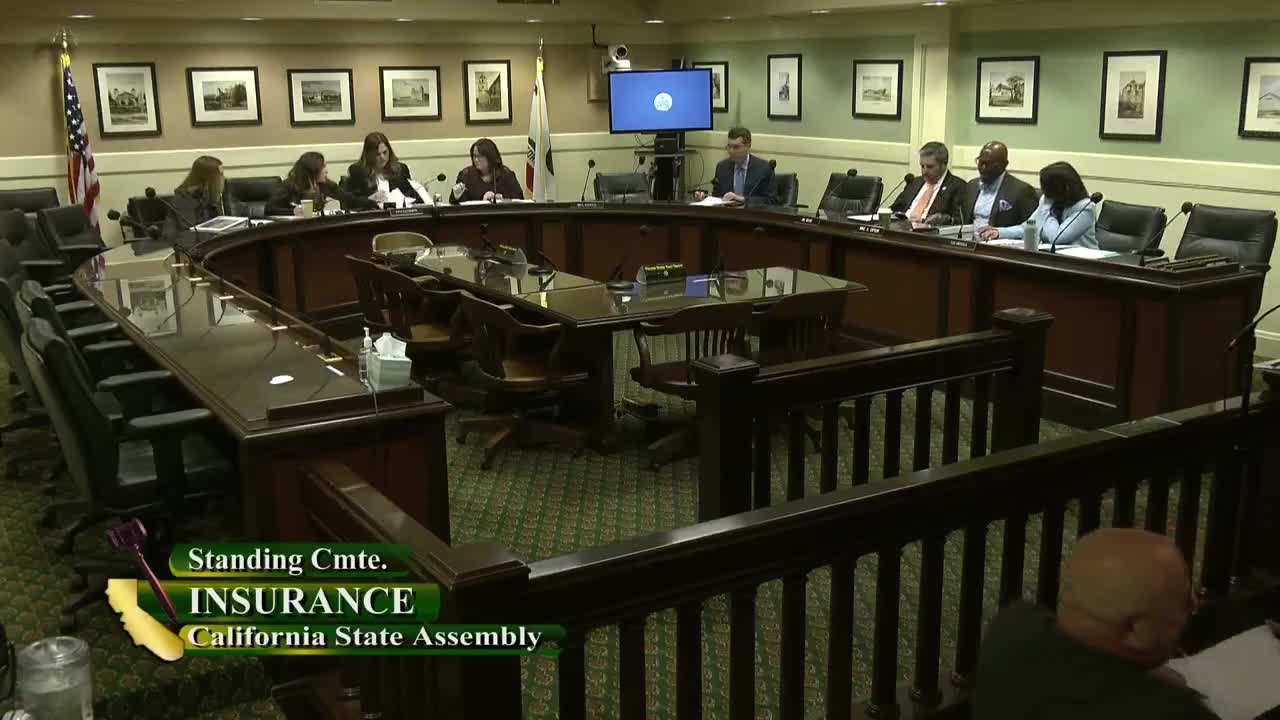
Bill Author

Bill Co-Author(s):