AB 889: Pupil safety: parental notification: synthetic drugs.
- Session Year: 2023-2024
- House: Assembly
- Latest Version Date: 2023-07-27
Current Status:
Passed
(2023-07-27: Chaptered by Secretary of State - Chapter 123, Statutes of 2023.)
Introduced
In Committee
First Chamber
In Committee
Second Chamber
Enacted
What does this bill do?
This bill would require school districts, county offices of education, and charter schools to inform parents or guardians each year about the dangers of using synthetic drugs not prescribed by a doctor, such as fentanyl, and that these drugs can be present in counterfeit pills. It also requires the information to be posted on the local agency’s and each school’s website.
The summary is provided by generative AI which can make mistakes. For original language, please view the details in the table below.
Existing law requires the governing board of a school district, at the beginning of the first semester or quarter of each school year, to notify parents or guardians of minor pupils of specified rights and responsibilities of the parent or guardian and of specified school district policies and procedures.
This bill would require a school district, county office of education, and charter school to annually inform parents or guardians of the dangers associated with using synthetic drugs, as provided, at the beginning of the first semester or quarter of the regular school term. The bill would require a local educational agency and each of their schools to post this information on their respective internet websites, as specified. By imposing additional duties on local educational agencies, the bill would impose a state-mandated program.
The California Constitution requires the state to reimburse local agencies and school districts for certain costs mandated by the state. Statutory provisions establish procedures for making that reimbursement.
This bill would provide that, if the Commission on State Mandates determines that the bill contains costs mandated by the state, reimbursement for those costs shall be made pursuant to the statutory provisions noted above.
(a)A local educational agency shall inform the parents or guardians of each enrolled pupil about the dangers associated with using synthetic drugs that are not prescribed by a physician, such as fentanyl. Parents or guardians shall also be informed of the possibility that dangerous synthetic drugs can be found in counterfeit pills.
(b)(1)The information shall be annually provided to parents or guardians at the beginning of the first semester or quarter of the regular school term.
(2)The information may be provided to parents or guardians pursuant to Section 48980.
(c)If a local educational agency maintains an internet website, the local educational agency shall post the information on their internet website and shall ensure that each individual school within the local educational agency that maintains an individual internet website also posts the information on that schools internet website.
(d)As used in this section, a local educational agency means a school district, county office of education, or charter school.
SEC. 2.If the Commission on State Mandates determines that this act contains costs mandated by the state, reimbursement to local agencies and school districts for those costs shall be made pursuant to Part 7 (commencing with Section 17500) of Division 4 of Title 2 of the Government Code.
REVISIONS: HeadingLine 2.|
Date
|
Status
|
|---|---|
| Jul 27, 2023 | Chaptered by Secretary of State - Chapter 123, Statutes of 2023. |
| Jul 27, 2023 | Approved by the Governor. |
| Jul 25, 2023 | Enrolled and presented to the Governor at 4 p.m. |
| Jul 13, 2023 | In Assembly. Ordered to Engrossing and Enrolling. |
| Jul 13, 2023 | Read third time. Passed. Ordered to the Assembly. (Ayes 37. Noes 0. Page 2037.). |
| Jul 5, 2023 | Read second time. Ordered to Consent Calendar. |
| Jul 3, 2023 | From committee: Be ordered to second reading file pursuant to Senate Rule 28.8 and ordered to Consent Calendar. |
| Jun 21, 2023 | From committee: Do pass and re-refer to Com. on APPR with recommendation: To Consent Calendar. (Ayes 7. Noes 0.) (June 21). Re-referred to Com. on APPR. |
| Jun 7, 2023 | Referred to Com. on ED. |
| May 26, 2023 | In Senate. Read first time. To Com. on RLS. for assignment. |
| May 25, 2023 | Read third time. Passed. Ordered to the Senate. (Ayes 78. Noes 0. Page 1755.) |
| May 18, 2023 | Read second time. Ordered to third reading. |
| May 18, 2023 | From committee: Do pass. (Ayes 15. Noes 0.) (May 18). |
| May 18, 2023 | Coauthors revised. |
| Apr 26, 2023 | In committee: Set, first hearing. Referred to APPR. suspense file. |
| Apr 13, 2023 | From committee: Do pass and re-refer to Com. on APPR. with recommendation: To Consent Calendar. (Ayes 7. Noes 0.) (April 12). Re-referred to Com. on APPR. |
| Apr 13, 2023 | Coauthors revised. |
| Feb 23, 2023 | Referred to Com. on ED. |
| Feb 15, 2023 | From printer. May be heard in committee March 17. |
| Feb 14, 2023 | Read first time. To print. |
|
Date
|
Description
|
Location
|
Votes
|
|
|---|---|---|---|---|
| Jul 13, 2023 | Consent Calendar AB889 Joe Patterson et al. | Senate Floor |
Passed |
|
| Jun 21, 2023 | Do pass, but first be re-referred to the Committee on [Appropriations] with the recommendation: To Consent Calendar | Senate Standing Committee on Education |
Passed |
|
| May 25, 2023 | AB 889 Joe Patterson Assembly Third Reading | Assembly Floor |
Passed |
|
| May 18, 2023 | Do pass. | Assembly Standing Committee on Appropriations |
Passed |
|
| Apr 12, 2023 | Do pass and be re-referred to the Committee on [Appropriations] with recommendation: To Consent Calendar | Assembly Standing Committee on Education |
Passed |
This list shows positions taken on this bill by organizations on the date displayed, which is linked to the original source.
Positions by individuals are not included.
|
Organization
|
Position
|
Date
|
|---|---|---|
| Los Angeles County Office Of Education | ** Support |
SENATE RULES COMMITTEE Office of Senate Floor Analyses (916) 651-1520 Fax: (916) 327-4478 | AB 889 |
CONSENT
Bill No: AB 889
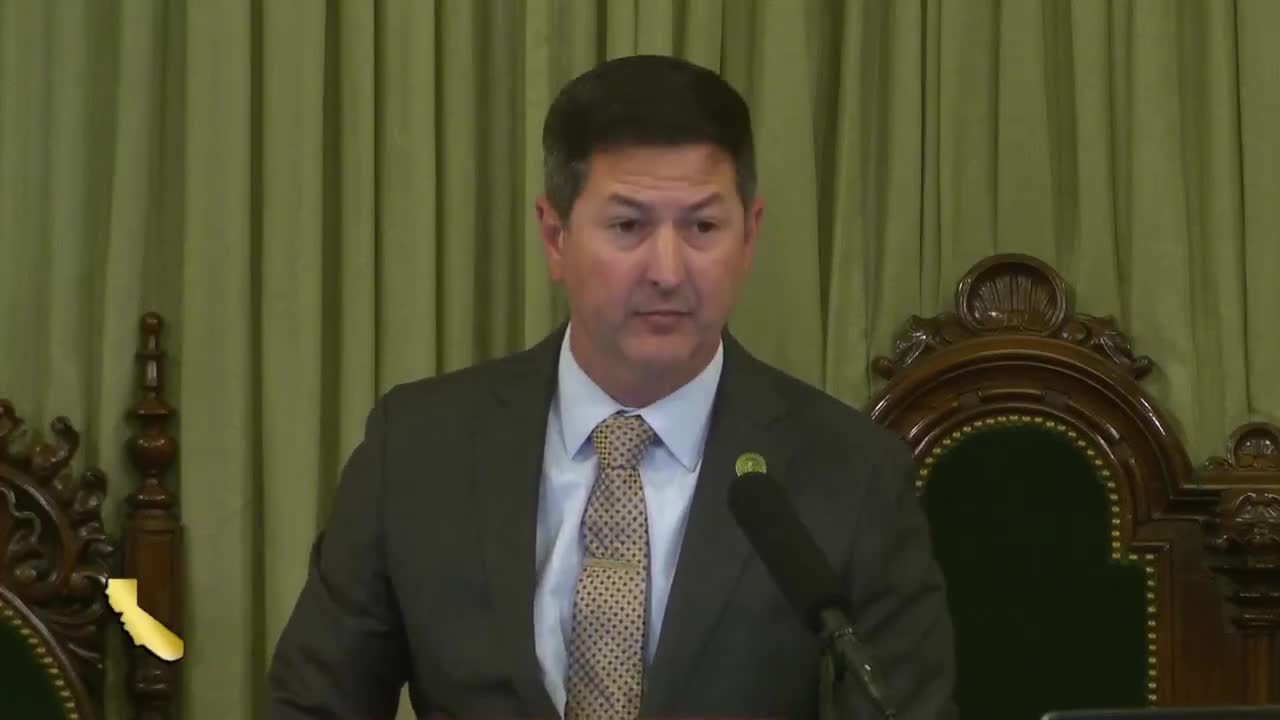
Author: Joe Patterson (R), et al.
Introduced: 2/14/23
Vote: 21
SENATE EDUCATION COMMITTEE: 7-0, 6/21/23
AYES: Newman, Ochoa Bogh, Cortese, Glazer, McGuire, Smallwood-Cuevas, Wilk
SENATE APPROPRIATIONS COMMITTEE: Senate Rule 28.8
ASSEMBLY FLOOR: 78-0, 5/25/23 - See last page for vote
SUBJECT: Pupil safety: parental notification: synthetic drugs
SOURCE: Author
DIGEST:
This bill requires a local educational agency (LEA), county office of education (COE), and charter school to annually inform parents or guardians of the dangers associated with using synthetic drugs and post this information on their respective internet websites.
ANALYSIS:
Existing law:
- Requires school district governing boards to notify parents and guardians of minor pupils of specified items at the beginning of the first semester or quarter of the regular school term. (EC § 48980)
- Authorizes public and private elementary and secondary schools to voluntarily determine whether or not to make emergency naloxone or another opioid antagonist and trained personnel available at its school. Requires a school to evaluate the emergency medical response time to the school and determine whether initiating emergency medical services is an acceptable alternative to naloxone or another opioid antagonist and trained personnel. Prohibits a private elementary or secondary school from exercising the authority provided by this bill from receiving state funds for this purpose. (EC § 49414.3 (c))
- Authorizes school districts, COEs, and charter schools to provide emergency naloxone or another opioid antagonist to school nurses or trained volunteer personnel to provide emergency medical aid to persons suffering, or reasonably believed to be suffering, from an opioid overdose. (EC § 49414.3 (a))
- Requires, if a school district, charter school, or private school elects to offer an athletic program, the school district, charter school, or private school shall annually give the Opioid Factsheet for Patients published by the Centers for Disease Control and Prevention to each athlete. The athlete and, if the athlete is 17 years of age or younger, the athlete’s parent or guardian shall sign a document acknowledging receipt of the Opioid Factsheet for Patients and return that document to the school district, charter school, or private school before the athlete initiates practice or competition. The Opioid Factsheet for Patients may be sent and returned through an electronic medium, including, but not limited to, fax or email. (EC § 49476)
This bill:
- Requires an LEA to inform the parents or guardians of each enrolled pupil about the dangers associated with using synthetic drugs that are not prescribed by a physician, such as fentanyl, and about the possibility that dangerous synthetic drugs can be found in counterfeit pills.
- Specifies the information related to the dangers associated with using synthetic drugs not prescribed by a physician and counterfeit pills, be annually provided to parents or guardians at the beginning of the first semester or quarter of the regular school term, as specified.
- Requires, if an LEA maintains an internet website, the LEA shall post the information on their internet website and shall ensure that each school within the LEA that maintains an individual internet website also publishes the information on that school’s internet website.
- Specifies “Local educational agency” means an LEA, COE, or charter school.
Comments
- Need for the bill. According to the author, “When I was growing up in the ‘80s and ‘90s, parents largely worried about their children using marijuana and drinking alcohol. Until recently, it never crossed my mind that a child could lose his or her life by making a single mistake experimenting with counterfeit prescription drug. This is why I wrote AB 889 so schools can educate both parents and children on the dangers of using synthetic drugs. I don't want other parents to have to wait for tragedy to strike for them to become aware of the dangers. AB 889 is a proactive approach and will save lives.”
- Addressing Fentanyl Among California Youth. According to the California Department of Public Health (CDPH), fentanyl-related overdose deaths increased 625 percent among ages 10-19 from 2018 to 2020. In 2021, there were 224 fentanyl-related overdose deaths among teens ages 15–19 in California. According to AB 1748 (Mayes, Chapter 557, Statutes of 2016), among other things, the State Superintendent of Public Instruction (SPI) must establish minimum training standards for school employees who volunteer to administer naloxone or another opioid antagonist. In addition to setting minimum training standards, the California Department of Education (CDE) must maintain on its website a clearinghouse for best practices in training nonmedical personnel to administer naloxone or another opioid antagonist to pupils.
In conjunction with the CDPH, the CDE provides LEAs with resources and information that they can readily share with parents and students to help keep them safe. The shareable Fentanyl Awareness and Prevention toolkit page offer information about the risks of fentanyl and how to prevent teen use and overdoses. In addition to the toolkit, the CDPH’s Substance and Addiction Prevention branch provides resources for parents, guardians, caretakers, educators, schools, and youth-serving providers.
- Statewide Standing Order for Naloxone. Naloxone can help reduce opioid overdose deaths in California, but many organizations find it challenging to obtain the required standing order to get naloxone from healthcare providers. According to CDPH, of the 6,843 opioid-related overdose deaths in 2021, 5,722 were related to fentanyl. CDPH issued the standing order in 2017 to address this need and support equitable naloxone access. The standing order:
- Allow community organizations and other entities in California that are not currently working with a physician to distribute naloxone to a person at risk of an opioid-related overdose or to a family member, friend, or another person in a position to assist; and
- Allow for the administration of naloxone by a family member, friend, or other person to a person experiencing or reasonably suspected of experiencing an opioid overdose.
Among the organizations and entities that can distribute naloxone under the order are colleges and universities. An individual at risk of experiencing an overdose or someone who can assist an individual at risk is allowed to do so. Under the statewide standing order, staff of community organizations and other entities distributing naloxone must be trained. They are also required to provide training to individuals who receive naloxone from them. Colleges and other organizations may apply to use the statewide standing order if they meet certain conditions.
A separate distribution program administered through The Department of Health Care Services (DHCS) allows universities and colleges to apply for and obtain naloxone at no cost to the institution. According to the CDPH website, since October 2018, their Naloxone Distribution Project (NDP) has distributed over 1 million units of naloxone and recorded over 57,000 overdose reversals.
- Local Action to Address Fentanyl. LEAs and COEs have also adjusted to address this growing crisis. For example, the Lake County Office of Education and Washington Unified School District in West Sacramento recently implemented a local school naloxone policy consistent with state statutes. San Diego Unified School District created its naloxone toolkit to aid other LEAs and inform parents and guardians.
FISCAL EFFECT: Appropriation: No Fiscal Com.: Yes Local: Yes
Los Angeles County Office of Education
OPPOSITION: (Verified 7/5/23)
None received
ARGUMENTS IN SUPPORT: According to the Los Angeles County Office of Education (LACOE), “According to the California Department of Education, only two-thirds of middle and high schools in California offer a dedicated class and in most cases the course is optional. In 2021, fentanyl overdose accounted for more than 80 percent of all drug-related deaths among Californian’s young people. There is a lot of misinformation being discussed around fentanyl it is time schools take the opportunity to educate and inform parents or guardians the dangers associated with these synthetic drugs. While there is a right for parents to know and understand the policies and procedures of the school or district policies, there is not a formal notification of the dangers associated with using synthetic drugs, including fentanyl. Many local educational agencies utilize their website to disseminate a wealth of information, including the annual notification to inform parents or guardians of rights and responsibilities of the school district policies and procedures. Since this annual notification is already required, there are no foreseeable barriers to add such timely and important information regarding the dangers associated with using synthetic drugs that are not prescribed by a physician which has caused student deaths due to use of counterfeit pills. AB 889 would require the school district and county office of education to annually notify parents and guardians about the risks and dangers associated with using synthetic drugs, including fentanyl.”
ASSEMBLY FLOOR: 78-0, 5/25/23
AYES: Addis, Alanis, Alvarez, Arambula, Bains, Bauer-Kahan, Bennett, Berman, Boerner, Bonta, Bryan, Calderon, Juan Carrillo, Wendy Carrillo, Cervantes, Chen, Connolly, Megan Dahle, Davies, Dixon, Essayli, Flora, Mike Fong, Vince Fong, Friedman, Gabriel, Gallagher, Garcia, Gipson, Grayson, Haney, Hart, Holden, Hoover, Irwin, Jackson, Jones-Sawyer, Kalra, Lackey, Lee, Low, Lowenthal, Maienschein, McCarty, McKinnor, Muratsuchi, Stephanie Nguyen, Ortega, Pacheco, Papan, Jim Patterson, Joe Patterson, Pellerin, Petrie-Norris, Quirk-Silva, Ramos, Reyes, Luz Rivas, Robert Rivas, Rodriguez, Blanca Rubio, Sanchez, Santiago, Schiavo, Soria, Ta, Ting, Valencia, Villapudua, Waldron, Wallis, Ward, Weber, Wicks, Wilson, Wood, Zbur, Rendon
NO VOTE RECORDED: Aguiar-Curry, Mathis
Prepared by: Kordell Hampton / ED. / (916) 651-4105
7/5/23 15:11:39
**** END ****
SENATE COMMITTEE ON EDUCATION
Senator Josh Newman, Chair
2023 - 2024 Regular
Bill No: Hearing Date: June 21, 2023
Author: | Joe Patterson | ||
Version: |
| ||
Urgency: | Fiscal: | ||
Consultant: | |||
Subject:
SUMMARY
This bill requires a local educational agency (LEA), county office of education (COE), and charter school to annually inform parents or guardians of the dangers associated with using synthetic drugs and post this information on their respective internet websites.
BACKGROUND
Existing Law:
Education Code (EC)
- Requires school district governing boards to notify parents and guardians of minor pupils of specified items at the beginning of the first semester or quarter of the regular school term. (EC § 48980)
- Authorizes public and private elementary and secondary schools to voluntarily determine whether or not to make emergency naloxone or another opioid antagonist and trained personnel available at its school. Requires a school to evaluate the emergency medical response time to the school and determine whether initiating emergency medical services is an acceptable alternative to naloxone or another opioid antagonist and trained personnel. Prohibits a private elementary or secondary school from exercising the authority provided by this bill from receiving state funds for this purpose. (EC § 49414.3 (c))
- Authorizes school districts, COEs, and charter schools to provide emergency naloxone or another opioid antagonist to school nurses or trained volunteer personnel to provide emergency medical aid to persons suffering, or reasonably believed to be suffering, from an opioid overdose. (EC § 49414.3 (a))
- If a school district, charter school, or private school elects to offer an athletic program, the school district, charter school, or private school shall annually give the Opioid Factsheet for Patients published by the Centers for Disease Control and Prevention to each athlete. The athlete and, if the athlete is 17 years of age or younger, the athlete’s parent or guardian shall sign a document acknowledging receipt of the Opioid Factsheet for Patients and return that document to the school district, charter school, or private school before the athlete initiates practice or competition. The Opioid Factsheet for Patients may be sent and returned through an electronic medium, including, but not limited to, fax or email. (EC § 49476)
ANALYSIS
This bill requires an LEA, COE, and charter school to annually inform parents or guardians of the dangers associated with using synthetic drugs and post this information on their respective internet websites. Specifically, this bill:
- Requires an LEA to inform the parents or guardians of each enrolled pupil about the dangers associated with using synthetic drugs that are not prescribed by a physician, such as fentanyl, and about the possibility that dangerous synthetic drugs can be found in counterfeit pills.
- Specifies the information related to the dangers associated with using synthetic drugs not prescribed by a physician and counterfeit pills, be annually provided to parents or guardians at the beginning of the first semester or quarter of the regular school term, as specified.
- Requires, if an LEA maintains an internet website, the LEA shall post the information on their internet website and shall ensure that each school within the LEA that maintains an individual internet website also publishes the information on that school’s internet website.
- “Local educational agency” means an LEA, COE, or charter school.
STAFF COMMENTS
- Need for the bill. According to the author, “When I was growing up in the ‘80s and ‘90s, parents largely worried about their children using marijuana and drinking alcohol. Until recently, it never crossed my mind that a child could lose his or her life by making a single mistake experimenting with counterfeit prescription drug. This is why I wrote AB 889 so schools can educate both parents and children on the dangers of using synthetic drugs. I don't want other parents to have to wait for tragedy to strike for them to become aware of the dangers. AB 889 is a proactive approach and will save lives.”
- Addressing Fentanyl Among California Youth. According to the California Department of Public Health (CDPH), fentanyl-related overdose deaths increased 625 percent among ages 10-19 from 2018 to 2020. In 2021, there were 224 fentanyl-related overdose deaths among teens ages 15–19 in California. According to AB 1748 (Mayes) Chapter 557, Statutes of 2016, among other things, the State Superintendent of Public Instruction (SPI) must establish minimum training standards for school employees who volunteer to administer naloxone or another opioid antagonist. In addition to setting minimum training standards, the California Department of Education (CDE) must maintain on its website a clearinghouse for best practices in training nonmedical personnel to administer naloxone or another opioid antagonist to pupils.
In conjunction with the CDPH, the CDE provides LEAs with resources and information that they can readily share with parents and students to help keep them safe. The shareable Fentanyl Awareness and Prevention toolkit page offer information about the risks of fentanyl and how to prevent teen use and overdoses. In addition to the toolkit, the CDPH’s Substance and Addiction Prevention branch provides resources for parents, guardians, caretakers, educators, schools, and youth-serving providers.
- Statewide Standing Order for Naloxone. Naloxone can help reduce opioid overdose deaths in California, but many organizations find it challenging to obtain the required standing order to get naloxone from healthcare providers. According to CDPH, of the 6,843 opioid-related overdose deaths in 2021, 5,722 were related to fentanyl. CDPH issued the standing order in 2017 to address this need and support equitable naloxone access. The standing order:
- Allow community organizations and other entities in California that are not currently working with a physician to distribute naloxone to a person at risk of an opioid-related overdose or to a family member, friend, or another person in a position to assist; and
- Allow for the administration of naloxone by a family member, friend, or other person to a person experiencing or reasonably suspected of experiencing an opioid overdose.
Among the organizations and entities that can distribute naloxone under the order are colleges and universities. An individual at risk of experiencing an overdose or someone who can assist an individual at risk is allowed to do so. Under the statewide standing order, staff of community organizations and other entities distributing naloxone must be trained. They are also required to provide training to individuals who receive naloxone from them. Colleges and other organizations may apply to use the statewide standing order if they meet certain conditions.
A separate distribution program administered through The Department of Health Care Services (DHCS) allows universities and colleges to apply for and obtain naloxone at no cost to the institution. According to the CDPH website, since October 2018, their Naloxone Distribution Project (NDP) has distributed over 1 million units of naloxone and recorded over 57,000 overdose reversals.
- Local Action to Address Fentanyl. LEAs and COEs have also adjusted to address this growing crisis. For example, the Lake County Office of Education and Washington Unified School District in West Sacramento recently implemented a local school naloxone policy consistent with state statutes. San Diego Unified School District created its naloxone toolkit to aid other LEAs and inform parents and guardians.
This bill is consistent with current efforts taken by LEAs in that it would require an LEA, COE, and charter school to inform parents or guardians annually of the dangers associated with using synthetic drugs and post this information on their respective internet websites.
- Related Legislation
AB 19 (Patterson, 2023) would require each public school operated by an LEA, COE, or charter school to maintain at least two doses of naloxone hydrochloride or another opioid antagonist for purposes of those authorizations. This bill is currently in Senate Education Committee.
SB 472 (Hurtado, 2023) would require each campus of a public school operated by an LEA, COE, or charter school to maintain at least two doses on its campus, and distribute, naloxone hydrochloride or another opioid antagonist pursuant to the standing order for naloxone and requires LEAs, COEs, and charter school to report to the California Department of Health Care Services (DHCS) for failure to distribute naloxone. This bill was held in Senate Appropriations.
SB 234 (Portantino, 2023) would require schools kindergarten to 12 grade, institutions of higher education, stadiums, concert venues, and amusement parks, at all times, to maintain unexpired doses of naloxone hydrochloride or any other opioid antagonist on its premise, ensure that at least two employees are aware of the location of the naloxone hydrochloride or other opioid antagonist, and expand community colleges ability to administer naloxone. SB 234 also provides civil protections to a person who helps naloxone hydrochloride or another opioid antagonist on a college campus stadium, concert venue, or amusement park to a person who appears to be experiencing an opioid overdose. This bill is currently in Assembly Education Committee.
AB 1748 (Mayes) Chapter 557, Statutes of 2016, authorizes LEAs to provide an emergency opioid antagonist to school nurses or trained personnel and authorizes a school nurse or trained personnel to administer an opioid antagonist to a person suffering from an opioid overdose.
SUPPORT
Los Angeles County Office of Education
OPPOSITION
None received
-- END --
ASSEMBLY THIRD READING
ATR Bill Id:AB 889
Author:(Joe Patterson)
As Introduced Ver:February 14, 2023
Majority vote
SUMMARY
Requires local educational agencies (LEAs) to annually inform the parents or guardians of each enrolled pupil of the dangers associated with synthetic drugs that are not prescribed by a physician, such as fentanyl.
Major Provisions
- Requires LEAs to inform the parents or guardians of each enrolled pupil of the dangers associated with synthetic drugs that are not prescribed by a physician, such as fentanyl, and that there is a possibility that dangerous synthetic drugs can be found in counterfeit pills.
- Requires the notification to be provided annually at the beginning of the first semester or quarter of the regular school term, and authorizes the notification to be provided as part of the annual notifications required under current law.
- Requires the LEA to post the information on their website as well as the website of each individual school within the LEA, if they have a website.
COMMENTS
Addressing Fentanyl Among California Youth. According to the California Department of Public Health (CDPH), fentanyl-related overdose deaths increased 625% among ages 10-19 from 2018 to 2020. In 2021, there were 224 fentanyl-related overdose deaths among teens ages 15–19 years old in California.
Current law requires the SPI to establish minimum training standards for school employees who volunteer to administer naloxone or another opioid antagonist. In addition to setting minimum training standards, the CDE must maintain on its website a clearinghouse for best practices in training nonmedical personnel to administer naloxone or another opioid antagonist to pupils.
The CDE, in conjunction with the CDPH, provide LEAs with resources and information that they can readily share with parents and students to help keep them safe. The Fentanyl Awareness and Prevention toolkit page offer information about the risks of fentanyl and how to prevent teen use and overdoses. In addition to the toolkit, the CDPH's Substance and Addiction Prevention branch also provides resources for parents, guardians, caretakers, educators, schools, and youth-serving providers.
According to the Author
"When I was growing up in the '80s and '90s, parents largely worried about their children using marijuana and drinking alcohol. Until recently, it never crossed my mind that a child could lose his or her life by making a single mistake experimenting with counterfeit prescription drug. This is why I wrote AB 889 so schools can educate both parents and children on the dangers of using synthetic drugs. I don't want other parents to have to wait for tragedy to strike for them to become aware of the dangers. AB 889 is a proactive approach and will save lives."
Arguments in Support
According to the Los Angeles County Office of Education, "While there is a right for parents to know and understand the policies and procedures of the school or district policies, there is not a formal notification of the dangers associated with using synthetic drugs, including fentanyl. Many local educational agencies utilize their website to disseminate a wealth of information, including the annual notification to inform parents or guardians of rights and responsibilities of the school district policies and procedures. Since this annual notification is already required, there are no foreseeable barriers to add such timely and important information regarding the dangers associated with using synthetic drugs that are not prescribed by a physician which has caused student deaths due to use of counterfeit pills. AB 889 would require the school district and county office of education to annually notify parents and guardians about the risks and dangers associated with using synthetic drugs, including fentanyl."
Arguments in Opposition
None on file.
FISCAL COMMENTS
According to the Assembly Appropriations Committee:
- Ongoing Proposition 98 General Fund costs, potentially in the low hundreds of thousands of dollars annually, for LEAs to provide written notifications. California has about six million students. If we assume printing costs of $0.03 per notification, costs would be $180,000 annually.
- Minor and absorbable one-time Proposition 98 General Fund costs to each LEA to add information to its website.
- If the Commission on State Mandates determines the bill's requirements to be a reimbursable state mandate, the state would need to reimburse these costs to LEAs or provide funding through the K-12 Mandate Block Grant.
VOTES
ASM EDUCATION: 7-0-0
YES: Muratsuchi, Megan Dahle, Juan Carrillo, Hoover, Lee, McCarty, Quirk-Silva
ASM APPROPRIATIONS: 15-0-1
YES: Holden, Megan Dahle, Bryan, Calderon, Wendy Carrillo, Dixon, Mike Fong, Hart, Lowenthal, Mathis, Papan, Pellerin, Sanchez, Weber, Ortega
ABS, ABST OR NV: Robert Rivas
UPDATED
VERSION: February 14, 2023
CONSULTANT: Debbie Look / ED. / (916) 319-2087 FN: 0000843
Date of Hearing: April 26, 2023
ASSEMBLY COMMITTEE ON APPROPRIATIONS
Chris Holden, Chair
ABPCA Bill Id:AB 889
Author:(Joe Patterson) – As Introduced Ver:February 14, 2023
Policy Committee: | Education | Vote: | 7 - 0 |
|
| ||
|
|
Urgency: No State Mandated Local Program: Yes Reimbursable: Yes
SUMMARY:
This bill requires each local education agency (LEA) to provide written notice, as part of an existing annual notification, to inform the parent or guardian of enrolled student about the dangers associated with synthetic drugs, such as fentanyl, and of the possibility that dangerous synthetic drugs can be found in counterfeit pills. In addition, the bill requires each LEA to post this information on its website, if it maintains a website.
FISCAL EFFECT:
- Ongoing Proposition 98 General Fund costs, potentially in the low hundreds of thousands of dollars annually, for LEAs to provide written notifications. California has about six million students. If we assume printing costs of $0.03 per notification, costs would be $180,000 annually.
- Minor and absorbable one-time Proposition 98 General Fund costs to each LEA to add information to its website.
If the Commission on State Mandates determines the bill’s requirements to be a reimbursable state mandate, the state would need to reimburse these costs to LEAs or provide funding through the K-12 Mandate Block Grant.
COMMENTS:
- Background. Fentanyl is a potent synthetic opioid drug approximately 50 times stronger than heroin and 100 times stronger than morphine. Recent cases of fentanyl-related overdoses are linked to illicitly manufactured fentanyl that is distributed through illegal drug markets and sometimes added to counterfeit pills.
This bill requires each LEA to inform students’ parents and guardians via written notice and on its website, if it has one, of the dangers of synthetic drugs, such as fentanyl. The notice is to be part of the LEA’s “annual notification,” a requirement established in current law whereby each LEA must send out various notifications at the beginning of the year to parents and guardians of students. For example, current law requires an LEA’s annual notification to include information about investing for college, the availability of state funds to cover Advanced Placement exam fees, the LEA’s sexual harassment policy, and various other items.
- Related Legislation. AB 802 (Joe Patterson) of this legislative session would require each LEA to provide written notice, as part of an existing annual notification, to a student’s parent or guardian of the right to examine the curriculum materials of the class or classes in which their child is enrolled and to post information on this right on the LEA’s website, if it maintains a website. The bill is pending on this committee’s suspense file.
AB 19 (Joe Patterson) of this legislative session would require each school to maintain at least two doses of naloxone hydrochloride or another opioid antagonist. The bill is pending in this committee.
SB 10 (Cortese) of this legislative session would require each LEA to include strategies for the prevention and treatment of an opioid overdose in their school safety plans, and require the California Department of Education to develop training materials on the use of emergency opioid antagonists for school personnel, and safety materials for parents, guardians, and students in conjunction with the California Health and Human Services Agency. The bill is pending in the Senate Appropriations Committee.
SB 472 (Hurtado) of this legislative session would require each school to maintain at least two doses of naloxone hydrochloride or another opioid antagonist. The bill is pending in the Senate Appropriations Committee.
Analysis Prepared by: Natasha Collins / APPR. / (916) 319-2081
Date of Hearing: April 12, 2023
ASSEMBLY COMMITTEE ON EDUCATION
Al Muratsuchi, Chair
ABPCA Bill Id:AB 889 (
Author:Joe Patterson) – As Introduced Ver:February 14, 2023
SUBJECT: Pupil safety: parental notification: synthetic drugs
SUMMARY: Requires local educational agencies (LEAs) to annually inform the parents or guardians of each enrolled pupil of the dangers associated with synthetic drugs that are not prescribed by a physician, such as fentanyl. Specifically, this bill:
- Requires LEAs to inform the parents or guardians of each enrolled pupil of the dangers associated with synthetic drugs that are not prescribed by a physician, such as fentanyl, and that there is a possibility that dangerous synthetic drugs can be found in counterfeit pills.
- Requires the notification to be provided annually at the beginning of the first semester or quarter of the regular school term.
- Authorizes the notification to be provided as part of the annual notifications required under current law.
- Requires the LEA to post the information on their website as well as the website of each individual school within the LEA, if they have a website.
- Defines LEA to include a school district, county office of education (COE), or charter school.
EXISTING LAW:
- Requires governing boards of school districts to notify parents and guardians of minor pupils of specified items at the beginning of the first semester or quarter of the regular school term. (Education Code (EC) 48980)
- Authorizes school districts, COEs and charter schools to provide emergency naloxone or another opioid antagonist to school nurses or trained volunteer personnel for the purpose of providing emergency medical aid to persons suffering, or reasonably believed to be suffering, from an opioid overdose. (EC 49414.3)
- Authorizes public and private elementary and secondary schools to voluntarily determine whether or not to make emergency naloxone or another opioid antagonist and trained personnel available at its school. Requires a school to evaluate the emergency medical response time to the school and determine whether initiating emergency medical services is an acceptable alternative to naloxone or another opioid antagonist and trained personnel. Prohibits a private elementary or secondary school choosing to exercise the authority provided by this bill from receiving state funds for this purpose.
- Requires the Superintendent of Public Instruction (SPI) to establish, and revise every five years or sooner, minimum standards of training for the administration of naloxone hydrochloride or another opioid antagonist as specified. Requires the California Department of Education (CDE) to maintain a clearinghouse for best practices in training nonmedical personnel to administer naloxone hydrochloride or another opioid antagonist to pupils. (EC 49414.3)
- If a school district, charter school, or private school elects to offer an athletic program, the school district, charter school, or private school shall annually give the Opioid Factsheet for Patients published by the Centers for Disease Control and Prevention to each athlete. The athlete and, if the athlete is 17 years of age or younger, the athlete’s parent or guardian shall sign a document acknowledging receipt of the Opioid Factsheet for Patients and return that document to the school district, charter school, or private school before the athlete initiates practice or competition. The Opioid Factsheet for Patients may be sent and returned through an electronic medium, including, but not limited to, fax or email. (EC 49476)
FISCAL EFFECT: The Office of Legislative Counsel has keyed this as a possible state-mandated local program.
COMMENTS:
Need for the bill. According to the author, “When I was growing up in the ‘80s and ‘90s, parents largely worried about their children using marijuana and drinking alcohol. Until recently, it never crossed my mind that a child could lose his or her life by making a single mistake experimenting with counterfeit prescription drug. This is why I wrote AB 889 so schools can educate both parents and children on the dangers of using synthetic drugs. I don't want other parents to have to wait for tragedy to strike for them to become aware of the dangers. AB 889 is a proactive approach and will save lives.”
Dangers associated with Fentanyl. Fentanyl is a potent synthetic opioid drug approved by the Food and Drug Administration (FDA) for use as an analgesic and anesthetic. It is approximately 50 times stronger than heroin and 100 times stronger than morphine. First developed in 1959, it was introduced in the 1960’s as an intravenous anesthetic. Fentanyl is legally manufactured and distributed in the United States; however, there are two types of fentanyl: pharmaceutical fentanyl and illicitly manufactured fentanyl. Both are considered synthetic opioids. Pharmaceutical fentanyl is prescribed by doctors to treat severe pain, especially after surgery and for advanced-stage cancer. Most recently, cases of fentanyl-related overdoses are linked to illicitly manufactured fentanyl that is distributed through illegal drug markets for its heroin-like effect. It is often added to other drugs because of its extreme potency, which makes drugs cheaper, more powerful, more addictive, and more dangerous.
Addressing Fentanyl Among California Youth. According to the California Department of Public Health (CDPH), fentanyl-related overdose deaths increased 625% among ages 10-19 from 2018 to 2020. In 2021, there were 224 fentanyl-related overdose deaths among teens ages 15–19 years old in California.
Current law requires the SPI to establish minimum training standards for school employees who volunteer to administer naloxone or another opioid antagonist. In addition to setting minimum training standards, the CDE must maintain on its website a clearinghouse for best practices in training nonmedical personnel to administer naloxone or another opioid antagonist to pupils.
The CDE, in conjunction with the CDPH, provide LEAs with resources and information that they can readily share with parents and students to help keep them safe. The Fentanyl Awareness and Prevention toolkit page offer information about the risks of fentanyl and how to prevent teen use and overdoses. In addition to the toolkit, the CDPH’s Substance and Addiction Prevention branch also provides resources for parents, guardians, caretakers, educators, schools, and youth-serving providers.
Reversing opioid overdoses. Naloxone is the generic name for an opioid antagonist that rapidly reverses an opioid overdose. It attaches to opioid receptors and reverses and blocks the effects of other opioids. Naloxone can quickly restore normal breathing to a person if their breathing has slowed or stopped because of an opioid overdose. Naloxone comes in two FDA-approved forms: injectable and prepackaged nasal spray.
On March 29, 2023, the FDA approved Narcan, naloxone hydrochloride nasal spray for over-the-counter (OTC), nonprescription use. This is the first naloxone product approved for use without a prescription. This will allow this medication to be sold directly to consumers in drug stores, grocery stores, as well as online. According to an FDA Commissioner, “Today’s approval of OTC naloxone nasal spray will help improve access to naloxone, increase the number of locations where it’s available and help reduce opioid overdose deaths throughout the country. We encourage the manufacturer to make accessibility to the product a priority by making it available as soon as possible and at an affordable price.”
Narcan nasal spray was first approved by the FDA in 2015 as a prescription drug. According to the FDA, in accordance with a process to change the status of a drug from prescription to nonprescription, the manufacturer provided data demonstrating that the drug is safe and effective for use as directed in its proposed labeling. The manufacturer also showed that consumers can understand how to use the drug safely and effectively without the supervision of a healthcare professional. The application to approve Narcan nasal spray for OTC use was granted priority review status and was the subject of an advisory committee meeting in February 2023, where committee members voted unanimously to recommend it be approved for marketing without a prescription.
CDPH Statewide Standing Order for Naloxone. Naloxone can help reduce opioid overdose deaths in California, but many organizations find it difficult to obtain the required standing order to obtain naloxone from health care providers. According to CDPH, of the 6,843 opioid-related overdose deaths in 2021, 5,722 were related to fentanyl. CDPH issued the standing order, in 2017, to address this need and support equitable naloxone access.
Among the organizations and entities that can distribute naloxone under the order are colleges and universities. An individual at risk of experiencing an overdose or someone who can assist an individual at risk is allowed to do so. Under the statewide standing order, staff of community organizations and other entities distributing naloxone must be trained. They are also required to provide training to individuals who receive naloxone from them. Colleges and other organizations may apply to use the statewide standing order if they meet certain conditions.
A separate distribution program administered through The Department of Health Care Services (DHCS) allows schools, universities and colleges to apply for and obtain naloxone at no cost to the institution. According to the CDPH website, since October 2018, their Naloxone Distribution Project (NDP) has distributed over 1 million units of naloxone, and recorded over 57,000 overdose reversals.
Related legislation. AB 19 (Joe Patterson) of the 2023-24 Session would require public schools to maintain at least two doses of naloxone hydrochloride or another opioid antagonist to provide emergency medical aid to a person suffering from an opioid overdose.
SB 10 (Cortese) of the 2023-24 Session would require LEAs and COEs to include strategies for the prevention and treatment of an opioid overdose in their school safety plans, and require the CDE to develop training materials on the use of emergency opioid antagonists for school personnel, and safety materials for parents, guardians, and pupils in conjunction with the California Health and Human Services Agency (CalHHS).
SB 472 (Hurtado) of the 2023-24 Session would require each campus of a public school operated by an LEA, COE, or charter school to maintain at least two doses on its campus, and distribute, naloxone hydrochloride or another opioid antagonist pursuant to the standing order for naloxone and requires LEAs, COEs, and charter school to report to DHCS for failure to distribute naloxone.
SB 234 (Portantino) of the 2023-24 Session would require schools kindergarten to 12th grade, institutions of higher education, stadiums, concert venues, and amusement parks, at all times, to maintain unexpired doses of naloxone hydrochloride or any other opioid antagonist on its premise, ensure that at least two employees are aware of the location of the naloxone hydrochloride or other opioid antagonist, and expand community colleges ability to administer naloxone. SB 234 would also provide civil protections to a person who administers naloxone hydrochloride or another opioid antagonist on a college campus stadium, concert venue, or amusement park to a person who appears to be experiencing an opioid overdose.
AB 1748 (Mayes) Chapter 557, Statutes of 2016, authorizes school nurses and other trained personnel to use naloxone hydrochloride (naloxone) or another opioid antagonist to provide emergency medical aid to persons suffering, or reasonably believed to be suffering, from an opioid overdose.
REGISTERED SUPPORT / OPPOSITION:
Support
None on file
Opposition
None on file
Analysis Prepared by: Debbie Look / ED. / (916) 319-2087
Bill Author