AB 944: Fire stations: alternative power generation.
- Session Year: 2023-2024
- House: Assembly
- Latest Version Date: 2023-04-25
Current Status:
Failed
(2024-02-01: From committee: Filed with the Chief Clerk pursuant to Joint Rule 56.)
Introduced
In Committee
First Chamber
In Committee
Second Chamber
Enacted
Existing law designates areas over which the state has primary responsibility for preventing and suppressing fires. Existing law also authorizes the formation of fire protection districts for the purpose of providing local fire protection and other services relating to the protection of lives and property. Existing law requires a skilled nursing facility to have an alternative source of power, as defined, to protect resident health and safety, as defined, for no fewer than 96 hours during any type of power outage.
This bill would require a fire station to have an alternative source of power, as defined, to ensure continued operation for no fewer than 96 hours during any type of power outage. The bill would impose specific compliance requirements based on whether a fire station uses a generator as its alternative source of power, or batteries or a combination of batteries in tandem with a renewable electrical generation facility. The bill would require a fire station to comply with its requirements by January 1, 2026. By imposing new duties on local agencies, this bill would impose a state-mandated local program.
The California Constitution requires the state to reimburse local agencies and school districts for certain costs mandated by the state. Statutory provisions establish procedures for making that reimbursement.
This bill would provide that, if the Commission on State Mandates determines that the bill contains costs mandated by the state, reimbursement for those costs shall be made pursuant to the statutory provisions noted above.
This bill would declare the intent of the Legislature to subsequently amend this bill to include provisions that would require fire stations to have an alternative method of power generation during power outages.Existing law designates areas over which the state has primary responsibility for preventing and suppressing fires. Existing law also authorizes the formation of fire protection districts for the purpose of providing local fire protection and other services relating to the protection of lives and property.
This bill would declare the intent of the Legislature to subsequently amend this bill to include provisions that would require fire stations to have an alternative method of power generation during power outages.
(a)The Legislature finds and declares that it is the public policy of this state to ensure that fire stations have an alternative source of power during power outages that may result from an emergency, a public safety power shutoff, a natural disaster, or other cause.
(b)(1)A fire station shall have an alternative source of power to ensure continued operations for no fewer than 96 hours during any type of power outage.
(2)For purposes of this section, alternative source of power means a source of electricity that is not received through an electric utility, but is generated or stored onsite, which may include include, but is not limited to to, emergency generators using fuel, large capacity batteries, and renewable electrical generation facilities.
(c)A fire station that uses a generator as its alternative source of power shall maintain sufficient fuel onsite to maintain generator operation for no less than 96 hours or make arrangements for fuel delivery for an emergency event. If fuel is to be delivered during an emergency event, the fire station shall ensure that fuel will be available with no delays.
(d)A fire station that uses batteries or a combination of batteries in tandem with a renewable electrical generation facility as its alternative source of power, shall have sufficient storage or generation capacity to maintain operation for no fewer than 96 hours. A fire station shall also make arrangements for delivery of a generator and fuel in the event power is not restored within 96 hours and the generation capacity of the renewable electrical generation facility is unable provide sufficient power to comply with this section.
(e)A fire station shall comply with the requirements of this section by January 1, 2026.
SEC. 2.If the Commission on State Mandates determines that this act contains costs mandated by the state, reimbursement to local agencies and school districts for those costs shall be made pursuant to Part 7 (commencing with Section 17500) of Division 4 of Title 2 of the Government Code.
(a)The Legislature finds and declares that it is the public policy of this state to ensure that fire stations have an alternative source of power during power outages that may result from an emergency, a public safety power shutoff, a natural disaster, or other cause.
(b)(1)A fire station shall have an alternative source of power to ensure continued operations for no fewer than 96 hours during any type of power outage.
(2)For purposes of this section, alternative source of power means a source of electricity that is not received through an electric utility, but is generated or stored onsite, which may include but is not limited to emergency generators using fuel, large capacity batteries, and renewable electrical generation facilities.
(c)A fire station that uses a generator as its alternative source of power shall maintain sufficient fuel onsite to maintain generator operation for no less than 96 hours or make arrangements for fuel delivery for an emergency event. If fuel is to be delivered during an emergency event, the fire station shall ensure that fuel will be available with no delays.
(d)A fire station that uses batteries or a combination of batteries in tandem with a renewable electrical generation facility as its alternative source of power, shall have sufficient storage or generation capacity to maintain operation for no fewer than 96 hours. A fire station shall also make arrangements for delivery of a generator and fuel in the event power is not restored within 96 hours and the generation capacity of the renewable electrical generation facility is unable provide sufficient power to comply with this section.
(e)A fire station shall comply with the requirements of this section by January 1, 2026.
SEC. 2.If the Commission on State Mandates determines that this act contains costs mandated by the state, reimbursement to local agencies and school districts for those costs shall be made pursuant to Part 7 (commencing with Section 17500) of Division 4 of Title 2 of the Government Code.
SECTION 1.It is the intent of the Legislature to subsequently amend this bill to include provisions that would require fire stations to have an alternative method of power generation during a power outage.It is the intent of the Legislature to subsequently amend this bill to include provisions that would require fire stations to have an alternative method of power generation during a power outage.
|
Date
|
Status
|
|---|---|
| Feb 1, 2024 | From committee: Filed with the Chief Clerk pursuant to Joint Rule 56. |
| Jan 31, 2024 | Died pursuant to Art. IV, Sec. 10(c) of the Constitution. |
| May 18, 2023 | In committee: Held under submission. |
| May 10, 2023 | In committee: Set, first hearing. Referred to APPR. suspense file. |
| Apr 26, 2023 | Re-referred to Com. on APPR. |
| Apr 25, 2023 | Read second time and amended. |
| Apr 24, 2023 | From committee: Amend, and do pass as amended and re-refer to Com. on APPR. (Ayes 7. Noes 0.) (April 17). |
| Mar 21, 2023 | Re-referred to Com. on E.M. |
| Mar 20, 2023 | From committee chair, with author's amendments: Amend, and re-refer to Com. on E.M. Read second time and amended. |
| Mar 16, 2023 | Referred to Com. on E.M. |
| Feb 15, 2023 | From printer. May be heard in committee March 17. |
| Feb 14, 2023 | Read first time. To print. |
|
Date
|
Description
|
Location
|
Votes
|
|
|---|---|---|---|---|
| Apr 17, 2023 | Do pass as amended and be re-referred to the Committee on [Appropriations] | Assembly Standing Committee on Emergency Management |
Passed |
This list shows positions taken on this bill by organizations on the date displayed, which is linked to the original source.
Positions by individuals are not included.
|
Organization
|
Position
|
Date
|
|---|---|---|
| District 5 Supervisor, Tuolumne County | ** Support |
Date of Hearing: May 10, 2023
ASSEMBLY COMMITTEE ON APPROPRIATIONS
Chris Holden, Chair
ABPCA Bill Id:AB 944
Author:(Irwin) – As Amended Ver:April 25, 2023
Policy Committee: | Emergency Management | Vote: | 7 - 0 |
|
| ||
|
|
Urgency: No State Mandated Local Program: Yes Reimbursable: Yes
SUMMARY:
This bill requires, by January 1, 2026, a fire station to have an alternative source of power to ensure continued operation for no less than 96 hours during any type of power outage.
FISCAL EFFECT:
- By requiring fire stations operated by local agencies to have a 96-hour alternative source of power, this bill creates a state-mandated local program. If the Commission on State Mandates determines the provisions of this bill create a new program or impose a higher level of service for which the state must reimburse local costs, local agencies could claim reimbursement from the state (General Fund). The magnitude of these costs is unknown, but preliminary estimates provided by county entities note a generator at one fire station can range between $50,000 and $100,000. According to the U.S. Fire Administration, there are 847 registered fire departments in California, with 15% of such departments nationwide having three or more stations.
- Similarly, costs of an unknown, but potentially significant, amount to the Department of Forestry and Fire Protection (CAL FIRE) to have a 96-hour alternative source of power. CAL FIRE operates over 400 fire stations.
COMMENTS:
- Purpose. According to the author:
While our communities rely on firefighters to be properly equipped to handle all emergencies, current law does not ensure fire stations have the proper backup power to keep firefighters ready to respond during a power outage. As our climate crisis continues to bring forth heat waves and wildfires, the need for planned public safety power shut offs and the real prospect of rolling black outs will be exacerbated.
This bill is supported by the City of Thousand Oaks.
- Public Safety Power Shutoffs (PSPSs). Existing law allows utilities to proactively cut power to electrical lines that may fail in certain weather conditions, thus reducing the likelihood of such infrastructure causing or contributing to a wildfire. However, an extended PSPS can leave communities and essential facilities without power for days, which brings its own risks and hardships. The Budget Acts of 2019 and 2020 provided one-time funding of $75 million and $50 million, respectively, to state and local entities and tribes to weather PSPSs. Eligible grant expenditures included generators and generator connections or alternative backup power sources for essential facilities, with an emphasis on clean energy and green solutions where feasible, as well as fuel storage, redundant emergency communications devices, and planning efforts to support individuals with access and functional needs and other socially vulnerable communities. This bill requires all fire stations to have an alternative source of power to ensure continued operation for no less than 96 hours during any type of power outage. While some fire departments have been able to purchase generators, others, especially volunteer fire departments in rural areas, struggle to maintain funding for basic daily operations. For example, a representative from a rural county shares that one of the local fire districts relies on fire trucks approximately 30 to 40 years old and fuel costs covered by spaghetti dinner fundraiser proceeds.
- Prior Legislation. AB 2511 (Irwin), Chapter 788, Statutes of 2022, required skilled nursing facilities to have an alternative source of power to protect resident health and safety for no less than 96 hours during any type of power outage. However, existing federal regulations already required nursing homes located in certain seismic zones to maintain a 96-hour fuel supply. Existing law does not require fire stations to have an alternative power source in the event of an emergency.
Analysis Prepared by: Irene Ho / APPR. / (916) 319-2081
Date of Hearing: April, 17, 2023
ASSEMBLY COMMITTEE ON EMERGENCY MANAGEMENT
Freddie Rodriguez, Chair
ABPCA Bill Id:AB 944 (
Author:Irwin) – As Amended Ver:March 20, 2023
SUBJECT: Fire stations: alternative power generation
SUMMARY: This bill requires fire stations to have an alternative source of power that lasts at least 96 hours during a power outage. Specifically, this bill:
- Requires fire stations to have an alternative source of power to ensure continued operations for no fewer than 96 hours during any type of power outage
- Defines “alternative source of power” as a source of electricity that is not received through an electric utility but is generated or stored onsite, including, but not limited to, emergency generators using fuel, large capacity batteries, and renewable electrical generation facilities.
- Requires fire stations that use a generator as their alternative source of power must maintain sufficient fuel onsite for operating the generator for at least 96 hours or make arrangements for fuel delivery for an emergency event without any delays, as specified.
- Requires fire stations that use batteries or a combination of batteries in tandem with a renewable electrical generation facility as its alternative power source to have sufficient storage or generation capacity that will last at least 96 hours.
- Requires fire stations to make arrangements for delivery of a generator and fuel in the event power is unrestored after 96 hours and the generation capacity of the renewable electrical generation facility is unable to provide sufficient power, as specified
- Requires fire stations to comply with this bill’s requirements by January 1, 2026.
EXISTING LAW:
- Requires skilled nursing facilities to an alternative power source to protect resident health and safety for no fewer than 96 hours during any power outage. (Health and Safety Code 1418.22)
- Requires the Office of the State Fire Marshal (SFM) to develop Wildland-Urban Interface Fire Safety Building Standards Compliance training for use in the training of local building officials, builders, and fire service personnel, that, among other things, include any applicable mandates for emergency power backup, including, but not limited to, battery backup requirements for automatic garage door openers. (Government Code 13159.5)
- Requires residential automatic garage door openers manufactured for sale, sold, purchased, or installed in California to have a backup battery designed to operate during an electrical outage and prohibits installing replacement garage doors to an opener that does not have a backup battery. (Health and Safety Code 19892)
FISCAL EFFECT: Unknown. A fiscal committee has yet to hear this bill.
COMMENTS:
Bill Purpose: According to the author, “847 fire stations across the state respond to millions of emergencies every year. While our communities rely on firefighters to be properly equipped to handle all emergencies, current law does not ensure fire stations have the proper backup power to keep firefighters ready to respond during a power outage. As our climate crisis continues to bring forth heat waves and wildfires, the need for planned public safety power shut offs and the real prospect of rolling black outs will be exacerbated. Without the proper backup power in place, fire stations risk having difficulties ranging from fueling their fire trucks to even opening the garage doors. And we all know delays in responding to an emergency often mean tragedy for our communities.”
The author continues, “AB 944 will require fire stations to have an alternative source of power to keep systems online for a minimum of 96 hours during emergency and planned power outages. With this new requirement, California will ensure all fire stations can withstand the vast majority of planned and emergency power outages as the safety of all Californians relies on the preparedness of our first responders.”
Equity Impact: According to the author’s staff, “This bill will impact all communities because first responders are needed in all areas of the state. Additionally, lower income communities and rural areas of the state tend to be underfunded and lack access to needed resources. This bill will ensure that all fire stations, regardless of the location, are required to have backup generational power to ensure the health and safety of our first responders, and of Californians across our state.”
Unprecedented Wildfire Activity: In Cal FIRE’s 2020 Fire Siege Report, the Director states, “at the end of 2020, we closed the book on, arguably, the worst fire year ever experienced on the west coast, and specifically in California. Since 2015, the term “unprecedented” has been used year over year as conditions have worsened, and the operational reality of a changing climate sets in. In California, the 2020 Fire Siege claimed the lives of 28 civilians and three firefighters, destroyed 9,248 structures and consumed 4.2 million acres. In August, the SCU and LNU Lightning Complexes were burning at the same time and at the time of containment, were the 3rd and 4th largest fires in California history. The Creek Fire grew to be the largest single fire in California history that did not originate as a complex of fires. Watersheds were eradicated, communities decimated, and the quality of life for 40 million Californians temporarily diminished.”
Fire Stations: California has 847 fire stations with an estimated 27,730 firefighters. As California continues to experience record-breaking wildfire seasons and fire stations receive millions of calls each year, firefighters serve as a frontline defense. To protect residents across the state, firefighters with fast response times are imperative for safety. The author’s office argues that fire stations “ill-equipped during power outages is especially troubling as fire stations need power to, among other things, answer phones, run their computers, fuel trucks, and open garage doors” and will impact response times.
While the exact number of fire stations with alternative power sources is unclear, various news organizations reported on cities across the state that purchased these devices for their stations. However, most reports demonstrated that more urban counties purchased generators than rural counties. Current state law does not require fire stations to have an alternative power source in the event of a power outage.
Ongoing Threat of Wildfires led to public education campaign: According to Cal OES, the department partnered with the private sector and investor-owned utilities in California on a PSPS public education campaign. The PSPS campaign focused on preparing Californians, especially vulnerable populations, for power shutoffs. It encouraged the public to have a personal safety plan, plan for their medical needs, build emergency supply kits, pre-identify backup charging methods for devices that require power, and other emergency preparedness activities for individuals and families.
Public Safety Power Shutoffs (PSPS): Over the last decade, California has experienced increased, intense, and record-breaking wildfires in Northern and Southern California. These fires have resulted in the devastating loss of life and billions of dollars in damage to property and infrastructure. Electric utility infrastructure has historically been responsible for less than ten percent of reported wildfires; however, fires attributed to power lines comprise roughly half of the most destructive fires in California’s history.
With the continuing threat of wildfire, utilities may proactively cut power to electrical lines that may fail in certain weather conditions to reduce the likelihood that their infrastructure could cause or contribute to a wildfire. This effort to reduce the risk of fires caused by electric infrastructure by temporarily turning off power to specific areas is called a PSPS. An extended PSPS can leave communities and essential facilities without power, which brings its own risks and hardships, particularly for vulnerable communities and individuals.
In 2012, the CPUC ruled that California Public Utilities Code Sections 451 and 399.2(a) give electric utilities authority to shut off electric power to protect public safety. This authority allows the energy companies (SDG&E, PG&E, SCE, Liberty, Bear Valley and PacifiCorp) to shut off power to prevent fires where strong winds, heat events, and related conditions are present.
In 2017, fires raged in Santa Rosa, Los Angeles, and Ventura making it one of the most devastating wildfire seasons in California’s history. In response to the 2017 wildfires and SB 901 (Dodd), the CPUC revised earlier guidelines on de-energizing power lines and adopted a new set of PSPS guidelines on June 5, 2020. Additionally, the CPUC voted in 2021 to require landline companies to have 72 hours of backup power for their infrastructure in areas with a high risk of wildfires.
Overview of the 2019 and 2020 grant applications: The 2019 Budget Act provided $75 million one-time PSPS funding and the 2020 Budget Act provided $50 million one-time PSPS funding. Below is a summary of the total amount requested by local entities and tribes compared to funding provided to local entities and tribes.
| Counties* | Cities** | Tribes | Special Districts*** |
2019 Allocation | 26,000,000 | 10,000,000 | 1,500,000 | - |
Amount Requested in Applications | N/A | 109,543,188 | 18,048,255 | - |
2020 Allocation | 13,000,000 | 13,000,000 | 2,500,000 | 20,000,000 |
Amount Requested in Applications | N/A | 31,270,361 | 2,695,803 | 47,519,793 |
*County Allocations were non-competitive. Each county received funding based on population. *The 2019 Allocation to Cities included a $2 million direct award to Los Angeles, Oakland, San Jose, and San Diego with each city receiving $500,000 each. ***Special Districts were not considered an eligible applicant for the 2019 funding. | ||||
The state retained $37.5 million of the 2019 one-time PSPS funds to allocate to state agencies.
Criteria used to evaluate awards: For 2019, the applications were evaluated based on the number of PSPS hours the applicant had experienced to date and the proposed use of the funds to prepare for and respond to PSPS events. For 2020, the criteria used to score the applications were detailed, including the weight of each area and possible priority points, in the released Request for Proposal (RFP), which included the critical nature of facilities and a focus on food storage reserves, schools, elections offices, and COVID-19 testing sites. Preference points were provided to cities and tribes that did not receive a grant award from the 2019 Budget Act award.
Eligible Grant Activities: Counties, cities, and tribes could purchase equipment such as generators and generator connections for essential facilities, with an emphasis on clean energy and green solutions where possible or other alternative backup power sources. Other eligible purchases are generator fuel, fuel storage, and redundant emergency communications, such as battery-powered radios. In addition, these communities could engage in planning, including, with respect to considerations of access and functional needs, medical baseline, and socially vulnerable communities, risk assessments for critical infrastructure and lifelines, and post-event reports that identify lessons learned and corrective actions.
Support if amended: Writing in support if amended, Jaron Brandon, Tuolumne County Supervisor for District 5, states “I am writing to express my strong support for AB 944, as amended by Assembly Member Irwin, which would require fire stations to have an alternative source of power to ensure continued operation for no fewer than 96 hours during any type of power outage. As a Tuolumne County Supervisor, I understand the importance of maintaining critical infrastructure -- we face both regular power outages affecting normal service as well as the potential for catastrophic weather and fire events.”
He continues, “In saying that, I would like to emphasize the importance of providing adequate state financial resources to accomplish this goal, considering similarly critical facilities for further investments, and allowing alternative forms of power generation and storage that increase fuel flexibility and reduce carbon footprints.”
Related Legislation: AB 418 (2021, Valladares) Vetoed. This bill would have established the Community Power Resiliency grant program to be administered by the California Office of Emergency Services (Cal OES).
AB 2551 (Irwin) Chaptered by Secretary of State - Chapter 788, Statutes of 2022 requires skilled nursing facilities to have an alternative source of power to protect resident health and safety for no fewer than 96 hours during any type of power outage.
SB 190 (Dodd) Among other things, requires the Office of the State Fire Marshal (SFM) to develop online training related to building standards in the Wildland-Urban Interface (WUI), and a listing of products and construction assemblies that are in compliance with fire safety building standards – including any pertinent mandates for emergency power backup, including, but not limited to, battery backup requirements for automatic garage door openers.
SB 969 (Dodd) Chapter 621, Statutes of 2018 requires residential automatic garage door openers manufactured for sale, sold, or installed in California on or after July 1, 2019, to have a backup battery that is designed to operate during an electrical outage, and prohibits replacement garage doors from being installed to an opener that does not have a backup battery.
AB 1403 (Levine, 2021) Adds "deenergization event" to the list of conditions constituting a state of emergency and local emergency and defines "deenergization event" to mean a planned power outage, undertaken by an electrical corporation, as defined, to reduce risk of wildfires caused by utility equipment, as specified. (Vetoed)
SB 52 (Dodd) Chapter 597, Statutes of 2021, defines a "deenergization event" as a planned power outage, as specified, and designates a deenergization event as a condition constituting a local emergency, with prescribed limitations.
REGISTERED SUPPORT / OPPOSITION:
Support
None on file.
Support if Amended
District 5 Supervisor, Tuolumne County
Opposition
None on file
Analysis Prepared by: Ryan Fleming / E.M. / (916) 319-3802
Discussed in Hearing
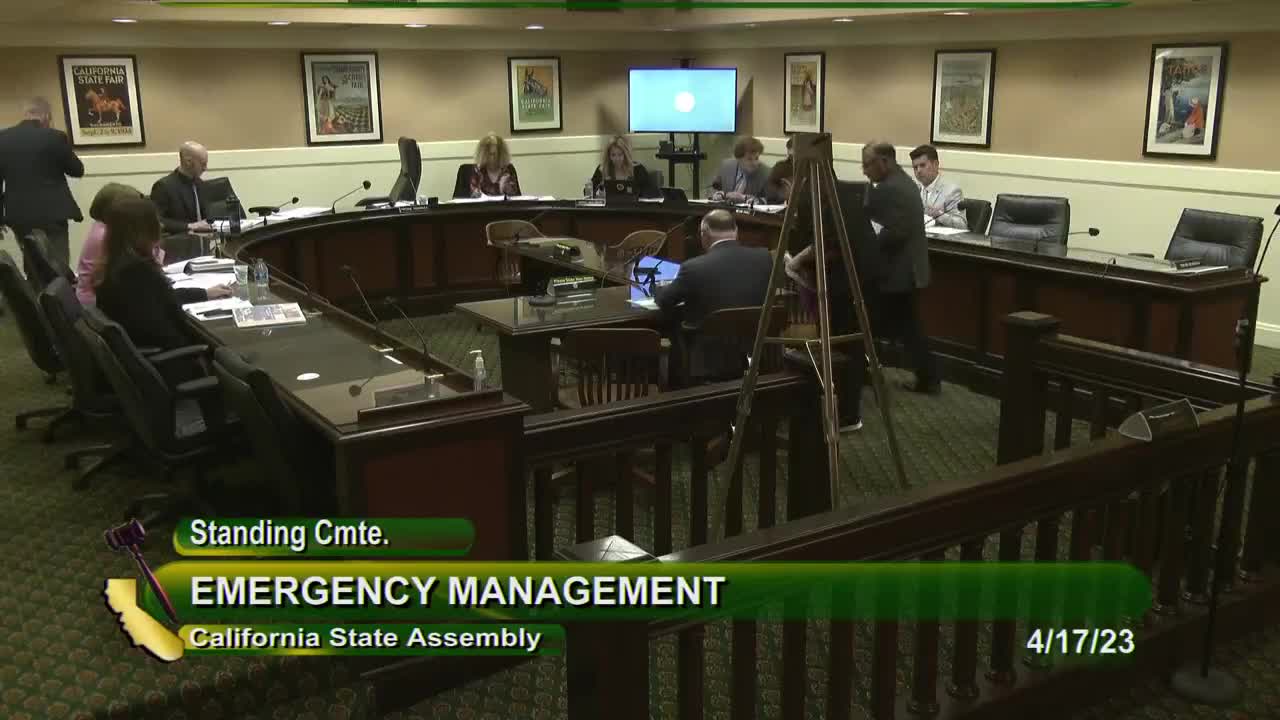 3MIN
Assembly Standing Committee on Emergency Management
Bill Author

Bill Co-Author(s):