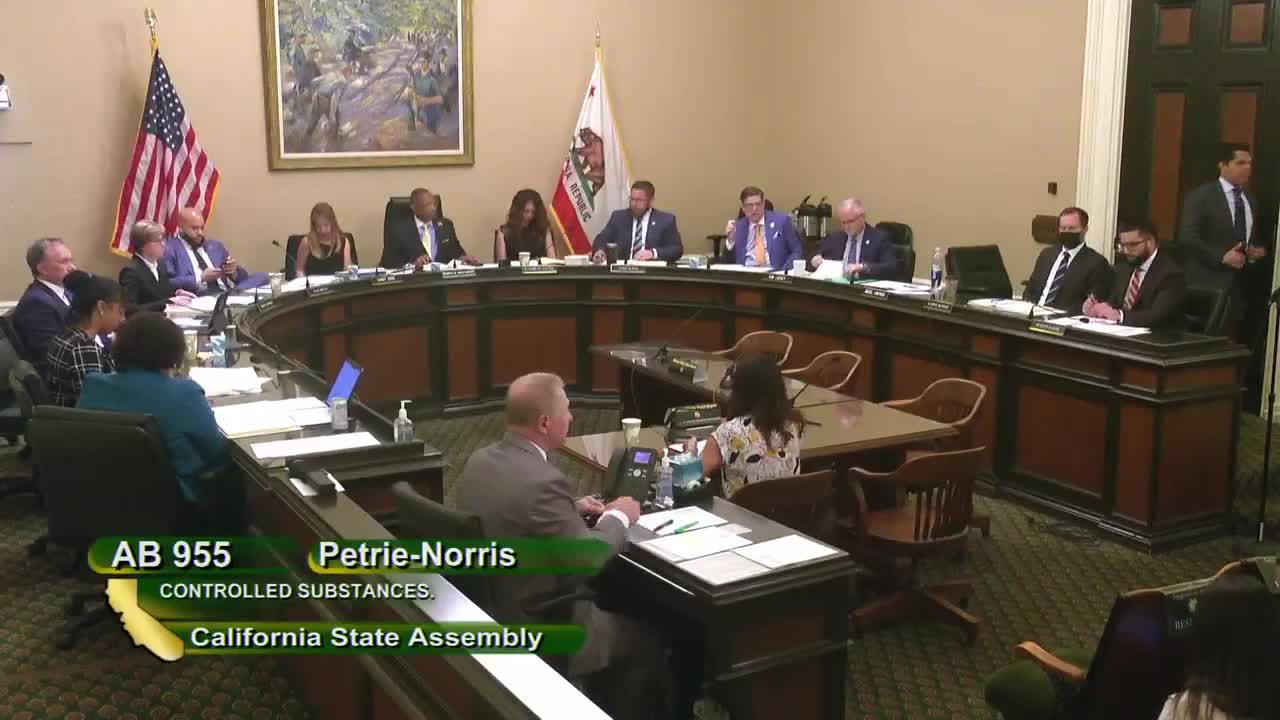
AB 955: Controlled substances.
- Session Year: 2023-2024
- House: Assembly
- Latest Version Date: 2023-03-15
Current Status:
Failed
(2024-02-01: From committee: Filed with the Chief Clerk pursuant to Joint Rule 56.)
Introduced
In Committee
First Chamber
In Committee
Second Chamber
Enacted
Existing law makes possession of specified controlled substances, including fentanyl, punishable by imprisonment in a county jail not to exceed one year, except as specified. Existing law makes possession of a controlled substance for the purposes of sale of the substance punishable by imprisonment in a county jail for a period of 2, 3, or 4 years.
This bill would make the sale of fentanyl on a social media platform, as defined, in California punishable by imprisonment in a county jail for a period of 3, 6, or 9 years.
By creating a new crime, this bill would impose a state-mandated local program.
The California Constitution requires the state to reimburse local agencies and school districts for certain costs mandated by the state. Statutory provisions establish procedures for making that reimbursement.
This bill would provide that no reimbursement is required by this act for a specified reason.
Existing federal law prohibits recipients of federal funding awards from using or procuring certain covered equipment, systems, or services, as specified. Federal law also requires aircraft, including unmanned aircraft, to be registered as a condition of operation. Federal law also requires persons operating unmanned aircraft for governmental purposes to comply with registration requirements that are applicable to persons operating unmanned aircraft for commercial purposes, or to obtain a certificate of waiver or authorization for a public operator for a specific unmanned aircraft activity, typically granted only to government agencies or other agencies that use unmanned aircraft as part of their routine public operations.Existing law authorizes contracting between state agencies and private contractors, and sets forth requirements for the procurement of goods and services by state agencies and the various responsibilities of state agencies and the Department of General Services in implementing state contracting procedures and policies.This bill would, on and after January 1, 2025, prohibit state and local agencies, including law enforcement agencies, from purchasing, acquiring, or otherwise using an unmanned aircraft or unmanned aircraft system produced by a manufacturer of covered equipment, systems, or services pursuant to specified federal law.Existing federal law prohibits recipients of federal funding awards from using or procuring certain covered equipment, systems, or services, as specified. Federal law also requires aircraft, including unmanned aircraft, to be registered as a condition of operation. Federal law also requires persons operating unmanned aircraft for governmental purposes to comply with registration requirements that are applicable to persons operating unmanned aircraft for commercial purposes, or to obtain a certificate of waiver or authorization for a public operator for a specific unmanned aircraft activity, typically granted only to government agencies or other agencies that use unmanned aircraft as part of their routine public operations.
Existing law authorizes contracting between state agencies and private contractors, and sets forth requirements for the procurement of goods and services by state agencies and the various responsibilities of state agencies and the Department of General Services in implementing state contracting procedures and policies.
This bill would, on and after January 1, 2025, prohibit state and local agencies, including law enforcement agencies, from purchasing, acquiring, or otherwise using an unmanned aircraft or unmanned aircraft system produced by a manufacturer of covered equipment, systems, or services pursuant to specified federal law.
(a)Except as otherwise provided in this division, every person who sells fentanyl on a social media platform in California shall be punished by imprisonment pursuant to subdivision (h) of Section 1170 of the Penal Code for a period of three, six, or nine years.
(b)For the purposes of this section and Section 11351.9, social media platform means a public-facing internet website, internet application, or mobile internet application, such as a social network, search engine, or email service, with at least 30,000,000 active monthly users in the United States.
SEC. 2.No reimbursement is required by this act pursuant to Section 6 of Article XIIIB of the California Constitution because the only costs that may be incurred by a local agency or school district will be incurred because this act creates a new crime or infraction, eliminates a crime or infraction, or changes the penalty for a crime or infraction, within the meaning of Section 17556 of the Government Code, or changes the definition of a crime within the meaning of Section 6 of Article XIIIB of the California Constitution.
SECTION 1.Chapter 12.9 (commencing with Section 7080) is added to Division 2 of Title 1 of the Government Code, to read:12.9.Acquisition and Use of Unmanned Aircraft 7080.(a)On and after January 1, 2025, no state or local agency, including any law enforcement agency, shall purchase, acquire, or otherwise use an unmanned aircraft or unmanned aircraft system produced by a manufacturer of covered equipment, systems, or services pursuant to Section 889 of the John S. McCain National Defense Authorization Act for Fiscal Year 2019 (Public Law 115232).(b)For purposes of this section, the following terms have the following meanings:(1)Local agency has the same meaning as in Section 53510.(2)State agency has the same meaning as in subdivision (a) of Section 11000.(3)Unmanned aircraft means an aircraft that is operated without the possibility of direct human intervention from within or on the aircraft, a remote piloted aircraft, or drone.(4)Unmanned aircraft system means an unmanned aircraft and associated elements, including, but not limited to, communication links and the components that control the unmanned aircraft that are required for the pilot in command to operate safely and efficiently in the national airspace system.(a)On and after January 1, 2025, no state or local agency, including any law enforcement agency, shall purchase, acquire, or otherwise use an unmanned aircraft or unmanned aircraft system produced by a manufacturer of covered equipment, systems, or services pursuant to Section 889 of the John S. McCain National Defense Authorization Act for Fiscal Year 2019 (Public Law 115232).
(b)For purposes of this section, the following terms have the following meanings:
(1)Local agency has the same meaning as in Section 53510.
(2)State agency has the same meaning as in subdivision (a) of Section 11000.
(3)Unmanned aircraft means an aircraft that is operated without the possibility of direct human intervention from within or on the aircraft, a remote piloted aircraft, or drone.
(4)Unmanned aircraft system means an unmanned aircraft and associated elements, including, but not limited to, communication links and the components that control the unmanned aircraft that are required for the pilot in command to operate safely and efficiently in the national airspace system.
|
Date
|
Status
|
|---|---|
| Feb 1, 2024 | From committee: Filed with the Chief Clerk pursuant to Joint Rule 56. |
| Jan 31, 2024 | Died pursuant to Art. IV, Sec. 10(c) of the Constitution. |
| May 1, 2023 | From committee: That the measure be retained in committee, and that the subject matter be referred to the Committee on Rules for assignment to the proper committee for study. (Ayes 8. Noes 0.) (April 27). |
| Mar 16, 2023 | Re-referred to Com. on P. & C.P. |
| Mar 16, 2023 | Re-referred to Com. on PUB. S. pursuant to Assembly Rule 96. |
| Mar 15, 2023 | From committee chair, with author's amendments: Amend, and re-refer to Com. on P. & C.P. Read second time and amended. |
| Mar 15, 2023 | In committee: Hearing postponed by committee. |
| Mar 2, 2023 | Referred to Coms. on P. & C.P. and A. & A.R. |
| Feb 15, 2023 | From printer. May be heard in committee March 17. |
| Feb 14, 2023 | Read first time. To print. |
|
Date
|
Description
|
Location
|
Votes
|
|
|---|---|---|---|---|
| Apr 27, 2023 | Bill measure be retained in committee, and subject matter be referred to Rules Committee for assignment to the proper committee. | Assembly Standing Committee on Public Safety |
Passed |
This list shows positions taken on this bill by organizations on the date displayed, which is linked to the original source.
Positions by individuals are not included.
|
Organization
|
Position
|
Date
|
|---|---|---|
| Arcadia Police Officers' Association | ** Support | |
| Association Of Orange County Deputy Sheriffs | ** Support | |
| Burbank Police Officers' Association | ** Support | |
| California Association Of Highway Patrolmen | ** Support | |
| California District Attorneys Association | * Support | Apr 27, 2023 |
| California Fraternal Order of Police | ** Support | |
| California Police Chiefs Association | * Support | Apr 27, 2023 |
| California Public Defenders Association | * Support | Apr 27, 2023 |
| California State Sheriff's Association | * Support | Apr 27, 2023 |
| California Statewide Law Enforcement Association | ** Support | |
| CLAREMONT POLICE OFFICERS ASSOCIATION | ** Support | |
| Corona Police Officers Association | ** Support | |
| Crime Victims United | * Support | Apr 27, 2023 |
| Culver City Police Officers' Association | ** Support | |
| Deputy Sheriffs Association of Monterey County | ** Support | |
| Drug Policy Alliance | ** Against | |
| Ella Baker Center For Human Rights | ** Against | |
| ENR Project | * Support | Apr 27, 2023 |
| Fullerton Police Officers' Association | ** Support | |
| Health Right 360 | * Support | Apr 27, 2023 |
| League Of California Cities | * Support | Apr 27, 2023 |
| Long Beach Police Officers Association | ** Support | |
| Murrieta Police Officers' Association | ** Support | |
| Newport Beach Police Association | ** Support | |
| Office of Placer County District Attorney | * Support | Apr 27, 2023 |
| Orange County Sheriff's Department | ** Support | |
| Palos Verdes Police Officers Association | ** Support | |
| Peace Officers Research Association Of California | ** Support | |
| PLACER COUNTY DEPUTY SHERIFFS ASSOCIATION | ** Support | |
| Pomona Police Officers' Association | ** Support | |
| RIVERSIDE POLICE OFFICERS ASSOCIATION | ** Support | |
| Riverside Sheriffs' Association | ** Support | |
| Sacramento County Deputy Sheriffs' Association | ** Support | |
| san bernardino county sheriff's employees' benefit association | ** Support | |
| San Diegans Against Crime | ** Support | |
| San Diego Deputy District Attorneys Association | ** Support | |
| Santa Ana Police Officers Association | ** Support | |
| Sister Warriors Freedom Coalition | ** Against | |
| stop the void | * Support | Apr 27, 2023 |
| Upland Police Officers Association | ** Support | |
| Young Women's Freedom Center | * Indeterminate | Apr 27, 2023 |
Date of Hearing: April 27, 2023
Counsel: Andrew Ironside
ASSEMBLY COMMITTEE ON
Reginald Byron Jones-Sawyer, Sr., Chair
ABPCA Bill Id:
Author:() – As Ver:
SUMMARY:
Creates a new crime for selling fentanyl on a social media platform. Specifically, this bill:
- Provides that a person who sells fentanyl on a social media platform in California shall be punished by imprisonment for a period of three, six, or nine years in county jail.
- Defines “social media platform” as a public-facing internet website, internet application, or mobile internet application, such as a social network, search engine, or email service, with at least 30,000,000 active monthly users in the United States.
EXISTING LAW:
- Provides that a person who possesses fentanyl for sale, or purchases fentanyl for purposes of sale, shall be punished by imprisonment in county jail for two, three, or four years. (Health & Saf. Code, § 11351.)
- Provides that a person who sells or transports fentanyl, or offers to do so, unless upon a written prescription, as specified, shall be punished by imprisonment in county jail for three, four, or five years. (Health & Saf. Code, § 11352, subd. (a).)
- Provides that a person who transports fentanyl within this state from one county to another noncontiguous county shall be punished by imprisonment in county jail for three, six, or nine years. (Health & Saf. Code, § 11352, subd. (b).)
- Provides that a person 18 years of age or over who voluntarily solicits, induces, encourages, or intimidates any minor to violate specified drug offenses shall be punished by imprisonment in the state prison for a period of three, six, or nine years. (Health & Saf. Code, § 11353.)
- Provides that a person 18 years of age or over who hires, employs, or uses a minor to unlawfully traffic a controlled substance, as specified, shall be punished by imprisonment in the state prison for a period of three, six, or nine years. (Health & Saf. Code, § 11353.)
- Provides that a person 18 years of age or over who unlawfully sells, offers to sell, or furnishes a controlled substance to a minor shall be punished by imprisonment in the state prison for a period of three, six, or nine years. (Health & Saf. Code, § 11353.)
- Provides that a person 18 years of age or over who is convicted of specified drug offenses involving a minor, in addition to the punishment imposed for that conviction, shall receive a one-year enhancement if the offense involved heroin, cocaine, cocaine base, or any analog of these substances and occurred at a facility where minors congregate. (Health & Saf. Code, § 11353.1, subd. (a)(1).)
- Provides that a person 18 years of age or over who is convicted of specified drug offenses involving a minor, in addition to the punishment imposed for that conviction, shall receive a two-year sentence enhancement if the offense involved heroin, cocaine, cocaine base, or any analog of these substances and occurred near a school. (Health & Saf. Code, § 11353.1, subd. (a)(2).)
- Specifies that it is a felony to manufacture specified controlled substances, including fentanyl, and makes that conduct punishable by imprisonment for three, five, or seven years in the county jail. (Health & Saf. Code, § 11379.6.)
- Defines “social media platform” as a public or semipublic internet-based service or application that has users in California and that meets the following criteria:
- A substantial function of the service or application is to connect users in order to allow users to interact socially with each other within the service or application.
- A service or application that provides email or direct messaging services shall not be considered to meet this criterion on the basis of that function alone.
- The service or application allows users to do all of the following:
- Construct a public or semipublic profile for purposes of signing into and using the service.
- Populate a list of other users with whom an individual shares a social connection within the system.
- Create or post content viewable by other users, including, but not limited to, on message boards, in chat rooms, or through a landing page or main feed that presents the user with content generated by other users. (Bus. & Prof. Code, § 22945, subd. (a)(3); Civ. Code, § 1798.99.20, subd. (b))
- Construct a public or semipublic profile for purposes of signing into and using the service.
- A substantial function of the service or application is to connect users in order to allow users to interact socially with each other within the service or application.
- Requires a social media platform that operates in the state to create, and publicly post on its internet website, a policy statement that includes all of the following:
- The social media platform’s policy on the use of the social media platform to illegally distribute a controlled substance;
- A general description of the social media platform’s moderation practices that are employed to prevent users from posting or sharing electronic content pertaining to the illegal distribution of a controlled substance;
- A link to mental health and drug education resources provided by governmental public health authorities;
- A link to the social media platform’s reporting mechanism for illegal or harmful content or behavior on the social media platform, if one exists; and,
- A general description of the social media platform’s policies and procedures for responding to law enforcement inquiries, including warrants, subpoenas, and other court orders compelling the production of or access to electronic communication information. (Bus. & Prof. Code, § 22945, subd. (b)(1)-(5).)
- The social media platform’s policy on the use of the social media platform to illegally distribute a controlled substance;
FISCAL EFFECT:
Unknown
COMMENTS:
- Author's Statement: According to the author, “Far too many families have felt the crushing heartbreak of losing a loved one to a fentanyl overdose. The problem is exacerbated by how easily the drug is trafficked on social media platforms. Every life taken due to an online fentanyl sale is a preventable tragedy and we must continue to do everything possible to ensure law enforcement agencies have the tools necessary fight this growing epidemic. AB 955 would increase penalties applied to those convicted of fentanyl sales by imprisonment in a county jail for a period of 3, 6, or 9 years, offering law enforcement important assistance in the fight against this deadly epidemic.”
- Fentanyl Use and Distribution: Drug overdoses have increased dramatically in recent years. In California, the number of deaths involving opioids, and fentanyl in particular, has increased significantly over the course of the last decade. Between 2012 and 2018, while opioid-related overdose deaths increased by 42%, overdose deaths related to fentanyl specifically increased by more than 800%—from 82 to 786. (CDPH, Overdose Prevention Initiative <https://www.cdph.ca.gov/Programs/CCDPHP/DCDIC/SACB/Pages/PrescriptionDrugOverdoseProgram.aspx?msclkid=99f1af92b9e411ec97e3e1fe58cde884> [last viewed Mar. 7, 2023].) In 2021, there were 21,016 emergency room visits resulting from an opioid overdose, 7,176 opioid-related overdose deaths, and 5,961 overdose deaths from fentanyl. (CDPH, Overdose Surveillance Dashboard <https://skylab.cdph.ca.gov/ODdash/?tab=Home> [last visited Mar. 7, 2023].). According to the CDC, “[i]t is a major contributor to fatal and nonfatal overdoses in the U.S.” (CDC, Fentanyl Facts <https://www.cdc.gov/stopoverdose/fentanyl/index.html> [last visited Apr. 25, 2023].)
Most of the illicit fentanyl consumed in the United States originates in China, “a major pipeline of the building blocks of fentanyl, known as fentanyl precursors, according to U.S. officials.” (John et al., The US sanctioned Chinese companies to fight illicit fentanyl. But the drug’s ingredients keep coming, CNN.com (Mar. 30, 2023) < https://www.cnn.com/2023/03/30/americas/fentanyl-us-china-mexico-precursor-intl/index.html> [last visited Mar. 31, 2023].). Chemical manufactures in China ship fentanyl precursors to Mexico where drug cartels make fentanyl and arrange for it to be transported across the U.S./Mexico border. (Ainsley, U.S. and Mexico weighing deal from Mexico to crack down on fentanyl going north while U.S. cracks down on guns going south, NBCNews.com (Mar. 27, 2023) <https://www.nbcnews.com/politics/national-security/fentanyl-gun-smuggling-us-mexico-border-deal-rcna75782> [last visited Mar. 31, 2023].) The vast majority of the fentanyl seizures in the U.S. occur at legal ports of entry or interior vehicle checkpoints, and U.S. citizens are primarily the ones trafficking fentanyl. (Bier, Fentanyl Is Smuggled for U.S. Citizens By U.S. Citizens, Not Asylum Seekers, Cato.org (Sept. 14, 2022) <https://www.cato.org/blog/fentanyl-smuggled-us-citizens-us-citizens-not-asylum-seekers> [last visited Mar. 31, 2023].).
Illicit fentanyl is typically available as either a liquid or powder. It is often mixed with other drugs like heroin, cocaine, or methamphetatime, and is widely used in counterfeit prescription opioids. Because of mixing, many users might not be aware that they are consuming fentanyl. (CDC, Fentanyl Facts <https://www.cdc.gov/stopoverdose/fentanyl/index.html> [last visited Apr. 25, 2023].)
Intentional fentanyl use is also on the rise. “One of the deadliest street drugs, illicit fentanyl, has transitioned from a hidden killer that people often hope to avoid to one that many drug users now seek out on its own.” (Edwards, Once feared, illicit fentanyl is now a drug of choice for many opioid users, NBC News (Aug. 7, 2022) <https://www.nbcnews.com/health/health-news/feared-illicit-fentanyl-now-drug-choice-many-opioids-users-rcna40418> [last visited Apr. 24, 2023].) A recent University of Washington survey of people who had used syringe service programs found that two-thirds had used fentanyl “on purpose” in the last three months. (Kingston et al., University of Washington, Results from the 2021 WA State Syringe Service Program Health Survey (Mar. 2022) at pp. 1, 6 <https://adai.uw.edu/wordpress/wp-content/uploads/ssp-health-survey-2021.pdf> [last visited Apr. 24, 2023].) “More than half of drug users [in the Tenderloin district in San Francisco] purposely seek fentanyl, despite its dangers, according to harm reduction workers who talk to hundreds of drug users every day.” (Vestal, Some Drug Users in Western U.S. Seek Out Deadly Fentanyl. Here’s Why., PEW Charitable Trusts (Jan. 7, 2019) <https://www.pewtrusts.org/en/research-and-analysis/blogs/stateline/2019/01/07/some-drug-users-in-western-us-seek-out-deadly-fentanyl-heres-why> [last view Apr. 24, 2023].) - Harsher Sentences for Drug Trafficking Unlikely to Reduce Drug Use or Deter Criminal Conduct: The author claims, “AB 955 would increase penalties applied to those convicted of fentanyl sales by imprisonment in a county jail for a period of 3, 6, or 9 years, offering law enforcement important assistance in the fight against this deadly epidemic.” Increasing penalties would assist law enforcement by either (1) incapacitating persons who deal drugs, thereby reducing the availability of fentanyl, or (2) deterring people from selling fentanyl. The evidence, however, suggests that measures such as this will do neither.
Ample research on the impact of increasing penalties for drug offenses on criminal behavior has called into question the effective ness of such measures. In a report examining the relationship between prison terms and drug misuse, PEW Charitable Trusts found “[n]o relationship between drug imprisonment rates and states’ drug problems,” finding that “high rates of drug imprisonment did not translate into lower rates of drug use, arrests, or overdose deaths.” (PEW, More Imprisonment Does Not Reduce State Drug Problems (Mar. 2018) p. 5 <https://www.pewtrusts.org/-/media/assets/2018/03/pspp_more_imprisonment_does_not_reduce_state_drug_problems.pdf> [last viewed Feb. 6, 2023]; see generally, Przybylski, Correctional and Sentencing Reform for Drug Offenders (Sept. 2009) < http://www.ccjrc.org/wp-content/uploads/2016/02/Correctional_and_Sentencing_Reform_for_Drug_Offenders.pdf> [last visited Mar. 20, 2023].) Put differently, imprisoning more people for longer periods of time for drug trafficking offenses is unlikely to reduce the risk of illicit drugs in our communities.
This may be because of the limited deterrent effect of harsher sentences generally. According the U.S. Department of Justice, “Laws and policies designed to deter crime by focusing mainly on increasing the severity of punishment are ineffective partly because criminals know little about the sanctions for specific crimes. More severe punishments do not ‘chasten’ individuals convicted of crimes, and prisons may exacerbate recidivism.” (National Institute of Justice, U.S. Department of Justice, Five Things About Deterrence (June 5, 2016) <https://nij.ojp.gov/topics/articles/five-things-about-deterrence> [last visited Feb. 2, 2023.])
Harsher sentences for drug trafficking offenses specifically may be particularly ineffective, in part because of the nature of illicit drug markets. As the National Research Council explains:
For several categories of offenders, an incapacitation strategy of crime prevention can misfire because most or all of those sent to prison are rapidly replaced in the criminal networks in which they participate. Street-level drug trafficking is the paradigm case. Drug dealing is part of a complex illegal market with low barriers to entry. Net earnings are low, and probabilities of eventual arrest and imprisonment are high… Drug policy research has nonetheless shown consistently that arrested dealers are quickly replaced by new recruits….
Despite the risks of drug dealing and the low average profits, many young disadvantaged people with little social capital and limited life chances sell drugs on street corners because it appears to present opportunities not otherwise available. However, [they] … overestimate the benefits of that activity and underestimate the risks. This perception is compounded by peer influences, social pressures, and deviant role models provided by successful dealers who live affluent lives and…avoid arrest… Arrests and imprisonments of easily replaceable offenders create illicit “opportunities” for others.
(Cmte. On Causes and Consequence of High Rates of Incarceration, National Research Council, The Growth of Incarceration in the United States: Exploring Causes and Consequences (2014) p. 146 <https://nap.nationalacademies.org/catalog/18613/the-growth-of-incarceration-in-the-united-states-exploring-causes> [last visited Apr. 25, 2023].)
More recently, the Council on Criminal Justice reviewed the evidence on the effect of harsher punishments on criminal behavior and came to the same conclusion. It reported:
The empirical evidence on selective incapacitation suggests that long sentences may produce short- and long-term public safety benefits for individuals engaged in violent offending, but may produce the opposite effect for those engaged in drug-related offending…where an incarcerated individual is quickly replaced by a new recruit. This “replacement effect” occurs—and undermines the overall crime-reducing effects of incapacitation—when there is “demand” for a particular criminal activity. The illicit drug business offers the most obvious example: when someone who plays a role in a drug trafficking organization is incarcerated, someone else must take his or her place.
One study found that incarcerating street-level drug dealers fueled their replacement by younger and more violent individuals. Additional research replicated these findings through an examination of the public safety impact of California’s three strikes law from 1994, when the law was implemented, to 1998. This work found short- and long-term decreases in most types of crime, but also found that imprisoning chronic drug offenders had no impact on the drug crime rate. The authors hypothesized that incarcerating chronic drug offenders did not result in an incapacitation effect because “when one drug offender is jailed, there is another (and perhaps more than just one other) ready to take his or her place.” Additional analyses further indicate that incarcerating people for drug trafficking may result in increased crimes rates in general and increased rates of violent crime, specifically, because of organizational destabilization and the need for new recruits to prove themselves.
(Long Sentences Task Force, Council on Criminal Justice, The Impact of Long Sentences on Public Safety: A Complex Relationship (Nov. 2022) p. 8 https://counciloncj.org/wp-content/uploads/2022/11/Impact-of-Long-Sentences-on-Public-Safety.pdf [last visited Apr. 2023] [internal citations omitted] [emphasis added].)
With fentanyl, the deterrent effect of increasing penalties may be questioned further because the seller often is unaware that the product is laced with fentanyl. Citing U.S. Sentencing Commission data, one analysis observed, “Low-level dealers rarely know the contents of the product in their supply chain or can predict its risk.” (Beletsky, America’s Favorite Antidote: Drug-Induced Homicide in the Age of the Overdose Crisis (2019) 4 Utah L.Rev. 833, 877.) “These contents also frequently fluctuate—often as a result of interdiction activities and other law enforcement efforts to disrupt the market, further complicating any rational decision-making.” (Ibid.)
Moreover, persons who participate in the drug trade often are themselves people who use drugs. According to the National Research Council: “Facing limited opportunities in legal labor markets and already in contact with drug-selling networks, users provide a ready low-wage labor pool for illegal markets.”(https://nap.nationalacademies.org/read/12976/chapter/4 - 24). According to a Bureau of Justice Statistics report, 70% of persons serving time in state prison for drug trafficking offenses used drugs in the month before the offense, and 42.3% of those persons had been using drugs at the time of their offense. (Bureau of Justice Statistics, Special Report: Drug Use and Dependence, State and Federal Prisoners, 2004 (Oct. 2006) a p. 5 <https://bjs.ojp.gov/content/pub/pdf/dudsfp04.pdf> [last visited Mar. 20, 2023].) Will the threat of an increased sentence effectively deter somebody already at a relatively high risk of death from illicit drug use?
Proponents observe that “[s]ocial media is a space dominated largely by young people.” But this is likely to be just as true for people who use drugs as for those who sell them. According to one study, “[Street-involved youth implicated in the drug trade] appear to be motivated by drug dependence,” finding: “Among participants who reported drug dealing, 263 (85.6%) individuals stated that the main reason that they sold drugs was to pay for their personal drug use.” (Werb et al., Risks surrounding drug trade involvement among street-involved youth, Am. J. Drug Alcohol Abuse (2008) <https://pubmed.ncbi.nlm.nih.gov/19016187/> [last visited Feb. 2, 2023].) Still another found that “White youths who misused prescription drugs were three times more likely to sell drugs, compared to White youths who did not misuse prescription drugs.” (Floyd et al., Adolescent Drug Dealing and Race/Ethnicity: A Population-Based study of the Differential Impact on Substance Use on Involvement in Drug Trade, Amer. J. of Drug & Alcohol Abuse, Vol. 36, No. 2 (Mar. 2010) <https://www.ncbi.nlm.nih.gov/pmc/articles/PMC2871399/ - R7> [last visited Mar. 17, 2022].) Many of the people receiving increased penalties under this bill are likely to be friends or romantic partners of the users. (Cf. Beletsky, America’s Favorite Antidote: Drug-Induced Homicide in the Age of the Overdose Crisis (2019) 4 Utah L.Rev. 833, pp. 839, 873-874.)
Additionally, as the Council on Criminal Justice’s report notes, the harsher punishments for drug offenses may actually do harm. For example, they may push persons selling and using drugs to engage in riskier behaviors. (See Friedman et al., Relationships of deterrence and law enforcement to drug-related harms among drug injectors in US metropolitan areas (2006) AIDS Vol 20 No 1.)
According to PEW, “[A] large body of prior research…cast[s] doubt on the theory that stiffer prison terms deter drug misuse, distribution, and other drug-law violations.” (PEW, supra.) PEW concludes:
Putting more drug-law violators behind bars for longer periods of time has generated enormous costs for taxpayers, but it has not yielded a convincing public safety return on those investments. Instead, more imprisonment for drug offenders has meant limited funds are siphoned away from programs, practices, and policies that have been proved to reduce drug use and crime. (Ibid.)
Will increasing penalties for selling fentanyl on social media deter people from selling, or using, drugs? The evidence to date suggests that it will not.
- Existing Penalties for Sale of Fentanyl: Existing law provides for significant penalties for selling fentanyl. A person who sells fentanyl, or even offers to do so, is subject to up to 5 years in county jail. (Health & Saf. Code, § 11352.) If a person 18-years-old or older sells fentanyl to minor, or who uses a minor to sell fentanyl, that person is subject to imprisonment in state prison for up to 9 years. (Health & Saf. Code, § 11353.) Transporting fentanyl within the state from one county to another is punishable by imprisonment in county jail for up to nine years. (Health & Saf. Code, § 11352, subd. (b).) If the fentanyl was mixed with cocaine or heroin, as is commonly done, and was sold at a place where minors congregate or near a school, the person is subject to a one- or two-year enhancement on top of the base term. (Health & Saf. Code, § 11353.1, subd. (a)(1) & (2).) Selling fentanyl while in possession of a firearm carries a one-year enhancement as well. (Pen. Code, § 12022, subd. (a)(1).)
- Existing Efforts to Combat Fentanyl in California: The state’s 2022-23 budget included $7.9 million in 2022-23 and $6.7 million ongoing to fund the Fentanyl Task Force within the Department of Justice (DOJ) to help tackle the fentanyl crisis. (Governor’s Budget Summary – 2023-24 at p. 117 <https://ebudget.ca.gov/2022-23/pdf/Enacted/BudgetSummary/FullBudgetSummary.pdf> [April 20, 2023].) The task force includes 25 new positions within the DOJ to support those efforts. (Ibid.)
Building on the 2022-23 Budget, the state’s 2023-24 Budget includes additional funding to combat fentanyl abuse. The budget allocates $93 million over the next four years, including $79 million for Naloxone distribution projects; $10 million for grants for education, testing, recovery, and support services; $4 million to make test strips more available; and, $3.5 million for overdose medication for all middle and high schools. (Governor’s Budget Summary – 2023-24 at p. 69 <https://ebudget.ca.gov/FullBudgetSummary.pdf> [April 20, 2023].)
The Governor’s Master Plan for Tackling the Fentanyl and Opioid Crisis also includes $30 million to expand California National Guard’s work to prevent drug-trafficking transnational criminal organizations and $15 million over two years to establish and operate the Fentanyl Enforcement Program within the DOJ to combat manufacturing, distribution, and trafficking. The Governor also has allocated $40.8 million for an education and awareness campaign to establish partnerships and create messaging and education tools for parents and educators, and $23 million in substance use disorder workforce grants to develop substance use disorder training for non-behavioral health professionals working with children and youth. (Governor Newsom’s Master Plan for Tackling the Fentanyl and Opioid Crisis <https://www.gov.ca.gov/wp-content/uploads/2023/03/Fentanyl-Opioids-Glossy-Plan_3.20.23.pdf?emrc=86c07e> [April 20, 2023].)
Adding to these efforts, the Governor recently announced a public safety partnership charged with combatting fentanyl trafficking in San Francisco. The partnership would include the California Highway Patrol, the California National Guard, San Francisco Police Department, and the San Francisco District Attorney’s Office. According to the press release, “This agreement will lead to the formation of a new collaborative operation between all four agencies focused on dismantling fentanyl trafficking and disrupting the supply of the deadly drug in the city by holding the operators of large-scale drug trafficking operations accountable.” (Governor Newsom Announces Public Safety Partnership to Disrupt Fentanyl Trafficking San Francisco <https://www.gov.ca.gov/2023/04/21/public-safety-partnership-sf/> [last visited Apr. 24, 2023].)
- This Bill’s Potential Impact on California’s Jail Population: Realignment began in October 2011. Since that time county jails have had oversight over most non-serious, non-violent, non-sexual felons and parolees who violate their parole. Before realignment, the maximum sentence in county jail was one year. Now that lower-level felons serve sentences in county jail, a portion of the jail population is serving sentences that are much longer than one year. Those factors related to realignment have served to increase population pressure on county jails.
In February 2021, the Public Policy Institute of California (PPIC) published a report discussing population impacts on California jails related to Realignment, Proposition 47 (Prop 47), and the effects of the COVID-19 pandemic. After realignment, the jail population began to rise; as of October 2014, the month before the passage of Proposition 47, it stood at roughly 82,000 inmates, a gain of 14% from 2011. (Lofstrom & Martin, California’s County Jails (Feb. 2021) <http://www.ppic.org/publication/californias-county-jails/>)[last viewed Mar. 21, 2022].)
Voters approved Prop 47 in November 2014, reclassifying several property and drug crimes from felonies to misdemeanors. Prop 47 had an immediate and lasting impact on jail populations: the average daily population dropped by almost 10,000 between October 2014 and January 2015. The jail population remained relatively flat between January 2015 and the onset of the COVID-19 pandemic. By February 2020, the average daily jail population had dropped to about 69,000, although that population grew by roughly 7,200 persons between May and September 2020. California currently has the capacity to house 79,000 persons in long-term county jail facilities. (Lofstrom & Martin, California’s County Jails (Feb. 2021) <http://www.ppic.org/publication/californias-county-jails/>)[last viewed Mar. 21, 2022].)
Moreover, even before realignment, many county jails were struggling with overcrowding. Indeed, “[p]rior to the passage of realignment, many counties were already operating under court-imposed population caps, and others had very little extra capacity in their jail systems.” (Lofstrom et al., Impact of Realignment on County Jail Populations, Public Policy Institute of California (June 2013) p. 7 <https://www.ppic.org/wp-content/uploads/content/pubs/report/R_613MLR.pdf> [last visited Mar. 17, 2023].)
This bill would dramatically increase sentences for individuals convicted of specified criminal offenses involving fentanyl. Many of the individuals sentenced pursuant to the provisions of this bill would serve their sentences in county jail, potentially straining already overcrowded facilities. Some will nonetheless serve prison sentences based on prior convictions. - Arguments in Support:
- According to the California Statewide Law Enforcement Association, “Fentanyl is an incredibly dangerous drug that presents a significant risk to public health. Those who distribute fentanyl do so with a conscious indifference to human life, ignoring the drug’s extremely dangerous potential. This danger is evidenced by the exponential increase in fentanyl-related deaths in our state. In California, there were 239 fentanyl-related deaths in 2016. By 2021, that number increased by 2,294%, reaching a total of 5,722 deaths.
“Law enforcement agencies make great efforts to seize fentanyl and control the influx of the drug into our state. Despite these efforts, a substantial amount of fentanyl continues to make its way into our communities. To combat this phenomenon requires holding traffickers and sellers accountable to the fullest extent of the law. This bill furthers that goal by increasing penalties for those using social media as a platform for their operations. Social media is a space dominated largely by young people. In order to best protect all Californians, especially the youngest among us on social media, accountability must be expanded to include sales made on such platforms.” - According to the Orange County Sheriff’s Department, “The use of social media has become one of the more common methods for selling drugs, particularly to our youth. We have seen this firsthand in the course of our law enforcement investigations. Over the past few year the Orange County Sheriff’s Department has employed a new strategy for investigating drug-related deaths. Past practice for drug-related deaths primarily involved a coroner review of the death, with little to no attempt to identify the source of the lethal drug. Now drug-related deaths in Sheriff’s jurisdiction are investigated with the intent of identifying the drug’s supplier for prosecution. In a substantial amount of the cases we have investigated, social media was the means for making the drug sale. Legislation like AB 955 will help us better hold traffickers accountable and make clear that use of social media to target Californians will not be tolerated.”
- According to the California Statewide Law Enforcement Association, “Fentanyl is an incredibly dangerous drug that presents a significant risk to public health. Those who distribute fentanyl do so with a conscious indifference to human life, ignoring the drug’s extremely dangerous potential. This danger is evidenced by the exponential increase in fentanyl-related deaths in our state. In California, there were 239 fentanyl-related deaths in 2016. By 2021, that number increased by 2,294%, reaching a total of 5,722 deaths.
- Argument in Opposition: According to the California Public Defenders Association, “Although the intention to stem the tide of fentanyl overdose deaths is laudable, AB 955 is misguided, targets the wrong people, and returns to failed policies of mass incarceration and War on Drugs.
“Clearly, if Californians want to stop the sale of fentanyl on social media, it can be stopped or at least severely curtailed by requiring the social media companies to police their websites. Social media companies do this every day with child pornography and other illicit activities. For example, Comparitech reports the following:
… in just nine months of 2022, Facebook had almost equaled 2021’s content removals for child exploitation. It was a similar story on Instagram (6.08 million pieces of content flagged from Q1-Q3 of 2022 compared to 8.38 million in 2021) and TikTok (140 million pieces of content flagged from Q1-Q3 of 2022 compared to 141.7 million in 2021).
Snapchat looked set to surpass 2021’s total with 201,527 accounts flagged for child sexual exploitation and abuse in the first half of 2022, compared to 317,243 flagged across all of 2021. Whereas, Discord’s Q1-Q3 figures for 2022 had already exceeded 2021’s totals (1.52 million accounts, servers, and pieces of content were flagged from Q1-Q3 of 2022, compared to 1.42 million in 2021). (Available online https://www.comparitech.com/blog/vpn-privacy/child-abuse-online-statistics/ )
“Instead, AB 955 relies on outdated War on Drugs mentality and would end up creating more harm than it would prevent. Relying on ever increasing penalties for drug offenses has been extensively researched, and we can therefore make some educated predictions about the outcome of bills like AB 955: it would not reduce the distribution of fentanyl, nor would it prevent overdoses; it would reduce neither the supply of drugs or the demand for them; and worse, it could actually discourage effective methods of dealing with the opioid crisis. One study found that states that increase their incarceration rates do not experience a decrease in drug use. When a drug seller is incarcerated, the supply of drugs is not reduced nor is the drug market impacted. Because the drug market is driven by demand rather than supply, research indicates that an incarcerated seller will simply be replaced by another individual to fill the market demand.
“Many of the people who will be incarcerated by this bill will be addicts themselves. A Bureau of Justice report found that 70% of people incarcerated for drug trafficking in state prisons used drugs prior to the offense. These individuals often distribute drugs, not for profit, but as a way to support their own substance use disorder. Often, these “traffickers” are not high-level members of any organized drug distribution scheme but are rather furnishing narcotics to friends and family members.
“The imposition of harsh penalties for distribution could undermine California’s Good Samaritan law, which encourages people to contact emergency services in case of an overdose. The threat of police involvement and harsh prison sentences may make an individual hesitant to call emergency services or run from the scene rather than help the victim.
“The primary risk of overdose for fentanyl results from its unknowing ingestion. The process of adding fentanyl to heroin is usually done early in the production process. According to the Drug Enforcement Administration, fentanyl is generally added to heroin before it enters the U.S. Therefore, low level sellers may not know they are distributing fentanyl. This bill would not reduce the inclusion of fentanyl in the drug supply, as it takes place high in the distribution chain.
“The War on Drugs has had a devastating impact on communities across California. The unintended consequences of using jails and prisons to deal with a public health issue will take decades to unravel. Rather than diminishing the harms of drug misuse, criminalizing people who sell and use drugs amplifies the risk of fatal overdoses and diseases, increases stigma and marginalization, and drives people away from needed treatment, health, and harm reduction services.
“Moreover, California voters have signaled, again and again, their preference for using a health approach to drug offenses, and their desire to unwind the failed War on Drugs. Reversing course and increasing criminal penalties not only flies in the face of multiple statewide elections, but it is also simply bad policy. If ever-increasing criminal penalties were the answer to the misuse of drugs, California would have solved this problem long ago. Societal harms associated with drugs are not alleviated by lengthy prison sentences. Rather, these increased penalties impose their own harm, devastating vulnerable communities, particularly communities of c color. For all of these reasons, AB 955 would take California in the wrong direction.
“It is not time to returned to policies that have already proven to be ineffective.”
- Related Legislation:
- AB 675 (Soria), would add a substance containing a heroin analog, a substance containing fentanyl, and a substance containing a fentanyl analog to the list of controlled substances for which possession of those substances while armed with a loaded and operable firearm is a felony punishable in state prison by two, three, or four years. AB 675 will be heard today in this committee.
- AB 701 (Villapudua), would impose an additional enhancement when a person is convicted of specified drug offenses involving fentanyl, including sale, possession for sale, and transportation, when the substance containing fentanyl exceeds a specified weight. AB 701 was granted reconsideration in this committee.
- AB 18 (Joe Patterson), would require the court to advise a person convicted of specified drug offenses that they could be charged with voluntary manslaughter or murder if they manufacture or distribute controlled substances in the future and somebody dies as a result. AB 18 was granted reconsideration in this committee.
- SB 237 (Grove), increases the punishment for drug trafficking fentanyl. SB 237 is up for reconsideration in the Senate Public Safety Committee.
- SB 62 (J. Nguyen), would apply existing weight enhancements increasing the penalty and fine for trafficking substances containing heroin, cocaine base, and cocaine to fentanyl. SB 62 is up for reconsideration in the Senate Public Safety Committee.
- SB 44 (Umberg), is substantially similar to AB 18 (Joe Patterson). SB 44 is up for reconsideration in the Senate Public Safety Committee.
- SB 226 (Alvarado-Gil), is substantially similar to AB 675 above. SB 226 is pending hearing in the Senate Appropriations Committee.
- AB 675 (Soria), would add a substance containing a heroin analog, a substance containing fentanyl, and a substance containing a fentanyl analog to the list of controlled substances for which possession of those substances while armed with a loaded and operable firearm is a felony punishable in state prison by two, three, or four years. AB 675 will be heard today in this committee.
- Prior Legislation:
- AB 2246 (Petrie-Norris), of the 2021-2022 Legislative Session, would have increased penalties for specified drug offenses involving fentanyl and applies a sentencing enhancement for specified drug trafficking offenses involving heroin, cocaine, or cocaine base to those involving fentanyl. AB 2246 failed passage in this committee.
- AB 2366 (Jim Patterson), of the 2021-2022 Legislative Session, was substantially similar to AB 18 (Joe Patterson), of the current session. The author pulled AB 2366 before the bill’s scheduled hearing in this committee.
- SB 350 (Melendez), of the 2021-2022 Legislative Session, was substantially similar to AB 18 (Joe Patterson), of the current session. SB 350 failed passage in the Senate Public Safety Committee.
- AB 1955 (Nguyen), of the 2021-2022 Legislative Session, would have applied the existing weight enhancements which increase the penalty and fine for trafficking substances containing heroin, cocaine base, and cocaine to fentanyl. AB 1955 failed passage in this committee.
- AB 1351 (Petrie-Norris), of the 2021-2022 Legislative Session, was nearly identical AB 1955 (Nguyen). The author pulled AB 1351 before it received hearing in the Assembly Public Safety Committee.
- AB 2975 (Petrie-Norris), of the 2019-2020 Legislative Session, was nearly identical to AB 1955 (Nguyen). AB 2973 was not heard in this committee.
- AB 2405 (Patterson), of the 2017-2018 Legislative Session, would have classified carfentanil in Schedule II of the drug schedule and would have increased penalties for trafficking in carfentanil. AB 2405 failed passage in this committee.
- AB 2467 (Patterson), of the 2017-2018 Legislative Session, would have increased the punishment for specified drug crimes involving fentanyl. SB 2467 failed passage in this committee.
- AB 3105 (Waldron), of the 2017-2018 Legislative Session, would have made sale of fentanyl punishable by a term of 10 years to life in a case involving 20 grams or more of a mixture or substance containing a detectable amount of fentanyl, as defined, or 5 grams or more of a mixture or substance containing an analogue. AB 3105 failed passage in this committee.
- SB 176 (Bates), of the 2017-2018 Legislative Session, would have classified carfentanil in Schedule II and would have applied the weight enhancement to a substance containing carfentanil or fentanyl. SB 176 failed passage in the Senate Public Safety Committee.
- SB 1103 (Bates), of the 2017-2018 Legislative Session, was substantially similar to AB 1955 (Nguyen). SB 1103 failed passage in the Senate Public Safety Committee.
- SB 1323 (Bates), of the 2015-2016 Legislative Session, would have applied the weight enhancement for possession for sale, or sale, of specified drugs, to fentanyl. SB 1323 was held on the Assembly Appropriations Committee Suspense File.
- AB 2246 (Petrie-Norris), of the 2021-2022 Legislative Session, would have increased penalties for specified drug offenses involving fentanyl and applies a sentencing enhancement for specified drug trafficking offenses involving heroin, cocaine, or cocaine base to those involving fentanyl. AB 2246 failed passage in this committee.
REGISTERED SUPPORT / OPPOSITION:
Support
Arcadia Police Officers' Association
Association of Orange County Deputy Sheriffs
Burbank Police Officers' Association
California Association of Highway Patrolmen
California District Attorneys Association
California Fraternal Order of Police
California Police Chiefs Association
California State Sheriffs' Association
California Statewide Law Enforcement Association
Claremont Police Officers Association
Corona Police Officers Association
Culver City Police Officers' Association
Deputy Sheriffs' Association of Monterey County
Fullerton Police Officers' Association
League of California Cities
Long Beach Police Officers Association
Murrieta Police Officers' Association
Newport Beach Police Association
Orange County Sheriff's Department
Palos Verdes Police Officers Association
Peace Officers Research Association of California (PORAC)
Placer County Deputy Sheriffs' Association
Pomona Police Officers' Association
Riverside Police Officers Association
Riverside Sheriffs' Association
Sacramento County Deputy Sheriffs' Association
San Bernardino County Sheriff's Employees' Benefit Association
San Diegans Against Crime
San Diego Deputy District Attorneys Association
Santa Ana Police Officers Association
Upland Police Officers Association
2 Private Individuals
Oppose
Drug Policy Alliance
Ella Baker Center for Human Rights
Sister Warriors Freedom Coalition
Analysis Prepared by:
Discussed in Hearing
 57MIN
Assembly Standing Committee on Public Safety
Bill Author

Bill Co-Author(s):