AB 969: Elections: voting systems.
- Session Year: 2023-2024
- House: Assembly
- Latest Version Date: 2023-10-04
Current Status:
Passed
(2023-10-04: Chaptered by Secretary of State - Chapter 300, Statutes of 2023.)
Introduced
In Committee
First Chamber
In Committee
Second Chamber
Enacted
Existing law specifies procedures for manual vote counts for a semifinal official canvass in a precinct, including, among others, after the polls have closed, commencing a public count of the ballots cast, unopened, to ascertain whether the number of ballots corresponds with the number of signatures on the roster. These manual vote count procedures apply to all elections in which ballots are counted by hand. Ballots counted manually in a central place are required to be counted by precinct, separately, under the direction of the elections official or their authorized deputies, in the same manner as provided where ballots are counted at the polling place.
This bill would prohibit an elections official from performing a manual vote count in a semifinal official canvass pursuant to the above procedures in any contest held on an established election date, as specified, where there are more than 1,000 registered voters eligible to participate in that election as of 154 days in advance of the election, or in any contest held on a date other than an established election date, where there are more than 5,000 registered voters eligible to participate in that election as of 154 days in advance of the election. The bill would only allow an elections official to conduct a manual vote count for a semifinal official canvass in a precinct pursuant to the above procedures if the count is conducted pursuant to a plan approved by the Secretary of State, as specified. The bill would require the Secretary of State to adopt regulations regarding manual vote counts.
Existing law authorizes the governing board of a local jurisdiction to adopt a voting system for use in an election if the system has been certified or conditionally approved by the Secretary of State.
This bill would require an elections official or the governing body of a jurisdiction that administers elections to use a certified voting system, as specified. This bill would make the termination of a contract for a certified voting system provisional unless and until the jurisdiction has a transition plan and has finalized and signed a new contract for a certified voting system.
By requiring local elections officials to perform additional duties, this bill would impose a state-mandated local program.
The California Constitution requires the state to reimburse local agencies and school districts for certain costs mandated by the state. Statutory provisions establish procedures for making that reimbursement.
This bill would provide that, if the Commission on State Mandates determines that the bill contains costs mandated by the state, reimbursement for those costs shall be made pursuant to the statutory provisions noted above.
This bill would declare that it is to take effect immediately as an urgency statute.
Existing law specifies procedures for manual vote counts for a semifinal official canvass in a precinct, including, among others, after the polls have closed, commencing a public count of the ballots cast, unopened, to ascertain whether the number of ballots corresponds with the number of signatures on the roster. These manual vote count procedures apply to all elections in which ballots are counted by hand. Ballots counted manually in a central place are required to be counted by precinct, separately, under the direction of the elections official or their authorized deputies, in the same manner as provided where ballots are counted at the polling place.
This bill would prohibit an elections official from performing a manual vote count in a semifinal official canvass pursuant to the above procedures in any contest in which there are more than 1,000 eligible registered voters as of 154 days in advance of an election. held on an established election date, as specified, where there are more than 1,000 registered voters eligible to participate in that election as of 154 days in advance of the election, or in any contest held on a date other than an established election date, where there are more than 5,000 registered voters eligible to participate in that election as of 154 days in advance of the election. The bill would only allow an elections official to conduct a manual vote count for a semifinal official canvass in a precinct pursuant to the above procedures if the count is conducted pursuant to a plan approved by the Secretary of State, as specified. The bill would require the Secretary of State to adopt regulations regarding manual vote counts.
Existing law authorizes the governing board of a local jurisdiction to adopt a voting system for use in an election if the system has been certified or conditionally approved by the Secretary of State.
This bill would require an elections official or the governing body of a jurisdiction that administers elections to use a certified voting system, as specified. This bill would make the termination of a contract for a certified voting system provisional unless and until the jurisdiction has a transition plan and has finalized and signed a new contract for a certified voting system.
By requiring local elections officials to perform additional duties, this bill would impose a state-mandated local program.
The California Constitution requires the state to reimburse local agencies and school districts for certain costs mandated by the state. Statutory provisions establish procedures for making that reimbursement.
This bill would provide that, if the Commission on State Mandates determines that the bill contains costs mandated by the state, reimbursement for those costs shall be made pursuant to the statutory provisions noted above.
This bill would declare that it is to take effect immediately as an urgency statute.
Existing law specifies procedures for manual vote counts for a semifinal official canvass in a precinct, including, among others, after the polls have closed, commencing a public count of the ballots cast, unopened, to ascertain whether the number of ballots corresponds with the number of signatures on the roster. These manual vote count procedures apply to all elections in which ballots are counted by hand. Ballots counted manually in a central place are required to be counted by precinct, separately, under the direction of the elections official or their authorized deputies, in the same manner as provided where ballots are counted at the polling place.
This bill would prohibit an elections official from performing a manual vote count in a semifinal official canvass pursuant to the above procedures in any contest in which there are more than 1,000 eligible registered voters as of 154 days in advance of an election. The bill would only allow an elections official to conduct a manual vote count for a semifinal official canvass in a precinct pursuant to the above procedures if the count is conducted pursuant to a plan approved by the Secretary of State. State, as specified. The bill would require the Secretary of State to adopt regulations regarding manual vote counts.
Existing law authorizes the governing board of a local jurisdiction to adopt a voting system for use in an election if the system has been certified or conditionally approved by the Secretary of State.
This bill would require an elections official or the governing body of a jurisdiction that administers elections to use a certified voting system, as specified. This bill would also prohibit a jurisdiction that administers elections from terminating an existing voting system contract without a transition plan and a replacement contract in place. make the termination of a contract for a certified voting system provisional unless and until the jurisdiction has a transition plan and has finalized and signed a new contract for a certified voting system.
By requiring local elections officials to perform additional duties, this bill would impose a state-mandated local program.
The California Constitution requires the state to reimburse local agencies and school districts for certain costs mandated by the state. Statutory provisions establish procedures for making that reimbursement.
This bill would provide that, if the Commission on State Mandates determines that the bill contains costs mandated by the state, reimbursement for those costs shall be made pursuant to the statutory provisions noted above.
This bill would declare that it is to take effect immediately as an urgency statute.
Existing law specifies procedures for manual vote counts for a semifinal official canvass in a precinct, including, among others, after the polls have closed, commencing a public count of the ballots cast, unopened, to ascertain whether the number of ballots corresponds with the number of signatures on the roster. These manual vote count procedures apply to all elections in which ballots are counted by hand. Ballots counted manually in a central place are required to be counted by precinct, separately, under the direction of the elections official or their authorized deputies, in the same manner as provided where ballots are counted at the polling place.
This bill would prohibit an elections official from performing a manual vote count in a semifinal official canvass pursuant to the above procedures in any contest in which there are more than 1,000 eligible registered voters as of 154 days in advance of an election. The bill would only allow an elections official to conduct a manual vote count for a semifinal official canvass in a precinct pursuant to the above procedures if the count is conducted pursuant to a plan approved by the Secretary of State. The bill would require the Secretary of State to adopt regulations regarding manual vote counts.
Existing law authorizes the governing board of a local jurisdiction to adopt a voting system for use in an election if the system has been certified or conditionally approved by the Secretary of State.
This bill would require an elections official or the governing body of a jurisdiction that administers elections to use a certified voting system, as specified. This bill would also prohibit a county board of supervisors jurisdiction that administers elections from terminating an existing voting system contract without a transition plan and a replacement contract in place.
By requiring local elections officials to perform additional duties, this bill would impose a state-mandated local program.
The California Constitution requires the state to reimburse local agencies and school districts for certain costs mandated by the state. Statutory provisions establish procedures for making that reimbursement.
This bill would provide that, if the Commission on State Mandates determines that the bill contains costs mandated by the state, reimbursement for those costs shall be made pursuant to the statutory provisions noted above.
This bill would declare that it is to take effect immediately as an urgency statute.
Existing law authorizes the governing board of a local jurisdiction to adopt a voting system for use in an election if the system has been certified or conditionally approved by the Secretary of State.
This bill would prohibit a county board of supervisors from terminating an existing voting system contract without a transition plan and a replacement contract in place.
Existing law requires the person in charge of elections for a county, city and county, city, or district to provide ballots for an election within that persons jurisdiction and to cause to be printed on the ballots the name of every candidate, as specified.This bill would make a technical, nonsubstantive change to this provision.Existing law requires the person in charge of elections for a county, city and county, city, or district to provide ballots for an election within that persons jurisdiction and to cause to be printed on the ballots the name of every candidate, as specified.
This bill would make a technical, nonsubstantive change to this provision.
(a)An elections official shall not conduct a manual vote count pursuant to this article or Article 6 (commencing with Section 15290) in any election unless that manual count is conducted pursuant to a plan approved by the Secretary of State. A manual count plan shall be consistent with the regulations adopted by the Secretary of State regarding manual vote counts. The Secretary of State shall prepare a template of a manual count plan that an elections official may use to assist in meeting this requirement.
(b)Notwithstanding subdivision (a), an elections official shall not conduct a manual vote count in an election, and the Secretary of State shall not approve a plan to conduct a manual vote count for that election, if either of the following are true:
(1)The election is held on an established election date, as provided in Section 1000, and there are more than 1,000 registered voters who are eligible to participate in that election as of 154 days in advance of the election.
(2)The election is held on a date other than an established election date, and there are more than 5,000 registered voters who are eligible to participate in that election as of 154 days in advance of the election.
SEC. 2.Section 15270.2 is added to the Elections Code, to read:15270.2.The Secretary of State shall adopt regulations regarding manual vote counts.
SEC. 3.Section 15270.3 is added to the Elections Code, to read:15270.3.Notwithstanding Section 15270.1 or subdivision (a) of Section 19207.5, an elections official may conduct a manual vote count in the event of a natural disaster or other state of emergency in which use of a certified voting system is not feasible.
SEC. 4.Section 19207.5 is added to the Elections Code, to read:19207.5.(a)An elections official or the governing body of any jurisdiction that administers elections shall use a voting machine, as defined in Section 361, or a voting system, as defined in Section 362, that has been certified pursuant to this division, to do all of the following:
(1)Provide sufficient numbers of voting machines or voting systems for accessibility pursuant to Section 19242 and the Help America Vote Act of 2002 (52 U.S.C. Sec. 20901 et seq.).
(2)Tabulate votes.
(b)If a jurisdiction that administers elections terminates a contract for an existing certified voting system, that termination shall be provisional and shall not become final unless and until the jurisdiction that administers elections has satisfied all of the following:
(1)The jurisdiction has a plan to transition to a new voting system that will ensure compliance with applicable state and federal laws.
(2)The jurisdiction has finalized and signed a new contract for a certified voting system.
SEC. 5.If the Commission on State Mandates determines that this act contains costs mandated by the state, reimbursement to local agencies and school districts for those costs shall be made pursuant to Part 7 (commencing with Section 17500) of Division 4 of Title 2 of the Government Code.
SEC. 6.This act is an urgency statute necessary for the immediate preservation of the public peace, health, or safety within the meaning of Article IV of the California Constitution and shall go into immediate effect. The facts constituting the necessity are:
In order to ensure that county elections officials know what voting system they will be using, particularly with the upcoming 2024 March Presidential Primary, it is necessary for this act to take effect immediately.
(a)An elections official shall not conduct a manual vote count pursuant to this article in any contest in which there are 1,000 or fewer eligible registered voters as of 154 days in advance of the election or Article 6 (commencing with Section 15290) in any election unless that manual count is conducted pursuant to a plan approved by the Secretary of State. A manual count plan shall be consistent with the regulations adopted by the Secretary of State regarding manual vote counts. The Secretary of State shall prepare a template of a manual count plan that an elections official may use to assist in meeting this requirement.
(b)Notwithstanding subdivision (a), an elections official shall not conduct a manual vote count in an election, and the Secretary of State shall not approve a plan to conduct a manual vote count for that election, if either of the following are true:
(1)The election is held on an established election date, as provided in Section 1000, and there are more than 1,000 registered voters who are eligible to participate in that election as of 154 days in advance of the election.
(2)The election is held on a date other than an established election date, and there are more than 5,000 registered voters who are eligible to participate in that election as of 154 days in advance of the election.
SEC. 3.SEC. 2.Section 15270.2 is added to the Elections Code, to read:15270.2.The Secretary of State shall adopt regulations regarding manual vote counts.
SEC. 3.Section 15270.3 is added to the Elections Code, to read:15270.3.Notwithstanding Section 15270.1 or subdivision (a) of Section 19207.5, an elections official may conduct a manual vote count in the event of a natural disaster or other state of emergency in which use of a certified voting system is not feasible.
SEC. 4.Section 19207.5 is added to the Elections Code, to read:19207.5.(a)An elections official or the governing body of any jurisdiction that administers elections shall use a voting machine, as defined in Section 361, or a voting system, as defined in Section 362, that has been certified pursuant to this division, to do all of the following:
(1)Provide sufficient numbers of voting machines or voting systems for accessibility pursuant to Section 19242 and the Help America Vote Act of 2002 (52 U.S.C. Sec. 20901 et seq.).
(2)Tabulate votes.
(b)Notwithstanding subdivision (a), an elections official may conduct a manual tally pursuant to Article 6 (commencing with Section 15290) or in the event of a natural disaster or other state of emergency in which compliance is not feasible. (c)(b)If a jurisdiction that administers elections terminates a contract for an existing certified voting system, that termination shall be provisional and shall not become final unless and until the jurisdiction that administers elections has satisfied all of the following:
(1)The jurisdiction has a plan to transition to a new voting system that will ensure compliance with applicable state and federal laws.
(2)The jurisdiction has finalized and signed a new contract for a certified voting system.
SEC. 5.If the Commission on State Mandates determines that this act contains costs mandated by the state, reimbursement to local agencies and school districts for those costs shall be made pursuant to Part 7 (commencing with Section 17500) of Division 4 of Title 2 of the Government Code.
SEC. 6.This act is an urgency statute necessary for the immediate preservation of the public peace, health, or safety within the meaning of Article IV of the California Constitution and shall go into immediate effect. The facts constituting the necessity are:
In order to ensure that county elections officials know what voting system they will be using, particularly with the upcoming 2024 March Presidential Primary, it is necessary for this act to take effect immediately.
This article applies to all elections in which ballots are counted by hand. An elections official shall not perform a manual vote count pursuant to this article or Article 6 (commencing with Section 15290) in any contest in which there are more than 1,000 eligible registered voters as of 154 days in advance of the election.
SEC. 2.Section 15270.1 is added to the Elections Code, to read:15270.1.An elections official shall not conduct a manual vote count pursuant to this article in any contest in which there are 1,000 or fewer eligible registered voters as of 154 days in advance of the election or Article 6 (commencing with Section 15290) in any election unless that manual count is conducted pursuant to a plan approved by the Secretary of State. A manual count plan shall be consistent with the regulations adopted by the Secretary of State regarding manual vote counts.
SEC. 3.Section 15270.2 is added to the Elections Code, to read:15270.2.The Secretary of State shall adopt regulations regarding manual vote counts.
SEC. 4.Section 19207.5 is added to the Elections Code, to read:19207.5.(a)An elections official or the governing body of any jurisdiction that administers elections shall use a voting machine, as defined in Section 361, or a voting system, as defined in Section 362, that has been certified pursuant to this division, to do all of the following:
(1)Provide sufficient numbers of voting machines or voting systems for accessibility pursuant to Section 19242 and the Help America Vote Act of 2002 (52 U.S.C. Sec. 20901 et seq.).
(2)Tabulate votes.
(b)Notwithstanding subdivision (a), an elections official may conduct a manual tally pursuant to Article 6 (commencing with Section 15290) or in the event of a natural disaster or other state of emergency in which compliance is not feasible.
(c)A If a jurisdiction that administers elections shall not terminate terminates a contract for an existing certified voting system, that termination shall be provisional and shall not become final unless and until the jurisdiction that administers elections has satisfied all of the following:
(1)The jurisdiction has a plan to transition to a new voting system that will ensure compliance with applicable state and federal laws.
(2)The jurisdiction is in the process of entering into has finalized and signed a new contract for a certified voting system.
SEC. 5.If the Commission on State Mandates determines that this act contains costs mandated by the state, reimbursement to local agencies and school districts for those costs shall be made pursuant to Part 7 (commencing with Section 17500) of Division 4 of Title 2 of the Government Code.
SEC. 6.This act is an urgency statute necessary for the immediate preservation of the public peace, health, or safety within the meaning of Article IV of the California Constitution and shall go into immediate effect. The facts constituting the necessity are:
In order to ensure that county elections officials know what voting system they will be using, particularly with the upcoming 2024 March Presidential Primary, it is necessary for this act to take effect immediately.
This article applies to all elections in which ballots are counted by hand. An elections official shall not perform a manual vote count pursuant to this article or Article 6 (commencing with Section 15290) in any contest in which there are more than 1,000 eligible registered voters as of 154 days in advance of the election.
SEC. 2.Section 15270.1 is added to the Elections Code, to read:15270.1.An elections official shall not conduct a manual vote count pursuant to this article or Article 6 (commencing with Section 15290) in any election unless that manual count is conducted pursuant to a plan approved by the Secretary of State.
SEC. 3.Section 15270.2 is added to the Elections Code, to read:15270.2.The Secretary of State shall adopt regulations regarding manual vote counts.
SEC. 4.Section 19207.5 is added to the Elections Code, to read:19207.5.(a)An elections official or the governing body of any jurisdiction that administers elections shall use a voting machine, as defined in Section 361, or a voting system, as defined in Section 362, that has been certified pursuant to this division, to do all of the following:
(1)Provide sufficient numbers of voting machines or voting systems for accessibility pursuant to Section 19242 and the Help America Vote Act of 2002 (52 U.S.C. Sec. 20901 et seq.).
(2)Tabulate votes.
(b)Notwithstanding subdivision (a), an elections official may conduct a manual tally pursuant to Article 6 (commencing with Section 15290) or in the event of a natural disaster or other state of emergency in which compliance is not feasible.
(c)A jurisdiction that administers elections shall not terminate a contract for an existing certified voting system, unless the jurisdiction that administers elections has satisfied all of the following:
(1)The jurisdiction has a plan to transition to a new voting system that will ensure compliance with applicable state and federal laws.
(2)The jurisdiction is in the process of entering into a new contract for a certified voting system.
SEC. 5.If the Commission on State Mandates determines that this act contains costs mandated by the state, reimbursement to local agencies and school districts for those costs shall be made pursuant to Part 7 (commencing with Section 17500) of Division 4 of Title 2 of the Government Code.
SEC. 2.SEC. 6.This act is an urgency statute necessary for the immediate preservation of the public peace, health, or safety within the meaning of Article IV of the California Constitution and shall go into immediate effect. The facts constituting the necessity are:
In order to ensure that county elections officials know what voting system they will be using, particularly with the upcoming 2024 March Presidential Primary, it is necessary for this act to take effect immediately.
A county board of supervisors shall not terminate an existing voting system contract without a transition plan and a replacement contract in place.
SEC. 2.This act is an urgency statute necessary for the immediate preservation of the public peace, health, or safety within the meaning of Article IV of the California Constitution and shall go into immediate effect. The facts constituting the necessity are:
In order to ensure that county elections officials know what voting system they will be using, particularly with the upcoming 2024 March Presidential Primary, it is necessary for this act to take effect immediately.
A county board of supervisors shall not terminate an existing voting system contract without a transition plan and a replacement contract in place.
SECTION 1.Section 13000 of the Elections Code is amended to read:13000.The person in charge of elections for any county, city and county, city, or district shall provide ballots for any elections within that persons jurisdiction, and shall cause to be printed on them the name of every candidate whose name has been certified to or filed with the proper officer pursuant to law and who, therefore, is entitled to a place on the appropriate ballot. REVISIONS: HeadingLine 2.The person in charge of elections for any county, city and county, city, or district shall provide ballots for any elections within his or her that persons jurisdiction, and shall cause to be printed on them the name of every candidate whose name has been certified to or filed with the proper officer pursuant to law and who, therefore, is entitled to a place on the appropriate ballot.
|
Date
|
Status
|
|---|---|
| Oct 4, 2023 | Chaptered by Secretary of State - Chapter 300, Statutes of 2023. |
| Oct 4, 2023 | Approved by the Governor. |
| Sep 14, 2023 | Enrolled and presented to the Governor at 4:30 p.m. |
| Sep 8, 2023 | Urgency clause adopted. Senate amendments concurred in. To Engrossing and Enrolling. (Ayes 62. Noes 14. Page 3121.). |
| Sep 7, 2023 | From committee: That the Senate amendments be concurred in. (Ayes 6. Noes 2.) (September 7). |
| Sep 6, 2023 | Re-referred to Com. on ELECTIONS. pursuant to Assembly Rule 77.2. |
| Sep 6, 2023 | Joint Rule 62(a), file notice suspended. (Page 2967.) |
| Sep 5, 2023 | In Assembly. Concurrence in Senate amendments pending. May be considered on or after September 7 pursuant to Assembly Rule 77. |
| Sep 5, 2023 | Read third time. Urgency clause adopted. Passed. Ordered to the Assembly. (Ayes 30. Noes 6. Page 2371.). |
| Aug 21, 2023 | Read second time. Ordered to third reading. |
| Aug 17, 2023 | Read third time and amended. Ordered to second reading. |
| Jul 11, 2023 | Read second time. Ordered to third reading. |
| Jul 10, 2023 | From committee: Be ordered to second reading pursuant to Senate Rule 28.8. |
| Jun 29, 2023 | Read second time and amended. Re-referred to Com. on APPR. |
| Jun 28, 2023 | From committee: Amend, and do pass as amended and re-refer to Com. on APPR. (Ayes 6. Noes 2.) (June 28). |
| Jun 20, 2023 | Withdrawn from committee. |
| Jun 20, 2023 | Re-referred to Com. on GOV. & F. |
| Jun 20, 2023 | From committee: Do pass and re-refer to Com. on APPR. (Ayes 6. Noes 1.) (June 20). Re-referred to Com. on APPR. |
| Jun 13, 2023 | From committee chair, with author's amendments: Amend, and re-refer to committee. Read second time, amended, and re-referred to Com. on E. & C.A. |
| Jun 1, 2023 | In committee: Set, first hearing. Hearing canceled at the request of author. |
| May 18, 2023 | From committee chair, with author's amendments: Amend, and re-refer to committee. Read second time, amended, and re-referred to Com. on E. & C.A. |
| May 10, 2023 | Referred to Coms. on E. & C.A. and GOV. & F. |
| Apr 27, 2023 | In Senate. Read first time. To Com. on RLS. for assignment. |
| Apr 27, 2023 | Read third time. Passed. Ordered to the Senate. (Ayes 62. Noes 9. Page 1360.) |
| Apr 20, 2023 | Read second time. Ordered to third reading. |
| Apr 19, 2023 | From committee: Do pass. (Ayes 6. Noes 1.) (April 19). |
| Apr 19, 2023 | Coauthors revised. |
| Mar 27, 2023 | Re-referred to Com. on ELECTIONS. |
| Mar 23, 2023 | Referred to Com. on ELECTIONS. |
| Mar 23, 2023 | From committee chair, with author's amendments: Amend, and re-refer to Com. on ELECTIONS. Read second time and amended. |
| Feb 15, 2023 | From printer. May be heard in committee March 17. |
| Feb 14, 2023 | Read first time. To print. |
|
Date
|
Description
|
Location
|
Votes
|
|
|---|---|---|---|---|
| Sep 8, 2023 | AB 969 Pellerin Concurrence - Urgency Added | Assembly Floor |
Passed |
|
| Sep 7, 2023 | With recommendation: That Senate amendments be concurred in. | Assembly Standing Committee on Elections |
Passed |
|
| Sep 5, 2023 | Assembly 3rd Reading AB969 Pellerin et al. By Glazer Urgency Clause | Senate Floor |
Passed |
|
| Jun 28, 2023 | Do pass as amended, but first amend, and re-refer to the Committee on [Appropriations] | Senate Standing Committee on Governance and Finance |
Passed |
|
| Jun 20, 2023 | Do pass, but first be re-referred to the Committee on [Appropriations] | Senate Standing Committee on Elections and Constitutional Amendments |
Passed |
|
| Apr 27, 2023 | AB 969 Pellerin Assembly Third Reading | Assembly Floor |
Passed |
|
| Apr 19, 2023 | Do pass. | Assembly Standing Committee on Elections |
Passed |
This list shows positions taken on this bill by organizations on the date displayed, which is linked to the original source.
Positions by individuals are not included.
|
Organization
|
Position
|
Date
|
|---|---|---|
| Aclu California Action | ** Support | |
| American Federation Of State, County And Municipal Employees, Afl-Cio | ** Support | |
| California Association Of Clerks & Election Officials | ** Support | |
| California Democratic Party | ** Support | |
| California Secretary of State, Shirley N. Weber, Ph.D. | ** Support | |
| Cathy Darling Allen, Shasta County Clerk/Registrar of Voters | ** Support | |
| Common Cause | * Support | Sep 7, 2023 |
| Conservative Action Group | * Against | Jun 28, 2023 |
| Conservative Patriots of Orange County | * Against | Jun 28, 2023 |
| County of Santa Barbara | * Against | Jun 20, 2023 |
| Disability Rights California | ** Support | |
| Election Integrity Project | * Against | Sep 7, 2023 |
| Election Integrity team of Alameda County | * Against | Jun 28, 2023 |
| Election Integrity team of Alameda County | * Against | Jun 28, 2023 |
| Elections Integrety team Alemeda County | * Against | Jun 28, 2023 |
| Fresno County | * Against | Jun 28, 2023 |
| Fresno County Clerk | * Support | Jun 28, 2023 |
| Last Californian | * Against | Jun 20, 2023 |
| League Of Women Voters Of California | ** Support | |
| Placer County | * Against | Jun 20, 2023 |
| Placer County American citizens for Title 52 | * Against | Jun 28, 2023 |
| Placer County Conservative Action Group | * Against | Jun 28, 2023 |
| Placer County Conservative Action Group | * Against | Jun 28, 2023 |
| Placer County with Election Integrity Project | * Against | Jun 28, 2023 |
| Sacramento County | * Against | Jun 20, 2023 |
| San Diego County | * Against Unless Amend | Jun 20, 2023 |
| Shasta County | * Support | Sep 7, 2023 |
| Shasta County Republican Central Committee | ** Against | |
| Yolo County | * Against | Jun 20, 2023 |
CONCURRENCE IN SENATE AMENDMENTS
CSA2 Bill Id:AB 969
Author:(Pellerin)
As Amended Ver:August 17, 2023
2/3 vote. Urgency
SUMMARY
Original Committee of Reference: ELECTIONS
Prohibits an elections official from performing a manual vote count in an election held on an established election date if there are more than 1,000 eligible registered voters, or an election held on a date other than an established election date if there are more than 5,000 eligible registered voters, as specified. Requires an elections official or any jurisdiction that administers elections to use a certified voting system for accessible voting and to tabulate votes, and prohibits a jurisdiction from terminating a contract for an existing certified voting system, unless the jurisdiction has a plan to transition to a new voting system and has signed a new contract for a certified voting system.
Senate Amendments
Current Committee Recommendation: Concur
The Senate amendments add the following substantive provisions to this bill:
- Prohibit an elections official from performing a manual vote count in any election unless that manual count is conducted pursuant to a plan approved by the Secretary of State (SOS). Require a manual count plan to be consistent with regulations adopted by the SOS regarding manual vote counts.
- Require the SOS to adopt regulations regarding manual vote counts and to prepare a template of a manual count plan that an elections official may use when creating their manual count plan to submit to the SOS.
- Prohibit an election official from conducting a manual vote count in an election, and prohibits the SOS from approving a plan to conduct a manual vote count for that election, if either of the following are true:
- The election is held on an established election date and there are more than 1,000 registered voters who are eligible to participate in that election as of 154 days before the election.
- The election is held on a date other than an established election date, and there are more than 5,000 registered voters who are eligible to participate in that election as of 154 days before the election.
- Require an elections official or the governing body of any jurisdiction that administers elections to use a certified voting machine or voting system for accessible voting pursuant to state and federal law and to tabulate votes
- Provide that if a jurisdiction that administers elections terminates a contract for an existing certified voting system, that termination shall be provisional and shall not become final unless and until the jurisdiction that administers elections has satisfied all of the following:
- The jurisdiction has a plan to transition to a new voting system that will ensure compliance with applicable state and federal laws; and,
- The jurisdiction has finalized and signed a new contract for a certified voting system.
- Add an urgency clause, allowing this bill to take effect immediately upon enactment.
COMMENTS
Subsequent to the Assembly's approval of this measure, it was amended in the Senate to add new substantive provisions to the bill. While the Senate amendments maintain the provisions from the Assembly-approved version of the bill, they also add provisions that limit when a manual ballot count may be conducted. Specifically the Senate amendments prohibit an elections official from performing a manual vote count in an election held on an established election date if there are more than 1,000 eligible registered voters, or in an election held on a date other than an established election date if there are more than 5,000 eligible registered voters, as specified. Additionally, the Senate amendments require an elections official who intends to conduct a manual vote count to submit a manual count plan to the SOS for approval, and require the plan to be consistent with regulations adopted by the SOS regarding manual vote counts. Finally, the Senate amendments add an urgency clause, allowing this bill to take effect immediately upon enactment. The current provisions of this bill were approved by the Senate by a vote of 31-6 on September 5, 2023. In light of the substantive Senate amendments, this bill was re-referred to the Assembly Elections Committee for further consideration pursuant to Assembly Rule 77.2. On September 7, 2023, the Assembly Elections Committee recommended, by 6 –2 vote, that the Senate amendments be concurred in.
On January 24, 2023, the Shasta County Board of Supervisors (Board) voted to cancel the county's voting system lease agreement with Dominion Voting Systems effective after Shasta County's March 7th special election. At the time that decision was approved, the Board did not provide a plan or describe how they would conduct future elections. On March 28, 2023, the Board voted to direct staff to: 1) establish a procedure for the manual tally of ballots; 2) select another vendor to provide voting equipment and associated software to satisfy all state and federal laws relating to voting access for persons with disabilities; and, 3) submit the plan to the SOS for approval for use at the county's next election.
This bill requires the SOS to adopt manual vote count regulations, and requires an elections official to submit for approval by the SOS a manual vote count plan that is consistent with the regulations. The SOS submitted the final rulemaking file for review to the Office of Administrative Law (OAL) on August 3, 2023 and the OAL has 30 working days to approve or disapprove the regulations. At the time of the preparation of this analysis, the proposed manual vote count regulations were still under review at OAL.
Shasta County is conducting a consolidated special election on November 7, 2023, and approximately 9,500 registered voters will vote to fill a school board vacancy, to fill three seats on a local fire district, and vote on two local ballot measures (one related to the formation of a fire district and the other related to the creation of a parcel tax).
In May, Shasta County entered into a contract for a new voting system to comply with federal and state laws relating to voting access for voters with disabilities. However, based on the actions of the Shasta County Board of Supervisors, those machines will not be used to tally ballots – all ballots for all elections will be tallied by hand. If this bill is signed into law, it would prohibit Shasta County from doing a full manual vote count for the November 7, 2023 election, or for next year's statewide elections.
This bill contains an urgency clause, which means that its provisions would take effect immediately if it is approved by the Legislature and signed by the Governor. This could happen as late as October 14, 2023, less than a month before the November 7, 2023, special election in Shasta County. The timing of when this bill is signed into law will determine how much time the Shasta County elections official has to prepare for their November special election. If this bill is signed into law on the last possible day, the elections officials would not know until 24 days before the election which method will be used to count ballots.
According to the author, the Shasta County elections official affirms that its office is in the process of finalizing policies to ensure an accurate, manual vote count of ballots cast in the November 7, 2023, special election and will be prepared to implement those policies should this bill not become law. At the same time, the elections official is confident they can pivot to a system to count the ballots electronically, even if this bill is signed into law (or becomes law without the Governor's signature) on the last possible day.
According to the Author
"Assembly Bill 969 simply says that a jurisdiction may not cancel their existing voting system before having another system ready to takes its place. AB 969 requires that a voting system be used in regularly scheduled elections in which there are more than 1,000 registered eligible voters as of 154 days in advance of the election. This threshold increases to 5,000 registered eligible voters in non-regularly scheduled elections, such as special elections. The United States [US] has some of the longest ballots in the world because they contain contests at the local, state, and federal levels. In non-regularly scheduled elections, the ballots tend to only have one contest on the ballot, which allows for easier hand counting.
"Manual tallies have been shown to be less accurate, slower, and more costly than machine tabulation. A 2018 study conducted by researchers from Harvard, MIT, and the University of Wisconsin examined statewide recounts conducted in Wisconsin and found that paper ballots counted by hand were less accurate than ballots counted with optical scanners. Tabulators are used by over 90% of [United States] election jurisdictions. Hand counts are complex, imprecise, and resource-intensive. Voting systems allow for higher security, accuracy, and accountability than hand counting and ensure the secrecy of the ballot.
"I have heard concerns that this impinges upon the local control of elections at the county level. This bill does not mandate that a county must use a specific voting system to conduct its elections."
Arguments in Support
With a support position of a prior version of this bill, the League of Women Voters of California (LWVC), wrote, "In January 2023, the Shasta County Board of Supervisors, in an act fueled by mis and dis-information and election denialism, voted to remove their Dominion electronic voting systems without an adequate replacement. The LWVC joined in a coalition letter to register concerns and urge reconsideration. The Board ignored the concerns expressed, and subsequently voted to require a hand count of all ballots in future elections. The LWVC joined in another letter registering further concerns, which, for the most part, was likewise disregarded by the Board. After prompting by the California Attorney General, the Board voted to purchase new machines to ensure state and federal voting accessibility requirements are met.
"Shasta County's precipitous moves places their elections at risk and diminishes the public's trust in elections. Now there is the threat that these costly and destabilizing actions will be repeated in other California counties. Hand-counting ballots requires sufficient multi-person teams of counters, sufficient resources to conduct the count, and enough time to complete the count before the legal deadlines for post-election auditing and reporting the official results. Without a computerized voting system, a timely and accurate count of ballots, in anything other than a very small election, may be impossible. AB 969 is a necessary exercise of the government's responsibility to protect fundamental voting rights. We cannot allow the irrational passions of uninformed political actors to disrupt the voting process and undermine our elections."
Arguments in Opposition
With an oppose position to a prior version of this bill, the Election Integrity Project California, Inc., wrote, "Clearly the genesis of AB 969 is the recent action taken by the Shasta County Board of Supervisors in deciding to conduct its county's elections without electronic assistance…
The Shasta County Board of Supervisors acted responsibly. They did their due diligence and established a clear plan to meet the needs of their county based on the evidence presented and considerations discussed. THIS is the role of local government!
"The messaging that has followed that action, that somehow it 'can't be done,' that Shasta will be in chaos and that their elections will cost millions more is categorically false and pure propaganda…AB 969 dictatorially removes from the table any election model other than one fully reliant on the very technology that so many people world-wide not only believe but know to be unreliable and manipulatable."
FISCAL COMMENTS
According to the Senate Appropriations Committee, pursuant to Senate Rule 28.8, negligible state costs.
VOTES
ASM ELECTIONS: 6-1-1
YES: Bryan, Bennett, Lee, Low, Pellerin, Blanca Rubio
NO: Lackey
ABS, ABST OR NV: Essayli
ASSEMBLY FLOOR: 62-9-9
YES: Addis, Aguiar-Curry, Alvarez, Arambula, Bains, Bauer-Kahan, Bennett, Berman, Boerner, Bonta, Bryan, Calderon, Juan Carrillo, Wendy Carrillo, Cervantes, Connolly, Dixon, Mike Fong, Friedman, Gabriel, Garcia, Gipson, Grayson, Haney, Hart, Holden, Irwin, Jackson, Kalra, Lee, Low, Lowenthal, Maienschein, McCarty, McKinnor, Muratsuchi, Stephanie Nguyen, Ortega, Pacheco, Papan, Pellerin, Petrie-Norris, Quirk-Silva, Ramos, Reyes, Luz Rivas, Robert Rivas, Rodriguez, Blanca Rubio, Santiago, Schiavo, Soria, Ting, Valencia, Villapudua, Ward, Weber, Wicks, Wilson, Wood, Zbur, Rendon
NO: Alanis, Megan Dahle, Davies, Vince Fong, Gallagher, Mathis, Sanchez, Waldron, Wallis
ABS, ABST OR NV: Chen, Essayli, Flora, Hoover, Jones-Sawyer, Lackey, Jim Patterson, Joe Patterson, Ta
SENATE FLOOR: 31-6-3
YES: Allen, Alvarado-Gil, Archuleta, Ashby, Atkins, Becker, Blakespear, Bradford, Caballero, Cortese, Dodd, Durazo, Eggman, Glazer, Gonzalez, Hurtado, Laird, Limón, McGuire, Menjivar, Min, Newman, Portantino, Roth, Rubio, Skinner, Smallwood-Cuevas, Stern, Umberg, Wahab, Wiener
NO: Dahle, Grove, Jones, Nguyen, Niello, Seyarto
ABS, ABST OR NV: Ochoa Bogh, Padilla, Wilk
ASM ELECTIONS: 6-2-0
YES: Pellerin, Bennett, Lee, Low, Blanca Rubio, McKinnor
NO: Lackey, Essayli
UPDATED
VERSION: August 17, 2023
CONSULTANT: Nichole Becker / ELECTIONS / (916) 319-2094 FN: 0001940
Date of Hearing: September 7, 2023
ASSEMBLY COMMITTEE ON ELECTIONS
Gail Pellerin, Chair
ABPCA Bill Id:AB 969 (
Author:Pellerin) – As Amended Ver:August 17, 2023
CONCURRENCE IN SENATE AMENDMENTS
SUBJECT: Elections: voting systems.
SUMMARY: Prohibits an elections official from performing a manual vote count in an election held on an established election date if there are more than 1,000 eligible registered voters, or an election held on a date other than an established election date if there are more than 5,000 eligible registered voters, as specified. Requires an elections official or any jurisdiction that administers elections to use a certified voting system for accessible voting and to tabulate votes, and prohibits a jurisdiction from terminating a contract for an existing certified voting system unless the jurisdiction has a plan to transition to a new voting system and has signed a new contract for a certified voting system.
The Senate amendments add the following substantive provisions to this bill:
- Prohibit an elections official from performing a manual vote count in any election unless that manual count is conducted pursuant to a plan approved by the Secretary of State (SOS). Require a manual count plan to be consistent with the regulations adopted by the SOS regarding manual vote counts.
- Require the SOS to adopt regulations regarding manual vote counts and to prepare a template of a manual count plan that an elections official may use when creating their manual count plan to submit to the SOS.
- Prohibit an elections official from conducting a manual vote count in an election, and prohibits the SOS from approving a plan to conduct a manual vote count for that election, if either of the following are true:
- The election is held on an established election date and there are more than 1,000 registered voters who are eligible to participate in that election as of 154 days before the election.
- The election is held on a date other than an established election date and there are more than 5,000 registered voters who are eligible to participate in that election as of 154 days before the election.
- The election is held on an established election date and there are more than 1,000 registered voters who are eligible to participate in that election as of 154 days before the election.
- Require an elections official or the governing body of any jurisdiction that administers elections to use a certified voting machine or voting system for accessible voting pursuant to state and federal law, and to tabulate votes.
- Provide that if a jurisdiction that administers elections terminates a contract for an existing certified voting system, that termination shall be provisional and shall not become final unless and until the jurisdiction that administers elections has satisfied all of the following:
- The jurisdiction has a plan to transition to a new voting system that will ensure compliance with applicable state and federal laws; and,
- The jurisdiction has finalized and signed a new contract for a certified voting system.
- The jurisdiction has a plan to transition to a new voting system that will ensure compliance with applicable state and federal laws; and,
- Add an urgency clause, allowing this bill to take effect immediately upon enactment.
EXISTING LAW:
- Guarantees eligible voters’ right to vote. (52 U.S.C. §10301, et seq.; California Constitution Article II, §2)
- Provides that the following dates are established election dates:
- The first Tuesday after the first Monday in March of each even-numbered year that is evenly divisible by four.
- The first Tuesday after the first Monday in March of each odd-numbered year.
- The second Tuesday of April in each even-numbered year.
- The first Tuesday after the first Monday in June in each even-numbered year that is not evenly divisible by four.
- The first Tuesday after the first Monday in November of each year. (Elections Code §1000)
- The first Tuesday after the first Monday in March of each even-numbered year that is evenly divisible by four.
- Prohibits a voting system, in whole or in part, from being used unless it has been certified or conditionally approved by the SOS prior to any election at which it is to be used. (Elections Code §19202(a))
- Prohibits a jurisdiction from purchasing or contracting for a voting system unless it has been certified or conditionally approved by the SOS. (Elections Code §19202(d))
- Authorizes the governing board of a local jurisdiction to adopt a voting system for use in an election if the system has been certified or conditionally approved by the SOS, as specified. (Elections Code §19207)
- Defines a voting system to mean a mechanical, electromechanical, or electronic system and its software, or any combination of these used for casting a ballot, tabulating votes, or both. (Elections Code §362)
- Defines a voting machine to mean any electronic device, including, but not limited to, a precinct optical scanner and a direct recording voting system, into which a voter may enter their votes, and which, by means of electronic tabulation and generation of printouts or other tangible, human-readable records, furnishes a total of the number of votes cast for each candidate and for or against each measure. (Elections Code §361)
- Requires, at each polling place, that at least one voting unit certified or conditionally approved by the SOS provide voters with disabilities the access required under the federal Help America Vote Act of 2002 (HAVA). (Elections Code §19242(b); 52 U.S.C. §20901, et seq.)
- Permits hand counting of ballots, as specified. (Elections Code §§15270, 15290)
FISCAL EFFECT: According to the Senate Appropriations Committee, pursuant to Senate Rule 28.8, negligible state costs.
COMMENTS:
- Prior Assembly Consideration of This Bill: Subsequent to the Assembly’s approval of this measure, it was amended in the Senate to add new substantive provisions to the bill. While the Senate amendments maintain the provisions from the Assembly-approved version of the bill, they also add provisions that limit when a manual ballot count may be conducted. Specifically the Senate amendments prohibit an election official from performing a manual vote count in an election held on an established election date if there are more than 1,000 eligible registered voters, or on an election held on a date other than an established election date if there are more than 5,000 eligible registered voters, as specified. Additionally, the Senate amendments require an elections official who intends to conduct a manual vote count to submit a manual count plan to the SOS for approval, and require the plan to be consistent with regulations adopted by the SOS regarding manual vote counts. Finally, the Senate amendments add an urgency clause, allowing this bill to take effect immediately upon enactment. The current provisions of this bill were approved by the Senate by a vote of 31-6 on September 5, 2023. The new provisions have not been considered by a policy committee in the Assembly during the current legislative session. As a result, this bill has been re-referred to this committee for further consideration pursuant to Assembly Rule 77.2.
- Purpose of the Bill: According to the author:
In January of 2023, the Shasta County Board of Supervisors voted to end their voting systems contract with Dominion Voting Systems. Ending this voting systems contract almost three years early is extremely expensive, and there is no doubt that this action by the Board of Supervisors has put the county elections official’s ability to conduct the next election at great risk. Every county in California has a voting systems contract with one of four approved vendors. In the event that county elections officials are not able to secure a contract with an approved replacement voting system vendor, this threw Shasta County’s ability to conduct an election which complied with the Elections Code [in] jeopardy.
Assembly Bill 969 simply says that a jurisdiction may not cancel their existing voting system before having another system ready to takes its place. AB 969 requires that a voting system be used in regularly scheduled elections in which there are more than 1,000 registered eligible voters as of 154 days in advance of the election. This threshold increases to 5,000 registered eligible voters in non-regularly scheduled elections, such as special elections. The United States [US] has some of the longest ballots in the world because they contain contests at the local, state, and federal levels. In non-regularly scheduled elections, the ballots tend to only have one contest on the ballot, which allows for easier hand counting.
Manual tallies have been shown to be less accurate, slower, and more costly than machine tabulation. A 2018 study conducted by researchers from Harvard, MIT, and the University of Wisconsin examined statewide recounts conducted in Wisconsin and found that paper ballots counted by hand were less accurate than ballots counted with optical scanners. Tabulators are used by over 90% of US election jurisdictions. Hand counts are complex, imprecise, and resource-intensive. Voting systems allow for higher security, accuracy, and accountability than hand counting and ensure the secrecy of the ballot.
I have heard concerns that this impinges upon the local control of elections at the county level. This bill does not mandate that a county must use a specific voting system to conduct its elections. In California, all voting systems must be state certified and federally qualified; the selection of a voting system will continue to be governed by existing Elections Code. California has some of the strictest voting systems standards in the country, with our standards exceeding the federal minimums. It is already illegal for any part of a voting system to be connected to the internet at any time and no part of the voting system is permitted to receive or transmit wireless communications or wireless data transfers.
- Shasta County: According to news articles, on January 24, 2023, the Shasta County Board of Supervisors (Board) voted to cancel the county’s voting system lease agreement with Dominion Voting Systems effective after Shasta County’s March 7th special election. At the time that decision was approved, the Board did not provide a plan or describe how they would conduct future elections. At a subsequent Board meeting, on February 28, 2023, the Shasta County Elections Department presented an agenda item to recommend the Board select a certified voting system or vote to rescind the cancellation of the Dominion lease agreement. Instead, the Board voted to explore hand counting (a “manual tally”) of paper ballots. On March 28, 2023, the Board voted to direct staff to: (1) establish a procedure for the manual tally of ballots; (2) select either Electronic Systems & Software (ES&S) or Hart InterCivic (Hart) to provide voting equipment and associated software to satisfy all state and federal laws relating to voting access for persons with disabilities; and, (3) submit the plan to the SOS for approval for use at the county’s next election. In March, the Board voted unanimously to pick Hart as their new provider of voting equipment and services in the county.
- Other Counties: Earlier this year, the Kern County Board of Supervisors considered canceling their contract with Dominion Voting Systems. However, according to media reports, in late February, after hours of debate, the Board voted 3-2 to renew their contract with Dominion. Committee staff is unaware of any other counties that are considering canceling their voting system vendor contracts at this time.
- Accessibility Requirements: Existing federal and state law contain requirements that some argue cannot be satisfied without voting technology that includes a voting system and other voting equipment. For instance, existing federal and state law require elections to be accessible. Specifically, HAVA requires a voting system to “be accessible for individuals with disabilities…in a manner that provides the same opportunity for access and participation (including privacy and independence) as for other voters.” Additionally, HAVA requires any voting system to use “at least one direct recording electronic voting system or other voting system equipped for individuals with disabilities at each polling place.” To comply with these requirements, accessible voting machines, including ballot-marking devices, are used for in-person voting at polling places and vote centers. These voting machines have features that enable voters with visual or dexterity impairments to vote privately and independently. Additionally, remote accessible vote by mail (RAVBM) systems enable private and independent voting by mail for some voters with disabilities by allowing them to complete a ballot on their own computer using their own assistive technology. State law requires that all voters be permitted to use a RAVBM system, including voters with disabilities, and military and overseas voters.
According to a February 27, 2023 letter sent from the California Attorney General’s (AG) office on behalf of the SOS’s office to the Shasta County Board of Supervisors, “California counties fulfill their duty to protect the right to vote by, among other measures, using electronic voting systems. Absent an electronic voting system, a county will not be able to fulfill the accessibility requirements of federal and state law.”
- Ballot Requirements: Current law prescribes how ballots are printed, and different ballot styles are created for each election that include the names and information for every contest and ballot measure listed on the ballot. Voting systems enable elections officials to create the many ballot styles required to be produced accurately and efficiently, so voters are able to vote on the contests for which they are eligible to vote. According to a March 23, 2023 letter sent by a coalition of nonprofit, nonpartisan California-based organizations to the Shasta County Board of Supervisors, “[without] a computerized voting system, county elections officials would have to figure out some other way to create all required ballot styles with the correct names and information for every contest and every ballot measure. They would also have to figure out how to manage the voluminous information that determines what appears and how it appears, as required by law, on each ballot.”
- Canvassing and Reporting Requirements: Current law requires county elections officials to comply with numerous canvassing and reporting requirements. The letter from the AG’s office points out that the “official canvass—a multi-step process involving the inspection, reconciliation, and counting of votes—must begin no later than the Thursday following the election” and must be completed no later than the 30th day after the election. At that time, the elections official is required to submit a certified statement of the results of the election to the SOS that includes the number of total votes cast and vote totals for each candidate or measure for every precinct, including overvotes and undervotes. The letter states that “[certified] electronic voting systems facilitate all of these Elections Code obligations” and the SOS “questions whether a county can complete these processes—all of which have strict deadlines and are critical to establishing the accuracy and integrity of elections—without using an approved electronic voting system.”
- Hand Counting Ballots: To ensure votes are accurately read and tallied by voting systems, existing law requires county elections officials to conduct a public manual tally (hand count) of ballots to verify the election results and check the accuracy of the vote count. There are two methods in which this may be accomplished and counties are required to use one or both to certify the results of every election. Elections officials are required to conduct a one percent manual tally, in which elections officials manually tally all the ballots in one percent of the precincts, selected at random by the elections officials. For each race that is not included in the initial group of precincts, the elections officials are required to count one additional precinct to include all races in the manual tally. Additionally, elections officials may conduct risk-limiting audits, and are required to do so if they are using an experimental voting system as part of a pilot program conducted pursuant to existing law. In a risk-limiting audit, elections officials manually tally randomly selected ballots, stopping as soon as it is implausible that a full recount would show a different result than the ballots reviewed.
The required manual tallies conducted to verify election results are typically conducted on a small percentage of ballots. As mentioned above, the Shasta County Board of Supervisors requested the election department to establish a procedure for the manual tally of all ballots. According to a report prepared by the Shasta County Clerk/Registrar of Voters entitled, “Analysis of Manual Tally Options for Shasta County,” the county “has never conducted a hand count at the scale currently proposed, and the complexity, resources, and time required for a manual tally increase as the number of contests and ballots subjected to the manual tally increase.” The report states that Shasta County has 111,503 voters and the typical turnout ranges from 50,000 voters in a primary to a high of 94,084 votes in the November 2020 Presidential general election. In the November 2022 general election, there were 47 ballot types, 42 contests, and 114 candidates and there were over 2.8 million ovals counted across the ballots.
According to information found in the Statement of the Vote that is prepared by the SOS for each statewide election, and information in a report titled History of Voting Systems in California that was prepared by the office of the SOS in 1999, it appears that no California county has conducted a full manual tally of all ballots cast at a statewide election since 1984. Only five counties (Alpine, Mariposa, Modoc, Sierra, and Trinity) have conducted a full manual tally of ballots at a statewide election since 1980, and each of those manual tallies involved fewer than 6,000 ballots. Nearly 70% of California counties have not conducted a full manual tally of all ballots cast at a statewide election since at least the 1960s.
The March 23, 2023 coalition letter that is referenced above notes that “[hand-counting] ballots requires sufficient multi-person teams of counters, sufficient resources to conduct the count (including facilities, tables, and funding to pay for staff, space, and supplies), and enough time to complete the count before the legal deadlines for post-election auditing and reporting the official results.” Without a computerized voting system, it is unclear whether Shasta County can timely count the ballots cast in any election other than a small special election.
Furthermore, because counties generally have not conducted full manual tallies of ballots cast in statewide elections for nearly 40 years, it is unclear whether existing state law contains appropriate processes, procedures, and safeguards for administering an election in which all ballots will be manually tallied.
- Secretary of State Manual Vote Count Regulations: This bill requires the SOS to adopt manual vote count regulations, and requires an elections official to submit for approval by the SOS a manual vote count plan that is consistent with the regulations. In May, the SOS released draft regulations governing the conduct of manual tallies of ballots that it was proposing to adopt. Following the release of those draft regulations, a 45-day public comment period was held through July 5, 2023, and a public hearing on those regulations was held on July 3, 2023. Based on the public comments received, the SOS made changes to the originally proposed regulations, which triggered another public comment period that was held from July 7, 2023 through July 24, 2023. The SOS submitted the final rulemaking file for review to the Office of Administrative Law (OAL) on August 3, 2023, and the OAL has 30 working days to approve or disapprove the regulations. At the time of the preparation of this committee analysis, the proposed manual vote count regulations were still under review at OAL.
- Local November Election in Shasta County: Shasta County is conducting a consolidated special election on November 7, 2023, and approximately 9,500 registered voters will vote to fill a school board vacancy, to fill three seats on a local fire district, and vote on two local ballot measures (one related to the formation of a fire district and the other related to the creation of a parcel tax).
As noted above, in May, Shasta County entered into a contract with Hart for a new voting system to comply with federal and state laws relating to voting access for voters with disabilities. However, based on the actions of the Shasta County Board of Supervisors, those machines will not be used to tally ballots – all ballots for all elections will be tallied by hand. If this bill is signed into law, it would prohibit Shasta County from doing a full manual vote count for the November 7, 2023 election, or for next year’s statewide elections. - Urgency Clause: This bill contains an urgency clause, which means that its provisions would take effect immediately if it is approved by the Legislature and signed by the Governor. This could happen as late as October 14, 2023, less than a month before the November 7, 2023, special election in Shasta County. The timing of when this bill is signed into law will determine how much time the Shasta County elections official has to prepare for their November special election. If this bill is signed into law on the last possible day, the elections officials would not know until 24 days before the election which method will be used to count ballots.
According to the author, the Shasta County elections official affirms that its office is in the process of finalizing policies to ensure an accurate, manual vote count of ballots cast in the November 7, 2023, special election and will be prepared to implement those policies should this bill not become law. At the same time, the elections official is confident they can pivot to a system to count the ballots electronically, even if this bill is signed into law (or becomes law without the Governor’s signature) on the last possible day. - Arguments in Support: In support of a prior version of this bill, the League of Women Voters of California (LWVC), wrote:
In January 2023, the Shasta County Board of Supervisors, in an act fueled by mis and dis-information and election denialism, voted to remove their Dominion electronic voting systems without an adequate replacement. The LWVC joined in a coalition letter to register concerns and urge reconsideration. The Board ignored the concerns expressed, and subsequently voted to require a hand count of all ballots in future elections. The LWVC joined in another letter registering further concerns, which, for the most part, was likewise disregarded by the Board. After prompting by the California Attorney General, the Board voted to purchase new machines to ensure state and federal voting accessibility requirements are met.
Shasta County’s precipitous moves places their elections at risk and diminishes the public’s trust in elections. Now there is the threat that these costly and destabilizing actions will be repeated in other California counties. Hand-counting ballots requires sufficient multi-person teams of counters, sufficient resources to conduct the count, and enough time to complete the count before the legal deadlines for post-election auditing and reporting the official results. Without a computerized voting system, a timely and accurate count of ballots, in anything other than a very small election, may be impossible.
AB 969 is a necessary exercise of the government’s responsibility to protect fundamental voting rights. We cannot allow the irrational passions of uninformed political actors to disrupt the voting process and undermine our elections.
- Arguments in Opposition: In opposition to a prior version of this bill, the Election Integrity Project California, Inc., wrote:
Clearly the genesis of AB 969 is the recent action taken by the Shasta County Board of Supervisors in deciding to conduct its county’s elections without electronic assistance… The Shasta County Board of Supervisors acted responsibly. They did their due diligence and established a clear plan to meet the needs of their county based on the evidence presented and considerations discussed. THIS is the role of local government!
The messaging that has followed that action, that somehow it “can’t be done,” that Shasta will be in chaos and that their elections will cost millions more is categorically false and pure propaganda…AB 969 dictatorially removes from the table any election model other than one fully reliant on the very technology that so many people world-wide not only believe but know to be unreliable and manipulatable.
REGISTERED SUPPORT / OPPOSITION:
Support
ACLU California Action (prior version)
American Federation of State, County and Municipal Employees, AFL-CIO (prior version)
California Association of Clerks & Election Officials (prior version)
California Common Cause
California Democratic Party
California Secretary of State Shirley N. Weber, Ph.D. (prior version)
Disability Rights California (prior version)
League of Women Voters of California (prior version)
4 individuals
Opposition
Election Integrity Project California, Inc. (prior version)
42 individuals
Analysis Prepared by: Nichole Becker / ELECTIONS / (916) 319-2094
CONCURRENCE IN SENATE AMENDMENTS
CSA1 Bill Id:AB 969
Author:(Pellerin)
As Amended Ver:August 17, 2023
2/3 vote Urgency
SUMMARY
Prohibits an elections official from performing a manual vote count in an election held on an established election date if there are more than 1,000 eligible registered voters, or an election held on a date other than an established election date if there are more than 5,000 eligible registered voters, as specified. Requires an elections official or any jurisdiction that administers elections to use a certified voting system for accessible voting and to tabulate votes, and prohibits a jurisdiction from terminating a contract for an existing certified voting system, unless the jurisdiction has a plan to transition to a new voting system and has signed a new contract for a certified voting system.
Senate Amendments
- Prohibit an elections official from performing a manual vote count in any election unless that manual count is conducted pursuant to a plan approved by the Secretary of State (SOS). Require a manual count plan to be consistent with regulations adopted by the SOS regarding manual vote counts.
- Require the SOS to prepare a template of a manual count plan that an elections official may use to when creating their manual count plan to submit to the SOS.
- Prohibit an elections official from conducting a manual vote count in an election, and prohibits the SOS from approving a plan to conduct a manual vote count for that election, if either of the following are true:
- The election is held on an established election date and there are more than 1,000 registered voters who are eligible to participate in that election as of 154 days before the election.
- The election is held on a date other than an established election date, and there are more than 5,000 registered voters who are eligible to participate in that election as of 154 days before the election.
- Require an elections official or the governing body of any jurisdiction that administers elections to use a certified voting machine or voting system for accessible voting pursuant to state and federal law and to tabulate votes.
- Provide that if a jurisdiction that administers elections terminates a contract for an existing certified voting system, that termination shall be provisional and shall not become final unless and until the jurisdiction that administers elections has satisfied all of the following:
- The jurisdiction has a plan to transition to a new voting system that will ensure compliance with applicable state and federal laws; and,
- The jurisdiction has finalized and signed a new contract for a certified voting system.
- Add an urgency clause, allowing this bill to take effect immediately upon enactment.
COMMENTS
According to news articles, on January 24, 2023, the Shasta County Board of Supervisors (Board) voted to cancel the county's voting system lease agreement with Dominion Voting Systems effective after Shasta County's March 7th special election. At the time that decision was approved, the Board did not provide a plan or describe how they would conduct future elections. At a subsequent Board meeting, on February 28, 2023, the Shasta County Elections Department presented an agenda item to recommend the Board select a certified voting system or vote to rescind the cancellation of the Dominion lease agreement. Instead, the Board voted to explore hand counting (a "manual tally") of paper ballots. On March 28, 2023, the Board voted to direct staff to: (1) establish a procedure for the manual tally of ballots; (2) select either Electronic Systems & Software (ES&S) or Hart InterCivic (Hart) to provide voting equipment and associated software to satisfy all state and federal laws relating to voting access for persons with disabilities; and, (3) submit the plan to the SOS for approval for use at the county's next election. In March, the Board voted unanimously to pick Hart as their new provider of voting equipment and services in the county.
The SOS submitted proposed manual count regulations to the Office of Administrative Law (OAL) on May 9, 2023, and 45 day public comment period on those regulations ran through July 5, 2023 and a public hearing on the regulations was held on July 3, 2023. Changes to the originally proposed regulation text were made based upon comments received during the 45-day public comment period and the public hearing. The SOS has submitted the final rulemaking file for review to the OAL on August 3, 2023 and the OAL has 30 days to review. Depending on how quickly the SOS acts and OAL responds, the manual count regulations may not be in place before the March 5, 2024, Statewide Presidential Primary Election – or before a November 7, 2023, special election in Shasta County.
The Senate amendments add substantive provisions to the bill. Specifically the Senate amendments prohibit an election official from performing a manual vote count in an election held on an established election date if there are more than 1,000 eligible registered voters, or on an election held on a date other than an established election date if there are more than 5,000 eligible registered voters, as specified. Additionally, the Senate amendments require an elections official to submit a manual count plan to the SOS for approval and require the plan to be consistent with the regulations adopted by the SOS regarding manual vote counts. Additionally, the Senate amendments add an urgency clause, allowing this bill to take effect immediately upon enactment. While the Senate amendments maintain the provisions from the Assembly-approved version of the bill, they also add substantive provisions that limit when a manual ballot count may be conducted. Those new provisions have not been considered by a policy committee in the Assembly during the current legislative session.
According to the Author
"AB 969 simply says that a jurisdiction may not cancel their existing voting system before having another system ready to takes its place. AB 969 requires that a voting system be used in regularly scheduled elections in which there are more than 1,000 registered eligible voters as of 154 days in advance of the election. This threshold increases to 5,000 registered eligible voters in non-regularly scheduled elections, such as special elections…
"I have heard concerns that this impinges upon the local control of elections at the county level. This bill does not mandate that a county must use a specific voting system to conduct its elections. In California, all voting systems must be state certified and federally qualified; the selection of a voting system will continue to be governed by existing Elections Code. California has some of the strictest voting systems standards in the country, with our standards exceeding the federal minimums. It is already illegal for any part of a voting system to be connected to the internet at any time and no part of the voting system is permitted to receive or transmit wireless communications or wireless data transfers."
Arguments in Support
With a support position of a prior version of this bill, the League of Women Voters of California (LWVC), wrote, "In January 2023, the Shasta County Board of Supervisors, in an act fueled by mis and dis-information and election denialism, voted to remove their Dominion electronic voting systems without an adequate replacement. The LWVC joined in a coalition letter to register concerns and urge reconsideration. The Board ignored the concerns expressed, and subsequently voted to require a hand count of all ballots in future elections. The LWVC joined in another letter registering further concerns, which, for the most part, was likewise disregarded by the Board. After prompting by the California Attorney General, the Board voted to purchase new machines to ensure state and federal voting accessibility requirements are met.
"Shasta County's precipitous moves places their elections at risk and diminishes the public's trust in elections. Now there is the threat that these costly and destabilizing actions will be repeated in other California counties. Hand-counting ballots requires sufficient multi-person teams of counters, sufficient resources to conduct the count, and enough time to complete the count before the legal deadlines for post-election auditing and reporting the official results. Without a computerized voting system, a timely and accurate count of ballots, in anything other than a very small election, may be impossible. AB 969 is a necessary exercise of the government's responsibility to protect fundamental voting rights. We cannot allow the irrational passions of uninformed political actors to disrupt the voting process and undermine our elections."
Arguments in Opposition
With an oppose position to a prior version of this bill, the Election Integrity Project California, Inc., wrote, "Clearly the genesis of AB 969 is the recent action taken by the Shasta County Board of Supervisors in deciding to conduct its county's elections without electronic assistance…
The Shasta County Board of Supervisors acted responsibly. They did their due diligence and established a clear plan to meet the needs of their county based on the evidence presented and considerations discussed. THIS is the role of local government!
"The messaging that has followed that action, that somehow it 'can't be done,' that Shasta will be in chaos and that their elections will cost millions more is categorically false and pure propaganda…AB 969 dictatorially removes from the table any election model other than one fully reliant on the very technology that so many people world-wide not only believe but know to be unreliable and manipulatable."
FISCAL COMMENTS
According to the Senate Appropriations Committee, pursuant to Senate Rule 28.8, negligible state costs.
VOTES:
ASM ELECTIONS: 6-1-1
YES: Bryan, Bennett, Lee, Low, Pellerin, Blanca Rubio
NO: Lackey
ABS, ABST OR NV: Essayli
ASSEMBLY FLOOR: 62-9-9
YES: Addis, Aguiar-Curry, Alvarez, Arambula, Bains, Bauer-Kahan, Bennett, Berman, Boerner, Bonta, Bryan, Calderon, Juan Carrillo, Wendy Carrillo, Cervantes, Connolly, Dixon, Mike Fong, Friedman, Gabriel, Garcia, Gipson, Grayson, Haney, Hart, Holden, Irwin, Jackson, Kalra, Lee, Low, Lowenthal, Maienschein, McCarty, McKinnor, Muratsuchi, Stephanie Nguyen, Ortega, Pacheco, Papan, Pellerin, Petrie-Norris, Quirk-Silva, Ramos, Reyes, Luz Rivas, Robert Rivas, Rodriguez, Blanca Rubio, Santiago, Schiavo, Soria, Ting, Valencia, Villapudua, Ward, Weber, Wicks, Wilson, Wood, Zbur, Rendon
NO: Alanis, Megan Dahle, Davies, Vince Fong, Gallagher, Mathis, Sanchez, Waldron, Wallis
ABS, ABST OR NV: Chen, Essayli, Flora, Hoover, Jones-Sawyer, Lackey, Jim Patterson, Joe Patterson, Ta
SENATE FLOOR: 31-6-3
YES: Allen, Alvarado-Gil, Archuleta, Ashby, Atkins, Becker, Blakespear, Bradford, Caballero, Cortese, Dodd, Durazo, Eggman, Glazer, Gonzalez, Hurtado, Laird, Limón, McGuire, Menjivar, Min, Newman, Portantino, Roth, Rubio, Skinner, Smallwood-Cuevas, Stern, Umberg, Wahab, Wiener
NO: Dahle, Grove, Jones, Nguyen, Niello, Seyarto
ABS, ABST OR NV: Ochoa Bogh, Padilla, Wilk
UPDATED
VERSION: June 13, 2023
CONSULTANT: Nichole Becker / ELECTIONS / (916) 319-2094 FN: 0001808
SENATE RULES COMMITTEE Office of Senate Floor Analyses (916) 651-1520 Fax: (916) 327-4478 | AB 969 |
THIRD READING
Bill No: AB 969
Author: Pellerin (D), et al.
Amended: 8/17/23 in Senate
Vote: 27 - Urgency
SENATE ELECTIONS & C.A. COMMITTEE: 6-1, 6/20/23
AYES: Glazer, Allen, McGuire, Menjivar, Newman, Umberg
NOES: Nguyen
SENATE GOVERNANCE & FIN. COMMITTEE: 6-2, 6/28/23
AYES: Caballero, Blakespear, Durazo, Glazer, Skinner, Wiener
NOES: Seyarto, Dahle
SENATE APPROPRIATIONS COMMITTEE: Senate Rule 28.8
ASSEMBLY FLOOR: 62-9, 4/27/23 - See last page for vote
SUBJECT: Elections: voting systems
SOURCE: Author
DIGEST:
This bill prohibits an election official from performing a manual vote count in any contest in which there are more than 1,000 eligible registered voters unless certain conditions are met and as specified. This bill also prohibits a jurisdiction that administers elections from terminating a contract for an existing certified voting system until the jurisdiction has a plan to transition to a new voting system and a new contract is signed, as specified.
Senate Floor Amendments of 8/17/23 provide additional details for when an elections official is prohibited from conducting a manual vote count in an election and for when the Secretary of State (SOS) is prohibited from approving a plan to conduct a manual vote count for that election. The amendments also require the SOS to prepare a template of a manual count plan for an elections official to use if needed.
ANALYSIS:
Existing law:
- Provides, pursuant to the federal Voting Rights Act of 1965, that no voting qualification or prerequisite to voting or standard, practice, or procedure shall be imposed or applied by any State or political subdivision in a manner which results in a denial or abridgement of the right of any citizen of the United States to vote on account of race or color, as specified.
- Permits a United States citizen 18 years of age and a resident of California to register to vote and to vote. Provides that an elector disqualified from voting while serving a state or federal prison term shall have their right to vote restored upon the completion of their prison term, as specified. Requires the Legislature to prohibit improper practices that affect elections and shall provide for the disqualification of electors while mentally incompetent or serving a state or federal prison term for the conviction of a felony.
- Prohibits a voting system, in whole or in part, from being used unless it has been certified or conditionally approved by the SOS prior to any election at which it is to be used.
- Prohibits a jurisdiction from purchasing or contracting for a voting system unless it has been certified or conditionally approved by the SOS.
- Authorizes the governing board of a local jurisdiction to adopt a voting system for use in an election if the system has been certified or conditionally approved by the SOS, as specified.
- Defines a voting system to mean a mechanical, electromechanical, or electronic system and its software, or any combination of these used for casting a ballot, tabulating votes, or both.
- Defines a voting machine to mean any electronic device, including, but not limited to, a precinct optical scanner and a direct recording voting system, into which a voter may enter their votes, and which, by means of electronic tabulation and generation of printouts or other tangible, human-readable records, furnishes a total of the number of votes cast for each candidate and for or against each measure.
- Requires, at each polling place, that at least one voting unit certified or conditionally approved by the SOS provide voters with disabilities the access required under the federal Help America Vote Act of 2002 (HAVA).
- Provides that the follow are established election dates:
- The first Tuesday after the first Monday in March of each even-numbered year that is evenly divisible by four.
- The first Tuesday after the first Monday in March of each odd-numbered year.
- The second Tuesday of April in each even-numbered year.
- The first Tuesday after the first Monday in June in each even-numbered year that is not evenly divisible by four.
- The first Tuesday after the first Monday in November of each year.
This bill:
- Prohibits an election official from conducting a manual vote count in any election unless that manual count is conducted pursuant to a plan approved by the SOS. Requires the SOS to prepare a template of a manual count plan that an elections official may use to assist in meeting this requirement.
- Prohibits an elections official from conducting a manual vote count in an election, and the SOS from approving a plan to conduct a manual vote count for that election, if either of the following are true:
- The election is held on an established election date and there are more than 1,000 registered voters who are eligible to participate in that election as of 154 days in advance of the election, as specified.
- The election is held on a date other than an established election date, and there are more than 5,000 registered voters who are eligible to participate in that election as of 154 days in advance of the election, as specified.
- Requires the SOS to adopt regulations regarding manual counts. Requires the manual count plan be consistent with the regulations adopted by the SOS regarding manual vote counts.
- Provides that an election official may conduct a manual vote count in the event of a natural disaster or other state of emergency in which use of a certified voting system is not feasible.
- Requires an election official or the governing body that administers elections to use a certified voting machine or voting system to provide sufficient numbers of machines for accessibility and to tabulate votes, as specified.
- Provides that if a jurisdiction that administers elections terminates a contract for an existing certified voting system, that termination shall be provisional and shall not become final until the jurisdiction has a plan to transition to a new voting system that will ensure compliance with applicable state and federal laws and the jurisdiction has finalized and signed a new contract for a certified voting system.
- Contains an urgency clause.
Background
Shasta County. According to recent news and media articles, on January 24, 2023, the Shasta County Board of Supervisors (Board) voted to cancel the county’s voting system lease agreement with Dominion Voting Systems effective after Shasta County’s March 7th special election. At the time that decision was approved, the Board did not provide a plan or describe how they would conduct future elections. At a subsequent Board meeting, on February 28, 2023, the Shasta County Elections Department presented an agenda item to recommend the Board select a certified voting system or vote to rescind the cancellation of the Dominion lease agreement. Instead, the Board voted to explore hand counting (a “manual tally”) of paper ballots. On March 28, 2023, the Board voted to direct staff to: (1) establish a procedure for the manual tally of ballots; (2) select either Electronic Systems & Software or Hart InterCivic (Hart) to provide voting equipment and associated software to satisfy all state and federal laws relating to voting access for persons with disabilities; and (3) submit the plan to the SOS for approval for use at the county’s next election. According to a recent news article, earlier this month, the Board voted unanimously to pick Hart as their new provider of voting equipment and services in the county.
Accessibility Requirements. Existing federal and state law contain requirements that some argue cannot be satisfied without voting technology that includes a voting system and other voting equipment. Specifically, HAVA requires a voting system to “be accessible for individuals with disabilities…in a manner that provides the same opportunity for access and participation (including privacy and independence) as for other voters.” Additionally, HAVA requires any voting system to use “at least one direct recording electronic voting system or other voting system equipped for individuals with disabilities at each polling place.” To comply with these requirements, accessible voting machines, including ballot-marking devices, are used for in-person voting at polling places and vote centers. These voting machines have features that enable voters with visual or dexterity impairments to vote privately and independently.
According to a February 27, 2023 letter sent from the California Attorney General’s office on behalf of the SOS’s office to the Board, “California counties fulfill their duty to protect the right to vote by, among other measures, using electronic voting systems. Absent an electronic voting system, a county will not be able to fulfill the accessibility requirements of federal and state law.”
Hand Counting Ballots. To ensure votes are accurately read and tallied by voting systems, existing law requires county elections officials to publicly conduct a manual tally (hand count) of ballots to verify the election results and check the accuracy of the vote count. There are two methods in which this may be accomplished, and counties are required to use one or both to certify the results of every election. Elections officials are required to conduct a one percent manual tally in which elections officials manually tally all the ballots in one percent of the precincts, selected at random by the elections officials. For each race that is not included in the initial group of precincts, the elections officials are required to count one additional precinct to include all races in the manual tally. Additionally, elections officials may conduct risk-limiting audits and are required to do so if they are using an experimental voting system as part of a pilot program conducted pursuant to existing law. In a risk-limiting audit, elections officials manually tally randomly selected ballots, stopping as soon as it is implausible that a full recount would show a different result than the ballots reviewed.
The required manual tallies conducted to verify election results are typically conducted on a small percentage of ballots. As mentioned above, the Board requested the election department to establish a procedure for the manual tally of all ballots. According to Shasta County Clerk/Registrar of Voters’ report entitled, “Analysis of Manual Tally Options for Shasta County,” Shasta County “has never conducted a hand count at the scale currently proposed, and the complexity, resources, and time required for a manual tally increase as the number of contests and ballots subjected to the manual tally increase.” The report states that Shasta County has 111,503 voters and the typical turnout ranges from 50,000 voters in a primary to a high of 94,084 votes in the November 2020 Presidential general election. In the November 2022 general election, there were 47 ballot types, 42 contests, and 114 candidates with over 2.8 million ovals counted across the ballots.
According to information found in the Statement of the Vote that is prepared by the SOS for each statewide election, and information in a report titled History of Voting Systems in California that was prepared by the office of the SOS in 1999, it appears that no California county has conducted a full manual tally of all ballots cast at a statewide election since 1984. Five counties (Alpine, Mariposa, Modoc, Sierra, and Trinity) have conducted a full manual tally of ballots at a statewide election since 1980, and each of those manual tallies involved fewer than 6,000 ballots.
Comments
- According to the author, AB 969 simply says that a jurisdiction may not cancel their existing voting system before having another system ready to takes its place. AB 969 requires that a voting system be used in regularly scheduled elections in which there are more than 1,000 registered eligible voters as of 154 days in advance of the election. This threshold increases to 5,000 registered eligible voters in non-regularly scheduled elections, such as special elections.
I have heard concerns that this impinges upon the local control of elections at the county level. This bill does not mandate that a county must use a specific voting system to conduct its elections. In California, all voting systems must be state certified and federally qualified; the selection of a voting system will continue to be governed by existing Elections Code. California has some of the strictest voting systems standards in the country, with our standards exceeding the federal minimums. It is already illegal for any part of a voting system to be connected to the internet at any time and no part of the voting system is permitted to receive or transmit wireless communications or wireless data transfers.
- Ability to Replace a Voting System. As previously mentioned, there are four voting systems vendors whose voting equipment is certified to be sold and used in California. If a local jurisdiction wanted to use a voting system beyond what is certified for use in California, that voting system would need to be certified by the SOS. The certification process could take months or even years before final certification. This certification process would also likely take place before a local jurisdiction begins negotiations and finalizes a contract. As a result, depending on the timeframe for the SOS to certify a voting system as well as the timeframe to negotiate and ultimately finalize a contract at the local level, it may result in a significant amount of time to replace a voting system.
FISCAL EFFECT: Appropriation: No Fiscal Com.: Yes Local: Yes
SUPPORT: (Verified 8/22/23)
Shirley N. Weber, Ph.D., Secretary of State
Cathy Darling Allen, Shasta County Clerk/Registrar of Voters
ACLU California Action
American Federation of State, County, and Municipal Employees
California Association of Clerks and Election Officials
California Common Cause
Disability Rights California
Five individuals
OPPOSITION: (Verified 8/22/23)
Election Integrity Project California, Inc.
Shasta County Republican Central Committee
44 individuals
ARGUMENTS IN SUPPORT: In a letter supporting AB 969, the League of Women Voters of California stated, in part, the following:
Shasta County’s precipitous moves places their elections at risk and diminishes the public’s trust in elections. Now there is the threat that these costly and destabilizing actions will be repeated in other California counties. Hand-counting ballots requires sufficient multi-person teams of counters, sufficient resources to conduct the count, and enough time to complete the count before the legal deadlines for post-election auditing and reporting the official results. Without a computerized voting system, a timely and accurate count of ballots, in anything other than a very small election, may be impossible.
AB 969 is a necessary exercise of the government’s responsibility to protect fundamental voting rights. We cannot allow the irrational passions of uninformed political actors to disrupt the voting process and undermine our elections.
ARGUMENTS IN OPPOSITION: In a letter opposing AB 969, Election Integrity Project California, Inc., stated, in part, the following:
It would be a mistake to attempt to tie the public’s hands, or send a message to the residents of the districts you represent that you do not trust them with self-governance decisions.
The strong implication of this bill is that counties cannot be trusted to ensure a viable election plan without an invasive and intrusive State straight jacket.
This bill sends a secondary message as well, that there IS something to hide, just as many citizens have documented as a result of their elections observations experiences. Part of that “something” resides in the electronic voting systems.
AB 969 smacks of desperation. It appears the proponents of this bill believe they have something to lose unless they squash any possibility of change to increase election integrity once and for all.
ASSEMBLY FLOOR: 62-9, 4/27/23
AYES: Addis, Aguiar-Curry, Alvarez, Arambula, Bains, Bauer-Kahan, Bennett, Berman, Boerner, Bonta, Bryan, Calderon, Juan Carrillo, Wendy Carrillo, Cervantes, Connolly, Dixon, Mike Fong, Friedman, Gabriel, Garcia, Gipson, Grayson, Haney, Hart, Holden, Irwin, Jackson, Kalra, Lee, Low, Lowenthal, Maienschein, McCarty, McKinnor, Muratsuchi, Stephanie Nguyen, Ortega, Pacheco, Papan, Pellerin, Petrie-Norris, Quirk-Silva, Ramos, Reyes, Luz Rivas, Robert Rivas, Rodriguez, Blanca Rubio, Santiago, Schiavo, Soria, Ting, Valencia, Villapudua, Ward, Weber, Wicks, Wilson, Wood, Zbur, Rendon
NOES: Alanis, Megan Dahle, Davies, Vince Fong, Gallagher, Mathis, Sanchez, Waldron, Wallis
NO VOTE RECORDED: Chen, Essayli, Flora, Hoover, Jones-Sawyer, Lackey, Jim Patterson, Joe Patterson, Ta
Prepared by: Scott Matsumoto / E. & C.A. / (916) 651-4106
8/23/23 15:37:26
SENATE COMMITTEE ON GOVERNANCE AND FINANCE
Senator Anna M. Caballero, Chair
2023 - 2024 Regular
Bill No: | AB 969 | Hearing Date: | 6/28/23 |
Author: | Pellerin | Tax Levy: | No |
Version: | 6/13/23 | Fiscal: | Yes |
Consultant: | Goldberg | ||
Elections: voting systems
Bans the manual counting of ballots for elections where there are more than 1,000 people registered to vote 154 days before the election and prevents voting system contracts from being canceled unless there is a process underway to contract for a replacement system in place.
Background
Conducting elections in California is a relatively de-centralized process in the sense that each of the state’s 58 counties purchases its own voting system, conducts its elections according to state law, tabulate the results, and, for state-related races, submits its results to the Secretary of State’s (SOS) office.
A county cannot buy or use a voting system until the SOS has certified it for use. That certification process examines not only whether the machines are accurate and secure, but also ensures they comply with detailed federal and state laws designed to ensure all voters can vote privately and independently. The federal Help America Vote Act (HAVA) requires a voting system to “be accessible for individuals with disabilities … in a manner that provides the same opportunity for access and participation (including privacy and independence) as for other voters.” HAVA also requires any voting system to use “at least one direct recording electronic voting system or other voting system equipped for individuals with disabilities at each polling place.” To comply with these requirements, accessible voting machines – including ballot-marking devices – contain features to enable voters with visual or dexterity impairments to vote privately and independently.
Back in January, the Shasta County Board of Supervisors (Board) voted to cancel the county’s contract with Dominion Voting Systems after its March 7, 2023, special election. When the contract was cancelled, the Board did not state how it intended to conduct future elections. During a February Board meeting, the Shasta County Elections Department recommended the Board either select a new certified voting system or reinstate the lease agreement with Dominion Voting Systems. Instead, the Board voted to explore moving to a paper ballot system that relied exclusively on hand counting, or manually tallying, paper ballots. In March, the Board directed its staff to (1) establish a procedure to manually tally paper ballots; (2) select either Electronic Systems & Software (ES&S) or Hart InterCivic (Hart) to provide voting equipment; and (3) submit the plan to the SOS for approval for use at the county’s next election. In May, the Board voted unanimously chose Hart as its new voting system vendor.
The author would like to change the law to prevent elections officials from choosing or being required to manually tally ballots in elections where there are more than 1,000 registered voters and preclude jurisdictions that administer elections from terminating a voting system contract unless the jurisdiction is in the process of entering into a new contract.
Proposed Law
Assembly Bill 969 has two distinct provisions: One dealing with the manual counting of ballots and a second provision dealing with contracting for voting systems.
As it pertains to manual counting, the bill:
- Prohibits an elections official from performing a manual vote count in any contest in which there are more than 1,000 eligible registered voters 154 days before the election.
- Prohibits an elections official from conducting a manual vote count in any election unless it is conducted pursuant to a plan approved by the SOS.
- Requires the SOS to adopt regulations regarding manual counts.
- Allows an elections official to conduct a manual tally as provided elsewhere in law to, among other things, audit election results or in the event of a natural disaster or other state of emergency, where compliance with the state law to use electronic voting machines or ballot-marking devices is not feasible.
- Requires an elections official to use a certified voting machine or voting system to provide a sufficient number of machines for accessibility and to tabulate votes.
As it pertains to contracting for a voting system, the bill:
- Prohibits any jurisdiction that administers elections from terminating any contract for an existing certified voting system, unless the jurisdiction:
- Has a plan to transition to a new voting system that will comply with state and federal law.
- Is in the process of entering into a new contract for a certified voting system.
The bill contains an urgency clause.
State Revenue Impact
No estimate.
Comments
1. Purpose of the bill. According to the author, “In January of 2023, the Shasta County Board of Supervisors voted to end their voting systems contract with Dominion Voting Systems. Ending this voting systems contract almost three years early is extremely expensive, and there is no doubt that this action by the Board of Supervisors has put the county elections official’s ability to conduct the next election at great risk.
“Every county in California has a voting systems contract with one of four approved vendors. In the event that county elections officials are not able to secure a contract with an approved replacement voting system vendor, it is unclear whether they would even be able to conduct their next election under current Election Code requirements. The county plans to conduct their elections via manual tally, which takes time, a large number of people to hand count, and is not an accurate way to count ballots. Shasta estimates it will cost upwards of $4 million to hand count ballots. To ensure stability regarding counting votes, AB 969 states that jurisdictions may not terminate an existing voting systems contract without a replacement contract and transition plan in place. AB 969 additionally limits the situations in which a manual tally may be used as the primary method.
“This bill ensures that county elections officials will know what voting system they will be using well in advance of their upcoming elections, will help minimize the disruptive nature of transitioning from one voting system to another, and addresses the realities of running an election in the 21st century.”
2. Clarifying when manual counts are permitted and when they are not. Section 1 of this bill prevents an elections official from doing any manual vote count in an election in which there are more than 1,000 registered voters as of 154 days before the election. However, Section 2 says an elections official shall not perform a manual vote count in any election unless it is done pursuant to a plan approved by the SOS. The author’s goal is to ban manual counts entirely in an election where there are 1,001 or more registered votes 154 days before the election, but permit manual tallies in an election when there are 1,000 or fewer voters registered 154 days prior to Election Day. The Committee may wish to consider amending the bill to clarify the author’s intent.
3. Regulations vs. Plans. Section 2 of the bill says the SOS may approve manual vote counting plans submitted by elections officials and Section 3 of the bill requires the SOS to adopt regulations regarding manual vote counts. However, nowhere in the bill does it state the manual vote counting plans submitted by elections officials and approved by the SOS must adhere to the regulations adopted by the SOS. The Committee may wish to consider amending the bill to add this requirement.
4. Status of the SOS regulations. As noted in Comment 3, the bill requires the SOS to adopt regulations regarding manual vote counts. This process is well underway, as the SOS submitted proposed manual count regulations to the Office of Administrative Law (OAL) on May 9, 2023, and the public comment period on those regulations will run through July 5, 2023 (a public hearing on the regulations has been scheduled for July 3, 2023). Generally speaking, following the public comment period, the SOS is required to respond to each public comment and if it decides to change any of the proposed regulations, the significance of those changes may trigger another 15-day public comment window to open up and the SOS would once again have to respond to those public comments. Once the process is complete, the SOS has until one year from the day it first proposed the regulations – in this case, until May 9, 2024 – to submit its regulatory package to OAL, and OAL has 30 days to review the proposal. Depending on how quickly the SOS acts and OAL responds, the manual count regulations may not be in place before the March 5, 2024, Statewide Presidential Primary Election – or before a November 7, 2023, special election in Shasta County.
5. How will Shasta County count the ballots in its November election? While the official election proclamation has yet to be issued, Shasta County will conduct an election on November 7, 2023, to fill a school board vacancy in a district involving approximately 8,500 registered voters. There may be a separate election in the county related to the formation of a fire district and the creation of a parcel tax (an election involving fewer than 1,000 voters), as well as a recall election involving a member of the Shasta County Board of Supervisors (which would involve about 20,000 voters).
As noted above, Shasta County entered into a contract with Hart for a new voting system in May 2023 and the county has taken delivery of those machines. However, based on actions of the Shasta County Board of Supervisors, those machines cannot be used to tally ballots – all ballots for all elections must be tallied by hand.
As an urgency bill, AB 969 would take effect immediately if it is passed by the Legislature, signed by the Governor, and chaptered into law. This could happen as late as October 14, 2023, less than a month before the November 7, 2023, special election in Shasta County. Should that occur, elections officials would not know until 24 days before the election if they will have to count ballots manually (if the bill is vetoed) or electronically (if the bill is signed).
Shasta County elections officials say they are in the process of finalizing policies to ensure an accurate, manual vote count of ballots cast in the November 7, 2023, special election and will be prepared to implement those policies should this bill not become law. At the same time, the elections officials are confident they can pivot to a system to count the ballots electronically, even if this bill is signed into law (or become law without the Governor’s signature) on the last possible day.
6. Cancelling voting system contracts – lack of specificity may allow the problem to continue. Part of the inspiration for this measure was the Shasta County Board of Supervisors’ decision to cancel the county’s contract with Dominion Voting Systems with very little notice – and no replacement system or plan for one in place.
This bill prevents a jurisdiction from terminating a contract for an existing certified voting system unless the jurisdiction:
- Has a plan to transition to a new voting system that will ensure compliance with applicable state and federal laws.
- Is in the process of entering into a new contract for a certified voting system.
The term “in the process of entering into a new contract” lacks the clarity one might hope for if trying to prevent a repeat of what happened in Shasta County. The Committee may wish to consider tying the cancellation of an existing system to the actual signing of a contract to acquire a new system. This could be accomplished by amending Section 4 of the bill to make it clear that any termination of a voting system contract is provisional and cannot become final until such time a new contract for a certified voting system has been finalized and signed.
7. Coming and going. The Senate Rules Committee has double referred AB 969, first to the Senate Elections & Constitutional Amendments Committee, where it passed on a 6-1 vote on June 20, 2023, and then to the Senate Governance and Finance Committee.
Assembly Actions
Assembly Elections Committee: 6-1
Assembly Floor: 62-9
Support and Opposition
(6/23/23)
Support: Shirley Weber - California Secretary of State
ACLU California Action
American Federation of State, County and Municipal Employees, Afl-cio
California Association of Clerks & Election Officials
Common CAUSE - California
Disability Rights California
League of Women Voters of California
Opposition: Election Integrity Project California
-- END --
SENATE COMMITTEE ON
ELECTIONS AND CONSTITUTIONAL AMENDMENTS
Senator Steven Glazer, Chair
2023 - 2024 Regular
Bill No: 969 Hearing Date: 6/20/23
Author: | Pellerin | ||
Version: |
| ||
Urgency: | Fiscal: | ||
Consultant: | |||
Subject:
DIGEST
Prohibits an election official from performing a manual vote count in any contest in which there are more than 1,000 eligible registered voters unless certain conditions are met and as specified. This bill also prohibits any jurisdiction that administers elections from terminating any contract for an existing certified voting system, unless the jurisdiction has a plan to transition to a new voting system that will ensure compliance with applicable state and federal laws and is in the process of entering into a new contract for a certified voting system.
ANALYSIS
Existing law:
- Provides, pursuant to the federal Voting Rights Act of 1965, that no voting qualification or prerequisite to voting or standard, practice, or procedure shall be imposed or applied by any State or political subdivision in a manner which results in a denial or abridgement of the right of any citizen of the United States to vote on account of race or color, as specified.
- Permits a United States citizen 18 years of age and a resident of California to register to vote and to vote. Provides that an elector disqualified from voting while serving a state or federal prison term shall have their right to vote restored upon the completion of their prison term, as specified. Requires the Legislature to prohibit improper practices that affect elections and shall provide for the disqualification of electors while mentally incompetent or serving a state or federal prison term for the conviction of a felony.
- Prohibits a voting system, in whole or in part, from being used unless it has been certified or conditionally approved by the Secretary of State (SOS) prior to any election at which it is to be used.
- Prohibits a jurisdiction from purchasing or contracting for a voting system unless it has been certified or conditionally approved by the SOS.
- Authorizes the governing board of a local jurisdiction to adopt a voting system for use in an election if the system has been certified or conditionally approved by the SOS, as specified.
- Defines a voting system to mean a mechanical, electromechanical, or electronic system and its software, or any combination of these used for casting a ballot, tabulating votes, or both.
- Defines a voting machine to mean any electronic device, including, but not limited to, a precinct optical scanner and a direct recording voting system, into which a voter may enter their votes, and which, by means of electronic tabulation and generation of printouts or other tangible, human-readable records, furnishes a total of the number of votes cast for each candidate and for or against each measure.
- Requires, at each polling place, that at least one voting unit certified or conditionally approved by the SOS provide voters with disabilities the access required under the federal Help America Vote Act of 2002 (HAVA).
This bill:
- Prohibits an election official from performing a manual vote count in any contest in which there are more than 1,000 eligible registered voters as of 154 days in advance of the election, as specified.
- Prohibits an election official from conducting a manual vote count in any election unless that manual count is conducted pursuant to a plan approved by the SOS, as specified.
- Requires the SOS to adopt regulations regarding manual counts.
- Provides that an election official may conduct a manual tally pursuant to existing law or in the event of a natural disaster or other state of emergency where compliance is not feasible.
- Requires an election official or the governing body that administers elections to use a certified voting machine or voting system to provide sufficient numbers of machines for accessibility and to tabulate votes, as specified.
- Prohibits any jurisdiction that administers elections from terminating any contract for an existing certified voting system, unless the jurisdiction has a plan to transition to a new voting system that will ensure compliance with applicable state and federal laws and is in the process of entering into a new contract for a certified voting system.
- Contains an urgency clause.
BACKGROUND
Shasta County. According to recent news and media articles, on January 24, 2023, the Shasta County Board of Supervisors (Board) voted to cancel the county’s voting system lease agreement with Dominion Voting Systems effective after Shasta County’s March 7th special election. At the time that decision was approved, the Board did not provide a plan or describe how they would conduct future elections. At a subsequent Board meeting, on February 28, 2023, the Shasta County Elections Department presented an agenda item to recommend the Board select a certified voting system or vote to rescind the cancellation of the Dominion lease agreement. Instead, the Board voted to explore hand counting (a “manual tally”) of paper ballots. On March 28, 2023, the Board voted to direct staff to: (1) establish a procedure for the manual tally of ballots; (2) select either Electronic Systems & Software (ES&S) or Hart InterCivic (Hart) to provide voting equipment and associated software to satisfy all state and federal laws relating to voting access for persons with disabilities; and (3) submit the plan to the SOS for approval for use at the county’s next election. According to a recent news article, earlier this month, the Board voted unanimously to pick Hart as their new provider of voting equipment and services in the county.
Other Counties. Earlier this year, the Kern County Board of Supervisors considered canceling their contract with Dominion Voting Systems. However, according to media reports, in late February, after hours of debate, the Board voted 3-2 to renew their contract with Dominion.
Accessibility Requirements. Existing federal and state law contain requirements that some argue cannot be satisfied without voting technology that includes a voting system and other voting equipment. For instance, existing federal and state law require elections to be accessible. Specifically, HAVA requires a voting system to “be accessible for individuals with disabilities…in a manner that provides the same opportunity for access and participation (including privacy and independence) as for other voters.” Additionally, HAVA requires any voting system to use “at least one direct recording electronic voting system or other voting system equipped for individuals with disabilities at each polling place.” To comply with these requirements, accessible voting machines, including ballot-marking devices, are used for in-person voting at polling places and vote centers. These voting machines have features that enable voters with visual or dexterity impairments to vote privately and independently. Additionally, remote accessible vote by mail (RAVBM) systems enable private and independent voting by mail for some voters with disabilities by allowing them to complete a ballot on their own computer using their own assistive technology. State law requires that all voters be permitted to use a RAVBM system, including voters with disabilities and military and overseas voters.
According to a February 27, 2023 letter sent from the California Attorney General’s (AG) office on behalf of the SOS’s office to the Board, “California counties fulfill their duty to protect the right to vote by, among other measures, using electronic voting systems. Absent an electronic voting system, a county will not be able to fulfill the accessibility requirements of federal and state law.”
Ballot Requirements. Current law prescribes how ballots are printed and how different ballot styles are created for each election. This includes how names and information for each contest and ballot measure are listed on the ballot. Voting systems enable elections officials to accurately and efficiently create the many ballot styles required to be produced so voters are able to vote on the contests for which they are eligible to vote. According to a March 23, 2023 letter sent by a coalition of nonprofit, nonpartisan California-based organizations to the Board, “[without] a computerized voting system, county elections officials would have to figure out some other way to create all required ballot styles with the correct names and information for every contest and every ballot measure. They would also have to figure out how to manage the voluminous information that determines what appears and how it appears, as required by law, on each ballot.”
Canvassing and Reporting Requirements. Current law requires county elections officials to comply with numerous canvassing and reporting requirements. The letter from the AG’s office points out that the “official canvass—a multi-step process involving the inspection, reconciliation, and counting of votes—must begin no later than the Thursday following the election” and must be completed no later than the 30th day after the election. At that time, election officials were required to submit a certified statement of the results of the election to the SOS that includes the number of total votes cast and vote totals for each candidate or measure for every precinct, including overvotes and undervotes. The letter states that “[certified] electronic voting systems facilitate all of these Elections Code obligations” and the “Secretary questions whether a county can complete these processes—all of which have strict deadlines and are critical to establishing the accuracy and integrity of elections—without using an approved electronic voting system.”
Hand Counting Ballots. To ensure votes are accurately read and tallied by voting systems, existing law requires county elections officials to publicly conduct a manual tally (hand count) of ballots to verify the election results and check the accuracy of the vote count. There are two methods in which this may be accomplished, and counties are required to use one or both to certify the results of every election. Elections officials are required to conduct a one percent manual tally in which elections officials manually tally all the ballots in one percent of the precincts, selected at random by the elections officials. For each race that is not included in the initial group of precincts, the elections officials are required to count one additional precinct to include all races in the manual tally. Additionally, elections officials may conduct risk-limiting audits and are required to do so if they are using an experimental voting system as part of a pilot program conducted pursuant to existing law. In a risk-limiting audit, elections officials manually tally randomly selected ballots, stopping as soon as it is implausible that a full recount would show a different result than the ballots reviewed.
The required manual tallies conducted to verify election results are typically conducted on a small percentage of ballots. As mentioned above, the Board requested the election department to establish a procedure for the manual tally of all ballots. According to Shasta County Clerk/Registrar of Voter’s report entitled, “Analysis of Manual Tally Options for Shasta County,” Shasta County “has never conducted a hand count at the scale currently proposed, and the complexity, resources, and time required for a manual tally increase as the number of contests and ballots subjected to the manual tally increase.” The report states that Shasta County has 111,503 voters and the typical turnout ranges from 50,000 voters in a primary to a high of 94,084 votes in the November 2020 Presidential general election. In the November 2022 general election, there were 47 ballot types, 42 contests, and 114 candidates with over 2.8 million ovals counted across the ballots.
According to information found in the Statement of the Vote that is prepared by the SOS for each statewide election, and information in a report titled History of Voting Systems in California that was prepared by the office of the SOS in 1999, it appears that no California county has conducted a full manual tally of all ballots cast at a statewide election since 1984. Only five counties (Alpine, Mariposa, Modoc, Sierra, and Trinity) have conducted a full manual tally of ballots at a statewide election since 1980, and each of those manual tallies involved fewer than 6,000 ballots. Nearly 70% of California counties have not conducted a full manual tally of all ballots cast at a statewide election since at least the 1960s.
The March 23, 2023 coalition letter that is referenced above notes that “[hand-counting] ballots requires sufficient multi-person teams of counters, sufficient resources to conduct the count (including facilities, tables, and funding to pay for staff, space, and supplies), and enough time to complete the count before the legal deadlines for post-election auditing and reporting the official results.” Without a computerized voting system, it is unclear whether Shasta County can timely count the ballots cast in any election other than a small special election.
Furthermore, because counties generally have not conducted full manual tallies of ballots cast in statewide elections for nearly 40 years, it is unclear whether existing state law contains appropriate processes, procedures, and safeguards for administering an election in which all ballots will be manually tallied. Recent news articles state that the SOS is currently working on draft regulations governing the hand count of ballots, which will go through the regulatory process.
Future Elections in Shasta County. While the next regularly scheduled election in Shasta County is the March 2024 statewide presidential primary election, the county may also be required to conduct one or more special elections before that time. According to a report to the Board by the County Clerk/Registrar of Voters at the Board’s April 6, 2023 meeting, the county has received inquiries from two local jurisdictions about potentially holding special elections on November 7, 2023. While the Board approved the purchasing of Hart voting equipment, as detailed above, it is unclear whether that equipment will be procured and deployed in time to be used in those upcoming elections, including the time that will be needed for preparations such as testing the equipment and training staff and poll workers on how to properly deploy and use it.
Voting Technology. The Legislature has approved various bills to ensure California has arduous voting system and voting equipment standards and approval procedures. Notably, SB 360 (Padilla), Chapter 602, Statutes of 2013, made significant changes to procedures and criteria for the certification and approval of a voting system, required the SOS to adopt and publish voting system standards and regulations governing the use of voting systems, and required those standards to meet or exceed federal voluntary voting system guidelines (VVSG) set forth by the US Election Assistance Commission (EAC) or its successor agency, as specified.
Accordingly, in 2014, California established its own standards – California voting system standards (CVSS) – for electronic components of voting systems which were derived from the EAC’s VVSG versions 1.1 and 2.0. The CVSS provides a set of specifications and requirements to which voting systems are required to be tested to determine if they provide all the basic functionality, accessibility, and security capabilities required of voting systems.
In counties that use electronic voting systems, state law requires election officials to provide paper ballots at the polling place. State law additionally prohibits any part of a voting system from being connected to the Internet at any time, and California's voting system standards prohibit voting systems from having the capability to communicate individual votes or vote totals over public communications networks or from having wireless communications capabilities.
Approved Voting Systems. According to the SOS’s website, as of April 4, 2023 there are four voting systems vendors whose voting equipment is certified to be sold and used in California: Hart Verity Voting, Dominion Voting System, ES&S, and Los Angeles County Voting Solution for All People (only applicable to Los Angeles County). Dominion Voting Systems provides voting systems for 40 of California's 58 counties.
COMMENTS
- According to the author: In January of 2023, the Shasta County Board of Supervisors voted to end their voting systems contract with Dominion Voting Systems. Ending this voting systems contract almost three years early is extremely expensive, and there is no doubt that this action by the Board of Supervisors has put the county elections official’s ability to conduct the next election at great risk.
Every county in California has a voting systems contract with one of four approved vendors. In the event that county elections officials are not able to secure a contract with an approved replacement voting system vendor, it is unclear whether they would even be able to conduct their next election under current Election Code requirements. To ensure stability regarding counting votes, AB 969 states that county Boards of Supervisors may not terminate an existing voting systems contract without a replacement contract and transition plan in place.
The simple language of this bill ensures that county elections officials will know what voting system they will be using well in advance of their upcoming elections and will help minimize the disruptive nature of transitioning from one voting system to another.
- Ability to Replace a Voting System. As previously mentioned, there are four voting systems vendors whose voting equipment is certified to be sold and used in California. If a local jurisdiction wanted to use a voting system beyond what is certified for use in California, that voting system would need to be certified by the SOS. The certification process could take months or even years before final certification. This certification process would also likely take place before a local jurisdiction begins negotiations and finalizes a contract. As a result, depending on the timeframe for the SOS to certify a voting system as well as the timeframe to negotiate and ultimately finalize a contract at the local level, it may result in a significant amount of time to replace a voting system.
- Argument in Support. In a letter supporting AB 969, the American Federation of State, County, and Municipal Employees stated, in part, the following:
Political rhetoric in recent years has been the subject of misinformation and a test of our democratic processes. Biased and factually unfounded rhetoric has permeated from our national discourse to here in California. In 2022, Shasta County voted to remove their Dominion electronic voting systems after reactionary pressure from constituents who believed misinformation. As a result, Shasta County does not have an adequate replacement for the voting system that it has used for years. There is currently no mandate for local jurisdictions to have a voting system or plan ready to replace an existing system.
Assembly Bill 969 would mandate that a county must have a detailed plan for voting system replacement prior to the removal of that county’s voting system. AB 969 ensures that voters in each county with a State-certified voting system will continuously have a voting system in place to conduct elections, preventing the disenfranchisement of voters due to reactionary or poorly planned policy.
- Argument in Opposition. In a letter opposing AB 969, Election Integrity Project California, Inc., stated, in part, the following:
It would be a mistake to attempt to tie the public’s hands, or send a message to the residents of the districts you represent that you do not trust them with self-governance decisions.
The strong implication of this bill is that counties cannot be trusted to ensure a viable election plan without an invasive and intrusive State straight jacket.
This bill sends a secondary message as well, that there IS something to hide, just as many citizens have documented as a result of their elections observations experiences.
Part of that “something” resides in the electronic voting systems. AB 969 smacks of desperation. It appears the proponents of this bill believe they have something to lose unless they squash any possibility of change to increase election integrity once and for all.
- Double Referral. If approved by this committee, AB 969 will be referred to the Committee on Governance and Finance.
RELATED/PRIOR LEGISLATION
SB 360 (Padilla), Chapter 602, Statutes of 2013, made significant changes to procedures and criteria for the certification and approval of a voting system, required the SOS to adopt and publish voting system standards and regulations governing the use of voting systems, and required those standards to meet or exceed VVSG set forth by the US EAC or its successor agency, as specified.
SB 1480 (Glazer) of 2022 would have permitted the SOS to certify this type of remote accessible vote by mail system and to develop procedures for a voter using the system to submit a signature electronically. SB 1480 would have required county elections official to permit a voter with a disability to use a certified remote accessible vote by mail system that enables the voter to return a completed ballot electronically, as specified. SB 1480 also permitted a voter with a disability to return their ballot by fax if the previously mentioned voting system was not available to use. SB 1480 passed the Senate, but was not heard in the Assembly Committee on Elections.
PRIOR ACTION
Assembly Floor: | 62 - 9 |
Assembly Committee: | 6 - 1 |
POSITIONS
Sponsor: Author
Support: American Federation of State, County, and Municipal Employees
California Association of Clerks and Election Officials
California Common Cause
Disability Rights California
Secretary of State Shirley N. Weber, Ph.D.
Oppose: Election Integrity Project California, Inc.
-- END --
ASSEMBLY THIRD READING
ATR Bill Id:AB 969
Author:(Pellerin)
As Amended Ver:March 23, 2023
Majority vote
SUMMARY
Prohibits a county board of supervisors from terminating an existing voting system contract without a transition plan and a replacement contract in place.
Major Provisions
COMMENTS
On January 24, 2023, the Shasta County Board of Supervisors (Board) voted to cancel the county's voting system lease agreement with Dominion Voting Systems effective after Shasta County's March 7th special election. At the time that decision was approved, the Board did not provide a plan or describe how they would conduct future elections.
Existing federal and state law contain requirements that some argue cannot be satisfied without voting technology that includes a voting system and other voting equipment. For instance, existing federal and state law require elections to be accessible. Specifically, the Help America Vote Act of 2002 (HAVA) requires a voting system to "be accessible for individuals with disabilities…in a manner that provides the same opportunity for access and participation (including privacy and independence) as for other voters." Additionally, HAVA requires any voting system to use "at least one direct recording electronic voting system or other voting system equipped for individuals with disabilities at each polling place." To comply with these requirements, accessible voting machines, including ballot-marking devices, are used for in-person voting at polling places and vote centers. These voting machines have features that enable voters with visual or dexterity impairments to vote privately and independently. Additionally, remote accessible vote by mail (RAVBM) systems enable private and independent voting by mail for some voters with disabilities by allowing them to complete a ballot on their own computer using their own assistive technology. State law requires that all voters be permitted to use a RAVBM system, including voters with disabilities, and military and overseas voters.
According to a February 27, 2023, letter sent from the California Attorney General's office on behalf of the Secretary of State's office to the Shasta County Board of Supervisors, "California counties fulfill their duty to protect the right to vote by, among other measures, using electronic voting systems. Absent an electronic voting system, a county will not be able to fulfill the accessibility requirements of federal and state law."
While the next regularly scheduled election in Shasta County is the March 2024 statewide presidential primary election, the county may also be required to conduct one or more special elections before that time. According to a report to the Shasta County Board of Supervisors by the County Clerk/Registrar of Voters at the Board's April 6, 2023, meeting, the county has received inquiries from two local jurisdictions about potentially holding special elections on November 7, 2023. While the Board approved the purchasing of Hart voting equipment it is unclear whether that equipment will be procured and deployed in time to be used in those upcoming elections, including the time that will be needed for preparations such as testing the equipment and training staff and poll workers on how to properly deploy and use it.
Please see the policy committee analysis for a full discussion on this bill.
According to the Author
"In January of 2023, the Shasta County Board of Supervisors voted to end their voting systems contract with Dominion Voting Systems. Ending this voting systems contract almost three years early is extremely expensive, and there is no doubt that this action by the Board of Supervisors has put the county elections official's ability to conduct the next election at great risk. Every county in California has a voting systems contract with one of four approved vendors. In the event that county elections officials are not able to secure a contract with an approved replacement voting system vendor, it is unclear whether they would even be able to conduct their next election under current Election Code requirements. To ensure stability regarding counting votes, AB 969 states that county Boards of Supervisors may not terminate an existing voting systems contract without a replacement contract and transition plan in place."
Arguments in Support
In support of this bill, the California Association of Clerks and Election Officials writes, "Existing law authorizes the governing board of a local jurisdiction to adopt a voting system for use in an election if the system has been certified or conditionally approved by the Secretary of State. This bill would prohibit a county board of supervisors from terminating an existing voting system contract without a transition plan and a replacement contract in place."
Arguments in Opposition
None received.
FISCAL COMMENTS
None. This bill is keyed nonfiscal by the Legislative Counsel.
VOTES
ASM ELECTIONS: 6-1-1
YES: Bryan, Bennett, Lee, Low, Pellerin, Blanca Rubio
NO: Lackey
ABS, ABST OR NV: Essayli
UPDATED
VERSION: March 23, 2023
CONSULTANT: Nichole Becker / ELECTIONS / (916) 319-2094 FN: 0000225
Date of Hearing: April 19, 2023
ASSEMBLY COMMITTEE ON ELECTIONS
Isaac G. Bryan, Chair
ABPCA Bill Id:AB 969 (
Author:Pellerin) – As Amended Ver:March 23, 2023
SUBJECT: Elections: voting systems.
SUMMARY: Prohibits a county board of supervisors from terminating an existing voting system contract without a transition plan and a replacement contract in place.
EXISTING LAW:
- Guarantees eligible voters’ right to vote. (52 U.S.C. §10301, et seq.; California Constitution Article II, §2)
- Prohibits a voting system, in whole or in part, from being used unless it has been certified or conditionally approved by the Secretary of State (SOS) prior to any election at which it is to be used. (Elections Code §19202(a))
- Prohibits a jurisdiction from purchasing or contracting for a voting system unless it has been certified or conditionally approved by the SOS. (Elections Code §19202(d))
- Authorizes the governing board of a local jurisdiction to adopt a voting system for use in an election if the system has been certified or conditionally approved by the SOS, as specified. (Elections Code §19207)
- Defines a voting system to mean a mechanical, electromechanical, or electronic system and its software, or any combination of these used for casting a ballot, tabulating votes, or both. (Elections Code §362)
- Defines a voting machine to mean any electronic device, including, but not limited to, a precinct optical scanner and a direct recording voting system, into which a voter may enter their votes, and which, by means of electronic tabulation and generation of printouts or other tangible, human-readable records, furnishes a total of the number of votes cast for each candidate and for or against each measure. (Elections Code §361)
- Requires, at each polling place, that at least one voting unit certified or conditionally approved by the SOS provide voters with disabilities the access required under the federal Help America Vote Act of 2002 (HAVA). (Elections Code §19242(b))
FISCAL EFFECT: None. This bill is keyed non-fiscal by the Legislative Counsel.
COMMENTS:
- Purpose of the Bill: According to the author:
In January of 2023, the Shasta County Board of Supervisors voted to end their voting systems contract with Dominion Voting Systems. Ending this voting systems contract almost three years early is extremely expensive, and there is no doubt that this action by the Board of Supervisors has put the county elections official’s ability to conduct the next election at great risk.
Every county in California has a voting systems contract with one of four approved vendors. In the event that county elections officials are not able to secure a contract with an approved replacement voting system vendor, it is unclear whether they would even be able to conduct their next election under current Election Code requirements. To ensure stability regarding counting votes, AB 969 states that county Boards of Supervisors may not terminate an existing voting systems contract without a replacement contract and transition plan in place.
- Shasta County: According to recent news and media articles, on January 24, 2023, the Shasta County Board of Supervisors (Board) voted to cancel the county’s voting system lease agreement with Dominion Voting Systems effective after Shasta County’s March 7th special election. At the time that decision was approved, the Board did not provide a plan or describe how they would conduct future elections. At a subsequent Board meeting, on February 28, 2023, the Shasta County Elections Department presented an agenda item to recommend the Board select a certified voting system or vote to rescind the cancellation of the Dominion lease agreement. Instead, the Board voted to explore hand counting (a “manual tally”) of paper ballots. On March 28, 2023, the Board voted to direct staff to: (1) establish a procedure for the manual tally of ballots; (2) select either Electronic Systems & Software (ES&S) or Hart InterCivic (Hart) to provide voting equipment and associated software to satisfy all state and federal laws relating to voting access for persons with disabilities; and, (3) submit the plan to the SOS for approval for use at the county’s next election. According to a recent news article, earlier this month, the Board voted unanimously to pick Hart as their new provider of voting equipment and services in the county.
- Other Counties: Earlier this year, the Kern County Board of Supervisors considered canceling their contract with Dominion Voting Systems. However, according to media reports, in late February, after hours of debate, the Board voted 3-2 to renew their contract with Dominion. Committee staff is unaware of any other counties that are considering canceling their voting system vendor contracts. At the time of the preparation of this analysis, committee staff had not received a response to inquiries about whether the office of the SOS was aware of other counties that are considering canceling their voting system vendor contracts.
- Accessibility Requirements: Existing federal and state law contain requirements that some argue cannot be satisfied without voting technology that includes a voting system and other voting equipment. For instance, existing federal and state law require elections to be accessible. Specifically, HAVA requires a voting system to “be accessible for individuals with disabilities…in a manner that provides the same opportunity for access and participation (including privacy and independence) as for other voters.” Additionally, HAVA requires any voting system to use “at least one direct recording electronic voting system or other voting system equipped for individuals with disabilities at each polling place.” To comply with these requirements, accessible voting machines, including ballot-marking devices, are used for in-person voting at polling places and vote centers. These voting machines have features that enable voters with visual or dexterity impairments to vote privately and independently. Additionally, remote accessible vote by mail (RAVBM) systems enable private and independent voting by mail for some voters with disabilities by allowing them to complete a ballot on their own computer using their own assistive technology. State law requires that all voters be permitted to use a RAVBM system, including voters with disabilities, and military and overseas voters.
According to a February 27, 2023 letter sent from the California Attorney General’s (AG) office on behalf of the SOS’s office to the Shasta County Board of Supervisors, “California counties fulfill their duty to protect the right to vote by, among other measures, using electronic voting systems. Absent an electronic voting system, a county will not be able to fulfill the accessibility requirements of federal and state law.” - Ballot Requirements: Current law prescribes how ballots are printed, and different ballot styles are created for each election that include the names and information for every contest and ballot measure listed on the ballot. Voting systems enable elections officials to create accurately and efficiently the many ballot styles required to be produced so voters are able to vote on the contests for which they are eligible to vote. According to a March 23, 2023 letter sent by a coalition of nonprofit, nonpartisan California-based organizations to the Shasta County Board of Supervisors, “[without] a computerized voting system, county elections officials would have to figure out some other way to create all required ballot styles with the correct names and information for every contest and every ballot measure. They would also have to figure out how to manage the voluminous information that determines what appears and how it appears, as required by law, on each ballot.”
- Canvassing and Reporting Requirements: Current law requires county elections officials to comply with numerous canvassing and reporting requirements. The letter from the AG’s office points out that the “official canvass—a multi-step process involving the inspection, reconciliation, and counting of votes—must begin no later than the Thursday following the election” and must be completed no later than no later than the 30th day after the election. At that time, the election officials is required to submit a certified statement of the results of the election to the SOS that includes the number of total votes cast and vote totals for each candidate or measure for every precinct, including overvotes and undervotes. The letter states that “[certified] electronic voting systems facilitate all of these Elections Code obligations” and the “Secretary questions whether a county can complete these processes—all of which have strict deadlines and are critical to establishing the accuracy and integrity of elections—without using an approved electronic voting system.”
- Hand Counting Ballots: To ensure votes are accurately read and tallied by voting systems, existing law requires county elections officials to conduct public a manual tally (hand count) of ballots to verify the election results and check the accuracy of the vote count. There are two methods in which this may be accomplished and counties are required to use one or both to certify the results of every election. Elections officials are required to conduct a one percent manual tally, in which elections officials manually tally all the ballots in one percent of the precincts, selected at random by the elections officials. For each race that is not included in the initial group of precincts, the elections officials are required to count one additional precinct to include all races in the manual tally. Additionally, elections officials may conduct risk-limiting audits, and are required to do so if they are using an experimental voting system as part of a pilot program conducted pursuant to existing law. In a risk-limiting audit, elections officials manually tally randomly selected ballots, stopping as soon as it is implausible that a full recount would show a different result than the ballots reviewed.
The required manual tallies conducted to verify election results are typically conducted on a small percentage of ballots. As mentioned above, the Shasta County Board of Supervisors requested the election department to establish a procedure for the manual tally of all ballots. According to Shasta County Clerk/Registrar of Voter’s report entitled, “Analysis of Manual Tally Options for Shasta County,” Shasta County “has never conducted a hand count at the scale currently proposed, and the complexity, resources, and time required for a manual tally increase as the number of contests and ballots subjected to the manual tally increase.” The report states that Shasta County has 111,503 voters and the typical turnout ranges from 50,000 voters in a primary to a high of 94,084 votes in the November 2020 Presidential general election. In the November 2022 general election, there were 47 ballot types, 42 contests, and 114 candidates and there were over 2.8 million ovals counted across the ballots.
According to information found in the Statement of the Vote that is prepared by the SOS for each statewide election, and information in a report titled History of Voting Systems in California that was prepared by the office of the SOS in 1999, it appears that no California county has conducted a full manual tally of all ballots cast at a statewide election since 1984. Only five counties (Alpine, Mariposa, Modoc, Sierra, and Trinity) have conducted a full manual tally of ballots at a statewide election since 1980, and each of those manual tallies involved fewer than 6,000 ballots. Nearly 70% of California counties have not conducted a full manual tally of all ballots cast at a statewide election since at least the 1960s.
The March 23, 2023 coalition letter that is referenced above notes that “[hand-counting] ballots requires sufficient multi-person teams of counters, sufficient resources to conduct the count (including facilities, tables, and funding to pay for staff, space, and supplies), and enough time to complete the count before the legal deadlines for post-election auditing and reporting the official results.” Without a computerized voting system, it is unclear whether Shasta County can timely count the ballots cast in any election other than a small special election.
Furthermore, because counties generally have not conducted full manual tallies of ballots cast in statewide elections for nearly 40 years, it is unclear whether existing state law contains appropriate processes, procedures, and safeguards for administering an election in which all ballots will be manually tallied. Recent news articles state that the SOS is currently working on draft regulations governing the hand count of ballots, which will go through the regulatory process.
- Future Elections in Shasta County: While the next regularly scheduled election in Shasta County is the March 2024 statewide presidential primary election, the county may also be required to conduct one or more special elections before that time. According to a report to the Shasta County Board of Supervisors by the County Clerk/Registrar of Voters at the Board’s April 6, 2023 meeting, the county has received inquiries from two local jurisdictions about potentially holding special elections on November 7, 2023. While the Board approved the purchasing of Hart voting equipment, as detailed above, it is unclear whether that equipment will be procured and deployed in time to be used in those upcoming elections, including the time that will be needed for preparations such as testing the equipment and training staff and poll workers on how to properly deploy and use it.
- Voting Technology: The Legislature has approved various bills to ensure California has the most rigorous and stringent voting system and voting equipment standards and approval procedures. Notably, SB 360 (Padilla), Chapter 602, Statutes of 2013, made significant changes to procedures and criteria for the certification and approval of a voting system, required the SOS to adopt and publish voting system standards and regulations governing the use of voting systems, and required those standards to meet or exceed federal voluntary voting system guidelines (VVSG) set forth by the US Election Assistance Commission (EAC) or its successor agency, as specified.
Accordingly, in 2014, California established its own standards – California voting system standards (CVSS) – for electronic components of voting systems which were derived from the EAC’s VVSG versions 1.1 and 2.0. The CVSS provides a set of specifications and requirements to which voting systems are required to be tested to determine if they provide all the basic functionality, accessibility, and security capabilities required of voting systems.
In counties that use electronic voting systems, state law requires election officials to provide paper ballots at the polling place. State law additionally prohibits any part of a voting system from being connected to the Internet at any time, and California's voting system standards prohibit voting systems from having the capability to communicate individual votes or vote totals over public communications networks or from having wireless communications capabilities.
- Approved Voting Systems: According to the SOS’s website, as of April 4, 2023 there are four voting systems vendors whose voting equipment is certified to be sold and used in California: Hart Verity Voting, Dominion Voting System, ES&S, and Los Angeles County Voting Solution for All People (only applicable to Los Angeles County). Dominion Voting Systems provides voting systems for 40 of California's 58 counties.
- Arguments in Support: In support of this bill, the California Association of Clerks and Election Officials (CACEO) writes:
Existing law authorizes the governing board of a local jurisdiction to adopt a voting system for use in an election if the system has been certified or conditionally approved by the Secretary of State.
This bill would prohibit a county board of supervisors from terminating an existing voting system contract without a transition plan and a replacement contract in place.
CACEO greatly appreciates Assemblymember Pellerin’s desire to ensure that voters in each county with a State-certified voting system will always have a voting system in place to conduct elections.
REGISTERED SUPPORT / OPPOSITION:
Support
California Association of Clerks and Election Officials
Opposition
None on file.
Analysis Prepared by: Nichole Becker / ELECTIONS / (916) 319-2094
Discussed in Hearing
 3MIN
Assembly Floor
 24MIN
Assembly Standing Committee on Elections
 3MIN
Senate Floor
 40MIN
Senate Standing Committee on Governance and Finance
 22MIN
Senate Standing Committee on Elections and Constitutional Amendments
 3MIN
Assembly Floor
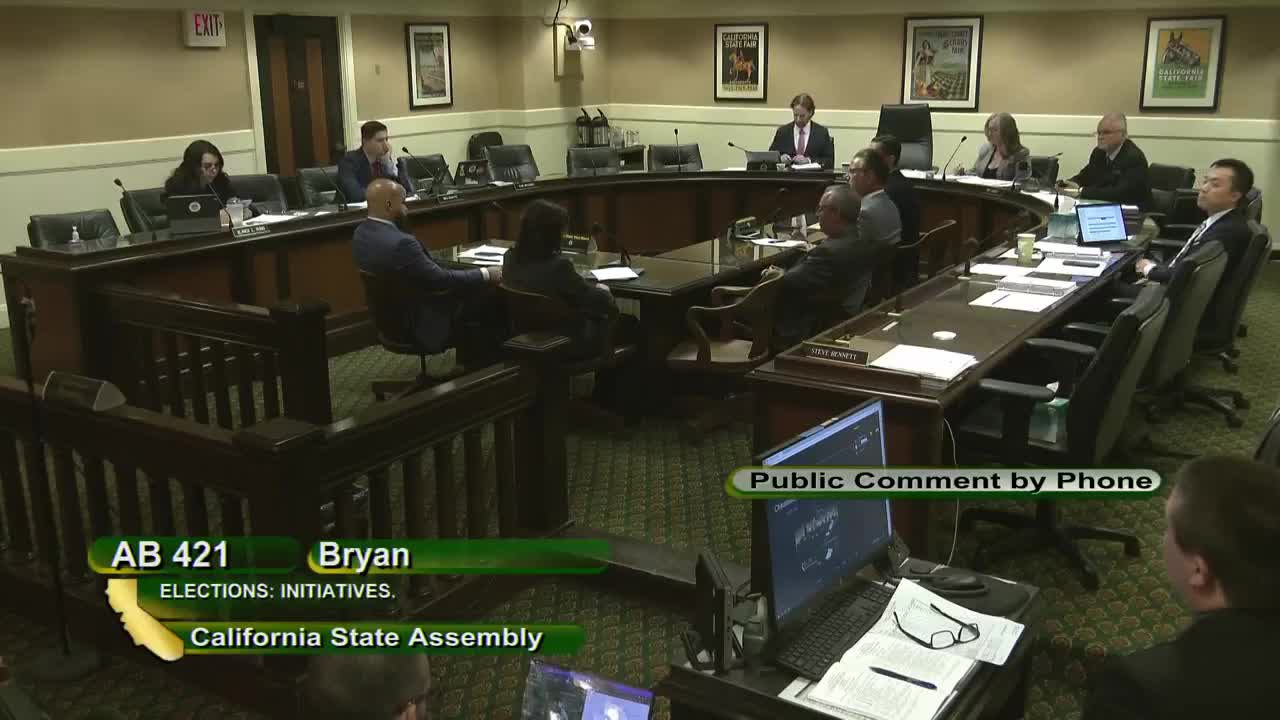 13MIN
Assembly Standing Committee on Elections
Bill Author




