HR 109
- Session Year: 2023-2024
- House: Assembly
- Latest Version Date: 2024-06-18
Current Status:
Failed
(2024-06-24: Coauthors revised.)
Introduced
In Committee
First Chamber
In Committee
Second Chamber
Enacted
WHEREAS, Willie Lewis Brown, Jr., was born in 1934 in Mineola, a racially segregated town in east Texas. After graduating from Mineola Colored High School, at 17 years of age, he moved to San Francisco to live with his uncle, Rembert Itsie Collins, who ran an underground casino; and
WHEREAS, In 1951, Willie L. Brown, Jr., graduated from San Francisco State University, and then earned a law degree from the University of California, Hastings College of the Law. He worked as a doorman, shoe salesman, and as part of a three-person janitorial crew to pay for his law school education. John Burton and George Mosconegiants in their own right in San Francisco politicswere the two other members of the janitorial crew; and
WHEREAS, As a lawyer, Willie L. Brown, Jr., represented many of San Franciscos most needy and vulnerable residents and, in 1961, he organized and led a demonstration to protest housing discrimination in the cityprotests that helped launch his first run for public office and his remarkable political career; and
WHEREAS, When first elected to the California State Assembly in 1964, Willie L. Brown, Jr., was one of only four African American Members in the Legislature. He served 30 years in the Assembly, becoming the first African American Speaker of the California State Assembly. In 1980, his improbable rise to become the Speaker was the result of his uncanny political judgment, strategic sense of timing, keen deal-making skills, and commitment to building relationships on both sides of the aisle, as Republican support helped secure him the Speakership; and
WHEREAS, Willie L. Brown, Jr., rose to national preeminence in 1972 at the Democratic National Convention when he gave an impassioned speech regarding the California delegation that concluded with him imploring the convention to Give me back my delegation; and
WHEREAS, His wide knowledge of public policy issues and political prowess were instrumental in negotiating and passing successful budgets even in the face of historic deficits, with him always prioritizing the most vulnerable and education funding. In 1992, he stood firm against then Governor Pete Wilsons proposed cuts to school funding and won the longest budget standoff, at 64 days, in Californias history; and
WHEREAS, Willie L. Brown, Jr., authored landmark legislation that decriminalized homosexuality in California, addressed the HIV/AIDS epidemic, required California motorists to use seat belts, and, in the early 1980s, led efforts to divest state holdings in South Africa during the apartheid era; and
WHEREAS, In late 1992, Speaker Brown was asked by both the Los Angeles Unified School District School Board and United Teachers Los Angeles to mediate their collective bargaining stalemate. He held dozens of meetings and eventually negotiated a settlement in the spring of 1993. The Los Angeles City Council declared Willie L. Brown Day to commemorate the success; and
WHEREAS, In late 1993 into early 1994, Willie L. Brown, Jr., was the first Speaker to host the California Economic Summit in Los Angeles and the California Education Summit in San Francisco; and
WHEREAS, Willie L. Brown, Jr., was often characterized as a Members Speaker, rarely putting his own name on bills, usually giving them to members in competitive districts or to committee chairs, and helping behind the scenes. He valued the creation of effective teams, including selecting the right people for top staff positions, which laid the foundation for successful, productive legislative sessions; and
WHEREAS, As Speaker, Willie L. Brown, Jr., was always willing to take the heat for members in tough districts. The needs of membersfriend or foewere always a top priority. This leadership approach helped Brown achieve policy wins and budget agreements, even when faced with razor-thin Democratic majorities. His political mastery, toughness, and loyalty to and relationships with all members of the Legislature, and deep knowledge of legislative rules and house traditions ensured his success; and
WHEREAS, As Speaker, he was also known for his weekly press conferenceshaving once stated that the only thing worse than being misquoted was not being talked about at all. His Speakership was characterized by his devotion to and pride in the State Legislature as an institution, his meticulous attention to the inner workings of the Capitoleven spotting light bulbs that needed to be changed, and the notorious End of Session Bash annual fundraisersthemed the hottest ticket in town; and
WHEREAS, In 1995, Speaker Brown retired from the Assembly and was elected to two terms as Mayor of San Francisco. Known affectionately as Da Mayor, he presided over the renovation of San Francisco City Hall, the resurgence of the Fillmore District, and many other projects that shape the San Francisco skyline of today. He retired from public service in 2004, yet at 90 years of age remains a much sought after advisor, political commentator, and active member of the California State Bar; and
WHEREAS, In 2008, Willie L. Brown, Jr., established the Willie L. Brown, Jr. Institute on Politics and Public Service at San Francisco State University, dedicated to training future municipal administrators, and the western span of the Bay Bridge was named the Willie L. Brown, Jr. Bridge by the Legislature in 2013; and
WHEREAS, Willie L. Brown, Jr., is a renowned figure in California politics, having inspired and mentored other Assembly Speakers, state and national elected officials, and hundreds of legislative staff, but he has never forgotten his humble beginnings and where he came from. As an example, he successfully lobbied President Bill Clinton to place an Amtrak train stop in downtown Mineola; and
WHEREAS, Willie L. Brown, Jr., has been described by allies and foes alike as a larger than life personality, political genius, gifted orator, and brilliant intellect with an almost photographic memory. He is respected for his boundless energy, ability to bring laughter into a room and, of course, roundly recognized for his sophisticated sense of personal style. Willie L. Brown, Jr., is a revered figure in California history and arguably one of the most important California leaders in recent times; now, therefore, be it
Resolved by the Assembly of the State of California, That the Assembly recognizes Speaker Willie Brown, Jr.s public service and dedication to the State of California; and be it further
Resolved, That the Assembly proclaims June 24, 2024, as Willie L. Brown, Jr., Day; and be it further
Resolved, That the Chief Clerk of the Assembly transmit copies of this resolution to the author for appropriate distribution.
|
Date
|
Status
|
|---|---|
| Jun 24, 2024 | Coauthors revised. |
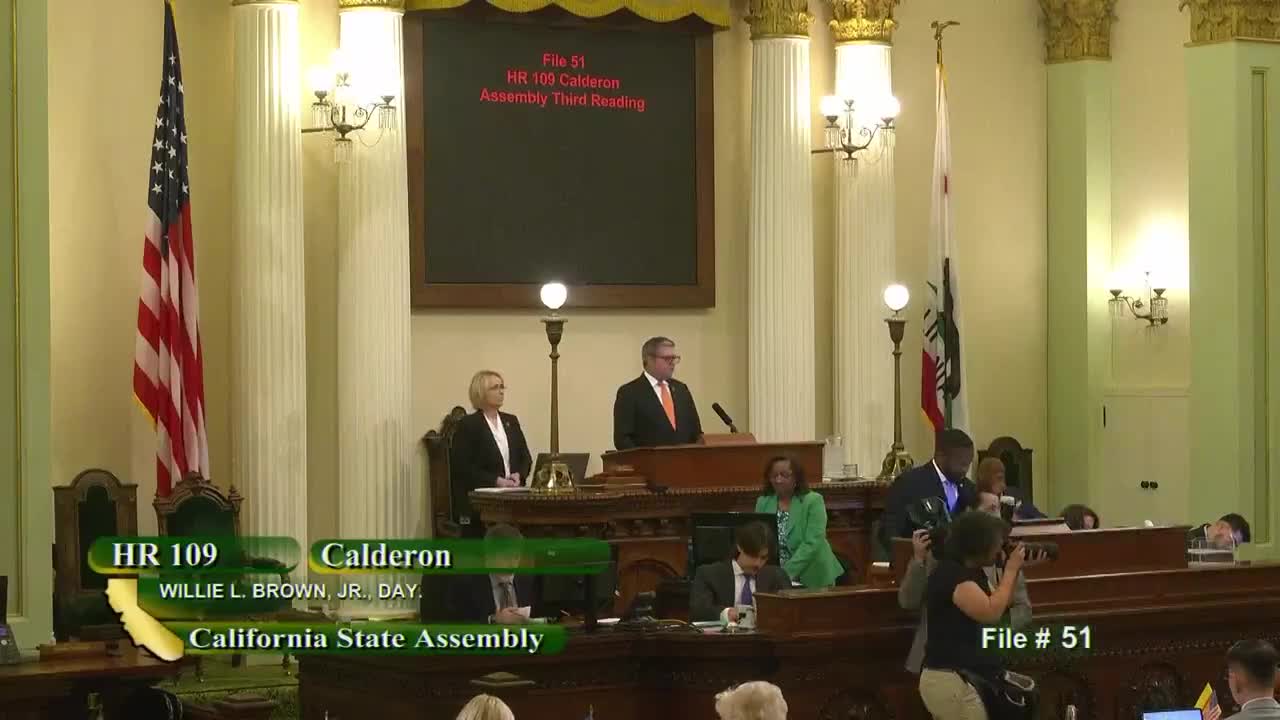
| Jun 24, 2024 | Read. Adopted. (Page 5981.). |
| Jun 20, 2024 | From committee: Be adopted. Ordered to Third Reading. (Ayes 9. Noes 0.) (June 20). |
| Jun 20, 2024 | Referred to Com. on RLS. |
| Jun 18, 2024 | Introduced. |
|
Date
|
Description
|
Location
|
Votes
|
|
|---|---|---|---|---|
| Jun 20, 2024 | Be adopted. To third reading. | Assembly Standing Committee on Rules |
Passed |
This list shows positions taken on this bill by organizations on the date displayed, which is linked to the original source.
Positions by individuals are not included.
Date of Hearing: June 20, 2024
ASSEMBLY COMMITTEE ON RULES
Blanca Pacheco, Chair
ABPCA Bill Id:HR 109 (
Author:Calderon) – As Introduced Ver:June 18, 2024
SUBJECT: Willie L. Brown, Jr., Day.
SUMMARY: Proclaims June 24, 2024, as Willie L. Brown, Jr., Day, in recognition of Speaker Willie L. Brown, Jr.’s public service and dedication to the State of California. Specifically, this resolution makes the following legislative findings:
- Willie Lewis Brown, Jr., was born in 1934 in Mineola, a racially-segregated town in east Texas. After graduating from Mineola Colored High School, at 17 years of age, he moved to San Francisco to live with his uncle, Rembert “Itsie” Collins, who ran an underground casino.
- In 1951, Willie L. Brown, Jr., graduated from San Francisco State University, and then earned a law degree from the University of California, Hastings College of the Law. He worked as a doorman, shoe salesman, and as part of a three-person janitorial crew to pay for his law school education. John Burton and George Moscone—giants in their own right in San Francisco politics—were the two other members of the janitorial crew.
- As a lawyer, Willie L. Brown, Jr., represented many of San Francisco’s most needy and vulnerable residents and, in 1961, he organized and led a demonstration to protest housing discrimination in the city—protests that helped launch his first run for public office and his remarkable political career.
- When first elected to the California State Assembly in 1964, Willie L. Brown, Jr., was one of only four African American Members in the Legislature. He served 30 years in the Assembly, becoming the first African American Speaker of the California State Assembly. In 1980, his improbable rise to become the Speaker was the result of his uncanny political judgment, strategic sense of timing, keen deal-making skills, and commitment to building relationships on both sides of the aisle, as Republican support helped secure him the Speakership.
- His wide knowledge of public policy issues and political prowess were instrumental in negotiating and passing successful budgets even in the face of historic deficits, with him always prioritizing the most vulnerable and education funding. In 1992, he stood firm against then Governor Pete Wilson’s proposed cuts to school funding and won the longest budget standoff, at 64 days, in California’s history.
- Willie L. Brown, Jr., authored landmark legislation that decriminalized homosexuality in California, addressed the HIV/AIDS epidemic, required California motorists to use seat belts, and, in the early 1980s, led efforts to divest state holdings in South Africa during the apartheid era.
- Willie L. Brown, Jr., was often characterized as a “Member’s Speaker,” rarely putting his own name on bills, usually giving them to Members in competitive districts or to committee chairs, and helping behind the scenes. He valued the creation of effective teams, including selecting the right people for top staff positions, which laid the foundation for successful, productive legislative sessions.
- In 1995, Speaker Brown retired from the Assembly and was elected to two terms as Mayor of San Francisco. Known affectionately as “Da Mayor,” he presided over the renovation of San Francisco City Hall, the resurgence of the Fillmore District, and many other projects that shape the San Francisco skyline of today. He retired from public service in 2004, yet at 90 years of age, remains a much sought after advisor, political commentator, and active member of the California State Bar.
- Willie L. Brown, Jr., is a renowned figure in California politics, having inspired and mentored other Assembly Speakers, state and national elected officials, and hundreds of legislative staff, but he has never forgotten his humble beginnings and where he came from. As an example, he successfully lobbied President Bill Clinton to place an Amtrak train stop in downtown Mineola.
- Willie L. Brown, Jr., has been described by allies and foes alike as a larger than life personality, political genius, gifted orator, and brilliant intellect with an almost photographic memory. He is respected for his boundless energy, ability to bring laughter into a room and, of course, roundly recognized for his sophisticated sense of personal style. Willie L. Brown, Jr., is a revered figure in California history and arguably one of the most important California leaders in recent times.
FISCAL EFFECT: This resolution is keyed non-fiscal by Legislative Counsel.
REGISTERED SUPPORT / OPPOSITION:
Support
None on file
Opposition
None on file
Analysis Prepared by: Michael Erke / RLS. / (916) 319-2800
Bill Author

Bill Co-Author(s):