SB 1242: Crimes: fires.
- Session Year: 2023-2024
- House: Senate
- Latest Version Date: 2024-08-16
Current Status:
Passed
(2024-08-16: Chaptered by Secretary of State. Chapter 173, Statutes of 2024.)
Introduced
In Committee
First Chamber
In Committee
Second Chamber
Enacted
What does this bill do?
This bill makes it a reason for a judge to impose a harsher sentence when someone recklessly sets a fire inside a merchant’s premises to help organized retail theft. Organized retail theft means theft carried out by coordinated groups or schemes to steal from stores.
The summary is provided by generative AI which can make mistakes. For original language, please view the details in the table below.
Existing law prohibits unlawfully causing a fire by recklessly setting fire to, burning, or causing to be burned, any structure, forest land, or property. A violation of this prohibition is punishable as either a misdemeanor or a felony.
This bill would, for the purposes of sentencing for a violation of these provisions, make it a factor in aggravation that the offense was carried out within a merchants premises in order to facilitate organized retail theft. By increasing the punishment for a crime, this bill would impose a state-mandated local program.
The California Constitution requires the state to reimburse local agencies and school districts for certain costs mandated by the state. Statutory provisions establish procedures for making that reimbursement.
This bill would provide that no reimbursement is required by this act for a specified reason.
The bill would make the factor-in-aggravation provision inoperative if a specified initiative is approved by the voters.This bill would declare that it is to take effect immediately as an urgency statute.Existing law prohibits unlawfully causing a fire by recklessly setting fire to, burning, or causing to be burned, any structure, forest land, or property. A violation of this prohibition is punishable as either a misdemeanor or a felony.
This bill would, for the purposes of sentencing for a violation of these provisions, make it a factor in aggravation that the offense was carried out within a merchants premises in order to facilitate organized retail theft. By increasing the punishment for a crime, this bill would impose a state-mandated local program.
The California Constitution requires the state to reimburse local agencies and school districts for certain costs mandated by the state. Statutory provisions establish procedures for making that reimbursement.
This bill would provide that no reimbursement is required by this act for a specified reason.
The bill would make the factor-in-aggravation provision inoperative if a specified initiative is approved by the voters.
This bill would declare that it is to take effect immediately as an urgency statute.
Existing law prohibits unlawfully causing a fire by recklessly setting fire to, burning, or causing to be burned, any structure, forest land, or property. A violation of this prohibition is punishable as either a misdemeanor or a felony.
This bill would, for the purposes of sentencing for a violation of these provisions, make it a factor in aggravation that the offense was carried out within a merchants premises in order to facilitate organized retail theft. By increasing the punishment for a crime, this bill would impose a state-mandated local program.
The California Constitution requires the state to reimburse local agencies and school districts for certain costs mandated by the state. Statutory provisions establish procedures for making that reimbursement.
This bill would provide that no reimbursement is required by this act for a specified reason.
Existing law authorizes the Secretary of the Department of Corrections and Rehabilitation to establish and operate community correctional facilities, with the primary purpose of providing housing, supervision, counseling, and other correctional programs for persons committed to the department. Within 30 days of designating a site as a community correctional center, existing law requires the department to notify the county board of supervisors or city council in whose jurisdiction the center may be located. Existing law authorizes the notice to be delivered by hand, or sent by any form of mail requiring a return receipt.This bill would additionally authorize notice by email.Existing law authorizes the Secretary of the Department of Corrections and Rehabilitation to establish and operate community correctional facilities, with the primary purpose of providing housing, supervision, counseling, and other correctional programs for persons committed to the department. Within 30 days of designating a site as a community correctional center, existing law requires the department to notify the county board of supervisors or city council in whose jurisdiction the center may be located. Existing law authorizes the notice to be delivered by hand, or sent by any form of mail requiring a return receipt.
This bill would additionally authorize notice by email.
A person is guilty of unlawfully causing a fire when they recklessly set fire to, burn, or cause to be burned any structure, forest land, or property.
(a)Unlawfully causing a fire that causes great bodily injury is a felony punishable by imprisonment in the state prison for two, four, or six years, or by imprisonment in the county jail for not more than one year, or by a fine, or by both such imprisonment and fine.
(b)Unlawfully causing a fire that causes an inhabited structure or inhabited property to burn is a felony punishable by imprisonment in the state prison for two, three, or four years, or by imprisonment in the county jail for not more than one year, or by a fine, or by both such imprisonment and fine.
(c)Unlawfully causing a fire of a structure or forest land is a felony punishable by imprisonment in the state prison for 16 months, two or three years, or by imprisonment in the county jail for not more than six months, or by a fine, or by both such imprisonment and fine.
(d)Unlawfully causing a fire of property is a misdemeanor. For purposes of this paragraph, unlawfully causing a fire of property does not include one burning or causing to be burned their own personal property unless there is injury to another person or to another persons structure, forest land, or property.
(e)In the case of any person convicted of violating this section while confined in a state prison, prison road camp, prison forestry camp, or other prison camp or prison farm, or while confined in a county jail while serving a term of imprisonment for a felony or misdemeanor conviction, any sentence imposed shall be consecutive to the sentence for which the person was then confined.
(f)For purposes of sentencing for a violation of this section, the fact that the offense was carried out within a merchants premises in order to facilitate organized retail theft, as defined in Section 490.4, shall be a factor in aggravation.
SEC. 2.No reimbursement is required by this act pursuant to Section 6 of Article XIIIB of the California Constitution because the only costs that may be incurred by a local agency or school district will be incurred because this act creates a new crime or infraction, eliminates a crime or infraction, or changes the penalty for a crime or infraction, within the meaning of Section 17556 of the Government Code, or changes the definition of a crime within the meaning of Section 6 of Article XIIIB of the California Constitution.
A person is guilty of unlawfully causing a fire when they recklessly set fire to, burn, or cause to be burned any structure, forest land, or property.
(a)Unlawfully causing a fire that causes great bodily injury is a felony punishable by imprisonment in the state prison for two, four, or six years, or by imprisonment in the county jail for not more than one year, or by a fine, or by both such imprisonment and fine.
(b)Unlawfully causing a fire that causes an inhabited structure or inhabited property to burn is a felony punishable by imprisonment in the state prison for two, three, or four years, or by imprisonment in the county jail for not more than one year, or by a fine, or by both such imprisonment and fine.
(c)Unlawfully causing a fire of a structure or forest land is a felony punishable by imprisonment in the state prison for 16 months, two or three years, or by imprisonment in the county jail for not more than six months, or by a fine, or by both such imprisonment and fine.
(d)Unlawfully causing a fire of property is a misdemeanor. For purposes of this paragraph, unlawfully causing a fire of property does not include one burning or causing to be burned their own personal property unless there is injury to another person or to another persons structure, forest land, or property.
(e)In the case of any person convicted of violating this section while confined in a state prison, prison road camp, prison forestry camp, or other prison camp or prison farm, or while confined in a county jail while serving a term of imprisonment for a felony or misdemeanor conviction, any sentence imposed shall be consecutive to the sentence for which the person was then confined.
(f)For purposes of sentencing for a violation of this section, the fact that the offense was carried out within a merchants premises in order to facilitate organized retail theft, as defined in Section 490.4, shall be a factor in aggravation.
(g)If the proposed initiative measure titled The Homelessness, Drug Addiction, and Theft Reduction Act (Initiative 23-0017A1) is approved by the voters at the statewide general election on November 5, 2024, this section shall become inoperative on the fifth day after the Secretary of State files the statement of the vote for the election, and shall be repealed on January 1, 2025.SEC. 2.Section 452 is added to the Penal Code, to read:452.A person is guilty of unlawfully causing a fire when they recklessly set fire to or burn or cause to be burned, any structure, forest land, or property.(a)Unlawfully causing a fire that causes great bodily injury is a felony punishable by imprisonment in the state prison for two, four or six years, or by imprisonment in the county jail for not more than one year, or by a fine, or by both such imprisonment and fine.(b)Unlawfully causing a fire that causes an inhabited structure or inhabited property to burn is a felony punishable by imprisonment in the state prison for two, three, or four years, or by imprisonment in the county jail for not more than one year, or by a fine, or by both such imprisonment and fine.(c)Unlawfully causing a fire of a structure or forest land is a felony punishable by imprisonment in the state prison for 16 months, two or three years, or by imprisonment in the county jail for not more than six months, or by a fine, or by both such imprisonment and fine.(d)Unlawfully causing a fire of property is a misdemeanor. For purposes of this paragraph, unlawfully causing a fire of property does not include one burning or causing to be burned their own personal property unless there is injury to another person or to another persons structure, forest land or property.(e)In the case of any person convicted of violating this section while confined in a state prison, prison road camp, prison forestry camp, or other prison camp or prison farm, or while confined in a county jail while serving a term of imprisonment for a felony or misdemeanor conviction, any sentence imposed shall be consecutive to the sentence for which the person was then confined.(f)If the proposed initiative measure titled The Homelessness, Drug Addiction, and Theft Reduction Act (Initiative 23-0017A1) is approved by the voters at the statewide general election on November 5, 2024, this section shall become operative on the fifth day after the Secretary of State files the statement of the vote for the election.SEC. 3.SEC. 2.No reimbursement is required by this act pursuant to Section 6 of Article XIIIB of the California Constitution because the only costs that may be incurred by a local agency or school district will be incurred because this act creates a new crime or infraction, eliminates a crime or infraction, or changes the penalty for a crime or infraction, within the meaning of Section 17556 of the Government Code, or changes the definition of a crime within the meaning of Section 6 of Article XIIIB of the California Constitution.
SEC. 4.This act is an urgency statute necessary for the immediate preservation of the public peace, health, or safety within the meaning of Article IV of the California Constitution and shall go into immediate effect. The facts constituting the necessity are:To address the increase in community-based crime and retail theft and to provide broader public safety, it is necessary that this act take effect immediately.A person is guilty of unlawfully causing a fire when they recklessly set fire to, burn, or cause to be burned any structure, forest land, or property.
(a)Unlawfully causing a fire that causes great bodily injury is a felony punishable by imprisonment in the state prison for two, four, or six years, or by imprisonment in the county jail for not more than one year, or by a fine, or by both such imprisonment and fine.
(b)Unlawfully causing a fire that causes an inhabited structure or inhabited property to burn is a felony punishable by imprisonment in the state prison for two, three, or four years, or by imprisonment in the county jail for not more than one year, or by a fine, or by both such imprisonment and fine.
(c)Unlawfully causing a fire of a structure or forest land is a felony punishable by imprisonment in the state prison for 16 months, two or three years, or by imprisonment in the county jail for not more than six months, or by a fine, or by both such imprisonment and fine.
(d)Unlawfully causing a fire of property is a misdemeanor. For purposes of this paragraph, unlawfully causing a fire of property does not include one burning or causing to be burned their own personal property unless there is injury to another person or to another persons structure, forest land, or property.
(e)In the case of any person convicted of violating this section while confined in a state prison, prison road camp, prison forestry camp, or other prison camp or prison farm, or while confined in a county jail while serving a term of imprisonment for a felony or misdemeanor conviction, any sentence imposed shall be consecutive to the sentence for which the person was then confined.
(f)For purposes of sentencing for a violation of this section, the fact that the offense was carried out within a merchants premises in order to facilitate organized retail theft, as defined in Section 490.4, shall be a factor in aggravation.
(g)If the proposed initiative measure titled The Homelessness, Drug Addiction, and Theft Reduction Act (Initiative 23-0017A1) is approved by the voters at the statewide general election on November 5, 2024, this section shall become inoperative on the fifth day after the Secretary of State files the statement of the vote for the election, and shall be repealed on January 1, 2025.
SEC. 2.Section 452 is added to the Penal Code, to read:452.A person is guilty of unlawfully causing a fire when they recklessly set fire to or burn or cause to be burned, any structure, forest land, or property.
(a)Unlawfully causing a fire that causes great bodily injury is a felony punishable by imprisonment in the state prison for two, four or six years, or by imprisonment in the county jail for not more than one year, or by a fine, or by both such imprisonment and fine.
(b)Unlawfully causing a fire that causes an inhabited structure or inhabited property to burn is a felony punishable by imprisonment in the state prison for two, three, or four years, or by imprisonment in the county jail for not more than one year, or by a fine, or by both such imprisonment and fine.
(c)Unlawfully causing a fire of a structure or forest land is a felony punishable by imprisonment in the state prison for 16 months, two or three years, or by imprisonment in the county jail for not more than six months, or by a fine, or by both such imprisonment and fine.
(d)Unlawfully causing a fire of property is a misdemeanor. For purposes of this paragraph, unlawfully causing a fire of property does not include one burning or causing to be burned their own personal property unless there is injury to another person or to another persons structure, forest land or property.
(e)In the case of any person convicted of violating this section while confined in a state prison, prison road camp, prison forestry camp, or other prison camp or prison farm, or while confined in a county jail while serving a term of imprisonment for a felony or misdemeanor conviction, any sentence imposed shall be consecutive to the sentence for which the person was then confined.
(f)If the proposed initiative measure titled The Homelessness, Drug Addiction, and Theft Reduction Act (Initiative 23-0017A1) is approved by the voters at the statewide general election on November 5, 2024, this section shall become operative on the fifth day after the Secretary of State files the statement of the vote for the election.
SEC. 2.SEC. 3.No reimbursement is required by this act pursuant to Section 6 of Article XIIIB of the California Constitution because the only costs that may be incurred by a local agency or school district will be incurred because this act creates a new crime or infraction, eliminates a crime or infraction, or changes the penalty for a crime or infraction, within the meaning of Section 17556 of the Government Code, or changes the definition of a crime within the meaning of Section 6 of Article XIIIB of the California Constitution.
SEC. 4.This act is an urgency statute necessary for the immediate preservation of the public peace, health, or safety within the meaning of Article IV of the California Constitution and shall go into immediate effect. The facts constituting the necessity are:
To address the increase in community-based crime and retail theft and to provide broader public safety, it is necessary that this act take effect immediately.
A person is guilty of unlawfully causing a fire when they recklessly set fire to, burn, or cause to be burned, burned any structure, forest land, or property.
(a)Unlawfully causing a fire that causes great bodily injury is a felony punishable by imprisonment in the state prison for two, four, or six years, or by imprisonment in the county jail for not more than one year, or by a fine, or by both such imprisonment and fine.
(b)Unlawfully causing a fire that causes an inhabited structure or inhabited property to burn is a felony punishable by imprisonment in the state prison for two, three, or four years, or by imprisonment in the county jail for not more than one year, or by a fine, or by both such imprisonment and fine.
(c)Unlawfully causing a fire of a structure or forest land is a felony punishable by imprisonment in the state prison for 16 months, two or three years, or by imprisonment in the county jail for not more than six months, or by a fine, or by both such imprisonment and fine.
(d)Unlawfully causing a fire of property is a misdemeanor. For purposes of this paragraph, unlawfully causing a fire of property does not include one burning or causing to be burned their own personal property unless there is injury to another person or to another persons structure, forest land, or property.
(e)In the case of any person convicted of violating this section while confined in a state prison, prison road camp, prison forestry camp, or other prison camp or prison farm, or while confined in a county jail while serving a term of imprisonment for a felony or misdemeanor conviction, any sentence imposed shall be consecutive to the sentence for which the person was then confined.
(f)For purposes of sentencing for a violation of this section, the fact that the offense was carried out within a merchants premises in order to facilitate organized retail theft, as defined in Section 490.4, shall be a factor in aggravation.
SEC. 2.No reimbursement is required by this act pursuant to Section 6 of Article XIIIB of the California Constitution because the only costs that may be incurred by a local agency or school district will be incurred because this act creates a new crime or infraction, eliminates a crime or infraction, or changes the penalty for a crime or infraction, within the meaning of Section 17556 of the Government Code, or changes the definition of a crime within the meaning of Section 6 of Article XIIIB of the California Constitution.
REVISIONS: HeadingLine 2.A person is guilty of unlawfully causing a fire when he they recklessly sets fire to or burns or causes set fire to, burn, or cause to be burned, any structure, forest land land, or property.
(a)Unlawfully causing a fire that causes great bodily injury is a felony punishable by imprisonment in the state prison for two, four four, or six years, or by imprisonment in the county jail for not more than one year, or by a fine, or by both such imprisonment and fine.
(b)Unlawfully causing a fire that causes an inhabited structure or inhabited property to burn is a felony punishable by imprisonment in the state prison for two, three three, or four years, or by imprisonment in the county jail for not more than one year, or by a fine, or by both such imprisonment and fine.
(c)Unlawfully causing a fire of a structure or forest land is a felony punishable by imprisonment in the state prison for 16 months, two or three years, or by imprisonment in the county jail for not more than six months, or by a fine, or by both such imprisonment and fine.
(d)Unlawfully causing a fire of property is a misdemeanor. For purposes of this paragraph, unlawfully causing a fire of property does not include one burning or causing to be burned his their own personal property unless there is injury to another person or to another persons structure, forest land land, or property.
(e)In the case of any person convicted of violating this section while confined in a state prison, prison road camp, prison forestry camp, or other prison camp or prison farm, or while confined in a county jail while serving a term of imprisonment for a felony or misdemeanor conviction, any sentence imposed shall be consecutive to the sentence for which the person was then confined.
(f)For purposes of sentencing for a violation of this section, the fact that the offense was carried out within a merchants premises in order to facilitate organized retail theft, as defined in Section 490.4, shall be a factor in aggravation.
SEC. 2.No reimbursement is required by this act pursuant to Section 6 of Article XIIIB of the California Constitution because the only costs that may be incurred by a local agency or school district will be incurred because this act creates a new crime or infraction, eliminates a crime or infraction, or changes the penalty for a crime or infraction, within the meaning of Section 17556 of the Government Code, or changes the definition of a crime within the meaning of Section 6 of Article XIIIB of the California Constitution.
SECTION 1.Section 6250 of the Penal Code is amended to read:6250.(a)The Secretary of the Department of Corrections and Rehabilitation may establish and operate facilities to be known as community correctional centers. The secretary may enter into a long-term agreement, not to exceed 20 years, for transfer of prisoners to, or placement of prisoners in, community correctional centers.(b)No later than 30 days after the department has designated a site as a potential site, the secretary shall notify the county board of supervisors or city council in whose jurisdiction the center may be located. The notification shall set forth the specifics of the site location, design, and operational characteristics for the facility. The department shall not contract for the facility until it has received and reviewed the comments of every local agency notified under this section or the expiration of 60 days after having given notice to the local agency, whichever occurs first.Upon receipt of the notice, the city, county, or city and county may hold a public hearing concerning the impact of the facility on the community. At the conclusion of the public hearing, the city, county, or city and county may make a recommendation to the department as to the appropriateness of the proposed site, specific design and operational features to help make the facility more compatible with the community, and alternative locations, if appropriate.Upon receipt of comments and recommendations, the department shall determine whether to proceed with the facility, to modify the proposal, or to select an alternative site. If the department selects a site recommended by the local agency after a hearing conducted pursuant to this section, no further review or hearings are required by this subdivision.(c)The notice referred to in subdivision (b) may be delivered by hand, by any form of mail requiring a return receipt, or by email. Failure to provide the notice shall be grounds for extinguishing the contract upon motion of the board of supervisors or city council.(d)The Secretary of the Department of Corrections and Rehabilitation shall not change the use of or significantly increase the capacity of a community correctional center established pursuant to subdivision (a) unless the secretary has first notified the county board of supervisors or city council in whose jurisdiction the center is located at least 30 days prior to the change of use or capacity. Failure to provide the notice shall be grounds for enjoining the change in use or capacity.(a)The Director of Corrections Secretary of the Department of Corrections and Rehabilitation may establish and operate facilities to be known as community correctional centers. The director secretary may enter into a long-term agreement, not to exceed 20 years, for transfer of prisoners to, or placement of prisoners in, community correctional centers.
(b)No later than 30 days after the department has designated a site as a potential site, the director secretary shall notify the county board of supervisors or city council in whose jurisdiction the center may be located. The notification shall set forth the specifics of the site location, design, and operational characteristics for the facility. The department shall not contract for the facility until it has received and reviewed the comments of every local agency notified under this section or the expiration of 60 days after having given notice to the local agency, whichever occurs first.
Upon receipt of the notice, the city, county, or city and county may hold a public hearing concerning the impact of the facility on the community. At the conclusion of the public hearing, the city, county, or city and county may make a recommendation to the department as to the appropriateness of the proposed site, specific design and operational features to help make the facility more compatible with the community, and alternative locations, if appropriate.
Upon receipt of comments and recommendations, the department shall determine whether to proceed with the facility, to modify the proposal, or to select an alternative site. If the department selects a site recommended by the local agency after a hearing conducted pursuant to this section, no further review or hearings are required by this subdivision.
(c)The notice referred to in subdivision (b) may be delivered by hand or sent by any form of mail requiring a return receipt. hand, by any form of mail requiring a return receipt, or by email. Failure to provide the notice shall be grounds for extinguishing the contract upon motion of the board of supervisors or city council.
(d)The Director of Corrections Secretary of the Department of Corrections and Rehabilitation shall not change the use of or significantly increase the capacity of a community correctional center established pursuant to subdivision (a) unless the director secretary has first notified the county board of supervisors or city council in whose jurisdiction the center is located at least 30 days prior to the change of use or capacity. Failure to provide the notice shall be grounds for enjoining the change in use or capacity.
|
Date
|
Status
|
|---|---|
| Aug 16, 2024 | Chaptered by Secretary of State. Chapter 173, Statutes of 2024. |
| Aug 16, 2024 | Approved by the Governor. |
| Aug 15, 2024 | Enrolled and presented to the Governor at 11:45 a.m. |
| Aug 12, 2024 | Assembly amendments concurred in. (Ayes 37. Noes 0. Page 5040.) Ordered to engrossing and enrolling. |
| Aug 8, 2024 | In Senate. Concurrence in Assembly amendments pending. |
| Aug 8, 2024 | Read third time. Passed. (Ayes 68. Noes 3. Page 6245.) Ordered to the Senate. |
| Jul 1, 2024 | Read third time and amended. |
| Jul 1, 2024 | Ordered to third reading. |
| Jul 1, 2024 | Assembly Rule 69 suspended. (Ayes 54. Noes 15. Page 6106.) |
| Jun 24, 2024 | Read second time. Ordered to third reading. |
| Jun 20, 2024 | Read second time and amended. Ordered to second reading. |
| Jun 19, 2024 | From committee: Do pass as amended. (Ayes 9. Noes 4.) (June 19). |
| Jun 11, 2024 | From committee: Do pass and re-refer to Com. on APPR. (Ayes 8. Noes 0.) (June 11). Re-referred to Com. on APPR. |
| Jun 11, 2024 | Coauthors revised. |
| Jun 3, 2024 | Referred to Com. on PUB. S. |
| May 23, 2024 | In Assembly. Read first time. Held at Desk. |
| May 22, 2024 | Read third time. Passed. (Ayes 36. Noes 0. Page 4137.) Ordered to the Assembly. |
| May 20, 2024 | Read second time. Ordered to third reading. |
| May 16, 2024 | Read second time and amended. Ordered to second reading. |
| May 16, 2024 | From committee: Do pass as amended. (Ayes 7. Noes 0. Page 3976.) (May 16). |
| May 14, 2024 | Set for hearing May 16. |
| May 13, 2024 | May 13 hearing: Placed on APPR suspense file. |
| May 3, 2024 | Set for hearing May 13. |
| Apr 2, 2024 | From committee: Do pass and re-refer to Com. on APPR. (Ayes 5. Noes 0. Page 3450.) (April 2). Re-referred to Com. on APPR. |
| Mar 26, 2024 | Set for hearing April 2. |
| Mar 19, 2024 | From committee with author's amendments. Read second time and amended. Re-referred to Com. on PUB S. |
| Feb 29, 2024 | Referred to Com. on PUB S. |
| Feb 16, 2024 | From printer. May be acted upon on or after March 17. |
| Feb 15, 2024 | Introduced. Read first time. To Com. on RLS. for assignment. To print. |
|
Date
|
Description
|
Location
|
Votes
|
|
|---|---|---|---|---|
| Aug 12, 2024 | Unfinished Business SB1242 Min et al. Concurrence | Senate Floor |
Passed |
|
| Aug 8, 2024 | SB 1242 Min Senate Third Reading By Zbur | Assembly Floor |
Passed |
|
| Jun 19, 2024 | Do pass as amended. | Assembly Standing Committee on Appropriations |
Passed |
|
| Jun 11, 2024 | Do pass and be re-referred to the Committee on [Appropriations] | Assembly Standing Committee on Public Safety |
Passed |
|
| May 22, 2024 | Senate 3rd Reading SB1242 Min et al. | Senate Floor |
Passed |
|
| May 16, 2024 | Do pass as amended | Senate Standing Committee on Appropriations |
Passed |
|
| May 13, 2024 | Placed on suspense file | Senate Standing Committee on Appropriations |
Passed |
|
| Apr 2, 2024 | Do pass, but first be re-referred to the Committee on [Appropriations] | Senate Standing Committee on Public Safety |
Passed |
This list shows positions taken on this bill by organizations on the date displayed, which is linked to the original source.
Positions by individuals are not included.
|
Organization
|
Position
|
Date
|
|---|---|---|
| California Retailers Association | ** Support | |
| City of Agoura Hills | ** Support | |
| City of Artesia | ** Support | |
| City Of Beverly Hills | * Support | Jun 11, 2024 |
| City of Buena Park | ** Support | |
| city of carlsbad | ** Support | |
| city of Cypress | ** Support | |
| City of El Cerrito | ** Support | |
| City of Fountain Valley | ** Support | |
| City Of Fullerton | ** Support | |
| City of Grand Terrace | ** Support | |
| City of La Mirada | ** Support | |
| City of Lakeport | ** Support | |
| City of Lakewood CA | ** Support | |
| City of Los Alamitos | ** Support | |
| City Of Mission Viejo | ** Support | |
| City Of Oakdale | ** Support | |
| city of paramount | ** Support | |
| City of Port Hueneme | ** Support | |
| City of Rancho Palos Verdes | ** Support | |
| City of Rancho Santa Margarita | ** Support | |
| City of Rolling Hills Estates | ** Support | |
| City of Rosemead | ** Support | |
| City of San Luis Obispo | ** Support | |
| City of Stanton | ** Support | |
| City of Stockton | * Support | Jun 11, 2024 |
| City of Whittier | ** Support | |
| League Of California Cities | * Support | Jun 11, 2024 |
| Town of Apple Valley | ** Support |
SENATE RULES COMMITTEE Office of Senate Floor Analyses (916) 651-1520 Fax: (916) 327-4478 | SB 1242 |
UNFINISHED BUSINESS
Bill No: SB 1242
Author: Min (D), et al.
Amended: 7/1/24
Vote: 21
SENATE PUBLIC SAFETY COMMITTEE: 5-0, 4/2/24
AYES: Wahab, Seyarto, Bradford, Skinner, Wiener
SENATE APPROPRIATIONS COMMITTEE: 7-0, 5/16/24
AYES: Caballero, Jones, Ashby, Becker, Bradford, Seyarto, Wahab
SENATE FLOOR: 36-0, 5/22/24
AYES: Alvarado-Gil, Ashby, Atkins, Becker, Blakespear, Caballero, Cortese, Dahle, Dodd, Durazo, Eggman, Glazer, Gonzalez, Grove, Hurtado, Jones, Laird, Limón, McGuire, Menjivar, Min, Newman, Nguyen, Niello, Ochoa Bogh, Padilla, Portantino, Roth, Rubio, Seyarto, Skinner, Stern, Umberg, Wahab, Wiener, Wilk
NO VOTE RECORDED: Allen, Archuleta, Bradford, Smallwood-Cuevas
ASSEMBLY FLOOR: 68-3, 8/8/24 - See last page for vote
SUBJECT: Crimes: fires
SOURCE: Author
DIGEST:
This bill specifies that for the crime of reckless arson, the fact that the offense was carried out within a merchant’s premises in order to facilitate organized retail theft shall be a factor in aggravation at sentencing.
Assembly Amendments
make nonsubstantive changes.
ANALYSIS:
Existing law:
- States that when a statute prescribes three possible terms of imprisonment, the court shall, in its sound discretion, order imposition of a sentence not to exceed the middle term, except when there are circumstances in aggravation of the crime that justify the imposition of a term of imprisonment exceeding the middle term, and the facts underlying those circumstances have been stipulated to by the defendant, or have been found true beyond a reasonable doubt at trial by the jury or by the judge in a court trial. (Pen. Code, § 1170, subd. (b).)
- Provides that except where evidence supporting an aggravating circumstance is admissible to prove or defend against the charged offense or enhancement at trial, or it is otherwise authorized by law, upon request of a defendant, trial on the circumstances in aggravation alleged in the indictment or information shall be bifurcated from the trial of charges and enhancements. (Pen. Code, § 1170, subd. (b)(2).)
- Creates, until January 1, 2026, the crime of organized retail theft which is defined as:
- Acting in concert with one or more persons to steal merchandise from one or more merchant’s premises or online marketplace with the intent to sell, exchange, or return the merchandise for value;
- Acting in concert with two or more persons to receive, purchase, or possess merchandise knowing or believing it to have been stolen;
- Acting as the agent of another individual or group of individuals to steal merchandise from one or more merchant’s premises or online marketplaces as part of a plan to commit theft; or,
- Recruiting, coordinating, organizing, supervising, directing, managing, or financing another to undertake acts of theft. (Pen. Code, § 490.4, subd. (a).)
- Punishes, until January 1, 2026, organized retail theft as follows:
- If violations of the above provisions, except the recruiting, coordinating, organizing, supervising, directing, managing, or financing another provision, are committed on two or more separate occasions within a one-year period, and if the aggregated value of the merchandise stolen, received, purchased, or possessed within that period exceeds $950 the offense is punishable as either a misdemeanor by imprisonment in a county jail not exceeding one year or as a jail-eligible felony;
- Any other violation of the above provisions, except the recruiting, coordinating, organizing, supervising, directing, managing, or financing another provision, is punishable as a misdemeanor by imprisonment in a county jail not exceeding one year; and,
- A violation of the recruiting, coordinating, organizing, supervising, directing, managing, or financing another provision is punishable as either a misdemeanor by imprisonment in a county jail not exceeding one year or as a jail-eligible felony. (Pen. Code, § 490.1, subd. (b).)
- States that a person is guilty of unlawfully causing a fire when they recklessly set fire to, burn, or cause to be burned, any structure, forest land, or property. (Pen. Code, § 452.)
- Punishes reckless arson as follows:
- Unlawfully causing a fire that causes great bodily injury is a felony punishable by imprisonment in the state prison for two, four or six years, or by imprisonment in the county jail for not more than one year, or by a fine, or by both such imprisonment and fine.
- Unlawfully causing a fire that causes an inhabited structure or inhabited property to burn is a felony punishable by imprisonment in the state prison for two, three or four years, or by imprisonment in the county jail for not more than one year, or by a fine, or by both such imprisonment and fine.
- Unlawfully causing a fire of a structure or forest land is a felony punishable by imprisonment in the state prison for 16 months, two or three years, or by imprisonment in the county jail for not more than six months, or by a fine, or by both such imprisonment and fine.
- Unlawfully causing a fire of property is a misdemeanor.
- In the case of any person convicted of violating this section while serving a term of imprisonment for a felony or misdemeanor conviction, any sentence imposed shall be consecutive to the sentence for which the person was then confined.
This bill provides that for purposes of sentencing for reckless arson, the fact that the offense was carried out within a merchant’s premises in order to facilitate organized retail theft shall be a factor in aggravation.
Comments
According to the author:
Retail theft has become increasingly sophisticated in recent years with scenarios where fire is being used as a tactic to hide and distract from criminal activity. SB 1242 is part of a comprehensive strategy to hold criminals accountable, while giving law enforcement the tools they need to successfully prosecute these heinous crimes that put both local communities and retailers at risk. The higher sentences authorized under this bill will help deter crime and put a stop to this destructive trend that costs businesses millions in damages, on top of investigative costs to local fire officials.
FISCAL EFFECT: Appropriation: No Fiscal Com.: Yes Local: Yes
According to Assembly Appropriations Committee:
- Cost pressures (Trial Court Trust Fund, General Fund) of an unknown but significant amount to the courts to adjudicate the aggravating factor added by this bill. An aggravating factor must be admitted by the defendant or found true beyond a reasonable doubt at trial, which may result in additional or longer court proceedings. A defendant charged with a misdemeanor or felony is entitled to a jury trial and, if the defendant is indigent, legal representation provided by the government. Actual court costs will depend on the number of cases brought and the amount of court time needed to adjudicate each case. Although courts are not funded on the basis of workload, increased pressure on the Trial Court Trust Fund may create a need for increased funding for courts from the General Fund. The Governor’s 2024-25 budget proposes $83.1 million ongoing from the General Fund to backfill declining revenue to the Trial Court Trust Fund.
- Costs (local funds, General Fund) of an unknown but significant amount to the Department of Corrections and Rehabilitation (CDCR) to incarcerate people who receive longer sentences as a result of this bill, as described in more detail below. Actual incarceration costs will depend on the number of convictions and the length of each sentence. The Legislative Analyst’s Office (LAO) estimates the average annual cost to incarcerate one person in state prison is $133,000.
According to the LAO, the General Fund faces a structural deficit in the tens of billions of dollars over the next several fiscal years.
SUPPORT: (Verified 7/3/24)
California Retailers Association
City of Agoura Hills
City of Artesia
City of Buena Park
City of Carlsbad
City of Cypress
City of El Cerrito
City of Fountain Valley
City of Fullerton
City of Grand Terrace
City of La Mirada
City of Lakeport
City of Lakewood CA
City of Los Alamitos
City of Mission Viejo
City of Oakdale
City of Paramount
City of Port Hueneme
City of Rancho Palos Verdes
City of Rancho Santa Margarita
City of Rolling Hills Estates
City of Rosemead
City of San Luis Obispo
City of Stanton
City of Whittier
Town of Apple Valley
OPPOSITION: (Verified 7/3/24)
None received
ASSEMBLY FLOOR: 68-3, 8/8/24
AYES: Addis, Aguiar-Curry, Alanis, Alvarez, Arambula, Bains, Bennett, Berman, Boerner, Calderon, Juan Carrillo, Wendy Carrillo, Cervantes, Chen, Connolly, Megan Dahle, Davies, Dixon, Essayli, Flora, Mike Fong, Friedman, Gabriel, Gallagher, Gipson, Grayson, Haney, Hart, Holden, Hoover, Irwin, Jackson, Lackey, Lee, Low, Lowenthal, Maienschein, Mathis, McCarty, Muratsuchi, Stephanie Nguyen, Ortega, Pacheco, Papan, Jim Patterson, Joe Patterson, Pellerin, Quirk-Silva, Ramos, Reyes, Luz Rivas, Rodriguez, Blanca Rubio, Sanchez, Santiago, Schiavo, Soria, Ta, Ting, Villapudua, Waldron, Wallis, Ward, Wicks, Wilson, Wood, Zbur, Robert Rivas
NOES: Bryan, Jones-Sawyer, McKinnor
NO VOTE RECORDED: Bauer-Kahan, Bonta, Garcia, Kalra, Petrie-Norris, Rendon, Valencia, Weber
Prepared by: Stella Choe / PUB. S. /
8/9/24 16:38:06
**** END ****
SENATE THIRD READING
STR Bill Id:SB 1242
Author:(Min)
As Amended Ver:July 1, 2024
Majority vote
SUMMARY
Provides that for the crime of reckless fire setting, if the offense was carried out within a merchant's premises in order to facilitate organized retail theft, it shall be a factor in aggravation at sentencing.
Major Provisions
State that for the crime of reckless fire setting, if the fire was set within a merchant's premises in order to facilitate organized retail theft, it shall be a factor in aggravation at sentencing.
COMMENTS
According to the Author
"Retail theft has become increasingly sophisticated in recent years with scenarios where fire is being used as a tactic to hide and distract from criminal activity. SB 1242 is part of a comprehensive strategy to hold criminals accountable, while giving law enforcement the tools they need to successfully prosecute these heinous crimes that put both local communities and retailers at risk. The higher sentences authorized under this bill will help deter crime and put a stop to this destructive trend that costs businesses millions in damages, on top of investigative costs to local fire officials."
Arguments in Support
According to the League of California Cities "SB 1242 would address the issue of fires being started to facilitate organized retail theft an aggravating factor to increase the sentence of the offender.
"Specifically, SB 1242 would address the issue of fires being started to facilitate an organized retail theft incident while staff must attend to the fire created as a diversion. This bill would increase penalties from these brazen acts by designating them as an aggravating factor making this eligible for increased sentencing.
"As you may know, retail theft continues to be a problem in all California communities. For example, commercial burglary is at the highest rate since 2008. In fact, according to the PPIC, commercial burglary increased statewide since 2020, especially in larger counties with an increase of 13% among 14 of the 15 largest counties. Rising theft is impacting every corner of California, and city officials need additional tools to reduce crime and improve the safety of their neighborhoods.
"While SB 1242 is important to make progress on retail theft, this bill is only one part of a comprehensive solution that needs to include prevention, enforcement, and supervision. Cal Cities is part of a larger coalition of business, labor, law enforcement and local governments trying to address the increase in theft that is impacting so many Californians. Addressing the issue of arson in conjunction with retail theft is one of the issues that can help address this growing problem, however additional changes are needed to make our communities safer."
Arguments in Opposition
None Submitted.
FISCAL COMMENTS
According to the Assembly Appropriations Committee:
- Cost pressures (Trial Court Trust Fund, General Fund) of an unknown but significant amount to the courts to adjudicate the aggravating factor added by this bill. An aggravating factor must be admitted by the defendant or found true beyond a reasonable doubt at trial, which may result in additional or longer court proceedings. A defendant charged with a misdemeanor or felony is entitled to a jury trial and, if the defendant is indigent, legal representation provided by the government. Actual court costs will depend on the number of cases brought and the amount of court time needed to adjudicate each case. Although courts are not funded on the basis of workload, increased pressure on the Trial Court Trust Fund may create a need for increased funding for courts from the General Fund. The Governor's 2024-25 budget proposes $83.1 million ongoing from the General Fund to backfill declining revenue to the Trial Court Trust Fund.
- Costs (local funds, General Fund) of an unknown but significant amount to the Department of Corrections and Rehabilitation (CDCR) to incarcerate people who receive longer sentences as a result of this bill, as described in more detail below. Actual incarceration costs will depend on the number of convictions and the length of each sentence. The Legislative Analyst's Office (LAO) estimates the average annual cost to incarcerate one person in state prison is $133,000.
According to the LAO, the General Fund faces a structural deficit in the tens of billions of dollars over the next several fiscal years.
VOTES
SENATE FLOOR: 36-0-4
YES: Alvarado-Gil, Ashby, Atkins, Becker, Blakespear, Caballero, Cortese, Dahle, Dodd, Durazo, Eggman, Glazer, Gonzalez, Grove, Hurtado, Jones, Laird, Limón, McGuire, Menjivar, Min, Newman, Nguyen, Niello, Ochoa Bogh, Padilla, Portantino, Roth, Rubio, Seyarto, Skinner, Stern, Umberg, Wahab, Wiener, Wilk
ABS, ABST OR NV: Allen, Archuleta, Bradford, Smallwood-Cuevas
ASM PUBLIC SAFETY: 8-0-0
YES: McCarty, Alanis, Lackey, Stephanie Nguyen, Reyes, Ting, Wilson, Zbur
ASM APPROPRIATIONS: 9-4-2
YES: Wicks, Arambula, Calderon, Berman, Mike Fong, Haney, Hart, Pellerin, Aguiar-Curry
NO: Sanchez, Dixon, Jim Patterson, Ta
ABS, ABST OR NV: Bryan, Grayson
UPDATED
VERSION: July 1, 2024
CONSULTANT: Gregory Pagan / PUB. S. / (916) 319-3744 FN: 0003678
SENATE THIRD READING
STR Bill Id:SB 1242
Author:(Min)
As Amended Ver:June 20, 2024
2/3. Urgency
SUMMARY
Provides that for the crime of reckless fire setting, if the offense was carried out within a merchant's premises in order to facilitate organized retail theft, it shall be a factor in aggravation at sentencing.
Major Provisions
State that for the crime of reckless fire setting, if the fire was set within a merchant's premises in order to facilitate organized retail theft, it shall be a factor in aggravation at sentencing.
COMMENTS
- Background: In 1977, California adopted the Determinate Sentencing Law, moving away from a system of indeterminate sentences with high maximum terms and broad parole discretion to specified set terms of imprisonment. Under a determinate sentencing system, the court selects from one of the three statutorily specified terms of imprisonment. This is generally referred to as sentencing triad, which specifies a lower, middle, and higher term of incarceration for violation of the offense.
Prior to 2007, the law provided a statutory presumption that the middle term was to be imposed unless aggravating or mitigating factors supported the imposition of the upper or lower term. The Rules of Court provides lists of both aggravating factors and mitigating factors. In each category there are factors relating to the crime and factors relating to the defendant. (CITE) In Cunningham v. California (2007) 549 U.S. 270, the United States Supreme Court held California's determinate sentencing law violated a defendant's right to trial by jury guaranteed under the Sixth Amendment to the U.S. Constitution. (Id. at p. 274.) Specifically the Court held that "[b]ecause circumstances in aggravation are found by the judge, not the jury, and need only be established by a preponderance of the evidence, not beyond a reasonable doubt, . . . the DSL violates Apprendi's bright-line rule: Except for a prior conviction, 'any fact that increases the penalty for a crime beyond the prescribed statutory maximum must be submitted to a jury, and proved beyond a reasonable doubt.'" (Id. at pp. 288-289, relying on Apprendi v. U.S. (2000) 530 U.S. 466.)
The Supreme Court provided direction as to what steps the Legislature could take to address the constitutional infirmities of the DSL:
As to the adjustment of California's sentencing system in light of our decision, the ball . . . lies in [California's] court. We note that several States have modified their systems in the wake of Apprendi and Blakely to retain determinate sentencing. They have done so by calling upon the jury - either at trial or in a separate sentencing proceeding - to find any fact necessary to the imposition of an elevated sentence. As earlier noted, California already employs juries in this manner to determine statutory sentencing enhancements. Other States have chosen to permit judges genuinely to exercise broad discretion . . . within a statutory range, which, everyone agrees, encounters no Sixth Amendment shoal. California may follow the paths taken by its sister States or otherwise alter its system, so long as the State observes Sixth Amendment limitations declared in this Court's decisions." (Cunningham, supra, 549 U.S. at pp. 293-294.)
Following Cunningham, the Legislature amended the determinate sentencing law, specifically Penal Code sections 1170 and 1170.2, to make the choice of lower, middle, or upper prison terms one within the sound discretion of the court. (SB 40 (Romero), Chapter 3, Statutes of 2007.) This approach was embraced by the California Supreme Court in People v. Sandoval (2007) 41 Cal.4th 825, 843-852. The procedure removes the mandatory middle term and the requirement of weighing aggravation against mitigation before imposition of the upper term. Under the amended sections, the sentencing court was permitted to impose any of the three terms in its discretion, and need only state reasons for the decision so that it will be subject to appellate review for abuse of discretion.
SB 40 (Romero), the first of a series of legislation to provide a fix to the constitutional shortcomings of the determinate sentencing law, contained a sunset provision so that the amendment to the determinate sentencing law would be repealed on a certain date if further legislative action was not taken before that date. According to intent language contained in SB 40, "It is the intent of the Legislature in enacting this provision to respond to the decision of the United States Supreme Court in Cunningham v. California, 2007 U.S. LEXIS 1324 (U.S. 2007). It is the further intent of the Legislature to maintain stability in California's criminal justice system while the criminal justice and sentencing structures in California sentencing are being reviewed." Following SB 40 (Romero), several bills extended the sunset on the amended DSL to continue allowing judges the discretion to impose the lower, middle or upper term of imprisonment authorized by statute.
However, in 2021, instead of extending the sunset on the amended determinate sentencing law that gives broad discretion to the court to make the choice between the three terms, the Legislature enacted legislation to authorize a court to impose the upper term only if the defendant admits the aggravating circumstance or found true beyond a reasonable doubt at trial by a jury. (SB 567 (Bradford), Chapter 731, Statutes of 2024.) The purpose of this change in approach was to give the jury a chance weigh in on the truthfulness of the circumstances that would increase a person's sentence. The Rules of Court provides lists of both aggravating factors and mitigating factors. (California Rules of Court, Rule 4.421.) In each category there are factors relating to the crime and factors relating to the defendant.
Additionally, some statutes specify factors in aggravation that may be relied upon to increase a person's sentence beyond the middle term. This bill would specify that the fact that the offense was carried out within a merchant's premises in order to facilitate organized retail theft, as defined in Section 490.4, shall be a factor in aggravation for purposes of sentencing a person found guilty of reckless arson.
- Incidents of setting Fire in Retail Stores: As noted in the author's statement, the impetus for this bill is the recent reported incidents of fires being set in retail stores to create a distraction while committing theft within the store.
On September 13, 2023, a woman was arrested for starting a fire in a Target store in Buena Park as a distraction so she could steal baby formula. It was unclear to investigators whether she was stealing the formula for personal use or as part of a retail theft scheme to resell the product. The fire cause $500,000 in damage to the store's building and $1 million damage to products.
On April 16, 2023, two men were arrested for setting a fire inside a North Highlands Target to create a distraction to commit retail theft. The men were booked on felony charges of burglary, grand theft, arson, and conspiracy.
- Efforts to Combat Retail Theft: "The Homelessness, Drug Addition, and Theft Reduction Act" is a new initiative that would make specific changes to laws enacted by Proposition 47. Specifically, the initiative would reenact felony sentencing for petty theft with two prior thefts, allow multiple petty thefts to be aggregated to meet the $950 threshold without a showing that the acts were connected, and create new enhancements depending on the amount of property stolen or damaged. The initiative would also increase penalties for certain drug crimes, mandate treatment for certain offenders, and require courts to warn people convicted of drug distribution that they may be charged with murder in the future if someone dies after taking an illegal drug provided by that person.
The initiative is supported by various law enforcement, public officials, district attorneys, and retail corporations. (Id.) To qualify for the November 2024 ballot, the law requires 546,651 valid signatures by June 27, 2024; as of January 25, 2024, the campaign had notified the Secretary of State that 25% of the required signatures had been collected. (Id.)
On January 9, 2024, Governor Newsom called for legislation to crack down on large scale property crimes committed by organized groups who profit from resale of stolen goods. The proposals include: 1) creating new penalties targeting those engaged in retail theft to resell, and those that resell the stolen property; 2) clarifying existing arrest authority so that police can arrest suspects of retail theft, even if they didn't witness the crime in progress; 3) clarifying that theft amounts may be aggregated to reach the grand theft threshold; 4) creating new penalties for professional auto burglary, increasing penalties for the possession of items stolen from a vehicle with intent to resell, regardless of whether the vehicle was locked; 5) eliminating the sunset date for the organized retail crime statute; and 6) increasing penalties for large-scale resellers of stolen goods.
Both houses of the Legislature have announced legislative packages that contain portions of the Governor's proposal.
According to the Author
"Retail theft has become increasingly sophisticated in recent years with scenarios where fire is being used as a tactic to hide and distract from criminal activity. SB 1242 is part of a comprehensive strategy to hold criminals accountable, while giving law enforcement the tools they need to successfully prosecute these heinous crimes that put both local communities and retailers at risk. The higher sentences authorized under this bill will help deter crime and put a stop to this destructive trend that costs businesses millions in damages, on top of investigative costs to local fire officials."
Arguments in Support
According to the League of California Cities "SB 1242 would address the issue of fires being started to facilitate organized retail theft an aggravating factor to increase the sentence of the offender.
"Specifically, SB 1242 would address the issue of fires being started to facilitate an organized retail theft incident while staff must attend to the fire created as a diversion. This bill would increase penalties from these brazen acts by designating them as an aggravating factor making this eligible for increased sentencing.
"As you may know, retail theft continues to be a problem in all California communities. For example, commercial burglary is at the highest rate since 2008. In fact, according to the PPIC, commercial burglary increased statewide since 2020, especially in larger counties with an increase of 13% among 14 of the 15 largest counties. Rising theft is impacting every corner of California, and city officials need additional tools to reduce crime and improve the safety of their neighborhoods.
"While SB 1242 is important to make progress on retail theft, this bill is only one part of a comprehensive solution that needs to include prevention, enforcement, and supervision. Cal Cities is part of a larger coalition of business, labor, law enforcement and local governments trying to address the increase in theft that is impacting so many Californians. Addressing the issue of arson in conjunction with retail theft is one of the issues that can help address this growing problem, however additional changes are needed to make our communities safer."
Arguments in Opposition
None submitted.
FISCAL COMMENTS
According to the Assembly Appropriations Committee:
- Cost pressures (Trial Court Trust Fund, General Fund) of an unknown but significant amount to the courts to adjudicate the aggravating factor added by this bill. An aggravating factor must be admitted by the defendant or found true beyond a reasonable doubt at trial, which may result in additional or longer court proceedings. A defendant charged with a misdemeanor or felony is entitled to a jury trial and, if the defendant is indigent, legal representation provided by the government. Actual court costs will depend on the number of cases brought and the amount of court time needed to adjudicate each case. Although courts are not funded on the basis of workload, increased pressure on the Trial Court Trust Fund may create a need for increased funding for courts from the General Fund. The Governor's 2024-25 budget proposes $83.1 million ongoing from the General Fund to backfill declining revenue to the Trial Court Trust Fund.
- Costs (local funds, General Fund) of an unknown but significant amount to the Department of Corrections and Rehabilitation (CDCR) to incarcerate people who receive longer sentences as a result of this bill, as described in more detail below. Actual incarceration costs will depend on the number of convictions and the length of each sentence. The Legislative Analyst's Office (LAO) estimates the average annual cost to incarcerate one person in state prison is $133,000.
According to the LAO, the General Fund faces a structural deficit in the tens of billions of dollars over the next several fiscal years.
VOTES
SENATE FLOOR: 36-0-4
YES: Alvarado-Gil, Ashby, Atkins, Becker, Blakespear, Caballero, Cortese, Dahle, Dodd, Durazo, Eggman, Glazer, Gonzalez, Grove, Hurtado, Jones, Laird, Limón, McGuire, Menjivar, Min, Newman, Nguyen, Niello, Ochoa Bogh, Padilla, Portantino, Roth, Rubio, Seyarto, Skinner, Stern, Umberg, Wahab, Wiener, Wilk
ABS, ABST OR NV: Allen, Archuleta, Bradford, Smallwood-Cuevas
ASM PUBLIC SAFETY: 8-0-0
YES: McCarty, Alanis, Lackey, Stephanie Nguyen, Reyes, Ting, Wilson, Zbur
ASM APPROPRIATIONS: 9-4-2
YES: Wicks, Arambula, Calderon, Berman, Mike Fong, Haney, Hart, Pellerin, Aguiar-Curry
NO: Sanchez, Dixon, Jim Patterson, Ta
ABS, ABST OR NV: Bryan, Grayson
UPDATED
VERSION: June 20, 2024
CONSULTANT: Gregory Pagan / PUB. S. / (916) 319-3744 FN: 0003549
Date of Hearing: June 19, 2024
ASSEMBLY COMMITTEE ON APPROPRIATIONS
Buffy Wicks, Chair
SBPCA Bill Id:SB 1242
Author:(Min) – As Amended Ver:May 16, 2024
Policy Committee: | Public Safety | Vote: | 8 - 0 |
|
| ||
|
|
Urgency: No State Mandated Local Program: Yes Reimbursable: No
SUMMARY:
This bill specifies that if a defendant is convicted of reckless fire setting, the fact that the offense was carried out within a merchant’s premises in order to facilitate organized retail theft is an aggravating factor that supports issuing a longer sentence for the defendant.
FISCAL EFFECT:
- Cost pressures (Trial Court Trust Fund, General Fund) of an unknown but significant amount to the courts to adjudicate the aggravating factor added by this bill. An aggravating factor must be admitted by the defendant or found true beyond a reasonable doubt at trial, which may result in additional or longer court proceedings. A defendant charged with a misdemeanor or felony is entitled to a jury trial and, if the defendant is indigent, legal representation provided by the government. Actual court costs will depend on the number of cases brought and the amount of court time needed to adjudicate each case. Although courts are not funded on the basis of workload, increased pressure on the Trial Court Trust Fund may create a need for increased funding for courts from the General Fund. The Governor’s 2024-25 budget proposes $83.1 million ongoing from the General Fund to backfill declining revenue to the Trial Court Trust Fund.
- Costs (local funds, General Fund) of an unknown but significant amount to the Department of Corrections and Rehabilitation (CDCR) to incarcerate people who receive longer sentences as a result of this bill, as described in more detail below. Actual incarceration costs will depend on the number of convictions and the length of each sentence. The Legislative Analyst’s Office (LAO) estimates the average annual cost to incarcerate one person in state prison is $133,000.
According to the LAO, the General Fund faces a structural deficit in the tens of billions of dollars over the next several fiscal years.
COMMENTS:
- Purpose. According to the author:
Retail theft has become increasingly sophisticated in recent years with scenarios where fire is being used as a tactic to hide and distract from criminal activity. SB 1242 is part of a comprehensive strategy to hold criminals accountable, while giving law enforcement the tools they need to successfully prosecute these heinous crimes that put both local communities and retailers at risk.
- Background. Under existing law, a person may be convicted of reckless arson if they recklessly set fire to a structure, forest, land, or other property. The type of criminal charge and punishment depend on the circumstances of the offense. Reckless arson is punishable as a misdemeanor by up to six months in county jail, or as a felony by 16 months, two years, or three years in state prison. If the defendant caused great bodily injury, reckless arson is punishable as a misdemeanor by up to one year in county jail, or as a felony by two, four, or six years in state prison. If the defendant causes an inhabited structure or property to burn, reckless arson is punishable as a misdemeanor by up to one year in county jail, or as a felony by two, three, or four years in state prison.
Where three possible sentences are prescribed by statute, the court must determine which sentence to impose. Generally, the court must impose the lower or middle term unless there are circumstances in aggravation of the crime that justify imposing the upper term. The court may impose the upper term only if the defendant admits an aggravating circumstance or the aggravating circumstance is found true beyond a reasonable doubt at trial.
This bill specifies that if a defendant sets a fire within a merchant’s premises in order to facilitate organized retail theft, that fact, if admitted by the defendant or found true at trial, supports issuing the upper term for the defendant. For example, if a jury found that a defendant set a fire at an inhabited department store as a distraction so their crime partners could steal merchandise as part of an organized theft operation, the court would use the jury’s finding to impose the upper sentence of four years in state prison for felony reckless arson that burned an inhabited structure, rather than the middle term of three years or the lower term of two years. The practical impact of this bill is that defendants convicted of reckless arson who commit the offense as part of an organized retail theft effort will receive longer state prison sentences than under existing law.
- Proposed Amendments. This bill has been proposed to be amended to contain an urgency clause, allowing the bill’s provisions to take effect immediately upon approval of the Governor. Amendments have also been proposed to add an inoperability clause stating that the factor-in-aggregation provisions will become inoperative if the proposed initiative measure titled “The Homelessness, Drug Addiction, and Theft Reduction Act” (Initiative 23-0017A1) is approved by the voters at the statewide general election on November 5, 2024.
Analysis Prepared by: Annika Carlson / APPR. / (916) 319-2081
Date of Hearing: June 11, 2024
Chief Counsel: Gregory Pagan
ASSEMBLY COMMITTEE ON PUBLIC SAFETY
Kevin McCarty, Chair
SBPCA Bill Id:SB 1242
Author:(Min) – As Amended Ver:May 16, 2024
As Proposed to be Amended in Committee
SUMMARY: Provides that for the crime of reckless fire setting, if the offense was carried out within a merchant’s premises in order to facilitate organized retail theft, it shall be a factor in aggravation at sentencing. Specifically, this bill:
- States that for the crime of reckless fire setting, if the fire was set within a merchant’s premises in order to facilitate organized retail theft, it shall be a factor in aggravation at sentencing.
- States that if the initiative measure titled “The Homelessness, Drug Addiction, and Theft Reduction ACT” (Initiative 23-0017A1) is approved by the voters at the statewide general election on November 5, 2024, the provision of law added by this bill to the existing reckless fire setting statute will become inoperative.
- Contains an urgency clause.
EXISTING LAW:
- States that when a statute prescribes three possible terms of imprisonment, the court shall, in its sound discretion, order imposition of a sentence not to exceed the middle term, except when there are circumstances in aggravation of the crime that justify the imposition of a term of imprisonment exceeding the middle term, and the facts underlying those circumstances have been stipulated to by the defendant, or have been found true beyond a reasonable doubt at trial by the jury or by the judge in a court trial. (Pen. Code, § 1170, subd. (b).)
- Provides that a person who commits any of the following acts is guilty of organized retail theft, shall be punished as prescribed:
- Acting in concert with one or more persons to steal merchandise from one or more merchant’s premises or online marketplace with the intent to sell, exchange, or return the merchandise for value;
- Acting in concert with two or more persons to receive, purchase, or possess merchandise knowing or believing it to have been stolen;
- Acting as the agent of another individual or group of individuals to steal merchandise from one or more merchant’s premises or online marketplaces as part of a plan to commit theft; and,
- Recruiting, coordinating, organizing, supervising, directing, managing, or financing another to undertake acts of theft. (Pen. Code, § 490.4, subd. (a).)
- States that organized retail theft is punished as follows:
- If violations of the above provisions, except the recruiting, coordinating, organizing, supervising, directing, managing, or financing another provision, are committed on two or more separate occasions within a one-year period, and if the aggregated value of the merchandise stolen, received, purchased, or possessed within that period exceeds $950 the offense is punishable as either a misdemeanor by imprisonment in a county jail not exceeding one year or as a jail-eligible felony;
- Any other violation of the above provisions, except the recruiting, coordinating, organizing, supervising, directing, managing, or financing another provision, is punishable as a misdemeanor by imprisonment in a county jail not exceeding one year; and,
- A violation of the recruiting, coordinating, organizing, supervising, directing, managing, or financing another provision is punishable as either a misdemeanor by imprisonment in a county jail not exceeding one year or as a jail-eligible felony. (Pen. Code, § 490.1, subd. (b).)
- If violations of the above provisions, except the recruiting, coordinating, organizing, supervising, directing, managing, or financing another provision, are committed on two or more separate occasions within a one-year period, and if the aggregated value of the merchandise stolen, received, purchased, or possessed within that period exceeds $950 the offense is punishable as either a misdemeanor by imprisonment in a county jail not exceeding one year or as a jail-eligible felony;
- Provides that a person is guilty of unlawfully causing a fire when he or she recklessly sets fire to or causes to be burned any structure, forestland, or property.
- Unlawfully causing a fire that causes great bodily injury is a felony, punishable by imprisonment in the state prison for two, four, or six years, or by imprisonment in the county jail not to exceed one year, or by a fine, or by both imprisonment and a fine.
- Unlawfully causing a fire that causes an inhabited structure or property to burn is a felony, punishable by imprisonment in the state prison for two, three, or four years, or by imprisonment in the county jail not to exceed one year, or by a fine, or by both imprisonment and a fine.
- Unlawfully causing a fire of a structure or forestland is a felony punishable by imprisonment in the state prison for 16 months, 2, or 3 years, or by imprisonment in the county jail not to exceed one year, or by a fine, or by both imprisonment and a fine.
- Unlawfully causing a fire of property is a misdemeanor. For purposes of this section unlawfully causing a fire of property does not include one burning or causing to be burned his own personal property unless there is injury to another person or to another person’s structure, forest land or property.
- In the case of any person violating this section while confined in a state prison, in a state prison road camp, prison forestry camp, or other prison camp, or prison farm, or confined in a county jail while serving a term of imprisonment for a felony or misdemeanor conviction, any sentenced imposed shall be consecutive to the sentence for which the person was then confined. (Pen. Code, § 452.)
- Unlawfully causing a fire that causes great bodily injury is a felony, punishable by imprisonment in the state prison for two, four, or six years, or by imprisonment in the county jail not to exceed one year, or by a fine, or by both imprisonment and a fine.
FISCAL EFFECT: Unknown
COMMENTS:
- Author's Statement: According to the author, "Retail theft has become increasingly sophisticated in recent years with scenarios where fire is being used as a tactic to hide and distract from criminal activity. SB 1242 is part of a comprehensive strategy to hold criminals accountable, while giving law enforcement the tools they need to successfully prosecute these heinous crimes that put both local communities and retailers at risk. The higher sentences authorized under this bill will help deter crime and put a stop to this destructive trend that costs businesses millions in damages, on top of investigative costs to local fire officials.”
- Background: In 1977, California adopted the Determinate Sentencing Law, moving away from a system of indeterminate sentences with high maximum terms and broad parole discretion to specified set terms of imprisonment. Under a determinate sentencing system, the court selects from one of the three statutorily specified terms of imprisonment. This is generally referred to as sentencing triad, which specifies a lower, middle, and higher term of incarceration for violation of the offense.
Prior to 2007, the law provided a statutory presumption that the middle term was to be imposed unless aggravating or mitigating factors supported the imposition of the upper or lower term. The Rules of Court provides lists of both aggravating factors and mitigating factors. In each category there are factors relating to the crime and factors relating to the defendant. (CITE) In Cunningham v. California (2007) 549 U.S. 270, the United States Supreme Court held California's determinate sentencing law violated a defendant's right to trial by jury guaranteed under the Sixth Amendment to the U.S. Constitution. (Id. at p. 274.) Specifically the Court held that “[b]ecause circumstances in aggravation are found by the judge, not the jury, and need only be established by a preponderance of the evidence, not beyond a reasonable doubt, . . . the DSL violates Apprendi's bright-line rule: Except for a prior conviction, ‘any fact that increases the penalty for a crime beyond the prescribed statutory maximum must be submitted to a jury, and proved beyond a reasonable doubt.'" (Id. at pp. 288-289, relying on Apprendi v. U.S. (2000) 530 U.S. 466.)
The Supreme Court provided direction as to what steps the Legislature could take to address the constitutional infirmities of the DSL:
As to the adjustment of California's sentencing system in light of our decision, the ball . . . lies in [California's] court. We note that several States have modified their systems in the wake of Apprendi and Blakely to retain determinate sentencing. They have done so by calling upon the jury - either at trial or in a separate sentencing proceeding - to find any fact necessary to the imposition of an elevated sentence. As earlier noted, California already employs juries in this manner to determine statutory sentencing enhancements. Other States have chosen to permit judges genuinely to exercise broad discretion . . . within a statutory range, which, everyone agrees, encounters no Sixth Amendment shoal. California may follow the paths taken by its sister States or otherwise alter its system, so long as the State observes Sixth Amendment limitations declared in this Court's decisions." (Cunningham, supra, 549 U.S. at pp. 293-294.)
Following Cunningham, the Legislature amended the determinate sentencing law, specifically Penal Code sections 1170 and 1170.2, to make the choice of lower, middle, or upper prison terms one within the sound discretion of the court. (SB 40 (Romero), Ch. 3, Stats. 2007.) This approach was embraced by the California Supreme Court in People v. Sandoval (2007) 41 Cal.4th 825, 843-852. The procedure removes the mandatory middle term and the requirement of weighing aggravation against mitigation before imposition of the upper term. Under the amended sections, the sentencing court was permitted to impose any of the three terms in its discretion, and need only state reasons for the decision so that it will be subject to appellate review for abuse of discretion.
SB 40 (Romero), the first of a series of legislation to provide a fix to the constitutional shortcomings of the determinate sentencing law, contained a sunset provision so that the amendment to the determinate sentencing law would be repealed on a certain date if further legislative action was not taken before that date. According to intent language contained in SB 40, “It is the intent of the Legislature in enacting this provision to respond to the decision of the United States Supreme Court in Cunningham v. California, 2007 U.S. LEXIS 1324 (U.S. 2007). It is the further intent of the Legislature to maintain stability in California's criminal justice system while the criminal justice and sentencing structures in California sentencing are being reviewed." Following SB 40 (Romero), several bills extended the sunset on the amended DSL to continue allowing judges the discretion to impose the lower, middle or upper term of imprisonment authorized by statute.
However, in 2021, instead of extending the sunset on the amended determinate sentencing law that gives broad discretion to the court to make the choice between the three terms, the Legislature enacted legislation to authorize a court to impose the upper term only if the defendant admits the aggravating circumstance or found true beyond a reasonable doubt at trial by a jury. (SB 567 (Bradford), Ch. 731, Stats. 2024.) The purpose of this change in approach was to give the jury a chance weigh in on the truthfulness of the circumstances that would increase a person’s sentence. The Rules of Court provides lists of both aggravating factors and mitigating factors. (Cal. Rules of Court, Rule 4.421.) In each category there are factors relating to the crime and factors relating to the defendant.
Additionally, some statutes specify factors in aggravation that may be relied upon to increase a person’s sentence beyond the middle term. This bill would specify that the fact that the offense was carried out within a merchant’s premises in order to facilitate organized retail theft, as defined in Section 490.4, shall be a factor in aggravation for purposes of sentencing a person found guilty of reckless arson.
- Incidents of setting Fire in Retail Stores: As noted in the author’s statement, the impetus for this bill is the recent reported incidents of fires being set in retail stores to create a distraction while committing theft within the store.
On September 13, 2023, a woman was arrested for starting a fire in a Target store in Buena Park as a distraction so she could steal baby formula. It was unclear to investigators whether she was stealing the formula for personal use or as part of a retail theft scheme to resell the product. The fire cause $500,000 in damage to the store’s building and $1 million damage to products.
On April 16, 2023, two men were arrested for setting a fire inside a North Highlands Target to create a distraction to commit retail theft. The men were booked on felony charges of burglar, grand theft, arson and conspiracy.
- Efforts to Combat Retail Theft: “The Homelessness, Drug Addition, and Theft Reduction Act” is a new initiative that would make specific changes to laws enacted by Proposition 47. Specifically, the initiative would reenact felony sentencing for petty theft with two prior thefts, allow multiple petty thefts to be aggregated to meet the $950 threshold without a showing that the acts were connected, and create new enhancements depending on the amount of property stolen or damaged. The initiative would also increase penalties for certain drug crimes, mandate treatment for certain offenders, and require courts to warn people convicted of drug distribution that they may be charged with murder in the future if someone dies after taking an illegal drug provided by that person.
The initiative is supported by various law enforcement, public officials, district attorneys, and retail corporations. (Id.) To qualify for the November 2024 ballot, the law requires 546,651 valid signatures by June 27, 2024; as of January 25, 2024, the campaign had notified the Secretary of State that 25% of the required signatures had been collected. (Id.)
On January 9, 2024, Governor Newsom called for legislation to crack down on large scale property crimes committed by organized groups who profit from resale of stolen goods. The proposals include: 1) creating new penalties targeting those engaged in retail theft to resell, and those that resell the stolen property; 2) clarifying existing arrest authority so that police can arrest suspects of retail theft, even if they didn’t witness the crime in progress; 3) clarifying that theft amounts may be aggregated to reach the grand theft threshold; 4) creating new penalties for professional auto burglary, increasing penalties for the possession of items stolen from a vehicle with intent to resell, regardless of whether the vehicle was locked; 5) eliminating the sunset date for the organized retail crime statute; and 6) increasing penalties for large-scale resellers of stolen goods.
Both houses of the Legislature have announced legislative packages that contain portions of the Governor’s proposal.
- Argument in Support: According to the League of California Cities “SB 1242 would address the issue of fires being started to facilitate organized retail theft an aggravating factor to increase the sentence of the offender.
“Specifically, SB 1242 would address the issue of fires being started to facilitate an organized retail theft incident while staff must attend to the fire created as a diversion. This bill would increase penalties from these brazen acts by designating them as an aggravating factor making this eligible for increased sentencing.
“As you may know, retail theft continues to be a problem in all California communities. For example, commercial burglary is at the highest rate since 2008. In fact, according to the PPIC, commercial burglary increased statewide since 2020, especially in larger counties with an increase of 13% among 14 of the 15 largest counties. Rising theft is impacting every corner of California, and city officials need additional tools to reduce crime and improve the safety of their neighborhoods.
“While SB 1242 is important to make progress on retail theft, this bill is only one part of a comprehensive solution that needs to include prevention, enforcement, and supervision. Cal Cities is part of a larger coalition of business, labor, law enforcement and local governments trying to address the increase in theft that is impacting so many Californians. Addressing the issue of arson in conjunction with retail theft is one of the issues that can help address this growing problem, however additional changes are needed to make our communities safer.”
REGISTERED SUPPORT / OPPOSITION:
Support
Buena Park; City of
California Downtown Association
California Retailers Association
Chief Probation Officers' of California (CPOC)
City of Agoura Hills
City of Artesia
City of Buena Park
City of Citrus Heights
City of Cypress
City of El Cerrito
City of Fountain Valley
City of Fullerton
City of Grand Terrace
City of La Mirada
City of Lakeport
City of Lakewood CA
City of Los Alamitos
City of Mission Viejo
City of Oakdale
City of Paramount
City of Port Hueneme
City of Rancho Palos Verdes
City of Rancho Santa Margarita
City of Rolling Hills Estates
City of Rosemead
City of San Luis Obispo
City of Stanton
City of Whittier
Downtown Santa Monica
League of California Cities
Stockton; City of
Town of Apple Valley
Opposition
None
Analysis Prepared by: Gregory Pagan / PUB. S. / (916) 319-3744
SENATE RULES COMMITTEE Office of Senate Floor Analyses (916) 651-1520 Fax: (916) 327-4478 | SB 1242 |
THIRD READING
Bill No: SB 1242
Author: Min (D)
Amended: 3/19/24
Vote: 21
SENATE PUBLIC SAFETY COMMITTEE: 5-0, 4/2/24
AYES: Wahab, Seyarto, Bradford, Skinner, Wiener
SENATE APPROPRIATIONS COMMITTEE: 7-0, 5/16/24
AYES: Caballero, Jones, Ashby, Becker, Bradford, Seyarto, Wahab
SUBJECT: Crimes: fires
SOURCE: Author
DIGEST:
This bill specifies that for the crime of reckless arson, the fact that the offense was carried out within a merchant’s premises in order to facilitate organized retail theft shall be a factor in aggravation at sentencing.
ANALYSIS:
Existing law:
- States that when a statute prescribes three possible terms of imprisonment, the court shall, in its sound discretion, order imposition of a sentence not to exceed the middle term, except when there are circumstances in aggravation of the crime that justify the imposition of a term of imprisonment exceeding the middle term, and the facts underlying those circumstances have been stipulated to by the defendant, or have been found true beyond a reasonable doubt at trial by the jury or by the judge in a court trial. (Pen. Code, § 1170, subd. (b).)
- Provides that except where evidence supporting an aggravating circumstance is admissible to prove or defend against the charged offense or enhancement at trial, or it is otherwise authorized by law, upon request of a defendant, trial on the circumstances in aggravation alleged in the indictment or information shall be bifurcated from the trial of charges and enhancements. (Pen. Code, § 1170, subd. (b)(2).)
- Creates, until January 1, 2026, the crime of organized retail theft which is defined as:
- Acting in concert with one or more persons to steal merchandise from one or more merchant’s premises or online marketplace with the intent to sell, exchange, or return the merchandise for value;
- Acting in concert with two or more persons to receive, purchase, or possess merchandise knowing or believing it to have been stolen;
- Acting as the agent of another individual or group of individuals to steal merchandise from one or more merchant’s premises or online marketplaces as part of a plan to commit theft; or,
- Recruiting, coordinating, organizing, supervising, directing, managing, or financing another to undertake acts of theft. (Pen. Code, § 490.4, subd. (a).)
- Punishes, until January 1, 2026, organized retail theft as follows:
- If violations of the above provisions, except the recruiting, coordinating, organizing, supervising, directing, managing, or financing another provision, are committed on two or more separate occasions within a one-year period, and if the aggregated value of the merchandise stolen, received, purchased, or possessed within that period exceeds $950 the offense is punishable as either a misdemeanor by imprisonment in a county jail not exceeding one year or as a jail-eligible felony;
- Any other violation of the above provisions, except the recruiting, coordinating, organizing, supervising, directing, managing, or financing another provision, is punishable as a misdemeanor by imprisonment in a county jail not exceeding one year; and,
- A violation of the recruiting, coordinating, organizing, supervising, directing, managing, or financing another provision is punishable as either a misdemeanor by imprisonment in a county jail not exceeding one year or as a jail-eligible felony. (Pen. Code, § 490.1, subd. (b).)
- States that a person is guilty of unlawfully causing a fire when they recklessly set fire to, burn, or cause to be burned, any structure, forest land, or property. (Pen. Code, § 452.)
- Punishes reckless arson as follows:
- Unlawfully causing a fire that causes great bodily injury is a felony punishable by imprisonment in the state prison for two, four or six years, or by imprisonment in the county jail for not more than one year, or by a fine, or by both such imprisonment and fine.
- Unlawfully causing a fire that causes an inhabited structure or inhabited property to burn is a felony punishable by imprisonment in the state prison for two, three or four years, or by imprisonment in the county jail for not more than one year, or by a fine, or by both such imprisonment and fine.
- Unlawfully causing a fire of a structure or forest land is a felony punishable by imprisonment in the state prison for 16 months, two or three years, or by imprisonment in the county jail for not more than six months, or by a fine, or by both such imprisonment and fine.
- Unlawfully causing a fire of property is a misdemeanor.
- In the case of any person convicted of violating this section while serving a term of imprisonment for a felony or misdemeanor conviction, any sentence imposed shall be consecutive to the sentence for which the person was then confined.
This bill provides that for purposes of sentencing for reckless arson, the fact that the offense was carried out within a merchant’s premises in order to facilitate organized retail theft shall be a factor in aggravation.
Comments
According to the author:
Retail theft has become increasingly sophisticated in recent years with scenarios where fire is being used as a tactic to hide and distract from criminal activity. SB 1242 is part of a comprehensive strategy to hold criminals accountable, while giving law enforcement the tools they need to successfully prosecute these heinous crimes that put both local communities and retailers at risk. The higher sentences authorized under this bill will help deter crime and put a stop to this destructive trend that costs businesses millions in damages, on top of investigative costs to local fire officials.
FISCAL EFFECT: Appropriation: No Fiscal Com.: Yes Local: Yes
According to the Senate Appropriations Committee:
- Unknown, potentially significant cost pressure to the state funded trial court system (Trial Court Trust Fund, General Fund).
- Unknown, potentially significant ongoing costs (General Fund) to the Department of Corrections and Rehabilitation (CDCR).
- Unknown, potentially significant ongoing costs (General Fund, local funds) to counties for increased incarceration costs.
SUPPORT: (Verified 5/16/2024)
California Retailers Association
City of Buena Park
City of Cypress
City of El Cerrito
City of Fountain Valley
City of Fullerton
City of Grand Terrace
City of La Mirada
City of Mission Viejo
City of Lakewood CA
City of Los Alamitos
City of Oakdale
City of Port Hueneme
City of Rancho Santa Margarita
City of Rolling Hills Estates
City of Rosemead
City of San Luis Obispo
City of Stanton
City of Whittier
League of California Cities
Town of Apple Valley
OPPOSITION: (Verified 5/16/2024)
Prepared by: Stella Choe / PUB. S. /
5/17/24 10:09:28
SENATE COMMITTEE ON
Senator Anna Caballero, Chair
2023 - 2024 Regular Session
SB 1242 (Min) - Crimes: fires
Version: | Policy Vote: |
Urgency: | Mandate: |
Hearing Date: | Consultant: |
Bill Summary:
SB 1242 provides that, for the crime of reckless arson, the fact that the offense was carried out within a merchant’s premises in order to facilitate organized retail theft, shall be a factor in aggravation at sentencing.
*********** ANALYSIS ADDENDUM – SUSPENSE FILE ***********
The following information is revised to reflect amendments
adopted by the committee on May 16, 2024
Fiscal Impact:
- Unknown, potentially significant cost pressure to the state funded trial court system (Trial Court Trust Fund, General Fund).
- Unknown, potentially significant ongoing costs (General Fund) to the Department of Corrections and Rehabilitation (CDCR).
- Unknown, potentially significant ongoing costs (General Fund, local funds) to counties for increased incarceration costs.
Author Amendments:
Add a coauthor.
Committee Amendments:
Add a coauthor.
-- END --
SENATE COMMITTEE ON
Senator Anna Caballero, Chair
2023 - 2024 Regular Session
SB 1242 (Min) - Crimes: fires
Version: | Policy Vote: |
Urgency: | Mandate: |
Hearing Date: | Consultant: |
Bill Summary: SB 1242 provides that, for the crime of reckless arson, the fact that the offense was carried out within a merchant’s premises in order to facilitate organized retail theft, shall be a factor in aggravation at sentencing.
Fiscal Impact:
- Unknown, potentially significant cost pressure to the state funded trial court system (Trial Court Trust Fund, General Fund) to adjudicate the aggravating factor, which must be found true beyond a reasonable doubt at trial by a jury and can be bifurcated from the trial of charges and enhancements. Certain rights to the defendants are attached to criminal proceedings, including the right to a jury trial and the right to counsel (at public expense if the defendants are unable to afford the costs of representation) which could lead to lengthier and more complex court proceedings with attendant workload and resource costs to the court. An eight hour court day costs approximately $8,000 in staff in workload. If the bill results in 12 or more days spent in court, trial court costs could be in the hundreds of thousands of dollars. While the courts are not funded on a workload basis, an increase in workload could result in delayed court services and would put pressure on the General Fund to fund additional staff and resources. For example, the 2021‑22 budget included $90 million one‑time General Fund to address case backlogs—with $30 million specifically for certain criminal case backlogs and $60 million for backlogs across all case types. The Governor’s 2024-25 state budget proposes $83.1 million ongoing General Fund to continue to backfill the Trial Court Trust Fund for expected revenue declines. (See Staff Comment.)
- Unknown, potentially significant ongoing costs (General Fund) to the Department of Corrections and Rehabilitation (CDCR) for longer commitments to state prison for persons convicted of reckless arson as required by this bill. (See Staff Comment.)
- Unknown, potentially significant ongoing costs (General Fund, local funds) to counties for increased incarceration costs. Although new crimes are not considered reimbursable state mandates, overcrowding in county jails creates cost pressure on the General Fund because the state has historically granted new funding to counties to offset overcrowding caused by the Realignment Act.
Background:
Reckless Arson: A person is guilty of reckless arson if they recklessly set fire to a structure, forest, land or property. This offense is punishable as a felony by imprisonment in the state prison for 16 months, two or three years, or as a misdemeanor by imprisonment in the county jail for not more than six months and/or a fine. If the person caused great bodily injury, the offense is punishable as a felony, by imprisonment in the state prison for two, four, or six years, or as misdemeanor, by imprisonment in the county jail for not more than one year and/or a fine. If the person causes fire to an inhabited property then the offense is a felony punishable by imprisonment in the state prison for two, three, or four years, or as a misdemeanor by imprisonment in the county jail for not more than one year and/or a fine.
Organized Retail Theft: Organized retail theft is committed by a person who acts in concert with one or more persons to steal merchandise from a merchant’s premise or online marketplace with intent to sell, exchange, or return the merchandise for value; to revive, purchase, or possess merchandise knowing t to be stolen; acting as the agent of another as part of a plan to commit theft; or, recruiting, coordinating, organizing, supervising, directing, managing, or financing another to undertake acts of theft.
Factors in Aggregation: When a statute prescribes three possible terms of imprisonment, the court shall, in its sound discretion, order imposition of a sentence not to exceed the middle term, except when there are circumstances in aggravation of the crime that justify the imposition of a term of imprisonment exceeding the middle term. A court may not use aggravating factors to impose a harsher sentence than usual unless the jury found those factors to be true beyond a reasonable doubt. (Cunningham v. California (2007) 549 U.S. 270.) Thus, courts can only impose the upper term if the defendant admits the aggravating factor or if it is found true beyond a reasonable doubt at trial by a jury or by the judge in a court trial. (Pen. Code, § 1170, subd. (b).) The Rules of Court provides lists of both aggravating factors and mitigating factors. (Cal. Rules of Court, Rule 4.421.) For example, for felony reckless arson, a court would generally impose the midterm of two years’ incarceration, unless there were mitigation factors to impose the lower term of 16 months, or aggregating factors to impose a high term of three years.
Proposed Law: This bill requires the fact that the offense of reckless arson was carried out within a merchant’s premises in order to facilitate organized retail theft, to be a factor in aggravation.
Related Legislation:
- AB 2438 (Petrie-Norris, 2024) would have made any person who acts in concert to take, damage, or destroy any property in the commission of a felony punishable by an additional and consecutive term of imprisonment. AB 2438 failed passage in Assembly Public Safety Committee.
- AB 331 (Jones-Sawyer, Chapter 113, Statutes of 2021) extended the sunset date for organized retail theft through January 1, 2026.
- AB 1065 (Jones-Sawyer, Chapter 803, Statutes of 2018), created the crime of organized retail theft and expanded jurisdiction to prosecute cases of theft or receipt of stolen merchandise.
Staff Comments:
The fiscal impact of this bill cannot be known with certainty, as the actual impact will be dependent on numerous factors, including, but not limited to, judicial and prosecutorial discretion, and the factors unique to each case. However, this bill could substantially impact the General Fund. This is significant given that increased sentences do not deter crime,[1] and according to the LAO, the General Fund faces a structural deficit in the tens of billions of dollars over the next several fiscal years.
As discussed above, the fiscal impact of this bill to courts could be considerable, due to the constitutional requirement that factors in aggravation be proved beyond a reasonable doubt. A court may only impose the upper term if the defendant admits the aggravating circumstance or if found true beyond a reasonable doubt at trial by a jury. Further, upon request of a defendant, trial on the circumstances in aggravation shall be bifurcated from the trial of charges and enhancements. (Pen. Code, § 1170, subd. (b)(2).) Thus, there would be substantial costs associated with additional jury trials to prove the fact of this factor in aggregation. It should be noted that the Rules of Court provides lists of both aggravating factors and mitigating factors. (Cal. Rules of Court, Rule 4.421.) One such aggravating factor is whether the way the crime was carried out indicates planning, sophistication, or professionalism. Another aggravating factor is whether crime involved an attempted or actual taking or damage of great monetary value. Given that organized retail theft requires persons to act in concert, it likely requires some amount of planning, and necessarily involves attempted taking or damage of property. Thus, a jury can already impose the upper term for individuals who commit reckless arson to coordinate organized retail theft, or whose conduct results in significant damage.
Also, as discussed above, this bill would increase incarceration costs. According to the Legislative Analyst’s Office (LAO), the state saves roughly $15,000 per year each time one fewer person needs to be housed in a prison. When taking into account the total costs of incarceration, including fixed costs for staffing and infrastructure in addition to the marginal cost of each inmate, the average annual per capita cost to confine a person in state prison is over $133,000. That’s because there are many other types of costs—including most staffing costs—that are only saved when capacity is reduced. Specifically, when a whole prison is deactivated, the state can save several tens of thousands of dollars per capita annually in addition to the population‑driven savings. Since 2021, the administration has deactivated several prisons and yards. CDCR estimates that these deactivations resulted in ongoing General Fund savings totaling about $620 million annually. The administration currently plans to deactivate additional prisons. The Governor’s 2024-25 budget proposes a $493 million decrease in CDCR funding, largely as a result of previous capacity reductions and the planned deactivation of a prison in March 2025. The LAO believes the state could deactivate around five additional prisons that collectively cost nearly $1 billion should they continue operating. As such, the LAO has recommended that the Legislature direct CDCR to begin planning to reduce capacity by deactivating prisons. Longer state prison sentences, like those proposed by this bill, would delay prison closures and the cost savings associated with them.
-- END --
Long-Term Sentences: Time to Reconsider the Scale of Punishment, 87 UMKC L. Rev., 1 (Nov. 5, 2018); National Institute of Justice, Five Things about Deterrence, Available at: https://www.ojp.gov/pdffiles1/nij/247350.pdf; National Research Council of the National Academies of Sciences, Engineering, and Medicine, The Growth of Incarceration in the United States: Exploring Causes and Consequences, (April 2014) at pp. 130 -15 Available at: https://academicworks.cuny.edu/cgi/viewcontent.cgi?article=1026&context=jj_pubs. ↑
SENATE COMMITTEE ON PUBLIC SAFETY
Senator Aisha Wahab, Chair
2023 - 2024 Regular
Bill No: SB 1242 Hearing Date: April 2, 2024
Author: | Min | ||
Version: | March 19, 2024 | ||
Urgency: | No | Fiscal: | Yes |
Consultant: | SC | ||
Subject: Crimes: fires
HISTORY
Source: Author
Prior Legislation: AB 1065 (Jones-Sawyer), Ch., Stats. 2019
Support: California Retailers Association
Opposition: None known
PURPOSE
The purpose of this bill is to specify that for the crime of reckless arson, the fact that the offense was carried out within a merchant’s premises in order to facilitate organized retail theft shall be a factor in aggravation at sentencing.
Existing law states that when a statute prescribes three possible terms of imprisonment, the court shall, in its sound discretion, order imposition of a sentence not to exceed the middle term, except when there are circumstances in aggravation of the crime that justify the imposition of a term of imprisonment exceeding the middle term, and the facts underlying those circumstances have been stipulated to by the defendant, or have been found true beyond a reasonable doubt at trial by the jury or by the judge in a court trial. (Pen. Code, § 1170, subd. (b).)
Existing law provides that except where evidence supporting an aggravating circumstance is admissible to prove or defend against the charged offense or enhancement at trial, or it is otherwise authorized by law, upon request of a defendant, trial on the circumstances in aggravation alleged in the indictment or information shall be bifurcated from the trial of charges and enhancements. (Pen. Code, § 1170, subd. (b)(2).)
Existing law, until January 1, 2026, creates the crime of organized retail theft which is defined as:
- Acting in concert with one or more persons to steal merchandise from one or more merchant’s premises or online marketplace with the intent to sell, exchange, or return the merchandise for value;
- Acting in concert with two or more persons to receive, purchase, or possess merchandise knowing or believing it to have been stolen;
- Acting as the agent of another individual or group of individuals to steal merchandise from one or more merchant’s premises or online marketplaces as part of a plan to commit theft; or,
- Recruiting, coordinating, organizing, supervising, directing, managing, or financing another to undertake acts of theft. (Pen. Code, § 490.4, subd. (a).)
Existing law, until January 1, 2026, punishes organized retail theft as follows:
- If violations of the above provisions, except the recruiting, coordinating, organizing, supervising, directing, managing, or financing another provision, are committed on two or more separate occasions within a one-year period, and if the aggregated value of the merchandise stolen, received, purchased, or possessed within that period exceeds $950 the offense is punishable as either a misdemeanor by imprisonment in a county jail not exceeding one year or as a jail-eligible felony;
- Any other violation of the above provisions, except the recruiting, coordinating, organizing, supervising, directing, managing, or financing another provision, is punishable as a misdemeanor by imprisonment in a county jail not exceeding one year; and,
- A violation of the recruiting, coordinating, organizing, supervising, directing, managing, or financing another provision is punishable as either a misdemeanor by imprisonment in a county jail not exceeding one year or as a jail-eligible felony. (Pen. Code, § 490.1, subd. (b).)
Existing law states that a person is guilty of unlawfully causing a fire when they recklessly set fire to, burn, or cause to be burned, any structure, forest land, or property. (Pen. Code, § 452.)
Existing law punishes reckless arson as follows:
- Unlawfully causing a fire that causes great bodily injury is a felony punishable by imprisonment in the state prison for two, four or six years, or by imprisonment in the county jail for not more than one year, or by a fine, or by both such imprisonment and fine.
- Unlawfully causing a fire that causes an inhabited structure or inhabited property to burn is a felony punishable by imprisonment in the state prison for two, three or four years, or by imprisonment in the county jail for not more than one year, or by a fine, or by both such imprisonment and fine.
- Unlawfully causing a fire of a structure or forest land is a felony punishable by imprisonment in the state prison for 16 months, two or three years, or by imprisonment in the county jail for not more than six months, or by a fine, or by both such imprisonment and fine.
- Unlawfully causing a fire of property is a misdemeanor.
- In the case of any person convicted of violating this section while serving a term of imprisonment for a felony or misdemeanor conviction, any sentence imposed shall be consecutive to the sentence for which the person was then confined. (Id.)
This bill provides that for purposes of sentencing for reckless arson, the fact that the offense was carried out within a merchant’s premises in order to facilitate organized retail theft shall be a factor in aggravation.
COMMENTS
- Need for This Bill
According to the author of this bill:
Retail theft has become increasingly sophisticated in recent years with scenarios where fire is being used as a tactic to hide and distract from criminal activity. SB 1242 is part of a comprehensive strategy to hold criminals accountable, while giving law enforcement the tools they need to successfully prosecute these heinous crimes that put both local communities and retailers at risk. The higher sentences authorized under this bill will help deter crime and put a stop to this destructive trend that costs businesses millions in damages, on top of investigative costs to local fire officials.
- Background: California’s Determinate Sentencing Law
In 1977, California adopted the Determinate Sentencing Law, moving away from a system of indeterminate sentences with high maximum terms and broad parole discretion to specified set terms of imprisonment. Under a determinate sentencing system, the court selects from one of the three statutorily specified terms of imprisonment. This is generally referred to as sentencing triad, which specifies a lower, middle, and higher term of incarceration for violation of the offense.
Prior to 2007, the law provided a statutory presumption that the middle term was to be imposed unless aggravating or mitigating factors supported the imposition of the upper or lower term. The Rules of Court provides lists of both aggravating factors and mitigating factors. In each category there are factors relating to the crime and factors relating to the defendant. (CITE) In Cunningham v. California (2007) 549 U.S. 270, the United States Supreme Court held California's determinate sentencing law violated a defendant's right to trial by jury guaranteed under the Sixth Amendment to the U.S. Constitution. (Id. at p. 274.) Specifically the Court held that “[b]ecause circumstances in aggravation are found by the judge, not the jury, and need only be established by a preponderance of the evidence, not beyond a reasonable doubt, . . . the DSL violates Apprendi's bright-line rule: Except for a prior conviction, ‘any fact that increases the penalty for a crime beyond the prescribed statutory maximum must be submitted to a jury, and proved beyond a reasonable doubt.'" (Id. at pp. 288-289, relying on Apprendi v. U.S. (2000) 530 U.S. 466.)
The Supreme Court provided direction as to what steps the Legislature could take to address the constitutional infirmities of the DSL:
As to the adjustment of California's sentencing system in light of our decision, the ball . . . lies in [California's] court. We note that several States have modified
their systems in the wake of Apprendi and Blakely to retain determinate sentencing. They have done so by calling upon the jury - either at trial or in a separate sentencing proceeding - to find any fact necessary to the imposition of an elevated sentence. As earlier noted, California already employs juries in this manner to determine statutory sentencing enhancements. Other States have chosen to permit judges genuinely to exercise broad discretion . . . within a statutory range, which, everyone agrees, encounters no Sixth Amendment shoal. California may follow the paths taken by its sister States or otherwise alter its system, so long as the State observes Sixth Amendment limitations declared in this Court's decisions." (Cunningham, supra, 549 U.S. at pp. 293-294.)
Following Cunningham, the Legislature amended the determinate sentencing law, specifically Penal Code sections 1170 and 1170.2, to make the choice of lower, middle, or upper prison terms one within the sound discretion of the court. (SB 40 (Romero), Ch. 3, Stats. 2007.) This approach was embraced by the California Supreme Court in People v. Sandoval (2007) 41 Cal.4th 825, 843-852. The procedure removes the mandatory middle term and the requirement of weighing aggravation against mitigation before imposition of the upper term. Under the amended sections, the sentencing court was permitted to impose any of the three terms in its discretion, and need only state reasons for the decision so that it will be subject to appellate review for abuse of discretion.
SB 40 (Romero), the first of a series of legislation to provide a fix to the constitutional shortcomings of the determinate sentencing law, contained a sunset provision so that the amendment to the determinate sentencing law would be repealed on a certain date if further legislative action was not taken before that date. According to intent language contained in SB 40, “It is the intent of the Legislature in enacting this provision to respond to the decision of the United States Supreme Court in Cunningham v. California, 2007 U.S. LEXIS 1324 (U.S. 2007). It is the further intent of the Legislature to maintain stability in California's criminal justice system while the criminal justice and sentencing structures in California sentencing are being reviewed." Following SB 40 (Romero), several bills extended the sunset on the amended DSL to continue allowing judges the discretion to impose the lower, middle or upper term of imprisonment authorized by statute.
However, in 2021, instead of extending the sunset on the amended determinate sentencing law that gives broad discretion to the court to make the choice between the three terms, the Legislature enacted legislation to authorize a court to impose the upper term only if the defendant admits the aggravating circumstance or found true beyond a reasonable doubt at trial by a jury. (SB 567 (Bradford), Ch. 731, Stats. 2024.) The purpose of this change in approach was to give the jury a chance weigh in on the truthfulness of the circumstances that would increase a person’s sentence. The Rules of Court provides lists of both aggravating factors and mitigating factors. (Cal. Rules of Court, Rule 4.421.) In each category there are factors relating to the crime and factors relating to the defendant.
Additionally, some statutes specify factors in aggravation that may be relied upon to increase a person’s sentence beyond the middle term. This bill specifies that the fact that the offense was carried out within a merchant’s premises in order to facilitate organized retail theft, as defined in Section 490.4, shall be a factor in aggravation for purposes of sentencing a person found guilty of reckless arson.
- Reported Incidents of Setting Fires in Retail Stores
As noted in the author’s statement, the impetus for this bill is the recent reported incidents of fires being set in retail stores to create a distraction while committing theft within the store.
On September 13, 2023, a woman was arrested for starting a fire in a Target store in Buena Park as a distraction so she could steal baby formula. It was unclear to investigators whether she was stealing the formula for personal use or as part of a retail theft scheme to resell the product. The fire cause $500,000 in damage to the store’s building and $1 million damage to products. (https://www.latimes.com/california/story/2023-09-13/buena-park-target-fire-woman-arrested-baby-formula-theft [as of Mar. 22, 2024].)
On April 16, 2023, two men were arrested for setting a fire inside a North Highlands Target to create a distraction to commit retail theft. The men were booked on felony charges of burglar, grand theft, arson and conspiracy. (https://www.kcra.com/article/sacramento-county-target-fire-suspect/43612303 [as of Mar. 22, 2024[.)
- Renewed Efforts to Combat Property Crimes
“The Homelessness, Drug Addition, and Theft Reduction Act” is a new initiative that would make specific changes to laws enacted by Proposition 47. Specifically, the initiative would reenact felony sentencing for petty theft with two prior thefts, allow multiple petty thefts to be aggregated to meet the $950 threshold without a showing that the acts were connected, and create new enhancements depending on the amount of property stolen or damaged. The initiative would also increase penalties for certain drug crimes, mandate treatment for certain offenders, and require courts to warn people convicted of drug distribution that they may be charged with murder in the future if someone dies after taking an illegal drug provided by that person. (https://ballotpedia.org/California_Drug_and_Theft_Crime_Penalties_and_Treatment-Mandated_Felonies_Initiative_(2024) [as of Mar. 1, 2024].) The initiative is supported by various law enforcement, public officials, district attorneys, and retail corporations. (Id.) To qualify for the November 2024 ballot, the law requires 546,651 valid signatures by June 27, 2024; as of January 25, 2024, the campaign had notified the Secretary of State that 25% of the required signatures had been collected. (Id.)
On January 9, 2024, Governor Newsom called for legislation to crack down on large scale property crimes committed by organized groups who profit from resale of stolen goods. (https://www.gov.ca.gov/2024/01/09/property-crime-framework/ [as of Mar. 1, 2024).) The proposals include: 1) creating new penalties targeting those engaged in retail theft to resell, and those that resell the stolen property; 2) clarifying existing arrest authority so that police can arrest suspects of retail theft, even if they didn’t witness the crime in progress; 3) clarifying that theft amounts may be aggregated to reach the grand theft threshold; 4) creating new penalties for professional auto burglary, increasing penalties for the possession of items stolen from a vehicle with intent to resell, regardless of whether the vehicle was locked; 5) eliminating the sunset date for the organized retail crime statute; and 6) increasing penalties for large-scale resellers of stolen goods.
Both houses of the Legislature have announced legislative packages that include parts of the Governor’s proposals. (See https://www.latimes.com/california/story/2024-02-26/senate-leaders-respond-to-states-fentanyl-crisis-and-organized-retail-theft-problem-with-new-legislation [as of Mar. 1, 2024) and https://www.latimes.com/california/story/2024-02-15/democratic-lawmakers-introduce-legislation-to-target-organized-retail-theft-online-resellers#:~:text=If%20passed%2C%20the%20bill%20would,if%20there%20were%20separate%20victims [as of Mar. 1, 2024].)
- Arguments in Support
According to the California Retailers Association:
This bill highlights the heightened severity and potential harm caused by arson, especially when targeted at businesses and within their premises. Such acts of arson not only endanger lives but also disrupt store operations and further undermine community safety. When fires are lit inside stores, they often must close for weeks to replace products damaged due to fire, smoke, or water damage.
The California Retailers Association is the only statewide trade association representing all segments of the retail industry including general merchandise, department stores, mass merchandisers, on-line marketplaces, restaurants, convenience stores, supermarkets and grocery stores, retail pharmacies, and specialty retail such as auto, vision, jewelry, hardware, and home stores.
SB 1242, paired with a package of other measures introduced in the state legislature, will keep our employees, our customers and the neighborhoods retailers operate in safe from this criminal activity.
-- END –
Discussed in Hearing
 1MIN
Senate Floor
 1MIN
Assembly Floor
 44SEC
Assembly Floor
 7MIN
Assembly Standing Committee on Appropriations
 5MIN
Assembly Standing Committee on Public Safety
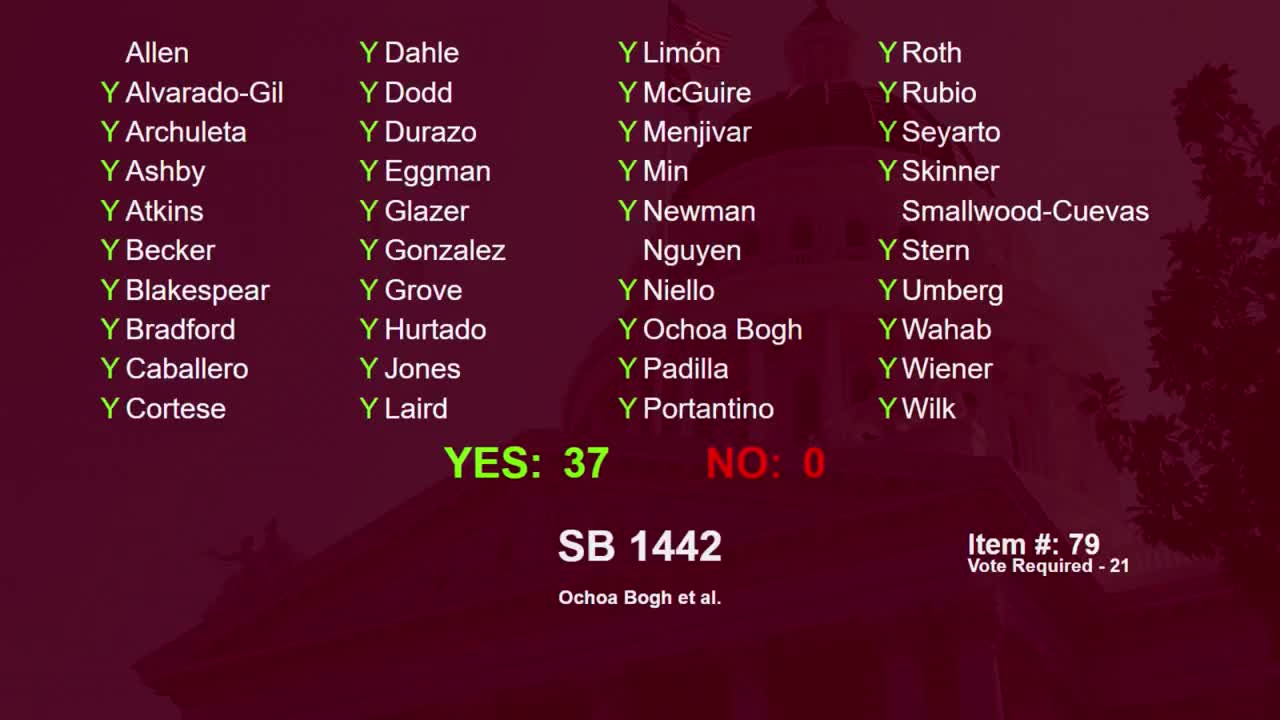 8MIN
Senate Floor
 4MIN
Senate Standing Committee on Public Safety


Bill Co-Author(s):






