SB 14: Serious felonies: human trafficking.
- Session Year: 2023-2024
- House: Senate
- Latest Version Date: 2023-09-25
Current Status:
Passed
(2023-09-25: Chaptered by Secretary of State. Chapter 230, Statutes of 2023.)
Introduced
In Committee
First Chamber
In Committee
Second Chamber
Enacted
What does this bill do?
The bill adds human trafficking of a minor to the list of “serious felonies,” which can lead to longer prison terms under California’s Three Strikes rules and limits plea bargaining in those cases, affecting people charged with that crime and the prosecutors handling them. It excludes situations where the specific listed trafficking offense was committed by someone who was themselves a victim of human trafficking at the time.
The summary is provided by generative AI which can make mistakes. For original language, please view the details in the table below.
Existing law defines the term serious felony for various purposes, including, among others, enhancing the punishment for felonies pursuant to existing sentencing provisions commonly known as the Three Strikes Law.
This bill would include human trafficking of a minor within the definition of a serious felony for all purposes, including for purposes of the Three Strikes Law, except as specified. By expanding the scope of an enhancement, this bill would impose a state-mandated local program.
The California Constitution requires the state to reimburse local agencies and school districts for certain costs mandated by the state. Statutory provisions establish procedures for making that reimbursement.
This bill would provide that no reimbursement is required by this act for a specified reason.
Existing law defines the term serious felony for various purposes, including, among others, enhancing the punishment for felonies pursuant to existing sentencing provisions commonly known as the Three Strikes Law.
This bill would include human trafficking of a minor within the definition of a serious felony for all purposes, including for purposes of the Three Strikes Law. Law, except as specified. By expanding the scope of an enhancement, this bill would impose a state-mandated local program.
The California Constitution requires the state to reimburse local agencies and school districts for certain costs mandated by the state. Statutory provisions establish procedures for making that reimbursement.
This bill would provide that no reimbursement is required by this act for a specified reason.
Existing law defines the terms term serious felony and violent felony for various purposes, including, among others, enhancing the punishment for felonies pursuant to existing sentencing provisions commonly known as the Three Strikes Law.
This bill would include human trafficking of a minor within the definition of a serious felony for all purposes, including for purposes of the Three Strikes Law. By expanding the scope of an enhancement, this bill would impose a state-mandated local program.
The California Constitution requires the state to reimburse local agencies and school districts for certain costs mandated by the state. Statutory provisions establish procedures for making that reimbursement.
This bill would provide that no reimbursement is required by this act for a specified reason.
Existing law defines the terms serious felony and violent felony for various purposes, including, among others, enhancing the punishment for felonies pursuant to existing sentencing provisions commonly known as the Three Strikes Law.
This bill would include human trafficking within the definition of a serious felony for all purposes, including for purposes of the Three Strikes Law. By expanding the scope of an enhancement, this bill would impose a state-mandated local program.
The California Constitution requires the state to reimburse local agencies and school districts for certain costs mandated by the state. Statutory provisions establish procedures for making that reimbursement.
This bill would provide that no reimbursement is required by this act for a specified reason.
Existing law defines the terms serious felony and violent felony for various purposes, including, among others, enhancing the punishment for felonies pursuant to existing sentencing provisions commonly known as the Three Strikes Law.
This bill would include human trafficking within the definition of a violent felony and the definition of a serious felony for all purposes, including for purposes of the Three Strikes Law. By expanding the scope of an enhancement, this bill would impose a state-mandated local program.
The California Constitution requires the state to reimburse local agencies and school districts for certain costs mandated by the state. Statutory provisions establish procedures for making that reimbursement.
This bill would provide that no reimbursement is required by this act for a specified reason.
The Legislature finds and declares all of the following:
(a)California consistently ranks number one in the nation in the number of human trafficking cases reported to the National Human Trafficking Hotline.
(b)The Attorney General notes that California is one of the largest sites for human trafficking in the United States and recognizes the serious nature of this crime.
(c)Minorities make up a high percentage of trafficking victims across the United States.
(d)According to a 2013 Department of Justice study examining the race of sex trafficking victims, 40.4 percent were Black, 23.9 percent were Hispanic, and 4.3 percent were Asian.
(e)Native American women and girls are victims of human trafficking at a much higher rate compared to the overall population.
(f)It is the intent of the Legislature to protect victims of human trafficking and ensure they are not themselves criminalized.
SEC. 2.Section 667.1 of the Penal Code is amended to read:667.1.(a)Notwithstanding subdivision (h) of Section 667, for all offenses committed on or after November 7, 2012, but before January 1, 2024, all references to existing statutes in subdivisions (c) to (g), inclusive, of Section 667, are to those statutes as they read on November 7, 2012.
(b)Notwithstanding subdivision (h) of Section 667, for all offenses committed on or after January 1, 2024, all references to existing statutes in subdivisions (c) to (g), inclusive, of Section 667, are to those statutes as they read on January 1, 2024.
SEC. 3.Section 1170.125 of the Penal Code is amended to read:1170.125.(a)Notwithstanding Section 2 of Proposition 184, as adopted at the November 8, 1994, statewide general election, for all offenses committed on or after November 7, 2012, but before January 1, 2024, all references to existing statutes in Sections 1170.12 and 1170.126 are to those sections as they read on November 7, 2012.
(b)Notwithstanding Section 2 of Proposition 184, as adopted at the November 8, 1994, statewide general election, for all offenses committed on or after January 1, 2024, all references to existing statutes in Sections 1170.12 and 1170.126 are to those sections as they read on January 1, 2024.
SEC. 4.Section 1192.7 of the Penal Code is amended to read:1192.7.(a)(1)It is the intent of the Legislature that district attorneys prosecute violent sex crimes under statutes that provide sentencing under a one strike, three strikes or habitual sex offender statute instead of engaging in plea bargaining over those offenses.
(2)Plea bargaining in any case in which the indictment or information charges any serious felony, any felony in which it is alleged that a firearm was personally used by the defendant, or any offense of driving while under the influence of alcohol, drugs, narcotics, or any other intoxicating substance, or any combination thereof, is prohibited, unless there is insufficient evidence to prove the peoples case, or testimony of a material witness cannot be obtained, or a reduction or dismissal would not result in a substantial change in sentence.
(3)If the indictment or information charges the defendant with a violent sex crime, as listed in subdivision (c) of Section 667.61, that could be prosecuted under Sections 269, 288.7, subdivisions (b) through (i) of Section 667, Section 667.61, or 667.71, plea bargaining is prohibited unless there is insufficient evidence to prove the peoples case, or testimony of a material witness cannot be obtained, or a reduction or dismissal would not result in a substantial change in sentence. At the time of presenting the agreement to the court, the district attorney shall state on the record why a sentence under one of those sections was not sought.
(b)As used in this section, plea bargaining means any bargaining, negotiation, or discussion between a criminal defendant, or their counsel, and a prosecuting attorney or judge, whereby the defendant agrees to plead guilty or nolo contendere, in exchange for any promises, commitments, concessions, assurances, or consideration by the prosecuting attorney or judge relating to any charge against the defendant or to the sentencing of the defendant.
(c)As used in this section, serious felony means any of the following:
(1)Murder or voluntary manslaughter; (2) mayhem; (3) rape; (4) sodomy by force, violence, duress, menace, threat of great bodily injury, or fear of immediate and unlawful bodily injury on the victim or another person; (5) oral copulation by force, violence, duress, menace, threat of great bodily injury, or fear of immediate and unlawful bodily injury on the victim or another person; (6) lewd or lascivious act on a child under 14 years of age; (7) any felony punishable by death or imprisonment in the state prison for life; (8) any felony in which the defendant personally inflicts great bodily injury on any person, other than an accomplice, or any felony in which the defendant personally uses a firearm; (9) attempted murder; (10) assault with intent to commit rape or robbery; (11) assault with a deadly weapon or instrument on a peace officer; (12) assault by a life prisoner on a noninmate; (13) assault with a deadly weapon by an inmate; (14) arson; (15) exploding a destructive device or any explosive with intent to injure; (16) exploding a destructive device or any explosive causing bodily injury, great bodily injury, or mayhem; (17) exploding a destructive device or any explosive with intent to murder; (18) any burglary of the first degree; (19) robbery or bank robbery; (20) kidnapping; (21) holding of a hostage by a person confined in a state prison; (22) attempt to commit a felony punishable by death or imprisonment in the state prison for life; (23) any felony in which the defendant personally used a dangerous or deadly weapon; (24) selling, furnishing, administering, giving, or offering to sell, furnish, administer, or give to a minor any heroin, cocaine, phencyclidine (PCP), or any methamphetamine-related drug, as described in paragraph (2) of subdivision (d) of Section 11055 of the Health and Safety Code, or any of the precursors of methamphetamines, as described in subparagraph (A) of paragraph (1) of subdivision (f) of Section 11055 or subdivision (a) of Section 11100 of the Health and Safety Code; (25) any violation of subdivision (a) of Section 289 where the act is accomplished against the victims will by force, violence, duress, menace, or fear of immediate and unlawful bodily injury on the victim or another person; (26) grand theft involving a firearm; (27) carjacking; (28) any felony offense, which would also constitute a felony violation of Section 186.22; (29) assault with the intent to commit mayhem, rape, sodomy, or oral copulation, in violation of Section 220; (30) throwing acid or flammable substances, in violation of Section 244; (31) assault with a deadly weapon, firearm, machinegun, assault weapon, or semiautomatic firearm or assault on a peace officer or firefighter, in violation of Section 245; (32) assault with a deadly weapon against a public transit employee, custodial officer, or school employee, in violation of Section 245.2, 245.3, or 245.5; (33) discharge of a firearm at an inhabited dwelling, vehicle, or aircraft, in violation of Section 246; (34) commission of rape or sexual penetration in concert with another person, in violation of Section 264.1; (35) continuous sexual abuse of a child, in violation of Section 288.5; (36) shooting from a vehicle, in violation of subdivision (c) or (d) of Section 26100; (37) intimidation of victims or witnesses, in violation of Section 136.1; (38) criminal threats, in violation of Section 422; (39) any attempt to commit a crime listed in this subdivision other than an assault; (40) any violation of Section 12022.53; (41) a violation of subdivision (b) or (c) of Section 11418; (42) human trafficking of a minor, in violation of subdivision (c) of Section 236.1, except, with respect to a violation of paragraph (1) of subdivision (c) of Section 236.1, where the person who committed the offense was a victim of human trafficking, as described in subdivision (b) or (c) of Section 236.1, at the time of the offense; and (43) any conspiracy to commit an offense described in this subdivision.
(d)As used in this section, bank robbery means to take or attempt to take, by force or violence, or by intimidation from the person or presence of another any property or money or any other thing of value belonging to, or in the care, custody, control, management, or possession of, any bank, credit union, or any savings and loan association.
As used in this subdivision, the following terms have the following meanings:
(1)Bank means any member of the Federal Reserve System, and any bank, banking association, trust company, savings bank, or other banking institution organized or operating under the laws of the United States, and any bank the deposits of which are insured by the Federal Deposit Insurance Corporation.
(2)Savings and loan association means any federal savings and loan association and any insured institution as defined in Section 401 of the National Housing Act, as amended, and any federal credit union as defined in Section 2 of the Federal Credit Union Act.
(3)Credit union means any federal credit union and any state-chartered credit union the accounts of which are insured by the Administrator of the National Credit Union administration.
(e)The provisions of this section shall not be amended by the Legislature except by statute passed in each house by rollcall vote entered in the journal, two-thirds of the membership concurring, or by a statute that becomes effective only when approved by the electors.
SEC. 5.No reimbursement is required by this act pursuant to Section 6 of Article XIIIB of the California Constitution because the only costs that may be incurred by a local agency or school district will be incurred because this act creates a new crime or infraction, eliminates a crime or infraction, or changes the penalty for a crime or infraction, within the meaning of Section 17556 of the Government Code, or changes the definition of a crime within the meaning of Section 6 of Article XIIIB of the California Constitution.
The Legislature finds and declares all of the following:
(a)California consistently ranks number one in the nation in the number of human trafficking cases reported to the National Human Trafficking Hotline.
(b)The Attorney General notes that California is one of the largest sites for human trafficking in the United States and recognizes the serious nature of this crime.
(c)Human trafficking is among the worlds fastest growing criminal enterprises and is estimated to be a $150,000,000,000 a year global industry.(c)Minorities make up a high percentage of trafficking victims across the United States.
(d)According to a 2013 Department of Justice study examining the race of sex trafficking victims, 40.4 percent were Black, 23.9 percent were Hispanic, and 4.3 percent were Asian.
(d)(e)Native American women and girls are victims of human trafficking at a much higher rate compared to the overall population.
(e)California has the sixth highest death rate of indigenous women in urban cities.(f)California was chosen to be the first pilot location for the United States Department of Justice Missing and Murdered Indigenous Persons Initiative.(f)It is the intent of the Legislature to protect victims of human trafficking and ensure they are not themselves criminalized.
SEC. 2.Section 667.1 of the Penal Code is amended to read:667.1.(a)Notwithstanding subdivision (h) of Section 667, for all offenses committed on or after November 7, 2012, but before January 1, 2024, all references to existing statutes in subdivisions (c) to (g), inclusive, of Section 667, are to those statutes as they read on November 7, 2012.
(b)Notwithstanding subdivision (h) of Section 667, for all offenses committed on or after January 1, 2024, all references to existing statutes in subdivisions (c) to (g), inclusive, of Section 667, are to those statutes as they read on January 1, 2024.
SEC. 3.Section 1170.125 of the Penal Code is amended to read:1170.125.(a)Notwithstanding Section 2 of Proposition 184, as adopted at the November 8, 1994, statewide general election, for all offenses committed on or after November 7, 2012, but before January 1, 2024, all references to existing statutes in Sections 1170.12 and 1170.126 are to those sections as they read on November 7, 2012.
(b)Notwithstanding Section 2 of Proposition 184, as adopted at the November 8, 1994, statewide general election, for all offenses committed on or after January 1, 2024, all references to existing statutes in Sections 1170.12 and 1170.126 are to those sections as they read on January 1, 2024.
SEC. 4.Section 1192.7 of the Penal Code is amended to read:1192.7.(a)(1)It is the intent of the Legislature that district attorneys prosecute violent sex crimes under statutes that provide sentencing under a one strike, three strikes or habitual sex offender statute instead of engaging in plea bargaining over those offenses.
(2)Plea bargaining in any case in which the indictment or information charges any serious felony, any felony in which it is alleged that a firearm was personally used by the defendant, or any offense of driving while under the influence of alcohol, drugs, narcotics, or any other intoxicating substance, or any combination thereof, is prohibited, unless there is insufficient evidence to prove the peoples case, or testimony of a material witness cannot be obtained, or a reduction or dismissal would not result in a substantial change in sentence.
(3)If the indictment or information charges the defendant with a violent sex crime, as listed in subdivision (c) of Section 667.61, that could be prosecuted under Sections 269, 288.7, subdivisions (b) through (i) of Section 667, Section 667.61, or 667.71, plea bargaining is prohibited unless there is insufficient evidence to prove the peoples case, or testimony of a material witness cannot be obtained, or a reduction or dismissal would not result in a substantial change in sentence. At the time of presenting the agreement to the court, the district attorney shall state on the record why a sentence under one of those sections was not sought.
(b)As used in this section, plea bargaining means any bargaining, negotiation, or discussion between a criminal defendant, or their counsel, and a prosecuting attorney or judge, whereby the defendant agrees to plead guilty or nolo contendere, in exchange for any promises, commitments, concessions, assurances, or consideration by the prosecuting attorney or judge relating to any charge against the defendant or to the sentencing of the defendant.
(c)As used in this section, serious felony means any of the following:
(1)Murder or voluntary manslaughter; (2) mayhem; (3) rape; (4) sodomy by force, violence, duress, menace, threat of great bodily injury, or fear of immediate and unlawful bodily injury on the victim or another person; (5) oral copulation by force, violence, duress, menace, threat of great bodily injury, or fear of immediate and unlawful bodily injury on the victim or another person; (6) lewd or lascivious act on a child under 14 years of age; (7) any felony punishable by death or imprisonment in the state prison for life; (8) any felony in which the defendant personally inflicts great bodily injury on any person, other than an accomplice, or any felony in which the defendant personally uses a firearm; (9) attempted murder; (10) assault with intent to commit rape or robbery; (11) assault with a deadly weapon or instrument on a peace officer; (12) assault by a life prisoner on a noninmate; (13) assault with a deadly weapon by an inmate; (14) arson; (15) exploding a destructive device or any explosive with intent to injure; (16) exploding a destructive device or any explosive causing bodily injury, great bodily injury, or mayhem; (17) exploding a destructive device or any explosive with intent to murder; (18) any burglary of the first degree; (19) robbery or bank robbery; (20) kidnapping; (21) holding of a hostage by a person confined in a state prison; (22) attempt to commit a felony punishable by death or imprisonment in the state prison for life; (23) any felony in which the defendant personally used a dangerous or deadly weapon; (24) selling, furnishing, administering, giving, or offering to sell, furnish, administer, or give to a minor any heroin, cocaine, phencyclidine (PCP), or any methamphetamine-related drug, as described in paragraph (2) of subdivision (d) of Section 11055 of the Health and Safety Code, or any of the precursors of methamphetamines, as described in subparagraph (A) of paragraph (1) of subdivision (f) of Section 11055 or subdivision (a) of Section 11100 of the Health and Safety Code; (25) any violation of subdivision (a) of Section 289 where the act is accomplished against the victims will by force, violence, duress, menace, or fear of immediate and unlawful bodily injury on the victim or another person; (26) grand theft involving a firearm; (27) carjacking; (28) any felony offense, which would also constitute a felony violation of Section 186.22; (29) assault with the intent to commit mayhem, rape, sodomy, or oral copulation, in violation of Section 220; (30) throwing acid or flammable substances, in violation of Section 244; (31) assault with a deadly weapon, firearm, machinegun, assault weapon, or semiautomatic firearm or assault on a peace officer or firefighter, in violation of Section 245; (32) assault with a deadly weapon against a public transit employee, custodial officer, or school employee, in violation of Section 245.2, 245.3, or 245.5; (33) discharge of a firearm at an inhabited dwelling, vehicle, or aircraft, in violation of Section 246; (34) commission of rape or sexual penetration in concert with another person, in violation of Section 264.1; (35) continuous sexual abuse of a child, in violation of Section 288.5; (36) shooting from a vehicle, in violation of subdivision (c) or (d) of Section 26100; (37) intimidation of victims or witnesses, in violation of Section 136.1; (38) criminal threats, in violation of Section 422; (39) any attempt to commit a crime listed in this subdivision other than an assault; (40) any violation of Section 12022.53; (41) a violation of subdivision (b) or (c) of Section 11418; (42) human trafficking of a minor, in violation of subdivision (c) of Section 236.1; 236.1, except, with respect to a violation of paragraph (1) of subdivision (c) of Section 236.1, where the person who committed the offense was a victim of human trafficking, as described in subdivision (b) or (c) of Section 236.1, at the time of the offense; and (43) any conspiracy to commit an offense described in this subdivision.
(d)As used in this section, bank robbery means to take or attempt to take, by force or violence, or by intimidation from the person or presence of another any property or money or any other thing of value belonging to, or in the care, custody, control, management, or possession of, any bank, credit union, or any savings and loan association.
As used in this subdivision, the following terms have the following meanings:
(1)Bank means any member of the Federal Reserve System, and any bank, banking association, trust company, savings bank, or other banking institution organized or operating under the laws of the United States, and any bank the deposits of which are insured by the Federal Deposit Insurance Corporation.
(2)Savings and loan association means any federal savings and loan association and any insured institution as defined in Section 401 of the National Housing Act, as amended, and any federal credit union as defined in Section 2 of the Federal Credit Union Act.
(3)Credit union means any federal credit union and any state-chartered credit union the accounts of which are insured by the Administrator of the National Credit Union administration.
(e)The provisions of this section shall not be amended by the Legislature except by statute passed in each house by rollcall vote entered in the journal, two-thirds of the membership concurring, or by a statute that becomes effective only when approved by the electors.
SEC. 5.No reimbursement is required by this act pursuant to Section 6 of Article XIIIB of the California Constitution because the only costs that may be incurred by a local agency or school district will be incurred because this act creates a new crime or infraction, eliminates a crime or infraction, or changes the penalty for a crime or infraction, within the meaning of Section 17556 of the Government Code, or changes the definition of a crime within the meaning of Section 6 of Article XIIIB of the California Constitution.
CORRECTIONS: HeadingLines 3 and 7.The Legislature finds and declares all of the following:
(a)California consistently ranks number one in the nation in the number of human trafficking cases reported to the National Human Trafficking Hotline.
(b)The Attorney General notes that California is one of the largest sites for human trafficking in the United States and recognizes the serious nature of this crime.
(c)Human trafficking is among the worlds fastest growing criminal enterprises and is estimated to be a $150,000,000,000 a year global industry.
(d)Native American women and girls are victims of human trafficking at a much higher rate compared to the overall population.
(e)California has the sixth highest death rate of indigenous women in urban cities.
(f)California was chosen to be the first pilot location for the United States Department of Justice Missing and Murdered Indigenous Persons Initiative.
SEC. 2.Section 667.1 of the Penal Code is amended to read:667.1.(a)Notwithstanding subdivision (h) of Section 667, for all offenses committed on or after November 7, 2012, but before January 1, 2024, all references to existing statutes in subdivisions (c) to (g), inclusive, of Section 667, are to those statutes as they read on November 7, 2012.
(b)Notwithstanding subdivision (h) of Section 667, for all offenses committed on or after January 1, 2024, all references to existing statutes in subdivisions (c) to (g), inclusive, of Section 667, are to those statutes as they read on January 1, 2024.
SEC. 3.Section 1170.125 of the Penal Code is amended to read:1170.125.(a)Notwithstanding Section 2 of Proposition 184, as adopted at the November 8, 1994, statewide general election, for all offenses committed on or after November 7, 2012, but before January 1, 2024, all references to existing statutes in Sections 1170.12 and 1170.126 are to those sections as they read on November 7, 2012.
(b)Notwithstanding Section 2 of Proposition 184, as adopted at the November 8, 1994, statewide general election, for all offenses committed on or after January 1, 2024, all references to existing statutes in Sections 1170.12 and 1170.126 are to those sections as they read on January 1, 2024.
SEC. 4.Section 1192.7 of the Penal Code is amended to read:1192.7.(a)(1)It is the intent of the Legislature that district attorneys prosecute violent sex crimes under statutes that provide sentencing under a one strike, three strikes or habitual sex offender statute instead of engaging in plea bargaining over those offenses.
(2)Plea bargaining in any case in which the indictment or information charges any serious felony, any felony in which it is alleged that a firearm was personally used by the defendant, or any offense of driving while under the influence of alcohol, drugs, narcotics, or any other intoxicating substance, or any combination thereof, is prohibited, unless there is insufficient evidence to prove the peoples case, or testimony of a material witness cannot be obtained, or a reduction or dismissal would not result in a substantial change in sentence.
(3)If the indictment or information charges the defendant with a violent sex crime, as listed in subdivision (c) of Section 667.61, that could be prosecuted under Sections 269, 288.7, subdivisions (b) through (i) of Section 667, Section 667.61, or 667.71, plea bargaining is prohibited unless there is insufficient evidence to prove the peoples case, or testimony of a material witness cannot be obtained, or a reduction or dismissal would not result in a substantial change in sentence. At the time of presenting the agreement to the court, the district attorney shall state on the record why a sentence under one of those sections was not sought.
(b)As used in this section, plea bargaining means any bargaining, negotiation, or discussion between a criminal defendant, or their counsel, and a prosecuting attorney or judge, whereby the defendant agrees to plead guilty or nolo contendere, in exchange for any promises, commitments, concessions, assurances, or consideration by the prosecuting attorney or judge relating to any charge against the defendant or to the sentencing of the defendant.
(c)As used in this section, serious felony means any of the following:
(1)Murder or voluntary manslaughter; (2) mayhem; (3) rape; (4) sodomy by force, violence, duress, menace, threat of great bodily injury, or fear of immediate and unlawful bodily injury on the victim or another person; (5) oral copulation by force, violence, duress, menace, threat of great bodily injury, or fear of immediate and unlawful bodily injury on the victim or another person; (6) lewd or lascivious act on a child under 14 years of age; (7) any felony punishable by death or imprisonment in the state prison for life; (8) any felony in which the defendant personally inflicts great bodily injury on any person, other than an accomplice, or any felony in which the defendant personally uses a firearm; (9) attempted murder; (10) assault with intent to commit rape or robbery; (11) assault with a deadly weapon or instrument on a peace officer; (12) assault by a life prisoner on a noninmate; (13) assault with a deadly weapon by an inmate; (14) arson; (15) exploding a destructive device or any explosive with intent to injure; (16) exploding a destructive device or any explosive causing bodily injury, great bodily injury, or mayhem; (17) exploding a destructive device or any explosive with intent to murder; (18) any burglary of the first degree; (19) robbery or bank robbery; (20) kidnapping; (21) holding of a hostage by a person confined in a state prison; (22) attempt to commit a felony punishable by death or imprisonment in the state prison for life; (23) any felony in which the defendant personally used a dangerous or deadly weapon; (24) selling, furnishing, administering, giving, or offering to sell, furnish, administer, or give to a minor any heroin, cocaine, phencyclidine (PCP), or any methamphetamine-related drug, as described in paragraph (2) of subdivision (d) of Section 11055 of the Health and Safety Code, or any of the precursors of methamphetamines, as described in subparagraph (A) of paragraph (1) of subdivision (f) of Section 11055 or subdivision (a) of Section 11100 of the Health and Safety Code; (25) any violation of subdivision (a) of Section 289 where the act is accomplished against the victims will by force, violence, duress, menace, or fear of immediate and unlawful bodily injury on the victim or another person; (26) grand theft involving a firearm; (27) carjacking; (28) any felony offense, which would also constitute a felony violation of Section 186.22; (29) assault with the intent to commit mayhem, rape, sodomy, or oral copulation, in violation of Section 220; (30) throwing acid or flammable substances, in violation of Section 244; (31) assault with a deadly weapon, firearm, machinegun, assault weapon, or semiautomatic firearm or assault on a peace officer or firefighter, in violation of Section 245; (32) assault with a deadly weapon against a public transit employee, custodial officer, or school employee, in violation of Section 245.2, 245.3, or 245.5; (33) discharge of a firearm at an inhabited dwelling, vehicle, or aircraft, in violation of Section 246; (34) commission of rape or sexual penetration in concert with another person, in violation of Section 264.1; (35) continuous sexual abuse of a child, in violation of Section 288.5; (36) shooting from a vehicle, in violation of subdivision (c) or (d) of Section 26100; (37) intimidation of victims or witnesses, in violation of Section 136.1; (38) criminal threats, in violation of Section 422; (39) any attempt to commit a crime listed in this subdivision other than an assault; (40) any violation of Section 12022.53; (41) a violation of subdivision (b) or (c) of Section 11418; (42) human trafficking, trafficking of a minor, in violation of subdivision (c) of Section 236.1; and (43) any conspiracy to commit an offense described in this subdivision.
(d)As used in this section, bank robbery means to take or attempt to take, by force or violence, or by intimidation from the person or presence of another any property or money or any other thing of value belonging to, or in the care, custody, control, management, or possession of, any bank, credit union, or any savings and loan association.
As used in this subdivision, the following terms have the following meanings:
(1)Bank means any member of the Federal Reserve System, and any bank, banking association, trust company, savings bank, or other banking institution organized or operating under the laws of the United States, and any bank the deposits of which are insured by the Federal Deposit Insurance Corporation.
(2)Savings and loan association means any federal savings and loan association and any insured institution as defined in Section 401 of the National Housing Act, as amended, and any federal credit union as defined in Section 2 of the Federal Credit Union Act.
(3)Credit union means any federal credit union and any state-chartered credit union the accounts of which are insured by the Administrator of the National Credit Union administration.
(e)The provisions of this section shall not be amended by the Legislature except by statute passed in each house by rollcall vote entered in the journal, two-thirds of the membership concurring, or by a statute that becomes effective only when approved by the electors.
SEC. 5.No reimbursement is required by this act pursuant to Section 6 of Article XIIIB of the California Constitution because the only costs that may be incurred by a local agency or school district will be incurred because this act creates a new crime or infraction, eliminates a crime or infraction, or changes the penalty for a crime or infraction, within the meaning of Section 17556 of the Government Code, or changes the definition of a crime within the meaning of Section 6 of Article XIIIB of the California Constitution.
The Legislature finds and declares all of the following:
(a)California consistently ranks number one in the nation in the number of human trafficking cases reported to the National Human Trafficking Hotline.
(b)The Attorney General notes that California is one of the largest sites for human trafficking in the United States and recognizes the serious nature of this crime.
(c)Human trafficking is among the worlds fastest growing criminal enterprises and is estimated to be a $150,000,000,000 a year global industry.
(d)Native American women and girls are victims of human trafficking at a much higher rate compared to the overall population.
(e)California has the sixth highest death rate of indigenous women in urban cities.
(f)California was chosen to be the first pilot location for the United States Department of Justice Missing and Murdered Indigenous Persons Initiative.
SECTION 1.SEC. 2.Section 667.1 of the Penal Code is amended to read:667.1.(a)Notwithstanding subdivision (h) of Section 667, for all offenses committed on or after November 7, 2012, but before January 1, 2024, all references to existing statutes in subdivisions (c) to (g), inclusive, of Section 667, are to those statutes as they read on November 7, 2012.
(b)Notwithstanding subdivision (h) of Section 667, for all offenses committed on or after January 1, 2024, all references to existing statutes in subdivisions (c) to (g), inclusive, of Section 667, are to those statutes as they read on January 1, 2024.
SEC. 2.SEC. 3.Section 1170.125 of the Penal Code is amended to read:1170.125.(a)Notwithstanding Section 2 of Proposition 184, as adopted at the November 8, 1994, statewide general election, for all offenses committed on or after November 7, 2012, but before January 1, 2024, all references to existing statutes in Sections 1170.12 and 1170.126 are to those sections as they read on November 7, 2012.
(b)Notwithstanding Section 2 of Proposition 184, as adopted at the November 8, 1994, statewide general election, for all offenses committed on or after January 1, 2024, all references to existing statutes in Sections 1170.12 and 1170.126 are to those sections as they read on January 1, 2024.
SEC. 3.SEC. 4.Section 1192.7 of the Penal Code is amended to read:1192.7.(a)(1)It is the intent of the Legislature that district attorneys prosecute violent sex crimes under statutes that provide sentencing under a one strike, three strikes or habitual sex offender statute instead of engaging in plea bargaining over those offenses.
(2)Plea bargaining in any case in which the indictment or information charges any serious felony, any felony in which it is alleged that a firearm was personally used by the defendant, or any offense of driving while under the influence of alcohol, drugs, narcotics, or any other intoxicating substance, or any combination thereof, is prohibited, unless there is insufficient evidence to prove the peoples case, or testimony of a material witness cannot be obtained, or a reduction or dismissal would not result in a substantial change in sentence.
(3)If the indictment or information charges the defendant with a violent sex crime, as listed in subdivision (c) of Section 667.61, that could be prosecuted under Sections 269, 288.7, subdivisions (b) through (i) of Section 667, Section 667.61, or 667.71, plea bargaining is prohibited unless there is insufficient evidence to prove the peoples case, or testimony of a material witness cannot be obtained, or a reduction or dismissal would not result in a substantial change in sentence. At the time of presenting the agreement to the court, the district attorney shall state on the record why a sentence under one of those sections was not sought.
(b)As used in this section section, plea bargaining means any bargaining, negotiation, or discussion between a criminal defendant, or their counsel, and a prosecuting attorney or judge, whereby the defendant agrees to plead guilty or nolo contendere, in exchange for any promises, commitments, concessions, assurances, or consideration by the prosecuting attorney or judge relating to any charge against the defendant or to the sentencing of the defendant.
(c)As used in this section, serious felony means any of the following:
(1)Murder or voluntary manslaughter; (2) mayhem; (3) rape; (4) sodomy by force, violence, duress, menace, threat of great bodily injury, or fear of immediate and unlawful bodily injury on the victim or another person; (5) oral copulation by force, violence, duress, menace, threat of great bodily injury, or fear of immediate and unlawful bodily injury on the victim or another person; (6) lewd or lascivious act on a child under 14 years of age; (7) any felony punishable by death or imprisonment in the state prison for life; (8) any felony in which the defendant personally inflicts great bodily injury on any person, other than an accomplice, or any felony in which the defendant personally uses a firearm; (9) attempted murder; (10) assault with intent to commit rape or robbery; (11) assault with a deadly weapon or instrument on a peace officer; (12) assault by a life prisoner on a noninmate; (13) assault with a deadly weapon by an inmate; (14) arson; (15) exploding a destructive device or any explosive with intent to injure; (16) exploding a destructive device or any explosive causing bodily injury, great bodily injury, or mayhem; (17) exploding a destructive device or any explosive with intent to murder; (18) any burglary of the first degree; (19) robbery or bank robbery; (20) kidnapping; (21) holding of a hostage by a person confined in a state prison; (22) attempt to commit a felony punishable by death or imprisonment in the state prison for life; (23) any felony in which the defendant personally used a dangerous or deadly weapon; (24) selling, furnishing, administering, giving, or offering to sell, furnish, administer, or give to a minor any heroin, cocaine, phencyclidine (PCP), or any methamphetamine-related drug, as described in paragraph (2) of subdivision (d) of Section 11055 of the Health and Safety Code, or any of the precursors of methamphetamines, as described in subparagraph (A) of paragraph (1) of subdivision (f) of Section 11055 or subdivision (a) of Section 11100 of the Health and Safety Code; (25) any violation of subdivision (a) of Section 289 where the act is accomplished against the victims will by force, violence, duress, menace, or fear of immediate and unlawful bodily injury on the victim or another person; (26) grand theft involving a firearm; (27) carjacking; (28) any felony offense, which would also constitute a felony violation of Section 186.22; (29) assault with the intent to commit mayhem, rape, sodomy, or oral copulation, in violation of Section 220; (30) throwing acid or flammable substances, in violation of Section 244; (31) assault with a deadly weapon, firearm, machinegun, assault weapon, or semiautomatic firearm or assault on a peace officer or firefighter, in violation of Section 245; (32) assault with a deadly weapon against a public transit employee, custodial officer, or school employee, in violation of Section 245.2, 245.3, or 245.5; (33) discharge of a firearm at an inhabited dwelling, vehicle, or aircraft, in violation of Section 246; (34) commission of rape or sexual penetration in concert with another person, in violation of Section 264.1; (35) continuous sexual abuse of a child, in violation of Section 288.5; (36) shooting from a vehicle, in violation of subdivision (c) or (d) of Section 26100; (37) intimidation of victims or witnesses, in violation of Section 136.1; (38) criminal threats, in violation of Section 422; (39) any attempt to commit a crime listed in this subdivision other than an assault; (40) any violation of Section 12022.53; (41) a violation of subdivision (b) or (c) of Section 11418; (42) human trafficking, in violation of Section 236.1; and (43) any conspiracy to commit an offense described in this subdivision.
(d)As used in this section, bank robbery means to take or attempt to take, by force or violence, or by intimidation from the person or presence of another any property or money or any other thing of value belonging to, or in the care, custody, control, management, or possession of, any bank, credit union, or any savings and loan association.
As used in this subdivision, the following terms have the following meanings:
(1)Bank means any member of the Federal Reserve System, and any bank, banking association, trust company, savings bank, or other banking institution organized or operating under the laws of the United States, and any bank the deposits of which are insured by the Federal Deposit Insurance Corporation.
(2)Savings and loan association means any federal savings and loan association and any insured institution as defined in Section 401 of the National Housing Act, as amended, and any federal credit union as defined in Section 2 of the Federal Credit Union Act.
(3)Credit union means any federal credit union and any state-chartered credit union the accounts of which are insured by the Administrator of the National Credit Union administration.
(e)The provisions of this section shall not be amended by the Legislature except by statute passed in each house by rollcall vote entered in the journal, two-thirds of the membership concurring, or by a statute that becomes effective only when approved by the electors.
SEC. 4.SEC. 5.No reimbursement is required by this act pursuant to Section 6 of Article XIIIB of the California Constitution because the only costs that may be incurred by a local agency or school district will be incurred because this act creates a new crime or infraction, eliminates a crime or infraction, or changes the penalty for a crime or infraction, within the meaning of Section 17556 of the Government Code, or changes the definition of a crime within the meaning of Section 6 of Article XIIIB of the California Constitution.
(a)Notwithstanding subdivision (h) of Section 667, for all offenses committed on or after November 7, 2012, but before January 1, 2024, all references to existing statutes in subdivisions (c) to (g), inclusive, of Section 667, are to those statutes as they read on November 7, 2012.
(b)Notwithstanding subdivision (h) of Section 667, for all offenses committed on or after January 1, 2024, all references to existing statutes in subdivisions (c) to (g), inclusive, of Section 667, are to those statutes as they read on January 1, 2024.
SEC. 2.Section 667.5 of the Penal Code is amended to read:667.5.Enhancement of prison terms for new offenses because of prior prison terms shall be imposed as follows:(a)If one of the new offenses is one of the violent felonies specified in subdivision (c), in addition to and consecutive to any other prison terms therefor, the court shall impose a three-year term for each prior separate prison term served by the defendant when the prior offense was one of the violent felonies specified in subdivision (c). However, an additional term shall not be imposed under this subdivision for a prison term served prior to a period of 10 years in which the defendant remained free of both prison custody and the commission of an offense that results in a felony conviction.(b)Except when subdivision (a) applies, if the new offense is a felony for which a prison sentence or a sentence of imprisonment in a county jail under subdivision (h) of Section 1170 is imposed or is not suspended, in addition and consecutive to any other sentence therefor, the court shall impose a one-year term for each prior separate prison term for a sexually violent offense as defined in subdivision (b) of Section 6600 of the Welfare and Institutions Code, provided that an additional term shall not be imposed under this subdivision for a prison term served prior to a period of five years in which the defendant remained free of both the commission of an offense that results in a felony conviction, and prison custody or the imposition of a term of jail custody imposed under subdivision (h) of Section 1170 or any felony sentence that is not suspended.(c)The Legislature finds and declares that the following specified crimes merit special consideration when imposing a sentence to display societys condemnation for these extraordinary crimes of violence against the person. For the purpose of this section, violent felony means any of the following:(1)Murder or voluntary manslaughter.(2)Mayhem.(3)Rape as defined in paragraph (2) or (6) of subdivision (a) of Section 261 or paragraph (1) or (4) of subdivision (a) of former Section 262.(4)Sodomy as defined in subdivision (c) or (d) of Section 286.(5)Oral copulation as defined in subdivision (c) or (d) of Section 287 or of former Section 288a.(6)Lewd or lascivious act as defined in subdivision (a) or (b) of Section 288.(7)Any felony punishable by death or imprisonment in the state prison for life.(8)Any felony in which the defendant inflicts great bodily injury on a person other than an accomplice, which has been charged and proved as provided for in Section 12022.7, 12022.8, or 12022.9 on or after July 1, 1977, or as specified prior to July 1, 1977, in Sections 213, 264, and 461, or any felony in which the defendant uses a firearm which use has been charged and proved as provided in subdivision (a) of Section 12022.3, or Section 12022.5 or 12022.55.(9)Robbery.(10)Arson, in violation of subdivision (a) or (b) of Section 451.(11)Sexual penetration as defined in subdivision (a) or (j) of Section 289.(12)Attempted murder.(13)A violation of Section 18745, 18750, or 18755.(14)Kidnapping.(15)Assault with the intent to commit a specified felony, in violation of Section 220.(16)Continuous sexual abuse of a child, in violation of Section 288.5.(17)Carjacking, as defined in subdivision (a) of Section 215.(18)Rape or sexual penetration, in concert, in violation of Section 264.1.(19)Extortion, as defined in Section 518, that would constitute a felony violation of Section 186.22.(20)Threats to victims or witnesses, as defined in Section 136.1, that would constitute a felony violation of Section 186.22.(21)Burglary of the first degree, as defined in subdivision (a) of Section 460, wherein it is charged and proved that another person, other than an accomplice, was present in the residence during the commission of the burglary.(22)Any violation of Section 12022.53.(23)A violation of subdivision (b) or (c) of Section 11418.(24)Human trafficking, in violation of Section 236.1.(d)For the purposes of this section, the defendant shall be deemed to remain in prison custody for an offense until the official discharge from custody, including any period of mandatory supervision, or until release on parole or postrelease community supervision, whichever first occurs, including any time during which the defendant remains subject to reimprisonment or custody in county jail for escape from custody or is reimprisoned on revocation of parole or postrelease community supervision. The additional penalties provided for prior prison terms shall not be imposed unless they are charged and admitted or found true in the action for the new offense.(e)The additional penalties provided for prior prison terms shall not be imposed for any felony for which the defendant did not serve a prior separate term in state prison or in county jail under subdivision (h) of Section 1170.(f)A prior conviction of a felony shall include a conviction in another jurisdiction for an offense that, if committed in California, is punishable by imprisonment in the state prison or in county jail under subdivision (h) of Section 1170 if the defendant served one year or more in prison for the offense in the other jurisdiction. A prior conviction of a particular felony shall include a conviction in another jurisdiction for an offense that includes all of the elements of the particular felony as defined under California law if the defendant served one year or more in prison for the offense in the other jurisdiction.(g)A prior separate prison term for the purposes of this section shall mean a continuous completed period of prison incarceration imposed for the particular offense alone or in combination with concurrent or consecutive sentences for other crimes, including any reimprisonment on revocation of parole that is not accompanied by a new commitment to prison, and including reimprisonment after an escape from incarceration.(h)Serving a prison term includes a confinement time in any state prison or federal penal institution as punishment for commission of an offense, including confinement in a hospital or other institution or facility credited as service of prison time in the jurisdiction of the confinement.(i)For the purposes of this section, a commitment to the State Department of Mental Health, or its successor the State Department of State Hospitals, as a mentally disordered sex offender following a conviction of a felony, which commitment exceeds one year in duration, shall be deemed a prior prison term.(j)For the purposes of this section, when a person subject to the custody, control, and discipline of the Secretary of the Department of Corrections and Rehabilitation is incarcerated at a facility operated by the Division of Juvenile Justice, that incarceration shall be deemed to be a term served in state prison.(k)(1)Notwithstanding subdivisions (d) and (g) or any other law, when one of the new offenses is committed while the defendant is temporarily removed from prison pursuant to Section 2690 or while the defendant is transferred to a community facility pursuant to Section 3416, 6253, or 6263, or while the defendant is on furlough pursuant to Section 6254, the defendant shall be subject to the full enhancements provided for in this section.(2)This subdivision does not apply when a full, separate, and consecutive term is imposed pursuant to any other law.SEC. 3.SEC. 2.Section 1170.125 of the Penal Code is amended to read:1170.125.(a)Notwithstanding Section 2 of Proposition 184, as adopted at the November 8, 1994, statewide general election, for all offenses committed on or after November 7, 2012, but before January 1, 2024, all references to existing statutes in Sections 1170.12 and 1170.126 are to those sections as they read on November 7, 2012.
(b)Notwithstanding Section 2 of Proposition 184, as adopted at the November 8, 1994, statewide general election, for all offenses committed on or after January 1, 2024, all references to existing statutes in Sections 1170.12 and 1170.126 are to those sections as they read on January 1, 2024.
SEC. 4.SEC. 3.Section 1192.7 of the Penal Code is amended to read:1192.7.(a)(1)It is the intent of the Legislature that district attorneys prosecute violent sex crimes under statutes that provide sentencing under a one strike, three strikes or habitual sex offender statute instead of engaging in plea bargaining over those offenses.
(2)Plea bargaining in any case in which the indictment or information charges any serious felony, any felony in which it is alleged that a firearm was personally used by the defendant, or any offense of driving while under the influence of alcohol, drugs, narcotics, or any other intoxicating substance, or any combination thereof, is prohibited, unless there is insufficient evidence to prove the peoples case, or testimony of a material witness cannot be obtained, or a reduction or dismissal would not result in a substantial change in sentence.
(3)If the indictment or information charges the defendant with a violent sex crime, as listed in subdivision (c) of Section 667.61, that could be prosecuted under Sections 269, 288.7, subdivisions (b) through (i) of Section 667, Section 667.61, or 667.71, plea bargaining is prohibited unless there is insufficient evidence to prove the peoples case, or testimony of a material witness cannot be obtained, or a reduction or dismissal would not result in a substantial change in sentence. At the time of presenting the agreement to the court, the district attorney shall state on the record why a sentence under one of those sections was not sought.
(b)As used in this section plea bargaining means any bargaining, negotiation, or discussion between a criminal defendant, or their counsel, and a prosecuting attorney or judge, whereby the defendant agrees to plead guilty or nolo contendere, in exchange for any promises, commitments, concessions, assurances, or consideration by the prosecuting attorney or judge relating to any charge against the defendant or to the sentencing of the defendant.
(c)As used in this section, serious felony means any of the following:
(1)Murder or voluntary manslaughter; (2) mayhem; (3) rape; (4) sodomy by force, violence, duress, menace, threat of great bodily injury, or fear of immediate and unlawful bodily injury on the victim or another person; (5) oral copulation by force, violence, duress, menace, threat of great bodily injury, or fear of immediate and unlawful bodily injury on the victim or another person; (6) lewd or lascivious act on a child under 14 years of age; (7) any felony punishable by death or imprisonment in the state prison for life; (8) any felony in which the defendant personally inflicts great bodily injury on any person, other than an accomplice, or any felony in which the defendant personally uses a firearm; (9) attempted murder; (10) assault with intent to commit rape or robbery; (11) assault with a deadly weapon or instrument on a peace officer; (12) assault by a life prisoner on a noninmate; (13) assault with a deadly weapon by an inmate; (14) arson; (15) exploding a destructive device or any explosive with intent to injure; (16) exploding a destructive device or any explosive causing bodily injury, great bodily injury, or mayhem; (17) exploding a destructive device or any explosive with intent to murder; (18) any burglary of the first degree; (19) robbery or bank robbery; (20) kidnapping; (21) holding of a hostage by a person confined in a state prison; (22) attempt to commit a felony punishable by death or imprisonment in the state prison for life; (23) any felony in which the defendant personally used a dangerous or deadly weapon; (24) selling, furnishing, administering, giving, or offering to sell, furnish, administer, or give to a minor any heroin, cocaine, phencyclidine (PCP), or any methamphetamine-related drug, as described in paragraph (2) of subdivision (d) of Section 11055 of the Health and Safety Code, or any of the precursors of methamphetamines, as described in subparagraph (A) of paragraph (1) of subdivision (f) of Section 11055 or subdivision (a) of Section 11100 of the Health and Safety Code; (25) any violation of subdivision (a) of Section 289 where the act is accomplished against the victims will by force, violence, duress, menace, or fear of immediate and unlawful bodily injury on the victim or another person; (26) grand theft involving a firearm; (27) carjacking; (28) any felony offense, which would also constitute a felony violation of Section 186.22; (29) assault with the intent to commit mayhem, rape, sodomy, or oral copulation, in violation of Section 220; (30) throwing acid or flammable substances, in violation of Section 244; (31) assault with a deadly weapon, firearm, machinegun, assault weapon, or semiautomatic firearm or assault on a peace officer or firefighter, in violation of Section 245; (32) assault with a deadly weapon against a public transit employee, custodial officer, or school employee, in violation of Section 245.2, 245.3, or 245.5; (33) discharge of a firearm at an inhabited dwelling, vehicle, or aircraft, in violation of Section 246; (34) commission of rape or sexual penetration in concert with another person, in violation of Section 264.1; (35) continuous sexual abuse of a child, in violation of Section 288.5; (36) shooting from a vehicle, in violation of subdivision (c) or (d) of Section 26100; (37) intimidation of victims or witnesses, in violation of Section 136.1; (38) criminal threats, in violation of Section 422; (39) any attempt to commit a crime listed in this subdivision other than an assault; (40) any violation of Section 12022.53; (41) a violation of subdivision (b) or (c) of Section 11418; (42) human trafficking, in violation of Section 236.1; and (43) any conspiracy to commit an offense described in this subdivision.
(d)As used in this section, bank robbery means to take or attempt to take, by force or violence, or by intimidation from the person or presence of another any property or money or any other thing of value belonging to, or in the care, custody, control, management, or possession of, any bank, credit union, or any savings and loan association.
As used in this subdivision, the following terms have the following meanings:
(1)Bank means any member of the Federal Reserve System, and any bank, banking association, trust company, savings bank, or other banking institution organized or operating under the laws of the United States, and any bank the deposits of which are insured by the Federal Deposit Insurance Corporation.
(2)Savings and loan association means any federal savings and loan association and any insured institution as defined in Section 401 of the National Housing Act, as amended, and any federal credit union as defined in Section 2 of the Federal Credit Union Act.
(3)Credit union means any federal credit union and any state-chartered credit union the accounts of which are insured by the Administrator of the National Credit Union administration.
(e)The provisions of this section shall not be amended by the Legislature except by statute passed in each house by rollcall vote entered in the journal, two-thirds of the membership concurring, or by a statute that becomes effective only when approved by the electors.
SEC. 5.SEC. 4.No reimbursement is required by this act pursuant to Section 6 of Article XIIIB of the California Constitution because the only costs that may be incurred by a local agency or school district will be incurred because this act creates a new crime or infraction, eliminates a crime or infraction, or changes the penalty for a crime or infraction, within the meaning of Section 17556 of the Government Code, or changes the definition of a crime within the meaning of Section 6 of Article XIIIB of the California Constitution.
(a)Notwithstanding subdivision (h) of Section 667, for all offenses committed on or after November 7, 2012, but before January 1, 2024, all references to existing statutes in subdivisions (c) to (g), inclusive, of Section 667, are to those statutes as they existed read on November 7, 2012.
(b)Notwithstanding subdivision (h) of Section 667, for all offenses committed on or after January 1, 2024, all references to existing statutes in subdivisions (c) to (g), inclusive, of Section 667, are to those statutes as they read on January 1, 2024.
SEC. 2.Section 667.5 of the Penal Code is amended to read:667.5.Enhancement of prison terms for new offenses because of prior prison terms shall be imposed as follows:
(a)If one of the new offenses is one of the violent felonies specified in subdivision (c), in addition to and consecutive to any other prison terms therefor, the court shall impose a three-year term for each prior separate prison term served by the defendant when the prior offense was one of the violent felonies specified in subdivision (c). However, an additional term shall not be imposed under this subdivision for any a prison term served prior to a period of 10 years in which the defendant remained free of both prison custody and the commission of an offense that results in a felony conviction.
(b)Except when subdivision (a) applies, if the new offense is any a felony for which a prison sentence or a sentence of imprisonment in a county jail under subdivision (h) of Section 1170 is imposed or is not suspended, in addition and consecutive to any other sentence therefor, the court shall impose a one-year term for each prior separate prison term for a sexually violent offense as defined in subdivision (b) of Section 6600 of the Welfare and Institutions Code, provided that an additional term shall not be imposed under this subdivision for any a prison term served prior to a period of five years in which the defendant remained free of both the commission of an offense that results in a felony conviction, and prison custody or the imposition of a term of jail custody imposed under subdivision (h) of Section 1170 or any felony sentence that is not suspended.
(c)The Legislature finds and declares that the following specified crimes merit special consideration when imposing a sentence to display societys condemnation for these extraordinary crimes of violence against the person. For the purpose of this section, violent felony means any of the following:
(1)Murder or voluntary manslaughter.
(2)Mayhem.
(3)Rape as defined in paragraph (2) or (6) of subdivision (a) of Section 261 or paragraph (1) or (4) of subdivision (a) of former Section 262.
(4)Sodomy as defined in subdivision (c) or (d) of Section 286.
(5)Oral copulation as defined in subdivision (c) or (d) of Section 287 or of former Section 288a.
(6)Lewd or lascivious act as defined in subdivision (a) or (b) of Section 288.
(7)Any felony punishable by death or imprisonment in the state prison for life.
(8)Any felony in which the defendant inflicts great bodily injury on a person other than an accomplice, which has been charged and proved as provided for in Section 12022.7, 12022.8, or 12022.9 on or after July 1, 1977, or as specified prior to July 1, 1977, in Sections 213, 264, and 461, or any felony in which the defendant uses a firearm which use has been charged and proved as provided in subdivision (a) of Section 12022.3, or Section 12022.5 or 12022.55.
(9)Any robbery.(9)Robbery.
(10)Arson, in violation of subdivision (a) or (b) of Section 451.
(11)Sexual penetration as defined in subdivision (a) or (j) of Section 289.
(12)Attempted murder.
(13)A violation of Section 18745, 18750, or 18755.
(14)Kidnapping.
(15)Assault with the intent to commit a specified felony, in violation of Section 220.
(16)Continuous sexual abuse of a child, in violation of Section 288.5.
(17)Carjacking, as defined in subdivision (a) of Section 215.
(18)Rape or sexual penetration, in concert, in violation of Section 264.1.
(19)Extortion, as defined in Section 518, which that would constitute a felony violation of Section 186.22.
(20)Threats to victims or witnesses, as defined in Section 136.1, which that would constitute a felony violation of Section 186.22.
(21)Any burglary Burglary of the first degree, as defined in subdivision (a) of Section 460, wherein it is charged and proved that another person, other than an accomplice, was present in the residence during the commission of the burglary.
(22)Any violation of Section 12022.53.
(23)A violation of subdivision (b) or (c) of Section 11418.
(24)Human trafficking, in violation of Section 236.1.
(d)For the purposes of this section, the defendant shall be deemed to remain in prison custody for an offense until the official discharge from custody, including any period of mandatory supervision, or until release on parole or postrelease community supervision, whichever first occurs, including any time during which the defendant remains subject to reimprisonment or custody in county jail for escape from custody or is reimprisoned on revocation of parole or postrelease community supervision. The additional penalties provided for prior prison terms shall not be imposed unless they are charged and admitted or found true in the action for the new offense.
(e)The additional penalties provided for prior prison terms shall not be imposed for any felony for which the defendant did not serve a prior separate term in state prison or in county jail under subdivision (h) of Section 1170.
(f)A prior conviction of a felony shall include a conviction in another jurisdiction for an offense which, that, if committed in California, is punishable by imprisonment in the state prison or in county jail under subdivision (h) of Section 1170 if the defendant served one year or more in prison for the offense in the other jurisdiction. A prior conviction of a particular felony shall include a conviction in another jurisdiction for an offense that includes all of the elements of the particular felony as defined under California law if the defendant served one year or more in prison for the offense in the other jurisdiction.
(g)A prior separate prison term for the purposes of this section shall mean a continuous completed period of prison incarceration imposed for the particular offense alone or in combination with concurrent or consecutive sentences for other crimes, including any reimprisonment on revocation of parole that is not accompanied by a new commitment to prison, and including any reimprisonment after an escape from incarceration.
(h)Serving a prison term includes any a confinement time in any state prison or federal penal institution as punishment for commission of an offense, including confinement in a hospital or other institution or facility credited as service of prison time in the jurisdiction of the confinement.
(i)For the purposes of this section, a commitment to the State Department of Mental Health, or its successor the State Department of State Hospitals, as a mentally disordered sex offender following a conviction of a felony, which commitment exceeds one year in duration, shall be deemed a prior prison term.
(j)For the purposes of this section, when a person subject to the custody, control, and discipline of the Secretary of the Department of Corrections and Rehabilitation is incarcerated at a facility operated by the Division of Juvenile Justice, that incarceration shall be deemed to be a term served in state prison.
(k)(1)Notwithstanding subdivisions (d) and (g) or any other law, when one of the new offenses is committed while the defendant is temporarily removed from prison pursuant to Section 2690 or while the defendant is transferred to a community facility pursuant to Section 3416, 6253, or 6263, or while the defendant is on furlough pursuant to Section 6254, the defendant shall be subject to the full enhancements provided for in this section.
(2)This subdivision does not apply when a full, separate, and consecutive term is imposed pursuant to any other law.
SEC. 3.Section 1170.125 of the Penal Code is amended to read:1170.125.(a)Notwithstanding Section 2 of Proposition 184, as adopted at the November 8, 1994, General Election, statewide general election, for all offenses committed on or after November 7, 2012, but before January 1, 2024, all references to existing statutes in Sections 1170.12 and 1170.126 are to those sections as they existed read on November 7, 2012.
(b)Notwithstanding Section 2 of Proposition 184, as adopted at the November 8, 1994, statewide general election, for all offenses committed on or after January 1, 2024, all references to existing statutes in Sections 1170.12 and 1170.126 are to those sections as they read on January 1, 2024.
SEC. 4.Section 1192.7 of the Penal Code is amended to read:1192.7.(a)(1)It is the intent of the Legislature that district attorneys prosecute violent sex crimes under statutes that provide sentencing under a one strike, three strikes or habitual sex offender statute instead of engaging in plea bargaining over those offenses.
(2)Plea bargaining in any case in which the indictment or information charges any serious felony, any felony in which it is alleged that a firearm was personally used by the defendant, or any offense of driving while under the influence of alcohol, drugs, narcotics, or any other intoxicating substance, or any combination thereof, is prohibited, unless there is insufficient evidence to prove the peoples case, or testimony of a material witness cannot be obtained, or a reduction or dismissal would not result in a substantial change in sentence.
(3)If the indictment or information charges the defendant with a violent sex crime, as listed in subdivision (c) of Section 667.61, that could be prosecuted under Sections 269, 288.7, subdivisions (b) through (i) of Section 667, Section 667.61, or 667.71, plea bargaining is prohibited unless there is insufficient evidence to prove the peoples case, or testimony of a material witness cannot be obtained, or a reduction or dismissal would not result in a substantial change in sentence. At the time of presenting the agreement to the court, the district attorney shall state on the record why a sentence under one of those sections was not sought.
(b)As used in this section plea bargaining means any bargaining, negotiation, or discussion between a criminal defendant, or his or her their counsel, and a prosecuting attorney or judge, whereby the defendant agrees to plead guilty or nolo contendere, in exchange for any promises, commitments, concessions, assurances, or consideration by the prosecuting attorney or judge relating to any charge against the defendant or to the sentencing of the defendant.
(c)As used in this section, serious felony means any of the following:
(1)Murder or voluntary manslaughter; (2) mayhem; (3) rape; (4) sodomy by force, violence, duress, menace, threat of great bodily injury, or fear of immediate and unlawful bodily injury on the victim or another person; (5) oral copulation by force, violence, duress, menace, threat of great bodily injury, or fear of immediate and unlawful bodily injury on the victim or another person; (6) lewd or lascivious act on a child under 14 years of age; (7) any felony punishable by death or imprisonment in the state prison for life; (8) any felony in which the defendant personally inflicts great bodily injury on any person, other than an accomplice, or any felony in which the defendant personally uses a firearm; (9) attempted murder; (10) assault with intent to commit rape or robbery; (11) assault with a deadly weapon or instrument on a peace officer; (12) assault by a life prisoner on a noninmate; (13) assault with a deadly weapon by an inmate; (14) arson; (15) exploding a destructive device or any explosive with intent to injure; (16) exploding a destructive device or any explosive causing bodily injury, great bodily injury, or mayhem; (17) exploding a destructive device or any explosive with intent to murder; (18) any burglary of the first degree; (19) robbery or bank robbery; (20) kidnapping; (21) holding of a hostage by a person confined in a state prison; (22) attempt to commit a felony punishable by death or imprisonment in the state prison for life; (23) any felony in which the defendant personally used a dangerous or deadly weapon; (24) selling, furnishing, administering, giving, or offering to sell, furnish, administer, or give to a minor any heroin, cocaine, phencyclidine (PCP), or any methamphetamine-related drug, as described in paragraph (2) of subdivision (d) of Section 11055 of the Health and Safety Code, or any of the precursors of methamphetamines, as described in subparagraph (A) of paragraph (1) of subdivision (f) of Section 11055 or subdivision (a) of Section 11100 of the Health and Safety Code; (25) any violation of subdivision (a) of Section 289 where the act is accomplished against the victims will by force, violence, duress, menace, or fear of immediate and unlawful bodily injury on the victim or another person; (26) grand theft involving a firearm; (27) carjacking; (28) any felony offense, which would also constitute a felony violation of Section 186.22; (29) assault with the intent to commit mayhem, rape, sodomy, or oral copulation, in violation of Section 220; (30) throwing acid or flammable substances, in violation of Section 244; (31) assault with a deadly weapon, firearm, machinegun, assault weapon, or semiautomatic firearm or assault on a peace officer or firefighter, in violation of Section 245; (32) assault with a deadly weapon against a public transit employee, custodial officer, or school employee, in violation of Section 245.2, 245.3, or 245.5; (33) discharge of a firearm at an inhabited dwelling, vehicle, or aircraft, in violation of Section 246; (34) commission of rape or sexual penetration in concert with another person, in violation of Section 264.1; (35) continuous sexual abuse of a child, in violation of Section 288.5; (36) shooting from a vehicle, in violation of subdivision (c) or (d) of Section 26100; (37) intimidation of victims or witnesses, in violation of Section 136.1; (38) criminal threats, in violation of Section 422; (39) any attempt to commit a crime listed in this subdivision other than an assault; (40) any violation of Section 12022.53; (41) a violation of subdivision (b) or (c) of Section 11418; (42) human trafficking, in violation of Section 236.1; and (42) (43) any conspiracy to commit an offense described in this subdivision.
(d)As used in this section, bank robbery means to take or attempt to take, by force or violence, or by intimidation from the person or presence of another any property or money or any other thing of value belonging to, or in the care, custody, control, management, or possession of, any bank, credit union, or any savings and loan association.
As used in this subdivision, the following terms have the following meanings:
(1)Bank means any member of the Federal Reserve System, and any bank, banking association, trust company, savings bank, or other banking institution organized or operating under the laws of the United States, and any bank the deposits of which are insured by the Federal Deposit Insurance Corporation.
(2)Savings and loan association means any federal savings and loan association and any insured institution as defined in Section 401 of the National Housing Act, as amended, and any federal credit union as defined in Section 2 of the Federal Credit Union Act.
(3)Credit union means any federal credit union and any state-chartered credit union the accounts of which are insured by the Administrator of the National Credit Union administration.
(e)The provisions of this section shall not be amended by the Legislature except by statute passed in each house by rollcall vote entered in the journal, two-thirds of the membership concurring, or by a statute that becomes effective only when approved by the electors.
SEC. 5.No reimbursement is required by this act pursuant to Section 6 of Article XIIIB of the California Constitution because the only costs that may be incurred by a local agency or school district will be incurred because this act creates a new crime or infraction, eliminates a crime or infraction, or changes the penalty for a crime or infraction, within the meaning of Section 17556 of the Government Code, or changes the definition of a crime within the meaning of Section 6 of Article XIIIB of the California Constitution.
|
Date
|
Status
|
|---|---|
| Sep 25, 2023 | Chaptered by Secretary of State. Chapter 230, Statutes of 2023. |
| Sep 25, 2023 | Approved by the Governor. |
| Sep 20, 2023 | Enrolled and presented to the Governor at 4:30 p.m. |
| Sep 13, 2023 | Assembly amendments concurred in. (Ayes 39. Noes 0. Page 2720.) Ordered to engrossing and enrolling. |
| Sep 11, 2023 | In Senate. Concurrence in Assembly amendments pending. |
| Sep 11, 2023 | Read third time. Passed. (Ayes 80. Noes 0. Page 3209.) Ordered to the Senate. |
| Sep 5, 2023 | Read second time. Ordered to third reading. |
| Sep 1, 2023 | Read second time and amended. Ordered to second reading. |
| Sep 1, 2023 | From committee: Do pass as amended. (Ayes 16. Noes 0.) (September 1). |
| Sep 1, 2023 | (Corrected September 5). |
| Aug 16, 2023 | August 16 set for first hearing. Placed on suspense file. |
| Jul 13, 2023 | Joint Rule 62(a) suspended. |
| Jul 13, 2023 | From committee: Do pass and re-refer to Com. on APPR. (Ayes 6. Noes 0.) (July 13). Re-referred to Com. on APPR. |
| Jul 11, 2023 | July 11 set for second hearing. Failed passage in committee. (Ayes 2. Noes 0.) Reconsideration granted. |
| Jun 21, 2023 | June 27 set for first hearing canceled at the request of author. |
| Jun 8, 2023 | Referred to Com. on PUB. S. |
| May 25, 2023 | In Assembly. Read first time. Held at Desk. |
| May 25, 2023 | Read third time. Passed. (Ayes 40. Noes 0. Page 1295.) Ordered to the Assembly. |
| May 23, 2023 | Ordered to special consent calendar. |
| May 18, 2023 | Read second time. Ordered to third reading. |
| May 18, 2023 | From committee: Do pass. (Ayes 7. Noes 0. Page 1157.) (May 18). |
| May 12, 2023 | Set for hearing May 18. |
| May 8, 2023 | May 8 hearing: Placed on APPR suspense file. |
| May 2, 2023 | Set for hearing May 8. |
| Apr 27, 2023 | Read second time and amended. Re-referred to Com. on APPR. |
| Apr 26, 2023 | From committee: Do pass as amended and re-refer to Com. on APPR. (Ayes 5. Noes 0. Page 900.) (April 25). |
| Apr 13, 2023 | From committee with author's amendments. Read second time and amended. Re-referred to Com. on PUB S. |
| Mar 22, 2023 | Set for hearing April 25. |
| Feb 23, 2023 | From committee with author's amendments. Read second time and amended. Re-referred to Com. on PUB S. |
| Jan 18, 2023 | Referred to Com. on PUB S. |
| Dec 6, 2022 | From printer. May be acted upon on or after January 5. |
| Dec 5, 2022 | Introduced. Read first time. To Com. on RLS. for assignment. To print. |
|
Date
|
Description
|
Location
|
Votes
|
|
|---|---|---|---|---|
| Sep 13, 2023 | Unfinished Business SB14 Grove et al. Concurrence | Senate Floor |
Passed |
|
| Sep 11, 2023 | SB 14 Grove Senate Third Reading By Blanca Rubio | Assembly Floor |
Passed |
|
| Sep 1, 2023 | Do pass as amended. | Assembly Standing Committee on Appropriations |
Passed |
|
| Jul 13, 2023 | Do pass and be re-referred to the Committee on [Appropriations] | Assembly Standing Committee on Public Safety |
Passed |
|
| Jul 11, 2023 | Do pass and be re-referred to the Committee on [Appropriations] | Assembly Standing Committee on Public Safety |
Failed |
|
| May 25, 2023 | Special Consent SB14 Grove et al. | Senate Floor |
Passed |
|
| May 18, 2023 | Do pass | Senate Standing Committee on Appropriations |
Passed |
|
| May 8, 2023 | Placed on suspense file | Senate Standing Committee on Appropriations |
Passed |
|
| Apr 25, 2023 | Do pass as amended, but first amend, and re-refer to the Committee on [Appropriations] | Senate Standing Committee on Public Safety |
Passed |
This list shows positions taken on this bill by organizations on the date displayed, which is linked to the original source.
Positions by individuals are not included.
|
Organization
|
Position
|
Date
|
|---|---|---|
| 3strands global foundation | ** Support | |
| Aclu California Action | ** Against | |
| Alabaster Jar Project | * Support | Jul 11, 2023 |
| Alabaster Jar Project | * Support | Apr 25, 2023 |
| Alameda County | * Support | Apr 25, 2023 |
| Alameda County District Attorney | * Support | Jul 11, 2023 |
| ALAMEDA COUNTY REPUBLICAN PARTY | * Support | Aug 16, 2023 |
| Amador County District Attorney | * Support | Apr 25, 2023 |
| America's Schools for Choice | * Support | Jul 11, 2023 |
| Bakersfield Crisis Pregnancy Center, INC. | ** Support | |
| Bakersfield Mayor Karen Goh | ** Support | |
| Bakersfield Police Department | ** Support | |
| Bakersfield Republican Women Federated | ** Support | |
| Bakersfield Republican Women Federated | * Support | Apr 25, 2023 |
| Bear Valley Police Department | ** Support | |
| Board of Supervisors of Fresno | * Support | Apr 25, 2023 |
| Bridge Network | ** Support | |
| Bridge of Light Anti-Human Trafficking Ministry | * Support | Apr 25, 2023 |
| Butte County | * Support | Apr 25, 2023 |
| California Association Of Highway Patrolmen | ** Support | |
| California Attorneys For Criminal Justice | ** Against | |
| California Capitol Connection | ** Support | |
| California Catholic Conference | ** Support | |
| California Coalition for Women Prisoners | ** Against | |
| California District Attorneys Association | ** Support | |
| California Faculty Association | ** Support | |
| California Family Council | ** Support | |
| California Massage Therapy Council | ** Support | |
| California Medical Association | ** Support | |
| California Police Chiefs Association | ** Support | |
| California Public Defenders Association | ** Against | |
| California State Sheriffs Association | ** Support | |
| California Statewide Law Enforcement Association | ** Support | |
| California Station High Patrol | * Support | Jul 11, 2023 |
| Calvary Chapel Chino HIlls | * Support | Apr 25, 2023 |
| Canyon Hills Assembly | * Support | Apr 25, 2023 |
| Chief Probation Officers Of California | ** Support | |
| Church of the Nazarene | * Support | Apr 25, 2023 |
| Church Without Walls | ** Support | |
| City Of Arvin | * Support | Apr 25, 2023 |
| City of Bakersfield | ** Support | |
| City Of Clovis | ** Support | |
| City of Fresno | ** Support | |
| City Of Los Angeles | * Support | Apr 25, 2023 |
| City of Needles | ** Support | |
| City Of Oakland | * Support | Apr 25, 2023 |
| City of Roseville Police Department | ** Support | |
| City of San Francisco | * Support | Apr 25, 2023 |
| City of San Juan Capistrano | ** Support | |
| City of Santa Clarita | ** Support | |
| City Of Taft | ** Support | |
| City Of Tehachapi | ** Support | |
| City Of Visalia | ** Support | |
| City of Yuba City | ** Support | |
| CityServe | * Support | Apr 25, 2023 |
| Clovis Police Department | ** Support | |
| Concerned Women for America | ** Support | |
| Connect 2 Change | ** Support | |
| Connected Change | * Support | Apr 25, 2023 |
| Cornerstone Synergy | ** Support | |
| County of Fresno | ** Support | |
| County Of Kern | ** Support | |
| County of Orange | ** Support | |
| County of San Bernardino | * Support | Apr 25, 2023 |
| Crime Victims United Of California | ** Support | |
| Democratic Party of Orange County | * Support | Apr 25, 2023 |
| Dennis Townsend | * Support | Jul 11, 2023 |
| Dennis Townsend | * Support | Apr 25, 2023 |
| Eagle Forum of California | * Support | Apr 25, 2023 |
| Educate. Advocate. | ** Support | |
| Ella Baker Center For Human Rights | ** Against | |
| Elmira Baptist Church | * Support | Apr 25, 2023 |
| Empowerment | ** Support | |
| Empowerment Dess Perkins Foundation | ** Support | |
| Erotic Service Providers Legal, Education, and Research Project | ** Against | |
| Exeter Police Department | ** Support | |
| Fairfield City Of | * Support | Apr 25, 2023 |
| Faith Baptist Church | * Support | Apr 25, 2023 |
| Flood Bakersfield Ministries, Inc. | ** Support | |
| Freedom Angels | * Support | Aug 16, 2023 |
| Fresno County District Attorneys Office | ** Support | |
| Fresno Police Department | ** Support | |
| Harvest International Ministry | ** Support | |
| Helping US | ** Support | |
| Helping Us | * Support | Apr 25, 2023 |
| Hoffman Hospice | ** Support | |
| Homestead Valley Community Council | ** Support | |
| Hope for Justice | ** Support | |
| Impact Community Organization | * Support | Apr 25, 2023 |
| Individual | ** Support | |
| Informed Parents of Contra Costa County | * Support | Apr 25, 2023 |
| Initiate Justice | ** Against | |
| Jenna McKaye Foundation | * Support | Aug 16, 2023 |
| Jenna McKaye Foundation | * Support | Apr 25, 2023 |
| Kern County Board of Supervisors | ** Support | |
| Kern County Child Protective Services | * Support | Aug 16, 2023 |
| Kern County Child Protective Services | * Support | Jul 11, 2023 |
| Kern County Child Protective Services | * Support | Apr 25, 2023 |
| Kern County Department of Human Services | ** Support | |
| Kern County District Attorney's Office | ** Support | |
| Kern County Probation Department | ** Support | |
| Kern County Probation Department | * Support | Apr 25, 2023 |
| Kern County Sheriff's Office | ** Support | |
| LA County | * Support | Apr 25, 2023 |
| Lake Isabella & Boldfish Property Owner's Association | ** Support | |
| Larry Micare, Tulare County | * Support | Apr 25, 2023 |
| Los Angeles County | * Support | Apr 25, 2023 |
| Love Never Fails | ** Support | |
| Loving Through His Eyes | * Support | Apr 25, 2023 |
| Lucerne Valley Economic Development Association | ** Support | |
| Magdalene Hope | * Support | Apr 25, 2023 |
| Marin County Coalition Against Human Trafficking | * Support | Apr 25, 2023 |
| Mayor Karen Goh | * Support | Apr 25, 2023 |
| Merced County District Attorney's Office | ** Support | |
| MOM Army | ** Support | |
| Monterey County District Attorney's Office | ** Support | |
| Monterey County District Attorney's Office - ODA - Salinas, CA | ** Support | |
| Mosques Against Trafficking | * Support | Jul 11, 2023 |
| National Center for Missing & Exploited Children | ** Support | |
| National Center on Sexual Exploitation | ** Support | |
| National Women's Political Caucus | * Support | Apr 25, 2023 |
| Newport Beach Women's Democratic Club | * Support | Apr 25, 2023 |
| North County Equity and Justice Coalition | * Support | Jul 11, 2023 |
| Operation Underground Railroad | ** Support | |
| Orange County Sheriff's Department | ** Support | |
| Our Duty | ** Support | |
| Peace Officers Research Association Of California | ** Support | |
| Placer County Moms for Liberty | * Support | Apr 25, 2023 |
| Project 14:14 Inc. | ** Support | |
| Project Rescue | ** Support | |
| Project Rescue | * Support | Apr 25, 2023 |
| Project Take | * Support | Apr 25, 2023 |
| Real Impact | ** Support | |
| Restoration Ranch Women's Shelter | * Support | Apr 25, 2023 |
| Sacramento County | * Support | Apr 25, 2023 |
| Sacramento County District Attorney | ** Support | |
| San Bernardino County Sheriff'S Department | ** Support | |
| San Diegans Against Crime | * Support | Jul 11, 2023 |
| San Diego County District Attorney's Office | ** Support | |
| San Diego County Supervisor Joel Anderson's Office | ** Support | |
| San Diego Deputy District Attorneys Association | * Support | Jul 11, 2023 |
| San Fernando Valley Parents | * Support | Jul 11, 2023 |
| San Francisco Collective Against Human Trafficking | * Support | Apr 25, 2023 |
| San Francisco Public Defender | ** Against | |
| Santa Clara County District Attorney's Office | ** Support | |
| saved in america | ** Support | |
| saving innocence | ** Support | |
| Shaw Yoder Antwih Schmelzer & Lange | * Support | Apr 25, 2023 |
| Shepherd's Gate in Contra Costa County | * Support | Apr 25, 2023 |
| Sister Warriors Freedom Coalition | ** Against | |
| Soroptimist International of North San Diego | ** Support | |
| Survivor Leader Network of San Diego | * Support | Jul 11, 2023 |
| Table Mountain Rancheria | ** Support | |
| The Light House Recovery Program, Inc. | ** Support | |
| Thrive Lemon Grove | * Support | Jul 11, 2023 |
| Treasures | ** Support | |
| Tulare County | ** Support | Jul 11, 2023 |
| Tulare County Child Abuse Prevention Council | ** Support | |
| Tulare County District Attorney's Office | ** Support | |
| Tulare County Supervisor Dennis Townsend | ** Support | |
| Tulare County Supervisor Larry Micari | ** Support | |
| Tule River Indian Tribe of California | ** Support | |
| UPS | ** Support | |
| Ventura County District Attorney | ** Support | |
| Veterans for Child Rescue | ** Support | |
| Visalia Police Department | ** Support | |
| Wisdom International | * Support | Apr 25, 2023 |
| Woman Ii Woman Inc. | ** Support | |
| WomanIIWoman | * Support | Apr 25, 2023 |
| Women's Center -High Desert, Inc. | ** Support | |
| Yolo County District Attorney | ** Support | |
| Young Women for America | * Support | Apr 25, 2023 |
| ZOE International | ** Support | |
| ZOE International | * Support | Jul 11, 2023 |
| ZOE International | * Support | Apr 25, 2023 |
SENATE RULES COMMITTEE Office of Senate Floor Analyses (916) 651-1520 Fax: (916) 327-4478 | SB 14 |
UNFINISHED BUSINESS
Bill No: SB 14
Author: Grove (R), Caballero (D) and Rubio (D), et al.
Amended: 9/1/23
Vote: 21
SENATE PUBLIC SAFETY COMMITTEE: 5-0, 4/25/23
AYES: Wahab, Ochoa Bogh, Bradford, Skinner, Wiener
SENATE APPROPRIATIONS COMMITTEE: 7-0, 5/18/23
AYES: Portantino, Jones, Ashby, Bradford, Seyarto, Wahab, Wiener
SENATE FLOOR: 40-0, 5/25/23
AYES: Allen, Alvarado-Gil, Archuleta, Ashby, Atkins, Becker, Blakespear, Bradford, Caballero, Cortese, Dahle, Dodd, Durazo, Eggman, Glazer, Gonzalez, Grove, Hurtado, Jones, Laird, Limón, McGuire, Menjivar, Min, Newman, Nguyen, Niello, Ochoa Bogh, Padilla, Portantino, Roth, Rubio, Seyarto, Skinner, Smallwood-Cuevas, Stern, Umberg, Wahab, Wiener, Wilk
ASSEMBLY FLOOR: 80-0, 9/11/23 - See last page for vote
SUBJECT: Serious felonies: human trafficking
SOURCE: 3Strands Global Foundation
DIGEST:
This bill designates human trafficking of a minor for purposes of a commercial sex act as a “serious felony,” making it a strike for purposes of the Three Strikes Law, except as specified.
Assembly Amendments
exclude defendants who were victims of human sex trafficking at the time of the offense from receiving a strike, as provided, and add legislative declarations and findings.
ANALYSIS:
Existing law:
- States that a person who deprives or violates the personal liberty of another with the intent to obtain forced labor or services is guilty of human trafficking and shall be punished by imprisonment in the state prison for 5, 8, or 12 years and a fine of not more than $500,000. (Pen. Code, § 236.1, subd. (a).)
- States that a person who deprives or violates the personal liberty of another with the intent to commit specified crimes including pimping, pandering, or child pornography, is guilty of human trafficking and shall be punished by imprisonment in the state prison for 8, 14, or 20 years and a fine of not more than $500,000. (Pen. Code, § 236.1, subd. (b).)
- Specifies that a person who causes, induces, or persuades, or attempts to cause, induce, or persuade, a person who is a minor at the time of commission of the offense to engage in a commercial sex act, with the intent to commit specified crimes including pimping, pandering, or child pornography, is guilty of human trafficking. A violation is punishable by imprisonment in the state prison as follows:
- Five, 8, or 12 years and a fine of not more than $500,000; or,
- Fifteen years to life and a fine of not more than $500,000 when the offense involves force, fear, fraud, deceit, coercion, violence, duress, menace, or threat of unlawful injury to the victim or to another person. (Pen. Code, § 236.1, subd. (c).)
- Includes the following offenses within the definition of “serious felonies”:
- Murder or voluntary manslaughter;
- Mayhem;
- Rape;
- Sodomy by force, violence, duress, menace, or threat or fear of bodily injury;
- Oral copulation by force, violence, duress, menace or threat or fear of bodily injury;
- Lewd act with child under fourteen years of age;
- Any felony punishable by death or life imprisonment;
- Any felony in which defendant personally inflicts great bodily injury on any person other than an accomplice or personally uses a firearm;
- Attempted murder;
- Assault with intent to commit rape or robbery;
- Assault with a deadly weapon or instrument on a peace officer;
- Assault by a life prisoner on a non-inmate;
- Assault with a deadly weapon by an inmate;
- Arson;
- Exploding a destructive device or any explosive with intent to injure;
- Exploding a destructive device or any explosive causing bodily injury, great bodily injury, or mayhem;
- Exploding a destructive device or any explosive with intent to murder;
- Burglary of an inhabited dwelling;
- Robbery or bank robbery;
- Kidnapping;
- Holding a hostage by an inmate;
- Attempt to commit a crime punishable by life imprisonment or death;
- Any felony where defendant personally used a dangerous or deadly weapon;
- Sale or furnishing heroin, cocaine, PCP, or methamphetamine to a minor;
- Forcible penetration with a foreign object;
- Grand theft involving a firearm;
- Any gang-related felony;
- Assault with the intent to commit mayhem or specified sex offenses;
- Maliciously throwing acid or flammable substances;
- Witness intimidation;
- Assault with a deadly weapon or firearm or assault on a peace officer or firefighter;
- Assault with a deadly weapon on a public transit employee;
- Criminal threats;
- Discharge of a firearm at an inhabited dwelling, vehicle, or aircraft;
- Commission of rape or sexual penetration in concert;
- Continuous sexual abuse of a child;
- Shooting from a vehicle;
- Any attempt to commit a “serious” felony other than assault;
- Any violation of the 10 years, 20 years, 25 years to life gun law;
- Possession or use of any weapon of mass destruction; and,
- Any conspiracy to commit a “serious” felony. (Pen. Code, §§ 1192.7, subd. (c).)
- Prohibits plea bargaining in any case in which the indictment or information charges a “serious” felony unless there is insufficient evidence to prove the charge, the testimony of a material witness cannot be obtained, or a reduction or dismissal would not result in a substantial change in sentence. (Pen. Code, § 1192.7, subd. (a)(2).)
- Provides that any person convicted of a “serious” felony who has previously been convicted of a “serious” felony receives, in addition to the sentence imposed by the court, an additional and consecutive five-year enhancement for each such prior conviction. (Pen. Code, § 667, subd. (a)(1).)
- Defines a "strike" prior as any “serious felony” listed in Penal Code sections 1192.7, subdivision (c) and 1192.8, and any “violent felony” listed in Penal Code section 667.5(c). (Pen. Code, §§ 667, subd. (d)(1) and 1170.12, subd. (b)(1).)
- Provides that where a defendant is convicted of any felony with a prior conviction for a single serious or violent felony, the sentence imposed must be twice the term otherwise provided as punishment. (Pen. Code §§ 667, subd. (d)(1) and 1170.12, subd. (c)(1).)
- Provides that a defendant, who is convicted of any current felony, with prior convictions of two or more "violent" or "serious" felonies, must receive a life sentence with a minimum term of 25 years. (Pen. Code § 667, subds. (a) and (d)(2)(i); Pen. Code § 1170.12, subd. (c)(2)(A).)
- Requires a defendant affected by a prior strike to be committed to state prison, and disallows diversion or probation. (Pen. Code, §§ 667, subd. (c) and 1170.12, subd. (a).)
- Requires consecutive rather than concurrent sentencing for multiple offenses committed by a defendant affected by a prior strike, unless the current felony convictions arise out of the same set of operative facts. (Pen. Code, §§ 667, subd. (c)(6) and 1170.12, subd. (a)(6).)
- Specifies all references to existing statutes in specified portions of the Three Strikes Law are to statutes as they existed on November 7, 2012. (Pen. Code § 667, subd. (h).)
This bill:
- Adds human trafficking of a minor for purposes of a commercial sex act to the list of serious felonies, except where a person who committed the offense was a victim of human sex trafficking at the time of the offense and the offense did not involve force, fear, fraud, deceit, coercion, violence, duress, menace, or threat of injury.
- Amends the statutory lock-in date for the Three Strikes Law to January 1, 2024 in order to make human trafficking of a minor for purposes of a commercial sex act a strike.
FISCAL EFFECT: Appropriation: No Fiscal Com.: Yes Local: Yes
According to the Assembly Appropriations Committee: Costs (General Fund) to the California Department of Corrections and Rehabilitation (CDCR), likely in the millions of dollars annually. As described in more detail below, this bill will result in longer prison terms for a person convicted of trafficking a minor, both for that offense and any future offenses. CDCR estimates current costs of about $128,000 to incarcerate one person for one year. Actual costs resulting from this bill will depend on the number of violations and convictions, defendants’ criminal histories, and judicial discretion, but the overall effect will be a significant increase in incarceration costs.
SUPPORT: (Verified 9/11/23)
3Strands Global Foundation (source)
Bakersfield Crisis Pregnancy Center, Inc.
Bakersfield Mayor Karen Goh
Bakersfield Police Department
Bear Valley Police Department
Bridge Network
California Association of Highway Patrolmen
California Capitol Connection
California Catholic Conference
California District Attorneys Association
California Faculty Association
California Family Council
California Police Chiefs Association
California State Sheriffs’ Association
Chief Probation Officers’ of California
Church Without Walls
City of Bakersfield
City of Clovis
City of Fresno
City of Needles
City of Roseville Police Department
City of San Juan Capistrano
City of Santa Clarita
City of Taft
City of Tehachapi
City of Visalia
City of Yuba City
Clovis Police Department
Concerned Women for America
Connect 2 Change
Cornerstone Synergy
County of Fresno
County of Kern
County of Orange
Educate. Advocate.
Empowerment Dess Perkins Foundation
Crime Victims United of California
Exeter Police Department
Flood Bakersfield Ministries, Inc.
Fresno County District Attorney’s Office
Fresno Police Department
Harvest International Ministry
Helping US
Hoffman Hospice
Homestead Valley Community Council
Hope for Justice
Kern County Board of Supervisors
Kern County Department of Human Services
Kern County District Attorney's Office
Kern County Probation Department
Kern County Sheriff's Office
Lake Isabella & Boldfish Property Owner's Association
Lucerne Valley Economic Development Association
Merced County District Attorney's Office
Mom Army
Monterey County District Attorney's Office
National Center for Missing & Exploited Children
National Center on Sexual Exploitation
Operation Underground Railroad
Orange County Sheriff's Department
Our Duty
Peace Officers Research Association of California
Project 14:14 Inc.
Project Rescue
Real Impact
Sacramento County District Attorney
San Bernardino County Sheriff's Department
San Diego County District Attorney's Office
San Diego County Supervisor Joel Anderson's Office
Santa Clara County District Attorney's Office
Saved in America
Saving Innocence
Soroptimist International of North San Diego
The Light House Recovery Program, Inc.
Treasures
Tulare County Child Abuse Prevention Council
Tulare County District Attorney's Office
Tulare County Supervisor Dennis Townsend
Tulare County Supervisor Larry Micari
Tule River Indian Tribe of California
Ventura County District Attorney
Veterans for Child Rescue
Visalia Police Department
Woman ii Woman Inc.
Women's Center -High Desert, Inc.
Yolo County District Attorney
Zoe International
Individual
OPPOSITION: (Verified 9/11/23)
ACLU California Action
California Attorneys for Criminal Justice
California Coalition for Women Prisoners
California Public Defenders Association
Ella Baker Center for Human Rights
Erotic Service Providers Legal, Education, and Research Project
Initiate Justice
San Francisco Public Defender
Sister Warriors Freedom Coalition
ARGUMENTS IN SUPPORT: According to 3Strands Global Foundation, the sponsor of this bill:
This important bill will include human trafficking in the lists of crimes that are defined as serious and violent under California law, making the crime a strike under the Three Strikes law. It will also help strengthen protections for the millions of victims of sex and labor trafficking.
California consistently ranks number one in the nation in the number of human trafficking cases reported to the National Human Trafficking Hotline. The California Attorney General notes that California is one of the largest sites for human trafficking in the United States, recognizes the serious nature of this crime. Human trafficking is among the world's fastest growing criminal enterprises and is estimated to be a $150 billion-a-year global industry. It is a dehumanizing crime that profits from the exploitation of our most vulnerable populations.
ARGUMENTS IN OPPOSITION: According to Sister Warriors Freedom Coalition:
The penalties for human trafficking are already harsh, and there is no evidence that increasing criminal penalties will prevent or reduce human trafficking. The penalties for human trafficking are already significant, i.e. from 5 years in state prison and up to 15 years to life in state prison (depending on the age of the victim, the purpose for the trafficking, and manner in which the trafficking was carried out– i.e. force, duress, etc.) Further, many of the underlying offenses listed in P.C. 236.1 also require sex registration pursuant to P.C. section 290. Moreover, there is no evidence that long prison sentences deter or prevent crime. If anything, low-level individuals involved in human trafficking will be prosecuted under this legislation, many of them will be prosecuted for conduct done under duress or other pressures, and they will be easily and swiftly replaced.
SB 14 legitimizes “Three Strikes” which has proven to be ineffective at serving public safety and has contributed to the mass incarceration of Black Californians. California is one of 24 states, along with the federal government, that enacted a version of Three-Strikes sentencing in the 1990s. However, California’s law contained some of the most severe sentence enhancements, applied to an especially broad group of felony offenses, and has been used more extensively in sentencing in criminal cases than in any other state. California’s law was also unique in mandating a doubled-sentence enhancement for any felony (for people with at least one prior serious or violent felony) regardless of whether or not the new felony was categorized as serious or violent. Nearly one-in-three (29%) of people serving doubled-sentence enhancements in January 2022 (about 8,100 individuals) had a strike enhancement for a non-serious, non-violent offense.
ASSEMBLY FLOOR: 80-0, 9/11/23
AYES: Addis, Aguiar-Curry, Alanis, Alvarez, Arambula, Bains, Bauer-Kahan, Bennett, Berman, Boerner, Bonta, Bryan, Calderon, Juan Carrillo, Wendy Carrillo, Cervantes, Chen, Connolly, Megan Dahle, Davies, Dixon, Essayli, Flora, Mike Fong, Vince Fong, Friedman, Gabriel, Gallagher, Garcia, Gipson, Grayson, Haney, Hart, Holden, Hoover, Irwin, Jackson, Jones-Sawyer, Kalra, Lackey, Lee, Low, Lowenthal, Maienschein, Mathis, McCarty, McKinnor, Muratsuchi, Stephanie Nguyen, Ortega, Pacheco, Papan, Jim Patterson, Joe Patterson, Pellerin, Petrie-Norris, Quirk-Silva, Ramos, Rendon, Reyes, Luz Rivas, Rodriguez, Blanca Rubio, Sanchez, Santiago, Schiavo, Soria, Ta, Ting, Valencia, Villapudua, Waldron, Wallis, Ward, Weber, Wicks, Wilson, Wood, Zbur, Robert Rivas
Prepared by: Stella Choe / PUB. S. /
9/11/23 19:48:42
**** END ****
SENATE THIRD READING
STR Bill Id:SB 14
Author:(Grove, et al.)
As Amended Ver:September 1, 2023
Majority vote
SUMMARY
Adds human trafficking of a minor for purposes of a commercial sex act to the list of "serious' felonies subject to enhanced penalties, including under California's Three-Strikes Law, except in specified circumstances where the person who committed the offense was a victim of human trafficking at the time of the offense.
Major Provisions
- Adds human trafficking of a minor for purposes of a commercial sex act to the list of "serious' felonies subject to enhanced penalties, including under California's Three-Strikes Law.
- Specifies that the enhanced penalties do not apply where the person who committed the offense was a victim of sex trafficking at the time of the offense, and the offense did not involves force, fear, fraud, deceit, coercion, violence, duress, menace, or threat of unlawful injury to the victim or to another person.
- Makes legislative findings and declarations.
COMMENTS
According to the Author
"The fastest growing criminal industry in the world is the buying and selling of human beings and California is one of the largest hubs for human trafficking. SB 14 will include sex trafficking of minors in the lists of crimes that are defined as serious under California law, making the crime a strike under the Three Strikes law. It will also help strengthen protections for the millions of victims of sex trafficking and serve as a deterrent for those that wish to perpetuate this horrendous crime."
Arguments in Support
According to 3Strands Global Foundation, the sponsor of this bill, "California consistently ranks number one in the nation in the number of human trafficking cases reported to the National Human Trafficking Hotline. The California Attorney General notes that California is one of the largest sites for human trafficking in the United States, recognizes the serious nature of this crime, and has defined it as "modern day slavery." Human trafficking is among the world's fastest growing criminal enterprises and is estimated to be a $150 billion-a-year global industry. It is a form of modern slavery that profits from the exploitation of our most vulnerable populations.
"SB 14 will give a voice to the millions of victims that have suffered from this horrific abuse. This bill will fight to protect victims, strengthen prevention and increase the prosecution of those who buy and sell human beings. It is about time that California starts to prosecute these horrendous acts as a serious crime."
Arguments in Opposition
According to the Ella Baker Center for Human Rights, "The Three Strikes model of sentencing enhancements is fundamentally flawed and should be repealed, not built upon. Three Strikes is ineffective in preventing crime or protecting our communities. It does not make victims whole or provide them with the healing that they need and deserve. Three Strikes has been proven to be applied in a manner that punishes Black, Latinx, and Indigenous people more severely than white people who commit similar acts. [¶]…[¶]
"For each additional year of incarceration, the California Legislature takes an additional $150,000 from the state General Fund. Multiplied by approximately 97,000 incarcerated people in state prisons serving very long sentences, the 2023-2024 fiscal year will spend 14.1 billion dollars from the state General Fund on prisons.. [sic] The state locks far too many billions of dollars into punishment schemes that could be better spent on mental health services in the community, the type of services that prevent crime and treat survivors of trauma.
"When reading what leaders in trauma treatment write, it is notable that punishment is not typically considered an essential element of recovery from sexual assault. In March 2017, [University of California] San Francisco Trauma Recovery Center (TRC) published its 'Integrated, Evidence-Based Approach for Survivors of Violent Crime.' In their Goals and Objective section, they wrote:
"'The overarching goal of TRC is to support the healing of the client's emotional and physical wounds along with restoration of their disrupted life circumstances. At the close of treatment, the client's health, broadly defined, will be stabilized and improving. Goals include working toward having safe housing; having an income sufficient to meet their needs; safety from further violence; the emotional health to cope with daily life, including a sense of hope for the future; access to needed physical or behavioral health treatments; incorporating healthy self-care strategies; employment or school, as appropriate; and being meaningfully engaged with others, such as family, church, and community.'
"In their 228-page manual, nowhere do they advocate for greater punishment as a means of healing a survivor's trauma. The word 'punish' does not appear. The only references to jail or prison was to acknowledge that decreased spending on mass incarceration due to Prop 47 would result in greater investment in mental health and drug diversion programs, as well as other services.
"The Ella Baker Center respectfully asserts that we have adequate means to punish sex trafficking of a minor. What we lack is adequate investment in schools, jobs, mental health and other services that can prevent acts of violence, and inadequate investment in trauma services. This bill will further exacerbate these fiscal inequities."
FISCAL COMMENTS
According to the Assembly Appropriations Committee, costs (General Fund) to the California Department of Corrections and Rehabilitation (CDCR), likely in the millions of dollars annually. As described in more detail below, this bill will result in longer prison terms for a person convicted of trafficking a minor, both for that offense and any future offenses. CDCR estimates current costs of about $128,000 to incarcerate one person for one year. Actual costs resulting from this bill will depend on the number of violations and convictions, defendants' criminal histories, and judicial discretion, but the overall effect will be a significant increase in incarceration costs.
VOTES
SENATE FLOOR: 40-0-0
YES: Allen, Alvarado-Gil, Archuleta, Ashby, Atkins, Becker, Blakespear, Bradford, Caballero, Cortese, Dahle, Dodd, Durazo, Eggman, Glazer, Gonzalez, Grove, Hurtado, Jones, Laird, Limón, McGuire, Menjivar, Min, Newman, Nguyen, Niello, Ochoa Bogh, Padilla, Portantino, Roth, Rubio, Seyarto, Skinner, Smallwood-Cuevas, Stern, Umberg, Wahab, Wiener, Wilk
ASM PUBLIC SAFETY: 6-0-2
YES: Jones-Sawyer, Alanis, Lackey, Ortega, Santiago, Zbur
ABS, ABST OR NV: Bonta, Bryan
ASM APPROPRIATIONS: 16-0-0
YES: Holden, Megan Dahle, Bryan, Calderon, Wendy Carrillo, Dixon, Mike Fong, Hart, Lowenthal, Mathis, Papan, Pellerin, Sanchez, Soria, Weber, Wilson
ASM PUBLIC SAFETY: 2-0-6
YES: Alanis, Lackey
ABS, ABST OR NV: Jones-Sawyer, Bonta, Bryan, Ortega, Santiago, Zbur
UPDATED
VERSION: September 1, 2023
CONSULTANT: Cheryl Anderson / PUB. S. / (916) 319-3744 FN: 0001561
Date of Hearing: August 16, 2023
ASSEMBLY COMMITTEE ON APPROPRIATIONS
Chris Holden, Chair
SBPCA Bill Id:SB 14
Author:(Grove) – As Amended Ver:April 27, 2023
Policy Committee: | Public Safety | Vote: | 2 - 0 |
Public Safety | 6 - 0 | ||
|
|
Urgency: No State Mandated Local Program: Yes Reimbursable: No
SUMMARY:
This bill designates every conviction for human trafficking of a minor as a “serious felony” that counts as a strike under the Three Strikes Law.
FISCAL EFFECT:
Costs (General Fund) to the California Department of Corrections and Rehabilitation (CDCR), likely in the millions of dollars annually. As described in more detail below, this bill will result in longer prison terms for a person convicted of trafficking a minor, both for that offense and any future offenses. CDCR estimates current costs of about $128,000 to incarcerate one person for one year. Actual costs resulting from this bill will depend on the number of violations and convictions, defendants’ criminal histories, and judicial discretion, but the overall effect will be a significant increase in incarceration costs.
COMMENTS:
- Purpose. According to the author:
The fastest growing criminal industry in the world is the buying and selling of human beings and California is one of the largest hubs for human trafficking. SB 14 will include sex trafficking of minors in the lists of crimes that are defined as serious under California law, making the crime a strike under the Three Strikes law. It will also help strengthen protections for the millions of victims of sex trafficking and serve as a deterrent for those that wish to perpetuate this horrendous crime.
- Background.
Human Trafficking. California is one of the largest sites of human trafficking in the United States, with 12,696 human trafficking cases and 24,046 victims identified by the Human Trafficking Hotline since 2007. In California law, human trafficking of a minor occurs when a person causes, induces, or persuades a minor to engage in a commercial sex act with the intent to commit specified crimes including pimping, pandering, or child pornography. Under existing law, a felony conviction for trafficking of a minor is punishable by a prison term of five, eight, or 12 years and a fine of up to $500,000. An instance of trafficking of a minor that involves force, fear, fraud, deceit, coercion, violence, duress, menace, or threat of unlawful injury to the victim or another person is already designated a serious felony, already counts as a strike under the Three Strikes Law, and is punishable by a prison term of 15 years to life and a fine of up to $500,000. Multiple other related convictions, sentencing enhancements, and other penalties are often applicable in trafficking cases, including sex offender registration, fines of up to $1.5 million, and great bodily injury enhancements of five to ten additional years in prison. According to CDCR data, there were 50 new commitments to state prison for human trafficking of a minor in 2022.
Criminal Sentencing. In the California Penal Code, a “serious felony” has a particular legal meaning. A conviction for a crime designated as a serious felony is punishable by an automatic five-year sentence enhancement in addition to the base sentence imposed by the court, and counts as a strike under the Three Strikes Law. Plea bargaining is prohibited in any case in which the defendant is charged with a serious felony, meaning that a prosecutor cannot offer such a defendant an opportunity to plead guilty to a lesser offense in exchange for information about other, potentially more culpable perpetrators. California’s Three Strikes Law imposes progressively longer prison terms for any person who has been previously convicted of one prior serious or violent felony. For example, if a person is convicted of a serious felony and is later convicted of any other felony offense, they must be sentenced to a prison term that is double the normal sentence issued for the felony. If that person is convicted of another serious or violent felony, they must be sentenced to 25 years to life in prison. These sentences are often compounded by the addition of other sentencing enhancements and penalties.
This bill would designate every instance of trafficking of a minor as a serious felony that counts as a strike under the Three Strikes Law. As a result, the minimum prison term for a person convicted of trafficking a minor would be 10 years in prison – a five-year base term plus a five-year serious felony enhancement. Any person convicted of this offense will be subject to the above-described penalties for any subsequent convictions. A person charged with trafficking a minor may not be offered a plea bargain for a lesser offense in exchange for information about other traffickers. This, victim advocates point out, may significantly compromise the ability of prosecutors and law enforcement to obtain information about criminal trafficking organizations when lower-level offenders – some of whom are themselves victims of trafficking – are charged with trafficking offenses. Because this bill makes any conviction for trafficking a minor a strike, any subsequent felony conviction would result in, at minimum, twice as long of a sentence as the person would have received otherwise. As discussed above, adding this new strike offense will significantly increase incarceration costs in the state.
Deterrence. Studies have shown that, in most circumstances, lengthy criminal sentences do not effectively deter crime. According to the Committee on Revision of the Penal Code, a “major analysis of more than 100 studies concluded that it was a ‘criminological fact’ that incarceration is no better at reducing reoffending than noncustodial sanctions such as probation.” (Committee on Revision of the Penal Code, “Annual Report and Recommendations,” 2021.) In light of the growing cost of incarceration and its limited utility in deterring crime, both the Little Hoover Commission and the Committee on Revision of the Penal Code have encouraged sentencing reform in California, which includes limiting sentencing enhancements. Additionally, in 2014, the Little Hoover Commission highlighted several evidence-based approaches to reducing crime, including programs and treatment that address underlying factors that can contribute to crime, such as poverty, homeless, mental health issues, and substance and alcohol abuse disorders. Research has shown that, unlike lengthy prison terms, these approaches have improved public safety outcomes.
- Prior Legislation. AB 1655 (Seyarto), of the 2021-2022 Legislative Session, would have prohibited plea bargaining in cases charging human trafficking of a minor, except in specified circumstances. AB 1665 was held in this committee.
SB 1042 (Grove), of the 2021-2022 Legislative Session, would have added human trafficking to the list of “violent” felonies as well as to the list of “serious” felonies for all purposes, including for purposes of the Three Strikes Law. SB 1042 failed passage in the Senate Public Safety Committee.
SB 1072 (Dahle), of the 2021-2022 Legislative Session, would have added human sex trafficking to the list of “violent” felonies. SB 1072 was not heard in the Senate Public Safety Committee at the author’s request.
AB 537 (Acosta), of the 2017-2018 Legislative Session, would have added crimes, including human trafficking involving sexual exploitation, to the list of “serious” felonies. AB 537 failed passage in the Assembly Public Safety Committee.
AB 1321 (Stone), of the 2013-2014 Legislative Session, would have added crimes, including human trafficking, to the list of “serious” felonies. AB 1321 was held in the Assembly Public Safety Committee.
AB 1188 (Pan), of the 2011-2012 Legislative Session, would have added four new offenses relating to child abuse to the list of “violent” felonies, and added five new offenses related to human trafficking and the abuse of a child to the “serious” felony list. AB 1188 failed passage in the Assembly Public Safety Committee.
Analysis Prepared by: Annika Carlson / APPR. / (916) 319-2081
Date of Hearing: July 13, 2023
Counsel: Cheryl Anderson
ASSEMBLY COMMITTEE ON PUBLIC SAFETY
Reginald Byron Jones-Sawyer, Sr., Chair
SBPCA Bill Id:SB 14
Author:(Grove) – As Amended Ver:April 27, 2023
VOTE ONLY
SUMMARY: Adds human trafficking of a minor for purposes of a commercial sex act to the list of “serious’ felonies subject to enhanced penalties, including under California’s Three-Strikes Law.
EXISTING LAW:
- Specifies that a person who causes, induces, or persuades, or attempts to cause, induce, or persuade, a person who is a minor at the time of commission of the offense to engage in a commercial sex act, with the intent to commit specified crimes including pimping, pandering, or child pornography, is guilty of human trafficking. A violation is punishable by imprisonment in the state prison as follows:
- Five, 8, or 12 years and a fine of not more than $500,000; or
- Fifteen years to life and a fine of not more than $500,000 when the offense involves force, fear, fraud, deceit, coercion, violence, duress, menace, or threat of unlawful injury to the victim or to another person. (Pen. Code, § 236.1, subd. (c).)
- Five, 8, or 12 years and a fine of not more than $500,000; or
- Defines the following offenses as “serious” felonies:
- Murder or voluntary manslaughter;
- Mayhem;
- Rape;
- Sodomy by force, violence, duress, menace, or threat or fear of bodily injury;
- Oral copulation by force, violence, duress, menace or threat or fear of bodily injury;
- Lewd act with child under fourteen years of age;
- Any felony punishable by death or life imprisonment;
- Any felony in which defendant personally inflicts great bodily injury on any person other than an accomplice or personally uses a firearm;
- Attempted murder;
- Assault with intent to commit rape or robbery;
- Assault with a deadly weapon or instrument on a peace officer;
- Assault by a life prisoner on a non-inmate;
- Assault with a deadly weapon by an inmate;
- Arson;
- Exploding a destructive device or any explosive with intent to injure;
- Exploding a destructive device or any explosive causing bodily injury, great bodily injury, or mayhem;
- Exploding a destructive device or any explosive with intent to murder;
- Burglary of an inhabited dwelling;
- Robbery or bank robbery;
- Kidnapping;
- Holding a hostage by an inmate;
- Attempt to commit a crime punishable by life imprisonment or death;
- Any felony where defendant personally used a dangerous or deadly weapon;
- Sale or furnishing heroin, cocaine, PCP, or methamphetamine to a minor;
- Forcible penetration with a foreign object;
- Grand theft involving a firearm;
- Any gang-related felony;
- Assault with the intent to commit mayhem or specified sex offenses;
- Maliciously throwing acid or flammable substances;
- Witness intimidation;
- Assault with a deadly weapon or firearm or assault on a peace officer or firefighter;
- Assault with a deadly weapon on a public transit employee;
- Criminal threats;
- Discharge of a firearm at an inhabited dwelling, vehicle, or aircraft;
- Commission of rape or sexual penetration in concert;
- Continuous sexual abuse of a child;
- Shooting from a vehicle;
- Any attempt to commit a “serious” felony other than assault;
- Any violation of the 10 years, 20 years, 25 years to life gun law;
- Possession or use of any weapon of mass destruction; and,
- Any conspiracy to commit a “serious” felony. (Pen. Code, § 1192.7, subd. (c).)
- Murder or voluntary manslaughter;
- Prohibits plea bargaining in any case in which the indictment or information charges a “serious” felony unless there is insufficient evidence to prove the charge, the testimony of a material witness cannot be obtained, or a reduction or dismissal would not result in a substantial change in sentence. (Pen. Code, § 1192.7, subd. (a)(2).)
- Provides that any person convicted of a “serious” felony who has previously been convicted of a “serious” felony receives, in addition to the sentence imposed by the court, an additional and consecutive five-year enhancement for each such prior conviction. (Pen. Code, § 667, subd. (a)(1).)
- States that a conviction of a violent or serious felony counts as a prior conviction for sentencing under the Three Strikes Law. (Pen. Code, § 667.)
- Specifies all references to existing statutes in specified portions of the Three Strikes Law, are to statutes as they existed on November 7, 2012. (Pen. Code, § 667, subd. (h).)
- Provides that if a defendant is convicted of a felony offense and it is pled and proved that the defendant has been convicted of one prior serious or violent offense as defined, the term of imprisonment is twice the term otherwise imposed for the current offense. (Pen. Code, § 667.)
- Provides that a defendant, who is convicted of a serious or violent felony offense or a specified sex offense, and it is pled and proved that the defendant has been convicted of two or more prior violent or serious offenses, the term is life in prison with a minimum term of 25 years. (Pen. Code, §§ 667, subds. (a) & (d)(2)(i); 1170.12, subd. (c)(2)(A).)
FISCAL EFFECT: Unknown.
COMMENTS:
- Author's Statement: According to the author, “The fastest growing criminal industry in the world is the buying and selling of human beings and California is one of the largest hubs for human trafficking. SB 14 will include sex trafficking of minors in the lists of crimes that are defined as serious under California law, making the crime a strike under the Three Strikes law. It will also help strengthen protections for the millions of victims of sex trafficking and serve as a deterrent for those that wish to perpetuate this horrendous crime.”
- Current Penalties: The offense addressed by this bill already carries very steep sentences. These punishments can often be further enhanced by any number of existing sentence enhancements.
Human trafficking of a minor for purposes of commercial sex is punishable by up to 12 years in prison. If the offense involves force, fear, fraud, deceit, coercion, violence, duress, menace, or threat of unlawful injury to the victim or to another person, the penalty is 15-years-to-life. The court may also impose up to a $1.5 million fine on a person convicted of human trafficking. (Pen. Code §§ 236.1 and 236.4.) If great bodily injury is inflicted on the victim to commit the human trafficking crime, an enhancement of up to 10 more years in state prison can be added. (Pen. Code, § 236.4, subd. (b).) A person convicted of human trafficking for sexual conduct is also required to register as a sex offender. (Pen. Code, § 290, subd. (c).) Any property or money used to facilitate human trafficking is subject to seizure. (Pen. Code, § 236.8.)
This bill would add human trafficking of a minor for purposes of commercial sex to the list of “serious” felonies and make it a strike under California’s Three Strikes law. While this crime is not listed as a “serious,” if great bodily injury is inflicted it is already both a “violent” and a “serious” felony. (Pen. Code, §§ 667.5, subd. (c)(8), 1192.7, subd. (c)(8).) Moreover, the act of human trafficking could include crimes that are already designated as a “violent” or “serious” felony such as kidnapping, threatening a victim or witness, personal use of a dangerous or deadly weapon, among others. Additionally, any felony punishable by life in prison is already a “serious” felony (see Pen. Code, § 1192.7 subd. (c)(7) ) which applies to human trafficking of minor victims for commercial sex acts when the crime involves force, fear, fraud, deceit, coercion, violence, duress, menace, or threat of unlawful injury to the victim or to another person. (Pen. Code, § 236.1, subd. (c)(2).) Any number of sexual offenses involving minors are also already on the “serious” or “violent” felony list. (See generally, Pen. Code §§ 667.5, subd. (c), 1192.7, subd. (c).)
A person who has a conviction for a strike (“serious” or “violent” felony) faces increased prison time for any future felony conviction. Any future felony conviction when a person has a prior conviction for a single strike results in a doubling of the prison sentence. A person, with two prior convictions for strikes faces a minimum sentence of 25 years-to life for a felony conviction, if certain criteria are met. (Pen. Code § 667, subds. (a) and (d)(2)(i); Pen. Code § 1170.12, subd. (c)(2)(A).) - Three Strikes Implications: In general, serious felonies as specified in Penal Code section 1192.7, subdivision (c) are considered “strikes” for purposes of California’s Three Strikes law. However, Proposition 36, which was passed by California voters on November 6, 2012, specifies that only the crimes that were included in the “serious felonies” list as of November 7, 2012, shall be treated as strikes for purposes of the Three Strikes law.
Notwithstanding subdivision (h) of Section 667, for all offenses committed on or after November 7, 2012, all references to existing statutes in subdivisions (c) to (g), inclusive, of Section 667 (Three Strikes Law), are to those statutes as they existed on November 7, 2012.
(Pen. Code, § 667.1; see also Pen. Code, § 1170.125 [“Notwithstanding Section 2 of Proposition 184, as adopted at the November 8, 1994, General Election, for all offenses committed on or after November 7, 2012, all references to existing statutes in Sections 1170.12 and 1170.126 are to those sections as they existed on November 7, 2012].)
This bill would make human trafficking of a minor for purposes of commercial sex, generally, a strike under California law because this bill would amend the date which defines the list of strikes to include the provisions of this bill. However, as discussed ante, by virtue of its 15-to-life penalty, where the human trafficking of the minor for purposes of commercial sex involves force, fear, fraud, deceit, coercion, violence, duress, menace, or threat of unlawful injury to the victim or to another person, it is already a strike. (Pen. Code, §§ 236.1, subd. (c)(2), 1192.7, subd. (c)(8).)
- Increased Penalties and Lack of Deterrent Effect: The National Institute of Justice (NIJ) has looked into the concept of improving public safety through increased penalties. (https://nij.ojp.gov/about-nij.) As early as 2016, the NIJ has been publishing its findings that increasing punishment for given offenses does little to deter criminals from engaging in that behavior. (“Five Things About Deterrence,” NIJ, May 2016, available at: https://www.ojp.gov/pdffiles1/nij/247350.pdf].) The NIJ has found that increasing penalties are generally ineffective and may exacerbate recidivism and actually reduce public safety. (Ibid.) These findings are consistent with other research from national institutions of renown. (See Travis, The Growth of Incarceration in the United States: Exploring Causes and Consequences, National Research Council of the National Academies of Sciences, Engineering, and Medicine, April 2014, at pp. 130 -150 available at: https://academicworks.cuny.edu/cgi/viewcontent.cgi?article=1026&context=jj_pubs, [as of Feb. 25, 2022].) Rather than penalty increases, the NIJ, advocates for polices that “increase the perception that criminals will be caught and punished” because such perception is a vastly more powerful deterrent than increasing the punishment. (“Five Things About Deterrence,” supra.)
- Argument in Support: According to 3Strands Global Foundation, the sponsor of this bill, “California consistently ranks number one in the nation in the number of human trafficking cases reported to the National Human Trafficking Hotline. The California Attorney General notes that California is one of the largest sites for human trafficking in the United States, recognizes the serious nature of this crime, and has defined it as “modern day slavery.” Human trafficking is among the world's fastest growing criminal enterprises and is estimated to be a $150 billion-a-year global industry. It is a form of modern slavery that profits from the exploitation of our most vulnerable populations.
“SB 14 will give a voice to the millions of victims that have suffered from this horrific abuse. This bill will fight to protect victims, strengthen prevention and increase the prosecution of those who buy and sell human beings. It is about time that California starts to prosecute these horrendous acts as a serious crime.” - Argument in Opposition: According to the Ella Baker Center for Human Rights, “The Three Strikes model of sentencing enhancements is fundamentally flawed and should be repealed, not built upon. Three Strikes is ineffective in preventing crime or protecting our communities. It does not make victims whole or provide them with the healing that they need and deserve. Three Strikes has been proven to be applied in a manner that punishes Black, Latinx, and Indigenous people more severely than white people who commit similar acts. [¶]…[¶]
“For each additional year of incarceration, the California Legislature takes an additional $150,000 from the state General Fund. Multiplied by approximately 97,000 incarcerated people in state prisons serving very long sentences, the 2023-2024 fiscal year will spend 14.1 billion dollars from the state General Fund on prisons.. [sic] The state locks far too many billions of dollars into punishment schemes that could be better spent on mental health services in the community, the type of services that prevent crime and treat survivors of trauma.
“When reading what leaders in trauma treatment write, it is notable that punishment is not typically considered an essential element of recovery from sexual assault. In March 2017, UC-San Francisco Trauma Recovery Center (TRC) published its ‘Integrated, Evidence-Based Approach for Survivors of Violent Crime.’ In their Goals and Objective section, they wrote:
“‘The overarching goal of TRC is to support the healing of the client’s emotional and physical wounds along with restoration of their disrupted life circumstances. At the close of treatment, the client’s health, broadly defined, will be stabilized and improving. Goals include working toward having safe housing; having an income sufficient to meet their needs; safety from further violence; the emotional health to cope with daily life, including a sense of hope for the future; access to needed physical or behavioral health treatments; incorporating healthy self-care strategies; employment or school, as appropriate; and being meaningfully engaged with others, such as family, church, and community.’
“In their 228-page manual, nowhere do they advocate for greater punishment as a means of healing a survivor’s trauma. The word ‘punish’ does not appear. The only references to jail or prison was to acknowledge that decreased spending on mass incarceration due to Prop 47 would result in greater investment in mental health and drug diversion programs, as well as other services.
“The Ella Baker Center respectfully asserts that we have adequate means to punish sex trafficking of a minor. What we lack is adequate investment in schools, jobs, mental health and other services that can prevent acts of violence, and inadequate investment in trauma services. This bill will further exacerbate these fiscal inequities.” - Related Legislation: AB 229 (Joe Patterson), would have expanded the crimes that are within the definition of a violent felony subject to additional penalties, including for purposes of California’s Three Strikes Law, to include additional forms of sexual crimes, human trafficking, and felony domestic violence. AB 229 failed passage in this committee.
- Prior Legislation:
- AB 1655 (Seyarto), of the 2021-2022 Legislative Session, would have prohibited plea bargaining in cases charging human trafficking of a minor, except in specified circumstances. AB 1665 was held in the Assembly Appropriations Committee.
- SB 1042 (Grove), of the 2021-2022 Legislative Session, would have added human trafficking to the list of “violent” felonies as well as to the list of “serious” felonies for all purposes, including for purposes of the Three Strikes Law. SB 1042 failed passage in the Senate Public Safety Committee.
- SB 1072 (Dahle), of the 2021-2022 Legislative Session, would have added human sex trafficking to the list of “violent” felonies. SB 1072 was not heard in the Senate Public Safety Committee at the author’s request.
- AB 537 (Acosta), of the 2017-2018 Legislative Session, would have added crimes, including human trafficking involving sexual exploitation, to the list of “serious” felonies. AB 537 failed passage in this committee.
- AB 1321 (Stone), of the 2013-2014 Legislative Session, would have added crimes, including human trafficking, to the list of “serious” felonies. AB 1321 was held in this committee.
- AB 1188 (Pan), of the 2011-2012 Legislative Session, would have added four new offenses relating to child abuse to the list of “violent” felonies, and added five new offenses related to human trafficking and the abuse of a child to the “serious” felony list. AB 1188 failed passage in this committee.
- AB 16 (Swanson), of the 2009-2010 Legislative Session, would have added human trafficking to the list of “serious” and “violent” felonies. AB 16 failed passage in the Assembly Appropriations Committee.
- SB 440 (Denham), of the 2009-2010 Legislative Session, would have added the crimes of child abuse likely to produce great bodily injury or death, physical child abuse, killing, mutilating, or torturing a domestic animal, elder abuse for which the defendant was incarcerated in state prison, and escape or attempted escape by force or violence to the lists of “serious” felonies as well as to the list of "violent” felonies, as specified; and added the crimes of human trafficking, stalking, solicitation to commit murder, fleeing or attempting to elude a pursuing peace officer, willful flight or attempting to elude a pursuing peace officer, and felon in possession of a firearm, to the list of “serious felonies," as specified. SB 440 failed passage in the Senate Public Safety Committee.
- AB 426 (Galgiani), of the 2007-2008 Legislative Session, would have added human trafficking to the list of “serious” and “violent” felonies. AB 426 failed passage in the Senate Public Safety Committee.
- AB 1655 (Seyarto), of the 2021-2022 Legislative Session, would have prohibited plea bargaining in cases charging human trafficking of a minor, except in specified circumstances. AB 1665 was held in the Assembly Appropriations Committee.
REGISTERED SUPPORT / OPPOSITION:
Support
3strands Global Foundation (Sponsor)
Bakersfield Crisis Pregnancy Center, INC.
Bakersfield Mayor Karen Goh
Bakersfield Police Department
Bakersfield Republican Women Federated
Bear Valley Police Department
Bridge Network
California Association of Highway Patrolmen
California Capitol Connection
California Catholic Conference
California District Attorneys Association
California Faculty Association
California Family Council
California Massage Therapy Council
California Medical Association
California Police Chiefs Association
California State Sheriffs' Association
California Statewide Law Enforcement Association
Chief Probation Officers' of California (CPOC)
Church without Walls
City of Bakersfield
City of Clovis
City of Fresno
City of Needles
City of Roseville Police Department
City of San Juan Capistrano
City of Santa Clarita
City of Taft
City of Tehachapi
City of Visalia
City of Yuba City
Clovis Police Department
Concerned Women for America
Connect 2 Change
Cornerstone Synergy
County of Fresno
County of Kern
Crime Victims United of California
Empowerment (dess Perkins Foundation)
Exeter Police Department
Flood Bakersfield Ministries, INC.
Fresno County District Attorneys Office
Fresno Police Department
Harvest International Ministry
Helping US
Hoffman Hospice
Homestead Valley Community Council
Hope for Justice
Kern County Board of Supervisors
Kern County Department of Human Services
Kern County District Attorney's Office
Kern County Probation Department
Kern County Sheriff's Office
Lake Isabella & Bodfish Property Owner's Association
Love Never Fails
Lucerne Valley Economic Development Association (LVEDA)
Merced County District Attorney's Office
Mom Army
Monterey County District Attorney's Office - ODA - Salinas, CA
National Center for Missing & Exploited Children
National Center on Sexual Exploitation (NCOSE)
Orange County Sheriff's Department
Peace Officers Research Association of California (PORAC)
Project 14:14 INC.
Project Rescue
Real Impact.
Sacramento County District Attorney
San Bernardino County Sheriff's Department
San Diego County District Attorney's Office
San Diego County Supervisor Joel Anderson's Office
Santa Clara County District Attorney's Office
Saving Innocence
Soroptimist International of North San Diego
Table Mountain Rancheria
The Light House Recovery Program, INC.
Treasures
Tulare County Child Abuse Prevention Council
Tulare County District Attorney's Offiice
Tulare County Supervisor Dennis Townsend
Tulare County Supervisor Larry Micari
Tule River Indian Tribe of California
UPS
Ventura County District Attorney
Veterans for Child Rescue
Visalia Police Department
Woman Ii Woman INC
Women's Center-high Desert, INC.
Yolo County District Attorney
Zoe International
13 Private Individuals
Opposition
California Attorneys for Criminal Justice
California Coalition for Women Prisoners
California Public Defenders Association
Ella Baker Center for Human Rights
Initiate Justice
San Francisco Public Defender
Sister Warriors Freedom Coalition
Analysis Prepared by: Cheryl Anderson / PUB. S. / (916) 319-3744
Date of Hearing: July 11, 2023
Counsel: Cheryl Anderson
ASSEMBLY COMMITTEE ON PUBLIC SAFETY
Reginald Byron Jones-Sawyer, Sr., Chair
SBPCA Bill Id:SB 14
Author:(Grove) – As Amended Ver:April 27, 2023
SUMMARY: Adds human trafficking of a minor for purposes of a commercial sex act to the list of “serious’ felonies subject to enhanced penalties, including under California’s Three-Strikes Law.
EXISTING LAW:
- Specifies that a person who causes, induces, or persuades, or attempts to cause, induce, or persuade, a person who is a minor at the time of commission of the offense to engage in a commercial sex act, with the intent to commit specified crimes including pimping, pandering, or child pornography, is guilty of human trafficking. A violation is punishable by imprisonment in the state prison as follows:
- Five, 8, or 12 years and a fine of not more than $500,000; or
- Fifteen years to life and a fine of not more than $500,000 when the offense involves force, fear, fraud, deceit, coercion, violence, duress, menace, or threat of unlawful injury to the victim or to another person. (Pen. Code, § 236.1, subd. (c).)
- Five, 8, or 12 years and a fine of not more than $500,000; or
- Defines the following offenses as “serious” felonies:
- Murder or voluntary manslaughter;
- Mayhem;
- Rape;
- Sodomy by force, violence, duress, menace, or threat or fear of bodily injury;
- Oral copulation by force, violence, duress, menace or threat or fear of bodily injury;
- Lewd act with child under fourteen years of age;
- Any felony punishable by death or life imprisonment;
- Any felony in which defendant personally inflicts great bodily injury on any person other than an accomplice or personally uses a firearm;
- Attempted murder;
- Assault with intent to commit rape or robbery;
- Assault with a deadly weapon or instrument on a peace officer;
- Assault by a life prisoner on a non-inmate;
- Assault with a deadly weapon by an inmate;
- Arson;
- Exploding a destructive device or any explosive with intent to injure;
- Exploding a destructive device or any explosive causing bodily injury, great bodily injury, or mayhem;
- Exploding a destructive device or any explosive with intent to murder;
- Burglary of an inhabited dwelling;
- Robbery or bank robbery;
- Kidnapping;
- Holding a hostage by an inmate;
- Attempt to commit a crime punishable by life imprisonment or death;
- Any felony where defendant personally used a dangerous or deadly weapon;
- Sale or furnishing heroin, cocaine, PCP, or methamphetamine to a minor;
- Forcible penetration with a foreign object;
- Grand theft involving a firearm;
- Any gang-related felony;
- Assault with the intent to commit mayhem or specified sex offenses;
- Maliciously throwing acid or flammable substances;
- Witness intimidation;
- Assault with a deadly weapon or firearm or assault on a peace officer or firefighter;
- Assault with a deadly weapon on a public transit employee;
- Criminal threats;
- Discharge of a firearm at an inhabited dwelling, vehicle, or aircraft;
- Commission of rape or sexual penetration in concert;
- Continuous sexual abuse of a child;
- Shooting from a vehicle;
- Any attempt to commit a “serious” felony other than assault;
- Any violation of the 10 years, 20 years, 25 years to life gun law;
- Possession or use of any weapon of mass destruction; and,
- Any conspiracy to commit a “serious” felony. (Pen. Code, § 1192.7, subd. (c).)
- Murder or voluntary manslaughter;
- Prohibits plea bargaining in any case in which the indictment or information charges a “serious” felony unless there is insufficient evidence to prove the charge, the testimony of a material witness cannot be obtained, or a reduction or dismissal would not result in a substantial change in sentence. (Pen. Code, § 1192.7, subd. (a)(2).)
- Provides that any person convicted of a “serious” felony who has previously been convicted of a “serious” felony receives, in addition to the sentence imposed by the court, an additional and consecutive five-year enhancement for each such prior conviction. (Pen. Code, § 667, subd. (a)(1).)
- States that a conviction of a violent or serious felony counts as a prior conviction for sentencing under the Three Strikes Law. (Pen. Code, § 667.)
- Specifies all references to existing statutes in specified portions of the Three Strikes Law, are to statutes as they existed on November 7, 2012. (Pen. Code, § 667, subd. (h).)
- Provides that if a defendant is convicted of a felony offense and it is pled and proved that the defendant has been convicted of one prior serious or violent offense as defined, the term of imprisonment is twice the term otherwise imposed for the current offense. (Pen. Code, § 667.)
- Provides that a defendant, who is convicted of a serious or violent felony offense or a specified sex offense, and it is pled and proved that the defendant has been convicted of two or more prior violent or serious offenses, the term is life in prison with a minimum term of 25 years. (Pen. Code, §§ 667, subds. (a) & (d)(2)(i); 1170.12, subd. (c)(2)(A).)
FISCAL EFFECT: Unknown.
COMMENTS:
- Author's Statement: According to the author, “The fastest growing criminal industry in the world is the buying and selling of human beings and California is one of the largest hubs for human trafficking. SB 14 will include sex trafficking of minors in the lists of crimes that are defined as serious under California law, making the crime a strike under the Three Strikes law. It will also help strengthen protections for the millions of victims of sex trafficking and serve as a deterrent for those that wish to perpetuate this horrendous crime.”
- Current Penalties: The offense addressed by this bill already carries very steep sentences. These punishments can often be further enhanced by any number of existing sentence enhancements.
Human trafficking of a minor for purposes of commercial sex is punishable by up to 12 years in prison. If the offense involves force, fear, fraud, deceit, coercion, violence, duress, menace, or threat of unlawful injury to the victim or to another person, the penalty is 15-years-to-life. The court may also impose up to a $1.5 million fine on a person convicted of human trafficking. (Pen. Code §§ 236.1 and 236.4.) If great bodily injury is inflicted on the victim to commit the human trafficking crime, an enhancement of up to 10 more years in state prison can be added. (Pen. Code, § 236.4, subd. (b).) A person convicted of human trafficking for sexual conduct is also required to register as a sex offender. (Pen. Code, § 290, subd. (c).) Any property or money used to facilitate human trafficking is subject to seizure. (Pen. Code, § 236.8.)
This bill would add human trafficking of a minor for purposes of commercial sex to the list of “serious” felonies and make it a strike under California’s Three Strikes law. While this crime is not listed as a “serious,” if great bodily injury is inflicted it is already both a “violent” and a “serious” felony. (Pen. Code, §§ 667.5, subd. (c)(8), 1192.7, subd. (c)(8).) Moreover, the act of human trafficking could include crimes that are already designated as a “violent” or “serious” felony such as kidnapping, threatening a victim or witness, personal use of a dangerous or deadly weapon, among others. Additionally, any felony punishable by life in prison is already a “serious” felony (see Pen. Code, § 1192.7 subd. (c)(7) ) which applies to human trafficking of minor victims for commercial sex acts when the crime involves force, fear, fraud, deceit, coercion, violence, duress, menace, or threat of unlawful injury to the victim or to another person. (Pen. Code, § 236.1, subd. (c)(2).) Any number of sexual offenses involving minors are also already on the “serious” or “violent” felony list. (See generally, Pen. Code §§ 667.5, subd. (c), 1192.7, subd. (c).)
A person who has a conviction for a strike (“serious” or “violent” felony) faces increased prison time for any future felony conviction. Any future felony conviction when a person has a prior conviction for a single strike results in a doubling of the prison sentence. A person, with two prior convictions for strikes faces a minimum sentence of 25 years-to life for a felony conviction, if certain criteria are met. (Pen. Code § 667, subds. (a) and (d)(2)(i); Pen. Code § 1170.12, subd. (c)(2)(A).) - Three Strikes Implications: In general, serious felonies as specified in Penal Code section 1192.7, subdivision (c) are considered “strikes” for purposes of California’s Three Strikes law. However, Proposition 36, which was passed by California voters on November 6, 2012, specifies that only the crimes that were included in the “serious felonies” list as of November 7, 2012, shall be treated as strikes for purposes of the Three Strikes law.
Notwithstanding subdivision (h) of Section 667, for all offenses committed on or after November 7, 2012, all references to existing statutes in subdivisions (c) to (g), inclusive, of Section 667 (Three Strikes Law), are to those statutes as they existed on November 7, 2012.
(Pen. Code, § 667.1; see also Pen. Code, § 1170.125 [“Notwithstanding Section 2 of Proposition 184, as adopted at the November 8, 1994, General Election, for all offenses committed on or after November 7, 2012, all references to existing statutes in Sections 1170.12 and 1170.126 are to those sections as they existed on November 7, 2012].)
This bill would make human trafficking of a minor for purposes of commercial sex, generally, a strike under California law because this bill would amend the date which defines the list of strikes to include the provisions of this bill. However, as discussed ante, by virtue of its 15-to-life penalty, where the human trafficking of the minor for purposes of commercial sex involves force, fear, fraud, deceit, coercion, violence, duress, menace, or threat of unlawful injury to the victim or to another person, it is already a strike. (Pen. Code, §§ 236.1, subd. (c)(2), 1192.7, subd. (c)(8).)
- Increased Penalties and Lack of Deterrent Effect: The National Institute of Justice (NIJ) has looked into the concept of improving public safety through increased penalties. (https://nij.ojp.gov/about-nij.) As early as 2016, the NIJ has been publishing its findings that increasing punishment for given offenses does little to deter criminals from engaging in that behavior. (“Five Things About Deterrence,” NIJ, May 2016, available at: https://www.ojp.gov/pdffiles1/nij/247350.pdf].) The NIJ has found that increasing penalties are generally ineffective and may exacerbate recidivism and actually reduce public safety. (Ibid.) These findings are consistent with other research from national institutions of renown. (See Travis, The Growth of Incarceration in the United States: Exploring Causes and Consequences, National Research Council of the National Academies of Sciences, Engineering, and Medicine, April 2014, at pp. 130 -150 available at: https://academicworks.cuny.edu/cgi/viewcontent.cgi?article=1026&context=jj_pubs, [as of Feb. 25, 2022].) Rather than penalty increases, the NIJ, advocates for polices that “increase the perception that criminals will be caught and punished” because such perception is a vastly more powerful deterrent than increasing the punishment. (“Five Things About Deterrence,” supra.)
- Argument in Support: According to 3Strands Global Foundation, the sponsor of this bill, “California consistently ranks number one in the nation in the number of human trafficking cases reported to the National Human Trafficking Hotline. The California Attorney General notes that California is one of the largest sites for human trafficking in the United States, recognizes the serious nature of this crime, and has defined it as “modern day slavery.” Human trafficking is among the world's fastest growing criminal enterprises and is estimated to be a $150 billion-a-year global industry. It is a form of modern slavery that profits from the exploitation of our most vulnerable populations.
“SB 14 will give a voice to the millions of victims that have suffered from this horrific abuse. This bill will fight to protect victims, strengthen prevention and increase the prosecution of those who buy and sell human beings. It is about time that California starts to prosecute these horrendous acts as a serious crime.” - Argument in Opposition: According to the Ella Baker Center for Human Rights, “The Three Strikes model of sentencing enhancements is fundamentally flawed and should be repealed, not built upon. Three Strikes is ineffective in preventing crime or protecting our communities. It does not make victims whole or provide them with the healing that they need and deserve. Three Strikes has been proven to be applied in a manner that punishes Black, Latinx, and Indigenous people more severely than white people who commit similar acts. [¶]…[¶]
“For each additional year of incarceration, the California Legislature takes an additional $150,000 from the state General Fund. Multiplied by approximately 97,000 incarcerated people in state prisons serving very long sentences, the 2023-2024 fiscal year will spend 14.1 billion dollars from the state General Fund on prisons.. [sic] The state locks far too many billions of dollars into punishment schemes that could be better spent on mental health services in the community, the type of services that prevent crime and treat survivors of trauma.
“When reading what leaders in trauma treatment write, it is notable that punishment is not typically considered an essential element of recovery from sexual assault. In March 2017, UC-San Francisco Trauma Recovery Center (TRC) published its ‘Integrated, Evidence-Based Approach for Survivors of Violent Crime.’ In their Goals and Objective section, they wrote:
“‘The overarching goal of TRC is to support the healing of the client’s emotional and physical wounds along with restoration of their disrupted life circumstances. At the close of treatment, the client’s health, broadly defined, will be stabilized and improving. Goals include working toward having safe housing; having an income sufficient to meet their needs; safety from further violence; the emotional health to cope with daily life, including a sense of hope for the future; access to needed physical or behavioral health treatments; incorporating healthy self-care strategies; employment or school, as appropriate; and being meaningfully engaged with others, such as family, church, and community.’
“In their 228-page manual, nowhere do they advocate for greater punishment as a means of healing a survivor’s trauma. The word ‘punish’ does not appear. The only references to jail or prison was to acknowledge that decreased spending on mass incarceration due to Prop 47 would result in greater investment in mental health and drug diversion programs, as well as other services.
“The Ella Baker Center respectfully asserts that we have adequate means to punish sex trafficking of a minor. What we lack is adequate investment in schools, jobs, mental health and other services that can prevent acts of violence, and inadequate investment in trauma services. This bill will further exacerbate these fiscal inequities.” - Related Legislation: AB 229 (Joe Patterson), would have expanded the crimes that are within the definition of a violent felony subject to additional penalties, including for purposes of California’s Three Strikes Law, to include additional forms of sexual crimes, human trafficking, and felony domestic violence. AB 229 failed passage in this committee.
- Prior Legislation:
- AB 1655 (Seyarto), of the 2021-2022 Legislative Session, would have prohibited plea bargaining in cases charging human trafficking of a minor, except in specified circumstances. AB 1665 was held in the Assembly Appropriations Committee.
- SB 1042 (Grove), of the 2021-2022 Legislative Session, would have added human trafficking to the list of “violent” felonies as well as to the list of “serious” felonies for all purposes, including for purposes of the Three Strikes Law. SB 1042 failed passage in the Senate Public Safety Committee.
- SB 1072 (Dahle), of the 2021-2022 Legislative Session, would have added human sex trafficking to the list of “violent” felonies. SB 1072 was not heard in the Senate Public Safety Committee at the author’s request.
- AB 537 (Acosta), of the 2017-2018 Legislative Session, would have added crimes, including human trafficking involving sexual exploitation, to the list of “serious” felonies. AB 537 failed passage in this committee.
- AB 1321 (Stone), of the 2013-2014 Legislative Session, would have added crimes, including human trafficking, to the list of “serious” felonies. AB 1321 was held in this committee.
- AB 1188 (Pan), of the 2011-2012 Legislative Session, would have added four new offenses relating to child abuse to the list of “violent” felonies, and added five new offenses related to human trafficking and the abuse of a child to the “serious” felony list. AB 1188 failed passage in this committee.
- AB 16 (Swanson), of the 2009-2010 Legislative Session, would have added human trafficking to the list of “serious” and “violent” felonies. AB 16 failed passage in the Assembly Appropriations Committee.
- SB 440 (Denham), of the 2009-2010 Legislative Session, would have added the crimes of child abuse likely to produce great bodily injury or death, physical child abuse, killing, mutilating, or torturing a domestic animal, elder abuse for which the defendant was incarcerated in state prison, and escape or attempted escape by force or violence to the lists of “serious” felonies as well as to the list of "violent” felonies, as specified; and added the crimes of human trafficking, stalking, solicitation to commit murder, fleeing or attempting to elude a pursuing peace officer, willful flight or attempting to elude a pursuing peace officer, and felon in possession of a firearm, to the list of “serious felonies," as specified. SB 440 failed passage in the Senate Public Safety Committee.
- AB 426 (Galgiani), of the 2007-2008 Legislative Session, would have added human trafficking to the list of “serious” and “violent” felonies. AB 426 failed passage in the Senate Public Safety Committee.
- AB 1655 (Seyarto), of the 2021-2022 Legislative Session, would have prohibited plea bargaining in cases charging human trafficking of a minor, except in specified circumstances. AB 1665 was held in the Assembly Appropriations Committee.
REGISTERED SUPPORT / OPPOSITION:
Support
3strands Global Foundation (Sponsor)
Bakersfield Crisis Pregnancy Center, INC.
Bakersfield Mayor Karen Goh
Bakersfield Police Department
Bakersfield Republican Women Federated
Bear Valley Police Department
Bridge Network
California Association of Highway Patrolmen
California Capitol Connection
California Catholic Conference
California District Attorneys Association
California Faculty Association
California Family Council
California Massage Therapy Council
California Medical Association
California Police Chiefs Association
California State Sheriffs' Association
California Statewide Law Enforcement Association
Chief Probation Officers' of California (CPOC)
Church without Walls
City of Bakersfield
City of Clovis
City of Fresno
City of Needles
City of Roseville Police Department
City of San Juan Capistrano
City of Santa Clarita
City of Taft
City of Tehachapi
City of Visalia
City of Yuba City
Clovis Police Department
Concerned Women for America
Connect 2 Change
Cornerstone Synergy
County of Fresno
County of Kern
Crime Victims United of California
Empowerment (dess Perkins Foundation)
Exeter Police Department
Flood Bakersfield Ministries, INC.
Fresno County District Attorneys Office
Fresno Police Department
Harvest International Ministry
Helping US
Hoffman Hospice
Homestead Valley Community Council
Hope for Justice
Kern County Board of Supervisors
Kern County Department of Human Services
Kern County District Attorney's Office
Kern County Probation Department
Kern County Sheriff's Office
Lake Isabella & Bodfish Property Owner's Association
Love Never Fails
Lucerne Valley Economic Development Association (LVEDA)
Merced County District Attorney's Office
Mom Army
Monterey County District Attorney's Office - ODA - Salinas, CA
National Center for Missing & Exploited Children
National Center on Sexual Exploitation (NCOSE)
Orange County Sheriff's Department
Peace Officers Research Association of California (PORAC)
Project 14:14 INC.
Project Rescue
Real Impact.
Sacramento County District Attorney
San Bernardino County Sheriff's Department
San Diego County District Attorney's Office
San Diego County Supervisor Joel Anderson's Office
Santa Clara County District Attorney's Office
Saving Innocence
Soroptimist International of North San Diego
Table Mountain Rancheria
The Light House Recovery Program, INC.
Treasures
Tulare County Child Abuse Prevention Council
Tulare County District Attorney's Offiice
Tulare County Supervisor Dennis Townsend
Tulare County Supervisor Larry Micari
Tule River Indian Tribe of California
UPS
Ventura County District Attorney
Veterans for Child Rescue
Visalia Police Department
Woman Ii Woman INC
Women's Center-high Desert, INC.
Yolo County District Attorney
Zoe International
13 Private Individuals
Opposition
California Attorneys for Criminal Justice
California Coalition for Women Prisoners
California Public Defenders Association
Ella Baker Center for Human Rights
Initiate Justice
San Francisco Public Defender
Sister Warriors Freedom Coalition
Analysis Prepared by: Cheryl Anderson / PUB. S. / (916) 319-3744
SENATE RULES COMMITTEE Office of Senate Floor Analyses (916) 651-1520 Fax: (916) 327-4478 | SB 14 |
THIRD READING
Bill No: SB 14
Author: Grove (R), Caballero (D) and Rubio (D), et al.
Amended: 4/27/23
Vote: 21
SENATE PUBLIC SAFETY COMMITTEE: 5-0, 4/25/23
AYES: Wahab, Ochoa Bogh, Bradford, Skinner, Wiener
SENATE APPROPRIATIONS COMMITTEE: 7-0, 5/18/23
AYES: Portantino, Jones, Ashby, Bradford, Seyarto, Wahab, Wiener
SUBJECT: Serious felonies: human trafficking
SOURCE: 3Strands Global Foundation
DIGEST:
This bill designates human trafficking of a minor for purposes of a commercial sex act as a “serious felony,” making it a strike for purposes of the Three Strikes Law.
ANALYSIS:
Existing law:
- States that a person who deprives or violates the personal liberty of another with the intent to obtain forced labor or services is guilty of human trafficking and shall be punished by imprisonment in the state prison for 5, 8, or 12 years and a fine of not more than $500,000. (Pen. Code, § 236.1, subd. (a).)
- States that a person who deprives or violates the personal liberty of another with the intent to commit specified crimes including pimping, pandering, or child pornography, is guilty of human trafficking and shall be punished by imprisonment in the state prison for 8, 14, or 20 years and a fine of not more than $500,000. (Pen. Code, § 236.1, subd. (b).)
- Specifies that a person who causes, induces, or persuades, or attempts to cause, induce, or persuade, a person who is a minor at the time of commission of the offense to engage in a commercial sex act, with the intent to commit specified crimes including pimping, pandering, or child pornography, is guilty of human trafficking. A violation is punishable by imprisonment in the state prison as follows:
- Five, 8, or 12 years and a fine of not more than $500,000; or,
- Fifteen years to life and a fine of not more than $500,000 when the offense involves force, fear, fraud, deceit, coercion, violence, duress, menace, or threat of unlawful injury to the victim or to another person. (Pen. Code, § 236.1, subd. (c).)
- Includes the following offenses within the definition of “serious felonies”:
- Murder or voluntary manslaughter;
- Mayhem;
- Rape;
- Sodomy by force, violence, duress, menace, or threat or fear of bodily injury;
- Oral copulation by force, violence, duress, menace or threat or fear of bodily injury;
- Lewd act with child under fourteen years of age;
- Any felony punishable by death or life imprisonment;
- Any felony in which defendant personally inflicts great bodily injury on any person other than an accomplice or personally uses a firearm;
- Attempted murder;
- Assault with intent to commit rape or robbery;
- Assault with a deadly weapon or instrument on a peace officer;
- Assault by a life prisoner on a non-inmate;
- Assault with a deadly weapon by an inmate;
- Arson;
- Exploding a destructive device or any explosive with intent to injure;
- Exploding a destructive device or any explosive causing bodily injury, great bodily injury, or mayhem;
- Exploding a destructive device or any explosive with intent to murder;
- Burglary of an inhabited dwelling;
- Robbery or bank robbery;
- Kidnapping;
- Holding a hostage by an inmate;
- Attempt to commit a crime punishable by life imprisonment or death;
- Any felony where defendant personally used a dangerous or deadly weapon;
- Sale or furnishing heroin, cocaine, PCP, or methamphetamine to a minor;
- Forcible penetration with a foreign object;
- Grand theft involving a firearm;
- Any gang-related felony;
- Assault with the intent to commit mayhem or specified sex offenses;
- Maliciously throwing acid or flammable substances;
- Witness intimidation;
- Assault with a deadly weapon or firearm or assault on a peace officer or firefighter;
- Assault with a deadly weapon on a public transit employee;
- Criminal threats;
- Discharge of a firearm at an inhabited dwelling, vehicle, or aircraft;
- Commission of rape or sexual penetration in concert;
- Continuous sexual abuse of a child;
- Shooting from a vehicle;
- Any attempt to commit a “serious” felony other than assault;
- Any violation of the 10 years, 20 years, 25 years to life gun law;
- Possession or use of any weapon of mass destruction; and,
- Any conspiracy to commit a “serious” felony. (Pen. Code, §§ 1192.7, subd. (c).)
- Prohibits plea bargaining in any case in which the indictment or information charges a “serious” felony unless there is insufficient evidence to prove the charge, the testimony of a material witness cannot be obtained, or a reduction or dismissal would not result in a substantial change in sentence. (Pen. Code, § 1192.7, subd. (a)(2).)
- Provides that any person convicted of a “serious” felony who has previously been convicted of a “serious” felony receives, in addition to the sentence imposed by the court, an additional and consecutive five-year enhancement for each such prior conviction. (Pen. Code, § 667, subd. (a)(1).)
- Defines a "strike" prior as any “serious felony” listed in Penal Code sections 1192.7, subdivision (c) and 1192.8, and any “violent felony” listed in Penal Code section 667.5(c). (Pen. Code, §§ 667, subd. (d)(1) and 1170.12, subd. (b)(1).)
- Provides that where a defendant is convicted of any felony with a prior conviction for a single serious or violent felony, the sentence imposed must be twice the term otherwise provided as punishment. (Pen. Code §§ 667, subd. (d)(1) and 1170.12, subd. (c)(1).)
- Provides that a defendant, who is convicted of any current felony, with prior convictions of two or more "violent" or "serious" felonies, must receive a life sentence with a minimum term of 25 years. (Pen. Code § 667, subds. (a) and (d)(2)(i); Pen. Code § 1170.12, subd. (c)(2)(A).)
- Requires a defendant affected by a prior strike to be committed to state prison, and disallows diversion or probation. (Pen. Code, §§ 667, subd. (c) and 1170.12, subd. (a).)
- Requires consecutive rather than concurrent sentencing for multiple offenses committed by a defendant affected by a prior strike, unless the current felony convictions arise out of the same set of operative facts. (Pen. Code, §§ 667, subd. (c)(6) and 1170.12, subd. (a)(6).)
- Specifies all references to existing statutes in specified portions of the Three Strikes Law are to statutes as they existed on November 7, 2012. (Pen. Code § 667, subd. (h).)
This bill:
- Adds human trafficking of a minor for purposes of a commercial sex act to the list of serious felonies.
- Amends the statutory lock-in date for the Three Strikes Law to January 1, 2024 in order to make human trafficking of a minor for purposes of a commercial sex act a strike.
FISCAL EFFECT: Appropriation: No Fiscal Com.: Yes Local: Yes
According to Senate Appropriations Committee, unknown costs, likely in the millions of dollars, to the Department of Corrections of Rehabilitation (CDCR) as a result of more and lengthier commitments to state prison (General Fund).
SUPPORT: (Verified 5/18/23)
3Strands Global Foundation (source)
Bakersfield Crisis Pregnancy Center, Inc.
Bakersfield Mayor Karen Goh
Bakersfield Police Department
Bear Valley Police Department
Bridge Network
California Association of Highway Patrolmen
California Capitol Connection
California Catholic Conference
California District Attorneys Association
California Faculty Association
California Family Council
California Police Chiefs Association
California State Sheriffs’ Association
Church Without Walls
City of Bakersfield
City of Clovis
City of Fresno
City of Needles
City of Roseville Police Department
City of San Juan Capistrano
City of Santa Clarita
City of Taft
City of Tehachapi
City of Visalia
City of Yuba City
Clovis Police Department
Concerned Women for America
Connect 2 Change
Cornerstone Synergy
County of Fresno
County of Kern
Empowerment Dess Perkins Foundation
Crime Victims United of California
Exeter Police Department
Flood Bakersfield Ministries, Inc.
Fresno County District Attorney’s Office
Fresno Police Department
Harvest International Ministry
Helping US
Hoffman Hospice
Homestead Valley Community Council
Hope for Justice
Kern County Board of Supervisors
Kern County Department of Human Services
Kern County District Attorney's Office
Kern County Probation Department
Kern County Sheriff's Office
Lake Isabella & Boldfish Property Owner's Association
Lucerne Valley Economic Development Association
Merced County District Attorney's Office
Mom Army
Monterey County District Attorney's Office
National Center for Missing & Exploited Children
National Center on Sexual Exploitation
Orange County Sheriff's Department
Peace Officers Research Association of California
Project 14:14 Inc.
Project Rescue
Real Impact
Sacramento County District Attorney
San Bernardino County Sheriff's Department
San Diego County District Attorney's Office
San Diego County Supervisor Joel Anderson's Office
Santa Clara County District Attorney's Office
Saving Innocence
Soroptimist International of North San Diego
The Light House Recovery Program, Inc.
Treasures
Tulare County Child Abuse Prevention Council
Tulare County District Attorney's Office
Tulare County Supervisor Dennis Townsend
Tulare County Supervisor Larry Micari
Tule River Indian Tribe of California
Ventura County District Attorney
Veterans for Child Rescue
Visalia Police Department
Woman Ii Woman Inc.
Women's Center -High Desert, Inc.
Yolo County District Attorney
Zoe International
Individual
OPPOSITION: (Verified 5/18/23)
California Attorneys for Criminal Justice
California Coalition for Women Prisoners
California Public Defenders Association
Initiate Justice
San Francisco Public Defender
Sister Warriors Freedom Coalition
ARGUMENTS IN SUPPORT: According to 3Strands Global Foundation, the sponsor of this bill:
This important bill will include human trafficking in the lists of crimes that are defined as serious and violent under California law, making the crime a strike under the Three Strikes law. It will also help strengthen protections for the millions of victims of sex and labor trafficking.
California consistently ranks number one in the nation in the number of human trafficking cases reported to the National Human Trafficking Hotline. The California Attorney General notes that California is one of the largest sites for human trafficking in the United States, recognizes the serious nature of this crime. Human trafficking is among the world's fastest growing criminal enterprises and is estimated to be a $150 billion-a-year global industry. It is a dehumanizing crime that profits from the exploitation of our most vulnerable populations.
ARGUMENTS IN OPPOSITION: According to Sister Warriors Freedom Coalition:
The penalties for human trafficking are already harsh, and there is no evidence that increasing criminal penalties will prevent or reduce human trafficking. The penalties for human trafficking are already significant, i.e. from 5 years in state prison and up to 15 years to life in state prison (depending on the age of the victim, the purpose for the trafficking, and manner in which the trafficking was carried out– i.e. force, duress, etc.) Further, many of the underlying offenses listed in P.C. 236.1 also require sex registration pursuant to P.C. section 290. Moreover, there is no evidence that long prison sentences deter or prevent crime. If anything, low-level individuals involved in human trafficking will be prosecuted under this legislation, many of them will be prosecuted for conduct done under duress or other pressures, and they will be easily and swiftly replaced.
SB 14 legitimizes “Three Strikes” which has proven to be ineffective at serving public safety and has contributed to the mass incarceration of Black Californians. California is one of 24 states, along with the federal government, that enacted a version of Three-Strikes sentencing in the 1990s. However, California’s law contained some of the most severe sentence enhancements, applied to an especially broad group of felony offenses, and has been used more extensively in sentencing in criminal cases than in any other state. California’s law was also unique in mandating a doubled-sentence enhancement for any felony (for people with at least one prior serious or violent felony) regardless of whether or not the new felony was categorized as serious or violent. Nearly one-in-three (29%) of people serving doubled-sentence enhancements in January 2022 (about 8,100 individuals) had a strike enhancement for a non-serious, non-violent offense.
Prepared by: Stella Choe / PUB. S. /
5/20/23 12:37:38
**** END ****
SENATE COMMITTEE ON APPROPRIATIONS
Senator Anthony Portantino, Chair
2023 - 2024 Regular Session
SB 14 (Grove) - Serious felonies: human trafficking
Version: April 27, 2023 | Policy Vote: PUB. S. 5 - 0 |
Urgency: No | Mandate: Yes |
Hearing Date: May 8, 2023 | Consultant: Matthew Fleming |
Bill Summary:
SB 14 would designate the offense of human trafficking of a minor a “serious felony,” thereby making it a strike for purposes of the Three Strikes Law.
Fiscal Impact:
Unknown costs, likely in the millions of dollars, to the Department of Corrections of Rehabilitation (CDCR) as a result of more and lengthier commitments to state prison (General Fund). See Staff Comments for additional details.
Background:
According to the Departments of Justice, human trafficking is among the world's fastest growing criminal enterprises and is estimated to be a $150 billion-a-year global industry. It is a form of modern day slavery that profits from the exploitation of our most vulnerable populations. One common misperception is that human trafficking requires movement across borders. In reality, it involves controlling a person or group through force, fraud, or coercion to exploit the victims for forced labor, sexual exploitation, or both. This can occur entirely within a single country or it can cross borders. Human trafficking strips victims of their freedom and violates our nation's promise that every person in the United States is guaranteed basic human rights. It is also a crime. Attorney General's Office is focused on combating the pervasive issue of human trafficking in California and has made it one of his top priorities.
The International Labor Organization estimates that there are more than 24.9 million human trafficking victims worldwide at any time. This includes 16 million victims of labor exploitation, 4.8 million victims of sexual exploitation, and 4.1 million victims of state imposed forced labor. The victims of human trafficking are often young girls and women. Young girls and women are 57.6% of forced labor victims and 99.4% of sex trafficking victims.
Human trafficking is among the world's fastest growing criminal enterprises and is estimated to be a $150 billion-a-year global industry. It is a form of modern day slavery that profits from the exploitation of our most vulnerable populations. One common misperception is that human trafficking requires movement across borders. In reality, it involves controlling a person or group through force, fraud, or coercion to exploit the victims for forced labor, sexual exploitation, or both. This can occur entirely within a single country or it can cross borders. Human trafficking strips victims of their freedom and violates our nation's promise that every person in the United States is guaranteed basic human rights. It is also a crime. Attorney General's Office is focused on combating the pervasive issue of human trafficking in California and has made it one of his top priorities.
The International Labor Organization estimates that there are more than 24.9 million human trafficking victims worldwide at any time. This includes 16 million victims of labor exploitation, 4.8 million victims of sexual exploitation, and 4.1 million victims of state imposed forced labor. The victims of human trafficking are often young girls and women. Young girls and women are 57.6% of forced labor victims and 99.4% of sex trafficking victims.
The current penalty for human trafficking for the purpose of obtaining forced labor or services is imprisonment in state prison for up to 12 years. If the offense involves human trafficking for the purpose of specified sexual conduct, obscene matter or extortion, the punishment proscribed is up to 20 years imprisonment in state prison. If the offense involves causing a minor to engage in a commercial sex act, the penalty imposed may be 15-years to life. (Pen. Code, § 236.1.) The court may also impose up to a $1.5 million fine on a person convicted of human trafficking. (Pen. Code §§ 236.1 and 236.4.) A person convicted of human trafficking for sexual conduct is also required to register as a sex offender. (Pen. Code, § 290, subd. (c).) Any property of money used to facilitate human trafficking is subject to seizure. (Pen. Code, § 236.8.) If great bodily injury is inflicted on the victim to commit the human trafficking crime, an enhancement adding 5, 7, or 10 years in state prison applies. (Pen. Code, § 236.4, subd. (b).)
This bill adds human trafficking of a minor to the list of serious felonies and makes it a strike for Three Strikes sentencing. While the crime of human trafficking of minor is not listed as a serious felony, the act of human trafficking could include crimes that are already designated as a violent or serious felony such as kidnapping, threatening a victim or witness, personal use of a dangerous or deadly weapon, among others. In addition, any felony punishable by life in prison is already a serious felony; this applies to human trafficking of minor victims for commercial sex acts when the crime involves force, fear, fraud, deceit, coercion, violence, duress, menace, or threat of unlawful injury to the victim or to another person. The Three Strikes law requires a person who is convicted of a felony and who previously has been convicted of one or more violent or serious felonies, known as strikes, to be subject to enhanced penalties. Specifically, if the person has one prior strike, the sentence on any new felony conviction must be double what is specified by statute. If the person has two prior strikes, the sentence on any new felony conviction was 25 years to life, although this provision was amended by Proposition 36, approved by voters in 2012, to require that the third strike must be a serious or violent felony in order to impose the life term.
The Three Strikes law contains a statutory “lock-in” date of November 7, 2012 which was the last date the law was amended. [Proposition 36, approved by California voters on November 7, 2012, which required the third strike to be either a violent or serious felony.] The effect of the lock-in date is to provide that the listed offenses are “strikes” as of that date. As long as an offense is deemed a strike as of the listed date, the Three Strikes sentencing provisions apply to enhance a person’s sentence even if the person was convicted of the offense prior to it being deemed a strike. The specified date also acts to disallow adding a new strike unless the date is extended. This bill amends the lock-in date to January 1, 2024 effectively adding to what constitutes a strike.
Proposed Law:
Includes human trafficking of a minor on the list of serious felonies and amends the “lock-in” date for the Three Strike Law to January 1, 2024, thereby expanding the offenses that count as strikes to include human trafficking of a minor.
Related Legislation:
- SB 1042 (Grove, 2022), would have included human trafficking within the definition of a violent felony and the definition of a serious felony for all purposes, including for purposes of the Three Strikes Law. SB 1042 failed passage Sen. Public Safety Committee.
- SB 1072 (Dahle, 2022), would have added human sex trafficking to the list of violent felonies. SB 1072 is pending in the Senate Public Safety Committee. AB 1665 (Seyarto), failed passage in the Assembly Public Safety Committee.
- AB 786 (Kiley, 2019), would have added the crime of human trafficking, as specified, to the list of violent felonies and made it a "strike" under California's Three Strikes Law. AB 786 failed passage in the Assembly Public Safety, 2019
- AB 197 (Kiley, 2017), would have added several offenses to the list of violent felonies and specifies that they are "strikes" under California's Three-Strikes Law. AB 197 was never heard in the Assembly Public Safety Committee.
- AB 67 (Rodriguez, 2017), would have added human sex trafficking and specified sexual assault offenses to the list of violent. AB 67 was held on Suspense File in the Assembly Appropriations Committee.
- AB 27 (Melendez, 2017), would have added specified sexual assault offenses to the list of violent felonies codified in the Penal Code. AB 27 was held on Suspense File in the Assembly Appropriations Committee.
- SB 75 (Bates, 2017), would have added vehicular manslaughter, human trafficking involving a minor, assault with a deadly weapon, solicitation of murder, rape under various specified circumstances, and grand theft of a firearm as violent felonies for purposes of imposing specified sentence enhancements. SB 75 failed passage in the Senate Public Safety Committee.
Staff Comments: The estimated per capita cost to incarcerate an individual in state prison is $127,827 for 2023-24. A person convicted of any new felony who has a prior strike offense must go to prison; they cannot be sent to rehabilitation facility or placed on probation. In addition, their sentence will be twice the sentence that would otherwise apply if they did not have a prior strike conviction. A person with two or more "strike" priors (a third striker) faces an indeterminate sentence of 25-years-to-life in prison. This bill would make human trafficking of a minor a strike offense. According to CDCR’s annual commitment report, there were 50 new commitments for human trafficking of a minor in 2022. As of December 31, 2022 there was a total of 352 counts of human trafficking of a minor among the prison population.
-- END --
SENATE COMMITTEE ON PUBLIC SAFETY
Senator Aisha Wahab, Chair
2023 - 2024 Regular
Bill No: SB 14 Hearing Date: April 25, 2023
Author: | Grove | ||
Version: | April 13, 2023 | ||
Urgency: | No | Fiscal: | Yes |
Consultant: | SC | ||
Subject: Serious felonies: human trafficking
HISTORY
Source: 3Strands Global Foundation
Prior Legislation: SB 1042 (Grove), failed passage Sen. Public Safety Comm., 2022
SB 1042 (Dahle), held in Sen. Public Safety Comm., 2022
AB 1665 (Seyarto), failed Assem. Public Safety, 2022
AB 786 (Kiley), failed Assem. Public Safety, 2019
AB 2823 (Nazarian), held Sen. Appropriations, 2018
SB 976 (Bates), failed Sen. Public Safety, 2018
SB 770 (Glazer), held in Sen. Public Safety, 2018
SB 75 (Bates), failed Sen. Public Safety, 2017
Support: Bakersfield Crisis Pregnancy Center, INC.; Bakersfield Mayor Karen Goh; Bakersfield Police Department; Bear Valley Police Department; California Association of Highway Patrolmen; California Capitol Connection; California Catholic Conference; California District Attorneys Association; California Family Council; California Police Chiefs Association; California State Sheriffs’ Association; Church Without Walls; City of Bakersfield; City of Clovis; City of Fresno; City of Needles; City of Roseville Police Department; City of San Juan Capistrano; City of Santa Clarita; City of Taft; City of Tehachapi; City of Yuba City; Clovis Police Department; Concerned Women for America; Cornerstone Synergy; County of Fresno; County of Kern; Empowerment Dess Perkins Foundation; Crime Victims United of California; Exeter Police Department; Flood Bakersfield Ministries, INC.; Fresno County District Attorney’s Office; Fresno Police Department; Harvest International Ministry; Helping US; Homestead Valley Community Council; Hope for Justice; Kern County Board of Supervisors; Kern County Department of Human Services; Kern County District Attorney's Office; Kern County Probation Department; Kern County Sheriff's Office; Lake Isabella & Boldfish Property Owner's Association; Lucerne Valley Economic Development Association (LVEDA); Merced County District Attorney's Office; Mom Army; Monterey County District Attorney's Office; National Center for Missing & Exploited Children; National Center on Sexual Exploitation (NCOSE); Orange County Sheriff's Department; Peace Officers Research Association of California (PORAC); Project 14:14 INC.; Project Rescue; Real Impact; Sacramento County District Attorney; San Bernardino County Sheriff's Department; San Diego County District Attorney's Office; San Diego County Supervisor Joel Anderson's Office; Santa Clara County District Attorney's Office; Saving Innocence; Soroptimist International of North San Diego; The Light House Recovery Program, INC.; Treasures; Tulare County Child Abuse Prevention Council; Tulare County District Attorney's Office; Tulare County Supervisor Dennis Townsend; Tulare County Supervisor Larry Micari; Tule River Indian Tribe of California; Ventura County District Attorney; Veterans for Child Rescue; Visalia Police Department; Woman Ii Woman INC.; Women's Center -High Desert, INC.; Yolo County District Attorney; Individual
Opposition: California Attorneys for Criminal Justice; California Coalition for Women Prisoners; California Public Defenders Association; San Francisco Public Defender’s Office; Sister Warriors Freedom Coalition
PURPOSE
The purpose of this bill is to designate human trafficking as a “serious felony,” making it a strike for purposes of the Three Strikes Law.
Existing law states that a person who deprives or violates the personal liberty of another with the intent to obtain forced labor or services is guilty of human trafficking and shall be punished by imprisonment in the state prison for 5, 8, or 12 years and a fine of not more than $500,000. (Pen. Code, § 236.1, subd. (a).)
Existing law states that a person who deprives or violates the personal liberty of another with the intent to commit specified crimes including pimping, pandering, or child pornography, is guilty of human trafficking and shall be punished by imprisonment in the state prison for 8, 14, or 20 years and a fine of not more than $500,000. (Pen. Code, § 236.1, subd. (b).)
Existing law specifies that a person who causes, induces, or persuades, or attempts to cause, induce, or persuade, a person who is a minor at the time of commission of the offense to engage in a commercial sex act, with the intent to commit specified crimes including pimping, pandering, or child pornography, is guilty of human trafficking. A violation is punishable by imprisonment in the state prison as follows:
- Five, 8, or 12 years and a fine of not more than $500,000; or
- Fifteen years to life and a fine of not more than $500,000 when the offense involves force, fear, fraud, deceit, coercion, violence, duress, menace, or threat of unlawful injury to the victim or to another person. (Pen. Code, § 236.1, subd. (c).)
- Five, 8, or 12 years and a fine of not more than $500,000; or
Existing law includes the following offenses within the definition of “violent felony”:
- Murder or voluntary manslaughter;
- Mayhem;
- Rape or spousal rape accomplished by means of force or threats of retaliation;
- Sodomy by force or fear of immediate bodily injury on the victim or another person;
- Oral copulation by force or fear of immediate bodily injury on the victim or another person;
- Lewd acts on a child under the age of 14 years, as defined;
- Any felony punishable by death or imprisonment in the state prison for life;
- Any felony in which the defendant inflicts great bodily injury on any person other than an accomplice, or any felony in which the defendant has used a firearm, as specified;
- Any robbery;
- Arson of a structure, forest land, or property that causes great bodily injury;
- Arson that causes an inhabited structure or property to burn;
- Sexual penetration accomplished against the victim's will by means of force, menace or fear of immediate bodily injury on the victim or another person;
- Attempted murder;
- Explosion or attempted explosion of a destructive device with the intent to commit murder;
- Explosion or ignition of any destructive device or any explosive which causes bodily injury to any person;
- Explosion of a destructive device which causes death or great bodily injury;
- Kidnapping;
- Assault with intent to commit mayhem, rape, sodomy or oral copulation;
- Continuous sexual abuse of a child;
- Carjacking, as defined;
- Rape or penetration of genital or anal openings by a foreign object;
- Felony extortion;
- Threats to victims or witnesses, as specified;
- First degree burglary, as defined, where it is proved that another person other than an accomplice, was present in the residence during the burglary;
- Use of a firearm during the commission of specified crimes; and,
- Possession, development, production, and transfers of weapons of mass destruction. (Pen. Code, § 667.5, subd. (c).)
Existing law imposes a three-year sentence enhancement for each prior separate prison term served by the defendant if the prior offense was a violent felony and the new offense is a violent felony. (Pen. Code § 667.5, subd. (a).)
Existing law includes the following offenses within the definition of “serious felonies”:
- Murder or voluntary manslaughter;
- Mayhem;
- Rape;
- Sodomy by force, violence, duress, menace, or threat or fear of bodily injury;
- Oral copulation by force, violence, duress, menace or threat or fear of bodily injury;
- Lewd act with child under fourteen years of age;
- Any felony punishable by death or life imprisonment;
- Any felony in which defendant personally inflicts great bodily injury on any person other than an accomplice or personally uses a firearm;
- Attempted murder;
- Assault with intent to commit rape or robbery;
- Assault with a deadly weapon or instrument on a peace officer;
- Assault by a life prisoner on a non-inmate;
- Assault with a deadly weapon by an inmate;
- Arson;
- Exploding a destructive device or any explosive with intent to injure;
- Exploding a destructive device or any explosive causing bodily injury, great bodily injury, or mayhem;
- Exploding a destructive device or any explosive with intent to murder;
- Burglary of an inhabited dwelling;
- Robbery or bank robbery;
- Kidnapping;
- Holding a hostage by an inmate;
- Attempt to commit a crime punishable by life imprisonment or death;
- Any felony where defendant personally used a dangerous or deadly weapon;
- Sale or furnishing heroin, cocaine, PCP, or methamphetamine to a minor;
- Forcible penetration with a foreign object;
- Grand theft involving a firearm;
- Any gang-related felony;
- Assault with the intent to commit mayhem or specified sex offenses;
- Maliciously throwing acid or flammable substances;
- Witness intimidation;
- Assault with a deadly weapon or firearm or assault on a peace officer or firefighter;
- Assault with a deadly weapon on a public transit employee;
- Criminal threats;
- Discharge of a firearm at an inhabited dwelling, vehicle, or aircraft;
- Commission of rape or sexual penetration in concert;
- Continuous sexual abuse of a child;
- Shooting from a vehicle;
- Any attempt to commit a “serious” felony other than assault;
- Any violation of the 10 years, 20 years, 25 years to life gun law;
- Possession or use of any weapon of mass destruction; and,
- Any conspiracy to commit a “serious” felony. (Pen. Code, §§ 1192.7, subd. (c).)
- Murder or voluntary manslaughter;
Existing law additionally defines the following as a “serious felony” when the offenses involve the personal infliction of great bodily injury on any person other than an accomplice, or the personal use of a dangerous or deadly weapon:
- Gross vehicular manslaughter while intoxicated and vehicular manslaughter while intoxicated;
- Driving under the influence and causing injury;
- Evading a pursuing peace officer causing serious bodily injury or death; or
- Reckless driving causing great bodily injury when the person previously has been convicted of specified driving offenses. (Pen. Code, § 1192.8.)
This bill would add human trafficking offenses to the list of serious felonies.
Existing law prohibits plea bargaining in any case in which the indictment or information charges a “serious” felony unless there is insufficient evidence to prove the charge, the testimony of a material witness cannot be obtained, or a reduction or dismissal would not result in a substantial change in sentence. (Pen. Code, § 1192.7, subd. (a)(2).)
Existing law provides that any person convicted of a “serious” felony who has previously been convicted of a “serious” felony receives, in addition to the sentence imposed by the court, an additional and consecutive five-year enhancement for each such prior conviction. (Pen. Code, § 667, subd. (a)(1).)
Existing law defines a "strike" prior as any “serious felony” listed in Penal Code sections 1192.7, subdivision (c) and 1192.8, and any “violent felony” listed in Penal Code section 667.5(c). (Pen. Code, §§ 667, subd. (d)(1) and 1170.12, subd. (b)(1).)
Existing law provides that where a defendant is convicted of any felony with a prior conviction for a single serious or violent felony, the sentence imposed must be twice the term otherwise provided as punishment. (Pen. Code §§ 667, subd. (d)(1) and 1170.12, subd. (c)(1).)
Existing law provides that a defendant, who is convicted of any current felony, with prior convictions of two or more "violent" or "serious" felonies, must receive a life sentence with a minimum term of 25 years. (Pen. Code § 667, subds. (a) and (d)(2)(i); Pen. Code § 1170.12, subd. (c)(2)(A).)
Existing law requires a defendant affected by a prior strike to be committed to state prison, and disallows diversion or probation. (Pen. Code, §§ 667, subd. (c) and 1170.12, subd. (a).)
Existing law requires consecutive rather than concurrent sentencing for multiple offenses committed by a defendant affected by a prior strike, unless the current felony convictions arise out of the same set of operative facts. (Pen. Code, §§ 667, subd. (c)(6) and 1170.12, subd. (a)(6).)
Existing law specifies all references to existing statutes in specified portions of the Three Strikes Law are to statutes as they existed on November 7, 2012. (Pen. Code § 667, subd. (h).)
This bill amends the above date to January 1, 2024 thereby expanding the offenses that count as strikes to include human trafficking.
COMMENTS
- Need for This Bill
According to the author of this bill:
Human trafficking is the fastest growing criminal enterprise in the world[1]. Traffickers have learned that it is a low-cost crime that yields high profits with minimal risk to the trafficker, especially since human beings are a reusable commodity[2]. The trafficking of children is particularly rampant in California, with traffickers forcing kids as young as 11-12 years-old[3] to have sex with upwards of 15 men a day or more. The average age a child is forced into the sex trade is between 11-14 years-old[4]. Labor trafficking is no less insidious, as victims of labor trafficking are forced to work long hours in unsanitary and inhuman working conditions for little or no pay[5]. Labor traffickers will often tell their victims they will not be believed if they try to report the crime and the authorities will deport them.[6]
Some of the most vulnerable trafficking victims include, Native Americans, LGBTQ, undocumented migrants, homeless youth and low-income individuals[7]. Minorities make up a high percentage of trafficking victims across the United States[8]. One Department of Justice study that examined the race of sex trafficking victims found 40.4% of victims were black and 23.9% were Hispanic. The same study for labor trafficking victims found that 55.7% of victims were Hispanic, 9.8% Black, and 14.8% were Asian[9].
The fastest growing criminal industry in the world is the buying and selling of human beings and California is one of the largest hubs for human trafficking. SB 14 will help strengthen protections for the millions of victims of sex and labor trafficking and serve as a deterrent for those that wish to perpetuate this horrendous crime.
- Background: Human Trafficking
According to the California Department of Justice,
Human trafficking is among the world's fastest growing criminal enterprises and is estimated to be a $150 billion-a-year global industry. It is a form of modern day slavery that profits from the exploitation of our most vulnerable populations. One common misperception is that human trafficking requires movement across borders. In reality, it involves controlling a person or group through force, fraud, or coercion to exploit the victims for forced labor, sexual exploitation, or both. This can occur entirely within a single country or it can cross borders. Human trafficking strips victims of their freedom and violates our nation's promise that every person in the United States is guaranteed basic human rights. It is also a crime. Attorney General's Office is focused on combating the pervasive issue of human trafficking in California and has made it one of his top priorities.
The International Labor Organization estimates that there are more than 24.9 million human trafficking victims worldwide at any time. This includes 16 million victims of labor exploitation, 4.8 million victims of sexual exploitation, and 4.1 million victims of state imposed forced labor. The victims of human trafficking are often young girls and women. Young girls and women are 57.6% of forced labor victims and 99.4% of sex trafficking victims.
(California Department of Justice, Human Trafficking < https://oag.ca.gov/human-trafficking > [as of Apr. 12, 2023].)
Data on human trafficking and how it is handled is limited. According to the Public Policy Institute of California (PPIC):
Understanding the extent of human trafficking is challenging for several reasons. Trafficking typically happens through clandestine networks. Individuals, families, and businesses who enslave others often seem legitimate. People who experience trafficking are often among the most socially and economically vulnerable. Even if they have opportunities to report their situation, they may not for fear of retaliation.
The United States operates a national hotline through which people can report suspected trafficking or seek help. The hotline publishes data on human trafficking cases and trafficked people that have been identified from hotline reports.
Hotline data spanning 2015 through 2021 indicate that the reported number of people experiencing trafficking nationwide rose from 12,000 in 2015 to more than 22,200 in 2019 and then fell to 16,700 in 2021. In California, these numbers peaked a year earlier and more modestly, so that California now accounts for smaller shares of trafficking cases and trafficked people. In 2015, 18% of trafficking cases and 15% of trafficked people were in California. By 2021, 13% of both cases and people were in California.
(PPIC Blog Post, Human Trafficking in California (Feb. 2023) https://www.ppic.org/blog/human-trafficking-in-california/ [as of Apr. 12, 2023].)
- Existing Human Trafficking Penalties
California’s human trafficking law was enacted by AB 22 (Lieber) Chapter 240, Statutes of 2005. AB 22 provided that the essence of human trafficking is the deprivation of the victim’s liberty in order to place the person in sexual commerce or obtain labor.
In 2012, California voters enacted Proposition 35 which modified many provisions of California's already tough human trafficking laws. Specifically, Proposition 35 expanded the definition of human trafficking and increased criminal penalties and fines for human trafficking offenses. The proposition specified that the fines collected are to be used for victim services and law enforcement. In criminal trials, the proposition makes evidence of sexual conduct by a victim of human trafficking inadmissible for the purposes of attacking the victim's credibility or character in court. The proposition also lowered the evidentiary requirements for showing of force in cases of minors. (See Legislative Analyst’s Office (LAO), Proposition 35: Human Trafficking. Penalties. Sex Offender Registration. Initiative Statute, (July 18, 2012) https://lao.ca.gov/ballot/2012/35_11_2012.aspx [as of Apr. 12, 2023].)
The current penalty for human trafficking for the purpose of obtaining forced labor or services is imprisonment in state prison for up to 12 years. If the offense involves human trafficking for the purpose of specified sexual conduct, obscene matter or extortion, the punishment proscribed is up to 20 years imprisonment in state prison. If the offense involves causing a minor to engage in a commercial sex act, the penalty imposed may be 15-years to life. (Pen. Code, § 236.1.) The court may also impose up to a $1.5 million fine on a person convicted of human trafficking. (Pen. Code §§ 236.1 and 236.4.) A person convicted of human trafficking for sexual conduct is also required to register as a sex offender. (Pen. Code, § 290, subd. (c).) Any property of money used to facilitate human trafficking is subject to seizure. (Pen. Code, § 236.8.)
If great bodily injury is inflicted on the victim to commit the human trafficking crime, an enhancement adding 5, 7, or 10 years in state prison applies. (Pen. Code, § 236.4, subd. (b).)
This bill adds human trafficking to the list of serious felonies and makes it a strike for Three Strikes sentencing. While the crime of human trafficking is not listed as a serious felony, the act of human trafficking could include crimes that are already designated as a violent or serious felony such as kidnapping, threatening a victim or witness, personal use of a dangerous or deadly weapon, among others. Additionally, any felony punishable by life in prison is already a serious felony (see subdivision (c)(2) of Penal Code section 1192.7) which applies to human trafficking of minor victims for commercial sex acts when the crime involves force, fear, fraud, deceit, coercion, violence, duress, menace, or threat of unlawful injury to the victim or to another person. (Pen. Code, § 236.1, subd. (c)(2).)
- Three Strikes Implications
In 1994, California voters passed Proposition 184, knowns as the “Three Strikes and You’re Out” law that defined qualifying “strikes” as those felonies listed as "serious" or "violent" on June 30, 1993. That same year, the California Legislature passed similar legislation that was signed into law. (AB 971 (Jones), Chapter 12, Statutes of 1994.) Collectively, Proposition 184 and AB 971 became known as California’s Three Strikes law which imposes longer prison sentences for certain repeat offenders. Proposition 21 of the March 2000 primary election added to the lists of serious and violent felonies and defined qualifying prior strikes as felony listed as serious or violent felonies as of March 8, 2000 – the date that the Proposition 21 took effect.
The Three Strikes law requires a person who is convicted of a felony and who previously has been convicted of one or more violent or serious felonies, known as strikes, to be subject to enhanced penalties. Specifically, if the person has one prior strike, the sentence on any new felony conviction must be double what is specified by statute. If the person has two prior strikes, the sentence on any new felony conviction was 25 years to life, although this provision was amended by Proposition 36, approved by voters in 2012, to require that the third strike must be a serious or violent felony in order to impose the life term.
The Three Strikes law contains a statutory “lock-in” date of November 7, 2012 which was the last date the law was amended. [Proposition 36, approved by California voters on November 7, 2012, which required the third strike to be either a violent or serious felony.] The effect of the lock-in date is to provide that the listed offenses are “strikes” as of that date. As long as an offense is deemed a strike as of the listed date, the Three Strikes sentencing provisions apply to enhance a person’s sentence even if the person was convicted of the offense prior to it being deemed a strike. The specified date also acts to disallow adding a new strike unless the date is extended. This bill amends the lock-in date to January 1, 2024 effectively adding to what constitutes a strike.
Proponents of the Three Strikes law argued that the law would “reduce crime by incapacitating and deterring people who committed repeat offenses by dramatically increasing punishment for people previously convicted of a “serious” or “violent” offense.” (Proposition 184, Voter Information Guide, 1994 General Election.) However, research shows that a decline in crime rates already began prior to the passage of the law. According to a 2005 report by the Legislative Analyst’s Office:
The overall crime rate in California, as measured by the Department of Justice’s California Crime Index, began declining before the passage of the Three Strikes law. In fact, the overall crime rate declined by 10 percent between 1991 and 1994. The crime rate continued to decline after Three Strikes, falling by 43 percent statewide between 1994 and 1999, though it has risen by about 11 percent since 1999. Similarly, the violent crime rate declined by 8 percent between 1991 and 1994 and then fell an additional 43 percent between 1994 and 2003. It is important to note that these reductions appear to be part of a national trend of falling crime rates. National crime rates-as reported by the Federal Bureau of Investigation’s Uniform Crime Report-declined 31 percent between 1991 and 2003, with violent crime declining 37 percent over that period. Researchers have identified a variety of factors that likely contributed to these reductions in national crime rates during much of the 1990s including a strong economy, more effective law enforcement practices, demographic changes, and a decline in handgun use.
(LAO, A Primer: Three Strikes - The Impact After More Than a Decade (Oct. 2005) <https://www.lao.ca.gov/2005/3_strikes/3_strikes_102005.htm> [as of Apr. 12, 2023].)
Research also shows that the law disproportionately impacts people of color. According to the Committee on the Revision of the Penal Code’s 2021 annual report:
More than 33,000 people in prison are serving a sentence lengthened by the Three Strikes law — including more than 7,400 people whose current conviction is neither serious nor violent. The population sentenced under the Three Strikes law is a third of the total prison population.
80% of people sentenced under the Three Strikes law are people of color. As with the entire prison population, the racial disparities are even more prevalent for young people sentenced under the law: 90% of those who were 25 or younger at the time of the offense and serving a sentence under the Three Strikes law are people of color.
People of color, particularly Black people, are arrested and prosecuted at disproportionate rates, and the Three Strikes law perpetuates these disparities by subjecting people to harsher penalties once they become justice-involved. While Black people account for less than 30% of the entire prison population, they account for 45% of people serving a third strike sentence.
(Annual Report and Recommendations 2021, Committee on Revision of the Penal Code, pp. 43-46, fn. omitted.) Based on the committee’s findings, the committee recommended eliminating or substantially limiting the use of the Three Strikes law. (Id. at p. 47.)
This bill expands Three Strikes by adding human trafficking to the list of serious felonies.
- Court Ordered California to Maintain a Durable Solution to Prison Overcrowding
In January 2010, a three-judge panel issued a ruling ordering California to reduce its prison population to 137.5% of design capacity because overcrowding was the primary reason that CDCR was unable to provide inmates with constitutionally adequate healthcare. (Coleman/Plata vs. Schwarzenegger (2010) No. Civ S-90-0520 LKK JFM P/NO. C01-1351 THE.) The United State Supreme Court upheld the decision, declaring that “without a reduction in overcrowding, there will be no efficacious remedy for the unconstitutional care of the sick and mentally ill” inmates in California’s prisons. (Brown v. Plata (2011) 131 S.Ct. 1910, 1939; 179 L.Ed.2d 969, 999.)
After continued litigation, on February 10, 2014, the federal court ordered California to reduce its in-state adult institution population to 137.5% of design capacity by February 28, 2016, as follows: 143% of design bed capacity by June 30, 2014; 141.5% of design bed capacity by February 28, 2015; and, 137.5% of design bed capacity by February 28, 2016.
The court also ordered California to implement the following population reduction measures in its prisons:
- Increase prospective credit earnings for non‑violent second‑strike inmates as well as minimum custody inmates.
- Allow non‑violent second‑strike inmates who have reached 50 percent of their total sentence to be referred to the Board of Parole Hearings (BPH) for parole consideration.
- Release inmates who have been granted parole by BPH but have future parole dates.
- Expand the California Department of Corrections and Rehabilitation’s (CDCR) medical parole program.
- Allow inmates age 60 and over who have served at least 25 years of incarceration to be considered for parole.
- Increase its use of reentry services and alternative custody programs.
(Opinion Re: Order Granting in Part and Denying in Part Defendants’ Request For Extension of December 31, 2013 Deadline, NO. 2:90-cv-0520 LKK DAD (PC), 3-Judge Court, Coleman v. Brown, Plata v. Brown (2-10-14).) Following the implementation of these measures along with the passage of Proposition 47 (approved by California voters in November 2014), California met the federal court’s population cap in December 2015. (Defendants’ December 2015 Status Report in Response to February 10, 2014 Order, 2:90-cv-00520 KJM DAD PC, 3-Judge Court, Coleman v. Brown, Plata v. Brown.)
CDCR’s March 2023 report on the prison population notes that as of March 8, 2023, the State’s adult prison population is 90,934, or 110.9 percent of design capacity (Three-Judge Court Quarterly Update, CDCR, (March 15, 2023) https://www.cdcr.ca.gov/3-judge-court-update/ [as of Apr. 17, 2023].)
While CDCR is currently in compliance with the three-judge panel’s order on the prison population, the state needs to maintain a “durable solution” to prison overcrowding “consistently demanded” by the court. (Opinion Re: Order Granting in Part and Denying in Part Defendants’ Request For Extension of December 31, 2013 Deadline, NO. 2:90-cv-0520 LKK DAD (PC), 3-Judge Court, Coleman v. Brown, Plata v. Brown (2-10-14).)
Adding new crimes that qualify as strikes will result in longer terms of incarceration thereby reversing the progress made in reducing prison overcrowding.
- Potential Amendment to be Taken in Committee
While data is hard to obtain in this arena, statistics tend to show that the average age of entry for a person into sex trafficking is 14 and 15. Considering that this bill expands Three Strikes but also considering that there is a differentiation of vulnerability between minors and adults, should this bill be narrowed to apply to commercial sex trafficking of minors?
- Argument in Support
According to 3Strands Global Foundation, the sponsor of this bill:
This important bill will include human trafficking in the lists of crimes that are defined as serious and violent under California law, making the crime a strike under the Three Strikes law. It will also help strengthen protections for the millions of victims of sex and labor trafficking.
California consistently ranks number one in the nation in the number of human trafficking cases reported to the National Human Trafficking Hotline. The California Attorney General notes that California is one of the largest sites for human trafficking in the United States, recognizes the serious nature of this crime. Human trafficking is among the world's fastest growing criminal enterprises and is estimated to be a $150 billion-a-year global industry. It is a dehumanizing crime that profits from the exploitation of our most vulnerable populations.
- Argument in Opposition
According to Sister Warriors Freedom Coalition:
The penalties for human trafficking are already harsh, and there is no evidence that increasing criminal penalties will prevent or reduce human trafficking. The penalties for human trafficking are already significant, i.e. from 5 years in state prison and up to 15 years to life in state prison (depending on the age of the victim, the purpose for the trafficking, and manner in which the trafficking was carried out– i.e. force, duress, etc.) Further, many of the underlying offenses listed in P.C. 236.1 also require sex registration pursuant to P.C. section 290. Moreover, there is no evidence that long prison sentences deter or prevent crime. If anything, low-level individuals involved in human trafficking will be prosecuted under this legislation, many of them will be prosecuted for conduct done under duress or other pressures, and they will be easily and swiftly replaced.
SB 14 legitimizes “Three Strikes” which has proven to be ineffective at serving public safety and has contributed to the mass incarceration of Black Californians. California is one of 24 states, along with the federal government, that enacted a version of Three-Strikes sentencing in the 1990s. However, California’s law contained some of the most severe sentence enhancements, applied to an especially broad group of felony offenses, and has been used more extensively in sentencing in criminal cases than in any other state. California’s law was also unique in mandating a doubled-sentence enhancement for any felony (for people with at least one prior serious or violent felony) regardless of whether or not the new felony was categorized as serious or violent. Nearly one-in-three (29%) of people serving doubled-sentence enhancements in January 2022 (about 8,100 individuals) had a strike enhancement for a non-serious, non-violent offense.
-- END –
https://www.justice.gov/usao-ri/human-trafficking ↑
https://www.dhs.gov/blue-campaign/course_choices_p41 ↑
https://rems.ed.gov/docs/Human%20Trafficking%20101%20for%20School%20Administrators%20and%20Staff.p ↑
https://rems.ed.gov/docs/Human%20Trafficking%20101%20for%20School%20Administrators%20and%20Staff.pf ↑
https://www.ojp.gov/pdffiles1/nij/grants/302157.pdf ↑
https://www.justice.gov/usao-cdca/human-trafficking#LAB ↑
https://www.justice.gov/humantrafficking/what-is-human-trafficking ↑
https://www.acf.hhs.gov/archive/blog/2015/04/bridging-minority-health-and-human-trafficking ↑
https://www.acf.hhs.gov/archive/blog/2015/04/bridging-minority-health-and-human-trafficking ↑
Discussed in Hearing
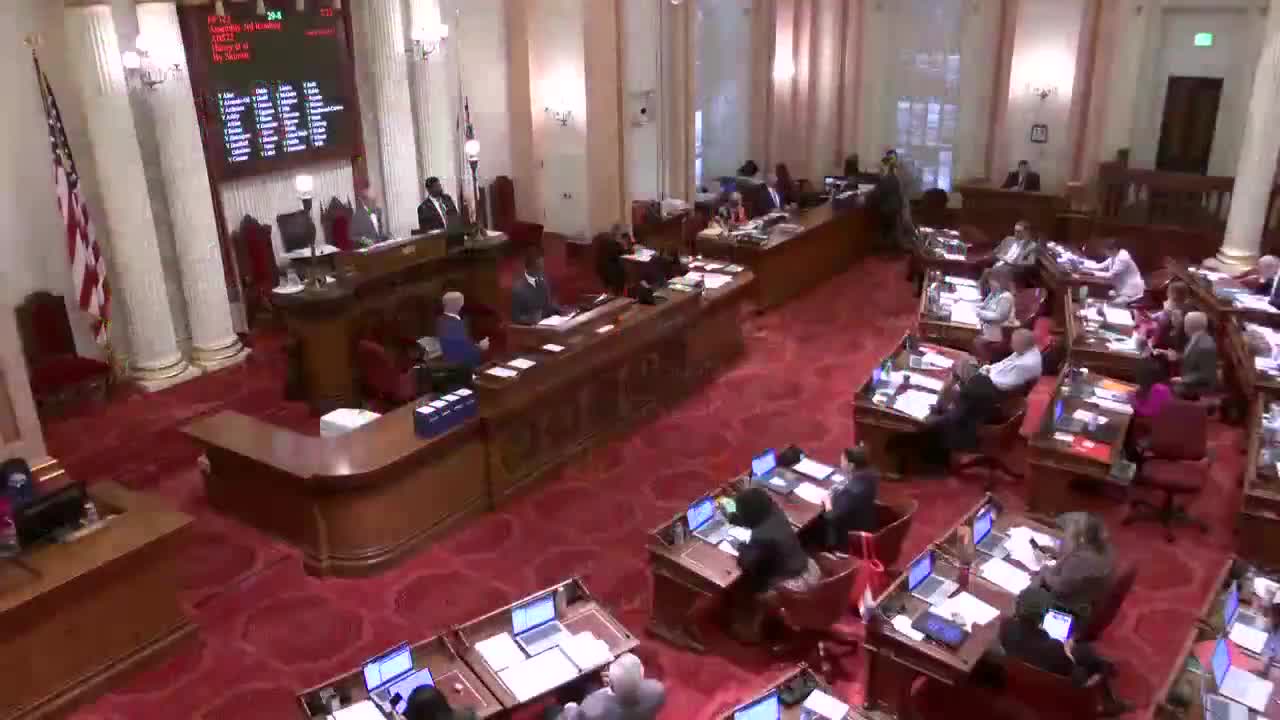 13MIN
Senate Floor
 46MIN
Assembly Floor
 23MIN
Assembly Standing Committee on Appropriations
 2MIN
Assembly Standing Committee on Public Safety
 1H
Assembly Standing Committee on Public Safety
 46MIN
Senate Standing Committee on Public Safety


Bill Co-Author(s):