SB 1440: School operations: 4-day school week.
- Session Year: 2023-2024
- House: Senate
- Latest Version Date: 2024-09-22
Current Status:
Passed
(2024-09-22: Chaptered by Secretary of State. Chapter 478, Statutes of 2024.)
Introduced
In Committee
First Chamber
In Committee
Second Chamber
Enacted
What does this bill do?
This bill allows the Stony Creek Joint Unified School District to run one or more schools on a four‑day school week if it meets state instructional time rules and other requirements. The district must file a plan with at least five extra backup instructional days, provide a nutritionally adequate breakfast and lunch free to any student who requests them five days a week regardless of income, get written agreement with employee unions, and if its performance falls on half or more of state measures in one year, it must stop the four‑day week the next year.
The summary is provided by generative AI which can make mistakes. For original language, please view the details in the table below.
Existing law, for purposes of attendance counting, defines a school month as 20 days or 4 weeks of 5 days each. Existing law authorizes specified school districts, including, among others, certain school districts in the County of San Diego, to operate one or more schools in their respective school districts on a 4-day school week if the school district complies with specified requirements, including, among other requirements, instructional time requirements and a plan, submitted to the State Department of Education for review and approval, for how the school district will meet those instructional time requirements.
This bill would, commencing with the 202526 school year, additionally authorize the Stony Creek Joint Unified School District to operate one or more schools in the district on a 4-day school week in accordance with those requirements, except that the Stony Creek Joint Unified School District would also be required to (1) include in its plan an annual school calendar with at least 5 additional days of instruction than is otherwise needed to meet the minimum instructional minute requirements in the event that one or more of the schools in the school district is prevented from operating for specified reasons and (2) make a nutritionally adequate breakfast, and a nutritionally adequate lunch, available 5 days per week to any pupil who requests a meal, free of charge, and without consideration of the pupils eligibility for federally funded free or reduced-price meals.
If the Stony Creek Joint Unified School District operates a 4-day school week pursuant to these provisions but subsequently experiences, in a single year, a decline in status in 50% or more of the state indicators used to measure performance that are included in the evaluation rubrics adopted by the State Board of Education, this bill would, commencing with the following school year, prohibit the school district from operating a 4-day school week. The bill also would update a cross reference relating to the applicable minimum instructional minute requirements for the school districts in the County of San Diego operating a 4-day school week.
This bill would make these provisions relating to the Stony Creek Joint Unified School District inoperative on July 1, 2029, and would repeal them as of January 1, 2030.
This bill would make legislative findings and declarations as to the necessity of a special statute for the Stony Creek Joint Unified School District.
Existing law, for purposes of attendance counting, defines a school month as 20 days or 4 weeks of 5 days each. Existing law authorizes the Big Sur Unified School District, the Leggett Valley Unified School District, and the Reeds Creek Elementary School District specified school districts, including, among others, certain school districts in the County of San Diego, to operate one or more schools in their respective school districts on a 4-day school week if the school district complies with specified requirements, including including, among other requirements, instructional time requirements and a plan, submitted to the State Department of Education for review and approval, for how the school district will meet those instructional time requirements.
This bill would would, commencing with the 202526 school year, additionally authorize the Stony Creek Joint Unified School District to operate one or more schools in the district on a 4-day school week in accordance with those requirements. requirements, except that the Stony Creek Joint Unified School District would also be required to (1) include in its plan an annual school calendar with at least 5 additional days of instruction than is otherwise needed to meet the minimum instructional minute requirements in the event that one or more of the schools in the school district is prevented from operating for specified reasons and (2) make a nutritionally adequate breakfast, and a nutritionally adequate lunch, available 5 days per week to any pupil who requests a meal, free of charge, and without consideration of the pupils eligibility for federally funded free or reduced-price meals.
If the Stony Creek Joint Unified School District operates a 4-day school week pursuant to these provisions but subsequently experiences, in a single year, a decline in status in 50% or more of the state indicators used to measure performance that are included in the evaluation rubrics adopted by the State Board of Education, this bill would, commencing with the following school year, prohibit the school district from operating a 4-day school week. The bill also would update a cross reference relating to the applicable minimum instructional minute requirements for the school districts in the County of San Diego operating a 4-day school week.
This bill would make these provisions relating to the Stony Creek Joint Unified School District inoperative on July 1, 2029, and would repeal them as of January 1, January 1, 2030.
This bill would make legislative findings and declarations as to the necessity of a special statute for the Stony Creek Joint Unified School District.
Existing law, for purposes of attendance counting, defines a school month as 20 days or 4 weeks of 5 days each. Existing law authorizes the Big Sur Unified School District, the Leggett Valley Unified School District, and the Reeds Creek Elementary School District to operate one or more schools in their respective school districts on a 4-day school week if the school district complies with specified requirements, including instructional time requirements.
This bill would additionally authorize the Stony Creek Joint Unified School District to operate one or more schools in the district on a 4-day school week in accordance with those requirements.
This bill would make legislative findings and declarations as to the necessity of a special statute for the Stony Creek Joint Unified School District.
Under existing law, the State Water Resources Control Board and the California regional water quality control boards prescribe waste discharge requirements for the discharge of stormwater in accordance with the national pollutant discharge elimination system permit program and the Porter-Cologne Water Quality Control Act. Existing law requires the regional boards to undertake reasonable efforts to identify dischargers of stormwater that have not obtained an appropriate permit. Existing law requires the state board, on or before December 31, to annually prepare a report that includes, among other things, a list of persons notified of their duty to comply with applicable stormwater permits and a description of the responses received to those notifications.This bill would require the annual report to additionally include a description of reasonable efforts undertaken by regional boards to identify dischargers of stormwater that have not obtained coverage under an appropriate stormwater permit. The bill would require the state board to submit the report to the Legislature on or before December 31 of each year until December 31, 2029, and would authorize the report to include a strategy or recommendation on actions to increase discharger coverage, as specified.Under existing law, the State Water Resources Control Board and the California regional water quality control boards prescribe waste discharge requirements for the discharge of stormwater in accordance with the national pollutant discharge elimination system permit program and the Porter-Cologne Water Quality Control Act. Existing law requires the regional boards to undertake reasonable efforts to identify dischargers of stormwater that have not obtained an appropriate permit. Existing law requires the state board, on or before December 31, to annually prepare a report that includes, among other things, a list of persons notified of their duty to comply with applicable stormwater permits and a description of the responses received to those notifications.
This bill would require the annual report to additionally include a description of reasonable efforts undertaken by regional boards to identify dischargers of stormwater that have not obtained coverage under an appropriate stormwater permit. The bill would require the state board to submit the report to the Legislature on or before December 31 of each year until December 31, 2029, and would authorize the report to include a strategy or recommendation on actions to increase discharger coverage, as specified.
Existing law regulates the preparation of maps for assessments levied by the Central Valley Flood Protection Board. Existing law requires that each map be given a distinctive number and designation and that each tract of land be designated on the map by a distinctive number. Existing law provides that any reference to a map and tract is sufficient description of the tract for various purposes, including proceedings based upon the assessment.This bill would make nonsubstantive changes to the latter provision relating to map references.Existing law regulates the preparation of maps for assessments levied by the Central Valley Flood Protection Board. Existing law requires that each map be given a distinctive number and designation and that each tract of land be designated on the map by a distinctive number. Existing law provides that any reference to a map and tract is sufficient description of the tract for various purposes, including proceedings based upon the assessment.
This bill would make nonsubstantive changes to the latter provision relating to map references.
Beginning in the 200405 fiscal year, the following school districts in San Diego County may operate one or more schools in their respective districts on a four-day school week if the districts comply with the instructional time requirements specified in Section 46207 and the other requirements of this chapter:
(a)Borrego Springs Unified School District.
(b)Julian Union Elementary School District.
(c)Julian Union High School District.
(d)Warner Unified School District.
SEC. 2.Section 37712 is added to the Education Code, immediately following Section 37711, to read:37712.(a)Notwithstanding any other law, commencing with the 202526 school year, the Stony Creek Joint Unified School District may operate one or more schools on a four-day school week if it complies with the instructional time requirements specified in Section 46207, the other requirements of this chapter, and all of the following requirements:
(1)(A)The school district shall annually, by no later than June 1, submit to the department for review and approval, a plan for how the school district will ensure that the minimum instructional minutes required pursuant to Section 46207 will be met in the following school year. The plan shall include, but not be limited to, an annual school calendar with at least five additional days of instruction than is otherwise needed to meet the minimum instructional minute requirements pursuant to Section 46207 in the event that one or more of the schools in the school district is prevented from operating for any of the reasons described in Section 41422 or 46392. If the school district does not need some or all of the five additional days of instruction in order to meet the minimum instructional minute requirements in that school year, the school district shall only offer the extra instructional days to pupils as necessary to meet those requirements.
(B)If the school district offered less than the minimum instructional minutes required pursuant to Section 46207, the school district shall be subject to the penalties described in subdivision (b) of Section 46207 and subdivision (c) of Section 46208. Nothing in this section shall be construed to subject the school district, if it has met the minimum instructional minutes required pursuant to Section 46207, to those penalties.
(2)(A)The school district makes a nutritionally adequate breakfast, and a nutritionally adequate lunch, available five days per week to any pupil who requests a meal, free of charge, and without consideration of the pupils eligibility for federally funded free or reduced-price meals.
(B)For purposes of subparagraph (A), the following definitions apply:
(i)Nutritionally adequate breakfast is one that qualifies for reimbursement under the most current meal pattern for the federal School Breakfast Program, as defined in Section 220.8 of Title 7 of the Code of Federal Regulations.
(ii)Nutritionally adequate lunch is one that qualifies for reimbursement under the most current meal pattern for the federal National School Lunch Program, as defined in Section 210.10 of Title 7 of the Code of Federal Regulations.
(b)If the Stony Creek Joint Unified School District has an exclusive bargaining representative, it may operate a school on a four-day school week pursuant to this section only if the school district and the representative of each bargaining unit of school district employees mutually agree to that operation in a memorandum of understanding.
(c)Notwithstanding subdivision (a), if the Stony Creek Joint Unified School District operates a four-day school week pursuant to this section but subsequently experiences, in a single year, a decline in status in 50 percent or more of the state indicators used to measure performance that are included in the evaluation rubrics adopted pursuant to Section 52064.5, the school district, commencing with the following school year, shall not operate a four-day school week.
(d)This section shall become inoperative on July 1, 2029, and, as of January 1, 2030, is repealed.
SEC. 3.For purposes of Section 2 of this act, which adds Section 37712 to the Education Code, the Legislature finds and declares that a special statute is necessary and that a general statute cannot be made applicable within the meaning of Section 16 of Article IV of the California Constitution because of the unique needs of the Stony Creek Joint Unified School District.
Beginning in the 200405 fiscal year, the following school districts in San Diego County may operate one or more schools in their respective districts on a four-day school week if the districts comply with the instructional time requirements specified in Section 37701 46207 and the other requirements of this chapter:
(a)Borrego Springs Unified School District.
(b)Julian Union Elementary School District.
(c)Julian Union High School District.
(d)Warner Unified School District.
SEC. 2.Section 37712 is added to the Education Code, immediately following Section 37711, to read:37712.(a)Notwithstanding any other law, commencing with the 202526 school year, the Stony Creek Joint Unified School District may operate one or more schools on a four-day school week if it complies with the instructional time requirements specified in Section 46207, the other requirements of this chapter, and all of the following requirements:
(1)(A)The school district shall annually, by no later than June 1, submit to the department for review and approval, a plan for how the school district will ensure that the minimum instructional minutes required pursuant to Section 46207 will be met in the following school year. The plan shall include, but not be limited to, an annual school calendar with at least five additional days of instruction than is otherwise needed to meet the minimum instructional minute requirements pursuant to Section 46207 in the event that one or more of the schools in the school district is prevented from operating for any of the reasons described in Section 41422 or 46392. If the school district does not need some or all of the five additional days of instruction in order to meet the minimum instructional minute requirements in that school year, the school district shall only offer the extra instructional days to pupils as necessary to meet those requirements.
(B)If the school district offered less than the minimum instructional minutes required pursuant to Section 46207, the school district shall be subject to the penalties described in subdivision (b) of Section 46207 and subdivision (c) of Section 46208. Nothing in this section shall be construed to subject the school district, if it has met the minimum instructional minutes required pursuant to Section 46207, to those penalties.
(2)(A)The school district makes a nutritionally adequate breakfast, and a nutritionally adequate lunch, available five days per week to any pupil who requests a meal, free of charge, and without consideration of the pupils eligibility for federally funded free or reduced-price meals.
(B)For purposes of subparagraph (A), the following definitions apply:
(i)Nutritionally adequate breakfast is one that qualifies for reimbursement under the most current meal pattern for the federal School Breakfast Program, as defined in Section 220.8 of Title 7 of the Code of Federal Regulations.
(ii)Nutritionally adequate lunch is one that qualifies for reimbursement under the most current meal pattern for the federal National School Lunch Program, as defined in Section 210.10 of Title 7 of the Code of Federal Regulations.
(b)If the Stony Creek Joint Unified School District has an exclusive bargaining representative, it may operate a school on a four-day school week pursuant to this section only if the school district and the representative of each bargaining unit of school district employees mutually agree to that operation in a memorandum of understanding.
(c)Notwithstanding subdivision (a), if the Stony Creek Joint Unified School District operates a four-day school week pursuant to this section but subsequently experiences, in a single year, a decline in status in 50 percent or more of the state indicators used to measure performance that are included in the evaluation rubrics adopted pursuant to Section 52064.5, the school district, commencing with the following school year, shall not operate a four-day school week.
(d)This section shall become inoperative on July 1, 2029, and, as of January 1, 2030, is repealed.
SEC. 2.SEC. 3.The For purposes of Section 2 of this act, which adds Section 37712 to the Education Code, the Legislature finds and declares that a special statute is necessary and that a general statute cannot be made applicable within the meaning of Section 16 of Article IV of the California Constitution because of the unique needs of the Stony Creek Joint Unified School District.
(a)Notwithstanding any other law, the Big Sur Unified School District, the Leggett Valley Unified School District, and the Reeds Creek Elementary School District District, and the Stony Creek Joint Unified School District may operate one or more schools in their respective school districts on a four-day school week, if the school district complies with the instructional time requirements specified in Section 37701 and the other requirements of this chapter.
(b)(1)A school district operating one or more schools on a four-day school week pursuant to this section shall annually, not later than June 1, submit to the department for review and approval a plan for how the school district will ensure that the minimum instructional minutes required under Section 46207 will be met in the following school year.
(2)If the school district offered less than the minimum instructional minutes required under Section 46207, the school district shall be subject to the penalties described in subdivision (b) of Section 46207 and subdivision (c) of Section 46208. Nothing in this section shall be construed to subject a school district that has met the minimum instructional minutes required under Section 46207 to those penalties.
(c)A school district with an exclusive bargaining representative may operate a school on a four-day school week pursuant to this section only if the school district and the representative of each bargaining unit of school district employees mutually agree to that operation in a memorandum of understanding.
(d)Instructional time penalties shall not be imposed pursuant to this section, as this section read on June 1, 2019, for the 201617 fiscal year to the 201819 fiscal year, inclusive, on a school district operating one or more schools on a four-day school week.
(e)Notwithstanding subdivisions (a) and (b) of this section and Section 37701, for the 202021 fiscal year only, the Big Sur Unified School District, the Leggett Valley Unified School District, and the Reeds Creek Elementary School District may operate one or more schools in their respective school districts on a four-day school week, if the school district complies with the following requirements and the other requirements of this chapter:
(1)Each day, pupils shall be scheduled for at least the minimum day for their grade level, as provided in Section 43501.
(2)The school district shall offer a minimum of 144 days of instruction for the 202021 school year.
(3)Instructional minutes shall be determined as follows:
(A)For in-person instruction, instructional minutes shall be based on time scheduled under the immediate physical supervision and control of an employee of the local educational agency who possesses a valid certification document, registered as required by law.
(B)For distance learning, instructional time shall be based on the time value of assignments as determined, and certified to, by an employee of the local educational agency who possesses a valid certification document, registered as required by law.
(C)For a combined day of instruction delivered through both in-person instruction and distance learning, time scheduled under the immediate supervision of an employee of the local educational agency who possesses a valid certification document can be combined with assignments made under the general supervision of an employee of the local educational agency who possesses a valid certification document as registered by law to meet the equivalent of a minimum day of instruction.
(4)If the school district offers instruction through distance learning, the requirements of distance learning in Part 24.5 (commencing with Section 43500).
(5)If the school district does not meet the minimum instructional day requirements in Section 43501, the school district shall be subject to the penalties described in paragraph (1) of subdivision (i) of Section 43504.
SEC. 2.The Legislature finds and declares that a special statute is necessary and that a general statute cannot be made applicable within the meaning of Section 16 of Article IV of the California Constitution because of the unique needs of the Stony Creek Unified School District.
SECTION 1.Section 13399.27 of the Water Code is amended to read:13399.27.(a)On or before December 31, the state board, after any necessary investigation, shall annually prepare, and make available to the public, a report that includes all of the following for the previous calendar year:(1)A list of those persons that were notified of their duty to comply with applicable general stormwater NPDES permits pursuant to Section 13399.30 and a description of the responses received to those notifications, including the filing of notices of intent to obtain coverage or notices of nonapplicability, returned mail and no response, appeals of filing or permitting requirements pursuant to this chapter, site inspections, enforcement actions taken, and penalties assessed therefor.(2)A list of those dischargers identified pursuant to Section 13399.31 that, during the previous calendar year, failed to submit an annual report or construction certification required by a regional board, and any penalties assessed therefor.(3)A description of reasonable efforts undertaken by regional boards to identify dischargers of stormwater that have not obtained coverage under an appropriate stormwater NPDES permit pursuant to Section 13399.30.(b)The state board shall submit the report to the Legislature on or before December 31 of each year. The report may include a strategy or recommended actions to increase discharger coverage under an appropriate stormwater NPDES permit, and increase submissions of annual reports and construction certifications submitted in accordance with the requirements of an applicable NPDES permit.(c)(1)The requirement for submitting a report imposed under subdivision (b) is inoperative on December 31, 2029, pursuant to Section 10231.5 of the Government Code.(2)A report to be submitted pursuant to subdivision (b) shall be submitted in compliance with Section 9795 of the Government Code.(a)On or before December 31, the state board, after any necessary investigation, shall annually prepare, and make available to the public, a report that includes both all of the following for the previous calendar year:
(a)(1)A list of those persons that were notified of their duty to comply with applicable general storm water stormwater NPDES permits pursuant to Section 13399.30 and a description of the responses received to those notifications, including the filing of notices of intent to obtain coverage or notices of nonapplicability, returned mail and no response, appeals of filing or permitting requirements pursuant to this chapter, site inspections, enforcement actions taken, and penalties assessed therefor.
(b)(2)A list of those dischargers identified pursuant to Section 13399.31 that, during the previous calendar year, failed to submit an annual report or construction certification required by a regional board, and any penalties assessed therefor.
(3)A description of reasonable efforts undertaken by regional boards to identify dischargers of stormwater that have not obtained coverage under an appropriate stormwater NPDES permit pursuant to Section 13399.30.
(b)The state board shall submit the report to the Legislature on or before December 31 of each year. The report may include a strategy or recommended actions to increase discharger coverage under an appropriate stormwater NPDES permit, and increase submissions of annual reports and construction certifications submitted in accordance with the requirements of an applicable NPDES permit.
(c)(1)The requirement for submitting a report imposed under subdivision (b) is inoperative on December 31, 2029, pursuant to Section 10231.5 of the Government Code.
(2)A report to be submitted pursuant to subdivision (b) shall be submitted in compliance with Section 9795 of the Government Code.
SECTION 1.Section 8843 of the Water Code is amended to read:8843.A reference to a map and tract is a sufficient description of the tract for the purposes of an assessment list, and for the purposes of the notice of delinquent sale, certificate of sale and deed in pursuance of that sale, and all other proceedings based upon the assessment.Any A reference to a map and tract is a sufficient description of the tract for the purposes of an assessment list, and for the purposes of the notice of delinquent sale, certificate of sale and deed in pursuance of said that sale, and all other proceedings based upon the assesssment. assessment.
|
Date
|
Status
|
|---|---|
| Sep 22, 2024 | Chaptered by Secretary of State. Chapter 478, Statutes of 2024. |
| Sep 22, 2024 | Approved by the Governor. |
| Sep 4, 2024 | Enrolled and presented to the Governor at 4 p.m. |
| Aug 28, 2024 | Assembly amendments concurred in. (Ayes 39. Noes 0. Page 5611.) Ordered to engrossing and enrolling. |
| Aug 27, 2024 | Ordered to special consent calendar. |
| Aug 26, 2024 | From committee: That the Assembly amendments be concurred in. (Ayes 6. Noes 0. Page 5425.) |
| Aug 22, 2024 | Set for hearing August 26. |
| Aug 19, 2024 | Re-referred to Com. on RLS pursuant to Senate Rule 29.10(d). |
| Aug 19, 2024 | From committee: Be re-referred to Com. on ED. pursuant to Senate Rule 29.10(d). (Ayes 5. Noes 0. Page 5165.) Re-referred to Com. on ED. |
| Aug 15, 2024 | In Senate. Concurrence in Assembly amendments pending. |
| Aug 15, 2024 | Read third time. Passed. (Ayes 75. Noes 0. Page 6321.) Ordered to the Senate. |
| Aug 8, 2024 | Read second time. Ordered to consent calendar. |
| Aug 7, 2024 | From committee: Do pass. Ordered to consent calendar. (Ayes 14. Noes 0.) (August 7). |
| Jun 27, 2024 | Read second time and amended. Re-referred to Com. on APPR. |
| Jun 26, 2024 | From committee: Do pass as amended and re-refer to Com. on APPR. (Ayes 7. Noes 0.) (June 26). |
| Jun 13, 2024 | Re-referred to Com. on ED. pursuant to Assembly Rule 96. |
| Jun 10, 2024 | From committee with author's amendments. Read second time and amended. Re-referred to Com. on E.S. & T.M. |
| May 28, 2024 | Referred to Com. on E.S. & T.M. |
| May 21, 2024 | In Assembly. Read first time. Held at Desk. |
| May 20, 2024 | Read third time. Passed. (Ayes 39. Noes 0. Page 4021.) Ordered to the Assembly. |
| May 14, 2024 | Read second time. Ordered to third reading. |
| May 13, 2024 | From committee: Be ordered to second reading pursuant to Senate Rule 28.8. |
| May 3, 2024 | Set for hearing May 13. |
| Apr 25, 2024 | From committee: Do pass and re-refer to Com. on APPR. (Ayes 7. Noes 0. Page 3754.) (April 24). Re-referred to Com. on APPR. |
| Apr 5, 2024 | Set for hearing April 24. |
| Apr 3, 2024 | Re-referred to Com. on E.Q. |
| Mar 20, 2024 | From committee with author's amendments. Read second time and amended. Re-referred to Com. on RLS. |
| Feb 29, 2024 | Referred to Com. on RLS. |
| Feb 20, 2024 | From printer. May be acted upon on or after March 18. |
| Feb 16, 2024 | Introduced. Read first time. To Com. on RLS. for assignment. To print. |
|
Date
|
Description
|
Location
|
Votes
|
|
|---|---|---|---|---|
| Aug 28, 2024 | Special Consent SB1440 Laird et al. | Senate Floor |
Passed |
|
| Aug 26, 2024 | That the Assembly amendments be concurred in | Senate Standing Committee on Education |
Passed |
|
| Aug 15, 2024 | SB 1440 Laird Consent Calendar Second Day Regular Session | Assembly Floor |
Passed |
|
| Aug 7, 2024 | Do pass. To Consent Calendar. | Assembly Standing Committee on Appropriations |
Passed |
|
| Jun 26, 2024 | Do pass as amended and be re-referred to the Committee on [Appropriations] | Assembly Standing Committee on Education |
Passed |
|
| May 20, 2024 | Senate 3rd Reading SB1440 Laird | Senate Floor |
Passed |
|
| Apr 24, 2024 | Do pass, but first be re-referred to the Committee on [Appropriations] | Senate Standing Committee on Environmental Quality |
Passed |
This list shows positions taken on this bill by organizations on the date displayed, which is linked to the original source.
Positions by individuals are not included.
|
Organization
|
Position
|
Date
|
|---|---|---|
| California School Employees Association | * Against | Jun 26, 2024 |
| Glenn County Office of Education | ** Support | |
| Grindstone Parent Advisory Committee, Grindstone Indian Rancheria | ** Support | |
| Small School Districts Association | * Support | Jun 26, 2024 |
| Stoney Creek Joint Unified School District | * Support | Jun 26, 2024 |
| Stony Creek Federation of Teachers | ** Support | |
| Stony Creek Joint Unified School District | ** Support | |
| Stony Creek Joint Unified School District Governing Board | ** Support |
SENATE RULES COMMITTEE Office of Senate Floor Analyses (916) 651-1520 Fax: (916) 327-4478 | SB 1440 |
UNFINISHED BUSINESS
Bill No: SB 1440
Author: Laird (D), et al.
Amended: 6/27/24
Vote: 21
PRIOR SENATE VOTES NOT RELEVANT
SENATE APPROPRIATIONS COMMITTEE: Senate Rule 29.10
SENATE EDUCATION COMMITTEE: 6-0, 8/26/24
AYES: Newman, Cortese, Glazer, Gonzalez, Smallwood-Cuevas, Wilk
NO VOTE RECORDED: Ochoa Bogh
ASSEMBLY FLOOR: 75-0, 8/15/24 (Consent) - See last page for vote
SUBJECT: School operations: 4-day school week
SOURCE: Stony Creek Joint Unified School District
DIGEST:
This bill temporarily authorizes the Stony Creek Joint Unified School District to operate its schools on a four-day school week if the district complies with specified requirements related to instructional time, school meals, agreements with employees, and student performance.
Assembly Amendments
(1) delete the prior contents of the bill, which related to efforts undertaken by Regional Water Quality Control Boards to identify dischargers of stormwater that have not obtained coverage under an appropriate stormwater permit; and, (2) add the authority for the Stony Creek Joint Unified School District to operate its schools on a four-day school week if the district complies with specified requirements related to instructional time, school meals, agreements with employees, and student performance.
ANALYSIS:
Existing law:
- Authorizes the Big Sur Unified School District, the Leggett Valley Unified School District, and the Reeds Creek Elementary School District to operate one or more schools in their respective school districts on a four-day school week, if the school district complies with specified instructional time and other requirements. (Education Code (EC) § 37700)
- Requires a school district operating one or more schools on a four-day school week to annually, not later than June 1, submit to the California Department of Education (CDE) for review and approval a plan for how the school district will ensure that the minimum instructional minutes (pursuant to the Incentives for Longer Instructional Day and Year provisions) will be met in the following school year. Requires the school district, if it offered less than the minimum instructional minutes required, to be subject to specified instructional time fiscal penalties. (EC § 37700)
- Authorizes a school district with an exclusive bargaining representative to operate a school on a four-day school week only if the school district and the representative of each bargaining unit of school district employees mutually agree to that operation in a memorandum of understanding. (EC § 37700)
- Requires school districts to provide, on an annual basis, while operating a school on a four-day school week, at least 560 hours of instructional time for kindergarten, at least 700 hours of instructional time for grades 1-3, and at least 845 hours of instructional time for grades 4-12. Authorizes the school district to exceed these minimum instructional times except that no student in a kindergarten shall be kept in school more than four hours in any day, exclusive of recesses. Prohibits the school day from exceeding eight hours, nor may the school week be less than four days. (EC § 37701)
- Requires the school district, in order to operate a school on a four-day school week, to secure the approval of the governing board of the district and of any collective bargaining agents representing employees of the school district. (EC § 37702)
- Requires a school site council in the school district to be involved in the planning and evaluation of a four-day school week. (EC § 37703)
- Requires the school district to consider the impact of the longer schoolday on primary grade students and the impact of the four-day school week on working parents who may be required to find child care services for their schoolage children due to the shortened school week. (EC § 37704)
- Requires, if a school district elects to operate a school on a four-day school week, the school district to be entitled to receive the same support, but not more support, from the State School Fund due to the average daily attendance (ADA) at the schools within the school district that it would have received if the school district had been operating under the provisions of law relating to the 175-day school year. (EC § 37706)
- Requires, if the school district elects to operate a school on a four-day school week, the reduced number of schooldays in the school district to not affect the rights of certificated or classified employees of the school district with regard to classification, tenure, or notice and shall not otherwise affect the contract rights of the employees. (EC § 37707)
- Requires, if a school operating on a four-day school week, as specified, fails to achieve its Academic Performance Index growth target, the authority of that school to operate on a four-day school week to be permanently revoked commencing with the beginning of the following school year. (EC § 37710)
- Authorizes, beginning in the 2004–05 fiscal year, the following school districts in San Diego County to operate one or more schools in their respective districts on a four-day school week if the districts comply with the specified instructional time and other requirements: Borrego Springs Unified School District, Julian Union Elementary School District, Julian Union High School District, and Warner Unified School District. (EC § 37711)
- Requires each school district, as a condition of apportionment, as specified, to for each fiscal year, offer, at a minimum, the following number of minutes of instruction:
- To students in kindergarten, 36,000 minutes;
- To students in grades 1 to 3, inclusive, 50,400 minutes;
- To students in grades 4 to 8, inclusive, 54,000 minutes; and
- To students in grades 9 to 12, inclusive, 64,800 minutes. (EC § 46207)
This bill (1) authorizes the Stony Creek Joint Unified School District to operate its schools on a four-day school week for up to four school years if the district complies with specified requirements related to instructional time, school meals, agreements with employees, and student performance; and, (2) makes a technical change to the instructional time requirements for the school districts that are currently authorized to operate a four-day school week. Specifically, this bill:
- Authorizes, beginning with the 2025–26 school year and through June 2029, the Stony Creek Joint Unified School District to operate one or more schools on a four-day school week if it complies with the instructional time requirements specified existing law, the other requirements of existing law related to operating a four-day school week, and all of the following requirements:
- Annually submit, by no later than June 1, to CDE for review and approval, a plan for how the school district will ensure that the minimum instructional minutes required by existing law will be met in the following school year.
- The plan must include, but not be limited to, an annual school calendar with at least five additional days of instruction than is otherwise needed to meet the minimum instructional minute requirements in the event that one or more of the schools in the school district is prevented from operating for specified reasons (natural disaster, epidemic, inability to secure a teacher, etc.).
- If the school district does not need some or all of the five additional days of instruction in order to meet the minimum instructional minute requirements in that school year, the school district must only offer the extra instructional days to students as necessary to meet those requirements.
- If the school district offered less than the required minimum instructional minutes, the school district must be subject to the penalties contained in existing law.
- The plan must include, but not be limited to, an annual school calendar with at least five additional days of instruction than is otherwise needed to meet the minimum instructional minute requirements in the event that one or more of the schools in the school district is prevented from operating for specified reasons (natural disaster, epidemic, inability to secure a teacher, etc.).
- Make a nutritionally adequate breakfast, and a nutritionally adequate lunch, available five days per week to any student who requests a meal, free of charge, and without consideration of the student’s eligibility for federally funded free or reduced-price meals.
- Annually submit, by no later than June 1, to CDE for review and approval, a plan for how the school district will ensure that the minimum instructional minutes required by existing law will be met in the following school year.
- Conditions the authority for the Stony Creek Joint Unified School District to operate a four-day school week on whether the school district and the representative of each bargaining unit of school district employees mutually agree to that operation in a memorandum of understanding (if the district has an exclusive bargaining representative).
- Prohibits the Stony Creek Joint Unified School District from continuing to operate a four-day school week in a school year subsequent to a single year in which there was a decline in status in 50 percent or more of the state indicators used to measure performance that are included in the evaluation rubrics.
- Sunsets the authority for the Stony Creek Joint Unified School District to operate a four-day school week on July 1, 2029.
- Defines the following terms:
- “Nutritionally adequate breakfast” is one that qualifies for reimbursement under the most current meal pattern for the federal School Breakfast Program.
- “Nutritionally adequate lunch” is one that qualifies for reimbursement under the most current meal pattern for the federal National School Lunch Program.
- “Nutritionally adequate breakfast” is one that qualifies for reimbursement under the most current meal pattern for the federal School Breakfast Program.
- Updates the instructional time requirements that apply to the school districts that are specifically authorized to operate a four-day school week.
Comments
- Need for the bill. According to the author, “Senate Bill 1440 authorizes the Stony Creek Joint Unified School District in Glenn and Colusa counties to operate on a 4-day school week schedule. Stony Creek Joint Unified School District is a rural district serving between 80-90 students and over half of the student body are members of the Grindstone Indian Rancheria of Wintun-Wailaki Indians of California which regularly engages in cultural and tribal activities on Mondays. Modifying the school schedule facilitates students’ and faculty’s participation in culturally significantly events, and ensures the district is best able to meet the needs of its local community including families, and faculty that live up to 60 miles from the school district.”
- Existing authorization to operate four-day school week. Existing law authorizes seven districts to operate on a four-day school week if the districts meet the minimum annual minute requirements. For most school districts, this means they operate four-days a week, with longer school days than districts operating a five-day week. Existing law sets caps on the maximum length of a school day for school districts operating a four-day week.
As noted in the Assembly Education Committee analysis, according to the CDE, only two districts, Big Sur Unified School District (Monterey County), and Leggett Valley Unified School District (Mendocino County), currently operate on a four-day school week schedule, mainly due to extreme weather or geographic conditions. The other districts, despite having received authorization, have chosen to continue operating on a five-day school week schedule. Additional school districts previously received authorization to operate a four-day schedule, but over time, their authorizations ended due to sunset provisions or other reasons.
- Why just Stony Creek Joint Unified School District? As noted by the author, “Stony Creek Joint Unified School District is a rural district serving between 80-90 students and over half of the student body are members of the Grindstone Indian Rancheria of Wintun-Wailaki Indians of California which regularly engages in cultural and tribal activities on Mondays. Modifying the school schedule facilitates students’ and faculty’s participation in culturally significantly events, and ensures the district is best able to meet the needs of its local community including families, and faculty that live up to 60 miles from the school district.”
According to the district’s website, “The Stony Creek Joint Unified School District is located in a rural area of northern California and serves students from Ladoga to Chrome and from the western edge of the Sacramento Valley to the summit of the Coast Range. The district covers approximately six hundred square miles, of which nearly half is within the boundaries of the Mendocino National Forest. Also included in this area is Grindstone Rancheria, a Nomlaki Indian Rancheria. Members from the Pomo and Wintun tribes also attend the school. The school community is made up of a variety of socioeconomic backgrounds: inter-district students from Glenn and Colusa Counties, Native Americans from one rancheria, ranching and logging families, and other students from well-established Elk Creek, Chrome, and Stonyford families.”
The district operates grades K-12 across four schools: an elementary school, an intermediate school (grades 5-8), a high school, and a continuation high school. According to the 2023 California School Dashboard, there were 88 students, almost half of whom are American Indian, enrolled in the Stony Creek Joint Unified School District. - Instructional time requirement. Existing law requires a school district operating one or more schools on a four-day school week to annually submit to the CDE a plan for how the school district will ensure that the minimum specified instructional minutes (under the Incentives for Longer Instructional Day and Year) will be met. The CDE reviews the submitted report and verifies the information provided by the district, including the school calendar, and how instructional minutes are calculated at all grade levels. Existing law requires the school district and the representative of each bargaining unit of school district employees to mutually agree to that operation in a memorandum of understanding. If the school district elects to operate a school on a four-day school week, as specified, the reduced number of schooldays cannot affect the rights of certificated or classified employees of the school district with regard to classification, tenure, or notice and shall not otherwise affect the contract rights of the employees.
As noted above, statute requires school districts operating schools on a four-day school week to submit a plan to the CDE for how the district will ensure the minimum instructional minutes required pursuant to the Incentives for Longer Instructional Day and Year statutes (rather than the minimum instructional minutes described in statute related to operating a four-day school week). This bill updates references to minimum instructional time to align with those specified in the Incentives for Longer Instructional Day and Year statutes. This reference update also more accurately reflects that instructional time is measured in minutes, rather than in hours.
FISCAL EFFECT: Appropriation: No Fiscal Com.: Yes Local: No
According to the Assembly Appropriations Committee, this bill would impose ongoing Proposition 98 General Fund costs of about $13,000 for meal reimbursements to Stony Creek Joint Unified School District. Costs could be higher or lower in any given year depending on student demand for meals. These costs would otherwise be covered by federal meal reimbursements, but a school district may claim reimbursements only for days it is operational. Because this bill requires Stony Creek Joint Unified School District to provide meals on a day it is not operational, the state would need to cover the cost of meals. To produce this estimate, CDE analyzed the number of breakfasts and lunches served at Stony Creek Joint Unified School District in the 2023-2024 school year.
SUPPORT: (Verified 8/26/24)
Stony Creek Joint Unified School District (Source)
Glenn County Office of Education
Grindstone Parent Advisory Committee, Grindstone Indian Rancheria
Stony Creek Federation of Teachers
Stony Creek Joint Unified School District Governing Board
OPPOSITION: (Verified 8/26/24)
None received
ASSEMBLY FLOOR: 75-0, 8/15/24
AYES: Addis, Aguiar-Curry, Alanis, Arambula, Bains, Bauer-Kahan, Bennett, Berman, Boerner, Bonta, Bryan, Calderon, Juan Carrillo, Wendy Carrillo, Cervantes, Connolly, Megan Dahle, Davies, Dixon, Essayli, Mike Fong, Friedman, Gabriel, Gallagher, Garcia, Gipson, Grayson, Haney, Hart, Hoover, Irwin, Jackson, Jones-Sawyer, Kalra, Lackey, Lee, Low, Lowenthal, Maienschein, Mathis, McCarty, McKinnor, Muratsuchi, Stephanie Nguyen, Ortega, Pacheco, Papan, Jim Patterson, Joe Patterson, Pellerin, Petrie-Norris, Quirk-Silva, Ramos, Rendon, Reyes, Luz Rivas, Rodriguez, Blanca Rubio, Sanchez, Santiago, Schiavo, Soria, Ta, Ting, Valencia, Villapudua, Waldron, Wallis, Ward, Weber, Wicks, Wilson, Wood, Zbur, Robert Rivas
NO VOTE RECORDED: Alvarez, Chen, Flora, Holden
Prepared by: Lynn Lorber / ED. / (916) 651-4105
8/27/24 12:23:22
**** END ****
SENATE COMMITTEE ON EDUCATION
Senator Josh Newman, Chair
2023 - 2024 Regular
Bill No: Hearing Date: August 26, 2024
Author: | Laird | ||
Version: |
| ||
Urgency: | Fiscal: | ||
Consultant: | |||
Subject:
NOTE: This bill has been amended to replace its contents and this is the first time the
bill is being heard in its current form in the Senate.
SUMMARY
This bill temporarily authorizes the Stony Creek Joint Unified School District to operate its schools on a four-day school week if the district complies with specified requirements related to instructional time, school meals, agreements with employees, and student performance.
BACKGROUND
Existing law:
Four-day school week
- Authorizes the Big Sur Unified School District, the Leggett Valley Unified School District, and the Reeds Creek Elementary School District to operate one or more schools in their respective school districts on a four-day school week, if the school district complies with specified instructional time and other requirements. (Education Code (EC) § 37700)
- Requires a school district operating one or more schools on a four-day school week to annually, not later than June 1, submit to the California Department of Education (CDE) for review and approval a plan for how the school district will ensure that the minimum instructional minutes (pursuant to the Incentives for Longer Instructional Day and Year provisions) will be met in the following school year. Requires the school district, if it offered less than the minimum instructional minutes required, to be subject to specified instructional time fiscal penalties. (EC § 37700)
- Authorizes a school district with an exclusive bargaining representative to operate a school on a four-day school week only if the school district and the representative of each bargaining unit of school district employees mutually agree to that operation in a memorandum of understanding. (EC § 37700)
- Requires school districts to provide, on an annual basis, while operating a school on a four-day school week, at least 560 hours of instructional time for kindergarten, at least 700 hours of instructional time for grades 1-3, and at least 845 hours of instructional time for grades 4-12. Authorizes the school district to exceed these minimum instructional times except that no student in a kindergarten shall be kept in school more than four hours in any day, exclusive of recesses. Prohibits the school day from exceeding eight hours, nor may the school week be less than four days. (EC § 37701)
- Requires the school district, in order to operate a school on a four-day school week, to secure the approval of the governing board of the district and of any collective bargaining agents representing employees of the school district. (EC § 37702)
- Requires a school site council in the school district to be involved in the planning and evaluation of a four-day school week. (EC § 37703)
- Requires the school district to consider the impact of the longer schoolday on primary grade students and the impact of the four-day school week on working parents who may be required to find child care services for their schoolage children due to the shortened school week. (EC § 37704)
- Requires, if a school district elects to operate a school on a four-day school week, the school district to be entitled to receive the same support, but not more support, from the State School Fund due to the average daily attendance (ADA) at the schools within the school district that it would have received if the school district had been operating under the provisions of law relating to the 175-day school year. (EC § 37706)
- Requires, if the school district elects to operate a school on a four-day school week, the reduced number of schooldays in the school district to not affect the rights of certificated or classified employees of the school district with regard to classification, tenure, or notice and shall not otherwise affect the contract rights of the employees. (EC § 37707)
- Requires, if a school operating on a four-day school week, as specified, fails to achieve its Academic Performance Index growth target, the authority of that school to operate on a four-day school week to be permanently revoked commencing with the beginning of the following school year. (EC § 37710)
- Authorizes, beginning in the 2004–05 fiscal year, the following school districts in San Diego County to operate one or more schools in their respective districts on a four-day school week if the districts comply with the specified instructional time and other requirements: Borrego Springs Unified School District, Julian Union Elementary School District, Julian Union High School District, and Warner Unified School District. (EC § 37711)
Incentives for Longer Instructional Day and Year
- Requires each school district, as a condition of apportionment, as specified, to for each fiscal year, offer, at a minimum, the following number of minutes of instruction:
- To students in kindergarten, 36,000 minutes;
- To students in grades 1 to 3, inclusive, 50,400 minutes;
- To students in grades 4 to 8, inclusive, 54,000 minutes; and
- To students in grades 9 to 12, inclusive, 64,800 minutes. (EC § 46207)
ANALYSIS
This bill (1) authorizes the Stony Creek Joint Unified School District to operate its schools on a four-day school week for up to four school years if the district complies with specified requirements related to instructional time, school meals, agreements with employees, and student performance; and, (2) makes a technical change to the instructional time requirements for the school districts that are currently authorized to operate a four-day school week. Specifically, this bill:
Stony Creek Joint Unified School District
- Authorizes, beginning with the 2025–26 school year and through June 2029, the Stony Creek Joint Unified School District to operate one or more schools on a four-day school week if it complies with the instructional time requirements specified existing law, the other requirements of existing law related to operating a four-day school week, and all of the following requirements:
- Annually submit, by no later than June 1, to CDE for review and approval, a plan for how the school district will ensure that the minimum instructional minutes required by existing law will be met in the following school year.
- The plan must include, but not be limited to, an annual school calendar with at least five additional days of instruction than is otherwise needed to meet the minimum instructional minute requirements in the event that one or more of the schools in the school district is prevented from operating for specified reasons (natural disaster, epidemic, inability to secure a teacher, etc.).
- If the school district does not need some or all of the five additional days of instruction in order to meet the minimum instructional minute requirements in that school year, the school district must only offer the extra instructional days to students as necessary to meet those requirements.
- If the school district offered less than the required minimum instructional minutes, the school district must be subject to the penalties contained in existing law.
- The plan must include, but not be limited to, an annual school calendar with at least five additional days of instruction than is otherwise needed to meet the minimum instructional minute requirements in the event that one or more of the schools in the school district is prevented from operating for specified reasons (natural disaster, epidemic, inability to secure a teacher, etc.).
- Make a nutritionally adequate breakfast, and a nutritionally adequate lunch, available five days per week to any student who requests a meal, free of charge, and without consideration of the student’s eligibility for federally funded free or reduced-price meals.
- Annually submit, by no later than June 1, to CDE for review and approval, a plan for how the school district will ensure that the minimum instructional minutes required by existing law will be met in the following school year.
- Conditions the authority for the Stony Creek Joint Unified School District to operate a four-day school week on whether the school district and the representative of each bargaining unit of school district employees mutually agree to that operation in a memorandum of understanding (if the district has an exclusive bargaining representative).
- Prohibits the Stony Creek Joint Unified School District from continuing to operate a four-day school week in a school year subsequent to a single year in which there was a decline in status in 50 percent or more of the state indicators used to measure performance that are included in the evaluation rubrics.
- Sunsets the authority for the Stony Creek Joint Unified School District to operate a four-day school week on July 1, 2029.
- Defines the following terms:
- “Nutritionally adequate breakfast” is one that qualifies for reimbursement under the most current meal pattern for the federal School Breakfast Program.
- “Nutritionally adequate lunch” is one that qualifies for reimbursement under the most current meal pattern for the federal National School Lunch Program.
- “Nutritionally adequate breakfast” is one that qualifies for reimbursement under the most current meal pattern for the federal School Breakfast Program.
Instructional time requirements
- Updates the instructional time requirements that apply to the school districts that are specifically authorized to operate a four-day school week.
STAFF COMMENTS
- Need for the bill. According to the author, “Senate Bill 1440 authorizes the Stony Creek Joint Unified School District in Glenn and Colusa counties to operate on a 4-day school week schedule. Stony Creek Joint Unified School District is a rural district serving between 80-90 students and over half of the student body are members of the Grindstone Indian Rancheria of Wintun-Wailaki Indians of California which regularly engages in cultural and tribal activities on Mondays. Modifying the school schedule facilitates students’ and faculty’s participation in culturally significantly events, and ensures the district is best able to meet the needs of its local community including families, and faculty that live up to 60 miles from the school district.”
- Existing authorization to operate four-day school week. Existing law authorizes seven districts to operate on a four-day school week if the districts meet the minimum annual minute requirements. For most school districts, this means they operate four-days a week, with longer school days than districts operating a five-day week. Existing law sets caps on the maximum length of a school day for school districts operating a four-day week.
As noted in the Assembly Education Committee analysis, according to the CDE, only two districts, Big Sur Unified School District (Monterey County), and Leggett Valley Unified School District (Mendocino County), currently operate on a four-day school week schedule, mainly due to extreme weather or geographic conditions. The other districts, despite having received authorization, have chosen to continue operating on a five-day school week schedule. Additional school districts previously received authorization to operate a four-day schedule, but over time, their authorizations ended due to sunset provisions or other reasons.
- Why just Stony Creek Joint Unified School District? As noted by the author, “Stony Creek Joint Unified School District is a rural district serving between 80-90 students and over half of the student body are members of the Grindstone Indian Rancheria of Wintun-Wailaki Indians of California which regularly engages in cultural and tribal activities on Mondays. Modifying the school schedule facilitates students’ and faculty’s participation in culturally significantly events, and ensures the district is best able to meet the needs of its local community including families, and faculty that live up to 60 miles from the school district.”
According to the district’s website, “The Stony Creek Joint Unified School District is located in a rural area of northern California and serves students from Ladoga to Chrome and from the western edge of the Sacramento Valley to the summit of the Coast Range. The district covers approximately six hundred square miles, of which nearly half is within the boundaries of the Mendocino National Forest. Also included in this area is Grindstone Rancheria, a Nomlaki Indian Rancheria. Members from the Pomo and Wintun tribes also attend the school. The school community is made up of a variety of socioeconomic backgrounds: inter-district students from Glenn and Colusa Counties, Native Americans from one rancheria, ranching and logging families, and other students from well-established Elk Creek, Chrome, and Stonyford families.”
The district operates grades K-12 across four schools: an elementary school, an intermediate school (grades 5-8), a high school, and a continuation high school. According to the 2023 California School Dashboard, there were 88 students, almost half of whom are American Indian, enrolled in the Stony Creek Joint Unified School District. - Instructional time requirement. Existing law requires a school district operating one or more schools on a four-day school week to annually submit to the CDE a plan for how the school district will ensure that the minimum specified instructional minutes (under the Incentives for Longer Instructional Day and Year) will be met. The CDE reviews the submitted report and verifies the information provided by the district, including the school calendar, and how instructional minutes are calculated at all grade levels. Existing law requires the school district and the representative of each bargaining unit of school district employees to mutually agree to that operation in a memorandum of understanding. If the school district elects to operate a school on a four-day school week, as specified, the reduced number of schooldays cannot affect the rights of certificated or classified employees of the school district with regard to classification, tenure, or notice and shall not otherwise affect the contract rights of the employees.
As noted above, statute requires school districts operating schools on a four-day school week to submit a plan to the CDE for how the district will ensure the minimum instructional minutes required pursuant to the Incentives for Longer Instructional Day and Year statutes (rather than the minimum instructional minutes described in statute related to operating a four-day school week). This bill updates references to minimum instructional time to align with those specified in the Incentives for Longer Instructional Day and Year statutes. This reference update also more accurately reflects that instructional time is measured in minutes, rather than in hours. - Fiscal impact. According to the Assembly Appropriations Committee, this bill would impose ongoing Proposition 98 General Fund costs of about $13,000 for meal reimbursements to Stony Creek Joint Unified School District. Costs could be higher or lower in any given year depending on student demand for meals. These costs would otherwise be covered by federal meal reimbursements, but a school district may claim reimbursements only for days it is operational. Because this bill requires Stony Creek Joint Unified School District to provide meals on a day it is not operational, the state would need to cover the cost of meals. To produce this estimate, CDE analyzed the number of breakfasts and lunches served at Stony Creek Joint Unified School District in the 2023-2024 school year.
SUPPORT
Stony Creek Joint Unified School District (Sponsor)
Glenn County Office of Education
Grindstone Parent Advisory Committee, Grindstone Indian Rancheria
Stony Creek Federation of Teachers
Stony Creek Joint Unified School District Governing Board
OPPOSITION
None received
-- END --
Date of Hearing: August 7, 2024
ASSEMBLY COMMITTEE ON APPROPRIATIONS
Buffy Wicks, Chair
SBPCA Bill Id:SB 1440
Author:(Laird) – As Amended Ver:June 27, 2024
Policy Committee: | Education | Vote: | 7 - 0 |
|
| ||
|
|
Urgency: No State Mandated Local Program: No Reimbursable: No
SUMMARY:
The bill authorizes, beginning with the 2025-26 school year, the Stony Creek Joint Unified School District to operate a four-day school week if it meets certain requirements. The bill sunsets the Stony Creek Joint Unified School District’s authority to operate a four-day school week on July 1, 2029. This bill also makes technical changes to instructional time requirements for four school districts currently authorized to provide a four-day school week.
Specifically, this bill authorizes the Stony Creek Joint Unified School District, located in in Glenn and Colusa counties, to operate a four-day school week if it meets certain conditions. Specifically, the school district must make available a nutritionally adequate breakfast and a nutritionally adequate lunch free of charge to any student who requests a meal five days per week. The district also must establish an annual school calendar with at least five additional days of instruction in order to attempt to meet the minimum instructional minute requirements. The bill specifies that if the if the Stony Creek Joint Unified School District operates a four-day school week and experiences a decline in status in 50% or more of the performance levels included in the state’s school performance accountability system (known as the California Schools Dashboard), the authority of the school district to operate on a four-day school week will be permanently revoked beginning the following school year.
Current law authorizes four school districts to operate a four-day school week: Borrego Springs Unified School District, Julian Union Elementary School District, Julian Union High School District, and Warner Unified School District. Current law requires these districts to meet instructional time requirements by operating a certain number of instructional hours annually. However, current practice requires school districts to meet instructional time requirements by operating a certain number of instructional minutes annually. This bill deletes the reference to instructional hours and instead references instructional minutes.
FISCAL EFFECT:
Ongoing Proposition 98 General Fund costs of about $13,000 for meal reimbursements to Stony Creek Joint Unified School District. Costs could be higher or lower in any given year depending on student demand for meals.
These costs would otherwise be covered by federal meal reimbursements, but a school district may claim reimbursements only for days it is operational. Because this bill requires Stony Creek Joint Unified School District to provide meals on a day it is not operational, the state would need to cover the cost of meals. To produce this estimate, the California Department of Education (CDE) analyzed the number of breakfasts and lunches served at Stony Creek Joint Unified School District in the 2023-2024 school year.
COMMENTS:
- Purpose. According to the author:
Senate Bill 1440 authorizes the Stony Creek Joint Unified School District in Glenn and Colusa counties to operate on a 4-day school week schedule. Stony Creek Joint Unified School District is a rural district serving between 80-90 students and over half of the student body are members of the Grindstone Indian Rancheria of Wintun-Wailaki Indians of California which regularly engages in cultural and tribal activities on Mondays. Modifying the school schedule facilitates students’ and faculty’s participation in culturally significantly events, and ensures the district is best able to meet the needs of its local community including families, and faculty that live up to 60 miles from the school district.
- Background. School districts generally are required to operate five-day school weeks. Typically, the Legislature has considered a school district as eligible to operate a four-day school week if the school district has extreme climate and geography and serves a widely dispersed population requiring long travel times to school, among other considerations. Current law authorizes seven school districts to operate a four-day school week if the districts meet minimum annual instructional minute requirements, among other requirements. To meet instructional minute requirements while operating four-day school week, most schools operate a longer school day than schools operating a five-day school week.
According to CDE, in order to operate a four-day school week, law requires a school district to annually submit to CDE a plan for how the school district will ensure that the minimum instructional minutes requirements will be met by schools offering a four-day school week. Current law also requires the school district and the representative of each bargaining unit of school district employees to mutually agree to the four-day school week in a memorandum of understanding. Further, the four-day school week must not affect the rights of certificated or classified employees of the school district with regard to classification, tenure, or notice, and must not otherwise affect the contract rights of these employees. Finally, if a school district operating on a four-day school week fails to achieve its Academic Performance Index (API) growth target, the authority of that school to operate on a four-day school week is to be permanently revoked, beginning the following school year. The API was the state’s school performance accountability system until 2013. The state currently uses a different school performance accountability system, known as the California Schools Dashboard.
According to CDE, only two school districts, Big Sur Unified School District, in Monterey County, and Leggett Valley Unified School District, in Mendocino County, operate a four-day school week, mainly due to extreme weather or geographic conditions. The other five authorized school districts have chosen to operate a five-day school week.
This bill authorizes Stony Creek Joint Unified School District to operate a four-day school week if certain conditions are met, such as meeting certain performance levels on the California Schools Dashboard. The bill also applies all other requirements imposed on schools operating 4-day school weeks on Stony Creek Joint Unified School District, should it choose to operate a 4-day school week.
In addition, this bill makes a technical change to instructional time requirements for four school districts authorized to operate a four-day school week to align with current practice. None of the four school districts currently operate a four-day school week.
Analysis Prepared by: Natasha Collins / APPR. / (916) 319-2081
Date of Hearing: June 26, 2024
ASSEMBLY COMMITTEE ON EDUCATION
Al Muratsuchi, Chair
SBPCA Bill Id:SB 1440
Author:(Laird) – As Amended Ver:June 10, 2024
SENATE VOTE: 39-0
SUBJECT: School operations: 4-day school week
SUMMARY: Authorizes the Stony Creek Joint Unified School District (SCJUSD) to operate one or more schools in the district on a four-day school week. Specifically, this bill:
- Authorizes the SCJUSD to operate one or more schools in the district on a four-day school week, as specified.
- States that the Legislature finds and declares that a special statute is necessary and that a general statute cannot be made applicable within the meaning of Section 16 of Article IV of the California Constitution because of the unique needs of the SCJUSD.
EXISTING LAW:
- Authorizes the Big Sur Unified School District, the Leggett Valley Unified School District, and the Reeds Creek Elementary School District to operate one or more schools in their respective school districts on a four-day school week, if the school district complies with specified instructional time and other requirements. (Education Code (EC) 37700)
- Requires a school district operating one or more schools on a four-day school week to annually, not later than June 1, submit to the California Department of Education (CDE) for review and approval a plan for how the school district will ensure that the minimum specified instructional minutes will be met in the following school year. Requires, if the school district offered less than the minimum specified instructional minutes required, the school district to be subject to specified instructional time fiscal penalties. (EC 37700)
- Authorizes a school district with an exclusive bargaining representative to operate a school on a four-day school week as specified only if the school district and the representative of each bargaining unit of school district employees mutually agree to that operation in a memorandum of understanding. (EC 37700)
- Requires school district to provide, on an annual basis, while operating a school on a four-day school week, not less than 560 hours of instructional time for kindergarten, not less than 700 hours of instructional time for grades 1, 2, and 3, and not less than 845 hours of instructional time for grades 4 to 12, inclusive. Authorizes the school district to exceed these minimum instructional times except that no pupil in a kindergarten shall be kept in school more than four hours in any day, exclusive of recesses. Prohibits the school day from exceeding eight hours, nor may the school week be less than four days. (EC 37701)
- Requires, to operate a school on a four-day school week, the school district to secure the approval of the governing board of the district and of any collective bargaining agents representing employees of the school district. (EC 37702)
- Requires a school site council in the school district to be involved in the planning and evaluation of a four-day school week. (EC 37703)
- Requires the school district to consider the impact of the longer schoolday on primary grade pupils and the impact of the four-day school week on working parents who may be required to find child care services for their schoolage children due to the shortened school week. (EC 37704)
- Requires, if a school district elects to operate a school on a four-day school week as authorized by this chapter, the school district shall be entitled to receive the same support, but not more support, from the State School Fund due to the average daily attendance (ADA) at the schools within the school district that it would have received if the school district had been operating under the provisions of law relating to the 175-day school year. (EC 37706)
- Requires, if the school district elects to operate a school on a four-day school week, as specified, the reduced number of schooldays in the school district to not affect the rights of certificated or classified employees of the school district with regard to classification, tenure, or notice and shall not otherwise affect the contract rights of the employees. (EC 37707)
- Requires, if a school operating on a four-day school week, as specified, fails to achieve its Academic Performance Index growth target, the authority of that school to operate on a four-day school week to be permanently revoked commencing with the beginning of the following school year. (EC 37710)
- Authorizes, beginning in the 2004–05 fiscal year, the following school districts in San Diego County to operate one or more schools in their respective districts on a four-day school week if the districts comply with the specified instructional time and other requirements: Borrego Springs Unified School District, Julian Union Elementary School District, Julian Union High School District, and Warner Unified School District.
- Requires each school district, as a condition of apportionment, as specified, to for each fiscal year, offer, at a minimum, the following number of minutes of instruction:
- To pupils in kindergarten, 36,000 minutes;
- To pupils in grades 1 to 3, inclusive, 50,400 minutes;
- To pupils in grades 4 to 8, inclusive, 54,000 minutes; and
- To pupils in grades 9 to 12, inclusive, 64,800 minutes. (EC 46207)
FISCAL EFFECT: Unknown
COMMENTS:
Need for the bill. According to the author, “Existing law authorizes three school districts in California, often rural or very small districts, to operate on a four-day school week to meet unique community needs. School districts operating on a modified schedule are required to still meet minimum instructional hours, and enter into a mutual agreement with local bargaining units to ensure both student and faculty achievement.
Senate Bill 1440 authorizes the Stony Creek Joint Unified School District in Glenn and Colusa counties to operate on a 4-day school week schedule. Stony Creek Joint Unified School District is a rural district serving between 80-90 students and over half of the student body are members of the Grindstone Indian Rancheria of Wintun-Wailaki Indians of California which regularly engages in cultural and tribal activities on Mondays. Modifying the school schedule facilitates students’ and faculty’s participation in culturally significantly events, and ensures the district is best able to meet the needs of its local community including families, and faculty that live up to 60 miles from the school district.”
Four-day school week authorizations in California. Prior to 1983, school districts were required to operate schools for five days and 175 days per year. The Hughes-Hart Educational Reform Act of 1983 (SB 813, Chapter 498, Statutes of 1983) offered incentive funding for districts to offer 180 days of instruction each year. Current law authorizes seven districts to operate on a four-day school week if the districts meet the minimum annual minute requirements, without losing incentive funding. For most school districts, this means they operate four-days a week, with longer school days than districts operating a five-day week. Current law sets caps on the maximum length of a school day for school districts operating a four-day week.
According to the CDE, only two districts, Big Sur Unified School District (Monterey County), and Leggett Valley Unified School District (Mendocino County), operate on a four-day school week schedule, mainly due to extreme weather or geographic conditions. The other districts, despite having received authorization, have chosen to continue operating on a five-day school week schedule. Additional school districts previously received authorization to operate a four-day schedule, but over time, their authorizations ended due to sunset provisions or other reasons. According to the Assembly Education Committee analysis for SB 236 (Pavely), Chapter 716, Statutes of 2013:
In the past, this Committee has applied the following criteria to school districts seeking approval for this option. The district:
- Experiences extremes of climate and geography;
- Serves a widely dispersed population requiring long travel times for significant number of students in the school district;
- Demonstrates the expected benefits to the school(s) and students of operating on shorter school week and instructional year;
- Has considered and addressed concerns about possible negative consequences of a longer school day and shorter week on employees, students, and families; and
- Is held to the requirements of existing law governing those school districts already operating schools on a four-day week.
Current law requires a school district operating one or more schools on a four-day school week to annually submit to the CDE a plan for how the school district will ensure that the minimum specified instructional minutes will be met. The CDE reviews the submitted report and verifies the information provided by the district, including the school calendar, and how instructional minutes are calculated at all grade levels. Further, current law requires the school district and the representative of each bargaining unit of school district employees to mutually agree to that operation in a memorandum of understanding. If the school district elects to operate a school on a four-day school week, as specified, the reduced number of schooldays in the school district cannot affect the rights of certificated or classified employees of the school district with regard to classification, tenure, or notice and shall not otherwise affect the contract rights of the employees.
Finally, if a school operating on a four-day school week fails to achieve its Academic Performance Index (API) growth target the authority of that school to operate on a four-day school week is permanently revoked, commencing with the beginning of the following school year. The API was one component of California’s prior statewide accountability system. The Public Schools Accountability Act (PSAA) of 1999 required that the CDE annually calculate APIs for California public schools and publish statewide school decile ranks. The PSAA also established annual API growth targets for each district, school, and student group. The Local Control Funding Formula (LCFF), enacted in 2013, was designed to improve student outcomes by providing more resources to meet the educational needs of low-income students, English learners (ELs), and foster youth. The LCFF required the SBE to develop a new statewide accountability system. During the development of this new system, the SBE suspended the calculation of the API, and the last API report was produced in 2013. In 2017, the SBE and the CDE launched a new accountability system to replace the API. This new, multiple-measures system provides a fuller picture of how districts and schools are addressing the needs of their students while also identifying the specific strengths and areas in need of improvement. The new accountability and continuous improvement system was implemented using an online tool known as the California School Dashboard (Dashboard). The Committee may wish to consider updating current law related to using the API growth targets to determine if a school district may continue to receive an authorization to operate a four-day week in order to reflect the current state accountability system.
Stony Creek Joint Unified School District. The SCJUSD is located in Glenn County. According to the SCJUSD’s webpage:
The Stony Creek Joint Unified School District is located in a rural area of northern California and serves students from Ladoga to Chrome and from the western edge of the Sacramento Valley to the summit of the Coast Range. The district covers approximately six hundred square miles, of which nearly half is within the boundaries of the Mendocino National Forest. Also included in this area is Grindstone Rancheria, a Nomlaki Indian Rancheria. Members from the Pomo and Wintun tribes also attend the school. The school community is made up of a variety of socioeconomic backgrounds: inter-district students from Glenn and Colusa Counties, Native Americans from one rancheria, ranching and logging families, and other students from well-established Elk Creek, Chrome, and Stonyford families.
The district operates grades TK-12 across four schools: an elementary school, a middle school, a high school, and a continuation high school. For the 2023-24 school year, student enrollment was 71, 65% socioeconomically disadvantaged, 0% ELs, and 1% foster youth.
Grade | ||||||||||||||
Ethnicity | Total | TK | 1 | 2 | 3 | 4 | 5 | 6 | 7 | 8 | 9 | 10 | 11 | 12 |
American Indian or Alaska Native | 36 | 1 | 3 | 6 | 2 | 2 | 5 | 1 | 2 | 3 | 3 | 2 | 3 | 3 |
Hispanic or Latino | 10 | 0 | 1 | 0 | 1 | 1 | 1 | 0 | 3 | 1 | 1 | 1 | 0 | 0 |
White | 23 | 1 | 1 | 2 | 1 | 1 | 3 | 1 | 2 | 4 | 2 | 0 | 1 | 4 |
Two or More Races | 2 | 0 | 0 | 0 | 0 | 0 | 0 | 0 | 0 | 0 | 1 | 1 | 0 | 0 |
Total | 71 | 2 | 5 | 8 | 4 | 4 | 9 | 2 | 7 | 8 | 7 | 4 | 4 | 7 |
According to the 2023 California Schools Dashboard, the SCJUSD scored 31.7 points below the state standards for English Language Arts, and 51.3 points below the standards for Mathematics. The district has a chronic absenteeism rate (students missing more than 10% of schooldays) of nearly 40% (15.4% higher than the statewide average).
According to information provided by the author’s office, “the SCJUSD has a unique local community makeup that would be better suited to a four-day school week schedule. The community exists in the territory of the Grindstone Indian Rancheria, and many of SCJUSD’s students and staff are members of the tribe. Cultural events for the tribe are often held on Mondays.”
As noted above, SCJUSD’s rate of chronic absenteeism was 39.7% in the 2022-23 school year, which was 15.4% higher than the statewide average rate (24.3%) for that year. A goal was set in the school district’s LCAP to improve attendance rates by the 2023-24 school year and reach “green” on the California Schools Dashboard by 2024. Chronic absenteeism rates improved in the 2021-22 school year, but became worse in 2022-23 and was “red” on the Dashboard. The SCJUSD LCAP notes that two families with multiple children are classified as chronically absent, which has a large impact on attendance rates. The LCAP further states:
After assessing the needs, conditions, and circumstances of our low-income students, we learned that the attendance rate of our low-income students is 7% lower than the attendance rate for all students.
In order to address this condition of our low-income students, we will develop and implement a new attendance program that is designed to address some of the major causes of absenteeism, including lack of reliable transportation and food, as well as a school climate that does not emphasize the importance of attendance. Goal N, Actions X, Y, and Z provide additional transportation and nutritional resources as well as a districtwide educational campaign on the benefits of high attendance rates.
These actions are being provided on an LEA-wide basis and we expect/hope that all students with less than a 100 percent attendance rate will benefit. However, because of the significantly lower attendance rate of low-income students, and because the actions meet needs most associated with the chronic stresses and experiences of a socio-economically disadvantaged status, we expect that the attendance rate for our low-income students will increase significantly more than the average attendance rate of all other students.
Four-day school weeks in other states. Four-day school week schedules are steadily gaining in popularity across the United States. Typically, schools increase the length of the school day four days a week and “drop” the fifth day. According to a 2024 EdWeek article, As Districts Weigh 4-Day Weeks, Research Overlooks Their Most Pressing Questions, about 900 school districts in 26 states currently operate on a four-day school week, an increase of about 40% since 2019. Prior to the spring before the COVID-19 pandemic, 662 districts were using the schedule across 24 states, an increase of over 600% since 1999, according to a 2021 Brookings commentary, 4-day school weeks: Educational innovation or detriment? In Idaho, more than half of the state’s 179 school districts and charter schools are on a four-day calendar, and the average four-day calendar includes 146 instructional days, according to the Iowa Department of Education. The Iowa State Board of Education recently took action to set minimum instructional days for K-12 public schools.
Source: Four-Day School Weeks: What Do We Know and Where Are We Going? National Conference on the Four-Day School Week, Oregon State University.
According to a 2023 EdSource article, Four-day school week gaining popularity nationally. Why isn’t it happening in California?:
Whether a district moves to a four-day schedule depends largely on whether states allow it. Thirty-one states require that schools operate at least 180 days a year, which is extremely difficult on a four-day schedule. Seven states require schools to be open 170 to 178 days a year, and two require them to be open between 160 and 165 days. Other states have a required number of hours, instead of days, that schools must offer students instruction. Three states — Idaho, Ohio and, South Dakota — have no requirements.
According to a 2021 Education Finance and Policy article, Are All Four-Day School Weeks Created Equal? A National Assessment of Four-Day School Week Policy Adoption and Implementation, across the country, students on four-day weeks spend about 85 fewer hours per year at school. Most of the districts on the four-day week schedule are small and rural, but not exclusively; for example, one urban Colorado district that serves approximately 18,000 students adopted the schedule at the start of the 2018–2019 school year (Morton, 2020).
Research on the benefits of four-day school weeks. According to a 2021 Brookings article, “Recent survey findings show that four-day school weeks have been adopted as a way to alleviate budgetary issues, attract teachers, and reduce student absences—issues that the pandemic exacerbated for many districts. Although conditions may be ripe for more schools to turn to such a model in the wake of the pandemic, the research suggests that most of these aims fail to be realized.”
Academic achievement. A primary concern surrounding the four-day school week is the impact on student academic achievement. Recent evidence found primarily negative academic impacts of four-day weeks in Oklahoma (Morton, 2020) and Oregon (Thompson, 2021). However, other studies suggest schools using the four-day schedule with a reduction in overall learning time saw the greatest decrease in student academic progress, in comparison with other schools using the four-day schedule, which maintained the overall learning time experienced little to no impact on achievement (Thompson, 2021). The Committee may wish to consider that structuring the four-day school week to maintain equivalent learning time appears to be critical to avoiding student learning loss.
Student attendance. Although a goal to increase student attendance is often listed as a rationale for shifting to a four-day week, studies show that there is no significant change to attendance rates for students in grades 3-8, nor among students in high school (Anderson & Walker, 2015; Thompson, 2021). According to a 2023 Educational Evaluation and Policy Analysis article, Effects of 4-Day School Weeks on Older Adolescents: Examining Impacts of the Schedule on Academic Achievement, Attendance, and Behavior in High School:
Despite an abundance of anecdotal evidence that four-day school weeks improve attendance, the three quasi-experimental studies existing to date that examine impacts on attendance find no effect or negligible effects on attendance rates. The anecdotal evidence, primarily based on interviews and opinion surveys, argues that attendance increases on a four-day week because students can use the fifth day for activities and appointments for which they might otherwise miss school (Hale, 2007; Hanson, 2017; Hedtke, 2014; Kilburn et al., 2021; Kingsbury, 2008; Leiseth, 2008; Schank & York, 2009; Smith, 2009; Toppo, 2002; Turner, 2010). These situations are likely to be particularly relevant in the remote, rural areas that have 4-day school weeks due to the lengthy travel that can be required to get to doctors’ offices and athletics games at other schools.
Fiscal impact. According to a 2021 National Tax Journal article, Does a Day Lost Equal Dollars Saved? The Effects of Four-Day School Weeks on School District Expenditures, school districts utilizing a four-day school week find only minimal cost savings, but there is also some evidence to suggest that the schedule may allow school districts greater resource flexibility when facing budget shortfalls. The four-day school week may also be used as a form of non-monetary compensation to facilitate instructional cost reductions, as research finds that teachers generally prefer the schedule (Thompson and Morton, 2021; and Turner, Finch, Ximena, 2017).
Students with disabilities. In Missouri, where four-day schedules have been adopted largely by rural school districts, 33% of families with students receiving special education services wanted to return to a five-day school week, as compared to only 12% of families with children not receiving special education services. Only 10% of families without students with disabilities said the switch to the four-day schedule had had a negative impact on their family, while 29% of families with students with disabilities said the four-day week had negatively impacted their family, according to a 2024 presentation by Missouri State University, Parent and Community Leader Perspectives: Missouri 4 Day School Week.
Other considerations. A survey of 545 school districts utilizing a four-day week showed that on the non-school weekday, 71.4% of districts did not provide any food to students (Thomason, 2024). According to a 2018 Economics of Education Review article, Juvenile Crime and the Four-Day School Week, juvenile crimes increase on average when a four-day schedule is adopted, particularly for property crime. The Committee may also wish to consider the impact of students to access to child care, nutritionally adequate meals, physical activity opportunities, social interactions with peers, teachers, and administrators, as well as any other impacts of a shorter school week.
Recent school closure data. School closures due to circumstances beyond a school district’s control have increased significantly over the last 10 years, with fewer closures during the COVID-19 pandemic due to students participating in school remotely. According to data provided by the CDE, there have been 3,931 school closure requests for apportionment during a closure submitted by LEAs from 2014-15 to 2022-23. As shown in the table below, the total number of school closures reported increased dramatically beginning in 2016-17 due to wildfires. The vast majority of these school closures lasted less than three days. The CDE reports that the two school districts that currently utilize the authorization to operate a four-day week regularly exceed the statewide average of school closure days. In the 2022-23 school year, the Leggett Valley USD was closed for 8 days, the Big Sur USD was closed for 92 days, and the statewide average was 4.24 days. A portion of Highway 1 near the Big Sur USD was impacted by a rockslide in January 2023, which made roads impassable for many months.
Emergency | 2014-15 | 2015-16 | 2016-17 | 2017-18 | 2018-19 | 2019-20 | 2020-21 | 2021-22 | 2022-23 |
Weather | 215 | 43 | 331 | 75 | 263 | 399 | 57 | 57 | 441 |
Other | 22 | 27 | 70 | 57 | 17 | 6 | 7 | 21 | 60 |
Epidemic | 5 | 2 | 7 | 8 | 14 | 10 | 3 | 76 | 32 |
Violence Threat | 23 | 44 | 8 | 24 | 35 | 21 | 0 | 25 | 18 |
Wildfire | 22 | 42 | 30 | 424 | 507 | 185 | 120 | 61 | 37 |
Power | 32 | 46 | 26 | 28 | 42 | 20 | 44 | 45 | 35 |
TOTAL | 319 | 204 | 472 | 616 | 878 | 641 | 231 | 285 | 623 |
Source: CDE
Apportionment during emergencies. Current law authorizes the SPI to grant normal apportionment credit to LEAs in emergencies, or in instances when one or more schools must be closed because of “extraordinary conditions.” When the SPI authorizes credit for days that school was closed, LEAs receive instructional time credit for the day(s) and minutes lost to the emergency closure and approval to reduce the divisor used for calculating ADA. The instructional time credit satisfies state law with regard to both the instructional day and minute requirements. The Committee may wish to consider that a California school district utilizing a four-day week schedule likely operates each school day with more instructional minutes per day than one with a five-day week schedule. Therefore, if a school needs to close due to an emergency or other authorized reason, the loss of instructional time is greater for students attending a school with a four-day schedule.
LEAs are held harmless from revenue loss that might otherwise result from the loss of ADA or instructional time in emergencies. LEAs obtain credit for days and minutes lost to emergency closure and material decreases in attendance due to emergency events by submitting a Request for Allowance of Attendance Due to Emergency Conditions (Form J-13A). A Form J-13A approval, combined with other LEA’s records, serves to document the LEA's compliance with instructional time laws, show why different divisors may be used in the computation of ADA, and document approval for ADA credit.
All LEAs must submit a certified plan for which independent study will be offered to students that accompanies all Form J-13A requests submitted for a school closure and/or a material decrease in attendance due to a qualifying event.
Arguments in support. The SJUSD writes, “A well-implemented four-day school week leads to improved student engagement, attendance, academic performance, and test scores. The additional day off provides students with opportunities for rest, enrichment activities, family time, and cultural engagement, which is particularly important for our Native American students, who represent 51% of or student population. This extra day can be used for participation in tribal events, ceremonies, and other culturally significant activities that are crucial for their personal and community well-being. Enhanced cultural engagement leads to improved self-esteem and academic performance, as students feel more connected to their roots and supported by their community. Parents and students in districts with four-day school weeks benefit from the three-day weekend for more rest, time for family activities, shopping trips, and doctor appointments in town. This resulted in markedly lower absenteeism and higher grades.”
Recommended Committee Amendments. Staff recommends that the bill be amended as follows:
Specific to SCJUSD:
- Require, the SCJUSD elects to operate a school on a four-day school week, the school district to make available a nutritionally adequate breakfast and a nutritionally adequate lunch free of charge to any student who requests a meal without consideration of the student’s eligibility for a federally funded free or reduced-price meal five days per week.
- Require, if the SCJUSD chooses to operate a school on a four-day school week, the district to establish an annual school calendar with at least five additional days of instruction in order to attempt to meet the minimum instructional minute requirements pursuant to EC 46207 in the event one or more of the schools in the school district is prevented from operating, such as extreme weather, pursuant to EC 41422 or 46392. State that, in the event that the SCJUSD does not need some or all of the five additional days of instruction in order to meet the annual minimum instructional minute requirements, the school district shall only offer the necessary extra instructional days to students.
- Require, if the SCJUSD operates on a four-day school week and experiences a decline in status in 50% or more of the indicators/performance levels included in the evaluation rubrics (California Schools Dashboard) the authority of that district to operate on a four-day school week be permanently revoked commencing with the beginning of the following school year.
- Add a sunset to the authorization for the SCJUSD to operate one or more schools in their respective school district on a four-day school week only until June 30, 2029.
Specific to school districts with the authorization to offer a four-day week:
- Update those San Diego county school districts with an authorization to offer a four-day week to meet the instructional requirements of EC 37700.
Related legislation. SB 236 (Pavley), Chapter 716, Statutes of 2013, authorized high schools offering a middle college program within the Moorpark Unified School District to operate a four-day school week, beginning in the 2013-14 fiscal year, if the school district complied with existing minimum instructional time requirements and meet their API growth targets, as specified. The intent of the bill is to only apply to high schools that have a middle college program. The requirements of the bill sunset on January 1, 2019.
AB 691 (Gilmore), Chapter 252, Statutes of 2009, authorizes the Alpaugh Unified School District, beginning in the 2010-11 fiscal year, to operate one or more schools in the school district on a four-day school week if the district complies with the instructional time requirements and other requirements for operating a four-day school week.
AB 868 (V. Manuel Perez) would have authorized the Palo Verde Unified School District to operate one or more schools on a four-day school week. The author later amended the bill into a different subject area in 2010.
AB 1889 (Berg), Chapter 661, Statutes of 2008, authorizes the Potter Valley Community Unified School District, beginning in the 2009-10 fiscal year, to operate one or more schools in the school district on a four-day school week if the district complies with the instructional time requirements and other requirements for operating a four-day school week.
SB 1138 (Hollingsworth), Chapter 465, Statutes of 2004, authorizes Borrego Springs Unified School District, Julian Union High School District, Warner Unified School District, Jamul-Dulzura Union Elementary School District, and Marysville Joint Unified School District, to operate a four-day school week.
AB 1820 (Maze), Chapter 481, Statutes of 2004, authorizes the Death Valley Unified School District to operate a four-day school week.
SB 1142 (Chesbro), of the 2023-24 Session would have authorized the Pacific Unified School District, Leggett Valley Unified School District, and Reeds Creek Elementary School District to operate for less than 180 days without penalty as long as the same number of annual minutes of instruction is provided. This bill was vetoed by the Governor, with a message stating that the bill would defeat the objective of the incentive funding program.
REGISTERED SUPPORT / OPPOSITION:
Support
Glenn County Office of Education
Grindstone Indian Rancheria of Wintun-Wailaki Indians of California Parental Advisory Committee
Stony Creek Joint Unified School District
Stony Creek Joint Unified School District Governing Board
Opposition
None on file
Analysis Prepared by: Marguerite Ries / ED. / (916) 319-2087
SENATE RULES COMMITTEE Office of Senate Floor Analyses (916) 651-1520 Fax: (916) 327-4478 | SB 1440 |
THIRD READING
Bill No: SB 1440
Author: Laird (D)
Amended: 3/20/24
Vote: 21
SENATE ENVIRONMENTAL QUALITY COMMITTEE: 7-0, 4/24/24
AYES: Allen, Dahle, Gonzalez, Hurtado, Menjivar, Nguyen, Skinner
SENATE APPROPRIATIONS COMMITTEE: Senate Rule 28.8
SUBJECT: Water quality: stormwater: reporting
SOURCE: Author
DIGEST: This bill requires the State Water Resources Control Board (State Water Board) to annually report on reasonable efforts undertaken by Regional Water Quality Control Boards (regional water boards) to identify dischargers of stormwater that have not obtained coverage under an appropriate stormwater permit.
ANALYSIS:
Existing law:
- Establishes the federal Clean Water Act (CWA) to regulate discharges of pollutants into the waters of the United States and to regulate quality standards for surface waters. (33 United States Code (U.S.C.) §1251 et seq.)
- Establishes the National Pollutant Discharge Elimination System (NPDES) permit program requiring the State Water Board and the nine Regional Water Boards to prescribe waste discharge requirements which, among other things, regulate the discharge of pollutants in stormwater, including municipal stormwater systems. (33 U.S.C. § 1342)
- Establishes the Porter-Cologne Water Quality Control Act, which prohibits the discharge of pollutants to surface waters unless the discharger obtains a permit from the State Water Board. (Water Code (WC) § 13000 et seq.)
- Requires the State Water Board to develop a comprehensive guidance document for evaluating and measuring the effectiveness of municipal stormwater management programs and permits. (WC § 13383.9)
- Requires the regional boards to undertake reasonable efforts to identify dischargers of stormwater that have not obtained an appropriate permit. (WC § 13399.30)
- Requires the State Water Board, on or before December 31, to annually prepare a report that includes, among other things, a list of persons notified of their duty to comply with applicable stormwater permits and a description of the responses received to those notifications. (WC § 13399.27)
This bill:
- Requires the annual report to additionally include a description of reasonable efforts undertaken by regional boards to identify dischargers of stormwater that have not obtained coverage under an appropriate stormwater NPDES permit.
- Requires the State Water Board to submit the report to the Legislature on or before December 31 of each year until December 31, 2029, and would authorize the report to include a strategy or recommendation on actions to increase discharger coverage and increase submissions of annual reports and construction certifications submitted, as specified.
Background
- Protecting Water Quality in California. Porter-Cologne, enacted in 1969, established the State Water Board, along with nine regional boards, and gave those agencies primary responsibility for the coordination and control of water quality. The State Water Board establishes statewide policy. The regional boards formulate and adopt water quality control plans and issue permits governing the discharge of waste.
Porter-Cologne requires any person discharging, or proposing to discharge, waste that could affect the quality of state waters to file a report with the appropriate regional board. The regional board then prescribes requirements as to the nature of the discharge, implementing any applicable water quality control plans.
CWA, enacted in 1972, established the NPDES permit system. CWA is a comprehensive water quality statute designed to restore and maintain the chemical, physical, and biological integrity of the nation’s waters. CWA prohibits pollutant discharges unless they comply with: (a) a permit; (b) established effluent limitations or standards; or (c) established national standards of performance. CWA allows any state to adopt and enforce its own water quality standards and limitations, so long as those standards and limitations are not less stringent than those in effect under CWA.
- Regulation of stormwater discharge. Stormwater is defined by the United States Environmental Protection Agency (U.S. EPA) as the runoff generated when precipitation from rain and snowmelt flows over land of impervious surfaces such as paved streets, parking lots, and building rooftops, without percolating into the ground. Stormwater is often considered a nuisance because it mobilizes pollutants such as motor oil and trash. In most cases, stormwater flows directly to water bodies through sewer systems, contributing a major source of pollution to rivers, lakes, and the ocean. Water runoff from cities, highways, industrial facilities, and construction sites can also carry pollutants, such as pesticides, herbicides, sediment, bacteria, and metals, that harm water quality and impair the beneficial uses of California waters.
The CWA prohibits certain discharges of stormwater containing pollutants except in compliance with a NPDES permit. The NPDES stormwater program regulates some stormwater discharges from three potential sources: municipal separate storm sewer systems (MS4s), construction activities, and industrial activities. The State Water Board and regional boards are responsible for regulating stormwater discharges under CWA and the NPDES permit program. - Annual submission of reports decreasing. The State Water Board manages an online database, the Stormwater Multiple Application and Report Tracking System (SMARTS), that allows permittees to electronically submit permit compliance data, and allows the public to view reports and information on water quality control efforts with stormwater. All dischargers are required to prepare and electronically submit an annual report no later than September 1, of each year using SMARTS. The Annual Report must include a summary and evaluation of all sampling and analysis results, original laboratory reports, chain of custody forms, a summary of all corrective actions taken during the compliance year, and identification of any compliance activities or corrective actions that were not implemented.
According the State Water Board’s Annual Performance Report for Fiscal Year (FY) 2022-23, only 23 percent of annual reports for stormwater construction facilities were received, a significant decrease from 74 percent in FY 2021-2022. And, in FY 2022-23, 80 percent of annual reports for stormwater industrial facilities were received, down from 93% the previous below.
Comments
- Purpose of Bill.-Author’s Statement. According to the author, “The Federal Clean Water Act prohibits entities, such as manufacturers, hazardous waste facilities, and oil and gas facilities, from discharging any pollutants into waters without obtaining a discharger permit to prevent harm to the environment, wildlife, and public health. However, California is expected to have an unknown and potentially significant number of dischargers that are not enrolled into our stormwater program. Additionally, for those entities that are appropriately enrolled, up to 80% are not submitting required annual reports regarding compliance.
“Senate Bill 1440 requires the State Water Board to annually report to the Legislature on efforts made to identify stormwater dischargers who have not obtained a required permit or are not submitting annual reports, and allows the Water Board to make recommendations on ways to enhance stormwater permitting compliance. SB 1440 will enable the state and Legislature to better understand deficiencies with existing permitting and ways to enhance water quality protections.”
- Enhancing legislative oversight. The state has enacted several laws in recent years to increase appropriate enrollment in and compliance with stormwater permits. As referenced above, the required annual report submittals from both construction and industrial dischargers have noticeably declined in recent years. The reports include important information on pollution prevention and monitoring plans that help the Board to identify the water impacts of industrial and construction activities.
This bill builds on existing oversight and reporting requirements regarding non-filers and discharger compliance reporting. Requiring the State Water Board to submit a report to the Legislature on recommended actions to increase discharger coverage and submissions of annual reports could enhance legislative oversight and help the state determine if there are additional steps that can be taken to increase enrollment and compliance with the NPDES permit program.
Related/Prior Legislation
AB 377 (Robert Rivas, 2021) would have required, by January 1, 2025, the State Water Board and the Regional Water Boards to evaluate impaired state surface waters and report to the Legislature a plan to bring all water segments into attainment by January 1, 2050. This bill died in the Assembly Committee on Appropriations.
AB 2106 (Robert. Rivas, 2021) would have required the State Water Board (State Water Board) to modernize its stormwater data collection systems and to establish a statewide commercial, industrial, and institutional NPDES order. This bill was vetoed by the Governor.
SB 205 (Hertzberg, Chapter 470, Statutes of 2019) required businesses to demonstrate enrollment with stormwater discharge permits when applying for, or renewing, a business license with a city or county.
SB 891 (Hertzberg, Chapter 678, Statutes of 2022) expanded requirements for local agencies to confirm that businesses can demonstrate enrollment with stormwater discharge permits as part of not just their business license processes, but also for equivalent instruments or permits.
FISCAL EFFECT: Appropriation: No Fiscal Com.: Yes Local: No
SUPPORT: (Verified 5/13/24)
None received
OPPOSITION: (Verified 5/13/24)
None received
Prepared by: Gabrielle Meindl / E.Q. / (916) 651-4108
5/13/24 16:09:15
**** END ****
SENATE COMMITTEE ON ENVIRONMENTAL QUALITY
Senator Allen, Chair
2023 - 2024 Regular
Bill No. | SB 1440 | Hearing Date: | 4/24/2024 |
Author: | Laird | ||
Version: | 3/20/2024 | ||
Urgency: | No | Fiscal: | Yes |
Consultant: | Gabrielle Meindl | ||
SUBJECT: Water quality: stormwater: reporting
DIGEST: Requires the State Water Resources Control Board (State Water Board) to annually report on reasonable efforts undertaken by Regional Water Quality Control Boards (regional water boards) to identify dischargers of stormwater that have not obtained coverage under an appropriate stormwater permit.
ANALYSIS:
Existing law:
- Establishes the federal Clean Water Act (CWA) to regulate discharges of pollutants into the waters of the United States and to regulate quality standards for surface waters. (33 United States Code (U.S.C.) §1251 et seq.)
- Establishes the National Pollutant Discharge Elimination System (NPDES) permit program requiring the State Water Board and the nine Regional Water Boards to prescribe waste discharge requirements which, among other things, regulate the discharge of pollutants in stormwater, including municipal stormwater systems. (33 U.S.C. § 1342)
- Establishes the Porter-Cologne Water Quality Control Act, which prohibits the discharge of pollutants to surface waters unless the discharger obtains a permit from the State Water Board. (Water Code (WC) § 13000 et seq.)
- Requires the State Water Board to develop a comprehensive guidance document for evaluating and measuring the effectiveness of municipal stormwater management programs and permits. (WC § 13383.9)
- Requires the regional boards to undertake reasonable efforts to identify dischargers of stormwater that have not obtained an appropriate permit. (WC § 13399.30)
- Requires the State Water Board, on or before December 31, to annually prepare a report that includes, among other things, a list of persons notified of their duty to comply with applicable stormwater permits and a description of the responses received to those notifications. (WC § 13399.27)
This bill:
- Requires the annual report to additionally include a description of reasonable efforts undertaken by regional boards to identify dischargers of stormwater that have not obtained coverage under an appropriate stormwater NPDES permit.
- Requires the State Water Board to submit the report to the Legislature on or before December 31 of each year until December 31, 2029, and would authorize the report to include a strategy or recommendation on actions to increase discharger coverage and increase submissions of annual reports and construction certifications submitted, as specified.
Background
- Protecting Water Quality in California. Porter-Cologne, enacted in 1969, established the State Water Board, along with nine regional boards, and gave those agencies primary responsibility for the coordination and control of water quality. The State Water Board establishes statewide policy. The regional boards formulate and adopt water quality control plans and issue permits governing the discharge of waste.
Porter-Cologne requires any person discharging, or proposing to discharge, waste that could affect the quality of state waters to file a report with the appropriate regional board. The regional board then prescribes requirements as to the nature of the discharge, implementing any applicable water quality control plans.
CWA, enacted in 1972, established the NPDES permit system. CWA is a comprehensive water quality statute designed to restore and maintain the chemical, physical, and biological integrity of the nation’s waters. CWA prohibits pollutant discharges unless they comply with: (1) a permit; (2) established effluent limitations or standards; or (3) established national standards of performance. CWA allows any state to adopt and enforce its own water quality standards and limitations, so long as those standards and limitations are not less stringent than those in effect under CWA.
- Regulation of stormwater discharge. Stormwater is defined by the United States Environmental Protection Agency (U.S. EPA) as the runoff generated when precipitation from rain and snowmelt flows over land of impervious surfaces such as paved streets, parking lots, and building rooftops, without percolating into the ground. Stormwater is often considered a nuisance because it mobilizes pollutants such as motor oil and trash. In most cases, stormwater flows directly to water bodies through sewer systems, contributing a major source of pollution to rivers, lakes, and the ocean. Water runoff from cities, highways, industrial facilities, and construction sites can also carry pollutants, such as pesticides, herbicides, sediment, bacteria, and metals, that harm water quality and impair the beneficial uses of California waters.
The CWA prohibits certain discharges of stormwater containing pollutants except in compliance with a NPDES permit. The NPDES stormwater program regulates some stormwater discharges from three potential sources: municipal separate storm sewer systems (MS4s), construction activities, and industrial activities. The State Water Board and regional boards are responsible for regulating stormwater discharges under CWA and the NPDES permit program. - Annual submission of reports decreasing. The State Water Board manages an online database, the Stormwater Multiple Application and Report Tracking System (SMARTS), that allows permittees to electronically submit permit compliance data, and allows the public to view reports and information on water quality control efforts with stormwater. All dischargers are required to prepare and electronically submit an annual report no later than September 1, of each year using SMARTS. The Annual Report must include a summary and evaluation of all sampling and analysis results, original laboratory reports, chain of custody forms, a summary of all corrective actions taken during the compliance year, and identification of any compliance activities or corrective actions that were not implemented.
According the State Water Board’s Annual Performance Report for Fiscal Year (FY) 2022-23, only 23 percent of annual reports for stormwater construction facilities were received, a significant decrease from 74 percent in FY 2021-2022. And, in FY 2022-23, 80 percent of annual reports for stormwater industrial facilities were received, down from 93% the previous below.
Comments
- Purpose of Bill. According to the author, “The Federal Clean Water Act prohibits entities, such as manufacturers, hazardous waste facilities, and oil and gas facilities, from discharging any pollutants into waters without obtaining a discharger permit to prevent harm to the environment, wildlife, and public health. However, California is expected to have an unknown and potentially significant number of dischargers that are not enrolled into our stormwater program. Additionally, for those entities that are appropriately enrolled, up to 80% are not submitting required annual reports regarding compliance.
“Senate Bill 1440 requires the State Water Board to annually report to the Legislature on efforts made to identify stormwater dischargers who have not obtained a required permit or are not submitting annual reports, and allows the Water Board to make recommendations on ways to enhance stormwater permitting compliance. SB 1440 will enable the state and Legislature to better understand deficiencies with existing permitting and ways to enhance water quality protections.”
- Enhancing legislative oversight. The state has enacted several laws in recent years to increase appropriate enrollment in and compliance with stormwater permits. As referenced above, the required annual report submittals from both construction and industrial dischargers have noticeably declined in recent years. The reports include important information on pollution prevention and monitoring plans that help the Board to identify the water impacts of industrial and construction activities.
SB 1440 builds on existing oversight and reporting requirements regarding non-filers and discharger compliance reporting. Requiring the State Water Board to submit a report to the Legislature on recommended actions to increase discharger coverage and submissions of annual reports could enhance legislative oversight and help the state determine if there are additional steps that can be taken to increase enrollment and compliance with the NPDES permit program.
Related/Prior Legislation
AB 377 (R. Rivas, 2021) would have required, by January 1, 2025, the State Water Board and the Regional Water Boards to evaluate impaired state surface waters and report to the Legislature a plan to bring all water segments into attainment by January 1, 2050. This bill died in the Assembly Appropriations Committee.
AB 2106 (R. Rivas, 2021) would have required the State Water Board (State Water Board) to modernize its stormwater data collection systems and to establish a statewide commercial, industrial, and institutional NPDES order. This bill was vetoed by the Governor.
SB 205 (Hertzberg, Chapter 470, Statutes of 2019) requires businesses to demonstrate enrollment with stormwater discharge permits when applying for, or renewing, a business license with a city or county.
SB 891 (Hertzberg, Chapter 678, Statutes of 2022) expands requirements for local agencies to confirm that businesses can demonstrate enrollment with stormwater discharge permits as part of not just their business license processes, but also for equivalent instruments or permits.
SOURCE:
Author
SUPPORT:
None Received
OPPOSITION:
None Received
-- END --
Discussed in Hearing
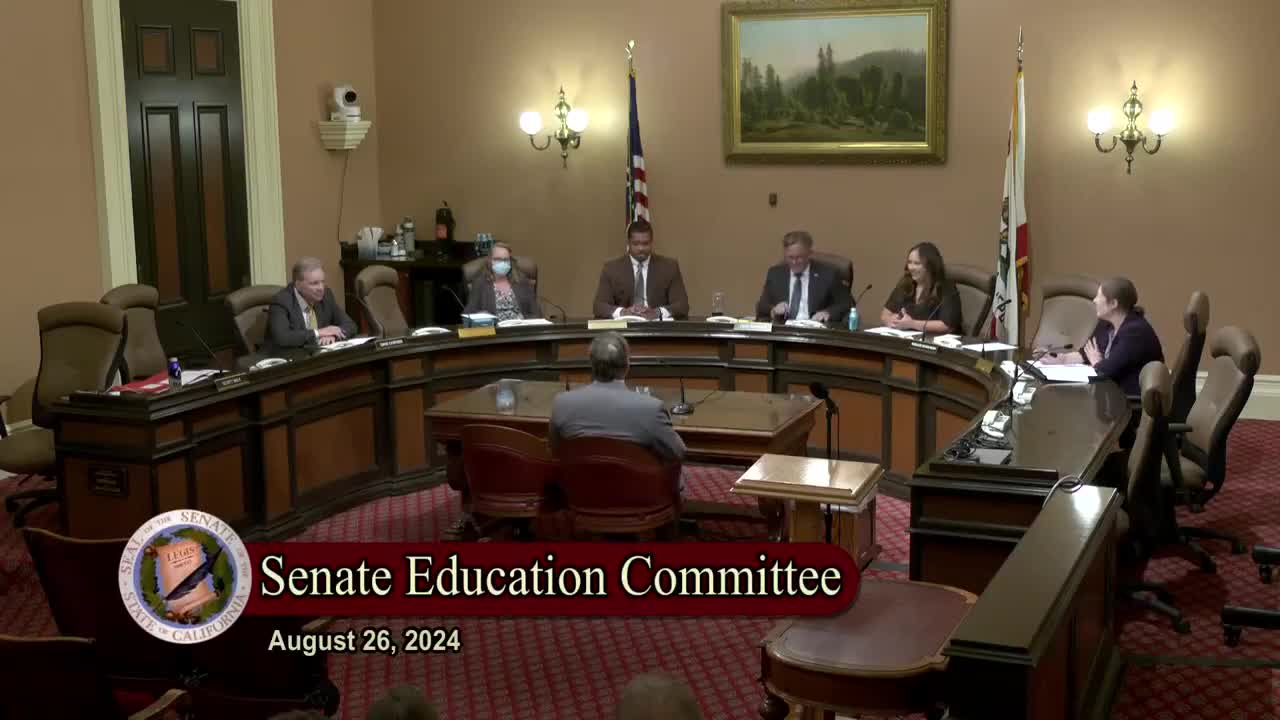 7MIN
Senate Standing Committee on Education
 11MIN
Assembly Standing Committee on Education
 59SEC
Senate Floor
 2MIN
Senate Standing Committee on Environmental Quality
 1MIN
Senate Standing Committee on Environmental Quality
 16SEC
Senate Standing Committee on Environmental Quality
37SEC
Senate Standing Committee on Environmental Quality
Bill Author