SB 150: Construction: workforce development: public contracts.
- Session Year: 2023-2024
- House: Senate
- Latest Version Date: 2023-07-10
Current Status:
Passed
(2023-07-10: Chaptered by Secretary of State. Chapter 61, Statutes of 2023.)
Introduced
In Committee
First Chamber
In Committee
Second Chamber
Enacted
(1)Existing law establishes the Department of Transportation in the Transportation Agency.
Existing law establishes the California Workforce Development Board as the body responsible for assisting the Governor in the development, oversight, and continuous improvement of Californias workforce investment system and the alignment of the education and workforce investment systems to the needs of the 21st century economy and workforce. Under existing law, the California Workforce Development Board assists the Governor in the administration, promotion, and expansion of high road construction careers.
This bill would require the Department of Transportation to work in partnership with the California Workforce Development Board to support Californias high road construction careers program. The bill would require the department to reserve a minimum aggregate total of $50,000,000 of federal funds from the federal Infrastructure Investment and Jobs Act to be allocated over 4 years to support the program.
(2)Existing law authorizes a public entity to use, enter into, or require contractors to enter into, a project labor agreement, as defined, for a construction project only if the agreement includes specified taxpayer protection provisions. Existing law authorizes the members of the governing board of a local public entity to choose by majority vote whether to use, enter into, or require contractors to enter into a project labor agreement that includes taxpayer protection provisions for a specific project or projects.
This bill, on or after January 1, 2026, would authorize a state agency to use, enter into, or require contractors to enter into, a project labor agreement that applies to a project or set of projects with aggregate construction costs in excess of $35,000,000 only if the agreement also includes provisions to address community benefits, as described.
(3)Existing law establishes specified procedures governing contracts between public entities and their contractors and subcontractors. Existing law also establishes the Labor and Workforce Development Agency, the Government Operations Agency, and the Transportation Agency within state government and sets forth their regulatory duties.
This bill would require the above-described state agencies to convene relevant stakeholders to provide input on recommendations to establish material terms to be included as a material part of a contract. The bill would require these agencies to meet with those stakeholders in the process of developing recommendations, and to consult with specified state entities, including the Civil Rights Department, as prescribed. The bill would require those recommendations to be provided to the Governor and the Legislature by March 30, 2024, and also presented to the California Workforce Development Board in a regularly scheduled public meeting.
(4)This bill would declare that it is to take effect immediately as an urgency statute.
This bill would express the intent of the Legislature to enact statutory changes relating to the Budget Act of 2023.This bill would express the intent of the Legislature to enact statutory changes relating to the Budget Act of 2023.
The department shall work in partnership with the California Workforce Development Board to support Californias high road construction careers program. The department shall reserve a minimum aggregate total of fifty million dollars ($50,000,000) of federal funds from the federal Infrastructure Investment and Jobs Act (Public Law 117-58) to be allocated over four years in support of the program.
SEC. 2.Section 2500.5 is added to the Public Contract Code, to read:2500.5.(a)A state agency may use, enter into, or require contractors to enter into, a project labor agreement pursuant to this chapter that applies to a project or set of projects with aggregate construction costs in excess of thirty-five million dollars ($35,000,000) only if the agreement also includes provisions to address community benefits. Community benefits may include partnerships with high road construction careers programs, as defined in Section 14005 of the Unemployment Insurance Code, local hire goals, coordination with programs that assist veterans in transitioning to civilian employment, job fairs for construction apprenticeship or preapprenticeship programs, or other methods agreed upon by the parties to promote employment and training opportunities for veterans and individuals who reside in economically disadvantaged areas.
(b)This section shall apply to project labor agreements entered into on or after January 1, 2026.
SEC. 3.Chapter 6.9 (commencing with Section 6990) is added to Part 1 of Division 2 of the Public Contract Code, to read:6.9.Embedding Workforce Standards in Procurement and Contracting6990.It is the intent of the Legislature, in enacting this chapter, to develop procurement models in alignment with initiatives to enhance the states training and access pipeline for quality jobs and the application of community benefits on infrastructure and manufacturing investments funded by the federal Infrastructure and Investment Jobs Act, the Inflation Reduction Act, and the CHIPS and Science Act.
6990.1.(a)The Labor and Workforce Development Agency, the Government Operations Agency, and the Transportation Agency shall do all of the following:
(1)Convene relevant stakeholders to provide input on recommendations to establish terms to be included as a material part of a contract, including measurable results to ensure that investments maximize benefits to marginalized and disadvantaged communities.
(2)Meet with those stakeholders no less than three times during the process of developing recommendations described in paragraph (1).
(3)Consult with the Civil Rights Department, other relevant state agencies, and a research or academic institution for the University of California for purposes of developing recommendations described in paragraph (1).
(b)The recommendations described in paragraph (1) of subdivision (a) shall be provided to the Governor and the Legislature by March 30, 2024. The recommendations shall also be presented to the California Workforce Development Board in a regularly scheduled public meeting.
(c)For purposes of this section, relevant stakeholders shall include representatives from local public agencies, labor organizations that represent workers in manufacturing, business organizations, nonprofit organizations that represent women in the construction industry, organizations representing the formerly incarcerated, and organizations that represent populations historically marginalized in the California economy.
SEC. 4.This act is an urgency statute necessary for the immediate preservation of the public peace, health, or safety within the meaning of Article IV of the California Constitution and shall go into immediate effect. The facts constituting the necessity are:
To promote environmental protection and safeguard economic development of Californias diverse public resources and people, and enhance the states ability to maximize federal funding to support those efforts, it is necessary for this act to take effect immediately.
SECTION 1.It is the intent of the Legislature to enact statutory changes relating to the Budget Act of 2023.It is the intent of the Legislature to enact statutory changes relating to the Budget Act of 2023.
|
Date
|
Status
|
|---|---|
| Jul 10, 2023 | Chaptered by Secretary of State. Chapter 61, Statutes of 2023. |
| Jul 10, 2023 | Approved by the Governor. |
| Jul 5, 2023 | Enrolled and presented to the Governor at 4 p.m. |
| Jul 5, 2023 | Urgency clause adopted. |
| Jul 5, 2023 | Assembly amendments concurred in. (Ayes 32. Noes 8. Page 1896.) Ordered to engrossing and enrolling. |
| Jul 3, 2023 | In Senate. Concurrence in Assembly amendments pending. |
| Jun 29, 2023 | Read third time. Urgency clause adopted. Passed. (Ayes 61. Noes 11. Page 2485.) Ordered to the Senate. |
| Jun 29, 2023 | From committee: Do pass. (Ayes 12. Noes 2.) (June 29). |
| Jun 29, 2023 | Assembly Rule 63 suspended. (Ayes 57. Noes 15. Page 2472.) |
| Jun 27, 2023 | Joint Rule 62(a) suspended. |
| Jun 27, 2023 | Re-referred to Com. on TRANS. pursuant to Assembly Rule 96. |
| Jun 26, 2023 | From committee with author's amendments. Read second time and amended. Re-referred to Com. on BUDGET. |
| Mar 30, 2023 | Referred to Com. on BUDGET. |
| Mar 27, 2023 | In Assembly. Read first time. Held at Desk. |
| Mar 27, 2023 | Read third time. Passed. (Ayes 29. Noes 8. Page 502.) Ordered to the Assembly. |
| Mar 20, 2023 | Read second time. Ordered to third reading. |
| Mar 16, 2023 | Withdrawn from committee. (Ayes 28. Noes 8. Page 357.) |
| Mar 16, 2023 | Ordered to second reading. |
| Jan 25, 2023 | Referred to Com. on B. & F.R. |
| Jan 19, 2023 | From printer. May be acted upon on or after February 18. |
| Jan 18, 2023 | Introduced. Read first time. To Com. on RLS. for assignment. To print. |
|
Date
|
Description
|
Location
|
Votes
|
|
|---|---|---|---|---|
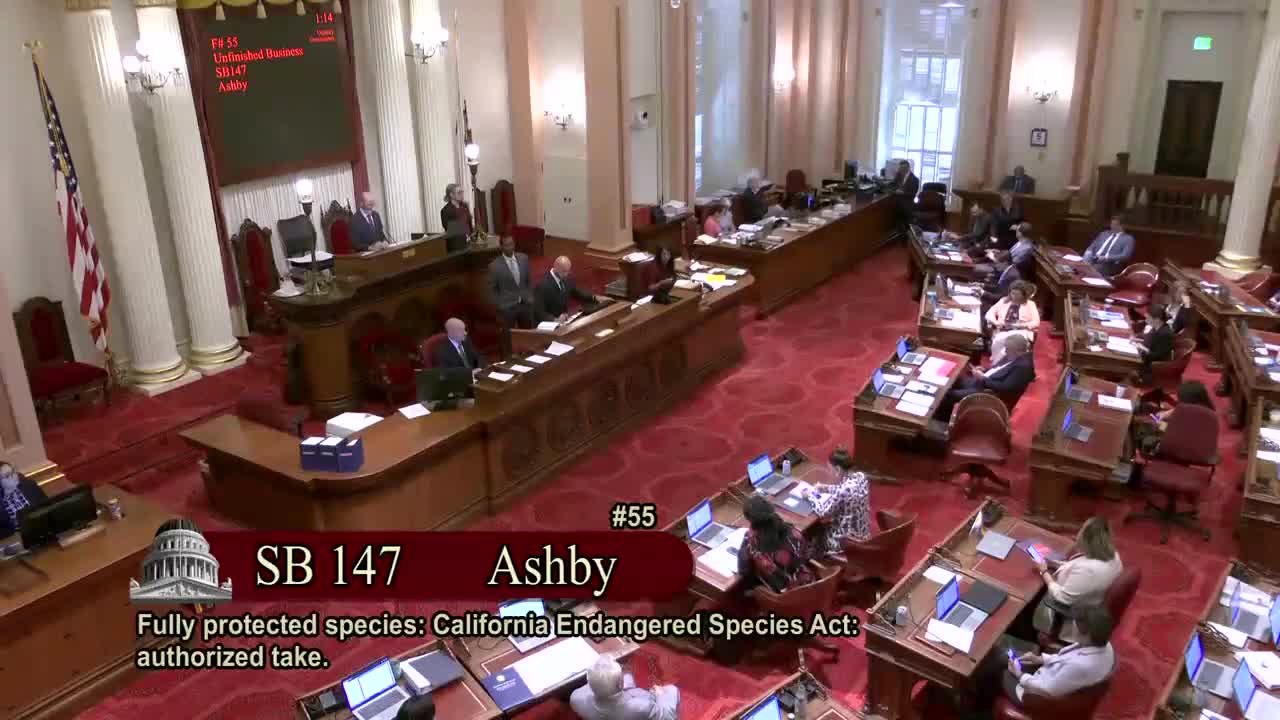
| Jul 5, 2023 | Unfinished Business SB150 Durazo et al. Urgency Clause Concurrence | Senate Floor |
Passed |
|
| Jun 29, 2023 | SB 150 Durazo Third Reading Urgency By RIVAS, L. | Assembly Floor |
Passed |
|
| Jun 29, 2023 | Do pass. | Assembly Standing Committee on Transportation |
Passed |
|
| Mar 27, 2023 | Senate 3rd Reading SB150 B. & F.R. (Skinner) | Senate Floor |
Passed |
This list shows positions taken on this bill by organizations on the date displayed, which is linked to the original source.
Positions by individuals are not included.
|
Organization
|
Position
|
Date
|
|---|---|---|
| ARC | * Support | Jun 29, 2023 |
| Bay Area Council | * Support | Jun 29, 2023 |
| BizFed | * Support | Jun 29, 2023 |
| California Coalition of Utility Employees | * Support | Jun 29, 2023 |
| California Labor Federation | * Support | Jun 29, 2023 |
| California State Association Of Electrical Workers | * Support | Jun 29, 2023 |
| California State Pipe Trades Council | * Support | Jun 29, 2023 |
| Elevator Constructors Union | * Support | Jun 29, 2023 |
| Los Angeles Area Chamber Of Commerce | * Support | Jun 29, 2023 |
| Los Angeles Black Workers Center | * Support | Jun 29, 2023 |
| New California Coalition | * Support | Jun 29, 2023 |
| Pro TEM Policy Consultant | * Support | Jun 29, 2023 |
| Southern California Black Worker Hub | * Support | Jun 29, 2023 |
| Western Electrical Contractors Association | * Against | Jun 29, 2023 |
| Western States Council Of Sheet Metal Workers | * Support | Jun 29, 2023 |
SENATE RULES COMMITTEE Office of Senate Floor Analyses (916) 651-1520 Fax: (916) 327-4478 | SB 150 |
UNFINISHED BUSINESS
Bill No: SB 150
Author: Durazo (D), Cortese (D), Gonzalez (D), Luz Rivas (D) and Smallwood-Cuevas (D)
Amended: 6/26/23
Vote: 27 - Urgency
SENATE FLOOR: Not relevant
ASSEMBLY FLOOR: 61-11, 6/29/23 - See last page for vote
SUBJECT: Construction: workforce development: public contracts
SOURCE: Author
DIGEST:
This bill embeds workforce and community benefit requirements in procurement and contracting for infrastructure and manufacturing investments related to the federal Infrastructure and Investment Jobs Act (IIJA), the Inflation Reduction Act (IRA) and the CHIPS and Science Act (CHIPS Act).
Assembly Amendments
delete the Senate version of this bill and instead add the current language.
ANALYSIS:
Existing law:
- Establishes the California Workforce Development Board as the body responsible for assisting the Governor in the development, oversight, and continuous improvement of California’s workforce investment system and the alignment of the education and workforce investment systems to the needs of the 21st century economy and workforce. Under existing law, the California Workforce Development Board assists the Governor in the administration, promotion, and expansion of high road construction careers.
- Authorizes a public entity to use, enter into, or require contractors to enter into, a project labor agreement, as defined, for a construction project only if the agreement includes specified taxpayer protection provisions.
- Authorizes the members of the governing board of a local public entity to choose by majority vote whether to use, enter into, or require contractors to enter into a project labor agreement that includes taxpayer protection provisions for a specific project or projects.
This bill:
- States the intent of the Legislature to “develop procurement models in alignment with initiatives to enhance the state’s training and access pipeline for quality jobs and the application of community benefits on infrastructure and manufacturing investments” by the federal IIJA, IRA and CHIPS Act.
- Requires the inclusion of community benefits in project labor agreements entered into by a state agency for projects of $35 million and above in construction costs.
- Defines community benefits to include local hire provisions, partnerships with high road construction careers programs and other methods to promote the employment of individuals from economically disadvantaged areas and veterans.
- Requires the Labor and Workforce Development Agency (LWDA), Government Operations Agency and Transportation Agency to develop and provide contractual and procurement model recommendations that maximize benefits to disadvantaged communities to the Governor and Legislature by March 30, 2024. This bill requires these recommendations to be developed in consultation with specified state agencies and stakeholders for the intended purpose of equity and access to quality jobs connected to IIJA, IRA and CHIPS Act investments.
- Requires the Department of Transportation (Caltrans) to reserve $50 million from IIJA funds to support high road construction careers programs that provide a range of supportive services and career placement assistance to underserved and underrepresented populations.
- Contains an urgency clause.
Comments
- Background. The federal IIJA, IRA and CHIPS Act are estimated to invest over $752 billion in infrastructure investments to rebuild roads, bridges and rail, improve access to clean drinking water, expand access to reliable and affordable high-speed internet, address climate change and bolster U.S. leadership in semiconductor research, development and manufacturing. California’s share of federal funds provides an opportunity to promote equity in access to construction and manufacturing careers through procurement and contractual requirements designed to maximize benefits to communities that have been historically marginalized in the economy. While public works construction requires the payment of prevailing wage and employment of apprentices, a similar or comparable framework has not been established for taxpayer funded financial assistance programs in the manufacturing sector.
- High Road Training Partnerships. As designed, High Road Training Partnerships are training programs, including pre-apprenticeship training that may include, but are not limited to partnerships with employers and labor unions, and address income inequality through skills development tied to employer needs for the underserved, justice-involved or low-income individuals.
FISCAL EFFECT: Appropriation: No Fiscal Com.: Yes Local: No
SUPPORT: (Verified 6/26/23)
None received
OPPOSITION: (Verified 6/26/23)
None received
ASSEMBLY FLOOR: 61-11, 6/29/23
AYES: Addis, Aguiar-Curry, Alvarez, Arambula, Bains, Bauer-Kahan, Bennett, Berman, Boerner, Bonta, Bryan, Calderon, Juan Carrillo, Wendy Carrillo, Cervantes, Connolly, Mike Fong, Gabriel, Garcia, Gipson, Grayson, Haney, Hart, Holden, Irwin, Jackson, Jones-Sawyer, Kalra, Lee, Low, Lowenthal, Maienschein, McCarty, McKinnor, Muratsuchi, Stephanie Nguyen, Ortega, Pacheco, Papan, Pellerin, Petrie-Norris, Quirk-Silva, Ramos, Reyes, Luz Rivas, Robert Rivas, Rodriguez, Blanca Rubio, Santiago, Schiavo, Soria, Ting, Valencia, Waldron, Wallis, Ward, Weber, Wicks, Wood, Zbur, Rendon
NOES: Chen, Megan Dahle, Dixon, Vince Fong, Gallagher, Hoover, Mathis, Jim Patterson, Joe Patterson, Sanchez, Ta
NO VOTE RECORDED: Alanis, Davies, Essayli, Flora, Friedman, Lackey, Villapudua, Wilson
Prepared by: Eunice Roh / B. & F.R. / (916) 651-4103
7/3/23 16:13:21
**** END ****
(Without Reference to File)
SENATE THIRD READING
STR Bill Id:SB 150
Author:(Durazo, et al.)
As Amended Ver:June 26, 2023
2/3 vote. Urgency
SUMMARY
Requires the California Department of Transportation (Caltrans) to work in partnership with the California Workforce Development Board to support California's high road construction careers program and requires Caltrans to reserve a of $50 million of federal funds from the federal Infrastructure Investment and Jobs Act to be allocated over four years to support the program.
Major Provisions
- Expresses legislative intent to develop procurement models in alignment with initiatives to enhance the state's training and access pipeline for quality jobs and the application of community benefits on infrastructure and manufacturing investments funded by the federal Infrastructure and Investment Jobs Act, the Inflation Reduction Act, and the CHIPS and Science Act.
- Requires the state Labor and Workforce Development Agency, Government Operations Agency, and Transportation Agency to convene a stakeholder process and to provide input on recommendations to establish terms to be included as a material part of a contract, including measurable results to ensure that investments maximize benefits to marginalized and disadvantaged communities. These recommendations shall be provided in a report to the Governor and Legislature by March 30, 2024.
- Beginning January 1, 2026, authorizes a state agency to enter into or require a project labor agreement that applies to a project with aggregate construction costs in excess of $35 million dollars, but only if the agreement also includes provisions to address community benefits, which is defined to include partnerships with existing high road construction careers programs, local hire goals, coordination with programs that utilize job fairs for construction apprenticeship or preapprenticeship programs, or other methods agreed upon by the parties to promote employment and training opportunities for veterans and individuals who reside in economically disadvantaged areas.
- Requires the Caltrans to work in partnership with the California Workforce Development Board to support California's high road construction careers program. This bill additionally requires Caltrans to reserve a minimum total of $50 million of federal funds from the federal Infrastructure Investment and Jobs Act of 2022 to be allocated over four years to support high road construction careers programs that provide a range of supportive services and career placement assistance to underserved and underrepresented populations
COMMENTS
This bill is a reflection of the increasing interest from the Legislature in using state contracting and procurement processes as a means to provide greater inclusion and equity in employment for women, veterans, and other individuals representing economically disadvantaged areas.
According to the Author
Arguments in Support
None on file
Arguments in Opposition
The Western Electrical Contractors Association (WECA) "opposes government-mandated Project Labor Agreements for several reasons, including:
- They replace an employee's right to decide if they want union representation (which they are guaranteed under the NLRA) with an administrative government decision for workers who are not the employees of the agency,
- They typically discriminate against any state or federal apprenticeship program NOT affiliated with a construction union,
- They reduce competition for construction projects that can increase costs by 15%-18%,
- PLAs [project labor agreements] produce direct economic damage to non-union workers forced to work under the PLA through mandatory union dues or fees, and loss of pension contributions,
- They can force a non-union worker to leave their existing health plan and join the union plan for the duration of the project or require the employer to pay twice for healthcare benefits,
- They grant a sole-source, no-bid, exclusive right to provide construction labor to the local trades council member, possibly excluding 80% of the construction workforce - many of whom are residents of that area.
While other provisions in SB 150 may have merit, WECA's opposition is to Section 2. WECA does not understand why a permissive authority – with provisions that do not go into effect until 2026 is included in a budget bill for 2024."
FISCAL COMMENTS
Unknown. This bill has been keyed non-fiscal by the Legislative Counsel.
VOTES
SENATE FLOOR: 29-8-3
YES: Allen, Alvarado-Gil, Archuleta, Atkins, Becker, Blakespear, Bradford, Caballero, Cortese, Dodd, Durazo, Eggman, Glazer, Gonzalez, Hurtado, Laird, Limón, McGuire, Menjivar, Min, Newman, Padilla, Portantino, Roth, Skinner, Smallwood-Cuevas, Umberg, Wahab, Wiener
NO: Dahle, Grove, Jones, Nguyen, Niello, Ochoa Bogh, Seyarto, Wilk
ABS, ABST OR NV: Ashby, Rubio, Stern
UPDATED
VERSION: June 26, 2023
CONSULTANT: Farra Bracht / TRANS. / (916) 319-2093 FN: 0001163
Date of Hearing: 06-29-2023
ASSEMBLY COMMITTEE ON TRANSPORTATION
Laura Friedman, Chair
SBPCA Bill Id:SB 150
Author:(Durazo, et al.) – As Amended Ver:June 26, 2023
SENATE VOTE: Not Applicable
SUBJECT: Construction: workforce development: public contracts.
SUMMARY: Specifically, this bill, an urgency measure:
- Expresses legislative intent to develop procurement models in alignment with initiatives to enhance the state’s training and access pipeline for quality jobs and the application of community benefits on infrastructure and manufacturing investments funded by the federal Infrastructure and Investment Jobs Act, the Inflation Reduction Act, and the CHIPS and Science Act.
- Requires the state Labor and Workforce Development Agency, Government Operations Agency, and Transportation Agency to convene a stakeholder process and to provide input on recommendations to establish terms to be included as a material part of a contract, including measurable results to ensure that investments maximize benefits to marginalized and disadvantaged communities. These recommendations shall be provided in a report to the Governor and Legislature by March 30, 2024.
- Beginning January 1, 2026, authorizes a state agency to enter into or require a project labor agreement that applies to a project with aggregate construction costs in excess of $35 million dollars, but only if the agreement also includes provisions to address community benefits, which is defined to include partnerships with existing high road construction careers programs, local hire goals, coordination with programs that utilize job fairs for construction apprenticeship or preapprenticeship programs, or other methods agreed upon by the parties to promote employment and training opportunities for veterans and individuals who reside in economically disadvantaged areas.
- Requires the California Department of Transportation (Caltrans) to work in partnership with the California Workforce Development Board to support California’s high road construction careers program. The bill additionally requires Caltrans to reserve a minimum total of $50 million of federal funds from the federal Infrastructure Investment and Jobs Act of 2022 to be allocated over four years to support high road construction careers programs that provide a range of supportive services and career placement assistance to underserved and underrepresented populations.
EXISTING LAW:
- Establishes procedures for state agencies to enter into contracts for goods and services, including generally requiring that certain contracts by a state agency, including, but not limited to, contracts for the construction, alteration, improvement, repair, or maintenance of property, be approved by the Department of General Services (DGS).
- Authorizes public entities to enter into, or require contractors to enter into, a project labor agreement for a construction project only if the agreement includes specified taxpayer protection provisions.
- Defines high road construction careers as high road training partnerships that invest in regional training partnerships with local building trades councils, and community and education interests that connect to state-approved apprenticeship programs for the purpose of providing services and career placement assistance to women and people from underserved and underrepresented populations.
FISCAL EFFECT: Unknown
COMMENTS: This bill is a reflection of the increasing interest from the Legislature in using state contracting and procurement processes as a means to provide greater inclusion and equity in employment for women, veterans, and other individuals representing economically disadvantaged areas.
Related Legislation:
SB 822 (Durazo of 2023) would establish an Interagency High Road Team to create high road evaluation metrics and require certain agencies to enter into an MOU with the state workforce development board to coordinate workforce development planning analysis, and implementation activities. Set for hearing in Assembly Labor and Employment Committee on June 28, 2023.
SB 574 (Wahab of 2023) would require all state agencies, and specified educational agencies using bond funds, to enter into project labor agreements with community benefits for projects that exceed a total cost of $35 million. Two-year bill.
SB 154 (Committee on Budget and Fiscal Review, Ch. 43, Statutes of 2022) required the state labor agency to submit a report to the Legislature documenting all relevant programs and initiatives under the Employment Development Department, Workforce Development Board, and Department of Industrial Relations regarding the high road standard.
REGISTERED SUPPORT / OPPOSITION:
Support
None on file
Opposition
None on file
Analysis Prepared by: Farra Bracht / TRANS. / (916) 319-2093
SENATE RULES COMMITTEE Office of Senate Floor Analyses (916) 651-1520 Fax: (916) 327-4478 | SB 150 |
THIRD READING
Bill No: SB 150
Author: Committee on Budget and Fiscal Review
Introduced: 1/18/23
Vote: 21
SOURCE: Author
DIGEST:
This bill expresses the intent of the Legislature to enact statutory changes relating to the Budget Act of 2023.
ANALYSIS: Senate Bills 100 through 219, inclusive, are to be considered as vehicles for the 2023-24 Budget Trailer Bills.
FISCAL EFFECT: Appropriation: No Fiscal Com.: No Local: No
SUPPORT: (Verified 3/21/23)
None received
OPPOSITION: (Verified 3/21/23)
None received
Prepared by: Jonas Austin / SFA / (916) 651-1520
3/22/23 14:01:44
**** END ****
Discussed in Hearing
 24MIN
Senate Floor
 33MIN
Assembly Standing Committee on Transportation
 4MIN
Assembly Floor





Bill Co-Author(s):