SB 1502: Controlled substances: xylazine.
- Session Year: 2023-2024
- House: Senate
- Latest Version Date: 2024-06-06
Current Status:
Failed
(2024-07-02: July 2 hearing: Held in committee and under submission.)
Introduced
In Committee
First Chamber
In Committee
Second Chamber
Enacted
What does this bill do?
This bill adds xylazine (an animal sedative increasingly found mixed into illegal drugs) to California’s Schedule III controlled substances, restricting its sale, possession, and use and affecting veterinarians, pharmacists, drug suppliers, and law enforcement. It also allows compounding xylazine animal drugs when an FDA‑approved product isn’t available and specifies that test kits used to detect xylazine are not considered illegal drug paraphernalia.
The summary is provided by generative AI which can make mistakes. For original language, please view the details in the table below.
Existing law, the California Uniform Controlled Substances Act, categorizes controlled substances into 5 schedules and places the greatest restrictions on those substances contained in Schedule I. Under existing law, the substances in Schedule I are deemed to have a high potential for abuse and no accepted medical use while substances in Schedules II through V are substances that have an accepted medical use, but have the potential for abuse. Existing law restricts the prescription, furnishing, possession, sale, and use of controlled substances, and makes a violation of those laws a crime, except as specified. Existing law defines drug paraphernalia and prohibits, among other things, the manufacture, sale, and possession, as specified, of drug paraphernalia. Existing law excludes from these prohibitions any testing equipment that is designed, marketed, used, or intended to be used to analyze a substance for the presence of fentanyl, ketamine, gamma hydroxybutyric acid, or any analog of fentanyl.
This bill would add xylazine to the list of Schedule III substances, as specified. If an animal drug containing xylazine that has been approved under the federal Food, Drug and Cosmetic Act is not available for sale in California, the bill would create an exception for a substance that is intended to be used to compound an animal drug or an animal drug compound containing xylazine, as specified. drug, as specified. The bill would exclude from the prohibitions on paraphernalia any testing equipment to analyze a substance for the presence of xylazine. By creating a new crime, the bill would impose a state-mandated local program.
The California Constitution requires the state to reimburse local agencies and school districts for certain costs mandated by the state. Statutory provisions establish procedures for making that reimbursement.
This bill would provide that no reimbursement is required by this act for a specified reason.
Existing law, the California Uniform Controlled Substances Act, categorizes controlled substances into 5 schedules and places the greatest restrictions on those substances contained in Schedule I. Under existing law, the substances in Schedule I are deemed to have a high potential for abuse and no accepted medical use while substances in Schedules II through V are substances that have an accepted medical use, but have the potential for abuse. Existing law restricts the prescription, furnishing, possession, sale, and use of controlled substances, and makes a violation of those laws a crime, except as specified. Existing law defines drug paraphernalia and prohibits, among other things, the manufacture, sale, and possession, as specified, of drug paraphernalia. Existing law excludes from these prohibitions any testing equipment that is designed, marketed, used, or intended to be used to analyze a substance for the presence of fentanyl, ketamine, gamma hydroxybutyric acid, or any analog of fentanyl.
This bill would add xylazine to the list of Schedule III substances, as specified. If an animal drug containing xylazine that has been approved under the federal Food, Drug and Cosmetic Act is not available for sale in California, the bill would create an exception for a substance that is intended to be used to compound an animal drug or an animal drug compound containing xylazine, as specified. The bill would exclude from the prohibitions on paraphernalia any testing equipment to analyze a substance for the presence of xylazine. By creating a new crime, the bill would impose a state-mandated local program.
The California Constitution requires the state to reimburse local agencies and school districts for certain costs mandated by the state. Statutory provisions establish procedures for making that reimbursement.
This bill would provide that no reimbursement is required by this act for a specified reason.
Existing law, the California Uniform Controlled Substances Act, categorizes controlled substances into 5 schedules and places the greatest restrictions on those substances contained in Schedule I. Under existing law, the substances in Schedule I are deemed to have a high potential for abuse and no accepted medical use while substances in Schedules II through V are substances that have an accepted medical use, but have the potential for abuse. Existing law restricts the prescription, furnishing, possession, sale, and use of controlled substances, and makes a violation of those laws a crime, except as specified.
This bill would add xylazine to the list of Schedule III substances, as specified. If an animal drug containing xylazine that has been approved under the federal Food, Drug and Cosmetic Act is not available for sale in California, the bill would create an exception for a substance that is intended to be used to compound an animal drug or an animal drug compound containing xylazine, as specified. By creating a new crime, the bill would impose a state-mandated local program.
The California Constitution requires the state to reimburse local agencies and school districts for certain costs mandated by the state. Statutory provisions establish procedures for making that reimbursement.
This bill would provide that no reimbursement is required by this act for a specified reason.
Existing law regulates the use of various chemicals and substances. Existing law, the California Uniform Controlled Substances Act, categorizes controlled substances into 5 schedules and places the greatest restrictions on those substances contained in Schedule I.This bill would state the intent of the Legislature to enact legislation to increase criminal penalties for illicit use of xylazine.Existing law regulates the use of various chemicals and substances. Existing law, the California Uniform Controlled Substances Act, categorizes controlled substances into 5 schedules and places the greatest restrictions on those substances contained in Schedule I.
This bill would state the intent of the Legislature to enact legislation to increase criminal penalties for illicit use of xylazine.
The Legislature finds and declares all of the following:
(a)Xylazine, an animal sedative used in veterinary medicine that has not been approved or authorized for human use by the federal Food and Drug Administration, has been increasingly found in the illicit drug supply and has been linked to an increasing number of overdose deaths in every United States census region. Xylazine is not currently listed on the federal- or state-controlled substances schedules.
(b)Xylazine, also known as tranq or the zombie drug, is frequently used as an adulterant mixed with other drugs, especially fentanyl. Fentanyl mixed with xylazine enhances fentanyls effects, increases its addictiveness, and worsens the risk of a life-threatening overdose. Overdoses involving xylazine pose additional challenges to first responders and emergency physicians because xylazine is not an opioid and its effects cannot be reversed with the opioid reversal medication naloxone.
(c)Combining drugs such as fentanyl with xylazine may increase profits for illicit drug traffickers by reducing the amount of fentanyl or other drugs used in a mixture.
(d)The Biden-Harris administration designated fentanyl adulterated with xylazine as an emerging drug threat under federal law, triggering a series of responses focused on prevention, treatment, and supply reduction.
(e)As of 2023, the prevalence of xylazine in California is low compared to other parts of the country. As a preventative effort to deterring further saturation of xylazine in the California illicit drug market, it is critical that further escalation of the current opioid epidemic be addressed.
(f)Though xylazine has no approved human use, animal drugs containing xylazine are critically important in veterinary medicine. It is important that any solution to address the prevalence of illicit xylazine also protects access for legitimate veterinary uses.
SEC. 2.Section 11014.5 of the Health and Safety Code is amended to read:11014.5.(a)Drug paraphernalia means all equipment, products and materials of any kind which are designed for use or marketed for use, in planting, propagating, cultivating, growing, harvesting, manufacturing, compounding, converting, producing, processing, preparing, testing, analyzing, packaging, repackaging, storing, containing, concealing, injecting, ingesting, inhaling, or otherwise introducing into the human body a controlled substance in violation of this division. It includes, but is not limited to:
(1)Kits designed for use or marketed for use in planting, propagating, cultivating, growing, or harvesting of any species of plant which is a controlled substance or from which a controlled substance can be derived.
(2)Kits designed for use or marketed for use in manufacturing, compounding, converting, producing, processing, or preparing controlled substances.
(3)Isomerization devices designed for use or marketed for use in increasing the potency of any species of plant which is a controlled substance.
(4)Testing equipment designed for use or marketed for use in identifying, or in analyzing the strength, effectiveness, or purity of controlled substances, except as otherwise provided in subdivision (d).
(5)Scales and balances designed for use or marketed for use in weighing or measuring controlled substances.
(6)Containers and other objects designed for use or marketed for use in storing or concealing controlled substances.
(7)Hypodermic syringes, needles, and other objects designed for use or marketed for use in parenterally injecting controlled substances into the human body.
(8)Objects designed for use or marketed for use in ingesting, inhaling, or otherwise introducing cannabis, cocaine, hashish, or hashish oil into the human body, such as:
(A)Carburetion tubes and devices.
(B)Smoking and carburetion masks.
(C)Roach clips, meaning objects used to hold burning material, such as a cannabis cigarette, that has become too small or too short to be held in the hand.
(D)Miniature cocaine spoons, and cocaine vials.
(E)Chamber pipes.
(F)Carburetor pipes.
(G)Electric pipes.
(H)Air-driven pipes.
(I)Chillums.
(J)Bongs.
(K)Ice pipes or chillers.
(b)For purposes of this section, the phrase marketed for use means advertising, distributing, offering for sale, displaying for sale, or selling in a manner which promotes the use of equipment, products, or materials with controlled substances.
(c)In determining whether an object is drug paraphernalia, a court or other authority may consider, in addition to all other logically relevant factors, the following:
(1)Statements by an owner or by anyone in control of the object concerning its use.
(2)Instructions, oral or written, provided with the object concerning its use for ingesting, inhaling, or otherwise introducing a controlled substance into the human body.
(3)Descriptive materials accompanying the object which explain or depict its use.
(4)National and local advertising concerning its use.
(5)The manner in which the object is displayed for sale.
(6)Whether the owner, or anyone in control of the object, is a legitimate supplier of like or related items to the community, such as a licensed distributor or dealer of tobacco products.
(7)Expert testimony concerning its use.
(d)Notwithstanding paragraph (4) of subdivision (a), drug paraphernalia does not include any testing equipment designed, marketed, intended to be used, or used, to test a substance for the presence of fentanyl, ketamine, gamma hydroxybutyric acid, xylazine, or any analog of fentanyl.
(e)If any provision of this section or the application thereof to any person or circumstance is held invalid, it is the intent of the Legislature that the invalidity shall not affect other provisions or applications of the section which can be given effect without the invalid provision or application and to this end the provisions of this section are severable.
SEC. 3.Section 11056 of the Health and Safety Code is amended to read:11056.(a)The controlled substances listed in this section are included in Schedule III.
(b)Stimulants. Unless specifically excepted or unless listed in another schedule, any material, compound, mixture, or preparation that contains any quantity of the following substances having a stimulant effect on the central nervous system, including its salts, isomers (whether optical, position, or geometric), and salts of those isomers whenever the existence of those salts, isomers, and salts of isomers is possible within the specific chemical designation:
(1)Those compounds, mixtures, or preparations in dosage unit form containing any stimulant substances listed in Schedule II which compounds, mixtures, or preparations were listed on August 25, 1971, as excepted compounds under Section 1308.32 of Title 21 of the Code of Federal Regulations, and any other drug of the quantitative composition shown in that list for those drugs or that is the same except that it contains a lesser quantity of controlled substances.
(2)Benzphetamine.
(3)Chlorphentermine.
(4)Clortermine.
(5)Mazindol.
(6)Phendimetrazine.
(c)Depressants. Unless specifically excepted in Section 11059 or elsewhere, or unless listed in another schedule, any material, compound, mixture, or preparation that contains any quantity of the following substances having a depressant effect on the central nervous system:
(1)Any compound, mixture, or preparation containing any of the following:
(A)Amobarbital.
(B)Secobarbital.
(C)Pentobarbital
or any salt thereof and one or more other active medicinal ingredients that are not listed in any schedule.
(2)Any suppository dosage form containing any of the following:
(A)Amobarbital.
(B)Secobarbital.
(C)Pentobarbital
or any salt of any of these drugs and approved by the federal Food and Drug Administration for marketing only as a suppository.
(3)Any substance that contains any quantity of a derivative of barbituric acid or any salt thereof.
(4)Chlorhexadol.
(5)Lysergic acid.
(6)Lysergic acid amide.
(7)Methyprylon.
(8)Sulfondiethylmethane.
(9)Sulfonethylmethane.
(10)Sulfonmethane.
(11)Gamma hydroxybutyric acid, and its salts, isomers, and salts of isomers, contained in a drug product for which an application has been approved under Section 505 of the Federal Food, Drug, and Cosmetic Act (21 U.S.C. Sec. 355).
(d)Nalorphine.
(e)Narcotic drugs. Unless specifically excepted or unless listed in another schedule, any material, compound, mixture, or preparation containing any of the following narcotic drugs, or their salts calculated as the free anhydrous base or alkaloid, in limited quantities as set forth below:
(1)Not more than 1.8 grams of codeine per 100 milliliters or not more than 90 milligrams per dosage unit, with an equal or greater quantity of an isoquinoline alkaloid of opium.
(2)Not more than 1.8 grams of codeine per 100 milliliters or not more than 90 milligrams per dosage unit, with one or more active, nonnarcotic ingredients in recognized therapeutic amounts.
(3)Not more than 1.8 grams of dihydrocodeine per 100 milliliters or not more than 90 milligrams per dosage unit, with one or more active nonnarcotic ingredients in recognized therapeutic amounts.
(4)Not more than 300 milligrams of ethylmorphine per 100 milliliters or not more than 15 milligrams per dosage unit, with one or more active, nonnarcotic ingredients in recognized therapeutic amounts.
(5)Not more than 500 milligrams of opium per 100 milliliters or per 100 grams or not more than 25 milligrams per dosage unit, with one or more active, nonnarcotic ingredients in recognized therapeutic amounts.
(6)Not more than 50 milligrams of morphine per 100 milliliters or per 100 grams, with one or more active, nonnarcotic ingredients in recognized therapeutic amounts.
(f)Anabolic steroids and chorionic gonadotropin. Any material, compound, mixture, or preparation containing chorionic gonadotropin or an anabolic steroid (excluding anabolic steroid products listed in the Table of Exempt Anabolic Steroid Products (Section 1308.34 of Title 21 of the Code of Federal Regulations), as exempt from the federal Controlled Substances Act (Section 801 and following of Title 21 of the United States Code)), including, but not limited to, the following:
(1)Androisoxazole.
(2)Androstenediol.
(3)Bolandiol.
(4)Bolasterone.
(5)Boldenone.
(6)Chloromethandienone.
(7)Clostebol.
(8)Dihydromesterone.
(9)Ethylestrenol.
(10)Fluoxymesterone.
(11)Formyldienolone.
(12)4-Hydroxy-19-nortestosterone.
(13)Mesterolone.
(14)Methandriol.
(15)Methandrostenolone.
(16)Methenolone.
(17)17-Methyltestosterone.
(18)Methyltrienolone.
(19)Nandrolone.
(20)Norbolethone.
(21)Norethandrolone.
(22)Normethandrolone.
(23)Oxandrolone.
(24)Oxymesterone.
(25)Oxymetholone.
(26)Quinbolone.
(27)Stanolone.
(28)Stanozolol.
(29)Stenbolone.
(30)Testosterone.
(31)Trenbolone.
(32)Human chorionic gonadotropin (hCG), except when possessed by, sold to, purchased by, transferred to, or administered by a licensed veterinarian, or a licensed veterinarians designated agent, exclusively for veterinary use.
(g)Ketamine. Any material, compound, mixture, or preparation containing ketamine.
(h)Hallucinogenic substances. Any of the following hallucinogenic substances: dronabinol (synthetic) in sesame oil and encapsulated in a soft gelatin capsule in a drug product approved by the federal Food and Drug Administration.
(i)(1)Xylazine, including its salts, isomers, and salts of its isomers. Any substance that contains xylazine.
(2)If an animal drug containing xylazine that has been approved under the federal Food, Drug and Cosmetic Act is not available for sale in California, this subdivision does not apply to a substance that is intended to be a substance listed in paragraph (1) may be used to compound an animal drug pursuant to the federal Food and Drug Administrations industry guidance on compounding animal drugs from bulk drug substances, or an animal drug compound containing xylazine that is compounded pursuant to this guidance. substances.
(3)Notwithstanding any other law, compounding an animal drug as pursuant to the conditions described in paragraph (2) shall not be deemed unprofessional conduct under Section 4301 of the Business and Professions Code.
SEC. 4.Section 11364.5 of the Health and Safety Code is amended to read:11364.5.(a)Except as authorized by law, no person shall maintain or operate any place of business in which drug paraphernalia is kept, displayed or offered in any manner, sold, furnished, transferred or given away unless such drug paraphernalia is completely and wholly kept, displayed or offered within a separate room or enclosure to which persons under the age of 18 years not accompanied by a parent or legal guardian are excluded. Each entrance to such a room or enclosure shall be signposted in reasonably visible and legible words to the effect that drug paraphernalia is kept, displayed or offered in such room or enclosure and that minors, unless accompanied by a parent or legal guardian, are excluded.
(b)Except as authorized by law, no owner, manager, proprietor or other person in charge of any room or enclosure, within any place of business, in which drug paraphernalia is kept, displayed or offered in any manner, sold, furnished, transferred or given away shall permit or allow any person under the age of 18 years to enter, be in, remain in or visit such room or enclosure unless that minor person is accompanied by their parent or legal guardian.
(c)Unless authorized by law, no person under the age of 18 years shall enter, be in, remain in, or visit any room or enclosure in any place of business in which drug paraphernalia is kept, displayed or offered in any manner, sold, furnished, transferred, or given away unless accompanied by their parent or legal guardian.
(d)As used in this section, drug paraphernalia means all equipment, products, and materials of any kind which are intended for use or designed for use, in planting, propagating, cultivating, growing, harvesting, manufacturing, compounding, converting, producing, processing, preparing, testing, analyzing, packaging, repackaging, storing, containing, concealing, injecting, ingesting, inhaling, or otherwise introducing into the human body a controlled substance. Drug paraphernalia includes, but is not limited to, all of the following:
(1)Kits intended for use or designed for use in planting, propagating, cultivating, growing, or harvesting of any species of plant which is a controlled substance or from which a controlled substance can be derived.
(2)Kits intended for use or designed for use in manufacturing, compounding, converting, producing, processing, or preparing controlled substances.
(3)Isomerization devices intended for use or designed for use in increasing the potency of any species of plant which is a controlled substance.
(4)Testing equipment intended for use or designed for use in identifying, or in analyzing the strength, effectiveness, or purity of controlled substances, except as otherwise provided in subdivision (g).
(5)Scales and balances intended for use or designed for use in weighing or measuring controlled substances.
(6)Diluents and adulterants, such as quinine hydrochloride, mannitol, mannite, dextrose, and lactose, intended for use or designed for use in cutting controlled substances.
(7)Separation gins and sifters intended for use or designed for use in removing twigs and seeds from, or in otherwise cleaning or refining, cannabis.
(8)Blenders, bowls, containers, spoons, and mixing devices intended for use or designed for use in compounding controlled substances.
(9)Capsules, balloons, envelopes, and other containers intended for use or designed for use in packaging small quantities of controlled substances.
(10)Containers and other objects intended for use or designed for use in storing or concealing controlled substances.
(11)Hypodermic syringes, needles, and other objects intended for use or designed for use in parenterally injecting controlled substances into the human body.
(12)Objects intended for use or designed for use in ingesting, inhaling, or otherwise introducing cannabis, cocaine, hashish, or hashish oil into the human body, such as the following:
(A)Metal, wooden, acrylic, glass, stone, plastic, or ceramic pipes with or without screens, permanent screens, hashish heads, or punctured metal bowls.
(B)Water pipes.
(C)Carburetion tubes and devices.
(D)Smoking and carburetion masks.
(E)Roach clips, meaning objects used to hold burning material, such as a cannabis cigarette that has become too small or too short to be held in the hand.
(F)Miniature cocaine spoons, and cocaine vials.
(G)Chamber pipes.
(H)Carburetor pipes.
(I)Electric pipes.
(J)Air-driven pipes.
(K)Chillums.
(L)Bongs.
(M)Ice pipes or chillers.
(e)In determining whether an object is drug paraphernalia, a court or other authority may consider, in addition to all other logically relevant factors, the following:
(1)Statements by an owner or by anyone in control of the object concerning its use.
(2)Prior convictions, if any, of an owner, or of anyone in control of the object, under any state or federal law relating to any controlled substance.
(3)Direct or circumstantial evidence of the intent of an owner, or of anyone in control of the object, to deliver it to persons whom they know, or should reasonably know, intend to use the object to facilitate a violation of this section. The innocence of an owner, or of anyone in control of the object, as to a direct violation of this section shall not prevent a finding that the object is intended for use, or designed for use, as drug paraphernalia.
(4)Instructions, oral or written, provided with the object concerning its use.
(5)Descriptive materials, accompanying the object which explain or depict its use.
(6)National and local advertising concerning its use.
(7)The manner in which the object is displayed for sale.
(8)Whether the owner, or anyone in control of the object, is a legitimate supplier of like or related items to the community, such as a licensed distributor or dealer of tobacco products.
(9)The existence and scope of legitimate uses for the object in the community.
(10)Expert testimony concerning its use.
(f)This section shall not apply to any of the following:
(1)Any pharmacist or other authorized person who sells or furnishes drug paraphernalia described in paragraph (11) of subdivision (d) upon the prescription of a physician, dentist, podiatrist, or veterinarian.
(2)Any physician, dentist, podiatrist, or veterinarian who furnishes or prescribes drug paraphernalia described in paragraph (11) of subdivision (d) to a patient.
(3)Any manufacturer, wholesaler, or retailer licensed by the California State Board of Pharmacy to sell or transfer drug paraphernalia described in paragraph (11) of subdivision (d).
(g)Notwithstanding paragraph (4) of subdivision (d), drug paraphernalia does not include any testing equipment designed, marketed, intended to be used, or used, to test a substance for the presence of fentanyl, ketamine, gamma hydroxybutyric acid, xylazine, or any analog of fentanyl.
(h)Notwithstanding any other provision of law, including Section 11374, violation of this section shall not constitute a criminal offense, but operation of a business in violation of the provisions of this section shall be grounds for revocation or nonrenewal of any license, permit, or other entitlement previously issued by a city, county, or city and county for the privilege of engaging in such business and shall be grounds for denial of any future license, permit, or other entitlement authorizing the conduct of such business or any other business, if the business includes the sale of drug paraphernalia.
SEC. 5.No reimbursement is required by this act pursuant to Section 6 of Article XIIIB of the California Constitution because the only costs that may be incurred by a local agency or school district will be incurred because this act creates a new crime or infraction, eliminates a crime or infraction, or changes the penalty for a crime or infraction, within the meaning of Section 17556 of the Government Code, or changes the definition of a crime within the meaning of Section 6 of Article XIIIB of the California Constitution.
The Legislature finds and declares all of the following:
(a)Xylazine, an animal sedative used in veterinary medicine that has not been approved or authorized for human use by the federal Food and Drug Administration, has been increasingly found in the illicit drug supply and has been linked to an increasing number of overdose deaths in every United States census region. Xylazine is not currently listed on the federal- or state-controlled substances schedules.
(b)Xylazine, also known as tranq or the zombie drug, is frequently used as an adulterant mixed with other drugs, especially fentanyl. Fentanyl mixed with xylazine enhances fentanyls effects, increases its addictiveness, and worsens the risk of a life-threatening overdose. Overdoses involving xylazine pose additional challenges to first responders and emergency physicians because xylazine is not an opioid and its effects cannot be reversed with the opioid reversal medication naloxone.
(c)Combining drugs such as fentanyl with xylazine may increase profits for illicit drug traffickers by reducing the amount of fentanyl or other drugs used in a mixture.
(d)The Biden-Harris administration designated fentanyl adulterated with xylazine as an emerging drug threat under federal law, triggering a series of responses focused on prevention, treatment, and supply reduction.
(e)As of 2023, the prevalence of xylazine in California is low compared to other parts of the country. As a preventative effort to deterring further saturation of xylazine in the California illicit drug market, it is critical that further escalation of the current opioid epidemic be addressed.
(f)Though xylazine has no approved human use, animal drugs containing xylazine are critically important in veterinary medicine. It is important that any solution to address the prevalence of illicit xylazine also protects access for legitimate veterinary uses.
SEC. 2.Section 11014.5 of the Health and Safety Code is amended to read:11014.5.(a)Drug paraphernalia means all equipment, products and materials of any kind which are designed for use or marketed for use, in planting, propagating, cultivating, growing, harvesting, manufacturing, compounding, converting, producing, processing, preparing, testing, analyzing, packaging, repackaging, storing, containing, concealing, injecting, ingesting, inhaling, or otherwise introducing into the human body a controlled substance in violation of this division. It includes, but is not limited to:
(1)Kits designed for use or marketed for use in planting, propagating, cultivating, growing, or harvesting of any species of plant which is a controlled substance or from which a controlled substance can be derived.
(2)Kits designed for use or marketed for use in manufacturing, compounding, converting, producing, processing, or preparing controlled substances.
(3)Isomerization devices designed for use or marketed for use in increasing the potency of any species of plant which is a controlled substance.
(4)Testing equipment designed for use or marketed for use in identifying, or in analyzing the strength, effectiveness, or purity of controlled substances, except as otherwise provided in subdivision (d).
(5)Scales and balances designed for use or marketed for use in weighing or measuring controlled substances.
(6)Containers and other objects designed for use or marketed for use in storing or concealing controlled substances.
(7)Hypodermic syringes, needles, and other objects designed for use or marketed for use in parenterally injecting controlled substances into the human body.
(8)Objects designed for use or marketed for use in ingesting, inhaling, or otherwise introducing cannabis, cocaine, hashish, or hashish oil into the human body, such as:
(A)Carburetion tubes and devices.
(B)Smoking and carburetion masks.
(C)Roach clips, meaning objects used to hold burning material, such as a cannabis cigarette, that has become too small or too short to be held in the hand.
(D)Miniature cocaine spoons, and cocaine vials.
(E)Chamber pipes.
(F)Carburetor pipes.
(G)Electric pipes.
(H)Air-driven pipes.
(I)Chillums.
(J)Bongs.
(K)Ice pipes or chillers.
(b)For the purposes of this section, the phrase marketed for use means advertising, distributing, offering for sale, displaying for sale, or selling in a manner which promotes the use of equipment, products, or materials with controlled substances.
(c)In determining whether an object is drug paraphernalia, a court or other authority may consider, in addition to all other logically relevant factors, the following:
(1)Statements by an owner or by anyone in control of the object concerning its use.
(2)Instructions, oral or written, provided with the object concerning its use for ingesting, inhaling, or otherwise introducing a controlled substance into the human body.
(3)Descriptive materials accompanying the object which explain or depict its use.
(4)National and local advertising concerning its use.
(5)The manner in which the object is displayed for sale.
(6)Whether the owner, or anyone in control of the object, is a legitimate supplier of like or related items to the community, such as a licensed distributor or dealer of tobacco products.
(7)Expert testimony concerning its use.
(d)Notwithstanding paragraph (4) of subdivision (a), drug paraphernalia does not include any testing equipment designed, marketed, intended to be used, or used, to test a substance for the presence of fentanyl, ketamine, gamma hydroxybutyric acid, xylazine, or any analog of fentanyl.
(e)If any provision of this section or the application thereof to any person or circumstance is held invalid, it is the intent of the Legislature that the invalidity shall not affect other provisions or applications of the section which can be given effect without the invalid provision or application and to this end the provisions of this section are severable.
SEC. 3.Section 11056 of the Health and Safety Code is amended to read:11056.(a)The controlled substances listed in this section are included in Schedule III.
(b)Stimulants. Unless specifically excepted or unless listed in another schedule, any material, compound, mixture, or preparation that contains any quantity of the following substances having a stimulant effect on the central nervous system, including its salts, isomers (whether optical, position, or geometric), and salts of those isomers whenever the existence of those salts, isomers, and salts of isomers is possible within the specific chemical designation:
(1)Those compounds, mixtures, or preparations in dosage unit form containing any stimulant substances listed in Schedule II which compounds, mixtures, or preparations were listed on August 25, 1971, as excepted compounds under Section 1308.32 of Title 21 of the Code of Federal Regulations, and any other drug of the quantitative composition shown in that list for those drugs or that is the same except that it contains a lesser quantity of controlled substances.
(2)Benzphetamine.
(3)Chlorphentermine.
(4)Clortermine.
(5)Mazindol.
(6)Phendimetrazine.
(c)Depressants. Unless specifically excepted in Section 11059 or elsewhere, or unless listed in another schedule, any material, compound, mixture, or preparation that contains any quantity of the following substances having a depressant effect on the central nervous system:
(1)Any compound, mixture, or preparation containing any of the following:
(A)Amobarbital.
(B)Secobarbital.
(C)Pentobarbital
or any salt thereof and one or more other active medicinal ingredients that are not listed in any schedule.
(2)Any suppository dosage form containing any of the following:
(A)Amobarbital.
(B)Secobarbital.
(C)Pentobarbital
or any salt of any of these drugs and approved by the federal Food and Drug Administration for marketing only as a suppository.
(3)Any substance that contains any quantity of a derivative of barbituric acid or any salt thereof.
(4)Chlorhexadol.
(5)Lysergic acid.
(6)Lysergic acid amide.
(7)Methyprylon.
(8)Sulfondiethylmethane.
(9)Sulfonethylmethane.
(10)Sulfonmethane.
(11)Gamma hydroxybutyric acid, and its salts, isomers, and salts of isomers, contained in a drug product for which an application has been approved under Section 505 of the Federal Food, Drug, and Cosmetic Act (21 U.S.C. Sec. 355).
(d)Nalorphine.
(e)Narcotic drugs. Unless specifically excepted or unless listed in another schedule, any material, compound, mixture, or preparation containing any of the following narcotic drugs, or their salts calculated as the free anhydrous base or alkaloid, in limited quantities as set forth below:
(1)Not more than 1.8 grams of codeine per 100 milliliters or not more than 90 milligrams per dosage unit, with an equal or greater quantity of an isoquinoline alkaloid of opium.
(2)Not more than 1.8 grams of codeine per 100 milliliters or not more than 90 milligrams per dosage unit, with one or more active, nonnarcotic ingredients in recognized therapeutic amounts.
(3)Not more than 1.8 grams of dihydrocodeine per 100 milliliters or not more than 90 milligrams per dosage unit, with one or more active nonnarcotic ingredients in recognized therapeutic amounts.
(4)Not more than 300 milligrams of ethylmorphine per 100 milliliters or not more than 15 milligrams per dosage unit, with one or more active, nonnarcotic ingredients in recognized therapeutic amounts.
(5)Not more than 500 milligrams of opium per 100 milliliters or per 100 grams or not more than 25 milligrams per dosage unit, with one or more active, nonnarcotic ingredients in recognized therapeutic amounts.
(6)Not more than 50 milligrams of morphine per 100 milliliters or per 100 grams, with one or more active, nonnarcotic ingredients in recognized therapeutic amounts.
(f)Anabolic steroids and chorionic gonadotropin. Any material, compound, mixture, or preparation containing chorionic gonadotropin or an anabolic steroid (excluding anabolic steroid products listed in the Table of Exempt Anabolic Steroid Products (Section 1308.34 of Title 21 of the Code of Federal Regulations), as exempt from the federal Controlled Substances Act (Section 801 and following of Title 21 of the United States Code)), including, but not limited to, the following:
(1)Androisoxazole.
(2)Androstenediol.
(3)Bolandiol.
(4)Bolasterone.
(5)Boldenone.
(6)Chloromethandienone.
(7)Clostebol.
(8)Dihydromesterone.
(9)Ethylestrenol.
(10)Fluoxymesterone.
(11)Formyldienolone.
(12)4-Hydroxy-19-nortestosterone.
(13)Mesterolone.
(14)Methandriol.
(15)Methandrostenolone.
(16)Methenolone.
(17)17-Methyltestosterone.
(18)Methyltrienolone.
(19)Nandrolone.
(20)Norbolethone.
(21)Norethandrolone.
(22)Normethandrolone.
(23)Oxandrolone.
(24)Oxymesterone.
(25)Oxymetholone.
(26)Quinbolone.
(27)Stanolone.
(28)Stanozolol.
(29)Stenbolone.
(30)Testosterone.
(31)Trenbolone.
(32)Human chorionic gonadotropin (hCG), except when possessed by, sold to, purchased by, transferred to, or administered by a licensed veterinarian, or a licensed veterinarians designated agent, exclusively for veterinary use.
(g)Ketamine. Any material, compound, mixture, or preparation containing ketamine.
(h)Hallucinogenic substances. Any of the following hallucinogenic substances: dronabinol (synthetic) in sesame oil and encapsulated in a soft gelatin capsule in a drug product approved by the federal Food and Drug Administration.
(i)(1)Xylazine, including its salts, isomers, and salts of its isomers. Any substance that contains xylazine.
(2)If an animal drug containing xylazine that has been approved under the federal Food, Drug and Cosmetic Act is not available for sale in California, this subdivision does not apply to a substance that is intended to be used to compound an animal drug pursuant to the federal Food and Drug Administrations industry guidance on compounding animal drugs from bulk drug substances, or an animal drug compound containing xylazine that is compounded pursuant to this guidance.
(3)Notwithstanding any other law, compounding an animal drug as described in paragraph (2) shall not be deemed unprofessional conduct under Section 4301 of the Business and Professions Code.
SEC. 4.Section 11364.5 of the Health and Safety Code is amended to read:11364.5.(a)Except as authorized by law, no person shall maintain or operate any place of business in which drug paraphernalia is kept, displayed or offered in any manner, sold, furnished, transferred or given away unless such drug paraphernalia is completely and wholly kept, displayed or offered within a separate room or enclosure to which persons under the age of 18 years not accompanied by a parent or legal guardian are excluded. Each entrance to such a room or enclosure shall be signposted in reasonably visible and legible words to the effect that drug paraphernalia is kept, displayed or offered in such room or enclosure and that minors, unless accompanied by a parent or legal guardian, are excluded.
(b)Except as authorized by law, no owner, manager, proprietor or other person in charge of any room or enclosure, within any place of business, in which drug paraphernalia is kept, displayed or offered in any manner, sold, furnished, transferred or given away shall permit or allow any person under the age of 18 years to enter, be in, remain in or visit such room or enclosure unless that minor person is accompanied by their parent or legal guardian.
(c)Unless authorized by law, no person under the age of 18 years shall enter, be in, remain in, or visit any room or enclosure in any place of business in which drug paraphernalia is kept, displayed or offered in any manner, sold, furnished, transferred, or given away unless accompanied by their parent or legal guardian.
(d)As used in this section, drug paraphernalia means all equipment, products, and materials of any kind which are intended for use or designed for use, in planting, propagating, cultivating, growing, harvesting, manufacturing, compounding, converting, producing, processing, preparing, testing, analyzing, packaging, repackaging, storing, containing, concealing, injecting, ingesting, inhaling, or otherwise introducing into the human body a controlled substance. Drug paraphernalia includes, but is not limited to, all of the following:
(1)Kits intended for use or designed for use in planting, propagating, cultivating, growing, or harvesting of any species of plant which is a controlled substance or from which a controlled substance can be derived.
(2)Kits intended for use or designed for use in manufacturing, compounding, converting, producing, processing, or preparing controlled substances.
(3)Isomerization devices intended for use or designed for use in increasing the potency of any species of plant which is a controlled substance.
(4)Testing equipment intended for use or designed for use in identifying, or in analyzing the strength, effectiveness, or purity of controlled substances, except as otherwise provided in subdivision (g).
(5)Scales and balances intended for use or designed for use in weighing or measuring controlled substances.
(6)Diluents and adulterants, such as quinine hydrochloride, mannitol, mannite, dextrose, and lactose, intended for use or designed for use in cutting controlled substances.
(7)Separation gins and sifters intended for use or designed for use in removing twigs and seeds from, or in otherwise cleaning or refining, cannabis.
(8)Blenders, bowls, containers, spoons, and mixing devices intended for use or designed for use in compounding controlled substances.
(9)Capsules, balloons, envelopes, and other containers intended for use or designed for use in packaging small quantities of controlled substances.
(10)Containers and other objects intended for use or designed for use in storing or concealing controlled substances.
(11)Hypodermic syringes, needles, and other objects intended for use or designed for use in parenterally injecting controlled substances into the human body.
(12)Objects intended for use or designed for use in ingesting, inhaling, or otherwise introducing cannabis, cocaine, hashish, or hashish oil into the human body, such as the following:
(A)Metal, wooden, acrylic, glass, stone, plastic, or ceramic pipes with or without screens, permanent screens, hashish heads, or punctured metal bowls.
(B)Water pipes.
(C)Carburetion tubes and devices.
(D)Smoking and carburetion masks.
(E)Roach clips, meaning objects used to hold burning material, such as a cannabis cigarette that has become too small or too short to be held in the hand.
(F)Miniature cocaine spoons, and cocaine vials.
(G)Chamber pipes.
(H)Carburetor pipes.
(I)Electric pipes.
(J)Air-driven pipes.
(K)Chillums.
(L)Bongs.
(M)Ice pipes or chillers.
(e)In determining whether an object is drug paraphernalia, a court or other authority may consider, in addition to all other logically relevant factors, the following:
(1)Statements by an owner or by anyone in control of the object concerning its use.
(2)Prior convictions, if any, of an owner, or of anyone in control of the object, under any state or federal law relating to any controlled substance.
(3)Direct or circumstantial evidence of the intent of an owner, or of anyone in control of the object, to deliver it to persons whom they know, or should reasonably know, intend to use the object to facilitate a violation of this section. The innocence of an owner, or of anyone in control of the object, as to a direct violation of this section shall not prevent a finding that the object is intended for use, or designed for use, as drug paraphernalia.
(4)Instructions, oral or written, provided with the object concerning its use.
(5)Descriptive materials, accompanying the object which explain or depict its use.
(6)National and local advertising concerning its use.
(7)The manner in which the object is displayed for sale.
(8)Whether the owner, or anyone in control of the object, is a legitimate supplier of like or related items to the community, such as a licensed distributor or dealer of tobacco products.
(9)The existence and scope of legitimate uses for the object in the community.
(10)Expert testimony concerning its use.
(f)This section shall not apply to any of the following:
(1)Any pharmacist or other authorized person who sells or furnishes drug paraphernalia described in paragraph (11) of subdivision (d) upon the prescription of a physician, dentist, podiatrist, or veterinarian.
(2)Any physician, dentist, podiatrist, or veterinarian who furnishes or prescribes drug paraphernalia described in paragraph (11) of subdivision (d) to a patient.
(3)Any manufacturer, wholesaler, or retailer licensed by the California State Board of Pharmacy to sell or transfer drug paraphernalia described in paragraph (11) of subdivision (d).
(g)Notwithstanding paragraph (4) of subdivision (d), drug paraphernalia does not include any testing equipment designed, marketed, intended to be used, or used, to test a substance for the presence of fentanyl, ketamine, gamma hydroxybutyric acid, xylazine, or any analog of fentanyl.
(h)Notwithstanding any other provision of law, including Section 11374, violation of this section shall not constitute a criminal offense, but operation of a business in violation of the provisions of this section shall be grounds for revocation or nonrenewal of any license, permit, or other entitlement previously issued by a city, county, or city and county for the privilege of engaging in such business and shall be grounds for denial of any future license, permit, or other entitlement authorizing the conduct of such business or any other business, if the business includes the sale of drug paraphernalia.
SEC. 5.No reimbursement is required by this act pursuant to Section 6 of Article XIIIB of the California Constitution because the only costs that may be incurred by a local agency or school district will be incurred because this act creates a new crime or infraction, eliminates a crime or infraction, or changes the penalty for a crime or infraction, within the meaning of Section 17556 of the Government Code, or changes the definition of a crime within the meaning of Section 6 of Article XIIIB of the California Constitution.
The Legislature finds and declares all of the following:
(a)Xylazine, an animal sedative used in veterinary medicine that has not been approved or authorized for human use by the federal Food and Drug Administration, has been increasingly found in the illicit drug supply and has been linked to an increasing number of overdose deaths in every United States census region. Xylazine is not currently listed on the federal- or state-controlled substances schedules.
(b)Xylazine, also known as tranq or the zombie drug, is frequently used as an adulterant mixed with other drugs, especially fentanyl. Fentanyl mixed with xylazine enhances fentanyls effects, increases its addictiveness, and worsens the risk of a life-threatening overdose. Overdoses involving xylazine pose additional challenges to first responders and emergency physicians because xylazine is not an opioid and its effects cannot be reversed with the opioid reversal medication naloxone.
(c)Combining drugs such as fentanyl with xylazine may increase profits for illicit drug traffickers by reducing the amount of fentanyl or other drugs used in a mixture.
(d)The Biden-Harris administration designated fentanyl adulterated with xylazine as an emerging drug threat under federal law, triggering a series of responses focused on prevention, treatment, and supply reduction.
(e)As of 2023, the prevalence of xylazine in California is low compared to other parts of the country. As a preventative effort to deterring further saturation of xylazine in the California illicit drug market, it is critical that further escalation of the current opioid epidemic be addressed.
(f)Though xylazine has no approved human use, animal drugs containing xylazine are critically important in veterinary medicine. It is important that any solution to address the prevalence of illicit xylazine also protects access for legitimate veterinary uses.
SEC. 2.Section 11014.5 of the Health and Safety Code is amended to read:11014.5.(a)Drug paraphernalia means all equipment, products and materials of any kind which are designed for use or marketed for use, in planting, propagating, cultivating, growing, harvesting, manufacturing, compounding, converting, producing, processing, preparing, testing, analyzing, packaging, repackaging, storing, containing, concealing, injecting, ingesting, inhaling, or otherwise introducing into the human body a controlled substance in violation of this division. It includes, but is not limited to:
(1)Kits designed for use or marketed for use in planting, propagating, cultivating, growing, or harvesting of any species of plant which is a controlled substance or from which a controlled substance can be derived.
(2)Kits designed for use or marketed for use in manufacturing, compounding, converting, producing, processing, or preparing controlled substances.
(3)Isomerization devices designed for use or marketed for use in increasing the potency of any species of plant which is a controlled substance.
(4)Testing equipment designed for use or marketed for use in identifying, or in analyzing the strength, effectiveness, or purity of controlled substances, except as otherwise provided in subdivision (d).
(5)Scales and balances designed for use or marketed for use in weighing or measuring controlled substances.
(6)Containers and other objects designed for use or marketed for use in storing or concealing controlled substances.
(7)Hypodermic syringes, needles, and other objects designed for use or marketed for use in parenterally injecting controlled substances into the human body.
(8)Objects designed for use or marketed for use in ingesting, inhaling, or otherwise introducing cannabis, cocaine, hashish, or hashish oil into the human body, such as:
(A)Carburetion tubes and devices.
(B)Smoking and carburetion masks.
(C)Roach clips, meaning objects used to hold burning material, such as a cannabis cigarette, that has become too small or too short to be held in the hand.
(D)Miniature cocaine spoons, and cocaine vials.
(E)Chamber pipes.
(F)Carburetor pipes.
(G)Electric pipes.
(H)Air-driven pipes.
(I)Chillums.
(J)Bongs.
(K)Ice pipes or chillers.
(b)For the purposes of this section, the phrase marketed for use means advertising, distributing, offering for sale, displaying for sale, or selling in a manner which promotes the use of equipment, products, or materials with controlled substances.
(c)In determining whether an object is drug paraphernalia, a court or other authority may consider, in addition to all other logically relevant factors, the following:
(1)Statements by an owner or by anyone in control of the object concerning its use.
(2)Instructions, oral or written, provided with the object concerning its use for ingesting, inhaling, or otherwise introducing a controlled substance into the human body.
(3)Descriptive materials accompanying the object which explain or depict its use.
(4)National and local advertising concerning its use.
(5)The manner in which the object is displayed for sale.
(6)Whether the owner, or anyone in control of the object, is a legitimate supplier of like or related items to the community, such as a licensed distributor or dealer of tobacco products.
(7)Expert testimony concerning its use.
(d)Notwithstanding paragraph (4) of subdivision (a), drug paraphernalia does not include any testing equipment designed, marketed, intended to be used, or used, to test a substance for the presence of fentanyl, ketamine, gamma hydroxybutyric acid, xylazine, or any analog of fentanyl.
(e)If any provision of this section or the application thereof to any person or circumstance is held invalid, it is the intent of the Legislature that the invalidity shall not affect other provisions or applications of the section which can be given effect without the invalid provision or application and to this end the provisions of this section are severable.
SEC. 2.SEC. 3.Section 11056 of the Health and Safety Code is amended to read:11056.(a)The controlled substances listed in this section are included in Schedule III.
(b)Stimulants. Unless specifically excepted or unless listed in another schedule, any material, compound, mixture, or preparation that contains any quantity of the following substances having a stimulant effect on the central nervous system, including its salts, isomers (whether optical, position, or geometric), and salts of those isomers whenever the existence of those salts, isomers, and salts of isomers is possible within the specific chemical designation:
(1)Those compounds, mixtures, or preparations in dosage unit form containing any stimulant substances listed in Schedule II which compounds, mixtures, or preparations were listed on August 25, 1971, as excepted compounds under Section 1308.32 of Title 21 of the Code of Federal Regulations, and any other drug of the quantitative composition shown in that list for those drugs or that is the same except that it contains a lesser quantity of controlled substances.
(2)Benzphetamine.
(3)Chlorphentermine.
(4)Clortermine.
(5)Mazindol.
(6)Phendimetrazine.
(c)Depressants. Unless specifically excepted in Section 11059 or elsewhere, or unless listed in another schedule, any material, compound, mixture, or preparation that contains any quantity of the following substances having a depressant effect on the central nervous system:
(1)Any compound, mixture, or preparation containing any of the following:
(A)Amobarbital.
(B)Secobarbital.
(C)Pentobarbital
or any salt thereof and one or more other active medicinal ingredients that are not listed in any schedule.
(2)Any suppository dosage form containing any of the following:
(A)Amobarbital.
(B)Secobarbital.
(C)Pentobarbital
or any salt of any of these drugs and approved by the federal Food and Drug Administration for marketing only as a suppository.
(3)Any substance that contains any quantity of a derivative of barbituric acid or any salt thereof.
(4)Chlorhexadol.
(5)Lysergic acid.
(6)Lysergic acid amide.
(7)Methyprylon.
(8)Sulfondiethylmethane.
(9)Sulfonethylmethane.
(10)Sulfonmethane.
(11)Gamma hydroxybutyric acid, and its salts, isomers, and salts of isomers, contained in a drug product for which an application has been approved under Section 505 of the Federal Food, Drug, and Cosmetic Act (21 U.S.C. Sec. 355).
(d)Nalorphine.
(e)Narcotic drugs. Unless specifically excepted or unless listed in another schedule, any material, compound, mixture, or preparation containing any of the following narcotic drugs, or their salts calculated as the free anhydrous base or alkaloid, in limited quantities as set forth below:
(1)Not more than 1.8 grams of codeine per 100 milliliters or not more than 90 milligrams per dosage unit, with an equal or greater quantity of an isoquinoline alkaloid of opium.
(2)Not more than 1.8 grams of codeine per 100 milliliters or not more than 90 milligrams per dosage unit, with one or more active, nonnarcotic ingredients in recognized therapeutic amounts.
(3)Not more than 1.8 grams of dihydrocodeine per 100 milliliters or not more than 90 milligrams per dosage unit, with one or more active nonnarcotic ingredients in recognized therapeutic amounts.
(4)Not more than 300 milligrams of ethylmorphine per 100 milliliters or not more than 15 milligrams per dosage unit, with one or more active, nonnarcotic ingredients in recognized therapeutic amounts.
(5)Not more than 500 milligrams of opium per 100 milliliters or per 100 grams or not more than 25 milligrams per dosage unit, with one or more active, nonnarcotic ingredients in recognized therapeutic amounts.
(6)Not more than 50 milligrams of morphine per 100 milliliters or per 100 grams, with one or more active, nonnarcotic ingredients in recognized therapeutic amounts.
(f)Anabolic steroids and chorionic gonadotropin. Any material, compound, mixture, or preparation containing chorionic gonadotropin or an anabolic steroid (excluding anabolic steroid products listed in the Table of Exempt Anabolic Steroid Products (Section 1308.34 of Title 21 of the Code of Federal Regulations), as exempt from the federal Controlled Substances Act (Section 801 and following of Title 21 of the United States Code)), including, but not limited to, the following:
(1)Androisoxazole.
(2)Androstenediol.
(3)Bolandiol.
(4)Bolasterone.
(5)Boldenone.
(6)Chloromethandienone.
(7)Clostebol.
(8)Dihydromesterone.
(9)Ethylestrenol.
(10)Fluoxymesterone.
(11)Formyldienolone.
(12)4-Hydroxy-19-nortestosterone.
(13)Mesterolone.
(14)Methandriol.
(15)Methandrostenolone.
(16)Methenolone.
(17)17-Methyltestosterone.
(18)Methyltrienolone.
(19)Nandrolone.
(20)Norbolethone.
(21)Norethandrolone.
(22)Normethandrolone.
(23)Oxandrolone.
(24)Oxymesterone.
(25)Oxymetholone.
(26)Quinbolone.
(27)Stanolone.
(28)Stanozolol.
(29)Stenbolone.
(30)Testosterone.
(31)Trenbolone.
(32)Human chorionic gonadotropin (hCG), except when possessed by, sold to, purchased by, transferred to, or administered by a licensed veterinarian, or a licensed veterinarians designated agent, exclusively for veterinary use.
(g)Ketamine. Any material, compound, mixture, or preparation containing ketamine.
(h)Hallucinogenic substances. Any of the following hallucinogenic substances: dronabinol (synthetic) in sesame oil and encapsulated in a soft gelatin capsule in a drug product approved by the federal Food and Drug Administration.
(i)(1)Xylazine, including its salts, isomers, and salts of its isomers. Any substance that contains xylazine.
(2)If an animal drug containing xylazine that has been approved under the federal Food, Drug and Cosmetic Act is not available for sale in California, this subdivision does not apply to a substance that is intended to be used to compound an animal drug pursuant to the federal Food and Drug Administrations industry guidance on compounding animal drugs from bulk drug substances, or an animal drug compound containing xylazine that is compounded pursuant to this guidance.
(3)Notwithstanding any other law, compounding an animal drug as described in paragraph (2) shall not be deemed unprofessional conduct under Section 4301 of the Business and Professions Code.
SEC. 4.Section 11364.5 of the Health and Safety Code is amended to read:11364.5.(a)Except as authorized by law, no person shall maintain or operate any place of business in which drug paraphernalia is kept, displayed or offered in any manner, sold, furnished, transferred or given away unless such drug paraphernalia is completely and wholly kept, displayed or offered within a separate room or enclosure to which persons under the age of 18 years not accompanied by a parent or legal guardian are excluded. Each entrance to such a room or enclosure shall be signposted in reasonably visible and legible words to the effect that drug paraphernalia is kept, displayed or offered in such room or enclosure and that minors, unless accompanied by a parent or legal guardian, are excluded.
(b)Except as authorized by law, no owner, manager, proprietor or other person in charge of any room or enclosure, within any place of business, in which drug paraphernalia is kept, displayed or offered in any manner, sold, furnished, transferred or given away shall permit or allow any person under the age of 18 years to enter, be in, remain in or visit such room or enclosure unless that minor person is accompanied by their parent or legal guardian.
(c)Unless authorized by law, no person under the age of 18 years shall enter, be in, remain in, or visit any room or enclosure in any place of business in which drug paraphernalia is kept, displayed or offered in any manner, sold, furnished, transferred, or given away unless accompanied by their parent or legal guardian.
(d)As used in this section, drug paraphernalia means all equipment, products, and materials of any kind which are intended for use or designed for use, in planting, propagating, cultivating, growing, harvesting, manufacturing, compounding, converting, producing, processing, preparing, testing, analyzing, packaging, repackaging, storing, containing, concealing, injecting, ingesting, inhaling, or otherwise introducing into the human body a controlled substance. Drug paraphernalia includes, but is not limited to, all of the following:
(1)Kits intended for use or designed for use in planting, propagating, cultivating, growing, or harvesting of any species of plant which is a controlled substance or from which a controlled substance can be derived.
(2)Kits intended for use or designed for use in manufacturing, compounding, converting, producing, processing, or preparing controlled substances.
(3)Isomerization devices intended for use or designed for use in increasing the potency of any species of plant which is a controlled substance.
(4)Testing equipment intended for use or designed for use in identifying, or in analyzing the strength, effectiveness, or purity of controlled substances, except as otherwise provided in subdivision (g).
(5)Scales and balances intended for use or designed for use in weighing or measuring controlled substances.
(6)Diluents and adulterants, such as quinine hydrochloride, mannitol, mannite, dextrose, and lactose, intended for use or designed for use in cutting controlled substances.
(7)Separation gins and sifters intended for use or designed for use in removing twigs and seeds from, or in otherwise cleaning or refining, cannabis.
(8)Blenders, bowls, containers, spoons, and mixing devices intended for use or designed for use in compounding controlled substances.
(9)Capsules, balloons, envelopes, and other containers intended for use or designed for use in packaging small quantities of controlled substances.
(10)Containers and other objects intended for use or designed for use in storing or concealing controlled substances.
(11)Hypodermic syringes, needles, and other objects intended for use or designed for use in parenterally injecting controlled substances into the human body.
(12)Objects intended for use or designed for use in ingesting, inhaling, or otherwise introducing cannabis, cocaine, hashish, or hashish oil into the human body, such as the following:
(A)Metal, wooden, acrylic, glass, stone, plastic, or ceramic pipes with or without screens, permanent screens, hashish heads, or punctured metal bowls.
(B)Water pipes.
(C)Carburetion tubes and devices.
(D)Smoking and carburetion masks.
(E)Roach clips, meaning objects used to hold burning material, such as a cannabis cigarette that has become too small or too short to be held in the hand.
(F)Miniature cocaine spoons, and cocaine vials.
(G)Chamber pipes.
(H)Carburetor pipes.
(I)Electric pipes.
(J)Air-driven pipes.
(K)Chillums.
(L)Bongs.
(M)Ice pipes or chillers.
(e)In determining whether an object is drug paraphernalia, a court or other authority may consider, in addition to all other logically relevant factors, the following:
(1)Statements by an owner or by anyone in control of the object concerning its use.
(2)Prior convictions, if any, of an owner, or of anyone in control of the object, under any state or federal law relating to any controlled substance.
(3)Direct or circumstantial evidence of the intent of an owner, or of anyone in control of the object, to deliver it to persons whom they know, or should reasonably know, intend to use the object to facilitate a violation of this section. The innocence of an owner, or of anyone in control of the object, as to a direct violation of this section shall not prevent a finding that the object is intended for use, or designed for use, as drug paraphernalia.
(4)Instructions, oral or written, provided with the object concerning its use.
(5)Descriptive materials, accompanying the object which explain or depict its use.
(6)National and local advertising concerning its use.
(7)The manner in which the object is displayed for sale.
(8)Whether the owner, or anyone in control of the object, is a legitimate supplier of like or related items to the community, such as a licensed distributor or dealer of tobacco products.
(9)The existence and scope of legitimate uses for the object in the community.
(10)Expert testimony concerning its use.
(f)This section shall not apply to any of the following:
(1)Any pharmacist or other authorized person who sells or furnishes drug paraphernalia described in paragraph (11) of subdivision (d) upon the prescription of a physician, dentist, podiatrist, or veterinarian.
(2)Any physician, dentist, podiatrist, or veterinarian who furnishes or prescribes drug paraphernalia described in paragraph (11) of subdivision (d) to a patient.
(3)Any manufacturer, wholesaler, or retailer licensed by the California State Board of Pharmacy to sell or transfer drug paraphernalia described in paragraph (11) of subdivision (d).
(g)Notwithstanding paragraph (4) of subdivision (d), drug paraphernalia does not include any testing equipment designed, marketed, intended to be used, or used, to test a substance for the presence of fentanyl, ketamine, gamma hydroxybutyric acid, xylazine, or any analog of fentanyl.
(h)Notwithstanding any other provision of law, including Section 11374, violation of this section shall not constitute a criminal offense, but operation of a business in violation of the provisions of this section shall be grounds for revocation or nonrenewal of any license, permit, or other entitlement previously issued by a city, county, or city and county for the privilege of engaging in such business and shall be grounds for denial of any future license, permit, or other entitlement authorizing the conduct of such business or any other business, if the business includes the sale of drug paraphernalia.
SEC. 3.SEC. 5.No reimbursement is required by this act pursuant to Section 6 of Article XIIIB of the California Constitution because the only costs that may be incurred by a local agency or school district will be incurred because this act creates a new crime or infraction, eliminates a crime or infraction, or changes the penalty for a crime or infraction, within the meaning of Section 17556 of the Government Code, or changes the definition of a crime within the meaning of Section 6 of Article XIIIB of the California Constitution.
The Legislature finds and declares all of the following:
(a)Xylazine, an animal sedative used in veterinary medicine that has not been approved or authorized for human use by the federal Food and Drug Administration, has been increasingly found in the illicit drug supply and has been linked to an increasing number of overdose deaths in every United States census region. Xylazine is not currently listed on the federal- or state-controlled substances schedules.
(b)Xylazine, also known as tranq or the zombie drug, is frequently used as an adulterant mixed with other drugs, especially fentanyl. Fentanyl mixed with xylazine enhances fentanyls effects, increases its addictiveness, and worsens the risk of a life-threatening overdose. Overdoses involving xylazine pose additional challenges to first responders and emergency physicians because xylazine is not an opioid and its effects cannot be reversed with the opioid reversal medication naloxone.
(c)Combining drugs such as fentanyl with xylazine may increase profits for illicit drug traffickers by reducing the amount of fentanyl or other drugs used in a mixture.
(d)The Biden-Harris administration designated fentanyl adulterated with xylazine as an emerging drug threat under federal law, triggering a series of responses focused on prevention, treatment, and supply reduction.
(e)As of 2023, the prevalence of xylazine in California is low compared to other parts of the country. As a preventative effort to deterring further saturation of xylazine in the California illicit drug market, it is critical that further escalation of the current opioid epidemic be addressed.
(f)Though xylazine has no approved human use, animal drugs containing xylazine are critically important in veterinary medicine. It is important that any solution to address the prevalence of illicit xylazine also protects access for legitimate veterinary uses.
SEC. 2.Section 11056 of the Health and Safety Code is amended to read:11056.(a)The controlled substances listed in this section are included in Schedule III.
(b)Stimulants. Unless specifically excepted or unless listed in another schedule, any material, compound, mixture, or preparation that contains any quantity of the following substances having a stimulant effect on the central nervous system, including its salts, isomers (whether optical, position, or geometric), and salts of those isomers whenever the existence of those salts, isomers, and salts of isomers is possible within the specific chemical designation:
(1)Those compounds, mixtures, or preparations in dosage unit form containing any stimulant substances listed in Schedule II which compounds, mixtures, or preparations were listed on August 25, 1971, as excepted compounds under Section 1308.32 of Title 21 of the Code of Federal Regulations, and any other drug of the quantitative composition shown in that list for those drugs or that is the same except that it contains a lesser quantity of controlled substances.
(2)Benzphetamine.
(3)Chlorphentermine.
(4)Clortermine.
(5)Mazindol.
(6)Phendimetrazine.
(c)Depressants. Unless specifically excepted in Section 11059 or elsewhere, or unless listed in another schedule, any material, compound, mixture, or preparation that contains any quantity of the following substances having a depressant effect on the central nervous system:
(1)Any compound, mixture, or preparation containing any of the following:
(A)Amobarbital.
(B)Secobarbital.
(C)Pentobarbital
or any salt thereof and one or more other active medicinal ingredients that are not listed in any schedule.
(2)Any suppository dosage form containing any of the following:
(A)Amobarbital.
(B)Secobarbital.
(C)Pentobarbital
or any salt of any of these drugs and approved by the federal Food and Drug Administration
for marketing only as a suppository.
(3)Any substance that contains any quantity of a derivative of barbituric acid or any salt thereof.
(4)Chlorhexadol.
(5)Lysergic acid.
(6)Lysergic acid amide.
(7)Methyprylon.
(8)Sulfondiethylmethane.
(9)Sulfonethylmethane.
(10)Sulfonmethane.
(11)Gamma hydroxybutyric acid, and its salts, isomers, and salts of isomers, contained in a drug product for which an application has been approved under Section 505 of the Federal Food, Drug, and Cosmetic Act (21 U.S.C. Sec. 355).
(d)Nalorphine.
(e)Narcotic drugs. Unless specifically excepted or unless listed in another schedule, any material, compound, mixture, or preparation containing any of the following narcotic drugs, or their salts calculated as the free anhydrous base or alkaloid, in limited quantities as set forth below:
(1)Not more than 1.8 grams of codeine per 100 milliliters or not more than 90 milligrams per dosage unit, with an equal or greater quantity of an isoquinoline alkaloid of opium.
(2)Not more than 1.8 grams of codeine per 100 milliliters or not more than 90 milligrams per dosage unit, with one or more active, nonnarcotic ingredients in recognized therapeutic amounts.
(3)Not more than 1.8 grams of dihydrocodeine per 100 milliliters or not more than 90 milligrams per dosage unit, with one or more active nonnarcotic ingredients in recognized therapeutic amounts.
(4)Not more than 300 milligrams of ethylmorphine per 100 milliliters or not more than 15 milligrams per dosage unit, with one or more active, nonnarcotic ingredients in recognized therapeutic amounts.
(5)Not more than 500 milligrams of opium per 100 milliliters or per 100 grams or not more than 25 milligrams per dosage unit, with one or more active, nonnarcotic ingredients in recognized therapeutic amounts.
(6)Not more than 50 milligrams of morphine per 100 milliliters or per 100 grams, with one or more active, nonnarcotic ingredients in recognized therapeutic amounts.
(f)Anabolic steroids and chorionic gonadotropin. Any material, compound, mixture, or preparation containing chorionic gonadotropin or an anabolic steroid (excluding anabolic steroid products listed in the Table of Exempt Anabolic Steroid Products (Section 1308.34 of Title 21 of the Code of Federal Regulations), as exempt from the federal Controlled Substances Act (Section 801 and following of Title 21 of the United States Code)), including, but not limited to, the following:
(1)Androisoxazole.
(2)Androstenediol.
(3)Bolandiol.
(4)Bolasterone.
(5)Boldenone.
(6)Chloromethandienone.
(7)Clostebol.
(8)Dihydromesterone.
(9)Ethylestrenol.
(10)Fluoxymesterone.
(11)Formyldienolone.
(12)4-Hydroxy-19-nortestosterone.
(13)Mesterolone.
(14)Methandriol.
(15)Methandrostenolone.
(16)Methenolone.
(17)17-Methyltestosterone.
(18)Methyltrienolone.
(19)Nandrolone.
(20)Norbolethone.
(21)Norethandrolone.
(22)Normethandrolone.
(23)Oxandrolone.
(24)Oxymesterone.
(25)Oxymetholone.
(26)Quinbolone.
(27)Stanolone.
(28)Stanozolol.
(29)Stenbolone.
(30)Testosterone.
(31)Trenbolone.
(32)Human chorionic gonadotropin (hCG), except when possessed by, sold to, purchased by, transferred to, or administered by a licensed veterinarian, or a licensed veterinarians designated agent, exclusively for veterinary use.
(g)Ketamine. Any material, compound, mixture, or preparation containing ketamine.
(h)Hallucinogenic substances. Any of the following hallucinogenic substances: dronabinol (synthetic) in sesame oil and encapsulated in a soft gelatin capsule in a drug product approved by the federal Food and Drug Administration.
(i)(1)Xylazine, including its salts, isomers, and salts of its isomers. Any substance that contains xylazine.
(2)If an animal drug containing xylazine that has been approved under the federal Food, Drug and Cosmetic Act is not available for sale in California, this subdivision does not apply to a substance that is intended to be used to compound an animal drug pursuant to the federal Food and Drug Administrations industry guidance on compounding animal drugs from bulk drug substances, or an animal drug compound containing xylazine that is compounded pursuant to this guidance.
(3)Notwithstanding any other law, compounding an animal drug as described in paragraph (2) shall not be deemed unprofessional conduct under Section 4301 of the Business and Professions Code.
SEC. 3.No reimbursement is required by this act pursuant to Section 6 of Article XIIIB of the California Constitution because the only costs that may be incurred by a local agency or school district will be incurred because this act creates a new crime or infraction, eliminates a crime or infraction, or changes the penalty for a crime or infraction, within the meaning of Section 17556 of the Government Code, or changes the definition of a crime within the meaning of Section 6 of Article XIIIB of the California Constitution.
SECTION 1.It is the intent of the Legislature to enact legislation to increase criminal penalties for illicit uses of xylazine.It is the intent of the Legislature to enact legislation to increase criminal penalties for illicit uses of xylazine.
|
Date
|
Status
|
|---|---|
| Jul 2, 2024 | July 2 hearing: Held in committee and under submission. |
| Jun 11, 2024 | June 11 hearing postponed by committee. |
| Jun 6, 2024 | From committee with author's amendments. Read second time and amended. Re-referred to Com. on PUB. S. |
| Jun 3, 2024 | Referred to Com. on PUB. S. |
| May 23, 2024 | In Assembly. Read first time. Held at Desk. |
| May 22, 2024 | Read third time. Passed. (Ayes 38. Noes 0. Page 4136.) Ordered to the Assembly. |
| May 20, 2024 | Read second time. Ordered to third reading. |
| May 16, 2024 | Read second time and amended. Ordered to second reading. |
| May 16, 2024 | From committee: Do pass as amended. (Ayes 7. Noes 0. Page 3986.) (May 16). |
| May 10, 2024 | Set for hearing May 16. |
| May 6, 2024 | May 6 hearing: Placed on APPR suspense file. |
| Apr 26, 2024 | Set for hearing May 6. |
| Apr 15, 2024 | Read second time and amended. Re-referred to Com. on APPR. |
| Apr 11, 2024 | From committee: Do pass as amended and re-refer to Com. on APPR. (Ayes 5. Noes 0. Page 3534.) (April 9). |
| Apr 3, 2024 | Re-referred to Com. on PUB S. |
| Apr 3, 2024 | Set for hearing April 9 in PUB S. pending receipt. |
| Mar 20, 2024 | From committee with author's amendments. Read second time and amended. Re-referred to Com. on RLS. |
| Feb 29, 2024 | Referred to Com. on RLS. |
| Feb 20, 2024 | From printer. May be acted upon on or after March 18. |
| Feb 16, 2024 | Introduced. Read first time. To Com. on RLS. for assignment. To print. |
|
Date
|
Description
|
Location
|
Votes
|
|
|---|---|---|---|---|
| May 22, 2024 | Senate 3rd Reading SB1502 Ashby et al. | Senate Floor |
Passed |
|
| May 16, 2024 | Do pass as amended | Senate Standing Committee on Appropriations |
Passed |
|
| May 6, 2024 | Placed on suspense file | Senate Standing Committee on Appropriations |
Passed |
|
| Apr 9, 2024 | Do pass as amended, but first amend, and re-refer to the Committee on [Appropriations] | Senate Standing Committee on Public Safety |
Passed |
This list shows positions taken on this bill by organizations on the date displayed, which is linked to the original source.
Positions by individuals are not included.
|
Organization
|
Position
|
Date
|
|---|---|---|
| Aclu California Action | * Against | Jul 2, 2024 |
| Arcadia Police Officers' Association | ** Support | |
| Bakersfield City Of | * Support | Jul 2, 2024 |
| Burbank Police Officers' Association | ** Support | |
| California Coalition of School Safety Professionals | ** Support | |
| California Narcotic Officers Association | * Support | Jul 2, 2024 |
| California Reserve Peace Officers Association | ** Support | |
| California Veterinary Medical Association | * Support | Jul 2, 2024 |
| Chief Probation Officers Of California | ** Support | |
| city of laguna niguel | ** Support | |
| City of Norwalk | ** Support | |
| City Of San Diego | ** Support | |
| City of San Jose | ** Support | |
| CLAREMONT POLICE OFFICERS ASSOCIATION | ** Support | |
| Corona Police Officers Association | ** Support | |
| Culver City Police Officers' Association | ** Support | |
| Deputy Sheriff Association | * Support | Jul 2, 2024 |
| Deputy Sheriffs Association of Monterey County | ** Support | |
| Drug Policy Alliance | ** Against | |
| Fullerton Police Officers' Association | ** Support | |
| League Of California Cities | * Support | Jul 2, 2024 |
| Los Angeles School Police Management Association | ** Support | |
| los angeles school police officers association | ** Support | |
| Murrieta Police Officers' Association | ** Support | |
| Newport Beach Police Association | ** Support | |
| Novato Police Officers Association | ** Support | |
| Palos Verdes Police Officers Association | ** Support | |
| Placer County Deputy Sheriffs' Assocation | ** Support | |
| Pomona Police Officers' Association | ** Support | |
| RIVERSIDE POLICE OFFICERS ASSOCIATION | ** Support | |
| Riverside Sheriffs' Association | ** Support | |
| San Diego Mayor Todd Gloria | * Support | Jul 2, 2024 |
| Santa Ana Police Officers Association | ** Support | |
| The Veterinary Medical Board | ** Support | |
| Upland Police Officers Association | ** Support |
Date of Hearing: July 2, 2024
Counsel: Andrew Ironside
ASSEMBLY COMMITTEE ON PUBLIC SAFETY
Kevin McCarty, Chair
SBPCA Bill Id:SB 1502
Author:(Ashby) – As Amended Ver:June 6, 2024
SUMMARY: Makes xylazine, also known as “tranq,” a Schedule III drug under California’s Uniform Controlled Substances Act (UCSA). Specifically, this bill:
- Makes xylazine, including its salts, isomers, and salts of its isomers and any substance that contains xylazine, a Schedule III controlled substance under the USCA.
- Provides that, if an animal drug containing xylazine that has been approved under the federal Food, Drug and Cosmetic Act is not available for sale in California, this subdivision does not apply to a substance that is intended to be used to compound an animal drug pursuant to the federal Food and Drug Administration’s industry guidance on compounding animal drugs from bulk drug substances, or an animal drug compound containing xylazine that is compounded pursuant to this guidance.
- Provides that compounding an animal drug shall not be deemed unprofessional conduct, as specified.
EXISTING LAW:
- Lists controlled substances in five “schedules” - intended to list drugs in decreasing order of harm and increasing medical utility or safety - and provides penalties for possession of and commerce in controlled substances. Schedule I includes the most serious and heavily controlled substances, with Schedule V being the least serious and most lightly controlled substances. (Health & Saf. Code, §§ 11054-11058.)
- Makes possession of a non-narcotic Schedule III controlled substance a misdemeanor subject to imprisonment in county jail for up to one year. (Health & Saf., § 11377, subd. (a).)
- Makes possession of a non-narcotic Schedule III controlled substance a felony subject to 16 months, 2 years, or 3 years in county jail where the person has one or more prior convictions for an offense classified as a violent felony or one that requires registration as a sex offender. (Health & Saf., § 11377, subd. (a).)
- Makes possession for sale of a non-narcotic Schedule III substance a felony subject to imprisonment in county jail for 16 months, 2 years or 3 years. (Health & Saf., § 11378.)
- Makes trafficking of a non-narcotic Schedule III substance a felony subject to imprisonment in county jail for 2, 3, or 4 years. (Health & Saf., § 11379.)
- Makes manufacturing, producing, or preparing a non-narcotic Schedule III controlled substance either directly or indirectly by chemical extraction or independently by means of chemical synthesis a felony punishable by imprisonment in county jail for 3, 5, or 7 years and a fine of up to $50,000. (Health & Saf., § 11379.6, subd. (a).)
- Makes offering to manufacturing, producing, or preparing a non-narcotic Schedule III controlled substance either directly or indirectly by chemical extraction or independently by means of chemical synthesis a felony punishable by imprisonment in county jail for 3, 4, or 5 years. (Health & Saf., § 11379.6, subd. (e).)
FISCAL EFFECT: Unknown.
COMMENTS:
- Author's Statement: According to the author, "California is in the midst of an opioid crisis, with over seven thousand deaths attributed to opioid overdose in our state in 2021 alone. This crisis is exacerbated by a growing trend of mixing fentanyl with xylazine, making it the deadliest drug threat in the United States. According to a DEA report, xylazine-related deaths have drastically increased nationwide, more than tripling from 2020 to 2021.
“Commonly referred to as ‘tranq’ or the ‘zombie drug,’ xylazine is a potent veterinary sedative that is increasingly being trafficked into our country. Xylazine is unsafe for human use and can cause severe wounds and necrosis, potentially leading to amputation or fatal overdose. Unlike opioid overdoses, a xylazine overdose cannot be reversed with naloxone. In fact, there is no drug approved to reverse the effects of xylazine use in humans.
“To combat this growing threat, SB 1502 will classify xylazine as a Schedule III substance, enabling the DEA to restrict access to this medication. It is crucial that we protect Californians from the negative impacts of Xylazine, and SB 1502 ensures the health and safety of our communities by regulating its availability and preventing misuse.” - Xylazine: According to CDPH, xylazine (also known as “tranq”) is a non-opioid animal tranquilizer that has been connected to an increasing number of overdose deaths nationwide. Some people who use drugs intentionally take fentanyl or other drug mixed with xylazine; in other circumstances, drug sellers cut fentanyl or heroin with xylazine to extend product’s effect without disclosing the adulterant. (https://www.cdph.ca.gov/Programs/CCDPHP/sapb/Pages/Xylazine.aspx)
The extent to which xylazine has proliferated in California drug markets is unclear. In 2022, the Drug Enforcement Administration (DEA) reported that its identification of xylazine-positive overdose deaths in the western United States increased by 750% in recent years, from four such deaths in 2020 to 34 in 2021. (https://www.dea.gov/sites/default/files/2022-12/The Growing Threat of Xylazine and its Mixture with Illicit Drugs.pdf) However, the DEA also noted comprehensive data on xylazine-related deaths is not available because xylazine is not routinely included in postmortem testing or data reporting in all jurisdictions. (Ibid.) In April 2023, based in part on the DEA’s report, the White House Office of National Drug Control Policy designated fentanyl mixed with xylazine as an emerging threat, recognizing its “growing role in overdose deaths in every region in the United States.” (https://www.whitehouse.gov/ondcp/briefing-room/2023/04/12/biden-harris-administration-designates-fentanyl-combined-with-xylazine-as-an-emerging-threat-to-the-united-states/ - :~:text=Xylazine%20is%20a%20non%2Dopioid,region%20of%20the%20United%20States.) On the other hand, in November 2023 in a letter to California health care facilities, CDPH described xylazine as “present” in California, but noted that the drug had not penetrated the state’s drug supply as extensively as it has in other regions. (https://www.cdph.ca.gov/Programs/CCDPHP/sapb/Pages/Xylazine.aspx) - The California Uniform Controlled Substances Act: In 1970, Congress passed the Comprehensive Drug Abuse Prevention and Control Act, which established a framework for federal regulation of controlled substances. Title II of the act is the Controlled Substances Act (CSA), which placed controlled substances in one of five “schedules.”
The schedule on which a controlled substance is placed determines the level of restriction imposed on its production, distribution, and possession, as well as the penalties applicable to any improper handling of the substance… [W]hen DEA places substances under control by regulation, the agency assigns each controlled substance to a schedule based on its medical utility and its potential for abuse and dependence.
(The Controlled Substances ACT (CSA): A Legal Overview for the 118th Congress, Congressional Research Service (Jan. 19, 2023) p. 2 <https://crsreports.congress.gov/product/pdf/r/r45948> [last visited Mar. 28, 2024].)
Substances are added to or removed from schedules through agency action or by legislation. (Id. at p. 9.)
State laws generally follow the federal scheduling decisions, and “they are relatively uniform across jurisdictions because almost all states have adopted a version of a model statute called the Uniform Controlled Substances Act (UCSA).” (Id. at 4.) California adopted the UCSA in 1972. (Stats. 1972, ch. 1407, § 3.)
Congress has not yet placed xylazine on a schedule under the Controlled Substances Act. There are currently two bills pending in Congress that would make xylazine a Schedule III substance. (H.R. No. 1839, 118th Cong., 1st Sess. (2023) & Sen. No. 993, 118th Cong., 1st Sess. (2023).) According to information author’s office provided to this committee, this bill is based on H.R. No. 1839.
California generally has aligned its Uniform Controlled Substances Act (UCSA) with the federal government’s scheduling decisions. (See People v. Ward (2008) 167 Cal.App.4th 252, 259 [“In the California Uniform Controlled Substances Act, California adopted the five schedules of controlled substances used in federal law and in the Uniform Controlled Substances Act”]; Williamson v. Bd. Of Medical Quality Assurance (1990) 271 Cal.App.3d 1343, 1352, fn. 1. [“Effective January 1, 1985, Schedules I through V of the California Uniform Controlled Substances Act were revised so as to generally parallel the five schedules contained in the Federal Controlled Substances Act.”].) As such, this bill would make xylazine a Schedule III drug under UCSA contingent on the federal government adding xylazine to Schedule III of the federal CSA.
Because this bill is based on a federal bill, and because California generally aligns the UCSA with the federal CSA, the author should consider amending this bill to make placement of xylazine in Schedule III of the USCA contingent on xylazine’s placement in Schedule III of the federal CSA. AB 3029 (Bains), a bill substantially similar to this one, did precisely that.
- Argument in Support: According to California Veterinary Medical Association, “Xylazine’s importance in veterinary medicine cannot be understated as it is easily one of the top 10 most critical medications in livestock, equine, and wildlife veterinary medicine, providing sedation and pain control to animals. The drug is also used by animal control officers in order to subdue wild animals and to provide veterinary care to exotic animals in zoos in California.
“According to the Veterinary Medical Board, there is no evidence of diversion of xylazine from veterinarians in California. Rather the drug is reportedly being trafficked in from Australia and China and is making its way into the hands of drug dealers for wholly illicit purposes. SB 1502 places guardrails around the continued application of the drug in the veterinary medicine space, while creating a blanket prohibition on its use for non-veterinary medicine purposes.” - Argument in Opposition: According to the Drug Policy Alliance, “By placing the substance on Schedule III of the Controlled Substances Act (CSA), SB 1502 will criminalize xylazine, including simple possession. We are concerned that by placing xylazine on the CSA, the state is setting a dangerous precedent.
- This provision will inadvertently create research restrictions at a time when we need more research to understand xylazine’s effects on humans.
- Placing xylazine on the CSA will result in the disproportionate prosecution and sentencing of people struggling with substance use, including people who may not know xylazine is in their drug supply.
Rather than punitive responses to drug use, the state should invest in xylazine research to find medical solutions to xylazine harm. It should also scale-up evidence-based public health interventions and harm reduction services for people who use drugs.
Science and Research Must Lead the Way
We are concerned that with this component in the bill, California will preemptively be placing xylazine on the CSA before scientific studies have been completed. Experts agree that there is a need for further research to better understand overdose risk and response, pathophysiology, patterns of xylazine use, clinical treatment and withdrawal management, wound treatment and management, harm reduction response, regulation, and potential racial disparities in drug enforcement, among other research topics.
Preliminary research on xylazine shows that xylazine is in fact an agonist at kappa opioid receptors.2 Several notable kappa opioid agonists FDA-approved for human use include: pentazocine (Schedule IV), butorphanol (Schedule IV), and nalbuphine (not scheduled). Given the range in scheduling for similar drugs, it is unclear how one could justify placing it as Schedule III without further research.
We call attention to dexmedetomidine which is nearly identical to xylazine, and is unscheduled. Dexmedetomidine is widely used as a medicine in hospital intensive care units and for treating mental health disorders. Scheduling dexmedetomidine would be massively disruptive, but by establishing the precedent with xylazine scheduling, this disruption is almost inevitable.
We all want our loved ones and communities to be safe, but scheduling xylazine does not prevent overdose deaths. For example, a ban on xylazine in Florida illustrates that criminalizing the substance does not reduce overdose deaths. Florida placed xylazine on Schedule I of the state CSA in 2018.3 In 2018, there were 3,727 opioid overdose deaths in Florida; in 2021 that number had grown to 6,442.
There are a number of potential criminal justice implications of scheduling that do not account for the realities of when and why people use xylazine.
Most people who use drugs are not actively seeking xylazine because they prefer heroin or other opioid drugs for their effects. Criminalization will impact many people who do not know they possess the substance and who were not seeking it out.
Xylazine is predominantly found in conjunction with fentanyl, for which severe criminal penalties already exist. It is estimated that 99.5% of xylazine-involved deaths substances that are already criminalized.
Further, we have strong concerns that criminalizing xylazine will disproportionately impact people struggling with substance use and those involved at the lowest level of the drug distribution chain- who need help and access to health services. The majority of people at the lowest drug distribution level report using drugs (87.5%) and 43.1% meet the criteria for substance use disorder. Imposing severe penalties on these individuals without addressing the root causes of problematic drug use perpetuates social disparities.
Moreover, sending people with substance use disorder into the criminal justice system makes them more vulnerable to overdose. Data shows that people recently released from incarceration are twenty-seven times more likely to experience an overdose in their first two weeks of release than the general public.
Criminalizing xylazine will not keep people safe. Historical evidence shows that prohibiting substances does not reduce overdose rates. Instead, it creates a dangerous cycle that exposes people who use drugs to newer and potentially more dangerous alternatives from unknown sources. In fact, this trend gave rise to xylazine through the criminalization of various opioids. As restrictions were placed on prescription opioids, people turned to the underground heroin supply. Subsequent crackdowns on heroin prompted suppliers to produce fentanyl, and harsh fentanyl penalties fueled an explosion of fentanyl analogs. Now, xylazine is appearing as a consequence of thecrackdown on fentanyl, and it follows that criminalizing xylazine will only lead to the emergence of other - potentially more potent substances - in the illicit drug supply.
We know that supply-side strategies fail to keep our communities safe. This is precisely why California must address demand by investing in evidence-based public health interventions. Relying on a criminal approach will not yield different results for xylazine.
Policy Solutions
To prevent overdoses and mitigate the harms of the illicit drug supply, the state must prioritize science-based decision-making and research, as well as harm reduction strategies and comprehensive public health approaches to the overdose epidemic. Instead of hastily criminalizing xylazine as a controlled substance, lawmakers should focus on allowing the implementation of overdose prevention services, Good Samaritan Laws, access to methadone, buprenorphine, and naloxone, and evidence-based drug education and treatment.
Additionally, efforts should be made to study and collect data on the presence and distribution of xylazine, expand access to xylazine test strips. Other solutions include:
- Research: Investing in work to scientifically understand xylazine and its effects, including into medications to treat xylazine withdrawal.
- Drug Checking: Providing services that help people identify whether their drugs contain xylazine, including in real-time situations.
- Education: Training healthcare professionals to recognize and treat xylazine skin wounds and other harms.
- Overdose Prevention: Teaching first responders and community members how to care for a xylazine-fentanyl overdose, and researching overdose-reversing medication for xylazine.
- Harm Reduction: Making sure that people who use drugs have access to harm reduction services, including overdose prevention centers. Connecting at-risk people with support systems, rather than arresting them.
- Related Legislation:
- AB 3029 (Bains) would make xylazine, also known as “tranq,” a Schedule III drug under California’s UCSA, contingent on the federal government adding xylazine to Schedule III of the federal CSA. AB 3029 is pending a hearing in the Senate Public Safety Committee.
- AB 1859 (Alanis), would require coroners to report to the State Department of Public Health (DPH) and to the Overdose Detection Mapping Application Program (ODMAP) whether an autopsy revealed the presence of xylazine at the time of a person’s death. AB 1859 is currently pending in the Assembly Appropriations Committee.
- AB 2018 (Rodriguez), would remove fenfluramine as a controlled substance under the UCSA. AB 2018 is pending a vote by the Assembly.
- AB 2871 (Maienschein), would authorize a county to establish an interagency overdose fatality review team to assist local agencies in identifying and reviewing overdose fatalities. AB 2871 is pending hearing in the Assembly Health Committee.
- AB 3073 (Haney), would, among other things, require the State Department of Public Health to develop protocols for implementing wastewater surveillance for high-risk substances, including xylazine. AB 3073 is pending hearing in the Assembly Committee on Environmental Safety and Toxic Materials.
- AB 3029 (Bains) would make xylazine, also known as “tranq,” a Schedule III drug under California’s UCSA, contingent on the federal government adding xylazine to Schedule III of the federal CSA. AB 3029 is pending a hearing in the Senate Public Safety Committee.
- Prior Legislation:
- AB 1399 (Friedman), Chapter 475, Statutes of 2023, prohibited, among other things, a veterinarian from ordering, prescribing, or making available xylazine unless the veterinarian has performed an in-person physical examination of the animal patient or make medically appropriate and timely visits to the premises where the animal patient is kept.
- AB 1399 (Friedman), Chapter 475, Statutes of 2023, prohibited, among other things, a veterinarian from ordering, prescribing, or making available xylazine unless the veterinarian has performed an in-person physical examination of the animal patient or make medically appropriate and timely visits to the premises where the animal patient is kept.
REGISTERED SUPPORT / OPPOSITION:
Support
Arcadia Police Officers' Association
Burbank Police Officers' Association
California Coalition of School Safety Professionals
California Narcotic Officers' Association
California Reserve Peace Officers Association
California Veterinary Medical Association
Chief Probation Officers' of California (CPOC)
City of Laguna Niguel
City of Norwalk
City of San Diego
City of San Jose
Claremont Police Officers Association
Corona Police Officers Association
Culver City Police Officers' Association
Deputy Sheriffs' Association of Monterey County
Fullerton Police Officers' Association
League of California Cities
Los Angeles School Police Management Association
Los Angeles School Police Officers Association
Mayor Todd Gloria, City of San Diego
Murrieta Police Officers' Association
Newport Beach Police Association
Novato Police Officers Association
Palos Verdes Police Officers Association
Placer County Deputy Sheriffs' Assocation
Pomona Police Officers' Association
Riverside Police Officers Association
Riverside Sheriffs' Association
Santa Ana Police Officers Association
The Veterinary Medical Board
Upland Police Officers Association
Opposition
ACLU California Action
Drug Policy Alliance
Analysis Prepared by: Andrew Ironside / PUB. S. / (916) 319-3744
Date of Hearing: June 11, 2024
Counsel: Andrew Ironside
ASSEMBLY COMMITTEE ON PUBLIC SAFETY
Kevin McCarty, Chair
SBPCA Bill Id:SB 1502
Author:(Ashby) – As Amended Ver:June 6, 2024
SUMMARY: Makes xylazine, also known as “tranq,” a Schedule III drug under California’s Uniform Controlled Substances Act (UCSA). Specifically, this bill:
- Makes xylazine, including its salts, isomers, and salts of its isomers and any substance that contains xylazine, a Schedule III controlled substance under the USCA.
- Provides that, if an animal drug containing xylazine that has been approved under the federal Food, Drug and Cosmetic Act is not available for sale in California, this subdivision does not apply to a substance that is intended to be used to compound an animal drug pursuant to the federal Food and Drug Administration’s industry guidance on compounding animal drugs from bulk drug substances, or an animal drug compound containing xylazine that is compounded pursuant to this guidance.
- Provides that compounding an animal drug shall not be deemed unprofessional conduct, as specified.
EXISTING LAW:
- Lists controlled substances in five “schedules” - intended to list drugs in decreasing order of harm and increasing medical utility or safety - and provides penalties for possession of and commerce in controlled substances. Schedule I includes the most serious and heavily controlled substances, with Schedule V being the least serious and most lightly controlled substances. (Health & Saf. Code, §§ 11054-11058.)
- Makes possession of a non-narcotic Schedule III controlled substance a misdemeanor subject to imprisonment in county jail for up to one year. (Health & Saf., § 11377, subd. (a).)
- Makes possession of a non-narcotic Schedule III controlled substance a felony subject to 16 months, 2 years, or 3 years in county jail where the person has one or more prior convictions for an offense classified as a violent felony or one that requires registration as a sex offender. (Health & Saf., § 11377, subd. (a).)
- Makes possession for sale of a non-narcotic Schedule III substance a felony subject to imprisonment in county jail for 16 months, 2 years or 3 years. (Health & Saf., § 11378.)
- Makes trafficking of a non-narcotic Schedule III substance a felony subject to imprisonment in county jail for 2, 3, or 4 years. (Health & Saf., § 11379.)
- Makes manufacturing, producing, or preparing a non-narcotic Schedule III controlled substance either directly or indirectly by chemical extraction or independently by means of chemical synthesis a felony punishable by imprisonment in county jail for 3, 5, or 7 years and a fine of up to $50,000. (Health & Saf., § 11379.6, subd. (a).)
- Makes offering to manufacturing, producing, or preparing a non-narcotic Schedule III controlled substance either directly or indirectly by chemical extraction or independently by means of chemical synthesis a felony punishable by imprisonment in county jail for 3, 4, or 5 years. (Health & Saf., § 11379.6, subd. (e).)
FISCAL EFFECT: Unknown.
COMMENTS:
- Author's Statement: According to the author, "California is in the midst of an opioid crisis, with over seven thousand deaths attributed to opioid overdose in our state in 2021 alone. This crisis is exacerbated by a growing trend of mixing fentanyl with xylazine, making it the deadliest drug threat in the United States. According to a DEA report, xylazine-related deaths have drastically increased nationwide, more than tripling from 2020 to 2021.
“Commonly referred to as ‘tranq’ or the ‘zombie drug,’ xylazine is a potent veterinary sedative that is increasingly being trafficked into our country. Xylazine is unsafe for human use and can cause severe wounds and necrosis, potentially leading to amputation or fatal overdose. Unlike opioid overdoses, a xylazine overdose cannot be reversed with naloxone. In fact, there is no drug approved to reverse the effects of xylazine use in humans.
“To combat this growing threat, SB 1502 will classify xylazine as a Schedule III substance, enabling the DEA to restrict access to this medication. It is crucial that we protect Californians from the negative impacts of Xylazine, and SB 1502 ensures the health and safety of our communities by regulating its availability and preventing misuse.” - Xylazine: According to CDPH, xylazine (also known as “tranq”) is a non-opioid animal tranquilizer that has been connected to an increasing number of overdose deaths nationwide. Some people who use drugs intentionally take fentanyl or other drug mixed with xylazine; in other circumstances, drug sellers cut fentanyl or heroin with xylazine to extend product’s effect without disclosing the adulterant. (https://www.cdph.ca.gov/Programs/CCDPHP/sapb/Pages/Xylazine.aspx)
The extent to which xylazine has proliferated in California drug markets is unclear. In 2022, the Drug Enforcement Administration (DEA) reported that its identification of xylazine-positive overdose deaths in the western United States increased by 750% in recent years, from four such deaths in 2020 to 34 in 2021. (https://www.dea.gov/sites/default/files/2022-12/The Growing Threat of Xylazine and its Mixture with Illicit Drugs.pdf) However, the DEA also noted comprehensive data on xylazine-related deaths is not available because xylazine is not routinely included in postmortem testing or data reporting in all jurisdictions. (Ibid.) In April 2023, based in part on the DEA’s report, the White House Office of National Drug Control Policy designated fentanyl mixed with xylazine as an emerging threat, recognizing its “growing role in overdose deaths in every region in the United States.” (https://www.whitehouse.gov/ondcp/briefing-room/2023/04/12/biden-harris-administration-designates-fentanyl-combined-with-xylazine-as-an-emerging-threat-to-the-united-states/ - :~:text=Xylazine%20is%20a%20non%2Dopioid,region%20of%20the%20United%20States.) On the other hand, in November 2023 in a letter to California health care facilities, CDPH described xylazine as “present” in California, but noted that the drug had not penetrated the state’s drug supply as extensively as it has in other regions. (https://www.cdph.ca.gov/Programs/CCDPHP/sapb/Pages/Xylazine.aspx) - The California Uniform Controlled Substances Act: In 1970, Congress passed the Comprehensive Drug Abuse Prevention and Control Act, which established a framework for federal regulation of controlled substances. Title II of the act is the Controlled Substances Act (CSA), which placed controlled substances in one of five “schedules.”
The schedule on which a controlled substance is placed determines the level of restriction imposed on its production, distribution, and possession, as well as the penalties applicable to any improper handling of the substance… [W]hen DEA places substances under control by regulation, the agency assigns each controlled substance to a schedule based on its medical utility and its potential for abuse and dependence.
(The Controlled Substances ACT (CSA): A Legal Overview for the 118th Congress, Congressional Research Service (Jan. 19, 2023) p. 2 <https://crsreports.congress.gov/product/pdf/r/r45948> [last visited Mar. 28, 2024].)
Substances are added to or removed from schedules through agency action or by legislation. (Id. at p. 9.)
State laws generally follow the federal scheduling decisions, and “they are relatively uniform across jurisdictions because almost all states have adopted a version of a model statute called the Uniform Controlled Substances Act (UCSA).” (Id. at 4.) California adopted the UCSA in 1972. (Stats. 1972, ch. 1407, § 3.)
Congress has not yet placed xylazine on a schedule under the Controlled Substances Act. There are currently two bills pending in Congress that would make xylazine a Schedule III substance. (H.R. No. 1839, 118th Cong., 1st Sess. (2023) & Sen. No. 993, 118th Cong., 1st Sess. (2023).) According to information author’s office provided to this committee, this bill is based on H.R. No. 1839.
California generally has aligned its Uniform Controlled Substances Act (UCSA) with the federal government’s scheduling decisions. (See People v. Ward (2008) 167 Cal.App.4th 252, 259 [“In the California Uniform Controlled Substances Act, California adopted the five schedules of controlled substances used in federal law and in the Uniform Controlled Substances Act”]; Williamson v. Bd. Of Medical Quality Assurance (1990) 271 Cal.App.3d 1343, 1352, fn. 1. [“Effective January 1, 1985, Schedules I through V of the California Uniform Controlled Substances Act were revised so as to generally parallel the five schedules contained in the Federal Controlled Substances Act.”].) As such, this bill would make xylazine a Schedule III drug under UCSA contingent on the federal government adding xylazine to Schedule III of the federal CSA.
Because this bill is based on a federal bill, and because California generally aligns the UCSA with the federal CSA, the author should consider amending this bill to make placement of xylazine in Schedule III of the USCA contingent on xylazine’s placement in Schedule III of the federal CSA. AB 3029 (Bains), a bill substantially similar to this one, did precisely that.
- Argument in Support: According to California Veterinary Medical Association, “Xylazine’s importance in veterinary medicine cannot be understated as it is easily one of the top 10 most critical medications in livestock, equine, and wildlife veterinary medicine, providing sedation and pain control to animals. The drug is also used by animal control officers in order to subdue wild animals and to provide veterinary care to exotic animals in zoos in California.
“According to the Veterinary Medical Board, there is no evidence of diversion of xylazine from veterinarians in California. Rather the drug is reportedly being trafficked in from Australia and China and is making its way into the hands of drug dealers for wholly illicit purposes. SB 1502 places guardrails around the continued application of the drug in the veterinary medicine space, while creating a blanket prohibition on its use for non-veterinary medicine purposes.” - Argument in Opposition: According to the Drug Policy Alliance, “By placing the substance on Schedule III of the Controlled Substances Act (CSA), SB 1502 will criminalize xylazine, including simple possession. We are concerned that by placing xylazine on the CSA, the state is setting a dangerous precedent.
- This provision will inadvertently create research restrictions at a time when we need more research to understand xylazine’s effects on humans.
- Placing xylazine on the CSA will result in the disproportionate prosecution and sentencing of people struggling with substance use, including people who may not know xylazine is in their drug supply.
Rather than punitive responses to drug use, the state should invest in xylazine research to find medical solutions to xylazine harm. It should also scale-up evidence-based public health interventions and harm reduction services for people who use drugs.
Science and Research Must Lead the Way
We are concerned that with this component in the bill, California will preemptively be placing xylazine on the CSA before scientific studies have been completed. Experts agree that there is a need for further research to better understand overdose risk and response, pathophysiology, patterns of xylazine use, clinical treatment and withdrawal management, wound treatment and management, harm reduction response, regulation, and potential racial disparities in drug enforcement, among other research topics.
Preliminary research on xylazine shows that xylazine is in fact an agonist at kappa opioid receptors.2 Several notable kappa opioid agonists FDA-approved for human use include: pentazocine (Schedule IV), butorphanol (Schedule IV), and nalbuphine (not scheduled). Given the range in scheduling for similar drugs, it is unclear how one could justify placing it as Schedule III without further research.
We call attention to dexmedetomidine which is nearly identical to xylazine, and is unscheduled. Dexmedetomidine is widely used as a medicine in hospital intensive care units and for treating mental health disorders. Scheduling dexmedetomidine would be massively disruptive, but by establishing the precedent with xylazine scheduling, this disruption is almost inevitable.
We all want our loved ones and communities to be safe, but scheduling xylazine does not prevent overdose deaths. For example, a ban on xylazine in Florida illustrates that criminalizing the substance does not reduce overdose deaths. Florida placed xylazine on Schedule I of the state CSA in 2018.3 In 2018, there were 3,727 opioid overdose deaths in Florida; in 2021 that number had grown to 6,442.
There are a number of potential criminal justice implications of scheduling that do not account for the realities of when and why people use xylazine.
Most people who use drugs are not actively seeking xylazine because they prefer heroin or other opioid drugs for their effects. Criminalization will impact many people who do not know they possess the substance and who were not seeking it out.
Xylazine is predominantly found in conjunction with fentanyl, for which severe criminal penalties already exist. It is estimated that 99.5% of xylazine-involved deaths substances that are already criminalized.
Further, we have strong concerns that criminalizing xylazine will disproportionately impact people struggling with substance use and those involved at the lowest level of the drug distribution chain- who need help and access to health services. The majority of people at the lowest drug distribution level report using drugs (87.5%) and 43.1% meet the criteria for substance use disorder. Imposing severe penalties on these individuals without addressing the root causes of problematic drug use perpetuates social disparities.
Moreover, sending people with substance use disorder into the criminal justice system makes them more vulnerable to overdose. Data shows that people recently released from incarceration are twenty-seven times more likely to experience an overdose in their first two weeks of release than the general public.
Criminalizing xylazine will not keep people safe. Historical evidence shows that prohibiting substances does not reduce overdose rates. Instead, it creates a dangerous cycle that exposes people who use drugs to newer and potentially more dangerous alternatives from unknown sources. In fact, this trend gave rise to xylazine through the criminalization of various opioids. As restrictions were placed on prescription opioids, people turned to the underground heroin supply. Subsequent crackdowns on heroin prompted suppliers to produce fentanyl, and harsh fentanyl penalties fueled an explosion of fentanyl analogs. Now, xylazine is appearing as a consequence of thecrackdown on fentanyl, and it follows that criminalizing xylazine will only lead to the emergence of other - potentially more potent substances - in the illicit drug supply.
We know that supply-side strategies fail to keep our communities safe. This is precisely why California must address demand by investing in evidence-based public health interventions. Relying on a criminal approach will not yield different results for xylazine.
Policy Solutions
To prevent overdoses and mitigate the harms of the illicit drug supply, the state must prioritize science-based decision-making and research, as well as harm reduction strategies and comprehensive public health approaches to the overdose epidemic. Instead of hastily criminalizing xylazine as a controlled substance, lawmakers should focus on allowing the implementation of overdose prevention services, Good Samaritan Laws, access to methadone, buprenorphine, and naloxone, and evidence-based drug education and treatment.
Additionally, efforts should be made to study and collect data on the presence and distribution of xylazine, expand access to xylazine test strips. Other solutions include:
- Research: Investing in work to scientifically understand xylazine and its effects, including into medications to treat xylazine withdrawal.
- Drug Checking: Providing services that help people identify whether their drugs contain xylazine, including in real-time situations.
- Education: Training healthcare professionals to recognize and treat xylazine skin wounds and other harms.
- Overdose Prevention: Teaching first responders and community members how to care for a xylazine-fentanyl overdose, and researching overdose-reversing medication for xylazine.
- Harm Reduction: Making sure that people who use drugs have access to harm reduction services, including overdose prevention centers. Connecting at-risk people with support systems, rather than arresting them.
- Related Legislation:
- AB 3029 (Bains) would make xylazine, also known as “tranq,” a Schedule III drug under California’s UCSA, contingent on the federal government adding xylazine to Schedule III of the federal CSA. AB 3029 is pending a hearing in the Senate Public Safety Committee.
- AB 1859 (Alanis), would require coroners to report to the State Department of Public Health (DPH) and to the Overdose Detection Mapping Application Program (ODMAP) whether an autopsy revealed the presence of xylazine at the time of a person’s death. AB 1859 is currently pending in the Assembly Appropriations Committee.
- AB 2018 (Rodriguez), would remove fenfluramine as a controlled substance under the UCSA. AB 2018 is pending a vote by the Assembly.
- AB 2871 (Maienschein), would authorize a county to establish an interagency overdose fatality review team to assist local agencies in identifying and reviewing overdose fatalities. AB 2871 is pending hearing in the Assembly Health Committee.
- AB 3073 (Haney), would, among other things, require the State Department of Public Health to develop protocols for implementing wastewater surveillance for high-risk substances, including xylazine. AB 3073 is pending hearing in the Assembly Committee on Environmental Safety and Toxic Materials.
- AB 3029 (Bains) would make xylazine, also known as “tranq,” a Schedule III drug under California’s UCSA, contingent on the federal government adding xylazine to Schedule III of the federal CSA. AB 3029 is pending a hearing in the Senate Public Safety Committee.
- Prior Legislation:
- AB 1399 (Friedman), Chapter 475, Statutes of 2023, prohibited, among other things, a veterinarian from ordering, prescribing, or making available xylazine unless the veterinarian has performed an in-person physical examination of the animal patient or make medically appropriate and timely visits to the premises where the animal patient is kept.
- AB 1399 (Friedman), Chapter 475, Statutes of 2023, prohibited, among other things, a veterinarian from ordering, prescribing, or making available xylazine unless the veterinarian has performed an in-person physical examination of the animal patient or make medically appropriate and timely visits to the premises where the animal patient is kept.
REGISTERED SUPPORT / OPPOSITION:
Support
Arcadia Police Officers' Association
Burbank Police Officers' Association
California Coalition of School Safety Professionals
California Narcotic Officers' Association
California Reserve Peace Officers Association
California Veterinary Medical Association
Chief Probation Officers' of California (CPOC)
City of Laguna Niguel
City of Norwalk
City of San Diego
City of San Jose
Claremont Police Officers Association
Corona Police Officers Association
Culver City Police Officers' Association
Deputy Sheriffs' Association of Monterey County
Fullerton Police Officers' Association
League of California Cities
Los Angeles School Police Management Association
Los Angeles School Police Officers Association
Mayor Todd Gloria, City of San Diego
Murrieta Police Officers' Association
Newport Beach Police Association
Novato Police Officers Association
Palos Verdes Police Officers Association
Placer County Deputy Sheriffs' Association
Pomona Police Officers' Association
Riverside Police Officers Association
Riverside Sheriffs' Association
Santa Ana Police Officers Association
The Veterinary Medical Board
Upland Police Officers Association
Opposition
Drug Policy Alliance
Analysis Prepared by: Andrew Ironside / PUB. S. / (916) 319-3744
SENATE RULES COMMITTEE Office of Senate Floor Analyses (916) 651-1520 Fax: (916) 327-4478 | SB 1502 |
THIRD READING
Bill No: SB 1502
Author: Ashby (D), et al.
Amended: 5/16/24
Vote: 21
SENATE PUBLIC SAFETY COMMITTEE: 5-0, 4/9/24
AYES: Wahab, Seyarto, Bradford, Skinner, Wiener
SENATE APPROPRIATIONS COMMITTEE: 7-0, 5/16/24
AYES: Caballero, Jones, Ashby, Becker, Bradford, Seyarto, Wahab
SUBJECT: Controlled substances: xylazine
SOURCE: Author
DIGEST:
This bill adds xylazine to the list of Schedule III controlled substances, except as specified.
ANALYSIS:
Existing law:
- Establishes the California Uniform Controlled Substances Act, which regulates controlled substances. (Health & Saf. Code, § 11000 et seq.)
- Classifies controlled substances into five schedules according to their danger and potential for abuse. Provides that Schedule I controlled substances have the greatest restrictions and penalties, including prohibiting the prescribing of a Schedule I controlled substance. (Health & Saf. Code, §§ 11054-11058.)
- Makes the possession of a Schedule III controlled substance that is not a narcotic drug a misdemeanor, unless upon the prescription physician, dentist, podiatrist, or veterinarian, licensed to practice in this state, and punishable by imprisonment in a county jail for a period of not more than one year, except that such person may instead be punished pursuant to Penal Code section 1170 (h) if that person has one or more prior convictions for specified offenses. (Health & Saf. Code § 11377, subd. (a).)
- Defines “drug paraphernalia” as all equipment, products and materials of any kind which are designed for use or marketed for use, in planting, propagating, cultivating, growing, harvesting, manufacturing, compounding, converting, producing, processing, preparing, testing, analyzing, packaging, repackaging, storing, containing, concealing, injecting, ingesting, inhaling, or otherwise introducing into the human a body a controlled substance. (Health & Saf. Code, §§ 11014.5, subd. (a), 11364.5, subd. (a).)
- Provides that drug paraphernalia includes testing equipment designed for use or marketed for use in identifying, or in analyzing the strength, effectiveness, or purity of controlled substances. (Health & Saf. Code, §§ 11014.5, subd. (a)(4), 11364.5, subd. (d)(4).)
- Provides that “drug paraphernalia” does not include any testing equipment designed, marketed, intended to be used, or used, to test a substance for the presence of fentanyl, ketamine, gamma hydroxybutyric acid, or any analog of fentanyl. (Health & Saf. Code, §§ 11014.5, subd. (d), 11364.5, subd. (g).)
This bill:
- Adds xylazine, and its salts, isomers, and salts of its isomers to Schedule III. Also adds any substance that contains xylazine.
- Exempts a substance that is intended to be used to compound an animal drug pursuant to the federal Food and Drug Administration’s (FDA) industry guidance on compounding animal drugs from bulk drug substances, or an animal drug compound containing xylazine that is compounded pursuant to this guidance, if an animal drug containing xylazine has been approved under the federal Food, Drug and Cosmetic Act and is not available for sale in California.
- Provides that notwithstanding any other law, compounding an animal drug as described in the provisions of this bill is not unprofessional conduct under Section 4301 of the Business and Professions Code.
Background
Through the Controlled Substances Act of 1970, the federal government regulates the manufacture, distribution, and dispensing of controlled substances. The Act groups drugs into five schedules with decreasing potential for physical or psychological harm, based on three considerations: accepted medical use; potential for abuse; and, safety or dependency liability. California’s controlled substances schedules largely follow the federal schedules.
- Schedule I controlled substances, such as heroin, ecstasy, and LSD, have a high potential for abuse and no generally accepted medical use.
- Schedule II controlled substances have a currently accepted medical use, with significant risk to patient safety, and have a high potential for abuse and dependence. Schedule II drugs can be narcotics or non-narcotic. Examples of Schedule II controlled substances include morphine, oxycodone, codeine, and amphetamine.
- Schedule III controlled substances have a currently accepted medical use, potential for abuse leading to moderate physical dependence. Examples of Schedule III controlled substances include ketamine and anabolic steroids.
- Schedule IV controlled substances have a currently accepted medical use, low potential for abuse which may lead to limited physical dependence. Examples of Schedule IV controlled substances include drugs include benzodiazepines.
- Schedule V controlled substances have a low potential for abuse or dependence. Examples of Schedule V controlled substances include buprenorphine and narctoci drugs containing non-narcotic active medicinal ingredients.
Xylazine
Xylazine, also known as tranq, is a non-opiate sedative, analgesic, and muscle relaxant only authorized in the U.S. for veterinary use by the FDA. (U.S. Department of Justice and Drug Enforcement Administration, DEA Joint Intelligence Report: The Growing Threat of Xylazine and its Mixture with Illicit Drugs (Oct. 2022), p. 1 available at https://www.dea.gov/sites/default/files/2022-12/The%20Growing%20Threat%20of%20Xylazine%20and%20its%20Mixture%20with%20Illicit%20Drugs.pdf [hereinafter DEA Joint Report].) It is not included in the federal controlled substances schedules, and it is not approved for consumption by humans. (Ibid.) In legal sales for veterinary use, xylazine is available in liquid form and sold in vials or preloaded syringes, with solutions prepared at a concentration appropriate for administration by injection based on the general size and weight of the species. (Ibid.) Xylazine is legitimately sold directly through pharmaceutical distributors and websites catering to veterinarians. (Ibid.)
Xylazine can be injected, sniffed, or consumed orally. (Centers for Disease Control and Prevention, What You Should Know About Xylazine available at https://www.cdc.gov/overdose-prevention/about/what-you-should-know-about-xylazine.html?CDC_AAref_Val=https://www.cdc.gov/drugoverdose/deaths/other-drugs/xylazine/faq.html People are most frequently exposed to xylazine while using illegal drugs, such as cocaine, heroin, and fentanyl, which are sometimes mixed with xylazine to enhance the effects of the drug it is being mixed with or to increase the price of the drug by increasing its weight. (Id.) The DEA reports that it has seized xylazine and fentanyl mixtures in almost all 50 states. (Id.) Between 2020 and 2021, DEA lab results found a 112% increase in the presence of xylazine in drug seizures in the Western region of the country. (DEA Joint Report, supra at p. 2.) Xylazine can cause respiratory depression similar to that of an opioid overdose which may increase the potential for a fatal outcome at a time when opioid overdose deaths remain high. (Id. at p. 4.) Due to the impact of xylazine on the opioid crisis, the White House designated fentanyl combined with xylazine as an emerging threat to the United States last year. (The White House, Office of the Press Secretary (Apr. 12, 2023) Biden-Harris Administration designates fentanyl combined with xylazine as an emerging threat to the United States, available at <https://www.whitehouse.gov/ondcp/briefing-room/2023/04/12/biden-harris-administration--designates-fentanyl-combined-with-xylazine-as-an-emerging-threat-to-the-united-states/ .)
This bill adds xylazine to the list of Schedule III controlled substances. It contains an exception for a substance that is intended to be used to compound an animal drug pursuant to the federal FDA’s industry guidance on compounding animal drugs from bulk drug substances, or an animal drug compound containing xylazine that is compounded pursuant to this guidance, when the animal drug containing xylazine has been approved under the federal Food, Drug and Cosmetic Act and is not available for sale this state.
FISCAL EFFECT: Appropriation: No Fiscal Com.: Yes Local: Yes
According to the Senate Appropriations Committee:
- Unknown, potentially significant workload costs, to the courts to adjudicate cases for alleged crimes involving Schedule III controlled substances (Trial Court Trust Fund, General Fund). While the courts are not funded on a workload basis, an increase in workload could result in delayed court services and would put pressure on the General Fund to increase the amount appropriated for trial court operations.
- Unknown General Fund costs for the Department of Corrections and Rehabilitation for potential prison sentences.
- The California Department of Justice anticipates no significant fiscal impact to the department.
SUPPORT: (Verified 5/16/24)
Arcadia Police Officers’ Association
Burbank Police Officers’ Association
California Coalition of School Safety Professionals
California Narcotic Officers’ Association
California Reserve Peace Officers Association
California Veterinary Medical Association
City of San Diego Mayor Todd Gloria
City of San Jose
Claremont Police Officers Association
Corona Police Officers Association
Culver City Police Officers’ Association
Deputy Sheriffs’ Association of Monterey County
Fullerton Police Officers’ Association
League of California Cities
Los Angeles School Police Management Association
Los Angeles School Police Officers Association
Murrieta Police Officers’ Association
Newport Beach Police Association
Novato Police Officers Association
Palos Verdes Police Officers Association
Placer County Deputy Sheriffs’ Association
Pomona Police Officers’ Association
Riverside Police Officers Association
Riverside Sheriffs’ Association
Santa Ana Police Officers Association
Upland Police Officers Association
OPPOSITION: (Verified 5/16/24)
Drug Policy Alliance
ARGUMENT IN SUPPORT: The City of San Jose writes:
SB 1502 … would restrict the use and availability of xylazine to help reduce the epidemic of drug overdoses. …
The City of San José has become increasingly concerned with the prevalence of fentanyl use on the City’s streets and has been a vocal supporter of legislation to combat its misuse. Unfortunately, fentanyl has become even more potent and deadly through the addition of xylazine, also known as “tranq”, which is a powerful sedative that is currently approved for veterinary use. By mixing these two substances, there is a higher risk for users to suffer from fatal drug poisoning. … This legislation would help curtail the availability of xylazine and prevent it from becoming more widespread.
ARGUMENT IN OPPOSITION: Drug Policy Alliance writes:
By placing [xylazine] on Schedule III of the Controlled Substances Act (CSA), SB 1502 will criminalize xylazine, including simple possession. We are concerned that by placing xylazine on the CSA, the state is setting a dangerous precedent.
We are concerned that … California will preemptively be placing xylazine on the CSA before scientific studies have been completed. Experts agree that there is a need for further research to better understand overdose risk and response, pathophysiology, patterns of xylazine use, clinical treatment and withdrawal management, wound treatment and management, harm reduction response, regulation, and potential racial disparities in drug enforcement, among other research topics.
There are a number of potential criminal justice implications of scheduling that do not account for the realities of when and why people use xylazine.
We know that supply-side strategies fail to keep our communities safe. …
To prevent overdose deaths and mitigate the harms of the illicit drug supply, the state must prioritize science-based decision-making and research, as well as harm reduction strategies and comprehensive public health approaches to the overdose epidemic. Instead of hastily criminalizing xylazine as a controlled substance, lawmakers should focus on allowing the implementation of overdose prevention services, Good Samaritan Laws, access to methadone, buprenorphine, and naloxone, and evidence-based drug education and treatment.
Prepared by: Stephanie Jordan / PUB. S. /
5/18/24 14:06:55
**** END ****
SENATE COMMITTEE ON
Senator Anna Caballero, Chair
2023 - 2024 Regular Session
SB 1502 (Ashby) - Controlled substances: xylazine
Version: | Policy Vote: |
Urgency: | Mandate: |
Hearing Date: | Consultant: |
Bill Summary:
SB 1502 would add xylazine to the list of Schedule III controlled substances, except as specified.
*********** ANALYSIS ADDENDUM – SUSPENSE FILE ***********
The following information is revised to reflect amendments
adopted by the committee on May 16, 2024
Fiscal Impact:
- Unknown, potentially significant workload costs, to the courts to adjudicate cases for alleged crimes involving Schedule III controlled substances (Trial Court Trust Fund, General Fund). While the courts are not funded on a workload basis, an increase in workload could result in delayed court services and would put pressure on the General Fund to increase the amount appropriated for trial court operations.
- Unknown General Fund costs for the Department of Corrections and Rehabilitation for potential prison sentences.
- The California Department of Justice anticipates no significant fiscal impact to the department.
Committee Amendments:
Add a co-author.
-- END --
SENATE COMMITTEE ON APPROPRIATIONS
Senator Anna Caballero, Chair
2023 - 2024 Regular Session
SB 1502 (Ashby) - Controlled substances: xylazine
Version: April 15, 2024 | Policy Vote: PUB. S. 5 - 0 |
Urgency: No | Mandate: Yes |
Hearing Date: May 6, 2024 | Consultant: Agnes Lee |
Bill Summary:
SB 1502 would add xylazine to the list of Schedule III controlled substances, except as specified.
Fiscal Impact:
- Unknown, potentially significant workload costs, to the courts to adjudicate cases for alleged crimes involving Schedule III controlled substances (Trial Court Trust Fund, General Fund). While the courts are not funded on a workload basis, an increase in workload could result in delayed court services and would put pressure on the General Fund to increase the amount appropriated for trial court operations.
- Unknown General Fund costs for the Department of Corrections and Rehabilitation for potential prison sentences.
- The California Department of Justice anticipates no significant fiscal impact to the department.
Background:
Through the Controlled Substances Act of 1970, the federal government regulates the manufacture, distribution, and dispensing of controlled substances. The Act groups drugs into five schedules with decreasing potential for physical or psychological harm, based on three considerations: accepted medical use; potential for abuse; and, safety or dependency liability. California’s controlled substances schedules largely follow the federal schedules:
- Schedule I controlled substances, such as heroin, ecstasy, and LSD, have a high potential for abuse and no generally accepted medical use.
- Schedule II controlled substances have a currently accepted medical use, with significant risk to patient safety, and have a high potential for abuse and dependence. Schedule II drugs can be narcotics or non-narcotic. Examples of Schedule II controlled substances include morphine, oxycodone, codeine, and amphetamine.
- Schedule III controlled substances have a currently accepted medical use, potential for abuse leading to moderate physical dependence. Examples of Schedule III controlled substances include ketamine and anabolic steroids.
- Schedule IV controlled substances have a currently accepted medical use, low potential for abuse which may lead to limited physical dependence. Examples of Schedule IV controlled substances include drugs include benzodiazepines.
- Schedule V controlled substances have a low potential for abuse or dependence. Examples of Schedule V controlled substances include buprenorphine and narcotic drugs containing non-narcotic active medicinal ingredients.
Existing state law makes the possession of a Schedule III controlled substance that is not a narcotic drug a misdemeanor, unless upon the prescription physician, dentist, podiatrist, or veterinarian, licensed to practice in this state, and punishable by imprisonment in a county jail for a period of not more than one year, except that such person may instead be punished pursuant to Penal Code section 1170 (h) if that person has one or more prior convictions for specified offenses.
Existing state law defines drug paraphernalia and prohibits, among other things, the manufacture, sale, and possession, as specified, of drug paraphernalia. Current law excludes from these prohibitions any testing equipment that is designed, marketed, used, or intended to be used to analyze a substance for the presence of fentanyl, ketamine, gamma hydroxybutyric acid, or any analog of fentanyl.
Xylazine, also known as tranq, is a non-opiate sedative, analgesic, and muscle relaxant only authorized in the U.S. for veterinary use by the federal Food and Drug Administration (FDA). It is not included in the federal controlled substances schedules, and it is not approved for consumption by humans.
Proposed Law:
Specific provisions of the bill would:
- Add xylazine to the list of Schedule III substances, as specified; and provide an exception that if an animal drug containing xylazine has been approved under the federal Food, Drug and Cosmetic Act and is not available for sale in California, this provision does not apply to a substance that is intended to be used to compound an animal drug pursuant to the FDA’s industry guidance on compounding animal drugs from bulk drug substances, or an animal drug compound containing xylazine that is compounded pursuant to this guidance.
- Exclude from the prohibitions on drug paraphernalia any testing equipment to analyze a substance for the presence of xylazine.
-- END --
SENATE COMMITTEE ON PUBLIC SAFETY
Senator Aisha Wahab, Chair
2023 - 2024 Regular
Bill No: SB 1502 Hearing Date: April 9, 2024
Author: | Ashby | ||
Version: | March 20, 2024 | ||
Urgency: | No | Fiscal: | Yes |
Consultant: | SJ | ||
Subject: Controlled substances: xylazine
HISTORY
Source: Author
Prior Legislation: AB 1598 (Davies), Ch. 201, Stats. 2022
Support: Unknown
Opposition: Drug Policy Alliance
PURPOSE
The purpose of this bill is to add xylazine to the list of Schedule III controlled substances, except as specified.
Existing law establishes the California Uniform Controlled Substances Act, which regulates controlled substances. (Health & Saf. Code, § 11000 et seq.)
Existing law classifies controlled substances into five schedules according to their danger and potential for abuse. Provides that Schedule I controlled substances have the greatest restrictions and penalties, including prohibiting the prescribing of a Schedule I controlled substance. (Health & Saf. Code, §§ 11054-11058.)
Existing law makes the possession of a Schedule III controlled substance that is not a narcotic drug a misdemeanor, unless upon the prescription physician, dentist, podiatrist, or veterinarian, licensed to practice in this state, and punishable by imprisonment in a county jail for a period of not more than one year, except that such person may instead be punished pursuant to Penal Code section 1170 (h) if that person has one or more prior convictions for specified offenses. (Health & Saf. Code § 11377, subd. (a).)
Existing law defines “drug paraphernalia” as all equipment, products and materials of any kind which are designed for use or marketed for use, in planting, propagating, cultivating, growing, harvesting, manufacturing, compounding, converting, producing, processing, preparing, testing, analyzing, packaging, repackaging, storing, containing, concealing, injecting, ingesting, inhaling, or otherwise introducing into the human a body a controlled substance. (Health & Saf. Code, §§ 11014.5, subd. (a), 11364.5, subd. (a).)
Existing law provides that drug paraphernalia includes testing equipment designed for use or marketed for use in identifying, or in analyzing the strength, effectiveness, or purity of controlled substances. (Health & Saf. Code, §§ 11014.5, subd. (a)(4), 11364.5, subd. (d)(4).)
Existing law provides that “drug paraphernalia” does not include any testing equipment designed, marketed, intended to be used, or used, to test a substance for the presence of fentanyl, ketamine, gamma hydroxybutyric acid, or any analog of fentanyl. (Health & Saf. Code, §§ 11014.5, subd. (d), 11364.5, subd. (g).)
This bill adds xylazine, and its salts, isomers, and salts of its isomers to Schedule III. Also adds any substance that contains xylazine.
This bill exempts a substance that is intended to be used to compound an animal drug pursuant to the federal Food and Drug Administration’s (FDA) industry guidance on compounding animal drugs from bulk drug substances, or an animal drug compound containing xylazine that is compounded pursuant to this guidance, if an animal drug containing xylazine has been approved under the federal Food, Drug and Cosmetic Act and is not available for sale in California.
This bill provides that notwithstanding any other law, compounding an animal drug as described in the provisions of this bill is not unprofessional conduct under Section 4301 of the Business and Professions Code.
COMMENTS
- Need For This Bill
According to the author:
California is in the midst of an opioid crisis, with over seven thousand deaths attributed to opioid overdose in our state in 2021. According to a DEA report, Xylazine-related deaths have drastically increased nationwide, more than tripling from 2020 to 2021. This surge is compounded by a growing trend of mixing fentanyl with Xylazine, rendering it the deadliest drug threat in the United States. Commonly referred to as “tranq” or the “zombie drug,” Xylazine is a potent veterinary sedative, increasingly being trafficked in our country. Notoriously unsafe for human use, Xylazine can cause severe wounds and necrosis, occasionally leading to amputation.
SB 1502 classifies Xylazine as a Schedule III substance, which enables the DEA to restrict access to the medication. It is crucial that we protect Californians from the negative impacts of Xylazine, and SB 1502 ensures the health and safety of our communities by regulating its availability and preventing misuse.
- Controlled Substance Schedules
Through the Controlled Substances Act of 1970, the federal government regulates the manufacture, distribution, and dispensing of controlled substances. The Act groups drugs into five schedules with decreasing potential for physical or psychological harm, based on three considerations: accepted medical use; potential for abuse; and, safety or dependency liability. California’s controlled substances schedules largely follow the federal schedules.
- Schedule I controlled substances, such as heroin, ecstasy, and LSD, have a high potential for abuse and no generally accepted medical use.
- Schedule II controlled substances have a currently accepted medical use, with significant risk to patient safety, and have a high potential for abuse and dependence. Schedule II drugs can be narcotics or non-narcotic. Examples of Schedule II controlled substances include morphine, oxycodone, codeine, and amphetamine.
- Schedule III controlled substances have a currently accepted medical use, potential for abuse leading to moderate physical dependence. Examples of Schedule III controlled substances include ketamine and anabolic steroids.
- Schedule IV controlled substances have a currently accepted medical use, low potential for abuse which may lead to limited physical dependence. Examples of Schedule IV controlled substances include drugs include benzodiazepines.
- Schedule V controlled substances have a low potential for abuse or dependence. Examples of Schedule V controlled substances include buprenorphine and narctoci drugs containing non-narcotic active medicinal ingredients.
- Xylazine
Xylazine, also known as tranq, is a non-opiate sedative, analgesic, and muscle relaxant only authorized in the U.S. for veterinary use by the FDA. (U.S. Department of Justice and Drug Enforcement Administration, DEA Joint Intelligence Report: The Growing Threat of Xylazine and its Mixture with Illicit Drugs (Oct. 2022), p. 1 available at <https://www.dea.gov/sites/default/files/2022-12/The%20Growing%20Threat%20of%20Xylazine%20and%20its%20Mixture%20with%20Illicit%20Drugs.pdf> [hereinafter DEA Joint Report].) It is not included in the federal controlled substances schedules, and it is not approved for consumption by humans. (Ibid.) In legal sales for veterinary use, xylazine is available in liquid form and sold in vials or preloaded syringes, with solutions prepared at a concentration appropriate for administration by injection based on the general size and weight of the species. (Ibid.) Xylazine is legitimately sold directly through pharmaceutical distributors and websites catering to veterinarians. (Ibid.)
Xylazine can be injected, sniffed, or consumed orally. (Centers for Disease Control and Prevention, What You Should Know About Xylazine available at <https://www.cdc.gov/drugoverdose/deaths/other-drugs/xylazine/faq.html#:~:text=References-,What%20is%20xylazine%3F,approved%20for%20use%20in%20in%20people.>.) People are most frequently exposed to xylazine while using illegal drugs, such as cocaine, heroin, and fentanyl, which are sometimes mixed with xylazine to enhance the effects of the drug it is being mixed with or to increase the price of the drug by increasing its weight. (Id.) The DEA reports that it has seized xylazine and fentanyl mixtures in almost all 50 states. (Id.) Between 2020 and 2021, DEA lab results found a 112% increase in the presence of xylazine in drug seizures in the Western region of the country. (DEA Joint Report, supra at p. 2.) Xylazine can cause respiratory depression similar to that of an opioid overdose which may increase the potential for a fatal outcome at a time when opioid overdose deaths remain high. (Id. at p. 4.) Due to the impact of xylazine on the opioid crisis, the White House designated fentanyl combined with xylazine as an emerging threat to the United States last year. (The White House, Office of the Press Secretary (Apr. 12, 2023) Biden-Harris Administration designates fentanyl combined with xylazine as an emerging threat to the United States, available at <https://www.whitehouse.gov/ondcp/briefing-room/2023/04/12/biden-harris-administration--designates-fentanyl-combined-with-xylazine-as-an-emerging-threat-to-the-united-states/>.)
This bill adds xylazine to the list of Schedule III controlled substances. It contains an exception for a substance that is intended to be used to compound an animal drug pursuant to the federal FDA’s industry guidance on compounding animal drugs from bulk drug substances, or an animal drug compound containing xylazine that is compounded pursuant to this guidance, when the animal drug containing xylazine has been approved under the federal Food, Drug and Cosmetic Act and is not available for sale this state.
- Amendments
The author plans to take the following amendments in committee to exclude testing equipment designed to detect xylazine, such as test strips, from the definition of drug paraphernalia:
Health and Safety Code section 11014.5, subdivision (d)
(d) Notwithstanding paragraph (4) of subdivision (a), “drug paraphernalia” does not include any testing equipment designed, marketed, intended to be used, or used, to test a substance for the presence of fentanyl, ketamine, gamma hydroxybutyric acid, xylazine, or any analog of fentanyl.
Health and Safety Code section 11364.5, subdivision (g)
(g) Notwithstanding paragraph (4) of subdivision (d), “drug paraphernalia” does not include any testing equipment designed, marketed, intended to be used, or used, to test a substance for the presence of fentanyl, ketamine, gamma hydroxybutyric acid, xylazine, or any analog of fentanyl.
- Argument in Opposition
Drug Policy Alliance writes:
By placing [xylazine] on Schedule III of the Controlled Substances Act (CSA), SB 1502 will criminalize xylazine, including simple possession. We are concerned that by placing xylazine on the CSA, the state is setting a dangerous precedent.
…
We are concerned that … California will preemptively be placing xylazine on the CSA before scientific studies have been completed. Experts agree that there is a need for further research to better understand overdose risk and response, pathophysiology, patterns of xylazine use, clinical treatment and withdrawal management, wound treatment and management, harm reduction response, regulation, and potential racial disparities in drug enforcement, among other research topics.
…
There are a number of potential criminal justice implications of scheduling that do not account for the realities of when and why people use xylazine.
…
We know that supply-side strategies fail to keep our communities safe. …
To prevent overdose deaths and mitigate the harms of the illicit drug supply, the state must prioritize science-based decision-making and research, as well as harm reduction strategies and comprehensive public health approaches to the overdose epidemic. Instead of hastily criminalizing xylazine as a controlled substance, lawmakers should focus on allowing the implementation of overdose prevention services, Good Samaritan Laws, access to methadone, buprenorphine, and naloxone, and evidence-based drug education and treatment.
-- END --
Discussed in Hearing
 12MIN
Assembly Standing Committee on Public Safety
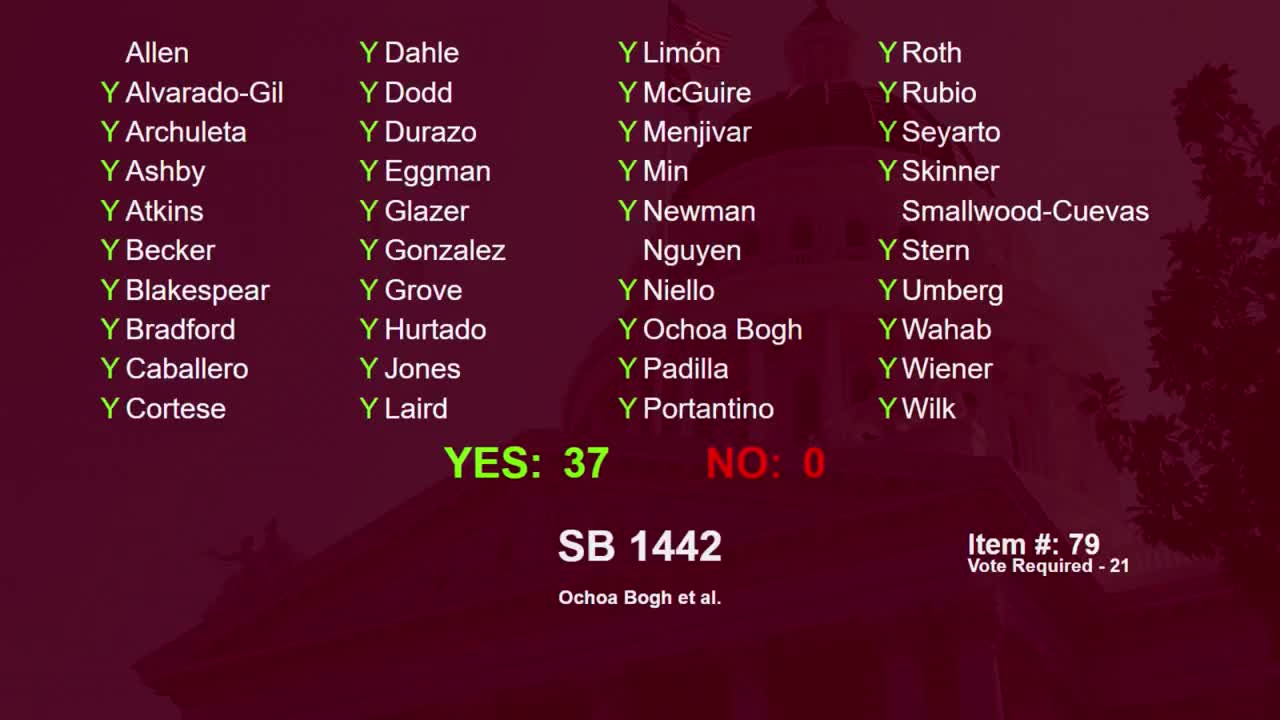 3MIN
Senate Floor
 10MIN
Senate Standing Committee on Public Safety
Bill Author