SB 243: Sales and Use Tax Law: exemption: gun safety systems.
- Session Year: 2023-2024
- House: Senate
- Latest Version Date: 2023-01-25
Current Status:
Failed
(2023-11-29: Returned to Secretary of Senate pursuant to Joint Rule 62(a).)
Introduced
In Committee
First Chamber
In Committee
Second Chamber
Enacted
Existing state sales and use tax laws impose a tax on retailers measured by the gross receipts from the sale of tangible personal property sold at retail in this state, or on the storage, use, or other consumption in this state of tangible personal property purchased from a retailer for storage, use, or other consumption in this state. The Sales and Use Tax Law provides various exemptions from those taxes.
This bill would, until January 1, 2028, exempt from those taxes the gross receipts from the sale in this state of, and the storage, use, or other consumption in this state of, a gun safety system, as defined.
Existing law requires a bill authorizing a new tax expenditure to contain, among other things, specific goals, purposes, and objectives that the tax expenditure will achieve, detailed performance indicators, and data collection requirements.
This bill would make findings detailing the goals of the above-described tax expenditure and performance indicators for determining whether the tax expenditure meets those goals.
The Bradley-Burns Uniform Local Sales and Use Tax Law authorizes counties and cities to impose local sales and use taxes in conformity with the Sales and Use Tax Law, and existing laws authorize districts, as specified, to impose transactions and use taxes in accordance with the Transactions and Use Tax Law, which generally conforms to the Sales and Use Tax Law. Amendments to the Sales and Use Tax Law are automatically incorporated into the local tax laws.
This bill would provide that exemption created by the bill does not apply to local sales and use taxes or transactions and use taxes.
Existing law imposes or dedicates certain state sales and use tax rates for local funding, including through the Local Revenue Fund 2011.
This bill would provide that the exemption created by the bill does not apply to those state sales and use tax rates imposed or dedicated for local government funding, including those rates for which revenues are deposited into the Local Revenue Fund 2011.
This bill would take effect immediately as a tax levy.
(a)There are exempted from the taxes imposed by this part the gross receipts from the sale in this state of, and the storage, use, or other consumption in this state of, a gun safety system.
(b)For purposes of this section, gun safety system means any of the following:
(1)A gun safe, as defined in Section 16610 of the Penal Code.
(2)A firearm safety device, as defined in Section 16540 of the Penal Code.
(3)A long-gun safe, as defined in Section 16870 of the Penal Code.
(c)(1)Notwithstanding any provision of the Bradley-Burns Uniform Local Sales and Use Tax Law (Part 1.5 (commencing with Section 7200)) or the Transactions and Use Tax Law (Part 1.6 (commencing with Section 7251)), the exemption established by subdivision (a) does not apply with respect to any tax levied pursuant to, or in accordance with, either of those laws.
(2)Notwithstanding subdivision (a), the exemption established by this section shall not apply with respect to any tax levied pursuant to Section 6051.2 or 6201.2, pursuant to Section 35 of Article XIII of the California Constitution, or any tax levied pursuant to Section 6051 or 6201 that is deposited in the State Treasury to the credit of the Local Revenue Fund 2011 pursuant to Section 6051.15 or 6201.15.
(d)For purposes of complying with Section 41 of the Revenue and Taxation Code, the Legislature finds and declares all of the following:
(1)The specific goal of the exemption provided by this section is to reduce unauthorized access to firearms by incentivizing greater access to high quality gun safety devices and storage.
(2)The performance indicator for the Legislature to use in determining if the tax exemption achieves the goal stated in paragraph (1) is whether there is a decrease in crimes committed with unsecured firearms accessed by an unauthorized person during the operational period of the exemption.
(e)This section shall become inoperative on January 1, 2028, and as of that date is repealed.
SEC. 2.This act provides for a tax levy within the meaning of Article IV of the California Constitution and shall go into immediate effect.
|
Date
|
Status
|
|---|---|
| Nov 29, 2023 | Returned to Secretary of Senate pursuant to Joint Rule 62(a). |
| May 3, 2023 | May 3 set for first hearing. Failed passage in committee. (Ayes 2. Noes 2. Page 992.) |
| Apr 20, 2023 | Set for hearing May 3. |
| Feb 1, 2023 | Referred to Com. on GOV. & F. |
| Jan 26, 2023 | From printer. May be acted upon on or after February 25. |
| Jan 25, 2023 | Introduced. Read first time. To Com. on RLS. for assignment. To print. |
|
Date
|
Description
|
Location
|
Votes
|
|
|---|---|---|---|---|
| May 3, 2023 | Do pass, but first be re-referred to the Committee on [Appropriations] | Senate Standing Committee on Governance and Finance |
Failed |
This list shows positions taken on this bill by organizations on the date displayed, which is linked to the original source.
Positions by individuals are not included.
|
Organization
|
Position
|
Date
|
|---|---|---|
| California Teachers Association | ** Against |
SENATE COMMITTEE ON GOVERNANCE AND FINANCE
Senator Anna M. Caballero, Chair
2023 - 2024 Regular
Bill No: | SB 243 | Hearing Date: | 5/3/23 |
Author: | Seyarto | Tax Levy: | Yes |
Version: | 1/25/23 | Fiscal: | Yes |
Consultant: | Grinnell | ||
Sales and Use Tax Law: exemption: gun safety systems
Enacts a state General Fund-only (3.9375%) sales and use tax exemption for the purchase of a gun safety system, as defined.
Background
Tax expenditures. California law allows various income tax credits, deductions, exemptions, and exclusions. The Legislature enacts such tax incentives either to compensate taxpayers for incurring certain expenses, such as child adoption, or to influence certain behavior, such as charitable giving. The Legislature uses tax incentives to encourage taxpayers to do something that they would otherwise not do, but for the tax credit. The Department of Finance is required annually to publish a list of tax expenditures, currently totaling around $87 billion per year.
Sales and Use Tax. State law imposes the sales tax on every retailer engaged in business in this state that sells tangible personal property, and requires them to collect the appropriate tax from the purchase and remit the amount to the California Department of Tax and Fee Administration (CDTFA). Sales tax applies whenever a retail sale is made, which is basically any sale other than one for resale in the regular course of business. Unless the person pays the sales tax to the retailer, he or she is liable for the use tax, which is imposed on any person consuming tangible personal property in the state. The use tax rate is the same rate as the sales tax rate, and must be remitted on or before the last day of the month following the quarterly period in which the person made the purchase. The current rate is 7.25% in the table below. Additionally, cities and counties may increase the sales and use tax rate up to 2% for either specific or general purposes pursuant to the California Constitution’s vote requirements.
Rate | Jurisdiction | Purpose/Authority | |
|---|---|---|---|
3.9375% | State (General Fund) | State general purposes | |
1.0625% |
| Realignment of local public safety services | |
0.50% | State (Local Revenue Fund) | Local governments to fund health and welfare programs | |
0.50% | State (Local Public Safety Fund) | Local governments to fund public safety services | |
1.25% | Local (City/County) 1.00% City and County | City and county general operations. Dedicated to county transportation purposes | |
7.25% | Total Statewide Rate |
Many items are fully exempted from the sales and use tax in California (prescription drugs, food, poultry litter), while others are exempted from the state sales tax, but not the local share, such as farm equipment and machinery, diesel fuel used for farming and food processing, teleproduction and postproduction equipment, timber harvesting equipment and machinery, and racehorse breeding stock.
Firearms sales. According to safehome.org, after a record year in 2020, gun sales in the U.S. dipped slightly in 2021. Still, with nearly 19 million guns sold, 2021 was the second-highest year for gun sales in the U.S. — behind only 2020, when estimated gun sales topped 21 million. Total estimated gun sales fell 13 percent between 2020 and 2021, but they remained higher than they were in 2019. The total number of guns sold in 2021 is more than double the number sold in 2001; sales in the U.S. rose by about 155 percent between 2002 and 2021. No state had more gun sales in 2021 than Texas, where an estimated 1.6 million firearms were sold in the nation’s second-largest state. Florida followed closely with 1.4 million firearms sold, with California in third place at 1.096 million, although its per capita sales are lower than most states.
Arguing that many currently owned firearms are not stored safely, the author wants to encourage the purchase of firearms safety devices by exempting their purchase from the sales and use tax.
Proposed Law
Senate Bill 243 enacts a state General Fund-only (3.9375%) sales and use tax exemption for a gun safety system, defined as:
- A gun safe.
- A firearm safety device.
- A long-gun safe.
The bill further defines these terms by reference to the Penal Code. The measure sunsets on January 1, 2028, and includes legislative findings and declarations to comply with Section 41 of the Revenue and Taxation Code.
State Revenue Impact
Pending.
Comments
1. Purpose of the bill. According to the author, “Increasing the use of firearms safety devices (FSDs) is a non-controversial way to prevent acts of gun violence, including suicide and gun crimes, resulting from theft and misuse. Similar policies have passed in legislatures of different partisan balances on bipartisan lines in Maine, Texas, and Tennessee. Here in California the legislature has passed laws increasing penalties against negligent firearms owners and even mandated the ownership of a FSD when purchasing a firearm. Even with regulations, the quality and type of FSDs varies heavily and depends on user preference. Despite the efforts of the legislature, research from state funded researchers indicates only one third of firearms are stored in the most secure manner. SB 243 provides a small incentive in combination with California’s other laws which is an easy way to educate new gun owners, save lives, and prevent tragedy by preventing unauthorized access to firearms.”
2. Windfall? Tax expenditures produce two different outcomes. First, they reward behavior that would have occurred without the tax benefit, referred to as windfall benefit. Second, they generate certain activity that would not have occurred but for the tax benefit In this case, the Penal Code already requires any firearm sold or transferred in the state to include or be accompanied by a FSD listed on a roster identified by the Department of Justice, unless the purchaser can show that they own a gun safe. As a result, SB 243 grants a tax incentive to comply with existing law. While the measure’s incentive would apply if purchasers wanted to buy more or superior safety devices than those that meet the requirement at the time of sale or transfer, the Committee may wish to consider the incentive effects of SB 243 given requirements in current law.
3. Related legislation. Last year, the Committee approved AB 1227 (Levine), which imposed an excise tax on firearms and ammunition sold in the state on firearms dealers and ammunition vendors to fund gun violence prevention programs, education, and research. The bill died on the Senate Floor.
4. Section 41. Section 41 of the Revenue and Taxation Code, requires any bill authorizing a new tax expenditure to contain, among other things, specific goals, purposes, and objectives that the tax expenditure will achieve, and detailed performance indicators, along with data collection and reporting requirements (SB 1335, Leno, 2014). To comply with Section 41, SB 243:
- States that its goal is to reduce unauthorized access to firearms by incentivizing greater access to high quality gun safety devices and storage.
- Provides that the performance indicator for the Legislature to use in determining if the tax exemption achieves its goal is whether there is a decrease in crimes committed with unsecured firearms accessed by an unauthorized person during the operational period of the exemption.
The measure does not specify the source of the data where a decrease in crimes can be identified, or identify which entity should collect it.
Support and Opposition
(4/28/23)
Support: None submitted.
Opposition: California Teachers Association
-- END --
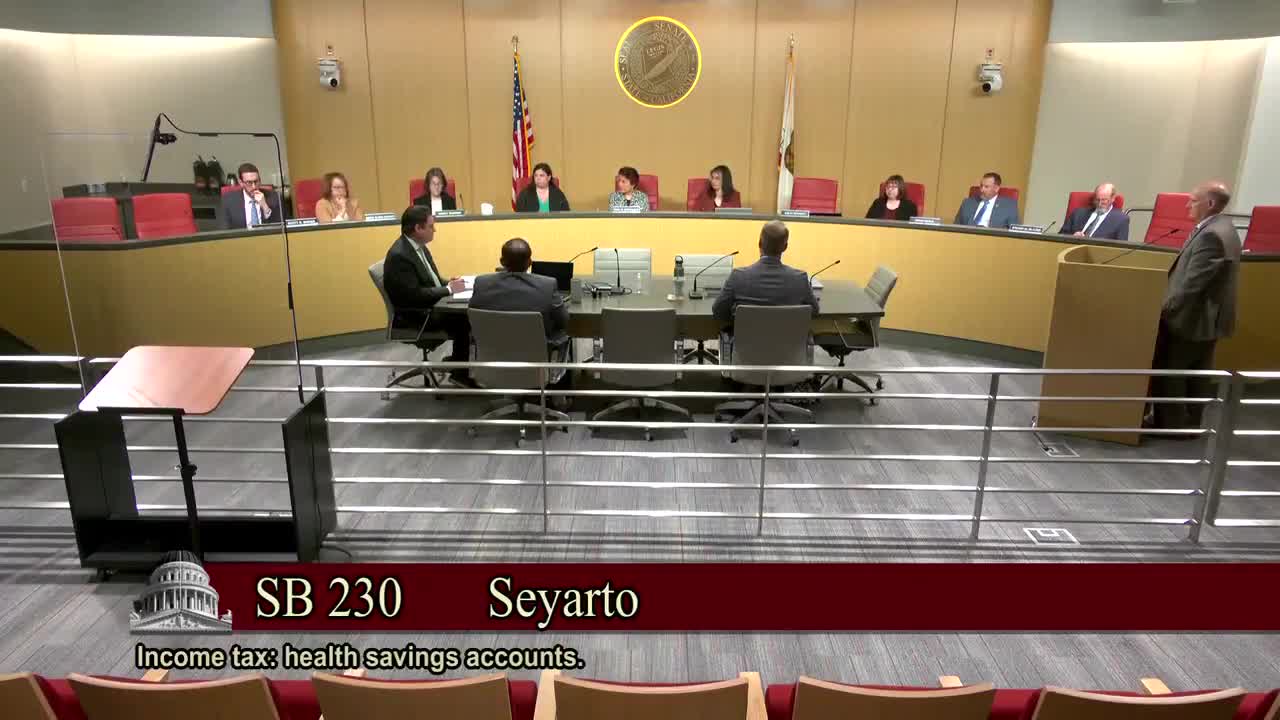
Discussed in Hearing
 8MIN
Senate Standing Committee on Governance and Finance
Bill Author
Bill Co-Author(s):