SB 253: Climate Corporate Data Accountability Act.
- Session Year: 2023-2024
- House: Senate
- Latest Version Date: 2023-10-07
Current Status:
Passed
(2023-10-07: Chaptered by Secretary of State. Chapter 382, Statutes of 2023.)
Introduced
In Committee
First Chamber
In Committee
Second Chamber
Enacted
The California Global Warming Solutions Act of 2006 requires the State Air Resources Board to adopt regulations to require the reporting and verification of statewide greenhouse gas emissions and to monitor and enforce compliance with the act. The act requires the state board to make available, and update at least annually, on its internet website the emissions of greenhouse gases, criteria pollutants, and toxic air contaminants for each facility that reports to the state board, as provided.
This bill would require the state board, on or before January 1, 2025, to develop and adopt regulations requiring specified partnerships, corporations, limited liability companies, and other business entities with total annual revenues in excess of $1,000,000,000 and that do business in California, defined as reporting entities, to publicly disclose to the emissions reporting organization, as defined, and obtain an assurance engagement on, starting in 2026 on a date to be determined by the state board, and annually thereafter, their scope 1 and scope 2 greenhouse gas emissions, as defined, and, starting in 2027 and annually thereafter, their scope 3 greenhouse gas emissions, as defined, from the reporting entitys prior fiscal year, as provided. The bill would require the state board to review during 2029, and update as necessary on or before January 1, 2030, these deadlines to evaluate trends in scope 3 emissions reporting and to consider changes to the deadlines, as provided. The bill would require a reporting entity to obtain an assurance engagement, performed by an independent third-party assurance provider, of the entitys public disclosure as provided. The bill would require the state board, in developing these regulations, to consult with the Attorney General, other government stakeholders, investors, stakeholders representing consumer and environmental justice interests, and reporting entities that have demonstrated leadership in full-scope greenhouse gas emissions accounting and public disclosure and greenhouse gas emissions reductions. The bill would also require the state board to ensure that the assurance process minimizes the need for reporting entities to engage multiple assurance providers and ensures sufficient assurance provider capacity, as well as timely reporting implementation, as required. The bill would further require the state board to contract with an emissions reporting organization to develop a reporting program to receive and make publicly available the required disclosures. The bill would authorize the state board, starting in 2033 and every 5 years thereafter, to assess the global greenhouse gas accounting and reporting standards and to adopt an alternative standard if it determines that using the alternative standard would more effectively further the goals of the bill.
This bill would require the state board, on or before July 1, 2027, to contract with the University of California, the California State University, a national laboratory, or another equivalent academic institution to prepare a report on the public disclosures made by reporting entities to the emissions reporting organization. The bill would require, in preparing the report, consideration to be given to, at a minimum, greenhouse gas emissions from reporting entities in the context of state greenhouse gas emissions reduction and climate goals. The bill would require the state board to provide the report to the emissions reporting organization to post on a digital platform that would be required to be created by the emissions reporting organization, and publicly accessible, to house the state boards report and the reporting entities public disclosures. The bill would require the emissions reporting organization to provide the state boards report to the relevant policy committees of the Legislature.
This bill would require a reporting entity, upon filing its disclosure, to pay to the state board an annual fee set by the state board, as provided. The bill would create the Climate Accountability and Emissions Disclosure Fund, require the proceeds of the fees to be deposited in the fund, and continuously appropriate the moneys in the fund to the state board for purposes of the bill. By creating a continuously appropriated fund, the bill would create an appropriation. The bill would require the state board to adopt regulations that authorize it to seek administrative penalties for violations of these provisions, as specified.
The California Global Warming Solutions Act of 2006 requires the State Air Resources Board to adopt regulations to require the reporting and verification of statewide greenhouse gas emissions and to monitor and enforce compliance with the act. The act requires the state board to make available, and update at least annually, on its internet website the emissions of greenhouse gases, criteria pollutants, and toxic air contaminants for each facility that reports to the state board, as provided.
This bill would require the state board, on or before January 1, 2025, to develop and adopt regulations requiring specified partnerships, corporations, limited liability companies, and other business entities with total annual revenues in excess of $1,000,000,000 and that do business in California, defined as reporting entities, to publicly disclose to the emissions reporting organization, as defined, and obtain an assurance engagement on, starting in 2026 on a date to be determined by the state board, and annually thereafter, their scope 1 and scope 2 greenhouse gas emissions, as defined, and, starting in 2027 and annually thereafter, their scope 3 greenhouse gas emissions, as defined, from the reporting entitys prior fiscal year, as provided. The bill would require the state board to review during 2029, and update as necessary on or before January 1, 2030, these deadlines to evaluate trends in scope 3 emissions reporting and to consider changes to the deadlines, as provided. The bill would require a reporting entity to obtain an assurance engagement, performed by an independent third-party assurance provider, of the entitys public disclosure as provided. The bill would require the state board, in developing these regulations, to consult with the Attorney General, other government stakeholders, investors, stakeholders representing consumer and environmental justice interests, and reporting entities that have demonstrated leadership in full-scope greenhouse gas emissions accounting and public disclosure and greenhouse gas emissions reductions. The bill would also require the state board to ensure that the assurance process minimizes the need for reporting entities to engage multiple assurance providers and ensures sufficient assurance provider capacity, as well as timely reporting implementation, as required. The bill would further require the state board to contract with an emissions reporting organization to develop a reporting program to receive and make publicly available the required disclosures. The bill would authorize the state board, starting in 2033 and every 5 years thereafter, to assess the global greenhouse gas accounting and reporting standards and to adopt an alternative standard if it determines that using the alternative standard would more effectively further the goals of the bill.
This bill would require the state board, on or before July 1, 2027, to contract with the University of California, the California State University, a national laboratory, or another equivalent academic institution to prepare a report on the public disclosures made by reporting entities to the emissions reporting organization. The bill would require, in preparing the report, consideration to be given to, at a minimum, greenhouse gas emissions from reporting entities in the context of state greenhouse gas emissions reduction and climate goals. The bill would require the state board to provide the report to the emissions reporting organization to post on a digital platform that would be required to be created by the emissions reporting organization, and publicly accessible, to house the state boards report and the reporting entities public disclosures. The bill would require the emissions reporting organization to provide the state boards report to the relevant policy committees of the Legislature.
This bill would require a reporting entity, upon filing its disclosure, to pay to the state board an annual fee set by the state board, as provided. The bill would create the Climate Accountability and Emissions Disclosure Fund, require the proceeds of the fees to be deposited in the fund, and continuously appropriate the moneys in the fund to the state board for purposes of the bill. By creating a continuously appropriated fund, the bill would create an appropriation. The bill would require the state board to adopt regulations that authorize it to seek administrative penalties for violations of these provisions, as specified.
The California Global Warming Solutions Act of 2006 requires the State Air Resources Board to adopt regulations to require the reporting and verification of statewide greenhouse gas emissions and to monitor and enforce compliance with the act. The act requires the state board to make available, and update at least annually, on its internet website the emissions of greenhouse gases, criteria pollutants, and toxic air contaminants for each facility that reports to the state board, as provided.
This bill would require the state board, on or before January 1, 2025, to develop and adopt regulations requiring specified partnerships, corporations, limited liability companies, and other business entities with total annual revenues in excess of $1,000,000,000 and that do business in California, defined as reporting entities, to publicly disclose to the emissions reporting organization, as defined, and obtain an assurance engagement on, starting in 2026 on a date to be determined by the state board, and annually thereafter, their scope 1 and scope 2 greenhouse gas emissions, as defined, and, starting in 2027 and annually thereafter, their scope 3 greenhouse gas emissions, as defined, from the reporting entitys prior fiscal year, as provided. The bill would require the state board to review during 2029, and update as necessary on or before January 1, 2030, these deadlines to evaluate trends in scope 3 emissions reporting and to consider changes to the deadlines, as provided. The bill would require a reporting entity to obtain an assurance engagement, performed by an independent third-party assurance provider, of the entitys public disclosure as provided. The bill would require the state board, in developing these regulations, to consult with the Attorney General, other government stakeholders, investors, stakeholders representing consumer and environmental justice interests, and reporting entities that have demonstrated leadership in full-scope greenhouse gas emissions accounting and public disclosure and greenhouse gas emissions reductions. The bill would also require the state board to ensure that the assurance process minimizes the need for reporting entities to engage multiple assurance providers and ensures sufficient assurance provider capacity, as well as timely reporting implementation, as required. The bill would further require the state board to contract with an emissions reporting organization to develop a reporting program to receive and make publicly available the required disclosures. The bill would authorize the state board, starting in 2033 and every 5 years thereafter, to assess the global greenhouse gas accounting and reporting standards and to adopt an alternative standard if it determines that using the alternative standard would more effectively further the goals of the bill.
This bill would require the state board, on or before July 1, 2027, to contract with the University of California, the California State University, a national laboratory, or another equivalent academic institution to prepare a report on the public disclosures made by reporting entities to the emissions reporting organization. The bill would require, in preparing the report, consideration to be given to, at a minimum, greenhouse gas emissions from reporting entities in the context of state greenhouse gas emissions reduction and climate goals. The bill would require the state board to provide the report to the emissions reporting organization to post on a digital platform that would be required to be created by the emissions reporting organization, and publicly accessible, to house the state boards report and the reporting entities public disclosures. The bill would require the emissions reporting organization to provide the state boards report to the relevant policy committees of the Legislature.
This bill would require a reporting entity, upon filing its disclosure, to pay to the state board an annual fee set by the state board, as provided. The bill would create the Climate Accountability and Emissions Disclosure Fund, require the proceeds of the fees to be deposited in the fund, and continuously appropriate the moneys in the fund to the state board for purposes of the bill. By creating a continuously appropriated fund, the bill would create an appropriation. The bill would require the state board to adopt regulations that authorize it to seek administrative penalties for violations of these provisions, as specified.
The California Global Warming Solutions Act of 2006 requires the State Air Resources Board to adopt regulations to require the reporting and verification of statewide greenhouse gas emissions and to monitor and enforce compliance with the act. The act requires the state board to make available, and update at least annually, on its internet website the emissions of greenhouse gases, criteria pollutants, and toxic air contaminants for each facility that reports to the state board, as provided.
This bill would require the state board, on or before January 1, 2025, to develop and adopt regulations requiring specified partnerships, corporations, limited liability companies, and other business entities with total annual revenues in excess of $1,000,000,000 and that do business in California, defined as reporting entities, to publicly disclose to the emissions reporting organization, as defined, and verify, obtain an assurance engagement on, starting in 2026 on a date to be determined by the state board, and annually thereafter, their scope 1 and scope 2 greenhouse gas emissions, as defined, and, starting in 2027 and annually thereafter, their scope 3 greenhouse gas emissions, as defined, from the specified reporting entitys prior fiscal year, as provided. The bill would require the state board to review during 2029, and update as necessary on or before January 1, 2030, these deadlines to evaluate trends in scope 3 emissions reporting and to consider changes to the deadlines, as provided. The bill would require reporting entities to disclose their greenhouse gas emissions in a manner that is easily understandable and accessible to residents of the state. The bill would require reporting entities to ensure that their public disclosures have been independently verified by a third-party auditor, a reporting entity to obtain an assurance engagement, performed by an independent third-party assurance provider, of the entitys public disclosure as provided. The bill would require the state board, in developing these regulations, to consult with the Attorney General, other government stakeholders, investors, stakeholders representing consumer and environmental justice interests, and reporting entities that have demonstrated leadership in full-scope greenhouse gas emissions accounting and public disclosure and greenhouse gas emissions reductions. The bill would also require the state board to ensure that the verification assurance process minimizes the need for reporting entities to engage multiple auditors assurance providers and ensures sufficient auditor assurance provider capacity, as well as timely reporting implementation, as required. The bill would further require the state board to contract with an emissions reporting organization to develop a reporting program to receive and make publicly available the required disclosures. The bill would authorize the state board, starting in 2033 and every 5 years thereafter, to assess the global greenhouse gas accounting and reporting standards and to adopt an alternative standard if it determines that using the alternative standard would more effectively further the goals of the bill.
This bill would require the state board, on or before July 1, 2027, to contract with the University of California, the California State University, a national laboratory, or another equivalent academic institution to prepare a report on the public disclosures made by reporting entities to the emissions reporting organization. The bill would require, in preparing the report, consideration to be given to, at a minimum, greenhouse gas emissions from reporting entities in the context of state greenhouse gas emissions reduction and climate goals. The bill would require the state board to provide the report to the emissions reporting organization to post on a digital platform that would be required to be created by the emissions reporting organization, and publicly accessible, to house the state boards report and the reporting entities public disclosures. The bill would require the emissions reporting organization to provide the state boards report to the relevant policy committees of the Legislature.
This bill would require reporting entities to pay an annual fee, not to exceed $1,000, for the reasonable regulatory costs of the state board for the administration and implementation of these provisions. a reporting entity, upon filing its disclosure, to pay to the state board an annual fee set by the state board, as provided. The bill would create the Climate Accountability and Emissions Disclosure Fund, require the proceeds of the fees to be deposited in the fund, and continuously appropriate the moneys in the fund to the state board for purposes of the bill. By creating a continuously appropriated fund, the bill would create an appropriation. The bill would require the state board to adopt regulations that authorize it to seek administrative penalties for violations of these provisions, as specified.
The California Global Warming Solutions Act of 2006 requires the State Air Resources Board to adopt regulations to require the reporting and verification of statewide greenhouse gas emissions and to monitor and enforce compliance with the act. The act requires the state board to make available, and update at least annually, on its internet website the emissions of greenhouse gases, criteria pollutants, and toxic air contaminants for each facility that reports to the state board, as provided.
This bill would require the state board, on or before January 1, 2025, to develop and adopt regulations requiring specified partnerships, corporations, limited liability companies, and other business entities with total annual revenues in excess of $1,000,000,000 and that do business in California, defined as reporting entities, to publicly disclose to the emissions reporting organization, as defined, and verify, starting in 2026 on a date to be determined by the state board, and annually thereafter, their scope 1 and scope 2 greenhouse gas emissions, as defined, and, starting in 2027 and annually thereafter, their scope 3 greenhouse gas emissions, as defined, from the specified fiscal year, as provided. The bill would require the state board to review during 2029, and update as necessary on or before January 1, 2030, these deadlines to evaluate trends in scope 3 emissions reporting and to consider changes to the deadlines, as provided. The bill would require reporting entities to disclose their greenhouse gas emissions in a manner that is easily understandable and accessible to residents of the state. The bill would require reporting entities to ensure that their public disclosures have been independently verified by a third-party auditor, as provided. The bill would require the state board, in developing these regulations, to consult with the Attorney General, other government stakeholders, investors, stakeholders representing consumer and environmental justice interests, and reporting entities that have demonstrated leadership in full-scope greenhouse gas emissions accounting and public disclosure and greenhouse gas emissions reductions. The bill would also require the state board to ensure that the verification process minimizes the need for reporting entities to engage multiple auditors and ensures sufficient auditor capacity, as well as timely reporting implementation, as required. The bill would further require the state board to contract with an emissions reporting organization to develop a reporting program to receive and make publicly available the required disclosures.
This bill would require the state board, on or before July 1, 2027, to contract with the University of California, the California State University, a national laboratory, or another equivalent academic institution to prepare a report on the public disclosures made by reporting entities to the emissions reporting organization. The bill would require, in preparing the report, consideration to be given to, at a minimum, greenhouse gas emissions from reporting entities in the context of state greenhouse gas emissions reduction and climate goals. The bill would require the state board to provide the report to the emissions reporting organization to post on a digital platform that would be required to be created by the emissions reporting organization, and publicly accessible, to house the state boards report and the reporting entities public disclosures. The bill would require the emissions reporting organization to provide the state boards report to the relevant policy committees of the Legislature.
This bill would require reporting entities to pay an annual fee, not to exceed $1,000, for the reasonable regulatory costs of the state board for the administration and implementation of these provisions. The bill would create the Climate Accountability and Emissions Disclosure Fund, require the proceeds of the fees to be deposited in the fund, and continuously appropriate the moneys in the fund to the state board for purposes of the bill. By creating a continuously appropriated fund, the bill would create an appropriation. The bill would require the state board to adopt regulations that authorize it to seek administrative penalties for violations of these provisions, as specified.
The California Global Warming Solutions Act of 2006 requires the State Air Resources Board to adopt regulations to require the reporting and verification of statewide greenhouse gas emissions and to monitor and enforce compliance with the act. The act requires the state board to make available, and update at least annually, on its internet website the emissions of greenhouse gases, criteria pollutants, and toxic air contaminants for each facility that reports to the state board, as provided.
This bill would require the state board, on or before January 1, 2025, to develop and adopt regulations requiring specified partnerships, corporations, limited liability companies, and other business entities with total annual revenues in excess of $1,000,000,000 and that do business in California, defined as reporting entities, to publicly disclose to the emissions reporting organization, as defined, and verify, starting in 2026 on a date to be determined by the state board, and annually thereafter, their greenhouse gas emissions, categorized as scope 1, 2, and 3 emissions, as defined, scope 1 and scope 2 greenhouse gas emissions, as defined, and, starting in 2027 and annually thereafter, their scope 3 greenhouse gas emissions, as defined, from the specified calendar fiscal year, as provided. The bill would require the state board, on or before January 1, 2030, to review, and update as necessary, board to review during 2029, and update as necessary on or before January 1, 2030, these deadlines to evaluate trends in scope 3 emissions reporting and to consider changes to the deadlines, as provided. The bill would require reporting entities to disclose their greenhouse gas emissions in a manner that is easily understandable and accessible to residents of the state. The bill would require reporting entities to ensure that their public disclosures have been independently verified by a third-party auditor approved by the state board. auditor, as provided. The bill would require the state board, in developing these regulations, to consult with the Attorney General, other government stakeholders, investors, stakeholders representing consumer and environmental justice interests, and reporting entities that have demonstrated leadership in full-scope greenhouse gas emissions accounting and public disclosure and greenhouse gas emissions reductions. The bill would also require the state board to ensure that the verification process minimizes the need for reporting entities to engage multiple auditors and ensures sufficient auditor capacity, as well as timely reporting implementation, as required. The bill would further require the state board to contract with an emissions reporting organization to develop a reporting program to receive and make publicly available the required disclosures.
This bill would require the state board, on or before July 1, 2027, to contract with the University of California, the California State University, a national laboratory, or another equivalent academic institution to prepare a report on the public disclosures made by reporting entities to the emissions reporting organization. The bill would require, in preparing the report, consideration to be given to, at a minimum, greenhouse gas emissions from reporting entities in the context of state greenhouse gas emissions reduction and climate goals. The bill would require the state board to provide the report to the emissions reporting organization to post on a digital platform that would be required to be created by the emissions reporting organization, and publicly accessible, to house the state boards report and the reporting entities public disclosures. The bill would require the emissions reporting organization to provide the state boards report to the relevant policy committees of the Legislature.
This bill would require reporting entities to pay an annual fee, not to exceed $1,000, for the reasonable regulatory costs of the state board for the administration and implementation of these provisions. The bill would create the Climate Accountability and Emissions Disclosure Fund, require the proceeds of the fees to be deposited in the fund, and continuously appropriate the moneys in the fund to the state board for purposes of the bill. By creating a continuously appropriated fund, the bill would create an appropriation. The bill would require the state board to adopt regulations that authorize it to seek administrative penalties for violations of these provisions, as specified.
The California Global Warming Solutions Act of 2006 requires the State Air Resources Board to adopt regulations to require the reporting and verification of statewide greenhouse gas emissions and to monitor and enforce compliance with the act. The act requires the state board to make available, and update at least annually, on its internet website the emissions of greenhouse gases, criteria pollutants, and toxic air contaminants for each facility that reports to the state board, as provided.
This bill would require the state board, on or before January 1, 2025, to develop and adopt regulations requiring United States specified partnerships, corporations, limited liability companies, and other business entities with total annual revenues in excess of $1,000,000,000 and that do business in California, defined as reporting entities, to publicly disclose to the emissions registry, reporting organization, as defined, and verify, starting in 2026 on a date to be determined by the state board, and annually thereafter, their greenhouse gas emissions, categorized as scope 1, 2, and 3 emissions, as defined, from the prior specified calendar year, as provided. The bill would require the state board, on or before January 1, 2030, to review, and update as necessary, these deadlines to evaluate trends in scope 3 emissions reporting and to consider changes to the deadlines, as provided. The bill would require reporting entities to disclose their greenhouse gas emissions in a manner that is easily understandable and accessible to residents of the state. The bill would require reporting entities to ensure that their public disclosures have been independently verified by the emissions registry or a third-party auditor, auditor approved by the state board, with expertise in greenhouse gas emissions accounting. board. The bill would require the state board, in developing these regulations, to consult with the Attorney General, other government stakeholders, investors, stakeholders representing consumer and environmental justice interests, and reporting entities that have demonstrated leadership in full-scope greenhouse gas emissions accounting and public disclosure and greenhouse gas emissions reductions. The bill would also require the state board to establish auditor qualifications and a process for approval of auditors that ensure that the verification process minimizes the need for reporting entities to engage multiple auditors and ensures sufficient auditor capacity, as well as timely reporting implementation, as required. The bill would further require the state board to contract with an emissions registry reporting organization to develop a reporting and registry program to receive and make publicly available the required disclosures.
This bill would require the state board, on or before July 1, 2027, to contract with the University of California, the California State University, a national laboratory, or another equivalent academic institution to prepare a report on the public disclosures made by reporting entities to the emissions registry. reporting organization. The bill would require, in preparing the report, consideration to be given to, at a minimum, greenhouse gas emissions from reporting entities in the context of state greenhouse gas emissions reduction and climate goals. The bill would require the state board to provide the report to the emissions registry reporting organization to post on a digital platform that would be required to be created by the emissions registry, reporting organization, and publicly accessible, to house the state boards report and the reporting entities public disclosures. The bill would require the emissions registry reporting organization to provide the state boards report to the relevant policy committees of the Legislature.
This bill would authorize the Attorney General to bring a civil action against a reporting entity, in the name of the people of the State of California, seeking civil penalties for violations of these provisions.This bill would make implementation of these provisions contingent upon an appropriation by the Legislature in the annual Budget Act or another statute for its purposes.This bill would require reporting entities to pay an annual fee, not to exceed $1,000, for the reasonable regulatory costs of the state board for the administration and implementation of these provisions. The bill would require the state board to adopt regulations that authorize it to seek administrative penalties for violations of these provisions, as specified.
The California Global Warming Solutions Act of 2006 requires the State Air Resources Board to adopt regulations to require the reporting and verification of statewide greenhouse gas emissions and to monitor and enforce compliance with the act. The act requires the state board to make available, and update at least annually, on its internet website the emissions of greenhouse gases, criteria pollutants, and toxic air contaminants for each facility that reports to the state board, as provided.
This bill would require the state board, on or before January 1, 2025, to develop and adopt regulations requiring United States partnerships, corporations, limited liability companies, and other business entities with total annual revenues in excess of $1,000,000,000 and that do business in California, defined as reporting entities, to publicly disclose to the emissions registry, as defined, and verify, starting in 2026 on a date to be determined by the state board, and annually thereafter, their greenhouse gas emissions, categorized as scope 1, 2, and 3 emissions, as defined, from the prior calendar year, as provided. The bill would require the state board, on or before January 1, 2030, to review, and update as necessary, these deadlines to evaluate trends in scope 3 emissions reporting and to consider changes to the deadlines, as provided. The bill would require reporting entities to disclose their greenhouse gas emissions in a manner that is easily understandable and accessible to residents of the state. The bill would require reporting entities to ensure that their public disclosures have been independently verified by the emissions registry or a third-party auditor, approved by the state board, with expertise in greenhouse gas emissions accounting. The bill would require the state board, in developing these regulations, to consult with the Attorney General, other government stakeholders, investors, stakeholders representing consumer and environmental justice interests, and reporting entities that have demonstrated leadership in full-scope greenhouse gas emissions accounting and public disclosure and greenhouse gas emissions reductions. The bill would also require the state board to establish auditor qualifications and a process for approval of auditors that ensures sufficient auditor capacity, as well as timely reporting implementation, as required. The bill would further require the state board to contract with an emissions registry to develop a reporting and registry program to receive and make publicly available the required disclosures.
This bill would require the state board, on or before July 1, 2027, to contract with the University of California, the California State University, a national laboratory, or another equivalent academic institution to prepare a report on the public disclosures made by reporting entities to the emissions registry. The bill would require, in preparing the report, consideration to be given to, at a minimum, greenhouse emissions from reporting entities in the context of state greenhouse gas emissions reduction and climate goals. The bill would require the state board to provide the report to the emissions registry to post on a digital platform that would be required to be created by the emissions registry, and publicly accessible, to house the state boards report and the reporting entities public disclosures. The bill would require the emissions registry to provide the state boards report to the relevant policy committees of the Legislature.
This bill would authorize the Attorney General to bring a civil action against a reporting entity, in the name of the people of the State of California, seeking civil penalties for violations of these provisions.
This bill would make implementation of these provisions contingent upon an appropriation by the Legislature in the annual Budget Act or another statute for its purposes.
The Legislature finds and declares all of the following:
(a)California has demonstrated its leadership in the battle against climate change and the climate actions of the state have inspired and contributed to bold actions in other states and across the globe.
(b)Californians are already facing devastating wildfires, sea level rise, drought, and other impacts associated with climate change that threaten the health and safety of Californians, undermines the sustainability of our communities, particularly those communities most affected by the negative effects of climate change, and the economic well-being of the state and its residents, including threatening many of the states largest industries.
(c)Climate change also poses a significant risk to companies long-term economic success and disrupts the value chains on which they rely. Managing these risks requires investments in decarbonization strategies that unlock emissions reductions and provide economic benefits for Californians and the state economy.
(d)California has achieved record economic growth, is on track to be the fourth largest economy in the world, and is a highly desirable market for the globes most profitable companies.
(e)California investors, consumers, and other stakeholders deserve transparency from companies regarding their greenhouse gas (GHG) emissions to inform their decisionmaking.
(f)United States companies that have access to Californias tremendously valuable consumer market by virtue of exercising their corporate franchise in the state also share responsibility for disclosing their contributions to global GHG emissions.
(g)Companies can increase the states climate risk through emissions activities that include, but are not limited to, company operations, supply chain activities, employee and consumer transportation, goods production and movement, construction, land use, and natural resource extraction.
(h)Accurate and comprehensive data that is subject to an assurance engagement performed by an independent third-party assurance provider is required to determine a companys direct and indirect GHG emissions, also known as its carbon footprint, and to effectively identify the sources of the emissions and develop means to reduce the same.
(i)The current approach for disclosure of climate emissions from public and private corporate enterprises relies largely on voluntary reporting of GHG inventories, goals, commitments, and agreements, and lacks the full transparency and consistency needed by residents and financial markets to fully understand these climate risks.
(j)The people, communities, and other stakeholders in California, facing the existential threat of climate change, have a right to know about the sources of carbon pollution, as measured by the comprehensive GHG emissions data of those companies benefiting from doing business in the state, in order to make informed decisions.
(k)The Greenhouse Gas Protocol is the globally recognized GHG emissions accounting and reporting standard developed and updated by the World Resources Institute and the World Business Council for Sustainable Development and provides the framework for corporate GHG emissions accounting and reporting. The framework defines and categorizes emissions as scopes 1, 2, and 3 emissions. Many companies already partially or fully disclose their emissions data.
(l)Mandating annual, full-scope GHG emissions data reporting to the emissions reporting organization for all United States companies with total annual revenues in excess of $1,000,000,000 that do business in California, as well as ensuring public access to the data in a manner that is easily understandable and accessible, will inform investors, empower consumers, and activate companies to improve risk management in order to move towards a net-zero carbon economy and is a critical next step that California must take to protect the state and its residents.
SEC. 2.Section 38532 is added to the Health and Safety Code, to read:38532.(a)This section shall be known, and may be cited, as the Climate Corporate Data Accountability Act.
(b)For purposes of this section, the following terms have the following definitions:
(1)Emissions reporting organization means a nonprofit emissions reporting organization contracted by the state board pursuant to paragraph (2) of subdivision (c) that both:
(A)Currently operates a greenhouse gas emission reporting organization for organizations operating in the United States.
(B)Has experience with greenhouse gas emissions disclosure by entities operating in California.
(2)Reporting entity means a partnership, corporation, limited liability company, or other business entity formed under the laws of this state, the laws of any other state of the United States or the District of Columbia, or under an act of the Congress of the United States with total annual revenues in excess of one billion dollars ($1,000,000,000) and that does business in California. Applicability shall be determined based on the reporting entitys revenue for the prior fiscal year.
(3)Scope 1 emissions means all direct greenhouse gas emissions that stem from sources that a reporting entity owns or directly controls, regardless of location, including, but not limited to, fuel combustion activities.
(4)Scope 2 emissions means indirect greenhouse gas emissions from consumed electricity, steam, heating, or cooling purchased or acquired by a reporting entity, regardless of location.
(5)Scope 3 emissions means indirect upstream and downstream greenhouse gas emissions, other than scope 2 emissions, from sources that the reporting entity does not own or directly control and may include, but are not limited to, purchased goods and services, business travel, employee commutes, and processing and use of sold products.
(c)(1)On or before January 1, 2025, the state board shall develop and adopt regulations to require a reporting entity to annually disclose to the emissions reporting organization, and obtain an assurance engagement performed by an independent third-party assurance provider on all of the reporting entitys scope 1 emissions, scope 2 emissions, and scope 3 emissions. The state board shall ensure that the regulations adopted pursuant to this subdivision require all of the following:
(A)(i)(I)That a reporting entity, starting in 2026 on or by a date to be determined by the state board, and annually thereafter on or by that date, publicly disclose to the emissions reporting organization all of the reporting entitys scope 1 emissions and scope 2 emissions for the reporting entitys prior fiscal year.
(II)That a reporting entity, starting in 2027 and annually thereafter, publicly disclose its scope 3 emissions no later than 180 days after its scope 1 emissions and scope 2 emissions are publicly disclosed to the emissions reporting organization for the prior fiscal year.
(ii)A reporting entity shall, beginning in 2026, measure and report its emissions of greenhouse gases in conformance with the Greenhouse Gas Protocol standards and guidance, including the Greenhouse Gas Protocol Corporate Accounting and Reporting Standard and the Greenhouse Gas Protocol Corporate Value Chain (Scope 3) Accounting and Reporting Standard developed by the World Resources Institute and the World Business Council for Sustainable Development, including guidance for scope 3 emissions calculations that detail acceptable use of both primary and secondary data sources, including the use of industry average data, proxy data, and other generic data in its scope 3 emissions calculations.
(iii)(I)Starting in 2033 and every five years thereafter, the state board may survey and assess currently available greenhouse gas accounting and reporting standards. At the conclusion of this assessment the state board may adopt a globally recognized alternative accounting and reporting standard if it determines its use would more effectively further the goals of this section. This review process shall include consultation with the stakeholders identified in paragraph (4).
(II)If the state board adopts an alternative accounting and reporting standard, the state board shall develop and adopt new regulations, pursuant to paragraph (1), to ensure full conformance with the new standard and reporting of scopes 1, 2, and 3 emissions and other requirements of this section.
(iv)During 2029 the state board shall review, and on or before January 1, 2030, the state board shall update as necessary, the public disclosure deadlines established pursuant to clause (i) to evaluate trends in scope 3 emissions reporting and consider changes to the disclosure deadlines to ensure that scope 3 emissions data is disclosed to the emissions reporting organization as close in time as practicable to the deadline for reporting entities to disclose scope 1 emissions and scope 2 emissions data.
(v)The reporting timelines shall consider industry stakeholder input and shall take into account the timelines by which reporting entities typically receive scope 1, scope 2, and scope 3 emissions data, as well as the capacity for an independent assurance engagement to be performed by a third-party assurance provider.
(B)That a reporting entitys public disclosure maximizes access for consumers, investors, and other stakeholders to comprehensive and detailed greenhouse gas emissions data across scopes 1, 2, and 3 emissions, as defined by this section, and is made in a manner that is easily understandable and accessible.
(C)That a reporting entitys public disclosure includes the name of the reporting entity and any fictitious names, trade names, assumed names, and logos used by the reporting entity.
(D)(i)That the emissions reporting is structured in a way that minimizes duplication of effort and allows a reporting entity to submit to the emissions reporting organization reports prepared to meet other national and international reporting requirements, including any reports required by the federal government, as long as those reports satisfy all of the requirements of this section.
(ii)Reporting entities that are required to report mandatory industrial emissions pursuant to regulations adopted pursuant to Section 38530 may provide that data with the disclosure required pursuant to this section.
(E)That a reporting entitys disclosure takes into account acquisitions, divestments, mergers, and other structural changes that can affect the greenhouse gas emissions reporting, and is disclosed in a manner consistent with the Greenhouse Gas Protocol standards and guidance or an alternative standard, if one is adopted after 2033.
(F)(i)That a reporting entity obtains an assurance engagement, performed by an independent third-party assurance provider, of their public disclosure. The reporting entity shall ensure that a copy of the complete assurance providers report on the greenhouse gas emissions inventory, including the name of the third-party assurance provider, is provided to the emissions reporting organization as part of or in connection with the reporting entitys public disclosure.
(ii)The assurance engagement for scope 1 emissions and scope 2 emissions shall be performed at a limited assurance level beginning in 2026 and at a reasonable assurance level beginning in 2030.
(iii)During 2026, the state board shall review and evaluate trends in third-party assurance requirements for scope 3 emissions. On or before January 1, 2027, the state board may establish an assurance requirement for third-party assurance engagements of scope 3 emissions. The assurance engagement for scope 3 emissions shall be performed at a limited assurance level beginning in 2030.
(iv)A third-party assurance provider shall have significant experience in measuring, analyzing, reporting, or attesting to the emission of greenhouse gasses and sufficient competence and capabilities necessary to perform engagements in accordance with professional standards and applicable legal and regulatory requirements. The assurance provider shall be able to issue reports that are appropriate under the circumstances and independent with respect to the reporting entity, and any of the reporting entitys affiliates for which it is providing the assurance report. During 2029 the state board shall review and, on or before January 1, 2030, shall update as necessary, the qualifications for third-party assurance providers based on an evaluation of trends in education relating to the emission of greenhouse gases and the qualifications of third-party assurance providers.
(v)The state board shall ensure that the assurance process minimizes the need for reporting entities to engage multiple assurance providers and ensures sufficient assurance provider capacity, as well as timely reporting implementation as required under clause (i) of subparagraph (A).
(G)(i)That a reporting entity, upon filing its disclosure, shall pay an annual fee to the state board for the administration and implementation of this section.
(ii)The state board shall set the fee established pursuant to clause (i) in an amount sufficient to cover the state boards full costs of administrating and implementing this section. The total amount of fees collected shall not exceed the state boards actual and reasonable costs to administer and implement this section.
(iii)The proceeds of the fees imposed pursuant to clause (i) shall be deposited in the Climate Accountability and Emissions Disclosure Fund, which is hereby created in the State Treasury. Notwithstanding Section 13340 of the Government Code, the money in the fund is continuously appropriated to the state board and shall be expended by the state board for the state boards activities pursuant to this section and to reimburse any outstanding loans made from other funds used to finance the initial costs of the state boards activities pursuant to this section. Moneys in the fund shall not be expended for any purpose not enumerated in this section.
(iv)The state board may adjust the fee in any year to reflect changes in the California Consumer Price Index during the prior year.
(2)The state board shall contract with an emissions reporting organization to develop a reporting program to receive and make publicly available disclosures required by this section pursuant to paragraph (1).
(3)The state board may adopt or update any other regulations that it deems necessary and appropriate to implement this section.
(4)In developing the regulations required pursuant to this subdivision, the state board shall consult with all of the following:
(A)The Attorney General.
(B)Other government stakeholders, including, but not limited to, experts in climate science and corporate carbon emissions accounting and reporting.
(C)Investors.
(D)Stakeholders representing consumer and environmental justice interests.
(E)Reporting entities that have demonstrated leadership in full-scope greenhouse gas emissions accounting and public disclosure and greenhouse gas emissions reductions.
(5)This section does not require additional reporting of emissions of greenhouse gases beyond the reporting of scope 1 emissions, scope 2 emissions, and scope 3 emissions required pursuant to the Greenhouse Gas Protocol standards and guidance or an alternative standard, if one is adopted after 2033.
(d)(1)On or before July 1, 2027, the state board shall contract with the University of California, the California State University, a national laboratory, or another equivalent academic institution to prepare a report on the public disclosures made by reporting entities to the emissions reporting organization pursuant to subdivision (c) and the regulations adopted by the state board pursuant to that subdivision. In preparing the report, consideration shall be given to, at a minimum, greenhouse gas emissions from reporting entities in the context of state greenhouse gas emissions reduction and climate goals. The entity preparing the report shall not require reporting entities to report any information beyond what is required pursuant to subdivision (c) or the regulations adopted by the state board pursuant to that subdivision.
(2)The state board shall submit the report required by this subdivision to the emissions reporting organization to be made publicly available on the digital platform required to be created by the emissions reporting organization pursuant to subdivision (e).
(e)(1)(A)The emissions reporting organization, on or before the date determined by the state board pursuant to clause (i) of subparagraph (A) of paragraph (1) of subdivision (c), shall create a digital platform, which shall be accessible to the public, that will feature the emissions data of reporting entities in conformance with the regulations adopted by the state board pursuant to subdivision (c) and the report prepared for the state board pursuant to subdivision (d). The emissions reporting organization shall make the reporting entities disclosures and the state boards report available on the digital platform within 30 days of receipt.
(B)The digital platform shall be capable of featuring individual reporting entity disclosures, and shall allow consumers, investors, and other stakeholders to view reported data elements aggregated in a variety of ways, including multiyear data, in a manner that is easily understandable and accessible to residents of the state. All data sets and customized views shall be available in electronic format for access and use by the public.
(2)The emissions reporting organization shall submit, within 30 days of receipt, the report prepared for the state board pursuant to subdivision (d) to the relevant policy committees of the Legislature.
(f)(1)Section 38580 does not apply to a violation of this section.
(2)(A)The state board shall adopt regulations that authorize it to seek administrative penalties for nonfiling, late filing, or other failure to meet the requirements of this section. The administrative penalties authorized by this section shall be imposed and recovered by the state board in administrative hearings conducted pursuant to Article 3 (commencing with Section 60065.1) and Article 4 (commencing with Section 60075.1) of Subchapter 1.25 of Chapter 1 of Division 3 of Title 17 of the California Code of Regulations. The administrative penalties imposed on a reporting entity shall not exceed five hundred thousand dollars ($500,000) in a reporting year. In imposing penalties for a violation of this section, the state board shall consider all relevant circumstances, including both of the following:
(i)The violators past and present compliance with this section.
(ii)Whether the violator took good faith measures to comply with this section and when those measures were taken.
(B) A reporting entity shall not be subject to an administrative penalty under this section for any misstatements with regard to scope 3 emissions disclosures made with a reasonable basis and disclosed in good faith.
(C)Penalties assessed on scope 3 reporting, between 2027 and 2030, shall only occur for nonfiling.
(g)This section applies to the University of California only to the extent that the Regents of the University of California, by resolution, make any of these provisions applicable to the university.
(h) The provisions of this section are severable. If any provision of this section or its application is held invalid, that invalidity shall not affect other provisions or applications that can be given effect without the invalid provision or application.
The Legislature finds and declares all of the following:
(a)California has demonstrated its leadership in the battle against climate change and the climate actions of the state have inspired and contributed to bold actions in other states and across the globe.
(b)Californians are already facing devastating wildfires, sea level rise, drought, and other impacts associated with climate change that threaten the health and safety of Californians, undermines the sustainability of our communities, particularly those communities most affected by the negative effects of climate change, and the economic well-being of the state and its residents, including threatening many of the states largest industries.
(c)Climate change also poses a significant risk to companies long-term economic success and disrupts the value chains on which they rely. Managing these risks requires investments in decarbonization strategies that unlock emissions reductions and provide economic benefits for Californians and the state economy.
(d)California has achieved record economic growth, is on track to be the fourth largest economy in the world, and is a highly desirable market for the globes most profitable companies.
(e)California investors, consumers, and other stakeholders deserve transparency from companies regarding their greenhouse gas (GHG) emissions to inform their decisionmaking.
(f)United States companies that have access to Californias tremendously valuable consumer market by virtue of exercising their corporate franchise in the state also share responsibility for disclosing their contributions to global GHG emissions.
(g)Companies can increase the states climate risk through emissions activities that include, but are not limited to, company operations, supply chain activities, employee and consumer transportation, goods production and movement, construction, land use, and natural resource extraction.
(h)Accurate and comprehensive data that is subject to an assurance engagement performed by an independent third-party assurance provider is required to determine a companys direct and indirect GHG emissions, also known as its carbon footprint, and to effectively identify the sources of the emissions and develop means to reduce the same.
(i)The current approach for disclosure of climate emissions from public and private corporate enterprises relies largely on voluntary reporting of GHG inventories, goals, commitments, and agreements, and lacks the full transparency and consistency needed by residents and financial markets to fully understand these climate risks.
(j)The people, communities, and other stakeholders in California, facing the existential threat of climate change, have a right to know about the sources of carbon pollution, as measured by the comprehensive GHG emissions data of those companies benefiting from doing business in the state, in order to make informed decisions.
(k)The Greenhouse Gas Protocol is the globally recognized GHG emissions accounting and reporting standard developed and updated by the World Resources Institute and the World Business Council for Sustainable Development and provides the framework for corporate GHG emissions accounting and reporting. The framework defines and categorizes emissions as scopes 1, 2, and 3 emissions. Many companies already partially or fully disclose their emissions data.
(l)Mandating annual, full-scope GHG emissions data reporting to the emissions reporting organization for all United States companies with total annual revenues in excess of $1,000,000,000 that do business in California, as well as ensuring public access to the data in a manner that is easily understandable and accessible, will inform investors, empower consumers, and activate companies to improve risk management in order to move towards a net-zero carbon economy and is a critical next step that California must take to protect the state and its residents.
SEC. 2.Section 38532 is added to the Health and Safety Code, to read:38532.(a)This section shall be known, and may be cited, as the Climate Corporate Data Accountability Act.
(b)For purposes of this section, the following terms have the following definitions:
(1)Emissions reporting organization means a nonprofit emissions reporting organization contracted by the state board pursuant to paragraph (2) of subdivision (c) that both:
(A)Currently operates a greenhouse gas emission reporting organization for organizations operating in the United States.
(B)Has experience with greenhouse gas emissions disclosure by entities operating in California.
(2)Reporting entity means a partnership, corporation, limited liability company, or other business entity formed under the laws of this state, the laws of any other state of the United States or the District of Columbia, or under an act of the Congress of the United States with total annual revenues in excess of one billion dollars ($1,000,000,000) and that does business in California. Applicability shall be determined based on the reporting entitys revenue for the prior fiscal year.
(3)Scope 1 emissions means all direct greenhouse gas emissions that stem from sources that a reporting entity owns or directly controls, regardless of location, including, but not limited to, fuel combustion activities.
(4)Scope 2 emissions means indirect greenhouse gas emissions from consumed electricity, steam, heating, or cooling purchased or acquired by a reporting entity, regardless of location.
(5)Scope 3 emissions means indirect upstream and downstream greenhouse gas emissions, other than scope 2 emissions, from sources that the reporting entity does not own or directly control and may include, but are not limited to, purchased goods and services, business travel, employee commutes, and processing and use of sold products.
(c)(1)On or before January 1, 2025, the state board shall develop and adopt regulations to require a reporting entity to annually disclose to the emissions reporting organization, and obtain an assurance engagement performed by an independent third-party assurance provider on all of the reporting entitys scope 1 emissions, scope 2 emissions, and scope 3 emissions. The state board shall ensure that the regulations adopted pursuant to this subdivision require all of the following:
(A)(i)(I)That a reporting entity, starting in 2026 on or by a date to be determined by the state board, and annually thereafter on or by that date, publicly disclose to the emissions reporting organization all of the reporting entitys scope 1 emissions and scope 2 emissions for the reporting entitys prior fiscal year.
(II)That a reporting entity, starting in 2027 and annually thereafter, publicly disclose its scope 3 emissions no later than 180 days after its scope 1 emissions and scope 2 emissions are publicly disclosed to the emissions reporting organization for the prior fiscal year.
(ii)A reporting entity shall, beginning in 2026, measure and report its emissions of greenhouse gases in conformance with the Greenhouse Gas Protocol standards and guidance, including the Greenhouse Gas Protocol Corporate Accounting and Reporting Standard and the Greenhouse Gas Protocol Corporate Value Chain (Scope 3) Accounting and Reporting Standard developed by the World Resources Institute and the World Business Council for Sustainable Development, including guidance for scope 3 emissions calculations that detail acceptable use of both primary and secondary data sources, including the use of industry average data, proxy data, and other generic data in its scope 3 emissions calculations.
(iii)(I)Starting in 2033 and every five years thereafter, the state board may survey and assess currently available greenhouse gas accounting and reporting standards. At the conclusion of this assessment the state board may adopt a globally recognized alternative accounting and reporting standard if it determines its use would more effectively further the goals of this section. This review process shall include consultation with the stakeholders identified in paragraph (4).
(II)If the state board adopts an alternative accounting and reporting standard, the state board shall develop and adopt new regulations, pursuant to paragraph (1), to ensure full conformance with the new standard and reporting of scopes 1, 2, and 3 emissions and other requirements of this section.
(iv)During 2029 the state board shall review, and on or before January 1, 2030, the state board shall update as necessary, the public disclosure deadlines established pursuant to clause (i) to evaluate trends in scope 3 emissions reporting and consider changes to the disclosure deadlines to ensure that scope 3 emissions data is disclosed to the emissions reporting organization as close in time as practicable to the deadline for reporting entities to disclose scope 1 emissions and scope 2 emissions data.
(v)The reporting timelines shall consider industry stakeholder input and shall take into account the timelines by which reporting entities typically receive scope 1, scope 2, and scope 3 emissions data, as well as the capacity for an independent assurance engagement to be performed by a third-party assurance provider.
(B)That a reporting entitys public disclosure maximizes access for consumers, investors, and other stakeholders to comprehensive and detailed greenhouse gas emissions data across scopes 1, 2, and 3 emissions, as defined by this section, and is made in a manner that is easily understandable and accessible.
(C)That a reporting entitys public disclosure includes the name of the reporting entity and any fictitious names, trade names, assumed names, and logos used by the reporting entity.
(D)(i)That the emissions reporting is structured in a way that minimizes duplication of effort and allows a reporting entity to submit to the emissions reporting organization reports prepared to meet other national and international reporting requirements, including any reports required by the federal government, as long as those reports satisfy all of the requirements of this section.
(ii)Reporting entities that are required to report mandatory industrial emissions pursuant to regulations adopted pursuant to Section 38530 may provide that data with the disclosure required pursuant to this section.
(E)That a reporting entitys disclosure takes into account acquisitions, divestments, mergers, and other structural changes that can affect the greenhouse gas emissions reporting, and is disclosed in a manner consistent with the Greenhouse Gas Protocol standards and guidance or an alternative standard, if one is adopted after 2033.
(F)(i)That a reporting entity obtains an assurance engagement, performed by an independent third-party assurance provider, of their public disclosure. The reporting entity shall ensure that a copy of the complete assurance providers report on the greenhouse gas emissions inventory, including the name of the third-party assurance provider, is provided to the emissions reporting organization as part of or in connection with the reporting entitys public disclosure.
(ii)The assurance engagement for scope 1 emissions and scope 2 emissions shall be performed at a limited assurance level beginning in 2026 and at a reasonable assurance level beginning in 2030.
(iii)During 2026, the state board shall review and evaluate trends in third-party assurance requirements for scope 3 emissions. On or before January 1, 2027, the state board may establish an assurance requirement for third-party assurance engagements of scope 3 emissions. The assurance engagement for scope 3 emissions shall be performed at a limited assurance level beginning in 2030.
(iv)A third-party assurance provider shall have significant experience in measuring, analyzing, reporting, or attesting to the emission of greenhouse gasses and sufficient competence and capabilities necessary to perform engagements in accordance with professional standards and applicable legal and regulatory requirements. The assurance provider shall be able to issue reports that are appropriate under the circumstances and independent with respect to the reporting entity, and any of the reporting entitys affiliates for which it is providing the assurance report. During 2029 the state board shall review and, on or before January 1, 2030, shall update as necessary, the qualifications for third-party assurance providers based on an evaluation of trends in education relating to the emission of greenhouse gases and the qualifications of third-party assurance providers.
(v)The state board shall ensure that the assurance process minimizes the need for reporting entities to engage multiple assurance providers and ensures sufficient assurance provider capacity, as well as timely reporting implementation as required under clause (i) of subparagraph (A).
(G)(i)That a reporting entity, upon filing its disclosure, shall pay an annual fee to the state board for the administration and implementation of this section.
(ii)The state board shall set the fee established pursuant to clause (i) in an amount sufficient to cover the state boards full costs of administrating and implementing this section. The total amount of fees collected shall not exceed the state boards actual and reasonable costs to administer and implement this section.
(iii)The proceeds of the fees imposed pursuant to clause (i) shall be deposited in the Climate Accountability and Emissions Disclosure Fund, which is hereby created in the State Treasury. Notwithstanding Section 13340 of the Government Code, the money in the fund is continuously appropriated to the state board and shall be expended by the state board for the state boards activities pursuant to this section and to reimburse any outstanding loans made from other funds used to finance the initial costs of the state boards activities pursuant to this section. Moneys in the fund shall not be expended for any purpose not enumerated in this section.
(iv)The state board may adjust the fee in any year to reflect changes in the California Consumer Price Index during the prior year.
(2)The state board shall contract with an emissions reporting organization to develop a reporting program to receive and make publicly available disclosures required by this section pursuant to paragraph (1).
(3)The state board may adopt or update any other regulations that it deems necessary and appropriate to implement this section.
(4)In developing the regulations required pursuant to this subdivision, the state board shall consult with all of the following:
(A)The Attorney General.
(B)Other government stakeholders, including, but not limited to, experts in climate science and corporate carbon emissions accounting and reporting.
(C)Investors.
(D)Stakeholders representing consumer and environmental justice interests.
(E)Reporting entities that have demonstrated leadership in full-scope greenhouse gas emissions accounting and public disclosure and greenhouse gas emissions reductions.
(5)This section does not require additional reporting of emissions of greenhouse gases beyond the reporting of scope 1 emissions, scope 2 emissions, and scope 3 emissions required pursuant to the Greenhouse Gas Protocol standards and guidance or an alternative standard, if one is adopted after 2033.
(d)(1)On or before July 1, 2027, the state board shall contract with the University of California, the California State University, a national laboratory, or another equivalent academic institution to prepare a report on the public disclosures made by reporting entities to the emissions reporting organization pursuant to subdivision (c) and the regulations adopted by the state board pursuant to that subdivision. In preparing the report, consideration shall be given to, at a minimum, greenhouse gas emissions from reporting entities in the context of state greenhouse gas emissions reduction and climate goals. The entity preparing the report shall not require reporting entities to report any information beyond what is required pursuant to subdivision (c) or the regulations adopted by the state board pursuant to that subdivision.
(2)The state board shall submit the report required by this subdivision to the emissions reporting organization to be made publicly available on the digital platform required to be created by the emissions reporting organization pursuant to subdivision (e).
(e)(1)(A)The emissions reporting organization, on or before the date determined by the state board pursuant to clause (i) of subparagraph (A) of paragraph (1) of subdivision (c), shall create a digital platform, which shall be accessible to the public, that will feature the emissions data of reporting entities in conformance with the regulations adopted by the state board pursuant to subdivision (c) and the report prepared for the state board pursuant to subdivision (d). The emissions reporting organization shall make the reporting entities disclosures and the state boards report available on the digital platform within 30 days of receipt.
(B)The digital platform shall be capable of featuring individual reporting entity disclosures, and shall allow consumers, investors, and other stakeholders to view reported data elements aggregated in a variety of ways, including multiyear data, in a manner that is easily understandable and accessible to residents of the state. All data sets and customized views shall be available in electronic format for access and use by the public.
(2)The emissions reporting organization shall submit, within 30 days of receipt, the report prepared for the state board pursuant to subdivision (d) to the relevant policy committees of the Legislature.
(f)(1)Section 38580 does not apply to a violation of this section.
(2)(A)The state board shall adopt regulations that authorize it to seek administrative penalties for nonfiling, late filing, or other failure to meet the requirements of this section. The administrative penalties authorized by this section shall be imposed and recovered by the state board in administrative hearings conducted pursuant to Article 3 (commencing with Section 60065.1) and Article 4 (commencing with Section 60075.1) of Subchapter 1.25 of Chapter 1 of Division 3 of Title 17 of the California Code of Regulations. The administrative penalties imposed on a reporting entity shall not exceed five hundred thousand dollars ($500,000) in a reporting year. In imposing penalties for a violation of this section, the state board shall consider all relevant circumstances, including both of the following:
(i)The violators past and present compliance with this section.
(ii)Whether the violator took good faith measures to comply with this section and when those measures were taken.
(B) A reporting entity shall not be subject to an administrative penalty under this section for any misstatements with regard to scope 3 emissions disclosures made with a reasonable basis and disclosed in good faith.
(C)Penalties assessed on scope 3 reporting, between 2027 and 2030, shall only occur for nonfiling.
(g)This section applies to the University of California only to the extent that the Regents of the University of California, by resolution, make any of these provisions applicable to the university.
(h) The provisions of this section are severable. If any provision of this section or its application is held invalid, that invalidity shall not affect other provisions or applications that can be given effect without the invalid provision or application.
The Legislature finds and declares all of the following:
(a)California has demonstrated its leadership in the battle against climate change and the climate actions of the state have inspired and contributed to bold actions in other states and across the globe.
(b)Californians are already facing devastating wildfires, sea level rise, drought, and other impacts associated with climate change that threaten the health and safety of Californians, undermines the sustainability of our communities, particularly those communities most affected by the negative effects of climate change, and the economic well-being of the state and its residents, including threatening many of the states largest industries.
(c)Climate change also poses a significant risk to companies long-term economic success and disrupts the value chains on which they rely. Managing these risks requires investments in decarbonization strategies that unlock emissions reductions and provide economic benefits for Californians and the state economy.
(d)California has achieved record economic growth, is on track to be the fourth largest economy in the world, and is a highly desirable market for the globes most profitable companies.
(e)California investors, consumers, and other stakeholders deserve transparency from companies regarding their greenhouse gas (GHG) emissions to inform their decisionmaking.
(f)United States companies that have access to Californias tremendously valuable consumer market by virtue of exercising their corporate franchise in the state also share responsibility for disclosing their contributions to global GHG emissions.
(g)Companies can increase the states climate risk through emissions activities that include, but are not limited to, company operations, supply chain activities, employee and consumer transportation, goods production and movement, construction, land use, and natural resource extraction.
(h)Accurate and comprehensive data that is subject to an assurance engagement performed by an independent third-party assurance provider is required to determine a companys direct and indirect GHG emissions, also known as its carbon footprint, and to effectively identify the sources of the emissions and develop means to reduce the same.
(i)The current approach for disclosure of climate emissions from public and private corporate enterprises relies largely on voluntary reporting of GHG inventories, goals, commitments, and agreements, and lacks the full transparency and consistency needed by residents and financial markets to fully understand these climate risks.
(j)The people, communities, and other stakeholders in California, facing the existential threat of climate change, have a right to know about the sources of carbon pollution, as measured by the comprehensive GHG emissions data of those companies benefiting from doing business in the state, in order to make informed decisions.
(k)The Greenhouse Gas Protocol is the globally recognized GHG emissions accounting and reporting standard developed and updated by the World Resources Institute and the World Business Council for Sustainable Development and provides the framework for corporate GHG emissions accounting and reporting. The framework defines and categorizes emissions as scopes 1, 2, and 3 emissions. Many companies already partially or fully disclose their emissions data.
(l)Mandating annual, full-scope GHG emissions data reporting to the emissions reporting organization for all United States companies with total annual revenues in excess of $1,000,000,000 that do business in California, as well as ensuring public access to the data in a manner that is easily understandable and accessible, will inform investors, empower consumers, and activate companies to improve risk management in order to move towards a net-zero carbon economy and is a critical next step that California must take to protect the state and its residents.
SEC. 2.Section 38532 is added to the Health and Safety Code, to read:38532.(a)This section shall be known, and may be cited, as the Climate Corporate Data Accountability Act.
(b)For purposes of this section, the following terms have the following definitions:
(1)Emissions reporting organization means a nonprofit emissions reporting organization contracted by the state board pursuant to paragraph (2) of subdivision (c) that both:
(A)Currently operates a greenhouse gas emission reporting organization for organizations operating in the United States.
(B)Has experience with greenhouse gas emissions disclosure by entities operating in California.
(2)Reporting entity means a partnership, corporation, limited liability company, or other business entity formed under the laws of this state, the laws of any other state of the United States or the District of Columbia, or under an act of the Congress of the United States with total annual revenues in excess of one billion dollars ($1,000,000,000) and that does business in California. Applicability shall be determined based on the reporting entitys revenue for the prior fiscal year.
(3)Scope 1 emissions means all direct greenhouse gas emissions that stem from sources that a reporting entity owns or directly controls, regardless of location, including, but not limited to, fuel combustion activities.
(4)Scope 2 emissions means indirect greenhouse gas emissions from consumed electricity, steam, heating, or cooling purchased or acquired by a reporting entity, regardless of location.
(5)Scope 3 emissions means indirect upstream and downstream greenhouse gas emissions, other than scope 2 emissions, from sources that the reporting entity does not own or directly control and may include, but are not limited to, purchased goods and services, business travel, employee commutes, and processing and use of sold products.
(c)(1)On or before January 1, 2025, the state board shall develop and adopt regulations to require a reporting entity to annually disclose to the emissions reporting organization, and obtain an assurance engagement performed by an independent third-party assurance provider on all of the reporting entitys scope 1 emissions, scope 2 emissions, and scope 3 emissions. The state board shall ensure that the regulations adopted pursuant to this subdivision require all of the following:
(A)(i)(I)That a reporting entity, starting in 2026 on or by a date to be determined by the state board, and annually thereafter on or by that date, publicly disclose to the emissions reporting organization all of the reporting entitys scope 1 emissions and scope 2 emissions for the reporting entitys prior fiscal year.
(II)That a reporting entity, starting in 2027 and annually thereafter, publicly disclose its scope 3 emissions no later than 180 days after its scope 1 emissions and scope 2 emissions are publicly disclosed to the emissions reporting organization for the prior fiscal year.
(ii)A reporting entity shall, beginning in 2026, measure and report its emissions of greenhouse gases in conformance with the Greenhouse Gas Protocol standards and guidance, including the Greenhouse Gas Protocol Corporate Accounting and Reporting Standard and the Greenhouse Gas Protocol Corporate Value Chain (Scope 3) Accounting and Reporting Standard developed by the World Resources Institute and the World Business Council for Sustainable Development, including guidance for scope 3 emissions calculations that detail acceptable use of both primary and secondary data sources, including the use of industry average data, proxy data, and other generic data in its scope 3 emissions calculations.
(iii)(I)Starting in 2033 and every five years thereafter, the state board may survey and assess currently available greenhouse gas accounting and reporting standards. At the conclusion of this assessment the state board may adopt a globally recognized alternative accounting and reporting standard if it determines its use would more effectively further the goals of this section. This review process shall include consultation with the stakeholders identified in paragraph (4).
(II)If the state board adopts an alternative accounting and reporting standard, the state board shall develop and adopt new regulations, pursuant to paragraph (1), to ensure full conformance with the new standard and reporting of scopes 1, 2, and 3 emissions and other requirements of this section.
(iv)During 2029 the state board shall review, and on or before January 1, 2030, the state board shall update as necessary, the public disclosure deadlines established pursuant to clause (i) to evaluate trends in scope 3 emissions reporting and consider changes to the disclosure deadlines to ensure that scope 3 emissions data is disclosed to the emissions reporting organization as close in time as practicable to the deadline for reporting entities to disclose scope 1 emissions and scope 2 emissions data.
(v)The reporting timelines shall consider industry stakeholder input and shall take into account the timelines by which reporting entities typically receive scope 1, scope 2, and scope 3 emissions data, as well as the capacity for an independent assurance engagement to be performed by a third-party assurance provider.
(B)That a reporting entitys public disclosure maximizes access for consumers, investors, and other stakeholders to comprehensive and detailed greenhouse gas emissions data across scopes 1, 2, and 3 emissions, as defined by this section, and is made in a manner that is easily understandable and accessible.
(C)That a reporting entitys public disclosure includes the name of the reporting entity and any fictitious names, trade names, assumed names, and logos used by the reporting entity.
(D)(i)That the emissions reporting is structured in a way that minimizes duplication of effort and allows a reporting entity to submit to the emissions reporting organization reports prepared to meet other national and international reporting requirements, including any reports required by the federal government, as long as those reports satisfy all of the requirements of this section.
(ii)Reporting entities that are required to report mandatory industrial emissions pursuant to regulations adopted pursuant to Section 38530 may provide that data with the disclosure required pursuant to this section.
(E)That a reporting entitys disclosure takes into account acquisitions, divestments, mergers, and other structural changes that can affect the greenhouse gas emissions reporting, and is disclosed in a manner consistent with the Greenhouse Gas Protocol standards and guidance or an alternative standard, if one is adopted after 2033.
(F)(i)That a reporting entity obtains an assurance engagement, performed by an independent third-party assurance provider, of their public disclosure. The reporting entity shall ensure that a copy of the complete assurance providers report on the greenhouse gas emissions inventory, including the name of the third-party assurance provider, is provided to the emissions reporting organization as part of or in connection with the reporting entitys public disclosure.
(ii)The assurance engagement for scope 1 emissions and scope 2 emissions shall be performed at a limited assurance level beginning in 2026 and at a reasonable assurance level beginning in 2030.
(iii)During 2026, the state board shall review and evaluate trends in third-party assurance requirements for scope 3 emissions. On or before January 1, 2027, the state board may establish an assurance requirement for third-party assurance engagements of scope 3 emissions. The assurance engagement for scope 3 emissions shall be performed at a limited assurance level beginning in 2030.
(iv)A third-party assurance provider shall have significant experience in measuring, analyzing, reporting, or attesting to the emission of greenhouse gasses and sufficient competence and capabilities necessary to perform engagements in accordance with professional standards and applicable legal and regulatory requirements. The assurance provider shall be able to issue reports that are appropriate under the circumstances and independent with respect to the reporting entity, and any of the reporting entitys affiliates for which it is providing the assurance report. During 2029 the state board shall review and, on or before January 1, 2030, shall update as necessary, the qualifications for third-party assurance providers based on an evaluation of trends in education relating to the emission of greenhouse gases and the qualifications of third-party assurance providers.
(v)The state board shall ensure that the assurance process minimizes the need for reporting entities to engage multiple assurance providers and ensures sufficient assurance provider capacity, as well as timely reporting implementation as required under clause (i) of subparagraph (A).
(G)(i)That a reporting entity, upon filing its disclosure, shall pay an annual fee to the state board for the administration and implementation of this section. The annual fee imposed on a reporting entity may not exceed one thousand dollars ($1,000).
(ii)The state board shall set the fee established pursuant to clause (i) in an amount sufficient to cover the state boards full costs of administrating and implementing this section. The total amount of fees collected shall not exceed the state boards actual and reasonable costs to administer and implement this section.
(iii)The proceeds of the fees imposed pursuant to clause (i) shall be deposited in the Climate Accountability and Emissions Disclosure Fund, which is hereby created in the State Treasury. Notwithstanding Section 13340 of the Government Code, the money in the fund is continuously appropriated to the state board and shall be expended by the state board for the state boards activities pursuant to this section and to reimburse any outstanding loans made from other funds used to finance the initial costs of the state boards activities pursuant to this section. Moneys in the fund shall not be expended for any purpose not enumerated in this section.
(iv)The state board may adjust the fee in any year to reflect changes in the California Consumer Price Index during the prior year.
(2)The state board shall contract with an emissions reporting organization to develop a reporting program to receive and make publicly available disclosures required by this section pursuant to paragraph (1).
(3)The state board may adopt or update any other regulations that it deems necessary and appropriate to implement this section.
(4)In developing the regulations required pursuant to this subdivision, the state board shall consult with all of the following:
(A)The Attorney General.
(B)Other government stakeholders, including, but not limited to, experts in climate science and corporate carbon emissions accounting and reporting.
(C)Investors.
(D)Stakeholders representing consumer and environmental justice interests.
(E)Reporting entities that have demonstrated leadership in full-scope greenhouse gas emissions accounting and public disclosure and greenhouse gas emissions reductions.
(5)This section does not require additional reporting of emissions of greenhouse gases beyond the reporting of scope 1 emissions, scope 2 emissions, and scope 3 emissions required pursuant to the Greenhouse Gas Protocol standards and guidance or an alternative standard, if one is adopted after 2033.
(d)(1)On or before July 1, 2027, the state board shall contract with the University of California, the California State University, a national laboratory, or another equivalent academic institution to prepare a report on the public disclosures made by reporting entities to the emissions reporting organization pursuant to subdivision (c) and the regulations adopted by the state board pursuant to that subdivision. In preparing the report, consideration shall be given to, at a minimum, greenhouse gas emissions from reporting entities in the context of state greenhouse gas emissions reduction and climate goals. The entity preparing the report shall not require reporting entities to report any information beyond what is required pursuant to subdivision (c) or the regulations adopted by the state board pursuant to that subdivision.
(2)The state board shall submit the report required by this subdivision to the emissions reporting organization to be made publicly available on the digital platform required to be created by the emissions reporting organization pursuant to subdivision (e).
(e)(1)(A)The emissions reporting organization, on or before the date determined by the state board pursuant to clause (i) of subparagraph (A) of paragraph (1) of subdivision (c), shall create a digital platform, which shall be accessible to the public, that will feature the emissions data of reporting entities in conformance with the regulations adopted by the state board pursuant to subdivision (c) and the report prepared for the state board pursuant to subdivision (d). The emissions reporting organization shall make the reporting entities disclosures and the state boards report available on the digital platform within 30 days of receipt.
(B)The digital platform shall be capable of featuring individual reporting entity disclosures, and shall allow consumers, investors, and other stakeholders to view reported data elements aggregated in a variety of ways, including multiyear data, in a manner that is easily understandable and accessible to residents of the state. All data sets and customized views shall be available in electronic format for access and use by the public.
(2)The emissions reporting organization shall submit, within 30 days of receipt, the report prepared for the state board pursuant to subdivision (d) to the relevant policy committees of the Legislature.
(f)(1)Section 38580 does not apply to a violation of this section.
(2)(A)The state board shall adopt regulations that authorize it to seek administrative penalties for nonfiling, late filing, or other failure to meet the requirements of this section. The administrative penalties authorized by this section shall be imposed and recovered by the state board in administrative hearings conducted pursuant to Article 3 (commencing with Section 60065.1) and Article 4 (commencing with Section 60075.1) of Subchapter 1.25 of Chapter 1 of Division 3 of Title 17 of the California Code of Regulations. The administrative penalties imposed on a reporting entity shall not exceed five hundred thousand dollars ($500,000) in a reporting year. In imposing penalties for a violation of this section, the state board shall consider all relevant circumstances, including both of the following:
(i)The violators past and present compliance with this section.
(ii)Whether the violator took good faith measures to comply with this section and when those measures were taken.
(B) A reporting entity shall not be subject to an administrative penalty under this section for any misstatements with regard to scope 3 emissions disclosures made with a reasonable basis and disclosed in good faith.
(C)Penalties assessed on scope 3 reporting, between 2027 and 2030, shall only occur for nonfiling.
(g)This section applies to the University of California only to the extent that the Regents of the University of California, by resolution, make any of these provisions applicable to the university.
(h) The provisions of this section are severable. If any provision of this section or its application is held invalid, that invalidity shall not affect other provisions or applications that can be given effect without the invalid provision or application.
The Legislature finds and declares all of the following:
(a)California has demonstrated its leadership in the battle against climate change and the climate actions of the state have inspired and contributed to bold actions in other states and across the globe.
(b)Californians are already facing devastating wildfires, sea level rise, drought, and other impacts associated with climate change that threaten the health and safety of Californians, undermines the sustainability of our communities, particularly those communities most affected by the negative effects of climate change, and the economic well-being of the state and its residents, including threatening many of the states largest industries.
(c)Climate change also poses a significant risk to companies long-term economic success and disrupts the value chains on which they rely. Managing these risks requires investments in decarbonization strategies that unlock emissions reductions and provide economic benefits for Californians and the state economy.
(d)California has achieved record economic growth, is on track to be the fourth largest economy in the world, and is a highly desirable market for the globes most profitable companies.
(e)California investors, consumers, and other stakeholders deserve transparency from companies regarding their greenhouse gas (GHG) emissions to inform their decisionmaking.
(f)United States companies that have access to Californias tremendously valuable consumer market by virtue of exercising their corporate franchise in the state also share responsibility for disclosing their contributions to global GHG emissions.
(g)Companies can increase the states climate risk through emissions activities that include, but are not limited to, company operations, supply chain activities, employee and consumer transportation, goods production and movement, construction, land use, and natural resource extraction.
(h)Accurate, verified, Accurate and comprehensive data that is subject to an assurance engagement performed by an independent third-party assurance provider is required to determine a companys direct and indirect GHG emissions, also known as its carbon footprint, and to effectively identify the sources of the emissions and develop means to reduce the same.
(i)The current approach for disclosure of climate emissions from public and private corporate enterprises relies largely on voluntary reporting of GHG inventories, goals, commitments, and agreements, and lacks the full transparency and consistency needed by residents and financial markets to fully understand these climate risks.
(j)The people, communities, and other stakeholders in California, facing the existential threat of climate change, have a right to know about the sources of carbon pollution, as measured by the comprehensive GHG emissions data of those companies benefiting from doing business in the state, in order to make informed decisions.
(k)The Greenhouse Gas Protocolthe Protocol is the globally recognized GHG emissions accounting and reporting standard developed and updated by the World Resources Institute and the World Business Council for Sustainable Developmentprovides Development and provides the framework for corporate GHG emissions accounting and reporting. The framework defines and categorizes emissions as scopes 1, 2, and 3 emissions. Many companies already partially or fully disclose their emissions data.
(l)Mandating annual, full-scope GHG emissions data reporting to the emissions reporting organization for all United States companies with total annual revenues in excess of $1,000,000,000 that do business in California, as well as ensuring public access to the data in a manner that is easily understandable and accessible, will inform investors, empower consumers, and activate companies to improve risk management in order to move towards a net-zero carbon economy and is a critical next step that California must take to protect the state and its residents.
SEC. 2.Section 38532 is added to the Health and Safety Code, to read:38532.(a)This section shall be known, and may be cited, as the Climate Corporate Data Accountability Act.
(b)For purposes of this section, the following terms have the following definitions:
(1)Emissions reporting organization means a nonprofit emissions reporting organization contracted by the state board pursuant to paragraph (2) of subdivision (c) that both:
(A)Currently operates a greenhouse gas emission reporting organization for organizations operating in the United States.
(B)Has experience with greenhouse gas emissions disclosure by entities operating in California.
(2)Reporting entity means a partnership, corporation, limited liability company, or other business entity formed under the laws of this state, the laws of any other state of the United States or the District of Columbia, or under an act of the Congress of the United States with total annual revenues in excess of one billion dollars ($1,000,000,000) and that does business in California. Applicability shall be determined based on the reporting entitys revenue for the prior fiscal year.
(3)Scope 1 emissions means all direct greenhouse gas emissions that stem from sources that a reporting entity owns or directly controls, regardless of location, including, but not limited to, fuel combustion activities.
(4)Scope 2 emissions means indirect greenhouse gas emissions from consumed electricity, steam, heating, or cooling purchased or acquired by a reporting entity, regardless of location.
(5)Scope 3 emissions means indirect upstream and downstream greenhouse gas emissions, other than scope 2 emissions, from sources that the reporting entity does not own or directly control and may include, but are not limited to, purchased goods and services, business travel, employee commutes, and processing and use of sold products.
(c)(1)On or before January 1, 2025, the state board shall develop and adopt regulations to require a reporting entity to annually disclose to the emissions reporting organization, and verify, obtain an assurance engagement performed by an independent third-party assurance provider on all of the reporting entitys scope 1 emissions, scope 2 emissions, and scope 3 emissions. The state board shall ensure that the regulations adopted pursuant to this subdivision require all of the following:
(A)(i)(I)That a reporting entity, starting in 2026 on or by a date to be determined by the state board, and annually thereafter on or by that date, publicly disclose to the emissions reporting organization all of the reporting entitys scope 1 emissions and scope 2 emissions for the reporting entitys prior fiscal year.
(II)That a reporting entity, starting in 2027 and annually thereafter, publicly disclose its scope 3 emissions no later than 180 days after its scope 1 emissions and scope 2 emissions are publicly disclosed to the emissions reporting organization for the prior fiscal year.
(ii)A reporting entity shall shall, beginning in 2026, measure and report its emissions of greenhouse gases in conformance with the Greenhouse Gas Protocol standards and guidance, including the Greenhouse Gas Protocol Corporate Accounting and Reporting Standard and the Greenhouse Gas Protocol Corporate Value Chain (Scope 3) Accounting and Reporting Standard developed by the World Resources Institute and the World Business Council for Sustainable Development, including guidance for scope 3 emissions calculations that detail acceptable use of both primary and secondary data sources, including the use of industry average data, proxy data, and other generic data in its scope 3 emissions calculations.
(iii)(I)Starting in 2033 and every five years thereafter, the state board may survey and assess currently available greenhouse gas accounting and reporting standards. At the conclusion of this assessment the state board may adopt a globally recognized alternative accounting and reporting standard if it determines its use would more effectively further the goals of this section. This review process shall include consultation with the stakeholders identified in paragraph (4).
(II)If the state board adopts an alternative accounting and reporting standard, the state board shall develop and adopt new regulations, pursuant to paragraph (1), to ensure full conformance with the new standard and reporting of scopes 1, 2, and 3 emissions and other requirements of this section.
(iii)(iv)During 2029 the state board shall review, and on or before January 1, 2030, the state board shall update as necessary, the public disclosure deadlines established pursuant to clause (i) to evaluate trends in scope 3 emissions reporting and consider changes to the disclosure deadlines to ensure that scope 3 emissions data is disclosed to the emissions reporting organization as close in time as practicable to the deadline for reporting entities to disclose scope 1 emissions and scope 2 emissions data.
(iv)(v)The reporting timelines shall consider industry stakeholder input and shall take into account the timelines by which reporting entities typically receive scope 1, scope 2, and scope 3 emissions data, as well as the capacity for independent verification to be performed by a third-party auditor. an independent assurance engagement to be performed by a third-party assurance provider.
(B)That a reporting entitys public disclosure is made in a manner that is easily understandable and accessible to residents, investors, and other stakeholders of the state.(B)That a reporting entitys public disclosure maximizes access for consumers, investors, and other stakeholders to comprehensive and detailed greenhouse gas emissions data across scopes 1, 2, and 3 emissions, as defined by this section, and is made in a manner that is easily understandable and accessible.
(C)That a reporting entitys public disclosure includes the name of the reporting entity and any fictitious names, trade names, assumed names, and logos used by the reporting entity.
(D)(i)That the emissions reporting is structured in a way that minimizes duplication of effort and allows a reporting entity to submit to the emissions reporting organization reports prepared to meet other national and international reporting requirements, including any reports required by the federal government, as long as those reports satisfy all of the requirements of this section.
(ii)Reporting entities that are required to report mandatory industrial emissions pursuant to regulations adopted pursuant to Section 38530 may provide that data with the disclosure required pursuant to this section.
(E)That a reporting entitys disclosure takes into account acquisitions, divestments, mergers, and other structural changes that can affect the greenhouse gas emissions reporting, and is disclosed in a manner consistent with the Greenhouse Gas Protocol standards and guidance. guidance or an alternative standard, if one is adopted after 2033.
(F)(i)That a reporting entitys public disclosure is independently verified by a third-party auditor. entity obtains an assurance engagement, performed by an independent third-party assurance provider, of their public disclosure. The reporting entity shall ensure that a copy of the complete, audited complete assurance providers report on the greenhouse gas emissions inventory, including the name of the third-party auditor, assurance provider, is provided to the emissions reporting organization as part of or in connection with the reporting entitys public disclosure.
(ii)Scope The assurance engagement for scope 1 emissions and scope 2 emissions shall be audited performed at a limited assurance level beginning in 2026 and at a reasonable assurance level beginning in 2030.
(iii)During 2026, the state board shall review and evaluate trends in third-party verification assurance requirements for scope 3 emissions. On or before January 1, 2027, the state board may establish an assurance requirement for third-party audits assurance engagements of scope 3 emissions. Scope The assurance engagement for scope 3 emissions shall be audited performed at a limited assurance level beginning in 2030.
(iv)A third-party auditor shall be an expert in the emission of greenhouse gases because of significant experience in measuring, analyzing, reporting, or attesting to the emission of greenhouse gases. A third-party auditor shall have assurance provider shall have significant experience in measuring, analyzing, reporting, or attesting to the emission of greenhouse gasses and sufficient competence and capabilities necessary to perform engagements in accordance with professional standards and applicable legal and regulatory requirements and to enable the auditor requirements. The assurance provider shall be able to issue reports that are appropriate under the circumstances and independent with respect to the reporting entity, and any of the reporting entitys affiliates for which it is providing the verification report, during the verification and professional engagement period. assurance report. During 2029 the state board shall review, and review and, on or before January 1, 2030, the state board shall update as necessary, the qualifications for third-party auditors to evaluate assurance providers based on an evaluation of trends in education relating to the emission of greenhouse gases and consider updating guidance on third-party auditors. and the qualifications of third-party assurance providers.
(v)The state board shall ensure that the verification assurance process minimizes the need for reporting entities to engage multiple auditors assurance providers and ensures sufficient auditor assurance provider capacity, as well as timely reporting implementation as required under clause (i) of subparagraph (A).
(G)(i)That a reporting entity, upon filing its disclosure, shall pay an annual fee that may not exceed the reasonable regulatory costs of to the state board for the administration and implementation of this section. The annual fee imposed on a reporting entity may not exceed one thousand dollars ($1,000).
(ii)The state board shall set the fee established pursuant to clause (i) in an amount sufficient to cover the state boards full costs of administrating and implementing this section. The total amount of fees collected shall not exceed the state boards actual and reasonable costs to administer and implement this section.
(ii)(iii)The proceeds of the fees imposed pursuant to clause (i) shall be deposited in the Climate Accountability and Emissions Disclosure Fund, which is hereby created in the State Treasury. Notwithstanding Section 13340 of the Government Code, the money in the fund is continuously appropriated to the state board for the costs of administering and implementing this section. and shall be expended by the state board for the state boards activities pursuant to this section and to reimburse any outstanding loans made from other funds used to finance the initial costs of the state boards activities pursuant to this section. Moneys in the fund shall not be expended for any purpose not enumerated in this section.
(iv)The state board may adjust the fee in any year to reflect changes in the California Consumer Price Index during the prior year.
(2)The state board shall contract with an emissions reporting organization to develop a reporting program to receive and make publicly available disclosures required by this section pursuant to paragraph (1).
(3)The state board may adopt or update any other regulations that it deems necessary and appropriate to implement this subdivision. section.
(4)In developing the regulations required pursuant to this subdivision, the state board shall consult with all of the following:
(A)The Attorney General.
(B)Other government stakeholders, including, but not limited to, experts in climate science and corporate carbon emissions accounting. accounting and reporting.
(C)Investors.
(D)Stakeholders representing consumer and environmental justice interests.
(E)Reporting entities that have demonstrated leadership in full-scope greenhouse gas emissions accounting and public disclosure and greenhouse gas emissions reductions.
(5)Nothing in this section requires This section does not require additional reporting of emissions of greenhouse gases beyond the reporting of scope 1 emissions, scope 2 emissions, and scope 3 emissions required pursuant to the Greenhouse Gas Protocol standards and guidance. guidance or an alternative standard, if one is adopted after 2033.
(d)(1)On or before July 1, 2027, the state board shall contract with the University of California, the California State University, a national laboratory, or another equivalent academic institution to prepare a report on the public disclosures made by reporting entities to the emissions reporting organization pursuant to subdivision (c) and the regulations adopted by the state board pursuant to that subdivision. In preparing the report, consideration shall be given to, at a minimum, greenhouse gas emissions from reporting entities in the context of state greenhouse gas emissions reduction and climate goals. The entity preparing the report shall not require reporting entities to report any information beyond what is required pursuant to subdivision (c) or the regulations adopted by the state board pursuant to that subdivision.
(2)The state board shall submit the report required by this subdivision to the emissions reporting organization to be made publicly available on the digital platform required to be created by the emissions reporting organization pursuant to subdivision (e).
(e)(1)(A)The emissions reporting organization, on or before the date determined by the state board pursuant to clause (i) of subparagraph (A) of paragraph (1) of subdivision (c), shall create a digital platform, which shall be accessible to the public, that will feature the emissions data of reporting entities in conformance with the regulations adopted by the state board pursuant to subdivision (c) and the report prepared for the state board pursuant to subdivision (d). The emissions reporting organization shall make the reporting entities disclosures and the state boards report available on the digital platform within 30 days of receipt.
(B)The digital platform shall be capable of featuring individual reporting entity disclosures, and shall allow consumers consumers, investors, and other stakeholders to view reported data elements aggregated in a variety of ways, including multiyear data, in a manner that is easily understandable and accessible to residents of the state. All data sets and customized views shall be available in electronic format for access and use by the public.
(2)The emissions reporting organization shall submit, within 30 days of receipt, the report prepared for the state board pursuant to subdivision (d) to the relevant policy committees of the Legislature.
(f)(1)Section 38580 does not apply to a violation of this section.
(2)(A)The state board shall adopt regulations that authorize it to seek administrative penalties for nonfiling, late filing, or other failure to meet the requirements of this section. The administrative penalties authorized by this section shall be imposed and recovered by the state board in administrative hearings conducted pursuant to Article 3 (commencing with Section 60065.1) and Article 4 (commencing with Section 60075.1) of Subchapter 1.25 of Chapter 1 of Division 3 of Title 17 of the California Code of Regulations. The administrative penalties imposed on a reporting entity shall not exceed five hundred thousand dollars ($500,000) in a reporting year. In imposing penalties for a violation of this section, the state board shall consider all relevant circumstances, including both of the following:
(i)The violators past and present compliance with this section.
(ii)Whether the violator took good faith measures to comply with this section and when those measures were taken.
(B)A reporting entity shall not be subject to an administrative penalty under this section for any misstatements with regard to scope 3 emissions disclosures made with a reasonable basis and disclosed in good faith.
(g)This section shall apply applies to the University of California only to the extent that the Regents of the University of California, by resolution, make any of these provisions applicable to the university.
(h) The provisions of this section are severable. If any provision of this section or its application is held invalid, that invalidity shall not affect other provisions or applications that can be given effect without the invalid provision or application.
The Legislature finds and declares all of the following:
(a)California has demonstrated its leadership in the battle against climate change and the climate actions of the state have inspired and contributed to bold actions in other states and across the globe.
(b)Californians are already facing devastating wildfires, sea level rise, drought, and other impacts associated with climate change that threaten the health and safety of Californians, undermines the sustainability of our communities, particularly those communities most affected by the negative effects of climate change, and the economic well-being of the state and its residents, including threatening many of the states largest industries.
(c)Climate change also poses a significant risk to companies long-term economic success and disrupts the value chains on which they rely. Managing these risks requires investments in decarbonization strategies that unlock emissions reductions and provide economic benefits for Californians and the state economy.
(d)California has achieved record economic growth, is on track to be the fourth largest economy in the world, and is a highly desirable market for the globes most profitable companies.
(e)California investors, consumers, and other stakeholders deserve transparency from companies regarding their greenhouse gas (GHG) emissions to inform their decisionmaking.
(f)United States companies that have access to Californias tremendously valuable consumer market by virtue of exercising their corporate franchise in the state also share responsibility for disclosing their contributions to global GHG emissions.
(g)Companies can increase the states climate risk through emissions activities that include, but are not limited to, company operations, supply chain activities, employee and consumer transportation, goods production and movement, construction, land use, and natural resource extraction.
(h)Accurate, verified, and comprehensive data is required to determine a companys direct and indirect GHG emissions, also known as its carbon footprint, and to effectively identify the sources of the emissions and develop means to reduce the same.
(i)The current approach for disclosure of climate emissions from public and private corporate enterprises relies largely on voluntary reporting of GHG inventories, goals, commitments, and agreements, and lacks the full transparency and consistency needed by residents and financial markets to fully understand these climate risks.
(j)The people, communities, and other stakeholders in California, facing the existential threat of climate change, have a right to know about the sources of carbon pollution, as measured by the comprehensive GHG emissions data of those companies benefiting from doing business in the state, in order to make informed decisions.
(k)The Greenhouse Gas Protocolthe globally recognized GHG emissions accounting standard developed and updated by the World Resources Institute and the World Business Council for Sustainable Developmentprovides the framework for corporate GHG emissions accounting and reporting. The framework defines and categorizes emissions as scopes 1, 2, and 3 emissions. Many companies already partially or fully disclose their emissions data.
(l)Mandating annual, full-scope GHG emissions data reporting to the emissions reporting organization for all United States companies with total annual revenues in excess of $1,000,000,000 that do business in California, as well as ensuring public access to the data in a manner that is easily understandable and accessible, will inform investors, empower consumers, and activate companies to improve risk management in order to move towards a net-zero carbon economy and is a critical next step that California must take to protect the state and its residents.
SEC. 2.Section 38532 is added to the Health and Safety Code, to read:38532.(a)This section shall be known, and may be cited, as the Climate Corporate Data Accountability Act.
(b)For purposes of this section, the following terms have the following definitions:
(1)Emissions reporting organization means a nonprofit emissions reporting organization contracted by the state board pursuant to paragraph (2) of subdivision (c) that both:
(A)Currently operates a greenhouse gas emission reporting organization for organizations operating in the United States.
(B)Has experience with greenhouse gas emissions disclosure by entities operating in California.
(2)Reporting entity means a partnership, corporation, limited liability company, or other business entity formed under the laws of this state, the laws of any other state of the United States or the District of Columbia, or under an act of the Congress of the United States with total annual revenues in excess of one billion dollars ($1,000,000,000) and that does business in California. Applicability shall be determined based on the reporting entitys revenue for the prior fiscal year.
(3)Scope 1 emissions means all direct greenhouse gas emissions that stem from sources that a reporting entity owns or directly controls, regardless of location, including, but not limited to, fuel combustion activities.
(4)Scope 2 emissions means indirect greenhouse gas emissions from consumed electricity, steam, heating, or cooling purchased or acquired by a reporting entity, regardless of location.
(5)Scope 3 emissions means indirect upstream and downstream greenhouse gas emissions, other than scope 2 emissions, from sources that the reporting entity does not own or directly control and may include, but are not limited to, purchased goods and services, business travel, employee commutes, and processing and use of sold products.
(c)(1)On or before January 1, 2025, the state board shall develop and adopt regulations to require a reporting entity to annually disclose to the emissions reporting organization, and verify, all of the reporting entitys scope 1 emissions, scope 2 emissions, and scope 3 emissions. The state board shall ensure that the regulations adopted pursuant to this subdivision require all of the following:
(A)(i)(I)That a reporting entity, starting in 2026 on or by a date to be determined by the state board, and annually thereafter on or by that date, publicly disclose to the emissions reporting organization all of the reporting entitys scope 1 emissions and scope 2 emissions for the reporting entitys prior fiscal year.
(II)That a reporting entity, starting in 2027 and annually thereafter, publicly disclose its scope 3 emissions no later than 180 days after its scope 1 emissions and scope 2 emissions are publicly disclosed to the emissions reporting organization for the prior fiscal year.
(ii)A reporting entity shall measure and report its emissions of greenhouse gases in conformance with the Greenhouse Gas Protocol standards and guidance, including the Greenhouse Gas Protocol Corporate Accounting and Reporting Standard and the Greenhouse Gas Protocol Corporate Value Chain (Scope 3) Accounting and Reporting Standard developed by the World Resources Institute and the World Business Council for Sustainable Development, including guidance for scope 3 emissions calculations that detail acceptable use of both primary and secondary data sources, including the use of industry average data, proxy data, and other generic data in its scope 3 emissions calculations.
(iii)During 2029 the state board shall review, and on or before January 1, 2030, the state board shall update as necessary, the public disclosure deadlines established pursuant to clause (i) to evaluate trends in scope 3 emissions reporting and consider changes to the disclosure deadlines to ensure that scope 3 emissions data is disclosed to the emissions reporting organization as close in time as practicable to the deadline for reporting entities to disclose scope 1 emissions and scope 2 emissions data.
(iv)The reporting timelines shall consider industry stakeholder input and shall take into account the timelines by which reporting entities typically receive scope 1, scope 2, and scope 3 emissions data, as well as the capacity for independent verification to be performed by a third-party auditor.
(B)That a reporting entitys public disclosure is made in a manner that is easily understandable and accessible to residents, investors, and other stakeholders of the state.
(C)That a reporting entitys public disclosure includes the name of the reporting entity and any fictitious names, trade names, assumed names, and logos used by the reporting entity.
(D)(i)That the emissions reporting is structured in a way that minimizes duplication of effort and allows a reporting entity to submit to the emissions reporting organization reports prepared to meet other national and international reporting requirements, including any reports required by the federal government, as long as those reports satisfy all of the requirements of this section.
(ii)Reporting entities that are required to report mandatory industrial emissions pursuant to regulations adopted pursuant to Section 38530 may provide that data with the disclosure required pursuant to this section.
(E)That a reporting entitys disclosure takes into account acquisitions, divestments, mergers, and other structural changes that can affect the greenhouse gas emissions reporting, and is disclosed in a manner consistent with the Greenhouse Gas Protocol standards and guidance.
(E)(F)(i)That a reporting entitys public disclosure is independently verified by a third-party auditor. The reporting entity shall ensure that a copy of the complete, audited greenhouse gas emissions inventory, including the name of the third-party auditor, is provided to the emissions reporting organization as part of or in connection with the reporting entitys public disclosure.
(ii)Scope 1 emissions and scope 2 emissions shall be audited at a limited assurance level beginning in 2026 and at a reasonable assurance level beginning in 2030.
(iii)During 2026, the state board shall review and evaluate trends in third-party verification requirements for scope 3 emissions. On or before January 1, 2027, the state board may establish an assurance requirement for third-party audits of scope 3 emissions. Scope 3 emissions shall be audited at a limited assurance level beginning in 2030.
(iv)A third-party auditor shall be an expert in the emission of greenhouse gases because of significant experience in measuring, analyzing, reporting, or attesting to the emission of greenhouse gases. A third-party auditor shall have sufficient competence and capabilities necessary to perform engagements in accordance with professional standards and applicable legal and regulatory requirements and to enable the auditor to issue reports that are appropriate under the circumstances and independent with respect to the reporting entity, and any of the reporting entitys affiliates for which it is providing the verification report, during the verification and professional engagement period. During 2029 the state board shall review, and on or before January 1, 2030, the state board shall update as necessary, the qualifications for third-party auditors to evaluate trends in education relating to the emission of greenhouse gases and consider updating guidance on third-party auditors.
(v)The state board shall ensure that the verification process minimizes the need for reporting entities to engage multiple auditors and ensures sufficient auditor capacity, as well as timely reporting implementation as required under clause (i) of subparagraph (A).
(F)(G)(i)That a reporting entity, upon filing its disclosure, shall pay an annual fee that may not exceed the reasonable regulatory costs of the state board for the administration and implementation of this section. The annual fee imposed on a reporting entity may not exceed one thousand dollars ($1,000).
(ii)The proceeds of the fees imposed pursuant to clause (i) shall be deposited in the Climate Accountability and Emissions Disclosure Fund, which is hereby created in the State Treasury. Notwithstanding Section 13340 of the Government Code, the money in the fund is continuously appropriated to the state board for the costs of administering and implementing this section.
(2)The state board shall contract with an emissions reporting organization to develop a reporting program to receive and make publicly available disclosures required by this section pursuant to paragraph (1).
(3)The state board may adopt or update any other regulations that it deems necessary and appropriate to implement this subdivision.
(4)In developing the regulations required pursuant to this subdivision, the state board shall consult with all of the following:
(A)The Attorney General.
(B)Other government stakeholders, including, but not limited to, experts in climate science and corporate carbon emissions accounting.
(C)Investors.
(D)Stakeholders representing consumer and environmental justice interests.
(E)Reporting entities that have demonstrated leadership in full-scope greenhouse gas emissions accounting and public disclosure and greenhouse gas emissions reductions.
(5)Nothing in this section requires additional reporting of emissions of greenhouse gases beyond the reporting of scope 1 emissions, scope 2 emissions, and scope 3 emissions required pursuant to the Greenhouse Gas Protocol standards and guidance.
(d)(1)On or before July 1, 2027, the state board shall contract with the University of California, the California State University, a national laboratory, or another equivalent academic institution to prepare a report on the public disclosures made by reporting entities to the emissions reporting organization pursuant to subdivision (c) and the regulations adopted by the state board pursuant to that subdivision. In preparing the report, consideration shall be given to, at a minimum, greenhouse gas emissions from reporting entities in the context of state greenhouse gas emissions reduction and climate goals. The entity preparing the report shall not require reporting entities to report any information beyond what is required pursuant to subdivision (c) or the regulations adopted by the state board pursuant to that subdivision.
(2)The state board shall submit the report required by this subdivision to the emissions reporting organization to be made publicly available on the digital platform required to be created by the emissions reporting organization pursuant to subdivision (e).
(e)(1)(A)The emissions reporting organization, on or before the date determined by the state board pursuant to clause (i) of subparagraph (A) of paragraph (1) of subdivision (c), shall create a digital platform, which shall be accessible to the public, that will feature the emissions data of reporting entities in conformance with the regulations adopted by the state board pursuant to subdivision (c) and the report prepared for the state board pursuant to subdivision (d). The emissions reporting organization shall make the reporting entities disclosures and the state boards report available on the digital platform within 30 days of receipt.
(B)The digital platform shall be capable of featuring individual reporting entity disclosures, and shall allow consumers to view reported data elements aggregated in a variety of ways, including multiyear data, in a manner that is easily understandable and accessible to residents of the state. All data sets and customized views shall be available in electronic format for access and use by the public.
(2)The emissions reporting organization shall submit, within 30 days of receipt, the report prepared for the state board pursuant to subdivision (d) to the relevant policy committees of the Legislature.
(f)(1)Section 38580 does not apply to a violation of this section.
(2)(A)The state board shall adopt regulations that authorize it to seek administrative penalties for nonfiling, late filing, or other failure to meet the requirements of this section. The administrative penalties authorized by this section shall be imposed and recovered by the state board in administrative hearings conducted pursuant to Article 3 (commencing with Section 60065.1) and Article 4 (commencing with Section 60075.1) of Subchapter 1.25 of Chapter 1 of Division 3 of Title 17 of the California Code of Regulations. The administrative penalties imposed on a reporting entity shall not exceed five hundred thousand dollars ($500,000) in a reporting year. In imposing penalties for a violation of this section, the state board shall consider all relevant circumstances, including both of the following:
(i)The violators past and present compliance with this section.
(ii)Whether the violator took good faith measures to comply with this section and when those measures were taken.
(B)A reporting entity shall not be subject to an administrative penalty under this section for any misstatements with regard to scope 3 emissions disclosures made with a reasonable basis and disclosed in good faith.
(g)This section shall apply to the University of California only to the extent that the Regents of the University of California, by resolution, make any of these provisions applicable to the university.
(h) The provisions of this section are severable. If any provision of this section or its application is held invalid, that invalidity shall not affect other provisions or applications that can be given effect without the invalid provision or application.
The Legislature finds and declares all of the following:
(a)California has demonstrated its leadership in the battle against climate change and the climate actions of the state have inspired and contributed to bold actions in other states and across the globe.
(b)Californians are already facing devastating wildfires, sea level rise, drought, and other impacts associated with climate change that threaten the health and safety of Californians, undermines the sustainability of our communities, particularly those communities most affected by the negative effects of climate change, and the economic well-being of the state and its residents, including threatening many of the states largest industries.
(c)Climate change also poses a significant risk to companies long-term economic success and disrupts the value chains on which they rely. Managing these risks requires investments in decarbonization strategies that unlock emissions reductions and provide economic benefits for Californians and the state economy.
(d)California has achieved record economic growth, is on track to be the fourth largest economy in the world, and is a highly desirable market for the globes most profitable companies.
(e)California investors, consumers, and other stakeholders deserve transparency from companies regarding their greenhouse gas (GHG) emissions to inform their decisionmaking.
(f)United States companies that have access to Californias tremendously valuable consumer market by virtue of exercising their corporate franchise in the state also share responsibility for disclosing their contributions to global GHG emissions.
(g)Companies can increase the states climate risk through emissions activities that include, but are not limited to, company operations, supply chain activities, employee and consumer transportation, goods production and movement, construction, land use, and natural resource extraction.
(h)Accurate, verified, and comprehensive data is required to determine a companys direct and indirect GHG emissions, also known as its carbon footprint, and to effectively identify the sources of the emissions and develop means to reduce the same.
(i)The current approach for disclosure of climate emissions from public and private corporate enterprises relies largely on voluntary reporting of GHG inventories, goals, commitments, and agreements, and lacks the full transparency and consistency needed by residents and financial markets to fully understand these climate risks.
(j)The people, communities, and other stakeholders in California, facing the existential threat of climate change, have a right to know about the sources of carbon pollution, as measured by the comprehensive GHG emissions data of those companies benefiting from doing business in the state, in order to make informed decisions.
(k)The Greenhouse Gas Protocolthe globally recognized GHG emissions accounting standard developed and updated by the World Resources Institute and the World Business Council for Sustainable Developmentprovides the framework for corporate GHG emissions accounting and reporting. The framework defines and categorizes emissions as scopes 1, 2, and 3 emissions. Many companies already partially or fully disclose their emissions data.
(l)Mandating annual, full-scope GHG emissions data reporting to the emissions reporting organization for all United States companies with total annual revenues in excess of $1,000,000,000 that do business in California, as well as ensuring public access to the data in a manner that is easily understandable and accessible, will inform investors, empower consumers, and activate companies to improve risk management in order to move towards a net-zero carbon economy and is a critical next step that California must take to protect the state and its residents.
SEC. 2.Section 38532 is added to the Health and Safety Code, to read:38532.(a)This section shall be known, and may be cited, as the Climate Corporate Data Accountability Act.
(b)For purposes of this section, the following terms have the following definitions:
(1)Emissions reporting organization means a nonprofit emissions reporting organization contracted by the state board pursuant to paragraph (2) of subdivision (c) that both:
(A)Currently operates a greenhouse gas emission reporting organization for organizations operating in the United States.
(B)Has experience with greenhouse gas emissions disclosure by entities operating in California.
(2)Reporting entity means a partnership, corporation, limited liability company, or other business entity formed under the laws of this state, the laws of any other state of the United States or the District of Columbia, or under an act of the Congress of the United States with total annual revenues in excess of one billion dollars ($1,000,000,000) and that does business in California.
(3)Scope 1 emissions means all direct greenhouse gas emissions that stem from sources that a reporting entity owns or directly controls, regardless of location, including, but not limited to, fuel combustion activities.
(4)Scope 2 emissions means indirect greenhouse gas emissions from electricity purchased and used consumed electricity, steam, heating, or cooling purchased or acquired by a reporting entity, regardless of location.
(5)Scope 3 emissions means indirect upstream and downstream greenhouse gas emissions, other than scope 2 emissions, from activities of a reporting entity that stem from sources that the reporting entity does not own or directly control and may include, but are not limited to, emissions associated with the reporting entitys supply chain, purchased goods and services, business travel, employee commutes, procurement, waste, and water usage, regardless of location. and processing and use of sold products.
(c)(1)On or before January 1, 2025, the state board shall develop and adopt regulations to require a reporting entity to annually disclose to the emissions reporting organization, and verify, all of the reporting entitys scope 1 emissions, scope 2 emissions, and scope 3 emissions. The state board shall ensure that the regulations adopted pursuant to this subdivision require, at a minimum, require all of the following:
(A)(i)(I)That a reporting entity, starting in 2026 on or by a date to be determined by the state board, and annually thereafter on or by that date, publicly disclose to the emissions reporting organization all of the reporting entitys scope 1 emissions and scope 2 emissions for the prior calendar year, and its scope 3 emissions for that same calendar year no later than 180 days after that date, using the Greenhouse Gas Protocol Corporate Accounting and Reporting Standard and the Greenhouse Gas Protocol Corporate Value Chain (Scope 3) Accounting and Reporting Standard developed by the World Resources Institute and the World Business Council for Sustainable Development, including guidance for scope 3 emissions calculations that detail acceptable use of both primary and secondary data sources, including the use of industry average data, proxy data, and other generic data in its scope 3 emissions calculations. reporting entitys prior fiscal year.
(II)That a reporting entity, starting in 2027 and annually thereafter, publicly disclose its scope 3 emissions no later than 180 days after its scope 1 emissions and scope 2 emissions are publicly disclosed to the emissions reporting organization for the prior fiscal year.
(ii)A reporting entity shall measure and report its emissions of greenhouse gases in conformance with the Greenhouse Gas Protocol standards and guidance, including the Greenhouse Gas Protocol Corporate Accounting and Reporting Standard and the Greenhouse Gas Protocol Corporate Value Chain (Scope 3) Accounting and Reporting Standard developed by the World Resources Institute and the World Business Council for Sustainable Development, including guidance for scope 3 emissions calculations that detail acceptable use of both primary and secondary data sources, including the use of industry average data, proxy data, and other generic data in its scope 3 emissions calculations.
(ii)On or before January 1, 2030,(iii)During 2029 the state board shall review, and on or before January 1, 2030, the state board shall update as necessary, the public disclosure deadlines established pursuant to clause (i) to evaluate trends in scope 3 emissions reporting and consider changes to the disclosure deadlines to ensure that scope 3 emissions data is disclosed to the emissions reporting organization as close in time as practicable to the deadline for reporting entities to disclose scope 1 emissions and scope 2 emissions data.
(iii)(iv)The reporting timelines shall consider industry stakeholder input and shall take into account the timelines by which reporting entities typically receive scope 1, scope 2, and scope 3 emissions data, as well as the capacity for independent verification to be performed by a third-party auditor, as approved by the state board. auditor.
(B)That a reporting entitys public disclosure is made in a manner that is easily understandable and accessible to residents, investors, and other stakeholders of the state.
(C)That a reporting entitys public disclosure includes the name of the reporting entity and any fictitious names, trade names, assumed names, and logos used by the reporting entity.
(D)That a reporting entitys public disclosure minimizes duplication of effort and is structured in ways that streamline and maximize reporting entities ability to use reports used in meeting the requirements of other leading climate disclosure programs. The state board shall determine leading program standards based on industry stakeholder and disclosure expert input.(D)That the emissions reporting is structured in a way that minimizes duplication of effort and allows a reporting entity to submit to the emissions reporting organization reports prepared to meet other national and international reporting requirements, including any reports required by the federal government, as long as those reports satisfy all of the requirements of this section.
(E)(i)That a reporting entitys public disclosure is independently verified by a third-party auditor approved by the state board. auditor. The reporting entity shall ensure that a copy of the complete, audited greenhouse gas emissions inventory, including the name of the approved third-party auditor, is provided to the emissions reporting organization as part of or in connection with the reporting entitys public disclosure.
(ii)Scope 1 emissions and scope 2 emissions shall be audited at a limited assurance level beginning in 2026 and at a reasonable assurance level beginning in 2030.
(iii)During 2026, the state board shall review and evaluate trends in third-party verification requirements for scope 3 emissions. On or before January 1, 2027, the state board may establish an assurance requirement for third-party audits of scope 3 emissions. Scope 3 emissions shall be audited at a limited assurance level beginning in 2030.
(ii)(iv)A third-party auditor shall be an expert in the emission of greenhouse gases because of significant experience in measuring, analyzing, reporting, or attesting to the emission of greenhouse gases. A third-party auditor shall have sufficient competence and capabilities necessary to perform engagements in accordance with professional standards and applicable legal and regulatory requirements and to enable the auditor to issue reports that are appropriate under the circumstances and independent with respect to the reporting entity, and any of the reporting entitys affiliates for which it is providing the verification report, during the verification and professional engagement period. During 2029 the state board shall review, and on or before January 1, 2030, the state board shall update as necessary, the qualifications for third-party auditors to evaluate trends in education relating to the emission of greenhouse gases and consider updating guidance on third-party auditors.
(iii)(v)The state board shall ensure that the verification process minimizes the need for reporting entities to engage multiple auditors and ensures sufficient auditor capacity, as well as timely reporting implementation as required under clause (i) of subparagraph (A).
(F)(i)That a reporting entity, upon filing its disclosure, shall pay an annual fee that may not exceed the reasonable regulatory costs of the state board for the administration and implementation of this section. The annual fee imposed on a reporting entity may not exceed one thousand dollars ($1,000). The proceeds of the fee shall be available, upon appropriation by the Legislature, for the costs of the state board for the administration and implementation of this section.
(ii)The proceeds of the fees imposed pursuant to clause (i) shall be deposited in the Climate Accountability and Emissions Disclosure Fund, which is hereby created in the State Treasury. Notwithstanding Section 13340 of the Government Code, the money in the fund is continuously appropriated to the state board for the costs of administering and implementing this section.
(2)The state board shall contract with an emissions reporting organization to develop a reporting program to receive and make publicly available disclosures required by this section pursuant to paragraph (1).
(3)The state board may adopt or update any other regulations that it deems necessary and appropriate to implement this subdivision.
(4)In developing the regulations required pursuant to this subdivision, the state board shall consult with all of the following:
(A)The Attorney General.
(B)Other government stakeholders, including, but not limited to, experts in climate science and corporate carbon emissions accounting.
(C)Investors.
(D)Stakeholders representing consumer and environmental justice interests.
(E)Reporting entities that have demonstrated leadership in full-scope greenhouse gas emissions accounting and public disclosure and greenhouse gas emissions reductions.
(5)Nothing in this section requires additional reporting of emissions of greenhouse gases beyond the reporting of scope 1 emissions, scope 2 emissions, and scope 3 emissions required pursuant to the Greenhouse Gas Protocol standards and guidance.
(d)(1)On or before July 1, 2027, the state board shall contract with the University of California, the California State University, a national laboratory, or another equivalent academic institution to prepare a report on the public disclosures made by reporting entities to the emissions reporting organization pursuant to subdivision (c) and the regulations adopted by the state board pursuant to that subdivision. In preparing the report, consideration shall be given to, at a minimum, greenhouse gas emissions from reporting entities in the context of state greenhouse gas emissions reduction and climate goals. The entity preparing the report shall not require reporting entities to report any information beyond what is required pursuant to subdivision (c) or the regulations adopted by the state board pursuant to that subdivision.
(2)The state board shall submit the report required by this subdivision to the emissions reporting organization to be made publicly available on the digital platform required to be created by the emissions reporting organization pursuant to subdivision (e).
(e)(1)(A)The emissions reporting organization, on or before the date determined by the state board pursuant to clause (i) of subparagraph (A) of paragraph (1) of subdivision (c), shall create a digital platform, which shall be accessible to the public, that will house all disclosures submitted by reporting entities to the emissions reporting organization under feature the emissions data of reporting entities in conformance with the regulations adopted by the state board pursuant to subdivision (c) and the report prepared for the state board pursuant to subdivision (d). The emissions reporting organization shall make the reporting entities disclosures and the state boards report available on the digital platform within 30 days of receipt.
(B)The digital platform shall be capable of featuring individual reporting entity disclosures, and shall allow consumers to view reported data elements aggregated in a variety of ways, including multiyear data, in a manner that is easily understandable and accessible to residents of the state. All data sets and customized views shall be available in electronic format for access and use by the public.
(2)The emissions reporting organization shall submit, within 30 days of receipt, the report prepared for the state board pursuant to subdivision (d) to the relevant policy committees of the Legislature.
(f)(1)Section 38580 does not apply to a violation of this section.
(2)(A)The state board shall adopt regulations that authorize it to seek administrative penalties for violations nonfiling, late filing, or other failure to meet the requirements of this section. The administrative penalties authorized by this section shall be imposed and recovered by the state board in administrative hearings conducted pursuant to Article 3 (commencing with Section 60065.1) and Article 4 (commencing with Section 60075.1) of Subchapter 1.25 of Chapter 1 of Division 3 of Title 17 of the California Code of Regulations. The administrative penalties imposed on a reporting entity shall not exceed five hundred thousand dollars ($500,000) in a reporting year. In imposing penalties for a violation of this section, the state board shall consider all relevant circumstances, including all both of the following:
(A)The nature, circumstances, extent, and gravity of the violation.(B)(i)The violators past and present compliance with this section.
(C)(ii)Whether the violator took good faith measures to comply with this section and when those measures were taken.
(D)Any other factor that justice may require.(B)A reporting entity shall not be subject to an administrative penalty under this section for any misstatements with regard to scope 3 emissions disclosures made with a reasonable basis and disclosed in good faith.
(g)This section shall apply to the University of California only to the extent that the Regents of the University of California, by resolution, make any of these provisions applicable to the university.
(h) The provisions of this section are severable. If any provision of this section or its application is held invalid, that invalidity shall not affect other provisions or applications that can be given effect without the invalid provision or application.
The Legislature finds and declares all of the following:
(a)California has demonstrated its leadership in the battle against climate change and the climate actions of the state have inspired and contributed to bold actions in other states and across the globe.
(b)Californians are already facing devastating wildfires, sea level rise, drought, and other impacts associated with climate change that threaten the health and safety of Californians, undermines the sustainability of our communities, particularly those communities most affected by the negative effects of climate change, and the economic well-being of the state and its residents, including threatening many of the states largest industries.
(c)Climate change also poses a significant risk to companies long-term economic success and disrupts the value chains on which they rely. Managing these risks requires investments in decarbonization strategies that unlock emissions reductions and provide economic benefits for Californians and the state economy.
(d)California has achieved record economic growth, is on track to be the fourth largest economy in the world, and is a highly desirable market for the globes most profitable companies.
(e)California investors, consumers, and other stakeholders deserve transparency from companies regarding their greenhouse gas (GHG) emissions to inform their decisionmaking.
(f)United States companies that have access to Californias tremendously valuable consumer market by virtue of exercising their corporate franchise in the state also share responsibility for disclosing their contributions to global greenhouse gas GHG emissions.
(g)Companies can increase the states climate risk through emissions activities that include, but are not limited to, company operations, supply chain activities, employee and consumer transportation, goods production and movement, construction, land use, and natural resource extraction.
(h)Accurate, verified, and comprehensive data is required to determine a companys direct and indirect GHG emissions, also known as its carbon footprint, and to effectively identify the sources of the emissions and develop means to reduce the same.
(i)The current approach for disclosure of climate emissions from public and private corporate enterprises relies largely on voluntary reporting of GHG inventories, goals, commitments, and agreements, and lacks the full transparency and consistency needed by residents and financial markets to fully understand these climate risks.
(j)The people, communities, and other stakeholders in California, facing the existential threat of climate change, have a right to know about the sources of carbon pollution, as measured by the comprehensive GHG emissions data of those companies benefiting from doing business in the state, in order to make informed decisions.
(k)The Greenhouse Gas Protocolthe globally recognized GHG emissions accounting standard developed and updated by the World Resources Institute and the World Business Council for Sustainable Developmentprovides the framework for corporate GHG emissions accounting and reporting. The framework defines and categorizes emissions as scopes 1, 2, and 3 emissions. Many companies already partially or fully disclose their emissions data.
(l)Mandating annual, full-scope GHG emissions data reporting to the emissions registry reporting organization for all United States companies with total annual revenues in excess of $1,000,000,000 that do business in California, as well as ensuring public access to the data in a manner that is easily understandable and accessible, will inform investors, empower consumers, and activate companies to improve risk management in order to move towards a net-zero carbon economy and is a critical next step that California must take to protect the state and its residents.
SEC. 2.Section 38532 is added to the Health and Safety Code, to read:38532.(a)This section shall be known, and may be cited, as the Climate Corporate Data Accountability Act.
(b)For purposes of this section, the following terms have the following definitions:
(1)Emissions registry reporting organization means a nonprofit emissions registry reporting organization contracted by the state board pursuant to paragraph (2) of subdivision (c) that: that both:
(A)Currently operates a voluntary greenhouse gas emission registry reporting organization for organizations operating in the United States.
(B)Has experience with voluntary greenhouse gas emissions disclosure by entities operating in California.
(2)Reporting entity means a partnership, corporation, limited liability company, or other business entity formed under the laws of this state, the laws of any other state of the United States or the District of Columbia, or under an act of the Congress of the United States with total annual revenues in excess of one billion dollars ($1,000,000,000) and that does business in California.
(3)Scope 1 emissions means all direct greenhouse gas emissions that stem from sources that a reporting entity owns or directly controls, regardless of location, including, but not limited to, fuel combustion activities.
(4)Scope 2 emissions means indirect greenhouse gas emissions from electricity purchased and used by a reporting entity, regardless of location.
(5)Scope 3 emissions means indirect greenhouse gas emissions, other than scope 2 emissions, from activities of a reporting entity that stem from sources that the reporting entity does not own or directly control and may include, but are not limited to, emissions associated with the reporting entitys supply chain, business travel, employee commutes, procurement, waste, and water usage, regardless of location.
(c)(1)On or before January 1, 2025, the state board shall develop and adopt regulations to require a reporting entity to annually disclose to the emissions registry, reporting organization, and verify, all of the reporting entitys scope 1 emissions, scope 2 emissions, and scope 3 emissions. The state board shall ensure that the regulations adopted pursuant to this subdivision require, at a minimum, all of the following:
(A)(i)That a reporting entity, starting in 2026 on or by a date to be determined by the state board, and annually thereafter on or by that date, publicly disclose to the emissions registry reporting organization all of the reporting entitys scope 1 emissions and scope 2 emissions for the prior calendar year, and its scope 3 emissions for that same calendar year no later than 180 days after that date, using the Greenhouse Gas Protocol Corporate Accounting and Reporting Standard and the Greenhouse Gas Protocol Corporate Value Chain (Scope 3) Accounting and Reporting Standard developed by the World Resources Institute and the World Business Council for Sustainable Development, including guidance for scope 3 emissions calculations that detail acceptable use of both primary and secondary data sources, including the use of industry average data, proxy data, and other generic data in its scope 3 emissions calculations.
(ii)On or before January 1, 2030, the state board shall review, and update as necessary, the public disclosure deadlines established pursuant to clause (i) to evaluate trends in scope 3 emissions reporting and consider changes to the disclosure deadlines to ensure that scope 3 emissions data is disclosed to the emissions registry reporting organization as close in time as practicable to the deadline for reporting entities to disclose scope 1 emissions and scope 2 emissions data.
(iii)The reporting timelines shall consider industry stakeholder input and shall take into account the timelines by which reporting entities typically receive scope 1, scope 2, and scope 3 emissions data, as well as the capacity for independent verification to be performed by a third-party auditor, as approved by the state board.
(B)That a reporting entitys public disclosure is made in a manner that is easily understandable and accessible to residents, investors, and other stakeholders of the state.
(C)That a reporting entitys public disclosure includes the name of the reporting entity and any fictitious names, trade names, assumed names, and logos used by the reporting entity.
(D)That a reporting entitys public disclosure minimizes duplication of effort and is structured in ways that streamline and maximize reporting entities ability to use reports used in meeting the requirements of other leading climate disclosure programs and standards. programs. The state board shall determine leading program standards based on industry stakeholder and disclosure expert input.
(E)(i)That a reporting entitys public disclosure is independently verified by the emissions registry or a third-party auditor, auditor approved by the state board, with expertise in greenhouse gas emissions accounting. board. The reporting entity shall ensure that a copy of the complete, audited greenhouse gas emissions inventory, including the name of the approved third-party auditor, is provided to the emissions registry reporting organization as part of or in connection with the reporting entitys public disclosure.
(ii)A third-party auditor shall be an expert in the emission of greenhouse gases because of significant experience in measuring, analyzing, reporting, or attesting to the emission of greenhouse gases. A third-party auditor shall have sufficient competence and capabilities necessary to perform engagements in accordance with professional standards and applicable legal and regulatory requirements and to enable the auditor to issue reports that are appropriate under the circumstances and independent with respect to the reporting entity, and any of the reporting entitys affiliates for which it is providing the verification report, during the verification and professional engagement period.
(ii)(iii)The state board shall establish auditor qualifications and a process for approval of auditors that ensure that the verification process minimizes the need for reporting entities to engage multiple auditors and ensures sufficient auditor capacity, as well as timely reporting implementation as required under clause (i) of subparagraph (A).
(F)That a reporting entity, upon filing its disclosure, shall pay an annual fee that may not exceed the reasonable regulatory costs of the state board for the administration and implementation of this section. The annual fee imposed on a reporting entity may not exceed one thousand dollars ($1,000). The proceeds of the fee shall be available, upon appropriation by the Legislature, for the costs of the state board for the administration and implementation of this section.
(2)The state board shall contract with an emissions registry reporting organization to develop a reporting and registry program to receive and make publicly available disclosures required by this section pursuant to paragraph (1).
(3)The state board may adopt or update any other regulations that it deems necessary and appropriate to implement this subdivision.
(4)In developing the regulations required pursuant to this subdivision, the state board shall consult with all of the following:
(A)The Attorney General.
(B)Other government stakeholders, including, but not limited to, experts in climate science and corporate carbon emissions accounting.
(C)Investors.
(D)Stakeholders representing consumer and environmental justice interests.
(E)Reporting entities that have demonstrated leadership in full-scope greenhouse gas emissions accounting and public disclosure and greenhouse gas emissions reductions.
(d)(1)On or before July 1, 2027, the state board shall contract with the University of California, the California State University, a national laboratory, or another equivalent academic institution to prepare a report on the public disclosures made by reporting entities to the emissions registry reporting organization pursuant to subdivision (c) and the regulations adopted by the state board pursuant to that subdivision. In preparing the report, consideration shall be given to, at a minimum, greenhouse gas emissions from reporting entities in the context of state greenhouse gas emissions reduction and climate goals. The entity preparing the report shall not require reporting entities to report any information beyond what is required pursuant to subdivision (c) or the regulations adopted by the state board pursuant to that subdivision.
(2)The state board shall submit the report required by this subdivision to the emissions registry reporting organization to be made publicly available on the digital platform required to be created by the emissions registry reporting organization pursuant to subdivision (e).
(e)(1)(A)The emissions registry, reporting organization, on or before the date determined by the state board pursuant to clause (i) of subparagraph (A) of paragraph (1) of subdivision (c), shall create a digital platform, which shall be accessible to the public, that will house all disclosures submitted by reporting entities to the emissions registry reporting organization under the regulations adopted by the state board pursuant to subdivision (c) and the report prepared for the state board pursuant to subdivision (d). The emissions registry reporting organization shall make the reporting entities disclosures and the state boards report available on the digital platform within 30 days of receipt.
(B)The digital platform shall be capable of featuring individual reporting entity disclosures, and shall allow consumers to view reported data elements aggregated in a variety of ways, including multiyear data, in a manner that is easily understandable and accessible to residents of the state. All data sets and customized views shall be available in electronic format for access and use by the public.
(2)The emissions registry reporting organization shall submit, within 30 days of receipt, the report prepared for the state board pursuant to subdivision (d) to the relevant policy committees of the Legislature.
(f)(1)Section 38580 does not apply to a violation of this section.
(2)If the Attorney General finds that a reporting entity has violated or is violating this section, or upon a complaint received from the state board, the Attorney General may bring a civil action against that reporting entity, in the name of the people of the State of California, seeking civil penalties for violations of this section.(2)The state board shall adopt regulations that authorize it to seek administrative penalties for violations of this section. The administrative penalties authorized by this section shall be imposed and recovered by the state board in administrative hearings conducted pursuant to Article 3 (commencing with Section 60065.1) and Article 4 (commencing with Section 60075.1) of Subchapter 1.25 of Chapter 1 of Division 3 of Title 17 of the California Code of Regulations. The administrative penalties imposed on a reporting entity shall not exceed five hundred thousand dollars ($500,000) in a reporting year. In imposing penalties for a violation of this section, the state board shall consider all relevant circumstances, including all of the following:
(A)The nature, circumstances, extent, and gravity of the violation.
(B)The violators past and present compliance with this section.
(C)Whether the violator took good faith measures to comply with this section and when those measures were taken.
(D)Any other factor that justice may require.
(g)This section shall apply to the University of California only to the extent that the Regents of the University of California, by resolution, make any of these provisions applicable to the university.
(g)(h) The provisions of this section are severable. If any provision of this section or its application is held invalid, that invalidity shall not affect other provisions or applications that can be given effect without the invalid provision or application.
(h)The implementation of this section is contingent upon an appropriation by the Legislature in the annual Budget Act or another statute for its purposes.The Legislature finds and declares all of the following:
(a)California has demonstrated its leadership in the battle against climate change and the climate actions of the state have inspired and contributed to bold actions in other states and across the globe.
(b)Californians are already facing devastating wildfires, sea level rise, drought, and other impacts associated with climate change that threaten the health and safety of Californians, undermines the sustainability of our communities, particularly those communities most affected by the negative effects of climate change, and the economic well-being of the state and its residents, including threatening many of the states largest industries.
(c)Climate change also poses a significant risk to companies long-term economic success and disrupts the value chains on which they rely. Managing these risks requires investments in decarbonization strategies that unlock emissions reductions and provide economic benefits for Californians and the state economy.
(d)California has achieved record economic growth, is on track to be the fourth largest economy in the world, and is a highly desirable market for the globes most profitable companies.
(e)California investors, consumers, and other stakeholders deserve transparency from companies regarding their greenhouse gas emissions to inform their decisionmaking.
(f)United States companies that have access to Californias tremendously valuable consumer market by virtue of exercising their corporate franchise in the state also share responsibility for disclosing their contributions to global greenhouse gas emissions.
(g)Companies can increase the states climate risk through emissions activities that include, but are not limited to, company operations, supply chain activities, employee and consumer transportation, goods production and movement, construction, land use, and natural resource extraction.
(h)Accurate, verified, and comprehensive data is required to determine a companys direct and indirect GHG emissions, also known as its carbon footprint, and to effectively identify the sources of the emissions and develop means to reduce the same.
(i)The current approach for disclosure of climate emissions from public and private corporate enterprises relies largely on voluntary reporting of GHG inventories, goals, commitments, and agreements, and lacks the full transparency and consistency needed by residents and financial markets to fully understand these climate risks.
(j)The people, communities, and other stakeholders in California, facing the existential threat of climate change, have a right to know about the sources of carbon pollution, as measured by the comprehensive GHG emissions data of those companies benefiting from doing business in the state, in order to make informed decisions.
(k)The Greenhouse Gas Protocolthe globally recognized GHG emissions accounting standard developed and updated by the World Resources Institute and the World Business Council for Sustainable Developmentprovides the framework for corporate GHG emissions accounting and reporting. The framework defines and categorizes emissions as scopes 1, 2, and 3 emissions. Many companies already partially or fully disclose their emissions data.
(l)Mandating annual, full-scope GHG emissions data reporting to the emissions registry for all United States companies with total annual revenues in excess of $1,000,000,000 that do business in California, as well as ensuring public access to the data in a manner that is easily understandable and accessible, will inform investors, empower consumers, and activate companies to improve risk management in order to move towards a net-zero carbon economy and is a critical next step that California must take to protect the state and its residents.
SEC. 2.Section 38532 is added to the Health and Safety Code, to read:38532.(a)This section shall be known, and may be cited, as the Climate Corporate Data Accountability Act.
(b)For purposes of this section, the following terms have the following definitions:
(1)Emissions registry means a nonprofit emissions registry organization contracted by the state board pursuant to paragraph (2) of subdivision (c) that:
(A)Currently operates a voluntary greenhouse gas emission registry for organizations operating in the United States.
(B)Has experience with voluntary greenhouse gas emissions disclosure by entities operating in California.
(2)Reporting entity means a partnership, corporation, limited liability company, or other business entity formed under the laws of this state, the laws of any other state of the United States or the District of Columbia, or under an act of the Congress of the United States with total annual revenues in excess of one billion dollars ($1,000,000,000) and that does business in California.
(3)Scope 1 emissions means all direct greenhouse gas emissions that stem from sources that a reporting entity owns or directly controls, regardless of location, including, but not limited to, fuel combustion activities.
(4)Scope 2 emissions means indirect greenhouse gas emissions from electricity purchased and used by a reporting entity, regardless of location.
(5)Scope 3 emissions means indirect greenhouse gas emissions, other than scope 2 emissions, from activities of a reporting entity that stem from sources that the reporting entity does not own or directly control and may include, but are not limited to, emissions associated with the reporting entitys supply chain, business travel, employee commutes, procurement, waste, and water usage, regardless of location.
(c)(1)On or before January 1, 2025, the state board shall develop and adopt regulations to require a reporting entity to annually disclose to the emissions registry, and verify, all of the reporting entitys scope 1 emissions, scope 2 emissions, and scope 3 emissions. The state board shall ensure that the regulations adopted pursuant to this subdivision require, at a minimum, all of the following:
(A)(i)That a reporting entity, starting in 2026 on or by a date to be determined by the state board, and annually thereafter on or by that date, publicly disclose to the emissions registry all of the reporting entitys scope 1 emissions and scope 2 emissions for the prior calendar year, and its scope 3 emissions for that same calendar year no later than 180 days after that date, using the Greenhouse Gas Protocol Corporate Accounting and Reporting Standard and the Greenhouse Gas Protocol Corporate Value Chain (Scope 3) Accounting and Reporting Standard developed by the World Resources Institute and the World Business Council for Sustainable Development, including guidance for scope 3 emissions calculations that detail acceptable use of both primary and secondary data sources, including the use of industry average data, proxy data, and other generic data in its scope 3 emissions calculations.
(ii)On or before January 1, 2030, the state board shall review, and update as necessary, the public disclosure deadlines established pursuant to clause (i) to evaluate trends in scope 3 emissions reporting and consider changes to the disclosure deadlines to ensure that scope 3 emissions data is disclosed to the emissions registry as close in time as practicable to the deadline for reporting entities to disclose scope 1 emissions and scope 2 emissions data.
(iii)The reporting timelines shall consider industry stakeholder input and shall take into account the timelines by which reporting entities typically receive scope 1, scope 2, and scope 3 emissions data, as well as the capacity for independent verification to be performed by a third-party auditor, as approved by the state board.
(B)That a reporting entitys public disclosure is made in a manner that is easily understandable and accessible to residents, investors, and other stakeholders of the state.
(C)That a reporting entitys public disclosure includes the name of the reporting entity and any fictitious names, trade names, assumed names, and logos used by the reporting entity.
(D)That a reporting entitys public disclosure is structured in ways that streamline and maximize reporting entities ability to use reports used in meeting the requirements of other leading climate disclosure programs and standards. The state board shall determine leading program standards based on industry stakeholder and disclosure expert input.
(E)(i)That a reporting entitys public disclosure is independently verified by the emissions registry or a third-party auditor, approved by the state board, with expertise in greenhouse gas emissions accounting. The reporting entity shall ensure that a copy of the complete, audited greenhouse gas emissions inventory, including the name of the approved third-party auditor, is provided to the emissions registry as part of or in connection with the reporting entitys public disclosure.
(ii)The state board shall establish auditor qualifications and a process for approval of auditors that ensures sufficient auditor capacity, as well as timely reporting implementation as required under clause (i) of subparagraph (A).
(2)The state board shall contract with an emissions registry to develop a reporting and registry program to receive and make publicly available disclosures required by this section pursuant to paragraph (1).
(3)The state board may adopt or update any other regulations that it deems necessary and appropriate to implement this subdivision.
(4)In developing the regulations required pursuant to this subdivision, the state board shall consult with all of the following:
(A)The Attorney General.
(B)Other government stakeholders, including, but not limited to, experts in climate science and corporate carbon emissions accounting.
(C)Investors.
(D)Stakeholders representing consumer and environmental justice interests.
(E)Reporting entities that have demonstrated leadership in full-scope greenhouse gas emissions accounting and public disclosure and greenhouse gas emissions reductions.
(d)(1)On or before July 1, 2027, the state board shall contract with the University of California, the California State University, a national laboratory, or another equivalent academic institution to prepare a report on the public disclosures made by reporting entities to the emissions registry pursuant to subdivision (c) and the regulations adopted by the state board pursuant to that subdivision. In preparing the report, consideration shall be given to, at a minimum, greenhouse gas emissions from reporting entities in the context of state greenhouse gas emissions reduction and climate goals. The entity preparing the report shall not require reporting entities to report any information beyond what is required pursuant to subdivision (c) or the regulations adopted by the state board pursuant to that subdivision.
(2)The state board shall submit the report required by this subdivision to the emissions registry to be made publicly available on the digital platform required to be created by the emissions registry pursuant to subdivision (e).
(e)(1)(A)The emissions registry, on or before the date determined by the state board pursuant to clause (i) of subparagraph (A) of paragraph (1) of subdivision (c), shall create a digital platform, which shall be accessible to the public, that will house all disclosures submitted by reporting entities to the emissions registry under the regulations adopted by the state board pursuant to subdivision (c) and the report prepared for the state board pursuant to subdivision (d). The emissions registry shall make the reporting entities disclosures and the state boards report available on the digital platform within 30 days of receipt.
(B)The digital platform shall be capable of featuring individual reporting entity disclosures, and shall allow consumers to view reported data elements aggregated in a variety of ways, including multiyear data, in a manner that is easily understandable and accessible to residents of the state. All data sets and customized views shall be available in electronic format for access and use by the public.
(2)The emissions registry shall submit, within 30 days of receipt, the report prepared for the state board pursuant to subdivision (d) to the relevant policy committees of the Legislature.
(f)(1)Section 38580 does not apply to a violation of this section.
(2)If the Attorney General finds that a reporting entity has violated or is violating this section, or upon a complaint received from the state board, the Attorney General may bring a civil action against that reporting entity, in the name of the people of the State of California, seeking civil penalties for violations of this section.
(g) The provisions of this section are severable. If any provision of this section or its application is held invalid, that invalidity shall not affect other provisions or applications that can be given effect without the invalid provision or application.
(h)The implementation of this section is contingent upon an appropriation by the Legislature in the annual Budget Act or another statute for its purposes.
|
Date
|
Status
|
|---|---|
| Oct 7, 2023 | Chaptered by Secretary of State. Chapter 382, Statutes of 2023. |
| Oct 7, 2023 | Approved by the Governor. |
| Sep 18, 2023 | Enrolled and presented to the Governor at 3 p.m. |
| Sep 12, 2023 | Assembly amendments concurred in. (Ayes 27. Noes 8. Page 2614.) Ordered to engrossing and enrolling. |
| Sep 11, 2023 | In Senate. Concurrence in Assembly amendments pending. |
| Sep 11, 2023 | Read third time. Passed. (Ayes 49. Noes 20. Page 3210.) Ordered to the Senate. |
| Sep 7, 2023 | Read third time and amended. |
| Sep 7, 2023 | Ordered to third reading. |
| Sep 7, 2023 | Assembly Rule 69 suspended. |
| Sep 5, 2023 | Read second time. Ordered to third reading. |
| Sep 1, 2023 | Read second time and amended. Ordered to second reading. |
| Sep 1, 2023 | From committee: Do pass as amended. (Ayes 11. Noes 4.) (September 1). |
| Aug 16, 2023 | August 16 set for first hearing. Placed on suspense file. |
| Jul 12, 2023 | Read second time and amended. Re-referred to Com. on APPR. |
| Jul 11, 2023 | From committee: Do pass as amended and re-refer to Com. on APPR. (Ayes 8. Noes 3.) (July 10). |
| Jun 30, 2023 | From committee with author's amendments. Read second time and amended. Re-referred to Com. on NAT. RES. |
| Jun 15, 2023 | Referred to Com. on NAT. RES. |
| May 31, 2023 | In Assembly. Read first time. Held at Desk. |
| May 30, 2023 | Read third time. Passed. (Ayes 24. Noes 9. Page 1360.) Ordered to the Assembly. |
| May 22, 2023 | Read second time. Ordered to third reading. |
| May 18, 2023 | Read second time and amended. Ordered to second reading. |
| May 18, 2023 | From committee: Do pass as amended. (Ayes 5. Noes 2. Page 1162.) (May 18). |
| May 12, 2023 | Set for hearing May 18. |
| May 1, 2023 | May 1 hearing: Placed on APPR suspense file. |
| Apr 21, 2023 | Set for hearing May 1. |
| Apr 19, 2023 | From committee: Do pass and re-refer to Com. on APPR. (Ayes 8. Noes 1. Page 798.) (April 18). Re-referred to Com. on APPR. |
| Apr 10, 2023 | Set for hearing April 18. |
| Mar 15, 2023 | From committee: Do pass and re-refer to Com. on JUD. (Ayes 4. Noes 2. Page 353.) (March 15). Re-referred to Com. on JUD. |
| Feb 10, 2023 | Set for hearing March 15. |
| Feb 9, 2023 | Referred to Coms. on E.Q. and JUD. |
| Jan 31, 2023 | From printer. May be acted upon on or after March 2. |
| Jan 30, 2023 | Introduced. Read first time. To Com. on RLS. for assignment. To print. |
|
Date
|
Description
|
Location
|
Votes
|
|
|---|---|---|---|---|
| Sep 12, 2023 | Unfinished Business SB253 Wiener et al. Concurrence | Senate Floor |
Passed |
|
| Sep 11, 2023 | SB 253 Wiener Senate Third Reading By Ward | Assembly Floor |
Passed |
|
| Sep 1, 2023 | Do pass as amended. | Assembly Standing Committee on Appropriations |
Passed |
|
| Jul 10, 2023 | Do pass as amended and be re-referred to the Committee on [Appropriations] | Assembly Standing Committee on Natural Resources |
Passed |
|
| May 30, 2023 | Senate 3rd Reading SB253 Wiener et al. | Senate Floor |
Passed |
|
| May 18, 2023 | Do pass as amended | Senate Standing Committee on Appropriations |
Passed |
|
| May 1, 2023 | Placed on suspense file | Senate Standing Committee on Appropriations |
Passed |
|
| Apr 18, 2023 | Do pass, but first be re-referred to the Committee on [Appropriations] | Senate Standing Committee on Judiciary |
Passed |
|
| Mar 15, 2023 | Do pass, but first be re-referred to the Committee on [Judiciary] | Senate Standing Committee on Environmental Quality |
Passed |
This list shows positions taken on this bill by organizations on the date displayed, which is linked to the original source.
Positions by individuals are not included.
|
Organization
|
Position
|
Date
|
|---|---|---|
| 1000 Grandmothers for Future Generations | ** Support | |
| 350 Bay Area Action | ** Support | |
| 350 Conejo - San Fernando Valley | ** Support | |
| 350 Marin | ** Support | |
| 350 Sacramento | ** Support | |
| ACLI | ** Against | |
| Active San Gabriel Valley | ** Support | |
| Advanced Medical Technology Association | ** Against | |
| African American Farmers of California | ** Against | |
| Agricultural Council Of California | ** Against | |
| Agricultural Energy Consumers Association | ** Against | |
| Alameda County Democratic Party | ** Support | |
| AMERICAN BANKERS ASSOCIATION | ** Against | |
| American Beverage Association | ** Against | |
| American Chemistry Council | ** Against | |
| American Composites Manufacturers Association | ** Against | |
| American Council Of Life Insurers | ** Against | |
| American Pistachio Growers | ** Against | |
| American Property Casualty Insurance Association | ** Against | |
| Antelope Valley Chambers of Commerce | ** Against | |
| Arcadia | ** Support | |
| Asian Pacific Environmental Network | ** Support | |
| Associated General Contractors Of California | ** Against | Jul 10, 2023 |
| Associated General Contractors-San Diego Chapter | * Against | Jul 10, 2023 |
| Association Of California Life And Health Insurance Companies | ** Against | |
| Association of General Contractors of America | ** Against | |
| Audubon California | ** Support | |
| Avocado Green Brands | ** Support | |
| B. Braun Medical, Inc. | ** Against | |
| Bank Policy Institute | ** Against | |
| Bay Area Youth Lobbying Initiative | ** Support | |
| Breathe California | ** Support | |
| Building Owners and Managers Association | ** Against | |
| Cal Asian Chamber of Commerce | ** Against | |
| California Alliance For Retired Americans | * Support | Jul 10, 2023 |
| California Apartment Association | ** Against | |
| California Apple Commission | ** Against | |
| California Bankers Association | ** Against | |
| California Blueberry Association | ** Against | |
| California Blueberry Commission | ** Against | |
| California Building Industry Association | ** Against | |
| California Business Properties Association | ** Against | |
| California Business Roundtable | ** Against | |
| California Calls | ** Support | |
| California Cattlemen'S Association | ** Against | |
| California Cement Manufacturers Environmental Coalition | ** Against | |
| California Chamber Of Commerce | ** Against | |
| California Construction And Industrial Materials Association | ** Against | |
| California Cotton Ginners and Growers Association | ** Against | |
| California Credit Union League | ** Against | |
| California Date Commission | ** Against | |
| California Environmental Justice Alliance | ** Support | |
| California Environmental Voters | ** Support | |
| California EnviroVoters | ** Support | |
| California Faculty Association | ** Support | |
| California Food Producers | ** Against | |
| California Forestry Association | ** Against | |
| California Fresh Food Association | * Against | Jul 10, 2023 |
| California Fresh Fruit Association | ** Against | |
| California Fuels And Convenience Alliance | ** Against | |
| California Green New Deal Coalition | ** Support | |
| California Health+advocates, Subsidiary of The California Primary Care Association | ** Support | |
| California Hispanic Chamber Of Commerce | ** Against | |
| California Hospital Association | ** Against | |
| California Hotel and Lodging Association | * Against | Jul 10, 2023 |
| California Independent Petroleum Association | ** Against | |
| California Interfaith Power & Light | ** Support | |
| California Life Sciences | ** Against | |
| California Manufacturers & Technology Association | ** Against | |
| California Mortgage Bankers Association | * Against | Jul 10, 2023 |
| California Native Plant Society | * Support | Jul 10, 2023 |
| California Nurses for Environmental Health and Justice | ** Support | |
| California Poultry Federation | ** Against | |
| California Railroads | ** Against | |
| California Reinvestment Coalition | ** Support | |
| California Restaurant Association | ** Against | |
| California Retailers Association | ** Against | |
| California Taxpayers Association | ** Against | |
| California Trucking Association | ** Against | |
| California Walnut Commission | ** Against | |
| California Water Association | ** Against | |
| California's Cement Manufacturers | * Against | Jul 10, 2023 |
| Californians Against Waste | ** Support | |
| Californians for Energy Choice | ** Support | |
| CALPIRG | ** Support | |
| Carbon Accountable | ** Support | |
| Carbon Accountable (co-sponsor | ** Support | |
| Carlsbad Chamber of Commerce | ** Against | |
| Cascadia Climate Action Now | ** Support | |
| Center For Biological Diversity | ** Support | |
| Center for Climate Change & Health | ** Support | |
| Ceres | ** Support | |
| Chemical Industry Council Of California | ** Against | |
| Chino Valley Chamber of Commerce | ** Against | |
| Citizens' Climate Lobby Santa Cruz | ** Support | |
| Citrus Heights Chamber | ** Against | |
| Citrus Heights Chamber of Commerce | ** Against | |
| City and County of San Francisco | ** Support | Jul 10, 2023 |
| City Of Huntington Beach | ** Against | |
| cleanearth4kids.org | ** Support | |
| Climate Action California | ** Support | |
| Climate Action Campaign | ** Support | |
| Climate Equity Policy Center | ** Support | |
| Climate Hawks Vote | ** Support | |
| Climate Reality Project, San Fernando Valley | ** Support | |
| ClimatePlan | ** Support | |
| Coalition For Clean Air | ** Support | |
| Coalition For Renewable Natural Gas | ** Against | |
| Costa Mesa Chamber of Commerce | ** Against | |
| Courage California | ** Support | |
| Credit Union National Association | ** Against | |
| Culver City Democratic Club | ** Support | |
| Danville Area Chamber of Commerce | ** Against | |
| Defenders of Wildlife California | * Support | Jul 10, 2023 |
| Dignity Health | ** Support | |
| Earthjustice | ** Support | |
| Eileen Fisher | ** Support | |
| Elders Climate Action, Norcal and Socal Chapters | ** Support | |
| Environment California | * Support | Jul 10, 2023 |
| Environmental Defense Fund | ** Support | |
| Environmental Working Group | ** Support | |
| Everlane | ** Support | |
| Far West Equipment Dealers Association | ** Against | |
| Financial Services Institute | ** Against | |
| Fossil Free California | ** Support | |
| Friends Committee On Legislation Of California | ** Support | |
| Friends Of The Earth | ** Support | |
| Greater High Desert Chamber of Commerce | ** Against | |
| Green Lining Institute | * Support | Jul 10, 2023 |
| Green New Deal At UC San Diego | ** Support | |
| Greenbelt Alliance | ** Support | |
| Greenlining Institute | ** Support | |
| Grove Collaborative | ** Support | |
| Hammond Climate Solutions Foundation | ** Support | |
| Human Impact Partners | ** Support | |
| Ikea | ** Support | |
| IKEA USA | ** Support | |
| Indivisible California | * Support | Jul 10, 2023 |
| Indivisible California Green Team | * Support | Jul 10, 2023 |
| Insured Retirement Institute | ** Against | |
| Interfaith Climate Action Network Contra Costa County | * Support | Jul 10, 2023 |
| LA Canada Flintridge Chamber of Commerce | ** Against | |
| Lawyers Committee for Civil Rights of the San Francisco Bay Area | ** Support | |
| Lawyers' Committee for Civil Rights of the San Francisco Bay Area | ** Support | |
| League Of Women Voters Of California | ** Support | |
| Long Beach Area Chamber of Commerce | ** Against | |
| Los Angeles Area Chamber Of Commerce | ** Against | |
| Los Angeles County Business Federation | ** Against | |
| Los Angeles County Democratic Party | ** Support | |
| Lutheran Office of Public Policy | * Support | Jul 10, 2023 |
| Microsoft Corporation | * Support | Jul 10, 2023 |
| Mono Lake Committee | ** Support | |
| Move LA | ** Support | |
| NAIOP of California | ** Against | |
| National Association of Mutual Insurance Companies | ** Against | |
| Natural Resources Defense Council | ** Support | |
| Nature Conservancy | * Support | Jul 10, 2023 |
| NextGen California | ** Support | |
| Nisei Farmers League | ** Against | |
| North San Diego Business Chamber | ** Against | |
| North San Diego Business Chamber of Commerce | ** Against | |
| Northern California Recycling Association | ** Support | |
| Oceanside Chamber of Commerce | ** Against | |
| Olive Growers Council of California | ** Against | |
| Orange County Business Council | ** Against | |
| Pacific Merchant Shipping Association | ** Against | |
| Palos Verdes Peninsula Chamber Of Commerce | ** Against | |
| Patagonia, Inc. | ** Support | |
| Pci West-chapter of The Precast/prestressed Concrete Institute | ** Against | |
| Persefoni Ai, Inc. | ** Support | |
| Persephone AI | * Support | Jul 10, 2023 |
| Personal Insurance Federation Of California | ** Against | |
| Pesticide Action Network | ** Support | |
| Planning And Conservation League | ** Support | |
| Plastic Pollution Coalition | ** Support | |
| Plumbing Manufacturers International | ** Against | |
| Progressives for Democracy in America | ** Support | |
| Public Citizen | ** Support | |
| Rancho Cordova Chamber of Commerce | ** Against | |
| REI | ** Support | |
| Sacramento Area Congregations Together | ** Support | |
| Sacramento Climate Justice Committee | * Support | Jul 10, 2023 |
| Salesforce Inc | * Support | Jul 10, 2023 |
| San Diego 350 | ** Support | |
| San Diego Gas and Electric | * Against | Jul 10, 2023 |
| San Francisco Baykeeper | ** Support | |
| Santa Barbara South Coast Chamber of Commerce | ** Against | |
| Santa Clarita Valley Chamber of Commerce | ** Against | |
| Santa Cruz Climate Action Network | * Support | Jul 10, 2023 |
| Santee Chamber of Commerce | ** Against | |
| Save The Bay | ** Support | |
| Securities Industry And Financial Markets Association | ** Against | |
| SEHA | * Support | Jul 10, 2023 |
| SEIU California | ** Support | |
| Series | * Support | Jul 10, 2023 |
| Seventh Generation | ** Support | |
| Sierra Club | ** Support | |
| Sierra Nevada Brewing Company | ** Support | |
| Simi Valley Chamber of Commerce | ** Against | |
| Solano County Democratic Central Committee | ** Support | |
| Southern California Gas Company | * Against | Jul 10, 2023 |
| Specialty Equipment Market Association | ** Against | |
| Sunflower Alliance | ** Support | |
| Sunrise Bay Area | ** Support | |
| Sunrise Movement Bay Area | ** Support | |
| Sunrise Movement San Diego | ** Support | |
| Sustainable Rossmoor | ** Support | |
| TechEquity Collaborative | ** Support | |
| Technet | ** Against | |
| Tenaska | ** Against | |
| The Climate Center | ** Support | |
| This! Is What We Did | ** Support | |
| Torrance Area Chamber of Commerce | ** Against | |
| Transformative Wealth Management, LLC | ** Support | |
| Truck And Engine Manufacturers Association | ** Against | |
| University Professional and Technical Employees | ** Support | |
| Voices for Progress | ** Support | |
| Walnut Creek Chamber of Commerce | ** Against | |
| Watershed Climate | ** Support | |
| West Precast Prestressed Concrete Institute | ** Against | |
| West Ventura County Business Alliance | ** Against | |
| Western Agricultural Processors Association | ** Against | |
| Western Growers Association | ** Against | |
| Western Plant Health Association | ** Against | |
| Western States Petroleum Association | ** Against | |
| Wine Institute | ** Against |
SENATE RULES COMMITTEE Office of Senate Floor Analyses (916) 651-1520 Fax: (916) 327-4478 | SB 253 |
UNFINISHED BUSINESS
Bill No: SB 253
Author: Wiener (D), Gonzalez (D) and Stern (D), et al.
Amended: 9/7/23
Vote: 21
SENATE ENVIRONMENTAL QUALITY COMMITTEE: 4-2, 3/15/23
AYES: Allen, Gonzalez, Menjivar, Skinner
NOES: Dahle, Nguyen
NO VOTE RECORDED: Hurtado
SENATE JUDICIARY COMMITTEE: 8-1, 4/18/23
AYES: Umberg, Allen, Ashby, Durazo, Laird, McGuire, Min, Wiener
NOES: Niello
NO VOTE RECORDED: Wilk, Caballero
SENATE APPROPRIATIONS COMMITTEE: 5-2, 5/18/23
AYES: Portantino, Ashby, Bradford, Wahab, Wiener
NOES: Jones, Seyarto
SENATE FLOOR: 24-9, 5/30/23
AYES: Allen, Archuleta, Atkins, Becker, Blakespear, Bradford, Cortese, Durazo, Eggman, Gonzalez, Hurtado, Laird, Limón, McGuire, Menjivar, Min, Padilla, Portantino, Skinner, Smallwood-Cuevas, Stern, Umberg, Wahab, Wiener
NOES: Alvarado-Gil, Dahle, Grove, Jones, Nguyen, Niello, Ochoa Bogh, Seyarto, Wilk
NO VOTE RECORDED: Ashby, Caballero, Dodd, Glazer, Newman, Roth, Rubio
ASSEMBLY FLOOR: 49-20, 9/11/23 - See last page for vote
SUBJECT: Climate Corporate Data Accountability Act
SOURCE: California Environmental Voters
Carbon Accountable
Ceres
Greenlining Institute
Sunrise Bay Area
DIGEST:
This bill requires any partnership, corporation, limited liability company, or other U.S. business entity with total annual revenues in excess of $1 billion and that does business in California to publicly report their annual greenhouse gas (GHG) emissions, as specified by the California Air Resources Board (CARB).
Assembly Amendments, among other things,
narrow the definition of scope 3 emissions, delay the requirement for scope 3 emissions to be reported by one year, provide for CARB to adopt different accounting and reporting standards if appropriate, permit certain data to be provided to comply with the reporting requirements, stipulate the role of an assurance provider, add a filing fee and reduce the extent of violations which would incur a specified penalty.
ANALYSIS:
Existing law:
- Requires, under AB 32, the monitoring and annual reporting of GHG emissions from specified sources that contribute the most to statewide emissions. (Health and Safety Code (HSC) § 38530)
- Requires the CARB to make available, and update annually, the emissions of GHGs, criteria pollutants, and toxic air contaminants from each facility that reports to the statute pursuant to AB 32. (HSC § 38531)
- Defines “doing business” in California as engaging in any transaction for the purpose of financial gain within California, being organized or commercially domiciled in California, or having California sales, property or payroll exceed specified amounts: as of 2020 being $610,395, $61,040, and $61,040, respectively. (Revenue and Tax Code (RTC) § 23101)
This bill, the Climate Corporate Data Accountability Act:
- Requires, on or before January 1, 2025, CARB to develop and adopt regulations to require a reporting entity to annually disclose to the emissions reporting organization and verify all of the reporting entity's scope 1 emissions, scope 2 emissions, and scope 3 emissions. Requires CARB to ensure that the regulations establish specified requirements, including conformance with the GHG Protocol standards and guidance, and obtainment of an assurance engagement performed by an independent third-party assurance provider.
- Requires CARB, during 2026, to review and evaluate trends in third-party assurance requirements for scope 3 emissions. Authorizes, on or before January 1, 2027, CARB to establish an assurance requirement for third-party assurance engagements of scope 3 emissions. Requires the assurance engagement for scope 3 emissions to be performed at a limited assurance level beginning in 2030.
- Requires a third-party assurance provider to have significant experience in measuring, analyzing, reporting, or attesting to the emission of GHGs and sufficient competence and capabilities necessary to perform engagements in accordance with professional standards and applicable legal and regulatory requirements.
- Requires a reporting entity, upon filing its disclosure, to pay an annual fee that may not exceed the reasonable regulatory costs of CARB for the administration and implementation of this bill. Deposits the proceeds of the fees in the Climate Accountability and Emissions Disclosure Fund.
- Requires CARB to contract with an emissions reporting organization to develop a reporting program to receive and make publicly available disclosures.
- Authorizes CARB to adopt or update any other regulations that it deems necessary and appropriate. Requires CARB, in developing the regulations, to consult with specified entities.
- Provides this bill does not require additional reporting of emissions of greenhouse gases beyond the reporting of scope 1 emissions, scope 2 emissions, and scope 3 emissions required pursuant to the GHG Protocol standards and guidance or an alternative standard, if one is adopted after 2033.
- Requires, on or before July 1, 2027, CARB to contract with the University of California, the California State University, a national laboratory, or another equivalent academic institution to prepare a report on the public disclosures made by reporting entities to the emissions reporting organization and the regulations adopted by CARB.
- Requires CARB to submit the report to the emissions reporting organization to be made publicly available on the digital platform required to be created by the emissions reporting organization.
- Provides that a reporting entity shall not be subject to an administrative penalty for any misstatements with regard to scope 3 emissions disclosures made with a reasonable basis and disclosed in good faith.
Background
- Scope 1, 2, and 3 emissions. The “scope” framework was introduced in 2001 by the World Resources Institute (WRI) and World Business Council for Sustainable Development as part of their GHG Protocol Corporate Accounting and Reporting Standard. The goal was to create a universal method for companies to measure and report the emissions associated with their business. The three scopes allow companies to differentiate between the emissions they emit directly into the air, which they have the most control over, and the emissions they contribute to indirectly.
Scope 1 covers direct emissions from owned or controlled sources, such as fuel combustion, company vehicles, or fugitive emissions. Scope 2 covers indirect emissions from the generation of purchased electricity, steam, heating and cooling consumed by the reporting company. Scope 3 includes all other indirect emissions that occur in a company’s value chain. Recent research from CDP (formerly the Carbon Disclosure Project) found that among full-scope (i.e. 1, 2, and 3) reports, scope 3 supply chain emissions are on average 11.4 times higher than combined scope 1 and 2 emissions.
Scope 3 emissions are divided into fifteen categories: Purchased goods and services; capital goods; fuel-and energy-related activities; upstream transportation and distribution; waste generated in operations; business travel; employee commuting; upstream leased assets; downstream transportation and distribution; processing of sold products; end-of-life treatment of sold products; downstream leased assets; franchises; and investments.
While the range of categories is daunting, the U.S. Environmental Protection Agency (EPA) provides an extensive list of accepted emission factor (EF) values for common items. For instance, a business would not need to measure and calculate the GHG emissions associated with each and every vehicle its employees used to calculate “employee commuting”, they could instead determine the total vehicle-miles traveled by their employees via different modes, then multiply those miles by the provided EF to get an acceptable estimation of the CO2 associated with that travel.
- Emissions from businesses. It should come as no surprise that, when considering scope 1, 2, and 3 emissions, businesses are responsible for a large share of GHG emissions. One frequently cited statistic from CDP states that 71% of all GHG emissions worldwide since 1988 are the result of a mere 100 companies. Those 100 companies are all fossil fuel producers, and given that scope 3 emissions include subsequent use of sold products, it follows that they would have tremendous scope 3 emissions. The scope 3 emissions for one organization are often the scope 1 and scope 2 emissions of another. For example, the emissions created by burning natural gas in a power plant would be accounted for as scope 1 emissions for the power plant, as scope 3 emissions for the company responsible for initially extracting the natural gas from the earth, and as scope 2 emissions for any business who purchased the electricity made by that power plant.
- Transparency guides action. Emission-reducing actions like shifting to cleaner power or greening supply chains—whether they are initiated by activists, board members, or investors—depend on transparency. Without an accurate accounting of a business’s real emissions, it is nigh impossible to target meaningful climate action. Scope 1, scope 2, and scope 3 emissions are all required for this transparency. Even existing voluntary reporting frameworks like CDP are neither necessarily public nor independently audited. Reducing scope 1 and 2 emissions by outsourcing polluting processes does not lead to a real, global reduction of GHG emissions and underscores the need for scope 3 reporting to capture the climate impacts of a business’s full supply chain.
Comments
- Purpose of Bill. According to the author, “California, like the rest of the world, is already deeply impacted by climate change, with worsening droughts, floods, and the unforgettable devastation brought on by an influx of massive wildfires – the top five largest wildfires in the state's history have all occurred in 2018 or later. We no longer have the time to rely on massive corporations to voluntarily report their emissions, and cannot afford any possibility that the emissions we are being told about have been altered or manipulated to ensure a positive public-facing appearance for a particular company. Rather, these corporations must be required to transparently report their activities and the emissions associated with them. Californians are watching their state get irrevocably harmed by climate change, and they have a right to know who is at the forefront of the pollution causing this. SB 253 would bolster California's position as a leader on climate change, will allow for consumers to make informed decisions regarding their patronage of these corporations, and will give policymakers the specific data required to significantly decrease corporate emissions.”
- Corporate Climate Accountability redux. Two years ago, the Senate heard and passed SB 260 (Wiener, 2021), which had a nearly identical aim. That bill made it through the policy and fiscal committees of both houses (albeit after a six-month hold in the Senate Appropriations Committee), before ultimately falling several votes short of passage on the Assembly Floor on the last night of session. SB 253 is a reintroduction of that bill, and the introduced language mirrored what was heard on the Assembly floor. However, that does still represent some significant changes.
Compared to last session’s effort, SB 253 eases the burden on reporting entities by permitting other specified data to be used in scope 3 emission reporting, and aids CARB in enforcing the provisions by requiring the billion-dollar companies reporting under the bill to also provide a filing fee to offset expenses.
- Scope 3 is still big. Despite the changes described above, the fact remains that mandating scope 3 emissions reporting will make life harder for the affected billion-dollar companies. The ability to use certain generic data (such as the EF tables provided by the EPA described above in the background section) significantly simplifies the endeavor, but it is still not trivial.
Some companies (both below and above the SB 253 threshold) already do voluntarily report full-scope emissions today, but it is a minority of the estimated 5,344 companies that would be required to report under this bill. There is value in applying the same requirements across all those companies though; it will result in a less-fragmented view of corporate emissions and enable more meaningful comparisons between companies.
Ultimately, the Senate should consider the trade-offs involved in this bill. Greater transparency of full-scope emissions from billion-dollar companies will allow the public, stakeholders, and investors to understand and act upon a company’s GHG emissions and trends. However, requiring full-scope emission reporting will incur additional costs for the reporting entities.
FISCAL EFFECT: Appropriation: Yes Fiscal Com.: Yes Local: No
According to the Senate Appropriations Committee:
- Estimated costs for CARB of approximately $3 million in fiscal year (FY) 2023-24, $7.7 million in FY 2024-25, and $6.9 million in FY 2025-26 and ongoing (Climate Accountability and Emissions Disclosure Fund) in staffing and contracting costs.
- Additional costs of approximately $600,000 for CARB in contract funds starting in 2032 and every five years thereafter to conduct the evaluation of alternative GHG protocols, and if needed, adopt new regulations and modify third-party assurance provider training to conform to the new protocol. This bill requires each reporting entity subject to this bill's requirements to pay CARB an annual fee and requires CARB to set the fee at an amount sufficient to cover its full costs of administering and implementing this bill, including reimbursing any loans made from other funds to finance CARB's startup costs.
- Unknown, but potentially significant costs (Legal Services Revolving Fund) to the Department of Justice (DOJ). The Natural Resources Law Section within DOJ's Public Rights Division anticipates the potential for increased litigation referrals from its client, CARB, for legal challenges arising from this bill. DOJ notes the increased costs associated with this potential litigation are unquantifiable but potentially significant; however, DOJ will bill CARB for these costs, which CARB will reimburse fully.
- To the extent CARB successfully seeks and recovers administrative penalties from a covered entity in violation of this bill, this bill could result in a potential increase in General Fund revenue of an unknown amount. This bill provides that administrative penalties imposed on a reporting entity shall not exceed $500,000 in a reporting year and that in imposing penalties, CARB shall consider relevant circumstances, such as the violator's past and present compliance with this bill and whether the violator took good faith measures to comply with this bill and when those measures were taken.
SUPPORT: (Verified 9/11/23)
California Environmental Voters (co-source)
Carbon Accountable (co-source)
Ceres (co-source)
Greenlining Institute (co-source)
Sunrise Bay Area (co-source)
1000 Grandmothers for Future Generations
350 Bay Area Action
350 Conejo / San Fernando Valley
350 Marin
350 Sacramento
Active San Gabriel Valley
Alameda County Democratic Party
Asian Pacific Environmental Network
Avocado Green Brands
Bay Area Youth Lobbying Initiative
Breathe California
California Faculty Association
California Interfaith Power & Light
California Nurses for Environmental Health and Justice
California Reinvestment Coalition
Californians Against Waste
Californians for Energy Choice
CALPIRG
Center for Biological Diversity
Center for Climate Change & Health
Citizens' Climate Lobby Santa Cruz
Cleanearth4kids.org
Climate Action California
Climate Action Campaign
Climate Equity Policy Center
Climate Hawks Vote
Climate Reality Project, San Fernando Valley
ClimatePlan
Dignity Health
Earthjustice
Elders Climate Action, NorCal and SoCal Chapters
Environmental Defense Fund
Environmental Working Group
Everlane
Fossil Free California
Friends Committee on Legislation of California
Friends of the Earth
Green New Deal at UC San Diego
Greenbelt Alliance
Grove Collaborative
Human Impact Partners
Ikea
Mono Lake Committee
Natural Resources Defense Council
Northern California Recycling Association
Patagonia Inc.
Persefoni Ai, Inc.
Pesticide Action Network
Planning and Conservation League
Sacramento Area Congregations Together
San Diego 350
San Francisco Baykeeper
SEIU California
Sierra Club
Sierra Nevada Brewing Company
Sunflower Alliance
Sunrise Movement Bay Area
Sunrise Movement San Diego
The Climate Center
Transformative Wealth Management LLC
University Professional and Technical Employees
Voices for Progress
Watershed Climate
OPPOSITION: (Verified 9/11/23)
ACLI
Advanced Medical Technology Association
African American Farmers of California
Agricultural Council of California
Agricultural Energy Consumer Association
American Beverage Association
American Chemistry Council
American Composites Manufacturers Association
American Pistachio Growers
American Property Casualty Insurance Association
Antelope Valley Chambers of Commerce
Association of General Contractors of America
B. Braun Medical Inc.
Building Owners and Managers Association
Cal Asian Chamber of Commerce
California Apartment Association
California Apple Commission
California Bankers Association
California Blueberry Association
California Blueberry Commission
California Building Industry Association
California Business Properties Association
California Cattlemen's Association
California Cement Manufacturers Environmental Coalition
California Chamber of Commerce
California Construction and Industrial Materials Association
California Cotton Ginners and Growers Association
California Date Commission
California Fresh Fruit Association
California Fuels and Convenience Alliance
California Hispanic Chamber of Commerce
California Hospital Association
California Independent Petroleum Association
California Life Sciences
California Manufacturers & Technology Association
California Poultry Federation
California Railroads
California Restaurant Association
California Retailers Association
California Taxpayers Association
California Trucking Association
California Walnut Commission
Carlsbad Chamber of Commerce
Chemical Industry Council of California
Chino Valley Chamber of Commerce
Citrus Heights Chamber of Commerce
City of Huntington Beach
Coalition for Renewable Natural Gas
Costa Mesa Chamber of Commerce
Danville Area Chamber of Commerce
Far West Equipment Dealers Association
Financial Services Institute
Greater High Desert Chamber of Commerce
LA Canada Flintridge Chamber of Commerce
Long Beach Area Chamber of Commerce
Los Angeles Area Chamber of Commerce
Los Angeles County Business Federation
NAIOP of California
National Association of Mutual Insurance Companies
Nisei Farmers League
North San Diego Business Chamber
Oceanside Chamber of Commerce
Olive Growers Council of California
Orange County Business Council
Pacific Merchant Shipping Association
Palos Verdes Peninsula Chamber of Commerce
PCI West - Chapter of the Precast/Prestressed Concrete Institute
Personal Insurance Federation of California
Plumbing Manufacturers International
Rancho Cordova Chamber of Commerce
Santa Barbara South Coast Chamber of Commerce
Santa Clarita Valley Chamber of Commerce
Santee Chamber of Commerce
Securities Industry and Financial Markets Association
Specialty Equipment Market Association
Technet
Tenaska
Torrance Area Chamber of Commerce
Truck and Engine Manufacturers Association
Walnut Creek Chamber of Commerce
West Ventura County Business Alliance
Western Agricultural Processors Association
Western Growers Association
Western Plant Health Association
Western States Petroleum Association
Wine Institute
ARGUMENTS IN SUPPORT: According to a coalition of groups in support, “By requiring reporting of both direct emissions from these corporations, and any emissions produced from their supply chains and other indirect emissions SB 253 creates the data infrastructure to drive down corporate carbon emissions. This mandate of comprehensive climate pollution transparency would be the first in the nation and would establish a public right to know which companies are polluting our environmental commons, how much they are emitting, and if they are decreasing - or increasing - their climate emissions, offering a transparent and public way of verifying corporate claims of climate leadership.”
ARGUMENTS IN OPPOSITION: According to a coalition of groups in opposition, “Requiring reporting and limiting emissions associated with a company’s entire supply chain will necessarily require that large businesses stop doing business with small and medium businesses that will struggle to accurately measure their greenhouse gas emissions let alone meet ambitious carbon emission requirements, leaving these companies without the contracts that enable them to grow and employ more workers. Further, the inability to meet the emission objectives may fall outside of the sphere of influence of small and medium businesses as the technology to transition to carbon neutrality may not yet even exist for their line of business. Yet, they will be subject to increasing costs and the potential loss of market opportunity. Forcing companies to make these decisions would have the effect of consolidating market share in the largest of companies rather than fostering competition and growth of smaller industries.”
ASSEMBLY FLOOR: 49-20, 9/11/23
AYES: Addis, Aguiar-Curry, Alvarez, Arambula, Bauer-Kahan, Bennett, Berman, Boerner, Bonta, Bryan, Calderon, Juan Carrillo, Wendy Carrillo, Connolly, Mike Fong, Friedman, Gabriel, Garcia, Haney, Hart, Holden, Irwin, Jackson, Jones-Sawyer, Kalra, Lee, Lowenthal, Maienschein, McCarty, McKinnor, Muratsuchi, Ortega, Pacheco, Papan, Pellerin, Petrie-Norris, Quirk-Silva, Rendon, Reyes, Luz Rivas, Santiago, Schiavo, Ting, Ward, Wicks, Wilson, Wood, Zbur, Robert Rivas
NOES: Alanis, Bains, Chen, Megan Dahle, Davies, Dixon, Essayli, Flora, Vince Fong, Gallagher, Hoover, Lackey, Mathis, Jim Patterson, Joe Patterson, Ramos, Sanchez, Ta, Waldron, Wallis
NO VOTE RECORDED: Cervantes, Gipson, Grayson, Low, Stephanie Nguyen, Rodriguez, Blanca Rubio, Soria, Valencia, Villapudua, Weber
Prepared by: Eric Walters / E.Q. / (916) 651-4108
9/11/23 19:51:25
**** END ****
SENATE THIRD READING
STR Bill Id:SB 253
Author:(Wiener, et al.)
As Amended Ver:September 7, 2023
Majority vote
SUMMARY
Requires any partnership, corporation, limited liability company, or other United States (U.S.) business entity with total annual revenues in excess of $1 billion and that does business in California to publicly report their annual greenhouse gas (GHG) emissions, as specified by the California Air Resources Board (ARB).
Major Provisions
- Establishes the Climate Corporate Data Accountability Act.
- Requires, on or before January 1, 2025, ARB to develop and adopt regulations to require a reporting entity to annually disclose to the emissions reporting organization and verify all of the reporting entity's Scope 1 emissions, Scope 2 emissions, and Scope 3 emissions. Requires ARB to ensure that the regulations establish specified requirements, including conformance with the Greenhouse Gas Protocol standards and guidance, and obtainment of an assurance engagement performed by an independent third-party assurance provider.
- Requires ARB, during 2026, to review and evaluate trends in third-party assurance requirements for Scope 3 emissions. Authorizes, on or before January 1, 2027, ARB to establish an assurance requirement for third-party assurance engagements of Scope 3 emissions. Requires the assurance engagement for scope 3 emissions to be performed at a limited assurance level beginning in 2030.
- Requires a third-party assurance provider to have significant experience in measuring, analyzing, reporting, or attesting to the emission of GHGs and sufficient competence and capabilities necessary to perform engagements in accordance with professional standards and applicable legal and regulatory requirements.
- Requires a reporting entity, upon filing its disclosure, to pay an annual fee that may not exceed the reasonable regulatory costs of ARB for the administration and implementation of this bill. Deposits the proceeds of the fees in the Climate Accountability and Emissions Disclosure Fund.
- Requires ARB to contract with an emissions reporting organization to develop a reporting program to receive and make publicly available disclosures.
- Authorizes ARB to adopt or update any other regulations that it deems necessary and appropriate. Requires ARB, in developing the regulations, to consult with specified entities.
- Provides the bill does not require additional reporting of emissions of greenhouse gases beyond the reporting of scope 1 emissions, scope 2 emissions, and scope 3 emissions required pursuant to the GHG Protocol standards and guidance or an alternative standard, if one is adopted after 2033.
- Requires, on or before July 1, 2027, ARB to contract with the University of California, the California State University, a national laboratory, or another equivalent academic institution to prepare a report on the public disclosures made by reporting entities to the emissions reporting organization and the regulations adopted by ARB
- Requires ARB to submit the report to the emissions reporting organization to be made publicly available on the digital platform required to be created by the emissions reporting organization.
- Provides that a reporting entity shall not be subject to an administrative penalty for any misstatements with regard to Scope 3 emissions disclosures made with a reasonable basis and disclosed in good faith.
COMMENTS
On a global scale, the "Scope" framework was introduced in 2001 by the WRI and World Business Council for Sustainable Development as part of their Greenhouse Gas Protocol Corporate Accounting and Reporting Standard. The goal was to create a universal method for companies to measure and report the emissions associated with their business. The three Scopes allow companies to differentiate between the emissions they emit directly into the air, which they have the most control over, and the emissions they contribute to indirectly.
Scope 1 covers all direct GHGs that stem from sources that a reporting entity owns or directly controls, regardless of location, including, but not limited to, fuel combustion activities.
Scope 2 covers indirect GHGs from consumed electricity, steam, heating, or cooling purchased or acquired by a reporting entity, regardless of location.
Scope 3 includes all other indirect emissions that occur in a company's value chain, such as purchased goods and services, business travel, employee commuting, waste disposal, use of sold products, transportation and distribution (up- and downstream), investments, and leased assets and franchises.
Scope 1 and 2 emissions alone have shortcomings as their sums can be manipulated. These deficiencies can be addressed through the inclusion of Scope 3 emissions.
Recent research from CDP (formerly the Carbon Disclosure Project) found that Scope 3 supply chain emissions are on average 11.4 times greater than operational (Scope 1 and 2) emissions, which is more than double the previous estimate.
This bill would require companies to use the Greenhouse Gas Protocol Corporate Accounting and Reporting Standard and the Greenhouse Gas Protocol Corporate Value Chain (Scope 3) Accounting and Reporting Standard to detail its Scope 3 emissions calculations. The emissions disclosures would need to be independently verified by an assurance provider, and businesses would pay an annual fee to cover state administrative costs.
According to Ceres, one of the sponsors of the bill, of the 5,300 U.S. corporations that would have to report their emissions, about 73% are private companies. Many publicly traded companies already report climate risks in their financial disclosure reports.
There are challenges in acquiring comprehensive and consistent Scope 3 emissions data. Businesses will have to report not only the GHGs emitted globally from their operations and energy use, but also from indirect sources, such as emissions from their supply chains, contractors and use of their products. These Scope 3 emissions have raised the concerns of business groups. A 2021 article in the Harvard Business Review said such protocols could lead to the same emissions being reported multiple times by different companies, a critique that the California Chamber of Commerce (CalChamber) echoes.
The author contends that double counting in the context of climate emissions accounting is a consideration when there is a need for one comprehensive global or national system level accounting to track aggregate progress and/or implement carbon markets, and there are multiple different entities with GHG emissions chains that are interconnected. In that context, the author believes it is important to have a clear understanding of the actual total emissions contributed by those entire systems.
According to the Author
California has been at the forefront of climate policy in recent decades, establishing a successful cap and trade program, committing to preserve 30% of California's lands in their natural state, and setting and achieving ambitious emission reduction targets. These reductions were partially met, and continue to be bolstered by the emission reporting requirements as laid out in the California Global Warming Solutions Act. These requirements, however, only apply to electricity generators, industrial facilities, fuel suppliers, and other major emitters, missing many sources of corporate pollution. Without the same requirements for these corporate entities, California is left without proper information and will not be able to accurately regulate and reduce these emissions. Filling this gap with detailed data regarding corporate activities is a crucial next step for the state to ensure that we continue to decrease the rampant GHGs that are destroying our planet.
California, like the rest of the world, is already deeply impacted by climate change … We no longer have the time to rely on massive corporations to voluntarily report their emissions, and cannot afford any possibility that the emissions we are being told about have been altered or manipulated to ensure a positive public-facing appearance for a particular company. Rather, these corporations must be required to transparently report their activities and the emissions associated with them. Californians are watching their state get irrevocably harmed by climate change, and they have a right to know who is at the forefront of the pollution causing this. SB 253 would bolster California's position as a leader on climate change, will allow for consumers to make informed decisions regarding their patronage of these corporations, and will give policymakers the specific data required to significantly decrease corporate emissions.
Arguments in Support
Dignity Health, IKEA, Patagonia, Sierra Nevada Brewing Co., and Seventh Generation write, "California is on track to be the fourth-largest economy in the world and this bill would set a global standard for emissions disclosure. SB 253 would level the playing field by ensuring that all major public and private companies disclose their full emissions inventory, creating a pathway for collective reduction strategies."
Arguments in Opposition
CalChamber worries the emissions estimates could be inaccurate, resulting in misguided public policy, while putting an onerous burden on companies, and expresses concerns the reports would include vulnerabilities to shareholder value, consumer demand, supply chains, employee safety, loans and other economic threats that may be amplified by changing climate and more extreme weather events.
FISCAL COMMENTS
According to the Senate Appropriations Committee, this bill will result in:
- Estimated costs for ARB of approximately $3 million in fiscal year (FY) 2023-24, $7.7 million in FY 2024-25, and $6.9 million in FY 2025-26 and ongoing (Climate Accountability and Emissions Disclosure Fund) in staffing and contracting costs.
- Additional costs of approximately $600,000 for ARB in contract funds starting in 2032 and every five years thereafter to conduct the evaluation of alternative GHG protocols, and if needed, adopt new regulations and modify third-party assurance provider training to conform to the new protocol. This bill requires each reporting entity subject to the bill's requirements to pay ARB an annual fee and requires ARB to set the fee at an amount sufficient to cover its full costs of administering and implementing this bill, including reimbursing any loans made from other funds to finance ARB's startup costs.
- Unknown, but potentially significant costs (Legal Services Revolving Fund) to the Department of Justice (DOJ). The Natural Resources Law Section within DOJ's Public Rights Division anticipates the potential for increased litigation referrals from its client, ARB, for legal challenges arising from this bill. DOJ notes the increased costs associated with this potential litigation are unquantifiable but potentially significant; however, DOJ will bill ARB for these costs, which ARB will reimburse fully.
- To the extent ARB successfully seeks and recovers administrative penalties from a covered entity in violation of this bill, this bill could result in a potential increase in General Fund revenue of an unknown amount. This bill provides that administrative penalties imposed on a reporting entity shall not exceed $500,000 in a reporting year and that in imposing penalties, ARB shall consider relevant circumstances, such as the violator's past and present compliance with this bill and whether the violator took good faith measures to comply with this bill and when those measures were taken.
VOTES
SENATE FLOOR: 24-9-7
YES: Allen, Archuleta, Atkins, Becker, Blakespear, Bradford, Cortese, Durazo, Eggman, Gonzalez, Hurtado, Laird, Limón, McGuire, Menjivar, Min, Padilla, Portantino, Skinner, Smallwood-Cuevas, Stern, Umberg, Wahab, Wiener
NO: Alvarado-Gil, Dahle, Grove, Jones, Nguyen, Niello, Ochoa Bogh, Seyarto, Wilk
ABS, ABST OR NV: Ashby, Caballero, Dodd, Glazer, Newman, Roth, Rubio
ASM NATURAL RESOURCES: 8-3-0
YES: Luz Rivas, Addis, Friedman, Muratsuchi, Pellerin, Ward, Wood, Zbur
NO: Flora, Hoover, Mathis
ASM APPROPRIATIONS: 11-4-1
YES: Holden, Bryan, Calderon, Wendy Carrillo, Mike Fong, Hart, Lowenthal, Papan, Pellerin, Weber, Wilson
NO: Megan Dahle, Dixon, Mathis, Sanchez
ABS, ABST OR NV: Soria
UPDATED
VERSION: September 7, 2023
CONSULTANT: Paige Brokaw / NAT. RES. / (916) 319-2092 FN: 0002055
SENATE THIRD READING
STR Bill Id:SB 253
Author:(Wiener, et al.)
As Amended Ver:September 1, 2023
Majority vote
SUMMARY
Requires any partnership, corporation, limited liability company, or other U.S. business entity with total annual revenues in excess of $1 billion and that does business in California to publicly report their annual greenhouse gas (GHG) emissions, as specified by the California Air Resources Board (ARB).
Major Provisions
- Establishes the Climate Corporate Data Accountability Act.
- Requires, on or before January 1, 2025, ARB to develop and adopt regulations to require a reporting entity to annually disclose to the emissions reporting organization and verify all of the reporting entity's Scope 1 emissions, Scope 2 emissions, and Scope 3 emissions. Requires ARB to ensure that the regulations establish specified requirements, including conformance with the Greenhouse Gas Protocol standards and guidance, and obtainment of an assurance engagement performed by an independent third-party assurance provider.
- Requires ARB, during 2026, to review and evaluate trends in third-party assurance requirements for Scope 3 emissions. Authorizes, on or before January 1, 2027, ARB to establish an assurance requirement for third-party assurance engagements of Scope 3 emissions. Requires the assurance engagement for Scope 3 emissions to be performed at a limited assurance level beginning in 2030.
- Requires a third-party assurance provider to have significant experience in measuring, analyzing, reporting, or attesting to the emission of GHGs and sufficient competence and capabilities necessary to perform engagements in accordance with professional standards and applicable legal and regulatory requirements.
- Requires a reporting entity, upon filing its disclosure, to pay an annual fee that may not exceed the reasonable regulatory costs of ARB for the administration and implementation of this bill. Deposits the proceeds of the fees in the Climate Accountability and Emissions Disclosure Fund.
- Requires ARB to contract with an emissions reporting organization to develop a reporting program to receive and make publicly available disclosures.
- Authorizes ARB to adopt or update any other regulations that it deems necessary and appropriate. Requires ARB, in developing the regulations, to consult with specified entities.
- Provides the bill does not require additional reporting of emissions of greenhouse gases beyond the reporting of scope 1 emissions, scope 2 emissions, and scope 3 emissions required pursuant to the GHG Protocol standards and guidance or an alternative standard, if one is adopted after 2033.
- Requires, on or before July 1, 2027, ARB to contract with the University of California, the California State University, a national laboratory, or another equivalent academic institution to prepare a report on the public disclosures made by reporting entities to the emissions reporting organization and the regulations adopted by ARB
- Requires ARB to submit the report to the emissions reporting organization to be made publicly available on the digital platform required to be created by the emissions reporting organization.
- Provides that a reporting entity shall not be subject to an administrative penalty for any misstatements with regard to Scope 3 emissions disclosures made with a reasonable basis and disclosed in good faith.
COMMENTS
On a global scale, the "Scope" framework was introduced in 2001 by the WRI and World Business Council for Sustainable Development as part of their Greenhouse Gas Protocol Corporate Accounting and Reporting Standard. The goal was to create a universal method for companies to measure and report the emissions associated with their business. The three Scopes allow companies to differentiate between the emissions they emit directly into the air, which they have the most control over, and the emissions they contribute to indirectly.
Scope 1 covers all direct GHGs that stem from sources that a reporting entity owns or directly controls, regardless of location, including, but not limited to, fuel combustion activities.
Scope 2 covers indirect GHGs from consumed electricity, steam, heating, or cooling purchased or acquired by a reporting entity, regardless of location.
Scope 3 includes all other indirect emissions that occur in a company's value chain, such as purchased goods and services, business travel, employee commuting, waste disposal, use of sold products, transportation and distribution (up- and downstream), investments, and leased assets and franchises.
Scope 1 and 2 emissions alone have shortcomings as their sums can be manipulated. These deficiencies can be addressed through the inclusion of Scope 3 emissions.
Recent research from CDP (formerly the Carbon Disclosure Project) found that Scope 3 supply chain emissions are on average 11.4 times greater than operational (Scope 1 and 2) emissions, which is more than double the previous estimate.
SB 253 would require companies to use the Greenhouse Gas Protocol Corporate Accounting and Reporting Standard and the Greenhouse Gas Protocol Corporate Value Chain (Scope 3) Accounting and Reporting Standard to detail its Scope 3 emissions calculations. The emissions disclosures would need to be independently verified by an assurance provider, and businesses would pay an annual fee of up to $1,000 to cover state administrative costs.
According to Ceres, one of the sponsors of this bill, of the 5,300 United States (U.S.) corporations that would have to report their emissions, about 73% are private companies. Many publicly traded companies already report climate risks in their financial disclosure reports.
There are challenges in acquiring comprehensive and consistent Scope 3 emissions data. Businesses will have to report not only the GHGs emitted globally from their operations and energy use, but also from indirect sources, such as emissions from their supply chains, contractors and use of their products. These Scope 3 emissions have raised the concerns of business groups. A 2021 article in the Harvard Business Review said such protocols could lead to the same emissions being reported multiple times by different companies, a critique that the California Chamber of Commerce (CalChamber) echoes.
The author contends that double counting in the context of climate emissions accounting is a consideration when there is a need for one comprehensive global or national system level accounting to track aggregate progress and/or implement carbon markets, and there are multiple different entities with GHG emissions chains that are interconnected. In that context, the author believes it is important to have a clear understanding of the actual total emissions contributed by those entire systems.
According to the Author
California has been at the forefront of climate policy in recent decades, establishing a successful cap and trade program, committing to preserve 30% of California's lands in their natural state, and setting and achieving ambitious emission reduction targets. These reductions were partially met, and continue to be bolstered by the emission reporting requirements as laid out in the California Global Warming Solutions Act. These requirements, however, only apply to electricity generators, industrial facilities, fuel suppliers, and other major emitters, missing many sources of corporate pollution. Without the same requirements for these corporate entities, California is left without proper information and will not be able to accurately regulate and reduce these emissions. Filling this gap with detailed data regarding corporate activities is a crucial next step for the state to ensure that we continue to decrease the rampant GHGs that are destroying our planet.
California, like the rest of the world, is already deeply impacted by climate change … We no longer have the time to rely on massive corporations to voluntarily report their emissions, and cannot afford any possibility that the emissions we are being told about have been altered or manipulated to ensure a positive public-facing appearance for a particular company. Rather, these corporations must be required to transparently report their activities and the emissions associated with them. Californians are watching their state get irrevocably harmed by climate change, and they have a right to know who is at the forefront of the pollution causing this. SB 253 would bolster California's position as a leader on climate change, will allow for consumers to make informed decisions regarding their patronage of these corporations, and will give policymakers the specific data required to significantly decrease corporate emissions.
Arguments in Support
Dignity Health, IKEA, Patagonia, Sierra Nevada Brewing Co., and Seventh Generation write, "California is on track to be the fourth-largest economy in the world and this bill would set a global standard for emissions disclosure. SB 253 would level the playing field by ensuring that all major public and private companies disclose their full emissions inventory, creating a pathway for collective reduction strategies."
Arguments in Opposition
CalChamber worries the emissions estimates could be inaccurate, resulting in misguided public policy, while putting an onerous burden on companies, and expresses concerns the reports would include vulnerabilities to shareholder value, consumer demand, supply chains, employee safety, loans and other economic threats that may be amplified by changing climate and more extreme weather events.
FISCAL COMMENTS
According to the Assembly Appropriations Committee, this bill will result in:
- Estimated costs for ARB of approximately $3 million in fiscal year (FY) 2023-24, $7.7 million in FY 2024-25, and $6.9 million in FY 2025-26 and ongoing (Climate Accountability and Emissions Disclosure Fund) in staffing and contracting costs.
- Additional costs of approximately $600,000 for ARB in contract funds starting in 2032 and every five years thereafter to conduct the evaluation of alternative GHG protocols, and if needed, adopt new regulations and modify third-party assurance provider training to conform to the new protocol. This bill requires each reporting entity subject to the bill's requirements to pay ARB an annual fee and requires ARB to set the fee at an amount sufficient to cover its full costs of administering and implementing this bill, including reimbursing any loans made from other funds to finance ARB's startup costs.
- Unknown, but potentially significant costs (Legal Services Revolving Fund) to the Department of Justice (DOJ). The Natural Resources Law Section within DOJ's Public Rights Division anticipates the potential for increased litigation referrals from its client, ARB, for legal challenges arising from this bill. DOJ notes the increased costs associated with this potential litigation are unquantifiable but potentially significant; however, DOJ will bill ARB for these costs, which ARB will reimburse fully.
- To the extent ARB successfully seeks and recovers administrative penalties from a covered entity in violation of this bill, this bill could result in a potential increase in General Fund revenue of an unknown amount. This bill provides that administrative penalties imposed on a reporting entity shall not exceed $500,000 in a reporting year and that in imposing penalties, ARB shall consider relevant circumstances, such as the violator's past and present compliance with this bill and whether the violator took good faith measures to comply with this bill and when those measures were taken.
VOTES
SENATE FLOOR: 24-9-7
YES: Allen, Archuleta, Atkins, Becker, Blakespear, Bradford, Cortese, Durazo, Eggman, Gonzalez, Hurtado, Laird, Limón, McGuire, Menjivar, Min, Padilla, Portantino, Skinner, Smallwood-Cuevas, Stern, Umberg, Wahab, Wiener
NO: Alvarado-Gil, Dahle, Grove, Jones, Nguyen, Niello, Ochoa Bogh, Seyarto, Wilk
ABS, ABST OR NV: Ashby, Caballero, Dodd, Glazer, Newman, Roth, Rubio
ASM NATURAL RESOURCES: 8-3-0
YES: Luz Rivas, Addis, Friedman, Muratsuchi, Pellerin, Ward, Wood, Zbur
NO: Flora, Hoover, Mathis
ASM APPROPRIATIONS: 11-4-1
YES: Holden, Bryan, Calderon, Wendy Carrillo, Mike Fong, Hart, Lowenthal, Papan, Pellerin, Weber, Wilson
NO: Megan Dahle, Dixon, Mathis, Sanchez
ABS, ABST OR NV: Soria
UPDATED
VERSION: September 1, 2023
CONSULTANT: Paige Brokaw / NAT. RES. / (916) 319-2092 FN: 0001674
Date of Hearing: August 16, 2023
ASSEMBLY COMMITTEE ON APPROPRIATIONS
Chris Holden, Chair
SBPCA Bill Id:SB 253
Author:(Wiener) – As Amended Ver:July 12, 2023
Policy Committee: | Natural Resources | Vote: | 8 - 3 |
|
| ||
|
|
Urgency: No State Mandated Local Program: No Reimbursable: No
SUMMARY:
This bill requires any U.S.-based business with annual revenues in excess of $1 billion and that does business in California to annually report the full range of greenhouse gas (GHG) emissions attributable to the business. This bill also specifies procedures for implementation and enforcement by the Air Resources Board (ARB).
Specifically, this bill, among other things:
- Requires ARB, on or before January 1, 2025, to adopt regulations requiring, among other things, a reporting entity to verify and annually disclose to the emissions reporting organization all of the reporting entity’s scope one, scope two, and scope three emissions, in accordance with specified timelines, procedures, third-party verification, and other requirements.
- Requires the reporting entity, upon filing its disclosure, to pay an annual fee of no more than $1,000 and that may not exceed the reasonable regulatory costs of ARB for the administration and implementation of this bill. Requires the proceeds of the fees to be deposited in the Climate Accountability and Emissions Disclosure Fund, which this bill creates in the State Treasury, and requires the money in the fund to be continuously appropriated to ARB for the costs of administering and implementing this bill.
- Requires ARB to contract with an emissions reporting organization to develop a reporting program to receive and make publicly available disclosures.
- Authorizes ARB to adopt or update any other regulations it deems necessary and appropriate to implement this bill and to consult with specified entities in developing the regulations.
- Requires ARB, on or before July 1, 2027, to contract with an academic institution to prepare and submit a report on the public disclosures made by reporting entities and the regulations adopted by ARB, as specified.
- Requires the emissions reporting organization, on or before a date determined by ARB, to create a digital platform, as specified, which shall be accessible to the public and that will feature the emissions data of reporting entities in conformance with the regulations adopted by ARB and the report prepared for ARB. Requires the emissions reporting organization to make the reporting entities’ disclosures and ARB’s report available on the digital platform within 30 days of receipt.
- Requires the emissions reporting organization to submit, within 30 days of receipt, the report prepared for ARB to the relevant policy committees of the Legislature.
- Provides that ARB’s enforcement of compliance with AB 32 (Núñez), Chapter 488, Statutes of 2006, does not apply to a violation of this bill.
- Requires ARB to adopt regulations that authorize it to seek administrative penalties for nonfiling, late filing, or other failure to meet the requirements of this bill, and requires the penalties to be imposed and recovered by ARB in administrative hearings, as specified. Prohibits the administrative penalties imposed on a reporting entity from exceeding $500,000 in a reporting year.
- Provides that a reporting entity shall not be subject to an administrative penalty for any misstatements with regard to scope three emissions disclosures made with a reasonable basis and disclosed in good faith.
FISCAL EFFECT:
1) ARB estimates costs of approximately $3 million in fiscal year (FY) 2023-24, $7.7 million in FY 2024-25, and $6.9 million in FY 2025-26 and ongoing (Climate Accountability and Emissions Disclosure Fund) in staffing and contracting costs. This bill requires each reporting entity subject to the bill’s requirements to pay an annual fee of up to $1,000 to cover ARB’s administrative and regulatory costs. It is not clear if these fees will be sufficient to cover the entirety of ARB’s estimated annual implementation costs. If the fees are insufficient, ARB will likely need to request additional funding (General Fund or special fund).
2) Unknown, but potentially significant, costs (Legal Services Revolving Fund) to the Department of Justice (DOJ). The Natural Resources Law Section within DOJ’s Public Rights Division anticipates the potential for increased litigation referrals from its client, ARB, for legal challenges arising from this bill. DOJ notes the increased costs associated with this potential litigation are unquantifiable but potentially significant; however, DOJ will bill ARB for these costs, which ARB will reimburse fully.
3) To the extent ARB successfully seeks and recovers administrative penalties from a covered entity in violation of this bill, this bill could result in a potential increase in General Fund revenue of an unknown amount. This bill provides that administrative penalties imposed on a reporting entity shall not exceed $500,000 in a reporting year and that in imposing penalties, ARB shall consider relevant circumstances, such as the violator’s past and present compliance with this bill and whether the violator took good faith measures to comply with this bill and when those measures were taken.
COMMENTS:
1) Purpose. According to the author:
California has been at the forefront of climate policy in recent decades, establishing a successful cap and trade program, committing to preserve 30% of California's lands in their natural state, and setting and achieving ambitious emission reduction targets. These reductions were partially met, and continue to be bolstered by the emission reporting requirements as laid out in the California Global Warming Solutions Act. These requirements, however, only apply to electricity generators, industrial facilities, fuel suppliers, and other major emitters, missing many sources of corporate pollution. Without the same requirements for these corporate entities, California is left without proper information and will not be able to accurately regulate and reduce these emissions. Filling this gap with detailed data regarding corporate activities is a crucial next step for the state to ensure that we continue to decrease the rampant GHGs that are destroying our planet.
2) Background. Under AB 32, the Mandatory Reporting of Greenhouse Gas Emissions regulation (MRR) requires hundreds of businesses, including electricity generators, industrial facilities, fuel suppliers, and electricity importers, to report GHGs to ARB. A summary of reported GHG emissions data reported under MRR is made public each year. ARB implements and oversees a third-party verification program to support mandatory GHG reporting. All GHG reports subject to the state’s cap-and-trade program must be independently verified by ARB-accredited verification bodies and verifiers.
On a global scale, the “scope” framework was introduced in 2001 by the World Resources Institute and the World Business Council for Sustainable Development as part of their Greenhouse Gas Protocol Corporate Accounting and Reporting Standard. The goal was to create a universal method for companies to measure and report the emissions associated with their businesses. The three scopes allow companies to differentiate between the emissions they emit directly into the air, which they have the most control over, and the emissions they contribute to indirectly.
Scope one covers all direct GHGs that stem from sources that a reporting entity owns or directly controls, regardless of location, including, but not limited to, fuel combustion activities. Scope two covers indirect GHGs from consumed electricity, steam, heating, or cooling purchased or acquired by a reporting entity, regardless of location. Scope three includes all other indirect emissions that occur in a company’s value chain, such as purchased goods and services, business travel, employee commuting, waste disposal, use of sold products, transportation and distribution, investments, and leased assets and franchises. For a more detailed discussion of some of the benefits of and challenges associated with reporting full-scope emissions as well as an overview of other national and international climate-related disclosure and emissions reporting standards currently in place, please see the Assembly Natural Resources Committee analysis of this bill.
3) Support and Opposition. A large coalition of environmental, environmental justice, and other organizations writes in support of the bill:
The full picture of corporate climate emissions remains fragmented, incomplete and unverified. When we do get corporate disclosures, they are often limited to a corporation’s operations and other direct emissions, but supply chain emissions are now estimated to be 11.4 times more than a company’s emissions from their direct operations on average. Without specific and comprehensive data detailing the sources and levels of corporate pollution, and whether emissions are increasing or decreasing, we will remain unable to effectively regulate, reduce, and restrict these sources of climate pollution that are threatening California and its residents.
A large coalition of business and other organizations writing in opposition contend, among other things, that this bill does not build on existing emissions reduction efforts, such as the direct monitoring and regulation of in-state emissions under the MRR requirements; assessing scope three emissions data with any degree of accuracy is not yet possible; and that this bill will have a detrimental impact on small- and medium-sized businesses that are under-resourced and likely to struggle to accurately measure their GHG emissions.
A number of companies, such as IKEA, Sierra Nevada, Seventh Generation, and Patagonia, are in support of the bill.
4) Related Legislation. SB 261 (Stern) requires companies that do business in California and have gross revenues exceeding $500 million annually, excluding insurance companies, to report on their climate-related financial risk, and requires ARB to contract with a qualified climate reporting organization to review and publish an analysis of those reports. SB 261 is pending in this committee.
5) Previous Legislation. SB 260 (Weiner), of the 2021-2022 Legislative Session, was substantially similar to this bill. SB 260 failed passage on the Assembly Floor.
SB 449 (Stern), of the 2021-2022 Legislative Session, was substantially similar to SB 261. SB 449 was held on the Senate Appropriations Committee’s suspense file.
Analysis Prepared by: Nikita Koraddi / APPR. / (916) 319-2081
Date of Hearing: July 10, 2023
ASSEMBLY COMMITTEE ON NATURAL RESOURCES
Luz Rivas, Chair
SBPCA Bill Id:SB 253
Author:(Wiener) – As Amended Ver:June 30, 2023
SENATE VOTE: 24-9
SUBJECT: Climate Corporate Data Accountability Act
SUMMARY: Requires any partnership, corporation, limited liability company, or other U.S. business entity with total annual revenues in excess of $1 billion and that does business in California to publicly report their annual greenhouse gas (GHG) emissions, as specified by the California Air Resources Board (ARB).
EXISTING LAW:
- Requires ARB, pursuant to California Global Warming Solutions Act of 2006 [AB 32 (Núñez), Chapter 488, Statutes of 2006], to adopt a statewide GHG emissions limit equivalent to 1990 levels by 2020, and (Health & Safety (HSC) Code 38500 et seq):
- Requires the reduction of GHGs to 40% below 1990 levels by 2030 and to 85% below 1990 levels by 2045, and:
- Authorizes ARB to adopt a regulation that establishes a system of market-based declining annual aggregate emission limits for sources or categories of sources that emit GHG emissions, applicable until December 31, 2030. Under this authority, ARB adopted a cap and trade regulation that applies to large industrial facilities and electricity generators emitting more than 25,000 metric tons of carbon dioxide equivalent per year, as well as distributors of fuels, including gasoline, diesel, and natural gas.
- Requires the monitoring and annual reporting of GHG emissions from GHG emission sources beginning with the sources or categories of sources that contribute the most to statewide emissions, and dictates that for the cap-and-trade program established pursuant to AB 32, entities that voluntarily participated in the California Climate Action Registry prior to December 31, 2006, and had developed a GHG emission reporting program, they would not be required to significantly alter their reporting or verification program except as necessary for compliance.
- Declares, pursuant to SCR 53 (McGuire), Res. Chapter 119, Statutes of 2022, that a climate emergency threatens the state, the nation, the planet, the natural world, and all of humanity.
- Requires corporations in California to report specified operating information to the Secretary of State (SOS). (California Corporations Code 100 et seq.)
THIS BILL:
- Establishes the Climate Corporate Data Accountability Act.
- Defines the following terms:
- “Emissions reporting organization” as a nonprofit emissions reporting organization contracted by ARB that both:
- Currently operates a GHG reporting organization for organizations operating in the United States; and,
- Has experience with GHGs disclosure by entities operating in California.
- “Reporting entity” as a partnership, corporation, limited liability company, or other business entity formed under the laws of this state, the laws of any other state of the United States or the District of Columbia, or under an act of the Congress of the United States with total annual revenues in excess of $1 billion and that does business in California.
- “Scope 1 emissions” as all direct GHGs that stem from sources that a reporting entity owns or directly controls, regardless of location, including, but not limited to, fuel combustion activities.
- “Scope 2 emissions” as indirect GHGs from consumed electricity, steam, heating, or cooling purchased or acquired by a reporting entity, regardless of location.
- “Scope 3 emissions” as indirect upstream and downstream GHG emissions, other than Scope 2 emissions from sources that the reporting entity does not own or directly control and may include, but are not limited to purchased goods and services, business travel, employee commutes, and processing and use of sold products.
- “Emissions reporting organization” as a nonprofit emissions reporting organization contracted by ARB that both:
- Requires, on or before January 1, 2025, ARB to develop and adopt regulations to require a reporting entity to annually disclose to the emissions reporting organization and verify all of the reporting entity’s Scope 1 emissions, Scope 2 emissions, and Scope 3 emissions. Requires ARB to ensure that the regulations require all of the following:
- That a reporting entity, starting in 2026 on or by a date to be determined ARB, and annually thereafter on or by that date, publicly disclose to the emissions reporting organization all of the reporting entity’s Scope 1 emissions and Scope 2 emissions for the prior fiscal year.
- That a reporting entity, starting in 2027 and annually thereafter, publicly disclose its Scope 3 emissions no later than 180 days after its Scope 1 emissions and Scope 2 emissions are publicly disclosed to the emissions reporting organization for the prior fiscal year.
- A reporting entity shall measure and report its emissions of GHGs in conformance with the Greenhouse Gas Protocol standards and guidance, including the Greenhouse Gas Protocol Corporate Accounting and Reporting Standard and the Greenhouse Gas Protocol Corporate Value Chain (Scope 3) Accounting and Reporting Standard developed by the World Resources Institute (WRI) and the World Business Council for Sustainable Development, including guidance for Scope 3 emissions calculations that detail acceptable use of both primary and secondary data sources, including the use of industry average data, proxy data, and other generic data in its Scope 3 emissions calculations.
- During 2029, ARB is required to review, and on or before January 1, 2030, ARB is required to update as necessary, the public disclosure deadlines to evaluate trends in Scope 3 emissions reporting and consider changes to the disclosure deadlines to ensure that Scope 3 emissions data is disclosed to the emissions reporting organization as close in time as practicable to the deadline for reporting entities to disclose Scope 1 emissions and Scope 2 emissions data.
- The reporting timelines shall consider industry stakeholder input and shall take into account the timelines by which reporting entities typically receive Scope 1, Scope 2, and Scope 3 emissions data, as well as the capacity for independent verification to be performed by a third-party auditor.
- That a reporting entity’s public disclosure is made in a manner that is easily understandable and accessible to residents, investors, and other stakeholders of the state.
- That a reporting entity’s public disclosure includes the name of the reporting entity and any fictitious names, trade names, assumed names, and logos used by the reporting entity.
- That the emissions reporting is structured in a way that minimizes duplication of effort and allows a reporting entity to submit to the emissions reporting organization reports prepared to meet other national and international reporting requirements, including any reports required by the federal government, as long as those reports satisfy all of the specified requirements.
- That a reporting entity’s public disclosure is independently verified by a third-party auditor. The reporting entity is required to ensure that a copy of the complete, audited GHG inventory, including the name of the third-party auditor, is provided to the emissions reporting organization as part of or in connection with the reporting entity’s public disclosure.
- Scope 1 emissions and Scope 2 emissions are required to be audited at a limited assurance level beginning in 2026 and at a reasonable assurance level beginning in 2030.
- During 2026, ARB is required to review and evaluate trends in third-party verification requirements for Scope 3 emissions. On or before January 1, 2027, ARB is authorized to establish an assurance requirement for third-party audits of Scope 3 emissions. Scope 3 emissions shall be audited at a limited assurance level beginning in 2030.
- A third-party auditor is required to be an expert in the emission of GHGs because of significant experience in measuring, analyzing, reporting, or attesting to the emission of GHGs. A third-party auditor is required to have sufficient competence and capabilities necessary to perform engagements in accordance with professional standards and applicable legal and regulatory requirements and to enable the auditor to issue reports that are appropriate under the circumstances and independent with respect to the reporting entity, and any of the reporting entity’s affiliates for which it is providing the verification report, during the verification and professional engagement period. During 2029, ARB is required to review, and on or before January 1, 2030, ARB is required to update as necessary, the qualifications for third-party auditors to evaluate trends in education relating to the emission of GHGs and consider updating guidance on third-party auditors.
- ARB is required to ensure that the verification process minimizes the need for reporting entities to engage multiple auditors and ensures sufficient auditor capacity, as well as timely reporting implementation.
- That a reporting entity, upon filing its disclosure, is required to pay an annual fee that may not exceed the reasonable regulatory costs of ARB for the administration and implementation of this bill. The annual fee imposed on a reporting entity may not exceed $1,000.
- The proceeds of the fees are required to be deposited in the Climate Accountability and Emissions Disclosure Fund, which the bill creates in the State Treasury. Requires the money in the fund to be continuously appropriated to ARB for the costs of administering and implementing this bill.
- That a reporting entity, starting in 2026 on or by a date to be determined ARB, and annually thereafter on or by that date, publicly disclose to the emissions reporting organization all of the reporting entity’s Scope 1 emissions and Scope 2 emissions for the prior fiscal year.
- Requires ARB to contract with an emissions reporting organization to develop a reporting program to receive and make publicly available disclosures.
- Authorizes ARB to adopt or update any other regulations that it deems necessary and appropriate to implement this bill.
- Requires ARB, in developing the regulations, to consult with all of the following:
- The Attorney General;
- Other government stakeholders, including, but not limited to, experts in climate science and corporate carbon emissions accounting;
- Investors;
- Stakeholders representing consumer and environmental justice interests; and,
- Reporting entities that have demonstrated leadership in full-Scope GHG emissions accounting and public disclosure and GHG reductions.
- Provides that nothing in this bill requires additional reporting of emissions of GHGs beyond the reporting of Scope 1 emissions, Scope 2 emissions, and Scope 3 emissions required pursuant to the Greenhouse Gas Protocol standards and guidance.
- Requires, on or before July 1, 2027, ARB to contract with the University of California, the California State University, a national laboratory, or another equivalent academic institution to prepare a report on the public disclosures made by reporting entities to the emissions reporting organization and the regulations adopted by ARB. Requires, in preparing the report, consideration to be given to, at a minimum, GHGs from reporting entities in the context of state GHG reduction and climate goals. Requires the entity preparing the report to not require reporting entities to report any information beyond what is required pursuant to this bill or the regulations adopted by ARB.
- Requires ARB to submit the report to the emissions reporting organization to be made publicly available on the digital platform required to be created by the emissions reporting organization.
- Requires the emissions reporting organization, on or before the date determined by ARB, to create a digital platform, which shall be accessible to the public that will feature the emissions data of reporting entities in conformance with the regulations adopted by ARB and the report prepared for ARB. Requires the emissions reporting organization to make the reporting entities’ disclosures and ARB’s report available on the digital platform within 30 days of receipt.
- Requires the digital platform to be capable of featuring individual reporting entity disclosures, and to allow consumers to view reported data elements aggregated in a variety of ways, including multiyear data, in a manner that is easily understandable and accessible to residents of the state. Requires all data sets and customized views to be available in electronic format for access and use by the public.
- Requires the emissions reporting organization to submit, within 30 days of receipt, the report prepared for ARB to the relevant policy committees of the Legislature.
- Provides that ARB’s enforcement of AB 32 compliance does not apply to a violation of this bill.
- Requires ARB to adopt regulations that authorize it to seek administrative penalties for nonfiling, late filing, or other failure to meet the requirements of this bill. Prohibits the administrative penalties imposed on a reporting entity from exceeding $500,000 in a reporting year. Requires ARB, in imposing penalties for a violation, to consider all relevant circumstances, including both of the following:
- The violator’s past and present compliance; and,
- Whether the violator took good faith measures to comply and when those measures were taken.
- Provides that a reporting entity shall not be subject to an administrative penalty for any misstatements with regard to Scope 3 emissions disclosures made with a reasonable basis and disclosed in good faith.
- Provides that this bill applies to the University of California only to the extent that the Regents of the University of California, by resolution, make any of these provisions applicable to the university.
- Provides that the provisions of this bill are severable.
FISCAL EFFECT: According to the Senate Appropriations Committee, this bill would result in unknown ongoing costs, likely in the millions of dollars annually (General Fund) for ARB to implement the provisions of this bill. These costs would be offset by revenues from an annual filing fee on reporting entities.
COMMENTS:
- Author’s statement:
California has been at the forefront of climate policy in recent decades, establishing a successful cap and trade program, committing to preserve 30% of California's lands in their natural state, and setting and achieving ambitious emission reduction targets. These reductions were partially met, and continue to be bolstered by the emission reporting requirements as laid out in the California Global Warming Solutions Act. These requirements, however, only apply to electricity generators, industrial facilities, fuel suppliers, and other major emitters, missing many sources of corporate pollution. Without the same requirements for these corporate entities, California is left without proper information and will not be able to accurately regulate and reduce these emissions. Filling this gap with detailed data regarding corporate activities is a crucial next step for the state to ensure that we continue to decrease the rampant GHGs that are destroying our planet.
California, like the rest of the world, is already deeply impacted by climate change … We no longer have the time to rely on massive corporations to voluntarily report their emissions, and cannot afford any possibility that the emissions we are being told about have been altered or manipulated to ensure a positive public-facing appearance for a particular company. Rather, these corporations must be required to transparently report their activities and the emissions associated with them. Californians are watching their state get irrevocably harmed by climate change, and they have a right to know who is at the forefront of the pollution causing this. SB 253 would bolster California's position as a leader on climate change, will allow for consumers to make informed decisions regarding their patronage of these corporations, and will give policymakers the specific data required to significantly decrease corporate emissions.
- Reporting GHG emissions. Under AB 32, the Mandatory Reporting of Greenhouse Gas Emissions regulation (MRR) requires hundreds of businesses, including electricity generators, industrial facilities, fuel suppliers, and electricity importers, to report GHGs to ARB. A summary of reported GHG emissions data reported under MRR is made public each year. ARB implements and oversees a third-party verification program to support mandatory GHG reporting. All GHG reports subject to the Cap-and-Trade Program must be independently verified by ARB-accredited verification bodies and verifiers.
On a global scale, the “Scope” framework was introduced in 2001 by the WRI and World Business Council for Sustainable Development as part of their Greenhouse Gas Protocol Corporate Accounting and Reporting Standard. The goal was to create a universal method for companies to measure and report the emissions associated with their business. The three Scopes allow companies to differentiate between the emissions they emit directly into the air, which they have the most control over, and the emissions they contribute to indirectly.
Scope 1 covers all direct GHGs that stem from sources that a reporting entity owns or directly controls, regardless of location, including, but not limited to, fuel combustion activities.
Scope 2 covers indirect GHGs from consumed electricity, steam, heating, or cooling purchased or acquired by a reporting entity, regardless of location.
Scope 3 includes all other indirect emissions that occur in a company’s value chain, such as purchased goods and services, business travel, employee commuting, waste disposal, use of sold products, transportation and distribution (up- and downstream), investments, and leased assets and franchises.
Scope 1 and 2 emissions alone have shortcomings. First, Scope 1 and 2 emission sums can be manipulated. For example, a company that was once vertically integrated can procure materials from outside suppliers. Thus, the emissions produced during the making of an input material could be moved off the company’s balance sheets and excluded from measurement. This would hide the true amount of carbon emitted throughout the organization’s value chain and thwart the asset owner’s efforts to estimate climate risk. In addition, Scope 1 and 2 emissions are under-inclusive. These deficiencies can be addressed through the inclusion of Scope 3 emissions.
Recent research from CDP (formerly the Carbon Disclosure Project) found that Scope 3 supply chain emissions are on average 11.4 times greater than operational (Scope 1 and 2) emissions, which is more than double the previous estimate.
- This bill. SB 253 would require companies to use the Greenhouse Gas Protocol Corporate Accounting and Reporting Standard and the Greenhouse Gas Protocol Corporate Value Chain (Scope 3) Accounting and Reporting Standard to detail its Scope 3 emissions calculations.
The emissions disclosures would need to be independently verified by an outside auditor, and businesses would pay an annual fee of up to $1,000 to cover state administrative costs.
According to Ceres, one of the sponsors of the bill, of the 5,300 U.S. corporations that would have to report their emissions, about 73% are private companies. Many publicly traded companies already report climate risks in their financial disclosure reports.
Some of those companies, including Dignity Health, IKEA, Patagonia, Sierra Nevada Brewing Co., and Seventh Generation support the bill, saying:
California is on track to be the fourth-largest economy in the world and this bill would set a global standard for emissions disclosure. SB 253 would level the playing field by ensuring that all major public and private companies disclose their full emissions inventory, creating a pathway for collective reduction strategies.
- Disclosing Scope 3 GHGs won’t come easily. There are challenges in acquiring comprehensive and consistent Scope 3 emissions data. The GHG Protocol Corporate Value Chain (Scope 3) Accounting and Reporting Standard sorts Scope 3 emissions into 15 categories. Companies need to discern whether to tabulate all or which of these categories of indirect emissions.
Businesses will have to report not only the GHGs emitted globally from their operations and energy use, but also from indirect sources, such as emissions from their supply chains, contractors and use of their products. These Scope 3 emissions have raised the concerns of business groups. A 2021 article in the Harvard Business Review said such protocols could lead to the same emissions being reported multiple times by different companies, a critique that CalChamber echoes.
The author contends that double counting in the context of climate emissions accounting is a consideration when there is a need for one comprehensive global or national system level accounting to track aggregate progress and/or implement carbon markets, and there are multiple different entities with GHG emissions chains that are interconnected. In that context, the author believes it is important to have a clear understanding of the actual total emissions contributed by those entire systems, further stating:
In the case of SB 253, the fact that a corporation would report the GHG emissions associated with the purchase of electricity as part of its Scope 2 emissions, while the producer of that energy would report those same emissions in its Scope 1 inventory is not "double counting" - an issue relating to comprehensive systems accounting with multiple interconnected entities. The goal of SB 253 is to provide a clear understanding of the total emissions of an individual corporation meeting certain requirements, to ensure accountability and catalyze their decarbonization efforts.
Additionally, the bill allows additional time – a year and a half more – for the disclosure of Scope 3 emissions over Scope 1 and 2 emissions, and gives ARB flexibility to evaluate trends in Scope 3 emissions reporting and adjust the disclosure deadlines.
- Avoiding duplication. Last March, the U.S. Securities and Exchange Commission (SEC) announced plans to enhance and standardize climate-related disclosures for investors, as part of a growing awareness of the importance of environmental, social & governance (ESG) issues among public companies. The new disclosure rules would require listed companies to not only disclose risks that are “reasonably likely to have a material impact on their business, results of operations, or financial condition,” but also “to disclose information about its direct GHG emissions (Scope 1) and indirect emissions from purchased electricity or other forms of energy (Scope 2),” as well as certain types of GHG emissions “from upstream and downstream activities in its value chain (Scope 3).”
Furthermore, there are layers of international standards that impact many of the companies that would be covered under this bill. The International Sustainability Standards Board (ISSB), an independent, private-sector body, developed the IFRS Sustainability Standards that are topic-specific and require an entity to disclose certain information in respects to climate-related risks and opportunities and will result in a comprehensive global baseline of sustainability disclosures. These were developed in response to a strong desire to address a fragmented landscape of voluntary, sustainability-related standards and requirements that add cost, complexity and risk to both companies and investors.
The United Kingdom already requires companies to report their emissions and the European Union will begin requiring companies to track emissions next year and report them in 2025. There is an “alphabet soup” of other climate-related financial disclosure requirements across Europe.
This bill provides that the emissions reporting is structured in a way that minimizes duplication of effort and allows a reporting entity to submit to the emissions reporting organization reports prepared to meet other national and international reporting requirements, including any reports required by the federal government, as long as those reports satisfy all of the requirements of the bill.
The business community that is governed under the AB 32 MMR regulation argues that regulation is likely the most comprehensive GHG reporting regulation in the world subject to rigorous oversight and enforcement. The regulation, developed and amended over 15 years, consists of hundreds of pages of detailed regulatory requirements and supporting appendices, guidance, and related materials impacting nearly 800 businesses. The author envisions that, to avoid costly and unnecessary duplication, an AB 32-regulated entity could include that information as part of their overall corporate climate accounting report that would be submitted pursuant to this bill.
- Value of disclosure. Disclosure itself creates transparency that can have myriad benefits, including:
- Enable more informed government investment – including by the California State Teachers’ Retirement System and California Public Employees' Retirement System, who are under state mandates to consider climate-related financial risk.
- Reputation enhancement– disclosure builds trust by responding to rising environmental concerns amongst the public.
- Competitive advantage – disclosure can give a company a performance edge on the stock market and access to capital (California’s Greenhouse Gas Reduction Fund resulting from AB 32 has billions in annual investments to make)
- Uncover risks and opportunities —a company can’t change what it doesn’t measure.
It bears mentioning that these benefits come with concerns. CalChamber worries the emissions estimates could be inaccurate, resulting in misguided public policy, while putting an onerous burden on companies. Also, there are concerns the reports would include vulnerabilities to shareholder value, consumer demand, supply chains, employee safety, loans and other economic threats that may be amplified by changing climate and more extreme weather events.
- Penalties. Under the bill, ARB is required to adopt regulations that authorize administrative penalties, up to $500,000, for nonfiling, late filing, or other failure to meet the disclosure requirements.
ARB would be required to consider, among other things, a company’s good faith effort to comply, and provides that a company would not be subject to an administrative penalty for any misstatements with regard to Scope 3 emissions disclosures made with a reasonable basis and disclosed in good faith.
- Committee amendments. The Committee may wish to consider the following amendments to:
- Clarify applicability of reporting entities based on revenue in U.S. dollars and that applicability shall be determined based on the reporting entity’s revenue for the prior fiscal year.
- Allow reporting entities that are required to report mandatory industrial emissions pursuant to AB 32 to provide that data with the disclosure required pursuant to this bill.
- Require ARB’s regulations to consider that a reporting entity’s disclosure takes into account acquisitions, divestments, mergers, and other structural changes that can affect the greenhouse gas emissions reporting, and is disclosed in a manner consistent with the Greenhouse Gas Protocol standards and guidance.
- Related legislation.
- SB 261 (Stern) requires companies that do business in California and have gross revenues exceeding $500 million annually, excluding insurance companies, to report on their climate-related financial risk, and requires ARB to contract with a qualified climate reporting organization to review and publish an analysis of those reports, as specified. This bill is scheduled to be heard in this committee on July 10.
- SB 260 (Weiner, 2022) was nearly identical to SB 253. It failed on the Assembly Floor.
- SB 449 (Stern) was nearly identical to SB 261. It was held in the Senate Appropriations Committee.
REGISTERED SUPPORT / OPPOSITION:
Support
1000 Grandmothers for Future Generations
350 Bay Area Action
350 Conejo / San Fernando Valley
350 Marin
350 Sacramento
Active San Gabriel Valley
Alameda County Democratic Party
Asian Pacific Environmental Network
Audubon California
Avocado Green Brands
California Calls
California Environmental Justice Alliance
California Environmental Voters
California Faculty Association
California Green New Deal Coalition
California Health+Advocates, Subsidiary of The California Primary Care Association
California Interfaith Power and Light
California Nurses for Environmental Health and Justice
California Reinvestment Coalition
Californians Against Waste
Californians for Energy Choice
CALPIRG
Cascadia Climate Action Now
Center for Biological Diversity
Center for Climate Change and Health
Ceres
Citizens' Climate Lobby Santa Cruz
Cleanearth4kids.org
Climate Action California
Climate Action Campaign
Climate Equity Policy Center
Climate Hawks Vote
Climate Reality Project, Los Angeles Chapter
Climate Reality Project, San Fernando Valley
Climateplan
Coalition for Clean Air
Courage California
Culver City Democratic Club
Dignity Health
Earthjustice
Eileen Fisher
Elders Climate Action, Norcal and Socal Chapters
Environment California
Environmental Defense Fund
Environmental Working Group
Everlane
Fossil Free California
Friends Committee on Legislation of California
Friends of The Earth
Green New Deal At UC San Diego
Greenbelt Alliance
Grove Collaborative
Hammond Climate Solutions Foundation
Human Impact Partners
IKEA
Indivisible Ca: Statestrong
Lawyers Committee for Civil Rights of The San Francisco Bay Area
Lawyers' Committee for Civil Rights of The San Francisco Bay Area
League of Women Voters of California
Microsoft Corporation
Mono Lake Committee
Move LA
Natural Resources Defense Council
Nextgen California
Patagonia
Pesticide Action Network
Planning and Conservation League
Plastic Pollution Coalition
Progressives for Democracy in America
Public Citizen
REI
Sacramento Area Congregations Together
Salesforce.com, INC.
San Diego 350
San Francisco Baykeeper
Save the Bay
SEIU California
Seventh Generation
Sierra Club California
Sierra Nevada Brewing Company
Solano County Democratic Central Committee
Sunflower Alliance
Sunrise Movement San Diego
Sustainable Rossmoor
Techequity Collaborative
The Climate Center
The Nature Conservancy
This! Is What We Did
Transformative Wealth Management LLC
University Professional and Technical Employees
Voices for Progress
Opposition
Advanced Medical Technology Association
African American Farmers of California
Agricultural Council of California
Agricultural Energy Consumer Association
American Bakers Association
American Beverage Association
American Chemistry Council
American Composites Manufacturers Association
American Council of Life Insurers
American Pistachio Growers
American Property Casualty Insurance Association
Antelope Valley Chambers of Commerce
Association of California Life and Health Insurance Companies
Bank Policy Institute
Building Owners and Managers Association of California
Cal Asian Chamber of Commerce
CalCIMA
California Apartment Association
California Apple Commission
California Bankers Association
California Blueberry Association
California Blueberry Commission
California Building Industry Association
California Business Properties Association
California Business Roundtable
California Cattlemen's Association
California Cement Manufacturers Environmental Coalition
California Chamber of Commerce
California Construction & Industrial Materials Association
California Cotton Ginners & Growers Association
California Credit Union League
California Date Commission
California Food Producers
California Forestry Association
California Fresh Fruit Association
California Fuels and Convenience Alliance
California Hispanic Chamber of Commerce
California Hospital Association
California Independent Petroleum Association
California Life Sciences
California Manufactures & Technology Association
California Mortgage Bankers Association
California Poultry Federation
California Railroads
California Restaurant Association
California Retailers Association
California Taxpayers Association
California Trucking Association
California Walnut Commission
California Water Association
Carlsbad Chamber of Commerce
Chemical Industry Council of California
Chino Valley Chamber of Commerce
Citrus Heights Chamber of Commerce
Costa Mesa Chamber of Commerce
Credit Union National Association
Danville Area Chamber of Commerce
Far West Equipment Dealers Association
Financial Services Institute
Greater High Desert Chamber of Commerce
Insured Retirement Institute
LA Canada Flintridge Chamber of Commerce
Long Beach Area Chamber of Commerce
Los Angeles Area Chamber of Commerce
Los Angeles County Business Federation
Naiop California
National Association of Mutual Insurance Companies
Nisei Farmers League
North San Diego Business Chamber
Oceanside Chamber of Commerce
Olive Growers Council of California
Orange County Business Council
Pacific Merchant Shipping Association
Palos Verdes Peninsula Chamber of Commerce
PCI West-chapter of The Precast/Prestressed Concrete Institute
Personal Insurance Federation of California
Plumbing Manufacturers International
Rancho Cordova Chamber of Commerce
San Diego Gas and Electric Company
Santa Barbara South Coast Chamber of Commerce
Santee Chamber of Commerce
Securities Industry and Financial Markets Association
Simi Valley Chamber of Commerce
Southern California Gas Company
Specialty Equipment Market Association (SEMA)
Technet
Tenaska
The Association of General Contractors of America
Torrance Area Chamber of Commerce
Truck and Engine Manufacturers Association
Walnut Creek Chamber of Commerce
West Ventura County Business Alliance
Western Agricultural Processors Association
Western Growers Association
Western Plant Health Association
Western States Petroleum Association
Wine Institute
Analysis Prepared by: Paige Brokaw / NAT. RES. /
SENATE COMMITTEE ON
Senator Anthony Portantino, Chair
2023 - 2024 Regular Session
SB 253 (Wiener) - Climate Corporate Data Accountability Act
Version: | Policy Vote: |
Urgency: | Mandate: |
Hearing Date: | Consultant: |
Bill Summary:
This bill would require any partnership, corporation, limited liability company, or other U.S. business entity with total annual revenues in excess of one billion dollars and that does business in California to publicly report their annual greenhouse gas (GHG) emissions, as specified by the California Air Resources Board (ARB).
Fiscal Impact:
- ARB estimates costs of approximately $3.1 million in fiscal year (FY) 2023-24, $6.4 million in FY 2024-25, and $6.0 million in FY 2025-26 and ongoing (General Fund) in staffing and contracting costs, to implement the bill.
- Unknown ongoing costs, likely in the upper hundreds of thousands of dollars annually (General Fund), for the Department of Justice (DOJ) to enforce violations of this bill under the Attorney General’s independent authority.
- To the extent the Attorney General successfully brings civil action against reporting entities in violation of the provisions of this bill, potential increases in state revenues of an unknown amount due to the collection of civil penalties.
- Unknown, potentially significant cost pressures to the state-funded trial courts due to additional workload (Trial Court Trust Fund, General Fund).
Background:
Scope 1, 2, and 3 emissions. The “scope” framework was introduced in 2001 by the World Resources Institute (WRI) and World Business Council for Sustainable Development as part of their Greenhouse Gas Protocol Corporate Accounting and Reporting Standard. The goal was to create a universal method for companies to measure and report the emissions associated with their business. The three scopes allow companies to differentiate between the emissions they emit directly into the air, which they have the most control over, and the emissions they contribute to indirectly.
Scope 1 covers direct emissions from owned or controlled sources, such as fuel combustion, company vehicles, or fugitive emissions. Scope 2 covers indirect emissions from the generation of purchased electricity, steam, heating and cooling consumed by the reporting company. Scope 3 includes all other indirect emissions that occur in a company’s value chain. Recent research from CDP (formerly the Carbon Disclosure Project) found that among full-scope (i.e. 1, 2, and 3) reports, scope 3 supply chain emissions are on average 11.4 times higher than combined scope 1 and 2 emissions.
Scope 3 emissions are divided into fifteen categories: Purchased goods and services; capital goods; fuel-and energy-related activities; upstream transportation and distribution; waste generated in operations; business travel; employee commuting; upstream leased assets; downstream transportation and distribution; processing of sold products; end-of-life treatment of sold products; downstream leased assets; franchises; and investments.
While the range of categories is daunting, the U.S. Environmental Protection Agency (EPA) provides an extensive list of accepted emission factor (EF) values for common items. For instance, a business would not need to measure and calculate the GHG emissions associated with each and every vehicle its employees used to calculate “employee commuting”, they could instead determine the total vehicle-miles traveled by their employees via different modes, then multiply those miles by the provided EF to get an acceptable estimation of the CO2 associated with that travel.
Emissions from businesses. It should come as no surprise that, when considering scope 1, 2, and 3 emissions, businesses are responsible for a large share of GHG emissions. One frequently cited statistic from CDP states that 71% of all GHG emissions worldwide since 1988 are the result of a mere 100 companies. Those 100 companies are all fossil fuel producers, and given that scope 3 emissions include subsequent use of sold products, it follows that they would have tremendous scope 3 emissions. The scope 3 emissions for one organization are often the scope 1 and scope 2 emissions of another. For example, the emissions created by burning natural gas in a power plant would be accounted for as scope 1 emissions for the power plant, as scope 3 emissions for the company responsible for initially extracting the natural gas from the earth, and as scope 2 emissions for any business who purchased the electricity made by that power plant.
Transparency guides action. In recent years, many companies have made or increased their commitments to climate action. Between December 2019 and September 2020, the number of corporations with net-zero emission goals tripled. The Climate Pledge, which calls for companies to commit to net zero carbon emissions by 2040, boasts 400 signatories as of March 2023. This is up from 53 signatories when SB 260 (Wiener, 2021) was previously heard in this committee.
Emission-reducing actions like shifting to cleaner power or greening supply chains—whether they are initiated by activists, board members, or investors—depends on transparency. Without an accurate accounting of a business’s real emissions, it is nigh impossible to target meaningful climate action. Scope 1, scope 2, and scope 3 emissions are all required for this transparency. Even existing voluntary reporting frameworks like CDP are neither necessarily public nor independently audited. Reducing scope 1 and 2 emissions by outsourcing polluting processes does not lead to a real, global reduction of GHG emissions and underscores the need for scope 3 reporting to capture the climate impacts of a business’s full supply chain.
Federal considerations. The “scope” framework is not currently employed in federal law; federal GHG emissions reporting requirements are limited to certain large GHG emissions sources, fuel and industrial gas suppliers, and carbon dioxide injection sites in the United States. The United States Securities and Exchange Commission (SEC), however, is considering a proposed rule that would require all publicly traded companies in the U.S. to disclose, as part of their initial offering materials and annually thereafter, information about their scope 1 and 2 emissions, and their scope 3 emissions if they are material or if the company has made a commitment that included reference to scope 3 emissions. The SEC propounded the proposed rule after concluding that the existing framework for emissions disclosures—much of it voluntary “has failed to produce the consistent, comparable, and reliable information that investors need. Instead, the proliferation of third-party reporting frameworks has contributed to reporting fragmentation, which can hinder investors' ability to understand and compare registrants' climate-related disclosures.”
International considerations. Scope-based reporting requirements are being adopted internationally as well. At the beginning of 2023, the European Union finalized and implemented the Corporate Sustainability Reporting Directive (CSRD), which requires certain EU-based and non-EU companies to file sustainability disclosures that include, among other things, the company’s scope 1 and 2 emissions and their scope 3 emissions if they are “material.” The CSRD’s reporting requirement applies to EU-based companies, non-EU companies with a net annual turnover of €150 million or more, and companies with securities listed on a qualified EU market. The United Kingdom has adopted a similar climate disclosure requirement for UK-incorporated companies with 500 or more employees and is (1) traded on a UK-regulated market, (2) a banking company, (3) an authorized insurance company, or (4) has a turnover of more than £500 million. Specifically, companies must disclose scope 1 and scope 2 emissions, and disclose scope 3 emissions if they are “material” or if the company has set an emissions target or other climate-related goal.
According to the sponsors of the bill, the EU’s CSRD will cover approximately 50,000 companies, and the SEC rules, if adopted, would cover between 5,000 and 7,000 publicly traded companies.
Proposed Law:
This bill would require any partnership, corporation, limited liability company, or other U.S. business entity with total annual revenues in excess of one billion dollars and that does business in California to publicly report their annual GHG emissions, as specified by ARB. Specifically, this bill would enact the Climate Corporate Data Accountability Act, and would:
- Make findings and declarations regarding, among other things, the impacts of climate change, the strength of California’s economy, and the importance of accurate emissions data in informing investors, consumers, and companies.
- Define the following terms:
- “Emissions registry” to mean a nonprofit emissions registry organization, as specified, contracted by ARB;
- “Reporting entity” to mean a partnership, corporation, limited liability company, or other U.S. business entity with total annual revenues in excess of one billion dollars and that does business in California;
- “Scope 1 emissions” to mean all direct GHG emissions that stem from sources that a reporting entity owns or directly controls, regardless of location, including, but not limited to, fuel combustion activities;
- “Scope 2 emissions” to mean indirect GHG emissions from electricity purchased and used by a reporting entity, regardless of location; and
- “Scope 3 emissions” to mean indirect GHG emissions, other than scope 2 emissions, from activities of a reporting entity that stem from sources that the reporting entity does not own or directly control and may include, but are not limited to, emissions associated with the reporting entity’s supply chain, business travel, employee commutes, procurement, waste, and water usage, regardless of location.
- Require ARB to, on or before January 1, 2025, develop and adopt regulations to require a reporting entity to annually disclose to the emissions registry, and verify, all of the reporting entity’s scope 1 emissions, scope 2 emissions, and scope 3 emissions. And further require ARB to ensure:
- That a reporting entity, starting in 2026 or a date determined by ARB, publicly disclose their scope 1, 2, and 3 emissions annually, as specified;
- That specified scope 3 guidance documents are incorporated, including guidance for scope 3 emissions calculations that detail acceptable use of both primary and secondary data sources, including the use of industry average data, proxy data, and other generic data in its scope 3 emissions calculations;
- The collected data is appropriately understandable, complete, and minimizes redundant reporting, as specified; and
- That specified stakeholders are engaged in the rulemaking proces
- Require ARB to, on or before January 1, 2027, contract with the University of California, the California State University, a national laboratory, or another equivalent academic institution to prepare a report on the public disclosures the emissions registry has received, as specified.
- Require the emissions registry to create a digital platform to house the public disclosures it receives, as specified.
- Permit the Attorney General to, upon finding that a reporting entity has violated or is violating this section, or upon a complaint received by ARB, bring a civil action against that entity, seeking civil penalties.
- Become implemented contingent upon an appropriation from the Legislature.
Related Legislation:
SB 390 (Limón, 2023) would make it unlawful for a person to certify or issue a voluntary carbon offset, to maintain on a registry a voluntary carbon offset, or to market, make available or offer for sale, or sell a voluntary carbon offset if the person knows or should know that the greenhouse gas reductions or greenhouse gas removal enhancements of the offset project related to the voluntary carbon offset are unlikely to be quantifiable, real, additional, and permanent.
SB 261 (Stern, 2023) would require businesses with total annual revenues over $500,000,000 and doing business in California to report the institution’s climate-related financial risk and the measures it has taken to reduce and adapt to those risks.
SB 252 (Gonzalez, 2023) would prohibit the boards of the Public Employees’ Retirement System and the State Teachers’ Retirement System from making new investments or renewing existing investments of public employee retirement funds in a fossil fuel company, as defined, and would require the boards to liquidate investments in a fossil fuel company on or before July 1, 2030.
SB 449 (Stern, 2021) would have required certain California-based financial institutions to prepare and disclose climate-related financial risk reports disclosing the institution’s climate-related financial risk and its measures to reduce and adapt to those risks; and established the Climate Change Financial Risk Task Force require certain California-based financial institutions to review the institutions’ reports and prepare analysis of the systemic and sector-wide climate-related financial risk. SB 449 was held on the Suspense File in this committee.
SB 260 (Wiener, 2021) would have required the ARB to develop regulations to require a reporting entity—defined as a business entity with total annual revenues over one billion dollars that does business in California—to report to an emissions registry, as defined, their Scope 1, Scope 2, and Scope 3 emissions, as defined. The bill also would have required the ARB to prepare a report by January 1, 2026, on those disclosures, and it requires the emissions registry to establish a public data platform to view the disclosures. SB 260 died on the Assembly Floor.
SB 775 (Wieckowski, 2017) would have imposed legislatively mandated requirements for the State’s emissions cap-and-trade program adopted by the ARB under the California Global Warming Solutions Act of 2006 and created several funds to accomplish climate-change-related goals. SB 775 was held in the Senate Environmental Quality Committee.
AB 1516 (Cunningham, Ch. 561, Stats. 2017) required the ARB to adopt regulations requiring the monitoring and reporting of GHG emissions within the state, including accounting for GHG emissions from all electricity sources within the state.
AB 617 (Cristina Garcia, Ch. 136, Stats. 2017) required the ARB to establish a uniform, statewide system for stationary sources to report their emissions of pollutants and toxic air contaminants; created an expedited schedule for certain facilities covered under the state’s cap-and-trade program to implement best achievable retrofit control technology for criteria pollutants and toxic air contaminants; required ARB to establish a clearinghouse of information on best achievable control technology and best achievable retrofit control technology; increased civil and criminal penalties for certain types of emissions; and created community emissions reduction programs for communities with a heavy exposure to criteria pollutants and toxic air contaminants.
AB 398 (Eduardo Garcia, Ch. 135, Stats. 2017) set legislatively mandated requirements for the State’s emissions cap-and-trade program adopted by the ARB under the California Global Warming Solutions Act of 2006 and extended certain tax relief to businesses to help offset the costs of complying with reduced emissions requirements.
Staff Comments: It is unknown how many civil actions will be brought by the attorney general as a result of this bill. However, the estimated workload cost of one hour of court time is approximately $1,000.
Staff notes that the requirements imposed by this bill are complex and, as a result, judicial involvement in a potential violation of its provisions could result in protracted litigation. If additional causes of action are filed that combined, result in 50 hours or more of court time, then this bill would meet the Suspense File threshold based on court workload cost pressure alone. Although courts are not funded on the basis of workload, increased pressure court staff time and resources may create a need for increased funding for courts from the General Fund (GF) to perform existing duties. Numerous trial court operations are funded through the imposition and collection of fines and fees. However, the Legislature has reduced and eliminated fines and fees over the past decade. As a result, the 2023-24 proposed budget anticipates an ongoing annual allocation of $109.3 million from the GF to the Trial Court Trust Fund (TCTF) in order to address the decline in revenue.
-- END --
SENATE RULES COMMITTEE Office of Senate Floor Analyses (916) 651-1520 Fax: (916) 327-4478 | SB 253 |
THIRD READING
Bill No: SB 253
Author: Wiener (D), Gonzalez (D) and Stern (D), et al.
Amended: 5/18/23
Vote: 21
SENATE ENVIRONMENTAL QUALITY COMMITTEE: 4-2, 3/15/23
AYES: Allen, Gonzalez, Menjivar, Skinner
NOES: Dahle, Nguyen
NO VOTE RECORDED: Hurtado
SENATE JUDICIARY COMMITTEE: 8-1, 4/18/23
AYES: Umberg, Allen, Ashby, Durazo, Laird, McGuire, Min, Wiener
NOES: Niello
NO VOTE RECORDED: Wilk, Caballero
SENATE APPROPRIATIONS COMMITTEE: 5-2, 5/18/23
AYES: Portantino, Ashby, Bradford, Wahab, Wiener
NOES: Jones, Seyarto
SUBJECT: Climate Corporate Data Accountability Act
SOURCE: Carbon Accountable
California EnviroVoters
Ceres
Sunrise Bay Area
Greenlining Institute
DIGEST:
This bill requires any partnership, corporation, limited liability company, or other U.S. business entity with total annual revenues in excess of one billion dollars and that does business in California to publicly report their annual greenhouse gas (GHG) emissions, as specified by the California Air Resources Board (CARB).
ANALYSIS:
Existing law:
- Requires, under AB 32, the monitoring and annual reporting of GHG emissions from specified sources that contribute the most to statewide emissions. (Health and Safety Code (HSC) § 38530)
- Requires the CARB to make available, and update annually, the emissions of GHGs, criteria pollutants, and toxic air contaminants from each facility that reports to the statute pursuant to AB 32. (HSC § 38531)
- Defines “doing business” in California as engaging in any transaction for the purpose of financial gain within California, being organized or commercially domiciled in California, or having California sales, property or payroll exceed specified amounts: as of 2020 being $610,395, $61,040, and $61,040, respectively. (Revenue and Tax Code (RTC) § 23101)
This bill, the Climate Corporate Data Accountability Act:
- Makes findings and declarations regarding, among other things, the impacts of climate change, the strength of California’s economy, and the importance of accurate emissions data in informing investors, consumers, and companies.
- Defines the following terms:
- “Emissions reporting organization” to mean a nonprofit emissions reporting organization, as specified, contracted by CARB;
- “Reporting entity” to mean a partnership, corporation, limited liability company, or other U.S. business entity with total annual revenues in excess of one billion dollars and that does business in California;
- “Scope 1 emissions” to mean all direct GHG emissions that stem from sources that a reporting entity owns or directly controls, regardless of location, including, but not limited to, fuel combustion activities;
- “Scope 2 emissions” to mean indirect GHG emissions from electricity purchased and used by a reporting entity, regardless of location; and
- “Scope 3 emissions” to mean indirect GHG emissions, other than scope 2 emissions, from activities of a reporting entity that stem from sources that the reporting entity does not own or directly control and may include, but are not limited to, emissions associated with the reporting entity’s supply chain, business travel, employee commutes, procurement, waste, and water usage, regardless of location.
- “Emissions reporting organization” to mean a nonprofit emissions reporting organization, as specified, contracted by CARB;
- Requires CARB to, on or before January 1, 2025, develop and adopt regulations to require a reporting entity to annually disclose to the emissions reporting organization, and verify, all of the reporting entity’s scope 1 emissions, scope 2 emissions, and scope 3 emissions. And further requires CARB to ensure:
- That a reporting entity, starting in 2026 or a date determined by CARB, publicly disclose their scope 1, 2, and 3 emissions annually, as specified;
- That specified scope 3 guidance documents are incorporated, including guidance for scope 3 emissions calculations that detail acceptable use of both primary and secondary data sources, including the use of industry average data, proxy data, and other generic data in its scope 3 emissions calculations;
- The collected data is appropriately understandable, complete, and minimizes redundant reporting, as specified;
- That specified stakeholders are engaged in the rulemaking process;
- That a reporting entity’s public disclosure is independently verified by a third-part auditor, as specified; and
- That a reporting entity shall pay an annual fee, as specified and not to exceed $1,000, that shall be available to cover the costs to CARB for administering and implementing this act.
- That a reporting entity, starting in 2026 or a date determined by CARB, publicly disclose their scope 1, 2, and 3 emissions annually, as specified;
- Requires CARB to, on or before January 1, 2027, contract with the University of California, the California State University, a national laboratory, or another equivalent academic institution to prepare a report on the public disclosures the emissions reporting organization has received, as specified.
- Requires the emissions reporting organization to create a digital platform to house the public disclosures it receives, as specified.
- Authorizes CARB to seek administrative penalties—not exceeding $500,000 and potentially reduced in consideration of all relevant circumstances—through administrative hearings for violations of this act.
Background
- Scope 1, 2, and 3 emissions. The “scope” framework was introduced in 2001 by the World Resources Institute (WRI) and World Business Council for Sustainable Development as part of their Greenhouse Gas Protocol Corporate Accounting and Reporting Standard. The goal was to create a universal method for companies to measure and report the emissions associated with their business. The three scopes allow companies to differentiate between the emissions they emit directly into the air, which they have the most control over, and the emissions they contribute to indirectly.
Scope 1 covers direct emissions from owned or controlled sources, such as fuel combustion, company vehicles, or fugitive emissions. Scope 2 covers indirect emissions from the generation of purchased electricity, steam, heating and cooling consumed by the reporting company. Scope 3 includes all other indirect emissions that occur in a company’s value chain. Recent research from CDP (formerly the Carbon Disclosure Project) found that among full-scope (i.e. 1, 2, and 3) reports, scope 3 supply chain emissions are on average 11.4 times higher than combined scope 1 and 2 emissions.
Scope 3 emissions are divided into fifteen categories: Purchased goods and services; capital goods; fuel-and energy-related activities; upstream transportation and distribution; waste generated in operations; business travel; employee commuting; upstream leased assets; downstream transportation and distribution; processing of sold products; end-of-life treatment of sold products; downstream leased assets; franchises; and investments.
While the range of categories is daunting, the U.S. Environmental Protection Agency (EPA) provides an extensive list of accepted emission factor (EF) values for common items. For instance, a business would not need to measure and calculate the GHG emissions associated with each and every vehicle its employees used to calculate “employee commuting”, they could instead determine the total vehicle-miles traveled by their employees via different modes, then multiply those miles by the provided EF to get an acceptable estimation of the CO2 associated with that travel. - Emissions from businesses. It should come as no surprise that, when considering scope 1, 2, and 3 emissions, businesses are responsible for a large share of GHG emissions. One frequently cited statistic from CDP states that 71% of all GHG emissions worldwide since 1988 are the result of a mere 100 companies. Those 100 companies are all fossil fuel producers, and given that scope 3 emissions include subsequent use of sold products, it follows that they would have tremendous scope 3 emissions. The scope 3 emissions for one organization are often the scope 1 and scope 2 emissions of another. For example, the emissions created by burning natural gas in a power plant would be accounted for as scope 1 emissions for the power plant, as scope 3 emissions for the company responsible for initially extracting the natural gas from the earth, and as scope 2 emissions for any business who purchased the electricity made by that power plant.
- Transparency guides action. Emission-reducing actions like shifting to cleaner power or greening supply chains—whether they are initiated by activists, board members, or investors—depend on transparency. Without an accurate accounting of a business’s real emissions, it is nigh impossible to target meaningful climate action. Scope 1, scope 2, and scope 3 emissions are all required for this transparency. Even existing voluntary reporting frameworks like CDP are neither necessarily public nor independently audited. Reducing scope 1 and 2 emissions by outsourcing polluting processes does not lead to a real, global reduction of GHG emissions and underscores the need for scope 3 reporting to capture the climate impacts of a business’s full supply chain.
Comments
- Purpose of bill. According to the author, “California, like the rest of the world, is already deeply impacted by climate change, with worsening droughts, floods, and the unforgettable devastation brought on by an influx of massive wildfires – the top five largest wildfires in the state's history have all occurred in 2018 or later. We no longer have the time to rely on massive corporations to voluntarily report their emissions, and cannot afford any possibility that the emissions we are being told about have been altered or manipulated to ensure a positive public-facing appearance for a particular company. Rather, these corporations must be required to transparently report their activities and the emissions associated with them. Californians are watching their state get irrevocably harmed by climate change, and they have a right to know who is at the forefront of the pollution causing this. SB 253 would bolster California's position as a leader on climate change, will allow for consumers to make informed decisions regarding their patronage of these corporations, and will give policymakers the specific data required to significantly decrease corporate emissions.”
- Corporate Climate Accountability redux. Two years ago, the Senate heard and passed SB 260 (Wiener, 2021), which had a nearly identical aim. That bill made it through the policy and fiscal committees of both houses (albeit after a six-month hold in the Senate Appropriations Committee), before ultimately falling several votes short of passage on the Assembly floor on the last night of session. SB 253 is a reintroduction of that bill, and the introduced language mirrored what was heard on the Assembly floor. However, that does still represent some significant changes
In short, SB 260 was considerably narrowed and refined by subsequent policy and fiscal committees after its first hearing in this committee, and the bill before the committee today represents the result of those efforts. Compared to last session’s effort, SB 253 eases the burden on reporting entities by permitting other specified data to be used in scope 3 emission reporting, and aids CARB in enforcing the provisions by requiring the billion-dollar companies reporting under the bill to also provide a filing fee to offset expenses.
- Scope 3 is still big. Despite the changes described above, the fact remains that mandating scope 3 emissions reporting will make life harder for the affected billion-dollar companies. The ability to use certain generic data (such as the EF tables provided by the EPA described above in the background section) significantly simplifies the endeavor, but it is still not trivial.
Some companies (both below and above the SB 253 threshold) already do voluntarily report full-scope emissions today, but it is a minority of the estimated 5,344 companies that would be required to report under this bill. There is value in applying the same requirements across all those companies though; it will result in a less-fragmented view of corporate emissions and enable more meaningful comparisons between companies.
Ultimately, the Senate should consider the trade-offs involved in this bill. Greater transparency of full-scope emissions from billion-dollar companies will allow the public, stakeholders, and investors to understand and act upon a company’s GHG emissions and trends. However, requiring full-scope emission reporting will incur additional costs for the reporting entities.
FISCAL EFFECT: Appropriation: No Fiscal Com.: Yes Local: No
According to the Senate Appropriations Committee, unknown ongoing costs, likely in the millions of dollars annually (General Fund), for CARB to implement the provisions of this bill. These costs would be offset by revenues from an annual filing fee on reporting entities.
SUPPORT: (Verified 5/18/23)
California EnviroVoters (co-source)
Carbon Accountable (co-source)
Ceres (co-source)
Greenlining Institute (co-source)
Sunrise Bay Area (co-source)
1000 Grandmothers for Future Generations
350 Bay Area Action
350 Conejo / San Fernando Valley
350 Marin
350 Sacramento
Active San Gabriel Valley
Alameda County Democratic Party
Asian Pacific Environmental Network
Avocado Green Brands
Breathe California
California Interfaith Power & Light
California Nurses for Environmental Health and Justice
California Public Interest Research Group
California Reinvestment Coalition
Californians Against Waste
Californians for Energy Choice
Center for Biological Diversity
Center for Climate Change & Health
Citizens' Climate Lobby Santa Cruz
Cleanearth4kids.org
Climate Action California
Climate Action Campaign
Climate Center
Climate Equity Policy Center
Climate Hawks Vote
Climate Reality Project, San Fernando Valley
Climateplan
Dignity Health
Earthjustice
Elders Climate Action, NorCal and SoCal Chapters
Environmental Defense Fund
Environmental Working Group
Everlane
Fossil Free California
Friends Committee on Legislation of California
Friends of the Earth
Green New Deal at UC San Diego
Greenbelt Alliance
Grove Collaborative
Human Impact Partners
Ikea
Mono Lake Committee
Natural Resources Defense Council
Patagonia Inc.
Persefoni Ai, Inc.
Pesticide Action Network
Planning and Conservation League
Sacramento Area Congregations Together
San Diego 350
San Francisco Baykeeper
SEIU California
Sierra Club
Sierra Nevada Brewing Company
Sunflower Alliance
Sunrise Movement Bay Area
Sunrise Movement San Diego
Transformative Wealth Management LLC
University Professional and Technical Employees
Voices for Progress
OPPOSITION: (Verified 5/18/23)
Advanced Medical Technology Association
African American Farmers of California
Agricultural Energy Consumer Association
American Chemistry Council
American Composites Manufacturers Association
American Pistachio Growers
American Property Casualty Insurance Association
Antelope Valley Chambers of Commerce
B. Braun Medical Inc.
Building Owners and Managers Association
Calcima
California Apple Commission
California Blueberry Association
California Building Industry Association
California Business Properties Association
California Cattlemen's Association
California Cement Manufacturers Environmental Coalition
California Chamber of Commerce
California Cotton Ginners & Growers Association
California Date Commission
California Fresh Fruit Association
California Life Sciences
California Manufacturers & Technology Association
California Poultry Federation
California Taxpayers Association
California Trucking Association
California Walnut Commission
Carlsbad Chamber of Commerce
Chemical Industry Council of California
Chino Valley Chamber of Commerce
Citrus Heights Chamber of Commerce
Coalition for Renewable Natural Gas
Costa Mesa Chamber of Commerce
Danville Area Chamber of Commerce
Far West Equipment Dealers Association
Financial Services Institute
Greater High Desert Chamber of Commerce
LA Canada Flintridge Chamber of Commerce
Long Beach Area Chamber of Commerce
Los Angeles Area Chamber of Commerce
NAIOP of California
National Association of Mutual Insurance Companies
Nisei Farmers League
North San Diego Business Chamber
Oceanside Chamber of Commerce
Olive Growers Council of California
Orange County Business Council
Pacific Merchant Shipping Association
Palos Verdes Peninsula Chamber of Commerce
PCI West-chapter of The Precast/Prestressed Concrete Institute
Personal Insurance Federation of California
Plumbing Manufacturers International
Rancho Cordova Chamber of Commerce
Santa Barbara South Coast Chamber of Commerce
Santee Chamber of Commerce
Securities Industry and Financial Markets Association
Specialty Equipment Market Association
Technet
Tenaska
The Association of General Contractors of America
Torrance Area Chamber of Commerce
Walnut Creek Chamber of Commerce
West Ventura County Business Alliance
Western Agricultural Processors Association
Western Growers Association
Western Plant Health Association
Western States Petroleum Association
ARGUMENTS IN SUPPORT: According to a coalition of groups in support, “By requiring reporting of both direct emissions from these corporations, and any emissions produced from their supply chains and other indirect emissions SB 253 creates the data infrastructure to drive down corporate carbon emissions. This mandate of comprehensive climate pollution transparency would be the first in the nation and would establish a public right to know which companies are polluting our environmental commons, how much they are emitting, and if they are decreasing - or increasing - their climate emissions, offering a transparent and public way of verifying corporate claims of climate leadership.”
ARGUMENTS IN OPPOSITION: According to a coalition of groups in opposition, “Requiring reporting and limiting emissions associated with a company’s entire supply chain will necessarily require that large businesses stop doing business with small and medium businesses that will struggle to accurately measure their greenhouse gas emissions let alone meet ambitious carbon emission requirements, leaving these companies without the contracts that enable them to grow and employ more workers. Further, the inability to meet the emission objectives may fall outside of the sphere of influence of small and medium businesses as the technology to transition to carbon neutrality may not yet even exist for their line of business. Yet, they will be subject to increasing costs and the potential loss of market opportunity. Forcing companies to make these decisions would have the effect of consolidating market share in the largest of companies rather than fostering competition and growth of smaller industries.”
Prepared by: Eric Walters / E.Q. / (916) 651-4108
5/23/23 12:00:15
**** END ****
SENATE COMMITTEE ON
Senator Anthony Portantino, Chair
2023 - 2024 Regular Session
SB 253 (Wiener) - Climate Corporate Data Accountability Act
Version: | Policy Vote: |
Urgency: | Mandate: |
Hearing Date: | Consultant: |
Bill Summary:
This bill would require any partnership, corporation, limited liability company, or other U.S. business entity with total annual revenues in excess of one billion dollars and that does business in California to publicly report their annual greenhouse gas (GHG) emissions, as specified by the California Air Resources Board (ARB).
*********** ANALYSIS ADDENDUM – SUSPENSE FILE ***********
The following information is revised to reflect amendments
adopted by the committee on May 18, 2023
Fiscal Impact:
- Unknown ongoing costs, likely in the millions of dollars annually (General Fund), for ARB to implement the provisions of this bill. These costs would be offset by revenues from an annual filing fee on reporting entities.
Author Amendments:
These amendments would establish an annual filing fee of up to $1,000 on reporting entities to cover reasonable regulatory costs, require AARB to adopt regulations authorizing it to seek administrative penalties for violations of this bill’s provisions rather than authorizing the Attorney General to bring civil action, and make other changes to provide additional flexibility.
-- END --
Senator Thomas Umberg, Chair
2023-2024 Regular Session
Bill No: SB 253 (Author:Wiener)
Version: January 30, 2023
Hearing Date: April 18, 2023
Fiscal: Yes
Urgency: No
Consultant: AWM
SUBJECT
Climate Corporate Data Accountability Act
DIGEST
This bill requires any partnership, corporation, limited liability company, or other U.S. business entity with total annual revenues in excess of one billion dollars and that does business in California to publicly report their annual greenhouse gas (GHG) emissions, as specified by the California Air Resources Board (CARB).
EXECUTIVE SUMMARY
The window to prevent the most catastrophic effects of climate change is rapidly closing. Current law, however, does not give the state or its consumers significant insight into what steps, if any, large companies are taking to reduce GHG emissions, which is imperative to avoid the worst effects of climate change.
This bill requires the CARB to adopt regulations to partner with a nonprofit emissions registry and to require U.S.-based companies with annual revenues over $1 billion and that do business in California to annually report their scope 1, scope 2, and scope 3 GHG emissions—which encompass emissions from a company’s direct operations as well as from its supply chain—to that registry. CARB must adopt the regulations for the reports by January 1, 2025, and the covered entities would be required to make their disclosures beginning in 2026 or a date to be determined by the CARB. The bill also requires the CARB, by January 1, 2027, to contract with an academic institution to prepare a publicly available report on the disclosures made by the reporting entities.
This bill is substantially similar to SB 260 (Wiener, 2021), which this Committee passed in an early version that required companies to report their emissions directly to the CARB. Following its passage in this Committee, the author continued to work with stakeholders and amended the bill to, among other things, require CARB to work with a third-party entity to create an emissions registry. SB 260 died on the Assembly Floor. This bill picks up where SB 260 left off, with additional changes made in response to stakeholder concerns.
This bill is sponsored by Carbon Accountable, CA Enviro Voters, Ceres, Sunrise Bay Area, and The Greenlining Institute, and is supported by over 60 environmental organizations, labor groups, businesses, and community groups. This bill is opposed by over 60 organizations including Chambers of Commerce, agricultural and manufacturing groups, and businesses. This bill was passed out of the Senate Environmental Quality Committee with a vote of 4-2.
PROPOSED CHANGES TO THE LAW
Existing state law:
- Establishes the CARB as the air pollution control agency in California and requires the CARB, among other things, to control emissions from a wide array of mobile sources and coordinate, encourage, and review the efforts of all levels of government as they affect air quality. (Health and Saf. Code, div. 26, part 2, §§ 39500 et seq.)
- Establishes the California Global Warming Solutions Act of 2006 (AB 32 (Nunez, Ch. 488, Stats. 2006)), which declares that global warming poses a serious threat to the economic well-being, public health, natural resources, and the environment of California, and that action taken by California to reduce emissions of greenhouse gases will have far-reaching effects by encouraging other states, the federal government, and other countries to act. (Health & Saf. Code, div. 25.5, §§ 38500 et seq.)
- Requires, as part of the California Global Warming Solutions Act of 2006, the CARB to determine the 1990 statewide GHG emissions level and approve a statewide GHG emissions limit that is equivalent to that level to be achieved by 2020. (Health & Saf. Code, § 38550.)
- Requires the CARB to ensure that statewide GHG emissions are reduced to at least 40 percent below the 1990 level by December 31, 2030, and allows the CARB, until December 31, 2030, to adopt regulations that utilize market-based compliance mechanisms (i.e., the cap-and-trade program) to reduce GHG emissions. (Health & Saf. Code, §§ 38562, 38566.)
- Requires the CARB to adopt regulations that, among other things, require monitoring and annual reporting of GHG emissions from GHG emission sources within the state, beginning with the sources or categories of sources that contribute the most to statewide emissions; and provides that, for the cap-and-trade program, entities that voluntarily participated in the California Climate Action Registry prior to December 31, 2006, and had developed a GHG emission reporting program would not be required to significantly alter their reporting or verification program except as necessary for compliance. (Health & Saf. Code, § 38530.)
- Requires the CARB to make available, and update annually, the emissions of GHGs, criteria pollutants, and toxic air contaminants from each facility that reports to the statute pursuant to AB 32. (Health & Saf. Code, § 38531.)
- Requires the CARB to monitor compliance with and enforce the requirements of the California Global Warming Solutions Act of 2006, and deems any violation to result in an emission of an air contaminant that may result in criminal and civil penalties. (Health & Saf. Code, § 38580.)
- Defines “doing business” in California as engaging in any transaction for the purpose of financial gain within California, being organized or commercially domiciled in California, or having California sales, property, or payroll exceed $610,395, $61,040, and $61,040, respectively, as of 2020. (Rev. & Tax. Code, §§17041, 23101.)
Existing federal law:
- Gives Congress the authority to regulate commerce with foreign nations and between states. (U.S. Const. art. I, § 8.)
- Establishes the Clean Air Act, which declares as a primary goal encouraging or otherwise promoting reasonable federal, state, and local governmental actions, consistent with the provisions of this Act, for pollution prevention. (42 U.S.C. § 7401.)
This bill:
- Establishes the Climate Corporate Data Accountability Act (the Act) within the California Global Warming Solutions Act of 2006.
- Makes findings and declarations regarding, among other things, the impacts of climate change, the strength of California’s economy, and the importance of accurate emissions data in informing investors, consumers, and companies.
- Defines relevant terms, including:
- “Emissions registry” is a nonprofit emissions registry organization, contracted by the CARB pursuant to 7), that (1) currently operates a voluntary greenhouse gas emission registry for organizations operating in the United States and (2) has experience with voluntary greenhouse gas emissions disclosure by entities operating in California.
- “Reporting entity” is a partnership, corporation, limited liability company, or other business entity formed under the laws of the state, any other state in the United States, the District of Columbia, or under an act of Congress of the United States with total annual revenues in excess of $1 billion, and that does business in California.
- “Scope 1 emissions” is all direct GHG emissions that stem from sources that a reporting entity owns or directly controls, regardless of location, including, but not limited to, fuel combustion activities.
- “Scope 2 emissions” is indirect GHG emissions from electricity purchased and used by a reporting entity, regardless of location.
- “Scope 3 emissions” is indirect GHG emissions, other than scope 2 emissions, from activities of a reporting entity that stem from sources that the reporting entity does not own or directly control and may include emissions associated with the reporting entity’s supply chain, business travel, employee commutes, procurement, waste, and water usage, regardless of location.
- Requires the CARB, on or before January 1, 2025, to develop and adopt regulations to require a reporting entity to annually disclose to the emissions registry, and verify, all of the entity’s scope 1, 2, and 3 emissions.
- Requires the CARB to ensure that the regulations adopted pursuant to 4) require, at a minimum, all of the following:
- That a reporting entity, starting in 2026 or a date to be determined by the CARB, and annually thereafter, publicly disclose to the emissions registry all of its scope 1 and scope 2 emissions for the prior calendar year, and its scope 3 emissions for that same calendar year no later than 180 days after that date, using the Greenhouse Gas Protocol Corporate Accounting and Reporting Standard and the Greenhouse Gas Protocol Corporate Value Chain (Scope 3) Accounting and Reporting Standard developed by the World Resources Institute and the World Business Council for Sustainable Development, including guidance for scope 3 emissions calculations that detail acceptable use of both primary and secondary data sources, including the use of industry average data, proxy data, and other generic data in its scope 3 emissions calculations.
- That CARB, on or before January 1, 2030, shall review and update as necessary the public disclosure guidelines developed in 5)(a) to evaluate trends in scope 3 emissions reporting and consider changes to the disclosure deadlines to ensure that scope 3 emissions data are disclosed to the emissions registry as close in time as practicable to the deadline for disclosing scope 1 and 2 emissions data.
- The reporting timelines shall consider industry stakeholder input and shall take into account the timelines by which reporting entities typically receive scope 1, 2, and 3 emissions data, as well as the capacity for independent verification to be performed by a third-party auditor, as approved by the CARB.
- That a reporting entity’s public disclosure is made in a manner that is easily understandable to residents, investors, and other stakeholders of the state.
- That a reporting entity’s public disclosure includes the name of the reporting entity and any fictitious names, trade names, assumed names, and logos used by the reporting entity.
- That a reporting entity’s public disclosure is structured in ways that streamline and maximize reporting entities’ ability to use reports used in meeting requirements of other leading climate disclosure programs and standards. The CARB shall determine leading program standards based on industry stakeholder and disclosure expert input.
- That a reporting entity’s public disclosure is independently verified by the emissions registry or a third-party auditor approved by the CARB and with expertise in greenhouse gas emissions accounting. The reporting entity shall ensure that a copy of the complete, audited greenhouse gas emissions inventory, including the name of the approved third-party auditor, is provided to the emissions registry as part of or in connection with the reporting entity’s public disclosure. The CARB shall establish auditor qualifications and a process for approval of auditors that ensures sufficient auditor capacity and timely reporting implementation for this purpose.
- Requires the CARB, in developing the regulations in 5), to consult with all of the following:
- The Attorney General.
- Other government stakeholders, including, but not limited to, experts in climate science and corporate carbon emissions accounting.
- Investors.
- Stakeholders representing consumer and environmental justice interests.
- Reporting entities that have demonstrated leadership in full-scope greenhouse gas emissions accounting and public disclosure and greenhouse gas emissions reductions.
- Requires the CARB to contract with an emissions registry to develop a reporting and registry program to receive and make publicly available disclosures required by this section pursuant to 4)(a).
- Authorizes the CARB to adopt or develop any other regulations that it deems necessary and appropriate to implement the requirements of 4)-7).
- Requires CARB, on or before July 1, 2027, to contract with the University of California, the California State University, a national laboratory, or another equivalent academic institution to prepare a report on the public disclosures made by reporting entities to the emissions registry pursuant to 4) and the regulations adopted by the CARB.
- In preparing the report, consideration shall be given to, at a minimum, greenhouse gas emissions from reporting entities in the context of state greenhouse gas emissions reduction and climate goals.
- The entity preparing the report shall not require reporting entities to report any information beyond what is required pursuant to 5) or the regulations adopted by the CARB pursuant to 8).
- Requires the CARB to submit the report required by 9) to the emissions registry to be made publicly available on the digital platform required to be created pursuant to 10). The emissions registry must submit the report to the Legislature within 30 days of receipt to the relevant policy committees of the Legislature.
- Requires the emissions registry contracted with pursuant to 7), on or before a date determined by the CARB, to create a publicly accessible digital platform to house all disclosures submitted by reporting entities to the emissions registry and the report prepared pursuant to 10).
- The emissions registry shall make the reporting entities’ disclosures and the state board’s report available on the digital platform within 30 days of receipt.
- The digital platform shall be capable of featuring individual reporting entity disclosures and shall allow consumers view to reported data elements aggregated in a variety of ways, including multiyear data, in a manner that is easily understandable and accessible to residents of the state. All data sets and customized views shall be available in electronic format for access and use by the public.
- Provides that the criminal and civil penalties for violations of the California Global Warming Solutions Act of 2006 (Health & Saf. Code, div. 25.5) set forth in Health & Safety Code section 38580 do not apply to violations of this bill.
- Authorizes the Attorney General, if the Attorney General finds that a reporting entity has violated or is violating this section or receives a complaint of noncompliance from the CARB, to bring a civil action against that reporting entity in the name of the State of California seeking civil penalties for the violations of the bill’s requirements.
- Includes a severability clause.
- Provides that the bill’s implementation is contingent upon an appropriation by the Legislature in the annual Budget Act or another statute for its purposes.
COMMENTS
- Author’s comment
According to the author:
SB 253, the Climate Corporate Data Accountability Act, requires public and private US-based corporations who do business in California and which have over $1 billion in annual revenue to report their greenhouse gas emissions from their direct activities, the activities of their supply chain, and other major emission sources by 2025. This emissions data will be published publicly and accessible via an online platform.
California has been at the forefront of climate policy in recent decades, establishing a successful cap and trade program, committing to preserve 30% of California's lands in their natural state, and setting and achieving ambitious emission reduction targets. These reductions were partially met, and continue to be bolstered by the emission reporting requirements as laid out in the California Global Warming Solutions Act. These requirements, however, only apply to electricity generators, industrial facilities, fuel suppliers, and other major emitters, missing many sources of corporate pollution. Without the same requirements for these corporate entities, California is left without proper information and will not be able to accurately regulate and reduce these emissions. Filling this gap with detailed data regarding corporate activities is a crucial next step for the state to ensure that we continue to decrease the rampant GHGs that are destroying our planet.
California, like the rest of the world, is already deeply impacted by climate change, with worsening droughts, floods, and the unforgettable devastation brought on by an influx of massive wildfires – the top five largest wildfires in the state's history have all occurred in 2018 or later. We no longer have the time to rely on massive corporations to voluntarily report their emissions, and cannot afford any possibility that the emissions we are being told about have been altered or manipulated to ensure a positive public-facing appearance for a particular company. Rather, these corporations must be required to transparently report their activities and the emissions associated with them. Californians are watching their state get irrevocably harmed by climate change, and they have a right to know who is at the forefront of the pollution causing this. SB 253 would bolster California's position as a leader on climate change, will allow for consumers to make informed decisions regarding their patronage of these corporations, and will give policymakers the specific data required to significantly decrease corporate emissions.
2. Background: the threat of climate change and California’s mitigation efforts
According to the National Oceanic and Atmospheric Administration (NOAA), global temperatures rose 1.8 degrees Fahrenheit between 1901 and 2020.[1] While that might not sound like much, global warming to date has caused dramatic global climate change, including increasingly rapid sea level rise, shrinking glaciers, and more erratic weather (such as floods and droughts).[2] The NOAA reports that “[g]reenhouse gases from human activities are the most significant driver of observed climate change since the mid-20th century.”[3]
“California is one of the most ‘climate-challenged’ regions of North America.”[4] Climate change will “have effects on all parts of California’s society,”[5] with the effects disproportionately felt by “the State’s most vulnerable citizens and communities.”[6] While California has already taken steps to impose limits on GHG emissions and other causes of climate change—such as reducing GHG emissions to 1990 levels by 2020 (which the state accomplished early, in 2016);[7] implementing a cap-and-trade program;[8] and requiring the state to be carbon neutral by 2045[9]—research indicates that, without “[g]lobal warming of 1.5ºC and 2ºC will be exceeded during the 21st century unless deep reductions in CO2 and other greenhouse gas emissions occur in the coming decades.”[10]
3. The “scope” framework for GHG emissions and existing reporting requirements
The Senate Environmental Quality Committee’s analysis of this bill, which is incorporated here by reference, explains the three-scope emissions framework employed in this bill as follows:
The “scope” framework was introduced in 2001 by the World Resources Institute (WRI) and World Business Council for Sustainable Development as part of their Greenhouse Gas Protocol Corporate Accounting and Reporting Standard. The goal was to create a universal method for companies to measure and report the emissions associated with their business. The three scopes allow companies to differentiate between the emissions they emit directly into the air, which they have the most control over, and the emissions they contribute to indirectly.
Scope 1 covers direct emissions from owned or controlled sources, such as fuel combustion, company vehicles, or fugitive emissions. Scope 2 covers indirect emissions from the generation of purchased electricity, steam, heating and cooling consumed by the reporting company. Scope 3 includes all other indirect emissions that occur in a company’s value chain. Recent research from CDP (formerly the Carbon Disclosure Project) found that among full-scope (i.e. 1, 2, and 3) reports, scope 3 supply chain emissions are on average 11.4 times higher than combined scope 1 and 2 emissions.
Scope 3 emissions are divided into fifteen categories: Purchased goods and services; capital goods; fuel-and energy-related activities; upstream transportation and distribution; waste generated in operations; business travel; employee commuting; upstream leased assets; downstream transportation and distribution; processing of sold products; end-of-life treatment of sold products; downstream leased assets; franchises; and investments.
While the range of categories is daunting, the U.S. Environmental Protection Agency (EPA) provides an extensive list of accepted emission factor (EF) values for common items. For instance, a business would not need to measure and calculate the GHG emissions associated with each and every vehicle its employees used to calculate “employee commuting,” they could instead determine the total vehicle-miles traveled by their employees via different modes, then multiply those miles by the provided EF to get an acceptable estimation of the CO2 associated with that travel.
The “scope” framework is not currently employed in federal law; federal GHG emissions reporting requirements are limited to certain large GHG emissions sources, fuel and industrial gas suppliers, and carbon dioxide injection sites in the United States.[11] The United States Securities and Exchange Commission (SEC), however, is considering a proposed rule that would require all publicly traded companies in the U.S. to disclose, as part of their initial offering materials and annually thereafter, information about their scope 1 and 2 emissions, and their scope 3 emissions if they are material or if the company has made a commitment that included reference to scope 3 emissions.[12] The SEC propounded the proposed rule after concluding that the existing framework for emissions disclosures—much of it voluntary “has failed to produce the consistent, comparable, and reliable information that investors need. Instead, the proliferation of third-party reporting frameworks has contributed to reporting fragmentation, which can hinder investors' ability to understand and compare registrants' climate-related disclosures.”[13]
Scope-based reporting requirements are being adopted internationally as well. At the beginning of 2023, the European Union finalized and implemented the Corporate Sustainability Reporting Directive (CSRD), which requires certain EU-based and non-EU companies to file sustainability disclosures that include, among other things, the company’s scope 1 and 2 emissions and their scope 3 emissions if they are “material.”[14] The CSRD’s reporting requirement applies to EU-based companies, non-EU companies with a net annual turnover of €150 million or more, and companies with securities listed on a qualified EU market.[15] The United Kingdom has adopted a similar climate disclosure requirement for UK-incorporated companies with 500 or more employees and is (1) traded on a UK-regulated market, (2) a banking company, (3) an authorized insurance company, or (4) has a turnover of more than £500 million.[16] Specifically, companies must disclose scope 1 and scope 2 emissions, and disclose scope 3 emissions if they are “material” or if the company has set an emissions target or other climate-related goal.[17]
According to the sponsors of the bill, the EU’s CSRD will cover approximately 50,000 companies, and the SEC rules, if adopted, would cover between 5,000 and 7,000 publicly traded companies.
4. This bill requires the most profitable U.S.-based companies to disclose their enterprise-wide GHG emissions
This bill implements an annual three-scope GHG emissions reporting requirement for companies with annual gross revenues in excess of $1 billion and that do business in California. Specifically, the bill requires the CARB to contract with an existing emissions registry for the receipt of the disclosure reports; beginning in 2026 or on a date later determined by the CARB, companies will be required to provide to the registry disclosures of their scope 1, 2, and 3 emissions, which must be either verified by the emissions registry or a third-party auditor with expertise in GHG emissions accounting. The CARB must consult with stakeholders including the Attorney General, investors, and representatives of consumer and environmental interest groups in developing regulations pursuant to this bill.
Company reports provided under this bill will be public. The bill also requires the emissions registry to create a public online portal that will allow the information provided to be viewed in a variety of ways, such as comparing companies’ emissions year-to-year and presenting data by industry. Additionally, in 2027, the CARB must contract with an academic institution to develop a report on the disclosures that will consider the reported emissions in the context of the state’s GHG reduction and climate goals. Collectively, these requirements will provide the public and policymakers with valuable information about companies’ emissions and what further steps can be taken to decrease GHG emissions.
This bill is similar to SB 260 (Wiener, 2021), which this Committee heard and passed two years ago. SB 260 made it through the policy and fiscal committees in both houses but failed passage on the Assembly floor. For purposes of this Committee’s jurisdiction, the relevant changes are: (1) unlike SB 260, this bill explicitly permits industry average, proxy, and other data to be used in scope 3 emissions calculations, and (2) the enforcement mechanism has changed from a penalty regime to be determined by the CARB to allowing the Attorney General to seek civil penalties for violations.
The environmental impact of this bill, including the debate over the value of disclosing scope 3 emissions, is discussed more thoroughly in the Senate Environmental Quality Committee’s analysis of this bill. Relevant to this Committee’s jurisdiction are the civil penalty provision and the potential constitutional issues raised by the bill. These are discussed below in Parts 5 and 6.
5. This bill authorizes the Attorney General to seek civil penalties from an entity that fails to comply with the disclosure requirements; the author is continuing to work with stakeholders to craft a more specific penalty framework
As currently in print, this bill provides that the Attorney General can seek a civil penalty in a civil action against an entity that violates the bill’s disclosure requirements. The lack of specificity of the penalty poses concerns about whether a covered entity has adequate notice about the consequences of a violation and whether a court would have adequate guidance in how to assess a penalty. The author, however, is committed to continuing to work with stakeholders as the bill works its way through the legislative process to develop a more specific penalty framework that implements proportional penalties in light of the harm caused by the failure to report and the size of the companies covered by this bill.
6. The bill does not present clear dormant interstate commerce clause issues
Section 8 of Article I of the United States Constitution grants the United States Congress the power to regulate interstate commerce.[18] Since the early nineteenth century, the Supreme Court has held that obverse proposition—that states may not usurp Congress’s express power to regulate interstate commerce—must also be true.[19] This rule against state interference in interstate commerce, sometimes known as the dormant Commerce Clause, serves as an absolute bar to regulations that discriminate against interstate commerce, i.e., by favoring in-state businesses or excluding out-of-state businesses.[20] But when a state passes a law that “ ‘regulat[es] even-handedly [across all in-state and out-of-state businesses] to effectuate a legitimate local public interest,’ ” that law “ ‘will be upheld unless the burden imposed upon such commerce is clearly excessive in relation to the putative local benefits.’ ”[21]
There is no facial dormant Commerce Clause issue here. This bill grants no favoritism for in-state companies—all U.S.-based companies doing business in California with annual gross revenues in excess of $1 billion are subject to the bill’s reporting requirement. That leaves only the questions of whether the bill’s reporting requirement serves a legitimate local interest, and whether the burden imposed by the reporting requirement is clearly excessive in relation to the benefits conferred.
With respect to the first prong—whether requiring very large companies to report scope 1, 2, and 3 emissions serves a legitimate local interest—the answer must be yes. As discussed above in Part 2, serious efforts are needed to prevent catastrophic levels of global warming. California thus has a clear interest in ensuring its residents can make informed, environmentally sound consumer decisions about companies that do business in the state, particularly when so many companies make unverified climate “pledges” that may help sell products without making a meaningful difference. This bill’s reporting requirement and resulting academic assessment of the reported emissions will inform California and its residents with about the full scope of GHG emissions from the country’s largest companies that profit from California’s substantial market power, as well as whether those companies are reducing emissions on a year-to-year basis. For companies, the knowledge that their emissions will be publicly available might encourage them to take meaningful steps to reduce GHG emissions.
For the second prong—whether the burden imposed by the reporting requirement is clearly excessive in relation to the benefit—the answer is likely no. The bill does not impose any new restrictions on GHG emissions—covered companies are required only to tabulate and report on what is already there, i.e., their enterprise-wide GHG emissions. Moreover, the bill limits its application to only the most profitable companies in the country and which do business in California, so the added economic cost of tabulating and auditing scope 1, 2, and 3 GHG emissions is unlikely to impose a significant burden on the affected companies.[22] By comparison, California reaches out and requires out-of-state companies to pay state sales taxes when their revenues exceed $610,395 in California;[23] imposing a GHG reporting requirement only on companies with annual revenues in excess of $1 billion appears to be a proportional burden.[24]
This bill, unlike SB 260, also explicitly allows scope 3 emissions to be calculated using approved indirect methods, such as using industry average data, proxy data, and other generic data. As the Senate Environmental Quality Committee’s analysis notes, this mode of calculation is still a nontrivial endeavor, but this bill’s express allowance of indirect calculation methods significantly simplifies the reporting requirement as compared to SB 260.
The bill’s opponents argue that the economic impact of GHG reporting will be felt by smaller companies to the extent those companies’ emissions will have to be counted as part of the reporting companies’ scope 3 emissions. As an initial matter, as discussed in Part 3, many of the companies covered by this bill are already required, or may soon be required, to report material scope 3 emissions, so it is unclear how many new burdens this bill will impose. It is also unclear to what extent smaller companies will need to be involved in reporting companies’ calculations of scope 3 emissions, because the bill authorizes a reporting entity to use industry data and other generic data in its scope 3 calculations. The use of indirect scope 3 calculation methods should significantly reduce the bill’s burden on small and medium companies and, in turn, decrease the likelihood that the burden imposed by the bill is clearly excessive in relation to the benefits conferred. The author and stakeholders are continuing to discuss possible amendments that could provide additional clarity with respect to how scope 3 emissions may be calculated.
6. Arguments in support
According to a coalition of over 50 organizations, including the bill’s sponsors:
Many communities in California are on the front lines of the climate crisis, facing the human impacts head-on…And while all of California is impacted, we know that climate impacts fall disproportionately on low-income communities and on Black people, Indigenous people, and People of Color. Yet the very corporations who are most responsible for the pollution which has caused the climate crisis ask individuals to make changes in their own lives to solve the problem, rather than own the responsibility to change their own practices.
This crisis is the direct result of the cumulative and growing emissions of [GHG] into our atmosphere and the private sector continues to play an outsized role in contributing to the crisis. For example, we know that 100 active fossil fuel producers are linked to 71% of global industrial GHG emissions since 1988. But the full picture of corporate climate emissions remains fragmented, complete, and unverified. When we do get corporate disclosures, they are often limited to a corporation’s operations and other direct emissions, but supply chain emissions are now estimated to be 11.4 times more than a company’s direct emissions from their direct operations on average. Without specific and comprehensive data detailing the sources and levels of corporate pollution, and whether emissions are increasing or decreasing, we will remain unable to effectively regulate, reduce, and restrict these sources of climate pollution that are threatening California and its residents.
By requiring reporting of both direct emissions from these corporations, and any emissions produced from their supply chains and other indirect emissions, SB 253 creates the data infrastructure to drive down corporate carbon emissions. This mandate of comprehensive climate pollution transparency would be the first in the nation and would establish a public right to know which companies are polluting our environmental commons, how much they are emitting, and if they are decreasing—or increasing—their climate emissions, offering a transparent and public way of verifying corporate claims of climate leadership.
7. Arguments in opposition
According to a coalition of over 60 organizations writing in opposition:
Requiring reporting and limiting emissions associated with a company’s entire supply chain will necessarily require that large businesses stop doing business with small and medium businesses that will struggle to accurately measure their greenhouse gas emissions let alone meet ambitious carbon emission requirements, leaving these companies without the contracts that enable them to grow and employ more workers. Further, the inability to meet the emission objectives may fall outside of the sphere of influence of small and medium businesses as the technology to transition to carbon neutrality may not yet even exist for their line of business. Yet, they will be subject to increasing costs and the potential loss of market opportunity. Forcing companies to make these decisions would have the effect of consolidating market share in the largest of companies rather than fostering competition and growth of smaller industries…
At this juncture, Scope 3 emissions reporting is more of an art than it is a science. Due to the likelihood of double counting, assessing Scope 3 emissions data with any degree of accuracy is not yet possible. For example, the guidelines were updated last fall to focus on Scope 3 emissions associated with land use and biogenic carbon and thus will impact Scope 3 emissions data for any materials derived from bio-based sources such as food/agricultural materials, etc. These updated guidelines not only underscore that Scope 3 emissions data reporting is still in its infancy stage, but it also raises compliance issues in terms of what guidance reporting entities must follow in the event the guidance, or portions thereof, are in the process of being updated in the future. Further, the State of California itself via CalPERS has requested at the Securities and Exchange Commission’s (SEC) ongoing rulemaking process relating to climate-related disclosures that the information disclosed should be “material” to a financial investment.
Finally, we are not aware of any statutory authority that would provide the [CARB] the authority to regulate foreign and out-of-state companies delivering goods to California. It seems likely that out-of-state or non-California companies would challenge such authority. Because of this uncertainty, the burden will fall on California-based companies, giving out-of-state and foreign companies a market advantage, driving production out-of-state and increasing the cost of goods for California residents…California should continue to implement and build upon existing programs and policies to regulate in-state emissions rather than seek to obtain emissions data throughout the international supply chain, especially seeing how it would have no authority to regulate emissions beyond the California border.
SUPPORT
California Environmental Voters (co-sponsor)
Carbon Accountable (co-sponsor
Ceres (co-sponsor)
Sunrise Movement Bay Area (co-sponsor)
The Greenlining Institute (co-sponsor)
350 Bay Area Action
350 Conejo/San Fernando Valley
350 Sacramento
350Marin.org
1000 Grandmothers for Future Generations
Active San Gabriel Valley
Alameda County Democratic Party
Arcadia
Asian Pacific Environmental Network
Avocado Green Brands
California Alliance for Retired Americans
California Interfaith Power & Light
California Nurses for Environmental Health and Justice
California Public Interest Research Group
California Reinvestment Coalition
Californians Against Waste
Californians for Energy Choice
Center for Biological Diversity
Center for Climate Change and Health
Citizens’ Climate Lobby Santa Cruz
CleanEarth4Kids.org
Climate Action California
Climate Action Campaign
Climate Equity Policy Center
Climate Hawks Vote
ClimatePlan
Coalition for Clean Air
Dignity Health
Elders Climate Action
Environmental Defense Fund
Environmental Working Group
Everlane
Fossil Free California
Friends Committee on Legislation of California
Friends of the Earth
Green New Deal at UC San Diego
Greenbelt Alliance
Grove Collaborative
Hammond Climate Solutions Foundation
Human Impact Partners
IKEA USA
Los Angeles County Democratic Party
Mono Lake Committee
Move LA
Natural Resources Defense Council
Patagonia
Pesticide Action Network
Planning and Conservation League
Sacramento Area Congregations Together
San Diego 350
San Fernando Valley Climate Reality Project
San Francisco Baykeeper
SEIU California
Sierra Club California
Sierra Nevada Brewing Co.
Sunflower Alliance
Sunrise Movement San Diego
The Climate Center
Transformative Wealth Management, LLC
University Professional & Technical Employees
Voices for Progress
One individual
OPPOSITION
Advanced Medical Technology Association
African American Farmers of California
Agricultural Council of California
Agricultural Energy Consumers Association
American Beverage Association
American Chemistry Council
American Composites Manufacturers Association
American Pistachio Growers
American Property Casualty Insurance Corporation
Antelope Valley Chambers of Commerce
Association of California Life and Health Insurance Companies
Association of General Contractors
B. Braun Medical Inc.
Building Owners and Managers Association
Cal Asian Chamber of Commerce
California Apartment Association
California Apple Commission
California Bankers Association
California Blueberry Association
California Blueberry Commission
California Building Industry Association
California Business Properties Association
California Cattlemen’s Association
California Cement Manufacturers Environmental Coalition
California Chamber of Commerce
California Construction and Industrial Materials Association
California Cotton Ginners and Growers Association
California Date Commission
California Food Producers
California Fresh Fruit Association
California Fuels and Convenience Alliance
California Hispanic Chamber of Commerce
California Independent Petroleum Assocation
California Life Sciences
California Manufacturers and Technology Association
California Poultry Federation
California Restaurant Association
California Retailers Association
California Trucking Association
California Walnut Commission
California Water Association
CalCIMA
CalTax
Carlsbad Chamber of Commerce
Chemical Industry Council of California
Chino Valley Chamber of Commerce
Citrus Heights Chamber
Costa Mesa Chamber of Commerce
Danville Area Chamber of Commerce
Far West Equipment Dealers Association
Financial Services Institute
Greater High Desert Chamber of Commerce
La Cañada Flintridge Chamber of Commerce
Long Beach Area Chamber of Commerce
Los Angeles Area Chamber of Commerce
National Association of Industrial and Office Properties
National Association of Mutual Insurance Companies
Nisei Farmers League
North San Diego Business Chamber of Commerce
Oceanside Chamber of Commerce
Olive Growers Council of California
Orange County Business Council
Pacific Merchant Shipping Association
Palos Verdes Peninsula Chamber of Commerce
Personal Insurance Federation of California
Plumbing Manufacturers International
Rancho Cordova Chamber of Commerce
Santa Barbara South Coast Chamber of Commerce
Santee Chamber of Commerce
Securities Industry and Financial markets Association
Specialty Equipment Market Association
Tenaska
TechNet
Torrance Area Chamber of Commerce
Truck and Engine Manufacturers Association
Walnut Creek Chamber
West Precast Prestressed Concrete Institute
West Ventura County Business Alliance
Western Agricultural Processors Association
Western Growers Association
Western Plant Health Association
Western States Petroleum Association
Wine Institute
RELATED LEGISLATION
Pending Legislation:
SB 390 (Limón, 2023) makes it unlawful for a person to certify or issue a voluntary carbon offset, to maintain on a registry a voluntary carbon offset, or to market, make available or offer for sale, or sell a voluntary carbon offset if the person knows or should know that the greenhouse gas reductions or greenhouse gas removal enhancements of the offset project related to the voluntary carbon offset are unlikely to be quantifiable, real, additional, and permanent. SB 390 is pending before the Senate Environmental Quality Committee.
SB 261 (Stern, 2023) requires businesses with total annual revenues over $500,000,000 and doing business in California to report the institution’s climate-related financial risk and the measures it has taken to reduce and adapt to those risks; and requires the Climate-Related Risk Disclosure Advisory Group to review the information submitted by the covered businesses and annually report to the public on the data received and proposals for regulatory actions or reforms needed to mitigate climate-related financial risks. SB 261 is pending before this Committee.
SB 252 (Gonzalez, 2023) prohibits the boards of the Public Employees’ Retirement System and the State Teachers’ Retirement System from making new investments or renewing existing investments of public employee retirement funds in a fossil fuel company, as defined, and would require the boards to liquidate investments in a fossil fuel company on or before July 1, 2030. SB 252 is pending before the Senate Labor, Public Employment, and Retirement Committee.
Prior Legislation:
SB 449 (Stern, 2021) would have required certain California-based financial institutions to prepare and disclose climate-related financial risk reports disclosing the institution’s climate-related financial risk and its measures to reduce and adapt to those risks; and established the Climate Change Financial Risk Task Force require certain California-based financial institutions to review the institutions’ reports and prepare analysis of the systemic and sector-wide climate-related financial risk. SB 449 died in the Senate Appropriations Committee.
SB 260 (Wiener, 2021) would have required the CARB to develop regulations to require a reporting entity—defined as a business entity with total annual revenues over one billion dollars that does business in California—to report to an emissions registry, as defined, their Scope 1, Scope 2, and Scope 3 emissions, as defined. The bill also would have required the ARB to prepare a report by January 1, 2026, on those disclosures, and it requires the emissions registry to establish a public data platform to view the disclosures. SB 260 died on the Assembly Floor.
SB 775 (Wieckowski, 2017) would have imposed legislatively mandated requirements for the State’s emissions cap-and-trade program adopted by the CARB under the California Global Warming Solutions Act of 2006 and created several funds to accomplish climate-change-related goals. SB 775 was held in the Senate Environmental Quality Committee.
AB 1516 (Cunningham, Ch. 561, Stats. 2017) required the CARB to adopt regulations requiring the monitoring and reporting of GHG emissions within the state, including accounting for GHG emissions from all electricity sources within the state.
AB 617 (Cristina Garcia, Ch. 136, Stats. 2017) required the CARB to establish a uniform, statewide system for stationary sources to report their emissions of pollutants and toxic air contaminants; created an expedited schedule for certain facilities covered under the state’s cap-and-trade program to implement best achievable retrofit control technology for criteria pollutants and toxic air contaminants; required CARB to establish a clearinghouse of information on best achievable control technology and best achievable retrofit control technology; increased civil and criminal penalties for certain types of emissions; and created community emissions reduction programs for communities with a heavy exposure to criteria pollutants and toxic air contaminants.
AB 398 (Eduardo Garcia, Ch. 135, Stats. 2017) set legislatively mandated requirements for the State’s emissions cap-and-trade program adopted by the CARB under the California Global Warming Solutions Act of 2006 and extended certain tax relief to businesses to help offset the costs of complying with reduced emissions requirements.
PRIOR VOTES:
Senate Environmental Quality Committee (Ayes 4, Noes 2)
**************
NOAA, Climate change impacts (last updated Aug. 13, 2021), https://www.noaa.gov/education/resource-collections/climate/climate-change-impacts. All links in this analysis are current as of April 14, 2023. ↑
Ibid. ↑
NOAA, Climate Change Indicators: Greenhouse Gases (last updated Aug. 1, 2022), https://www.epa.gov/climate-indicators/greenhouse-gases. ↑
California’s Fourth Climate Change Assessment (Fourth Assessment), Statewide Summary Report (Jan. 16, 2019), p. 13. ↑
Ibid. ↑
Id. at p. 16. ↑
AB 32 (Nunez, Ch. 488, Stats. 2006); Kasler, California beats its 2020 goals for cutting greenhouse gases, Sacramento Bee (Jul. 11, 2018), available at https://www.sacbee.com/article214717585.html. ↑
Cal. Code Regs., tit. 17, div. 3, ch. 1, subchapter 10, art. 5, §§ 95801 et seq. ↑
Governor’s Exec. Order No. B-55-18 (Sept. 10, 2018). ↑
Intergovernmental Panel on Climate Change, Report, Climate Change 2021: The Physical Science Basis: Contribution of Working Group I to the Sixth Assessment Report of the Intergovernmental Palen on Climate Change (2021), p. 14. ↑
40 C.F.R. pt.98, §§ 98.1-98.478. ↑
See SEC Proposed Rules, The Enhancement and Standardization of Climate-Related Disclosures for Investors, 87 Fed.Reg. 21334-01, 21345 (Apr. 11, 2022). ↑
Id. at p. 21342. ↑
See Directive (EU) 2022/2464 of Eur. Parliament and the Council of 14 Dec. 2022, amending Regulation (EU) No 537/2014, Directive 2004/109/EC, Directive 2006/43/EC and Directive 2013/34/EU, as regards corporate sustainability reporting (OJ L. 322 (12/16/2022), pp. 15-80). ↑
Ibid. ↑
The Companies (Strategic Report) (Climate-related Financial Disclosure) Regulations 2022 (Jan. 17. 2022). ↑
Ibid. ↑
U.S. Const., art. I, § 8, cl. 3. ↑
See Gibbons v. Ogden (1824) 22 U.S. 1. ↑
E.g., Dean Milk Co. v. Madison (1951) 340 U.S. 349, 354. ↑
South Dakota v. Wayfair, Inc. (2018) 138 S.Ct. 2080, 2091. ↑
Research conducted on 14,400 publicly listed companies in 77 countries between 2005 and 2018 shows that voluntarily disclosing emissions actually reduces the cost of capital for the companies that do so, and provides greater market efficiency overall. (Bolton & Kacperczyk, Signaling Through Carbon Disclosure, Harvard Law School Forum on Corporate Governance (Mar. 30, 2021), https://corpgov.law.harvard.edu/2021/03/30/signaling-through-carbon-disclosure/). ↑
Rev. & Tax. Code, §§17041, 23101, 23151. ↑
California also already imposes extra-territorial reporting requirements, including requiring manufacturers and retail sellers with $100 million in gross revenue that do business in the state to disclose on their websites their efforts, if any, to prevent slavery and human trafficking within their supply chains. (Civ. Code, § 1714.43.) ↑
SENATE COMMITTEE ON ENVIRONMENTAL QUALITY
Senator Allen, Chair
2023 - 2024 Regular
Bill No: SB 253
Author: | Wiener, et al. | ||
Version: | 1/30/2023 | Hearing Date: | 3/15/2023 |
Urgency: | No | Fiscal: | Yes |
Consultant: | Eric Walters | ||
SUBJECT: Climate Corporate Data Accountability Act
DIGEST: This bill requires any partnership, corporation, limited liability company, or other U.S. business entity with total annual revenues in excess of one billion dollars and that does business in California to publicly report their annual greenhouse gas (GHG) emissions, as specified by the California Air Resources Board (CARB).
ANALYSIS:
Existing law:
- Requires, under AB 32, the monitoring and annual reporting of GHG emissions from specified sources that contribute the most to statewide emissions. (Health and Safety Code (HSC) § 38530)
- Requires the CARB to make available, and update annually, the emissions of GHGs, criteria pollutants, and toxic air contaminants from each facility that reports to the statute pursuant to AB 32. (HSC § 38531)
- Defines “doing business” in California as engaging in any transaction for the purpose of financial gain within California, being organized or commercially domiciled in California, or having California sales, property or payroll exceed specified amounts: as of 2020 being $610,395, $61,040, and $61,040, respectively. (Revenue and Tax Code (RTC) § 23101)
This bill, the Climate Corporate Data Accountability Act:
- Makes findings and declarations regarding, among other things, the impacts of climate change, the strength of California’s economy, and the importance of accurate emissions data in informing investors, consumers, and companies.
- Defines the following terms:
- “Emissions registry” to mean a nonprofit emissions registry organization, as specified, contracted by CARB;
- “Reporting entity” to mean a partnership, corporation, limited liability company, or other U.S. business entity with total annual revenues in excess of one billion dollars and that does business in California;
- “Scope 1 emissions” to mean all direct GHG emissions that stem from sources that a reporting entity owns or directly controls, regardless of location, including, but not limited to, fuel combustion activities;
- “Scope 2 emissions” to mean indirect GHG emissions from electricity purchased and used by a reporting entity, regardless of location; and
- “Scope 3 emissions” to mean indirect GHG emissions, other than scope 2 emissions, from activities of a reporting entity that stem from sources that the reporting entity does not own or directly control and may include, but are not limited to, emissions associated with the reporting entity’s supply chain, business travel, employee commutes, procurement, waste, and water usage, regardless of location.
- “Emissions registry” to mean a nonprofit emissions registry organization, as specified, contracted by CARB;
- Requires CARB to, on or before January 1, 2025, develop and adopt regulations to require a reporting entity to annually disclose to the emissions registry, and verify, all of the reporting entity’s scope 1 emissions, scope 2 emissions, and scope 3 emissions. And further requires CARB to ensure:
- That a reporting entity, starting in 2026 or a date determined by CARB, publicly disclose their scope 1, 2, and 3 emissions annually, as specified;
- That specified scope 3 guidance documents are incorporated, including guidance for scope 3 emissions calculations that detail acceptable use of both primary and secondary data sources, including the use of industry average data, proxy data, and other generic data in its scope 3 emissions calculations;
- The collected data is appropriately understandable, complete, and minimizes redundant reporting, as specified; and
- That specified stakeholders are engaged in the rulemaking process.
- That a reporting entity, starting in 2026 or a date determined by CARB, publicly disclose their scope 1, 2, and 3 emissions annually, as specified;
- Requires CARB to, on or before January 1, 2027, contract with the University of California, the California State University, a national laboratory, or another equivalent academic institution to prepare a report on the public disclosures the emissions registry has received, as specified.
- Requires the emissions registry to create a digital platform to house the public disclosures it receives, as specified.
- Permits the Attorney General to, upon finding that a reporting entity has violated or is violating this section, or upon a complaint received by CARB, bring a civil action against that entity, seeking civil penalties.
- Becomes implemented contingent upon an appropriation from the Legislature.
Background
- Scope 1, 2, and 3 emissions. The “scope” framework was introduced in 2001 by the World Resources Institute (WRI) and World Business Council for Sustainable Development as part of their Greenhouse Gas Protocol Corporate Accounting and Reporting Standard. The goal was to create a universal method for companies to measure and report the emissions associated with their business. The three scopes allow companies to differentiate between the emissions they emit directly into the air, which they have the most control over, and the emissions they contribute to indirectly.
Scope 1 covers direct emissions from owned or controlled sources, such as fuel combustion, company vehicles, or fugitive emissions. Scope 2 covers indirect emissions from the generation of purchased electricity, steam, heating and cooling consumed by the reporting company. Scope 3 includes all other indirect emissions that occur in a company’s value chain. Recent research from CDP (formerly the Carbon Disclosure Project) found that among full-scope (i.e. 1, 2, and 3) reports, scope 3 supply chain emissions are on average 11.4 times higher than combined scope 1 and 2 emissions.
Scope 3 emissions are divided into fifteen categories: Purchased goods and services; capital goods; fuel-and energy-related activities; upstream transportation and distribution; waste generated in operations; business travel; employee commuting; upstream leased assets; downstream transportation and distribution; processing of sold products; end-of-life treatment of sold products; downstream leased assets; franchises; and investments.
While the range of categories is daunting, the U.S. Environmental Protection Agency (EPA) provides an extensive list of accepted emission factor (EF) values for common items. For instance, a business would not need to measure and calculate the GHG emissions associated with each and every vehicle its employees used to calculate “employee commuting”, they could instead determine the total vehicle-miles traveled by their employees via different modes, then multiply those miles by the provided EF to get an acceptable estimation of the CO2 associated with that travel. - Emissions from businesses. It should come as no surprise that, when considering scope 1, 2, and 3 emissions, businesses are responsible for a large share of GHG emissions. One frequently cited statistic from CDP states that 71% of all GHG emissions worldwide since 1988 are the result of a mere 100 companies. Those 100 companies are all fossil fuel producers, and given that scope 3 emissions include subsequent use of sold products, it follows that they would have tremendous scope 3 emissions. The scope 3 emissions for one organization are often the scope 1 and scope 2 emissions of another. For example, the emissions created by burning natural gas in a power plant would be accounted for as scope 1 emissions for the power plant, as scope 3 emissions for the company responsible for initially extracting the natural gas from the earth, and as scope 2 emissions for any business who purchased the electricity made by that power plant.
- Transparency guides action. In recent years, many companies have made or increased their commitments to climate action. Between December 2019 and September 2020, the number of corporations with net-zero emission goals tripled. The Climate Pledge, which calls for companies to commit to net zero carbon emissions by 2040, boasts 400 signatories as of March 2023. This is up from 53 signatories when SB 260 (Wiener, 2021) was previously heard in this committee.
Emission-reducing actions like shifting to cleaner power or greening supply chains—whether they are initiated by activists, board members, or investors—depends on transparency. Without an accurate accounting of a business’s real emissions, it is nigh impossible to target meaningful climate action. Scope 1, scope 2, and scope 3 emissions are all required for this transparency. Even existing voluntary reporting frameworks like CDP are neither necessarily public nor independently audited. Reducing scope 1 and 2 emissions by outsourcing polluting processes does not lead to a real, global reduction of GHG emissions and underscores the need for scope 3 reporting to capture the climate impacts of a business’s full supply chain.
Comments
- Purpose of Bill. According to the author, “California has been at the forefront of climate policy in recent decades, establishing a successful cap and trade program, committing to preserve 30% of California's lands in their natural state, and setting and achieving ambitious emission reduction targets. These reductions were partially met, and continue to be bolstered by the emission reporting requirements as laid out in the California Global Warming Solutions Act. These requirements, however, only apply to electricity generators, industrial facilities, fuel suppliers, and other major emitters, missing many sources of corporate pollution. Without the same requirements for these corporate entities, California is left without proper information and will not be able to accurately regulate and reduce these emissions. Filling this gap with detailed data regarding corporate activities is a crucial next step for the state to ensure that we continue to decrease the rampant GHGs that are destroying our planet.
“California, like the rest of the world, is already deeply impacted by climate change, with worsening droughts, floods, and the unforgettable devastation brought on by an influx of massive wildfires – the top five largest wildfires in the state's history have all occurred in 2018 or later. We no longer have the time to rely on massive corporations to voluntarily report their emissions, and cannot afford any possibility that the emissions we are being told about have been altered or manipulated to ensure a positive public-facing appearance for a particular company. Rather, these corporations must be required to transparently report their activities and the emissions associated with them. Californians are watching their state get irrevocably harmed by climate change, and they have a right to know who is at the forefront of the pollution causing this. SB 253 would bolster California's position as a leader on climate change, will allow for consumers to make informed decisions regarding their patronage of these corporations, and will give policymakers the specific data required to significantly decrease corporate emissions.” - Corporate Climate Accountability redux. Two years ago, this committee heard and passed SB 260 (Wiener, 2021), which had a nearly identical aim. That bill made it through the policy and fiscal committees of both houses (albeit after a six-month hold in the Senate Appropriations Committee), before ultimately falling several votes short of passage on the Assembly floor on the last night of session. SB 253 is a reintroduction of that bill, and the language mirrors what was heard on the Assembly floor. However, that does still represent some significant changes from the bill as this committee last heard it in the spring of 2021.
The following is not intended to be an exhaustive list of amendments made to SB 260, but does provide context for the committee in considering this bill:- As heard in this committee, SB 260 previously required CARB to set—and reporting entities to work towards—“science-based emissions targets” to reduce their emissions. SB 253 only requires reporting of emissions;
- As heard here, SB 260 did not explicitly allow for industry average, proxy, and other generic data in scope 3 emission calculations. SB 253 does allow those data to be used, in order to facilitate useful estimations without undue reporting burdens;
- The previous version of SB 260 heard in this committee only included implicit enforcement provisions for CARB. The bill went through several iterations of enforcement provisions, but ultimately SB 253 permits the Attorney General to seek civil penalties for a violation, as specified; and
- Implementation of SB 253 is contingent upon an appropriation by the Legislature.
- As heard in this committee, SB 260 previously required CARB to set—and reporting entities to work towards—“science-based emissions targets” to reduce their emissions. SB 253 only requires reporting of emissions;
In short, SB 260 was considerably narrowed and refined by subsequent policy and fiscal committees after its first hearing in this committee, and the bill before the committee today represents the result of those efforts. Compared to last session’s effort, SB 253 eases the burden on reporting entities and removes enforcement responsibilities from CARB.
- Scope 3 is still big. Despite the changes described above, the fact remains that mandating scope 3 emissions reporting will make life harder for the affected billion-dollar companies. The ability to use certain generic data (such as the EF tables provided by the EPA described above in the background section) significantly simplifies the endeavor, but it is still not trivial.
Some companies (both below and above the SB 253 threshold) already do voluntarily report full-scope emissions today, but it is a minority of the estimated 5,344 companies that would be required to report under this bill. There is value in applying the same requirements across all those companies though; it will result in a less-fragmented view of corporate emissions and enable more meaningful comparisons between companies.
Ultimately, the committee should consider the trade-offs involved in this bill. Greater transparency of full-scope emissions from billion-dollar companies will allow the public, stakeholders, and investors to understand and act upon a company’s GHG emissions and trends. However, requiring full-scope emission reporting will incur additional costs for the reporting entities. - The business of higher education. As written, SB 253 applies to any “partnership, corporation, limited liability company, [or other U.S. business entity] with total annual revenues in excess of one billion dollars and that does business in California.”
It appears this may—seemingly inadvertently—apply to the University of California (UC) system. Section 9 of Article IX of the California Constitution establishes the UC system, and states in part that, “The University of California shall constitute a public trust, to be administered by the existing corporation known as ‘The Regents of the University of California,’ with full powers of organization and government…” According to the UC Office of the President’s Budget for Current Operations 2021-2022, the UC system’s total estimated revenues totaled $8.9 billion (composed of 18% UC general funds, 39% state general funds, and 43% student tuition and fees).
Thus, it may be that the Regents of the University of California could be subject to the provisions of this bill. The committee and author may wish to consider if this is a desirable impact of this legislation and, if not, amend the bill accordingly.
DOUBLE REFERRAL:
If this measure is approved by the Senate Environmental Quality Committee, the do pass motion must include the action to re-refer the bill to the Senate Judiciary Committee.
Related/Prior Legislation
SB 260 (Wiener, 2021) was identical to this bill. It failed passage on the Assembly floor.
SB 261 (Stern, 2023) requires specified entities to prepare a climate-related financial risk report, as specified, and sets forth duties of the Climate-Related Risk Disclosure Advisory Group. SB 261 is currently before this committee.
SB 252 (Gonzalez, 2023) prohibits the boards of the Public Employees’ Retirement System and the State Teachers’ Retirement System from making new investments or renewing existing investments of public employee retirement funds in a fossil fuel company, as defined, and would require the boards to liquidate investments in a fossil fuel company on or before July 1, 2030. SB 252 is currently in the Senate Labor, Public Employment and Retirement Committee.
SOURCE:
Carbon Accountable
California EnviroVoters
Ceres
Sunrise Bay Area
Greenlining Institute
SUPPORT:
1000 Grandmothers for Future Generations
350 Bay Area Action
350 Conejo / San Fernando Valley
350 Marin
350 Sacramento
Active San Gabriel Valley
Alameda County Democratic Party
Asian Pacific Environmental Network (APEN)
Avocado Green Brands
California Environmental Voters (formerly Clcv)
California Interfaith Power & Light
California Nurses for Environmental Health and Justice
California Reinvestment Coalition
Californians Against Waste
Californians for Energy Choice
Calpirg, California Public Interest Research Group
Carbon Accountable
Center for Biological Diversity
Center for Climate Change & Health
Ceres
Citizens' Climate Lobby Santa Cruz
Cleanearth4kids.org
Climate Action California
Climate Action Campaign
Climate Center; the
Climate Equity Policy Center
Climate Hawks Vote
Climate Reality Project, San Fernando Valley
Climateplan
Dignity Health
Earthjustice
Elders Climate Action, Norcal and Socal Chapters
Environmental Defense Fund
Environmental Working Group
Everlane
Fossil Free California
Friends Committee on Legislation of California
Friends of The Earth
Green New Deal At UC San Diego
Greenbelt Alliance
Greenlining Institute; the
Grove Collaborative
Human Impact Partners
Ikea
Mono Lake Committee
Natural Resources Defense Council (NRDC)
Patagonia INC.
Pesticide Action Network
Planning and Conservation League
Sacramento Area Congregations Together
San Diego 350
San Francisco Baykeeper
Seiu California
Sierra Nevada Brewing Company
Sunflower Alliance
Sunrise Movement Bay Area
Sunrise Movement San Diego
Transformative Wealth Management LLC
University Professional and Technical Employees
Voices for Progress
OPPOSITION:
Advanced Medical Technology Association (ADVAMED)
African American Farmers of California
Agricultural Energy Consumer Association
American Chemistry Council
American Composites Manufacturers Association
American Pistachio Growers
American Property Casualty Insurance Association
Antelope Valley Chambers of Commerce
Building Owners and Managers Association
Calcima
California Apple Commission
California Blueberry Association
California Blueberry Commission
California Building Industry Association
California Building Industry Association (CBIA)
California Business Properties Association
California Cattlemen's Association
California Cement Manufacturers Environmental Coalition
California Chamber of Commerce
California Cotton Ginners & Growers Association
California Date Commission
California Fresh Fruit Association
California Life Sciences
California Manufacturers & Technology Association
California Poultry Federation
California Taxpayers Association (CALTAX)
California Trucking Association
California Walnut Commission
Carlsbad Chamber of Commerce
Chemical Industry Council of California
Chino Valley Chamber of Commerce
Citrus Heights Chamber of Commerce
Costa Mesa Chamber of Commerce
Danville Area Chamber of Commerce
Far West Equipment Dealers Association
Financial Services Institute
Greater High Desert Chamber of Commerce
LA Canada Flintridge Chamber of Commerce
Long Beach Area Chamber of Commerce
Los Angeles Area Chamber of Commerce
Naiop of California
National Association of Mutual Insurance Companies
Nisei Farmers League
North San Diego Business Chamber
Oceanside Chamber of Commerce
Olive Growers Council of California
Orange County Business Council
Pacific Merchant Shipping Association
Palos Verdes Peninsula Chamber of Commerce
Pci West-chapter of The Precast/prestressed Concrete Institute
Personal Insurance Federation of California
Plumbing Manufacturers International
Rancho Cordova Chamber of Commerce
Santa Barbara South Coast Chamber of Commerce
Santee Chamber of Commerce
Securities Industry and Financial Markets Association
Specialty Equipment Market Association (SEMA)
Technet
Tenaska
The Association of General Contractors of America
Torrance Area Chamber of Commerce
Walnut Creek Chamber of Commerce
West Ventura County Business Alliance
Western Agricultural Processors Association
Western Growers Association
Western Plant Health Association
Western States Petroleum Association
ARGUMENTS IN SUPPORT:
According to a coalition of groups in support, “By requiring reporting of both direct emissions from these corporations, and any emissions produced from their supply chains and other indirect emissions SB 253 creates the data infrastructure to drive down corporate carbon emissions. This mandate of comprehensive climate pollution transparency would be the first in the nation and would establish a public right to know which companies are polluting our environmental commons, how much they are emitting, and if they are decreasing - or increasing - their climate emissions, offering a transparent and public way of verifying corporate claims of climate leadership.”
ARGUMENTS IN OPPOSITION:
According to a coalition of groups in opposition, “Requiring reporting and limiting emissions associated with a company’s entire supply chain will necessarily require that large businesses stop doing business with small and medium businesses that will struggle to accurately measure their greenhouse gas emissions let alone meet ambitious carbon emission requirements, leaving these companies without the contracts that enable them to grow and employ more workers. Further, the inability to meet the emission objectives may fall outside of the sphere of influence of small and medium businesses as the technology to transition to carbon neutrality may not yet even exist for their line of business. Yet, they will be subject to increasing costs and the potential loss of market opportunity. Forcing companies to make these decisions would have the effect of consolidating market share in the largest of companies rather than fostering competition and growth of smaller industries.”
-- END --
Discussed in Hearing
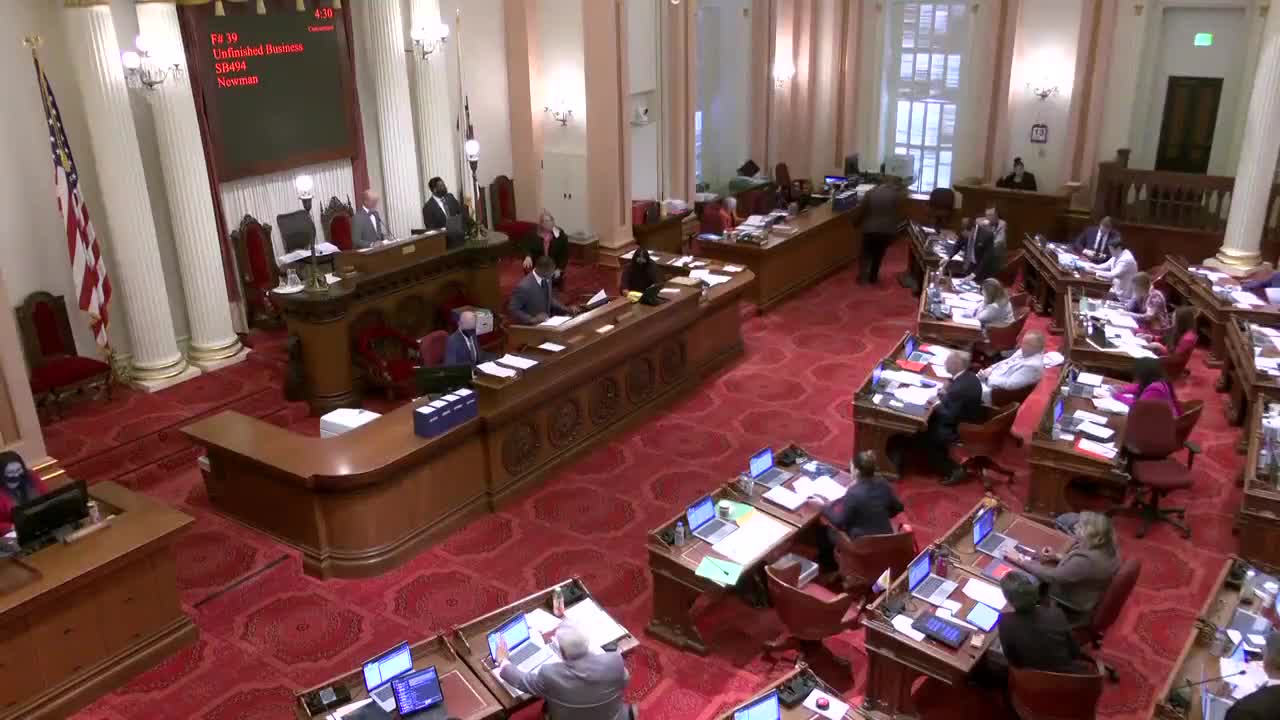 5MIN
Senate Floor
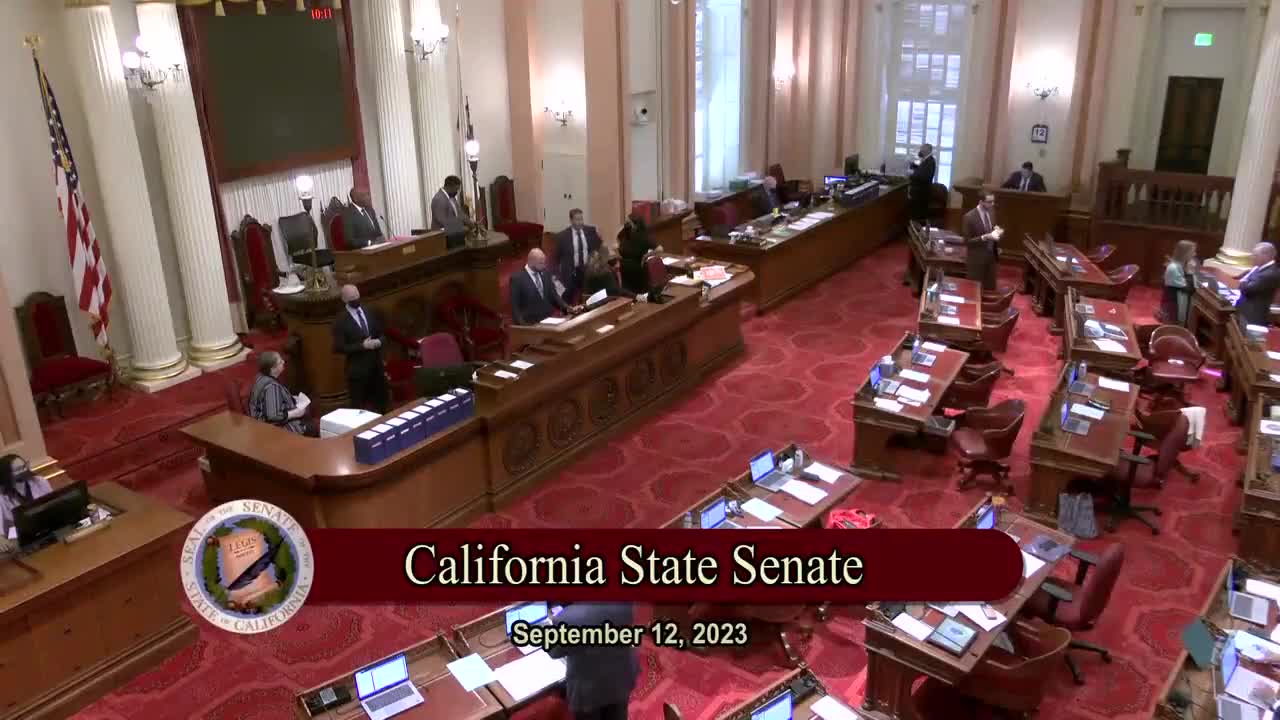 4MIN
Senate Floor
 19MIN
Assembly Floor
 27MIN
Assembly Standing Committee on Natural Resources
 3MIN
Senate Floor
 24MIN
Senate Standing Committee on Judiciary
 34MIN