SB 33: Commercial financing: disclosures.
- Session Year: 2023-2024
- House: Senate
- Latest Version Date: 2023-10-07
Current Status:
Passed
(2023-10-07: Chaptered by Secretary of State. Chapter 376, Statutes of 2023.)
Introduced
In Committee
First Chamber
In Committee
Second Chamber
Enacted
What does this bill do?
The bill requires companies that offer commercial financing to business recipients to include the total cost of the financing expressed as an annual percentage rate (APR) in their required disclosures, including example disclosures for factoring and asset‑based lending. It also directs the state financial commissioner to set rules for how that APR is calculated and displayed, and protects providers from liability if the actual APR differs from an estimated APR they disclosed in line with those rules or official guidance.
The summary is provided by generative AI which can make mistakes. For original language, please view the details in the table below.
Existing law requires a provider who extends a specific offer of commercial financing to a recipient, as defined, to disclose specified information relating to that transaction to the recipient and to obtain the recipients signature on that disclosure before consummating the commercial financing transaction. Existing law, until January 1, 2024, requires a provider to disclose the total cost of financing expressed as an annualized rate.
Existing law authorizes a provider who offers financing that is factoring or asset-based lending, in lieu of the disclosure described above, to provide an alternative disclosure that may be based on an example of a transaction that could occur under the general agreement for a given amount of accounts receivables and that meets specified requirements. Existing law, until January 1, 2024, requires that alternative disclosure to disclose the total cost of financing expressed as an annualized rate.
Existing law requires the Commissioner of Financial Protection and Innovation to adopt regulations governing these disclosure requirements and requires those regulations to include specified information and determinations, including, among other things, the appropriate method to express the annualized rate and the types of fees and charges to be included in the calculation. Existing law makes providers subject to examination and enforcement by the commissioner under the California Financing Law (CFL) for any violation of these provisions or of any rule or order adopted pursuant to these provisions, as specified. The CFL authorizes the commissioner to bring an action to enjoin, as specified, against a person who, in the commissioners estimation, has violated or is about to violate the CFL and authorizes the imposition of civil penalties to that effect. A willful violation of the CFL is a crime, except as specified.
This bill would require providers to continue to include in the disclosures and alternative disclosures the total cost of financing expressed as an annualized rate, as described above, indefinitely. By expanding the scope of an existing crime with regard to willful violations of the CFL, this bill would impose a state-mandated local program. The bill would make conforming changes to the provisions describing the regulations adopted by the commissioner governing these disclosure requirements.
The California Constitution requires the state to reimburse local agencies and school districts for certain costs mandated by the state. Statutory provisions establish procedures for making that reimbursement.
This bill would provide that no reimbursement is required by this act for a specified reason.
Existing law requires a provider who extends a specific offer of commercial financing to a recipient, as defined, to disclose specified information relating to that transaction to the recipient and to obtain the recipients signature on that disclosure before consummating the commercial financing transaction. Existing law, until January 1, 2024, requires a provider to disclose the total cost of financing expressed as an annualized rate.
Existing law authorizes a provider who offers financing that is factoring or asset-based lending, in lieu of the disclosure described above, to provide an alternative disclosure that may be based on an example of a transaction that could occur under the general agreement for a given amount of accounts receivables and that meets specified requirements. Existing law, until January 1, 2024, requires that alternative disclosure to disclose the total cost of financing expressed as an annualized rate.
Existing law requires the Commissioner of Business Oversight Financial Protection and Innovation to adopt regulations governing these disclosure requirements, requirements and requires those regulations to include specified information and determinations, including, among other things, the appropriate method to express the annualized rate and the types of fees and charges to be included in the calculation. Existing law makes providers subject to examination and enforcement by the commissioner under the California Financing Law (CFL) for any violation of these provisions or of any rule or order adopted pursuant to these provisions, as specified. The CFL authorizes the commissioner to bring an action to enjoin, as specified, against a person who, in the commissioners estimation, has violated or is about to violate the CFL, CFL and authorizes the imposition of civil penalties to that effect. A willful violation of the CFL is a crime, except as specified.
This bill would require providers to continue to include in the disclosures and alternative disclosures the total cost of financing expressed as an annualized rate, as described above, indefinitely. By expanding the scope of an existing crime with regard to willful violations of the CFL, this bill would impose a state-mandated local program. The bill would make conforming changes to the provisions describing the regulations adopted by the commissioner governing these disclosure requirements.
The California Constitution requires the state to reimburse local agencies and school districts for certain costs mandated by the state. Statutory provisions establish procedures for making that reimbursement.
This bill would provide that no reimbursement is required by this act for a specified reason.
Existing law requires a provider who extends a specific offer of commercial financing to a recipient, as defined, to disclose specified information relating to that transaction to the recipient and to obtain the recipients signature on that disclosure before consummating the commercial financing transaction. Existing law, until January 1, 2024, requires a provider to disclose the total cost of financing expressed as an annualized rate.
Existing law authorizes a provider who offers financing that is factoring or asset-based lending, in lieu of the disclosure described above, to provide an alternative disclosure that may be based on an example of a transaction that could occur under the general agreement for a given amount of accounts receivables and that meets specified requirements. Existing law, until January 1, 2024, requires that alternative disclosure to disclose the total cost of financing expressed as an annualized rate.
Existing law requires the Commissioner of Business Oversight to adopt regulations governing these disclosure requirements, and requires those regulations to include specified information and determinations, including, among other things, the appropriate method to express the annualized rate and the types of fees and charges to be included in the calculation. Existing law makes providers subject to examination and enforcement by the commissioner under California Financing Law (CFL) for any violation of these provisions or of any rule or order adopted pursuant to these provisions, as specified. The CFL authorizes the commissioner to bring an action to enjoin, as specified, against a person who, in the commissioners estimation, has violated or is about to violate the CFL, and authorizes the imposition of civil penalties to that effect. A willful violation of the CFL is a crime, except as specified.
This bill would require providers to continue to include in the disclosures and alternative disclosures the total cost of financing expressed as an annualized rate, as described above, indefinitely. By expanding the scope of an existing crime with regard to willful violations of the CFL, this bill would impose a state-mandated local program. The bill would make conforming changes to the provisions describing the regulations adopted by the commissioner governing these disclosure requirements.
The California Constitution requires the state to reimburse local agencies and school districts for certain costs mandated by the state. Statutory provisions establish procedures for making that reimbursement.
This bill would provide that no reimbursement is required by this act for a specified reason.
(a)A provider subject to this division shall disclose all of the information in subdivision (b) or in Section 22803, if applicable, to a recipient at the time of extending a specific commercial financing offer to that recipient, and shall obtain the recipients signature on the disclosure before consummating the commercial financing transaction.
(b)Except as provided in Section 22803, a provider subject to this division shall disclose all of the following:
(1)The total amount of funds provided.
(2)The total dollar cost of the financing.
(3)The term or estimated term.
(4)The method, frequency, and amount of payments.
(5)A description of prepayment policies.
(6)The total cost of the financing expressed as an annualized rate.
SEC. 2.Section 22802 of the Financial Code, as added by Section 2 of Chapter 1011 of the Statutes of 2018, is repealed.SEC. 3.Section 22803 of the Financial Code, as added by Section 2 of Chapter 1011 of the Statutes of 2018, is amended to read:22803.As an alternative to the disclosures required in subdivision (b) of Section 22802, a provider who offers commercial financing that is factoring or asset-based lending and that offers the recipient an agreement that describes the general terms and conditions of the commercial financing transaction that will occur under the agreement, may provide the following disclosures as an example of a transaction that could occur under the general agreement for a given amount of accounts receivables:
(a)An amount financed.
(b)The total dollar cost.
(c)The term or estimated term.
(d)The method, frequency, and amount of payments.
(e)A description of prepayment policies.
(f)The total cost of the financing expressed as an annualized rate.
SEC. 4.Section 22803 of the Financial Code, as added by Section 2 of Chapter 1011 of the Statutes of 2018, is repealed.SEC. 5.Section 22804 of the Financial Code is amended to read:22804.(a)The commissioner shall adopt regulations governing the disclosures described in paragraphs (1) to (5), inclusive, of subdivision (b) of Section 22802 and subdivisions (a) to (e), inclusive, of Section 22803. Those regulations shall include all of the following:
(1)Definitions, contents, or methods of calculations for each of the disclosure items set forth in each applicable paragraph of subdivision (b) of Section 22802 and subdivisions (a) to (f), inclusive, of Section 22803.
(2)Requirements concerning the time, manner, and format of the applicable disclosures described in subdivision (b) of Section 22802 and subdivisions (a) to (f), inclusive, of Section 22803.
(b)The commissioner shall adopt regulations concerning the annualized rate disclosure described in paragraph (6) of subdivision (b) of Section 22802 and subdivision (f) of Section 22803. Those regulations shall include all of the following:
(1)A determination of the appropriate method to express the annualized rate disclosure and the types of fees and charges to be included in that calculation.
(2)When providers shall be permitted to disclose an estimated annualized rate, and how that estimate shall be calculated. The method of calculation determined by this paragraph shall specify the accuracy requirements and tolerance allowances for the calculation, and the types of fees and charges to be included in the calculation.
(3)Requirements concerning the time, manner, and format of the disclosure.
(c)A provider shall not be required to comply with the disclosure requirements of this division until the final regulations are adopted by the commissioner pursuant to this section and become effective on the applicable date described in Section 11343.4 of the Government Code.
SEC. 6.Section 22806 is added to the Financial Code, immediately following Section 22805, to read:22806.No provision of this division imposes any liability on a provider as a result of the actual Annual Percentage Rate (APR) charged by a provider differing from the Estimated APR disclosed in conformity with any regulation, order, or written interpretive opinion of the commissioner or any such opinion of the Attorney General, whether or not such regulation, order, or written interpretive opinion is later amended, rescinded, or repealed or determined by judicial or other authority to be invalid for any reason.
SEC. 7.No reimbursement is required by this act pursuant to Section 6 of Article XIIIB of the California Constitution because the only costs that may be incurred by a local agency or school district will be incurred because this act creates a new crime or infraction, eliminates a crime or infraction, or changes the penalty for a crime or infraction, within the meaning of Section 17556 of the Government Code, or changes the definition of a crime within the meaning of Section 6 of Article XIIIB of the California Constitution.
(a)A provider subject to this division shall disclose all of the information in subdivision (b) or in Section 22803, if applicable, to a recipient at the time of extending a specific commercial financing offer to that recipient, and shall obtain the recipients signature on the disclosure before consummating the commercial financing transaction.
(b)Except as provided in Section 22803, a provider subject to this division shall disclose all of the following:
(1)The total amount of funds provided.
(2)The total dollar cost of the financing.
(3)The term or estimated term.
(4)The method, frequency, and amount of payments.
(5)A description of prepayment policies.
(6)The total cost of the financing expressed as an annualized rate.
SEC. 2.Section 22802 of the Financial Code, as added by Section 2 of Chapter 1011 of the Statutes of 2018, is repealed.SEC. 3.Section 22803 of the Financial Code, as added by Section 2 of Chapter 1011 of the Statutes of 2018, is amended to read:22803.As an alternative to the disclosures required in subdivision (b) of Section 22802, a provider who offers commercial financing that is factoring or asset-based lending and that offers the recipient an agreement that describes the general terms and conditions of the commercial financing transaction that will occur under the agreement, may provide the following disclosures as an example of a transaction that could occur under the general agreement for a given amount of accounts receivables:
(a)An amount financed.
(b)The total dollar cost.
(c)The term or estimated term.
(d)The method, frequency, and amount of payments.
(e)A description of prepayment policies.
(f)The total cost of the financing expressed as an annualized rate.
SEC. 4.Section 22803 of the Financial Code, as added by Section 2 of Chapter 1011 of the Statutes of 2018, is repealed.SEC. 5.Section 22804 of the Financial Code is amended to read:22804.(a)The commissioner shall adopt regulations governing the disclosures described in paragraphs (1) to (5), inclusive, of subdivision (b) of Section 22802 and subdivisions (a) to (e), inclusive, of Section 22803. Those regulations shall include all of the following:
(1)Definitions, contents, or methods of calculations for each of the disclosure items set forth in each applicable paragraph of subdivision (b) of Section 22802 and subdivisions (a) to (f), inclusive, of Section 22803.
(2)Requirements concerning the time, manner, and format of the applicable disclosures described in subdivision (b) of Section 22802 and subdivisions (a) to (f), inclusive, of Section 22803.
(b)The commissioner shall adopt regulations concerning the annualized rate disclosure described in paragraph (6) of subdivision (b) of Section 22802 and subdivision (f) of Section 22803. Those regulations shall include all of the following:
(1)A determination of the appropriate method to express the annualized rate disclosure and the types of fees and charges to be included in that calculation.
(2)When providers shall be permitted to disclose an estimated annualized rate, and how that estimate shall be calculated. The method of calculation determined by this paragraph shall specify the accuracy requirements and tolerance allowances for the calculation, and the types of fees and charges to be included in the calculation.
(3)Requirements concerning the time, manner, and format of the disclosure.
(c)A provider shall not be required to comply with the disclosure requirements of this division until the final regulations are adopted by the commissioner pursuant to this section and become effective on the applicable date described in Section 11343.4 of the Government Code.
SEC. 6.Section 22806 is added to the Financial Code, immediately following Section 22805, to read:22806.No provision of this division imposes any liability on a provider as a result of the actual APR Annual Percentage Rate (APR) charged by a provider differing from the Estimated APR disclosed in conformity with any regulation, order, or written interpretive opinion of the commissioner or any such opinion of the Attorney General, notwithstanding that whether or not such regulation, order, or written interpretive opinion may is later be amended, rescinded, or repealed or be determined by judicial or other authority to be invalid for any reason.
SEC. 7.No reimbursement is required by this act pursuant to Section 6 of Article XIIIB of the California Constitution because the only costs that may be incurred by a local agency or school district will be incurred because this act creates a new crime or infraction, eliminates a crime or infraction, or changes the penalty for a crime or infraction, within the meaning of Section 17556 of the Government Code, or changes the definition of a crime within the meaning of Section 6 of Article XIIIB of the California Constitution.
(a)A provider subject to this division shall disclose all of the information in subdivision (b) or in Section 22803, if applicable, to a recipient at the time of extending a specific commercial financing offer to that recipient, and shall obtain the recipients signature on the disclosure before consummating the commercial financing transaction.
(b)Except as provided in Section 22803, a provider subject to this division shall disclose all of the following:
(1)The total amount of funds provided.
(2)The total dollar cost of the financing.
(3)The term or estimated term.
(4)The method, frequency, and amount of payments.
(5)A description of prepayment policies.
(6)The total cost of the financing expressed as an annualized rate.
SEC. 2.Section 22802 of the Financial Code, as added by Section 2 of Chapter 1011 of the Statutes of 2018, is repealed.SEC. 3.Section 22803 of the Financial Code, as added by Section 2 of Chapter 1011 of the Statutes of 2018, is amended to read:22803.As an alternative to the disclosures required in subdivision (b) of Section 22802, a provider who offers commercial financing that is factoring or asset-based lending and that offers the recipient an agreement that describes the general terms and conditions of the commercial financing transaction that will occur under the agreement, may provide the following disclosures as an example of a transaction that could occur under the general agreement for a given amount of accounts receivables:
(a)An amount financed.
(b)The total dollar cost.
(c)The term or estimated term.
(d)The method, frequency, and amount of payments.
(e)A description of prepayment policies.
(f)The total cost of the financing expressed as an annualized rate.
SEC. 4.Section 22803 of the Financial Code, as added by Section 2 of Chapter 1011 of the Statutes of 2018, is repealed.SEC. 5.Section 22804 of the Financial Code is amended to read:22804.(a)The commissioner shall adopt regulations governing the disclosures described in paragraphs (1) to (5), inclusive, of subdivision (b) of Section 22802 and subdivisions (a) to (e), inclusive, of Section 22803. Those regulations shall include all of the following:
(1)Definitions, contents, or methods of calculations for each of the disclosure items set forth in each applicable paragraph of subdivision (b) of Section 22802 and subdivisions (a) to (f), inclusive, of Section 22803.
(2)Requirements concerning the time, manner, and format of the applicable disclosures described in subdivision (b) of Section 22802 and subdivisions (a) to (f), inclusive, of Section 22803.
(b)The commissioner shall adopt regulations concerning the annualized rate disclosure described in paragraph (6) of subdivision (b) of Section 22802 and subdivision (f) of Section 22803. Those regulations shall include all of the following:
(1)A determination of the appropriate method to express the annualized rate disclosure and the types of fees and charges to be included in that calculation.
(2)When providers shall be permitted to disclose an estimated annualized rate, and how that estimate shall be calculated. The method of calculation determined by this paragraph shall specify the accuracy requirements and tolerance allowances for the calculation, and the types of fees and charges to be included in the calculation.
(3)Requirements concerning the time, manner, and format of the disclosure.
(c)A provider shall not be required to comply with the disclosure requirements of this division until the final regulations are adopted by the commissioner pursuant to this section and become effective on the applicable date described in Section 11343.4 of the Government Code.
SEC. 6.Section 22806 is added to the Financial Code, immediately following Section 22805, to read:22806.No provision of this division imposes any liability on a provider as a result of the actual APR charged by a provider differing from the Estimated APR disclosed in conformity with any regulation, order, or written interpretive opinion of the commissioner or any such opinion of the Attorney General, notwithstanding that such regulation, order, or written interpretive opinion may later be amended, rescinded, or repealed or be determined by judicial or other authority to be invalid for any reason.
SEC. 6. SEC. 7.No reimbursement is required by this act pursuant to Section 6 of Article XIIIB of the California Constitution because the only costs that may be incurred by a local agency or school district will be incurred because this act creates a new crime or infraction, eliminates a crime or infraction, or changes the penalty for a crime or infraction, within the meaning of Section 17556 of the Government Code, or changes the definition of a crime within the meaning of Section 6 of Article XIIIB of the California Constitution.
(a)A provider subject to this division shall disclose all of the information in subdivision (b) or in Section 22803, if applicable, to a recipient at the time of extending a specific commercial financing offer to that recipient, and shall obtain the recipients signature on such a the disclosure before consummating the commercial financing transaction.
(b)Except as provided in Section 22803, a provider subject to this division shall disclose all of the following:
(1)The total amount of funds provided.
(2)The total dollar cost of the financing.
(3)The term or estimated term.
(4)The method, frequency, and amount of payments.
(5)A description of prepayment policies.
(6)The total cost of the financing expressed as an annualized rate.
(c)This section shall remain in effect only until January 1, 2024, and as of that date is repealed.SEC. 2.Section 22802 of the Financial Code, as added by Section 2 of Chapter 1011 of the Statutes of 2018, is repealed.22802.(a)A provider subject to this division shall disclose all of the information in subdivision (b) or in Section 22803, if applicable, to a recipient at the time of extending a specific commercial financing offer to that recipient, and shall obtain the recipients signature on such a disclosure before consummating the commercial financing transaction.(b)Except as provided in Section 22803, a provider subject to this division shall disclose all of the following:(1)The total amount of funds provided.(2)The total dollar cost of the financing.(3)The term or estimated term.(4)The method, frequency, and amount of payments.(5)A description of prepayment policies.(c)This section shall become operative on January 1, 2024.SEC. 3.Section 22803 of the Financial Code, as added by Section 2 of Chapter 1011 of the Statutes of 2018, is amended to read:22803.(a)As an alternative to the disclosures required in subdivision (b) of Section 22802, a provider who offers commercial financing that is factoring or asset-based lending and that offers the recipient an agreement that describes the general terms and conditions of the commercial financing transaction that will occur under the agreement, may provide the following disclosures as an example of a transaction that could occur under the general agreement for a given amount of accounts receivables:
(1)(a)An amount financed.
(2)(b)The total dollar cost.
(3)(c)The term or estimated term.
(4)(d)The method, frequency, and amount of payments.
(5)(e)A description of prepayment policies.
(6)(f)The total cost of the financing expressed as an annualized rate.
(b)This section shall remain in effect only until January 1, 2024, and as of that date is repealed.SEC. 4.Section 22803 of the Financial Code, as added by Section 2 of Chapter 1011 of the Statutes of 2018, is repealed.22803.(a)As an alternative to the disclosures required in subdivision (b) of Section 22802, a provider who offers commercial financing that is factoring or asset-based lending and that offers the recipient an agreement that describes the general terms and conditions of the commercial financing transaction that will occur under the agreement, may provide the following disclosures as an example of a transaction that could occur under the general agreement for a given amount of accounts receivables:(1)An amount financed.(2)The total dollar cost.(3)The term or estimated term.(4)The method, frequency, and amount of payments.(5)A description of prepayment policies.(b)This section shall become operative on January 1, 2024.SEC. 5.Section 22804 of the Financial Code is amended to read:22804.(a)The commissioner shall adopt regulations governing the disclosures described in paragraphs (1) to (5), inclusive, of subdivision (b) of Section 22802 and paragraphs (1) to (5), subdivisions (a) to (e), inclusive, of subdivision (a) of Section 22803. Those regulations shall include all of the following:
(1)Definitions, contents, or methods of calculations for each of the disclosure items set forth in each applicable paragraph of subdivision (b) of Section 22802 and subdivision (a) subdivisions (a) to (f), inclusive, of Section 22803.
(2)Requirements concerning the time, manner, and format of the applicable disclosures described in subdivision (b) of Section 22802 and subdivision (a) subdivisions (a) to (f), inclusive, of Section 22803.
(b)The commissioner shall adopt regulations concerning the annualized rate disclosure described in paragraph (6) of subdivision (b) of Section 22802 and paragraph (6) of subdivision (a) subdivision (f) of Section 22803. Those regulations shall include all of the following:
(1)A determination of the appropriate method to express the annualized rate disclosure and the types of fees and charges to be included in that calculation.
(2)When providers shall be permitted to disclose an estimated annualized rate, and how such an that estimate shall be calculated. The method of calculation determined by this paragraph shall specify the accuracy requirements and tolerance allowances for the calculation, and the types of fees and charges to be included in the calculation.
(3)Requirements concerning the time, manner, and format of the disclosure.
(c)A provider shall not be required to comply with the disclosure requirements of this division until the final regulations are adopted by the commissioner pursuant to this section and become effective on the applicable date described in Section 11343.4 of the Government Code.
SEC. 6.No reimbursement is required by this act pursuant to Section 6 of Article XIIIB of the California Constitution because the only costs that may be incurred by a local agency or school district will be incurred because this act creates a new crime or infraction, eliminates a crime or infraction, or changes the penalty for a crime or infraction, within the meaning of Section 17556 of the Government Code, or changes the definition of a crime within the meaning of Section 6 of Article XIIIB of the California Constitution.
|
Date
|
Status
|
|---|---|
| Oct 7, 2023 | Chaptered by Secretary of State. Chapter 376, Statutes of 2023. |
| Oct 7, 2023 | Approved by the Governor. |
| Sep 21, 2023 | Enrolled and presented to the Governor at 4 p.m. |
| Sep 14, 2023 | Assembly amendments concurred in. (Ayes 40. Noes 0. Page 2840.) Ordered to engrossing and enrolling. |
| Sep 13, 2023 | In Senate. Concurrence in Assembly amendments pending. |
| Sep 13, 2023 | Read third time. Passed. (Ayes 80. Noes 0. Page 3350.) Ordered to the Senate. |
| Sep 5, 2023 | Read third time and amended. |
| Sep 5, 2023 | Ordered to third reading. |
| Aug 17, 2023 | Read second time. Ordered to third reading. |
| Aug 16, 2023 | From committee: Do pass. (Ayes 16. Noes 0.) (August 16). |
| Jun 21, 2023 | Read second time and amended. Re-referred to Com. on APPR. |
| Jun 20, 2023 | From committee: Do pass as amended and re-refer to Com. on APPR. (Ayes 10. Noes 0.) (June 20). |
| Jun 13, 2023 | From committee: Do pass and re-refer to Com. on JUD. (Ayes 11. Noes 0.) (June 12). Re-referred to Com. on JUD. |
| May 18, 2023 | Referred to Coms. on B. & F. and JUD. |
| May 11, 2023 | In Assembly. Read first time. Held at Desk. |
| May 11, 2023 | Read third time. Passed. (Ayes 39. Noes 0. Page 1050.) Ordered to the Assembly. |
| May 2, 2023 | Read second time. Ordered to third reading. |
| May 1, 2023 | From committee: Be ordered to second reading pursuant to Senate Rule 28.8. |
| Apr 21, 2023 | Set for hearing May 1. |
| Apr 20, 2023 | April 24 hearing postponed by committee. |
| Apr 14, 2023 | Set for hearing April 24. |
| Apr 12, 2023 | From committee: Do pass and re-refer to Com. on APPR. (Ayes 10. Noes 0. Page 685.) (April 11). Re-referred to Com. on APPR. |
| Apr 3, 2023 | Set for hearing April 11. |
| Mar 29, 2023 | From committee: Do pass and re-refer to Com. on JUD. (Ayes 6. Noes 0. Page 569.) (March 29). Re-referred to Com. on JUD. |
| Feb 28, 2023 | Set for hearing March 29. |
| Jan 18, 2023 | Referred to Coms. on B. & F.I. and JUD. |
| Dec 6, 2022 | From printer. May be acted upon on or after January 5. |
| Dec 5, 2022 | Introduced. Read first time. To Com. on RLS. for assignment. To print. |
|
Date
|
Description
|
Location
|
Votes
|
|
|---|---|---|---|---|
| Sep 14, 2023 | Unfinished Business SB33 Glazer Concurrence | Senate Floor |
Passed |
|
| Sep 13, 2023 | SB 33 Glazer Senate Third Reading By Dixon | Assembly Floor |
Passed |
|
| Aug 16, 2023 | Do pass. | Assembly Standing Committee on Appropriations |
Passed |
|
| Jun 20, 2023 | Do pass as amended and be re-referred to the Committee on [Appropriations] | Assembly Standing Committee on Judiciary |
Passed |
|
| Jun 12, 2023 | Do pass and be re-referred to the Committee on [Judiciary] | Assembly Standing Committee on Banking and Finance |
Passed |
|
| May 11, 2023 | Senate 3rd Reading SB33 Glazer | Senate Floor |
Passed |
|
| Apr 11, 2023 | Do pass, but first be re-referred to the Committee on [Appropriations] | Senate Standing Committee on Judiciary |
Passed |
|
| Mar 29, 2023 | Do pass, but first be re-referred to the Committee on [Judiciary] | Senate Standing Committee on Banking and Financial Institutions |
Passed |
This list shows positions taken on this bill by organizations on the date displayed, which is linked to the original source.
Positions by individuals are not included.
|
Organization
|
Position
|
Date
|
|---|---|---|
| A Slice Of New York | ** Support | |
| Abate-A-Weed | ** Against | |
| Access Plus Capital | ** Support | |
| Accessity | ** Support | |
| Accion Opportunity Fund | ** Support | |
| Accion Opportunity Fund | * Support | Mar 29, 2023 |
| Accion Opportunity Fund | * Support | Apr 11, 2023 |
| Agriculture and Land-Based Training Association | ** Support | |
| Alro Window Coverings | ** Support | |
| American Enterprise | ** Support | |
| Amir Mansour | ** Support | |
| AmPac Tri-State CDC | ** Support | |
| Anchor Capitol | ** Support | |
| Anchor Finance Services | ** Support | |
| Anchor Financial Services | ** Support | |
| AnewAmerica Community Corporation | ** Support | |
| Ar Diesel Repair | ** Support | |
| Asian Food Trade Association | ** Against | |
| Asian Industry Business to Business | ** Against | |
| Asian Pacific Islander Small Business Program WBC LTSC Community Development Corp. | ** Support | |
| Asociacion De Emprendedor@s | ** Support | |
| AT Industrial Products | ** Against | |
| Bankers Small Business Community Development Corporation | ** Support | |
| Bay Area Development Company | ** Support | |
| Bethel LA Cdc | ** Support | |
| Bethel Los Angeles Community Development Corporation | ** Support | |
| Bluevine | ** Support | |
| Brea Chamber of Commerce | ** Against | |
| Bryant's Books Enterprises | ** Support | |
| C.O.O.K. Alliance | ** Support | |
| California Asset Building Coalition | ** Support | |
| California Association for Micro Enterprise Opportunity | ** Support | |
| California Black Chamber of Commerce | ** Support | |
| California Capital Financial Development Corporation | ** Support | |
| California Coalition for Community Investment | ** Support | |
| California Hispanic Chamber Of Commerce | ** Support | |
| California Low-Income Consumer Coalition | ** Support | |
| California Reinvestment Coalition | ** Support | |
| California Small Business Development Center - Valley Community | ** Support | |
| California State University, Monterey Bay Institute for Innovation and Economic Development | ** Support | |
| Camel Financial, Inc. | * Against Unless Amend | Jun 12, 2023 |
| Camel Financial, Inc. | * For If Amend | Jun 12, 2023 |
| Cameo - California Association for Micro Enterprise Opportunity | ** Support | |
| Camino Financial | * Support | Mar 29, 2023 |
| Carmela Flores | ** Support | |
| CDC Small Business Finance | ** Support | |
| Central Valley Immigrant Integration Collaborative | ** Support | |
| Chino Valley Chamber of Commerce | ** Support | |
| Cleanup Carpet & Tile Care | ** Support | |
| Clear Vision Enterprise LLC | ** Support | |
| Club Pilates Palos Verdes | ** Support | |
| Cm Cleaning Solutions | ** Support | |
| Coalition of Small & Disabled Veteran Business Owners | ** Against | |
| Coalition of Small and Disabled Veteran Businesses | ** Against | |
| Comebackshop | ** Support | |
| Comet Corn Popcorn | ** Support | |
| Consumer Advocates Against Reverse Mortgage Abuse | ** Support | |
| Consumer Federation Of California | ** Support | |
| COOK Alliance | ** Support | |
| Courier-messenger INC. | ** Against | |
| Crisp Catering | ** Against | |
| Crowdfund Better | ** Support | |
| Cypress Chamber of Commerce | ** Against | |
| Discovering You | ** Support | |
| Dominofx Group | ** Support | |
| Dr Donna Lee INC. | ** Support | |
| East LA Rising | ** Support | |
| Economic Development And Financing Corporation | ** Support | |
| El Pajaro Community Development Corporation | ** Support | |
| Elena's House Daycare | ** Support | |
| Finer Flora | ** Support | |
| First American Properties and Acquisitions | ** Support | |
| Flasher Barricade Association | ** Against | |
| Focus Language International | ** Support | |
| Fresno Area Hispanic Foundation | ** Support | |
| Fresno Metro Black Chamber of Commerce | ** Support | |
| Funding Circle | ** Support | |
| Fusion Climb | ** Support | |
| Go Local Sonoma County | ** Support | |
| Greater Ontario Business Council | ** Support | |
| Green and Clean Landscaping and Construction INC. | ** Support | |
| Halo Business Finance Corp | ** Support | |
| Hills Flat Lumber Co. | ** Against | |
| Hound Lounge | ** Support | |
| Hudson Cook, LLP | * Against | Apr 11, 2023 |
| Ica Fund | ** Support | |
| Inclusive Action for the City | ** Support | |
| Inner City Advisor Fund Good Jobs | ** Support | |
| Innovative Lending Platform Association | ** Support | |
| International Rescue Committee | ** Support | |
| International Rescue Committee's Center for Economic Opportunity | ** Support | |
| Invest In Women Entrepreneurs Initiative | ** Support | |
| Jedi | ** Support | |
| Jefferson Economic Development Institute | ** Support | |
| Jefferson Economic Development Organization | ** Support | |
| Judge Casey's Saucery | ** Support | |
| Julia Funk | ** Support | |
| Kery’s Fashion | ** Support | |
| Krtkl, INC. | ** Support | |
| Latino Economic Development Center | ** Support | |
| LendingClub | ** Support | |
| Lighter Capital | ** Support | |
| Lisa Kaczmarczyk Phd Consulting, LLC | ** Support | |
| Logan Heights Community Development Corporation | ** Support | |
| Lotus Studio Pottery | ** Support | |
| Main Street Launch | ** Support | |
| Maloney Meat Company | ** Against | |
| Marian Doub Consulting | ** Support | |
| Mata Consulting LLC | ** Support | |
| Maximum Reach for Economic Equity | ** Support | |
| Maximum Research for Economic Equity | ** Support | |
| MicroEnterprise Collaborative of Inland Southern California | ** Support | |
| Mission Economic Development Agency | ** Support | |
| Mitchell's Transport, LLC | ** Support | |
| Momentus Capital | ** Support | |
| Multifunding | ** Support | |
| National Association of Latino Community Asset Builders | * Support | Mar 29, 2023 |
| National Federation of Latino Chambers of Commerce & Associations | ** Against | |
| National Latina Business Women Association | * Support | Mar 29, 2023 |
| National Latina Women's Business Association - Inland Empire | ** Support | |
| Oakland African American Chamber Of Commerce | ** Support | |
| Oakland Citizens Committee For Urban Renewal | ** Support | |
| Otokonda Ble Daycare | ** Support | |
| Pacific Community Ventures | ** Support | |
| Pacific Crest Dental | ** Support | |
| Prospera Community Development | ** Support | |
| Public Law Center | ** Support | |
| Pur-7le LLC | ** Support | |
| Rarámuri Income Tax | ** Support | |
| Red Jack Saloon | ** Support | |
| Redwood Region Economic Development Commission | * Support | Mar 29, 2023 |
| Relat-able | ** Support | |
| Renaissance Entrepreneurship Center | ** Support | |
| Responsible Business Lending Coalition | ** Support | |
| Retreat Skin & Hair Studio | ** Support | |
| Revenue Based Finance Coalition | ** Against | |
| Richmond Main Street Initiative | ** Support | |
| San Francisco African American Chamber of Commerce | ** Support | |
| San Mateo Area Chamber of Commerce | ** Support | |
| Seabreeze Books & Charts | ** Against | |
| Secured Finance Network | * Against | Jun 20, 2023 |
| Secured Finance Network | * Against | Jun 12, 2023 |
| Secured Financial Network | ** Against | |
| Sensis INC. | ** Against | |
| Sharron Fisher Stylist | ** Support | |
| Silver Lining | ** Support | |
| Silver Lining Strategies & Advocacy | ** Support | |
| slavic-american chamber of commerce | ** Against | |
| Small Business California | ** Support | |
| Small Business Finance Association | ** Against | |
| Small Business Majority | ** Support | |
| Socal Hydraulics | ** Against | |
| Southeast Asian Community Center | ** Support | |
| Star Milling Co | ** Against | |
| Start Small Think Big | ** Support | |
| Start Up Monterey Bay | ** Support | |
| Sweet Bossa LLC | ** Support | |
| T and V Rooming LLC | ** Support | |
| Talisman Collection INC. | ** Support | |
| Tha Tax Lady | ** Support | |
| The C.O.O.K Alliance | ** Support | |
| The CraneWorks | ** Support | |
| The Greenlining Institute | ** Support | |
| The Responsible Business Lending Coalition | ** Support | |
| Trenell Leshelle Hair & Makeup Studio | ** Support | |
| Tri County Chamber Alliance | ** Support | |
| U.S. Hispanic Business Council | ** Against | |
| Una Mas Mexican Grill | ** Support | |
| Uplift San Bernardino | ** Support | |
| Vanasek Insurance Services, INC. | ** Support | |
| Vnt Authentic Catering Services | ** Support | |
| W W W Group | ** Support | |
| Wadeco | ** Support | |
| Wadeco Business Center | ** Support | |
| Women's Economic Ventures | ** Support | |
| Woodstock Institute | ** Support | |
| Working Solutions | ** Support |
SENATE RULES COMMITTEE Office of Senate Floor Analyses (916) 651-1520 Fax: (916) 327-4478 | SB 33 |
UNFINISHED BUSINESS
Bill No: SB 33
Author: Glazer (D)
Amended: 9/5/23
Vote: 21
SENATE BANKING & F.I. COMMITTEE: 6-0, 3/29/23
AYES: Limón, Niello, Caballero, Min, Nguyen, Portantino
NO VOTE RECORDED: Bradford
SENATE JUDICIARY COMMITTEE: 10-0, 4/11/23
AYES: Umberg, Wilk, Allen, Ashby, Durazo, Laird, McGuire, Min, Niello, Wiener
NO VOTE RECORDED: Stern
SENATE APPROPRIATIONS COMMITTEE: Senate Rule 28.8
SENATE FLOOR: 39-0, 5/11/23
AYES: Allen, Alvarado-Gil, Archuleta, Ashby, Atkins, Becker, Blakespear, Bradford, Caballero, Cortese, Dahle, Dodd, Durazo, Eggman, Glazer, Gonzalez, Hurtado, Jones, Laird, Limón, McGuire, Menjivar, Min, Newman, Nguyen, Niello, Ochoa Bogh, Padilla, Portantino, Roth, Rubio, Seyarto, Skinner, Smallwood-Cuevas, Stern, Umberg, Wahab, Wiener, Wilk
NO VOTE RECORDED: Grove
ASSEMBLY FLOOR: 80-0, 9/13/23 - See last page for vote
SUBJECT: Commercial financing: disclosures
SOURCE: Author
DIGEST:
This bill removes a sunset provision that applies to a requirement to disclose the cost of a commercial financing transaction expressed as an annualized rate. The requirement is scheduled to sunset on January 1, 2024. By removing the sunset, this bill requires commercial financing providers to provide the specified disclosure indefinitely.
Assembly Amendments
make technical and clarifying changes.
ANALYSIS:
Existing law:
- Establishes disclosure requirements related to commercial financing. (Division 9.5 of the Financial Code, commencing with Section 22800)
- Defines “commercial financing” as an accounts receivable purchase transaction, including factoring, asset-based lending transaction, commercial loan, commercial open-end credit plan, or lease financing transaction intended by the recipient for use primarily for other than personal, family, or household purposes. (Financial Code Section 22800 (d))
- Defines “recipient” as a person who is presented a specific commercial financing offer by a provider that is equal to or less than $500,000. (Financial Code Section 22800 (n))
- Requires a provider of commercial financing to disclose the following information to a recipient at the time of extending a specific commercial financing offer to that recipient:
- The total amount of funds provided.
- The total dollar cost of the financing.
- The term or estimated term.
- The method, frequency, and amount of payments.
- A description of prepayment penalties.
- Until January 1, 2024, the total cost of the financing expressed as an annualized rate. (Financial Code Section 22802)
- Allows a provider of commercial financing that is factoring or asset-based lending to offer, in lieu of 4) above, the following:
- An agreement that generally describes the general terms and conditions of the commercial financing transaction that will occur under the agreement, and
- The same information as described in b) – f) of 4) above based on an example transaction that could occur under the general agreement for a given amount of accounts receivable. (Financial Code Section 22803)
- Requires the Department of Financial Protection and Innovation (DFPI) to adopt regulations governing the disclosures described in 4) and 5) above, including when providers may disclose an estimated annualize rate and how such an estimate shall be calculated. (Financial Code Section 22804)
- Subjects providers licensed under the California Financing Law to examination and enforcement by DFPI for any violation of the disclosure requirements. (Financial Code Section 22805)
- Exempts specified entities, including depository institutions, or transactions from the disclosure requirements. (Financial Code Section 22801)
- Provides, pursuant to 6) above, regulations that specify in detail how the disclosure requirements apply to the range of commercial financing products included in 2) above. The regulations became effective on December 9, 2022. (Title 10, Chapter 3 of the California Code of Regulations, Subchapter 3 commencing with Section 900)
This bill:
Removes the sunset provision of January 1, 2024, that applies to the disclosure of the total cost of financing expressed as an annualized rate and makes conforming changes.
- Provides that the commercial financing disclosure law does not impose any liability on a provider as a result of the actual annual percentage rate (APR) charged by a provider differing from the Estimated APR disclosed in conformity with any regulation, order, or written interpretive opinion of the commissioner or any such opinion of the Attorney General, as specified.
Background
- SB 1235. This bill seeks to maintain a requirement that disclosures related to certain commercial financing transactions continue to include the cost of financing expressed as an annualized rate. The requirement was enacted by a provision contained in SB 1235 (Glazer, Chapter 1011, Statutes of 2018), which established a first-in-the-nation disclosure framework that applies to a variety of financing products offered to small business borrowers. Under existing law, the annualized rate will no longer be required as part of the disclosure as of January 1, 2024. Other information, such as the total amount of financing, the dollar cost of financing, and the method, frequency, and amount of payments, remains in the law indefinitely.
Despite SB 1235 being enacted in 2018, providers of commercial financing who are subject to the law were not required to provide the disclosures until the DFPI adopted final regulations required by SB 1235. After SB 1235’s passage, the DFPI provided stakeholders three informal opportunities to comment in writing about the proposed commercial financing disclosure regulations, followed by six additional opportunities to comment on the regulations during the formal rulemaking process. The DFPI incorporated extensive revisions to improve the proposed regulations based upon stakeholder input during this process. DFPI adopted final regulations on June 9, 2022, with an effective date of December 9, 2022, for providers to comply with the regulations. Therefore, even though the initial bill was signed on September 30, 2018, the law was effectively on hold until December 9, 2022.
- Motivation for Annualized Rate Disclosure
Small businesses face a diverse, but often confusing, array of financing options that are difficult to compare. Moreover, some financing options impose significant costs on small business borrowers with annualized rates exceeding 100%. Accion Opportunity Fund, a non-profit headquartered in San Jose that provides financial support for small businesses, found the following in their research of alternative financing providers.[1]
- The average alternative financing product analyzed carried a 94% APR, with the maximum APR reaching 358%.
- The average monthly loan payment for businesses in the dataset was nearly double the net income available to their owner(s), severely hampering an owner’s ability to expand a business or hire new employees, and drastically undermining the long-term viability of an enterprise.
- Among the businesses that Opportunity Fund was able to refinance out of higher cost financing, monthly payments fell by more than 60% and APR dropped by an average of 85%. Those savings represent critically needed cash flow for many small businesses, but especially those struggling to survive or expand.
In an environment with such costly forms of credit and high variation between financing providers, small businesses can benefit from shopping around to find the best deal. But many financing provides do not disclose key terms of financing, and the format and content of existing disclosures are widely variable, hindering a small business owner’s ability to compare financing offers. Federal Reserve research revealed the following key findings through conducting focus groups with small business operators.[2]
- Although participants initially said it was “easy” to evaluate credit products, when presented with several options, many expressed uncertainty or answered questions incorrectly when making specific product comparisons, particularly on cost.
- Virtually all the focus group participants said they want clearly stated product features and costs and an easier way to compare product offerings. Among their suggestions were interest rates expressed as APRs, straightforward explanation of all fees, and required statements about payment policies, including late fees and prepayment penalties.
Subsequent research from the Federal Reserve confirmed these findings.[3] The researchers found that cost was not the only factor driving small business owners’ financing decisions. Among focus group participants, “best price” was the most commonly mentioned top factor in their choice of lender, but “quick and easy loan application process,” “a lender I know and trust,” and “likelihood application will be approved” were primary considerations for others. Standardized disclosures were found to provide helpful information in comparing financing options:
The clear disclosure of product costs and terms could help many of these business owners make informed decisions about the amounts they borrow, cash flow management, early repayment, and repeat borrowing. Focus group participants reacted favorably to a sample disclosure box with total cost of capital, the term, payment frequency, APR, average payment amount, and basic information about prepayment. Their comments indicated that such information, presented clearly and in a standard format, would be very useful for product comparisons. A majority of participants commented that APR was among its most helpful details. The repayment amount, frequency of payments, and prepayment penalties were also cited as important.
These findings, in addition to the experiences and expressed preferences of the many small business organizations that support this bill, are the motivating force behind SB 1235 and the effort to maintain the annualized rate as a required metric in California’s commercial financing disclosure law.
- Comparing Key Metrics Between Similar Financing Options
The sponsors of this bill provided the following table comparing key metrics across financing products.
Note that each of the products assumes the same financing amount and total dollar cost of financing, but the APRs vary significantly. The difference in APRs is driven by the difference in term or estimated term of each product. All else equal, a small business borrower prefers to have a longer repayment period over which to spread out the cash flows remitted to the financing provider, and APR serves as a helpful metric in signaling the relative benefits of the term structures of otherwise similar financing products.
A helpful illustration of this concept is provided by MFTransparency, a now defunct organization that worked to improve pricing transparency in the microfinance industry.[4]
When you take out a loan you are essentially “renting” money. You are given money that is owned by someone else and you agree to pay them “rent” (interest) for this privilege. This is just like renting anything else, an apartment for example. If you rent an apartment, a room that costs $1000 dollars per day is very different than a room that costs $1000 dollars per month. Using Total Cost of Credit is like looking at the price of an apartment, but not taking into account how long you will be able to stay!
But APR is like looking at a standardized cost per year for that same apartment:
$1,000 per day = $365,000 per year
$1,000 per month = $12,000 per year
Even an inexperienced customer can appreciate the difference. When price is standardized, the decision is simple!
Thus the problem with using Total Cost of Credit is that it does not incorporate the time value of money. A small cost in a short time can be much harder to pay back than a larger cost over a longer time. It’s not only how much you pay back, but when you pay it back. The price must account for how long can you put that loan to work to make a return that will pay for the interest. APR is thus a better indicator of price as it takes into account both time and money!
- Relitigating SB 1235 and Annualized Rate Disclosures
Opposition arguments to this bill are substantively similar to arguments filed in opposition to SB 1235 and comments provided to DFPI throughout the rulemaking process, specifically arguments and comments related to the annualized rate disclosure requirement for sales-based financing and factoring.
Opposition claims that the estimated APR disclosure is inaccurate. This claim rests primarily on the statutorily mandated rules promulgated by DFPI that establish methods by which a provider of sales-based financing may forecast a recipient’s revenue, which is then used to project the recipient’s repayment schedule. The opposition’s argument fails to recognize that the rules require providers to disclose how the APR is calculated, that the APR is an estimate, and that the recipient’s APR may vary. Taking into account these required disclosures, it is not factually true to characterize the estimated APR as “inaccurate,” so long as providers comply with the regulation.
Another opposition claim is that providers “must make different assumptions and use different information on which to base those assumptions.” This claim is also factually false. The rules allow sales-based financing providers to use one of two methods to estimate a recipient’s income: the historical method and the underwriting method. The historical method requires a provider to forecast a recipient’s revenue using four to twelve months of historical sales data, as specified in the rules. If a provider believes that they have a better way to forecast recipients’ revenues, the provider may elect to use the underwriting method which allows the provider to use the best information reasonably available to the provider to establish the estimate. In either case, two providers may use the exact same assumptions in projecting revenue. For example, two providers may both elect to use the historical method based on 12 months of revenue, and those two providers should forecast the same revenue estimate for a given recipient based on that recipient’s historical revenue. Likewise, though less likely that the previous example, two providers may have the same underwriting method to forecast a recipient’s revenue, and those two providers should arrive at the same revenue estimate based on the same set of facts provided by a given recipient. A more accurate claim from opposition would be that providers “may” make different assumptions, rather than claiming that the rules require that providers “must” make different assumptions. And as mentioned in the previous paragraph, providers must disclose the assumptions upon which they rely to estimate a recipient’s revenue, which gives the recipient that ability to appropriately contextualize any estimate.
To be fair, the differences in structures across commercial financing products do present challenges in developing a standardized disclosure, but it is these very differences that stymie a small business owner’s ability to shop around and compare offers for financing without a set of common metrics to assess. In addressing the challenges of creating a standardized disclosure, DFPI led a thoughtful rulemaking process that spanned four years and provided nine opportunities for public comment. The result of that process is 48 pages of detailed regulations that provide a high level of specificity so that providers can understand their compliance obligations and recipients can receive helpful information as they evaluate their financing options.
Comments
Purpose of the bill. According to the author’s office, “The bill is necessary to ensure California continues to protect small business borrowers under the disclosure regulations outlined by the Department of Financial Protection and Innovation as a result of SB 1235. A sunset written into SB 1235 would terminate the requirement that financial providers disclose the total cost of a financial product as an annualized rate to borrowers. The information provided by an annualized rate, APR, is crucial for small business borrowers to know. APR allows consumers to comparison shop and understand the total cost of the money they are borrowing. Because of how valuable this information is, the sunset must be repealed.”
FISCAL EFFECT: Appropriation: No Fiscal Com.: Yes Local: Yes
According to the Assembly Appropriations Committee, costs of an unknown amount, but likely less than $150,000 annually, to DFPI to continue enforcing APR disclosure requirements. Since the existing requirements only took effect in December 2022, enforcement efforts are still too new to fully extrapolate ongoing costs, especially in light of pending litigation.
SUPPORT: (Verified 9/13/23)
A Slice of New York
Access Plus Capital
Accessity
Accion Opportunity Fund
Agriculture and Land-based Training Association
Alro Window Coverings
American Enterprise
Amir Mansour
AmPac Tri-State CDC
Anchor Capitol
Anew America Community Corporation
AR Diesel Repair
Asian Pacific Islander Small Business Program WBC/LTSC Community Development Corp.
Asociacion De Emprendedor@s
Augustine's Dreams
Bankers Small Business Community Development Corporation
Bay Area Development Company
Bethel LA CDC
Bluevine
Bryant's Books Enterprises
C.o.o.k. Alliance
California Asset Building Coalition
California Association for Micro Enterprise Opportunity
California Black Chamber of Commerce
California Capital Financial Development Corporation
California Coalition for Community Investment
California Hispanic Chamber of Commerce
California Low-Income Consumer Coalition
California Reinvestment Coalition
California Small Business Development Center - Valley Community
CAMEO - California Association for Micro Enterprise Opportunity
Carmela Flores
CDC Small Business Finance
Central Valley Immigrant Integration Collaborative
Chino Valley Chamber of Commerce
Cleanup Carpet & Tile Care
Clear Vision Enterprise LLC
Club Pilates Palos Verdes
Cm Cleaning Solutions
Comebackshop
Comet Corn Popcorn
Consumer Advocates Against Reverse Mortgage Abuse
Consumer Federation of California
Cook Alliance
Crowdfundbetter
Discovering You
Dominofx Group
Dr Donna Lee Inc.
East LA Rising
Economic Development and Financing Corporation
El Pajaro Community Development Corporation
Elena's House Daycare
Finer Flora
First American Properties and Acquisitions
Focus Language International
Fresno Area Hispanic Foundation
Fresno Metro Black Chamber of Commerce
Funding Circle
Fusion Climb
Go Local Sonoma County
Greater Ontario Business Council
Green and Clean Landscaping and Construction Inc.
Halo Business Finance Corp
Hound Lounge
ICA Fund
Inclusive Action for the City
Innovative Lending Platform Association
International Rescue Committee
Invest in Women Entrepreneurs Initiative
Jedi
Jefferson Economic Development Organization
Judge Casey's Saucery
Julia Funk
Kery’s Fashion
Krtkl, INC.
Latino Economic Development Center
Lendingclub
Lighter Capital
Lisa Kaczmarczyk Phd Consulting, LLC
Logan Heights Community Development Corporation
Lotus Studio Pottery
Main Street Launch
Marian Doub Consulting
Mata Consulting LLC
Maximum Reach for Economic Equity
Mission Economic Development Agency
Mitchell's Transport, LLC
Momentus Capital
Multifunding
National Latina Women's Business Association - Inland Empire
Oakland African American Chamber of Commerce
Oakland Citizens Committee for Urban Renewal
Otokonda Ble Daycare
Pacific Community Ventures
Pacific Crest Dental
Prospera Community Development
Public Law Center
Pur-7le LLC
Rarámuri Income Tax
Red Jack Saloon
Relat-able
Renaissance Entrepreneurship Center
Retreat Skin & Hair Studio
Richmond Main Street Initiative
San Francisco African American Chamber of Commerce
San Mateo Area Chamber of Commerce
Sharron Fisher Stylist
Silver Lining
Silver Lining Strategies & Advocacy
Small Business California
Small Business Majority
Southeast Asian Community Center
Start Small Think Big
Start Up Monterey Bay
Sweet Bossa LLC
T and V Rooming LLC
Talisman Collection INC.
Tha Tax Lady
The Crane Works
The Greenlining Institute
The Responsible Business Lending Coalition
Trenell Leshelle Hair & Makeup Studio
Una Mas Mexican Grill
Uplift San Bernardino
Vanasek Insurance Services, Inc.
Vnt Authentic Catering Services
W W W Group
Wadeco
Women's Economic Ventures
Woodstock Institute
Working Solutions
OPPOSITION: (Verified 9/13/23)
Abate-a-Weed
Asian Food Trade Association
Asian Industry Business to Business
At Industrial Products
Brea Chamber of Commerce
Coalition of Small & Disabled Veteran Business Owners
Courier-Messenger Inc.
Crisp Catering
Cypress Chamber of Commerce
Flasher Barricade Association
Hills Flat Lumber Co.
Maloney Meat Company
National Federation of Latino Chambers of Commerce & Associations
Seabreeze Books & Charts
Small Business Finance Association
Sensis Inc.
Slavic-American Chamber of Commerce
SoCal Hydraulics
STAR Milling Co.
U.S. Hispanic Business Council
ASSEMBLY FLOOR: 80-0, 9/13/23
AYES: Addis, Aguiar-Curry, Alanis, Alvarez, Arambula, Bains, Bauer-Kahan, Bennett, Berman, Boerner, Bonta, Bryan, Calderon, Juan Carrillo, Wendy Carrillo, Cervantes, Chen, Connolly, Megan Dahle, Davies, Dixon, Essayli, Flora, Mike Fong, Vince Fong, Friedman, Gabriel, Gallagher, Garcia, Gipson, Grayson, Haney, Hart, Holden, Hoover, Irwin, Jackson, Jones-Sawyer, Kalra, Lackey, Lee, Low, Lowenthal, Maienschein, Mathis, McCarty, McKinnor, Muratsuchi, Stephanie Nguyen, Ortega, Pacheco, Papan, Jim Patterson, Joe Patterson, Pellerin, Petrie-Norris, Quirk-Silva, Ramos, Rendon, Reyes, Luz Rivas, Rodriguez, Blanca Rubio, Sanchez, Santiago, Schiavo, Soria, Ta, Ting, Valencia, Villapudua, Waldron, Wallis, Ward, Weber, Wicks, Wilson, Wood, Zbur, Robert Rivas
Prepared by: Michael Burdick / B. & F.I. /
9/14/23 9:24:39
**** END ****
https://aofund.org/app/uploads/2021/03/Unaffordable-and-Unsustainable-The-New-Business-Lending-on-Main-Street_Opportunity-Fund-Research-Report_May-2016.pdf ↑
https://www.clevelandfed.org/publications/cd-reports/2015/sr-20150825-alternative-lending-through-the-eyes-of-mom-and-pop-small-business-owners ↑
https://www.federalreserve.gov/publications/files/what-small-business-borrowers-find-when-browsing-online-lender-websites.pdf ↑
http://www.mftransparency.org/total-cost-of-credit-vs-apr/ ↑
SENATE THIRD READING
STR Bill Id:SB 33
Author:(Glazer)
As Amended Ver:September 5, 2023
Majority vote
SUMMARY
Removes the sunset provision that applies to disclosure requirements for small business financing and provides a limited safe harbor related to that disclosure.
Major Provisions
- Requires, by repealing the January 1, 2024, sunset date, a commercial financing provider to continue including the total cost of financing expressed as an annualized rate in specified disclosures.
- Provides that the requirement does not impose any liability on a provider if the actual annual percentage rate (APR) charged differs from the estimated APR disclosed in conformity with a regulation, order, or opinion of the Department of Financial Protection and Innovation (DFPI) commissioner or Attorney General.
COMMENTS
Small businesses must navigate a highly complex, fragmented, and quickly-evolving lending market. For even savvy borrowers, understanding available options can be time-consuming and confusing, made more difficult because commercial financing is not covered by long-established federal statutes such as the Truth in Lending Act (TILA).
In response, the Legislature passed SB 1235 (Glazer), Chapter 1011, Statutes of 2018, to require DFPI to establish the following standardized commercial financing disclosures for small business borrowers: (a) the total amount of funds provided, (b) the total dollar cost of the financing, (c) the term or estimated term, method, frequency, and amount of payments, (d) a description of prepayment penalties, and (e) until January 1, 2024, the total cost of financing expressed at an annualized rate. SB 1235 applied to a wide range of financing products, including a closed-end transaction, sales-based financing, asset-based lending, an open-end credit plan, factoring, and lease financing.
After a multi-year regulatory process with numerous stakeholder comment periods, the disclosures took effect in December 2022. Under DFPI's final regulations, a lender must provide, until January 1, 2024, an APR to meet the disclosure requirement specified in (e), above. This bill repeals the looming sunset date, thus making the APR disclosure permanent.
According to the Author
"As the need for capital has continued to grow, new forms of financing have developed to help entrepreneurial Californians receive the monetary means of starting or improving their businesses. This new market place had gone unregulated until I introduced and passed SB 1235.
With the passage of SB 1235, California became the first state in the nation to require commercial finance companies to provide Truth-in-Lending disclosures to small business borrowers, allowing borrowers to more easily comparison shop and understand the true cost of the money they are borrowing. Included in the disclosure requirements was the need for financial providers to disclose the total cost of their financing as an annualized rate. Early versions of the measure called for calculating the annualized rate using a metric that was untested in California or any other state, this led the then-chair of the Senate Judiciary Committee to include a sunset provision on the untested metric. However, the bill was later amended to delegate the choice of metric to the Department of Financial Protection and Innovation (DFPI.) The department has since adopted the familiar and long-tested Annual Percentage Rate, or APR for that metric. With the removal of the untested metric, the sunset clause became unnecessary. Small businesses should be able to benefit from truth-in-lending indefinitely; especially when the money they are borrowing, to begin or improve their business, could prove overburdening. SB 33 will eliminate the sunset to ensure that small business borrowers can continue to benefit from truth-in-lending disclosures that allow them to compare apples-to-apples and make the best financial decisions for their businesses, their families, and themselves."
Arguments in Support
The California Association of Micro Enterprise Opportunity (CAMEO) writes:
"Continuing the disclosures is important because small business owners, especially first-time entrepreneurs, have little access to traditional bank loans. Many of these small business owners have a limited understanding of financial practices and do not have access to an attorney or accountant…An incomplete understanding of the product can lead small business owners to borrow more than they can afford to repay or trap them in cycles of high-cost debt."
Arguments in Opposition
Groups representing commercial financing providers oppose SB 33, arguing the required APR disclosure will be inaccurate and expose providers to liability. The Revenue-Based Finance Coalition writes:
"SB 33 seeks to make permanent a required "Estimated APR" disclosure. The "Estimated APR" disclosure is based on detailed assumptions and estimates mandated by the DFPI in its commercial financing disclosure regulations. Requiring a financing provider to disclose the cost of financing based on assumptions and estimates creates significant legal liability simply for following California law."
FISCAL COMMENTS
According to the Assembly Appropriations Committee, costs of an unknown amount, but likely less than $150,000 annually, to DFPI to continue enforcing APR disclosure requirements. Since the existing requirements only took effect in December 2022, enforcement efforts are still too new to fully extrapolate ongoing costs, especially in light of pending litigation.
VOTES
SENATE FLOOR: 39-0-1
YES: Allen, Alvarado-Gil, Archuleta, Ashby, Atkins, Becker, Blakespear, Bradford, Caballero, Cortese, Dahle, Dodd, Durazo, Eggman, Glazer, Gonzalez, Hurtado, Jones, Laird, Limón, McGuire, Menjivar, Min, Newman, Nguyen, Niello, Ochoa Bogh, Padilla, Portantino, Roth, Rubio, Seyarto, Skinner, Smallwood-Cuevas, Stern, Umberg, Wahab, Wiener, Wilk
ABS, ABST OR NV: Grove
ASM BANKING AND FINANCE: 11-0-1
YES: Grayson, Bauer-Kahan, Cervantes, Dixon, Mike Fong, Gabriel, Petrie-Norris, Soria, Waldron, Wicks, Wilson
ABS, ABST OR NV: Chen
ASM JUDICIARY: 10-0-1
YES: Maienschein, Essayli, Connolly, Dixon, Haney, Kalra, Pacheco, Papan, Reyes, Robert Rivas
ABS, ABST OR NV: Sanchez
ASM APPROPRIATIONS: 16-0-0
YES: Holden, Megan Dahle, Bryan, Calderon, Wendy Carrillo, Dixon, Mike Fong, Hart, Lowenthal, Mathis, Papan, Pellerin, Sanchez, Soria, Weber, Wilson
UPDATED
VERSION: September 5, 2023
CONSULTANT: Luke Reidenbach / B. & F. / (916) 319-3081 FN: 0001404
SENATE THIRD READING
STR Bill Id:SB 33
Author:(Glazer)
As Amended Ver:June 21, 2023
Majority vote
SUMMARY
Removes the sunset provision that applies to disclosure requirements for small business financing and provides a limited safe harbor related to that disclosure.
Major Provisions
- Requires, by repealing the January 1, 2024, sunset date, a commercial financing provider to continue including the total cost of financing expressed as an annualized rate in specified disclosures.
- Provides that the requirement does not impose any liability on a provider if the actual annual percentage rate (APR) charged differs from the estimated APR disclosed in conformity with a regulation, order, or opinion of the Department of Financial Protection and Innovation (DFPI) commissioner or Attorney General.
COMMENTS
Small businesses must navigate a highly complex, fragmented, and quickly-evolving lending market. For even savvy borrowers, understanding available options can be time-consuming and confusing, made more difficult because commercial financing is not covered by long-established federal statutes such as the Truth in Lending Act (TILA).
In response, the Legislature passed SB 1235 (Glazer), Chapter 1011, Statutes of 2018, to require DFPI to establish the following standardized commercial financing disclosures for small business borrowers: a) the total amount of funds provided, b) the total dollar cost of the financing, c) the term or estimated term, method, frequency, and amount of payments, d) a description of prepayment penalties, and e) until January 1, 2024, the total cost of financing expressed at an annualized rate. SB 1235 applied to a wide range of financing products, including a closed-end transaction, sales-based financing, asset-based lending, an open-end credit plan, factoring, and lease financing.
After a multi-year regulatory process with numerous stakeholder comment periods, the disclosures took effect in December 2022. Under DFPI's final regulations, a lender must provide, until January 1, 2024, an APR to meet the disclosure requirement specified in e), above. This bill repeals the looming sunset date, thus making the APR disclosure permanent.
According to the Author
"As the need for capital has continued to grow, new forms of financing have developed to help entrepreneurial Californians receive the monetary means of starting or improving their businesses. This new market place had gone unregulated until I introduced and passed SB 1235.
With the passage of SB 1235, California became the first state in the nation to require commercial finance companies to provide Truth-in-Lending disclosures to small business borrowers, allowing borrowers to more easily comparison shop and understand the true cost of the money they are borrowing. Included in the disclosure requirements was the need for financial providers to disclose the total cost of their financing as an annualized rate. Early versions of the measure called for calculating the annualized rate using a metric that was untested in California or any other state, this led the then-chair of the Senate Judiciary Committee to include a sunset provision on the untested metric. However, the bill was later amended to delegate the choice of metric to the Department of Financial Protection and Innovation (DFPI.) The department has since adopted the familiar and long-tested Annual Percentage Rate, or APR for that metric. With the removal of the untested metric, the sunset clause became unnecessary. Small businesses should be able to benefit from truth-in-lending indefinitely; especially when the money they are borrowing, to begin or improve their business, could prove overburdening. SB 33 will eliminate the sunset to ensure that small business borrowers can continue to benefit from truth-in-lending disclosures that allow them to compare apples-to-apples and make the best financial decisions for their businesses, their families, and themselves."
Arguments in Support
The California Association of Micro Enterprise Opportunity (CAMEO) writes:
"Continuing the disclosures is important because small business owners, especially first-time entrepreneurs, have little access to traditional bank loans. Many of these small business owners have a limited understanding of financial practices and do not have access to an attorney or accountant…An incomplete understanding of the product can lead small business owners to borrow more than they can afford to repay or trap them in cycles of high-cost debt."
Arguments in Opposition
Groups representing commercial financing providers oppose SB 33, arguing the required APR disclosure will be inaccurate and expose providers to liability. The Revenue-Based Finance Coalition writes:
"SB 33 seeks to make permanent a required "Estimated APR" disclosure. The "Estimated APR" disclosure is based on detailed assumptions and estimates mandated by the DFPI in its commercial financing disclosure regulations. Requiring a financing provider to disclose the cost of financing based on assumptions and estimates creates significant legal liability simply for following California law."
FISCAL COMMENTS
According to the Assembly Appropriations Committee, costs of an unknown amount, but likely less than $150,000 annually, to DFPI to continue enforcing APR disclosure requirements. Since the existing requirements only took effect in December 2022, enforcement efforts are still too new to fully extrapolate ongoing costs, especially in light of pending litigation.
VOTES
SENATE FLOOR: 39-0-1
YES: Allen, Alvarado-Gil, Archuleta, Ashby, Atkins, Becker, Blakespear, Bradford, Caballero, Cortese, Dahle, Dodd, Durazo, Eggman, Glazer, Gonzalez, Hurtado, Jones, Laird, Limón, McGuire, Menjivar, Min, Newman, Nguyen, Niello, Ochoa Bogh, Padilla, Portantino, Roth, Rubio, Seyarto, Skinner, Smallwood-Cuevas, Stern, Umberg, Wahab, Wiener, Wilk
ABS, ABST OR NV: Grove
ASM BANKING AND FINANCE: 11-0-1
YES: Grayson, Bauer-Kahan, Cervantes, Dixon, Mike Fong, Gabriel, Petrie-Norris, Soria, Waldron, Wicks, Wilson
ABS, ABST OR NV: Chen
ASM JUDICIARY: 10-0-1
YES: Maienschein, Essayli, Connolly, Dixon, Haney, Kalra, Pacheco, Papan, Reyes, Robert Rivas
ABS, ABST OR NV: Sanchez
ASM APPROPRIATIONS: 16-0-0
YES: Holden, Megan Dahle, Bryan, Calderon, Wendy Carrillo, Dixon, Mike Fong, Hart, Lowenthal, Mathis, Papan, Pellerin, Sanchez, Soria, Weber, Wilson
UPDATED
VERSION: June 21, 2023
CONSULTANT: Luke Reidenbach / B. & F. / (916) 319-3081 FN: 0001272
Date of Hearing: August 16, 2023
ASSEMBLY COMMITTEE ON APPROPRIATIONS
Chris Holden, Chair
SBPCA Bill Id:SB 33
Author:(Glazer) – As Amended Ver:June 21, 2023
Policy Committee: | Banking and Finance | Vote: | 11 - 0 |
Judiciary | 10 - 0 | ||
|
|
Urgency: No State Mandated Local Program: Yes Reimbursable: No
SUMMARY:
This bill requires, by repealing the January 1, 2024, sunset date, a commercial financing provider to continue including the total cost of financing expressed as an annualized rate in specified disclosures.
This bill provides that the requirement does not impose any liability on a provider if the actual annual percentage rate (APR) charged differs from the estimated APR disclosed in conformity with a regulation, order, or opinion of the Department of Financial Protection and Innovation (DFPI) commissioner or Attorney General.
FISCAL EFFECT:
Costs of an unknown amount, but likely less than $150,000 annually, to DFPI to continue enforcing APR disclosure requirements. Since the existing requirements only took effect in December 2022, enforcement efforts are still too new to fully extrapolate ongoing costs, especially in light of pending litigation (see comment 3, below, for further discussion).
COMMENTS:
- Purpose. According to the author:
With the passage of SB 1235, California became the first state in the nation to require commercial finance companies to provide Truth-in-Lending disclosures to small business borrowers, allowing borrowers to more easily comparison shop and understand the true cost of the money they are borrowing…Early versions of the measure called for calculating the annualized rate using a metric that was untested in California or any other state, this led the then-chair of the Senate Judiciary Committee to include a sunset provision on the untested metric. However, the bill was later amended to delegate the choice of metric to [DFPI, which] has since adopted the familiar and long-tested [APR] for that metric. With the removal of the untested metric, the sunset clause became unnecessary.
- Support and Opposition. This bill is supported by a large coalition of consumer and small business groups, led by the California Association of Micro Enterprise Opportunity and Responsible Business Lending Coalition, which argues:
Continuing the disclosures is important because small business owners, especially first-time entrepreneurs, have little access to traditional bank loans. Many of these small business owners have a limited understanding of financial practices and do not have access to an attorney or accountant…An incomplete understanding of the product can lead small business owners to borrow more than they can afford to repay or trap them in cycles of high-cost debt.
This bill is opposed by various small businesses and chambers of commerce. For example, the U.S. Hispanic Business Council notes revenue-based financing “is not a traditional way to secure capital,” but such financing is “fair and reasonable” and APR disclosures “produce inaccurate metrics that fail to properly convey the benefits of this source of funds.” This bill is also opposed by the Secured Finance Network unless amended to include a safe harbor provision, and by the Small Business Finance Association unless amended to replace the APR disclosure with an alternative metric.
- Background.
Implementation of SB 1235 (Glazer), Chapter 1011, Statutes of 2018. SB 1235 required DFPI to establish the following standardized commercial financing disclosures for small business borrowers: (a) the total amount of funds provided, (b) the total dollar cost of the financing, (c) the term or estimated term, method, frequency, and amount of payments, (d) a description of prepayment penalties, and (e) until January 1, 2024, the total cost of financing expressed at an annualized rate. SB 1235 applied to a wide range of financing products, including a closed-end transaction, sales-based financing, asset-based lending, an open-end credit plan, factoring, and lease financing.
After a multi-year regulatory process with numerous stakeholder comment periods, the disclosures took effect in December 2022. Under DFPI’s final regulations, a lender must provide, until January 1, 2024, an APR to meet the disclosure requirement specified in (e), above. This bill repeals the looming sunset date, thus making the APR disclosure permanent. However, as noted in the Assembly Judiciary Committee’s analysis of this bill, pending litigation is challenging the APR disclosure on preemption and First Amendment arguments. DFPI’s motion to dismiss was denied and the case is proceeding on the merits.
APR. APR is a metric that allows people to compare the relative cost of a loan or financing product by taking into account interest, fees, and the repayment period. Thus, APR considers the “time value of money,” as paying back a $10,000 loan in a one-month period is much different than paying back the same loan in a 12-month period, even if the borrower’s total costs are the same. However, like any metric, APR has limitations. The math of annualizing can result in a high APR, which a borrower may perceive as a high cost, for a short-term loan that would otherwise be considered affordable. Additionally, for business financing products that do not have scheduled payment terms, such as sales-based lending and factoring, APR requires projection of a likely payment schedule, subjecting the number to uncertainty.
Safe Harbor. Given the limitations of APR for certain financing products, DFPI’s final regulations allow provision of an “estimated APR” figure, calculated using prescribed methodologies, along with a disclaimer that the APR is an estimate and that the recipient’s APR may vary. However, certain commercial financing providers continue to express concern that a small business owner can sue a provider if the realized APR, despite being clearly labeled as an estimate, does not match the disclosed APR.
DFPI considered additional “safe harbor” provisions during the regulatory process, but concluded “the regulations already incorporate significant protections for providers.” And, although a recent amendment proposes statutory “safe harbor” language, specifying the APR requirement does not impose any liability on a provider if the actual APR charged differs from the estimated APR disclosed in conformity with DFPI’s regulations, opposition to this bill remains.
Analysis Prepared by: Irene Ho / APPR. / (916) 319-2081
Date of Hearing: June 20, 2023
ASSEMBLY COMMITTEE ON JUDICIARY
Brian Maienschein, Chair
SBPCA Bill Id:SB 33
Author:(Glazer) – As Introduced Ver:December 5, 2022
As Proposed to be Amended
SENATE VOTE: 39-0
SUBJECT: Commercial financing: disclosures
KEY ISSUE: SHOULD THE LEGISLATURE ELIMINATE A JANUARY 1, 2024 SUNSET OF A PROVISION REQUIRING PROVIDERS OF SMALL BUSINESS FINANCING TO DISCLOSE THE ANNUALIZED PERCENTAGE RATE OF THEIR FINANCIAL PRODUCTS SO THAT IT BECOMES A PERMANENT DISCLOSURE REQUIREMENT?
SYNOPSIS
Small businesses’ ability to borrow, and to do so affordably, is essential to their financial health and future growth prospects. Historically, small business lending relied on community banks, but over time community banks became less common, and their capital less available, particularly after the 2008 financial crisis. This void was largely filled by a wide range of commercial financing products. However, these new commercial financing providers did not have to provide disclosures until the passage of SB 1235 in 2018. SB 1235 was the first “small business truth in lending law” in the nation, requiring providers of such products to provide small business consumers with a handful of key disclosure items that could then be used to comparison shop across products. At the time SB 1235 was introduced, there was a debate regarding the best metric to use for a key term: the annualized rate of financing. The Legislature tasked the Department of Financial Protection and Innovation (DFPI) with determining which annualized metric to use and implementing regulations for compliance. SB 1235 also placed a January 1, 2024 sunset on the provision requiring an annualized rate disclosure. After over four years of rulemaking, the DFPI promulgated regulations establishing the Annual Percentage Rate (APR) and estimated APR as the correct metric for disclosing financing as an annualized rate, and established a set of guidelines and safeguards for disclosure of that term for non-fixed term financial products that necessarily rely on assumptions to make estimated APR calculations.
Now that DFPI has promulgated rules concerning the appropriate metric, the author of SB 1235 has introduced this bill, SB 33, which would remove the sunset and make the annualized rate disclosure permanent. Supporters of the bill include members of the for-profit small business financing industry, small business groups, nonprofit small business lenders, small business support agencies, community groups, consumer advocates, civil rights groups, and community development financial institutions. Opposition is primarily associations and coalitions of providers of commercial financing products such as revenue-based financing and asset based-lending, along with some small businesses who rely on those sources of funding. In response to concerns from opposition that the safeguards in the regulations nevertheless expose certain providers to unfair liability risk, the author has proposed an amendment providing a safe harbor to those providers whose actual APR differs from their estimated APR, provided that they complied with the regulations. The author and Committee believe this amendment should address many of the opposition’s concerns.
SUMMARY: Removes the sunset provision that applies to disclosure requirements for small business financing and provides a limited safe harbor. Specifically, this bill:
- Removes the January 1, 2024 sunset provision from the required disclosure of the total cost of financing expressed as an annualized rate, thereby making that disclosure requirement permanent.
- Provides a statutory safe harbor to a provider where the actual APR charged by a provider differs from the Estimated APR disclosed in conformity with any regulation, order, or written interpretive opinion of the commissioner or any such opinion of the Attorney General, notwithstanding that such regulation, order, or written interpretive opinion may later be amended, rescinded, or repealed or be determined by judicial or other authority to be invalid for any reason.
EXISTING LAW:
- Establishes the California Financing Law (CFL), administered by the Department of Financial Protetction and Innovation (DFPI), which regulates secured and unsecured, consumer-purpose and commercial-purpose loans made by nondepository institutions, as specified, and requires persons engaged in the business of making consumer and commercial loans, as defined, to obtain finance lender licenses. (Financial Code Section 22000 et seq. Unless otherwise noted, all further references are to the Financial Code.)
- Establishes, separate from the CFL, disclosure requirements for certain small commercial loans, subject to certain terms and exemptions. (Section 22800 et seq.)
- Defines the terms commercial loan, commercial open-end credit plan, accounts receivable purchase transaction, account, payment intangible, factoring, lease financing, asset-based lending transaction, commercial financing, provider, and recipient, as specified. (Section 22800.)
- Requires a commercial financing provider to disclose specified information to a loan recipient, at the time the provider extends a specific commercial financing offer to that recipient, and to obtain the recipient’s signature on such disclosure before consummating the commercial financing transaction. (Section 22802 (a), (b).)
- Provides that the information to be disclosed in 4) is to include the following:
- The total amount of funds provided;
- The total dollar cost of the financing;
- The term or estimated term;
- The method, frequency, and amount of payments; a description of prepayment policies; and
- The total cost of financing expressed as an annualized rate. (Ibid.)
- As an alternative to the disclsoure in 4-5), a provider of commercial financing who offers commercial financing that is factoring or asset-based lending, may provide the following information: an amount financed; the total dollar cost; the term or estimated term; the method, frequency, and amount of payments; a description of prepayment policies; and the total cost of the financing expressed as an annualized rate. (Section 22803 (a).)
- Requires the Commissioner of DFPI to adopt regulations to govern disclosures, as specified. (Section 22804 (a), (b).)
- Provides that any provider required to make the disclosures shall be subject to examination and enforcement by the Commissioner of the DFPI pursuant to provisions under the California Financing Law. (Section 22805.)
- Provides that the requirement that disclosures or alternative disclosures specified in 4)-6) include the total cost of financing expressed as an annualized rate sunset on January 1, 2024. (Sections 22802 (c), 22803 (b).)
FISCAL EFFECT: As currently in print this bill is keyed fiscal.
COMMENTS: In 2018, the Legislature passed the first “small business truth in lending law” in the nation to help small business borrowers compare and evaluate the increasingly varied financing options available to them. (SB 1235 (Glazer), Chap. 1011, Stat. 2018.) SB 1235 directed the Department of Financial Protetction and Innovation (DFPI) to establish standardized commercial financing disclosures. One of the required disclosures was the total cost of financing expressed as an annualized rate. The Legislature placed a sunset on that specific disclosure requirement, providing DFPI the opportunity to arrive at the correct metric for that annualized disclosure. Now that the metric has been determined—Annual Percentage Rate— the author brings this bill to remove the sunset. The author explains the impetus for this sunset-removing bill:
Until I introduced and passed SB 1235 in 2018, entrepreneurial Californians seeking capital to grow their businesses faced a largely unregulated alternative financing marketplace. With the passage of SB 1235, California became the first state in the nation to require commercial finance companies to provide Truth-in-Lending disclosures to small business borrowers, allowing borrowers to more easily comparison shop and understand the true cost of the money they are borrowing. The Department of Financial Protection and Innovation chose the familiar and long-tested Annual Percentage Rate, or APR for that metric. Small businesses should be able to benefit from Truth-in-Lending indefinitely; especially when the money they are borrowing, to begin or improve their business, could prove overburdening. SB 33 will eliminate the sunset to ensure that small business borrowers can continue to benefit from truth-in-lending disclosures that allow them to compare apples-to-apples and make the best financial decisions for their businesses, their families, and themselves.
It is axiomatic that California has an interest in the availability of financing for small businesses. These firms play an important role in local economies as employers and as providers of goods and services. Small businesses’ ability to borrow, and to do so affordably, is essential to their financial health and future growth prospects. Historically, small businesses lending relied on community banks, but over time community banks became less common, and their capital less available, particularly after the 2008 financial crisis. This created a gap, which has largely been filled by a wide range of commercial lending products. Much of these funding sources are nonbank online lenders. As the Federal Reserve Banks' Small Business Credit Survey (SBCS) indicates, nearly one-third (32 percent) of small businesses that applied for credit in 2018 sought it from an online lender, up from 19 percent and 24 percent in 2016 and 2017, respectively. (The Small Business Credit Survey (SBCS) is an annual survey of employer and nonemployer small firms administered by the 12 Federal Reserve Banks, https://www.fedsmallbusiness.org/about.)
This online lending industry (also known as “fintech”) consists of various types of online lenders, offering a variety of products. Some products are lines of credit and term loans structured much like those from traditional banks, with fixed rates and monthly payments. Other short-term products have fixed weekly or daily payments. Still others are sales-based lending products (also known as “merchant cash advances” or “revenue-based funding”) that entail the sale of future receivables for a set dollar amount, repaid with a set percentage of the business's daily sales receipts. For example, a business may be advanced $50,000 and repay $60,000 through 10 percent automatic draws from its daily credit card receipts. Some products are a hybrid in which repayment is based on a share of sales—much like a cash advance product—but regardless of sales, must be fully repaid within a set period—like a term loan.
What these various credit products have in common is that borrowers apply and are largely processed, underwritten, and serviced online. They also were not subject to any disclosure rules—until the passage of SB 1235.
The disclosure requirements in SB 1235 apply to a wide range of financial products. Prior to SB 1235, federal laws required disclosures for consumer credit transactions, including the Truth-in-Lending Act (TILA) and its implementing regulation (Regulation Z), which requires lenders to disclose key pricing and term information to consumers, enabling them to compare options and make informed credit decisions. These prescriptive disclosures were generally only required for credit transactions with consumers and not businesses. In 2016, the Federal Reserve, the U.S. Treasury Department, the Office of the Comptroller of the Currency, and others highlighted the lack of protections for small businesses as a critical gap in the regulatory framework.(See, e.g., Treasury 2016: “Small Business Borrowers Will Likely Require Enhanced Safeguards” https://www.treasury.gov/connect/blog/Pages/Opportunities-and-Challenges-in-Online-Marketplace-Lending.aspx.)
Against this backdrop, the Legislature passed SB 1235, which imposed disclosure requirements on most commercial lending products, including alternative commercial funding sources, such as asset-based financing, sales-based financing, and factoring, all of which are based, in part, on non-fixed terms.
Sales-based financing (also known as merchant cash sales and revenue-based financing) generally involves the provider extending a fixed amount of money (the advance) to the small business (i.e., the recipient), in exchange for a percentage of the small business’s future receipts. The amount owed by the small business (a set percentage of its receipts) is calculated and payable on a daily, weekly, or monthly schedule or on another schedule mutually agreed to by the provider and the small business. Although the percentage the small business owes the provider remains constant, the amount paid to the provider varies, based on the business’ daily, weekly, or monthly cash flows. Because the payments owed by the small business closely track receipts received by the business from its customers, sales-based financing is popular among businesses with seasonal or other types of irregular cash flow. Rather than taking out a loan and having to make a fixed payment every month, regardless of its cash receipts, a business knows it will owe no more than a set percentage of its receipts. Because of the way in which it is structured, sales-based financing does not have fixed terms; it lasts as long as it takes the small business to pay back the advance.
Asset-based lending means a transaction in which advances are made from time to time contingent on a recipient forwarding payments received from one or more third parties for goods the recipient has supplied or services the recipient has rendered to that third party or parties.
Factoring takes many different forms, but generally involves the provider purchasing a set amount of accounts receivable, in advance, at a discount, from a business. The discount price builds in a profit margin for the factor and is also intended to reflect the cost of capital (the business is receiving the money immediately, while the factor must wait to collect the receivables) and to reflect the likelihood that some portion of the receivables will not be collectable by the factor. Because of the way in which factoring arrangements are structured, there is no set term or repayment amount; the purchase price of the accounts is paid to the small business up front, and the factor collects receipts over time as customers of the business make payments on the underlying accounts.
A 2019 report on minority-owned firms by the Federal Reserve Bank of Atlanta, shows that alternative products, such as merchant cash advance (sales-based financing) and factoring are used by approximately 3-8% of small business owners across demographic groups, as compared to loans and lines of credit which are used by 44-56% of small business owners. (The Atlanta Fed Releases the 2019 Report on Minority-Owned Small Businesses- Federal Reserve Bank of Atlanta.)
Only two types of commercial financing were knowingly excluded from the disclosures required by SB 1235: traditional bank loans made outside of bank partnership models and commercial equipment leasing. The former was excluded, because of preemption concerns, while the latter was excluded because of the difficulty in identifying a workable definition for this type of activity.
SB 1235 required providers of such products to provide small business consumers with a handful of key disclosure items that could then be used to comparison shop across products. Specifically, those required disclosures included:
1) The total amount of funds provided.
2) The total dollar cost of the financing.
3) The term or estimated term.
4) The method, frequency, and amount of payments.
5) A description of prepayment policies.
6) The total cost of the financing expressed as an annualized rate.
At the time SB 1235 was introduced (2018), there was a debate regarding the best metric to use for determining the annualized rate for alternative products, such as factoring and sales-based financing, which have non-fixed terms, necessitating estimations and assumptions. The bill as introduced required disclosure of an annualized rate in the commonly-used form of APR or estimated APR, but a later version of the bill removed APR and replaced it a previously-untested metric of estimated Annualized Cost of Capital. Ultimately, the bill that was signed into law punted the question of which metric to use, delegating that responsibility to the Department of Business Operations (now renamed the DFPI). DFPI was thus tasked with determining which annualized metric(s) should be disclosed, developing the formula(s) to be used to calculate the metric(s), and specifying accuracy requirements and tolerance allowances associated with the metric(s). SB 1235 did not prescribe a timeframe within which DFPI was required to promulgate those regulations. It did, however, establish a January 1, 2024 sunset to the annualized rate disclosure requirement. In December 2022—almost four and half years after SB 1235 was signed, DFPI promulgated rules establishing estimated APR as the required disclosure.
This bill raises two key issues: 1) should APR remain a required disclosure, given that certain providers are required to rely on assumptions and estimates; and 2) do providers of such products face liability risk by making an estimated APR disclosure, which relies on assumptions?
Is estimated APR the correct metric to use for all commercial financing products?
An Annual Percentage Rate (APR) is a standardized measure of the cost of credit that includes all fees and interest rates charged by a lender, created by Congress in 1968 through enactment of TILA. Generally, it is expressed as a percentage and is calculated based on the amount of the loan and the duration of the loan. APR generally provides borrowers with the most pertinent information on the actual price they would pay to borrow money. And its ubiquity across the lending space makes it particularly useful: it is a bottom-line number they can compare among lenders and investment products.
As aptly summarized by the Assembly’s Banking and Finance Committee analysis:
The math of annualizing means that a short-term loan that a borrower would typically consider affordable can still carry a high APR, which a borrower may perceive as a high cost. For business financing products like sales-based lending and factoring, which do not have scheduled payment terms and are not structured like traditional consumer loan products, APR presents several mechanical challenges. Any APR calculation for these products must make assumptions to project a likely payment schedule, which means the number is subject to uncertainty. Industry stakeholders have long argued APR is unhelpful and counterproductive in certain contexts, in part due to these factors.” (https://debanked.com/2020/10/steve-denis-talks-about-sbfa-study-apr-is-a-bad-metric-for-smb-loan-transparency/)
…
It is undeniably true that APR is challenging for some providers. SB 33 has attracted significant opposition from providers that have difficulty navigating the disclosure rules promulgated by DFPI. It is also true that APR can offer a small business unique information the other disclosures do not.
Moreover, the same reasons why APR is so difficult to estimate for some commercial financing products can support an argument for the importance of requiring APR disclosures. Factoring and sales-based financing can be complicated and opaque, and organizations like the Federal Reserve have been critical of the fees and costs associated with those products. (https://www.atlantafed.org/community-development/publications/partners-update/2020/01/200108-report-on-minority-owned-small-businesses.) It is a worthy endeavor to give businesses a variety of data points, with the appropriate caveats, so they can make fully informed decisions when obtaining commercial financing.
Opposition to the APR disclosure has been primarily concentrated by the providers of alternative financial products. They argue that an apples-to-apples comparison of their product to other products vis-à-vis an estimated APR disclosure is impossible, because their disclosure would be based on a fictitious payment schedule.
This battle over the benefit of estimated APR has been hashed out over four-and-a-half years of rulemaking. DFPI, which was tasked with determining which metric to use for the annualized rate disclosure mandated by SB 1235, ultimately decided on APR, determining that though imperfect, it best reflected the cost of capital expressed as an annualized rate.
In making that determination, it established guidelines for rooting the assumptions these alternative financial product providers rely on. For example, the Department’s regulations give providers two options for calculating a recipient’s future income, sales, or receipts: (1) A “historical method” that requires providers to calculate a recipient’s future income based upon an average of the recipients’ previous monthly income (California Code of Regulations, tit. 10, Ch. 3, Section 930); (2) An “underwriting method” that allows providers to calculate a recipient’s future income based upon “the best information reasonably available to the provider” (Section 931, (a)(3)). Section 931 further establishes that a provider who makes disclosures based on assumptions, shall conduct an internal audit, so that providers do not continue to use a method that results in systemic underestimates of APR and payment amount.
SB 33 has nevertheless provided an opportunity for opponents of estimated APR to re-raise their concerns. Estimated APR disclosures have been significantly addressed by DFPI over more than four years of comment period through its rule-making process, and analyzed by the Senate and Assembly’s Banking and Finance Committees in connection with this bill. All acknowledge that APR has limitations; and all conclude that the disclosure of this metric—however imperfect—provides meaningful information to the small business consumer.
It is outside this Committee’s purview to weigh in on the appropriateness of a particular commercial financial metric as opposed to any other, especially given DFPIs lengthy and thorough analysis of that particular question.
This analysis thus turns to the second issue posed by this bill: liability concerns.
Do providers have a liability risk by providing these required estimated APR disclosures, which rely on assumptions?
It is undisputed that for certain financial products assumptions will need to be relied upon, and estimates provided. The regulations and accompanying Statement of Reasons acknowledge that reality and build in numerous protections against liability:
- Provide guidelines for making assumptions needed to calculate APR for certain products. (E.g., Sections 930, 931.)
- Require that assumptions be disclosed. (E.g., Sections 916, 917.)
- Require that estimated terms be disclosed as ‘estimates,’ along with explanations of how they were calculated. (E.g., Section 917.)
- Require express language in disclosures of certain products that estimated terms may differ (and often differ substantially) and that therefore disclosed APR may likewise vary (and often vary substantially). (E.g., Sections 911 (open-end transactions), 913 (factoring), 914 (sales-based financing), and 916 (asset-based lending).)
- Establishes that a provider is shielded from liability if they rely on “the best information reasonably available” when making their estimations. The Statement of Reasons clearly establishes that even if sales outlooks change, and the provider was wrong about their estimate, the “provider would nonetheless be compliant with the regulations if its disclosures relied upon the best information reasonably available to the provider.” (Statement of Reasons Response to Comment 1.2.22.)
- Provides safe harbor for inadvertent error in disclosure and right-to- cure period in recognition that the disclosures may be sensitive to slight variations in the input data (Section 955(b)) or for inadvertently making a disclosure that does not put the recipient in a worse position than if the disclosure had been made correctly (i.e., overestimating the disclosed APR). (Section 955 (c).)
- Establishes an audit procedure for disclosures based on assumptions, so that providers do not continue to use a method that results in systemic underestimates of APR and payment amount. (Section 931.)
While the author and this Committee believes that the safeguards in the regulations should properly shield good-faith providers from liability, the author is proposing amendments to assuage concerns regarding liability by including a statutory safe harbor for compliance with regulations.
Author’s Amendment. This amendment strikes the right balance in extending liability protection to providers who’s disclosed estimated APR, based on assumptions, differs from the actual APR, based on real inputs. This safe harbor language is modeled in large part on Financial Code Section 31002.
Accordingly, as proposed to be amended, Financial Code Section 22806 will now read:
No provision of this division imposes any liability on a provider as a result of the actual APR charged by a provider differing from the Estimated APR disclosed in conformity with any regulation, order, or written interpretive opinion of the commissioner or any such opinion of the Attorney General, notwithstanding that such regulation, order, or written interpretive opinion may later be amended, rescinded, or repealed or be determined by judicial or other authority to be invalid for any reason.
Based on extensive conversations with many members of the opposition, the Committee believes that the author amendment should satisfy the concerns raised by much of the opposition.
Pending litigation. The Committee notes that SB 1235 is subject to pending litigation in which preemption and First Amendment arguments have been raised to challenge the required estimated APR disclosure. A motion to dismiss filed by DFPI was denied, and the case is proceeding on the merits. (Small Business Finance Association v. Hewlett, Case No. 2:2022-cv-08775 (C.D. Cal.).
ARGUMENTS IN SUPPORT: SB 33 is supported by large parts of the for-profit small business financing industry, in addition to being supported by small business groups, nonprofit small business lenders, small business support agencies, community groups, consumer advocates, civil rights groups, and community development financial institutions. A coalition representing many of these stakeholders write in support:
We are pleased to offer our strong support for SB 33 and we thank you for your leadership on this issue. Continuing the disclosures is important because small business owners, especially first-time entrepreneurs, have little access to traditional bank loans. Many of these small business owners have a limited understanding of financial practices and do not have access to an attorney or accountant. They do not understand interest rates, prepayment penalties, or other complicated financing terms of the options that are available today. Moreover, many of the terms are not clearly written or proposed to the small business owner promptly. An incomplete understanding of the product can lead small business owners to borrow more than they can afford to repay or trap them in cycles of high-cost debt. An inappropriate financing product can lead a small business to financial ruin, or even worse, closure of the business.
…
SB 1235 as enacted in California, provided a sound solution for small business owners in the state seeking financing by requiring all providers to clearly communicate the cost and terms of the financing being offered. SB 33 secures the future of the commonsense and now-tested policy, ensuring transparency to small business borrowers in our state.
ARGUMENTS IN OPPOSITION: The Secured Financial Network writes in opposition unless amended:
DFPI has recently adopted regulations that require our lenders to calculate and disclose an APR that we know is inaccurate because of the open-ended nature of the products we offer. Due to the concern around the APR disclosure requirement, a recent poll of our members found that 40% of those who responded intend to or have stopped lending to small businesses in California.
We do not believe there is an adequate safe harbor because the regulations only provide protection for inadvertent errors or omissions in calculating APR either outside of tolerance or discovered and corrected within 60 days of providing disclosure. They provide no explicit safe harbor for a good faith APR calculation that was done in accordance with the regulations but looking back was more than 1/8 of a percent off, despite the statement that the amount is an estimate and may vary.
Because we offer open-ended, revolving credit, it is virtually impossible to calculate an APR that will reflect the borrower’s actual experience. Even when we follow the DFPI’s regulations, experienced lenders know that their APR estimate is most likely incorrect since the actual rate will be based on borrower behavior which cannot be predicted, versus a hypothetical estimate. This is what has driven lenders out of the market. They are concerned about facing both civil and criminal penalties because they cannot accurately disclose an APR even though the rate is characterized as an estimate.
The Revenue-Based Finance Coalition writes:
SB 33 seeks to make permanent a required “Estimated APR” disclosure. The “Estimated APR” disclosure is based on detailed assumptions and estimates mandated by the DFPI in its commercial financing disclosure regulations. Requiring a financing provider to disclose the cost of financing based on assumptions and estimates creates significant legal liability simply for following California law.
REGISTERED SUPPORT / OPPOSITION:
Support
A Slice of New York
Access Plus Capital
Accessity
Accion Opportunity Fund
Agriculture & Land Based Training Association
Alro Window Coverings
American Enterprise
Amir Mansour
Ampac Tri-state CDC
Anchor Capitol
Anew America Community Corporation
Ar Diesel Repair
Asian Pacific Islander Small Business Program Wbc Ltsc Community Development Corp.
Asociacion De Emprendedor@s
Augustine's Dreams
Bay Area Development Company
Bethel LA Cdc
Bluevine
Bryant's Books Enterprises
California Asset Building Coalition
California Black Chamber of Commerce
California Capital Financial Development Corporation
California Coalition for Community Investment
California Hispanic Chamber of Commerce
California Low-income Consumer Coalition
California Reinvestment Coalition
California Small Business Development Center (SBDC) - Valley Community
Cameo - California Association for Micro Enterprise Opportunity
Carmela Flores
CDC Small Business Finance
Central Valley Immigrant Integration Collaborative
Chino Valley Chamber of Commerce
Cleanup Carpet & Tile Care
Clear Vision Enterprise LLC
Club Pilates Palos Verdes
Cm Cleaning Solutions
Comebackshop
Comet Corn Popcorn
Consumer Advocates Against Reverse Mortgage Abuse
Consumer Federation of California
Cook Alliance
Crowdfundbetter
Discovering You
Dominofx Group
Dr Donna Lee INC.
East LA Rising
Economic Development and Financing Corporation
El Pajaro Community Development Corporation
Elena's House Daycare
Finer Flora
First American Properties and Acquisitions
Focus Language International
Fresno Area Hispanic Foundation
Fresno Metro Black Chamber of Commerce
Funding Circle
Fusion Climb
Go Local Sonoma County
Greater Ontario Business Council
Green and Clean Landscaping and Construction INC.
Greenlining Institute
Halo Business Finance Corp
Hound Lounge
Ica Fund
Inclusive Action for The City
Innovative Lending Platform Association
International Rescue Committee
Invest in Women Entrepreneurs Initiative
Jedi
Judge Casey's Saucery
Julia Funk
Kery’s Fashion
Krtkl, INC.
Latino Economic Development Center (LEDC)
Lendingclub
Lighter Capital
Lisa Kaczmarczyk Phd Consulting, LLC
Logan Heights Community Development Corporation
Lotus Studio Pottery
Main Street Launch
Marian Doub Consulting
Mata Consulting LLC
Maximum Reach for Economic Equity (fka Sac Black Biz)
Mission Economic Development Agency (MEDA)
Mitchell's Transport, LLC
Momentus Capital
Multifunding
National Latina Women's Business Association - Inland Empire
Oakland African American Chamber of Commerce
Oakland Citizens Committee for Urban Renewal (OCCUR)
Otokonda Ble Daycare
Pacific Community Ventures
Pacific Crest Dental
Prospera Community Development
Public Law Center
Pur-7le LLC
Rarámuri Income Tax
Red Jack Saloon
Relat-able
Renaissance Entrepreneurship Center
Retreat Skin & Hair Studio
Richmond Main Street Initiative
San Francisco African American Chamber of Commerce
San Mateo Area Chamber of Commerce
Sharron Fisher Stylist
Silver Lining Strategies & Advocacy
Small Business California
Small Business Majority
Southeast Asian Community Center
Start Small Think Big
Start Up Monterey Bay
Sweet Bossa LLC
T and V Rooming LLC
Talisman Collection INC.
Tha Tax Lady
The Crane Works
The Responsible Business Lending Coalition
Trenell Leshelle Hair & Makeup Studio
Tri County Chamber Alliance
Una Mas Mexican Grill
Vanasek Insurance Services, INC.
Vnt Authentic Catering Services
W W W Group
Wadeco
Women's Economic Ventures
Woodstock Institute
Working Solutions
Opposition
Abate-a-weed
Asian Food Trade Association
Asian Industry Business to Business
At Industrial Products
Brea Chamber of Commerce
Coalition of Small & Disabled Veteran Business Owners
Courier-messenger INC.
Crisp Catering
Cypress Chamber of Commerce
Hills Flat Lumber Co.
Maloney Meat Company
National Federation of Latino Chambers of Commerce & Associations
Revenue Based Finance Coalition
Revenue Based Finance Coalition
Seabreeze Books & Charts
Sensis INC.
Slavic-american Chamber of Commerce
Socal Hydraulics
STAR Milling Co.
U.S. Hispanic Business Council
Opposition Unless Amended
Secured Finance Network
Small Business Finance Association
Other
Coalition of Small and Disabled Veteran Businesses
Flasher Barricade Association
Analysis Prepared by: Shiran Zohar / JUD. / (916) 319-2334
Date of Hearing: June 12, 2023
ASSEMBLY COMMITTEE ON BANKING AND FINANCE
Timothy Grayson, Chair
SBPCA Bill Id:SB 33
Author:(Glazer) – As Introduced Ver:December 5, 2022
SENATE VOTE: 39-0
SUBJECT: Commercial financing: disclosures
SUMMARY: Removes the January 1, 2024 sunset date for the requirement that a commercial financing provider include “total cost of financing expressed as an annualized rate” in its required disclosure to financing recipients.
EXISTING LAW:
- Establishes disclosure requirements related to commercial financing. (Division 9.5 of the Financial Code Sec. 22800, et seq.)
- Defines “commercial financing” as an accounts receivable purchase transaction, including factoring, asset-based lending transaction, commercial loan, commercial open-end credit plan, or lease financing transaction intended by the recipient for use primarily for other than personal, family, or household purposes. (Financial Code Sec. 22800 (d))
- Defines “recipient” as a person who is presented a specific commercial financing offer by a provider that is equal to or less than five hundred thousand dollars ($500,000). (Financial Code Sec. 22800 (n))
- Requires a provider of commercial financing to disclose the following information to a recipient at the time of extending a specific commercial financing offer to that recipient:
- The total amount of funds provided.
- The total dollar cost of the financing.
- The term or estimated term.
- The method, frequency, and amount of payments.
- A description of prepayment penalties.
- Until January 1, 2024, the total cost of the financing expressed as an annualized rate. (Financial Code Sec. 22802)
- Allows a provider of commercial financing that is factoring or asset-based lending to offer, instead of #4 above, the following:
- An agreement that generally describes the general terms and conditions of the commercial financing transaction that will occur under the agreement, and
- The same information as described in b) – f) of #4 above based on an example transaction that could occur under the general agreement for a given amount of accounts receivable. (Financial Code Sec. 22803)
- Subjects providers licensed under the California Financing Law to examination and enforcement by the Department of Financial Protection and Innovation (DFPI) for any violation of the disclosure requirements. (Financial Code Sec. 22805)
- Exempts the following entities or transactions from the disclosure requirements:
- Depository institutions.
- Lenders regulated under the federal Farm Credit Act.
- A commercial financing transaction secured by real property.
- A commercial financing transaction in which the recipient is a dealer or a vehicle rental company, as specified, pursuant to a specific commercial financing offer or commercial open-end credit plan of at least fifty thousand dollars ($50,000), including any commercial loan made pursuant to such a commercial financing transaction.
- Any person who makes no more than one commercial financing transaction in California in a 12-month period or any person who makes five or fewer commercial financing transactions in California in a 12-month period that are incidental to the business of the person relying upon the exemption. (Financial Code Section 22801)
FISCAL EFFECT: Unknown. This bill is keyed Fiscal by Legislative Counsel.
COMMENTS:
- Purpose
According to the author:
As the need for capital has continued to grow, new forms of financing have developed to help entrepreneurial Californians receive the monetary means of starting or improving their businesses. This new market place had gone unregulated until I introduced and passed SB 1235. With the passage of SB 1235, California became the first state in the nation to require commercial finance companies to provide Truth-in-Lending disclosures to small business borrowers, allowing borrowers to more easily comparison shop and understand the true cost of the money they are borrowing. Included in the disclosure requirements was the need for financial providers to disclose the total cost of their financing as an annualized rate. Early versions of the measure called for calculating the annualized rate using a metric that was untested in California or any other state, this led the then-chair of the Senate Judiciary Committee to include a sunset provision on the untested metric. However, the bill was later amended to delegate the choice of metric to the Department of Financial Protection and Innovation (DFPI.) The department has since adopted the familiar and long-tested Annual Percentage Rate, or APR for that metric. With the removal of the untested metric, the sunset clause became unnecessary. Small businesses should be able to benefit from truth-in-lending indefinitely; especially when the money they are borrowing, to begin or improve their business, could prove overburdening. SB 33 will eliminate the sunset to ensure that small business borrowers can continue to benefit from truth-in-lending disclosures that allow them to compare apples-to-apples and make the best financial decisions for their businesses, their families, and themselves
- California’s commercial financing disclosure rules
Small businesses must navigate a highly complex, fragmented, and quickly-evolving lending market. For even savvy borrowers, understanding available options can be time-consuming and confusing, made more difficult because commercial financing is not covered by long-established federal statutes such as the Truth in Lending Act (TILA). As the Consumer Financial Protection Bureau (CFPB) notes about the small business lending market:
The market is fragmented across numerous different product types, making small business lending very different from residential mortgage lending. Among other sources of financing, small businesses use credit cards and lines of credit; equipment, vehicle, and other closed-end loans, both secured and unsecured; and merchant cash advances. Some lenders offer a variety of products while others specialize.[1]
In response to the proliferation of complex and costly commercial lending products, the Legislature passed SB 1235 (Glazer), Chapter 1011, Statues of 2018, to require DFPI to establish standardized commercial financing disclosures. SB 1235 aimed to create the first “small business truth in lending law” in the nation to help small business borrowers compare and evaluate the varied financing options available to them.
SB 1235 tasked DFPI with developing the following disclosures for small business borrowers: (a) the total amount of funds provided; (b) the total dollar cost of the financing; (c) the term or estimated term, the method, frequency and amount of payments; (d) a description of prepayment penalties; and, (e) until January 1, 2024, the total cost of financing expressed at an annualized rate.
Importantly, SB 1235 also differentiated the above disclosures for asset-based lending and factoring products, which do not have defined payment terms. Specifically, SB 1235 authorized a provider to give the borrower the above disclosures as part of “an example of a transaction that could occur under the general agreement for a given amount of accounts receivable.”
While SB 1235 became law in 2018, the bill’s provisions only recently took effect in December 2022 following an extensive regulatory process. In its press release celebrating the final regulations, DFPI stated the new disclosures “will assist small businesses in making more informed decisions about the potential costs of various commercial financing options.”[2]
- Types of commercial financing
A wide range of financing products falls within the scope of SB 1235’s standardized disclosures. The Senate Banking and Financial Institutions Committee succinctly summarized these financing options as follows:
- Closed-end transaction means a transaction in which credit is extended only once over a specific term and is repaid (a) in regular predetermined payments of a specified amount over a fixed period of time or, (b) in the case of sales-based financing, in payments calculated as a percentage of sales or income, but with a minimum required payment or payments such that the recipient is eventually required to repay the amount advanced regardless of the sales or income the recipient collects. An example of a transaction with a repayment feature described by (a) is a traditional installment loan.
- Sales-based financing means a commercial financing transaction that is repaid by a recipient to the financer as a percentage of sales or income, in which the payment amount increases and decreases according to the volume of sales made or income received by the recipient.
- Asset-based lending means a transaction in which advances are made from time to time contingent on a recipient forwarding payments received from one or more third parties for goods the recipient has supplied or services the recipient has rendered to that third party or parties.
- Open-end credit plan means a provider’s plan for making open-end loans pursuant to a loan agreement that sets forth the terms and conditions governing the use of the open-end credit program, similar to a revolving credit card.
- Factoring means an accounts receivable purchase transaction that includes an agreement to purchase, transfer, or sell a legally enforceable claim for payment held by a recipient for goods the recipient has supplied or services the recipient has rendered that have been ordered but for which payment has not yet been made.
- Lease financing means providing a lease for goods if the lease includes a purchase option that creates a security interest in the goods leased.
- The debate around Annual Percentage Rate (APR)
SB 33 has reignited the debate over the usefulness of APR as a standardized measure for commercial financing products. Before evaluating SB 33’s sunset removal, it is worth reviewing how APR works and why it has become so commonplace.
Generally speaking, APR allows people to compare the relative cost of a loan or financing product by taking into account interest, fees, and the repayment period. Policymakers, regulators, and consumer advocates typically embrace APR as a way to compare different products, even if those products have varying rates, repayment schedules, and fee structures.
APR is a useful metric in part because it incorporates a loan’s repayment period and “the time value of money.” The length of time the borrower has to repay the financing or loan is relevant information, especially for a business managing its cash flow. Paying back a $10,000 loan in a one-month period is much different than paying back the same loan in a 12-month period, even if the borrower’s total costs are same. And APR appears to be important to small businesses: Focus group research from the Federal Reserve found that participating business owners found APR among the most helpful details in a sample disclosure.[3] As SB 33 supporters note:
APR is the cornerstone of price transparency. APR is simply the full cost of the financing over a common unit of time. APR can be calculated for any type of product--it's just math. That’s why APR has been the standard measure of the price of financing since the Federal Truth in Lending Act passed in 1967
However, APR, like any metric, has limitations. The math of annualizing means that a short-term loan that a borrower would typically consider affordable can still carry a high APR, which a borrower may perceive as a high cost. For business financing products like sales-based lending and factoring, which do not have scheduled payment terms and are not structured like traditional consumer loan products, APR presents several mechanical challenges. Any APR calculation for these products must make assumptions to project a likely payment schedule, which means the number is subject to uncertainty. Industry stakeholders have long argued APR is unhelpful and counterproductive in certain contexts, in part due to these factors.[4]
SB 33 restarts this debate by proposing to make permanent SB 1235’s “total cost of the financing expressed at an annualized rate” disclosure. Under DFPI’s final regulations, a lender must provide an APR to satisfy this disclosure requirement. For sales-based financing and factoring, DFPI allows for an “Estimated APR” figure, and DFPI requires a provider to: (a) Disclose an “Estimated APR” figure, calculated using prescribed methodologies; and, (b) Disclose that the APR is an estimate and that the recipient’s APR may vary. As an illustrative example, DFPI specifies the following Estimated APR disclosure for sale-based financing:
APR is the estimated cost of your financing expressed as a yearly rate. APR incorporates the amount and timing of the funding you receive, fees you pay, and the periodic payments you make. This calculation assumes your estimated average monthly income through [description of particular payment channel or mechanism] will be [average monthly income estimate determined in accordance with sections 930 or 931]. Since your actual income may vary from our estimate, your effective APR may also vary.[5]
DFPI’s regulations make clear that the APR disclosure will be more complicated for certain types of commercial financing and go to great lengths to lay out clear guidelines for how providers must proceed. In those cases, providers are granted flexibility in producing the estimate based on either the “historical method,” which takes into account a recipient’s prior sales data, or the “underwriting method,” which allows a provider to use the best information reasonably available to establish the estimate.
A key question for committee members is whether APR, however imperfect it may be, is worth keeping around for California’s commercial financing disclosure rules. It is undeniably true that APR is challenging for some providers. SB 33 has attracted significant opposition from providers that have difficulty navigating the disclosure rules promulgated by DFPI. It is also true that APR can offer a small business unique information the other disclosures do not.
Moreover, the same reasons why APR is so difficult to estimate for some commercial financing products can support an argument for the importance of requiring APR disclosures. Factoring and sales-based financing can be complicated and opaque, and organizations like the Federal Reserve have been critical of the fees and costs associated with those products.[6] It is a worthy endeavor to give businesses a variety of data points, with the appropriate caveats, so they can make fully informed decisions when obtaining commercial financing.
Finally, the below table, provided by supporters, shows the relative differences in APR for different financing products that have the same total costs but different terms. These numbers are hypothetical, but they demonstrate how APR can differ by financing product.
- What about litigation?
Opponents express concern that a small business owner can sue a provider because the realized APR, despite being advertised as an estimate, did not reflect the disclosed number. As the Revenue Based Finance Coalition (RBFC) argues, “Requiring a financing provider to disclose the cost of financing based on assumptions and estimates creates significant legal liability simply for following California law.” While SB 1235 did not grant a private right of action, opponents point to several other laws that would allow a business owner to bring legal action, including the Unfair Competition Law and California’s False Advertising Law.
It is worth noting that a “safe harbor” can take many forms, and DFPI considered different proposals through the rulemaking process. For example, DFPI considered the issue of a “good faith” safe harbor during rulemaking and concluded:
The DFPI declines to adopt this change because the regulations already incorporate significant protections for providers. The DFPI can review the effectiveness of these protections after enactment of the regulations and reassess whether some kind of good faith safe harbor standard is appropriate.
As always, the Legislature is free to provide DFPI additional direction on how to proceed with regards to a safe harbor, and the author may wish to consider this further. However, a safe harbor must be carefully crafted so that it does not unintentionally allow a provider to purposely mislead a small business. SB 33 has also been referred to the Assembly Judiciary Committee, which is the committee best suited to review issues around liability.
- Support
The California Association of Micro Enterprise Opportunity (CAMEO), the Responsible Business Lending Coalition (RBLC), and a coalition of organizations including consumer groups, local chambers of commerce, and development corporations, support SB 33 and the removal of the sunset. Their letter argues:
Continuing the disclosures is important because small business owners, especially first-time entrepreneurs, have little access to traditional bank loans. Many of these small business owners have a limited understanding of financial practices and do not have access to an attorney or accountant. They do not understand interest rates, prepayment penalties, or other complicated financing terms of the options that are available today. Moreover, many of the terms are not clearly written or proposed to the small business owner promptly. An incomplete understanding of the product can lead small business owners to borrow more than they can afford to repay or trap them in cycles of high-cost debt. An inappropriate financing product can lead a small business to financial ruin, or even worse, closure of the business.
- Opposition
Organizations representing commercial finance providers oppose SB 33, citing potential litigation risks and the inappropriateness of APR for certain commercial financing products.
Moreover, Secured Finance Network (SFN) and the Small Business Finance Association (SBFA) separately oppose the bill unless amended. SFN requests amendments that, in their totality, remove the “Estimated APR” requirement for a subset of commercial finance providers. SFN argues:
Unfortunately, after numerous rounds of draft regulations, DFPI has adopted regulations that force our lenders to disclose an Annual Percentage Rate (APR) that imposes a consumer construct on a revolving commercial product that is inaccurate in this application. Because of this, a recent poll of our members found that 40% of those who responded intend to stop lending to small businesses in California. These lenders are afraid of facing both civil and criminal penalties because they cannot accurately disclose an APR when the outstanding balance and costs associated with the financing are constantly changing
SBFA shares similar concerns:
We request that SB 33 be amended to remove the requirement for an annualized metric and to give DFPI more flexibility and the opportunity to better examine the best, most meaningful way to provide disclosures across both loan and non-loan financing products. Removing this requirement is more consistent with consumer finance disclosure law (e.g., different disclosure requirements for loans and leases) and provides flexibility to the DFPI to review, study, and update disclosure requirements.
REGISTERED SUPPORT / OPPOSITION:
Support
Access Plus Capital
Accessity
Accion Opportunity Fund
Agriculture & Land Based Training Association
Ampac Tri-state CDC
Anchor Capitol
Anew America Community Corporation
Asian Pacific Islander Small Business Program Wbc Ltsc Community Development Corp.
Bankers Small Business CDC Of California
Bay Area Development Company
Bethel LA Cdc
California Asset Building Coalition
California Black Chamber of Commerce
California Capital Financial Development Corporation
California Hispanic Chamber of Commerce
California Low-income Consumer Coalition
California Reinvestment Coalition
California Small Business Development Center (SBDC) - Valley Community
Cameo - California Association for Micro Enterprise Opportunity
Consumer Advocates Against Reverse Mortgage Abuse
Consumer Federation of California
Cook Alliance
Crowdfundbetter
Economic Development and Financing Corporation
El Pajaro Community Development Corporation
Fresno Area Hispanic Foundation
Fresno Metro Black Chamber of Commerce
Funding Circle
Go Local Sonoma County
Greater Ontario Business Council
Greenlining Institute
Halo Business Finance Corp
Inclusive Action for The City
Inner City Advisor Fund Good Jobs
International Rescue Committee
Invest in Women Entrepreneurs Initiative
Jefferson Economic Development Institute (JEDI)
Latino Economic Development Center (LEDC)
Lendingclub
Lighter Capital
Main Street Launch
Marian Doub Consulting
Maximum Reach for Economic Equity (fka Sac Black Biz)
Mission Economic Development Agency (MEDA)
Momentus Capital
Multifunding
Oakland African American Chamber of Commerce
Oakland Citizens Committee for Urban Renewal (OCCUR)
Pacific Community Ventures
Prospera Community Development
Public Law Center
Renaissance Entrepreneurship Center
Richmond Main Street Initiative
San Francisco African American Chamber of Commerce
San Mateo Area Chamber of Commerce
Silver Lining Strategies & Advocacy
Small Business California
Small Business Majority
Southeast Asian Community Center
Start Small Think Big
Start Up Monterey Bay
The Crane Works
The Responsible Business Lending Coalition
Wadeco
Women's Economic Ventures
Woodstock Institute
Working Solutions
Oppose
Abate-a-weed
Asian Food Trade Association
Asian Industry Business to Business
AT Industrial Products
Brea Chamber of Commerce
Coalition of Small & Disabled Veteran Business Owners
Courier-messenger INC.
Crisp Catering
Cypress Chamber of Commerce
Flasher Barricade Association
Maloney Meat Company
Revenue Based Finance Coalition
Seabreeze Books & Charts
Sensis INC.
Slavic-american Chamber of Commerce
Socal Hydraulics
STAR Milling Co.
Oppose Unless Amended
Secured Financial Network
Small Business Finance Association
Analysis Prepared by: Luke Reidenbach / B. & F. / (916) 319-3081
https://files.consumerfinance.gov/f/documents/cfpb_small-business-lending-rule-fact-sheet_2023-03.pdf ↑
https://dfpi.ca.gov/2022/06/14/dfpis-commercial-financing-disclosure-regulations-approved-to-become-effective-as-of-december-9-2022/ ↑
https://www.federalreserve.gov/publications/files/what-small-business-borrowers-find-when-browsing-online-lender-websites.pdf ↑
https://debanked.com/2020/10/steve-denis-talks-about-sbfa-study-apr-is-a-bad-metric-for-smb-loan-transparency/ ↑
https://dfpi.ca.gov/2022/06/14/dfpis-commercial-financing-disclosure-regulations-approved-to-become-effective-as-of-december-9-2022/ ↑
https://www.atlantafed.org/community-development/publications/partners-update/2020/01/200108-report-on-minority-owned-small-businesses ↑
SENATE RULES COMMITTEE Office of Senate Floor Analyses (916) 651-1520 Fax: (916) 327-4478 | SB 33 |
THIRD READING
Bill No: SB 33
Author: Glazer (D)
Introduced: 12/5/22
Vote: 21
SENATE BANKING & F.I. COMMITTEE: 6-0, 3/29/23
AYES: Limón, Niello, Caballero, Min, Nguyen, Portantino
NO VOTE RECORDED: Bradford
SENATE JUDICIARY COMMITTEE: 10-0, 4/11/23
AYES: Umberg, Wilk, Allen, Ashby, Durazo, Laird, McGuire, Min, Niello, Wiener
NO VOTE RECORDED: Stern
SENATE APPROPRIATIONS COMMITTEE: Senate Rule 28.8
SUBJECT: Commercial financing: disclosures
SOURCE: Author
DIGEST:
This bill removes a sunset provision that applies to a requirement to disclose the cost of a commercial financing transaction expressed as an annualized rate. The requirement is scheduled to sunset on January 1, 2024. By removing the sunset, this bill requires commercial financing providers to provide the specified disclosure indefinitely.
ANALYSIS:
Existing law:
- Establishes disclosure requirements related to commercial financing. (Division 9.5 of the Financial Code, commencing with Section 22800)
- Defines “commercial financing” as an accounts receivable purchase transaction, including factoring, asset-based lending transaction, commercial loan, commercial open-end credit plan, or lease financing transaction intended by the recipient for use primarily for other than personal, family, or household purposes. (Financial Code Section 22800 (d))
- Defines “recipient” as a person who is presented a specific commercial financing offer by a provider that is equal to or less than $500,000. (Financial Code Section 22800 (n))
- Requires a provider of commercial financing to disclose the following information to a recipient at the time of extending a specific commercial financing offer to that recipient:
- The total amount of funds provided.
- The total dollar cost of the financing.
- The term or estimated term.
- The method, frequency, and amount of payments.
- A description of prepayment penalties.
- Until January 1, 2024, the total cost of the financing expressed as an annualized rate. (Financial Code Section 22802)
- Allows a provider of commercial financing that is factoring or asset-based lending to offer, in lieu of 4) above, the following:
- An agreement that generally describes the general terms and conditions of the commercial financing transaction that will occur under the agreement, and
- The same information as described in b) – f) of 4) above based on an example transaction that could occur under the general agreement for a given amount of accounts receivable. (Financial Code Section 22803)
- Requires the Department of Financial Protection and Innovation (DFPI) to adopt regulations governing the disclosures described in 4) and 5) above, including when providers may disclose an estimated annualize rate and how such an estimate shall be calculated. (Financial Code Section 22804)
- Subjects providers licensed under the California Financing Law to examination and enforcement by DFPI for any violation of the disclosure requirements. (Financial Code Section 22805)
- Exempts specified entities, including depository institutions, or transactions from the disclosure requirements. (Financial Code Section 22801)
- Pursuant to 6) above, provides regulations that specify in detail how the disclosure requirements apply to the range of commercial financing products included in 2) above. The regulations became effective on December 9, 2022. (Title 10, Chapter 3 of the California Code of Regulations, Subchapter 3 commencing with Section 900)
This bill removes the sunset provision of January 1, 2024, that applies to the disclosure of the total cost of financing expressed as an annualized rate and makes conforming changes.
Background
- SB 1235. This bill seeks to maintain a requirement that disclosures related to certain commercial financing transactions continue to include the cost of financing expressed as an annualized rate. The requirement was enacted by a provision contained in SB 1235 (Glazer, Chapter 1011, Statutes of 2018), which established a first-in-the-nation disclosure framework that applies to a variety of financing products offered to small business borrowers. Under existing law, the annualized rate will no longer be required as part of the disclosure as of January 1, 2024. Other information, such as the total amount of financing, the dollar cost of financing, and the method, frequency, and amount of payments, remains in the law indefinitely.
Despite SB 1235 being enacted in 2018, providers of commercial financing who are subject to the law were not required to provide the disclosures until the Department of Financial Protection and Innovation (DFPI) adopted final regulations required by SB 1235. After SB 1235’s passage, the DFPI provided stakeholders three informal opportunities to comment in writing about the proposed commercial financing disclosure regulations, followed by six additional opportunities to comment on the regulations during the formal rulemaking process. The DFPI incorporated extensive revisions to improve the proposed regulations based upon stakeholder input during this process. DFPI adopted final regulations on June 9, 2022, with an effective date of December 9, 2022, for providers to comply with the regulations. Therefore, even though the initial bill was signed on September 30, 2018, the law was effectively on hold until December 9, 2022.
- Motivation for Annualized Rate Disclosure
Small businesses face a diverse, but often confusing, array of financing options that are difficult to compare. Moreover, some financing options impose significant costs on small business borrowers with annualized rates exceeding 100%. Accion Opportunity Fund, a non-profit headquartered in San Jose that provides financial support for small businesses, found the following in their research of alternative financing providers.[1]
- The average alternative financing product analyzed carried a 94% annual percentage rate (APR), with the maximum APR reaching 358%.
- The average monthly loan payment for businesses in the dataset was nearly double the net income available to their owner(s), severely hampering an owner’s ability to expand a business or hire new employees, and drastically undermining the long-term viability of an enterprise.
- Among the businesses that Opportunity Fund was able to refinance out of higher cost financing, monthly payments fell by more than 60% and APR dropped by an average of 85%. Those savings represent critically needed cash flow for many small businesses, but especially those struggling to survive or expand.
In an environment with such costly forms of credit and high variation between financing providers, small businesses can benefit from shopping around to find the best deal. But many financing provides do not disclose key terms of financing, and the format and content of existing disclosures are widely variable, hindering a small business owner’s ability to compare financing offers. Federal Reserve research revealed the following key findings through conducting focus groups with small business operators.[2]
- Although participants initially said it was “easy” to evaluate credit products, when presented with several options, many expressed uncertainty or answered questions incorrectly when making specific product comparisons, particularly on cost.
- Virtually all the focus group participants said they want clearly stated product features and costs and an easier way to compare product offerings. Among their suggestions were interest rates expressed as APRs, straightforward explanation of all fees, and required statements about payment policies, including late fees and prepayment penalties.
Subsequent research from the Federal Reserve confirmed these findings.[3] The researchers found that cost was not the only factor driving small business owners’ financing decisions. Among focus group participants, “best price” was the most commonly mentioned top factor in their choice of lender, but “quick and easy loan application process,” “a lender I know and trust,” and “likelihood application will be approved” were primary considerations for others. Standardized disclosures were found to provide helpful information in comparing financing options:
The clear disclosure of product costs and terms could help many of these business owners make informed decisions about the amounts they borrow, cash flow management, early repayment, and repeat borrowing. Focus group participants reacted favorably to a sample disclosure box with total cost of capital, the term, payment frequency, APR, average payment amount, and basic information about prepayment. Their comments indicated that such information, presented clearly and in a standard format, would be very useful for product comparisons. A majority of participants commented that APR was among its most helpful details. The repayment amount, frequency of payments, and prepayment penalties were also cited as important.
These findings, in addition to the experiences and expressed preferences of the many small business organizations that support this bill, are the motivating force behind SB 1235 and the effort to maintain the annualized rate as a required metric in California’s commercial financing disclosure law.
- Comparing Key Metrics Between Similar Financing Options
The sponsors of this bill provided the following table comparing key metrics across financing products.
Note that each of the products assumes the same financing amount and total dollar cost of financing, but the APRs vary significantly. The difference in APRs is driven by the difference in term or estimated term of each product. All else equal, a small business borrower prefers to have a longer repayment period over which to spread out the cash flows remitted to the financing provider, and APR serves as a helpful metric in signaling the relative benefits of the term structures of otherwise similar financing products.
A helpful illustration of this concept is provided by MFTransparency, a now defunct organization that worked to improve pricing transparency in the microfinance industry.[4]
When you take out a loan you are essentially “renting” money. You are given money that is owned by someone else and you agree to pay them “rent” (interest) for this privilege. This is just like renting anything else, an apartment for example. If you rent an apartment, a room that costs $1000 dollars per day is very different than a room that costs $1000 dollars per month. Using Total Cost of Credit is like looking at the price of an apartment, but not taking into account how long you will be able to stay!
But APR is like looking at a standardized cost per year for that same apartment:
$1,000 per day = $365,000 per year
$1,000 per month = $12,000 per year
Even an inexperienced customer can appreciate the difference. When price is standardized, the decision is simple!
Thus the problem with using Total Cost of Credit is that it does not incorporate the time value of money. A small cost in a short time can be much harder to pay back than a larger cost over a longer time. It’s not only how much you pay back, but when you pay it back. The price must account for how long can you put that loan to work to make a return that will pay for the interest. APR is thus a better indicator of price as it takes into account both time and money!
- Relitigating SB 1235 and Annualized Rate Disclosures
Opposition arguments to this bill are substantively similar to arguments filed in opposition to SB 1235 and comments provided to DFPI throughout the rulemaking process, specifically arguments and comments related to the annualized rate disclosure requirement for sales-based financing and factoring.
Opposition claims that the estimated APR disclosure is inaccurate. This claim rests primarily on the statutorily mandated rules promulgated by DFPI that establish methods by which a provider of sales-based financing may forecast a recipient’s revenue, which is then used to project the recipient’s repayment schedule. The opposition’s argument fails to recognize that the rules require providers to disclose how the APR is calculated, that the APR is an estimate, and that the recipient’s APR may vary. Taking into account these required disclosures, it is not factually true to characterize the estimated APR as “inaccurate,” so long as providers comply with the regulation.
Another opposition claim is that providers “must make different assumptions and use different information on which to base those assumptions.” This claim is also factually false. The rules allow sales-based financing providers to use one of two methods to estimate a recipient’s income: the historical method and the underwriting method. The historical method requires a provider to forecast a recipient’s revenue using four to twelve months of historical sales data, as specified in the rules. If a provider believes that they have a better way to forecast recipients’ revenues, the provider may elect to use the underwriting method which allows the provider to use the best information reasonably available to the provider to establish the estimate. In either case, two providers may use the exact same assumptions in projecting revenue. For example, two providers may both elect to use the historical method based on 12 months of revenue, and those two providers should forecast the same revenue estimate for a given recipient based on that recipient’s historical revenue. Likewise, though less likely that the previous example, two providers may have the same underwriting method to forecast a recipient’s revenue, and those two providers should arrive at the same revenue estimate based on the same set of facts provided by a given recipient. A more accurate claim from opposition would be that providers “may” make different assumptions, rather than claiming that the rules require that providers “must” make different assumptions. And as mentioned in the previous paragraph, providers must disclose the assumptions upon which they rely to estimate a recipient’s revenue, which gives the recipient that ability to appropriately contextualize any estimate.
To be fair, the differences in structures across commercial financing products do present challenges in developing a standardized disclosure, but it is these very differences that stymie a small business owner’s ability to shop around and compare offers for financing without a set of common metrics to assess. In addressing the challenges of creating a standardized disclosure, DFPI led a thoughtful rulemaking process that spanned four years and provided nine opportunities for public comment. The result of that process is 48 pages of detailed regulations that provide a high level of specificity so that providers can understand their compliance obligations and recipients can receive helpful information as they evaluate their financing options.
Comments
Purpose of the bill. According to the author’s office, “The bill is necessary to ensure California continues to protect small business borrowers under the disclosure regulations outlined by the Department of Financial Protection and Innovation as a result of SB 1235. A sunset written into SB 1235 would terminate the requirement that financial providers disclose the total cost of a financial product as an annualized rate to borrowers. The information provided by an annualized rate, APR, is crucial for small business borrowers to know. APR allows consumers to comparison shop and understand the total cost of the money they are borrowing. Because of how valuable this information is, the sunset must be repealed.”
FISCAL EFFECT: Appropriation: No Fiscal Com.: Yes Local: Yes
SUPPORT: (Verified 5/1/23)
Access Plus Capital
Accessity
Accion Opportunity Fund
Agriculture and Land-based Training Association
AmPac Tri-State CDC
Anchor Financial Services
Anew America Community Corporation
Asian Pacific Islander Small Business Program WBC LTSC Community Development Corp.
Bankers Small Business CDC of California
Bay Area Development Company
Bethel Los Angeles Community Development Corporation
California Asset-Building Coalition
California Association for Micro Enterprise Development
California Black Chamber of Commerce
California Capital Financial Development Corporation
California Coalition for Community Investment
California Hispanic Chambers of Commerce
California Low-Income Consumer Coalition
California Reinvestment Coalition
California Small Business Development Center - Valley Community
California State University, Monterey Bay Institute for Innovation and Economic Development
Consumer Advocates Against Reverse Mortgage Abuse
Consumer Federation of California
Crowdfund Better
Economic Development and Financing Corporation
El Pajaro Community Development Corporation
Fondo Adelante, Mission Economic Development Agency
Fresno Area Hispanic Foundation
Fresno Metro Black Chamber of Commerce
Funding Circle
Go Local Sonoma County
Greater Ontario Business Council
Halo Business Finance Corp
ICA Fund Good Jobs (Inner City Advisors)
Inclusive Action for the City
International Rescue Committee's Center for Economic Opportunity
Invest in Women Entrepreneurs Initiative
Jefferson Economic Development Institute
Latino Economic Development Center
LendingClub
Lighter Capital
Main Street Launch
Marian Doub Consulting
Maximum Reach for Economic Equity (FKA Sac Black Biz)
Microenterprise Collaborative of Inland Southern California
Momentus Capital
Multifunding
Oakland African American Chamber of Commerce
Oakland Citizens Committee for Urban Renewal
Pacific Community Ventures
Prospera Community Development
Public Law Center
Renaissance Entrepreneurship Center
Responsible Business Lending Coalition
Richmond Main Street Initiative
San Francisco African American Chamber of Commerce
San Mateo Area Chamber of Commerce
Silver Lining
Small Business California
Small Business Majority
Southeast Asian Community Center
Start Small Think Big
The C.O.O.K Alliance
The CraneWorks
Wadeco Business Center
Women’s Economic Ventures
Woodstock Institute
Working Solutions
OPPOSITION: (Verified 5/1/23)
Revenue Based Finance Coalition
ARGUMENTS IN SUPPORT: A large coalition of organizations led by the California Association of Micro Enterprise Opportunity (CAMEO) and the Responsible Business Lending Coalition writes:
We voice strong support for SB 33 as an effort to preserve the commonsense protections that California businesses enjoy, thanks to the passage of SB 1235. SB 33 will eliminate the 2024 sunset date for SB 1235 and guarantee transparency for businesses and certainty for providers that the required financing disclosure rules implemented in December 2022 will remain in place. SB 1235 empowers small business owners into making informed decisions by guaranteeing commonsense disclosure of pricing and terms.
ARGUMENTS IN OPPOSITION: The Revenue Based Finance Coalition write in opposition:
The “Estimated APR” Disclosure is Inaccurate and Misleading… revenue-based financing providers must make different assumptions and use different information on which to base those assumptions… A financing marketplace saturated with offers of APRs that are inconsistently calculated does not promote the informed use of credit. It has the opposite effect… the RBFC respectfully asks the Senate Banking and Financial Institutions Committee to allow the “annualized rate” disclosure… to sunset.
Prepared by: Michael Burdick / B. & F.I. /
5/3/23 15:07:35
**** END ****
https://aofund.org/app/uploads/2021/03/Unaffordable-and-Unsustainable-The-New-Business-Lending-on-Main-Street_Opportunity-Fund-Research-Report_May-2016.pdf ↑
https://www.clevelandfed.org/publications/cd-reports/2015/sr-20150825-alternative-lending-through-the-eyes-of-mom-and-pop-small-business-owners ↑
https://www.federalreserve.gov/publications/files/what-small-business-borrowers-find-when-browsing-online-lender-websites.pdf ↑
http://www.mftransparency.org/total-cost-of-credit-vs-apr/ ↑
Senator Thomas Umberg, Chair
2023-2024 Regular Session
Bill No: SB 33 (Author:Glazer)
Version: December 5, 2022
Hearing Date: April 11, 2023
Fiscal: Yes
Urgency: No
Consultant: AWM
SUBJECT
Commercial financing: disclosures
DIGEST
This bill removes the January 1, 2024, sunset provision that applies to a disclosure requirement of the cost of a commercial financing transaction expressed as an annualized rate.
EXECUTIVE SUMMARY
In 2018, the Legislature enacted SB 1235 (Glazer, Ch. 1011, Stats. 2018), which established required disclosures for commercial financing offers of under $500,000, as specified. The bill was intended to provide small business owners with information about the actual cost of financing.
One portion of SB 1235, which was intended to provide borrowers with the total cost of the loan, went through several iterations and was the source of significant contention. The bill ultimately charged the Department of Financial Protection and Innovation (DFPI) with establishing, through regulations, the specific method by which a commercial lender would be require to disclosed the total cost of financing as expressed in an annualized rate. SB 1235 provided that this specific disclosure metric would sunset on January 1, 2024, leaving the remainder of the bill intact, and that the disclosure requirements as a whole would not take effect until the regulations took effect. DFPI, after an extensive rulemaking process, opted to require the disclosure of the annual percentage rate (APR) or estimated APR of the loan. The regulations took effect December 9, 2022.
This bill removes the sunset on the requirement that disclosures relating to small commercial financing offers include the total cost of financing as expressed in an annualized rate, in the form determined by the DFPI.
This bill is sponsored by the author and supported by over 60 organizations representing small business owners and groups dedicated to encouraging economic development. This bill is opposed by the Revenue Based Finance Coalition. This bill was passed out of the Senate Banking and Financial Institutions Committee with a vote of 6-0.
PROPOSED CHANGES TO THE LAW
Existing law:
- Establishes the California Financing Law (CFL), which regulates specified finance lenders and brokers making certain types of commercial loans. (Fin. Code, div. 9, §§ 22000 et seq.)
- Establishes, separate from the CFL, disclosure requirements for certain small commercial loans, subject to the terms and exemptions set forth in 3)-x). (Fin. Code, div. 9.5, §§ 22800 et seq.)
- Requires a commercial financing provider to disclose specified information to a loan recipient, at the time the provider extends a specific commercial financing offer to that recipient, and to obtain the recipient’s signature on such disclosure before consummating the commercial financing transaction. The information to be disclosed is as follows:
- The total amount of funds provided; the total dollar cost of the financing; the term or estimated term; the method, frequency, and amount of payments; a description of prepayment policies; and the total cost of financing expressed as an annualized rate. (Fin. Code, § 22802(a), (b).)
- If the provider of commercial financing offers commercial financing that is factoring or asset-based lending and that offers the recipient an agreement that describes the general terms and conditions of the commercial financing transaction that will occur under the agreement, the provider may disclose the following in lieu of 3)(a): an amount financed; the total dollar cost; the term or estimated term; the method, frequency, and amount of payments; a description of prepayment policies; and the total cost of the financing expressed as an annualized rate. (Fin. Code, § 22803(a).)
- Requires the Commissioner of the DFPI to adopt regulations to govern the disclosures in 3), as specified. (Fin. Code, § 22804(a), (b).)
- Provides that a provider shall not be required to comply with 3) until the final regulations are adopted pursuant to 4) and become effective, as specified. (Fin. Code, § 22804(c).)
- Provides that, after the final regulations have become effective under 4), any provider required to make the disclosures shall be subject to examination band enforcement by the Commissioner of the DFPI pursuant to provisions under the California Financing Law. (Fin. Code, § 22805.)
- Provides that the requirement to disclose the total cost of financing expressed as an annualized rate under 3) will sunset on January 1, 2024. (Fin. Code, §§ 22802(c), 22803(b).)
- Exempts from the disclosure requirement in 3) all of the following:
- Depository institutions.
- Lenders regulated under the federal Farm Credit Act (12 U.S.C. §§ 2001 et seq.).
- A commercial financing transaction secured by real property.
- A commercial financing transaction in which the recipient is a dealer or a vehicle rental company, as specified, pursuant to a specific commercial financing offer or commercial open-end credit plan of at least fifty thousand dollars ($50,000), including any commercial loan made pursuant to such a commercial financing transaction.
- Any person who makes no more than one commercial financing transaction in California in a 12-month period or any person who makes five or fewer commercial financing transactions in California in a 12-month period that are incidental to the business of the person relying upon the exemption. (Fin. Code, § 22801.)
- Defines relevant terms for purposes of 2), including:
- “Commercial financing” is an accounts receivable purchase transaction, including factoring, asset-based lending transaction, commercial loan, commercial open-ended credit plan, or lease financing transaction intended by the recipient for use primarily for other than personal, family, or household purposes. For purposes of determining whether financing is commercial financing, the provider may rely on any written statement of intended purposes signed by the recipient, which may be contained in the loan application or in a separate statement. The provider shall not be required to ascertain that the proceeds of the commercial financing are used in accordance with the statement of intended purposes.
- “Commercial loan” is a loan of a principal amount of $5,000 or more, or any loan under an open-end credit plan, the proceeds of which are intended by the recipient for use primarily for other than personal, family, or household purposes.
- “Commissioner” is the Commissioner of the DFPI.
- “Depository institution” is (1) a bank, trust company, or industrial loan company doing business under the authority of, or in accordance with, specified state or federal processes; (2) a federally chartered savings and loan association, federal savings bank, or federal credit union that is authorized to transact business sin this state; or (3) a savings and loan association, savings bank, or credit union organized under the laws of this or any other state; additionally, any of the institutions in (1)-(3) must be authorized to do business in this state.
- “Provider” is a person who extends a specific offer of commercial financing to a recipient, as well as a nondepository institution which enters into a written agreement with a depository institution to arrange for the extension of commercial financing by the depository institution to a recipient via an online lending platform administered by the nondepository institution. The fact that a provider extends a specific offer of commercial financing or lending on behalf of a depository institution does not mean that the provider engaged in lending or originated that loan or financing.
- “Recipient” means a person who is presented a specific financing offer by a provider that is equal to or less than $500,000. (Fin. Code, § 22800.)
This bill:
- Eliminates the sunset on the requirements to disclose the total cost of financing expressed as an annualized rate.
COMMENTS
- Author’s comment
According to the author:
As the need for capital has continued to grow, new forms of financing have developed to help entrepreneurial Californians receive the monetary means of starting or improving their businesses. This new market place had gone unregulated until I introduced and passed SB 1235. With the passage of SB 1235, California became the first state in the nation to require commercial finance companies to provide Truth-in-Lending disclosures to small business borrowers, allowing borrowers to more easily comparison shop and understand the true cost of the money they are borrowing. Included in the disclosure requirements was the need for financial providers to disclose the total cost of their financing as an annualized rate. Early versions of the measure called for calculating the annualized rate using a metric that was untested in California or any other state, this led the then-chair of the Senate Judiciary Committee to include a sunset provision on the untested metric. However, the bill was later amended to delegate the choice of metric to the Department of Financial Protection and Innovation (DFPI.) The department has since adopted the familiar and long-tested Annual Percentage Rate, or APR for that metric. With the removal of the untested metric, the sunset clause became unnecessary. Small businesses should be able to benefit from truth-in-lending indefinitely; especially when the money they are borrowing, to begin or improve their business, could prove overburdening. SB 33 will eliminate the sunset to ensure that small business borrowers can continue to benefit from truth-in-lending disclosures that allow them to compare apples-to-apples and make the best financial decisions for their businesses, their families, and themselves.
2. California’s consumer protection priorities and the adoption of disclosure requirements for small business financing offers
Consumer protection in the banking and finance sector is a priority for this state. The California Financing Law (CFL) sets forth a comprehensive regulatory framework for consumer and commercial loans issued by specified financial institutions.[1] The CFL’s goals include permitting and encouraging the development of economically sound lending practices and protecting borrowers against unfair practices by some lenders, and its provisions should be liberally construed to promote its purposes and policies.[2]
With the advent of different types of commercial financing, however, not all commercial lending entities are covered by the CFL. This left a gap in the CFL’s protective framework for commercial lending. In response, the Legislature enacted SB 1235 (Glazer, Ch. 1011, Stats. 2018), which established disclosure requirements for specified entities extending commercial financing offers of less than $500,000. SB 1235 deliberately placed its disclosure requirements outside of the CFL to ensure that it covered all commercial lenders, except those already covered by other specified disclosure laws.[3] The bill’s disclosure requirements are intended to help small businesses understand the terms of commercial financing being offered to them. The Senate Banking and Financial Institution Committee’s analysis of this bill discusses the types of financing covered by this bill; it is incorporated herein by reference.
3. The history of the “the total cost of the financing expressed in an annualized rate” disclosure requirement addressed in this bill
SB 1235 went through several iterations before its final passage. When this Committee heard the bill, stakeholders objected to the bill’s required disclosure of a financial product’s APR.[4] To address those concerns, the author proposed deleting the APR disclosure and instead requiring covered providers to disclose the “estimated annualized cost of capital (ACC),” a figure calculated using a formula set forth in the bill.[5] Stakeholders were mixed on the ACC proposal, with some concerned that the metric was untested and could confuse businesses by potentially representing the costs of their products.[6] The bill was nevertheless amended to delete the APR disclosure and add the ACC disclosure as it was voted out of this Committee.[7] Those amendments also introduced a sunset provision for the first time, providing that the ACC disclosure provision would sunset on January 1, 2023.[8]
As the bill wound its way through the Assembly, the author amended several provisions of the bill, including—in response to stakeholder concerns—removing the ACC disclosure requirement.[9] Rather than go back to requiring disclosure of the APR—which stakeholders still objected to—the author chose a third option, which was ultimately codified: the Commissioner of the DFPI (then the Department of Business Oversight) would be required to select an appropriate method to express the total cost of the financing expressed in an annualized rate and establish that rate through regulations.[10] The same amendments modified the sunset to have it apply only to the annualized rate disclosure requirement, and—because the potentially problematic ACC metric was no longer in the bill—extended the sunset until January 1, 2024.[11]
At the end of 2022, the DFPI enacted its regulations pursuant to SB 1235. Under its mandate to select a metric for the disclosure of the total cost of financing expressed in an annualized rate, the DFPI engaged in a four-year rulemaking process to determine the best metric. Ultimately, DFPI elected to require the disclosure of APR or, for financing options that do not assume a set monthly payment, the estimated APR.[12] The estimated APR may be calculated in ones of two ways: the historical method, which allows the lender to calculate the recipient’s future monthly sales by relying on the borrower’s historical sales, as specified;[13] and the underwriting method, which allows the lender to make assumptions about the borrower’s sales based on the best information available at the time and requires the lender to periodically audit its assumptions to determine whether it needs to modify its method.[14]
The regulations became effective on December 9, 2022.[15] Accordingly, even though SB 1235 has been law since the beginning of 2019, its disclosure requirements have been effective for fewer than six months.
3. This bill removes the sunset on the “the total cost of financing expressed in an annualized rate” disclosure requirement
This bill removes the January 1, 2024, sunset on the provision requiring the disclosure of the total cost of financing as expressed in an annualized rate—currently APR or estimated APR pursuant to DFPI regulations.
The bill’s supporters argue that the annualized rate disclosure requirement provides important information to small business owners, many of whom are financially unsophisticated and do not have access to an attorney or accountant. They note that there is a wide range of financing options available to small businesses, many of which do not resemble stereotypical bank loans and which can have annualized rates approaching 100 percent. Without the all of the disclosures required in SB 1235, they argue, small business owners might not have a complete picture of the financing terms they are agreeing to and will end up overpaying more than they can afford.
The Revenue-Based Finance Coalition, writing in opposition, argues that the DFPI’s “estimated APR” metric is not useful, particularly with respect to revenue-based financing, because it requires the lender to estimate payments based on assumptions that might end up being incorrect. Revenue-based financing sets loan repayments as a portion of the borrower’s revenues, e.g., some percentage of the borrower’s monthly revenues; as such, to determine the estimated APR, the lender has to draw up a repayment schedule based on its best guess of the borrower’s future revenues. These objections are similar to those made in opposition to SB 1235 and during the DFPI’s rulemaking process.
SUPPORT
Access Plus Capital
Accessity
Accion Opportunity Fund
Agriculture and Land-based Training Association
AmPac Tri-State CDC
Anchor Finance Services
Anew America Community Corporation
Asian Pacific Islander Small Business Program WBC LTSC Community Development Corp.
Bankers Small Business CDC of California
Bay Area Development Company
Bethel Los Angeles Community Development Corporation
California Asset-Building Coalition
California Black Chamber of Commerce
California Capital Financial Development Corporation
California Hispanic Chambers of Commerce
California Low-Income Consumer Coalition
California Reinvestment Coalition
California Small Business Development Center – Valley Community
California State University, Monterey Bay Institute for Innovation and Economic Development
CAMEO
Consumer Advocates Against Reverse Mortgage Abuse
Consumer Federation of California
Crowdfund Better
Economic Development and Financing Corporation
El Pajaro Community Development Corporation
Fondo Adelante, Mission Economic Development Agency
Fresno Area Hispanic Foundation
Fresno Metro Black Chamber of Commerce
Funding Circle
Go Local Sonoma County
Greater Ontario Business Council
Halo Business Finance Corp.
Inclusive Action for the City
International Rescue Committee’s Center for Economic Opportunity
Invest in Women Entrepreneurs Initiative
Jefferson Economic Development Institute
Latino Economic Development Center
LendingClub
Lighter Capital
Main Street Launch
Marian Doub Consulting
Maximum Research for Economic Equity
Microenterprise Collaborative of Inland Southern California
Momentus Capital
Multifunding
Oakland African American Chamber of Commerce
Oakland Citizens Committee for Urban Renewal
Pacific Community Ventures
Prospera Community Development
Public Law Center
Renaissance Entrepreneurship Center
Responsible Business Lending Coalition
Richmond Main Street Initiative
San Francisco African American Chamber of Commerce
San Mateo Area Chamber of Commerce
Silver Lining
Small Business California
Small Business Majority
Southeast Asian Community Center
Start Small Think Big
The C.O.O.K. Alliance
The CraneWorks
Wadeco Business Center
Women’s Economic Ventures
Woodstock Institute
Working Solutions
OPPOSITION
Revenue Based Finance Coalition
RELATED LEGISLATION
Pending Legislation: SB 865 (Glazer, 2023) requires a person who provides commercial brokerage services to a borrower in a commercial loan transaction by soliciting lenders or otherwise negotiating a commercial loan, to be licensed by the Commissioner the DFPI and would impose a fiduciary responsibility to the borrower upon a person who provides commercial brokerage services in a commercial loan transaction by soliciting lenders or otherwise negotiating a commercial loan, as specified. SB 865 is pending before the Senate Banking and Financial Institutions Committee.
Prior Legislation:
SB 1235 (Glazer, Ch. 1011, Stats. 2018) enacted the provisions at issue in this bill. See Part 2 for further discussion of the bill’s contents and history.
SB 984 (Hueso, Ch. 480, Stats. 2016) repealed the January 1, 2018, terminal date for the Pilot Program, and extended the Pilot Program until January 1, 2023.
SB 318 (Hill, Ch. 467, Stats. 2013) made changes to an existing installment loan pilot project authorized by SB 1146 (Florez, Ch. 640, Stats. 2010) intended to increase the availability of loans between $300 and $2500 to consumers and thereby provide a responsible market alternative to payday loans. The modified pilot project would, until January 1, 2018, permit lenders to charge higher interest rates, origination fees, and delinquency fees than are permitted under the CFLL in an effort to increase the availability of small-dollar loans and credit-building opportunities for unbanked or under-banked persons.
PRIOR VOTES:
Senate Banking and Financial Institutions Committee (Ayes 6, Noes 0)
**************
Fin. Code, div. 9, §§ 22000 et seq. ↑
Id., § 22001. ↑
Sen. Comm. on Banking & Financial Institutions on Sen. Bill No. 1235 (2017-2018 Reg. Sess.) Aug. 31, 2018, p. 7; Fin. Code, § 228801. ↑
Sen. Comm. on Judiciary on Sen. Bill No. 1235 (2017-2018 Reg. Sess.) May 7, 2018, pp. 8-9. ↑
Id. at pp. 9-12. ↑
Id. at pp. 11-12. ↑
See SB 1235 (Glazer, 2018), May 10, 2018, version. ↑
Ibid. ↑
See Assem. Comm. on Approps. on Sen. Bill No. 1235 (2017-2018 Reg. Sess.) Aug. 24, 2018, p. 2. ↑
Ibid.; see Fin. Code, §§ 22082(b)(6), 22083(f), 22804. ↑
See SB 1235 (Glazer, 2018), Aug. 16, 2018, version. ↑
See Cal. Code Regs., tit. 10, §§ 901, 910-917. ↑
Id., § 930. ↑
Id., § 931. ↑
See id., tit. 10, ch. 3., subch. 3, §§ 900 et seq. ↑
SENATE COMMITTEE ON
BANKING AND FINANCIAL INSTITUTIONS
Senator Monique Limón, Chair
2023 - 2024 Regular
Bill No: SB 33 Hearing Date: March 29, 2023
Author: | Glazer | ||
Version: | December 5, 2022 Introduced | ||
Urgency: | No | Fiscal: | Yes |
Consultant: | Michael Burdick | ||
Subject: Commercial financing: disclosures
SUMMARY
This bill removes a sunset provision that applies to a disclosure requirement of the cost of a commercial financing transaction expressed as an annualized rate. The requirement is scheduled to sunset on January 1, 2024. By removing the sunset, this bill requires commercial financing providers to provide the specified disclosure indefinitely.
EXISTING LAW
- Establishes disclosure requirements related to commercial financing. (Division 9.5 of the Financial Code, commencing with Section 22800)
- Defines “commercial financing” as an accounts receivable purchase transaction, including factoring, asset-based lending transaction, commercial loan, commercial open-end credit plan, or lease financing transaction intended by the recipient for use primarily for other than personal, family, or household purposes. (Financial Code Section 22800 (d))
- Defines “recipient” as a person who is presented a specific commercial financing offer by a provider that is equal to or less than five hundred thousand dollars ($500,000). (Financial Code Section 22800 (n))
- Requires a provider of commercial financing to disclose the following information to a recipient at the time of extending a specific commercial financing offer to that recipient:
- The total amount of funds provided.
- The total dollar cost of the financing.
- The term or estimated term.
- The method, frequency, and amount of payments.
- A description of prepayment penalties.
- Until January 1, 2024, the total cost of the financing expressed as an annualized rate. (Financial Code Section 22802)
- Allows a provider of commercial financing that is factoring or asset-based lending to offer, in lieu of #4 above, the following:
- An agreement that generally describes the general terms and conditions of the commercial financing transaction that will occur under the agreement, and
- The same information as described in b) – f) of #4 above based on an example transaction that could occur under the general agreement for a given amount of accounts receivable. (Financial Code Section 22803)
- Requires the Department of Financial Protection and Innovation (DFPI) to adopt regulations governing the disclosures described in #4 and #5 above, including when providers may disclose an estimated annualize rate and how such an estimate shall be calculated. (Financial Code Section 22804)
- Subjects providers licensed under the California Financing Law to examination and enforcement by DFPI for any violation of the disclosure requirements. (Financial Code Section 22805)
- Exempts the following entities or transactions from the disclosure requirements:
- Depository institutions.
- Lenders regulated under the federal Farm Credit Act.
- A commercial financing transaction secured by real property.
- A commercial financing transaction in which the recipient is a dealer or a vehicle rental company, as specified, pursuant to a specific commercial financing offer or commercial open-end credit plan of at least fifty thousand dollars ($50,000), including any commercial loan made pursuant to such a commercial financing transaction.
- Any person who makes no more than one commercial financing transaction in California in a 12-month period or any person who makes five or fewer commercial financing transactions in California in a 12-month period that are incidental to the business of the person relying upon the exemption. (Financial Code Section 22801)
- Pursuant to #6 above, provides regulations that specify in detail how the disclosure requirements apply to the range of commercial financing products included in #2 above. The regulations became effective on December 9, 2022. (Title 10, Chapter 3 of the California Code of Regulations, Subchapter 3 commencing with Section 900)
THIS BILL
- Removes the sunset provision of January 1, 2024, that applies to the disclosure of the total cost of financing expressed as an annualized rate and makes conforming changes.
COMMENTS
- PURPOSE
According to the author’s office:
The bill is necessary to ensure California continues to protect small business borrowers under the disclosure regulations outlined by the Department of Financial Protection and Innovation as a result of SB 1235. A sunset written into SB 1235 would terminate the requirement that financial providers disclose the total cost of a financial product as an annualized rate to borrowers. The information provided by an annualized rate, APR, is crucial for small business borrowers to know. APR allows consumers to comparison shop and understand the total cost of the money they are borrowing. Because of how valuable this information is, the sunset must be repealed.
- BACKGROUND
This bill seeks to maintain a requirement that disclosures related to certain commercial financing transactions continue to include the cost of financing expressed as an annualized rate. The requirement was enacted by a provision contained in SB 1235 (Glazer, Chapter 1011, Statutes of 2018), which established a first-in-the-nation disclosure framework that applies to a variety of financing products offered to small business borrowers. Under existing law, the annualized rate will no longer be required as part of the disclosure as of January 1, 2024. Other information, such as the total amount of financing, the dollar cost of financing, and the method, frequency, and amount of payments, remains in the law indefinitely.
Despite SB 1235 being enacted in 2018, providers of commercial financing who are subject to the law were not required to provide the disclosures until the Department of Financial Protection and Innovation (DFPI) adopted final regulations required by SB 1235. After SB 1235’s passage, the DFPI provided stakeholders three informal opportunities to comment in writing about the proposed commercial financing disclosure regulations, followed by six additional opportunities to comment on the regulations during the formal rulemaking process. The DFPI incorporated extensive revisions to improve the proposed regulations based upon stakeholder input during this process. DFPI adopted final regulations on June 9, 2022, with an effective date of December 9, 2022, for providers to comply with the regulations. Therefore, even though the initial bill was signed on September 30, 2018, the law was effectively on hold until December 9, 2022.
- SCOPE OF FINANCING PRODUCTS SUBJECT TO DISCLOSURE REQUIREMENT
The markets for commercial financing offer a variety of products that have different structures and terms, but they all serve the same core function – providing a business with funds (or some other asset) that may be repaid in the future. Many of the small and medium-sized businesses that are intended to be covered by this bill may not have sophisticated knowledge of financing products, and the intent of SB 1235 and this bill is to require a common set of disclosures so that businesses can “shop among competing offers before deciding which financing work[s] best for them,” according to the author of the bill.
The following types of financing products fall within the scope of SB 1235 and this bill, to the extent that the financing amount offered is less than or equal to $500,000 and the recipient intends to use the proceeds primarily for other than personal, family or household purposes. The descriptions provided below are based on the definitions contained in SB 1235 or the related regulations.
- Closed-end transaction means a transaction in which credit is extended only once over a specific term and is repaid (a) in regular predetermined payments of a specified amount over a fixed period of time or, (b) in the case of sales-based financing, in payments calculated as a percentage of sales or income, but with a minimum required payment or payments such that the recipient is eventually required to repay the amount advanced regardless of the sales or income the recipient collects. An example of a transaction with a repayment feature described by (a) is a traditional installment loan.
- Sales-based financing means a commercial financing transaction that is repaid by a recipient to the financer as a percentage of sales or income, in which the payment amount increases and decreases according to the volume of sales made or income received by the recipient. Many merchant cash advance (MCA) products fall under this category. Notably, MCA providers have caught the eyes of federal regulators for their “aggressive, and potentially misleading, marketing practices and…potentially abusive collection tactics.”[1]
- Asset-based lending means a transaction in which advances are made from time to time contingent on a recipient forwarding payments received from one or more third parties for goods the recipient has supplied or services the recipient has rendered to that third party or parties.
- Open-end credit plan means a provider’s plan for making open-end loans pursuant to a loan agreement that sets forth the terms and conditions governing the use of the open-end credit program, and provides that:
(1) The recipient may use the open-end credit program to obtain money, goods, labor, or services or credit, and the provider makes open-end loans to the recipient for the purpose of paying money to, or at the direction of, the recipient or paying obligations that the recipient creates through use of the open-end credit program.
(2) The amount of each advance and the charges and other permitted costs are debited to an account.
(3) The charges are computed from time to time on the unpaid balances of the recipient’s account, excluding from the computation any unpaid charges other than permitted fees, costs, and expenses.
(4) The recipient has the privilege of paying the account in full at any time.
An open-end credit plan is essentially a revolving credit card for businesses.
- Factoring means an accounts receivable purchase transaction that includes an agreement to purchase, transfer, or sell a legally enforceable claim for payment held by a recipient for goods the recipient has supplied or services the recipient has rendered that have been ordered but for which payment has not yet been made.
- Lease financing means providing a lease for goods if the lease includes a purchase option that creates a security interest in the goods leased.
Inarguably, the differences in structures of these products may provide relative benefits or risks to recipients and indicate differences in the legal context through which the products are provided. The functional commonality of the products, however, in providing recipients with funds today that they payback at some point(s) in the future suggests that the products are close substitutes with one another and that recipients would benefit from information that allows them to compare the costs of these products when seeking financing.
- MOTIVATION FOR ANNUALIZED RATE DISCLOSURE
Small businesses face a diverse, but often confusing, array of financing options that are difficult to compare. Moreover, some financing options impose significant costs on small business borrowers with annualized rates exceeding 100%. Accion Opportunity Fund, a non-profit headquartered in San Jose that provides financial support for small businesses, found the following in their research of alternative financing providers.[2]
- The average alternative financing product analyzed carried a 94% annual percentage rate (APR), with the maximum APR reaching 358%.
- The average monthly loan payment for businesses in the dataset was nearly double the net income available to their owner(s), severely hampering an owner’s ability to expand a business or hire new employees, and drastically undermining the long-term viability of an enterprise.
- Among the businesses that Opportunity Fund was able to refinance out of higher cost financing, monthly payments fell by more than 60% and APR dropped by an average of 85%. Those savings represent critically needed cash flow for many small businesses, but especially those struggling to survive or expand.
In an environment with such costly forms of credit and high variation between financing providers, small businesses can benefit from shopping around to find the best deal. But many financing provides do not disclose key terms of financing, and the format and content of existing disclosures are widely variable, hindering a small business owner’s ability to compare financing offers. Federal Reserve research revealed the following key findings through conducting focus groups with small business operators.[3]
- Although participants initially said it was “easy” to evaluate credit products, when presented with several options, many expressed uncertainty or answered questions incorrectly when making specific product comparisons, particularly on cost.
- Virtually all the focus group participants said they want clearly stated product features and costs and an easier way to compare product offerings. Among their suggestions were interest rates expressed as APRs, straightforward explanation of all fees, and required statements about payment policies, including late fees and prepayment penalties.
Subsequent research from the Federal Reserve confirmed these findings.[4] The researchers found that cost was not the only factor driving small business owners’ financing decisions. Among focus group participants, “best price” was the most commonly mentioned top factor in their choice of lender, but “quick and easy loan application process,” “a lender I know and trust,” and “likelihood application will be approved” were primary considerations for others. Standardized disclosures were found to provide helpful information in comparing financing options:
The clear disclosure of product costs and terms could help many of these business owners make informed decisions about the amounts they borrow, cash flow management, early repayment, and repeat borrowing. Focus group participants reacted favorably to a sample disclosure box with total cost of capital, the term, payment frequency, APR, average payment amount, and basic information about prepayment. Their comments indicated that such information, presented clearly and in a standard format, would be very useful for product comparisons. A majority of participants commented that APR was among its most helpful details. The repayment amount, frequency of payments, and prepayment penalties were also cited as important.
These findings, in addition to the experiences and expressed preferences of the many small business organizations that support this bill, are the motivating force behind SB 1235 and the effort to maintain the annualized rate as a required metric in California’s commercial financing disclosure law.
- COMPARING KEY METRICS BETWEEN SIMILAR FINANCING OPTIONS
The sponsors of this bill provided the following table comparing key metrics across financing products.
Note that each of the products assumes the same financing amount and total dollar cost of financing, but the APRs vary significantly. The difference in APRs is driven by the difference in term or estimated term of each product. All else equal, a small business borrower prefers to have a longer repayment period over which to spread out the cash flows remitted to the financing provider, and APR serves as a helpful metric in signaling the relative benefits of the term structures of otherwise similar financing products.
A helpful illustration of this concept is provided by MFTransparency, a now defunct organization that worked to improve pricing transparency in the microfinance industry.[5]
When you take out a loan you are essentially “renting” money. You are given money that is owned by someone else and you agree to pay them “rent” (interest) for this privilege. This is just like renting anything else, an apartment for example. If you rent an apartment, a room that costs $1000 dollars per day is very different than a room that costs $1000 dollars per month. Using Total Cost of Credit is like looking at the price of an apartment, but not taking into account how long you will be able to stay!
But APR is like looking at a standardized cost per year for that same apartment:
$1,000 per day = $365,000 per year
$1,000 per month = $12,000 per year
Even an inexperienced customer can appreciate the difference. When price is standardized, the decision is simple!
Thus the problem with using Total Cost of Credit is that it does not incorporate the time value of money. A small cost in a short time can be much harder to pay back than a larger cost over a longer time. It’s not only how much you pay back, but when you pay it back. The price must account for how long can you put that loan to work to make a return that will pay for the interest. APR is thus a better indicator of price as it takes into account both time and money!
- RELITIGATING SB 1235 AND ANNUALIZED RATE DISCLOSURES
Opposition arguments to this bill are substantively similar to arguments filed in opposition to SB 1235 and comments provided to DFPI throughout the rulemaking process, specifically arguments and comments related to the annualized rate disclosure requirement for sales-based financing and factoring.
Opposition claims that the estimated APR disclosure is inaccurate. This claim rests primarily on the statutorily mandated rules promulgated by DFPI that establish methods by which a provider of sales-based financing may forecast a recipient’s revenue, which is then used to project the recipient’s repayment schedule. The opposition’s argument fails to recognize that the rules require providers to disclose how the APR is calculated, that the APR is an estimate, and that the recipient’s APR may vary. Taking into account these required disclosures, it is not factually true to characterize the estimated APR as “inaccurate,” so long as providers comply with the regulation.
Another opposition claim is that providers “must make different assumptions and use different information on which to base those assumptions.” This claim is also factually false. The rules allow sales-based financing providers to use one of two methods to estimate a recipient’s income: the historical method and the underwriting method. The historical method requires a provider to forecast a recipient’s revenue using four to twelve months of historical sales data, as specified in the rules. If a provider believes that they have a better way to forecast recipients’ revenues, the provider may elect to use the underwriting method which allows the provider to use the best information reasonably available to the provider to establish the estimate. In either case, two providers may use the exact same assumptions in projecting revenue. For example, two providers may both elect to use the historical method based on 12 months of revenue, and those two providers should forecast the same revenue estimate for a given recipient based on that recipient’s historical revenue. Likewise, though less likely that the previous example, two providers may have the same underwriting method to forecast a recipient’s revenue, and those two providers should arrive at the same revenue estimate based on the same set of facts provided by a given recipient. A more accurate claim from opposition would be that providers “may” make different assumptions, rather than claiming that the rules require that providers “must” make different assumptions. And as mentioned in the previous paragraph, providers must disclose the assumptions upon which they rely to estimate a recipient’s revenue, which gives the recipient that ability to appropriately contextualize any estimate.
To be fair, the differences in structures across commercial financing products do present challenges in developing a standardized disclosure, but it is these very differences that stymie a small business owner’s ability to shop around and compare offers for financing without a set of common metrics to assess. In addressing the challenges of creating a standardized disclosure, DFPI led a thoughtful rulemaking process that spanned four years and provided nine opportunities for public comment. The result of that process is 48 pages of detailed regulations that provide a high level of specificity so that providers can understand their compliance obligations and recipients can receive helpful information as they evaluate their financing options.
- ARGUMENTS IN SUPPORT
A large coalition of organizations led by the California Association of Micro Enterprise Opportunity (CAMEO) and the Responsible Business Lending Coalition writes:
We voice strong support for SB 33 as an effort to preserve the commonsense protections that California businesses enjoy, thanks to the passage of SB 1235. SB 33 will eliminate the 2024 sunset date for SB 1235 and guarantee transparency for businesses and certainty for providers that the required financing disclosure rules implemented in December 2022 will remain in place. SB 1235 empowers small business owners into making informed decisions by guaranteeing commonsense disclosure of pricing and terms.
- ARGUMENTS IN OPPOSITION
The Revenue Based Finance Coalition write in opposition:
The “Estimated APR” Disclosure is Inaccurate and Misleading… revenue-based financing providers must make different assumptions and use different information on which to base those assumptions… A financing marketplace saturated with offers of APRs that are inconsistently calculated does not promote the informed use of credit. It has the opposite effect… the RBFC respectfully asks the Senate Banking and Financial Institutions Committee to allow the “annualized rate” disclosure… to sunset.
LIST OF REGISTERED SUPPORT/OPPOSITION
Support
The Responsible Business Lending Coalition
Access Plus Capital
Accessity
Accion Opportunity Fund
Agriculture and Land-based Training Association (ALBA)
AmPac Tri-State CDC
Anchor Financial Services
Anew America Community Corporation
Asian Pacific Islander Small Business Program WBC LTSC Community Development Corp.
Bankers Small Business CDC of California
Bay Area Development Company
Bethel Los Angeles Community Development Corporation
California Asset-Building Coalition (CABC)
California Association for Micro Enterprise Development (CAMEO)
California Black Chamber of Commerce
California Capital Financial Development Corporation
California Hispanic Chambers of Commerce (CAHCC)
California Low-Income Consumer Coalition
California Reinvestment Coalition
California Small Business Development Center (SBDC) - Valley Community
California State University, Monterey Bay Institute for Innovation and Economic Development
Consumer Advocates Against Reverse Mortgage Abuse (CAARMA)
Consumer Federation of California
Crowdfund Better
Economic Development and Financing Corporation
El Pajaro Community Development Corporation
Fondo Adelante, Mission Economic Development Agency (MEDA)
Fresno Area Hispanic Foundation
Fresno Metro Black Chamber of Commerce
Funding Circle
Go Local Sonoma County
Greater Ontario Business Council
Halo Business Finance Corp
ICA Fund Good Jobs (Inner City Advisors)
Inclusive Action for the City
International Rescue Committee's Center for Economic Opportunity
Invest in Women Entrepreneurs Initiative
Jefferson Economic Development Institute (JEDI)
Latino Economic Development Center (LEDC)
LendingClub
Lighter Capital
Main Street Launch
Marian Doub Consulting
Maximum Reach for Economic Equity (FKA Sac Black Biz)
Microenterprise Collaborative of Inland Southern California
Momentus Capital
Multifunding
Oakland African American Chamber of Commerce
Oakland Citizens Committee for Urban Renewal (OCCUR)
Pacific Community Ventures (PCV)
Prospera Community Development
Public Law Center (PLC)
Renaissance Entrepreneurship Center
Richmond Main Street Initiative
San Francisco African American Chamber of Commerce (SFAACC)
San Mateo Area Chamber of Commerce
Silver Lining
Small Business California
Small Business Majority
Southeast Asian Community Center
Start Small Think Big
The C.O.O.K Alliance
The CraneWorks
Wadeco Business Center
Women’s Economic Ventures (WEV)
Woodstock Institute
Working Solutions
Opposition
Revenue Based Finance Coalition
-- END --
https://www.ftc.gov/news-events/news/press-releases/2022/01/merchant-cash-advance-providers-banned-industry-ordered-redress-small-businesses ↑
https://aofund.org/app/uploads/2021/03/Unaffordable-and-Unsustainable-The-New-Business-Lending-on-Main-Street_Opportunity-Fund-Research-Report_May-2016.pdf ↑
https://www.clevelandfed.org/publications/cd-reports/2015/sr-20150825-alternative-lending-through-the-eyes-of-mom-and-pop-small-business-owners ↑
https://www.federalreserve.gov/publications/files/what-small-business-borrowers-find-when-browsing-online-lender-websites.pdf ↑
http://www.mftransparency.org/total-cost-of-credit-vs-apr/ ↑
Discussed in Hearing
 2MIN
Senate Floor
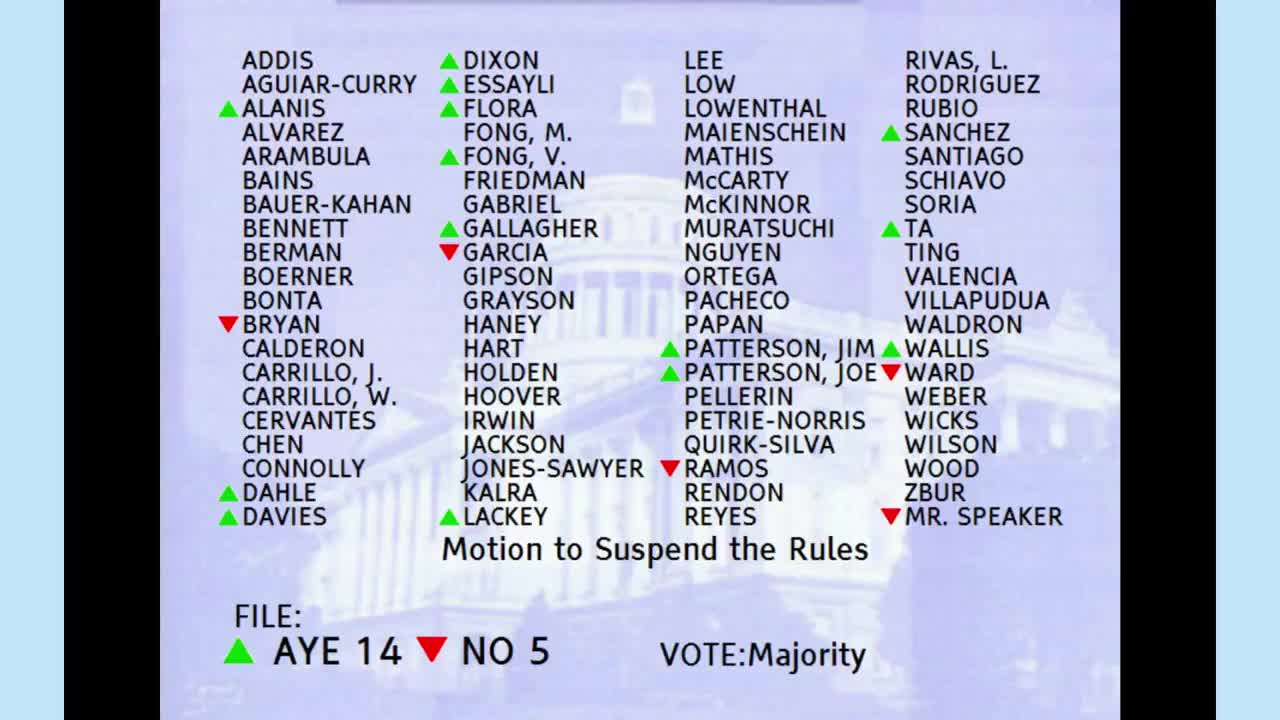 2MIN
Assembly Floor
 47SEC
Assembly Floor
 3MIN
Assembly Standing Committee on Appropriations
 11MIN
Assembly Standing Committee on Judiciary
 40MIN
Assembly Standing Committee on Banking and Finance
 53SEC
Senate Floor
 10MIN
Senate Standing Committee on Judiciary
Bill Author

Bill Co-Author(s):