SB 651: California Environmental Quality Act: groundwater recharge projects: Judicial Council rules of court.
- Session Year: 2023-2024
- House: Senate
- Latest Version Date: 2023-06-22
Current Status:
Failed
(2023-06-22: Read second time and amended. Re-referred to Com. on NAT. RES.)
Introduced
In Committee
First Chamber
In Committee
Second Chamber
Enacted
What does this bill do?
The bill requires the Judicial Council to adopt court rules so lawsuits that challenge the certification of an environmental impact report (EIR) or project approvals for groundwater recharge projects tied to a groundwater sustainability plan must be resolved, including appeals, within 270 days of filing. It defines which recharge projects are covered and excludes certain sites (for example, lands with recent pesticide use, manure-applied areas, places that risk damage to levees or water systems, and lands not irrigated in the past three years). The bill also expresses the Legislature’s intent that state and regional water boards prioritize water‑right and water‑quality approvals to speed projects that capture high precipitation for local storage or recharge while protecting fish and wildlife.
The summary is provided by generative AI which can make mistakes. For original language, please view the details in the table below.
The California Environmental Quality Act (CEQA) requires, among other things, a lead agency, as defined, to prepare, or cause to be prepared, and certify the completion of an environmental impact report on a project that it proposes to carry out or approve that may have a significant effect on the environment or to adopt a negative declaration if it finds that the project will not have that effect. CEQA establishes a procedure by which a person may seek judicial review of the decision of the lead agency made pursuant to CEQA.
Existing law, the Sustainable Groundwater Management Act, requires all groundwater basins designated as high- or medium-priority basins by the Department of Water Resources that are designated as basins subject to critical conditions of overdraft to be managed under a groundwater sustainability plan or coordinated groundwater sustainability plans by January 31, 2020, and requires all other groundwater basins designated as high- or medium-priority basins to be managed under a groundwater sustainability plan or coordinated groundwater sustainability plans by January 31, 2022, plan, except as specified.
This bill would require the Judicial Council to adopt a rule of court to establish procedures requiring actions or proceedings brought to attack, review, set aside, void, or annul the certification of an environmental impact report, or the granting of any project approvals, for specified projects that are approved to implement groundwater recharge projects, as described, except as provided, that implement a groundwater sustainability plan or an interim groundwater sustainability plan, as described, that would require the actions or proceedings, including any appeals, to be resolved within 270 days of the filing of the certified record of proceedings with the court. The bill would also include a related statement of legislative intent.
Existing law establishes in the Natural Resources Agency the State Water Resources Control Board and the regional water quality control boards. Existing law requires the state board to formulate and adopt state policy for water quality control. Existing law requires each regional board to coordinate with the state board and other regional boards, as well as other state agencies with responsibility for water quality, with respect to water quality control matters.
This bill would make it the policy of this state that, to help advance groundwater recharge projects, and to demonstrate the feasibility of projects that can use available high water flows to recharge local groundwater while minimizing flood risks, the state board and the regional water quality control boards prioritize water right permits, water quality certifications, waste discharge requirements, and conditional waivers of waste discharge requirements to accelerate approvals for projects that enhance the ability of a local or state agency to capture high precipitation events for local storage or recharge, consistent with water right priorities and protections for fish and wildlife.
The California Environmental Quality Act (CEQA) requires, among other things, a lead agency, as defined, to prepare, or cause to be prepared, and certify the completion of an environmental impact report on a project that it proposes to carry out or approve that may have a significant effect on the environment or to adopt a negative declaration if it finds that the project will not have that effect. CEQA establishes a procedure by which a person may seek judicial review of the decision of the lead agency made pursuant to CEQA.
Existing law, the Sustainable Groundwater Management Act, requires all groundwater basins designated as high- or medium-priority basins by the Department of Water Resources that are designated as basins subject to critical conditions of overdraft to be managed under a groundwater sustainability plan or coordinated groundwater sustainability plans by January 31, 2020, and requires all other groundwater basins designated as high- or medium-priority basins to be managed under a groundwater sustainability plan or coordinated groundwater sustainability plans by January 31, 2022, except as specified.
This bill would require the Judicial Council to adopt a rule of court to establish procedures requiring actions or proceedings brought to attack, review, set aside, void, or annul the certification of an environmental impact report, or the granting of any project approvals, for specified water storage and groundwater recharge projects that require projects that are approved to implement a groundwater sustainability plan or an interim groundwater sustainability plan, as described, that would require the actions or proceedings, including any appeals, to be resolved within 270 days of the filing of the certified record of proceedings with the court.
Existing law establishes in the Natural Resources Agency the State Water Resources Control Board and the regional water quality control boards. Existing law requires the state board to formulate and adopt state policy for water quality control. Existing law requires each regional board to coordinate with the state board and other regional boards, as well as other state agencies with responsibility for water quality, with respect to water quality control matters.
This bill would make it the policy of this state that, to help advance groundwater recharge projects, and to demonstrate the feasibility of projects that can use available high water flows to recharge local groundwater while minimizing flood risks, the state board and the regional water quality control boards prioritize water right permits, water quality certifications, waste discharge requirements, and conditional waivers of waste discharge requirements to accelerate approvals for projects that enhance the ability of a local or state agency to capture high precipitation events for local storage or recharge, consistent with water right priorities and protections for fish and wildlife.
The California Environmental Quality Act (CEQA) requires, among other things, a lead agency, as defined, to prepare, or cause to be prepared, and certify the completion of an environmental impact report on a project that it proposes to carry out or approve that may have a significant effect on the environment or to adopt a negative declaration if it finds that the project will not have that effect. CEQA establishes a procedure by which a person may seek judicial review of the decision of the lead agency made pursuant to CEQA.
Existing law, the Sacramento-San Joaquin Delta Reform Act of 2009, provides that it is the policy of the state to, among other things, reduce reliance on the Sacramento-San Joaquin Delta in meeting Californias future water supply needs through a statewide strategy of investing in improved regional supplies, conservation, and water use efficiency. Existing law establishes the Delta Stewardship Council, which is required to develop, adopt, and commence implementation of a comprehensive management plan, known as the Delta Plan, for the Sacramento-San Joaquin Delta. The act requires, among other things, a state or local public agency that proposes to undertake a covered action, before initiating the implementation of that covered action, to prepare a written certification of consistency with detailed findings as to whether the covered action is consistent with the Delta Plan and to submit that certification to the council, as provided.This bill would exempt from CEQA actions taken by a state agency, or by a local agency if the state agency with primary responsibility for the implementation of directives addressing impacts of drought concurs that local action is required, and permits that are necessary to carry out those actions, to accelerate approvals for projects that enhance the ability of a local or state agency to capture high precipitation events for local storage or recharge, consistent with water right priorities and protections for fish and wildlife. The bill would exempt the above-described actions and permits from the requirement to prepare a written certification of consistency with detailed findings as to whether the covered action or permit is consistent with the Delta Plan and to submit that certification to the council. The bill would also exempt from CEQA a recharge project under the Department of Water Resources Sustainable Groundwater Management Grant Program and flood-managed aquifer recharge projects, occurring on open and working lands to replenish and store water in groundwater basins that will help mitigate groundwater conditions impacted by drought, as specified. The bill would require state and local agencies to maintain on their internet websites a list of all activities or approvals to which these exemptions apply.To the extent that the bill would impose additional duties on local entities related to their implementation of CEQA and the Sacramento-San Joaquin Delta Reform Act of 2009, the bill would impose a state-mandated local program.The California Constitution requires the state to reimburse local agencies and school districts for certain costs mandated by the state. Statutory provisions establish procedures for making that reimbursement.This bill would provide that, if the Commission on State Mandates determines that the bill contains costs mandated by the state, reimbursement for those costs shall be made pursuant to the statutory provisions noted above.This bill would require the Judicial Council to adopt a rule of court to establish procedures requiring actions or proceedings brought to attack, review, set aside, void, or annul the certification of an environmental impact report, or the granting of any project approvals, for specified water storage and groundwater recharge projects that require the actions or proceedings, including any appeals, to be resolved within 270 days of the filing of the certified record of proceedings with the court.
Existing law establishes in the Natural Resources Agency the State Water Resources Control Board and the regional water quality control boards. Existing law requires the state board to formulate and adopt state policy for water quality control. Existing law requires each regional board to coordinate with the state board and other regional boards, as well as other state agencies with responsibility for water quality, with respect to water quality control matters.
This bill would make it the policy of this state that, to help advance groundwater recharge projects, and to demonstrate the feasibility of projects that can use available high water flows to recharge local groundwater while minimizing flood risks, the state board and the regional water quality control boards prioritize water right permits, water quality certifications, waste discharge requirements, and conditional waivers of waste discharge requirements to accelerate approvals for projects that enhance the ability of a local or state agency to capture high precipitation events for local storage or recharge, consistent with water right priorities and protections for fish and wildlife.
The California Environmental Quality Act (CEQA) requires, among other things, a lead agency, as defined, to prepare, or cause to be prepared, and certify the completion of an environmental impact report on a project that it proposes to carry out or approve that may have a significant effect on the environment or to adopt a negative declaration if it finds that the project will not have that effect.
Existing law, the Sacramento-San Joaquin Delta Reform Act of 2009, provides that it is the policy of the state to, among other things, reduce reliance on the Sacramento-San Joaquin Delta in meeting Californias future water supply needs through a statewide strategy of investing in improved regional supplies, conservation, and water use efficiency. Existing law establishes the Delta Stewardship Council, which is required to develop, adopt, and commence implementation of a comprehensive management plan, known as the Delta Plan, for the Sacramento-San Joaquin Delta. The act requires, among other things, a state or local public agency that proposes to undertake a covered action, before initiating the implementation of that covered action, to prepare a written certification of consistency with detailed findings as to whether the covered action is consistent with the Delta Plan and to submit that certification to the council, as provided.
This bill would exempt from CEQA actions taken by a state agency, or by a local agency if the state agency with primary responsibility for the implementation of directives addressing impacts of drought concurs that local action is required, and permits that are necessary to carry out those actions, to accelerate approvals for projects that enhance the ability of a local or state agency to capture high precipitation events for local storage or recharge, consistent with water right priorities and protections for fish and wildlife. The bill would exempt the above-described actions and permits from the requirement to prepare a written certification of consistency with detailed findings as to whether the covered action or permit is consistent with the Delta Plan and to submit that certification to the council. The bill would also exempt from CEQA a recharge project under the Department of Water Resources Sustainable Groundwater Management Grant Program and flood-managed aquifer recharge projects, occurring on open and working lands to replenish and store water in groundwater basins that will help mitigate groundwater conditions impacted by drought, as specified. The bill would require state and local agencies to maintain on their internet websites a list of all activities or approvals to which these exemptions apply.
To the extent that the bill would impose additional duties on local entities related to their implemention implementation of CEQA and the Sacramento-San Joaquin Delta Reform Act of 2009, the bill would impose a state-mandated local program.
The California Constitution requires the state to reimburse local agencies and school districts for certain costs mandated by the state. Statutory provisions establish procedures for making that reimbursement.This bill would provide that with regard to certain mandates no reimbursement is required by this act for a specified reason.With regard to any other mandates, this bill would provide that, if the Commission on State Mandates determines that the bill contains costs so mandated by the state, reimbursement for those costs shall be made pursuant to the statutory provisions noted above.The California Constitution requires the state to reimburse local agencies and school districts for certain costs mandated by the state. Statutory provisions establish procedures for making that reimbursement.
This bill would provide that, if the Commission on State Mandates determines that the bill contains costs mandated by the state, reimbursement for those costs shall be made pursuant to the statutory provisions noted above.
Existing law establishes in the Natural Resources Agency the State Water Resources Control Board and the regional water quality control boards. Existing law requires the state board to formulate and adopt state policy for water quality control. Existing law requires each regional board to coordinate with the state board and other regional boards, as well as other state agencies with responsibility for water quality, with respect to water quality control matters.
This bill would make it the policy of this state that, to help advance groundwater recharge projects, and to demonstrate the feasibility of projects that can use available high water flows to recharge local groundwater while minimizing flood risks, the state board and the regional water quality control boards prioritize water right permits, water quality certifications, waste discharge requirements, and conditional waivers of waste discharge requirements to accelerate approvals for projects that enhance the ability of a local or state agency to capture high precipitation events for local storage or recharge, consistent with water right priorities and protections for fish and wildlife.
The California Environmental Quality Act (CEQA) requires, among other things, a lead agency, as defined, to prepare, or cause to be prepared, and certify the completion of an environmental impact report on a project that it proposes to carry out or approve that may have a significant effect on the environment or to adopt a negative declaration if it finds that the project will not have that effect.
Existing law, the Sacramento-San Joaquin Delta Reform Act of 2009, provides that it is the policy of the state to, among other things, reduce reliance on the Sacramento-San Joaquin Delta in meeting Californias future water supply needs through a statewide strategy of investing in improved regional supplies, conservation, and water use efficiency. Existing law establishes the Delta Stewardship Council, which is required to develop, adopt, and commence implementation of a comprehensive management plan, known as the Delta Plan, for the Sacramento-San Joaquin Delta. The act requires, among other things, a state or local public agency that proposes to undertake a covered action, before initiating the implementation of that covered action, to prepare a written certification of consistency with detailed findings as to whether the covered action is consistent with the Delta Plan and to submit that certification to the council, as provided.
This bill would exempt from CEQA actions taken by a state agency, or by a local agency if the state agency with primary responsibility for the implementation of directives addressing impacts of drought concurs that local action is required, and permits that are necessary to carry out those actions, to accelerate approvals for projects that enhance the ability of a local or state agency to capture high precipitation events for local storage or recharge, consistent with water right priorities and protections for fish and wildlife. The bill would exempt the above-described actions and permits from the requirement to prepare a written certification of consistency with detailed findings as to whether the covered action or permit is consistent with the Delta Plan and to submit that certification to the council. The bill would also exempt from CEQA a recharge project under the Department of Water Resources Sustainable Groundwater Management Grant Program and flood-managed aquifer recharge projects, occurring on open and working lands to replenish and store water in groundwater basins that will help mitigate groundwater conditions impacted by drought, as specified. The bill would require state and local agencies to maintain on their internet websites a list of all activities or approvals to which these exemptions apply.
To the extent that the bill would impose additional duties on local entities related to their implemention of CEQA and the Sacramento-San Joaquin Delta Reform Act of 2009, the bill would impose a state-mandated local program.
The California Constitution requires the state to reimburse local agencies and school districts for certain costs mandated by the state. Statutory provisions establish procedures for making that reimbursement.
This bill would provide that with regard to certain mandates no reimbursement is required by this act for a specified reason.
With regard to any other mandates, this bill would provide that, if the Commission on State Mandates determines that the bill contains costs so mandated by the state, reimbursement for those costs shall be made pursuant to the statutory provisions noted above.
(a)(1)For purposes of this section, project means a groundwater recharge project that is approved to implement implements a groundwater sustainability plan that the department determines is in compliance with the requirements of Sections 10727.2 and 10727.4 of the Water Code or to implement an interim groundwater sustainability plan adopted pursuant to Section 10735.6 of the Water Code.
(2)For purposes of this section, a project does not include a project where any water is diverted or applied to any of the following:
(A)Any barn, ponds, or lands, to which manure or waste from an animal facility that generates waste from the feeding and housing of animals for more than 45 days per year in a confined area that is not vegetated are applied.
(B)Any agricultural field that has been identified as an outlier, either by an agricultural coalition charged with implementation of the Irrigated Lands Regulatory Program or by the appropriate regional water board, with respect to nitrogen application.
(C)Any agricultural field where pesticide or fertilizer application has occurred in the prior 30 days or in the period prohibited by applicable law, whichever is longer.
(D)Any area that could cause damage to critical levees, infrastructure, wastewater and drinking water systems, drinking water wells or drinking water supplies, or exacerbate the threat of flood and other health and safety concerns.
(E)Any area that has not been in active irrigated agricultural cultivation within the past three years, including grazing lands, annual grasslands, and natural habitats. This limitation does not apply to facilities already constructed for the purpose of groundwater recharge or managed wetlands.
(b)The Judicial Council shall adopt a rule of court to establish procedures that require actions or proceedings brought to attack, review, set aside, void, or annul the certification of an environmental impact report for a project or the granting of any project approvals that require the actions or proceedings, including any potential appeals to the court of appeal or the Supreme Court, to be resolved, to the extent feasible, within 270 days of the filing of the certified record of proceedings with the court.
SEC. 2.Section 114 is added to the Water Code, to read:114.It is the policy of this state that, to help advance groundwater recharge projects, and to demonstrate the feasibility of projects that can use available high water flows to recharge local groundwater while minimizing flood risks, the board and the regional water quality control boards shall prioritize water right permits, water quality certifications, waste discharge requirements, and conditional waivers of waste discharge requirements to accelerate approvals for projects that enhance the ability of a local or state agency to capture high precipitation events for local storage or recharge, consistent with water right priorities and protections for fish and wildlife.SEC. 2.It is the intent of the Legislature to help advance groundwater recharge projects, and to demonstrate the feasibility of projects that can use available high water flows to recharge local groundwater while minimizing flood risks. It is the further intent of the Legislature to encourage the board and the regional water quality control boards to prioritize water right permits, water quality certifications, waste discharge requirements, and conditional waivers of waste discharge requirements to accelerate approvals for projects that enhance the ability of a local or state agency to capture high precipitation events for local storage or recharge, consistent with water right priorities and protections for fish and wildlife.
(a)For purposes of this section, project means a project that is approved to implement a groundwater sustainability plan that the department determines is in compliance with the requirements of Sections 10727.2 and 10727.4 of the Water Code or to implement an interim groundwater sustainability plan adopted pursuant to Section 10735.6 of the Water Code.
(b)The Judicial Council shall adopt a rule of court to establish procedures that require actions or proceedings brought to attack, review, set aside, void, or annul the certification of an environmental impact report for a project or the granting of any project approvals that require the actions or proceedings, including any potential appeals to the court of appeal or the Supreme Court, to be resolved, to the extent feasible, within 270 days of the filing of the certified record of proceedings with the court.
SEC. 2.Section 114 is added to the Water Code, to read:114.It is the policy of this state that, to help advance groundwater recharge projects, and to demonstrate the feasibility of projects that can use available high water flows to recharge local groundwater while minimizing flood risks, the board and the regional water quality control boards shall prioritize water right permits, water quality certifications, waste discharge requirements, and conditional waivers of waste discharge requirements to accelerate approvals for projects that enhance the ability of a local or state agency to capture high precipitation events for local storage or recharge, consistent with water right priorities and protections for fish and wildlife.
(a)For purposes of this section, project means either of the following:
(1)An action taken by a state agency, or by a local agency if the state agency with primary responsibility for the implementation of directives addressing the impacts of drought concurs that local action is required, or to a permit that is necessary to carry out that action, to the extent necessary to address the impacts of drought, in order to accelerate approvals for projects that enhance the ability of a local or state agency to capture high precipitation events for local storage or recharge, consistent with water right priorities and protections for fish and wildlife.
(b)This division does not apply to a(2)A recharge project under the Department of Water Resources Sustainable Groundwater Management Grant Program or to a flood-managed aquifer recharge project, occurring on open and working lands to replenish and store water in groundwater basins that will help mitigate groundwater conditions impacted by drought, with respect to an action taken by a state agency, or by a local agency if the Department of Water Resources concurs that local action is required, or to a permit that is necessary to carry out that action, to the extent necessary to address the impacts of drought.
(c)State and local agencies shall maintain on their internet websites a list of all activities or approvals to which this section applies.(b)The Judicial Council shall adopt a rule of court to establish procedures that require actions or proceedings brought to attack, review, set aside, void, or annul the certification of an environmental impact report for a project or the granting of any project approvals that require the actions or proceedings, including any potential appeals to the court of appeal or the Supreme Court, to be resolved, to the extent feasible, within 270 days of the filing of the certified record of proceedings with the court.
SEC. 2.Section 114 is added to the Water Code, to read:114.It is the policy of this state that, to help advance groundwater recharge projects, and to demonstrate the feasibility of projects that can use available high water flows to recharge local groundwater while minimizing flood risks, the board and the regional water quality control boards shall prioritize water right permits, water quality certifications, waste discharge requirements, and conditional waivers of waste discharge requirements to accelerate approvals for projects that enhance the ability of a local or state agency to capture high precipitation events for local storage or recharge, consistent with water right priorities and protections for fish and wildlife.
SEC. 3.Section 85225.1 is added to the Water Code, to read:85225.1.(a)This chapter does not apply to actions or permits described in subdivision (a) of Section 21080.08 of the Public Resources Code.(b)State and local agencies shall maintain on their internet websites a list of all activities or approvals that are exempted from this chapter pursuant to this section.SEC. 4.If the Commission on State Mandates determines that this act contains costs mandated by the state, reimbursement to local agencies and school districts for those costs shall be made pursuant to Part 7 (commencing with Section 17500) of Division 4 of Title 2 of the Government Code.(a)This division does not apply to an action taken by a state agency, or by a local agency if the state agency with primary responsibility for the implementation of directives addressing the impacts of drought concurs that local action is required, or to a permit that is necessary to carry out that action, to the extent necessary to address the impacts of drought, in order to accelerate approvals for projects that enhance the ability of a local or state agency to capture high precipitation events for local storage or recharge, consistent with water right priorities and protections for fish and wildlife.
(b)This division does not apply to a recharge project under the Department of Water Resources Sustainable Groundwater Management Grant Program or to a flood-managed aquifer recharge project, occurring on open and working lands to replenish and store water in groundwater basins that will help mitigate groundwater conditions impacted by drought, with respect to an action taken by a state agency, or by a local agency if the Department of Water Resources concurs that local action is required, or to a permit that is necessary to carry out that action, to the extent necessary to address the impacts of drought.
(c)State and local agencies shall maintain on their internet websites a list of all activities or approvals to which this section applies.
SEC. 2.Section 114 is added to the Water Code, to read:114.It is the policy of this state that, to help advance groundwater recharge projects, and to demonstrate the feasibility of projects that can use available high water flows to recharge local groundwater while minimizing flood risks, the board and the regional water quality control boards shall prioritize water right permits, water quality certifications, waste discharge requirements, and conditional waivers of waste discharge requirements to accelerate approvals for projects that enhance the ability of a local or state agency to capture high precipitation events for local storage or recharge, consistent with water right priorities and protections for fish and wildlife.
SEC. 3.Section 85225.1 is added to the Water Code, to read:85225.1.(a)This chapter does not apply to actions or permits described in subdivision (a) of Section 21080.08 of the Public Resources Code.
(b)State and local agencies shall maintain on their internet websites a list of all activities or approvals that are exempted from this chapter pursuant to this section.
SEC. 4.No reimbursement is required by this act pursuant to Section 6 of Article XIIIB of the California Constitution for certain costs that may be incurred by a local agency or school district because, in that regard, this act creates a new crime or infraction, eliminates a crime or infraction, or changes the penalty for a crime or infraction, within the meaning of Section 17556 of the Government Code, or changes the definition of a crime within the meaning of Section 6 of Article XIIIB of the California Constitution.However, if the Commission on State Mandates determines that this act contains other costs mandated by the state, reimbursement to local agencies and school districts for those costs shall be made pursuant to Part 7 (commencing with Section 17500) of Division 4 of Title 2 of the Government Code.SEC. 4.If the Commission on State Mandates determines that this act contains costs mandated by the state, reimbursement to local agencies and school districts for those costs shall be made pursuant to Part 7 (commencing with Section 17500) of Division 4 of Title 2 of the Government Code.
(a)This division does not apply to an action taken by a state agency, or by a local agency if the state agency with primary responsibility for the implementation of directives addressing the impacts of drought concurs that local action is required, or to a permit that is necessary to carry out that action, to the extent necessary to address the impacts of drought, in order to accelerate approvals for projects that enhance the ability of a local or state agency to capture high precipitation events for local storage or recharge, consistent with water right priorities and protections for fish and wildlife.
(b)This division does not apply to a recharge project under the Department of Water Resources Sustainable Groundwater Management Grant Program or to a flood-managed aquifer recharge project, occurring on open and working lands to replenish and store water in groundwater basins that will help mitigate groundwater conditions impacted by drought, with respect to an action taken by a state agency, or by a local agency if the Department of Water Resources concurs that local action is required, or to a permit that is necessary to carry out that action, to the extent necessary to address the impacts of drought.
(c)State and local agencies shall maintain on their internet websites a list of all activities or approvals to which this section applies.
SEC. 2.Section 114 is added to the Water Code, to read:114.It is the policy of this state that, to help advance groundwater recharge projects, and to demonstrate the feasibility of projects that can use available high water flows to recharge local groundwater while minimizing flood risks, the board and the regional water quality control boards shall prioritize water right permits, water quality certifications, waste discharge requirements, and conditional waivers of waste discharge requirements to accelerate approvals for projects that enhance the ability of a local or state agency to capture high precipitation events for local storage or recharge, consistent with water right priorities and protections for fish and wildlife.
SEC. 3.Section 85225.1 is added to the Water Code, to read:85225.1.(a)This chapter does not apply to actions or permits described in subdivision (a) of Section 21080.08 of the Public Resources Code.
(b)State and local agencies shall maintain on their internet websites a list of all activities or approvals that are exempted from this chapter pursuant to this section.
SEC. 4.No reimbursement is required by this act pursuant to Section 6 of Article XIIIB of the California Constitution for certain costs that may be incurred by a local agency or school district because, in that regard, this act creates a new crime or infraction, eliminates a crime or infraction, or changes the penalty for a crime or infraction, within the meaning of Section 17556 of the Government Code, or changes the definition of a crime within the meaning of Section 6 of Article XIIIB of the California Constitution.
However, if the Commission on State Mandates determines that this act contains other costs mandated by the state, reimbursement to local agencies and school districts for those costs shall be made pursuant to Part 7 (commencing with Section 17500) of Division 4 of Title 2 of the Government Code.
|
Date
|
Status
|
|---|---|
| Jun 22, 2023 | Read second time and amended. Re-referred to Com. on NAT. RES. |
| Jun 21, 2023 | From committee: Do pass as amended and re-refer to Com. on NAT. RES. (Ayes 11. Noes 0.) (June 20). |
| Jun 1, 2023 | Referred to Coms. on W., P., & W. and NAT. RES. |
| May 25, 2023 | In Assembly. Read first time. Held at Desk. |
| May 24, 2023 | Read third time. Passed. (Ayes 37. Noes 0. Page 1257.) Ordered to the Assembly. |
| May 18, 2023 | Read second time. Ordered to third reading. |
| May 18, 2023 | From committee: Do pass. (Ayes 6. Noes 1. Page 1178.) (May 18). |
| May 12, 2023 | Set for hearing May 18. |
| May 8, 2023 | May 8 hearing: Placed on APPR suspense file. |
| May 2, 2023 | Set for hearing May 8. |
| Apr 27, 2023 | Read second time and amended. Re-referred to Com. on APPR. |
| Apr 26, 2023 | From committee: Do pass as amended and re-refer to Com. on APPR. (Ayes 7. Noes 0. Page 936.) (April 26). |
| Apr 18, 2023 | Set for hearing April 26. |
| Apr 12, 2023 | Read second time and amended. Re-referred to Com. on E.Q. |
| Apr 11, 2023 | From committee: Do pass as amended and re-refer to Com. on E.Q. (Ayes 9. Noes 0. Page 658.) (April 11). |
| Mar 29, 2023 | From committee with author's amendments. Read second time and amended. Re-referred to Com. on N.R. & W. |
| Mar 23, 2023 | Set for hearing April 11. |
| Mar 1, 2023 | Referred to Coms. on N.R. & W. and E.Q. |
| Feb 17, 2023 | From printer. May be acted upon on or after March 19. |
| Feb 16, 2023 | Introduced. Read first time. To Com. on RLS. for assignment. To print. |
|
Date
|
Description
|
Location
|
Votes
|
|
|---|---|---|---|---|
| Jun 20, 2023 | Do pass as amended and be re-referred to the Committee on [Natural Resources] | Assembly Standing Committee on Water, Parks, and Wildlife |
Passed |
|
| May 24, 2023 | Senate 3rd Reading SB651 Grove et al. | Senate Floor |
Passed |
|
| May 18, 2023 | Do pass | Senate Standing Committee on Appropriations |
Passed |
|
| May 8, 2023 | Placed on suspense file | Senate Standing Committee on Appropriations |
Passed |
|
| Apr 26, 2023 | Do pass as amended, but first amend, and re-refer to the Committee on [Appropriations] | Senate Standing Committee on Environmental Quality |
Passed |
|
| Apr 11, 2023 | Do pass as amended, but first amend, and re-refer to the Committee on [Environmental Quality] | Senate Standing Committee on Natural Resources and Water |
Passed |
This list shows positions taken on this bill by organizations on the date displayed, which is linked to the original source.
Positions by individuals are not included.
|
Organization
|
Position
|
Date
|
|---|---|---|
| African American Farmers of California | ** Support | |
| California Apple Commission | ** Support | |
| California Blueberry Association | ** Support | |
| California Blueberry Commission | ** Support | |
| California Chamber Of Commerce | * Support | Jun 20, 2023 |
| California Cotton Ginners and Growers Association | ** Support | |
| California Environmental Voters | ** Against | |
| California Farm Bureau Federation | ** Support | |
| California Fresh Fruit Association | ** Support | |
| California Tomato Growers Association | ** Support | |
| California Walnut Commission | ** Support | |
| Center For Biological Diversity | ** Against | |
| Defenders Of Wildlife | ** Against | |
| Grower-Shipper Association of Central California | ** Support | |
| Kern County Farm Bureau | ** Support | |
| Laborde Land Company, LLC | ** Support | |
| Lower Tule River Irrigation District Groundwater Sustainability Agency | ** Support | |
| Lower Tule River Irrigation District GSA | ** Support | |
| Mid-Kaweah Groundwater Sustainability Agency | ** Support | |
| Natural Resources Defense Council | ** Against | |
| Nisei Farmers League | * Support | Jun 20, 2023 |
| NRDC | ** Against | Apr 26, 2023 |
| Olive Growers Council of California | ** Support | |
| Pixley Irrigation District Groundwater Sustainability Agency | ** Support | |
| Pixley Irrigation District GSA | ** Support | |
| R Street Institute | ** Support | |
| Reeb Government Relations | * Support | Jun 20, 2023 |
| San Luis DeltaMendota Water Authority | * Support | Apr 26, 2023 |
| Sierra Club of California | * Against | Jun 20, 2023 |
| United Ag | ** Support | Jun 20, 2023 |
| united ag | ** Support | |
| United Water Conservation District | * Support | Jun 20, 2023 |
| Valley Ag Water Coalition | * Support | Jun 20, 2023 |
| Western AG Processors Association | ** Support | Jun 20, 2023 |
| Western Growers Association | ** Support | |
| Westlands Water District | * Support | Apr 11, 2023 |
Date of Hearing: June 20, 2023
ASSEMBLY COMMITTEE ON WATER, PARKS, AND WILDLIFE
Rebecca Bauer-Kahan, Chair
SBPCA Bill Id:SB 651
Author:(Grove) – As Amended Ver:April 27, 2023
SENATE VOTE: 37-0
SUBJECT: Water storage and recharge: California Environmental Quality Act
SUMMARY: Streamlines judicial review for specified groundwater management projects that are challenged under the California Environmental Quality Act (CEQA). Specifically, this bill:
- Defines “project” as a project approved to implement an approved groundwater sustainability plan (GSP) or an interim plan developed by the State Water Resources Control Board (State Water Board) for a probationary basin for purpose of judicial streamlining in this bill.
- Requires the Judicial Council to adopt a rule of court to streamline judicial review of an action brought against certification of an environmental impact report for, or approval of, a project so that the proceeding is resolved within 270 days, to the extent feasible.
- Declares it is the policy of the state to accelerate approvals for projects that capture high precipitation events for local storage or recharge.
EXISTING LAW:
- Enacts the Sustainable Groundwater Management Act (SGMA) that requires local agencies to sustainably manage groundwater in basins that the Department of Water Resources (DWR) deems high- or medium-priority by 2040. Defines sustainable management of groundwater as the avoidance of the following six “undesirable results:” (a) chronic lowering of groundwater levels; (b) reduction of groundwater storage; (c) seawater intrusion; (d) degraded water quality; (e) land subsidence; and (f) depletions of interconnected surface water (Water Code § 10720 et seq.).
- Requires local agencies in groundwater basins DWR designates as high- or medium-priority to form a groundwater sustainability agency by June 30, 2017 (Water Code § 10723). Requires high- or medium-priority basins to be managed under a GSP by January 31, 2022 (Water Code § 10727.7).
- Requires DWR to identify groundwater basins that are subject to critical conditions of overdraft (Water Code § 12924). Requires these critically overdrafted basins to be managed under a GSP by January 31, 2020 (Water Code § 10720.7).
- Requires a GSP to include a description of the aquifer system in the basin, measureable objectives to achieve the sustainability goal within 20 years, a planning and implementation horizon, monitoring sites and protocols, and other specified contents (Water Code § 10727–10727.8).
- Exempts the preparation and adoption of a GSP from CEQA but clarifies that projects to implement a GSP are not exempt from CEQA (Water Code § 10728.6).
- Authorizes the State Water Board to adopt an interim plan for the management of groundwater in a basin that is designated “probationary” (Water Code § 10735.6).
- Requires, under CEQA, lead agencies with the principal responsibility for carrying out or approving a project to prepare a negative declaration, mitigated negative declaration, or environmental impact report (EIR) for the project, unless the project is exempt from CEQA (Public Resources Code §21000 et seq.). If a project may have a significant effect on the environment, the lead agency must prepare a draft EIR [CEQA Guidelines 15064(a)(1), (f)(1)].
- Requires an “environmental leadership development project” (ELDP), which includes certain housing projects, challenged under CEQA, to be resolved in 270 days, including appeals to the court of appeal and the Supreme Court (Public Resources Code §21185).
FISCAL EFFECT: Unknown. This bill is keyed fiscal.
COMMENTS:
- Purpose of this bill. According to the author, this bill is necessary to accelerate implementation of GSPs so that groundwater resources are better managed. The author asserts: “Our GSAs have 17 years to achieve groundwater sustainability, and we are running critically behind in reaching those goals. [This bill] makes the judicial review process more efficient and gets our local agencies building instead of waiting. Projects deserve to be built in a manner that minimizes time-consuming and burdensome lawsuits and appeals while preserving environmental quality.” The author cites an example where a project in a groundwater basin managed by the Eastern Tule GSA was subject to a CEQA challenge that delayed implementation; this bill would expedite review of such a challenge.
The author indicates the Governor’s executive order N-7-22 which extended the drought emergency in 2022 and exempted groundwater recharge projects from CEQA, among other provisions, as an impetus for this bill. - Background. In the midst of a severe drought, the Legislature enacted SGMA in 2014 to reverse the adverse impacts caused by groundwater overdraft and to protect groundwater resources for future use by California’s economy, communities, and ecosystems. Under SGMA, “medium” and “high” priority groundwater basins must form a GSA and develop a GSP. The 21 groundwater basins designated as being in a condition of critical overdraft were required to develop GSPs and submit them to DWR for review by January 31, 2020. The remaining medium- and high-priority groundwater basins had until January 31, 2022, to submit GSPs to DWR for review. Basins that were already actively managing their groundwater resources at the time of SGMA’s passage were permitted to submit an “alternative” plan to DWR for review to ensure the plan met the objectives of SGMA.
As noted above in #5 under “Existing Law,” SGMA exempts the development and adoption of a GSP from CEQA. After submission of a GSP to DWR, DWR reviews the GSPs and determines whether a GSP is “approved,” “incomplete,” or “inadequate.” Approved basins may implement their plans, subject to periodic state review; “incomplete” basins have six months to correct deficiencies identified by DWR; and “inadequate” basins are referred to the State Water Board for possible designation as a “probationary” basin subject to state management (or “state intervention”).
How many GSPs? Currently, DWR has deemed 23 GSPs that cover six critically overdrafted basins to be “inadequate” and have referred those GSPs to the State Water Board for consideration of whether probationary status for the basin is warranted. Of the remaining GSPs, DWR has determined that 15 GSPs covering six basins are still “incomplete” (submittal of a corrected GSP is pending) and 25 GSPs are “complete.” DWR is reviewing another 54 GSPs (“review in progress”) that have been submitted and has until January 2024 to complete this review. This bill would apply to the 25 GSPs that are deemed “complete” and (presumably) to the nine alternative submittals that DWR has approved. However, if this bill were enacted, it is very likely that a significant number of the 54 GSPs currently being reviewed by DWR would be deemed “complete” shortly after this bill takes effect on January 1, 2024, and would, therefore, be able to take advantage of the judicial streamlining provided by this bill. - Arguments in support. The Valley Ag Water Coalition (Coalition) supports this bill pointing out that it is similar to the Governor’s drought EO and arguing that “time is of the essence” to implement local projects to capture and recharge critically overdrafted groundwater basins. The Coalition maintains these groundwater projects must come to fruition “given the cyclical nature of water supply availability and the impact severe drought has on groundwater resources.”
- Arguments in opposition. The Sierra Club opposes this bill arguing that “this attempt to streamline CEQA’s judicial review process undermines the environmental safeguards, public transparency, and promotes streamlining of projects.” Sierra Club contends that it is “imperative that groundwater storage and recharge projects comply with CEQA review to ensure that they have no potentially significant adverse consequences, such as aquifer contamination, and to provide public information and transparency.”
- Policy considerations. It is not clear the extent to which the implementation of SGMA is being delayed by legal challenges under CEQA to groundwater management projects outlined in GSPs. The author has only referenced one example where a groundwater project described in a GSP has been challenged under CEQA. Given that 117 distinct GSPs (25 of which have been approved) covering more than 100 groundwater basins were submitted to DWR as of January 2022, lengthy legal challenges to groundwater management projects does not appear to be a widespread problem. The Committee may wish to ask the author why this judicial streamlining is necessary given the record, or lack thereof.
- Suggested committee amendments. This bill offers judicial streamlining for CEQA challenges to any project that implements an approved GSP or an interim plan for a probationary basin. This covers a wide range of projects over a period of at least two decades. Some examples of projects identified in GSPs approved to date include groundwater recharge projects, water use efficiency projects (e.g., efficient fixtures for residences or drip irrigation for agriculture), land fallowing or repurposing programs, water recycling, stormwater capture, and new or enhanced water conveyance infrastructure, among others. The Committee may wish to ask the author to narrow the scope of this bill similar to other CEQA judicial streamlining bills (e.g., ELDPs) so that only those projects that are likely to have environmental benefits rather than environmental impacts receive the benefit of streamlining. The following amendment would address this concern:
Public Resources Code, Section 21168.6.11. (a) For purposes of this section, “project” means a groundwater recharge project that is approved to implements a groundwater sustainability plan that the department determines is in compliance with the requirements of Sections 10727.2 and 10727.4 of the Water Code or to implement an interim groundwater sustainability plan adopted pursuant to Section 10735.6 of the Water Code.
(b) For purposes of the section, a “project” shall not include a project where any water is diverted or applied to any of the following:
(1) Any barn, ponds, or lands, to which manure or waste from an animal facility that generates waste from the feeding and housing of animals for more than 45 days per year in a confined area that is not vegetated are applied.
(2) Any agricultural field that has been identified as an outlier, either by an agricultural coalition charged with implementation of the Irrigated Lands Regulatory Program or by the appropriate regional water board, with respect to nitrogen application.
(3)Any agricultural field where pesticide or fertilizer application has occurred in the prior 30 days or in the period prohibited by applicable law, whichever is longer.
(4) Any area that could cause damage to critical levees, infrastructure, wastewater and drinking water systems, drinking water wells or drinking water supplies, or exacerbate the threat of flood and other health and safety concerns.
(5) Any area that has not been in active irrigated agricultural cultivation within the past three years, including grazing lands, annual grasslands, and natural habitats. This limitation does not apply to facilities already constructed for the purpose of groundwater recharge or managed wetlands.
Legislative intent or broad policy? This bill also adds a new section to Division 1 of the Water Code that declares it is the policy of the state that the State Water Board and Regional Water Boards prioritize the approval of permits necessary to implement groundwater recharge projects that capture water from “high precipitation events.” This reads more like legislative intent than other statements of broad policy such as the Human Right to Water (Water Code § 106.3), domestic use preference (Water Code § 106), or public ownership of water (Water Code § 102) that are more typically enshrined in statute in Division 1 of the Water Code. The Committee may wish to request that the author not codify this statement and instead include it as legislative intent to this bill.
- Dual-referral. This bill is also referred to the Natural Resources Committee.
- Related legislation. SB 861 (Dahle) of 2023 would have required the Judicial Council to adopt rules of court to ensure any CEQA-related challenges to five specific water conveyance projects are resolved by the courts in 270 days if feasible. SB 861 was held on suspense in the Senate Appropriations Committee.
SB 420 (Becker) of 2023 allows certain electric transmission projects to become ELDPs and have any CEQA-related challenges be resolved by the courts in 270 days if feasible. SB 420 is pending in the Assembly Utilities and Energy Committee.
AB 1488 (Wallis) of 2023 classifies water storage, water conveyance, and groundwater recharge projects as ELDPs, which requires any CEQA-related challenges be resolved by the courts in 270 days if feasible. This bill is pending in the Assembly Natural Resources Committee.
SB 315 (Hurtado) of 2023 would have required the State Water Board to provide an 18-month grace period to a GSA whose basin has been designated as a “probationary basin,” before the probationary status takes effect. It also would have removed the State Water Board’s authority to develop an interim plan for a probationary basin if a GSA has not cured the deficiencies in the GSP. SB 315 was held on suspense in the Senate Appropriations Committee.
SB 7 (Atkins), Chapter 19, Statutes of 2021, re-enacts and revises the expedited CEQA administrative and judicial review procedures for ELDPs. For these projects, a 270-day judicial review deadline would apply and includes appeals to the Court of Appeal and the Supreme Court. It also extended eligibility to housing projects that will result in an investment of $15–$100 million, provided at least 15% of the project is affordable to lower income households and the project is not used as a short-term rental.
REGISTERED SUPPORT / OPPOSITION:
Support
California Farm Bureau Federation
Valley Ag Water Coalition
Opposition
Center for Biological Diversity
Defenders of Wildlife
Natural Resources Defense Council
Sierra Club
Analysis Prepared by: Pablo Garza / W., P., & W. / (916) 319-2096
SENATE RULES COMMITTEE Office of Senate Floor Analyses (916) 651-1520 Fax: (916) 327-4478 | SB 651 |
THIRD READING
Bill No: SB 651
Author: Grove (R), et al.
Amended: 4/27/23
Vote: 21
SENATE NATURAL RES. & WATER COMMITTEE: 9-0, 4/11/23
AYES: Min, Seyarto, Becker, Dahle, Eggman, Grove, Hurtado, Laird, Padilla
NO VOTE RECORDED: Allen, Limón
SENATE ENVIRONMENTAL QUALITY COMMITTEE: 7-0, 4/26/23
AYES: Allen, Dahle, Gonzalez, Hurtado, Jones, Menjivar, Skinner
SENATE APPROPRIATIONS COMMITTEE: 6-1, 5/18/23
AYES: Portantino, Jones, Ashby, Bradford, Seyarto, Wiener
NOES: Wahab
SUBJECT: Water storage and recharge: California Environmental Quality Act
SOURCE: Author
DIGEST:
This bill requires the Judicial Council to adopt rules of court to ensure California Environmental Quality Act (CEQA) actions pertaining to certain water storage and groundwater recharge projects are resolved by the courts, to the extent feasible, within 270 days.
ANALYSIS:
Existing law:
- Requires, under the Sustainable Groundwater Management Act (SGMA) Groundwater Sustainability Agencies (GSAs) to adopt Groundwater Sustainability Plans (GSPs) to reduce groundwater pumping to sustainable levels by 2040. (Water Code §10720 et seq)
- Requires, pursuant to CEQA, lead agencies with the principal responsibility for carrying out or approving a project to prepare a negative declaration (ND), mitigated negative declaration (MND), or environmental impact report (EIR) for the project, unless the project is exempt from CEQA. (Public Resources Code (PRC) §21000 et seq.). If a project may have a significant effect on the environment, the lead agency must prepare a draft EIR. (CEQA Guidelines 15064(a)(1), (f)(1))
- Requires counties with a population of over 200,000 to designate one or more judges to develop expertise on CEQA and hear CEQA cases. (PRC §21167.1 (b))
- Requires both the superior court and the court of appeal to give CEQA lawsuits preference over all other civil actions. (PRC §21167.1(a))
- Requires, if feasible, the court of appeal to hear a CEQA appeal within one year of filing. (PRC §21167.1(a)).
- Requires an “environmental leadership development project” (ELDP), which includes certain housing projects, challenged under CEQA, to be resolved in 270 days, including appeals to the court of appeal and the Supreme Court. (PRC §21185).
This bill:
- Defines “project” to mean a project that is approved to implement a GSP that the Department of Water Resources (DWR) determines is in compliance with SGMA or to implement an interim GSP adopted pursuant to SGMA.
- Directs the Judicial Council to adopt rules of court to ensure, to the extent feasible, challenges under CEQA to the projects noted above are resolved in 270 days, including appeals to the court of appeal and the Supreme Court.
Background
- The A, B, C’s of CEQA. CEQA was enacted by the Legislature and signed into law by Governor Ronald Reagan in 1970. While it has evolved into a very complex Act over the past 53 years, at its core the basic principles of CEQA are relatively simple.
It is designed to (a) make government agencies and the public aware of the environmental impacts of a proposed project, (b) ensure the public can take part in the review process, and (c) identify and implement measures to mitigate or eliminate any negative impact the project may have on the environment.
CEQA is self-executing statute that is enforced by civil lawsuits that can challenge any project’s environmental review. Public agencies, as well as private individuals and organizations, can file lawsuits under CEQA.
- Underground Storage. California’s groundwater use is the largest in the United States, with approximately 16% of the nation’s groundwater supplies come from the state’s aquifers. This resource has helped California become the largest food and agricultural economy in the nation, but the unsustainable use of groundwater also has its pitfalls, including diminished quantity and degraded quality of groundwater resources, damaged infrastructure due to land subsidence, and decline in ecosystem services.
- Recharging Those Aquifers. Groundwater recharge occurs when water seeps – or is injected – into the ground to replenish underground aquifers and plays an important role in water management in California. Recharging helps mitigate impacts from groundwater pumping, such as dry wells or subsidence, and also provides wetland habitat for birds, reduces flood risk, and stores water for droughts. Common methods of recharge include filling dedicated recharge basins or ponds, injecting water through wells, and using extra surface water to avoid pumping.
- SGMA Freud. The Sustainable Groundwater Management Act, better known as SGMA, was created in 2014 to better manage California’s underground water resources. Among its many provisions is a requirement that GSAs adopt GSPs to reduce pumping to sustainable levels by 2040.
- The SGMA Process. SGMA requires GSAs in medium- and high-priority groundwater basins, which includes 21 critically over-drafted basins, to develop and implement GSPs. SGMA authorizes state intervention in limited circumstances, generally when DWR determines a GSP is inadequate or isn’t being implemented properly.
If DWR finds a GSP is inadequate, it gives the GSA 180 days to cure any deficiencies. If after that time, DWR still finds the GSP inadequate, the State Water Resources Control Board (SWRCB) considers – via a noticed public hearing – whether the basin should be designated as a probationary basin.
Once a basin is determined to be “probationary,” the GSA has one year to address the issues and if they are not resolved, the SWRCB may begin another public process to determine whether to implement an interim plan for the basin. Should that occur, the SWRCB temporarily manages the groundwater in the basin until the GSA can demonstrate its ability to manage the basin sustainably.
- Who Is On Probation? In early March 2023, DWR deemed six GSPs as inadequate, thus triggering the process outlined above.
The six basins the SWRCB will now determine, via a notice public hearing, whether they should be deemed “probationary” are:
- Chowchilla Subbasin in Madera and Merced counties.
- Delta-Mendota Subbasin in San Joaquin, Stanislaus, Merced, Fresno, Madera, and San Benito counties.
- Kaweah Subbasin in Tulare and Kings counties.
- Tule Subbasin in Tulare County.
- Tulare Lake Subbasin in Kings County.
- Kern Subbasin in Kern County.
Comments
- Purpose of Bill. According to the author, “Our GSAs have 17 years to achieve comprehensive groundwater sustainability. Many of them have projects tied up in lengthy and costly litigation, with no option to build the projects necessary to be compliant with SGMA. The state needs to expedite burdensome EIR lawsuits that delay the construction of common sense water projects.”
- Moving More People Into The Front Row Seats. This is one of at least four bills this session – SB 861 (Dahle), SB 420 (Becker), and AB 1488 (Wallis) being the other three – proposing to require any CEQA-related litigation to be resolved by the courts in 270 days, if feasible.
Obviously it depends on how many of these types of cases are filed and where in the state they are handled. However, it is worth noting to the extent more and more cases are required to be adjudicated on an expedited basis, the more and more likely it is that – absent an expansion of courts and judges in the state – other types of cases will be slowed down in the state’s judicial system.
Related/Prior Legislation
SB 861 (Dahle, 2023) requires the Judicial Council to adopt rules of court to ensure any CEQA-related challenges to five specific water conveyance projects are resolved by the courts in 270 days if feasible. The bill was held in the Senate Appropriations Committee.
SB 420 (Becker, 2023) allows certain electric transmission projects to become ELDPs and have any CEQA-related challenges be resolved by the courts in 270 days if feasible. The bill is pending before the Senate Floor.
AB 1488 (Wallis, 2023) classifies water storage, water conveyance, and groundwater recharge projects as ELDPs, which requires any CEQA-related challenges be resolved by the courts in 270 days if feasible. AB 1488 was held in its first policy committee.
SB 315 (Hurtado, 2023) requires the State Water Resources Control Board (SWRCB) to provide an 18-month grace period to a GSA whose basin has been designated as a “probationary basin,” before the probationary status takes effect. It also removes SWRCB’s authority to develop an interim plan for a probationary basin if a GSA has not cured the deficiencies in the GSP. The bill was held in the Senate Appropriations Committee.
SB 7 (Atkins, Chapter 19, Statutes of 2021) re-enacted and revised the expedited CEQA administrative and judicial review procedures for ELDPs. For these projects, a 270-day judicial review deadline would apply and includes appeals to the Court of Appeal and the Supreme Court. It also extended eligibility to housing projects that will result in an investment of $15-$100 million, provided at least 15% of the project is affordable to lower income households and the project is not used as a short-term rental.
FISCAL EFFECT: Appropriation: No Fiscal Com.: Yes Local: No
According to the Senate Appropriations Committee:
- The State Water Resources Control Board (SWRCB) estimates ongoing costs within the range of $2 million to $3.4 million annually (General Fund, special fund, or bond funds) to implement the provisions of this bill and advance, permit, and process groundwater recharge projects that capture high precipitation events for local storage or recharge.
- Unknown but potentially significant cost pressure (General Fund) to the state-funded court system to process and hear challenges to projects eligible for expedited judicial review as a result of this bill.
- Potential unknown but likely minor costs (General Fund) to Judicial Council to adopt rules of the court to guide implementation of the provisions of this bill.”
SUPPORT: (Verified 5/18/23)
African American Farmers of California
CalChamber
California Apple Commission
California Blueberry Association
California Blueberry Commission
California Cotton Ginners and Growers Association
California Farm Bureau Federation
California Fresh Fruit Association
California Tomato Growers Association
California Walnut Commission
Grower-shipper Association of Central California
Kern County Farm Bureau
Laborde Land Company LLC
Lower Tule River Irrigation District GSA
Mid-Kaweah Groundwater Sustainability Agency
Nisei Farmers League
Olive Growers Council of California
Pixley Irrigation District GSA
R Street Institute
United Ag
United Water Conservation District
Valley Ag Water Coalition
Western Agricultural Processors Association
Western Growers Association
OPPOSITION: (Verified 5/18/23)
Center for Biological Diversity
Defenders of Wildlife
Natural Resources Defense Council
Sierra Club California
ARGUMENTS IN SUPPORT: Writing in support, Valley Ag Water Coalition argues that, [e]xpediting judicial review would not exempt projects from CEQA standards; however, streamlining the timeline for review keeps court costs low, prevents delays, and ensures these necessary projects meet their deadlines for approval.
“Valley Ag Water Coalition members are agricultural water suppliers located in the San Joaquin Valley that are planning and implementing local projects to capture and recharge basins subject to critical overdraft. Time is of the essence in bringing such projects to fruition given the cyclical nature of water supply availability and the impact severe drought has had on groundwater resources.”
ARGUMENTS IN OPPOSITION: Writing in opposition, Sierra Club California, Center for Biological Diversity, Defenders of Wildlife, and Natural Resources Defense Council argue that “The judicial review process is an essential part of CEQA, and ensures that the environmental protections in place are actually followed and significant impacts are mitigated. Attempting to streamline CEQA review by putting a time limit on the judicial review process undermines transparency and puts unnecessary pressure on the judicial system. California must maintain strong environmental review.”
Prepared by: Genevieve Wong / N.R. & W. / (916) 651-4116
5/20/23 13:05:19
**** END ****
SENATE COMMITTEE ON APPROPRIATIONS
Senator Anthony Portantino, Chair
2023 - 2024 Regular Session
SB 651 (Grove) - Water storage and recharge: California Environmental Quality Act
Version: April 27, 2023 | Policy Vote: N.R. & W. 9 - 0, E.Q. 7 - 0 |
Urgency: No | Mandate: No |
Hearing Date: May 8, 2023 | Consultant: Ashley Ames |
Bill Summary:
This bill would require the Judicial Council to adopt rules of court to ensure actions related to the California Environmental Quality Act (CEQA) pertaining to certain projects that are approved to implement a groundwater sustainability plan or an interim groundwater sustainability plan are resolved by the courts, to the extent feasible, within 270 days.
Fiscal Impact:
- The State Water Resources Control Board (SWRCB) estimates ongoing costs within the range of $2 million to $3.4 million annually (General Fund, special fund, or bond funds) to implement the provisions of this bill and advance, permit, and process groundwater recharge projects that capture high precipitation events for local storage or recharge.
- Unknown but potentially significant cost pressure (General Fund) to the state-funded court system to process and hear challenges to projects eligible for expedited judicial review as a result of this bill. (See staff comments.)
- Potential unknown but likely minor costs (General Fund) to Judicial Council to adopt rules of the court to guide implementation of the provisions of this bill.
Background:
California Environmental Quality Act (CEQA) proceedings. Current law requires the courts to give CEQA-related cases preference over “all other civil actions… so that the action or proceeding shall be quickly heard and determined” (PRC §21167.1). In addition to this existing mandate, the AB 900 process provides that the courts, to the extent feasible, must complete the judicial review process in a given timeframe for certain CEQA-related actions or proceedings. Such mandates on a court can delay access for other cases, such as medical malpractice suits, wrongful death suits, or contract disputes, as well as potentially exacerbate a court’s backlog on civil documents, such as filing a new civil complaint, processing answers and cross complaints, or processing a demurrer or summary judgement. Calendar preferences and guaranteed timeframes create additional demands on our courts that have very limited resources and a never-ending supply of cases to hear.
The Sustainable Groundwater Management Act (SGMA). The Sustainable Groundwater Management Act, better known as SGMA, was created in 2014 to better manage California’s underground water resources. Among its many provisions is a requirement that GSAs adopt GSPs to reduce pumping to sustainable levels by 2040.
SGMA requires GSAs in medium- and high-priority groundwater basins, which includes 21 critically over-drafted basins, to develop and implement GSPs. SGMA authorizes state intervention in limited circumstances, generally when DWR determines a GSP is inadequate or isn’t being implemented properly.
If DWR finds a GSP is inadequate, it gives the GSA 180 days to cure any deficiencies. If after that time, DWR still finds the GSP inadequate, the State Water Resources Control Board (SWRCB) considers – via a noticed public hearing – whether the basin should be designated as a probationary basin.
Once a basin is determined to be “probationary,” the GSA has one year to address the issues and if they are not resolved, the SWRCB may begin another public process to determine whether to implement an interim plan for the basin. Should that occur, the SWRCB temporarily manages the groundwater in the basin until the GSA can demonstrate its ability to manage the basin sustainably.
Proposed Law:
This bill would require the Judicial Council to adopt rules of court to ensure CEQA-related actions pertaining to certain projects that are approved to implement a groundwater sustainability plan or an interim groundwater sustainability plan are resolved by the courts, to the extent feasible, within 270 days. Specifically, this bill would:
- Define “project” as a project that is approved to implement a groundwater sustainability plan that the department determines is in compliance with the requirements of Sections 10727.2 and 10727.4 of the Water Code or to implement an interim groundwater sustainability plan adopted pursuant to Section 10735.6 of the Water Code.
- Direct the Judicial Council to adopt rules of court to ensure, to the extent feasible, challenges under CEQA to the projects noted above are resolved in 270 days, including appeals to the court of appeal and the Supreme Court. (PRC §21185).
Related Legislation:
SB 861 (Dahle) of 2023 requires the Judicial Council to adopt rules of court to ensure any CEQA-related challenges to five specific water conveyance projects are resolved by the courts in 270 days if feasible. This bill is pending before this committee.
SB 420 (Becker) of 2023 allows certain electric transmission projects to become ELDPs and have any CEQA-related challenges be resolved by the courts in 270 days if feasible. This bill is pending before this committee.
AB 1488 (Wallis) of 2023 classifies water storage, water conveyance, and groundwater recharge projects as ELDPs, which requires any CEQA-related challenges be resolved by the courts in 270 days if feasible.
SB 315 (Hurtado) of 2023 requires the State Water Resources Control Board (SWRCB) to provide an 18-month grace period to a GSA whose basin has been designated as a “probationary basin,” before the probationary status takes effect. It also removes SWRCB’s authority to develop an interim plan for a probationary basin if a GSA has not cured the deficiencies in the GSP. This bill is pending before this committee.
SB 7 (Atkins, Chapter 19, Statutes of 2021), re-enacted and revised the expedited CEQA administrative and judicial review procedures for ELDPs. For these projects, a 270-day judicial review deadline would apply and includes appeals to the Court of Appeal and the Supreme Court. It also extended eligibility to housing projects that will result in an investment of $15-$100 million, provided at least 15% of the project is affordable to lower income households and the project is not used as a short-term rental.
Staff Comments:
This bill would result in potential cost pressure of an unknown amount to the state-funded court system to process and hear challenges under CEQA to certain water projects that would be eligible for expedited administrative and judicial review as a result of this bill. It is possible that, absent this bill, the state would face similar costs resulting from challenges to a project that would occur over a period longer than timeframes prescribed by this bill. However, the acceleration of some cases due to this bill could result in the need for extra personnel and resources in order for the courts to hear them within the required period.
-- END --
SENATE COMMITTEE ON ENVIRONMENTAL QUALITY
Senator Allen, Chair
2023 - 2024 Regular
Bill No: SB 651
Author: | Grove | ||
Version: | 4/12/2023 | Hearing Date: | April 26, 2023 |
Urgency: | No | Fiscal: | Yes |
Consultant: | Evan Goldberg | ||
SUBJECT: Water storage and recharge: California Environmental Quality Act (CEQA).
DIGEST: This bill requires the Judicial Council to adopt rules of court to ensure CEQA-related actions pertaining to certain water storage and groundwater recharge projects are resolved by the courts, to the extent feasible, within 270 days.
ANALYSIS:
Existing law:
- The Sustainable Groundwater Management Act (SGMA) requires Groundwater Sustainability Agencies (GSAs) to adopt Groundwater Sustainability Plans (GSPs) to reduce groundwater pumping to sustainable levels by 2040. (Water Code §10720 et seq)
- CEQA requires lead agencies with the principal responsibility for carrying out or approving a project to prepare a negative declaration (ND), mitigated negative declaration (MND), or environmental impact report (EIR) for the project, unless the project is exempt from CEQA. (Public Resources Code (PRC) §21000 et seq.). If a project may have a significant effect on the environment, the lead agency must prepare a draft EIR. (CEQA Guidelines 15064(a)(1), (f)(1))
- Establishes various timelines under which a person has a right to bring an action under CEQA. (PRC §21167).
- Requires counties with a population of over 200,000 to designate one or more judges to develop expertise on CEQA and hear CEQA cases. (PRC §21167.1 (b))
- Requires both the superior court and the court of appeal to give CEQA lawsuits preference over all other civil actions. (PRC §21167.1(a))
- Requires, if feasible, the court of appeal to hear a CEQA appeal within one year of filing. (PRC §21167.1(a)).
- Requires an “environmental leadership development project” (ELDP), which includes certain housing projects, challenged under CEQA, to be resolved in 270 days, including appeals to the court of appeal and the Supreme Court. (PRC §21185).
This bill:
- Defines “project” to mean:
- Actions taken by state or local agencies to address drought conditions by approving projects that make it easier for agencies to capture high precipitation events for local storage or recharge, consistent with water right priorities and protections for fish and wildlife.
- Water recharge projects under the Department of Water Resources’ (DWR) Sustainable Groundwater Management Grant Program and flood-managed aquifer recharge projects to replenish and store water in groundwater basins that will help mitigate groundwater conditions impacted by drought.
- Directs the Judicial Council to adopt rules of court to ensure, to the extent feasible, challenges under CEQA to the projects noted above are resolved in 270 days, including appeals to the court of appeal and the Supreme Court. (PRC §21185).
Background
- The A, B, C’s of CEQA. CEQA was enacted by the Legislature and signed into law by Governor Ronald Reagan in 1970. While it has evolved into a very complex Act over the past 53 years, at its core the basic principles of CEQA are relatively simple.
It is designed to (a) make government agencies and the public aware of the environmental impacts of a proposed project, (b) ensure the public can take part in the review process, and (c) identify and implement measures to mitigate or eliminate any negative impact the project may have on the environment.
CEQA is self-executing statute that is enforced by civil lawsuits that can challenge any project’s environmental review. Public agencies, as well as private individuals and organizations, can file lawsuits under CEQA.
- Underground Storage. California’s groundwater use is the largest in the United States, with approximately 16% of the nation’s groundwater supplies come from the state’s aquifers. This resource has helped California become the largest food and agricultural economy in the nation, but the unsustainable use of groundwater also has its pitfalls, including diminished quantity and degraded quality of groundwater resources, damaged infrastructure due to land subsidence, and decline in ecosystem services.
- Recharging Those Aquifers. Groundwater recharge occurs when water seeps – or is injected – into the ground to replenish underground aquifers and plays an important role in water management in California. Recharging helps mitigate impacts from groundwater pumping, such as dry wells or subsidence, and also provides wetland habitat for birds, reduces flood risk, and stores water for droughts. Common methods of recharge include filling dedicated recharge basins or ponds, injecting water through wells, and using extra surface water to avoid pumping.
- SGMA Freud. The Sustainable Groundwater Management Act, better known as SGMA, was created in 2014 to better manage California’s underground water resources. Among its many provisions is a requirement that GSAs adopt GSPs to reduce pumping to sustainable levels by 2040.
- The SGMA Process. SGMA requires GSAs in medium- and high-priority groundwater basins, which includes 21 critically over-drafted basins, to develop and implement GSPs. SGMA authorizes state intervention in limited circumstances, generally when DWR determines a GSP is inadequate or isn’t being implemented properly.
If DWR finds a GSP is inadequate, it gives the GSA 180 days to cure any deficiencies. If after that time, DWR still finds the GSP inadequate, the State Water Resources Control Board (SWRCB) considers – via a noticed public hearing – whether the basin should be designated as a probationary basin.
Once a basin is determined to be “probationary,” the GSA has one year to address the issues and if they are not resolved, the SWRCB may begin another public process to determine whether to implement an interim plan for the basin. Should that occur, the SWRCB temporarily manages the groundwater in the basin until the GSA can demonstrate its ability to manage the basin sustainably.
- Who Is On Probation? There are 94 groundwater basins required to submit plans under SGMA and to date, DWR has provided determinations for 24 of them. In early March 2023, DWR approved 6 plans for critically overdrafted groundwater basins in Central California while at the same time deeming 6 plans as inadequate, thus triggering the process outlined above.
The 6 basins the SWRCB will now determine, via a notice public hearing, whether they should be deemed “probationary” are:
Chowchilla Subbasin in Madera and Merced counties
Delta-Mendota Subbasin in San Joaquin, Stanislaus, Merced, Fresno, Madera, and San Benito counties
Kaweah Subbasin in Tulare and Kings counties
Tule Subbasin in Tulare County
Tulare Lake Subbasin in Kings County
Kern Subbasin in Kern County
Should the SWRCB determine a basin as probationary, it will temporarily manage the groundwater in the basin until the GSA can demonstrate its ability to manage the basin sustainably.
Comments
- Purpose of Bill. According to the author, “Our GSAs have 17 years to achieve comprehensive groundwater sustainability. Many of them have projects tied up in lengthy and costly litigation, with no option to build the projects necessary to be compliant with SGMA. The state needs to expedite burdensome EIR lawsuits that delay the construction of common sense water projects.”
- Wait, You Look Very Familiar. Earlier this year, this committee heard SB 861 (Dahle), which, as it came to the committee, sought to require the Judicial Council to adopt rules of court to ensure CEQA-related challenges to all water conveyance or storage facilities and water conveyance or storage projects be resolved by the courts in 270 days, if feasible.
That bill defined a “water conveyance or storage facility” as “a facility used for the conveyance or storage of water for beneficial uses” and defined a “water conveyance or storage project” as “a project for the repair or expansion of an existing water conveyance or storage facility or the development and construction of a new water conveyance or storage facility.”
SB 861 was amended in committee to effectively eliminate that definition and apply the bill’s provision solely to five specific water storage projects approved by the California Water Commission.
This bill seeks to apply this same 270-day (if feasible) court resolution process for CEQA-related challenges to:
- Actions taken by state or local agencies to address drought conditions by approving projects that make it easier for agencies to capture high precipitation events for local storage or recharge, consistent with water right priorities and protections for fish and wildlife.
- Water recharge projects under DWR’s Sustainable Groundwater Management Grant Program and flood-managed aquifer recharge projects to replenish and store water in groundwater basins that will help mitigate groundwater conditions impacted by drought.
Under (1) above, this bill could apply to many of the same projects the original version of SB 861 (Dahle) would have applied to. Based upon information provided by the author, the focus of this bill is intended to be on SGMA-related projects. As such, the author and committee may wish to consider narrowing the bill to only apply the 270-day expedited judicial review to projects approved or managed by a GSA, DWR or the SWRCB to comply with SGMA.
- Moving More People Into The Front Row Seats. This is one of at least four bills – SB 861 (Dahle), SB 420 (Becker), and AB 1488 (Wallis) being the other three – proposing to require any CEQA-related litigation to be resolved by the courts in 270 days, if feasible.
Obviously it depends on how many of these types of cases are filed and where in the state they are handled. However, it is worth noting to the extent more and more cases are required to be adjudicated on an expedited basis, the more and more likely it is that – absent an expansion of courts and judges in the state – other types of cases will be slowed down in the state’s judicial system.
- Committee Amendments. Staff recommends the committee adopt the suggested bolded amendments in Comment 2 above.
DOUBLE REFERRAL:
This bill was heard by the Senate Natural Resources & Water Committee on April 11, 2023, where it was approved on a 9-0 vote.
Related/Prior Legislation
SB 861 (Dahle) of 2023 requires the Judicial Council to adopt rules of court to ensure any CEQA-related challenges to five specific water conveyance projects are resolved by the courts in 270 days if feasible. SB 861 was approved by the Senate Environmental Quality Committee and is pending in the Senate Appropriations Committee.
SB 420 (Becker) of 2023 allows certain electric transmission projects to become ELDPs and have any CEQA-related challenges be resolved by the courts in 270 days if feasible. This bill was approved by the Senate Environmental Quality Committee and was scheduled to be heard in the Senate Energy, Utilities & Communications Committee on April 24, 2023.
AB 1488 (Wallis) of 2023 classifies water storage, water conveyance, and groundwater recharge projects as ELDPs, which requires any CEQA-related challenges be resolved by the courts in 270 days if feasible. This bill is pending in the Assembly Natural Resources Committee.
SB 315 (Hurtado) of 2023 requires the State Water Resources Control Board (SWRCB) to provide an 18-month grace period to a GSA whose basin has been designated as a “probationary basin,” before the probationary status takes effect. It also removes SWRCB’s authority to develop an interim plan for a probationary basin if a GSA has not cured the deficiencies in the GSP. This bill is pending in the Senate Appropriation Committee.
SB 7 (Atkins, Chapter 19, Statutes of 2021), re-enacted and revised the expedited CEQA administrative and judicial review procedures for ELDPs. For these projects, a 270-day judicial review deadline would apply and includes appeals to the Court of Appeal and the Supreme Court. It also extended eligibility to housing projects that will result in an investment of $15-$100 million, provided at least 15% of the project is affordable to lower income households and the project is not used as a short-term rental.
SOURCE:
Author
SUPPORT:
African American Farmers of California
CalChamber
California Apple Commission
California Blueberry Association
California Blueberry Commission
California Cotton Ginners and Growers Association
California Farm Bureau Federation
California Fresh Fruit Association
California Tomato Growers Association
California Walnut Commission
Grower-shipper Association of Central California
Kern County Farm Bureau
Laborde Land Company LLC
Lower Tule River Irrigation District GSA
Mid-kaweah Groundwater Sustainability Agency
Nisei Farmers League
Olive Growers Council of California
Pixley Irrigation District GSA
R Street Institute
United Ag
United Water Conservation District
Valley Ag Water Coalition
Western Agricultural Processors Association
Western Growers Association
OPPOSITION:
Center for Biological Diversity
Defenders of Wildlife
Natural Resources Defense Council
Sierra Club California
ARGUMENTS IN SUPPORT:
The Valley Ag Water Coalition writes in support of the bill:
“The bill, as last amended, also seeks to streamline the approval process by requiring the Judicial Council to adopt rules of court applicable to actions or proceedings brought to attack, review, set aside, void, or annul the certification of an environmental impact report, or the granting of any project approvals that require the actions or proceedings, including any appeals to the court of appeal or the Supreme Court, to be resolved, to the extent feasible, within 270 days of the filing of the certified record of proceedings with the court. Expediting judicial review would not exempt projects from CEQA standards; however, streamlining the timeline for review keeps court costs low, prevents delays, and ensures these necessary projects meet their deadlines for approval.
“Valley Ag Water Coalition members are agricultural water suppliers located in the San Joaquin Valley that are planning and implementing local projects to capture and recharge basins subject to critical overdraft. Time is of the essence in bringing such projects to fruition given the cyclical nature of water supply availability and the impact severe drought has had on groundwater resources.”
ARGUMENTS IN OPPOSITION:
A joint letter issued by the bill’s four opponents argues:
“CEQA plays a critical role for environmental review by facilitating public transparency, holding the government and developers accountable to comply with laws to protect environmental and public health, and ensuring that environmental justice and equity are part of the decision-making process … The judicial review process acts as CEQA’s enforcement mechanism and ensures that the environmental review process is properly followed, including important public health and safety requirements. This bill would expedite the judicial review process for water storage and groundwater recharge projects, undermining public transparency and safeguards that are necessary to protect public health and the environment.
“This bill applies to both above and below-ground water projects that would provide water for ‘local storage.’ Water storage projects are not harmless and streamlining the environmental review process, including judicial review, is inappropriate. Current proposals to construct and expand dams, reservoirs, and conveyance may affect water quality, endangered and threatened species, and public health, and have not demonstrated that they can provide reliable water supplies under changing climate conditions without negative impacts to the environment. Attempting to rush the environmental review process for these projects risks substantial harm to the environment and undermines accountability to the public whose water providers and governments are investing significant funds, time, and resources in them. It is also imperative that groundwater storage and recharge projects comply with CEQA review to ensure that they have no potentially significant adverse consequences, such as aquifer contamination, and to provide public information and transparency. Any new project must also be evaluated to ensure in-stream flows remain protected where there are new diversions and other potential impacts are fully mitigated.”
-- END --
SENATE COMMITTEE ON NATURAL RESOURCES AND WATER
Senator Dave Min, Chair
2023 - 2024 Regular
Bill No: SB Hearing Date: April 11, 2023
Author: | |||
Version: | Amended | ||
Urgency: | Fiscal: | ||
Consultant: | |||
Subject: Water storage and recharge: California Environmental Quality Act: Sacramento-San Joaquin Delta Reform Act of 2009: exemptions
BACKGROUND AND EXISTING LAW
California’s groundwater. California’s groundwater use is the largest in the United States, with approximately 16% of the nation’s groundwater supplies being extracted from the state’s aquifers. With help from the state’s groundwater resources, California has become the largest food and agricultural economy in the nation. However, the unsustainable use of groundwater also has its pitfalls, including diminished quantity and degraded quality of groundwater resources, damaged infrastructure due to land subsidence, and decline in ecosystem services.
Many of the state’s groundwater basins are being managed sustainably; but in some basins, particularly those that underlie major agricultural regions, groundwater withdrawals exceeds the amount that is recharged.
Groundwater recharge occurs when water seeps into the ground to replenish underground aquifers and can play an important role in water management in California. Many areas throughout California already participate in groundwater recharge activities. Although some recharge happens incidentally, with water flowing into the ground from rivers, unlined canals, or excess irrigation, intentional recharge can restore groundwater levels and store water for later use. Recharge can also help mitigate impacts from groundwater pumping, such as dry wells or subsidence, while providing wetland habitat for birds, reducing flood risk, and storing water for droughts.
Common methods of recharge include filling dedicated recharge basins or ponds, injecting water through wells, and using extra surface water to avoid pumping (this is often referred to as in-lieu recharge).
Sustainable Groundwater Management Act. In contrast to other environmental legislation, California was the last state in the nation to adopt a statewide groundwater management system. In 2014, the Legislature passed and then Governor Brown signed SB 1168 (Pavley), SB 1319 (Pavley) and AB 1739 (Dickinson). Those three bills established the Sustainable Groundwater Management Act (SGMA), and made other related changes to the California Water Code. Together, those bills provide a framework for sustainable groundwater management, with the goal of managing and using groundwater in a manner that can be maintained during the planning and implementation horizon without causing undesirable results.
As part of this act, local agencies designated as Groundwater Sustainability Agencies (GSAs) are required to develop Groundwater Sustainability Plans (GSPs) for all critically overdrafted basins by January 31, 2020, and for all other high and medium priority basins by January 31, 2022, and implement the plans to bring groundwater use into balance. GSAs may customize their GSPs to their regional economic and environmental circumstances. SGMA does the following:
- Provides for sustainable management of groundwater basins.
- Enhances local management of groundwater consistent with rights to use or store groundwater.
- Establishes minimum standards for effective, continuous management of groundwater.
- Provides local groundwater agencies with the authority, technical, and financial assistance needed to maintain groundwater supplies.
- Avoids or minimizes land subsidence impacts.
- Improves data collection and understanding of groundwater resources and management.
- Increases groundwater storage and removes impediments to recharge.
- Empowers local agencies to manage groundwater basins, while minimizing state intervention.
Basins should reach sustainability within 20 years of implementing their sustainability plans. For critically over-drafted basins, that will be 2040. For the remaining high and medium priority basins, the deadline is 2042.
As defined by SGMA, "A basin is subject to critical overdraft when continuation of present water management practices would probably result in significant adverse overdraft-related environmental, social, or economic impacts."
Overdraft occurs when the average annual amount of groundwater extraction exceeds the long-term average annual supply of water to the basin. Effects of overdraft can include seawater intrusion, land subsidence, groundwater depletion, and/or chronic lowering of groundwater levels.
DWR’s Sustainable Groundwater Management (SGM) Grant Program. The SGM Grant Program is managed by the Division of Regional Assistance in DWR. The mission of the SGM Grant program is to provide funding to GSAs to promote healthy and sustainable groundwater basins, to reduce and eliminate undesirable effects, and to promote projects that provide multiple benefits while also improving groundwater supply and quality. The Division of Regional Assistance conducts the following activities under the SGM Grant program:
- Funds the development and implementation of a GSP or an approved alternative to a GSP.
- Funds projects that promote the sustainable use of groundwater.
- Educates the public on groundwater sources and uses, and ways to sustainably manage and protect it.
- Provides technical assistance for underrepresented communities to identify their risks and needs with respect to SGMA compliance.
- Researches and disseminates information on sustainable groundwater best management practices.
- Collaborates with other State agencies, nonprofit organizations, and other interested parties to ensure that public funds are expended on activities and tasks that best suits the groundwater needs in California.
Flood-managed Aquifer Recharge projects. According to DWR’s website, flood-managed aquifer recharge (Flood-MAR) is an integrated and voluntary resources management strategy that uses flood water resulting from, or in anticipation of, rainfall or snowmelt for managed aquifer recharge on agricultural lands and working landscapes, including but not limited to refuges, floodplains, and flood bypasses. Flood-MAR can be implemented at multiple scales, from individual landowners diverting floodwater with existing infrastructure, to using extensive detention/recharge areas, and modernizing flood manage infrastructure/operations.
The Sacramento-San Joaquin Delta. The Delta is formed by the confluence of the Sacramento and San Joaquin rivers and covers about 1,150 square miles in Sacramento, San Joaquin, Contra Costa, Solano, and Yolo counties. The Delta comprises about 70 islands that have been created from what was historically tidal marshland through the construction of over 1,100 miles of levees. About three-fourths of the water flowing into the Delta comes from the Sacramento River. In addition, the Suisun Marsh, the San Francisco Bay, and the Pacific Ocean affect the Delta through the tides and the flow of saltwater.
Although the Delta is geographically located in one part of the state, it affects the rest of the state in four important ways. The Delta is (1) a biologically diverse ecosystem, (2) essential to the state’s water system, (3) a place with economic and cultural value to the state, and (4) an important infrastructure corridor. The Delta is the largest estuary on the west coast and contains a variety of habitat types for over 700 species of fish and wildlife. In addition, many of the state’s native fish species migrate through the Delta. As a result, the Delta is important for maintaining biodiversity in California and the United States and essential to state’s water system.
Water supply in California does not naturally occur where demand is highest. Much of the state’s precipitation occurs in the northern and eastern parts of the state, while much of the demand occurs in the south and on the coast because of the locations of population centers and agricultural lands. As a result, two large water projects—the State Water Project (SWP) and the federal Central Valley Project (CVP) — were built to store and transport water throughout the state. These projects store water in dams upstream of the Delta and use rivers to transport it to the Delta. The water then moves through the Delta’s waterways to pumps in the southern part of the Delta, where the SWP and the CVP then pump, or “export,” that water to the Central Valley, Southern California, and parts of the San Francisco Bay Area.
In 2009, the Legislature passed the Sacramento-San Joaquin Delta Reform Act of 2009 (Delta Reform Act) (SB 1 7X, Chapter 5, Statutes of 2009) declaring that it’s the intent of the Legislature to provide for the sustainable management of the Sacramento-San Joaquin Delta ecosystem, to provide for a more reliable water supply for the state, to protect and enhance the quality of water supply from the Delta, and to establish a governance structure that will direct efforts across state agencies to develop a legally enforceable Delta Plan. As such, the Delta Reform Act also established the Delta Stewardship Council, whose responsibility includes developing a Delta Plan.
Executive Order N-5-23. Since July 2021, Governor Newsom has issued four executive orders in response to the drought: Executive Orders N-10-21, N-7-22, N-3-23, and N-4-23. On March 24, 2023, the Governor issued Executive Order N-5-23 to “terminate several operative provisions” “that are no longer needed in light of improving drought conditions.” Of the 81 operative provisions, 49 were terminated and 32 remain in effect. The remaining operative provisions include, among others:
- Directing the State Water Resources Control Board (SWRCB) and the regional boards to prioritize processing of applications for groundwater recharge projects, and suspending CEQA for such projects. (Executive Order N-7-22, Paragraph 12)
- Suspending CEQA for specified flood-related and state-supported recharge projects. (Executive Order N-7-22, paragraph 13)
- Facilitating the diversion of flood flows to accelerate groundwater recharge, under specified conditions that limit permissible diversions to those that do not harm water quality, habitat, or infrastructure (Executive Order N-4-23, paragraphs 2-5,7)
According to the Office of Planning and Research’s CEQA database, CEQAnet, the following projects have claimed a CEQA exemption pursuant to Executive Order N-7-22.
- A Pasajero groundwater recharge project, which includes the construction of the Pasajero Recharge Facility including 15 dry wells and two recharge basins. The project also includes pipelines to convey water from the Coalinga Canal to the Pasajero site, and associated earthwork and equipment including a pumping station, flow meters, valves, and other appurtenances.
- A proposed well to be drilled at the CV Star Center that will be approximately 100 ft. deep. Water from the well will be pumped to East Fort Bragg Booster Station where it will enter the region’s distribution system.
- Contra Costa Water District one-year water transfer to Alameda County Water District.
- Camp Meeker Recreation and Park District (CMRPD) flow release to release water from the CMRPD water system treatment facility into Dutch Bill Creak with the goal of maintaining flows sufficient for downstream pools to be connected throughout the dry season.
Existing law:
- Requires, pursuant to SGMA, among other things:
- All groundwater basins designated as high- or medium-priority basins by the Department of Water Resources (DWR) that are designated as basins subject to critical conditions of overdraft to be managed under a GSP, coordinated GSPs, or approved alternative plans by January 31, 2020.
- All other groundwater basins designated as high- or medium-priority basins to be managed under a GSP, coordinated GSPs, or approved alternative plan by January 31, 2022, except as specified.
- A GSP be developed to ensure that by 2040, the basin is in a sustainable condition, meaning there can be no undesirable results (such as subsidence) from use of the basin. Defines undesirable results as:
- Chronic lowering of groundwater levels.
- Significant and unreasonable reduction of groundwater storage.
- Significant and unreasonable seawater intrusion.
- Significant and unreasonable degraded water quality.
- Significant and unreasonable land subsidence.
- Surface water depletions that have significant and unreasonable adverse impacts on beneficial uses of surface water.
- DWR to review such plans and evaluate whether a plan:
- Conforms to the requirements of SGMA, and
- Is likely to achieve the sustainability goal for the basin covered by the plan.
- All groundwater basins to achieve sustainability. A GSP must include measurable objectives and milestones in increments of five years to achieve sustainability within 20 years of GSP adoption.
- Allows SWRCB to designate a basin as “probationary” if it does not have a GSA, or the GSA fails to adopt or implement a GSP or approved alternative, in which case SWRCB can develop a plan to achieve sustainability for the basin.
- Specifically exempts some adjudicated basins that are managed pursuant to a court order from complying with SGMA.
- Provides, further, in SGMA:
- The intent of the Legislature to preserve the security of water rights in the state to the greatest extent possible consistent with the sustainable management of groundwater.
- Authorizes GSAs to limit groundwater pumping, however that limit shall not be construed to be a final determination of rights to extract groundwater.
- The intent of the Legislature to preserve the security of water rights in the state to the greatest extent possible consistent with the sustainable management of groundwater.
- The California Environmental Quality Act (CEQA, PRC §§21000 et seq.) requires a lead agency, as defined, to prepare, or cause to be prepared, and to certify the completion of an environmental impact report on a project that it proposes to carry out or approve that may have a significant effect on the environment or to adopt a negative declaration if it finds that the project will not have that effect. CEQA also requires a lead agency to prepare a mitigated negative declaration for a project that may have a significant effect on the environment if revisions in the project would avoid or mitigate that effect and there is no substantial evidence that the project, as revised, would have a significant effect on the environment. The adoption of GSPs are exempt from CEQA.
- Creates the Delta Stewardship Council and charges the Delta Stewardship Council with developing the Delta Plan. The Delta Plan is the comprehensive, long-term management plan for the Delta to achieve coequal goals. “Coequal goals” means the two goals of providing a more reliable water supply for California and protecting, restoring, and enhancing the Delta ecosystem.
PROPOSED LAW
This bill codifies portions of an executive order which exempt from CEQA: (1) actions and permits necessary to accelerate approvals for projects that enhance a local or state agency’s ability to capture high levels of water for local storage or recharge (above- or below- ground storage), (2) certain recharge projects, and (3) certain flood-managed aquifer recharge projects. Specifically:
- Makes it a policy of the state that, to help advance groundwater recharge projects, and to demonstrate the feasibility of projects that can use available high water flows to recharge local groundwater while minimizing flood risks, the SWRCB and regional boards prioritize water right permits, water quality certifications, waste discharge requirements, and conditional waivers of waste discharge requirements to accelerate approvals for projects that enhance the ability of a local or state agency to capture high precipitation events for local storage or recharge, consistent with water right priorities and protections for fish and wildlife.
- Exempts from CEQA any action taken by a state agency or by a local agency, as specified, to the extent necessary to address the impacts of drought, to accelerate approvals for projects that enhance the ability of a local or state agency to capture high precipitation events for local storage or recharge. Also exempts from CEQA permits that are necessary to carry out that action.
- Exempts from the requirement that a state or local public agency, before initiating the implementation of the action or permit, prepare a written certification of consistency as to whether the action or permit is consistent with the Delta Plan and to submit the above described actions and permits in that certification to the Delta Stewardship Council. Requires the state or local agency to maintain on their website a list of these exempt activities and approvals.
- Exempts from CEQA recharge projects under DWR’s Sustainable Groundwater Management Grant Program and flood-managed aquifer recharge projects, occurring on open and working lands to replenish and store water in groundwater basins that will help mitigate groundwater conditions impacted by drought, with respect to an action taken by a state agency or local agency, as specified,
ARGUMENTS IN SUPPORT
According to the author, “Our GSAs have 17 years to achieve comprehensive groundwater sustainability, but are not given the expediency and coordination from state agencies that would help them secure their goals. The Administration’s Water Strategy outlines the need to provide a surface water supply of four million acre-feet, yet the state has not started building Sites Reservoir, or any other sizable projects that will help us achieve that goal. These projects need to be built, agencies need the tools to do it, and California needs to stop accepting scarcity as our water reality.”
ARGUMENTS IN OPPOSITION
Sierra Club California, Defenders of Wildlife, California Environmental Voters, and the Natural Resources Defense Council, write in a coalition letter, that “this bill undercuts fundamental environmental protections that could result in the approval of several extraordinarily expensive, poorly planned projects with long-term adverse consequences for water quality, endangered and threatened species, and human health.”… “Above-ground water storage projects carry significant risks and it is inappropriate to exempt them from requirements to consider and publicly disclose potential environmental and public health and safety impacts. Current proposals to construct and expand dams, reservoirs, and conveyance may affect water quality, endangered and threatened species, and public health… It is also imperative that groundwater storage and recharge projects comply with CEQA review to ensure that they have no potentially significant adverse consequences, such as contamination…”
COMMENTS
Is this bill redundant? The CEQA exemptions proposed by the bill are already in effect pursuant to Executive Order N-7-22, Paragraphs 12 and 13, and reinforced as operative under Executive Order N-5-23, issued on March 24, 2023. Given that these CEQA exemptions are already in effect, a question arises if this bill is necessary? According to author’s staff, the bill is necessary because Executive Orders are not permanent. This bill would make the CEQA exemptions permanent.
The importance of being consistent. The Delta has been identified as an important biologically diverse ecosystem that not only is essential to the state’s water system but also a place with economic and cultural value to the state. In recognition of the need to manage the Delta’s water and environmental resources over the long term; protect and enhance the unique cultural, recreational, and agricultural values of the Delta; restore the Delta ecosystem; and improve water quality to protect human health and the environment, among other objectives; the Legislature enacted the Delta Reform Act of 2009. The Delta Reform Act of 2009 requires a state or local agency proposing to undertake a “covered action,” before initiating implementation of that covered action, to prepare a written certification of consistency as to whether the covered action is consistent with the Delta Plan and to submit it to the Delta Stewardship Council.
In addition to exempting actions to accelerate approvals for projects that enhance a state or local agency’s ability to capture large amounts of rain for above- or below-ground water storage, SB 651 would not require the local or lead agency to certify that the project is consistent with the Delta Plan. Allowing for these projects to be inconsistent with the Delta Plan will only make the issues in the Delta worse.
The committee may wish to amend the bill to strike this this provision. (See Amendment 1).
Undermines the foundation upon which SMGA is based upon. As discussed above, SGMA requires basins designated as high- or medium-priority to be managed by a GSP, which are developed and implemented by GSAs to meet the “sustainability goal.” The sustainability goal, as defined by SGMA, is the “existence and implementation of one or more [GSPs] that achieve sustainable groundwater management ….” SGMA defines “sustainable groundwater management” as the management and use of groundwater in a manner that can be maintained during the planning and implementation horizon without causing undesirable results. Undesirable results means, chronic lowering of groundwater levels indicating a significant and unreasonable depletion of supply if continued over the planning and implementation horizon, significant and unreasonable reduction of groundwater storage, significant and unreasonable seawater intrusion, significant and unreasonable degraded water quality, significant and unreasonable land subsidence, and depletions of interconnected surface water that have a significant and unreasonable adverse impacts on beneficial uses of the surface water.
CEQA does not apply to the preparation and adoption of GSPs (Water Code §10728.6).
CEQA is the tool that gives the public, project applicants, and decision makers information about the potential significant environmental impacts of a project. How will an entity know if their project would cause any of SGMA’s undesirable results without CEQA? Further, if the adoption of GSPs is already exempt from CEQA, and an individual project would be permanently exempt under this bill, how will a GSA know if they are able to achieve sustainable groundwater management by 2040? Does a permanent exemption of this sort set GSAs up to fail and all but guarantee that they will not meet the sustainability goal and will require state intervention?
How about this instead? Rather than completely exempting these projects from CEQA and putting groundwater basins at risk of not being managed sustainably, the committee may wish to consider an expedited judicial review process instead. (See Amendment 2)
Double referral. This bill is double referred with the Senate Environmental Quality Committee, with this committee being the committee of first referral. Elements of this bill under the jurisdiction of the Senate Environmental Quality Committee are included here for context and completeness only and will be discussed before that committee.
Related legislation
SB 23 (Caballero), among other things, requires the Department of Fish and Wildlife to issue final Lake or Streambed Alteration Agreements and requires SWRCB to take final action the issuance of certain water quality certifications. SB 23 is set for hearing in this committee on April 11, 2023.
SB 659 (Ashby) enacts the California Water Supply Solutions Act of 2023 and requires DWR to prepare and approve a groundwater recharge action that would achieve an increase of 10 million acre-feet of annual groundwater recharge. SB 659 is set for hearing in this committee on April 11, 2023.
SB 861 (Dahle) requires Judicial Council to adopt rules of court applicable to actions or proceedings brought to attack, review, set aside, void, or annul the certification or adoption of an environmental impact report for water conveyance or storage projects, as defined, or the granting of project approvals, including any appeals to the court of appeal or the Supreme Court, to be resolved, to the extent feasible, within 270 days of the filing of the certified record of proceedings with the court to an action or proceeding seeking judicial review of the lead agency’s action related to those projects. SB 861 passed out of the Senate Environmental Quality Committee with a vote of 7-0 and is now pending before the Senate Judiciary Committee.
AB 923 (Bauer-Kahan) requires DWR, in coordination with SWRCB, to undertake a study to identify and assess barriers to the implementation of flood plain restoration projects that provide increased flood risk reduction and groundwater recharge benefits. AB 923 is pending before the Assembly Water, Parks, and Wildlife Committee.
AB 1488 (Wallis, V. Fong) amends the Jobs and Economic Improvement Through Environmental Leadership Act of 2021 to apply to water storage projects, water conveyance projects, and groundwater recharge projects. AB 1488 is pending before the Assembly Natural Resources Committee.
Previous legislation
AB 1774 (Seyarto, 2022) would have required the Judicial Council to adopt rules of court applicable to actions or proceedings brought to attack, review, set aside, void, or annual the certification or adoption of an environmental impact report for water conveyance or storage projects, or the granting of project approvals, be resolved, to the extent feasible, within 270 days of the filing of the certified record of proceedings with the court to an action or proceeding seeking judicial review of the lead agency’s action relating to those projects. AB 1774 was held in Assembly Natural Resources Committee.
AB 350 (Villapudua, 2021) would have required the Department of Food and Agriculture to establish and administer a three-year grant program to fund technical assistance to support landowners located in a critically over-drafted basin in reaching water use reduction goals established pursuant to SGMA. AB 350 did not get off the Senate Floor.
SB 487 (2015, Nielsen) would have exempted from CEQA the formation of a GSA, the amendment of a GSP or coordinated GSP, and the implementation of those plans, except to the extent that the implementation requires the construction or installation of a new facility. SB 487 was held in the Senate Environmental Quality Committee.
AB 455 (2015, Bigelow) requires Judicial Council to establish procedures for actions or proceedings brought to attack, review, set aside, void, or annul the certification of an EIR for projects covered by a groundwater sustainability plan that require the actions or proceedings be resolved within 270 days of certification of the record of proceeding; and prohibits the court from staying or enjoining the construction or operation of a project unless the court makes a certain finding. AB 455 was not heard in the first policy committee.
SUGGESTED AMENDMENTS
AMENDMENT 1
Strike Section 3 from the bill.
SEC. 3. Section 85225.1 is added to the Water Code, to read:
85225.1. (a) This chapter does not apply to actions or permits described in subdivision (a) of Section 21080.08 of the Public Resources Code.
(b) State and local agencies shall maintain on their internet websites a list of all activities or approvals that are exempted from this chapter pursuant to this section.
AMENDMENT 2
Strike Section 1 from the bill:
SECTION 1. Section 21080.08 is added to the Public Resources Code, to read:
21080.08. (a) This division does not apply to an action taken by a state agency, or by a local agency if the state agency with primary responsibility for the implementation of directives addressing the impacts of drought concurs that local action is required, or to a permit that is necessary to carry out that action, to the extent necessary to address the impacts of drought, in order to accelerate approvals for projects that enhance the ability of a local or state agency to capture high precipitation events for local storage or recharge, consistent with water right priorities and protections for fish and wildlife.
(b) This division does not apply to a recharge project under the Department of Water Resources’ Sustainable Groundwater Management Grant Program or to a flood-managed aquifer recharge project, occurring on open and working lands to replenish and store water in groundwater basins that will help mitigate groundwater conditions impacted by drought, with respect to an action taken by a state agency, or by a local agency if the Department of Water Resources concurs that local action is required, or to a permit that is necessary to carry out that action, to the extent necessary to address the impacts of drought.
(c) State and local agencies shall maintain on their internet websites a list of all activities or approvals to which this section applies.
AMENDMENT 3
Add Section 21168.6.11 to the Public Resources Code, to read:
SECTION 1. Section 21168.6.11 is added to the Public Resources Code, to read:
21168.6.11. (a) For purposes of this section, “project” means either of the following:
- An action taken by a state agency, or by a local agency if the state agency with primary responsibility for the implementation of directives addressing the impacts of drought concurs that local action is required, or to a permit that is necessary to carry out that action, to the extent necessary to address the impacts of drought, in order to accelerate approvals for projects that enhance the ability of a local or state agency to capture high precipitation events for local storage or recharge, consistent with water right priorities and protections for fish and wildlife.
- An action taken by a state agency, or by a local agency if the state agency with primary responsibility for the implementation of directives addressing the impacts of drought concurs that local action is required, or to a permit that is necessary to carry out that action, to the extent necessary to address the impacts of drought, in order to accelerate approvals for projects that enhance the ability of a local or state agency to capture high precipitation events for local storage or recharge, consistent with water right priorities and protections for fish and wildlife
(b) The Judicial Council shall adopt a rule of court to establish procedures that require actions or proceedings brought to attack, review, set aside, void, or annul the certification of an environmental impact report for a project or the granting of any project approvals that require the actions or proceedings, including any potential appeals to the court of appeal or the Supreme Court, to be resolved, to the extent feasible, within 270 days of the filing of the certified record of proceedings with the court.
SUPPORT
African American Farmers of California
CalChamber
California Apple Commission
California Blueberry Association
California Blueberry Commission
California Cotton Ginners and Growers Association
California Farm Bureau Federation
California Fresh Fruit Association
California Tomato Growers Association
California Walnut Commission
Grower-Shipper Association of Central California
Lower Tule River Irrigation District Groundwater Sustainability Agency
Mid-Kaweah Groundwater Sustainability Agency
Nisei Farmers League
Olive Growers Council of California
Pixley Irrigation District Groundwater Sustainability Agency
R Street Institute
United Ag
United Water Conservation District
Valley Ag Water Coalition
Western Agricultural Processors Association
Western Growers Association
OPPOSITION
California Environmental Voters
Defenders of Wildlife
Natural Resources Defense Council
Sierra Club California
-- END --
Discussed in Hearing
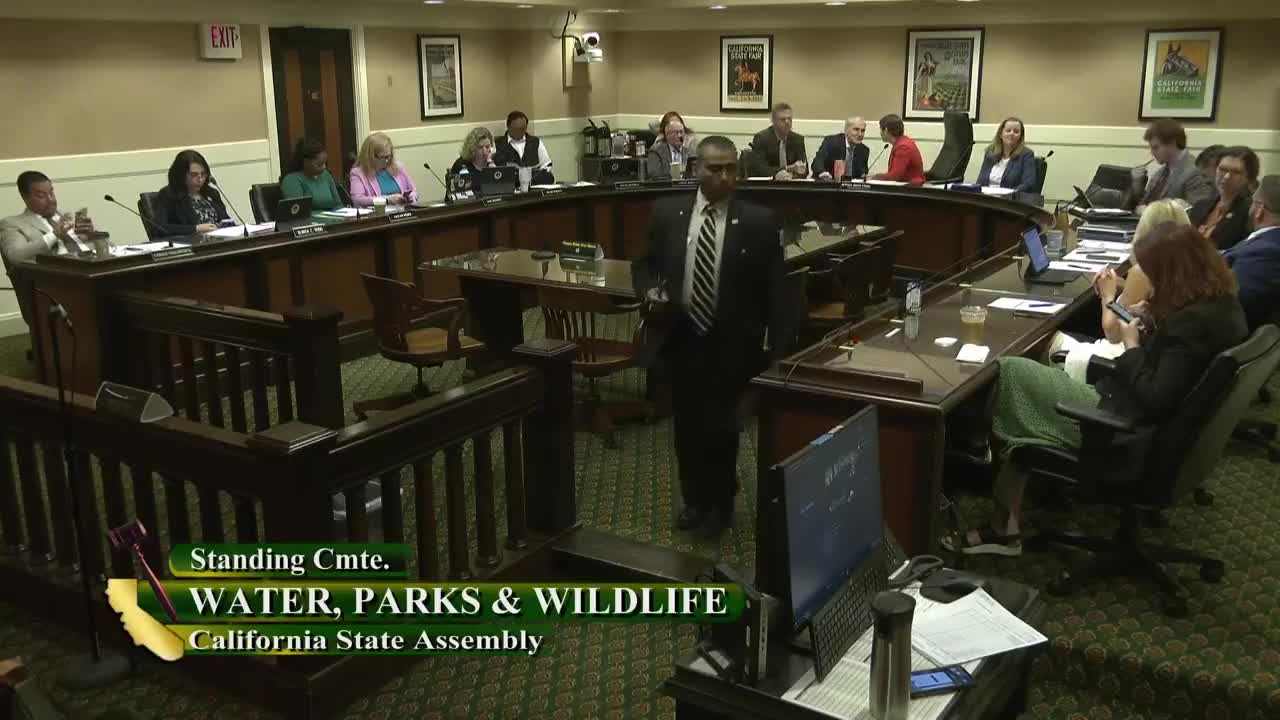 9MIN
Assembly Standing Committee on Water, Parks, and Wildlife
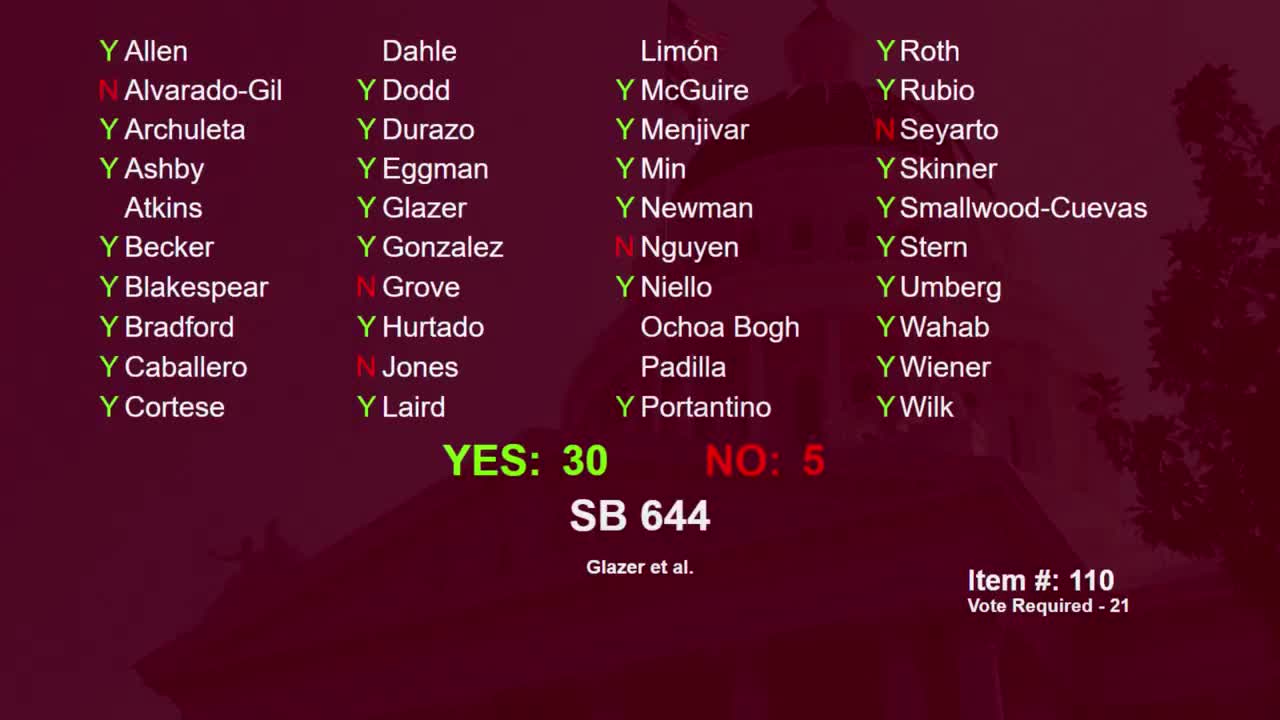 4MIN
Senate Floor
 9MIN
Senate Standing Committee on Environmental Quality
 14MIN
Senate Standing Committee on Natural Resources and Water
Bill Author

Bill Co-Author(s):