SB 669: Veterinarians: veterinarian-client-patient relationship.
- Session Year: 2023-2024
- House: Senate
- Latest Version Date: 2023-10-13
Current Status:
Passed
(2023-10-13: Chaptered by Secretary of State. Chapter 882, Statutes of 2023.)
Introduced
In Committee
First Chamber
In Committee
Second Chamber
Enacted
What does this bill do?
The bill lets California veterinarians authorize registered veterinary technicians to establish the veterinarian-client-patient relationship (the formal vet–client–patient link) and give preventive vaccines or medicines to control internal or external parasites. Technicians must examine the animal, follow written protocols, inform and get permission from the client, and only do this when the vet is at the clinic or nearby/available by phone; the veterinarian signs to accept responsibility except for willful cruelty or gross negligence.
The summary is provided by generative AI which can make mistakes. For original language, please view the details in the table below.
Existing law, the Veterinary Medicine Practice Act, establishes the Veterinary Medical Board within the Department of Consumer Affairs for the licensure and regulation of veterinarians and the practice of veterinary medicine. Existing law makes a violation of the act a crime. The act prohibits any person from practicing veterinary medicine, as defined, without a license.
This bill would authorize a veterinarian to allow a registered veterinary technician to act as an agent of the veterinarian for the purpose of establishing the veterinarian-client-patient relationship to administer preventive or prophylactic vaccines or medications for the control or eradication of apparent or anticipated internal or external parasites by satisfying specified criteria.
Because a violation of the bills provisions would be a crime under the Veterinary Medicine Practice Act, the bill would impose a state-mandated local program.
The California Constitution requires the state to reimburse local agencies and school districts for certain costs mandated by the state. Statutory provisions establish procedures for making that reimbursement.
This bill would provide that no reimbursement is required by this act for a specified reason.
Existing law, the Veterinary Medicine Practice Act, establishes the Veterinary Medical Board within the Department of Consumer Affairs for the licensure and regulation of veterinarians and the practice of veterinary medicine. Existing law makes a violation of the act a crime. The act prohibits any person from practicing veterinary medicine, as defined, without a license.
This bill would authorize a veterinarian to allow a registered veterinary technician to act as an agent for of the veterinarian for the purpose of establishing the veterinarian-client-patient relationship to administer preventive or prophylactic vaccines or medications for the control or eradication of apparent or anticipated internal or external parasites, viruses, or bacteria parasites by satisfying specified criteria.
(2)Existing law authorizes the board to adopt regulations that are reasonably necessary to carry into effect the provisions of the act. Pursuant to that authority, existing regulations prohibit a drug from being prescribed for a duration inconsistent with the medical condition of the animal or the type of drug prescribed and a veterinarian from prescribing a drug for a duration longer than one year from the date the veterinarian examined the animal and prescribed the drug.This bill would codify the boards regulation prohibiting a veterinarian from prescribing a drug for a duration that is inconsistent with the medical condition of the animal or type of drug prescribed and from prescribing a drug for a duration longer than one year from the date that the veterinarian examined the animal and prescribed the drug.Because a violation of the bills provisions would be a crime under the Veterinary Medicine Practice Act, the bill would impose a state-mandated local program.
(3)TheThe California Constitution requires the state to reimburse local agencies and school districts for certain costs mandated by the state. Statutory provisions establish procedures for making that reimbursement.
This bill would provide that no reimbursement is required by this act for a specified reason.
(1)Existing law, the Veterinary Medicine Practice Act, establishes the Veterinary Medical Board within the Department of Consumer Affairs for the licensure and regulation of veterinarians and the practice of veterinary medicine. Existing law makes a violation of the act a crime. The act prohibits any person from practicing veterinary medicine, as defined, without a license.
Existing law authorizes the board to adopt regulations that are reasonably necessary to carry into effect the provisions of the act. Pursuant to that authority, existing regulations make it unprofessional conduct for a veterinarian to render specified treatment of an animal without an established veterinarian-client-patient relationship, as specified. Existing regulations also prohibit a person from practicing veterinary medicine in this state outside the context of a veterinarian-client-patient relationship or as otherwise permitted by law.This bill would codify the boards above-described promulgated regulations by providing that it is unprofessional conduct for a veterinarian to administer, prescribe, dispense or furnish a drug, medicine, appliance, or treatment of whatever nature for the prevention, cure, or relief of a wound, fracture or bodily injury, or disease of an animal without having first established a veterinarian-client-patient relationship with the animal patient and the client, except as specified. The bill would authorize a veterinarian-client-patient relationship to be established if specified conditions are satisfied. This bill would, notwithstanding those provisions, authorize a veterinarian, veterinarian to allow a registered veterinary technician to act as an agent for the veterinarian for the purpose of permitting a registered veterinary technician establishing the veterinarian-client-patient relationship to administer to an animal patient preventive or prophylactic vaccines or medications for the control or eradication of an apparent or anticipated internal or external parasite, to establish a veterinarian-client-patient relationship parasites, viruses, or bacteria by satisfying other specified criteria.
(2)Existing regulations adopted by the board law authorizes the board to adopt regulations that are reasonably necessary to carry into effect the provisions of the act. Pursuant to that authority, existing regulations prohibit a drug from being prescribed for a duration inconsistent with the medical condition of the animal or the type of drug prescribed and a veterinarian from prescribing a drug for a duration longer than one year from the date the veterinarian examined the animal and prescribed the drug.
This bill would codify the boards regulation prohibiting a veterinarian from prescribing a drug for a duration that is inconsistent with the medical condition of the animal or type of drug prescribed and from prescribing a drug for a duration longer than one year from the date that the veterinarian examined the animal and prescribed the drug.
Because a violation of the bills provisions would be a crime under the Veterinary Medicine Practice Act, the bill would impose a state-mandated local program.
(3)The California Constitution requires the state to reimburse local agencies and school districts for certain costs mandated by the state. Statutory provisions establish procedures for making that reimbursement.
This bill would provide that no reimbursement is required by this act for a specified reason.
(1)Existing law, the Veterinary Medicine Practice Act, establishes the Veterinary Medical Board within the Department of Consumer Affairs for the licensure and regulation of veterinarians and the practice of veterinary medicine. Existing law makes a violation of the act a crime. The act prohibits any person from practicing veterinary medicine, as defined, without a license.
Existing law authorizes the board to adopt regulations that are reasonably necessary to carry into effect the provisions of the act. Pursuant to that authority, existing regulations make it unprofessional conduct for a veterinarian to render specified treatment of an animal without an established veterinarian-client-patient relationship, as specified. Existing regulations also prohibit a person from practicing veterinary medicine in this state outside the context of a veterinarian-client-patient relationship or as otherwise permitted by law.
This bill would codify the boards above-described promulgated regulations by providing that it is unprofessional conduct for a veterinarian to administer, prescribe, dispense or furnish a drug, medicine, appliance, or treatment of whatever nature for the prevention, cure, or relief of a wound, fracture or bodily injury, or disease of an animal without having first established a veterinarian-client-patient relationship with the animal patient and the client, except as specified. The bill would authorize a veterinarian-client-patient relationship to be established if specified conditions are satisfied. This bill would, notwithstanding those provisions, authorize a veterinarian, for the purpose of permitting a registered veterinary technician to administer to an animal patient preventive or prophylactic vaccines or medications for the control or eradication of an apparent or anticipated internal or external parasite, to establish a veterinarian-client-patient relationship by satisfying other specified criteria.
(2)Existing regulations adopted by the board prohibit a drug from being prescribed for a duration inconsistent with the medical condition of the animal or the type of drug prescribed and a veterinarian from prescribing a drug for a duration longer than one year from the date the veterinarian examined the animal and prescribed the drug.
This bill would codify the boards regulation prohibiting a veterinarian from prescribing a drug for a duration that is inconsistent with the medical condition of the animal or type of drug prescribed and from prescribing a drug for a duration longer than one year from the date that the veterinarian examined the animal and prescribed the drug.
Because a violation of the bills provisions would be a crime under the Veterinary Medicine Practice Act, the bill would impose a state-mandated local program.
(3)The California Constitution requires the state to reimburse local agencies and school districts for certain costs mandated by the state. Statutory provisions establish procedures for making that reimbursement.
This bill would provide that no reimbursement is required by this act for a specified reason.
Existing law prohibits a health care practitioner from providing documentation relating to an individuals need for an emotional support dog unless the health care practitioner complies with specified criteria, including, among other things, that the health care practitioner establish a client-provider relationship with the individual for at least 30 days prior to providing the documentation, except as specified.This bill would make a technical, nonsubstantive change to that provision.Existing law prohibits a health care practitioner from providing documentation relating to an individuals need for an emotional support dog unless the health care practitioner complies with specified criteria, including, among other things, that the health care practitioner establish a client-provider relationship with the individual for at least 30 days prior to providing the documentation, except as specified.
This bill would make a technical, nonsubstantive change to that provision.
The Legislature finds and declares all of the following:
(a)A national shortage of veterinarians and veterinary staff has made access to animal care extremely difficult. That challenge is even greater in low-income and unhoused populations.
(b)An increasing number of unvaccinated animals poses a serious public health risk.
(c)It is the intent of the Legislature in enacting this measure to empower veterinarians and their trusted registered veterinary technicians to increase access to prophylactic care where it is most needed.
SEC. 2.Section 4826.7 is added to the Business and Professions Code, to read:4826.7.(a)For purposes of this section, veterinarian means a California licensed veterinarian.
(b)A veterinarian may authorize a registered veterinary technician to act as an agent of the veterinarian for the purpose of establishing the veterinarian-client-patient relationship to administer preventive or prophylactic vaccines or medications for the control or eradication of apparent or anticipated internal or external parasites if all of the following conditions are met:
(1)The registered veterinary technician administers preventive or prophylactic vaccines or medications for the control or eradication of apparent or anticipated internal or external parasites in a registered veterinary premises when the veterinarian is physically present at the registered veterinary premises.
(2)If working at a location other than a registered veterinary premises, the registered veterinary technician administers preventive or prophylactic vaccines or medications for the control or eradication of apparent or anticipated internal or external parasites when the veterinarian is in the general vicinity or available by telephone and is quickly and easily available. At this location, the registered veterinary technician shall have equipment and drugs necessary to provide immediate emergency care at a level commensurate with the provision of preventive or prophylactic vaccines or medications for the control or eradication of apparent or anticipated internal or external parasites.
(3)The registered veterinary technician examines the animal patient and administers preventive or prophylactic vaccines or medications for the control or eradication of apparent or anticipated internal or external parasites in accordance with written protocols and procedures established by the veterinarian, which shall include, at a minimum, all of the following:
(A)Obtaining the animal patients history from the client in order to reasonably ensure that the administration of preventive or prophylactic vaccines or medications for the control or eradication of apparent or anticipated internal or external parasites is appropriate.
(B)Data that must be collected by physical examination of the animal patient in order to reasonably ensure that the administration of preventive or prophylactic vaccines or medications for the control or eradication of apparent or anticipated internal or external parasites is appropriate.
(C)Information in the patient history or physical examination results that would preclude the administration of preventive or prophylactic vaccines or medications for the control or eradication of apparent or anticipated internal or external parasites.
(D)Criteria that would disqualify the animal patient from receiving the preventive or prophylactic vaccines or medications for the control or eradication of apparent or anticipated internal or external parasites.
(E)Vaccination protocols for each animal species for which preventive or prophylactic vaccines are administered, that include, at a minimum, handling and administration of vaccines in accordance with manufacturer label recommendations and what to do in the event of an adverse reaction or other emergency.
(F)Preventative procedures for parasite control for each animal species for which medications for the control or eradication of apparent or anticipated internal or external parasites are being administered, which shall include, at a minimum, handling and administration of medications in accordance with manufacturer label recommendations and what to do in the event of an adverse reaction or other emergency.
(G)Documentation of all of the following animal patient information:
(i)Name or initials of the person responsible for entries.
(ii)Name, address, and phone number of the client.
(iii)Name or identity of the animal, herd, or flock.
(iv)Except for herds or flocks, age, sex, breed, species, and color of the animal.
(v)Beginning and ending dates of custody of the animal, if applicable.
(vi)A history or pertinent information as it pertains to each animal, herd, or flocks medical status.
(vii)Data, including that obtained by instrumentation, from the physical examination.
(viii)Treatment and intended treatment plan, including medications, dosages, route of administration, and frequency of use.
(ix)Diagnosis or assessment before performing a treatment or procedure.
(x)If relevant, a prognosis of the animals condition.
(xi)All medications and treatments prescribed and dispensed, including strength, dosage, route of administration, quantity, and frequency of use.
(4)The veterinarian and the registered veterinary technician sign and date a statement containing an assumption of risk by the veterinarian for all acts of the registered veterinary technician related to examining the animal patient and administering preventive or prophylactic vaccines or medications for the control or eradication of apparent or anticipated internal or external parasite, short of willful acts of animal cruelty, gross negligence, or gross unprofessional conduct on behalf of the registered veterinary technician.
(5)The veterinarian and the registered veterinary technician sign and date a statement containing authorization for the registered veterinary technician to act as the agent of the veterinarian only to establish the veterinarian-client-patient relationship for purposes of administering preventive or prophylactic vaccines or medications for the control or eradication of apparent or anticipated internal or external parasites when acting in compliance with the protocols and procedures specified in paragraph (3), and only until the date the veterinarian terminates authorization for the registered veterinary technician to act as the agent of the veterinarian.
(6)(A)Before the registered veterinary technician examines or administers any preventive or prophylactic vaccines or medications for the control or eradication of apparent or anticipated internal or external parasites to the animal patient, the registered veterinary technician informs the client orally or in writing that the registered veterinary technician is acting as an agent of the veterinarian for purposes of administering to the animal patient preventive or prophylactic vaccines or medications, as applicable, and provides the veterinarians name and license number to the client.
(B)After providing the disclosure specified in subparagraph (A), the registered veterinary technician records in the animal patients medical record the oral or written authorization of the client to proceed with the registered veterinary technicians examination of the animal patient and administration of the specified vaccine or medication.
(c)(1)Documentation relating to satisfaction of the requirements of paragraphs (4) and (5) of subdivision (b) shall be retained by the veterinarian for the duration of the registered veterinary technicians work as an agent of that veterinarian and until three years from the date of the termination of the veterinarians relationship with the registered veterinary technician.
(2)Documentation relating to satisfaction of subparagraph (G) of paragraph (3) of subdivision (b) shall be retained by the veterinarian for a minimum of three years after the animal patients last visit.
SEC. 3.Section 4840 of the Business and Professions Code is amended to read:4840.(a)Registered veterinary technicians and veterinary assistants are approved to perform those animal health care services prescribed by law under the supervision of a veterinarian licensed or authorized to practice in this state.
(b)Registered veterinary technicians may perform animal health care services on those animals impounded by a state, county, city, or city and county agency pursuant to the direct order, written order, or telephonic order of a veterinarian licensed or authorized to practice in this state.
(c)Registered veterinary technicians may apply for registration from the federal Drug Enforcement Administration that authorizes the direct purchase of sodium pentobarbital for the performance of euthanasia as provided for in paragraph (4) of subdivision (a) of Section 4827 without the supervision or authorization of a licensed veterinarian.
(d)Registered veterinary technicians may act as an agent of the supervising veterinarian in establishing the veterinarian-client-patient relationship for the purposes of administering preventive or prophylactic vaccines or medications for the control or eradication of apparent or anticipated internal or external parasites in accordance with subdivision (b) of Section 4826.7.
SEC. 4.No reimbursement is required by this act pursuant to Section 6 of Article XIIIB of the California Constitution because the only costs that may be incurred by a local agency or school district will be incurred because this act creates a new crime or infraction, eliminates a crime or infraction, or changes the penalty for a crime or infraction, within the meaning of Section 17556 of the Government Code, or changes the definition of a crime within the meaning of Section 6 of Article XIIIB of the California Constitution.
The Legislature finds and declares all of the following:
(a)A national shortage of veterinarians and veterinary staff has made access to animal care extremely difficult. That challenge is even greater in low-income and unhoused populations.
(b)An increasing number of unvaccinated animals poses a serious public health risk.
(c)It is the intent of the legislature Legislature in enacting this measure to empower veterinarians and their trusted registered veterinary technicians to increase access to prophylactic care where it is most needed.
SEC. 2.Section 4826.7 is added to the Business and Professions Code, to read:4826.7.(a)For purposes of this section, veterinarian means a California licensed veterinarian.
(b)A veterinarian may authorize a registered veterinary technician to act as an agent of the veterinarian for the purpose of establishing the veterinarian-client-patient relationship to administer preventive or prophylactic vaccines or medications for the control or eradication of apparent or anticipated internal or external parasites if all of the following conditions are met:
(1)The registered veterinary technician administers preventive or prophylactic vaccines or medications for the control or eradication of apparent or anticipated internal or external parasites in a registered veterinary premises when the veterinarian is physically present at the registered veterinary premises.
(2)If working at a location other than a registered veterinary premises, the registered veterinary technician administers preventive or prophylactic vaccines or medications for the control or eradication of apparent or anticipated internal or external parasites when the veterinarian is in the general vicinity. vicinity or available by telephone and is quickly and easily available. At this location, the registered veterinary technician shall have equipment and drugs necessary to provide immediate emergency care at a level commensurate with the provision of preventive or prophylactic vaccines or medications for the control or eradication of apparent or anticipated internal or external parasites.
(3)The registered veterinary technician examines the animal patient and administers preventive or prophylactic vaccines or medications for the control or eradication of apparent or anticipated internal or external parasites in accordance with written protocols and procedures established by the veterinarian, which shall include, at a minimum, all of the following:
(A)Obtaining the animal patients history from the client in order to reasonably ensure that the administration of preventive or prophylactic vaccines or medications for the control or eradication of apparent or anticipated internal or external parasites is appropriate.
(B)Data that must be collected by physical examination of the animal patient in order to reasonably ensure that the administration of preventive or prophylactic vaccines or medications for the control or eradication of apparent or anticipated internal or external parasites is appropriate.
(C)Information in the patient history or physical examination results that would preclude the administration of preventive or prophylactic vaccines or medications for the control or eradication of apparent or anticipated internal or external parasites.
(D)Criteria that would disqualify the animal patient from receiving the preventive or prophylactic vaccines or medications for the control or eradication of apparent or anticipated internal or external parasites.
(E)Vaccination protocols for each animal species for which preventive or prophylactic vaccines are administered, that include, at a minimum, handling and administration of vaccines in accordance with manufacturer label recommendations and what to do in the event of an adverse reaction or other emergency.
(F)Preventative procedures for parasite control for each animal species for which medications for the control or eradication of apparent or anticipated internal or external parasites are being administered, which shall include, at a minimum, handling and administration of medications in accordance with manufacturer label recommendations and what to do in the event of an adverse reaction or other emergency.
(G)Documentation of all of the following animal patient information:
(i)Name or initials of the person responsible for entries.
(ii)Name, address, and phone number of the client.
(iii)Name or identity of the animal, herd, or flock.
(iv)Except for herds or flocks, age, sex, breed, species, and color of the animal.
(v)Beginning and ending dates of custody of the animal, if applicable.
(vi)A history or pertinent information as it pertains to each animal, herd, or flocks medical status.
(vii)Data, including that obtained by instrumentation, from the physical examination.
(viii)Treatment and intended treatment plan, including medications, dosages, route of administration, and frequency of use.
(ix)Diagnosis or assessment before performing a treatment or procedure.
(x)If relevant, a prognosis of the animals condition.
(xi)All medications and treatments prescribed and dispensed, including strength, dosage, route of administration, quantity, and frequency of use.
(4)The veterinarian and the registered veterinary technician sign and date a statement containing an assumption of risk by the veterinarian for all acts of the registered veterinary technician related to examining the animal patient and administering preventive or prophylactic vaccines or medications for the control or eradication of apparent or anticipated internal or external parasite, short of willful acts of animal cruelty, gross negligence, or gross unprofessional conduct on behalf of the registered veterinary technician.
(5)The veterinarian and the registered veterinary technician sign and date a statement containing authorization for the registered veterinary technician to act as the agent of the veterinarian only to establish the veterinarian-client-patient relationship for purposes of administering preventive or prophylactic vaccines or medications for the control or eradication of apparent or anticipated internal or external parasites when acting in compliance with the protocols and procedures specified in paragraph (3), and only until the date the veterinarian terminates authorization for the registered veterinary technician to act as the agent of the veterinarian.
(c)(1)Documentation relating to satisfaction of the requirements of paragraphs (4) and (5) of subdivision (b) shall be retained by the veterinarian for the duration of the registered veterinary technicians work as an agent of that veterinarian and until three years from the date of the termination of the veterinarians relationship with the registered veterinary technician.
(2)Documentation relating to satisfaction of subparagraph (G) of paragraph (3) of subdivision (b) shall be retained by the veterinarian for a minimum of three years after the animal patients last visit.
SEC. 3.Section 4840 of the Business and Professions Code is amended to read:4840.(a)Registered veterinary technicians and veterinary assistants are approved to perform those animal health care services prescribed by law under the supervision of a veterinarian licensed or authorized to practice in this state.
(b)Registered veterinary technicians may perform animal health care services on those animals impounded by a state, county, city, or city and county agency pursuant to the direct order, written order, or telephonic order of a veterinarian licensed or authorized to practice in this state.
(c)Registered veterinary technicians may apply for registration from the federal Drug Enforcement Administration that authorizes the direct purchase of sodium pentobarbital for the performance of euthanasia as provided for in paragraph (4) of subdivision (a) of Section 4827 without the supervision or authorization of a licensed veterinarian.
(d)Registered veterinary technicians may act as an agent of the supervising veterinarian in establishing the veterinarian-client-patient relationship for the purposes of administering preventive or prophylactic vaccines or medications for the control or eradication of apparent or anticipated internal or external parasites in accordance with subdivision (b) of Section 4826.7.
SEC. 4.No reimbursement is required by this act pursuant to Section 6 of Article XIIIB of the California Constitution because the only costs that may be incurred by a local agency or school district will be incurred because this act creates a new crime or infraction, eliminates a crime or infraction, or changes the penalty for a crime or infraction, within the meaning of Section 17556 of the Government Code, or changes the definition of a crime within the meaning of Section 6 of Article XIIIB of the California Constitution.
The Legislature finds and declares all of the following:
(a)A national shortage of veterinarians and veterinary staff has made access to animal care extremely difficult. That challenge is even greater in low-income and unhoused populations.
(b)An increasing number of unvaccinated animals poses a serious public health risk.
(c)It is the intent of the legislature in enacting this measure to empower veterinarians and their trusted registered veterinary technicians to increase access to prophylactic care where it is most needed.
SEC. 2.Section 4826.6 is added to the Business and Professions Code, to read:4826.6.(a)For purposes of this section, the following apply:(1)Administer means the direct application of a drug or device to the body of an animal by injection, inhalation, ingestion, or other means.(2)Client means the owner of the animal.(3)Direct supervision means either of the following:(A)The supervisor is physically present at the location where a registered veterinary technician performs delegated animal health care job tasks.(B)The supervisor is in the general vicinity of the location that a registered veterinary technician performs delegated animal health care job tasks, and the supervisor is quickly and easily available, and either of the following has occurred:(i)The animal has been examined by a veterinarian at an appropriate time that good veterinary medical practice requires, consistent with the animal health care job or task.(ii)The animal has been examined by a registered veterinary technician as the agent of a veterinarian for purposes of establishing the veterinarian-client-patient relationship to administer preventative or prophylactic vaccines or medications for the control or eradication of apparent or anticipated internal or external parasites, viruses, or bacteria in accordance with subdivision (b).(4)Drug means any controlled substance, as defined in Section 4021, and any dangerous drug, as defined in Section 4022.(5)Herd means any group of animals of the same species located at the same geographic location.(6)Supervisor means a person who is a California licensed veterinarian. (7)VeterinarianSEC. 2.Section 4826.7 is added to the Business and Professions Code, to read:4826.7.(a)For purposes of this section, veterinarian means a California licensed veterinarian.
(b)A veterinarian may allow authorize a registered veterinary technician to act as an agent for of the veterinarian for the purpose of establishing the veterinarian-client-patient relationship to administer preventive or prophylactic vaccines or medications for the control or eradication of apparent or anticipated internal or external parasites, viruses, or bacteria parasites if all of the following conditions are met:
(1)The registered veterinary technician administers preventive or prophylactic vaccines or medications for the control or eradication of apparent or anticipated internal or external parasites, viruses, or bacteria parasites in a registered veterinary premises under the direct supervision of the licensed veterinarian or supervisor. when the veterinarian is physically present at the registered veterinary premises.
(2)If working at a location other than a registered veterinary premises, the veterinarian may authorize a registered veterinary technician to administer administers preventive or prophylactic vaccines or medications for the control or eradication of apparent or anticipated internal or external parasites under the direct supervision of the licensed veterinarian. when the veterinarian is in the general vicinity.
(3)The registered veterinary technician examines the animal patient and administers preventive or prophylactic vaccines or medications for the control or eradication of apparent or anticipated internal or external parasites, viruses, or bacteria parasites in accordance with written protocols and procedures established by the supervisor, veterinarian, which shall include, at a minimum, all of the following:
(A)Obtaining the animal patients history from the client in order to reasonably ensure that the administration of preventive or prophylactic vaccines or medications for the control or eradication of apparent or anticipated internal or external parasites is appropriate.
(B)Data that must be collected by physical examination of the animal patient in order to reasonably ensure that the administration of preventive or prophylactic vaccines or medications for the control or eradication of apparent or anticipated internal or external parasites is appropriate.
(C)Information in the patient history or physical examination results that would preclude the administration of preventive or prophylactic vaccines or medications. medications for the control or eradication of apparent or anticipated internal or external parasites.
(D)Criteria that would disqualify the animal patient from receiving the preventive or prophylactic vaccines or medications from the registered veterinary technician. for the control or eradication of apparent or anticipated internal or external parasites.
(E)Vaccination protocols for each animal species for which preventive or prophylactic vaccines are administered, that include, at a minimum, handling and administration of vaccines in accordance with manufacturer label recommendations and what to do in the event of an adverse reaction or other emergency.
(F)Preventative procedures for parasite control for each animal species for which medications for the control or eradication of apparent or anticipated internal or external parasites are being administered, which shall include, at a minimum, handling and administration of medications in accordance with manufacturer label recommendations and what to do in the event of an adverse reaction or other emergency.
(G)Documentation of all of the following animal patient information:
(i)Name or initials of the person responsible for entries.
(ii)Name, address, and phone number of the client.
(iii)Name or identity of the animal, herd, or flock.
(iv)Except for herds or flocks, age, sex, breed, species, and color of the animal.
(v)Beginning and ending dates of custody of the animal, if applicable.
(vi)A history or pertinent information as it pertains to each animal, herd, or flocks medical status.
(vii)Data, including that obtained by instrumentation, from the physical examination.
(viii)Treatment and intended treatment plan, including medications, dosages, route of administration, and frequency of use.
(ix)Diagnosis or assessment before performing a treatment or procedure.
(x)If relevant, a prognosis of the animals condition.
(xi)All medications and treatments prescribed and dispensed, including strength, dosage, route of administration, quantity, and frequency of use.
(4)The veterinarian and the registered veterinary technician sign and date a statement containing an assumption of risk by the veterinarian for all acts of the registered veterinary technician related to examining the animal patient and administering preventive or prophylactic vaccines or medications for the control or eradication of apparent or anticipated internal or external parasite, short of willful acts of animal cruelty, gross negligence, or gross unprofessional conduct on behalf of the registered veterinary technician.
(4)The supervisor(5)The veterinarian and the registered veterinary technician sign and date a statement containing authorization for the registered veterinary technician to act as the agent of the supervisor veterinarian only to establish the veterinarian-client-patient relationship for purposes of administering preventive or prophylactic vaccines or medications for the control or eradication of apparent or anticipated internal or external parasites, viruses, or bacteria parasites when acting in compliance with the protocols and procedures specified in paragraph (3), and only until the date the supervisor veterinarian terminates supervision or authorization for the registered veterinary technician to act as the agent of the veterinarian or supervisor. veterinarian.
(c)(1)Documentation relating to satisfaction of the requirements of paragraphs (4) and (5) of subdivision (b) shall be retained by the supervisor veterinarian for the duration of the registered veterinary technicians supervision work as an agent of that veterinarian and until three years from the date of the termination of the supervisorial veterinarians relationship with the registered veterinary technician.
(2)Documentation relating to satisfaction of subparagraph (G) of paragraph (3) of subdivision (b) shall be retained by the veterinarian for a minimum of three years after the animal patients last visit.
(d)A veterinarian shall not prescribe a drug for a duration that is inconsistent with the medical condition of the animal or the type of drug prescribed. A veterinarian shall not prescribe a drug for a duration longer than one year from the date that the veterinarian examined the animal and prescribed the drug.SEC. 3.Section 4840 of the Business and Professions Code is amended to read:4840.(a)Registered veterinary technicians and veterinary assistants are approved to perform those animal health care services prescribed by law under the supervision of a veterinarian licensed or authorized to practice in this state.
(b)Registered veterinary technicians may perform animal health care services on those animals impounded by a state, county, city, or city and county agency pursuant to the direct order, written order, or telephonic order of a veterinarian licensed or authorized to practice in this state.
(c)Registered veterinary technicians may apply for registration from the federal Drug Enforcement Administration that authorizes the direct purchase of sodium pentobarbital for the performance of euthanasia as provided for in paragraph (4) of subdivision (a) of Section 4827 without the supervision or authorization of a licensed veterinarian.
(d)Registered veterinary technicians may act as an agent of the supervising veterinarian in establishing the veterinarian-client-patient relationship for the purposes of administering preventive or prophylactic vaccines or medications for the control or eradication of apparent or anticipated internal or external parasites, viruses, or bacteria parasites in accordance with subdivision (b) of Section 4826.6. 4826.7.
SEC. 4.No reimbursement is required by this act pursuant to Section 6 of Article XIIIB of the California Constitution because the only costs that may be incurred by a local agency or school district will be incurred because this act creates a new crime or infraction, eliminates a crime or infraction, or changes the penalty for a crime or infraction, within the meaning of Section 17556 of the Government Code, or changes the definition of a crime within the meaning of Section 6 of Article XIIIB of the California Constitution.
The Legislature finds and declares all of the following:
(a)A national shortage of veterinarians and veterinary staff has made access to animal care extremely difficult. That challenge is even greater in low-income and unhoused populations.
(b)An increasing number of unvaccinated animals poses a serious public health risk.
(c)It is the intent of the legislature in enacting this measure to empower veterinarians and their trusted registered veterinary technicians to increase access to prophylactic care where it is most needed.
SECTION 1.SEC. 2.Section 4826.6 is added to the Business and Professions Code, to read:4826.6.(a)It is unprofessional conduct for a veterinarian to administer, prescribe, dispense or furnish a drug, medicine, appliance, or treatment of whatever nature for the prevention, cure, or relief of a wound, fracture or bodily injury, or disease of an animal without having first established a veterinarian-client-patient relationship with the animal patient and the client as provided in this section, unless the patient is a wild animal, the owner is unknown, or rabies vaccines are prophylactically administered to the animal to prevent disease or loss of life.(b)Except as provided in subdivision (c), a veterinarian-client-patient relationship may be established if all of the following occur:(1)The client authorizes the veterinarian to assume responsibility for making medical judgments regarding the health of the animal, including the need for medical treatment.(2)The veterinarian has sufficient knowledge of the animal to initiate at least a general or preliminary diagnosis of the medical condition of the animal because the veterinarian is personally acquainted with the care of the animal by virtue of an examination of the animal or by medically appropriate and timely visits to the premises where the animal is kept.(3)The veterinarian has assumed responsibility for making medical judgments regarding the health of the animal and has communicated with the client about a course of treatment, diagnostics, or a therapeutic plan appropriate to the circumstance. 4826.6.(a)For purposes of this section, the following apply:
(1)Administer means the direct application of a drug or device to the body of an animal by injection, inhalation, ingestion, or other means.
(2)Client means the owner of the animal.
(3)Direct supervision means either of the following:
(A)The supervisor is physically present at the location where a registered veterinary technician performs delegated animal health care job tasks.
(B)The supervisor is in the general vicinity of the location that a registered veterinary technician performs delegated animal health care job tasks, and the supervisor is quickly and easily available, and either of the following has occurred:
(i)The animal has been examined by a veterinarian at an appropriate time that good veterinary medical practice requires, consistent with the animal health care job or task.
(ii)The animal has been examined by a registered veterinary technician as the agent of a veterinarian for purposes of establishing the veterinarian-client-patient relationship to administer preventative or prophylactic vaccines or medications for the control or eradication of apparent or anticipated internal or external parasites, viruses, or bacteria in accordance with subdivision (b).
(4)Drug means any controlled substance, as defined in Section 4021, and any dangerous drug, as defined in Section 4022.
(5)Herd means any group of animals of the same species located at the same geographic location.
(6)Supervisor means a person who is a California licensed veterinarian.
(7)Veterinarian means a California licensed veterinarian.
(c)Notwithstanding subdivision (b),(b)A veterinarian may allow a registered veterinary technician to act as an agent for the veterinarian for the purpose of permitting a registered veterinary technician establishing the veterinarian-client-patient relationship to administer to an animal patient preventive or prophylactic vaccines or medications for the control or eradication of an apparent or anticipated internal or external parasite, a veterinarian may establish a veterinarian-client-patient relationship, parasites, viruses, or bacteria if all of the following conditions are met:
(1)The registered veterinary technician administers preventive or prophylactic vaccines or medications for the control or eradication of apparent or anticipated internal or external parasites in an animal hospital setting under the indirect parasites, viruses, or bacteria in a registered veterinary premises under the direct supervision of the licensed veterinarian or supervisor.
(2)If working at a location other than a registered veterinary premises with unhoused or underserved communities, premises, the veterinarian may authorize a registered veterinary technician to administer preventive or prophylactic vaccines or medications for the control or eradication of apparent or anticipated internal or external parasites under the indirect direct supervision of the licensed veterinarian or supervisor only if animals can be transported to a licensed animal hospital within five miles of the field operation and the licensed animal hospital agrees in advance to take, treat, and admit any animal suffering adverse effects from the vaccination or medication. veterinarian.
(3)The registered veterinary technician examines the animal patient and administers preventive or prophylactic vaccines or medications for the control or eradication of apparent or anticipated internal or external parasites parasites, viruses, or bacteria in accordance with written protocols and procedures established by the supervisor, which shall include, at a minimum, all of the following:
(A)Obtaining the animal patients history from the client in order to reasonably ensure that the administration of preventive or prophylactic vaccines or medications for the control or eradication of apparent or anticipated internal or external parasites is possible. is appropriate.
(B)Data that must be collected by physical examination of the animal patient in order to reasonably ensure that the administration of preventive or prophylactic vaccines or medications for the control or eradication of apparent or anticipated internal or external parasites is possible. is appropriate.
(C)Information in the patient history or physical examination results that would preclude the administration of preventive or prophylactic vaccines or medications for the control or eradication of apparent or anticipated internal or external parasites. medications.
(D)Criteria that would disqualify the animal patient from receiving the preventive or prophylactic vaccines or medications from the registered veterinary technician.
(E)Vaccination protocols for each animal species for which preventive or prophylactic vaccines are administered, that include, at a minimum, handling and administration of vaccines in accordance with manufacturer label recommendations and what to do in the event of an adverse reaction or other emergency.
(F)Preventative procedures for parasite control for each animal species for which medications for the control or eradication of apparent or anticipated internal or external parasites are being administered, which shall include, at a minimum, handling and administration of medications in accordance with manufacturer label recommendations and what to do in the event of an adverse reaction or other emergency.
(G)Documentation of all of the following animal patient information:
(i)Name or initials of the person responsible for entries.
(ii)Name, address, and phone number of the client.
(iii)Name or identity of the animal, herd, or flock.
(iv)Except for herds or flocks, age, sex, breed, species, and color of the animal.
(v)Beginning and ending dates of custody of the animal, if applicable.
(vi)A history or pertinent information as it pertains to each animal, herd, or flocks medical status.
(vii)Data, including that obtained by instrumentation, from the physical examination.
(viii)Treatment and intended treatment plan, including medications, dosages, route of administration, and frequency of use.
(ix)Diagnosis or assessment before performing a treatment or procedure.
(x)If relevant, a prognosis of the animals condition.
(xi)All medications and treatments prescribed and dispensed, including strength, dosage, route of administration, quantity, and frequency of use.
(4)The supervisor and the registered veterinary technician sign and date a statement containing both of the following:(A)An assumption of risk by the supervisor for all acts of the registered veterinary technician related to examining the animal patient and administering preventive or prophylactic vaccines or medications for the control or eradication of apparent or anticipated internal or external parasites. (B)Authorization(4)The supervisor and the registered veterinary technician sign and date a statement containing authorization for the registered veterinary technician to act as the agent of the supervisor only to establish the veterinarian-client-patient relationship for purposes of administering preventive or prophylactic vaccines or medications for the control or eradication of apparent or anticipated internal or external parasites parasites, viruses, or bacteria when acting in compliance with the protocols and procedures specified in paragraph (3), and only until the date the supervisor terminates supervision or authorization for the registered veterinary technician to act as the agent of the veterinarian or supervisor.
(5)(A)Before examination of, or administration of any preventive or prophylactic vaccines or medications for the control or eradication of apparent or anticipated internal or external parasites to, the animal patient, the registered veterinary technician shall disclose, orally or in writing, to the client that the registered veterinary technician is acting as the agent of the supervisor for purposes of administering to the animal patient preventative or prophylactic vaccines or medications, as applicable, and provides the supervisors name and license number to the client.(B)After the disclosure described in subparagraph (A) is provided, the registered veterinary technician shall obtain the oral or written authorization of the client before proceeding with the registered veterinary technicians examination of the animal patient and administration of the specified vaccine or medication. The client authorization shall be recorded by the registered veterinary technician in the animal patients medical record.(d)All documentation(c)Documentation relating to satisfaction of the requirements of subdivision (c) (b) shall be retained by the supervisor for the duration of the registered veterinary technicians supervision and until three years from the date of the termination of the supervisorial relationship with the registered veterinary technician.
(e)(d)A veterinarian shall not prescribe a drug for a duration that is inconsistent with the medical condition of the animal or the type of drug prescribed. A veterinarian shall not prescribe a drug for a duration longer than one year from the date that the veterinarian examined the animal and prescribed the drug.
(f)For purposes of this section, drug means any controlled substance, as defined in Section 4021, and any dangerous drug, as defined in Section 4022.SEC. 3.Section 4840 of the Business and Professions Code is amended to read:4840.(a)Registered veterinary technicians and veterinary assistants are approved to perform those animal health care services prescribed by law under the supervision of a veterinarian licensed or authorized to practice in this state.
(b)Registered veterinary technicians may perform animal health care services on those animals impounded by a state, county, city, or city and county agency pursuant to the direct order, written order, or telephonic order of a veterinarian licensed or authorized to practice in this state.
(c)Registered veterinary technicians may apply for registration from the federal Drug Enforcement Administration that authorizes the direct purchase of sodium pentobarbital for the performance of euthanasia as provided for in subdivision (d) paragraph (4) of subdivision (a) of Section 4827 without the supervision or authorization of a licensed veterinarian.
(d)Registered veterinary technicians may act as an agent of the supervising veterinarian in establishing the veterinarian-client-patient relationship for the purposes of administering preventive or prophylactic vaccines or medications for the control or eradication of apparent or anticipated internal or external parasites, viruses, or bacteria in accordance with subdivision (b) of Section 4826.6.
SEC. 2. SEC. 4.No reimbursement is required by this act pursuant to Section 6 of Article XIIIB of the California Constitution because the only costs that may be incurred by a local agency or school district will be incurred because this act creates a new crime or infraction, eliminates a crime or infraction, or changes the penalty for a crime or infraction, within the meaning of Section 17556 of the Government Code, or changes the definition of a crime within the meaning of Section 6 of Article XIIIB of the California Constitution.
(a)It is unprofessional conduct for a veterinarian to administer, prescribe, dispense or furnish a drug, medicine, appliance, or treatment of whatever nature for the prevention, cure, or relief of a wound, fracture or bodily injury, or disease of an animal without having first established a veterinarian-client-patient relationship with the animal patient and the client as provided in this section, unless the patient is a wild animal, the owner is unknown, or rabies vaccines are prophylactically administered to the animal to prevent disease or loss of life.
(b)Except as provided in subdivision (c), a veterinarian-client-patient relationship may be established if all of the following occur:
(1)The client authorizes the veterinarian to assume responsibility for making medical judgments regarding the health of the animal, including the need for medical treatment.
(2)The veterinarian has sufficient knowledge of the animal to initiate at least a general or preliminary diagnosis of the medical condition of the animal because the veterinarian is personally acquainted with the care of the animal by virtue of an examination of the animal or by medically appropriate and timely visits to the premises where the animal is kept.
(3)The veterinarian has assumed responsibility for making medical judgments regarding the health of the animal and has communicated with the client about a course of treatment, diagnostics, or a therapeutic plan appropriate to the circumstance.
(c)Notwithstanding subdivision (b), for the purpose of permitting a registered veterinary technician to administer to an animal patient preventive or prophylactic vaccines or medications for the control or eradication of an apparent or anticipated internal or external parasite, a veterinarian may establish a veterinarian-client-patient relationship, if all of the following conditions are met:
(1)The registered veterinary technician administers preventive or prophylactic vaccines or medications for the control or eradication of apparent or anticipated internal or external parasites in an animal hospital setting under the indirect supervision of the licensed veterinarian or supervisor.
(2)If working at a location other than registered veterinary premises with unhoused or underserved communities, the veterinarian may authorize a registered veterinary technician to administer preventive or prophylactic vaccines or medications for the control or eradication of apparent or anticipated internal or external parasites under the indirect supervision of the licensed veterinarian or supervisor only if animals can be transported to a licensed animal hospital within five miles of the field operation and the licensed animal hospital agrees in advance to take, treat, and admit any animal suffering adverse effects from the vaccination or medication.
(3)The registered veterinary technician examines the animal patient and administers preventive or prophylactic vaccines or medications for the control or eradication of apparent or anticipated internal or external parasites in accordance with written protocols and procedures established by the supervisor, which shall include, at a minimum, all of the following:
(A)Obtaining the animal patients history from the client in order to reasonably ensure that the administration of preventive or prophylactic vaccines or medications for the control or eradication of apparent or anticipated internal or external parasites is possible.
(B)Data that must be collected by physical examination of the animal patient in order to reasonably ensure that the administration of preventive or prophylactic vaccines or medications for the control or eradication of apparent or anticipated internal or external parasites is possible.
(C)Information in the patient history or physical examination results that would preclude the administration of preventive or prophylactic vaccines or medications for the control or eradication of apparent or anticipated internal or external parasites.
(D)Criteria that would disqualify the animal patient from receiving the preventive or prophylactic vaccines or medications from the registered veterinary technician.
(E)Vaccination protocols for each animal species for which preventive or prophylactic vaccines are administered, that include, at a minimum, handling and administration of vaccines in accordance with manufacturer label recommendations and what to do in the event of an adverse reaction or other emergency.
(F)Preventative procedures for parasite control for each animal species for which medications for the control or eradication of apparent or anticipated internal or external parasites are being administered, which shall include, at a minimum, handling and administration of medications in accordance with manufacturer label recommendations and what to do in the event of an adverse reaction or other emergency.
(G)Documentation of all of the following animal patient information:
(i)Name or initials of the person responsible for entries.
(ii)Name, address, and phone number of the client.
(iii)Name or identity of the animal, herd, or flock.
(iv)Except for herds or flocks, age, sex, breed, species, and color of the animal.
(v)Beginning and ending dates of custody of the animal, if applicable.
(vi)A history or pertinent information as it pertains to each animal, herd, or flocks medical status.
(vii)Data, including that obtained by instrumentation, from the physical examination.
(viii)Treatment and intended treatment plan, including medications, dosages, route of administration, and frequency of use.
(ix)Diagnosis or assessment before performing a treatment or procedure.
(x)If relevant, a prognosis of the animals condition.
(xi)All medications and treatments prescribed and dispensed, including strength, dosage, route of administration, quantity, and frequency of use.
(4)The supervisor and the registered veterinary technician sign and date a statement containing both of the following:
(A)An assumption of risk by the supervisor for all acts of the registered veterinary technician related to examining the animal patient and administering preventive or prophylactic vaccines or medications for the control or eradication of apparent or anticipated internal or external parasites.
(B)Authorization for the registered veterinary technician to act as the agent of the supervisor only to establish the veterinarian-client-patient relationship for purposes of administering preventive or prophylactic vaccines or medications for the control or eradication of apparent or anticipated internal or external parasites when acting in compliance with the protocols and procedures specified in paragraph (3), and only until the date the supervisor terminates supervision or authorization for the registered veterinary technician to act as the agent of the veterinarian or supervisor.
(5)(A)Before examination of, or administration of any preventive or prophylactic vaccines or medications for the control or eradication of apparent or anticipated internal or external parasites to, the animal patient, the registered veterinary technician shall disclose, orally or in writing, to the client that the registered veterinary technician is acting as the agent of the supervisor for purposes of administering to the animal patient preventative or prophylactic vaccines or medications, as applicable, and provides the supervisors name and license number to the client.
(B)After the disclosure described in subparagraph (A) is provided, the registered veterinary technician shall obtain the oral or written authorization of the client before proceeding with the registered veterinary technicians examination of the animal patient and administration of the specified vaccine or medication. The client authorization shall be recorded by the registered veterinary technician in the animal patients medical record.
(d)All documentation relating to satisfaction of the requirements of subdivision (c) shall be retained by the supervisor for the duration of the registered veterinary technicians supervision and until three years from the date of the termination of the supervisorial relationship with the registered veterinary technician.
(e)A veterinarian shall not prescribe a drug for a duration that is inconsistent with the medical condition of the animal or the type of drug prescribed. A veterinarian shall not prescribe a drug for a duration longer than one year from the date that the veterinarian examined the animal and prescribed the drug.
(f)For purposes of this section, drug means any controlled substance, as defined in Section 4021, and any dangerous drug, as defined in Section 4022.
SEC. 2.No reimbursement is required by this act pursuant to Section 6 of Article XIIIB of the California Constitution because the only costs that may be incurred by a local agency or school district will be incurred because this act creates a new crime or infraction, eliminates a crime or infraction, or changes the penalty for a crime or infraction, within the meaning of Section 17556 of the Government Code, or changes the definition of a crime within the meaning of Section 6 of Article XIIIB of the California Constitution.
SECTION 1.Section 122318 of the Health and Safety Code is amended to read:122318.(a)A health care practitioner shall not provide documentation relating to an individuals need for an emotional support dog unless the health care practitioner complies with all of the following criteria:(1)Possesses a valid, active license and includes the effective date, license number, jurisdiction, and type of professional license in the documentation.(2)Is licensed to provide professional services within the scope of the license in the jurisdiction in which the documentation is provided.(3)(A)Except as specified in subparagraph (B), establishes a client-provider relationship with the individual for at least 30 days prior to providing the documentation requested regarding the individuals need for an emotional support dog.(B)A client-provider relationship with the individual of 30 days or more shall not be required for individuals who are verified to be homeless. Homeless status may be verified by any of the following methods:(I)Identification through the local Homeless Management Information System, as defined in Section 578.3 of Title 24 of the Code of Federal Regulations.(II)Via a continuum of care, as defined in Section 578.3 of Title 24 of the Code of Federal Regulations, or a homeless services provider that is contracting with a continuum of care.(III)Visual confirmation by a homeless services provider of individuals dwelling in a homeless shelter, homeless encampment, outdoor makeshift shelter, or vehicle.(4)Completes a clinical evaluation of the individual regarding the need for an emotional support dog.(5)Provides a verbal or written notice to the individual that knowingly and fraudulently representing oneself to be the owner or trainer of any canine licensed as, to be qualified as, or identified as, a guide, signal, or service dog is a misdemeanor violation of Section 365.7 of the Penal Code.(b)For purposes of this section, health care practitioner means a person who is licensed and regulated pursuant to Division 2 (commencing with Section 500) of the Business and Professions Code, who is acting within the scope of practice of the persons license or certificate.(c)A health care practitioner may be subject to discipline from the health care practitioners licensing board for a violation of this section.(a)A health care practitioner shall not provide documentation relating to an individuals need for an emotional support dog unless the health care practitioner complies with all of the following criteria:
(1)Possesses a valid, active license and includes the effective date, license number, jurisdiction, and type of professional license in the documentation.
(2)Is licensed to provide professional services within the scope of the license in the jurisdiction in which the documentation is provided.
(3)(A)Except as specified in subparagraph (B), establishes a client-provider relationship with the individual for at least 30 days prior to providing the documentation requested regarding the individuals need for an emotional support dog.
(B)A client-provider relationship with the individual of 30 days or more shall not be required for individuals who are verified to be homeless. Homeless status may be verified by any of the following: following methods:
(I)Identification through the local Homeless Management Information System, as defined in Section 578.3 of Title 24 of the Code of Federal Regulations.
(II)Via a continuum of care, as defined in Section 578.3 of Title 24 of the Code of Federal Regulations, or a homeless services provider that is contracting with a continuum of care.
(III)Visual confirmation by a homeless services provider of individuals dwelling in a homeless shelter, homeless encampment, outdoor makeshift shelter, or vehicle.
(4)Completes a clinical evaluation of the individual regarding the need for an emotional support dog.
(5)Provides a verbal or written notice to the individual that knowingly and fraudulently representing oneself to be the owner or trainer of any canine licensed as, to be qualified as, or identified as, a guide, signal, or service dog is a misdemeanor violation of Section 365.7 of the Penal Code.
(b)For purposes of this section, health care practitioner means a person who is licensed and regulated pursuant to Division 2 (commencing with Section 500) of the Business and Professions Code, who is acting within the scope of practice of the persons license or certificate.
(c)A health care practitioner may be subject to discipline from the health care practitioners licensing board for a violation of this section.
|
Date
|
Status
|
|---|---|
| Oct 13, 2023 | Chaptered by Secretary of State. Chapter 882, Statutes of 2023. |
| Oct 13, 2023 | Approved by the Governor. |
| Sep 7, 2023 | Enrolled and presented to the Governor at 4 p.m. |
| Sep 1, 2023 | Assembly amendments concurred in. (Ayes 37. Noes 0. Page 2241.) Ordered to engrossing and enrolling. |
| Aug 29, 2023 | Ordered to special consent calendar. |
| Aug 24, 2023 | In Senate. Concurrence in Assembly amendments pending. |
| Aug 24, 2023 | Read third time. Passed. (Ayes 73. Noes 0. Page 2802.) Ordered to the Senate. |
| Aug 17, 2023 | Read second time. Ordered to consent calendar. |
| Aug 16, 2023 | From committee: Do pass. Ordered to consent calendar. (Ayes 15. Noes 0.) (August 16). |
| Jun 21, 2023 | Read second time and amended. Re-referred to Com. on APPR. |
| Jun 20, 2023 | From committee: Do pass as amended and re-refer to Com. on APPR. (Ayes 18. Noes 0.) (June 20). |
| Jun 12, 2023 | From committee with author's amendments. Read second time and amended. Re-referred to Com. on B. & P. |
| May 26, 2023 | Referred to Com. on B. & P. |
| May 15, 2023 | In Assembly. Read first time. Held at Desk. |
| May 15, 2023 | Read third time. Passed. (Ayes 38. Noes 0. Page 1079.) Ordered to the Assembly. |
| May 9, 2023 | Read second time. Ordered to third reading. |
| May 8, 2023 | From committee: Be ordered to second reading pursuant to Senate Rule 28.8. |
| May 2, 2023 | Set for hearing May 8. |
| Apr 27, 2023 | Read second time and amended. Re-referred to Com. on APPR. |
| Apr 26, 2023 | From committee: Do pass as amended and re-refer to Com. on APPR. (Ayes 13. Noes 0. Page 853.) (April 24). |
| Apr 18, 2023 | From committee with author's amendments. Read second time and amended. Re-referred to Com. on B., P. & E. D. |
| Apr 3, 2023 | Set for hearing April 24. |
| Mar 29, 2023 | Re-referred to Com. on B., P. & E. D. |
| Mar 21, 2023 | From committee with author's amendments. Read second time and amended. Re-referred to Com. on RLS. |
| Mar 1, 2023 | Referred to Com. on RLS. |
| Feb 17, 2023 | From printer. May be acted upon on or after March 19. |
| Feb 16, 2023 | Introduced. Read first time. To Com. on RLS. for assignment. To print. |
|
Date
|
Description
|
Location
|
Votes
|
|
|---|---|---|---|---|
| Sep 1, 2023 | Special Consent SB669 Cortese et al. | Senate Floor |
Passed |
|
| Aug 24, 2023 | SB 669 Cortese Consent Calendar Second Day Regular Session | Assembly Floor |
Passed |
|
| Aug 16, 2023 | Do pass. To Consent Calendar. | Assembly Standing Committee on Appropriations |
Passed |
|
| Jun 20, 2023 | Do pass as amended and be re-referred to the Committee on [Appropriations] | Assembly Standing Committee on Business and Professions |
Passed |
|
| May 15, 2023 | Senate 3rd Reading SB669 Cortese | Senate Floor |
Passed |
|
| Apr 24, 2023 | Do pass as amended, but first amend, and re-refer to the Committee on [Appropriations] | Senate Standing Committee on Business, Professions and Economic Development |
Passed |
This list shows positions taken on this bill by organizations on the date displayed, which is linked to the original source.
Positions by individuals are not included.
|
Organization
|
Position
|
Date
|
|---|---|---|
| ASPCA | ** Support | |
| CalAnimals | * Support | Jun 20, 2023 |
| California Animal Welfare Association | ** Support | |
| California Registered Veterinary Technicians Association | * Support | Jun 20, 2023 |
| California Registered Veterinary Technicians Association | * Support | Apr 24, 2023 |
| California Registered Veterinary Technicians Association | * Support | Apr 24, 2023 |
| California Veterinary Medical Association | ** Support | |
| Humane Society Of The United States | ** Support | |
| Humane Society Veterinary Medical Association | ** Support | |
| Sacramento SPCA | ** Support | |
| San Diego Humane Society And Spca | ** Support | |
| San Francisco Spca | ** Support | |
| Shaw Yoder Antwih Schmelzer Lange | * Support | Jun 20, 2023 |
| Veterinary Medical Board | ** Against |
SENATE RULES COMMITTEE Office of Senate Floor Analyses (916) 651-1520 Fax: (916) 327-4478 | SB 669 |
UNFINISHED BUSINESS
Bill No: SB 669
Author: Cortese (D), et al.
Amended: 6/21/23
Vote: 21
SENATE BUS., PROF. & ECON. DEV. COMMITTEE: 13-0, 4/24/23
AYES: Roth, Nguyen, Alvarado-Gil, Archuleta, Ashby, Becker, Dodd, Eggman, Glazer, Niello, Smallwood-Cuevas, Wahab, Wilk
SENATE APPROPRIATIONS COMMITTEE: Senate Rule 28.8
SENATE FLOOR: 38-0, 5/15/23
AYES: Allen, Alvarado-Gil, Archuleta, Ashby, Atkins, Becker, Blakespear, Bradford, Caballero, Cortese, Dahle, Dodd, Durazo, Eggman, Glazer, Gonzalez, Grove, Hurtado, Jones, Laird, Limón, McGuire, Menjivar, Min, Newman, Nguyen, Niello, Ochoa Bogh, Padilla, Portantino, Roth, Seyarto, Skinner, Stern, Umberg, Wahab, Wiener, Wilk
NO VOTE RECORDED: Rubio, Smallwood-Cuevas
ASSEMBLY FLOOR: 73-0, 8/24/23 (Consent) - See last page for vote
SUBJECT: Veterinarians: veterinarian-client-patient relationship
SOURCE: Sacramento SPCA
DIGEST:
This bill authorizes a registered veterinary technician (RVT) to establish a veterinarian client patient relationship (VCPR) under the direct supervision of a veterinarian for purposes of administering preventive or prophylactic vaccines or medications to control or eradicate internal or external parasites, as specified.
Assembly Amendments
clarify the requirements for a RVT working at a location other than a registered premises, as specified, and require the RVT to notify the client prior to examining or administering any preventive or prophylactic vaccines or medications for the control or eradication of apparent or anticipated internal or external parasites, they are acting as an agent of the veterinarian and to record the client’s authorization in the animal patient’s medical record.
ANALYSIS:
Existing law:
- Requires the Veterinary Medical Board (VMB) to adopt regulations establishing animal health care tasks and an appropriate degree of supervision required for those tasks that may be performed only by a RVT or veterinarian. (Business and Professions Code (BPC) § 4836(a))
- Prohibits an individual from using the title “RVT” or “veterinary technician” or using the initials R.V.T. without meeting the requirements to be a RVT, as specified. (BPC § 4839.5)
This bill:
- Permits a veterinarian to allow a RVT to administer to act as an agent for the veterinarian for purposes of establishing the VCPR to administer preventative or prophylactic vaccines or medications for the control or eradication of an apparent or anticipated internal or external parasite, a veterinarian may establish a VCPR if all of the following conditions are met:
- The RVT administers preventative or prophylactic vaccines or medications for the control or eradication of apparent or anticipated internal or external parasites in a registered veterinary premises when the veterinarian is physically present.
- If working at a location other than registered veterinary premises, the RVT administers preventive or prophylactic vaccines or medications for the control or eradication of apparent or anticipated internal or external parasites when the veterinarian is in the general vicinity or available by telephone and is quickly and easily available. At this location, the RVT must have equipment and drugs necessary to provide immediate emergency care at a level commensurate with the provision of preventive or prophylactic vaccines or medications for the control or eradication of apparent or anticipated internal or external parasites.
- The RVT examines the animal patient and administers preventive or prophylactic vaccines or medications for the control or eradication of apparent or anticipated internal or external parasites in accordance with written protocols and procedures established by the veterinarian.
- The veterinarian and RVT sign and date a statement containing an assumption of risk by the veterinarian for all acts of the RVT and authorization for the RVT to act as the agent of the veterinarian for specified parasite eradication.
- Requires documentation be retained by the veterinarian for the duration of the RVT’s supervision and until three years from the date of the termination of the veterinarian’s relationship with the RVT.
- Requires the RVT, before they examine or administer any preventive or prophylactic vaccines or medications for the control or eradication of apparent or anticipated internal or external parasites to the animal patient, to inform the client orally or in writing that the RVT is acting as the agent of the veterinarian, as specified.
- Requires the RVT after providing the disclosure in 3) above to record in the animal patient’s record the oral or written authorization of the client to proceed with the RVT’s examination of the animal patient and administration of the specified vaccine or medication.
- Makes findings and declarations related to veterinary medical care and the role of RVTs and the health risks of unvaccinated animals.
Background
In order to practice veterinary medicine in California, an individual must graduate from a degree program offered by an accredited postsecondary institution or institutions approved by the VMB, pass a national veterinarian examination, and pass an examination provided by the VMB to test the knowledge of the laws and regulations related to the practice of veterinary medicine in California. According to the VMB’s regulations (Title 16, California Code of Regulations § 2032.1), it is unprofessional conduct for a veterinarian to administer, prescribe, dispense or furnish a drug, medicine, appliance, or treatment of whatever nature for the prevention, cure, or relief of a wound, fracture or bodily injury or disease of an animal without having first established a VCPR with the animal patient except where the patient is a wild animal or the owner is unknown.
RVTs are an essential part of the veterinary workforce, performing critical support tasks such as drawing blood to run laboratory tests, operating radiographic equipment, or administering medication. Under the direct supervision of a Veterinarian, an RVT is also able to suture skin, extract teeth, apply casts, or administer anesthesia. To be eligible to become an RVT in California, the applicant has to pass a national licensing examination.
As specified in regulations, an RVT may perform the following procedures only under the direct supervision of a licensed veterinarian: induce anesthesia, apply casts and splints, perform dental extractions, suture cutaneous and subcutaneous tissues, gingiva and oral mucous membranes, create a relief hole in the skin to facilitate placement of an intravascular catheter, and perform the perform the following procedures under indirect supervision of a licensed veterinarian: administer controlled substances and perform animal health care tasks under the direct or indirect supervision of a licensed veterinarian.
The practice of veterinary medicine is specified in statute (BPC § 4826) and includes actions such as diagnosing or prescribing a drug, medicine, appliance, application, treatment of whatever nature, for the cure or relief of a wound, fracture, bodily injury or disease of animals (including those actions of an RVT or a veterinary assistant under the supervision of a licensed veterinarian). Further, the law requires that any premises where veterinary medicine, dentistry, or surgery is practiced to obtain a premise permit from the VMB. A premises includes any building, kennel, mobile unit or vehicle (BPC § 4853).
This bill provides limited authority for a RVT to establish the VCPR, under the direct supervision of a licensed veterinarian, for purposes of administering certain vaccinations and providing preventive medication.
FISCAL EFFECT: Appropriation: No Fiscal Com.: Yes Local: Yes
According to the Assembly Appropriations Committee, “the Veterinary Medical Board (Board) states this bill will require an update to the Board’s regulations and possibly add enforcement codes to the licensing and enforcement system at a cost of $12,000 (Veterinary Medical Board Contingent Fund).”
SUPPORT: (Verified 8/24/23)
Sacramento SPCA (source)
ASPCA
California Animal Welfare Association
California Veterinary Medical Association
Humane Society of The United States
Humane Society Veterinary Medical Association
San Diego Humane Society and SPCA
San Francisco SPCA
OPPOSITION: (Verified 8/24/23)
Veterinary Medical Board
ARGUMENTS IN SUPPORT: Supporters note generally that this bill allows veterinarians to better utilize RVTs to increase access to care.
ARGUMENTS IN OPPOSITION: The Veterinary Medical Board notes, “Among other concerns, the April 18, 2023 version inserted new provisions for establishing the Veterinarian-Client-Patient-Relationship (VCPR) and definitions that conflict with current regulations, and would allow registered veterinary technicians to treat viruses and bacteria.”
ASSEMBLY FLOOR: 73-0, 8/24/23
AYES: Addis, Aguiar-Curry, Alanis, Alvarez, Arambula, Bains, Bauer-Kahan, Bennett, Berman, Boerner, Bryan, Calderon, Juan Carrillo, Wendy Carrillo, Cervantes, Chen, Connolly, Megan Dahle, Davies, Dixon, Essayli, Flora, Mike Fong, Vince Fong, Friedman, Gabriel, Gipson, Grayson, Haney, Hart, Holden, Hoover, Irwin, Jackson, Kalra, Lackey, Lee, Low, Lowenthal, Mathis, McCarty, Muratsuchi, Stephanie Nguyen, Ortega, Pacheco, Papan, Jim Patterson, Joe Patterson, Pellerin, Petrie-Norris, Quirk-Silva, Ramos, Rendon, Reyes, Luz Rivas, Rodriguez, Blanca Rubio, Sanchez, Santiago, Schiavo, Soria, Ta, Ting, Valencia, Villapudua, Waldron, Wallis, Weber, Wicks, Wilson, Wood, Zbur, Robert Rivas
NO VOTE RECORDED: Bonta, Gallagher, Garcia, Jones-Sawyer, Maienschein, McKinnor, Ward
Prepared by: Elissa Silva / B., P. & E.D. / 916-651-4104
8/25/23 13:41:54
**** END ****
Date of Hearing: August 16, 2023
ASSEMBLY COMMITTEE ON APPROPRIATIONS
Chris Holden, Chair
SBPCA Bill Id:SB 669
Author:(Cortese) – As Amended Ver:June 21, 2023
Policy Committee: | Business and Professions | Vote: | 18 - 0 |
|
| ||
|
|
Urgency: No State Mandated Local Program: Yes Reimbursable: No
SUMMARY:
This bill allows, under specified conditions, a licensed veterinarian to authorize a registered veterinary technician (RVT) to act as the veterinarian’s agent to establish the veterinarian-client-patient relationship (VCPR) and administer vaccines or medications for the control of parasites.
The Veterinary Medical Board (Board) states this bill will require an update to the Board’s regulations and possibly add enforcement codes to the licensing and enforcement system at a cost of $12,000 (Veterinary Medical Board Contingent Fund).
COMMENTS:
- Purpose. This bill is sponsored by Sacramento SPCA. According to the author:
When California began rolling out COVID-19 vaccinations, parking lots in suburban malls became drive-through vaccination clinics and, in many cases, it was EMTs from local fire departments and the California National Guard who administered them. A similar crisis is threatening our public health and safety: unvaccinated pets in California. These pets are at risk of catching and transmitting rabies and the parvovirus.
[An RVT is a trained and licensed professional who has completed two-year program] and faced national and state examination boards. In contrast, California’s EMTs are only required to complete a 12-week program before being eligible for certification…[RVTs] can already do the following: administer controlled substances, apply casts and splints, compound drugs and administer vaccines.
- Background.
RVTs. RVTs provide vital support by performing tasks, such as drawing blood, conducting laboratory tests, operating radiographic equipment, administering medication, and many other procedures. The Board’s regulations allow an RVT, under the direct supervision of a licensed veterinarian, to induce anesthesia; perform dental extractions; suture cutaneous and subcutaneous tissues, gingiva, and oral mucous membranes; create a relief hole in the skin to facilitate placement of an intravascular catheter; and compound drugs from bulk substances. The regulations allow an RVT, under indirect supervision of a licensed veterinarian, to apply casts and splints, administer controlled substances, and compound drugs from non-bulk substances. The regulations also stipulate that the degree of supervision by a licensed veterinarian over an RVT performing animal health care tasks must be consistent with standards of good veterinary medical practices.
VCPR. The Veterinary Medicine Practice Act requires a veterinarian to establish and maintain a VCPR before providing care to an animal patient. The VCPR is established when the client has authorized the veterinarian to make medical judgements, and when the veterinarian has gained sufficient knowledge of the animal to make a diagnosis, generally through an in-person examination. According to the Board’s regulations, it is unprofessional conduct for a veterinarian to administer, prescribe, dispense or furnish a drug, medicine, appliance, or treatment of whatever nature for the prevention, cure, or relief of a wound, fracture or bodily injury or disease of an animal without having first established a VCPR with the animal patient and the client, except if the patient is a wild animal or the animal’s owner is unknown.
- Related Legislation.
- AB 1215 (W. Carrillo) requires the Department of Housing and Community Development to establish a grant program to provide funding to homeless shelters and domestic violence shelters to provide shelter, food, and basic veterinary services for pets owned by individuals experiencing homelessness or escaping domestic violence, as specified. AB 1215 is pending in the Senate Committee on Appropriations.
- AB 1237 (Petrie-Norris) would have established the California Public Interest Veterinary Debt Relief Program under the California Student Aid Commission (CSAC) to provide educational debt relief to California-licensed veterinarians who enter into a contract with CSAC to provide veterinary services in eligible settings. AB 1237 was held under submission in this committee.
- AB 1399 (Friedman) expands the authority of a licensed veterinarian to establish a VCPR and practice veterinary medicine through telehealth. AB 1399 is pending in the Senate Committee on Appropriations.
- AB 1215 (W. Carrillo) requires the Department of Housing and Community Development to establish a grant program to provide funding to homeless shelters and domestic violence shelters to provide shelter, food, and basic veterinary services for pets owned by individuals experiencing homelessness or escaping domestic violence, as specified. AB 1215 is pending in the Senate Committee on Appropriations.
- Prior Legislation. SB 1347 (Galgiani) of 2020 would have expanded exemptions to the practice of veterinary medicine and allowed an animal shelter employee or volunteer who has obtained training to perform specified veterinary tasks. The hearing of SB 1347 in this committee was canceled by the author.
Analysis Prepared by: Allegra Kim / APPR. / (916) 319-2081
Date of Hearing: June 20, 2023
ASSEMBLY COMMITTEE ON BUSINESS AND PROFESSIONS
Marc Berman, Chair
SBPCA Bill Id:SB 669
Author:(Cortese) – As Amended Ver:June 12, 2023
SENATE VOTE: 38-0
SUBJECT: Veterinarians: veterinarian-client-patient relationship
SUMMARY: Authorizes a licensed veterinarian to permit a registered veterinary technician (RVT) to act as their agent for purposes of establishing the veterinarian-client-patient relationship (VCPR) and administrating preventative or prophylactic vaccines or medications.
EXISTING LAW:
- Provides for the regulation of veterinary medicine under the Veterinary Medicine Practice Act (Act) and prohibits the practice unlicensed of veterinary medicine. (Business and Professions Code (BPC) §§ 4800-4917)
- Establishes the Veterinary Medical Board (VMB) within the Department of Consumer Affairs (DCA) to license and regulate the veterinary medicine profession. (BPC § 4800)
- Requires the VMB to adopt regulations delineating animal health care tasks and an appropriate degree of supervision required for those tasks that may be performed solely by an RVT or licensed veterinarian. (BPC § 4836(a))
- Permits the VMB to additionally adopt regulations establishing animal health care tasks that by a veterinary assistant, an RVT or a licensed veterinarian. (BPC § 4836(b))
- Requires the VMB to establish an appropriate degree of supervision by an RVT or a licensed veterinarian over a veterinary assistant for any authorized tasks and provides that the degree of supervision for any of those tasks shall be higher than, or equal to, the degree of supervision required when an RVT performs the task. (BPC § 4836(b))
- Authorizes the VMB to revoke or suspend the certificate of registration of an RVT, as specified. (BPC § 4837)
- Declares it is unlawful to practice veterinary medicine in California unless the individual holds a valid, unexpired, and unrevoked license issued by the VMB. (BPC § 4825)
- Provides that an individual practices veterinary medicine, surgery, and dentistry, and the various branches thereof, when the practitioner does any one of the following:
- Represents oneself as engaged in the practice of veterinary medicine, veterinary surgery, or veterinary dentistry in any of its branches.
- Diagnoses or prescribes a drug, medicine, appliance, application, or treatment of whatever nature for the prevention, cure, or relief of a wound, fracture, bodily injury, or disease of animals.
- Administers a drug, medicine, appliance, application, or treatment of whatever nature for the prevention, cure, or relief of a wound, fracture, bodily injury, or disease of animals, as specified.
- Performs a surgical or dental operation upon an animal.
- Performs any manual procedure for the diagnosis of pregnancy, sterility, or infertility upon livestock or Equidae.
- Collects blood from an animal for the purpose of transferring or selling that blood and blood component products to a licensed veterinarian at a registered premise, as specified.
- Uses any words, letters, or titles in such connection or under such circumstances as to induce the belief that the person using them is engaged in the practice of veterinary medicine, veterinary surgery, or veterinary dentistry, as specified.
(BPC § 4826)
- Requires all veterinarians engaged and employed as veterinarians by the state, or a county, city, corporation, firm, or individual to secure a license issued by the VMB. (BPC § 4828)
- Prohibits an RVT from performing the following functions or activities that represent the practice of veterinary medicine, requires the knowledge, skill, and training of a licensed veterinarian: (1) surgery, (2) diagnosis and prognosis of animal diseases, and (3) prescribing drugs, medications, or appliances. (California Code of Regulations (CCR), tit. 16 § 2036(a))
- Allows an RVT to perform the following procedures under the direct supervision of a licensed veterinarian: (1) induce anesthesia, (2) perform dental extractions, (3) suture cutaneous and subcutaneous tissues, gingiva, and oral mucous membranes, (4) create a relief hole in the skin to facilitate placement of an intravascular catheter, and (5) drug compounding from bulk substances. (CCR, tit. 16 § 2036(b))
- Authorizes an RVT to perform the following procedures under indirect supervision of a licensed veterinarian: (1) administer controlled substances, (2) apply casts and splints, (3) provide drug compounding from non-bulk substances. (CCR, tit. 16 § 2036(b))
- Requires an RVT, veterinary assistant, and veterinary assistant controlled substances permitholder to wear a nametag identification in at least 18-point type in any area of the veterinary premises that is accessible to members of the public, and requires the nametag to include the RVT, veterinary assistant, and veterinary assistant controlled substances permit holder’s name, and, if applicable, the license, registration, or permit type and number issued by the VMB. (BPC § 4826.3)
- Prohibits an individual from using the title “RVT,” “veterinary technician,” or using the initials “RVT” without meeting the requirements of an RVT. (BPC § 4839.5)
- Declares that it is unprofessional conduct for a veterinarian to administer, prescribe, dispense or furnish a drug, medicine, appliance, or treatment of whatever nature for the prevention, cure, or relief of a wound, fracture or bodily injury or disease of an animal without having first established a VCPR with the animal patient or patients and the client, except where the patient is a wild animal or the owner is unknown. (CCR, tit. 16 § 2032.1)
- Requires the VCPR be established through the following actions:
- The client has authorized the veterinarian to assume responsibility for making medical judgments regarding the health of the animal, including the need for medical treatment.
- The veterinarian has sufficient knowledge of the animal to initiate at least a general or preliminary diagnosis of the medical condition of the animal.
- The veterinarian has assumed responsibility for making medical judgments regarding the health of the animal and has communicated with the client a course of treatment appropriate to the animal’s circumstance.
(CCR, tit. 16, § 2032.1)
- Defines “direct supervision” as the supervisor physically present at the location where animal healthcare professionals provide care and tasks which are expected to be conducted quickly and are easily available. (CCR, tit. 16, § 2034(e))
- Defines “indirect supervision” as the supervisor not being physically present at the location where animal healthcare tasks, treatments, procedures, etc. are to be performed, but has given either written or oral instructions (“direct orders”) for treatment of the animal and the animal has been examined by a veterinarian in a manner consistent with appropriate delegated animal health care task and that the animal is not anesthetized, as defined. (CCR, tit. 16, § 2034(f))
- Authorizes RVTs and veterinary assistants to perform those animal health care services prescribed by law under the supervision of a veterinarian licensed or authorized to practice. (BPC § 4840(a))
- Specifies that an RVT may perform animal health care services on impounded animals by a state, county, city, or city and county agency pursuant to the direct order, written order, or telephonic order of a veterinarian licensed or authorized to practice in California. (BPC § 4840(b))
- Permits an RVT to apply for registration from the federal Drug Enforcement Administration to allow the direct purchase of sodium pentobarbital for the performance of euthanasia, without the supervision or authorization of a licensed veterinarian. (BPC § 4840(c))
THIS BILL:
- Makes findings and declarations relating to veterinary medical care, the dire impact from the national shortage of veterinarians and veterinary staff, barriers and economic hardships the veterinary shortage has created for an animal’s access to care, the critical role of vaccines in the maintenance of public health, and the public health risks associated with unvaccinated animals.
- Declares that all references to “veterinarian” refer to a California-licensed veterinarian.
- Allows a veterinarian to authorize an RVT to act as an agent on behalf of the veterinarian for purposes of establishing a VCPR, which, after forming, would authorize the RVT to administer preventative or prophylactic vaccines or medications, as long as the following criteria are fulfilled:
- The RVT administers preventative or prophylactic vaccines or medications for the control or eradication of apparent or anticipated internal or external parasites in an animal hospital setting under the direct supervision of the licensed veterinarian or supervisor.
- If working at a location other than registered veterinary location, the veterinarian may authorize an RVT to administer preventive or prophylactic vaccines or medications for the control or eradication of apparent or anticipated internal or external parasites when the veterinarian is in the general vicinity or available by telephone and is quickly and easily available.
- At this nonregistered veterinary location, it is additionally required that the RTV have equipment and drugs necessary to provide immediate emergency care at a level commensurate with the provision of preventive or prophylactic vaccines or medications for the control or eradication of apparent or anticipated internal or external parasites.
- The RVT examines the animal patient and administers preventive or prophylactic vaccines or medications for the control or eradication of apparent or anticipated internal or external parasites following written protocols and procedures established by the supervisor, which must meet a series of minimum requirements.
- The supervisor and RVT sign and date a statement containing a statement of authorization for the RVT to act as the agent of the veterinarian and that the veterinarian is assuming risk for all acts of the RVT, only until the date the supervisor terminates supervision or authorization for the RVT to act as the agent of the veterinarian or supervisor.
- Requires documentation relating to the above requirements to be retained by the veterinarian for the duration of the registered veterinary technician’s work as an agent of that veterinarian and until three years from the date of the termination of the veterinarian’s relationship with the registered veterinary technician.
FISCAL EFFECT: Pursuant to Senate Rule 28.8, negligible state costs.
COMMENTS:
Purpose. This bill is sponsored by Sacramento SPCA. According to the author:
“When California began rolling out COVID-19 vaccinations, parking lots in suburban malls became drive-through vaccination clinics and, in many cases, it was EMTs from local fire departments and the California National Guard who administered them. A similar crisis is threatening our public health and safety: unvaccinated pets in California. These pets are at risk of catching and transmitting rabies and the parvovirus. Registered Veterinary Technicians are trained and licensed professionals who have completed two-year programs and faced national and state examination boards. In contrast, California’s EMTs are only required to complete a 12-week program before being eligible for certification. Expanding the duties of R.V.T.s isn’t unprecedented either. They can already do the following: administer controlled substances, apply casts and splints, compound drugs and administer vaccines.”
Background.
Veterinarians. In order to practice veterinary medicine and provide healthcare to a variety of animals, veterinarians must secure a license through the VMB. A licensed California veterinarian is authorized to engage in the practice of veterinary medicine, surgery, veterinary dentistry, and related health procedures for the benefit of an animal’s general health and wellbeing. Veterinarians are trained and licensed to diagnose, prescribe medication and provide treatment for the animal’s health and improvement to the animal’s quality of life. Veterinarians are extensively trained, satisfied academic requirements, and provide health care for various animals. Veterinarians receive specific healthcare training as it applies to animals and understanding the nature for the prevention, cure, or relief of a wound, fracture, bodily injury, or disease of animals. In order to practice veterinary medicine in California, an applicant must graduate from a degree program offered by an accredited postsecondary institution or institutions approved by the VMB, pass a national veterinarian examination, and pass an examination provided by the VMB to test the knowledge of the laws and regulations related to the practice of veterinary medicine in California.
Registered Veterinary Technicians. RVTs serves a crucial role in the veterinary workforce by providing vital supportive health-related tasks. These health tasks involve drawing blood and conducting laboratory tests, operating radiographic equipment, administering medication, as well as countless other health related procedures. The VMB’s regulations strictly outline that an RVT may perform the certain procedures only under the direct supervision of a licensed veterinarian. These procedures induce anesthesia, apply casts and splints, perform dental extractions, suture cutaneous and subcutaneous tissues, gingiva and oral mucous membranes, create a relief hole in the skin to facilitate placement of an intravascular catheter. The VMB’s regulations have also stipulated that an RVT may perform a variety of procedures under indirect supervision of a licensed veterinarian. These procedures include the act of administering controlled substances and performing animal health care tasks.
Veterinarian-Client-Patient-Relationship (VCPR). The Veterinary Medicine Practice Act requires a veterinarian to establish and maintain a veterinarian-client-patient-relationship (VCPR) before providing care to an animal patient. Among other requirements, this relationship is established when the client has authorized the veterinarian to make medical judgements, and when the veterinarian has gained sufficient knowledge of the animal to make a diagnosis, generally through an in-person examination. According to the VMB’s regulations relating to establishing a VCPR, it is unprofessional conduct for a veterinarian to administer, prescribe, dispense or furnish a drug, medicine, appliance, or treatment of whatever nature for the prevention, cure, or relief of a wound, fracture or bodily injury or disease of an animal without having first established a VCPR with the animal patient or patients and the client, with an exception if the patient is a wild animal or the animal’s owner is unknown.
Veterinary Healthcare Workforce: National Shortages, Affordability, and Timely Access to Care. According to a recent National Institute of Health (NIH) publication, Putting Access to Veterinary Care on the Map: A Veterinary Care Accessibility Index Access, “access to veterinary care is a problem that sits at the intersection of a number of societal factors including income inequality, access to transportation, language and cultural differences as well as the spatial distribution of veterinary care providers.” According to the University of California’s report on the Animal Shelter Assistance Program at UC Davis, the most urgent issue challenging the veterinary healthcare profession both nationally and in California is the veterinary medical staff shortage. This current workforce shortage directly affects the profession’s ability to recruit and retain veterinarians and licensed support staff, which typically are RVTs. This shortage has produced unnecessary painful experiences for animals and families throughout the state.
The report also illustrates the increasing rates pet owners are struggling when trying to find affordable and accessible care. At the same time, the cost of veterinary care has increased by nearly 50% over the last ten years. Adding to families and pet caregiver’s financial strain and lack of veterinary providers, the report and even those able to afford care may need to drive long distances and endure prolonged waiting periods.
This bill seeks to address access gaps to preventive or prophylactic vaccines or medications resulting from an insufficient workforce of licensed veterinarians by allowing RVTs to establish the VCPR and administer those vaccines or medications under certain conditions. Under the bill, the veterinarian and the RVT would be required to sign a statement authorizing the RVT to act as the veterinarian’s agent and establishing that the veterinarian will assume risk for the RVT’s activities. Additional documentation would be created and retained for all administrations. The author and supporters believe that the bill balances the need for greater access to these vaccines and medications with the VMB’s mission to protect the public.
Current Related Legislation.
AB 1399 (Friedman) would expand the authority of a licensed veterinarian to establish a veterinarian-client-patient relationship and practice veterinary medicine through the use of telehealth. This bill is currently pending before the Senate Business, Professions, & Economic Development Committee.
AB 1237 (Petrie-Norris) would have established the California Public Interest Veterinary Debt Relief Program under the administration of the California Student Aid Commission (CSAC) to award funds to California-licensed veterinarians, in relief of their educational loan debt, as defined, who enter into a contract with CSAC to provide veterinary services in eligible premises settings. This bill was held under submission in the Assembly Appropriations Committee.
AB 1215 (W. Carrillo) would require the Department of Housing and Community Development to establish a grant program to provide funding to homeless shelters and domestic violence shelters to provide shelter, food, and basic veterinary services for pets owned by individuals experiencing homelessness or escaping domestic violence, as specified. This bill is currently pending before the Senate Housing Committee.
Prior Related Legislation.
AB 1535 (Committee on Business and Professions, Chapter 631, Statutes of 2021) enacted various changes to the regulation of veterinarians, RVTs, Veterinary Assistant Controlled Substances Permit (VACSP) holders, veterinary schools, and veterinary premises, stemming from the joint sunset review oversight of the Veterinary Medical Board (Board) by the Assembly Committee on Business and Professions and the Senate Committee on Business, Professions, and Economic Development.
SB 1347 (Galgiani) of 2020 would have expanded exemptions to the practice of veterinary medicine to include specified functions performed at a shelter, as defined, by an employee or volunteer who has obtained specified training. At the request of the author, this bill’s hearing in Assembly Appropriations Committee was canceled and the bill did not move.
ARGUMENTS IN SUPPORT:
American Society for the Prevention of Cruelty to Animals (ASPCA) writes the following in support: “Current nationwide shortage of veterinarians is increasing challenges for pet owners trying to access care, with one study noting that 75 million pets in the U.S. could be without veterinary care by 2030. As such, a bill like SB 669 that will allow veterinarians to better utilize their entrusted, highly trained RVTs to establish the VCPR, can help ensure that more pets receive this most essential, basic care. Utilizing RVTs in this fashion affords the veterinarian more time to focus on providing diagnostics and treatments to other animal patients, while also improving job satisfaction for RVTs by expanding their duties. There are communities throughout California that are experiencing severe shortages in veterinary services and populations that are struggling to obtain even basic vaccines for their pets. It is not uncommon in such communities to have widespread outbreaks of preventable diseases among animals that result in great suffering and even death. Providing this avenue for veterinary services to reach more animals could make a very meaningful difference for pets and the people who love them.”
California Animal Welfare Association (CalAnimals) states the following in support: “This bill would authorize a veterinarian to allow a registered veterinary technician to act as an agent of the veterinarian for the purpose of establishing the veterinarian-client-patient relationship (VCPR) to administer preventive or prophylactic vaccines or medications for the control or eradication of apparent or anticipated internal or external parasites by satisfying specified criteria. With the exception of the rabies vaccination, the treatments included in SB 669 are over-the-counter vaccines and topical treatments California animal owners can administer on their own pets. Most California citizens prefer working with a professional and California Registered Veterinary Technicians are highly trained in the administration of these substances and are trained to manage adverse reactions.”
The California Veterinary Medical Association (CVMA) supports the bill and writes: “As part of their core, standardized licensing education, RVTs possess knowledge about vaccine handling and administration, the animal diseases that vaccines are used to prevent, as well as parasite identification, treatment, and control. This bill permits veterinarians to better utilize RVTs to their fullest capacity in practice by permitting them to work as an agent of the veterinarian to establish the VCPR for these specific purposes. This is done under direct veterinarian supervision, as defined, to include detailed written protocols, agreements, and disclosures. In addition to the positive impacts discussed above, the bill will also have the incidental benefit of calling greater attention to the range of skills possessed by RVTs, in turn promoting their appropriate use within the confines of a veterinary practice. In that regard, even many veterinarians themselves do not have a full appreciation for the scope of RVT practice that is currently afforded under the law. This measure will thus work in furtherance of educating the profession at large as to the crucial importance of RVTs in the delivery of sound veterinary care.”
San Francisco SPCA states the following in support of the bill: “The ability to hold these basic community vaccine clinics is restricted under current law, which requires a veterinarian to be onsite at vaccine clinics. SB 669 offers an avenue to make the most efficient use of the limited veterinarians available by allowing trained, educated and experienced RVTs to administer the vaccines under the indirect (offsite) supervision of a licensed veterinarian, freeing up the veterinarian’s time. The legislation includes valuable safeguards to ensure the safety of the animal patients and coordination with the veterinarian. At a time when California is experiencing a significant and worsening shortage of veterinary professionals, this legislation provides an avenue to improve public health and safety, and potentially life-saving animal healthcare, in a professional manner, ensuring the best care and the most efficient use of resources.”
The Humane Society of the United States (HSUS) and the Humane Society Veterinary Medical Association (HSVMA) supports this measure and write the following in support: “Disparities in access to veterinary care have created barriers to important services and further isolated historically underserved communities. We need to find safe and sustainable ways to reduce these barriers to veterinary care. This bill does just that.”
ARGUMENTS IN OPPOSITION:
The Veterinary Medical Board (VBM) is opposed unless amended to the bill and writes the following: “The proposed amendments to BPC section 4826.7, subdivision (b)(2), would authorize the RVT to administer vaccines and medications without any veterinarian review of the animal patient and fails to account for the veterinarian prescription requirement. Accordingly, the Board agrees with the CVMA and recommends including subdivision (d), as shown in the attached amendments, in BPC section 4826.7, to properly provide for veterinarian prescription before RVT administration of the vaccines or medications.”
POLICY ISSUES:
The VMB has expressed concerns that this bill would expand the scope of the RVT, which includes permitting the RVT to administer preventative or prophylactic vaccines or medications when the RVT is working at a location other than a registered veterinary premises and the supervising veterinarian is available by telephone. The VMB also expressed concern with the lack of client disclosure an RVT would be required to provide when acting as an agent for the veterinarian.
Another issue the VMB has expressed with this bill is the VMB is concerned the bill, in its current form, would not ensuring compliance with existing federal and state laws on controlled substance and dangerous drug prescriptions requirements. Current law clearly states only veterinarians are authorized to prescribe treatment to animal patients, which sometimes includes prescribing controlled substances and dangerous drugs. According to the VMB, under this bill, RVTs would be allowed to administer these types of medication. The VMB states that the bill, as currently written, would authorize an RVT to treat animals without examination by the veterinarian and authorize RVTs to prescribe medications to animals without the required prescription by a veterinarian.
AMENDMENTS:
To require that a client is informed that an RVT is acting as a veterinarian’s agent prior to an animal patient receiving treatment, amend the bill to add the following subdivision:
(c) Prior to examination of, or administration of any preventive or prophylactic vaccines or medications for the control or eradication of apparent or anticipated internal or external parasites to the animal patient, the client is informed orally or in writing that the RVT is acting as an agent of the veterinarian for purposes of administering to the animal patient preventive or prophylactic vaccines or medications, as applicable, and provides the veterinarian’s name and license number to the client. After such disclosure is provided, the oral or written authorization of the client to proceed with the RVT’s examination of the animal patient and administration of the specified vaccine or medication shall be recorded in the animal patient’s medical record.
REGISTERED SUPPORT:
Sacramento SPCA (Sponsor)
California Veterinary Medical Association
Humane Society of the United States
Humane Society Veterinary Medical Association
San Francisco SPCA
California Animal Welfare Association
REGISTERED OPPOSITION:
Veterinary Medical Board (Unless Amended)
Analysis Prepared by: Annabel Smith / B. & P. / (916) 319-3301
SENATE RULES COMMITTEE Office of Senate Floor Analyses (916) 651-1520 Fax: (916) 327-4478 | SB 669 |
THIRD READING
Bill No: SB 669
Author: Cortese (D)
Amended: 4/27/23
Vote: 21
SENATE BUS., PROF. & ECON. DEV. COMMITTEE: 13-0, 4/24/23
AYES: Roth, Nguyen, Alvarado-Gil, Archuleta, Ashby, Becker, Dodd, Eggman, Glazer, Niello, Smallwood-Cuevas, Wahab, Wilk
SENATE APPROPRIATIONS COMMITTEE: Senate Rule 28.8
SUBJECT: Veterinarians: veterinarian-client-patient relationship
SOURCE: Sacramento SPCA
DIGEST:
This bill authorizes a registered veterinary technician (RVT) to establish a veterinarian client patient relationship (VCPR) under the direct supervision of a veterinarian for purposes of administering preventive or prophylactic vaccines or medications to control or eradicate internal or external parasites, as specified.
ANALYSIS:
Existing law:
- Requires the VMB to adopt regulations establishing animal health care tasks and an appropriate degree of supervision required for those tasks that may be performed only by a RVT or veterinarian. (Business and Professions Code (BPS) § 4836(a))
- Prohibits an individual from using the title “RVT” or “veterinary technician” or using the initials R.V.T. without meeting the requirements to be a RVT, as specified. (BPC § 4839.5)
This bill:
- Permits a veterinarian to allow a RVT to administer to act as an agent for the veterinarian for purposes of establishing the VCPR to administer preventative or prophylactic vaccines or medications for the control or eradication of an apparent or anticipated internal or external parasite, a veterinarian may establish a VCPR if all of the following conditions are met:
- The RVT administers preventative or prophylactic vaccines or medications for the control or eradication of apparent or anticipated internal or external parasites in a registered veterinary premises when the veterinarian is physically present;
- If working at a location other than registered veterinary premises, the RVT administers preventive or prophylactic vaccines or medications for the control or eradication of apparent or anticipated internal or external parasites when the veterinarian is in the general vicinity;
- The RVT examines the animal patient and administers preventive or prophylactic vaccines or medications for the control or eradication of apparent or anticipated internal or external parasites in accordance with written protocols and procedures established by the veterinarian.
- The veterinarian and RVT sign and date a statement containing an assumption of risk by the veterinarian for all acts of the RVT and authorization for the RVT to act as the agent of the veterinarian for specified parasite eradication.
- Requires documentation be retained by the veterinarian for the duration of the RVT’s supervision and until three years from the date of the termination of the veterinarian’s relationship with the RVT.
- Makes findings and declarations related to veterinary medical care and the role of RVTs and the health risks of unvaccinated animals.
Background
In order to practice veterinary medicine in California, an individual must graduate from a degree program offered by an accredited postsecondary institution or institutions approved by the VMB, pass a national veterinarian examination, and pass an examination provided by the VMB to test the knowledge of the laws and regulations related to the practice of veterinary medicine in California. According to the VMB’s regulations (Title 16, California Code of Regulations § 2032.1), it is unprofessional conduct for a veterinarian to administer, prescribe, dispense or furnish a drug, medicine, appliance, or treatment of whatever nature for the prevention, cure, or relief of a wound, fracture or bodily injury or disease of an animal without having first established a VCPR with the animal patient except where the patient is a wild animal or the owner is unknown.
RVTs are an essential part of the veterinary workforce, performing critical support tasks such as drawing blood to run laboratory tests, operating radiographic equipment, or administering medication. Under the direct supervision of a Veterinarian, an RVT is also able to suture skin, extract teeth, apply casts, or administer anesthesia. To be eligible to become an RVT in California, the applicant has to pass a national licensing examination.
As specified in regulations, an RVT may perform the following procedures only under the direct supervision of a licensed veterinarian: induce anesthesia, apply casts and splints, perform dental extractions, suture cutaneous and subcutaneous tissues, gingiva and oral mucous membranes, create a relief hole in the skin to facilitate placement of an intravascular catheter, and perform the perform the following procedures under indirect supervision of a licensed veterinarian: administer controlled substances and perform animal health care tasks under the direct or indirect supervision of a licensed veterinarian.
The practice of veterinary medicine is specified in statute (BPC § 4826) and includes actions such as diagnosing or prescribing a drug, medicine, appliance, application, treatment of whatever nature, for the cure or relief of a wound, fracture, bodily injury or disease of animals (including those actions of an RVT or a veterinary assistant under the supervision of a licensed veterinarian). Further, the law requires that any premises where veterinary medicine, dentistry, or surgery is practiced to obtain a premises permit from the VMB. A premises includes any building, kennel, mobile unit or vehicle (BPC § 4853).
This bill provides limited authority for a RVT to establish the VCPR, under the direct supervision of a licensed veterinarian, for purposes of administering certain vaccinations and providing preventive medication. The VMB is currently in the process of clarifying similar authority through the regulatory process.
FISCAL EFFECT: Appropriation: No Fiscal Com.: Yes Local: Yes
SUPPORT: (Verified 5/9/23)
Sacramento SPCA (source)
California Veterinary Medical Association
OPPOSITION: (Verified 5/9/23)
Veterinary Medical Board
ARGUMENTS IN SUPPORT: The Sacramento SPCA writes in support, “By empowering veterinarians to utilize their trusted and highly trained Registered Veterinary Technicians to offer these services at off-site clinics this measure would provide essential health benefits to these animals, their owners, and improve the health and safety of the general public.”
The California Veterinary Medical Association writes in support, “SB 669 permits veterinarians to better utilize RVTs to their fullest capacity in practice by permitting them to work as an agent of the veterinarian to establish the VCPR for these specific purposes. This is done under direct veterinarian supervision, as defined, to include detailed written protocols, agreements, and disclosures.”
ARGUMENTS IN OPPOSITION: The Veterinary Medical Board is opposed as amended to the April 18, 2023 version and notes, “After discussing numerous concerns with the latest provisions of SB 669 during its April 20, 2023 meeting, the Board took an oppose, unless amended position. The Board appreciated the intent of the March 21 version of the bill, as it significantly mirrored proposed regulations approved by the Board at its January 2023 Board meeting. Unfortunately, the April 18, 2023 amendments have raised significant consumer protection concerns for the Board. Among other concerns, the April 18, 2023 version inserted new provisions for establishing the Veterinarian-Client-Patient-Relationship (VCPR) and definitions that conflict with current regulations, and would allow registered veterinary technicians to treat viruses and bacteria.”
Prepared by: Elissa Silva / B., P. & E.D. / 916-651-4104
5/10/23 15:29:21
**** END ****
SENATE COMMITTEE ON
BUSINESS, PROFESSIONS AND ECONOMIC DEVELOPMENT
Senator Richard Roth, Chair
2023 - 2024 Regular
Bill No: Hearing Date: April 24, 2023
Author: | |||
Version: | April 18, 2023 | ||
Urgency: | No | Fiscal: | Yes |
Consultant: | Elissa Silva | ||
Subject:
SUMMARY:
Authorizes a Registered Veterinary Technician (RVT) to establish a veterinarian client patient relationship (VCPR) under the direct supervision of a veterinarian for purposes of administering preventive or prophylactic vaccines or medications for the control or eradication of apparent or anticipated internal or external parasites, viruses or bacteria, as specified.
Existing law:
- Establishes the Veterinary Medical Board (VMB) under the Department of Consumer Affairs (DCA), to license and regulate veterinarians, registered veterinary technicians (RVTs), to issue premises permits for veterinary hospitals, and to issue Veterinary Assistant Controlled Substances Permits (VACSPs). (BPC § 4800 et seq.)
- Authorizes the VMB, at any time, to inspect the premises in which veterinary medicine, veterinary dentistry, or veterinary surgery is practiced, and specifies that the VMB’s inspection authority does not extend to premises that are not registered with the VMB. (BPC § 4809.5)
- Requires all veterinarians actually engaged and employed, as veterinarians by the state, or a county, city, corporation, firm or individual are practicing veterinary medicine must secure a license by the VMB. (BPC § 4828)
- Exempts the following from the veterinary practice act (Act):
- Practicing veterinary medicine as a bona fide owner of one’s own animals and applies to the owner’s bona fide employees, and any person assisting the owner, provided that the practice is performed gratuitously;
- Lay testing of poultry by the whole blood agglutination test, as specified;
- Making any determination as to the status of pregnancy, sterility, or infertility upon livestock, equine, or food animals at the time an animal is being inseminated, providing no charge is made for this determination;
- Administering sodium pentobarbital for euthanasia of sick, injured, homeless, or surrendered domestic pets or animals without the presence of a veterinarian when the person is an employee of an animal control shelter and its agencies or humane society.
- Providing the following care to animals lawfully deposited with or impounded by a shelter not registered with the board pursuant to Section 4853:
- Administering preventative or prophylactic nonprescription vaccinations to the animal pursuant to protocols written by a veterinarian licensed in this state for the purposes of preventing the spread of communicable diseases, without the presence of a veterinarian when the person has received proper training in the administration of the nonprescription preventative or prophylactic vaccinations.
- Administering nonprescription medications to the animal pursuant to protocols written by a veterinarian licensed in this state, for the control or eradication of apparent or anticipated internal or external parasites, including, but not limited to, fleas, ticks, or worms, without the presence of a veterinarian when the person has received proper training in the administration of the nonprescription medications for the control or eradication of those internal or external parasites. A person’s decision to administer these medications shall not be construed to mean the person has made a diagnosis of the animal’s medical condition.
- Administering medications prescribed by a veterinarian licensed in the state to the animal without the presence of a veterinarian when the shelter has received a written treatment plan from the licensed veterinarian for that specific animal and has a dispensing protocol in place for the tracking of dispensed prescribed medications and when the person has received proper training in the administration of prescription medications. (BPC § 4827)
- Administering preventative or prophylactic nonprescription vaccinations to the animal pursuant to protocols written by a veterinarian licensed in this state for the purposes of preventing the spread of communicable diseases, without the presence of a veterinarian when the person has received proper training in the administration of the nonprescription preventative or prophylactic vaccinations.
- Practicing veterinary medicine as a bona fide owner of one’s own animals and applies to the owner’s bona fide employees, and any person assisting the owner, provided that the practice is performed gratuitously;
- States that a person practices “veterinary medicine” when the person does any of the following:
- Represents oneself as engaged in the practice of veterinary medicine;
- Diagnoses or prescribes a drug, medicine, appliance, application, or treatment of whatever nature for the prevention, cure, or relief of a wound or fracture, bodily injury or disease of animals;
- Administers a drug, medicine, appliance, application, or treatment of whatever nature for the prevention, cure, or relief of a wound, fracture, bodily injury, or disease of animals, except where the medicine, appliance, application, or treatment is administered by a RVT or a veterinary assistant at the direction of, and under the direct supervision of a licensed veterinarian, as specified. However, no person, other than a licensed veterinarian, may induce anesthesia unless authorized by regulation of the board;
- Performs a surgical or dental operation on an animal;
- Performs any manual procedure for the diagnosis of pregnancy, sterility, or infertility upon livestock or Equidae.
- Collects blood from an animal for the purpose of transferring or selling that blood and blood component products to a licensed veterinarian at a registered premises, except where the blood is collected by a RVT or veterinary assistant at the direction of, and under the direct supervision of, a licensed veterinarian, as specified; or,
- Uses any words, letters, or titles in such connection or under such circumstances as to induce the belief that the person using them is engaged in the practice of veterinary medicine, veterinary surgery, or veterinary dentistry. (BPC § 4826)
- Represents oneself as engaged in the practice of veterinary medicine;
- Requires a RVT, veterinary assistant, and a veterinary assistant controlled substances permit holder to wear a nametag identification in at least 18-point type in any veterinary premises that is accessible to members of the public. (BPC § 4826.3)
- Requires the VMB to adopt regulations establishing animal health care tasks and an appropriate degree of supervision required for those tasks that may be performed only by a RVT or veterinarian. (BPC § 4836(a))
- Authorizes the VMB to revoke or suspend the certificate of registration of a RVT, as specified. (BPC § 4837)
- Prohibits an individual from using the title “RVT” or “veterinary technician” or using the initials R.V.T. without meeting the requirements to be a RVT, as specified. (BPC § 4839.5)
This bill:
- Permits a veterinarian to allow a RVT to administer to act as an agent for the veterinarian for purposes of establishing the VCPR or prophylactic vaccines or medications for the control or eradication of an apparent or anticipated internal or external parasite, a veterinarian may establish a VCPR if all of the following conditions are met:
- The RVT administers preventative or prophylactic vaccines or medications for the control or eradication of apparent or anticipated internal or external parasites in an animal hospital setting under the direct supervision of the licensed veterinarian or supervisor;
- If working at a location other than registered veterinary premises the veterinarian may authorize a RVT to administer preventive or prophylactic vaccines or medications for the control or eradication of apparent or anticipated internal or external parasites under the direct supervision of the licensed veterinarian;
- The RVT examines the animal patient and administers preventive or prophylactic vaccines or medications for the control or eradication of apparent or anticipated internal or external parasites in accordance with written protocols and procedures established by the supervisor, which must include, at a minimum, all of the following:
- Obtaining the animal patient’s history from the client in order to reasonably ensure that the administration of preventative or prophylactic vaccines or medications for the control or eradication of apparent or anticipated internal or external parasites is appropriate;
- Data that must be collected by psychical examination of the animal patient in order to reasonable ensure that the administration of preventative or prophylactic vaccines or medications for the control or eradication of apparent or anticipated internal or external parasites is appropriate;
- Information in the patient history or physical examination results that would preclude the preventative or prophylactic vaccines or medications;
- Criteria that would disqualify the animal patient from receiving the preventative or prophylactic vaccines or medications from the RVT;
- Vaccination protocols for each animal species for which preventative or prophylactic vaccines are administered, that include, at a minimum, handling and administration of vaccines in accordance with manufacturer label recommendations and what to do in the event of an adverse reaction or other emergency;
- Preventative procedures for parasite control for each animal species for which medications for the control or eradication of apparent or anticipated internal or external parasites are being administered, which must include at a minimum handling and administration of medications in accordance with manufacturer label recommendations and what to do in event of an adverse reaction or other emergency;
- Documentation including:
- Name or initials of the person responsible for entries
- Name, address, and phone number of the client.
- Name or identity of the animal, herd, or flock.
- Except for herds or flocks, age, sex, breed, species, and color of the animal.
- Beginning and ending dates of custody of the animal, if applicable.
- A history or pertinent information as it pertains to each animal, herd, or flock’s medical status.
- Data, including that obtained by instrumentation, from the physical examination.
- Treatment and intended treatment plan, including medications, dosages, route of administration, and frequency of use.
- Diagnosis or assessment before performing a treatment or procedure, if relevant, a prognosis of the animal’s condition, and all medications and treatments prescribed and dispensed, including strength, dosage, route of administration, quantity, and frequency of use.
- Name or initials of the person responsible for entries
- Obtaining the animal patient’s history from the client in order to reasonably ensure that the administration of preventative or prophylactic vaccines or medications for the control or eradication of apparent or anticipated internal or external parasites is appropriate;
- The supervisor and RVT sign and date a statement containing both of the following:
- Authorization for the RVT to act as the agent of the supervisor only to establish the VCPR for purposes of administering preventive or prophylactic vaccines or medications for the control or eradication of apparent or anticipated internal or external parasites when acting in compliance with the protocols and procedures specified and only until the date the supervisor terminates supervision or authorization for the RVT to act as the agent of the veterinarian or supervisor.
- Authorization for the RVT to act as the agent of the supervisor only to establish the VCPR for purposes of administering preventive or prophylactic vaccines or medications for the control or eradication of apparent or anticipated internal or external parasites when acting in compliance with the protocols and procedures specified and only until the date the supervisor terminates supervision or authorization for the RVT to act as the agent of the veterinarian or supervisor.
- Requires all documentation required to be retained by the supervisor for the duration of the RVT’s supervision and until three years from the date of the termination of the supervisorial relationship with the RVT.
- Prohibits a veterinarian from prescribing a drug for a duration that is inconsistent with the medical condition of the animal and prohibits a veterinarian from prescribing a drug for a duration longer than one year from the date that the veterinarian examined the animal and prescribed the drug.
- Makes findings and declarations related to veterinary medical care and the role of RVTs and the health risks of unvaccinated animals.
FISCAL EFFECT:
Unknown. This bill is keyed fiscal by Legislative Counsel.
COMMENTS:
- Purpose. This bill is sponsored by the Sacramento SPCA. According to the author, “Both the California Veterinary Medical Association and the California Veterinary Medical Board agree that a RVT should be allowed to establish a VCPR for the purpose of administering vaccines and preventatives such as flea/tick prophylactics. Unfortunately, both would require the RVT to show the paperwork to a licensed vet before administering the vaccine. This does not help solve the shortage of available care.”
- Background.
Veterinarians. The veterinary medical profession provides health care to livestock, poultry, and pets from birds, fish, rabbits, hamsters, and snakes to dogs, cats, goats, pigs, horses, and llamas. Currently there are 36 recognized specialties in veterinary medicine such as surgery, internal medicine, pathology, and ophthalmology. To practice veterinary medicine in California, an applicant must graduate from a degree program offered by an accredited postsecondary institution or institutions approved by the VMB, pass a national veterinarian examination, and pass an examination provided by the VMB to test the knowledge of the laws and regulations related to the practice of veterinary medicine in California.
BPC § 4827 outlines specific exemptions to the practice of veterinary medicine, including: practicing veterinary medicine on one’s own animals; specified poultry testing; determining the status of pregnancy, sterility, or infertility in livestock or food animals; and administering sodium pentobarbital to euthanize sick, injured, homeless, or surrendered animals without the presence of a veterinarian when the person is an employee of an animal control shelter and has received proper training. Additional exemptions include certain treatments provided by shelter personnel or volunteers to animals that have been impounded or taken in.
Veterinary Client Patient Relationship (VCPR). According to the VMB’s current regulations (Title 16, California Code of Regulations § 2032.1), It is unprofessional conduct for a veterinarian to administer, prescribe, dispense or furnish a drug, medicine, appliance, or treatment of whatever nature for the prevention, cure, or relief of a wound, fracture or bodily injury or disease of an animal without having first established a VCPR with the animal patient except where the patient is a wild animal or the owner is unknown.
The regulations additionally specify that the VCPR is established by the following:
(1) The client has authorized the veterinarian to assume responsibility for making medical judgments regarding the health of the animal, including the need for medical treatment,
(2) The veterinarian has sufficient knowledge of the animal to initiate at least a general or preliminary diagnosis of the medical condition of the animal. This means that the veterinarian is personally acquainted with the care of the animal by virtue of an examination of the animal or by medically appropriate and timely visits to the premises where the animals are kept, and
(3) The veterinarian has assumed responsibility for making medical judgments regarding the health of the animal and has communicated with the client a course of treatment appropriate to the circumstance, a few other provisions.
RVTs. RVTs are an essential part of the veterinary workforce, performing critical support tasks such as drawing blood to run laboratory tests, operating radiographic equipment, or administering medication. Under the direct supervision of a Veterinarian, an RVT is also able to suture skin, extract teeth, apply casts, or administer anesthesia. To be eligible to become an RVT in California, the applicant has to pass a national licensing examination.
As specified in regulations, an RVT may perform the following procedures only under the direct supervision of a licensed veterinarian: induce anesthesia, apply casts and splints, perform dental extractions, suture cutaneous and subcutaneous tissues, gingiva and oral mucous membranes, create a relief hole in the skin to facilitate placement of an intravascular catheter, and perform the perform the following procedures under indirect supervision of a licensed veterinarian: administer controlled substances and perform animal health care tasks under the direct or indirect supervision of a licensed veterinarian.
The Act and the Veterinary Medical Board. The VMB is the regulatory entity responsible for the licensure and regulation of veterinarians, RVT, schools and programs along with veterinary premises and hospitals through the enforcement of the California Veterinary Medicine Practice Act (Act). The VMB develops and enforces the standards for examinations, licensing, and hospital and school inspections. Additionally, the VMB is provided with enforcement authority to take actions against both licensed and unlicensed persons for any violation of the Act, including unlicensed practice.
The practice of veterinary medicine is specified in statute (BPC § 4826) and includes actions such as diagnosing or prescribing a drug, medicine, appliance, application, treatment of whatever nature, for the cure or relief of a wound, fracture, bodily injury or disease of animals (including those actions of an RVT or a veterinary assistant under the supervision of a licensed veterinarian). Further, the law requires that any premises where veterinary medicine, dentistry, or surgery is being practiced is required to obtain a premises permit from the VMB. A premises includes any building, kennel, mobile unit or vehicle (BPC § 4853).
This bill provides limited authority for a RVT to establish the VCPR, under the direct supervision of a licensed veterinarian, for purposes of administering certain vaccinations and providing preventive medication. The VMB is currently in the process of clarifying similar authority through the regulatory process.
- Related Legislation. AB 1535 (Committee on Business and Professions, Chapter 631, Statutes of 2021) enacts various changes to the regulation of veterinarians, RVTs, Veterinary Assistant Controlled Substances Permit (VACSP) holders, veterinary schools, and veterinary premises, stemming from the joint sunset review oversight of the Veterinary Medical Board (Board) by the Assembly Committee on Business and Professions and the Senate Committee on Business, Professions, and Economic Development.
SB 1347 (Galgiani of 2020) Expands exemptions to the practice of veterinary medicine, and allows an animal shelter employee or volunteer who has obtained training to perform specified veterinary tasks. (Status: This bill died in Assembly Appropriations).
- Arguments in Support. The California Veterinary Medical Association writes in support and notes, “In addition to the positive impacts discussed above, SB 669 will also have the incidental benefit of calling greater attention to the range of skills possessed by RVTs, in turn promoting their appropriate use within the confines of a veterinary practice. In that regard, even many veterinarians themselves do not have a full appreciation for the scope of RVT practice that is currently afforded under the law. SB 669 will thus work in furtherance of educating the profession at large as to the crucial importance of RVTs in the delivery of sound veterinary care.”
- Proposed Author’s Amendments. In the recent amendments to this bill, the author inadvertently included the authorization for the RVT to administer medications for the treatment of viruses and bacteria, which is beyond routine vaccinations and other preventive treatment originally intended by the author and sponsor. In addition, the author and sponsor have requested additional amendments to clarify the intent of the bill. As a result, the author has requested to strike Section 2 of the current bill and replace it with the following, creating a new section in the Act, as well as to make changes to Section 3 of the bill to correct a cross-reference.
SEC. 2. Section 4826.7 is added to the Business and Professions Code, to read:
4826.7.(a) For purposes of this section, “veterinarian” means a California licensed veterinarian.
(b) A veterinarian may authorize a registered veterinary technician to act as an agent of the veterinarian for the purpose of establishing the veterinarian-client-patient relationship to administer preventive or prophylactic vaccines or medications for the control or eradication of apparent or anticipated internal or external parasites, if all of the following conditions are met:
(1) The registered veterinary technician administers preventive or prophylactic vaccines or medications for the control or eradication of apparent or anticipated internal or external parasites in a registered veterinary premises when the veterinarian is physically present at the registered veterinary premises.
(2) If working at a location other than a registered veterinary premises, the registered veterinary technician administers preventive or prophylactic vaccines or medications for the control or eradication of apparent or anticipated internal or external parasites when the veterinarian is in the general vicinity.
(3) The registered veterinary technician examines the animal patient and administers preventive or prophylactic vaccines or medications for the control or eradication of apparent or anticipated internal or external parasites, in accordance with written protocols and procedures established by the veterinarian, which shall include, at a minimum, all of the following:
(A) Obtaining the animal patient’s history from the client in order to reasonably ensure that the administration of preventive or prophylactic vaccines or medications for the control or eradication of apparent or anticipated internal or external parasites is appropriate.
(B) Data that must be collected by physical examination of the animal patient in order to reasonably ensure that the administration of preventive or prophylactic vaccines or medications for the control or eradication of apparent or anticipated internal or external parasites is appropriate.
(C) Information in the patient history or physical examination results that would preclude the administration of preventive or prophylactic vaccines or medications for the control or eradication of apparent or anticipated internal or external parasites..
(D) Criteria that would disqualify the animal patient from receiving the preventive or prophylactic vaccines or medications for the control or eradication of apparent or anticipated internal or external parasites.
(E) Vaccination protocols for each animal species for which preventive or prophylactic vaccines are administered, that include, at a minimum, handling and administration of vaccines in accordance with manufacturer label recommendations and what to do in the event of an adverse reaction or other emergency.
(F) Preventative procedures for parasite control for each animal species for which medications for the control or eradication of apparent or anticipated internal or external parasites are being administered, which shall include, at a minimum, handling and administration of medications in accordance with manufacturer label recommendations and what to do in the event of an adverse reaction or other emergency.
(G) Documentation of all of the following animal patient information:
(i) Name or initials of the person responsible for entries.
(ii) Name, address, and phone number of the client.
(iii) Name or identity of the animal, herd, or flock.
(iv) Except for herds or flocks, age, sex, breed, species, and color of the animal.
(v) Beginning and ending dates of custody of the animal, if applicable.
(vi) A history or pertinent information as it pertains to each animal, herd, or flock’s medical status.
(vii) Data, including that obtained by instrumentation, from the physical examination.
(viii) Treatment and intended treatment plan, including medications, dosages, route of administration, and frequency of use.
(ix) Diagnosis or assessment before performing a treatment or procedure.
(x) If relevant, a prognosis of the animal’s condition.
(xi) All medications and treatments prescribed and dispensed, including strength, dosage, route of administration, quantity, and frequency of use.
(4)The veterinarian and the registered veterinary technician sign and date a statement containing an assumption of risk by the veterinarian for all acts of the registered veterinary technician related to examining the animal patient and administering preventive or prophylactic vaccines or medications for the control or eradication of apparent or anticipated internal or external parasites, short of willful acts of animal cruelty, gross negligence, or gross unprofessional conduct on behalf of the registered veterinary technician.
(5) The veterinarian and the registered veterinary technician sign and date a statement containing authorization for the registered veterinary technician to act as the agent of the veterinarian only to establish the veterinarian-client-patient relationship for purposes of administering preventive or prophylactic vaccines or medications for the control or eradication of apparent or anticipated internal or external parasites, when acting in compliance with the protocols and procedures specified in paragraph (3), and only until the date the veterinarian terminates supervision or authorization for the registered veterinary technician to act as the agent of the veterinarian..
(c) Documentation relating to satisfaction of the requirements of subdivision (c) (b)(4) and (5) shall be retained by the veterinarian for the duration of the registered veterinary technician’s supervision and until three years from the date of the termination of the supervisorial relationship with the registered veterinary technician.
(d) Documentation relating to satisfaction of the requirements of Part (G), paragraph (3) of subdivision (b) shall be retained by the veterinarian for a minimum of three years after the animal’s last visit.
SEC. 3. Section 4840 of the Business and Professions Code is amended to read:
4840.(a) Registered veterinary technicians and veterinary assistants are approved to perform those animal health care services prescribed by law under the supervision of a veterinarian licensed or authorized to practice in this state.
(b) Registered veterinary technicians may perform animal health care services on those animals impounded by a state, county, city, or city and county agency pursuant to the direct order, written order, or telephonic order of a veterinarian licensed or authorized to practice in this state.
(c) Registered veterinary technicians may apply for registration from the federal Drug Enforcement Administration that authorizes the direct purchase of sodium pentobarbital for the performance of euthanasia as provided for in paragraph (4) of subdivision (a) of Section 4827 without the supervision or authorization of a licensed veterinarian.
(d) Registered veterinary technicians may act as an agent of the supervising veterinarian in establishing the veterinarian-client-patient relationship for the purposes of administering preventive or prophylactic vaccines or medications for the control or eradication of apparent or anticipated internal or external parasites, viruses, or bacteria in accordance with subdivision (b) of Section 4826.7.
SUPPORT AND OPPOSITION:
Support:
California Veterinary Medical Association
Opposition:
None received
-- END --
Discussed in Hearing
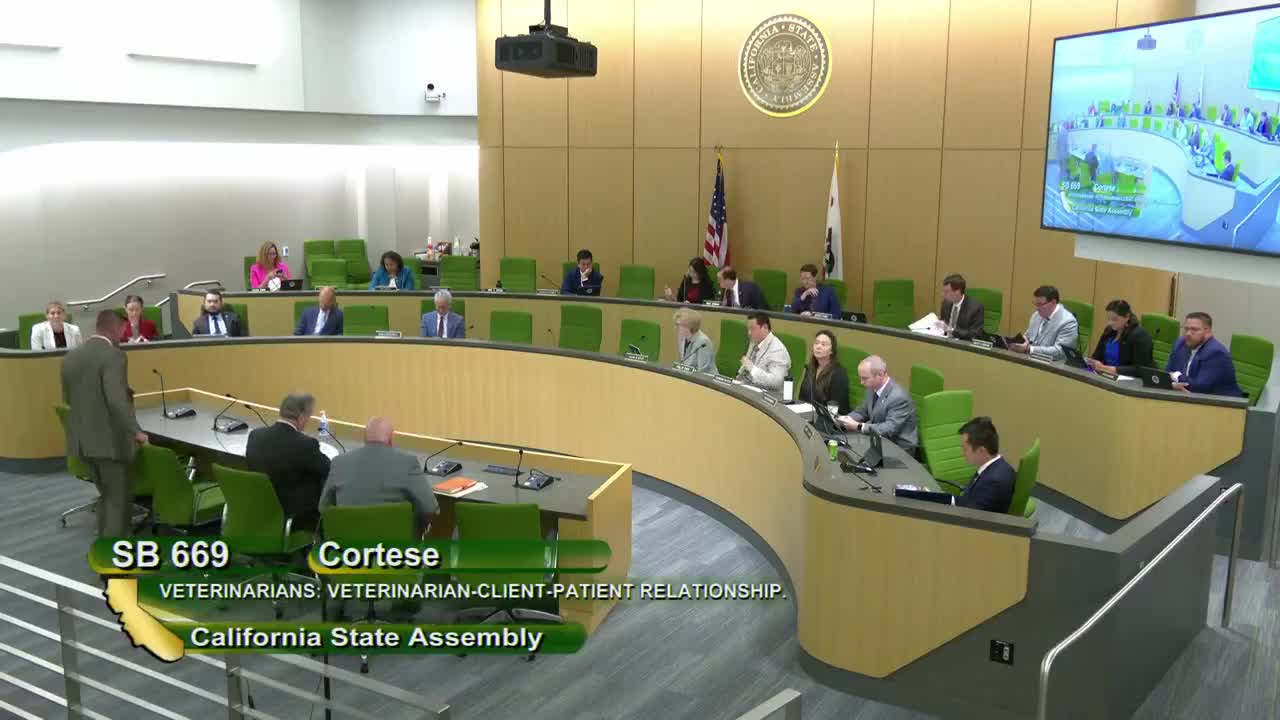 12MIN
Assembly Standing Committee on Business and Professions
 1MIN
Senate Floor
 12MIN
Senate Standing Committee on Business, Professions and Economic Development
Bill Author



