SB 676: Local ordinances and regulations: drought-tolerant landscaping.
- Session Year: 2023-2024
- House: Senate
- Latest Version Date: 2023-10-08
Current Status:
Passed
(2023-10-08: Chaptered by Secretary of State. Chapter 498, Statutes of 2023.)
Introduced
In Committee
First Chamber
In Committee
Second Chamber
Enacted
Existing law prohibits a city, including a charter city, county, and city and county, from enacting or enforcing any ordinance or regulation that prohibits the installation of drought-tolerant landscaping, synthetic grass, or artificial turf on residential property, as specified.
This bill would instead prohibit a city, including a charter city, county, or city and county from enacting or enforcing any ordinance or regulation that prohibits the installation of drought-tolerant landscaping using living plant material on residential property. The bill would specify that drought-tolerant landscaping does not include the installation of synthetic grass or artificial turf.
The bill would include findings that changes proposed by this bill address a matter of statewide concern rather than a municipal affair and, therefore, apply to all cities, including charter cities.
Existing law prohibits a city, including a charter city, county, and city and county, from enacting or enforcing any ordinance or regulation that prohibits the installation of drought-tolerant landscaping, synthetic grass, or artificial turf on residential property, as specified.
This bill would instead prohibit a city, including a charter city, county, or city and county from enacting or enforcing any ordinance or regulation that prohibits the installation of drought-tolerant landscaping using living plant material on residential property. The bill would specify that drought-tolerant landscaping does not include the installation of synthetic grass or artificial turf. By establishing new requirements for local agencies, this bill would impose a state-mandated program.
The bill would include findings that changes proposed by this bill address a matter of statewide concern rather than a municipal affair and, therefore, apply to all cities, including charter cities.
Existing law, the Bradley-Burns Uniform Local Sales and Use Tax Law and the Transactions and Use Tax Law provide as specified, for the imposition of sales or transactions and use taxes by cities, counties, and local districts. Existing law establishes the California Department of Tax and Fee Administration (department) and provides that the department is the successor to, and is vested with, the duties, powers, and responsibilities of the State Board of Equalization, which include the administration and enforcement of local sales or transactions and use taxes. Existing law authorizes, among other tax authorization provisions, a legislative body of any city or county, or city and county, to levy a tax by ordinance, as specified, on the privilege of selling at retail within its jurisdiction aerosol paint containers, containers of any other marking substance, felt tip markers that have a flat or angled writing surface of1/2 inch or greater, or any other marking instruments.This bill would authorize a county to levy a tax by ordinance, approved by a1/2 vote of the electors, at a rate of no more than $0.30 per tablet, on the sale within its jurisdiction of trichlor tablets, as defined. The bill would require a county imposing such a tax to contract with the department to administer the tax and would require the ordinance levying the tax to sunset no later than 5 years after its effective date unless the ordinance is extended by the electors, as specified. The bill would require a retailer engaged in business in a county that has an operative ordinance enacted pursuant to the bill to collect the tax from the consumer at the point of sale and would require the retailer to remit the tax to the department. The bill would require the department to allocate the tax revenues, as specified, and would require the county to expend those revenues for purposes of public education related to proper use of trichlor tablets in commercial and residential pool settings and local water conservation.Existing law, the Bradley-Burns Uniform Local Sales and Use Tax Law and the Transactions and Use Tax Law provide as specified, for the imposition of sales or transactions and use taxes by cities, counties, and local districts. Existing law establishes the California Department of Tax and Fee Administration (department) and provides that the department is the successor to, and is vested with, the duties, powers, and responsibilities of the State Board of Equalization, which include the administration and enforcement of local sales or transactions and use taxes. Existing law authorizes, among other tax authorization provisions, a legislative body of any city or county, or city and county, to levy a tax by ordinance, as specified, on the privilege of selling at retail within its jurisdiction aerosol paint containers, containers of any other marking substance, felt tip markers that have a flat or angled writing surface of1/2 inch or greater, or any other marking instruments.
This bill would authorize a county to levy a tax by ordinance, approved by a1/2 vote of the electors, at a rate of no more than $0.30 per tablet, on the sale within its jurisdiction of trichlor tablets, as defined. The bill would require a county imposing such a tax to contract with the department to administer the tax and would require the ordinance levying the tax to sunset no later than 5 years after its effective date unless the ordinance is extended by the electors, as specified. The bill would require a retailer engaged in business in a county that has an operative ordinance enacted pursuant to the bill to collect the tax from the consumer at the point of sale and would require the retailer to remit the tax to the department. The bill would require the department to allocate the tax revenues, as specified, and would require the county to expend those revenues for purposes of public education related to proper use of trichlor tablets in commercial and residential pool settings and local water conservation.
(a)A city, including a charter city, county, or city and county, shall not enact any ordinance or regulation, or enforce any existing ordinance or regulation, that prohibits the installation of drought-tolerant landscaping using living plant material on residential property.
(b)For the purposes of this section, drought-tolerant landscaping shall not include the installation of synthetic grass or artificial turf.
SEC. 2.The Legislature finds and declares that the prolonged drought, along with climate change, requires the state to address water conservation goals that will have long-term impacts in this state. The Legislature further finds and declares that drought-tolerant landscaping is a viable landscaping alternative that will further the goal of addressing long-term water conservation. Therefore, allowing property owners in this state to install drought-tolerant landscaping on their residential properties is a matter of statewide concern and is not a municipal affair as that term is used in Section 5 of Article XI of the California Constitution. Therefore, Section 1 of this act amending Section 53087.7 of the Government Code applies to all cities, including charter cities.
(a)A city, including a charter city, county, or city and county, shall not enact any ordinance or regulation, or enforce any existing ordinance or regulation, that prohibits the installation of drought tolerant landscaping, synthetic grass, or artificial turf drought-tolerant landscaping using living plant material on residential property.
(b)A city, including a charter city, county, or city and county, may impose reasonable restrictions on the type of drought tolerant landscaping, synthetic grass, or artificial turf that may be installed on residential property provided that those restrictions do not do any of the following:(1)Substantially increase the cost of installing drought tolerant landscaping, synthetic grass, or artificial turf.(2)Effectively prohibit the installation of drought tolerant landscaping, synthetic grass, or artificial turf.(3)Significantly impede the installation of drought tolerant landscaping, including, but not limited to, a requirement that a residential yard must be completely covered with living plant material.(c)A city, including a charter city, county, or city and county, may impose reasonable restrictions on the installation or design of synthetic grass or artificial turf within the dripline of a tree protected by local ordinance.(b)For the purposes of this section, drought-tolerant landscaping shall not include the installation of synthetic grass or artificial turf.
SEC. 2.The Legislature finds and declares that the prolonged drought, along with climate change, requires the state to address water conservation goals that will have long-term impacts in this state. The Legislature further finds and declares that drought-tolerant landscaping is a viable landscaping alternative that will further the goal of addressing long-term water conservation. Therefore, allowing property owners in this state to install drought-tolerant landscaping on their residential properties is a matter of statewide concern and is not a municipal affair as that term is used in Section 5 of Article XI of the California Constitution. Therefore, Section 1 of this act amending Section 53087.7 of the Government Code applies to all cities, including charter cities.
SECTION 1.Chapter 3.1 (commencing with Section 7287.15) is added to Part 1.7 of Division 2 of the Revenue and Taxation Code, to read:3.1.Responsible Pool Disinfection and Water Conservation Act7287.15.The legislative body of a county may levy a tax by an ordinance approved by two-thirds of the electors voting on the measure, in addition to any other tax authorized by this division, for the privilege of selling trichlor tablets at retail within its jurisdiction, at the rate of no more than thirty cents ($0.30) per tablet.7287.16.For purposes of this chapter:(a)Cyanuric acid means a pool stabilizing and conditioning chemical in either liquid or granular form that is often mixed with chlorine tablets or sticks, which is also called trichlor, and chlorine shock, which is also called dichlor, to ensure proper disinfection of pools for public health and safe swimming.(b)Department means the California Department of Tax and Fee Administration.(c)Trichlor tablet means trichloro-s-trizinetrione that is a dry solid and meets all of the following criteria:(1)It contains the highest available (90 percent) chlorine content combined with cyanuric acid.(2)It is a United States Environmental Protection Agency-registered pesticide for use as a sanitizer for pools and spas.(3)It is sold in tablet, stick, or granular form.7287.17.An ordinance levying a tax pursuant to this chapter shall provide for both of the following:(a)That the county shall contract before the effective date of the ordinance with the department to perform all functions incident to the administration or operation of the ordinance for as long as the county has an operative ordinance enacted pursuant to this chapter.(b)That the ordinance shall sunset no later than five years after its effective date unless it is extended by two-thirds of the electors voting on the extension.7287.18.A retailer engaged in business in a county that has an operative ordinance enacted pursuant to this chapter shall, at the point of sale of a trichlor tablet, collect the tax from the consumer and give to the consumer a receipt therefor in the manner and form prescribed by the department.7287.19.(a)Any revenues collected pursuant to a tax imposed by an ordinance authorized by this chapter shall be remitted to the department and allocated by the department as follows:(1)First, for reimbursement to the department, pursuant to the contract between the department and the county of the reasonable costs of administering and enforcing the ordinance on behalf of the county.(2)Second, for transmission not later than March 15 of each calendar year to each county that has an operative ordinance enacted pursuant to this chapter in an amount corresponding to the amount of revenues derived within that jurisdiction from a tax levied by that ordinance.(b)Moneys transmitted to a county pursuant to this section shall be expended by that county only for purposes of public education related to the proper use of trichlor tablets in commercial and residential pool settings and local water conservation.7287.20.Except as provided in Section 7287.21, to the extent feasible or practicable, Chapter 5 (commencing with Section 6451), Chapter 6 (commencing with Section 6701), Chapter 7 (commencing with Section 6901), and Chapter 8 (commencing with Section 7051) of Part 1 shall govern determinations, collection of tax, overpayments and refunds, and administration under this chapter.7287.21.(a)The return and payment of the tax imposed by this chapter is due and payable to the department annually on or before February 15 following the end of the calendar year during which the tax was collected.(b)For purposes of computing interest due on an amount of tax not paid when due, interest shall be computed to the 15th day of each succeeding month.(c)(1)Except in the case of fraud, intent to evade this chapter or accompanying rules and regulations, or failure to make a return, a notice of a deficiency determination shall be mailed within three years after the 15th day of the second month following the one-year period for which the amount is proposed to be determined or within three years after the return is filed, whichever period expires later.(2)In the case of failure to make a return, a notice of determination shall be mailed within eight years after the 15th day of the second month following the one-year period for which the amount is proposed to be determined.(d)(1)(A)Except as provided in paragraph (2), a refund shall not be approved by the department after three years from the 15th day of the second month following the one-year period for which the overpayment was made, or with respect to determinations made under Article 2 (commencing with Section 6481), Article 3 (commencing with Section 6511), and Article 4 (commencing with Section 6536) of Chapter 5 of Part 1, after six months from the date the determinations become final, or after six months from the date of overpayment, whichever period expires later, unless a claim therefor is filed with the department within that period.(B)A credit shall not be approved by the department after the expiration of the period described in subparagraph (A) unless a claim for credit is filed with the department within that period or unless the credit relates to a period for which a waiver has been granted pursuant to Section 6488.(2)A refund may be approved by the department for a period for which a waiver has been granted under Section 6488 if a claim for refund is filed with the department before the expiration of the waiver period.(e)In all other instances in which the due date specified in subdivision (a) conflicts with a due date specified in Chapter 5 (commencing with Section 6451), Chapter 6 (commencing with Section 6701), Chapter 7 (commencing with Section 6901), and Chapter 8 (commencing with Section 7051) of Part 1, the due date specified in subdivision (a) shall be substituted for any due date specified in those chapters, and periods running from or to, or otherwise based on, the otherwise applicable due date shall be adjusted accordingly.7287.22.The department shall administer and enforce the provisions of this chapter and may prescribe, adopt, and enforce, rules and regulations for those purposes pursuant to Chapter 3.5 (commencing with Section 11340) of Part 1 of Division 3 of Title 2 of the Government Code.The legislative body of a county may levy a tax by an ordinance approved by two-thirds of the electors voting on the measure, in addition to any other tax authorized by this division, for the privilege of selling trichlor tablets at retail within its jurisdiction, at the rate of no more than thirty cents ($0.30) per tablet.
7287.16.For purposes of this chapter:
(a)Cyanuric acid means a pool stabilizing and conditioning chemical in either liquid or granular form that is often mixed with chlorine tablets or sticks, which is also called trichlor, and chlorine shock, which is also called dichlor, to ensure proper disinfection of pools for public health and safe swimming.
(b)Department means the California Department of Tax and Fee Administration.
(c)Trichlor tablet means trichloro-s-trizinetrione that is a dry solid and meets all of the following criteria:
(1)It contains the highest available (90 percent) chlorine content combined with cyanuric acid.
(2)It is a United States Environmental Protection Agency-registered pesticide for use as a sanitizer for pools and spas.
(3)It is sold in tablet, stick, or granular form.
7287.17.An ordinance levying a tax pursuant to this chapter shall provide for both of the following:
(a)That the county shall contract before the effective date of the ordinance with the department to perform all functions incident to the administration or operation of the ordinance for as long as the county has an operative ordinance enacted pursuant to this chapter.
(b)That the ordinance shall sunset no later than five years after its effective date unless it is extended by two-thirds of the electors voting on the extension.
7287.18.A retailer engaged in business in a county that has an operative ordinance enacted pursuant to this chapter shall, at the point of sale of a trichlor tablet, collect the tax from the consumer and give to the consumer a receipt therefor in the manner and form prescribed by the department.
7287.19.(a)Any revenues collected pursuant to a tax imposed by an ordinance authorized by this chapter shall be remitted to the department and allocated by the department as follows:
(1)First, for reimbursement to the department, pursuant to the contract between the department and the county of the reasonable costs of administering and enforcing the ordinance on behalf of the county.
(2)Second, for transmission not later than March 15 of each calendar year to each county that has an operative ordinance enacted pursuant to this chapter in an amount corresponding to the amount of revenues derived within that jurisdiction from a tax levied by that ordinance.
(b)Moneys transmitted to a county pursuant to this section shall be expended by that county only for purposes of public education related to the proper use of trichlor tablets in commercial and residential pool settings and local water conservation.
7287.20.Except as provided in Section 7287.21, to the extent feasible or practicable, Chapter 5 (commencing with Section 6451), Chapter 6 (commencing with Section 6701), Chapter 7 (commencing with Section 6901), and Chapter 8 (commencing with Section 7051) of Part 1 shall govern determinations, collection of tax, overpayments and refunds, and administration under this chapter.
7287.21.(a)The return and payment of the tax imposed by this chapter is due and payable to the department annually on or before February 15 following the end of the calendar year during which the tax was collected.
(b)For purposes of computing interest due on an amount of tax not paid when due, interest shall be computed to the 15th day of each succeeding month.
(c)(1)Except in the case of fraud, intent to evade this chapter or accompanying rules and regulations, or failure to make a return, a notice of a deficiency determination shall be mailed within three years after the 15th day of the second month following the one-year period for which the amount is proposed to be determined or within three years after the return is filed, whichever period expires later.
(2)In the case of failure to make a return, a notice of determination shall be mailed within eight years after the 15th day of the second month following the one-year period for which the amount is proposed to be determined.
(d)(1)(A)Except as provided in paragraph (2), a refund shall not be approved by the department after three years from the 15th day of the second month following the one-year period for which the overpayment was made, or with respect to determinations made under Article 2 (commencing with Section 6481), Article 3 (commencing with Section 6511), and Article 4 (commencing with Section 6536) of Chapter 5 of Part 1, after six months from the date the determinations become final, or after six months from the date of overpayment, whichever period expires later, unless a claim therefor is filed with the department within that period.
(B)A credit shall not be approved by the department after the expiration of the period described in subparagraph (A) unless a claim for credit is filed with the department within that period or unless the credit relates to a period for which a waiver has been granted pursuant to Section 6488.
(2)A refund may be approved by the department for a period for which a waiver has been granted under Section 6488 if a claim for refund is filed with the department before the expiration of the waiver period.
(e)In all other instances in which the due date specified in subdivision (a) conflicts with a due date specified in Chapter 5 (commencing with Section 6451), Chapter 6 (commencing with Section 6701), Chapter 7 (commencing with Section 6901), and Chapter 8 (commencing with Section 7051) of Part 1, the due date specified in subdivision (a) shall be substituted for any due date specified in those chapters, and periods running from or to, or otherwise based on, the otherwise applicable due date shall be adjusted accordingly.
7287.22.The department shall administer and enforce the provisions of this chapter and may prescribe, adopt, and enforce, rules and regulations for those purposes pursuant to Chapter 3.5 (commencing with Section 11340) of Part 1 of Division 3 of Title 2 of the Government Code.
|
Date
|
Status
|
|---|---|
| Oct 8, 2023 | Chaptered by Secretary of State. Chapter 498, Statutes of 2023. |
| Oct 8, 2023 | Approved by the Governor. |
| Sep 20, 2023 | Enrolled and presented to the Governor at 4:30 p.m. |
| Sep 12, 2023 | In Senate. Ordered to engrossing and enrolling. |
| Sep 12, 2023 | Read third time. Passed. (Ayes 66. Noes 10. Page 3251.) Ordered to the Senate. |
| Jul 13, 2023 | Read second time. Ordered to third reading. |
| Jul 12, 2023 | From committee: Do pass. (Ayes 8. Noes 0.) (July 12). |
| Jun 1, 2023 | Referred to Com. on L. GOV. |
| May 25, 2023 | In Assembly. Read first time. Held at Desk. |
| May 24, 2023 | Read third time. Passed. (Ayes 33. Noes 5. Page 1274.) Ordered to the Assembly. |
| May 1, 2023 | Read second time. Ordered to third reading. |
| Apr 27, 2023 | From committee: Do pass. (Ayes 6. Noes 1. Page 939.) (April 26). |
| Apr 20, 2023 | Set for hearing April 26. |
| Apr 18, 2023 | From committee with author's amendments. Read second time and amended. Re-referred to Com. on GOV. & F. |
| Mar 1, 2023 | Referred to Com. on GOV. & F. |
| Feb 17, 2023 | From printer. May be acted upon on or after March 19. |
| Feb 16, 2023 | Introduced. Read first time. To Com. on RLS. for assignment. To print. |
|
Date
|
Description
|
Location
|
Votes
|
|
|---|---|---|---|---|
| Sep 12, 2023 | SB 676 Allen Senate Third Reading By Schiavo | Assembly Floor |
Passed |
|
| Jul 12, 2023 | Do pass. | Assembly Standing Committee on Local Government |
Passed |
|
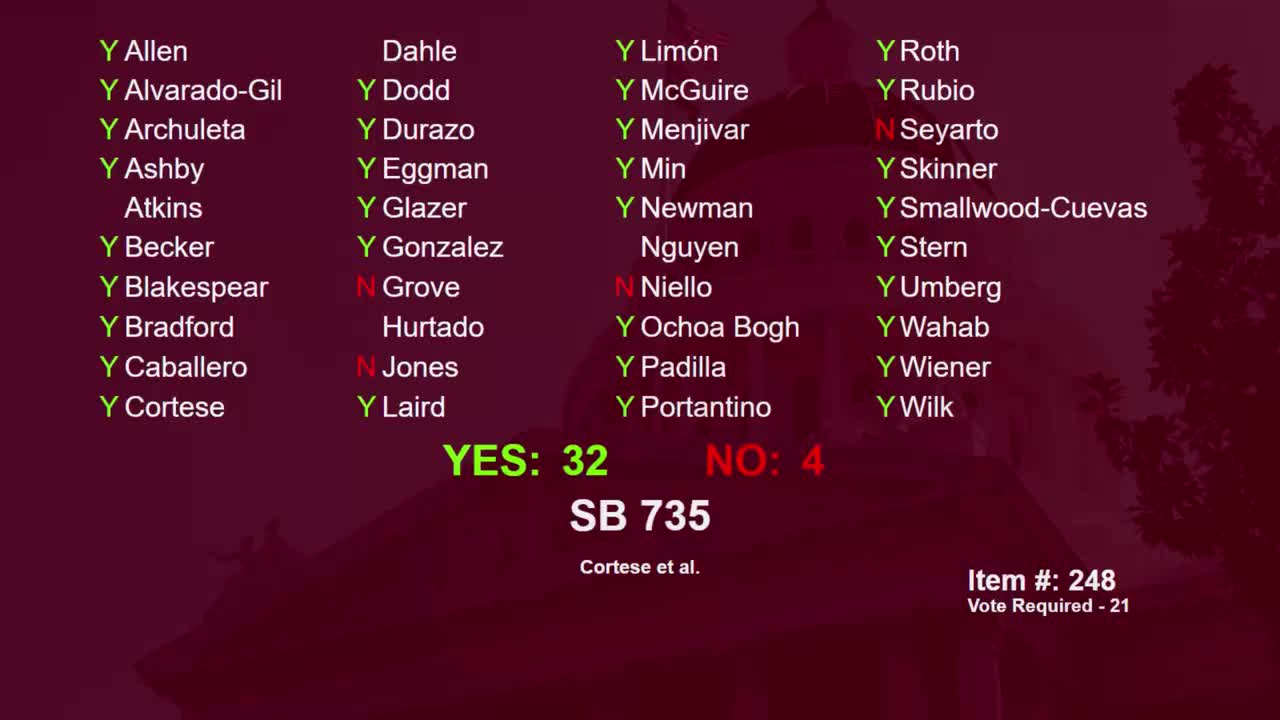
| May 24, 2023 | Senate 3rd Reading SB676 Allen | Senate Floor |
Passed |
|
| Apr 26, 2023 | Do pass | Senate Standing Committee on Governance and Finance |
Passed |
This list shows positions taken on this bill by organizations on the date displayed, which is linked to the original source.
Positions by individuals are not included.
|
Organization
|
Position
|
Date
|
|---|---|---|
| A Choice for Advocacy, Inc. | ** Support | |
| A Voice for Choice Advocacy | ** Support | |
| Active San Gabriel Valley | ** Support | |
| Association Of California Water Agencies | ** Support | |
| Beyond Plastics | ** Support | |
| California Product Stewardship Council | ** Support | |
| California Safe Schools | ** Support | |
| Center For Public Environmental Oversight | ** Support | |
| City Of Millbrae | ** Support | |
| Clean Water Action | ** Support | |
| cleanearth4kids.org | ** Support | |
| Community Water Center | ** Support | |
| Environmental Working Group | ** Support | |
| Green Science Policy Institute | ** Support | |
| Healthy Building Network | ** Support | |
| Kahn Soares Conway LLP | * Support | Jul 12, 2023 |
| Las Virgenes Municipal Water District | ** Support | |
| National Stewardship Action Council | * Support | Jul 12, 2023 |
| Natural Resources Defense Council | ** Support | |
| Non Toxic Communities | ** Support | |
| Nontoxic Schools | ** Support | |
| Northern California Recycling Association | ** Support | |
| Physicians for Social Responsibility - Los Angeles | ** Support | |
| Plant California Alliance | ** Support | |
| Plant Conservation Alliance | ** Support | |
| Plastic Pollution Coalition | ** Support | |
| Public Employees for Environmental Responsibility | ** Support | |
| Responsible Purchasing Network | ** Support | |
| RXN Group | * Support | Jul 12, 2023 |
| Safe Healthy Playing Fields, Inc. | ** Support | |
| San Diegans for Sustainable, Equitable, & Quiet Equipment in Landscaping | ** Support | |
| San Francisco Baykeeper | ** Support | |
| Santa Clara County | * Support | Apr 26, 2023 |
| SD-SEQUEL | ** Support | |
| See | ** Support | |
| Shaw Yoder Antwih Schmelzer Lange Inc | * Support | Jul 12, 2023 |
| The Last Plastic Straw | ** Support | |
| The Story of Stuff Project | ** Support |
SENATE THIRD READING
STR Bill Id:SB 676
Author:(Allen)
As Amended Ver:April 18, 2023
Majority vote
SUMMARY
Specifies that cities or counties may not prohibit the installation of drought-tolerant landscaping using living plant material on residential property, and repeals existing provisions regarding the ability of cities or counties to prohibit or restrict the installation of synthetic grass or artificial turf on residential property.
Major Provisions
- Specifies that a city, including a charter city, county, or city and county (city or county), shall not enact any ordinance or regulation, or enforce any existing ordinance or regulation, that prohibits the installation of drought-tolerant landscaping using living plant material on residential property.
- Repeals existing law prohibiting a city or county from enacting any ordinance or regulation, or enforcing any existing ordinance or regulation, that prohibits the installation of synthetic grass or artificial turf on residential property.
- Repeals existing law allowing a city or county to impose reasonable restrictions on the type of drought tolerant landscaping, synthetic grass, or artificial turf that may be installed on residential property, as specified.
- Repeals existing law allowing a city or county to impose reasonable restrictions on the installation or design of synthetic grass or artificial turf within the dripline of a tree protected by local ordinance.
- Specifies that "drought-tolerant landscaping" shall not include the installation of synthetic grass or artificial turf.
COMMENTS
State law prohibits local governments from adopting ordinances or regulations that ban the installation of drought-tolerant landscaping, synthetic grass, or artificial turf on residential property [AB 1164 (Gatto), Chapter 671, Statutes of 2015]. However, local agencies can restrict the type of drought-tolerant landscaping, synthetic grass or artificial turf that residents can install on their properties, provided such restrictions are reasonable and do not do any of the following:
- Substantially increase the cost of installation.
- Effectively prohibit the installation.
- Significantly impede the installation, including, but not limited to, requiring a residential yard to be completely covered with living plant materials.
In response to this restriction authority, some local jurisdictions, such as the City of Glendale, have excluded the installation of artificial or synthetic turf from their turf replacement rebate program because it does not meet specified sustainability goals. Others, such as the City of Millbrae, have enacted a temporary moratorium on the use of artificial turf and synthetic grass to allow City staff time to develop and prepare a permanent ordinance prescribing landscape standards, specifications, and a process for regulating installation methods.
The use of artificial turf has come under scrutiny in recent years due to health concerns that have been raised about its chemical components, including the presence of perfluoroalkyl and polyfluoroalkyl substances (PFAS). According to the State Water Resources Control Board, PFAS are a large group of human-made substances that do not occur naturally in the environment and are resistant to heat, water, and oil. PFAS have been widely used as surface coatings and protectants in consumer goods such as carpet and home textiles; clothing; food packaging; and non-stick cookware. Exposure can occur through food, food packaging, consumer products, house dust, and drinking water.
According to the Author
"California is facing prolonged droughts as climate change exacerbates weather patterns, bringing higher temperatures and less precipitation. In an effort to conserve water, the state and many municipalities have implemented strict water conservation policies including the restriction of lawn watering. As a result, some Californians have transitioned to drought-resistant landscaping options, including artificial turf, to reduce household water usage.
"The Legislature enacted a law in 2016 that prohibits local governments from banning or regulating artificial turf in their jurisdictions in an effort to encourage a transition to landscaping alternatives that use less water. However, emerging research reveals that artificial turf incurs significant environmental problems including microplastic pollution, chemical run-off, and lack of recyclability. A 2019 U.S. Environmental Protection Agency study found per- and poly-fluoroalkyl substances (PFAS) in artificial turf – chemicals used since the 1950s to make commercial and industrial products that resist heat, stains, and grease and have been linked to numerous health problems including cancer, kidney and liver damage, birth defects, and harm to children's health.
"Like most plastics, artificial turf has a limited life span. It is rarely recycled due to the high cost of separating and cleaning the material, as well as market constraints on reusability. When artificial turf needs to be replaced, it is commonly disposed in landfills where it continues to leech toxins into the surrounding soil, water, and air. SB 676 will return power to cities and counties to ban or regulate artificial turf in their communities to manage the associated environmental and waste impacts."
Arguments in Support
A coalition of supporters, including the National Stewardship Action Council, Non-Toxic Schools, Environmental Working Group, California Product Stewardship Council, Plastic Pollution Coalition, The Last Plastic Straw, Story of Stuff Project, SEE (Social Eco Education), San Francisco Baykeeper, Northern California Recycling Association, and Active San Gabriel Valley, write, "California's drought has led some jurisdictions and residents to make the switch to synthetic grass and artificial turf. However, most synthetic grass contains harmful chemicals such as PFAS that get into our waterways, along with microplastics.
"PFAS are toxic, cancer causing 'forever' chemicals that persist in the environment and do not break down, posing a very dangerous threat to public health and the environment right now and for generations to come. We are also concerned about material degradation and microplastics getting into water, soil, and our food chain. A growing number of municipalities across the nation are banning the installation of synthetic grass due to growing concerns about environmental and public health implications.
"SB 676 would disincentivize the switch to synthetic grass or artificial turf which contain harmful chemicals including known carcinogens and can reasonably be expected to break down into microplastics."
Arguments in Opposition
None on file
FISCAL COMMENTS
None
VOTES
SENATE FLOOR: 33-5-2
YES: Allen, Alvarado-Gil, Archuleta, Ashby, Atkins, Becker, Blakespear, Bradford, Caballero, Cortese, Dodd, Durazo, Eggman, Glazer, Gonzalez, Hurtado, Laird, Limón, McGuire, Menjivar, Min, Newman, Ochoa Bogh, Padilla, Portantino, Roth, Rubio, Skinner, Smallwood-Cuevas, Stern, Umberg, Wahab, Wiener
NO: Dahle, Grove, Jones, Niello, Wilk
ABS, ABST OR NV: Nguyen, Seyarto
ASM LOCAL GOVERNMENT: 8-0-0
YES: Juan Carrillo, Dixon, Boerner, Haney, Pacheco, Ramos, Waldron, Wilson
UPDATED
VERSION: April 18, 2023
CONSULTANT: Angela Mapp / L. GOV. / (916) 319-3958 FN: 0001219
Date of Hearing: July 12, 2023
ASSEMBLY COMMITTEE ON LOCAL GOVERNMENT
Juan Carrillo, Chair
SBPCA Bill Id:SB 676
Author:(Allen) – As Amended Ver:April 18, 2023
SENATE VOTE: 33-5
SUBJECT: Local ordinances and regulations: drought-tolerant landscaping.
SUMMARY: Specifies that cities or counties may not prohibit the installation of drought-tolerant landscaping using living plant material on residential property, and repeals existing provisions regarding the ability of cities or counties to prohibit or restrict the installation of synthetic grass or artificial turf on residential property. Specifically, this bill:
- Specifies that a city, including a charter city, county, or city and county (city or county), shall not enact any ordinance or regulation, or enforce any existing ordinance or regulation, that prohibits the installation of drought-tolerant landscaping using living plant material on residential property.
- Repeals existing law prohibiting a city or county from enacting any ordinance or regulation, or enforcing any existing ordinance or regulation, that prohibits the installation of synthetic grass or artificial turf on residential property.
- Repeals existing law allowing a city or county to impose reasonable restrictions on the type of drought tolerant landscaping, synthetic grass, or artificial turf that may be installed on residential property, as specified.
- Repeals existing law allowing a city or county to impose reasonable restrictions on the installation or design of synthetic grass or artificial turf within the dripline of a tree protected by local ordinance.
- Specifies that “drought-tolerant landscaping” shall not include the installation of synthetic grass or artificial turf.
- Finds and declares that the prolonged drought, along with climate change, requires the state to address water conservation goals that will have long-term impacts in this state, and that drought-tolerant landscaping is a viable landscaping alternative that will further the goal of addressing long-term water conservation. Therefore, allowing property owners in this state to install drought-tolerant landscaping on their residential properties is a matter of statewide concern and is not a municipal affair as that term is used in Section 5 of Article XI of the California Constitution. Therefore, this bill applies to all cities, including charter cities.
EXISTING LAW:
- Prohibits cities or counties from adopting ordinances or regulations that ban the installation of drought-tolerant landscaping, synthetic grass, or artificial turf on residential property.
- Allows cities or counties to restrict the type of drought-tolerant landscaping, synthetic grass or artificial turf that residents can install on their properties, provided such restrictions are reasonable and do not do any of the following:
- Substantially increase the cost of installation.
- Effectively prohibit the installation.
- Significantly impede the installation, including, but not limited to, requiring a residential yard to be completely covered with living plant materials.
- Allows cities or counties to impose reasonable restrictions on the installation or design of synthetic grass or artificial turf within the dripline of a tree protected by local ordinance. (Government Code § 53087.7)
FISCAL EFFECT: None
COMMENTS:
- Author’s Statement. According to the author, “California is facing prolonged droughts as climate change exacerbates weather patterns, bringing higher temperatures and less precipitation. In an effort to conserve water, the state and many municipalities have implemented strict water conservation policies including the restriction of lawn watering. As a result, some Californians have transitioned to drought-resistant landscaping options, including artificial turf, to reduce household water usage.
“The Legislature enacted a law in 2016 that prohibits local governments from banning or regulating artificial turf in their jurisdictions in an effort to encourage a transition to landscaping alternatives that use less water. However, emerging research reveals that artificial turf incurs significant environmental problems including microplastic pollution, chemical run-off, and lack of recyclability. A 2019 U.S. Environmental Protection Agency study found per- and poly-fluoroalkyl substances (PFAS) in artificial turf – chemicals used since the 1950s to make commercial and industrial products that resist heat, stains, and grease and have been linked to numerous health problems including cancer, kidney and liver damage, birth defects, and harm to children’s health.
“Like most plastics, artificial turf has a limited life span. It is rarely recycled due to the high cost of separating and cleaning the material, as well as market constraints on reusability. When artificial turf needs to be replaced, it is commonly disposed in landfills where it continues to leech toxins into the surrounding soil, water, and air. SB 676 will return power to cities and counties to ban or regulate artificial turf in their communities to manage the associated environmental and waste impacts.”
- Bill Summary. This bill clarifies that a city or county may not enact or enforce any ordinance or regulation that bans the installation of drought-tolerant landscaping using living plant material on residential property. The bill provides that “drought-tolerant landscaping” shall not include the installation of synthetic grass or artificial turf, effectively allowing local agencies to ban the installation of synthetic grass or artificial turf on residential property.
This bill repeals existing law authorizing local agencies to impose reasonable restrictions on the type of drought-tolerant landscaping, synthetic grass or artificial turf that can be installed on residential properties.
This bill is sponsored by the author.
- Background. State law prohibits local governments from adopting ordinances or regulations that ban the installation of drought-tolerant landscaping, synthetic grass, or artificial turf on residential property [AB 1164 (Gatto) Chapter 671, Statutes of 2015]. However, local agencies can restrict the type of drought-tolerant landscaping, synthetic grass or artificial turf that residents can install on their properties, provided such restrictions are reasonable and do not do any of the following:
- Substantially increase the cost of installation.
- Effectively prohibit the installation.
- Significantly impede the installation, including, but not limited to, requiring a residential yard to be completely covered with living plant materials.
In response to this restriction authority, some local jurisdictions, such as the City of Glendale, have excluded the installation of artificial or synthetic turf from their turf replacement rebate program because it does not meet specified sustainability goals. Others, such as the City of Millbrae, have enacted a temporary moratorium on the use of artificial turf and synthetic grass to allow City staff time to develop and prepare a permanent ordinance prescribing landscape standards, specifications, and a process for regulating installation methods.
The use of artificial turf has come under scrutiny in recent years due to health concerns that have been raised about its chemical components, including the presence of perfluoroalkyl and polyfluoroalkyl substances (PFAS). According to the State Water Resources Control Board, PFAS are a large group of human-made substances that do not occur naturally in the environment and are resistant to heat, water, and oil. PFAS have been widely used as surface coatings and protectants in consumer goods such as carpet and home textiles; clothing; food packaging; and non-stick cookware. Exposure can occur through food, food packaging, consumer products, house dust, and drinking water.
- Arguments in Support. A coalition of supporters, including the National Stewardship Action Council, Non-Toxic Schools, Environmental Working Group, California Product Stewardship Council, Plastic Pollution Coalition, The Last Plastic Straw, Story of Stuff Project, SEE (Social Eco Education), San Francisco Baykeeper, Northern California Recycling Association, and Active San Gabriel Valley, write, “California’s drought has led some jurisdictions and residents to make the switch to synthetic grass and artificial turf. However, most synthetic grass contains harmful chemicals such as PFAS that get into our waterways, along with microplastics.
“PFAS are toxic, cancer causing ‘forever’ chemicals that persist in the environment and do not break down, posing a very dangerous threat to public health and the environment right now and for generations to come. We are also concerned about material degradation and microplastics getting into water, soil, and our food chain. A growing number of municipalities across the nation are banning the installation of synthetic grass due to growing concerns about environmental and public health implications.
“SB 676 would disincentivize the switch to synthetic grass or artificial turf which contain harmful chemicals including known carcinogens and can reasonably be expected to break down into microplastics.”
- Arguments in Opposition. None on file.
REGISTERED SUPPORT / OPPOSITION:
Support
A Voice for Choice Advocacy
Active San Gabriel Valley
Association of California Water Agencies (ACWA)
Beyond Plastics
California Product Stewardship Council
California Safe Schools
Center for Public Environmental Oversight
City of Millbrae
Clean Water Action
Cleanearth4kids.org
Community Water Center
Environmental Working Group
Green Science Policy Institute
Healthy Building Network
Las Virgenes Municipal Water District
National Stewardship Action Council
Natural Resources Defense Council.
Non Toxic Communities
Nontoxic Schools
Northern California Recycling Association
Physicians for Social Responsibility - Los Angeles
Plant California Alliance
Plastic Pollution Coalition
Public Employees for Environmental Responsibility
Responsible Purchasing Network
Safe Healthy Playing Fields, INC.
San Francisco Baykeeper
Sd-sequel
See (social Eco Education)
The Last Plastic Straw
The Story of Stuff Project
Opposition
None on file
Analysis Prepared by: Angela Mapp / L. GOV. / (916) 319-3958
SENATE RULES COMMITTEE Office of Senate Floor Analyses (916) 651-1520 Fax: (916) 327-4478 | SB 676 |
THIRD READING
Bill No: SB 676
Author: Allen (D)
Amended: 4/18/23
Vote: 21
SENATE GOVERNANCE & FIN. COMMITTEE: 6-1, 4/26/23
AYES: Caballero, Blakespear, Durazo, Glazer, Skinner, Wiener
NOES: Dahle
NO VOTE RECORDED: Seyarto
SUBJECT: Local ordinances and regulations: drought-tolerant landscaping
SOURCE: Author
DIGEST:
This bill prohibits local agencies from banning the installation of drought-tolerant landscaping using living plant material and repeals existing provisions allowing them to reasonably restrict the installation of synthetic grass or artificial turf on residential property.
ANALYSIS:
Existing law:
- Prohibits local governments from adopting ordinances or regulations that ban the installation of drought-tolerant landscaping, synthetic grass, or artificial turf on residential property.
- Permits local agencies to restrict the type of drought-tolerant landscaping, synthetic grass or artificial turf that residents can install on their properties, provided such restrictions are reasonable and do not do any of the following:
- Substantially increase the cost of installation;
- Effectively prohibit the installation; or,
- Significantly impede the installation, including, but not limited to, requiring a residential yard to be completely covered with living plant materials.
This bill:
- Prohibits a charter city, county, or city and county, from enacting or enforcing any ordinance or regulation that bans the installation of drought-tolerant landscaping using living plant material on residential property.
- Provides, for purposes of the prohibition in this bill, that “drought-tolerant landscaping” shall not include the installation of synthetic grass or artificial turf, meaning that local agencies may ban the installation of synthetic grass or artificial turf.
- Repeals existing law authorizing local agencies to impose reasonable restrictions on the type of drought-tolerant landscaping, synthetic grass or artificial turf that residents can install on their properties.
- Includes necessary legislative findings and declarations to apply its provisions to charter cities.
Background
California’s drought. In October 2021, Governor Newsom issued a proclamation extending the statewide drought emergency and urging Californians to increase their water conservation efforts. In recent years, a number of local governments and agencies have established rebate and other incentive programs to encourage residents to curb water use. For instance, the Municipal Water District of Orange County offers a turf removal program that replaces water-intensive grass with climate-appropriate landscapes, thus reducing customers’ water use by up to 70 percent. Likewise, the Sacramento County Water Agency’s “cash for grass” program provides a voluntary rebate of up to $2,000 to residential customers for converting grass and sprinkler irrigation to drip irrigation systems.
Local artificial turf regulation. In response to the authority provided in current law allowing local governments to restrict the type of drought-tolerant landscaping, synthetic grass or artificial turf that can be installed on residential property, some local jurisdictions, such as the City of Glendale, have excluded the installation of artificial or synthetic turf from their turf replacement rebate program because it does not meet specified sustainability goals. Others, such as the City of Millbrae, have enacted a temporary moratorium on the use of artificial turf and synthetic grass to allow City staff time to develop and prepare a permanent ordinance prescribing landscape standards, specifications, and a process for regulating installation methods.
The use of artificial turf has come under scrutiny in recent years due to health concerns that have been raised about its chemical components, including the presence of perfluoroalkyl and polyfluoroalkyl substances (PFAS). According to the State Water Resources Control Board, PFAS are a large group of human-made substances that do not occur naturally in the environment and are resistant to heat, water, and oil. PFAS have been widely used as surface coatings and protectants in consumer goods such as carpet and home textiles; clothing; food packaging; and non-stick cookware. Exposure can occur through food, food packaging, consumer products, house dust, and drinking water.
Seeking to further discourage the use of artificial or synthetic turf in water-conscious landscaping, the author wants to repeal existing law restricting local agencies’ authority over the type of drought-tolerant landscaping, synthetic grass or artificial turf that residents can install on their properties and instead prohibit local agencies from banning the installation of drought-tolerant landscaping using living plant material.
Comments
- Purpose of the bill. According to the author, “The Legislature enacted a law in 2016 that prohibits local governments from banning or regulating artificial turf in their jurisdictions in an effort to encourage a transition to landscaping alternatives that use less water. However, emerging research reveals that artificial turf incurs significant environmental problems through pollution, chemical run-off, and lack of recyclability. A 2019 U.S. Environmental Protection Agency study found per- and poly-fluoroalkyl substances (PFAS) in artificial turf – chemicals used since the 1950s to make commercial and industrial products that resist heat, stains, and grease and have been linked to numerous health problems including cancer, kidney and liver damage, birth defects, and harm to children’s health.
“Like most plastics, artificial turf has a limited life span. It is rarely recycled due to the high cost of separating and cleaning the material, as well as market constraints on reusability. When artificial turf needs to be replaced, it is commonly disposed in landfills where it continues to leech toxins into the surrounding soil, water, and air. SB 676 will return power to cities and counties to ban or regulate artificial turf in their communities to manage the associated environmental and waste impacts.”
- Home rule. The police power is the inherent authority of sovereign governments to regulate private behavior, consistent with constitutional rights and procedures. Under the California Constitution, the police power is delegated to cities and counties to "make and enforce within [their] limits all local, police, sanitary, and other ordinances and regulations not in conflict with general laws" (Article XI, Section 7). Courts have interpreted the police power as including the power to regulate the physical appearance of the environment within a community, including ordinances that enforce aesthetic standards. In this regard, existing law allows a local government to establish reasonable design and quality restrictions related to the type of artificial turf a resident can use, including, for example, color and replacement requirements, as long as those restrictions do not effectively make it impossible for residents to install the artificial turf. This bill removes this authority and instead permits local agencies to regulate, including to ban, the installation of artificial or synthetic turf in their communities.
Related/Prior Legislation
On March 29th, the Committee approved SB 414 (Allen), which prohibits local agencies from issuing state-funded rebates, vouchers, or other financial incentives for drought-tolerant landscaping that uses synthetic grass or artificial turf. On April 19th, the author amended this bill to delete its contents and insert the current provisions, which amend the same section as SB 414 but instead prohibit local agencies from enacting or enforcing any ordinance or regulation that bans the installation of drought-tolerant landscaping using living plant material on residential property. Because SB 676 specifies drought-tolerant landscaping does not include the installation of synthetic grass or artificial turf and repeals existing provisions authorizing local agencies to reasonably restrict such installation, the bill has the effect of allowing local agencies to ban it in their jurisdictions.
FISCAL EFFECT: Appropriation: No Fiscal Com.: No Local: No
SUPPORT: (Verified 5/1/23)
A Choice for Advocacy, Inc.
National Stewardship Action Council
Non Toxic Communities
Plant Conservation Alliance
Safe Healthy Playing Fields, Inc.
San Diegans for Sustainable, Equitable, & Quiet Equipment in Landscaping
OPPOSITION: (Verified 5/1/23)
None received
ARGUMENTS IN SUPPORT: According to the National Stewardship Action Council, “A growing number of municipalities across the nation are banning the installation of synthetic grass due to growing concerns about environmental and public health implications. SB 676 would disincentivize the switch to synthetic grass or artificial turf which contain harmful chemicals including known carcinogens and can reasonably be expected to break down into microplastics.”
Prepared by: Cassie Royce / GOV. & F. / (916) 651-4119
5/3/23 15:16:13
**** END ****
SENATE COMMITTEE ON GOVERNANCE AND FINANCE
Senator Anna M. Caballero, Chair
2023 - 2024 Regular
Bill No: | SB 676 | Hearing Date: | 4/26/23 |
Author: | Allen | Tax Levy: | No |
Version: | 4/18/23 Amended | Fiscal: | No |
Consultant: | Royce, Favorini-Csorba | ||
local ordinances and regulations: drought-tolerant landscaping
Prohibits local agencies from banning the installation of drought-tolerant landscaping using living plant material and repeals existing provisions allowing them to reasonably restrict the installation of synthetic grass or artificial turf on residential property.
Background
California’s drought. In October 2021, Governor Newsom issued a proclamation extending the statewide drought emergency and urging Californians to increase their water conservation efforts. In recent years, a number of local governments and agencies have established rebate and other incentive programs to encourage residents to curb water use. For instance, the Municipal Water District of Orange County offers a turf removal program that replaces water-intensive grass with climate-appropriate landscapes, thus reducing customers’ water use by up to 70 percent. Likewise, the Sacramento County Water Agency’s “cash for grass” program provides a voluntary rebate of up to $2,000 to residential customers for converting grass and sprinkler irrigation to drip irrigation systems.
Local artificial turf regulations. State law prohibits local governments from adopting ordinances or regulations that ban the installation of drought-tolerant landscaping, synthetic grass, or artificial turf on residential property (AB 1164, Gatto, 2015). However, local agencies can restrict the type of drought-tolerant landscaping, synthetic grass or artificial turf that residents can install on their properties, provided such restrictions are reasonable and do not do any of the following:
- Substantially increase the cost of installation;
- Effectively prohibit the installation; or,
- Significantly impede the installation, including, but not limited to, requiring a residential yard to be completely covered with living plant materials.
In response to this restriction authority, some local jurisdictions, such as the City of Glendale, have excluded the installation of artificial or synthetic turf from their turf replacement rebate program because it does not meet specified sustainability goals. Others, such as the City of Millbrae, have enacted a temporary moratorium on the use of artificial turf and synthetic grass to allow City staff time to develop and prepare a permanent ordinance prescribing landscape standards, specifications, and a process for regulating installation methods.
The use of artificial turf has come under scrutiny in recent years due to health concerns that have been raised about its chemical components, including the presence of perfluoroalkyl and polyfluoroalkyl substances (PFAS). According to the State Water Resources Control Board, PFAS are a large group of human-made substances that do not occur naturally in the environment and are resistant to heat, water, and oil. PFAS have been widely used as surface coatings and protectants in consumer goods such as carpet and home textiles; clothing; food packaging; and non-stick cookware. Exposure can occur through food, food packaging, consumer products, house dust, and drinking water.
Seeking to further discourage the use of artificial or synthetic turf in water-conscious landscaping, the author wants to repeal existing law restricting local agencies’ authority over the type of drought-tolerant landscaping, synthetic grass or artificial turf that residents can install on their properties and instead prohibit local agencies from banning the installation of drought-tolerant landscaping using living plant material.
Proposed Law
Senate Bill 676 prohibits a charter city, county, or city and county, from enacting or enforcing any ordinance or regulation that bans the installation of drought-tolerant landscaping using living plant material on residential property.
For purposes of this prohibition, the bill provides that “drought-tolerant landscaping” shall not include the installation of synthetic grass or artificial turf, meaning that local agencies may ban the installation of synthetic grass or artificial turf.
The measure repeals existing law authorizing local agencies to impose reasonable restrictions on the type of drought-tolerant landscaping, synthetic grass or artificial turf that residents can install on their properties.
The bill also includes necessary legislative findings and declarations to apply its provisions to charter cities.
State Revenue Impact
No estimate.
Comments
1. Purpose of the bill. According to the author, “California is facing one of the worst and most prolonged droughts as climate change exacerbates weather patterns, bringing higher temperatures and less precipitation. In an effort to conserve water, the state and many municipalities have implemented strict water conservation policies including the restriction of lawn watering. As a result, some Californians have transitioned to drought-resistant landscaping options, including artificial turf, to reduce household water usage.
The Legislature enacted a law in 2016 that prohibits local governments from banning or regulating artificial turf in their jurisdictions in an effort to encourage a transition to landscaping alternatives that use less water. However, emerging research reveals that artificial turf incurs significant environmental problems through pollution, chemical run-off, and lack of recyclability. A 2019 U.S. Environmental Protection Agency study found per- and poly-fluoroalkyl substances (PFAS) in artificial turf – chemicals used since the 1950s to make commercial and industrial products that resist heat, stains, and grease and have been linked to numerous health problems including cancer, kidney and liver damage, birth defects, and harm to children’s health.
Like most plastics, artificial turf has a limited life span. It is rarely recycled due to the high cost of separating and cleaning the material, as well as market constraints on reusability. When artificial turf needs to be replaced, it is commonly disposed in landfills where it continues to leech toxins into the surrounding soil, water, and air. SB 676 will return power to cities and counties to ban or regulate artificial turf in their communities to manage the associated environmental and waste impacts.”
2. Home rule. The police power is the inherent authority of sovereign governments to regulate private behavior, consistent with constitutional rights and procedures. Under the California Constitution, the police power is delegated to cities and counties to "make and enforce within [their] limits all local, police, sanitary, and other ordinances and regulations not in conflict with general laws" (Article XI, Section 7). Courts have interpreted the police power as including the power to regulate the physical appearance of the environment within a community, including ordinances that enforce aesthetic standards. In this regard, existing law allows a local government to establish reasonable design and quality restrictions related to the type of artificial turf a resident can use, including, for example, color and replacement requirements, as long as those restrictions do not effectively make it impossible for residents to install the artificial turf. This bill removes this authority and instead permits local agencies to regulate, including to ban, the installation of artificial or synthetic turf in their communities.
3. Related legislation. On March 29th, the Committee approved SB 414 (Allen), which prohibits local agencies from issuing state-funded rebates, vouchers, or other financial incentives for drought-tolerant landscaping that uses synthetic grass or artificial turf. On April 19th, the author amended this bill to delete its contents and insert the current ones, which amend the same section as SB 414 but instead prohibit local agencies from enacting or enforcing any ordinance or regulation that bans the installation of drought-tolerant landscaping using living plant material on residential property. Because SB 676 specifies drought-tolerant landscaping does not include the installation of synthetic grass or artificial turf and repeals existing provisions authorizing local agencies to reasonably restrict such installation, the bill has the effect of allowing local agencies to ban it in their jurisdictions.
4. Charter cities. The California Constitution allows cities that adopt charters to control their own “municipal affairs.” In all other matters, charter cities must follow the general, statewide laws. However, the Constitution does not define “municipal affairs,” leaving it to the courts to determine whether a topic is a municipal affair or an issue of statewide concern. SB 676 specifies that it applies to all cities, including charter cities. To support this assertion, the bill includes a legislative finding that allowing residential property owners to install drought-tolerant landscaping is a matter of statewide concern.
Support and Opposition
(4/21/23)
Support:
National Stewardship Action Council
Plant California Alliance
Opposition: None submitted.
-- END --
Discussed in Hearing
 1MIN
Assembly Floor
 5MIN
Assembly Standing Committee on Local Government
 2MIN
Senate Floor
 6MIN
Senate Standing Committee on Governance and Finance
Bill Author

Bill Co-Author(s):