SB 919: Franchise Investment Law: franchise brokers.
- Session Year: 2023-2024
- House: Senate
- Latest Version Date: 2024-09-24
Current Status:
Passed
(2024-09-24: Chaptered by Secretary of State. Chapter 518, Statutes of 2024.)
Introduced
In Committee
First Chamber
In Committee
Second Chamber
Enacted
Existing law, the Franchise Investment Law, generally provides for the regulation of the offer and sale of franchises and requires the Commissioner of Financial Protection and Innovation to maintain a risk-based process of reviewing franchise applications with emphasis on risks associated with the franchisors financial condition, the franchisors compliance record, and significant deficiencies with the franchisors application. The law requires specific written disclosures, and authorizes the sale of a franchise to be exempt from specified requirements if the franchisor meets certain disclosure and notice requirements. Existing law makes it unlawful for a person to offer or sell any franchise unless the franchise has been registered or exempted pursuant to these provisions.
This bill, contingent upon an appropriation by the Legislature, would require a franchise broker, as defined, to register with the commissioner before engaging in certain activities, including offering or selling a franchise in this state. This registration process would require the franchise broker to sign and verify a specified form, under penalty of perjury. The bill would make it unlawful for a franchise broker to offer or sell a franchise in this state unless the franchise broker is registered pursuant to these provisions. The bill would authorize the commissioner to summarily issue a stop order suspending or revoking a registration under these provisions and would prescribe a hearing process if the commissioner receives a written request for hearing from the franchise broker, as specified. The bill would impose certain recordkeeping and regulatory requirements on franchise brokers and would make various actions by franchise brokers unlawful. The bill would make these provisions operative on the later of: (1) July 1, 2026, or (2) the first anniversary of the date on which the above-described appropriation is made.
Existing law makes it unlawful for any person to effect or to attempt to effect a sale of a franchise unless, among other exceptions, the person is identified in an application or amended application with the commissioner, licensed by the Department of Real Estate as a real estate broker or real estate salesperson, or licensed by the commissioner as a broker-dealer or agent pursuant to the Corporate Securities Law of 1968.
This bill would add as an exception to the provisions described above a person registered as a franchise broker.
Under existing law, a person who offers or sells a franchise in violation of specified provisions is liable to the franchisee or subfranchisor, who may sue for specified damages.
This bill would make a franchise broker who offers or sells a franchise in violation of specified provisions liable to the franchisee or franchisor, who may sue for damages, as specified.
Existing law requires the commissioner to charge and collect specified fees in connection with an application for registration for, renewal of, and amendment of, a registration of an offer of franchises, as specified, which are credited to the Financial Protection Fund.
This bill would establish specified fees in connection with an application for registration or amendment of a registration as a franchise broker, and would require the commissioner to charge and collect those fees.
By expanding the crime of perjury, as specified above, this bill would impose a state-mandated local program.
The California Constitution requires the state to reimburse local agencies and school districts for certain costs mandated by the state. Statutory provisions establish procedures for making that reimbursement.
This bill would provide that no reimbursement is required by this act for a specified reason.
Existing law, the Franchise Investment Law, generally provides for the regulation of the offer and sale of franchises and requires the Commissioner of Financial Protection and Innovation to maintain a risk-based process of reviewing franchise applications with emphasis on risks associated with the franchisors financial condition, the franchisors compliance record, and significant deficiencies with the franchisors application. The law requires specific written disclosures, and authorizes the sale of a franchise to be exempt from specified requirements if the franchisor meets certain disclosure and notice requirements. Existing law makes it unlawful for a person to offer or sell any franchise unless the franchise has been registered or exempted pursuant to these provisions.
This bill would, beginning January 1, 2026, require a third-party franchise seller, bill, contingent upon an appropriation by the Legislature, would require a franchise broker, as defined, to register with the commissioner, as specified, including signing and verifying a prescribed form. commissioner before engaging in certain activities, including offering or selling a franchise in this state. This registration process would require the franchise broker to sign and verify a specified form, under penalty of perjury. The bill would make it unlawful for a third-party franchise seller franchise broker to offer or sell a franchise in this state unless the third-party franchise seller franchise broker is registered pursuant to these provisions, as specified. provisions. The bill would authorize the commissioner to summarily issue a stop order suspending or revoking a registration under these provisions, as specified, provisions and would prescribe a hearing process if the commissioner receives a written request for hearing from the third-party franchise seller, franchise broker, as specified. The bill would impose certain recordkeeping and regulatory requirements on registered third-party franchise sellers, franchise brokers and would make certain various actions by third-party franchise sellers franchise brokers unlawful. The bill would make these provisions operative on the later of: (1) July 1, 2026, or (2) the first anniversary of the date on which the above-described appropriation is made.
Existing law makes it unlawful for any person to effect or to attempt to effect a sale of a franchise unless, among other exceptions, the person is identified in an application or amended application with the commissioner, licensed by the Department of Real Estate as a real estate broker or real estate salesperson, or licensed by the commissioner as a broker-dealer or agent pursuant to the Corporate Securities Law of 1968.
This bill would add as an exception to the provisions described above a person registered as a third-party franchise seller, as specified. franchise broker.
Under existing law, a person who offers or sells a franchise in violation of specified provisions is liable to the franchisee or subfranchisor, who may sue for specified damages.
This bill would make a franchise broker who offers or sells a franchise in violation of specified provisions liable to the franchisee or franchisor, who may sue for damages, as specified.
Existing law requires the commissioner to charge and collect specified fees in connection with an application for registration for, renewal of, and amendment of, a registration of an offer of franchises, as specified, which are credited to the Financial Protection Fund.
This bill would establish specified fees in connection with an application for registration or amendment of a registration as a third-party franchise seller, franchise broker, and would require the commissioner to charge and collect those fees.
By expanding the crime of perjury, as specified above, this bill would impose a state-mandated local program.
The California Constitution requires the state to reimburse local agencies and school districts for certain costs mandated by the state. Statutory provisions establish procedures for making that reimbursement.
This bill would provide that no reimbursement is required by this act for a specified reason.
Existing law, the Franchise Investment Law, generally provides for the regulation of the offer and sale of franchises and requires the Commissioner of Financial Protection and Innovation to maintain a risk-based process of reviewing franchise applications with emphasis on risks associated with the franchisors financial condition, the franchisors compliance record, and significant deficiencies with the franchisors application. The law requires specific written disclosures, and authorizes the sale of a franchise to be exempt from specified requirements if the franchisor meets certain disclosure and notice requirements. Existing law makes it unlawful for a person to offer or sell any franchise unless the franchise has been registered or exempted pursuant to these provisions.
This bill would, beginning January 1, 2026, require a third-party franchise seller, as defined, to register with the commissioner, as specified, including signing and verifying a prescribed form. The bill would make it unlawful for a third-party franchise seller to offer or sell a franchise in this state unless the third-party franchise seller is registered pursuant to these provisions, as specified. The bill would authorize the commissioner to summarily issue a stop order suspending or revoking a registration under these provisions, as specified, and would prescribe a hearing process if the commissioner receives a written request for hearing from the third-party franchise seller, as specified. The bill would impose certain requirements on registered third-party franchise sellers, and make certain actions by third-party franchise sellers unlawful.
Existing law makes it unlawful for any person to effect or to attempt to effect a sale of a franchise unless, among other exceptions, the person is identified in an application or amended application with the commissioner, licensed by the Department of Real Estate as a real estate broker or real estate salesperson, or licensed by the commissioner as a broker-dealer or agent pursuant to the Corporate Securities Law of 1968.
This bill would add as an exception to the provisions described above a person registered as a third-party franchise seller, as specified.
Existing law requires the commissioner to charge and collect specified fees in connection with an application for registration for, renewal of, and amendment of, a registration of an offer of franchises, as specified, which are credited to the Financial Protection Fund.
This bill would establish specified fees in connection with an application for registration or amendment of a registration as a third-party franchise seller, and would require the commissioner to charge and collect those fees.
By expanding the crime of perjury, as specified above, this bill would impose a state-mandated local program.
The California Constitution requires the state to reimburse local agencies and school districts for certain costs mandated by the state. Statutory provisions establish procedures for making that reimbursement.
This bill would provide that no reimbursement is required by this act for a specified reason.
Existing law, the Franchise Investment Law, generally provides for the regulation of the offer and sale of franchises and requires the Commissioner of Financial Protection and Innovation to maintain a risk-based process of reviewing franchise applications with emphasis on risks associated with the franchisors financial condition, the franchisors compliance record, and significant deficiencies with the franchisors application. The law requires specific written disclosures, and authorizes the sale of a franchise to be exempt from specified requirements if the franchisor meets certain disclosure and notice requirements. Existing law makes it unlawful for a person to offer or sell any franchise unless the franchise has been registered or exempted pursuant to these provisions.
This bill would, beginning July 1, 2025, January 1, 2026, require a third-party franchise seller, as defined, to register with the commissioner, as specified, including signing and verifying a prescribed form. The bill would make it unlawful for a third-party franchise seller to offer or sell a franchise in this state unless the third-party franchise seller is registered pursuant to these provisions, as specified. The bill would authorize the commissioner to summarily issue a stop order suspending or denying the effectiveness of revoking a registration under these provisions or barring a third-party franchise seller from offering or selling a franchise in this state, provisions, as specified, and would prescribe a hearing process if the commissioner receives a written request for hearing from the third-party franchise seller, as specified. The bill would impose certain requirements on registered third-party franchise sellers, and make certain actions by third-party franchise sellers unlawful.
Existing law makes it unlawful for any person to effect or to attempt to effect a sale of a franchise unless, among other exceptions, the person is identified in an application or amended application with the commissioner, licensed by the Department of Real Estate as a real estate broker or real estate salesperson, or licensed by the commissioner as a broker-dealer or agent pursuant to the Corporate Securities Law of 1968.
This bill would add as an exception to the provisions described above a person registered as a third-party franchise seller, as specified.
Existing law requires the commissioner to charge and collect specified fees in connection with an application for registration for, renewal of, and amendment of, a registration of an offer of franchises, as specified, which are credited to the Financial Protection Fund.
This bill would establish specified fees in connection with an application for registration or amendment of a registration as a third-party franchise seller, and would require the commissioner to charge and collect those fees.
By expanding the crime of perjury, as specified above, this bill would impose a state-mandated local program.
The California Constitution requires the state to reimburse local agencies and school districts for certain costs mandated by the state. Statutory provisions establish procedures for making that reimbursement.
This bill would provide that no reimbursement is required by this act for a specified reason.
Existing law, the Franchise Investment Law, generally provides for the regulation of the offer and sale of franchises and requires the Commissioner of Financial Protection and Innovation to maintain a risk-based process of reviewing franchise applications with emphasis on risks associated with the franchisors financial condition, the franchisors compliance record, and significant deficiencies with the franchisors application. The law requires specific written disclosures, and authorizes the sale of a franchise to be exempt from specified requirements if the franchisor meets certain disclosure and notice requirements. Existing law makes it unlawful for a person to offer or sell any franchise unless the franchise has been registered or exempted pursuant to these provisions.
This bill would, beginning July 1, 2025, require a third-party franchise seller, as defined, to register with the commissioner, as specified, including signing and verifying a prescribed form. The bill would make it unlawful for a third-party franchise seller to offer or sell a franchise in this state unless the third-party franchise seller is registered pursuant to these provisions, as specified. The bill would authorize the commissioner to summarily issue a stop order suspending or denying the effectiveness of a registration under these provisions or barring a third-party franchise seller from offering or selling a franchise in this state, as specified, and would prescribe a hearing process if the commissioner receives a written request for hearing from the third-party franchise seller, as specified. The bill would impose certain requirements on registered third-party franchise sellers, and make certain actions by third-party franchise sellers unlawful.
Existing law makes it unlawful for any person to effect or to attempt to effect a sale of a franchise unless, among other exceptions, the person is identified in an application or amended application with the commissioner, licensed by the Department of Real Estate as a real estate broker or real estate salesperson, or licensed by the commissioner as a broker-dealer or agent pursuant to the Corporate Securities Law of 1968.
This bill would add as an exception to the provisions described above a person registered as a third-party franchise seller, as specified.
Existing law requires the commissioner to charge and collect specified fees in connection with an application for registration for, renewal of, and amendment of, a registration of an offer of franchises, as specified, which are credited to the Financial Protection Fund.
This bill would establish specified fees in connection with an application for registration or amendment of a registration as a third-party franchise seller, and would require the commissioner to charge and collect those fees.
By expanding the crime of perjury, as specified above, this bill would impose a state-mandated local program.
The California Constitution requires the state to reimburse local agencies and school districts for certain costs mandated by the state. Statutory provisions establish procedures for making that reimbursement.
This bill would provide that no reimbursement is required by this act for a specified reason.
Existing law, the Franchise Investment Law, generally provides for the regulation of the offer and sale of franchises and requires the Commissioner of Financial Protection and Innovation to maintain a risk-based process of reviewing franchise applications with emphasis on risks associated with the franchisors financial condition, the franchisors compliance record, and significant deficiencies with the franchisors application. The law requires specific written disclosures, and authorizes the sale of a franchise to be exempt from specified requirements if the franchisor meets certain disclosure and notice requirements. Existing law makes it unlawful for a person to offer or sell any franchise unless the franchise has been registered or exempted pursuant to these provisions.
This bill would, beginning July 1, 2025, require a third-party franchise seller, as defined, to register with the commissioner, as specified, including signing and verifying a prescribed form, and authorize a registered third-party franchise seller to renew its registration annually, as specified. form. The bill would make it unlawful for a third-party franchise seller to offer or sell a franchise in this state unless the third-party franchise seller is registered pursuant to these provisions, as specified. The bill would authorize the commissioner to summarily issue a stop order suspending or denying the effectiveness of a registration under these provisions, provisions or barring a third-party franchise seller from offering or selling a franchise in this state, as specified, and would prescribe a hearing process if the commissioner receives a written request for hearing from the third-party franchise seller, as specified. The bill would impose certain requirements on registered third-party franchise sellers, and make certain actions by third-party franchise sellers unlawful.
Existing law makes it unlawful for any person to effect or to attempt to effect a sale of a franchise unless, among other exceptions, the person is identified in an application or amended application with the commissioner, licensed by the Department of Real Estate as a real estate broker or real estate salesperson, or licensed by the commissioner as a broker-dealer or agent pursuant to the Corporate Securities Law of 1968.
This bill would remove the exemptions for licensed real estate brokers, real estate salespersons, broker-dealers, and agents as described above and instead specify that it is unlawful for any person to effect or attempt to effect a sale of a franchise unless the person is identified in an application or amended application with the commissioner, as specified, or add as an exception to the provisions described above a person registered as a third-party franchise seller, as specified.
Existing law requires the commissioner to charge and collect specified fees in connection with an application for registration for, renewal of, and amendment of, a registration of an offer of franchises, as specified, which are credited to the Financial Protection Fund.
This bill would establish specified fees in connection with an application for registration, renewal, registration or amendment of a registration as a third-party franchise seller, and would require the commissioner to charge and collect those fees.
By expanding the crime of perjury, as specified above, this bill would impose a state-mandated local program.
The California Constitution requires the state to reimburse local agencies and school districts for certain costs mandated by the state. Statutory provisions establish procedures for making that reimbursement.
This bill would provide that no reimbursement is required by this act for a specified reason.
Existing law, the Franchise Investment Law, generally provides for the regulation of the offer and sale of franchises and requires the Commissioner of Financial Protection and Innovation to maintain a risk-based process of reviewing franchise applications with emphasis on risks associated with the franchisors financial condition, the franchisors compliance record, and significant deficiencies with the franchisors application. The law requires specific written disclosures, and authorizes the sale of a franchise to be exempt from specified requirements if the franchisor meets certain disclosure and notice requirements. Existing law makes it unlawful for a person to offer or sell any franchise unless the franchise has been registered or exempted pursuant to these provisions.
This bill would, beginning July 1, 2025, require a third-party franchise seller, as defined, to register with the commissioner, as specified, including signing and verifying a prescribed form, and authorize a registered third-party franchise seller to renew its registration annually, as specified. The bill would make it unlawful for a third-party franchise seller to offer or sell a franchise in this state unless the third-party franchise seller is registered pursuant to these provisions, as specified. The bill would authorize the commissioner to summarily issue a stop order suspending or denying the effectiveness of a registration under these provisions, as specified, and would prescribe a hearing process if the commissioner receives a written request for hearing from the third-party franchise seller, as specified. The bill would impose certain requirements on registered third-party franchise sellers, and make certain actions by third-party franchise sellers unlawful.
Existing law makes it unlawful for any person to effect or to attempt to effect a sale of a franchise unless, among other exceptions, the person is identified in an application or amended application with the commissioner, licensed by the Department of Real Estate as a real estate broker or real estate salesperson, or licensed by the commissioner as a broker-dealer or agent pursuant to the Corporate Securities Law of 1968.
This bill would remove the exemptions for licensed real estate brokers, real estate salespersons, broker-dealers, and agents as described above and instead specify that it is unlawful for any person to effect or attempt to effect a sale of a franchise unless the person is identified in an application or amended application with the commissioner, as specified, or registered as a third-party franchise seller, as specified.
Existing law requires the commissioner to charge and collect specified fees in connection with an application for registration for, renewal of, and amendment of, a registration of an offer of franchises, as specified, which are credited to the Financial Protection Fund.
This bill would establish specified fees in connection with an application for registration, renewal, or amendment of a registration as a third-party franchise seller, and would require the commissioner to charge and collect those fees.
By expanding the crime of perjury, as specified above, this bill would impose a state-mandated local program.
The California Constitution requires the state to reimburse local agencies and school districts for certain costs mandated by the state. Statutory provisions establish procedures for making that reimbursement.
This bill would provide that no reimbursement is required by this act for a specified reason.
Existing law requires a ballot card manufacturer, finisher, or ballot on demand system vendor to disclose to the Secretary of State in writing any known flaw or defect in its ballot card manufacturing or finishing process, manufactured or finished ballot cards, or ballot on demand system that could adversely affect the future casting or tallying of votes.This bill would make a technical, nonsubstantive change to that provision.Existing law requires a ballot card manufacturer, finisher, or ballot on demand system vendor to disclose to the Secretary of State in writing any known flaw or defect in its ballot card manufacturing or finishing process, manufactured or finished ballot cards, or ballot on demand system that could adversely affect the future casting or tallying of votes.
This bill would make a technical, nonsubstantive change to that provision.
(a)Franchise broker means a person who directly or indirectly engages in the business of the offer or sale of a franchise, regardless of the title used by the person or any organization with which they are affiliated, and receives or is promised a fee, commission, or other form of consideration from a franchisor, subfranchisor, franchisee, or affiliate of a franchisor, subfranchisor, or franchisee. Common titles franchise brokers use include, but are not limited to, franchise seller, broker network, broker organization, franchise sales organization, consultant, and coach.
(b)A franchise broker does not include any of the following:
(1)A franchisor or its officers, directors, or employees.
(2)A subfranchisor or its officers, directors, or employees.
(3)An area representative or its officers, directors, or employees.
(4)An employee of an affiliate of a franchisor or subfranchisor.
(5)A franchisee of the franchise offering being presented to a prospective franchisee, unless the franchisee operates a franchised broker business.
SEC. 2.Section 31210 of the Corporations Code is amended to read:31210.It is unlawful for any person to effect or attempt to effect a sale of a franchise in this state, except in transactions exempted under Chapter 1 (commencing with Section 31100) of Part 2 of this division, unless that person is any of the following:
(a)Identified in Item 2 of a franchise disclosure document submitted with an application or amended application filed with the commissioner pursuant to Part 2 (commencing with Section 31100) of this division.
(b)Licensed by the Department of Real Estate as a real estate broker or real estate salesperson.
(c)Licensed by the commissioner as a broker-dealer or agent pursuant to the Corporate Securities Law of 1968.
(d)Registered as a franchise broker pursuant to Part 7 (commencing with Section 31520).
SEC. 3.Section 31300 of the Corporations Code is amended to read:31300.(a)Any person who offers or sells a franchise in violation of Section 31101, 31110, 31119, 31200, or 31202, or in violation of any provision of this division that provides an exemption from the provisions of Chapter 2 (commencing with Section 31110) of Part 2 or any portions of Part 2, shall be liable to the franchisee or subfranchisor, who may sue for damages caused thereby, and if the violation is willful, the franchisee may also sue for rescission, unless, in the case of a violation of Section 31200 or 31202, the defendant proves that the plaintiff knew the facts concerning the untruth or omission, or that the defendant exercised reasonable care and did not know, or, if they had exercised reasonable care, would not have known, of the untruth or omission.
(b)(1)Any franchise broker who offers or sells a franchise in violation of Part 7 (commencing with Section 31520) or Chapter 1 (commencing with Section 31200) of Part 3 shall be liable to the franchisee, who may sue for damages caused thereby.
(2)Any franchise broker who offers or sells a franchise in violation of Part 7 (commencing with Section 31520) or Chapter 1 (commencing with Section 31200) of Part 3 shall be liable to the franchisor, who may sue for damages or may assert claims of indemnity against the franchise broker caused by the violation, including, but not limited to, indemnity for any damages awarded in connection with rescission awarded to the franchisee.
SEC. 4.Section 31500 of the Corporations Code is amended to read:31500.(a)The commissioner shall charge and collect the fees fixed by this section. All fees and charges collected under this section shall be transmitted to the Treasurer at least weekly, accompanied by a detailed statement thereof and shall be credited to the State Corporations Fund.
(b)The fee for filing an application for registration of the offer of franchises under Section 31111 is six hundred seventy-five dollars ($675).
(c)The fee for filing an application for renewal of a registration under Section 31121 is four hundred fifty dollars ($450).
(d)The fee for filing an amendment to the application filed under Section 31111 or 31121 after the effective date of the registration of the offer of franchises, is fifty dollars ($50).
(e)The fee for filing an application for material modification under Section 31125 is fifty dollars ($50), whether or not it accompanies an application under Section 31111 or 31121.
(f)The fee for filing the initial notice of exemption under Section 31101 is four hundred fifty dollars ($450) and the fee for filing each consecutive subsequent notice of exemption under these provisions is one hundred fifty dollars ($150).
(g)The fee for filing an application for approval of a written notice of violation under Section 31303 or 31304 is six hundred seventy-five dollars ($675).
(h)The fee for filing an application for registration as a franchise broker under Part 7 (commencing with Section 31520) is four hundred fifty dollars ($450).
(i)The fee for filing an application for amendment of a registration as a franchise broker under Part 7 (commencing with Section 31520) is fifty dollars ($50).
SEC. 5.Part 7 (commencing with Section 31520) is added to Division 5 of Title 4 of the Corporations Code, to read:7.FRANCHISE BROKERS31520.(a)A franchise broker shall register by filing online all of the following with the commissioner:
(1)A completed Uniform Franchise Broker Disclosure Document, as created and modified by the commissioner, that is signed and verified as true and correct by the filer.
(2)Any additional documents or exhibits prescribed by the commissioner.
(3)The required registration fee, as set forth in Section 31500.
(4)Copies of financial securities and insurance policies the commissioner requires the franchise broker to obtain and maintain.
(b)Subject to Section 31522, the registration shall be effective upon filing a complete application, including all required documents, and paying all applicable fees.
(c)Subject to Section 31522, a registration pursuant to this section shall expire on December 31 of the year in which the registration became effective.
31521.(a)A registered franchise broker shall promptly notify the commissioner in writing by an application to amend the registration of any material change in the information contained in the latest Uniform Franchise Broker Disclosure Document filed by the franchise broker.
(b)The commissioner may by rule further define what shall be considered a material change for those purposes, and the circumstances under which an amended Uniform Franchise Broker Disclosure Document must be filed.
(c)The commissioner may issue a stop order pursuant to Section 31522 if the commissioner finds that any of the material changes provided pursuant to this section constitute a failure to comply with any of the provisions of this division or any rule issued by the commissioner pertaining to this division.
31522.(a)The commissioner may summarily issue a stop order suspending or revoking any registration under this part if the commissioner finds that the franchise broker has failed to comply with any of the provisions of this division or any rule issued by the commissioner pertaining to this division.
(b)A franchise broker shall not offer or sell a franchise in this state while a stop order issued pursuant to subdivision (a) is in effect.
(c)Upon issuance of a stop order, the commissioner shall promptly provide a notice to the franchise broker that contains all of the following:
(1)Notice that the stop order has been issued.
(2)The reasons for issuance of the stop order.
(3)Notice that the matter will be set for hearing within 15 business days after the commissioner receives a written request for hearing from the franchise broker, unless the franchise broker consents to a later date.
(d)The commissioner may modify, vacate, or extend a stop order until there has been a final determination of the matter at the hearing.
(e)A hearing under this section shall be conducted pursuant to Chapter 5 (commencing with Section 11500) of Part 1 of Division 3 of Title 2 of the Government Code, and the commissioner shall have all the powers granted under those provisions.
(f)If the franchise broker does not request a hearing within 30 days after receipt of the notice required by subdivision (c), the stop order shall remain in effect until it is modified or vacated by the commissioner.
31523.A registered franchise broker offering a franchise for sale in this state shall keep and maintain a complete set of books, records, and accounts of that offer for a period of five calendar years.
31524.A registered franchise broker is subject to, and shall comply with, all of the following:
(a)Section 31154.
(b)Section 31155.
(c)Section 31156.
(d)Section 31157.
(e)Section 31158.
31525.(a)It is unlawful for a franchise broker to offer or sell a franchise in this state unless the franchise broker is registered pursuant to this part.
(b)For purposes of this section, an offer or sale of a franchise is made in this state if any of the following apply:
(1)The prospective franchisee resides in this state.
(2)The prospective franchisee has its principal place of business in this state.
(3)The franchised business will be located in this state.
31526.(a)It is unlawful for a franchise broker to communicate with a prospective franchisee about investing in a franchise opportunity that is subject to registration pursuant to this division unless the franchise broker first provides to the prospective franchisee a copy of the completed Uniform Franchise Broker Disclosure Document.
(b)A franchise broker may provide the Uniform Franchise Broker Disclosure Document to a prospective franchisee through electronic means, subject to any requirements or conditions imposed by the commissioner.
31527.For purposes of this part, the Uniform Franchise Broker Disclosure Document shall contain all of the following information:
(a)A franchise broker cover page, as created and modified by the commissioner, that contains standardized language regarding franchise brokers, including, but not limited to, all of the following:
(1)The types of sellers.
(2)The franchise brokers role in the franchise sales process.
(3)Services a franchise broker might provide.
(4)Different ways a franchise broker might be compensated for its services.
(5)Examples of questions a prospective franchisee might ask a franchise broker.
(b)All of the following information about the franchise broker:
(1)Legal name.
(2)Trade name.
(3)Year and state of formation.
(4)Principal place of business.
(5)Owners.
(6)Directors and officers.
(7)Contact information.
(8)The franchise brokers broker network or franchise sales organization.
(c)The franchise brokers professional experience during the last five years, including, but not limited to, employers, principal positions, each positions location, and the month and year of each positions start date and end date.
(d)Administrative, civil, or criminal actions alleging that the franchise broker, or an owner, officer, or director of the franchise broker, violated any franchise, antitrust, or securities law, or committed fraud, unfair or deceptive practices, or similar violations, whether pending or resolved, within the last five years.
(e)The industries of the brands the franchise broker represents and how many brands within each industry the franchise broker represents.
(f)A description of the services performed by the franchise broker.
(g)How the franchise broker is compensated, including, but not limited to, how the amount of any consideration the franchise broker receives is calculated.
(h)Whether a broker network, broker organization, or franchise sales organization may receive any additional consideration.
(i)The brands for whom the franchise broker sold a franchise anywhere in the United States or its territories during the last calendar year for which the franchise broker received or is entitled to receive compensation, including, but not limited to, the total number of units sold for the brand.
31528.The implementation of this part is contingent upon an appropriation for its purposes by the Legislature in the annual Budget Act or other statute. This part shall become operative on the later of: (1) July 1, 2026, or (2) the first anniversary of the date on which the appropriation is made.
SEC. 6.No reimbursement is required by this act pursuant to Section 6 of Article XIIIB of the California Constitution because the only costs that may be incurred by a local agency or school district will be incurred because this act creates a new crime or infraction, eliminates a crime or infraction, or changes the penalty for a crime or infraction, within the meaning of Section 17556 of the Government Code, or changes the definition of a crime within the meaning of Section 6 of Article XIIIB of the California Constitution.
(a)Third-party franchise seller Franchise broker means a person who directly or indirectly engages in the business of the offer or sale of a franchise franchise, regardless of the title used by the person or any organization with which they are affiliated, and receives or is promised a fee, commission, or other form of consideration from a franchisor, subfranchisor, franchisee, or affiliate of a franchisor, subfranchisor, or franchisee. Common titles franchise brokers use include, but are not limited to, franchise seller, broker network, broker organization, franchise sales organization, consultant, and coach.
(b)A third-party franchise seller franchise broker does not include any of the following:
(1)A franchisor or its officers, directors, or employees.
(2)A subfranchisor or its officers, directors, or employees.
(3)An area representative or its officers, directors, or employees.
(4)An employee of an affiliate of a franchisor or subfranchisor.
(5)A franchisee of the franchise offering being presented to a prospective franchisee, unless the franchisee operates a franchised broker business.
SEC. 2.Section 31210 of the Corporations Code is amended to read:31210.It is unlawful for any person to effect or attempt to effect a sale of a franchise in this state, except in transactions exempted under Chapter 1 (commencing with Section 31100) of Part 2 of this division, unless that person is any of the following:
(a)Identified in Item 2 of a franchise disclosure document submitted with an application or amended application filed with the commissioner pursuant to Part 2 (commencing with Section 31100) of this division.
(b)Licensed by the Department of Real Estate as a real estate broker or real estate salesperson.
(c)Licensed by the commissioner as a broker-dealer or agent pursuant to the Corporate Securities Law of 1968.
(d)Registered as a third-party franchise seller franchise broker pursuant to Part 7 (commencing with Section 31520).
SEC. 3.Section 31300 of the Corporations Code is amended to read:31300.(a)Any person who offers or sells a franchise in violation of Section 31101, 31110, 31119, 31200, or 31202, or in violation of any provision of this division that provides an exemption from the provisions of Chapter 2 (commencing with Section 31110) of Part 2 or any portions of Part 2, shall be liable to the franchisee or subfranchisor, who may sue for damages caused thereby, and if the violation is willful, the franchisee may also sue for rescission, unless, in the case of a violation of Section 31200 or 31202, the defendant proves that the plaintiff knew the facts concerning the untruth or omission, or that the defendant exercised reasonable care and did not know, or, if they had exercised reasonable care, would not have known, of the untruth or omission.
(b)(1)Any third-party franchise seller franchise broker who offers or sells a franchise in violation of Part 7 (commencing with Section 31520) or Chapter 1 (commencing with Section 31200) of Part 3 shall be liable to the franchisee, who may sue for damages caused thereby.
(2)Any third-party franchise seller franchise broker who offers or sells a franchise in violation of Part 7 (commencing with Section 31520) or Chapter 1 (commencing with Section 31200) of Part 3 shall be liable to the franchisor, who may sue for damages or may assert claims of indemnity against the third-party franchise seller franchise broker caused by the violation, including, but not limited to, indemnity for any damages awarded in connection with rescission awarded to the franchisee.
SEC. 4.Section 31500 of the Corporations Code is amended to read:31500.(a)The commissioner shall charge and collect the fees fixed by this section. All fees and charges collected under this section shall be transmitted to the Treasurer at least weekly, accompanied by a detailed statement thereof and shall be credited to the State Corporations Fund.
(b)The fee for filing an application for registration of the offer of franchises under Section 31111 is six hundred seventy-five dollars ($675).
(c)The fee for filing an application for renewal of a registration under Section 31121 is four hundred fifty dollars ($450).
(d)The fee for filing an amendment to the application filed under Section 31111 or 31121 after the effective date of the registration of the offer of franchises, is fifty dollars ($50).
(e)The fee for filing an application for material modification under Section 31125 is fifty dollars ($50), whether or not it accompanies an application under Section 31111 or 31121.
(f)The fee for filing the initial notice of exemption under Section 31101 is four hundred fifty dollars ($450) and the fee for filing each consecutive subsequent notice of exemption under these provisions is one hundred fifty dollars ($150).
(g)The fee for filing an application for approval of a written notice of violation under Section 31303 or 31304 is six hundred seventy-five dollars ($675).
(h)The fee for filing an application for registration as a third-party franchise seller franchise broker under Part 7 (commencing with Section 31520) is two four hundred fifty dollars ($250). ($450).
(i)The fee for filing an application for amendment of a registration as a third-party franchise seller franchise broker under Part 7 (commencing with Section 31520) is fifty dollars ($50).
SEC. 5.Part 7 (commencing with Section 31520) is added to Division 5 of Title 4 of the Corporations Code, to read:7.Third-Party Franchise Sellers FRANCHISE BROKERS31520.(a)A third-party franchise seller franchise broker shall register by filing online all of the following with the commissioner:
(1)A completed Uniform Third-Party Franchise Seller Franchise Broker Disclosure Document, as created and modified by the commissioner, that is signed and verified as true and correct by the filer.
(2)Any additional documents or exhibits prescribed by the commissioner.
(3)The required registration fee, as set forth in Section 31500.
(4)Copies of financial securities and insurance policies the commissioner requires the third-party seller franchise broker to obtain and maintain.
(b)Subject to Section 31522, the registration shall be effective upon filing a complete application, including all required documents, and paying all applicable fees.
(c)Subject to Section 31522, a registration pursuant to this section shall expire on December 31 of the year in which the registration became effective.
31521.(a)A registered third-party franchise seller franchise broker shall promptly notify the commissioner in writing by an application to amend the registration of any material change in the information contained in the latest Uniform Third-Party Franchise Seller Franchise Broker Disclosure Document filed by the third-party franchise seller. franchise broker.
(b)The commissioner may by rule further define material change for purposes of subdivision (a) and the circumstances under which an amended Uniform Third-Party Franchise Seller Disclosure Document must be filed. what shall be considered a material change for those purposes, and the circumstances under which an amended Uniform Franchise Broker Disclosure Document must be filed.
(c)The commissioner may issue a stop order pursuant to Section 31522 if the commissioner finds that any of the material changes provided pursuant to this section constitute a failure to comply with any of the provisions of this division or any rule issued by the commissioner pertaining to this division.
31522.(a)The commissioner may summarily issue a stop order suspending or revoking any registration under this part if the commissioner finds that the third-party franchise seller franchise broker has failed to comply with any of the provisions of this division or any rule issued by the commissioner pertaining to this division.
(b)A third-party franchise seller franchise broker shall not offer or sell a franchise in this state while a stop order issued pursuant to subdivision (a) is in effect.
(c)Upon issuance of a stop order, the commissioner shall promptly provide a notice to the third-party franchise seller franchise broker that contains all of the following:
(1)Notice that the stop order has been issued.
(2)The reasons for issuance of the stop order.
(3)Notice that the matter will be set for hearing within 15 business days after the commissioner receives a written request for hearing from the third-party franchise seller, franchise broker, unless the third-party franchise seller franchise broker consents to a later date.
(d)The commissioner may modify, vacate, or extend a stop order until there has been a final determination of the matter at the hearing.
(e)A hearing under this section shall be conducted pursuant to Chapter 5 (commencing with Section 11500) of Part 1 of Division 3 of Title 2 of the Government Code, and the commissioner shall have all the powers granted under those provisions.
(f)If the third-party franchise seller franchise broker does not request a hearing within 30 days after receipt of the notice required by subdivision (c), the stop order shall remain in effect until it is modified or vacated by the commissioner.
31523.A registered third-party franchise seller franchise broker offering a franchise for sale in this state shall keep and maintain a complete set of books, records, and accounts of that offer for a period of five calendar years.
31524.A registered third-party franchise seller franchise broker is subject to, and shall comply with, all of the following:
(a)Section 31154.
(b)Section 31155.
(c)Section 31156.
(d)Section 31157.
(e)Section 31158.
31525.(a)It is unlawful for a third-party franchise seller franchise broker to offer or sell a franchise in this state unless the third-party franchise seller franchise broker is registered pursuant to this part.
(b)For purposes of this section, an offer or sale of a franchise is made in this state if any of the following apply:
(1)The prospective franchisee resides in this state.
(2)The prospective franchisee has its principal place of business in this state.
(3)The franchised business will be located in this state.
31526.(a)It is unlawful for a third-party franchise seller franchise broker to engage communicate with a prospective franchisee about investing in a franchise opportunity that is subject to registration pursuant to this division unless the third-party franchise seller franchise broker first provides to the prospective franchisee a copy of the completed Uniform Third-Party Franchise Seller Franchise Broker Disclosure Document.
(b)A third-party franchise seller franchise broker may provide the Uniform Third-Party Franchise Seller Franchise Broker Disclosure Document to a prospective franchisee through electronic means, subject to any requirements or conditions imposed by the commissioner.
31527.For purposes of this part, the Uniform Third-Party Franchise Seller Franchise Broker Disclosure Document shall contain all of the following information:
(a)A third-party franchise seller franchise broker cover page, as created and modified by the commissioner, that contains standardized language regarding third-party franchise sellers, franchise brokers, including, but not limited to, all of the following:
(1)The types of sellers.
(2)The third-party franchise sellers franchise brokers role in the franchise sales process.
(3)Services a third-party franchise seller franchise broker might provide.
(4)Different ways a third-party franchise seller franchise broker might be compensated for its services.
(5)Examples of questions a prospective franchisee might ask a third-party franchise seller. franchise broker.
(b)All of the following information about the third-party franchise seller: franchise broker:
(1)Legal name.
(2)Trade name.
(3)Year and state of formation.
(4)Principal place of business.
(5)Owners.
(6)Directors and officers.
(7)Contact information.
(8)The third-party franchise sellers franchise brokers broker network or franchise sales organization.
(c)The third-party franchise sellers franchise brokers professional experience during the last five years, including, but not limited to, employers, principal positions, each positions location, and the month and year of each positions start date and end date.
(d)Administrative, civil, or criminal actions alleging that the third-party franchise seller, franchise broker, or an owner, officer, or director of the third-party franchise seller, franchise broker, violated any franchise, antitrust, or securities law, or committed fraud, unfair or deceptive practices, or similar violations, whether pending or resolved, within the last five years.
(e)The industries of the brands the third-party franchise seller franchise broker represents and how many brands within each industry the third-party franchise seller franchise broker represents.
(f)A description of the services performed by the third-party franchise seller. franchise broker.
(g)How the third-party franchise seller franchise broker is compensated, including, but not limited to, how the amount of any consideration the third-party franchise seller franchise broker receives is calculated.
(h)Whether a broker network, broker organization, or franchise sales organization may receive any additional consideration.
(i)The name and contact information for all franchisees to whom the third-party franchise seller sold a franchise anywhere in the United States or its territories during the last calendar year for which the third-party franchise seller received or is entitled to receive compensation, including, but not limited to, the total number of units sold to each franchisee.(i)The brands for whom the franchise broker sold a franchise anywhere in the United States or its territories during the last calendar year for which the franchise broker received or is entitled to receive compensation, including, but not limited to, the total number of units sold for the brand.
31528.This part shall become operative on January 1, 2026.31528.The implementation of this part is contingent upon an appropriation for its purposes by the Legislature in the annual Budget Act or other statute. This part shall become operative on the later of: (1) July 1, 2026, or (2) the first anniversary of the date on which the appropriation is made.
SEC. 6.No reimbursement is required by this act pursuant to Section 6 of Article XIIIB of the California Constitution because the only costs that may be incurred by a local agency or school district will be incurred because this act creates a new crime or infraction, eliminates a crime or infraction, or changes the penalty for a crime or infraction, within the meaning of Section 17556 of the Government Code, or changes the definition of a crime within the meaning of Section 6 of Article XIIIB of the California Constitution.
(a)Third-party franchise seller means a person who directly or indirectly engages in the business of the offer or sale of a franchise and receives or is promised a fee, commission, or other form of consideration from a franchisor, subfranchisor, franchisee, or affiliate of a franchisor, subfranchisor, or franchisee. A third-party franchise seller includes, but is not limited to, a franchise broker, a broker network, a broker organization, and a franchise sales organization.
(b)A third-party franchise seller does not include any of the following:
(1)A franchisor or its officers, directors, or employees.
(2)A subfranchisor or its officers, directors, or employees.
(3)An area representative or its officers, directors, or employees.
(4)An employee of an affiliate of a franchisor or subfranchisor.
(5)A franchisee of the franchise offering being presented to a prospective franchisee, unless the franchisee operates a franchised broker business.
SEC. 2.Section 31210 of the Corporations Code is amended to read:31210.It is unlawful for any person to effect or attempt to effect a sale of a franchise in this state, except in transactions exempted under Chapter 1 (commencing with Section 31100) of Part 2 of this division, unless that person is any of the following:
(a)Identified in Item 2 of a franchise disclosure document submitted with an application or amended application filed with the commissioner pursuant to Part 2 (commencing with Section 31100) of this division.
(b)Licensed by the Department of Real Estate as a real estate broker or real estate salesperson.
(c)Licensed by the commissioner as a broker-dealer or agent pursuant to the Corporate Securities Law of 1968.
(d)Registered as a third-party franchise seller pursuant to Part 7 (commencing with Section 31520).
SEC. 3.Section 31300 of the Corporations Code is amended to read:31300.(a)Any person who offers or sells a franchise in violation of Section 31101, 31110, 31119, 31200, or 31202, or in violation of any provision of this division that provides an exemption from the provisions of Chapter 2 (commencing with Section 31110) of Part 2 or any portions of Part 2, shall be liable to the franchisee or subfranchisor, who may sue for damages caused thereby, and if the violation is willful, the franchisee may also sue for rescission, unless, in the case of a violation of Section 31200 or 31202, the defendant proves that the plaintiff knew the facts concerning the untruth or omission, or that the defendant exercised reasonable care and did not know, or, if they had exercised reasonable care, would not have known, of the untruth or omission.
(b)(1)Any third-party franchise seller who offers or sells a franchise in violation of Part 7 (commencing with Section 31520) or Chapter 1 (commencing with Section 31200) of Part 3 shall be liable to the franchisee, who may sue for damages caused thereby.
(2)Any third-party franchise seller who offers or sells a franchise in violation of Part 7 (commencing with Section 31520) or Chapter 1 (commencing with Section 31200) of Part 3 shall be liable to the franchisor, who may sue for damages or may assert claims of indemnity against the third-party franchise seller caused by the violation, including, but not limited to, indemnity for any damages awarded in connection with rescission awarded to the franchisee.
SEC. 4.Section 31500 of the Corporations Code is amended to read:31500.(a)The commissioner shall charge and collect the fees fixed by this section. All fees and charges collected under this section shall be transmitted to the Treasurer at least weekly, accompanied by a detailed statement thereof and shall be credited to the State Corporations Fund.
(b)The fee for filing an application for registration of the offer of franchises under Section 31111 is six hundred seventy-five dollars ($675).
(c)The fee for filing an application for renewal of a registration under Section 31121 is four hundred fifty dollars ($450).
(d)The fee for filing an amendment to the application filed under Section 31111 or 31121 after the effective date of the registration of the offer of franchises, is fifty dollars ($50).
(e)The fee for filing an application for material modification under Section 31125 is fifty dollars ($50), whether or not it accompanies an application under Section 31111 or 31121.
(f)The fee for filing the initial notice of exemption under Section 31101 is four hundred fifty dollars ($450) and the fee for filing each consecutive subsequent notice of exemption under these provisions is one hundred fifty dollars ($150).
(g)The fee for filing an application for approval of a written notice of violation under Section 31303 or 31304 is six hundred seventy-five dollars ($675).
(h)The fee for filing an application for registration as a third-party franchise seller under Part 7 (commencing with Section 31520) is two hundred fifty dollars ($250).
(i)The fee for filing an application for amendment of a registration as a third-party franchise seller under Part 7 (commencing with Section 31520) is fifty dollars ($50).
SEC. 5.Part 7 (commencing with Section 31520) is added to Division 5 of Title 4 of the Corporations Code, to read:7.Third-Party Franchise Sellers31520.(a)A third-party franchise seller shall register by filing online all of the following with the commissioner:
(1)A completed Uniform Third-Party Franchise Seller Disclosure Document, as created and modified by the commissioner, that is signed and verified as true and correct by the filer.
(2)Any additional documents or exhibits prescribed by the commissioner.
(3)The required registration fee, as set forth in Section 31500.
(4)Copies of financial securities and insurance policies the commissioner requires the third-party seller to obtain and maintain.
(b)Subject to Section 31522, the registration shall be effective upon filing a complete application, including all required documents, and paying all applicable fees.
(c)Subject to Section 31522, a registration pursuant to this section shall expire on December 31 of the year in which the registration became effective.
31521.(a)A registered third-party franchise seller shall promptly notify the commissioner in writing by an application to amend the registration of any material change in the information contained in the latest Uniform Third-Party Franchise Seller Disclosure Document filed by the third-party franchise seller.
(b)For purposes of this section, a material change includes, but is not limited to, any of the following:(1)A change in litigation history.(2)A change in services provided.(3)A change in compensation.(4)Any other change the commissioner determines constitutes a material change.(b)The commissioner may by rule define material change for purposes of subdivision (a) and the circumstances under which an amended Uniform Third-Party Franchise Seller Disclosure Document must be filed.
(c)The commissioner may issue a stop order pursuant to Section 31522 if the commissioner finds that any of the material changes provided pursuant to this section constitute a failure to comply with any of the provisions of this division or any rule issued by the commissioner pertaining to this division.
31522.(a)The commissioner may summarily issue a stop order suspending or revoking any registration under this part if the commissioner finds that the third-party franchise seller has failed to comply with any of the provisions of this division or any rule issued by the commissioner pertaining to this division.
(b)A third-party franchise seller shall not offer or sell a franchise in this state while a stop order issued pursuant to subdivision (a) is in effect.
(c)Upon issuance of a stop order, the commissioner shall promptly provide a notice to the third-party franchise seller that contains all of the following:
(1)Notice that the stop order has been issued.
(2)The reasons for issuance of the stop order.
(3)Notice that the matter will be set for hearing within 15 business days after the commissioner receives a written request for hearing from the third-party franchise seller, unless the third-party franchise seller consents to a later date.
(d)The commissioner may modify, vacate, or extend a stop order until there has been a final determination of the matter at the hearing.
(e)A hearing under this section shall be conducted pursuant to Chapter 5 (commencing with Section 11500) of Part 1 of Division 3 of Title 2 of the Government Code, and the commissioner shall have all the powers granted under those provisions.
(f)If the third-party franchise seller does not request a hearing within 30 days after receipt of the notice required by subdivision (c), the stop order shall remain in effect until it is modified or vacated by the commissioner.
31523.A registered third-party franchise seller offering a franchise for sale in this state shall keep and maintain a complete set of books, records, and accounts of that offer for a period of five calendar years.
31524.A registered third-party franchise seller is subject to, and shall comply with, all of the following:
(a)Section 31154.
(b)Section 31155.
(c)Section 31156.
(d)Section 31157.
(e)Section 31158.
31525.(a)It is unlawful for a third-party franchise seller to offer or sell a franchise in this state unless the third-party franchise seller is registered pursuant to this part.
(b)For purposes of this section, an offer or sale of a franchise is made in this state if any of the following apply:
(1)The prospective franchisee resides in this state.
(2)The prospective franchisee has its principal place of business in this state.
(3)The franchised business will be located in this state.
31526.(a)It is unlawful for a third-party franchise seller to engage with a prospective franchisee about investing in a franchise opportunity that is subject to registration pursuant to this division unless the third-party franchise seller first provides to the prospective franchisee a copy of the completed Uniform Third-Party Franchise Seller Disclosure Document.
(b)A third-party franchise seller may provide the Uniform Third-Party Franchise Seller Disclosure Document to a prospective franchisee through electronic means, subject to any requirements or conditions imposed by the commissioner.
31527.For purposes of this part, the Uniform Third-Party Franchise Seller Disclosure Document shall contain all of the following information:
(a)A third-party franchise seller cover page, as created and modified by the commissioner, that contains standardized language regarding third-party franchise sellers, including, but not limited to, all of the following:
(1)The types of sellers.
(2)The third-party franchise sellers role in the franchise sales process.
(3)Services a third-party franchise seller might provide.
(4)Different ways a third-party franchise seller might be compensated for its services.
(5)Examples of questions a prospective franchisee might ask a third-party franchise seller.
(b)All of the following information about the third-party franchise seller:
(1)Legal name.
(2)Trade name.
(3)Year and state of formation.
(4)Principal place of business.
(5)Owners.
(6)Directors and officers.
(7)Contact information.
(8)The third-party franchise sellers broker network or franchise sales organization.
(c)The third-party franchise sellers professional experience during the last five years, including, but not limited to, employers, principal positions, each positions location, and the month and year of each positions start date and end date.
(d)Administrative, civil, or criminal actions alleging that the third-party franchise seller, or an owner, officer, or director of the third-party franchise seller, violated any franchise, antitrust, or securities law, or committed fraud, unfair or deceptive practices, or similar violations, whether pending or resolved, within the last five years.
(e)The industries of the brands the third-party franchise seller represents and how many brands within each industry the third-party franchise seller represents.
(f)A description of the services performed by the third-party franchise seller.
(g)How the third-party franchise seller is compensated, including, but not limited to, how the amount of any consideration the third-party franchise seller receives is calculated.
(h)Whether a broker network, broker organization, or franchise sales organization may receive any additional consideration.
(i)The name and contact information for all franchisees to whom the third-party franchise seller sold a franchise anywhere in the United States or its territories during the last calendar year for which the third-party franchise seller received or is entitled to receive compensation, including, but not limited to, the total number of units sold to each franchisee.
31528.This part shall become operative on January 1, 2026.
SEC. 6.No reimbursement is required by this act pursuant to Section 6 of Article XIIIB of the California Constitution because the only costs that may be incurred by a local agency or school district will be incurred because this act creates a new crime or infraction, eliminates a crime or infraction, or changes the penalty for a crime or infraction, within the meaning of Section 17556 of the Government Code, or changes the definition of a crime within the meaning of Section 6 of Article XIIIB of the California Constitution.
(a)Third-party franchise seller means a person who directly or indirectly engages in the business of the offer or sale of a franchise and receives or is promised a fee, commission, or other form of consideration from a franchisor, subfranchisor, franchisee, or affiliate of a franchisor, subfranchisor, or franchisee. A third-party franchise seller includes, but is not limited to, a franchise broker, a broker network, a broker organization, and a franchise sales organization.
(b)A third-party franchise seller does not include any of the following:
(1)A franchisor or its officers, directors, or employees.
(2)A subfranchisor or its officers, directors, or employees.
(3)An area representative or its officers, directors, or employees.
(4)An employee of an affiliate of a franchisor or subfranchisor.
(5)A franchisee of the franchise offering being presented to a prospective franchisee, unless the franchisee operates a franchised broker business.
SEC. 2.Section 31210 of the Corporations Code is amended to read:31210.It is unlawful for any person to effect or attempt to effect a sale of a franchise in this state, except in transactions exempted under Chapter 1 (commencing with Section 31100) of Part 2 of this division, unless that person is any of the following:
(a)Identified in Item 2 of a franchise disclosure document submitted with an application or amended application filed with the commissioner pursuant to Part 2 (commencing with Section 31100) of this division.
(b)Licensed by the Department of Real Estate as a real estate broker or real estate salesperson.
(c)Licensed by the commissioner as a broker-dealer or agent pursuant to the Corporate Securities Law of 1968.
(d)Registered as a third-party franchise seller pursuant to Part 7 (commencing with Section 31520).
SEC. 3.Section 31300 of the Corporations Code is amended to read:31300.(a)Any person who offers or sells a franchise in violation of Section 31101, 31110, 31119, 31200, or 31202, or in violation of any provision of this division that provides an exemption from the provisions of Chapter 2 (commencing with Section 31110) of Part 2 or any portions of Part 2, shall be liable to the franchisee or subfranchisor, who may sue for damages caused thereby, and if the violation is willful, the franchisee may also sue for rescission, unless, in the case of a violation of Section 31200 or 31202, the defendant proves that the plaintiff knew the facts concerning the untruth or omission, or that the defendant exercised reasonable care and did not know, or, if they had exercised reasonable care, would not have known, of the untruth or omission.
(b)(1)Any third-party franchise seller who offers or sells a franchise in violation of Part 7 (commencing with Section 31520) or Chapter 1 (commencing with Section 31200) of Part 3 shall be liable to the franchisee, who may sue for damages caused thereby.
(2)Any third-party franchise seller who offers or sells a franchise in violation of Part 7 (commencing with Section 31520) or Chapter 1 (commencing with Section 31200) of Part 3 shall be liable to the franchisor, who may sue for damages or may assert claims of indemnity against the third-party franchise seller caused by the violation, including, but not limited to, indemnity for any damages awarded in connection with rescission awarded to the franchisee.
SEC. 4.Section 31500 of the Corporations Code is amended to read:31500.(a)The commissioner shall charge and collect the fees fixed by this section. All fees and charges collected under this section shall be transmitted to the Treasurer at least weekly, accompanied by a detailed statement thereof and shall be credited to the State Corporations Fund.
(b)The fee for filing an application for registration of the offer of franchises under Section 31111 is six hundred seventy-five dollars ($675).
(c)The fee for filing an application for renewal of a registration under Section 31121 is four hundred fifty dollars ($450).
(d)The fee for filing an amendment to the application filed under Section 31111 or 31121 after the effective date of the registration of the offer of franchises, is fifty dollars ($50).
(e)The fee for filing an application for material modification under Section 31125 is fifty dollars ($50), whether or not it accompanies an application under Section 31111 or 31121.
(f)The fee for filing the initial notice of exemption under Section 31101 is four hundred fifty dollars ($450) and the fee for filing each consecutive subsequent notice of exemption under these provisions is one hundred fifty dollars ($150).
(g)The fee for filing an application for approval of a written notice of violation under Section 31303 or 31304 is six hundred seventy-five dollars ($675).
(h)The fee for filing an application for registration as a third-party franchise seller under Part 7 (commencing with Section 31520) is two hundred fifty dollars ($250).
(i)The fee for filing an application for amendment of a registration as a third-party franchise seller under Part 7 (commencing with Section 31520) is fifty dollars ($50).
SEC. 5.Part 7 (commencing with Section 31520) is added to Division 5 of Title 4 of the Corporations Code, to read:7.Third-Party Franchise Sellers31520.(a)A third-party franchise seller shall register by filing online all of the following with the commissioner:
(1)A completed Uniform Third-Party Franchise Seller Disclosure Document [DFPI Form XXX.XXX], Document, as created and modified and supplemented by the commissioner, that is signed and verified as true and correct by the filer.
(2)Any additional documents or exhibits prescribed by the commissioner.
(3)The required registration fee, as set forth in Section 31500.
(4)Copies of financial securities and insurance policies the commissioner requires the third-party seller to obtain and maintain.
(b)Subject to Section 31522, the registration shall be effective upon filing a complete application, including all required documents, and paying all applicable fees.
(c)Subject to Section 31522, a registration pursuant to this section shall expire on December 31 of the year in which the registration became effective.
31521.(a)A registered third-party franchise seller shall promptly notify the commissioner in writing by an application to amend the registration of any material change in the information contained in the latest Uniform Third-Party Franchise Seller Disclosure Document [DFPI Form XXX.XXX] filed by the third-party franchise seller.
(b)For purposes of this section, a material change includes, but is not limited to, any of the following:
(1)A change in litigation history.
(2)A change in services provided.
(3)A change in compensation.
(4)Any other change the commissioner determines constitutes a material change.
(c)The commissioner may issue a stop order pursuant to Section 31525 31522 if the commissioner finds that any of the material changes provided pursuant to this section constitute a failure to comply with any of the provisions of this division or any rule issued by the commissioner pertaining to this division.
31522.(a)The commissioner may summarily issue a stop order suspending or denying the effectiveness of revoking any registration under this part or barring a third-party franchise seller from offering or selling a franchise in this state if the commissioner finds that the third-party franchise seller has failed to comply with any of the provisions of this division or any rule issued by the commissioner pertaining to this division.
(b)A third-party franchise seller shall not offer or sell a franchise in this state while a stop order issued pursuant to subdivision (a) is in effect.
(c)Upon issuance of a stop order, the commissioner shall promptly provide a notice to the third-party franchise seller that contains all of the following:
(1)Notice that the stop order has been issued.
(2)The reasons for issuance of the stop order.
(3)Notice that the matter will be set for hearing within 15 business days after the commissioner receives a written request for hearing from the third-party franchise seller, unless the third-party franchise seller consents to a later date.
(d)The commissioner may modify, vacate, or extend a stop order until there has been a final determination of the matter at the hearing.
(e)A hearing under this section shall be conducted pursuant to Chapter 5 (commencing with Section 11500) of Part 1 of Division 3 of Title 2 of the Government Code, and the commissioner shall have all the powers granted under those provisions.
(f)If the third-party franchise seller does not request a hearing within 30 days after receipt of the notice required by subdivision (c), the stop order shall remain in effect until it is modified or vacated by the commissioner.
31523.A registered third-party franchise seller offering a franchise for sale in this state shall keep and maintain a complete set of books, records, and accounts of that offer for a period of five calendar years.
31524.A registered third-party franchise seller is subject to, and shall comply with, all of the following:
(a)Section 31154.
(b)Section 31155.
(c)Section 31156.
(d)Section 31157.
(e)Section 31158.
31525.(a)It is unlawful for a third-party franchise seller to offer or sell a franchise in this state unless the third-party franchise seller is registered pursuant to this part.
(b)For purposes of this section, an offer or sale of a franchise is made in this state if any of the following apply:
(1)The prospective franchisee resides in this state.
(2)The prospective franchisee has its principal place of business in this state.
(3)The franchised business will be located in this state.
31526.(a)It is unlawful for a third-party franchise seller to engage with a prospective franchisee about a franchise opportunity that is subject to registration pursuant to this division unless the third-party franchise seller first provides to the prospective franchisee a copy of the completed Uniform Third-Party Franchise Seller Disclosure Document [DFPI Form XXX.XXX]. Document.
(b)A third-party franchise seller may provide the Uniform Third-Party Franchise Seller Disclosure Document [DFPI Form XXX.XXX] to a prospective franchisee through electronic means, subject to any requirements or conditions imposed by the commissioner.
31527.For purposes of this part, the Uniform Third-Party Franchise Seller Disclosure Document [DFPI Form XXX.XXX] shall contain all of the following information:
(a)A third-party franchise seller cover page page, as created and modified by the commissioner, that contains standardized language regarding third-party franchise sellers, including, but not limited to, all of the following:
(1)The types of sellers.
(2)The third-party franchise sellers role in the franchise sales process.
(3)Services a third-party franchise seller might provide.
(4)Different ways a third-party franchise seller might be compensated for its services.
(5)Examples of questions a prospective franchisee might ask a third-party franchise seller.
(b)All of the following information about the third-party franchise seller:
(1)Legal name.
(2)Trade name.
(3)Year and state of incorporation. formation.
(4)Principal place of business.
(5)Owners.
(6)Directors and officers.
(7)Contact information.
(8)The third-party franchise sellers broker network or franchise sales organization.
(c)The third-party franchise sellers professional experience during the last five years. years, including, but not limited to, employers, principal positions, each positions location, and the month and year of each positions start date and end date.
(d)Administrative, civil, or criminal actions alleging that the third-party franchise seller, or an owner, officer, or director of the third-party franchise seller, violated any franchise, antitrust, or securities law, or committed fraud, unfair or deceptive practices, or similar violations, whether pending or resolved, within the last five years.
(e)The industries of the brands the third-party franchise seller represents and how many brands within each industry the third-party franchise seller represents.
(f)A description of the services performed by the third-party franchise seller.
(g)How the third-party franchise seller is compensated, including, but not limited to, how the amount of any consideration the third-party franchise seller receives is calculated.
(h)Whether a broker network, broker organization, or franchise sales organization may receive any additional consideration.
(i)The name and contact information for all franchisees to whom the third-party franchise seller sold a franchise anywhere in the United States or its territories during the last calendar year, year for which the third-party franchise seller received or is entitled to receive compensation, including, but not limited to, the total number of units sold to each franchisee.
31528.This part shall become operative on July 1, 2025. January 1, 2026.
SEC. 6.No reimbursement is required by this act pursuant to Section 6 of Article XIIIB of the California Constitution because the only costs that may be incurred by a local agency or school district will be incurred because this act creates a new crime or infraction, eliminates a crime or infraction, or changes the penalty for a crime or infraction, within the meaning of Section 17556 of the Government Code, or changes the definition of a crime within the meaning of Section 6 of Article XIIIB of the California Constitution.
(a)Third-party franchise seller means a person who directly or indirectly engages in the business of the offer or sale of a franchise, including, but not limited to, franchise and receives or is promised a fee, commission, or other form of consideration from a franchisor, subfranchisor, franchisee, or affiliate of a franchisor, subfranchisor, or franchisee. A third-party franchise seller includes, but is not limited to, a franchise broker, a broker network, a broker organization, and a franchise sales organization.
(b)A third-party franchise seller does not include any of the following:
(1)A franchisor or its officers, directors, or employees.
(2)A subfranchisor or its officers, directors, or employees.
(3)An area representative or its officers, directors, or employees.
(4)An employee of an affiliate of a franchisor or subfranchisor.
(5)A franchisee of the franchise offering being presented to a prospective franchisee, unless the franchisee operates a franchised broker business.
SEC. 2.Section 31210 of the Corporations Code is amended to read:31210.It is unlawful for any person to effect or attempt to effect a sale of a franchise in this state, except in transactions exempted under Chapter 1 (commencing with Section 31100) of Part 2 of this division, unless that person is any of the following:
(a)Identified in Item 2 of a franchise disclosure document submitted with an application or amended application filed with the commissioner pursuant to Part 2 (commencing with Section 31100) of this division.
(b)Licensed by the Department of Real Estate as a real estate broker or real estate salesperson.
(c)Licensed by the commissioner as a broker-dealer or agent pursuant to the Corporate Securities Law of 1968.
(d)Registered as a third-party franchise seller pursuant to Part 7 (commencing with Section 31520).
SEC. 3.Section 31300 of the Corporations Code is amended to read:31300.(a)Any person who offers or sells a franchise in violation of Section 31101, 31110, 31119, 31200, or 31202, or in violation of any provision of this division that provides an exemption from the provisions of Chapter 2 (commencing with Section 31110) of Part 2 or any portions of Part 2, shall be liable to the franchisee or subfranchisor, who may sue for damages caused thereby, and if the violation is willful, the franchisee may also sue for rescission, unless, in the case of a violation of Section 31200 or 31202, the defendant proves that the plaintiff knew the facts concerning the untruth or omission, or that the defendant exercised reasonable care and did not know, or, if they had exercised reasonable care, would not have known, of the untruth or omission.
(b)(1)Any third-party franchise seller who offers or sells a franchise in violation of Part 7 (commencing with Section 31520) or Chapter 1 (commencing with Section 31200) of Part 3 shall be liable to the franchisee, who may sue for damages caused thereby.
(2)Any third-party franchise seller who offers or sells a franchise in violation of Part 7 (commencing with Section 31520) or Chapter 1 (commencing with Section 31200) of Part 3 shall be liable to the franchisor, who may sue for damages or may assert claims of indemnity against the third-party franchise seller caused by the violation, including, but not limited to, indemnity for any damages awarded in connection with rescission awarded to the franchisee.
SEC. 4.Section 31500 of the Corporations Code is amended to read:31500.(a)The commissioner shall charge and collect the fees fixed by this section. All fees and charges collected under this section shall be transmitted to the Treasurer at least weekly, accompanied by a detailed statement thereof and shall be credited to the State Corporations Fund.
(b)The fee for filing an application for registration of the offer of franchises under Section 31111 is six hundred seventy-five dollars ($675).
(c)The fee for filing an application for renewal of a registration under Section 31121 is four hundred fifty dollars ($450).
(d)The fee for filing an amendment to the application filed under Section 31111 or 31121 after the effective date of the registration of the offer of franchises, is fifty dollars ($50).
(e)The fee for filing an application for material modification under Section 31125 is fifty dollars ($50), whether or not it accompanies an application under Section 31111 or 31121.
(f)The fee for filing the initial notice of exemption under Section 31101 is four hundred fifty dollars ($450) and the fee for filing each consecutive subsequent notice of exemption under these provisions is one hundred fifty dollars ($150).
(g)The fee for filing an application for approval of a written notice of violation under Section 31303 or 31304 is six hundred seventy-five dollars ($675).
(h)The fee for filing an application for registration as a third-party franchise seller under Part 7 (commencing with Section 31520) is two hundred fifty dollars ($250).
(i)The fee for filing an application for amendment of a registration as a third-party franchise seller under Part 7 (commencing with Section 31520) is fifty dollars ($50).
SEC. 5.Part 7 (commencing with Section 31520) is added to Division 5 of Title 4 of the Corporations Code, to read:7.Third-Party Franchise Sellers31520.(a)A third-party franchise seller shall register by filing online all of the following with the commissioner:
(1)A completed Uniform Third-Party Franchise Seller Disclosure Document [DFPI Form XXX.XXX], as modified and supplemented by the commissioner, that is signed and verified as true and correct by the filer.
(2)Any additional documents or exhibits prescribed by the commissioner.
(3)The required registration fee, as set forth in Section 31500.
(b)Subject to Section 31522, the registration shall be effective upon filing a complete application, including all required documents, and paying all applicable fees.
(c)Subject to Section 31522, a registration pursuant to this section shall expire on December 31 of the year in which the registration became effective.
31521.(a)A registered third-party franchise seller shall promptly notify the commissioner in writing by an application to amend the registration of any material change in the information contained in the latest Uniform Third-Party Franchise Seller Disclosure Document [DFPI Form XXX.XXX] filed by the third-party franchise seller.
(b)For purposes of this section, a material change includes, but is not limited to, any of the following:
(1)A change in litigation history.
(2)A change in services provided.
(3)A change in compensation.
(4)Any other change the commissioner determines constitutes a material change.
(c)The commissioner may issue a stop order pursuant to Section 31525 if the commissioner finds that any of the material changes provided pursuant to this section constitute a failure to comply with any of the provisions of this division or any rule issued by the commissioner pertaining to this division.
31522.(a)The commissioner may summarily issue a stop order suspending or denying the effectiveness of any registration under this part or barring a third-party franchise seller from offering or selling a franchise in this state if the commissioner finds that the third-party franchise seller has failed to comply with any of the provisions of this division or any rule issued by the commissioner pertaining to this division.
(b)A third-party franchise seller shall not offer or sell a franchise in this state while a stop order issued pursuant to subdivision (a) is in effect.
(c)Upon issuance of a stop order, the commissioner shall promptly provide a notice to the third-party franchise seller that contains all of the following:
(1)Notice that the stop order has been issued.
(2)The reasons for issuance of the stop order.
(3)Notice that the matter will be set for hearing within 15 business days after the commissioner receives a written request for hearing from the third-party franchise seller, unless the third-party franchise seller consents to a later date.
(d)The commissioner may modify, vacate, or extend a stop order until there has been a final determination of the matter at the hearing.
(e)A hearing under this section shall be conducted pursuant to Chapter 5 (commencing with Section 11500) of Part 1 of Division 3 of Title 2 of the Government Code, and the commissioner shall have all the powers granted under those provisions.
(f)If the third-party franchise seller does not request a hearing within 30 days after receipt of the notice required by subdivision (c), the stop order shall remain in effect until it is modified or vacated by the commissioner.
31523.A registered third-party franchise seller offering a franchise for sale in this state shall keep and maintain a complete set of books, records, and accounts of that offer for a period of five calendar years.
31524.A registered third-party franchise seller is subject to, and shall comply with, all of the following:
(a)Section 31154.
(b)Section 31155.
(c)Section 31156.
(d)Section 31157.
(e)Section 31158.
31525.(a)It is unlawful for a third-party franchise seller to offer or sell a franchise in this state unless the third-party franchise seller is registered pursuant to this part.
(b)For purposes of this section, an offer or sale of a franchise is made in this state if any of the following apply:
(1)The prospective franchisee resides in this state.
(2)The prospective franchisee has its principal place of business in this state.
(3)The franchised business will be located in this state.
31526.(a)It is unlawful for a third-party franchise seller to engage with a prospective franchisee about a franchise opportunity that is subject to registration pursuant to this division unless the third-party franchise seller first provides to the prospective franchisee a copy of the completed Uniform Third-Party Franchise Seller Disclosure Document [DFPI Form XXX.XXX].
(b)A third-party franchise seller may provide the Uniform Third-Party Franchise Seller Disclosure Document [DFPI Form XXX.XXX] to a prospective franchisee through electronic means, subject to any requirements or conditions imposed by the commissioner.
31527.For purposes of this part, the Uniform Third-Party Franchise Seller Disclosure Document [DFPI Form XXX.XXX] shall contain all of the following information:
(a)A third-party franchise seller cover page that contains standardized language regarding third-party franchise sellers, including, but not limited to, all of the following:
(1)The types of sellers.
(2)The third-party franchise sellers role in the franchise sales process.
(3)Services a third-party franchise seller might provide.
(4)Different ways a third-party franchise seller might be compensated for its services.
(5)Examples of questions a prospective franchisee might ask a third-party franchise seller.
(b)All of the following information about the third-party franchise seller:
(1)Legal name.
(2)Trade name.
(3)Year and state of incorporation.
(4)Principal place of business.
(5)Owners.
(6)Directors and officers.
(7)Contact information.
(c)The third-party franchise sellers professional experience during the last five years.
(d)Administrative, civil, or criminal actions alleging that the third-party franchise seller, or an owner, officer, or director of the third-party franchise seller, violated any franchise, antitrust, or securities law, or committed fraud, unfair or deceptive practices, or similar violations, whether pending or resolved, within the last five years.
(e)The industries of the brands the third-party franchise seller represents and how many brands within each industry the third-party franchise seller represents.
(f)A description of the services performed by the third-party franchise seller.
(g)How the third-party franchise seller is compensated, including, but not limited to, how the amount of any consideration the third-party franchise seller receives is calculated.
(h)Whether a broker network, broker organization, or franchise sales organization may receive any additional consideration.
(i)The name and contact information for all franchisees to whom the third-party franchise seller sold a franchise anywhere in the United States or its territories during the last calendar year, including, but not limited to, the total number of units sold to each franchisee.
31528.This part shall become operative on July 1, 2025.
SEC. 6.No reimbursement is required by this act pursuant to Section 6 of Article XIIIB of the California Constitution because the only costs that may be incurred by a local agency or school district will be incurred because this act creates a new crime or infraction, eliminates a crime or infraction, or changes the penalty for a crime or infraction, within the meaning of Section 17556 of the Government Code, or changes the definition of a crime within the meaning of Section 6 of Article XIIIB of the California Constitution.
(a)Third-party franchise seller means a person who directly or indirectly engages in the business of the offer or sale of a franchise, including, but not limited to, a franchise broker, a broker network, a broker organization, and a franchise sales organization.
(b)A third-party franchise seller does not include any of the following:
(1)A franchisor or its officers, directors, or employees.
(2)A subfranchisor or its officers, directors, or employees.
(3)An area representative or its officers, directors, or employees.
(4)An employee of a wholly owned an affiliate of a franchisor or subfranchisor.
(5)A franchisee of the franchise offering being presented to a prospective franchisee, unless the franchisee operates a franchised broker business.
SEC. 2.Section 31210 of the Corporations Code is amended to read:31210.It is unlawful for any person to effect or attempt to effect a sale of a franchise in this state, except in transactions exempted under Chapter 1 (commencing with Section 31100) of Part 2 of this division, unless that person is either any of the following:
(a)Identified in Item 2 of a franchise disclosure document submitted with an application or amended application filed with the commissioner pursuant to Part 2 (commencing with Section 31100) of this division.
(b)Licensed by the Department of Real Estate as a real estate broker or real estate salesperson.
(c)Licensed by the commissioner as a broker-dealer or agent pursuant to the Corporate Securities Law of 1968.
(b)(d)Registered as a third-party franchise seller pursuant to Part 7 (commencing with Section 31520).
SEC. 3.Section 31300 of the Corporations Code is amended to read:31300.(a)Any person who offers or sells a franchise in violation of Section 31101, 31110, 31119, 31200, or 31202, or of Part 7 (commencing with Section 31520), or in violation of any provision of this division that provides an exemption from the provisions of Chapter 2 (commencing with Section 31110) of Part 2 or any portions of Part 2, shall be liable to the franchisee or subfranchisor, who may sue for damages caused thereby, and if the violation is willful, the franchisee may also sue for rescission, unless, in the case of a violation of Section 31200 or 31202, the defendant proves that the plaintiff knew the facts concerning the untruth or omission, or that the defendant exercised reasonable care and did not know, or, if they had exercised reasonable care, would not have known, of the untruth or omission.
(b)(1)Any third-party franchise seller who offers or sells a franchise in violation of Part 7 (commencing with Section 31520) or Section 31200 Chapter 1 (commencing with Section 31200) of Part 3 shall be liable to the franchisee, who may sue for damages caused thereby, and if the violation is willful, the franchisee may also sue for rescission, unless, in the case of a violation of Section 31200, the defendant proves that the plaintiff knew the facts concerning the untruth or omission, or that the defendant exercised reasonable care and did not know, or, if they had exercised reasonable care, would not have known, of the untruth or omission. thereby.
(2)Any third-party franchise seller who offers or sells a franchise in violation of Part 7 (commencing with Section 31520) or Chapter 1 (commencing with Section 31200) of Part 3 shall be liable to the franchisor, who may sue for damages or may assert claims of indemnity against the third-party franchise seller caused by the violation. violation, including, but not limited to, indemnity for any damages awarded in connection with rescission awarded to the franchisee.
SEC. 4.Section 31500 of the Corporations Code is amended to read:31500.(a)The commissioner shall charge and collect the fees fixed by this section. All fees and charges collected under this section shall be transmitted to the Treasurer at least weekly, accompanied by a detailed statement thereof and shall be credited to the State Corporations Fund.
(b)The fee for filing an application for registration of the offer of franchises under Section 31111 is six hundred seventy-five dollars ($675).
(c)The fee for filing an application for renewal of a registration under Section 31121 is four hundred fifty dollars ($450).
(d)The fee for filing an amendment to the application filed under Section 31111 or 31121 after the effective date of the registration of the offer of franchises, is fifty dollars ($50).
(e)The fee for filing an application for material modification under Section 31125 is fifty dollars ($50), whether or not it accompanies an application under Section 31111 or 31121.
(f)The fee for filing the initial notice of exemption under Section 31101 is four hundred fifty dollars ($450) and the fee for filing each consecutive subsequent notice of exemption under these provisions is one hundred fifty dollars ($150).
(g)The fee for filing an application for approval of a written notice of violation under Section 31303 or 31304 is six hundred seventy-five dollars ($675).
(h)The fee for filing an application for registration as a third-party franchise seller under Part 7 (commencing with Section 31520) is two hundred fifty dollars ($250).
(i)The fee for filing an application for renewal of a registration as a third-party franchise seller under Part 7 (commencing with Section 31520) is one hundred fifty dollars ($150).(j)(i)The fee for filing an application for amendment of a registration as a third-party franchise seller under Part 7 (commencing with Section 31520) is fifty dollars ($50).
SEC. 5.Part 7 (commencing with Section 31520) is added to Division 5 of Title 4 of the Corporations Code, to read:7.Third-Party Franchise Sellers31520.(a)A third-party franchise seller shall register by filing online all of the following with the commissioner:
(1)A completed Uniform Third-Party Franchise Seller Disclosure Form, as created, modified, Document [DFPI Form XXX.XXX], as modified and supplemented by the commissioner, that is signed and verified in the same manner as is provided for the verification of pleadings pursuant to the Code of Civil Procedure. as true and correct by the filer.
(2)A completed Uniform Third-Party Franchise Seller Disclosure Document, as created, modified, and supplemented by the commissioner.(3)(2)Any additional documents or exhibits prescribed by the commissioner.
(4)(3)The required registration fee, as set forth in Section 31500.
(b)Subject to Section 31523, 31522, the registration shall be effective beginning at midnight on the fifth business day after the third-party franchise seller files the items required by subdivision (a), unless the commissioner determines an earlier time. upon filing a complete application, including all required documents, and paying all applicable fees.
(c)Subject to Section 31523, 31522, a registration pursuant to this section shall expire one year after the effective date of the registration. on December 31 of the year in which the registration became effective.
31521.(a)A registered third-party franchise seller may renew its registration annually by filing all of the following at least 14 days before the registration expires:(1)An updated Uniform Third-Party Franchise Seller Disclosure Form.(2)A registration renewal statement in the form and containing the information prescribed by the commissioner.(3)Any additional documents or exhibits prescribed by the commissioner.(4)The required filing fee, as set forth in Section 31500.(b)Subject to Section 31523, the renewal shall be effective beginning at midnight on the fifth business day after the third-party franchise seller files the items required by subdivision (a), unless the commissioner determines an earlier time.(c)Subject to Section 31523, a renewal pursuant to this section shall expire one year after the effective date of the renewal.31522.31521.(a)A registered third-party franchise seller shall promptly notify the commissioner in writing by an application to amend the registration of any material change in the information contained in the latest Uniform Third-Party Franchise Seller Disclosure Form Document [DFPI Form XXX.XXX] filed by the third-party franchise seller.
(b)For purposes of this section, a material change includes, but is not limited to, any of the following:
(1)A change in litigation history.
(2)A change in services provided.
(3)A change in compensation.
(4)Any other change the commissioner determines constitutes a material change.
(c)The commissioner may issue a stop order pursuant to Section 31526 31525 if the commissioner finds that any of the material changes provided pursuant to this section constitute a failure to comply with any of the provisions of this division or any rule issued by the commissioner pertaining to this division.
31523.31522.(a)The commissioner may summarily issue a stop order suspending or denying the effectiveness of any registration under this part or barring a third-party franchise seller from offering or selling a franchise in this state if the commissioner finds that the third-party franchise seller has failed to comply with any of the provisions of this division or any rule issued by the commissioner pertaining to this division.
(b)A third-party franchise seller shall not offer or sell a franchise in this state while a stop order issued pursuant to subdivision (a) is in effect.
(c)Upon issuance of a stop order, the commissioner shall promptly provide a notice to the third-party franchise seller that contains all of the following:
(1)Notice that the stop order has been issued.
(2)The reasons for issuance of the stop order.
(3)Notice that the matter will be set for hearing within 15 business days after the commissioner receives a written request for hearing from the third-party franchise seller, unless the third-party franchise seller consents to a later date.
(d)The commissioner may modify, vacate, or extend a stop order until there has been a final determination of the matter at the hearing.
(e)A hearing under this section shall be conducted pursuant to Chapter 5 (commencing with Section 11500) of Part 1 of Division 3 of Title 2 of the Government Code, and the commissioner shall have all the powers granted under those provisions.
(f)If the third-party franchise seller does not request a hearing within 30 days after receipt of the notice required by subdivision (c), the stop order shall remain in effect until it is modified or vacated by the commissioner.
31524.31523.A registered third-party franchise seller offering a franchise for sale in this state shall keep and maintain a complete set of books, records, and accounts of that offer for a period of five calendar years.
31525.31524.A registered third-party franchise seller is subject to, and shall comply with, all of the following:
(a)Section 31154.
(b)Section 31155.
(b)(c)Section 31156.
(c)(d)Section 31157.
(d)(e)Section 31158.
31526.31525.(a)It is unlawful for a third-party franchise seller to offer or sell a franchise in this state unless the third-party franchise seller is registered pursuant to this part.
(b)For purposes of this section, an offer or sale of a franchise is made in this state if any of the following apply:
(1)The prospective franchisee resides in this state.
(2)The prospective franchisee has its principal place of business in this state.
(3)The franchised business will be located in this state.
31527.31526.(a)It is unlawful for a third-party franchise seller to engage with a prospective franchisee about a franchise opportunity that is subject to registration pursuant to this division unless the third-party franchise seller first provides to the prospective franchisee a copy of the completed Uniform Third-Party Franchise Seller Disclosure Document. Document [DFPI Form XXX.XXX].
(b)A third-party franchise seller may provide the Uniform Third-Party Franchise Seller Disclosure Document [DFPI Form XXX.XXX] to a prospective franchisee through electronic means, subject to any requirements or conditions imposed by the commissioner.
31528.31527.For purposes of this part, the Uniform Third-Party Franchise Seller Disclosure Document [DFPI Form XXX.XXX] shall contain all of the following information:
(a)A third-party franchise seller cover page that contains standardized language regarding third-party franchise sellers, including, but not limited to, all of the following:
(1)The types of sellers.
(2)The third-party franchise sellers role in the franchise sales process.
(3)Services a third-party franchise seller might provide.
(4)Different ways a third-party franchise seller might be compensated for its services.
(5)Examples of questions a prospective franchisee might ask a third-party franchise seller.
(b)All of the following information about the third-party franchise seller:
(1)Legal name.
(2)Trade name.
(3)Year and state of incorporation.
(4)Principal place of business.
(5)Owners.
(6)Directors and officers.
(7)Contact information.
(c)The third-party franchise sellers professional experience during the last five years.
(d)Administrative, civil, or criminal actions alleging that the third-party franchise seller, or an owner, officer, or director of the third-party franchise seller, violated any franchise, antitrust, or securities law, or committed fraud, unfair or deceptive practices, or similar violations, whether pending or resolved, within the last five years.
(e)The industries of the brands the third-party franchise seller represents and how many brands within each industry the third-party franchise seller represents.
(f)A description of the services performed by the third-party franchise seller.
(g)How the third-party franchise seller is compensated, including, but not limited to, how the amount of any consideration the third-party franchise seller receives is calculated.
(h)Whether a broker network, broker organization, or franchise sales organization may receive any additional consideration.
(i)The name and contact information for all franchisees to whom the third-party franchise seller sold a franchise anywhere in the United States or its territories during the last calendar year, including, but not limited to, the total number of units sold to each franchisee.
31529.31528.This part shall become operative on July 1, 2025.
SEC. 6.No reimbursement is required by this act pursuant to Section 6 of Article XIIIB of the California Constitution because the only costs that may be incurred by a local agency or school district will be incurred because this act creates a new crime or infraction, eliminates a crime or infraction, or changes the penalty for a crime or infraction, within the meaning of Section 17556 of the Government Code, or changes the definition of a crime within the meaning of Section 6 of Article XIIIB of the California Constitution.
(a)Third-party franchise seller means a person who directly or indirectly engages in the business of the offer or sale of a franchise, including, but not limited to, a franchise broker, a broker network, a broker organization, and a franchise sales organization.
(b)A third-party franchise seller does not include any of the following:
(1)A franchisor or its officers, directors, or employees.
(2)A subfranchisor or its officers, directors, or employees.
(3)An area representative or its officers, directors, or employees.
(4)An employee of a wholly owned affiliate of a franchisor or subfranchisor.
(5)A franchisee of the franchise offering being presented to a prospective franchisee, unless the franchisee operates a franchised broker business.
SEC. 2.Section 31210 of the Corporations Code is amended to read:31210.It is unlawful for any person to effect or attempt to effect a sale of a franchise in this state, except in transactions exempted under Chapter 1 (commencing with Section 31100) of Part 2 of this division, unless such person is: (1) identified that person is either of the following:
(a)Identified in Item 2 of an application or amended application filed with the commissioner pursuant to Part 2 (commencing with Section 31100) of this division, (2) licensed by the Bureau of Real Estate as a real estate broker or real estate salesperson, or (3) licensed by the commissioner as a broker-dealer or agent pursuant to the Corporate Securities Law of 1968. division.
(b)Registered as a third-party franchise seller pursuant to Part 7 (commencing with Section 31520).
SEC. 3.Section 31300 of the Corporations Code is amended to read:31300.(a)Any person who offers or sells a franchise in violation of Section 31101, 31110, 31119, 31200, or 31202, or of Part 7 (commencing with Section 31520), or in violation of any provision of this division that provides an exemption from the provisions of Chapter 2 (commencing with Section 31110) of Part 2 or any portions of Part 2, shall be liable to the franchisee or subfranchisor, who may sue for damages caused thereby, and if the violation is willful, the franchisee may also sue for rescission, unless, in the case of a violation of Section 31200 or 31202, the defendant proves that the plaintiff knew the facts concerning the untruth or omission, or that the defendant exercised reasonable care and did not know, or, if he or she they had exercised reasonable care, would not have known, of the untruth or omission.
(b)(1)Any third-party franchise seller who offers or sells a franchise in violation of Part 7 (commencing with Section 31520) or Section 31200 shall be liable to the franchisee, who may sue for damages caused thereby, and if the violation is willful, the franchisee may also sue for rescission, unless, in the case of a violation of Section 31200, the defendant proves that the plaintiff knew the facts concerning the untruth or omission, or that the defendant exercised reasonable care and did not know, or, if they had exercised reasonable care, would not have known, of the untruth or omission.
(2)Any third-party franchise seller who offers or sells a franchise in violation of Part 7 (commencing with Section 31520) shall be liable to the franchisor, who may sue for damages or may assert claims of indemnity against the third-party franchise seller caused by the violation.
SEC. 4.Section 31500 of the Corporations Code is amended to read:31500.(a)The commissioner shall charge and collect the fees fixed by this section. All fees and charges collected under this section shall be transmitted to the Treasurer at least weekly, accompanied by a detailed statement thereof and shall be credited to the State Corporations Fund.
(b)The fee for filing an application for registration of the offer of franchises under Section 31111 is six hundred seventy-five dollars ($675).
(c)The fee for filing an application for renewal of a registration under Section 31121 is four hundred fifty dollars ($450).
(d)The fee for filing an amendment to the application filed under Section 31111 or 31121 after the effective date of the registration of the offer of franchises, is fifty dollars ($50).
(e)The fee for filing an application for material modification under Section 31125 is fifty dollars ($50), whether or not it accompanies an application under Section 31111 or 31121.
(f)The fee for filing the initial notice of exemption under Section 31101 is four hundred fifty dollars ($450) and the fee for filing each consecutive subsequent notice of exemption under these provisions is one hundred fifty dollars ($150).
(g)The fee for filing an application for approval of a written notice of violation under Section 31303 or 31304 is six hundred seventy-five dollars ($675).
(h)The fee for filing an application for registration as a third-party franchise seller under Part 7 (commencing with Section 31520) is two hundred fifty dollars ($250).
(i)The fee for filing an application for renewal of a registration as a third-party franchise seller under Part 7 (commencing with Section 31520) is one hundred fifty dollars ($150).
(j)The fee for filing an application for amendment of a registration as a third-party franchise seller under Part 7 (commencing with Section 31520) is fifty dollars ($50).
SEC. 5.Part 7 (commencing with Section 31520) is added to Division 5 of Title 4 of the Corporations Code, to read:7.Third-Party Franchise Sellers31520.(a)A third-party franchise seller shall register by filing all of the following with the commissioner:
(1)A completed Uniform Third-Party Franchise Seller Disclosure Form, as created, modified, and supplemented by the commissioner, that is signed and verified in the same manner as is provided for the verification of pleadings pursuant to the Code of Civil Procedure.
(2)A completed Uniform Third-Party Franchise Seller Disclosure Document, as created, modified, and supplemented by the commissioner.
(3)Any additional documents or exhibits prescribed by the commissioner.
(4)The required registration fee, as set forth in Section 31500.
(b)Subject to Section 31523, the registration shall be effective beginning at midnight on the fifth business day after the third-party franchise seller files the items required by subdivision (a), unless the commissioner determines an earlier time.
(c)Subject to Section 31523, a registration pursuant to this section shall expire one year after the effective date of the registration.
31521.(a)A registered third-party franchise seller may renew its registration annually by filing all of the following at least 14 days before the registration expires:
(1)An updated Uniform Third-Party Franchise Seller Disclosure Form.
(2)A registration renewal statement in the form and containing the information prescribed by the commissioner.
(3)Any additional documents or exhibits prescribed by the commissioner.
(4)The required filing fee, as set forth in Section 31500.
(b)Subject to Section 31523, the renewal shall be effective beginning at midnight on the fifth business day after the third-party franchise seller files the items required by subdivision (a), unless the commissioner determines an earlier time.
(c)Subject to Section 31523, a renewal pursuant to this section shall expire one year after the effective date of the renewal.
31522.(a)A registered third-party franchise seller shall promptly notify the commissioner in writing by an application to amend the registration of any material change in the information contained in the latest Uniform Third-Party Franchise Seller Disclosure Form filed by the third-party franchise seller.
(b)For purposes of this section, a material change includes, but is not limited to, any of the following:
(1)A change in litigation history.
(2)A change in services provided.
(3)A change in compensation.
(4)Any other change the commissioner determines constitutes a material change.
(c)The commissioner may issue a stop order pursuant to Section 31526 if the commissioner finds that any of the material changes provided pursuant to this section constitute a failure to comply with any of the provisions of this division or any rule issued by the commissioner pertaining to this division.
31523.(a)The commissioner may summarily issue a stop order suspending or denying the effectiveness of any registration under this part if the commissioner finds that the third-party franchise seller has failed to comply with any of the provisions of this division or any rule issued by the commissioner pertaining to this division.
(b)A third-party franchise seller shall not offer or sell a franchise in this state while a stop order issued pursuant to subdivision (a) is in effect.
(c)Upon issuance of a stop order, the commissioner shall promptly provide a notice to the third-party franchise seller that contains all of the following:
(1)Notice that the stop order has been issued.
(2)The reasons for issuance of the stop order.
(3)Notice that the matter will be set for hearing within 15 business days after the commissioner receives a written request for hearing from the third-party franchise seller, unless the third-party franchise seller consents to a later date.
(d)The commissioner may modify, vacate, or extend a stop order until there has been a final determination of the matter at the hearing.
(e)A hearing under this section shall be conducted pursuant to Chapter 5 (commencing with Section 11500) of Part 1 of Division 3 of Title 2 of the Government Code, and the commissioner shall have all the powers granted under those provisions.
(f)If the third-party franchise seller does not request a hearing within 30 days after receipt of the notice required by subdivision (c), the stop order shall remain in effect until it is modified or vacated by the commissioner.
31524.A registered third-party franchise seller offering a franchise for sale in this state shall keep and maintain a complete set of books, records, and accounts of that offer for a period of five calendar years.
31525.A registered third-party franchise seller is subject to, and shall comply with, all of the following:
(a)Section 31154.
(b)Section 31156.
(c)Section 31157.
(d)Section 31158.
31526.(a)It is unlawful for a third-party franchise seller to offer or sell a franchise in this state unless the third-party franchise seller is registered pursuant to this part.
(b)For purposes of this section, an offer or sale of a franchise is made in this state if any of the following apply:
(1)The prospective franchisee resides in this state.
(2)The prospective franchisee has its principal place of business in this state.
(3)The franchised business will be located in this state.
31527.(a)It is unlawful for a third-party franchise seller to engage with a prospective franchisee about a franchise opportunity that is subject to registration pursuant to this division unless the third-party franchise seller first provides to the prospective franchisee a copy of the completed Uniform Third-Party Franchise Seller Disclosure Document.
(b)A third-party franchise seller may provide the Uniform Third-Party Franchise Seller Disclosure Document to a prospective franchisee through electronic means, subject to any requirements or conditions imposed by the commissioner.
31528.For purposes of this part, the Uniform Third-Party Franchise Seller Disclosure Document shall contain all of the following information:
(a)A third-party franchise seller cover page that contains standardized language regarding third-party franchise sellers, including, but not limited to, all of the following:
(1)The types of sellers.
(2)The third-party franchise sellers role in the franchise sales process.
(3)Services a third-party franchise seller might provide.
(4)Different ways a third-party franchise seller might be compensated for its services.
(5)Examples of questions a prospective franchisee might ask a third-party franchise seller.
(b)All of the following information about the third-party franchise seller:
(1)Legal name.
(2)Trade name.
(3)Year and state of incorporation.
(4)Principal place of business.
(5)Owners.
(6)Directors and officers.
(7)Contact information.
(c)The third-party franchise sellers professional experience during the last five years.
(d)Administrative, civil, or criminal actions alleging that the third-party franchise seller, or an owner, officer, or director of the third-party franchise seller, violated any franchise, antitrust, or securities law, or committed fraud, unfair or deceptive practices, or similar violations, whether pending or resolved, within the last five years.
(e)The industries of the brands the third-party franchise seller represents and how many brands within each industry the third-party franchise seller represents.
(f)A description of the services performed by the third-party franchise seller.
(g)How the third-party franchise seller is compensated, including, but not limited to, how the amount of any consideration the third-party franchise seller receives is calculated.
(h)Whether a broker network, broker organization, or franchise sales organization may receive any additional consideration.
(i)The name and contact information for all franchisees to whom the third-party franchise seller sold a franchise anywhere in the United States or its territories during the last calendar year, including, but not limited to, the total number of units sold to each franchisee.
31529.This part shall become operative on July 1, 2025.
SEC. 6.No reimbursement is required by this act pursuant to Section 6 of Article XIIIB of the California Constitution because the only costs that may be incurred by a local agency or school district will be incurred because this act creates a new crime or infraction, eliminates a crime or infraction, or changes the penalty for a crime or infraction, within the meaning of Section 17556 of the Government Code, or changes the definition of a crime within the meaning of Section 6 of Article XIIIB of the California Constitution.
SECTION 1.Section 13004 of the Elections Code is amended to read:13004.(a)The Secretary of State shall adopt regulations governing the manufacture, finishing, quality standards, distribution, and inventory control of ballot cards and ballot on demand systems. For commercial ballot manufacturers and finishers, the Secretary of State shall require a biennial inspection of the certified manufacturing, finishing, and storage facilities. The Secretary of State shall also approve each ballot card manufacturer, finisher, and ballot on demand system before manufacturing or finishing ballot cards, or deploying a ballot on demand system, for use in California elections.(b)Not later than five working days before the Secretary of State begins the initial inspection, the ballot card manufacturer, finisher, or ballot on demand system vendor shall disclose to the Secretary of State in writing any known flaw or defect in its ballot card manufacturing or finishing process, manufactured or finished ballot cards, or ballot on demand system that could adversely affect the future casting or tallying of votes. Once approved by the Secretary of State, the ballot card manufacturer, finisher, or ballot on demand system vendor shall notify the Secretary of State and the affected local elections officials in writing within two business days after it discovers any flaw or defect in its ballot card manufacturing or finishing process, manufactured or finished ballot cards, or ballot on demand system that could adversely affect the future casting or tallying of votes.(a)The Secretary of State shall adopt regulations governing the manufacture, finishing, quality standards, distribution, and inventory control of ballot cards and ballot on demand systems. For commercial ballot manufacturers and finishers, the Secretary of State shall require a biennial inspection of the certified manufacturing, finishing, and storage facilities. The Secretary of State shall also approve each ballot card manufacturer, finisher, and ballot on demand system before manufacturing or finishing ballot cards, or deploying a ballot on demand system, for use in California elections.
(b)Not later than five working days before the Secretary of State begins his or her the initial inspection, the ballot card manufacturer, finisher, or ballot on demand system vendor shall disclose to the Secretary of State in writing any known flaw or defect in its ballot card manufacturing or finishing process, manufactured or finished ballot cards, or ballot on demand system that could adversely affect the future casting or tallying of votes. Once approved by the Secretary of State, the ballot card manufacturer, finisher, or ballot on demand system vendor shall notify the Secretary of State and the affected local elections officials in writing within two business days after it discovers any flaw or defect in its ballot card manufacturing or finishing process, manufactured or finished ballot cards, or ballot on demand system that could adversely affect the future casting or tallying of votes.
|
Date
|
Status
|
|---|---|
| Sep 24, 2024 | Chaptered by Secretary of State. Chapter 518, Statutes of 2024. |
| Sep 24, 2024 | Approved by the Governor. |
| Sep 4, 2024 | Enrolled and presented to the Governor at 4 p.m. |
| Aug 28, 2024 | Assembly amendments concurred in. (Ayes 39. Noes 0. Page 5560.) Ordered to engrossing and enrolling. |
| Aug 26, 2024 | In Senate. Concurrence in Assembly amendments pending. |
| Aug 26, 2024 | Read third time. Passed. (Ayes 75. Noes 0. Page 6547.) Ordered to the Senate. |
| Aug 22, 2024 | Ordered to third reading. |
| Aug 22, 2024 | Read third time and amended. |
| Aug 20, 2024 | Read second time. Ordered to third reading. |
| Aug 19, 2024 | Read second time and amended. Ordered to second reading. |
| Aug 15, 2024 | From committee: Do pass as amended. (Ayes 11. Noes 0.) (August 15). |
| Aug 7, 2024 | August 7 set for first hearing. Placed on suspense file. |
| Jun 26, 2024 | Read second time and amended. Re-referred to Com. on APPR. |
| Jun 25, 2024 | From committee: Do pass as amended and re-refer to Com. on APPR. (Ayes 11. Noes 0.) (June 25). |
| Jun 19, 2024 | Read second time and amended. Re-referred to Com. on JUD. |
| Jun 18, 2024 | From committee: Do pass as amended and re-refer to Com. on JUD. (Ayes 8. Noes 0.) (June 17). |
| Jun 3, 2024 | Referred to Coms. on B. & F. and JUD. |
| May 23, 2024 | In Assembly. Read first time. Held at Desk. |
| May 22, 2024 | Read third time. Passed. (Ayes 37. Noes 1. Page 4149.) Ordered to the Assembly. |
| May 20, 2024 | Read second time. Ordered to third reading. |
| May 16, 2024 | Read second time and amended. Ordered to second reading. |
| May 16, 2024 | From committee: Do pass as amended. (Ayes 7. Noes 0. Page 3964.) (May 16). |
| May 10, 2024 | Set for hearing May 16. |
| May 6, 2024 | May 6 hearing: Placed on APPR suspense file. |
| Apr 26, 2024 | Set for hearing May 6. |
| Apr 24, 2024 | From committee: Do pass and re-refer to Com. on APPR. (Ayes 11. Noes 0. Page 3724.) (April 23). Re-referred to Com. on APPR. |
| Apr 17, 2024 | From committee: Do pass and re-refer to Com. on JUD. (Ayes 6. Noes 1. Page 3658.) (April 17). Re-referred to Com. on JUD. |
| Apr 12, 2024 | Set for hearing April 23 in JUD. pending receipt. |
| Apr 5, 2024 | Set for hearing April 17. |
| Apr 3, 2024 | Re-referred to Coms. on B. & F.I. and JUD. |
| Mar 14, 2024 | From committee with author's amendments. Read second time and amended. Re-referred to Com. on RLS. |
| Feb 14, 2024 | Referred to Com. on RLS. |
| Jan 11, 2024 | From printer. May be acted upon on or after February 10. |
| Jan 10, 2024 | Introduced. Read first time. To Com. on RLS. for assignment. To print. |
|
Date
|
Description
|
Location
|
Votes
|
|
|---|---|---|---|---|
| Aug 28, 2024 | Unfinished Business SB919 Umberg Concurrence | Senate Floor |
Passed |
|
| Aug 26, 2024 | SB 919 Umberg Senate Third Reading By Pacheco | Assembly Floor |
Passed |
|
| Aug 15, 2024 | Do pass as amended. | Assembly Standing Committee on Appropriations |
Passed |
|
| Jun 25, 2024 | Do pass as amended and be re-referred to the Committee on [Appropriations] | Assembly Standing Committee on Judiciary |
Passed |
|
| Jun 17, 2024 | Do pass as amended and be re-referred to the Committee on [Judiciary] | Assembly Standing Committee on Banking and Finance |
Passed |
|
| May 22, 2024 | Senate 3rd Reading SB919 Umberg | Senate Floor |
Passed |
|
| May 16, 2024 | Do pass as amended | Senate Standing Committee on Appropriations |
Passed |
|
| May 6, 2024 | Placed on suspense file | Senate Standing Committee on Appropriations |
Passed |
|
| Apr 23, 2024 | Do pass, but first be re-referred to the Committee on [Appropriations] | Senate Standing Committee on Judiciary |
Passed |
|
| Apr 17, 2024 | Do pass, but first be re-referred to the Committee on [Judiciary] | Senate Standing Committee on Banking and Financial Institutions |
Passed |
This list shows positions taken on this bill by organizations on the date displayed, which is linked to the original source.
Positions by individuals are not included.
|
Organization
|
Position
|
Date
|
|---|---|---|
| Alta Mere Auto Care | ** Support | |
| Amazing Lash Studio | ** Support | |
| American Association of Franchisees and Dealers | ** Support | |
| Beauty Bungalows | ** Support | |
| Bishops Cut and Color | ** Support | |
| Brain Balance | ** Support | |
| Bright Star | ** Support | |
| Bright Stare Care | ** Support | |
| Camp Bow Wow | ** Support | |
| Camp[ Bow Wow | ** Support | |
| Cappriotti’s | ** Support | |
| Capriotti's | ** Support | |
| Certapro Painters | ** Support | |
| Church's Texas Chicken | ** Support | |
| Church’s Texas Chicken | ** Support | |
| City Wide Facility Solutions | ** Support | |
| Coalition of Franchisee Associations | ** Support | |
| College H.u.n.k.s Hauling Junk | ** Support | |
| Dr. Nick Tranmissions | ** Support | |
| Drybar | ** Support | |
| Eatgatherlove | ** Support | |
| Elements Massage | ** Support | |
| Elmer's Restaurants, Inc, | ** Support | |
| Fastsigns | ** Support | |
| Firstservice Brands/california Closets | ** Support | |
| Fitness Together | ** Support | |
| Floor Covering International | ** Support | |
| Frenchie's Modern Nails | ** Support | |
| Frenchie’s Modern Nails | ** Support | |
| Gojoe Patrol, INC. | ** Support | |
| Great Clips | ** Support | |
| Gymguyz | ** Support | |
| Home Helpers Home Care | ** Support | |
| Ikids U Franchise, LLC | ** Support | |
| Instant Imprints | ** Support | |
| International Franchise Association | ** Support | |
| Inxpress | ** Support | |
| Milex Complete Auto Care | ** Support | |
| Mr. Transmission | ** Support | |
| Msa Worldwide | ** Support | |
| Multistate Transmission | ** Support | |
| NextHome, Inc. | ** Support | |
| Paul Davis | ** Support | |
| Payroll Vault | ** Support | |
| Pillar To Post Home Inspectors | ** Support | |
| Pizza Factory | ** Support | |
| PuroClean | ** Support | |
| Radiant Waxing | ** Support | |
| Season 2 Consign | ** Support | |
| Season 2 Franchising | ** Support | |
| Senior Care Authority, LLC | ** Support | |
| Sports Clips | ** Support | |
| Stratus Building Solutions | ** Support | |
| Supercuts Franchise Association | ** Support | |
| The Goddard School | ** Support | |
| The Joint Chiropractic | ** Support | |
| The Lash Lounge | ** Support | |
| Tootl Transport | ** Support | |
| Trash Butler | ** Support | |
| Tropical Smoothie Café | ** Support | |
| Wild Birds Unlimited, Inc. | ** Support | |
| WingZone | ** Support | |
| Wise Coatings Franchises | ** Support |
SENATE RULES COMMITTEE Office of Senate Floor Analyses (916) 651-1520 Fax: (916) 327-4478 | SB 919 |
UNFINISHED BUSINESS
Bill No: SB 919
Author: Umberg (D)
Amended: 8/22/24
Vote: 21
SENATE BANKING & F.I. COMMITTEE: 6-1, 4/17/24
AYES: Limón, Niello, Bradford, Caballero, Min, Portantino
NOES: Nguyen
SENATE JUDICIARY COMMITTEE: 11-0, 4/23/24
AYES: Umberg, Wilk, Allen, Ashby, Caballero, Durazo, Gonzalez, Laird, Min, Niello, Wahab
SENATE APPROPRIATIONS COMMITTEE: 7-0, 5/16/24
AYES: Caballero, Jones, Ashby, Becker, Bradford, Seyarto, Wahab
SENATE FLOOR: 37-1, 5/22/24
AYES: Alvarado-Gil, Ashby, Atkins, Becker, Blakespear, Bradford, Caballero, Cortese, Dahle, Dodd, Durazo, Eggman, Glazer, Gonzalez, Grove, Hurtado, Jones, Laird, Limón, McGuire, Menjivar, Min, Newman, Niello, Ochoa Bogh, Padilla, Portantino, Roth, Rubio, Seyarto, Skinner, Smallwood-Cuevas, Stern, Umberg, Wahab, Wiener, Wilk
NOES: Nguyen
NO VOTE RECORDED: Allen, Archuleta
ASSEMBLY FLOOR: 75-0, 8/26/24 - See last page for vote
SUBJECT: Franchise Investment Law: franchise brokers
SOURCE: International Franchisor Association
American Association of Franchisees and Dealers
Coalition of Franchisee Associations
DIGEST:
This bill requires a franchise broker to register with the Department of Financial Protection and Innovation (DFPI) prior to engaging in the offer or sale of a franchise in this state and to provide a specified disclosure before engaging with a prospective franchisee about a franchise opportunity.
Assembly Amendments
clarify definitions; change the required application fee; authorize DFPI to further define, by rule, material changes that require an amended disclosure to be filed; modify the enforcement authority provided to DFPI; and condition the implementation of the bill on an appropriation, making the bill operative on the later of July 1, 2026, or the first anniversary of the date on which the appropriation is made.
ANALYSIS:
Existing federal law:
Provides the Franchise Rule, enforced by the Federal Trade Commission, which requires a franchisor offering or selling a franchise to provide the prospective franchisee with 23 specified items of information about the franchise, its officers, and other franchisees. Examples of information include the franchisor’s business background, financial performance representations, the fees charged by the franchisor, specifications for renewing the franchise agreement, and contact information for current and former franchisees. (16 Code of Federal Regulations (CFR) Parts 436 and 437)
- Defines “franchise seller” as a person that offers for sale, sells, or arranges for the sale of a franchise. It includes the franchisor and the franchisor's employees, representatives, agents, subfranchisors, and third-party brokers who are involved in franchise sales activities. It does not include existing franchisees who sell only their own outlet and who are otherwise not engaged in franchise sales on behalf of the franchisor. (16 CFR 436.1(j))
Existing state law:
- Provides the Franchise Investment Law (FIL) that generally requires franchisors to register with the commissioner of the Department of Financial Protection and Innovation (DFPI) before offering and selling franchises in this state. (Division 5 of Title 4 of the Corporations Code, commencing with Section 31000 et seq.)
- Provides that it is unlawful for a person to offer or sell a franchise unless the offer has been registered under the FIL, unless exempted. (Corporations Code Section 31110)
- Requires that an application for registration be accompanied by a proposed franchise disclosure document containing specified information and containing a disclaimer that the registration does not constitute approval, recommendation, or endorsement by DFPI. (Corporations Code Section 31114)
- Requires that a person provide to a prospective franchisee, at least 14 days prior to the sale of a franchise, a copy of the franchise disclosure document, together with a copy of all proposed agreements related to the sale. (Corporations Code Section 31119)
- Prohibits various fraudulent acts and practices related to the sale of a franchise, such as making untrue or misleading statements. (Corporations Code Section 31200 – 31204)
- Prohibits a person to effect or attempt to effect a sale of a franchise, except in specified exempt transactions, unless such person is:
- Identified in an application filed with DFPI pursuant to the FIL,
- Licensed by the Bureau of Real Estate as a real estate broker or real estate salesperson, or
- Licensed by DFPI as a broker-dealer or agent pursuant to the Corporate Securities Law of 1968. (Corporations Code Section 31210)
- Imposes civil liability, as specified, on any person who offers or sells a franchise in violation of the FIL. (Corporations Code Section 31300 et seq.)
- Requires DFPI to charge fees for filing specified applications, an amendment, or an initial notice of exemption, ranging from $50 to $675 per filing. (Corporations Code Section 31500)
This bill:
- Defines “franchise broker” as a person who directly or indirectly engages in the business of the offer or sale of a franchise, regardless of the title used by the person or any organization with which they are affiliated, and receives or is promised a fee, commission, or other form of consideration from a franschisor, subfranchisor, franchisee, or one of their affiliates. Provides that a “franchise broker” does not include: a franchisor or its officers, directors, or employees; a subfranchisor or its officers, directors, or employees; an area representative or its officers, directors, or employees; an employee of an affiliate of a franchisor or subfranchisor; a franchisee of the franchise offering being presented to a prospective franchisee, unless the franchisee operates a franchised broker business.
- Requires a franchise broker to register with DFPI prior to effecting or attempting to effect a sale of a franchise.
- Requires an application for registration to include a completed, signed, and verified Uniform Franchise Broker Disclosure Document; the required registration fee, as described in #12 below; and any additional documents or exhibits prescribed by the commissioner.
- Specifies processes related to registrations and renewals of registration.
- Requires a registered franchise broker to promptly notify DFPI of any material change in their disclosure document, and authorizes DFPI to further define, by rule, what shall be considered a material change and the circumstances under which an amended document must be filed.
- Authorizes DFPI to issue a stop order suspending or revoking a registration if the franchise broker has failed to comply with the FIL, as specified.
- Requires a franchise broker to comply with existing provisions of the FIL related to how a registration is characterized, a prohibition from advertising an offer unless the advertisement has been filed first with DFPI, and a prohibition on false advertising.
- Provides that it is unlawful for a franchise broker to offer or sell a franchise in this state unless the franchise broker is registered.
- Provides that it is unlawful for a franchise broker to communicate with a prospective franchisee about investing in a franchise opportunity before providing a copy of the completed Uniform Franchise Broker Disclosure Document, described in #10 below.
- Provides that the Uniform Franchise broker Disclosure Document shall contain all of the following information:
- A cover page that contains standardized language regarding franchise brokers, including the types of sellers, their role in the franchise sales process, the services they provide, types of compensation, and examples of questions a prospective franchise might ask a franchise broker.
- Specified information about the franchise broker, including name, owners, place of business, and contact information.
- The franchise broker’s professional experience.
- Administrative, civil, or criminal actions alleging that the franchise broker, or an owner, officer, or director of the franchise broker, violated any franchise, antitrust, or securities law, or committed fraud, unfair or deceptive practices, or similar violations, whether pending or resolved, within the last five years.
- The industries of the brands the franchise broker represents and how many brands within each industry the franchise broker represents.
- A description of the services performed by the franchise broker.
- How the franchise broker is compensated, including, but not limited to, how the amount of any consideration the franchise broker receives is calculated.
- Whether a broker network, broker organization, or franchise sales organization (which are not defined terms) may receive any additional consideration.
- The brands for whom the franchise broker sold a franchise anywhere in the United States or its territories during the last calendar year, including, but not limited to, the total number of units sold for the brand.
- Provides the following fees for filing applications:
- $450 for an application for registration as a franchise broker.
- $50 for an application for amendment of a registration as a franchise broker.
- Provides that a franchise broker who offers or sells a franchise in violation of the FIL is liable to the franchisee, who may sue for damages caused thereby. Provides that the franchisor may also sue for damages or may assert claims of indemnity against the franchise broker caused by the violation, including, but not limited to, indemnity for any damages awarded in connection with rescission awarded to the franchisee.
- Provides that the implementation of this bill is contingent upon an appropriation, making the bill operative on the later of July 1, 2026, or the first anniversary of the date on which the appropriation is made.
Comments
According to the author:
Senate Bill 919 increases transparency in the franchise sales process for prospective franchisees in the State by providing information not only about what the prospective franchisee is buying (a franchise opportunity) but also who is selling it to them. SB 919 ensures that a prospective franchisee understands the role of the franchise broker and the incentives they may receive for referring the prospective franchisee to one franchise opportunity over another.
Background
Franchising is a business model where a franchisee is granted the right to engage in the business of offering goods or services under a marketing plan that is mostly prescribed by a franchisor. The franchisee’s business is inextricably linked to the brand of the franchisor, often through a trademark, logo, or other commercial symbol representing the franchisor. In exchange for operating its businesses under the marketing plan of the franchisor, the franchisee pays a fee, either directly or indirectly.
The California Franchise Investment Law (FIL) covers activities related to the offering and sale of a franchise in this state. The FIL generally requires franchisors to register with the Department of Financial Protection and Innovation (DFPI) before offering and selling franchises in California, unless otherwise exempt. The FIL requires that registration disclosure documents and final franchise agreements be provided to prospective franchisees at least fourteen days before the sale of a franchise. The purpose of the pre-sale disclosure is to provide, fully and truthfully, material information about the franchisor and its franchise offering to the prospective franchisee, prior to the prospective franchisee making a purchase decision. The FIL prohibits a person from engaging in fraudulent or deceptive practices related to the offering of a franchise. The FIL provides as enforcement mechanisms civil remedies, criminal punishment, and authorizes DFPI or the Attorney General to bring an action to enjoin activities or to enforce compliance with the law.
- THE OFFERING AND SALE OF A FRANCHISE. Entrepreneurship is often a risky endeavor, and franchising can offer a quicker and easier way for a person to start their own business, compared to creating and implementing their own concept. Some prospective franchisees begin investigating franchise opportunities with little knowledge or experience related to running a business generally or investing in and operating a franchise specifically. Navigating the hundreds of franchise opportunities available to them may be daunting. Nowadays, a prospective franchisee likely begins their research online, where rather than engaging directly with a franchisor, they are more likely to first engage with franchise brokers, a third party between the franchisor and the prospective franchisee.
The range of third-party involvement in the franchise sales process ranges from the relatively light touch of lead generators to the more significant involvement of franchise brokers and franchise sales organizations. A common characteristic of all these entity types is that the third parties typically enter into contractual relationships with franchisors who are their clients; despite nomenclature like “franchisee coach,” prospective franchisees are not the clients.
- RISKS OF FRANCHISE BROKERS. The increasing use of third parties in the offering and sale of franchises suggests that these third parties deliver value to the process, as no franchisor or franchisee is required to engage with a franchise broker. But the value added by a third party is partially offset by the risks incurred by franchisors and franchisees.
Franchise brokers often introduce risks to the franchise sales process, especially if the third party provides services beyond simple lead generation. Franchisors that outsource significant aspects of the sales process lose oversight and control of what prospective franchisees hear about a franchise opportunity. Third parties often have less knowledge of and history with a given franchise brand than a franchisor’s employees. If a third party makes errors or omissions or otherwise misbehaves during the sales process, the ultimate liability for those mistakes often rests with the franchisor.
A risk shared by franchisors and franchisees using franchise brokers is misaligned incentives. Many franchise brokers are compensated only when a franchisee signs a franchise agreement with a franchisor, creating a transactional, short-term incentive for the third party to do whatever it takes to close a deal. But it is the franchisor and franchisee who enter a long-term agreement with each other. A bad fit will often leave a franchisee with a poorly performing investment that can wipe out not only their investment in the franchise, but may saddle them with personal liability for loans taken out to finance property, equipment, and other start-up costs. For the franchisor, a dissatisfied franchisee may not only hamper their growth plans as prospective franchisees learn of problems, but may also lead to litigation claiming that the franchisee was misled during the sales process.
- HOW THIS BILL ADDRESSES RISKS POSED BY FRANCHISE BROKERS. To address the risks described in the previous comment, this bill relies primarily on transparency, by the way of a prescriptive disclosure requirement that franchise brokers would provide to prospective franchisees. The disclosure document contains information that could alert a prudent prospective franchisee to red flags that would cause the prospective franchisee to consider whether working with the franchise broker is in the prospective franchisee’s best interests. Information about the franchise broker that could trigger red flags includes their litigation history, information about their compensation schemes, and their professional experience during the last five years. These pieces of information could provide evidence of the franchise broker’s honesty, potential conflicts of interest, and their knowledge, experience, and suitability in providing advice to the prospective franchisee.
In addition to information about the specific franchise broker, the disclosure also provides general information about franchise brokers, such as the role they play in the sales process, the particular services that they may provide, and examples of questions that a prospective franchisee might ask a franchise broker. This general information could be used to give the prospective franchisee tools in conducting due diligence of franchise brokers before engaging in more extensive discussions with such parties.
In addition to the required disclosure, this bill requires franchise brokers to register with DFPI. The process for registration is intentionally ministerial in nature; DFPI is neither required nor authorized to review the information provided in a registration filing. DFPI is authorized to issue a stop order suspending or denying the effectiveness of a registration if DFPI finds that the franchise broker has failed to comply with a requirement of this bill, but it is unclear how DFPI would come to learn of such violation. The bill does not authorize DFPI to conduct any examinations of registered franchise brokers, meaning enforcement by DFPI will likely be initiated by complaints received from franchisors, franchisees, or prospective franchisees who allege harm caused by a franchise broker.
In addition to the registration requirement, the bill provides a cause of action to a franchisee or franchisor who is harmed by a franchise broker that violates a provision of this bill. Given the relatively weak authority provided to DFPI, it is likely that the provisions of this bill primarily will be enforced through private enforcement through the courts.
FISCAL EFFECT: Appropriation: No Fiscal Com.: Yes Local: Yes
According to the Assembly Appropriations Committee:
- Costs of approximately $700,000 in the first year and $600,000 annually thereafter to DFPI for information technology system updates and staff workload to administer and enforce registration requirements for third-party franchise sellers (State Corporations Fund).
Although this bill establishes application and amendment fees to support DFPI’s administrative and enforcement costs, initial costs will likely exceed fee revenues until a sufficient amount of third-party franchise sellers register with DFPI. While the total number of sellers is unknown, prospective registrants likely range in the low thousands.
- Annual cost pressures (General Fund (GF) or Trial Court Trust Fund (TCTF)) of an unknown amount, potentially up to $150,000, to the courts in additional workload. This bill creates a new cause of action by making a third-party franchise seller who offers or sells a franchise in violation of the FIL liable for damages to the franchisee and franchisor. It is unclear how many civil actions may be filed statewide, but the estimated workload cost of one hour of court time is $1,000. Although courts are not funded on the basis of workload, increased pressure on staff and the TCTF may create a need for increased court funding from the GF to perform existing duties. The Budget Act of 2024 includes $37.3 million ongoing GF to backfill declining TCTF revenue.
SUPPORT: (Verified 8/23/24)
International Franchise Association (co-source)
American Association of Franchisees and Dealers (co-source)
Coalition of Franchisee Associations (co-source)
Alta Mere Auto Care
Beauty Bungalows
Bishops Cut and Color
Brain Balance
Bright STAR
Camp[ Bow Wow
Capriotti's
Certapro Painters
Church's Texas Chicken
City Wide Facility Solutions
College H.u.n.k.s Hauling Junk
Dr. Nick Tranmissions
Drybar
Eatgatherlove
Elements Massage
Elmer's Restaurants, Inc,
Fastsigns
Firstservice Brands/california Closets
Fitness Together
Floor Covering International
Frenchie's Modern Nails
Gojoe Patrol, INC.
Great Clips
Gymguyz
Home Helpers Home Care
Ikids U Franchise, LLC
Instant Imprints
Inxpress
Milex Complete Auto Care
Mr. Transmission
Msa Worldwide
Multistate Transmission
Wise Coatings Franchises
OPPOSITION: (Verified 8/23/24)
None received
ARGUMENTS IN SUPPORT: The International Franchisors Association and a coalition of franchise brands write:
There is a need for greater transparency in the franchise sales process concerning the role of the various franchise sellers with whom a prospective franchisee may interact with when considering a franchise opportunity. It is common for a prospective franchisee to engage with a broker, employees of a franchise sales organization, and a franchisor’s development personnel in connection with a single franchise opportunity, each of whom are influenced by different incentives to steer the prospective franchisee to one franchise opportunity over another. Franchisees currently have limited visibility into this network of franchise sellers and the incentives driving their advice. SB 919 seeks to provide greater visibility by requiring third-party franchise sellers to provide minimal but important disclosures to prospective franchisees that are material to understanding the role of the third-party franchise seller, including ownership structure, a general description of the services performed on behalf of franchisor clients and the method by which they are compensated for those services, industries represented and the number of brands within the represented industry, litigation history, and the franchisees to whom the third party franchise seller sold franchises during the preceding year.
ASSEMBLY FLOOR: 75-0, 8/26/24
AYES: Addis, Aguiar-Curry, Alanis, Alvarez, Arambula, Bains, Bauer-Kahan, Bennett, Berman, Boerner, Bonta, Bryan, Calderon, Juan Carrillo, Wendy Carrillo, Connolly, Megan Dahle, Davies, Dixon, Essayli, Flora, Mike Fong, Friedman, Gabriel, Gallagher, Garcia, Gipson, Grayson, Haney, Hart, Holden, Hoover, Irwin, Jackson, Jones-Sawyer, Kalra, Lackey, Lee, Low, Lowenthal, Maienschein, Mathis, McCarty, McKinnor, Muratsuchi, Stephanie Nguyen, Pacheco, Papan, Jim Patterson, Joe Patterson, Pellerin, Petrie-Norris, Quirk-Silva, Ramos, Rendon, Reyes, Luz Rivas, Rodriguez, Blanca Rubio, Sanchez, Santiago, Schiavo, Soria, Ting, Valencia, Villapudua, Waldron, Wallis, Ward, Weber, Wicks, Wilson, Wood, Zbur, Robert Rivas
NO VOTE RECORDED: Cervantes, Chen, Ortega, Ta
Prepared by: Michael Burdick / B. & F.I. /
8/27/24 12:23:08
**** END ****
SENATE THIRD READING
STR Bill Id:SB 919
Author:(Umberg)
As Amended Ver:August 22, 2024
Majority vote
SUMMARY
Requires a franchise broker to register with the Department of Financial Protection and Innovation (DFPI).
Major Provisions
- Requires a franchise broker to annually register online with DFPI and makes it unlawful for a franchise broker to engage a prospective franchisee about a franchise opportunity without first providing the prospective franchisee a copy of the broker's Uniform Franchise Broker Disclosure Document filed as part of the registration process. The disclosure document must contain specified information, including the different ways a franchise broker may be compensated for services, the broker's professional experience during the last five years and certain administrative, civil, or criminal actions against the broker.
- Establishes a $450 fee for filing an application with DFPI for registration as a broker and a $50 fee for amendment of such a registration. A broker must promptly notify DFPI of any material change to specified filing information by amending the broker's registration.
- Authorizes DFPI to issue a stop order suspending or revoking a broker's registration and prescribes the resultant notification and hearing process for the broker.
- Provides that a person who offers or sells a franchise in violation of this registration requirement or other specified provisions of the Franchise Investment Law (FIL) is liable for damages to the franchisee and franchisor.
- Makes implementation of the proposed franchise broker registration contingent upon an appropriation by the Legislature and operative on the later of July 1, 2026, or the first anniversary after which the appropriation is made
COMMENTS
- Background: Franchises and the Franchise Relations Act (FRA) and the FIL
A franchise is a type of license that grants a franchisee access to a franchisor's proprietary business knowledge, processes, and trademarks, thus allowing the franchisee to sell a product or service under the franchisor's business name. In exchange for acquiring a franchise, the franchisee usually pays the franchisor an initial start-up fee and annual licensing fees.
Franchises are a fairly common way for an entrepreneur to start a business because the entrepreneur has access to an established brand name. According to a 2017 US Census Bureau survey, approximately 11.4% of all businesses are franchises, with the limited service restaurant industry having the most franchise establishments of any industry.
Because of the unique relationship between the franchisee and the franchisor, the franchise process is subject to tailored laws and rules. The FRA was enacted in 1980 to govern relationships between franchisors and franchisees after they have entered into contract with each other. The FRA is designed to prevent unfair practices in the transfer, renewal or termination of a franchise, and prohibits the termination of a franchise agreement except for good cause and only after notice and an opportunity to fix the problem. It also lays out certain circumstances where immediate termination is permitted, for example: bankruptcy, abandonment, mutual agreement, material misrepresentation, illegal activity, or a failure to pay franchise fees and imminent danger to the public.
The FIL, which this bill amends, was enacted to protect California investors from potentially fraudulent franchise investments. Under the FIL, franchisors must disclose to prospective franchisees the information necessary to make an informed decision about franchise offers, and prohibits the sale of franchises that would lead to fraud or the likelihood that a franchisor's promises would not be fulfilled. The FIL allows for enforcement through damages (payment for economic losses) and rescission (cancellation of the contract). It also provides for injunctive relief (to require or prohibit a specific action), and reasonable costs and attorneys' fees in certain circumstances.
- Background: The role of franchise broker.
As part of the franchising process, a number of third parties can play a role in facilitating or otherwise brokering the sale of a franchise to a potential buyer. In theory, these brokers can offer expertise in areas like brands, applicable laws, local economic and demographic trends, and local real estate.
However, these entities have also come under scrutiny for the risk they can pose for both the franchise owner (seller) and the franchisee (buyer). Simply put, these entities make money when a franchise sale goes through, and they bear none of the risk of a failed franchise arrangement. This incentive can lead to unfavorable or risky arrangements that may not have been made if the two parties communicated directly. These concerns are backed by comments from industry participants who argue that bad actors often sell to unqualified candidates, misrepresent franchise offerings, and make unauthorized financial performance representations.
- What does SB 919 do?
SB 919 requires franchise brokers to register with DFPI and to provide both DFPI and potential investors a disclosure that contains specified information that is meant to highlight the broker's incentives to secure the sale.
The Uniform Franchise Broker Disclosure Document is the lynchpin of SB 919's protections for franchisors and franchisees. This document must contain information on the franchise broker's role in the franchise sales process, the different ways the third-party may be compensated, the industries or brands they represent, and their professional experience and administrative, civil, or criminal actions initiated against the franchise broker in the last five years.
According to the Author
"Senate Bill 919 increases transparency in the franchise sales process for prospective franchisee in the State by providing information not only about what the prospective franchisee is buying (a franchise opportunity) but also who is selling it to them. SB 919 ensures that a prospective franchisee understands the role of the third party franchise seller and the incentives they may receive for referring the prospective franchisee to one franchise opportunity over another. By improving franchise presale disclosures, prospective franchisees will be better able to evaluate and make investment choices among the wide range of franchise opportunities presented to them and to choose from those that meet their goals, ambitions, financial and other requirements."
Arguments in Support
The Coalition of Franchise Associations writes:
"Senate Bill 919 will specifically require franchise sellers to register with the state, provide significant disclosures to its clients, and assign liability if they don't provide accurate information on the franchise they are selling. Currently, franchise sellers, often called franchise brokers, have no requirements. For example, to become a franchise broker, all you have to do is call yourself one. The importance of registration and disclosure is because buying a franchise puts the franchisee at significant risk. Most franchises, and often the loans required to obtain the franchise, require personal guarantees by the franchisee. Unlike most other large investments where only the investment is at risk, buying a franchise can put ALL your assets at risk. Because of these risks it is critical that franchise sellers have disclosure requirements and liability if they provide improper information about the franchise they are selling."
Arguments in Opposition
None received.
FISCAL COMMENTS
According to the Assembly Appropriations Committee:
- Costs of approximately $700,000 in the first year and $600,000 annually thereafter to DFPI for information technology system updates and staff workload to administer and enforce registration requirements for franchise brokers (State Corporations Fund).
Although this bill establishes application and amendment fees to support DFPI's administrative and enforcement costs, initial costs will likely exceed fee revenues until a sufficient amount of franchise brokers register with DFPI. While the total number of brokers is unknown, prospective registrants likely range in the low thousands.
- Annual cost pressures (General Fund (GF) or Trial Court Trust Fund (TCTF)) of an unknown amount, potentially up to $150,000, to the courts in additional workload. This bill creates a new cause of action by making a franchise broker who offers or sells a franchise in violation of the FIL liable for damages to the franchisee and franchisor. It is unclear how many civil actions may be filed statewide, but the estimated workload cost of one hour of court time is $1,000. Although courts are not funded on the basis of workload, increased pressure on staff and the TCTF may create a need for increased court funding from the GF to perform existing duties. The Budget Act of 2024 includes $37.3 million ongoing GF to backfill declining TCTF revenue.
VOTES
SENATE FLOOR: 37-1-2
YES: Alvarado-Gil, Ashby, Atkins, Becker, Blakespear, Bradford, Caballero, Cortese, Dahle, Dodd, Durazo, Eggman, Glazer, Gonzalez, Grove, Hurtado, Jones, Laird, Limón, McGuire, Menjivar, Min, Newman, Niello, Ochoa Bogh, Padilla, Portantino, Roth, Rubio, Seyarto, Skinner, Smallwood-Cuevas, Stern, Umberg, Wahab, Wiener, Wilk
NO: Nguyen
ABS, ABST OR NV: Allen, Archuleta
ASM BANKING AND FINANCE: 8-0-1
YES: Grayson, Cervantes, Dixon, Mike Fong, Maienschein, Petrie-Norris, Blanca Rubio, Soria
ABS, ABST OR NV: Chen
ASM JUDICIARY: 11-0-1
YES: Kalra, Dixon, Bauer-Kahan, Bryan, Connolly, Haney, Maienschein, McKinnor, Pacheco, Reyes, Sanchez
ABS, ABST OR NV: Joe Patterson
ASM APPROPRIATIONS: 11-0-4
YES: Wicks, Arambula, Bryan, Calderon, Wendy Carrillo, Mike Fong, Grayson, Haney, Hart, Pellerin, Villapudua
ABS, ABST OR NV: Sanchez, Dixon, Jim Patterson, Ta
UPDATED
VERSION: August 22, 2024
CONSULTANT: Luke Reidenbach / B. & F. / (916) 319-3081 FN: 0004231
SENATE THIRD READING
STR Bill Id:SB 919
Author:(Umberg)
As Amended Ver:August 19, 2024
Majority vote
SUMMARY
Requires a third-party franchise seller to register with the Department of Financial Protection and Innovation (DFPI).
Major Provisions
- Requires, beginning January 1, 2026, a third-party franchise seller to annually register online with DFPI and makes it unlawful for a third-party franchise seller to engage a prospective franchisee about a franchise opportunity without first providing the prospective franchisee a copy of the seller's Uniform Third-Party Franchise Seller Disclosure Document filed as part of the registration process. The disclosure document must contain specified information, including the different ways a third-party franchise seller may be compensated for services, the seller's professional experience during the last five years and contact information for all franchisees sold, and certain administrative, civil, or criminal actions against the seller.
- Establishes a $250 fee for filing an application with DFPI for registration as a seller and a $50 fee for amendment of such a registration. A seller must promptly notify DFPI of any material change to specified filing information by amending the seller's registration.
- Authorizes DFPI to issue a stop order suspending or revoking a seller's registration and prescribes the resultant notification and hearing process for the seller.
- Provides that a person who offers or sells a franchise in violation of this registration requirement or other specified provisions of the Franchise Investment Law (FIL) is liable for damages to the franchisee and franchisor.
COMMENTS
- Background: Franchises and the Franchise Relations Act (FRA) and the FIL
A franchise is a type of license that grants a franchisee access to a franchisor's proprietary business knowledge, processes, and trademarks, thus allowing the franchisee to sell a product or service under the franchisor's business name. In exchange for acquiring a franchise, the franchisee usually pays the franchisor an initial start-up fee and annual licensing fees.
Franchises are a fairly common way for an entrepreneur to start a business because the entrepreneur has access to an established brand name. According to a 2017 US Census Bureau survey, approximately 11.4% of all businesses are franchises, with the limited service restaurant industry having the most franchise establishments of any industry.
Because of the unique relationship between the franchisee and the franchisor, the franchise process is subject to tailored laws and rules. The FRA was enacted in 1980 to govern relationships between franchisors and franchisees after they have entered into contract with each other. The FRA is designed to prevent unfair practices in the transfer, renewal or termination of a franchise, and prohibits the termination of a franchise agreement except for good cause and only after notice and an opportunity to fix the problem. It also lays out certain circumstances where immediate termination is permitted, for example: bankruptcy, abandonment, mutual agreement, material misrepresentation, illegal activity, or a failure to pay franchise fees and imminent danger to the public.
The FIL, which this bill amends, was enacted to protect California investors from potentially fraudulent franchise investments. Under the FIL, franchisors must disclose to prospective franchisees the information necessary to make an informed decision about franchise offers, and prohibits the sale of franchises that would lead to fraud or the likelihood that a franchisor's promises would not be fulfilled. The FIL allows for enforcement through damages (payment for economic losses) and rescission (cancellation of the contract). It also provides for injunctive relief (to require or prohibit a specific action), and reasonable costs and attorneys' fees in certain circumstances.
- Background: The role of third-party sellers.
As part of the franchising process, a number of third parties can play a role in facilitating or otherwise brokering the sale of a franchise to a potential buyer. In theory, these brokers can offer expertise in areas like brands, applicable laws, local economic and demographic trends, and local real estate.
However, these entities have also come under scrutiny for the risk they can pose for both the franchise owner (seller) and the franchisee (buyer). Simply put, these entities make money when a franchise sale goes through, and they bear none of the risk of a failed franchise arrangement. This incentive can lead to unfavorable or risky arrangements that may not have been made if the two parties communicated directly. These concerns are backed by comments from industry participants who argue that bad actors often sell to unqualified candidates, misrepresent franchise offerings, and make unauthorized financial performance representations.
- What does SB 919 do?
SB 919 requires third-party franchise sellers to register with DFPI and to provide both DFPI and potential investors a Seller Disclosure that contains specified information that is meant to highlight the seller's incentives to secure the sale.
The Seller Disclosure is the lynchpin of SB 919's protections for franchisors and franchisees. This document must contain information on the third-party seller's role in the franchise sales process, the different ways the third-party may be compensated, the industries or brands they represent, and their professional experience and administrative, civil, or criminal actions initiated against the third-party franchise seller in the last five years.
According to the Author
"Senate Bill 919 increases transparency in the franchise sales process for prospective franchisee in the State by providing information not only about what the prospective franchisee is buying (a franchise opportunity) but also who is selling it to them. SB 919 ensures that a prospective franchisee understands the role of the third party franchise seller and the incentives they may receive for referring the prospective franchisee to one franchise opportunity over another. By improving franchise presale disclosures, prospective franchisees will be better able to evaluate and make investment choices among the wide range of franchise opportunities presented to them and to choose from those that meet their goals, ambitions, financial and other requirements."
Arguments in Support
The Coalition of Franchise Associations writes:
"Senate Bill 919 will specifically require franchise sellers to register with the state, provide significant disclosures to its clients, and assign liability if they don't provide accurate information on the franchise they are selling. Currently, franchise sellers, often called franchise brokers, have no requirements. For example, to become a franchise broker, all you have to do is call yourself one. The importance of registration and disclosure is because buying a franchise puts the franchisee at significant risk. Most franchises, and often the loans required to obtain the franchise, require personal guarantees by the franchisee. Unlike most other large investments where only the investment is at risk, buying a franchise can put ALL your assets at risk. Because of these risks it is critical that franchise sellers have disclosure requirements and liability if they provide improper information about the franchise they are selling."
Arguments in Opposition
None received.
FISCAL COMMENTS
According to Assembly Appropriations Committee:
- Costs of approximately $700,000 in the first year and $600,000 annually thereafter to DFPI for information technology system updates and staff workload to administer and enforce registration requirements for third-party franchise sellers (State Corporations Fund).
Although this bill establishes application and amendment fees to support DFPI's administrative and enforcement costs, initial costs will likely exceed fee revenues until a sufficient amount of third-party franchise sellers register with DFPI. While the total number of sellers is unknown, prospective registrants likely range in the low thousands.
- Annual cost pressures (General Fund (GF) or Trial Court Trust Fund (TCTF)) of an unknown amount, potentially up to $150,000, to the courts in additional workload. This bill creates a new cause of action by making a third-party franchise seller who offers or sells a franchise in violation of the FIL liable for damages to the franchisee and franchisor. It is unclear how many civil actions may be filed statewide, but the estimated workload cost of one hour of court time is $1,000. Although courts are not funded on the basis of workload, increased pressure on staff and the TCTF may create a need for increased court funding from the GF to perform existing duties. The Budget Act of 2024 includes $37.3 million ongoing GF to backfill declining TCTF revenue.
VOTES
SENATE FLOOR: 37-1-2
YES: Alvarado-Gil, Ashby, Atkins, Becker, Blakespear, Bradford, Caballero, Cortese, Dahle, Dodd, Durazo, Eggman, Glazer, Gonzalez, Grove, Hurtado, Jones, Laird, Limón, McGuire, Menjivar, Min, Newman, Niello, Ochoa Bogh, Padilla, Portantino, Roth, Rubio, Seyarto, Skinner, Smallwood-Cuevas, Stern, Umberg, Wahab, Wiener, Wilk
NO: Nguyen
ABS, ABST OR NV: Allen, Archuleta
ASM BANKING AND FINANCE: 8-0-1
YES: Grayson, Cervantes, Dixon, Mike Fong, Maienschein, Petrie-Norris, Blanca Rubio, Soria
ABS, ABST OR NV: Chen
ASM JUDICIARY: 11-0-1
YES: Kalra, Dixon, Bauer-Kahan, Bryan, Connolly, Haney, Maienschein, McKinnor, Pacheco, Reyes, Sanchez
ABS, ABST OR NV: Joe Patterson
ASM APPROPRIATIONS: 11-0-4
YES: Wicks, Arambula, Bryan, Calderon, Wendy Carrillo, Mike Fong, Grayson, Haney, Hart, Pellerin, Villapudua
ABS, ABST OR NV: Sanchez, Dixon, Jim Patterson, Ta
UPDATED
VERSION: August 19, 2024
CONSULTANT: Luke Reidenbach / B. & F. / (916) 319-3081 FN: 0003972
Date of Hearing: August 7, 2024
ASSEMBLY COMMITTEE ON APPROPRIATIONS
Buffy Wicks, Chair
SBPCA Bill Id:SB 919
Author:(Umberg) – As Amended Ver:June 26, 2024
Policy Committee: | Banking and Finance | Vote: | 8 - 0 |
Judiciary | 11 - 0 | ||
|
|
Urgency: No State Mandated Local Program: Yes Reimbursable: No
SUMMARY:
This bill requires a third-party franchise seller to register with the Department of Financial Protection and Innovation (DFPI) and enacts a private right of action for both franchisees and franchisors against a third-party franchise seller who unlawfully offers or sells a franchise.
Specifically, this bill:
- Requires, beginning January 1, 2026, a third-party franchise seller to annually register online with DFPI and makes it unlawful for a third-party franchise seller to engage a prospective franchisee about a franchise opportunity without first providing the prospective franchisee a copy of the seller’s Uniform Third-Party Franchise Seller Disclosure Document filed as part of the registration process. The disclosure document must contain specified information, including the different ways a third-party franchise seller may be compensated for services, the seller’s professional experience during the last five years and contact information for all franchisees sold, and certain administrative, civil, or criminal actions against the seller.
- Establishes a $250 fee for filing an application with DFPI for registration as a seller and a $50 fee for amendment of such a registration. A seller must promptly notify DFPI of any material change to specified filing information by amending the seller’s registration.
- Authorizes DFPI to issue a stop order suspending or revoking a seller’s registration and prescribes the resultant notification and hearing process for the seller.
- Provides that a person who offers or sells a franchise in violation of this registration requirement or other specified provisions of the Franchise Investment Law (FIL) is liable for damages to the franchisee and franchisor.
FISCAL EFFECT:
- Costs of approximately $700,000 in the first year and $600,000 annually thereafter to DFPI for information technology system updates and staff workload to administer and enforce registration requirements for third-party franchise sellers (State Corporations Fund).
Although this bill establishes application and amendment fees to support DFPI’s administrative and enforcement costs, initial costs will likely exceed fee revenues until a sufficient amount of third-party franchise sellers register with DFPI. While the total number of sellers is unknown, prospective registrants likely range in the low thousands.
- Annual cost pressures (General Fund (GF) or Trial Court Trust Fund (TCTF)) of an unknown amount, potentially up to $150,000, to the courts in additional workload. This bill creates a new cause of action by making a third-party franchise seller who offers or sells a franchise in violation of the FIL liable for damages to the franchisee and franchisor. It is unclear how many civil actions may be filed statewide, but the estimated workload cost of one hour of court time is $1,000. Although courts are not funded on the basis of workload, increased pressure on staff and the TCTF may create a need for increased court funding from the GF to perform existing duties. The Budget Act of 2024 includes $37.3 million ongoing GF to backfill declining TCTF revenue.
According to the Legislative Analyst’s Office, the GF faces a structural deficit in the tens of billions of dollars over the next several fiscal years.
COMMENTS:
- Purpose. According to the author:
SB 919 ensures that a prospective franchisee understands the role of the third party franchise seller and the incentives they may receive for referring the prospective franchisee to one franchise opportunity over another. By improving franchise presale disclosures, prospective franchisees will be better able to evaluate and make investment choices among the wide range of franchise opportunities presented to them and to choose from those that meet their goals, ambitions, financial and other requirements.
This bill is co-sponsored by the American Association of Franchisees and Dealers and Coalition of Franchisee Associations and supported by the International Franchise Association and various franchise businesses.
- The FIL and Third-party Franchise Sellers. A franchise is a type of license that grants a franchisee access to a franchisor’s proprietary business knowledge, processes, and trademarks, thus allowing the franchisee to sell a product or service under the franchisor’s business name. In exchange for acquiring a franchise, the franchisee usually pays the franchisor an initial start-up fee and annual licensing fees. The FIL protects investors from potentially fraudulent franchise investments by generally requiring franchisors to register with DFPI and provide specified disclosure documents to prospective franchisees, with civil enforcement through damages and rescission.
Third-party franchise sellers can help facilitate or otherwise broker the sale of a franchise to a potential buyer. In theory, such sellers can offer expertise in areas like brand recognition, applicable laws, and local economic trends. However, the practice has come under scrutiny from both franchisees and franchisors, since the seller makes money when a franchise agreement is executed and bears none of the risk if the arrangement fails. This bill requires third-party franchise sellers to also register with DFPI and provide DFPI and potential investors a seller disclosure document with information highlighting the seller’s track record and incentives to secure the sale. This bill also provides a private right of action for both franchisees and franchisors to seek redress for harms caused by a third-party franchise seller.
Analysis Prepared by: Irene Ho / APPR. / (916) 319-2081
Date of Hearing: June 25, 2024
ASSEMBLY COMMITTEE ON JUDICIARY
Ash Kalra, Chair
SBPCA Bill Id:SB 919
Author:(Umberg) – As Amended Ver:June 19, 2024
As Proposed to be Amended
SENATE VOTE: 37-1
SUBJECT: Franchise Investment Law: third-party franchise sellers
KEY ISSUE: should third-party franchise sellers be required to register with the department of financial protection and innovation?
SYNOPSIS
The franchise business model can present significant opportunities for first-time small business owners. However, the potentially one-sided nature of franchising can result in significant harms to unsuspecting franchisees. Over the past decade, the Legislature has sought to better protect franchisees and restore balance to the franchisee-franchisor relationship, most notably with the passage of sweeping reforms to the laws governing the contractual relationship between franchisors and franchisees operating in California. (AB 525 (Holden) Chap. 776, Stats. 2015.) These efforts, however, have overlooked the growing industry of third-party franchise sellers. Third-party franchise sellers claim to assist potential franchisees navigate the complex franchise sales process and help small business owners find a franchising opportunity that best fits their needs. In the absence of regulation over this industry the author and proponents of this measure note a growing number of third-party sellers are self-dealing, refusing to disclose conflicts of interest, and generally undermining the relationship between a franchisee and franchisor for their own gain.
This bill would require third-party franchise sellers to register with the Department of Financial Protection and Innovation much like franchisors must do under existing law prior to selling franchises in this state. Additionally, the bill requires third-party sellers to provide prospective franchisees a comprehensive set of disclosures prior to working with the prospective-franchisee in order to ensure that the franchisee is fully aware of any conflicts that the third-party seller may have. The bill also authorizes the Department of Financial Protection and Innovation to shut down the operations of any third-party franchise seller who fails to comply with this bill. Finally, the bill provides a private right of action for both franchisees and franchisors to seek redress for harms caused by a third-party franchise seller.
This bill, unlike nearly every other franchise bill heard by this Committee in the past decade, is the product of a consensus effort by franchisees and franchisors. Both the International Franchise Association and the American Association of Franchisees & Dealers, jointly highlight the harms to the industry that unscrupulous third-party franchise sellers present. The proponents of this measure contend this bill provides the Department of Financial Protection and Innovation critical new tools to police third-party franchise sellers. This measure has no registered opposition and was previously heard and approved by the Committee on Banking and Finance by a vote of eight to zero.
SUMMARY: Requires third-party franchise sellers to register with the Department of Financial Protection and Innovation. Specifically, this bill:
- Requires a third-party franchise seller to register with the Department of Financial Protection and Innovation by submitting to the Commissioner of the Department the following:
- A completed Uniform Third-Party Franchise Seller Disclosure Document, as specified by the Commissioner, that is signed and verified as correct and true by the filer;
- Copies of all financial securities and insurance policies the Commissioner requires the third-party seller to obtain and maintain;
- Any additional documentation required by the Commissioner; and
- Registration fees, as specified.
- Provides that a third-party franchise seller is deemed registered upon completing the registration required by 1).
- Requires a registered third-party franchise seller to promptly notify the Commissioner of the Department of Financial Protection and Innovation, in writing, of any material change in the information contained in the latest Uniform Third-Party Franchise Seller Disclosure Document.
- Defines “material change” for the purpose of 3) to include, but not be limited to the following:
- A change in litigation history;
- A change in services provided;
- A change in compensation; and
- Any other changes determined to be material by the Commissioner.
- Authorizes the Commissioner of the Department of Financial Protection and Innovation to issue a stop order in accordance with 6) if the Commissioner determines that any of the material changes constitute a failure to comply with any of the provisions of this bill.
- Authorizes the Commissioner of the Department of Financial Protection and Innovation to issue a stop order suspending or revoking any registration of a third-party franchise seller if the Commissioner finds that the third-party franchise seller has failed to comply with any of the provisions of this bill or rule adopted by the Commissioner.
- Requires, upon the issuance of a stop order pursuant to 6), the Commissioner to do the following:
- Notify the third-party seller that the order was issued and specify the reasons for the order; and
- Notify the third-party seller that the matter will be set for a formal hearing within 15 business days after the Commissioner receives a written request for hearing from the third-party franchise seller, unless the third-party franchise seller consents to a later date.
- Permits the Commissioner of the Department of Financial Protection and Innovation to modify, vacate, or extend a stop order until there has been a final determination of the matter at the hearing provided for in 7).
- Provides that if a third-party franchise seller does not request the hearing specified in 7) within 30 days of receiving the notice from the Commissioner of the Department of Financial Protection and Innovation the stop order remains in effect until modified or vacated by the Commissioner.
- Prohibits a third-party franchise seller subject to a stop order from offering for sale or selling a franchise in the state.
- Requires a registered third-party franchise seller to keep and maintain a complete set of books, records, and accounts of that offer for a period of five calendar years.
- Requires a third-party franchise seller to provide to the prospective franchisee a copy of the completed Uniform Third-Party Franchise Seller Disclosure Document before the seller can engage with a prospective franchisee regarding a franchise opportunity.
- Requires the Uniform Third-Party Franchise Seller Disclosure Document to contain the following information:
- The type of seller of franchises;
- The third-party franchise sellers’ role in the franchise sales process;
- Services a third-party franchise seller might provide, and a detailed description of those services;
- Different ways a third-party franchise seller might be compensated for its services;
- Examples of questions a prospective franchisee might ask a third-party franchise seller;
- Specified information about the individual third-party seller’s business;
- The third-party franchise seller’s professional experience during the last five years, as specified;
- All administrative, civil, or criminal actions alleging that the third-party franchise seller, or an owner, officer, or director of the third-party franchise seller, violated any franchise, antitrust, or securities law, or committed fraud, unfair or deceptive practices, or similar violations, whether pending or resolved, within the last five years;
- The industries of the brands the third-party franchise seller represents and how many brands within each industry the third-party franchise seller represents;
- How the third-party franchise seller is compensated, including, but not limited to, how the amount of any consideration the third-party franchise seller receives is calculated;
- Whether a broker network, broker organization, or franchise sales organization may receive any additional consideration; and
- The name and contact information for all franchisees to whom the third-party franchise seller sold a franchise anywhere in the United States or its territories during the last calendar year, as specified.
- Defines a “third-party franchise seller” to mean a person who directly or indirectly engages in the business of the offer or sale of a franchise and receives, or is promised, a fee, commission or other form of consideration from a franchisor, subfranchisor or franchisee, or an affiliate of a franchisor, subfranchisor or franchisee.
- Clarifies that a third-party franchise seller is not any of the following:
- A franchisor or its officers, directors, or employees;
- A subfranchisor or its officers, directors, or employees;
- An area representative or its officers, directors, or employees;
- An employee of an affiliate of a franchisor or subfranchisor; or
- A franchisee of the franchise offering being presented to a prospective franchisee, unless the franchisee operates a franchised broker business.
- Provides that a third-party franchise seller who offers or sells a franchise in violation of this bill is liable to the franchisee, who may sue for damages.
- Provides that in addition to the action authorized by 16) the franchisor may also sue for damages or may assert claims of indemnity against the third-party franchise seller caused by the violation, including, but not limited to, indemnity for any damages awarded in connection with rescission awarded to the franchisee.
- Provides that the bill takes effect January 1, 2026.
EXISTING LAW:
- Establishes the California Franchise Relations to govern the contractual relationship between franchisors and franchisees. (Business and Professions Code Section 20000 et seq.)
- Prohibits a franchisor from preventing a franchisee from selling or transferring a franchise, all or substantially all of the assets of the franchise business, or a controlling or noncontrolling interest in the franchise business, to another person provided that the person is qualified under the franchisor’s then-existing standards for the approval of new or renewing franchisees, these standards to be made available to the franchisee. (Business and Professions Code Section 20028 (a).)
- Establishes the Franchise Investment Law to regulate the sales of franchises in the state. (Corporations Code Section 31000 et seq.)
- Requires any person seeking to offer a franchise for sale in California to register with the Commissioner of the Department of Financial Protection and Innovation. (Corporations Code Section 31110.)
- Provides that the Commissioner of the Department of Financial Protection and Innovation may summarily revoke a franchise seller’s registration if the Commissioner finds:
- That there has been a failure to comply with any of the provisions of this law or the rules of the commissioner;
- That an offer or sale of the franchise would constitute misrepresentation to, or deceit or fraud of the purchasers, or that, in the case of a franchise other than a subfranchise, a major inducement to prospective franchisees is fees or other compensation from participation in the sale of additional franchises;
- An applicant has failed to comply with any rule or order of the Commissioner; or
- Any person identified in the application or any officer or director of the franchisor, whether or not identified in the application but is involved in the transaction creates an unreasonable risk to the prospective franchisee. (Corporations Code Section 31115.)
- Imposes civil liability, as specified, on any person who offers or sells a franchise in violation of the Franchise Investment Law. (Corporations Code Section 31300 et seq.)
- Authorizes, whenever it appears to the Commissioner of the Department of Financial Protection and Innovation, that any person has engaged or is about to engage in any act or practice constituting a violation of any provision of the Franchise Investment Law, any rule or order thereunder, the Commissioner may bring an action, or request the Attorney General to bring an action in the name of the people of the State of California, in the superior court to enjoin the acts or practices or to enforce compliance with the law. (Corporations Code Section 31400.)
- Requires the Department of Financial Protection and Innovation to charge fees for filing specified applications, an amendment, or an initial notice of exemption, ranging from $50 to $675 per filing. (Corporations Code Section 31500.)
FISCAL EFFECT: As currently in print this bill is keyed fiscal.
COMMENTS: For individuals seeking to start a small business, the franchise model can present significant benefits. Franchising is the model whereby a small business (the franchisee) is licensed to access the proprietary business knowledge, processes, and trademarks of a large multi-national corporation (the franchisor). The franchisee owns their own business but essentially operates the business on behalf of the larger company. Unfortunately, this model can also be highly predatory as the franchisee is frequently forced to operate its business at the whims of the larger company. In recent years, the Legislature has sought to instill greater equity in this relationship.
Of late, however, a new entity has emerged in the franchising scene: third-party franchise sellers. These third-party franchise sellers are independent operators who work with prospective franchisees to identify opportunities that match their interests and investment capacity and assist in negotiating the franchise agreement between the franchisee and franchisor. Given the lack of regulation over third-party franchise sellers, the author and proponents of this bill note that instances of fraud and other malfeasance are growing. This bill seeks to better regulate third-party franchise sellers. In support of the measure the author states:
Senate Bill 919 increases transparency in the franchise sales process for prospective franchisee in the State by providing information not only about what the prospective franchisee is buying (a franchise opportunity) but also who is selling it to them. SB 919 ensures that a prospective franchisee understands the role of the third party franchise seller and the incentives they may receive for referring the prospective franchisee to one franchise opportunity over another. By improving franchise presale disclosures, prospective franchisees will be better able to evaluate and make investment choices among the wide range of franchise opportunities presented to them and to choose from those that meet their goals, ambitions, financial and other requirements.
A brief overview of franchising. Franchising is one of the more popular models of operating a business in the United States. Many national brands are involved in the franchise model, from fast food restaurants like Burger King and Subway and business support organizations like the UPS Store; to hotels like Hilton’s Hampton Inn. Under a franchise model, a large corporation, such as Subway, operates as the franchisor. The franchisee is a small business owner who invests into the business by purchasing the franchise, thus giving the franchisee access to the branding, promotional assistance, product procurement, and business support services provided by the franchisor. In return for this assistance, the franchisee must strictly adhere to branding, product quality, and other requirements imposed by the franchisor. Typically, the franchisor audits franchisees on a regular basis to ensure they are complying with these rules. In many cases, a failure to adhere to these requirements can result in the termination of the franchise.
Although the franchise model presents benefits to both the franchisee and franchisor, franchisees bear the overwhelming majority of the risk. Purchasing a franchise can cost hundreds of thousands of dollars or more in initial investments. According to the industry group Franchise Grade, as of the end of 2018 nearly $460 billion dollars had been invested into purchasing the over 475 thousand franchises operating nationwide. On top of these investments, franchisees must purchase supplies, décor, and other items from the franchisor in order to comply with the branding and product requirements of the franchisor. Adding additional risk to the relationship, and financial uncertainty for franchisees, over the course of a decades long franchise agreement, the franchisor may abruptly require the franchisee to purchase new products or décor as the franchisor’s national business model or marketing plans change.
Recognizing the imbalance between franchisees and franchisors, over the past decade, the Legislature has passed several measures to insert greater equity into the relationship. In 2015, the Legislature enacted AB 525 (Holden) Chap. 776, Stats. 2015, to significantly overhaul the statutes governing the contracts that regulate the relationship between a franchisor and franchisee. In 2022, the Legislature enacted AB 676 (Holden) Chap. 728, Stats. 2022, to close loopholes in AB 525, strengthen the Franchise Investment Law, and deter discriminatory practices in franchise sales. While these laws have greatly improved franchisee’s rights under California law they do not impact third-party franchise sellers.
Lacking regulation, third-party franchise sellers are introducing new avenues for malfeasance into the franchise model. As noted above, purchasing a franchise involves significant financial risk. To lessen the risk, and ensure that franchisees are fully aware of the financial stakes of purchasing a franchise, the Franchise Investment Law highly regulates the franchise sales process. The Franchise Investment Law treats the purchase of a franchise much like the purchase of securities and requires the seller of the franchise, typically the franchisor, to register with the Department of Financial Protection and Innovation and provide the potential franchisee a litany of financial disclosures and projections related to the business.
Due to the complexity of purchasing a franchise, the third-party franchise seller industry emerged to, ostensibly, guide prospective franchisees through the purchase. The third-party seller works with prospective franchisees to evaluate which franchise would be best suited to their needs and financial interests. However, in the absence of regulation, bad actors are beginning to thrive and take advantage of investors looking to buy a franchise without knowing the interests and conflicts of the person helping them through the franchise purchase process. For example, a third-party franchise seller may have agreements with different franchisors to recruit new franchisees, and may receive a commission when a sale of a franchise is made. In such an instance, one franchisor may offer the third-party franchise seller a larger commission than another, providing a perverse incentive for the third-party franchise seller to direct a potential franchisee toward one franchisor over another, regardless of the financial strengths or fit of either franchisor to the buyer. While this results in a financial gain for the third-party franchise seller, the franchisee may become stuck in an expensive, multi-year, contract to operate a business they are not well prepared to manage.
This bill recognizes the need for improved regulation of third-party franchise sellers. The measure seeks to incorporate third-party franchise sellers into the regulatory framework provided by the Franchise Investment Law and adopt several provisions of recently released model rules for regulating third party franchise sellers. The bill requires third-party franchise sellers to register with the Department of Financial Protection and Innovation and submit significant information about the seller’s business practices to the Department. The bill would explicitly prohibit any entity not registered with the Department from acting as a third-party franchise seller. The measure also enables the Department of Financial Protection and Innovation to revoke the registration of any third-party seller deemed to have fallen out of compliance with the law.
Additionally, the bill requires the third-party franchise seller to provide all prospective franchisees a Uniform Third-Party Franchise Seller Disclosure Form that is designed to inform a prospective franchisee of the third-party seller’s business history, any prior lawsuits related to that business, and any conflicts or preexisting relationships with franchisors that that third-party seller may have. To facilitate the disclosure of potential conflicts, the bill imposes significant recordkeeping requirements on third-party franchise sellers.
Finally, recognizing that both franchisors and franchisees can suffer significant financial harm as a result of malfeasance by a third-party franchise seller, this measure provides both franchisors and franchisees a private right of action to seek redress against a third-party franchise seller. A franchisee harmed by a third-party franchise seller is authorized to seek all damages caused by the misrepresentations of the third-party seller as well as recession of the underlying franchise agreement. These provisions seek to make the franchisee whole and eliminate the burdens associated with operating the franchise. Given that the franchisor may lose out on a business opportunity as a result of the above mentioned contract recession provisions, the bill authorizes the franchisor to seek damages related to the terminated contract as well as seek indemnification from any claims against the franchisor arising from the third-party seller’s malfeasance.
Proposed amendments incorporate additional several proposals found in a recently released model rule for regulating third-party sellers. Significant portions of this bill are based on a model law for regulating third-party franchise sellers put forward by the North American Securities Administrators Association (available here: https://www.nasaa.org/wp-content/uploads/2024/05/Request-for-Public-Comment-Proposed-NASAA-Model-Franchise-Broker-Registration-Act.pdf). As ambitious and thorough as the bill in print is, it lacks several key provisions of the model rules. In discussions with this Committee, the author and sponsors agree that adding several of the missing provisions to this bill would further enhance the measure. Accordingly, several amendments will be adopted to insert additional provisions from the model rules.
First, proposed amendments will now require a third-party franchise seller to disclose to the Department of Financial Protection and Innovation information regarding insurance or financial assurances. Accordingly, a new paragraph (4) will be added to subdivision (a) of the proposed Corporations Code Section 31520 to read:
(4) Copies of financial securities and insurance policies the commissioner requires the third-party seller to obtain and maintain.
Secondly, the bill enhances the Uniform Third-Party Franchise Seller Disclosure Document to ensure that all third-party franchise sellers, regardless of how the business is incorporated, are covered by the document, and capture additional information helpful and informative to a prospective franchisee. Accordingly, the proposed Section 31527 of the Corporations Code will now read:
(a) A third-party franchise seller cover page, as created and modified by the commissioner, that contains standardized language regarding third-party franchise sellers, including, but not limited to, all of the following:
(1) The types of sellers.
(2) The third-party franchise sellers’ role in the franchise sales process.
(3) Services a third-party franchise seller might provide.
(4) Different ways a third-party franchise seller might be compensated for its services.
(5) Examples of questions a prospective franchisee might ask a third-party franchise seller.
(b) All of the following information about the third-party franchise seller:
(1) Legal name.
(2) Trade name.
(3) Year and state of formation. incorporation.
(4) Principal place of business.
(5) Owners.
(6) Directors and officers.
(7) Contact information.
(8) The third party franchise seller’s broker network or franchise sales organization.
(c) The third-party franchise seller’s professional experience during the last five years, including, but not limited to, employers, principal positions, each position’s location, and the month and year of each position’s start date and end date.
(d) Administrative, civil, or criminal actions alleging that the third-party franchise seller, or an owner, officer, or director of the third-party franchise seller, violated any franchise, antitrust, or securities law, or committed fraud, unfair or deceptive practices, or similar violations, whether pending or resolved, within the last five years.
(e) The industries of the brands the third-party franchise seller represents and how many brands within each industry the third-party franchise seller represents.
(f) A description of the services performed by the third-party franchise seller.
(g) How the third-party franchise seller is compensated, including, but not limited to, how the amount of any consideration the third-party franchise seller receives is calculated.
(h) Whether a broker network, broker organization, or franchise sales organization may receive any additional consideration.
(i)The name and contact information for all franchisees to whom the third-party franchise seller sold a franchise anywhere in the United States or its territories during the last calendar year for which the third-party franchise seller received or is entitled to receive compensation, including, but not limited to, the total number of units sold to each franchisee.
Finally, in order to ensure that the Department of Financial Protection and Innovation is able to properly issue stop orders to third-party franchise sellers violating the law, an erroneous cross-reference in subdivision (c) of the proposed Corporations Code Section 31521 will be remedied. That subdivision will now read:
(c) The commissioner may issue a stop order pursuant to Section 31522 31525 if the commissioner finds that any of the material changes provided pursuant to this section constitute a failure to comply with any of the provisions of this division or any rule issued by the commissioner pertaining to this division.
Additional amendments seek to ensure that the Department of Financial Protection and Innovation can implement this measure in an efficient manner. As the agency tasked with overseeing the Franchise Investment Law, the Department of Financial Protection and Innovation is also charged with implementing this bill. Seeking to lessen the burden on the Department, the author and the sponsors are proposing several amendments. First, references to a new Department form will be modified. Specifically, all references to “[DFPI Form XXX.XXX]” related to the Uniform Third-Party Franchise Seller Disclosure Document will be deleted, thus offering the Department greater flexibility as it relates to the disclosure document. Additionally, the implementation date of this bill will be changed from July 1, 2025 to January 1, 2026 to provide the Department more time to adopt any regulations and draft any forms necessary to effectuate the bill.
ARGUMENTS IN SUPPORT: This measure is co-sponsored by the International Franchise Association and the American Association of Franchisees & Dealers and is supported by numerous franchise organizations. In support of this bill the American Association of Franchisees & Dealers writes:
Senate Bill 919 will specifically require franchise sellers to register with the state, provide significant disclosures to its clients, and assign liability if they don’t provide accurate information on the franchise they are selling. Currently, franchise sellers, often called franchise brokers, have no requirements. For example, to become a franchise broker, all you have to do is call yourself one. The importance of registration and disclosure is because buying a franchise puts the franchisee at significant risk. Most franchises, and often the loans required to obtain the franchise, require personal guarantees by the franchisee. Unlike most other large investments where only the investment is at risk, buying a franchise can put ALL your assets at risk. Because of these risks it is critical that franchise sellers have disclosure requirements and liability if they provide improper information about the franchise they are selling.
REGISTERED SUPPORT / OPPOSITION:
Support
American Association of Franchisees & Dealers (co-sponsor)
International Franchise Association (co-sponsor)
Alta Mere Auto Care
Beauty Bungalows
Bishops Cut and Color
Brain Balance
Bright STAR
Camp Bow Wow
Capriotti's
CertaPro Painters
Church's Texas Chicken
City Wide Facility Solutions
Coalition of Franchisee Associations
College Hunks Hauling Junk
Dr. Nick Transmissions
Drybar
EatGatherLove
Elements Massage
Elmer's Restaurants, Inc.
Fastsigns
FirstService Brands/California Closets
Fitness Together
Floor Covering International
Frenchie's Modern Nails
Gojoe Patrol, INC.
Great Clips
Gymguyz
Home Helpers Home Care
iKids U Franchise, LLC
Instant Imprints
InXpress
Milex Complete Auto Care
Mr. Transmission
MSA Worldwide
Multistate Transmission
Wise Coatings Franchises
Opposition
None on file
Analysis Prepared by: Nicholas Liedtke / JUD. / (916) 319-2334
Date of Hearing: June 17, 2024
ASSEMBLY COMMITTEE ON BANKING AND FINANCE
Timothy Grayson, Chair
SBPCA Bill Id:SB 919
Author:(Umberg) – As Amended Ver:May 16, 2024
SENATE VOTE: 37-1
SUBJECT: Franchise Investment Law: third-party franchise sellers
SUMMARY: Requires, beginning on July 1, 2025, a third-party franchise seller to register with the Department of Financial Protection and Innovation (DFPI) and to comply with new disclosure requirements.
Specifically, this bill:
- Defines a “third-party franchise seller” as a person who directly or indirectly engages in the business of the offer or sale of a franchise, including but not limited to franchise broker, a broker network, and a franchise sales organization. “Third-party franchise seller” does not include a franchisor, subfranchisor, or an area representative or any of their officers, directors, or employees.
- Makes it unlawful for a third-party franchise seller to effect or attempt to effect the sale of a franchise unless registered with DFPI as a third-party franchise seller.
- Beginning on July 1, 2025:
- Provides that it is unlawful for a third-party franchise seller to offer or sell a franchise in this state unless the third-party franchise seller is registered.
- Requires a third-party franchise seller to register by filing online specified information with the DFPI commissioner, including a Uniform Third-Party Franchise Seller Disclosure Document (Seller Disclosure), which must include specified information such as compensation and a description of services performed, any additional documents or exhibits prescribed by the commissioner, and a registration fee. The third-party franchise seller must notify the DFPI commissioner of any material change in information, such as a change in litigation history or change in compensation.
- Provides that it is unlawful for a third-party franchise seller to engage with a prospective franchisee before providing a copy of the completed Seller Disclosure.
- Requires a third-party franchise seller to comply with existing provisions of the Franchise Investment Law (FIL) related to false advertising and how registration can be characterizd.
- Authorizes DFPI to issue a stop order suspending or denying the effectiveness of a registration or barring a third-party franchise seller from offering or selling a franchise in this state if the third-party franchise seller has failed to comply with the FIL, as specified.
- Provides that a third-party franchise seller who offers or sells a franchise in violation of the FIL is liable to the franchisee, who may sue for damages caused thereby. Provides that the franchisor may also sue for damages or may assert claims of indemnity against the third-party franchise seller caused by the violation, including, but not limited to, indemnity for any damages awarded in connection with rescission awarded to the franchisee.
EXISTING LAW:
- Provides the FIL that generally requires franchisors to register with the commissioner of DFPI before offering and selling franchises in this state. (Division 5 of Title 4 of the Corporations Code, commencing with Section 31000 et seq.)
- Provides that it is unlawful for a person to offer or sell a franchise unless the offer has been registered under the FIL, unless exempted. (Corporations Code Section 31110)
- Requires that an application for registration to be accompanied by a proposed franchise disclosure document containing specified information and containing a disclaimer that the registration does not constitute approval, recommendation, or endorsement by DFPI. (Corporations Code Section 31114)
- Requires that a person provide to a prospective franchisee, at least 14 days prior to the sale of a franchise, a copy of the franchise disclosure document, together with a copy of all proposed agreements related to the sale. (Corporations Code Section 31119)
- Prohibits various fraudulent acts and practices related to the sale of a franchise, such as making untrue or misleading statements. (Corporations Code Section 31200 – 31204)
- Prohibits a person to effect or attempt to effect a sale of a franchise, except in specified exempt transactions, unless such person is:
- Identified in an application filed with DFPI pursuant to the FIL,
- Licensed by the Bureau of Real Estate as a real estate broker or real estate salesperson, or
- Licensed by DFPI as a broker-dealer or agent pursuant to the Corporate Securities Law of 1968. (Corporations Code Section 31210)
- Imposes civil liability, as specified, on any person who offers or sells a franchise in violation of the FIL. (Corporations Code Section 31300 et seq.)
- Requires DFPI to charge fees for filing specified applications, an amendment, or an initial notice of exemption, ranging from $50 to $675 per filing. (Corporations Code Section 31500)
FISCAL EFFECT: Unknown. This bill is keyed Fiscal by Legislative Counsel.
COMMENTS:
- Purpose.
According to the author:
Senate Bill 919 increases transparency in the franchise sales process for prospective franchisee in the State by providing information not only about what the prospective franchisee is buying (a franchise opportunity) but also who is selling it to them. SB 919 ensures that a prospective franchisee understands the role of the third party franchise seller and the incentives they may receive for referring the prospective franchisee to one franchise opportunity over another. By improving franchise presale disclosures, prospective franchisees will be better able to evaluate and make investment choices among the wide range of franchise opportunities presented to them and to choose from those that meet their goals, ambitions, financial and other requirements.
- Background: Franchises and the Franchise Relations Act (FRA) and the FIL
A franchise is a type of license that grants a franchisee access to a franchisor's proprietary business knowledge, processes, and trademarks, thus allowing the franchisee to sell a product or service under the franchisor's business name. In exchange for acquiring a franchise, the franchisee usually pays the franchisor an initial start-up fee and annual licensing fees.
Franchises are a fairly common way for an entrepreneur to start a business because the entrepreneur has access to an established brand name. According to a 2017 US Census Bureau survey, approximately 11.4% of all businesses are franchises, with the limited service restaurant industry having the most franchise establishments of any industry.[1]
Because of the unique relationship between the franchisee and the franchisor, the franchise process is subject to tailored laws and rules. The FRA was enacted in 1980 to govern relationships between franchisors and franchisees after they have entered into contract with each other. The FRA is designed to prevent unfair practices in the transfer, renewal or termination of a franchise, and prohibits the termination of a franchise agreement except for good cause and only after notice and an opportunity to fix the problem. It also lays out certain circumstances where immediate termination is permitted, for example: bankruptcy, abandonment, mutual agreement, material misrepresentation, illegal activity, or a failure to pay franchise fees and imminent danger to the public.
The FIL, which this bill amends, was enacted to protect California investors from potentially fraudulent franchise investments. Under the FIL, franchisors must disclose to prospective franchisees the information necessary to make an informed decision about franchise offers, and prohibits the sale of franchises that would lead to fraud or the likelihood that a franchisor’s promises would not be fulfilled. The FIL allows for enforcement through damages (payment for economic losses) and rescission (cancellation of the contract). It also provides for injunctive relief (to require or prohibit a specific action), and reasonable costs and attorneys' fees in certain circumstances.
- Background: The role of third-party sellers.
As part of the franchising process, a number of third parties can play a role in facilitating or otherwise brokering the sale of a franchise to a potential buyer. In theory, these brokers can offer expertise in areas like brands, applicable laws, local economic and demographic trends, and local real estate.
However, these entities have also come under scrutiny for the risk they can pose for both the franchise owner (seller) and the franchisee (buyer). Simply put, these entities make money when a franchise sale goes through, and they bear none of the risk of a failed franchise arrangement. This incentive can lead to unfavorable or risky arrangements that may not have been made if the two parties communicated directly. These concerns are backed by comments from industry participants who argue that bad actors often sell to unqualified candidates, misrepresent franchise offerings, and make unauthorized financial performance representations.
A 2011 report by the American Bar Association lays out the types of third-party franchise sellers that exist today, some (but not all) of which are the focus of this bill.[2] These third parties include:
- Lead generators. A lead generator is simply a person or organization that, in exchange for a fee, provides a franchisor a list of potential investors. A lead generator does not generally work to convince the prospective franchisee to purchase the franchise.
- Franchise brokers. A franchise broker, who appears to be the main focus of this bill, is an organization or a person who, in exchange for compensation from the franchisor, will actively offer for sale the franchise. The broker is a salesperson: they take a much more proactive role in convincing the potential investor to move forward with the purchase. Importantly, the broker is not party to the agreement between the franchisor and the franchisee.
- Local area representative. A local area representative engages in franchise selling activities in a defined geographic area. Under this model, the area representative may pay an initial fee for the right to enter into an agreement with the franchisor, and the representative will help sell the franchise in that region as well as offer post-sale services such as marketing support and workplace training.
- What does SB 919 do?
SB 919 requires third-party franchise sellers to register with DFPI and to provide both DFPI and potential investors a Seller Disclosure that contains specified information that is meant to highlight the seller’s incentives to secure the sale.
The Seller Disclosure it is the lynchpin of SB 919’s protections for franchisors and franchisees. This document must contain information on the third-party seller’s role in the franchise sales process, the different ways the third-party may be compensated, the industries or brands they represent, and their professional experience and administrative, civil, or criminal actions initiated against the third-party franchise seller in the last five years.
There remain questions about SB 919’s scope. As noted the Senate Banking and Financial Institutions Committee’s analysis, the definition of “third-party franchise seller” creates significant uncertainty about who is covered and who is not. SB 919 does not specify that these entities must receive compensation for their activities, which is generally the impetus for the identified market problems. Moreover, the definition includes those who “indirectly” engage in the business of offering or selling a franchise, which could be read as applying to a broad range of activities likely not intended to be covered since those actors would not need to provide a disclosure as required by other parts of the bill.
- Interaction with the Model Franchise Broker Registration Act
On May 13, 2024, the North American Securities Administrators Association (NASAA) released the NASAA Model Franchise Broker Registration Act (Model Law). NASAA describes the need for the Model Law as follows:
Franchise brokers have been the subject of complaints, including allegations of misrepresentations, hard sell tactics, and confusion about their role. Although franchisors are required to register with state franchise administrators in 15 states, currently only two states, New York and Washington, require franchise brokers to register with a state franchise administrator. Franchisors also are subject to certain disclosure obligations to prospective franchisees under the Federal Trade Commission Franchise Rule, but franchise brokers have no obligations under the Franchise Rule.
Like SB 919, the Model Law requires third-party sellers to disclose certain information and to register with the state. The Model Law also includes provisions related to prohibited practices, examination requirements, continuing education, and financial and insurance requirements. While the Model Law simply authorizes a regulator to develop specific rules around financial and insurance criteria as a condition for registration, SB 919 contains no such provisions. In this way, SB 919 might be read as having less onerous requirements on franchise brokers than the Model Law, though the approaches taken by the two proposals are generally the same.
- Recent legislation.
AB 676 (Holden), Chapter 728, Statutes of 2022, made modest changes to various provisions of the FIL and FRA, including a provision that deems void and unenforceable any provision of a franchise agreement that disclaims or denies representations made by the franchisor or its personnel or agents to a prospective franchisee, reliance by the prospective franchisee on any representations made by the franchisor or its personnel or agents, reliance by the prospective franchisee on any representation in the franchise disclosure document including any accompanying exhibits, or violation of any provision of the FIL.
- Amendments
The committee recommends the following amendments to align the definition of “third-party franchise seller” with the definition of “franchise broker” in the Model Law. Specifically, the committee recommends the following amendments:
(a) “Third-party franchise seller” means a person who directly or indirectly engages in the business of the offer or sale of a franchise and receives, or is promised, a fee, commission or other form of consideration from a franchisor, subfranchisor or franchisee, or an affiliate of a franchisor, subfranchisor or franchisee. A third party franchise seller includes but is not limited to, including, but not limited to, a franchise broker, a broker network, a broker organization, and a franchise sales organization.
(b) A “third-party franchise seller” does not include any of the following:
(1) A franchisor or its officers, directors, or employees.
(2) A subfranchisor or its officers, directors, or employees.
(3) An area representative or its officers, directors, or employees.
(4) An employee of an affiliate of a franchisor or subfranchisor.
(5) A franchisee of the franchise offering being presented to a prospective franchisee, unless the franchisee operates a franchised broker business.
- Support
The Coalition of Franchise Associations, a co-sponsor of this bill, writes:
Senate Bill 919 will specifically require franchise sellers to register with the state, provide significant disclosures to its clients, and assign liability if they don’t provide accurate information on the franchise they are selling. Currently, franchise sellers, often called franchise brokers, have no requirements. For example, to become a franchise broker, all you have to do is call yourself one. The importance of registration and disclosure is because buying a franchise puts the franchisee at significant risk. Most franchises, and often the loans required to obtain the franchise, require personal guarantees by the franchisee. Unlike most other large investments where only the investment is at risk, buying a franchise can put ALL your assets at risk. Because of these risks it is critical that franchise sellers have disclosure requirements and liability if they provide improper information about the franchise they are selling.
REGISTERED SUPPORT / OPPOSITION:
Support
Alta Mere Auto Care
Beauty Bungalows
Bishops Cut and Color
Brain Balance
Bright STAR Care
Capriotti's
Certapro Painters
Church's Texas Chicken
City Wide Facility Solutions
College H.u.n.k.s Hauling Junk
Dr. Nick Tranmissions
Drybar
Eatgatherlove
Elements Massage
Elmer's Restaurants, Inc,
Fastsigns
Firstservice Brands/California Closets
Fitness Together
Floor Covering International
Frenchie's Modern Nails
Gojoe Patrol, INC.
Great Clips
GYMGUYZ
Home Helpers Home Care
Ikids U Franchise, LLC
Instant Imprints
International Franchise Association
Inxpress
Milex Complete Auto Care
Mr. Transmission
Msa Worldwide
Multistate Transmission
Wise Coatings Franchises
Opposition
None on file.
Analysis Prepared by: Luke Reidenbach / B. & F. / (916) 319-3081
SENATE RULES COMMITTEE Office of Senate Floor Analyses (916) 651-1520 Fax: (916) 327-4478 | SB 919 |
THIRD READING
Bill No: SB 919
Author: Umberg (D)
Amended: 5/16/24
Vote: 21
SENATE BANKING & F.I. COMMITTEE: 6-1, 4/17/24
AYES: Limón, Niello, Bradford, Caballero, Min, Portantino
NOES: Nguyen
SENATE JUDICIARY COMMITTEE: 11-0, 4/23/24
AYES: Umberg, Wilk, Allen, Ashby, Caballero, Durazo, Gonzalez, Laird, Min, Niello, Wahab
SENATE APPROPRIATIONS COMMITTEE: 7-0, 5/16/24
AYES: Caballero, Jones, Ashby, Becker, Bradford, Seyarto, Wahab
SUBJECT: Franchise Investment Law: third-party franchise sellers
SOURCE: International Franchisor Association (co-source)
American Association of Franchisees and Dealers (co-source)
Coalition of Franchisee Associations (co-source)
DIGEST:
This bill requires a third-party franchise seller to register with DFPI prior to engaging in the offer or sale of a franchise in this state and to provide a specified disclosure before engaging with a prospective franchisee about a franchise opportunity.
ANALYSIS:
Existing Federal Law:
Provides the Franchise Rule, enforced by the Federal Trade Commission, which requires a franchisor offering or selling a franchise to provide the prospective franchisee with 23 specified items of information about the franchise, its officers, and other franchisees. Examples of information include the franchisor’s business background, financial performance representations, the fees charged by the franchisor, specifications for renewing the franchise agreement, and contact information for current and former franchisees. (16 CFR Parts 436 and 437)
- Defines “franchise seller” as a person that offers for sale, sells, or arranges for the sale of a franchise. It includes the franchisor and the franchisor's employees, representatives, agents, subfranchisors, and third-party brokers who are involved in franchise sales activities. It does not include existing franchisees who sell only their own outlet and who are otherwise not engaged in franchise sales on behalf of the franchisor. (16 CFR 436.1(j))
Existing State Law:
- Provides the Franchise Investment Law (FIL) that generally requires franchisors to register with the commissioner of the Department of Financial Protection and Innovation (DFPI) before offering and selling franchises in this state. (Division 5 of Title 4 of the Corporations Code, commencing with Section 31000 et seq.)
- Provides that it is unlawful for a person to offer or sell a franchise unless the offer has been registered under the FIL, unless exempted. (Corporations Code Section 31110)
- Requires that an application for registration to be accompanied by a proposed franchise disclosure document containing specified information and containing a disclaimer that the registration does not constitute approval, recommendation, or endorsement by DFPI. (Corporations Code Section 31114)
- Requires that a person provide to a prospective franchisee, at least 14 days prior to the sale of a franchise, a copy of the franchise disclosure document, together with a copy of all proposed agreements related to the sale. (Corporations Code Section 31119)
- Prohibits various fraudulent acts and practices related to the sale of a franchise, such as making untrue or misleading statements. (Corporations Code Section 31200 – 31204)
- Prohibits a person to effect or attempt to effect a sale of a franchise, except in specified exempt transactions, unless such person is:
- Identified in an application filed with DFPI pursuant to the FIL,
- Licensed by the Bureau of Real Estate as a real estate broker or real estate salesperson, or
- Licensed by DFPI as a broker-dealer or agent pursuant to the Corporate Securities Law of 1968. (Corporations Code Section 31210)
- Imposes civil liability, as specified, on any person who offers or sells a franchise in violation of the FIL. (Corporations Code Section 31300 et seq.)
- Requires DFPI to charge fees for filing specified applications, an amendment, or an initial notice of exemption, ranging from $50 to $675 per filing. (Corporations Code Section 31500)
This bill:
- Defines “third-party franchise seller” as a person who directly or indirectly engages in the business of the offer or sale of a franchise, including, but not limited to, a franchise broker, a broker network, a broker organization, and a franchise sales organization, which are undefined terms in the bill. Provides that a “third-party franchise seller” does not include: a franchisor or its officers, directors, or employees; a subfranchisor or its officers, directors, or employees; an area representative or its officers, directors, or employees; an employee of an affiliate of a franchisor or subfranchisor; a franchisee of the franchise offering being presented to a prospective franchisee, unless the franchisee operates a franchised broker business.
- Requires a third-party franchise seller to register with DFPI prior to effecting or attempting to effect a sale of a franchise.
- Requires an application for registration to include a completed, signed, and verified Uniform Third-Party Franchise Seller Disclosure Document; the required registration fee, as described in #12 below, and any additional documents or exhibits prescribed by the commissioner.
- Specifies processes related to registrations and renewals of registration.
- Requires a registered third-party franchise seller to promptly notify DFPI of any material change in their disclosure document, which includes a change in litigation history, a change in services provided, or a change in compensation.
- Authorizes DFPI to issue a stop order suspending or denying the effectiveness of a registration or barring a third-party franchise seller from offering or selling a franchise in this state if the third-party franchise seller has failed to comply with the FIL, as specified.
- Requires a third-party franchise seller to comply with existing provisions of the FIL related to how a registration is characterized, a prohibition from advertising an offer unless the advertisement has been filed first with DFPI, and a prohibition on false advertising.
- Provides that it is unlawful for a third-party franchise seller to offer or sell a franchise in this state unless the third-party franchise seller is registered.
- Provides that it is unlawful for a third-party franchise seller to engage with a prospective franchisee before providing a copy of the completed Uniform Third-Party Franchise Seller Disclosure Document, described in #10 below.
- Provides that the Uniform Third-Party Franchise Seller Disclosure Document shall contain all of the following information:
- A cover page that contains standardized language regarding third-party franchise sellers, including the types of sellers, their role in the franchise sales process, the services they provide, types of compensation, and examples of questions a prospective franchise might ask a third-party franchise seller.
- Specified information about the third-party franchise seller, including name, owners, place of business, and contact information.
- The third-party franchise seller’s professional experience.
- Administrative, civil, or criminal actions alleging that the third-party franchise seller, or an owner, officer, or director of the third-party franchise seller, violated any franchise, antitrust, or securities law, or committed fraud, unfair or deceptive practices, or similar violations, whether pending or resolved, within the last five years.
- The industries of the brands the third-party franchise seller represents and how many brands within each industry the third-party franchise seller represents.
- A description of the services performed by the third-party franchise seller.
- How the third-party franchise seller is compensated, including, but not limited to, how the amount of any consideration the third-party franchise seller receives is calculated.
- Whether a broker network, broker organization, or franchise sales organization (which are not defined terms) may receive any additional consideration.
- The name and contact information for all franchisees to whom the third-party franchise seller sold a franchise anywhere in the United States or its territories during the last calendar year, including, but not limited to, the total number of units sold to each franchisee.
- Provides that provisions described in #2-#10 are operative on July 1, 2025.
- Provides the following fees for filing applications:
- $250 for an application for registration as a third-party franchise seller.
- $50 for an application for amendment of a registration as a third-party franchise seller.
- Provides that a third-party franchise seller who offers or sells a franchise in violation of the FIL is liable to the franchisee, who may sue for damages caused thereby. Provides that the franchisor may also sue for damages or may assert claims of indemnity against the third-party franchise seller caused by the violation, including, but not limited to, indemnity for any damages awarded in connection with rescission awarded to the franchisee.
Comments
According to the author:
Senate Bill 919 increases transparency in the franchise sales process for prospective franchisees in the State by providing information not only about what the prospective franchisee is buying (a franchise opportunity) but also who is selling it to them. SB 919 ensures that a prospective franchisee understands the role of the third party franchise seller and the incentives they may receive for referring the prospective franchisee to one franchise opportunity over another.
BACKGROUND
Franchising is a business model where a franchisee is granted the right to engage in the business of offering goods or services under a marketing plan that is mostly prescribed by a franchisor. The franchisee’s business is inextricably linked to the brand of the franchisor, often through a trademark, logo, or other commercial symbol representing the franchisor. In exchange for operating its businesses under the marketing plan of the franchisor, the franchisee pays a fee, either directly or indirectly.
The California Franchise Investment Law (FIL) covers activities related to the offering and sale of a franchise in this state. The FIL generally requires franchisors to register with the Department of Financial Protection and Innovation (DFPI) before offering and selling franchises in California, unless otherwise exempt. The FIL requires that registration disclosure documents and final franchise agreements be provided to prospective franchisees at least fourteen days before the sale of a franchise. The purpose of the pre-sale disclosure is to provide, fully and truthfully, material information about the franchisor and its franchise offering to the prospective franchisee, prior to the prospective franchisee making a purchase decision. The FIL prohibits a person from engaging in fraudulent or deceptive practices related to the offering of a franchise. The FIL provides as enforcement mechanisms civil remedies, criminal punishment, and authorizes DFPI or the Attorney General to bring an action to enjoin activities or to enforce compliance with the law.
- THE OFFERING AND SALE OF A FRANCHISE
Entrepreneurship is often a risky endeavor, and franchising can offer a quicker and easier way for a person to start their own business, compared to creating and implementing their own concept. Some prospective franchisees begin investigating franchise opportunities with little knowledge or experience related to running a business generally or investing in and operating a franchise specifically. Navigating the hundreds of franchise opportunities available to them may be daunting. Nowadays, a prospective franchisee likely begins their research online, where rather than engaging directly with a franchisor, they are more likely to first engage with third-party franchise sellers.
The range of third-party involvement in the franchise sales process ranges from the relatively light touch of lead generators to the more significant involvement of franchise brokers and franchise sales organizations. A common characteristic of all these entity types is that the third parties typically enter into contractual relationships with franchisors who are their clients; despite nomenclature like “franchisee coach,” prospective franchisees are not the clients.
- Lead Generator. Most lead generation networks, at a minimum, operate online lead generation websites or franchise portals, which are widely used by prospective franchisees searching the internet to research and find franchise opportunities. These websites and portals usually provide information on various franchise brands, including a general franchise description, certain startup costs, and ongoing fees.
- Franchise Broker. A franchise sales broker is an independent sales agent not employed by the franchisor who solicits prospective franchisees to purchase a franchise and receives a fee or commission from the franchisor on the sale of the franchise. Most franchise sales brokers are solely paid by the franchisor in the form of a fee or commission and generally do not charge the prospective franchisee for connecting them with the franchisor.
- Franchise Broker Network. A franchise broker network (also known as a “broker organization”) is a network of individual franchise brokers and suppliers that all work together to refer potential franchisees to franchisors. Franchise broker networks differ from franchise broker organization in the way they receive compensation – franchise broker networks typically are compensated based on sales whereas franchise broker organizations typically are membership-based, with franchisors paying a membership fee to be represented by the organization.
- Franchise Sales Organizations. A franchise sales organization often functions as an extension of (or replacement for) a franchisor’s sales and development team, leading all aspects of the franchise sales process, including marketing and development. These sellers represent various brands and are employed by the franchisor to carry out franchisee recruitment services for the franchisor.
- RISKS OF THIRD-PARTY FRANCHISE SELLERS
The increasing use of third parties in the offering and sale of franchises suggests that these third parties deliver value to the process, as no franchisor or franchisee is required to engage with a third-party seller. But the value added by a third party is partially offset by the risks incurred by franchisors and franchisees.
Third parties often introduce risks to the franchise sales process, especially if the third party provides services beyond simple lead generation. Franchisors that outsource significant aspects of the sales process lose oversight and control of what prospective franchisees hear about a franchise opportunity. Third parties often have less knowledge of and history with a given franchise brand than a franchisor’s employees. If a third party makes errors or omissions or otherwise misbehaves during the sales process, the ultimate liability for those mistakes often rests with the franchisor.
A risk shared by franchisors and franchisees using third-party sellers is misaligned incentives. Many third-party sellers are compensated only when a franchisee signs a franchise agreement with a franchisor, creating a transactional, short-term incentive for the third party to do whatever it takes to close a deal. But it is the franchisor and franchisee who enter a long-term agreement with each other. A bad fit will often leave a franchisee with a poorly performing investment that can wipe out not only their investment in the franchise, but may saddle them with personal liability for loans taken out to finance property, equipment, and other start-up costs. For the franchisor, a dissatisfied franchisee may not only hamper their growth plans as prospective franchisees learn of problems, but may also lead to litigation claiming that the franchisee was misled during the sales process.
- HOW THIS BILL ADDRESSES RISKS POSED BY THIRD-PARTY SELLERS
To address the risks described in the previous comment, this bill relies primarily on transparency, by the way of a prescriptive disclosure requirement that third-party franchise sellers would provide to prospective franchisees. The disclosure document contains information that could alert a prudent prospective franchisee to red flags that would cause the prospective franchisee to consider whether working with the third-party franchise seller is in the prospective franchisee’s best interests. Information about the third-party franchise seller that could trigger red flags includes their litigation history, information about their compensation schemes, and their professional experience during the last five years. These pieces of information could provide evidence of the third-party franchise seller’s honesty, potential conflicts of interest, and their knowledge, experience, and suitability in providing advice to the prospective franchisee.
In addition to information about the specific third-party franchise seller, the disclosure also provides general information about third-party franchise sellers, such as the role they play in the sales process, the particular services that they may provide, and examples of questions that a prospective franchisee might ask a third-party franchise seller. This general information could be used to give the prospective franchisee tools in conducting due diligence of third-party franchise sellers before engaging in more extensive discussions with such parties.
In addition to the required disclosure, this bill requires third-party franchise sellers to register with DFPI. The process for registration is intentionally ministerial in nature; DFPI is neither required nor authorized to review the information provided in a registration filing. DFPI is authorized to issue a stop order suspending or denying the effectiveness of a registration if DFPI finds that the third-party franchise seller has failed to comply with a requirement of this bill, but it is unclear how DFPI would come to learn of such violation. The bill does not authorize DFPI to conduct any examinations of registered third-party franchise sellers, meaning enforcement by DFPI will likely be initiated by complaints received from franchisors, franchisees, or prospective franchisees who allege harm caused by a third-party franchise seller.
In addition to the registration requirement, the bill provides a cause of action to a franchisee or franchisor who is harmed by a third-party franchise seller that violates a provision of this bill. Given the relatively weak authority provided to DFPI, it is likely that the provisions of this bill primarily will be enforced through private enforcement through the courts.
FISCAL EFFECT: Appropriation: No Fiscal Com.: Yes Local: Yes
According to the Senate Appropriations Committee:
Unknown potentially significant one-time and ongoing costs for DFPI to register third-party franchise sellers and for continued administrative and enforcement workload. Workload may include additional staff time to process license applications, respond to questions, and updates IT systems to expand existing license databases.
The bill establishes application and registration amendment fees to support DFPI's ongoing administrative and enforcement costs (State Corporations Fund). Overall costs to administer the program will depend on, among other things, how many third party franchise sellers are in the state and would seek licensure under this bill. While this number is unknown, prospective licensees likely range in the low thousands.
SUPPORT: (Verified 5/16/2024)
International Franchise Association (co-source)
American Association of Franchisees and Dealers (co-source)
Coalition of Franchisee Associations (co-source)
Alta Mere Auto Care
Beauty Bungalows
Bishops Cut and Color
Brain Balance
Bright STAR
Camp[ Bow Wow
Capriotti's
Certapro Painters
Church's Texas Chicken
City Wide Facility Solutions
College H.u.n.k.s Hauling Junk
Dr. Nick Tranmissions
Drybar
Eatgatherlove
Elements Massage
Elmer's Restaurants, Inc,
Fastsigns
Firstservice Brands/california Closets
Fitness Together
Floor Covering International
Frenchie's Modern Nails
Gojoe Patrol, INC.
Great Clips
Gymguyz
Home Helpers Home Care
Ikids U Franchise, LLC
Instant Imprints
Inxpress
Milex Complete Auto Care
Mr. Transmission
Msa Worldwide
Multistate Transmission
Wise Coatings Franchises
OPPOSITION: (Verified 5/16/2024)
None received
ARGUMENTS IN SUPPORT: The International Franchisors Association and a coalition of franchise brands write:
There is a need for greater transparency in the franchise sales process concerning the role of the various franchise sellers with whom a prospective franchisee may interact with when considering a franchise opportunity. It is common for a prospective franchisee to engage with a broker, employees of a franchise sales organization, and a franchisor’s development personnel in connection with a single franchise opportunity, each of whom are influenced by different incentives to steer the prospective franchisee to one franchise opportunity over another. Franchisees currently have limited visibility into this network of franchise sellers and the incentives driving their advice. SB 919 seeks to provide greater visibility by requiring third-party franchise sellers to provide minimal but important disclosures to prospective franchisees that are material to understanding the role of the third-party franchise seller, including ownership structure, a general description of the services performed on behalf of franchisor clients and the method by which they are compensated for those services, industries represented and the number of brands within the represented industry, litigation history, and the franchisees to whom the third party franchise seller sold franchises during the preceding year.
ARGUMENTS IN OPPOSITION: None received
Prepared by: Michael Burdick / B. & F.I. /
5/18/24 12:28:47
**** END ****
SENATE COMMITTEE ON
Senator Anna Caballero, Chair
2023 - 2024 Regular Session
SB 919 (Umberg) - Franchise Investment Law: third-party franchise sellers
Version: | Policy Vote: |
Urgency: | Mandate: |
Hearing Date: | Consultant: |
Bill Summary:
SB 919 requires third-party franchise sellers, as defined, to register with the Department of Financial Protection and Innovation (DFPI) and comply with specified disclosure requirements and provisions of the California Franchise Investment Law (FIL) beginning July 1, 2025.
*********** ANALYSIS ADDENDUM – SUSPENSE FILE ***********
The following information is revised to reflect amendments
adopted by the committee on May 16, 2024
Fiscal Impact:
Unknown potentially significant one-time and ongoing costs for DFPI to register third-party franchise sellers and for continued administrative and enforcement workload. Workload may include additional staff time to process license applications, respond to questions, and updates IT systems to expand existing license databases.
The bill establishes application and registration amendment fees to support DFPI's ongoing administrative and enforcement costs (State Corporations Fund). Overall costs to administer the program will depend on, among other things, how many third party franchise sellers are in the state and would seek licensure under this bill. While this number is unknown, prospective licensees likely range in the low thousands.
Author Amendments:
- Provide exemptions.
- Revise when a registration becomes effective.
- Make other programmatic changes.
-- END --
SENATE COMMITTEE ON APPROPRIATIONS
Senator Anna Caballero, Chair
2023 - 2024 Regular Session
SB 919 (Umberg) - Franchise Investment Law: third-party franchise sellers
Version: March 14, 2024 | Policy Vote: B. & F.I. 6 - 1, JUD. 11 - 0 |
Urgency: No | Mandate: Yes |
Hearing Date: May 6, 2024 | Consultant: Janelle Miyashiro |
Bill Summary:
SB 919 requires third-party franchise sellers, as defined, to register with the Department of Financial Protection and Innovation (DFPI) and comply with specified disclosure requirements and provisions of the California Franchise Investment Law (FIL) beginning July 1, 2025.
Fiscal Impact:
- Unknown potentially significant one-time and ongoing costs for DFPI to register third-party franchise sellers and for continued administrative and enforcement workload. While a fiscal estimate from DFPI was unavailable at the time of this analysis, based on comparable licensing programs DFPI currently oversees, costs will likely range in the hundreds of thousands of dollars. Workload may include additional staff time to process license applications, respond to questions, and updates IT systems to expand existing license databases.
The bill establishes application, renewal, and registration amendment fees to support DFPI's ongoing administrative and enforcement costs (State Corporations Fund). Overall costs to administer the program will depend on, among other things, how many third party franchise sellers are in the state and would seek licensure under this bill. While this number is unknown, prospective licensees likely range in the low thousands.
- The Department of Real Estate (DRE) reports the need for 0.25 personnel years (PYs) at the Associate Governmental Program Analyst level at a cost of $37,000 in the first year of implementation and $35,000 in the second year (Real Estate Fund). Workload includes updating the Real Estate Law book and employee staff manuals, conducting training for enforcement staff, and providing information to licensees through bulletins and social media campaigns.
DRE notes that generally, the department requires 1.0 PY of administrative professional staff for every 5.0 PYs of program staff to support its program operations. While the majority of costs for these positions are absorbable through distributed administrative costs, additional funding may be needed depending on the specific classification required for support staff.
Background:
Franchising is a business model where a franchisee is granted the right to engage in the business of offering goods or services under a marketing plan that is mostly prescribed by a franchisor. The franchisee’s business is inextricably linked to the brand of the franchisor, often through a trademark, logo, or other commercial symbol representing the franchisor. In exchange for operating its businesses under the marketing plan of the franchisor, the franchisee pays a fee, either directly or indirectly.
The FIL covers activities related to the offering and sale of a franchise in this state. The FIL generally requires franchisors to register with the DFPI before offering and selling franchises in California, unless otherwise exempt. The FIL requires that registration disclosure documents and final franchise agreements be provided to prospective franchisees at least fourteen days before the sale of a franchise. The purpose of the pre-sale disclosure is to provide, fully and truthfully, material information about the franchisor and its franchise offering to the prospective franchisee, prior to the prospective franchisee making a purchase decision. Similar to securities laws, the FIL prohibits a person from engaging in fraudulent or deceptive practices related to the offering of a franchise. The FIL provides as enforcement mechanisms civil remedies, criminal punishment, and authorizes DFPI or the Attorney General to bring an action to enjoin activities or to enforce compliance with the law.
However, the FIL does not apply to third-party franchise sellers, who are not the franchisor and may have other incentives to steer prospective franchise buyers toward certain franchises over others. A risk shared by franchisors and franchisees using third-party sellers is misaligned incentives.
Proposed Law:
- Defines a “third-party franchise seller” as a person who directly or indirectly engages in the business of the offer or sale of a franchise, including but not limited to, a franchise broker, a broker network, a broker organization, and a franchise sales organization.
- Exempts the following: a franchisor, subfranchisor, an area representative, an employee of a wholly owned franchisor or subfranchisor affiliate, or a franchisee of the franchise offering being presented to a prospective franchisee.
- Requires third-party franchise sellers to register with the DFPI and comply with specified provisions of the FIL. Registration includes filing all of the following:
- A completed Uniform Third-Party Franchise Seller Disclosure Form.
- A completed Uniform Third-Party Franchise Seller Disclosure Document.
- Any additional documents or exhibits prescribed by DFPI.
- The required registration fee.
- Provides that registration is effective beginning at midnight on the fifth business day after the third-party franchise seller files all required items and expires one year after the effective date of registration.
- Establishes processes for third-party franchise sellers to renew and amend registrations.
- Authorizes the commissioner to issue a stop order suspending or denying a registration if the third-party franchise seller is found to have failed to comply with specified registration requirements.
- Prohibits third-party franchise sellers from offering or selling a franchise in this state while a stop order is in effect.
- Requires the commissioner to comply with specified notification requirements when issuing a stop order to third-party franchise sellers.
- Provides that if a third-party franchise seller does not request a hearing within 30 days after notification by the commissioner, then the stop order remains in effect until modified or vacated by the commissioner.
- Requires third-party franchise sellers to keep and maintain a complete set of books, records, and accounts of offers for at least five calendar years.
- Establishes fees for third-party franchise sellers as follows:
- $250 for an application for registration.
- $150 for a registration renewal.
- $50 to amend a registration.
- Provides that it is unlawful for third-party franchise sellers to engage with a prospective franchisee about a franchise opportunity unless the seller is registered with the DFPI and first provides the prospective franchisee with a copy of the completed Uniform Third-Party Franchise Seller Disclosure Document, as prescribed.
- Makes any third-party franchise seller that offers or sells a franchise in violation of the bill’s third-party franchisor provisions liable to the franchisee, and provides that the franchisee may sue for damages, rescission if the violation was willful except as specified. Provides that a third-party franchise seller that offers or sells a franchise in violation of the bill’s third-party franchisor provisions is also liable to the franchisor, who may sue for damages or may assert claims of indemnity against the third-party franchise seller
- Provides that the above third-party franchise seller registration requirements become operative on July 1, 2025.
- Make technical and conforming changes.
-- END --
Senator Thomas Umberg, Chair
2023-2024 Regular Session
Bill No: SB 919 (Author:Umberg)
Version: March 14, 2024
Hearing Date: April 23, 2024
Fiscal: Yes
Urgency: No
Consultant: ID
SUBJECT
Franchise Investment Law: third-party franchise sellers
DIGEST
This bill requires third-party franchise sellers to register with the state, provide specified disclosures to any prospective buyer of a franchise, and keep and maintain records of sales for five years.
EXECUTIVE SUMMARY
Many businesses across the United States operate as franchises. A franchise is a type of license that grants a franchisee (the person utilizing the license) access to a franchisor’s (the person providing the franchise) proprietary business knowledge, processes, and trademarks to sell a product under the franchisor’s business name. Franchises are often complex arrangements, in which the franchisee receives certain rights and services from the franchisor, while the franchisor still maintains some control over the franchise and the brand. When franchises are sold by a franchisor, California law requires the franchisor to register with the Department of Financial Protection and Innovation (DFPI) and provide certain information and disclosures to DFPI and to prospective buyers of the franchise. The Commissioner of DFPI can enforce these provisions on a franchisor seller, and a franchisee or sub-franchisor can sue a franchisor seller for damages for the franchisor’s violation of the law. However, this arrangement and regulatory apparatus does not apply to third-party franchise sellers, who are not the franchisor and may have perverse incentives to steer prospective franchise buyers toward certain franchises over others. To remedy this lack of transparency, this bill proposes a regulatory scheme similar to the scheme for franchisor sellers, that can be enforced by DFPI and by suit from franchisees or franchisors. SB 919 is sponsored by the American Association of Franchisees & Dealers and the Coalition of Franchisee Associations, and supported by the International Franchise Association and a collection of franchise entities. The Committee has received no timely opposition. SB 919 passed out of the Senate Banking and Financial Institutions Committee on a vote of 6 to 1.
PROPOSED CHANGES TO THE LAW
Existing law:
- Provides that it is unlawful for any person to offer or sell any franchise in the state unless the offer of the franchise has been registered or is exempt, as specified. (Corp. Code § 31110.)
- Requires that an application for registration of an offer be filed with the commissioner of the Department of Financial Protection and Innovation (DFPI) on the Uniform Franchise Registration Application, and the application must be signed and verified by the franchisor or sub-franchisor. (Corp. Code § 3111-3112.)
- Provides that the commissioner may, for the protection of prospective franchisees or sub-franchisors because a franchisor failed to demonstrate adequate financial arrangements have been made, require the escrow or impound of franchisee fees and other funds paid by the franchisee or sub-franchisor until such obligations have been satisfied. (Corp. Code §31113.)
- Requires that a franchisor seller’s registration application must be accompanied by a proposed franchise disclosure document, and additional disclosures the commissioner requires. (Corp. Code § 31114.)
- Provides that the Commissioner may issue a stop order ending or suspending the registration of the franchise sale if they determine that the rules relating to registration and disclosure have not been complied with. Requires the Commissioner to provide a notice to the applicant for the registration, and allow the applicant to request a hearing on the order within 30 days of the notice, to be held within 15 days of receipt of a request for a hearing. (Corp. Code §§ 31115-31117.)
- Makes it unlawful to sell any franchise in the state that is subject to registration without first providing the prospective franchisee with a copy of the franchise disclosure document, together with a copy of all proposed agreements, at least 14 days before the execution of the agreement by the prospective franchisee or the receipt of any consideration, whichever occurs first. (Corp. Code § 31119.)
- Prescribes that a franchise sale is registered for a one year period from the effective date of the registration, unless the commissioner specifies a different period, and provides that registration may be renewed as specified. (Corp. Code §§ 31120-31121.)
- Requires that a franchisor promptly notify the commissioner in writing of any material change to the information contained in the franchisor sale application. (Corp. Code § 31123.)
- Specifies that every franchisor or sub-franchisor offering franchises for sale must keep and maintain a complete set of books, records, and accounts of such sales. (Corp. Code § 31150.)
- Prohibits the publication of any advertisement in the state offering a franchise subject to registration unless a copy of the advertisement is provided to the commissioner at least three business days prior, and prohibits the publication of any advertisement the commissioner finds contains any statement that is false or misleading, or omits to make a necessary statement. (Corp. Code §§ 31156-57.)
- Provides that any person who offers or sells a franchise in violation of specified sections of the Franchise Investment Law is liable to the franchisee or sub-franchisor, who may sue for damages, and for rescission if the violation is willful, unless for specified violations the defendant proves that the plaintiff knew the facts concerning the untruth or omission, or that the defendant exercised reasonable care and did not know or would not know of the untruth or omission. (Corp. Code § 31300.)
This bill:
- Defines a third-party franchise seller as a person who directly or indirectly engages in the business of the offer or sale of a franchise, including a franchise broker, broker network, broker organization, and a franchise sales organization. Excludes from this definition: a franchisor or its officers, directors, or employees; a subfranchisor or its officers, directors, or employees; an area representative or its officers, directors, or employees; an employee of a wholly owned affiliate for a franchisor or subfranchisor; and a franchisee of the franchise being presented to a prospective franchisee, unless the franchisee operates a franchise broker business.
- Makes it unlawful for any person to effect or attempt to effect the sale of a franchise, unless they are either identified in an application or amended application, or they are registered as a third-party franchise seller.
- Makes any third-party franchise seller that offers or sells a franchise in violation of the bill’s third-party franchisor provisions liable to the franchisee, and provides that the franchisee may sue for damages, rescission if the violation was willful except as specified. Provides that a third-party franchise seller that offers or sells a franchise in violation of the bill’s third-party franchisor provisions is also liable to the franchisor, who may sue for damages or may assert claims of indemnity against the third-party franchise seller.
- Provides for specified fees for the filing of an application for registration, renewal, or amendment to a registration as a third-party franchise seller under the bill’s provisions.
- Requires a third-party franchise seller to register by filing specified information with the commissioner, including a completed uniform third-party franchise seller disclosure form and document and any additional documents.
- Provides that this registration expires within one year after the effective date of the registration. Provides for renewal of registration through the filing of specified documents at least 14 days before the seller’s current registration expires, and requires that the renewal shall be effective at midnight on the fifth business day after filing of the necessary documents for the renewal, unless the commissioner determines an earlier time.
- Requires a third-party franchise seller to promptly notify the commissioner in writing through an application to amend its registration of any material change in the information continued in the latest Uniform Third-Party Franchise Seller Disclosure Form, and specifies that a material change includes: a change in litigation history; a change in services provided; a change in compensation; or any other change the commissioner determines constitutes a material change. Provides that the commissioner may issue a stop order as specified if they find that any material change constitutes a failure to comply with this bill or any rule issued pursuant to it.
- Provides that the commissioner may summarily issue a stop order suspending or denying any registration if the commissioner finds that the third-party franchise seller has failed to comply with any of the provisions of this bill or any rule issued by the Commissioner, and requires that in such a scenario the commissioner must issue a notice to the third-party franchise seller notifying it of that fact and providing specified information. Provides that the stop order may be modified, vacated, or extended until there has been a final determination of the matter at a hearing.
- Provides that a third-party franchise seller may request a hearing on the Commissioner’s stop order within 30 days of receiving notice of the order, and that the order will remain in effect until it is modified or vacated by the Commissioner if no hearing is requested.
- Prohibits a third-party franchise seller from offering a franchise for sale in the state while a stop order of the Commissioner is issued.
- Requires a third-party franchise seller to keep and maintain a complete set of books, records, and accounts for at least five years.
- Requires a third-party franchise seller comply with a variety of code sections that prohibit advertisements offering a franchise unless a copy is filed with the commissioner, prohibit the publishing of any advertisement if the commissioner finds it contains false or misleading statements, and that permit the commissioner to prescribe circumstances under which electronic records or signatures may be accepted.
- Makes it unlawful for a third-party franchise seller to offer to sell a franchise in the state unless a third-party franchise seller is registered, and specifies that an offer or sale of a franchise occurs in the state in any of the following circumstances: the prospective franchisee resides in the state; the prospective franchisee has its principal place of business in the state; or the franchised business will be located in the state.
- Makes it unlawful for a third-party franchise seller to engage with a prospective franchisee about a franchise opportunity unless the third-party franchise seller first provides to the prospective franchisee a copy of the completed Uniform Third-Party Franchise Seller Disclosure Document, which it can provide electronically.
- Requires the Uniform Third-Party Franchise Seller Disclosure document to contain specified information, including:
- the types of sellers;
- the third-party franchise sellers’ role in the franchise sales process;
- services a third-party franchise seller might provide;
- different ways a third-party franchise seller might be compensated for its services;
- examples of questions a prospective franchisee might ask a third-party franchise seller;
- the third-party franchise seller’s legal name, trade name, year and state of incorporation, principal place of business, owners, directors and officers, contact information;
- the third-party franchise seller’s professional experience during the last five years;
- the administrative, civil, or criminal actions alleging that the third-party franchise seller, owner, officer, or director violated any franchise, antitrust, or securities law, or committed fraud, unfair or deceptive practices, or similar violations within the last five years;
- the industries of the brands that the third-party franchise seller represents, and how many brands within each industry the third-party franchise seller represents;
- the description of the services performed by the third-party franchise seller;
- how the third-party franchise seller is compensated, including how the amount of any consideration they receive is calculated;
- whether a broker network, broker organization, or franchise sales organization may receive any additional consideration; and
- the name and contact information for all franchisees to whom the third-party franchise seller sold a franchise anywhere in the United States or its territories during the last calendar year, including the total number of units sold to each.
- Specifies that its provisions become operable on July 1, 2025.
COMMENTS
- Author’s statement
According to the author:
Senate Bill 919 increases transparency in the franchise sales process for prospective franchisees in the State by providing information not only about what the prospective franchisee is buying (a franchise opportunity) but also who is selling it to them. SB 919 ensures that a prospective franchisee understands the role of the third party franchise seller and the incentives they may receive for referring the prospective franchisee to one franchise opportunity over another. By improving franchise presale disclosures, prospective franchisees will be better able to evaluate and make investment choices among the wide range of franchise opportunities presented to them and to choose from those that meet their goals, ambitions, financial and other requirements.
- Third-party franchise sellers
Many businesses across the United States operate as franchises. A franchise is a type of license that grants a franchisee (the person utilizing the license) access to a franchisor’s (the person providing the franchise) proprietary business knowledge, processes, and trademarks to sell a product under the franchisor’s business name.[1] When a franchisee buys a franchise, they are able to open a shop of the same name and brand as the franchisor, selling the franchisor’s product. Many major businesses in the United States are franchises, including many major fast food and automotive businesses.
When someone buys a franchise, there are a variety of costs and limits on what they can do with the franchise. They must pay an initial franchise fee for the franchise, and may have to pay continuing royalty payments to the franchisor based on a percentage of the franchise’s weekly or monthly gross income.[2] The franchisee may also have to contribute to an advertising fund that the franchisor uses for national advertising or to attract new franchise owners. Additionally, franchisors usually control how the franchisee conducts business, such as by controlling the design or appearance of the business, and restricting how the franchise operates and where it sells.[3]
Business franchises are popular businesses, as they come with ready name recognition and infrastructure, and business franchises often look to sell more franchises in order to grow the brand and their income streams from additional franchises. To facilitate the sale of franchises, franchise sellers work to find individuals and investors interested in a franchise opportunity. A franchise seller is someone who offers for sale, sells, or arranges for the sale of a franchise.[4] Franchise sellers include the franchisor and its employees, representatives, agents, sub-franchisors, and third-party brokers. Franchise brokers are considered franchise sellers, and usually work with a person interested in buying a franchise to identify opportunities that match their interests and investment capacity and helps with the sale process.[5]
- Current laws relating to franchises
Both federal and state laws regulate franchises and sales of franchises. The Federal Trade Commission’s Franchise Rule requires that franchisors provide all potential franchisees and purchasers of a franchisee with material information that the potential buyer needs to assess the franchise and weigh the risks and benefits of purchasing it. The Rule requires that the franchisor complete a Franchise Disclosure Document (FDD), which contains 23 specific items of information about the offered franchise.[6] The 23 items include information on: the franchisor and any parent entities, predecessors, and affiliates; the franchisor’s business experience; current or past litigation; any bankruptcy history; the required initial fees; other fees required to purchase the franchise; the estimated initial investment required; any restrictions on sources of products and services; the franchisee's obligations; financing; assistance, advertising, computer systems, and training that the franchisor provides; the territory of the franchise; trademarks; patents, copyrights, and proprietary information; a franchisee’s obligation to participate in the actual operation of the franchise business; the restrictions on what the franchisee may sell; provisions on renewal, termination, or transfer of the franchise, and dispute resolution; public figures; any financial performance representations; the franchisor’s other outlets and franchisees; the franchisor’s financial statements; contracts; and the franchisor’s receipts.[7] The FDD must be provided to the prospective buyer at least 14 days before the close of the sale.[8]
At the state level, the California Legislature enacted the Franchise Investment Law in 1970, the first franchise disclosure law in the country. The Franchise Investment Law requires franchisors to register with the Department of Financial Protection and Innovation (DFPI) in order to be able to sell or offer franchises in California. (Corp. Code § 31000 et seq.) It also requires the disclosure of specified documents and the final franchise agreement to the prospective buyer at least 14 days before the sale. (Corp. Code § 31119.) Registration of a franchise sale lasts for one year, and can be renewed. (Corp. Code § 31120.) The Commissioner may issue a stop order ending or suspending the registration of the franchise sale if they determine that the rules relating to registration and disclosure have not been complied with, upon which the Commissioner must provide a notice to the applicant for the registration, and allow the applicant to request a hearing on the order within 30 days of the notice, to be held within 15 days of receipt of a request for a hearing. (Corp. Code §§ 31115-31117.) The Franchise Investment Law also provides for a private right of action for franchisees for specified violations of its provisions by franchisors. (Corp. Code § 31300.) However, the Franchise Investment Law does not apply to entities other than a franchisor offering a franchise for sale.
- There have been concerns over the operations of third-party franchise sellers
While franchisors selling a franchise are covered by the regulations of the Franchise Investment Law and the FTC’s Franchise Rule, third-party franchise sellers are not. This blindspot in regulation may allow bad actors to thrive and take advantage of investors looking to buy a franchise without knowing the interests and conflicts of the person helping them through the franchise purchase process. For example, a third-party franchise seller may have agreements with different franchisors to find franchisees, and may receive a commission when a sale of a franchise is made.[9] One franchisor may offer the third-party franchise seller a larger commission than another, providing a perverse incentive for the third-party franchise seller to direct a potential franchisee toward one franchisor over another, regardless of the financial strengths or fit of either franchisor to the buyer. In a recent case, a lawsuit was brought against a franchise brokerage firm and its brokers over claims that the brokers attempting to extend franchise laws to these brokers for deceptive practices and misrepresentation of facts to potential franchisees.[10] However, that particular lawsuit involved an interpretation of New York state law on franchise sellers to find that the franchise brokers involved were covered.
- SB 919 proposes to combat bad actors in the third-party franchise seller industry by establishing a regulatory framework for the entities
SB 919 aims to provide increased transparency to the franchise sales process when a third-party franchise seller is involved, since these entities are otherwise currently not covered by disclosure and registration laws. SB 919 expands the prohibition on selling or attempting to sell a franchise without being registered under the California Franchise Investment Law. The bill requires third-party franchise sellers to be registered under the California Franchise Investment Law and subjected to disclosure requirements, and prescribes a registration process for these sellers as well. It defines third-party franchise sellers as: “a person who directly or indirectly engages in the business of the offer or sale of a franchise, including, but not limited to, a franchise broker, a broker organizations, and a franchise sales organization.”
The registration requirements in this bill require a third-party franchise seller to complete a Uniform Third-Party Franchise Seller Disclosure Form created by the DFPI Commissioner and file the completed form with the commissioner, along with a disclosure document, any additional documents or exhibits prescribed by the commissioner, and to pay a specified registration fee. As with the registration of franchisors who are selling franchises, SB 919’s provisions make third-party franchise sellers’ registration annual. Like with the registration provisions for franchisor sellers, the bill’s third-party franchise seller registration provisions require a third-party franchise seller to promptly notify the commissioner and amend their registration if there are any material changes to their registration, as specified.
It also provides the same mechanism as currently exists for franchisor sellers for the commissioner to issue a stop order for a violation of the registration provisions, including the provisions requiring the commissioner issue a notice of the stop order, allow 30 days for it to be disputed, and hold a hearing within 15 days of a request for review by the third-party franchise seller.
Additionally, SB 919 requires a third-party franchise seller to keep and maintain a complete set of books, records, and accounts of any franchise sale offers for five years, and to provide a copy of the Uniform Third-Party Franchise Seller Disclosure Document to a prospective franchisee before engaging with the prospective franchisee about a franchise opportunity. The Uniform Third-Party Franchise Seller Disclosure Document must contain specified information, including information regarding the third-party franchise seller’s role in the franchise sales process, the different ways the third-party may be compensated, the industries or brands the they represent, and their professional experience and administrative, civil, or criminal actions initiated against the third-party franchise seller in the last five years.
Through this thorough process, SB 919 aligns the requirements for third-party franchise sellers with those currently in the Franchise Investment Law for franchisor sellers, mirroring the registration requirements and process and transparency requirements that currently apply to franchisor sellers.
- SB 919 is enforced by DFPI and by a private right of action
SB 919 ensures compliance both through DFPI, and through the same private right of action currently available in the franchisor seller context. As previously described, the DFPI Commissioner will enforce the provisions of SB 919 relating to registration. In addition, SB 919 adds the new provisions it creates relating to third-party franchise sellers to Corporations Code Section 31300, which provides that any person who offers or sells a franchise in violation of the specified Franchise Investment Law provisions is liable to the franchisee or sub-franchisor. SB 919 allows a franchisee or sub-franchisor to sue for damages caused by the seller’s violation. It further allows for rescission in the case of a willful violation of the registration requirements, unless the defendant proves that the plaintiff knew the facts concerning the false statement or omission, or that the defendant exercised reasonable care and did not know or would not have known of the falsity or omission. However, unlike the private right of action for a franchisor seller, SB 919’s private right of action also allows the franchisor to sue for damages or any claims of indemnity against the third-party franchise seller caused by the violation.
Thus, if a third-party franchise seller offers to sell or sells a franchise while not being registered as required, or does so without providing the franchisee the required disclosure documents, they could be liable to the franchisee or the franchisor for any damages from the violation. Because there are often three parties in such sales – the franchisee, the franchisor, and the third-party seller – the additional provision allowing the franchisor to sue would ensure that blame and indemnity can be properly placed on the party at fault, even when a franchisee may have claims against both the franchisor and the third-party seller. Through these mechanisms, SB 919 attempts to regulate the third-party franchise seller industry, ensure transparency for those considering buying a franchise through such a third-party seller, and provide a judicial remedy when a party is injured by a third-party franchise seller’s failure to provide transparency.
- Arguments in support
According to the Coalition of Franchisee Associations, which is a co-sponsor of this bill:
Senate Bill 919 will specifically require franchise sellers to register with the state, provide significant disclosures to its clients, and assign liability if they don’t provide accurate information on the franchise they are selling. Currently, franchise sellers, often called franchise brokers, have no requirements. For example, to become a franchise broker, all you have to do is call yourself one. The importance of registration and disclosure is because buying a franchise puts the franchisee at significant risk. Most franchises, and often the loans required to obtain the franchise, require personal guarantees by the franchisee. Unlike most other large investments where only the investment is at risk, buying a franchise can put ALL your assets at risk. Because of these risks it is critical that franchise sellers have disclosure requirements and liability if they provide improper information about the franchise they are selling.
SUPPORT
American Association of Franchisees & Dealers (co-sponsor)
Coalition of Franchisee Associations (co-sponsor)
Amazing Lash Studio
Beauty Bungalows
Bishops Cut and Color
Brain Balance
Bright Stare Care
Camp Bow Wow
Cappriotti’s
CertaPro Painters
Church’s Texas Chicken
City Wide Facility Solutions
College H.U.N.K.S. Hauling Junk
Drybar
EatGatherLove
Elements Massage
Elmer’s Restaurants, Inc.
FASTSIGNS
FirstService Brands/California Closets
Fitness Together
Floor Coverings International
Frenchie’s Modern Nails
Great Clips
GoJoe Patrol, Inc.
GYMGUYZ
Home Helpers Home Care
iKids U Franchise, LLC
Instant Imprints
International Franchise Association
InXpress
MSA Worldwide
NextHome, Inc.
Paul Davis
Payroll Vault
Pillar To Post Home Inspectors
Pizza Factory
PuroClean
Radiant Waxing
Season 2 Consign
Season 2 Franchising
Senior Care Authority, LLC
Sports Clips
Stratus Building Solutions
Supercuts Franchise Association
The Goddard School
The Joint Chiropractic
The Lash Lounge
Tootl Transport
Trash Butler
Tropical Smoothie Café
Wild Birds Unlimited, Inc.
WingZone
Wise Coatings Franchises
OPPOSITION
None received
RELATED LEGISLATION
Pending Legislation: None known.
Prior Legislation: AB 676 (Holden, Ch. 728., Stats. 2022) provides that the Commissioner of the DFPI has the authority to summarily issue a stop order on a registration of a franchisor seller, among other provisions.
PRIOR VOTES:
Senate Banking and Financial Institutions Committee (Ayes 6, Noes 1)
**************
Adam Hayes, What is a franchise, and how does it work?, Investopedia (Feb. 29, 2024), available at https://www.investopedia.com/terms/f/franchise.asp. ↑
Federal Trade Commission, A Consumer’s Guide to Buying a Franchise (Sept. 2020), available at https://www.ftc.gov/business-guidance/resources/consumers-guide-buying-franchise#right-for-you (hereafter Consumer’s Guide). ↑
Id. ↑
See the Federal definition of franchise seller provided in 16 CFR § 436.1. ↑
Consumer’s Guide, supra note 2. ↑
16 CFR §§ 436-437. ↑
Id., LII Legal Information Institute, FTC franchise rule, Cornell Law School (Jul. 2021), available at https://www.law.cornell.edu/wex/ftc_franchise_rule. ↑
16 CFR § 436.2. ↑
Consumer’s Guide, supra note 2. ↑
Beth Ewen, New set of lawsuits target FranChoice, other franchise brokers, Franchise Times (Mar. 24, 2020), available at https://www.franchisetimes.com/franchise_insights/new-set-of-lawsuits-target-franchoice-other-franchise-brokers/article_7a7db8fc-4620-5f74-997e-a0d080d4e460.html. ↑
SENATE COMMITTEE ON
BANKING AND FINANCIAL INSTITUTIONS
Senator Monique Limón, Chair
2023 - 2024 Regular
Bill No: SB 919 Hearing Date: April 17, 2024
Author: | Umberg | ||
Version: | March 14, 2024 Amended | ||
Urgency: | No | Fiscal: | Yes |
Consultant: | Michael Burdick | ||
Subject: Franchise Investment Law: third-party franchise sellers
SUMMARY
This bill requires a third-party franchise seller to register with DFPI prior to engaging in the offer or sale of a franchise in this state and to provide a specified disclosure before engaging with a prospective franchisee about a franchise opportunity.
EXISTING FEDERAL LAW
Provides the Franchise Rule, enforced by the Federal Trade Commission, which requires a franchisor offering or selling a franchise to provide the prospective franchisee with 23 specified items of information about the franchise, its officers, and other franchisees. Examples of information include the franchisor’s business background, financial performance representations, the fees charged by the franchisor, specifications for renewing the franchise agreement, and contact information for current and former franchisees. (16 CFR Parts 436 and 437)
- Defines “franchise seller” as a person that offers for sale, sells, or arranges for the sale of a franchise. It includes the franchisor and the franchisor's employees, representatives, agents, subfranchisors, and third-party brokers who are involved in franchise sales activities. It does not include existing franchisees who sell only their own outlet and who are otherwise not engaged in franchise sales on behalf of the franchisor. (16 CFR 436.1(j))
EXISTING STATE LAW
- Provides the Franchise Investment Law (FIL) that generally requires franchisors to register with the commissioner of the Department of Financial Protection and Innovation (DFPI) before offering and selling franchises in this state. (Division 5 of Title 4 of the Corporations Code, commencing with Section 31000 et seq.)
- Provides the following regulations, among others, that apply to the sale of a franchise:
- Provides that it is unlawful for a person to offer or sell a franchise unless the offer has been registered under the FIL, unless exempted. (Corporations Code Section 31110)
- Requires that an application for registration to be accompanied by a proposed franchise disclosure document containing specified information and containing a disclaimer that the registration does not constitute approval, recommendation, or endorsement by DFPI. (Corporations Code Section 31114)
- Authorizes DFPI to stop a registration for a variety of reasons, including but not limited to: a failure to comply with the FIL, the offer would constitute misrepresentation or fraud, or if a person involved in the offer or sale poses an unreasonable risk to prospective franchisees and has been convicted of a felony, held liable in a civil action involving fraud or embezzlement, or subject to an enforcement action from a federal regulator. (Corporations Code Section 31115)
- Requires that a person provide to a prospective franchisee, at least 14 days prior to the sale of a franchise, a copy of the franchise disclosure document, together with a copy of all proposed agreements related to the sale. (Corporations Code Section 31119)
- Prohibits various fraudulent acts and practices related to the sale of a franchise, such as making untrue or misleading statements. (Corporations Code Section 31200 – 31204)
- Prohibits a person to effect or attempt to effect a sale of a franchise, except in specified exempt transactions, unless such person is:
- Identified in an application filed with DFPI pursuant to the FIL,
- Licensed by the Bureau of Real Estate as a real estate broker or real estate salesperson, or
- Licensed by DFPI as a broker-dealer or agent pursuant to the Corporate Securities Law of 1968. (Corporations Code Section 31210)
- Imposes civil liability, as specified, on any person who offers or sells a franchise in violation of the FIL. (Corporations Code Section 31300 et seq.)
- Authorizes DFPI to bring a court action, or request the Attorney General to bring an action in the name of the people of the State of California, to enjoin the acts or practices or to enforce compliance with the law whenever it appears that any person has engaged or is about to engage in any act or practice constituting a violation of any provision of FIL or any rule or order thereunder. (Corporations Code Section 31400)
- Requires DFPI to charge fees for filing specified applications, an amendment, or an initial notice of exemption, ranging from $50 to $675 per filing. (Corporations Code Section 31500)
THIS BILL
- Defines “third-party franchise seller” as a person who directly or indirectly engages in the business of the offer or sale of a franchise, including, but not limited to, a franchise broker, a broker network, a broker organization, and a franchise sales organization, which are undefined terms in the bill. Provides that a “third-party franchise seller” does not include: a franchisor or its officers, directors, or employees; a subfranchisor or its officers, directors, or employees; an area representative or its officers, directors, or employees; an employee of a wholly owned affiliate of a franchisor or subfranchisor; a franchisee of the franchise offering being presented to a prospective franchisee, unless the franchisee operates a franchised broker business.
- Requires a third-party franchise seller to register with DFPI prior to effecting or attempting to effect a sale of a franchise.
- Requires an application for registration to include:
- A completed, signed, and verified Uniform Third-Party Franchise Seller Disclosure Form.
- A completed Uniform Third-Party Franchise Seller Disclosure Document, as described in #10 below.
- The required registration fee, as described in #12 below.
- Any additional documents or exhibits prescribed by the commissioner.
- Specifies processes related to registrations and renewals of registration.
- Requires a registered third-party franchise seller to promptly notify DFPI of any material change in their Form, which includes a change in litigation history, a change in services provided, or a change in compensation.
- Authorizes DFPI to issue a stop order suspending or denying the effectiveness of a registration if the third-party franchise seller has failed to comply with the FIL, as specified.
- Requires a third-party franchise seller to comply with existing provisions of the FIL related to:
- A prohibition from characterizing a registration with DFPI under the FIL as a finding by DFPI that any document filed under the FIL is true, complete, or not misleading, or that DFPI has passed in any way upon the merits or qualifications of, or recommended or given approval to, any person, franchise or transaction.
- A prohibition from publishing any advertisement offering a franchise, as specified, unless a true copy of the advertisement has been filed with DFPI at least three business days prior to the first publication.
- A prohibition from publishing any advertisement concerning a franchise after DFPI finds that the advertisement contains any false or misleading statement.
- Provides that it is unlawful for a third-party franchise seller to offer or sell a franchise in this state, as specified, unless the third-party franchise seller is registered.
- Provides that it is unlawful for a third-party franchise seller to engage with a prospective franchisee before providing a copy of the completed Uniform Third-Party Franchise Seller Disclosure Document, described in #10 below.
- Provides that the Uniform Third-Party Franchise Seller Disclosure Document shall contain all of the following information:
- A cover page that contains standardized language regarding third-party franchise sellers, including the types of sellers, their role in the franchise sales process, the services they provide, types of compensation, and examples of questions a prospective franchise might ask a third-party franchise seller.
- Specified information about the third-party franchise seller, including name, owners, place of business, and contact information.
- The third-party franchise seller’s professional experience during the last five years.
- Administrative, civil, or criminal actions alleging that the third-party franchise seller, or an owner, officer, or director of the third-party franchise seller, violated any franchise, antitrust, or securities law, or committed fraud, unfair or deceptive practices, or similar violations, whether pending or resolved, within the last five years.
- The industries of the brands the third-party franchise seller represents and how many brands within each industry the third-party franchise seller represents.
- A description of the services performed by the third-party franchise seller.
- How the third-party franchise seller is compensated, including, but not limited to, how the amount of any consideration the third-party franchise seller receives is calculated.
- Whether a broker network, broker organization, or franchise sales organization (which are not defined terms) may receive any additional consideration.
- The name and contact information for all franchisees to whom the third-party franchise seller sold a franchise anywhere in the United States or its territories during the last calendar year, including, but not limited to, the total number of units sold to each franchisee.
- Provides that provisions described in #2-#10 are operative on July 1, 2025.
- Provides the following fees for filing applications:
- $250 for an application for registration as a third-party franchise seller.
- $150 for an application for renewal of a registration as a third-party franchise seller.
- $50 for an application for amendment of a registration as a third-party franchise seller.
- Removes exemptions for a real estate broker, real estate salesperson, and broker-dealer or agent, requiring these persons to be identified in registration documents before effecting or attempting to effect a sale of a franchise.
- Provides that a third-party franchise seller who offers or sells a franchise in violation of the FIL is liable to the franchisee, who may sue for damages, and if the violation is willful, the franchise may also sue for rescission, as specified. Provides that the franchisor may also sue for damages or may assert claims of indemnity against the third-party franchise seller caused by the violation.
COMMENTS
- PURPOSE
This bill is sponsored by the International Franchisors Association, the Coalition of Franchisee Associations, and the American Association of Franchisees and Dealers. According to the author:
Senate Bill 919 increases transparency in the franchise sales process for prospective franchisees in the State by providing information not only about what the prospective franchisee is buying (a franchise opportunity) but also who is selling it to them. SB 919 ensures that a prospective franchisee understands the role of the third party franchise seller and the incentives they may receive for referring the prospective franchisee to one franchise opportunity over another.
- BACKGROUND
Franchising is a business model where a franchisee is granted the right to engage in the business of offering goods or services under a marketing plan that is mostly prescribed by a franchisor. The franchisee’s business is inextricably linked to the brand of the franchisor, often through a trademark, logo, or other commercial symbol representing the franchisor. In exchange for operating its businesses under the marketing plan of the franchisor, the franchisee pays a fee, either directly or indirectly. Examples of large franchises include McDonald’s and many other popular fast food chains, Ace Hardware, and Marriott International. According to industry research, there are more than 800,000 franchise establishments nationwide across 9,000 franchise brands, employing more than 8.5 million workers.[1]
The California Franchise Investment Law (FIL) covers activities related to the offering and sale of a franchise in this state. The FIL generally requires franchisors to register with the Department of Financial Protection and Innovation (DFPI) before offering and selling franchises in California, unless otherwise exempt. The FIL requires that registration disclosure documents and final franchise agreements be provided to prospective franchisees at least fourteen days before the sale of a franchise. The purpose of the pre-sale disclosure is to provide, fully and truthfully, material information about the franchisor and its franchise offering to the prospective franchisee, prior to the prospective franchisee making a purchase decision. Similar to securities laws, the FIL prohibits a person from engaging in fraudulent or deceptive practices related to the offering of a franchise. The FIL provides as enforcement mechanisms civil remedies, criminal punishment, and authorizes DFPI or the Attorney General to bring an action to enjoin activities or to enforce compliance with the law.
The actual contract between a franchisor and franchisee is governed by the California Franchise Relations Act (CFRA). This bill does not implicate the CFRA. This bill focuses on the offer or sale of a franchise under the FIL, particularly, the involvement of third-parties in the offering and sale of a franchise.
- THE OFFERING AND SALE OF A FRANCHISE
Entrepreneurship is often a risky endeavor, and franchising can offer a quicker and easier way for a person to start their own business, compared to thinking of and implementing their own concept. But franchising is not a guaranteed path to owning a profitable business. In addition to paying the initial franchise fee than can range from $20,000 to more than $50,000, franchisees may need to invest capital in building the particular franchise location, acquiring inventory and supplies, and establishing initial working capital for the business. If the franchisee is unable to develop and operate a profitable business, they may lose not only their initial investment but may also be personally liable for business loans that commonly require a franchisee to provide a personal guarantee.
Some prospective franchisees begin investigating franchise opportunities with little knowledge or experience related to running a business generally or investing in and operating a franchise specifically. Navigating the hundreds of franchise opportunities available to them may be daunting. Nowadays, a prospective franchisee likely begins their research online, where rather than engaging directly with a franchisor, they are more likely to first engage with third-party franchise sellers.[2] The spectrum of activities and persons engaged in third-party franchise selling is discussed in the subsequent comment.
If a prospective franchisee engages with a third-party franchise seller and shows adequate interest in a particular franchise opportunity, they eventually transition to engaging directly with the franchisor. The responsibilities of the franchisor pertaining to the offer and sale of a franchise are subject to the federal Franchise Rule, described in the Existing Federal Law section above, and the FIL. Those laws require the franchisor to provide a specified franchise disclosure document, at least 14 days prior to a franchisee signing the franchise agreement, with information relevant to the prospective franchisee in evaluating the investment opportunity. The law also prohibits the franchisor from engaging in any fraudulent acts and practices related to the sale of a franchise, such as making untrue or misleading statements. Importantly, though a third-party may engage in the sales process, the franchisor is ultimately responsible for complying with the disclosure requirement and applicable franchise laws; the franchisor cannot simply outsource this responsibility to third parties.
- TYPES OF THIRD-PARTY FRANCHISE SELLERS
The range of third-party involvement in the franchise sales process ranges from the relatively light touch of lead generators to the more significant involvement of franchise brokers and franchise sales organizations. A brief description of various third-party participants is summarized below, but the terminology used within the industry to describe these actors and their activities is far from uniform.[3] A common characteristic of all these entity types is that the third parties typically enter into contractual relationships with franchisors who are their clients; despite nomenclature like “franchisee coach,” prospective franchisees are not the clients.[4]
- Lead Generator. Lead generation networks are individuals or entities that identify potential franchisees and provide the names and/or contact information for such potential franchisees to franchisors for a fee. The lead generation network and franchisor usually operate under a contract that details how the lead generation network is compensated for leads. Most lead generation networks, at a minimum, operate online lead generation websites or franchise portals, which are widely used by prospective franchisees searching the internet to research and find franchise opportunities. These websites and portals usually provide information on various franchise brands, including a general franchise description, certain startup costs, and ongoing fees.
- Franchise Broker. A franchise sales broker is an independent sales agent not employed by the franchisor who solicits prospective franchisees to purchase a franchise and receives a fee or commission from the franchisor on the sale of the franchise. Most franchise sales brokers are solely paid by the franchisor in the form of a fee or commission and generally do not charge the prospective franchisee for connecting them with the franchisor. Franchise sales brokers can go by various other names, including coaches, consultants, agents, and representatives. The franchise sales broker’s role in the franchise sales process can range from very limited to highly involved. However, the essential element of the franchise sales broker’s role is introducing franchisors to prospective franchisees, with the franchisor reserving final approval rights.
- Franchise Broker Network. A franchise broker network (also known as a “broker organization”) is a network of individual franchise brokers and suppliers that all work together to refer potential franchisees to franchisors. Franchise broker networks differ from franchise broker organization in the way they receive compensation – franchise broker networks typically are compensated based on sales whereas franchise broker organizations typically are membership-based, with franchisors paying a membership fee to be represented by the organization. A franchise broker network or franchise broker organization may represent many (sometimes hundreds of) franchise opportunities, which may be competitors within the same industry.
- Franchise Sales Organizations. A franchise sales organization often functions as an extension of (or replacement for) a franchisor’s sales and development team, leading all aspects of the franchise sales process, including marketing and development. These sellers represent various brands and are employed by the franchisor to carry out franchisee recruitment services for the franchisor. Franchise Sales Organizations may and do work with Franchise Broker Networks that refer business to the Franchise Sales Organization or franchisor for whom the Franchise Sales Organization performs services.
- BENEFITS AND RISKS OF THIRD-PARTY FRANCHISE SELLERS
The increasing use of third parties in the offering and sale of franchises suggests that these third parties deliver value to the process, as no franchisor or franchisee is required to engage with a third-party seller. But the value added by a third party is partially offset by the risks incurred by franchisors and franchisees. The approach implicit in this bill is to preserve the benefits that third parties can provide, while mitigating at least some of the risk.
Franchisors benefit from using third-party sellers in several ways.[5] A prominent benefit is the cost savings from outsourcing sales functions. Many third-party franchise sellers are compensated when a deal closes, meaning the franchisor does not directly incur an expense until there is associated revenue to cover the expense. This is particularly attractive for smaller or earlier-stage franchises that are less able to bear the risk and capital investment to build an in-house sales team. By leveraging outside parties, a franchisor can spend its marketing and sales budget more efficiently. Outsourcing can provide access to professional salespeople with broad geographic reach and connections to more prospective franchisees than the franchisor would be able to develop in-house.
Franchisees can also benefit from engaging with third-party sellers. Similar to franchisors, third-party sellers can reduce a prospective franchisee’s costs, though these costs are often denominated in time and energy, rather than dollars. Third-party sellers have knowledge of franchising and specific franchise opportunities that a prospective franchisee may access on-demand, rather than developing through their own extensive market research. There are also many prospective franchisees who value someone they believe to be a market expert, which can alleviate the stress and uncertainty of navigating an unfamiliar and complicated marketplace.
Third parties often introduce risks to the franchise sales process, especially if the third party provides services beyond simple lead generation. Franchisors that outsource significant aspects of the sales process lose oversight and control of what prospective franchisees hear about a franchise opportunity. Third parties often have less knowledge of and history with a given franchise brand than a franchisor’s employees. If a third party makes errors or omissions or otherwise misbehaves during the sales process, the ultimate liability for those mistakes often rests with the franchisor.
A risk shared by franchisors and franchisees using third-party sellers is misaligned incentives. As discussed previously, many third-party sellers are compensated only when a franchisee signs a franchise agreement with a franchisor, creating a transactional, short-term incentive for the third party to do whatever it takes to close a deal. But it is the franchisor and franchisee who enter a long-term agreement with each other. A bad fit will often leave a franchisee with a poorly performing investment that can wipe out not only their investment in the franchise, but may saddle them with personal liability for loans taken out to finance property, equipment, and other start-up costs. For the franchisor, a dissatisfied franchisee may not only hamper their growth plans as prospective franchisees learn of problems, but may also lead to litigation claiming that the franchisee was misled during the sales process. Meanwhile, the third-party seller often has moved on, leaving the franchisor and franchisee to clean up the mess that the third party may have, at least partially, created.
- HOW THIS BILL ADDRESSES RISKS POSED BY THIRD-PARTY SELLERS
To address the risks described in the previous comment, this bill relies primarily on transparency, by the way of a prescriptive disclosure requirement that third-party franchise sellers would provide to prospective franchisees. The disclosure document contains information that could alert a prudent prospective franchisee to red flags that would cause the prospective franchisee to consider whether working with the third-party franchise seller is in the prospective franchisee’s best interests. Information about the third-party franchise seller that could trigger red flags includes their litigation history, information about their compensation schemes, and their professional experience during the last five years. These pieces of information could provide evidence of the third-party franchise seller’s honesty, potential conflicts of interest, and their knowledge, experience, and suitability in providing advice to the prospective franchisee.
In addition to information about the specific third-party franchise seller, the disclosure also provides general information about third-party franchise sellers, such as the role they play in the sales process, the particular services that they may provide, and examples of questions that a prospective franchisee might ask a third-party franchise seller. This general information could be used to give the prospective franchisee tools in conducting due diligence of third-party franchise sellers before engaging in more extensive discussions with such parties.
In addition to the required disclosure, this bill requires third-party franchise sellers to register with DFPI. The process for registration is intentionally ministerial in nature; DFPI is neither required nor authorized to review the information provided in a registration filing. DFPI is authorized to issue a stop order suspending or denying the effectiveness of a registration if DFPI finds that the third-party franchise seller has failed to comply with a requirement of this bill, but it is unclear how DFPI would come to learn of such violation. The bill does not require or authorize DFPI to conduct any examinations of registered third-party franchise sellers, meaning enforcement by DFPI will likely be initiated by complaints received from franchisors, franchisees, or prospective franchisees who allege harm caused by a third-party franchise seller.
In addition to the registration requirement, the bill provides a cause of action to a franchisee or franchisor who is harmed by a third-party franchise seller that violates a provision of this bill. Given the relatively weak authority provided to DFPI, it is likely that the provisions of this bill primarily will be enforced through private enforcement through the courts.
- CONSIDERATIONS MOVING FORWARD
This bill is intended to mitigate the consequences of a mostly unregulated market of persons who play an important role in the sale of franchises. While well-intended, the bill is a work-in-progress and may evolve considerably. Third-party franchise sellers – the people who would be covered by this regulation – have yet to engage directly in the legislative process. Lacking their involvement, Committee staff has attempted to identify aspects of the bill that may be unclear or potentially controversial, but it is likely that issues not enumerated below may surface if affected parties eventually provide feedback. Considerations for the author and sponsor are summarized below, and the author is encouraged to keep Committee staff and the Chair involved in discussions as this bill evolves.
- Definitional refinement
The author and sponsors may consider whether the proposed definition of “third-party franchise seller” is sufficiently broad to capture their intended audience. The definition reads, in part, “person who directly or indirectly engages in the business of the offer or sale” of a franchise. Some persons may not deem themselves to be in the business of offering or selling a franchise; instead, they may describe their activities as gathering information from prospective franchisees and providing referrals when a prospective franchisee may be a good fit with a franchisor. Additionally, what is the intended reach of “indirectly” in the definition? Certainly, there is a line beyond which no reasonable person could assume the bill intends to reach, but the bill gives no indication of how narrowly or broadly to interpret “indirectly.”
The definition also introduces undefined terms that are expressly deemed “third-party franchise sellers,” including franchise broker, broker network, broker organization, and franchise sales organization. If these terms are not defined or described, how is a court or DFPI expected to interpret these terms? The inclusion of such undefined terms in a lynchpin definition for the bill – third-party franchise seller – begs for litigation and misinterpretation by courts and DFPI.
Consideration: If the intent is to capture third-parties who are compensated as a result of the sale of a franchise, there may be a more direct way to capture that activity. A “third-party franchise seller” could mean a person who receives compensation related to the sale of a franchise, while exempting persons who not considered to be third parties, like the franchisor, subfranchisor, or an affiliate. This approach may avoid the thorny problem of needing to describe the range of activities untaken by, or labels self-applied to, persons who are engaging in this third-party sales-related activity. The author and sponsor may also consider whether any person paid on commission should be required to register, given the inherent conflict of interest that incentive-based compensation can introduce between that person and a prospective franchisee.
- Effecting a sale
This bill provides that it is unlawful for a person to “effect or attempt to effect a sale of a franchise” unless that person is named in a specified disclosure in the franchise disclosure document or that person is registered as a third-party franchise seller. Similar to the discussion immediately preceding related to the definition of “third-party franchise seller,” it is unclear if the author and sponsors’ intent will be fully realized, depending on their views in whether certain activities of third-party franchise sellers should be deemed as “effecting or attempting to effect” a franchise sale. Committee staff is not aware of relevant case law that informs the interpretation of effecting a franchise sale, but Nationwide Investment Corp. v. California Funeral Service, Inc. may be informative. The court held in Nationwide that a person who participates in negotiations that involve the purchase or sale of securities is effecting or attempting to effect a transaction in such securities and is thus considered a “broker-dealer” under California securities law. Many third-party franchise sellers may argue that their activities do not constitute effecting a franchise sale, as they do not participate in negotiating the terms of the franchise sale. They may argue that their activities are limited to gathering information from prospective franchisees and sharing general information about franchise opportunities.
Consideration: If the author and sponsor intend for this section to apply narrowly to third-party franchise sellers that engage in negotiations related to a franchise sale, then the current language in the bill may suffice. If, however, the author and sponsor intend for this provision to apply more broadly to activities undertaken by a majority of third-party franchise sellers, the author may consider amendments that clarify the intended scope of “effecting or attempting to effect” a franchise sale or amendments that expressly expand the scope of activities related to marketing a franchise opportunity to ensure that the author’s intent is fully reflected in the bill.
- Conduct requirements for third-party franchise sellers
The International Franchisors Association (IFA), one of the co-sponsors of this bill, argues that this bill is necessary “due to the significant role third-party franchise sellers play in franchise sales, often acting as the primary point of contact for prospective franchisees.” IFA also identifies the risk that a third-party franchise seller will steer the prospective franchisee to one franchise opportunity over another based on the different incentives that influence the third party. These concerns are backed by comments from industry participants that bad actors sell to unqualified candidates, misrepresent franchise offerings, and make unauthorized financial performance representations.[6]
To address these concerns, this bill proposes requirements of third-party franchise sellers related to disclosure and registration. The conduct requirements of a registered third-party franchise seller are fairly sparse. The bill prohibits a third-party franchise seller from certain misrepresentations in DFPI filings, including the mandatory disclosure document, and from false advertising. It is not clear whether any other material requirements or prohibitions apply to the conduct of a third-party franchise seller.
Consideration: To better address problematic behavior of some third-party franchise sellers, the author may consider adding, or clarifying the application of, conduct standards that should apply to third-party franchise sellers. An important first step is to clarify whether Corporations Code Section 31201, which prohibits a person offering or selling by means of making an untrue statement of a material fact or omitting to state a material fact that makes their statement misleading, is intended to apply to a third-party franchise seller. Though likely more complex and controversial, the author may also consider whether certain third-party franchise sellers owe an obligation to assess the suitability of a prospective franchisee before presenting any particular franchise opportunities to the prospective franchisee.
- Pros and cons of more specificity
In conversations with Committee staff, a sponsor raised the prospect of codifying the specific language required in the Uniform Third-Party Franchise Seller Disclosure Document directly into this bill. Specifying the disclosure language in statute carries the benefit of avoiding the potentially lengthy and costly administrative processes that would need to be undertaken by DFPI to specify the details of the document. This approach would also allow the Legislature to weigh-in directly at a level of detail that would be deferred to DFPI under the current version of the bill. On the other hand, a more lengthy administrative process led by DFPI may result in a better outcome. For one, DFPI has subject matter experts on the issue of franchising who have knowledge and experience in this field that exceeds that of legislative staff. Secondly, third-party franchise sellers have yet to engage in the legislative process, and these entities may have valuable feedback to inform the contents of the disclosure.
Consideration: If the author plans to specify the language of the disclosure in the bill, the author may consider amending the bill with such language as soon as possible. Making public the specific language of the disclosure may help to bring stakeholders to the table and give the Legislature more information about areas of potential disagreement. Additionally, the author may consider strongly encouraging the sponsors to invite third-party franchise sellers to join negotiations with the Legislature as the bill moves through the process, to the extent that sponsors have not done so already.
- Where specificity may be controversial
This bill requires a third-party franchise seller to disclose how they are compensated, including, “how the amount of any consideration the third-party franchise seller receives is calculated.” The bill does not elaborate on how specific this disclosure must be. For example, would a third-party seller need to disclose that they receive $35,000 from Franchisor A, plus 1.5% of the franchisee’s monthly sales in royalties for ten years; $25,000 from Franchisor B, plus a 0.5% equity stake in the franchise; and $50,000 from Franchisor C? Or would a more general description, such as “we receive a flat fee commission that ranges from $20,000 to $50,000 from various franchisors, with some franchisors providing ongoing royalty payments or equity shares in the franchise,” suffice?
The more specific this disclosure is required to be, the more controversial it may be for third-party franchise sellers and, potentially, some franchisors. Contractual arrangements between a franchisor and third-party franchise seller may be considered a trade secret, and compelling disclosure may raise concerns about fair competition. This information could be used by a franchisor in attempting to negotiate more favorable terms with third-party franchise sellers if the franchisors knows what other franchisors are paying the third-party franchise sellers. Likewise, a third-party franchise seller could use the information disclosed by a competing third-party franchise seller to negotiate more favorable terms with a given franchisor.
Consideration: The author may consider elaborating on how specific the required disclosure related to compensation is intended to be. In lieu of highly specific disclosures of compensation, the author may consider a more general disclosure about compensation that is enhanced by a clear and conspicuous statement related to the following points:
- That a prospective franchisee should be aware that a third-party franchise seller is not working on their behalf, but is in a contractual arrangement with franchisors.
- That the third-party franchise seller may be influenced to present, recommend, or otherwise suggest a particular franchise opportunity based on how much the third-party franchise seller will be compensated, rather than the suitability of that franchise opportunity for the prospective franchisee.
- That a prospective franchisee cannot expect that a third-party franchise seller will provide information or make recommendations that are aligned with the best interests of the prospective franchisee.
- Rescission of a franchise agreement
This bill provides a cause of action to a franchisee who is harmed by a third-party franchise seller who offers or sells a franchise in violation of the requirements of this bill. One of the available remedies available to a prevailing franchisee is rescission of the franchise agreement. As the franchise agreement is between a franchisor and franchisee, it is unclear how the acts of a third-party franchise seller could or should result in the rescission of such an agreement. If a franchisor is harmed by the rescission, is the franchisor left to bring a separate action against the third-party franchise seller for damages or claims of indemnity, as provided in the bill? Or could the court order a judgment against the third-party franchise seller to compensate the franchisor in the same proceeding that resulted in the rescission?
Consideration: This bill is double-referred to the Committee on Judiciary, and the author may consult with staff in that committee about the proper way to handle rescissions of franchise agreements in this bill.
- ARGUMENTS IN SUPPORT
Notably, the major trade association representing franchisors, the International Franchisor Association (IFA), and major trade associations representing franchisees, the American Association of Franchisees and Dealers (AAFD) and the Coalition of Franchisee Associations, are co-sponsoring this bill. While franchisors and franchisees often have competing interests in establishing policies around franchise investments and relations, the two sides see mutual benefit in stronger oversight of third-party franchise sellers. IFA and a coalition of franchise brands write in support:
There is a need for greater transparency in the franchise sales process concerning the role of the various franchise sellers with whom a prospective franchisee may interact with when considering a franchise opportunity. It is common for a prospective franchisee to engage with a broker, employees of a franchise sales organization, and a franchisor’s development personnel in connection with a single franchise opportunity, each of whom are influenced by different incentives to steer the prospective franchisee to one franchise opportunity over another. Franchisees currently have limited visibility into this network of franchise sellers and the incentives driving their advice. SB 919 seeks to provide greater visibility by requiring third-party franchise sellers to provide minimal but important disclosures to prospective franchisees that are material to understanding the role of the third-party franchise seller, including ownership structure, a general description of the services performed on behalf of franchisor clients and the method by which they are compensated for those services, industries represented and the number of brands within the represented industry, litigation history, and the franchisees to whom the third party franchise seller sold franchises during the preceding year.
AAFD writes:
Senate Bill 919 will specifically require franchise sellers to register with the state, provide significant disclosures to its clients, and assign liability if they don’t provide accurate information on the franchise they are selling. Currently, franchise sellers, often called franchise brokers, have no requirements. For example, to become a franchise broker, all you have to do is call yourself one. The importance of registration and disclosure is because buying a franchise puts the franchisee at significant risk. Most franchises, and often the loans required to obtain the franchise, require personal guarantees by the franchisee. Unlike most other large investments where only the investment is at risk, buying a franchise can put ALL your assets at risk. Because of these risks it is critical that franchise sellers have disclosure requirements and liability if they provide improper information about the franchise they are selling.
- ARGUMENTS IN OPPOSITION
None received.
- DOUBLE-REFERRAL
This bill is double referred to the Committee on Judiciary.
- PRIOR AND RELATED LEGISLATION
AB 676 (Holden, Chapter 728, Statutes of 2022) made modest changes to various provisions of the Franchise Investment Law and Franchise Relations Act, including a provision that deems void and unenforceable any provision of a franchise agreement that disclaims or denies representations made by the franchisor or its personnel or agents to a prospective franchisee, reliance by the prospective franchisee on any representations made by the franchisor or its personnel or agents, reliance by the prospective franchisee on any representation in the franchise disclosure document including any accompanying exhibits, or violation of any provision of the FIL.
LIST OF REGISTERED SUPPORT/OPPOSITION
Support
American Association of Franchisees & Dealers (co-sponsor)
Coalition of Franchisee Associations (co-sponsor)
International Franchise Association (co-sponsor)
Alta Mere Auto Care
Beauty Bungalows
Bishops Cut and Color
Brain Balance
Bright STAR
Camp[ Bow Wow
Capriotti's
Certapro Painters
Church's Texas Chicken
City Wide Facility Solutions
College H.u.n.k.s Hauling Junk
Dr. Nick Tranmissions
Drybar
Eatgatherlove
Elements Massage
Elmer's Restaurants, Inc,
Fastsigns
Firstservice Brands/california Closets
Fitness Together
Floor Covering International
Frenchie's Modern Nails
Gojoe Patrol, INC.
Great Clips
Gymguyz
Home Helpers Home Care
Ikids U Franchise, LLC
Instant Imprints
Inxpress
Milex Complete Auto Care
Mr. Transmission
Msa Worldwide
Multistate Transmission
Wise Coatings Franchises
Opposition
None received
-- END --
https://www.franchise.org/sites/default/files/2024-02/2024%20Franchising%20Economic%20Report.pdf ↑
Larger and more established franchises are more likely to use their own in-house teams to solicit and facilitate the sale of franchises. Many franchises, however, outsource various aspects of their franchise sale operations to third parties. ↑
These descriptions rely primarily, but not exclusively, on a paper presented at the American Bar Association (ABA) 45th Annual Form on Franchising, titled, “The Latest on Working with Franchise Sales Organizations, Agents and Brokers,” accessed through the following link on 4/14/24: https://drive.google.com/file/d/1TZpsIHNM9fhd3qwFJS7W9usbZhhtEytB/view. ↑
https://www.thefranchiseking.com/what-everybody-ought-to-know-about-franchise-consultants ↑
The following discussion of benefits and risks relies heavily on the previously cited ABA paper. ↑
https://www.jdsupra.com/legalnews/california-paves-way-for-franchise-1835318/#:~:text=Franchise%20brokers%20are%20then%20paid,maintain%20a%20separate%20registration%20process. ↑
Discussed in Hearing
 2MIN
Senate Floor
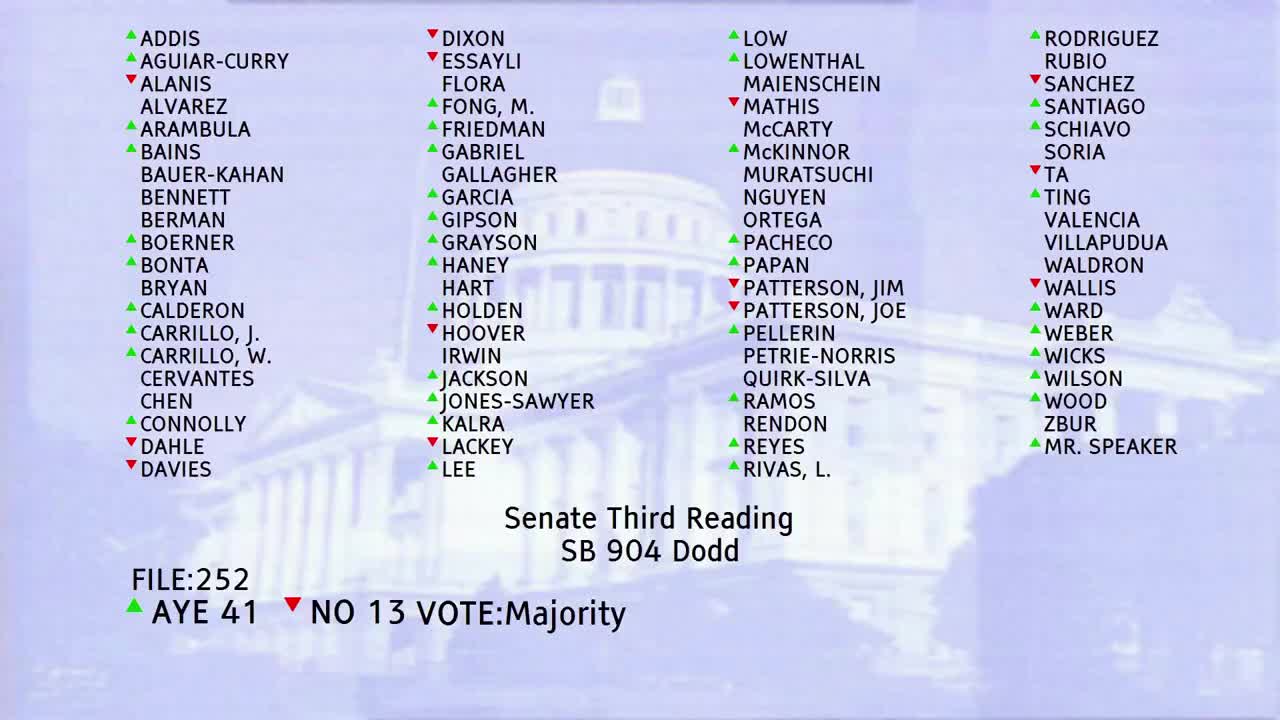 2MIN
Assembly Floor
 39SEC
Assembly Floor
 3MIN
Assembly Standing Committee on Judiciary
 5MIN
Assembly Standing Committee on Banking and Finance
 1MIN
Senate Floor
 6MIN
Senate Standing Committee on Judiciary
 10MIN
Senate Standing Committee on Banking and Financial Institutions
Bill Author

Bill Co-Author(s):