SB 931: Tribal gaming: compact ratification.
- Session Year: 2023-2024
- House: Senate
- Latest Version Date: 2024-09-20
Current Status:
Passed
(2024-09-20: Chaptered by Secretary of State. Chapter 320, Statutes of 2024.)
Introduced
In Committee
First Chamber
In Committee
Second Chamber
Enacted
Existing federal law, the Indian Gaming Regulatory Act of 1988, provides for the negotiation and execution of tribal-state gaming compacts for the purpose of authorizing certain types of gaming on Indian lands within a state. The California Constitution authorizes the Governor to negotiate and conclude those compacts, subject to ratification by the Legislature. Existing law expressly ratifies a number of tribal-state gaming compacts, and amendments to tribal-state gaming compacts, between the State of California and specified Indian tribes.
The California Environmental Quality Act (CEQA) requires a lead agency to prepare, or cause to be prepared, and certify the completion of, an environmental impact report on a project, as defined, that it proposes to carry out or approve that may have a significant effect on the environment, as defined, or to adopt a negative declaration if it finds that the project will not have that effect.
This bill would ratify the tribal-state gaming compacts entered into between the State of California and the Campo Band of Diegueno Mission Indians of the Campo Indian Reservation, California, the La Posta Band of Diegueno Mission Indians of the La Posta Indian Reservation, California, the Timbisha Shoshone Tribe, and the Elem Indian Colony of Pomo Indians of the Sulphur Bank Rancheria, California, and amendments to the tribal-state gaming compacts entered into between the State of California and the Augustine Band of Cahuilla Indians, California, the Picayune Rancheria of Chukchansi Indians of California, and the Cher-Ae Heights Indian Community of the Trinidad Rancheria, California. The bill would provide that, in deference to tribal sovereignty, certain actions related to these compacts are not projects for the purposes of CEQA.
This bill would declare that it is to take effect immediately as an urgency statute.
Existing law, the Gambling Control Act, establishes the California Gambling Control Commission, which is responsible for licensing and regulating various gambling activities and establishments. Under existing law, the commission consists of 5 members appointed by the Governor, subject to confirmation by the Senate.Existing law requires specified employees of a gambling enterprise to apply for and obtain a work permit from the commission or from a city, county, or city and county. Existing law authorizes the commission to issue an order summarily suspending a persons work permit upon a finding that the suspension is necessary for the immediate preservation of the public peace, health, safety, or general welfare, and provides for a hearing within 30 calendar days of the date of service of the suspension.This bill would instead provide for a hearing within 27 calendar days.Existing law, the Gambling Control Act, establishes the California Gambling Control Commission, which is responsible for licensing and regulating various gambling activities and establishments. Under existing law, the commission consists of 5 members appointed by the Governor, subject to confirmation by the Senate.
Existing law requires specified employees of a gambling enterprise to apply for and obtain a work permit from the commission or from a city, county, or city and county. Existing law authorizes the commission to issue an order summarily suspending a persons work permit upon a finding that the suspension is necessary for the immediate preservation of the public peace, health, safety, or general welfare, and provides for a hearing within 30 calendar days of the date of service of the suspension.
This bill would instead provide for a hearing within 27 calendar days.
(a)The following tribal-state gaming compacts and amended compacts entered into in accordance with the federal Indian Gaming Regulatory Act of 1988 (18 U.S.C. Secs. 1166 to 1168, inclusive, and 25 U.S.C. Sec. 2701 et seq.), are hereby ratified:
(1)The compact between the State of California and the Campo Band of Diegueno Mission Indians of the Campo Indian Reservation, California, executed on April 23, 2024.
(2)The compact between the State of California and the La Posta Band of Diegueno Mission Indians of the La Posta Indian Reservation, California, executed on February 27, 2024.
(3)The compact between the State of California and the Timbisha Shoshone Tribe, executed on August 7, 2024.
(4)The compact between the State of California and the Elem Indian Colony of Pomo Indians of the Sulphur Bank Rancheria, California, executed on August 7, 2024.
(5)The third amendment to the compact between the State of California and the Augustine Band of Cahuilla Indians, California, executed on August 7, 2024.
(6)The third amendment to the compact between the State of California and the Picayune Rancheria of Chukchansi Indians of California, executed on August 13, 2024.
(7)The third amendment to the compact between the State of California and the Cher-Ae Heights Indian Community of the Trinidad Rancheria, California, executed on August 13, 2024.
(b)(1)In deference to tribal sovereignty, none of the following shall be deemed a project for purposes of the California Environmental Quality Act (Division 13 (commencing with Section 21000) of the Public Resources Code):
(A)The execution of a tribal-state gaming compact ratified by this section.
(B)The execution of an amended tribal-state gaming compact ratified by this section.
(C)The execution of an intergovernmental agreement between a tribe and a county or city government negotiated pursuant to the express authority of, or as expressly referenced in, a tribal-state gaming compact or amended compact ratified by this section.
(D)The execution of an intergovernmental agreement between a tribe and the Department of Transportation, or other state agency, negotiated pursuant to the express authority of, or as expressly referenced in, a tribal-state gaming compact or amended compact ratified by this section.
(E)The on-reservation impacts of compliance with the terms of a tribal-state gaming compact or amended compact ratified by this section.
(2)Except as expressly provided in this section, this subdivision does not exempt a city, county, or city and county, or the Department of Transportation, or any state agency or local jurisdiction, from the requirements of the California Environmental Quality Act.
SEC. 2.This act is an urgency statute necessary for the immediate preservation of the public peace, health, or safety within the meaning of Article IV of the California Constitution and shall go into immediate effect. The facts constituting the necessity are:
In order to enhance the economic development, stability, and self-sufficiency of the Campo Band of Diegueno Mission Indians of the Campo Indian Reservation, California, the La Posta Band of Diegueno Mission Indians of the La Posta Indian Reservation, California, the Timbisha Shoshone Tribe, the Elem Indian Colony of Pomo Indians of the Sulphur Bank Rancheria, California, the Augustine Band of Cahuilla Indians, California, the Picayune Rancheria of Chukchansi Indians of California, and the Cher-Ae Heights Indian Community of the Trinidad Rancheria, California, and to protect the interests of those tribes and their members, the surrounding communities, and the California public at the earliest possible time, it is necessary that this act take effect immediately.
SECTION 1.Section 19913 of the Business and Professions Code is amended to read:19913.(a)The commission may issue an order summarily suspending a persons work permit, whether issued by a city, county, or city and county, or by the commission, upon a finding that the suspension is necessary for the immediate preservation of the public peace, health, safety, or general welfare. The order is effective when served upon the holder of the permit.(b)The order of summary suspension shall state facts upon which the finding of necessity for the suspension is based. For the purposes of this section, the order of summary suspension shall be deemed an accusation.(c)An order of summary suspension shall be signed by at least three members of the commission.(d)The person whose work permit is summarily suspended has a right to a hearing to commence not more than 27 calendar days from the date of service of the suspension.(a)The commission may issue an order summarily suspending a persons work permit, whether issued by a city, county, or city and county, or by the commission, upon a finding that the suspension is necessary for the immediate preservation of the public peace, health, safety, or general welfare. The order is effective when served upon the holder of the permit.
(b)The order of summary suspension shall state facts upon which the finding of necessity for the suspension is based. For the purposes of this section, the order of summary suspension shall be deemed an accusation.
(c)An order of summary suspension shall be signed by at least three members of the commission.
(d)The person whose work permit is summarily suspended has a right to a hearing to commence not more than 30 27 calendar days from the date of service of the suspension.
|
Date
|
Status
|
|---|---|
| Sep 20, 2024 | Chaptered by Secretary of State. Chapter 320, Statutes of 2024. |
| Sep 20, 2024 | Approved by the Governor. |
| Sep 4, 2024 | Enrolled and presented to the Governor at 4 p.m. |
| Aug 28, 2024 | Urgency clause adopted. |
| Aug 28, 2024 | Assembly amendments concurred in. (Ayes 39. Noes 0. Page 5612.) Ordered to engrossing and enrolling. |
| Aug 27, 2024 | Ordered to special consent calendar. |
| Aug 26, 2024 | In Senate. Concurrence in Assembly amendments pending. |
| Aug 26, 2024 | Read third time. Urgency clause adopted. Passed. (Ayes 77. Noes 0. Page 6540.) Ordered to the Senate. |
| Aug 20, 2024 | Read third time and amended. |
| Aug 20, 2024 | Ordered to third reading. |
| Aug 19, 2024 | Ordered to third reading. |
| Aug 19, 2024 | From inactive file. |
| Aug 15, 2024 | Notice of intention to remove from inactive file given by Assembly Member Ramos. |
| Jun 20, 2024 | Ordered to inactive file. |
| Jun 20, 2024 | Read second time. Ordered to consent calendar. |
| Jun 20, 2024 | From consent calendar on motion of Assembly Member Santiago. |
| Jun 19, 2024 | From committee: Do pass. Ordered to consent calendar. (Ayes 14. Noes 0.) (June 19). |
| Jun 5, 2024 | From committee: Do pass and re-refer to Com. on APPR. with recommendation: To consent calendar. (Ayes 19. Noes 0.) (June 5). Re-referred to Com. on APPR. |
| Apr 29, 2024 | Referred to Com. on G.O. |
| Apr 11, 2024 | In Assembly. Read first time. Held at Desk. |
| Apr 11, 2024 | Read third time. Passed. (Ayes 39. Noes 0. Page 3576.) Ordered to the Assembly. |
| Apr 9, 2024 | Read second time. Ordered to consent calendar. |
| Apr 8, 2024 | From committee: Be ordered to second reading pursuant to Senate Rule 28.8 and ordered to consent calendar. |
| Mar 28, 2024 | Set for hearing April 8. |
| Mar 12, 2024 | From committee: Do pass and re-refer to Com. on APPR with recommendation: To consent calendar. (Ayes 16. Noes 0. Page 3282.) (March 12). Re-referred to Com. on APPR. |
| Feb 28, 2024 | Set for hearing March 12. |
| Feb 14, 2024 | Referred to Com. on G.O. |
| Jan 17, 2024 | From printer. May be acted upon on or after February 16. |
| Jan 16, 2024 | Introduced. Read first time. To Com. on RLS. for assignment. To print. |
|
Date
|
Description
|
Location
|
Votes
|
|
|---|---|---|---|---|
| Aug 28, 2024 | Special Consent SB931 Dodd et al. Urgency Clause | Senate Floor |
Passed |
|
| Aug 26, 2024 | SB 931 Dodd Third Reading Urgency By Ramos | Assembly Floor |
Passed |
|
| Jun 19, 2024 | Do pass. To Consent Calendar. | Assembly Standing Committee on Appropriations |
Passed |
|
| Jun 5, 2024 | Do pass and be re-referred to the Committee on [Appropriations] with recommendation: To Consent Calendar | Assembly Standing Committee on Governmental Organization |
Passed |
|
| Apr 11, 2024 | Consent Calendar 2nd SB931 G.O. (Dodd) | Senate Floor |
Passed |
|
| Mar 12, 2024 | Do pass, but first be re-referred to the Committee on [Appropriations] with the recommendation: To Consent Calendar | Senate Standing Committee on Governmental Organization |
Passed |
This list shows positions taken on this bill by organizations on the date displayed, which is linked to the original source.
Positions by individuals are not included.
SENATE RULES COMMITTEE Office of Senate Floor Analyses (916) 651-1520 Fax: (916) 327-4478 | SB 931 |
UNFINISHED BUSINESS
Bill No: SB 931
Author: Dodd (D), et al.
Amended: 8/20/24
Vote: 27 - Urgency
PRIOR SENATE VOTE NOT RELEVANT
NOTE: Earlier this month, the Senate Governmental Organization Committee held informational hearings on the tribal-state gaming compact between the State of California and the Campo Band of Diegueno Mission Indians of the Campo Indian Reservation, California, the La Posta Band of Diegueno Mission Indians of the La Posta Indian Reservation, California, the Timbisha Shoshone Tribe, and the Elem Indian Colony of Pomo Indians of the Sulphur Band of Rancheria, California. Additionally, the Senate Governmental Organization Committee held an informational hearings on the amendments to the tribal-state gaming compacts entered into between the State of California and the Augustine Band of Cahuilla Indians, California, the Picayune Rancheria of Chukchansi Indians of California, and the Cher-Ae Heights Indian Community of the Trinidad Rancheria, California.
ASSEMBLY FLOOR: 77-0, 8/26/24 - See last page for vote
SUBJECT: Tribal gaming: compact ratification
SOURCE: Author
DIGEST:
This bill ratifies four separate tribal-state gaming compacts between the State of California and the Campo Band of Diegueno Mission Indians of the Campo Indian Reservation, California, the La Posta Band of Diegueno Mission Indians of the La Posta Indian Reservation, California, the Timbisha Shoshone Tribe, and the Elem Indian Colony of Pomo Indians of the Sulphur Band of Rancheria, California. Additionally, the bill ratifies three separate amendments to the tribal-state gaming compacts entered into between the State of California and the Augustine Band of Cahuilla Indians, California, the Picayune Rancheria of Chukchansi Indians of California, and the Cher-Ae Heights Indian Community of the Trinidad Rancheria, California.
Assembly Amendments
delete the contents of the bill and instead ratify four separate tribal-state gaming compacts and three separate amendments to tribal-state gaming compacts, as specified.
ANALYSIS:
Existing law:
- Provides, under the Indian Gaming Regulatory Act (IGRA), for the negotiation and conclusion of compacts between federally recognized Indian tribes and the State for the purpose of conducting Class III gaming activities on Indian lands within a State as a means of promoting tribal economic development, self-sufficiency, and strong tribal governments.
- Authorizes expressly a number of tribal-state gaming compacts between the State of California and specified Indian tribes.
- Authorizes the conduct of Class III gaming activities to the extent such activities are permitted by state law, a gaming compact has been concluded by a federally recognized tribe and the State, and the compact has been approved by the Secretary of the Interior.
- Limits the operation of Class III gaming activities to Indian lands acquired on or before October 17, 1988. Provides, for certain exceptions to conduct gaming activities on Indian lands acquired after October 17, 1988.
- Defines “Indian lands” to mean all lands within the limits of any Indian reservation, and any lands title to which is either held in trust by the United States for the benefit of any Indian tribe, or individual, or held by any Indian tribe or individual subject to restriction by the U.S. against alienation and over which an Indian tribe exercises governmental power.
- Requires the State to negotiate to conclude a compact in good faith with an Indian tribe having jurisdiction over the Indian lands upon which the Class III gaming activity is to be conducted. Provides the U.S. district courts with jurisdiction over any cause of action initiated by a tribal government alleging that the State failed to negotiate in good faith to conclude a compact. Prescribes the remedy, mediation supervised by the courts, if it is found that the State failed to negotiate in good faith to conclude a compact.
- Authorizes the Governor, under the California Constitution, to negotiate and conclude compacts, subject to ratification by the Legislature.
This bill:
- Ratifies four separate tribal-state gaming compacts between the State of California and the Campo Band of Diegueno Mission Indians of the Campo Indian Reservation, California, the La Posta Band of Diegueno Mission Indians of the La Posta Indian Reservation, California, the Timbisha Shoshone Tribe, and the Elem Indian Colony of Pomo Indians of the Sulphur Band of Rancheria, California.
- Ratifies three separate amendments to the tribal-state gaming compacts entered into between the State of California and the Augustine Band of Cahuilla Indians, California, the Picayune Rancheria of Chukchansi Indians of California, and the Cher-Ae Heights Indian Community of the Trinidad Rancheria, California.
- Provides that, in deference to tribal sovereignty, certain actions are not deemed projects for purposes of the California Environmental Quality Act (CEQA); and, stipulate, except as expressly provided, that none of the provisions shall be construed to exempt a city, county, or city and county, or the Department of Transportation from CEQA requirements.
- Contains an urgency clause.
Background
Campo Band of Diegueno Mission Indians Compact. The Compact authorizes the Tribe to operate a maximum of 1,200 slot machines at no more than two gaming facilities located on eligible Indian lands held in trust for the Tribe, and located within the boundaries of the Tribe’s reservation. The Tribe has agreed to pay the State its pro rata share of costs the State incurs for the performance of its duties under the Compact. The Compact does not require the Tribe to pay into the Revenue Sharing Trust Fund (RSTF) or the Tribal Nation Grant Fund (TNGF).
If the Tribe operates more than 349 slot machines the Compact requires the Tribe to pay 0.5% of Net Win to an Impact Mitigation Fund and distribute those funds to fire protection districts or non-tribal law enforcement, emergency services, or service agencies to mitigate demonstrated impacts on such entities resulting from the operation of the Tribe’s gaming activities or other purposes as the Tribe and fire protection districts or non-tribal law enforcement, emergency services, or service agencies agree upon.
The Campo Indian Reservation is located in southeastern San Diego County atop the Laguna Mountains. The Tribe owns and operates the Golden Acorn Casino, the Golden Grill Restaurant, the Del Oro Deli, and a travel center, all located in Campo. The casino features approximately 350 slot machines from penny slots, to high-limit machines.
La Posta Band of Diegueno Mission Indians Compact. The compact authorizes the Tribe to operate a maximum of 1,200 slot machines at no more than three gaming facilities located on eligible Indian lands held in trust for the Tribe, and located within the boundaries of the Tribe’s reservation.
The Tribe has agreed to pay the State its pro rata share of costs the State incurs for the performance of its duties under the Compact. The Compact does not require the Tribe to pay into the RSTF or the TNGF. If the Tribe operates more than 349 slot machines, the Compact requires the Tribe to pay 0.5% of Net Win to neighboring jurisdictions, public agencies, and local charitable organizations to mitigate impacts upon those entities resulting from the operation of the Gaming Facility, or other purposes as the Tribe may see fit, consistent with the request of a recipient.
The La Posta Reservation spans 3,556 acres and is located in the Laguna Mountains, 56 miles east of San Diego and 46 miles west of El Centro. From 2007 to 2012, the Tribe owned and operated the La Posta Casino, which at the time was one of the smallest of the 11 casinos in San Diego County. When the casino opened, it employed 60 people; in 2008, the San Diego Union-Tribune reported La Posta had 100 employees. A slump in business began affecting the casino as early as 2009, when it was forced to shut down late at night on occasion. The Casino permanently shut down in 2012.
Timbisha Shoshone Compact. The Compact authorizes the Tribe to operate a maximum of 1,200 slot machines at no more than three gaming facilities located on eligible Indian lands held in trust for the Tribe, and located within the boundaries of the Tribe’s reservation.
The Tribe has agreed to pay the State its pro rata share of costs the State incurs for the performance of its duties under the Compact. The Compact does not require the Tribe to pay into the RSTF or the TNGF. If the Tribe operates more than 349 slot machines, the Compact requires the Tribe to pay 0.5% of Net Win to fire protection districts and non-tribal law enforcement, emergency services, and service agencies with demonstrated impacts from the gaming facilities. Certain terms of the Compact related to licensing, regulatory, patron protection, and public health provisions are substantially the same as recent compacts.
The Timbisha are a Native American tribe federally recognized as the Death Valley Timbisha Shoshone Band of California. They are known as the Timbisha Shoshone Tribe and are located in southeast California, near Death Valley and the Nevada border. According to various news reports, the Tribe is seeking to build a casino in Inyokern. The casino is proposed to be built in two phases: a 20,000 square-foot casino and entertainment complex, including 349 slot machines, six gaming tables, restaurants, and meeting rooms for the first phase, and a hotel, convention center, and more restaurants for phase two.
Elem Indian Colony of Pomo Indians Compact. The Compact authorizes the Tribe to operate a maximum of 349 slot machines at no more than two gaming facilities located on eligible Indian lands held in trust for the Tribe, and located within the boundaries of the Tribe’s reservation. The Tribe has agreed to pay the State its pro rata share of costs the State incurs for the performance of its duties under the Compact. The Compact does not require the Tribe to pay into the Revenue Sharing Trust Fund (RSTF) or the Tribal Nation Grant Fund (TNGF).
The Tribe is currently a Non-Gaming Tribe. Under the terms of this Compact, the Tribe will remain a Limited-Gaming Tribe when operating gaming activities based on the authorized number of slot machines. Accordingly, the Tribe has no obligation under this Compact to distribute funds to mitigate impacts of gaming, if any, to local governments. The Elem Indian Colony of Pomo Indians are a federally recognized Native American Band of Pomo based on 50 acres near Clearlake Oaks, California on the Eastern shore of Clear Lake. The Elem Indian Colony reservation was originally formed under the name Sulfur Bank Rancheria. The Tribe does not currently operate a casino.
Language in all the Compacts. All of the compacts include language related to licensing, regulatory, environmental mitigation, patron protection, labor, and public health provisions that are substantially the same as recent compacts. The Compact includes a Force Majeure clause which, in the event of a force majeure event beyond the Tribe’s control that cause the Tribe’s gaming facility to be inoperable or operate at significantly less capacity, the Tribe and the State agree to meet and confer for the purposes of discussing the event and appropriate actions. Once effective, legislative ratification and federal approval required, all four compacts will be in full force and effect for 25 years following the effective date.
Compact Extensions. The State of California in 1999 and 2000 entered into over 60 tribal-state gaming compacts with tribes in California pursuant to the Indian Gaming Regulatory Act (IGRA). These compacts are collectively referred to as the 1999 Compacts. The 1999 Compacts were for an initial 20-year term, with a termination date of December 31, 2020. However, the 1999 Compacts included an automatic 18-month extension to June 30, 2022. Two years ago, the State of
California agreed to an additional 18-month compact extension with approximately 26 tribes that allowed them to operate under the terms of their 1999 Compact until December 31, 2023. Last year, the State of California agreed once again to a one-year compact extension with 22 tribes who are still operating under their original 1999 Compacts to allow them to operate under the terms of their 1999 Compacts until December 31, 2024. A majority of the tribes with 1999 Compacts now have new compacts, but there are still a handful of tribes that are still operating under the 1999 Compacts.
The 1999 Compacts allow, but do not require, the State and a tribe to amend the term of the Tribe’s 1999 Compact by mutual and written agreement. To be effective, an amendment solely to extend the term of a 1999 Compact requires ratification by the California Legislature, but it does not require approval by the Secretary pursuant to 25 Code of Federal Regulations section 293.5.
The amendment to extend the 1999 Compacts until December 31, 2025 would not preclude the State and the 1999 Compact tribes from agreeing to further extensions should both agree it is appropriate.
Indian Gaming Regulatory Act. In 1988, Congress enacted IGRA to provide a statutory basis for the operation and regulation of gaming on Indian lands. IGRA provides that an Indian tribe may conduct gaming activity on Indian lands if the activity “is not specifically prohibited by federal law and is conducted within a State which does not prohibit such gaming activity.”
IGRA distinguishes between three classes of gaming (Class I, Class II, and Class III) and provides for different forms of regulation for each class. Class I gaming includes “social games” for minor prizes or “traditional forms of Indian gaming.” Class II gaming is defined to include bingo and card games that are explicitly authorized by the laws of the state, or that are not explicitly prohibited by the laws of the state and are played at any location in the State, so long as the card games are played in conformity with those laws and regulations. Class III gaming includes such things as slot machines, casino games, and banked card games such as black jack and baccarat. Class III gaming may only be conducted under terms of a compact negotiated between an Indian tribe and a State.
IGRA was enacted against a legal background in which Indian tribes and individuals generally are exempt from state taxation within their own territory. IGRA provides that with the exception of assessments permitted under the statute, to defray the State’s costs of regulating gaming activity, IGRA shall not be interpreted as conferring upon a State authority to impose any tax, fee, charge, or other assessment upon an Indian tribe to engage in Class III activity. Nor may a State refuse to enter into negotiations based on the lack of authority to impose such a tax, fee, charge, or other assessment.
When a tribe requests negotiations for a Class III compact, IGRA requires the State to negotiate with the Indian tribe in good faith. IGRA provides a comprehensive process to prevent an impasse in compact negotiations, which is triggered when a tribe files suit alleging that the State has refused to negotiate or has failed to negotiate in good faith.
Before 2000, the California Constitution prohibited Class III gaming. In 2000, California voters approved Proposition 1A, which had been proposed by the Governor and passed by the Legislature. Proposition 1A amended the California Constitution to permit the State to negotiate compacts with federally recognized Indian tribes for certain Class III gaming activities. Because non-Indian parties were still forbidden from operating gaming facilities, Proposition 1A granted Indian tribes a “constitutionally protected monopoly on most types of Class III games in California.”
Revenue Sharing Trust Fund (RSTF). Existing law creates in the State Treasury the RSTF for the receipt and deposit of moneys derived from gaming device license fees that are paid into the RSTF pursuant to the terms of specified tribal-state gaming compacts for the purpose of making distributions to non-compacted California tribes (e.g., federally-recognized non-gaming tribes and tribes that operate casinos with fewer than 350 slot machines).
Revenue in the RSTF is available to the California Gambling Control Commission, upon appropriation by the Legislature, for making distributions of $1.1 million annually to non-compact tribes. The RSTF was created as part of the 1999 compacts, which, in conjunction with the passage of Proposition 1A, created gaming compacts with approximately 60 California tribes. Non-compact tribes are considered third-party beneficiaries of the 1999 compacts.
Tribal Nation Grant Fund. This particular fund was created to complement the RSTF and provides for the distribution of funds to non-gaming tribes, upon application of such tribes for purposes related to effective self-governance, self-determined community, and economic development. Payments from this fund are intended to be made to non-gaming tribes on a “need” basis, upon application.
FISCAL EFFECT: Appropriation: No Fiscal Com.: Yes Local: No
SUPPORT: (Verified 8/22/24)
None received
OPPOSITION: (Verified 8/22/24)
None received
ASSEMBLY FLOOR: 77-0, 8/26/24
AYES: Addis, Aguiar-Curry, Alanis, Alvarez, Arambula, Bains, Bauer-Kahan, Bennett, Berman, Boerner, Bonta, Bryan, Calderon, Juan Carrillo, Wendy Carrillo, Chen, Connolly, Megan Dahle, Davies, Dixon, Essayli, Flora, Mike Fong, Friedman, Gabriel, Gallagher, Garcia, Gipson, Grayson, Haney, Hart, Holden, Hoover, Irwin, Jackson, Jones-Sawyer, Kalra, Lackey, Lee, Low, Lowenthal, Maienschein, Mathis, McCarty, McKinnor, Muratsuchi, Stephanie Nguyen, Pacheco, Papan, Jim Patterson, Joe Patterson, Pellerin, Petrie-Norris, Quirk-Silva, Ramos, Rendon, Reyes, Luz Rivas, Rodriguez, Blanca Rubio, Sanchez, Santiago, Schiavo, Soria, Ta, Ting, Valencia, Villapudua, Waldron, Wallis, Ward, Weber, Wicks, Wilson, Wood, Zbur, Robert Rivas
NO VOTE RECORDED: Cervantes, Ortega
Click here to enter text.
Prepared by: Felipe Lopez / G.O. / (916) 651-1530
8/27/24 12:54:25
**** END ****
SENATE THIRD READING
STR Bill Id:SB 931
Author:(Dodd)
As Amended Ver:August 20, 2024
2/3 vote. Urgency
SUMMARY
- Would ratify separate tribal-state gaming compacts between the State of California and:
- The Campo Band of Diegueno Mission Indians of the Campo Indian Reservation, California, executed on April 23, 2024.
- The La Posta Band of Diegueno Mission Indians of the La Posta Indian Reservation, California, executed on February 27, 2024.
- The Timbisha Shoshone Tribe, executed on August 7, 2024.
- The Elem Indian Colony of Pomo Indians of the Sulphur Bank Rancheria, California, executed on August 7, 2024.
- Would ratify amendments to separate tribal-state gaming compacts entered into in accordance with the federal Indian Gaming Regulatory Act (IGRA) of 1998, which are for the sole purpose of extending the terms of the tribal-state gaming compacts until December 31, 2025 as follows:
- The Augustine Band of Cahuilla Indians, California, executed on August 7, 2024.
- The Picayune Rancheria of Chukchansi Indians of California, executed on August 13, 2024.
- The Cher-Ae Heights Indian Community of the Trinidad Rancheria, California, executed on August 13, 2024.
Major Provisions
- Ratifies a tribal-state gaming compacts between the State of California and the seven above-mentioned tribes.
- Provides that, in deference to tribal sovereignty, certain actions are not deemed projects for purposes of the California Environmental Quality Act (CEQA); and, stipulate, except as expressly provided, that none of the provisions shall be construed to exempt a city, county, or city and county, or the Department of Transportation, or any state agency or local jurisdiction, from CEQA requirements.
- Once effective (legislative ratification and federal approval required), the long term compacts will be in full force and effect for 25 years following the effective date.
- Declare that it is to take effect immediately as an urgency statute.
EXISTING LAW:
- Provides, under the Indian Gaming Regulatory Act (IGRA), for the negotiation and conclusion of compacts between federally recognized Indian tribes and the State for the purpose of conducting Class III gaming activities on Indian lands within a State as a means of promoting tribal economic development, self-sufficiency, and strong tribal governments.
- Authorizes expressly a number of tribal-state gaming compacts between the State of California and specified Indian tribes.
- Authorizes the conduct of Class III gaming activities to the extent such activities are permitted by state law, a gaming compact has been concluded by a federally recognized tribe and the State, and the compact has been approved by the Secretary of the Interior.
- Limits the operation of Class III gaming activities to Indian lands acquired on or before October 17, 1988. Provides exceptions to conduct gaming activities on Indian lands acquired after October 17, 1988.
- Defines Indian lands to mean all lands within the limits of any Indian reservation, and any lands title to which is either held in trust by the United States (U.S.) for the benefit of any Indian tribe, or individual, or held by any Indian tribe or individual subject to restriction by the U.S. against alienation and over which an Indian tribe exercises governmental power.
- Requires the State to negotiate to conclude a compact in good faith with an Indian tribe having jurisdiction over the Indian lands upon which the Class III gaming activity is to be conducted. Provides the U.S. district courts with jurisdiction over any cause of action initiated by a tribal government alleging that the State failed to negotiate in good faith to conclude a compact. Prescribes the remedy, mediation supervised by the courts, if it is found that the State failed to negotiate in good faith to conclude a compact.
- Authorizes the Governor, under the California Constitution, to negotiate and conclude compacts, subject to ratification by the Legislature.
COMMENTS
Background.
The Assembly Governmental Organization Committee held informational hearings on the separate signed tribal-state gaming compacts between the State of California and the specified tribes on August 14, 2024 and August 22, 2024.
Background on Separate 25-Year Compacts.
Gaming Facilities and Number of Gaming Devices Authorized. The La Posta Band of Diegueno Mission Indians of the La Posta Indian Reservation, California and the Timbisha Shoshone Tribe would be authorized to operate three gaming facilities on gaming eligible lands. The Campo Band of Diegueno Mission Indians of the Campo Indian Reservation, California and the Elem Indian Colony of Pomo Indians of the Sulphur Bank Rancheria, California would be authorized to operate two such facilities on its gaming eligible land.
The total number of gaming devices (slot machines) each Tribe is authorized to operate at their gaming facilities is as follows:
- Campo Band of Diegueno Mission Indians of the Campo Indian Reservation, California – 1,200 gaming devices.
- The La Posta Band of Diegueno Mission Indians of the La Posta Indian Reservation, California – 1,200 gaming devices.
- The Timbisha Shoshone Tribe – 1,200 gaming devices.
The Elem Indian Colony of Pomo Indians of the Sulphur Bank Rancheria, California – 349 gaming devices.
Payments to the Special Distribution Fund (SDF). The Tribes shall pay to the State, on a pro rata basis, the costs the State incurs for the performance of all its duties under this Compact, as established by the monies appropriated in the annual Budget Act for the performance of their duties under the Class III gaming compacts. This contribution is eligible to be reduced or eliminated if an individual Tribe remains a limited-gaming tribe and there are sufficient funds in the SDF.
Payments to the RSTF or the TNGF. The Tribes would not be required to make payments into either the Revenue Sharing trust Fund (RSTF) or the Tribal Nation Grant Fund (TNGF).
Distribution by Tribe to Local Governments. Each Compact of the Campo Band of Diegueno Mission Indians of the Campo Indian Reservation, California, the La Posta Band of Diegueno Mission Indians of the La Posta Indian Reservation, California, and the Timbisha Shoshone Tribe state that if the Tribe operates more than 349 gaming devices (slot machines), the Tribe shall pay 0.5% of Net Win to neighboring jurisdictions, public agencies, and local charitable organizations to mitigate impacts upon those entities resulting from the operation of the gaming facilities or other purposes as the Tribe may see fit, consistent with the request of a recipient.
Labor Provisions. The Compacts provide that the gaming activities authorized by each Compact may only commence after the Tribe has adopted an ordinance identical to the Tribal Labor Relations Ordinance (TRLO), as referenced in the Compacts, and the gaming activities may only continue as long as the Tribe maintains the ordinance. If the Tribe employs 250 or more persons in a tribal casino facility, then the provisions of the TLRO become effective. The TLRO makes it clear that employees shall have the right to self-organization, to form, to join, or assist employee organizations, to bargain collectively through representatives of their own choosing. The TLRO provides for a secret ballot election and union neutrality. After the certification that 30% of the eligible employees in a bargaining unit have expressed an interest in the union, a notice of election shall be issued and the election shall be concluded within 30 calendar days thereafter. Employees may mail in ballots provided they are received by election day. Union representation requires an affirmative vote of 50% plus one of all votes cast.
Exclusivity. Provides that in the event the exclusive right of Indian tribes to operate Class III gaming in California pursuant to the California Constitution is abrogated by the enactment, amendment, or repeal of a state statute or constitutional provision or the conclusive and dispositive judicial construction of a statute or the State Constitution by a California appellate court after the effective date of this Compact, that gaming devices may lawfully be operated by non-Indian entities, the Tribe shall have the right to terminate this Compact, as specified.
Changes in the Law. If a federal or State court decides that, as a result of a change in the law, a provision of the Compact is invalid or inoperable but also decides that the Compact remains valid and the court's judgment is not stayed pending appeal, the parties shall meet and negotiate in good faith a replacement for that Compact provision and other appropriate related amendments. The parties shall meet within thirty days after the ruling of invalidity or inoperability becomes effective.
Amendment by Agreement. The terms and conditions of each Compact may be amended at any time by the mutual and written agreement of both parties, provided that each party voluntarily consents to such negotiations in writing. Any amendments to these Compacts shall be deemed to supersede, supplant and extinguish all previous understandings and agreements on the subject.
Effective Date. Each Compact shall not be effective unless and until all of the following have occurred: the Compact is ratified by statute in accordance with state law and notice of approval or constructive approval is published in the Federal Register. Once effective, these Compacts shall be in full force and effect for 25 years following the effective date.
Background on Separate Compact Extensions. Recently, the State of California agreed to a Compact extension with 3 tribes still operating under their original 1999 Compact, allowing them to operate under the terms of the 1999 agreement until December 31, 2025.
The State of California in 1999 and 2000 entered into over 60 tribal-state gaming compacts with tribes in California pursuant to the Indian Gaming Regulatory Act (IGRA). These compacts are collectively referred to as the 1999 Compacts. The 1999 Compacts were for an initial 20-year term, with a termination date of December 31, 2020. However, the 1999 Compacts included an automatic 18-month extension to June 30, 2022. In 2022, the State of California agreed to an additional 18-month compact extensions with approximately 26 tribes that allowed them to operate under the terms of their 1999 Compact until December 31, 2023. Last year, although most of the tribes with 1999 Compacts now have new compacts, the 1999 Compacts are still in effect for about 28 tribes.
The 1999 Compacts allow, but do not require, the State and a tribe to amend the term of the tribe's 1999 Compact by mutual and written agreement. To be effective, an amendment solely to extend the term of a 1999 Compact requires ratification by the California Legislature, but it does not require approval by the Secretary of the Interior pursuant to 25 Code of Federal Regulations section 293.5.
Augustine Band of Cahuilla Indians. The Augustine Band of Cahuilla Indians is a federally recognized Cahuilla Band in Coachella, California. The Tribe currently operates the Augustine Casino which features approximately 750 slot machines. The Tribe's original compact execution date was on March 15, 2000.
Picayune Rancheria of Chukchansi Indians of California. The Picayune Rancheria is a federally recognized tribe in Madera County. The Tribe currently operates the Chukchansi Gold Resort & Casino which features 2,000 slot machines. The Tribe's original compact execution date was on September 10, 1999.
The Cher-Ae Heights Indian Community of the Trinidad Rancheria. The Cher-Ae Heights Indian Community of the Trinidad Rancheria is a federally recognized Tribe in Humboldt County. The Tribe currently operates the Cher-Ae Heights Casino which features approximately 348 slot machines. The Tribe's original compact execution date was on September 10, 1999.
Additional Background Information:
IGRA. In 1988, Congress enacted the IGRA to provide a statutory basis for the operation and regulation of gaming on Indian lands. IGRA provides that an Indian tribe may conduct gaming activity on Indian lands if the activity "is not specifically prohibited by federal law and is conducted within a State which does not prohibit such gaming activity." IGRA further provided for general regulatory oversight at the federal level and created the National Indian Gaming Commission (NIGC).
IGRA distinguishes between three classes of gaming (Class I, Class II, and Class III) and provides for different forms of regulation for each class. Class I gaming includes "social games" for minor prizes or "traditional forms of Indian gaming." Class II gaming is defined to include bingo and card games that are explicitly authorized by the laws of the state, or that are not explicitly prohibited by the laws of the state and are played at any location in the State, so long as the card games are played in conformity with those laws and regulations. All other games are Class III, except for certain social or traditional forms of gaming. Class III games include, but are not limited to the following: baccarat, blackjack, slot machines, and electronic or electromechanical facsimiles of any game of chance. Class III gaming may only be conducted under terms of a compact negotiated between an Indian tribe and a State.
IGRA was enacted against a legal background in which Indian tribes and individuals generally are exempt from state taxation within their own territory. IGRA provides that with the exception of assessments permitted under the statute, to defray the State's costs of regulating gaming activity, IGRA shall not be interpreted as conferring upon a State authority to impose any tax, fee, charge, or other assessment upon an Indian tribe to engage in Class III activity. Nor may a State refuse to enter into negotiations based on the lack of authority to impose such a tax, fee, charge, or other assessment.
When a tribe requests negotiations for a Class III compact, IGRA requires the State to negotiate with the Indian tribe in good faith. IGRA provides a comprehensive process to prevent an impasse in compact negotiations, which is triggered when a tribe files suit alleging that the State has refused to negotiate or has failed to negotiate in good faith.
Compact Ratification. The State Constitution, as amended by Proposition 1A of March 2000, permits Indian tribes to conduct and operate slot machines, lottery games, and banked and percentage card games on Indian land. These gambling activities shall only occur if:
- The Governor and an Indian tribe reach agreement on a compact;
- The Legislature approves the compact, and,
- The federal government approves the compact.
The Governor is the designated State officer responsible for negotiating and executing, on behalf of the State, Tribal-State gaming compacts with federally recognized Indian tribes located within the State of California. Following completion of negotiations, the Governor shall submit a copy of any executed Tribal-State compact to both houses of the Legislature for ratification and shall submit a copy of the executed compact to the Secretary of State. The Compact provides that it shall not be presented to the Legislature for a ratification vote until the Tribe has provided the written proof and will provide written proof to the Governor the tribal governing body has ratified it.
According to the Author
According to the Governor's office, "each of the individually-negotiated new Compacts reflect the Governor's and the Tribes' mutual commitment to a strong and respectful government-to-government relationship, and to promoting tribal economic development and self-sufficiency and strong tribal governments. Each Tribe and the State have concluded that the Compact protects the interests of the Tribe and its members, the surrounding community, and the California public, and will promote and secure long-term stability, mutual respect, and mutual benefits."
Arguments in Support
None on file.
Arguments in Opposition
None on file.
FISCAL COMMENTS
Unknown.
VOTES
SENATE FLOOR: 39-0-1
YES: Allen, Alvarado-Gil, Archuleta, Ashby, Atkins, Becker, Blakespear, Bradford, Caballero, Cortese, Dahle, Dodd, Durazo, Eggman, Glazer, Gonzalez, Grove, Hurtado, Jones, Laird, Limón, McGuire, Menjivar, Min, Newman, Nguyen, Niello, Ochoa Bogh, Portantino, Roth, Rubio, Seyarto, Skinner, Smallwood-Cuevas, Stern, Umberg, Wahab, Wiener, Wilk
ABS, ABST OR NV: Padilla
ASM GOVERNMENTAL ORGANIZATION: 19-0-3
YES: Blanca Rubio, Lackey, Bryan, Cervantes, Davies, Dixon, Gabriel, Gipson, Haney, Jones-Sawyer, McKinnor, Pacheco, Papan, Jim Patterson, Ramos, Soria, Ta, Valencia, Wallis
ABS, ABST OR NV: Addis, Bains, Low
ASM APPROPRIATIONS: 14-0-1
YES: Wicks, Sanchez, Arambula, Bryan, Calderon, Berman, Dixon, Mike Fong, Haney, Hart, Jim Patterson, Pellerin, Ta, Aguiar-Curry
ABS, ABST OR NV: Grayson
UPDATED
VERSION: August 20, 2024
CONSULTANT: Eric Johnson / G.O. / (916) 319-2531 FN: 0004562
SENATE THIRD READING
STR Bill Id:SB 931
Author:(Committee on Governmental Organization)
As Introduced Ver:January 16, 2024
Majority vote
SUMMARY
This bill requires the California Gambling Control Commission (CGCC or Commission) to begin a hearing regarding the suspension of a person's work permit within 27 calendar days, instead of 30 calendar days, of the suspension.
COMMENTS
Background.
The Gambling Control Act created a comprehensive scheme for statewide regulation of legal gambling under a bifurcated system of administration involving the Bureau within DOJ and the five-member Commission appointed by the Governor. The CGCC is authorized to establish minimum regulatory standards for the gambling industry and to ensure that the state gambling licenses are not issued to, or held by, unsuitable or unqualified individuals.
As of April 2023, the CGCC reports that there are 82 licensed card clubs in California. These gaming establishments vary in size, from businesses with just a few gaming tables to large establishments with over 350 gaming tables. Card clubs offer poker and other table games to the public. Card clubs differ from tribal casinos in the way they generate revenue and the specific types of games they can offer.
The Bureau monitors the conduct of gaming operations to ensure compliance with state gambling laws and conducts extensive background investigations of applicants seeking a state gambling license. The Bureau also conducts background checks for all key employees and state gambling licensees and vendor applications. There are over 4,400 licenses processed per year, mainly license renewals and employee transfers. The Bureau inspects premises where gambling is conducted, examines gambling equipment, audits papers, books, and records of the gambling establishment, investigates suspected violations of gambling laws, and is ultimately responsible for enforcing compliance with all state laws pertaining to gambling.
A decision of the CGCC may be reviewed by petition pursuant to Section 1085 of the Code of Civil Procedure. Existing law prohibits a court from issuing a temporary injunction or other provisional order to restrain, stay, or otherwise interfere with any action by the DOJ or the CGCC, except upon a finding by the court, based on clear and convincing evidence, that the public interest will not be prejudiced. Existing law prohibits an order from being effective for more than 15 days and a preliminary order from being effective for more than 45 days, except by stipulation of the DOJ or the CGCC.
According to the Author
[E]very year the Senate Governmental Organization committee moves a legislative vehicle through the legislative process to ensure that a vehicle is available should the need for a tribal compact vehicle emerge. Specifically, this bill simply changes from 30 to 27 days by which the [CGCC] must commence a hearing when the (CGCC) suspends a person's work permit.
Arguments in Support
None on file.
Arguments in Opposition
None on file.
FISCAL COMMENTS
According to the Assembly Appropriations Committee analysis, "minor and absorbable costs to the CGCC."
VOTES
SENATE FLOOR: 39-0-1
YES: Allen, Alvarado-Gil, Archuleta, Ashby, Atkins, Becker, Blakespear, Bradford, Caballero, Cortese, Dahle, Dodd, Durazo, Eggman, Glazer, Gonzalez, Grove, Hurtado, Jones, Laird, Limón, McGuire, Menjivar, Min, Newman, Nguyen, Niello, Ochoa Bogh, Portantino, Roth, Rubio, Seyarto, Skinner, Smallwood-Cuevas, Stern, Umberg, Wahab, Wiener, Wilk
ABS, ABST OR NV: Padilla
ASM GOVERNMENTAL ORGANIZATION: 19-0-3
YES: Blanca Rubio, Lackey, Bryan, Cervantes, Davies, Dixon, Gabriel, Gipson, Haney, Jones-Sawyer, McKinnor, Pacheco, Papan, Jim Patterson, Ramos, Soria, Ta, Valencia, Wallis
ABS, ABST OR NV: Addis, Bains, Low
ASM APPROPRIATIONS: 14-0-1
YES: Wicks, Sanchez, Arambula, Bryan, Calderon, Berman, Dixon, Mike Fong, Haney, Hart, Jim Patterson, Pellerin, Ta, Aguiar-Curry
ABS, ABST OR NV: Grayson
UPDATED
VERSION: January 16, 2024
CONSULTANT: Eric Johnson / G.O. / (916) 319-2531 FN: 0003899
Date of Hearing: June 19, 2024
ASSEMBLY COMMITTEE ON APPROPRIATIONS
Buffy Wicks, Chair
SBPCA Bill Id:SB 931
Author:(Committee on Governmental Organization) – As Introduced Ver:January 16, 2024
Policy Committee: | Governmental Organization | Vote: | 19 - 0 |
|
| ||
|
|
Urgency: No State Mandated Local Program: No Reimbursable: No
SUMMARY:
This bill requires the California Gambling Control Commission (CGCC) to begin a hearing regarding the suspension of a person’s work permit within 27 calendar days, instead of 30 calendar days, of the suspension.
FISCAL EFFECT:
Minor and absorbable costs to the CGCC.
COMMENTS:
- Purpose. According to the author’s office:
[E]very year the Senate Governmental Organization committee moves a legislative vehicle through the legislative process to ensure that a vehicle is available should the need for a tribal compact vehicle emerge. Specifically, this bill simply changes from 30 to 27 days by which the [CGCC] must commence a hearing when the [CGCC] suspends a person’s work permit.
- Related Legislation. SB 771 (Committee on Governmental Organization), Chapter 888, Statutes of 2023, ratified specified tribal-state gaming compacts. However, prior to being amended to ratify such compacts, SB 771 was similar to this bill, except SB 771 would have required the suspension hearing to commence within 28 calendar days of the suspension.
AB 2886 (Aguiar-Curry) extends the effective time, from 15 calendar days to 21 calendar days, of a temporary injunction or other provisional order to restrain, stay, or otherwise interfere with an action by the Department of Justice or the CGCC, and extends the effective time, from 45 days to 60 days, of a preliminary order. AB 2886 is pending hearing in the Senate Appropriations Committee.
Analysis Prepared by: Irene Ho / APPR. / (916) 319-2081
Date of Hearing: June 5, 2024
ASSEMBLY COMMITTEE ON GOVERNMENTAL ORGANIZATION
Blanca Rubio, Chair
SBPCA Bill Id:SB 931
Author:(Committee on Governmental Organization) – As Introduced Ver:January 16, 2024
SENATE VOTE: 39-0
SUBJECT: Gambling: work permits: suspension
SUMMARY: This bill changes, from 30 to 27 calendar days, for when the California Gambling Control Commission (GCCC or Commission) must commence a hearing for when a person’s work permit is summarily suspended. Specifically, this bill:
1) Changes, from 30 to 27 calendar days, for when the GCCC must commence a hearing when a person’s work permit is summarily suspended.
EXISTING LAW:
1) Provides, under the Act, for the licensure and regulation of various legalized gambling
activities and establishments by the Commission and the investigation and enforcement of those activities and establishments by the Bureau of Gambling Control (Bureau), under the California Department of Justice (DOJ).
2) Provides the CGCC shall have all powers necessary and proper to enable it fully and
effectually to carry out the policies and purposes of the Act, as specified.
3) Requires specified employees of a gambling enterprise to apply for and obtain a work permit from the Commission or from a city, county, or city and county.
4) Authorizes the Commission to issue an order summarily suspending a person’s work permit upon a finding that the suspension is necessary for the immediate preservation of the public peace, health, safety, or general welfare, and provides for a hearing within 30 calendar days of the date of service of the suspension.
FISCAL EFFECT: This bill is keyed fiscal by Legislative Counsel.
COMMENTS:
Background.
Gambling Regulation/Enforcement in California. The Act created a comprehensive scheme for statewide regulation of legal gambling under a bifurcated system of administration involving the Bureau within DOJ and the five-member Commission appointed by the Governor. The CGCC is authorized to establish minimum regulatory standards for the gambling industry and to ensure that the state gambling licenses are not issued to, or held by, unsuitable or unqualified individuals.
As of April 2023, the CGCC reports that there are 82 licensed card clubs in California. These gaming establishments vary in size, from businesses with just a few gaming tables to large establishments with over 350 gaming tables. Card clubs offer poker and other table games to the public. Card clubs differ from tribal casinos in the way they generate revenue and the specific types of games they can offer.
The Bureau monitors the conduct of gaming operations to ensure compliance with state gambling laws and conducts extensive background investigations of applicants seeking a state gambling license. The Bureau also conducts background checks for all key employees and state gambling licensees and vendor applications. There are over 4,400 licenses processed per year, mainly license renewals and employee transfers.
The Bureau inspects premises where gambling is conducted, examines gambling equipment, audits papers, books, and records of the gambling establishment, investigates suspected violations of gambling laws, and is ultimately responsible for enforcing compliance with all state laws pertaining to gambling.
A decision of the CGCC may be reviewed by petition pursuant to Section 1085 of the Code of Civil Procedure. Existing law prohibits a court from issuing a temporary injunction or other provisional order to restrain, stay, or otherwise interfere with any action by the DOJ or the CGCC, except upon a finding by the court, based on clear and convincing evidence, that the public interest will not be prejudiced. Existing law prohibits an order from being effective for more than 15 days and a preliminary order from being effective for more than 45 days, except by stipulation of the DOJ or the CGCC.
Purpose of the bill. According to the author’s office, “every year the Senate Governmental Organization committee moves a legislative vehicle through the legislative process to ensure that a vehicle is available should the need for a tribal compact vehicle emerge. Specifically, this bill simply changes from 30 to 27 days by which the Commission must commence a hearing when the Commission suspends a person’s work permit.”
Current law authorizes the CGCC to issue an order summarily suspending a person’s work permit upon finding that the suspension is necessary for the immediate preservation of the public peace, health, safety, or general welfare. An order is required to be signed by at least three members of the Commission.
The person whose work permit is summarily suspended has a right to a hearing to commence within 30 calendar days from the date of the suspension. This bill simply changes this specific time frame from 30 to 27 calendar days.
Related legislation. AB 2886 (Aguiar-Curry) of 2024. This bill extends the effective time of a temporary injunction or other provisional order to restrain, stay, or otherwise interfere with an action by the DOJ or CGCC. (Pending in Senate Committee on Governmental Organization)
SB 346 (Ochoa Bogh) of 2023. This bill would require the CGCC to post a public record of every vote on its Internet Web site no later than two business days after the meeting at which the vote was taken. (Pending in Assembly Committee on Governmental Organization)
Prior legislation. SB 771 (Governmental Organization) of 2023. This bill would have changed, from 30 to 28 calendar days, for when the Commission must commence a hearing when a person’s work permit is summarily suspended. (Gut and amended to an unrelated issue)
AB 1827 (Governmental Organization) of 2019. This bill would require the Commission to post a public record of each of its votes on its Internet Web site. (Died in the Senate Inactive File)
AB 2838 (Low) of 2018. This bill would have required the Bureau to review and comment on any submitted ordinance within 60 days of receiving the ordinance. (Vetoed by Governor Brown)
REGISTERED SUPPORT / OPPOSITION:
Support
None on file
Opposition
None on file
Analysis Prepared by: Eric Johnson / G.O. / (916) 319-2531
SENATE RULES COMMITTEE Office of Senate Floor Analyses (916) 651-1520 Fax: (916) 327-4478 | SB 931 |
CONSENT
Bill No: SB 931
Author: Committee on Governmental Organization
Introduced: 1/16/24
Vote: 21
SENATE GOVERNMENTAL ORG. COMMITTEE: 16-0, 3/12/24
AYES: Dodd, Wilk, Alvarado-Gil, Archuleta, Ashby, Bradford, Glazer, Jones, Nguyen, Ochoa Bogh, Padilla, Portantino, Roth, Rubio, Seyarto, Smallwood-Cuevas
SENATE APPROPRIATIONS COMMITTEE: Senate Rule 28.8
SUBJECT: Gambling: work permits: suspension
SOURCE: Author
DIGEST: This bill changes, from 30 to 27 calendar days, for when the California Gambling Control Commission (Commission) must commence a hearing for when a person’s work permit is summarily suspended.
ANALYSIS:
Existing law:
- Provides, under the Gambling Control Act (Act), for the licensure and regulation of various legalized gambling activities and establishments by the Commission and the investigation and enforcement of those activities and establishments by the Bureau of Gambling Control (Bureau), under the California Department of Justice (DOJ).
- Requires specified employees of a gambling enterprise to apply for and obtain a work permit from the Commission or from a city, county, or city and county.
- Authorizes the Commission to issue an order summarily suspending a person’s work permit upon a finding that the suspension is necessary for the immediate preservation of the public peace, health, safety, or general welfare, and provides for a hearing within 30 calendar days of the date of service of the suspension.
This bill changes, from 30 to 27 calendar days, for when the Commission must commence a hearing when a person’s work permit is summarily suspended.
Background
Author’s statement. According to the author’s office, “every year the Senate Governmental Organization committee moves a legislative vehicle through the legislative process to ensure that a vehicle is available should the need for a tribal compact vehicle emerge. Specifically, this bill simply changes from 30 to 27 days by which the Commission must commence a hearing when the Commission suspends a person’s work permit.”
Current Process. Current law authorizes the Commission to issue an order summarily suspending a person’s work permit upon finding that the suspension is necessary for the immediate preservation of the public peace, health, safety, or general welfare. An order is required to be signed by at least three members of the Commission.
The person whose work permit is summarily suspended has a right to a hearing to commence within 30 calendar days from the date of the suspension. This bill simply changes this specific time frame from 30 to 27 calendar days.
Gambling Regulation/Enforcement in California. The Act created a comprehensive scheme for statewide regulation of legal gambling under a bifurcated system of administration involving the Bureau within DOJ and the five-member Commission appointed by the Governor. The Commission is authorized to establish minimum regulatory standards for the gambling industry and to ensure that the state gambling licenses are not issued to, or held by, unsuitable or unqualified individuals.
The Bureau monitors the conduct of gaming operations to ensure compliance with state gambling laws and conducts extensive background investigations of applicants seeking a state gambling license. The Bureau also conducts background checks for all key employees and state gambling licensees and vendor applications.
The Bureau inspects premises where gambling is conducted, examines gambling equipment, audits papers, books, and records of the gambling establishment, investigates suspected violations of gambling laws, and is ultimately responsible for enforcing compliance with all state laws pertaining to gambling.
Related/Prior Legislation
SB 346 (Ochoa Bogh, 2023) requires the Commission to post a public record of every vote on its Internet Web site no later than two business days after the meeting at which the vote was taken. (Pending in the Assembly Governmental Organization Committee)
SB 771 (Governmental Organization, 2023) would have changed, from 30 to 28 calendar days, for when the Commission must commence a hearing when a person’s work permit is summarily suspended. (Gutted and amended to an unrelated issue)
FISCAL EFFECT: Appropriation: No Fiscal Com.: Yes Local: No
SUPPORT: (Verified 4/8/24)
None received
OPPOSITION: (Verified 4/8/24)
Prepared by: Brian Duke / G.O. / (916) 651-1530
4/9/24 10:37:59
**** END ****
SENATE COMMITTEE ON GOVERNMENTAL ORGANIZATION
Senator Bill Dodd
Chair
2023 - 2024 Regular
Bill No: SB Hearing Date: 3/12/2024
Author: | Committee on Governmental Organization | ||
Version: | Introduced | ||
Urgency: | Fiscal: | ||
Consultant: | |||
SUBJECT:
DIGEST: This bill changes, from 30 to 27 calendar days, for when the California Gambling Control Commission (Commission) must commence a hearing for when a person’s work permit is summarily suspended.
ANALYSIS:
Existing law:
- Provides, under the Gambling Control Act (Act), for the licensure and regulation of various legalized gambling activities and establishments by the Commission and the investigation and enforcement of those activities and establishments by the Bureau of Gambling Control (Bureau), under the California Department of Justice (DOJ).
- Requires specified employees of a gambling enterprise to apply for and obtain a work permit from the Commission or from a city, county, or city and county.
- Authorizes the Commission to issue an order summarily suspending a person’s work permit upon a finding that the suspension is necessary for the immediate preservation of the public peace, health, safety, or general welfare, and provides for a hearing within 30 calendar days of the date of service of the suspension.
This bill changes, from 30 to 27 calendar days, for when the Commission must commence a hearing when a person’s work permit is summarily suspended.
Background
Author Statement. According to the author’s office, “every year the Senate Governmental Organization committee moves a legislative vehicle through the legislative process to ensure that a vehicle is available should the need for a tribal compact vehicle emerge. Specifically, this bill simply changes from 30 to 27 days by which the Commission must commence a hearing when the Commission suspends a person’s work permit.”
Current Process. Current law authorizes the Commission to issue an order summarily suspending a person’s work permit upon finding that the suspension is necessary for the immediate preservation of the public peace, health, safety, or general welfare. An order is required to be signed by at least three members of the Commission.
The person whose work permit is summarily suspended has a right to a hearing to commence within 30 calendar days from the date of the suspension. This bill simply changes this specific time frame from 30 to 27 calendar days.
Gambling Regulation/Enforcement in California. The Act created a comprehensive scheme for statewide regulation of legal gambling under a bifurcated system of administration involving the Bureau within DOJ and the five-member Commission appointed by the Governor. The Commission is authorized to establish minimum regulatory standards for the gambling industry and to ensure that the state gambling licenses are not issued to, or held by, unsuitable or unqualified individuals.
The Bureau monitors the conduct of gaming operations to ensure compliance with state gambling laws and conducts extensive background investigations of applicants seeking a state gambling license. The Bureau also conducts background checks for all key employees and state gambling licensees and vendor applications.
The Bureau inspects premises where gambling is conducted, examines gambling equipment, audits papers, books, and records of the gambling establishment, investigates suspected violations of gambling laws, and is ultimately responsible for enforcing compliance with all state laws pertaining to gambling.
Prior/Related Legislation
SB 771 (Governmental Organization, 2023) would have changed, from 30 to 28 calendar days, for when the Commission must commence a hearing when a person’s work permit is summarily suspended. (Gutted and amended to an unrelated issue)
SB 346 (Ochoa Bogh, 2023) requires the Commission to post a public record of every vote on its Internet Web site no later than two business days after the meeting at which the vote was taken. (Pending in the Assembly Governmental Organization Committee)
SB 302 (Governmental Organization, 2021) would have required the Commission to post a public record of every vote on its Internet Web site no later than two business days after the meeting at which the vote was taken. (Gutted and amended to an unrelated issue)
SB 869 (Governmental Organization, 2020) would have required the Commission to post a public record of every vote on its Internet Web site no later than two business days after the meeting at which the vote was taken. (Gutted and amended to an unrelated issue)
SB 286 (Governmental Organization, 2019) would have required the Commission to post a public record of every vote on its Internet Web site no later than two business days after the meeting at which the vote was taken. (Gutted and amended to an unrelated issue)
AB 1827 (Governmental Organization, 2019) would require the Commission to post a public record of each of its votes on its Internet Web site. (Died in the Senate Inactive File)
AB 2838 (Low, 2018) would have required the Bureau of Gambling Control to review and comment on any submitted ordinance within 60 days of receiving the ordinance. (Vetoed by Governor Brown)
FISCAL EFFECT: Appropriation: No Fiscal Com.: Yes Local: No
SUPPORT:
None received
OPPOSITION:
None received
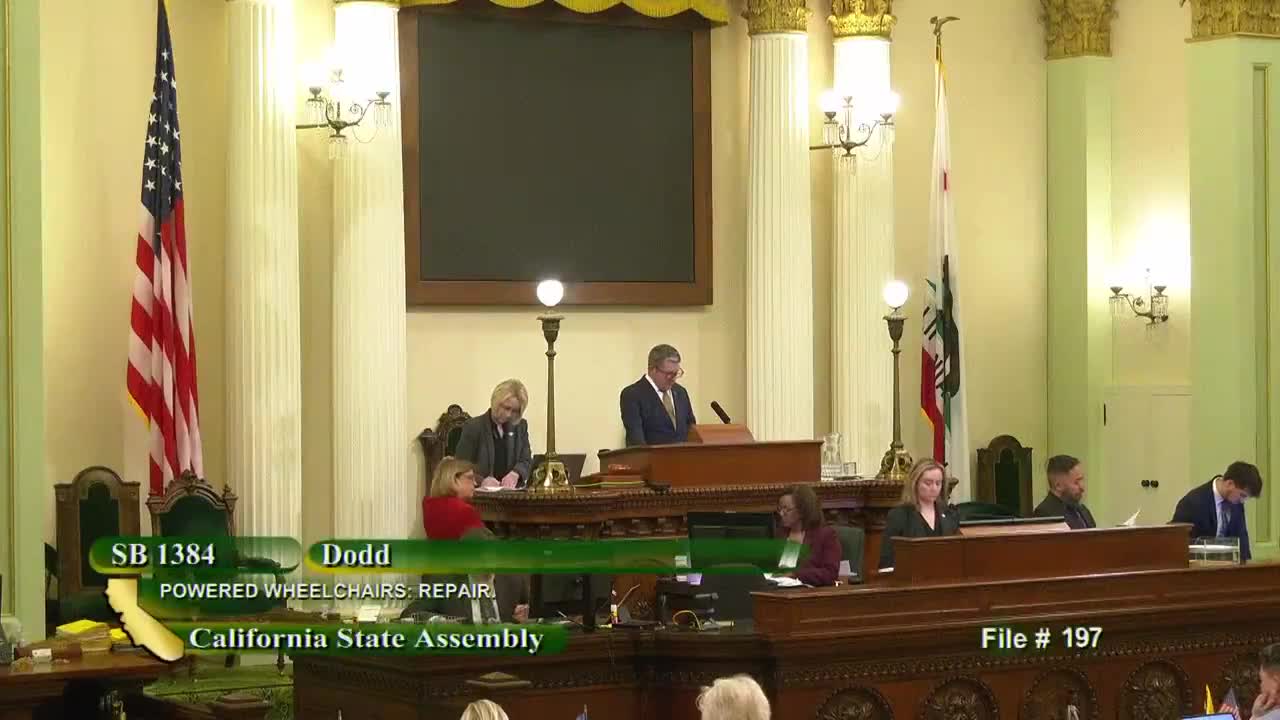
Bill Author