SCA 7: Employment: workers’ rights.
- Session Year: 2023-2024
- House: Senate
- Latest Version Date: 2023-06-26
Current Status:
Failed
(2023-06-26: Read second time and amended. Re-referred to Com. on E. & C.A.)
Introduced
In Committee
First Chamber
In Committee
Second Chamber
Enacted
What does this bill do?
This proposed constitutional amendment would give all Californians the right to join a union and to negotiate with their employers through representatives they choose, and it directs the Legislature to provide enforcement. It would also bar new state or local laws that interfere with employees’ ability to organize and bargain over pay, hours, job conditions, and workplace safety.
The summary is provided by generative AI which can make mistakes. For original language, please view the details in the table below.
Existing state law forbids a public employer from deterring or discouraging public employees from becoming or remaining members of an employee organization. Existing federal law forbids employers from interfering with, restraining, or coercing employees in the exercise of rights relating to organizing, forming, joining, or assisting a labor organization for collective bargaining purposes, or from working together to improve terms and conditions of employment, or refraining from any such activity.
This measure, the Right to Organize and Negotiate Act, would ensure that all Californians have the right to join a union and to negotiate with their employers, through their legally chosen representative, and the right to protect their economic well-being and safety at work. This measure would require the Legislature to provide for the enforcement of these rights. This measure would also prohibit, after January 1, 2023, the passing of any statute or ordinance that interferes with, negates, or diminishes the right of employees to organize and bargain collectively over their wages, hours, and other terms and conditions of employment and workplace safety.
Existing state law forbids a public employer from deterring or discouraging public employees from becoming or remaining members of an employee organization. Existing federal law forbids employers from interfering with, restraining, or coercing employees in the exercise of rights relating to organizing, forming, joining, or assisting a labor organization for collective bargaining purposes, or from working together to improve terms and conditions of employment, or refraining from any such activity.
This measure, the Right to Organize and Negotiate Act, would ensure that all Californians have the right to join a union and to negotiate with their employers, through their legally chosen representative, and the right to protect their economic well-being and safety at work. This measure would also prohibit, after January 1, 2023, the passing of any statute or ordinance that interferes with, negates, or diminishes the right of employees to organize and bargain collectively over their wages, hours, and other terms and conditions of employment and workplace safety.
WHEREAS, The Constitution of the State of California enumerates a wide range of rights granted to its residents; and
WHEREAS, Those rights include privacy, freedom from discrimination, freedom from interference with reproductive decisions, and access to a free public education; and
WHEREAS, Court decisions have taken away or limited other longstanding rights; and
WHEREAS, Employees freedom to organize and negotiate with their employers should be guaranteed by the California State Constitution; now, therefore, be it
Resolved by the Senate, the Assembly concurring, That the Legislature of the State of California at its 202324 Regular Session commencing on the fifth day of December 2022, two-thirds of the membership of each house concurring, hereby proposes to the people of the State of California, that the Constitution of the State be amended as follows:
(a)This section shall be known, and may be cited, as the Right to Organize and Negotiate Act.
(b)All Californians shall have the right to join a union and to negotiate with their employers, through their legally chosen representative, and the right to protect their economic well-being and safety at work. The Legislature shall provide for the enforcement of these rights.
(c)On or after January 1, 2023, no ordinance or statute shall be passed, enacted, or adopted that interferes with, negates, or diminishes the right of employees to organize and bargain collectively over their wages, hours, and other terms and conditions of employment and workplace safety.
WHEREAS, The Constitution of the State of California enumerates a wide range of rights granted to its residents; and
WHEREAS, Those rights include privacy, freedom from discrimination, freedom from interference with reproductive decisions, and access to a free public education; and
WHEREAS, Court decisions have taken away or limited other longstanding rights; and
WHEREAS, Employees freedom to organize and negotiate with their employers should be guaranteed by the California State Constitution; now, therefore, be it
Resolved by the Senate, the Assembly concurring, That the Legislature of the State of California at its 202324 Regular Session commencing on the fifth day of December 2022, two-thirds of the membership of each house concurring, hereby proposes to the people of the State of California, that the Constitution of the State be amended as follows:
(a)This section shall be known, and may be cited, as the Right to Organize and Negotiate Act.
(b)All Californians shall have the right to join a union and to negotiate with their employers, through their legally chosen representative, and the right to protect their economic well-being and safety at work.
(c)On or after January 1, 2023, no statute ordinance or ordinance statute shall be passed, enacted, or adopted that interferes with, negates, or diminishes the right of employees to organize and bargain collectively over their wages, hours, and other terms and conditions of employment and workplace safety.
WHEREAS, The Constitution of the State of California enumerates a wide range of rights granted to its residents; and
WHEREAS, Those rights include privacy, freedom from discrimination, freedom from interference with reproductive decisions, and access to a free public education; and
WHEREAS, Court decisions have taken away or limited other longstanding rights; and
WHEREAS, Employees freedom to organize and negotiate with their employers should be guaranteed by the California State Constitution; now, therefore, be it
Resolved by the Senate, the Assembly concurring, That the Legislature of the State of California at its 202324 Regular Session commencing on the fifth day of December 2022, two-thirds of the membership of each house concurring, hereby proposes to the people of the State of California, that the Constitution of the State be amended as follows:
(a)This section shall be known, and may be cited, as the Right to Organize and Negotiate Act.
(b)All Californians shall have the right to join a union and to negotiate with their employers, through their legally chosen representative, and the right to protect their economic well-being and safety at work.
(c)On or after January 1, 2023, no statute or ordinance shall be passed, enacted, or adopted that interferes with, negates, or diminishes the right of employees to organize and bargain collectively over their wages, hours, and other terms and conditions of employment and workplace safety.
|
Date
|
Status
|
|---|---|
| Jun 26, 2023 | Read second time and amended. Re-referred to Com. on E. & C.A. |
| Jun 22, 2023 | From committee: Be adopted as amended and re-refer to Com. on E. & C.A. (Ayes 4. Noes 1. Page 1698.) (June 22). |
| Jun 15, 2023 | Set for hearing June 22. |
| Jun 13, 2023 | June 14 set for first hearing canceled at the request of author. |
| Jun 6, 2023 | From committee with author's amendments. Read second time and amended. Re-referred to Com. on L., P.E. & R. |
| Jun 5, 2023 | Set for hearing June 14. |
| May 10, 2023 | Referred to Coms. on L., P.E. & R., E. & C.A., and APPR. |
| May 2, 2023 | From printer. May be acted upon on or after June 1. |
| May 1, 2023 | Introduced. Read first time. To Com. on RLS. for assignment. To print. |
|
Date
|
Description
|
Location
|
Votes
|
|
|---|---|---|---|---|
| Jun 22, 2023 | Favorable With Committee Substitute (PreK-12 Quality Subcommittee) | Senate Standing Committee on Labor, Public Employment and Retirement |
Passed |
This list shows positions taken on this bill by organizations on the date displayed, which is linked to the original source.
Positions by individuals are not included.
|
Organization
|
Position
|
Date
|
|---|---|---|
| Murrieta Wildomar Chamber of Commerce | ** Against | |
| Actors' Equity | ** Support | |
| Agricultural Council Of California | ** Against | |
| Anaheim Chamber Of Commerce | ** Against | |
| Associated Builders And Contractors Of California | ** Against | |
| Associated General Contractors Of California | ** Against | |
| Association of General Contractors of San Diego | ** Against | |
| Bay Area Council | ** Against | |
| BOMA California | ** Against | |
| brawley chamber of commerce | ** Against | |
| Brea Chamber of Commerce | ** Against | |
| California Association Of Health Facilities | ** Against | |
| California Association Of Winegrape Growers | ** Against | |
| California Building Industry Association | * Against | Jun 22, 2023 |
| California Business Properties Association | ** Against | |
| California Business Roundtable | ** Against | |
| California Chamber Of Commerce | ** Against | |
| California Farm Bureau | ** Against | |
| California Federation of Teachers, AFL-CIO | ** Support | |
| California Grocers Association | ** Against | |
| California Labor Federation | ** Support | |
| California League of Food Producers | ** Against | |
| California Manufacturers & Technology Association | ** Against | |
| California New Car Dealers Association | ** Against | |
| California Nurses Association | ** Support | |
| California Policy Center | ** Against | |
| California Restaurant Association | ** Against | |
| California Retailers Association | ** Against | |
| California School Employees Association | ** Support | |
| California State Association Of Electrical Workers | ** Support | |
| California State Building Trades | * Support | Jun 22, 2023 |
| California State Council Of Laborers | ** Support | |
| California State Pipe Trades Council | ** Support | |
| California-Nevada Conference Of Operating Engineers | ** Support | |
| Chino Valley Chamber of Commerce | ** Against | |
| Communication Workers of America, District 9 | ** Support | |
| Corona Chamber of Commerce | ** Against | |
| Dana Point Chamber of Commerce | ** Against | |
| Disability Rights California | ** Support | |
| Family Business Association of California | ** Against | |
| Fontana Chamber of Commerce | ** Against | |
| Greater Coachella Valley Chamber of Commerce | ** Against | |
| Greater High Desert Chamber of Commerce | ** Against | |
| Housing Contractors Of California | ** Against | |
| IBEW Local 1245 | ** Support | |
| Institute of Real Estate Management | ** Against | |
| LA Canada Flintridge Chamber of Commerce | ** Against | |
| Lake Elsinore Valley Chamber of Commerce | ** Against | |
| Long Beach Area Chamber of Commerce | ** Against | |
| Los Angeles Business Federation | ** Against | |
| Mission Viejo Chamber of Commerce | ** Against | |
| Moreno Valley Chamber of Commerce | ** Against | |
| Naiop California | ** Against | |
| National Federation Of Independent Business | ** Against | |
| Office of Lieutenant Governor Eleni Kounalakis | ** Support | |
| Orange County Business Council | ** Against | |
| Pacific Grove Chamber of Commerce | ** Against | |
| Palos Verdes Peninsula Chamber Of Commerce | ** Against | |
| Paso Robles Chamber of Commerce | ** Against | |
| Rancho Cordova Chamber of Commerce | ** Against | |
| Ridgecrest Chamber of Commerce | ** Against | |
| Santa Maria Valley Chamber of Commerce | ** Against | |
| SEIU California State Council | ** Support | |
| SEIU Local 1000 | ** Support | |
| Sheet Metal Workers' Local Union No. 104 | ** Support | |
| Southwest California Legislative Council | ** Against | |
| State Superintendent of Public Instruction Tony Thurmond | ** Support | |
| Templeton Chamber of Commerce | ** Against | |
| The California State Legislative Board of the Sheet Metal, Air, Rail and Transportation Workers – Transportation Division | ** Support | |
| Transport Workers Union of America, AFL-CIO | ** Support | |
| Tri County Chamber Alliance | ** Against | |
| UC-AFT | ** Support | |
| UDW/AFSCME Local 3930 | ** Support | |
| UFCW - Western States Council | ** Support | |
| United Auto Workers | ** Support | |
| United Nurses Associations Of California/Union Of Health Care Professionals | ** Support | |
| United Steelworkers District 12 | ** Support | |
| Walnut Creek Chamber of Commerce | ** Against | |
| Western Electrical Contractors Association | ** Against | |
| Western Growers Association | ** Against | |
| Western States Council Of Sheet Metal Workers | ** Support | |
| Yorba Linda Chamber of Commerce | ** Against |
SENATE COMMITTEE ON LABOR, PUBLIC EMPLOYMENT AND RETIREMENT
Senator Dave Cortese, Chair
2023 - 2024 Regular
Bill No: SCA 7 Hearing Date: June 22, 2023
Author: | Umberg | ||
Version: | June 6, 2023 | ||
Urgency: |
| Fiscal: | No |
Consultant: | Glenn Miles | ||
SUBJECT: Employment: workers’ rights
KEY ISSUE
Should the State Constitution do the following:
- Grant all Californians the right to join a union and to negotiate with their employers, through their legally chosen representative;
- Grant all Californians the right to protect their economic well-being and safety at work;
- Prohibit state and local government, on or after January 1, 2023, from passing, enacting, or adopting any law that interferes with, negates, or diminishes the right of employees to organize and bargain collectively over their wages, hours, and other terms and conditions of employment and workplace safety?
ANALYSIS
Existing law:
- Under the federal National Labor Relations Act (NLRA), governs collective bargaining in the private sector (Title 29, United States Code (USC), §§151 et seq.,). The NLRA generally preempts state law in the ambit of private sector collective bargaining but leaves it to the states to regulate collective bargaining in their respective public sectors. California public employees have no collective bargaining rights absent specific state statutory authority establishing those rights.
- Provides several statutory frameworks under California law to provide public employees collective bargaining rights, govern public employer-employee relations, and limit labor strife and economic disruption in the public sector through a reasonable method of resolving disputes regarding wages, hours and other terms and conditions of employment between public employers and recognized public employee organizations or their exclusive representatives. These include the Dills Act and Meyers-Milias-Brown Act (MMBA) which provides for state public employer-employee relations and local government employer-employee relations, respectively. (Government Code (GC) §§ 3512 et seq. and 3500 et seq.)
- Provides publicly employed firefighters the right to self-organization, to form, join, or assist labor organizations, to present grievances and recommendations regarding wages, salaries, hours, and working conditions to the governing body, and to discuss the same with such governing body, through such an organization, but prohibits them from having the right to strike, or to recognize a picket line of a labor organization while in the course of the performance of their official duties. (Labor Code (LC) § 1962)
- Defines a “jurisdictional strike” to mean a concerted refusal to perform work for an employer or any other concerted interference with an employer’s operation or business, arising out of a controversy between two or more labor organizations as to which of them has or should have the exclusive right to bargain collectively with an employer on behalf of his employees or any of them, or arising out of a controversy between two or more labor organizations as to which of them has or should have the exclusive right to have its members perform work for an employer. (LC § 1118)
- Declares a jurisdictional strike against public policy and unlawful. (LC § 1115)
This constitutional amendment:
- Establishes the Right to Organize and Negotiate Act.
- Declares that all Californians shall have the right to join a union and to negotiate with their employers, through their legally chosen representative, and the right to protect their economic well-being and safety at work.
- Prohibits, on or after January 1, 2023, any statute or ordinance from being passed, enacted, or adopted that interferes with, negates, or diminishes the right of employees to organize and bargain collectively over their wages, hours, and other terms and conditions of employment and workplace safety.
COMMENTS
1. Need for this bill?
According to the author,
“In the last four decades, efforts to dismantle union contracts and erode labor protections has resulted in a significant shift in the distribution of household wealth towards the more wealthy, and has furthermore resulted in a widened income gap. This has disproportionately affected our most vulnerable populations. Workers who were once in the middle class are falling behind financially, and the most marginalized workers, predominantly Black and Latino workers, immigrants, and women, are just one paycheck away from losing their homes or facing financial disaster.”
Furthermore, there has been an increase in anti-labor efforts across the country in recent years. On the national level, twenty-eight states have anti-worker, right-to-work laws. In November 2022, Tennessee became the tenth in the nation with a right-to-work provision in its constitution. In comparison, five states have a provision to protect worker collective bargaining rights in their state constitutions – New York, Hawaii, Missouri, New Jersey, and most recently, Illinois. California has many strong laws on the books that promote union activity and protect workers’ basic rights to organize and enact worker protections. But more work is needed to counteract anti-union efforts on the local, state, and federal level that threaten the progress workers have achieved that will undermine economic opportunity.”
“Therefore, SCA 7 is needed to protect the right to organize and negotiate, and affirm working Californians’ most important asset in securing their futures: a strong and robust union.”
2. Committee Comments:
This measure would establish a broad based constitutional right for any person in California to form or join a union and for that union to represent the person in collective bargaining with the person’s respective employer.
Existing federal and state law exclude many persons from collective bargaining rights depending on their position, their employer, or some other specific justification. For example, the National Labor Relations Act specifically does not include in its definition of employee “any individual employed as an agricultural laborer, or in the domestic service of any family or person at his home, or any individual employed by his parent or spouse, or any individual having the status of an independent contractor, or any individual employed as a supervisor, or any individual employed by an employer subject to the Railway Labor Act [45 U.S.C. 151 et seq.], as amended from time to time, or by any other person who is not an employer as herein defined.” (29 USC 152 (3)).
Thus, private sector supervisors generally do not have collective bargaining rights. Public sector supervisors may or may not have collective bargaining rights depending on the state statutory framework under which their eligibility for collective bargaining rights is authorized. Given the broad right extended by SCA 7, it seems those persons would now have the right to collectively bargain. Thus, previously excluded supervisors would now be able to form or join unions. Yet, since those persons are not included under the NLRA, it is unclear how disputes involving their organizing activities and bargaining agreements could be resolved. Presumably, they would be resolved through litigation in state courts and not through NLRB administrative hearings or any other state administrative hearing process. However, federal courts could also intervene if plaintiffs challenged state law on preemption principles alleging that the Congress, through the NLRA, intended for supervisors not to have collective bargaining rights.
Additionally, under state statutory schemes that provide public employees collective bargaining rights, exempt employees would now be able to form and join unions. Presumably, so too would legislative employees, who currently have no existing statutory right to collective bargaining.
It is unclear, given SCA 7’s prohibitions on state statutes or local ordinances from interfering or diminishing organizing and collective bargaining rights, whether state or local officials could develop the procedural and detailed regulatory framework necessary to administer collective bargaining through subsequent legislation. Nor is it clear whether existing statutory frameworks prior to January 1, 2023, would be affected, frozen in place, or exempt from SCA 7’s provisions.
At least two bills this legislative session seek to establish or amend collective bargaining rights for groups of employees that currently do not have or have limited bargaining rights, AB 1 (McKinnor) and AB 1672 (Haney). The former extends collective bargaining rights to legislative employees while the latter seeks to govern labor relations for independent in-home supportive services by making the state the employer of record. Typically, new legislative frameworks result in follow-up legislation to clean up or address unforeseen or unintended consequences of the new statutory scheme. It is unclear whether the Legislature would retain that ability for these or other collective bargaining related statutes after passage of SCA 7.
The measure implicates a potential revision through litigation in state and possibly federal courts of existing collective bargaining frameworks. For just one example, it is unclear whether SCA 7 provides an individual collective bargaining right or a right to participate in already formed unions. Under existing collective bargaining structures, and via settled, well-understood processes and adjudicatory frameworks, employees select an exclusive employee representative who is then charged with negotiating with the designated employer. SCA 7 may overturn that framework by providing individual rights whereby a person or groups of persons not content with the selected union demands individual or alternative recognition by a different union and a distinct right to negotiate with the employer. Thus, SCA 7 could lead to jurisdictional strikes or conflicts, which current law prohibits.
Additionally, SCA 7 could invalidate existing statute that prohibits, for example, firefighters from striking or recognizing other unions’ picket lines or prevent newly forming (and possibly existing) public agencies from including no-strike provisions in their ordinances for public safety personnel.
While sympathetic to the argument that five other states have enshrined a constitutional right to collective bargaining in their constitutions, the committee also must acknowledge that those state courts who have or will create the law surrounding those constitutional provisions do not determine California law or bind California courts. Moreover, those states’ adoptions have occurred in circumstances distinct from the development of labor law in California. In some cases, the constitutional provision preceded the statutory development of the state’s labor law and both could develop in harmony, one guided by the other. In other cases, the adoption is too novel to provide guidance to California on the potential ramifications to this state’s well-developed jurisprudence and statutory framework, particularly with respect to our public employment labor relations statutes. Indeed, the League of California Cities (LCC), in expressing concerns about SCA 7, writes the following:
“SCA 7 upsets the current balance in the system of public employee collective bargaining by enshrining special benefits into the State Constitution that would negatively impact cities throughout the state. California and federal law provide well-informed and well-understood structures for public sector union activity.”
The LCC includes in its letter, among other issues, the concerns that SCA 7 could subject many local ordinances to legal challenge, interfere with charter cities’ Home Rule provisions, allow individuals to demand unilateral decisions regarding their working conditions, and interfere with existing representation models of public employers negotiating with exclusive employee representatives.
With respect to SCA 7’s effect on private sector collective bargaining, it is difficult to know except to say that it will likely only be resolved through litigation. Should the U.S. Supreme Court limit the authority of federal agencies to implement and regulate federal labor law, it is possible that a state constitutional provision could protect private sector employees’ bargaining rights. However, that speculatively presumes that the court also weakens federal labor law presumption provisions to allow states to enter a field up to now, intentionally occupied primarily by federal law.
Additionally, although SCA 7 provides a right to collective bargaining to all Californians, the measure is silent on whether it imposes a duty to bargain on employers. In other jurisdictions, courts have split on the issue. Some hold that the purpose of the constitutional right would be frustrated if employers did not have a duty to bargain. Others hold that since the measure adding the right did not specify such a duty on employers, the right must be more about protecting employees’ ability to organize than about forcing employers to bargain. This issue would also require litigation and court resolution.
What does seem certain is that SCA 7 will result in litigation and judicial development of California labor relations law while limiting the power of the Legislature to address those subjects.
3. Author’s Amendment
The author has requested the following amendment to the measure to clarify that the Legislature has authority to provide implementing legislation.
SEC. 1.5. (a) This section shall be known, and may be cited, as the Right to Organize and Negotiate Act.
(b) All Californians shall have the right to join a union and to negotiate with their employers, through their legally chosen representative, and the right to protect their economic well-being and safety at work. The Legislature shall provide for the enforcement of these rights.
(c) On or after January 1, 2023, no statute or ordinance shall be passed, enacted, or adopted that interferes with, negates, or diminishes the right of employees to organize and bargain collectively over their wages, hours, and other terms and conditions of employment and workplace safety.
4. Proponent Arguments
According to a coalition of labor associations, including the California Labor Federation,
“SCA 7 will put on the ballot a state constitutional amendment to enshrine the right to organize and negotiate with employers in the California Constitution and invalidates new laws and ordinances that violate those rights. SCA 7 will constitutionally protect the right of workers to come to together in a workplace and negotiate with their employer over terms and conditions of employment.”
5. Opponent Arguments:
According to a coalition of business associations, including the California Chamber of Commerce, SCA 7 would create a basis to challenge virtually any state or local government infrastructure, energy, or housing project or procurement proposal; eliminate charter city home rule authority over local wages and employment terms; prohibit state and local budget actions that reduce public employment; prohibit adoption of state or local laws that reduce private sector employment; create several new classes of potential organizing (workers) currently excluded from collective bargaining; and require reexamination potentially dozens or hundreds of proposed statutes from this session that could be in conflict with SCA 7.
6. Dual Referral: The Senate Rules Committee referred this bill to the Senate Labor, Public Employment and Retirement Committee and to the Senate Elections Committee.
7. Prior/ Related Legislation:
AB 1 (McKinnor) would provide collective bargaining rights to legislative employees. The bill is currently awaiting referral in the Senate Rules Committee.
AB 1672 (Haney) would establish the In-Home Supportive Services Employer-Employee Relations Act to govern labor relations for independent providers of in-home support service and deem the state to be the employer of record of provider in each county, a specified. The bill is currently awaiting referral in the Senate Rules Committee.
SUPPORT
State Building and Construction Trades Council (Co-Sponsor)
California Labor Federation (Co-Sponsor)
Actors' Equity
California Federation of Teachers AFL-CIO
California Nurses Association
California School Employees Association
California State Association of Electrical Workers
California State Council of Laborers
California State Legislative Board of the Sheet Metal, Air, Rail and Transportation Workers - Transportation Division (SMART-TD)
California State Pipe Trades Council
California-Nevada Conference of Operating Engineers
Communication Workers of America, District 9
Disability Rights California
IBEW Local 1245
Office of Lieutenant Governor Eleni Kounalakis
SEIU California State Council
SEIU Local 1000
Sheet Metal Workers' Local Union No. 104 (SMART)
State Superintendent of Public Instruction Tony Thurmond
Transport Workers Union of America, AFL-CIO
UC-AFT
UDW/AFSCME Local 3930
UFCW - Western States Council
United Auto Workers
United Nurses Associations of California/Union of Health Care Professionals
United Steelworkers District 12
Western States Council of Sheet Metal Workers
OPPOSITION
Agricultural Council of California
Anaheim Chamber of Commerce
Associated Builders and Contractors of California
Associated General Contractors of California
Association of General Contractors of San Diego
Bay Area Council
BOMA California
Brawley Chamber of Commerce
Brea Chamber of Commerce
California Association of Health Facilities
California Association of Winegrape Growers
California Building Industry Association
California Business Properties Association
California Business Roundtable
California Chamber of Commerce
California Farm Bureau
California Grocers Association
California League of Food Producers
California Manufacturers & Technology Association
California New Car Dealers Association
California Policy Center
California Restaurant Association
California Retailers Association
Chino Valley Chamber of Commerce
Corona Chamber of Commerce
Dana Point Chamber of Commerce
Family Business Association of California
Fontana Chamber of Commerce
Greater Coachella Valley Chamber of Commerce
Greater High Desert Chamber of Commerce
Housing Contractors of California
Institute of Real Estate Management (IREM)
LA Canada Flintridge Chamber of Commerce
Lake Elsinore Valley Chamber of Commerce
Long Beach Area Chamber of Commerce
Los Angeles Business Federation
Mission Viejo Chamber of Commerce
Moreno Valley Chamber of Commerce
Murrieta Wildomar Chamber of Commerce
NAIOP California
National Federation of Independent Business
Orange County Business Council
Pacific Grove Chamber of Commerce
Palos Verdes Peninsula Chamber of Commerce
Paso Robles Chamber of Commerce
Rancho Cordova Chamber of Commerce
Ridgecrest Chamber of Commerce
Santa Maria Valley Chamber of Commerce
Southwest California Legislative Council
Templeton Chamber of Commerce
Tri County Chamber Alliance
Walnut Creek Chamber of Commerce
Western Electrical Contractors Association
Western Growers Association
Yorba Linda Chamber of Commerce
-- END --
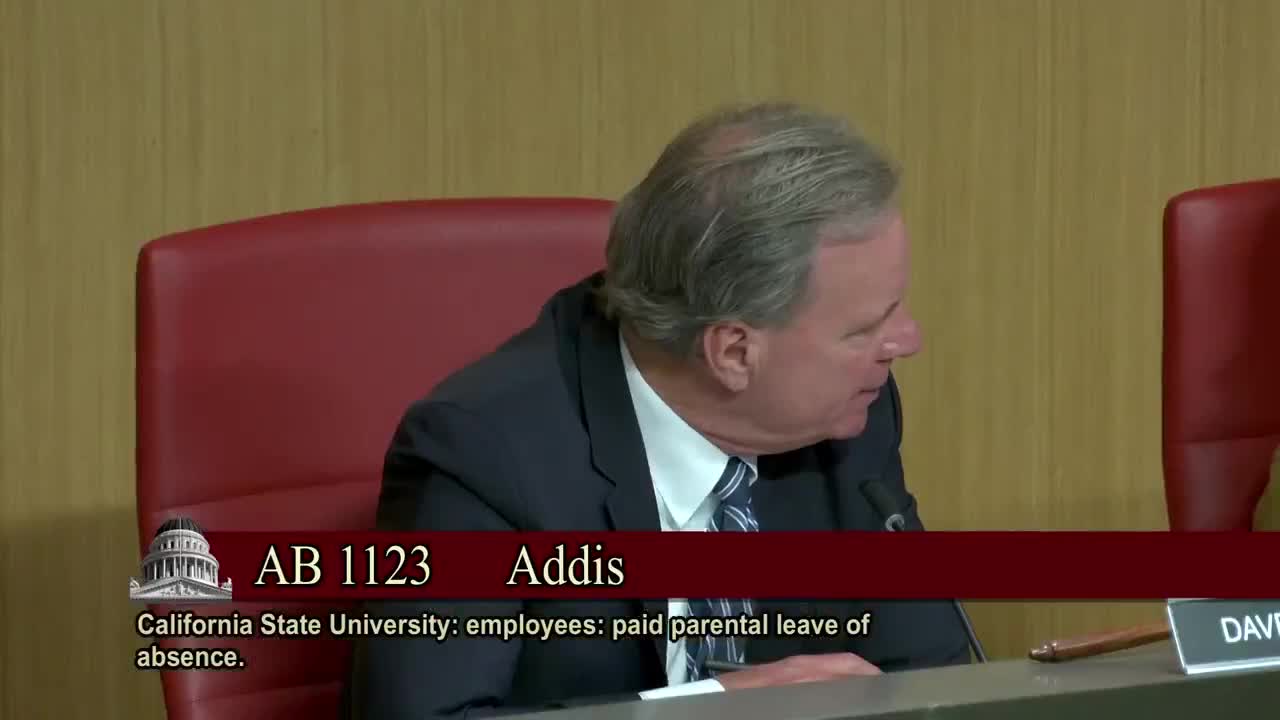
Discussed in Hearing
 23MIN
Senate Standing Committee on Labor, Public Employment and Retirement
Bill Author

Bill Co-Author(s):