AB 1004: Tribal financial information: public records: exemption.
- Session Year: 2025-2026
- House: Assembly
- Latest Version Date: 2025-09-26
Current Status:
Passed
(2025-09-26: Chaptered by Secretary of State - Chapter 132, Statutes of 2025.)
Introduced
In Committee
Awaiting First Chamber Vote
Passed First Chamber
In Committee
Awaiting Second Chamber Vote
Passed Second Chamber
Enacted
What does this bill do?
This bill makes any financial information a federally recognized Indian tribe gives to a state or local agency to get financial assistance confidential and not open to public inspection. It also requires every agency agreement or contract with a tribe for financial help to include a clause saying that the tribe’s financial information will remain confidential.
The summary is provided by generative AI which can make mistakes. For original language, please view the details in the table below.
Existing law, the California Public Records Act, requires each state and local agency, as defined, to make its records open to public inspection at all times during office hours, except as specifically exempted from disclosure by law.
This bill would make any record that contains financial information provided by an Indian tribe to a state or local agency, as a condition of or requirement for receiving financial assistance to be confidential, not a public record, and not open to public inspection. The bill would require each state or local agency agreement or contract with an Indian tribe related to financial assistance to contain a provision stating that any financial information disclosed pursuant to the agreement or contract shall remain confidential, shall not be a public record, and shall not be open to public inspection. By imposing additional duties on local agencies, this bill would impose a state-mandated local program.
The act specifically exempts from disclosure records that are exempted or prohibited from disclosure by federal or state law and lists records subject to that exemption, specifying that the listed exemptions are not inclusive of all exemptions under the act.
This bill would revise the list of exempted records to add the above-described exemption.
The bill would include findings that changes proposed by this bill address a matter of statewide concern rather than a municipal affair and, therefore, apply to all cities, including charter cities.
Existing constitutional provisions require that a statute that limits the right of access to the meetings of public bodies or the writings of public officials and agencies be adopted with findings demonstrating the interest protected by the limitation and the need for protecting that interest.
This bill would make legislative findings to that effect.
The California Constitution requires local agencies, for the purpose of ensuring public access to the meetings of public bodies and the writings of public officials and agencies, to comply with a statutory enactment that amends or enacts laws relating to public records or open meetings and contains findings demonstrating that the enactment furthers the constitutional requirements relating to this purpose.
This bill would make legislative findings to that effect.
The California Constitution requires the state to reimburse local agencies and school districts for certain costs mandated by the state. Statutory provisions establish procedures for making that reimbursement.
This bill would provide that, if the Commission on State Mandates determines that the bill contains costs mandated by the state, reimbursement for those costs shall be made pursuant to the statutory provisions noted above.
Existing law, the California Public Records Act, requires each state and local agency, as defined, to make its records open to public inspection at all times during office hours, except as specifically exempted from disclosure by law.
This bill would make all any record that contains financial information provided by an Indian tribe to the state, a city, county, city and county, municipal corporation or subdivision thereof, public district, public board, public agency, or political subdivision of the state, a state or local agency, as a condition of or requirement for receiving state financial assistance to be confidential, not a public record, and not open to public inspection. The bill would require each state or local agency agreement or contract with an Indian tribe related to state financial assistance to contain a provision stating that any financial information disclosed pursuant to the agreement or contract shall remain confidential, shall not be a public record, and shall not be open to public inspection. By imposing additional duties on local agencies, this bill would impose a state-mandated local program.
The act specifically exempts from disclosure records that are exempted or prohibited from disclosure by federal or state law and lists records subject to that exemption, specifying that the listed exemptions are not inclusive of all exemptions under the act.
This bill would revise the list of exempted records to add the above-described exemption.
The bill would include findings that changes proposed by this bill address a matter of statewide concern rather than a municipal affair and, therefore, apply to all cities, including charter cities.
Existing constitutional provisions require that a statute that limits the right of access to the meetings of public bodies or the writings of public officials and agencies be adopted with findings demonstrating the interest protected by the limitation and the need for protecting that interest.
This bill would make legislative findings to that effect.
The California Constitution requires local agencies, for the purpose of ensuring public access to the meetings of public bodies and the writings of public officials and agencies, to comply with a statutory enactment that amends or enacts laws relating to public records or open meetings and contains findings demonstrating that the enactment furthers the constitutional requirements relating to this purpose.
This bill would make legislative findings to that effect.
The California Constitution requires the state to reimburse local agencies and school districts for certain costs mandated by the state. Statutory provisions establish procedures for making that reimbursement.
This bill would provide that, if the Commission on State Mandates determines that the bill contains costs mandated by the state, reimbursement for those costs shall be made pursuant to the statutory provisions noted above.
Existing law, the California Public Records Act, requires each state and local agency, as defined, to make its records open to public inspection at all times during office hours, except as specifically exempted from disclosure by law.
This bill would make all financial information provided by an Indian tribe to the state, a city, county, city and county, municipal corporation or subdivision thereof, public district, public board, public agency, or political subdivision of the state, as a condition of or requirement for receiving state financial assistance to be confidential, not a public record, and not open to public inspection. The bill would require each agreement or contract with an Indian tribe related to state financial assistance to contain a provision stating that any financial information disclosed pursuant to the agreement or contract shall remain confidential, shall not be a public record, and shall not be open to public inspection. By imposing additional duties on local agencies, this bill would impose a state-mandated local program.
The act specifically exempts from disclosure records that are exempted or prohibited from disclosure by federal or state law and lists records subject to that exemption, specifying that the listed exemptions are not inclusive of all exemptions under the act.
This bill would revise the list of exempted records to add the above-described exemption.
Existing constitutional provisions require that a statute that limits the right of access to the meetings of public bodies or the writings of public officials and agencies be adopted with findings demonstrating the interest protected by the limitation and the need for protecting that interest.
This bill would make legislative findings to that effect.
The California Constitution requires local agencies, for the purpose of ensuring public access to the meetings of public bodies and the writings of public officials and agencies, to comply with a statutory enactment that amends or enacts laws relating to public records or open meetings and contains findings demonstrating that the enactment furthers the constitutional requirements relating to this purpose.
This bill would make legislative findings to that effect.
The California Constitution requires the state to reimburse local agencies and school districts for certain costs mandated by the state. Statutory provisions establish procedures for making that reimbursement.
This bill would provide that, if the Commission on State Mandates determines that the bill contains costs mandated by the state, reimbursement for those costs shall be made pursuant to the statutory provisions noted above.
Existing law, the District Organization Law, establishes a procedure for the organization, operation, and government of a tax or assessment district.This bill would make a nonsubstantive change to that provision.Existing law, the District Organization Law, establishes a procedure for the organization, operation, and government of a tax or assessment district.
This bill would make a nonsubstantive change to that provision.
The following provisions may operate to exempt certain records, or portions thereof, from disclosure pursuant to this division:
Taxpayer information, confidentiality, local taxes, Section 7925.000, this code.
Tax preparer, disclosure of information obtained in business of preparing tax returns, Section 17530.5, Business and Professions Code.
Teacher, credential holder or applicant, information provided to Commission on Teacher Credentialing, confidentiality of, Section 44341, Education Code.
Teacher, certified school personnel examination results, confidentiality of, Section 44289, Education Code.
Telephone answering service customer list, trade secret, Section 16606, Business and Professions Code.
Timber yield tax, disclosure to county assessor, Section 38706, Revenue and Taxation Code.
Timber yield tax, disclosure of information, Section 38705, Revenue and Taxation Code.
Title insurers, confidentiality of notice of noncompliance, Section 12414.14, Insurance Code.
Tobacco products, exemption from disclosure for distribution information provided to the State Department of Public Health, Section 22954, Business and Professions Code.
Tow truck driver, information in records of the Department of the California Highway Patrol, Department of Motor Vehicles, or other agencies, confidentiality of, Sections 2431 and 2432.3, Vehicle Code.
Toxic Substances Control, Department of, inspection of records of, Section 25152.5, Health and Safety Code.
Trade secrets, Section 1060, Evidence Code.
Trade secrets, confidentiality of, occupational safety and health inspections, Section 6322, Labor Code.
Trade secrets, disclosure of public records, Section 3426.7, Civil Code.
Trade secrets, food, drugs, cosmetics, nondisclosure, Sections 110165 and 110370, Health and Safety Code.
Trade secrets, protection by Director of Pesticide Regulation, Sections 7924.300 to 7924.335, inclusive, this code.
Trade secrets and proprietary information relating to pesticides, confidentiality of, Sections 14022 and 14023, Food and Agricultural Code.
Trade secrets, protection by Director of Industrial Relations, Section 6396, Labor Code.
Trade secrets relating to hazardous substances, disclosure of, Sections 78480 to 78495, inclusive, and Section 78930, Health and Safety Code.
Traffic violator school licensee records, confidentiality of, Section 11212, Vehicle Code.
Traffic offense, dismissed for participation in driving school or program, record of, confidentiality of, Section 1808.7, Vehicle Code.
Transit districts, questionnaire and financial statement information in bids, Section 99154, Public Utilities Code.
Tribal financial information, Section 8450, this code.
Tribal-state gaming compacts, exemption from disclosure for records of an Indian tribe relating to securitization of annual payments, Section 63048.63, this code.
Trust companies, disclosure of private trust confidential information, Section 1602, Financial Code.
SEC. 2.Chapter 5.7 (commencing with Section 8450) is added to Division 1 of Title 2 of the Government Code, to read:5.7.Tribal Financial Information8450.(a)For purposes of this section, the following definitions apply:
(1)Indian tribe means a federally recognized Indian tribe and any department, division, subdivision, agency, or arm or instrumentality thereof.
(2)Financial assistance means grants, cooperative agreements, noncash contributions or donations of property, direct appropriations, food commodities, and other financial assistance provided by a public agency.
(3)Public agency has the same meaning as the term is defined in Section 7920.525.
(b)Notwithstanding any other law, any record that contains financial information provided by an Indian tribe to a public agency, as a condition of or requirement for receiving financial assistance shall be confidential, shall not be a public record, and shall not be open to public inspection.
(c)Each public agency agreement or contract with an Indian tribe related to financial assistance shall contain a provision stating that any financial information disclosed pursuant to the agreement or contract shall remain confidential, shall not be a public record, and shall not be open to public inspection.
(d)The Legislature finds and declares that the records described in subdivision (b) are records of a sovereign nation and are not subject to disclosure by private citizens or the state.
SEC. 3.The Legislature finds and declares that Sections 1 and 2 of this act, which amend Section 7930.205 of, and add Section 8450 to, the Government Code, address a matter of statewide concern rather than a municipal affair as that term is used in Section 5 of Article XI of the California Constitution. Therefore, Sections 1 and 2 of this act apply to all cities, including charter cities.
SEC. 4.The Legislature finds and declares that Sections 1 and 2 of this act, which amend Section 7930.205 of, and add Section 8450 to, the Government Code, impose a limitation on the publics right of access to the meetings of public bodies or the writings of public officials and agencies within the meaning of Section 3 of Article I of the California Constitution. Pursuant to that constitutional provision, the Legislature makes the following findings to demonstrate the interest protected by this limitation and the need for protecting that interest:
In order to respect tribal sovereignty, while also collecting tribal financial information needed to make a decision on financial assistance, it is necessary to preserve the confidentiality of this information.
SEC. 5.The Legislature finds and declares that Sections 1 and 2 of this act, which amend Section 7930.205 of, and add Section 8450 to, the Government Code, further, within the meaning of paragraph (7) of subdivision (b) of Section 3 of Article I of the California Constitution, the purposes of that constitutional section as it relates to the right of public access to the meetings of local public bodies or the writings of local public officials and local agencies. Pursuant to paragraph (7) of subdivision (b) of Section 3 of Article I of the California Constitution, the Legislature makes the following findings:
In order to respect tribal sovereignty, while also collecting tribal financial information needed to make a decision on financial assistance, it is necessary to preserve the confidentiality of this information.
SEC. 6.If the Commission on State Mandates determines that this act contains costs mandated by the state, reimbursement to local agencies and school districts for those costs shall be made pursuant to Part 7 (commencing with Section 17500) of Division 4 of Title 2 of the Government Code.
The following provisions may operate to exempt certain records, or portions thereof, from disclosure pursuant to this division:
Taxpayer information, confidentiality, local taxes, Section 7925.000, this code.
Tax preparer, disclosure of information obtained in business of preparing tax returns, Section 17530.5, Business and Professions Code.
Teacher, credential holder or applicant, information provided to Commission on Teacher Credentialing, confidentiality of, Section 44341, Education Code.
Teacher, certified school personnel examination results, confidentiality of, Section 44289, Education Code.
Telephone answering service customer list, trade secret, Section 16606, Business and Professions Code.
Timber yield tax, disclosure to county assessor, Section 38706, Revenue and Taxation Code.
Timber yield tax, disclosure of information, Section 38705, Revenue and Taxation Code.
Title insurers, confidentiality of notice of noncompliance, Section 12414.14, Insurance Code.
Tobacco products, exemption from disclosure for distribution information provided to the State Department of Public Health, Section 22954, Business and Professions Code.
Tow truck driver, information in records of the Department of the California Highway Patrol, Department of Motor Vehicles, or other agencies, confidentiality of, Sections 2431 and 2432.3, Vehicle Code.
Toxic Substances Control, Department of, inspection of records of, Section 25152.5, Health and Safety Code.
Trade secrets, Section 1060, Evidence Code.
Trade secrets, confidentiality of, occupational safety and health inspections, Section 6322, Labor Code.
Trade secrets, disclosure of public records, Section 3426.7, Civil Code.
Trade secrets, food, drugs, cosmetics, nondisclosure, Sections 110165 and 110370, Health and Safety Code.
Trade secrets, protection by Director of Pesticide Regulation, Sections 7924.300 to 7924.335, inclusive, this code.
Trade secrets and proprietary information relating to pesticides, confidentiality of, Sections 14022 and 14023, Food and Agricultural Code.
Trade secrets, protection by Director of Industrial Relations, Section 6396, Labor Code.
Trade secrets relating to hazardous substances, disclosure of, Sections 78480 to 78495, inclusive, and Section 78930, Health and Safety Code.
Traffic violator school licensee records, confidentiality of, Section 11212, Vehicle Code.
Traffic offense, dismissed for participation in driving school or program, record of, confidentiality of, Section 1808.7, Vehicle Code.
Transit districts, questionnaire and financial statement information in bids, Section 99154, Public Utilities Code.
Tribal financial information, Section 8450, this code.
Tribal-state gaming compacts, exemption from disclosure for records of an Indian tribe relating to securitization of annual payments, Section 63048.63, this code.
Trust companies, disclosure of private trust confidential information, Section 1602, Financial Code.
SEC. 2.Chapter 5.7 (commencing with Section 8450) is added to Division 1 of Title 2 of the Government Code, to read:5.7.Tribal Financial Information8450.(a)For purposes of this section, the following definitions apply:
(1)Indian tribe means a federally recognized Indian tribe and any department, division, subdivision, agency, or arm or instrumentality thereof.
(2)Financial assistance means grants, cooperative agreements, noncash contributions or donations of property, direct appropriations, food commodities, and other financial assistance provided by a public agency.
(3)Public agency has the same meaning as the term is defined in Section 7920.525.
(b)Notwithstanding any other law, any record that contains financial information provided by an Indian tribe to a public agency, as a condition of or requirement for receiving financial assistance shall be confidential, shall not be a public record, and shall not be open to public inspection.
(c)Each public agency agreement or contract with an Indian tribe related to financial assistance shall contain a provision stating that any financial information disclosed pursuant to the agreement or contract shall remain confidential, shall not be a public record, and shall not be open to public inspection.
(d)The Legislature finds and declares that the financial and legal records of Indian tribes and tribal business enterprises records described in subdivision (b) are records of a sovereign nation and are not subject to disclosure by private citizens or the state.
SEC. 3.The Legislature finds and declares that Sections 1 and 2 of this act, which amend Section 7930.205 of, and add Section 8450 to, the Government Code, address a matter of statewide concern rather than a municipal affair as that term is used in Section 5 of Article XI of the California Constitution. Therefore, Sections 1 and 2 of this act apply to all cities, including charter cities.
SEC. 4.The Legislature finds and declares that Sections 1 and 2 of this act, which amend Section 7930.205 of, and add Section 8450 to, the Government Code, impose a limitation on the publics right of access to the meetings of public bodies or the writings of public officials and agencies within the meaning of Section 3 of Article I of the California Constitution. Pursuant to that constitutional provision, the Legislature makes the following findings to demonstrate the interest protected by this limitation and the need for protecting that interest:
In order to respect tribal sovereignty, while also collecting tribal financial information needed to make a decision on financial assistance, it is necessary to preserve the confidentiality of this information.
SEC. 5.The Legislature finds and declares that Sections 1 and 2 of this act, which amend Section 7930.205 of, and add Section 8450 to, the Government Code, further, within the meaning of paragraph (7) of subdivision (b) of Section 3 of Article I of the California Constitution, the purposes of that constitutional section as it relates to the right of public access to the meetings of local public bodies or the writings of local public officials and local agencies. Pursuant to paragraph (7) of subdivision (b) of Section 3 of Article I of the California Constitution, the Legislature makes the following findings:
In order to respect Tribal tribal sovereignty, while also collecting tribal financial information needed to make a decision on financial assistance, it is necessary to preserve the confidentiality of this information.
SEC. 6.If the Commission on State Mandates determines that this act contains costs mandated by the state, reimbursement to local agencies and school districts for those costs shall be made pursuant to Part 7 (commencing with Section 17500) of Division 4 of Title 2 of the Government Code.
The following provisions may operate to exempt certain records, or portions thereof, from disclosure pursuant to this division:
Taxpayer information, confidentiality, local taxes, Section 7925.000, this code.
Tax preparer, disclosure of information obtained in business of preparing tax returns, Section 17530.5, Business and Professions Code.
Teacher, credential holder or applicant, information provided to Commission on Teacher Credentialing, confidentiality of, Section 44341, Education Code.
Teacher, certified school personnel examination results, confidentiality of, Section 44289, Education Code.
Telephone answering service customer list, trade secret, Section 16606, Business and Professions Code.
Timber yield tax, disclosure to county assessor, Section 38706, Revenue and Taxation Code.
Timber yield tax, disclosure of information, Section 38705, Revenue and Taxation Code.
Title insurers, confidentiality of notice of noncompliance, Section 12414.14, Insurance Code.
Tobacco products, exemption from disclosure for distribution information provided to the State Department of Public Health, Section 22954, Business and Professions Code.
Tow truck driver, information in records of the Department of the California Highway Patrol, Department of Motor Vehicles, or other agencies, confidentiality of, Sections 2431 and 2432.3, Vehicle Code.
Toxic Substances Control, Department of, inspection of records of, Section 25152.5, Health and Safety Code.
Trade secrets, Section 1060, Evidence Code.
Trade secrets, confidentiality of, occupational safety and health inspections, Section 6322, Labor Code.
Trade secrets, disclosure of public records, Section 3426.7, Civil Code.
Trade secrets, food, drugs, cosmetics, nondisclosure, Sections 110165 and 110370, Health and Safety Code.
Trade secrets, protection by Director of Pesticide Regulation, Sections 7924.300 to 7924.335, inclusive, this code.
Trade secrets and proprietary information relating to pesticides, confidentiality of, Sections 14022 and 14023, Food and Agricultural Code.
Trade secrets, protection by Director of Industrial Relations, Section 6396, Labor Code.
Trade secrets relating to hazardous substances, disclosure of, Sections 78480 to 78495, inclusive, and Section 78930, Health and Safety Code.
Traffic violator school licensee records, confidentiality of, Section 11212, Vehicle Code.
Traffic offense, dismissed for participation in driving school or program, record of, confidentiality of, Section 1808.7, Vehicle Code.
Transit districts, questionnaire and financial statement information in bids, Section 99154, Public Utilities Code.
Tribal financial information, Section 8450, this code.
Tribal-state gaming compacts, exemption from disclosure for records of an Indian tribe relating to securitization of annual payments, Section 63048.63, this code.
Trust companies, disclosure of private trust confidential information, Section 1602, Financial Code.
SEC. 2.Chapter 5.7 (commencing with Section 8450) is added to Division 1 of Title 2 of the Government Code, to read:5.7.Tribal Financial Information8450.(a)For purposes of this section, the following definitions apply:
(1)Indian tribe means a federally recognized Indian tribe and any department, division, subdivision, agency, or arm or instrumentality thereof.
(2)State financial Financial assistance means grants, cooperative agreements, noncash contributions or donations of property, direct appropriations, food commodities, and other financial assistance provided by the state. a public agency.
(3)Public agency has the same meaning as the term is defined in Section 7920.525.
(b)Notwithstanding any other law, all any record that contains financial information provided by an Indian tribe to the state, city, county, city and county, municipal corporation or subdivision thereof, public district, public board, public agency, or political subdivision of the state, a public agency, as a condition of or requirement for receiving state financial assistance shall be confidential, shall not be a public record, and shall not be open to public inspection.
(c)Each public agency agreement or contract with an Indian tribe related to state financial assistance shall contain a provision stating that any financial information disclosed pursuant to the agreement or contract shall remain confidential, shall not be a public record, and shall not be open to public inspection.
(d)The Legislature finds and declares that the financial and legal records of Indian tribes and tribal business enterprises are records of a sovereign nation and are not subject to disclosure by private citizens or the state.
SEC. 3.The Legislature finds and declares that Sections 1 and 2 of this act, which amend Section 7930.205 of, and add Section 8450 to, the Government Code, address a matter of statewide concern rather than a municipal affair as that term is used in Section 5 of Article XI of the California Constitution. Therefore, Sections 1 and 2 of this act apply to all cities, including charter cities.
SEC. 3.SEC. 4.The Legislature finds and declares that Sections 1 and 2 of this act, which amend Section 7930.205 of, and add Section 8450 to, the Government Code, impose a limitation on the publics right of access to the meetings of public bodies or the writings of public officials and agencies within the meaning of Section 3 of Article I of the California Constitution. Pursuant to that constitutional provision, the Legislature makes the following findings to demonstrate the interest protected by this limitation and the need for protecting that interest:
In order to respect tribal sovereignty, while also collecting tribal financial information needed to make a decision on financial assistance, it is necessary to preserve the confidentiality of this information.
SEC. 4.SEC. 5.The Legislature finds and declares that Sections 1 and 2 of this act, which amend Section 7930.205 of, and add Section 8450 to, the Government Code, further, within the meaning of paragraph (7) of subdivision (b) of Section 3 of Article I of the California Constitution, the purposes of that constitutional section as it relates to the right of public access to the meetings of local public bodies or the writings of local public officials and local agencies. Pursuant to paragraph (7) of subdivision (b) of Section 3 of Article I of the California Constitution, the Legislature makes the following findings:
In order to respect Tribal sovereignty, while also collecting tribal financial information needed to make a decision on financial assistance, it is necessary to preserve the confidentiality of this information.
SEC. 5.SEC. 6.If the Commission on State Mandates determines that this act contains costs mandated by the state, reimbursement to local agencies and school districts for those costs shall be made pursuant to Part 7 (commencing with Section 17500) of Division 4 of Title 2 of the Government Code.
The following provisions may operate to exempt certain records, or portions thereof, from disclosure pursuant to this division:
Taxpayer information, confidentiality, local taxes, Section 7925.000, this code.
Tax preparer, disclosure of information obtained in business of preparing tax returns, Section 17530.5, Business and Professions Code.
Teacher, credential holder or applicant, information provided to Commission on Teacher Credentialing, confidentiality of, Section 44341, Education Code.
Teacher, certified school personnel examination results, confidentiality of, Section 44289, Education Code.
Telephone answering service customer list, trade secret, Section 16606, Business and Professions Code.
Timber yield tax, disclosure to county assessor, Section 38706, Revenue and Taxation Code.
Timber yield tax, disclosure of information, Section 38705, Revenue and Taxation Code.
Title insurers, confidentiality of notice of noncompliance, Section 12414.14, Insurance Code.
Tobacco products, exemption from disclosure for distribution information provided to the State Department of Public Health, Section 22954, Business and Professions Code.
Tow truck driver, information in records of the Department of the California Highway Patrol, Department of Motor Vehicles, or other agencies, confidentiality of, Sections 2431 and 2432.3, Vehicle Code.
Toxic Substances Control, Department of, inspection of records of, Section 25152.5, Health and Safety Code.
Trade secrets, Section 1060, Evidence Code.
Trade secrets, confidentiality of, occupational safety and health inspections, Section 6322, Labor Code.
Trade secrets, disclosure of public records, Section 3426.7, Civil Code.
Trade secrets, food, drugs, cosmetics, nondisclosure, Sections 110165 and 110370, Health and Safety Code.
Trade secrets, protection by Director of Pesticide Regulation, Sections 7924.300 to 7924.335, inclusive, this code.
Trade secrets and proprietary information relating to pesticides, confidentiality of, Sections 14022 and 14023, Food and Agricultural Code.
Trade secrets, protection by Director of Industrial Relations, Section 6396, Labor Code.
Trade secrets relating to hazardous substances, disclosure of, Sections 78480 to 78495, inclusive, and Section 78930, Health and Safety Code.
Traffic violator school licensee records, confidentiality of, Section 11212, Vehicle Code.
Traffic offense, dismissed for participation in driving school or program, record of, confidentiality of, Section 1808.7, Vehicle Code.
Transit districts, questionnaire and financial statement information in bids, Section 99154, Public Utilities Code.
Tribal financial information, Section 8450, this code.
Tribal-state gaming compacts, exemption from disclosure for records of an Indian tribe relating to securitization of annual payments, Section 63048.63, this code.
Trust companies, disclosure of private trust confidential information, Section 1602, Financial Code.
SEC. 2.Chapter 5.7 (commencing with Section 8450) is added to Division 1 of Title 2 of the Government Code, to read:5.7.Tribal Financial Information8450.(a)For purposes of this section, the following definitions apply:
(1)Indian tribe means a federally recognized Indian tribe and any department, division, subdivision, agency, or arm or instrumentality thereof.
(2)State financial assistance means grants, cooperative agreements, noncash contributions or donations of property, direct appropriations, food commodities, and other financial assistance provided by the state.
(b)Notwithstanding any other law, all financial information provided by an Indian tribe to the state, city, county, city and county, municipal corporation or subdivision thereof, public district, public board, public agency, or political subdivision of the state, as a condition of or requirement for receiving state financial assistance shall be confidential, shall not be a public record, and shall not be open to public inspection.
(c)Each agreement or contract with an Indian tribe related to state financial assistance shall contain a provision stating that any financial information disclosed pursuant to the agreement or contract shall remain confidential, shall not be a public record, and shall not be open to public inspection.
SEC. 3.The Legislature finds and declares that Sections 1 and 2 of this act, which amend Section 7930.205 of, and add Section 8450 to, the Government Code, impose a limitation on the publics right of access to the meetings of public bodies or the writings of public officials and agencies within the meaning of Section 3 of Article I of the California Constitution. Pursuant to that constitutional provision, the Legislature makes the following findings to demonstrate the interest protected by this limitation and the need for protecting that interest:
In order to respect tribal sovereignty, while also collecting tribal financial information needed to make a decision on financial assistance, it is necessary to preserve the confidentiality of this information.
SEC. 4.The Legislature finds and declares that Sections 1 and 2 of this act, which amend Section 7930.205 of, and add Section 8450 to, the Government Code, further, within the meaning of paragraph (7) of subdivision (b) of Section 3 of Article I of the California Constitution, the purposes of that constitutional section as it relates to the right of public access to the meetings of local public bodies or the writings of local public officials and local agencies. Pursuant to paragraph (7) of subdivision (b) of Section 3 of Article I of the California Constitution, the Legislature makes the following findings:
In order to respect Tribal sovereignty, while also collecting tribal financial information needed to make a decision on financial assistance, it is necessary to preserve the confidentiality of this information.
SEC. 5.If the Commission on State Mandates determines that this act contains costs mandated by the state, reimbursement to local agencies and school districts for those costs shall be made pursuant to Part 7 (commencing with Section 17500) of Division 4 of Title 2 of the Government Code.
SECTION 1.Section 58001 of the Government Code is amended to read:58001.It is the purpose of this chapter to make available a procedure for the organization, operation, and government of districts.It is the purpose of this chapter to make available a procedure for the organization, operation operation, and government of districts.
|
Date
|
Status
|
|---|---|
| Sep 26, 2025 | Chaptered by Secretary of State - Chapter 132, Statutes of 2025. |
| Sep 26, 2025 | Approved by the Governor. |
| Sep 15, 2025 | Enrolled and presented to the Governor at 4:30 p.m. |
| Sep 4, 2025 | Senate amendments concurred in. To Engrossing and Enrolling. (Ayes 77. Noes 0. Page 2934.). |
| Sep 4, 2025 | In Assembly. Concurrence in Senate amendments pending. |
| Sep 3, 2025 | Read third time. Passed. Ordered to the Assembly. (Ayes 40. Noes 0. Page 2435.). |
| Aug 20, 2025 | Read second time. Ordered to third reading. |
| Aug 19, 2025 | Read third time and amended. Ordered to second reading. |
| Jul 1, 2025 | Read second time. Ordered to third reading. |
| Jun 30, 2025 | From committee: Be ordered to second reading pursuant to Senate Rule 28.8. |
| Jun 17, 2025 | From committee: Do pass and re-refer to Com. on APPR. (Ayes 12. Noes 0.) (June 17). Re-referred to Com. on APPR. |
| May 14, 2025 | Referred to Com. on JUD. |
| May 1, 2025 | In Senate. Read first time. To Com. on RLS. for assignment. |
| May 1, 2025 | Read third time. Passed. Ordered to the Senate. (Ayes 76. Noes 0. Page 1387.) |
| Apr 24, 2025 | Read second time. Ordered to Consent Calendar. |
| Apr 23, 2025 | From committee: Do pass. To Consent Calendar. (Ayes 15. Noes 0.) (April 23). |
| Apr 10, 2025 | Re-referred to Com. on APPR. |
| Apr 9, 2025 | Read second time and amended. |
| Apr 8, 2025 | From committee: Amend, and do pass as amended and re-refer to Com. on APPR. with recommendation: To Consent Calendar. (Ayes 12. Noes 0.) (April 8). |
| Apr 1, 2025 | Re-referred to Com. on JUD. |
| Mar 28, 2025 | Referred to Com. on JUD. |
| Mar 28, 2025 | From committee chair, with author's amendments: Amend, and re-refer to Com. on JUD. Read second time and amended. |
| Feb 21, 2025 | From printer. May be heard in committee March 23. |
| Feb 20, 2025 | Read first time. To print. |
|
Date
|
Description
|
Location
|
Votes
|
|
|---|---|---|---|---|
| Sep 4, 2025 | AB 1004 Wallis Concurrence in Senate Amendments | Assembly Floor |
Passed |
|
| Sep 3, 2025 | Assembly 3rd Reading AB1004 Wallis By Allen | Senate Floor |
Passed |
|
| Jun 17, 2025 | Do pass, but first be re-referred to the Committee on [Appropriations] | Senate Standing Committee on Judiciary |
Passed |
|
| May 1, 2025 | AB 1004 Wallis Consent Calendar Second Day Regular Session | Assembly Floor |
Passed |
|
| Apr 23, 2025 | Do pass. To Consent Calendar. | Assembly Standing Committee on Appropriations |
Passed |
|
| Apr 8, 2025 | Do pass as amended, and be re-referred to the Committee on [Appropriations] with recommendation: To Consent Calendar | Assembly Standing Committee on Judiciary |
Passed |
This list shows positions taken on this bill by organizations on the date displayed, which is linked to the original source.
Positions by individuals are not included.
|
Organization
|
Position
|
Date
|
|---|---|---|
| Agua Caliente Band Of Cahuilla Indians | ** Support | |
| California Nations Indian Gaming Association | ** Support | |
| Morongo Band Of Mission Indians | ** Support | |
| Soboba Band Of Luiseno Indians | ** Support |
CONCURRENCE IN SENATE AMENDMENTS
CSA1 Bill Id:AB 1004
Author:(Wallis)
As Amended Ver:August 19, 2025
Majority vote
SUMMARY
Exempts records containing financial information provided by an Indian tribe to a public agency, as a condition of or requirement for receiving financial assistance, from inspection and disclosure under the California Public Records Act.
Senate Amendments
Clarify the intent of the Legislature that any record that contains financial information provided by an Indian tribe to a public agency are records of a sovereign nation are not subject to disclosure by private citizens or the state.
COMMENTS
This bill, sponsored by the Soboba Band of Luiseño Indians, seeks to enact an exemption to the rule of the California Public Records Act (CPRA) that all public records are open to the public and required to be disclosed to the public upon request. Under the bill any record that contains financial information provided by an Indian tribe to a public agency, as a condition of or requirement for receiving financial assistance, would be confidential, not a public record, and not open to public inspection. As explained below, this bill would constitute more of a clarification, than a change, to existing law.
Background about the California Public Records Act (CPRA) and an existing exemption for financial records of Indian Tribes. Access to information concerning the conduct of the people′s business is a fundamental and necessary right of every person in this state. (Government Code Section 7921.000. All further statutory references are to this code, unless otherwise indicated.) The CPRA makes all documents and ″writings″ of a public agency open to public inspection upon request, unless the records are otherwise exempt from public disclosure. Writings may be exempt under the CPRA itself, or pursuant to another law that is incorporated by reference into the CPRA, or when, based on the facts of the particular case, the public interest served by not disclosing the record clearly outweighs the public interest served by disclosure of the record. (Sections 7922.000 7922.525, 7922.530.)
Existing law makes financial information provided by Indian tribes to the state for purposes of negotiating tribal-state gaming compacts confidential and exempt from disclosure in response to a CPRA request. Section 63048.63 (a)(1) provides as follows:
The financial and legal records of California Indian tribes and tribal business enterprises are records of a sovereign nation and are not subject to disclosure by private citizens or the state. This is explicitly recognized in amendments to tribal-state gaming compacts ratified by the Legislature, which provide for the securitization of annual payments to be received from the tribes by the state or by an agency, trust, fund, or entity specified by the state.
If financial and legal records of the Indian tribes are confidential and exempt from disclosure when submitted to the state pursuant to tribal gaming compacts, the information should be confidential and exempt from disclosure when submitted to the state – or another public agency – for any purpose. It is possible that a public agency that received a CPRA request for financial or legal records of an Indian tribe would deny the request on the basis of Section 63048.63. But it is also possible that they would not.
The bill merely clarifies state law by explicitly providing that all financial information provided by an Indian Tribe to a public agency as a condition of receiving financial assistance from the agency, is confidential, not a public record, and not open to public inspection. This clarification respects tribal sovereignty and preserves the confidentiality of tribal financial information.
According to the Author
As sovereign nations, California Indian Tribes′ financial information is private and disclosure of that information is subject to the laws of the tribal nation. California Indian Tribes are eligible for various grant and loan programs and other types of financial assistance. As part of evaluating whether the tribes meets the public agency′s requirements for participation in a particular program, the agency may need to review specific financial information of the Tribe. Sharing financial information with the agency for this purpose could lead to its disclosure through a Public Records Act request. AB 1004 would make all financial information provided by an Indian Tribe to the state or any local jurisdiction as a condition of receiving financial assistance, confidential, not a public record, and not open to public inspection. This change respects tribal sovereignty by preserving the confidentiality of the information.
Arguments in Support
Soboba Band of Luiseño Indians (Soboba), sponsor of the bill, writes the following to explain why the bill is necessary and appropriate:
Soboba, like many other California Indian Tribes, is a sovereign nation that maintains its own legal framework governing the disclosure and protection of financial records. However, in order to participate in needed state programs – such as grants, loans, and other financial assistance – Tribes are often required to disclose detailed financial data. Without explicit statutory safeguards, there is a risk that these sensitive records could become subject to disclosure through the Public Records Act, thereby undermining both our sovereignty and the confidentiality that is essential to Tribal self-governance.
While limited confidentiality protections exist for certain circumstances (for example, regarding gaming compacts), there remains a significant gap in the law for non-gaming financial information. AB 1004 closes this gap by ensuring that all financial information provided to the state, or its local subdivisions, for the purpose of receiving state financial assistance is protected from unauthorized disclosure.
Arguments in Opposition
None on file
FISCAL COMMENTS
According to the Senate Appropriations Committee, pursuant to Senate Rule 28.8, negligible state costs.
VOTES:
ASM JUDICIARY: 12-0-0
YES: Kalra, Dixon, Wicks, Bryan, Connolly, Harabedian, Pacheco, Papan, Sanchez, Stefani, Zbur, Tangipa
ASM APPROPRIATIONS: 15-0-0
YES: Wicks, Sanchez, Arambula, Calderon, Caloza, Dixon, Elhawary, Fong, Mark González, Hart, Pacheco, Pellerin, Solache, Ta, Tangipa
ASSEMBLY FLOOR: 76-0-3
YES: Addis, Aguiar-Curry, Ahrens, Alanis, Alvarez, Arambula, Ávila Farías, Bains, Bauer-Kahan, Bennett, Berman, Boerner, Bonta, Bryan, Calderon, Caloza, Carrillo, Castillo, Connolly, Davies, DeMaio, Dixon, Elhawary, Ellis, Flora, Fong, Gabriel, Gallagher, Garcia, Gipson, Jeff Gonzalez, Mark González, Hadwick, Haney, Harabedian, Hart, Hoover, Irwin, Jackson, Kalra, Krell, Lackey, Lee, Lowenthal, Macedo, Muratsuchi, Nguyen, Ortega, Pacheco, Patel, Patterson, Pellerin, Petrie-Norris, Quirk-Silva, Ramos, Ransom, Celeste Rodriguez, Michelle Rodriguez, Rogers, Blanca Rubio, Sanchez, Schiavo, Schultz, Sharp-Collins, Solache, Soria, Stefani, Ta, Tangipa, Valencia, Wallis, Ward, Wicks, Wilson, Zbur, Rivas
ABS, ABST OR NV: Chen, McKinnor, Papan
SENATE FLOOR: 40-0-0
YES: Allen, Alvarado-Gil, Archuleta, Arreguín, Ashby, Becker, Blakespear, Cabaldon, Caballero, Cervantes, Choi, Cortese, Dahle, Durazo, Gonzalez, Grayson, Grove, Hurtado, Jones, Laird, Limón, McGuire, McNerney, Menjivar, Niello, Ochoa Bogh, Padilla, Pérez, Reyes, Richardson, Rubio, Seyarto, Smallwood-Cuevas, Stern, Strickland, Umberg, Valladares, Wahab, Weber Pierson, Wiener
UPDATED
VERSION: August 19, 2025
CONSULTANT: Alison Merrilees / JUD. / (916) 319-2334 FN: 0001250
SENATE RULES COMMITTEE Office of Senate Floor Analyses (916) 651-1520 Fax: (916) 327-4478 | AB 1004 |
THIRD READING
Bill No: AB 1004
Author: Wallis (R)
Amended: 8/19/25 in Senate
Vote: 21
SENATE JUDICIARY COMMITTEE: 12-0, 6/17/25
AYES: Umberg, Niello, Allen, Arreguín, Caballero, Durazo, Laird, Stern, Valladares, Wahab, Weber Pierson, Wiener
NO VOTE RECORDED: Ashby
SENATE APPROPRIATIONS COMMITTEE: Senate Rule 28.8
ASSEMBLY FLOOR: 76-0, 5/1/25 (Consent) - See last page for vote
SUBJECT: Tribal financial information: public records: exemption
SOURCE: Soboba Band of Luiseño Indians
DIGEST:
This bill provides that any record that contains financial information provided by an Indian tribe to a state or local agency as a condition of or requirement for receiving financial assistance to be confidential, not a public record, and not open to public inspection and makes conforming changes.
Senate floor amendments of 8/19/25 make technical and clarifying changes.
ANALYSIS:
Existing law:
- Provides, pursuant to the California Constitution, that the people have the right of access to information concerning the conduct of the people’s business, and, therefore, the meetings of public bodies and the writings of public officials and agencies are required to be open to public scrutiny. (California Constitution (Cal. Const.), art. I, § 3(b)(1).)
- Requires a statute to be broadly construed if it furthers the people’s right of access, and narrowly construed if it limits the right of access. (Cal. const. art. I, § 3(b)(1).)
- Requires a statute that limits the public’s right of access to be adopted with findings demonstrating the interest protected by the limitation and the need for protecting that interest. (Cal. const. art. I, § 3(b)(1).)
- Governs the disclosure of information collected and maintained by public agencies pursuant to the California Public Records Act (CPRA). (Government (Gov.) Code §§ 792.000 et seq.)
- States that the Legislature, mindful of the right of individuals to privacy, finds and declares that access to information concerning the conduct of the people’s business is a fundamental and necessary right of every person in this state. (Gov. Code § 7921.000.)
- Defines “public records” as any writing containing information relating to the conduct of the public’s business prepared, owned, used, or retained by any state or local agency regardless of physical form or characteristics. (Gov. Code § 7920.530.)
- Defines “public agency” as any state or local agency. (Gov. Code § 7920.525(a).)
- Provides that all public records are accessible to the public upon request, unless the record requested is exempt from public disclosure. (Gov. Code § 7922.525.)
- Some records are prohibited from being disclosed and other records are permissively exempted from being disclosed. (See e.g. Gov. Code §§ 7920.505 & 7922.200.)
- There are several general categories of documents or information that are permissively exempt from disclosure under the CPRA essentially due to the character of the information. The exempt information can be withheld by the public agency with custody of the information, but it also may be disclosed if it is shown that the public’s interest in disclosure outweighs the public’s interest in non-disclosure of the information. (CBS, Inc. v. Block (1986) 42 Cal.3d 646, at 652.)[1]
- Provides, in relation to tribal-state gaming compacts, that the financial and legal records of California Indian tribes and tribal business enterprises are records of a sovereign nation and are not subject to disclosure by private citizens or the state. This is explicitly recognized in amendments to tribal-state gaming compacts ratified by the Legislature, which provide for the securitization of annual payments to be received from the Indian tribes by the state or by an agency, trust, fund, or entity specified by the state. (Gov. Code § 63048.63(a)(1).)
- Specifies that neither the CPRA or any other provision of law permits the disclosure of any records of an Indian tribe received by the state, or by an agency, trust fund, or entity specified by the state, in connection with the sale of any portions of the designated tribal-state gaming compact assets or the issuance of bonds, or any summaries or analyses thereof. (Id. at subd. (b).)
This bill:
- Provides that, notwithstanding any other law, any record that contains financial information provided by an Indian tribe to a public agency, as a condition of or requirement for receiving financial assistance, is confidential, is not a public record, and is not open to public inspection and makes conforming changes.
- Requires each public agency agreement or contract with an Indian tribe related to financial assistance to contain a provision stating that any financial information disclosed pursuant to the agreement or contract shall remain confidential, shall not be a public record, and shall not be open to public inspection.
- Provides that the Legislature finds and declares that the financial and legal records of Indian tribes and tribal business enterprises are records of a sovereign nation and are not subject to disclosure by private citizens or the state.
- Defines the following terms for these purposes:
- “Indian tribe” means a federally recognized Indian tribe and any department, division, subdivision, agency, or arm or instrumentality thereof.
- “Financial assistance” means grants, cooperative agreements, noncash contributions or donations of property, direct appropriations, food commodities, and other financial assistance provided by a public agency.
- “Public agency” has the same meaning as the term is defined in Section 7920.525 of the Government Code.
Comments
The CPRA makes all public records of a public agency open to public inspection upon request and grants the public the right to obtain a copy of any public record, unless the records are otherwise exempt from public disclosure. Existing law provides that that the financial and legal records of California Indian tribes and tribal business enterprises provided in relation to tribal-state gaming compacts are records of a sovereign nation and are not subject to disclosure by private citizens or the state. This bill seeks to provide that any record containing financial information of an Indian tribe provided to a public agency as a condition of or requirement for receiving financial assistance is confidential and not a public record.
Under the CPRA, public records are open to inspection by the public at all times during the office hours of the agency, unless they are exempt from disclosure. (Gov. Code § 7922.525.) A public record is defined as any writing containing information relating to the conduct of the public’s business that is prepared, owned, used, or retained by any public agency regardless of physical form or characteristics. (Gov. Code § 7920.530.) There are several general categories of documents or information that are permissively exempt from disclosure under the CPRA essentially due to the character of the information. The exempt information can be withheld by the public agency with custody of the information, but it also may be disclosed if it is shown that the public’s interest in disclosure outweighs the public’s interest in non-disclosure of the information. (CBS (1986) 42 Cal.3d 646, at 652.). Additionally, some records are prohibited from disclosure or are specifically stated to not be public records. (see Gov. Code § 7924.110(a).)
California generally recognizes that public access to information concerning the conduct of the people’s business is a fundamental and necessary right.[2] At the same time, the state recognizes that this right must be balanced against the right to privacy.[3] The general right of access to public records may, therefore, be limited when records include personal or sensitive information.
Native American tribes are “nations that exercise inherent sovereign authority over their members and territories.” (Cal. Jur. 3d. Indians Sec. 2.) State law recognizes this sovereignty by making financial information provided by Indian tribes to the state for the purposes of negotiating tribal-state gaming compacts confidential and exempt from disclosure in response to a CPRA request. (Gov. Code § 63048.63(a)-(b).) This bill seeks to ensure that any financial information provided by an Indian tribe to a state or local agency as a condition of or requirement for receiving financial assistance receives the same confidentiality protection and is protected from public disclosure. The bill states that the Legislature finds and declares that the financial and legal records of Indian tribes and tribal business enterprises are records of a sovereign nation and are not subject to disclosure by private citizens or the state.
FISCAL EFFECT: Appropriation: No Fiscal Com.: Yes Local: Yes
SUPPORT: (Verified 7/1/25)
Soboba Band of Luiseño Indians (source)
Agua Caliente Band of Cahuilla Indians
California Nations Indian Gaming Association
Morongo Band of Mission Indians
OPPOSITION: (Verified 7/1/25)
None received
ARGUMENTS IN SUPPORT: The author writes:
As sovereign nations, California Indian Tribes maintain their own legal frameworks for handling financial information. Yet, when Tribes apply for or receive state or local financial assistance -such as grants, loans, or cooperative agreements—they are often required to submit detailed financial records. Because current law does not provide explicit protections for these non-gaming financial disclosures, the records risk exposure under the California Public Records Act (CPRA), which undermines tribal sovereignty and self-governance.
AB 1004 clarifies that any record containing financial information provided by an Indian Tribe to a public agency as a condition of receiving financial assistance is confidential, is not a public record, and is not open to public inspection. The bill further requires that all such agreements contain provisions acknowledging and reinforcing this confidentiality. This bill closes a critical gap in current law. While tribal gaming compacts already benefit from statutory confidentiality protections, there is no comparable safeguard for other tribal financial information submitted for public assistance programs. AB 1004 addresses this inconsistency and ensures that California respects the sovereignty of its tribal partners. By doing so, AB 1004 upholds government-to-government relationships, promotes equitable participation in public programs, and protects sensitive information from improper disclosure. It is a targeted, common-sense measure that reinforces tribal self-determination and honors longstanding state policy.
The Soboba Band of Luiseño Indians, the sponsor of the bill, writes:
By clarifying the confidentiality of Tribal financial information, AB 1004 fosters a more equitable, respectful partnership between Tribes and the State of California – one that honors sovereignty while promoting responsible participation in state programs.
ASSEMBLY FLOOR: 76-0, 5/1/25
AYES: Addis, Aguiar-Curry, Ahrens, Alanis, Alvarez, Arambula, Ávila Farías, Bains, Bauer-Kahan, Bennett, Berman, Boerner, Bonta, Bryan, Calderon, Caloza, Carrillo, Castillo, Connolly, Davies, DeMaio, Dixon, Elhawary, Ellis, Flora, Fong, Gabriel, Gallagher, Garcia, Gipson, Jeff Gonzalez, Mark González, Hadwick, Haney, Harabedian, Hart, Hoover, Irwin, Jackson, Kalra, Krell, Lackey, Lee, Lowenthal, Macedo, Muratsuchi, Nguyen, Ortega, Pacheco, Patel, Patterson, Pellerin, Petrie-Norris, Quirk-Silva, Ramos, Ransom, Celeste Rodriguez, Michelle Rodriguez, Rogers, Blanca Rubio, Sanchez, Schiavo, Schultz, Sharp-Collins, Solache, Soria, Stefani, Ta, Tangipa, Valencia, Wallis, Ward, Wicks, Wilson, Zbur, Rivas
NO VOTE RECORDED: Chen, McKinnor, Papan
Prepared by: Amanda Mattson / JUD. / (916) 651-4113
8/20/25 23:28:43
**** END ****
CBS, Inc. v. Block (1986) 42 Cal.3d 646, at 652 (stating that “[t]wo exceptions to the general policy of disclosure are set forth in the [CPRA]. Section 6254 lists 19 categories of disclosure-exempt material. These exemptions are permissive, not mandatory. The [CPRA] endows the agency with discretionary authority to override the statutory exceptions when a dominating public interest favors disclosure.”). The exemptions in Section 6254 were continued under the reorganization of the CPRA and may be referred to as former Section 6254 provisions. (Gov. Code § 7920.505.) ↑
Cal. Const., art. I, § 3; Gov. Code, § 7921.000. ↑
Cal. Const., art. I, § 1. ↑
Senator Thomas Umberg, Chair
2025-2026 Regular Session
Bill No: AB 1004 (Author:Wallis)
Version: April 9, 2025
Hearing Date: June 17, 2025
Fiscal: Yes
Urgency: No
AMConsultant:
SUBJECT
Tribal financial information: public records: exemption
DIGEST
This bill provides that any record that contains financial information provided by an Indian tribe to a state or local agency as a condition of or requirement for receiving financial assistance to be confidential, not a public record, and not open to public inspection and makes conforming changes.
EXECUTIVE SUMMARY
The California Public Records Act (CPRA) makes all public records of a public agency open to public inspection upon request and grants the public the right to obtain a copy of any public record, unless the records are otherwise exempt from public disclosure. Existing law provides that that the financial and legal records of California Indian tribes and tribal business enterprises provided in relation to tribal-state gaming compacts are records of a sovereign nation and are not subject to disclosure by private citizens or the state. This bill seeks to provide that any record containing financial information of an Indian tribe provided to a public agency as a condition of or requirement for receiving financial assistance is confidential and not a public record. The bill is sponsored by the Soboba Band of Luiseño Indians and supported by the Agua Caliente Band of Cahuilla Indians and the Morongo Band of Mission Indians. The committee did not receive any timely opposition.
PROPOSED CHANGES TO THE LAW
Existing law:
- Provides, pursuant to the California Constitution, that the people have the right of access to information concerning the conduct of the people’s business, and, therefore, the meetings of public bodies and the writings of public officials and agencies are required to be open to public scrutiny. (Cal. const. art. I, § 3(b)(1).)
- Requires a statute to be broadly construed if it furthers the people’s right of access, and narrowly construed if it limits the right of access. (Cal. const. art. I, § 3(b)(1).)
- Requires a statute that limits the public’s right of access to be adopted with findings demonstrating the interest protected by the limitation and the need for protecting that interest. (Cal. const. art. I, § 3(b)(1).)
- Governs the disclosure of information collected and maintained by public agencies pursuant to the CPRA. (Gov. Code §§ 7920.000 et seq.)
- States that the Legislature, mindful of the individual right to privacy, finds and declares that access to information concerning the conduct of the people’s business is a fundamental and necessary right of every person in this state. (Gov. Code § 7921.000.)
- Defines “public records” as any writing containing information relating to the conduct of the public’s business prepared, owned, used, or retained by any state or local agency regardless of physical form or characteristics. (Gov. Code § 7920.530.)
- Provides that all public records are accessible to the public upon request, unless the record requested is exempt from public disclosure. (Gov. Code § 7922.525-7922.530.)
- Some records are prohibited from being disclosed and other records are permissively exempted from being disclosed. (See e.g. Gov. Code §§ 7920.505 & 7922.200.) There are several general categories of documents or information that are permissively exempt from disclosure under the CPRA essentially due to the character of the information. The exempt information can be withheld by the public agency with custody of the information, but it also may be disclosed if it is shown that the public’s interest in disclosure outweighs the public’s interest in non-disclosure of the information. (CBS, Inc. v. Block (1986) 42 Cal.3d 646, at 652 (hereafter CBS)). [1]
- Requires a public agency withholding any public record to demonstrate that the record in question is exempt under express provisions of the CPRA or that the public interest served by not disclosing the record clearly outweighs the public interest served by disclosure of the record. (Gov. Code § 7922.000.)
- Authorizes any person to institute proceedings for injunctive or declarative relief or writ of mandate in any court of competent jurisdiction to enforce the public’s right to inspect or to receive a copy of any public record or class of public records under the CPRA. (Gov. Code § 7923.000.)
- The court shall decide the case after examining the record in camera if permitted by subdivision (b) of Section 915 of the Evidence Code, papers filed by the parties, and any oral argument and additional evidence as the court may allow. (Gov. Code § 7923.100-7923.105.)
- If the court finds that the public official’s decision to refuse disclosure is not justified, the judge will order the public official to make the record public. (Gov. Code § 7923.110.)
- If the judge determines that the public official was justified in refusing to make the record public, the judge will return the item to the public official without disclosing its content with an order supporting the decision refusing disclosure. (Gov. Code § 7923.110.)
- Requires the court to award court costs and reasonable attorney’s fees to the requester should the requester prevail in litigation filed pursuant to the CPRA, and requires the costs and fees to be paid by the public agency. Requires the requester to pay the agency’s costs and attorney fees if the court finds that the requester’s case is clearly frivolous. (Gov. Code § 7923.115(a)-(b).)
- Provides, in relation to tribal-state gaming compacts, that the financial and legal records of California Indian tribes and tribal business enterprises are records of a sovereign nation and are not subject to disclosure by private citizens or the state. This is explicitly recognized in amendments to tribal-state gaming compacts ratified by the Legislature, which provide for the securitization of annual payments to be received from the Indian tribes by the state or by an agency, trust, fund, or entity specified by the state. (Gov. Code § 63048.63(a)(1).)
- Specifies that neither the CPRA or any other provision of law permits the disclosure of any records of an Indian tribe received by the state, or by an agency, trust fund, or entity specified by the state, in connection with the sale of any portions of the designated tribal-state gaming compact assets or the issuance of bonds, or any summaries or analyses thereof. (Id. at subd. (b).)
This bill:
- Provides that, notwithstanding any other law, any record that contains financial information provided by an Indian tribe to a public agency, as a condition of or requirement for receiving financial assistance, is confidential, is not a public record, and is not open to public inspection and makes conforming changes.
- Requires each public agency agreement or contract with an Indian tribe related to financial assistance to contain a provision stating that any financial information disclosed pursuant to the agreement or contract shall remain confidential, shall not be a public record, and shall not be open to public inspection.
- Provides that the Legislature finds and declares that the financial and legal records of Indian tribes and tribal business enterprises are records of a sovereign nation and are not subject to disclosure by private citizens or the state.
- Defines the following terms for these purposes:
- “Indian tribe” means a federally recognized Indian tribe and any department, division, subdivision, agency, or arm or instrumentality thereof.
- “Financial assistance” means grants, cooperative agreements, noncash contributions or donations of property, direct appropriations, food commodities, and other financial assistance provided by a public agency.
- “Public agency” has the same meaning as the term is defined in Section 7920.525 of the Government Code.
COMMENTS
- Stated need for the bill
The author writes:
As sovereign nations, California Indian Tribes maintain their own legal frameworks for handling financial information. Yet, when Tribes apply for or receive state or local financial assistance -such as grants, loans, or cooperative agreements—they are often required to submit detailed financial records. Because current law does not provide explicit protections for these non-gaming financial disclosures, the records risk exposure under the California Public Records Act (CPRA), which undermines tribal sovereignty and self-governance.
AB 1004 clarifies that any record containing financial information provided by an Indian Tribe to a public agency as a condition of receiving financial assistance is confidential, is not a public record, and is not open to public inspection. The bill further requires that all such agreements contain provisions acknowledging and reinforcing this confidentiality. This bill closes a critical gap in current law. While tribal gaming compacts already benefit from statutory confidentiality protections, there is no comparable safeguard for other tribal financial information submitted for public assistance programs. AB 1004 addresses this inconsistency and ensures that California respects the sovereignty of its tribal partners. By doing so, AB 1004 upholds government-to-government relationships, promotes equitable participation in public programs, and protects sensitive information from improper disclosure. It is a targeted, common-sense measure that reinforces tribal self-determination and honors longstanding state policy.
- This bill limits access to public records under the CPRA
Access to information concerning the conduct of the people’s business is a fundamental and necessary right of every person in this state. (Gov. Code § 7921.000.) In 2004, the right of public access was enshrined in the California Constitution with the passage of Proposition 59 (Nov. 3, 2004, statewide general election),[2] which amended the California Constitution to specifically protect the right of the public to access and obtain government records: “The people have the right of access to information concerning the conduct of the people’s business, and therefore . . . the writings of public officials and agencies shall be open to public scrutiny.” (Cal. Const., art. I, sec. 3 (b)(1).) In 2014, voters approved Proposition 42 (Jun. 3, 2014, statewide direct primary election)[3] to further increase public access to government records by requiring local agencies to comply with the CPRA and the Ralph M. Brown Act[4], and with any subsequent statutory enactment amending either act, as provided. (Cal. Const., art. I, sec. 3 (b)(7).)
Under the CPRA, public records are open to inspection by the public at all times during the office hours of the agency, unless they are exempt from disclosure. (Gov. Code § 7922.525.) A public record is defined as any writing containing information relating to the conduct of the public’s business that is prepared, owned, used, or retained by any public agency regardless of physical form or characteristics. (Gov. Code § 7920.530.) There are several general categories of documents or information that are permissively exempt from disclosure under the CPRA essentially due to the character of the information. The exempt information can be withheld by the public agency with custody of the information, but it also may be disclosed if it is shown that the public’s interest in disclosure outweighs the public’s interest in non-disclosure of the information. (CBS (1986) 42 Cal.3d 646, at 652.). Additionally, some records are prohibited from disclosure or are specifically stated to not be public records. (see Gov. Code § 7924.110(a).)
California generally recognizes that public access to information concerning the conduct of the people’s business is a fundamental and necessary right.[5] At the same time, the state recognizes that this right must be balanced against the right to privacy.[6] The general right of access to public records may, therefore, be limited when records include personal or sensitive information.
Native American tribes are “nations that exercise inherent sovereign authority over their members and territories.” (Cal. Jur. 3d. Indians Sec. 2.) State law recognizes this sovereignty by making financial information provided by Indian tribes to the state for the purposes of negotiating tribal-state gaming compacts confidential and exempt from disclosure in response to a CPRA request. (Gov. Code § 63048.63(a)-(b).) This bill seeks to ensure that any financial information provided by an Indian tribe to a state or local agency as a condition of or requirement for receiving financial assistance receives the same confidentiality protection and is protected from public disclosure. The bill states that the Legislature finds and declares that the financial and legal records of Indian tribes and tribal business enterprises are records of a sovereign nation and are not subject to disclosure by private citizens or the state.
- Statements in support
The Soboba Band of Luiseño Indians, the sponsor of the bill, writes:
By clarifying the confidentiality of Tribal financial information, AB 1004 fosters a more equitable, respectful partnership between Tribes and the State of California – one that honors sovereignty while promoting responsible participation in state programs.
SUPPORT
Soboba Band of Luiseño Indians (sponsor)
Agua Caliente Band of Cahuilla Indians
Morongo Band of Mission Indians
OPPOSITION
None received
RELATED LEGISLATION
Pending Legislation:
AB 370 (Carrillo, 2025) adds an additional unusual circumstance under which the initial response time to a public records request may be extended by an agency for an additional 14 days to include the inability of the agency, because of a cyberattack, to access its electronic servers or systems in order to search for and obtain a record that the agency believes is responsive to a request and is maintained on the servers or systems in an electronic format. AB 370 is pending before this Committee and is set to be heard on the same day at this bill.
Prior Legislation: None known.
PRIOR VOTES
Assembly Floor (Ayes 76, Noes 0)
Assembly Appropriations Committee (Ayes 15, Noes 0)
Assembly Judiciary Committee (Ayes 12, Noes 0)
**************
CBS, Inc. v. Block (1986) 42 Cal.3d 646, at 652 (stating that “[t]wo exceptions to the general policy of disclosure are set forth in the [CPRA]. Section 6254 lists 19 categories of disclosure-exempt material. These exemptions are permissive, not mandatory. The [CPRA] endows the agency with discretionary authority to override the statutory exceptions when a dominating public interest favors disclosure.”). The exemptions in Section 6254 were continued under the reorganization of the CPRA and may be referred to as former Section 6254 provisions. (Gov. Code § 7920.505.) ↑
Prop. 59 was placed on the ballot by a unanimous vote of both houses of the Legislature. (SCA 1 (Burton, Ch. 1, Stats. 2004)) ↑
Prop. 42 was placed on the ballot by a unanimous vote of both houses of the Legislature. (SCA 3 (Leno, Ch. 123, Stats. 2013)) ↑
The Ralph M. Brown Act is the open meetings laws that applies to local agencies. (Gov. Code §§ 59450 et. seq.) ↑
Cal. Const., art. I, § 3; Gov. Code, § 7921.000. ↑
Cal. Const., art. I, § 1. ↑
Date of Hearing: April 23, 2025
ASSEMBLY COMMITTEE ON APPROPRIATIONS
Buffy Wicks, Chair
ABPCA Bill Id:AB 1004
Author:(Wallis) – As Amended Ver:April 9, 2025
Policy Committee: | Judiciary | Vote: | 12 - 0 |
|
| ||
|
|
Urgency: No State Mandated Local Program: Yes Reimbursable: No
SUMMARY:
This bill expressly incorporates an existing prohibition on public disclosure of certain tribal financial records into the Public Records Act (PRA).
Specifically, the bill exempts from disclosure a record that contains financial information provided by an Indian tribe to an agency as a condition of receiving financial assistance.
FISCAL EFFECT:
No significant state costs.
COMMENTS:
- Purpose. This bill is sponsored by the Soboba Band of Luiseno Indians, which writes:
Soboba, like many other California Indian Tribes, is a sovereign nation that maintains its own legal framework governing the disclosure and protection of financial records. However, in order to participate in needed state programs – such as grants, loans, and other financial assistance – Tribes are often required to disclose detailed financial data. Without explicit statutory safeguards, there is a risk that these sensitive records could become subject to disclosure through the Public Records Act, thereby undermining both our sovereignty and the confidentiality that is essential to Tribal self-governance.
- Background. The PRA requires a government agency to make a public record available to a person upon request unless the record is exempt from disclosure or the agency shows the public interest in nondisclosure of the record clearly outweighs the public interest in disclosure. Currently, the Government Code specifies that “financial and legal records of California Indian tribes and tribal business enterprises are records of a sovereign nation and are not subject to disclosure by private citizens or the state.” This prohibition on disclosure of tribal records is likely already incorporated into the PRA through Government Code section 7922.530, which exempts from disclosure under the PRA a record that is prohibited from disclosure by any other law. This bill explicitly states that specified records containing tribal financial information are not public records and may not be disclosed under the PRA.
Analysis Prepared by: Annika Carlson / APPR. / (916) 319-2081
Date of Hearing: April 8, 2025
ASSEMBLY COMMITTEE ON JUDICIARY
Ash Kalra, Chair
ABPCA Bill Id:AB 1004
Author:(Wallis) – As Amended Ver:March 28, 2025
PROPOSED CONSENT (As Proposed to be Amended)
SUBJECT: Tribal financial information: public records: exemption
KEY ISSUE: SHOULD RECORDS CONTAINING FINANCIAL INFORMATION PROVIDED BY AN INDIAN TRIBE TO A PUBLIC AGENCY, AS A CONDITION OF OR REQUIREMENT FOR RECEIVING FINANCIAL ASSISTANCE, BE EXEMPT FROM INSPECTION AND DISCLOSURE UNDER THE CALIFORNIA PUBLIC RECORDS ACT?
SYNOPSIS
Existing law makes financial information provided by Indian tribes to the state for purposes of negotiating tribal-state gaming compacts confidential and exempt from disclosure in response to a CPRA request. If financial and legal records of the Indian tribes are confidential and exempt from disclosure when submitted to the state pursuant to tribal gaming compacts, the information should be confidential and exempt from disclosure when submitted to the state – or another public agency – for any purpose. It is possible that a public agency that received a CPRA request for financial or legal records of an Indian tribe would deny the request, on the basis of Section 63048.63, but it is also possible that an agency would not do so.
This bill, sponsored by the Soboba Band of Luiseño Indians, merely clarifies state law by explicitly providing that all financial information provided by an Indian Tribe to a public agency as a condition of receiving financial assistance from the agency, is confidential, not a public record, and not open to public inspection. This clarification respects tribal sovereignty and preserves the confidentiality of tribal financial information.
The author proposes a number of clarifying amendments to the bill that would do the following: (1) make it clear that the record, not just the information is exempt from disclosure; (2) expand the scope of government agencies covered by the bill by incorporating the definition of “public agency” from the CPRA; (3) have the exemption apply to all financial records prepared for all financial assistance from those agencies, and (4) clarify that the bill applies to all cities, including charter cities. The amendments are incorporated into the SUMMARY, below, and explained in the analysis. The bill has no opposition on file.
SUMMARY: Exempts records containing financial information provided by an Indian tribe to a public agency, as a condition of or requirement for receiving financial assistance, from inspection and disclosure under the California Public Records Act. Specifically, this bill:
- Provides that notwithstanding any other law, any record that contains financial information provided by an Indian tribe to a public agency, as a condition of or requirement for receiving financial assistance shall be confidential, shall not be a public record, and shall not be open to public inspection.
- Requires that each agreement or contract with an Indian tribe related to financial assistance shall contain a provision stating that any financial information disclosed pursuant to the agreement or contract shall remain confidential, shall not be a public record, and shall not be open to public inspection.
- Finds and declares, on behalf of the Legislature, that the financial and legal records of Indian tribes and tribal business enterprises are records of a sovereign nation and are not subject to disclosure by private citizens or the state.
- Provides that for purposes of the bill, the following definitions apply:
- “Indian tribe” means a federally recognized Indian tribe and any department, division, subdivision, agency, or arm or instrumentality thereof.
- “Financial assistance” means grants, cooperative agreements, noncash contributions or donations of property, direct appropriations, food commodities, and other financial assistance provided by a public agency.
- “Public agency” has the same meaning that it has in existing law governing the California Public Records Act. (Government Code Section 7920.525 (a).)
- Includes findings that the bill would address a matter of statewide concern rather than a municipal affair, and therefore would apply to all cities, including charter cities.
EXISTING LAW:
- Provides that the people have the right of access to information concerning the conduct of the people’s business and, therefore, the writings of public officials and agencies shall be open to public scrutiny. Specifies that any law or rule that limits the public right of access shall be adopted with findings demonstrating the interest protected by the limitation. (California Constitution, art. I, Section 3.)
- Provides that, in enacting the California Public Records Act (CPRA), the Legislature, mindful of the right of individuals to privacy, finds and declares that access to information concerning the conduct of the people’s business is a fundamental and necessary right of every person in this state. (Government Code Section 7921.000. All further statutory references are to this code, unless otherwise indicated.)
- Provides that public records are open to inspection at all times during the office hours of a state or local agency and every person has a right to inspect any public record, exempted as otherwise provided; and that any reasonably segregable portion of a record shall be available for inspection by any person requesting the record after deletion of the portions that are exempted by law. (Section 7922.525.)
- Requires a public agency to justify withholding any record by demonstrating that the record in question is exempt under express provisions of this division, or that on the facts of the particular case the public interest served by not disclosing the record clearly outweighs the public interest served by disclosure of the record. (Section 7922.000.)
- Gives the public the right to obtain a copy of any public record within ten days or, in specified “unusual circumstances,” within 14 days of the ten-day period. (Section 7922.535.)
- Authorizes any person to institute proceedings for injunctive or declarative relief or writ of mandate in any court of competent jurisdiction to enforce his or her right to inspect or to receive a copy of any public record or class of public records under the CPRA; and requires the times for responsive pleadings and for hearings in these proceedings shall be set by the judge of the court with the object of securing a decision as to these matters at the earliest possible time. (Sections 7923.000, 7923.005.)
- Provides that whenever it is made to appear by verified petition to the superior court of the county where the records or some part thereof are situated that certain public records are being improperly withheld from a member of the public, the court shall order the officer or person charged with withholding the records to disclose the public record or show cause why they should not do so. The court shall decide the case after examining the record in camera, papers filed by the parties and any oral argument and additional evidence as the court may allow. (Sections 7923.100 7923.105.)
- Requires the court to award court costs and reasonable attorney’s fees to the requester should the requester prevail in litigation filed pursuant to the CPRA; and requires the costs and fees to be paid by the public agency, while only requiring the requester to pay the agency’s costs and attorney fees if the court finds that the requester’s case is clearly frivolous. (Section 7923.115.)
- Provides, in relation to tribal-state gaming compacts, that the financial and legal records of California Indian tribes and tribal business enterprises are records of a sovereign nation and are not subject to disclosure by private citizens or the state. This is explicitly recognized in amendments to tribal-state gaming compacts ratified by the Legislature, which provide for the securitization of annual payments to be received from the Indian tribes by the state or by an agency, trust, fund, or entity specified by the state. (Section 63048.63 (a)(1).)
- Defines the following for purposes of the CPRA:
- “Local agency” includes any of the following:
- A county.
- A city, whether general law or chartered.
- A city and county.
- A school district.
- A municipal corporation.
- A district.
- A political subdivision.
- Any board, commission, or agency of the foregoing.
- Another local public agency.
- An entity that is a legislative body of a local agency pursuant to subdivision (c) or (d) of Section 54952.7920.510.
- “Public agency” means any state or local agency. (Section 7920.525 (a).)
- “State agency” means every state office, officer, department, division, bureau, board, and commission or other state body or agency, except those agencies provided for in Article IV (except Section 20 thereof) or Article VI of the California Constitution; and includes the State Bar of California, as described in Section 6001 of the Business and Professions Code. (Section 7920.540.)
- “Local agency” includes any of the following:
FISCAL EFFECT: As currently in print this bill is keyed fiscal.
COMMENTS: This bill, sponsored by the Soboba Band of Luiseño Indians, seeks to enact an exemption to the rule of the California Public Records Act (CPRA) that all public records are open to the public and required to be disclosed to the public upon request. Under the bill, on the other hand, any record that contains financial information provided by an Indian tribe to a public agency, as a condition of or requirement for receiving financial assistance, would be confidential, not a public record, and not open to public inspection. As explained below, this bill would constitute more of a clarification, than a change, to existing law. According to the author:
As sovereign nations, California Indian Tribes’ financial information is private and disclosure of that information is subject to the laws of the tribal nation. California Indian Tribes are eligible for various grant and loan programs and other types of financial assistance. As part of evaluating whether the tribes meets the public agency’s requirements for participation in a particular program, the agency may need to review specific financial information of the Tribe. Sharing financial information with the agency for this purpose could lead to its disclosure through a Public Records Act request. AB 1004 would make all financial information provided by an Indian Tribe to the state or any local jurisdiction as a condition of receiving financial assistance, confidential, not a public record, and not open to public inspection. This change respects tribal sovereignty by preserving the confidentiality of the information.
Background about the California Public Records Act (CPRA) and an existing exemption for financial records of Indian Tribes. Access to information concerning the conduct of the people’s business is a fundamental and necessary right of every person in this state. (Section 7921.000.) The CPRA makes all documents and “writings” of a public agency open to public inspection upon request, unless the records are otherwise exempt from public disclosure. Writings may be exempt under the CPRA itself, or pursuant to another law that is incorporated by reference into the CPRA, or when, based on the facts of the particular case, the public interest served by not disclosing the record clearly outweighs the public interest served by disclosure of the record. (Sections 7922.000 7922.525, 7922.530.)
Existing law makes financial information provided by Indian tribes to the state for purposes of negotiating tribal-state gaming compacts confidential and exempt from disclosure in response to a CPRA request. Section 63048.63 (a)(1) provides as follows:
The financial and legal records of California Indian tribes and tribal business enterprises are records of a sovereign nation and are not subject to disclosure by private citizens or the state. This is explicitly recognized in amendments to tribal-state gaming compacts ratified by the Legislature, which provide for the securitization of annual payments to be received from the tribes by the state or by an agency, trust, fund, or entity specified by the state.
If financial and legal records of the Indian tribes are confidential and exempt from disclosure when submitted to the state pursuant to tribal gaming compacts, the information should be confidential and exempt from disclosure when submitted to the state – or another public agency – for any purpose. It is possible that a public agency that received a CPRA request for financial or legal records of an Indian tribe would deny the request on the basis of Section 63048.63. But it is also possible that they would not.
The bill merely clarifies state law by explicitly providing that all financial information provided by an Indian Tribe to a public agency as a condition of receiving financial assistance from the agency, is confidential, not a public record, and not open to public inspection. This clarification respects tribal sovereignty and preserves the confidentiality of tribal financial information.
Author’s amendments. For several reasons, the bill in print arguably is not as clear or comprehensive as it could and should be. First, the bill in print exempts from disclosure an Indian tribe’s financial information within a record submitted by an Indian tribe, but not the record itself.
Second, the bill lists the state, and a number of local agencies, that are prohibited from disclosing financial information submitted to them by an Indian tribe, but the list is less comprehensive than the state and local agencies that are included within the term “public agency” as that term is defined and used in the CPRA (See 10), above, of EXISTING LAW). The amendments incorporate that definition by cross-reference.
Third, the bill in print may limit the type of financial assistance that is subject to the bill. It provides that, notwithstanding any other law, “any record that contains financial information provided by an Indian tribe to [a public agency], as a condition of or requirement for receiving state financial assistance shall be confidential, shall not be a public record, and shall not be open to public inspection.” This wording seems to preclude information provided by an Indian tribe to a public agency in order to receive other types of assistance, such as local grants and funding. The bill would be more comprehensive if it applied to all “financial assistance” provided by all public agencies (and if that term were defined to cross-reference the CPRA).
Finally, the bill in print may not apply to all cities. Amendments make findings that the bill would address a matter of statewide concern rather than a municipal affair, and therefore would apply to all cities, including charter cities.
In order to address all of these issues, and also to incorporate language used in Section 63048.63 regarding the confidential nature of tribal compact agreements and the financial information within them, the author proposes the following amendments to the bill in print:
CHAPTER 5.7. Tribal Financial Information
8450. (a) For purposes of this section, the following definitions apply:
(1) “Indian tribe” means a federally recognized Indian tribe and any department, division, subdivision, agency, or arm or instrumentality thereof.
(2) “State financial Financial assistance” means grants, cooperative agreements, noncash contributions or donations of property, direct appropriations, food commodities, and other financial assistance provided by the state a public agency.
(3) “Public agency” has the same meaning as in subdivision (a) of Section 7920.525.
(b) Notwithstanding any other law, all any record that contains financial information provided by an Indian tribe to the state, city, county, city and county, municipal corporation or subdivision thereof, public district, public board, public agency, or political subdivision of the state a public agency, as a condition of or requirement for receiving state financial assistance shall be confidential, shall not be a public record, and shall not be open to public inspection.
(c) Each public agency agreement or contract with an Indian tribe related to state financial assistance shall contain a provision stating that any financial information disclosed pursuant to the agreement or contract shall remain confidential, shall not be a public record, and shall not be open to public inspection.
(d) The Legislature finds and declares that the financial and legal records of Indian tribes and tribal business enterprises are records of a sovereign nation and are not subject to disclosure by private citizens or the state.
SEC. 3. The Legislature finds and declares that Sections 1 and 2, which amend Section 7930.205 of, and add Section 8450 to, the Government Code address a matter of statewide concern rather than a municipal affair as that term is used in Section 5 of Article XI of the California Constitution. Therefore, Sections 1 and 2 of this act apply to all cities, including charter cities.
ARGUMENTS IN SUPPORT: Soboba Band of Luiseño Indians (Soboba), sponsor of the bill, writes the following to explain why the bill is necessary and appropriate:
Soboba, like many other California Indian Tribes, is a sovereign nation that maintains its own legal framework governing the disclosure and protection of financial records. However, in order to participate in needed state programs – such as grants, loans, and other financial assistance – Tribes are often required to disclose detailed financial data. Without explicit statutory safeguards, there is a risk that these sensitive records could become subject to disclosure through the Public Records Act, thereby undermining both our sovereignty and the confidentiality that is essential to Tribal self-governance.
While limited confidentiality protections exist for certain circumstances (for example, regarding gaming compacts), there remains a significant gap in the law for non-gaming financial information. AB 1004 closes this gap by ensuring that all financial information provided to the state, or its local subdivisions, for the purpose of receiving state financial assistance is protected from unauthorized disclosure.
REGISTERED SUPPORT / OPPOSITION:
Support
Soboba Band of Luiseño Indians (sponsor)
Opposition
None on file
Analysis Prepared by: Alison Merrilees / JUD. / (916) 319-2334
Discussed in Hearing
 51SEC
Assembly Floor
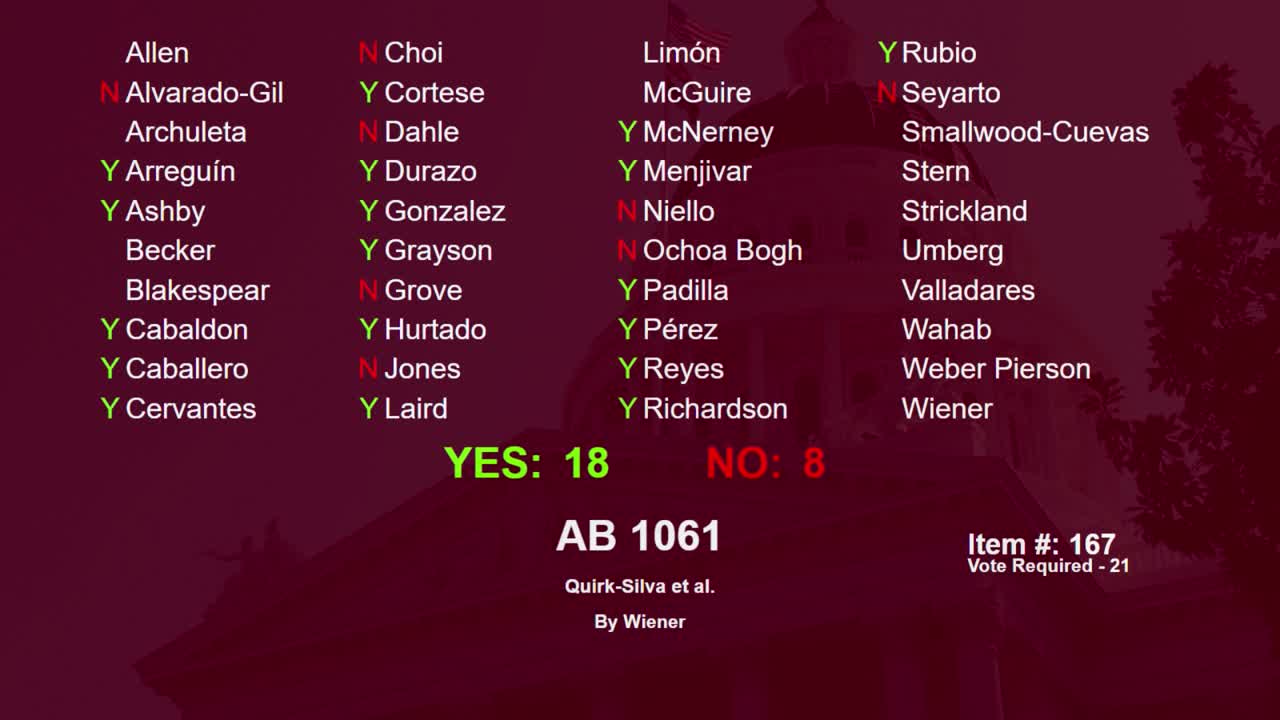 2MIN
Senate Floor
 5MIN
Senate Standing Committee on Judiciary
Bill Author

Bill Co-Author(s):