AB 1032: Coverage for behavioral health visits.
- Session Year: 2025-2026
- House: Assembly
- Latest Version Date: 2025-09-16
Current Status:
Failed
(2026-01-22: Consideration of Governor's veto stricken from file.)
Introduced
In Committee
Awaiting First Chamber Vote
Passed First Chamber
In Committee
Awaiting Second Chamber Vote
Passed Second Chamber
Enacted
Existing law, the Knox-Keene Health Care Service Plan Act of 1975, provides for the licensure and regulation of health care service plans by the Department of Managed Health Care, and makes a willful violation of the act a crime. Existing law provides for the regulation of health insurers by the Department of Insurance. Existing law requires a health care service plan contract or health insurance policy issued, amended, or renewed on or after January 1, 2021, to provide coverage for medically necessary treatment of mental health and substance use disorders, as defined, under the same terms and conditions applied to other medical conditions.
This bill would generally require a large group health care service plan contract or health insurance policy issued, amended, or renewed on or after January 1, 2026, to reimburse an eligible enrollee or insured for up to 12 visits with a behavioral health provider if the enrollee or insured lives in a county where a local or state emergency has been declared due to wildfires and the enrollee or insured has experienced a loss, trauma, or displacement because of the fire. The bill would prohibit these benefits from being subject to utilization review. The bill would require a health care service plan contract or health insurer to provide notice to all affected enrollees of these provisions, as specified. Because a willful violation of these provisions by a health care service plan would be a crime, the bill would impose a state-mandated local program.
The California Constitution requires the state to reimburse local agencies and school districts for certain costs mandated by the state. Statutory provisions establish procedures for making that reimbursement.
This bill would provide that no reimbursement is required by this act for a specified reason.
This bill would declare that it is to take effect immediately as an urgency statute.
Existing law, the Knox-Keene Health Care Service Plan Act of 1975, provides for the licensure and regulation of health care service plans by the Department of Managed Health Care, and makes a willful violation of the act a crime. Existing law provides for the regulation of health insurers by the Department of Insurance. Existing law requires a health care service plan contract or health insurance policy issued, amended, or renewed on or after January 1, 2021, to provide coverage for medically necessary treatment of mental health and substance use disorders, as defined, under the same terms and conditions applied to other medical conditions.
This bill would generally require a large group health care service plan contract or health insurance policy issued, amended, or renewed on or after January 1, 2026, to reimburse an eligible enrollee or insured for up to 12 visits with a behavioral health provider if the enrollee or insured is lives in a county where a local or state emergency has been declared due to wildfires and the enrollee or insured has experienced a loss, trauma, or displacement because of the fire. The bill would prohibit these benefits from being subject to utilization review. The bill would require a health care service plan contract or health insurer to provide notice to all affected enrollees of these provisions, as specified. Because a willful violation of these provisions by a health care service plan would be a crime, the bill would impose a state-mandated local program.
The California Constitution requires the state to reimburse local agencies and school districts for certain costs mandated by the state. Statutory provisions establish procedures for making that reimbursement.
This bill would provide that no reimbursement is required by this act for a specified reason.
This bill would declare that it is to take effect immediately as an urgency statute.
Existing law, the Knox-Keene Health Care Service Plan Act of 1975, provides for the licensure and regulation of health care service plans by the Department of Managed Health Care, and makes a willful violation of the act a crime. Existing law provides for the regulation of health insurers by the Department of Insurance. Existing law requires a health care service plan contract or health insurance policy issued, amended, or renewed on or after January 1, 2021, to provide coverage for medically necessary treatment of mental health and substance use disorders, as defined, under the same terms and conditions applied to other medical conditions.
This bill would generally require a large group health care service plan contract or health insurance policy issued, amended, or renewed on or after January 1, 2026, to reimburse an eligible enrollee or insured for up to 12 visits per year with a licensed behavioral health provider if the enrollee or insured is in a county where a local or state emergency has been declared due to wildfires. wildfires and the enrollee or insured has experienced a loss, trauma, or displacement because of the fire. The bill would prohibit these benefits from being subject to utilization review. Under the bill, an enrollee or insured would be entitled to those benefits until one year from the date the local or state emergency is lifted, whichever is later. The bill would require a health care service plan contract or health insurer to provide notice to all affected enrollees of these provisions, as specified. Because a willful violation of these provisions by a health care service plan would be a crime, the bill would impose a state-mandated local program.
The California Constitution requires the state to reimburse local agencies and school districts for certain costs mandated by the state. Statutory provisions establish procedures for making that reimbursement.
This bill would provide that no reimbursement is required by this act for a specified reason.
This bill would declare that it is to take effect immediately as an urgency statute.
Existing law, the Knox-Keene Health Care Service Plan Act of 1975, provides for the licensure and regulation of health care service plans by the Department of Managed Health Care, and makes a willful violation of the act a crime. Existing law provides for the regulation of health insurers by the Department of Insurance. Existing law requires a health care service plan contract or health insurance policy issued, amended, or renewed on or after January 1, 2021, to provide coverage for medically necessary treatment of mental health and substance use disorders, as defined, under the same terms and conditions applied to other medical conditions.
This bill would generally require an individual or a large group health care service plan contract or health insurance policy issued, amended, or renewed on or after January 1, 2026, to reimburse an eligible enrollee or insured for up to 12 visits per year with a licensed behavioral health provider if the enrollee or insured is in a county where a local or state emergency has been declared due to wildfires. The bill would prohibit these benefits from being subject to utilization review. Under the bill, an enrollee or insured would be entitled to those benefits until one year from the date the local or state emergency is lifted, whichever is later. The bill would require a health care service plan contract or health insurer to provide notice to all affected enrollees of these provisions, as specified. Because a willful violation of these provisions by a health care service plan would be a crime, the bill would impose a state-mandated local program.
The California Constitution requires the state to reimburse local agencies and school districts for certain costs mandated by the state. Statutory provisions establish procedures for making that reimbursement.
This bill would provide that no reimbursement is required by this act for a specified reason.
This bill would declare that it is to take effect immediately as an urgency statute.
Existing law, the Knox-Keene Health Care Service Plan Act of 1975, provides for the licensure and regulation of health care service plans by the Department of Managed Health Care, and makes a willful violation of the act a crime. Existing law provides for the regulation of health insurers by the Department of Insurance. Existing law requires a health care service plan contract or health insurance policy issued, amended, or renewed on or after January 1, 2021, to provide coverage for medically necessary treatment of mental health and substance use disorders, as defined, under the same terms and conditions applied to other medical conditions.
This bill would generally require an individual or group health care service plan contract or health insurance policy issued, amended, or renewed on or after January 1, 2026, to reimburse an eligible enrollee or insured for up to 12 visits per year with a licensed behavioral health provider if the enrollee or insured is in a county where a local or state emergency has been declared due to wildfires. Under the bill, an enrollee or insured would be entitled to those benefits until one year from the date the local or state emergency is lifted, whichever is later. Because a willful violation of these provisions by a health care service plan would be a crime, the bill would impose a state-mandated local program.
The California Constitution requires the state to reimburse local agencies and school districts for certain costs mandated by the state. Statutory provisions establish procedures for making that reimbursement.
This bill would provide that no reimbursement is required by this act for a specified reason.
This bill would declare that it is to take effect immediately as an urgency statute.
(a)(1)(A)In addition to covering all medically necessary treatment of mental health and substance use disorders, as required by Section 1374.72, a large group health care service plan contract issued, amended, or renewed on or after January 1, 2026, shall cover or reimburse an eligible enrollee for up to 12 visits with a behavioral health provider if the enrollee lives in a county or counties where a local or state emergency has been declared due to wildfires, and the enrollee has experienced a loss, trauma, or displacement because of the fire. These 12 visits shall not be subject to utilization review, as defined in Section 1374.721, and shall apply regardless of the network status of the behavioral health provider.
(B)For the purposes of subparagraph (A), state of emergency means a declaration by the Governor pursuant to Section 8625 of the Government Code and local emergency means an emergency declared pursuant to Article 14 (commencing with Section 8630) of Chapter 7 of Division 1 of Title 2 of the Government Code.
(2)A health care service plan shall assure continuity of care of the benefits required by this section consistent with Section 1373.96 and the regulations adopted thereunder.
(3)A noncontracting provider may only collect from the enrollee the in-network cost-sharing amount. The enrollee shall pay no more than the same cost sharing that the enrollee would pay for the same covered services received from an in-network provider. Cost sharing shall accrue toward the enrollees annual deductible, regardless of the network status of the licensed behavioral health provider.
(4)A noncontracting provider shall be paid consistent with the requirements of this chapter relating to out-of-network services under Section 1374.72 and regulations adopted thereunder.
(5)For a health care service plan contract that meets the definition of a high deductible health plan set forth in Section 223(c)(2) of Title 26 of the United States Code, paragraph (1) shall only apply once an enrollees deductible has been satisfied for the year.
(b)(1)This section shall apply to a health care benefit plan or contract entered into with the Board of Administration of the Public Employees Retirement System pursuant to the Public Employees Medical and Hospital Care Act (part 5 (commencing with Section 22750) of Division 5 of Title 2 of the Government Code) and members of the State Teachers Retirement System.
(2)This section does not apply to a specialized health care service plan contract that covers only dental or vision benefits, a Medicare supplement plan, or coverage under a health care service plan contract for the federal Medicare Program pursuant to Title XVIII of the Social Security Act (42 U.S.C. Sec. 1395 et seq.).
(3)This section shall not apply to Medi-Cal managed care plans that contract with the State Department of Health Care Services pursuant to Chapter 7 (commencing with Section 1400) of, and Chapter 8 (commencing with Section 14200) of, Part 3 of Division 9 of the Welfare and Institutions Code.
(c)This section does not excuse a health care service plan from complying with Section 1374.72 or any other requirement set forth under this chapter, including, but not limited to, medically necessary treatment of mental health and substance use disorders as required by Section 1374.72, which requires health plans to provide an enrollee with medically necessary mental health and substance use disorder services within specific time and distance standards, without arbitrary or discriminatory limits on the number of visits.
(d)For the purposes of this section, behavioral health provider means a health care provider as defined in Section 1374.72.
(e)(1)Upon implementation of this section or within 30 days of when a local or state emergency due to wildfires has been declared, the health care service plan shall provide notice to all affected enrollees of this provision, and that an enrollee can access the services under this section from any behavioral health provider.
(2)The notice shall also specify that an enrollees rights and benefits under this section are separate and distinct from those in Section 1374.72, including, but not limited to, the right to medically necessary treatment of mental health and substance use disorders as required by Section 1374.72, the requirement to provide the enrollee with all medically necessary mental health and substance use disorder services within specified time and distance standards, without arbitrary or discriminatory limits on the number of visits, as well as their right under Section 1374.72 to receive out-of-network care if in-network care is not available within the time or geographic standards set by law or regulation and the obligation of the health care service plan to arrange those services. The notice may be in the following form:
In response to the recent emergency declaration due to wildfires in (County Name), you may be eligible for direct visits with a behavioral health care provider of your choice under Section 1368.9 of the Health and Safety Code. This benefit is meant for those who have experienced displacement, loss, or trauma due to the recent wildfires.
You may receive up to 12 visits with a behavioral health provider, even if they are out of network. These visits may be covered directly by your plan or reimbursed after payment. Please contact your insurer in advance to confirm coverage and billing details.
This new benefit is in addition to your existing rights under Section 1374.72 of the Health and Safety Code. Under Section 1374.72 of the Health and Safety Code, you are eligible for medically necessary mental health and substance use disorder services within specific time and distance standards, without arbitrary or discriminatory limits on the number of visits.
Reiterating your rights under this new provision: you are eligible for up to 12 visits with a behavioral health provider, even if the provider is not part of our network.
If you have questions or need assistance, please contact Member Services.
(f)The department may issue guidance to health care service plans until the emergency is terminated. This guidance shall not be subject to the Administrative Procedure Act (Chapter 3.5 (commencing with Section 11340) of Part 1 of Division 3 of Title 2 of the Government Code).
(g)This section shall not be construed to limit the Governors authority under the California Emergency Services Act (Chapter 7 (commencing with Section 8550) of Division 1 of Title 2 of the Government Code), or the directors authority under any provision of this chapter.
SEC. 2.Section 10112.97 is added to the Insurance Code, to read:10112.97.(a)(1)(A)In addition to covering all medically necessary treatment of mental health and substance use disorders, as required by Section 10144.5, a large group health insurance policy issued, amended, or renewed on or after January 1, 2026, shall cover or reimburse an eligible insured for up to 12 visits with a behavioral health provider if the insured lives in a county or counties where a local or state emergency has been declared due to wildfires, and the insured has experienced a loss, trauma, or displacement because of the fire. These 12 visits shall not be subject to utilization review, as defined in Section 10144.52, and shall apply regardless of the network status of the behavioral health provider.
(B)For the purposes of subparagraph (A), state of emergency means a declaration by the Governor pursuant to Section 8625 of the Government Code and local emergency means an emergency declared pursuant to Article 14 (commencing with Section 8630) of Chapter 7 of Division 1 of Title 2 of the Government Code.
(2)An insurer shall assure continuity of care for the benefits required by this section consistent with Section 10133.56 and the regulations adopted thereunder.
(3)(A)A noncontracting provider may only collect from the insured the in-network cost-sharing amount. The insured shall pay no more than the same cost sharing that the insured would pay for the same covered services received from an in-network provider. Cost sharing shall accrue toward the insureds annual deductible, regardless of the network status of the behavioral health provider.
(B)A health insurer or a provider may seek relief in any court for the purpose of resolving a payment dispute. A provider is not prohibited from using a health insurers existing dispute resolution process.
(4)For a health insurance policy that meets the definition of a high deductible health plan set forth in Section 223(c)(2) of Title 26 of the United States Code, paragraph (1) shall only apply once an insureds deductible has been satisfied for the year.
(b)(1)This section shall apply to insureds of a health care benefit plan or contract entered into with the Board of Administration of the Public Employees Retirement System pursuant to the Public Employees Medical and Hospital Care Act (Part 5 (commencing with Section 22750) of Division 5 of Title 2 of the Government Code) and members of the State Teachers Retirement System.
(2)This section does not apply to a specialized health insurance policy that covers only dental or vision benefits, a Medicare supplement insurance policy, or coverage under a health care service plan contract for the federal Medicare Program pursuant to Title XVIII of the Social Security Act (42 U.S.C. Sec. 1395 et seq.).
(c)This section does not excuse a health insurer from complying with Sections 10144.4, 10144.5, 10144.51, 10144.52, 10144.53, and 10144.57, or any other requirement set forth under this code. Nothing in this section shall be construed to limit any rights conferred upon insureds under this code, including, but not limited to, rights to medically necessary treatment of mental health and substance use disorders as required by Section 10144.5, which requires health insurers to provide an insured with medically necessary behavioral health care services within specific time and distance standards, without arbitrary or discriminatory limits on the number of visits.
(d)For the purposes of this section, behavioral health provider means a health care provider as defined in Section 10144.5.
(e)(1)Upon implementation of this section or within 30 days of when a local or state emergency due to wildfires has been declared, the insurer shall provide notice to all affected insureds of this provision, and that insured can access the services under this section from any health care provider.
(2)The notice shall also specify that an insureds rights and benefits under this section is separate from and distinct from those in Section 10144.5, including, but not limited to, the right to medically necessary treatment of mental health and substance use disorders as required by Section 10144.5, the requirement to provide an insured with all medically necessary behavioral health care services within specified time and distance standards, without arbitrary or discriminatory limits on the number of visits, as well as their right under Section 10144.5 to receive out-of-network care if in-network care is not available within the time or geographic standards set by law or regulation and the obligation of the insurer to arrange those services. The notice may be in the following form:
In response to the recent emergency declaration due to wildfires in (County Name), you may be eligible for direct visits with a behavioral health care provider of your choice under Section 10112.97 of the Insurance Code. This benefit is meant for those who have experienced displacement, loss, or trauma due to the recent wildfires.
You may receive up to 12 visits with a behavioral health provider, even if they are out of network. These visits may be covered directly by your plan or reimbursed after payment. Please contact your insurer in advance to confirm coverage and billing details.
This new benefit is in addition to your existing rights under Section 10144.5 of the Insurance Code. Under Section 10144.5 of the Insurance Code, you are eligible for medically necessary mental health and substance use disorder services within specific time and distance standards, without arbitrary or discriminatory limits on the number of visits.
Reiterating your rights under this new provision: you are eligible for up to 12 visits with a behavioral health provider, even if the provider is not part of our network.
If you have questions or need assistance, please contact Member Services.
(f)The department may issue guidance to insurers until the emergency is terminated. This guidance shall not be subject to the Administrative Procedure Act (Chapter 3.5 (commencing with Section 11340) of Part 1 of Division 3 of Title 2 of the Government Code).
(g)This section shall not be construed to limit the Governors authority under the California Emergency Services Act (Chapter 7 (commencing with Section 8550) of Division 1 of Title 2 of the Government Code), or the directors authority under any provision of this chapter.
SEC. 3.No reimbursement is required by this act pursuant to Section 6 of Article XIIIB of the California Constitution because the only costs that may be incurred by a local agency or school district will be incurred because this act creates a new crime or infraction, eliminates a crime or infraction, or changes the penalty for a crime or infraction, within the meaning of Section 17556 of the Government Code, or changes the definition of a crime within the meaning of Section 6 of Article XIIIB of the California Constitution.
SEC. 4.This act is an urgency statute necessary for the immediate preservation of the public peace, health, or safety within the meaning of Article IV of the California Constitution and shall go into immediate effect. The facts constituting the necessity are:
Because the destruction and loss of ones home, belongings, and surrounding community, and the threat to personal safety and the safety of loved ones, can have significant consequences on survivors behavioral health, which persist for years after, it is necessary for this act to take effect immediately.
(a)(1)(A)In addition to covering all medically necessary treatment of mental health and substance use disorders, as required by Section 1374.72, a large group health care service plan contract issued, amended, or renewed on or after January 1, 2026, shall cover or reimburse an eligible enrollee for up to 12 visits with a behavioral health provider if the enrollee is lives in a county or counties where a local or state emergency has been declared due to wildfires, and the enrollee has experienced a loss, trauma, or displacement because of the fire. These 12 visits shall not be subject to utilization review, as defined in Section 1374.721, and shall apply regardless of the network status of the behavioral health provider.
(B)For the purposes of subparagraph (A), state of emergency means a declaration by the Governor pursuant to Section 8625 of the Government Code and local emergency means an emergency declared pursuant to Article 14 (commencing with Section 8630) of Chapter 7 of Division 1 of Title 2 of the Government Code.
(2)A health care service plan shall assure continuity of care of the benefits required by this section consistent with Section 1373.96 and the regulations adopted thereunder.
(3)A noncontracting provider may only collect from the enrollee the in-network cost sharing cost-sharing amount. The enrollee shall pay no more than the same cost sharing that the enrollee would pay for the same covered services received from an in-network provider. Cost sharing shall accrue toward the enrollees annual deductible, regardless of the network status of the licensed behavioral health provider.
(4)A noncontracting provider shall be paid consistent with the requirements of this chapter relating to out-of-network services under Section 1374.72 and regulations adopted thereunder.
(5)For a health care service plan contract that meets the definition of a high deductible health plan set forth in Section 223(c)(2) of Title 26 of the United States Code, paragraph (1) shall only apply once an enrollees deductible has been satisfied for the year.
(b)(1)This section shall apply to a health care benefit plan or contract entered into with the Board of Administration of the Public Employees Retirement System pursuant to the Public Employees Medical and Hospital Care Act (part 5 (commencing with Section 22750) of Division 5 of Title 2 of the Government Code) and members of the State Teachers Retirement System (CalSTRS) who receive a health care benefit under CalSTRS. System.
(2)This section does not apply to a specialized health care service plan contract that covers only dental or vision benefits, a Medicare supplement plan, or coverage under a health care service plan contract for the federal Medicare Program pursuant to Title XVIII of the Social Security Act (42 U.S.C. Sec. 1395 et seq.).
(3)This section shall not apply to Medi-Cal managed care plans that contract with the State Department of Health Care Services pursuant to Chapter 7 (commencing with Section 1400) of, and Chapter 8 (commencing with Section 14200) of, Part 3 of Division 9 of the Welfare and Institutions Code.
(c)This section does not excuse a health care service plan from complying with Section 1374.72 or any other requirement set forth under this chapter, including, but not limited to, medically necessary treatment of mental health and substance use disorders as required by Section 1374.72, which requires health plans to provide an enrollee with medically necessary mental health and substance use disorder services within specific time and distance standards, without limit on the number of services. arbitrary or discriminatory limits on the number of visits.
(d)For the purposes of this section, behavioral health provider means a health care provider as defined in Section 1374.72.
(e)(1)Upon implementation of this section or within 30 days of when a local or state emergency due to wildfires has been declared, the health care service plan shall provide notice to all affected enrollees of this provision, and that an enrollee can access the services under this section from any behavioral health provider.
(2)The notice shall also specify that an enrollees rights and benefits under this section are separate and distinct from those in Section 1374.72, including, but not limited to, the right to medically necessary treatment of mental health and substance use disorders as required by Section 1374.72, the requirement to provide the enrollee with all medically necessary mental health and substance use disorder services within specified time and distance standards, without limits on the number of visits, arbitrary or discriminatory limits on the number of visits, as well as their right under Section 1374.72 to receive out-of-network care if in-network care is not available within the time or geographic standards set by law or regulation and the obligation of the health care service plan to arrange those services. The notice may be in the following form:
In response to the recent emergency declaration due to wildfires in (County Name), you may be eligible for direct visits with a behavioral health care provider of your choice under Section 1368.9 of the Health and Safety Code. This benefit is meant for those who have experienced displacement, loss, or trauma due to the recent wildfires.
You may receive up to 12 visits with a behavioral health provider, even if they are out of network. These visits may be covered directly by your plan or reimbursed after payment. Please contact your insurer in advance to confirm coverage and billing details.
This new benefit is in addition to your existing rights under Section 1374.72 of the Health and Safety Code. Under Section 1374.72 of the Health and Safety Code, you are eligible for medically necessary mental health and substance use disorder services within specific time and distance standards, without limit on the number of services. arbitrary or discriminatory limits on the number of visits.
Reiterating your rights under this new provision: you are eligible for up to 12 visits with a behavioral health provider, even if the provider is not part of our network.
If you have questions or need assistance, please contact Member Services.
(f)The department may issue guidance to health care service plans until the emergency is terminated. This guidance shall not be subject to the Administrative Procedure Act (Chapter 3.5 (commencing with Section 11340) of Part 1 of Division 3 of Title 2 of the Government Code).
(g)This section shall not be construed to limit the Governors authority under the California Emergency Services Act (Chapter 7 (commencing with Section 8550) of Division 1 of Title 2 of the Government Code), or the directors authority under any provision of this chapter.
SEC. 2.Section 10112.97 is added to the Insurance Code, to read:10112.97.(a)(1)(A)In addition to covering all medically necessary treatment of mental health and substance use disorders, as required by Section 10144.5, a large group health insurance policy issued, amended, or renewed on or after January 1, 2026, shall cover or reimburse an eligible insured for up to 12 visits with a behavioral health provider if the insured is lives in a county or counties where a local or state emergency has been declared due to wildfires, and the insured has experienced a loss, trauma, or displacement because of the fire. These 12 visits shall not be subject to utilization review, as defined in Section 10144.52, and shall apply regardless of the network status of the behavioral health provider.
(B)For the purposes of subparagraph (A), state of emergency means a declaration by the Governor pursuant to Section 8625 of the Government Code and local emergency means an emergency declared pursuant to Article 14 (commencing with Section 8630) of Chapter 7 of Division 1 of Title 2 of the Government Code.
(2)An insurer shall assure continuity of care for the benefits required by this section consistent with Section 10133.56 and the regulations adopted thereunder.
(3)(A)A noncontracting provider may only collect from the insured the in-network cost sharing cost-sharing amount. The insured shall pay no more than the same cost sharing that the insured would pay for the same covered services received from an in-network provider. Cost sharing shall accrue toward the insureds annual deductible, regardless of the network status of the behavioral health provider.
(B)A health insurer or a provider may seek relief in any court for the purpose of resolving a payment dispute. A provider is not prohibited from using a health insurers existing dispute resolution process.
(4)For a health insurance policy that meets the definition of a high deductible health plan set forth in Section 223(c)(2) of Title 26 of the United States Code, paragraph (1) shall only apply once an insureds deductible has been satisfied for the year.
(b)(1)This section shall apply to insureds of a health care benefit plan or contract entered into with the Board of Administration of the Public Employees Retirement System pursuant to the Public Employees Medical and Hospital Care Act (Part 5 (commencing with Section 22750) of Division 5 of Title 2 of the Government Code) and members of the State Teachers Retirement System (CalSTRS) who receive a health care benefit under CalSTRS. System.
(2)This section does not apply to a specialized health insurance policy that covers only dental or vision benefits, a Medicare supplement insurance policy, or coverage under a health care service plan contract for the federal Medicare Program pursuant to Title XVIII of the Social Security Act (42 U.S.C. Sec. 1395 et seq.).
(c)This section does not excuse a health insurer from complying with Sections 10144.4, 10144.5, 10144.51, 10144.52, 10144.53, and 10144.57, or any other requirement set forth under this code. Nothing in this section shall be construed to limit any rights conferred upon insureds under this code, including, but not limited to, rights to medically necessary treatment of mental health and substance use disorders as required by Section 10144.5, which requires health insurers to provide an insured with medically necessary behavioral health care services within specific time and distance standards, without limit on the number of visits. arbitrary or discriminatory limits on the number of visits.
(d)For the purposes of this section, behavioral health provider means a health care provider as defined in Section 10144.5.
(e)(1)Upon implementation of this section or within 30 days of when a local or state emergency due to wildfires has been declared, the insurer shall provide notice to all affected insureds of this provision, and that insured can access the services under this section from any health care provider.
(2)The notice shall also specify that an insureds rights and benefits under this section is separate from and distinct from those in Section 10144.5, including, but not limited to, the right to medically necessary treatment of mental health and substance use disorders as required by Section 10144.5, the requirement to provide an insured with all medically necessary behavioral health care services within specified time and distance standards, without limits on the number of visits, arbitrary or discriminatory limits on the number of visits, as well as their right under Section 10144.5 to receive out-of-network care if in-network care is not available within the time or geographic standards set by law or regulation and the obligation of the insurer to arrange those services. The notice may be in the following form:
In response to the recent emergency declaration due to wildfires in (County Name), you may be eligible for direct visits with a behavioral health care provider of your choice under Section 10112.97 of the Insurance Code. This benefit is meant for those who have experienced displacement, loss, or trauma due to the recent wildfires.
You may receive up to 12 visits with a behavioral health provider, even if they are out of network. These visits may be covered directly by your plan or reimbursed after payment. Please contact your insurer in advance to confirm coverage and billing details.
This new benefit is in addition to your existing rights under Section 10144.5 of the Insurance Code. Under Section 10144.5 of the Insurance Code, you are eligible for medically necessary mental health and substance use disorder services within specific time and distance standards, without limit on the number of services. arbitrary or discriminatory limits on the number of visits.
Reiterating your rights under this new provision: you are eligible for up to 12 visits with a behavioral health provider, even if the provider is not part of our network.
If you have questions or need assistance, please contact Member Services.
(f)The department may issue guidance to insurers until the emergency is terminated. This guidance shall not be subject to the Administrative Procedure Act (Chapter 3.5 (commencing with Section 11340) of Part 1 of Division 3 of Title 2 of the Government Code).
(g)This section shall not be construed to limit the Governors authority under the California Emergency Services Act (Chapter 7 (commencing with Section 8550) of Division 1 of Title 2 of the Government Code), or the directors authority under any provision of this chapter.
SEC. 3.No reimbursement is required by this act pursuant to Section 6 of Article XIIIB of the California Constitution because the only costs that may be incurred by a local agency or school district will be incurred because this act creates a new crime or infraction, eliminates a crime or infraction, or changes the penalty for a crime or infraction, within the meaning of Section 17556 of the Government Code, or changes the definition of a crime within the meaning of Section 6 of Article XIIIB of the California Constitution.
SEC. 4.This act is an urgency statute necessary for the immediate preservation of the public peace, health, or safety within the meaning of Article IV of the California Constitution and shall go into immediate effect. The facts constituting the necessity are:
Because the destruction and loss of ones home, belongings, and surrounding community, and the threat to personal safety and the safety of loved ones, can have significant consequences on survivors behavioral health, which persist for years after, it is necessary for this act to take effect immediately.
(a)(1)A (A)In addition to covering all medically necessary treatment of mental health and substance use disorders, as required by Section 1374.72, a large group health care service plan contract issued, amended, or renewed on or after January 1, 2026, shall cover or reimburse an eligible enrollee for up to 12 visits per year with a licensed behavioral health provider if the enrollee is in a county or counties where a local or state emergency has been declared due to wildfires. wildfires, and the enrollee has experienced a loss, trauma, or displacement because of the fire. These benefits 12 visits shall not be subject to utilization review, as defined in Section 1374.721, and shall apply even if the licensed behavioral health provider is not a contracting provider. regardless of the network status of the behavioral health provider.
(2)An enrollee is entitled to the benefits specified in paragraph (1) until one year from the date the local or state emergency is lifted, whichever is later. Consistent with Section 1373.96, a health care service plan shall assure continuity of care.(B)For the purposes of subparagraph (A), state of emergency means a declaration by the Governor pursuant to Section 8625 of the Government Code and local emergency means an emergency declared pursuant to Article 14 (commencing with Section 8630) of Chapter 7 of Division 1 of Title 2 of the Government Code.
(2)A health care service plan shall assure continuity of care of the benefits required by this section consistent with Section 1373.96 and the regulations adopted thereunder.
(3)A noncontracting provider may only collect from the enrollee the in-network cost sharing amount. The enrollee shall pay no more than the same cost sharing that the enrollee would pay for the same covered services received from an in-network provider. Cost sharing shall accrue toward the enrollees annual deductible, regardless of the network status of the licensed behavioral health provider.
(4)A noncontracting provider shall be paid consistent with the requirements of this chapter. chapter relating to out-of-network services under Section 1374.72 and regulations adopted thereunder.
(5)For a health care service plan contract that meets the definition of a high deductible health plan set forth in Section 223(c)(2) of Title 26 of the United States Code, paragraph (1) shall only apply once an enrollees deductible has been satisfied for the year.
(b)(1)This section shall apply to a health care benefit plan or contract entered into with the Board of Administration of the Public Employees Retirement System pursuant to the Public Employees Medical and Hospital Care Act (part 5 (commencing with Section 22750) of Division 5 of Title 2 of the Government Code) and members of the State Teachers Retirement System (CalSTRS) who receive a health care benefit under CALSTRS. CalSTRS.
(2)This section does not apply to a specialized health care service plan contract that covers only dental or vision benefits benefits, a Medicare supplement plan, or to coverage under a health care service plan contract for the federal Medicare Program pursuant to Title XVIII of the Social Security Act (42 U.S.C. Sec. 1395 et seq.).
(3)This section shall not apply to Medi-Cal managed care plans that contract with the State Department of Health Care Services pursuant to Chapter 7 (commencing with Section 1400) of, and Chapter 8 (commencing with Section 14200) of, Part 3 of Division 9 of the Welfare and Institutions Code.
(c)A health care service plan shall comply with the requirements of this chapter, including, Sections 1374.72 and 1374.721.(d)For purposes of this section, licensed behavioral health provider means a provider licensed under Division 2 (commencing with Section 500) of the Business and Professions Code authorized to render behavioral health services.(c)This section does not excuse a health care service plan from complying with Section 1374.72 or any other requirement set forth under this chapter, including, but not limited to, medically necessary treatment of mental health and substance use disorders as required by Section 1374.72, which requires health plans to provide an enrollee with medically necessary mental health and substance use disorder services within specific time and distance standards, without limit on the number of services.
(d)For the purposes of this section, behavioral health provider means a health care provider as defined in Section 1374.72.
(e)(1)Upon implementation of this section or within 30 days of when a local or state emergency due to wildfires has been declared, the health care service plan shall provide notice to all affected enrollees of this provision, as well as their right under Section 1374.72 to receive out of network care if in-network care is not available within the time or geographic standards set by law or regulation and the obligation of the plan to arrange such services. and that an enrollee can access the services under this section from any behavioral health provider.
(2)The notice shall also specify that an enrollees rights and benefits under this section are separate and distinct from those in Section 1374.72, and that enrollees can access the services under this section from any of the licensed behavioral health providers. including, but not limited to, the right to medically necessary treatment of mental health and substance use disorders as required by Section 1374.72, the requirement to provide the enrollee with all medically necessary mental health and substance use disorder services within specified time and distance standards, without limits on the number of visits, as well as their right under Section 1374.72 to receive out-of-network care if in-network care is not available within the time or geographic standards set by law or regulation and the obligation of the health care service plan to arrange those services. The notice may be in the following form:
In response to the recent emergency declaration due to wildfires in (County Name), you may be eligible for direct visits with a behavioral health care provider of your choice under Section 1368.9 of the Health and Safety Code. This benefit is meant for those who have experienced displacement, loss, or trauma due to the recent wildfires.
You may receive up to 12 visits with a behavioral health provider, even if they are out of network. These visits may be covered directly by your plan or reimbursed after payment. Please contact your insurer in advance to confirm coverage and billing details.
This new benefit is in addition to your existing rights under Section 1374.72 of the Health and Safety Code. Under Section 1374.72 of the Health and Safety Code, you are eligible for medically necessary mental health and substance use disorder services within specific time and distance standards, without limit on the number of services.
Reiterating your rights under this new provision: you are eligible for up to 12 visits with a behavioral health provider, even if the provider is not part of our network.
If you have questions or need assistance, please contact Member Services.
(f)The department may issue guidance to health care service plans until the emergency is terminated. This guidance shall not be subject to the Administrative Procedure Act (Chapter 3.5 (commencing with Section 11340) of Part 1 of Division 3 of Title 2 of the Government Code).
(g)This section shall not be construed to limit the Governors authority under the California Emergency Services Act (Chapter 7 (commencing with Section 8550) of Division 1 of Title 2 of the Government Code), or the directors authority under any provision of this chapter.
SEC. 2.Section 10112.97 is added to the Insurance Code, to read:10112.97.(a)(1)A (A)In addition to covering all medically necessary treatment of mental health and substance use disorders, as required by Section 10144.5, a large group health insurance policy issued, amended, or renewed on or after January 1, 2026, shall cover or reimburse an eligible insured for up to 12 visits per year with a licensed behavioral health provider if the insured is in a county or counties where a local or state emergency has been declared due to wildfires. wildfires, and the insured has experienced a loss, trauma, or displacement because of the fire. These benefits 12 visits shall not be subject to utilization review, as defined in Section 10144.52, and shall apply regardless of the network status of the licensed behavioral health provider.
(2)An insured is entitled to the benefits specified in paragraph (1) until one year from the date the local or state emergency is lifted, whichever is later. Consistent with Section 10133.56, an insurer shall assure continuity of care.(B)For the purposes of subparagraph (A), state of emergency means a declaration by the Governor pursuant to Section 8625 of the Government Code and local emergency means an emergency declared pursuant to Article 14 (commencing with Section 8630) of Chapter 7 of Division 1 of Title 2 of the Government Code.
(2)An insurer shall assure continuity of care for the benefits required by this section consistent with Section 10133.56 and the regulations adopted thereunder.
(3)(A)A noncontracting provider may only collect from the insured the in-network cost sharing amount. The insured shall pay no more than the same cost sharing that the insured would pay for the same covered services received from an in-network provider. Cost sharing shall accrue toward the insureds annual deductible, regardless of the network status of the licensed behavioral health provider.
(B)A health insurer or a provider may seek relief in any court for the purpose of resolving a payment dispute. A provider is not prohibited from using a health insurers existing dispute resolution process.
(4)For a health insurance policy that meets the definition of a high deductible health plan set forth in Section 223(c)(2) of Title 26 of the United States Code, paragraph (1) shall only apply once an insureds deductible has been satisfied for the year.
(b)(1)This section shall apply to insureds of a health care benefit plan or contract entered into with the Board of Administration of the Public Employees Retirement System pursuant to the Public Employees Medical and Hospital Care Act (Part 5 (commencing with Section 22750) of Division 5 of Title 2 of the Government Code) and members of the State Teachers Retirement System (CalSTRS) who receive a health care benefit under CalSTRS.
(2)This section does not apply to a specialized health insurance policy that covers only dental or vision benefits, a Medicare supplement insurance policy, or to coverage under a health care service plan contract for the federal Medicare Program pursuant to Title XVIII of the Social Security Act (42 U.S.C. Sec. 1395 et seq.).
(c)An insurer shall comply with the requirements of this chapter, including, Section 10144.5.(d)For purposes of this section, licensed behavioral health provider means a provider licensed under Division 2 (commencing with Section 500) of the Business and Professions Code authorized to render behavioral health services.(c)This section does not excuse a health insurer from complying with Sections 10144.4, 10144.5, 10144.51, 10144.52, 10144.53, and 10144.57, or any other requirement set forth under this code. Nothing in this section shall be construed to limit any rights conferred upon insureds under this code, including, but not limited to, rights to medically necessary treatment of mental health and substance use disorders as required by Section 10144.5, which requires health insurers to provide an insured with medically necessary behavioral health care services within specific time and distance standards, without limit on the number of visits.
(d)For the purposes of this section, behavioral health provider means a health care provider as defined in Section 10144.5.
(e)(1)Upon implementation of this section or within 30 days of when a local or state emergency due to wildfires has been declared, the insurer shall provide notice to all affected insureds of this provision, as well as their right under Section 10144.5 to receive out of network care if in-network care is not available within the time or geographic standards set by law or regulation and the obligation of the insurer to arrange such services. and that insured can access the services under this section from any health care provider.
(2)The notice shall also specify that an insureds rights and benefits under this section is separate from and distinct from those in Section 10144.5 and that an insured can access the services under this section from any of the licensed behavioral health providers. 10144.5, including, but not limited to, the right to medically necessary treatment of mental health and substance use disorders as required by Section 10144.5, the requirement to provide an insured with all medically necessary behavioral health care services within specified time and distance standards, without limits on the number of visits, as well as their right under Section 10144.5 to receive out-of-network care if in-network care is not available within the time or geographic standards set by law or regulation and the obligation of the insurer to arrange those services. The notice may be in the following form:
In response to the recent emergency declaration due to wildfires in (County Name), you may be eligible for direct visits with a behavioral health care provider of your choice under Section 10112.97 of the Insurance Code. This benefit is meant for those who have experienced displacement, loss, or trauma due to the recent wildfires.
You may receive up to 12 visits with a behavioral health provider, even if they are out of network. These visits may be covered directly by your plan or reimbursed after payment. Please contact your insurer in advance to confirm coverage and billing details.
This new benefit is in addition to your existing rights under Section 10144.5 of the Insurance Code. Under Section 10144.5 of the Insurance Code, you are eligible for medically necessary mental health and substance use disorder services within specific time and distance standards, without limit on the number of services.
Reiterating your rights under this new provision: you are eligible for up to 12 visits with a behavioral health provider, even if the provider is not part of our network.
If you have questions or need assistance, please contact Member Services.
(f)The department may issue guidance to insurers until the emergency is terminated. This guidance shall not be subject to the Administrative Procedure Act (Chapter 3.5 (commencing with Section 11340) of Part 1 of Division 3 of Title 2 of the Government Code).
(g)This section shall not be construed to limit the Governors authority under the California Emergency Services Act (Chapter 7 (commencing with Section 8550) of Division 1 of Title 2 of the Government Code), or the directors authority under any provision of this chapter.
SEC. 3.No reimbursement is required by this act pursuant to Section 6 of Article XIIIB of the California Constitution because the only costs that may be incurred by a local agency or school district will be incurred because this act creates a new crime or infraction, eliminates a crime or infraction, or changes the penalty for a crime or infraction, within the meaning of Section 17556 of the Government Code, or changes the definition of a crime within the meaning of Section 6 of Article XIIIB of the California Constitution.
SEC. 4.This act is an urgency statute necessary for the immediate preservation of the public peace, health, or safety within the meaning of Article IV of the California Constitution and shall go into immediate effect. The facts constituting the necessity are:
Because the destruction and loss of ones home, belongings, and surrounding community, and the threat to personal safety and the safety of loved ones, can have significant consequences on survivors behavioral health, which persist for years after, it is necessary for this act to take effect immediately.
(a)(1)An individual or A large group health care service plan contract issued, amended, or renewed on or after January 1, 2026, shall reimburse an eligible enrollee for up to 12 visits per year with a licensed behavioral health provider if the enrollee is in a county where a local or state emergency has been declared due to wildfires. These benefits shall not be subject to utilization review, and shall apply even if the licensed behavioral health provider is not a contracting provider.
(2)An enrollee is entitled to the benefits specified in paragraph (1) until one year from the date the local or state emergency is lifted, whichever is later. Consistent with Section 1373.96, a health care service plan shall assure continuity of care.
(3)The enrollee shall pay no more than the same cost sharing that the enrollee would pay for the same covered services received from an in-network provider. Cost sharing shall accrue toward the enrollees annual deductible, regardless of the network status of the licensed behavioral health provider.
(4)A noncontracting provider shall be paid consistent with the requirements of this chapter.
(3)(5)For a health care service plan contract that meets the definition of a high deductible health plan set forth in Section 223(c)(2) of Title 26 of the United States Code, paragraph (1) shall only apply once an enrollees deductible has been satisfied for the year.
(b)(1)This section applies to a health care service plan subject to Section 1349.2.(b)(1)This section shall apply to a health care benefit plan or contract entered into with the Board of Administration of the Public Employees Retirement System pursuant to the Public Employees Medical and Hospital Care Act (part 5 (commencing with Section 22750) of Division 5 of Title 2 of the Government Code) and members of the State Teachers Retirement System (CalSTRS) who receive a health care benefit under CALSTRS.
(2)This section does not apply to a specialized health care service plan contract that covers only dental or vision benefits or to coverage under a health care service plan contract for the federal Medicare Program pursuant to Title XVIII of the Social Security Act (42 U.S.C. Sec. 1395 et seq.).
(c)This section does not excuse a health care service plan from complying with Section 1374.72 or any other requirement of this chapter.(3)This section shall not apply to Medi-Cal managed care plans that contract with the State Department of Health Care Services pursuant to Chapter 7 (commencing with Section 1400) of, and Chapter 8 (commencing with Section 14200) of, Part 3 of Division 9 of the Welfare and Institutions Code.
(c)A health care service plan shall comply with the requirements of this chapter, including, Sections 1374.72 and 1374.721.
(d)For purposes of this section, licensed behavioral health provider means a provider licensed under Division 2 (commencing with Section 500) of the Business and Professions Code authorized to render behavioral health services.
(e)(1)Upon implementation of this section or within 30 days of when a local or state emergency due to wildfires has been declared, the health care service plan shall provide notice to all affected enrollees of this provision, as well as their right under Section 1374.72 to receive out of network care if in-network care is not available within the time or geographic standards set by law or regulation and the obligation of the plan to arrange such services.
(2)The notice shall also specify that an enrollees rights and benefits under this section are separate and distinct from those in Section 1374.72, and that enrollees can access the services under this section from any of the licensed behavioral health providers.
SEC. 2.Section 10144.45 is added to the Insurance Code, to read:10144.45.SEC. 2.Section 10112.97 is added to the Insurance Code, to read:10112.97.(a)(1)An individual or A large group health insurance policy issued, amended, or renewed on or after January 1, 2026, shall reimburse an eligible insured for up to 12 visits per year with a licensed behavioral health provider if the insured is in a county where a local or state emergency has been declared due to wildfires. These benefits shall not be subject to utilization review, as defined in Section 10144.52, and shall apply regardless of the network status of the licensed behavioral health provider.
(2)An insured is entitled to the benefits specified in paragraph (1) until one year from the date the local or state emergency is lifted, whichever is later. Consistent with Section 10133.56, an insurer shall assure continuity of care.
(3)The insured shall pay no more than the same cost sharing that the insured would pay for the same covered services received from an in-network provider. Cost sharing shall accrue toward the insureds annual deductible, regardless of the network status of the licensed behavioral health provider.
(3)(4)For a health insurance policy that meets the definition of a high deductible health plan set forth in Section 223(c)(2) of Title 26 of the United States Code, paragraph (1) shall only apply once an insureds deductible has been satisfied for the year.
(b)(1)This section applies to an insurer subject to subdivision (i) of Section 740.(b)(1)This section shall apply to insureds of a health care benefit plan or contract entered into with the Board of Administration of the Public Employees Retirement System pursuant to the Public Employees Medical and Hospital Care Act (Part 5 (commencing with Section 22750) of Division 5 of Title 2 of the Government Code) and members of the State Teachers Retirement System (CalSTRS) who receive a health care benefit under CalSTRS.
(2)This section does not apply to a specialized health insurance policy that covers only dental or vision benefits benefits, a Medicare supplement insurance policy, or to coverage under a health care service plan contract for the federal Medicare Program pursuant to Title XVIII of the Social Security Act (42 U.S.C. Sec. 1395 et seq.).
(c)This section does not excuse a health care service plan from complying with Section 10144.5 or any other requirement of this chapter.(c)An insurer shall comply with the requirements of this chapter, including, Section 10144.5.
(d)For purposes of this section, licensed behavioral health provider means a provider licensed under Division 2 (commencing with Section 500) of the Business and Professions Code authorized to render behavioral health services.
(e)(1)Upon implementation of this section or within 30 days of when a local or state emergency due to wildfires has been declared, the insurer shall provide notice to all affected insureds of this provision, as well as their right under Section 10144.5 to receive out of network care if in-network care is not available within the time or geographic standards set by law or regulation and the obligation of the insurer to arrange such services.
(2)The notice shall also specify that an insureds rights and benefits under this section is separate from and distinct from those in Section 10144.5 and that an insured can access the services under this section from any of the licensed behavioral health providers.
SEC. 3.No reimbursement is required by this act pursuant to Section 6 of Article XIIIB of the California Constitution because the only costs that may be incurred by a local agency or school district will be incurred because this act creates a new crime or infraction, eliminates a crime or infraction, or changes the penalty for a crime or infraction, within the meaning of Section 17556 of the Government Code, or changes the definition of a crime within the meaning of Section 6 of Article XIIIB of the California Constitution.
SEC. 4.This act is an urgency statute necessary for the immediate preservation of the public peace, health, or safety within the meaning of Article IV of the California Constitution and shall go into immediate effect. The facts constituting the necessity are:
Because the destruction and loss of ones home, belongings, and surrounding community, and the threat to personal safety and the safety of loved ones, can have significant consequences on survivors behavioral health, which persist for years after, it is necessary for this act to take effect immediately.
(a)(1)An individual or group health care service plan contract issued, amended, or renewed on or after January 1, 2026, shall reimburse an eligible enrollee for up to 12 visits per year with a licensed behavioral health provider if the enrollee is in a county where a local or state emergency has been declared due to wildfires.
(2)An enrollee is entitled to the benefits specified in paragraph (1) until one year from the date the local or state emergency is lifted, whichever is later.
(3)For a health care service plan contract that meets the definition of a high deductible health plan set forth in Section 223(c)(2) of Title 26 of the United States Code, paragraph (1) shall only apply once an enrollees deductible has been satisfied for the year.
(b)(1)This section applies to a health care service plan subject to Section 1349.2.
(2)This section does not apply to a specialized health care service plan contract that covers only dental or vision benefits or to coverage under a health care service plan contract for the federal Medicare Program pursuant to Title XVIII of the Social Security Act (42 U.S.C. Sec. 1395 et seq.).
(c)This section does not excuse a health care service plan from complying with Section 1374.72 or any other requirement of this chapter.
(d)For purposes of this section, licensed behavioral health provider means a provider licensed under Division 2 (commencing with Section 500) of the Business and Professions Code authorized to render behavioral health services.
SEC. 2.Section 10144.45 is added to the Insurance Code, to read:10144.45.(a)(1)An individual or group health insurance policy issued, amended, or renewed on or after January 1, 2026, shall reimburse an eligible insured for up to 12 visits per year with a licensed behavioral health provider if the insured is in a county where a local or state emergency has been declared due to wildfires.
(2)An insured is entitled to the benefits specified in paragraph (1) until one year from the date the local or state emergency is lifted, whichever is later.
(3)For a health insurance policy that meets the definition of a high deductible health plan set forth in Section 223(c)(2) of Title 26 of the United States Code, paragraph (1) shall only apply once an insureds deductible has been satisfied for the year.
(b)(1)This section applies to an insurer subject to subdivision (i) of Section 740.
(2)This section does not apply to a specialized health insurance policy that covers only dental or vision benefits or to coverage under a health care service plan contract for the federal Medicare Program pursuant to Title XVIII of the Social Security Act (42 U.S.C. Sec. 1395 et seq.).
(c)This section does not excuse a health care service plan from complying with Section 10144.5 or any other requirement of this chapter.
(d)For purposes of this section, licensed behavioral health provider means a provider licensed under Division 2 (commencing with Section 500) of the Business and Professions Code authorized to render behavioral health services.
SEC. 3.No reimbursement is required by this act pursuant to Section 6 of Article XIIIB of the California Constitution because the only costs that may be incurred by a local agency or school district will be incurred because this act creates a new crime or infraction, eliminates a crime or infraction, or changes the penalty for a crime or infraction, within the meaning of Section 17556 of the Government Code, or changes the definition of a crime within the meaning of Section 6 of Article XIIIB of the California Constitution.
SEC. 4.This act is an urgency statute necessary for the immediate preservation of the public peace, health, or safety within the meaning of Article IV of the California Constitution and shall go into immediate effect. The facts constituting the necessity are:
Because the destruction and loss of one's home, belongings, and surrounding community, and the threat to personal safety and the safety of loved ones, can have significant consequences on survivors' behavioral health, which persist for years after, it is necessary for this act to take effect immediately.
|
Date
|
Status
|
|---|---|
| Jan 22, 2026 | Consideration of Governor's veto stricken from file. |
| Oct 13, 2025 | Consideration of Governor's veto pending. |
| Oct 13, 2025 | Vetoed by Governor. |
| Sep 24, 2025 | Enrolled and presented to the Governor at 3 p.m. |
| Sep 12, 2025 | Senate amendments concurred in. To Engrossing and Enrolling. (Ayes 77. Noes 0. Page 3386.). |
| Sep 12, 2025 | In Assembly. Concurrence in Senate amendments pending. |
| Sep 11, 2025 | Read third time. Urgency clause adopted. Passed. Ordered to the Assembly. (Ayes 32. Noes 1. Page 2922.). |
| Sep 2, 2025 | Read second time. Ordered to third reading. |
| Aug 29, 2025 | Read second time and amended. Ordered returned to second reading. |
| Aug 29, 2025 | From committee: Amend, and do pass as amended. (Ayes 4. Noes 1.) (August 29). |
| Aug 18, 2025 | In committee: Referred to suspense file. |
| Jul 15, 2025 | Read second time and amended. Re-referred to Com. on APPR. |
| Jul 14, 2025 | From committee: Amend, and do pass as amended and re-refer to Com. on APPR. (Ayes 8. Noes 0.) (July 9). |
| Jun 11, 2025 | Referred to Com. on HEALTH. |
| Jun 3, 2025 | In Senate. Read first time. To Com. on RLS. for assignment. |
| Jun 2, 2025 | Read third time. Urgency clause adopted. Passed. Ordered to the Senate. (Ayes 74. Noes 1. Page 1872.). |
| May 27, 2025 | Read second time. Ordered to third reading. |
| May 23, 2025 | From committee: Do pass. (Ayes 13. Noes 0.) (May 23). |
| May 21, 2025 | Joint Rule 62(a), file notice suspended. (Page 1627.) |
| May 21, 2025 | In committee: Set, first hearing. Referred to APPR. suspense file. |
| May 14, 2025 | In committee: Hearing postponed by committee. |
| May 6, 2025 | Re-referred to Com. on APPR. |
| May 5, 2025 | Read second time and amended. |
| May 1, 2025 | From committee: Amend, and do pass as amended and re-refer to Com. on APPR. (Ayes 16. Noes 0.) (April 29). |
| Mar 10, 2025 | Referred to Com. on HEALTH. |
| Feb 21, 2025 | From printer. May be heard in committee March 23. |
| Feb 20, 2025 | Read first time. To print. |
|
Date
|
Description
|
Location
|
Votes
|
|
|---|---|---|---|---|
| Sep 12, 2025 | AB 1032 Harabedian Concurrence in Senate Amendments | Assembly Floor |
Passed |
|
| Sep 11, 2025 | Assembly 3rd Reading AB1032 Harabedian et al. By Pérez Urgency Clause | Senate Floor |
Passed |
|
| Aug 29, 2025 | Do pass as amended | Senate Standing Committee on Appropriations |
Passed |
|
| Aug 18, 2025 | Placed on suspense file | Senate Standing Committee on Appropriations |
Passed |
|
| Jul 9, 2025 | Do pass as amended, but first amend, and re-refer to the Committee on [Appropriations] | Senate Standing Committee on Health |
Passed |
|
| Jun 2, 2025 | AB 1032 Harabedian Third Reading Urgency | Assembly Floor |
Passed |
|
| May 23, 2025 | Do pass. | Assembly Standing Committee on Appropriations |
Passed |
|
| Apr 29, 2025 | Do pass as amended and be re-referred to the Committee on [Appropriations] | Assembly Standing Committee on Health |
Passed |
This list shows positions taken on this bill by organizations on the date displayed, which is linked to the original source.
Positions by individuals are not included.
|
Organization
|
Position
|
Date
|
|---|---|---|
| Altamed Health Services Corporation | ** Support | |
| Association Of California Life And Health Insurance Companies | ** Against | |
| ASSOCIATION OF CALIFORNIA LIFE AND HEALTH INSURANCE COMPANIES (ACLHIC PAC) | ** Against | |
| California Academy of Child and Adolescent Psychiatry | ** Support | |
| California Access Coalition | ** Support | |
| California Association Of Health Plans | ** Against | |
| California Behavioral Health Association | ** Support | |
| California Pan-Ethnic Health Network | ** Support | |
| California Retired Teachers Association | ** Support | |
| California-Hawaii State Conference Of The Naacp | ** Support | |
| cleanearth4kids.org | ** Support | |
| County of Los Angeles Board of Supervisors | ** Support | |
| Eaton Fire Survivors Network | ** Support | |
| Mental Health America of California | ** Support | |
| National Alliance on Mental Illness | ** Support | |
| National Association of Social Workers | ** Support | |
| National Association of Social Workers California Chapter | ** Support | |
| National Union Of Healthcare Workers | ** Support | |
| Steinberg Institute | ** Support | |
| The Kennedy Forum | ** Support |
GOVERNOR'S VETO
GV Bill Id:AB 1032
Author:(Harabedian and Rivas)
As Enrolled Ver:September 16, 2025
2/3 vote. Urgency.
SUMMARY
Requires a large group health care service plan (health plan) or health insurer to cover or reimburse an eligible enrollee or insured for up to 12 visits with a behavioral health (BH) provider if the enrollee or insured is in a county or counties where a local or state emergency has been declared due to wildfires. Prohibits the 12 visits from being subject to utilization review, and requires the visits to apply regardless of the network status of the BH provider. Prohibits an enrollee or insured from paying no more than the same cost sharing that the individual would pay for the same covered services received from an in-network provider. Requires the benefits in this bill to apply to a health care benefit plan or contract entered into with the Board of Administration of the California Public Employees' Retirement System (CalPERS) pursuant to the Public Employees Medical and Hospital Care Act, and to members of the State Teachers' Retirement System. Contains an urgency clause to ensure that the provisions of this bill go into immediate effect upon enactment.
Senate Amendments
- Require the enrollee or insured to have experienced a loss, trauma, or displacement because of the fire as a condition of coverage under this bill.
- Clarify the requirements of this bill are in addition to the requirement on health plans and insurers to cover all medically necessary treatment of mental health and substance use disorders under existing law, and prohibits this bill from excusing a plan or insurer from complying with existing law.
- Require coverage for up to 12 visits, instead of 12 visits per year in the Assembly-approved version of this bill.
- Require a health plan and insurer to assure continuity of care of the benefits required by this bill consistent with a specified provision of existing law and the regulations adopted thereunder.
- Prohibit a non-contracting provider from collecting more than the in-network cost-sharing amount.
- Allow a health insurer or a provider to seek relief in any court for the purpose of resolving a payment dispute.
- Require the notice required to be provided by health plans and insurers under this bill to include specified information.
Governor's Veto Message
This bill would require large group health care service plans and insurers to reimburse an eligible enrollee for up to 12 visits with a licensed behavioral health (BH) provider if the enrollee lives in a county where a local or state emergency is proclaimed due to wildfires and experienced a loss, trauma, or displacement because of the fire. This bill would prohibit these benefits from being subject to utilization review (UM) and would apply regardless of whether a licensed BH provider is a contracting provider.
While I share the authors' concerns regarding the increased need for behavioral health services following a wildfire disaster, all enrollees in commercial plans already maintain coverage for behavioral health visits, regardless of whether they live in a county where a local or state emergency is declared. Additionally, this bill creates a broad exception to UM practices, including out-of-network limits, which are standard managed care protocols that ensure appropriate care while limiting unnecessary costs. At a time when consumers are facing double-digit rate increases in their health care premiums across the nation, passing additional policies that would lead to further premium increases would be irresponsible.
COMMENTS
California's climate makes it naturally prone to wildfires. The Legislative Analyst's Office released a publication titled, "Frequently Asked Questions about Wildfires in California," which highlighted that starting in the spring, much of the state typically experiences low levels of rainfall and increasingly warm conditions. These conditions begin to dry out vegetation, which makes the state increasingly susceptible to wildfires during the summer and early fall—or even later in years when dry conditions persist through the winter. Some areas of the state face a particularly high risk of severe wildfires due to factors such as the type of vegetation present, the local weather patterns, and the forms and features of land surfaces. According to a 2022 study titled, "Using wildland fire smoke modeling data in gerontological health research," between 2007 and 2018, 99.5% of California's population lived in a county with at least one smoke wave, or chronic smoke event. Wildfires have increased in severity over time. Several of the state's largest and most destructive wildfires have occurred in recent years, including the Tubbs Fire (Santa Rosa, 2017), the Camp Fire (Butte County, 2018), the Eaton Fire (Los Angeles, 2025) and the Palisades Fire (Los Angeles, 2025).
Research is emerging regarding the links between severe wildfire incidence and population-wide harm to BH. According to the California Department of Public Health (DPH), emotional recovery after a wildfire can be incredibly challenging. The stress of coping with the loss of a home, personal items, pets, livestock and other traumatic events can trigger mood swings, sleep disruption, and cause extreme nervous tension and/or depression. Studies also suggest that even those who do not lose homes can have anxiety, depression or psychological distress for years after a wildfire dies out. Furthermore, both the situational and physical impacts of wildfire exposure can impact a person's BH status. A 2025 study published by researchers at the Harvard T.H. Chan School of Public health found that exposure to fine particle air pollution (PM 2.5) from wildfire smoke was associated with increased visits to emergency departments for mental health conditions.
According to the Author
As wildfires continue to devastate our communities, we cannot ignore the lasting emotional toll they take on survivors. The author states that the data is clear—anxiety, depression, and post-traumatic stress disorder are real consequences, and the demand for behavioral health support skyrockets in the aftermath. The author concludes that we must act now to ensure those affected have the behavioral health services they need to heal and rebuild their lives.
Arguments in Support
The California Behavioral Health Association (CBHA) supports this bill, stating that although Californians are entitled to a set amount of annual visits to their BH provider, it is most important to account for additional visits during times of crisis. CBHA continues that this bill would ensure critical access to BH services and promote recovery and resilience for residents who have experienced traumatic impacts. CBHA cites data from the California Parent & Youth Helpline which showed a dramatic surge in activity, with 62% of all calls related to mental and BH needs coming from Southern California during this year's wildfires. This spike in demand was accompanied by sharp increases across all communication channels, including a 366% jump in overnight calls, a 68% rise in live chat usage, a 45% increase in text messages, and a 22% overall boost in call volume. CBHA argues that these statistics call for an immediate resolution that provides additional volumes of support services and behavioral health resources to those in need.
Arguments in Opposition
The California Association of Health Plans (CAHP) and the Association of California Life and Health Insurance Companies (ACLHIC) write that this bill is duplicative of existing mental health parity laws and seems to undermine those existing protections by imposing arbitrary limits on services when related to a specific event. The opposition argues this bill duplicates protections and creates confusion and administrative complexity. The opposition believes this creates inequities and discrimination in the system by treating those impacted by wildfires differently than individuals affected by other natural disasters and by limiting the bill to the large group market. CAHP and ACLHIC believe this bill will create operational challenges and they believe utilization management is an essential tool for determining medical necessity, ensuring provider accountability, preventing fraud, waste, and abuse, and safeguarding against unnecessary costs.
FISCAL COMMENTS
According to the Senate Appropriations Committee, unknown ongoing costs for the Department of Managed Health Care (DMHC), likely low hundreds of thousands, for state administration (Managed Care Fund). Unknown costs for the California Department of Insurance (CDI), likely minor, for state administration (Insurance Fund). Unknown potential General Fund costs to the extent there are increases in premiums for CalPERS plans.
VOTES
ASM HEALTH: 16-0-0
YES: Bonta, Chen, Addis, Aguiar-Curry, Arambula, Carrillo, Flora, Mark González, Krell, Patel, Patterson, Celeste Rodriguez, Sanchez, Schiavo, Sharp-Collins, Stefani
ASM APPROPRIATIONS: 13-0-2
YES: Wicks, Arambula, Calderon, Caloza, Dixon, Elhawary, Fong, Mark González, Hart, Pacheco, Pellerin, Solache, Ta
ABS, ABST OR NV: Sanchez, Tangipa
ASSEMBLY FLOOR: 74-1-4
YES: Addis, Aguiar-Curry, Ahrens, Alanis, Alvarez, Arambula, Ávila Farías, Bains, Bauer-Kahan, Bennett, Berman, Boerner, Bonta, Bryan, Calderon, Caloza, Carrillo, Castillo, Chen, Connolly, Davies, Dixon, Elhawary, Flora, Fong, Gabriel, Garcia, Gipson, Jeff Gonzalez, Mark González, Hadwick, Haney, Harabedian, Hart, Hoover, Irwin, Jackson, Kalra, Krell, Lackey, Lee, Lowenthal, McKinnor, Muratsuchi, Nguyen, Ortega, Pacheco, Papan, Patel, Patterson, Pellerin, Petrie-Norris, Quirk-Silva, Ramos, Ransom, Celeste Rodriguez, Michelle Rodriguez, Rogers, Blanca Rubio, Sanchez, Schiavo, Schultz, Sharp-Collins, Solache, Soria, Stefani, Ta, Valencia, Wallis, Ward, Wicks, Wilson, Zbur, Rivas
NO: DeMaio
ABS, ABST OR NV: Ellis, Gallagher, Macedo, Tangipa
SENATE FLOOR: 32-1-7
YES: Allen, Alvarado-Gil, Archuleta, Arreguín, Ashby, Becker, Blakespear, Cabaldon, Caballero, Cervantes, Cortese, Dahle, Durazo, Gonzalez, Grayson, Grove, Hurtado, Laird, Limón, McGuire, McNerney, Menjivar, Padilla, Pérez, Reyes, Richardson, Rubio, Smallwood-Cuevas, Stern, Strickland, Umberg, Wiener
NO: Niello
ABS, ABST OR NV: Choi, Jones, Ochoa Bogh, Seyarto, Valladares, Wahab, Weber Pierson
ASSEMBLY FLOOR: 77-0-3
YES: Addis, Aguiar-Curry, Ahrens, Alanis, Alvarez, Arambula, Ávila Farías, Bains, Bauer-Kahan, Bennett, Berman, Boerner, Bonta, Bryan, Calderon, Caloza, Carrillo, Castillo, Chen, Connolly, Davies, Dixon, Elhawary, Ellis, Flora, Fong, Gabriel, Gallagher, Garcia, Gipson, Jeff Gonzalez, Mark González, Hadwick, Haney, Harabedian, Hart, Hoover, Irwin, Jackson, Kalra, Krell, Lackey, Lee, Lowenthal, Macedo, McKinnor, Muratsuchi, Nguyen, Ortega, Pacheco, Papan, Patel, Patterson, Pellerin, Petrie-Norris, Quirk-Silva, Ramos, Ransom, Celeste Rodriguez, Michelle Rodriguez, Rogers, Blanca Rubio, Sanchez, Schiavo, Schultz, Sharp-Collins, Solache, Soria, Stefani, Ta, Valencia, Wallis, Ward, Wicks, Wilson, Zbur, Rivas
ABS, ABST OR NV: DeMaio, Johnson, Tangipa
UPDATED
VERSION: September 16, 2025
CONSULTANT: Riana King and Scott Bain / HEALTH / (916) 319-2097 FN: 0002198
CONCURRENCE IN SENATE AMENDMENTS
CSA1 Bill Id:AB 1032
Author:(Harabedian and Rivas)
As Amended Ver:August 29, 2025
2/3 vote. Urgency.
SUMMARY
Requires a large group health care service plan (health plan) or health insurer to cover or reimburse an eligible enrollee or insured for up to 12 visits with a behavioral health (BH) provider if the enrollee or insured is in a county or counties where a local or state emergency has been declared due to wildfires. Prohibits the 12 visits from being subject to utilization review, and requires the visits to apply regardless of the network status of the BH provider. Prohibits an enrollee or insured from paying no more than the same cost sharing that the individual would pay for the same covered services received from an in-network provider. Requires the benefits in this bill to apply to a health care benefit plan or contract entered into with the Board of Administration of the California Public Employees' Retirement System (CalPERS) pursuant to the Public Employees Medical and Hospital Care Act, and to members of the State Teachers' Retirement System. Contains an urgency clause to ensure that the provisions of this bill go into immediate effect upon enactment.
Senate Amendments
- Require the enrollee or insured to have experienced a loss, trauma, or displacement because of the fire as a condition of coverage under this bill.
- Clarify the requirements of this bill are in addition to the requirement on health plans and insurers to cover all medically necessary treatment of mental health and substance use disorders under existing law, and prohibits this bill from excusing a plan or insurer from complying with existing law.
- Require coverage for up to 12 visits, instead of 12 visits per year in the Assembly-approved version of this bill.
- Require a health plan and insurer to assure continuity of care of the benefits required by this bill consistent with a specified provision of existing law and the regulations adopted thereunder.
- Prohibit a non-contracting provider from collecting more than the in-network cost-sharing amount.
- Allow a health insurer or a provider to seek relief in any court for the purpose of resolving a payment dispute.
- Require the notice required to be provided by health plans and insurers under this bill to include specified information.
COMMENTS
California's climate makes it naturally prone to wildfires. The Legislative Analyst's Office released a publication titled, "Frequently Asked Questions about Wildfires in California," which highlighted that starting in the spring, much of the state typically experiences low levels of rainfall and increasingly warm conditions. These conditions begin to dry out vegetation, which makes the state increasingly susceptible to wildfires during the summer and early fall—or even later in years when dry conditions persist through the winter. Some areas of the state face a particularly high risk of severe wildfires due to factors such as the type of vegetation present, the local weather patterns, and the forms and features of land surfaces. According to a 2022 study titled, "Using wildland fire smoke modeling data in gerontological health research," between 2007 and 2018, 99.5% of California's population lived in a county with at least one smoke wave, or chronic smoke event. Wildfires have increased in severity over time. Several of the state's largest and most destructive wildfires have occurred in recent years, including the Tubbs Fire (Santa Rosa, 2017), the Camp Fire (Butte County, 2018), the Eaton Fire (Los Angeles, 2025) and the Palisades Fire (Los Angeles, 2025).
Research is emerging regarding the links between severe wildfire incidence and population-wide harm to BH. According to the California Department of Public Health (DPH), emotional recovery after a wildfire can be incredibly challenging. The stress of coping with the loss of a home, personal items, pets, livestock and other traumatic events can trigger mood swings, sleep disruption, and cause extreme nervous tension and/or depression. Studies also suggest that even those who do not lose homes can have anxiety, depression or psychological distress for years after a wildfire dies out. Furthermore, both the situational and physical impacts of wildfire exposure can impact a person's BH status. A 2025 study published by researchers at the Harvard T.H. Chan School of Public health found that exposure to fine particle air pollution (PM 2.5) from wildfire smoke was associated with increased visits to emergency departments for mental health conditions.
According to the Author
As wildfires continue to devastate our communities, we cannot ignore the lasting emotional toll they take on survivors. The author states that the data is clear—anxiety, depression, and post-traumatic stress disorder (PTSD) are real consequences, and the demand for behavioral health support skyrockets in the aftermath. The author concludes that we must act now to ensure those affected have the behavioral health services they need to heal and rebuild their lives.
Arguments in Support
The California Behavioral Health Association (CBHA) supports this bill, stating that although Californians are entitled to a set amount of annual visits to their BH provider, it is most important to account for additional visits during times of crisis. CBHA continues that this bill would ensure critical access to BH services and promote recovery and resilience for residents who have experienced traumatic impacts. CBHA cites data from the California Parent & Youth Helpline which showed a dramatic surge in activity, with 62% of all calls related to mental and BH needs coming from Southern California during this year's wildfires. This spike in demand was accompanied by sharp increases across all communication channels, including a 366% jump in overnight calls, a 68% rise in live chat usage, a 45% increase in text messages, and a 22% overall boost in call volume. CBHA argues that these statistics call for an immediate resolution that provides additional volumes of support services and behavioral health resources to those in need.
Arguments in Opposition
The California Association of Health Plans (CAHP) and the Association of California Life and Health Insurance Companies (ACLHIC) write that this bill is duplicative of existing mental health parity laws and seems to undermine those existing protections by imposing arbitrary limits on services when related to a specific event. The opposition argues this bill duplicates protections and creates confusion and administrative complexity. The opposition believes this creates inequities and discrimination in the system by treating those impacted by wildfires differently than individuals affected by other natural disasters and by limiting the bill to the large group market. CAHP and ACLHIC believe this bill will create operational challenges and they believe utilization management is an essential tool for determining medical necessity, ensuring provider accountability, preventing fraud, waste, and abuse, and safeguarding against unnecessary costs.
FISCAL COMMENTS
According to the Senate Appropriations Committee, unknown ongoing costs for the Department of Managed Health Care (DMHC), likely low hundreds of thousands, for state administration (Managed Care Fund). Unknown costs for the California Department of Insurance (CDI), likely minor, for state administration (Insurance Fund). Unknown potential General Fund costs to the extent there are increases in premiums for CalPERS plans.
VOTES:
ASM HEALTH: 16-0-0
YES: Bonta, Chen, Addis, Aguiar-Curry, Arambula, Carrillo, Flora, Mark González, Krell, Patel, Patterson, Celeste Rodriguez, Sanchez, Schiavo, Sharp-Collins, Stefani
ASM APPROPRIATIONS: 13-0-2
YES: Wicks, Arambula, Calderon, Caloza, Dixon, Elhawary, Fong, Mark González, Hart, Pacheco, Pellerin, Solache, Ta
ABS, ABST OR NV: Sanchez, Tangipa
ASSEMBLY FLOOR: 74-1-4
YES: Addis, Aguiar-Curry, Ahrens, Alanis, Alvarez, Arambula, Ávila Farías, Bains, Bauer-Kahan, Bennett, Berman, Boerner, Bonta, Bryan, Calderon, Caloza, Carrillo, Castillo, Chen, Connolly, Davies, Dixon, Elhawary, Flora, Fong, Gabriel, Garcia, Gipson, Jeff Gonzalez, Mark González, Hadwick, Haney, Harabedian, Hart, Hoover, Irwin, Jackson, Kalra, Krell, Lackey, Lee, Lowenthal, McKinnor, Muratsuchi, Nguyen, Ortega, Pacheco, Papan, Patel, Patterson, Pellerin, Petrie-Norris, Quirk-Silva, Ramos, Ransom, Celeste Rodriguez, Michelle Rodriguez, Rogers, Blanca Rubio, Sanchez, Schiavo, Schultz, Sharp-Collins, Solache, Soria, Stefani, Ta, Valencia, Wallis, Ward, Wicks, Wilson, Zbur, Rivas
NO: DeMaio
ABS, ABST OR NV: Ellis, Gallagher, Macedo, Tangipa
UPDATED
VERSION: August 29, 2025
CONSULTANT: Scott Bain and Riana King / HEALTH / (916) 319-2097 FN: 0001604
SENATE RULES COMMITTEE Office of Senate Floor Analyses (916) 651-1520 Fax: (916) 327-4478 | AB 1032 |
THIRD READING
Bill No: AB 1032
Author: Harabedian (D) and Rivas (D), et al.
Amended: 8/29/25 in Senate
Vote: 27 - Urgency
SENATE HEALTH COMMITTEE: 8-0, 7/9/25
AYES: Menjivar, Durazo, Gonzalez, Limón, Padilla, Richardson, Rubio, Wiener
NO VOTE RECORDED: Valladares, Grove, Weber Pierson
SENATE APPROPRIATIONS COMMITTEE: 4-1, 8/29/25
AYES: Caballero, Cabaldon, Grayson, Richardson
NOES: Wahab
NO VOTE RECORDED: Seyarto, Dahle
ASSEMBLY FLOOR: 74-1, 6/2/25 - See last page for vote
SUBJECT: Coverage for behavioral health visits
SOURCE: Author
DIGEST:
This bill requires a large group health plan contract or large group insurance policy to reimburse an eligible enrollee or insured for up to 12 visits with a behavioral health provider if the enrollee or insured lives in a county or counties where a local or state emergency has been declared due to wildfires and has experienced a loss, trauma, or displacement because of the fire. Exempts these benefits from utilization review regardless of the network status of the provider. Includes coverage in a health benefit plan or contract entered into with the Board of Administration of the Public Employees Retirement System and for members of the State Teachers’ Retirement System, as specified.
ANALYSIS:
Existing law:
- Establishes the Department of Managed Health Care (DMHC) to regulate health plans under the Knox-Keene Health Care Service Plan Act of 1975 (Knox-Keene Act) and the California Department of Insurance (CDI) to regulate health and other insurance. [Health and Safety Code (HSC) §1340, et seq. and Insurance Code (INS) §106, et seq.]
- Requires health plans or insurers to provide an enrollee or insured who has been displaced or affected by a state of emergency declared by the Governor, or a health emergency declared by the State Public Health Officer, access to medically necessary health care services. Requires the health plan or insurer, within 48 hours, to file a notification describing whether the plan or insurer has experienced or expects to experience any disruption to operations, explaining how the plan or insurer is communicating with potentially impacted enrollees and insureds, and summarizing the actions taken or in the process of taking to ensure that the health care needs of enrollees and insureds are met. Authorizes DMHC and CDI to require the plan or insurer to take actions, including, shortening time limits to approve prior authorization, precertification, or referrals, and extend the time that prior authorizations, precertifications, and referrals remain valid; and, allowing an enrollee or insured to access an appropriate out-of-network provider if an in-network provider is unavailable due to the state of emergency or if the enrollee or insured is out of the area due to displacement. [HSC §1368.7 and INS §10112.95]
- Requires every health plan contract and insurance policy that provides hospital, medical, or surgical coverage to provide coverage for medically necessary treatment of mental health and substance use disorders under the same terms and conditions applied to other medical conditions, as specified. [HSC §1374.72 and INS §10144.5]
- Requires the plans and insurers that offer contracts and policies described in 3) above to base any medical necessity determination or utilization review criteria used to determine medical necessity on current generally accepted standards of mental health and substance use disorder care. Requires the utilization review criteria and guidelines to be based on the most recent versions of treatment guidelines for the specialty; and, prohibits, for those decisions involving level of care placement or other patient care within this scope of care, from applying different, additional, conflicting, or more restrictive utilization review criteria, as specified. [HSC §1374.721 and INS §10144.52]
- Requires health plans or insurers, when medically necessary treatment of a mental health or substance use disorder services are not available in network within the geographic and timely access standards set by law or regulation, to arrange coverage to ensure the delivery of medically necessary out-of-network services and any medically necessary follow-up services that, to the maximum extent possible, meet those geographic and timely access standards. Requires “arrange coverage to ensure the delivery of medically necessary out-of-network services” to include, but not be limited to, providing services to secure medically necessary out-of-network options that are available to the enrollee or insured within geographic and timely access standards. Requires the enrollee or insured to pay no more than the same cost-sharing that would be paid for the same covered services received from an in-network provider. [HSC §1374.72 and INS §10144.5]
- Requires health plans or health insurers to cover the completion of covered services by a terminated provider, if requested by an enrollee or insured for the treatment of certain conditions, and if the provider and plan agree on terms and reimbursement, as specified. Requires health plans to cover the completion of covered services by non-participating providers for new enrollees under similar circumstances. [HSC §1373.96 and INS §10133.56]
- Establishes as one condition eligible for completion of services (there are other conditions not relevant to this bill), a serious chronic condition that is a medical condition due to a disease, illness, or other medical disorder that is serious in nature and that persists without full cure or worsens over an extended period of time or requires ongoing treatment to maintain remission or prevent deterioration. Requires completion of covered services to be provided for a period of time necessary to complete a course of treatment and to arrange for a safe transfer to another provider, as determined by the health plan or insurer in consultation with the enrollee or insured and the terminated provider or nonparticipating provider and consistent with good professional practices. Limits completion of covered services for a serious chronic condition to not more than 12 months from the contract termination date or 12 months from the effective date of coverage for a newly covered enrollee. [HSC §1373.96 and INS §10133.56]
This bill:
- Requires a large group health plan contract or insurance policy issued, amended or renewed on or after January 1, 2026, to cover or reimburse an eligible enrollee or insured for up to 12 visits per year with a licensed behavioral health provider if the enrollee or insured lives in a county or counties where a local or state emergency has been declared due to wildfires, and the enrollee or insured has experienced a loss, trauma, or displacement because of the fire. Exempts these 12 visits from utilization review regardless of the network status of the behavioral health provider. Clarifies this is in addition to covering all medical necessary treatment of mental health and substance use disorders, as required by law.
- Requires a health plan and insurer to assure continuity of care consistent with existing law. Defines state of emergency, and local emergency, as specified.
- Requires the enrollee or insured to pay no more than in-network cost-sharing. Requires cost-sharing to accrue toward the enrollee’s or insured’s annual deductible, regardless of network status of the provider.
- Applies this bill to a health benefit plan or contract entered into with the Board of Administration of the Public Employees Retirement System and members of the State Teachers’ Retirement System, as specified. Applies this bill to a “high deductible health plan,” as specified once the deductible is satisfied.
- Requires a noncontracting provider to be paid consistent with existing law.
- Defines licensed behavioral health provider as a health care provider defined under specified law.
- Requires the plan or insurer to provide notice of the benefit in this bill to all affected enrollees and insureds, as specified.
- Contains an urgency clause that will make this bill effective upon enactment.
Comments
According to the author of this bill:
As wildfires continue to devastate our communities, we cannot ignore the lasting emotional toll they take on survivors. The data is clear—anxiety, depression, and post-traumatic stress disorder (PTSD) are real consequences and the demand for behavioral health support skyrockets in the aftermath. We must act now to ensure those affected have the behavioral health services they need to heal and rebuild their lives.
Background
California Health Benefits Review Program (CHBRP) report. The past 10 years have seen some of the most destructive and deadliest fires in California history, including the 2018 Camp Fire and 2025 Eaton Fire. Serious wildfires can result in harmful environmental conditions such as smoke and poor water quality, and disrupt residents’ way of life through forced evacuations and burned or damaged property, land, and structures, as well as through the loss or fracture of jobs, income, social and community networks, food and water security, and more. Residents of an affected region can experience adverse physical and behavioral health conditions that last beyond the end of the fire. Common behavioral health conditions among people impacted by wildfires and other natural disasters are PTSD, anxiety, depression, sleep disorders, general mood or behavior disorders, and substance use disorder. Individuals who lose loved ones are at greater risk for serious psychological distress.
Related/Prior Legislation
SB 979 (Dodd, Chapter 421, Statutes of 2022) expands provisions of law permitting DMHC and CDI to take actions to protect enrollee and insured access to health care during a state of emergency proclaimed by the Governor by extending this ability to health emergencies declared by the state Public Health Officer, and by extending this authority to when the emergency affects health care providers or the enrollee’s or insured’s health, rather than just when the emergency displaces enrollees.
FISCAL EFFECT: Appropriation: No Fiscal Com.: Yes Local: Yes
According to the Senate Committee on Appropriations, unknown ongoing costs for DMHC, likely low hundreds of thousands, for state administration (Managed Care Fund). Unknown costs for CDI, likely minor, for state administration (Insurance Fund). Unknown potential General Fund costs to the extent there are increases in premiums for CalPERS plans.
SUPPORT: (Verified 8/29/2025)
AltaMed Health Services Corporation
California Academy of Child and Adolescent Psychiatry
California Access Coalition
California Behavioral Health Association
California Pan-Ethnic Health Network
California Retired Teachers Association
California-Hawaii State Conference of the NAACP
CleanEarth4Kids.org
County of Los Angeles Board of Supervisors
Eaton Fire Survivors Network
Mental Health America of California
National Alliance on Mental Illness
National Association of Social Workers
National Union of Healthcare Workers
Steinberg Institute
The Kennedy Forum
OPPOSITION: (Verified 8/29/2025)
Association of California Life and Health Insurance Companies
California Association of Health Plans
ARGUMENTS IN SUPPORT: AltaMed writes, “Wildfires have devastating effects not only on physical property but also on mental health. The Eaton and Palisades fires in Los Angeles County resulted in 30 deaths, over 18,000 destroyed structures, and approximately $30 billion in property damage. Studies show that wildfire survivors frequently experience anxiety, depression, PTSD, and other behavioral health challenges. Data from helplines indicate a dramatic surge in distress calls following these disasters, demonstrating the urgent need for accessible mental health services. AltaMed was directly impacted by the Eaton Fire, which destroyed our Pasadena clinic and displaced over 3,500 patients—many of them older adults and low-income families. Seventeen employees lost their homes, and hundreds more were affected. Despite these losses, AltaMed mounted a coordinated and compassionate response, becoming the only community health center to provide services at the Pasadena Convention Center evacuation site. Over 215 staff delivered more than 650 clinical encounters through mobile units and wellness teams, offering primary care, urgent services, and behavioral health support. Mental health emerged as a critical need for individuals from fire areas, stating that their households had experienced worsening mental health since the fire and needed help finding mental health support or counseling services. Our teams conducted daily wellness checks, provided mental health care within quarantine zones, and supported individuals showing signs of trauma, stress, and anxiety. Through this response, AltaMed witnessed firsthand the urgent and ongoing need for behavioral health services during and after wildfire emergencies.” The Steinberg Institute writes this bill, “takes a critical step forward by recognizing that the demand for services often intensifies in the wake of traumatic events. Californians—particularly those impacted by regional disasters such as wildfires—require more than the baseline number of appointments to support their recovery and resilience. Data from the California Parent & Youth Helpline highlights this need: during the most recent wildfire season, 62% of all calls came from Southern California, with a 366% surge in overnight calls, 68% increase in live chat usage, 45% rise in texts, and a 22% overall increase in call volume. These statistics underscore the urgent necessity for scalable and responsive behavioral health care access during emergencies.”
ARGUMENTS IN OPPOSITION: The California Association of Health Plans (CAHP) and the Association of California Life and Health Insurance Companies (ACLHIC) write that this bill is duplicative of existing mental health parity laws and seems to undermine those existing protections by imposing arbitrary limits on services when related to a specific event. The opposition argues this bill duplicates protections and creates confusion and administrative complexity. The opposition believes this creates inequities and discrimination in the system by treating those impacted by wildfires differently than individuals affected by other natural disasters and by limiting the bill to the large group market. CAHP and ACLHIC believe this bill will create operational challenges and they believe utilization management is an essential tool for determining medical necessity, ensuring provider accountability, preventing fraud, waste, and abuse, and safeguarding against unnecessary costs.
ASSEMBLY FLOOR: 74-1, 6/2/25
AYES: Addis, Aguiar-Curry, Ahrens, Alanis, Alvarez, Arambula, Ávila Farías, Bains, Bauer-Kahan, Bennett, Berman, Boerner, Bonta, Bryan, Calderon, Caloza, Carrillo, Castillo, Chen, Connolly, Davies, Dixon, Elhawary, Flora, Fong, Gabriel, Garcia, Gipson, Jeff Gonzalez, Mark González, Hadwick, Haney, Harabedian, Hart, Hoover, Irwin, Jackson, Kalra, Krell, Lackey, Lee, Lowenthal, McKinnor, Muratsuchi, Nguyen, Ortega, Pacheco, Papan, Patel, Patterson, Pellerin, Petrie-Norris, Quirk-Silva, Ramos, Ransom, Celeste Rodriguez, Michelle Rodriguez, Rogers, Blanca Rubio, Sanchez, Schiavo, Schultz, Sharp-Collins, Solache, Soria, Stefani, Ta, Valencia, Wallis, Ward, Wicks, Wilson, Zbur, Rivas
NOES: DeMaio
NO VOTE RECORDED: Ellis, Gallagher, Macedo, Tangipa
Prepared by: Teri Boughton / HEALTH / (916) 651-4111
9/2/25 18:13:17
**** END ****
SENATE COMMITTEE ON APPROPRIATIONS
Senator Anna Caballero, Chair
2025 - 2026 Regular Session
AB 1032 (Harabedian) - Coverage for behavioral health visits
Version: July 15, 2025 | Policy Vote: HEALTH 8 - 0 |
Urgency: Yes | Mandate: Yes |
Hearing Date: August 29, 2025 | Consultant: Agnes Lee |
Bill Summary:
AB 1032, an urgency measure, would require a large group health plan contract or insurance policy to cover up to 12 visits with a behavioral health provider if the enrollee/insured is in a county where a local or state emergency has been declared due to wildfires, as specified.
*********** ANALYSIS ADDENDUM – SUSPENSE FILE ***********
The following information is revised to reflect amendments
adopted by the committee on August 29, 2025
Fiscal Impact:
- Unknown ongoing costs for the Department of Managed Health Care (DMHC), likely low hundreds of thousands, for state administration (Managed Care Fund).
- Unknown costs for the California Department of Insurance (CDI), likely minor, for state administration (Insurance Fund).
- Unknown potential General Fund costs to the extent there are increases in premiums for CalPERS plans.
Author Amendments:
Make clarifying and technical changes.
-- END --
SENATE COMMITTEE ON APPROPRIATIONS
Senator Anna Caballero, Chair
2025 - 2026 Regular Session
AB 1032 (Harabedian) - Coverage for behavioral health visits
Version: July 15, 2025 | Policy Vote: HEALTH 8 - 0 |
Urgency: Yes | Mandate: Yes |
Hearing Date: August 18, 2025 | Consultant: Agnes Lee |
Bill Summary:
AB 1032, an urgency measure, would require a large group health plan contract or insurance policy to cover up to 12 visits with a behavioral health provider if the enrollee/insured is in a county where a local or state emergency has been declared due to wildfires, as specified.
Fiscal Impact:
- The Department of Managed Health Care (DMHC) estimates costs of approximately $370,000 in 2026-27 and $348,000 annually thereafter for state administration (Managed Care Fund).
- The California Department of Insurance (CDI) estimates costs of $3,000 in 2025-26 and $16,000 in 2026-27 for state administration (Insurance Fund).
- Unknown potential General Fund costs to the extent there are increases in premiums for CalPERS plans.
Background:
Current law requires every health plan contract and insurance policy that provides hospital, medical, or surgical coverage to provide coverage for medically necessary treatment of mental health and substance use disorders under the same terms and conditions applied to other medical conditions, as specified. Current law defines medically necessary treatment of mental health or substance use disorder to include that the service or product is in accordance with generally accepted standards of mental health or substance use disorder care, and clinically appropriate in terms of type, frequency, extent, site, and duration. In conducting utilization review of all covered services and benefits for the diagnosis, prevention, and treatment of mental health and substance use disorders, health plans and insurers must apply the criteria and guidelines in the most recent versions of treatment criteria developed by the nonprofit professional association for the relevant clinical specialty.
Current law requires health plans and insurers to provide an enrollee/insured who has been displaced or whose health otherwise may be affected by a state of emergency declared by the Governor, or a health emergency declared by the State Public Health Officer, access to medically necessary health care services. Health plans and insurers must, within 48 hours of a declaration, file a notification to the DMHC/CDI describing whether the plan/insurer has experienced or expects to experience any disruption to operations, explaining how the plan or insurer is communicating with potentially impacted enrollees/insureds, and summarizing the actions taken or in the process of taking to ensure that the health care needs of enrollees/insureds are met. The DMHC/CDI may require the plan/insurer to take actions, including, but not limited to, the following:
- Shorten time limits for health plans/insurers to approve prior authorization, precertification, or referrals, and extend the time that prior authorizations, precertifications, and referrals remain valid.
- Extend filing deadlines for claims.
- Suspend prescription refill limitations and allow an impacted enrollee/insured to refill their prescriptions at an out-of-network pharmacy.
- Authorize an enrollee/insured to replace medical equipment or supplies.
- Allow an enrollee/insured to access an appropriate out-of-network provider if an in-network provider is unavailable due to the state of emergency or if the enrollee/insured is out of the area due to displacement.
- Have a toll-free telephone number that an affected enrollee/insured may call for answers to questions, as specified.
Proposed Law:
Specific provisions of the bill would:
- Require a large group health plan contract or insurance policy issued, amended, or renewed on or after January 1, 2026, to cover or reimburse an eligible enrollee/insured for up to 12 visits with a behavioral health provider if the enrollee/insured is in a county or counties where a local or state emergency has been declared due to wildfires, and the enrollee has experienced a loss, trauma, or displacement because of the fire; and prohibit these 12 visits from being subject to utilization review, as defined, and must apply regardless of the network status of the behavioral health provider.
- Require that a noncontracting provider may only collect from the enrollee/insured the in-network cost sharing amount.
- Require that upon implementation of the bill’s provisions or within 30 days of when a local or state emergency due to wildfires has been declared, the health plan/insurer must provide notice to all affected enrollees/insureds of this provision, and that an enrollee/insured can access these services from any behavioral health provider.
- Exempt Medi-Cal managed care plans.
- Contain an urgency clause.
Related Legislation: AB 546 (Caloza), an urgency measure, would require large group health plans and insurers to include coverage for one portable high-efficiency particulate air (HEPA) purifier in a county where a local or state emergency has been declared due to wildfires, as specified. The bill is scheduled to be heard on August 18, 2025 in this committee.
Staff Comments: According to the California Health Benefits Review Program (CHBRP) analysis of AB 1032 (July 15, 2025 version), the bill would result in a projected increase of $18,393,000 in total annual expenditures for enrollees with plans regulated by the DMHC and policies regulated by the CDI. This includes costs of $1,461,000 due to an estimated increase in CalPERS plan premiums.
-- END --
SENATE COMMITTEE ON HEALTH
Senator Caroline Menjivar, Chair
BILL NO: AB 1032
AUTHOR: | Harabedian, Rivas | ||
VERSION: | May 5, 2025 | ||
HEARING DATE: | July 9, 2025 | ||
CONSULTANT: | Teri Boughton | ||
SUBJECT: Coverage for behavioral health visits
SUMMARY:
Requires a large group health plan contract or large group insurance policy to reimburse an eligible enrollee or insured for up to 12 visits per year with a licensed behavioral health provider if the enrollee or insured is in a county where a local or state emergency has been declared due to wildfires. Exempts these benefits from utilization review including when a provider is not a contracting provider. Applies this bill to a health benefit plan or contract entered into with the Board of Administration of the Public Employees Retirement System and the State Teachers’ Retirement System, as specified.
Existing law:
- Establishes the Department of Managed Health Care (DMHC) to regulate health plans under the Knox-Keene Health Care Service Plan Act of 1975 (Knox-Keene Act) and the California Department of Insurance (CDI) to regulate health and other insurance. [HSC §1340, et seq. and INS §106, et seq.]
- Requires health plans or insurers to provide an enrollee or insured who has been displaced or affected by a state of emergency declared by the Governor, or a health emergency declared by the State Public Health Officer, access to medically necessary health care services. Requires the health plan or insurer, within 48 hours, to file a notification describing whether the plan or insurer has experienced or expects to experience any disruption to operations, explaining how the plan or insurer is communicating with potentially impacted enrollees and insureds, and summarizing the actions taken or in the process of taking to ensure that the health care needs of enrollees and insureds are met. Authorizes DMHC and CDI to require the plan or insurer to take actions, including, but not limited to:
- Shortening time limits to approve prior authorization, precertification, or referrals, and extend the time that prior authorizations, precertifications, and referrals remain valid;
- Extending filing deadlines for claims;
- Suspending prescription refill limitations and allow an impacted enrollee or insured to refill their prescriptions at an out-of-network pharmacy;
- Authorizing an enrollee or insured to replace medical equipment or supplies;
- Allowing an enrollee or insured to access an appropriate out-of-network provider if an in-network provider is unavailable due to the state of emergency or if the enrollee or insured is out of the area due to displacement; and,
- Having a toll-free telephone number that an affected enrollee or insured may call for answers to questions, including questions about the loss of health insurance identification cards, access to prescription refills, or how to access health care.
- Authorizes DMHC and CDI to issue guidance to plans and insurers during the first three years following the declaration of emergency, or until the emergency is terminated, whichever occurs first. Exempts this guidance from the Administrative Procedures Act. [HSC §1368.7 and INS §10112.95]
- Requires every health plan contract and insurance policy that provides hospital, medical, or surgical coverage to provide coverage for medically necessary treatment of mental health and substance use disorders under the same terms and conditions applied to other medical conditions, as specified. [HSC §1374.72 and INS §10144.5]
- Requires the plans and insurers that offer contracts and policies described in 3) above to base any medical necessity determination or utilization review criteria used to determine medical necessity on current generally accepted standards of mental health and substance use disorder care. Requires the utilization review criteria and guidelines to be based on the most recent versions of treatment guidelines for the specialty; and, prohibits, for those decisions involving level of care placement or other patient care within this scope of care, from applying different, additional, conflicting, or more restrictive utilization review criteria, as specified. [HSC §1374.721 and INS §10144.52]
- Requires health plans or insurers, when medically necessary treatment of a mental health or substance use disorder services are not available in network within the geographic and timely access standards set by law or regulation, to arrange coverage to ensure the delivery of medically necessary out-of-network services and any medically necessary follow-up services that, to the maximum extent possible, meet those geographic and timely access standards. Requires “arrange coverage to ensure the delivery of medically necessary out-of-network services” to include, but not be limited to, providing services to secure medically necessary out-of-network options that are available to the enrollee or insured within geographic and timely access standards. Requires the enrollee or insured to pay no more than the same cost-sharing that would be paid for the same covered services received from an in-network provider. [HSC §1374.72 and INS §10144.5]
- Requires health plans or health insurers to cover the completion of covered services by a terminated provider, if requested by an enrollee or insured for the treatment of certain conditions, and if the provider and plan agree on terms and reimbursement, as specified. Requires health plans to cover the completion of covered services by non-participating providers for new enrollees under similar circumstances. [HSC §1373.96 and INS §10133.56]
- Establishes as one condition eligible for completion of services (there are other conditions not relevant to this bill), a serious chronic condition that is a medical condition due to a disease, illness, or other medical disorder that is serious in nature and that persists without full cure or worsens over an extended period of time or requires ongoing treatment to maintain remission or prevent deterioration. Requires completion of covered services to be provided for a period of time necessary to complete a course of treatment and to arrange for a safe transfer to another provider, as determined by the health plan or insurer in consultation with the enrollee or insured and the terminated provider or nonparticipating provider and consistent with good professional practices. Limits completion of covered services for a serious chronic condition to not more than 12 months from the contract termination date or 12 months from the effective date of coverage for a newly covered enrollee. [HSC §1373.96 and INS §10133.56]
- Defines health care provider for purposes of 3) and 4) above to mean any of the following:
- A person who is licensed under the law;
- As associate marriage and family therapist or marriage and family therapist trainee functioning pursuant to specified law;
- A qualified autism service provider or qualified autism service professional certified by a national entity;
- An associate clinical social worker functioning pursuant to the law;
- An associate professional clinical counselor or professional clinical counselor trainee functioning pursuant to the law;
- A registered psychologist, as specified, pursuant to the law;
- A registered psychologist association, as specified pursuant to the law; and,
- A psychology trainee or person supervised as set forth in the law.
This bill:
- Requires a large group health plan contract or insurance policy issued, amended or renewed on or after January 1, 2026, to reimburse an eligible enrollee or insured for up to 12 visits per year with a licensed behavioral health provider if the enrollee or insured is in a county where a local or state emergency has been declared due to wildfires. Exempts these benefits from utilization review including when a provider is not a contracting provider.
- Entitles the enrollee or insured to these benefits until one year from the date the local or state emergency is lifted, whichever is later. Requires a health plan and insurer to assure continuity of care consistent with existing law.
- Requires the enrollee or insured to pay no more than in-network cost-sharing. Requires cost-sharing to accrue toward the enrollee’s or insured’s annual deductible, regardless of network status of the provider.
- Applies this bill to a health benefit plan or contract entered into with the Board of Administration of the Public Employees Retirement System and members of the State Teachers’ Retirement System, as specified. Applies this bill to a “high deductible health plan,” as specified once the deductible is satisfied.
- Requires a noncontracting provider to be paid consistent with existing law.
- Exempts specialized dental and vision plans and policies and Medi-Cal managed care plans.
- Requires a health plan and insurer to comply with existing law, including requirements related to mental health and substance use disorder parity.
- Defines licensed behavioral health provider as a provider licensed under specified law authorized to render behavioral health services.
- Requires the plan or insurer to provide notice of the benefit in this bill to all affected enrollees and insureds, and their right under existing law to receive out-of-network care if it is not available within the time or geographic standards under the law, and the plan or insurer’s obligation to arrange for such services. Requires the notice to specify that an enrollee’s or insured’s rights and benefits under this bill are separate and distinct from other rights under existing law.
- Contains an urgency clause that will make this bill effective upon enactment.
FISCAL EFFECT:
According to the Assembly Committee on Appropriations, General Fund costs to the California Public Employees Retirement System (CalPERS) of more than $1.3 million annually, based on the CHBRP analysis. CHBRP estimated costs to health plan premiums in CalPERS plans would increase by $2.71 million. If 58% of CalPERS members are associated with state employment and 84% of premium costs are paid by employers, state costs would be approximately $1.3 million. Costs of $3,000 in fiscal year (FY) 2025-26 and $16,000 in FY 2026-27 to the Department of Insurance (Insurance Fund). Minor and absorbable costs to the Department of Managed Health Care.
PRIOR VOTES:
Assembly Floor: | 74 - 1 |
Assembly Appropriations Committee: | 13 - 0 |
Assembly Health Committee: | 16 - 0 |
COMMENTS:
- Author’s statement. According to the author, as wildfires continue to devastate our communities, we cannot ignore the lasting emotional toll they take on survivors. The data is clear—anxiety, depression, and post-traumatic stress disorder (PTSD) are real consequences and the demand for behavioral health support skyrockets in the aftermath. We must act now to ensure those affected have the behavioral health services they need to heal and rebuild their lives.
- California Health Benefits Review Program (CHBRP) report. AB 1996 (Thomson, Chapter 795, Statutes of 2002) requests the University of California to assess legislation proposing a mandated benefit or service and prepare a written analysis with relevant data on the medical, economic, and public health impacts of proposed health plan and health insurance benefit mandate legislation. CHBRP was created in response to AB 1996, and reviewed this bill. Key findings include:
- Background. The past 10 years have seen some of the most destructive and deadliest fires in California history, including the 2018 Camp Fire and 2025 Eaton Fire. Serious wildfires can result in harmful environmental conditions such as smoke and poor water quality, and disrupt residents’ way of life through forced evacuations and burned or damaged property, land, and structures, as well as through the loss or fracture of jobs, income, social and community networks, food and water security, and more. Residents of an affected region can experience adverse physical and behavioral health conditions that last beyond the end of the fire. Common behavioral health conditions among people impacted by wildfires and other natural disasters are PTSD, anxiety, depression, sleep disorders, general mood or behavior disorders, and substance use disorder (SUD). Individuals who lose loved ones are at greater risk for serious psychological distress.
- Coverage impacts and enrollees covered. This bill has been amended to narrow its application to the large group market after CHBRP’s report was published. Table 7 of CHBRP’s report indicates that there are approximately 8.3 million enrollees and insureds in state regulated large group coverage in California and 914,000 CalPERs members in state regulated plans who could be subject to the benefits in this bill. CalSTRS does not provide health insurance coverage as those benefits are collectively bargained at the local school district level. To the extent that coverage for CalSTRS members includes large groups (100 or more members) covered by state regulated plans those impacts may be incorporated into CHBRP’s report.
- Medical effectiveness. CHBRP identified a large body of literature demonstrating that psychotherapy and pharmacotherapy treatments are effective for people experiencing PTSD, anxiety, depression, SUD, and sleep disturbances as part of general trauma care. The medical effectiveness review reached the following conclusions for people experiencing general trauma. CHBRP identified scant literature specific to the effectiveness of psychotherapy and pharmacotherapy treatments for PTSD, anxiety, depression, SUD, and sleep disturbances among people who have experienced natural disasters. Despite the dearth of literature, CHBRP does not have a reason to believe these therapies, which are effective for treating behavioral health conditions generally, would not also be effective for people seeking treatment due to trauma rooted in experience with a natural disaster.
- Utilization. CHBRP estimates there could be approximately 3.6 million utilizers in counties with an emergency declaration due to wildfires and, under previous versions of this bill, approximately 16,170 utilizers of reimbursement for behavioral health, and of that 9,930 with unmet need. This bill has been narrowed since CHBRP published their report so the number of actual utilizers benefitting from this bill is likely lower.
- Impact on expenditures. According to Table 7 in CHBRP’s report, CHBRP estimates a total premium impact of $.28 per member per month DMHC large group plans $.28 per member per month CDI large group policies, and $.29 per member per month for CalPERs. Based on the previous version of this bill, CHBRP estimated premium increases because of this bill, would total $43.7 million. Since this bill has been narrowed those premium increases would be a lower amount.
- CalPERS. Premiums could be expected to increase by $2.7 million.
- Related legislation. AB 546 (Caloza) requires a large group health plan contract or group health insurance policy, including CalPERs and CalSTRs plans, to include coverage for one portable high-efficiency particulate air purifier (at a cost up to $500) for enrollees or insureds who are pregnant and enrollees or insureds who are diagnosed with asthma or chronic obstructive pulmonary disease, if prescribed by a provider and in a county where a local or state emergency has been declared due to wildfires for up to one year. Contains an urgency clause that will make this bill effective upon enactment. AB 546 passed out of this Committee on July 2, 2025 with a vote of 9-0.
SB 582 (Stern) establishes licensing policies during federal or state declared emergencies or disasters for facilities licensed by the California Department of Social Services, California Department of Public Health, and DHCS. SB 582 is set for hearing on July 15, 2025 in the Assembly Health Committee. - Prior legislation. SB 979 (Dodd, Chapter 421, Statutes of 2022) expands provisions of law permitting DMHC and CDI to take actions to protect enrollee and insured access to health care during a state of emergency proclaimed by the Governor by extending this ability to health emergencies declared by the state Public Health Officer, and by extending this authority to when the emergency affects health care providers or the enrollee’s or insured’s health, rather than just when the emergency displaces enrollees.
- Support. AltaMed writes, “Wildfires have devastating effects not only on physical property but also on mental health. The Eaton and Palisades fires in Los Angeles County resulted in 30 deaths, over 18,000 destroyed structures, and approximately $30 billion in property damage. Studies show that wildfire survivors frequently experience anxiety, depression, PTSD, and other behavioral health challenges. Data from helplines indicate a dramatic surge in distress calls following these disasters, demonstrating the urgent need for accessible mental health services. AltaMed was directly impacted by the Eaton Fire, which destroyed our Pasadena clinic and displaced over 3,500 patients—many of them older adults and low-income families. Seventeen employees lost their homes, and hundreds more were affected. Despite these losses, AltaMed mounted a coordinated and compassionate response, becoming the only community health center to provide services at the Pasadena Convention Center evacuation site. Over 215 staff delivered more than 650 clinical encounters through mobile units and wellness teams, offering primary care, urgent services, and behavioral health support. Mental health emerged as a critical need for individuals from fire areas, stating that their households had experienced worsening mental health since the fire and needed help finding mental health support or counseling services. Our teams conducted daily wellness checks, provided mental health care within quarantine zones, and supported individuals showing signs of trauma, stress, and anxiety. Through this response, AltaMed witnessed firsthand the urgent and ongoing need for behavioral health services during and after wildfire emergencies.” The Steinberg Institute writes this bill, “takes a critical step forward by recognizing that the demand for services often intensifies in the wake of traumatic events. Californians—particularly those impacted by regional disasters such as wildfires—require more than the baseline number of appointments to support their recovery and resilience. Data from the California Parent & Youth Helpline highlights this need: during the most recent wildfire season, 62% of all calls came from Southern California, with a 366% surge in overnight calls, 68% increase in live chat usage, 45% rise in texts, and a 22% overall increase in call volume. These statistics underscore the urgent necessity for scalable and responsive behavioral health care access during emergencies.”
- Opposition. The California Association of Health Plans (CAHP) and the Association of California Life and Health Insurance Companies (ACLHIC) write that this bill is duplicative of existing mental health parity laws and seems to undermine those existing protections by imposing arbitrary limits on services when related to a specific event. The opposition argues this bill duplicates protections and creates confusion and administrative complexity. The opposition believes this creates inequities and discrimination in the system by treating those impacted by wildfires differently than individuals affected by other natural disasters and by limiting the bill to the large group market. CAHP and ACLHIC believe this bill will create operational challenges and they believe utilization management is an essential tool for determining medical necessity, ensuring provider accountability, preventing fraud, waste, and abuse, and safeguarding against unnecessary costs.
- Policy comment. The behavioral health services contemplated pursuant to this bill are a subset of services that are already covered by state regulated health plans and insurers. Out-of-network coverage for these services may also already be covered benefits under existing law when there is a state-declared, state of emergency (for any reason) or when in-network services are not within required standards. This bill essentially allows for 12 visits with a specified type of licensed behavior health provider, without utilization review, when there is a local or state emergency declared wildfire in the county of the enrollee or insured. As this bill is limited to licensed providers there are some traditional behavioral health provider types who would not be reimbursed under the circumstances of this bill; for example, certified behavioral health providers who are not licensed or registered or associate providers identified in existing mental health and substance use disorder parity law.
- Amendments. Because of the complexities posed by interaction of this bill and existing law there are amendments to this bill that have been requested by stakeholders, the committee, and the author.
SUPPORT AND OPPOSITION:
Support: AltaMed Health Services Corporation
California Academy of Child and Adolescent Psychiatry
California Behavioral Health Association
California Pan-Ethnic Health Network
California Retired Teachers Association
California-Hawaii State Conference of the NAACP
County of Los Angeles Board of Supervisors
Mental Health America of California
National Alliance on Mental Illness
Steinberg Institute
The Kennedy Forum
Oppose: Association of California Life and Health Insurance Companies
California Association of Health Plans
-- END --
ASSEMBLY THIRD READING
ATR Bill Id:AB 1032
Author:(Harabedian and Rivas)
As Amended Ver:May 5, 2025
2/3 vote. Urgency
SUMMARY
Requires a large group health care service plan (health plan) or health insurer to reimburse an eligible enrollee or insured for up to 12 visits per year with a licensed behavioral health (BH) provider if the enrollee or insured is in a county where a local or state emergency has been declared due to wildfires. Contains an urgency clause to ensure that the provisions of this bill go into immediate effect upon enactment.
Major Provisions
COMMENTS
Background. California's climate makes it naturally prone to wildfires. The Legislative Analyst's Office released a publication titled, "Frequently Asked Questions about Wildfires in California," which highlighted that starting in the spring, much of the state typically experiences low levels of rainfall and increasingly warm conditions. These conditions begin to dry out vegetation, which makes the state increasingly susceptible to wildfires during the summer and early fall—or even later in years when dry conditions persist through the winter. Some areas of the state face a particularly high risk of severe wildfires due to factors such as the type of vegetation present, the local weather patterns, and the forms and features of land surfaces. According to a 2022 study titled, "Using wildland fire smoke modeling data in gerontological health research," between 2007 and 2018, 99.5% of California's population lived in a county with at least one smoke wave, or chronic smoke event. Wildfires have increased in severity over time. Several of the state's largest and most destructive wildfires have occurred in recent years, including the Tubbs Fire (Santa Rosa, 2017), the Camp Fire (Butte County, 2018), the Eaton Fire (Los Angeles, 2025) and the Palisades Fire (Los Angeles, 2025).
Wildfire impact on BH. Research is emerging regarding the links between severe wildfire incidence and population-wide harm to BH. According to the California Department of Public Health (DPH), emotional recovery after a wildfire can be incredibly challenging. The stress of coping with the loss of a home, personal items, pets, livestock and other traumatic events can trigger mood swings, sleep disruption, and cause extreme nervous tension and/or depression. Studies also suggest that even those who do not lose homes can have anxiety, depression or psychological distress for years after a wildfire dies out. Furthermore, both the situational and physical impacts of wildfire exposure can impact a person's BH status. A 2025 study published by researchers at the Harvard T.H. Chan School of Public health found that exposure to fine particle air pollution (PM 2.5) from wildfire smoke was associated with increased visits to emergency departments for mental health conditions.
California Health Benefits Review Program (CHBRP). CHBRP was created in response to AB 1996 (Thomson), Chapter 795, Statutes of 2002, which requests the University of California to assess legislation proposing a mandated benefit or service and prepare a written analysis with relevant data on the medical, economic, and public health impacts of proposed health plan and health insurance benefit mandate legislation. SB 125 (Hernandez), Chapter 9, Statutes of 2015, added an impact assessment on essential health benefits (EHBs), and legislation that impacts health insurance benefit designs, cost sharing, premiums, and other health insurance topics to CHBRP's purview.
- Baseline coverage. CHBRP notes that all enrollees in commercial and California Public Employees' Retirement System (CalPERS) policies captured under this bill have coverage for BH visits regardless of whether or not there is a wildfire. None have coverage that allows them to see any licensed BH provider (contracted with their plan or not) and be reimbursed after the visit. Under this bill, 100% of enrollees would have such coverage. This bill does not expand coverage per se but rather expands access to out-of-network coverage. The enrollee would need to pay for BH visits and then be reimbursed by the insurer, less any cost sharing.
- Utilization. CHBRP estimates that an additional 16,170 people (6,240 utilizing for wildfire-related reasons and 9,930 people with previously unmet needs) would have a total of 194,050 more BH visits (assuming each enrollee receives 12 visits within the first year post-mandate) as a result of this bill.
- Cost impact. CHBRP estimates this bill would increase total net annual expenditures by $49,966,000 (0.03%) for enrollees with commercial and CalPERS plans and policies. This is due to an increase of $43,747,000 in total health insurance premiums paid by employers and enrollees, and a $6,219,000 increase in enrollee cost sharing.
- Medical effectiveness. CHBRP identified a large body of literature demonstrating that psychotherapy and pharmacotherapy treatments are effective for people experiencing post-traumatic stress disorder (PTSD), anxiety, depression, substance use disorder (SUD), and sleep disturbances as part of general trauma care.
CHBRP identified scant literature specific to the effectiveness of psychotherapy and pharmacotherapy treatments for PTSD, anxiety, depression, SUD, and sleep disturbances among people who have experienced natural disasters. Despite the dearth of literature, CHBRP does not have a reason to believe these therapies, which are effective for treating BH conditions generally, would not also be effective for people seeking treatment due to trauma rooted in experience with a natural disaster.
- Public health impacts. CHBRP estimates in the first year after passage, there would be improved BH outcomes among the population of people who reside in a county with a local or state emergency declaration due to wildfires, have a BH need, have the ability to pay out of pocket for out-of-network care, and who ultimately utilize care and have the cost of BH visits reimbursed. The positive public health outcomes are supported by strong evidence that psychotherapy and pharmacotherapy are medically effective treatments for PTSD, anxiety, and depression; strong evidence that pharmacotherapy is effective at treating sleep disturbances; and some evidence that psychotherapy and pharmacotherapy are effective at treating SUD.
CHBRP has insufficient information to estimate the impact of this bill on disparities by group within the first 12 months after enactment. However, to the extent that this bill would increase access among higher-income people and families who could afford to pay out of pocket before receiving reimbursement, there could be disparate impacts; in such cases, lower-income families might not be able to pay for care upfront before being reimbursed by their plan or policy.
- Long-term impacts. CHBRP notes that a state emergency declaration due to a wildfire often lasts longer than the initial first few months past the date of the disaster event. Coverage under this bill would go through one year following the end of the emergency period, but wildfire impacts can last longer. To the extent that emergency declarations in counties impacted by wildfires continue, utilization of BH services could increase past the first year after enactment. Since there may be a time lag between when a wildfire event occurs and people's need for BH services, utilization may extend past one year. Additionally, severity of conditions may change over time. As need continues, and to the extent that plans and policies are required to provide coverage under this bill, utilization could increase marginally. Should utilization of BH visits increase, premiums and enrollee cost sharing would increase proportionately.
There could be longer-term public health impacts of BH services utilization as provided under this bill. For instance, since trauma-induced anxiety and depression tend to persist longer past a disaster event, increased access to and use of care may lead to improved outcomes in the long term. Outcomes for PTSD may also improve in the long term to the extent that affected populations receive timely and consistent treatment. In addition, it may take weeks or months for the health benefits of psychotherapy and pharmacotherapy to be fully realized.
Mental Health Parity. Federal Mental Health Parity laws require if a health plan includes services for mental health and substance use disorders as part of their benefits that those services must be covered under the same terms and conditions as other medical services. The Patient Protection and Affordable Care Act (ACA) also specifies coverage of the 10 EHBs, including mental health and substance use disorder treatment services. The ACA went beyond existing federal law by mandating coverage instead of requiring parity only if coverage is provided.
SB 855 (Wiener), Chapter 151, Statutes of 2020, requires commercial health plans and insurers in California to provide full coverage for the treatment of all mental health conditions and substance use disorders. SB 855 also establishes specific standards for what constitutes medically necessary treatment and criteria for the use of clinical guidelines. SB 855 applies to all state-regulated health plans and insurers that provide hospital, medical, or surgical coverage, and to any entity acting on the plan or insurer's behalf. A health plan cannot limit benefits or coverage for mental health or substance use disorder treatments or services when medically necessary.
Timely access laws. SB 221 (Wiener) Chapter 724, Statutes of 2021, codified Department of Managed Health Care (DMHC) regulations requiring health plans to meet a set of standards, including specific time frames under which enrollees must be able to access care. These requirements provide health plan members the right to behavioral health appointments within the following time frames:
- Urgent care without prior authorization: within 48 hours;
- Urgent care with prior authorization: within 96 hours;
- Non-urgent psychiatrist appointments within 15 business days, and non-physician mental health or substance use disorder providers within 10 business days; and,
- Non-urgent follow-up appointments with a non-physician mental health care or substance use disorder provider within 10 business days of the prior appointment for those undergoing a course of treatment for an ongoing mental health or substance use disorder condition.
Office of Health Care Affordability (OHCA) cost targets. OHCA was established in 2022 in response to widespread cost-related access challenges across California. According to the California Health Care Foundation, over half of Californians say they skip or delay health care due to costs. OHCA collects, analyzes, and publicly reports data on total health care expenditures and enforces spending targets. OHCA's spending targets are intended to reduce excess spending and slow health care spending growth. In April of 2024, OHCA approved a statewide cost growth target of 3.5% starting in 2025 and phasing down to 3% by 2029. Health care entities, including health plans, are subject to the statewide spending target and are subject to progressive enforcement if the entity's costs exceed the target. Some entities have raised concerns that new legislative benefit mandates will make it difficult for them to meet the established cost growth target.
Current law does not explicitly require OHCA to adjust the cost growth targets based on changes to state policy, such as mandates, that may increase spending. However, it does require OHCA to consider state benefit mandates in its development and enforcement of cost growth targets. Specifically, when establishing cost growth target methodology, OHCA is required to review relevant state policy changes impacting covered benefits, provider reimbursement, and costs, among other factors. In addition, in enforcing cost growth targets, OHCA is required to consider factors that contribute to spending in excess of the applicable target, and the extent to which each entity has control over the applicable components of its cost target.
According to the Author
As wildfires continue to devastate our communities, we cannot ignore the lasting emotional toll they take on survivors. The author states that the data is clear—anxiety, depression, and post-traumatic stress disorder (PTSD) are real consequences, and the demand for behavioral health support skyrockets in the aftermath. The author concludes that we must act now to ensure those affected have the behavioral health services they need to heal and rebuild their lives.
Arguments in Support
The California Behavioral Health Association (CBHA) supports this bill, stating that although Californians are entitled to a set amount of annual visits to their BH provider, it is most important to account for additional visits during times of crisis. CBHA continues that this bill would ensure critical access to BH services and promote recovery and resilience for residents who have experienced traumatic impacts. CBHA cites data from the California Parent & Youth Helpline which showed a dramatic surge in activity, with 62% of all calls related to mental and BH needs coming from Southern California during this year's wildfires. This spike in demand was accompanied by sharp increases across all communication channels, including a 366% jump in overnight calls, a 68% rise in live chat usage, a 45% increase in text messages, and a 22% overall boost in call volume. CBHA argues that these statistics call for an immediate resolution that provides additional volumes of support services and behavioral health resources to those in need.
Arguments in Opposition
The California Association of Health Plans (CAHP) and Association of California Life and Health Insurance Companies (ACLHIC) oppose this bill, stating that current California and federal law require health plans and insurers to provide mental health and SUD services at parity with physical health service and this bill seems to undermine those existing protections by imposing an arbitrary limit on services when they are related to a specific event. CAHP and ACLHIC further argue that this bill creates inequities as it would selectively offer additional BH benefits only to individuals residing in counties affected by wildfires. CAHP and ACLHIC continue that this approach is inherently inequitable as it treats those impacted by wildfires differently than individuals affected by other natural disasters, such as floods, earthquakes, or mudslides, many of which have similarly devastating physical and psychological impacts. CAHP and ACLHIC also cite operational and compliance challenges, stating that defining eligibility by county is overly broad, as California counties can be large and not uniformly affected by wildfires. CAHP and ACLHIC continue that this bill would create significant operational challenges for health plans/insurers, requiring them to verify member residency in declared wildfire emergency areas, track overlapping declarations, and administer a specialized benefit structure.
FISCAL COMMENTS
According to the Assembly Committee on Appropriations, General Fund costs to the California Public Employees Retirement System (CalPERS) of more than $1.3 million annually, based on the CHBRP analysis. CHBRP estimated costs to health plan premiums in CalPERS plans would increase by $2.71 million. If 58% of CalPERS members are associated with state employment and 84% of premium costs are paid by employers, state costs would be approximately $1.3 million. Costs of $3,000 in fiscal year (FY) 2025-26 and $16,000 in FY 2026-27 to the Department of Insurance (Insurance Fund). Minor and absorbable costs to the Department of Managed Health Care.
VOTES
ASM HEALTH: 16-0-0
YES: Bonta, Chen, Addis, Aguiar-Curry, Arambula, Carrillo, Flora, Mark González, Krell, Patel, Patterson, Celeste Rodriguez, Sanchez, Schiavo, Sharp-Collins, Stefani
ASM APPROPRIATIONS: 13-0-2
YES: Wicks, Arambula, Calderon, Caloza, Dixon, Elhawary, Fong, Mark González, Hart, Pacheco, Pellerin, Solache, Ta
ABS, ABST OR NV: Sanchez, Tangipa
UPDATED
VERSION: May 5, 2025
CONSULTANT: Riana King / HEALTH / (916) 319-2097 FN: 0000679
Date of Hearing: May 21, 2025
ASSEMBLY COMMITTEE ON APPROPRIATIONS
Buffy Wicks, Chair
ABPCA Bill Id:AB 1032
Author:(Harabedian) – As Amended Ver:May 5, 2025
Policy Committee: | Health | Vote: | 16 - 0 |
|
| ||
|
|
Urgency: Yes State Mandated Local Program: Yes Reimbursable: No
SUMMARY:
This bill requires a large group health plan contract or health insurance policy to reimburse an eligible enrollee or insured (collectively, “enrollee”) for up to 12 visits per year with a licensed behavioral health (BH) provider, without utilization review, if the enrollee is in a county where a local or state emergency has been declared due to wildfires. This bill includes an urgency clause.
This bill also:
- Specifies that the BH provider does not need to be a contracting provider.
- Prohibits the health plan or insurer from requiring the enrollee to pay more than the same cost sharing that they would pay for the same covered services from an in-network provider.
- Requires the health plan or insurer to offer the benefits until one year from the date the local or state emergency is lifted.
- Requires a health plan or health insurer to notify all affected enrollees of these provisions, as specified,
- Applies to a health plan contract or insurance policy issued, amended, or renewed on or after January 1, 2026.
- Exempts the Medi-Cal program.
FISCAL EFFECT:
- General Fund costs to the California Public Employees Retirement System (CalPERS) of more than $1.3 million annually, based on the California Health Benefits Review Program (CHBRP) analysis. CHBRP estimated costs to health plan premiums in CalPERS plans would increase by $2.71 million. If 58% of CalPERS members are associated with state employment and 84% of premium costs are paid by employers, state costs would be approximately $1.3 million. Minor and absorbable costs to the Department of Managed Health Care.
- Costs of $3,000 in fiscal year (FY) 2025-26 and $16,000 in FY 2026-27 to the Department of Insurance (Insurance Fund).
- Minor and absorbable costs to the Department of Managed Health Care.
COMMENTS:
- Purpose. According to the author:
As wildfires continue to devastate our communities, we cannot ignore the lasting emotional toll they take on survivors. The data is clear—anxiety, depression, and PTSD are real consequences, and the demand for behavioral health support skyrockets in the aftermath. We must act now to ensure those affected have the behavioral health services they need to heal and rebuild their lives.
- Background. According to the California Department of Public Health (CDPH), emotional recovery after a wildfire can be incredibly challenging. The stress of coping with the loss of a home, personal items, pets, and livestock, and other traumatic events, can trigger mood swings and sleep disruption, and cause extreme nervous tension and depression. Studies also suggest that even those who do not lose homes can have anxiety, depression or psychological distress for years after a wildfire dies out. A 2025 study found that exposure to fine particle air pollution (PM 2.5) from wildfire smoke was associated with increased visits to emergency departments for mental health conditions.
- Support. The California Behavioral Health Association (CBHA) supports this bill, stating that although Californians are entitled to a set amount of annual visits to their BH provider, it is important to account for additional visits during times of crisis. CBHA continues that this bill would ensure critical access to BH services and promote recovery and resilience for residents who have experienced traumatic impacts. CBHA cites data from the California Parent & Youth Helpline showing a dramatic surge in activity, with 62% of all calls related to mental and BH needs coming from Southern California during this year’s wildfires. This spike in demand was accompanied by sharp increases across all communication channels, including a 366% jump in overnight calls, a 68% rise in live chat usage, a 45% increase in text messages, and a 22% overall boost in call volume. CBHA argues these statistics call for an immediate resolution that provides additional BH resources to those in need.
- Opposition. The California Association of Health Plans (CAHP) and Association of California Life and Health Insurance Companies (ACLHIC) oppose this bill, arguing that current California and federal law require health plans and insurers to provide BH services at parity with physical health service, and that this bill seems to undermine existing protections by imposing an arbitrary limit on services when they are related to a specific event. CAHP and ACLHIC further argue that this bill selectively offers additional BH benefits only to individuals residing in counties affected by wildfires, which is inherently inequitable as it treats those impacted by wildfires differently than individuals affected by other natural disasters, such as floods, earthquakes, or mudslides. CAHP and ACLHIC also cite operational and compliance challenges, stating that defining eligibility by county is overly broad, as California counties can be large and not uniformly affected by wildfires.
Analysis Prepared by: Allegra Kim / APPR. / (916) 319-2081
Date of Hearing: April 29, 2025
ASSEMBLY COMMITTEE ON HEALTH
Mia Bonta, Chair
ABPCA Bill Id:AB 1032
Author:(Harabedian & Rivas) – As Introduced Ver:February 20, 2025
SUBJECT: Coverage for behavioral health visits.
SUMMARY: Requires an individual or group health care service plan (health plan) or health insurer to reimburse an eligible enrollee or insured for up to 12 visits per year with a licensed behavioral health (BH) provider if the enrollee or insured is in a county where a local or state emergency has been declared due to wildfires. Contains an urgency clause to ensure that the provisions of this bill go into immediate effect upon enactment. Specifically, this bill:
- Requires an individual or group health plan contract or health insurance policy issued, amended, or renewed on or after January 1, 2026, to reimburse an eligible enrollee or insured for up to 12 visits per year with a licensed BH provider if the enrollee or insured is in a county where a local or state emergency has been declared due to wildfires.
- Specifies that an enrollee or insured is entitled to the benefits in 1) until one year from the date the local or state emergency is lifted, whichever is later.
- Requires, for high deductible health plans, that 1) applies only once an enrollee or insured’s deductible has been satisfied for the year.
- Exempts specialized health plans or health insurers from the provisions of this bill.
- Specifies that this bill does not excuse a health plan or health insurer from complying with existing Mental Health Parity laws.
EXISTING LAW:
- Establishes the Department of Managed Health Care (DMHC) to regulate health plans under the Knox-Keene Health Care Service Plan Act of 1975 (Knox-Keene Act) and California Department of Insurance (CDI) to regulate health and other insurance. [Health & Safety Code (HSC) § 1340, et seq. and Insurance Code (INS) § 106, et seq.]
- Establishes California's essential health benefits (EHBs) benchmark under the Patient Protection and Affordable Care Act (ACA) as the Kaiser Small Group Health Maintenance Organization, establishes existing California health insurance mandates, and the 10 ACA mandated benefits, including prescription drug coverage. [HSC § 1367.005 and INS § 10112.27]
- Defines “basic health care services” as all of the following:
- Physician services, including consultation and referral;
- Hospital inpatient services and ambulatory care services;
- Diagnostic laboratory and therapeutic radiologic services;
- Home health services;
- Preventive health services;
- Emergency health care services, including ambulance and ambulance transport services and out-of-area coverage. Basic health care services includes ambulance and ambulance transport services provided through the 911 emergency response system; and,
- Hospice care, as specified. [HSC § 1345 and INS § 10112.281]
- Requires every disability insurance policy and health plan that provides hospital, medical, or surgical coverage to provide coverage for medically necessary treatment of mental health (MH) and substance use disorders (SUDs), under the same terms and conditions applied to other medical conditions, as specified. [HSC § 1374.72 and INS § 10144.5]
- Defines medically necessary treatment of MH or SUD including that the service or product is in accordance with generally accepted standards of MH or SUD care, clinically appropriate in terms of type, frequency, extent, site, and duration. [HSC § 1374.72 and INS § 10144.5]
- Requires a health plan or insurer that provides hospital, medical, or surgical coverage to base any medical necessity determination or the utilization review (UR) criteria that the plan, and any entity acting on the plan’s behalf, applies to determine the medical necessity of health care services and benefits for the diagnosis, prevention, and treatment of MH and SUDs on current generally accepted standards of MH and SUD care, as specified. Requires a health plan or insurer to apply the criteria and guidelines set forth in the most recent versions of treatment criteria developed by the nonprofit professional association for the relevant clinical specialty in conducting UR of all covered health care services and benefits for the diagnosis, prevention, and treatment of MH and SUDs in children, adolescents, and adults. [HSC § 1374.721 and INS § 10144.52]
FISCAL EFFECT: Unknown. This bills has not been analyzed by a fiscal committee.
COMMENTS:
- PURPOSE OF THIS BILL. According to the author, as wildfires continue to devastate our communities, we cannot ignore the lasting emotional toll they take on survivors. The author states that the data is clear—anxiety, depression, and post-traumatic stress disorder (PTSD) are real consequences, and the demand for behavioral health support skyrockets in the aftermath. The author concludes that we must act now to ensure those affected have the behavioral health services they need to heal and rebuild their lives.
- BACKGROUND. California’s climate makes it naturally prone to wildfires. The Legislative Analyst’s Office released a publication titled, “Frequently Asked Questions about Wildfires in California,” which highlighted that starting in the spring, much of the state typically experiences low levels of rainfall and increasingly warm conditions. These conditions begin to dry out vegetation, which makes the state increasingly susceptible to wildfires during the summer and early fall—or even later in years when dry conditions persist through the winter. Some areas of the state face a particularly high risk of severe wildfires due to factors such as the type of vegetation present, the local weather patterns, and the forms and features of land surfaces. According to a 2022 study titled, “Using wildland fire smoke modeling data in gerontological health research,” between 2007 and 2018, 99.5% of California’s population lived in a county with at least one smoke wave, or chronic smoke event. Wildfires have increased in severity over time. Several of the state’s largest and most destructive wildfires have occurred in recent years, including the Tubbs Fire (Santa Rosa, 2017), the Camp Fire (Butte County, 2018), the Eaton Fire (Los Angeles, 2025) and the Palisades Fire (Los Angeles, 2025).
- Wildfire impact on BH. Research is emerging regarding the links between severe wildfire incidence and population-wide harm to BH. According to the California Department of Public Health, emotional recovery after a wildfire can be incredibly challenging. The stress of coping with the loss of a home, personal items, pets, livestock and other traumatic events can trigger mood swings, sleep disruption, and cause extreme nervous tension and/or depression. Studies also suggest that even those who do not lose homes can have anxiety, depression or psychological distress for years after a wildfire dies out. Furthermore, both the situational and physical impacts of wildfire exposure can impact a person’s BH status. A 2025 study published by researchers at the Harvard T.H. Chan School of Public health found that exposure to fine particle air pollution (PM 2.5) from wildfire smoke was associated with increased visits to emergency departments for mental health conditions.
- California Health Benefits Review Program (CHBRP). CHBRP was created in response to AB 1996 (Thomson), Chapter 795, Statutes of 2002, which requests the University of California to assess legislation proposing a mandated benefit or service and prepare a written analysis with relevant data on the medical, economic, and public health impacts of proposed health plan and health insurance benefit mandate legislation. SB 125 (Hernandez), Chapter 9, Statutes of 2015, added an impact assessment on EHBs, and legislation that impacts health insurance benefit designs, cost sharing, premiums, and other health insurance topics to CHBRP’s purview.
- Baseline coverage. CHBRP notes that all enrollees in commercial and California Public Employees' Retirement System (CalPERS) policies captured under this bill have coverage for BH visits regardless of whether or not there is a wildfire. None have coverage that allows them to see any licensed BH provider (contracted with their plan or not) and be reimbursed after the visit. Under this bill, 100% of enrollees would have such coverage. This bill does not expand coverage per se but rather expands access to out-of-network coverage. The enrollee would need to pay for BH visits and then be reimbursed by the insurer, less any cost sharing. This bill would not exceed the definition of EHBs in California.
- Utilization. CHBRP estimates that an additional 16,170 people (6,240 utilizing for wildfire-related reasons and 9,930 people with previously unmet needs) would have a total of 194,050 more BH visits (assuming each enrollee receives 12 visits within the first year post-mandate) as a result of this bill.
- Cost impact. CHBRP estimates this bill would increase total net annual expenditures by $49,966,000 (0.03%) for enrollees with commercial and CalPERS plans and policies. This is due to an increase of $43,747,000 in total health insurance premiums paid by employers and enrollees, and a $6,219,000 increase in enrollee cost sharing.
- Medical effectiveness. CHBRP identified a large body of literature demonstrating that psychotherapy and pharmacotherapy treatments are effective for people experiencing PTSD, anxiety, depression, SUD, and sleep disturbances as part of general trauma care. The medical effectiveness review reached the following conclusions for people experiencing general trauma.
- For psychotherapy:
- There is very strong evidence that psychotherapy is effective at reducing PTSD prevalence and symptoms;
- There is strong evidence that psychotherapy is effective at reducing depression prevalence and symptoms;
- There is very strong evidence that psychotherapy is effective at reducing anxiety prevalence and symptoms;
- There is some evidence that psychotherapy is effective at reducing SUD prevalence and symptoms; and,
- There is some evidence that psychotherapy is effective at reducing sleep disturbance prevalence and symptoms.
- For pharmacotherapy:
- There is strong evidence that pharmacotherapy is effective at reducing PTSD prevalence and symptoms;
- There is strong evidence that pharmacotherapy is effective at reducing depression prevalence and symptoms;
- There is strong evidence that pharmacotherapy is effective at reducing anxiety prevalence and symptoms;
- There is some evidence that pharmacotherapy is effective at reducing SUD prevalence and symptoms; and,
- There is strong evidence that pharmacotherapy is effective at reducing sleep disturbance prevalence and symptoms.
- For psychotherapy:
CHBRP identified scant literature specific to the effectiveness of psychotherapy and pharmacotherapy treatments for PTSD, anxiety, depression, SUD, and sleep disturbances among people who have experienced natural disasters. Despite the dearth of literature, CHBRP does not have a reason to believe these therapies, which are effective for treating BH conditions generally, would not also be effective for people seeking treatment due to trauma rooted in experience with a natural disaster.
- Public health impacts. CHBRP estimates in the first year after passage, there would be improved BH outcomes among the population of people who reside in a county with a local or state emergency declaration due to wildfires, have a BH need, have the ability to pay out of pocket for out-of-network care, and who ultimately utilize care and have the cost of BH visits reimbursed. The positive public health outcomes are supported by strong evidence that psychotherapy and pharmacotherapy are medically effective treatments for PTSD, anxiety, and depression; strong evidence that pharmacotherapy is effective at treating sleep disturbances; and some evidence that psychotherapy and pharmacotherapy are effective at treating SUD.
CHBRP has insufficient information to estimate the impact of this bill on disparities by group within the first 12 months after enactment. However, to the extent that this bill would increase access among higher-income people and families who could afford to pay out of pocket before receiving reimbursement, there could be disparate impacts; in such cases, lower-income families might not be able to pay for care upfront before being reimbursed by their plan or policy.
- Long-term impacts. CHBRP notes that a state emergency declaration due to a wildfire often lasts longer than the initial first few months past the date of the disaster event. Coverage under this bill would go through one year following the end of the emergency period, but wildfire impacts can last longer. To the extent that emergency declarations in counties impacted by wildfires continue, utilization of BH services could increase past the first year after enactment. Since there may be a time lag between when a wildfire event occurs and people’s need for BH services, utilization may extend past one year. Additionally, severity of conditions may change over time. As need continues, and to the extent that plans and policies are required to provide coverage under this bill, utilization could increase marginally. Should utilization of BH visits increase, premiums and enrollee cost sharing would increase proportionately.
There could be longer-term public health impacts of BH services utilization as provided under this bill. For instance, since trauma-induced anxiety and depression tend to persist longer past a disaster event, increased access to and use of care may lead to improved outcomes in the long term. Outcomes for PTSD may also improve in the long term to the extent that affected populations receive timely and consistent treatment. In addition, it may take weeks or months for the health benefits of psychotherapy and pharmacotherapy to be fully realized.
- Mental Health Parity. Federal Mental Health Parity laws require if a health plan includes services for mental health and substance use disorders as part of their benefits that those services must be covered under the same terms and conditions as other medical services. The ACA also specifies coverage of the 10 EHBs, including mental health and substance use disorder treatment services. The ACA went beyond existing federal law by mandating coverage instead of requiring parity only if coverage is provided.
SB 855 (Wiener), Chapter 151, Statutes of 2020, requires commercial health plans and insurers in California to provide full coverage for the treatment of all mental health conditions and substance use disorders. SB 855 also establishes specific standards for what constitutes medically necessary treatment and criteria for the use of clinical guidelines. SB 855 applies to all state-regulated health plans and insurers that provide hospital, medical, or surgical coverage, and to any entity acting on the plan or insurer's behalf. A health plan cannot limit benefits or coverage for mental health or substance use disorder treatments or services when medically necessary.
- Timely access laws. SB 221 (Wiener) Chapter 724, Statutes of 2021, codified DMHC regulations requiring health plans to meet a set of standards, including specific time frames under which enrollees must be able to access care. These requirements provide health plan members the right to behavioral health appointments within the following time frames:
- Urgent care without prior authorization: within 48 hours;
- Urgent care with prior authorization: within 96 hours;
- Non-urgent psychiatrist appointments within 15 business days, and non-physician mental health or substance use disorder providers within 10 business days; and,
- Non-urgent follow-up appointments with a non-physician mental health care or substance use disorder provider within 10 business days of the prior appointment for those undergoing a course of treatment for an ongoing mental health or substance use disorder condition.
- EHBs. The ACA requires health plans sold in the individual and small group markets to offer a comprehensive package of items and services, EHBs, with no dollar limits. Under the ACA, the federal government gave each state the authority to choose its “benchmark” EHB plan. EHBs require plans to cover ten categories of services: (1) ambulatory patient services (outpatient care); (2) emergency services; (3) hospitalization; (4) maternity and newborn care; (5) mental health and substance use disorder services, including behavioral health treatment; (6) prescription drugs; (7) rehabilitative and habilitative services and devices; (8) laboratory services; (9) preventive and wellness services and chronic disease management; and, (10) pediatric services, including dental and vision care. Under the ACA, if states require plans to cover services beyond those defined as EHBs in law, states must pay the costs of those benefits, either by paying the enrollee directly or by paying the qualified health plan (offered through Covered California). The federal department of Health and Human Services (HHS) issued rules in 2018, 2019, and 2024 that provided states with new flexibilities to augment their EHBs. California is currently undergoing the process of updating the state’s benchmark EHB plan. After a series of public meetings and a Legislative hearing, DMHC announced California’s intent to submit a proposal to the federal government to add three new benefits to the state’s EHB benchmark plan: hearing aids, durable medical equipment, and infertility treatment. Notification from DMHC to HHS must take place by May 7, 2025 for the new benchmark to take effect by the January 1, 2027 plan year. If the proposed EHB benchmark is approved, legislation to codify the new benchmark plan will be necessary. AB 224 (Bonta) and SB 62 (Menjivar) have been introduced this session to codify any benchmark changes that may come out of this process.
- Office of Health Care Affordability (OHCA) cost targets. OHCA was established in 2022 in response to widespread cost-related access challenges across California. According to the California Health Care Foundation, over half of Californians say they skip or delay health care due to costs. OHCA collects, analyzes, and publicly reports data on total health care expenditures and enforces spending targets. OHCA’s spending targets are intended to reduce excess spending and slow health care spending growth. In April of 2024, OHCA approved a statewide cost growth target of 3.5% starting in 2025 and phasing down to 3% by 2029. Health care entities, including health plans, are subject to the statewide spending target and are subject to progressive enforcement if the entity’s costs exceed the target. Some entities have raised concerns that new legislative benefit mandates will make it difficult for them to meet the established cost growth target.
- Timely access laws. SB 221 (Wiener) Chapter 724, Statutes of 2021, codified DMHC regulations requiring health plans to meet a set of standards, including specific time frames under which enrollees must be able to access care. These requirements provide health plan members the right to behavioral health appointments within the following time frames:
Current law does not explicitly require OHCA to adjust the cost growth targets based on changes to state policy, such as mandates, that may increase spending. However, it does require OHCA to consider state benefit mandates in its development and enforcement of cost growth targets. Specifically, when establishing cost growth target methodology, OHCA is required to review relevant state policy changes impacting covered benefits, provider reimbursement, and costs, among other factors. In addition, in enforcing cost growth targets, OHCA is required to consider factors that contribute to spending in excess of the applicable target, and the extent to which each entity has control over the applicable components of its cost target.
- SUPPORT. The California Behavioral Health Association (CBHA) supports this bill, stating that although Californians are entitled to a set amount of annual visits to their BH provider, it is most important to account for additional visits during times of crisis. CBHA continues that this bill would ensure critical access to BH services and promote recovery and resilience for residents who have experienced traumatic impacts. CBHA cites data from the California Parent & Youth Helpline which showed a dramatic surge in activity, with 62% of all calls related to mental and BH needs coming from Southern California during this year’s wildfires. This spike in demand was accompanied by sharp increases across all communication channels, including a 366% jump in overnight calls, a 68% rise in live chat usage, a 45% increase in text messages, and a 22% overall boost in call volume. CBHA argues that these statistics call for an immediate resolution that provides additional volumes of support services and behavioral health resources to those in need.
- OPPOSITION. The California Association of Health Plans (CAHP) and Association of California Life and Health Insurance Companies (ACLHIC) oppose this bill, stating that current California and federal law require health plans and insurers to provide MH and SUD services at parity with physical health service and this bill seems to undermine those existing protections by imposing an arbitrary limit on services when they are related to a specific event. CAHP and ACLHIC further argue that this bill creates inequities as it would selectively offer additional BH benefits only to individuals residing in counties affected by wildfires. CAHP and ACLHIC continue that this approach is inherently inequitable as it treats those impacted by wildfires differently than individuals affected by other natural disasters, such as floods, earthquakes, or mudslides, many of which have similarly devastating physical and psychological impacts. CAHP and ACLHIC also cite operational and compliance challenges, stating that defining eligibility by county is overly broad, as California counties can be large and not uniformly affected by wildfires. CAHP and ACLHIC continue that this bill would create significant operational challenges for health plans/insurers, requiring them to verify member residency in declared wildfire emergency areas, track overlapping declarations, and administer a specialized benefit structure.
- PREVIOUS LEGISLATION.
- SB 221 (Wiener), Chapter 724, Statutes of 2021, codifies existing timely access to care standards for health plans and insurers, applies these requirements to Medi-Cal Managed Care plans, and adds a standard for non-urgent follow-up appointments for nonphysician MH care or SUD providers that is within 10 business days of the prior appointment.
- SB 855 (Wiener), Chapter 151, Statutes of 2020, revises and recasts California’s MH Parity provisions, and requires a health plan contract or disability insurance policy issued, amended, or renewed on or after January 1, 2021, to provide coverage for medically necessary treatment of MH and SUD, as defined, under the same terms and conditions applied to other medical conditions and prohibits a health plan or disability insurer from limiting benefits or coverage for MH and SUD to short-term or acute treatment. Specifies that if services for the medically necessary treatment of a MH and SUD are not available in network within the geographic and timely access standards in existing law, the health plan or insurer is required to arrange coverage to ensure the delivery of medically necessary out of network services and any medically necessary follow up services, as specified.
- AUTHORS AMENDMENTS: The authors of this bill have submitted amendments for consideration by the committee that do the following:
- Exclude individual market health plans and insurers from the provisions of this bill;
- Prohibit utilization management for the benefits provided under this bill;
- Require the benefits provided under this bill to apply even if the licensed BH provider is not a contracting provider;
- Require health plans or insurers to assure continuity of medically necessary care, consistent with existing law;
- Prohibit enrollees or insureds from paying more than the same cost sharing they would pay for the same covered services received from a contracting BH professional;
- Require non-contracting providers be paid consistent with the requirements of existing law;
- Require health plans and health insurers, upon implementation of this bill or within 30 days of when a local or state emergency due to wildfires has been declared, to provide notice to all affected enrollees of the provisions of this bill, as well as their rights under existing law, to receive out-of-network care if in-network care is not available within the time or geographic standards set by law or regulation and the obligation of the plan to arrange such services;
- Requires the notice in f) to specify that an enrollee or insured’s rights and benefits under this section are separate from and distinct from those in existing law, and enrollees can access the services under this bill from any licensed BH provider; and,
- Make clarifying and technical changes.
REGISTERED SUPPORT / OPPOSITION:
Support
California Behavioral Health Association
California Pan - Ethnic Health Network
California Retired Teachers Association
Mental Health America of California
National Association of Social Workers—California Chapter
National Alliance on Mental Illness (NAMI-CA)
Opposition
Association of California Life & Health Insurance Companies
California Association of Health Plans
Analysis Prepared by: Riana King / HEALTH / (916) 319-2097
Discussed in Hearing
 1MIN
Assembly Floor
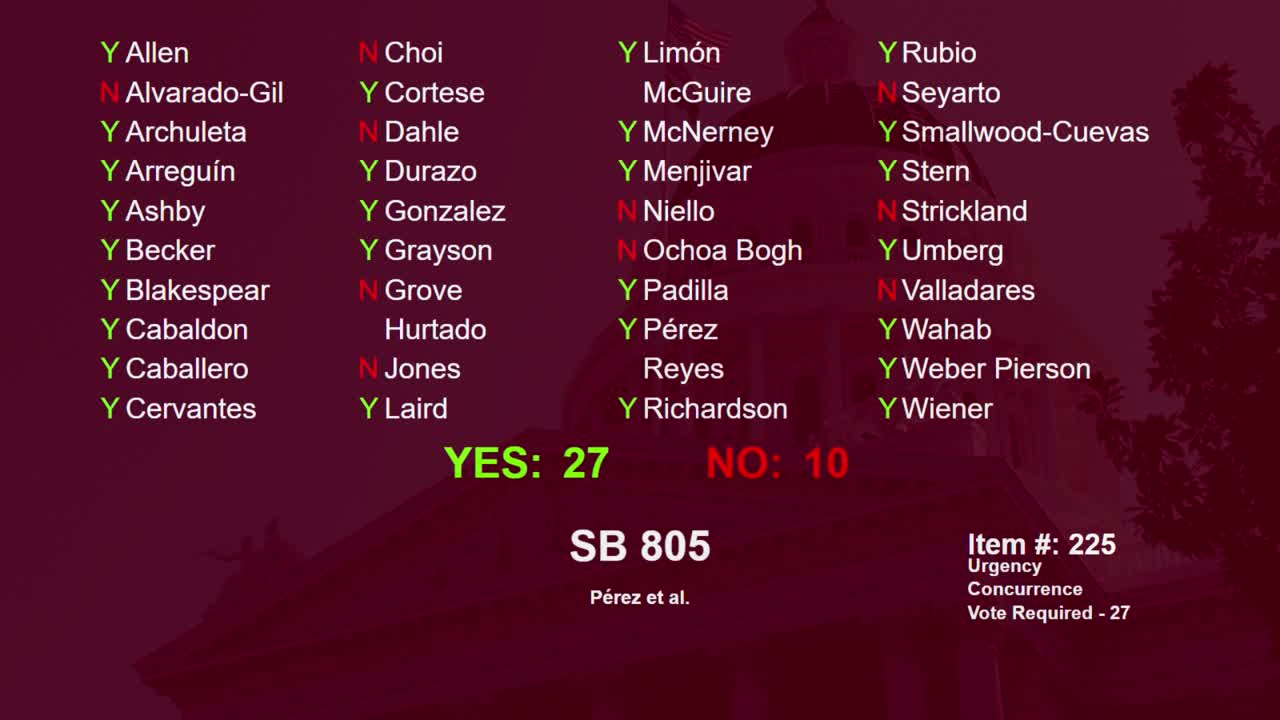 2MIN
Senate Floor
 31SEC
Senate Standing Committee on Appropriations
 39MIN
Senate Standing Committee on Health
 1MIN
Assembly Floor
 15MIN
Assembly Standing Committee on Health


Bill Co-Author(s):