AB 1273: Public utilities: ratesetting proceedings: local publicly owned electric utilities: California Renewables Portfolio Standard Program.
- Session Year: 2025-2026
- House: Assembly
- Latest Version Date: 2025-09-16
Current Status:
Failed
(2026-01-22: Consideration of Governor's veto stricken from file.)
Introduced
In Committee
Awaiting First Chamber Vote
Passed First Chamber
In Committee
Awaiting Second Chamber Vote
Passed Second Chamber
Enacted
What does this bill do?
The bill stops the California Public Utilities Commission from putting on its consent agenda any ratesetting decision that would raise rates for customers of an electric company with a revenue requirement over $1 billion. It also requires at least a 30‑minute public comment period before voting on any ratesetting decision that would raise customer rates by more than 5%, unless too few people wish to speak. The bill extends an existing rule allowing local publicly owned electric utilities (city or local government utilities) that get over 40% of sales from certain large hydro contracts in effect on January 1, 2018, to use that exemption for multiyear compliance periods set after 2030.
The summary is provided by generative AI which can make mistakes. For original language, please view the details in the table below.
Existing law vests the Public Utilities Commission (PUC) with regulatory authority over public utilities, including electrical corporations. Existing law requires all charges demanded or received by a public utility for a product or commodity furnished or to be furnished or a service rendered or to be rendered to be just and reasonable. Existing law, except as provided, prohibits a public utility from changing a rate unless there is a showing before the PUC and a finding by the PUC that the new rate is justified. Existing law requires the PUC to publish and maintain on its internet website particular documents regarding the PUCs agendas, actions, decisions, resolutions, rules, and other information.
This bill would prohibit the PUC from placing the consideration of a decision in a ratesetting proceeding that would result in an increase in rates to customers of an electrical corporation that has a revenue requirement that exceeds $1,000,000,000 on its consent agenda. The bill would, except as provided, require the PUC to provide, at a meeting to vote on a decision of a ratesetting proceeding that increases the rates of an electrical corporations customers by more than 5%, before its vote on the decision, a public comment period of at least 30 minutes on the decision.
Under existing law, the California Renewables Portfolio Standard Program requires retail sellers and local publicly owned electric utilities to procure a minimum quantity of electricity products from eligible renewable energy resources during certain compliance periods up to December 31, 2030. Existing law provides that a local publicly owned electric utility is not required to procure a certain amount of eligible renewable energy resources if, during a year within those compliance periods, the local publicly owned electric utility receives more than 40% of its retail sales from large hydroelectric generation under an ownership agreement or contract in effect as of January 1, 2018. Existing law authorizes the State Energy Resources Conservation and Development Commission (Energy Commission) to establish appropriate multiyear compliance periods for local publicly owned electric utilities beyond December 31, 2030.
This bill would provide that the provision related to the procurement of eligible renewable energy resources by local publicly owned electric utilities also applies to the compliance periods established by the Energy Commission.
Existing law vests the Public Utilities Commission (PUC) with regulatory authority over public utilities, including electrical corporations. Existing law requires all charges demanded or received by a public utility for a product or commodity furnished or to be furnished or a service rendered or to be rendered to be just and reasonable. Existing law, except as provided, prohibits a public utility from changing a rate unless there is a showing before the PUC and a finding by the PUC that the new rate is justified. Existing law requires the PUC to publish and maintain on its internet website particular documents regarding the PUCs agendas, actions, decisions, resolutions, rules, and other information.
This bill would prohibit the PUC from placing the consideration of a decision in a ratesetting proceeding that would result in an increase in rates to customers of an electrical corporation ratesetting proceeding that has a revenue requirement that exceeds $1,000,000,000 on its consent calendar. agenda. The bill would, except as provided, require the PUC to provide, at a meeting to vote on a decision of a ratesetting proceeding, proceeding that increases the rates of an electrical corporations customers by more than 5%, before its vote on the ratesetting proceeding, decision, a public comment period of at least 30 minutes on the ratesetting proceeding. decision.
Under existing law, the California Renewables Portfolio Standard Program requires retail sellers and local publicly owned electric utilities to procure a minimum quantity of electricity products from eligible renewable energy resources during certain compliance periods up to December 31, 2030. Existing law provides that a local publicly owned electric utility is not required to procure a certain amount of eligible renewable energy resources if, during a year within those compliance periods, the local publicly owned electric utility receives more than 40% of its retail sales from large hydroelectric generation under an ownership agreement or contract in effect as of January 1, 2018. Existing law authorizes the State Energy Resources Conservation and Development Commission (Energy Commission) to establish appropriate multiyear compliance periods for local publicly owned electric utilities beyond December 31, 2030.
This bill would provide that the provision related to the procurement of eligible renewable energy resources by local publicly owned electric utilities also applies to the compliance periods established by the Energy Commission.
Existing law vests the Public Utilities Commission (PUC) with regulatory authority over public utilities, including electrical corporations. Existing law requires all charges demanded or received by a public utility for a product or commodity furnished or to be furnished or a service rendered or to be rendered to be just and reasonable. Existing law, except as provided, prohibits a public utility from changing a rate unless there is a showing before the PUC and a finding by the PUC that the new rate is justified. Existing law requires the PUC to publish and maintain on its internet website particular documents regarding the PUCs agendas, actions, decisions, resolutions, rules, and other information.
This bill would prohibit the PUC from placing the consideration of an electrical corporation ratesetting proceeding on its consent calendar. The bill would, except as provided, require the PUC to provide, at a meeting to vote on a ratesetting proceeding, before its vote on the ratesetting proceeding, a public comment period for the application of not less than 30 minutes at the hearing to consider and vote on the electrical corporation ratesetting proceeding. of at least 30 minutes on the ratesetting proceeding.
Under existing law, the California Renewables Portfolio Standard Program requires retail sellers and local publicly owned electric utilities to procure a minimum quantity of electricity products from eligible renewable energy resources during certain compliance periods up to December 31, 2030. Existing law provides that a local publicly owned electric utility is not required to procure a certain amount of eligible renewable energy resources if, during a year within those compliance periods, the local publicly owned electric utility receives more than 40% of its retail sales from large hydroelectric generation under an ownership agreement or contract in effect as of January 1, 2018. Existing law authorizes the State Energy Resources Conservation and Development Commission (Energy Commission) to establish appropriate multiyear compliance periods for local publicly owned electric utilities beyond December 31, 2030.
This bill would provide that the provision related to the procurement of eligible renewable energy resources by local publicly owned electric utilities also applies to the compliance periods established by the Energy Commission.
Existing law vests the Public Utilities Commission (PUC) with regulatory authority over public utilities, including electrical corporations. Existing law requires all charges demanded or received by a public utility for a product or commodity furnished or to be furnished or a service rendered or to be rendered to be just and reasonable. Existing law, except as provided, prohibits a public utility from changing a rate unless there is a showing before the Public Utilities Commission PUC and a finding by the commission PUC that the new rate is justified.
This bill would prohibit the commission PUC from placing the consideration of an electrical corporation general rate case ratesetting proceeding on its consent calendar. The bill would, except as provided, require the commission PUC to provide provide, before its vote on the ratesetting proceeding, a public comment period for the application of not less than 30 minutes at the hearing to consider and vote on the electrical corporation general rate case ratesetting proceeding.
Under existing law, the California Renewables Portfolio Standard Program requires retail sellers and local publicly owned electric utilities to procure a minimum quantity of electricity products from eligible renewable energy resources during certain compliance periods up to December 31, 2030. Existing law provides that a local publicly owned electric utility is not required to procure a certain amount of eligible renewable energy resources if, during a year within those compliance periods, the local publicly owned electric utility receives more than 40% of its retail sales from large hydroelectric generation under an ownership agreement or contract in effect as of January 1, 2018. Existing law authorizes the State Energy Resources Conservation and Development Commission (Energy Commission) to establish appropriate multiyear compliance periods for local publicly owned electric utilities beyond December 31, 2030.
This bill would provide that the provision related to the procurement of eligible renewable energy resources by local publicly owned electric utilities also applies to the compliance periods established by the Energy Commission.
Existing law requires all charges demanded or received by a public utility for a product or commodity furnished or to be furnished or a service rendered or to be rendered to be just and reasonable. Existing law, except as provided, prohibits a public utility from changing a rate unless there is a showing before the Public Utilities Commission and a finding by the commission that the new rate is justified.
This bill would prohibit the commission from placing the consideration of an application from an electrical corporation for a rate increase general rate case proceeding on its consent calendar. The bill would, except as provided, require the commission to provide a public comment period for the application of not less than 30 minutes at the hearing considering the application. to consider and vote on the electrical corporation general rate case proceeding.
Existing law requires all charges demanded or received by a public utility for a product or commodity furnished or to be furnished or a service rendered or to be rendered to be just and reasonable. Existing law, except as provided, prohibits a public utility from changing a rate unless there is a showing before the Public Utilities Commission and a finding by the commission that the new rate is justified.
This bill would prohibit the commission from placing the consideration of an application from an electrical corporation for a rate increase on its consent calendar. The bill would, except as provided, require the commission to provide a public comment period for the application of not less than 30 minutes at the hearing considering the application.
(a)(1)Before a meeting at which the commission considers any action or decision, the commission shall make available to the public copies of the agenda and, upon request, documents related to an agenda item that is proposed to be considered by the commission.
(2)The commission shall publish the agenda, documents related to agenda items, and adopted commission decisions in a manner that makes copies of those materials easily available to the public, including publishing those materials on the commissions internet website at the same time as the written agenda and documents related to agenda items are made available to the public.
(b)The commission shall publish and maintain all of the following documents on the commissions internet website:
(1)Until a decision or resolution is adopted and published, all of the commissions proposed and alternate proposed decisions and resolutions.
(2)On or before 10 days following the commissions adoption of a decision or resolution, a copy of that decision or resolution.
(3)The then-current version of the commissions general orders and Rules of Practice and Procedure.
(4)Until final disposition, including disposition of any judicial appeals, of a proceeding in which a ruling is issued, a copy of that ruling.
(5)Until final disposition, including disposition of any judicial appeals, a docket card that lists, by title and date of filing or issuance, all documents filed and all decisions or rulings issued in a proceeding, including the public versions of all prepared oral and written testimony and advice letter filings, protests, and responses.
(c)The commission shall make all of the following information available on the commissions internet website:
(1)Information on how members of the public and ratepayers can gain access to the commissions ratemaking process and information regarding the specific matters to be decided by the commission.
(2)Information on the operation of the office of the public advisor established pursuant to Section 321, and how the public advisor can connect members of the public to persons responsible for specific cases and matters to be decided.
(d)(1)The commission shall not place on its consent agenda of a meeting to vote on the consideration of a decision in a ratesetting proceeding that would result in an increase in rates to customers of an electrical corporation that has a revenue requirement that exceeds one billion dollars ($1,000,000,000).
(2)To ensure that an open discussion of a decision in a ratesetting proceeding that increases the rates of an electrical corporations customers by more than 5 percent occurs, at a meeting to vote on the decision, before its vote on the decision, the commission shall provide a public comment period of at least 30 minutes on the decision, unless there is an insufficient number of members of the public wishing to speak on the decision to require a 30-minute comment period.
SEC. 2.Section 399.30 of the Public Utilities Code is amended to read:399.30.(a)(1)To fulfill unmet long-term generation resource needs, each local publicly owned electric utility shall adopt and implement a renewable energy resources procurement plan that requires the utility to procure a minimum quantity of electricity products from eligible renewable energy resources, including renewable energy credits, as a specified percentage of total kilowatthours sold to the utilitys retail end-use customers, each compliance period, to achieve the targets of subdivision (c).
(2)Beginning January 1, 2019, a local publicly owned electric utility subject to Section 9621 shall incorporate the renewable energy resources procurement plan required by this section as part of a broader integrated resource plan developed and adopted pursuant to Section 9621.
(b)The governing board shall implement procurement targets for a local publicly owned electric utility that require the utility to procure a minimum quantity of eligible renewable energy resources for each of the following compliance periods:
(1)January 1, 2011, to December 31, 2013, inclusive.
(2)January 1, 2014, to December 31, 2016, inclusive.
(3)January 1, 2017, to December 31, 2020, inclusive.
(4)January 1, 2021, to December 31, 2024, inclusive.
(5)January 1, 2025, to December 31, 2027, inclusive.
(6)January 1, 2028, to December 31, 2030, inclusive.
(c)The governing board of a local publicly owned electric utility shall ensure all of the following:
(1)The quantities of eligible renewable energy resources to be procured for the compliance period from January 1, 2011, to December 31, 2013, inclusive, are equal to an average of 20 percent of retail sales.
(2)The quantities of eligible renewable energy resources to be procured for all other compliance periods reflect reasonable progress in each of the intervening years sufficient to ensure that the procurement of electricity products from eligible renewable energy resources achieves 25 percent of retail sales by December 31, 2016, 33 percent by December 31, 2020, 44 percent by December 31, 2024, 52 percent by December 31, 2027, and 60 percent by December 31, 2030. The Energy Commission shall establish appropriate multiyear compliance periods for all subsequent years that require the local publicly owned electric utility to procure not less than 60 percent of retail sales of electricity products from eligible renewable energy resources.
(3)A local publicly owned electric utility shall adopt procurement requirements consistent with Section 399.16.
(4)Beginning January 1, 2014, in calculating the procurement requirements under this article, a local publicly owned electric utility may exclude from its total retail sales the kilowatthours generated by an eligible renewable energy resource that is credited to a participating customer pursuant to a voluntary green pricing or shared renewable generation program. Any exclusion shall be limited to electricity products that do not meet the portfolio content criteria set forth in paragraph (2) or (3) of subdivision (b) of Section 399.16. Any renewable energy credits associated with electricity credited to a participating customer shall not be used for compliance with procurement requirements under this article, shall be retired on behalf of the participating customer, and shall not be further sold, transferred, or otherwise monetized for any purpose. To the extent possible for generation that is excluded from retail sales under this subdivision, a local publicly owned electric utility shall seek to procure those eligible renewable energy resources that are located in reasonable proximity to program participants.
(d)(1)The governing board of a local publicly owned electric utility shall adopt procurement requirements consistent with subparagraph (B) of paragraph (5) of subdivision (a) of, and paragraph (1) of subdivision (b) of, Section 399.13.
(2)The governing board of a local publicly owned electric utility may adopt the following measures:
(A)Conditions that allow for delaying timely compliance consistent with subdivision (b) of Section 399.15.
(B)Cost limitations for procurement expenditures consistent with subdivision (c) of Section 399.15.
(e)The governing board of the local publicly owned electric utility shall adopt a program for the enforcement of this article. The program shall be adopted at a publicly noticed meeting offering all interested parties an opportunity to comment. Not less than 30 days notice shall be given to the public of any meeting held for purposes of adopting the program. Not less than 10 days notice shall be given to the public before any meeting is held to make a substantive change to the program.
(f)Each local publicly owned electric utility shall annually post notice, in accordance with the Ralph M. Brown Act (Chapter 9 (commencing with Section 54950) of Part 1 of Division 2 of Title 5 of the Government Code), whenever its governing body will deliberate in public on its renewable energy resources procurement plan.
(g)A public utility district that receives all of its electricity pursuant to a preference right adopted and authorized by the United States Congress pursuant to Section 4 of the Trinity River Division Act of August 12, 1955 (Public Law 84-386), shall be in compliance with the renewable energy procurement requirements of this article.
(h)For a local publicly owned electric utility that was in existence on or before January 1, 2009, that provides retail electric service to 15,000 or fewer customer accounts in California, and is interconnected to a balancing authority located outside this state but within the WECC, an eligible renewable energy resource includes a facility that is located outside California that is connected to the WECC transmission system, if all of the following conditions are met:
(1)The electricity generated by the facility is procured by the local publicly owned electric utility, is delivered to the balancing authority area in which the local publicly owned electric utility is located, and is not used to fulfill renewable energy procurement requirements of other states.
(2)The local publicly owned electric utility participates in, and complies with, the accounting system administered by the Energy Commission pursuant to this article.
(3)The Energy Commission verifies that the electricity generated by the facility is eligible to meet the renewables portfolio standard procurement requirements.
(i)Notwithstanding subdivision (a), for a local publicly owned electric utility that is a joint powers authority of districts established pursuant to state law on or before January 1, 2005, that furnishes electric services other than to residential customers, and is formed pursuant to the Irrigation District Law (Division 11 (commencing with Section 20500) of the Water Code), the percentage of total kilowatthours sold to the districts retail end-use customers, upon which the renewables portfolio standard procurement requirements in subdivision (b) are calculated, shall be based on the authoritys average retail sales over the previous seven years. If the authority has not furnished electric service for seven years, then the calculation shall be based on average retail sales over the number of completed years during which the authority has provided electric service.
(j)A local publicly owned electric utility in a city and county that only receives greater than 67 percent of its electricity sources from hydroelectric generation located within the state that it owns and operates, and that does not meet the definition of a renewable electrical generation facility pursuant to Section 25741 of the Public Resources Code, shall be required to procure eligible renewable energy resources, including renewable energy credits, to meet only the electricity demands unsatisfied by its hydroelectric generation in any given year, in order to satisfy its renewable energy procurement requirements.
(k)(1)For purposes of this subdivision, large hydroelectric generation means electricity generated from an existing hydroelectric facility located within the state that does not qualify as an eligible renewable energy resource and, as of January 1, 2018, was owned by a local publicly owned electric utility, the federal government as a part of the federal Central Valley Project, or a joint powers agency formed and created pursuant to the Joint Exercise of Powers Act (Chapter 5 (commencing with Section 6500) of Division 7 of Title 1 of the Government Code).
(2)If, during a year within a compliance period set forth in subdivision (b) or (c), a local publicly owned electric utility receives more than 40 percent of its retail sales from large hydroelectric generation under an ownership agreement or contract in effect as of January 1, 2018, it is not required to procure eligible renewable energy resources that exceed the lesser of the following for that year:
(A)The portion of the local publicly owned electric utilitys retail sales unsatisfied by the local publicly owned electric utilitys large hydroelectric generation.
(B)The soft target adopted by the Energy Commission for the intervening years of the relevant compliance period.
(3)An extension or renewal of a procurement agreement shall not be eligible to count towards the determination that the local publicly owned electric utility receives more than 40 percent of its retail sales from large hydroelectric generation in any year. This paragraph shall not apply to any agreement in effect on January 1, 2015, between a local publicly owned electric utility and the Western Area Power Administration or federal government as part of the federal Central Valley Project.
(4)The Energy Commission shall adjust the total quantities of eligible renewable energy resources to be procured by a local publicly owned electric utility for a compliance period to reflect any reductions required pursuant to paragraph (2).
(5)This subdivision does not modify the compliance obligation of a local publicly owned electric utility to satisfy the requirements of subdivision (c) of Section 399.16.
(l)(1)(A)For purposes of this subdivision, unavoidable long-term contracts and ownership agreements means commitments for electricity from a coal-fired powerplant, located outside the state, originally entered into by a local publicly owned electric utility before June 1, 2010, that is not subsequently modified to result in an extension of the duration of the agreement or result in an increase in total quantities of energy delivered during any compliance period set forth in subdivision (b).
(B)The governing board of a local publicly owned electric utility shall demonstrate in its renewable energy resources procurement plan required pursuant to subdivision (a) that any cancellation or divestment of the commitment would result in significant economic harm to its retail customers that cannot be substantially mitigated through resale, transfer to another entity, early closure of the facility, or other feasible measures.
(2)For the compliance period set forth in paragraph (4) of subdivision (b), a local publicly owned electric utility meeting the requirement of subparagraph (B) of paragraph (1) may adjust its renewable energy procurement targets to ensure that the procurement of additional electricity from eligible renewable energy resources, in combination with the procurement of electricity from unavoidable long-term contracts and ownership agreements, does not exceed the total retail sales of the local publicly owned electric utility during that compliance period. The local publicly owned electric utility may limit its procurement of eligible renewable energy resources for that compliance period to no less than an average of 33 percent of its retail sales.
(3)The Energy Commission shall approve any reductions in procurement targets proposed by a local publicly owned electric utility if it determines that the requirements of this subdivision are satisfied.
(m)A local publicly owned electric utility shall retain discretion over both of the following:
(1)The mix of eligible renewable energy resources procured by the utility and those additional generation resources procured by the utility for purposes of ensuring resource adequacy and reliability.
(2)The reasonable costs incurred by the utility for eligible renewable energy resources owned by the utility.
(n)The Energy Commission shall adopt regulations specifying procedures for enforcement of this article. The regulations shall include a public process under which the Energy Commission may issue a notice of violation and correction against a local publicly owned electric utility for failure to comply with this article, and for referral of violations to the State Air Resources Board for penalties pursuant to subdivision (o).
(o)(1)Upon a determination by the Energy Commission that a local publicly owned electric utility has failed to comply with this article, the Energy Commission shall refer the failure to comply with this article to the State Air Resources Board, which may impose penalties to enforce this article consistent with Part 6 (commencing with Section 38580) of Division 25.5 of the Health and Safety Code. Any penalties imposed shall be comparable to those adopted by the commission for noncompliance by retail sellers.
(2)Any penalties collected by the State Air Resources Board pursuant to this article shall be deposited in the Air Pollution Control Fund and, upon appropriation by the Legislature, shall be expended for reducing emissions of air pollution or greenhouse gases within the same geographic area as the local publicly owned electric utility.
(a)(1)Before a meeting at which the commission considers any action or decision, the commission shall make available to the public copies of the agenda and, upon request, documents related to an agenda item that is proposed to be considered by the commission.
(2)The commission shall publish the agenda, documents related to agenda items, and adopted commission decisions in a manner that makes copies of those materials easily available to the public, including publishing those materials on the commissions internet website at the same time as the written agenda and documents related to agenda items are made available to the public.
(b)The commission shall publish and maintain all of the following documents on the commissions internet website:
(1)Until a decision or resolution is adopted and published, all of the commissions proposed and alternate proposed decisions and resolutions.
(2)On or before 10 days following the commissions adoption of a decision or resolution, a copy of that decision or resolution.
(3)The then-current version of the commissions general orders and Rules of Practice and Procedure.
(4)Until final disposition, including disposition of any judicial appeals, of a proceeding in which a ruling is issued, a copy of that ruling.
(5)Until final disposition, including disposition of any judicial appeals, a docket card that lists, by title and date of filing or issuance, all documents filed and all decisions or rulings issued in a proceeding, including the public versions of all prepared oral and written testimony and advice letter filings, protests, and responses.
(c)The commission shall make the all of the following information available on the commissions internet website:
(1)Information on how members of the public and ratepayers can gain access to the commissions ratemaking process and information regarding the specific matters to be decided by the commission commission.
(2)Information on the operation of the office of the public advisor established pursuant to Section 321, and how the public advisor can connect members of the public to persons responsible for specific cases and matters to be decided.
(d)(1)The commission shall not place on its consent agenda of a meeting to vote on the consideration of a decision in a ratesetting proceeding that would result in an increase in rates to customers of an electrical corporation that has annual revenues a revenue requirement that exceed five hundred million dollars ($500,000,000). exceeds one billion dollars ($1,000,000,000).
(2)To ensure that an open discussion of a decision in a ratesetting proceeding that increases the rates of an electrical corporation ratesetting proceeding corporations customers by more than 5 percent occurs, at a meeting to vote on a ratesetting proceeding, the decision, before its vote on the ratesetting proceeding, decision, the commission shall provide a public comment period of at least 30 minutes on the ratesetting proceeding, decision, unless there is an insufficient number of members of the public wishing to speak on the ratesetting proceeding decision to require a 30-minute comment period.
SEC. 2.Section 399.30 of the Public Utilities Code is amended to read:399.30.(a)(1)To fulfill unmet long-term generation resource needs, each local publicly owned electric utility shall adopt and implement a renewable energy resources procurement plan that requires the utility to procure a minimum quantity of electricity products from eligible renewable energy resources, including renewable energy credits, as a specified percentage of total kilowatthours sold to the utilitys retail end-use customers, each compliance period, to achieve the targets of subdivision (c).
(2)Beginning January 1, 2019, a local publicly owned electric utility subject to Section 9621 shall incorporate the renewable energy resources procurement plan required by this section as part of a broader integrated resource plan developed and adopted pursuant to Section 9621.
(b)The governing board shall implement procurement targets for a local publicly owned electric utility that require the utility to procure a minimum quantity of eligible renewable energy resources for each of the following compliance periods:
(1)January 1, 2011, to December 31, 2013, inclusive.
(2)January 1, 2014, to December 31, 2016, inclusive.
(3)January 1, 2017, to December 31, 2020, inclusive.
(4)January 1, 2021, to December 31, 2024, inclusive.
(5)January 1, 2025, to December 31, 2027, inclusive.
(6)January 1, 2028, to December 31, 2030, inclusive.
(c)The governing board of a local publicly owned electric utility shall ensure all of the following:
(1)The quantities of eligible renewable energy resources to be procured for the compliance period from January 1, 2011, to December 31, 2013, inclusive, are equal to an average of 20 percent of retail sales.
(2)The quantities of eligible renewable energy resources to be procured for all other compliance periods reflect reasonable progress in each of the intervening years sufficient to ensure that the procurement of electricity products from eligible renewable energy resources achieves 25 percent of retail sales by December 31, 2016, 33 percent by December 31, 2020, 44 percent by December 31, 2024, 52 percent by December 31, 2027, and 60 percent by December 31, 2030. The Energy Commission shall establish appropriate multiyear compliance periods for all subsequent years that require the local publicly owned electric utility to procure not less than 60 percent of retail sales of electricity products from eligible renewable energy resources.
(3)A local publicly owned electric utility shall adopt procurement requirements consistent with Section 399.16.
(4)Beginning January 1, 2014, in calculating the procurement requirements under this article, a local publicly owned electric utility may exclude from its total retail sales the kilowatthours generated by an eligible renewable energy resource that is credited to a participating customer pursuant to a voluntary green pricing or shared renewable generation program. Any exclusion shall be limited to electricity products that do not meet the portfolio content criteria set forth in paragraph (2) or (3) of subdivision (b) of Section 399.16. Any renewable energy credits associated with electricity credited to a participating customer shall not be used for compliance with procurement requirements under this article, shall be retired on behalf of the participating customer, and shall not be further sold, transferred, or otherwise monetized for any purpose. To the extent possible for generation that is excluded from retail sales under this subdivision, a local publicly owned electric utility shall seek to procure those eligible renewable energy resources that are located in reasonable proximity to program participants.
(d)(1)The governing board of a local publicly owned electric utility shall adopt procurement requirements consistent with subparagraph (B) of paragraph (5) of subdivision (a) of, and paragraph (1) of subdivision (b) of, Section 399.13.
(2)The governing board of a local publicly owned electric utility may adopt the following measures:
(A)Conditions that allow for delaying timely compliance consistent with subdivision (b) of Section 399.15.
(B)Cost limitations for procurement expenditures consistent with subdivision (c) of Section 399.15.
(e)The governing board of the local publicly owned electric utility shall adopt a program for the enforcement of this article. The program shall be adopted at a publicly noticed meeting offering all interested parties an opportunity to comment. Not less than 30 days notice shall be given to the public of any meeting held for purposes of adopting the program. Not less than 10 days notice shall be given to the public before any meeting is held to make a substantive change to the program.
(f)Each local publicly owned electric utility shall annually post notice, in accordance with the Ralph M. Brown Act (Chapter 9 (commencing with Section 54950) of Part 1 of Division 2 of Title 5 of the Government Code), whenever its governing body will deliberate in public on its renewable energy resources procurement plan.
(g)A public utility district that receives all of its electricity pursuant to a preference right adopted and authorized by the United States Congress pursuant to Section 4 of the Trinity River Division Act of August 12, 1955 (Public Law 84-386), shall be in compliance with the renewable energy procurement requirements of this article.
(h)For a local publicly owned electric utility that was in existence on or before January 1, 2009, that provides retail electric service to 15,000 or fewer customer accounts in California, and is interconnected to a balancing authority located outside this state but within the WECC, an eligible renewable energy resource includes a facility that is located outside California that is connected to the WECC transmission system, if all of the following conditions are met:
(1)The electricity generated by the facility is procured by the local publicly owned electric utility, is delivered to the balancing authority area in which the local publicly owned electric utility is located, and is not used to fulfill renewable energy procurement requirements of other states.
(2)The local publicly owned electric utility participates in, and complies with, the accounting system administered by the Energy Commission pursuant to this article.
(3)The Energy Commission verifies that the electricity generated by the facility is eligible to meet the renewables portfolio standard procurement requirements.
(i)Notwithstanding subdivision (a), for a local publicly owned electric utility that is a joint powers authority of districts established pursuant to state law on or before January 1, 2005, that furnishes electric services other than to residential customers, and is formed pursuant to the Irrigation District Law (Division 11 (commencing with Section 20500) of the Water Code), the percentage of total kilowatthours sold to the districts retail end-use customers, upon which the renewables portfolio standard procurement requirements in subdivision (b) are calculated, shall be based on the authoritys average retail sales over the previous seven years. If the authority has not furnished electric service for seven years, then the calculation shall be based on average retail sales over the number of completed years during which the authority has provided electric service.
(j)A local publicly owned electric utility in a city and county that only receives greater than 67 percent of its electricity sources from hydroelectric generation located within the state that it owns and operates, and that does not meet the definition of a renewable electrical generation facility pursuant to Section 25741 of the Public Resources Code, shall be required to procure eligible renewable energy resources, including renewable energy credits, to meet only the electricity demands unsatisfied by its hydroelectric generation in any given year, in order to satisfy its renewable energy procurement requirements.
(k)(1)For purposes of this subdivision, large hydroelectric generation means electricity generated from an existing hydroelectric facility located within the state that does not qualify as an eligible renewable energy resource and, as of January 1, 2018, was owned by a local publicly owned electric utility, the federal government as a part of the federal Central Valley Project, or a joint powers agency formed and created pursuant to the Joint Exercise of Powers Act (Chapter 5 (commencing with Section 6500) of Division 7 of Title 1 of the Government Code).
(2)If, during a year within a compliance period set forth in subdivision (b) or (c), a local publicly owned electric utility receives more than 40 percent of its retail sales from large hydroelectric generation under an ownership agreement or contract in effect as of January 1, 2018, it is not required to procure eligible renewable energy resources that exceed the lesser of the following for that year:
(A)The portion of the local publicly owned electric utilitys retail sales unsatisfied by the local publicly owned electric utilitys large hydroelectric generation.
(B)The soft target adopted by the Energy Commission for the intervening years of the relevant compliance period.
(3)An extension or renewal of a procurement agreement shall not be eligible to count towards the determination that the local publicly owned electric utility receives more than 40 percent of its retail sales from large hydroelectric generation in any year. This paragraph shall not apply to any agreement in effect on January 1, 2015, between a local publicly owned electric utility and the Western Area Power Administration or federal government as part of the federal Central Valley Project.
(4)The Energy Commission shall adjust the total quantities of eligible renewable energy resources to be procured by a local publicly owned electric utility for a compliance period to reflect any reductions required pursuant to paragraph (2).
(5)This subdivision does not modify the compliance obligation of a local publicly owned electric utility to satisfy the requirements of subdivision (c) of Section 399.16.
(l)(1)(A)For purposes of this subdivision, unavoidable long-term contracts and ownership agreements means commitments for electricity from a coal-fired powerplant, located outside the state, originally entered into by a local publicly owned electric utility before June 1, 2010, that is not subsequently modified to result in an extension of the duration of the agreement or result in an increase in total quantities of energy delivered during any compliance period set forth in subdivision (b).
(B)The governing board of a local publicly owned electric utility shall demonstrate in its renewable energy resources procurement plan required pursuant to subdivision (a) that any cancellation or divestment of the commitment would result in significant economic harm to its retail customers that cannot be substantially mitigated through resale, transfer to another entity, early closure of the facility, or other feasible measures.
(2)For the compliance period set forth in paragraph (4) of subdivision (b), a local publicly owned electric utility meeting the requirement of subparagraph (B) of paragraph (1) may adjust its renewable energy procurement targets to ensure that the procurement of additional electricity from eligible renewable energy resources, in combination with the procurement of electricity from unavoidable long-term contracts and ownership agreements, does not exceed the total retail sales of the local publicly owned electric utility during that compliance period. The local publicly owned electric utility may limit its procurement of eligible renewable energy resources for that compliance period to no less than an average of 33 percent of its retail sales.
(3)The Energy Commission shall approve any reductions in procurement targets proposed by a local publicly owned electric utility if it determines that the requirements of this subdivision are satisfied.
(m)A local publicly owned electric utility shall retain discretion over both of the following:
(1)The mix of eligible renewable energy resources procured by the utility and those additional generation resources procured by the utility for purposes of ensuring resource adequacy and reliability.
(2)The reasonable costs incurred by the utility for eligible renewable energy resources owned by the utility.
(n)The Energy Commission shall adopt regulations specifying procedures for enforcement of this article. The regulations shall include a public process under which the Energy Commission may issue a notice of violation and correction against a local publicly owned electric utility for failure to comply with this article, and for referral of violations to the State Air Resources Board for penalties pursuant to subdivision (o).
(o)(1)Upon a determination by the Energy Commission that a local publicly owned electric utility has failed to comply with this article, the Energy Commission shall refer the failure to comply with this article to the State Air Resources Board, which may impose penalties to enforce this article consistent with Part 6 (commencing with Section 38580) of Division 25.5 of the Health and Safety Code. Any penalties imposed shall be comparable to those adopted by the commission for noncompliance by retail sellers.
(2)Any penalties collected by the State Air Resources Board pursuant to this article shall be deposited in the Air Pollution Control Fund and, upon appropriation by the Legislature, shall be expended for reducing emissions of air pollution or greenhouse gases within the same geographic area as the local publicly owned electric utility.
(a)(1)Prior to commencement of any meeting Before a meeting at which commissioners vote on items on the public agenda, the commission considers any action or decision, the commission shall make available to the public copies of the agenda, and agenda and, upon request, any agenda item documents related to an agenda item that are is proposed to be considered by the commission for action or decision at a commission meeting. commission.
(2)In addition, the The commission shall publish the agenda, agenda item documents, documents related to agenda items, and adopted commission decisions in a manner that makes copies of them those materials easily available to the public, including publishing those documents materials on the Internet. Publication of the agenda and agenda item documents shall occur on the Internet commissions internet website at the same time as the written agenda and agenda item documents related to agenda items are made available to the public.
(b)The commission shall publish and maintain all of the following documents on the Internet: the commissions internet website:
(1)Each Until a decision or resolution is adopted and published, all of the commissions proposed and alternate proposed decisions and resolutions, until the decision or resolution is adopted and published. resolutions.
(2)Each of the commissions adopted decisions and resolutions. The publication shall occur within On or before 10 days of following the commissions adoption of each a decision or resolution by the commission. resolution, a copy of that decision or resolution.
(3)The then-current version of the commissions general orders and Rules of Practice and Procedure.
(4)Each of the commissions rulings. The commission shall maintain those rulings on its Internet Web site until Until final disposition, including disposition of any judicial appeals, of the respective proceedings of a proceeding in which the rulings were issued. a ruling is issued, a copy of that ruling.
(5)A Until final disposition, including disposition of any judicial appeals, a docket card that lists, by title and date of filing or issuance, all documents filed and all decisions or rulings issued in those proceedings, a proceeding, including the public versions of all prepared oral and written testimony and advice letter filings, protests, and responses. The commission shall maintain the docket card until final disposition, including disposition of any judicial appeals, of the corresponding proceedings.
(c)The commission shall make the all of the following information available on the Internet: commissions internet website:
(1)Information on how members of the public and ratepayers can gain access to the commissions ratemaking process and information regarding the specific matters to be decided. decided by the commission
(2)Information on the operation of the office of the public advisor established in pursuant to Section 321 321, and how the public advisor can connect members of the public to persons responsible for specific cases and matters to be decided.
(d)(1)The commission shall not place on its consent agenda of a meeting to vote on the consideration of a ratesetting proceeding that would result in an increase in rates to customers of an electrical corporation that has annual revenues that exceed five hundred million dollars ($500,000,000).
(2)To ensure that an open discussion of an electrical corporation ratesetting proceeding occurs, at a meeting to vote on a ratesetting proceeding, before its vote on the ratesetting proceeding, the commission shall provide a public comment period of at least 30 minutes on the ratesetting proceeding, unless there is an insufficient number of members of the public wishing to speak on the ratesetting proceeding to require a 30-minute comment period.
SECTION 1.SEC. 2.Section 399.30 of the Public Utilities Code is amended to read:399.30.(a)(1)To fulfill unmet long-term generation resource needs, each local publicly owned electric utility shall adopt and implement a renewable energy resources procurement plan that requires the utility to procure a minimum quantity of electricity products from eligible renewable energy resources, including renewable energy credits, as a specified percentage of total kilowatthours sold to the utilitys retail end-use customers, each compliance period, to achieve the targets of subdivision (c).
(2)Beginning January 1, 2019, a local publicly owned electric utility subject to Section 9621 shall incorporate the renewable energy resources procurement plan required by this section as part of a broader integrated resource plan developed and adopted pursuant to Section 9621.
(b)The governing board shall implement procurement targets for a local publicly owned electric utility that require the utility to procure a minimum quantity of eligible renewable energy resources for each of the following compliance periods:
(1)January 1, 2011, to December 31, 2013, inclusive.
(2)January 1, 2014, to December 31, 2016, inclusive.
(3)January 1, 2017, to December 31, 2020, inclusive.
(4)January 1, 2021, to December 31, 2024, inclusive.
(5)January 1, 2025, to December 31, 2027, inclusive.
(6)January 1, 2028, to December 31, 2030, inclusive.
(c)The governing board of a local publicly owned electric utility shall ensure all of the following:
(1)The quantities of eligible renewable energy resources to be procured for the compliance period from January 1, 2011, to December 31, 2013, inclusive, are equal to an average of 20 percent of retail sales.
(2)The quantities of eligible renewable energy resources to be procured for all other compliance periods reflect reasonable progress in each of the intervening years sufficient to ensure that the procurement of electricity products from eligible renewable energy resources achieves 25 percent of retail sales by December 31, 2016, 33 percent by December 31, 2020, 44 percent by December 31, 2024, 52 percent by December 31, 2027, and 60 percent by December 31, 2030. The Energy Commission shall establish appropriate multiyear compliance periods for all subsequent years that require the local publicly owned electric utility to procure not less than 60 percent of retail sales of electricity products from eligible renewable energy resources.
(3)A local publicly owned electric utility shall adopt procurement requirements consistent with Section 399.16.
(4)Beginning January 1, 2014, in calculating the procurement requirements under this article, a local publicly owned electric utility may exclude from its total retail sales the kilowatthours generated by an eligible renewable energy resource that is credited to a participating customer pursuant to a voluntary green pricing or shared renewable generation program. Any exclusion shall be limited to electricity products that do not meet the portfolio content criteria set forth in paragraph (2) or (3) of subdivision (b) of Section 399.16. Any renewable energy credits associated with electricity credited to a participating customer shall not be used for compliance with procurement requirements under this article, shall be retired on behalf of the participating customer, and shall not be further sold, transferred, or otherwise monetized for any purpose. To the extent possible for generation that is excluded from retail sales under this subdivision, a local publicly owned electric utility shall seek to procure those eligible renewable energy resources that are located in reasonable proximity to program participants.
(d)(1)The governing board of a local publicly owned electric utility shall adopt procurement requirements consistent with subparagraph (B) of paragraph (5) of subdivision (a) of, and paragraph (1) of subdivision (b) of, Section 399.13.
(2)The governing board of a local publicly owned electric utility may adopt the following measures:
(A)Conditions that allow for delaying timely compliance consistent with subdivision (b) of Section 399.15.
(B)Cost limitations for procurement expenditures consistent with subdivision (c) of Section 399.15.
(e)The governing board of the local publicly owned electric utility shall adopt a program for the enforcement of this article. The program shall be adopted at a publicly noticed meeting offering all interested parties an opportunity to comment. Not less than 30 days notice shall be given to the public of any meeting held for purposes of adopting the program. Not less than 10 days notice shall be given to the public before any meeting is held to make a substantive change to the program.
(f)Each local publicly owned electric utility shall annually post notice, in accordance with the Ralph M. Brown Act (Chapter 9 (commencing with Section 54950) of Part 1 of Division 2 of Title 5 of the Government Code), whenever its governing body will deliberate in public on its renewable energy resources procurement plan.
(g)A public utility district that receives all of its electricity pursuant to a preference right adopted and authorized by the United States Congress pursuant to Section 4 of the Trinity River Division Act of August 12, 1955 (Public Law 84-386), shall be in compliance with the renewable energy procurement requirements of this article.
(h)For a local publicly owned electric utility that was in existence on or before January 1, 2009, that provides retail electric service to 15,000 or fewer customer accounts in California, and is interconnected to a balancing authority located outside this state but within the WECC, an eligible renewable energy resource includes a facility that is located outside California that is connected to the WECC transmission system, if all of the following conditions are met:
(1)The electricity generated by the facility is procured by the local publicly owned electric utility, is delivered to the balancing authority area in which the local publicly owned electric utility is located, and is not used to fulfill renewable energy procurement requirements of other states.
(2)The local publicly owned electric utility participates in, and complies with, the accounting system administered by the Energy Commission pursuant to this article.
(3)The Energy Commission verifies that the electricity generated by the facility is eligible to meet the renewables portfolio standard procurement requirements.
(i)Notwithstanding subdivision (a), for a local publicly owned electric utility that is a joint powers authority of districts established pursuant to state law on or before January 1, 2005, that furnishes electric services other than to residential customers, and is formed pursuant to the Irrigation District Law (Division 11 (commencing with Section 20500) of the Water Code), the percentage of total kilowatthours sold to the districts retail end-use customers, upon which the renewables portfolio standard procurement requirements in subdivision (b) are calculated, shall be based on the authoritys average retail sales over the previous seven years. If the authority has not furnished electric service for seven years, then the calculation shall be based on average retail sales over the number of completed years during which the authority has provided electric service.
(j)A local publicly owned electric utility in a city and county that only receives greater than 67 percent of its electricity sources from hydroelectric generation located within the state that it owns and operates, and that does not meet the definition of a renewable electrical generation facility pursuant to Section 25741 of the Public Resources Code, shall be required to procure eligible renewable energy resources, including renewable energy credits, to meet only the electricity demands unsatisfied by its hydroelectric generation in any given year, in order to satisfy its renewable energy procurement requirements.
(k)(1)For purposes of this subdivision, large hydroelectric generation means electricity generated from an existing hydroelectric facility located within the state that does not qualify as an eligible renewable energy resource and, as of January 1, 2018, was owned by a local publicly owned electric utility, the federal government as a part of the federal Central Valley Project, or a joint powers agency formed and created pursuant to the Joint Exercise of Powers Act (Chapter 5 (commencing with Section 6500) of Division 7 of Title 1 of the Government Code).
(2)If, during a year within a compliance period set forth in subdivision (b) or (c), a local publicly owned electric utility receives more than 40 percent of its retail sales from large hydroelectric generation under an ownership agreement or contract in effect as of January 1, 2018, it is not required to procure eligible renewable energy resources that exceed the lesser of the following for that year:
(A)The portion of the local publicly owned electric utilitys retail sales unsatisfied by the local publicly owned electric utilitys large hydroelectric generation.
(B)The soft target adopted by the Energy Commission for the intervening years of the relevant compliance period.
(3)An extension or renewal of a procurement agreement shall not be eligible to count towards the determination that the local publicly owned electric utility receives more than 40 percent of its retail sales from large hydroelectric generation in any year. This paragraph shall not apply to any agreement in effect on January 1, 2015, between a local publicly owned electric utility and the Western Area Power Administration or federal government as part of the federal Central Valley Project.
(4)The Energy Commission shall adjust the total quantities of eligible renewable energy resources to be procured by a local publicly owned electric utility for a compliance period to reflect any reductions required pursuant to paragraph (2).
(5)This subdivision does not modify the compliance obligation of a local publicly owned electric utility to satisfy the requirements of subdivision (c) of Section 399.16.
(l)(1)(A)For purposes of this subdivision, unavoidable long-term contracts and ownership agreements means commitments for electricity from a coal-fired powerplant, located outside the state, originally entered into by a local publicly owned electric utility before June 1, 2010, that is not subsequently modified to result in an extension of the duration of the agreement or result in an increase in total quantities of energy delivered during any compliance period set forth in subdivision (b).
(B)The governing board of a local publicly owned electric utility shall demonstrate in its renewable energy resources procurement plan required pursuant to subdivision (a) that any cancellation or divestment of the commitment would result in significant economic harm to its retail customers that cannot be substantially mitigated through resale, transfer to another entity, early closure of the facility, or other feasible measures.
(2)For the compliance period set forth in paragraph (4) of subdivision (b), a local publicly owned electric utility meeting the requirement of subparagraph (B) of paragraph (1) may adjust its renewable energy procurement targets to ensure that the procurement of additional electricity from eligible renewable energy resources, in combination with the procurement of electricity from unavoidable long-term contracts and ownership agreements, does not exceed the total retail sales of the local publicly owned electric utility during that compliance period. The local publicly owned electric utility may limit its procurement of eligible renewable energy resources for that compliance period to no less than an average of 33 percent of its retail sales.
(3)The Energy Commission shall approve any reductions in procurement targets proposed by a local publicly owned electric utility if it determines that the requirements of this subdivision are satisfied.
(m)A local publicly owned electric utility shall retain discretion over both of the following:
(1)The mix of eligible renewable energy resources procured by the utility and those additional generation resources procured by the utility for purposes of ensuring resource adequacy and reliability.
(2)The reasonable costs incurred by the utility for eligible renewable energy resources owned by the utility.
(n)The Energy Commission shall adopt regulations specifying procedures for enforcement of this article. The regulations shall include a public process under which the Energy Commission may issue a notice of violation and correction against a local publicly owned electric utility for failure to comply with this article, and for referral of violations to the State Air Resources Board for penalties pursuant to subdivision (o).
(o)(1)Upon a determination by the Energy Commission that a local publicly owned electric utility has failed to comply with this article, the Energy Commission shall refer the failure to comply with this article to the State Air Resources Board, which may impose penalties to enforce this article consistent with Part 6 (commencing with Section 38580) of Division 25.5 of the Health and Safety Code. Any penalties imposed shall be comparable to those adopted by the commission for noncompliance by retail sellers.
(2)Any penalties collected by the State Air Resources Board pursuant to this article shall be deposited in the Air Pollution Control Fund and, upon appropriation by the Legislature, shall be expended for reducing emissions of air pollution or greenhouse gases within the same geographic area as the local publicly owned electric utility.
SEC. 2.Section 454 of the Public Utilities Code is amended to read:454.(a)Except as provided in Section 455, a public utility shall not change a rate or alter a classification, contract, practice, or rule as to result in a new rate, except upon a showing before the commission and a finding by the commission that the new rate is justified. Whenever an electrical, gas, heat, telephone, water, or sewer system corporation files an application to change a rate, other than a change reflecting and passing through to customers only new costs to the corporation that do not result in changes in revenue allocation, for the services or commodities furnished by it, the corporation shall furnish to its customers affected by the proposed rate change notice of its application to the commission for approval of the new rate. This notice requirement does not apply to a rate change proposed by a corporation pursuant to an advice letter submitted to the commission in accordance with commission procedures for this means of submission. The procedures for advice letters may include provision for notice to customers or subscribers on a case-by-case basis, as determined by the commission. The corporation may include the notice with the regular bill for charges transmitted to the customers within 45 days if the corporation operates on a 30-day billing cycle, or within 75 days if the corporation operates on a 60-day billing cycle. If more than one application to change a rate is filed within a single billing cycle, the corporation may combine the notices into a single notice if the applications are separately identified. The notice shall state the amount of the proposed rate change expressed in both dollar and percentage terms for the entire rate change and for each customer classification, a brief statement of the reasons the change is required or sought, the mailing and, if available, email address of the commission to which a customer inquiry may be directed regarding how to participate in, or receive further notices regarding the date, time, or place of, a hearing on the application, and the mailing address of the corporation to which a customer inquiry relative to the proposed rate change may be directed.(b)For a water corporation with more than 2,000 service connections, the notice required in subdivision (a) shall include estimated rate impacts on the various customer classes of the corporation. The commission may require the corporation to inform customers in a separate letter or through a bill insert, at the corporations discretion, of the outcome of the general rate case, within 60 days if the corporation operates on a 30-day billing cycle, or within 90 days if the corporation operates on a 60-day billing cycle, of the commissions final decision, including the approved rates and the approved capital projects that will subsequently be executed by way of an advice letter.(c)The commission may adopt rules it considers reasonable and proper for each class of public utility providing for the nature of the showing required to be made in support of proposed rate changes, the form and manner of the presentation of the showing, with or without a hearing, and the procedure to be followed in the consideration thereof. Rules applicable to common carriers may provide for the publication and filing of a proposed rate change together with a written showing in support thereof, giving notice of the filing and showing in support thereof to the public, granting an opportunity for protests thereto, and to the consideration of, and action on, the showing and any protests filed thereto by the commission, with or without hearing. However, the proposed rate change does not become effective until it has been approved by the commission.(d)The commission shall permit individual public utility customers and subscribers affected by a proposed rate change, and organizations formed to represent their interests, to testify at a hearing on the proposed rate change, except that the presiding officer need not allow repetitive or irrelevant testimony and may conduct the hearing in an efficient manner.(e)(1)The commission shall not place the consideration of an electrical corporation ratesetting proceeding on its consent calendar.(2)To ensure that an open discussion of an electrical corporation ratesetting proceeding occurs, at the hearing to consider and vote on the ratesetting proceeding, the commission shall provide, before its vote on the ratesetting proceeding, a public comment period for the application of not less than 30 minutes. This paragraph does not apply if there is an insufficient number of commenters on the application to require a 30-minute comment period.(a)(1)To fulfill unmet long-term generation resource needs, each local publicly owned electric utility shall adopt and implement a renewable energy resources procurement plan that requires the utility to procure a minimum quantity of electricity products from eligible renewable energy resources, including renewable energy credits, as a specified percentage of total kilowatthours sold to the utilitys retail end-use customers, each compliance period, to achieve the targets of subdivision (c).
(2)Beginning January 1, 2019, a local publicly owned electric utility subject to Section 9621 shall incorporate the renewable energy resources procurement plan required by this section as part of a broader integrated resource plan developed and adopted pursuant to Section 9621.
(b)The governing board shall implement procurement targets for a local publicly owned electric utility that require the utility to procure a minimum quantity of eligible renewable energy resources for each of the following compliance periods:
(1)January 1, 2011, to December 31, 2013, inclusive.
(2)January 1, 2014, to December 31, 2016, inclusive.
(3)January 1, 2017, to December 31, 2020, inclusive.
(4)January 1, 2021, to December 31, 2024, inclusive.
(5)January 1, 2025, to December 31, 2027, inclusive.
(6)January 1, 2028, to December 31, 2030, inclusive.
(c)The governing board of a local publicly owned electric utility shall ensure all of the following:
(1)The quantities of eligible renewable energy resources to be procured for the compliance period from January 1, 2011, to December 31, 2013, inclusive, are equal to an average of 20 percent of retail sales.
(2)The quantities of eligible renewable energy resources to be procured for all other compliance periods reflect reasonable progress in each of the intervening years sufficient to ensure that the procurement of electricity products from eligible renewable energy resources achieves 25 percent of retail sales by December 31, 2016, 33 percent by December 31, 2020, 44 percent by December 31, 2024, 52 percent by December 31, 2027, and 60 percent by December 31, 2030. The Energy Commission shall establish appropriate multiyear compliance periods for all subsequent years that require the local publicly owned electric utility to procure not less than 60 percent of retail sales of electricity products from eligible renewable energy resources.
(3)A local publicly owned electric utility shall adopt procurement requirements consistent with Section 399.16.
(4)Beginning January 1, 2014, in calculating the procurement requirements under this article, a local publicly owned electric utility may exclude from its total retail sales the kilowatthours generated by an eligible renewable energy resource that is credited to a participating customer pursuant to a voluntary green pricing or shared renewable generation program. Any exclusion shall be limited to electricity products that do not meet the portfolio content criteria set forth in paragraph (2) or (3) of subdivision (b) of Section 399.16. Any renewable energy credits associated with electricity credited to a participating customer shall not be used for compliance with procurement requirements under this article, shall be retired on behalf of the participating customer, and shall not be further sold, transferred, or otherwise monetized for any purpose. To the extent possible for generation that is excluded from retail sales under this subdivision, a local publicly owned electric utility shall seek to procure those eligible renewable energy resources that are located in reasonable proximity to program participants.
(d)(1)The governing board of a local publicly owned electric utility shall adopt procurement requirements consistent with subparagraph (B) of paragraph (5) of subdivision (a) of, and paragraph (1) of subdivision (b) of, Section 399.13.
(2)The governing board of a local publicly owned electric utility may adopt the following measures:
(A)Conditions that allow for delaying timely compliance consistent with subdivision (b) of Section 399.15.
(B)Cost limitations for procurement expenditures consistent with subdivision (c) of Section 399.15.
(e)The governing board of the local publicly owned electric utility shall adopt a program for the enforcement of this article. The program shall be adopted at a publicly noticed meeting offering all interested parties an opportunity to comment. Not less than 30 days notice shall be given to the public of any meeting held for purposes of adopting the program. Not less than 10 days notice shall be given to the public before any meeting is held to make a substantive change to the program.
(f)Each local publicly owned electric utility shall annually post notice, in accordance with the Ralph M. Brown Act (Chapter 9 (commencing with Section 54950) of Part 1 of Division 2 of Title 5 of the Government Code), whenever its governing body will deliberate in public on its renewable energy resources procurement plan.
(g)A public utility district that receives all of its electricity pursuant to a preference right adopted and authorized by the United States Congress pursuant to Section 4 of the Trinity River Division Act of August 12, 1955 (Public Law 84-386), shall be in compliance with the renewable energy procurement requirements of this article.
(h)For a local publicly owned electric utility that was in existence on or before January 1, 2009, that provides retail electric service to 15,000 or fewer customer accounts in California, and is interconnected to a balancing authority located outside this state but within the WECC, an eligible renewable energy resource includes a facility that is located outside California that is connected to the WECC transmission system, if all of the following conditions are met:
(1)The electricity generated by the facility is procured by the local publicly owned electric utility, is delivered to the balancing authority area in which the local publicly owned electric utility is located, and is not used to fulfill renewable energy procurement requirements of other states.
(2)The local publicly owned electric utility participates in, and complies with, the accounting system administered by the Energy Commission pursuant to this article.
(3)The Energy Commission verifies that the electricity generated by the facility is eligible to meet the renewables portfolio standard procurement requirements.
(i)Notwithstanding subdivision (a), for a local publicly owned electric utility that is a joint powers authority of districts established pursuant to state law on or before January 1, 2005, that furnishes electric services other than to residential customers, and is formed pursuant to the Irrigation District Law (Division 11 (commencing with Section 20500) of the Water Code), the percentage of total kilowatthours sold to the districts retail end-use customers, upon which the renewables portfolio standard procurement requirements in subdivision (b) are calculated, shall be based on the authoritys average retail sales over the previous seven years. If the authority has not furnished electric service for seven years, then the calculation shall be based on average retail sales over the number of completed years during which the authority has provided electric service.
(j)A local publicly owned electric utility in a city and county that only receives greater than 67 percent of its electricity sources from hydroelectric generation located within the state that it owns and operates, and that does not meet the definition of a renewable electrical generation facility pursuant to Section 25741 of the Public Resources Code, shall be required to procure eligible renewable energy resources, including renewable energy credits, to meet only the electricity demands unsatisfied by its hydroelectric generation in any given year, in order to satisfy its renewable energy procurement requirements.
(k)(1)For purposes of this subdivision, large hydroelectric generation means electricity generated from an existing hydroelectric facility located within the state that does not qualify as an eligible renewable energy resource and, as of January 1, 2018, was owned by a local publicly owned electric utility, the federal government as a part of the federal Central Valley Project, or a joint powers agency formed and created pursuant to the Joint Exercise of Powers Act (Chapter 5 (commencing with Section 6500) of Division 7 of Title 1 of the Government Code).
(2)If, during a year within a compliance period set forth in subdivision (b), (b) or (c), a local publicly owned electric utility receives more than 40 percent of its retail sales from large hydroelectric generation under an ownership agreement or contract in effect as of January 1, 2018, it is not required to procure eligible renewable energy resources that exceed the lesser of the following for that year:
(A)The portion of the local publicly owned electric utilitys retail sales unsatisfied by the local publicly owned electric utilitys large hydroelectric generation.
(B)The soft target adopted by the Energy Commission for the intervening years of the relevant compliance period.
(3)An extension or renewal of a procurement agreement shall not be eligible to count towards the determination that the local publicly owned electric utility receives more than 40 percent of its retail sales from large hydroelectric generation in any year. This paragraph shall not apply to any agreement in effect on January 1, 2015, between a local publicly owned electric utility and the Western Area Power Administration or federal government as part of the federal Central Valley Project.
(4)The Energy Commission shall adjust the total quantities of eligible renewable energy resources to be procured by a local publicly owned electric utility for a compliance period to reflect any reductions required pursuant to paragraph (2).
(5)This subdivision does not modify the compliance obligation of a local publicly owned electric utility to satisfy the requirements of subdivision (c) of Section 399.16.
(l)(1)(A)For purposes of this subdivision, unavoidable long-term contracts and ownership agreements means commitments for electricity from a coal-fired powerplant, located outside the state, originally entered into by a local publicly owned electric utility before June 1, 2010, that is not subsequently modified to result in an extension of the duration of the agreement or result in an increase in total quantities of energy delivered during any compliance period set forth in subdivision (b).
(B)The governing board of a local publicly owned electric utility shall demonstrate in its renewable energy resources procurement plan required pursuant to subdivision (a) that any cancellation or divestment of the commitment would result in significant economic harm to its retail customers that cannot be substantially mitigated through resale, transfer to another entity, early closure of the facility, or other feasible measures.
(2)For the compliance period set forth in paragraph (4) of subdivision (b), a local publicly owned electric utility meeting the requirement of subparagraph (B) of paragraph (1) may adjust its renewable energy procurement targets to ensure that the procurement of additional electricity from eligible renewable energy resources, in combination with the procurement of electricity from unavoidable long-term contracts and ownership agreements, does not exceed the total retail sales of the local publicly owned electric utility during that compliance period. The local publicly owned electric utility may limit its procurement of eligible renewable energy resources for that compliance period to no less than an average of 33 percent of its retail sales.
(3)The Energy Commission shall approve any reductions in procurement targets proposed by a local publicly owned electric utility if it determines that the requirements of this subdivision are satisfied.
(m)A local publicly owned electric utility shall retain discretion over both of the following:
(1)The mix of eligible renewable energy resources procured by the utility and those additional generation resources procured by the utility for purposes of ensuring resource adequacy and reliability.
(2)The reasonable costs incurred by the utility for eligible renewable energy resources owned by the utility.
(n)The Energy Commission shall adopt regulations specifying procedures for enforcement of this article. The regulations shall include a public process under which the Energy Commission may issue a notice of violation and correction against a local publicly owned electric utility for failure to comply with this article, and for referral of violations to the State Air Resources Board for penalties pursuant to subdivision (o).
(o)(1)Upon a determination by the Energy Commission that a local publicly owned electric utility has failed to comply with this article, the Energy Commission shall refer the failure to comply with this article to the State Air Resources Board, which may impose penalties to enforce this article consistent with Part 6 (commencing with Section 38580) of Division 25.5 of the Health and Safety Code. Any penalties imposed shall be comparable to those adopted by the commission for noncompliance by retail sellers.
(2)Any penalties collected by the State Air Resources Board pursuant to this article shall be deposited in the Air Pollution Control Fund and, upon appropriation by the Legislature, shall be expended for reducing emissions of air pollution or greenhouse gases within the same geographic area as the local publicly owned electric utility.
SECTION 1.SEC. 2.Section 454 of the Public Utilities Code is amended to read:454.(a)Except as provided in Section 455, a public utility shall not change a rate or alter a classification, contract, practice, or rule as to result in a new rate, except upon a showing before the commission and a finding by the commission that the new rate is justified. Whenever an electrical, gas, heat, telephone, water, or sewer system corporation files an application to change a rate, other than a change reflecting and passing through to customers only new costs to the corporation that do not result in changes in revenue allocation, for the services or commodities furnished by it, the corporation shall furnish to its customers affected by the proposed rate change notice of its application to the commission for approval of the new rate. This notice requirement does not apply to a rate change proposed by a corporation pursuant to an advice letter submitted to the commission in accordance with commission procedures for this means of submission. The procedures for advice letters may include provision for notice to customers or subscribers on a case-by-case basis, as determined by the commission. The corporation may include the notice with the regular bill for charges transmitted to the customers within 45 days if the corporation operates on a 30-day billing cycle, or within 75 days if the corporation operates on a 60-day billing cycle. If more than one application to change a rate is filed within a single billing cycle, the corporation may combine the notices into a single notice if the applications are separately identified. The notice shall state the amount of the proposed rate change expressed in both dollar and percentage terms for the entire rate change and for each customer classification, a brief statement of the reasons the change is required or sought, the mailing and, if available, email address of the commission to which a customer inquiry may be directed regarding how to participate in, or receive further notices regarding the date, time, or place of, a hearing on the application, and the mailing address of the corporation to which a customer inquiry relative to the proposed rate change may be directed.
(b)For a water corporation with more than 2,000 service connections, the notice required in subdivision (a) shall include estimated rate impacts on the various customer classes of the corporation. The commission may require the corporation to inform customers in a separate letter or through a bill insert, at the corporations discretion, of the outcome of the general rate case, within 60 days if the corporation operates on a 30-day billing cycle, or within 90 days if the corporation operates on a 60-day billing cycle, of the commissions final decision, including the approved rates and the approved capital projects that will subsequently be executed by way of an advice letter.
(c)The commission may adopt rules it considers reasonable and proper for each class of public utility providing for the nature of the showing required to be made in support of proposed rate changes, the form and manner of the presentation of the showing, with or without a hearing, and the procedure to be followed in the consideration thereof. Rules applicable to common carriers may provide for the publication and filing of a proposed rate change together with a written showing in support thereof, giving notice of the filing and showing in support thereof to the public, granting an opportunity for protests thereto, and to the consideration of, and action on, the showing and any protests filed thereto by the commission, with or without hearing. However, the proposed rate change does not become effective until it has been approved by the commission.
(d)The commission shall permit individual public utility customers and subscribers affected by a proposed rate change, and organizations formed to represent their interests, to testify at a hearing on the proposed rate change, except that the presiding officer need not allow repetitive or irrelevant testimony and may conduct the hearing in an efficient manner.
(e)(1)The commission shall not place the consideration of an electrical corporation general rate case ratesetting proceeding on its consent calendar.
(2)To ensure that an open discussion of an electrical corporation general rate case ratesetting proceeding occurs, at the hearing to consider and vote on the general rate case ratesetting proceeding, the commission shall provide provide, before its vote on the ratesetting proceeding, a public comment period for the application of not less than 30 minutes. This paragraph does not apply if there is an insufficient number of commenters on the application to require a 30-minute comment period.
(a)Except as provided in Section 455, a public utility shall not change a rate or alter a classification, contract, practice, or rule as to result in a new rate, except upon a showing before the commission and a finding by the commission that the new rate is justified. Whenever an electrical, gas, heat, telephone, water, or sewer system corporation files an application to change a rate, other than a change reflecting and passing through to customers only new costs to the corporation that do not result in changes in revenue allocation, for the services or commodities furnished by it, the corporation shall furnish to its customers affected by the proposed rate change notice of its application to the commission for approval of the new rate. This notice requirement does not apply to a rate change proposed by a corporation pursuant to an advice letter submitted to the commission in accordance with commission procedures for this means of submission. The procedures for advice letters may include provision for notice to customers or subscribers on a case-by-case basis, as determined by the commission. The corporation may include the notice with the regular bill for charges transmitted to the customers within 45 days if the corporation operates on a 30-day billing cycle, or within 75 days if the corporation operates on a 60-day billing cycle. If more than one application to change a rate is filed within a single billing cycle, the corporation may combine the notices into a single notice if the applications are separately identified. The notice shall state the amount of the proposed rate change expressed in both dollar and percentage terms for the entire rate change and for each customer classification, a brief statement of the reasons the change is required or sought, the mailing and, if available, email address of the commission to which a customer inquiry may be directed regarding how to participate in, or receive further notices regarding the date, time, or place of, a hearing on the application, and the mailing address of the corporation to which a customer inquiry relative to the proposed rate change may be directed.
(b)For a water corporation with more than 2,000 service connections, the notice required in subdivision (a) shall include estimated rate impacts on the various customer classes of the corporation. The commission may require the corporation to inform customers in a separate letter or through a bill insert, at the corporations discretion, of the outcome of the general rate case, within 60 days if the corporation operates on a 30-day billing cycle, or within 90 days if the corporation operates on a 60-day billing cycle, of the commissions final decision, including the approved rates and the approved capital projects that will subsequently be executed by way of an advice letter.
(c)The commission may adopt rules it considers reasonable and proper for each class of public utility providing for the nature of the showing required to be made in support of proposed rate changes, the form and manner of the presentation of the showing, with or without a hearing, and the procedure to be followed in the consideration thereof. Rules applicable to common carriers may provide for the publication and filing of a proposed rate change together with a written showing in support thereof, giving notice of the filing and showing in support thereof to the public, granting an opportunity for protests thereto, and to the consideration of, and action on, the showing and any protests filed thereto by the commission, with or without hearing. However, the proposed rate change does not become effective until it has been approved by the commission.
(d)The commission shall permit individual public utility customers and subscribers affected by a proposed rate change, and organizations formed to represent their interests, to testify at a hearing on the proposed rate change, except that the presiding officer need not allow repetitive or irrelevant testimony and may conduct the hearing in an efficient manner.
(e)(1)The commission shall not place the consideration of an application from an electrical corporation for a rate increase general rate case proceeding on its consent calendar.
(2)To ensure that an open discussion of the application from the an electrical corporation for a rate increase general rate case proceeding occurs, at a the hearing to consider the application, and vote on the general rate case proceeding, the commission shall provide a public comment period for the application of not less than 30 minutes. This paragraph does not apply if there is an insufficient number of commenters on the application to require a 30-minute comment period.
(a)Except as provided in Section 455, a public utility shall not change any a rate or so alter any a classification, contract, practice, or rule as to result in any a new rate, except upon a showing before the commission and a finding by the commission that the new rate is justified. Whenever any an electrical, gas, heat, telephone, water, or sewer system corporation files an application to change any a rate, other than a change reflecting and passing through to customers only new costs to the corporation which that do not result in changes in revenue allocation, for the services or commodities furnished by it, the corporation shall furnish to its customers affected by the proposed rate change notice of its application to the commission for approval of the new rate. This notice requirement does not apply to any a rate change proposed by a corporation pursuant to an advice letter submitted to the commission in accordance with commission procedures for this means of submission. The procedures for advice letters may include provision for notice to customers or subscribers on a case-by-case basis, as determined by the commission. The corporation may include the notice with the regular bill for charges transmitted to the customers within 45 days if the corporation operates on a 30-day billing cycle, or within 75 days if the corporation operates on a 60-day billing cycle. If more than one application to change any a rate is filed within a single billing cycle, the corporation may combine the notices into a single notice if the applications are separately identified. The notice shall state the amount of the proposed rate change expressed in both dollar and percentage terms for the entire rate change as well as and for each customer classification, a brief statement of the reasons the change is required or sought, and the mailing, and mailing and, if available, the email address of the commission to which any a customer inquiries inquiry may be directed regarding how to participate in, or receive further notices regarding the date, time, or place of, any a hearing on the application, and the mailing address of the corporation to which any a customer inquiries inquiry relative to the proposed rate change may be directed.
(b)For a water corporation with more than 2,000 service connections, the notice required in subdivision (a) shall include estimated rate impacts on the various customer classes of the corporation. The commission may require the corporation to inform customers in a separate letter or through a bill insert, at the corporations discretion, of the outcome of the general rate case, within 60 days if the corporation operates on a 30-day billing cycle, or within 90 days if the corporation operates on a 60-day billing cycle, of the commissions final decision, including the approved rates and the approved capital projects that will subsequently be executed by way of an advice letter.
(c)The commission may adopt rules it considers reasonable and proper for each class of public utility providing for the nature of the showing required to be made in support of proposed rate changes, the form and manner of the presentation of the showing, with or without a hearing, and the procedure to be followed in the consideration thereof. Rules applicable to common carriers may provide for the publication and filing of any a proposed rate change together with a written showing in support thereof, giving notice of the filing and showing in support thereof to the public, granting an opportunity for protests thereto, and to the consideration of, and action on, the showing and any protests filed thereto by the commission, with or without hearing. However, the proposed rate change does not become effective until it has been approved by the commission.
(d)The commission shall permit individual public utility customers and subscribers affected by a proposed rate change, and organizations formed to represent their interests, to testify at any a hearing on the proposed rate change, except that the presiding officer need not allow repetitive or irrelevant testimony and may conduct the hearing in an efficient manner.
(e)(1)The commission shall not place the consideration of an application from an electrical corporation for a rate increase on its consent calendar.
(2)To ensure that an open discussion of the application from the electrical corporation for a rate increase occurs, at a hearing to consider the application, the commission shall provide a public comment period for the application of not less than 30 minutes. This paragraph does not apply if there is an insufficient number of commenters on the application to require a 30-minute comment period.
|
Date
|
Status
|
|---|---|
| Jan 22, 2026 | Consideration of Governor's veto stricken from file. |
| Oct 1, 2025 | Consideration of Governor's veto pending. |
| Oct 1, 2025 | Vetoed by Governor. |
| Sep 24, 2025 | Enrolled and presented to the Governor at 3 p.m. |
| Sep 13, 2025 | Senate amendments concurred in. To Engrossing and Enrolling. (Ayes 73. Noes 0. Page 3508.). |
| Sep 13, 2025 | Joint Rules 61(a)(14) and 51(a)(4) suspended. (Ayes 59. Noes 20. Page 3413.) |
| Sep 12, 2025 | In Assembly. Concurrence in Senate amendments pending. |
| Sep 12, 2025 | Read third time. Passed. Ordered to the Assembly. (Ayes 37. Noes 0. Page 2993.). |
| Sep 8, 2025 | Read second time. Ordered to third reading. |
| Sep 4, 2025 | Read third time and amended. Ordered to second reading. |
| Aug 29, 2025 | Read second time. Ordered to third reading. |
| Aug 29, 2025 | From committee: Do pass. (Ayes 7. Noes 0.) (August 29). |
| Aug 18, 2025 | In committee: Referred to suspense file. |
| Jul 22, 2025 | From committee: Amend, and do pass as amended and re-refer to Com. on APPR. (Ayes 15. Noes 0.) (July 15). |
| Jul 22, 2025 | Read second time and amended. Re-referred to Com. on APPR. |
| Jul 7, 2025 | From committee chair, with author's amendments: Amend, and re-refer to committee. Read second time, amended, and re-referred to Com. on E., U & C. |
| Jul 1, 2025 | In committee: Set, first hearing. Hearing canceled at the request of author. |
| May 21, 2025 | Referred to Com. on E., U & C. |
| May 8, 2025 | In Senate. Read first time. To Com. on RLS. for assignment. |
| May 8, 2025 | Read third time. Passed. Ordered to the Senate. (Ayes 69. Noes 0. Page 1487.) |
| May 1, 2025 | Read second time. Ordered to Consent Calendar. |
| Apr 30, 2025 | From committee: Do pass. To Consent Calendar. (Ayes 14. Noes 0.) (April 30). |
| Apr 8, 2025 | Re-referred to Com. on APPR. |
| Apr 7, 2025 | Read second time and amended. |
| Apr 3, 2025 | From committee: Amend, and do pass as amended and re-refer to Com. on APPR. with recommendation: To Consent Calendar. (Ayes 18. Noes 0.) (April 2). |
| Mar 10, 2025 | Referred to Com. on U. & E. |
| Feb 24, 2025 | Read first time. |
| Feb 22, 2025 | From printer. May be heard in committee March 24. |
| Feb 21, 2025 | Introduced. To print. |
|
Date
|
Description
|
Location
|
Votes
|
|
|---|---|---|---|---|
| Sep 13, 2025 | AB 1273 Patterson Concurrence in Senate Amendments | Assembly Floor |
Passed |
|
| Sep 12, 2025 | Assembly 3rd Reading AB1273 Patterson By Becker | Senate Floor |
Passed |
|
| Aug 29, 2025 | Do pass | Senate Standing Committee on Appropriations |
Passed |
|
| Aug 18, 2025 | Placed on suspense file | Senate Standing Committee on Appropriations |
Passed |
|
| Jul 15, 2025 | Do pass as amended, but first amend, and re-refer to the Committee on [Appropriations] | Senate Standing Committee on Energy, Utilities and Communications |
Passed |
|
| May 8, 2025 | AB 1273 Patterson Consent Calendar Second Day Regular Session | Assembly Floor |
Passed |
|
| Apr 30, 2025 | Do pass. To Consent Calendar. | Assembly Standing Committee on Appropriations |
Passed |
|
| Apr 2, 2025 | Do pass as amended, and be re-referred to the Committee on [Appropriations] with recommendation: To Consent Calendar | Assembly Standing Committee on Utilities and Energy |
Passed |
This list shows positions taken on this bill by organizations on the date displayed, which is linked to the original source.
Positions by individuals are not included.
|
Organization
|
Position
|
Date
|
|---|---|---|
| Media Alliance | ** Support | |
| Northern California Power Agency | ** Support |
GOVERNOR′S VETO
GV Bill Id:AB 1273
Author:(Patterson)
As Enrolled Ver:September 16, 2025
2/3 vote
SUMMARY
Changes the California Public Utilities Commission (CPUC) rules regarding items eligible for the consent agenda and public comment periods for rate setting cases. The bill also changes the eligibility of Renewables Portfolio Standard (RPS) compliance for local publically owned electric utilities (POUs) who have existing large hydroelectric resources.
Senate Amendments
- Prohibits rate increases to be placed on the consent agenda at CPUC meetings for only electrical corporations with a revenue requirement exceeding $1,000,000,000.
- Mandate the public comment period only for increases in rates of an electrical corporation′s customers by more than 5 percent.
- Maintains an exemption for POUs that allows the inclusion of large hydroelectric resources in meeting their RPS mandate past 2030.
Governor′s Veto Message
This bill would prohibit the CPUC from placing on its consent agenda a Decision in a rate-setting proceeding that significantly increases rates for certain electric customers. This bill also clarifies eligibility rules for electric POUs in meeting compliance periods under the RPS. The CPUC is currently bound by strict transparency, accountability, and public access requirements under the Bagley-Keene Open Meeting Act and several statutes enshrined in the agency′s publicly developed Rules of Practice and Procedure. All these requirements provide ample opportunity for public input and comment, and provide the agency with flexibility to decide important matters before its full Commission.
While the clarification of eligibility for electric POUs under the RPS deserves attention, this bill′s requirements on the CPUC′s public decision-making processes risk delaying action on critical issues, including ones that the CPUC is often accused of not acting on judiciously and expediently.
COMMENTS
The CPUC Rules of Practice and Procedure states that a case ″non-controversial, of a routine nature, and/or not requiring subsequent Commission action,″ is currently worthy of inclusion on the consent agenda. Decisions that increase costs may be considered routine at the CPUC, since they happen frequently. As a result, the CPUC puts such items on the consent agenda to expedite business, where the Commissioners do not comment and vote on all Consent Agenda items together. AB 1273 prohibits the CPUC from placing ratesetting proceedings on its consent agenda that increase rates to customers of an electrical corporation that has a revenue requirement that exceeds $1,000,000,000. By moving these proceedings off the consent agenda, Commission voting meetings would likely be longer.
The number of rate cases on the consent agenda in the last five voting meetings was limited to five rate cases (including all types of utilities). All other proceedings that increase ratepayer costs, as identified in the CPUC′s published agenda, would result in a total of 38 cases on the consent agenda. All 38 additional cases were regarding energy utilities. Most of the cases in this expanded category were intervenor compensation proceedings (the payment to consumer protection groups) and were each less than $350,000 dollars. One of the cases in this expanded category was for $36.4 million for Wildfire Mitigation Cost Recovery. If the authors focus on just rate cases for energy utilities, this would have minimal impact on the length and efficiency of hearings. Including rate cases in the regular agenda provides an opportunity for the public to hear the Commissioners orally justify their thinking about rate-increases as growing energy bills has led to frustrations and concerns about cost of living.
AB 1273 mandates a minimum of a 30-minute public comment period on ratesetting proceedings that increase rates of an electrical corporation′s customers by more than 5 percent. According to current CPUC rules the public may address the CPUC during the Public Comment Period during a CPUC Voting Meeting. The committee is not aware of a limit on total time for this portion of the agenda but every speaker is limited to 1 minute. However, because these rules are at the discretion of the CPUC, this could change at any time. This law would ensure a minimum comment period.
SB 100 (De León, Chapter 312, Statutes of 2018) established the state policy that renewable and zero-carbon resources should supply 100% of retail sales and electricity procured in the state by 2045. This policy was recently updated under SB 1020 (Laird, Chapter 361, Statutes of 2022) which accelerated the requirement on state agencies to 100% by 2035, and established interim targets of 90% by 2035 and 95% by 2040 for all other entities. California has made progress in decarbonizing its energy sector, almost 58% of the state′s electricity mix arising from zero-carbon resources. Solar energy has been the dominant source of California′s renewable energy resources. This growth is largely attributed by the cheaper prices of solar photovoltaics in recent years and California′s abundant solar capacity. However, as solar generation increases in California, the mismatch between when energy is generated and when it is needed poses challenges for grid stability and operation. As a result, California′s retail electric providers often need to purchase electricity to serve both RPS and reliability compliance (capacity) obligations
According to the CEC, in 2023 total generation for California was 281,141 gigawatt-hours (GWh). Approximately 58% was due to zero-carbon generation (nuclear, hydroelectric, and renewables); while almost 12% was due solely to large hydro generation. California′s RPS program, and other energy programs predating RPS, have distinguished between smaller and larger hydroelectric facilities as those that are either at or below (small) or over (large) 30 MW – enough electricity to power nearly 30,000 households. These distinctions have reflected state policy concerning natural river habitats which discourage more damming of rivers, as well as to encourage the development of new, alternative renewable energy projects.
SB 100 (De León, Chapter 312, Statutes of 2018), and previous RPS updates (SB 350, Chapter 547, Statutes of 2015), include an exemption for POUs that requires they procure renewable energy only up to the retail sales unserved by large hydroelectric generation. This applies to POUs that generate more than 40% of their electricity from existing large hydroelectric sources in a given year. The exemption applies only through the year 2030, while the RPS program itself extends indefinitely beyond 2030. This gap between the exemption timeline and expected lifetime of the RPS program affects a small group of POUs who source much of their renewable energy from large hydroelectric generation. The City of Palo Alto Utilities (CPAU) is one of the POUs negatively affected by expiration of this exemption; their analysis estimates it will cost CPAU roughly $25 million from 2030 – 2045 in excess renewable energy procurement. This bill would clarify that the current exemption continues beyond the 2030 date to include future compliance periods.
According to the Author
″Currently the CPUC uses a consent calendar to consolidate multiple agenda items into one. The issue is that electricity rate increases get put on the consent calendar causing electric utility users to be prohibited from commenting on the electricity rate hikes. The consent calendar has been misused to bypass public comment on several critical issues. For instance, the CPUC′s February 20, 2025 agenda included 32 items on the consent calendar, compared to just 6 regular agenda items. These items have increasingly impacted consumers. According to KMPH, at least two rate increases were passed in 2024 using the consent calendar.″
Arguments in Support
The transparency advocacy group Media Alliance writes in support AB 1273, arguing that rate increases by electrical corporations should not be part of the CPUC′s consent agenda as these type of actions decrease the public′s trust in government oversight. The Northern California Power Agency writes in support of AB 1273 because it includes an extension of the state policy including POU large hydroelectric generation under the RPS program. They state that it ″ensures that communities that help fund the federal hydropower system can realize the benefits of their long-term investment in critical public infrastructure.″
Arguments in Opposition
None on file.
FISCAL COMMENTS
According to the Senate Committee on Appropriations the bill will cost hundreds of thousands of dollars annually to the CPUC for the increased length of Commission agenda meetings and to otherwise implement the provisions of this bill.
According to the Assembly Committee on Appropriations, which evaluated the bill with few material differences regarding Commission meetings, the bill will have no significant costs to the CPUC.
Since these evaluations, the bill has narrowed its impact to (1) ratesetting proceedings that would result in an increase in rates to customers of an electrical corporation that has a revenue requirement that exceeds one billion dollars ($1,000,000,000) and (2) ratesetting proceedings that increases the rates of an electrical corporation′s customers by more than 5 percent.
VOTES
ASM UTILITIES AND ENERGY: 18-0-0
YES: Petrie-Norris, Patterson, Boerner, Calderon, Chen, Davies, Mark González, Harabedian, Hart, Irwin, Kalra, Papan, Rogers, Schiavo, Schultz, Ta, Wallis, Zbur
ASM APPROPRIATIONS: 14-0-1
YES: Wicks, Sanchez, Arambula, Calderon, Caloza, Dixon, Elhawary, Fong, Mark González, Hart, Pacheco, Solache, Ta, Alanis
ABS, ABST OR NV: Pellerin
ASSEMBLY FLOOR: 69-0-10
YES: Addis, Aguiar-Curry, Ahrens, Alanis, Alvarez, Ávila Farías, Bains, Bauer-Kahan, Bennett, Berman, Bonta, Bryan, Calderon, Caloza, Castillo, Chen, Connolly, Davies, DeMaio, Dixon, Elhawary, Ellis, Fong, Gabriel, Garcia, Gipson, Mark González, Hadwick, Haney, Harabedian, Hart, Hoover, Jackson, Kalra, Krell, Lackey, Lee, Lowenthal, Macedo, McKinnor, Muratsuchi, Nguyen, Ortega, Pacheco, Papan, Patel, Patterson, Pellerin, Petrie-Norris, Quirk-Silva, Ramos, Ransom, Michelle Rodriguez, Rogers, Blanca Rubio, Schiavo, Schultz, Sharp-Collins, Solache, Soria, Stefani, Ta, Tangipa, Valencia, Ward, Wicks, Wilson, Zbur, Rivas
ABS, ABST OR NV: Arambula, Boerner, Carrillo, Flora, Gallagher, Jeff Gonzalez, Irwin, Celeste Rodriguez, Sanchez, Wallis
SENATE FLOOR: 37-0-3
YES: Allen, Alvarado-Gil, Arreguín, Ashby, Becker, Blakespear, Cabaldon, Caballero, Cervantes, Cortese, Dahle, Durazo, Grayson, Grove, Hurtado, Jones, Laird, Limón, McGuire, McNerney, Menjivar, Niello, Ochoa Bogh, Padilla, Pérez, Reyes, Richardson, Rubio, Seyarto, Smallwood-Cuevas, Stern, Strickland, Umberg, Valladares, Wahab, Weber Pierson, Wiener
ABS, ABST OR NV: Archuleta, Choi, Gonzalez
ASSEMBLY FLOOR: 73-0-7
YES: Addis, Aguiar-Curry, Ahrens, Alanis, Alvarez, Arambula, Ávila Farías, Bains, Bauer-Kahan, Bennett, Berman, Boerner, Bryan, Calderon, Caloza, Carrillo, Castillo, Chen, Connolly, Davies, DeMaio, Dixon, Ellis, Flora, Fong, Gabriel, Gallagher, Gipson, Jeff Gonzalez, Mark González, Hadwick, Haney, Harabedian, Hart, Hoover, Irwin, Johnson, Kalra, Krell, Lackey, Lowenthal, Macedo, Muratsuchi, Nguyen, Ortega, Pacheco, Papan, Patel, Patterson, Pellerin, Petrie-Norris, Quirk-Silva, Ramos, Ransom, Celeste Rodriguez, Michelle Rodriguez, Rogers, Blanca Rubio, Sanchez, Schiavo, Schultz, Sharp-Collins, Solache, Soria, Stefani, Tangipa, Valencia, Wallis, Ward, Wicks, Wilson, Zbur, Rivas
ABS, ABST OR NV: Bonta, Elhawary, Garcia, Jackson, Lee, McKinnor, Ta
UPDATED
VERSION: September 16, 2025
CONSULTANT: Laura Shybut / U. & E. / (916) 319-2083 FN: 0002161
CONCURRENCE IN SENATE AMENDMENTS
CSA1 Bill Id:AB 1273
Author:(Patterson)
As Amended Ver:September 4, 2025
Majority vote
SUMMARY
Changes the California Public Utilities Commission (CPUC) rules regarding items eligible for the consent agenda and public comment periods for rate setting cases. The bill also changes the eligibility of Renewable Portfolio Standard (RPS) compliance for local publically owned electric utilities (POUs) who have existing large hydroelectric resources.
Senate Amendments
- Prohibits rate increases to be placed on the consent agenda at CPUC meetings for only electrical corporations with a revenue requirement exceeding $1,000,000,000.
- Mandate the public comment period only for increases in rates of an electrical corporation's customers by more than 5%.
- Maintains an exemption for POUs that allows the inclusion of large hydroelectric resources in meeting their RPS mandate past 2030.
COMMENTS
The CPUC Rules of Practice and Procedure states that a case "non-controversial, of a routine nature, and/or not requiring subsequent Commission action," is currently worthy of inclusion on the consent agenda. Decisions that increase costs may be considered routine at the CPUC, since they happen frequently. As a result, the CPUC puts such items on the consent agenda to expedite business, where the Commissioners do not comment and vote on all Consent Agenda items together. AB 1273 prohibits the CPUC from placing ratesetting proceedings on its consent agenda that increase rates to customers of an electrical corporation that has a revenue requirement that exceeds $1,000,000,000. By moving these proceedings off the consent agenda, Commission voting meetings would likely be longer.
The number of rate cases on the consent agenda in the last five voting meetings was limited to five rate cases (including all types of utilities). All other proceedings that increase ratepayer costs, as identified in the CPUC's published agenda, would result in a total of 38 cases on the consent agenda. All 38 additional cases were regarding energy utilities. Most of the cases in this expanded category were intervenor compensation proceedings (the payment to consumer protection groups) and were each less than $350,000 dollars. One of the cases in this expanded category was for $36.4 million for Wildfire Mitigation Cost Recovery. If the authors focus on just rate cases for energy utilities, this would have minimal impact on the length and efficiency of hearings. Including rate cases in the regular agenda provides an opportunity for the public to hear the Commissioners orally justify their thinking about rate-increases as growing energy bills has led to frustrations and concerns about cost of living.
AB 1273 mandates a minimum of a 30-minute public comment period on ratesetting proceedings that increase rates of an electrical corporation's customers by more than 5%. According to current CPUC rules the public may address the CPUC during the Public Comment Period during a CPUC Voting Meeting. The committee is not aware of a limit on total time for this portion of the agenda but every speaker is limited to one minute. However, because these rules are at the discretion of the CPUC, this could change at any time. This law would ensure a minimum comment period.
SB 100 (De León, Chapter 312, Statutes of 2018) established the state policy that renewable and zero-carbon resources should supply 100% of retail sales and electricity procured in the state by 2045. This policy was recently updated under SB 1020 (Laird, Chapter 361, Statutes of 2022) which accelerated the requirement on state agencies to 100% by 2035, and established interim targets of 90% by 2035 and 95% by 2040 for all other entities. California has made progress in decarbonizing its energy sector, almost 58% of the state's electricity mix arising from zero-carbon resources. Solar energy has been the dominant source of California's renewable energy resources. This growth is largely attributed by the cheaper prices of solar photovoltaics in recent years and California's abundant solar capacity. However, as solar generation increases in California, the mismatch between when energy is generated and when it is needed poses challenges for grid stability and operation. As a result, California's retail electric providers often need to purchase electricity to serve both RPS and reliability compliance (capacity) obligations
According to the CEC, in 2023 total generation for California was 281,141 gigawatt-hours (GWh). Approximately 58% was due to zero-carbon generation (nuclear, hydroelectric, and renewables); while almost 12% was due solely to large hydro generation. California's RPS program, and other energy programs predating RPS, have distinguished between smaller and larger hydroelectric facilities as those that are either at or below (small) or over (large) 30 MW – enough electricity to power nearly 30,000 households. These distinctions have reflected state policy concerning natural river habitats which discourage more damming of rivers, as well as to encourage the development of new, alternative renewable energy projects.
SB 100 (De León, Chapter 312, Statutes of 2018), and previous RPS updates (SB 350, Chapter 547, Statutes of 2015), include an exemption for POUs that requires they procure renewable energy only up to the retail sales unserved by large hydroelectric generation. This applies to POUs that generate more than 40% of their electricity from existing large hydroelectric sources in a given year. The exemption applies only through the year 2030, while the RPS program itself extends indefinitely beyond 2030. This gap between the exemption timeline and expected lifetime of the RPS program affects a small group of POUs who source much of their renewable energy from large hydroelectric generation. The City of Palo Alto Utilities (CPAU) is one of the POUs negatively affected by expiration of this exemption; their analysis estimates it will cost CPAU roughly $25 million from 2030 – 2045 in excess renewable energy procurement. This bill would clarify that the current exemption continues beyond the 2030 date to include future compliance periods.
According to the Author
"Currently the CPUC uses a consent calendar to consolidate multiple agenda items into one. The issue is that electricity rate increases get put on the consent calendar causing electric utility users to be prohibited from commenting on the electricity rate hikes. The consent calendar has been misused to bypass public comment on several critical issues. For instance, the CPUC's February 20, 2025 agenda included 32 items on the consent calendar, compared to just six regular agenda items. These items have increasingly impacted consumers. According to KMPH, at least two rate increases were passed in 2024 using the consent calendar."
Arguments in Support
The transparency advocacy group Media Alliance writes in support AB 1273, arguing that rate increases by electrical corporations should not be part of the CPUC's consent agenda as these type of actions decrease the public's trust in government oversight. The Northern California Power Agency writes in support of AB 1273 because it includes an extension of the state policy including POU large hydroelectric generation under the RPS program. They state that it "ensures that communities that help fund the federal hydropower system can realize the benefits of their long-term investment in critical public infrastructure."
Arguments in Opposition
None on file.
FISCAL COMMENTS
According to the Senate Committee on Appropriations the bill will cost hundreds of thousands of dollars annually to the CPUC for the increased length of Commission agenda meetings and to otherwise implement the provisions of this bill.
According to the Assembly Committee on Appropriations, which evaluated the bill with few material differences regarding Commission meetings, the bill will have no significant costs to the CPUC.
Since these evaluations, the bill has narrowed its impact to (1) ratesetting proceedings that would result in an increase in rates to customers of an electrical corporation that has a revenue requirement that exceeds one billion dollars ($1,000,000,000) and (2) ratesetting proceedings that increases the rates of an electrical corporation's customers by more than 5%.
VOTES:
ASM UTILITIES AND ENERGY: 18-0-0
YES: Petrie-Norris, Patterson, Boerner, Calderon, Chen, Davies, Mark González, Harabedian, Hart, Irwin, Kalra, Papan, Rogers, Schiavo, Schultz, Ta, Wallis, Zbur
ASM APPROPRIATIONS: 14-0-1
YES: Wicks, Sanchez, Arambula, Calderon, Caloza, Dixon, Elhawary, Fong, Mark González, Hart, Pacheco, Solache, Ta, Alanis
ABS, ABST OR NV: Pellerin
ASSEMBLY FLOOR: 69-0-10
YES: Addis, Aguiar-Curry, Ahrens, Alanis, Alvarez, Ávila Farías, Bains, Bauer-Kahan, Bennett, Berman, Bonta, Bryan, Calderon, Caloza, Castillo, Chen, Connolly, Davies, DeMaio, Dixon, Elhawary, Ellis, Fong, Gabriel, Garcia, Gipson, Mark González, Hadwick, Haney, Harabedian, Hart, Hoover, Jackson, Kalra, Krell, Lackey, Lee, Lowenthal, Macedo, McKinnor, Muratsuchi, Nguyen, Ortega, Pacheco, Papan, Patel, Patterson, Pellerin, Petrie-Norris, Quirk-Silva, Ramos, Ransom, Michelle Rodriguez, Rogers, Blanca Rubio, Schiavo, Schultz, Sharp-Collins, Solache, Soria, Stefani, Ta, Tangipa, Valencia, Ward, Wicks, Wilson, Zbur, Rivas
ABS, ABST OR NV: Arambula, Boerner, Carrillo, Flora, Gallagher, Jeff Gonzalez, Irwin, Celeste Rodriguez, Sanchez, Wallis
UPDATED
VERSION: September 4, 2025
CONSULTANT: Kristen Koenig / U. & E. / (916) 319-2083 FN: 0001967
SENATE RULES COMMITTEE Office of Senate Floor Analyses (916) 651-1520 Fax: (916) 327-4478 | AB 1273 |
THIRD READING
Bill No: AB 1273
Author: Patterson (R)
Amended: 9/4/25 in Senate
Vote: 21
SENATE ENERGY, U. & C. COMMITTEE: 15-0, 7/15/25
AYES: Becker, Ochoa Bogh, Allen, Arreguín, Caballero, Dahle, Gonzalez, Grove, Hurtado, Limón, McNerney, Rubio, Stern, Strickland, Wahab
NO VOTE RECORDED: Archuleta, Ashby
SENATE APPROPRIATIONS COMMITTEE: 7-0, 8/29/25
AYES: Caballero, Seyarto, Cabaldon, Dahle, Grayson, Richardson, Wahab
ASSEMBLY FLOOR: 69-0, 5/8/25 (Consent) - See last page for vote
SUBJECT: Public utilities: ratesetting proceedings: local publicly owned electric utilities: California Renewables Portfolio Standard Program
SOURCE: Author
DIGEST:
This bill includes two unrelated provisions: (1) makes changes to the California Public Utilities Commission (CPUC) rules regarding the treatment of rate-setting proceeding decisions at CPUC voting meetings; and (2) clarifies eligibility related to compliance with future compliance periods of the Renewables Portfolio Standard (RPS) for local publicly owned electric utilities (POUs) who have existing procurement of large hydroelectric resources.
Senate Floor Amendments of 9/4/25 to address administration requests to narrow the provisions of this bill related to items that can be placed on consent on the agenda of CPUC voting meetings and additional clarifying language.
ANALYSIS:
Existing law:
- Establishes and vests the CPUC with regulatory authority over public utilities. (Article XII of the California Constitution)
- Requires all charges demanded or received by a public utility for a product or commodity furnished or to be furnished or a service rendered or to be rendered to be just and reasonable. (Public Utilities Code §451)
- Prohibits, except as provided, a public utility from changing a rate unless there is a showing before the CPUC and a finding by the CPUC that the new rate is justified. (Public Utilities Code §454)
- Mandates that items on the CPUC public agenda will be made subject to public review and comment before the commissioners can vote on the matter. Mandates the CPUC to adopt rules that provide for the time and manner of public review and comment. (Public Utilities Code §311(e))
- Requires that before voting on a case, the CPUC must provide the decision to the parties involved and must be subject to at least 30 days public review and comment. (Public Utilities Code §311(g))
- Requires the CPUC to inform the Legislature whenever it reduces or waives the time for public review or comment. (Public Utilities Code §311(i))
- Requires the CPUC to publish and maintain on its internet website particular documents regarding the agency’s agendas, actions, decisions, resolutions, rules, and other information. (Public Utilities Code §311.5)
- Establishes the office of the public advisor at the CPUC, which helps members of the public and ratepayers communicate with the CPUC during any hearing or proceeding, including opportunities to comment on proceedings. (Public Utilities Code §321)
- Grants the CPUC authority to adopt rules of practice and procedure to be applied during CPUC hearings and proceedings. (Public Utilities Code §1701)
- Requires the CPUC, where feasible and appropriate, to seek the participation of those who are likely to be affected by a proceeding prior to determining the proceeding’s scope. Sunset this requirement on January 1, 2020. (Public Utilities Code §1711)
- Defines a “renewable electrical generation facility” as one that, among other requirements, uses biomass, solar thermal, photovoltaic, wind, geothermal, fuel cells using renewable fuels, small hydroelectric generation of 30 megawatts (MW) or less, digester gas, municipal solid waste conversion, landfill gas, ocean wave, ocean thermal, or tidal current, and any additions or enhancements to the facility using that technology. (Public Resources Code §25741)
- Requires, the California RPS Program, retail sellers and local POUs to procure a minimum quantity of electricity products from eligible renewable energy resources during certain compliance periods up to December 31, 2030. (Public Utilities Code §§399.15 and 399.30(a)(b)(c))
- Defines eligible renewable energy resources include small hydroelectric generation facilities of 30 MW or less, conduit hydroelectric facilities, and the incremental increase in electrical generation resulting from efficiency improvements of existing small hydroelectric facilities. (Public Utilities Code §§399.12, 399.12.5)
- Provides that a local POU is not required to procure a certain amount of eligible renewable energy resources if, during a year within those compliance periods, the local POU receives more than 40% of its retail sales from large hydroelectric generation under an ownership agreement or contract in effect as of January 1, 2018. (Public Utilities Code §399.30(k)(2))
- Authorizes the State Energy Resources Conservation and Development Commission (California Energy Commission (CEC)) to establish appropriate multiyear compliance periods for local POUs beyond December 31, 2030. (Public Utilities Code §399.30(c)(2))
This bill:
- Relevant to rules regarding the treatment of ratesetting proceedings:
- Prohibits the CPUC from placing the consideration of an electrical corporation ratesetting proceeding decisions on its consent calendar when the decision would result in a more than 5% rate increase for customers of electrical corporations with revenue requirements that exceed $1 billion.
- Requires, except as provided, the CPUC to provide, at a meeting to vote on the above ratesetting proceeding decision, a public comment period for at least 30 minutes before a vote by the commissioners.
- Relevant to the RPS: Provides that the provision related to the procurement of eligible renewable energy resources by POUs also applies to the compliance periods established by the CEC beyond 2030.
Background
CPUC monthly voting meetings. The CPUC meets monthly (often twice a month) to take up items that require a vote of the commissioners. These meetings are held throughout the state, with the majority held in San Francisco. The agendas for the meetings encompass four parts: the Public Comment Period, the Consent Agenda, the Regular Agenda, and the Closed Session Agenda. At the beginning of the meeting, the CPUC takes up public comment where members of the public can speak about items on the agenda (with some exceptions) and public members often use this time to raise issues that are not on the agenda but may become part of a future meeting agenda. Generally, the public is limited to one minute of comments. The CPUC accepts participation from members who joined in person and members who call in.
Consent Agenda. The CPUC’s meeting agenda notes items on the “Consent Agenda” which are items can be taken up for a vote as a group. However, at the beginning of the meeting, usually the President (or the presiding commissioner), will announce if items are being removed from the Consent list to the Regular meeting agenda (generally at the request of a commissioner) or being held over for a future meeting. Members of the public are allowed to speak to the items on the Consent agenda. Items on the Regular Agenda are individually presented, discussed, allowed public comment, and voted on by the commissioners.
Relevant to the Renewable Portfolio Standard. The CEC administers the state’s landmark RPS, ensures the state’s utilities disclose electricity sources to consumers, supports renewable energy development, and tracks the state’s progress toward its renewable energy goals. Enacted by SB 1078 (Sher, Chapter 516, Statutes of 2002) and accelerated and expanded by subsequent legislation, California’s RPS establishes increasing renewable energy procurement targets spanning multiyear compliance periods for the state’s electric load-serving entities (LSE). Originally applicable to retail sellers, the statewide mandatory RPS was expanded by SBX1-2 (Simitian, Chapter 1, Statutes of 2011, First Extraordinary Session) to include local POUs. As a result of SB 100 (DeLeón, Chapter 312, Statutes of 2018), LSEs are required to increase their procurement of eligible renewable energy resources to 60% of retail sales by 2030. As part of its responsibilities, the CEC verifies the eligibility of renewable energy procured by retail sellers and POUs that are obligated to participate in California’s RPS. The CEC is also responsible for certifying RPS-eligible renewable energy resources, designing and implementing an accounting system to track and report renewable energy procurement for all program participants, and overseeing compliance and enforcement of POUs. The CEC participated in the development of the Western Renewable Energy Generation Information System (WREGIS), an independently administered renewable energy tracking system to verify renewable energy procurement for all program participants. The CPUC is responsible for compliance and enforcement for retail sellers.
RPS and large hydroelectric generation. California’s RPS program, and other energy programs predating RPS, have distinguished between smaller hydroelectric facilities and larger facilities, those that are over 30 MW. These distinctions have largely reflected the state policy to discourage more damming of rivers out of concern for the natural habitats rivers provide and the state’s desire to encourage development of new renewable energy projects (including, but not limited to, solar and wind). The passage of SB 100 (De León, 2018) accelerated the RPS requirements by requiring all LSEs to meet a 60% RPS requirement by 2030 and requiring a planning goal of 100% zero-carbon resources by 2045.
Comments
Need for this bill. The author states:
Currently the CPUC uses a consent calendar to consolidate multiple agenda items into one. The issue is that electricity rate increases get put on the consent calendar causing electric utility users to be prohibited from commenting on the electricity rate hikes. The consent calendar has been misused to bypass public comment on several critical issues. For instance, the CPUC’s February 20, 2025 agenda included 32 items on the consent calendar, compared to just 6 regular agenda items. These items have increasingly impacted consumers. According to KMPH, at least two rate increases were passed in 2024 using the consent calendar.
Desire to have CPUC commissoners hear public comment and vote on individual ratesetting cases. Consent agenda items are generally bundled as a group because all commissioners are voting in support and taking them up together can help speed up a voting meeting. Members of the public are allowed to speak to the items on the Consent agenda, but they do not have the benefit of having the item be presented and discussed by commissioners individually as the case is for Regular agenda items. Given that the bulk of the proceedings the CPUC commissioners votes on at the voting meetings concern rate-setting proceedings it happens that some of these cases have been placed as consent items on the agenda. The author opposed this practice, particularly for recent ratesetting cases that resulted in rate increases for customers of Pacific Gas & Electric (PG&E). This bill would require the rate-cases for PG&E, San Diego Gas & Electric, and Southern California Edison, would be prohibited from being included as consent items in future voting meetings if the decisions would result in rate increase that are more than 5% and would require the CPUC to allot at least 30 minutes for these ratesetting case decisions, if the number of public commenters merits the need for 30 minutes.
RPS and POUs. SB 100 (De León, Chapter 312, Statutes of 2018), and previous RPS updates (SB 350, Chapter 547, Statutes of 2015), included an exemption for POUs that requires they procure renewable energy only up to the retail sales unserved by large hydroelectric generation. This applies to POUs that generate more than 40% of their electricity from existing large hydroelectric sources in a given year. The goal of this exemption is to prevent unnecessary over-procurement of renewable energy, while recognizing that hydroelectric generation is a flexible and zero carbon resource that complements intermittent renewables. The exemption applies only through the year 2030, while the RPS program itself extends indefinitely beyond 2030. This gap between the exemption timeline and expected lifetime of the RPS program affects a very small group of POUs who source much of their renewable energy from large hydroelectric generation. However, for these utilities the dollar impacts of aligning the large hydroelectric exemption with the duration of the RPS program are substantial.
The City of Palo Alto Utilities (CPAU) is one of the POUs negatively affected by expiration of this exemption; their analysis estimates it will cost CPAU roughly $25 million from 2030 – 2045 in excess renewable energy procurement. The additional purchase of unneeded renewable energy will also increase electric rates for other utilities, particularly as the current energy market is very tight and has been characterized as a seller’s market. From CPAU’s perspective, this is an unacceptable prospect considering the affordability issues that California utility ratepayers face. Based on current resource portfolios, other potentially affected POUs include Biggs, Gridley, Healdsburg, and Silicon Valley. This bill would clarify that the current exemption continues beyond the 2030 date to include future compliance periods.
Related/Prior Legislation
AB 705 (Boerner) of 2025, would have established the Independent Office of Audits and Investigations at the CPUC, which would be led by the Inspector General. The new office would be responsible for assessing accounting practices, or any fraud or malfeasance among other responsibilities. The bill was held in the Senate Appropriations Committee.
AB 13 (Ransom) of 2025, establishes additional legislative oversight and proposes reform of the CPUC, to include, among other mandates, specific requirements for CPUC commissioner appointees and additional CPUC reporting requirements to the Legislature. The bill is pending in the Senate Appropriations Committee.
SB 386 (Caballero) of 2020, would have limited the RPS obligations for Turlock and Modesto Districts to the electricity demands that are unsatisfied by the Don Pedro Hydroelectric Project, and in exchange requires the districts to procure energy storage, as specified. The bill was held in the Senate, Energy, Utilities and Communications Committee.
SB 100 (De León, Chapter 312, Statutes of 2018) established the 100 Percent Clean Energy Act of 2017 which increased the RPS requirement from 50% by 2030 to 60%, and creates the policy of planning to meet all of the state's retail electricity supply with a mix of RPS-eligible and zero-carbon resources by December 31, 2045, for a total of 100% clean energy.
SB 350 (De León, Chapter 547, Statutes of 2015) established the goal of receiving 50 of California’s electricity from eligible renewable energy resources.
SB 591 (Cannella, Chapter 520, Statutes of 2013) limited the Merced Irrigation District’s RPS obligation to the electricity demands that are unsatisfied by the New Exchequer Dam.
SBX1 2 (Simitian, Chapter 1, Statutes of 2011-12 First Extraordinary Session) required retail sellers of electricity and POUs to procure at least 33% of their electricity from renewable resources by 2020.
FISCAL EFFECT: Appropriation: No Fiscal Com.: Yes Local: No
According to the Senate Appropriations Committee: the CPUC estimates ongoing costs of about $700,000 annually (ratepayer funds) for three positions to support the increased length of Commission agenda meetings and to otherwise implement the provisions of this bill.
SUPPORT: (Verified 9/3/25)
Media Alliance
Northern California Power Agency
OPPOSITION: (Verified 9/3/25)
None received
ARGUMENTS IN SUPPORT: Media Alliance states:
A fundamental public policy precept is the people most impacted by any action of a legislative or regulatory body need to have input into the policy. A consent calendar process robs both the taxpaying public of the opportunity to explain how the action will affect them and it robs regulators of necessary input prior to their vote. Obviously, no one likes rate increases and even if they are necessary, it can be a hard pill to swallow, but it is important that regulators and legislators of all kinds face the public, explain their rationale for the action they are taking and hear about how that affects the people. Using the consent process, which is intended for administrative efficiency, to short circuit that responsive process is undemocratic and angers the public. Moreover, it makes it extremely difficult for the public to understand why rates are going up, what the rate increase is going to be used for and what problems the regulatory agency is trying to address by agreeing to another rate increase.
ASSEMBLY FLOOR: 69-0, 5/8/25
AYES: Addis, Aguiar-Curry, Ahrens, Alanis, Alvarez, Ávila Farías, Bains, Bauer-Kahan, Bennett, Berman, Bonta, Bryan, Calderon, Caloza, Castillo, Chen, Connolly, Davies, DeMaio, Dixon, Elhawary, Ellis, Fong, Gabriel, Garcia, Gipson, Mark González, Hadwick, Haney, Harabedian, Hart, Hoover, Jackson, Kalra, Krell, Lackey, Lee, Lowenthal, Macedo, McKinnor, Muratsuchi, Nguyen, Ortega, Pacheco, Papan, Patel, Patterson, Pellerin, Petrie-Norris, Quirk-Silva, Ramos, Ransom, Michelle Rodriguez, Rogers, Blanca Rubio, Schiavo, Schultz, Sharp-Collins, Solache, Soria, Stefani, Ta, Tangipa, Valencia, Ward, Wicks, Wilson, Zbur, Rivas
NO VOTE RECORDED: Arambula, Boerner, Carrillo, Flora, Gallagher, Jeff Gonzalez, Irwin, Celeste Rodriguez, Sanchez, Wallis
Prepared by: Nidia Bautista / E., U. & C. / (916) 651-4107
9/9/25 17:24:55
**** END ****
SENATE RULES COMMITTEE Office of Senate Floor Analyses (916) 651-1520 Fax: (916) 327-4478 | AB 1273 |
THIRD READING
Bill No: AB 1273
Author: Patterson (R)
Amended: 7/22/25 in Senate
Vote: 21
SENATE ENERGY, U. & C. COMMITTEE: 15-0, 7/15/25
AYES: Becker, Ochoa Bogh, Allen, Arreguín, Caballero, Dahle, Gonzalez, Grove, Hurtado, Limón, McNerney, Rubio, Stern, Strickland, Wahab
NO VOTE RECORDED: Archuleta, Ashby
ASSEMBLY FLOOR: 69-0, 5/8/25 (Consent) - See last page for vote
SUBJECT: Public utilities: ratesetting proceedings: local publicly owned electric utilities: California Renewables Portfolio Standard Program
SOURCE: Author
DIGEST:
This bill includes two unrelated provisions: (1) makes changes to the California Public Utilities Commission (CPUC) rules regarding the treatment of rate-setting proceedings at CPUC hearings; and (2) clarifies eligibility related to compliance with future compliance periods of the Renewables Portfolio Standard (RPS) for local publicly owned electric utilities (POUs) who have existing procurement of large hydroelectric resources.
ANALYSIS:
Existing law:
- Establishes and vests the CPUC with regulatory authority over public utilities. (Article XII of the California Constitution)
- Requires all charges demanded or received by a public utility for a product or commodity furnished or to be furnished or a service rendered or to be rendered to be just and reasonable. (Public Utilities Code §451)
- Prohibits, except as provided, a public utility from changing a rate unless there is a showing before the CPUC and a finding by the CPUC that the new rate is justified. (Public Utilities Code §454)
- Mandates that items on the CPUC public agenda will be made subject to public review and comment before the commissioners can vote on the matter. Mandates the CPUC to adopt rules that provide for the time and manner of public review and comment. (Public Utilities Code §311(e))
- Requires that before voting on a case, the CPUC must provide the decision to the parties involved and must be subject to at least 30 days public review and comment. (Public Utilities Code §311(g))
- Requires the CPUC to inform the Legislature whenever it reduces or waives the time for public review or comment. (Public Utilities Code §311(i))
- Requires the CPUC to publish and maintain on its internet website particular documents regarding the agency’s agendas, actions, decisions, resolutions, rules, and other information. (Public Utilities Code §311.5)
- Establishes the office of the public advisor at the CPUC, which helps members of the public and ratepayers communicate with the CPUC during any hearing or proceeding, including opportunities to comment on proceedings. (Public Utilities Code §321)
- Grants the CPUC authority to adopt rules of practice and procedure to be applied during CPUC hearings and proceedings. (Public Utilities Code §1701)
- Requires the CPUC, where feasible and appropriate, to seek the participation of those who are likely to be affected by a proceeding prior to determining the proceeding’s scope. Sunset this requirement on January 1, 2020. (Public Utilities Code §1711)
- Defines a “renewable electrical generation facility” as one that, among other requirements, uses biomass, solar thermal, photovoltaic, wind, geothermal, fuel cells using renewable fuels, small hydroelectric generation of 30 megawatts (MW) or less, digester gas, municipal solid waste conversion, landfill gas, ocean wave, ocean thermal, or tidal current, and any additions or enhancements to the facility using that technology. (Public Resources Code §25741)
- Requires, the California RPS Program, retail sellers and local POUs to procure a minimum quantity of electricity products from eligible renewable energy resources during certain compliance periods up to December 31, 2030. (Public Utilities Code §§399.15 and 399.30(a)(b)(c))
- Defines eligible renewable energy resources include small hydroelectric generation facilities of 30 MW or less, conduit hydroelectric facilities, and the incremental increase in electrical generation resulting from efficiency improvements of existing small hydroelectric facilities. (Public Utilities Code §§399.12, 399.12.5)
- Provides that a local POU is not required to procure a certain amount of eligible renewable energy resources if, during a year within those compliance periods, the local POU receives more than 40% of its retail sales from large hydroelectric generation under an ownership agreement or contract in effect as of January 1, 2018. (Public Utilities Code §399.30(k)(2))
- Authorizes the State Energy Resources Conservation and Development Commission (California Energy Commission (CEC)) to establish appropriate multiyear compliance periods for local POUs beyond December 31, 2030. (Public Utilities Code §399.30(c)(2))
This bill:
- Relevant to rules regarding the treatment of ratesetting proceedings:
- Prohibits the CPUC from placing the consideration of an electrical corporation ratesetting proceeding on its consent calendar.
- Requires, except as provided, the CPUC to provide, at a meeting to vote on a ratesetting proceeding, before its vote on the ratesetting proceeding, a public comment period for the application of at least 30 minutes on the ratesetting proceeding.
- Relevant to the RPS: Provides that the provision related to the procurement of eligible renewable energy resources by POUs also applies to the compliance periods established by the CEC beyond 2030.
Background
CPUC monthly voting meetings. The CPUC meets monthly (often twice a month) to take up items that require a vote of the commissioners. These meetings are held throughout the state, with the majority held in San Francisco. The agendas for the meetings encompass four parts: the Public Comment Period, the Consent Agenda, the Regular Agenda, and the Closed Session Agenda. At the beginning of the meeting, the CPUC takes up public comment where members of the public can speak about items on the agenda (with some exceptions) and public members often use this time to raise issues that are not on the agenda but may become part of a future meeting agenda. Generally, the public is limited to one minute of comments. The CPUC accepts participation from members who joined in person and members who call in.
Consent Agenda. The CPUC’s meeting agenda notes items on the “Consent Agenda” which are items can be taken up for a vote as a group. However, at the beginning of the meeting, usually the President (or the presiding commissioner), will announce if items are being removed from the Consent list to the Regular meeting agenda (generally at the request of a commissioner) or being held over for a future meeting. Members of the public are allowed to speak to the items on the Consent agenda. Items on the Regular Agenda are individually presented, discussed, allowed public comment, and voted on by the commissioners.
Relevant to the Renewable Portfolio Standard. The CEC administers the state’s landmark RPS, ensures the state’s utilities disclose electricity sources to consumers, supports renewable energy development, and tracks the state’s progress toward its renewable energy goals. Enacted by SB 1078 (Sher, Chapter 516, Statutes of 2002) and accelerated and expanded by subsequent legislation, California’s RPS establishes increasing renewable energy procurement targets spanning multiyear compliance periods for the state’s electric load-serving entities (LSE). Originally applicable to retail sellers, the statewide mandatory RPS was expanded by SBX1-2 (Simitian, Chapter 1, Statutes of 2011, First Extraordinary Session) to include local POUs. As a result of SB 100 (DeLeón, Chapter 312, Statutes of 2018), LSEs are required to increase their procurement of eligible renewable energy resources to 60% of retail sales by 2030. As part of its responsibilities, the CEC verifies the eligibility of renewable energy procured by retail sellers and POUs that are obligated to participate in California’s RPS. The CEC is also responsible for certifying RPS-eligible renewable energy resources, designing and implementing an accounting system to track and report renewable energy procurement for all program participants, and overseeing compliance and enforcement of POUs. The CEC participated in the development of the Western Renewable Energy Generation Information System (WREGIS), an independently administered renewable energy tracking system to verify renewable energy procurement for all program participants. The CPUC is responsible for compliance and enforcement for retail sellers.
RPS and large hydroelectric generation. California’s RPS program, and other energy programs predating RPS, have distinguished between smaller hydroelectric facilities and larger facilities, those that are over 30 MW. These distinctions have largely reflected the state policy to discourage more damming of rivers out of concern for the natural habitats rivers provide and the state’s desire to encourage development of new renewable energy projects (including, but not limited to, solar and wind). The passage of SB 100 (De León, 2018) accelerated the RPS requirements by requiring all LSEs to meet a 60% RPS requirement by 2030 and requiring a planning goal of 100% zero-carbon resources by 2045.
Comments
Need for this bill. The author states:
Currently the CPUC uses a consent calendar to consolidate multiple agenda items into one. The issue is that electricity rate increases get put on the consent calendar causing electric utility users to be prohibited from commenting on the electricity rate hikes. The consent calendar has been misused to bypass public comment on several critical issues. For instance, the CPUC’s February 20, 2025 agenda included 32 items on the consent calendar, compared to just 6 regular agenda items. These items have increasingly impacted consumers. According to KMPH, at least two rate increases were passed in 2024 using the consent calendar.
Desire to have CPUC commissoners hear public comment and vote on individual ratesetting cases. Consent agenda items are generally bundled as a group because all commissioners are voting in support and taking them up together can help speed up a voting meeting. Members of the public are allowed to speak to the items on the Consent agenda, but they do not have the benefit of having the item be presented and discussed by commissioners individually as the case is for Regular agenda items. Given that the bulk of the proceedings the CPUC commissioners votes on at the voting meetings concern rate-setting proceedings it happens that some of these cases have been placed as consent items on the agenda. The author opposed this practice, particularly for recent ratesetting cases that resulted in rate increases for customers of Pacific Gas & Electric (PG&E). This bill would require the rate-cases for PG&E, San Diego Gas & Electric, and Southern California Edison, would be prohibited from being included as consent items in future voting meetings and would require the CPUC to allot at least 30 minutes for these ratesetting cases, if the number of public commenters merits the need for 30 minutes.
RPS and POUs. SB 100 (De León, Chapter 312, Statutes of 2018), and previous RPS updates (SB 350, Chapter 547, Statutes of 2015), include an exemption for POUs that requires they procure renewable energy only up to the retail sales unserved by large hydroelectric generation. This applies to POUs that generate more than 40% of their electricity from existing large hydroelectric sources in a given year. The goal of this exemption is to prevent unnecessary over-procurement of renewable energy, while recognizing that hydroelectric generation is a flexible and zero carbon resource that complements intermittent renewables. The exemption applies only through the year 2030, while the RPS program itself extends indefinitely beyond 2030. This gap between the exemption timeline and expected lifetime of the RPS program affects a very small group of POUs who source much of their renewable energy from large hydroelectric generation. However, for these utilities the dollar impacts of aligning the large hydroelectric exemption with the duration of the RPS program are substantial.
The City of Palo Alto Utilities (CPAU) is one of the POUs negatively affected by expiration of this exemption; their analysis estimates it will cost CPAU roughly $25 million from 2030 – 2045 in excess renewable energy procurement. The additional purchase of unneeded renewable energy will also increase electric rates for other utilities, particularly as the current energy market is very tight and has been characterized as a seller’s market. From CPAU’s perspective, this is an unacceptable prospect considering the affordability issues that California utility ratepayers face. Based on current resource portfolios, other potentially affected POUs include Biggs, Gridley, Healdsburg, and Silicon Valley. This bill would clarify that the current exemption continues beyond the 2030 date to include future compliance periods.
Related/Prior Legislation
AB 705 (Boerner) of 2025, would have established the Independent Office of Audits and Investigations at the CPUC, which would be led by the Inspector General. The new office would be responsible for assessing accounting practices, or any fraud or malfeasance among other responsibilities. The bill was held in the Senate Appropriations Committee.
AB 13 (Ransom) of 2025, establishes additional legislative oversight and proposes reform of the CPUC, to include, among other mandates, specific requirements for CPUC commissioner appointees and additional CPUC reporting requirements to the Legislature. The bill is pending in the Senate Appropriations Committee.
SB 386 (Caballero) of 2020, would have limited the RPS obligations for Turlock and Modesto Districts to the electricity demands that are unsatisfied by the Don Pedro Hydroelectric Project, and in exchange requires the districts to procure energy storage, as specified. The bill was held in the Senate, Energy, Utilities and Communications Committee.
SB 100 (De León, Chapter 312, Statutes of 2018) established the 100 Percent Clean Energy Act of 2017 which increased the RPS requirement from 50% by 2030 to 60%, and creates the policy of planning to meet all of the state's retail electricity supply with a mix of RPS-eligible and zero-carbon resources by December 31, 2045, for a total of 100% clean energy.
SB 350 (De León, Chapter 547, Statutes of 2015) established the goal of receiving 50 of California’s electricity from eligible renewable energy resources.
SB 591 (Cannella, Chapter 520, Statutes of 2013) limited the Merced Irrigation District’s RPS obligation to the electricity demands that are unsatisfied by the New Exchequer Dam.
SBX1 2 (Simitian, Chapter 1, Statutes of 2011-12 First Extraordinary Session) required retail sellers of electricity and POUs to procure at least 33% of their electricity from renewable resources by 2020.
FISCAL EFFECT: Appropriation: No Fiscal Com.: Yes Local: No
• According to the Senate Appropriations Committee: the CPUC estimates ongoing costs of about $700,000 annually (ratepayer funds) for three positions to support the increased length of Commission agenda meetings and to otherwise implement the provisions of this bill.
SUPPORT: (Verified 9/2/25)
Media Alliance
Northern California Power Agency
OPPOSITION: (Verified 9/2/25)
None received
ARGUMENTS IN SUPPORT: Media Alliance states:
A fundamental public policy precept is the people most impacted by any action of a legislative or regulatory body need to have input into the policy. A consent calendar process robs both the taxpaying public of the opportunity to explain how the action will affect them and it robs regulators of necessary input prior to their vote. Obviously, no one likes rate increases and even if they are necessary, it can be a hard pill to swallow, but it is important that regulators and legislators of all kinds face the public, explain their rationale for the action they are taking and hear about how that affects the people. Using the consent process, which is intended for administrative efficiency, to short circuit that responsive process is undemocratic and angers the public. Moreover, it makes it extremely difficult for the public to understand why rates are going up, what the rate increase is going to be used for and what problems the regulatory agency is trying to address by agreeing to another rate increase.
ASSEMBLY FLOOR: 69-0, 5/8/25
AYES: Addis, Aguiar-Curry, Ahrens, Alanis, Alvarez, Ávila Farías, Bains, Bauer-Kahan, Bennett, Berman, Bonta, Bryan, Calderon, Caloza, Castillo, Chen, Connolly, Davies, DeMaio, Dixon, Elhawary, Ellis, Fong, Gabriel, Garcia, Gipson, Mark González, Hadwick, Haney, Harabedian, Hart, Hoover, Jackson, Kalra, Krell, Lackey, Lee, Lowenthal, Macedo, McKinnor, Muratsuchi, Nguyen, Ortega, Pacheco, Papan, Patel, Patterson, Pellerin, Petrie-Norris, Quirk-Silva, Ramos, Ransom, Michelle Rodriguez, Rogers, Blanca Rubio, Schiavo, Schultz, Sharp-Collins, Solache, Soria, Stefani, Ta, Tangipa, Valencia, Ward, Wicks, Wilson, Zbur, Rivas
NO VOTE RECORDED: Arambula, Boerner, Carrillo, Flora, Gallagher, Jeff Gonzalez, Irwin, Celeste Rodriguez, Sanchez, Wallis
Prepared by: Nidia Bautista / E., U. & C. / (916) 651-4107
9/2/25 11:33:00
**** END ****
SENATE RULES COMMITTEE Office of Senate Floor Analyses (916) 651-1520 Fax: (916) 327-4478 | AB 1273 |
THIRD READING
Bill No: AB 1273
Author: Patterson (R)
Amended: 7/22/25 in Senate
Vote: 21
SENATE ENERGY, U. & C. COMMITTEE: 15-0, 7/15/25
AYES: Becker, Ochoa Bogh, Allen, Arreguín, Caballero, Dahle, Gonzalez, Grove, Hurtado, Limón, McNerney, Rubio, Stern, Strickland, Wahab
NO VOTE RECORDED: Archuleta, Ashby
ASSEMBLY FLOOR: 69-0, 5/8/25 (Consent) - See last page for vote
SUBJECT: Public utilities: ratesetting proceedings: local publicly owned electric utilities: California Renewables Portfolio Standard Program
SOURCE: Author
DIGEST:
This bill includes two unrelated provisions: (1) makes changes to the California Public Utilities Commission (CPUC) rules regarding the treatment of rate-setting proceedings at CPUC hearings; and (2) clarifies eligibility related to compliance with future compliance periods of the Renewables Portfolio Standard (RPS) for local publicly owned electric utilities (POUs) who have existing procurement of large hydroelectric resources.
ANALYSIS:
Existing law:
- Establishes and vests the CPUC with regulatory authority over public utilities. (Article XII of the California Constitution)
- Requires all charges demanded or received by a public utility for a product or commodity furnished or to be furnished or a service rendered or to be rendered to be just and reasonable. (Public Utilities Code §451)
- Prohibits, except as provided, a public utility from changing a rate unless there is a showing before the CPUC and a finding by the CPUC that the new rate is justified. (Public Utilities Code §454)
- Mandates that items on the CPUC public agenda will be made subject to public review and comment before the commissioners can vote on the matter. Mandates the CPUC to adopt rules that provide for the time and manner of public review and comment. (Public Utilities Code §311(e))
- Requires that before voting on a case, the CPUC must provide the decision to the parties involved and must be subject to at least 30 days public review and comment. (Public Utilities Code §311(g))
- Requires the CPUC to inform the Legislature whenever it reduces or waives the time for public review or comment. (Public Utilities Code §311(i))
- Requires the CPUC to publish and maintain on its internet website particular documents regarding the agency’s agendas, actions, decisions, resolutions, rules, and other information. (Public Utilities Code §311.5)
- Establishes the office of the public advisor at the CPUC, which helps members of the public and ratepayers communicate with the CPUC during any hearing or proceeding, including opportunities to comment on proceedings. (Public Utilities Code §321)
- Grants the CPUC authority to adopt rules of practice and procedure to be applied during CPUC hearings and proceedings. (Public Utilities Code §1701)
- Requires the CPUC, where feasible and appropriate, to seek the participation of those who are likely to be affected by a proceeding prior to determining the proceeding’s scope. Sunset this requirement on January 1, 2020. (Public Utilities Code §1711)
- Defines a “renewable electrical generation facility” as one that, among other requirements, uses biomass, solar thermal, photovoltaic, wind, geothermal, fuel cells using renewable fuels, small hydroelectric generation of 30 megawatts (MW) or less, digester gas, municipal solid waste conversion, landfill gas, ocean wave, ocean thermal, or tidal current, and any additions or enhancements to the facility using that technology. (Public Resources Code §25741)
- Requires, the California RPS Program, retail sellers and local POUs to procure a minimum quantity of electricity products from eligible renewable energy resources during certain compliance periods up to December 31, 2030. (Public Utilities Code §§399.15 and 399.30(a)(b)(c))
- Defines eligible renewable energy resources include small hydroelectric generation facilities of 30 MW or less, conduit hydroelectric facilities, and the incremental increase in electrical generation resulting from efficiency improvements of existing small hydroelectric facilities. (Public Utilities Code §§399.12, 399.12.5)
- Provides that a local POU is not required to procure a certain amount of eligible renewable energy resources if, during a year within those compliance periods, the local POU receives more than 40% of its retail sales from large hydroelectric generation under an ownership agreement or contract in effect as of January 1, 2018. (Public Utilities Code §399.30(k)(2))
- Authorizes the State Energy Resources Conservation and Development Commission (California Energy Commission (CEC)) to establish appropriate multiyear compliance periods for local POUs beyond December 31, 2030. (Public Utilities Code §399.30(c)(2))
This bill:
- Relevant to rules regarding the treatment of ratesetting proceedings:
- Prohibits the CPUC from placing the consideration of an electrical corporation ratesetting proceeding on its consent calendar.
- Requires, except as provided, the CPUC to provide, at a meeting to vote on a ratesetting proceeding, before its vote on the ratesetting proceeding, a public comment period for the application of at least 30 minutes on the ratesetting proceeding.
- Relevant to the RPS: Provides that the provision related to the procurement of eligible renewable energy resources by POUs also applies to the compliance periods established by the CEC beyond 2030.
Background
CPUC monthly voting meetings. The CPUC meets monthly (often twice a month) to take up items that require a vote of the commissioners. These meetings are held throughout the state, with the majority held in San Francisco. The agendas for the meetings encompass four parts: the Public Comment Period, the Consent Agenda, the Regular Agenda, and the Closed Session Agenda. At the beginning of the meeting, the CPUC takes up public comment where members of the public can speak about items on the agenda (with some exceptions) and public members often use this time to raise issues that are not on the agenda but may become part of a future meeting agenda. Generally, the public is limited to one minute of comments. The CPUC accepts participation from members who joined in person and members who call in.
Consent Agenda. The CPUC’s meeting agenda notes items on the “Consent Agenda” which are items can be taken up for a vote as a group. However, at the beginning of the meeting, usually the President (or the presiding commissioner), will announce if items are being removed from the Consent list to the Regular meeting agenda (generally at the request of a commissioner) or being held over for a future meeting. Members of the public are allowed to speak to the items on the Consent agenda. Items on the Regular Agenda are individually presented, discussed, allowed public comment, and voted on by the commissioners.
Relevant to the Renewable Portfolio Standard. The CEC administers the state’s landmark RPS, ensures the state’s utilities disclose electricity sources to consumers, supports renewable energy development, and tracks the state’s progress toward its renewable energy goals. Enacted by SB 1078 (Sher, Chapter 516, Statutes of 2002) and accelerated and expanded by subsequent legislation, California’s RPS establishes increasing renewable energy procurement targets spanning multiyear compliance periods for the state’s electric load-serving entities (LSE). Originally applicable to retail sellers, the statewide mandatory RPS was expanded by SBX1-2 (Simitian, Chapter 1, Statutes of 2011, First Extraordinary Session) to include local POUs. As a result of SB 100 (DeLeón, Chapter 312, Statutes of 2018), LSEs are required to increase their procurement of eligible renewable energy resources to 60% of retail sales by 2030. As part of its responsibilities, the CEC verifies the eligibility of renewable energy procured by retail sellers and POUs that are obligated to participate in California’s RPS. The CEC is also responsible for certifying RPS-eligible renewable energy resources, designing and implementing an accounting system to track and report renewable energy procurement for all program participants, and overseeing compliance and enforcement of POUs. The CEC participated in the development of the Western Renewable Energy Generation Information System (WREGIS), an independently administered renewable energy tracking system to verify renewable energy procurement for all program participants. The CPUC is responsible for compliance and enforcement for retail sellers.
RPS and large hydroelectric generation. California’s RPS program, and other energy programs predating RPS, have distinguished between smaller hydroelectric facilities and larger facilities, those that are over 30 MW. These distinctions have largely reflected the state policy to discourage more damming of rivers out of concern for the natural habitats rivers provide and the state’s desire to encourage development of new renewable energy projects (including, but not limited to, solar and wind). The passage of SB 100 (De León, 2018) accelerated the RPS requirements by requiring all LSEs to meet a 60% RPS requirement by 2030 and requiring a planning goal of 100% zero-carbon resources by 2045.
Comments
Need for this bill. The author states:
Currently the CPUC uses a consent calendar to consolidate multiple agenda items into one. The issue is that electricity rate increases get put on the consent calendar causing electric utility users to be prohibited from commenting on the electricity rate hikes. The consent calendar has been misused to bypass public comment on several critical issues. For instance, the CPUC’s February 20, 2025 agenda included 32 items on the consent calendar, compared to just 6 regular agenda items. These items have increasingly impacted consumers. According to KMPH, at least two rate increases were passed in 2024 using the consent calendar.
Desire to have CPUC commissoners hear public comment and vote on individual ratesetting cases. Consent agenda items are generally bundled as a group because all commissioners are voting in support and taking them up together can help speed up a voting meeting. Members of the public are allowed to speak to the items on the Consent agenda, but they do not have the benefit of having the item be presented and discussed by commissioners individually as the case is for Regular agenda items. Given that the bulk of the proceedings the CPUC commissioners votes on at the voting meetings concern rate-setting proceedings it happens that some of these cases have been placed as consent items on the agenda. The author opposed this practice, particularly for recent ratesetting cases that resulted in rate increases for customers of Pacific Gas & Electric (PG&E). This bill would require the rate-cases for PG&E, San Diego Gas & Electric, and Southern California Edison, would be prohibited from being included as consent items in future voting meetings and would require the CPUC to allot at least 30 minutes for these ratesetting cases, if the number of public commenters merits the need for 30 minutes.
RPS and POUs. SB 100 (De León, Chapter 312, Statutes of 2018), and previous RPS updates (SB 350, Chapter 547, Statutes of 2015), include an exemption for POUs that requires they procure renewable energy only up to the retail sales unserved by large hydroelectric generation. This applies to POUs that generate more than 40% of their electricity from existing large hydroelectric sources in a given year. The goal of this exemption is to prevent unnecessary over-procurement of renewable energy, while recognizing that hydroelectric generation is a flexible and zero carbon resource that complements intermittent renewables. The exemption applies only through the year 2030, while the RPS program itself extends indefinitely beyond 2030. This gap between the exemption timeline and expected lifetime of the RPS program affects a very small group of POUs who source much of their renewable energy from large hydroelectric generation. However, for these utilities the dollar impacts of aligning the large hydroelectric exemption with the duration of the RPS program are substantial.
The City of Palo Alto Utilities (CPAU) is one of the POUs negatively affected by expiration of this exemption; their analysis estimates it will cost CPAU roughly $25 million from 2030 – 2045 in excess renewable energy procurement. The additional purchase of unneeded renewable energy will also increase electric rates for other utilities, particularly as the current energy market is very tight and has been characterized as a seller’s market. From CPAU’s perspective, this is an unacceptable prospect considering the affordability issues that California utility ratepayers face. Based on current resource portfolios, other potentially affected POUs include Biggs, Gridley, Healdsburg, and Silicon Valley. This bill would clarify that the current exemption continues beyond the 2030 date to include future compliance periods.
Related/Prior Legislation
AB 705 (Boerner) of 2025, would have established the Independent Office of Audits and Investigations at the CPUC, which would be led by the Inspector General. The new office would be responsible for assessing accounting practices, or any fraud or malfeasance among other responsibilities. The bill was held in the Senate Appropriations Committee.
AB 13 (Ransom) of 2025, establishes additional legislative oversight and proposes reform of the CPUC, to include, among other mandates, specific requirements for CPUC commissioner appointees and additional CPUC reporting requirements to the Legislature. The bill is pending in the Senate Appropriations Committee.
SB 386 (Caballero) of 2020, would have limited the RPS obligations for Turlock and Modesto Districts to the electricity demands that are unsatisfied by the Don Pedro Hydroelectric Project, and in exchange requires the districts to procure energy storage, as specified. The bill was held in this committee.
SB 100 (De León, Chapter 312, Statutes of 2018) established the 100 Percent Clean Energy Act of 2017 which increased the RPS requirement from 50% by 2030 to 60%, and creates the policy of planning to meet all of the state's retail electricity supply with a mix of RPS-eligible and zero-carbon resources by December 31, 2045, for a total of 100% clean energy.
SB 350 (De León, Chapter 547, Statutes of 2015) established the goal of receiving 50 of California’s electricity from eligible renewable energy resources.
SB 591 (Cannella, Chapter 520, Statutes of 2013) limited the Merced Irrigation District’s RPS obligation to the electricity demands that are unsatisfied by the New Exchequer Dam.
SBX1 2 (Simitian, Chapter 1, Statutes of 2011-12 First Extraordinary Session) required retail sellers of electricity and POUs to procure at least 33% of their electricity from renewable resources by 2020.
FISCAL EFFECT: Appropriation: No Fiscal Com.: Yes Local: No
• The CPUC estimates ongoing costs of about $700,000 annually (ratepayer funds) for three positions to support the increased length of Commission agenda meetings and to otherwise implement the provisions of this bill.
SUPPORT: (Verified 8/29/25)
Media Alliance
Northern California Power Agency
OPPOSITION: (Verified 8/29/25)
None received
ARGUMENTS IN SUPPORT: Media Alliance states:
A fundamental public policy precept is the people most impacted by any action of a legislative or regulatory body need to have input into the policy. A consent calendar process robs both the taxpaying public of the opportunity to explain how the action will affect them and it robs regulators of necessary input prior to their vote. Obviously, no one likes rate increases and even if they are necessary, it can be a hard pill to swallow, but it is important that regulators and legislators of all kinds face the public, explain their rationale for the action they are taking and hear about how that affects the people. Using the consent process, which is intended for administrative efficiency, to short circuit that responsive process is undemocratic and angers the public. Moreover, it makes it extremely difficult for the public to understand why rates are going up, what the rate increase is going to be used for and what problems the regulatory agency is trying to address by agreeing to another rate increase.
ASSEMBLY FLOOR: 69-0, 5/8/25
AYES: Addis, Aguiar-Curry, Ahrens, Alanis, Alvarez, Ávila Farías, Bains, Bauer-Kahan, Bennett, Berman, Bonta, Bryan, Calderon, Caloza, Castillo, Chen, Connolly, Davies, DeMaio, Dixon, Elhawary, Ellis, Fong, Gabriel, Garcia, Gipson, Mark González, Hadwick, Haney, Harabedian, Hart, Hoover, Jackson, Kalra, Krell, Lackey, Lee, Lowenthal, Macedo, McKinnor, Muratsuchi, Nguyen, Ortega, Pacheco, Papan, Patel, Patterson, Pellerin, Petrie-Norris, Quirk-Silva, Ramos, Ransom, Michelle Rodriguez, Rogers, Blanca Rubio, Schiavo, Schultz, Sharp-Collins, Solache, Soria, Stefani, Ta, Tangipa, Valencia, Ward, Wicks, Wilson, Zbur, Rivas
NO VOTE RECORDED: Arambula, Boerner, Carrillo, Flora, Gallagher, Jeff Gonzalez, Irwin, Celeste Rodriguez, Sanchez, Wallis
Prepared by: Nidia Bautista / E., U. & C. / (916) 651-4107
8/30/25 16:34:19
**** END ****
SENATE COMMITTEE ON
Senator Anna Caballero, Chair
2025 - 2026 Regular Session
AB 1273 (Patterson) - Public utilities: ratesetting proceedings: local publicly owned electric utilities: California Renewables Portfolio Standard Program
Version: | Policy Vote: |
Urgency: | Mandate: |
Hearing Date: | Consultant: |
Bill Summary:
This bill would (1) make changes to the California Public Utilities Commission (CPUC) rules regarding the treatment of rate-setting proceedings at CPUC hearings; and (2) clarify eligibility related to compliance with future compliance periods of the Renewables Portfolio Standard (RPS) for local publicly owned electric utilities (POUs) who have existing procurement of large hydroelectric resources.
Fiscal Impact:
- Ongoing costs in the hundreds of thousands of dollars annually (ratepayer funds) to the CPUC for the increased length of Commission agenda meetings and to otherwise implement the provisions of this bill.
Background:
CPUC monthly voting meetings. The CPUC meets monthly (often twice a month) to take up items that require a vote of the commissioners. These meetings are held throughout the state, with the majority held in San Francisco. The agendas for the meetings encompass four parts: the Public Comment Period, the Consent Agenda, the Regular Agenda, and the Closed Session Agenda. At the beginning of the meeting, the CPUC takes up public comment where members of the public can speak about items on the agenda (with some exceptions) and public members often use this time to raise issues that are not on the agenda but may become part of a future meeting agenda. Generally, the public is limited to one minute of comments. The CPUC accepts participation from members who joined in person and members who call in.
Consent Agenda. The CPUC’s meeting agenda notes items on the Consent Agenda. These agenda items can be taken up as a group. However, at the beginning of the meeting, usually the President (or the presiding commissioner), will announce if items are being removed from the Consent list to the Regular meeting agenda (generally at the request of a commissioner) or being held over for a future meeting. Members of the public are allowed to speak to the items on the Consent agenda. Items on the Regular Agenda are individually presented, discussed, allowed public comment, and voted on by the commissioners.
Relevant to the Renewable Portfolio Standard:
The CEC administers the state’s landmark RPS, ensures the state’s utilities disclose electricity sources to consumers, supports renewable energy development, and tracks the state’s progress toward its renewable energy goals. Enacted by Senate Bill 1078 (Sher, Chapter 516, Statutes of 2002) and accelerated and expanded by subsequent legislation, California’s RPS establishes increasing renewable energy procurement targets spanning multiyear compliance periods for the state’s electric load-serving entities (LSE). Originally applicable to retail sellers, the statewide mandatory RPS was expanded by Senate Bill X1-2 (Simitian, Chapter 1, Statutes of 2011, First Extraordinary Session) to include local POUs. As a result of Senate Bill 100 (DeLeón, Chapter 312, Statutes of 2018), LSEs are required to increase their procurement of eligible renewable energy resources to 60% of retail sales by 2030. As part of its responsibilities, the CEC verifies the eligibility of renewable energy procured by retail sellers and POUs that are obligated to participate in California’s RPS. The CEC is also responsible for certifying RPS-eligible renewable energy resources, designing and implementing an accounting system to track and report renewable energy procurement for all program participants, and overseeing compliance and enforcement of POUs. The CEC participated in the development of the Western Renewable Energy Generation Information System (WREGIS), an independently administered renewable energy tracking system to verify renewable energy procurement for all program participants. The CPUC is responsible for compliance and enforcement for retail sellers.
RPS and large hydroelectric generation. California’s RPS program, and other energy programs predating RPS, have distinguished between smaller hydroelectric facilities and larger facilities, those that are over 30 megawatts (MW). These distinctions have largely reflected the state policy to discourage more damming of rivers out of concern for the natural habitats rivers provide and the state’s desire to encourage development of new renewable energy projects (including, but not limited to, solar and wind). The passage of SB 100 (De León, 2018) accelerated the RPS requirements by requiring all LSEs to meet a 60% RPS requirement by 2030 and requiring a planning goal of 100% zero-carbon resources by 2045.
Proposed Law:
This bill would (1) make changes to CPUC)rules regarding the treatment of rate-setting proceedings at CPUC hearings; and (2) clarify eligibility related to compliance with future compliance periods of the RPS for local POUs who have existing procurement of large hydroelectric resources.
Related Legislation:
AB 705 (Boerner) of 2025, would establish the Independent Office of Audits and Investigations at the CPUC, which would be led by the Inspector General. The new office would be responsible for assessing accounting practices, or any fraud or malfeasance among other responsibilities.
AB 13 (Ransom) of 2025, would establish additional legislative oversight and proposes reform of the CPUC, to include, among other mandates, specific requirements for CPUC commissioner appointees and additional CPUC reporting requirements to the Legislature.
SB 386 (Caballero) of 2020, would have limited the RPS obligations for Turlock and Modesto Districts to the electricity demands that are unsatisfied by the Don Pedro Hydroelectric Project, and in exchange requires the districts to procure energy storage, as specified.
SB 100 (De León, Chapter 312, Statutes of 2018) established the 100 Percent Clean Energy Act of 2017 which increased the RPS requirement from 50% by 2030 to 60%, and creates the policy of planning to meet all of the state's retail electricity supply with a mix of RPS-eligible and zero-carbon resources by December 31, 2045, for a total of 100% clean energy.
SB 350 (De León, Chapter 547, Statutes of 2015) established the goal of receiving 50 of California’s electricity from eligible renewable energy resources.
SB 591 (Cannella, Chapter 520, Statutes of 2013) limited the Merced Irrigation District’s RPS obligation to the electricity demands that are unsatisfied by the New Exchequer Dam.
SBX1 2 (Simitian, Chapter 1, Statutes of 2011-12 First Extraordinary Session) required retail sellers of electricity and POUs to procure at least 33% of their electricity from renewable resources by 2020.
-- END --
SENATE COMMITTEE ON ENERGY, UTILITIES AND COMMUNICATIONS
Senator Josh Becker, Chair
2025 - 2026 Regular
Bill No: AB 1273 Hearing Date: 7/15/2025
Author: | Patterson | ||
Version: | 7/7/2025 Amended | ||
Urgency: | No | Fiscal: | Yes |
Consultant: | Nidia Bautista | ||
SUBJECT: Public utilities: ratesetting proceedings: local publicly owned electric utilities: California Renewables Portfolio Standard Program
DIGEST: This bill includes two unrelated provisions: (1) makes changes to the California Public Utilities Commission (CPUC) rules regarding the treatment of rate-setting proceedings at CPUC hearings; and (2) clarifies eligibility related to compliance with future compliance periods of the Renewables Portfolio Standard (RPS) for local publicly owned electric utilities (POUs) who have existing procurement of large hydroelectric resources.
ANALYSIS:
Existing law:
- Establishes and vests the CPUC with regulatory authority over public utilities. (Article XII of the California Constitution)
- Requires all charges demanded or received by a public utility for a product or commodity furnished or to be furnished or a service rendered or to be rendered to be just and reasonable. (Public Utilities Code §451)
- Prohibits, except as provided, a public utility from changing a rate unless there is a showing before the CPUC and a finding by the CPUC that the new rate is justified. (Public Utilities Code §454)
- Mandates that items on the CPUC public agenda will be made subject to public review and comment before the commissioners can vote on the matter. Mandates the CPUC to adopt rules that provide for the time and manner of public review and comment. (Public Utilities Code §311(e))
- Requires that before voting on a case, the CPUC must provide the decision to the parties involved and must be subject to at least 30 days public review and comment. (Public Utilities Code §311(g))
- Requires the CPUC to inform the Legislature whenever it reduces or waives the time for public review or comment. (Public Utilities Code §311(i))
- Establishes the office of the public advisor at the CPUC, which helps members of the public and ratepayers communicate with the CPUC during any hearing or proceeding, including opportunities to comment on proceedings. (Public Utilities Code §321)
- Grants the CPUC authority to adopt rules of practice and procedure to be applied during CPUC hearings and proceedings. (Public Utilities Code §1701)
- Requires the CPUC, where feasible and appropriate, to seek the participation of those who are likely to be affected by a proceeding prior to determining the proceeding’s scope. Sunset this requirement on January 1, 2020. (Public Utilities Code §1711)
- Defines a “renewable electrical generation facility” as one that, among other requirements, uses biomass, solar thermal, photovoltaic, wind, geothermal, fuel cells using renewable fuels, small hydroelectric generation of 30 megawatts (MW) or less, digester gas, municipal solid waste conversion, landfill gas, ocean wave, ocean thermal, or tidal current, and any additions or enhancements to the facility using that technology. (Public Resources Code §25741)
- Requires, the California RPS Program, retail sellers and local POUs to procure a minimum quantity of electricity products from eligible renewable energy resources during certain compliance periods up to December 31, 2030. (Public Utilities Code §§399.15 and 399.30(a)(b)(c))
- Defines eligible renewable energy resources include small hydroelectric generation facilities of 30 MW or less, conduit hydroelectric facilities, and the incremental increase in electrical generation resulting from efficiency improvements of existing small hydroelectric facilities. (Public Utilities Code §§399.12, 399.12.5)
- Provides that a local POU is not required to procure a certain amount of eligible renewable energy resources if, during a year within those compliance periods, the local POU receives more than 40% of its retail sales from large hydroelectric generation under an ownership agreement or contract in effect as of January 1, 2018. (Public Utilities Code §399.30(k)(2))
- Authorizes the State Energy Resources Conservation and Development Commission (California Energy Commission (CEC)) to establish appropriate multiyear compliance periods for local POUs beyond December 31, 2030. (Public Utilities Code §399.30(c)(2))
This bill:
- Relevant to rules regarding the treatment of ratesetting proceedings:
- Prohibits the CPUC from placing the consideration of an electrical corporation ratesetting proceeding on its consent calendar.
- Requires, except as provided, the CPUC to provide a public comment period for the application of not less than 30 minutes at the hearing to consider and vote on the electrical corporation ratesetting proceeding.
- Relevant to the RPS: Provides that the provision related to the procurement of eligible renewable energy resources by local publicly owned electric utilities also applies to the compliance periods established by the CEC beyond 2030.
Background
CPUC monthly voting meetings. The CPUC meets monthly (often twice a month) to take up items that require a vote of the commissioners. These meetings are held throughout the state, with the majority held in San Francisco. The agendas for the meetings encompass four parts: the Public Comment Period, the Consent Agenda, the Regular Agenda, and the Closed Session Agenda. At the beginning of the meeting, the CPUC takes up public comment where members of the public can speak about items on the agenda (with some exceptions) and public members often use this time to raise issues that are not on the agenda but may become part of a future meeting agenda. Generally, the public is limited to one minute of comments. The CPUC accepts participation from members who joined in person and members who call in.
Consent Agenda. The CPUC’s meeting agenda notes items on the Consent Agenda. These agenda items can be taken up as a group. However, at the beginning of the meeting, usually the President (or the presiding commissioner), will announce if items are being removed from the Consent list to the Regular meeting agenda (generally at the request of a commissioner) or being held over for a future meeting. Members of the public are allowed to speak to the items on the Consent agenda. Items on the Regular Agenda are individually presented, discussed, allowed public comment, and voted on by the commissioners.
Relevant to the Renewable Portfolio Standard:
The CEC administers the state’s landmark RPS, ensures the state’s utilities disclose electricity sources to consumers, supports renewable energy development, and tracks the state’s progress toward its renewable energy goals. Enacted by Senate Bill 1078 (Sher, Chapter 516, Statutes of 2002) and accelerated and expanded by subsequent legislation, California’s RPS establishes increasing renewable energy procurement targets spanning multiyear compliance periods for the state’s electric load-serving entities (LSE). Originally applicable to retail sellers, the statewide mandatory RPS was expanded by Senate Bill X1-2 (Simitian, Chapter 1, Statutes of 2011, First Extraordinary Session) to include local POUs. As a result of Senate Bill 100 (DeLeón, Chapter 312, Statutes of 2018), LSEs are required to increase their procurement of eligible renewable energy resources to 60% of retail sales by 2030. As part of its responsibilities, the CEC verifies the eligibility of renewable energy procured by retail sellers and POUs that are obligated to participate in California’s RPS. The CEC is also responsible for certifying RPS-eligible renewable energy resources, designing and implementing an accounting system to track and report renewable energy procurement for all program participants, and overseeing compliance and enforcement of POUs. The CEC participated in the development of the Western Renewable Energy Generation Information System (WREGIS), an independently administered renewable energy tracking system to verify renewable energy procurement for all program participants. The CPUC is responsible for compliance and enforcement for retail sellers.
RPS and large hydroelectric generation. California’s RPS program, and other energy programs predating RPS, have distinguished between smaller hydroelectric facilities and larger facilities, those that are over 30 megawatts (MW). These distinctions have largely reflected the state policy to discourage more damming of rivers out of concern for the natural habitats rivers provide and the state’s desire to encourage development of new renewable energy projects (including, but not limited to, solar and wind). The passage of SB 100 (De León, 2018) accelerated the RPS requirements by requiring all LSEs to meet a 60% RPS requirement by 2030 and requiring a planning goal of 100% zero-carbon resources by 2045.
Comments
Need for this bill. The author states:
Currently the CPUC uses a consent calendar to consolidate multiple agenda items into one. The issue is that electricity rate increases get put on the consent calendar causing electric utility users to be prohibited from commenting on the electricity rate hikes. The consent calendar has been misused to bypass public comment on several critical issues. For instance, the CPUC’s February 20, 2025 agenda included 32 items on the consent calendar, compared to just 6 regular agenda items. These items have increasingly impacted consumers. According to KMPH, at least two rate increases were passed in 2024 using the consent calendar.
Amendments needed. A common complaint about the CPUC is the pace of decision-making. Many regulated entities and active stakeholders have routinely expressed frustration with the agency making timely decisions. In many respects, this is often a function of the various rules under which the CPUC must adhere, particularly as it handles a large volume of utilities and their corresponding rate cases (which are not restricted to the solely the general rate cases) which are handled under quasi-judicial rules involving hearings and taking evidence. Given that the bulk of the proceedings the CPUC commissioners take votes on at its voting meetings concern rate-setting proceedings, in its laudable efforts to provide greater transparency for the public by prohibiting ratesetting proceedings from being placed on the Consent agenda, this bill could result in voting meetings taking longer than necessary, thereby potentially delaying decisions when the CPUC has a full agenda of items to be heard. Therefore, the author and committee may wish to amend this bill to require a financial threshold above which certain rate-setting proceedings should not be placed on the Consent Agenda instead of prohibiting all rate-setting proceedings from being placed on the Consent Agenda. Additional amendments would make technical and clarifying changes.
RPS and POUs. SB 100 (De León, 2018), and previous RPS updates (SB 350, 2015), include an exemption for POUs that requires they procure renewable energy only up to the retail sales unserved by large hydroelectric generation. This applies to POUs that generate more than 40% of their electricity from existing large hydroelectric sources in a given year. The goal of this exemption is to prevent unnecessary over-procurement of renewable energy, while recognizing that hydroelectric generation is a flexible and zero carbon resource that complements intermittent renewables. The exemption applies only through the year 2030, while the RPS program itself extends indefinitely beyond 2030. This gap between the exemption timeline and expected lifetime of the RPS program affects a very small group of POUs who source much of their renewable energy from large hydroelectric generation. However, for these utilities the dollar impacts of aligning the large hydroelectric exemption with the duration of the RPS program are substantial.
The City of Palo Alto Utilities (CPAU) is one of the POUs negatively affected by expiration of this exemption; their analysis estimates it will cost CPAU roughly $25 million from 2030 – 2045 in excess renewable energy procurement. The additional purchase of unneeded renewable energy will also increase electric rates for other utilities, particularly as the current energy market is very tight and has been characterized as a seller’s market. From CPAU’s perspective, this is an unacceptable prospect considering the affordability issues that California utility ratepayers face. This bill would clarify that the current exemption continues beyond the 2030 date to include future compliance periods.
Prior/Related Legislation
AB 705 (Boerner) of 2025, establishes the Independent Office of Audits and Investigations at the CPUC, which would be led by the Inspector General. The new office would be responsible for assessing accounting practices, or any fraud or malfeasance among other responsibilities. The bill is pending in this committee.
AB 13 (Ransom) of 2025, establishes additional legislative oversight and proposes reform of the CPUC, to include, among other mandates, specific requirements for CPUC commissioner appointees and additional CPUC reporting requirements to the Legislature. The bill is pending in this committee.
SB 386 (Caballero) of 2020, would have limited the RPS obligations for Turlock and Modesto Districts to the electricity demands that are unsatisfied by the Don Pedro Hydroelectric Project, and in exchange requires the districts to procure energy storage, as specified. The bill was held in this committee.
SB 100 (De León, Chapter 312, Statutes of 2018) established the 100 Percent Clean Energy Act of 2017 which increased the RPS requirement from 50% by 2030 to 60%, and creates the policy of planning to meet all of the state's retail electricity supply with a mix of RPS-eligible and zero-carbon resources by December 31, 2045, for a total of 100% clean energy.
SB 350 (De León, Chapter 547, Statutes of 2015) established the goal of receiving 50 of California’s electricity from eligible renewable energy resources.
SB 591 (Cannella, Chapter 520, Statutes of 2013) limited the Merced Irrigation District’s RPS obligation to the electricity demands that are unsatisfied by the New Exchequer Dam.
SBX1 2 (Simitian, Chapter 1, Statutes of 2011-12 First Extraordinary Session) required retail sellers of electricity and POUs to procure at least 33% of their electricity from renewable resources by 2020.
FISCAL EFFECT: Appropriation: No Fiscal Com.: Yes Local: No
SUPPORT:
Media Alliance
OPPOSITION:
None received
ARGUMENTS IN SUPPORT: Media Alliance states:
A fundamental public policy precept is the people most impacted by any action of a legislative or regulatory body need to have input into the policy. A consent calendar process robs both the taxpaying public of the opportunity to explain how the action will affect them and it robs regulators of necessary input prior to their vote. Obviously, no one likes rate increases and even if they are necessary, it can be a hard pill to swallow, but it is important that regulators and legislators of all kinds face the public, explain their rationale for the action they are taking and hear about how that affects the people. Using the consent process, which is intended for administrative efficiency, to short circuit that responsive process is undemocratic and angers the public. Moreover, it makes it extremely difficult for the public to understand why rates are going up, what the rate increase is going to be used for and what problems the regulatory agency is trying to address by agreeing to another rate increase.
-- END --
Date of Hearing: April 30, 2025
ASSEMBLY COMMITTEE ON APPROPRIATIONS
Buffy Wicks, Chair
ABPCA Bill Id:AB 1273
Author:(Patterson) – As Amended Ver:April 7, 2025
Policy Committee: | Utilities and Energy | Vote: | 18 - 0 |
|
| ||
|
|
Urgency: No State Mandated Local Program: No Reimbursable: No
SUMMARY:
This bill prohibits the California Public Utilities Commission (CPUC) from placing consideration of an electrical corporation general rate case proceeding on its consent calendar during a voting meeting.
The bill further requires, to “ensure that an open discussion of an electrical corporation general rate case proceeding occurs, at the hearing to consider and vote on the general rate case proceeding,” the CPUC provide a public comment period of not less than 30 minutes, unless there is an insufficient number of commenters to require a 30-minute comment period.
FISCAL EFFECT:
No significant costs to the CPUC.
COMMENTS:
The CPUC regulates the “rates,” that is, the prices, entities subject to its jurisdiction may charge their customers. There is a great deal of law governing how the CPUC is to undertake this rate regulation, but, at a very high level, the law allows the CPUC to approve rates that are sufficient to allow the regulated entity to recover a “just and reasonable” amount of revenue and that are sufficient to allow the regulated entity to provide adequate service to its customers.
The electrical corporations, also known as electrical investor-owned utilities, or IOUs, are subject to rate regulation by the CPUC. For a long time, California’s IOUs had rates that were relatively high, compared to the rates charged by electrical utilities operating in other parts of the country; however, the rates were stable, usually hewing more or less to the rate of inflation, and IOU customer electricity bills were relatively low. In recent years, this has changed. To wit, according the Public Advocates Office (an independent office within the CPUC that advocates before the CPUC on behalf of residential and small business ratepayers), rates for the state’s three largest electrical IOUs have increased between 71 percent and 101 percent over the past ten years. The Public Advocate attributes the bulk of these rate increases to wildfire mitigation and to transmission and distribution investments. The Public Advocate notes that electrical IOU customer bills have also increased over the past decade and have, in some cases, fluctuated considerably from month to month and year to year.
The CPUC generally considers an IOU’s request to alter the rates the IOU charges its customers through a proceeding known as a general rate case, or GRC. A GRC is a massive undertaking involving requests for billions of dollars, hundreds of thousands of customers, dozens of highly engaged and oftentimes legally and technically sophisticated interested parties and thousands of pages of documents, some of them thoroughly complex. For this reason, the CPUC considers the GRC of each IOU according to a staggered, four-year cycle. In addition, the CPUC may consider an IOU’s requests for a rate change outside of the IOU’s GRC.
The five commissioners of the CPUC must vote to approve an IOU rate increase. At such voting meetings, the CPUC regularly maintains a consent calendar on which it places “routine” items. The commissioners do not comment on items on the consent calendar, and they vote on all items on the consent calendar in one motion. As shown in the analysis of this bill prepared by the Assembly Committee on Utilities and Energy, the CPUC regularly places electrical IOU rate increases on its consent calendar, along with many other items on which the commissioners votes.
CPUC Voting Meeting Date | Rate Cases on Consent Agenda (includes IOUs other than electrical IOUs) | Items that Increase Ratepayer Cost on Consent Agenda (including GRCs) | Total Items on Consent Agenda |
December 19th, 2024 | 3 | 9 | 58 |
January 16th, 2025 | 1 | 9 | 40 |
January 30th, 2025 | 0 | 6 | 30 |
February 20th, 2025 | 0 | 3 | 31 |
March 13th, 2025 | 1 | 11 | 42 |
The author objects to the practice of placing CPUC approval of an electrical IOU rate increase on the commission’s consent calendar and wants the commissioners to discuss such increases, and wants commissioners to hear public expressions of opinion on the proposed rate increases. According to the author:
AB 1273 is a crucial step in ensuring that Californians have a voice in decisions that directly impact their wallets. By prohibiting the California Public Utilities Commission from adding rate increase applications to the consent calendar and requiring a minimum of 30 minutes of public comment at hearings, we are promoting transparency and accountability. It’s vital that ratepayers are heard, and that these decisions are made with the utmost consideration of their concerns.
The CPUC describes some language in the bill as ambiguous, and, therefore, contends it is difficult to determine exactly what the bill requires of the CPUC. According to the CPUC, this ambiguity comes from the bill’s reference to “hearings” and to “proceedings.” The CPUC states that its commissioners vote on items at what the CPUC refers to as “business meetings,” and not at hearings, nor at proceedings. This analysis notes the ambiguity but understands the bill to address only CPUC voting meetings, that is, “business meetings.” Still, the author may wish to amend the bill to clarify what CPUC sees as ambiguity.
Analysis Prepared by: Jay Dickenson / APPR. / (916) 319-2081
Date of Hearing: April 2, 2025
ASSEMBLY COMMITTEE ON UTILITIES AND ENERGY
Cottie Petrie-Norris, Chair
ABPCA Bill Id:AB 1273 (
Author:Patterson) – As Introduced Ver:February 21, 2025
SUBJECT: Public utilities: electricity rates
SUMMARY: This bill forbids the California Public Utilities Commission (CPUC) from placing applications for a rate increase from electrical corporations onto its consent calendar. The bill also requires at least 30 minutes of public comment at a hearing to consider an application for a rate increase from electrical corporations.
EXISTING LAW:
1) Mandates that items on the CPUC public agenda will be made subject to public review and comment before the commissioners can vote on the matter. (Public Utilities Code § 311(e))
2) Mandates the CPUC to adopt rules that provide for the time and manner of public review and comment (Public Utilities Code § 311(e))
3) Requires that before voting on a case, the CPUC must provide the decision to the parties involved and must be subject to public review and comment for 30 days (Public Utilities Code § 311(g))
4) Requires the CPUC to inform the Legislature whenever it reduces or waives the time for public review or comment (Public Utilities Code § 311(i))
5) Establishes the office of the public advisor at the CPUC, which helps members of the public and ratepayers communicate with the commission during any hearing or proceeding. This includes publicizing the commission’s hearings and opportunities to comment on proceedings. (Public Utilities Code § 321)
6) Grants the CPUC authority to adopt rules of practice and procedure to be applied during CPUC hearings (Public Utilities Code § 1701)
7) Required the CPUC, where feasible and appropriate, to seek the participation of those who are likely to be affected by a proceeding prior to determining the proceeding’s scope. Sunset this requirement on January 1, 2020. (Public Utilities Code § 1711)
FISCAL EFFECT: Unknown. This bill is keyed fiscal and will be referred to the Assembly Committee on Appropriations for its review.
CONSUMER COST IMPACTS: Unknown. This bill seeks transparency of CPUC actions that result in a utility rate increase. Increased transparency may result in a reduction in rate increases.
BACKGROUND:
Rules Governing CPUC Proceedings — Statute requires the CPUC to provide opportunities for public involvement during proceedings (see Existing Law) but the statutory requirements are minimal. Most of the rules dictating CPUC proceedings are defined by the CPUC Rules of Practice and Procedure.[1]
Rule 1.1. Existing Rules of Practice and Procedure governs public participation:
- Allows any member of the public to submit written comment in any CPUC proceeding using the “Public Comment” tab of the online Docket Card.
- Ensures that all written public comment submitted in a proceeding will be entered into the administrative record.
- Ensures that relevant written comment submitted in a proceeding will be summarized in the final decision issued in that proceeding.
- Allows for parties to respond to any public comment submitted in a proceeding.
- Allows the assigned Commissioner and/or Administrative Law Judge to invite parties to a proceeding to comment on any matter identified in public comment.
Ways for the Public to Participate in Review and Comment on Rate-Setting Proceedings — Outlined below are the standard steps in a utility rate setting proceeding. There are three primary ways for the public to participate. (1) Submit comments on the proceeding’s Docket Card. (2) Request to become a formal party in a proceeding. (3) Speak at CPUC meetings where there are opportunities to make public comment. These three opportunities are outlined in the timeline of the proceeding below. The steps in the process where the public can participate are in bold.
- Utilities submit an application.
- Interested parties can protest the application.
- A CPUC commissioner and Administrative Law Judge are assigned to the Proceeding.
- A Pre-hearing Conference can be scheduled (45-60 days from the start of the proceeding).
- A Scoping Memo is issued which defines the scope of the proceeding.
- Evidentiary Hearing or submission of written comments in responses.
- Formal parties to the proceeding can provide evidence to the hearing.
- Administrative Law Judge writes a Proposed Decision
- A closed door Rate-Setting Deliberative Meeting can be scheduled to discuss the proceeding.
- The public has 30 days to comment by submitting comment to the Docket Card.
- The Commissioners vote on the Proposed Decision at a public Voting Meeting.
- The public can make a comment at the Voting Meeting.
CPUC Standard Voting Meeting Agenda — In a CPUC Voting Meeting, there are four parts of the agenda[2]: the Public Comment Period, the Consent Agenda, the Regular Agenda, and the Closed Session Agenda.
The Public Comment Period is the portion of the meeting where the CPUC allows for public comment. Members of the public may address the Commission CPUC about items on the agenda, except closed session matters and certain complaint and license cases. The instructions provided to the public are found below. The committee is not aware of a limit on the total time for this portion of the agenda. However, every speaker is limited to 1 minute. Currently, these rules are set by and could change at the discretion of the CPUC.
Items on the Consent Agenda are voted on as a group and are not discussed or considered individually. The CPUC considers Consent Agenda items to be non-controversial, of a routine nature, and/or not requiring subsequent Commission action. Consent Agenda items may be moved to the Regular Agenda for discussion at the request of a Commissioner or a Commission Division Director. They may also be held to a subsequent meeting for further consideration.
Items on the Regular Agenda are individually discussed and voted on. The Regular Agenda is divided into specific sections: Energy, Telecommunications, Water/Sewer, Transportation/Rail Safety, Other Utility, Legislative Matters, Commissioner Reports, Management Reports and Resolutions.
Items discussed in Closed or Executive Session include applications to rehear an issue, pending or threatened litigation, or personnel issues. This session is not open to the public.
Instructions for Public Comment from the Public Advisor — Below are the current instructions provided by the CPUC to members of the public who want to make comment at CPUC Voting Meetings.[3]
- If you are attending in-person and wish to make a public comment, please sign-up at the Public Advisor’s table.
- To make a comment by phone, dial 1-800-857-1917 and enter the passcode for the English or Spanish phone line, as indicated above. To make a public comment, unmute your phone, and press *1 (star one) when prompted by the operator. Once you press *1 you will be prompted to state your name and/or organization, please do so slowly and clearly. The operator will call on you when it is your turn to speak.
- Wait times depend on the number of speakers in the public comment queue. During times of high call volumes, wait times will be long. The operator will call on you when it is your turn to speak.
- Each speaker will have 1 minute to speak. Commenters requiring a translator will have at least twice the amount of time allotted to English speakers.
- The President of the Commission maintains discretion on individual speaker time allocations, depending on the number of speakers. A speaker may not cede time to another speaker.
- In-person comments will generally be taken first, and the order of speakers will generally be based on the order in which speakers sign-up or call-in. The President of the Commission maintains the discretion to alter the order of speakers.
- At the end of Public Comment Session, the CPUC’s President will ask if there any additional individuals who wish to speak. Anyone who has already made a public comment may not comment again at the same meeting.
COMMENTS:
- Author’s Statement. According to the author, “AB 1273 is a crucial step in ensuring that Californians have a voice in decisions that directly impact their wallets. By prohibiting the California Public Utilities Commission from adding rate increase applications to the consent calendar and requiring a minimum of 30 minutes of public comment at hearings, we are promoting transparency and accountability. It’s vital that ratepayers are heard, and that these decisions are made with the utmost consideration of their concerns."
- Rate-cases and Other Ratepayer Costs on the Consent Agenda: AB 1273 prohibits the CPUC from placing applications that increase rates on the consent calendar. It is unclear to the committee, based on the CPUC Rules of Practice and Procedure, how the Commission deems a case “non-controversial, of a routine nature, and/or not requiring subsequent Commission action,”[4] and thus worthy of inclusion on the Consent Agenda. Decisions that increase costs may be considered routine at the CPUC, since they happen frequently. As a result, the CPUC puts such items on the Consent Agenda to expedite business, where the Commissioners do not comment and vote on all Consent Agenda items together. By moving either Rate Cases or all cases that increase ratepayer costs off the Consent Agenda, Commission Voting Meetings would likely be longer.
Cross-checking the published public agenda with updates on items that were withdrawn, held, or moved from the Consent to the Regular Agenda, the committee has found the following:
Table 1: Rate Cases and Ratepayer Impacted Cases on the Consent Agenda
Voting Meeting Date | Rate Cases on Consent Agenda (includes all types of utilities) | Items that Increase Ratepayer Cost on Consent Agenda (including Rate Cases) | Total Items on Consent Agenda |
3 | 9 | 58 | |
1 | 9 | 40 | |
0 | 6 | 30 | |
0 | 3 | 31 | |
1 | 11 | 42 |
The number of Rate Cases on the Consent Agenda in the last five Voting Meetings was limited to five rate cases (including all types of utilities). All other proceedings that increase ratepayer costs, as identified in the CPUC’s published agenda, would result in a total of 38 cases on the Consent Agenda. All 38 additional cases were regarding energy utilities. Most of the cases in this expanded category were Intervenor Compensation proceedings (the payment to consumer protection groups) and were each less than $350,000 dollars. One of the cases in this expanded category was for $36.4 million for Wildfire Mitigation Cost Recovery.[15] If the authors focus on just Rate Cases for energy utilities, this would have minimal impact on the length and efficiency of hearings. Including Rate Cases in the Regular Agenda provides an opportunity for the public to hear the Commissioners orally justify their thinking about rate-increases as growing energy bills has led to frustrations and concerns about cost of living.
- Public Comment: AB 1273 mandates a minimum of a 30-minute public comment period. According to the current CPUC rules and the instructions provided above, the committee is not aware of an issue with access to public comment at CPUC Voting Meetings. However, because these rules are at the discretion of the CPUC, this could change at any time. This law would ensure a minimum comment period. Another way to achieve greater transparency in the process, would be to mandate a public hearing to receive feedback from ratepayers within the 30-day comment period prior to the Voting Meeting on any Rate Case proceeding.
- Definition of application and hearing to consider the application: AB 1273 requires that “an application from an electrical corporation for a rate increase” is not placed on the consent calendar. “An application” is not sufficiently specific. Rate Cases are the primary proceeding for the CPUC to determine electricity rates and grant rate increases. In addition, the language in the bill requires 30 minutes of public commentary at “a hearing to consider the application.” There are many types of hearings in the process of a CPUC proceeding (see the rate-case timeline above). The committee recommends striking “an application” and “a hearing to consider an application,” and replacing with “any general rate case proceeding” and “the hearing to consider and vote on the electrical corporation general rate case proceeding”, respectively.
- Related Legislation.
AB 1295 (Patterson, 2025) requires public utilities to include the costs of state-mandated programs on customer billing statements on a quarterly basis. Status: Assembly Committee on Utilities and Energy.
AB 705 (Boerner, 2025) establishes the Independent Office of Audits and Investigations at the CPUC, which would be led by the Inspector General. The new office would be responsible for assessing accounting practices, or any fraud or malfeasance among other responsibilities. Status: Assembly Committee on Utilities and Energy.
AB 13 (Ransom, 2025) establishes additional legislative oversight and proposes reform of the CPUC, to include, among other mandates, specific requirements for CPUC commissioner appointees and additional CPUC reporting requirements to the Legislature. Status: Heard in this Committee on March 26th, 2025, where it passed out 18-0-0.
SB 593 (Hurtado, 2025) requires, among many provisions, that the CPUC shall submit a report to the Legislature regarding the implementation and effectiveness of power surge notifications and impact of the bill on reducing damages from power surges. This is not directly related to subject matter but does require the generation of an additional report from the CPUC to the Legislature. Status: Senate Energy, Utilities and Communications Committee.
- Prior Legislation.
AB 2205 (Patterson and Gallagher) required the commission to reduce the kilowatt-per-hour rate for electricity charged to ratepayers by at least 30%. Status: died in committee.
SB 215 (Leno) mandates a series of reforms over the rules and operations governing the CPUC. This in particular relates to laws and rules governing ex parte communications and recusal processes for commissioners. Status: Chapter 807, Statutes of 2016.
SB 512 (Hill) proposes a suite of reforms to the operations and governance of the CPUC, including removing the requirement that the CPUC monthly meetings be held in San Francisco; requiring the CPUC to solicit input from customers from diverse regions of the state, process that input into CPUC decision making, and report on the efforts to increase public participation; and requiring the CPUC to list the public meetings held outside San Francisco both for the previous year and anticipated in the coming year; report on timeliness of rate cases. Status: Chapter 808, Statutes of 2016.
AB 825 (Rendon, 2015) proposed a suite of reforms of the CPUC to make the agency more accessible and transparent to the public. Status: Vetoed by the Governor.
AB 1023 (Rendon, 2015) proposed to codify the summary log requirements currently required at the CPUC for ratesetting proceedings and extend those requirements to quasi-legislative proceedings. Status: Vetoed by the Governor.
SB 48 (Hill, 2015) proposed a suite of reforms of the governance and operations of the CPUC, including some of the same reforms in SB 611 (Hill, 2013). Status: Vetoed by the Governor.
SB 660 (Leno and Hueso, 2015) proposed many of the same reforms included in SB 215 of the ex parte communications laws related to ratesetting and quasi-legislative proceedings, addresses the process for disqualifying a commissioner from a proceeding, and other reforms of the CPUC. Status: Vetoed by the Governor.
SB 695 (Kehoe) among many provisions, the bill required the commission to report to the Governor and Legislature recommendations for actions that can be undertaken during the upcoming year to limit utility costs and rate increases. The bill would require the commission to annually require electrical and gas corporations to study and report to the commission on measures that they recommend be undertaken to limit costs and rate increases. Status: Chapter 337, Statutes of 2009.
REGISTERED SUPPORT / OPPOSITION:
Support
Media Alliance
Opposition
None on file.
Analysis Prepared by: Kristen Koenig / U. & E. / (916) 319-2083
CPUC, Rules of Practice and Procedure, California Code of Regulations, Title 20, Division 1, Chapter 1, 2021 ↑
CPUC, “Guide to the Commission Meeting and Meeting Agenda” ↑
https://www.cpuc.ca.gov/about-cpuc/transparency-and-reporting/cpuc-voting-meetings, Accessed March 23rd, 2025 ↑
CPUC, “Guide to the Commission Meeting and Meeting Agenda” ↑
CPUC Public Agenda 3556, Thursday, December 16, 2024, 11:00 a.m. ↑
CPUC Public Agenda 3556, Thursday, December 16, 2024, 11:00 a.m., Remote Presentation ↑
CPUC Public Agenda 3557, Thursday, January 16, 2025, 11:00 a.m. ↑
CPUC Public Agenda 3557, Thursday, January 16, 2025, 11:00 a.m., Remote Presentation ↑
CPUC, Public Agenda 3558, Thursday, January 30, 2025, 11:00 a.m. ↑
CPUC, Public Agenda 3558, Thursday, January 30, 2025, 11:00 a.m., Remote Presentation ↑
CPUC Public Agenda 3559, Thursday, February 20, 2025, 11:00 a.m. ↑
CPUC Public Agenda 3559, Thursday, February 20, 2025, 11:00 a.m., Remote Presentation ↑
CPUC Public Agenda 3560, Thursday, March 13, 2025, 11:00 a.m ↑
CPUC Public Agenda 3560, Thursday, March 13, 2025, 11:00 a.m, Remote Presentation ↑
CPUC Public Agenda 3559, Thursday, February 20, 2025, 11:00 a.m. ↑
Discussed in Hearing
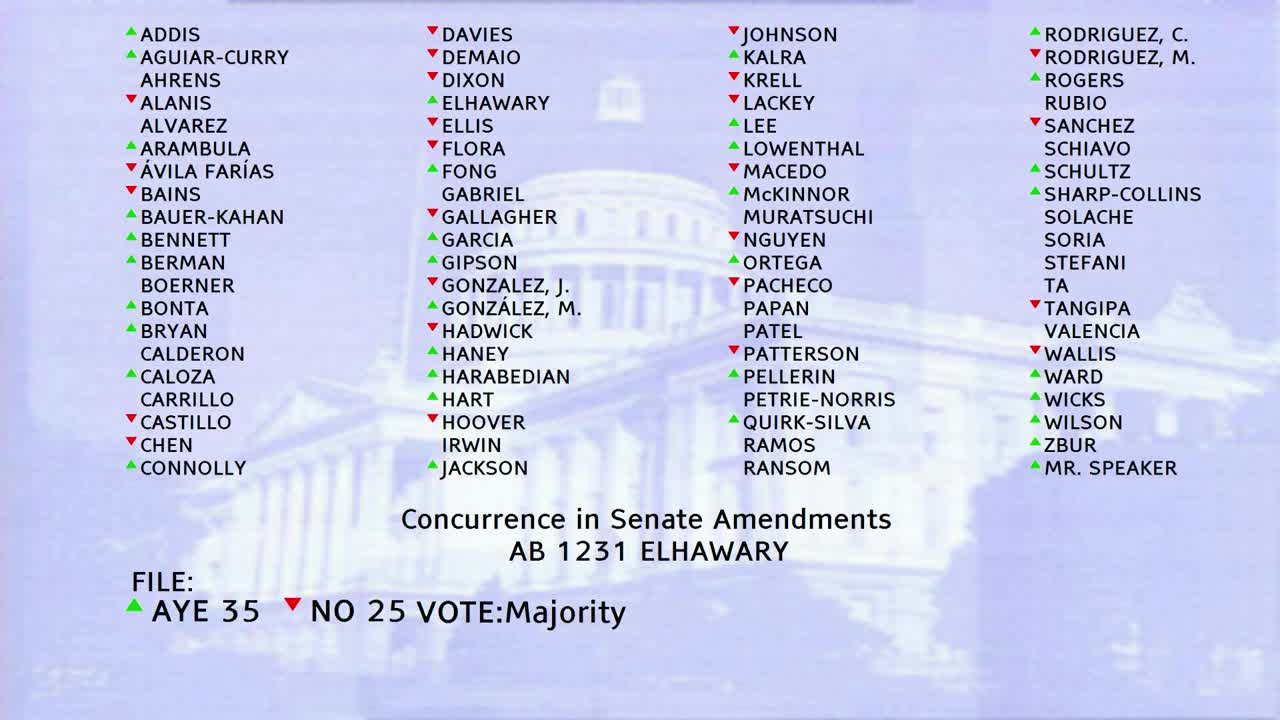 50SEC
Assembly Floor
 2MIN
Senate Floor
 9MIN
Senate Standing Committee on Energy, Utilities and Communications
Bill Author

Bill Co-Author(s):