AB 1363: Protective orders: Wyland’s Law.
- Session Year: 2025-2026
- House: Assembly
- Latest Version Date: 2025-10-10
Current Status:
Passed
(2025-10-10: Chaptered by Secretary of State - Chapter 574, Statutes of 2025.)
Introduced
In Committee
Awaiting First Chamber Vote
Passed First Chamber
In Committee
Awaiting Second Chamber Vote
Passed Second Chamber
Enacted
Existing law requires each county to develop a procedure for electronically transmitting, upon the issuance of certain types of protective orders, the contents of the order and other specified information to the Department of Justice through the California Law Enforcement Telecommunications System. Existing law also requires the department to maintain a California Restraining and Protective Order System and to make specified information electronically available to court clerks and law enforcement personnel.
This bill, Wylands Law, would, subject to an appropriation by the Legislature, authorize the department to establish, or contract with a vendor to establish, an automated protected person information and notification system to provide a petitioner or a protected person in a protective order case with automated access to information about their case, as specified. The bill would require a record demonstrating whether the superior court has fulfilled its transmission obligations or a record demonstrating receipt of information about a protective order that the department maintains to be open to public inspection and copying.
Existing law requires each county to develop a procedure for electronically transmitting, upon the issuance of certain types of protective orders, the contents of the order and other specified information to the Department of Justice through the California Law Enforcement Telecommunications System. Existing law also requires the department to maintain a California Restraining and Protective Order System and to make specified information electronically available to court clerks and law enforcement personnel.
This bill, Wylands Law, would require a superior court that issued a protective order, as defined, to, upon oral or written request, make information available to the requestor, including, among other things, information demonstrating when the superior court or its designee transmitted information to the department, as specified. The bill would require the department to maintain a record demonstrating its receipt of the information transmitted about a protective order. The bill would, subject to an appropriation by the Legislature, authorize the department to establish, or contract with a vendor to establish, an automated protected person information and notification system to provide a petitioner or a protected person in a protective order case with automated access to information about their case, as specified. The bill would require a record demonstrating whether the superior court has fulfilled its transmission obligations or a record demonstrating receipt of information about a protective order that the department is required to maintain maintains to be open to public inspection and copying. The bill would make these provisions apply to a case pending before January 1, 2026, to the extent information about a protective order is necessary to verify a superior courts specified transmission obligations.
Existing law requires each county to develop a procedure for electronically transmitting, upon the issuance of certain types of protective orders, the contents of the order and other specified information to the Department of Justice (department) through the California Law Enforcement Telecommunications System. Existing law also requires the department to maintain a California Restraining and Protective Order System and to make specified information electronically available to court clerks and law enforcement personnel.
This bill, Wylands Law, would require a superior court to maintain a record demonstrating that it has discharged its obligation to transmit information about a protective order to the department and that issued a protective order, as defined, to, upon oral or written request, make information available to the requestor, including, among other things, information demonstrating when the superior court or its designee transmitted information to the department, as specified. The bill would require the department to maintain a record demonstrating its receipt of the information transmitted about a protective order, as specified. The bill would require the superior court to make those records available to a petitioner, respondent, or protected person, or their representative, within one business day upon an oral or written request. The bill would order. The bill would, subject to an appropriation by the Legislature, authorize the department to establish, or contract with a vendor to establish, an automated protected person information and notification system to provide a petitioner or a protected person in a protective order case with automated access to information about their case, as specified. The bill would require a record demonstrating transmission of information about a protective order that a superior court is required to maintain whether the superior court has fulfilled its transmission obligations or a record demonstrating receipt of information about a protective order that the department is required to maintain to be open to public inspection and copying. The bill would make these provisions apply to a case pending before January 1, 2026, to the extent information about a protective order is necessary to verify a superior courts specified transmission obligations.
Existing law requires each county to develop a procedure for electronically transmitting, upon the issuance of certain types of protective orders, the contents of the order and other specified information to the Department of Justice (department) through the California Law Enforcement Telecommunications System. Existing law also requires the department to maintain a California Restraining and Protective Order System and to make specified information electronically available to court clerks and law enforcement personnel.
This bill, Wylands Law, would require a superior court to maintain a record demonstrating that it has discharged its obligation to transmit information about a protective order to the department and would require the department to maintain a record demonstrating its receipt of the information transmitted about a protective order, as specified. The bill would require the superior court to make those records to be made available to a petitioner, respondent, or protected person, or their representative, within one business day upon an oral or written request. The bill would require, as of January 1, 2027, each superior court and the department to develop and implement an electronic form and manage an email address to facilitate the electronic submission of these requests. The bill would require a superior court and the department to conspicuously post the form and the email address on their respective internet websites under the heading Wylands Law Record Request. The bill would authorize the department to establish, or contract with a vendor to establish, an automated protected person information and notification system to provide a petitioner or a protected person in a protective order case with automated access to information about their case, as specified. The bill would require a record demonstrating transmission of information about a protective order that a superior court is required to maintain or a record demonstrating receipt of information about a protective order that the department is required to maintain to be open to public inspection and copying. The bill would authorize the court and the department to redact personal identifying information, as defined, about the protected person from any record made available to the public. The bill would make these provisions apply to a case pending before January 1, 2026, to the extent information about a protective order is necessary to verify a superior courts specified transmission obligations.
Existing law requires each county to develop a procedure for electronically transmitting, upon the issuance of certain types of protective orders, the contents of the order and other specified information to the Department of Justice (department) through the California Law Enforcement Telecommunications System. Existing law also requires the department to maintain a California Restraining and Protective Order System and to make specified information electronically available to court clerks and law enforcement personnel.
This bill, Wylands Law, would require a superior court to maintain a record demonstrating that it has discharged its obligation to transmit information about a protective order to the Department of Justice department and would require the Department of Justice department to maintain a record demonstrating its receipt of the information transmitted about a protective order, as specified. The bill would require those records to be made available to a petitioner, respondent, or protected person, or their representative, within one business day upon an oral or written request. This bill would require The bill would require, as of January 1, 2027, each superior court and the department to develop and implement an electronic form and manage an email address to facilitate the electronic submission of these requests. The bill would require a superior court and the Department of Justice department to conspicuously post the form and the email address on their respective internet websites under the heading Wylands Law Record Request. The bill would make these records subject to disclosure under a request for a judicial administrative record or a public record request, as specified. For a case pending before January 1, 2026, the bill would make the information necessary to verify a superior courts transmission obligations under these provisions a judicial administrative record or a public record, as specified, that is not exempt from disclosure. The bill would require a record demonstrating transmission of information about a protective order that a superior court is required to maintain or a record demonstrating receipt of information about a protective order that the department is required to maintain to be open to public inspection and copying. The bill would authorize the court and the department to redact personal identifying information, as defined, about the protected person from any record made available to the public. The bill would make these provisions apply to a case pending before January 1, 2026, to the extent information about a protective order is necessary to verify a superior courts specified transmission obligations.
Existing law requires each county to develop a procedure for electronically transmitting, upon the issuance of certain types of protective orders, the contents of the order and other specified information to the Department of Justice through the California Law Enforcement Telecommunications System. Existing law also requires the department to maintain a California Restraining and Protective Order System and to make specified information electronically available to court clerks and law enforcement personnel.
This bill, Wylands Law, would require a superior court to maintain a record demonstrating that it has discharged its obligation to transmit a protective order to the Department of Justice and would require the Department of Justice to maintain a record demonstrating its receipt of the protective order, as specified. The bill would require those records to be made available to a petitioner, respondent, or protected person, or their representative, within one business day upon an oral or written request. This bill would require each superior court and the department to develop and implement an electronic form and manage an email address to facilitate the electronic submission of these requests. The bill would require a superior court and the Department of Justice to conspicuously post the form and the email address on their respective internet websites under the heading Wylands Law Record Request. The bill would make these records subject to disclosure under a request for a judicial administrative record or a public record request, as specified. For a case pending before January 1, 2026, the bill would make the information necessary to verify a superior courts transmission obligations under these provisions a judicial administrative record or a public record, as specified, that is not exempt from disclosure.
Existing law authorizes a court to issue a gun violence restraining order to prohibit a person from purchasing or possessing a firearm or ammunition for a period of one to 5 years, subject to renewal, if the subject of the petition poses a significant danger of self-harm or harm to another by having a firearm and the order is necessary to prevent personal injury to the subject of the petition or another.This bill would make technical, nonsubstantive changes to this provision.Existing law authorizes a court to issue a gun violence restraining order to prohibit a person from purchasing or possessing a firearm or ammunition for a period of one to 5 years, subject to renewal, if the subject of the petition poses a significant danger of self-harm or harm to another by having a firearm and the order is necessary to prevent personal injury to the subject of the petition or another.
This bill would make technical, nonsubstantive changes to this provision.
The Legislature finds and declares that subdivisions (a) and (b) of Section 6380 of the Family Code impose a mandatory duty on the superior court to transmit a protective order issued pursuant to Division 10 (commencing with Section 6200) of the Family Code, with the exception of an order issued pursuant to Section 6271 of the Family Code, to the Department of Justice directly or through a law enforcement designee.
SEC. 2.Section 6380.5 is added to the Family Code, to read:6380.5.(a)This section shall be known, and may be cited, as Wylands Law.
(b)Subject to an appropriation by the Legislature, the department may establish, or contract with a vendor to establish, an automated protected person information and notification system to provide a petitioner or protected person in a protective order case with automated access to information maintained in the California Restraining and Protective Order System about their case, which shall include all of the following:
(1)Whether the department has received a record of the protective order.
(2)If the protective order has been successfully served on the restrained person.
(3)Notwithstanding any other law, if the restrained person has violated the protective order by attempting to purchase or acquire a firearm or ammunition while the order is in effect.
(c)(1)Notwithstanding any other law, a record demonstrating whether the superior court has fulfilled its transmission obligations pursuant to subdivision (a) or (b) of Section 6380 is required to be open to public inspection and copying.
(2)Notwithstanding any other law, a record demonstrating receipt of information about a protective order that the department maintains is a public record that is not exempt from disclosure in response to a public record request made pursuant to the California Public Records Act (Division 10 (commencing with Section 7920.000) of Title 1 of the Government Code).
(3)Paragraph (2) of this subdivision does not constitute a change in, but is declaratory of, existing law.
(d)For purposes of this section, the following definitions apply:
(1)Department means the Department of Justice.
(2)Protective order includes all order types listed in Section 6380 and the reissuance, extension, modification, or termination of the order.
The Legislature finds and declares that subdivisions (a) and (b) of Section 6380 of the Family Code impose a mandatory duty on the superior court to transmit a protective order issued pursuant to Division 10 (commencing with Section 6200) of the Family Code, with the exception of an order issued pursuant to Section 6271 of the Family Code, to the Department of Justice directly or through a law enforcement designee.
SEC. 2.Section 6380.5 is added to the Family Code, to read:6380.5.(a)This section shall be known, and may be cited, as Wylands Law.
(b)(1)Upon the oral or written request of a petitioner, respondent, or protected person, or their representative, a superior court that issued a protective order shall, within one business day or, if the request is made on the same day the order is issued, within two business days, make the following information available to the requester:(A)Information demonstrating when the superior court or its designee transmitted information to the department pursuant to subdivision (a) of Section 6380.(B)Information demonstrating when the superior court or its designee transmitted information to the department, as described in subdivision (b) of Section 6380, for an order issued pursuant to any of the following:(i)Section 136.2 of the Penal Code.(ii)Section 213.5, 304, or 362.4 of the Welfare and Institutions Code.(iii)This division, excluding Section 6271.(C)Information demonstrating when the superior court or its designee transmitted information to the department, as described in subdivision (b) of Section 6380, or information demonstrating that the court ordered the petitioner or the petitioners attorney to deliver a copy of the order to a law enforcement agency for an order issued pursuant to any of the following:(i)Section 527.6, 527.8, or 527.85 of the Code of Civil Procedure.(ii)Section 15657.03 of the Welfare and Institutions Code.(2)If a superior court uses a designee to transmit information about a protective order to the department pursuant to subdivisions (a) and (b) of Section 6380, the designee shall confirm to the superior court, within one business day, that it transmitted information about the protective order to the department pursuant to subdivisions (a) and (b) of Section 6380, and the superior court shall maintain the record from the designee that the information about the protective order was transmitted to the department.(c)The department shall maintain a record demonstrating receipt of the information about a protective order transmitted to the department pursuant to subdivision (a) or (b) of Section 6380.(d)(b)Subject to an appropriation by the Legislature, the department may establish, or contract with a vendor to establish, an automated protected person information and notification system to provide a petitioner or protected person in a protective order case with automated access to information maintained in the California Restraining and Protective Order System about their case, which shall include all of the following:
(1)Whether the department has received a record of the protective order.
(2)If the protective order has been successfully served on the restrained person.
(3)Notwithstanding any other law, if the restrained person has violated the protective order by attempting to purchase or acquire a firearm or ammunition while the order is in effect.
(e)(c)(1)Notwithstanding any other law, a record demonstrating whether the superior court has fulfilled its transmission obligations under this section or pursuant to subdivision (a) or (b) of Section 6380 is required to be open to public inspection and copying.
(2)Notwithstanding any other law, a record demonstrating receipt of information about a protective order that the department maintains pursuant to subdivision (c) is a public record that is not exempt from disclosure in response to a public record request made pursuant to the California Public Records Act (Division 10 (commencing with Section 7920.000) of Title 1 of the Government Code).
(3)This subdivision applies to a case pending before January 1, 2026, to the extent that information about a protective order is necessary to verify a superior courts transmission obligations under this section or pursuant to subdivision (a) or (b) of Section 6380.(4)(3)Paragraph (2) of this subdivision does not constitute a change in, but is declaratory of, existing law.
(f)(d)For purposes of this section, the following definitions apply:
(1)Department means the Department of Justice.
(2)Protective order includes all order types listed in Section 6380 and the reissuance, extension, modification, or termination of the order.
The Legislature finds and declares that subdivisions (a) and (b) of Section 6380 of the Family Code impose a mandatory duty on the superior court to transmit a protective order issued pursuant to Division 10 (commencing with Section 6200) of the Family Code, with the exception of an order issued pursuant to Section 6271 of the Family Code, to the Department of Justice directly or through a law enforcement designee.
SECTION 1.SEC. 2.Section 6380.5 is added to the Family Code, to read:6380.5.(a)This section shall be known, and may be cited, as Wylands Law.
(b)(1)(A)A superior court shall maintain a record demonstrating it has discharged its obligation pursuant to subdivisions (a) and (b) of Section 6380 to transmit information about a protective order to the department.(B)The record shall include the case number, the name of the court that issued the order, the name of the respondent, the date of issuance of the order, and the date the superior court transmitted the order.(C)The record shall not contain a protected partys personal identifying information.(b)(1)Upon the oral or written request of a petitioner, respondent, or protected person, or their representative, a superior court that issued a protective order shall, within one business day or, if the request is made on the same day the order is issued, within two business days, make the following information available to the requester:
(A)Information demonstrating when the superior court or its designee transmitted information to the department pursuant to subdivision (a) of Section 6380.
(B)Information demonstrating when the superior court or its designee transmitted information to the department, as described in subdivision (b) of Section 6380, for an order issued pursuant to any of the following:
(i)Section 136.2 of the Penal Code.
(ii)Section 213.5, 304, or 362.4 of the Welfare and Institutions Code.
(iii)This division, excluding Section 6271.
(C)Information demonstrating when the superior court or its designee transmitted information to the department, as described in subdivision (b) of Section 6380, or information demonstrating that the court ordered the petitioner or the petitioners attorney to deliver a copy of the order to a law enforcement agency for an order issued pursuant to any of the following:
(i)Section 527.6, 527.8, or 527.85 of the Code of Civil Procedure.
(ii)Section 15657.03 of the Welfare and Institutions Code.
(2)If a superior court uses a designee to transmit information about a protective order to the department pursuant to subdivisions (a) and (b) of Section 6380, the designee shall confirm with to the superior court court, within one business day, that it transmitted information about the protective order to the department pursuant to subdivisions (a) and (b) of Section 6380, and the superior court shall maintain the record from the designee that the information about the protective order was transmitted to the department.
(c)The department shall maintain a record demonstrating receipt of the information about a protective order transmitted to the department pursuant to subdivision (a) or (b) of Section 6380.
(d)The superior court that issued a protective order shall make a record it maintains pursuant to subdivision (b) available upon the oral or written request of a petitioner, respondent, or protected person, or their representative, within one business day or, if the request is made on the same day the order is issued, within two business days.(e)The(d)Subject to an appropriation by the Legislature, the department may establish, or contract with a vendor to establish, an automated protected person information and notification system to provide a petitioner or protected person in a protective order case with automated access to information maintained in the California Restraining and Protective Order System about their case, including which shall include all of the following:
(1)Whether the department has received a record of the protective order.
(2)If the protective order has been successfully served on the restrained person.
(3)If Notwithstanding any other law, if the restrained person has violated the protective order by attempting to purchase or acquire a firearm or ammunition while the order is in effect.
(f)(e)(1)Notwithstanding any other law, a record demonstrating transmission of information about a protective order that a superior court maintains pursuant to subdivision (b) whether the superior court has fulfilled its transmission obligations under this section or pursuant to subdivision (a) or (b) of Section 6380 is required to be open to public inspection and copying.
(2)Notwithstanding any other law, a record demonstrating receipt of information about a protective order that the department maintains pursuant to subdivision (c) is a public record that is not exempt from disclosure in response to a public record request made pursuant to the California Public Records Act (Division 10 (commencing with Section 7920.000) of Title 1 of the Government Code).
(3)This subdivision applies to a case pending before January 1, 2026, to the extent that information about a protective order is necessary to verify a superior courts transmission obligations under this section, section or pursuant to subdivision (a) or (b) of Section 6380.
(4)Paragraph (2) of this subdivision does not constitute a change in, but is declaratory of, existing law.
(g)(f)For purposes of this section, the following definitions apply:
(1)Department means the Department of Justice.
(2)Personal identifying information has the same meaning as in subdivision (b) of Section 530.55 of the Penal Code.(2)Protective order includes all order types listed in Section 6380 and the reissuance, extension, modification, or termination of the order.
(a)This section shall be known, and may be cited, as Wylands Law.
(b)(1)(A)A superior court shall maintain a record demonstrating it has discharged its obligation pursuant to subdivisions (a) and (b) of Section 6380 to transmit information about a protective order to the department. The
(B)The record shall include, at a minimum, include the case number, the name of the court that issued the order, the name of the respondent, the date of issuance of the order, and the date it the superior court transmitted the order.
(C)The record shall not contain a protected partys personal identifying information.
(2)If a superior court uses a designee to transmit information about a protective order to the department pursuant to subdivisions (a) and (b) of Section 6380, the designee shall confirm with the superior court that it transmitted information about the protective order to the department pursuant to subdivisions (a) and (b) of Section 6380, and the superior court shall maintain the record that the information about the protective order was transmitted to the department.
(c)The department shall maintain a record demonstrating receipt of the information about a protective order transmitted to the department pursuant to subdivision (a) or (b) of Section 6380.
(d)The superior court that issued a protective order shall make a record it maintains pursuant to subdivision (b) available upon the oral or written request of a petitioner, respondent, or protected person, or their representative, within one business day or, if the request is made on the same day the order is issued, within two business days.
(e)Notwithstanding Section 7922.535 of the Government Code, the department shall make a record it maintains pursuant to subdivision (c) available upon request of a petitioner, respondent, or protected person, or their representative, within one business day or, if the request is made on the same day the order is issued, within two business days.(f)(1)As of January 1, 2027, each superior court and the department shall develop and implement an electronic form and manage an email address to facilitate the electronic submission of a request made pursuant to subdivision (d) or (e).(2)A superior court and the department shall post the form and email address described in this subdivision conspicuously on their respective internet websites under the heading Wylands Law Record Request.(e)The department may establish, or contract with a vendor to establish, an automated protected person information and notification system to provide a petitioner or protected person in a protective order case with automated access to information maintained in the California Restraining and Protective Order System about their case, including all of the following:
(1)Whether the department has received a record of the protective order.
(2)If the protective order has been successfully served on the restrained person.
(3)If the restrained person has violated the protective order by attempting to purchase or acquire a firearm or ammunition while the order is in effect.
(g)(f)(1)Notwithstanding any other law, a record demonstrating transmission of information about a protective order that a superior court maintains pursuant to subdivision (b) is required to be open to public inspection and copying. The court may redact personal identifying information about the protected person from any record that it makes available to the public.
(2)Notwithstanding any other law, a record demonstrating receipt of information about a protective order that the department maintains pursuant to subdivision (c) is a public record that is not exempt from disclosure in response to a public record request made pursuant to the California Public Records Act (Division 10 (commencing with Section 7920.000) of Title 1 of the Government Code). The department may redact personal identifying information about the protected person from any record that it makes available to the public.
(3)This subdivision applies to a case pending before January 1, 2026, to the extent that information about a protective order is necessary to verify a superior courts transmission obligations under this section, or pursuant to subdivision (a) or (b) of Section 6380.
(4)Paragraph (2) of this subdivision does not constitute a change in, but is declaratory of, existing law.
(h)(g)For purposes of this section, the following terms are defined as follows: definitions apply:
(1)Department means the Department of Justice.(2)Personal identifying information has the same meaning as in subdivision (b) of Section 530.55 of the Penal Code.(a)This section shall be known, and may be cited, as Wylands Law.
(b)(1)A superior court shall maintain a record demonstrating it has discharged its obligation to transmit pursuant to subdivisions (a) and (b) of Section 6380 to transmit information about a protective order to the Department of Justice pursuant to subdivisions (a) and (b) of Section 6380, which shall include, but not be limited to, department. The record shall include, at a minimum, the name of the respondent, the date of issuance of the order, and the date it transmitted the order.
(2)If a superior court uses a designee to transmit information about a protective order to the Department of Justice department pursuant to subdivisions (a) and (b) of Section 6380, the designee shall confirm with the superior court that it transmitted information about the protective order to the department pursuant to subdivisions (a) and (b) of Section 6380, and the superior court shall maintain the record that the order information about the protective order was transmitted to Department of Justice as described in paragraph (1). the department.
(c)The Department of Justice department shall maintain a record demonstrating receipt of the information about a protective order it received transmitted to the department pursuant to subdivision (a) or (b) of Section 6380, which shall include, but not be limited to, the name of the respondent, the date of issuance of the order, and the date it received the order. 6380.
(d)The superior court that issued a protective order shall make a record it maintains pursuant to subdivision (b) available upon the oral or written request of a petitioner, respondent, or protected person, or their representative, within one business day or, if the request is made on the same day the order is issued, within two business days.
(e)The Department of Justice Notwithstanding Section 7922.535 of the Government Code, the department shall make a record it maintains pursuant to subdivision (c) available upon request of a petitioner, respondent, or protected person, or their representative, within one business day or, if the request is made on the same day the order is issued, within two business days.
(f)(1)Each As of January 1, 2027, each superior court and the Department of Justice department shall develop and implement an electronic form and manage an email address to facilitate the electronic submission of a request made pursuant to subdivision (d) or (e).
(2)A superior court and the Department of Justice department shall post the form and email address described in this subdivision conspicuously on their respective internet websites under the heading Wylands Law Record Request.
(g)(1)Notwithstanding any other law, a record maintained demonstrating transmission of information about a protective order that a superior court maintains pursuant to subdivision (b) is a judicial administrative record, as described in Rule 10.500 of the California Rules of Court, that is not exempt from disclosure. required to be open to public inspection and copying. The court may redact personal identifying information about the protected person from any record that it makes available to the public.
(2)Notwithstanding any other law, a record maintained demonstrating receipt of information about a protective order that the department maintains pursuant to subdivision (c) is a public record that is not exempt from disclosure in response to a public record request made pursuant to the California Public Records Act (Division 10 (commencing with Section 7920.000) of Title 1 of the Government Code). The department may redact personal identifying information about the protected person from any record that it makes available to the public.
(3)In This subdivision applies to a case pending before January 1, 2026, the information to the extent that information about a protective order is necessary to verify a superior courts transmission obligations under this section: section, or pursuant to subdivision (a) or (b) of Section 6380.
(A)If requested from the superior court, is a judicial administrative record, as described in Rule 10.500 of the California Rules of Court, that is not exempt from public disclosure.(B)If requested from the Department of Justice, is a public record that is not exempt from public disclosure in response to a public record request made pursuant to the California Public Records Act (Division 10 (commencing with Section 7920.000) of Title 1 of the Government Code).(4)This Paragraph (2) of this subdivision does not constitute a change in, but is declaratory of, existing law.
(h)For purposes of this section, the following terms are defined as follows:
(1)Department means the Department of Justice.
(2)Personal identifying information has the same meaning as in subdivision (b) of Section 530.55 of the Panel Code.
(a)This section shall be known, and may be cited, as Wylands Law.
(b)(1)A superior court shall maintain a record demonstrating it has discharged its obligation to transmit a protective order to the Department of Justice pursuant to subdivisions (a) and (b) of Section 6380, which shall include, but not be limited to, the name of the respondent, the date of issuance of the order, and the date it transmitted the order.
(2)If a superior court uses a designee to transmit a protective order to the Department of Justice pursuant to subdivisions (a) and (b) of Section 6380, the superior court shall maintain the record that the order was transmitted to Department of Justice as described in paragraph (1).
(c)The Department of Justice shall maintain a record demonstrating receipt of a protective order it received pursuant to subdivision (a) or (b) of Section 6380, which shall include, but not be limited to, the name of the respondent, the date of issuance of the order, and the date it received the order.
(d)The superior court that issued a protective order shall make a record it maintains pursuant to subdivision (b) available upon the oral or written request of a petitioner, respondent, or protected person, or their representative, within one business day or, if the request is made on the same day the order is issued, within two business days.
(e)The Department of Justice shall make a record it maintains pursuant to subdivision (c) available upon request of a petitioner, respondent, or protected person, or their representative, within one business day or, if the request is made on the same day the order is issued, within two business days.
(f)(1)Each superior court and the Department of Justice shall develop and implement an electronic form and manage an email address to facilitate the electronic submission of a request made pursuant to subdivision (d) or (e).
(2)A superior court and the Department of Justice shall post the form and email address described in this subdivision conspicuously on their respective internet websites under the heading Wylands Law Record Request.
(g)(1)Notwithstanding any other law, a record maintained pursuant to subdivision (b) is a judicial administrative record, as described in Rule 10.500 of the California Rules of Court, that is not exempt from disclosure.
(2)Notwithstanding any other law, a record maintained pursuant to subdivision (c) is a public record that is not exempt from disclosure in response to a public record request made pursuant to the California Public Records Act (Division 10 (commencing with Section 7920.000) of Title 1 of the Government Code).
(3)In a case pending before January 1, 2026, the information necessary to verify a superior courts transmission obligations under this section:
(A)If requested from the superior court, is a judicial administrative record, as described in Rule 10.500 of the California Rules of Court, that is not exempt from public disclosure.
(B)If requested from the Department of Justice, is a public record that is not exempt from public disclosure in response to a public record request made pursuant to the California Public Records Act (Division 10 (commencing with Section 7920.000) of Title 1 of the Government Code).
(4)This subdivision does not constitute a change in, but is declaratory of, existing law.
SECTION 1.Section 18170 of the Penal Code is amended to read:18170.(a)(1)The following individuals may request that a court, after notice and a hearing, issue a gun violence restraining order enjoining the subject of the petition from having in their custody or control, owning, purchasing, possessing, or receiving a firearm or ammunition for a period of time between one to five years:(A)An immediate family member of the subject of the petition.(B)An employer of the subject of the petition.(C)A coworker of the subject of the petition, if they have had substantial and regular interactions with the subject for at least one year and have obtained the approval of the employer.(D)An employee or teacher of a secondary or postsecondary school that the subject has attended in the last six months, if the employee or teacher has obtained the approval of a school administrator or a school administration staff member with a supervisorial role.(E)A law enforcement officer.(F)A roommate of the subject of the petition.(G)An individual who has a dating relationship with the subject of the petition.(H)An individual who has a child in common with the subject of the petition, if they have had substantial and regular interactions with the subject for at least one year.(2)This chapter does not require a person described in paragraph (1) to seek a gun violence restraining order.(b)For purposes of this subdivision, dating relationship has the same meaning as in paragraph (10) of subdivision (f) of Section 243.(c)For purposes of this section, immediate family member means a spouse, whether by marriage or not, domestic partner, parent, child, a person related by consanguinity or affinity within the second degree, or a person related by consanguinity or affinity within the fourth degree who has had substantial and regular interactions with the subject for at least one year.(d)For purposes of this subdivision, roommate means a person who regularly resides in the household, or who, within the prior six months, regularly resided in the household, and who has had substantial and regular interactions with the subject for at least one year.(a)(1)Any of the The following individuals may request that a court, after notice and a hearing, issue a gun violence restraining order enjoining the subject of the petition from having in their custody or control, owning, purchasing, possessing, or receiving a firearm or ammunition for a period of time between one to five years:
(A)An immediate family member of the subject of the petition.
(B)An employer of the subject of the petition.
(C)A coworker of the subject of the petition, if they have had substantial and regular interactions with the subject for at least one year and have obtained the approval of the employer.
(D)An employee or teacher of a secondary or postsecondary school that the subject has attended in the last six months, if the employee or teacher has obtained the approval of a school administrator or a school administration staff member with a supervisorial role.
(E)A law enforcement officer.
(F)A roommate of the subject of the petition.
(G)An individual who has a dating relationship with the subject of the petition.
(H)An individual who has a child in common with the subject of the petition, if they have had substantial and regular interactions with the subject for at least one year.
(2)This chapter does not require a person described in paragraph (1) to seek a gun violence restraining order.
(b)For purposes of this subdivision, dating relationship has the same meaning as in paragraph (10) of subdivision (f) of Section 243.
(c)For purposes of this section, immediate family member means any a spouse, whether by marriage or not, domestic partner, parent, child, any a person related by consanguinity or affinity within the second degree, or any a person related by consanguinity or affinity within the fourth degree who has had substantial and regular interactions with the subject for at least one year.
(d)For purposes of this subdivision, roommate means a person who regularly resides in the household, or who, within the prior six months, regularly resided in the household, and who has had substantial and regular interactions with the subject for at least one year.
(e)This section shall become operative on September 1, 2020.|
Date
|
Status
|
|---|---|
| Oct 10, 2025 | Chaptered by Secretary of State - Chapter 574, Statutes of 2025. |
| Oct 10, 2025 | Approved by the Governor. |
| Sep 24, 2025 | Enrolled and presented to the Governor at 3 p.m. |
| Sep 12, 2025 | Senate amendments concurred in. To Engrossing and Enrolling. (Ayes 80. Noes 0. Page 3420.). |
| Sep 12, 2025 | In Assembly. Concurrence in Senate amendments pending. |
| Sep 11, 2025 | Read third time. Passed. Ordered to the Assembly. (Ayes 40. Noes 0. Page 2931.). |
| Sep 9, 2025 | Ordered to special consent calendar. |
| Sep 2, 2025 | Read second time. Ordered to third reading. |
| Aug 29, 2025 | Read second time and amended. Ordered returned to second reading. |
| Aug 29, 2025 | From committee: Amend, and do pass as amended. (Ayes 7. Noes 0.) (August 29). |
| Aug 18, 2025 | In committee: Referred to suspense file. |
| Jul 15, 2025 | From committee: Do pass and re-refer to Com. on APPR. with recommendation: To Consent Calendar. (Ayes 6. Noes 0.) (July 15). Re-referred to Com. on APPR. |
| Jul 10, 2025 | Read second time and amended. Re-referred to Com. on PUB. S. |
| Jul 9, 2025 | From committee: Amend, and do pass as amended and re-refer to Com. on PUB. S. (Ayes 13. Noes 0.) (July 8). |
| Jun 25, 2025 | In committee: Set, first hearing. Hearing canceled at the request of author. |
| Jun 11, 2025 | Referred to Coms. on JUD. and PUB. S. |
| Jun 3, 2025 | In Senate. Read first time. To Com. on RLS. for assignment. |
| Jun 2, 2025 | Read third time. Passed. Ordered to the Senate. (Ayes 79. Noes 0. Page 1923.) |
| May 27, 2025 | Read second time. Ordered to third reading. |
| May 23, 2025 | Read second time and amended. Ordered returned to second reading. |
| May 23, 2025 | From committee: Amend, and do pass as amended. (Ayes 11. Noes 0.) (May 23). |
| May 23, 2025 | Assembly Rule 63 suspended. (Ayes 51. Noes 16. Page 1644.) |
| May 14, 2025 | In committee: Set, first hearing. Referred to APPR. suspense file. |
| Apr 24, 2025 | Re-referred to Com. on APPR. |
| Apr 23, 2025 | Read second time and amended. |
| Apr 22, 2025 | From committee: Amend, and do pass as amended and re-refer to Com. on APPR. with recommendation: To Consent Calendar. (Ayes 12. Noes 0.) (April 22). |
| Apr 1, 2025 | Re-referred to Com. on JUD. |
| Mar 28, 2025 | Referred to Com. on JUD. |
| Mar 28, 2025 | From committee chair, with author's amendments: Amend, and re-refer to Com. on JUD. Read second time and amended. |
| Feb 24, 2025 | Read first time. |
| Feb 22, 2025 | From printer. May be heard in committee March 24. |
| Feb 21, 2025 | Introduced. To print. |
|
Date
|
Description
|
Location
|
Votes
|
|
|---|---|---|---|---|
| Sep 12, 2025 | AB 1363 Stefani Concurrence in Senate Amendments | Assembly Floor |
Passed |
|
| Sep 11, 2025 | Special Consent AB1363 Stefani et al. By Ashby | Senate Floor |
Passed |
|
| Aug 29, 2025 | Do pass as amended | Senate Standing Committee on Appropriations |
Passed |
|
| Aug 18, 2025 | Placed on suspense file | Senate Standing Committee on Appropriations |
Passed |
|
| Jul 15, 2025 | Do pass, but first be re-referred to the Committee on [Appropriations] with the recommendation: To Consent Calendar | Senate Standing Committee on Public Safety |
Passed |
|
| Jul 8, 2025 | Do pass as amended, but first amend, and re-refer to the Committee on [Public Safety] | Senate Standing Committee on Judiciary |
Passed |
|
| Jun 2, 2025 | AB 1363 Stefani Assembly Third Reading | Assembly Floor |
Passed |
|
| May 23, 2025 | Do pass as amended. | Assembly Standing Committee on Appropriations |
Passed |
|
| Apr 22, 2025 | Do pass as amended, and be re-referred to the Committee on [Appropriations] with recommendation: To Consent Calendar | Assembly Standing Committee on Judiciary |
Passed |
This list shows positions taken on this bill by organizations on the date displayed, which is linked to the original source.
Positions by individuals are not included.
|
Organization
|
Position
|
Date
|
|---|---|---|
| Brady United Against Gun Violence | ** Support | |
| Everytown for Gun Safety | ** Support | |
| Everytown for Gun Safety Action Fund | ** Support | |
| Giffords | ** Support | |
| Moms Demand Action for Gun Sense in America | ** Support | |
| San Diegans For Gun Violence Prevention | ** Support | |
| San Diego County Board of Supervisors | ** Support | |
| San Francisco District Attorney Brooke Jenkins | ** Support | |
| San Francisco District Attorney's Office | ** Support | |
| san francisco marin medical society | ** Support | |
| Students Demand Action | ** Support |
CONCURRENCE IN SENATE AMENDMENTS
CSA1 Bill Id:AB 1363
Author:(Stefani)
As Amended Ver:August 29, 2025
Majority vote
SUMMARY
Authorizes, subject to an appropriation, the California Department of Justice (DOJ) to develop and implement a new system for the public to electronically request a record demonstrating that information about a protective order was transmitted to, and received by, DOJ.
Major Provisions
- Authorizes, subject to an appropriation, the department to establish, or contract with a vendor to establish, an automated protected person information and notification system to provide a petitioner or protected person in a protective order case with automated access to information maintained in the California Restraining and Protective Order System about their case, including all of the following:
- Whether the department has received a record of the protective order.
- If the protective order has been successfully served on the restrained person.
- If the restrained person has violated the protective order by attempting to purchase or acquire a firearm or ammunition while the order is in effect.
- Provides that notwithstanding any other law, a record demonstrating transmission of protective order information that a superior court maintains is required to be open to public inspection and copying.
- Provides that notwithstanding any other law, a record demonstrating receipt of protective order information that the department maintains is a public record that is not exempt from disclosure in response to a public record request made pursuant to the California Public Records Act (CPRA). States that this provision does not constitute a change in, but is declaratory of, existing law.
- Defines the following terms for purposes of the bill:
- ″Department″ means the California Department of Justice.
- ″Personal identifying information″ has the same meaning as in subdivision (b) of Penal Code Section 530.55.
Senate Amendments
Omit all clarifications and changes to existing law in relation to the process for courts to create, maintain, and make available records of transmission of a protective order to the department.
COMMENTS
This bill, also known as ″Wyland′s Law,″ is sponsored by GIFFORDS and authorizes, subject to an appropriation, DOJ to develop an automated protected person information and notification system to provide a petitioner or protected person in a protective order case with automated access to information maintained in the California Restraining and Protective Order System about their case.
Background on Domestic Violence Protective Orders. In order to prevent acts of domestic violence, existing law permits a victim or potential victim of domestic violence to seek a ″protective order.″ Such orders may take the form of emergency protective orders (sought by law enforcement) or domestic violence restraining orders (DVRO). Both types of orders typically take the form of ″stay away″ or similar orders that ensure separation of the parties, at least for as long as it takes to appear in court or resolve the causes of the violence. In order to better prevent harm, emergency protective orders and temporary restraining orders are issued ex parte – that is, based upon the affidavit or testimony of only the party seeking relief. A permanent restraining order, which may last up to five years, may be issued only after a noticed hearing at which the respondent is free to testify. Because of their inherently time-sensitive manner, requests are reviewed and, if approved, issued on the same day as requested, or no later than the next business day.
The vast majority (perhaps as many as 90%) of ex parte domestic violence restraining orders are sought without assistance of counsel. The person seeking protection fills out at least four required forms with the Superior Court of the county in which they reside. These forms generally require identifying information of the person to be restrained, and the names, ages, and relationships of the person or persons to be protected. The forms include a request for temporary protective order (DV-100) and another form (DV-110) containing the same information, which, if the request is approved, is stamped by the court and serves as the official court order served upon the respondent. In addition, at the time of the request, the person seeking protection must also file a hearing notice form (DV-109), which notifies the respondent of any scheduled hearing.
The tragic death of Wyland Thomas Gomes and ongoing litigation. In December 2016, the Kings County Superior Court issued a restraining order against Victor Gomes after he threatened to murder Wyland Thomas Gomes, the son he shared with his ex-wife, Christy Camara. The restraining order was to remain in effect for nine months, until September 2017. However, the superior court never transmitted information about that order to the Department of Justice, as it was required to do pursuant to subdivisions (a) and (b) of Family Code Section 6380. In May 2017, Gomes applied to purchase a firearm. DOJ, not having a record of the order in its system, approved the background check, allowing Gomes to purchase a firearm. Shortly thereafter, Gomes used the firearm to shoot and kill 10 year-old Wyland. Gomes then took his own life.
After Wyland′s murder, Camara tirelessly investigated how her son′s murderer was able to pass a DOJ background check and acquire a firearm, despite being prohibited from purchasing firearms as a result of the restraining order. (Family Code Section 6389(a).) According to her attorney, Camara made eight public record requests of six different state and local agencies. DOJ refused Camara′s requests in toto. Camara brought suit against DOJ to enforce her rights under the CPRA. (Camara Gomes v. Dep′t of Justice (S.F. Super. Ct.) Case No. CPF-22-517886.) After litigating for over two years, a superior court in San Francisco ruled in Camara′s favor, found that DOJ had unlawfully withheld public records and segregable information subject to public disclosure within its confidential records, and issued a writ of mandate requiring DOJ to disclose most of the requested records to Camara. The records clearly demonstrate that the Kings County Superior Court failed to transmit not only the December 2016 DVRO, but also two other restraining orders against Gomes – all in violation of the requirements of Family Code Section 6380(a) and (b).
According to the Author
Gun violence is a crisis that affects communities across California and it is now the leading cause of death for children and teens in our country. One piece of the critical gun violence protections already in current law include that Superior Courts transmit protective orders to the Department of Justice (DOJ) in order to ensure that a retrained person cannot pass a background check when attempting to purchase firearms. In 2016, a failure to transmit these life-saving orders of protection from the Superior Court to the Department of Justice resulted in lethal consequences for Wyland Thomas Gomes when his father successfully purchased a firearm and then used it to shoot and kill 10 year-old Wyland before taking his own life.
AB 1363, named in Wyland′s honor, seeks to provide individuals with a means of ensuring that protection orders are successfully transmitted to the Department of Justice for registration in their systems.
Arguments in Support
Sponsor GIFFORDS writes the following to explain why the bill is important:
The tragic case of Wyland Thomas Gomes, who lost his life at age 10, underscores the urgent need for AB 1363. In December 2016, a restraining order, including a firearm prohibition, was issued against Victor Gomes, Wyland′s father. Sadly, the Kings County Superior Court failed to timely transmit this order to the Department of Justice (DOJ), as mandated by Family Code section 6380. Because the order wasn′t transmitted Victor Gomes was able to purchase a firearm, ultimately leading to Wyland′s death.
Importantly, current law does not provide a protected party the ability to confirm a protective order has been properly transmitted. In fact, it took Wyland′s mother, Christy Camara Gomes, two years of litigation and eight public record requests to uncover the court′s error. No victim should be denied the life-saving information that their protective order has been handled properly.
Assembly Bill 1363 (Wyland′s Law) provides essential safeguards to prevent similar tragedies.
Arguments in Opposition
None on file
FISCAL COMMENTS
According to the Senate Appropriations Committee, the fiscal impact is as follows:
- DOJ anticipates a fiscal impact of approximately $3 million or less (General Fund). DOJ notes implementation of this bill will be dependent upon the appropriation of funds. The DOJ will be unable to absorb the costs to comply with or implement the requirements of the bill within existing budgeted resources. Electronic transmittal of the records will be managed through the California Law Enforcement Telecommunications System (CLETS). The Information Security Branch (ISB) within DOJ′s Office of General Counsel would be responsible for supporting the Information Security Programs for all CLETS and California Justice Information access requests. To address the increase in workload, ISB will require 1.0 Information Technology Specialist II and 1.0 Information Technology Specialist I beginning on January 1, 2027 and ongoing. This bill will have an impact to the General Fund. The Tort and Condemnation Section (TORT), within the Civil Law Division anticipated an increase in workload representing BOF in lawsuits arising out of a failure to protect or discharge new statutory duties and to consult with BOF on related matters upon the enactment of AB 1363. TORT will require the following resources in each fiscal year beginning January 1, 2026: FY 2025-26: 100 Deputy Attorney General Supervisor (SDAG) hours and 100 Deputy Attorney General (DAG) hours; Ongoing: 200 SDAG hours and 200 DAG hours.
To implement the mandates of AB 1363, the Division of Law Enforcement (DLE), Bureau of Firearms (BOF) would require the following resources in FY 2025-26:
- 10 overtime hours for one Associate Governmental Program Analyst (AGPA) in the Firearm Application Review Unit (FARU) to attend joint application development (JAD) sessions.
- 30 overtime hours for one AGPA in FARU to conduct user acceptance testing (UAT) and enter transactions to ensure information is being checked against California Restraining and Protective Order System (CARPOS) and sent to CJIS.
- 20 overtime hours for two AGPAs in the Customer Support Center (CSC) to attend JAD sessions.
- 60 overtime hours for two AGPAs in the CSC to conduct UAT and enter transactions to ensure information is being checked against CARPOS and sent to CJIS.
- Additional ongoing funding will also be required for Deputy Attorney General (DAG) consultation costs to consult and review information prior to releasing any BOF records to CJIS for storing, releasing and uploading to CARPOS. The billable rate is $228 per hour for 10 DAG hours annually.
AB 1363 would require that a record demonstrating receipt of information about a protective order maintained by DOJ is a public record not exempt from disclosure. While it is unknown what the volume of requests would be, the assumption is that this type of PRA request would be publicized and encouraged for individuals to utilize. The DOJ estimates 700 requests to be worked per business day (175,000 is half of DOJ′s annual number of active records in the system divided by about 250 business days in the year), if 1% of requests were submitted through a PRA request, that would amount to 1,750 new requests per year that would require about 2.25 hours each to process.
To implement the mandates of this bill, the Regulations, Training, and PRA Section, within CJIS, would need the following resources:
- 2.0 Associate Governmental Program Analyst (AGPA) – Permanent beginning 1/1/2026 The AGPAs would process PRA requests related to a ′Wyland′s Law Records Request′, including, request intake, tracking, routing, reviewing, redacting, drafting response letters, obtaining approvals, and disseminating responses.
To implement the mandates of this bill, JDIS would require the following resources:
- 1.0 AGPA – Permanent beginning 1/1/2026. The AGPA would act as the subject matter expert surrounding legislation related to ′Wyland′s Law Record Requests′, create program procedures and other internal documents for maintaining the automated protected person information and notification system, create testing scripts and scenarios for the technical testing of the automated protected person information and notification system, be responsible for drafting language to be made available to requestors, track firearm violation notices to ensure timely entry of violation messages into CARPOS, analyze data and provide statistics in response to data requests, and internal requests, and review PRAs surrounding ″Wyland′s Law″ requests.
- 2.0 Crime Analyst (CA) II – Permanent beginning 1/1/2026. The CA IIs would complete internal and public-facing testing of the automated protected person information and notification system. Review any partial matches received from the Dealer Record of Sale (DROS) application process and compare to active CARPOS records. Complete firearm violation entries based on partial match results. Act as the liaison between JDIS and BOF regarding firearm violation notices. Monitor the automated protected person information and notification system and work with the HDC to troubleshoot any technical errors. Assist with providing data in response to PRAs.
The California Law Enforcement Telecommunication System (CLETS) Administration Section, within ADB, would be required to onboard 27 additional courts/counties for use of CLETS and LEAWeb. The following positions would be required:
- 1.0 Information Technology Specialist (ITS) I – Permanent beginning 1/1/2026. The ITS I would perform the following duties: Process New/Upgrade CLETS applications using Cloud or Cloud related software to ensure the agency system upgrades meet the technical security requirements, provide consultation and policy/statute interpretation as it relates to system implementation/upgrade, implementation plans, testing and going live into production, participate in working sessions to assist agencies with answering questions, and research and analysis.
- 1.0 Information Technology Associate (ITA) – Permanent beginning 1/1/2026. The ITA would perform the following duties: Process New/Upgrade Service CLETS applications to ensure the agency meets the technical security requirements, troubleshoot access problems, review and maintain agreements, and make table changes as needed.
As written, AB 1363 would authorize, but not require, the DOJ to create an automated protected person information and notification system to provide automated access to information maintained in CARPOS; including, whether the department has received a record of the protective order, if the protective order has been successfully served on the restrained person and, if the restrained person has violated the protective order by attempting to purchase or acquire a firearm or ammunition while the order is in effect. The new system would need to capture restraining order data fields necessary for either inquiry matching purposes or transaction verification purposes. Personal identifiable information (PII) fields may need to be redacted from any public interface. This new system would also need to track data for the person inquiring and the record response provided to them.
The IT project required by this bill would be subject to Project Approval Lifecyle (PAL) Stage 1-4 California Department of Technology (CDT) oversight. An exemption from CDT oversight would be required to implement this bill timely. The IT system changes would require a minimum of 18 months to complete. The project effort would consist of three months of upfront planning, followed by an eight-month development effort, four months of testing, and three months of post implementation efforts. The implementation effort would require hiring additional staff and consultants.
The CJIS Applications Unit, within ADB, would require the following resources:
- 1.0 ITS I – Permanent beginning 1/1/2026. The ITS I would perform the following duties: Analysis, contracts, testing, and ongoing maintenance.
- 1.0 ITS I – Permanent beginning 1/1/2026. The ITS I would perform the following duties: Review requirements, system testing, and implementation testing.
- IT Consultant (JAVA/SQL Developer): Term 1/1/2026 – 12/31/2026. The JAVA/SQL Developer would perform the following duties: Create new system, requirements gathering and analysis, technical analysis, design, coding, unit testing, system integration testing, implementation, knowledge transfer and technical documentation.
To complete the IT system changes, ESB would need the following resources:
- 1.0 ITS I – Permanent beginning 1/1/2026 (Project Management and Oversight Section). The ITS I would perform the following duties: Oversee the project approval lifecycle planning stages 1-4, manage the software development lifecycle project phases for design, development, implementation, post implementation monitoring and project close out.
- 1.0 ITS I – Permanent beginning 1/1/2026 (Quality Assurance Enterprise Testing Office). The ITS I would perform the following duties: Participate in application development sessions and contribute to ensuring the requirements are unambiguous and testable, serve as a resource to the project team for quality assurance, review the requirements, develop test cases and test data, perform functional and regression testing, report and document all defects identified during the functional testing and regression testing, and provide ongoing system support.
CDT Oversight Manager: Term 1/1/2026 – 1/1/2028. Oversee and ensure successful execution of the IT project. If the DOJ is required to contract with the CDT for project approval, oversight, and tracking, based on the CDT costs associated with current DOJ projects, the cost of CDT oversight is estimated to be $23,504 per month. The total cost of CDT oversight would be an estimated $564,096 over the length of an 18-month effort.
VOTES:
ASM JUDICIARY: 12-0-0
YES: Kalra, Dixon, Bauer-Kahan, Bryan, Connolly, Harabedian, Macedo, Pacheco, Lee, Sanchez, Stefani, Zbur
ASM APPROPRIATIONS: 11-0-4
YES: Wicks, Arambula, Calderon, Caloza, Elhawary, Fong, Mark González, Hart, Pacheco, Pellerin, Solache
ABS, ABST OR NV: Sanchez, Dixon, Ta, Tangipa
ASSEMBLY FLOOR: 79-0-0
YES: Addis, Aguiar-Curry, Ahrens, Alanis, Alvarez, Arambula, Ávila Farías, Bains, Bauer-Kahan, Bennett, Berman, Boerner, Bonta, Bryan, Calderon, Caloza, Carrillo, Castillo, Chen, Connolly, Davies, DeMaio, Dixon, Elhawary, Ellis, Flora, Fong, Gabriel, Gallagher, Garcia, Gipson, Jeff Gonzalez, Mark González, Hadwick, Haney, Harabedian, Hart, Hoover, Irwin, Jackson, Kalra, Krell, Lackey, Lee, Lowenthal, Macedo, McKinnor, Muratsuchi, Nguyen, Ortega, Pacheco, Papan, Patel, Patterson, Pellerin, Petrie-Norris, Quirk-Silva, Ramos, Ransom, Celeste Rodriguez, Michelle Rodriguez, Rogers, Blanca Rubio, Sanchez, Schiavo, Schultz, Sharp-Collins, Solache, Soria, Stefani, Ta, Tangipa, Valencia, Wallis, Ward, Wicks, Wilson, Zbur, Rivas
UPDATED
VERSION: August 29, 2025
CONSULTANT: Alison Merrilees / JUD. / (916) 319-2334 FN: 0001721
SENATE RULES COMMITTEE Office of Senate Floor Analyses (916) 651-1520 Fax: (916) 327-4478 | AB 1363 |
THIRD READING
Bill No: AB 1363
Author: Stefani (D), et al.
Amended: 8/29/25 in Senate
Vote: 21
SENATE JUDICIARY COMMITTEE: 13-0, 7/8/25
AYES: Umberg, Niello, Allen, Arreguín, Ashby, Caballero, Durazo, Laird, Stern, Valladares, Wahab, Weber Pierson, Wiener
SENATE PUBLIC SAFETY COMMITTEE: 6-0, 7/15/25
AYES: Arreguín, Seyarto, Caballero, Gonzalez, Pérez, Wiener
SENATE APPROPRIATIONS COMMITTEE: 7-0, 8/29/25
AYES: Caballero, Seyarto, Cabaldon, Dahle, Grayson, Richardson, Wahab
ASSEMBLY FLOOR: 79-0, 6/2/25 - See last page for vote
SUBJECT: Protective orders: Wyland’s Law
SOURCE: GIFFORDS
DIGEST:
This bill authorizes, subject to an appropriation, the Department of Justice (DOJ) to establish, directly or through a contracted vendor, an automated system to provide persons protected by a protective order, or the petitioner in a protective order case, with automated access to information about their case; and clarifies that records demonstrating a superior court’s transmission of, and the DOJ’s receipt of, information related to protective orders are public records.
ANALYSIS:
Existing law:
- Provides that, when the following types of protective orders are issued, the court must order the subject of the order to relinquish any firearms, or firearms and ammunition,[1] in their immediate possession control or subject to their immediate possession or control:
- A civil protective order to prevent harassment, workplace violence, or the threat of campus violence. (Civil Code (Civ. Code), §§ 527.6, 527.8, 527.85, 527.9.)
- A restraining order or protective order issued under the Domestic Violence Prevention Act (DVPA). (Fam. Code, §§ 6218, 6389.)
- A protective order to prevent the intimidation of witnesses (known as a criminal protective order). (Penal Code (Pen. Code), § 136.2.)
- A juvenile court order related to domestic violence, including orders to protect a parent, legal guardian, or caretaker of a child who is a dependent or ward of the juvenile court. (Welfare and Institution (Welf. & Inst. Code), § 213.5.)
- A protective order to prevent the abuse of an elder or dependent adult. (Welf. & Inst. Code, § 15657.03.)
- A protective order issued by a tribunal of another state and registered with the clerk of a court of this state. (Family Code (Fam. Code), §§ 6401, 6380.)
- Permits a court sentencing a defendant for specified retail crimes, including shoplifting, any theft from a retail establishment, and organized retail theft, to issue an order prohibiting the defendant from entering the retail establishment, and if the retail establishment is a chain or a franchise, any other retail establishments in the chain or franchise within a specified geographic range, if specified conditions are met; and permits a prosecuting attorney or attorney representing the retail establishment to request such an order be issued against a person in lieu of a citation. (Pen. Code, § 490.8.)
- Requires each county, with the approval of the Department of Justice, to have a procedure, using existing systems, for the electronic transmission of the data described in 4) and 5) to the DOJ. The data must be electronically transmitted through the California Law Enforcement Telecommunications System (CLETS), unless the Department of Justice approves an alternative method. (Fam. Code, § 6380(a).)
- Provides that all data relating to criminal protective orders and data filed in connection with DVPA orders on the required Judicial Council forms shall be transmitted by the court or its designee within one business day by either (1) transmitting a physical copy of the order to a local law enforcement agency authorized by the DOJ to enter orders into CLETS, or (2) with the approval of the DOJ, entering the order into CLETS directly. (Fam. Code, § 6380(a).)
- Provides that, upon the issuance of an order listed in 1) or 2), including any such orders issued in connection with an order for modification of a custody or visitation order issued pursuant to a dissolution, legal separation, nullity, or paternity proceeding, the DOJ shall be immediately notified of the contents of the order and specified information. (Fam. Code, § 6380(b).)
- Provides that all of the available information listed in 5) must be included in the notice to the DOJ, and the inability to provide all categories of information shall not delay the entry of the information available. (Fam. Code, § 6380(b).)
- Provides that the transmission of the data in 5) to the DOJ for a civil harassment restraining order, workplace violence prevention order, campus violence prevention order, or elder or dependent adult protective order may be accomplished as follows:
- The court shall order the petitioner or the attorney for the petitioner to deliver a copy of the order, and any subsequent proof of service, by the close of the business day on which the order was made to a law enforcement agency having jurisdiction over the residence of the petitioner and to any law enforcement agencies within the court’s discretion as requested by the petitioner.
- Alternatively, the court or its designee shall transmit to law enforcement, within one business day, all information required in 3) by either transmitting a physical copy of the order or proof of service to a local law enforcement agency to enter the order into CLETS, or, with the approval of the DOJ, entering the order or proof of service into CLETS directly. (Code Civ. Proc., §§ 527.6(r), 527.8(s), 527.85(r); Welf. & Inst. Code, § 15657.03(p).)
- Provides that the transmission of all data with respect to a juvenile court protective order shall be transmitted by the court or its designee, within one business day, to law enforcement personnel by either (1) transmitting a physical copy of the order to a local law enforcement agency authorized by the DOJ to enter orders into CLETS, or (2) with the approval of the DOJ, entering the order into CLETS directly. (Welf. & Inst. Code, § 213.5.)
- Provides that the information conveyed to the DOJ pursuant to 4) shall also indicate whether the respondent was present in court to be informed of the contents of the court order, as specified, and whether the respondent failed to appear. (Fam. Code, § 6380(c).)
- Requires the proof of service of a protective order to be provided to the DOJ as follows:
- When the protective order was served by a law enforcement officer, the officer shall submit the proof of service, within one business day of service, directly into the DOJ California Restraining Order and Protective System, including the officer’s name and law enforcement agency, and shall transmit the original proof of service form to the issuing court.
- When the protective order was served by a person other than a law enforcement officer, the court, within one business day of receipt of proof of service, shall submit the proof of service directly into the DOJ California Restraining and Protective Order System, including the name of the person who served the order; if the court is unable to provide this notification to the DOJ by electronic transmission, the court shall, within one business day of receipt, transmit a copy of the proof of service to a local law enforcement agency, which shall submit the proof of service directly into the DOJ California Restraining and Protective Order System within one day of receipt from the court. (Fam. Code, § 6380(d).)
- Requires the DOJ to maintain a California Restraining and Protective Order System and make available to court clerks and law enforcement personnel, through computer access, all information regarding the protective and restraining orders and injunctions described in 1), whether or not served on the respondent. (Fam. Code, § 6380(e).)
- Provides that, if a court issues a modification, extension, or termination of a protective order, it shall be on forms adopted by the Judicial Council and approved by the DOJ, and the transmitting agency for the county shall immediately notify the DOJ, by electronic transmission, of the terms of the modification, extension, or termination. (Fam. Code, § 6380(f).)
- Provides that “electronic transmission” includes computer access through CLETS. (Fam. Code, § 6380(h).)
- Provides that only protective and restraining orders issued on forms adopted by the Judicial Council and approved by the DOJ shall be transmitted to the DOJ, except for valid protective or restraining orders relating to domestic or family violence issued by a tribunal of another state, which shall be registered upon request, as specified. (Fam. Code, § 6380(i).)
- Establishes the California Public Records Act (CPRA), which provides for the people’s access to government records. (Gov. Code, tit. 1, div. 10, §§ 7920.000 et seq.)
This bill:
- States that the Legislature finds and declares that subdivisions (a) and (b) of Section 6380 of the Family Code impose a mandatory duty on the superior court to transmit a protective order issued pursuant to the DVPA, with the exception of an order issued pursuant to Section 6271 of the Family Code, to
- Subject to an appropriation by the Legislature, permits the DOJ to establish, or contract with a vendor to establish, an automated protected person information and notification system to provide a petitioner or protected person in a protective order case with automated access to information maintained in the California Restraining and Protective Order System about their case, including all of the following:
- Whether the DOJ has received a record of the protective order.
- If the protective order has been successfully served on the restrained person.
- If the restrained person has violated the protective order by attempting to purchase or acquire a firearm while the order is in effect.
- Provides that, notwithstanding any other law, a record demonstrating whether a superior court has fulfilled its obligation to transmit a protective order under Section 6380 of the Family Code is required to be open to public inspection and copying.
- Provides that a record demonstrating transmission of information about a protective order to the DOJ is not exempt from disclosure pursuant to the California Public Records Act (Gov. Code, tit. 1, div. 10, §§ 7920.000 et seq.), and states that this provision does not constitute a change in, but is declaratory of, existing law; and states that this provision is declaratory of existing law.
Comments
Current law requires courts to transmit information about protective orders, including orders issued under the Domestic Violence Prevention Act (DVPA), to the DOJ when such orders are issued or modified. Current law also provides that the DOJ’s records relating to protective orders—including whether they received records from a superior court—must be made available to the public on request under the California Public Records Act (CPRA). These requirements are intended to ensure that terms of the order—such as the prohibition on a restrained person owning and possessing firearms—are transmitted to law enforcement and to any person conducting a background check in connection with a firearm sale.
The existing laws relating to the transmittal of protective order information, however, are not always followed. This bill is intended to provide persons protected by protective orders with confirmation that the information was transmitted to the DOJ. To that end, the bill authorizes the DOJ, subject to an appropriation by the Legislature, to establish, or contract with a vendor to establish, an automated system through which a protected person can access information relating to their case. The bill also clarifies that records demonstrating whether a superior court has fulfilled its obligation to transmit information about a protective order to the DOJ, or demonstrating receipt of such information by the DOJ, are public records that are open to public inspection and copying.
FISCAL EFFECT: Appropriation: No Fiscal Com.: No Local: No
According to the Senate Appropriations Committee, the fiscal impact is as follows:
- DOJ anticipates a fiscal impact of approximately $3 million or less (General Fund). DOJ notes implementation of this bill will be dependent upon the appropriation of funds. The DOJ will be unable to absorb the costs to comply with or implement the requirements of the bill within existing budgeted resources. Electronic transmittal of the records will be managed through the California Law Enforcement Telecommunications System (CLETS). The Information Security Branch (ISB) within DOJ’s Office of General Counsel would be responsible for supporting the Information Security Programs for all CLETS and California Justice Information access requests. To address the increase in workload, ISB will require 1.0 Information Technology Specialist II and 1.0 Information Technology Specialist I beginning on January 1, 2027 and ongoing. This bill will have an impact to the General Fund. The Tort and Condemnation Section (TORT), within the Civil Law Division anticipated an increase in workload representing BOF in lawsuits arising out of a failure to protect or discharge new statutory duties and to consult with BOF on related matters upon the enactment of AB 1363. TORT will require the following resources in each fiscal year beginning January 1, 2026: FY 2025-26: 100 Deputy Attorney General Supervisor (SDAG) hours and 100 Deputy Attorney General (DAG) hours; Ongoing: 200 SDAG hours and 200 DAG hours.
To implement the mandates of AB 1363, the Division of Law Enforcement (DLE), Bureau of Firearms (BOF) would require the following resources in FY 2025-26:
- 10 overtime hours for one Associate Governmental Program Analyst (AGPA) in the Firearm Application Review Unit (FARU) to attend joint application development (JAD) sessions.
- 30 overtime hours for one AGPA in FARU to conduct user acceptance testing (UAT) and enter transactions to ensure information is being checked against California Restraining and Protective Order System (CARPOS) and sent to CJIS.
- 20 overtime hours for two AGPAs in the Customer Support Center (CSC) to attend JAD sessions.
- 60 overtime hours for two AGPAs in the CSC to conduct UAT and enter transactions to ensure information is being checked against CARPOS and sent to CJIS.
- Additional ongoing funding will also be required for Deputy Attorney General (DAG) consultation costs to consult and review information prior to releasing any BOF records to CJIS for storing, releasing and uploading to CARPOS. The billable rate is $228 per hour for 10 DAG hours annually.
AB 1363 would require that a record demonstrating receipt of information about a protective order maintained by DOJ is a public record not exempt from disclosure. While it is unknown what the volume of requests would be, the assumption is that this type of PRA request would be publicized and encouraged for individuals to utilize. The DOJ estimates 700 requests to be worked per business day (175,000 is half of DOJ’s annual number of active records in the system divided by about 250 business days in the year), if 1% of requests were submitted through a PRA request, that would amount to 1,750 new requests per year that would require about 2.25 hours each to process.
To implement the mandates of this bill, the Regulations, Training, and PRA Section, within CJIS, would need the following resources:
- 2.0 Associate Governmental Program Analyst (AGPA) – Permanent beginning 1/1/2026 The AGPAs would process PRA requests related to a ‘Wyland’s Law Records Request’, including, request intake, tracking, routing, reviewing, redacting, drafting response letters, obtaining approvals, and disseminating responses.
To implement the mandates of this bill, JDIS would require the following resources:
- 1.0 AGPA – Permanent beginning 1/1/2026. The AGPA would act as the subject matter expert surrounding legislation related to ‘Wyland’s Law Record Requests’, create program procedures and other internal documents for maintaining the automated protected person information and notification system, create testing scripts and scenarios for the technical testing of the automated protected person information and notification system, be responsible for drafting language to be made available to requestors, track firearm violation notices to ensure timely entry of violation messages into CARPOS, analyze data and provide statistics in response to data requests, and internal requests, and review PRAs surrounding “Wyland’s Law” requests.
- 2.0 Crime Analyst (CA) II – Permanent beginning 1/1/2026. The CA IIs would complete internal and public-facing testing of the automated protected person information and notification system. Review any partial matches received from the Dealer Record of Sale (DROS) application process and compare to active CARPOS records. Complete firearm violation entries based on partial match results. Act as the liaison between JDIS and BOF regarding firearm violation notices. Monitor the automated protected person information and notification system and work with the HDC to troubleshoot any technical errors. Assist with providing data in response to PRAs.
The California Law Enforcement Telecommunication System (CLETS) Administration Section, within ADB, would be required to onboard 27 additional courts/counties for use of CLETS and LEAWeb. The following positions would be required:
- 1.0 Information Technology Specialist (ITS) I – Permanent beginning 1/1/2026. The ITS I would perform the following duties: Process New/Upgrade CLETS applications using Cloud or Cloud related software to ensure the agency system upgrades meet the technical security requirements, provide consultation and policy/statute interpretation as it relates to system implementation/upgrade, implementation plans, testing and going live into production, participate in working sessions to assist agencies with answering questions, and research and analysis.
- 1.0 Information Technology Associate (ITA) – Permanent beginning 1/1/2026. The ITA would perform the following duties: Process New/Upgrade Service CLETS applications to ensure the agency meets the technical security requirements, troubleshoot access problems, review and maintain agreements, and make table changes as needed.
As written, AB 1363 would authorize, but not require, the DOJ to create an automated protected person information and notification system to provide automated access to information maintained in CARPOS; including, whether the department has received a record of the protective order, if the protective order has been successfully served on the restrained person and, if the restrained person has violated the protective order by attempting to purchase or acquire a firearm or ammunition while the order is in effect. The new system would need to capture restraining order data fields necessary for either inquiry matching purposes or transaction verification purposes. Personal identifiable information (PII) fields may need to be redacted from any public interface. This new system would also need to track data for the person inquiring and the record response provided to them.
The IT project required by this bill would be subject to Project Approval Lifecyle (PAL) Stage 1-4 California Department of Technology (CDT) oversight. An exemption from CDT oversight would be required to implement this bill timely. The IT system changes would require a minimum of 18 months to complete. The project effort would consist of three months of upfront planning, followed by an eight-month development effort, four months of testing, and three months of post implementation efforts. The implementation effort would require hiring additional staff and consultants.
The CJIS Applications Unit, within ADB, would require the following resources:
- 1.0 ITS I – Permanent beginning 1/1/2026. The ITS I would perform the following duties: Analysis, contracts, testing, and ongoing maintenance.
- 1.0 ITS I – Permanent beginning 1/1/2026. The ITS I would perform the following duties: Review requirements, system testing, and implementation testing.
- IT Consultant (JAVA/SQL Developer): Term 1/1/2026 – 12/31/2026. The JAVA/SQL Developer would perform the following duties: Create new system, requirements gathering and analysis, technical analysis, design, coding, unit testing, system integration testing, implementation, knowledge transfer and technical documentation.
- 1.0 ITS I – Permanent beginning 1/1/2026. The ITS I would perform the following duties: Analysis, contracts, testing, and ongoing maintenance.
To complete the IT system changes, ESB would need the following resources:
- 1.0 ITS I – Permanent beginning 1/1/2026 (Project Management and Oversight Section). The ITS I would perform the following duties: Oversee the project approval lifecycle planning stages 1-4, manage the software development lifecycle project phases for design, development, implementation, post implementation monitoring and project close out.
- 1.0 ITS I – Permanent beginning 1/1/2026 (Quality Assurance Enterprise Testing Office). The ITS I would perform the following duties: Participate in application development sessions and contribute to ensuring the requirements are unambiguous and testable, serve as a resource to the project team for quality assurance, review the requirements, develop test cases and test data, perform functional and regression testing, report and document all defects identified during the functional testing and regression testing, and provide ongoing system support.
- CDT Oversight Manager: Term 1/1/2026 – 1/1/2028. Oversee and ensure successful execution of the IT project. If the DOJ is required to contract with the CDT for project approval, oversight, and tracking, based on the CDT costs associated with current DOJ projects, the cost of CDT oversight is estimated to be $23,504 per month. The total cost of CDT oversight would be an estimated $564,096 over the length of an 18-month effort.
SUPPORT: (Verified 8/29/25)
GIFFORDS (source)
Brady United Against Gun Violence
Everytown for Gun Safety
San Diego County Board of Supervisors
San Diegans for Gun Violence Prevention
San Francisco District Attorney’s Office
San Francisco Marin Medical Society
OPPOSITION: (Verified 8/29/25)
None received
ARGUMENTS IN SUPPORT: According to GIFFORDS:
The tragic case of Wyland Thomas Gomes, who lost his life at age 10, underscores the urgent need for AB 1363. In December 2016, a restraining order, including a firearm prohibition, was issued against Victor Gomes, Wyland’s father. Sadly, the Kings County Superior Court failed to timely transmit this order to the Department of Justice (DOJ), as mandated by Family Code section 6380. Because the order wasn’t transmitted, Victor Gomes was able to purchase a firearm, ultimately leading to Wyland’s death.
Importantly, current law does not provide a protected party the ability to confirm a protective order has been properly transmitted. In fact, it took Wyland’s mother, Christy Camara Gomes, two years of litigation and eight public record requests to uncover the court’s error. No victim should be denied the life-saving information that their protective order has been handled properly.
Assembly Bill 1363 (Wyland’s Law) provides essential safeguards to prevent similar tragedies. By…enabling the Department of Justice to create a notification system for protected parties, and by making these records readily accessible to petitioners, protected persons, and their representatives, this bill ensures accountability and transparency.
ASSEMBLY FLOOR: 79-0, 6/2/25
AYES: Addis, Aguiar-Curry, Ahrens, Alanis, Alvarez, Arambula, Ávila Farías, Bains, Bauer-Kahan, Bennett, Berman, Boerner, Bonta, Bryan, Calderon, Caloza, Carrillo, Castillo, Chen, Connolly, Davies, DeMaio, Dixon, Elhawary, Ellis, Flora, Fong, Gabriel, Gallagher, Garcia, Gipson, Jeff Gonzalez, Mark González, Hadwick, Haney, Harabedian, Hart, Hoover, Irwin, Jackson, Kalra, Krell, Lackey, Lee, Lowenthal, Macedo, McKinnor, Muratsuchi, Nguyen, Ortega, Pacheco, Papan, Patel, Patterson, Pellerin, Petrie-Norris, Quirk-Silva, Ramos, Ransom, Celeste Rodriguez, Michelle Rodriguez, Rogers, Blanca
Rubio, Sanchez, Schiavo, Schultz, Sharp-Collins, Solache, Soria, Stefani, Ta, Tangipa, Valencia, Wallis, Ward, Wicks, Wilson, Zbur, Rivas
Prepared by: Allison Whitt Meredith / JUD. / (916) 651-4113
9/2/25 18:22:30
**** END ****
DVPOs already require the relinquishment of ammunition; beginning January 1, 2026, the remaining order types listed in 1) will also require the relinquishment of ammunition. (See SB 899 (Skinner, Ch. 544, Stats. 2024).) ↑
SENATE COMMITTEE ON
Senator Anna Caballero, Chair
2025 - 2026 Regular Session
AB 1363 (Stefani) - Protective orders: Wyland’s Law
Version: | Policy Vote: |
Urgency: | Mandate: |
Hearing Date: | Consultant: |
Bill Summary:
Authorizes DOJ, subject to an appropriation, to establish, or contract with a vendor to establish, an automated protected person information and notification system to provide a petitioner or protected person in a protective order case with automated access to information maintained in the CARPOS, as specified.
*********** ANALYSIS ADDENDUM – SUSPENSE FILE ***********
The following information is revised to reflect amendments
adopted by the committee on August 29, 2025
Fiscal Impact:
- DOJ anticipates a fiscal impact of approximately $3 million or less (General Fund). DOJ notes implementation of this bill will be dependent upon the appropriation of funds. The DOJ will be unable to absorb the costs to comply with or implement the requirements of the bill within existing budgeted resources. Electronic transmittal of the records will be managed through the California Law Enforcement Telecommunications System (CLETS). The Information Security Branch (ISB) within DOJ’s Office of General Counsel would be responsible for supporting the Information Security Programs for all CLETS and California Justice Information access requests. To address the increase in workload, ISB will require 1.0 Information Technology Specialist II and 1.0 Information Technology Specialist I beginning on January 1, 2027 and ongoing. This bill will have an impact to the General Fund. The Tort and Condemnation Section (TORT), within the Civil Law Division anticipated an increase in workload representing BOF in lawsuits arising out of a failure to protect or discharge new statutory duties and to consult with BOF on related matters upon the enactment of AB 1363. TORT will require the following resources in each fiscal year beginning January 1, 2026: FY 2025-26: 100 Deputy Attorney General Supervisor (SDAG) hours and 100 Deputy Attorney General (DAG) hours; Ongoing: 200 SDAG hours and 200 DAG hours.
To implement the mandates of AB 1363, the Division of Law Enforcement (DLE), Bureau of Firearms (BOF) would require the following resources in FY 2025-26:
- 10 overtime hours for one Associate Governmental Program Analyst (AGPA) in the Firearm Application Review Unit (FARU) to attend joint application development (JAD) sessions.
- 30 overtime hours for one AGPA in FARU to conduct user acceptance testing (UAT) and enter transactions to ensure information is being checked against California Restraining and Protective Order System (CARPOS) and sent to CJIS.
- 20 overtime hours for two AGPAs in the Customer Support Center (CSC) to attend JAD sessions.
- 60 overtime hours for two AGPAs in the CSC to conduct UAT and enter transactions to ensure information is being checked against CARPOS and sent to CJIS.
- Additional ongoing funding will also be required for Deputy Attorney General (DAG) consultation costs to consult and review information prior to releasing any BOF records to CJIS for storing, releasing and uploading to CARPOS. The billable rate is $228 per hour for 10 DAG hours annually.
AB 1363 would require that a record demonstrating receipt of information about a protective order maintained by DOJ is a public record not exempt from disclosure. While it is unknown what the volume of requests would be, the assumption is that this type of PRA request would be publicized and encouraged for individuals to utilize. The DOJ estimates 700 requests to be worked per business day (175,000 is half of DOJ’s annual number of active records in the system divided by about 250 business days in the year), if 1% of requests were submitted through a PRA request, that would amount to 1,750 new requests per year that would require about 2.25 hours each to process.
To implement the mandates of this bill, the Regulations, Training, and PRA Section, within CJIS, would need the following resources:
- 2.0 Associate Governmental Program Analyst (AGPA) – Permanent beginning 1/1/2026 The AGPAs would process PRA requests related to a ‘Wyland’s Law Records Request’, including, request intake, tracking, routing, reviewing, redacting, drafting response letters, obtaining approvals, and disseminating responses.
To implement the mandates of this bill, JDIS would require the following resources:
- 1.0 AGPA – Permanent beginning 1/1/2026. The AGPA would act as the subject matter expert surrounding legislation related to ‘Wyland’s Law Record Requests’, create program procedures and other internal documents for maintaining the automated protected person information and notification system, create testing scripts and scenarios for the technical testing of the automated protected person information and notification system, be responsible for drafting language to be made available to requestors, track firearm violation notices to ensure timely entry of violation messages into CARPOS, analyze data and provide statistics in response to data requests, and internal requests, and review PRAs surrounding “Wyland’s Law” requests.
- 2.0 Crime Analyst (CA) II – Permanent beginning 1/1/2026. The CA IIs would complete internal and public-facing testing of the automated protected person information and notification system. Review any partial matches received from the Dealer Record of Sale (DROS) application process and compare to active CARPOS records. Complete firearm violation entries based on partial match results. Act as the liaison between JDIS and BOF regarding firearm violation notices. Monitor the automated protected person information and notification system and work with the HDC to troubleshoot any technical errors. Assist with providing data in response to PRAs.
- 1.0 AGPA – Permanent beginning 1/1/2026. The AGPA would act as the subject matter expert surrounding legislation related to ‘Wyland’s Law Record Requests’, create program procedures and other internal documents for maintaining the automated protected person information and notification system, create testing scripts and scenarios for the technical testing of the automated protected person information and notification system, be responsible for drafting language to be made available to requestors, track firearm violation notices to ensure timely entry of violation messages into CARPOS, analyze data and provide statistics in response to data requests, and internal requests, and review PRAs surrounding “Wyland’s Law” requests.
The California Law Enforcement Telecommunication System (CLETS) Administration Section, within ADB, would be required to onboard 27 additional courts/counties for use of CLETS and LEAWeb. The following positions would be required:
- 1.0 Information Technology Specialist (ITS) I – Permanent beginning 1/1/2026. The ITS I would perform the following duties: Process New/Upgrade CLETS applications using Cloud or Cloud related software to ensure the agency system upgrades meet the technical security requirements, provide consultation and policy/statute interpretation as it relates to system implementation/upgrade, implementation plans, testing and going live into production, participate in working sessions to assist agencies with answering questions, and research and analysis.
- 1.0 Information Technology Associate (ITA) – Permanent beginning 1/1/2026. The ITA would perform the following duties: Process New/Upgrade Service CLETS applications to ensure the agency meets the technical security requirements, troubleshoot access problems, review and maintain agreements, and make table changes as needed.
- 1.0 Information Technology Specialist (ITS) I – Permanent beginning 1/1/2026. The ITS I would perform the following duties: Process New/Upgrade CLETS applications using Cloud or Cloud related software to ensure the agency system upgrades meet the technical security requirements, provide consultation and policy/statute interpretation as it relates to system implementation/upgrade, implementation plans, testing and going live into production, participate in working sessions to assist agencies with answering questions, and research and analysis.
As written, AB 1363 would authorize, but not require, the DOJ to create an automated protected person information and notification system to provide automated access to information maintained in CARPOS; including, whether the department has received a record of the protective order, if the protective order has been successfully served on the restrained person and, if the restrained person has violated the protective order by attempting to purchase or acquire a firearm or ammunition while the order is in effect. The new system would need to capture restraining order data fields necessary for either inquiry matching purposes or transaction verification purposes. Personal identifiable information (PII) fields may need to be redacted from any public interface. This new system would also need to track data for the person inquiring and the record response provided to them.
The IT project required by this bill would be subject to Project Approval Lifecyle (PAL) Stage 1-4 California Department of Technology (CDT) oversight. An exemption from CDT oversight would be required to implement this bill timely. The IT system changes would require a minimum of 18 months to complete. The project effort would consist of three months of upfront planning, followed by an eight-month development effort, four months of testing, and three months of post implementation efforts. The implementation effort would require hiring additional staff and consultants.
The CJIS Applications Unit, within ADB, would require the following resources:
- 1.0 ITS I – Permanent beginning 1/1/2026. The ITS I would perform the following duties: Analysis, contracts, testing, and ongoing maintenance.
- 1.0 ITS I – Permanent beginning 1/1/2026. The ITS I would perform the following duties: Review requirements, system testing, and implementation testing.
- IT Consultant (JAVA/SQL Developer): Term 1/1/2026 – 12/31/2026. The JAVA/SQL Developer would perform the following duties: Create new system, requirements gathering and analysis, technical analysis, design, coding, unit testing, system integration testing, implementation, knowledge transfer and technical documentation.
- 1.0 ITS I – Permanent beginning 1/1/2026. The ITS I would perform the following duties: Analysis, contracts, testing, and ongoing maintenance.
To complete the IT system changes, ESB would need the following resources:
- 1.0 ITS I – Permanent beginning 1/1/2026 (Project Management and Oversight Section). The ITS I would perform the following duties: Oversee the project approval lifecycle planning stages 1-4, manage the software development lifecycle project phases for design, development, implementation, post implementation monitoring and project close out.
- 1.0 ITS I – Permanent beginning 1/1/2026 (Quality Assurance Enterprise Testing Office). The ITS I would perform the following duties: Participate in application development sessions and contribute to ensuring the requirements are unambiguous and testable, serve as a resource to the project team for quality assurance, review the requirements, develop test cases and test data, perform functional and regression testing, report and document all defects identified during the functional testing and regression testing, and provide ongoing system support.
- CDT Oversight Manager: Term 1/1/2026 – 1/1/2028. Oversee and ensure successful execution of the IT project. If the DOJ is required to contract with the CDT for project approval, oversight, and tracking, based on the CDT costs associated with current DOJ projects, the cost of CDT oversight is estimated to be $23,504 per month. The total cost of CDT oversight would be an estimated $564,096 over the length of an 18-month effort.
- 1.0 ITS I – Permanent beginning 1/1/2026 (Project Management and Oversight Section). The ITS I would perform the following duties: Oversee the project approval lifecycle planning stages 1-4, manage the software development lifecycle project phases for design, development, implementation, post implementation monitoring and project close out.
Author Amendments:
- Add coauthors.
- Strike provisions making the bill applicable to cases pending before January 1, 2026.
Committee Amendments:
- Strike provisions requiring a court to make information available upon request.
- Strike provisions requiring the DOJ to maintain a record demonstrating its receipt of information about a protective order.
-- END --
SENATE COMMITTEE ON APPROPRIATIONS
Senator Anna Caballero, Chair
2025 - 2026 Regular Session
AB 1363 (Stefani) - Protective orders: Wyland’s Law
Version: July 10, 2025 | Policy Vote: JUD. 13 - 0, PUB. S. 6 - 0 |
Urgency: No | Mandate: No |
Hearing Date: August 18, 2025 | Consultant: Liah Burnley |
Bill Summary:
AB 1363 requires superior courts to maintain a record demonstrating that it has transmitted information about protective orders to the Department of Justice (DOJ) and requires the DOJ to maintain a record demonstrating its receipt of the information transmitted about a protective order.
Fiscal Impact:
- The judicial branch estimates new, ongoing workload of $2.1 million to $3.3 million to comply with the notation components of the bill (Trial Court Trust Fund, General Fund). The majority of courts rely on their local law enforcement partners to update the Department of Justice’s California Law Enforcement Telecommunications System (CLETS) with protective order information, including updates to existing orders. A few courts have the ability and trained staff to access the system and can update protective orders directly. For courts with this direct access, there will be workload associated with notating the transmission information each time a protective order was updated in the DOJ’s system. For the other courts, they will need to remain in contact with their designee to obtain the information and go back and update case notes as the information is relayed back to court staff. The branch estimates a likely minor and absorbable impact to process requests to verify transmission information but notes that the information may not be available from the designee if they have not yet notified the court of compliance. Beginning with fiscal year 2024–25, the trial courts have an ongoing $55 million reduction to their operational funding, which impacts their ability to provide core services, and more workload for the courts will further stretch court resources and may impact access to justice.
- DOJ anticipates a fiscal impact of approximately $3 million or less (General Fund). DOJ notes implementation of this bill will be dependent upon the appropriation of funds. The DOJ will be unable to absorb the costs to comply with or implement the requirements of the bill within existing budgeted resources. Electronic transmittal of the records will be managed through the California Law Enforcement Telecommunications System (CLETS). The Information Security Branch (ISB) within DOJ’s Office of General Counsel would be responsible for supporting the Information Security Programs for all CLETS and California Justice Information access requests. To address the increase in workload, ISB will require 1.0 Information Technology Specialist II and 1.0 Information Technology Specialist I beginning on January 1, 2027 and ongoing. This bill will have an impact to the General Fund.
The Tort and Condemnation Section (TORT), within the Civil Law Division anticipated an increase in workload representing BOF in lawsuits arising out of a failure to protect or discharge new statutory duties and to consult with BOF on related matters upon the enactment of AB 1363. TORT will require the following resources in each fiscal year beginning January 1, 2026: FY 2025-26: 100 Deputy Attorney General Supervisor (SDAG) hours and 100 Deputy Attorney General (DAG) hours; Ongoing: 200 SDAG hours and 200 DAG hours.
To implement the mandates of AB 1363, the Division of Law Enforcement (DLE), Bureau of Firearms (BOF) would require the following resources in FY 2025-26:
- 10 overtime hours for one Associate Governmental Program Analyst (AGPA) in the Firearm Application Review Unit (FARU) to attend joint application development (JAD) sessions.
- 30 overtime hours for one AGPA in FARU to conduct user acceptance testing (UAT) and enter transactions to ensure information is being checked against California Restraining and Protective Order System (CARPOS) and sent to CJIS.
- 20 overtime hours for two AGPAs in the Customer Support Center (CSC) to attend JAD sessions.
- 60 overtime hours for two AGPAs in the CSC to conduct UAT and enter transactions to ensure information is being checked against CARPOS and sent to CJIS.
- Additional ongoing funding will also be required for Deputy Attorney General (DAG) consultation costs to consult and review information prior to releasing any BOF records to CJIS for storing, releasing and uploading to CARPOS. The billable rate is $228 per hour for 10 DAG hours annually.
AB 1363 would require that a record demonstrating receipt of information about a protective order maintained by DOJ is a public record not exempt from disclosure. While it is unknown what the volume of requests would be, the assumption is that this type of PRA request would be publicized and encouraged for individuals to utilize. The DOJ estimates 700 requests to be worked per business day (175,000 is half of DOJ’s annual number of active records in the system divided by about 250 business days in the year), if 1% of requests were submitted through a PRA request, that would amount to 1,750 new requests per year that would require about 2.25 hours each to process.
To implement the mandates of this bill, the Regulations, Training, and PRA Section, within CJIS, would need the following resources:
- 2.0 Associate Governmental Program Analyst (AGPA) – Permanent beginning 1/1/2026 The AGPAs would process PRA requests related to a ‘Wyland’s Law Records Request’, including, request intake, tracking, routing, reviewing, redacting, drafting response letters, obtaining approvals, and disseminating responses.
To implement the mandates of this bill, JDIS would require the following resources:
- 1.0 AGPA – Permanent beginning 1/1/2026. The AGPA would act as the subject matter expert surrounding legislation related to ‘Wyland’s Law Record Requests’, create program procedures and other internal documents for maintaining the automated protected person information and notification system, create testing scripts and scenarios for the technical testing of the automated protected person information and notification system, be responsible for drafting language to be made available to requestors, track firearm violation notices to ensure timely entry of violation messages into CARPOS, analyze data and provide statistics in response to data requests, and internal requests, and review PRAs surrounding “Wyland’s Law” requests.
- 2.0 Crime Analyst (CA) II – Permanent beginning 1/1/2026. The CA IIs would complete internal and public-facing testing of the automated protected person information and notification system. Review any partial matches received from the Dealer Record of Sale (DROS) application process and compare to active CARPOS records. Complete firearm violation entries based on partial match results. Act as the liaison between JDIS and BOF regarding firearm violation notices. Monitor the automated protected person information and notification system and work with the HDC to troubleshoot any technical errors. Assist with providing data in response to PRAs.
- 1.0 AGPA – Permanent beginning 1/1/2026. The AGPA would act as the subject matter expert surrounding legislation related to ‘Wyland’s Law Record Requests’, create program procedures and other internal documents for maintaining the automated protected person information and notification system, create testing scripts and scenarios for the technical testing of the automated protected person information and notification system, be responsible for drafting language to be made available to requestors, track firearm violation notices to ensure timely entry of violation messages into CARPOS, analyze data and provide statistics in response to data requests, and internal requests, and review PRAs surrounding “Wyland’s Law” requests.
The California Law Enforcement Telecommunication System (CLETS) Administration Section, within ADB, would be required to onboard 27 additional courts/counties for use of CLETS and LEAWeb. The following positions would be required:
- 1.0 Information Technology Specialist (ITS) I – Permanent beginning 1/1/2026. The ITS I would perform the following duties: Process New/Upgrade CLETS applications using Cloud or Cloud related software to ensure the agency system upgrades meet the technical security requirements, provide consultation and policy/statute interpretation as it relates to system implementation/upgrade, implementation plans, testing and going live into production, participate in working sessions to assist agencies with answering questions, and research and analysis.
- 1.0 Information Technology Associate (ITA) – Permanent beginning 1/1/2026. The ITA would perform the following duties: Process New/Upgrade Service CLETS applications to ensure the agency meets the technical security requirements, troubleshoot access problems, review and maintain agreements, and make table changes as needed.
- 1.0 Information Technology Specialist (ITS) I – Permanent beginning 1/1/2026. The ITS I would perform the following duties: Process New/Upgrade CLETS applications using Cloud or Cloud related software to ensure the agency system upgrades meet the technical security requirements, provide consultation and policy/statute interpretation as it relates to system implementation/upgrade, implementation plans, testing and going live into production, participate in working sessions to assist agencies with answering questions, and research and analysis.
As written, AB 1363 would authorize, but not require, the DOJ to create an automated protected person information and notification system to provide automated access to information maintained in CARPOS; including, whether the department has received a record of the protective order, if the protective order has been successfully served on the restrained person and, if the restrained person has violated the protective order by attempting to purchase or acquire a firearm or ammunition while the order is in effect. The new system would need to capture restraining order data fields necessary for either inquiry matching purposes or transaction verification purposes. Personal identifiable information (PII) fields may need to be redacted from any public interface. This new system would also need to track data for the person inquiring and the record response provided to them.
The IT project required by this bill would be subject to Project Approval Lifecyle (PAL) Stage 1-4 California Department of Technology (CDT) oversight. An exemption from CDT oversight would be required to implement this bill timely. The IT system changes would require a minimum of 18 months to complete. The project effort would consist of three months of upfront planning, followed by an eight-month development effort, four months of testing, and three months of post implementation efforts. The implementation effort would require hiring additional staff and consultants.
The CJIS Applications Unit, within ADB, would require the following resources:
- 1.0 ITS I – Permanent beginning 1/1/2026. The ITS I would perform the following duties: Analysis, contracts, testing, and ongoing maintenance.
- 1.0 ITS I – Permanent beginning 1/1/2026. The ITS I would perform the following duties: Review requirements, system testing, and implementation testing.
- IT Consultant (JAVA/SQL Developer): Term 1/1/2026 – 12/31/2026. The JAVA/SQL Developer would perform the following duties: Create new system, requirements gathering and analysis, technical analysis, design, coding, unit testing, system integration testing, implementation, knowledge transfer and technical documentation.
- 1.0 ITS I – Permanent beginning 1/1/2026. The ITS I would perform the following duties: Analysis, contracts, testing, and ongoing maintenance.
To complete the IT system changes, ESB would need the following resources:
- 1.0 ITS I – Permanent beginning 1/1/2026 (Project Management and Oversight Section). The ITS I would perform the following duties: Oversee the project approval lifecycle planning stages 1-4, manage the software development lifecycle project phases for design, development, implementation, post implementation monitoring and project close out.
- 1.0 ITS I – Permanent beginning 1/1/2026 (Quality Assurance Enterprise Testing Office). The ITS I would perform the following duties: Participate in application development sessions and contribute to ensuring the requirements are unambiguous and testable, serve as a resource to the project team for quality assurance, review the requirements, develop test cases and test data, perform functional and regression testing, report and document all defects identified during the functional testing and regression testing, and provide ongoing system support.
- CDT Oversight Manager: Term 1/1/2026 – 1/1/2028. Oversee and ensure successful execution of the IT project. If the DOJ is required to contract with the CDT for project approval, oversight, and tracking, based on the CDT costs associated with current DOJ projects, the cost of CDT oversight is estimated to be $23,504 per month. The total cost of CDT oversight would be an estimated $564,096 over the length of an 18-month effort.
- 1.0 ITS I – Permanent beginning 1/1/2026 (Project Management and Oversight Section). The ITS I would perform the following duties: Oversee the project approval lifecycle planning stages 1-4, manage the software development lifecycle project phases for design, development, implementation, post implementation monitoring and project close out.
Background:
Current law also requires that protective orders, or specified information relating to the parties covered by protective orders, be transferred to DOJ, generally through the CLETS system, so that the information can be entered into CARPOS. CARPOS is a statewide database that “provides courts and law enforcement agencies with access, through CLETS, to important details about court protection and restraining orders, including their terms and conditions, firearm prohibitions, expiration date, whether the respondent has received notice of the order, and who[m] the order restrains and protects.” (DOJ, Armed and Prohibited Persons System Report 2024, p. 11 available at <https://oag.ca.gov/system/files/media/2024-apps-report.pdf>.) CARPOS plays a critical role in preventing prohibited persons from acquiring firearms and ammunition. (Ibid.)
For DVROs, information about the order can be transmitted to DOJ directly by the court or by a law enforcement agency designated by the court. (Fam. Code, § 6380, subds. (a).) According to the Senate Judiciary Committee’s analysis of this bill, the overwhelming majority of superior courts designate a law enforcement agency to do the transmittals.
Proposed Law:
- Requires a superior court that issues a protective order, upon the request of a petitioner, respondent, or protected person, or their representative, to, within one business day or, if the request is made available on the same day the order is issued, within two business days, make the following information available to the requester:
- Information demonstrating when the superior court transmitted information to DOJ pertaining to a domestic violence restraining order, a criminal protective order, or juvenile court’s order related to domestic violence; and,
- Information demonstrating when the superior court transmitted information to DOJ, or information demonstrating that the court ordered the petitioner to deliver a copy of the order to a law enforcement agency for an order issued pursuant to a protective order to prevent harassment, workplace violence, or the threat of campus violence, or a protective order to prevent the abuse of an elder or dependent adult.
- Requires, if a superior court uses a designee to transmit information about a protective order to DOJ, the designee to confirm to the superior court, within one business day, that it transmitted information about the protective order to DOJ, and requires the superior court to maintain the record from the designee that the information about the protective order was transmitted to DOJ.
- Requires DOJ to maintain a record demonstrating receipt of the information about a protective order transmitted to the department.
- Authorizes DOJ, subject to an appropriation, to establish, or contract with a vendor to establish, an automated protected person information and notification system to provide a petitioner or protected person in a protective order case with automated access to information maintained in the CARPOS about their case, including all of the following:
- Whether the department has received a record of the protective order;
- If the protective order has been successfully served on the restrained person; and,
- If the restrained person has violated the protective order by attempting to purchase or acquire a firearm or ammunition while the order is in effect.
- Provides that a record demonstrating whether the superior court has fulfilled its transmission obligations is open to public inspection and copying.
- Provides a record demonstrating receipt of information about a protective order that DOJ maintains is a public record that is not exempt from disclosure under the CPRA.
- Provides that these provisions apply to cases pending before January 1, 2026, to the extent that information about a protective order is necessary to verify a superior court’s transmission obligations.
-- END --
SENATE COMMITTEE ON PUBLIC SAFETY
Senator Jesse Arreguín, Chair
2025 - 2026 Regular
Bill No: AB 1363 Hearing Date: July 15, 2025
Author: | Stefani | ||
Version: | July 10, 2025 | ||
Urgency: | No | Fiscal: | Yes |
Consultant: | SJ | ||
Subject: Protective orders: Wyland’s Law
HISTORY
Source: Giffords Law Center to Prevent Gun Violence
Prior Legislation: SB 899 (Skinner), Ch. 544, Stats. of 2024
AB 3209 (Berman), Ch. 169, Stats. of 2024
SB 1089 (Jackson), Ch. 89, Stats. of 2018
Support: County of San Diego; Everytown for Gun Safety Action Fund; Moms Demand Action for Gun Sense in America; San Diegans for Gun Violence Prevention; San Francisco District Attorney Brooke Jenkins; San Francisco Marin Medical Society; Students Demand Action
Opposition: None known
Assembly Floor Vote: 79 - 0
PURPOSE
The purpose of this bill is to require a superior court that issues a protective order to make information demonstrating when the court or its designee transmitted information to the Department of Justice (DOJ) available, upon request; require DOJ to keep a record demonstrating its receipt of information transmitted about a protective order; authorize DOJ, upon an appropriation, to establish an automated protected person information and notification system to provide a petitioner or protected person with automated access to information about their case; and require a record demonstrating whether the court has fulfilled its transmission obligations or a record demonstrating DOJ has received information about a protective order to be open to public inspection.
Existing law requires, when the following types of protective orders are issued, the court to order the subject of the order to relinquish any firearms in their immediate possession or control or subject to their immediate possession or control:
- A civil protective order to prevent harassment, workplace violence, or the threat of campus violence. (Code Civ. Proc., §§ 527.6, 527.8, 527.85, 527.9.)
- A domestic violence restraining order or protective order (DVRO). (Fam. Code, §§ 6218, 6389.)
- A protective order to prevent the intimidation of witnesses (known as a criminal protective order). (Pen. Code, § 136.2.)
- A juvenile court order related to domestic violence, including orders to protect a parent, legal guardian, or caretaker of a child who is a dependent or ward of the juvenile court. (Welf. & Inst. Code, § 213.5.)
- A protective order to prevent the abuse of an elder or dependent adult. (Welf. & Inst. Code, § 15657.03.)
- A protective order issued by a tribunal of another state and registered with the clerk of a court of this state. (Fam. Code, §§ 6401, 6380.)
Existing law additionally prohibits a person subject to a DVRO from owning, possessing, purchasing, or receive ammunition while that protective order is in effect. (Fam. Code, § 6389, subd. (a).)
Existing law authorizes a court sentencing a defendant for specified retail crimes, including shoplifting, any theft from a retail establishment, and organized retail theft, to issue an order prohibiting the defendant from entering the retail establishment, and if the retail establishment is a chain or a franchise, any other retail establishments in the chain or franchise within a specified geographic range, if specified conditions are met. Permits a prosecuting attorney or attorney representing the retail establishment to request such an order be issued against a person in lieu of a citation. (Pen. Code, § 490.8.)
Existing law requires each county, with the approval of DOJ, to have a procedure, using existing systems, for the electronic transmission of specified data to the DOJ. Requires the data to be electronically transmitted through the California Law Enforcement Telecommunications System (CLETS), unless the DOJ approves an alternative method. (Fam. Code, § 6380, subd. (a).)
Existing law requires that all data relating to criminal protective orders and data filed in connection with the Domestic Violence Prevention Act (DVPA) orders be transmitted by the court or its designee within one business day by either transmitting a physical copy of the order to a local law enforcement agency authorized by the DOJ to enter orders into CLETS, or with the approval of the DOJ, entering the order into CLETS directly. (Fam. Code, § 6380, subd. (a).)
Existing law requires, upon the issuance of specified protective and restraining orders, including any such orders issued in connection with an order for modification of a custody or visitation order issued pursuant to a dissolution, legal separation, nullity, or paternity proceeding, the DOJ to be immediately notified of the contents of the order and the following information:
- The name, race, date of birth, and other personal descriptive information of the respondent as required by a form prescribed by the DOJ.
- The names of the protected persons.
- The date of issuance of the order.
- The duration or expiration date of the order.
- The terms and conditions of the protective order, including stay-away, no-contact, residency exclusion, custody, and visitation provisions of the order.
- The department or division number and the address of the court.
- Whether or not the order was served upon the respondent.
- The terms and conditions of any restrictions on the ownership or possession of firearms. (Fam. Code, § 6380, subd. (b).)
Existing law requires that all available information be included in the notice to the DOJ. Prohibits the inability to provide all categories of information from delaying the entry of the information available. (Fam. Code, § 6380, subd. (b).)
Existing law requires a law enforcement officer who served a protective order to submit the proof of service directly into the DOJ California Restraining Order and Protective System (CARPOS) within one business day of service and to transmit the original proof of service form to the issuing court. (Fam. Code, § 6380, subd. (d).)
Existing law requires the court, when the protective order was served by a person other than a law enforcement officer, to submit the proof of service directly into CARPOS, within one business day of receipt of proof of service. Requires the court, if it is unable to provide notification to the DOJ by electronic transmission, to transmit a copy of the proof of service to a local law enforcement agency, within one business day of receipt. Requires the local law enforcement agency to submit the proof of service directly into CARPOS within one day of receipt from the court. (Fam. Code, § 6380, subd. (d).)
Existing law requires the DOJ to maintain CARPOS and make available to court clerks and law enforcement personnel, through computer access, all information regarding specified protective and restraining orders and injunctions, whether or not served on the respondent. (Fam. Code, § 6380, subd. (e).)
Existing law requires a court’s modification, extension, or termination of a protective order to be on forms adopted by the Judicial Council and approved by DOJ. Requires the transmitting agency for the county to immediately notify the DOJ, by electronic transmission, of the terms of the modification, extension, or termination. (Fam. Code, § 6380, subd. (f).)
Existing law provides that “electronic transmission” includes computer access through CLETS. (Fam. Code, § 6380, subd. (h).)
Existing law provides that only protective and restraining orders issued on forms adopted by the Judicial Council and approved by DOJ shall be transmitted to DOJ, except for valid protective or restraining orders relating to domestic or family violence issued by a tribunal of another state. (Fam. Code, § 6380, subd. (i).)
Existing law provides that the transmission of the data in to the DOJ for a civil harassment restraining order, workplace violence prevention order, campus violence prevention order, or elder or dependent adult protective order may be accomplished as follows:
- The court shall order the petitioner or the attorney for the petitioner to deliver a copy of the order, and any subsequent proof of service, by the close of the business day on which the order was made to a law enforcement agency having jurisdiction over the residence of the petitioner and to any law enforcement agencies within the court’s discretion as requested by the petitioner.
- Alternatively, the court or its designee shall transmit to law enforcement, within one business day, all information required by either transmitting a physical copy of the order or proof of service to a local law enforcement agency to enter the order into CLETS, or, with the approval of the DOJ, entering the order or proof of service into CLETS directly.
(Code Civ. Proc., §§ 527.6, subd. (r), 527.8, subd. (s), 527.85, subd. (r); Welf. & Inst. Code, § 15657.03, subd. (p).)
Existing law requires that the transmission of all data with respect to a juvenile court protective order be transmitted by the court or its designee, within one business day, to law enforcement personnel by either transmitting a physical copy of the order to a local law enforcement agency authorized by the DOJ to enter orders into CLETS, or with the approval of the DOJ, entering the order into CLETS directly. (Welf. & Inst. Code, § 213.5.)
Existing law establishes the California Public Records Act (CPRA), which provides for the people’s access to government records. (Gov. Code, §§ 7920.000 et seq.)
This bill requires a superior court that issues a protective order, upon the oral or written request of a petitioner, respondent, or protected person, or their representative, to, within one business day or, if the request is made available on the same day the order is issued, within two business days, make the following information available to the requester:
- Information demonstrating when the superior court or its designee transmitted information to DOJ pertaining to a DVRO.
- Information demonstrating when the superior court transmitted or its designee transmitted information to DOJ for a criminal protective order, or juvenile courts order related to domestic violence.
- Information demonstrating when the superior court transmitted or its designee transmitted information to DOJ, or information demonstrating that the court ordered the petitioner or the petitioner’s attorney to deliver a copy of the order to a law enforcement agency for an order issued pursuant to any of the following: a protective order to prevent harassment, workplace violence, or the threat of campus violence, or a protective order to prevent the abuse of an elder or dependent adult.
This bill requires, if a superior court uses a designee to transmit information about a protective order to DOJ, the designee to confirm to the superior court, within one business day, that it transmitted information about the protective order to DOJ, and requires the superior court to maintain the record from the designee that the information about the protective order was transmitted to DOJ.
This bill requires DOJ to maintain a record demonstrating receipt of the information about a protective order transmitted to the department.
This bill authorizes DOJ, subject to an appropriation, to establish, or contract with a vendor to establish, an automated protected person information and notification system to provide a petitioner or protected person in a protective order case with automated access to information maintained in the CARPOS about their case, including all of the following:
- Whether the department has received a record of the protective order.
- If the protective order has been successfully served on the restrained person.
- Notwithstanding any other law, if the restrained person has violated the protective order by attempting to purchase or acquire a firearm or ammunition while the order is in effect.
This bill provides, notwithstanding any other law, that a record demonstrating whether the superior court has fulfilled its transmission obligations is open to public inspection and copying.
This bill provides, notwithstanding any other law, a record demonstrating receipt of information about a protective order that DOJ maintains is a public record that is not exempt from disclosure under the CPRA.
This bill provides that its provisions apply to cases pending before January 1, 2026, to the extent that information about a protective order is necessary to verify a superior court’s transmission obligations.
This bill establishes that its provision are known and may be cited as Wyland’s Law.
This bill includes legislative findings and declarations.
COMMENTS
- Need For This Bill
According to the author:
Gun violence is a crisis that affects communities across California and it is now the leading cause of death for children and teens in our country. One piece of the critical gun violence protections already in current law include that Superior Courts transmit protective orders to the Department of Justice (DOJ) in order to ensure that a retrained person cannot pass a background check when attempting to purchase firearms. In 2016, a failure to transmit these life-saving orders of protection from the Superior Court to the Department of Justice resulted in lethal consequences for Wyland Thomas Gomes when his father successfully purchased a firearm and then used it to shoot and kill 10 year-old Wyland before taking his own life. AB 1363, named in Wyland’s honor, seeks to provide individuals with a means of ensuring that protection orders are successfully transmitted to the Department of Justice for registration in their systems. … This is vital for ensuring that individuals have the timely information they need to protect themselves and others from the devastating impacts of gun violence.
- Protective Orders
California has a number of mechanism under which a person who is at risk of harassment, abuse, or other violence can obtain a protective order prohibiting the offending individual from engaging in specific acts. These include DVROs under the DVPA; civil orders to protect against threats of harassment, workplace violence, and campus violence; criminal protective orders; and protective orders against the abuse, isolation, or neglect of an elder or dependent adult. (Fam. Code, § 6380; Code Civ. Proc., §§ 527.6, 527.8, 527.85; Pen. Code § 136.2; Welf. & Inst. Code, § 15657.03.)
Under current law, a person subject to a DVRO is prohibited from possessing firearms or ammunition and is required to relinquish any firearms or ammunition in their control. (Fam. Code, § 6389.) The other protective orders listed above currently include a prohibition on
possession of firearms, and a requirement to relinquish, firearms, but not ammunition. The prohibition and relinquishment requirements will extend to ammunition beginning January 1, 2026. (See SB 899 (Skinner), Ch. 544, Stats. of 2024.)
- Transmission of Protective Order Information to DOJ
Current law also requires that protective orders, or specified information relating to the parties covered by protective orders, be transferred to DOJ, generally through the CLETS system, so that the information can be entered into CARPOS. CARPOS is a statewide database that “provides courts and law enforcement agencies with access, through CLETS, to important details about court protection and restraining orders, including their terms and conditions, firearm prohibitions, expiration date, whether the respondent has received notice of the order, and who[m] the order restrains and protects.” (DOJ, Armed and Prohibited Persons System Report 2024, p. 11 available at <https://oag.ca.gov/system/files/media/2024-apps-report.pdf>.) CARPOS plays a critical role in preventing prohibited persons from acquiring firearms and ammunition. (Ibid.)
For DVROs, information about the order can be transmitted to DOJ directly by the court or by a law enforcement agency designated by the court. (Fam. Code, § 6380, subds. (a).) According to the Senate Judiciary Committee’s analysis of this bill, the overwhelming majority of superior courts designate a law enforcement agency to do the transmittals.
This bill was introduced to ensure that information pertaining to protective orders is timely transmitted to DOJ, and that records of the transmittal to DOJ and receipt by DOJ are maintained. This bill is named after Wyland Thomas Gomes, whose father was allowed to purchase a firearm even though he was prohibited from possessing a firearm by a DVRO. (Hailey Branson-Potts, A 10-year-old was killed by his father; proposed California law aims to close gun loophole (Apr. 15, 2025), available at <https://www.latimes.com/california/story/2025-04-15/after-a-10-year-old-was-murdered-by-his-father-a-proposed-california-law-aims-to-close-gun-loophole>). After obtaining a firearm, Wyland’s father shot and killed him and then took his own life. (Ibid.) After Wyland’s murder, his mother, Christy Camara, sought to find out how Gomes was able to purchase a gun despite the DVRO. Camara was unable to obtain information from DOJ about the transmittal after filing CPRA requests but was finally able to obtain that information after successfully suing the department.
This bill requires the superior court that issued a protective order to maintain a record of its transmittal of the order, or information relating to the order, to DOJ. If the court relies on a designee to transmit the order or information through CLETS, the designee must provide confirmation to the superior court and the court must maintain that record. This bill also requires DOJ to maintain a record demonstrating receipt of information about a protective order.
This bill additionally provides that the records of the court’s transmittal are open to public inspection, and that DOJ’s records of receipt are subject to disclosure under the CPRA. Finally, this bill authorizes DOJ to establish an automated protected person information and notification system to provide a petitioner or protected person in a protective order case with automated access to information maintained in CARPOS about their case, including all of the following:
- Whether the department has received a record of the protective order.
- If the protective order has been successfully served on the restrained person.
- If the restrained person has violated the protective order by attempting to purchase or acquire a firearm or ammunition while the order is in effect.
- Argument in Support
According to Giffords Law Center to Prevent Gun Violence:
The tragic case of Wyland Thomas Gomes, who lost his life at age 10, underscores the urgent need for AB 1363. In December 2016, a restraining order, including a firearm prohibition, was issued against Victor Gomes, Wyland’s father. Sadly, the Kings County Superior Court failed to timely transmit this order to the Department of Justice (DOJ), as mandated by Family Code section 6380. Because the order wasn’t transmitted, Victor Gomes was able to purchase a firearm, ultimately leading to Wyland’s death.
Importantly, current law does not provide a protected party the ability to confirm a protective order has been properly transmitted. In fact, it took Wyland’s mother, Christy Camara Gomes, two years of litigation and eight public record requests to uncover the court’s error. No victim should be denied the life-saving information that their protective order has been handled properly.
Assembly Bill 1363 (Wyland’s Law) provides essential safeguards to prevent similar tragedies. By requiring superior courts to maintain records proving the transmission of protective orders, enabling the Department of Justice to create a notification system for protected parties, and by making these records readily accessible to petitioners, protected persons, and their representatives, this bill ensures accountability and transparency.
-- END --
ASSEMBLY THIRD READING
ATR Bill Id:AB 1363
Author:(Stefani)
As Amended Ver:May 23, 2025
Majority vote
SUMMARY
Changes and clarifies existing law regarding records of protective orders in several ways; and requires the courts and the California Department of Justice (DOJ) to develop and implement a new system for the public to electronically request a record demonstrating that information about a protective order was transmitted to, and received by, DOJ.
Major Provisions
- Provides that the section enacted by the bill shall be known, and may be cited, as Wyland's Law.
- Requires that a superior court shall maintain a record demonstrating it has discharged its obligation pursuant to subdivisions (a) and (b) of Family Code Section 6380 to transmit information about a protective order to the Department of Justice (department). The record shall include the case number, the name of the court that issued the order, the name of the respondent, the date of issuance of the order, and the date when the superior court transmitted the order.
- Prohibits the record from containing a protected party's personal identifying information.
- Provides that if a superior court uses a designee to transmit information about a protective order to the department pursuant to subdivisions (a) and (b) of Family Code Section 6380, the designee shall confirm with the superior court that it transmitted information about the protective order to the department pursuant to subdivisions (a) and (b) of Family Code Section 6380, and the superior court shall maintain the record that the order was transmitted to the department.
- Requires the department to maintain a record demonstrating receipt of the information about a protective order transmitted to the department pursuant to subdivision (a) or (b) of Family Code Section 6380.
- Requires the superior court that issued a protective order to make a record it maintains pursuant to 2), above, available upon the oral or written request of a petitioner, respondent, or protected person, or their representative, within one business day or, if the request is made on the same day the order is issued, within two business days.
- Allows the department to establish, or contract with a vendor to establish, an automated protected person information and notification system to provide a petitioner or protected person in a protective order case with automated access to information maintained in the California Restraining and Protective Order System about their case, including all of the following:
- Whether the department has received a record of the protective order.
- If the protective order has been successfully served on the restrained person.
- If the restrained person has violated the protective order by attempting to purchase or acquire a firearm or ammunition while the order is in effect.
- Provides that notwithstanding any other law, a record demonstrating transmission of protective order information that a superior court maintains pursuant to 2), above, is required to be open to public inspection and copying.
- Provides that notwithstanding any other law, a record demonstrating receipt of protective order information that the department maintains pursuant to 4), above, is a public record that is not exempt from disclosure in response to a public record request made pursuant to the California Public Records Act (CPRA).
- Applies this provision to a case pending before January 1, 2026 to the extent that the protective order information necessary to verify a superior court’s transmission obligations under this section or subdivision (a) or (b) of Family Code Section 6380.
- States that this provision does not constitute a change in, but is declaratory of, existing law.
- Defines the following terms for purposes of the bill:
- "Department" means the California Department of Justice.
- "Personal identifying information" has the same meaning as in subdivision (b) of Penal Code Section 530.55.
COMMENTS
This bill, also known as "Wyland's Law," is sponsored by GIFFORDS and seeks to change and clarify existing state law regarding court and California Department of Justice (hereafter DOJ, or department) records of protective orders in several ways. Among other things, the bill requires each superior court to (1) create a new type of record demonstrating that protective order information was transmitted to, and received by, DOJ; and (2) make the record available upon the oral or written request of a petitioner, respondent, or protected person, or their representative, within one business day or, if the request is made on the same day the order is issued, within two business days. It also requires DOJ to develop an automated protected person information and notification system to provide a petitioner or protected person in a protective order case with automated access to information maintained in the California Restraining and Protective Order System about their case.
Background on Domestic Violence Protective Orders. In order to prevent acts of domestic violence, existing law permits a victim or potential victim of domestic violence to seek a "protective order." Such orders may take the form of emergency protective orders (sought by law enforcement) or domestic violence restraining orders (DVRO). Both types of orders typically take the form of "stay away" or similar orders that ensure separation of the parties, at least for as long as it takes to appear in court or resolve the causes of the violence. In order to better prevent harm, emergency protective orders and temporary restraining orders are issued ex parte – that is, based upon the affidavit or testimony of only the party seeking relief. A permanent restraining order, which may last up to five years, may be issued only after a noticed hearing at which the respondent is free to testify. Because of their inherently time-sensitive manner, requests are reviewed and, if approved, issued on the same day as requested, or no later than the next business day.
The vast majority (perhaps as many as 90%) of ex parte domestic violence restraining orders are sought without assistance of counsel. The person seeking protection fills out at least four required forms with the Superior Court of the county in which they reside. These forms generally require identifying information of the person to be restrained, and the names, ages, and relationships of the person or persons to be protected. The forms include a request for temporary protective order (DV-100) and another form (DV-110) containing the same information, which, if the request is approved, is stamped by the court and serves as the official court order served upon the respondent. In addition, at the time of the request, the person seeking protection must also file a hearing notice form (DV-109), which notifies the respondent of any scheduled hearing.
The tragic death of Wyland Thomas Gomes and ongoing litigation. In December 2016, the Kings County Superior Court issued a restraining order against Victor Gomes after he threatened to murder Wyland Thomas Gomes, the son he shared with his ex-wife, Christy Camara. The restraining order was to remain in effect for nine months, until September 2017. However, the superior court never transmitted information about that order to the Department of Justice, as it was required to do pursuant to subdivisions (a) and (b) of Family Code Section 6380. In May 2017, Gomes applied to purchase a firearm. DOJ, not having a record of the order in its system, approved the background check, allowing Gomes to purchase a firearm. Shortly thereafter, Gomes used the firearm to shoot and kill 10 year-old Wyland. Gomes then took his own life.
After Wyland's murder, Camara tirelessly investigated how her son's murderer was able to pass a DOJ background check and acquire a firearm, despite being prohibited from purchasing firearms as a result of the restraining order. (Family Code Section 6389(a).) According to her attorney, Camara made eight public record requests of six different state and local agencies. DOJ refused Camara’s requests in toto. Camara brought suit against DOJ to enforce her rights under the CPRA. (Camara Gomes v. Dep't of Justice (S.F. Super. Ct.) Case No. CPF-22-517886.) After litigating for over two years, a superior court in San Francisco ruled in Camara’s favor, found that DOJ had unlawfully withheld public records and segregable information subject to public disclosure within its confidential records, and issued a writ of mandate requiring DOJ to disclose most of the requested records to Camara. The records clearly demonstrate that the Kings County Superior Court failed to transmit not only the December 2016 DVRO, but also two other restraining orders against Gomes – all in violation of the requirements of Family Code Section 6380(a) and (b).
According to the Author
Gun violence is a crisis that affects communities across California and it is now the leading cause of death for children and teens in our country. One piece of the critical gun violence protections already in current law include that Superior Courts transmit protective orders to the Department of Justice (DOJ) in order to ensure that a retrained person cannot pass a background check when attempting to purchase firearms. In 2016, a failure to transmit these life-saving orders of protection from the Superior Court to the Department of Justice resulted in lethal consequences for Wyland Thomas Gomes when his father successfully purchased a firearm and then used it to shoot and kill 10 year-old Wyland before taking his own life.
AB 1363, named in Wyland's honor, seeks to provide individuals with a means of ensuring that protection orders are successfully transmitted to the Department of Justice for registration in their systems. By establishing a clear, accessible system for verifying this information, AB 1363 ensures that petitioners, respondents, protected persons, or their representative can easily access confirmation of a protective order's status within one business day. This is vital for ensuring that individuals have the timely information they need to protect themselves and others from the devastating impacts of gun violence.
Arguments in Support
Sponsor GIFFORDS writes the following to explain why the bill is important:
The tragic case of Wyland Thomas Gomes, who lost his life at age 10, underscores the urgent need for AB 1363. In December 2016, a restraining order, including a firearm prohibition, was issued against Victor Gomes, Wyland's father. Sadly, the Kings County Superior Court failed to timely transmit this order to the Department of Justice (DOJ), as mandated by Family Code section 6380. Because the order wasn't transmitted Victor Gomes was able to purchase a firearm, ultimately leading to Wyland's death.
Importantly, current law does not provide a protected party the ability to confirm a protective order has been properly transmitted. In fact, it took Wyland's mother, Christy Camara Gomes, two years of litigation and eight public record requests to uncover the court's error. No victim should be denied the life-saving information that their protective order has been handled properly.
Assembly Bill 1363 (Wyland's Law) provides essential safeguards to prevent similar tragedies. By requiring superior courts and the DOJ to maintain records proving the transmission and receipt of protective orders, and by making these records readily accessible to petitioners, respondents, protected persons, and their representatives within one business day, this bill ensures accountability and transparency.
Arguments in Opposition
None on file
FISCAL COMMENTS
According to the Assembly Appropriations Committee:
- Costs (Trial Court Trust Fund, General Fund) of an unknown but significant amount. Judicial Council anticipates significant one-time costs to update its case management system to track transmission information, and ongoing costs for clerks to enter transmission information into the system for each order. Judicial Council also anticipates ongoing workload costs for clerks and judges to monitor and respond to requests for transmission records. Although courts are not funded on the basis of workload, increased pressure on the Trial Court Trust Fund may create a demand for increased funding for courts from the General Fund. The fiscal year 2024-25 state budget provides $37.3 million ongoing General Fund to backfill declining revenue to the Trial Court Trust Fund.
- Costs to DOJ (General Fund, special funds) of an unknown but likely significant amount for additional staffing to track and maintain records of receipt, respond to inquiries, and create the automated information and notification system.
VOTES
ASM JUDICIARY: 12-0-0
YES: Kalra, Dixon, Bauer-Kahan, Bryan, Connolly, Harabedian, Macedo, Pacheco, Lee, Sanchez, Stefani, Zbur
ASM APPROPRIATIONS: 11-0-4
YES: Wicks, Arambula, Calderon, Caloza, Elhawary, Fong, Mark González, Hart, Pacheco, Pellerin, Solache
ABS, ABST OR NV: Sanchez, Dixon, Ta, Tangipa
UPDATED
VERSION: May 23, 2025
CONSULTANT: Alison Merrilees / JUD. / (916) 319-2334 FN: 0000608
Date of Hearing: May 14, 2025
ASSEMBLY COMMITTEE ON APPROPRIATIONS
Buffy Wicks, Chair
ABPCA Bill Id:AB 1363
Author:(Stefani) – As Amended Ver:April 23, 2025
Policy Committee: | Judiciary | Vote: | 12 - 0 |
|
| ||
|
|
Urgency: No State Mandated Local Program: No Reimbursable: No
SUMMARY:
This bill requires a superior court and the Department of Justice (DOJ) to maintain records showing that a court that issued a protective order has transmitted specified information about the order to DOJ, and that DOJ has received the information. The bill also requires the courts and DOJ to provide copies of the records to affected parties and members of the public.
Specifically, among other provisions, this bill:
- Requires a superior court to maintain a record (“transmission record”) demonstrating the court has discharged its obligation to transmit information about a protective order to DOJ, including circumstances in which a designee transmits information about a protective order to DOJ on behalf of the court.
- Requires a superior court that issued a protective order to make available the records described in item 1, above, upon request by the petitioner, respondent, or protected person, or their representative.
- Requires DOJ to maintain a record (“record of receipt”) demonstrating the department received the information about a protective order transmitted by a court or the court’s designee. Requires DOJ to make such a record available upon request of a petitioner, respondent, or protected person, or their representative, within one business day or, if the request is made on the same day the order is issued, within two business days.
- Requires, as of January 1, 2027, each superior court and DOJ to develop and implement an electronic form and manage an email address to facilitate the electronic submission of the requests described in item 2 and item 3, above.
- Provides that notwithstanding any other law, a transmission record maintained by a court must be open to public inspection and copying. Allows the court to redact personal identifying information about a protected person from any record it makes available to the public.
- Provides that notwithstanding any other law, a record of receipt maintained by DOJ is a public record that is not exempt from disclosure in response to a request made pursuant to the California Public Records Act (PRA).
FISCAL EFFECT:
- Costs (Trial Court Trust Fund, General Fund) of an unknown but significant amount. As of when this analysis was prepared, Judicial Council (JC) was unable to provide a cost estimate but identified several significant costs to the courts to implement this bill. JC anticipates significant one-time costs to update its case management system to track transmission information, and ongoing costs for clerks to enter transmission information into the system for each order. JC also anticipates ongoing workload costs for clerks and judges to monitor and respond to requests for transmission records, and, if needed, to consider and make redactions. Although courts are not funded on the basis of workload, increased pressure on the Trial Court Trust Fund may create a demand for increased funding for courts from the General Fund. The fiscal year 2024-25 state budget provides $37.3 million ongoing General Fund to backfill declining revenue to the Trial Court Trust Fund.
- Costs to DOJ (General Fund, special funds), possibly in the millions of dollars annually, for additional staffing to track and maintain records of receipt, respond to inquiries, and provide records of receipt upon request on the bill’s expedited timeline. DOJ will also incur significant one-time costs of an unknown amount to create a website for submission of records requests, and may incur one-time costs to create an IT system to manage and track records of receipt.
COMMENTS:
- Purpose. This bill is sponsored by Giffords. According to the author, the bill addresses a significant gap in the state’s protective and restraining order system:
One piece of the critical gun violence protections already in current law include that Superior Courts transmit protective orders to the Department of Justice (DOJ) in order to ensure that a retrained person cannot pass a background check when attempting to purchase firearms. In 2016, a failure to transmit these life-saving orders of protection from the Superior Court to the Department of Justice resulted in lethal consequences for Wyland Thomas Gomes when his father successfully purchased a firearm and then used it to shoot and kill 10 year-old Wyland before taking his own life. AB 1363, named in Wyland’s honor, seeks to provide individuals with a means of ensuring that protection orders are successfully transmitted to the Department of Justice for registration in their systems.
- Background. Existing law requires a court that issues a protective or restraining order to submit information about the order to DOJ. DOJ maintains information about restraining and proactive orders reported to the department in the California Restraining and Protective Order System (CARPOS). DOJ is required by law to check CARPOS when conducting certain background checks, including background checks required before a person may purchase a firearm in California or obtain a concealed carry weapons license. However, if a court failed to transmit information about a restraining order to DOJ for inclusion in CARPOS, DOJ’s background check will not necessarily reveal any information that indicates the person subject to the restraining order is prohibited from obtaining a firearm, and the person’s background check may be approved, allowing them to purchase a firearm.
In an effort to ensure each restraining or protective order is communicated as required by law, this bill requires courts and DOJ to maintain transmission records and records of receipt, and make them available to the public upon request. If a person affected by the order – like the person who requested it or the person who is restrained by it – asks the court for a copy of the transmission record or asks DOJ for a copy of the record of receipt, the bill requires the court or DOJ to provide the record on an expedited timeline.
Analysis Prepared by: Annika Carlson / APPR. / (916) 319-2081
Date of Hearing: April 22, 2025
ASSEMBLY COMMITTEE ON JUDICIARY
Ash Kalra, Chair
ABPCA Bill Id:AB 1363
Author:(Stefani) – As Amended Ver:March 28, 2025
PROPOSED CONSENT (As Proposed to be Amended)
SUBJECT: Protective orders: Wyland’s Law
KEY ISSUE: IN AN EFFORT TO ENSURE THAT PROTECTIVE ORDER INFORMATION IS TRANSMITTED BY COURTS TO THE CALIFORNIA DEPARTMENT OF JUSTICE (DOJ) AS REQUIRED BY LAW, SHOULD EXISTING LAW REGARDING RECORDS OF PROTECTIVE ORDERS BE CHANGED AND CLARIFIED; AND SHOULD THE COURTS AND DOJ DEVELOP AND IMPLEMENT A NEW SYSTEM FOR THE PUBLIC TO ELECTRONICALLY REQUEST A RECORD DEMONSTRATING THAT INFORMATION ABOUT A PROTECTIVE ORDER WAS TRANSMITTED TO, AND RECEIVED BY, DOJ?
SYNOPSIS
Existing law requires courts to transmit information about protective orders to the Department of Justice (DOJ) when the orders are issued or modified. Current law also requires records about protective orders – and whether or not they have been transmitted from courts to DOJ – to be made available to the public upon request pursuant to the California Public Records Act (CPRA). While these existing requirements should ensure that protective order information is transmitted to DOJ – so that it is recorded in DOJ’s databases and available to DOJ in the event that a person who is restrained by a protective order cannot purchase a firearm, among other law enforcement needs – and also to the protected person, that does not always happen.
The tragic death of Wyland Thomas Gomes demonstrates that, despite these requirements, existing law may not be adequate to ensure that protective orders are enforced and that the public has access to important public information about protective orders. In December 2016, the Kings County Superior Court issued a restraining order against Victor Gomes after he threatened to murder Wyland. But the superior court never transmitted information about that order to DOJ. In May 2017, Gomes applied to purchase a firearm. DOJ, not having a record of the order in its system, approved the background check, allowing Gomes to purchase a firearm. Shortly thereafter, Gomes used the firearm to shoot and kill 10 year-old Wyland. Gomes then took his own life. Wyland’s mother tirelessly investigated how her son’s murderer was able to pass a DOJ background check and acquire a firearm, despite the protective order. She ended up suing DOJ to enforce her rights under the CPRA. After litigating for over two years, a superior court in San Francisco ruled in Camara’s favor, found that DOJ had unlawfully withheld public records and segregable information subject to public disclosure within its confidential records, and issued a writ of mandate requiring DOJ to disclose most of the requested records to Camara. The records clearly demonstrate that the Kings County Superior Court failed to transmit not only the December 2016 DVRO, but also two other restraining orders against Gomes – all in violation of the requirements of existing law.
This bill, sponsored by GIFFORDS, seeks to change and clarify existing state law regarding court and DOJ records of protective orders in several ways. First, the bill requires that a superior court shall maintain a record demonstrating it has discharged its obligation to transmit information about a protective order to the Department of Justice. Second, the bill requires the courts and DOJ to make these new types of records available to the public upon request. Third, the bill requires that the courts and DOJ develop and implement a new system for the public to electronically request such a record.
In order to address issues raised by the bill in print, the author proposes a number of clarifying amendments. The amendments are incorporated into the SUMMARY, below, and explained in the analysis. The bill has no support, other than GIFFORDS, and no opposition on file.
SUMMARY: Changes and clarifies existing law regarding records of protective orders in several ways; and requires the courts and the California Department of Justice (DOJ) to develop and implement a new system for the public to electronically request a record demonstrating that information about a protective order was transmitted to, and received by, DOJ. Specifically, this bill:
- Provides that the section enacted by the bill shall be known, and may be cited, as Wyland’s Law.
- Requires that a superior court shall maintain a record demonstrating it has discharged its obligation pursuant to subdivisions (a) and (b) of Section 6380 to transmit information about a protective order to the Department of Justice (department). The record shall include, at a minimum, the name of the respondent, the date of issuance of the order, and the date it transmitted the order.
- Provides that if a superior court uses a designee to transmit information about a protective order to the department pursuant to subdivisions (a) and (b) of Section 6380, the designee shall confirm with the superior court that it transmitted information about the protective order to the department pursuant to subdivisions (a) and (b) of Section 6380, and the superior court shall maintain the record that the order was transmitted to the department.
- Requires the department to maintain a record demonstrating receipt of the information about a protective order transmitted to the department pursuant to subdivision (a) or (b) of Section 6380.
- Requires the superior court that issued a protective order to make a record it maintains pursuant to 2), above, available upon the oral or written request of a petitioner, respondent, or protected person, or their representative, within one business day or, if the request is made on the same day the order is issued, within two business days.
- Requires the department, notwithstanding the provisions of the California Public Records Act (CPRA) that require an agency to respond to a request for public records within ten days, to make a record it maintains pursuant to 4), above, available upon request of a petitioner, respondent, or protected person, or their representative, within one business day or, if the request is made on the same day the order is issued, within two business days.
- Requires, as of January 1, 2027, each superior court and the department to develop and implement an electronic form, and manage an email address, to facilitate the electronic submission of a request made pursuant to 5) and 6), above; and requires each superior court and the department to post the form and email address conspicuously on their respective internet websites under the heading “Wyland’s Law Record Request.”
- Provides that notwithstanding any other law, a record demonstrating transmission of protective order information that a superior court maintains pursuant to 2), above, is required to be open to public inspection and copying. The court may redact personal identifying information about the protected person from any record that it makes available to the public.
- Provides that notwithstanding any other law, a record demonstrating receipt of protective order information that the department maintains pursuant to 4), above, is a public record that is not exempt from disclosure in response to a public record request made pursuant to the CPRA.
- Allows the department to redact personal identifying information about the protected person from any record that it makes available to the public.
- Applies this provision to a case pending before January 1, 2026 to the extent that the protective order information necessary to verify a superior court’s transmission obligations under this section or subdivision (a) or (b) of Section 6380.
- States that this provision does not constitute a change in, but is declaratory of, existing law.
- Defines the following terms for purposes of the bill:
- “Department” means the California Department of Justice.
- “Personal identifying information” has the same meaning as in subdivision (b) of Section 530.55 of the Penal Code.
EXISTING LAW:
- Establishes the Domestic Violence Protection Act (DVPA), which sets forth procedural and substantive requirements for the issuance of a “protective order,” whether issued ex parte, after notice and hearing, or in a judgment, that enjoins specified acts of abuse, excluding a person from a dwelling, or enjoining other specified behavior. (Family Code Section 6200 et seq.)
- Authorizes a court to issue a domestic violence restraining order (DVRO) in order to prevent acts of domestic violence, abuse, and sexual abuse and to provide for the separation of the persons involved in the domestic violence for a sufficient period of time to resolve the causes of the violence. Permits the court to issue the order based solely on the affidavit or testimony of the person requesting the restraining order, if the court is satisfied that evidence presented provides reasonable proof of past acts or acts of abuse. (Family Code Sections 6220 and 6300 (a).)
- Authorizes the issuance of an order after notice and a hearing that enjoins specified acts of abuse, excluding a person from a dwelling, or enjoining other specified behavior. (Family Code Section 6340 (a)(1).)
- Requires each county, with the approval of the Department of Justice, by July 1, 1996, to develop a procedure, using existing systems, for the electronic transmission of data, as described in subdivision (b), to the Department of Justice. The data shall be electronically transmitted through the California Law Enforcement Telecommunications System (CLETS) of the Department of Justice by law enforcement personnel, or with the approval of the Department of Justice, court personnel, or another appropriate agency capable of maintaining and preserving the integrity of both the CLETS and the California Restraining and Protective Order System. (Family Code Section 6380 (a).)
- Requires, upon the issuance of various types of protective orders, including but not limited to a temporary restraining order or injunction relating to harassment, unlawful violence, or the threat of violence, or upon registration with the court clerk of a domestic violence protective or restraining order issued by the tribunal of another state, the Department of Justice to be immediately notified of the contents of the order and the following information (however, the inability to provide all categories of information shall not delay the entry of the information available):
- The name, race, date of birth, and other personal descriptive information of the respondent as required by a form prescribed by the Department of Justice.
- The names of the protected persons.
- The date of issuance of the order.
- The duration or expiration date of the order.
- The terms and conditions of the protective order, including stay-away, no-contact, residency exclusion, custody, and visitation provisions of the order.
- The department or division number and the address of the court.
- Whether or not the order was served upon the respondent.
- The terms and conditions of any restrictions on the ownership or possession of firearms. (Family Code Section 6380 (b).)
- Requires the Department of Justice to maintain a California Restraining and Protective Order System and shall make available to court clerks and law enforcement personnel, through computer access, all information regarding the protective and restraining orders and injunctions described in 5), whether or not served upon the respondent. (Family Code Section 6380 (e).)
- Provides that the people have the right of access to information concerning the conduct of the people’s business and, therefore, the writings of public officials and agencies shall be open to public scrutiny. Specifies that any law or rule that limits the public right of access shall be adopted with findings demonstrating the interest protected by the limitation. (California Constitution, art. I, Section 3.)
- Provides that, in enacting the California Public Records Act (CPRA), the Legislature, mindful of the right of individuals to privacy, finds and declares that access to information concerning the conduct of the people’s business is a fundamental and necessary right of every person in this state. (Government Code Section 7921.000. All further statutory references are to this code, unless otherwise indicated.)
- Defines “public records” to include any writing containing information relating to the conduct of the public’s business prepared, owned, used, or retained by any state or local agency regardless of physical form or characteristics and those in the custody of, or maintained by, the Governor’s office means any writing prepared on or after January 6, 1975. (Section 7920.530.)
- Provides that public records are open to inspection at all times during the office hours of a state or local agency and every person has a right to inspect any public record, exempted as otherwise provided; and that any reasonably segregable portion of a record shall be available for inspection by any person requesting the record after deletion of the portions that are exempted by law. (Section 7922.525.)
- Requires a public agency to determine whether it has disclosable public records in its possession within ten days or, in specified “unusual circumstances,” within 14 days of the ten-day period, of its receipt of a request for public records and to promptly notify the person making the request of the determination and the reasons therefor. (Section 7922.535 (a).)
- Requires a public agency to justify withholding any record by demonstrating that the record in question is exempt under express provisions of this division, or that on the facts of the particular case the public interest served by not disclosing the record clearly outweighs the public interest served by disclosure of the record. (Section 7922.000.)
FISCAL EFFECT: As currently in print this bill is keyed fiscal.
COMMENTS: This bill, also known as “Wyland’s Law,” is sponsored by GIFFORDS and seeks to change and clarify existing state law regarding court and California Department of Justice (hereafter DOJ, or department) records of protective orders in several ways. Among other things, the bill requires each superior court and the DOJ to (1) create a new type of record demonstrating that protective order information was transmitted to, and received by, DOJ; and (2) develop and implement a new system for the public to electronically request such a record. According to the author:
Gun violence is a crisis that affects communities across California and it is now the leading cause of death for children and teens in our country. One piece of the critical gun violence protections already in current law include that Superior Courts transmit protective orders to the Department of Justice (DOJ) in order to ensure that a retrained person cannot pass a background check when attempting to purchase firearms. In 2016, a failure to transmit these life-saving orders of protection from the Superior Court to the Department of Justice resulted in lethal consequences for Wyland Thomas Gomes when his father successfully purchased a firearm and then used it to shoot and kill 10 year-old Wyland before taking his own life.
AB 1363, named in Wyland’s honor, seeks to provide individuals with a means of ensuring that protection orders are successfully transmitted to the Department of Justice for registration in their systems. By establishing a clear, accessible system for verifying this information, AB 1363 ensures that petitioners, respondents, protected persons, or their representative can easily access confirmation of a protective order’s status within one business day. This is vital for ensuring that individuals have the timely information they need to protect themselves and others from the devastating impacts of gun violence.
Background on Domestic Violence Protective Orders. In order to prevent acts of domestic violence, existing law permits a victim or potential victim of domestic violence to seek a “protective order.” Such orders may take the form of emergency protective orders (sought by law enforcement) or domestic violence restraining orders (DVRO). Both types of orders typically take the form of “stay away” or similar orders that ensure separation of the parties, at least for as long as it takes to appear in court or resolve the causes of the violence. In order to better prevent harm, emergency protective orders and temporary restraining orders are issued ex parte – that is, based upon the affidavit or testimony of only the party seeking relief. A permanent restraining order, which may last up to five years, may be issued only after a noticed hearing at which the respondent is free to testify. Because of their inherently time-sensitive manner, requests are reviewed and, if approved, issued on the same day as requested, or no later than the next business day.
The vast majority (perhaps as many as 90%) of ex parte domestic violence restraining orders are sought without assistance of counsel. The person seeking protection fills out at least four required forms with the Superior Court of the county in which they reside. These forms generally require identifying information of the person to be restrained, and the names, ages, and relationships of the person or persons to be protected. The forms include a request for temporary protective order (DV-100) and another form (DV-110) containing the same information, which, if the request is approved, is stamped by the court and serves as the official court order served upon the respondent. In addition, at the time of the request, the person seeking protection must also file a hearing notice form (DV-109), which notifies the respondent of any scheduled hearing.
Public Access to Public Records. Access to information concerning the conduct of the people’s business is a fundamental and necessary right of every person in this state. (Section 7921.000.) In 2004, the right of public access was enshrined in the California Constitution with the passage of Proposition 59 (Nov. 3, 2004, statewide general election), placed on the ballot by a unanimous vote of both houses of the Legislature. SCA 1 (Burton, Ch. 1, Stats. 2004) amended the California Constitution to specifically protect the right of the public to access and obtain government records: “The people have the right of access to information concerning the conduct of the people’s business, and therefore . . . the writings of public officials and agencies shall be open to public scrutiny.” (Cal. Const., art. I, sec. 3 (b)(1).) In 2014, voters approved Proposition 42 (Jun. 3, 2014, statewide direct primary election), placed on the ballot by a unanimous vote of both houses of the Legislature, (SCA 3 (Leno, Ch. 123, Stats. 2013), to further increase public access to government records by requiring local agencies to comply with the CPRA and the Ralph M. Brown Act, and with any subsequent statutory enactment amending either act, as provided. (Cal. Const., art. I, sec. 3 (b)(7).)
Under the California Public Records Act (CPRA), public records are open to inspection at all times during the office hours of a public agency for inspection by the public, unless exempted. (Section 7922.525.) A public record is defined as any writing containing information relating to the conduct of the public’s business prepared, owned, used, or retained by any public agency regardless of physical form or characteristics. (Section 7920.530.) Despite the CPRA’s general rule that public records are open to inspection and subject to disclosure, the CPRA provides exceptions providing that a document, or a portion thereof, is not subject to public disclosure. An exemption can be explicit in the CPRA itself, pursuant to another law, or justified by the agency’s determination that, based on the facts of the particular case, the public interest served by not disclosing the record clearly outweighs the public interest served by disclosure of the record. (See Sections 7922.000, 7922.525, 7922.530.)
Existing law requires courts to transmit information about protective orders to DOJ. Prior to 2003, Family Code Section 6380 required DOJ to be notified immediately upon the issuance of a specified protective order or restraining order, concerning the contents of the order and whether it has been served on the respondent. The information was required to be provided electronically through the California Law Enforcement Telecommunications System (CLETS) and each county was required to have in place a procedure for transmitting the required information to the DOJ via CLETS. DOJ maintained the information in its Domestic Violence Restraining Order System (DVROS), which was accessible to court and law enforcement personnel.
This made sense in theory, but was ineffective as a practical matter, leaving most DVROs unserved (or without a record of service), making it impossible for law enforcement agencies (including DOJ) to enforce them. SB 1627 (Kuehl, Chap. 265, Stats. 2002) sought to address the issue. According to the Senate Committee on Public Safety, in the analysis of SB 1627 prepared for its April 9, 2002 hearing on the bill:
At the present time, most California courts do not have the ability to transmit the required information via CLETS. Therefore, they provide the information to law enforcement agencies to provide to DVROS. However, DOJ is often not notified that the order has been served on the person subject to the restraining order. Of the 164,642 protective orders entered into DVROS, only 51,378 have a proof of service entered for them. Without information on the proof of service, law enforcement cannot enforce the order.
SB 1627 recast the law to require, within one business day of service, any law enforcement officer who served a protective order to submit the proof of service directly into DVROS, including his or her name and law enforcement agency. Immediately upon receipt of proof of service by a person other than a law enforcement officer, the clerk of the court was required to submit the proof of service of a protective order directly into DVROS, including the name of the person who served the order. If the court is unable to provide this notification to DOJ by electronic transmission, the court is required, within one business day of receipt, to transmit a copy of the proof of service to a local law enforcement agency. The local law enforcement agency then must submit the proof of service directly into DVROS within one business day of receipt from the court.
In 2018, as the result of SB 1089 (Jackson) Chap. 89, Stats. 2018, the Legislature prohibited parties from stipulating, and a superior court agreeing, that protective order information would not be transmitted by a superior court to DOJ via CLETS. SB 1089 clarified that transmission of protective order information by a court is mandatory in all cases and that a stipulation for a “non-CLETS” restraining order is invalid, even if a superior court ratifies the agreement. In 2019, AB 1817 (Assembly Committee on Judiciary), Chap. 115, Stats. 2019, substituted “California Restraining and Protective Order System” (CRPOS) for DVROs throughout Section 6380.
The tragic death of Wyland Thomas Gomes and ongoing litigation. In December 2016, the Kings County Superior Court issued a restraining order against Victor Gomes after he threatened to murder Wyland Thomas Gomes, the son he shared with his ex-wife, Christy Camara. The restraining order was to remain in effect for nine months, until September 2017. However, the superior court never transmitted information about that order to the Department of Justice, as it was required to do pursuant to subdivisions (a) and (b) of Family Code Section 6380. In May 2017, Gomes applied to purchase a firearm. DOJ, not having a record of the order in its system, approved the background check, allowing Gomes to purchase a firearm. Shortly thereafter, Gomes used the firearm to shoot and kill 10 year-old Wyland. Gomes then took his own life.
After Wyland’s murder, Camara tirelessly investigated how her son’s murderer was able to pass a DOJ background check and acquire a firearm, despite being prohibited from purchasing firearms as a result of the restraining order. (Family Code Section 6389 (a).) According to her attorney, Camara made eight public record requests of six different state and local agencies. DOJ refused Camara’s requests in toto. Camara brought suit against DOJ to enforce her rights under the CPRA. (Camara Gomes v. Dep’t of Justice (S.F. Super. Ct.) Case No. CPF-22-517886.) After litigating for over two years, a superior court in San Francisco ruled in Camara’s favor, found that DOJ had unlawfully withheld public records and segregable information subject to public disclosure within its confidential records, and issued a writ of mandate requiring DOJ to disclose most of the requested records to Camara. The records clearly demonstrate that the Kings County Superior Court failed to transmit not only the December 2016 DVRO, but also two other restraining orders against Gomes – all in violation of the requirements of Family Code Section 6380 (a) and (b).
According to the author, “There is an ongoing wrongful death suit against the Kings County Superior Court and DOJ that does not directly implicat[e] this bill.” In other words, to the extent that the bill changes or clarifies the law about public access to information about protective orders being transmitted to DOJ, those issues are not subject to ongoing litigation in the pending wrongful death case. The Committee is reluctant to approve legislation that directly impacts a matter of ongoing litigation, but this bill does not appear to raise such a concern.
This bill seeks to change and clarify existing state law regarding court and DOJ records of protective orders in several ways. First, the bill requires that a superior court shall maintain a record demonstrating it has discharged its obligation to transmit information about a protective order to the Department of Justice. The bill in print specifies that if a superior court uses a designee to transmit a protective order to DOJ (as allowed by current law), the superior court shall maintain the record that the order was transmitted to DOJ. This requirement seems on its face to be straightforward, given that existing law requires the courts to transmit such information to DOJ and presumably the courts would maintain a record of doing so in the court file of each case in which it issues a protective order. However, the bill seems to envision that the court would create a new type of record to memorialize the transmission of specific information about a protective order to DOJ. The bill imposes the same requirement on DOJ, requiring the department to maintain a record demonstrating that it received the protective information transmitted by the court. While DOJ would now have a record of any information transmitted by the court, the bill also seems to envision that DOJ would create a new type of record to memorialize its receipt of the protective order information transmitted by the court. Also, regarding the court obligation to maintain a record regarding its designee transmitting protective order information to DOJ, it is unclear how a court could do that if the designee is not required to provide the record to the court.
Second, the bill requires the courts and DOJ to make these new types of records available to the public upon request. This requirement also seems straightforward on its face, given that protective order information and the fact of its transmission (or lack of transmission) to DOJ is a public record, as confirmed by the San Francisco Superior Court in Camara Gomes v. Dep’t of Justice (S.F. Super. Ct.) Case No. CPF-22-517886. However, the bill requires that the court and DOJ records must be made available “upon request of a petitioner, respondent, or protected person, or their representative, within one business day or, if the request is made on the same day the order is issued, within two business days.” This provision conflicts with the CPRA, which gives an agency ten days to identify records that are responsive to a CPRA request. (Government Code Section 7922.535.) The bill in print does not take into account that the new record may include personal identifying information about a person protected by the order that could be included in the disclosed record.
Third, the bill requires that the courts and DOJ develop and implement a new system for the public to electronically request such a record. Specifically, the bill requires each superior court and the department to develop and implement an electronic form, and manage an email address, to facilitate the electronic submission of a request made for the new type of record described above; and requires each superior court and the department to post the form and email address conspicuously on their respective internet websites under the heading “Wyland’s Law Record Request.” Under the bill in print, this new system would have to be operational by the date when the bill goes into effect on January 1, 2026.
An alternative approach to addressing the important issues raised by this bill? There may be another way to achieve the bill’s goal of making protective order information available to interested parties. In its annual Armed and Prohibited Persons System (APPS) Report released in March, 2025, DOJ made a recommendation to modernize the CARPOS system to, among other things, do the following:
. . . enable DOJ to establish an automated protected person information and notification system to provide survivors who obtain protection orders with automated access to information about their own case, including whether DOJ has received any record of their court order or whether the order has been successfully served on, or violated by, the restrained person. This enhancement could help proactively inform survivors about their own case and empower them to take appropriate action for their own safety and in support of accountability and enforcement.” (Armed and Prohibited Persons System Report 2024, Annual Report to the Legislature, pp 11-12 and 50-51, available at https://oag.ca.gov/system/files/media/2024-apps-report.pdf.)
Legislative authorization and funding would be needed to develop the system and share CARPOS information with petitioners and protected parties. But given the fact that survivors now face significant challenges in determining whether their order has been effectively served on the respondent (and recorded as served) so that the order may be enforced, this approach could provide survivors with a way to easily obtain that information. Multiple states have reportedly established similar automated protected person information systems in recent years. The author may wish to explore the option of California developing such a system, as an alternative to the bill’s current approach of making records available to the public, as the bill moves forward.
Author’s amendments. In order to account for the bill in print’s conflict with the CPRA, its lack of lead time to allow the courts and DOJ to develop a new system to facilitate compliance with a “Wyland’s Law Record Request,” provide authority to the courts and DOJ to redact personal identifying information about a protected person from a record that the bill makes public, and clarify that a designee is required to provide the court with a record of its transmission, the author proposes to amend the bill as follows. The amendments also make minor changes to improve the bill’s clarity and readability:
6380.5. (a) This section shall be known, and may be cited, as Wyland’s Law.
(b) (1) A superior court shall maintain a record demonstrating it has discharged its obligation pursuant to subdivisions (a) and (b) of Section 6380 to transmit information about a protective order to the Department of Justice department. pursuant to subdivisions (a) and (b) of Section 6380, which The record shall include, but not be limited to, at a minimum, the name of the respondent, the date of issuance of the order, and the date it transmitted the order.
(2) If a superior court uses a designee to transmit information about a protective order to the Department of Justice department pursuant to subdivisions (a) and (b) of Section 6380, the designee shall confirm with the superior court that it transmitted information about the protective order to the department pursuant to subdivisions (a) and (b) of Section 6380, and the superior court shall maintain the record that the order information about the protective order was transmitted to Department of Justice as described in paragraph (1) the department.
(c) The Department of Justice department shall maintain a record demonstrating receipt of the information about a protective order it received transmitted to the department pursuant to subdivision (a) or (b) of Section 6380, which shall include, but not be limited to, the name of the respondent, the date of issuance of the order, and the date it received the order.
(d) The superior court that issued a protective order shall make a record it maintains pursuant to subdivision (b) available upon the oral or written request of a petitioner, respondent, or protected person, or their representative, within one business day or, if the request is made on the same day the order is issued, within two business days.
(e) The Department of Justice Notwithstanding Section 7922.535 of the Government Code, the department shall make a record it maintains pursuant to subdivision (c) available upon request of a petitioner, respondent, or protected person, or their representative, within one business day or, if the request is made on the same day the order is issued, within two business days.
(f) (1) Each As of January 1, 2027, each superior court and the Department of Justice department shall develop and implement an electronic form and manage an email address to facilitate the electronic submission of a request made pursuant to subdivision (d) or (e).
(2) A superior court and the Department of Justice shall post the form and email address described in this subdivision conspicuously on their respective internet websites under the heading “Wyland’s Law Record Request.”
(g) (1) Notwithstanding any other law, a record maintained demonstrating transmission of information about a protective order that a superior court maintains pursuant to subdivision (b) is a judicial administrative record, as described in Rule 10.500 of the California Rules of Court, that is not exempt from disclosure required to be open to public inspection and copying. The court may redact personal identifying information about the protected person from any record that it makes available to the public.
(2) Notwithstanding any other law, a record maintained demonstrating receipt of information about a protective order that the department maintains pursuant to subdivision (c) is a public record that is not exempt from disclosure in response to a public record request made pursuant to the California Public Records Act (Division 10 (commencing with Section 7920.000) of Title 1 of the Government Code). The department may redact personal identifying information about the protected person from any record that it makes available to the public.
(3) In This subdivision applies to a case pending before January 1, 2026, to the extent that the information about a protective order is necessary to verify a superior court’s transmission obligations under this section , or pursuant to subdivision (a) or (b) of Section 6380.
(A) If requested from the superior court, is a judicial administrative record, as described in Rule 10.500 of the California Rules of Court, that is not exempt from public disclosure.
(B) If requested from the Department of Justice, is a public record that is not exempt from public disclosure in response to a public record request made pursuant to the California Public Records Act (Division 10 (commencing with Section 7920.000) of Title 1 of the Government Code).
(4) This Paragraph (2) of this subdivision does not constitute a change in, but is declaratory of, existing law.
(h) For purposes of this section:
(1) “Department” means the California Department of Justice.
(2) “Personal identifying information” has the same meaning as in subdivision (b) of Section 530.55 of the Penal Code.
ARGUMENTS IN SUPPORT: Sponsor GIFFORDS writes the following to explain why the bill is important:
The tragic case of Wyland Thomas Gomes, who lost his life at age 10, underscores the urgent need for AB 1363. In December 2016, a restraining order, including a firearm prohibition, was issued against Victor Gomes, Wyland’s father. Sadly, the Kings County Superior Court failed to timely transmit this order to the Department of Justice (DOJ), as mandated by Family Code section 6380. Because the order wasn’t transmitted Victor Gomes was able to purchase a firearm, ultimately leading to Wyland’s death.
Importantly, current law does not provide a protected party the ability to confirm a protective order has been properly transmitted. In fact, it took Wyland’s mother, Christy Camara Gomes, two years of litigation and eight public record requests to uncover the court’s error. No victim should be denied the life-saving information that their protective order has been handled properly.
Assembly Bill 1363 (Wyland’s Law) provides essential safeguards to prevent similar tragedies. By requiring superior courts and the DOJ to maintain records proving the transmission and receipt of protective orders, and by making these records readily accessible to petitioners, respondents, protected persons, and their representatives within one business day, this bill ensures accountability and transparency.
REGISTERED SUPPORT / OPPOSITION:
Support
GIFFORDS (sponsor)
Opposition
None on file
Analysis Prepared by: Alison Merrilees / JUD. / (916) 319-2334
Discussed in Hearing
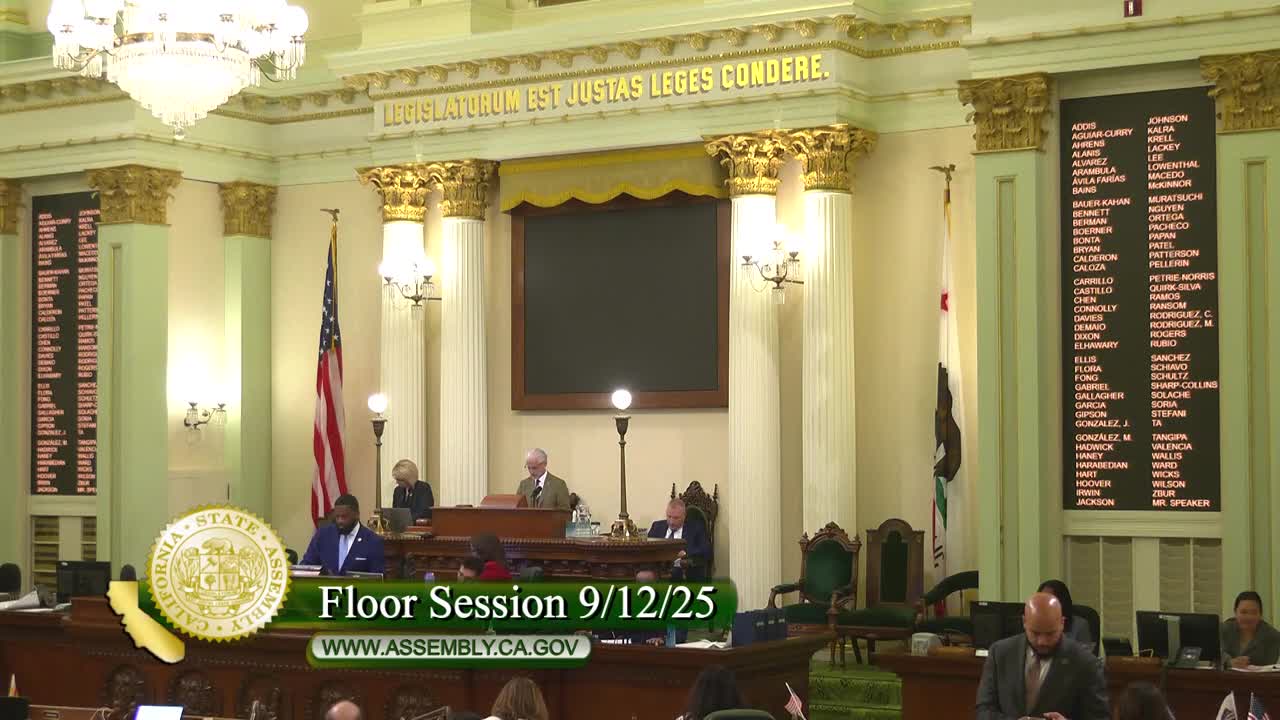 1MIN
Assembly Floor
 50SEC
Senate Standing Committee on Appropriations
 7MIN
Senate Standing Committee on Judiciary
 7MIN
Assembly Floor
Bill Author