AB 1428: California Affordable Childcare Act: Personal Income Tax and Corporation Tax.
- Session Year: 2025-2026
- House: Assembly
- Latest Version Date: 2025-04-09
Current Status:
Failed
(2026-02-02: From committee: Filed with the Chief Clerk pursuant to Joint Rule 56.)
Introduced
In Committee
Awaiting First Chamber Vote
Passed First Chamber
In Committee
Awaiting Second Chamber Vote
Passed Second Chamber
Enacted
What does this bill do?
The bill creates a temporary 0.5% tax on the portion of individual and corporate income over $10 million for entities that employ one or more workers for taxable years beginning in 2026 through 2030, but it exempts employers that provide on-site child care or fully reimburse employees for needed child care. Revenue from the tax is directed into a new state childcare fund to provide grants to licensed child care providers to lower fees for families and expand capacity by hiring more staff.
The summary is provided by generative AI which can make mistakes. For original language, please view the details in the table below.
The Personal Income Tax Law and the Corporation Tax Law impose taxes according to, or measured by, income derived from or attributable to sources within this state.
This bill, for taxable years beginning on or after January 1, 2026, and before January 1, 2031, in addition to any other taxes imposed by those laws, would impose a tax at a rate of 0.05% 0.5% on that portion of income in excess of $10,000,000 during the taxable year. year, except as provided. The bill would establish the California Affordable Child Care Fund in the State Treasury and would direct all revenues, less reimbursement to the Franchise Tax Board for the administration of the additional tax, to be deposited into that fund. The bill would continuously appropriate the moneys in the fund to the State Treasurer for the purpose of establishing a grant program for licensed child care facilities, as described. By establishing a new continuously appropriated fund, this bill would make an appropriation.
This bill would include a change in state statute that would result in a taxpayer paying a higher tax within the meaning of Section 3 of Article XIIIA of the California Constitution, and thus would require for passage the approval of 2/3 of the membership of each house of the Legislature.
The Personal Income Tax Law and the Corporation Tax Law impose taxes according to, or measured by, income derived from or attributable to sources within this state.
This bill, in addition to any other taxes imposed by those laws, would impose a tax at a rate of 0.05% on that portion of income in excess of $10,000,000 during the taxable year. The bill would establish the California Affordable Child Care Fund in the State Treasury and would direct all revenues, less reimbursement to the Franchise Tax Board for the administration of the additional tax, to be deposited into that fund. The bill would continuously appropriate the moneys in the fund to the State Treasurer for the purpose of establishing a grant program for licensed child care facilities, as described. By establishing a new continuously appropriated fund, this bill would make an appropriation.
This bill would include a change in state statute that would result in a taxpayer paying a higher tax within the meaning of Section 3 of Article XIIIA of the California Constitution, and thus would require for passage the approval of 2/3 of the membership of each house of the Legislature.
Existing law, the Child Care and Development Services Act, administered by the State Department of Social Services, establishes a system of childcare and development services for children up to 13 years of age and their parents, including a full range of supervision, health, and support services through full- and part-time programs. Existing law sets forth the purposes of the act, which include, among other things, the provision of a comprehensive, coordinated, and cost-effective system of childcare and development services for children and their parents.This bill would state the intent of the Legislature to enact legislation to establish the California Affordable Childcare Act.Existing law, the Child Care and Development Services Act, administered by the State Department of Social Services, establishes a system of childcare and development services for children up to 13 years of age and their parents, including a full range of supervision, health, and support services through full- and part-time programs. Existing law sets forth the purposes of the act, which include, among other things, the provision of a comprehensive, coordinated, and cost-effective system of childcare and development services for children and their parents.
This bill would state the intent of the Legislature to enact legislation to establish the California Affordable Childcare Act.
This measure shall be known, and may be cited, as the California Affordable Child Care Act.
SEC. 2.The Legislature finds and declares all of the following:
(a)There are 2.7 million children ages 5 and under in California 62% of these children have all available parents in the workforce.
(b)The typical annual cost of child care for an infant in California is around $19,000.
(c)On average, child care providers in California earn just $37,270 a year which can make it a challenge to recruit and retain this workforce, leading to labor supply issues.
(d)The California economy loses $17 billion annually due to child care challenges.
SEC. 3.Section 17043.5 is added to the Revenue and Taxation Code, to read:17043.5.(a)For each taxable year beginning on or after January 1, 2026, and before January 1, 2031, in addition to any other taxes imposed by this part, a tax shall be imposed at a rate of 0.05 0.5 percent on that portion of a taxpayers income in excess of ten million dollars ($10,000,000).
(b)(1)The tax imposed pursuant to subdivision (a) shall only apply to a taxpayer that employs one or more employees, either as an individual or through a partnership, limited liability company, or similar business enterprise of which the taxpayer is a partner, member, owner, or beneficial owner.
(2)Notwithstanding paragraph (1), the tax imposed by this section shall not apply where the taxpayer satisfies either of the following:
(A)Provides child care for their employees during working hours.
(B)Fully reimburses employees for necessary child care services.
(c)This section shall remain operative only until December 1, 2031, and as of that date is repealed.
SEC. 4.Section 19602.6 is added to the Revenue and Taxation Code, to read:19602.6.(a)The Affordable Childcare Reimbursement Fund is hereby established in the State Treasury. All revenues, less reimbursement to the Franchise Tax Board for the costs of administration, from the additional tax imposed under Sections 17043.5 and 23151.5 for the taxable year shall be deposited in the Affordable Childcare Reimbursement Fund.
(b)Notwithstanding Section 13340 of the Government Code, moneys in the fund are continuously appropriated without regard to fiscal year to the Treasurer for the purposes of funding grants as described in this section.
(c)Beginning with the 202728 fiscal year, grants shall be made available to childcare facilities licensed pursuant to the California Child Day Care Facilities Act (Chapters 3.5 (commencing with Section 1596.90) and 3.6 (commencing with Section 1597.30)) of Division 2 of the Health and Safety Code.
(d)Grant funds shall be used exclusively for the following:
(1)Lowering rates charged by a licensee for child care services.
(2)Increasing available spaces for services provided by hiring additional employees.
SEC. 5.Section 23151.5 is added to the Revenue and Taxation Code, to read:23151.5.(a)For each taxable year beginning on or after January 1, 2026, and before January 1, 2031, in addition to any other taxes imposed by this part, a tax shall be imposed at a rate of 0.05 0.5 percent on that portion of a corporations income in excess of ten million dollars ($10,000,000).
(b)(1)The tax imposed pursuant to subdivision (a) shall only apply to any corporation that employs one or more employees.
(2)Notwithstanding paragraph (1), the tax imposed by this section shall not apply where the corporation satisfies either of the following:
(A)Provides child care for their employees during working hours.
(B)Fully reimburses employees for necessary child care services.
(c)This section shall remain operative only until December 1, 2031, and as of that date is repealed.
This measure shall be known, and may be cited, as the California Affordable Child Care Act.
SEC. 2.The Legislature finds and declares all of the following:
(a)There are 2.7 million children ages 5 and under in California 62% of these children have all available parents in the workforce.
(b)The typical annual cost of child care for an infant in California is around $19,000.
(c)On average, child care providers in California earn just $37,270 a year which can make it a challenge to recruit and retain this workforce, leading to labor supply issues.
(d)The California economy loses $17 billion annually due to child care challenges.
SEC. 3.Section 17043.5 is added to the Revenue and Taxation Code, to read:17043.5.(a)For each taxable year beginning on or after January 1, 2026, in addition to any other taxes imposed by this part, a tax shall be imposed at a rate of 0.05 percent on that portion of a taxpayers income in excess of ten million dollars ($10,000,000).
(b)(1)The tax imposed pursuant to subdivision (a) shall only apply to a taxpayer that employs one or more employees, either as an individual or through a partnership, limited liability company, or similar business enterprise of which the taxpayer is a partner, member, owner, or beneficial owner.
(2)Notwithstanding paragraph (1), the tax imposed by this section shall not apply where the taxpayer satisfies either of the following:
(A)Provides child care for their employees during working hours.
(B)Fully reimburses employees for necessary child care services.
SEC. 4.Section 19602.6 is added to the Revenue and Taxation Code, to read:19602.6.(a)The Affordable Childcare Reimbursement Fund is hereby established in the State Treasury. All revenues, less reimbursement to the Franchise Tax Board for the costs of administration, from the additional tax imposed under Sections 17043.5 and 23151.5 for the taxable year shall be deposited in the Affordable Childcare Reimbursement Fund.
(b)Notwithstanding Section 13340 of the Government Code, moneys in the fund are continuously appropriated without regard to fiscal year to the Treasurer for the purposes of funding grants as described in this section.
(c)Beginning with the 202728 fiscal year, grants shall be made available to childcare facilities licensed pursuant to the California Child Day Care Facilities Act (Chapters 3.5 (commencing with Section 1596.90) and 3.6 (commencing with Section 1597.30)) of Division 2 of the Health and Safety Code.
(d)Grant funds shall be used exclusively for the following:
(1)Lowering rates charged by a licensee for child care services.
(2)Increasing available spaces for services provided by hiring additional employees.
SEC. 5.Section 23151.5 is added to the Revenue and Taxation Code, to read:23151.5.(a)For each taxable year beginning on or after January 1, 2026, in addition to any other taxes imposed by this part, a tax shall be imposed at a rate of 0.05 percent on that portion of a corporations income in excess of ten million dollars ($10,000,000).
(b)(1)The tax imposed pursuant to subdivision (a) shall only apply to any corporation that employs one or more employees.
(2)Notwithstanding paragraph (1), the tax imposed by this section shall not apply where the corporation satisfies either of the following:
(A)Provides child care for their employees during working hours.
(B)Fully reimburses employees for necessary child care services.
SECTION 1.It is the intent of the Legislature to enact legislation to establish the California Affordable Childcare Act.It is the intent of the Legislature to enact legislation to establish the California Affordable Childcare Act.
|
Date
|
Status
|
|---|---|
| Feb 2, 2026 | From committee: Filed with the Chief Clerk pursuant to Joint Rule 56. |
| Jan 31, 2026 | Died pursuant to Art. IV, Sec. 10(c) of the Constitution. |
| Apr 28, 2025 | In committee: Set, second hearing. Hearing canceled at the request of author. |
| Apr 21, 2025 | In committee: Set, first hearing. Referred to suspense file. |
| Apr 10, 2025 | Re-referred to Com. on REV. & TAX. |
| Apr 9, 2025 | From committee chair, with author's amendments: Amend, and re-refer to Com. on REV. & TAX. Read second time and amended. |
| Apr 1, 2025 | Re-referred to Com. on REV. & TAX. |
| Mar 28, 2025 | From committee chair, with author's amendments: Amend, and re-refer to Com. on REV. & TAX. Read second time and amended. |
| Mar 28, 2025 | Referred to Com. on REV. & TAX. |
| Feb 24, 2025 | Read first time. |
| Feb 22, 2025 | From printer. May be heard in committee March 24. |
| Feb 21, 2025 | Introduced. To print. |
This list shows positions taken on this bill by organizations on the date displayed, which is linked to the original source.
Positions by individuals are not included.
|
Organization
|
Position
|
Date
|
|---|---|---|
| 21St Century Alliance | ** Against | |
| Acclamation Insurance Management Services | ** Against | |
| Allied Managed Care | ** Against | |
| Associated General Contractors Of California | ** Against | |
| Associated General Contractors, San Diego | ** Against | |
| Building Owners and Managers Association of California | ** Against | |
| California Business Properties Association | ** Against | |
| California Business Roundtable | ** Against | |
| California Chamber Of Commerce | ** Against | |
| California Manufacturers And Technology Association | ** Against | |
| California Taxpayers Association | ** Against | |
| Coalition of Small and Disabled Veteran Businesses | ** Against | |
| Contra Costa Taxpayers Association | ** Against | |
| Family Business Association of California | ** Against | |
| Flasher Barricade Association | ** Against | |
| Kern County Taxpayers Association | ** Against | |
| Naiop California | ** Against | |
| National Federation Of Independent Business | ** Against | |
| SEIU California | ** Support | |
| Silicon Valley Leadership Group | ** Against | |
| Silicon Valley Taxpayers Association | ** Against | |
| Southern California Rental Housing Association | ** Against | |
| United States Telecom Association | ** Against | |
| VALLEY INDUSTRY AND COMMERCE ASSOCIATION | ** Against | |
| Ventura County Taxpayers Association | ** Against |
Date of Hearing: April 28, 2025
ASSEMBLY COMMITTEE ON REVENUE AND TAXATION
Mike Gipson, Chair
ABPCA Bill Id:AB 1428 (
Author:Muratsuchi) – As Amended Ver:April 9, 2025
SUSPENSE
2/3 vote. Fiscal committee.
SUBJECT: California Affordable Childcare Act: Personal Income Tax and Corporation Tax
SUMMARY: Imposes new taxes under both the Personal Income Tax (PIT) Law and Corporation Tax (CT) Law on income in excess of $10 million to provide revenues for a newly established Affordable Childcare Reimbursement Fund (Fund). Specifically, this bill:
- Enacts the California Affordable Child Care Act.
- Contains the following legislative findings and declarations:
- There are 2.7 million children ages 5 and under in California and 62% of these children have all available parents in the workforce;
- The typical annual cost of childcare for an infant in California is around $19,000;
- On average, childcare providers in California earn just $37,270 a year, which can make it a challenge to recruit and retain this workforce, leading to labor supply issues; and,
- The California economy loses $17 billion annually due to childcare challenges.
- Imposes, in addition to any other taxes imposed by the PIT Law, a tax at a rate of 0.5% on that portion of a taxpayer's income in excess of $10 million. Specifically, this tax:
- Applies for taxable years beginning on or after January 1, 2026, and before January 1, 2031;
- Only applies to a taxpayer that employs one or more employees, either as an individual or through a partnership, limited liability company, or similar business enterprise of which the taxpayer is a partner, member, owner, or beneficial owner; and,
- Shall not apply where the taxpayer satisfies either of the following conditions:
- Provides childcare for their employees during working hours; or,
- Fully reimburses employees for necessary childcare services.
- Imposes, in addition to any other taxes imposed by the CT Law, a tax at a rate of 0.5% on that portion of a corporation's income in excess of $10 million. Specifically, this tax:
- Applies for taxable years beginning on or after January 1, 2026, and before January 1, 2031;
- Only applies to a corporation that employs one or more employees; and,
- Shall not apply where the corporation satisfies either of the following conditions:
- Provides childcare for their employees during working hours; or,
- Fully reimburses employees for necessary childcare services.
- Establishes the Fund in the State Treasury. All revenues, less reimbursement to the Franchise Tax Board (FTB) for the costs of administration, from the additional taxes imposed for the taxable year shall be deposited into the Fund.
- Provides that, notwithstanding Government Code Section 13340, moneys in the Fund are continuously appropriated without regard to fiscal year (FY) to the State Treasurer to fund grants.
- Provides that, beginning with FY 2027-28, grants shall be made available to childcare facilities licensed pursuant to the California Child Day Care Facilities Act.
- Specifies that grant funds shall be used exclusively for the following:
- Lowering rates charged by a licensee for childcare services; and,
- Increasing available spaces for services provided by hiring additional employees.
EXISTING LAW:
- Imposes taxes, under the PIT Law and the CT Law, according to, or measured by, income derived from or attributable to sources within this state. (Revenue and Taxation Code (R&TC) Sections 17001 and 23001.
- Imposes, for taxable years beginning on or after January 1, 2005, in addition to any other taxes imposed by the PIT Law, an additional tax at the rate of 1% on that portion of a taxpayer's taxable income in excess of $1 million. Specifies that the following shall not apply to this tax:
- The provisions of R&TC Section 17039, relating to the allowance of credits;
- The provisions of R&TC Section 17041, relating to filing status and recomputation of the income tax brackets; and,
- The provisions of R&TC Section 17045, relating to joint returns.
(R&TC Section 17043.)
FISCAL EFFECT: The FTB estimates that this bill would generate additional revenues of $210 million in FY 2025-26, $460 million in FY 2026-27, and $460 million in FY 2027-28.
COMMENTS:
- The author has provided the following statement in support of this bill:
Child care affordability is not just a family issue – it's an economic one. When families have access to reliable, high-quality child care, parents can stay in the workforce, businesses thrive, and children receive the early learning support they need to succeed.
Assembly Bill 1428 establishes the California Affordable Child Care Fund to address the urgent crisis of child care affordability and access across the state. With over 2.4 million California parents unable to afford child care and hundreds of thousands of children without access to care, AB 1428 offers a sustainable solution to strengthen California's child care system by proposing a modest tax of [0.5%] on income above $10 million annually. Revenue generated will be deposited into a dedicated fund to support licensed child care providers to lower costs for families, expand access by increasing staffing, and improve program quality.
- This bill is sponsored by SEIU California, which notes:
Our workforce includes child care providers who provide home-based care for California children. They often work long hours and experience physical and mental exhaustion as a result. Grants from the fund established in this bill would allow them to lower the cost of their services while continuing to provide quality care for families. Additionally, the funds can be used to hire more employees; this would not only increase the number of child care slots for families, but it would also promote the health and well-being of child care providers.
AB 1428 would impose a 0.5% tax on corporations making over $10 million a year to generate revenue for the fund. The bill exempts corporations that provide child care services for their employees during work hours or fully reimburses employees for necessary child care services. By incentivizing corporations to do either of these things, this bill further reduces the cost of child care for California's working families.
- This bill is opposed by the California Taxpayers Association, which notes:
California's top marginal personal income tax rate of 13.3 percent is the highest in the nation, and payroll taxes levied on top of income taxes effectively bring the tax rate for wealthy Californians to 14.5 percent. AB 1428 would increase the top personal income tax rate to 15 percent for targeted taxpayers.
According to data from the enacted 2024-25 budget, 41.4 percent of California's tax and fee revenue comes from the personal income tax, and the most recent data released by the Franchise Tax Board shows that the top 1 percent of high-income taxpayers accounted for nearly 40 percent of personal income tax revenue received by the state.
Because of the state's disproportionate dependence on high earners, the revenue stream follows the boom-and-bust cycle of the stock market. AB 1428 could result in the migration of high-income earners to any of the 49 other states that have dramatically lower income taxes, or no personal income taxes at all.
- Committee Staff Comments:
- The childcare crisis: Quality childcare serves a number of important functions. Among other things, quality childcare provides an educational foundation for young children while granting their parents and caregivers the support needed to participate in the workforce and contribute to the economy. Nevertheless, access to affordable and quality childcare remains a significant challenge for many Californians. According to a report by First 5 California, over 2.4 million California parents simply cannot afford childcare. This report also found that:
- 48% of California parents say that it is difficult or very difficult to find childcare they can afford;
- Over one-third of California parents say it is difficult to find childcare located near their work or home or within the hours they need;
- 50% of parents say childcare issues have a negative impact on their career or job; and,
- Nationally, lack of affordable childcare results in $28.9 billion in lost wages annually.
- The childcare crisis: Quality childcare serves a number of important functions. Among other things, quality childcare provides an educational foundation for young children while granting their parents and caregivers the support needed to participate in the workforce and contribute to the economy. Nevertheless, access to affordable and quality childcare remains a significant challenge for many Californians. According to a report by First 5 California, over 2.4 million California parents simply cannot afford childcare. This report also found that:
The report also points to the lingering negative impact of the COVID-19 pandemic on the childcare ecosystem in California. Specifically, the report notes:
The COVID-19 pandemic exacerbated an existing childcare shortage in California, when roughly a third of the childcare provider workforce was lost and families went without access to these critical early learning environments. While some providers have returned, in part due to a combination of rate reform and improved wages through the collective bargaining actions of provider unions, millions of families still struggle to find childcare within their communities that is accessible and affordable. As a result, parents, particularly women who want to work outside the home, are too often left out of the workforce.
- What would this bill do? This bill seeks to establish a dedicated funding source for childcare in California by imposing two new taxes. Specifically, this bill would impose a tax under both the PIT Law and the CT Law at the rate of 0.5% on that portion of a taxpayer's income in excess of $10 million. The tax would only apply in cases where the taxpayer or corporation employs one or more employees. Additionally, the 0.5% tax would not apply in cases where the taxpayer or corporation either provides childcare for their employees during working hours or fully reimburses employees for necessary childcare services.
Revenues from these new taxes would be deposited into the Fund, with moneys continuously appropriated to the State Treasurer to fund grants. Beginning with FY 2027-28, grants would be made available to childcare facilities licensed under the California Child Day Care Facilities Act. Grant funds would be used exclusively to lower rates charged by a licensee for childcare services and to increase available spaces by hiring additional employees.
- The benefits and perils of earmarking: Proponents of this bill might argue that this bill provides a stable and much-needed source of funding for California's childcare system. Critics, however, might contend that the practice of earmarking restricts the Legislature's ability to fund vital state programs in a holistic manner through the annual budgetary process. Critics might also argue that this bill elevates the needs of childcare above other vital programs designed to address basic human necessities, ranging from health care to public safety.
- High marginal rates promote progressivity but also revenue volatility: In 2004, California voters passed the Mental Health Services Act (MHSA) to expand and transform California's behavioral health system to better serve individuals with, and at risk of, serious mental health issues. Specifically, the MHSA imposed an additional PIT at the rate of 1% on that portion of a taxpayer's taxable income exceeding $1 million. When one includes the MHSA tax, California currently has a top marginal PIT rate of 13.3%, which, according to the Tax Foundation's national survey, is the highest PIT rate in the country. If this bill were passed, however, California's top marginal tax rate would, at least for many employers with income in excess of $10 million, increase to 13.8%. California's standard rate under the CT Law, in turn, is currently 8.84%. If this bill were passed, California's top CT Law rate would increase to 9.34%, still behind several other states including New Jersey, which, according to the Tax Foundation, has a top marginal corporate rate of 11.5%.
Progressive tax structures have a number of benefits. Namely, they generate revenues for essential government services while minimizing the burden on those who can least afford to pay. This can be seen by examining California's PIT, which, according to the Department of Finance, is estimated to comprise 61.3% of California's General Fund revenues in FY 2025-26 alone. The CT, in turn, is estimated to comprise 17.3% of General Fund Revenues.
At the same time, however, a progressive tax system largely places responsibility for funding government on the state's wealthiest taxpayers. For example, it is widely reported that the top 1% of income earners pay roughly 40% or more of all PITs in California. The income of these wealthy taxpayers, however, is often driven by rises and falls in stock and other asset prices. This can lead to significant revenue volatility from year to year. When such revenues are tied to specific programs, it is not difficult to envision a scenario where programmatic funding is set at high levels in good economic times, creating expectations that cannot be met when revenues fall, sometimes precipitously, due to weaker economic conditions.
- Administrative and policy considerations: Committee staff has identified a number of administrative and policy considerations and stands willing to assist the author to resolve these and any other issues that are identified as this bill progresses through the legislative process. These issues include the following:
- This bill uses terminology not found in the tax code. For example, in its PIT provisions, this bill imposes the new rate on that portion of a taxpayer's "income" in excess of $10 million. It is not clear what this means, however. Does the author wish the tax to apply to "taxable income" in line with the PIT Law generally? If so, amendments should be taken to reflect this intent.
- This bill provides that the tax shall not apply to a taxpayer or corporation that either "provides child care" for their employees during working hours or fully reimburses employees for "necessary child care services." This bill, however, does not define what constitutes "childcare", nor what would be considered "necessary child care services". The lack of definitional clarity could lead to disputes between taxpayers and the FTB and complicate administration of this new tax.
- As noted above, this bill would continuously appropriate tax revenues to the State Treasurer to fund grants to licensed childcare facilities to lower childcare service rates and increase available spaces by hiring additional employees. As a preliminary matter, it is unclear why the State Treasurer, who serves as the state's lead asset manager and financier, has been selected to award grants for childcare. It is also unclear what criteria would be used to award grants. Would the State Treasurer award grants based on considerations of geography, greatest need, and greatest potential impact? In addition, how would the State Treasurer ensure that grant proceeds are actually used to achieve goals like "lowering rates". Would this require the Treasurer's Office to enter into a contractual arrangement with grant recipients setting forth specific conditions? If so, would this necessitate auditing for purposes of compliance?
- Would the new PIT rate apply to a taxpayer with one employee even if that single employee had no children requiring childcare? If this is not the author's intent, clarifying amendments should be taken.
- The FTB has identified a number of implementation considerations in its staff analysis of this bill, including the following:
- This bill uses undefined terms, e.g., "similar business enterprise" and "necessary child care services." The absence of definitions could lead to taxpayer confusion. For clarity, the author may wish to amend the bill to define these terms.
- The bill provides that the FTB would deposit the additional 0.5% tax in the Affordable Childcare Reimbursement Fund for the State Treasurer to fund grants as specified. However, the bill does not provide which state agency would administer the grants allowed by this bill.
- The bill is silent on whether the $10 million income threshold would apply to all of the taxpayer's income or only the amount that flows from the partnership to the taxpayer. The author may wish to amend the bill to clarify.
- The bill does not specify whether this tax would be treated as income taxes imposed under the PITL or CTL, which could complicate administration. For clarity, the author may want to amend the bill to specify that this additional tax be treated as if imposed under Section 17041 and 23151 and specify whether credits allowed under the CTL or PITL could be applied to this additional tax.
- Prior legislation:
- AB 14 (Davies), of the 2023-24 Legislative Session, would have allowed a credit under the PIT Law in an amount equal to childcare costs, as defined, paid or incurred by the qualified taxpayer in this state, as specified. AB 14 was held on this Committee's Suspense File.
- AB 1634 (Bauer-Kahan), of the 2023-24 Legislative Session, would have allowed a deduction for any cost paid or incurred by a taxpayer for qualified childcare provided by the taxpayer to a dependent, under six years of age, of the taxpayer's employee, not to exceed $5,000 per taxable year per qualified dependent. AB 1634 was never heard by this Committee.
- SB 533 (Limón), of the 2023-24 Legislative Session, would have, among other things, allowed a credit equal to 30% of the costs of startup expenses for childcare programs or constructing a childcare facility, to be used primarily by the children of the taxpayer's employees or by the children of employees of tenants leasing commercial or office space in a building owned by the taxpayer, or of the costs of providing childcare information and referral services to the taxpayer's employees, as provided, not to exceed $30,000 for the taxable year. SB 533 was held on the Senate Appropriations Committee's Suspense File.
- AB 2803 (Valladares), of the 2021-22 Legislative Session, would have allowed a credit for contributions paid or incurred by a taxpayer for qualified care or backup care for dependents, as specified, of the taxpayer's employees, in an amount equal to 25% of the contributions, or 30% for a small employer taxpayer, as provided, not to exceed $250,000 per taxable year. AB 2803 was heard for testimony only but did not receive a vote in this Committee.
- Administrative and policy considerations: Committee staff has identified a number of administrative and policy considerations and stands willing to assist the author to resolve these and any other issues that are identified as this bill progresses through the legislative process. These issues include the following:
REGISTERED SUPPORT / OPPOSITION:
Support
SEIU California (Sponsor)
Opposition
Acclamation Insurance Management Services
Allied Managed Care
Associated General Contractors of California
Associated General Contractors San Diego
Building Owners and Managers Association of California
California Business Properties Association
California Business Roundtable
California Chamber of Commerce
California Manufacturers and Technology Association
California Taxpayers Association
Coalition of Small and Disabled Veteran Businesses
Contra Costa Taxpayers Association
Family Business Association of California
Flasher Barricade Association
Kern County Taxpayers Association
NAIOP California
National Federation of Independent Business
Silicon Valley Leadership Group
Silicon Valley Taxpayers Association
Southern California Rental Housing Association
United States Telecom Association
Valley Industry and Commerce Association
Ventura County Taxpayers Association
21st Century Alliance
Analysis Prepared by: M. David Ruff / REV. & TAX. / (916) 319-2098
Date of Hearing: April 21, 2025
ASSEMBLY COMMITTEE ON REVENUE AND TAXATION
Mike Gipson, Chair
ABPCA Bill Id:AB 1428 (
Author:Muratsuchi) – As Amended Ver:April 9, 2025
2/3 vote. Fiscal committee.
SUBJECT: California Affordable Childcare Act: Personal Income Tax and Corporation Tax
SUMMARY: Imposes new taxes under both the Personal Income Tax (PIT) Law and Corporation Tax (CT) Law on income in excess of $10 million to provide revenues for a newly established Affordable Childcare Reimbursement Fund (Fund). Specifically, this bill:
- Enacts the California Affordable Child Care Act.
- Contains the following legislative findings and declarations:
- There are 2.7 million children ages 5 and under in California and 62% of these children have all available parents in the workforce;
- The typical annual cost of childcare for an infant in California is around $19,000;
- On average, childcare providers in California earn just $37,270 a year, which can make it a challenge to recruit and retain this workforce, leading to labor supply issues; and,
- The California economy loses $17 billion annually due to childcare challenges.
- Imposes, in addition to any other taxes imposed by the PIT Law, a tax at a rate of 0.5% on that portion of a taxpayer's income in excess of $10 million. Specifically, this tax:
- Applies for taxable years beginning on or after January 1, 2026, and before January 1, 2031;
- Only applies to a taxpayer that employs one or more employees, either as an individual or through a partnership, limited liability company, or similar business enterprise of which the taxpayer is a partner, member, owner, or beneficial owner; and,
- Shall not apply where the taxpayer satisfies either of the following conditions:
- Provides childcare for their employees during working hours; or,
- Fully reimburses employees for necessary childcare services.
- Imposes, in addition to any other taxes imposed by the CT Law, a tax at a rate of 0.5% on that portion of a corporation's income in excess of $10 million. Specifically, this tax:
- Applies for taxable years beginning on or after January 1, 2026, and before January 1, 2031;
- Only applies to a corporation that employs one or more employees; and,
- Shall not apply where the corporation satisfies either of the following conditions:
- Provides childcare for their employees during working hours; or,
- Fully reimburses employees for necessary childcare services.
- Establishes the Fund in the State Treasury. All revenues, less reimbursement to the Franchise Tax Board (FTB) for the costs of administration, from the additional taxes imposed for the taxable year shall be deposited into the Fund.
- Provides that, notwithstanding Government Code Section 13340, moneys in the Fund are continuously appropriated without regard to fiscal year (FY) to the State Treasurer to fund grants.
- Provides that, beginning with FY 2027-28, grants shall be made available to childcare facilities licensed pursuant to the California Child Day Care Facilities Act.
- Specifies that grant funds shall be used exclusively for the following:
- Lowering rates charged by a licensee for childcare services; and,
- Increasing available spaces for services provided by hiring additional employees.
EXISTING LAW:
- Imposes taxes, under the PIT Law and the CT Law, according to, or measured by, income derived from or attributable to sources within this state. (Revenue and Taxation Code (R&TC) Sections 17001 and 23001.
- Imposes, for taxable years beginning on or after January 1, 2005, in addition to any other taxes imposed by the PIT Law, an additional tax at the rate of 1% on that portion of a taxpayer's taxable income in excess of $1 million. Specifies that the following shall not apply to this tax:
- The provisions of R&TC Section 17039, relating to the allowance of credits;
- The provisions of R&TC Section 17041, relating to filing status and recomputation of the income tax brackets; and,
- The provisions of R&TC Section 17045, relating to joint returns.
(R&TC Section 17043.)
FISCAL EFFECT: The FTB estimates that this bill would generate additional revenues of $210 million in FY 2025-26, $460 million in FY 2026-27, and $460 million in FY 2027-28.
COMMENTS:
- The author has provided the following statement in support of this bill:
Child care affordability is not just a family issue – it's an economic one. When families have access to reliable, high-quality child care, parents can stay in the workforce, businesses thrive, and children receive the early learning support they need to succeed.
Assembly Bill 1428 establishes the California Affordable Child Care Fund to address the urgent crisis of child care affordability and access across the state. With over 2.4 million California parents unable to afford child care and hundreds of thousands of children without access to care, AB 1428 offers a sustainable solution to strengthen California's child care system by proposing a modest tax of [0.5%] on income above $10 million annually. Revenue generated will be deposited into a dedicated fund to support licensed child care providers to lower costs for families, expand access by increasing staffing, and improve program quality.
- This bill is sponsored by SEIU California, which notes:
Our workforce includes child care providers who provide home-based care for California children. They often work long hours and experience physical and mental exhaustion as a result. Grants from the fund established in this bill would allow them to lower the cost of their services while continuing to provide quality care for families. Additionally, the funds can be used to hire more employees; this would not only increase the number of child care slots for families, but it would also promote the health and well-being of child care providers.
AB 1428 would impose a 0.5% tax on corporations making over $10 million a year to generate revenue for the fund. The bill exempts corporations that provide child care services for their employees during work hours or fully reimburses employees for necessary child care services. By incentivizing corporations to do either of these things, this bill further reduces the cost of child care for California's working families.
- This bill is opposed by the California Taxpayers Association, which notes:
California's top marginal personal income tax rate of 13.3 percent is the highest in the nation, and payroll taxes levied on top of income taxes effectively bring the tax rate for wealthy Californians to 14.5 percent. AB 1428 would increase the top personal income tax rate to 15 percent for targeted taxpayers.
According to data from the enacted 2024-25 budget, 41.4 percent of California's tax and fee revenue comes from the personal income tax, and the most recent data released by the Franchise Tax Board shows that the top 1 percent of high-income taxpayers accounted for nearly 40 percent of personal income tax revenue received by the state.
Because of the state's disproportionate dependence on high earners, the revenue stream follows the boom-and-bust cycle of the stock market. AB 1428 could result in the migration of high-income earners to any of the 49 other states that have dramatically lower income taxes, or no personal income taxes at all.
- Committee Staff Comments:
- The childcare crisis: Quality childcare serves a number of important functions. Among other things, quality childcare provides an educational foundation for young children while granting their parents and caregivers the support needed to participate in the workforce and contribute to the economy. Nevertheless, access to affordable and quality childcare remains a significant challenge for many Californians. According to a report by First 5 California, over 2.4 million California parents simply cannot afford childcare. This report also found that:
- 48% of California parents say that it is difficult or very difficult to find childcare they can afford;
- Over one-third of California parents say it is difficult to find childcare located near their work or home or within the hours they need;
- 50% of parents say childcare issues have a negative impact on their career or job; and,
- Nationally, lack of affordable childcare results in $28.9 billion in lost wages annually.
- The childcare crisis: Quality childcare serves a number of important functions. Among other things, quality childcare provides an educational foundation for young children while granting their parents and caregivers the support needed to participate in the workforce and contribute to the economy. Nevertheless, access to affordable and quality childcare remains a significant challenge for many Californians. According to a report by First 5 California, over 2.4 million California parents simply cannot afford childcare. This report also found that:
The report also points to the lingering negative impact of the COVID-19 pandemic on the childcare ecosystem in California. Specifically, the report notes:
The COVID-19 pandemic exacerbated an existing childcare shortage in California, when roughly a third of the childcare provider workforce was lost and families went without access to these critical early learning environments. While some providers have returned, in part due to a combination of rate reform and improved wages through the collective bargaining actions of provider unions, millions of families still struggle to find childcare within their communities that is accessible and affordable. As a result, parents, particularly women who want to work outside the home, are too often left out of the workforce.
- What would this bill do? This bill seeks to establish a dedicated funding source for childcare in California by imposing two new taxes. Specifically, this bill would impose a tax under both the PIT Law and the CT Law at the rate of 0.5% on that portion of a taxpayer's income in excess of $10 million. The tax would only apply in cases where the taxpayer or corporation employs one or more employees. Additionally, the 0.5% tax would not apply in cases where the taxpayer or corporation either provides childcare for their employees during working hours or fully reimburses employees for necessary childcare services.
Revenues from these new taxes would be deposited into the Fund, with moneys continuously appropriated to the State Treasurer to fund grants. Beginning with FY 2027-28, grants would be made available to childcare facilities licensed under the California Child Day Care Facilities Act. Grant funds would be used exclusively to lower rates charged by a licensee for childcare services and to increase available spaces by hiring additional employees.
- The benefits and perils of earmarking: Proponents of this bill might argue that this bill provides a stable and much-needed source of funding for California's childcare system. Critics, however, might contend that the practice of earmarking restricts the Legislature's ability to fund vital state programs in a holistic manner through the annual budgetary process. Critics might also argue that this bill elevates the needs of childcare above other vital programs designed to address basic human necessities, ranging from health care to public safety.
- High marginal rates promote progressivity but also revenue volatility: In 2004, California voters passed the Mental Health Services Act (MHSA) to expand and transform California's behavioral health system to better serve individuals with, and at risk of, serious mental health issues. Specifically, the MHSA imposed an additional PIT at the rate of 1% on that portion of a taxpayer's taxable income exceeding $1 million. When one includes the MHSA tax, California currently has a top marginal PIT rate of 13.3%, which, according to the Tax Foundation's national survey, is the highest PIT rate in the country. If this bill were passed, however, California's top marginal tax rate would, at least for many employers with income in excess of $10 million, increase to 13.8%. California's standard rate under the CT Law, in turn, is currently 8.84%. If this bill were passed, California's top CT Law rate would increase to 9.34%, still behind several other states including New Jersey, which, according to the Tax Foundation, has a top marginal corporate rate of 11.5%.
Progressive tax structures have a number of benefits. Namely, they generate revenues for essential government services while minimizing the burden on those who can least afford to pay. This can be seen by examining California's PIT, which, according to the Department of Finance, is estimated to comprise 61.3% of California's General Fund revenues in FY 2025-26 alone. The CT, in turn, is estimated to comprise 17.3% of General Fund Revenues.
At the same time, however, a progressive tax system largely places responsibility for funding government on the state's wealthiest taxpayers. For example, it is widely reported that the top 1% of income earners pay roughly 40% or more of all PITs in California. The income of these wealthy taxpayers, however, is often driven by rises and falls in stock and other asset prices. This can lead to significant revenue volatility from year to year. When such revenues are tied to specific programs, it is not difficult to envision a scenario where programmatic funding is set at high levels in good economic times, creating expectations that cannot be met when revenues fall, sometimes precipitously, due to weaker economic conditions.
- Administrative and policy considerations: Committee staff has identified a number of administrative and policy considerations and stands willing to assist the author to resolve these and any other issues that are identified as this bill progresses through the legislative process. These issues include the following:
- This bill uses terminology not found in the tax code. For example, in its PIT provisions, this bill imposes the new rate on that portion of a taxpayer's "income" in excess of $10 million. It is not clear what this means, however. Does the author wish the tax to apply to "taxable income" in line with the PIT Law generally? If so, amendments should be taken to reflect this intent.
- This bill provides that the tax shall not apply to a taxpayer or corporation that either "provides child care" for their employees during working hours or fully reimburses employees for "necessary child care services." This bill, however, does not define what constitutes "childcare", nor what would be considered "necessary child care services". The lack of definitional clarity could lead to disputes between taxpayers and the FTB and complicate administration of this new tax.
- As noted above, this bill would continuously appropriate tax revenues to the State Treasurer to fund grants to licensed childcare facilities to lower childcare service rates and increase available spaces by hiring additional employees. As a preliminary matter, it is unclear why the State Treasurer, who serves as the state's lead asset manager and financier, has been selected to award grants for childcare. It is also unclear what criteria would be used to award grants. Would the State Treasurer award grants based on considerations of geography, greatest need, and greatest potential impact? In addition, how would the State Treasurer ensure that grant proceeds are actually used to achieve goals like "lowering rates". Would this require the Treasurer's Office to enter into a contractual arrangement with grant recipients setting forth specific conditions? If so, would this necessitate auditing for purposes of compliance?
- Would the new PIT rate apply to a taxpayer with one employee even if that single employee had no children requiring childcare? If this is not the author's intent, clarifying amendments should be taken.
- The FTB has identified a number of implementation considerations in its staff analysis of this bill, including the following:
- This bill uses undefined terms, e.g., "similar business enterprise" and "necessary child care services." The absence of definitions could lead to taxpayer confusion. For clarity, the author may wish to amend the bill to define these terms.
- The bill provides that the FTB would deposit the additional 0.5% tax in the Affordable Childcare Reimbursement Fund for the State Treasurer to fund grants as specified. However, the bill does not provide which state agency would administer the grants allowed by this bill.
- The bill is silent on whether the $10 million income threshold would apply to all of the taxpayer's income or only the amount that flows from the partnership to the taxpayer. The author may wish to amend the bill to clarify.
- The bill does not specify whether this tax would be treated as income taxes imposed under the PITL or CTL, which could complicate administration. For clarity, the author may want to amend the bill to specify that this additional tax be treated as if imposed under Section 17041 and 23151 and specify whether credits allowed under the CTL or PITL could be applied to this additional tax.
- Prior legislation:
- AB 14 (Davies), of the 2023-24 Legislative Session, would have allowed a credit under the PIT Law in an amount equal to childcare costs, as defined, paid or incurred by the qualified taxpayer in this state, as specified. AB 14 was held on this Committee's Suspense File.
- AB 1634 (Bauer-Kahan), of the 2023-24 Legislative Session, would have allowed a deduction for any cost paid or incurred by a taxpayer for qualified childcare provided by the taxpayer to a dependent, under six years of age, of the taxpayer's employee, not to exceed $5,000 per taxable year per qualified dependent. AB 1634 was never heard by this Committee.
- SB 533 (Limón), of the 2023-24 Legislative Session, would have, among other things, allowed a credit equal to 30% of the costs of startup expenses for childcare programs or constructing a childcare facility, to be used primarily by the children of the taxpayer's employees or by the children of employees of tenants leasing commercial or office space in a building owned by the taxpayer, or of the costs of providing childcare information and referral services to the taxpayer's employees, as provided, not to exceed $30,000 for the taxable year. SB 533 was held on the Senate Appropriations Committee's Suspense File.
- AB 2803 (Valladares), of the 2021-22 Legislative Session, would have allowed a credit for contributions paid or incurred by a taxpayer for qualified care or backup care for dependents, as specified, of the taxpayer's employees, in an amount equal to 25% of the contributions, or 30% for a small employer taxpayer, as provided, not to exceed $250,000 per taxable year. AB 2803 was heard for testimony only but did not receive a vote in this Committee.
- Administrative and policy considerations: Committee staff has identified a number of administrative and policy considerations and stands willing to assist the author to resolve these and any other issues that are identified as this bill progresses through the legislative process. These issues include the following:
REGISTERED SUPPORT / OPPOSITION:
Support
SEIU California (Sponsor)
Opposition
Acclamation Insurance Management Services
Allied Managed Care
Associated General Contractors of California
Associated General Contractors San Diego
Building Owners and Managers Association of California
California Business Properties Association
California Business Roundtable
California Chamber of Commerce
California Manufacturers and Technology Association
California Taxpayers Association
Coalition of Small and Disabled Veteran Businesses
Contra Costa Taxpayers Association
Family Business Association of California
Flasher Barricade Association
Kern County Taxpayers Association
NAIOP California
National Federation of Independent Business
Silicon Valley Leadership Group
Silicon Valley Taxpayers Association
Southern California Rental Housing Association
United States Telecom Association
Valley Industry and Commerce Association
Ventura County Taxpayers Association
21st Century Alliance
Analysis Prepared by: M. David Ruff / REV. & TAX. / (916) 319-2098
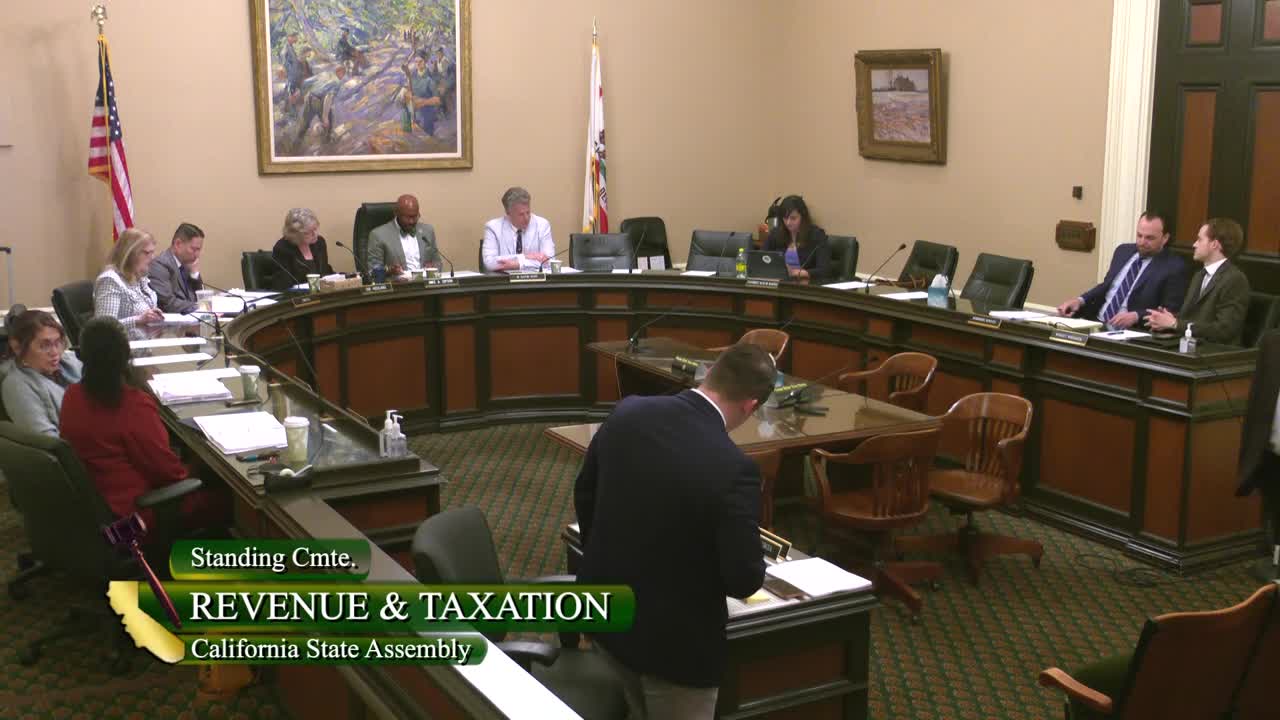
Discussed in Hearing
 13MIN
Assembly Standing Committee on Revenue and Taxation
Bill Author
Bill Co-Author(s):