AB 1629: Dental coverage.
- Session Year: 2025-2026
- House: Assembly
- Latest Version Date: 2026-09-27
Current Status:
Passed
(2026-09-27: Chaptered by Secretary of State - Chapter 535, Statutes of 2026.)
Introduced
In Committee
Awaiting First Chamber Vote
Passed First Chamber
In Committee
Awaiting Second Chamber Vote
Passed Second Chamber
Enacted
Existing law, the Knox-Keene Health Care Service Plan Act of 1975, provides for the licensure and regulation of health care service plans by the Department of Managed Health Care and makes a willful violation of the acts requirements a crime. Existing law provides for the regulation of health insurers by the Department of Insurance. Existing law prohibits a contract between a plan or insurer and a dentist from requiring a dentist to accept an amount set by the plan or insurer as payment for dental care services provided to an enrollee or insured that are not covered services under the enrollees contract or the insureds policy. Existing law requires a plan or insurer to make specified disclosures to an enrollee or insured regarding noncovered dental services.
Existing law requires a health care service plan or health insurer to comply with specified timely access requirements. Under existing law, a health care service plan is required to annually report to the Department of Managed Health Care on this compliance. Existing law authorizes the Department of Insurance to issue guidance to insurers regarding annual timely access and network reporting methodologies.
This bill would require a plan or insurer, including a specialized plan or insurer, covering dental services, to pay a noncontracting dental provider, which includes a registered dental hygienist in alternative practice, directly for covered services rendered to the enrollee or insured in accordance with the benefit provided in the contract or policy when the noncontracting dental provider submits to the plan or insurer an assignment of benefits. The bill would require a noncontracting dental provider to obtain a signed and dated consent to collect an assignment of benefits from an enrollee or insured. The bill would prohibit a noncontracting dental provider collecting an enrollees or insureds assignment of benefits from charging an enrollee or insured, prior to the plan or insurer payment, more than an estimate of the enrollees or the insureds cost sharing for the treatment or a deposit that approximates that cost share. Because a willful violation of these provisions relative to health care service plans would be a crime, this bill would impose a state-mandated local program.
This bill would require a plan or insurer to certify, under penalty of perjury, that specified information submitted to its regulator regarding network adequacy is true and correct, thus creating a crime and imposing a state-mandated local program.
Existing law, the Dental Practice Act, provides for the licensure and regulation of dentists and dental assistants by the Dental Board of California and the licensure and regulation of dental hygienists by the Dental Hygiene Board of California, and defines unprofessional conduct by a licensee, including, among other things, the violation of any provision of the act. Existing law authorizes the respective board to discipline a licensee under the act by placing the licensee on probation under various specified terms and conditions.
This bill would require a noncontracting dental provider, including a registered dental hygienist in alternative practice, to make specified disclosures to a patient before collecting the patients signed and dated consent to an assignment of benefits. The bill would expand the definition of unprofessional conduct under the act to include the failure to comply with that disclosure requirement and the above-described prohibition relating to the charging of a patient more than an estimate of their cost sharing and the failure to maintain a signed and dated copy of the patients consent.
The California Constitution requires the state to reimburse local agencies and school districts for certain costs mandated by the state. Statutory provisions establish procedures for making that reimbursement.
This bill would provide that no reimbursement is required by this act for a specified reason.
Existing law, the Knox-Keene Health Care Service Plan Act of 1975, provides for the licensure and regulation of health care service plans by the Department of Managed Health Care and makes a willful violation of the acts requirements a crime. Existing law provides for the regulation of health insurers by the Department of Insurance. Existing law prohibits a contract between a plan or insurer and a dentist from requiring a dentist to accept an amount set by the plan or insurer as payment for dental care services provided to an enrollee or insured that are not covered services under the enrollees contract or the insureds policy. Existing law requires a plan or insurer to make specified disclosures to an enrollee or insured regarding noncovered dental services.
Existing law requires a health care service plan or health insurer to comply with specified timely access requirements. Under existing law, a health care service plan is required to annually report to the Department of Managed Health Care on this compliance. Existing law authorizes the Department of Insurance to issue guidance to insurers regarding annual timely access and network reporting methodologies.
This bill would require a plan or insurer, including a specialized plan or insurer, covering dental services, to pay a noncontracting dental provider, which includes a registered dental hygienist in alternative practice, directly for covered services rendered to the enrollee or insured in accordance with the benefit provided in the contract or policy when the noncontracting dental provider submits to the plan or insurer an assignment of benefits. The bill would require a noncontracting dental provider to obtain a signed and dated consent to collect an assignment of benefits from an enrollee or insured. The bill would prohibit a noncontracting dental provider collecting an enrollees or insureds assignment of benefits from charging an enrollee or insured, prior to the plan or insurer payment, more than an estimate of the enrollees or the insureds cost sharing for the treatment or a deposit that approximates that cost share. Because a willful violation of these provisions relative to health care service plans would be a crime, this bill would impose a state-mandated local program.
This bill would require a plan or insurer to certify, under penalty of perjury, that specified information submitted to its regulator regarding network adequacy is true and correct, thus creating a crime and imposing a state-mandated local program.
Existing law, the Dental Practice Act, provides for the licensure and regulation of dentists and dental assistants by the Dental Board of California and the licensure and regulation of dental hygienists by the Dental Hygiene Board of California, and defines unprofessional conduct by a licensee, including, among other things, the violation of any provision of the act. Existing law authorizes the respective board to discipline a licensee under the act by placing the licensee on probation under various specified terms and conditions.
This bill would require a noncontracting dental provider, including a registered dental hygienist in alternative practice, to make specified disclosures to a patient before collecting the patients signed and dated consent to an assignment of benefits. The bill would expand the definition of unprofessional conduct under the act to include the failure to comply with that disclosure requirement and the above-described prohibition relating to the charging of a patient more than an estimate of their cost sharing and the failure to maintain a signed and dated copy of the patients consent.
The California Constitution requires the state to reimburse local agencies and school districts for certain costs mandated by the state. Statutory provisions establish procedures for making that reimbursement.
This bill would provide that no reimbursement is required by this act for a specified reason.
Existing law, the Knox-Keene Health Care Service Plan Act of 1975, provides for the licensure and regulation of health care service plans by the Department of Managed Health Care and makes a willful violation of the acts requirements a crime. Existing law provides for the regulation of health insurers by the Department of Insurance. Existing law prohibits a contract between a plan or insurer and a dentist from requiring a dentist to accept an amount set by the plan or insurer as payment for dental care services provided to an enrollee or insured that are not covered services under the enrollees contract or the insureds policy. Existing law requires a plan or insurer to make specified disclosures to an enrollee or insured regarding noncovered dental services.
Existing law requires a health care service plan or health insurer to comply with specified timely access requirements. Under existing law, a health care service plan is required to annually report to the Department of Managed Health Care on this compliance. Existing law authorizes the Department of Insurance to issue guidance to insurers regarding annual timely access and network reporting methodologies.
This bill would require a plan or insurer, including a specialized plan or insurer, covering dental services, upon written and dated consent of the enrollee or insured, to pay a noncontracting dental provider provider, which includes a registered dental hygienist in alternative practice, directly for covered services rendered to the enrollee or insured in accordance with the benefit provided in the contract or policy. policy when the noncontracting dental provider submits to the plan or insurer an assignment of benefits. The bill would require a noncontracting dental provider to obtain a signed and dated consent to collect an assignment of benefits from an enrollee or insured. The bill would prohibit a noncontracting dental provider accepting collecting an enrollees or insureds assignment of benefits from charging an enrollee or insured, prior to the plan or insurer payment, more than an estimate of the enrollees or the insureds cost sharing for the treatment or a deposit that approximates that cost share. The bill would require a noncontracting dental provider to make specified disclosures to an enrollee or insured before accepting an assignment of benefits. Because a willful violation of these provisions relative to health care service plans would be a crime, this bill would impose a state-mandated local program.
This bill would require a plan or insurer to certify, under penalty of perjury, that specified information submitted to its regulator regarding network adequacy is true and correct, thus creating a crime and imposing a state-mandated local program.
Existing law, the Dental Practice Act, provides for the licensure and regulation of dentists and dental assistants by the Dental Board of California and the licensure and regulation of dental hygienists by the Dental Hygiene Board of California, and defines unprofessional conduct by a licensee, including, among other things, the violation of any provision of the act. Existing law authorizes the respective board to discipline a licensee under the act by placing the licensee on probation under various specified terms and conditions.
This bill would require a noncontracting dental provider, including a registered dental hygienist in alternative practice, to make specified disclosures to a patient before collecting the patients signed and dated consent to an assignment of benefits. The bill would expand the definition of unprofessional conduct under the act to include the failure to comply with the requirements and prohibitions described above relating to the payment of a noncontracting provider by a plan or insurer, the amount a noncontracting provider may charge an enrollee or insured, and the provision of disclosures by a noncontracting provider. that disclosure requirement and the above-described prohibition relating to the charging of a patient more than an estimate of their cost sharing and the failure to maintain a signed and dated copy of the patients consent.
The California Constitution requires the state to reimburse local agencies and school districts for certain costs mandated by the state. Statutory provisions establish procedures for making that reimbursement.
This bill would provide that no reimbursement is required by this act for a specified reason.
Existing law, the Knox-Keene Health Care Service Plan Act of 1975, provides for the licensure and regulation of health care service plans by the Department of Managed Health Care and makes a willful violation of the acts requirements a crime. Existing law provides for the regulation of health insurers by the Department of Insurance. Existing law prohibits a contract between a plan or insurer and a dentist from requiring a dentist to accept an amount set by the plan or insurer as payment for dental care services provided to an enrollee or insured that are not covered services under the enrollees contract or the insureds policy. Existing law requires a plan or insurer to make specified disclosures to an enrollee or insured regarding noncovered dental services.
Existing law requires a health care service plan or health insurer to comply with specified timely access requirements. Under existing law, a health care service plan is required to annually report to the Department of Managed Health Care on this compliance. Existing law authorizes the Department of Insurance to issue guidance to insurers regarding annual timely access and network reporting methodologies.
If a health care service plan or health insurer pays a contracting dental provider directly for covered services, this bill would require the plan or insurer to pay a noncontracting dental provider directly for covered services if the noncontracting provider submits to the plan or insurer a written assignment of benefits form signed by the enrollee or insured. The bill would require the plan or insurer to provide a predetermination or prior authorization to the dental provider and to reimburse the provider for not less than that amount, except as specified. The bill would require the plan or insurer to notify the enrollee or insured that the provider was paid and that the out-of-network cost may count towards their annual or lifetime maximum.
This bill would require a plan or insurer, including a specialized plan or insurer, covering dental services, upon written and dated consent of the enrollee or insured, to pay a noncontracting dental provider directly for covered services rendered to the enrollee or insured in accordance with the benefit provided in the contract or policy. The bill would prohibit a noncontracting dental provider accepting assignment of benefits from charging an enrollee or insured, prior to the plan payment, more than an estimate of the enrollees or the insureds cost sharing for the treatment or a deposit that approximates that cost share. The bill would require a noncontracting dental provider to make specified disclosures to an enrollee or insured before accepting an assignment of benefits. Because a willful violation of these provisions relative to health care service plans would be a crime, this bill would impose a state-mandated local program.
This bill would require a plan or insurer to certify, under penalty of perjury, that specified information submitted to its regulator regarding network adequacy is true and correct, thus creating a crime and imposing a state-mandated local program.
Existing law, the Dental Practice Act, provides for the licensure and regulation of dentists and dental assistants by the Dental Board of California and defines unprofessional conduct by a licensee, including, among other things, the violation of any provision of the act. Existing law authorizes the board to discipline a licensee under the act by placing the licensee on probation under various specified terms and conditions.
This bill would expand the definition of unprofessional conduct under the act to include the failure to provide an enrollee or insured with specified disclosures before accepting an assignment of benefits if the licensee is not under contract with the dental benefit plan. comply with the requirements and prohibitions described above relating to the payment of a noncontracting provider by a plan or insurer, the amount a noncontracting provider may charge an enrollee or insured, and the provision of disclosures by a noncontracting provider.
The California Constitution requires the state to reimburse local agencies and school districts for certain costs mandated by the state. Statutory provisions establish procedures for making that reimbursement.
This bill would provide that no reimbursement is required by this act for a specified reason.
Existing law, the Knox-Keene Health Care Service Plan Act of 1975, provides for the licensure and regulation of health care service plans by the Department of Managed Health Care and makes a willful violation of the acts requirements a crime. Existing law provides for the regulation of health insurers by the Department of Insurance. Existing law prohibits a contract between a plan or insurer and a dentist from requiring a dentist to accept an amount set by the plan or insurer as payment for dental care services provided to an enrollee or insured that are not covered services under the enrollees contract or the insureds policy. Existing law requires a plan or insurer to make specified disclosures to an enrollee or insured regarding noncovered dental services.
Existing law requires a health care service plan or health insurer to comply with specified timely access requirements. Under existing law, a health care service plan is required to annually report to the Department of Managed Health Care on this compliance. Existing law authorizes the Department of Insurance to issue guidance to insurers regarding annual timely access and network reporting methodologies.
If a health care service plan or health insurer pays a contracting dental provider directly for covered services, this bill would require the plan or insurer to pay a noncontracting dental provider directly for covered services if the noncontracting provider submits to the plan or insurer a written assignment of benefits form signed by the enrollee or insured. The bill would require the plan or insurer to provide a predetermination or prior authorization to the dental provider and to reimburse the provider for not less than that amount, except as specified. The bill would require the plan or insurer to notify the enrollee or insured that the provider was paid and that the out-of-network cost may count towards their annual or lifetime maximum. The bill would require a noncontracting dental provider to make specified disclosures to an enrollee or insured before accepting an assignment of benefits. Because a willful violation of these provisions relative to health care service plans would be a crime, this bill would impose a state-mandated local program.
This bill would require the Department of Managed Health Care and the Department of Insurance to review the adequacy of an entire dental provider network, including the portions of the network serving plans and insurers not regulated by the respective department. a plan or insurer to certify, under penalty of perjury, that specified information submitted to its regulator regarding network adequacy is true and correct, thus creating a crime and imposing a state-mandated local program.
Existing law, the Dental Practice Act, provides for the licensure and regulation of dentists and dental assistants by the Dental Board of California and defines unprofessional conduct by a licensee, including, among other things, the violation of any provision of the act. Existing law authorizes the board to discipline a licensee under the act by placing the licensee on probation under various specified terms and conditions.
This bill would expand the definition of unprofessional conduct under the act to include the failure to provide an enrollee or insured with specified disclosures before accepting an assignment of benefits if the licensee is not under contract with the dental benefit plan.
The California Constitution requires the state to reimburse local agencies and school districts for certain costs mandated by the state. Statutory provisions establish procedures for making that reimbursement.
This bill would provide that no reimbursement is required by this act for a specified reason.
Existing law, the Knox-Keene Health Care Service Plan Act of 1975, provides for the licensure and regulation of health care service plans by the Department of Managed Health Care and makes a willful violation of the acts requirements a crime. Existing law provides for the regulation of health insurers by the Department of Insurance. Existing law prohibits a contract between a plan or insurer and a dentist from requiring a dentist to accept an amount set by the plan or insurer as payment for dental care services provided to an enrollee or insured that are not covered services under the enrollees contract or the insureds policy. Existing law requires a plan or insurer to make specified disclosures to an enrollee or insured regarding noncovered dental services.
Existing law requires a health care service plan or health insurer to comply with specified timely access requirements. Under existing law, a health care service plan is required to annually report to the Department of Managed Health Care on this compliance. Existing law authorizes the Department of Insurance to issue guidance to insurers regarding annual timely access and network reporting methodologies.
If a health care service plan or health insurer pays a contracting dental provider directly for covered services, this bill would require the plan or insurer to pay a noncontracting dental provider directly for covered services if the noncontracting provider submits to the plan or insurer a written assignment of benefits form signed by the enrollee or insured. The bill would require the plan or insurer to provide a predetermination or prior authorization to the dental provider and to reimburse the provider for not less than that amount, except as specified. The bill would require the plan or insurer to notify the enrollee or insured that the provider was paid and that the out-of-network cost may count towards their annual or lifetime maximum. The bill would require a noncontracting dental provider to make specified disclosures to an enrollee or insured before accepting an assignment of benefits. Because a willful violation of these provisions relative to health care service plans would be a crime, this bill would impose a state-mandated local program.
This bill would require the Department of Managed Health Care and the Department of Insurance to review the adequacy of an entire dental provider network, including the portions of the network serving plans and insurers not regulated by the respective department.
The California Constitution requires the state to reimburse local agencies and school districts for certain costs mandated by the state. Statutory provisions establish procedures for making that reimbursement.
This bill would provide that no reimbursement is required by this act for a specified reason.
The Legislature finds and declares all of the following:
(a)It is the intent of the Legislature to hold dental plans and insurers accountable for meeting network adequacy requirements.
(b)Nearly one-half of Californians with commercial dental plans have coverage that is self-insured, administrative services only, or managed by a third-party administrator, which have not been included in the states assessment of network adequacy for fully insured coverage, despite the large overlap of provider networks serving both self-insured and fully insured dental plans and insurers.
(c)Provider network adequacy is more clearly established by commercial dental plans and insurers accurately assessing and ensuring that their reporting data includes all enrollees, including those under self-funded or administrative services-only coverage.
(d)This act is not intended to provide the state with authority to regulate dental plans or insurers outside of its current jurisdiction.
(e)The Legislature does not intend to prevent the Department of Managed Health Care or the Department of Insurance from developing additional standards or audit methodologies for network adequacy purposes.
SEC. 2.Section 1680 of the Business and Professions Code is amended to read:1680.Unprofessional conduct by a person licensed under this chapter is defined as, but is not limited to, any one of the following:
(a)The obtaining of any fee by fraud or misrepresentation.
(b)The employment directly or indirectly of any student or suspended or unlicensed dentist to practice dentistry as defined in this chapter.
(c)The aiding or abetting of any unlicensed person to practice dentistry.
(d)The aiding or abetting of a licensed person to practice dentistry unlawfully.
(e)The committing of any act or acts of sexual abuse, misconduct, or relations with a patient that are substantially related to the practice of dentistry.
(f)The use of any false, assumed, or fictitious name, either as an individual, firm, corporation, or otherwise, or any name other than the name under which the person is licensed to practice, in advertising or in any other manner indicating that the person is practicing or will practice dentistry, except that name as is specified in a valid permit issued pursuant to Section 1701.5.
(g)The practice of accepting or receiving any commission or the rebating in any form or manner of fees for professional services, radiograms, prescriptions, or other services or articles supplied to patients.
(h)The making use by the licensee or any agent of the licensee of any advertising statements of a character tending to deceive or mislead the public.
(i)The advertising of either professional superiority or the advertising of performance of professional services in a superior manner. This subdivision shall not prohibit advertising permitted by subdivision (h) of Section 651.
(j)The employing or the making use of solicitors.
(k)The advertising in violation of Section 651.
(l)The advertising to guarantee any dental service, or to perform any dental operation painlessly. This subdivision shall not prohibit advertising permitted by Section 651.
(m)The violation of any of the provisions of law regulating the procurement, dispensing, or administration of dangerous drugs, as defined in Chapter 9 (commencing with Section 4000) or controlled substances, as defined in Division 10 (commencing with Section 11000) of the Health and Safety Code.
(n)The violation of any of the provisions of this division.
(o)The permitting of any person to operate dental radiographic equipment who has not met the requirements of Section 1656.
(p)The clearly excessive prescribing or administering of drugs or treatment, or the clearly excessive use of diagnostic procedures, or the clearly excessive use of diagnostic or treatment facilities, as determined by the customary practice and standards of the dental profession.
Any person who violates this subdivision is guilty of a misdemeanor and shall be punished by a fine of not less than one hundred dollars ($100) or more than six hundred dollars ($600), or by imprisonment for a term of not less than 60 days or more than 180 days, or by both a fine and imprisonment.
(q)The use of threats or harassment against any patient or licensee for providing evidence in any possible or actual disciplinary action, or other legal action; or the discharge of an employee primarily based on the employees attempt to comply with the provisions of this chapter or to aid in the compliance.
(r)Suspension or revocation of a license issued, or discipline imposed, by another state or territory on grounds that would be the basis of discipline in this state.
(s)The alteration of a patients record with intent to deceive.
(t)Unsanitary or unsafe office conditions, as determined by the customary practice and standards of the dental profession.
(u)The abandonment of the patient by the licensee, without written notice to the patient that treatment is to be discontinued and before the patient has ample opportunity to secure the services of another dentist, registered dental hygienist, registered dental hygienist in alternative practice, or registered dental hygienist in extended functions and provided the health of the patient is not jeopardized.
(v)The willful misrepresentation of facts relating to a disciplinary action to the patients of a disciplined licensee.
(w)Use of fraud in the procurement of any license issued pursuant to this chapter.
(x)Any action or conduct that would have warranted the denial of the license.
(y)The aiding or abetting of a licensed dentist, dental assistant, registered dental assistant, registered dental assistant in extended functions, dental sedation assistant permitholder, orthodontic assistant permitholder, registered dental hygienist, registered dental hygienist in alternative practice, or registered dental hygienist in extended functions to practice dentistry in a negligent or incompetent manner.
(z)(1)The failure to report to the board in writing within seven days any of the following: (A) the death of the licensees patient during the performance of any dental or dental hygiene procedure; (B) the discovery of the death of a patient whose death is related to a dental or dental hygiene procedure performed by the licensee; or (C) except for a scheduled hospitalization, the removal to a hospital or emergency center for medical treatment of any patient to whom oral conscious sedation, conscious sedation, or general anesthesia was administered, or any patient as a result of dental or dental hygiene treatment. With the exception of patients to whom oral conscious sedation, conscious sedation, or general anesthesia was administered, removal to a hospital or emergency center that is the normal or expected treatment for the underlying dental condition is not required to be reported. Upon receipt of a report pursuant to this subdivision the board may conduct an inspection of the dental office if the board finds that it is necessary. A dentist shall report to the board all deaths occurring in the licensees practice with a copy sent to the Dental Hygiene Board of California if the death was the result of treatment by a registered dental hygienist, registered dental hygienist in alternative practice, or registered dental hygienist in extended functions. A registered dental hygienist, registered dental hygienist in alternative practice, or registered dental hygienist in extended functions shall report to the Dental Hygiene Board of California all deaths occurring as the result of dental hygiene treatment, and a copy of the notification shall be sent to the board.
(2)The report required by this subdivision shall be on a form or forms approved by the board. The form or forms approved by the board shall require the licensee to include, but not be limited to, the following information for cases in which patients received anesthesia: the date of the procedure; the patients age in years and months, weight, and sex; the patients American Society of Anesthesiologists (ASA) physical status; the patients primary diagnosis; the patients coexisting diagnoses; the procedures performed; the sedation setting; the medications used; the monitoring equipment used; the category of the provider responsible for sedation oversight; the category of the provider delivering sedation; the category of the provider monitoring the patient during sedation; whether the person supervising the sedation performed one or more of the procedures; the planned airway management; the planned depth of sedation; the complications that occurred; a description of what was unexpected about the airway management; whether there was transportation of the patient during sedation; the category of the provider conducting resuscitation measures; and the resuscitation equipment utilized. Disclosure of individually identifiable patient information shall be consistent with applicable law. A report required by this subdivision shall not be admissible in any action brought by a patient of the licensee providing the report.
(3)For the purposes of paragraph (2), categories of provider are: General Dentist, Pediatric Dentist, Oral Surgeon, Dentist Anesthesiologist, Physician Anesthesiologist, Dental Assistant, Registered Dental Assistant, Dental Sedation Assistant, Registered Nurse, Certified Registered Nurse Anesthetist, or Other.
(4)The form shall state that this information shall not be considered an admission of guilt, but is for educational, data, or investigative purposes.
(5)The board may assess a penalty on any licensee who fails to report an instance of an adverse event as required by this subdivision. The licensee may dispute the failure to file within 10 days of receiving notice that the board had assessed a penalty against the licensee.
(aa)Participating in or operating any group advertising and referral services that are in violation of Section 650.2.
(ab)The failure to use a fail-safe machine with an appropriate exhaust system in the administration of nitrous oxide. The board shall, by regulation, define what constitutes a fail-safe machine.
(ac)Engaging in the practice of dentistry with an expired license.
(ad)Except for good cause, the knowing failure to protect patients by failing to follow infection control guidelines of the board, thereby risking transmission of bloodborne infectious diseases from dentist, dental assistant, registered dental assistant, registered dental assistant in extended functions, dental sedation assistant permitholder, orthodontic assistant permitholder, registered dental hygienist, registered dental hygienist in alternative practice, or registered dental hygienist in extended functions to patient, from patient to patient, and from patient to dentist, dental assistant, registered dental assistant, registered dental assistant in extended functions, dental sedation assistant permitholder, orthodontic assistant permitholder, registered dental hygienist, registered dental hygienist in alternative practice, or registered dental hygienist in extended functions. In administering this subdivision, the board shall consider referencing the standards, regulations, and guidelines of the State Department of Public Health developed pursuant to Section 1250.11 of the Health and Safety Code and the standards, guidelines, and regulations pursuant to the California Occupational Safety and Health Act of 1973 (Part 1 (commencing with Section 6300) of Division 5 of the Labor Code) for preventing the transmission of HIV, hepatitis B, and other bloodborne pathogens in health care settings. The board shall review infection control guidelines, if necessary, on an annual basis and proposed changes shall be reviewed by the Dental Hygiene Board of California to establish a consensus. The hygiene board shall submit any recommended changes to the infection control guidelines for review to establish a consensus. As necessary, the board shall consult with the Medical Board of California, the California Board of Podiatric Medicine, the Board of Registered Nursing, and the Board of Vocational Nursing and Psychiatric Technicians, to encourage appropriate consistency in the implementation of this subdivision.
The board shall seek to ensure that all appropriate dental personnel are informed of the responsibility to follow infection control guidelines, and of the most recent scientifically recognized safeguards for minimizing the risk of transmission of bloodborne infectious diseases.
(ae)The utilization by a licensed dentist of any person to perform the functions of any registered dental assistant, registered dental assistant in extended functions, dental sedation assistant permitholder, orthodontic assistant permitholder, registered dental hygienist, registered dental hygienist in alternative practice, or registered dental hygienist in extended functions who, at the time of initial employment, does not possess a current, valid license or permit to perform those functions.
(af)The prescribing, dispensing, or furnishing of dangerous drugs or devices, as defined in Section 4022, in violation of Section 2242.1.
(ag)Using water, or other methods used for irrigation, that are not sterile or that do not contain recognized disinfecting or antibacterial properties when performing dental procedures on exposed dental pulp.
(ah)The failure by the treating dentist, prior to the initial diagnosis and correction of malpositions of human teeth or initial use of orthodontic appliances, to perform an examination pursuant to subdivision (b) of Section 1684.5, including the review of the patients most recent diagnostic digital or conventional radiographs or other equivalent bone imaging suitable for orthodontia. New radiographs or other equivalent bone imaging shall be ordered if deemed appropriate by the treating dentist.
(ai)(1)The failure to provide the disclosures described in paragraph (2) to a patient before collecting a signed and dated consent to an assignment of benefits, as described under Section 1374.191 of the Health and Safety Code or Section 10120.6 of the Insurance Code.
(2)A noncontracting dental provider shall disclose all of the following to a patient before collecting an assignment of benefits:
(A)That the licensee is a noncontracting dental provider with respect to the patients dental benefit plan or policy.
(B)That the patient may experience lower out-of-pocket costs if services are rendered by a dental provider who is under contract with the dental benefit plan or policy.
(C)An estimate of the planned treatment cost and an estimate of the patients portion of that cost or a deposit that approximates cost share.
(D)That the patients plan or policy benefits may not apply to the treatment, and the noncontracting dental provider is not subject to requirements of the patients dental benefit plan or policy.
(E)That the patient has the right to confirm their dental benefit or coverage information from their health care service plan or insurer before beginning treatment.
(F)That an agreement to assignment of benefits is optional and may be revoked with respect to services not yet rendered by contacting in writing the noncontracting dental provider and health care service plan or insurance policy covering dental services or the specialized health insurance policy or plan covering dental services.
(aj)The failure to maintain a signed and dated copy of the consent described under Section 1374.191 of the Health and Safety Code or Section 10120.6 of the Insurance Code.
(ak)When collecting a signed and dated consent to an assignment of benefits, as described under Section 1374.191 of the Health and Safety Code or Section 10120.6 of the Insurance Code, charging the patient prior to the plan or insurer payment more than an estimate of the patients cost sharing for the treatment or a deposit that approximates cost share.
SEC. 3.Section 1950.5 of the Business and Professions Code is amended to read:1950.5.Unprofessional conduct by a person licensed under this article is defined as, but is not limited to, any one of the following:
(a)The obtaining of any fee by fraud or misrepresentation.
(b)The aiding or abetting of any unlicensed person to practice dentistry or dental hygiene.
(c)The aiding or abetting of a licensed person to practice dentistry or dental hygiene unlawfully.
(d)The committing of any act or acts of sexual abuse, misconduct, or relations with a patient that are substantially related to the practice of dental hygiene.
(e)The use of any false, assumed, or fictitious name, either as an individual, firm, corporation, or otherwise, or any name other than the name under which the person is licensed to practice, in advertising or in any other manner indicating that the person is practicing or will practice dentistry, except the name specified in a valid permit issued pursuant to Section 1962.
(f)The practice of accepting or receiving any commission or the rebating in any form or manner of fees for professional services, radiographs, prescriptions, or other services or articles supplied to patients.
(g)The making use by the licensee or any agent of the licensee of any advertising statements of a character tending to deceive or mislead the public.
(h)The advertising of either professional superiority or the advertising of performance of professional services in a superior manner. This subdivision shall not prohibit advertising permitted by subdivision (h) of Section 651.
(i)The employing or the making use of solicitors.
(j)Advertising in violation of Section 651.
(k)Advertising to guarantee any dental hygiene service, or to perform any dental hygiene procedure painlessly. This subdivision shall not prohibit advertising permitted by Section 651.
(l)The violation of any of the provisions of this division.
(m)The permitting of any person to operate dental radiographic equipment who has not met the requirements to do so, as determined by the dental hygiene board.
(n)The clearly excessive administering of drugs or treatment, or the clearly excessive use of treatment procedures, or the clearly excessive use of treatment facilities, as determined by the customary practice and standards of the dental hygiene profession.
Any person who violates this subdivision is guilty of a misdemeanor and shall be punished by a fine of not less than one hundred dollars ($100) or more than six hundred dollars ($600), or by imprisonment for a term of not less than 60 days or more than 180 days, or by both a fine and imprisonment.
(o)The use of threats or harassment against any patient or licensee for providing evidence in any possible or actual disciplinary action, or other legal action; or the discharge of an employee primarily based on the employees attempt to comply with the provisions of this chapter or to aid in the compliance.
(p)Suspension or revocation of a license issued, or discipline imposed, by another state or territory on grounds that would be the basis of discipline in this state.
(q)The alteration of a patients record with intent to deceive.
(r)Unsanitary or unsafe office conditions, as determined by the customary practice and standards of the dental hygiene profession.
(s)The abandonment of the patient by the licensee, without written notice to the patient that treatment is to be discontinued and before the patient has ample opportunity to secure the services of another registered dental hygienist, registered dental hygienist in alternative practice, or registered dental hygienist in extended functions and provided the health of the patient is not jeopardized.
(t)The willful misrepresentation of facts relating to a disciplinary action to the patients of a disciplined licensee.
(u)Use of fraud in the procurement of any license issued pursuant to this article.
(v)Any action or conduct that would have warranted the denial of the license.
(w)The aiding or abetting of a registered dental hygienist, registered dental hygienist in alternative practice, or registered dental hygienist in extended functions to practice dental hygiene in a negligent or incompetent manner.
(x)The failure to report to the dental hygiene board in writing within seven days any of the following: (1) the death of the licensees patient during the performance of any dental hygiene procedure; (2) the discovery of the death of a patient whose death is related to a dental hygiene procedure performed by the licensee; or (3) except for a scheduled hospitalization, the removal to a hospital or emergency center for medical treatment for a period exceeding 24 hours of any patient as a result of dental or dental hygiene treatment. Upon receipt of a report pursuant to this subdivision, the dental hygiene board may conduct an inspection of the dental hygiene practice office if the dental hygiene board finds that it is necessary.
(y)A registered dental hygienist, registered dental hygienist in alternative practice, or registered dental hygienist in extended functions shall report to the dental hygiene board all deaths occurring in their practice with a copy sent to the dental board if the death occurred while working as an employee in a dental office. A dentist shall report to the dental board all deaths occurring in their practice with a copy sent to the dental hygiene board if the death was the result of treatment by a registered dental hygienist, registered dental hygienist in alternative practice, or registered dental hygienist in extended functions.
(z)Knowingly making a statement or signing a certificate or other document that falsely represents the existence or nonexistence of a fact directly or indirectly related to the practice of dental hygiene.
(aa)(1)For a registered dental hygienist in alternative practice, the failure to provide the disclosures described in paragraph (2) to a patient before collecting a signed and dated consent to an assignment of benefits, as described under Section 1374.191 of the Health and Safety Code or Section 10120.6 of the Insurance Code.
(2)A registered dental hygienist in alternative practice shall disclose all of the following to a patient before collecting an assignment of benefits:
(A)That the licensee is a noncontracting dental provider with respect to the patients dental benefit plan or policy.
(B)That the patient may experience lower out-of-pocket costs if services are rendered by a dental provider who is under contract with the dental benefit plan or policy.
(C)An estimate of the planned treatment cost and an estimate of the patients portion of that cost or a deposit that approximates cost share.
(D)That the patients plan or policy benefits may not apply to the treatment, and the noncontracting dental provider is not subject to requirements of the patients dental benefit plan or policy.
(E)That the patient has the right to confirm their dental benefit or coverage information from their health care service plan or insurer before beginning treatment.
(F)That an agreement to assignment of benefits is optional and may be revoked with respect to services not yet rendered by contacting in writing the noncontracting dental provider and health care service plan or insurance policy covering dental services or the specialized health insurance policy or plan covering dental services.
(ab)The failure of a registered dental hygienist in alternative practice to maintain a signed and dated copy of the consent described under Section 1374.191 of the Health and Safety Code or Section 10120.6 of the Insurance Code.
(ac)When collecting a signed and dated consent to an assignment of benefits, as described under Section 1374.191 of the Health and Safety Code or Section 10120.6 of the Insurance Code, charging the patient prior to the plan or insurer payment more than an estimate of the patients cost sharing for the treatment or a deposit that approximates cost share.
SEC. 4.Section 1367.03 of the Health and Safety Code, as amended by Section 11 of Chapter 27 of the Statutes of 2026, is amended to read:1367.03.(a)A health care service plan that provides or arranges for the provision of hospital or physician services, including a specialized mental health plan that provides physician or hospital services, or that provides mental health services pursuant to a contract with a full service plan, shall comply with the following timely access requirements:
(1)A health care service plan shall provide or arrange for the provision of covered health care services in a timely manner appropriate for the nature of the enrollees condition consistent with good professional practice. A plan shall establish and maintain networks, policies, procedures, and quality assurance monitoring systems and processes sufficient to ensure compliance with this clinical appropriateness standard. A health care service plan that uses a tiered network shall demonstrate compliance with the standards established by this section based on providers available at the lowest cost-sharing tier.
(2)A health care service plan shall ensure that all plan and provider processes necessary to obtain covered health care services, including, but not limited to, prior authorization processes, are completed in a manner that ensures the provision of covered health care services to an enrollee in a timely manner appropriate for the enrollees condition and in compliance with this section.
(3)If it is necessary for a provider or an enrollee to reschedule an appointment, the appointment shall be promptly rescheduled in a manner that is appropriate for the enrollees health care needs and ensures continuity of care consistent with good professional practice, and consistent with this section and the regulations adopted thereunder.
(4)Interpreter services required by Section 1367.04 of this code and Section 1300.67.04 of Title 28 of the California Code of Regulations shall be coordinated with scheduled appointments for health care services in a manner that ensures the provision of interpreter services at the time of the appointment without imposing delay on the scheduling of the appointment. This subdivision does not modify the requirements established in Section 1300.67.04 of Title 28 of the California Code of Regulations, or approved by the department pursuant to Section 1300.67.04 of Title 28 of the California Code of Regulations for a plans language assistance program.
(5)In addition to ensuring compliance with the clinical appropriateness standard set forth in paragraph (1), a health care service plan shall ensure that its network has adequate capacity and availability of licensed health care providers to offer enrollees appointments that meet the following timeframes:
(A)Urgent care appointments for services that do not require prior authorization: within 48 hours of the request for appointment, except as provided in subparagraph (H).
(B)Urgent care appointments for services that require prior authorization: within 96 hours of the request for appointment, except as provided in subparagraph (H).
(C)Nonurgent appointments for primary care: within 10 business days of the request for appointment, except as provided in subparagraphs (H) and (I).
(D)Nonurgent appointments with specialist physicians: within 15 business days of the request for appointment, except as provided in subparagraphs (H) and (I).
(E)Nonurgent appointments with a nonphysician mental health care or substance use disorder provider: within 10 business days of the request for appointment, except as provided in subparagraphs (H) and (I).
(F)Commencing July 1, 2022, nonurgent followup appointments with a nonphysician mental health care or substance use disorder provider: within 10 business days of the prior appointment for those undergoing a course of treatment for an ongoing mental health or substance use disorder condition, except as provided in subparagraph (H). This subparagraph does not limit coverage for nonurgent followup appointments with a nonphysician mental health care or substance use disorder provider to once every 10 business days.
(G)Nonurgent appointments for ancillary services for the diagnosis or treatment of injury, illness, or other health condition: within 15 business days of the request for appointment, except as provided in subparagraphs (H) and (I).
(H)The applicable waiting time for a particular appointment may be extended if the referring or treating licensed health care provider, or the health professional providing triage or screening services, as applicable, acting within the scope of their practice and consistent with professionally recognized standards of practice, has determined and noted in the relevant record that a longer waiting time will not have a detrimental impact on the health of the enrollee.
(I)Preventive care services, as defined in subdivision (e), and periodic followup care, including standing referrals to specialists for chronic conditions, periodic office visits to monitor and treat pregnancy, cardiac, mental health, or substance use disorder conditions, and laboratory and radiological monitoring for recurrence of disease, may be scheduled in advance consistent with professionally recognized standards of practice as determined by the treating licensed health care provider acting within the scope of their practice.
(J)A referral to a specialist by a primary care provider or another specialist shall be subject to the relevant time-elapsed standard in subparagraph (A), (B), or (D), unless the requirements in subparagraph (H) or (I) are met, and shall be subject to the other provisions of this section.
(K)A plan may demonstrate compliance with the primary care time-elapsed standards established by this subdivision through implementation of standards, processes, and systems providing advanced access to primary care appointments, as defined in subdivision (e).
(6)In addition to ensuring compliance with the clinical appropriateness standard set forth in paragraph (1), each dental plan, and each full service plan offering coverage for dental services, shall ensure that dental networks have adequate capacity and availability of licensed health care providers to offer enrollees appointments for covered dental services in accordance with the following requirements:
(A)Urgent appointments within the dental plan network shall be offered within 72 hours of the time of request for appointment, if consistent with the enrollees individual needs and as required by professionally recognized standards of dental practice.
(B)Nonurgent appointments shall be offered within 36 business days of the request for appointment, except as provided in subparagraph (C).
(C)Preventive dental care appointments shall be offered within 40 business days of the request for appointment.
(7)A plan shall ensure it has sufficient numbers of network providers to maintain compliance with the standards established by this section.
(A)This section does not modify the requirements regarding provider-to-enrollee ratio or geographic accessibility established by Section 1300.51, 1300.67.2, or 1300.67.2.1 of Title 28 of the California Code of Regulations.
(B)A plan operating in a network service area that has a shortage of one or more types of providers shall ensure timely access to covered health care services as required by this section, including applicable time-elapsed standards, by referring an enrollee to, or, in the case of a preferred provider network, by assisting an enrollee to locate available and accessible network providers in neighboring network service areas consistent with patterns of practice for obtaining health care services in a timely manner appropriate for the enrollees health needs.
(C)A plan shall arrange for the provision of covered services from providers outside the plans network if unavailable within the network if medically necessary for the enrollees condition. A plan shall ensure that enrollee costs for medically necessary referrals to nonnetwork providers shall not exceed applicable in-network copayments, coinsurance, and deductibles. This requirement does not prohibit a plan or its delegated provider group from accommodating an enrollees preference to wait for a later appointment from a specific network provider. If medically necessary treatment of a mental health or substance use disorder is not available in network within the geographic and timely access standards set by law or regulation, a health care service plan shall arrange coverage outside the plans network in accordance with subdivision (d) of Section 1374.72.
(8)A plan shall provide or arrange for the provision, 24 hours per day, 7 days per week, of triage or screening services by telephone, as defined in subdivision (e).
(A)A plan shall ensure that telephone triage or screening services are provided in a timely manner appropriate for the enrollees condition, and that the triage or screening waiting time does not exceed 30 minutes.
(B)A plan may provide or arrange for the provision of telephone triage or screening services through one or more of the following means: plan-operated telephone triage or screening services, telephone medical advice services pursuant to Section 1348.8, the plans primary care and mental health care or substance use disorder network, or another method that provides triage or screening services consistent with this section.
(i)A plan that arranges for the provision of telephone triage or screening services through network primary care, mental health care, and substance use disorder providers shall require those providers to maintain a procedure for triaging or screening enrollee telephone calls, which, at a minimum, shall include the employment, during and after business hours, of a telephone answering machine, an answering service, or office staff, that shall inform the caller of both of the following:
(I)Regarding the length of wait for a return call from the provider.
(II)How the caller may obtain urgent or emergency care, including, if applicable, how to contact another provider who has agreed to be on call to triage or screen by telephone, or, if needed, deliver urgent or emergency care.
(ii)A plan that arranges for the provision of triage or screening services through network primary care, mental health care, and substance use disorder providers who are unable to meet the time-elapsed standards established in subparagraph (A) shall also provide or arrange for the provision of plan-contracted or operated triage or screening services, which shall, at a minimum, be made available to enrollees affected by that portion of the plans network.
(iii)An unlicensed staff person handling enrollee calls may ask questions on behalf of a licensed staff person to help ascertain the condition of an insured so that the enrollee may be referred to licensed staff. However, an unlicensed staff person shall not, under any circumstances, use the answers to those questions in an attempt to assess, evaluate, advise, or make a decision regarding the condition of an enrollee or determine when an enrollee needs to be seen by a licensed medical professional.
(9)Dental, vision, chiropractic, and acupuncture plans shall ensure that network providers employ an answering service or a telephone answering machine during nonbusiness hours, which provide instructions regarding how an enrollee may obtain urgent or emergency care, including, if applicable, how to contact another provider who has agreed to be on call to triage or screen by telephone, or, if needed, deliver urgent or emergency care.
(10)A plan shall ensure that, during normal business hours, the waiting time for an enrollee to speak by telephone with a plan customer service representative knowledgeable and competent regarding the enrollees questions and concerns shall not exceed 10 minutes.
(b)With regard to subdivision (a), dental, vision, chiropractic, and acupuncture plans shall comply with paragraphs (1), (3), (4), (7), (9), and (10).
(c)The obligation of a plan to comply with this section shall not be waived if the plan delegates to its provider groups or other contracting entities any services or activities that the plan is required to perform. A plans implementation of this section shall be consistent with the Health Care Providers Bill of Rights, and a material change in the obligations of a plans network providers shall be considered a material change to the provider contract, within the meaning of subdivision (b) and paragraph (2) of subdivision (h) of Section 1375.7.
(d)A health care service plan shall incorporate the standards set forth in subdivision (a) into the health plans quality assurance systems and the processes set forth in Sections 1367 and 1370 of this code and Title 28 of the California Code of Regulations, including Sections 1300.67.2, 1300.67.2.2, 1300.68, and 1300.70. A plan shall not prevent, discourage, or discipline a network provider or employee for informing an enrollee or subscriber about the timely access standards.
(e)For purposes of this section:
(1)Advanced access means the provision, by a network provider, or by the provider group to which an enrollee is assigned, of appointments with a primary care physician, or other qualified primary care provider such as a nurse practitioner or physicians assistant, within the same or next business day from the time an appointment is requested, and advance scheduling of appointments at a later date if the enrollee prefers not to accept the appointment offered within the same or the next business day.
(2)Appointment waiting time means the time from the initial request for health care services by an enrollee or the enrollees treating provider to the earliest date offered for the appointment for services inclusive of time for obtaining authorization from the plan or completing any other condition or requirement of the plan or its network providers.
(3)Preventive care means health care provided for prevention and early detection of disease, illness, injury, or another health condition and, in the case of a full service plan, includes all of the basic health care services required by Sections 1345, 1367.002, 1367.3, and 1367.35 of this code and subdivision (f) of Section 1300.67 of Title 28 of the California Code of Regulations.
(4)Provider group has the meaning set forth in subdivision (g) of Section 1373.65.
(5)Triage or screening means the assessment of an enrollees health concerns and symptoms via communication with a physician, registered nurse, or other qualified health professional acting within their scope of practice and who is trained to screen or triage an enrollee who may need care for the purpose of determining the urgency of the enrollees need for care.
(6)Triage or screening waiting time means the time waiting to speak by telephone with a physician, registered nurse, or other qualified health professional acting within their scope of practice and who is trained to screen or triage an enrollee who may need care.
(7)Urgent care means health care for a condition that requires prompt attention, consistent with paragraph (2) of subdivision (h) of Section 1367.01.
(f)(1)Contracts between health care service plans and health care providers shall ensure compliance with the standards developed under this chapter. These contracts shall require reporting by health care providers to health care service plans and by health care service plans to the department to ensure compliance with the standards.
(2)Health care service plans shall report annually to the department on compliance with the standards in a manner specified by the department. The reported information shall allow consumers to compare the performance of plans and their network providers in complying with the standards, as well as changes in the compliance of plans with these standards.
(3)The department shall develop standardized methodologies for reporting that shall be used by health care service plans to demonstrate compliance with this section and any regulations adopted pursuant to it, including demonstration of the average waiting time for each class of appointment regulated under this section, except the department may develop methodologies to demonstrate compliance with, and the average appointment wait time for, each class of appointments regulated under paragraph (6) of subdivision (a). The methodologies shall be sufficient to determine compliance with the standards developed under this section for different networks of providers if a health care service plan uses a different network for Medi-Cal managed care products than for other products or if a health care service plan uses a different network for individual market products than for small group market products. The development and adoption of these methodologies shall not be subject to the Administrative Procedure Act (Chapter 3.5 (commencing with Section 11340) of Part 1 of Division 3 of Title 2 of the Government Code) until December 31, 2025. The department shall consult with stakeholders in developing standardized methodologies under this paragraph.
(4)Notwithstanding paragraph (3), the department may take compliance or disciplinary action, including assessment of administrative penalties, on the basis of noncompliance with any of the provisions of this section, including, but not limited to, timeframes for appointments and followup appointments.
(5)A plan, as defined in Section 1374.194, shall certify, under penalty of perjury, that information and data submitted to the department as required pursuant to this section is true and correct, as referenced in Section 1300.67.2.2(h)(2) of Title 28 of the California Code of Regulations. This shall include an attestation that, in determining and reporting on network adequacy, the plan has evaluated and taken into consideration the total number of lives utilizing the same provider network and if those enrolled lives impact network adequacy pursuant to paragraph (2). The department may audit plans for compliance pursuant to this paragraph or in response to consumer complaints regarding network adequacy. The department may adopt additional standards consistent with subdivision (l).
(6)The department may review and adopt standards, in addition to those specified in this article, concerning the availability of primary care physicians, specialty physicians, hospital care, and other health care, so that consumers have timely access to care. In so doing, the department shall consider the nature of physician practices, including individual and group practices, as well as the nature of the plan network. The department shall also consider various circumstances affecting the delivery of care, including urgent care, care provided on the same day, and requests for specific providers. If the department finds that health care service plans and health care providers have difficulty meeting these standards, the department may make recommendations to the Assembly Committee on Health and the Senate Committee on Health pursuant to subdivision (i). The development and adoption of standards under this paragraph shall not be subject to the Administrative Procedure Act until December 31, 2028. The department shall consult with stakeholders in developing the standards and methodologies described in this section.
(g)(1)The director may investigate and, by order, take enforcement action against plans, including, but not limited to, assessing administrative penalties subject to appropriate notice of, and the opportunity for, a hearing in accordance with Section 1397, regarding noncompliance with the requirements of this section. The director shall consider, as an aggravating factor when assessing administrative penalties, if harm to an enrollee, including financial or health impacts to an enrollee or substantial harm as defined in Section 3428 of the Civil Code, has occurred as a result of plan noncompliance. The director has the discretion to determine what harm constitutes harm to an enrollee. The plan may provide to the director, and the director may consider, information regarding the plans overall compliance with the requirements of this section. When taking enforcement action against a plan, the director may consider patterns of noncompliance. The administrative penalties shall not be deemed an exclusive remedy available to the director. These penalties shall be paid to the Managed Care Administrative Fines and Penalties Fund and shall be used for the purposes specified in Section 1341.45. The director shall periodically evaluate grievances to determine if any audit, investigative, or enforcement actions should be undertaken by the department.
(2)The director may, after appropriate notice and opportunity for hearing in accordance with Section 1397, by order, assess administrative penalties if the director determines that a health care service plan has knowingly committed, or has performed with a frequency that indicates a general business practice, either of the following:
(A)Repeated failure to act promptly and reasonably to ensure timely access to care consistent with this chapter.
(B)Repeated failure to act promptly and reasonably to require network providers to ensure timely access that the plan is required to perform under this chapter and that have been delegated by the plan to the network provider when the obligation of the plan to the enrollee or subscriber is reasonably clear.
(3)The administrative penalties available to the director pursuant to this section are not exclusive and may be sought and employed in any combination with civil, criminal, and other administrative remedies deemed warranted by the director to enforce this chapter.
(4)The administrative penalties shall be paid to the Managed Care Administrative Fines and Penalties Fund and shall be used for the purposes specified in Section 1341.45.
(h)The department shall work with the Department of Health Care Access and Information to ensure that the quality of care report card incorporates information provided pursuant to subdivision (f) regarding the degree to which health care service plans and health care providers comply with the requirements for timely access to care.
(i)The department shall annually review information regarding compliance with the standards developed under this section and shall make recommendations for changes that further protect enrollees. Commencing no later than December 1, 2015, and annually thereafter, the department shall post its final findings from the review on its internet website.
(j)The department shall post on its internet website any waivers or alternative standards that the department approves under this section on or after January 1, 2015.
(k)This section applies to a licensed health care service plan that provides services to Medi-Cal beneficiaries. Except for appointment wait time standards set forth in paragraph (5) of subdivision (a) of this section and in Section 1300.67.2.2 of Title 28 of the California Code of Regulations, this section does not alter the requirements or standards of the State Department of Health Care Services specified in Section 14197 of the Welfare and Institutions Code.
(l)This section does not prevent the department from developing additional standards to improve timely access to care and network adequacy.
SEC. 5.Section 1374.191 is added to the Health and Safety Code, to read:1374.191.(a)A health care service plan covering dental services or a specialized health care service plan covering dental services shall pay the noncontracting dental provider, which includes a registered dental hygienist in alternative practice, directly for covered services rendered to the enrollee in accordance with the benefit provided in the enrollees contract when the noncontracting dental provider submits to the plan an assignment of benefits in accordance with this section.
(b)Before collecting an assignment of benefits, a noncontracting dental provider shall disclose all of the following to the enrollee:
(1)That the licensee is a noncontracting dental provider with respect to the enrollees dental benefit plan.
(2)That the enrollee may experience lower out-of-pocket costs if services are rendered by a dentist who is under contract with the dental benefit plan.
(3)An estimate of the planned treatment cost and an estimate of the enrollees portion of that cost or a deposit that approximates cost share.
(4)That the enrollees plan benefits may not apply to the treatment, and the noncontracting dental provider is not subject to contract requirements of the enrollees dental benefit plan.
(5)That the enrollee has the right to confirm their dental benefit or coverage information from their plan before beginning treatment.
(6)That an agreement to assignment of benefits is optional and may be revoked with respect to services not yet rendered by contacting in writing the noncontracting dental provider and health care service plan covering dental services or the specialized health care service plan covering dental services.
(c)(1)The noncontracting dental provider, which includes a registered dental hygienist in alternative practice, shall obtain a signed and dated consent to collect an assignment of benefits from an enrollee. The enrollees consent shall not be required to be submitted to the health care service plan as long as the noncontracting dental provider maintains a record of the signed and dated consent.
(2)A noncontracting dental provider collecting an enrollees assignment of benefits under paragraph (1) shall not charge the enrollee prior to the plan payment more than an estimate of the enrollees cost sharing for the treatment or a deposit that approximates cost share.
(d)A health care service plan covering dental services and a specialized health care service plan covering dental services shall be considered a third-party payor under Section 732 of the Business and Professions Code.
(e)For purposes of this section, assignment of benefits means the transfer of reimbursement or other rights provided for under a health care service plan contract to a treating provider for services or items rendered to an enrollee.
(f)This section applies only to a health care service plan contract covering out-of-network dental services or a specialized health care service plan contract covering out-of-network dental services pursuant to this chapter.
(g)This section does not apply to Medi-Cal managed care plan contracts, including dental managed care contracts, authorized under Chapter 7 (commencing with Section 14000) or Chapter 8 (commencing with Section 14200) of Part 3 of Division 9 of the Welfare and Institutions Code.
SEC. 6.Section 10120.6 is added to the Insurance Code, to read:10120.6.(a)A health insurance policy covering dental services or a specialized health insurance policy covering dental services shall pay the noncontracting dental provider, which includes a registered dental hygienist in alternative practice, directly for covered services rendered to the insured in accordance with the benefit provided in the insureds policy when the noncontracting dental provider submits to the insurer an assignment of benefits in compliance with subdivisions (ai) and (aj) of Section 1680 of, or subdivisions (aa) and (ab) of Section 1950.5 of, the Business and Professions Code.
(b)(1)A noncontracting dental provider, which includes a registered dental hygienist in alternative practice, shall obtain a signed and dated consent to collect an assignment of benefits from an insured. The insureds consent shall not be required to be submitted to the health insurer as long as the noncontracting dental provider maintains a record of the signed and dated consent.
(2)A noncontracting dental provider collecting an insureds assignment of benefits under paragraph (1) shall not charge the insured prior to the insurer payment more than an estimate of the insureds cost sharing for the treatment or a deposit that approximates cost share.
(c)A health insurance policy covering dental services and a specialized health insurance policy covering dental services shall be considered a third-party payor under Section 732 of the Business and Professions Code.
(d)For purposes of this section, assignment of benefits means the transfer of reimbursement or other rights provided for under a health insurance policy to a treating provider for services or items rendered to an insured.
(e)This section applies only to a health insurance policy covering out-of-network dental services or a specialized health insurance policy covering out-of-network dental services pursuant to this part.
SEC. 7.Section 10133.54 of the Insurance Code is amended to read:10133.54.(a)This section applies to policies of health insurance, as defined by subdivision (b) of Section 106. The requirements of this section apply to all health care services covered by a health insurance policy.
(b)Notwithstanding Section 10133.5, a health insurer shall comply with the timely access requirements in this section, but a specialized health insurance policy as defined in subdivision (c) of Section 106, other than a specialized mental health insurance policy, is exempt from the provisions of this section, except as specified in paragraph (6) and subdivision (c).
(1)A health insurer shall provide or arrange for the provision of covered health care services in a timely manner appropriate for the nature of the insureds condition, consistent with good professional practice. An insurer shall establish and maintain provider networks, policies, procedures, and quality assurance monitoring systems and processes sufficient to ensure compliance with this clinical appropriateness standard. An insurer that uses a tiered network shall demonstrate compliance with the standards established by this section based on providers available at the lowest cost-sharing tier.
(2)A health insurer shall ensure that all insurer and provider processes necessary to obtain covered health care services, including, but not limited to, prior authorization processes, are completed in a manner that ensures the provision of covered health care services to an insured in a timely manner appropriate for the insureds condition and in compliance with this section.
(3)If it is necessary for a provider or an insured to reschedule an appointment, the appointment shall be promptly rescheduled in a manner that is appropriate for the insureds health care needs, and ensures continuity of care consistent with good professional practice, and consistent with the objectives of Section 10133.5, the regulations adopted pursuant to Section 10133.5, and this section.
(4)Interpreter services required by Section 10133.8 of this code and Article 12.1 (commencing with Section 2538.1) of Title 10 of the California Code of Regulations shall be coordinated with scheduled appointments for health care services in a manner that ensures the provision of interpreter services at the time of the appointment, consistent with Section 2538.6 of Title 10 of the California Code of Regulations, without imposing delay on the scheduling of the appointment. This subdivision does not modify the requirements established in Sections 10133.8 and 10133.9 of this code and Section 2538.6 of Title 10 of the California Code of Regulations, or approved by the department pursuant to Section 2538.6 of Title 10 of the California Code of Regulations, for an insurers language assistance program.
(5)In addition to ensuring compliance with the clinical appropriateness standard set forth in paragraph (1), a health insurer shall ensure that its contracted provider network has adequate capacity and availability of licensed health care providers to offer insureds appointments that meet the following timeframes:
(A)Urgent care appointments for services that do not require prior authorization: within 48 hours of the request for appointment, except as provided in subparagraph (H).
(B)Urgent care appointments for services that require prior authorization: within 96 hours of the request for appointment, except as provided in subparagraph (H).
(C)Nonurgent appointments for primary care: within 10 business days of the request for appointment, except as provided in subparagraphs (H) and (I).
(D)Nonurgent appointments with specialist physicians: within 15 business days of the request for appointment, except as provided in subparagraphs (H) and (I).
(E)Nonurgent appointments with a nonphysician mental health care or substance use disorder provider: within 10 business days of the request for appointment, except as provided in subparagraphs (H) and (I).
(F)Commencing July 1, 2022, nonurgent followup appointments with a nonphysician mental health care or substance use disorder provider: within 10 business days of the prior appointment for those undergoing a course of treatment for an ongoing mental health or substance use disorder condition, except as provided in subparagraph (H). This subparagraph does not limit coverage for nonurgent followup appointments with a nonphysician mental health care or substance use disorder provider to once every 10 business days.
(G)Nonurgent appointments for ancillary services for the diagnosis or treatment of injury, illness, or other health condition: within 15 business days of the request for appointment, except as provided in subparagraphs (H) and (I).
(H)The applicable waiting time for a particular appointment may be extended if the referring or treating licensed health care provider, or the health professional providing triage or screening services, as applicable, acting within the scope of their practice and consistent with professionally recognized standards of practice, has determined and noted in the relevant record that a longer waiting time will not have a detrimental impact on the health of the insured.
(I)Preventive care services, as defined in subdivision (e), and periodic followup care, including standing referrals to specialists for chronic conditions, periodic office visits to monitor and treat pregnancy, cardiac, mental health, or substance use disorder conditions, and laboratory and radiological monitoring for recurrence of disease, may be scheduled in advance consistent with professionally recognized standards of practice as determined by the treating licensed health care provider acting within the scope of their practice.
(J)A referral to a specialist by a primary care provider or another specialist shall be subject to the relevant time-elapsed standard in subparagraph (A), (B), or (D), unless the requirements in subparagraph (H) or (I) are met, and shall be subject to the other provisions of this section.
(6)(A)The following types of health insurance policies shall be subject to the requirements in subparagraph (B):
(i)A health insurance policy covering the pediatric oral or vision essential health benefit.
(ii)A specialized health insurance policy that provides coverage for the pediatric oral essential health benefit, as defined in paragraph (5) of subdivision (a) of Section 10112.27.
(iii)A specialized health insurance policy that covers dental benefits only, as defined in subdivision (c) of Section 106.
(B)In addition to ensuring compliance with the clinical appropriateness standard set forth in paragraph (1), each health insurance policy specified in subparagraph (A) shall ensure that contracted oral or vision provider networks have adequate capacity and availability of licensed health care providers, including generalist and specialist dentists, ophthalmologists, optometrists, and opticians, to offer insureds appointments for covered oral or vision services in accordance with the following requirements:
(i)Urgent appointments within the plan network shall be offered within 72 hours of the time of request for appointment, if consistent with the insureds individual needs and as required by professionally recognized standards of dental practice.
(ii)Nonurgent appointments shall be offered within 36 business days of the request for appointment, except as provided in clause (iii).
(iii)Preventive care appointments shall be offered within 40 business days of the request for appointment.
(iv)The applicable waiting time for a particular appointment in this paragraph may be extended if the referring or treating licensed health care provider, or the health professional providing triage or screening services, as applicable, acting within the scope of the providers practice and consistent with professionally recognized standards of practice, has determined and noted in the relevant record that a longer waiting time will not have a detrimental impact on the health of the insured.
(7)An insurer shall ensure it has sufficient numbers of contracted providers to maintain compliance with the standards established by this section.
(A)This section does not modify the requirements regarding accessibility established by Article 6 (commencing with Section 2240) of Title 10 of the California Code of Regulations.
(B)An insurer shall ensure timely access to covered health care services as required by this section, including applicable time-elapsed standards, by assisting an insured to locate available and accessible contracted providers in a timely manner appropriate for the insureds health needs. An insurer shall arrange for the provision of services outside the insurers contracted network if unavailable within the network if medically necessary for the insureds condition. Insured costs for medically necessary referrals to nonnetwork providers shall not exceed applicable in-network copayments, coinsurance, and deductibles.
(8)An insurer shall provide or arrange for the provision, 24 hours per day, 7 days per week, of triage or screening services by telephone, as defined in subdivision (f).
(A)An insurer shall ensure that telephone triage or screening services are provided in a timely manner appropriate for the insureds condition and that the triage or screening waiting time does not exceed 30 minutes.
(B)An insurer may provide or arrange for the provision of telephone triage or screening services through one or more of the following means: insurer-operated telephone triage or screening services, telephone medical advice services pursuant to Section 10279, the insurers contracted primary care and mental health care or substance use disorder provider network, or other method that provides triage or screening services consistent with this section.
(i)An insurer that arranges for the provision of telephone triage or screening services through contracted primary care and mental health care and substance use disorder providers shall require those providers to maintain a procedure for triaging or screening insured telephone calls, which, at a minimum, shall include the employment, during and after business hours, of a telephone answering machine, an answering service, or office staff, that shall inform the caller of both of the following:
(I)Regarding the length of wait for a return call from the provider.
(II)How the caller may obtain urgent or emergency care, including, if applicable, how to contact another provider who has agreed to be on call to triage or screen by telephone, or, if needed, deliver urgent or emergency care.
(ii)An insurer that arranges for the provision of triage or screening services through contracted primary care and mental health care and substance use disorder providers who are unable to meet the time-elapsed standards established in subparagraph (A) shall also provide or arrange for the provision of insurer-contracted or operated triage or screening services, which shall, at a minimum, be made available to insureds affected by that portion of the insurers network.
(iii)An unlicensed staff person handling insured calls may ask questions on behalf of a licensed staff person to help ascertain the condition of an insured so that the insured may be referred to licensed staff. However, an unlicensed staff person shall not, under any circumstances, use the answers to those questions in an attempt to assess, evaluate, advise, or make a decision regarding the condition of an insured or determine when an insured needs to be seen by a licensed medical professional.
(9)A health insurance policy providing coverage for the pediatric oral and vision essential health benefit, and a specialized health insurance policy that provides coverage for dental care expenses only, shall require that contracted providers employ an answering service or a telephone answering machine during nonbusiness hours, which provides instructions regarding how an insured may obtain urgent or emergency care, including, if applicable, how to contact another provider who has agreed to be on call to triage or screen by telephone, or, if needed, deliver urgent or emergency care.
(10)An insurer shall ensure that, during normal business hours, the waiting time for an insured to speak by telephone with an insurer customer service representative knowledgeable and competent regarding the insureds questions and concerns shall not exceed 10 minutes, or that the covered person will receive a scheduled call-back within 30 minutes.
(c)Notwithstanding subdivision (b), a specialized health insurance policy, as defined in subdivision (c) of Section 106, other than a specialized mental health insurance policy, is exempt from this section, except as specified in this subdivision. A specialized health insurance policy that provides coverage for dental care expenses only shall comply with paragraphs (1), (3), (4), (6), (7), (9), and (10) of subdivision (b).
(d)An insurer shall incorporate the standards set forth in the insurers quality assurance systems and processes, as set forth in subdivision (b), and the processes as set forth in Title 10 of the California Code of Regulations, including Sections 2240.1, 2240.15, and 2240.16. An insurer shall not prevent, discourage, or discipline a contracting provider or employee for informing an insured or policyholder about the timely access standards.
(e)For purposes of this section:
(1)Appointment waiting time means the time from the initial request for health care services by an insured or the insureds treating provider to the earliest date offered for the appointment for services inclusive of time for obtaining authorization from the insurer or completing any other condition or requirement of the insurer or its contracting providers.
(2)Preventive care means health care provided for prevention and early detection of disease, illness, injury, or other health conditions, and includes, but is not limited to, all of the services required by all of the following laws:
(A)Section 146.130 of Title 45 of the Code of Federal Regulations.
(B)Section 10112.2 (incorporating the requirements of Section 2713 of the federal Public Health Service Act (42 U.S.C. Sec. 300gg-13)).
(C)Clause (ii) of subparagraph (A) of paragraph (2) of subdivision (a) of Section 10112.27.
(3)Provider group has the meaning set forth in subdivision (v) of Section 10133.15.
(4)Triage or screening means the assessment of an insureds health concerns and symptoms via communication with a physician, registered nurse, or other qualified health professional acting within their scope of practice and who is trained to screen or triage an insured who may need care for the purpose of determining the urgency of the insureds need for care.
(5)Triage or screening waiting time means the time waiting to speak by telephone with a physician, registered nurse, or other qualified health professional acting within their scope of practice and who is trained to screen or triage an insured who may need care.
(6)Urgent care means health care for a condition that requires prompt attention, consistent with paragraph (2) of subdivision (h) of Section 10123.135.
(f)(1)The department may issue guidance to insurers regarding annual timely access and network reporting methodologies. The development and adoption of these methodologies shall not be subject to the Administrative Procedure Act (Chapter 3.5 (commencing with Section 11340) of Part 1 of Division 3 of Title 2 of the Government Code) until December 31, 2025.
(2)Notwithstanding paragraph (1), the department may take compliance or disciplinary action, including imposition of administrative penalties, on the basis of noncompliance with any of the provisions of this section, including, but not limited to, timeframes for appointments and followup appointments.
(3)A health insurer, as defined in Section 10120.41, shall certify, under penalty of perjury, that information and data submitted to the department as required pursuant to this section is true and correct. This shall include an attestation that, in determining and reporting on network adequacy, the insurer has evaluated and taken into consideration the total number of lives utilizing the same provider network and if those enrolled lives impact network adequacy. The department may audit plans for compliance pursuant to this paragraph or in response to consumer complaints regarding network adequacy. The department may adopt additional standards consistent with subdivision (g).
(4)The department may review and adopt standards, in addition to those specified in this article, concerning the availability of primary care physicians, specialty physicians, hospital care, and other health care, so that consumers have timely access to care. In so doing, the department shall consider the nature of physician practices, including individual and group practices, as well as the nature of the network. The department shall also consider various circumstances affecting the delivery of care, including urgent care, care provided on the same day, and requests for specific providers. If the department finds that insurers and health care providers have difficulty meeting these standards, the department may make recommendations to the Assembly Committee on Health and the Senate Committee on Health. The development and adoption of standards under this paragraph shall not be subject to the Administrative Procedure Act until December 31, 2028. The department shall consult with stakeholders in developing the standards and methodologies described in this section.
(g)Nothing in this section shall be construed to prevent the department from developing additional standards to improve timely access to care and network adequacy.
SEC. 8.No reimbursement is required by this act pursuant to Section 6 of Article XIIIB of the California Constitution because the only costs that may be incurred by a local agency or school district will be incurred because this act creates a new crime or infraction, eliminates a crime or infraction, or changes the penalty for a crime or infraction, within the meaning of Section 17556 of the Government Code, or changes the definition of a crime within the meaning of Section 6 of Article XIIIB of the California Constitution.
The Legislature finds and declares all of the following:
(a)It is the intent of the Legislature to hold dental plans and insurers accountable for meeting network adequacy requirements.
(b)Nearly one-half of Californians with commercial dental plans have coverage that is self-insured, administrative services only, or managed by a third-party administrator, which have not been included in the states assessment of network adequacy for fully insured coverage, despite the large overlap of provider networks serving both self-insured and fully insured dental plans and insurers.
(c)Provider network adequacy is more clearly established by commercial dental plans and insurers accurately assessing and ensuring that their reporting data includes all enrollees, including those under self-funded or administrative services-only coverage.
(d)This act is not intended to provide the state with authority to regulate dental plans or insurers outside of its current jurisdiction.
(e)The Legislature does not intend to prevent the Department of Managed Health Care or the Department of Insurance from developing additional standards or audit methodologies for network adequacy purposes.
SEC. 2.Section 1680 of the Business and Professions Code is amended to read:1680.Unprofessional conduct by a person licensed under this chapter is defined as, but is not limited to, any one of the following:
(a)The obtaining of any fee by fraud or misrepresentation.
(b)The employment directly or indirectly of any student or suspended or unlicensed dentist to practice dentistry as defined in this chapter.
(c)The aiding or abetting of any unlicensed person to practice dentistry.
(d)The aiding or abetting of a licensed person to practice dentistry unlawfully.
(e)The committing of any act or acts of sexual abuse, misconduct, or relations with a patient that are substantially related to the practice of dentistry.
(f)The use of any false, assumed, or fictitious name, either as an individual, firm, corporation, or otherwise, or any name other than the name under which the person is licensed to practice, in advertising or in any other manner indicating that the person is practicing or will practice dentistry, except that name as is specified in a valid permit issued pursuant to Section 1701.5.
(g)The practice of accepting or receiving any commission or the rebating in any form or manner of fees for professional services, radiograms, prescriptions, or other services or articles supplied to patients.
(h)The making use by the licensee or any agent of the licensee of any advertising statements of a character tending to deceive or mislead the public.
(i)The advertising of either professional superiority or the advertising of performance of professional services in a superior manner. This subdivision shall not prohibit advertising permitted by subdivision (h) of Section 651.
(j)The employing or the making use of solicitors.
(k)The advertising in violation of Section 651.
(l)The advertising to guarantee any dental service, or to perform any dental operation painlessly. This subdivision shall not prohibit advertising permitted by Section 651.
(m)The violation of any of the provisions of law regulating the procurement, dispensing, or administration of dangerous drugs, as defined in Chapter 9 (commencing with Section 4000) or controlled substances, as defined in Division 10 (commencing with Section 11000) of the Health and Safety Code.
(n)The violation of any of the provisions of this division.
(o)The permitting of any person to operate dental radiographic equipment who has not met the requirements of Section 1656.
(p)The clearly excessive prescribing or administering of drugs or treatment, or the clearly excessive use of diagnostic procedures, or the clearly excessive use of diagnostic or treatment facilities, as determined by the customary practice and standards of the dental profession.
Any person who violates this subdivision is guilty of a misdemeanor and shall be punished by a fine of not less than one hundred dollars ($100) or more than six hundred dollars ($600), or by imprisonment for a term of not less than 60 days or more than 180 days, or by both a fine and imprisonment.
(q)The use of threats or harassment against any patient or licensee for providing evidence in any possible or actual disciplinary action, or other legal action; or the discharge of an employee primarily based on the employees attempt to comply with the provisions of this chapter or to aid in the compliance.
(r)Suspension or revocation of a license issued, or discipline imposed, by another state or territory on grounds that would be the basis of discipline in this state.
(s)The alteration of a patients record with intent to deceive.
(t)Unsanitary or unsafe office conditions, as determined by the customary practice and standards of the dental profession.
(u)The abandonment of the patient by the licensee, without written notice to the patient that treatment is to be discontinued and before the patient has ample opportunity to secure the services of another dentist, registered dental hygienist, registered dental hygienist in alternative practice, or registered dental hygienist in extended functions and provided the health of the patient is not jeopardized.
(v)The willful misrepresentation of facts relating to a disciplinary action to the patients of a disciplined licensee.
(w)Use of fraud in the procurement of any license issued pursuant to this chapter.
(x)Any action or conduct that would have warranted the denial of the license.
(y)The aiding or abetting of a licensed dentist, dental assistant, registered dental assistant, registered dental assistant in extended functions, dental sedation assistant permitholder, orthodontic assistant permitholder, registered dental hygienist, registered dental hygienist in alternative practice, or registered dental hygienist in extended functions to practice dentistry in a negligent or incompetent manner.
(z)(1)The failure to report to the board in writing within seven days any of the following: (A) the death of the licensees patient during the performance of any dental or dental hygiene procedure; (B) the discovery of the death of a patient whose death is related to a dental or dental hygiene procedure performed by the licensee; or (C) except for a scheduled hospitalization, the removal to a hospital or emergency center for medical treatment of any patient to whom oral conscious sedation, conscious sedation, or general anesthesia was administered, or any patient as a result of dental or dental hygiene treatment. With the exception of patients to whom oral conscious sedation, conscious sedation, or general anesthesia was administered, removal to a hospital or emergency center that is the normal or expected treatment for the underlying dental condition is not required to be reported. Upon receipt of a report pursuant to this subdivision the board may conduct an inspection of the dental office if the board finds that it is necessary. A dentist shall report to the board all deaths occurring in the licensees practice with a copy sent to the Dental Hygiene Board of California if the death was the result of treatment by a registered dental hygienist, registered dental hygienist in alternative practice, or registered dental hygienist in extended functions. A registered dental hygienist, registered dental hygienist in alternative practice, or registered dental hygienist in extended functions shall report to the Dental Hygiene Board of California all deaths occurring as the result of dental hygiene treatment, and a copy of the notification shall be sent to the board.
(2)The report required by this subdivision shall be on a form or forms approved by the board. The form or forms approved by the board shall require the licensee to include, but not be limited to, the following information for cases in which patients received anesthesia: the date of the procedure; the patients age in years and months, weight, and sex; the patients American Society of Anesthesiologists (ASA) physical status; the patients primary diagnosis; the patients coexisting diagnoses; the procedures performed; the sedation setting; the medications used; the monitoring equipment used; the category of the provider responsible for sedation oversight; the category of the provider delivering sedation; the category of the provider monitoring the patient during sedation; whether the person supervising the sedation performed one or more of the procedures; the planned airway management; the planned depth of sedation; the complications that occurred; a description of what was unexpected about the airway management; whether there was transportation of the patient during sedation; the category of the provider conducting resuscitation measures; and the resuscitation equipment utilized. Disclosure of individually identifiable patient information shall be consistent with applicable law. A report required by this subdivision shall not be admissible in any action brought by a patient of the licensee providing the report.
(3)For the purposes of paragraph (2), categories of provider are: General Dentist, Pediatric Dentist, Oral Surgeon, Dentist Anesthesiologist, Physician Anesthesiologist, Dental Assistant, Registered Dental Assistant, Dental Sedation Assistant, Registered Nurse, Certified Registered Nurse Anesthetist, or Other.
(4)The form shall state that this information shall not be considered an admission of guilt, but is for educational, data, or investigative purposes.
(5)The board may assess a penalty on any licensee who fails to report an instance of an adverse event as required by this subdivision. The licensee may dispute the failure to file within 10 days of receiving notice that the board had assessed a penalty against the licensee.
(aa)Participating in or operating any group advertising and referral services that are in violation of Section 650.2.
(ab)The failure to use a fail-safe machine with an appropriate exhaust system in the administration of nitrous oxide. The board shall, by regulation, define what constitutes a fail-safe machine.
(ac)Engaging in the practice of dentistry with an expired license.
(ad)Except for good cause, the knowing failure to protect patients by failing to follow infection control guidelines of the board, thereby risking transmission of bloodborne infectious diseases from dentist, dental assistant, registered dental assistant, registered dental assistant in extended functions, dental sedation assistant permitholder, orthodontic assistant permitholder, registered dental hygienist, registered dental hygienist in alternative practice, or registered dental hygienist in extended functions to patient, from patient to patient, and from patient to dentist, dental assistant, registered dental assistant, registered dental assistant in extended functions, dental sedation assistant permitholder, orthodontic assistant permitholder, registered dental hygienist, registered dental hygienist in alternative practice, or registered dental hygienist in extended functions. In administering this subdivision, the board shall consider referencing the standards, regulations, and guidelines of the State Department of Public Health developed pursuant to Section 1250.11 of the Health and Safety Code and the standards, guidelines, and regulations pursuant to the California Occupational Safety and Health Act of 1973 (Part 1 (commencing with Section 6300) of Division 5 of the Labor Code) for preventing the transmission of HIV, hepatitis B, and other bloodborne pathogens in health care settings. The board shall review infection control guidelines, if necessary, on an annual basis and proposed changes shall be reviewed by the Dental Hygiene Board of California to establish a consensus. The hygiene board shall submit any recommended changes to the infection control guidelines for review to establish a consensus. As necessary, the board shall consult with the Medical Board of California, the California Board of Podiatric Medicine, the Board of Registered Nursing, and the Board of Vocational Nursing and Psychiatric Technicians, to encourage appropriate consistency in the implementation of this subdivision.
The board shall seek to ensure that all appropriate dental personnel are informed of the responsibility to follow infection control guidelines, and of the most recent scientifically recognized safeguards for minimizing the risk of transmission of bloodborne infectious diseases.
(ae)The utilization by a licensed dentist of any person to perform the functions of any registered dental assistant, registered dental assistant in extended functions, dental sedation assistant permitholder, orthodontic assistant permitholder, registered dental hygienist, registered dental hygienist in alternative practice, or registered dental hygienist in extended functions who, at the time of initial employment, does not possess a current, valid license or permit to perform those functions.
(af)The prescribing, dispensing, or furnishing of dangerous drugs or devices, as defined in Section 4022, in violation of Section 2242.1.
(ag)Using water, or other methods used for irrigation, that are not sterile or that do not contain recognized disinfecting or antibacterial properties when performing dental procedures on exposed dental pulp.
(ah)The failure by the treating dentist, prior to the initial diagnosis and correction of malpositions of human teeth or initial use of orthodontic appliances, to perform an examination pursuant to subdivision (b) of Section 1684.5, including the review of the patients most recent diagnostic digital or conventional radiographs or other equivalent bone imaging suitable for orthodontia. New radiographs or other equivalent bone imaging shall be ordered if deemed appropriate by the treating dentist.
(ai)(1)The failure to provide the disclosures described in paragraph (2) to a patient before collecting a signed and dated consent to an assignment of benefits, as described under Section 1374.191 of the Health and Safety Code or Section 10120.6 of the Insurance Code.
(2)A noncontracting dental provider shall disclose all of the following to a patient before collecting an assignment of benefits:
(A)That the licensee is a noncontracting dental provider with respect to the patients dental benefit plan or policy.
(B)That the patient may experience lower out-of-pocket costs if services are rendered by a dental provider who is under contract with the dental benefit plan or policy.
(C)An estimate of the planned treatment cost and an estimate of the patients portion of that cost or a deposit that approximates cost share.
(D)That the patients plan or policy benefits may not apply to the treatment, and the noncontracting dental provider is not subject to requirements of the patients dental benefit plan or policy.
(E)That the patient has the right to confirm their dental benefit or coverage information from their health care service plan or insurer before beginning treatment.
(F)That an agreement to assignment of benefits is optional and may be revoked with respect to services not yet rendered by contacting in writing the noncontracting dental provider and health care service plan or insurance policy covering dental services or the specialized health insurance policy or plan covering dental services.
(aj)The failure to maintain a signed and dated copy of the consent described under Section 1374.191 of the Health and Safety Code or Section 10120.6 of the Insurance Code.
(ak)When collecting a signed and dated consent to an assignment of benefits, as described under Section 1374.191 of the Health and Safety Code or Section 10120.6 of the Insurance Code, charging the patient prior to the plan or insurer payment more than an estimate of the patients cost sharing for the treatment or a deposit that approximates cost share.
SEC. 3.Section 1950.5 of the Business and Professions Code is amended to read:1950.5.Unprofessional conduct by a person licensed under this article is defined as, but is not limited to, any one of the following:
(a)The obtaining of any fee by fraud or misrepresentation.
(b)The aiding or abetting of any unlicensed person to practice dentistry or dental hygiene.
(c)The aiding or abetting of a licensed person to practice dentistry or dental hygiene unlawfully.
(d)The committing of any act or acts of sexual abuse, misconduct, or relations with a patient that are substantially related to the practice of dental hygiene.
(e)The use of any false, assumed, or fictitious name, either as an individual, firm, corporation, or otherwise, or any name other than the name under which the person is licensed to practice, in advertising or in any other manner indicating that the person is practicing or will practice dentistry, except the name specified in a valid permit issued pursuant to Section 1962.
(f)The practice of accepting or receiving any commission or the rebating in any form or manner of fees for professional services, radiographs, prescriptions, or other services or articles supplied to patients.
(g)The making use by the licensee or any agent of the licensee of any advertising statements of a character tending to deceive or mislead the public.
(h)The advertising of either professional superiority or the advertising of performance of professional services in a superior manner. This subdivision shall not prohibit advertising permitted by subdivision (h) of Section 651.
(i)The employing or the making use of solicitors.
(j)Advertising in violation of Section 651.
(k)Advertising to guarantee any dental hygiene service, or to perform any dental hygiene procedure painlessly. This subdivision shall not prohibit advertising permitted by Section 651.
(l)The violation of any of the provisions of this division.
(m)The permitting of any person to operate dental radiographic equipment who has not met the requirements to do so, as determined by the dental hygiene board.
(n)The clearly excessive administering of drugs or treatment, or the clearly excessive use of treatment procedures, or the clearly excessive use of treatment facilities, as determined by the customary practice and standards of the dental hygiene profession.
Any person who violates this subdivision is guilty of a misdemeanor and shall be punished by a fine of not less than one hundred dollars ($100) or more than six hundred dollars ($600), or by imprisonment for a term of not less than 60 days or more than 180 days, or by both a fine and imprisonment.
(o)The use of threats or harassment against any patient or licensee for providing evidence in any possible or actual disciplinary action, or other legal action; or the discharge of an employee primarily based on the employees attempt to comply with the provisions of this chapter or to aid in the compliance.
(p)Suspension or revocation of a license issued, or discipline imposed, by another state or territory on grounds that would be the basis of discipline in this state.
(q)The alteration of a patients record with intent to deceive.
(r)Unsanitary or unsafe office conditions, as determined by the customary practice and standards of the dental hygiene profession.
(s)The abandonment of the patient by the licensee, without written notice to the patient that treatment is to be discontinued and before the patient has ample opportunity to secure the services of another registered dental hygienist, registered dental hygienist in alternative practice, or registered dental hygienist in extended functions and provided the health of the patient is not jeopardized.
(t)The willful misrepresentation of facts relating to a disciplinary action to the patients of a disciplined licensee.
(u)Use of fraud in the procurement of any license issued pursuant to this article.
(v)Any action or conduct that would have warranted the denial of the license.
(w)The aiding or abetting of a registered dental hygienist, registered dental hygienist in alternative practice, or registered dental hygienist in extended functions to practice dental hygiene in a negligent or incompetent manner.
(x)The failure to report to the dental hygiene board in writing within seven days any of the following: (1) the death of the licensees patient during the performance of any dental hygiene procedure; (2) the discovery of the death of a patient whose death is related to a dental hygiene procedure performed by the licensee; or (3) except for a scheduled hospitalization, the removal to a hospital or emergency center for medical treatment for a period exceeding 24 hours of any patient as a result of dental or dental hygiene treatment. Upon receipt of a report pursuant to this subdivision, the dental hygiene board may conduct an inspection of the dental hygiene practice office if the dental hygiene board finds that it is necessary.
(y)A registered dental hygienist, registered dental hygienist in alternative practice, or registered dental hygienist in extended functions shall report to the dental hygiene board all deaths occurring in their practice with a copy sent to the dental board if the death occurred while working as an employee in a dental office. A dentist shall report to the dental board all deaths occurring in their practice with a copy sent to the dental hygiene board if the death was the result of treatment by a registered dental hygienist, registered dental hygienist in alternative practice, or registered dental hygienist in extended functions.
(z)Knowingly making a statement or signing a certificate or other document that falsely represents the existence or nonexistence of a fact directly or indirectly related to the practice of dental hygiene.
(aa)(1)For a registered dental hygienist in alternative practice, the failure to provide the disclosures described in paragraph (2) to a patient before collecting a signed and dated consent to an assignment of benefits, as described under Section 1374.191 of the Health and Safety Code or Section 10120.6 of the Insurance Code.
(2)A registered dental hygienist in alternative practice shall disclose all of the following to a patient before collecting an assignment of benefits:
(A)That the licensee is a noncontracting dental provider with respect to the patients dental benefit plan or policy.
(B)That the patient may experience lower out-of-pocket costs if services are rendered by a dental provider who is under contract with the dental benefit plan or policy.
(C)An estimate of the planned treatment cost and an estimate of the patients portion of that cost or a deposit that approximates cost share.
(D)That the patients plan or policy benefits may not apply to the treatment, and the noncontracting dental provider is not subject to requirements of the patients dental benefit plan or policy.
(E)That the patient has the right to confirm their dental benefit or coverage information from their health care service plan or insurer before beginning treatment.
(F)That an agreement to assignment of benefits is optional and may be revoked with respect to services not yet rendered by contacting in writing the noncontracting dental provider and health care service plan or insurance policy covering dental services or the specialized health insurance policy or plan covering dental services.
(ab)The failure of a registered dental hygienist in alternative practice to maintain a signed and dated copy of the consent described under Section 1374.191 of the Health and Safety Code or Section 10120.6 of the Insurance Code.
(ac)When collecting a signed and dated consent to an assignment of benefits, as described under Section 1374.191 of the Health and Safety Code or Section 10120.6 of the Insurance Code, charging the patient prior to the plan or insurer payment more than an estimate of the patients cost sharing for the treatment or a deposit that approximates cost share.
SEC. 4.Section 1367.03 of the Health and Safety Code, as amended by Section 11 of Chapter 27 of the Statutes of 2026, is amended to read:1367.03.(a)A health care service plan that provides or arranges for the provision of hospital or physician services, including a specialized mental health plan that provides physician or hospital services, or that provides mental health services pursuant to a contract with a full service plan, shall comply with the following timely access requirements:
(1)A health care service plan shall provide or arrange for the provision of covered health care services in a timely manner appropriate for the nature of the enrollees condition consistent with good professional practice. A plan shall establish and maintain networks, policies, procedures, and quality assurance monitoring systems and processes sufficient to ensure compliance with this clinical appropriateness standard. A health care service plan that uses a tiered network shall demonstrate compliance with the standards established by this section based on providers available at the lowest cost-sharing tier.
(2)A health care service plan shall ensure that all plan and provider processes necessary to obtain covered health care services, including, but not limited to, prior authorization processes, are completed in a manner that ensures the provision of covered health care services to an enrollee in a timely manner appropriate for the enrollees condition and in compliance with this section.
(3)If it is necessary for a provider or an enrollee to reschedule an appointment, the appointment shall be promptly rescheduled in a manner that is appropriate for the enrollees health care needs and ensures continuity of care consistent with good professional practice, and consistent with this section and the regulations adopted thereunder.
(4)Interpreter services required by Section 1367.04 of this code and Section 1300.67.04 of Title 28 of the California Code of Regulations shall be coordinated with scheduled appointments for health care services in a manner that ensures the provision of interpreter services at the time of the appointment without imposing delay on the scheduling of the appointment. This subdivision does not modify the requirements established in Section 1300.67.04 of Title 28 of the California Code of Regulations, or approved by the department pursuant to Section 1300.67.04 of Title 28 of the California Code of Regulations for a plans language assistance program.
(5)In addition to ensuring compliance with the clinical appropriateness standard set forth in paragraph (1), a health care service plan shall ensure that its network has adequate capacity and availability of licensed health care providers to offer enrollees appointments that meet the following timeframes:
(A)Urgent care appointments for services that do not require prior authorization: within 48 hours of the request for appointment, except as provided in subparagraph (H).
(B)Urgent care appointments for services that require prior authorization: within 96 hours of the request for appointment, except as provided in subparagraph (H).
(C)Nonurgent appointments for primary care: within 10 business days of the request for appointment, except as provided in subparagraphs (H) and (I).
(D)Nonurgent appointments with specialist physicians: within 15 business days of the request for appointment, except as provided in subparagraphs (H) and (I).
(E)Nonurgent appointments with a nonphysician mental health care or substance use disorder provider: within 10 business days of the request for appointment, except as provided in subparagraphs (H) and (I).
(F)Commencing July 1, 2022, nonurgent followup appointments with a nonphysician mental health care or substance use disorder provider: within 10 business days of the prior appointment for those undergoing a course of treatment for an ongoing mental health or substance use disorder condition, except as provided in subparagraph (H). This subparagraph does not limit coverage for nonurgent followup appointments with a nonphysician mental health care or substance use disorder provider to once every 10 business days.
(G)Nonurgent appointments for ancillary services for the diagnosis or treatment of injury, illness, or other health condition: within 15 business days of the request for appointment, except as provided in subparagraphs (H) and (I).
(H)The applicable waiting time for a particular appointment may be extended if the referring or treating licensed health care provider, or the health professional providing triage or screening services, as applicable, acting within the scope of their practice and consistent with professionally recognized standards of practice, has determined and noted in the relevant record that a longer waiting time will not have a detrimental impact on the health of the enrollee.
(I)Preventive care services, as defined in subdivision (e), and periodic followup care, including standing referrals to specialists for chronic conditions, periodic office visits to monitor and treat pregnancy, cardiac, mental health, or substance use disorder conditions, and laboratory and radiological monitoring for recurrence of disease, may be scheduled in advance consistent with professionally recognized standards of practice as determined by the treating licensed health care provider acting within the scope of their practice.
(J)A referral to a specialist by a primary care provider or another specialist shall be subject to the relevant time-elapsed standard in subparagraph (A), (B), or (D), unless the requirements in subparagraph (H) or (I) are met, and shall be subject to the other provisions of this section.
(K)A plan may demonstrate compliance with the primary care time-elapsed standards established by this subdivision through implementation of standards, processes, and systems providing advanced access to primary care appointments, as defined in subdivision (e).
(6)In addition to ensuring compliance with the clinical appropriateness standard set forth in paragraph (1), each dental plan, and each full service plan offering coverage for dental services, shall ensure that dental networks have adequate capacity and availability of licensed health care providers to offer enrollees appointments for covered dental services in accordance with the following requirements:
(A)Urgent appointments within the dental plan network shall be offered within 72 hours of the time of request for appointment, if consistent with the enrollees individual needs and as required by professionally recognized standards of dental practice.
(B)Nonurgent appointments shall be offered within 36 business days of the request for appointment, except as provided in subparagraph (C).
(C)Preventive dental care appointments shall be offered within 40 business days of the request for appointment.
(7)A plan shall ensure it has sufficient numbers of network providers to maintain compliance with the standards established by this section.
(A)This section does not modify the requirements regarding provider-to-enrollee ratio or geographic accessibility established by Section 1300.51, 1300.67.2, or 1300.67.2.1 of Title 28 of the California Code of Regulations.
(B)A plan operating in a network service area that has a shortage of one or more types of providers shall ensure timely access to covered health care services as required by this section, including applicable time-elapsed standards, by referring an enrollee to, or, in the case of a preferred provider network, by assisting an enrollee to locate available and accessible network providers in neighboring network service areas consistent with patterns of practice for obtaining health care services in a timely manner appropriate for the enrollees health needs.
(C)A plan shall arrange for the provision of covered services from providers outside the plans network if unavailable within the network if medically necessary for the enrollees condition. A plan shall ensure that enrollee costs for medically necessary referrals to nonnetwork providers shall not exceed applicable in-network copayments, coinsurance, and deductibles. This requirement does not prohibit a plan or its delegated provider group from accommodating an enrollees preference to wait for a later appointment from a specific network provider. If medically necessary treatment of a mental health or substance use disorder is not available in network within the geographic and timely access standards set by law or regulation, a health care service plan shall arrange coverage outside the plans network in accordance with subdivision (d) of Section 1374.72.
(8)A plan shall provide or arrange for the provision, 24 hours per day, 7 days per week, of triage or screening services by telephone, as defined in subdivision (e).
(A)A plan shall ensure that telephone triage or screening services are provided in a timely manner appropriate for the enrollees condition, and that the triage or screening waiting time does not exceed 30 minutes.
(B)A plan may provide or arrange for the provision of telephone triage or screening services through one or more of the following means: plan-operated telephone triage or screening services, telephone medical advice services pursuant to Section 1348.8, the plans primary care and mental health care or substance use disorder network, or another method that provides triage or screening services consistent with this section.
(i)A plan that arranges for the provision of telephone triage or screening services through network primary care, mental health care, and substance use disorder providers shall require those providers to maintain a procedure for triaging or screening enrollee telephone calls, which, at a minimum, shall include the employment, during and after business hours, of a telephone answering machine, an answering service, or office staff, that shall inform the caller of both of the following:
(I)Regarding the length of wait for a return call from the provider.
(II)How the caller may obtain urgent or emergency care, including, if applicable, how to contact another provider who has agreed to be on call to triage or screen by telephone, or, if needed, deliver urgent or emergency care.
(ii)A plan that arranges for the provision of triage or screening services through network primary care, mental health care, and substance use disorder providers who are unable to meet the time-elapsed standards established in subparagraph (A) shall also provide or arrange for the provision of plan-contracted or operated triage or screening services, which shall, at a minimum, be made available to enrollees affected by that portion of the plans network.
(iii)An unlicensed staff person handling enrollee calls may ask questions on behalf of a licensed staff person to help ascertain the condition of an insured so that the enrollee may be referred to licensed staff. However, an unlicensed staff person shall not, under any circumstances, use the answers to those questions in an attempt to assess, evaluate, advise, or make a decision regarding the condition of an enrollee or determine when an enrollee needs to be seen by a licensed medical professional.
(9)Dental, vision, chiropractic, and acupuncture plans shall ensure that network providers employ an answering service or a telephone answering machine during nonbusiness hours, which provide instructions regarding how an enrollee may obtain urgent or emergency care, including, if applicable, how to contact another provider who has agreed to be on call to triage or screen by telephone, or, if needed, deliver urgent or emergency care.
(10)A plan shall ensure that, during normal business hours, the waiting time for an enrollee to speak by telephone with a plan customer service representative knowledgeable and competent regarding the enrollees questions and concerns shall not exceed 10 minutes.
(b)With regard to subdivision (a), dental, vision, chiropractic, and acupuncture plans shall comply with paragraphs (1), (3), (4), (7), (9), and (10).
(c)The obligation of a plan to comply with this section shall not be waived if the plan delegates to its provider groups or other contracting entities any services or activities that the plan is required to perform. A plans implementation of this section shall be consistent with the Health Care Providers Bill of Rights, and a material change in the obligations of a plans network providers shall be considered a material change to the provider contract, within the meaning of subdivision (b) and paragraph (2) of subdivision (h) of Section 1375.7.
(d)A health care service plan shall incorporate the standards set forth in subdivision (a) into the health plans quality assurance systems and the processes set forth in Sections 1367 and 1370 of this code and Title 28 of the California Code of Regulations, including Sections 1300.67.2, 1300.67.2.2, 1300.68, and 1300.70. A plan shall not prevent, discourage, or discipline a network provider or employee for informing an enrollee or subscriber about the timely access standards.
(e)For purposes of this section:
(1)Advanced access means the provision, by a network provider, or by the provider group to which an enrollee is assigned, of appointments with a primary care physician, or other qualified primary care provider such as a nurse practitioner or physicians assistant, within the same or next business day from the time an appointment is requested, and advance scheduling of appointments at a later date if the enrollee prefers not to accept the appointment offered within the same or the next business day.
(2)Appointment waiting time means the time from the initial request for health care services by an enrollee or the enrollees treating provider to the earliest date offered for the appointment for services inclusive of time for obtaining authorization from the plan or completing any other condition or requirement of the plan or its network providers.
(3)Preventive care means health care provided for prevention and early detection of disease, illness, injury, or another health condition and, in the case of a full service plan, includes all of the basic health care services required by Sections 1345, 1367.002, 1367.3, and 1367.35 of this code and subdivision (f) of Section 1300.67 of Title 28 of the California Code of Regulations.
(4)Provider group has the meaning set forth in subdivision (g) of Section 1373.65.
(5)Triage or screening means the assessment of an enrollees health concerns and symptoms via communication with a physician, registered nurse, or other qualified health professional acting within their scope of practice and who is trained to screen or triage an enrollee who may need care for the purpose of determining the urgency of the enrollees need for care.
(6)Triage or screening waiting time means the time waiting to speak by telephone with a physician, registered nurse, or other qualified health professional acting within their scope of practice and who is trained to screen or triage an enrollee who may need care.
(7)Urgent care means health care for a condition that requires prompt attention, consistent with paragraph (2) of subdivision (h) of Section 1367.01.
(f)(1)Contracts between health care service plans and health care providers shall ensure compliance with the standards developed under this chapter. These contracts shall require reporting by health care providers to health care service plans and by health care service plans to the department to ensure compliance with the standards.
(2)Health care service plans shall report annually to the department on compliance with the standards in a manner specified by the department. The reported information shall allow consumers to compare the performance of plans and their network providers in complying with the standards, as well as changes in the compliance of plans with these standards.
(3)The department shall develop standardized methodologies for reporting that shall be used by health care service plans to demonstrate compliance with this section and any regulations adopted pursuant to it, including demonstration of the average waiting time for each class of appointment regulated under this section, except the department may develop methodologies to demonstrate compliance with, and the average appointment wait time for, each class of appointments regulated under paragraph (6) of subdivision (a). The methodologies shall be sufficient to determine compliance with the standards developed under this section for different networks of providers if a health care service plan uses a different network for Medi-Cal managed care products than for other products or if a health care service plan uses a different network for individual market products than for small group market products. The development and adoption of these methodologies shall not be subject to the Administrative Procedure Act (Chapter 3.5 (commencing with Section 11340) of Part 1 of Division 3 of Title 2 of the Government Code) until December 31, 2025. The department shall consult with stakeholders in developing standardized methodologies under this paragraph.
(4)Notwithstanding paragraph (3), the department may take compliance or disciplinary action, including assessment of administrative penalties, on the basis of noncompliance with any of the provisions of this section, including, but not limited to, timeframes for appointments and followup appointments.
(5)A plan, as defined in Section 1374.194, shall certify, under penalty of perjury, that information and data submitted to the department as required pursuant to this section is true and correct, as referenced in Section 1300.67.2.2(h)(2) of Title 28 of the California Code of Regulations. This shall include an attestation that, in determining and reporting on network adequacy, the plan has evaluated and taken into consideration the total number of lives utilizing the same provider network and if those enrolled lives impact network adequacy pursuant to paragraph (2). The department may audit plans for compliance pursuant to this paragraph or in response to consumer complaints regarding network adequacy. The department may adopt additional standards consistent with subdivision (l).
(6)The department may review and adopt standards, in addition to those specified in this article, concerning the availability of primary care physicians, specialty physicians, hospital care, and other health care, so that consumers have timely access to care. In so doing, the department shall consider the nature of physician practices, including individual and group practices, as well as the nature of the plan network. The department shall also consider various circumstances affecting the delivery of care, including urgent care, care provided on the same day, and requests for specific providers. If the department finds that health care service plans and health care providers have difficulty meeting these standards, the department may make recommendations to the Assembly Committee on Health and the Senate Committee on Health pursuant to subdivision (i). The development and adoption of standards under this paragraph shall not be subject to the Administrative Procedure Act until December 31, 2028. The department shall consult with stakeholders in developing the standards and methodologies described in this section.
(g)(1)The director may investigate and, by order, take enforcement action against plans, including, but not limited to, assessing administrative penalties subject to appropriate notice of, and the opportunity for, a hearing in accordance with Section 1397, regarding noncompliance with the requirements of this section. The director shall consider, as an aggravating factor when assessing administrative penalties, if harm to an enrollee, including financial or health impacts to an enrollee or substantial harm as defined in Section 3428 of the Civil Code, has occurred as a result of plan noncompliance. The director has the discretion to determine what harm constitutes harm to an enrollee. The plan may provide to the director, and the director may consider, information regarding the plans overall compliance with the requirements of this section. When taking enforcement action against a plan, the director may consider patterns of noncompliance. The administrative penalties shall not be deemed an exclusive remedy available to the director. These penalties shall be paid to the Managed Care Administrative Fines and Penalties Fund and shall be used for the purposes specified in Section 1341.45. The director shall periodically evaluate grievances to determine if any audit, investigative, or enforcement actions should be undertaken by the department.
(2)The director may, after appropriate notice and opportunity for hearing in accordance with Section 1397, by order, assess administrative penalties if the director determines that a health care service plan has knowingly committed, or has performed with a frequency that indicates a general business practice, either of the following:
(A)Repeated failure to act promptly and reasonably to ensure timely access to care consistent with this chapter.
(B)Repeated failure to act promptly and reasonably to require network providers to ensure timely access that the plan is required to perform under this chapter and that have been delegated by the plan to the network provider when the obligation of the plan to the enrollee or subscriber is reasonably clear.
(3)The administrative penalties available to the director pursuant to this section are not exclusive and may be sought and employed in any combination with civil, criminal, and other administrative remedies deemed warranted by the director to enforce this chapter.
(4)The administrative penalties shall be paid to the Managed Care Administrative Fines and Penalties Fund and shall be used for the purposes specified in Section 1341.45.
(h)The department shall work with the Department of Health Care Access and Information to ensure that the quality of care report card incorporates information provided pursuant to subdivision (f) regarding the degree to which health care service plans and health care providers comply with the requirements for timely access to care.
(i)The department shall annually review information regarding compliance with the standards developed under this section and shall make recommendations for changes that further protect enrollees. Commencing no later than December 1, 2015, and annually thereafter, the department shall post its final findings from the review on its internet website.
(j)The department shall post on its internet website any waivers or alternative standards that the department approves under this section on or after January 1, 2015.
(k)This section applies to a licensed health care service plan that provides services to Medi-Cal beneficiaries. Except for appointment wait time standards set forth in paragraph (5) of subdivision (a) of this section and in Section 1300.67.2.2 of Title 28 of the California Code of Regulations, this section does not alter the requirements or standards of the State Department of Health Care Services specified in Section 14197 of the Welfare and Institutions Code.
(l)This section does not prevent the department from developing additional standards to improve timely access to care and network adequacy.
SEC. 5.Section 1374.191 is added to the Health and Safety Code, to read:1374.191.(a)A health care service plan covering dental services or a specialized health care service plan covering dental services shall pay the noncontracting dental provider, which includes a registered dental hygienist in alternative practice, directly for covered services rendered to the enrollee in accordance with the benefit provided in the enrollees contract when the noncontracting dental provider submits to the plan an assignment of benefits in accordance with this section.
(b)Before collecting an assignment of benefits, a noncontracting dental provider shall disclose all of the following to the enrollee:
(1)That the licensee is a noncontracting dental provider with respect to the enrollees dental benefit plan.
(2)That the enrollee may experience lower out-of-pocket costs if services are rendered by a dentist who is under contract with the dental benefit plan.
(3)An estimate of the planned treatment cost and an estimate of the enrollees portion of that cost or a deposit that approximates cost share.
(4)That the enrollees plan benefits may not apply to the treatment, and the noncontracting dental provider is not subject to contract requirements of the enrollees dental benefit plan.
(5)That the enrollee has the right to confirm their dental benefit or coverage information from their plan before beginning treatment.
(6)That an agreement to assignment of benefits is optional and may be revoked with respect to services not yet rendered by contacting in writing the noncontracting dental provider and health care service plan covering dental services or the specialized health care service plan covering dental services.
(c)(1)The noncontracting dental provider, which includes a registered dental hygienist in alternative practice, shall obtain a signed and dated consent to collect an assignment of benefits from an enrollee. The enrollees consent shall not be required to be submitted to the health care service plan as long as the noncontracting dental provider maintains a record of the signed and dated consent.
(2)A noncontracting dental provider collecting an enrollees assignment of benefits under paragraph (1) shall not charge the enrollee prior to the plan payment more than an estimate of the enrollees cost sharing for the treatment or a deposit that approximates cost share.
(d)A health care service plan covering dental services and a specialized health care service plan covering dental services shall be considered a third-party payor under Section 732 of the Business and Professions Code.
(e)For purposes of this section, assignment of benefits means the transfer of reimbursement or other rights provided for under a health care service plan contract to a treating provider for services or items rendered to an enrollee.
(f)This section applies only to a health care service plan contract covering out-of-network dental services or a specialized health care service plan contract covering out-of-network dental services pursuant to this chapter.
(g)This section does not apply to Medi-Cal managed care plan contracts, including dental managed care contracts, authorized under Chapter 7 (commencing with Section 14000) or Chapter 8 (commencing with Section 14200) of Part 3 of Division 9 of the Welfare and Institutions Code.
SEC. 6.Section 10120.6 is added to the Insurance Code, to read:10120.6.(a)A health insurance policy covering dental services or a specialized health insurance policy covering dental services shall pay the noncontracting dental provider, which includes a registered dental hygienist in alternative practice, directly for covered services rendered to the insured in accordance with the benefit provided in the insureds policy when the noncontracting dental provider submits to the insurer an assignment of benefits in compliance with subdivisions (ai) and (aj) of Section 1680 of, or subdivisions (aa) and (ab) of Section 1950.5 of, the Business and Professions Code.
(b)(1)A noncontracting dental provider, which includes a registered dental hygienist in alternative practice, shall obtain a signed and dated consent to collect an assignment of benefits from an insured. The insureds consent shall not be required to be submitted to the health insurer as long as the noncontracting dental provider maintains a record of the signed and dated consent.
(2)A noncontracting dental provider collecting an insureds assignment of benefits under paragraph (1) shall not charge the insured prior to the insurer payment more than an estimate of the insureds cost sharing for the treatment or a deposit that approximates cost share.
(c)A health insurance policy covering dental services and a specialized health insurance policy covering dental services shall be considered a third-party payor under Section 732 of the Business and Professions Code.
(d)For purposes of this section, assignment of benefits means the transfer of reimbursement or other rights provided for under a health insurance policy to a treating provider for services or items rendered to an insured.
(e)This section applies only to a health insurance policy covering out-of-network dental services or a specialized health insurance policy covering out-of-network dental services pursuant to this part.
SEC. 7.Section 10133.54 of the Insurance Code is amended to read:10133.54.(a)This section applies to policies of health insurance, as defined by subdivision (b) of Section 106. The requirements of this section apply to all health care services covered by a health insurance policy.
(b)Notwithstanding Section 10133.5, a health insurer shall comply with the timely access requirements in this section, but a specialized health insurance policy as defined in subdivision (c) of Section 106, other than a specialized mental health insurance policy, is exempt from the provisions of this section, except as specified in paragraph (6) and subdivision (c).
(1)A health insurer shall provide or arrange for the provision of covered health care services in a timely manner appropriate for the nature of the insureds condition, consistent with good professional practice. An insurer shall establish and maintain provider networks, policies, procedures, and quality assurance monitoring systems and processes sufficient to ensure compliance with this clinical appropriateness standard. An insurer that uses a tiered network shall demonstrate compliance with the standards established by this section based on providers available at the lowest cost-sharing tier.
(2)A health insurer shall ensure that all insurer and provider processes necessary to obtain covered health care services, including, but not limited to, prior authorization processes, are completed in a manner that ensures the provision of covered health care services to an insured in a timely manner appropriate for the insureds condition and in compliance with this section.
(3)If it is necessary for a provider or an insured to reschedule an appointment, the appointment shall be promptly rescheduled in a manner that is appropriate for the insureds health care needs, and ensures continuity of care consistent with good professional practice, and consistent with the objectives of Section 10133.5, the regulations adopted pursuant to Section 10133.5, and this section.
(4)Interpreter services required by Section 10133.8 of this code and Article 12.1 (commencing with Section 2538.1) of Title 10 of the California Code of Regulations shall be coordinated with scheduled appointments for health care services in a manner that ensures the provision of interpreter services at the time of the appointment, consistent with Section 2538.6 of Title 10 of the California Code of Regulations, without imposing delay on the scheduling of the appointment. This subdivision does not modify the requirements established in Sections 10133.8 and 10133.9 of this code and Section 2538.6 of Title 10 of the California Code of Regulations, or approved by the department pursuant to Section 2538.6 of Title 10 of the California Code of Regulations, for an insurers language assistance program.
(5)In addition to ensuring compliance with the clinical appropriateness standard set forth in paragraph (1), a health insurer shall ensure that its contracted provider network has adequate capacity and availability of licensed health care providers to offer insureds appointments that meet the following timeframes:
(A)Urgent care appointments for services that do not require prior authorization: within 48 hours of the request for appointment, except as provided in subparagraph (H).
(B)Urgent care appointments for services that require prior authorization: within 96 hours of the request for appointment, except as provided in subparagraph (H).
(C)Nonurgent appointments for primary care: within 10 business days of the request for appointment, except as provided in subparagraphs (H) and (I).
(D)Nonurgent appointments with specialist physicians: within 15 business days of the request for appointment, except as provided in subparagraphs (H) and (I).
(E)Nonurgent appointments with a nonphysician mental health care or substance use disorder provider: within 10 business days of the request for appointment, except as provided in subparagraphs (H) and (I).
(F)Commencing July 1, 2022, nonurgent followup appointments with a nonphysician mental health care or substance use disorder provider: within 10 business days of the prior appointment for those undergoing a course of treatment for an ongoing mental health or substance use disorder condition, except as provided in subparagraph (H). This subparagraph does not limit coverage for nonurgent followup appointments with a nonphysician mental health care or substance use disorder provider to once every 10 business days.
(G)Nonurgent appointments for ancillary services for the diagnosis or treatment of injury, illness, or other health condition: within 15 business days of the request for appointment, except as provided in subparagraphs (H) and (I).
(H)The applicable waiting time for a particular appointment may be extended if the referring or treating licensed health care provider, or the health professional providing triage or screening services, as applicable, acting within the scope of their practice and consistent with professionally recognized standards of practice, has determined and noted in the relevant record that a longer waiting time will not have a detrimental impact on the health of the insured.
(I)Preventive care services, as defined in subdivision (e), and periodic followup care, including standing referrals to specialists for chronic conditions, periodic office visits to monitor and treat pregnancy, cardiac, mental health, or substance use disorder conditions, and laboratory and radiological monitoring for recurrence of disease, may be scheduled in advance consistent with professionally recognized standards of practice as determined by the treating licensed health care provider acting within the scope of their practice.
(J)A referral to a specialist by a primary care provider or another specialist shall be subject to the relevant time-elapsed standard in subparagraph (A), (B), or (D), unless the requirements in subparagraph (H) or (I) are met, and shall be subject to the other provisions of this section.
(6)(A)The following types of health insurance policies shall be subject to the requirements in subparagraph (B):
(i)A health insurance policy covering the pediatric oral or vision essential health benefit.
(ii)A specialized health insurance policy that provides coverage for the pediatric oral essential health benefit, as defined in paragraph (5) of subdivision (a) of Section 10112.27.
(iii)A specialized health insurance policy that covers dental benefits only, as defined in subdivision (c) of Section 106.
(B)In addition to ensuring compliance with the clinical appropriateness standard set forth in paragraph (1), each health insurance policy specified in subparagraph (A) shall ensure that contracted oral or vision provider networks have adequate capacity and availability of licensed health care providers, including generalist and specialist dentists, ophthalmologists, optometrists, and opticians, to offer insureds appointments for covered oral or vision services in accordance with the following requirements:
(i)Urgent appointments within the plan network shall be offered within 72 hours of the time of request for appointment, if consistent with the insureds individual needs and as required by professionally recognized standards of dental practice.
(ii)Nonurgent appointments shall be offered within 36 business days of the request for appointment, except as provided in clause (iii).
(iii)Preventive care appointments shall be offered within 40 business days of the request for appointment.
(iv)The applicable waiting time for a particular appointment in this paragraph may be extended if the referring or treating licensed health care provider, or the health professional providing triage or screening services, as applicable, acting within the scope of the providers practice and consistent with professionally recognized standards of practice, has determined and noted in the relevant record that a longer waiting time will not have a detrimental impact on the health of the insured.
(7)An insurer shall ensure it has sufficient numbers of contracted providers to maintain compliance with the standards established by this section.
(A)This section does not modify the requirements regarding accessibility established by Article 6 (commencing with Section 2240) of Title 10 of the California Code of Regulations.
(B)An insurer shall ensure timely access to covered health care services as required by this section, including applicable time-elapsed standards, by assisting an insured to locate available and accessible contracted providers in a timely manner appropriate for the insureds health needs. An insurer shall arrange for the provision of services outside the insurers contracted network if unavailable within the network if medically necessary for the insureds condition. Insured costs for medically necessary referrals to nonnetwork providers shall not exceed applicable in-network copayments, coinsurance, and deductibles.
(8)An insurer shall provide or arrange for the provision, 24 hours per day, 7 days per week, of triage or screening services by telephone, as defined in subdivision (f).
(A)An insurer shall ensure that telephone triage or screening services are provided in a timely manner appropriate for the insureds condition and that the triage or screening waiting time does not exceed 30 minutes.
(B)An insurer may provide or arrange for the provision of telephone triage or screening services through one or more of the following means: insurer-operated telephone triage or screening services, telephone medical advice services pursuant to Section 10279, the insurers contracted primary care and mental health care or substance use disorder provider network, or other method that provides triage or screening services consistent with this section.
(i)An insurer that arranges for the provision of telephone triage or screening services through contracted primary care and mental health care and substance use disorder providers shall require those providers to maintain a procedure for triaging or screening insured telephone calls, which, at a minimum, shall include the employment, during and after business hours, of a telephone answering machine, an answering service, or office staff, that shall inform the caller of both of the following:
(I)Regarding the length of wait for a return call from the provider.
(II)How the caller may obtain urgent or emergency care, including, if applicable, how to contact another provider who has agreed to be on call to triage or screen by telephone, or, if needed, deliver urgent or emergency care.
(ii)An insurer that arranges for the provision of triage or screening services through contracted primary care and mental health care and substance use disorder providers who are unable to meet the time-elapsed standards established in subparagraph (A) shall also provide or arrange for the provision of insurer-contracted or operated triage or screening services, which shall, at a minimum, be made available to insureds affected by that portion of the insurers network.
(iii)An unlicensed staff person handling insured calls may ask questions on behalf of a licensed staff person to help ascertain the condition of an insured so that the insured may be referred to licensed staff. However, an unlicensed staff person shall not, under any circumstances, use the answers to those questions in an attempt to assess, evaluate, advise, or make a decision regarding the condition of an insured or determine when an insured needs to be seen by a licensed medical professional.
(9)A health insurance policy providing coverage for the pediatric oral and vision essential health benefit, and a specialized health insurance policy that provides coverage for dental care expenses only, shall require that contracted providers employ an answering service or a telephone answering machine during nonbusiness hours, which provides instructions regarding how an insured may obtain urgent or emergency care, including, if applicable, how to contact another provider who has agreed to be on call to triage or screen by telephone, or, if needed, deliver urgent or emergency care.
(10)An insurer shall ensure that, during normal business hours, the waiting time for an insured to speak by telephone with an insurer customer service representative knowledgeable and competent regarding the insureds questions and concerns shall not exceed 10 minutes, or that the covered person will receive a scheduled call-back within 30 minutes.
(c)Notwithstanding subdivision (b), a specialized health insurance policy, as defined in subdivision (c) of Section 106, other than a specialized mental health insurance policy, is exempt from this section, except as specified in this subdivision. A specialized health insurance policy that provides coverage for dental care expenses only shall comply with paragraphs (1), (3), (4), (6), (7), (9), and (10) of subdivision (b).
(d)An insurer shall incorporate the standards set forth in the insurers quality assurance systems and processes, as set forth in subdivision (b), and the processes as set forth in Title 10 of the California Code of Regulations, including Sections 2240.1, 2240.15, and 2240.16. An insurer shall not prevent, discourage, or discipline a contracting provider or employee for informing an insured or policyholder about the timely access standards.
(e)For purposes of this section:
(1)Appointment waiting time means the time from the initial request for health care services by an insured or the insureds treating provider to the earliest date offered for the appointment for services inclusive of time for obtaining authorization from the insurer or completing any other condition or requirement of the insurer or its contracting providers.
(2)Preventive care means health care provided for prevention and early detection of disease, illness, injury, or other health conditions, and includes, but is not limited to, all of the services required by all of the following laws:
(A)Section 146.130 of Title 45 of the Code of Federal Regulations.
(B)Section 10112.2 (incorporating the requirements of Section 2713 of the federal Public Health Service Act (42 U.S.C. Sec. 300gg-13)).
(C)Clause (ii) of subparagraph (A) of paragraph (2) of subdivision (a) of Section 10112.27.
(3)Provider group has the meaning set forth in subdivision (v) of Section 10133.15.
(4)Triage or screening means the assessment of an insureds health concerns and symptoms via communication with a physician, registered nurse, or other qualified health professional acting within their scope of practice and who is trained to screen or triage an insured who may need care for the purpose of determining the urgency of the insureds need for care.
(5)Triage or screening waiting time means the time waiting to speak by telephone with a physician, registered nurse, or other qualified health professional acting within their scope of practice and who is trained to screen or triage an insured who may need care.
(6)Urgent care means health care for a condition that requires prompt attention, consistent with paragraph (2) of subdivision (h) of Section 10123.135.
(f)(1)The department may issue guidance to insurers regarding annual timely access and network reporting methodologies. The development and adoption of these methodologies shall not be subject to the Administrative Procedure Act (Chapter 3.5 (commencing with Section 11340) of Part 1 of Division 3 of Title 2 of the Government Code) until December 31, 2025.
(2)Notwithstanding paragraph (1), the department may take compliance or disciplinary action, including imposition of administrative penalties, on the basis of noncompliance with any of the provisions of this section, including, but not limited to, timeframes for appointments and followup appointments.
(3)A health insurer, as defined in Section 10120.41, shall certify, under penalty of perjury, that information and data submitted to the department as required pursuant to this section is true and correct. This shall include an attestation that, in determining and reporting on network adequacy, the insurer has evaluated and taken into consideration the total number of lives utilizing the same provider network and if those enrolled lives impact network adequacy. The department may audit plans for compliance pursuant to this paragraph or in response to consumer complaints regarding network adequacy. The department may adopt additional standards consistent with subdivision (g).
(4)The department may review and adopt standards, in addition to those specified in this article, concerning the availability of primary care physicians, specialty physicians, hospital care, and other health care, so that consumers have timely access to care. In so doing, the department shall consider the nature of physician practices, including individual and group practices, as well as the nature of the network. The department shall also consider various circumstances affecting the delivery of care, including urgent care, care provided on the same day, and requests for specific providers. If the department finds that insurers and health care providers have difficulty meeting these standards, the department may make recommendations to the Assembly Committee on Health and the Senate Committee on Health. The development and adoption of standards under this paragraph shall not be subject to the Administrative Procedure Act until December 31, 2028. The department shall consult with stakeholders in developing the standards and methodologies described in this section.
(g)Nothing in this section shall be construed to prevent the department from developing additional standards to improve timely access to care and network adequacy.
SEC. 8.No reimbursement is required by this act pursuant to Section 6 of Article XIIIB of the California Constitution because the only costs that may be incurred by a local agency or school district will be incurred because this act creates a new crime or infraction, eliminates a crime or infraction, or changes the penalty for a crime or infraction, within the meaning of Section 17556 of the Government Code, or changes the definition of a crime within the meaning of Section 6 of Article XIIIB of the California Constitution.
The Legislature finds and declares all of the following:
(a)It is the intent of the Legislature to hold dental plans and insurers accountable for meeting network adequacy requirements.
(b)Nearly one-half of Californians with commercial dental plans have coverage that is self-insured, administrative services only, or managed by a third-party administrator, which have not been included in the states assessment of network adequacy for fully insured coverage, despite the large overlap of provider networks serving both self-insured and fully insured dental plans and insurers.
(c)Provider network adequacy is more clearly established by commercial dental plans and insurers accurately assessing and ensuring that their reporting data includes all enrollees, including those under self-funded or administrative services-only coverage.
(d)This act is not intended to provide the state with authority to regulate dental plans or insurers outside of its current jurisdiction.
(e)The Legislature does not intend to prevent the Department of Managed Health Care or the Department of Insurance from developing additional standards or audit methodologies for network adequacy purposes.
SEC. 2.Section 1680 of the Business and Professions Code is amended to read:1680.Unprofessional conduct by a person licensed under this chapter is defined as, but is not limited to, any one of the following:
(a)The obtaining of any fee by fraud or misrepresentation.
(b)The employment directly or indirectly of any student or suspended or unlicensed dentist to practice dentistry as defined in this chapter.
(c)The aiding or abetting of any unlicensed person to practice dentistry.
(d)The aiding or abetting of a licensed person to practice dentistry unlawfully.
(e)The committing of any act or acts of sexual abuse, misconduct, or relations with a patient that are substantially related to the practice of dentistry.
(f)The use of any false, assumed, or fictitious name, either as an individual, firm, corporation, or otherwise, or any name other than the name under which the person is licensed to practice, in advertising or in any other manner indicating that the person is practicing or will practice dentistry, except that name as is specified in a valid permit issued pursuant to Section 1701.5.
(g)The practice of accepting or receiving any commission or the rebating in any form or manner of fees for professional services, radiograms, prescriptions, or other services or articles supplied to patients.
(h)The making use by the licensee or any agent of the licensee of any advertising statements of a character tending to deceive or mislead the public.
(i)The advertising of either professional superiority or the advertising of performance of professional services in a superior manner. This subdivision shall not prohibit advertising permitted by subdivision (h) of Section 651.
(j)The employing or the making use of solicitors.
(k)The advertising in violation of Section 651.
(l)The advertising to guarantee any dental service, or to perform any dental operation painlessly. This subdivision shall not prohibit advertising permitted by Section 651.
(m)The violation of any of the provisions of law regulating the procurement, dispensing, or administration of dangerous drugs, as defined in Chapter 9 (commencing with Section 4000) or controlled substances, as defined in Division 10 (commencing with Section 11000) of the Health and Safety Code.
(n)The violation of any of the provisions of this division.
(o)The permitting of any person to operate dental radiographic equipment who has not met the requirements of Section 1656.
(p)The clearly excessive prescribing or administering of drugs or treatment, or the clearly excessive use of diagnostic procedures, or the clearly excessive use of diagnostic or treatment facilities, as determined by the customary practice and standards of the dental profession.
Any person who violates this subdivision is guilty of a misdemeanor and shall be punished by a fine of not less than one hundred dollars ($100) or more than six hundred dollars ($600), or by imprisonment for a term of not less than 60 days or more than 180 days, or by both a fine and imprisonment.
(q)The use of threats or harassment against any patient or licensee for providing evidence in any possible or actual disciplinary action, or other legal action; or the discharge of an employee primarily based on the employees attempt to comply with the provisions of this chapter or to aid in the compliance.
(r)Suspension or revocation of a license issued, or discipline imposed, by another state or territory on grounds that would be the basis of discipline in this state.
(s)The alteration of a patients record with intent to deceive.
(t)Unsanitary or unsafe office conditions, as determined by the customary practice and standards of the dental profession.
(u)The abandonment of the patient by the licensee, without written notice to the patient that treatment is to be discontinued and before the patient has ample opportunity to secure the services of another dentist, registered dental hygienist, registered dental hygienist in alternative practice, or registered dental hygienist in extended functions and provided the health of the patient is not jeopardized.
(v)The willful misrepresentation of facts relating to a disciplinary action to the patients of a disciplined licensee.
(w)Use of fraud in the procurement of any license issued pursuant to this chapter.
(x)Any action or conduct that would have warranted the denial of the license.
(y)The aiding or abetting of a licensed dentist, dental assistant, registered dental assistant, registered dental assistant in extended functions, dental sedation assistant permitholder, orthodontic assistant permitholder, registered dental hygienist, registered dental hygienist in alternative practice, or registered dental hygienist in extended functions to practice dentistry in a negligent or incompetent manner.
(z)(1)The failure to report to the board in writing within seven days any of the following: (A) the death of the licensees patient during the performance of any dental or dental hygiene procedure; (B) the discovery of the death of a patient whose death is related to a dental or dental hygiene procedure performed by the licensee; or (C) except for a scheduled hospitalization, the removal to a hospital or emergency center for medical treatment of any patient to whom oral conscious sedation, conscious sedation, or general anesthesia was administered, or any patient as a result of dental or dental hygiene treatment. With the exception of patients to whom oral conscious sedation, conscious sedation, or general anesthesia was administered, removal to a hospital or emergency center that is the normal or expected treatment for the underlying dental condition is not required to be reported. Upon receipt of a report pursuant to this subdivision the board may conduct an inspection of the dental office if the board finds that it is necessary. A dentist shall report to the board all deaths occurring in the licensees practice with a copy sent to the Dental Hygiene Board of California if the death was the result of treatment by a registered dental hygienist, registered dental hygienist in alternative practice, or registered dental hygienist in extended functions. A registered dental hygienist, registered dental hygienist in alternative practice, or registered dental hygienist in extended functions shall report to the Dental Hygiene Board of California all deaths occurring as the result of dental hygiene treatment, and a copy of the notification shall be sent to the board.
(2)The report required by this subdivision shall be on a form or forms approved by the board. The form or forms approved by the board shall require the licensee to include, but not be limited to, the following information for cases in which patients received anesthesia: the date of the procedure; the patients age in years and months, weight, and sex; the patients American Society of Anesthesiologists (ASA) physical status; the patients primary diagnosis; the patients coexisting diagnoses; the procedures performed; the sedation setting; the medications used; the monitoring equipment used; the category of the provider responsible for sedation oversight; the category of the provider delivering sedation; the category of the provider monitoring the patient during sedation; whether the person supervising the sedation performed one or more of the procedures; the planned airway management; the planned depth of sedation; the complications that occurred; a description of what was unexpected about the airway management; whether there was transportation of the patient during sedation; the category of the provider conducting resuscitation measures; and the resuscitation equipment utilized. Disclosure of individually identifiable patient information shall be consistent with applicable law. A report required by this subdivision shall not be admissible in any action brought by a patient of the licensee providing the report.
(3)For the purposes of paragraph (2), categories of provider are: General Dentist, Pediatric Dentist, Oral Surgeon, Dentist Anesthesiologist, Physician Anesthesiologist, Dental Assistant, Registered Dental Assistant, Dental Sedation Assistant, Registered Nurse, Certified Registered Nurse Anesthetist, or Other.
(4)The form shall state that this information shall not be considered an admission of guilt, but is for educational, data, or investigative purposes.
(5)The board may assess a penalty on any licensee who fails to report an instance of an adverse event as required by this subdivision. The licensee may dispute the failure to file within 10 days of receiving notice that the board had assessed a penalty against the licensee.
(aa)Participating in or operating any group advertising and referral services that are in violation of Section 650.2.
(ab)The failure to use a fail-safe machine with an appropriate exhaust system in the administration of nitrous oxide. The board shall, by regulation, define what constitutes a fail-safe machine.
(ac)Engaging in the practice of dentistry with an expired license.
(ad)Except for good cause, the knowing failure to protect patients by failing to follow infection control guidelines of the board, thereby risking transmission of bloodborne infectious diseases from dentist, dental assistant, registered dental assistant, registered dental assistant in extended functions, dental sedation assistant permitholder, orthodontic assistant permitholder, registered dental hygienist, registered dental hygienist in alternative practice, or registered dental hygienist in extended functions to patient, from patient to patient, and from patient to dentist, dental assistant, registered dental assistant, registered dental assistant in extended functions, dental sedation assistant permitholder, orthodontic assistant permitholder, registered dental hygienist, registered dental hygienist in alternative practice, or registered dental hygienist in extended functions. In administering this subdivision, the board shall consider referencing the standards, regulations, and guidelines of the State Department of Public Health developed pursuant to Section 1250.11 of the Health and Safety Code and the standards, guidelines, and regulations pursuant to the California Occupational Safety and Health Act of 1973 (Part 1 (commencing with Section 6300) of Division 5 of the Labor Code) for preventing the transmission of HIV, hepatitis B, and other bloodborne pathogens in health care settings. The board shall review infection control guidelines, if necessary, on an annual basis and proposed changes shall be reviewed by the Dental Hygiene Board of California to establish a consensus. The hygiene board shall submit any recommended changes to the infection control guidelines for review to establish a consensus. As necessary, the board shall consult with the Medical Board of California, the California Board of Podiatric Medicine, the Board of Registered Nursing, and the Board of Vocational Nursing and Psychiatric Technicians, to encourage appropriate consistency in the implementation of this subdivision.
The board shall seek to ensure that all appropriate dental personnel are informed of the responsibility to follow infection control guidelines, and of the most recent scientifically recognized safeguards for minimizing the risk of transmission of bloodborne infectious diseases.
(ae)The utilization by a licensed dentist of any person to perform the functions of any registered dental assistant, registered dental assistant in extended functions, dental sedation assistant permitholder, orthodontic assistant permitholder, registered dental hygienist, registered dental hygienist in alternative practice, or registered dental hygienist in extended functions who, at the time of initial employment, does not possess a current, valid license or permit to perform those functions.
(af)The prescribing, dispensing, or furnishing of dangerous drugs or devices, as defined in Section 4022, in violation of Section 2242.1.
(ag)Using water, or other methods used for irrigation, that are not sterile or that do not contain recognized disinfecting or antibacterial properties when performing dental procedures on exposed dental pulp.
(ah)The failure by the treating dentist, prior to the initial diagnosis and correction of malpositions of human teeth or initial use of orthodontic appliances, to perform an examination pursuant to subdivision (b) of Section 1684.5, including the review of the patients most recent diagnostic digital or conventional radiographs or other equivalent bone imaging suitable for orthodontia. New radiographs or other equivalent bone imaging shall be ordered if deemed appropriate by the treating dentist.
(ai)(1)The failure to comply with provide the disclosures described in paragraph (2) to a patient before collecting a signed and dated consent to an assignment of benefits, as described under Section 1374.191 of the Health and Safety Code or Section 10120.6 of the Insurance Code.
(2)A noncontracting dental provider shall disclose all of the following to a patient before collecting an assignment of benefits:
(A)That the licensee is a noncontracting dental provider with respect to the patients dental benefit plan or policy.
(B)That the patient may experience lower out-of-pocket costs if services are rendered by a dental provider who is under contract with the dental benefit plan or policy.
(C)An estimate of the planned treatment cost and an estimate of the patients portion of that cost or a deposit that approximates cost share.
(D)That the patients plan or policy benefits may not apply to the treatment, and the noncontracting dental provider is not subject to requirements of the patients dental benefit plan or policy.
(E)That the patient has the right to confirm their dental benefit or coverage information from their health care service plan or insurer before beginning treatment.
(F)That an agreement to assignment of benefits is optional and may be revoked with respect to services not yet rendered by contacting in writing the noncontracting dental provider and health care service plan or insurance policy covering dental services or the specialized health insurance policy or plan covering dental services.
(aj)The failure to maintain a signed and dated copy of the consent described under Section 1374.191 of the Health and Safety Code or Section 10120.6 of the Insurance Code.
(ak)When collecting a signed and dated consent to an assignment of benefits, as described under Section 1374.191 of the Health and Safety Code or Section 10120.6 of the Insurance Code, charging the patient prior to the plan or insurer payment more than an estimate of the patients cost sharing for the treatment or a deposit that approximates cost share.
SEC. 3.Section 1367.03 of the Health and Safety Code is amended to read:1367.03.(a)A health care service plan that provides or arranges for the provision of hospital or physician services, including a specialized mental health plan that provides physician or hospital services, or that provides mental health services pursuant to a contract with a full service plan, shall comply with the following timely access requirements:(1)A health care service plan shall provide or arrange for the provision of covered health care services in a timely manner appropriate for the nature of the enrollees condition consistent with good professional practice. A plan shall establish and maintain networks, policies, procedures, and quality assurance monitoring systems and processes sufficient to ensure compliance with this clinical appropriateness standard. A health care service plan that uses a tiered network shall demonstrate compliance with the standards established by this section based on providers available at the lowest cost-sharing tier.(2)A health care service plan shall ensure that all plan and provider processes necessary to obtain covered health care services, including, but not limited to, prior authorization processes, are completed in a manner that ensures the provision of covered health care services to an enrollee in a timely manner appropriate for the enrollees condition and in compliance with this section.(3)If it is necessary for a provider or an enrollee to reschedule an appointment, the appointment shall be promptly rescheduled in a manner that is appropriate for the enrollees health care needs and ensures continuity of care consistent with good professional practice, and consistent with this section and the regulations adopted thereunder.(4)Interpreter services required by Section 1367.04 of this code and Section 1300.67.04 of Title 28 of the California Code of Regulations shall be coordinated with scheduled appointments for health care services in a manner that ensures the provision of interpreter services at the time of the appointment without imposing delay on the scheduling of the appointment. This subdivision does not modify the requirements established in Section 1300.67.04 of Title 28 of the California Code of Regulations, or approved by the department pursuant to Section 1300.67.04 of Title 28 of the California Code of Regulations for a plans language assistance program.(5)In addition to ensuring compliance with the clinical appropriateness standard set forth in paragraph (1), a health care service plan shall ensure that its network has adequate capacity and availability of licensed health care providers to offer enrollees appointments that meet the following timeframes:(A)Urgent care appointments for services that do not require prior authorization: within 48 hours of the request for appointment, except as provided in subparagraph (H).(B)Urgent care appointments for services that require prior authorization: within 96 hours of the request for appointment, except as provided in subparagraph (H).(C)Nonurgent appointments for primary care: within 10 business days of the request for appointment, except as provided in subparagraphs (H) and (I).(D)Nonurgent appointments with specialist physicians: within 15 business days of the request for appointment, except as provided in subparagraphs (H) and (I).(E)Nonurgent appointments with a nonphysician mental health care or substance use disorder provider: within 10 business days of the request for appointment, except as provided in subparagraphs (H) and (I).(F)Commencing July 1, 2022, nonurgent followup appointments with a nonphysician mental health care or substance use disorder provider: within 10 business days of the prior appointment for those undergoing a course of treatment for an ongoing mental health or substance use disorder condition, except as provided in subparagraph (H). This subparagraph does not limit coverage for nonurgent followup appointments with a nonphysician mental health care or substance use disorder provider to once every 10 business days.(G)Nonurgent appointments for ancillary services for the diagnosis or treatment of injury, illness, or other health condition: within 15 business days of the request for appointment, except as provided in subparagraphs (H) and (I).(H)The applicable waiting time for a particular appointment may be extended if the referring or treating licensed health care provider, or the health professional providing triage or screening services, as applicable, acting within the scope of their practice and consistent with professionally recognized standards of practice, has determined and noted in the relevant record that a longer waiting time will not have a detrimental impact on the health of the enrollee.(I)Preventive care services, as defined in subdivision (e), and periodic followup care, including standing referrals to specialists for chronic conditions, periodic office visits to monitor and treat pregnancy, cardiac, mental health, or substance use disorder conditions, and laboratory and radiological monitoring for recurrence of disease, may be scheduled in advance consistent with professionally recognized standards of practice as determined by the treating licensed health care provider acting within the scope of their practice.(J)A referral to a specialist by a primary care provider or another specialist shall be subject to the relevant time-elapsed standard in subparagraph (A), (B), or (D), unless the requirements in subparagraph (H) or (I) are met, and shall be subject to the other provisions of this section.(K)A plan may demonstrate compliance with the primary care time-elapsed standards established by this subdivision through implementation of standards, processes, and systems providing advanced access to primary care appointments, as defined in subdivision (e).(6)In addition to ensuring compliance with the clinical appropriateness standard set forth in paragraph (1), each dental plan, and each full service plan offering coverage for dental services, shall ensure that dental networks have adequate capacity and availability of licensed health care providers to offer enrollees appointments for covered dental services in accordance with the following requirements:(A)Urgent appointments within the dental plan network shall be offered within 72 hours of the time of request for appointment, if consistent with the enrollees individual needs and as required by professionally recognized standards of dental practice.(B)Nonurgent appointments shall be offered within 36 business days of the request for appointment, except as provided in subparagraph (C).(C)Preventive dental care appointments shall be offered within 40 business days of the request for appointment.(7)A plan shall ensure it has sufficient numbers of network providers to maintain compliance with the standards established by this section.(A)This section does not modify the requirements regarding provider-to-enrollee ratio or geographic accessibility established by Section 1300.51, 1300.67.2, or 1300.67.2.1 of Title 28 of the California Code of Regulations.(B)A plan operating in a network service area that has a shortage of one or more types of providers shall ensure timely access to covered health care services as required by this section, including applicable time-elapsed standards, by referring an enrollee to, or, in the case of a preferred provider network, by assisting an enrollee to locate available and accessible network providers in neighboring network service areas consistent with patterns of practice for obtaining health care services in a timely manner appropriate for the enrollees health needs.(C)A plan shall arrange for the provision of covered services from providers outside the plans network if unavailable within the network if medically necessary for the enrollees condition. A plan shall ensure that enrollee costs for medically necessary referrals to nonnetwork providers shall not exceed applicable in-network copayments, coinsurance, and deductibles. This requirement does not prohibit a plan or its delegated provider group from accommodating an enrollees preference to wait for a later appointment from a specific network provider. If medically necessary treatment of a mental health or substance use disorder is not available in network within the geographic and timely access standards set by law or regulation, a health care service plan shall arrange coverage outside the plans network in accordance with subdivision (d) of Section 1374.72.(8)A plan shall provide or arrange for the provision, 24 hours per day, 7 days per week, of triage or screening services by telephone, as defined in subdivision (e).(A)A plan shall ensure that telephone triage or screening services are provided in a timely manner appropriate for the enrollees condition, and that the triage or screening waiting time does not exceed 30 minutes.(B)A plan may provide or arrange for the provision of telephone triage or screening services through one or more of the following means: plan-operated telephone triage or screening services, telephone medical advice services pursuant to Section 1348.8, the plans primary care and mental health care or substance use disorder network, or another method that provides triage or screening services consistent with this section.(i)A plan that arranges for the provision of telephone triage or screening services through network primary care, mental health care, and substance use disorder providers shall require those providers to maintain a procedure for triaging or screening enrollee telephone calls, which, at a minimum, shall include the employment, during and after business hours, of a telephone answering machine, an answering service, or office staff, that shall inform the caller of both of the following:(I)Regarding the length of wait for a return call from the provider.(II)How the caller may obtain urgent or emergency care, including, if applicable, how to contact another provider who has agreed to be on call to triage or screen by telephone, or, if needed, deliver urgent or emergency care.(ii)A plan that arranges for the provision of triage or screening services through network primary care, mental health care, and substance use disorder providers who are unable to meet the time-elapsed standards established in subparagraph (A) shall also provide or arrange for the provision of plan-contracted or operated triage or screening services, which shall, at a minimum, be made available to enrollees affected by that portion of the plans network.(iii)An unlicensed staff person handling enrollee calls may ask questions on behalf of a licensed staff person to help ascertain the condition of an insured so that the enrollee may be referred to licensed staff. However, an unlicensed staff person shall not, under any circumstances, use the answers to those questions in an attempt to assess, evaluate, advise, or make a decision regarding the condition of an enrollee or determine when an enrollee needs to be seen by a licensed medical professional.(9)Dental, vision, chiropractic, and acupuncture plans shall ensure that network providers employ an answering service or a telephone answering machine during nonbusiness hours, which provide instructions regarding how an enrollee may obtain urgent or emergency care, including, if applicable, how to contact another provider who has agreed to be on call to triage or screen by telephone, or, if needed, deliver urgent or emergency care.(10)A plan shall ensure that, during normal business hours, the waiting time for an enrollee to speak by telephone with a plan customer service representative knowledgeable and competent regarding the enrollees questions and concerns shall not exceed 10 minutes.(b)With regard to subdivision (a), dental, vision, chiropractic, and acupuncture plans shall comply with paragraphs (1), (3), (4), (7), (9), and (10).(c)The obligation of a plan to comply with this section shall not be waived if the plan delegates to its provider groups or other contracting entities any services or activities that the plan is required to perform. A plans implementation of this section shall be consistent with the Health Care Providers Bill of Rights, and a material change in the obligations of a plans network providers shall be considered a material change to the provider contract, within the meaning of subdivision (b) and paragraph (2) of subdivision (h) of Section 1375.7.(d)A health care service plan shall incorporate the standards set forth in subdivision (a) into the health plans quality assurance systems and the processes set forth in Sections 1367 and 1370 of this code and Title 28 of the California Code of Regulations, including Sections 1300.67.2, 1300.67.2.2, 1300.68, and 1300.70. A plan shall not prevent, discourage, or discipline a network provider or employee for informing an enrollee or subscriber about the timely access standards.(e)For purposes of this section:(1)Advanced access means the provision, by a network provider, or by the provider group to which an enrollee is assigned, of appointments with a primary care physician, or other qualified primary care provider such as a nurse practitioner or physicians assistant, within the same or next business day from the time an appointment is requested, and advance scheduling of appointments at a later date if the enrollee prefers not to accept the appointment offered within the same or the next business day.(2)Appointment waiting time means the time from the initial request for health care services by an enrollee or the enrollees treating provider to the earliest date offered for the appointment for services inclusive of time for obtaining authorization from the plan or completing any other condition or requirement of the plan or its network providers.(3)Preventive care means health care provided for prevention and early detection of disease, illness, injury, or another health condition and, in the case of a full service plan, includes all of the basic health care services required by Sections 1345, 1367.002, 1367.3, and 1367.35 of this code and subdivision (f) of Section 1300.67 of Title 28 of the California Code of Regulations.(4)Provider group has the meaning set forth in subdivision (g) of Section 1373.65.(5)Triage or screening means the assessment of an enrollees health concerns and symptoms via communication with a physician, registered nurse, or other qualified health professional acting within their scope of practice and who is trained to screen or triage an enrollee who may need care for the purpose of determining the urgency of the enrollees need for care.(6)Triage or screening waiting time means the time waiting to speak by telephone with a physician, registered nurse, or other qualified health professional acting within their scope of practice and who is trained to screen or triage an enrollee who may need care.(7)Urgent care means health care for a condition that requires prompt attention, consistent with paragraph (2) of subdivision (h) of Section 1367.01.(f)(1)Contracts between health care service plans and health care providers shall ensure compliance with the standards developed under this chapter. These contracts shall require reporting by health care providers to health care service plans and by health care service plans to the department to ensure compliance with the standards.(2)Health care service plans shall report annually to the department on compliance with the standards in a manner specified by the department. The reported information shall allow consumers to compare the performance of plans and their network providers in complying with the standards, as well as changes in the compliance of plans with these standards.(3)The department shall develop standardized methodologies for reporting that shall be used by health care service plans to demonstrate compliance with this section and any regulations adopted pursuant to it, including demonstration of the average waiting time for each class of appointment regulated under this section, except the department may develop methodologies to demonstrate compliance with, and the average appointment wait time for, each class of appointments regulated under paragraph (6) of subdivision (a). The methodologies shall be sufficient to determine compliance with the standards developed under this section for different networks of providers if a health care service plan uses a different network for Medi-Cal managed care products than for other products or if a health care service plan uses a different network for individual market products than for small group market products. The development and adoption of these methodologies shall not be subject to the Administrative Procedure Act (Chapter 3.5 (commencing with Section 11340) of Part 1 of Division 3 of Title 2 of the Government Code) until December 31, 2025. The department shall consult with stakeholders in developing standardized methodologies under this paragraph.(4)Notwithstanding paragraph (3), the department may take compliance or disciplinary action, including assessment of administrative penalties, on the basis of noncompliance with any of the provisions of this section, including, but not limited to, timeframes for appointments and followup appointments.(5)A plan, as defined in Section 1374.194, shall certify, under penalty of perjury, that information and data submitted to the department as required pursuant to this section is true and correct, as referenced in Section 1300.67.2.2(h)(2) of Title 28 of the California Code of Regulations. This shall include an attestation that, in determining and reporting on network adequacy, the plan has evaluated and taken into consideration the total number of lives utilizing the same provider network and if those enrolled lives impact network adequacy pursuant to paragraph (2). The department may audit plans for compliance pursuant to this paragraph or in response to consumer complaints regarding network adequacy. The department may adopt additional standards consistent with subdivision (l).(6)The department may review and adopt standards, in addition to those specified in this article, concerning the availability of primary care physicians, specialty physicians, hospital care, and other health care, so that consumers have timely access to care. In so doing, the department shall consider the nature of physician practices, including individual and group practices, as well as the nature of the plan network. The department shall also consider various circumstances affecting the delivery of care, including urgent care, care provided on the same day, and requests for specific providers. If the department finds that health care service plans and health care providers have difficulty meeting these standards, the department may make recommendations to the Assembly Committee on Health and the Senate Committee on Health pursuant to subdivision (i). The development and adoption of standards under this paragraph shall not be subject to the Administrative Procedure Act until December 31, 2028. The department shall consult with stakeholders in developing the standards and methodologies described in this section.(g)(1)The director may investigate and, by order, take enforcement action against plans, including, but not limited to, assessing administrative penalties subject to appropriate notice of, and the opportunity for, a hearing in accordance with Section 1397, regarding noncompliance with the requirements of this section. The director shall consider, as an aggravating factor when assessing administrative penalties, if harm to an enrollee, including financial or health impacts to an enrollee or substantial harm as defined in Section 3428 of the Civil Code, has occurred as a result of plan noncompliance. The director has the discretion to determine what harm constitutes harm to an enrollee. The plan may provide to the director, and the director may consider, information regarding the plans overall compliance with the requirements of this section. When taking enforcement action against a plan, the director may consider patterns of noncompliance. The administrative penalties shall not be deemed an exclusive remedy available to the director. These penalties shall be paid to the Managed Care Administrative Fines and Penalties Fund and shall be used for the purposes specified in Section 1341.45. The director shall periodically evaluate grievances to determine if any audit, investigative, or enforcement actions should be undertaken by the department.(2)The director may, after appropriate notice and opportunity for hearing in accordance with Section 1397, by order, assess administrative penalties if the director determines that a health care service plan has knowingly committed, or has performed with a frequency that indicates a general business practice, either of the following:(A)Repeated failure to act promptly and reasonably to ensure timely access to care consistent with this chapter.(B)Repeated failure to act promptly and reasonably to require network providers to ensure timely access that the plan is required to perform under this chapter and that have been delegated by the plan to the network provider when the obligation of the plan to the enrollee or subscriber is reasonably clear.(3)The administrative penalties available to the director pursuant to this section are not exclusive and may be sought and employed in any combination with civil, criminal, and other administrative remedies deemed warranted by the director to enforce this chapter.(4)The administrative penalties shall be paid to the Managed Care Administrative Fines and Penalties Fund and shall be used for the purposes specified in Section 1341.45.(h)The department shall work with the patient advocate to ensure that the quality of care report card incorporates information provided pursuant to subdivision (f) regarding the degree to which health care service plans and health care providers comply with the requirements for timely access to care.(i)The department shall annually review information regarding compliance with the standards developed under this section and shall make recommendations for changes that further protect enrollees. Commencing no later than December 1, 2015, and annually thereafter, the department shall post its final findings from the review on its internet website.(j)The department shall post on its internet website any waivers or alternative standards that the department approves under this section on or after January 1, 2015.(k)This section applies to a licensed health care service plan that provides services to Medi-Cal beneficiaries. Except for appointment wait time standards set forth in paragraph (5) of subdivision (a) of this section and in Section 1300.67.2.2 of Title 28 of the California Code of Regulations, this section does not alter the requirements or standards of the State Department of Health Care Services specified in Section 14197 of the Welfare and Institutions Code.(l)This section does not prevent the department from developing additional standards to improve timely access to care and network adequacy.SEC. 3.Section 1950.5 of the Business and Professions Code is amended to read:1950.5.Unprofessional conduct by a person licensed under this article is defined as, but is not limited to, any one of the following:
(a)The obtaining of any fee by fraud or misrepresentation.
(b)The aiding or abetting of any unlicensed person to practice dentistry or dental hygiene.
(c)The aiding or abetting of a licensed person to practice dentistry or dental hygiene unlawfully.
(d)The committing of any act or acts of sexual abuse, misconduct, or relations with a patient that are substantially related to the practice of dental hygiene.
(e)The use of any false, assumed, or fictitious name, either as an individual, firm, corporation, or otherwise, or any name other than the name under which the person is licensed to practice, in advertising or in any other manner indicating that the person is practicing or will practice dentistry, except the name specified in a valid permit issued pursuant to Section 1962.
(f)The practice of accepting or receiving any commission or the rebating in any form or manner of fees for professional services, radiographs, prescriptions, or other services or articles supplied to patients.
(g)The making use by the licensee or any agent of the licensee of any advertising statements of a character tending to deceive or mislead the public.
(h)The advertising of either professional superiority or the advertising of performance of professional services in a superior manner. This subdivision shall not prohibit advertising permitted by subdivision (h) of Section 651.
(i)The employing or the making use of solicitors.
(j)Advertising in violation of Section 651.
(k)Advertising to guarantee any dental hygiene service, or to perform any dental hygiene procedure painlessly. This subdivision shall not prohibit advertising permitted by Section 651.
(l)The violation of any of the provisions of this division.
(m)The permitting of any person to operate dental radiographic equipment who has not met the requirements to do so, as determined by the dental hygiene board.
(n)The clearly excessive administering of drugs or treatment, or the clearly excessive use of treatment procedures, or the clearly excessive use of treatment facilities, as determined by the customary practice and standards of the dental hygiene profession.
Any person who violates this subdivision is guilty of a misdemeanor and shall be punished by a fine of not less than one hundred dollars ($100) or more than six hundred dollars ($600), or by imprisonment for a term of not less than 60 days or more than 180 days, or by both a fine and imprisonment.
(o)The use of threats or harassment against any patient or licensee for providing evidence in any possible or actual disciplinary action, or other legal action; or the discharge of an employee primarily based on the employees attempt to comply with the provisions of this chapter or to aid in the compliance.
(p)Suspension or revocation of a license issued, or discipline imposed, by another state or territory on grounds that would be the basis of discipline in this state.
(q)The alteration of a patients record with intent to deceive.
(r)Unsanitary or unsafe office conditions, as determined by the customary practice and standards of the dental hygiene profession.
(s)The abandonment of the patient by the licensee, without written notice to the patient that treatment is to be discontinued and before the patient has ample opportunity to secure the services of another registered dental hygienist, registered dental hygienist in alternative practice, or registered dental hygienist in extended functions and provided the health of the patient is not jeopardized.
(t)The willful misrepresentation of facts relating to a disciplinary action to the patients of a disciplined licensee.
(u)Use of fraud in the procurement of any license issued pursuant to this article.
(v)Any action or conduct that would have warranted the denial of the license.
(w)The aiding or abetting of a registered dental hygienist, registered dental hygienist in alternative practice, or registered dental hygienist in extended functions to practice dental hygiene in a negligent or incompetent manner.
(x)The failure to report to the dental hygiene board in writing within seven days any of the following: (1) the death of the licensees patient during the performance of any dental hygiene procedure; (2) the discovery of the death of a patient whose death is related to a dental hygiene procedure performed by the licensee; or (3) except for a scheduled hospitalization, the removal to a hospital or emergency center for medical treatment for a period exceeding 24 hours of any patient as a result of dental or dental hygiene treatment. Upon receipt of a report pursuant to this subdivision, the dental hygiene board may conduct an inspection of the dental hygiene practice office if the dental hygiene board finds that it is necessary.
(y)A registered dental hygienist, registered dental hygienist in alternative practice, or registered dental hygienist in extended functions shall report to the dental hygiene board all deaths occurring in their practice with a copy sent to the dental board if the death occurred while working as an employee in a dental office. A dentist shall report to the dental board all deaths occurring in their practice with a copy sent to the dental hygiene board if the death was the result of treatment by a registered dental hygienist, registered dental hygienist in alternative practice, or registered dental hygienist in extended functions.
(z)Knowingly making a statement or signing a certificate or other document that falsely represents the existence or nonexistence of a fact directly or indirectly related to the practice of dental hygiene.
(aa)(1)For a registered dental hygienist in alternative practice, the failure to provide the disclosures described in paragraph (2) to a patient before collecting a signed and dated consent to an assignment of benefits, as described under Section 1374.191 of the Health and Safety Code or Section 10120.6 of the Insurance Code.
(2)A registered dental hygienist in alternative practice shall disclose all of the following to a patient before collecting an assignment of benefits:
(A)That the licensee is a noncontracting dental provider with respect to the patients dental benefit plan or policy.
(B)That the patient may experience lower out-of-pocket costs if services are rendered by a dental provider who is under contract with the dental benefit plan or policy.
(C)An estimate of the planned treatment cost and an estimate of the patients portion of that cost or a deposit that approximates cost share.
(D)That the patients plan or policy benefits may not apply to the treatment, and the noncontracting dental provider is not subject to requirements of the patients dental benefit plan or policy.
(E)That the patient has the right to confirm their dental benefit or coverage information from their health care service plan or insurer before beginning treatment.
(F)That an agreement to assignment of benefits is optional and may be revoked with respect to services not yet rendered by contacting in writing the noncontracting dental provider and health care service plan or insurance policy covering dental services or the specialized health insurance policy or plan covering dental services.
(ab)The failure of a registered dental hygienist in alternative practice to maintain a signed and dated copy of the consent described under Section 1374.191 of the Health and Safety Code or Section 10120.6 of the Insurance Code.
(ac)When collecting a signed and dated consent to an assignment of benefits, as described under Section 1374.191 of the Health and Safety Code or Section 10120.6 of the Insurance Code, charging the patient prior to the plan or insurer payment more than an estimate of the patients cost sharing for the treatment or a deposit that approximates cost share.
SEC. 4.Section 1367.03 of the Health and Safety Code, as amended by Section 11 of Chapter 27 of the Statutes of 2026, is amended to read:1367.03.(a)A health care service plan that provides or arranges for the provision of hospital or physician services, including a specialized mental health plan that provides physician or hospital services, or that provides mental health services pursuant to a contract with a full service plan, shall comply with the following timely access requirements:
(1)A health care service plan shall provide or arrange for the provision of covered health care services in a timely manner appropriate for the nature of the enrollees condition consistent with good professional practice. A plan shall establish and maintain networks, policies, procedures, and quality assurance monitoring systems and processes sufficient to ensure compliance with this clinical appropriateness standard. A health care service plan that uses a tiered network shall demonstrate compliance with the standards established by this section based on providers available at the lowest cost-sharing tier.
(2)A health care service plan shall ensure that all plan and provider processes necessary to obtain covered health care services, including, but not limited to, prior authorization processes, are completed in a manner that assures ensures the provision of covered health care services to an enrollee in a timely manner appropriate for the enrollees condition and in compliance with this section.
(3)If it is necessary for a provider or an enrollee to reschedule an appointment, the appointment shall be promptly rescheduled in a manner that is appropriate for the enrollees health care needs, needs and ensures continuity of care consistent with good professional practice, and consistent with this section and the regulations adopted thereunder.
(4)Interpreter services required by Section 1367.04 of this code and Section 1300.67.04 of Title 28 of the California Code of Regulations shall be coordinated with scheduled appointments for health care services in a manner that ensures the provision of interpreter services at the time of the appointment without imposing delay on the scheduling of the appointment. This subdivision does not modify the requirements established in Section 1300.67.04 of Title 28 of the California Code of Regulations, or approved by the department pursuant to Section 1300.67.04 of Title 28 of the California Code of Regulations for a plans language assistance program.
(5)In addition to ensuring compliance with the clinical appropriateness standard set forth in paragraph (1), a health care service plan shall ensure that its network has adequate capacity and availability of licensed health care providers to offer enrollees appointments that meet the following timeframes:
(A)Urgent care appointments for services that do not require prior authorization: within 48 hours of the request for appointment, except as provided in subparagraph (H).
(B)Urgent care appointments for services that require prior authorization: within 96 hours of the request for appointment, except as provided in subparagraph (H).
(C)Nonurgent appointments for primary care: within 10 business days of the request for appointment, except as provided in subparagraphs (H) and (I).
(D)Nonurgent appointments with specialist physicians: within 15 business days of the request for appointment, except as provided in subparagraphs (H) and (I).
(E)Nonurgent appointments with a nonphysician mental health care or substance use disorder provider: within 10 business days of the request for appointment, except as provided in subparagraphs (H) and (I).
(F)Commencing July 1, 2022, nonurgent followup appointments with a nonphysician mental health care or substance use disorder provider: within 10 business days of the prior appointment for those undergoing a course of treatment for an ongoing mental health or substance use disorder condition, except as provided in subparagraph (H). This subparagraph does not limit coverage for nonurgent followup appointments with a nonphysician mental health care or substance use disorder provider to once every 10 business days.
(G)Nonurgent appointments for ancillary services for the diagnosis or treatment of injury, illness, or other health condition: within 15 business days of the request for appointment, except as provided in subparagraphs (H) and (I).
(H)The applicable waiting time for a particular appointment may be extended if the referring or treating licensed health care provider, or the health professional providing triage or screening services, as applicable, acting within the scope of their practice and consistent with professionally recognized standards of practice, has determined and noted in the relevant record that a longer waiting time will not have a detrimental impact on the health of the enrollee.
(I)Preventive care services, as defined in subdivision (e), and periodic followup care, including standing referrals to specialists for chronic conditions, periodic office visits to monitor and treat pregnancy, cardiac, mental health, or substance use disorder conditions, and laboratory and radiological monitoring for recurrence of disease, may be scheduled in advance consistent with professionally recognized standards of practice as determined by the treating licensed health care provider acting within the scope of their practice.
(J)A referral to a specialist by a primary care provider or another specialist shall be subject to the relevant time-elapsed standard in subparagraph (A), (B), or (D), unless the requirements in subparagraph (H) or (I) are met, and shall be subject to the other provisions of this section.
(K)A plan may demonstrate compliance with the primary care time-elapsed standards established by this subdivision through implementation of standards, processes, and systems providing advanced access to primary care appointments, as defined in subdivision (e).
(6)In addition to ensuring compliance with the clinical appropriateness standard set forth in paragraph (1), each dental plan, and each full service plan offering coverage for dental services, shall ensure that dental networks have adequate capacity and availability of licensed health care providers to offer enrollees appointments for covered dental services in accordance with the following requirements:
(A)Urgent appointments within the dental plan network shall be offered within 72 hours of the time of request for appointment, if consistent with the enrollees individual needs and as required by professionally recognized standards of dental practice.
(B)Nonurgent appointments shall be offered within 36 business days of the request for appointment, except as provided in subparagraph (C).
(C)Preventive dental care appointments shall be offered within 40 business days of the request for appointment.
(7)A plan shall ensure it has sufficient numbers of network providers to maintain compliance with the standards established by this section.
(A)This section does not modify the requirements regarding provider-to-enrollee ratio or geographic accessibility established by Section 1300.51, 1300.67.2, or 1300.67.2.1 of Title 28 of the California Code of Regulations.
(B)A plan operating in a network service area that has a shortage of one or more types of providers shall ensure timely access to covered health care services as required by this section, including applicable time-elapsed standards, by referring an enrollee to, or, in the case of a preferred provider network, by assisting an enrollee to locate available and accessible network providers in neighboring network service areas consistent with patterns of practice for obtaining health care services in a timely manner appropriate for the enrollees health needs.
(C)A plan shall arrange for the provision of covered services from providers outside the plans network if unavailable within the network if medically necessary for the enrollees condition. A plan shall ensure that enrollee costs for medically necessary referrals to nonnetwork providers shall not exceed applicable in-network copayments, coinsurance, and deductibles. This requirement does not prohibit a plan or its delegated provider group from accommodating an enrollees preference to wait for a later appointment from a specific network provider. If medically necessary treatment of a mental health or substance use disorder is not available in network within the geographic and timely access standards set by law or regulation, a health care service plan shall arrange coverage outside the plans network in accordance with subdivision (d) of Section 1374.72.
(8)A plan shall provide or arrange for the provision, 24 hours per day, 7 days per week, of triage or screening services by telephone, as defined in subdivision (e).
(A)A plan shall ensure that telephone triage or screening services are provided in a timely manner appropriate for the enrollees condition, and that the triage or screening waiting time does not exceed 30 minutes.
(B)A plan may provide or arrange for the provision of telephone triage or screening services through one or more of the following means: plan-operated telephone triage or screening services, telephone medical advice services pursuant to Section 1348.8, the plans primary care and mental health care or substance use disorder network, or another method that provides triage or screening services consistent with this section.
(i)A plan that arranges for the provision of telephone triage or screening services through network primary care, mental health care, and substance use disorder providers shall require those providers to maintain a procedure for triaging or screening enrollee telephone calls, which, at a minimum, shall include the employment, during and after business hours, of a telephone answering machine, an answering service, or office staff, that shall inform the caller of both of the following:
(I)Regarding the length of wait for a return call from the provider.
(II)How the caller may obtain urgent or emergency care, including, if applicable, how to contact another provider who has agreed to be on call to triage or screen by phone, or telephone, or, if needed, deliver urgent or emergency care.
(ii)A plan that arranges for the provision of triage or screening services through network primary care, mental health care, and substance use disorder providers who are unable to meet the time-elapsed standards established in subparagraph (A) shall also provide or arrange for the provision of plan-contracted or operated triage or screening services, which shall, at a minimum, be made available to enrollees affected by that portion of the plans network.
(iii)An unlicensed staff person handling enrollee calls may ask questions on behalf of a licensed staff person to help ascertain the condition of an insured so that the enrollee may be referred to licensed staff. However, an unlicensed staff person shall not, under any circumstances, use the answers to those questions in an attempt to assess, evaluate, advise, or make a decision regarding the condition of an enrollee or determine when an enrollee needs to be seen by a licensed medical professional.
(9)Dental, vision, chiropractic, and acupuncture plans shall ensure that network providers employ an answering service or a telephone answering machine during nonbusiness hours, which provide instructions regarding how an enrollee may obtain urgent or emergency care, including, if applicable, how to contact another provider who has agreed to be on call to triage or screen by phone, or telephone, or, if needed, deliver urgent or emergency care.
(10)A plan shall ensure that, during normal business hours, the waiting time for an enrollee to speak by telephone with a plan customer service representative knowledgeable and competent regarding the enrollees questions and concerns shall not exceed 10 minutes.
(b)With regard to subdivision (a), dental, vision, chiropractic, and acupuncture plans shall comply with paragraphs (1), (3), (4), (7), (9), and (10).
(c)The obligation of a plan to comply with this section shall not be waived if the plan delegates to its provider groups or other contracting entities any services or activities that the plan is required to perform. A plans implementation of this section shall be consistent with the Health Care Providers Bill of Rights, and a material change in the obligations of a plans network providers shall be considered a material change to the provider contract, within the meaning of subdivision (b) and paragraph (2) of subdivision (h) of Section 1375.7.
(d)A health care service plan shall incorporate the standards set forth in subdivision (a) into the health plans quality assurance systems and the processes set forth in Sections 1367 and 1370 of this code and Title 28 of the California Code of Regulations, including Sections 1300.67.2, 1300.67.2.2, 1300.68, and 1300.70. A plan shall not prevent, discourage, or discipline a network provider or employee for informing an enrollee or subscriber about the timely access standards.
(e)For purposes of this section:
(1)Advanced access means the provision, by a network provider, or by the provider group to which an enrollee is assigned, of appointments with a primary care physician, or other qualified primary care provider such as a nurse practitioner or physicians assistant, within the same or next business day from the time an appointment is requested, and advance scheduling of appointments at a later date if the enrollee prefers not to accept the appointment offered within the same or the next business day.
(2)Appointment waiting time means the time from the initial request for health care services by an enrollee or the enrollees treating provider to the earliest date offered for the appointment for services inclusive of time for obtaining authorization from the plan or completing any other condition or requirement of the plan or its network providers.
(3)Preventive care means health care provided for prevention and early detection of disease, illness, injury, or another health condition and, in the case of a full service plan plan, includes all of the basic health care services required by Sections 1345, 1367.002, 1367.3, and 1367.35 of this code and subdivision (f) of Section 1300.67 of Title 28 of the California Code of Regulations.
(4)Provider group has the meaning set forth in subdivision (g) of Section 1373.65.
(5)Triage or screening means the assessment of an enrollees health concerns and symptoms via communication with a physician, registered nurse, or other qualified health professional acting within their scope of practice and who is trained to screen or triage an enrollee who may need care for the purpose of determining the urgency of the enrollees need for care.
(6)Triage or screening waiting time means the time waiting to speak by telephone with a physician, registered nurse, or other qualified health professional acting within their scope of practice and who is trained to screen or triage an enrollee who may need care.
(7)Urgent care means health care for a condition that requires prompt attention, consistent with paragraph (2) of subdivision (h) of Section 1367.01.
(f)(1)Contracts between health care service plans and health care providers shall ensure compliance with the standards developed under this chapter. These contracts shall require reporting by health care providers to health care service plans and by health care service plans to the department to ensure compliance with the standards.
(2)Health care service plans shall report annually to the department on compliance with the standards in a manner specified by the department. The reported information shall allow consumers to compare the performance of plans and their network providers in complying with the standards, as well as changes in the compliance of plans with these standards.
(3)The department shall develop standardized methodologies for reporting that shall be used by health care service plans to demonstrate compliance with this section and any regulations adopted pursuant to it, including demonstration of the average waiting time for each class of appointment regulated under this section, except the department may develop methodologies to demonstrate compliance with, and the average appointment wait time for, each class of appointments regulated under paragraph (6) of subdivision (a). The methodologies shall be sufficient to determine compliance with the standards developed under this section for different networks of providers if a health care service plan uses a different network for Medi-Cal managed care products than for other products or if a health care service plan uses a different network for individual market products than for small group market products. The development and adoption of these methodologies shall not be subject to the Administrative Procedure Act (Chapter 3.5 (commencing with Section 11340) of Part 1 of Division 3 of Title 2 of the Government Code) until December 31, 2025. The department shall consult with stakeholders in developing standardized methodologies under this paragraph.
(4)Notwithstanding paragraph (3), the department may take compliance or disciplinary action, including assessment of administrative penalties, on the basis of noncompliance with any of the provisions of this section, including, but not limited to, timeframes for appointments and followup appointments.
(5)A plan, as defined in Section 1374.194, shall certify, under penalty of perjury, that information and data submitted to the department as required pursuant to this section is true and correct, as referenced in Section 1300.67.2.2(h)(2) of Title 28 of the California Code of Regulations. This shall include an attestation that, in determining and reporting on network adequacy, the plan has evaluated and taken into consideration the total number of lives utilizing the same provider network and if those enrolled lives impact network adequacy pursuant to paragraph (2). The department may audit plans for compliance pursuant to this paragraph or in response to consumer complaints regarding network adequacy. The department may adopt additional standards consistent with subdivision (l).
(5)(6)The department may review and adopt standards, in addition to those specified in this article, concerning the availability of primary care physicians, specialty physicians, hospital care, and other health care, so that consumers have timely access to care. In so doing, the department shall consider the nature of physician practices, including individual and group practices, as well as the nature of the plan network. The department shall also consider various circumstances affecting the delivery of care, including urgent care, care provided on the same day, and requests for specific providers. If the department finds that health care service plans and health care providers have difficulty meeting these standards, the department may make recommendations to the Assembly Committee on Health and the Senate Committee on Health pursuant to subdivision (i). The development and adoption of standards under this paragraph shall not be subject to the Administrative Procedure Act until December 31, 2028. The department shall consult with stakeholders in developing the standards and methodologies described in this section.
(g)(1)The director may investigate and, by order, take enforcement action against plans, including, but not limited to, assessing administrative penalties subject to appropriate notice of, and the opportunity for, a hearing in accordance with Section 1397, regarding noncompliance with the requirements of this section. The director shall consider, as an aggravating factor when assessing administrative penalties, if harm to an enrollee, including financial or health impacts to an enrollee or substantial harm as defined in Section 3428 of the Civil Code, has occurred as a result of plan noncompliance. The director has the discretion to determine what harm constitutes harm to an enrollee. The plan may provide to the director, and the director may consider, information regarding the plans overall compliance with the requirements of this section. When taking enforcement action against a plan, the director may consider patterns of noncompliance. The administrative penalties shall not be deemed an exclusive remedy available to the director. These penalties shall be paid to the Managed Care Administrative Fines and Penalties Fund and shall be used for the purposes specified in Section 1341.45. The director shall periodically evaluate grievances to determine if any audit, investigative, or enforcement actions should be undertaken by the department.
(2)The director may, after appropriate notice and opportunity for hearing in accordance with Section 1397, by order, assess administrative penalties if the director determines that a health care service plan has knowingly committed, or has performed with a frequency that indicates a general business practice, either of the following:
(A)Repeated failure to act promptly and reasonably to assure ensure timely access to care consistent with this chapter.
(B)Repeated failure to act promptly and reasonably to require network providers to assure ensure timely access that the plan is required to perform under this chapter and that have been delegated by the plan to the network provider when the obligation of the plan to the enrollee or subscriber is reasonably clear.
(C)(3)The administrative penalties available to the director pursuant to this section are not exclusive, exclusive and may be sought and employed in any combination with civil, criminal, and other administrative remedies deemed warranted by the director to enforce this chapter.
(3)(4)The administrative penalties shall be paid to the Managed Care Administrative Fines and Penalties Fund and shall be used for the purposes specified in Section 1341.45.
(h)The department shall work with the Department of Health Care Access and Information to assure ensure that the quality of care report card incorporates information provided pursuant to subdivision (f) regarding the degree to which health care service plans and health care providers comply with the requirements for timely access to care.
(i)The department shall annually review information regarding compliance with the standards developed under this section and shall make recommendations for changes that further protect enrollees. Commencing no later than December 1, 2015, and annually thereafter, the department shall post its final findings from the review on its internet website.
(j)The department shall post on its internet website any waivers or alternative standards that the department approves under this section on or after January 1, 2015.
(k)This section applies to a licensed health care service plan that provides services to Medi-Cal beneficiaries. Except for appointment wait time standards set forth in paragraph (5) of subdivision (a) of this section and in Section 1300.67.2.2 of Title 28 of the California Code of Regulations, this section does not alter the requirements or standards of the State Department of Health Care Services specified in Section 14197 of the Welfare and Institutions Code.
(l)This section does not prevent the department from developing additional standards to improve timely access to care and network adequacy.
SEC. 4.SEC. 5.Section 1374.191 is added to the Health and Safety Code, to read:1374.191.(a)Upon written and dated consent of the enrollee, a A health care service plan covering dental services or a specialized health care service plan covering dental services shall pay the noncontracting dental provider provider, which includes a registered dental hygienist in alternative practice, directly for covered services rendered to the enrollee in accordance with the benefit provided in the enrollees contract. contract when the noncontracting dental provider submits to the plan an assignment of benefits in accordance with this section.
(b)Before accepting collecting an assignment of benefits, a noncontracting dental provider shall disclose all of the following to the enrollee:
(1)That the licensee is a noncontracting dental provider with respect to the enrollees dental benefit plan.
(2)That the enrollee may experience lower out-of-pocket costs if services are rendered by a dentist who is under contract with the dental benefit plan.
(3)An estimate of the planned treatment cost and an estimate of the enrollees portion of that cost or a deposit that approximates cost share.
(4)That the enrollees plan benefits may not apply to the treatment, and the noncontracting dental provider is not subject to contract requirements of the enrollees dental benefit plan.
(5)That the enrollee has the right to confirm their dental benefit or coverage information from their plan before beginning treatment.
(6)That an agreement to assignment of benefits is optional and may be revoked with respect to services not yet rendered by contacting in writing the noncontracting dental provider and health care service plan covering dental services or the specialized health care service plan covering dental services.
(c)(1)The noncontracting dental provider, which includes a registered dental hygienist in alternative practice, shall obtain a signed and dated consent to collect an assignment of benefits from an enrollee. The enrollees consent shall not be required to be submitted to the health care service plan as long as the noncontracting dental provider maintains a record of the signed and dated consent.
(c)(2)A noncontracting dental provider accepting collecting an enrollees assignment of benefits under paragraph (1) shall not charge the enrollee prior to the plan payment more than an estimate of the enrollees cost sharing for the treatment or a deposit that approximates cost share.
(d)A health care service plan covering dental services and a specialized health care service plan covering dental services shall be considered a third-party payor under Section 732 of the Business and Professions Code.
(e)For purposes of this section, assignment of benefits means the transfer of reimbursement or other rights provided for under a health care service plan contract to a treating provider for services or items rendered to an enrollee.
(f)This section applies only to a health care service plan contract covering out-of-network dental services or a specialized health care service plan contract covering out-of-network dental services pursuant to this chapter.
(g)This section does not apply to Medi-Cal managed care plan contracts, including dental managed care contracts, authorized under Chapter 7 (commencing with Section 14000) or Chapter 8 (commencing with Section 14200) of Part 3 of Division 9 of the Welfare and Institutions Code.
SEC. 5.SEC. 6.Section 10120.6 is added to the Insurance Code, to read:10120.6.(a)Upon written and dated consent of the insured, a A health insurance policy covering dental services or a specialized health insurance policy covering dental services shall pay the noncontracting dental provider provider, which includes a registered dental hygienist in alternative practice, directly for covered services rendered to the insured in accordance with the benefit provided in the insureds policy. policy when the noncontracting dental provider submits to the insurer an assignment of benefits in compliance with subdivisions (ai) and (aj) of Section 1680 of, or subdivisions (aa) and (ab) of Section 1950.5 of, the Business and Professions Code.
(b)Before accepting an assignment of benefits, a noncontracting dental provider shall disclose all of the following to the insured:(1)That the licensee is a noncontracting dental provider with respect to the insureds dental benefit policy.(2)That the insured may experience lower out-of-pocket costs if services are rendered by a dentist who is under contract with the dental benefit policy.(3)An estimate of the planned treatment cost and an estimate of the insureds portion of that cost or a deposit that approximates cost share.(4)That the insureds policy benefits may not apply to the treatment, and the noncontracting dental provider is not subject to requirements of the insureds dental benefit policy.(5)That the insured has the right to confirm their dental benefit or coverage information from their insurer before beginning treatment.(6)That an agreement to assignment of benefits is optional and may be revoked with respect to services not yet rendered by contacting in writing the noncontracting dental provider and health insurance policy covering dental services or the specialized health insurance policy covering dental services.(b)(1)A noncontracting dental provider, which includes a registered dental hygienist in alternative practice, shall obtain a signed and dated consent to collect an assignment of benefits from an insured. The insureds consent shall not be required to be submitted to the health insurer as long as the noncontracting dental provider maintains a record of the signed and dated consent.
(c)(2)A noncontracting dental provider accepting collecting an insureds assignment of benefits under paragraph (1) shall not charge the insured prior to the insurer payment more than an estimate of the insureds cost sharing for the treatment or a deposit that approximates cost share.
(d)(c)A health insurance policy covering dental services and a specialized health insurance policy covering dental services shall be considered a third-party payor under Section 732 of the Business and Professions Code.
(e)(d)For purposes of this section, assignment of benefits means the transfer of reimbursement or other rights provided for under a health insurance policy to a treating provider for services or items rendered to an insured.
(f)(e)This section applies only to a health insurance policy covering out-of-network dental services or a specialized health insurance policy covering out-of-network dental services pursuant to this part.
SEC. 6.SEC. 7.Section 10133.54 of the Insurance Code is amended to read:10133.54.(a)This section applies to policies of health insurance, as defined by subdivision (b) of Section 106. The requirements of this section apply to all health care services covered by a health insurance policy.
(b)Notwithstanding Section 10133.5, a health insurer shall comply with the timely access requirements in this section, but a specialized health insurance policy as defined in subdivision (c) of Section 106, other than a specialized mental health insurance policy, is exempt from the provisions of this section, except as specified in paragraph (6) and subdivision (c).
(1)A health insurer shall provide or arrange for the provision of covered health care services in a timely manner appropriate for the nature of the insureds condition, consistent with good professional practice. An insurer shall establish and maintain provider networks, policies, procedures, and quality assurance monitoring systems and processes sufficient to ensure compliance with this clinical appropriateness standard. An insurer that uses a tiered network shall demonstrate compliance with the standards established by this section based on providers available at the lowest cost-sharing tier.
(2)A health insurer shall ensure that all insurer and provider processes necessary to obtain covered health care services, including, but not limited to, prior authorization processes, are completed in a manner that ensures the provision of covered health care services to an insured in a timely manner appropriate for the insureds condition and in compliance with this section.
(3)If it is necessary for a provider or an insured to reschedule an appointment, the appointment shall be promptly rescheduled in a manner that is appropriate for the insureds health care needs, and ensures continuity of care consistent with good professional practice, and consistent with the objectives of Section 10133.5, the regulations adopted pursuant to Section 10133.5, and this section.
(4)Interpreter services required by Section 10133.8 of this code and Article 12.1 (commencing with Section 2538.1) of Title 10 of the California Code of Regulations shall be coordinated with scheduled appointments for health care services in a manner that ensures the provision of interpreter services at the time of the appointment, consistent with Section 2538.6 of Title 10 of the California Code of Regulations, without imposing delay on the scheduling of the appointment. This subdivision does not modify the requirements established in Sections 10133.8 and 10133.9 of this code and Section 2538.6 of Title 10 of the California Code of Regulations, or approved by the department pursuant to Section 2538.6 of Title 10 of the California Code of Regulations, for an insurers language assistance program.
(5)In addition to ensuring compliance with the clinical appropriateness standard set forth in paragraph (1), a health insurer shall ensure that its contracted provider network has adequate capacity and availability of licensed health care providers to offer insureds appointments that meet the following timeframes:
(A)Urgent care appointments for services that do not require prior authorization: within 48 hours of the request for appointment, except as provided in subparagraph (H).
(B)Urgent care appointments for services that require prior authorization: within 96 hours of the request for appointment, except as provided in subparagraph (H).
(C)Nonurgent appointments for primary care: within 10 business days of the request for appointment, except as provided in subparagraphs (H) and (I).
(D)Nonurgent appointments with specialist physicians: within 15 business days of the request for appointment, except as provided in subparagraphs (H) and (I).
(E)Nonurgent appointments with a nonphysician mental health care or substance use disorder provider: within 10 business days of the request for appointment, except as provided in subparagraphs (H) and (I).
(F)Commencing July 1, 2022, nonurgent followup appointments with a nonphysician mental health care or substance use disorder provider: within 10 business days of the prior appointment for those undergoing a course of treatment for an ongoing mental health or substance use disorder condition, except as provided in subparagraph (H). This subparagraph does not limit coverage for nonurgent followup appointments with a nonphysician mental health care or substance use disorder provider to once every 10 business days.
(G)Nonurgent appointments for ancillary services for the diagnosis or treatment of injury, illness, or other health condition: within 15 business days of the request for appointment, except as provided in subparagraphs (H) and (I).
(H)The applicable waiting time for a particular appointment may be extended if the referring or treating licensed health care provider, or the health professional providing triage or screening services, as applicable, acting within the scope of their practice and consistent with professionally recognized standards of practice, has determined and noted in the relevant record that a longer waiting time will not have a detrimental impact on the health of the insured.
(I)Preventive care services, as defined in subdivision (e), and periodic followup care, including standing referrals to specialists for chronic conditions, periodic office visits to monitor and treat pregnancy, cardiac, mental health, or substance use disorder conditions, and laboratory and radiological monitoring for recurrence of disease, may be scheduled in advance consistent with professionally recognized standards of practice as determined by the treating licensed health care provider acting within the scope of their practice.
(J)A referral to a specialist by a primary care provider or another specialist shall be subject to the relevant time-elapsed standard in subparagraph (A), (B), or (D), unless the requirements in subparagraph (H) or (I) are met, and shall be subject to the other provisions of this section.
(6)(A)The following types of health insurance policies shall be subject to the requirements in subparagraph (B):
(i)A health insurance policy covering the pediatric oral or vision essential health benefit.
(ii)A specialized health insurance policy that provides coverage for the pediatric oral essential health benefit, as defined in paragraph (5) of subdivision (a) of Section 10112.27.
(iii)A specialized health insurance policy that covers dental benefits only, as defined in subdivision (c) of Section 106.
(B)In addition to ensuring compliance with the clinical appropriateness standard set forth in paragraph (1), each health insurance policy specified in subparagraph (A) shall ensure that contracted oral or vision provider networks have adequate capacity and availability of licensed health care providers, including generalist and specialist dentists, ophthalmologists, optometrists, and opticians, to offer insureds appointments for covered oral or vision services in accordance with the following requirements:
(i)Urgent appointments within the plan network shall be offered within 72 hours of the time of request for appointment, if consistent with the insureds individual needs and as required by professionally recognized standards of dental practice.
(ii)Nonurgent appointments shall be offered within 36 business days of the request for appointment, except as provided in clause (iii).
(iii)Preventive care appointments shall be offered within 40 business days of the request for appointment.
(iv)The applicable waiting time for a particular appointment in this paragraph may be extended if the referring or treating licensed health care provider, or the health professional providing triage or screening services, as applicable, acting within the scope of the providers practice and consistent with professionally recognized standards of practice, has determined and noted in the relevant record that a longer waiting time will not have a detrimental impact on the health of the insured.
(7)An insurer shall ensure it has sufficient numbers of contracted providers to maintain compliance with the standards established by this section.
(A)This section does not modify the requirements regarding accessibility established by Article 6 (commencing with Section 2240) of Title 10 of the California Code of Regulations.
(B)An insurer shall ensure timely access to covered health care services as required by this section, including applicable time-elapsed standards, by assisting an insured to locate available and accessible contracted providers in a timely manner appropriate for the insureds health needs. An insurer shall arrange for the provision of services outside the insurers contracted network if unavailable within the network if medically necessary for the insureds condition. Insured costs for medically necessary referrals to nonnetwork providers shall not exceed applicable in-network copayments, coinsurance, and deductibles.
(8)An insurer shall provide or arrange for the provision, 24 hours per day, 7 days per week, of triage or screening services by telephone, as defined in subdivision (f).
(A)An insurer shall ensure that telephone triage or screening services are provided in a timely manner appropriate for the insureds condition and that the triage or screening waiting time does not exceed 30 minutes.
(B)An insurer may provide or arrange for the provision of telephone triage or screening services through one or more of the following means: insurer-operated telephone triage or screening services, telephone medical advice services pursuant to Section 10279, the insurers contracted primary care and mental health care or substance use disorder provider network, or other method that provides triage or screening services consistent with this section.
(i)An insurer that arranges for the provision of telephone triage or screening services through contracted primary care and mental health care and substance use disorder providers shall require those providers to maintain a procedure for triaging or screening insured telephone calls, which, at a minimum, shall include the employment, during and after business hours, of a telephone answering machine, an answering service, or office staff, that shall inform the caller of both of the following:
(I)Regarding the length of wait for a return call from the provider.
(II)How the caller may obtain urgent or emergency care, including, if applicable, how to contact another provider who has agreed to be on call to triage or screen by telephone, or, if needed, deliver urgent or emergency care.
(ii)An insurer that arranges for the provision of triage or screening services through contracted primary care and mental health care and substance use disorder providers who are unable to meet the time-elapsed standards established in subparagraph (A) shall also provide or arrange for the provision of insurer-contracted or operated triage or screening services, which shall, at a minimum, be made available to insureds affected by that portion of the insurers network.
(iii)An unlicensed staff person handling insured calls may ask questions on behalf of a licensed staff person to help ascertain the condition of an insured so that the insured may be referred to licensed staff. However, an unlicensed staff person shall not, under any circumstances, use the answers to those questions in an attempt to assess, evaluate, advise, or make a decision regarding the condition of an insured or determine when an insured needs to be seen by a licensed medical professional.
(9)A health insurance policy providing coverage for the pediatric oral and vision essential health benefit, and a specialized health insurance policy that provides coverage for dental care expenses only, shall require that contracted providers employ an answering service or a telephone answering machine during nonbusiness hours, which provides instructions regarding how an insured may obtain urgent or emergency care, including, if applicable, how to contact another provider who has agreed to be on call to triage or screen by telephone, or, if needed, deliver urgent or emergency care.
(10)An insurer shall ensure that, during normal business hours, the waiting time for an insured to speak by telephone with an insurer customer service representative knowledgeable and competent regarding the insureds questions and concerns shall not exceed 10 minutes, or that the covered person will receive a scheduled call-back within 30 minutes.
(c)Notwithstanding subdivision (b), a specialized health insurance policy, as defined in subdivision (c) of Section 106, other than a specialized mental health insurance policy, is exempt from this section, except as specified in this subdivision. A specialized health insurance policy that provides coverage for dental care expenses only shall comply with paragraphs (1), (3), (4), (6), (7), (9), and (10) of subdivision (b).
(d)An insurer shall incorporate the standards set forth in the insurers quality assurance systems and processes, as set forth in subdivision (b), and the processes as set forth in Title 10 of the California Code of Regulations, including Sections 2240.1, 2240.15, and 2240.16. An insurer shall not prevent, discourage, or discipline a contracting provider or employee for informing an insured or policyholder about the timely access standards.
(e)For purposes of this section:
(1)Appointment waiting time means the time from the initial request for health care services by an insured or the insureds treating provider to the earliest date offered for the appointment for services inclusive of time for obtaining authorization from the insurer or completing any other condition or requirement of the insurer or its contracting providers.
(2)Preventive care means health care provided for prevention and early detection of disease, illness, injury, or other health conditions, and includes, but is not limited to, all of the services required by all of the following laws:
(A)Section 146.130 of Title 45 of the Code of Federal Regulations.
(B)Section 10112.2 (incorporating the requirements of Section 2713 of the federal Public Health Service Act (42 U.S.C. Sec. 300gg-13)).
(C)Clause (ii) of subparagraph (A) of paragraph (2) of subdivision (a) of Section 10112.27.
(3)Provider group has the meaning set forth in subdivision (v) of Section 10133.15.
(4)Triage or screening means the assessment of an insureds health concerns and symptoms via communication with a physician, registered nurse, or other qualified health professional acting within their scope of practice and who is trained to screen or triage an insured who may need care for the purpose of determining the urgency of the insureds need for care.
(5)Triage or screening waiting time means the time waiting to speak by telephone with a physician, registered nurse, or other qualified health professional acting within their scope of practice and who is trained to screen or triage an insured who may need care.
(6)Urgent care means health care for a condition that requires prompt attention, consistent with paragraph (2) of subdivision (h) of Section 10123.135.
(f)(1)The department may issue guidance to insurers regarding annual timely access and network reporting methodologies. The development and adoption of these methodologies shall not be subject to the Administrative Procedure Act (Chapter 3.5 (commencing with Section 11340) of Part 1 of Division 3 of Title 2 of the Government Code) until December 31, 2025.
(2)Notwithstanding paragraph (1), the department may take compliance or disciplinary action, including imposition of administrative penalties, on the basis of noncompliance with any of the provisions of this section, including, but not limited to, timeframes for appointments and followup appointments.
(3)A health insurer, as defined in Section 10120.41, shall certify, under penalty of perjury, that information and data submitted to the department as required pursuant to this section is true and correct. This shall include an attestation that, in determining and reporting on network adequacy, the insurer has evaluated and taken into consideration the total number of lives utilizing the same provider network and if those enrolled lives impact network adequacy. The department may audit plans for compliance pursuant to this paragraph or in response to consumer complaints regarding network adequacy. The department may adopt additional standards consistent with subdivision (g).
(4)The department may review and adopt standards, in addition to those specified in this article, concerning the availability of primary care physicians, specialty physicians, hospital care, and other health care, so that consumers have timely access to care. In so doing, the department shall consider the nature of physician practices, including individual and group practices, as well as the nature of the network. The department shall also consider various circumstances affecting the delivery of care, including urgent care, care provided on the same day, and requests for specific providers. If the department finds that insurers and health care providers have difficulty meeting these standards, the department may make recommendations to the Assembly Committee on Health and the Senate Committee on Health. The development and adoption of standards under this paragraph shall not be subject to the Administrative Procedure Act until December 31, 2028. The department shall consult with stakeholders in developing the standards and methodologies described in this section.
(g)Nothing in this section shall be construed to prevent the department from developing additional standards to improve timely access to care and network adequacy.
SEC. 7.SEC. 8.No reimbursement is required by this act pursuant to Section 6 of Article XIIIB of the California Constitution because the only costs that may be incurred by a local agency or school district will be incurred because this act creates a new crime or infraction, eliminates a crime or infraction, or changes the penalty for a crime or infraction, within the meaning of Section 17556 of the Government Code, or changes the definition of a crime within the meaning of Section 6 of Article XIIIB of the California Constitution.
The Legislature finds and declares all of the following:
(a)It is the intent of the Legislature to hold dental plans and insurers accountable for meeting network adequacy requirements.
(b)Nearly one-half of Californians with commercial dental plans have coverage that is self-insured, administrative services only, or managed by a third-party administrator, which have not been included in the states assessment of network adequacy for fully insured coverage, despite the large overlap of provider networks serving both self-insured and fully insured dental plans and insurers.
(c)Provider network adequacy is more clearly established by commercial dental plans and insurers accurately assessing and ensuring that their reporting data includes all enrollees, including those under self-funded or administrative services-only coverage.
(d)This act is not intended to provide the state with authority to regulate dental plans or insurers outside of its current jurisdiction.
(e)The Legislature does not intend to prevent the Department of Managed Health Care or the Department of Insurance from developing additional standards or audit methodologies for network adequacy purposes.
SEC. 2.Section 1680 of the Business and Professions Code is amended to read:1680.Unprofessional conduct by a person licensed under this chapter is defined as, but is not limited to, any one of the following:
(a)The obtaining of any fee by fraud or misrepresentation.
(b)The employment directly or indirectly of any student or suspended or unlicensed dentist to practice dentistry as defined in this chapter.
(c)The aiding or abetting of any unlicensed person to practice dentistry.
(d)The aiding or abetting of a licensed person to practice dentistry unlawfully.
(e)The committing of any act or acts of sexual abuse, misconduct, or relations with a patient that are substantially related to the practice of dentistry.
(f)The use of any false, assumed, or fictitious name, either as an individual, firm, corporation, or otherwise, or any name other than the name under which the person is licensed to practice, in advertising or in any other manner indicating that the person is practicing or will practice dentistry, except that name as is specified in a valid permit issued pursuant to Section 1701.5.
(g)The practice of accepting or receiving any commission or the rebating in any form or manner of fees for professional services, radiograms, prescriptions, or other services or articles supplied to patients.
(h)The making use by the licensee or any agent of the licensee of any advertising statements of a character tending to deceive or mislead the public.
(i)The advertising of either professional superiority or the advertising of performance of professional services in a superior manner. This subdivision shall not prohibit advertising permitted by subdivision (h) of Section 651.
(j)The employing or the making use of solicitors.
(k)The advertising in violation of Section 651.
(l)The advertising to guarantee any dental service, or to perform any dental operation painlessly. This subdivision shall not prohibit advertising permitted by Section 651.
(m)The violation of any of the provisions of law regulating the procurement, dispensing, or administration of dangerous drugs, as defined in Chapter 9 (commencing with Section 4000) or controlled substances, as defined in Division 10 (commencing with Section 11000) of the Health and Safety Code.
(n)The violation of any of the provisions of this division.
(o)The permitting of any person to operate dental radiographic equipment who has not met the requirements of Section 1656.
(p)The clearly excessive prescribing or administering of drugs or treatment, or the clearly excessive use of diagnostic procedures, or the clearly excessive use of diagnostic or treatment facilities, as determined by the customary practice and standards of the dental profession.
Any person who violates this subdivision is guilty of a misdemeanor and shall be punished by a fine of not less than one hundred dollars ($100) or more than six hundred dollars ($600), or by imprisonment for a term of not less than 60 days or more than 180 days, or by both a fine and imprisonment.
(q)The use of threats or harassment against any patient or licensee for providing evidence in any possible or actual disciplinary action, or other legal action; or the discharge of an employee primarily based on the employees attempt to comply with the provisions of this chapter or to aid in the compliance.
(r)Suspension or revocation of a license issued, or discipline imposed, by another state or territory on grounds that would be the basis of discipline in this state.
(s)The alteration of a patients record with intent to deceive.
(t)Unsanitary or unsafe office conditions, as determined by the customary practice and standards of the dental profession.
(u)The abandonment of the patient by the licensee, without written notice to the patient that treatment is to be discontinued and before the patient has ample opportunity to secure the services of another dentist, registered dental hygienist, registered dental hygienist in alternative practice, or registered dental hygienist in extended functions and provided the health of the patient is not jeopardized.
(v)The willful misrepresentation of facts relating to a disciplinary action to the patients of a disciplined licensee.
(w)Use of fraud in the procurement of any license issued pursuant to this chapter.
(x)Any action or conduct that would have warranted the denial of the license.
(y)The aiding or abetting of a licensed dentist, dental assistant, registered dental assistant, registered dental assistant in extended functions, dental sedation assistant permitholder, orthodontic assistant permitholder, registered dental hygienist, registered dental hygienist in alternative practice, or registered dental hygienist in extended functions to practice dentistry in a negligent or incompetent manner.
(z)(1)The failure to report to the board in writing within seven days any of the following: (A) the death of the licensees patient during the performance of any dental or dental hygiene procedure; (B) the discovery of the death of a patient whose death is related to a dental or dental hygiene procedure performed by the licensee; or (C) except for a scheduled hospitalization, the removal to a hospital or emergency center for medical treatment of any patient to whom oral conscious sedation, conscious sedation, or general anesthesia was administered, or any patient as a result of dental or dental hygiene treatment. With the exception of patients to whom oral conscious sedation, conscious sedation, or general anesthesia was administered, removal to a hospital or emergency center that is the normal or expected treatment for the underlying dental condition is not required to be reported. Upon receipt of a report pursuant to this subdivision the board may conduct an inspection of the dental office if the board finds that it is necessary. A dentist shall report to the board all deaths occurring in the licensees practice with a copy sent to the Dental Hygiene Board of California if the death was the result of treatment by a registered dental hygienist, registered dental hygienist in alternative practice, or registered dental hygienist in extended functions. A registered dental hygienist, registered dental hygienist in alternative practice, or registered dental hygienist in extended functions shall report to the Dental Hygiene Board of California all deaths occurring as the result of dental hygiene treatment, and a copy of the notification shall be sent to the board.
(2)The report required by this subdivision shall be on a form or forms approved by the board. The form or forms approved by the board shall require the licensee to include, but not be limited to, the following information for cases in which patients received anesthesia: the date of the procedure; the patients age in years and months, weight, and sex; the patients American Society of Anesthesiologists (ASA) physical status; the patients primary diagnosis; the patients coexisting diagnoses; the procedures performed; the sedation setting; the medications used; the monitoring equipment used; the category of the provider responsible for sedation oversight; the category of the provider delivering sedation; the category of the provider monitoring the patient during sedation; whether the person supervising the sedation performed one or more of the procedures; the planned airway management; the planned depth of sedation; the complications that occurred; a description of what was unexpected about the airway management; whether there was transportation of the patient during sedation; the category of the provider conducting resuscitation measures; and the resuscitation equipment utilized. Disclosure of individually identifiable patient information shall be consistent with applicable law. A report required by this subdivision shall not be admissible in any action brought by a patient of the licensee providing the report.
(3)For the purposes of paragraph (2), categories of provider are: General Dentist, Pediatric Dentist, Oral Surgeon, Dentist Anesthesiologist, Physician Anesthesiologist, Dental Assistant, Registered Dental Assistant, Dental Sedation Assistant, Registered Nurse, Certified Registered Nurse Anesthetist, or Other.
(4)The form shall state that this information shall not be considered an admission of guilt, but is for educational, data, or investigative purposes.
(5)The board may assess a penalty on any licensee who fails to report an instance of an adverse event as required by this subdivision. The licensee may dispute the failure to file within 10 days of receiving notice that the board had assessed a penalty against the licensee.
(aa)Participating in or operating any group advertising and referral services that are in violation of Section 650.2.
(ab)The failure to use a fail-safe machine with an appropriate exhaust system in the administration of nitrous oxide. The board shall, by regulation, define what constitutes a fail-safe machine.
(ac)Engaging in the practice of dentistry with an expired license.
(ad)Except for good cause, the knowing failure to protect patients by failing to follow infection control guidelines of the board, thereby risking transmission of bloodborne infectious diseases from dentist, dental assistant, registered dental assistant, registered dental assistant in extended functions, dental sedation assistant permitholder, orthodontic assistant permitholder, registered dental hygienist, registered dental hygienist in alternative practice, or registered dental hygienist in extended functions to patient, from patient to patient, and from patient to dentist, dental assistant, registered dental assistant, registered dental assistant in extended functions, dental sedation assistant permitholder, orthodontic assistant permitholder, registered dental hygienist, registered dental hygienist in alternative practice, or registered dental hygienist in extended functions. In administering this subdivision, the board shall consider referencing the standards, regulations, and guidelines of the State Department of Public Health developed pursuant to Section 1250.11 of the Health and Safety Code and the standards, guidelines, and regulations pursuant to the California Occupational Safety and Health Act of 1973 (Part 1 (commencing with Section 6300) of Division 5 of the Labor Code) for preventing the transmission of HIV, hepatitis B, and other bloodborne pathogens in health care settings. The board shall review infection control guidelines, if necessary, on an annual basis and proposed changes shall be reviewed by the Dental Hygiene Board of California to establish a consensus. The hygiene board shall submit any recommended changes to the infection control guidelines for review to establish a consensus. As necessary, the board shall consult with the Medical Board of California, the California Board of Podiatric Medicine, the Board of Registered Nursing, and the Board of Vocational Nursing and Psychiatric Technicians, to encourage appropriate consistency in the implementation of this subdivision.
The board shall seek to ensure that all appropriate dental personnel are informed of the responsibility to follow infection control guidelines, and of the most recent scientifically recognized safeguards for minimizing the risk of transmission of bloodborne infectious diseases.
(ae)The utilization by a licensed dentist of any person to perform the functions of any registered dental assistant, registered dental assistant in extended functions, dental sedation assistant permitholder, orthodontic assistant permitholder, registered dental hygienist, registered dental hygienist in alternative practice, or registered dental hygienist in extended functions who, at the time of initial employment, does not possess a current, valid license or permit to perform those functions.
(af)The prescribing, dispensing, or furnishing of dangerous drugs or devices, as defined in Section 4022, in violation of Section 2242.1.
(ag)Using water, or other methods used for irrigation, that are not sterile or that do not contain recognized disinfecting or antibacterial properties when performing dental procedures on exposed dental pulp.
(ah)The failure by the treating dentist, prior to the initial diagnosis and correction of malpositions of human teeth or initial use of orthodontic appliances, to perform an examination pursuant to subdivision (b) of Section 1684.5, including the review of the patients most recent diagnostic digital or conventional radiographs or other equivalent bone imaging suitable for orthodontia. New radiographs or other equivalent bone imaging shall be ordered if deemed appropriate by the treating dentist.
(ai)The failure to provide an enrollee or insured with all of the following disclosures before accepting an assignment of benefits pursuant to Section 1374.191 of the Health and Safety Code or Section 10120.6 of the Insurance Code if the licensee is not under contract with the dental benefit plan:(1)That the licensee is a noncontracting dental provider with respect to the enrollees or insureds dental benefit plan.(2)That the enrollee or insured may experience lower out-of-pocket costs if services are rendered by a dentist who is under contract with the dental benefit plan.(3)An estimate of the planned treatment cost and the enrollees or insureds portion of that cost.(ai)The failure to comply with Section 1374.191 of the Health and Safety Code or Section 10120.6 of the Insurance Code.
SEC. 3.Section 1367.03 of the Health and Safety Code is amended to read:1367.03.(a)A health care service plan that provides or arranges for the provision of hospital or physician services, including a specialized mental health plan that provides physician or hospital services, or that provides mental health services pursuant to a contract with a full service plan, shall comply with the following timely access requirements:
(1)A health care service plan shall provide or arrange for the provision of covered health care services in a timely manner appropriate for the nature of the enrollees condition consistent with good professional practice. A plan shall establish and maintain networks, policies, procedures, and quality assurance monitoring systems and processes sufficient to ensure compliance with this clinical appropriateness standard. A health care service plan that uses a tiered network shall demonstrate compliance with the standards established by this section based on providers available at the lowest cost-sharing tier.
(2)A health care service plan shall ensure that all plan and provider processes necessary to obtain covered health care services, including, but not limited to, prior authorization processes, are completed in a manner that ensures the provision of covered health care services to an enrollee in a timely manner appropriate for the enrollees condition and in compliance with this section.
(3)If it is necessary for a provider or an enrollee to reschedule an appointment, the appointment shall be promptly rescheduled in a manner that is appropriate for the enrollees health care needs and ensures continuity of care consistent with good professional practice, and consistent with this section and the regulations adopted thereunder.
(4)Interpreter services required by Section 1367.04 of this code and Section 1300.67.04 of Title 28 of the California Code of Regulations shall be coordinated with scheduled appointments for health care services in a manner that ensures the provision of interpreter services at the time of the appointment without imposing delay on the scheduling of the appointment. This subdivision does not modify the requirements established in Section 1300.67.04 of Title 28 of the California Code of Regulations, or approved by the department pursuant to Section 1300.67.04 of Title 28 of the California Code of Regulations for a plans language assistance program.
(5)In addition to ensuring compliance with the clinical appropriateness standard set forth in paragraph (1), a health care service plan shall ensure that its network has adequate capacity and availability of licensed health care providers to offer enrollees appointments that meet the following timeframes:
(A)Urgent care appointments for services that do not require prior authorization: within 48 hours of the request for appointment, except as provided in subparagraph (H).
(B)Urgent care appointments for services that require prior authorization: within 96 hours of the request for appointment, except as provided in subparagraph (H).
(C)Nonurgent appointments for primary care: within 10 business days of the request for appointment, except as provided in subparagraphs (H) and (I).
(D)Nonurgent appointments with specialist physicians: within 15 business days of the request for appointment, except as provided in subparagraphs (H) and (I).
(E)Nonurgent appointments with a nonphysician mental health care or substance use disorder provider: within 10 business days of the request for appointment, except as provided in subparagraphs (H) and (I).
(F)Commencing July 1, 2022, nonurgent followup appointments with a nonphysician mental health care or substance use disorder provider: within 10 business days of the prior appointment for those undergoing a course of treatment for an ongoing mental health or substance use disorder condition, except as provided in subparagraph (H). This subparagraph does not limit coverage for nonurgent followup appointments with a nonphysician mental health care or substance use disorder provider to once every 10 business days.
(G)Nonurgent appointments for ancillary services for the diagnosis or treatment of injury, illness, or other health condition: within 15 business days of the request for appointment, except as provided in subparagraphs (H) and (I).
(H)The applicable waiting time for a particular appointment may be extended if the referring or treating licensed health care provider, or the health professional providing triage or screening services, as applicable, acting within the scope of their practice and consistent with professionally recognized standards of practice, has determined and noted in the relevant record that a longer waiting time will not have a detrimental impact on the health of the enrollee.
(I)Preventive care services, as defined in subdivision (e), and periodic followup care, including standing referrals to specialists for chronic conditions, periodic office visits to monitor and treat pregnancy, cardiac, mental health, or substance use disorder conditions, and laboratory and radiological monitoring for recurrence of disease, may be scheduled in advance consistent with professionally recognized standards of practice as determined by the treating licensed health care provider acting within the scope of their practice.
(J)A referral to a specialist by a primary care provider or another specialist shall be subject to the relevant time-elapsed standard in subparagraph (A), (B), or (D), unless the requirements in subparagraph (H) or (I) are met, and shall be subject to the other provisions of this section.
(K)A plan may demonstrate compliance with the primary care time-elapsed standards established by this subdivision through implementation of standards, processes, and systems providing advanced access to primary care appointments, as defined in subdivision (e).
(6)In addition to ensuring compliance with the clinical appropriateness standard set forth in paragraph (1), each dental plan, and each full service plan offering coverage for dental services, shall ensure that dental networks have adequate capacity and availability of licensed health care providers to offer enrollees appointments for covered dental services in accordance with the following requirements:
(A)Urgent appointments within the dental plan network shall be offered within 72 hours of the time of request for appointment, if consistent with the enrollees individual needs and as required by professionally recognized standards of dental practice.
(B)Nonurgent appointments shall be offered within 36 business days of the request for appointment, except as provided in subparagraph (C).
(C)Preventive dental care appointments shall be offered within 40 business days of the request for appointment.
(7)A plan shall ensure it has sufficient numbers of network providers to maintain compliance with the standards established by this section.
(A)This section does not modify the requirements regarding provider-to-enrollee ratio or geographic accessibility established by Section 1300.51, 1300.67.2, or 1300.67.2.1 of Title 28 of the California Code of Regulations.
(B)A plan operating in a network service area that has a shortage of one or more types of providers shall ensure timely access to covered health care services as required by this section, including applicable time-elapsed standards, by referring an enrollee to, or, in the case of a preferred provider network, by assisting an enrollee to locate available and accessible network providers in neighboring network service areas consistent with patterns of practice for obtaining health care services in a timely manner appropriate for the enrollees health needs.
(C)A plan shall arrange for the provision of covered services from providers outside the plans network if unavailable within the network if medically necessary for the enrollees condition. A plan shall ensure that enrollee costs for medically necessary referrals to nonnetwork providers shall not exceed applicable in-network copayments, coinsurance, and deductibles. This requirement does not prohibit a plan or its delegated provider group from accommodating an enrollees preference to wait for a later appointment from a specific network provider. If medically necessary treatment of a mental health or substance use disorder is not available in network within the geographic and timely access standards set by law or regulation, a health care service plan shall arrange coverage outside the plans network in accordance with subdivision (d) of Section 1374.72.
(8)A plan shall provide or arrange for the provision, 24 hours per day, 7 days per week, of triage or screening services by telephone, as defined in subdivision (e).
(A)A plan shall ensure that telephone triage or screening services are provided in a timely manner appropriate for the enrollees condition, and that the triage or screening waiting time does not exceed 30 minutes.
(B)A plan may provide or arrange for the provision of telephone triage or screening services through one or more of the following means: plan-operated telephone triage or screening services, telephone medical advice services pursuant to Section 1348.8, the plans primary care and mental health care or substance use disorder network, or another method that provides triage or screening services consistent with this section.
(i)A plan that arranges for the provision of telephone triage or screening services through network primary care, mental health care, and substance use disorder providers shall require those providers to maintain a procedure for triaging or screening enrollee telephone calls, which, at a minimum, shall include the employment, during and after business hours, of a telephone answering machine, an answering service, or office staff, that shall inform the caller of both of the following:
(I)Regarding the length of wait for a return call from the provider.
(II)How the caller may obtain urgent or emergency care, including, if applicable, how to contact another provider who has agreed to be on call to triage or screen by telephone, or, if needed, deliver urgent or emergency care.
(ii)A plan that arranges for the provision of triage or screening services through network primary care, mental health care, and substance use disorder providers who are unable to meet the time-elapsed standards established in subparagraph (A) shall also provide or arrange for the provision of plan-contracted or operated triage or screening services, which shall, at a minimum, be made available to enrollees affected by that portion of the plans network.
(iii)An unlicensed staff person handling enrollee calls may ask questions on behalf of a licensed staff person to help ascertain the condition of an insured so that the enrollee may be referred to licensed staff. However, an unlicensed staff person shall not, under any circumstances, use the answers to those questions in an attempt to assess, evaluate, advise, or make a decision regarding the condition of an enrollee or determine when an enrollee needs to be seen by a licensed medical professional.
(9)Dental, vision, chiropractic, and acupuncture plans shall ensure that network providers employ an answering service or a telephone answering machine during nonbusiness hours, which provide instructions regarding how an enrollee may obtain urgent or emergency care, including, if applicable, how to contact another provider who has agreed to be on call to triage or screen by telephone, or, if needed, deliver urgent or emergency care.
(10)A plan shall ensure that, during normal business hours, the waiting time for an enrollee to speak by telephone with a plan customer service representative knowledgeable and competent regarding the enrollees questions and concerns shall not exceed 10 minutes.
(b)With regard to subdivision (a), dental, vision, chiropractic, and acupuncture plans shall comply with paragraphs (1), (3), (4), (7), (9), and (10).
(c)The obligation of a plan to comply with this section shall not be waived if the plan delegates to its provider groups or other contracting entities any services or activities that the plan is required to perform. A plans implementation of this section shall be consistent with the Health Care Providers Bill of Rights, and a material change in the obligations of a plans network providers shall be considered a material change to the provider contract, within the meaning of subdivision (b) and paragraph (2) of subdivision (h) of Section 1375.7.
(d)A health care service plan shall incorporate the standards set forth in subdivision (a) into the health plans quality assurance systems and the processes set forth in Sections 1367 and 1370 of this code and Title 28 of the California Code of Regulations, including Sections 1300.67.2, 1300.67.2.2, 1300.68, and 1300.70. A plan shall not prevent, discourage, or discipline a network provider or employee for informing an enrollee or subscriber about the timely access standards.
(e)For purposes of this section:
(1)Advanced access means the provision, by a network provider, or by the provider group to which an enrollee is assigned, of appointments with a primary care physician, or other qualified primary care provider such as a nurse practitioner or physicians assistant, within the same or next business day from the time an appointment is requested, and advance scheduling of appointments at a later date if the enrollee prefers not to accept the appointment offered within the same or the next business day.
(2)Appointment waiting time means the time from the initial request for health care services by an enrollee or the enrollees treating provider to the earliest date offered for the appointment for services inclusive of time for obtaining authorization from the plan or completing any other condition or requirement of the plan or its network providers.
(3)Preventive care means health care provided for prevention and early detection of disease, illness, injury, or another health condition and, in the case of a full service plan, includes all of the basic health care services required by Sections 1345, 1367.002, 1367.3, and 1367.35 of this code and subdivision (f) of Section 1300.67 of Title 28 of the California Code of Regulations.
(4)Provider group has the meaning set forth in subdivision (g) of Section 1373.65.
(5)Triage or screening means the assessment of an enrollees health concerns and symptoms via communication with a physician, registered nurse, or other qualified health professional acting within their scope of practice and who is trained to screen or triage an enrollee who may need care for the purpose of determining the urgency of the enrollees need for care.
(6)Triage or screening waiting time means the time waiting to speak by telephone with a physician, registered nurse, or other qualified health professional acting within their scope of practice and who is trained to screen or triage an enrollee who may need care.
(7)Urgent care means health care for a condition that requires prompt attention, consistent with paragraph (2) of subdivision (h) of Section 1367.01.
(f)(1)Contracts between health care service plans and health care providers shall ensure compliance with the standards developed under this chapter. These contracts shall require reporting by health care providers to health care service plans and by health care service plans to the department to ensure compliance with the standards.
(2)Health care service plans shall report annually to the department on compliance with the standards in a manner specified by the department. The reported information shall allow consumers to compare the performance of plans and their network providers in complying with the standards, as well as changes in the compliance of plans with these standards.
(3)The department shall develop standardized methodologies for reporting that shall be used by health care service plans to demonstrate compliance with this section and any regulations adopted pursuant to it, including demonstration of the average waiting time for each class of appointment regulated under this section, except the department may develop methodologies to demonstrate compliance with, and the average appointment wait time for, each class of appointments regulated under paragraph (6) of subdivision (a). The methodologies shall be sufficient to determine compliance with the standards developed under this section for different networks of providers if a health care service plan uses a different network for Medi-Cal managed care products than for other products or if a health care service plan uses a different network for individual market products than for small group market products. The development and adoption of these methodologies shall not be subject to the Administrative Procedure Act (Chapter 3.5 (commencing with Section 11340) of Part 1 of Division 3 of Title 2 of the Government Code) until December 31, 2025. The department shall consult with stakeholders in developing standardized methodologies under this paragraph.
(4)Notwithstanding paragraph (3), the department may take compliance or disciplinary action, including assessment of administrative penalties, on the basis of noncompliance with any of the provisions of this section, including, but not limited to, timeframes for appointments and followup appointments.
(5)A plan, as defined in Section 1374.194, shall certify, under penalty of perjury, that information and data submitted to the department as required pursuant to this section is true and correct, as referenced in Section 1300.67.2.2 (h)(2) 1300.67.2.2(h)(2) of Title 28 of the California Code of Regulations. This shall include an attestation that, in determining and reporting on network adequacy, the plan has evaluated and taken into consideration the total number of lives utilizing the same provider network and if those enrolled lives impact network adequacy pursuant to paragraph (2). The department may audit plans for compliance pursuant to this paragraph or in response to consumer complaints regarding network adequacy. The department may adopt additional standards consistent with subdivision (l).
(6)The department may review and adopt standards, in addition to those specified in this article, concerning the availability of primary care physicians, specialty physicians, hospital care, and other health care, so that consumers have timely access to care. In so doing, the department shall consider the nature of physician practices, including individual and group practices, as well as the nature of the plan network. The department shall also consider various circumstances affecting the delivery of care, including urgent care, care provided on the same day, and requests for specific providers. If the department finds that health care service plans and health care providers have difficulty meeting these standards, the department may make recommendations to the Assembly Committee on Health and the Senate Committee on Health pursuant to subdivision (i). The development and adoption of standards under this paragraph shall not be subject to the Administrative Procedure Act until December 31, 2028. The department shall consult with stakeholders in developing the standards and methodologies described in this section.
(g)(1)The director may investigate and, by order, take enforcement action against plans, including, but not limited to, assessing administrative penalties subject to appropriate notice of, and the opportunity for, a hearing in accordance with Section 1397, regarding noncompliance with the requirements of this section. The director shall consider, as an aggravating factor when assessing administrative penalties, if harm to an enrollee, including financial or health impacts to an enrollee or substantial harm as defined in Section 3428 of the Civil Code, has occurred as a result of plan noncompliance. The director has the discretion to determine what harm constitutes harm to an enrollee. The plan may provide to the director, and the director may consider, information regarding the plans overall compliance with the requirements of this section. When taking enforcement action against a plan, the director may consider patterns of noncompliance. The administrative penalties shall not be deemed an exclusive remedy available to the director. These penalties shall be paid to the Managed Care Administrative Fines and Penalties Fund and shall be used for the purposes specified in Section 1341.45. The director shall periodically evaluate grievances to determine if any audit, investigative, or enforcement actions should be undertaken by the department.
(2)The director may, after appropriate notice and opportunity for hearing in accordance with Section 1397, by order, assess administrative penalties if the director determines that a health care service plan has knowingly committed, or has performed with a frequency that indicates a general business practice, either of the following:
(A)Repeated failure to act promptly and reasonably to ensure timely access to care consistent with this chapter.
(B)Repeated failure to act promptly and reasonably to require network providers to ensure timely access that the plan is required to perform under this chapter and that have been delegated by the plan to the network provider when the obligation of the plan to the enrollee or subscriber is reasonably clear.
(3)The administrative penalties available to the director pursuant to this section are not exclusive and may be sought and employed in any combination with civil, criminal, and other administrative remedies deemed warranted by the director to enforce this chapter.
(4)The administrative penalties shall be paid to the Managed Care Administrative Fines and Penalties Fund and shall be used for the purposes specified in Section 1341.45.
(h)The department shall work with the patient advocate to ensure that the quality of care report card incorporates information provided pursuant to subdivision (f) regarding the degree to which health care service plans and health care providers comply with the requirements for timely access to care.
(i)The department shall annually review information regarding compliance with the standards developed under this section and shall make recommendations for changes that further protect enrollees. Commencing no later than December 1, 2015, and annually thereafter, the department shall post its final findings from the review on its internet website.
(j)The department shall post on its internet website any waivers or alternative standards that the department approves under this section on or after January 1, 2015.
(k)This section applies to a licensed health care service plan that provides services to Medi-Cal beneficiaries. Except for appointment wait time standards set forth in paragraph (5) of subdivision (a) of this section and in Section 1300.67.2.2 of Title 28 of the California Code of Regulations, this section does not alter the requirements or standards of the State Department of Health Care Services specified in Section 14197 of the Welfare and Institutions Code.
(l)This section does not prevent the department from developing additional standards to improve timely access to care and network adequacy.
SEC. 4.Section 1374.191 is added to the Health and Safety Code, to read:1374.191.(a)When a health care service plan pays a contracting dental provider directly for covered services rendered to an enrollee, the plan shall pay a noncontracting dental provider directly for covered services rendered to an enrollee if the noncontracting provider submits to the plan a written assignment of benefits form signed by the enrollee.(b)A plan shall provide notice to the enrollee that the out-of-network cost may count towards their annual or lifetime maximum, as applicable, and shall inform the enrollee that payment was sent to the provider.(c)To comply with an assignment of benefits request, a plan shall provide a predetermination or prior authorization to the dental provider and shall not reimburse the provider less than the amount set forth in the predetermination or prior authorization for the services, except in cases of fraud, billing error, or loss of coverage.1374.191.(a)Upon written and dated consent of the enrollee, a health care service plan covering dental services or a specialized health care service plan covering dental services shall pay the noncontracting dental provider directly for covered services rendered to the enrollee in accordance with the benefit provided in the enrollees contract.
(b)Before accepting an assignment of benefits, a noncontracting dental provider shall disclose all of the following to the enrollee:
(1)That the licensee is a noncontracting dental provider with respect to the enrollees dental benefit plan.
(2)That the enrollee may experience lower out-of-pocket costs if services are rendered by a dentist who is under contract with the dental benefit plan.
(3)An estimate of the planned treatment cost and an estimate of the enrollees portion of that cost or a deposit that approximates cost share.
(4)That the enrollees plan benefits may not apply to the treatment, and the noncontracting dental provider is not subject to contract requirements of the enrollees dental benefit plan.
(5)That the enrollee has the right to confirm their dental benefit or coverage information from their plan before beginning treatment.
(6)That an agreement to assignment of benefits is optional and may be revoked with respect to services not yet rendered by contacting in writing the noncontracting dental provider and health care service plan covering dental services or the specialized health care service plan covering dental services.
(c)A noncontracting dental provider accepting assignment of benefits shall not charge the enrollee prior to the plan payment more than an estimate of the enrollees cost sharing for the treatment or a deposit that approximates cost share.
(d)A health care service plan covering dental services and a specialized health care service plan covering dental services shall be considered a third-party payor under Section 732 of the Business and Professions Code.
(d)(e)For purposes of this section, assignment of benefits means the transfer of reimbursement or other rights provided for under a health care service plan contract to a treating provider for services or items rendered to an enrollee.
(e)(f)This section applies only to a health care service plan contract covering out-of-network dental services or a specialized health care service plan contract covering out-of-network dental services pursuant to this chapter.
(f)(g)This section does not apply to Medi-Cal managed care plan contracts, including dental managed care contracts, authorized under Chapter 7 (commencing with Section 14000) or Chapter 8 (commencing with Section 14200) of Part 3 of Division 9 of the Welfare and Institutions Code.
SEC. 5.Section 10120.6 is added to the Insurance Code, to read:10120.6.(a)When a health insurer pays a contracting dental provider directly for covered services rendered to an insured, the insurer shall pay a noncontracting dental provider directly for covered services rendered to an insured if the noncontracting provider submits to the insurer a written assignment of benefits form signed by the insured.(b)An insurer shall provide notice to the insured that the out-of-network cost may count towards their annual or lifetime maximum, as applicable, and shall inform the insured that payment was sent to the provider.(c)To comply with an assignment of benefits request, an insurer shall provide a predetermination or prior authorization to the dental provider and shall not reimburse the provider less than the amount set forth in the predetermination or prior authorization for the services, except in cases of fraud, billing error, or loss of coverage.10120.6.(a)Upon written and dated consent of the insured, a health insurance policy covering dental services or a specialized health insurance policy covering dental services shall pay the noncontracting dental provider directly for covered services rendered to the insured in accordance with the benefit provided in the insureds policy.
(b)Before accepting an assignment of benefits, a noncontracting dental provider shall disclose all of the following to the insured:
(1)That the licensee is a noncontracting dental provider with respect to the insureds dental benefit policy.
(2)That the insured may experience lower out-of-pocket costs if services are rendered by a dentist who is under contract with the dental benefit policy.
(3)An estimate of the planned treatment cost and an estimate of the insureds portion of that cost or a deposit that approximates cost share.
(4)That the insureds policy benefits may not apply to the treatment, and the noncontracting dental provider is not subject to requirements of the insureds dental benefit policy.
(5)That the insured has the right to confirm their dental benefit or coverage information from their insurer before beginning treatment.
(6)That an agreement to assignment of benefits is optional and may be revoked with respect to services not yet rendered by contacting in writing the noncontracting dental provider and health insurance policy covering dental services or the specialized health insurance policy covering dental services.
(c)A noncontracting dental provider accepting assignment of benefits shall not charge the insured prior to the insurer payment more than an estimate of the insureds cost sharing for the treatment or a deposit that approximates cost share.
(d)A health insurance policy covering dental services and a specialized health insurance policy covering dental services shall be considered a third-party payor under Section 732 of the Business and Professions Code.
(d)(e)For purposes of this section, assignment of benefits means the transfer of reimbursement or other rights provided for under a health insurance policy to a treating provider for services or items rendered to an insured.
(e)(f)This section applies only to a health insurance policy covering dental services or a specialized health insurance policy covering dental services pursuant to this part.
SEC. 6.Section 10133.54 of the Insurance Code is amended to read:10133.54.(a)This section applies to policies of health insurance, as defined by subdivision (b) of Section 106. The requirements of this section apply to all health care services covered by a health insurance policy.
(b)Notwithstanding Section 10133.5, a health insurer shall comply with the timely access requirements in this section, but a specialized health insurance policy as defined in subdivision (c) of Section 106, other than a specialized mental health insurance policy, is exempt from the provisions of this section, except as specified in paragraph (6) and subdivision (c).
(1)A health insurer shall provide or arrange for the provision of covered health care services in a timely manner appropriate for the nature of the insureds condition, consistent with good professional practice. An insurer shall establish and maintain provider networks, policies, procedures, and quality assurance monitoring systems and processes sufficient to ensure compliance with this clinical appropriateness standard. An insurer that uses a tiered network shall demonstrate compliance with the standards established by this section based on providers available at the lowest cost-sharing tier.
(2)A health insurer shall ensure that all insurer and provider processes necessary to obtain covered health care services, including, but not limited to, prior authorization processes, are completed in a manner that ensures the provision of covered health care services to an insured in a timely manner appropriate for the insureds condition and in compliance with this section.
(3)If it is necessary for a provider or an insured to reschedule an appointment, the appointment shall be promptly rescheduled in a manner that is appropriate for the insureds health care needs, and ensures continuity of care consistent with good professional practice, and consistent with the objectives of Section 10133.5, the regulations adopted pursuant to Section 10133.5, and this section.
(4)Interpreter services required by Section 10133.8 of this code and Article 12.1 (commencing with Section 2538.1) of Title 10 of the California Code of Regulations shall be coordinated with scheduled appointments for health care services in a manner that ensures the provision of interpreter services at the time of the appointment, consistent with Section 2538.6 of Title 10 of the California Code of Regulations, without imposing delay on the scheduling of the appointment. This subdivision does not modify the requirements established in Sections 10133.8 and 10133.9 of this code and Section 2538.6 of Title 10 of the California Code of Regulations, or approved by the department pursuant to Section 2538.6 of Title 10 of the California Code of Regulations, for an insurers language assistance program.
(5)In addition to ensuring compliance with the clinical appropriateness standard set forth in paragraph (1), a health insurer shall ensure that its contracted provider network has adequate capacity and availability of licensed health care providers to offer insureds appointments that meet the following timeframes:
(A)Urgent care appointments for services that do not require prior authorization: within 48 hours of the request for appointment, except as provided in subparagraph (H).
(B)Urgent care appointments for services that require prior authorization: within 96 hours of the request for appointment, except as provided in subparagraph (H).
(C)Nonurgent appointments for primary care: within 10 business days of the request for appointment, except as provided in subparagraphs (H) and (I).
(D)Nonurgent appointments with specialist physicians: within 15 business days of the request for appointment, except as provided in subparagraphs (H) and (I).
(E)Nonurgent appointments with a nonphysician mental health care or substance use disorder provider: within 10 business days of the request for appointment, except as provided in subparagraphs (H) and (I).
(F)Commencing July 1, 2022, nonurgent followup appointments with a nonphysician mental health care or substance use disorder provider: within 10 business days of the prior appointment for those undergoing a course of treatment for an ongoing mental health or substance use disorder condition, except as provided in subparagraph (H). This subparagraph does not limit coverage for nonurgent followup appointments with a nonphysician mental health care or substance use disorder provider to once every 10 business days.
(G)Nonurgent appointments for ancillary services for the diagnosis or treatment of injury, illness, or other health condition: within 15 business days of the request for appointment, except as provided in subparagraphs (H) and (I).
(H)The applicable waiting time for a particular appointment may be extended if the referring or treating licensed health care provider, or the health professional providing triage or screening services, as applicable, acting within the scope of their practice and consistent with professionally recognized standards of practice, has determined and noted in the relevant record that a longer waiting time will not have a detrimental impact on the health of the insured.
(I)Preventive care services, as defined in subdivision (e), and periodic followup care, including standing referrals to specialists for chronic conditions, periodic office visits to monitor and treat pregnancy, cardiac, mental health, or substance use disorder conditions, and laboratory and radiological monitoring for recurrence of disease, may be scheduled in advance consistent with professionally recognized standards of practice as determined by the treating licensed health care provider acting within the scope of their practice.
(J)A referral to a specialist by a primary care provider or another specialist shall be subject to the relevant time-elapsed standard in subparagraph (A), (B), or (D), unless the requirements in subparagraph (H) or (I) are met, and shall be subject to the other provisions of this section.
(6)(A)The following types of health insurance policies shall be subject to the requirements in subparagraph (B):
(i)A health insurance policy covering the pediatric oral or vision essential health benefit.
(ii)A specialized health insurance policy that provides coverage for the pediatric oral essential health benefit, as defined in paragraph (5) of subdivision (a) of Section 10112.27.
(iii)A specialized health insurance policy that covers dental benefits only, as defined in subdivision (c) of Section 106.
(B)In addition to ensuring compliance with the clinical appropriateness standard set forth in paragraph (1), each health insurance policy specified in subparagraph (A) shall ensure that contracted oral or vision provider networks have adequate capacity and availability of licensed health care providers, including generalist and specialist dentists, ophthalmologists, optometrists, and opticians, to offer insureds appointments for covered oral or vision services in accordance with the following requirements:
(i)Urgent appointments within the plan network shall be offered within 72 hours of the time of request for appointment, if consistent with the insureds individual needs and as required by professionally recognized standards of dental practice.
(ii)Nonurgent appointments shall be offered within 36 business days of the request for appointment, except as provided in clause (iii).
(iii)Preventive care appointments shall be offered within 40 business days of the request for appointment.
(iv)The applicable waiting time for a particular appointment in this paragraph may be extended if the referring or treating licensed health care provider, or the health professional providing triage or screening services, as applicable, acting within the scope of the providers practice and consistent with professionally recognized standards of practice, has determined and noted in the relevant record that a longer waiting time will not have a detrimental impact on the health of the insured.
(7)An insurer shall ensure it has sufficient numbers of contracted providers to maintain compliance with the standards established by this section.
(A)This section does not modify the requirements regarding accessibility established by Article 6 (commencing with Section 2240) of Title 10 of the California Code of Regulations.
(B)An insurer shall ensure timely access to covered health care services as required by this section, including applicable time-elapsed standards, by assisting an insured to locate available and accessible contracted providers in a timely manner appropriate for the insureds health needs. An insurer shall arrange for the provision of services outside the insurers contracted network if unavailable within the network if medically necessary for the insureds condition. Insured costs for medically necessary referrals to nonnetwork providers shall not exceed applicable in-network copayments, coinsurance, and deductibles.
(8)An insurer shall provide or arrange for the provision, 24 hours per day, 7 days per week, of triage or screening services by telephone, as defined in subdivision (f).
(A)An insurer shall ensure that telephone triage or screening services are provided in a timely manner appropriate for the insureds condition and that the triage or screening waiting time does not exceed 30 minutes.
(B)An insurer may provide or arrange for the provision of telephone triage or screening services through one or more of the following means: insurer-operated telephone triage or screening services, telephone medical advice services pursuant to Section 10279, the insurers contracted primary care and mental health care or substance use disorder provider network, or other method that provides triage or screening services consistent with this section.
(i)An insurer that arranges for the provision of telephone triage or screening services through contracted primary care and mental health care and substance use disorder providers shall require those providers to maintain a procedure for triaging or screening insured telephone calls, which, at a minimum, shall include the employment, during and after business hours, of a telephone answering machine, an answering service, or office staff, that shall inform the caller of both of the following:
(I)Regarding the length of wait for a return call from the provider.
(II)How the caller may obtain urgent or emergency care, including, if applicable, how to contact another provider who has agreed to be on call to triage or screen by telephone, or, if needed, deliver urgent or emergency care.
(ii)An insurer that arranges for the provision of triage or screening services through contracted primary care and mental health care and substance use disorder providers who are unable to meet the time-elapsed standards established in subparagraph (A) shall also provide or arrange for the provision of insurer-contracted or operated triage or screening services, which shall, at a minimum, be made available to insureds affected by that portion of the insurers network.
(iii)An unlicensed staff person handling insured calls may ask questions on behalf of a licensed staff person to help ascertain the condition of an insured so that the insured may be referred to licensed staff. However, an unlicensed staff person shall not, under any circumstances, use the answers to those questions in an attempt to assess, evaluate, advise, or make a decision regarding the condition of an insured or determine when an insured needs to be seen by a licensed medical professional.
(9)A health insurance policy providing coverage for the pediatric oral and vision essential health benefit, and a specialized health insurance policy that provides coverage for dental care expenses only, shall require that contracted providers employ an answering service or a telephone answering machine during nonbusiness hours, which provides instructions regarding how an insured may obtain urgent or emergency care, including, if applicable, how to contact another provider who has agreed to be on call to triage or screen by telephone, or, if needed, deliver urgent or emergency care.
(10)An insurer shall ensure that, during normal business hours, the waiting time for an insured to speak by telephone with an insurer customer service representative knowledgeable and competent regarding the insureds questions and concerns shall not exceed 10 minutes, or that the covered person will receive a scheduled call-back within 30 minutes.
(c)Notwithstanding subdivision (b), a specialized health insurance policy, as defined in subdivision (c) of Section 106, other than a specialized mental health insurance policy, is exempt from this section, except as specified in this subdivision. A specialized health insurance policy that provides coverage for dental care expenses only shall comply with paragraphs (1), (3), (4), (6), (7), (9), and (10) of subdivision (b).
(d)An insurer shall incorporate the standards set forth in the insurers quality assurance systems and processes, as set forth in subdivision (b), and the processes as set forth in Title 10 of the California Code of Regulations, including Sections 2240.1, 2240.15, and 2240.16. An insurer shall not prevent, discourage, or discipline a contracting provider or employee for informing an insured or policyholder about the timely access standards.
(e)For purposes of this section:
(1)Appointment waiting time means the time from the initial request for health care services by an insured or the insureds treating provider to the earliest date offered for the appointment for services inclusive of time for obtaining authorization from the insurer or completing any other condition or requirement of the insurer or its contracting providers.
(2)Preventive care means health care provided for prevention and early detection of disease, illness, injury, or other health conditions, and includes, but is not limited to, all of the services required by all of the following laws:
(A)Section 146.130 of Title 45 of the Code of Federal Regulations.
(B)Section 10112.2 (incorporating the requirements of Section 2713 of the federal Public Health Service Act (42 U.S.C. Sec. 300gg-13)).
(C)Clause (ii) of subparagraph (A) of paragraph (2) of subdivision (a) of Section 10112.27.
(3)Provider group has the meaning set forth in subdivision (v) of Section 10133.15.
(4)Triage or screening means the assessment of an insureds health concerns and symptoms via communication with a physician, registered nurse, or other qualified health professional acting within their scope of practice and who is trained to screen or triage an insured who may need care for the purpose of determining the urgency of the insureds need for care.
(5)Triage or screening waiting time means the time waiting to speak by telephone with a physician, registered nurse, or other qualified health professional acting within their scope of practice and who is trained to screen or triage an insured who may need care.
(6)Urgent care means health care for a condition that requires prompt attention, consistent with paragraph (2) of subdivision (h) of Section 10123.135.
(f)(1)The department may issue guidance to insurers regarding annual timely access and network reporting methodologies. The development and adoption of these methodologies shall not be subject to the Administrative Procedure Act (Chapter 3.5 (commencing with Section 11340) of Part 1 of Division 3 of Title 2 of the Government Code) until December 31, 2025.
(2)Notwithstanding paragraph (1), the department may take compliance or disciplinary action, including imposition of administrative penalties, on the basis of noncompliance with any of the provisions of this section, including, but not limited to, timeframes for appointments and followup appointments.
(3)A health insurer, as defined in Section 10120.41, shall certify, under penalty of perjury, that information and data submitted to the department as required pursuant to this section is true and correct. This shall include an attestation that, in determining and reporting on network adequacy, the insurer has evaluated and taken into consideration the total number of lives utilizing the same provider network and if those enrolled lives impact network adequacy. The department may audit plans for compliance pursuant to this paragraph or in response to consumer complaints regarding network adequacy. The department may adopt additional standards consistent with subdivision (g).
(4)The department may review and adopt standards, in addition to those specified in this article, concerning the availability of primary care physicians, specialty physicians, hospital care, and other health care, so that consumers have timely access to care. In so doing, the department shall consider the nature of physician practices, including individual and group practices, as well as the nature of the network. The department shall also consider various circumstances affecting the delivery of care, including urgent care, care provided on the same day, and requests for specific providers. If the department finds that insurers and health care providers have difficulty meeting these standards, the department may make recommendations to the Assembly Committee on Health and the Senate Committee on Health. The development and adoption of standards under this paragraph shall not be subject to the Administrative Procedure Act until December 31, 2028. The department shall consult with stakeholders in developing the standards and methodologies described in this section.
(g)Nothing in this section shall be construed to prevent the department from developing additional standards to improve timely access to care and network adequacy.
SEC. 7.No reimbursement is required by this act pursuant to Section 6 of Article XIIIB of the California Constitution because the only costs that may be incurred by a local agency or school district will be incurred because this act creates a new crime or infraction, eliminates a crime or infraction, or changes the penalty for a crime or infraction, within the meaning of Section 17556 of the Government Code, or changes the definition of a crime within the meaning of Section 6 of Article XIIIB of the California Constitution.
The Legislature finds and declares all of the following:
(a)It is the intent of the Legislature to hold dental plans and insurers accountable for meeting network adequacy requirements.
(b)Nearly one-half of Californians with commercial dental plans have coverage that is self-insured, administrative services only, or managed by a third-party administrator, which have not been included in the states assessment of network adequacy for fully insured coverage, despite the large overlap of provider networks serving both self-insured and fully insured dental plans and insurers.
(c)Provider network adequacy is more clearly established by commercial dental plans and insurers accurately assessing and ensuring that their reporting data includes all enrollees, including those under self-funded or administrative services-only coverage.
(d)This act is not intended to provide the state with authority to regulate dental plans or insurers outside of its current jurisdiction.
(e)The Legislature does not intend to prevent the Department of Managed Health Care or the Department of Insurance from developing additional standards or audit methodologies for network adequacy purposes.
SEC. 2.Section 1680 of the Business and Professions Code is amended to read:1680.Unprofessional conduct by a person licensed under this chapter is defined as, but is not limited to, any one of the following:
(a)The obtaining of any fee by fraud or misrepresentation.
(b)The employment directly or indirectly of any student or suspended or unlicensed dentist to practice dentistry as defined in this chapter.
(c)The aiding or abetting of any unlicensed person to practice dentistry.
(d)The aiding or abetting of a licensed person to practice dentistry unlawfully.
(e)The committing of any act or acts of sexual abuse, misconduct, or relations with a patient that are substantially related to the practice of dentistry.
(f)The use of any false, assumed, or fictitious name, either as an individual, firm, corporation, or otherwise, or any name other than the name under which the person is licensed to practice, in advertising or in any other manner indicating that the person is practicing or will practice dentistry, except that name as is specified in a valid permit issued pursuant to Section 1701.5.
(g)The practice of accepting or receiving any commission or the rebating in any form or manner of fees for professional services, radiograms, prescriptions, or other services or articles supplied to patients.
(h)The making use by the licensee or any agent of the licensee of any advertising statements of a character tending to deceive or mislead the public.
(i)The advertising of either professional superiority or the advertising of performance of professional services in a superior manner. This subdivision shall not prohibit advertising permitted by subdivision (h) of Section 651.
(j)The employing or the making use of solicitors.
(k)The advertising in violation of Section 651.
(l)The advertising to guarantee any dental service, or to perform any dental operation painlessly. This subdivision shall not prohibit advertising permitted by Section 651.
(m)The violation of any of the provisions of law regulating the procurement, dispensing, or administration of dangerous drugs, as defined in Chapter 9 (commencing with Section 4000) or controlled substances, as defined in Division 10 (commencing with Section 11000) of the Health and Safety Code.
(n)The violation of any of the provisions of this division.
(o)The permitting of any person to operate dental radiographic equipment who has not met the requirements of Section 1656.
(p)The clearly excessive prescribing or administering of drugs or treatment, or the clearly excessive use of diagnostic procedures, or the clearly excessive use of diagnostic or treatment facilities, as determined by the customary practice and standards of the dental profession.
Any person who violates this subdivision is guilty of a misdemeanor and shall be punished by a fine of not less than one hundred dollars ($100) or more than six hundred dollars ($600), or by imprisonment for a term of not less than 60 days or more than 180 days, or by both a fine and imprisonment.
(q)The use of threats or harassment against any patient or licensee for providing evidence in any possible or actual disciplinary action, or other legal action; or the discharge of an employee primarily based on the employees attempt to comply with the provisions of this chapter or to aid in the compliance.
(r)Suspension or revocation of a license issued, or discipline imposed, by another state or territory on grounds that would be the basis of discipline in this state.
(s)The alteration of a patients record with intent to deceive.
(t)Unsanitary or unsafe office conditions, as determined by the customary practice and standards of the dental profession.
(u)The abandonment of the patient by the licensee, without written notice to the patient that treatment is to be discontinued and before the patient has ample opportunity to secure the services of another dentist, registered dental hygienist, registered dental hygienist in alternative practice, or registered dental hygienist in extended functions and provided the health of the patient is not jeopardized.
(v)The willful misrepresentation of facts relating to a disciplinary action to the patients of a disciplined licensee.
(w)Use of fraud in the procurement of any license issued pursuant to this chapter.
(x)Any action or conduct that would have warranted the denial of the license.
(y)The aiding or abetting of a licensed dentist, dental assistant, registered dental assistant, registered dental assistant in extended functions, dental sedation assistant permitholder, orthodontic assistant permitholder, registered dental hygienist, registered dental hygienist in alternative practice, or registered dental hygienist in extended functions to practice dentistry in a negligent or incompetent manner.
(z)(1)The failure to report to the board in writing within seven days any of the following: (A) the death of the licensees patient during the performance of any dental or dental hygiene procedure; (B) the discovery of the death of a patient whose death is related to a dental or dental hygiene procedure performed by the licensee; or (C) except for a scheduled hospitalization, the removal to a hospital or emergency center for medical treatment of any patient to whom oral conscious sedation, conscious sedation, or general anesthesia was administered, or any patient as a result of dental or dental hygiene treatment. With the exception of patients to whom oral conscious sedation, conscious sedation, or general anesthesia was administered, removal to a hospital or emergency center that is the normal or expected treatment for the underlying dental condition is not required to be reported. Upon receipt of a report pursuant to this subdivision the board may conduct an inspection of the dental office if the board finds that it is necessary. A dentist shall report to the board all deaths occurring in the licensees practice with a copy sent to the Dental Hygiene Board of California if the death was the result of treatment by a registered dental hygienist, registered dental hygienist in alternative practice, or registered dental hygienist in extended functions. A registered dental hygienist, registered dental hygienist in alternative practice, or registered dental hygienist in extended functions shall report to the Dental Hygiene Board of California all deaths occurring as the result of dental hygiene treatment, and a copy of the notification shall be sent to the board.
(2)The report required by this subdivision shall be on a form or forms approved by the board. The form or forms approved by the board shall require the licensee to include, but not be limited to, the following information for cases in which patients received anesthesia: the date of the procedure; the patients age in years and months, weight, and sex; the patients American Society of Anesthesiologists (ASA) physical status; the patients primary diagnosis; the patients coexisting diagnoses; the procedures performed; the sedation setting; the medications used; the monitoring equipment used; the category of the provider responsible for sedation oversight; the category of the provider delivering sedation; the category of the provider monitoring the patient during sedation; whether the person supervising the sedation performed one or more of the procedures; the planned airway management; the planned depth of sedation; the complications that occurred; a description of what was unexpected about the airway management; whether there was transportation of the patient during sedation; the category of the provider conducting resuscitation measures; and the resuscitation equipment utilized. Disclosure of individually identifiable patient information shall be consistent with applicable law. A report required by this subdivision shall not be admissible in any action brought by a patient of the licensee providing the report.
(3)For the purposes of paragraph (2), categories of provider are: General Dentist, Pediatric Dentist, Oral Surgeon, Dentist Anesthesiologist, Physician Anesthesiologist, Dental Assistant, Registered Dental Assistant, Dental Sedation Assistant, Registered Nurse, Certified Registered Nurse Anesthetist, or Other.
(4)The form shall state that this information shall not be considered an admission of guilt, but is for educational, data, or investigative purposes.
(5)The board may assess a penalty on any licensee who fails to report an instance of an adverse event as required by this subdivision. The licensee may dispute the failure to file within 10 days of receiving notice that the board had assessed a penalty against the licensee.
(aa)Participating in or operating any group advertising and referral services that are in violation of Section 650.2.
(ab)The failure to use a fail-safe machine with an appropriate exhaust system in the administration of nitrous oxide. The board shall, by regulation, define what constitutes a fail-safe machine.
(ac)Engaging in the practice of dentistry with an expired license.
(ad)Except for good cause, the knowing failure to protect patients by failing to follow infection control guidelines of the board, thereby risking transmission of bloodborne infectious diseases from dentist, dental assistant, registered dental assistant, registered dental assistant in extended functions, dental sedation assistant permitholder, orthodontic assistant permitholder, registered dental hygienist, registered dental hygienist in alternative practice, or registered dental hygienist in extended functions to patient, from patient to patient, and from patient to dentist, dental assistant, registered dental assistant, registered dental assistant in extended functions, dental sedation assistant permitholder, orthodontic assistant permitholder, registered dental hygienist, registered dental hygienist in alternative practice, or registered dental hygienist in extended functions. In administering this subdivision, the board shall consider referencing the standards, regulations, and guidelines of the State Department of Public Health developed pursuant to Section 1250.11 of the Health and Safety Code and the standards, guidelines, and regulations pursuant to the California Occupational Safety and Health Act of 1973 (Part 1 (commencing with Section 6300) of Division 5 of the Labor Code) for preventing the transmission of HIV, hepatitis B, and other bloodborne pathogens in health care settings. The board shall review infection control guidelines, if necessary, on an annual basis and proposed changes shall be reviewed by the Dental Hygiene Board of California to establish a consensus. The hygiene board shall submit any recommended changes to the infection control guidelines for review to establish a consensus. As necessary, the board shall consult with the Medical Board of California, the California Board of Podiatric Medicine, the Board of Registered Nursing, and the Board of Vocational Nursing and Psychiatric Technicians, to encourage appropriate consistency in the implementation of this subdivision.
The board shall seek to ensure that all appropriate dental personnel are informed of the responsibility to follow infection control guidelines, and of the most recent scientifically recognized safeguards for minimizing the risk of transmission of bloodborne infectious diseases.
(ae)The utilization by a licensed dentist of any person to perform the functions of any registered dental assistant, registered dental assistant in extended functions, dental sedation assistant permitholder, orthodontic assistant permitholder, registered dental hygienist, registered dental hygienist in alternative practice, or registered dental hygienist in extended functions who, at the time of initial employment, does not possess a current, valid license or permit to perform those functions.
(af)The prescribing, dispensing, or furnishing of dangerous drugs or devices, as defined in Section 4022, in violation of Section 2242.1.
(ag)Using water, or other methods used for irrigation, that are not sterile or that do not contain recognized disinfecting or antibacterial properties when performing dental procedures on exposed dental pulp.
(ah)The failure by the treating dentist, prior to the initial diagnosis and correction of malpositions of human teeth or initial use of orthodontic appliances, to perform an examination pursuant to subdivision (b) of Section 1684.5, including the review of the patients most recent diagnostic digital or conventional radiographs or other equivalent bone imaging suitable for orthodontia. New radiographs or other equivalent bone imaging shall be ordered if deemed appropriate by the treating dentist.
(ai)The failure to provide an enrollee or insured with all of the following disclosures before accepting an assignment of benefits pursuant to Section 1374.191 of the Health and Safety Code or Section 10120.6 of the Insurance Code if the licensee is not under contract with the dental benefit plan:
(1)That the licensee is a noncontracting dental provider with respect to the enrollees or insureds dental benefit plan.
(2)That the enrollee or insured may experience lower out-of-pocket costs if services are rendered by a dentist who is under contract with the dental benefit plan.
(3)An estimate of the planned treatment cost and the enrollees or insureds portion of that cost.
SECTION 1.SEC. 3.Section 1367.03 of the Health and Safety Code is amended to read:1367.03.(a)A health care service plan that provides or arranges for the provision of hospital or physician services, including a specialized mental health plan that provides physician or hospital services, or that provides mental health services pursuant to a contract with a full service plan, shall comply with the following timely access requirements:
(1)A health care service plan shall provide or arrange for the provision of covered health care services in a timely manner appropriate for the nature of the enrollees condition consistent with good professional practice. A plan shall establish and maintain networks, policies, procedures, and quality assurance monitoring systems and processes sufficient to ensure compliance with this clinical appropriateness standard. A health care service plan that uses a tiered network shall demonstrate compliance with the standards established by this section based on providers available at the lowest cost-sharing tier.
(2)A health care service plan shall ensure that all plan and provider processes necessary to obtain covered health care services, including, but not limited to, prior authorization processes, are completed in a manner that assures ensures the provision of covered health care services to an enrollee in a timely manner appropriate for the enrollees condition and in compliance with this section.
(3)If it is necessary for a provider or an enrollee to reschedule an appointment, the appointment shall be promptly rescheduled in a manner that is appropriate for the enrollees health care needs, needs and ensures continuity of care consistent with good professional practice, and consistent with this section and the regulations adopted thereunder.
(4)Interpreter services required by Section 1367.04 of this code and Section 1300.67.04 of Title 28 of the California Code of Regulations shall be coordinated with scheduled appointments for health care services in a manner that ensures the provision of interpreter services at the time of the appointment without imposing delay on the scheduling of the appointment. This subdivision does not modify the requirements established in Section 1300.67.04 of Title 28 of the California Code of Regulations, or approved by the department pursuant to Section 1300.67.04 of Title 28 of the California Code of Regulations for a plans language assistance program.
(5)In addition to ensuring compliance with the clinical appropriateness standard set forth in paragraph (1), a health care service plan shall ensure that its network has adequate capacity and availability of licensed health care providers to offer enrollees appointments that meet the following timeframes:
(A)Urgent care appointments for services that do not require prior authorization: within 48 hours of the request for appointment, except as provided in subparagraph (H).
(B)Urgent care appointments for services that require prior authorization: within 96 hours of the request for appointment, except as provided in subparagraph (H).
(C)Nonurgent appointments for primary care: within 10 business days of the request for appointment, except as provided in subparagraphs (H) and (I).
(D)Nonurgent appointments with specialist physicians: within 15 business days of the request for appointment, except as provided in subparagraphs (H) and (I).
(E)Nonurgent appointments with a nonphysician mental health care or substance use disorder provider: within 10 business days of the request for appointment, except as provided in subparagraphs (H) and (I).
(F)Commencing July 1, 2022, nonurgent followup appointments with a nonphysician mental health care or substance use disorder provider: within 10 business days of the prior appointment for those undergoing a course of treatment for an ongoing mental health or substance use disorder condition, except as provided in subparagraph (H). This subparagraph does not limit coverage for nonurgent followup appointments with a nonphysician mental health care or substance use disorder provider to once every 10 business days.
(G)Nonurgent appointments for ancillary services for the diagnosis or treatment of injury, illness, or other health condition: within 15 business days of the request for appointment, except as provided in subparagraphs (H) and (I).
(H)The applicable waiting time for a particular appointment may be extended if the referring or treating licensed health care provider, or the health professional providing triage or screening services, as applicable, acting within the scope of their practice and consistent with professionally recognized standards of practice, has determined and noted in the relevant record that a longer waiting time will not have a detrimental impact on the health of the enrollee.
(I)Preventive care services, as defined in subdivision (e), and periodic followup care, including standing referrals to specialists for chronic conditions, periodic office visits to monitor and treat pregnancy, cardiac, mental health, or substance use disorder conditions, and laboratory and radiological monitoring for recurrence of disease, may be scheduled in advance consistent with professionally recognized standards of practice as determined by the treating licensed health care provider acting within the scope of their practice.
(J)A referral to a specialist by a primary care provider or another specialist shall be subject to the relevant time-elapsed standard in subparagraph (A), (B), or (D), unless the requirements in subparagraph (H) or (I) are met, and shall be subject to the other provisions of this section.
(K)A plan may demonstrate compliance with the primary care time-elapsed standards established by this subdivision through implementation of standards, processes, and systems providing advanced access to primary care appointments, as defined in subdivision (e).
(6)In addition to ensuring compliance with the clinical appropriateness standard set forth in paragraph (1), each dental plan, and each full service plan offering coverage for dental services, shall ensure that dental networks have adequate capacity and availability of licensed health care providers to offer enrollees appointments for covered dental services in accordance with the following requirements:
(A)Urgent appointments within the dental plan network shall be offered within 72 hours of the time of request for appointment, if consistent with the enrollees individual needs and as required by professionally recognized standards of dental practice.
(B)Nonurgent appointments shall be offered within 36 business days of the request for appointment, except as provided in subparagraph (C).
(C)Preventive dental care appointments shall be offered within 40 business days of the request for appointment.
(7)A plan shall ensure it has sufficient numbers of network providers to maintain compliance with the standards established by this section.
(A)This section does not modify the requirements regarding provider-to-enrollee ratio or geographic accessibility established by Section 1300.51, 1300.67.2, or 1300.67.2.1 of Title 28 of the California Code of Regulations.
(B)A plan operating in a network service area that has a shortage of one or more types of providers shall ensure timely access to covered health care services as required by this section, including applicable time-elapsed standards, by referring an enrollee to, or, in the case of a preferred provider network, by assisting an enrollee to locate available and accessible network providers in neighboring network service areas consistent with patterns of practice for obtaining health care services in a timely manner appropriate for the enrollees health needs.
(C)A plan shall arrange for the provision of covered services from providers outside the plans network if unavailable within the network if medically necessary for the enrollees condition. A plan shall ensure that enrollee costs for medically necessary referrals to nonnetwork providers shall not exceed applicable in-network copayments, coinsurance, and deductibles. This requirement does not prohibit a plan or its delegated provider group from accommodating an enrollees preference to wait for a later appointment from a specific network provider. If medically necessary treatment of a mental health or substance use disorder is not available in network within the geographic and timely access standards set by law or regulation, a health care service plan shall arrange coverage outside the plans network in accordance with subdivision (d) of Section 1374.72.
(8)A plan shall provide or arrange for the provision, 24 hours per day, 7 days per week, of triage or screening services by telephone, as defined in subdivision (e).
(A)A plan shall ensure that telephone triage or screening services are provided in a timely manner appropriate for the enrollees condition, and that the triage or screening waiting time does not exceed 30 minutes.
(B)A plan may provide or arrange for the provision of telephone triage or screening services through one or more of the following means: plan-operated telephone triage or screening services, telephone medical advice services pursuant to Section 1348.8, the plans primary care and mental health care or substance use disorder network, or another method that provides triage or screening services consistent with this section.
(i)A plan that arranges for the provision of telephone triage or screening services through network primary care, mental health care, and substance use disorder providers shall require those providers to maintain a procedure for triaging or screening enrollee telephone calls, which, at a minimum, shall include the employment, during and after business hours, of a telephone answering machine, an answering service, or office staff, that shall inform the caller of both of the following:
(I)Regarding the length of wait for a return call from the provider.
(II)How the caller may obtain urgent or emergency care, including, if applicable, how to contact another provider who has agreed to be on call to triage or screen by phone, or telephone, or, if needed, deliver urgent or emergency care.
(ii)A plan that arranges for the provision of triage or screening services through network primary care, mental health care, and substance use disorder providers who are unable to meet the time-elapsed standards established in subparagraph (A) shall also provide or arrange for the provision of plan-contracted or operated triage or screening services, which shall, at a minimum, be made available to enrollees affected by that portion of the plans network.
(iii)An unlicensed staff person handling enrollee calls may ask questions on behalf of a licensed staff person to help ascertain the condition of an insured so that the enrollee may be referred to licensed staff. However, an unlicensed staff person shall not, under any circumstances, use the answers to those questions in an attempt to assess, evaluate, advise, or make a decision regarding the condition of an enrollee or determine when an enrollee needs to be seen by a licensed medical professional.
(9)Dental, vision, chiropractic, and acupuncture plans shall ensure that network providers employ an answering service or a telephone answering machine during nonbusiness hours, which provide instructions regarding how an enrollee may obtain urgent or emergency care, including, if applicable, how to contact another provider who has agreed to be on call to triage or screen by phone, or telephone, or, if needed, deliver urgent or emergency care.
(10)A plan shall ensure that, during normal business hours, the waiting time for an enrollee to speak by telephone with a plan customer service representative knowledgeable and competent regarding the enrollees questions and concerns shall not exceed 10 minutes.
(b)With regard to subdivision (a), dental, vision, chiropractic, and acupuncture plans shall comply with paragraphs (1), (3), (4), (7), (9), and (10).
(c)The obligation of a plan to comply with this section shall not be waived if the plan delegates to its provider groups or other contracting entities any services or activities that the plan is required to perform. A plans implementation of this section shall be consistent with the Health Care Providers Bill of Rights, and a material change in the obligations of a plans network providers shall be considered a material change to the provider contract, within the meaning of subdivision (b) and paragraph (2) of subdivision (h) of Section 1375.7.
(d)A health care service plan shall incorporate the standards set forth in subdivision (a) into the health plans quality assurance systems and the processes set forth in Sections 1367 and 1370 of this code and Title 28 of the California Code of Regulations, including Sections 1300.67.2, 1300.67.2.2, 1300.68, and 1300.70. A plan shall not prevent, discourage, or discipline a network provider or employee for informing an enrollee or subscriber about the timely access standards.
(e)For purposes of this section:
(1)Advanced access means the provision, by a network provider, or by the provider group to which an enrollee is assigned, of appointments with a primary care physician, or other qualified primary care provider such as a nurse practitioner or physicians assistant, within the same or next business day from the time an appointment is requested, and advance scheduling of appointments at a later date if the enrollee prefers not to accept the appointment offered within the same or the next business day.
(2)Appointment waiting time means the time from the initial request for health care services by an enrollee or the enrollees treating provider to the earliest date offered for the appointment for services inclusive of time for obtaining authorization from the plan or completing any other condition or requirement of the plan or its network providers.
(3)Preventive care means health care provided for prevention and early detection of disease, illness, injury, or another health condition and, in the case of a full service plan plan, includes all of the basic health care services required by Sections 1345, 1367.002, 1367.3, and 1367.35 of this code and subdivision (f) of Section 1300.67 of Title 28 of the California Code of Regulations.
(4)Provider group has the meaning set forth in subdivision (g) of Section 1373.65.
(5)Triage or screening means the assessment of an enrollees health concerns and symptoms via communication with a physician, registered nurse, or other qualified health professional acting within their scope of practice and who is trained to screen or triage an enrollee who may need care for the purpose of determining the urgency of the enrollees need for care.
(6)Triage or screening waiting time means the time waiting to speak by telephone with a physician, registered nurse, or other qualified health professional acting within their scope of practice and who is trained to screen or triage an enrollee who may need care.
(7)Urgent care means health care for a condition that requires prompt attention, consistent with paragraph (2) of subdivision (h) of Section 1367.01.
(f)(1)Contracts between health care service plans and health care providers shall ensure compliance with the standards developed under this chapter. These contracts shall require reporting by health care providers to health care service plans and by health care service plans to the department to ensure compliance with the standards.
(2)Health care service plans shall report annually to the department on compliance with the standards in a manner specified by the department. The reported information shall allow consumers to compare the performance of plans and their network providers in complying with the standards, as well as changes in the compliance of plans with these standards.
(3)The department shall develop standardized methodologies for reporting that shall be used by health care service plans to demonstrate compliance with this section and any regulations adopted pursuant to it, including demonstration of the average waiting time for each class of appointment regulated under this section, except the department may develop methodologies to demonstrate compliance with, and the average appointment wait time for, each class of appointments regulated under paragraph (6) of subdivision (a). The methodologies shall be sufficient to determine compliance with the standards developed under this section for different networks of providers if a health care service plan uses a different network for Medi-Cal managed care products than for other products or if a health care service plan uses a different network for individual market products than for small group market products. The development and adoption of these methodologies shall not be subject to the Administrative Procedure Act (Chapter 3.5 (commencing with Section 11340) of Part 1 of Division 3 of Title 2 of the Government Code) until December 31, 2025. The department shall consult with stakeholders in developing standardized methodologies under this paragraph.
(4)Notwithstanding paragraph (3), the department may take compliance or disciplinary action, including assessment of administrative penalties, on the basis of noncompliance with any of the provisions of this section, including, but not limited to, timeframes for appointments and followup appointments.
(5)Information reported by a plan to the department pursuant to paragraph (2) shall include comprehensive information regarding the dental provider networks that each dental provider serves. Comprehensive information shall include the number of covered lives per line of business, including third party or administrative service organizations, as applicable. The department shall review the adequacy of an entire dental provider network, as reported by the health care service plans, including the portions of the network serving plans and insurers not regulated by the department.(5)A plan, as defined in Section 1374.194, shall certify, under penalty of perjury, that information and data submitted to the department as required pursuant to this section is true and correct, as referenced in Section 1300.67.2.2 (h)(2) of Title 28 of the California Code of Regulations. This shall include an attestation that, in determining and reporting on network adequacy, the plan has evaluated and taken into consideration the total number of lives utilizing the same provider network and if those enrolled lives impact network adequacy pursuant to paragraph (2). The department may audit plans for compliance pursuant to this paragraph or in response to consumer complaints regarding network adequacy. The department may adopt additional standards consistent with subdivision (l).
(6)The department may review and adopt standards, in addition to those specified in this article, concerning the availability of primary care physicians, specialty physicians, hospital care, and other health care, so that consumers have timely access to care. In so doing, the department shall consider the nature of physician practices, including individual and group practices, as well as the nature of the plan network. The department shall also consider various circumstances affecting the delivery of care, including urgent care, care provided on the same day, and requests for specific providers. If the department finds that health care service plans and health care providers have difficulty meeting these standards, the department may make recommendations to the Assembly Committee on Health and the Senate Committee on Health pursuant to subdivision (i). The development and adoption of standards under this paragraph shall not be subject to the Administrative Procedure Act until December 31, 2028. The department shall consult with stakeholders in developing the standards and methodologies described in this section.
(g)(1)The director may investigate and, by order, take enforcement action against plans, including, but not limited to, assessing administrative penalties subject to appropriate notice of, and the opportunity for, a hearing in accordance with Section 1397, regarding noncompliance with the requirements of this section. The director shall consider, as an aggravating factor when assessing administrative penalties, if harm to an enrollee, including financial or health impacts to an enrollee or substantial harm as defined in Section 3428 of the Civil Code, has occurred as a result of plan noncompliance. The director has the discretion to determine what harm constitutes harm to an enrollee. The plan may provide to the director, and the director may consider, information regarding the plans overall compliance with the requirements of this section. When taking enforcement action against a plan, the director may consider patterns of noncompliance. The administrative penalties shall not be deemed an exclusive remedy available to the director. These penalties shall be paid to the Managed Care Administrative Fines and Penalties Fund and shall be used for the purposes specified in Section 1341.45. The director shall periodically evaluate grievances to determine if any audit, investigative, or enforcement actions should be undertaken by the department.
(2)The director may, after appropriate notice and opportunity for hearing in accordance with Section 1397, by order, assess administrative penalties if the director determines that a health care service plan has knowingly committed, or has performed with a frequency that indicates a general business practice, either of the following:
(A)Repeated failure to act promptly and reasonably to assure ensure timely access to care consistent with this chapter.
(B)Repeated failure to act promptly and reasonably to require network providers to assure ensure timely access that the plan is required to perform under this chapter and that have been delegated by the plan to the network provider when the obligation of the plan to the enrollee or subscriber is reasonably clear.
(3)The administrative penalties available to the director pursuant to this section are not exclusive, exclusive and may be sought and employed in any combination with civil, criminal, and other administrative remedies deemed warranted by the director to enforce this chapter.
(4)The administrative penalties shall be paid to the Managed Care Administrative Fines and Penalties Fund and shall be used for the purposes specified in Section 1341.45.
(h)The department shall work with the patient advocate to assure ensure that the quality of care report card incorporates information provided pursuant to subdivision (f) regarding the degree to which health care service plans and health care providers comply with the requirements for timely access to care.
(i)The department shall annually review information regarding compliance with the standards developed under this section and shall make recommendations for changes that further protect enrollees. Commencing no later than December 1, 2015, and annually thereafter, the department shall post its final findings from the review on its internet website.
(j)The department shall post on its internet website any waivers or alternative standards that the department approves under this section on or after January 1, 2015.
(k)This section applies to a licensed health care service plan that provides services to Medi-Cal beneficiaries. Except for appointment wait time standards set forth in paragraph (5) of subdivision (a) of this section and in Section 1300.67.2.2 of Title 28 of the California Code of Regulations, this section does not alter the requirements or standards of the State Department of Health Care Services specified in Section 14197 of the Welfare and Institutions Code.
(l)This section does not prevent the department from developing additional standards to improve timely access to care and network adequacy.
SEC. 2.SEC. 4.Section 1374.191 is added to the Health and Safety Code, to read:1374.191.(a)If When a health care service plan pays a contracting dental provider directly for covered services rendered to an enrollee, the plan shall pay a noncontracting dental provider directly for covered services rendered to an enrollee if the noncontracting provider submits to the plan a written assignment of benefits form signed by the enrollee.
(b)Before accepting an assignment of benefits, a noncontracting dental provider shall disclose all of the following information to an enrollee:(1)That the provider is a noncontracting dental provider.(2)That the enrollee may experience lower out-of-pocket costs if services are rendered by a contracting network dentist.(3)An estimate of what the planned treatment would cost and the enrollees portion of the cost.(c)(b)A plan shall provide notice to the enrollee that the out-of-network cost may count towards their annual or lifetime maximum, as applicable, and shall inform the enrollee that payment was sent to the provider.
(d)A(c)To comply with an assignment of benefits request, a plan shall provide a predetermination or prior authorization to the dental provider and shall not reimburse the provider less than the amount set forth in the predetermination or prior authorization for the services, except in cases of fraud, billing error, or loss of coverage.
(e)(d)For purposes of this section, assignment of benefits means the transfer of reimbursement or other rights provided for under a health care service plan contract to a treating provider for services or items rendered to an enrollee.
(f)(e)This section applies only to a health care service plan contract covering dental services or a specialized health care service plan contract covering dental services pursuant to this chapter.
(g)(f)This section does not apply to Medi-Cal managed care plan contracts, including dental managed care contracts, authorized under Chapter 7 (commencing with Section 14000) or Chapter 8 (commencing with Section 14200) of Part 3 of Division 9 of the Welfare and Institutions Code.
SEC. 3.SEC. 5.Section 10120.6 is added to the Insurance Code, to read:10120.6.(a)If When a health insurer pays a contracting dental provider directly for covered services rendered to an insured, the insurer shall pay a noncontracting dental provider directly for covered services rendered to an insured if the noncontracting provider submits to the insurer a written assignment of benefits form signed by the insured.
(b)Before accepting an assignment of benefits, a noncontracting dental provider shall disclose all of the following information to an insured:(1)That the provider is a noncontracting dental provider.(2)That the insured may experience lower out-of-pocket costs if services are rendered by a contracting network dentist.(3)An estimate of what the planned treatment would cost and the insureds portion of the cost.(c)(b)An insurer shall provide notice to the insured that the out-of-network cost may count towards their annual or lifetime maximum, as applicable, and shall inform the insured that payment was sent to the provider.
(d)An(c)To comply with an assignment of benefits request, an insurer shall provide a predetermination or prior authorization to the dental provider and shall not reimburse the provider less than the amount set forth in the predetermination or prior authorization for the services, except in cases of fraud, billing error, or loss of coverage.
(e)(d)For purposes of this section, assignment of benefits means the transfer of reimbursement or other rights provided for under a health insurance policy to a treating provider for services or items rendered to an insured.
(f)(e)This section applies only to a health insurance policy covering dental services or a specialized health insurance policy covering dental services pursuant to this part.
SEC. 4.SEC. 6.Section 10133.54 of the Insurance Code is amended to read:10133.54.(a)This section applies to policies of health insurance, as defined by subdivision (b) of Section 106. The requirements of this section apply to all health care services covered by a health insurance policy.
(b)Notwithstanding Section 10133.5, a health insurer shall comply with the timely access requirements in this section, but a specialized health insurance policy as defined in subdivision (c) of Section 106, other than a specialized mental health insurance policy, is exempt from the provisions of this section, except as specified in paragraph (6) and subdivision (c).
(1)A health insurer shall provide or arrange for the provision of covered health care services in a timely manner appropriate for the nature of the insureds condition, consistent with good professional practice. An insurer shall establish and maintain provider networks, policies, procedures, and quality assurance monitoring systems and processes sufficient to ensure compliance with this clinical appropriateness standard. An insurer that uses a tiered network shall demonstrate compliance with the standards established by this section based on providers available at the lowest cost-sharing tier.
(2)A health insurer shall ensure that all insurer and provider processes necessary to obtain covered health care services, including, but not limited to, prior authorization processes, are completed in a manner that assures ensures the provision of covered health care services to an insured in a timely manner appropriate for the insureds condition and in compliance with this section.
(3)If it is necessary for a provider or an insured to reschedule an appointment, the appointment shall be promptly rescheduled in a manner that is appropriate for the insureds health care needs, and ensures continuity of care consistent with good professional practice, and consistent with the objectives of Section 10133.5, the regulations adopted pursuant to Section 10133.5, and this section.
(4)Interpreter services required by Section 10133.8 of this code and Article 12.1 (commencing with Section 2538.1) of Title 10 of the California Code of Regulations shall be coordinated with scheduled appointments for health care services in a manner that ensures the provision of interpreter services at the time of the appointment, consistent with Section 2538.6 of Title 10 of the California Code of Regulations, without imposing delay on the scheduling of the appointment. This subdivision does not modify the requirements established in Sections 10133.8 and 10133.9 of this code and Section 2538.6 of Title 10 of the California Code of Regulations, or approved by the department pursuant to Section 2538.6 of Title 10 of the California Code of Regulations Regulations, for an insurers language assistance program.
(5)In addition to ensuring compliance with the clinical appropriateness standard set forth in paragraph (1), a health insurer shall ensure that its contracted provider network has adequate capacity and availability of licensed health care providers to offer insureds appointments that meet the following timeframes:
(A)Urgent care appointments for services that do not require prior authorization: within 48 hours of the request for appointment, except as provided in subparagraph (H).
(B)Urgent care appointments for services that require prior authorization: within 96 hours of the request for appointment, except as provided in subparagraph (H).
(C)Nonurgent appointments for primary care: within 10 business days of the request for appointment, except as provided in subparagraphs (H) and (I).
(D)Nonurgent appointments with specialist physicians: within 15 business days of the request for appointment, except as provided in subparagraphs (H) and (I).
(E)Nonurgent appointments with a nonphysician mental health care or substance use disorder provider: within 10 business days of the request for appointment, except as provided in subparagraphs (H) and (I).
(F)Commencing July 1, 2022, nonurgent followup appointments with a nonphysician mental health care or substance use disorder provider: within 10 business days of the prior appointment for those undergoing a course of treatment for an ongoing mental health or substance use disorder condition, except as provided in subparagraph (H). This subparagraph does not limit coverage for nonurgent followup appointments with a nonphysician mental health care or substance use disorder provider to once every 10 business days.
(G)Nonurgent appointments for ancillary services for the diagnosis or treatment of injury, illness, or other health condition: within 15 business days of the request for appointment, except as provided in subparagraphs (H) and (I).
(H)The applicable waiting time for a particular appointment may be extended if the referring or treating licensed health care provider, or the health professional providing triage or screening services, as applicable, acting within the scope of their practice and consistent with professionally recognized standards of practice, has determined and noted in the relevant record that a longer waiting time will not have a detrimental impact on the health of the insured.
(I)Preventive care services, as defined in subdivision (e), and periodic follow up followup care, including standing referrals to specialists for chronic conditions, periodic office visits to monitor and treat pregnancy, cardiac, mental health, or substance use disorder conditions, and laboratory and radiological monitoring for recurrence of disease, may be scheduled in advance consistent with professionally recognized standards of practice as determined by the treating licensed health care provider acting within the scope of their practice.
(J)A referral to a specialist by a primary care provider or another specialist shall be subject to the relevant time-elapsed standard in subparagraph (A), (B) (B), or (D), unless the requirements in subparagraph (H) or (I) are met, and shall be subject to the other provisions of this section.
(6)(A)The following types of health insurance policies shall be subject to the requirements in subparagraph (B):
(i)A health insurance policy covering the pediatric oral or vision essential health benefit.
(ii)A specialized health insurance policy that provides coverage for the pediatric oral essential health benefit, as defined in paragraph (5) of subdivision (a) of Section 10112.27.
(iii)A specialized health insurance policy that covers dental benefits only, as defined in subdivision (c) of Section 106.
(B)In addition to ensuring compliance with the clinical appropriateness standard set forth in paragraph (1), each health insurance policy specified in subparagraph (A) shall ensure that contracted oral or vision provider networks have adequate capacity and availability of licensed health care providers, including generalist and specialist dentists, ophthalmologists, optometrists, and opticians, to offer insureds appointments for covered oral or vision services in accordance with the following requirements:
(i)Urgent appointments within the plan network shall be offered within 72 hours of the time of request for appointment, if consistent with the insureds individual needs and as required by professionally recognized standards of dental practice.
(ii)Nonurgent appointments shall be offered within 36 business days of the request for appointment, except as provided in clause (iii).
(iii)Preventive care appointments shall be offered within 40 business days of the request for appointment.
(iv)The applicable waiting time for a particular appointment in this paragraph may be extended if the referring or treating licensed health care provider, or the health professional providing triage or screening services, as applicable, acting within the scope of the providers practice and consistent with professionally recognized standards of practice, has determined and noted in the relevant record that a longer waiting time will not have a detrimental impact on the health of the insured.
(7)An insurer shall ensure it has sufficient numbers of contracted providers to maintain compliance with the standards established by this section.
(A)This section does not modify the requirements regarding accessibility established by Article 6 (commencing with Section 2240) of Title 10 of the California Code of Regulations.
(B)An insurer shall ensure timely access to covered health care services as required by this section, including applicable time-elapsed standards, by assisting an insured to locate available and accessible contracted providers in a timely manner appropriate for the insureds health needs. An insurer shall arrange for the provision of services outside the insurers contracted network if unavailable within the network if medically necessary for the insureds condition. Insured costs for medically necessary referrals to nonnetwork providers shall not exceed applicable in-network copayments, coinsurance, and deductibles.
(8)An insurer shall provide or arrange for the provision, 24 hours per day, 7 days per week, of triage or screening services by telephone, as defined in subdivision (f).
(A)An insurer shall ensure that telephone triage or screening services are provided in a timely manner appropriate for the insureds condition, condition and that the triage or screening waiting time does not exceed 30 minutes.
(B)An insurer may provide or arrange for the provision of telephone triage or screening services through one or more of the following means: insurer-operated telephone triage or screening services, telephone medical advice services pursuant to Section 10279, the insurers contracted primary care and mental health care or substance use disorder provider network, or other method that provides triage or screening services consistent with this section.
(i)An insurer that arranges for the provision of telephone triage or screening services through contracted primary care and mental health care and substance use disorder providers shall require those providers to maintain a procedure for triaging or screening insured telephone calls, which, at a minimum, shall include the employment, during and after business hours, of a telephone answering machine, an answering service, or office staff, that shall inform the caller of both of the following:
(I)Regarding the length of wait for a return call from the provider.
(II)How the caller may obtain urgent or emergency care, including, if applicable, how to contact another provider who has agreed to be on call to triage or screen by phone, or telephone, or, if needed, deliver urgent or emergency care.
(ii)An insurer that arranges for the provision of triage or screening services through contracted primary care and mental health care and substance use disorder providers who are unable to meet the time-elapsed standards established in subparagraph (A) shall also provide or arrange for the provision of insurer-contracted or operated triage or screening services, which shall, at a minimum, be made available to insureds affected by that portion of the insurers network.
(iii)An unlicensed staff person handling insured calls may ask questions on behalf of a licensed staff person to help ascertain the condition of an insured so that the insured may be referred to licensed staff. However, an unlicensed staff person shall not, under any circumstances, use the answers to those questions in an attempt to assess, evaluate, advise, or make a decision regarding the condition of an insured or determine when an insured needs to be seen by a licensed medical professional.
(9)A health insurance policy providing coverage for the pediatric oral and vision essential health benefit, and a specialized health insurance policy that provides coverage for dental care expenses only, shall require that contracted providers employ an answering service or a telephone answering machine during nonbusiness hours, which provides instructions regarding how an insured may obtain urgent or emergency care, including, if applicable, how to contact another provider who has agreed to be on call to triage or screen by phone, or telephone, or, if needed, deliver urgent or emergency care.
(10)An insurer shall ensure that, during normal business hours, the waiting time for an insured to speak by telephone with an insurer customer service representative knowledgeable and competent regarding the insureds questions and concerns shall not exceed 10 minutes, or that the covered person will receive a scheduled call-back within 30 minutes.
(c)Notwithstanding subdivision (b), a specialized health insurance policy, as defined in subdivision (c) of Section 106, other than a specialized mental health insurance policy, is exempt from this section, except as specified in this subdivision. A specialized health insurance policy that provides coverage for dental care expenses only shall comply with paragraphs (1), (3), (4), (6), (7), (9), and (10) of subdivision (b).
(d)An insurer shall incorporate the standards set forth in the insurers quality assurance systems and processes, as set forth in subdivision (b), and the processes as set forth in Title 10 of the California Code of Regulations, including Sections 2240.1, 2240.15, and 2240.16. An insurer shall not prevent, discourage, or discipline a contracting provider or employee for informing an insured or policyholder about the timely access standards.
(e)For purposes of this section:
(1)Appointment waiting time means the time from the initial request for health care services by an insured or the insureds treating provider to the earliest date offered for the appointment for services inclusive of time for obtaining authorization from the insurer or completing any other condition or requirement of the insurer or its contracting providers.
(2)Preventive care means health care provided for prevention and early detection of disease, illness, injury, or other health conditions, and includes, but is not limited to, all of the services required by all of the following laws:
(A)Section 146.130 of Title 45 of the Code of Federal Regulations.
(B)Section 10112.2 (incorporating the requirements of Section 2713 of the federal Public Health Service Act (42 U.S.C. Sec. 300gg-13)).
(C)Clause (ii) of subparagraph (A) of paragraph (2) of subdivision (a) of Section 10112.27.
(3)Provider group has the meaning set forth in subdivision (v) of Section 10133.15.
(4)Triage or screening means the assessment of an insureds health concerns and symptoms via communication with a physician, registered nurse, or other qualified health professional acting within their scope of practice and who is trained to screen or triage an insured who may need care for the purpose of determining the urgency of the insureds need for care.
(5)Triage or screening waiting time means the time waiting to speak by telephone with a physician, registered nurse, or other qualified health professional acting within their scope of practice and who is trained to screen or triage an insured who may need care.
(6)Urgent care means health care for a condition that requires prompt attention, consistent with paragraph (2) of subdivision (h) of Section 10123.135.
(f)(1)The department may issue guidance to insurers regarding annual timely access and network reporting methodologies. The development and adoption of these methodologies shall not be subject to the Administrative Procedure Act (Chapter 3.5 (commencing with Section 11340) of Part 1 of Division 3 of Title 2 of the Government Code) until December 31, 2025.
(2)Notwithstanding paragraph (1), the department may take compliance or disciplinary action, including imposition of administrative penalties, on the basis of noncompliance with any of the provisions of this section, including, but not limited to, timeframes for appointments and followup appointments.
(3)Information reported by an insurer to the department pursuant to this article shall include comprehensive information regarding the dental provider networks that each dental provider serves. Comprehensive information shall include the number of covered lives per line of business, including third party or administrative service organizations, as applicable. The department shall review the adequacy of an entire dental provider network, as reported by the health insurers, including the portions of the network serving plans and insurers not regulated by the department.(3)A health insurer, as defined in Section 10120.41, shall certify, under penalty of perjury, that information and data submitted to the department as required pursuant to this section is true and correct. This shall include an attestation that, in determining and reporting on network adequacy, the insurer has evaluated and taken into consideration the total number of lives utilizing the same provider network and if those enrolled lives impact network adequacy. The department may audit plans for compliance pursuant to this paragraph or in response to consumer complaints regarding network adequacy. The department may adopt additional standards consistent with subdivision (g).
(4)The department may review and adopt standards, in addition to those specified in this article, concerning the availability of primary care physicians, specialty physicians, hospital care, and other health care, so that consumers have timely access to care. In so doing, the department shall consider the nature of physician practices, including individual and group practices, as well as the nature of the network. The department shall also consider various circumstances affecting the delivery of care, including urgent care, care provided on the same day, and requests for specific providers. If the department finds that insurers and health care providers have difficulty meeting these standards, the department may make recommendations to the Assembly Committee on Health and the Senate Committee on Health. The development and adoption of standards under this paragraph shall not be subject to the Administrative Procedure Act until December 31, 2028. The department shall consult with stakeholders in developing the standards and methodologies described in this section.
(g)Nothing in this section shall be construed to prevent the department from developing additional standards to improve timely access to care and network adequacy.
SEC. 5.SEC. 7.No reimbursement is required by this act pursuant to Section 6 of Article XIIIB of the California Constitution because the only costs that may be incurred by a local agency or school district will be incurred because this act creates a new crime or infraction, eliminates a crime or infraction, or changes the penalty for a crime or infraction, within the meaning of Section 17556 of the Government Code, or changes the definition of a crime within the meaning of Section 6 of Article XIIIB of the California Constitution.
(a)A health care service plan that provides or arranges for the provision of hospital or physician services, including a specialized mental health plan that provides physician or hospital services, or that provides mental health services pursuant to a contract with a full service plan, shall comply with the following timely access requirements:
(1)A health care service plan shall provide or arrange for the provision of covered health care services in a timely manner appropriate for the nature of the enrollees condition consistent with good professional practice. A plan shall establish and maintain networks, policies, procedures, and quality assurance monitoring systems and processes sufficient to ensure compliance with this clinical appropriateness standard. A health care service plan that uses a tiered network shall demonstrate compliance with the standards established by this section based on providers available at the lowest cost-sharing tier.
(2)A health care service plan shall ensure that all plan and provider processes necessary to obtain covered health care services, including, but not limited to, prior authorization processes, are completed in a manner that assures the provision of covered health care services to an enrollee in a timely manner appropriate for the enrollees condition and in compliance with this section.
(3)If it is necessary for a provider or an enrollee to reschedule an appointment, the appointment shall be promptly rescheduled in a manner that is appropriate for the enrollees health care needs, and ensures continuity of care consistent with good professional practice, and consistent with this section and the regulations adopted thereunder.
(4)Interpreter services required by Section 1367.04 of this code and Section 1300.67.04 of Title 28 of the California Code of Regulations shall be coordinated with scheduled appointments for health care services in a manner that ensures the provision of interpreter services at the time of the appointment without imposing delay on the scheduling of the appointment. This subdivision does not modify the requirements established in Section 1300.67.04 of Title 28 of the California Code of Regulations, or approved by the department pursuant to Section 1300.67.04 of Title 28 of the California Code of Regulations for a plans language assistance program.
(5)In addition to ensuring compliance with the clinical appropriateness standard set forth in paragraph (1), a health care service plan shall ensure that its network has adequate capacity and availability of licensed health care providers to offer enrollees appointments that meet the following timeframes:
(A)Urgent care appointments for services that do not require prior authorization: within 48 hours of the request for appointment, except as provided in subparagraph (H).
(B)Urgent care appointments for services that require prior authorization: within 96 hours of the request for appointment, except as provided in subparagraph (H).
(C)Nonurgent appointments for primary care: within 10 business days of the request for appointment, except as provided in subparagraphs (H) and (I).
(D)Nonurgent appointments with specialist physicians: within 15 business days of the request for appointment, except as provided in subparagraphs (H) and (I).
(E)Nonurgent appointments with a nonphysician mental health care or substance use disorder provider: within 10 business days of the request for appointment, except as provided in subparagraphs (H) and (I).
(F)Commencing July 1, 2022, nonurgent followup appointments with a nonphysician mental health care or substance use disorder provider: within 10 business days of the prior appointment for those undergoing a course of treatment for an ongoing mental health or substance use disorder condition, except as provided in subparagraph (H). This subparagraph does not limit coverage for nonurgent followup appointments with a nonphysician mental health care or substance use disorder provider to once every 10 business days.
(G)Nonurgent appointments for ancillary services for the diagnosis or treatment of injury, illness, or other health condition: within 15 business days of the request for appointment, except as provided in subparagraphs (H) and (I).
(H)The applicable waiting time for a particular appointment may be extended if the referring or treating licensed health care provider, or the health professional providing triage or screening services, as applicable, acting within the scope of their practice and consistent with professionally recognized standards of practice, has determined and noted in the relevant record that a longer waiting time will not have a detrimental impact on the health of the enrollee.
(I)Preventive care services, as defined in subdivision (e), and periodic followup care, including standing referrals to specialists for chronic conditions, periodic office visits to monitor and treat pregnancy, cardiac, mental health, or substance use disorder conditions, and laboratory and radiological monitoring for recurrence of disease, may be scheduled in advance consistent with professionally recognized standards of practice as determined by the treating licensed health care provider acting within the scope of their practice.
(J)A referral to a specialist by a primary care provider or another specialist shall be subject to the relevant time-elapsed standard in subparagraph (A), (B), or (D), unless the requirements in subparagraph (H) or (I) are met, and shall be subject to the other provisions of this section.
(K)A plan may demonstrate compliance with the primary care time-elapsed standards established by this subdivision through implementation of standards, processes, and systems providing advanced access to primary care appointments, as defined in subdivision (e).
(6)In addition to ensuring compliance with the clinical appropriateness standard set forth in paragraph (1), each dental plan, and each full service plan offering coverage for dental services, shall ensure that dental networks have adequate capacity and availability of licensed health care providers to offer enrollees appointments for covered dental services in accordance with the following requirements:
(A)Urgent appointments within the dental plan network shall be offered within 72 hours of the time of request for appointment, if consistent with the enrollees individual needs and as required by professionally recognized standards of dental practice.
(B)Nonurgent appointments shall be offered within 36 business days of the request for appointment, except as provided in subparagraph (C).
(C)Preventive dental care appointments shall be offered within 40 business days of the request for appointment.
(7)A plan shall ensure it has sufficient numbers of network providers to maintain compliance with the standards established by this section.
(A)This section does not modify the requirements regarding provider-to-enrollee ratio or geographic accessibility established by Section 1300.51, 1300.67.2, or 1300.67.2.1 of Title 28 of the California Code of Regulations.
(B)A plan operating in a network service area that has a shortage of one or more types of providers shall ensure timely access to covered health care services as required by this section, including applicable time-elapsed standards, by referring an enrollee to, or, in the case of a preferred provider network, by assisting an enrollee to locate available and accessible network providers in neighboring network service areas consistent with patterns of practice for obtaining health care services in a timely manner appropriate for the enrollees health needs.
(C)A plan shall arrange for the provision of covered services from providers outside the plans network if unavailable within the network if medically necessary for the enrollees condition. A plan shall ensure that enrollee costs for medically necessary referrals to nonnetwork providers shall not exceed applicable in-network copayments, coinsurance, and deductibles. This requirement does not prohibit a plan or its delegated provider group from accommodating an enrollees preference to wait for a later appointment from a specific network provider. If medically necessary treatment of a mental health or substance use disorder is not available in network within the geographic and timely access standards set by law or regulation, a health care service plan shall arrange coverage outside the plans network in accordance with subdivision (d) of Section 1374.72.
(8)A plan shall provide or arrange for the provision, 24 hours per day, 7 days per week, of triage or screening services by telephone, as defined in subdivision (e).
(A)A plan shall ensure that telephone triage or screening services are provided in a timely manner appropriate for the enrollees condition, and that the triage or screening waiting time does not exceed 30 minutes.
(B)A plan may provide or arrange for the provision of telephone triage or screening services through one or more of the following means: plan-operated telephone triage or screening services, telephone medical advice services pursuant to Section 1348.8, the plans primary care and mental health care or substance use disorder network, or another method that provides triage or screening services consistent with this section.
(i)A plan that arranges for the provision of telephone triage or screening services through network primary care, mental health care, and substance use disorder providers shall require those providers to maintain a procedure for triaging or screening enrollee telephone calls, which, at a minimum, shall include the employment, during and after business hours, of a telephone answering machine, an answering service, or office staff, that shall inform the caller of both of the following:
(I)Regarding the length of wait for a return call from the provider.
(II)How the caller may obtain urgent or emergency care, including, if applicable, how to contact another provider who has agreed to be on call to triage or screen by phone, or if needed, deliver urgent or emergency care.
(ii)A plan that arranges for the provision of triage or screening services through network primary care, mental health care, and substance use disorder providers who are unable to meet the time-elapsed standards established in subparagraph (A) shall also provide or arrange for the provision of plan-contracted or operated triage or screening services, which shall, at a minimum, be made available to enrollees affected by that portion of the plans network.
(iii)An unlicensed staff person handling enrollee calls may ask questions on behalf of a licensed staff person to help ascertain the condition of an insured so that the enrollee may be referred to licensed staff. However, an unlicensed staff person shall not, under any circumstances, use the answers to those questions in an attempt to assess, evaluate, advise, or make a decision regarding the condition of an enrollee or determine when an enrollee needs to be seen by a licensed medical professional.
(9)Dental, vision, chiropractic, and acupuncture plans shall ensure that network providers employ an answering service or a telephone answering machine during nonbusiness hours, which provide instructions regarding how an enrollee may obtain urgent or emergency care, including, if applicable, how to contact another provider who has agreed to be on call to triage or screen by phone, or if needed, deliver urgent or emergency care.
(10)A plan shall ensure that, during normal business hours, the waiting time for an enrollee to speak by telephone with a plan customer service representative knowledgeable and competent regarding the enrollees questions and concerns shall not exceed 10 minutes.
(b)With regard to subdivision (a), dental, vision, chiropractic, and acupuncture plans shall comply with paragraphs (1), (3), (4), (7), (9), and (10).
(c)The obligation of a plan to comply with this section shall not be waived if the plan delegates to its provider groups or other contracting entities any services or activities that the plan is required to perform. A plans implementation of this section shall be consistent with the Health Care Providers Bill of Rights, and a material change in the obligations of a plans network providers shall be considered a material change to the provider contract, within the meaning of subdivision (b) and paragraph (2) of subdivision (h) of Section 1375.7.
(d)A health care service plan shall incorporate the standards set forth in subdivision (a) into the health plans quality assurance systems and the processes set forth in Sections 1367 and 1370 of this code and Title 28 of the California Code of Regulations, including Sections 1300.67.2, 1300.67.2.2, 1300.68, and 1300.70. A plan shall not prevent, discourage, or discipline a network provider or employee for informing an enrollee or subscriber about the timely access standards.
(e)For purposes of this section:
(1)Advanced access means the provision, by a network provider, or by the provider group to which an enrollee is assigned, of appointments with a primary care physician, or other qualified primary care provider such as a nurse practitioner or physicians assistant, within the same or next business day from the time an appointment is requested, and advance scheduling of appointments at a later date if the enrollee prefers not to accept the appointment offered within the same or the next business day.
(2)Appointment waiting time means the time from the initial request for health care services by an enrollee or the enrollees treating provider to the earliest date offered for the appointment for services inclusive of time for obtaining authorization from the plan or completing any other condition or requirement of the plan or its network providers.
(3)Preventive care means health care provided for prevention and early detection of disease, illness, injury, or another health condition and, in the case of a full service plan includes all of the basic health care services required by Sections 1345, 1367.002, 1367.3, and 1367.35 of this code and subdivision (f) of Section 1300.67 of Title 28 of the California Code of Regulations.
(4)Provider group has the meaning set forth in subdivision (g) of Section 1373.65.
(5)Triage or screening means the assessment of an enrollees health concerns and symptoms via communication with a physician, registered nurse, or other qualified health professional acting within their scope of practice and who is trained to screen or triage an enrollee who may need care for the purpose of determining the urgency of the enrollees need for care.
(6)Triage or screening waiting time means the time waiting to speak by telephone with a physician, registered nurse, or other qualified health professional acting within their scope of practice and who is trained to screen or triage an enrollee who may need care.
(7)Urgent care means health care for a condition that requires prompt attention, consistent with paragraph (2) of subdivision (h) of Section 1367.01.
(f)(1)Contracts between health care service plans and health care providers shall ensure compliance with the standards developed under this chapter. These contracts shall require reporting by health care providers to health care service plans and by health care service plans to the department to ensure compliance with the standards.
(2)Health care service plans shall report annually to the department on compliance with the standards in a manner specified by the department. The reported information shall allow consumers to compare the performance of plans and their network providers in complying with the standards, as well as changes in the compliance of plans with these standards.
(3)The department shall develop standardized methodologies for reporting that shall be used by health care service plans to demonstrate compliance with this section and any regulations adopted pursuant to it, including demonstration of the average waiting time for each class of appointment regulated under this section, except the department may develop methodologies to demonstrate compliance with, and the average appointment wait time for, each class of appointments regulated under paragraph (6) of subdivision (a). The methodologies shall be sufficient to determine compliance with the standards developed under this section for different networks of providers if a health care service plan uses a different network for Medi-Cal managed care products than for other products or if a health care service plan uses a different network for individual market products than for small group market products. The development and adoption of these methodologies shall not be subject to the Administrative Procedure Act (Chapter 3.5 (commencing with Section 11340) of Part 1 of Division 3 of Title 2 of the Government Code) until December 31, 2025. The department shall consult with stakeholders in developing standardized methodologies under this paragraph.
(4)Notwithstanding paragraph (3), the department may take compliance or disciplinary action, including assessment of administrative penalties, on the basis of noncompliance with any of the provisions of this section, including, but not limited to, timeframes for appointments and followup appointments.
(5)Information reported by a plan to the department pursuant to paragraph (2) shall include comprehensive information regarding the dental provider networks that each dental provider serves. Comprehensive information shall include the number of covered lives per line of business, including third party or administrative service organizations, as applicable. The department shall review the adequacy of an entire dental provider network, as reported by the health care service plans, including the portions of the network serving plans and insurers not regulated by the department.
(5)(6)The department may review and adopt standards, in addition to those specified in this article, concerning the availability of primary care physicians, specialty physicians, hospital care, and other health care, so that consumers have timely access to care. In so doing, the department shall consider the nature of physician practices, including individual and group practices, as well as the nature of the plan network. The department shall also consider various circumstances affecting the delivery of care, including urgent care, care provided on the same day, and requests for specific providers. If the department finds that health care service plans and health care providers have difficulty meeting these standards, the department may make recommendations to the Assembly Committee on Health and the Senate Committee on Health pursuant to subdivision (i). The development and adoption of standards under this paragraph shall not be subject to the Administrative Procedure Act until December 31, 2028. The department shall consult with stakeholders in developing the standards and methodologies described in this section.
(g)(1)The director may investigate and, by order, take enforcement action against plans, including, but not limited to, assessing administrative penalties subject to appropriate notice of, and the opportunity for, a hearing in accordance with Section 1397, regarding noncompliance with the requirements of this section. The director shall consider, as an aggravating factor when assessing administrative penalties, if harm to an enrollee, including financial or health impacts to an enrollee or substantial harm as defined in Section 3428 of the Civil Code, has occurred as a result of plan noncompliance. The director has the discretion to determine what harm constitutes harm to an enrollee. The plan may provide to the director, and the director may consider, information regarding the plans overall compliance with the requirements of this section. When taking enforcement action against a plan, the director may consider patterns of noncompliance. The administrative penalties shall not be deemed an exclusive remedy available to the director. These penalties shall be paid to the Managed Care Administrative Fines and Penalties Fund and shall be used for the purposes specified in Section 1341.45. The director shall periodically evaluate grievances to determine if any audit, investigative, or enforcement actions should be undertaken by the department.
(2)The director may, after appropriate notice and opportunity for hearing in accordance with Section 1397, by order, assess administrative penalties if the director determines that a health care service plan has knowingly committed, or has performed with a frequency that indicates a general business practice, either of the following:
(A)Repeated failure to act promptly and reasonably to assure timely access to care consistent with this chapter.
(B)Repeated failure to act promptly and reasonably to require network providers to assure timely access that the plan is required to perform under this chapter and that have been delegated by the plan to the network provider when the obligation of the plan to the enrollee or subscriber is reasonably clear.
(C)(3)The administrative penalties available to the director pursuant to this section are not exclusive, and may be sought and employed in any combination with civil, criminal, and other administrative remedies deemed warranted by the director to enforce this chapter.
(3)(4)The administrative penalties shall be paid to the Managed Care Administrative Fines and Penalties Fund and shall be used for the purposes specified in Section 1341.45.
(h)The department shall work with the patient advocate to assure that the quality of care report card incorporates information provided pursuant to subdivision (f) regarding the degree to which health care service plans and health care providers comply with the requirements for timely access to care.
(i)The department shall annually review information regarding compliance with the standards developed under this section and shall make recommendations for changes that further protect enrollees. Commencing no later than December 1, 2015, and annually thereafter, the department shall post its final findings from the review on its internet website.
(j)The department shall post on its internet website any waivers or alternative standards that the department approves under this section on or after January 1, 2015.
(k)This section applies to a licensed health care service plan that provides services to Medi-Cal beneficiaries. Except for appointment wait time standards set forth in paragraph (5) of subdivision (a) of this section and in Section 1300.67.2.2 of Title 28 of the California Code of Regulations, this section does not alter the requirements or standards of the State Department of Health Care Services specified in Section 14197 of the Welfare and Institutions Code.
(l)This section does not prevent the department from developing additional standards to improve timely access to care and network adequacy.
SEC. 2.Section 1374.191 is added to the Health and Safety Code, to read:1374.191.(a)If a health care service plan pays a contracting dental provider directly for covered services rendered to an enrollee, the plan shall pay a noncontracting dental provider directly for covered services rendered to an enrollee if the noncontracting provider submits to the plan a written assignment of benefits form signed by the enrollee.
(b)Before accepting an assignment of benefits, a noncontracting dental provider shall disclose all of the following information to an enrollee:
(1)That the provider is a noncontracting dental provider.
(2)That the enrollee may experience lower out-of-pocket costs if services are rendered by a contracting network dentist.
(3)An estimate of what the planned treatment would cost and the enrollees portion of the cost.
(c)A plan shall provide notice to the enrollee that the out-of-network cost may count towards their annual or lifetime maximum, as applicable, and shall inform the enrollee that payment was sent to the provider.
(d)A plan shall provide a predetermination or prior authorization to the dental provider and shall not reimburse the provider less than the amount set forth in the predetermination or prior authorization for the services, except in cases of fraud, billing error, or loss of coverage.
(e)For purposes of this section, assignment of benefits means the transfer of reimbursement or other rights provided for under a health care service plan contract to a treating provider for services or items rendered to an enrollee.
(f)This section applies only to a health care service plan contract covering dental services or a specialized health care service plan contract covering dental services pursuant to this chapter.
(g)This section does not apply to Medi-Cal managed care plan contracts, including dental managed care contracts, authorized under Chapter 7 (commencing with Section 14000) or Chapter 8 (commencing with Section 14200) of Part 3 of Division 9 of the Welfare and Institutions Code.
SEC. 3.Section 10120.6 is added to the Insurance Code, to read:10120.6.(a)If a health insurer pays a contracting dental provider directly for covered services rendered to an insured, the insurer shall pay a noncontracting dental provider directly for covered services rendered to an insured if the noncontracting provider submits to the insurer a written assignment of benefits form signed by the insured.
(b)Before accepting an assignment of benefits, a noncontracting dental provider shall disclose all of the following information to an insured:
(1)That the provider is a noncontracting dental provider.
(2)That the insured may experience lower out-of-pocket costs if services are rendered by a contracting network dentist.
(3)An estimate of what the planned treatment would cost and the insureds portion of the cost.
(c)An insurer shall provide notice to the insured that the out-of-network cost may count towards their annual or lifetime maximum, as applicable, and shall inform the insured that payment was sent to the provider.
(d)An insurer shall provide a predetermination or prior authorization to the dental provider and shall not reimburse the provider less than the amount set forth in the predetermination or prior authorization for the services, except in cases of fraud, billing error, or loss of coverage.
(e)For purposes of this section, assignment of benefits means the transfer of reimbursement or other rights provided for under a health insurance policy to a treating provider for services or items rendered to an insured.
(f)This section applies only to a health insurance policy covering dental services or a specialized health insurance policy covering dental services pursuant to this part.
SEC. 4.Section 10133.54 of the Insurance Code is amended to read:10133.54.(a)This section applies to policies of health insurance, as defined by subdivision (b) of Section 106. The requirements of this section apply to all health care services covered by a health insurance policy.
(b)Notwithstanding Section 10133.5, a health insurer shall comply with the timely access requirements in this section, but a specialized health insurance policy as defined in subdivision (c) of Section 106, other than a specialized mental health insurance policy, is exempt from the provisions of this section, except as specified in paragraph (6) and subdivision (c).
(1)A health insurer shall provide or arrange for the provision of covered health care services in a timely manner appropriate for the nature of the insureds condition, consistent with good professional practice. An insurer shall establish and maintain provider networks, policies, procedures, and quality assurance monitoring systems and processes sufficient to ensure compliance with this clinical appropriateness standard. An insurer that uses a tiered network shall demonstrate compliance with the standards established by this section based on providers available at the lowest cost-sharing tier.
(2)A health insurer shall ensure that all insurer and provider processes necessary to obtain covered health care services, including, but not limited to, prior authorization processes, are completed in a manner that assures the provision of covered health care services to an insured in a timely manner appropriate for the insureds condition and in compliance with this section.
(3)If it is necessary for a provider or an insured to reschedule an appointment, the appointment shall be promptly rescheduled in a manner that is appropriate for the insureds health care needs, and ensures continuity of care consistent with good professional practice, and consistent with the objectives of Section 10133.5, the regulations adopted pursuant to Section 10133.5, and this section.
(4)Interpreter services required by Section 10133.8 of this code and Article 12.1 (commencing with Section 2538.1) of Title 10 of the California Code of Regulations shall be coordinated with scheduled appointments for health care services in a manner that ensures the provision of interpreter services at the time of the appointment, consistent with Section 2538.6 of Title 10 of the California Code of Regulations, without imposing delay on the scheduling of the appointment. This subdivision does not modify the requirements established in Sections 10133.8 and 10133.9 of this code and Section 2538.6 of Title 10 of the California Code of Regulations, or approved by the department pursuant to Section 2538.6 of Title 10 of the California Code of Regulations for an insurers language assistance program.
(5)In addition to ensuring compliance with the clinical appropriateness standard set forth in paragraph (1), a health insurer shall ensure that its contracted provider network has adequate capacity and availability of licensed health care providers to offer insureds appointments that meet the following timeframes:
(A)Urgent care appointments for services that do not require prior authorization: within 48 hours of the request for appointment, except as provided in subparagraph (H).
(B)Urgent care appointments for services that require prior authorization: within 96 hours of the request for appointment, except as provided in subparagraph (H).
(C)Nonurgent appointments for primary care: within 10 business days of the request for appointment, except as provided in subparagraphs (H) and (I).
(D)Nonurgent appointments with specialist physicians: within 15 business days of the request for appointment, except as provided in subparagraphs (H) and (I).
(E)Nonurgent appointments with a nonphysician mental health care or substance use disorder provider: within 10 business days of the request for appointment, except as provided in subparagraphs (H) and (I).
(F)Commencing July 1, 2022, nonurgent followup appointments with a nonphysician mental health care or substance use disorder provider: within 10 business days of the prior appointment for those undergoing a course of treatment for an ongoing mental health or substance use disorder condition, except as provided in subparagraph (H). This subparagraph does not limit coverage for nonurgent followup appointments with a nonphysician mental health care or substance use disorder provider to once every 10 business days.
(G)Nonurgent appointments for ancillary services for the diagnosis or treatment of injury, illness, or other health condition: within 15 business days of the request for appointment, except as provided in subparagraphs (H) and (I).
(H)The applicable waiting time for a particular appointment may be extended if the referring or treating licensed health care provider, or the health professional providing triage or screening services, as applicable, acting within the scope of their practice and consistent with professionally recognized standards of practice, has determined and noted in the relevant record that a longer waiting time will not have a detrimental impact on the health of the insured.
(I)Preventive care services, as defined in subdivision (e), and periodic follow up care, including standing referrals to specialists for chronic conditions, periodic office visits to monitor and treat pregnancy, cardiac, mental health, or substance use disorder conditions, and laboratory and radiological monitoring for recurrence of disease, may be scheduled in advance consistent with professionally recognized standards of practice as determined by the treating licensed health care provider acting within the scope of their practice.
(J)A referral to a specialist by a primary care provider or another specialist shall be subject to the relevant time-elapsed standard in subparagraph (A), (B) or (D), unless the requirements in subparagraph (H) or (I) are met, and shall be subject to the other provisions of this section.
(6)(A)The following types of health insurance policies shall be subject to the requirements in subparagraph (B):
(i)A health insurance policy covering the pediatric oral or vision essential health benefit.
(ii)A specialized health insurance policy that provides coverage for the pediatric oral essential health benefit, as defined in paragraph (5) of subdivision (a) of Section 10112.27.
(iii)A specialized health insurance policy that covers dental benefits only, as defined in subdivision (c) of Section 106.
(B)In addition to ensuring compliance with the clinical appropriateness standard set forth in paragraph (1), each health insurance policy specified in subparagraph (A) shall ensure that contracted oral or vision provider networks have adequate capacity and availability of licensed health care providers, including generalist and specialist dentists, ophthalmologists, optometrists, and opticians, to offer insureds appointments for covered oral or vision services in accordance with the following requirements:
(i)Urgent appointments within the plan network shall be offered within 72 hours of the time of request for appointment, if consistent with the insureds individual needs and as required by professionally recognized standards of dental practice.
(ii)Nonurgent appointments shall be offered within 36 business days of the request for appointment, except as provided in clause (iii).
(iii)Preventive care appointments shall be offered within 40 business days of the request for appointment.
(iv)The applicable waiting time for a particular appointment in this paragraph may be extended if the referring or treating licensed health care provider, or the health professional providing triage or screening services, as applicable, acting within the scope of the providers practice and consistent with professionally recognized standards of practice, has determined and noted in the relevant record that a longer waiting time will not have a detrimental impact on the health of the insured.
(7)An insurer shall ensure it has sufficient numbers of contracted providers to maintain compliance with the standards established by this section.
(A)This section does not modify the requirements regarding accessibility established by Article 6 (commencing with Section 2240) of Title 10 of the California Code of Regulations.
(B)An insurer shall ensure timely access to covered health care services as required by this section, including applicable time-elapsed standards, by assisting an insured to locate available and accessible contracted providers in a timely manner appropriate for the insureds health needs. An insurer shall arrange for the provision of services outside the insurers contracted network if unavailable within the network if medically necessary for the insureds condition. Insured costs for medically necessary referrals to nonnetwork providers shall not exceed applicable in-network copayments, coinsurance, and deductibles.
(8)An insurer shall provide or arrange for the provision, 24 hours per day, 7 days per week, of triage or screening services by telephone, as defined in subdivision (f).
(A)An insurer shall ensure that telephone triage or screening services are provided in a timely manner appropriate for the insureds condition, and that the triage or screening waiting time does not exceed 30 minutes.
(B)An insurer may provide or arrange for the provision of telephone triage or screening services through one or more of the following means: insurer-operated telephone triage or screening services, telephone medical advice services pursuant to Section 10279, the insurers contracted primary care and mental health care or substance use disorder provider network, or other method that provides triage or screening services consistent with this section.
(i)An insurer that arranges for the provision of telephone triage or screening services through contracted primary care and mental health care and substance use disorder providers shall require those providers to maintain a procedure for triaging or screening insured telephone calls, which, at a minimum, shall include the employment, during and after business hours, of a telephone answering machine, an answering service, or office staff, that shall inform the caller of both of the following:
(I)Regarding the length of wait for a return call from the provider.
(II)How the caller may obtain urgent or emergency care, including, if applicable, how to contact another provider who has agreed to be on call to triage or screen by phone, or if needed, deliver urgent or emergency care.
(ii)An insurer that arranges for the provision of triage or screening services through contracted primary care and mental health care and substance use disorder providers who are unable to meet the time-elapsed standards established in subparagraph (A) shall also provide or arrange for the provision of insurer-contracted or operated triage or screening services, which shall, at a minimum, be made available to insureds affected by that portion of the insurers network.
(iii)An unlicensed staff person handling insured calls may ask questions on behalf of a licensed staff person to help ascertain the condition of an insured so that the insured may be referred to licensed staff. However, an unlicensed staff person shall not, under any circumstances, use the answers to those questions in an attempt to assess, evaluate, advise, or make a decision regarding the condition of an insured or determine when an insured needs to be seen by a licensed medical professional.
(9)A health insurance policy providing coverage for the pediatric oral and vision essential health benefit, and a specialized health insurance policy that provides coverage for dental care expenses only, shall require that contracted providers employ an answering service or a telephone answering machine during nonbusiness hours, which provides instructions regarding how an insured may obtain urgent or emergency care, including, if applicable, how to contact another provider who has agreed to be on call to triage or screen by phone, or if needed, deliver urgent or emergency care.
(10)An insurer shall ensure that, during normal business hours, the waiting time for an insured to speak by telephone with an insurer customer service representative knowledgeable and competent regarding the insureds questions and concerns shall not exceed 10 minutes, or that the covered person will receive a scheduled call-back within 30 minutes.
(c)Notwithstanding subdivision (b), a specialized health insurance policy, as defined in subdivision (c) of Section 106, other than a specialized mental health insurance policy, is exempt from this section, except as specified in this subdivision. A specialized health insurance policy that provides coverage for dental care expenses only shall comply with paragraphs (1), (3), (4), (6), (7), (9), and (10) of subdivision (b).
(d)An insurer shall incorporate the standards set forth in the insurers quality assurance systems and processes, as set forth in subdivision (b), and the processes as set forth in Title 10 of the California Code of Regulations, including Sections 2240.1, 2240.15, and 2240.16. An insurer shall not prevent, discourage, or discipline a contracting provider or employee for informing an insured or policyholder about the timely access standards.
(e)For purposes of this section:
(1)Appointment waiting time means the time from the initial request for health care services by an insured or the insureds treating provider to the earliest date offered for the appointment for services inclusive of time for obtaining authorization from the insurer or completing any other condition or requirement of the insurer or its contracting providers.
(2)Preventive care means health care provided for prevention and early detection of disease, illness, injury, or other health condition conditions, and includes, but is not limited to, all of the services required by all of the following laws:
(A)Section 146.130 of Title 45 of the Code of Federal Regulations.
(B)Section 10112.2 (incorporating the requirements of Section 2713 of the federal Public Health Service Act (42 U.S.C. Sec. 300gg-13)).
(C)Clause (ii) of subparagraph (A) of paragraph (2) of subdivision (a) of Section 10112.27.
(3)Provider group has the meaning set forth in subdivision (v) of Section 10133.15.
(4)Triage or screening means the assessment of an insureds health concerns and symptoms via communication with a physician, registered nurse, or other qualified health professional acting within their scope of practice and who is trained to screen or triage an insured who may need care for the purpose of determining the urgency of the insureds need for care.
(5)Triage or screening waiting time means the time waiting to speak by telephone with a physician, registered nurse, or other qualified health professional acting within their scope of practice and who is trained to screen or triage an insured who may need care.
(6)Urgent care means health care for a condition which that requires prompt attention, consistent with paragraph (2) of subdivision (h) of Section 10123.135.
(f)(1)The department may issue guidance to insurers regarding annual timely access and network reporting methodologies. The development and adoption of these methodologies shall not be subject to the Administrative Procedure Act (Chapter 3.5 (commencing with Section 11340) of Part 1 of Division 3 of Title 2 of the Government Code) until December 31, 2025.
(2)Notwithstanding paragraph (1), the department may take compliance or disciplinary action, including imposition of administrative penalties, on the basis of noncompliance with any of the provisions of this section, including, but not limited to, timeframes for appointments and followup appointments.
(3)Information reported by an insurer to the department pursuant to this article shall include comprehensive information regarding the dental provider networks that each dental provider serves. Comprehensive information shall include the number of covered lives per line of business, including third party or administrative service organizations, as applicable. The department shall review the adequacy of an entire dental provider network, as reported by the health insurers, including the portions of the network serving plans and insurers not regulated by the department.
(3)(4)The department may review and adopt standards, in addition to those specified in this article, concerning the availability of primary care physicians, specialty physicians, hospital care, and other health care, so that consumers have timely access to care. In so doing, the department shall consider the nature of physician practices, including individual and group practices, as well as the nature of the network. The department shall also consider various circumstances affecting the delivery of care, including urgent care, care provided on the same day, and requests for specific providers. If the department finds that insurers and health care providers have difficulty meeting these standards, the department may make recommendations to the Assembly Committee on Health and the Senate Committee on Health. The development and adoption of standards under this paragraph shall not be subject to the Administrative Procedure Act until December 31, 2028. The department shall consult with stakeholders in developing the standards and methodologies described in this section.
(g)Nothing in this section shall be construed to prevent the department from developing additional standards to improve timely access to care and network adequacy.
SEC. 5.No reimbursement is required by this act pursuant to Section 6 of Article XIIIB of the California Constitution because the only costs that may be incurred by a local agency or school district will be incurred because this act creates a new crime or infraction, eliminates a crime or infraction, or changes the penalty for a crime or infraction, within the meaning of Section 17556 of the Government Code, or changes the definition of a crime within the meaning of Section 6 of Article XIIIB of the California Constitution.
REVISIONS: HeadingLine 2.|
Date
|
Status
|
|---|---|
| Sep 27, 2026 | Chaptered by Secretary of State - Chapter 535, Statutes of 2026. |
| Sep 27, 2026 | Approved by the Governor. |
| Sep 3, 2026 | Enrolled and presented to the Governor at 4 p.m. |
| Aug 26, 2026 | Senate amendments concurred in. To Engrossing and Enrolling. (Ayes 62. Noes 5.). |
| Aug 26, 2026 | Senate amendments concurred in. To Engrossing and Enrolling. (Ayes 62. Noes 5. Page 6631.). |
| Aug 26, 2026 | In Assembly. Concurrence in Senate amendments pending. |
| Aug 26, 2026 | Read third time. Passed. Ordered to the Assembly. (Ayes 30. Noes 10.). |
| Aug 24, 2026 | Read second time. Ordered to third reading. |
| Aug 20, 2026 | Read third time and amended. Ordered to second reading. |
| Aug 13, 2026 | Read second time. Ordered to third reading. |
| Aug 13, 2026 | From committee: Do pass. (Ayes 5. Noes 2.) (August 13). |
| Aug 3, 2026 | In committee: Referred to APPR. suspense file. |
| Jun 29, 2026 | From committee: Do pass and re-refer to Com. on APPR. (Ayes 8. Noes 2.) (June 29). Re-referred to Com. on APPR. |
| Jun 25, 2026 | From committee chair, with author's amendments: Amend, and re-refer to committee. Read second time, amended, and re-referred to Com. on B. P. & E.D. |
| Jun 25, 2026 | From committee: Do pass and re-refer to Com. on B. P. & E.D. (Ayes 9. Noes 2.) (June 24). Re-referred to Com. on B. P. & E.D. |
| Jun 10, 2026 | Re-referred to Coms. on HEALTH and B. P. & E.D. |
| Jun 3, 2026 | Referred to Com. on RLS. |
| Jun 3, 2026 | From committee chair, with author's amendments: Amend, and re-refer to committee. Read second time, amended, and re-referred to Com. on RLS. |
| May 22, 2026 | In Senate. Read first time. To Com. on RLS. for assignment. |
| May 22, 2026 | Read third time. Passed. Ordered to the Senate. (Ayes 61. Noes 0.) |
| May 22, 2026 | Read third time. Passed. Ordered to the Senate. (Ayes 61. Noes 0. Page 5254.) |
| May 18, 2026 | Read second time. Ordered to third reading. |
| May 14, 2026 | From committee: Do pass. (Ayes 11. Noes 0.) (May 14). |
| Apr 8, 2026 | In committee: Set, first hearing. Referred to APPR. suspense file. |
| Mar 18, 2026 | From committee: Do pass and re-refer to Com. on APPR. (Ayes 12. Noes 0.) (March 17). Re-referred to Com. on APPR. |
| Mar 18, 2026 | Coauthors revised. |
| Feb 9, 2026 | Referred to Com. on HEALTH. |
| Jan 27, 2026 | From printer. May be heard in committee February 26. |
| Jan 26, 2026 | Read first time. To print. |
|
Date
|
Description
|
Location
|
Votes
|
|
|---|---|---|---|---|
| Aug 26, 2026 | AB 1629 Haney Concurrence in Senate Amendments | Assembly Floor |
Passed |
|
| Aug 26, 2026 | Assembly 3rd Reading AB1629 Haney et al. By Gonzalez | Senate Floor |
Passed |
|
| Aug 13, 2026 | Do pass | Senate Standing Committee on Appropriations |
Passed |
|
| Aug 3, 2026 | Placed on suspense file | Senate Standing Committee on Appropriations |
Passed |
|
| Jun 29, 2026 | Do pass, but first be re-referred to the Committee on [Appropriations] | Senate Standing Committee on Business, Professions and Economic Development |
Passed |
|
| Jun 24, 2026 | Do pass, but first be re-referred to the Committee on [Business, Professions and Economic Development] | Senate Standing Committee on Health |
Passed |
|
| May 22, 2026 | AB 1629 Haney Assembly Third Reading | Assembly Floor |
Passed |
|
| May 14, 2026 | Do pass. | Assembly Standing Committee on Appropriations |
Passed |
|
| Mar 17, 2026 | Do pass and be re-referred to the Committee on [Appropriations] | Assembly Standing Committee on Health |
Passed |
This list shows positions taken on this bill by organizations on the date displayed, which is linked to the original source.
Positions by individuals are not included.
|
Organization
|
Position
|
Date
|
|---|---|---|
| American Federation of State, County and Municipal Employees | ** Support | |
| Association Of California Life & Health Insurance Companies | ** Against | |
| Association Of California State Supervisors | ** Support | |
| Bay Area Council | ** Against | |
| California Academy of General Dentistry | ** Support | |
| California Association Of Dental Plans | ** Against | |
| California Association Of Health Plans | ** Against | |
| California Association Of Oral And Maxillofacial Surgeons | ** Support | |
| California Association Of Orthodontists | ** Support | |
| California Chamber Of Commerce | ** Against | |
| California Dental Association | ** Support | |
| California Dental Hygienists’ Association | ** Support | |
| California Hospital Association | ** Support | |
| California Medical Association | ** Support | |
| California Society of Pediatric Dentistry | ** Support | |
| California State Retirees | ** Support | |
| Delta Dental Of California | ** Against | |
| Dental Hygiene Board of California | ** Support | |
| Los Angeles County Business Federation | ** Against | |
| San Francisco Chamber of Commerce | ** Against | |
| san francisco marin medical society | ** Support | |
| Service Employees International Union California | ** Support |
CONCURRENCE IN SENATE AMENDMENTS
CSA1 Bill Id:AB 1629
Author:(Haney)
As Amended Ver:August 20, 2026
Majority vote
SUMMARY
Requires a health care service plan (health plan) or health insurer to pay a non-contracting dental provider or registered dental hygienist in alternative practice directly for covered services if the non-contracting provider submits a written assignment of benefits (AOB) form signed by the enrollee. Requires a non-contracting provider to disclose specified information on out-of-pocket costs to the patient and obtain signed and dated consent to an AOB.
Senate Amendments
- Strike language requiring Department of Managed Health Care (DMHC) and California Department of Insurance (CDI) to collect and report information on dental provider network adequacy. Instead require a dental plan or insurer to certify, under penalty of perjury, that information and data submitted to DMHC and CDI is true and correct. Require that this includes an attestation that in determining and reporting on network adequacy, the plan or insurer has evaluated and taken into consideration the total number of lives utilizing the same provider network and if those enrolled lives impact network adequacy. Authorize DMHC and CDI to adopt additional standards and audit plans for compliance.
- Strike provider to patient disclosure requirements from the Insurance Code and add them to the Business and Professions code.
- Expand consumer protections and clarify provider obligations regarding AOB, including prohibiting a non-contracting provider from charging the patient more than the estimate of their cost-sharing for treatment prior to payment from the plan or insurer.
- Add intent language on holding dental plans accountable for meeting network adequacy standards while staying within the authority of the state's regulatory authority.
COMMENTS
Dental insurance. According to the California Health Benefits Review Program (CHBRP), the majority of dental benefit plans are "fully insured" and regulated at the state level by DMHC and CDI. The Patient Protection and Affordable Care Act (ACA) helped California expand Medi-Cal eligibility and offer dental benefits to newly eligible adult enrollees (the "expansion population"). Additionally, all Covered California health insurance plans offer embedded pediatric dental coverage at no extra cost. For adults, a dental plan can be added to health plan purchases. Some private-sector dental plans are referred to as "ERISA" plans, after the federal Employee Retirement Income Security Act, which governs them. States are preempted from enforcing laws on ERISA self-insured plans, but states are not barred from regulating state-licensed, fully insured health plans that may contract with ERISA plans.
Dental insurance commonly divides oral health services into the following categories: preventive and diagnostic, basic restorative services, major restorative services, and orthodontics. Preventive and diagnostic services are typically the most generous in terms of coverage. Basic restorative services include the treatments for common dental problems and are generally straightforward and nonsurgical in nature, such as simple extractions and basic root canals. Major restorative services, however, are often complex or lengthy, typically requiring more time and expense than basic services. Coverage for major restorative services can be limited in many dental plan designs and products.
Dental plans, like health plans, come in various models including Preferred Provider Organization (PPO) plans. In a PPO arrangement, the health insurer contracts with a network of providers who agree to accept lower fees and/or to control utilization. Enrollees in a PPO plan receive a higher level of benefits if they go to a preferred provider than if they go to a non-preferred or non-contracted provider.
AOB. A core function of dental insurance is the development of a network of dental providers who agree to treat patients covered by the plan. Dentists who contract with a dental plan will agree to terms about reimbursement rates, cost-sharing, benefits covered, and other details. Contracting dentists are then listed as a participating provider by the insurance plan and have access to the patient network covered by the plan. Contracting dentists are also able to bill the dental plan directly for services while patients are responsible for paying any cost-sharing amounts detailed under their coverage.
Patients under a PPO plan may seek services from non-contracted providers. The patients may seek an AOB, which is an arrangement where a patient requests that their plan payments be made directly to a designated person or facility, such as a dentist, physician, or hospital. In the context of this bill, an AOB would apply to non-contracting dentists. Under AOB, a patient may permit a non-contracting dentist to bill the dental plan directly and collect authorized reimbursement from the plan. The patient is on the hook to pay the dentist the remaining balance of their bill. Under AOB non-contracting, dentists aren't required to limit their rates to contractual levels, meaning the patient may pay higher cost-sharing amounts. For example, a plan may cover a filling for $100 with the patient paying 20%. A contracted dentist would then be able to collect $80 from the plan and $20 from the patient. However, if that patient had an AOB with a non-contracting dentist who charges $150 for a filling, the dentist would collect $80 from the dental plan and $70 from the patient. If an AOB was not in place, the dentist would not be able to directly bill the insurer, meaning the patient would be balance billed for the full $150 and have to seek reimbursement for $80 from their dental plan.
Network Adequacy Requirements. Network adequacy standards are utilized to ensure that plans contain and maintain a network of providers adequate for enrollees to access medically necessary care in a timely manner. In California, state law sets forth various network adequacy requirements on plans and insurers, including the following:
- Timely Access to Care. State law requires that plans meet a set of standards which include specific time frames under which enrollees must be able to access care. These requirements generally provide dental plan members the right to appointments within the following time frames:
- Urgent care within 72 hours;
- Non-urgent care within 36 business days; and,
- Preventive dental care within 40 business days.
For comparison, health plan members have the right to appointments within the following time frames:
- Urgent care without prior authorization: within 48 hours
- Urgent care with prior authorization: within 96 hours;
- Non-urgent primary care appointments: within 10 business days;
- Non-urgent specialist appointments: within 15 business days;
- Non-Urgent mental health (MH) appointments: within 15 business days for psychiatrist, within 10 business days for non-physician MH provider; and,
- Non-urgent appointments for ancillary services for the diagnosis or treatment of injury, illness, or other health condition: within 15 business days.
- Geographic Access. Health plans are also generally required to ensure geographic access, meaning there are a sufficient number of providers located within a reasonable distance from where each enrollee lives or works. For example, primary care physicians (PCPs) and hospitals should be located within 15 miles or 30 minutes from work or home.
Health plans must also ensure provider capacity such that health plan networks have enough of each of the right types of providers to deliver the volume of services needed. For example, plan networks should include one primary care provider for every 2,000 beneficiaries.
According to the Author
Every month, millions of Californians pay their monthly dental insurance bill but never get the care they are entitled to. The author continues that dental insurance providers intentionally make it difficult to use their insurance by delaying, denying, or barely covering the cost of care. The author states that California has over 35,000 active dentists, which is the most in the nation. The author argues that the issue isn't a lack of dentists – it's that many of the dentists aren't in the insurance networks because insurance companies deliberately keep their networks small to maximize profits, and force patients to go out-of-network. The author continues that current law does not require insurance companies to directly cover out-of-network dental services. Instead, the author states that patients must pay the full cost upfront and then seek reimbursement from their insurer. The author argues that this means patients are responsible for covering the entire bill at the time of their visit, placing the financial burden squarely on them. The author concludes that this bill will stop insurance companies from intentionally making it too difficult for families to use their dental insurance by requiring insurers to ensure that insurance payments go directly to the dentist, so patients aren't burdened with large upfront costs.
Arguments in Support
The California Dental Association (CDA), sponsor of this bill, states that due to limited in-network options, many patients are forced to seek care from out-of-network providers. CDA continues that a common frustration is that some dental plans refuse to honor a patient's AOB, which allows patients to direct their dental benefits to their out-of-network dentist, enabling the dentist to handle payment directly. CDA states that most medical insurance plans honor AOB requests, but some dental plans do not, often requiring patients to pay for care upfront, leaving them with significant out-of-pocket costs. CDA argues that patients should not be penalized for choosing to see an out-of-network dentist, especially when their plan fails to provide an adequate network. CDA continues that regulators need a full and comprehensive view of all dental plan enrollees using a provider network to determine whether the plan is effectively meeting the needs of policyholders. CDA argues that due to these "blind spots," the state cannot fully evaluate whether dental plans offer enough in-network dentists and specialists to deliver the promised care.
Arguments in Opposition
Delta Dental of California (Delta Dental) is opposed to this bill, stating that it fails to address any documented problem or issue in the California dental benefit marketplace. Delta Dental continues that mandatory AOB fundamentally alters the structure that supports dental networks and helps keep dental care affordable. Delta Dental argues that dental networks function through a clear and deliberate exchange. Participating dentists agree to accept negotiated fees, comply with contractual standards, and provide defined consumer protections; in return, they receive direct reimbursement, predictable payment, and access to a broader patient base. Delta Dental continues that the ability to receive direct reimbursement from a dental plan is a primary reason dentists elect to participate in networks and agree to discounted fee schedules that lower costs for patients. Delta Dental states that in states that mandate AOB, dentist participation in PPO provider networks is approximately 7% lower than in states without such mandates. Delta Dental estimates that if this bill results in even a modest 5 to 15% reduction in network participation, total out‑of‑pocket costs for our enrollees would increase by approximately $250 million to $740 million annually. Delta Dental further argues that this bill does not go far enough to ensure meaningful consumer protection. Delta Dental continues that this bill does not provide meaningful recourse when disclosures are incomplete, unclear, or not provided. In such instances, enrollees may be exposed to unexpected and potentially significant out-of-pocket costs without proper advance notice or an opportunity to make informed decisions about their care.
FISCAL COMMENTS
According to the Senate Appropriations Committee:
- The DMHC estimates costs of approximately $1,781,000 in 2027-28, $1,548,000 each year in 2028-29 and 2029-30, and $1,637,000 in 2030-31 and annually thereafter for state administration (Managed Care Fund).
- The CDI estimates costs of $11,000 in 2026-27 and $23,000 in 2027-28 for state administration (Insurance Fund).
- The Dental Board of California estimates costs of approximately $66,000 per year for enforcement-related workload (State Dentistry Fund).
- The Dental Hygiene Board of California indicates no fiscal impact since they already have a process in place that would comply with the bill's provisions.
VOTES:
ASM HEALTH: 12-0-4
YES: Bonta, Addis, Aguiar-Curry, Ahrens, Caloza, Carrillo, Mark González, Patel, Rogers, Schiavo, Sharp-Collins, Stefani
ABS, ABST OR NV: Chen, Johnson, Patterson, Sanchez
ASM APPROPRIATIONS: 11-0-4
YES: Wicks, Aguiar-Curry, Calderon, Caloza, Fong, Mark González, Krell, Pacheco, Pellerin, Sharp-Collins, Solache
ABS, ABST OR NV: Hoover, Dixon, Ta, Tangipa
ASSEMBLY FLOOR: 61-0-19
YES: Addis, Aguiar-Curry, Ahrens, Alanis, Alvarez, Ávila Farías, Bains, Bauer-Kahan, Bennett, Berman, Boerner, Bonta, Bryan, Calderon, Caloza, Carrillo, Connolly, DeMaio, Elhawary, Flora, Fong, Garcia, Gipson, Mark González, Haney, Harabedian, Hart, Irwin, Jackson, Kalra, Krell, Lee, Lowenthal, McKinnor, Muratsuchi, Nguyen, Ortega, Pacheco, Papan, Patel, Pellerin, Petrie-Norris, Quirk-Silva, Ramos, Ransom, Michelle Rodriguez, Rogers, Blanca Rubio, Schiavo, Schultz, Sharp-Collins, Solache, Soria, Stefani, Valencia, Wallis, Ward, Wicks, Wilson, Zbur, Rivas
ABS, ABST OR NV: Arambula, Castillo, Chen, Davies, Dixon, Ellis, Gabriel, Gallagher, Jeff Gonzalez, Hadwick, Hoover, Johnson, Lackey, Macedo, Patterson, Celeste Rodriguez, Sanchez, Ta, Tangipa
UPDATED
VERSION: June 25, 2026
CONSULTANT: Riana King / HEALTH / (916) 319-2097 FN: 0004132
SENATE RULES COMMITTEE Office of Senate Floor Analyses (916) 651-4171 | AB 1629 |
THIRD READING
Bill No: AB 1629
Author: Haney (D), et al.
Amended: 8/20/26 in Senate
Vote: 21
SENATE HEALTH COMMITTEE: 9-2, 6/24/26
AYES: Weber Pierson, Caballero, Durazo, Gonzalez, Menjivar, Padilla, Pérez, Rubio, Smallwood-Cuevas
NOES: Valladares, Grove
SENATE BUS., PROF. & ECON. DEV. COMMITTEE: 8-2, 6/29/26
AYES: Wahab, Archuleta, Arreguín, Caballero, Grayson, Menjivar, Smallwood-Cuevas, Umberg
NOES: Niello, Strickland
NO VOTE RECORDED: Choi
SENATE APPROPRIATIONS COMMITTEE: 5-2, 8/13/26
AYES: Cervantes, Cabaldon, Grayson, Richardson, Wahab
NOES: Seyarto, Dahle
ASSEMBLY FLOOR: 61-0, 5/22/26 - See last page for vote
SUBJECT: Dental coverage
SOURCE: California Dental Association
DIGEST:
This bill (1) Requires health plans, insurers, and specialized plans that cover dental services to certify under penalty of perjury and attest that the plan or insurer has evaluated and taken into consideration the total number of lives utilizing the same dental provider network and if those enrolled lives impact network adequacy requirements; (2) Requires a plan or insurer to pay a noncontracting dental provider directly for covered services; (3) Makes it unprofessional conduct for a noncontracting dental provider, including registered dental hygienists in alternative practice, to fail to inform an enrollee or insured of certain information, obtain consent, and maintain a record of the consent; and, (4) prohibits a noncontracting dental provider, including registered dental hygienists in alternative practice, accepting assignment of benefits from charging the enrollee or insured prior to the plan or insurer payment, more than an estimate of the enrollee’s or insured’s cost-sharing for the treatment or a deposit that approximates cost-share.
Senate Floor Amendments of 8/20/2026:
1) Extend the unprofessional conduct provisions to registered dental hygienists in alternative practice.
2) Require the noncontracting dental provider to obtain a written and dated consent before collecting an assignment of benefits.
3) Indicate that the consent does not have to be submitted to the plan or insurer, but a record of the consent must be maintained by the provider.
4) Make other technical and clarifying changes.
ANALYSIS:
Existing law:
- Establishes the Department of Managed Health Care (DMHC) to regulate health plans under the Knox-Keene Health Care Service Plan Act of 1975 (Knox-Keene Act); California Department of Insurance (CDI) to regulate health and other insurance; and the Department of Health Care Services (DHCS) to administer the Medi-Cal program. [Health & Safety Code (HSC) §1340, et seq., Insurance Code (INS) §106, et seq., and Welfare & Institutions Code (WIC) §14000, et seq.]
- Establishes criteria for unprofessional conduct for licensees under the Dental Practices Act and the Dental Hygiene Board. [BPC §1680 and §1950.5]
This bill:
Network Adequacy
- Requires a health plan that issues, sells, renews, or offers a plan contract covering dental services, including a specialized health plan covering dental services, to certify, under penalty of perjury, that information and data submitted to DMHC as required by law is true and correct, as referenced in regulations, as specified. Requires an insurer that issues, sells, renews, or offers a policy of health insurance, as defined, covering dental services, including a specialized health insurance policy covering dental services to certify, under penalty of perjury, that information and data submitted to CDI as required by law is true and correct.
- Requires 1) directly above to include an attestation that, in determining and reporting on network adequacy, the plan has evaluated and taken into consideration the total number of lives utilizing the same provider network and if those enrolled lives impact network adequacy requirements. Authorizes DMHC and CDI to audit plans for compliance or in response to consumer complaints regarding network adequacy. Authorizes DMHC and CDI to adopt additional standards consistent with existing law.
Assignment of benefits
- Requires a health plan or insurer that pays a contracting dental provider directly for covered services rendered to an enrollee or insured, upon written and dated consent, to also pay a noncontracting dental provider, which includes a registered dental hygienist in alternative practice, directly for covered services rendered to an enrollee or insured in accordance with the contract or policy when the provider submits an assignment of benefits in accordance with this bill.
- Defines “assignment of benefits” as the transfer of reimbursement or other rights provided for under a health plan contract or health insurance policy to a treating provider for services or items rendered to an enrollee or insured.
- Requires a noncontracting dental provider to disclose, before collecting an assignment of benefits, all of the following:
- That the licensee is a noncontracting dental provider with respect to the dental benefit plan.
- That the enrollee or insured may experience lower out-of-pocket costs if services are rendered by a dentist who is under contract with the dental benefit plan.
- An estimate of the planned treatment cost and an estimate of the enrollee’s or insured’s portion of that cost or a deposit that approximates cost share.
- That the plan benefits may not apply to the treatment, and the noncontracting dental provider is not subject to contract requirements of the dental benefit plan.
- That the enrollee or insured has the right to confirm their dental benefit or coverage information from their plan or insurer before beginning treatment.
- That an agreement to assignment of benefits is optional and may be revoked with respect to services not yet rendered by contacting in writing the noncontracting dental provider and health care service plan or insurance policy covering dental services or the specialized health care service plan or insurance policy covering dental services.
- Requires the noncontracting dental provider, which includes a registered dental hygienist in alternative practice, to obtain a signed and dated consent to collect an assignment of benefits from an enrollee or insured. Indicates the consent shall not be required to be submitted to the plan or insurer as long as the noncontracting dental provider maintains a record of the signed and dated consent.
- Prohibits a noncontracting dental provider collecting assignment of benefits from charging the enrollee or insured prior to the plan payment more than an estimate of the enrollee’s or insured’s cost-sharing for the treatment or a deposit that approximates cost-share.
- Requires a health plan or insurer covering dental services and a specialized health care service plan covering dental services to be considered a third-party payer, as specified.
- Applies the assignment of benefits provisions to a health plan contract or health insurance policy covering out-of-network dental services or a specialized health plan contract or policy covering dental services. Exempts Medi-Cal managed care plan contracts, including dental managed care contracts.
Business and Professions provisions
- Makes it unprofessional conduct for a person licensed under the Dental Practice Act and a registered dental hygienist in alternative practice to fail to provide an enrollee or insured with the disclosures and fail to comply with the provisions above.
Background
According to the author:
Every month, millions of Californians pay their monthly dental insurance bill but never get the care they are entitled to. Dental insurance providers intentionally make it difficult to use their insurance by delaying, denying, or barely covering the cost of care. California has over 35,000 active dentists, which is the most in the nation. The issue isn’t a lack of dentists– it's that many of the dentists aren’t in the insurance networks because insurance companies deliberately keep their networks small to maximize profits, and force patients to go out-of-network. Current law does not require insurance companies to directly cover out-of-network dental services. Instead, patients must pay the full cost upfront and then seek reimbursement from their insurer. This means patients are responsible for covering the entire bill at the time of their visit, placing the financial burden squarely on them. This bill will stop insurance companies from intentionally making it too difficult for families to use their dental insurance by requiring insurers to ensure that insurance payments go directly to the dentist, so patients aren’t burdened with large upfront costs.
Timely access compliance and annual network reporting. Health plans are required to annually submit to DMHC information confirming the status of each of their networks and enrollment, including a complete list of the health plan's network providers, hospitals and other facilities, and enrollees. Also, by May 1st of each year, profile-only plans (e.g., restricted and limited full-service, subcontracted, dental, vision, acupuncture, and chiropractic health plans) are required to annually submit to the DMHC network profile information detailing their approved network names, product lines, network service area, enrollment status, and plan-to-plan contracts.
FISCAL EFFECT: Appropriation: No Fiscal Com.: Yes Local: Yes
According to the Senate Appropriations Committee, DMHC estimates costs of approximately $1,781,000 in 2027-28, $1,548,000 each year in 2028-29 and 2029-30, and $1,637,000 in 2030-31 and annually thereafter for state administration (Managed Care Fund).
CDI estimates costs of $11,000 in 2026-27 and $23,000 in 2027-28 for state administration (Insurance Fund).
The Dental Board of California estimates costs of approximately $66,000 per year for enforcement-related workload (State Dentistry Fund).
The Dental Hygiene Board of California indicates no fiscal impact since they already have a process in place that would comply with the bill’s provisions.
SUPPORT: (Verified 8/20/26)
California Dental Association (source)
American Federation of State, County and Municipal Employees
Association of California State Supervisors
California Academy of General Dentistry
California Association of Oral and Maxillofacial Surgeons
California Association of Orthodontists
California Dental Hygienists’ Association
California Hospital Association
California Medical Association
California Society of Pediatric Dentistry
California State Retirees
Dental Hygiene Board of California
San Francisco Marin Medical Society
Service Employees International Union California
OPPOSITION: (Verified 8/20/26)
Association of California Life & Health Insurance Companies
Bay Area Council
California Association of Dental Plans
California Association of Health Plans
California Chamber of Commerce
Delta Dental of California
Los Angeles County Business Federation
San Francisco Chamber of Commerce
ARGUMENTS IN SUPPORT: The California Dental Association (CDA), the sponsor of this bill, writes Californians are increasingly finding it difficult to find in-network dentists, not because of a shortage of dentists, but as a result of dental plans offering inadequate networks, forcing patients to seek care out-of-network. CDA indicates most medical plans honor assignment of benefits, but some dental plans refuse, requiring patients to pay upfront, leaving them with significant out-of-pocket costs. The California Academy of General Dentistry indicates many plans and insurers do not have contracted providers that are reasonably accessible to their enrollees due to distance or transportation issues. The California Association of Oral and Maxillofacial Surgeons writes that patients often choose to seek care outside of their insurance network for a variety of reasons, including continuity of care, provider availability, or personal preference, and, when they make that choice it is essential that the process for assigning benefits and receiving reimbursement is straightforward and that patients and providers have clarity about how coverage will be applied. The California Association of Orthodontists (CAO) writes that half of Californians with commercial dental plans have a plan that is self-insured by their employer and regulated under federal law. CAO says because they are outside of state regulatory oversight, they are not included in network adequacy assessments, despite serving a significant number of patients, and state regulators need a full and comprehensive view of all dental plan enrollees using a provider network to determine whether the plan is effectively meeting the needs of policyholders. The California Hospital Association (CHA) writes that this bill ensures patients can access preventive care, including dental services, which is vital to improving overall health outcomes and preventing unnecessary emergency department visits related to dental pain. CHA says this bill would increase access and transparency by improving state oversight of dental plans’ network adequacy and require dental plans to honor assignment of benefits requests from enrollees.
ARGUMENTS IN OPPOSITION: The California Association of Dental Plans (CADP) writes that this bill requires dental plans to affirm duplicative and burdensome dental provider network data and mandates assignment of benefit for dental plans which could increase consumer costs, reduce dental networks, and negatively impact access to affordable dental care for Californians. CADP believes this bill includes reporting for plans not regulated by the state and suggests they already have to comply with extensive dental network and access reporting requirements and are not seeing significant complaints regarding access to providers. Regarding assignment of benefits, CADP believes this bill interferes with legitimate business decisions and oversight, and patient protections exist within network contracts. Delta Dental writes that this bill threatens to increase consumer costs, weaken dental provider networks, and reduce access to affordable dental care, and it fails to address any documented problem or issue in the California dental marketplace, which is notable for high patient satisfaction, and the small number of complaints documented by DMHC and CDI. Delta Dental says this bill would extend the benefit of network participation to nonparticipating dentists without requiring them to accept negotiated rates or comply with patient protections. Delta Dental estimates that if this bill results in even a modest 5% to 15% reduction in network participation, total out‑of‑pocket costs for their enrollees would increase by approximately $250 million to $740 million annually, which does not represent a loss of revenue for Delta Dental, but a direct loss for enrollees who would have to pay higher out-of-pocket costs if dentist network participation declines.
ASSEMBLY FLOOR: 61-0, 5/22/26
AYES: Addis, Aguiar-Curry, Ahrens, Alanis, Alvarez, Ávila Farías, Bains, Bauer-Kahan, Bennett, Berman, Boerner, Bonta, Bryan, Calderon, Caloza, Carrillo, Connolly, DeMaio, Elhawary, Flora, Fong, Garcia, Gipson, Mark González, Haney, Harabedian, Hart, Irwin, Jackson, Kalra, Krell, Lee, Lowenthal, McKinnor, Muratsuchi, Nguyen, Ortega, Pacheco, Papan, Patel, Pellerin, Petrie-Norris, Quirk-Silva, Ramos, Ransom, Michelle Rodriguez, Rogers, Blanca Rubio, Schiavo, Schultz, Sharp-Collins, Solache, Soria, Stefani, Valencia, Wallis, Ward, Wicks, Wilson, Zbur, Rivas
NO VOTE RECORDED: Arambula, Castillo, Chen, Davies, Dixon, Ellis, Gabriel, Gallagher, Jeff Gonzalez, Hadwick, Hoover, Johnson, Lackey, Macedo, Patterson, Celeste Rodriguez, Sanchez, Ta, Tangipa
Prepared by: Teri Boughton / HEALTH / (916) 651-4111
8/24/26 13:55:20
**** END ****
SENATE RULES COMMITTEE Office of Senate Floor Analyses (916) 651-4171 | AB 1629 |
THIRD READING
Bill No: AB 1629
Author: Haney (D), et al.
Amended: 6/25/26 in Senate
Vote: 21
SENATE HEALTH COMMITTEE: 9-2, 6/24/26
AYES: Weber Pierson, Caballero, Durazo, Gonzalez, Menjivar, Padilla, Pérez, Rubio, Smallwood-Cuevas
NOES: Valladares, Grove
SENATE BUS., PROF. & ECON. DEV. COMMITTEE: 8-2, 6/29/26
AYES: Wahab, Archuleta, Arreguín, Caballero, Grayson, Menjivar, Smallwood-Cuevas, Umberg
NOES: Niello, Strickland
NO VOTE RECORDED: Choi
SENATE APPROPRIATIONS COMMITTEE: 5-2, 8/13/26
AYES: Cervantes, Cabaldon, Grayson, Richardson, Wahab
NOES: Seyarto, Dahle
ASSEMBLY FLOOR: 61-0, 5/22/26 - See last page for vote
SUBJECT: Dental coverage
SOURCE: California Dental Association
DIGEST:
This bill (1) requires health plans, insurers, and specialized plans that cover dental services to certify under penalty of perjury and attest that the plan or insurer has evaluated and taken into consideration the total number of lives utilizing the same dental provider network and if those enrolled lives impact network adequacy requirements. (2) Requires a plan or insurer to pay a noncontracting dental provider directly for covered services. (3) Makes it unprofessional conduct for a noncontracting dental provider to fail to inform an enrollee or insured of certain information and (4) prohibits a noncontracting dental provider accepting assignment of benefits from charging the enrollee or insured prior to the plan payment, more than an estimate of the enrollee’s or insured’s cost-sharing for the treatment or a deposit that approximates cost-share.
ANALYSIS:
Existing law:
- Establishes the Department of Managed Health Care (DMHC) to regulate health plans under the Knox-Keene Health Care Service Plan Act of 1975 (Knox-Keene Act); California Department of Insurance (CDI) to regulate health and other insurance; and the Department of Health Care Services (DHCS) to administer the Medi-Cal program. [Health & Safety Code (HSC) §1340, et seq., Insurance Code (INS) §106, et seq., and Welfare & Institutions Code (WIC) §14000, et seq.]
- Requires health plans and insurers that provide or arrange for the provision of hospitals or physician services, including specialized mental health plans and policies, to comply with timely access requirements, including in a timely manner appropriate for the nature of the condition consistent with good professional practices. Requires plans and insurers to maintain networks and policies consistent with this clinical appropriateness standard; and, to ensure its network has capacity and availability to offer appointments that meet specified timeframes, unless the provider has determined and noted in the record that a longer waiting time is not detrimental. [HSC §1367.03 and INS §10133.54]
- Requires each dental plan and each full service plan offering coverage for dental services to comply with the clinical appropriateness standard described in 2) above; and to have networks and adequate capacity and availability of providers to offer appointments for covered dental services in accordance with specified requirements, such as within 72 hours for an urgent appointment and within 36 business days for a nonurgent appointment.
- Requires a health plan, including a specialized plan, and health insurance policies that cover hospital, medical or surgical expense to reimburse a complete claim for emergency services or portion thereof as soon as practicable but no later than 30 calendar days after receipt of the claim, as specified, whether the claim is in state or out of state. [HSC §1371 and §1371.35; INS §10123.13 and §10123.147]
- Requires every contract between a plan and health care provider to be in writing and set forth that in the event the plan fails to pay for health care services set forth in the subscriber contract, the subscriber or enrollee is not to be liable to the provider for any sums owed by the plan. Prohibits, if the contract has not been reduced to writing, or if the contract fails to contain the required prohibition, the contracting provider from collecting or attempting to collect from the subscriber or enrollee sums owed by the plan. Prohibits a contracting provider, agent, trustee, or assignee thereof, from maintaining any action at law against a subscriber or enrollee to collect sums owed by the plan. [HSC §1379]
- Establishes criteria for unprofessional conduct for licensees under the Dental Practices Act and the Dental Hygiene Board. [BPC §1680 and §1950.5]
This bill:
Network Adequacy
- Requires a health plan that issues, sells, renews, or offers a plan contract covering dental services, including a specialized health plan covering dental services, to certify, under penalty of perjury, that information and data submitted to DMHC as required by law is true and correct, as referenced in regulations, as specified. Requires an insurer that issues, sells, renews, or offers a policy of health insurance, as defined, covering dental services, including a specialized health insurance policy covering dental services to certify, under penalty of perjury, that information and data submitted to CDI as required by law is true and correct.
- Requires 1) directly above to include an attestation that, in determining and reporting on network adequacy, the plan has evaluated and taken into consideration the total number of lives utilizing the same provider network and if those enrolled lives impact network adequacy requirements. Authorizes DMHC and CDI to audit plans for compliance or in response to consumer complaints regarding network adequacy. Authorizes DMHC and CDI to adopt additional standards consistent with existing law.
Assignment of benefits
- Requires a health plan or insurer that pays a contracting dental provider directly for covered services rendered to an enrollee or insured, upon written and dated consent, to also pay a noncontracting dental provider directly for covered services rendered to an enrollee or insured in accordance with the contract or policy. Defines “assignment of benefits” as the transfer of reimbursement or other rights provided for under a health plan contract or health insurance policy to a treating provider for services or items rendered to an enrollee or insured.
- Requires a noncontracting dental provider to disclose, before accepting an assignment of benefits, all of the following:
- That the licensee is a noncontracting dental provider with respect to the dental benefit plan.
- That the enrollee or insured may experience lower out-of-pocket costs if services are rendered by a dentist who is under contract with the dental benefit plan.
- An estimate of the planned treatment cost and an estimate of the enrollee’s or insured’s portion of that cost or a deposit that approximates cost share.
- That the plan benefits may not apply to the treatment, and the noncontracting dental provider is not subject to contract requirements of the dental benefit plan.
- That the enrollee or insured has the right to confirm their dental benefit or coverage information from their plan or insurer before beginning treatment.
- That an agreement to assignment of benefits is optional and may be revoked with respect to services not yet rendered by contacting in writing the noncontracting dental provider and health care service plan or insurance policy covering dental services or the specialized health care service plan or insurance policy covering dental services.
- Prohibits a noncontracting dental provider accepting assignment of benefits from charging the enrollee or insured prior to the plan payment more than an estimate of the enrollee’s or insured’s cost-sharing for the treatment or a deposit that approximates cost-share.
- Requires a health care service plan covering dental services and a specialized health care service plan covering dental services to be considered a third-party payer, as specified.
- Applies the assignment of benefits provisions to a health plan contract or health insurance policy covering out-of-network dental services or a specialized health plan contract or policy covering dental services. Exempts Medi-Cal managed care plan contracts, including dental managed care contracts.
Business and Professions provisions
- Makes it unprofessional conduct for a person licensed under the Dental Practice Act to fail to provide an enrollee or insured with the disclosures described in 4) above, and to fail to comply with 5) above.
Comments
According to the author:
Every month, millions of Californians pay their monthly dental insurance bill but never get the care they are entitled to. Dental insurance providers intentionally make it difficult to use their insurance by delaying, denying, or barely covering the cost of care. California has over 35,000 active dentists, which is the most in the nation. The issue isn’t a lack of dentists– it's that many of the dentists aren’t in the insurance networks because insurance companies deliberately keep their networks small to maximize profits, and force patients to go out-of-network. Current law does not require insurance companies to directly cover out-of-network dental services. Instead, patients must pay the full cost upfront and then seek reimbursement from their insurer. This means patients are responsible for covering the entire bill at the time of their visit, placing the financial burden squarely on them. This bill will stop insurance companies from intentionally making it too difficult for families to use their dental insurance by requiring insurers to ensure that insurance payments go directly to the dentist, so patients aren’t burdened with large upfront costs.
Background
Timely access compliance and annual network reporting. Health plans are required to annually submit to DMHC information confirming the status of each of their networks and enrollment, including a complete list of the health plan's network providers, hospitals and other facilities, and enrollees. Also, by May 1st of each year, profile-only plans (e.g., restricted and limited full-service, subcontracted, dental, vision, acupuncture, and chiropractic health plans) are required to annually submit to the DMHC network profile information detailing their approved network names, product lines, network service area, enrollment status, and plan-to-plan contracts.
Assignment of benefits. Assignment of benefits refers to an arrangement where a patient requests that their health benefit payments be made directly to a designated provider or facility, such as a physician or hospital. Health plans regulated by DMHC, which include Health Maintenance Organizations (HMOs) and Preferred Provider Organizations (PPOs) are required to directly reimburse providers for emergency care and services, providing certain statutory and regulatory conditions are met. Otherwise, HMO model plans would generally have no legal obligation to reimburse non-contracted providers, except in an emergency, since the plan contract provides that enrollees must get services from network providers in order for the benefits to be covered. DMHC regulations require a plan to arrange for out-of-network care for covered services if care cannot be provided within timely access requirements in network, and in those cases cost-sharing cannot exceed applicable in network cost-sharing. For both DMHC and CDI regulated plans and insurers, mental health or substance use disorder services that are not available within geographic and timely distance standards must also be covered at in network cost-sharing when provided by out-of-network providers. PPO enrollees may seek services from non-contracted providers. PPOs have historically reimbursed enrollees directly for covered services but have generally allowed for assignment of benefits to network providers, and even for out-of-network providers.
FISCAL EFFECT: Appropriation: No Fiscal Com.: Yes Local: Yes
According to the Senate Appropriations Committee, DMHC estimates costs of approximately $1,781,000 in 2027-28, $1,548,000 each year in 2028-29 and 2029-30, and $1,637,000 in 2030-31 and annually thereafter for state administration (Managed Care Fund).
CDI estimates costs of $11,000 in 2026-27 and $23,000 in 2027-28 for state administration (Insurance Fund).
The Dental Board of California estimates costs of approximately $66,000 per year for enforcement-related workload (State Dentistry Fund).
The Dental Hygiene Board of California indicates no fiscal impact since they already have a process in place that would comply with the bill’s provisions.
SUPPORT: (Verified 8/14/26)
California Dental Association (source)
American Federation of State, County and Municipal Employees
Association of California State Supervisors
California Academy of General Dentistry
California Association of Oral and Maxillofacial Surgeons
California Association of Orthodontists
California Dental Hygienists’ Association
California Hospital Association
California Medical Association
California Society of Pediatric Dentistry
California State Retirees
Dental Hygiene Board of California
San Francisco Marin Medical Society
SEIU California
OPPOSITION: (Verified 8/14/26)
Association of California Life & Health Insurance Companies
Bay Area Council
California Association of Dental Plans
California Association of Health Plans
California Chamber of Commerce
Delta Dental of California
Los Angeles County Business Federation
San Francisco Chamber of Commerce
ARGUMENTS IN SUPPORT: The California Dental Association (CDA), the sponsor of this bill, writes Californians are increasingly finding it difficult to find in-network dentists, not because of a shortage of dentists, but as a result of dental plans offering inadequate networks, forcing patients to seek care out-of-network. CDA indicates most medical plans honor assignment of benefits, but some dental plans refuse, requiring patients to pay upfront, leaving them with significant out-of-pocket costs. The California Academy of General Dentistry indicates many plans and insurers do not have contracted providers that are reasonably accessible to their enrollees due to distance or transportation issues. The California Association of Oral and Maxillofacial Surgeons writes that patients often choose to seek care outside of their insurance network for a variety of reasons, including continuity of care, provider availability, or personal preference, and, when they make that choice it is essential that the process for assigning benefits and receiving reimbursement is straightforward and that patients and providers have clarity about how coverage will be applied. The California Association of Orthodontists (CAO) writes that half of Californians with commercial dental plans have a plan that is self-insured by their employer and regulated under federal law. CAO says because they are outside of state regulatory oversight, they are not included in network adequacy assessments, despite serving a significant number of patients, and state regulators need a full and comprehensive view of all dental plan enrollees using a provider network to determine whether the plan is effectively meeting the needs of policyholders. The California Hospital Association (CHA) writes that this bill ensures patients can access preventive care, including dental services, which is vital to improving overall health outcomes and preventing unnecessary emergency department visits related to dental pain. CHA says this bill would increase access and transparency by improving state oversight of dental plans’ network adequacy and require dental plans to honor assignment of benefits requests from enrollees.
ARGUMENTS IN OPPOSITION: The California Association of Dental Plans (CADP) writes that this bill requires dental plans to affirm duplicative and burdensome dental provider network data and mandates assignment of benefit for dental plans which could increase consumer costs, reduce dental networks, and negatively impact access to affordable dental care for Californians. CADP believes this bill includes reporting for plans not regulated by the state and suggests they already have to comply with extensive dental network and access reporting requirements and are not seeing significant complaints regarding access to providers. Regarding assignment of benefits, CADP believes this bill interferes with legitimate business decisions and oversight, and patient protections exist within network contracts. Delta Dental writes that this bill threatens to increase consumer costs, weaken dental provider networks, and reduce access to affordable dental care, and it fails to address any documented problem or issue in the California dental marketplace, which is notable for high patient satisfaction, and the small number of complaints documented by DMHC and CDI. Delta Dental says this bill would extend the benefit of network participation to nonparticipating dentists without requiring them to accept negotiated rates or comply with patient protections. Delta Dental estimates that if this bill results in even a modest 5% to 15% reduction in network participation, total out‑of‑pocket costs for their enrollees would increase by approximately $250 million to $740 million annually, which does not represent a loss of revenue for Delta Dental, but a direct loss for enrollees who would have to pay higher out-of-pocket costs if dentist network participation declines.
ASSEMBLY FLOOR: 61-0, 5/22/26
AYES: Addis, Aguiar-Curry, Ahrens, Alanis, Alvarez, Ávila Farías, Bains, Bauer-Kahan, Bennett, Berman, Boerner, Bonta, Bryan, Calderon, Caloza, Carrillo, Connolly, DeMaio, Elhawary, Flora, Fong, Garcia, Gipson, Mark González, Haney, Harabedian, Hart, Irwin, Jackson, Kalra, Krell, Lee, Lowenthal, McKinnor, Muratsuchi, Nguyen, Ortega, Pacheco, Papan, Patel, Pellerin, Petrie-Norris, Quirk-Silva, Ramos, Ransom, Michelle Rodriguez, Rogers, Blanca Rubio, Schiavo, Schultz, Sharp-Collins, Solache, Soria, Stefani, Valencia, Wallis, Ward, Wicks, Wilson, Zbur, Rivas
NO VOTE RECORDED: Arambula, Castillo, Chen, Davies, Dixon, Ellis, Gabriel, Gallagher, Jeff Gonzalez, Hadwick, Hoover, Johnson, Lackey, Macedo, Patterson, Celeste Rodriguez, Sanchez, Ta, Tangipa
Prepared by: Teri Boughton / HEALTH / (916) 651-4111
8/14/26 10:56:56
**** END ****
SENATE COMMITTEE ON
Senator Sabrina Cervantes, Chair
2025 - 2026 Regular Session
AB 1629 (Haney) - Dental coverage
Version: | Policy Vote: |
Urgency: | Mandate: |
Hearing Date: | Consultant: |
Bill Summary:
AB 1629 would require a health plan or insurer covering dental services to pay a noncontracting dental provider directly for covered services, as specified.
Fiscal Impact:
- The Department of Managed Health Care (DMHC) estimates costs of approximately $1,781,000 in 2027-28, $1,548,000 each year in 2028-29 and 2029-30, and $1,637,000 in 2030-31 and annually thereafter for state administration (Managed Care Fund).
- The California Department of Insurance (CDI) estimates costs of $11,000 in 2026-27 and $23,000 in 2027-28 for state administration (Insurance Fund).
- The Dental Board of California estimates costs of approximately $66,000 per year for enforcement-related workload (State Dentistry Fund).
- The Dental Hygiene Board of California indicates no fiscal impact since they already have a process in place that would comply with the bill’s provisions.
Background:
Timely Access and Network Adequacy. Current law requires health plans and insurers to provide or arrange for the provision of covered health care services in a timely manner appropriate for the nature of the enrollee’s/insured’s condition consistent with good professional practice. Health plans and insurers must establish and maintain networks, policies, procedures, and quality assurance monitoring systems and processes sufficient to ensure compliance with this clinical appropriateness standard. Health plans and insurers must ensure that their networks have adequate capacity and availability of licensed health care providers to offer enrollees/insureds appointments that meet specified timeframes. Current law also specifies required timely appointments that apply to health plans/insurers that provide dental services. Health plans and insurers must report annually to the DMHC/CDI on compliance with the timely access and network adequacy standards.
Assignment of Benefits. Patients enrolled in a Preferred Provider Organization (PPO) plan (including dental PPO plans) may seek services from non-contracted (out-of-network) providers. PPOs may allow for assignment of benefits to out-of-network providers, rather than reimbursing enrollees directly for covered services. Assignment of benefits refers to an arrangement whereby a patient requests that their health benefit payments be made directly to a designated provider or facility, such as a physician or hospital. If a patient signs a written authorization, the out-of-network provider may seek to have the insurer pay the provider directly. Patients are still liable for their share of costs, which can be substantial for a provider outside the PPO network. For example, a PPO policy might pay 80 percent of the negotiated rate for contracted providers and the patient pays the remaining 20 percent of that negotiated rate. For non-contracted providers, the policy might only pay 60 percent of what the carrier determines is the usual and customary fee and the patient is liable for the difference between what the insurer paid and the provider's billed charges, which might be higher than usual and customary fees.
Proposed Law:
Specific provisions of the bill would:
- Define “assignment of benefits” to mean the transfer of reimbursement or other rights provided for under a health care service plan contract or health insurance policy to a treating provider for services or items rendered to an enrollee or insured.
- Require, upon written and dated consent of the enrollee/insured, a health plan/insurer covering dental services or a specialized health plan/policy covering dental services to pay the noncontracting dental provider directly for covered services rendered to the enrollee/insured in accordance with the benefit provided in the enrollee’s/insured’s contract/policy.
- Require, before accepting an assignment of benefits, a noncontracting dental provider to disclose all of the following to the enrollee/insured:
- That the licensee is a noncontracting dental provider with respect to the enrollee’s/insured’s dental benefit plan/policy.
- That the enrollee may experience lower out-of-pocket costs if services are rendered by a dentist who is under contract with the dental benefit plan/policy.
- An estimate of the planned treatment cost and an estimate of the enrollee’s/insured’s portion of that cost or a deposit that approximates cost share.
- That the enrollee’s/insured’s plan/policy benefits may not apply to the treatment, and the noncontracting dental provider is not subject to contract requirements of the enrollee’s/insured’s dental benefit plan/policy.
- That the enrollee/insured has the right to confirm their dental benefit or coverage information from their plan/insurer before beginning treatment.
- That an agreement to assignment of benefits is optional and may be revoked with respect to services not yet rendered by contacting in writing the noncontracting dental provider and health plan/insurer covering dental services or the specialized health plan/insurer covering dental services.
- Prohibit a noncontracting dental provider accepting assignment of benefits from charging the enrollee/insured prior to the plan/insurer payment more than an estimate of the enrollee’s/insured’s cost sharing for the treatment or a deposit that approximates cost share.
- Specify that the provisions regarding assignment of benefits apply only to a health plan contract or health insurance policy covering out-of-network dental services or a specialized health plan contract or specialized health insurance policy covering out-of-network dental services, as specified.
- Specify that the provisions regarding assignment of benefits do not apply to Medi-Cal managed care plan contracts, including dental managed care contracts.
- Require dental plans/insurers, as defined, to certify, under penalty of perjury, that information and data submitted to DMHC/CDI related to timely access requirements is true and correct; require that this must include an attestation that, in determining and reporting on network adequacy, the plan/insurer has evaluated and taken into consideration the total number of lives utilizing the same provider network and if those enrolled lives impact network adequacy; and authorize DMHC/CDI to conduct audits for compliance or in response to consumer complaints regarding network adequacy.
- Require that failure of a licensed dental provider to comply with the requirements related to the assignment of benefits provisions is considered unprofessional conduct under the state’s Dental Practice Act.
-- END --
SENATE COMMITTEE ON
BUSINESS, PROFESSIONS AND ECONOMIC DEVELOPMENT
Senator Dr. Aisha Wahab, Chair
2025 - 2026 Regular
Bill No: Hearing Date: June 29, 2026
Author: | |||
Version: |
| ||
Urgency: | Fiscal: | ||
Consultant: | |||
Subject:
SUMMARY:
Requires a plan or insurer to pay a noncontracting dental provider directly for covered services and pay no less than the amount set forth in a predetermination or prior authorization of services upon written and dated consent of the enrollee. Makes it unprofessional conduct for a noncontracting dental provider who fails to provide a health plan enrollee, specialized health plan enrollee, or insured specified disclosures, including an estimate cost of services and the enrollee’s portion of that cost. Requires health plans, insurers, and specialized plans that cover dental services to certify under penalty of perjury and attest that the plan or insurer has evaluated and taken into consideration the total number of lives utilizing the same dental provider network and if those enrolled lives impact network adequacy requirements.
NOTE:
This bill is double-referred. It was previously heard in the Senate Committee on Health on June 24, 2026, and passed with a vote of 9-2.
Existing law:
- Establishes the Dental Board of California (DBC) to regulate the practice of dentistry and to administer and enforce the Dental Practice Act (Act). (Business and Professions Code (BPC) §§ 1600 et seq.)
- Provides that protection of the public shall be the highest priority for the DBC in exercising its licensing, regulatory, and disciplinary functions. Whenever the protection of the public is inconsistent with other interests sought to be promoted, the protection of the public shall be paramount. (BPC § 1601.2)
- Authorizes the DBC to inspect the books, records, and premises of any dentist licensed under the Act and the licensing documents, records, and premises of any dental assistant permitted under the Act in response to a complaint that a dentist or dental assistant has violated any law or regulation that constitutes grounds for disciplinary action by the board. (BPC § 1611.5)
- Establishes criteria for unprofessional conduct for persons licensed under the Dental Practice Act. (BPC §1680)
- Specifies that any license may be revoked or suspended or the licensee may be reprimanded or be placed on probation by the DBC for unprofessional conduct, and other specified causes provided by the Act. (BPC § 1670)
- Establishes the Department of Managed Health Care (DMHC) to regulate health plans under the Knox-Keene Health Care Service Plan Act of 1975 (Knox-Keene Act). (Health and Safety Code (HSC) §1340, et seq.)
- Establishes the California Department of Insurance (CDI) to regulate health insurance; defines health insurance as “an individual or group disability insurance policy that provides coverage for hospital, medical, or surgical benefits”; and defines “specialized health insurance policy” as a policy of health insurance for covered benefits in a single specialized area of health care, including dental-only, vision-only, and behavioral health-only policies. (Insurance Code (INS) §§100, et seq., 100(b),(c))
- Requires health care service plans and insurers that provide or arrange for the provision of hospitals or physician services, including specialized mental health plans and policies, to comply with timely access requirements, including in a timely manner appropriate for the nature of the condition consistent with good professional practices. Requires plans and insurers to maintain networks and policies consistent with this clinical appropriateness standard; and to ensure its network has capacity and availability to offer appointments that meet the following timeframes, unless the provider has determined and noted in the record that a longer waiting time is not detrimental:
a) Urgent care appointments for services that do not require prior authorization: within 48 hours of the request for appointment;
b) Urgent care appointments for services that require prior authorization: within 96 hours of the request for appointment;
c) Nonurgent appointments for primary care: within 10 business days of the request for appointment;
d) Nonurgent appointments with specialist physicians: within 15 business days of the request for appointment; and
e) Nonurgent appointments with a nonphysician mental health care or substance use disorder provider: within 10 business days of the request for appointment.
(HSC §1367.03(a)(5) and INS §10133.54(b)(5))
- Requires each dental plan and each full-service plan offering coverage for dental services to comply with the clinical appropriateness standard described in 7) above; and to have networks and adequate capacity and availability of providers to offer appointments for covered dental services in accordance with the following requirements:
- Urgent appointments within the dental plan network offered within 72 hours of the time of request for appointment, if consistent with the enrollee’s individual needs and as required by professionally recognized standards of dental practice;
- Urgent appointments within the dental plan network offered within 72 hours of the time of request for appointment, if consistent with the enrollee’s individual needs and as required by professionally recognized standards of dental practice;
b) Nonurgent appointments offered within 36 business days of the request for appointment, unless it is a preventive dental care appointment subject to c) below; and
c) Preventive dental care appointments offered within 40 business days of the request for an appointment.
Permits applicable waiting times to be extended if the provider has determined and noted in the patient’s record a longer waiting time will not be detrimental consistent with professionally recognized standards of practice. (HSC § 1367.03(a)(6) and INS §10133.54(b)(6)(B))
- Requires contracts between health care service plans and health care providers to ensure compliance with standards developed under the Knox-Keene Act. Requires compliance reporting by health care providers to health care service plans and by health care service plans to the DMHC. Requires health care plans to annually file compliance reports with the DMHC. Requires DMHC to develop standardized methodologies for reporting to be used by health care service plans to demonstrate compliance with accessibility standards appropriate for the enrollee’s condition. Authorizes DMHC to take disciplinary action, including assessment of civil penalties for noncompliance. (HSC § 1367.03(f))
- Authorizes CDI to issue guidance to insurers regarding annual timely access and network reporting methodologies, exempt from requirements of the Administrative Procedure Act; authorizes CDI to take disciplinary action, including assessment of civil penalties for noncompliance of 9). (INS § 10133.54(f))
- Defines “health insurer” as an insurer that issues, sells, renews, or offers a policy of health insurance covering dental services, including a specialized health insurance policy covering dental services. (INS § 10120.41(a)(2))
This bill:
- States findings and declarations, including the intent of the Legislature to hold dental plans and insurers accountable for meeting network adequacy requirements.
- Classifies failure of a dentist to comply with disclosure requirements required by this bill as unprofessional conduct, enforceable by the DBC.
- Requires a health care service plan covering out-of-network dental services or a specialized health care service plan covering out-of-network dental services to pay a noncontracting dental provider directly for covered services rendered to an enrollee in accordance with the benefit provided in the enrollee’s contract upon written and dated consent of the enrollee.
- Requires a dental provider to disclose all of the following before accepting an assignment of benefits:
a) That the licensee is a noncontracting dental provider with respect to the enrollee’s dental benefit plan.
b) That the enrollee may experience lower out-of-pocket costs if services are rendered by a dentist who is under contract with the dental benefit plan.
c) An estimate of the planned treatment cost and an estimate of the enrollee’s portion of that cost or a deposit that approximates cost share.
d) That the enrollee’s plan benefits may not apply to the treatment, and the noncontracting dental provider is not subject to contract requirements of the enrollee’s dental benefit plan.
e) That the enrollee has the right to confirm their dental benefit or coverage information from their plan before beginning treatment.
f) That an agreement to assignment of benefits is optional and may be revoked with respect to services not yet rendered by contacting in writing the noncontracting dental provider and health care service plan covering dental services or the specialized health care service plan covering dental services.
- Prohibits the noncontracting dental provider from charging the enrollee prior to the plan payment more than an estimate of the enrollee’s cost sharing for the treatment or a deposit that approximates the enrollee’s cost share.
- Classifies a health care service plan covering dental services and a specialized health care service plan covering dental services as a third-party payor under BPC § 732 for the purposes of payment for services rendered that must be refunded within specified timeframes by a physician and surgeon or a dentist. A violation is considered unprofessional conduct.
- Defines “assignment of benefits” as the transfer of reimbursement or other rights provided for under a health care service plan contract to a treating provider for services or items rendered to an enrollee for the purposes of 3) – 6).
- Adds corresponding language to the Insurance Code to implement the same requirements as 3) – 7), but applicable to a health insurance policy covering dental services or specialized health insurance policy covering dental services.
- Requires a health care service plan to certify, under penalty of perjury, that information and data submitted to the DMHC above in 10) is true and correct and include an attestation that, in determining and reporting on network adequacy, the plan has evaluated and taken into consideration the total number of lives utilizing the same provider network and if those enrolled lives impact network adequacy by allowing consumers to compare the performance of plans and their network providers in complying with standards of the Knox-Keene Act; authorizes the DMHC to audit plans for compliance and in response to consumer complaints regarding network adequacy; authorizes DMHC to adopt additional standards to improve timely access to care and network adequacy.
- Requires a health insurer to certify, under penalty of perjury, that information and data submitted to the CDI is true and correct and include an attestation that, in determining and reporting on network adequacy, the insurer has evaluated and taken into consideration the total number of lives utilizing the same provider network and if those enrolled lives impact network adequacy; authorizes CDI to adopt additional standards to improve timely access to care and network adequacy.
FISCAL EFFECT:
This bill is keyed fiscal by Legislative Counsel. According to the Assembly Committee on Appropriations, “CDI estimates costs of $224,000 in fiscal year (FY) 2026-27, $222,000 in FY 2027-28, and $356,000 in FY 2028-29 and ongoing (Insurance Fund) to amend network adequacy regulations, review policy forms, and expand network adequacy reviews. CDI reports it currently reviews only specialized health insurance policies that provide pediatric essential health benefit dental care for network adequacy; this bill requires CDI to review all specialized health insurance policies that provide dental coverage. Costs to DMHC of an unknown amount. However, assuming DMHC’s costs to implement this bill would be similar to those for AB 371 (Haney), of the current legislative session, costs to DMHC could be in the millions of dollars per year (Managed Care Fund).”
COMMENTS:
- Purpose. This bill is sponsored by the California Dental Association. According to the Author, “Every month, millions of Californians pay their monthly dental insurance bill but never get the care they are entitled to. Dental insurance providers intentionally make it difficult to use their insurance by delaying, denying, or barely covering the cost of care. California has over 35,000 active dentists which is the most in the nation. The issue isn't a lack of dentists- it's that many of the dentists aren't in the insurance networks because insurance companies deliberately keep their networks small to maximize profits, and force patients to go out-of-network. Current law does not require insurance companies to directly cover out-of-network dental services. Instead, patients must pay the full cost upfront and then seek reimbursement from their insurer. This means patients are responsible for covering the entire bill at the time of their visit, placing the financial burden squarely on them.
AB 1629 will stop insurance companies from intentionally making it too difficult for families to use their dental insurance by requiring insurers to ensure that insurance payments go directly to the dentist, so patients aren’t burdened with large upfront costs.” - Background.
Network adequacy issues. In California, an estimated 5.2 million residents lack consistent access to a dentist. Many patients are required to travel long distances for care or pay high out-of-pocket costs because provider networks are too narrow and restrictive. Delayed dental care can lead to serious health risks and is known to disproportionately harm low-income and underserved communities where provider shortages are more severe. The Center for Disease Control (CDC) reports that 67% of dental health professional shortages are in rural communities. The Harvard Gazette
According to the DCA 2024-25 Annual Report, California has nearly 36,000 active dentist licensees. The Author states, “The issue is not a shortage of dentists; it is that many are not included in insurance networks because insurers keep networks small to control costs and maximize profits, forcing patients out of the network.”
Currently, if a patient does not have access to a dentist within their network, or if they cannot get an appointment because of excessive wait times, they might turn to an out-of-network dentist at their own cost. Others delay dental care or go without at the expense of their overall health. When preventative care is delayed, it often leads to more costly restorative care and worse, untreated dental issues have been linked to diabetes and heart disease.
This bill would require health plans and insurers to pay an out-of-network dentist for services provided to an enrollee or insured patient upon written consent of the patient. The goal of this bill is to increase access to care by allowing a patient to visit an out-of-network dentist without being required to pay the upfront costs themselves, although they will eventually have to pay any difference in what the dentist charges and what the dentist is reimbursed by the health plan or insurance.
Disclosures, estimates, and unprofessional conduct. This bill would require the dentist to disclose to the patient a list of information including that the dentist is not a provider within the patient’s dental benefit plan; the patent may experience lower out-of-pocket costs if they visit a dentist who is in-network; an estimate of the planned treatment cost and an estimate of the patient’s approximate out-of-pocket costs; a statement that the patient’s benefits may not apply to the treatment being sought; and other disclosures. Failure to provide these disclosures would qualify as unprofessional conduct and subject the dentist to disciplinary action by the DBC, up to and including license revocation.
The intent and goal of this bill to increase accessibility is commendable; however, holding out-of-network dentists accountable for providing estimates to patients who are members of a health service plan or insurance plan while placing themselves at risk of disciplinary action may not serve the goal of this bill to increase the number of dentists available to patients who lack access to in-network dental care.
- Related Legislation. SB 386 (Limón, Chapter 219, Statutes of 2025) requires a health plan or health insurer that provides direct payment to a dental provider, or payment through a contracted vendor, to have a non-fee-based default method of payment and obtain affirmative consent from a dental provider who opts in, prior to providing a fee-based payment.
AB 371 (Haney of 2025) would have required a health plan or insurer, if they pay a contracting dental provider directly for covered services, to pay a non-contracting dental provider directly for covered services if the non-contracting provider submits a written assignment of benefits form signed by the enrollee; would have required a health plan or insurer offering dental services to meet specified timely and geographic access requirements. (Status: The bill was held in the Assembly Committee on Appropriations.)
AB 1086 (Dababneh of 2015) would have required health plans and insurers that sell products in the individual market to authorize and permit assignment of benefits for covered services to a non-contracting physician who furnishes health care services. (Status: The bill did not advance from the Assembly Committee on Health.)
AB 1579 (Campos of 2012) would have required a health plan or insurer that pays a contracting dental provider directly for covered services rendered to an enrollee or insured to also pay a noncontracting dental provider directly for covered services rendered to an enrollee or insured where the provider submits a written assignment of benefits signed by the enrollee or insured, or their legal representative; would have required specific disclosure indicating the provider is out-of-network and the plan’s benefits and policies may not apply, out-of-pockets costs may be higher, how to find an in-network provider and confirm dental benefit information; would have required written estimates and balanced billing protections for the enrollee. (Status: the bill did not advance from the Senate Committee on Health.)
- Arguments in Support. The California Dental Association (sponsor) writes, “Because of limited in-network options, many patients are forced to seek care from out-of-network providers. A common frustration is that some dental plans refuse to honor a patient's Assignment of Benefits (AOB). AOB allows patients to direct their dental benefits to their out-of-network dentist, enabling the dentist to handle payment directly. When AOB requests are not honored, patients must pay 100% of the treatment out of pocket and then seek reimbursement from their plan. Most medical insurance plans honor AOB requests, however some dental plans do not, which presents a significant barrier to care. Across the US, 28 states currently require dental plans to honor AOB requests, and the majority of plans operating in California already do so as a matter of practice. Patients should not be penalized for choosing to see an out-of-network dentist, especially when their plan fails to provide an adequate network. AB 1629 increases access and transparency by improving state oversight of dental plans’ network adequacy and requiring dental plans to honor AOB requests from enrollees. These improvements will ensure that patients receive better value and access to care from their dental coverage.”
The American Federation of State, County and Municipal Employees, AFL-CIO, writes, “This legislation streamlines the reimbursement process by requiring insurers to pay noncontracting providers directly via a signed assignment of benefits, which ensures patients are not burdened with large upfront costs when seeking out-of-network care. Furthermore, by mandating that insurers honor predeterminations and empowering state departments to conduct comprehensive reviews of dental provider networks, the bill eliminates the "bait-and-switch" financial surprises and narrow-network hurdles that currently prevent Californians from accessing timely, reliable dental services.”
The San Francisco Marin Medical Society writes, “Oral health is directly connected to overall health outcomes. Untreated dental disease can contribute to serious medical conditions, including cardiovascular disease, diabetes complications, adverse pregnancy outcomes, and infections. Improving access to dental services helps promote better health across the continuum of care. By requiring plans to pay providers directly when patients assign benefits, AB 1629 can reduce financial and administrative obstacles that prevent patients from obtaining timely treatment.”
- Arguments in Opposition. The Association of California Life and Health Insurance Companies and California Association of Health Plans oppose writing, “…the bill's provision related to assignment of benefits is especially concerning as it directly undermines existing network standards and potentially subjects patients to inflated, unanticipated costs. Obtaining direct reimbursement is one of the key advantages of being a participating provider. By allowing non‐contracted dentists the opportunity to receive direct payments, AB 1629 disincentivizes dentists from contracting with health plans/insurers. Reduced contracting between plans and providers means consumers will lose several advantages, including services provided at discounted rates.” The organizations say that “one of the most significant issues with AB 1629 is its attempt to convert predeterminations into guaranteed payments. Currently, a predetermination and/or a pre-treatment estimate are optional tools aimed at aiding providers and patients in understanding potential coverage and cost-sharing. Specifically, they: Are not required before services are rendered; Do not constitute binding coverage determinations; and Are expressly subject to final claim adjudication. Predeterminations are based on preliminary information available at the time of review. Final reimbursement can only be determined when the claim is submitted and fully adjudicated. Payment then depends on factors such as: Patient eligibility at the time of service; Coordination of benefits; Annual or lifetime benefit caps; Frequency limitations; Claim-level edits and billing accuracy, and Changes in coverage between the estimates and date of service.”
Delta Dental of California writes, “A central concern of AB 1629 is the mandate of assignment of benefits (AOB). By requiring plans to pay non-contracted providers directly, without requiring adherence to accepted negotiated fees, compliance with contractual standards, or provided consumer protections, AOB reduces incentives for providers to participate in plan networks. Over time, this dynamic will erode network participation, limit access to in-network care, and increase the likelihood that patients receive services from out-of-network providers, exposing enrollees to higher and less predictable out-of-pocket costs, including balance billing.”
- Policy Comments and Questions.
Is there value to the estimate if the estimate is not close to the share the patient will be expected to pay out of pocket? The purpose of providing an estimate is to allow the consumer to make an educated decision about their health care. A cost/benefit analysis is meaningless without knowing whether the decreased wait time associated with using an out-of-network dentist is worth the additional costs if the costs are not close to reality. Considering the variables that determine how much a provider would be paid, and therefore, how much the enrollee would be required to pay, would the dentist have the information available to provide a credible estimate to the patient? Is the estimate intended to be calculated by the health plan and provided by the dentist or is the dentist expected to assess the above? The Author may wish to clarify who is responsible for providing the calculations for the estimate of the enrollee’s portion of the cost. Considering this requirement likely cannot be met with any level of accuracy by the dentist and not meeting the requirement could result in license suspension or revocation, this bill may result in a reduced number of dentists, which runs counter to the purpose of this bill to increase access to care.
Conversely, are violations provable and enforceable? If a dentist gives a client a wildly off estimate, is it a violation? This bill does not provide guardrails around accuracy, which raises questions about whether protecting consumers’ financial security is a priority. What would stop a dentist from always providing an estimate of $0 to stop a patient from going elsewhere? If the dentist does not give disclosures at all, is that a violation? The DBC is authorized to inspect records of its licensees in response to a complaint that licensee has violated any law or regulation that constitutes grounds for disciplinary action by the DBC. However, the only written document required by this bill is consent of the enrollee for the health care service plan to pay the noncontracting dentist. How would the DBC prove there was a violation of the disclosure requirements? The Author may wish to consider amendments to require written disclosures signed and dated by the patient and retained by the dentist. The Author may also wish to require guardrails around what constitutes an acceptable estimate.
SUPPORT AND OPPOSITION:
Support:
American Federation of State, County and Municipal Employees, AFL-CIO
California Dental Association
San Francisco Marin Medical Society
Opposition:
Association of California Life & Health Insurance Companies
California Association of Health Plans
Delta Dental of California
-- END --
SENATE COMMITTEE ON HEALTH
Senator Akilah Weber Pierson, Chair
BILL NO: AB 1629
AUTHOR: | Haney | ||
VERSION: | June 3, 2026 | ||
HEARING DATE: | June 24, 2026 | ||
CONSULTANT: | Teri Boughton | ||
SUBJECT: Dental coverage
SUMMARY:
Requires health plans, insurers, and specialized plans that cover dental services to certify under penalty of perjury and attest that the plan or insurer has evaluated and taken into consideration the total number of lives utilizing the same dental provider network and if those enrolled lives impact network adequacy requirements. Requires a plan or insurer to pay a noncontracting dental provider directly for covered services and pay no less than the amount set forth in a predetermination or prior authorization of services. Makes it unprofessional conduct for a noncontracting dental provider to fail to inform an enrollee or insured of certain information, including an estimate of services as part of the enrollee’s or insured’s authorization of the direct noncontracting dental provider payment from the plan or insurer (also referred to as assignment of benefits).
Existing law:
- Establishes the Department of Managed Health Care (DMHC) to regulate health plans under the Knox-Keene Health Care Service Plan Act of 1975 (Knox-Keene Act); California Department of Insurance (CDI) to regulate health and other insurance; and the Department of Health Care Services (DHCS) to administer the Medi-Cal program. [HSC §1340, et seq., INS §106, et seq., and WIC §14000, et seq.]
- Requires health plans and insurers that provide or arrange for the provision of hospitals or physician services, including specialized mental health plans and policies, to comply with timely access requirements, including in a timely manner appropriate for the nature of the condition consistent with good professional practices. Requires plans and insurers to maintain networks and policies consistent with this clinical appropriateness standard; and, to ensure its network has capacity and availability to offer appointments that meet the following timeframes, unless the provider has determined and noted in the record that a longer waiting time is not detrimental:
- Urgent care appointments for services that do not require prior authorization: within 48 hours of the request for appointment;
- Urgent care appointments for services that require prior authorization: within 96 hours of the request for appointment;
- Nonurgent appointments for primary care: within 10 business days of the request for appointment;
- Nonurgent appointments with specialist physicians: within 15 business days of the request for appointment; and,
- Nonurgent appointments with a nonphysician mental health care or substance use disorder provider: within 10 business days of the request for appointment. [HSC §1367.03 and INS §10133.54]
- Requires each dental plan and each full service plan offering coverage for dental services to comply with the clinical appropriateness standard described in 2) above; and to have networks and adequate capacity and availability of providers to offer appointments for covered dental services in accordance with the following requirements:
- Urgent appointments within the dental plan network offered within 72 hours of the time of request for appointment, if consistent with the enrollee’s individual needs and as required by professionally recognized standards of dental practice;
- Nonurgent appointments offered within 36 business days of the request for appointment, unless it is a preventive dental care appointment subject to c) below; and,
- Preventive dental care appointments offered within 40 business days of the request for an appointment.
Permits applicable waiting times to be extended if the provider has determined and noted in the patient’s record a longer waiting time will not be detrimental consistent with professionally recognized standards of practice. [HSC §1367.03 and INS §10133.54]
- Requires contracts between health plans and providers to ensure compliance with Knox-Keene Act standards and requires reporting by providers to plans and by plans to DMHC. Requires plans to file annual compliance reports. Authorizes CDI to review and adopt standards concerning the availability of providers so that consumers have timely access to care. Authorizes CDI to take compliance or disciplinary action, including imposition of administrative penalties. [HSC §1367.03 and INS §10133.54]
- Requires a disability insurer, upon written consent of the insured, to pay group insurance benefits contingent upon, or for expenses incurred, for hospitalization, medical, or surgical aid to the person or persons furnishing the hospitalization, medical, or surgical aid, or, to the person having paid for the services, an amount not to exceed the amount of benefit provided by the policy with respect to the service or billing of the provider. Prohibits the amount of the payments pursuant to one or more assignments from exceeding the amount of expenses incurred. Requires payments so made to discharge the insurer’s obligation with respect to the amount so paid. Permits an insurer to negotiate and enter into contracts for alternative rates of payment with institutional providers and professional providers. [INS §10133]
- Requires a disability insurer to pay group insurance benefits contingent upon, or for expenses incurred for hospitalization of medical or surgical aid to the person or persons having provided or having paid for the hospitalization or medical or surgical aid when specified items are submitted including a provider’s itemized bill for services, name address of the person to be reimbursed, the policy number of insured, a signature verifying services being billed have been provided, and other necessary information directly related to coverage under the policy. [INS §10133.7]
- Requires a disability insurer or health plan to pay group insurance benefits to DHCS for expenses incurred for hospitalization, medical, or surgical aid in the case of a Medi-Cal beneficiary. Requires every group health plan that provides hospital, medical, or surgical expense benefits for plan members and their dependents to authorize and permit assignment of an enrollee’s or subscriber’s right to any reimbursement for health care service covered under contract with DHCS when health care service are provided to a Medi-Cal beneficiary, except as specified. [INS §10133.7 and HSC §1371.3]
- Requires a health plan, including a specialized plan, and health insurance policies that cover hospital, medical or surgical expense to reimburse a complete claim for emergency services or portion thereof as soon as practicable but no later than 30 calendar days after receipt of the claim, as specified, whether the claim is in state or out of state. [HSC §1371 and §1371.35; INS §10123.13 and §10123.147]
- Requires every contract between a plan and health care provider to be in writing and set forth that in the event the plan fails to pay for health care services set forth in the subscriber contract, the subscriber or enrollee is not to be liable to the provider for any sums owed by the plan. Prohibits, if the contract has not been reduced to writing, or if the contract fails to contain the required prohibition, the contracting provider from collecting or attempting to collect from the subscriber or enrollee sums owed by the plan. Prohibits a contracting provider, agent, trustee, or assignee thereof, from maintaining any action at law against a subscriber or enrollee to collect sums owed by the plan. [HSC §1379]
- Establishes criteria for unprofessional conduct for persons licensed under the Dental Practices Act. [BPC §1680]
This bill:
Network Adequacy
- Requires a health plan that issues, sells, renews, or offers a plan contract covering dental services, including a specialized health plan covering dental services, to certify, under penalty of perjury, that information and data submitted to DMHC as required by law is true and correct, as referenced in regulations, as specified. Requires an insurer that issues, sells, renews, or offers a policy of health insurance, as defined, covering dental services, including a specialized health insurance policy covering dental services to certify, under penalty of perjury, that information and data submitted to CDI as required by law is true and correct.
- Requires 1) directly above to include an attestation that, in determining and reporting on network adequacy, the plan has evaluated and taken into consideration the total number of lives utilizing the same provider network and if those enrolled lives impact network adequacy requirements. Authorizes DMHC and CDI to audit plans for compliance or in response to consumer complaints regarding network adequacy. Authorizes DMHC and CDI to adopt additional standards consistent with existing law.
Assignment of benefits
- Requires a health plan or insurer that pays a contracting dental provider directly for covered services rendered to an enrollee or insured, to also pay a noncontracting dental provider directly for covered services rendered to an enrollee or insured if the noncontracting provider submits to a written assignment of benefits form signed by the enrollee or insured. Defines “assignment of benefits” as the transfer of reimbursement or other rights provided for under a health plan contract or health insurance policy to a treating provider for services or items rendered to an enrollee or insured.
- Requires a plan or insurer to provide notice to the enrollee or insured that the out-of-network cost may count towards their annual or lifetime maximum, as applicable, and to inform the enrollee or insurer that payment was sent to the provider.
- Requires a plan or insurer to provide a predetermination or prior authorization to the dental provider and prohibits the plan or insurer from reimbursing the provider less than the amount set forth in the predetermination or prior authorization for the services, except in the case of fraud, billing error, or loss of coverage.
- Applies the assignment of benefits provisions to a health plan contract or health insurance policy covering dental services or a specialized health plan contract or policy covering dental services. Exempts Medi-Cal managed care plan contracts, including dental managed care contracts.
Business and Professions provisions
- Makes it unprofessional conduct for a person licensed under the Dental Practice Act to fail to provide an enrollee or insured with the following disclosures before accepting an assignment of benefits, if the licensee is not under contract with the dental benefit plan:
- That the licensee is a noncontracting dental provider with respect to the enrollee’s or insured’s dental benefit plan;
- That the enrollee or insured may experience lower out-of-pocket costs if services are rendered by a dentist who is under contract with the dental benefit plan; and,
- An estimate of the planned treatment cost and the enrollee’s or insured’s portion of that cost.
FISCAL EFFECT:
As amended, this bill has not been analyzed by a fiscal committee.
PRIOR VOTES:
Assembly Floor: | 61 - 0 |
Assembly Appropriations Committee: | 11 - 0 |
Assembly Health Committee: | 12 - 0 |
COMMENTS:
- Author’s statement. According to the author, every month, millions of Californians pay their monthly dental insurance bill but never get the care they are entitled to. Dental insurance providers intentionally make it difficult to use their insurance by delaying, denying, or barely covering the cost of care. California has over 35,000 active dentists, which is the most in the nation. The issue isn’t a lack of dentists– it's that many of the dentists aren’t in the insurance networks because insurance companies deliberately keep their networks small to maximize profits, and force patients to go out-of-network. Current law does not require insurance companies to directly cover out-of-network dental services. Instead, patients must pay the full cost upfront and then seek reimbursement from their insurer. This means patients are responsible for covering the entire bill at the time of their visit, placing the financial burden squarely on them. This bill will stop insurance companies from intentionally making it too difficult for families to use their dental insurance by requiring insurers to ensure that insurance payments go directly to the dentist, so patients aren’t burdened with large upfront costs.
- Background. Regulation and oversight of health insurance in California is split between two state departments. DMHC regulates 97% of state-regulated commercial and public health plan enrollment. Specifically, DMHC regulates health plans under Knox-Keene Act, which includes health maintenance organizations (HMOs) and some Preferred Provider Organization (PPO) plans. CDI regulates health insurers offering health insurance, which includes PPO plans and traditional indemnity insurance. An HMO is a managed care arrangement that provides and arranges for health care through contracted or employed providers and generally only covers health services provided by network providers, except in an emergency. In a PPO arrangement, the plan or insurer contracts with a network of medical providers who agree to accept lower fees and/or to control utilization. Enrollees in a PPO plan have the option to obtain care from a provider that is out of the PPO network but generally pay a higher cost in doing so. Many plans and insurers that cover dental benefits are licensed as specialized plans but there are some full service health plans and insurers that also cover dental services.
- Timely access compliance and annual network reporting. Health plans are required to annually submit to DMHC information confirming the status of each of their networks and enrollment, including a complete list of the health plan's network providers, hospitals and other facilities, and enrollees. By May 1st of each year, reporting plans (full-service health plans and specialized plans that provide mental health services) are required to report to DMHC information regarding their compliance with timely access standards and network adequacy requirements. Also, by May 1st of each year, profile-only plans (e.g., restricted and limited full-service, subcontracted, dental, vision, acupuncture, and chiropractic health plans) are required to annually submit to the DMHC network profile information detailing their approved network names, product lines, network service area, enrollment status, and plan-to-plan contracts. According to the 2024 DMHC annual report, one of DMHC’s top priorities is to ensure health plan members can access health care services when they need it. In 2024, DMHC reviewed annual timely access compliance reports submitted by health plans, including provider appointment availability surveys, for Measurement Year 2023. Plans that do not meet timely access standards must submit corrective actions to DMHC and, in certain circumstances, may be subject to disciplinary action. In addition to monitoring health plan networks for compliance with timely access standards, DMHC reviews most health plan networks for compliance with network adequacy requirements on an annual basis. DMHC developed new network adequacy regulations which revised standards and methodologies for 2024 to improve network monitoring through the annual review.
- Assignment of benefits. Assignment of benefits refers to an arrangement where a patient requests that their health benefit payments be made directly to a designated provider or facility, such as a physician or hospital. Health plans regulated by DMHC, which include HMOs and PPOs are required to directly reimburse providers for emergency care and services, providing certain statutory and regulatory conditions are met. Otherwise, HMO model plans would generally have no legal obligation to reimburse non-contracted providers, except in an emergency, since the plan contract provides that enrollees must get services from network providers in order for the benefits to be covered. DMHC regulations require a plan to arrange for out-of-network care for covered services if care cannot be provided within timely access requirements in network, and in those cases cost-sharing cannot exceed applicable in network cost-sharing. For both DMHC and CDI regulated plans and insurers, mental health or substance use disorder services that are not available within geographic and timely distance standards must also be covered at in network cost-sharing when provided by out-of-network providers.
PPO enrollees may seek services from non-contracted providers. PPOs have historically reimbursed enrollees directly for covered services, but have generally allowed for assignment of benefits to network providers, and even for out-of-network providers. If a patient signs a written authorization, the provider may seek, and the insurer must pay, the provider directly. Patients are still liable for their share of costs, which can be substantial for a provider outside the PPO network. For example, a PPO policy might pay 80% of the negotiated rate for contracted providers and the patient pays the remaining 20% of that negotiated rate. For non-contracted providers, the policy might only pay 60% of what the carrier determines is the usual and customary fee and the patient is liable for the difference between what the insurer paid and the provider's billed charges, which might be higher than usual and customary fees. Even where the patient assigns the benefits to the provider, unless the provider waives the right to payment, the patient remains liable for full payment to the provider. In addition to the added cost to the patient for going to an out-of-network provider, a PPO may exclude amounts the patient pays to out-of-network providers for covered services from application toward the deductible and annual maximum copayment limits.
- Double referral. This bill is double referred. Should this bill pass this committee it will be referred to the Senate Committee on Business, Professions, and Economic Development.
- Prior legislation. AB 371 (Haney of 2025) would have required a health plan or insurer, if they pay a contracting dental provider directly for covered services, to pay a non-contracting dental provider directly for covered services if the non-contracting provider submits a written assignment of benefits form signed by the enrollee. AB 371 would have required a health plan or insurer offering dental services to meet specified timely and geographic access requirements. AB 371 was held in the Assembly Appropriations Committee.
AB 72 (Bonta, Chapter 492, Statutes of 2016) establishes a payment rate, which is the greater of the average of a health plan or health insurer’s contracted rate, as specified, or 125% of the amount Medicare reimburses for the same or similar services; and an independent dispute resolution process for claims and claim disputes related to covered services provided at a contracted health facility by a noncontracting individual health care professional. AB 72 limits enrollee and insured cost-sharing for these covered services to no more than the cost sharing required had the services been provided by a contracting health professional.
AB 1086 (Dababneh of 2015) would have required health plans and insurers that sell products in the individual market to authorize and permit assignment of benefits for covered services to a non-contracting physician who furnishes health care services. AB 1086 failed passage in the Assembly Health Committee.
SB 1373 (Lieu of 2012) would have required hospitals to provide an enrollee or insured, who seeks services at a hospital for an elective or scheduled procedure, a notice with specified information, further requires a plan to either refer the enrollee or subscriber to a contracting provider or authorize the person to obtain services from a noncontracting provider. SB 1373 failed passage in the Senate Health Committee.
AB 1579 (Campos of 2012) would have required a health plan or insurer that pays a contracting dental provider directly for covered services rendered to an enrollee or insured to also pay a noncontracting dental provider directly for covered services rendered to an enrollee or insured where the provider submits a written assignment of benefits signed by the enrollee or insured, or their legal representative. AB 1579 contained a very specific disclosure notice with a translation requirement that indicated the provider is out-of-network and the plan’s benefits and policies may not apply, out-of-pockets costs may be higher, how to find an in-network provider and confirm dental benefit information. AB 1579 also contained written estimates and balanced billing protections for the enrollee. AB 1579 was not heard in the Senate Health Committee.
AB 1742 (Pan of 2012) would have required health plans and individual insurers, except specialized health plans and insurers, to permit enrollees to assign benefits directly to health care providers for health care services. AB 1742 failed passage in the Assembly Health Committee.
AB 2275 (Hayashi, Chapter 673, Statutes of 2010) prohibits a provider from charging more for non-covered dental services than his or her usual and customary rate for those services.
AB 1455 (Scott, Chapter 827, Statutes of 2000) bars health plans from engaging in unfair payment patterns in the reimbursement of providers. AB 1455 contains a number of other provisions regarding payment practices of health plans, including requiring health plans to make their dispute resolution process available to noncontracting providers.
AB 2309 (Woodruff, Chapter 744, Statutes of 1993) requires health plans and insurers that cover the expenses of health care services to permit the insured or covered person to assign reimbursement to the provider of services, in which case the insurer is required to directly pay the provider, custodial parent, or DHCS for Medi-Cal beneficiaries.
- Support. The California Dental Association (CDA), the sponsor of this bill, writes Californians are increasingly finding it difficult to find in-network dentists, not because of a shortage of dentists, but as a result of dental plans offering inadequate networks, forcing patients to seek care out-of-network. CDA indicates most medical plans honor assignment of benefits, but some dental plans refuse, requiring patients to pay upfront, leaving them with significant out-of-pocket costs. CDA also writes that recent amendments removed reporting requirements and instead require attestation that plans have considered all dental plans offered when they file for network adequacy review. CDA says this seeks to remove substantial costs from this bill. The California Academy of General Dentistry indicates many plans and insurers do not have contracted providers that are reasonably accessible to their enrollees due to distance or transportation issues. The California Association of Oral and Maxillofacial Surgeons writes that patients often choose to seek care outside of their insurance network for a variety of reasons, including continuity of care, provider availability, or personal preference, and, when they make that choice it is essential that the process for assigning benefits and receiving reimbursement is straightforward and that patients and providers have clarity about how coverage will be applied. The California Association of Orthodontists (CAO) writes that half of Californians with commercial dental plans have a plan that is self-insured by their employer and regulated under federal law. CAO says because they are outside of state regulatory oversight, they are not included in network adequacy assessments, despite serving a significant number of patients, and state regulators need a full and comprehensive view of all dental plan enrollees using a provider network to determine whether the plan is effectively meeting the needs of policyholders. The California Hospital Association (CHA) writes that this bill ensures patients can access preventive care, including dental services, which is vital to improving overall health outcomes and preventing unnecessary emergency department visits related to dental pain. CHA says this bill would increase access and transparency by improving state oversight of dental plans’ network adequacy and require dental plans to honor assignment of benefits requests from enrollees.
- Opposition. The California Association of Dental Plans (CADP) writes that this bill requires dental plans to affirm duplicative and burdensome dental provider network data and mandates assignment of benefit for dental plans which could increase consumer costs, reduce dental networks, and negatively impact access to affordable dental care for Californians. CADP believes this bill includes reporting for plans not regulated by the state and suggests they already have to comply with extensive dental network and access reporting requirements and are not seeing significant complaints regarding access to providers. Regarding assignment of benefits, CADP believes this bill interferes with legitimate business decisions and oversight, and patient protections exist within network contracts. However, if this remains in this bill, CADP suggests removing the clause “when a health care service plan pays a contracting dental provider directly for covered services rendered to an enrollee.” Additionally, CADP identifies problems with the use of pre-determinations and prior authorizations suggested in this bill that result in a two-tiered provider system that will disincentivize network participation, and suggests allowing other reasonable factors identified by the National Council of Insurance Legislators model and other state legislation to be used to impact payment such as if the annual maximum or other benefit limitations have been reached, or if another payer is responsible for payment. The California Association of Health Plans (CAHP) and the Association of California Life and Health Insurance Companies (ACLHIC) believe the use of predeterminations and prior authorization in this bill is one of the most significant issues, as they are preliminary information and not required before services are rendered, do not constitute binding coverage determinations, and are expressly subject to final claim adjudication. CAHP and ACLHIC indicate that obtaining direct reimbursement is one of the key advantages of being a participating provider and if direct payment is required it will impact their networks and consumer protections required of contracted plans. Delta Dental writes that this bill threatens to increase consumer costs, weaken dental provider networks, and reduce access to affordable dental care, and it fails to address any documented problem or issue in the California dental marketplace, which is notable for high patient satisfaction, and the small number of complaints documented by DMHC and CDI. Delta Dental says this bill would extend the benefit of network participation to nonparticipating dentists without requiring them to accept negotiated rates or comply with patient protections. Delta Dental estimates that if this bill results in even a modest 5% to 15% reduction in network participation, total out‑of‑pocket costs for their enrollees would increase by approximately $250 million to $740 million annually, which does not represent a loss of revenue for Delta Dental, but a direct loss for enrollees who would have to pay higher out-of-pocket costs if dentist network participation declines.
- Policy comments. This bill raises network adequacy concerns on plans and insurers that cover dental services, and at the same time, arguably, incentivizes dental providers not to contract with these plans because this bill guarantees direct payment regardless of the terms of the coverage, or any of the other contractual terms that apply to contracted providers. Worthy of focus is the impact on access and affordability of dental coverage for enrollees and insureds for this coverage. If coverage includes an out-of-network benefit the plan should honor that benefit and the enrollee should be fully informed about cost differentials that may occur and contractual protections that may not apply because of the use of an out-of-network provider for services.
- Amendments. The committee may wish to amend this bill to expand consumer protections and clarify provider obligations regarding assignment of benefits and simplify the assignment of benefit requirements on plans to be more consistent with the activities of plans currently honoring assignment of benefits, while obligating those plans not honoring assignment of benefits to do so.
SUPPORT AND OPPOSITION:
Support: California Dental Association (sponsor)
American Federation of State, County and Municipal Employees
California Academy of General Dentistry
California Association of Oral and Maxillofacial Surgeons
California Association of Orthodontists
California Dental Hygienists’ Association
California Hospital Association
California Medical Association
Dental Hygiene Board of California
San Francisco Marin Medical Society
Oppose: Association of California Life & Health Insurance Companies
Bay Area Council
California Association of Dental Plans
California Association of Health Plans
California Chamber of Commerce
Delta Dental of California
Los Angeles County Business Federation
San Francisco Chamber of Commerce
-- END --
ASSEMBLY THIRD READING
ATR Bill Id:AB 1629
Author:(Haney)
As Introduced Ver:January 26, 2026
Majority vote
SUMMARY
Requires a health care service plan (health plan) or health insurer, if they pay a contracting dental provider directly for covered services, to pay a non-contracting dental provider directly for covered services if the non-contracting provider submits a written assignment of benefits (AOB) form signed by the enrollee. Requires a non-contracting dental provider to disclose specified information on out-of-pocket costs to the patient. Requires the Department of Managed Health Care (DMHC) and California Department of Insurance (CDI) to collect and report information on dental provider network adequacy.
Major Provisions
COMMENTS
Dental insurance. According to the California Health Benefits Review Program (CHBRP), the majority of dental benefit plans are "fully insured" and regulated at the state level by DMHC and CDI. The Patient Protection and Affordable Care Act (ACA) helped California expand Medi-Cal eligibility and offer dental benefits to newly eligible adult enrollees (the "expansion population"). Additionally, all Covered California health insurance plans offer embedded pediatric dental coverage at no extra cost. For adults, a dental plan can be added to health plan purchases. Some private-sector dental plans are referred to as "ERISA" plans, after the federal Employee Retirement Income Security Act, which governs them. States are preempted from enforcing laws on ERISA self-insured plans, but states are not barred from regulating state-licensed, fully insured health plans that may contract with ERISA plans.
Dental insurance commonly divides oral health services into the following categories: preventive and diagnostic, basic restorative services, major restorative services, and orthodontics. Preventive and diagnostic services are typically the most generous in terms of coverage. Basic restorative services include the treatments for common dental problems and are generally straightforward and nonsurgical in nature, such as simple extractions and basic root canals. Major restorative services, however, are often complex or lengthy, typically requiring more time and expense than basic services. Coverage for major restorative services can be limited in many dental plan designs and products.
Dental plans, like health plans, come in various models including Preferred Provider Organization (PPO) plans. In a PPO arrangement, the health insurer contracts with a network of providers who agree to accept lower fees and/or to control utilization. Enrollees in a PPO plan receive a higher level of benefits if they go to a preferred provider than if they go to a non-preferred or non-contracted provider.
AOB. A core function of dental insurance is the development of a network of dental providers who agree to treat patients covered by the plan. Dentists who contract with a dental plan will agree to terms about reimbursement rates, cost-sharing, benefits covered, and other details. Contracting dentists are then listed as a participating provider by the insurance plan and have access to the patient network covered by the plan. Contracting dentists are also able to bill the dental plan directly for services while patients are responsible for paying any cost-sharing amounts detailed under their coverage.
Patients under a PPO plan may seek services from non-contracted providers. The patients may seek an AOB, which is an arrangement where a patient requests that their plan payments be made directly to a designated person or facility, such as a dentist, physician, or hospital. In the context of this bill, an AOB would apply to non-contracting dentists. Under AOB, a patient may permit a non-contracting dentist to bill the dental plan directly and collect authorized reimbursement from the plan. The patient is on the hook to pay the dentist the remaining balance of their bill. Under AOB non-contracting, dentists aren't required to limit their rates to contractual levels, meaning the patient may pay higher cost-sharing amounts. For example, a plan may cover a filling for $100 with the patient paying 20%. A contracted dentist would then be able to collect $80 from the plan and $20 from the patient. However, if that patient had an AOB with a non-contracting dentist who charges $150 for a filling, the dentist would collect $80 from the dental plan and $70 from the patient. If an AOB was not in place, the dentist would not be able to directly bill the insurer, meaning the patient would be balance billed for the full $150 and have to seek reimbursement for $80 from their dental plan.
Network Adequacy Requirements. Network adequacy standards are utilized to ensure that plans contain and maintain a network of providers adequate for enrollees to access medically necessary care in a timely manner. In California, state law sets forth various network adequacy requirements on plans and insurers, including the following:
- Timely Access to Care. State law requires that plans meet a set of standards which include specific time frames under which enrollees must be able to access care. These requirements generally provide dental plan members the right to appointments within the following time frames:
- Urgent care within 72 hours;
- Non-urgent care within 36 business days; and,
- Preventive dental care within 40 business days.
For comparison, health plan members have the right to appointments within the following time frames:
- Urgent care without prior authorization: within 48 hours;
- Urgent care with prior authorization: within 96 hours;
- Non-urgent primary care appointments: within 10 business days;
- Non-urgent specialist appointments: within 15 business days;
- Non-Urgent mental health (MH) appointments: within 15 business days for psychiatrist, within 10 business days for non-physician MH provider; and,
- Non-urgent appointments for ancillary services for the diagnosis or treatment of injury, illness, or other health condition: within 15 business days.
- Geographic Access. Health plans are also generally required to ensure geographic access, meaning there are a sufficient number of providers located within a reasonable distance from where each enrollee lives or works. For example, primary care physicians (PCPs) and hospitals should be located within 15 miles or 30 minutes from work or home.
Health plans must also ensure provider capacity such that health plan networks have enough of each of the right types of providers to deliver the volume of services needed. For example, plan networks should include one primary care provider for every 2,000 beneficiaries.
According to the Author
According to the author, every month, millions of Californians pay their monthly dental insurance bill but never get the care they are entitled to. The author continues that dental insurance providers intentionally make it difficult to use their insurance by delaying, denying, or barely covering the cost of care. The author states that California has over 35,000 active dentists, which is the most in the nation. The author argues that the issue isn't a lack of dentists – it's that many of the dentists aren't in the insurance networks because insurance companies deliberately keep their networks small to maximize profits, and force patients to go out-of-network. The author continues that current law does not require insurance companies to directly cover out-of-network dental services. Instead, the author states that patients must pay the full cost upfront and then seek reimbursement from their insurer. The author argues that this means patients are responsible for covering the entire bill at the time of their visit, placing the financial burden squarely on them. The author concludes that this bill will stop insurance companies from intentionally making it too difficult for families to use their dental insurance by requiring insurers to ensure that insurance payments go directly to the dentist, so patients aren't burdened with large upfront costs.
Arguments in Support
The California Dental Association (CDA), sponsor of this bill, states that due to limited in-network options, many patients are forced to seek care from out-of-network providers. CDA continues that a common frustration is that some dental plans refuse to honor a patient's AOB, which allows patients to direct their dental benefits to their out-of-network dentist, enabling the dentist to handle payment directly. CDA states that most medical insurance plans honor AOB requests, but some dental plans do not, often requiring patients to pay for care upfront, leaving them with significant out-of-pocket costs. CDA argues that patients should not be penalized for choosing to see an out-of-network dentist, especially when their plan fails to provide an adequate network. CDA continues that regulators need a full and comprehensive view of all dental plan enrollees using a provider network to determine whether the plan is effectively meeting the needs of policyholders. CDA argues that due to these "blind spots," the state cannot fully evaluate whether dental plans offer enough in-network dentists and specialists to deliver the promised care.
Arguments in Opposition
The California Association of Dental Plans (CADP) opposes this bill, stating that the new requirements and mandates could increase consumers costs, reduce dental networks, and negatively impact access to affordable dental care. CADP believes the dental network reporting provisions in this bill are unnecessary and duplicative as current statutes and regulations already require dental plans to submit thorough and extensive dental network and access information to regulators to review and approve dental networks for Californians. CADP continues that while AOB can be appropriate in certain arrangements, a statutory mandate eliminates flexibility and restricts the ability of private parties to structure insurer/provider relationships that best meet their operational and financial needs. CADP further argues that the predetermination and prior authorization language in the bill is unclear if it applies only to out-of-network providers or all dental network providers.
FISCAL COMMENTS
According to the Assembly Committee on Appropriations:
- CDI estimates costs of $224,000 in fiscal year (FY) 2026-27, $222,000 in FY 2027-28, and $356,000 in FY 2028-29 and ongoing (Insurance Fund) to amend network adequacy regulations, review policy forms, and expand network adequacy reviews. CDI reports it currently reviews only specialized health insurance policies that provide pediatric essential health benefit dental care for network adequacy; this bill requires CDI to review all specialized health insurance policies that provide dental coverage.
- Costs to DMHC of an unknown amount. However, assuming DMHC's costs to implement this bill would be similar to those for AB 371 (Haney), of the current legislative session, costs to DMHC could be in the millions of dollars per year (Managed Care Fund).
VOTES
ASM HEALTH: 12-0-4
YES: Bonta, Addis, Aguiar-Curry, Ahrens, Caloza, Carrillo, Mark González, Patel, Rogers, Schiavo, Sharp-Collins, Stefani
ABS, ABST OR NV: Chen, Johnson, Patterson, Sanchez
ASM APPROPRIATIONS: 11-0-4
YES: Wicks, Aguiar-Curry, Calderon, Caloza, Fong, Mark González, Krell, Pacheco, Pellerin, Sharp-Collins, Solache
ABS, ABST OR NV: Hoover, Dixon, Ta, Tangipa
UPDATED
VERSION: January 26, 2026
CONSULTANT: Riana King / HEALTH / (916) 319-2097 FN: 0002880
Date of Hearing: April 8, 2026
ASSEMBLY COMMITTEE ON APPROPRIATIONS
Buffy Wicks, Chair
ABPCA Bill Id:AB 1629
Author:(Haney) – As Introduced Ver:January 26, 2026
Policy Committee: | Health | Vote: | 12 - 0 |
|
| ||
|
|
Urgency: No State Mandated Local Program: Yes Reimbursable: No
SUMMARY:
This bill requires a health care service plan (health plan) or health insurer that pays a contracting dental provider directly for covered services to pay a non-contracting dental provider directly for covered services if the non-contracting provider submits an assignment of benefits (AOB) form.
Specifically, this bill also:
- Defines AOB as the transfer of reimbursement or other rights provided for under a health plan or insurance contract to a treating provider for services or items rendered to an enrollee.
- Requires a non-contracting dental provider, before accepting an AOB, to disclose to an enrollee the following information:
- The provider is a non-contracting dental provider.
- The enrollee may experience lower out-of-pocket costs if they receive services from a contracting network dentist.
- An estimate of what the planned treatment will cost and the enrollee’s portion of the cost.
- The provider is a non-contracting dental provider.
- Requires a health plan or health insurer to notify an enrollee that the out-of-network cost may count towards their annual or lifetime maximum, as applicable, and that payment was sent to the provider.
- Requires a dental plan or insurer to provide a predetermination or prior authorization to the dental provider and prohibits the dental plan or insurer from reimbursing the provider less than the amount set forth in the predetermination or prior authorization for the services, except as specified.
- Exempts Medi-Cal managed care plans from the requirements in items 2 through 4, above.
- Requires the information a dental plan or insurer reports to the Department of Managed Health Care (DMHC) or the Department of Insurance (CDI) to include comprehensive information regarding the dental provider networks that each provider serves, including the number of covered lives per line of business, including third party or administrative service organizations.
- Requires DMHC and CDI review the adequacy of an entire dental provider network as reported by the health plan or insurer, including the portions of the network serving plans not regulated by the department.
FISCAL EFFECT:
CDI estimates costs of $224,000 in fiscal year (FY) 2026-27, $222,000 in FY 2027-28, and $356,000 in FY 2028-29 and ongoing (Insurance Fund) to amend network adequacy regulations, review policy forms, and expand network adequacy reviews. CDI reports it currently reviews only specialized health insurance policies that provide pediatric essential health benefit dental care for network adequacy; this bill requires CDI to review all specialized health insurance policies that provide dental coverage.
Costs to DMHC of an unknown amount. However, assuming DMHC’s costs to implement this bill would be similar to those for AB 371 (Haney), of the current legislative session, costs to DMHC could be in the millions of dollars per year (Managed Care Fund).
COMMENTS:
- Purpose. This bill is sponsored by the California Dental Association (CDA). According to the author:
[M]illions of Californians pay their monthly dental insurance bill but never get the care they are entitled to. [This bill] will stop insurance companies from intentionally making it too difficult for families to use their dental insurance by requiring insurers to ensure that insurance payments go directly to the dentist, so patients aren’t burdened with large upfront costs.
- Background. AOB. A dental plan or insurer develops a network of dental providers who agree to treat patients covered by that plan or insurer. Dentists who contract with a dental plan agree to terms about reimbursement rates, cost-sharing, benefits covered, and other details. Contracting dentists are then listed as participating providers by the plan or insurer and have access to the patient network covered by the plan or insurer. Contracting dentists bill the dental plan directly for services and patients are responsible for cost-sharing amounts required by their plan or contract. This bill requires a dental plan or insurer to apply similar practices to a non-contracting dentist under an AOB, without requiring the non-contracting dentist to limit their rates to contractual levels. Additionally, under an AOB, patients would no longer be required to pay their non-contracting dental provider, and then be reimbursed for the amount the plan or insurer covers.
- Implementation Question. The Assembly Health Committee analysis notes this bill requires CDI and DMHC to enforce provisions against entities they do not regulate, and requires CDI and DMHC to ensure out-of-network dentists comply with the consumer notification requirements when there is no enforcement mechanism for CDI and DMHC to compel dentists to comply with these requirements.
- Support. Various associations of dental health professionals, the California Hospital Association, and the American Federation of State, County, and Municipal Employees, AFL-CIO expressed support for this bill. CDA writes Californians are finding it difficult to locate in-network dentists because dental plans are failing to offer adequate networks for consumers. CDA argues many patients are forced to seek care from out-of-network providers, but some plans refuse to honor a patient’s AOB.
- Opposition. Delta Dental of California (Delta Dental) writes mandating AOBs fundamentally alters the contractual framework that supports provider networks and that the ability to receive direct payment incentivizes dentists to participate in networks and agree to discounted fee schedules, which lowers costs for patients. Delta Dental argues this bill will increase costs for patients and expresses concerns over the reporting requirements in this bill, among other concerns.
- Prior Legislation. AB 371 (Haney), of the current Legislative Session, was similar to this bill but included time and distance standards. AB 371 was held on this committee’s suspense file.
Analysis Prepared by: Allegra Kim / APPR. / (916) 319-2081
Date of Hearing: March 17, 2026
ASSEMBLY COMMITTEE ON HEALTH
Mia Bonta, Chair
ABPCA Bill Id:AB 1629
Author:(Haney) – As Introduced Ver:January 26, 2026
SUBJECT: Dental coverage.
SUMMARY: Requires a health care service plan (health plan) or health insurer, if they pay a contracting dental provider directly for covered services, to pay a non-contracting dental provider directly for covered services if the non-contracting provider submits a written assignment of benefits (AOB) form signed by the enrollee. Specifically, this bill:
- Requires a non-contracting dental provider, before accepting an AOB, to disclose the following information to an enrollee:
- That the provider is a non-contracting dental provider;
- That the enrollee may experience lower out-of-pocket costs if services are rendered by a contracting network dentist; and,
- An estimate of what the planned treatment would cost and the enrollee’s portion of the cost.
- Requires a health plan or health insurer to provide notice to an enrollee that the out-of-network cost may count towards their annual or lifetime maximum, as applicable and that payment was sent to the provider.
- Requires a dental plan or insurer to provide a predetermination or prior authorization to the dental provider. Prohibits the dental plan or insurer from reimbursing the provider less than the amount set forth in the predetermination or prior authorization for the services, except in cases of fraud, billing error, or loss of coverage.
- Requires information reported by a dental plan or insurer to the Department of Managed Health Care (DMHC) or California Department of Insurance (CDI) to include comprehensive information regarding the dental provider networks that each dental provider serves. Specifies comprehensive information includes the number of covered lives per line of business, including self-insured, third party, or administrative service organizations, as applicable. For the purpose of determining network adequacy and compliance with time and distance requirements, requires the departments to review the adequacy of an entire dental provider network, as reported by the health care service plans, including the portions of the network serving plans and insurers not regulated by the department.
EXISTING LAW:
- Establishes DMHC to regulate health plans under the Knox-Keene Health Care Service Plan Act of 1975 and CDI to regulate health insurance. [Health and Safety Code (HSC) § 1340, et seq. and Insurance Code (INS) § 106, et seq.]
- Requires DMHC to develop and adopt regulations to ensure that enrollees have access to health care services in a timely manner, regarding:
- Waiting times for appointments, including primary and specialty care physicians;
- Care in an episode of illness, including timeliness of referrals and obtaining other services, as needed; and,
- Waiting time to speak to a physician, registered nurse, or other qualified health professional trained to screen or triage. [HSC § 1367.03]
- Requires, in developing these standards, DMHC to consider the clinical appropriateness, the nature of the specialty, the urgency or care, and the requirements of law governing utilization review. Permits DMHC to develop reporting methodologies. [HSC § 1367.03]
- Requires CDI to promulgate regulations applicable to health insurers to ensure access to health care in a timely manner, and designed to ensure adequacy of the number of locations of institutional facilities and professional providers, adequacy of number of professional providers, and license classifications, consistent with standards of good health care and clinically appropriate care, and that contracts are fair and reasonable. [INS § 10133.5]
- Requires, in designing the regulations, CDI to consider regulations promulgated by DMHC and all other relevant guidelines in an effort to accomplish maximum accessibility within a cost-efficient system of indemnification. Requires insurers to report annually on complaints and for CDI to review complaints and make reported information public. [INS § 10133.5]
- Requires, for a plan or insurer offering coverage for dental services, urgent dental appointments to be offered within 72 hours of a request, non-urgent dental appointments to be offered within 36 business days of a request, and preventive dental care appointments to be offered within 40 business days of a request. [HSC § 1367.03 and INS § 10133.54]
FISCAL EFFECT: Unknown. This bill has not been analyzed by a fiscal committee.
COMMENTS:
- PURPOSE OF THIS BILL. According to the author, every month, millions of Californians pay their monthly dental insurance bill but never get the care they are entitled to. Dental insurance providers intentionally make it difficult to use their insurance by delaying, denying, or barely covering the cost of care. The author states that California has over 35,000 active dentists which is the most in the nation. The author argues that the issue isn’t a lack of dentists – it's that many of the dentists aren’t in the insurance networks because insurance companies deliberately keep their networks small to maximize profits, and force patients to go out-of-network. The author continues that current law does not require insurance companies to directly cover out-of-network dental services. Instead, the author states that patients must pay the full cost upfront and then seek reimbursement from their insurer. The author argues that this means patients are responsible for covering the entire bill at the time of their visit, placing the financial burden squarely on them. The author concludes that this bill will stop insurance companies from intentionally making it too difficult for families to use their dental insurance by requiring insurers to ensure that insurance payments go directly to the dentist, so patients aren’t burdened with large upfront costs.
- BACKGROUND.
- Dental insurance. According to the California Health Benefits Review Program (CHBRP), the majority of dental benefit plans are “fully insured” and regulated at the state level by DMHC or CDI. The Patient Protection and Affordable Care Act helped California expand Medi-Cal eligibility and offer dental benefits to newly eligible adult enrollees (the “expansion population”). Additionally, all Covered California health insurance plans offer embedded pediatric dental coverage at no extra cost. For adults, a dental plan can be added to health plan purchases. Some private-sector dental plans are referred to as “ERISA” plans, after the federal Employee Retirement Income Security Act, which governs them. States are preempted from enforcing laws on ERISA self-insured plans, but states are not barred from regulating state-licensed, fully insured health plans that may contract with ERISA plans.
Dental insurance commonly divides oral health services into the following categories: preventive and diagnostic, basic restorative services, major restorative services, and orthodontics. Preventive and diagnostic services are typically the most generous in terms of coverage. Basic restorative services include the treatments for common dental problems and are generally straightforward and nonsurgical in nature, such as simple extractions and basic root canals. Major restorative services, however, are often complex or lengthy, typically requiring more time and expense than basic services. Coverage for major restorative services can be limited in many dental plan designs and products.
Dental plans, like health plans, come in various models including Preferred Provider Organization (PPO) plans. In a PPO arrangement, the health insurer contracts with a network of providers who agree to accept lower fees and/or to control utilization. Enrollees in a PPO plan receive a higher level of benefits if they go to a preferred provider than if they go to a non-preferred or non-contracted provider.
- AOB. A core function of dental insurance is the development of a network of dental providers who agree to treat patients covered by the plan. Dentists who contract with a dental plan will agree to terms about reimbursement rates, cost-sharing, benefits covered, and other details. Contracting dentists are then listed as a participating provider by the insurance plan and have access to the patient network covered by the plan. Contracting dentists are also able to bill the dental plan directly for services while patients are responsible for paying any cost-sharing amounts detailed under their coverage.
Patients under a PPO plan may seek services from non-contracted providers. The patients may seek an AOB, which is an arrangement where a patient requests that their plan payments be made directly to a designated person or facility, such as a dentist, physician, or hospital. In the context of this bill, an AOB would apply to non-contracting dentists. Under AOB, a patient may permit a non-contracting dentist to bill the dental plan directly and collect authorized reimbursement from the plan. The patient is on the hook to pay the dentist the remaining balance of their bill. Under AOB non-contracting, dentists aren’t required to limit their rates to contractual levels, meaning the patient may pay higher cost-sharing amounts. For example, a plan may cover a filling for $100 with the patient paying 20%. A contracted dentist would then be able to collect $80 from the plan and $20 from the patient. However, if that patient had an AOB with a non-contracting dentist who charges $150 for a filling, the dentist would collect $80 from the dental plan and $70 from the patient. If an AOB was not in place, the dentist would not be able to directly bill the insurer, meaning the patient would be balance billed for the full $150 and have to seek reimbursement for $80 from their dental plan.
- Network Adequacy Requirements. Network adequacy standards are utilized to ensure that plans contain and maintain a network of providers adequate for enrollees to access medically necessary care in a timely manner. In California, state law sets forth various network adequacy requirements on plans and insurers, including the following:
- Timely Access to Care. State law requires that plans meet a set of standards which include specific time frames under which enrollees must be able to access care. These requirements generally provide dental plan members the right to appointments within the following time frames:
- Urgent care within 72 hours;
- Non-urgent care within 36 business days; and,
- Preventive dental care within 40 business days.
- Timely Access to Care. State law requires that plans meet a set of standards which include specific time frames under which enrollees must be able to access care. These requirements generally provide dental plan members the right to appointments within the following time frames:
- Network Adequacy Requirements. Network adequacy standards are utilized to ensure that plans contain and maintain a network of providers adequate for enrollees to access medically necessary care in a timely manner. In California, state law sets forth various network adequacy requirements on plans and insurers, including the following:
For comparison, health plan members have the right to appointments within the following time frames:
- Urgent care without prior authorization: within 48 hours;
- Urgent care with prior authorization: within 96 hours;
- Non-urgent primary care appointments: within 10 business days;
- Non-urgent specialist appointments: within 15 business days;
- Non-Urgent mental health (MH) appointments: within 15 business days for psychiatrist, within 10 business days for non-physician MH provider; and,
- Non-urgent appointments for ancillary services for the diagnosis or treatment of injury, illness, or other health condition: within 15 business days.
- Geographic Access. Health plans are also generally required to ensure geographic access, meaning there are a sufficient number of providers located within a reasonable distance from where each enrollee lives or works. For example, primary care physicians (PCPs) and hospitals should be located within 15 miles or 30 minutes from work or home.
Health plans must also ensure provider capacity such that health plan networks have enough of each of the right types of providers to deliver the volume of services needed. For example, plan networks should include one primary care provider for every 2,000 beneficiaries.
- SUPPORT. The California Dental Association (CDA), sponsor of this bill, states that due to limited in-network options, many patients are forced to seek care from out-of-network providers. CDA continues that a common frustration is that some dental plans refuse to honor a patient's AOB, which allows patients to direct their dental benefits to their out-of-network dentist, enabling the dentist to handle payment directly. CDA states that most medical insurance plans honor AOB requests, but some dental plans do not, often requiring patients to pay for care upfront, leaving them with significant out-of-pocket costs. CDA argues that patients should not be penalized for choosing to see an out-of-network dentist, especially when their plan fails to provide an adequate network. CDA continues that regulators need a full and comprehensive view of all dental plan enrollees using a provider network to determine whether the plan is effectively meeting the needs of policyholders. CDA argues that due to these “blind spots,” the state cannot fully evaluate whether dental plans offer enough in-network dentists and specialists to deliver the promised care.
- OPPOSITION. The California Association of Dental Plans (CADP) opposes this bill, stating that the new requirements and mandates could increase consumers costs, reduce dental networks, and negatively impact access to affordable dental care. CADP believes the dental network reporting provisions in this bill are unnecessary and duplicative as current statutes and regulations already require dental plans to submit thorough and extensive dental network and access information to regulators to review and approve dental networks for Californians. CADP continues that while AOB can be appropriate in certain arrangements, a statutory mandate eliminates flexibility and restricts the ability of private parties to structure insurer/provider relationships that best meet their operational and financial needs. CADP further argues that the predetermination and prior authorization language in the bill is unclear if it applies only to out-of-network providers or all dental network providers.
- PREVIOUS LEGISLATION.
- AB 371 (Haney) of 2025, was substantially similar to this bill. AB 371 was held on the Assembly Appropriations Committee suspense file.
- SB 386 (Limón), Chapter 219, Statutes of 2025, requires a health plan and health insurer covering dental services that provides payment directly to a dental provider to have a default method of payment that does not require the dental provider to incur a fee to access payment. Requires a health plan and health insurer to obtain affirmative consent from a dental provider who opts in to a fee-based payment method (where the provider incurs a fee to access payment) before the plan or vendor provides a fee-based payment method to the provider.
- AB 1048 (Wicks), Chapter 557, Statutes of 2023 prohibits, after January 1, 2025, a plan or health insurer from issuing, amending, renewing, or offering a plan contract or policy that imposes a dental waiting period provision in large group contracts and policies, or a preexisting condition provision in any contracts or policies. Requires health plan contracts and insurance policies covering dental services to be subject to premium rate reviews.
- SB 221 (Wiener), Chapter 724, Statutes of 2021, codifies existing timely access to care standards for health plans and insurers, applies these requirements to Medi-Cal Managed Care plans, and adds a standard for non-urgent follow-up appointments for nonphysician MH care or substance use disorder (SUD) providers that is within 10 business days of the prior appointment.
- SB 855 (Wiener), Chapter 151, Statutes of 2020, revises and recasts California’s Mental Health Parity provisions, and requires a health plan contract or disability insurance policy issued, amended, or renewed on or after January 1, 2021, to provide coverage for medically necessary treatment of MH and SUD, as defined, under the same terms and conditions applied to other medical conditions and prohibits a health plan or disability insurer from limiting benefits or coverage for MH and SUD to short-term or acute treatment. Specifies that if services for the medically necessary treatment of a MH and SUD are not available in network within the geographic and timely access standards in existing law, the health plan or insurer is required to arrange coverage to ensure the delivery of medically necessary out of network services and any medically necessary follow up services, as specified.
- SB 964 (Hernandez), Chapter 573, Statutes of 2014, requires a health plan to annually report specified network adequacy data to DMHC as a part of its annual timely access compliance report, and requires DMHC to review the network adequacy data for compliance.
- AB 1579 (Campos) of 2012, would have required a health plan or health insurer that pays a contracting dental provider directly for covered services rendered to an enrollee or insured to also pay a non-contracting dental provider directly for covered services rendered to an enrollee or insured where the provider submits a written assignment of benefits signed by the enrollee or insured, or their legal representative. AB 1579 was held in the Senate Health Committee.
- AB 2179 (Cohn), Chapter 797, Statutes of 2002, requires DMHC and CDI to develop and adopt regulations to ensure that enrollees have access to needed health care services.
- POLICY COMMENT.
- Market and consumer considerations. Some opposing groups argue that the ability to receive direct payment for covered services is the primary reason dentists choose to participate in carrier networks, agreeing to lower their fees in exchange for streamlined reimbursement. Delta Dental estimates that the AOB provisions of this bill could lead to a 5% to 15% reduction in network participation, which would mean enrollees would face an additional $250 million to $700 million in out-of-pocket costs annually. However, the true impact of an AOB mandate is unclear. In their position letter on a prior iteration of this bill, CADP stated that many of their members already offer AOB as a business decision, although they argue that it should not be mandated for all plans.
The author and sponsors shared a report with the committee from the George Washington University (GWU) titled “Analysis of the Impact of Dental AOB Laws,” which was published after multiple states passed their own AOB laws. The GWU report examined the impact of AOB laws on the number of total dentists participating in PPO networks in four states, Tennessee, New Jersey, Mississippi, and South Dakota. The report found that the number of total participating dentists in PPO networks did not decline, but actually rose following the adoption of AOB laws. Delta Dental provided data on the impact of AOB laws on their networks in other states that have passed similar laws. The data provided shows that in the 13 states with their lowest network participation, eight require AOB by law. Delta Dental argues this demonstrates a correlation between AOB mandates and dentists’ decisions not to participate in dental networks.
It’s important to note that if an AOB mandate were to be enacted, patients would no longer be burdened with passing payment between their dental plan and provider. Removing patients from the middle of such transactions would align with recent state and federal efforts to limit patient exposure to surprise billing. When a consumer enrolls in a PPO they are generally making a conscious choice to pick a plan with more flexibility to see out-of-network providers, even if it costs more. While some opposition groups have noted that this bill erodes consumer protections, this bill does not give PPO consumers any more ability to see an out-of-network provider than they already have. In fact, this bill would provide consumers with more disclosure and notification about the cost impact of going out-of-network than they would without an AOB. Making these trade-offs clearer to patients should be considered a step forward. While the impact of AOB on the dental plan market is an important consideration that the Legislature should continue to question, it is important to also center the patient experience when considering the context of this bill. Opposition groups have argued that further consumer protections could be included, such as capping the rate that out-of-network providers can charge a consumer. Given that the author’s goal is to reduce cost burden on consumers, they may wish to consider such provisions if this bill moves forward.
- Implementation hurdles. As drafted, this bill requires CDI and DMHC to enforce provisions against entities they don’t have regulatory authority over. For example, this bill requires CDI to collect information from DMHC-regulated, Med-Cal, self-funded, and potentially, ERISA-regulated plans. It also requires DMHC to collect information from CDI-regulated, Medi-Cal, self-funded, and potentially, ERISA-regulated plans. While both entities have full statutory power to enforce reporting provisions on dental plans under their respective jurisdiction, it is unclear what authority they would have to compel and enforce such provisions on plans regulated by other entities. Additionally, this bill requires CDI and DMHC to ensure that out-of-network dentists are complying with the consumer notification pieces of this bill. One of the regulators flagged that they can enforce provider requirements through an insurer/plan contract with the provider. However, under the provisions of this bill there is no provider contract in place, therefore there is no enforcement mechanism for them to compel dentists to comply with these requirements. The author may wish to work with CDI and DMHC to ensure that these provisions are enforceable, otherwise this legislation may not accomplish the author’s goals.
REGISTERED SUPPORT / OPPOSITION:
Support
California Dental Association (sponsor)
American Federation of State, County and Municipal Employees, AFL-CIO
California Academy of General Dentistry
California Association of Oral and Maxillofacial Surgeons
California Association of Orthodontists
One individual
Oppose
Association of California Life & Health Insurance Companies
Bay Area Council
California Association of Dental Plans
California Association of Health Plans
California Chamber of Commerce
Delta Dental of California
Los Angeles County Business Federation
San Francisco Chamber of Commerce
Analysis Prepared by: Riana King / HEALTH / (916) 319-2097
Discussed in Hearing
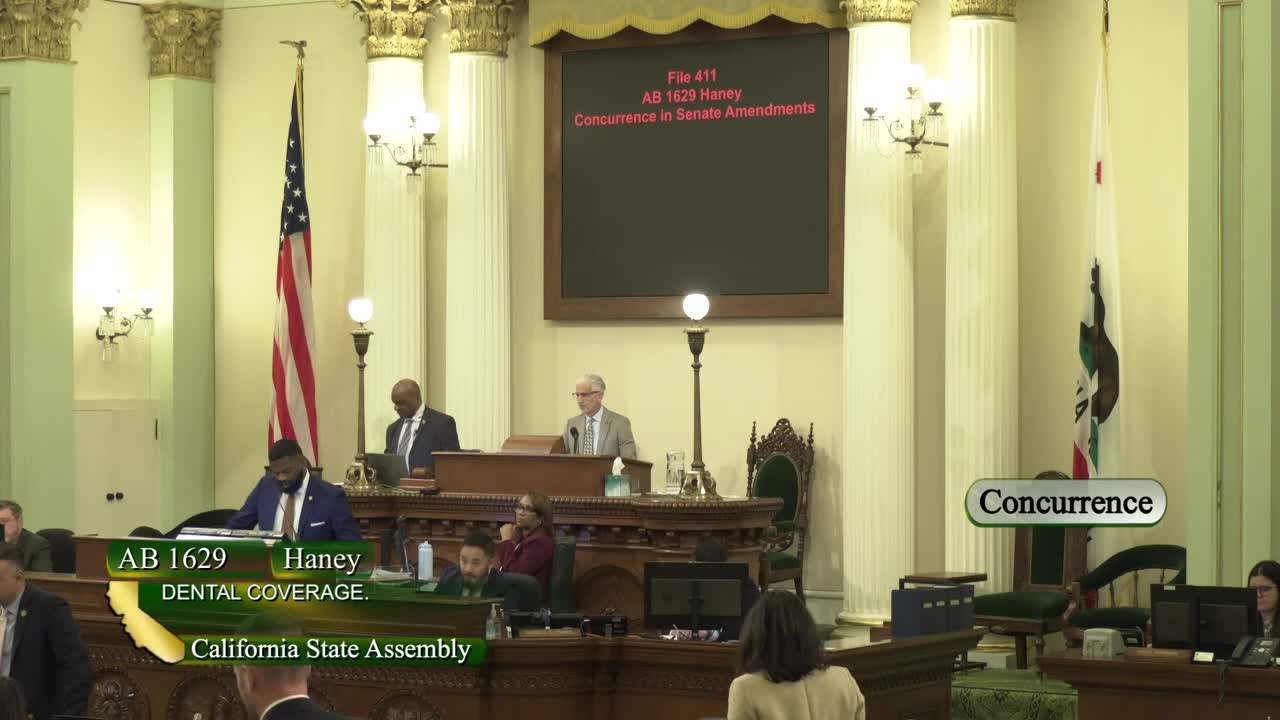 1MIN
Assembly Floor
 2MIN
Senate Floor
 9MIN
Senate Standing Committee on Business, Professions and Economic Development
 13MIN
Senate Standing Committee on Health
 1MIN
Assembly Floor
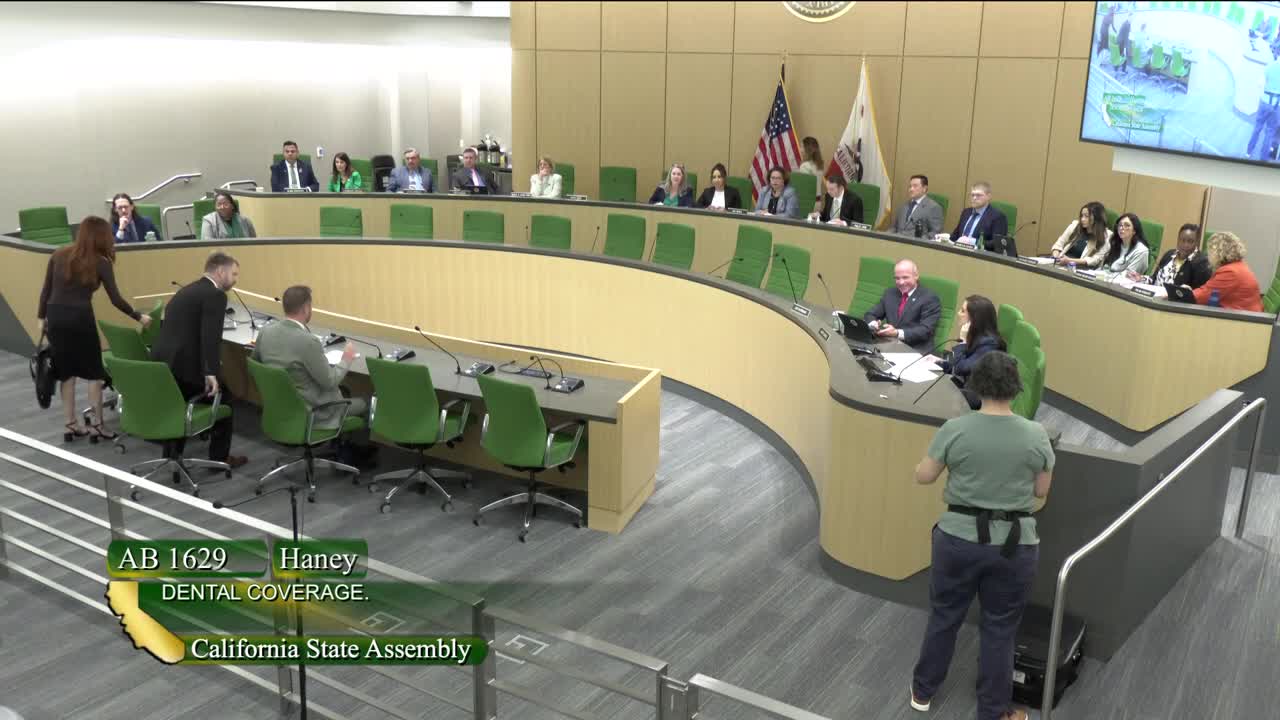 24MIN
Assembly Standing Committee on Health
Bill Author

Bill Co-Author(s):