AB 1722: California Endangered Species Act: take prohibition: self-defense.
- Session Year: 2025-2026
- House: Assembly
- Latest Version Date: 2026-08-24
Current Status:
Failed
(2026-09-18: Vetoed by Governor.)
Introduced
In Committee
Awaiting First Chamber Vote
Passed First Chamber
In Committee
Awaiting Second Chamber Vote
Passed Second Chamber
Enacted
The California Endangered Species Act requires the Fish and Game Commission to establish a list of endangered species and a list of threatened species and to add or remove species from either list if it finds, upon the receipt of sufficient scientific information, as specified, that the action is warranted. The act prohibits the taking of an endangered or threatened species, except under certain circumstances. The violation of the act is a crime.
This bill would prohibit the imposition of a civil, administrative, or criminal penalty for a violation of the take prohibition if the defendant used necessary and reasonable force to protect themselves, a member of their family, or any other individual from immediate bodily harm from a species listed pursuant to the act. The bill would require a person who committed a take, or an attempted take, of a species listed pursuant to the act under these circumstances to notify the Department of Fish and Wildlife within 24 hours after the take. Because a violation of this requirement would be a crime, the bill would impose a state-mandated local program.
The California Constitution requires the state to reimburse local agencies and school districts for certain costs mandated by the state. Statutory provisions establish procedures for making that reimbursement.
This bill would provide that no reimbursement is required by this act for a specified reason.
The California Endangered Species Act requires the Fish and Game Commission to establish a list of endangered species and a list of threatened species and to add or remove species from either list if it finds, upon the receipt of sufficient scientific information, as specified, that the action is warranted. The act prohibits the taking of an endangered or threatened species, except under certain circumstances. The violation of the act is a crime.
This bill would prohibit the imposition of a civil, administrative, or criminal penalty for a violation of the take prohibition if the defendant used necessary and reasonable force to protect themselves, a member of their family, or any other individual from immediate bodily harm from an animal a species listed pursuant to the act. The bill would require a person who committed a take, or an attempted take, of a species listed pursuant to the act under these circumstances to notify the Department of Fish and Wildlife within 24 hours after the take. Because a violation of this requirement would be a crime, the bill would impose a state-mandated local program.
The California Constitution requires the state to reimburse local agencies and school districts for certain costs mandated by the state. Statutory provisions establish procedures for making that reimbursement.
This bill would provide that no reimbursement is required by this act for a specified reason.
The California Endangered Species Act requires the Fish and Game Commission to establish a list of endangered species and a list of threatened species and to add or remove species from either list if it finds, upon the receipt of sufficient scientific information, as specified, that the action is warranted. The act prohibits the taking of an endangered or threatened species, except under certain circumstances. The violation of the act is a crime.
This bill would prohibit the imposition of a civil, administrative, or criminal penalty for a violation of the take prohibition if the defendant committed the act based on a good faith belief that they were acting used necessary and reasonable force to protect themselves, a member of their family, or any other individual from immediate bodily harm from an animal listed pursuant to the act. The bill would require a person who committed a take, or an attempted take, of a species listed pursuant to the act under these circumstances to notify the Department of Fish and Wildlife within 24 hours after the take. Because a violation of this requirement would be a crime, the bill would impose a state-mandated local program.
The California Constitution requires the state to reimburse local agencies and school districts for certain costs mandated by the state. Statutory provisions establish procedures for making that reimbursement.
This bill would provide that no reimbursement is required by this act for a specified reason.
The California Endangered Species Act requires the Fish and Game Commission to establish a list of endangered species and a list of threatened species and to add or remove species from either list if it finds, upon the receipt of sufficient scientific information, as specified, that the action is warranted. The act prohibits the taking of an endangered or threatened species, except under certain circumstances.
This bill would prohibit the imposition of a civil, administrative, or criminal penalty for a violation of the take prohibition if the defendant committed the act based on a good faith belief that they were acting to protect themselves, a member of their family, or any other individual from bodily harm from an animal listed under pursuant to the act.
The California Endangered Species Act requires the Fish and Game Commission to establish a list of endangered species and a list of threatened species and to add or remove species from either list if it finds, upon the receipt of sufficient scientific information, as specified, that the action is warranted. The act prohibits the taking of an endangered or threatened species, except under certain circumstances.
This bill would prohibit the imposition of a civil, administrative, or criminal penalty for a violation of the take prohibition if the defendant committed the act based on a good faith belief that they were acting to protect themselves, a member of their family, or any other individual from bodily harm from an animal listed under the act.
The California Constitution establishes the Fish and Game Commission and provides for the delegation to the commission of powers relating to the protection and propagation of fish and game. Under existing law, the Department of Fish and Wildlife has jurisdiction over the conservation, protection, and management of fish, wildlife, native plants, and habitat necessary for biologically sustainable populations of those species.This bill would state the intent of the Legislature to enact subsequent legislation relating to wildlife.The California Constitution establishes the Fish and Game Commission and provides for the delegation to the commission of powers relating to the protection and propagation of fish and game. Under existing law, the Department of Fish and Wildlife has jurisdiction over the conservation, protection, and management of fish, wildlife, native plants, and habitat necessary for biologically sustainable populations of those species.
This bill would state the intent of the Legislature to enact subsequent legislation relating to wildlife.
(a)The Legislature finds and declares that the federal Endangered Species Act of 1973 (16 U.S.C. Sec. 1531 et seq.) establishes a defense against the imposition of civil penalties, and a defense to prosecution, for the take of an animal listed pursuant to the federal act if the defendant committed the act based on a good faith belief that they were acting to protect themselves, a member of their family, or any other individual from that animal (16 U.S.C. Sec. 1540).
(b)It is the intent of the Legislature to establish similar defenses against the imposition of civil and criminal penalties for the take of an animal listed pursuant to the California Endangered Species Act (Chapter 1.5 (commencing with Section 2050) of Division 3 of the Fish and Game Code) for when that take is necessary and reasonable to the threat an animal listed under the California Endangered Species Act may pose to a human.
SEC. 2.Section 2080.8 is added to the Fish and Game Code, to read:2080.8.(a)A civil or administrative penalty shall not be imposed for a violation of Section 2080 or 2085, or both, if it can be shown by a preponderance of the evidence that the defendant used necessary and reasonable force to protect themselves, a member of their family, or any other individual from immediate bodily harm from any endangered, threatened, or candidate species.
(b)It shall be a defense to prosecution for a violation of Section 2080 or 2085, or both, if the defendant used necessary and reasonable force to protect themselves, a member of their family, or any other individual from immediate bodily harm from any endangered, threatened, or candidate species.
(c)A person who committed a take, or an attempted take, described in this section shall notify the department within 24 hours after the take.
(d)(1)On or before July 1, 2032, the department shall prepare a report that includes, but is not limited to, compiled data, including the species, date, and approximate location, regarding a take of an animal reported pursuant to subdivision (c) between January 1, 2027, through December 31, 2031.
(2)The report prepared pursuant to this subdivision shall be submitted to the relevant legislative policy and budget committees in both houses of the Legislature and be submitted in compliance with Section 9795 of the Government Code.
SEC. 3.No reimbursement is required by this act pursuant to Section 6 of Article XIIIB of the California Constitution because the only costs that may be incurred by a local agency or school district will be incurred because this act creates a new crime or infraction, eliminates a crime or infraction, or changes the penalty for a crime or infraction, within the meaning of Section 17556 of the Government Code, or changes the definition of a crime within the meaning of Section 6 of Article XIIIB of the California Constitution.
(a)The Legislature finds and declares that the federal Endangered Species Act of 1973 (16 U.S.C. Sec. 1531 et seq.) establishes a defense against the imposition of civil penalties, and a defense to prosecution, for the take of an animal listed pursuant to the federal act if the defendant committed the act based on a good faith belief that they were acting to protect themselves, a member of their family, or any other individual from that animal (16 U.S.C. Sec. 1540).
(b)It is the intent of the Legislature to establish the same similar defenses against the imposition of civil and criminal penalties for the take of an animal listed pursuant to the California Endangered Species Act (Chapter 1.5 (commencing with Section 2050) of Division 3 of the Fish and Game Code). Code) for when that take is necessary and reasonable to the threat an animal listed under the California Endangered Species Act may pose to a human.
SEC. 2.Section 2080.8 is added to the Fish and Game Code, to read:2080.8.(a)Notwithstanding Section 2014 or any other law, a A civil or administrative penalty shall not be imposed for a violation of Section 2080 or 2085, or both, if it can be shown by a preponderance of the evidence that the defendant committed an act based on a good faith belief that they were acting used necessary and reasonable force to protect themselves, a member of their family, or any other individual from immediate bodily harm from any endangered, threatened, or candidate species.
(b)Notwithstanding any other law, it It shall be a defense to prosecution for a violation of Section 2080 or 2085, or both, if the defendant committed the offense based on a good faith belief that they were acting used necessary and reasonable force to protect themselves, a member of their family, or any other individual from immediate bodily harm from any endangered, threatened, or candidate species.
(c)A person who committed a take, or an attempted take, described in this section shall notify the department within 24 hours after the take.
SEC. 3.No reimbursement is required by this act pursuant to Section 6 of Article XIIIB of the California Constitution because the only costs that may be incurred by a local agency or school district will be incurred because this act creates a new crime or infraction, eliminates a crime or infraction, or changes the penalty for a crime or infraction, within the meaning of Section 17556 of the Government Code, or changes the definition of a crime within the meaning of Section 6 of Article XIIIB of the California Constitution.
(a)The Legislature finds and declares that the federal Endangered Species Act of 1973 (16 U.S.C. Sec. 1531 et seq.) establishes a defense against the imposition of civil penalties, and a defense to prosecution, for the take of an animal listed under pursuant to the federal act if the defendant committed the act based on a good faith belief that they were acting to protect themselves, a member of their family, or any other individual from that animal (16 U.S.C. Sec. 1540).
(b)It is the intent of the Legislature to establish the same defenses against the imposition of civil and criminal penalties for the take of an animal listed under pursuant to the California Endangered Species Act (Chapter 1.5 (commencing with Section 2050) of Division 3 of the Fish and Game Code).
SEC. 2.Section 2080.8 is added to the Fish and Game Code, to read:2080.8.(a)Notwithstanding Section 2014 or any other law, a civil or administrative penalty shall not be imposed for a violation of Section 2080 if it can be shown by a preponderance of the evidence that the defendant committed an act based on a good faith belief that they were acting to protect themselves, a member of their family, or any other individual from bodily harm from any endangered, threatened, or candidate species.
(b)Notwithstanding any other law, it shall be a defense to prosecution for a violation of Section 2080 if the defendant committed the offense based on a good faith belief that they were acting to protect themselves, a member of their family, or any other individual from bodily harm from any endangered, threatened, or candidate species.
(a)The Legislature finds and declares that the federal Endangered Species Act of 1973 (16 U.S.C. Sec. 1531 et seq.) establishes a defense against the imposition of civil penalties, and a defense to prosecution, for the take of an animal listed under the federal act if the defendant committed the act based on a good faith belief that they were acting to protect themselves, a member of their family, or any other individual from that animal (16 U.S.C. Sec. 1540).
(b)It is the intent of the Legislature to establish the same defenses against the imposition of civil and criminal penalties for the take of an animal listed under the California Endangered Species Act (Chapter 1.5 (commencing with Section 2050) of Division 3 of the Fish and Game Code).
SEC. 2.Section 2080.8 is added to the Fish and Game Code, to read:2080.8.(a)Notwithstanding Section 2014 or any other law, a civil or administrative penalty shall not be imposed for a violation of Section 2080 if it can be shown by a preponderance of the evidence that the defendant committed an act based on a good faith belief that they were acting to protect themselves, a member of their family, or any other individual from bodily harm from any endangered, threatened, or candidate species.
(b)Notwithstanding any other law, it shall be a defense to prosecution for a violation of Section 2080 if the defendant committed the offense based on a good faith belief that they were acting to protect themselves, a member of their family, or any other individual from bodily harm from any endangered, threatened, or candidate species.
SECTION 1.It is the intent of the Legislature to enact subsequent legislation relating to wildlife.It is the intent of the Legislature to enact subsequent legislation relating to wildlife.
|
Date
|
Status
|
|---|---|
| Sep 18, 2026 | Vetoed by Governor. |
| Aug 27, 2026 | Enrolled and presented to the Governor at 4 p.m. |
| Aug 20, 2026 | Senate amendments concurred in. To Engrossing and Enrolling. (Ayes 61. Noes 1.). |
| Aug 20, 2026 | Senate amendments concurred in. To Engrossing and Enrolling. (Ayes 61. Noes 1. Page 6316.). |
| Aug 20, 2026 | Senate amendments concurred in. To Engrossing and Enrolling. |
| Aug 19, 2026 | In Assembly. Concurrence in Senate amendments pending. |
| Aug 19, 2026 | Read third time. Passed. Ordered to the Assembly. (Ayes 34. Noes 1.). |
| Aug 19, 2026 | Read third time. Passed. Ordered to the Assembly. (Ayes 34. Noes 1. Page 5548.). |
| Aug 4, 2026 | Read second time. Ordered to third reading. |
| Aug 3, 2026 | From committee: Be ordered to second reading pursuant to Senate Rule 28.8. |
| Jul 1, 2026 | From committee: Do pass and re-refer to Com. on APPR. (Ayes 12. Noes 0.) (June 30). Re-referred to Com. on APPR. |
| Jun 25, 2026 | From committee chair, with author's amendments: Amend, and re-refer to committee. Read second time, amended, and re-referred to Com. on JUD. |
| Jun 24, 2026 | From committee: Do pass and re-refer to Com. on JUD. (Ayes 7. Noes 0.) (June 23). Re-referred to Com. on JUD. |
| Jun 10, 2026 | Referred to Coms. on N.R. & W. and JUD. |
| Jun 1, 2026 | In Senate. Read first time. To Com. on RLS. for assignment. |
| May 28, 2026 | Read third time. Passed. Ordered to the Senate. (Ayes 64. Noes 0.) |
| May 28, 2026 | Read third time. Passed. Ordered to the Senate. (Ayes 64. Noes 0. Page 5520.) |
| May 7, 2026 | Read second time. Ordered to third reading. |
| May 6, 2026 | From committee: Do pass. (Ayes 14. Noes 0.) (May 6). |
| Apr 22, 2026 | From committee: Do pass and re-refer to Com. on APPR. (Ayes 11. Noes 0.) (April 21). Re-referred to Com. on APPR. |
| Apr 20, 2026 | Re-referred to Com. on JUD. |
| Apr 16, 2026 | Read second time and amended. |
| Apr 15, 2026 | From committee: Amend, and do pass as amended and re-refer to Com. on JUD. (Ayes 10. Noes 0.) (April 14). |
| Apr 7, 2026 | Re-referred to Com. on W., P., & W. |
| Apr 6, 2026 | From committee chair, with author's amendments: Amend, and re-refer to Com. on W., P., & W. Read second time and amended. |
| Mar 23, 2026 | Re-referred to Com. on W., P., & W. |
| Mar 19, 2026 | Referred to Coms. on W., P., & W. and JUD. |
| Mar 19, 2026 | From committee chair, with author's amendments: Amend, and re-refer to Com. on W., P., & W. Read second time and amended. |
| Feb 6, 2026 | From printer. May be heard in committee March 8. |
| Feb 5, 2026 | Read first time. To print. |
|
Date
|
Description
|
Location
|
Votes
|
|
|---|---|---|---|---|
| Aug 20, 2026 | AB 1722 Hadwick Concurrence in Senate Amendments | Assembly Floor |
Passed |
|
| Aug 19, 2026 | Assembly 3rd Reading AB1722 Hadwick et al. By Grove | Senate Floor |
Passed |
|
| Jun 30, 2026 | Do pass, but first be re-referred to the Committee on [Appropriations] | Senate Standing Committee on Judiciary |
Passed |
|
| Jun 23, 2026 | Do pass, but first be re-referred to the Committee on [Judiciary] | Senate Standing Committee on Natural Resources and Water |
Passed |
|
| May 28, 2026 | AB 1722 Hadwick Assembly Third Reading | Assembly Floor |
Passed |
|
| May 6, 2026 | Do pass. | Assembly Standing Committee on Appropriations |
Passed |
|
| Apr 21, 2026 | Do pass and be re-referred to the Committee on [Appropriations] | Assembly Standing Committee on Judiciary |
Passed |
|
| Apr 14, 2026 | Do pass as amended and be re-referred to the Committee on [Judiciary] | Assembly Standing Committee on Water, Parks, and Wildlife |
Passed |
This list shows positions taken on this bill by organizations on the date displayed, which is linked to the original source.
Positions by individuals are not included.
|
Organization
|
Position
|
Date
|
|---|---|---|
| Angel’s Furry Friends Rescue | ** Against | |
| Animal Cruelty Club, Hueneme High School | ** Against | |
| Animal Rescue Mission | ** Against | |
| Animal Rescuers for Change | ** Against | |
| ANIMAL WELLNESS ACTION | ** Against | |
| Beezy's Rescue | ** Against | |
| Beezy’s Rescue | ** Against | |
| Berkeley Animal Rights Center | ** Against | |
| Better Together Forever | ** Against | |
| Born Again Animal Rescue and Adoption | ** Against | |
| California Bowmen Hunters/State Archery Association | ** Support | |
| California Deer Association | ** Support | |
| California Houndsmen For Conservation | ** Support | |
| california rifle & pistol association | ** Support | |
| Center For Biological Diversity | ** Against | |
| Compassionate Bay | ** Against | |
| Concerned Citizens Animal Rescue | ** Against | |
| Concerned Citizens Animal Rescue, Inc. | ** Against | |
| County of Shasta | ** Support | |
| County of Siskiyou | ** Support | |
| Defenders Of Wildlife | ** Against | |
| Direct Action Everywhere | ** Against | |
| Ear Heart | ** Against | |
| Eartheart | ** Against | |
| Feline Lucky Adventures | ** Against | |
| Giantmecha Syndicate | ** Against | |
| Greater Los Angeles Animal Spay Neuter Collaborative | ** Against | |
| Howl for Wildlife | ** Support | |
| Hugs and Kisses Animal Fund | ** Against | |
| Humane World for Animals | ** Support | |
| Jaimie Brianna's Legacy Fund | ** Against | |
| Jamie Brianna’s Legacy Fund | ** Against | |
| Latino Alliance for Animal Care Foundation | ** Against | |
| Lockwood Animal Rescue Center | ** Against | |
| Long Beach Spay & Neuter Foundation | ** Against | |
| Long Beach Spay and Neuter Foundation | ** Against | |
| Los Angeles Democrats for the Protection of Animals | ** Against | |
| NY 4 Whales | ** Against | |
| NY4Whales | ** Against | |
| Over 900 individuals | ** Against | |
| Pet Loss Support Group | ** Against | |
| Pibbles N Kibbles Animal Rescue | ** Against | |
| Plant-based Advocates | ** Against | |
| Project Minnie | ** Against | |
| Rabbit Savior | ** Against | |
| Real Good Rescue | ** Against | |
| Rural County Representatives of California | ** Support | |
| Sacramento Safari Club | ** Support | |
| Safari Club International – Golden Gate Chapter | ** Support | |
| Safari Club International – San Francisco Bay Area Chapter | ** Support | |
| San Diego County Wildlife Federation | ** Support | |
| Seeds 4 Change | ** Against | |
| Seeds 4 Change Now Animal Rescue | ** Against | |
| Senior Citizens for Humane Education and Legislation | ** Against | |
| Social Compassion In Legislation | ** Against | |
| START Rescue | ** Against | |
| Students Against Animal Cruelty Club - Hueneme High School | ** Against | |
| The Black Brant Group | ** Support | |
| The Canine Condition | ** Against | |
| The Pet Loss Support Group | ** Against | |
| The Spayce Project | ** Against | |
| The Wild Sheep Foundation – California Chapter | ** Support | |
| Tulare Basin Wetlands Association | ** Support | |
| Underdog Heroes, INC. | ** Against | |
| Women United for Animal Welfare | ** Against |
GOVERNOR'S VETO
GV Bill Id:AB 1722
Author:(Hadwick)
As Enrolled Ver:August 24, 2026
2/3 vote
SUMMARY
Allows an individual to "take" a species listed under the California Endangered Species Act (CESA) if the individual is acting in self-defense, or defense of another individual, when threatened with immediate bodily harm by the listed species. Further, requires the Department of Fish and Wildlife (CDFW) to prepare a report on threatened and endangered species taken pursuant to this bill, by July 1, 2032.
Governor's Veto Message
"This bill would prohibit the imposition of civil or criminal penalties on an individual who 'takes' a species listed, or a candidate for listing, under [CESA] if the individual acted in self-defense or in defense of another individual to protect against immediate bodily harm.
Defending oneself from immediate bodily harm is a fundamental right. California law already protects against penalties for taking endangered species if the take occurred to protect oneself or another person. This bill duplicates these protections while creating confusion about the applicable standard for invoking this type of defense."
COMMENTS
California law generally prohibits the "taking" of wildlife, which includes the hunting, pursuing, catching, capturing, or killing of a wild animal without a permit, license, or tag from CDFW. The already-strict penalties for unlawfully taking an animal can be compounded if that animal is listed under CESA by the Fish and Game Commission. As of February 2026, there are 165 CESA-listed plants and 110 CESA-listed animals. Of those CESA-listed plants and animals, there are several that may cause bodily harm to an individual, including bighorn sheep, gray wolves, and mountain lions. The author and proponents of this bill note that, unlike federal law, California law does not provide an exception to CESA for the taking of a listed species for self-defense.
This bill proposes self-defense as a defense against a charge of illegally taking a CESA-listed species in California. This bill would provide a defense to any person who took a listed species while using necessary and reasonable force to protect themselves, a member of their family, or any other individual from immediate bodily harm. The bill clarifies that it is a defense to both criminal and civil liability under CESA and conditions the defense on the defendant properly notifying CDFW within 24 hours of committing the take.
According to the Author
"CESA prohibits the 'take' of a listed species, including actions such as pursuing, capturing, or killing, without clear exceptions for situations involving immediate threats to human safety. As a result, individuals who act to protect themselves or others from bodily harm may still face civil, administrative, or even criminal penalties. This bill ensures that individuals and law enforcement on the ground can react immediately and reasonably to protect themselves, their families, or others from harm."
Arguments in Support
A number of hunting organizations write in support of this bill, which supporters claim allows for "limited and clearly defined defense when necessary and reasonable force is used in response to an immediate threat to human safety." They note that this bill "does not expand lawful opportunities to take listed species, weaken existing conservation protections, or alter the listing and recovery framework under CESA. Instead, it creates a narrow and reasonable safeguard for situations involving immediate threats to human safety while preserving California's strong commitment to wildlife conservation." Further, they believe that this bill will reduce "enforcement and judicial costs, limit unnecessary legal exposure for individuals acting in legitimate self-defense, and improve consistency in application of the law."
Arguments in Opposition
Writing in opposition in a joint sign-on letter, Social Compassion in Legislation argues, "[This bill] raises concerns regarding the precedent it sets for the treatment of wildlife in California. By creating a statutory defense that materially alters how [CESA] is enforced, [this bill] opens the door to abuse by poachers."
"Under current law, the take of listed species is strictly prohibited unless authorized in advance through established, science-based processes overseen by [CDFW]. [This bill] shifts away from that structure by allowing individuals to assert that they used 'necessary and reasonable force' to prevent 'immediate bodily harm,' thereby avoiding both civil and criminal liability."
"In practice, once an animal is killed, it is often impossible to objectively determine whether lethal force was truly necessary, whether nonlethal alternatives were available, or whether the situation rose to the level of immediate harm required by the statute. This creates significant enforcement challenges."
FISCAL COMMENTS
According to the Assembly Appropriations Committee, this bill has the following fiscal impact:
1) Department of Justice (DOJ) and Judicial Council note that any costs to DOJ and the courts are likely minor and absorbable.
2) Costs to CDFW are likely minor and absorbable. While the bill requires a person who took, or attempted to take, an animal listed under CESA to notify CDFW within 24 hours after the take, this provision is unlikely to result in increased costs to [CDFW], since CDFW must already respond to and investigate these types of wildlife encounters regardless of the changes in this bill.
VOTES
ASM WATER, PARKS, AND WILDLIFE: 10-0-3
YES: Papan, Jeff Gonzalez, Alanis, Alvarez, Ávila Farías, Bains, Caloza, Gallagher, Hart, Muratsuchi
ABS, ABST OR NV: Bennett, Boerner, Rogers
ASM JUDICIARY: 11-0-1
YES: Kalra, Macedo, Bauer-Kahan, Bryan, Dixon, Harabedian, Pacheco, Papan, Sanchez, Stefani, Zbur
ABS, ABST OR NV: Connolly
ASM APPROPRIATIONS: 14-0-1
YES: Wicks, Hoover, Aguiar-Curry, Caloza, Dixon, Fong, Mark González, Krell, Pacheco, Pellerin, Sharp-Collins, Solache, Ta, Tangipa
ABS, ABST OR NV: Arambula
ASSEMBLY FLOOR: 64-0-16
YES: Aguiar-Curry, Ahrens, Alanis, Alvarez, Arambula, Ávila Farías, Bains, Bauer-Kahan, Bennett, Bonta, Bryan, Calderon, Caloza, Carrillo, Castillo, Chen, Davies, DeMaio, Dixon, Ellis, Flora, Fong, Gallagher, Garcia, Gipson, Jeff Gonzalez, Mark González, Hadwick, Haney, Harabedian, Hart, Hoover, Irwin, Johnson, Kalra, Krell, Lackey, Lowenthal, Macedo, McKinnor, Muratsuchi, Nguyen, Pacheco, Papan, Patterson, Ramos, Ransom, Michelle Rodriguez, Blanca Rubio, Sanchez, Schiavo, Schultz, Sharp-Collins, Solache, Soria, Stefani, Ta, Tangipa, Valencia, Wallis, Ward, Wicks, Wilson, Rivas
ABS, ABST OR NV: Addis, Berman, Boerner, Connolly, Elhawary, Gabriel, Jackson, Lee, Ortega, Patel, Pellerin, Petrie-Norris, Quirk-Silva, Celeste Rodriguez, Rogers, Zbur
SENATE FLOOR: 34-1-5
YES: Allen, Alvarado-Gil, Archuleta, Arreguín, Ashby, Becker, Cabaldon, Caballero, Cervantes, Choi, Cortese, Dahle, Durazo, Grayson, Grove, Hurtado, Jones, Laird, McGuire, McNerney, Menjivar, Niello, Ochoa Bogh, Padilla, Reyes, Richardson, Rubio, Seyarto, Smallwood-Cuevas, Strickland, Umberg, Valladares, Wahab, Weber Pierson
NO: Stern
ABS, ABST OR NV: Blakespear, Gonzalez, Limón, Pérez, Wiener
ASSEMBLY FLOOR: 61-1-17
YES: Aguiar-Curry, Ahrens, Alanis, Alvarez, Arambula, Ávila Farías, Bains, Bonta, Bryan, Calderon, Caloza, Carrillo, Castillo, Davies, DeMaio, Dixon, Ellis, Flora, Fong, Gipson, Jeff Gonzalez, Mark González, Hadwick, Haney, Harabedian, Hart, Hoover, Johnson, Kalra, Krell, Lackey, Lowenthal, Macedo, McKinnor, Muratsuchi, Nguyen, Pacheco, Papan, Patterson, Petrie-Norris, Quirk-Silva, Ramos, Ransom, Celeste Rodriguez, Michelle Rodriguez, Blanca Rubio, Sanchez, Schiavo, Schultz, Sharp-Collins, Solache, Soria, Stefani, Ta, Tangipa, Valencia, Wallis, Ward, Wicks, Wilson, Rivas
NO: Lee
ABS, ABST OR NV: Addis, Bauer-Kahan, Bennett, Berman, Boerner, Chen, Connolly, Elhawary, Gabriel, Garcia, Irwin, Jackson, Ortega, Patel, Pellerin, Rogers, Zbur
UPDATED
VERSION: August 24, 2026
CONSULTANT: Stephanie Mitchell / W., P., & W. / (916) 319-2096 FN: 0004587
CONCURRENCE IN SENATE AMENDMENTS
CSA1 Bill Id:AB 1722
Author:(Hadwick)
As Amended Ver:June 25, 2026
Majority vote
SUMMARY
Allows an individual to "take" a species listed under the California Endangered Species Act (CESA) if the individual is acting in self-defense, or defense of another individual, when threatened with immediate bodily harm by the listed species.
Senate Amendments
By July 1, 2032, require the Department of Fish and Wildlife (CDFW) to prepare a report on threatened and endangered species taken pursuant to this bill.
COMMENTS
California law generally prohibits the "taking" of wildlife, which includes the hunting, pursuing, catching, capturing, or killing of a wild animal without a permit, license, or tag from CDFW. The already-strict penalties for unlawfully taking an animal can be compounded if that animal is listed under CESA by the Fish and Game Commission. As of February 2026, there are 165 CESA-listed plants and 110 CESA-listed animals. Of those CESA-listed plants and animals, there are several that may cause bodily harm to an individual, including bighorn sheep, gray wolves, and mountain lions. The author and proponents of this bill note that, unlike federal law, California law does not provide an exception to CESA for the taking of a listed species for self-defense.
This bill proposes self-defense as a defense against a charge of illegally taking a CESA-listed species in California. This bill would provide a defense to any person who took a listed species while using necessary and reasonable force to protect themselves, a member of their family, or any other individual from immediate bodily harm. The bill clarifies that it is a defense to both criminal and civil liability under CESA and conditions the defense on the defendant properly notifying CDFW within 24 hours of committing the take.
According to the Author
"CESA prohibits the 'take' of a listed species, including actions such as pursuing, capturing, or killing, without clear exceptions for situations involving immediate threats to human safety. As a result, individuals who act to protect themselves or others from bodily harm may still face civil, administrative, or even criminal penalties. This bill ensures that individuals and law enforcement on the ground can react immediately and reasonably to protect themselves, their families, or others from harm."
Arguments in Support
A number of hunting organizations write in support of this bill, which supporters claim allows for "limited and clearly defined defense when necessary and reasonable force is used in response to an immediate threat to human safety." They note that this bill "does not expand lawful opportunities to take listed species, weaken existing conservation protections, or alter the listing and recovery framework under CESA. Instead, it creates a narrow and reasonable safeguard for situations involving immediate threats to human safety while preserving California's strong commitment to wildlife conservation." Further, they believe that this bill will reduce "enforcement and judicial costs, limit unnecessary legal exposure for individuals acting in legitimate self-defense, and improve consistency in application of the law."
Arguments in Opposition
Writing in opposition in a joint sign-on letter, Social Compassion in Legislation argues, "[This bill] raises concerns regarding the precedent it sets for the treatment of wildlife in California. By creating a statutory defense that materially alters how [CESA] is enforced, [this bill] opens the door to abuse by poachers."
"Under current law, the take of listed species is strictly prohibited unless authorized in advance through established, science-based processes overseen by [CDFW]. [This bill] shifts away from that structure by allowing individuals to assert that they used 'necessary and reasonable force' to prevent 'immediate bodily harm,' thereby avoiding both civil and criminal liability."
"In practice, once an animal is killed, it is often impossible to objectively determine whether lethal force was truly necessary, whether nonlethal alternatives were available, or whether the situation rose to the level of immediate harm required by the statute. This creates significant enforcement challenges."
FISCAL COMMENTS
According to the Assembly Appropriations Committee, this bill has the following fiscal impact:
1) Department of Justice (DOJ) and Judicial Council note that any costs to DOJ and the courts are likely minor and absorbable.
2) Costs to CDFW are likely minor and absorbable. While the bill requires a person who took, or attempted to take, an animal listed under CESA to notify CDFW within 24 hours after the take, this provision is unlikely to result in increased costs to [CDFW], since CDFW must already respond to and investigate these types of wildlife encounters regardless of the changes in this bill.
VOTES:
ASM WATER, PARKS, AND WILDLIFE: 10-0-3
YES: Papan, Jeff Gonzalez, Alanis, Alvarez, Ávila Farías, Bains, Caloza, Gallagher, Hart, Muratsuchi
ABS, ABST OR NV: Bennett, Boerner, Rogers
ASM JUDICIARY: 11-0-1
YES: Kalra, Macedo, Bauer-Kahan, Bryan, Dixon, Harabedian, Pacheco, Papan, Sanchez, Stefani, Zbur
ABS, ABST OR NV: Connolly
ASM APPROPRIATIONS: 14-0-1
YES: Wicks, Hoover, Aguiar-Curry, Caloza, Dixon, Fong, Mark González, Krell, Pacheco, Pellerin, Sharp-Collins, Solache, Ta, Tangipa
ABS, ABST OR NV: Arambula
ASSEMBLY FLOOR: 64-0-16
YES: Aguiar-Curry, Ahrens, Alanis, Alvarez, Arambula, Ávila Farías, Bains, Bauer-Kahan, Bennett, Bonta, Bryan, Calderon, Caloza, Carrillo, Castillo, Chen, Davies, DeMaio, Dixon, Ellis, Flora, Fong, Gallagher, Garcia, Gipson, Jeff Gonzalez, Mark González, Hadwick, Haney, Harabedian, Hart, Hoover, Irwin, Johnson, Kalra, Krell, Lackey, Lowenthal, Macedo, McKinnor, Muratsuchi, Nguyen, Pacheco, Papan, Patterson, Ramos, Ransom, Michelle Rodriguez, Blanca Rubio, Sanchez, Schiavo, Schultz, Sharp-Collins, Solache, Soria, Stefani, Ta, Tangipa, Valencia, Wallis, Ward, Wicks, Wilson, Rivas
ABS, ABST OR NV: Addis, Berman, Boerner, Connolly, Elhawary, Gabriel, Jackson, Lee, Ortega, Patel, Pellerin, Petrie-Norris, Quirk-Silva, Celeste Rodriguez, Rogers, Zbur
SENATE FLOOR: 34-1-5
YES: Allen, Alvarado-Gil, Archuleta, Arreguín, Ashby, Becker, Cabaldon, Caballero, Cervantes, Choi, Cortese, Dahle, Durazo, Grayson, Grove, Hurtado, Jones, Laird, McGuire, McNerney, Menjivar, Niello, Ochoa Bogh, Padilla, Reyes, Richardson, Rubio, Seyarto, Smallwood-Cuevas, Strickland, Umberg, Valladares, Wahab, Weber Pierson
NO: Stern
ABS, ABST OR NV: Blakespear, Gonzalez, Limón, Pérez, Wiener
UPDATED
VERSION: June 25, 2026
CONSULTANT: Stephanie Mitchell / W., P., & W. / (916) 319-2096 FN: 0003808
SENATE RULES COMMITTEE Office of Senate Floor Analyses (916) 651-4171 | AB 1722 |
THIRD READING
Bill No: AB 1722
Author: Hadwick (R), et al.
Amended: 6/25/26 in Senate
Vote: 21
SENATE NATURAL RES. & WATER COMMITTEE: 7-0, 6/23/26
AYES: Becker, Seyarto, Allen, Cabaldon, Grove, Laird, Stern
SENATE JUDICIARY COMMITTEE: 12-0, 6/30/26
AYES: Umberg, Niello, Allen, Ashby, Caballero, Durazo, Laird, Reyes, Valladares, Wahab, Weber Pierson, Wiener
NO VOTE RECORDED: Stern
SENATE APPROPRIATIONS COMMITTEE: Senate Rule 28.8
ASSEMBLY FLOOR: 64-0, 5/28/26 - See last page for vote
SUBJECT: California Endangered Species Act: take prohibition: self-defense
SOURCE: Author
DIGEST:
This bill prohibits the imposition of a civil, administrative, or criminal penalty for a violation of the take prohibition for listed and candidate species under the California Endangered Species Act if the defendant used necessary and reasonable force to protect themselves, a member of their family, or any other individual from immediate bodily harm, as provided, among other provisions.
ANALYSIS:
Existing federal law:
- Establishes that no civil penalty shall be imposed for violation of Endangered Species Act (ESA) if it can be shown by a preponderance of the evidence that the defendant committed an act based on a good faith belief that he was acting to protect himself or herself, a member of his or her family, or any other individual from bodily harm, from any species listed as endangered or threatened under ESA.. (16 U.S.C. §1540 (a)(3)
- Establishes that it shall be a defense to prosecution under ESA if the defendant committed the offense based on a good faith belief that he was acting to protect himself or herself, a member of his or her family, or any other individual, from bodily harm from any species listed as endangered or threatened under the federal ESA. (16 U.S.C. §1540 (b)(3))
Existing state law:
- Prohibits a person from taking, or attempting to take, any species the commission determines to be an endangered or threatened species or candidate species under the California Endangered Species Act (CESA). (Fish and Game Code (FGC) §§2080, 2085)
- Establishes that the punishment for any violation of take prohibited under CESA is punishable by a fine of $25,000–$50,0000 for each violation or imprisonment in county jail for not more than one year, or both a fine and imprisonment. (FGC §12008.1)
- Permits a judge, before whom a person is being tried for the taking of an endangered or threatened species, among other animals, with the court’s discretion and upon conviction of that person, to order the forfeiture of any proceeds resulting from the take of the animal. (FGC §12159.5)
- Requires a judge to order the forfeiture of any device or apparatus that is used in committing the offense. (FGC §12157 (b))
- Defines “take” to mean to hunt, pursue, catch, capture, or kill, or attempt to hunt, pursue, catch, capture, or kill. (FGC §86)
- Establishes that an individual is not guilty of a violation of the prohibited take or injury of a mountain lion if it is demonstrated that, in taking or injuring the mountain lion, the individual was acting in self-defense or in defense of others. (FGC §4800)
- Exempts from the prohibition to hunt, trap, or otherwise take a bobcat, situations where the take of the bobcat was based on a good faith belief that the take was necessary to protect a person from immediate bodily harm from the bobcat, as specified. (FGC §4156)
- Makes it unlawful to take a bird, mammal, reptile, or amphibian except as provided in the FGC or regulations adopted pursuant to the FGC. (FGC §2000)
- Provides that a person who maliciously and intentionally maims, mutilates, tortures, or wounds a living animal, or maliciously and intentionally kills an animal, is guilty of a crime punishable, with certain exceptions including Penal Code 599c, as provided. (Penal Code §597(a))
- Provides that no part of the Penal Code shall be construed as interfering with any of the laws of this state known as the “game laws,” or any laws for or against the destruction of certain birds, nor must this title be construed as interfering with the right to destroy any venomous reptile, or any animal known as dangerous to life, limb, or property, or to interfere with the right to kill all animals used for food, or with properly conducted scientific experiments or investigations performed under the authority of the faculty of a regularly incorporated medical college or university of this state. (Penal Code §599c)
This bill:
- Prohibits the imposition of a civil or administrative penalty for a violation of the prohibition on take of a listed or candidate species under CESA if it can be shown by a preponderance of evidence that the defendant used necessary and reasonable force to protect themselves, a member of their family, or any other individual from immediate bodily harm from the species, as provided.
- Provides that it is a defense to prosecution on take of a listed or candidate species under CESA if the defendant used necessary and reasonable force to protect themselves, a member of their family, or any other individual from immediate bodily harm from the species.
- Requires a person who committed a take or attempted to take an animal that is a listed or candidate species under CESA pursuant to 1) or 2) to report it to the department within 24 hours. On or before July 1, 2032, requires the California Department of Fish and Wildlife to prepare a report on the take of species pursuant to this provision, as specified.
- Makes a legislative finding and declaration that the federal ESA establishes a defense against civil penalties and prosecution for the take of a federally-listed species based upon a good faith belief that they were acting to protect themselves or others, as provided.
- States legislative intent to establish a similar defense to that available under the federal ESA against the imposition of civil and criminal penalties for the take of an animal listed under CESA when it is necessary due to the threat posed by the animal to a human, as provided.
- Provides that no reimbursement is required for state-mandated costs incurred by a local agency or school district, as provided.
[Note: Additional information regarding this bill may be found in the Senate Natural Resources and Water and Senate Judiciary Committees’ bill analyses.]
FISCAL EFFECT: Appropriation: No Fiscal Com.: Yes Local: Yes
SUPPORT: (Verified 8/4/26)
California Bowmen Hunters/State Archery Association
California Deer Association
California Houndsmen for Conservation
California Rifle & Pistol Association
County of Shasta
County of Siskiyou
HOWL for Wildlife
Rural County Representatives of California
Sacramento Safari Club
Safari Club International – Golden Gate Chapter
Safari Club International – San Francisco Bay Area Chapter
San Diego County Wildlife Federation
The Black Brant Group
The Wild Sheep Foundation – California Chapter
Tulare Basin Wetlands Association
OPPOSITION: (Verified 8/4/26)
Angel’s Furry Friends Rescue
Animal Cruelty Club, Hueneme High School
Animal Rescue Mission
Animal Rescuers for Change
Animal Wellness Action
Beezy’s Rescue
Berkeley Animal Rights Center
better Together Forever
Born Again Animal Rescue and Adoption
Compassionate Bay
Concerned Citizens Animal Rescue, Inc.
Direct Action Everywhere
EartHeart
Feline Lucky Adventures
Giantmecha Syndicate
Greater Los Angeles Animal Spay Neuter Collaborative
Hugs and Kisses Animal Fund
Jamie Brianna’s Legacy Fund
Latino Alliance for Animal Care Foundation
Lockwood Animal Rescue Center
Long Beach Spay & Neuter Foundation
Los Angeles Democrats for the Protection of Animals
NY4Whales
Pet Loss Support Group
Pibbles n Kibbles Animal Rescue
Plant-Based Advocates
Project Minnie
RABBIT SAVIOR
Real Good Rescue
Seeds 4 Change
Senior Citizens for Humane Education and Legislation
Social Compassion in Legislation
START Rescue
The Canine Condition
The Spayce Project
Underdog Heroes, Inc.
Women United for Animal Welfare
ARGUMENTS IN SUPPORT: According to the author, “Rural residents in California are subjected to much higher rates of wildlife conflict from larger predatory species that can reasonably threaten a person, requiring them to protect themselves. The California Endangered Species Act (CESA) prohibits the ‘take’ of a listed species, including actions such as hazing with rocks, sticks and pepper spray, without clear exceptions for situations involving immediate threats to human life. As a result, individuals who act to protect themselves or others from bodily harm may still face civil, administrative, or even criminal penalties. Assembly Bill 1722 establishes a clear, good-faith self-defense protection under CESA, aligning California law with the federal Endangered Species Act, which already recognizes this defense. In emergency situations when seconds count, law enforcement officials warn that the lack of clarity in current law creates significant public safety risks. This bill ensures ranchers, hunters, hikers, and people enjoying the outdoors have certainty they can protect themselves and their families if they encounter a dangerous predator.”
ARGUMENTS IN OPPOSITION: Writing in opposition in a joint sign-on letter, Social Compassion in Legislation argues, “AB 1722 raises concerns regarding the precedent it sets for the treatment of wildlife in California. By creating a statutory defense that materially alters how the California Endangered Species Act (CESA) is enforced, AB 1722 opens the door to abuse by poachers.”
“Under current law, the take of listed species is strictly prohibited unless authorized in advance through established, science-based processes overseen by the Department of Fish and Wildlife. AB 1722 shifts away from that structure by allowing individuals to assert that they used ‘necessary and reasonable force’ to prevent ‘immediate bodily harm,’ thereby avoiding both civil and criminal liability.”
“In practice, once an animal is killed, it is often impossible to objectively determine whether lethal force was truly necessary, whether nonlethal alternatives were available, or whether the situation rose to the level of immediate harm required by the statute. This creates significant enforcement challenges.”
ASSEMBLY FLOOR: 64-0, 5/28/26
AYES: Aguiar-Curry, Ahrens, Alanis, Alvarez, Arambula, Ávila Farías, Bains, Bauer-Kahan, Bennett, Bonta, Bryan, Calderon, Caloza, Carrillo, Castillo, Chen, Davies, DeMaio, Dixon, Ellis, Flora, Fong, Gallagher, Garcia, Gipson, Jeff Gonzalez, Mark González, Hadwick, Haney, Harabedian, Hart, Hoover, Irwin, Johnson, Kalra, Krell, Lackey, Lowenthal, Macedo, McKinnor, Muratsuchi, Nguyen, Pacheco, Papan, Patterson, Ramos, Ransom, Michelle Rodriguez, Blanca Rubio, Sanchez, Schiavo, Schultz, Sharp-Collins, Solache, Soria, Stefani, Ta, Tangipa, Valencia, Wallis, Ward, Wicks, Wilson, Rivas
NO VOTE RECORDED: Addis, Berman, Boerner, Connolly, Elhawary, Gabriel, Jackson, Lee, Ortega, Patel, Pellerin, Petrie-Norris, Quirk-Silva, Celeste Rodriguez, Rogers, Zbur
Prepared by: Katharine Moore / N.R. & W. / (916) 651-4116
8/5/26 14:57:39
**** END ****
Senator Thomas Umberg, Chair
2025-2026 Regular Session
Bill No: AB 1722 (Author:Hadwick)
Version: June 25, 2026
Hearing Date: June 30, 2026
Fiscal: Yes
Urgency: No
Consultant: AM
SUBJECT
California Endangered Species Act: take prohibition: self-defense
DIGEST
This prohibits a civil, administrative, or criminal penalty from being enforced for a violation of a taking prohibited under the California Endangered Species Act if the defendant used necessary and reasonable force to protect themselves, a member of their family, or any other individual from immediate bodily harm, as provided. The bill requires a person who committed a take, or an attempted take, to protect themselves, a member of their family, or any other individual from immediate bodily harm to notify the Department of Fish and Wildlife within 24 hours after the take.
EXECUTIVE SUMMARY
The California Endangered Species Act prohibits the taking of an endangered species or candidate species. The federal Endangered Species Act provides for defense against the imposition of civil penalties, and a defense to prosecution, for the taking of an animal listed pursuant to the federal act if the defendant committed the act based on a good faith belief that they were acting to protect themselves, a member of their family, or any other individual from that animal (16 U.S.C. Sec. 1540) This bill seeks to enact similar defenses under state law. Existing federal law provides that there is a defense to prosecution for unlawful taking under the federal Act if the defendant committed the offense based on a good faith belief that they were acting to protect themselves, a member of their family, or any other individual, from bodily harm from any species listed as endangered or threatened under federal law. (16 U.S.C. § 1540(b)(3).)
The bill is author-sponsored and supported by the County of Siskiyou and County of Shasta. The bill is opposed by several animal welfare organizations and over 900 individuals. The bill passed the Natural Resources and Water Committee of a vote of 7 to 0.
PROPOSED CHANGES TO THE LAW
Existing state law:
- Establishes that it is the policy of the state to conserve its natural resources and to prevent the willful or negligent destruction of birds, mammals, fish, reptiles, or amphibia, and authorizes the state to seek unspecified civil damages against any person or local agency which unlawfully or negligently takes or destroys any bird, mammal, fish, reptile, or amphibian protected by the laws of this state, as specified. (Fish & G. Code § 2014.)
- Prohibits a person from taking, or attempting to take, any species that the Fish and Game Commission determines to be an endangered or threatened species. (Fish & G. Code § 2080.)
- Defines “take” to mean to hunt, pursue, catch, capture, or kill, or attempt to hunt, pursue, catch, capture, or kill. (Fish & G. Code § 86.)
- Prohibits from taking, or attempting to take, any species that the Fish and Game Commission determines to be a candidate species to become an endangered species. (Fish & G. Code § 2085.)
- Provides that a person found guilty of violating 2) or 3) is subject to a fine of $25,000 to $50,0000 for each violation or imprisonment in county jail for not more than one year, or both a fine and imprisonment. (Fish & G. Code § 12008.1.)
- Provides that an individual is not guilty of a prohibited take or injury of a mountain lion if it is demonstrated that, in taking or injuring the mountain lion, the individual was acting in self-defense or in defense of others. (Fish & G. Code § 4800.)
- Provides that any necessary force may be used to protect the person or property of oneself, or of a spouse, child, parent, or other relative, or member of one’s family, or of a ward, servant, master, or guest, from wrongful injury. (Civ. Code § 50.)
- Adopts a statutory presumption that any person using force intended, or likely to cause, death or great bodily injury within their residence who held a reasonable fear of imminent peril of death or great bodily injury to self, family, or a member of the household when that force is used against another person, not a member of the family or household, who unlawfully and forcibly enters or has unlawfully and forcibly entered the residence and the person using the force knew or had reason to believe that an unlawful and forcible entry occurred. (Pen. Code § 198.5.)
This bill:
- Provides that an administrative penalty shall not be imposed for a violation of taking an endangered or candidate species under the California Endangered Species Act, or both, if it can be shown by a preponderance of the evidence that the defendant used necessary and reasonable force to protect themselves, a member of their family, or any other individual from immediate bodily harm from any endangered, threatened, or candidate species.
- Provides that it shall be a defense to prosecution for a violation of taking an endangered or candidate species under the California Endangered Species Act, or both, if the defendant used necessary and reasonable force to protect themselves, a member of their family, or any other individual from immediate bodily harm from any endangered, threatened, or candidate species.
- Requires a person who committed a take, or an attempted take, described in this section to notify the Department of Fish and Wildlife (DFW) within 24 hours after the take.
- Requires DFW to prepare a report to the Legislature that includes, but is not limited to, compiled data, including the species, date, and approximate location, regarding a take of an animal reported pursuant to 3), above, between January 1, 2027, through December 31, 2031.
COMMENTS
- Author statement
The author writes:
Rural residents in California are subjected to much higher rates of wildlife conflict from larger predatory species that can reasonably threaten a person, requiring them to protect themselves. The California Endangered Species Act (CESA) prohibits the “take” of a listed species, including actions such as hazing with rocks, sticks and pepper spray, without clear exceptions for situations involving immediate threats to human life. As a result, individuals who act to protect themselves or others from bodily harm may still face civil, administrative, or even criminal penalties. Assembly Bill 1722 establishes a clear, good-faith self-defense protection under CESA, aligning California law with the federal Endangered Species Act, which already recognizes this defense. In emergency situations when seconds count, law enforcement officials warn that the lack of clarity in current law creates significant public safety risks. This bill ensures ranchers, hunters, hikers, and people enjoying the outdoors have certainty they can protect themselves and their families if they encounter a dangerous predator.
- This bill establishes a defense to a taking under the California Endangered Species Act
State law generally prohibits a person from “taking” a wild species, whether plant or animal, without a permit. The California Endangered Species Act provides enhanced penalties for taking a species listed as endangered or as a candidate species by the Fish and Game Commission. A “taking” for the purpose of wildlife is defined as hunting, pursuing, catching, capturing, or killing, or attempting to do any of the above to a wild animal. These include a fine of $25,000 to $50,0000 for each violation or imprisonment in county jail for not more than one year, or both a fine and imprisonment. (Fish & Game Code § 12008.1.) The California Endangered Species Act provides additional protection for roughly 165 plants and 110 animals listed as endangered species in California, with wildlife species ranging from salt-marsh harvest mice and bumble bees to apex grey wolves and mountain lions.[1]
Federal law provides a defense to a taking under the federal Endangered Species Act if the defendant committed the act based on a good faith belief that they were acting to protect themselves, a member of their family, or any other individual from that animal (16 U.S.C. Sec. 1540). This bill seeks to enact a similar defense under the California Endangered Species Act. The bill provides that no civil penalty is to be assessed, and it is a defense against any criminal penalty, if a defendant used necessary and reasonable force to protect themselves, a member of their family, or any other individual from immediate bodily harm. This language is modeled upon Civil Code Section 50, which provides a defense for the use of force against a wrongful injury. As such, courts should be capable of applying the standard under this bill.
- Stakeholder statements
The County of Siskiyou writes in support stating:
Due to Siskiyou County’s rural and ecologically diverse landscape, county residents, ranchers, and recreationists regularly encounter wildlife, some of which are protected species. As a result, Siskiyou County supports additional protections for individuals who may need to respond to dangerous wildlife situations.
AB 1722 provides important clarification in state law and recognizes the realities faced by rural communities throughout California. The Board appreciates your leadership on this issue and your efforts to address public safety concerns affecting those who coexist with listed species.
A coalition of animal welfare organizations, including Social Compassion in Legislation and Berkeley Animal Rights Center, writes in opposition stating:
Under current law, the take of listed species is strictly prohibited unless authorized in advance through established, science-based processes overseen by the Department of Fish and Wildlife. AB 1722 shifts away from that structure by allowing individuals to assert that they used “necessary and reasonable force” to prevent “immediate bodily harm,” thereby avoiding both civil and criminal liability.
Although these terms are familiar in other legal contexts, they are not easily defined within the context of self-defense against wildlife and will be inherently difficult to apply consistently. In practice, once an animal is killed, it is often impossible to objectively determine whether lethal force was truly necessary, whether nonlethal
alternatives were available, or whether the situation rose to the level of immediate harm required by the statute. This creates significant enforcement challenges.
Any wildlife encounter which ends in either human or animal life being harmed or lost is a tragedy. AB 1722 will do nothing to prevent or change the outcomes to those tragedies but instead create a “get out of jail free card” for poachers to escape legal consequences for killing animals.
SUPPORT
County of Siskiyou
County of Shasta
OPPOSITION
Angel's Furry Friends Rescue
Animal Rescue Mission
Animal Rescuers for Change
Animal Wellness Action
Beezy's Rescue
Berkeley Animal Rights Center
Better Together Forever
Born Again Animal Rescue and Adoption
Compassionate Bay
Concerned Citizens Animal Rescue
Direct Action Everywhere
Ear Heart
Feline Lucky Adventures
Giantmecha Syndicate
Greater Los Angeles Animal Spay Neuter Collaborative
Hugs and Kisses Animal Fund
Jaimie Brianna's Legacy Fund
Latino Alliance for Animal Care Foundation
Lockwood Animal Rescue Center
Long Beach Spay and Neuter Foundation
Los Angeles Democrats for the Protection of Animals
NY 4 Whales
Pibbles N Kibbles Animal Rescue
Plant-based Advocates
Project Minnie
Rabbit Savior
Real Good Rescue
Seeds 4 Change Now Animal Rescue
Seniors Citizens for Humane Education and Legislation
Social Compassion in Legislation
Start Rescue
Students Against Animal Cruelty Club - Hueneme High School
The Canine Condition
The Pet Loss Support Group
The Spayce Project
Underdog Heroes
Women United for Animal Welfare (WUFAW)
Over 900 individuals
PRIOR VOTES
Senate Natural Resources and Water Committee (Ayes 7, Noes 0)
Assembly Floor (Ayes 64, Noes 0)
Assembly Appropriations Committee (Ayes 14, Noes 0)
Assembly Judiciary Committee (Ayes 11, Noes 0)
Assembly Water, Parks and Wildlife Committee (Ayes 10, Noes 0)
**************
Cal. Dept. Fish & Wildlife, State and Federally Listed Endangered and Threatened Animals of California, (Apr. 2026), available at https://nrm.dfg.ca.gov/FileHandler.ashx?DocumentID=109405&inline. ↑
SENATE COMMITTEE ON NATURAL RESOURCES AND WATER
Senator Josh Becker, Chair
2025 - 2026 Regular
Bill No: AB Hearing Date: June 23, 2026
Author: | |||
Version: | Amended | ||
Urgency: | Fiscal: | ||
Consultant: | |||
Subject: California Endangered Species Act: take prohibition: self-defense
SUMMARY
This bill would prohibit the imposition of a civil, administrative, or criminal penalty for a violation of the take prohibition for listed and candidate species under the California Endangered Species Act if the defendant used necessary and reasonable force to protect themselves, a member of their family, or any other individual from immediate bodily harm, as provided, among other provisions.
BACKGROUND AND EXISTING LAW
The California Department of Fish and Wildlife and Fish and Game Commission
Existing law establishes the California Department of Fish and Wildlife (department) and the California Fish and Game Commission (commission) in the California Natural Resources Agency. The department’s mission statement is “to manage California’s diverse fish, wildlife, and plant resources, and the habitats upon which they depend, for their ecological values and for their use and enjoyment by the public.” In general the department implements and enforces the regulations set by the commission, as well as providing biological data and expertise to inform the commission’s decision-making process.
The California Endangered Species Act (CESA)
CESA was enacted to prevent the extinction of fish, wildlife, plant, and invertebrate species. CESA relies on scientific analysis to determine which species face extinction and impose protections for those species. The continued existence of a species may be threatened by any combination of habitat destruction, overexploitation, predation, competition, disease, or other natural or human-related activities. The overarching intent of CESA is to regulate and impose mitigation on activities that could contribute to the extinction of species. Species are referred to as “listed” if they have been designated as “threatened” or “endangered” by CESA.
CESA prohibits the “take” of a listed species, which means to hunt, pursue, catch, capture, or kill, or attempt to hunt, pursue, catch, capture, or kill. CDFW may issue permits under CESA to allow the take that is incidental to an otherwise legitimate activity. In California, species that are being considered for listing under CESA (i.e., candidate species) are afforded the same protections as listed species until the scientific evaluation is complete and the commission makes a final decision regarding if the species should be listed or not.
The federal Endangered Species Act (ESA)
While CESA and ESA have similar intent, the two laws differ from each other. ESA (16 U.S.C. §§1531 et seq.) provides a program for the conservation of threatened and endangered plants and animals and the habitats in which they are found. ESA requires federal agencies to ensure that actions they authorize, fund, or carry out are not likely to jeopardize the continued existence of any listed species or result in the destruction or adverse modification of designated critical habitat of such species. The law also prohibits any action that causes the take of any listed species of endangered fish or wildlife.
ESA specifically provides that no civil penalty shall be imposed for a violation if it can be shown by a preponderance of evidence that the defendant committed an act based on a good faith belief that they were acting to protect themselves, a family member, or any individual from bodily harm from any ESA-listed species. ESA provides protection from criminal prosecution as well in the same circumstances. There are no similar explicit provisions in CESA.
Gray wolves, recently returned to California and raising concerns due livestock predation and potential risks to public safety, are protected under both CESA and ESA. Mountain lions have special protections under California law and certain populations are also protected under CESA.
Existing law:
- Prohibits a person from taking, or attempting to take, any species the commission determines to be an endangered or threatened species or candidate species under CESA. (Fish and Game Code (FGC) §§2080, 2085)
- Establishes that the punishment for any violation of take prohibited under CESA is punishable by a fine of $25,000–$50,0000 for each violation or imprisonment in county jail for not more than one year, or both a fine and imprisonment. (FGC §12008.1)
- Permits a judge, before whom a person is being tried for the taking of an endangered or threatened species, among other animals, with the court’s discretion and upon conviction of that person, to order the forfeiture of any proceeds resulting from the take of the animal. (FGC §12159.5)
- Requires a judge to order the forfeiture of any device or apparatus that is used in committing the offense. (FGC § 12157 (b))
- Defines “take” to mean to hunt, pursue, catch, capture, or kill, or attempt to hunt, pursue, catch, capture, or kill. (FGC § 86)
- Establishes that an individual is not guilty of a violation of the prohibited take or injury of a mountain lion if it is demonstrated that, in taking or injuring the mountain lion, the individual was acting in self-defense or in defense of others. (FGC §4800)
- Exempts from the prohibition to hunt, trap, or otherwise take a bobcat, situations where the take of the bobcat was based on a good faith belief that the take was necessary to protect a person from immediate bodily harm from the bobcat if both of the following conditions are met:
- The person who committed the take notifies the department within five days after the take; and
- A bobcat or part of the bobcat taken pursuant to this subdivision is not retained, sold, or removed from the site of the take without the authorization from the department. (FGC §4156)
- Makes it unlawful to take a bird, mammal, reptile, or amphibian except as provided in the FGC or regulations adopted pursuant to the FGC. Further, establishes that possession of a bird, mammal, fish, reptile, amphibian, or part of any of those animals, in or on the fields, forests, or waters of this state, or while returning therefrom with fishing or hunting equipment, is prima facie evidence the possessor took the bird, mammal, fish, reptile, or amphibian, or part of that animal. (FGC §2000)
- Provides, notwithstanding any other law, that the accidental taking of a bird, mammal, reptile, or amphibian by collision with a vehicle while that vehicle is being operated on a roadway is not a violation of the FGC or regulations of the FGC, but prohibits the person from possessing the animal after the collision. (FGC §2000.5)
- Makes it unlawful to possess a bird, mammal, fish, reptile, amphibian, or part of any of those animals, taken in violation of the FGC or applicable regulations. (FGC §2002)
- Establishes that it is the policy of the state to conserve its natural resources and to prevent the willful or negligent destruction of birds, mammals, fish, reptiles, or amphibia. Additionally, provides that the state may recover damages in a civil action against any person or local agency which unlawfully or negligently takes or destroys any bird, mammal, fish, reptile, or amphibian protected by the laws of this state and that the measures of the damages will be the amount that compensates for the detriment proximately caused by the taking of the animal. (FGC §2014)
- Provides that any necessary force may be used to protect from wrongful injury the person or property of oneself, or of a spouse, child, parent, or other relative, or member of one’s family, or of a ward, servant, master, or guest. (Civil Code §50)
- Provides that a person who maliciously and intentionally maims, mutilates, tortures, or wounds a living animal, or maliciously and intentionally kills an animal, is guilty of a crime punishable, with certain exceptions including Penal Code 599c, as provided. (Penal Code §597(a))
- Provides that no part of the Penal Code shall be construed as interfering with any of the laws of this state known as the “game laws,” or any laws for or against the destruction of certain birds, nor must this title be construed as interfering with the right to destroy any venomous reptile, or any animal known as dangerous to life, limb, or property, or to interfere with the right to kill all animals used for food, or with properly conducted scientific experiments or investigations performed under the authority of the faculty of a regularly incorporated medical college or university of this state. (Penal Code §599c)
- Establishes that no civil penalty shall be imposed for violation of ESA if it can be shown by a preponderance of the evidence that the defendant committed an act based on a good faith belief that he was acting to protect himself or herself, a member of his or her family, or any other individual from bodily harm, from any species listed as endangered or threatened under ESA.. (16 U.S.C. §1540 (a)(3)
- Establishes that it shall be a defense to prosecution under ESA if the defendant committed the offense based on a good faith belief that he was acting to protect himself or herself, a member of his or her family, or any other individual, from bodily harm from any species listed as endangered or threatened under the federal ESA. (16 U.S.C. §1540 (b)(3))
PROPOSED LAW
This bill would:
- Prohibit the imposition of a civil or administrative penalty for a violation of the prohibition on take of a listed or candidate species under CESA if it can be shown by a preponderance of evidence that the defendant used necessary and reasonable force to protect themselves, a member of their family, or any other individual from immediate bodily harm from the species, as provided.
- Provide that it is a defense to prosecution on take of a listed or candidate species under CESA if the defendant used necessary and reasonable force to protect themselves, a member of their family, or any other individual from immediate bodily harm from the species.
- Require a person who committed a take or attempted to take an animal that is a listed or candidate species under CESA pursuant to 1) or 2) to report it to the department within 24 hours.
- Make a legislative finding and declaration that the federal ESA establishes a defense against civil penalties and prosecution for the take of a federally-listed species based upon a good faith belief that they were acting to protect themselves or others, as provided.
- State legislative intent to establish a similar defense to that available under the federal ESA against the imposition of civil and criminal penalties for the take of an animal listed under CESA when it is necessary due to the threat posed by the animal to a human, as provided.
- Provide that no reimbursement is required for state-mandated costs incurred by a local agency or school district, as provided.
ARGUMENTS IN SUPPORT
According to the author, “Rural residents in California are subjected to much higher rates of wildlife conflict from larger predatory species that can reasonably threaten a person, requiring them to protect themselves. The California Endangered Species Act (CESA) prohibits the “take” of a listed species, including actions such as hazing with rocks, sticks and pepper spray, without clear exceptions for situations involving immediate threats to human life. As a result, individuals who act to protect themselves or others from bodily harm may still face civil, administrative, or even criminal penalties. Assembly Bill 1722 establishes a clear, good-faith self-defense protection under CESA, aligning California law with the federal Endangered Species Act, which already recognizes this defense. In emergency situations when seconds count, law enforcement officials warn that the lack of clarity in current law creates significant public safety risks. This bill ensures ranchers, hunters, hikers, and people enjoying the outdoors have certainty they can protect themselves and their families if they encounter a dangerous predator.”
ARGUMENTS IN OPPOSITION
Writing in opposition in a joint sign-on letter, Social Compassion in Legislation argues, “AB 1722 raises concerns regarding the precedent it sets for the treatment of wildlife in California. By creating a statutory defense that materially alters how the California Endangered Species Act (CESA) is enforced, AB 1722 opens the door to abuse by poachers.”
“Under current law, the take of listed species is strictly prohibited unless authorized in advance through established, science-based processes overseen by the Department of Fish and Wildlife. AB 1722 shifts away from that structure by allowing individuals to assert that they used ‘necessary and reasonable force’ to prevent ‘immediate bodily harm,’ thereby avoiding both civil and criminal liability.”
“In practice, once an animal is killed, it is often impossible to objectively determine whether lethal force was truly necessary, whether nonlethal alternatives were available, or whether the situation rose to the level of immediate harm required by the statute. This creates significant enforcement challenges.”
COMMENTS
This bill is double-referred. This bill has been referred to both this Committee and the Senate Judiciary Committee. This Committee is the committee of first referral. Elements of the bill within the jurisdiction of the Senate Judiciary Committee are included here for completeness and context only and will be discussed before that Committee.
This bill would adopt a California-specific self-defense statute under CESA. The author argues that there is a need for the bill to provide similar protections under CESA for the take of listed and candidate species as there is under ESA for federally-listed species. In a neutral position letter, the Center for Biological Diversity states that the amendments taken in the Assembly Water, Parks, and Wildlife Committee “reflect the general state of California law for the take of wildlife in self-defense in which law enforcement and courts can evaluate concrete facts – whether there was an imminent threat and whether a reasonable person would have acted similarly.”
Public transparency and legislative oversight. As noted in the numerous letters of support, there is considerable concern about the risks posed in generally rural counties by the presence of large predators listed under ESA or CESA or both. There is utility in collecting data regarding the use of the protections provided by this bill to help inform the ongoing and evolving efforts to ensure public safety while also facilitating human-wildlife coexistence.
In view of this, the Committee may wish to amend the bill to require a legislative report containing collected information on the use of the protections provided by this bill. [Amendment #1]
California self-defense standards. According to the Assembly Judiciary Committee’s bill analysis:
“Typically, California self-defense standards require both an objective and subjective showing to properly plead the defense. The defendant must show that their actions were reasonably related to the harm threatened against them, and the defendant must reasonably believe that they were about to be immediately harmed. (see, e.g. People v. Aris (1989) 215 Cal. App. 3d 1178.) As it applies to this bill, the language now in-print reflects this dual standard. First, under this bill, a defendant must demonstrate that they subjectively believed that they were facing an imminent threat. If the defendant did not actually believe the endangered species posed an imminent threat they are not entitled to the defense. Secondly, the defendant must show that they used a necessary and reasonable amount of force. This test utilizes the objective ‘reasonable person’ standard to examine whether the amount of force utilized by the defendant would be matched by the mythical ‘reasonable person’ in the same set of circumstances. For example, if a defendant standing on a ridgeline shot and killed a mountain lion that looked at them from 100 feet below but made no other aggressive motion, they would likely be found to have used more force than necessary and would not meet the objective standard, as a ‘reasonable person’ would likely not have felt threatened in that situation. Conversely, if the defendant shot a mountain lion directly charging at their child on level ground, the defendant would likely be found to have used necessary force, as most reasonable Californians would have feared for their child’s life in such a circumstance.”
“Given that the recent amendments to this measure move the bill away from the confusing and subjective standard utilized in federal law and toward California’s tried and true standards for self-defense, California courts should be able to readily implement this measure. Similarly, the wardens of the Department of Fish and Wildlife, to the extent they were not already utilizing prosecutorial discretion of self-defense related take cases, should have ample guidance to enforce this statute.”
Recent related legislation
SB 1397 (Alvarado-Gil, 2026) would require the department to maintain, enhance, and expand its human-mountain lion conflicts program in order to protect public health and safety, among other provisions. (This bill is pending before the Assembly Water, Parks, and Wildlife Committee.)
SB 1135 (Blakespear, 2026), the California Wildlife Coexistence Act, would establish a Wildlife Coexistence Program at the department to manage and promote wildlife coexistence, as provided, among other provisions. (This bill is pending before the Assembly Water, Parks, and Wildlife Committee.)
ACR 145 (Patterson, Chapter 32, Resolution of 2024) declared 2024 as the year to Coexist with Wildlife, California.
Committee amendments to be taken in the Senate Judiciary Committee. Due to the time required to process amendments and legislative policy committee deadlines, the Committee amendments committed to by the author in this Committee will be formally taken in the Senate Judiciary Committee when the bill is heard there.
SUGGESTED AMENDMENTS
AMENDMENT 1
Add to proposed FGC §2080.8 as follows:
(d) On or by July 1, 2032, the department shall prepare a report and submit the report to the relevant legislative policy and budget committees in both houses of the Legislature. The report shall include at least the following information for the time period January 1, 2027 through December 31, 2031:
(1) Compiled data regarding the take of any animal reported pursuant to subdivision (c) including the species, date, and approximate location.
(2) A report to be submitted pursuant to this subdivision shall be submitted in compliance with Section 9795 of the Government Code.
SUPPORT
California Bowmen Hunters/State Archery Association
California Deer Association
California Houndsmen for Conservation
California Rifle & Pistol Association
County of Shasta
County of Siskiyou
HOWL for Wildlife
Rural County Representatives of California
Sacramento Safari Club
Safari Club International – Golden Gate Chapter
Safari Club International – San Francisco Bay Area Chapter
San Diego County Wildlife Federation
The Black Brant Group
The Wild Sheep Foundation – California Chapter
Tulare Basin Wetlands Association
OPPOSITION
Angel’s Furry Friends Rescue
Animal Cruelty Club, Hueneme High School
Animal Rescue Mission
Animal Rescuers for Change
Animal Wellness Action
Beezy’s Rescue
Berkeley Animal Rights Center
better Together Forever
Born Again Animal Rescue and Adoption
Compassionate Bay
Concerned Citizens Animal Rescue, Inc.
Direct Action Everywhere
EartHeart
Feline Lucky Adventures
Giantmecha Syndicate
Greater Los Angeles Animal Spay Neuter Collaborative
Hugs and Kisses Animal Fund
Jamie Brianna’s Legacy Fund
Latino Alliance for Animal Care Foundation
Lockwood Animal Rescue Center
Long Beach Spay & Neuter Foundation
Los Angeles Democrats for the Protection of Animals
NY4Whales
Pet Loss Support Group
Pibbles n Kibbles Animal Rescue
Plant-Based Advocates
Project Minnie
RABBIT SAVIOR
Real Good Rescue
Seeds 4 Change
Senior Citizens for Humane Education and Legislation
Social Compassion in Legislation
START Rescue
The Canine Condition
The Spayce Project
Underdog Heroes, Inc.
Women United for Animal Welfare
Multiple individuals
-- END --
ASSEMBLY THIRD READING
ATR Bill Id:AB 1722
Author:(Hadwick)
As Amended Ver:April 16, 2026
Majority vote
SUMMARY
Allows an individual to ″take″ a species listed under the California Endangered Species Act (CESA) if the individual is acting in self-defense, or defense of another individual, when threatened with immediate bodily harm by the listed species.
Major Provisions
1) Prohibits a civil or administrative penalty from being imposed for a violation of the take prohibition of a listed species, if it can be shown by a preponderance of the evidence that the defendant used necessary and reasonable force to protect themselves, a member of their family, or any other individual from immediate bodily harm from an endangered, threatened, or candidate species.
2) Provides that it shall be a defense to prosecution for a violation of the take prohibition of a listed species, if the defendant used necessary and reasonable force to protect themselves, a member of their family, or any other individual from immediate bodily harm from an endangered, threatened, or candidate species.
3) Requires a person who committed a take, or an attempted take, to notify the California Department of Fish and Wildlife (CDFW) within 24 hours after the take.
COMMENTS
California law generally prohibits the ″taking″ of wildlife, which includes the hunting, pursuing, catching, capturing, or killing of a wild animal without a permit, license, or tag from CDFW. The already-strict penalties for unlawfully taking an animal can be compounded if that animal is listed under CESA by the Fish and Game Commission. As of February 2026, there are 165 CESA-listed plants and 110 CESA-listed animals. Of those CESA-listed plants and animals, there are several that may cause bodily harm to an individual, including bighorn sheep, gray wolves, and mountain lions. The author and proponents of this bill note that, unlike federal law, California law does not provide an exception to CESA for the taking of a listed species for self-defense.
This bill proposes self-defense as a defense against a charge of illegally taking a CESA-listed species in California. This bill would provide a defense to any person who took a listed species while using necessary and reasonable force to protect themselves, a member of their family, or any other individual from immediate bodily harm. The bill clarifies that it is a defense to both criminal and civil liability under CESA and conditions the defense on the defendant properly notifying CDFW within 24 hours of committing the take.
According to the Author
″CESA prohibits the ′take′ of a listed species, including actions such as pursuing, capturing, or killing, without clear exceptions for situations involving immediate threats to human safety. As a result, individuals who act to protect themselves or others from bodily harm may still face civil, administrative, or even criminal penalties. This bill ensures that individuals and law enforcement on the ground can react immediately and reasonably to protect themselves, their families, or others from harm.″
Arguments in Support
California Rifle & Pistol Association writes in support stating that this bill ″simply ensures that law-abiding Californians exercising their natural right to self-defense — often while lawfully carrying firearms for protection in bear or predator country — are not treated as poachers or criminals after defending human life.″ Rural County Representatives of California also express the sentiment that this bill would ensure ″that individuals are not subject to prosecution for protecting themselves, their families, or others from harm by a protected predatory animal.″
Arguments in Opposition
Social Compassion in Legislation and a collection of organizations are concerned about the treatment of wildlife in the state. They write that ″although [the self-defense terms in the bill] are familiar in other legal contexts, they are not defined within wildlife law and will be inherently difficult to apply consistently. In practice, once an animal is killed, it is often impossible to objectively determine whether lethal force was truly necessary, whether nonlethal alternatives were available, or whether the situation rose to the level of immediate harm required by the statute. This creates significant enforcement challenges.″
FISCAL COMMENTS
According to the Assembly Appropriations Committee, this bill has the following fiscal impact:
1) Department of Justice (DOJ) and Judicial Council note that any costs to DOJ and the courts are likely minor and absorbable.
2) Costs to CDFW are likely minor and absorbable. While the bill requires a person who took, or attempted to take, an animal listed under CESA to notify CDFW within 24 hours after the take, this provision is unlikely to result in increased costs to [CDFW], since CDFW must already respond to and investigate these types of wildlife encounters regardless of the changes in this bill.
VOTES
ASM WATER, PARKS, AND WILDLIFE: 10-0-3
YES: Papan, Jeff Gonzalez, Alanis, Alvarez, Ávila Farías, Bains, Caloza, Gallagher, Hart, Muratsuchi
ABS, ABST OR NV: Bennett, Boerner, Rogers
ASM JUDICIARY: 11-0-1
YES: Kalra, Macedo, Bauer-Kahan, Bryan, Dixon, Harabedian, Pacheco, Papan, Sanchez, Stefani, Zbur
ABS, ABST OR NV: Connolly
ASM APPROPRIATIONS: 14-0-1
YES: Wicks, Hoover, Aguiar-Curry, Caloza, Dixon, Fong, Mark González, Krell, Pacheco, Pellerin, Sharp-Collins, Solache, Ta, Tangipa
ABS, ABST OR NV: Arambula
UPDATED
VERSION: April 16, 2026
CONSULTANT: Stephanie Mitchell / W., P., & W. / (916) 319-2096 FN: 0002512
Date of Hearing: May 6, 2026
ASSEMBLY COMMITTEE ON APPROPRIATIONS
Buffy Wicks, Chair
ABPCA Bill Id:AB 1722
Author:(Hadwick) – As Amended Ver:April 16, 2026
Policy Committee: | Water, Parks and Wildlife | Vote: | 10 - 0 |
Judiciary | 11 - 0 | ||
|
|
Urgency: No State Mandated Local Program: Yes Reimbursable: No
SUMMARY:
This bill prohibits the imposition of a civil, administrative, or criminal penalty for a violation of the “take” prohibition in the Fish and Game Code (FGC) if the defendant used necessary and reasonable force to protect themselves, a member of their family, or any other individual from immediate bodily harm from an animal listed pursuant to the California Endangered Species Act (CESA).
Specifically, this bill:
1) Prohibits a civil or administrative penalty from being imposed for a violation of FGC Section 2080 or 2085, or both, if it can be shown by a preponderance of the evidence that the defendant used necessary and reasonable force to protect themselves, a member of their family, or any other individual from immediate bodily harm from any endangered, threatened, or candidate species.
2) Provides that it shall be a defense to prosecution for a violation of FGC Section 2080 or 2085, or both, if the defendant used necessary and reasonable force to protect themselves, a member of their family, or any other individual from immediate bodily harm from any endangered, threatened, or candidate species.
3) Requires a person who committed a take, or an attempted take, described in this section to notify the California Department of Fish and Wildlife (CDFW) within 24 hours after the take.
FGC Section 2080 prohibits a person from taking, or attempting to take, any species that the Fish and Game Commission (FGC) determines to be an endangered or threatened species, and FGC Section 2085 prohibits from taking, or attempting to take, any species that FGC determines to be a candidate species to become an endangered species.
FISCAL EFFECT:
1) Department of Justice (DOJ) and Judicial Council note that any costs to DOJ and the courts are likely minor and absorbable.
2) Costs to CDFW are likely minor and absorbable. While the bill requires a person who took, or attempted to take, an animal listed under CESA to notify CDFW within 24 hours after the take, this provision is unlikely to result in increased costs to the department, since CDFW must already respond to and investigate these types of wildlife encounters regardless of the changes in this bill.
COMMENTS:
1) Purpose. According to the author:
[CESA] prohibits the “take” of a listed species, including actions such as pursuing, capturing, or killing, without clear exceptions for situations involving immediate threats to human safety. As a result, individuals who act to protect themselves or others from bodily harm may still face civil, administrative, or even criminal penalties.
Assembly Bill 1722 establishes a clear, good-faith self-defense protection under CESA, aligning California law with the federal Endangered Species Act [ESA], which already recognizes this defense. In emergency situations when seconds count, law enforcement officials warn that the lack of clarity in current law creates significant public safety risks. This bill ensures that individuals and law enforcement on the ground can react immediately and reasonably to protect themselves, their families, or others from harm.
2) Background. California law generally prohibits the “taking” of wildlife, which includes the hunting, pursuing, catching, capturing, or killing of a wild animal, without receiving specific permits from CDFW. The penalties for unlawfully taking an animal may be compounded if that animal is listed by FGC as an endangered species. The author and proponents of this bill note that, unlike federal law, California law does not provide an exception to the taking law for self-defense.
Among others in support of this bill, the Rural County Representatives of California (RCRC) notes that many of its member counties engaged with CDFW to “mitigate the profound impacts of gray wolves, which reintroduced themselves into California over the last decade.” Gray wolves can be a threat to both livestock and public safety. Similarly, mountain lions are becoming an increasing danger to residents in areas that overlap with their habitat. RCRC argues that the listing of both species under CESA, in concert with ESA, has “greatly slowed CDFW’s response to human safety and livestock depredation concerns and cost the state millions of dollars in compensation to ranchers for their losses.” In addition, RCRC argues CESA does not provide adequate protection for a California resident who must use lethal force in self-defense. RCRC writes:
AB 1722 would harmonize self-defense provisions in CESA with protections in the federal Endangered Species Act, allowing for Californians to employ lethal tactics in self-defense when necessary during an encounter with a protected species. In doing so, the measure ensures that individuals are not subject to prosecution for protecting themselves, their families, or others from harm by a protected predatory animal.
Analysis Prepared by: Nikita Koraddi / APPR. / (916) 319-2081
Date of Hearing: April 21, 2026
ASSEMBLY COMMITTEE ON JUDICIARY
Ash Kalra, Chair
ABPCA Bill Id:AB 1722
Author:(Hadwick) – As Amended Ver:April 16, 2026
SUBJECT: California Endangered Species Act: take prohibition: self-defense
KEY ISSUE: should a person be entitled to a self defense claim for the take of an endangered species if the person who took the animal utilized necessary and reasonable force TO protect themselves or others?
SYNOPSIS
Existing law provides extensive regulations to protect California’s wild plant and animal populations. Wildlife generally cannot be hunted, captured, or harassed (referred to as a take), without a permit from the Department of Fish and Wildlife. While obtaining a license to hunt an animal during the designated hunting season is a relatively easy endeavor, reflecting their fragile state, taking an endangered species requires extensive review and permitting from the Department. Without the proper take permit, harming an endangered species exposes a person to significant criminal and civil liability. However, as several extirpated animals return to California and the populations of some endangered animals begin to rebound, urban sprawl is increasing the interactions between humans and sensitive wildlife populations. The author of this measure notes that some of these interactions can be dangerous for humans, and absent a self-defense statute in law, people may face serious legal liability for defending themselves from animal attacks.
To that end, this bill adopts self-defense standards when a person is forced to take an endangered species to defend themselves or others. This bill provides that a person may take an endangered animal in self-defense so long as the person uses only as much force as is necessary and reasonable to deter an immediate threat to human safety. This standard is modeled after California’s existing self-defense statutes for human-to-human interactions and foregoes the federal law’s highly litigated, yet continuously muddled, standard for taking an endangered species in self-defense.
This author-sponsored measure is supported by the California Rifle and Pistol Association who argue that the bill helps protect their members who may encounter dangerous endangered species while out on an otherwise lawful hunt, hike, or camping trip. This bill is opposed by the animal rights group Social Compassion in Legislation. While the amendments appear to address most of the concerns raised by the opposition, several minor points of contention seem to remain. This bill was previously heard and approved by the Committee on Water, Parks, and Wildlife by a vote of ten to zero.
SUMMARY: Provides for a justification defense of self-defense to charges that a person illegally took an endangered species if the person took the animal while using utilizing necessary and reasonable force to protect themselves or others. Specifically, this bill:
- Prohibits a civil or administrative penalty from being imposed for a violation of specified anti-take provisions of the Fish and Game Code if it can be shown by a preponderance of the evidence that the defendant utilized necessary and reasonable force to protect themselves, a member of their family, or any other individual from immediate bodily harm from any endangered, threatened, or candidate species.
- Provides a defense to prosecution for a violation of specified anti-take provisions of the Fish and Game Code if the defendant utilized necessary and reasonable force to protect themselves, a member of their family, or any other individual from immediate bodily harm from any endangered, threatened, or candidate species.
- Requires a person seeking to avail themselves of the defenses provided in 1) and 2) to notify the Department of Fish and Wildlife of the taking within 24 hours.
- Makes various findings and declarations.
EXISTING LAW:
- Establishes that it is the policy of the state to conserve its natural resources and to prevent the willful or negligent destruction of birds, mammals, fish, reptiles, or amphibia, and authorizes the state to seek unspecified civil damages against any person or local agency which unlawfully or negligently takes or destroys any bird, mammal, fish, reptile, or amphibian protected by the laws of this state, as specified. (Fish and Game Code Section 2014.)
- Defines “take” to mean to hunt, pursue, catch, capture, or kill, or attempt to hunt, pursue, catch, capture, or kill. (Fish and Game Code Section 86.)
- Prohibits a person from taking, or attempting to take, any species that the Fish and Game Commission determines to be an endangered or threatened species. (Fish and Game Code Section 2080.)
- Prohibits from taking, or attempting to take, any species that the Fish and Game Commission determines to be a candidate species to become an endangered species. (Fish and Game Code Section 2085.)
- Provides that a person found guilty of violating 3) or 4) is subject to a fine of $25,000 to $50,0000 for each violation or imprisonment in county jail for not more than one year, or both a fine and imprisonment. (Fish and Game Code Section 12008.1.)
- Provides that an individual is not guilty of a prohibited take or injury of a mountain lion if it is demonstrated that, in taking or injuring the mountain lion, the individual was acting in self-defense or in defense of others. (Fish and Game Code Section 4800.)
- Provides, pursuant to federal law, that there is a defense to prosecution for unlawful taking under the federal Endangered Species Act if the defendant committed the offense based on a good faith belief that they were acting to protect themselves, a member of their family, or any other individual, from bodily harm from any species listed as endangered or threatened under federal law. (16 U.S. Code Section 1540 (b)(3).)
- Provides that any necessary force may be used to protect from wrongful injury the person or property of oneself, or of a spouse, child, parent, or other relative, or member of one’s family, or of a ward, servant, master, or guest. (Civil Code Section 50.)
- Provides that a homicide is justifiable when committed by any person in any of the following cases:
- When resisting any attempt to murder any person, or to commit a felony, or to do some great bodily injury upon any person;
- When committed in defense of habitation, property, or person, against one who manifestly intends or endeavors, by violence or surprise, to commit a felony, or against one who manifestly intends and endeavors, in a violent, riotous, or tumultuous manner, to enter the habitation of another for the purpose of offering violence to any person therein;
- When committed in the lawful defense of such person, or of a spouse, parent, child, master, mistress, or servant of such person, when there is reasonable ground to apprehend a design to commit a felony or to do some great bodily injury, and imminent danger of such design being accomplished; but such person, or the person in whose behalf the defense was made, if he or she was the assailant or engaged in mutual combat, must really and in good faith have endeavored to decline any further struggle before the homicide was committed; or
- When necessarily committed in attempting, by lawful ways and means, to apprehend any person for any felony committed, or in lawfully suppressing any riot, or in lawfully keeping and preserving the peace. (Penal Code Section 197.)
- Adopts a statutory presumption that any person using force intended or likely to cause death or great bodily injury within his or her residence held a reasonable fear of imminent peril of death or great bodily injury to self, family, or a member of the household when that force is used against another person, not a member of the family or household, who unlawfully and forcibly enters or has unlawfully and forcibly entered the residence and the person using the force knew or had reason to believe that an unlawful and forcible entry occurred. (Penal Code Section 198.5.)
FISCAL EFFECT: As currently in print this bill is keyed fiscal.
COMMENTS: California law generally prohibits the “taking” of wildlife, which includes the hunting, pursuing, catching, capturing, or killing of a wild animal without receiving specific permits from the Department of Fish and Wildlife. The already-strict penalties for unlawfully taking an animal can be compounded if that animal is listed by the Fish and Game Commission as an endangered species. The author and proponents of this bill note that, unlike federal law, California law does not provide an exception to the taking law for self-defense.
The author also notes that several endangered species, most notably the grey wolf, can threaten humans in rural areas. The author argues that Californians should be protected from legal liability in the event they are forced to take an endangered species in self-defense. This bill provides such a defense so long as the defendant utilized necessary and reasonable force to protect themselves. In support of this bill the author states:
The California Endangered Species Act (CESA) prohibits the “take” of a listed species, including actions such as pursuing, capturing, or killing, without clear exceptions for situations involving immediate threats to human safety. As a result, individuals who act to protect themselves or others from bodily harm may still face civil, administrative, or even criminal penalties. Assembly Bill 1722 establishes a clear, good-faith self-defense protection under CESA, aligning California law with the federal Endangered Species Act, which already recognizes this defense. In emergency situations when seconds count, law enforcement officials warn that the lack of clarity in current law creates significant public safety risks. This bill ensures that individuals and law enforcement on the ground can react immediately and reasonably to protect themselves, their families, or others from harm.
California law imposes strict penalties on those who harm wildlife. All wild animals and plant species in California are protected by the provisions of the Fish and Game Code. Generally, one cannot “take” a wild species without a permit. A “taking” for the purpose of wildlife is defined as hunting, pursuing, catching, capturing, or killing, or attempting to do any of the above to a wild animal. Existing law generally recognizes two separate forms of taking: a permitted taking or an incidental taking. Permitted takings are generally regulated by the Fish and Game Commission under the Commission’s authority to issue a license to take (i.e. a hunting or fishing license) of a specific creature during a specific season. (Fish and Game Code Section 200 et seq.) A permitted taking, like a hunting trip, involves a person intentionally seeking to take a specific animal in accordance with their license.
Conversely, an incidental taking occurs when a protected species is taken incidental to an otherwise lawful activity. These activities can include construction and development, farming activities, and approved timber operations. (Fish and Game Code Section 2081.) In these incidents a person applies for the incidental take permit when seeking to commence the otherwise lawful activity that may take wildlife. So long as specific criteria are met, essentially requiring a project to minimize its impact on wildlife, including endangered wildlife, whenever possible, the Department of Fish and Wildlife can issue the permit. Similarly, if a person accidentally strikes an animal with their vehicle, they are generally not liable for a taking. (Fish and Game Code Section 2000.5.)
Beyond these general exceptions to California’s take law it is unlawful to annoy, injure, or kill wildlife in the state. Recognizing the seriousness of harassing wildlife, the existing law makes an unlawful taking a misdemeanor, exposing a defendant to potential jail term and tens of thousands of dollars of liability in addition to civil penalties imposed by the Department of Fish and Wildlife.
The California Endangered Species Act protects over 250 fragile plant and animal populations in this state. While the existing law aims to protect all wildlife, the California Endangered Species Act provides additional protection for the 165 plants and 110 animals listed as endangered species in California. The animals listed as endangered species span the “food chain” in the wild. Endangered animals in California range from the salt-marsh harvest mouse to bumble bees to apex predators including grey wolves and mountain lions. (https://nrm.dfg.ca.gov/FileHandler.ashx?DocumentID=109405&inline.)
While most non-endangered animals can be taken subject to a basic permit from the Department of Fish and Wildlife or Fish and Game Commission, endangered species may not be imported into the state, exported out of the state, taken, possessed, purchased, or sold without express authorization from the Department of Fish and Wildlife. Absent one of the limited conditions for taking an endangered species, an unlawful take exposes a person to significant legal jeopardy.
Federal law provides for a self-defense justification if an endangered species is taken. Much like California law, the United States Fish and Wildlife Service maintains the list of federally protected endangered species. Similar to state law, federal law also imposes harsh punishments on those found to have improperly taken a federally recognized endangered species. One major difference between state and federal law is that federal law provides an exception to its anti-take statutes for animals taken in self-defense. Section 1540 of Title 16 of the United States Code provides a justification of self-defense against an unlawful taking charge if a person acted in a “good faith belief that they were acting to protect themselves, a member of their family, or any other individual, from bodily harm.” Although, as described above, California law recognizes incidental and accidental takings as potential defenses to liability, there is no clear self-defense statute if a person is forced to take an endangered species. The proponents of this measure note that as urban development encroaches on wildlife habitat and some formerly extirpated endangered species, like the grey wolf, return to their grazing habitat in California, the risk of dangerous human-wildlife interactions is increasing.
This bill would adopt a California-specific self-defense statute for taking an endangered species. Seeking to align state law with federal law, this bill proposes a justification defense of self-defense against a charge of illegally taking an endangered species in California. This bill would provide a defense to any person who took an endangered species while using necessary and reasonable force to protect themselves, a member of their family, or any other individual from immediate bodily harm. The bill clarifies that it is a defense to both criminal and civil liability under the California Endangered Species Act. The bill conditions the defense on the defendant properly notifying the Department of Fish and Wildlife within 24 hours of committing the taking.
Unlike federal law, this bill would apply both an objective and subjective standard when asserting a self-defense claim when taking an endangered species. As originally introduced this bill utilized the same “good faith” standard for self-defense employed by federal law. Notably, good faith is generally viewed as a subjective legal standard, although some objective standards do apply. This has caused significant confusion for federal courts seeking to implement the federal standard. In United States v. Wallen, a case involving the shooting of three juvenile grizzly bears who raided a chicken coop, the Ninth Circuit remanded the case back to the trial court holding a “good faith belief defense … ordinarily depends on a defendant’s subjective state of mind, and the defense is not automatically precluded by evidence that the state of mind was objectively unreasonable” (United States v. Wallen (9th Cir. 2017) 874 F.3d 620, 632.) Despite the earlier ruling in Wallen that federal law only requires a subjective showing of good faith, in United States v. Charette, the Ninth Circuit held that the trial court erred in analyzing whether Charette acted in self-defense using “objectively reasonable,” instead of the “good faith belief” standard, which “requires only a subjective belief in the need to protect oneself or others.” (United States v. Charette (9th Cir. 2018) 893 F.3d 1169, 1176.) These cases highlight that federal courts appear to still be struggling with the appropriate manner in which to evaluate good faith self-defense claims.
Recognizing this ambiguity, in consultation with this Committee and the Committee on Water Park and Wildlife, the author agreed to amend the bill to better resemble California’s existing homicide self-defense statutes found in both the Civil and Penal Code. Those amendments, reflected in the now in-print version of this bill, permit a self-defense justification only when the defendant acted in a manner utilizing only “necessary and reasonable force to protect themselves, a member of their family, or any other individual.” This language is largely modeled after Civil Code Section 50 which provides that, “any necessary force may be used to protect from wrongful injury the person or property of oneself, or of a spouse, child, parent, or other relative, or member of one’s family, or of a ward, servant, master, or guest.”
Typically, California self-defense standards require both an objective and subjective showing to properly plead the defense. The defendant must show that their actions were reasonably related to the harm threatened against them, and the defendant must reasonably believe that they were about to be immediately harmed. (see, e.g. People v. Aris (1989) 215 Cal. App. 3d 1178.) As it applies to this bill, the language now in-print reflects this dual standard. First, under this bill, a defendant must demonstrate that they subjectively believed that they were facing an imminent threat. If the defendant did not actually believe the endangered species posed an imminent threat they are not entitled to the defense. Secondly, the defendant must show that they used a necessary and reasonable amount of force. This test utilizes the objective “reasonable person” standard to examine whether the amount of force utilized by the defendant would be matched by the mythical “reasonable person” in the same set of circumstances. For example, if a defendant standing on a ridgeline shot and killed a mountain line that looked at them from 100 feet below but made no other aggressive motion, they would likely be found to have used more force than necessary and would not meet the objective standard, as a “reasonable person” would likely not have felt threatened in that situation. Conversely, if the defendant shot a mountain directly charging at their child on level ground, the defendant would likely be found to have used necessary force, as most reasonable Californians would have feared for their child’s life in such a circumstance.
Given that the recent amendments to this measure move the bill away from the confusing and subjective standard utilized in federal law and toward California’s tried and true standards for self-defense, California courts should be able to readily implement this measure. Similarly, the wardens of the Department of Fish and Wildlife, to the extent they were not already utilizing prosecutorial discretion of self-defense related take cases, should have ample guidance to enforce this statute.
ARGUMENTS IN SUPPORT: This bill is supported by the California Rifle & Pistol Association. In support of this bill, the Association writes:
California Rifle & Pistol Association members frequently recreate, hunt, hike, camp, and work in California’s remote and wild areas where encounters with protected wildlife — such as mountain lions, bears, or other species — can occur. Under current law, a person acting reasonably to protect themselves or their family from an imminent attack by a protected animal risks criminal or civil penalties, even when no alternative exists. AB 1722 eliminates this chilling effect by affirming that the right to self-preservation takes precedence in genuine life-threatening situations.
This measure does not authorize indiscriminate killing of protected species, nor does it weaken overall protections for endangered wildlife. It simply ensures that law-abiding Californians exercising their natural right to self-defense — often while lawfully carrying firearms for protection in bear or predator country — are not treated as poachers or criminals after defending human life. The bill aligns with fundamental principles of public safety and respects the realities faced by those who live, work, and recreate in California’s diverse ecosystems.
ARGUMENTS IN OPPOSITION: This bill is opposed by the animal welfare organization, Social Compassion in Legislation. In opposition they write:
While we appreciate the intent behind this measure, AB 1722 (Hadwick) raises significant concerns regarding its potential impacts on animal welfare, ecological integrity, and the precedent it may set for the treatment of wildlife in California. Policies governing wildlife management must be grounded in sound science, ethical responsibility, and a clear commitment to minimizing harm. Unfortunately, this bill falls short of those standards.
AB 1722 weakens California’s current doctrine which allows a reasonable person to defend themselves or another from an imminent threat. By stripping “reasonableness” from the standard and instead relying on the person’s “good faith belief” that they were in danger, AB 1722 would in practice give the ability for anyone to kill one of these animals, cart blanche.
REGISTERED SUPPORT / OPPOSITION:
Support
California Rifle and Pistol Association, Inc.
Safari Club International, California Coalition
Opposition
Social Compassion in Legislation (prior version)
Analysis Prepared by: Nicholas Liedtke / JUD. / (916) 319-2334
Date of Hearing: April 14, 2026
ASSEMBLY COMMITTEE ON WATER, PARKS, AND WILDLIFE
Diane Papan, Chair
ABPCA Bill Id:AB 1722 (
Author:Hadwick) – As Amended Ver:April 6, 2026
SUBJECT: California Endangered Species Act: take prohibition: self-defense
SUMMARY: Prohibits the imposition of a civil, administrative, or criminal penalty for a violation of the take prohibition under the California Endangered Species Act (CESA) if the defendant committed the act based on a good faith belief that they were acting to protect themselves, a member of their family, or any other individual from bodily harm from a CESA-listed animal. Specifically, this bill:
- Notwithstanding any other law, prohibits the imposition of a violation of the take prohibition under CESA (Existing Law #1), if it can be shown by a preponderance of the evidence that the defendant committed an act based on a good faith belief that they were acting to protect themselves, a member of their family, or any other individual from bodily harm from any endangered, threatened, or candidate species (i.e., CESA listed-species).
- Notwithstanding any other law, establishes a defense to prosecution for a violation of the take prohibition under CESA, if the defendant committed the offense based on a good faith belief that they were acting to protect themselves, a member of their family, or any other individual from bodily harm from any CESA-listed species.
- Finds and declares that the federal Endangered Species Act (ESA) establishes a defense for a defendant who has committed an offense of the federal ESA. Further, declares that it is the intent of the Legislature to establish a similar defense for the violation of take for a CESA-listed species.
EXISTING LAW:
- Prohibits a person from taking, or attempting to take, any species that the Fish and Game Commission determines to be an endangered or threatened species [Fish and Game Code (FGC) § 2080].
- States that the provisions in Existing Law #1 also apply to a species designated as a candidate species (FGC § 2085).
- Establishes that an individual is not guilty of a violation of the prohibited take or injury of a mountain lion if it is demonstrated that, in taking or injuring the mountain lion, the individual was acting in self-defense or in defense of others (FGC § 4800).
- Exempts from the prohibition to hunt, trap, or otherwise take a bobcat, situations where the take of the bobcat was based on a good faith belief that the take was necessary to protect a person from immediate bodily harm from the bobcat if both of the following conditions are met:
- The person who committed the take notifies the Department of Fish and Wildlife (CDFW) within five days after the take; and
- A bobcat or part of the bobcat taken pursuant to this subdivision is not retained, sold, or removed from the site of the take without the authorization from CDFW (FGC § 4156).
- Makes it unlawful to take a bird, mammal, reptile, or amphibian except as provided in the FGC or regulations adopted pursuant to the FGC. Further, establishes that possession of a bird, mammal, fish, reptile, amphibian, or part of any of those animals, in or on the fields, forests, or waters of this state, or while returning therefrom with fishing or hunting equipment, is prima facie evidence the possessor took the bird, mammal, fish, reptile, or amphibian, or part of that animal (FGC § 2000).
- Provides, notwithstanding any other law, that the accidental taking of a bird, mammal, reptile, or amphibian by collision with a vehicle while that vehicle is being operated on a roadway is not a violation of the FGC or regulations of the FGC, but prohibits the person from possessing the animal after the collision (FGC § 2000.5).
- Makes it unlawful to possess a bird, mammal, fish, reptile, amphibian, or part of any of those animals, taken in violation of the FGC or FGC regulations (FGC § 2002).
- Establishes that it is the policy of the state to conserve its natural resources and to prevent the willful or negligent destruction of birds, mammals, fish, reptiles, or amphibia. Additionally, provides that the state may recover damages in a civil action against any person or local agency which unlawfully or negligently takes or destroys any bird, mammal, fish, reptile, or amphibian protected by the laws of this state and that the measures of the damages will be the amount that compensates for the detriment proximately caused by the taking of the animal (FGC § 2014).
- Establishes that the punishment for any violation of Existing Law #1 and #2 are punishable by a fine of $25,000–$50,0000 for each violation or imprisonment in county jail for not more than one year, or both a fine and imprisonment (FGC § 12008.1).
- Permits a judge, before whom a person is being tried for the taking of an endangered or threatened species, among other animals, with the court’s discretion and upon conviction of that person, to order the forfeiture of any proceeds resulting from the take of the animal (FGC § 12159.5).
- Requires a judge to order the forfeiture of any device or apparatus that is used in committing the offense [FGC § 12157 (b)].
- Defines “take” to mean to hunt, pursue, catch, capture, or kill, or attempt to hunt, pursue, catch, capture, or kill (FGC § 86).
- Provides that any necessary force may be used to protect from wrongful injury the person or property of oneself, or of a spouse, child, parent, or other relative, or member of one’s family, or of a ward, servant, master, or guest (Civil Code § 50).
- States that homicide is justifiable when committed by any person in any of the following cases:
- When resisting any attempt to murder any person, or to commit a felony, or to do some great bodily injury upon any person;
- When committed in defense of habitation, property, or person, against one who manifestly intends or endeavors, by violence or surprise, to commit a felony, or against one who manifestly intends and endeavors, in a violent, riotous, or tumultuous manner, to enter the habitation of another for the purpose of offering violence to any person therein;
- When committed in the lawful defense of such person, or of a spouse, parent, child, master, mistress, or servant of such person, when there is reasonable ground to apprehend a design to commit a felony or to do some great bodily injury, and imminent danger of such design being accomplished; but such person, or the person in whose behalf the defense was made, if he or she was the assailant or engaged in mutual combat, must really and in good faith have endeavored to decline any further struggle before the homicide was committed; or
- When necessarily committed in attempting, by lawful ways and means, to apprehend any person for any felony committed, or in lawfully suppressing any riot, or in lawfully keeping and preserving the peace (Penal Code § 197).
- Establishes that no civil penalty shall be imposed for violation of the federal ESA if it can be shown by a preponderance of the evidence that the defendant committed an act based on a good faith belief that he was acting to protect himself or herself, a member of his or her family, or any other individual from bodily harm, from any species listed as endangered or threatened under the federal ESA [16 U.S. Code § 1540 (a)(3)].
- Establishes that it shall be a defense to prosecution under the federal ESA if the defendant committed the offense based on a good faith belief that he was acting to protect himself or herself, a member of his or her family, or any other individual, from bodily harm from any species listed as endangered or threatened under the federal ESA [16 U.S. Code § 1540 (b)(3)].
FISCAL EFFECT: Unknown. This bill is keyed fiscal.
COMMENTS:
- Purpose of this bill. According to the author, “CESA prohibits the ‘take’ of a listed species, including actions such as pursuing, capturing, or killing, without clear exceptions for situations involving immediate threats to human safety. As a result, individuals who act to protect themselves or others from bodily harm may still face civil, administrative, or even criminal penalties. [This bill] establishes a clear, good-faith self-defense protection under CESA, aligning California law with the federal ESA, which already recognizes this defense. This bill ensures that individuals and law enforcement on the ground can react immediately and reasonably to protect themselves, their families, or others from harm.”
- Background. As of February 2026, there are 165 CESA-listed plants and 110 CESA-listed animals. Of those CESA-listed plants and animals, there are several that may cause bodily harm to an individual: bighorn sheep, gray wolves, and mountain lions.
Federal statute. The federal ESA contains language that is substantially similar to this bill (see Existing Law #13 and #14). These exemptions have been used in several court cases.
The best example is in United States v. Wallen [874 F.3d 620, 632 (9th Cir. 2017)], which evaluated the actions of Dan Calvert Wallen, who shot three adolescent grizzly bears. The bear cubs had broken into Wallen’s chicken coop, scattered and killed some of the chickens, and frightened his children who were nearby playing. When the three cubs returned later that night, Wallen killed all three. Although he earlier offered several conflicting accounts to federal authorities, Wallen testified at trial that he killed two of the cubs when they came upon him in his yard at night while he was surrounded by his chickens. He claimed that he killed the third cub when it charged him shortly thereafter. Wallen was charged under the federal ESA and, after trial, the magistrate judge concluded that Wallen’s self-defense claim was “objectively unreasonable” and sentenced Wallen to three years’ probation, beginning with 60 days detention, and ordered Wallen to pay $15,000 in restitution. Wallen appealed.
On the first appeal, the court determined that the magistrate judge incorrectly applied an objective good faith standard instead of a subjective good faith standard when analyzing whether Wallen acted in self-defense. The court concluded that a “good faith belief defense … ordinarily depends on a defendant’s subjective state of mind, and the defense is not automatically precluded by evidence that the state of mind was objectively unreasonable” (emphasis added). The case was remanded.
Wallen was tried again on the same record before the same magistrate judge. This time, the magistrate judge rejected his self-defense claim on the basis that “Wallen’s lack of credibility and inconsistent statements demonstrate that he did not in good faith believe shooting the bears was necessary to protect himself or his family.” The district court affirmed Wallen’s conviction, and another appeal followed. Although the appellate court review found that the magistrate judge erred by determining that Wallen’s lack of credibility rendered his evidence of “good-faith” irrelevant, upon de novo review, the court concluded that Wallen was indeed guilty of killing three endangered animals and that Wallen was not truly fearful for the safety of his family.
United States v. Charette [893 F.3d 1169 (9th Cir. 2018)] evaluated the circumstances under which Brian Charette killed a protected grizzly bear that was harassing his horses in a pasture near his home in Montana. Charette claimed that he shot and killed the bear after it chased his dogs towards him and appeared to be climbing the fence into his yard. Throughout the case, Charette maintained that he acted in self-defense. Following a bench trial, a United States magistrate judge convicted Charette of taking the grizzly bear in violation of the federal ESA and the district court affirmed. An appellate panel reversed the district court’s ruling because it found that the trial court did not analyze whether Charette acted in self-defense using “objectively reasonable,” instead of the “good faith belief” standard, which “requires only a subjective belief in the need to protect oneself or others.” According to the courts, the subjective standard is “satisfied when a defendant actually, even if unreasonable, believes his actions are necessary to protect himself or others from perceived danger from a grizzly bear.” The judgment was reversed, the conviction vacated, and the case was remanded for further proceedings.
In United States v. Locke Mellott [4:16-mj-00029 (2016)] Locke Mellott testified that he was afraid for his own safety and the safety of his unarmed hunting partner when he shot a grizzly bear. This testimony was sufficient to shift the burden to the government to disprove Melott’s claim beyond a reasonable doubt. The United States failed to prove beyond a reasonable doubt that Mellott’s belief, that he was acting in defense of himself and his unarmed hunting partner, was not objectively reasonable. Therefore, the United States failed to meet its burden to prove each element of the charge beyond a reasonable doubt and the court found Mellott not guilty of the charge.
Legal standards. This bill is also referred to the Assembly Judiciary Committee, where the judicial aspects of this bill will be more fully addressed. Still, it is critical to understand the legal standards of this bill while in this Committee. This bill exempts the take of an endangered species from penalties, if “it can be shown by a preponderance of the evidence that the defendant committed an act based on a good faith belief.” Written another way, this requires that the evidence indicates that it is more likely than not (over 50% probability) that the defendant acted on honest and reasonable beliefs. As noted in the court cases above, this standard has led to appeals. The controversy likely stems from the difference between the common law standards of self-defense and the “good faith” language in the federal ESA.
To successfully claim self-defense, the following conditions must generally be met: the person must reasonably believe that there was an immediate threat of harm, they must believe that force was reasonably necessary to prevent that harm, and they must not have used more force than was reasonably necessary under the circumstances. This is an objective standard, which has been extensively interpreted by case law: What would a reasonable person do? In contrast, a good faith argument skews towards a subjective standard: What did the defendant actually believe?
There may be concern that a person could intentionally put themselves in a precarious position in order to claim self-defense in the take of a CESA-listed species. Generally, case law limits aggressors from claiming self-defense. In People v. Gleghorn [93 Cal. App. 3d 196, 238 Cal. Rptr. 82 (1987)], a human-vs.-human self-defense case, the court found that “not every assault gives rise to the right to kill in self-defense.” Similarly, in People v. Lee [95 Cal.App.5th 1164 (2023)] the court found that the defendants provocative conduct was a “substantial factor” in contributing to the crime, and affirmed the conviction. That is, a person cannot claim self-defense if they created or provoked the danger they are in. To the Committee’s knowledge, this finding has never been used to address human-vs.-wildlife self-defense. However, it is possible that if a person is pursuing a CESA-listed species (which is included in the definition of “take”), or is harassing and agitating the animal, and then finds themselves in a self-defense situation, they would not be able to avail themselves of the exemption provided by this bill.
This bill states that the exception to CESA would only apply to a defendant’s actions to “protect themselves, a member of their family, or any other individual from bodily harm.” An “individual” is generally understood to mean a natural human person, so these provisions could not be interpreted to include pets, livestock, or other property.
Finally, this bill establishes protections for both civil and administrative penalties (proposed subsection a) as well as criminal violations (proposed subsection b).
- Policy considerations. No examples of incidents where a CESA-listed species needed to be taken for self-defense have been provided to or discovered by this Committee. Therefore, this bill is addressing a hypothetical problem. With both mountain lions and gray wolves as CESA-listed species, it is possible that self-defense scenarios may arise in the future. Self-defense standards do exist and apply, whether the aggressor is human or animal. This bill, however, proposes a new standard for self-defense that is more flexible and subjective than the existing standard. The good faith standard appears to have created confusion in the courts when the federal self-defense standards have been used. Additionally, this bill proposes a self-defense standard for CESA-listed species that is more lenient than what is presumed to exist for all other species that have not been listed under CESA.
- Proposed committee amendments. This bill intends to provide penalty exemptions for self-defense due to conflict with a CESA-listed species (i.e., endangered, threatened, and candidate species), but does not exempt violations against candidate species, which are protected under FGC § 2085. This bill establishes an exception to specific violations, so it is unnecessary to nullify any other law. Additionally, this bill proposed subjective standards to self-defense for CESA-listed species, which contradict the well-established standards for self-defense. Finally, in the event an aggressive animal threatens bodily harm to a person, it is critical to rapidly notify CDFW so they can evaluate the scene or potentially pursue an aggressive animal that may cause harm to others. To address these concerns, the Committee may wish to request that the author take the amendments outlined below. Should this bill pass this Committee, the author may wish to consider expanding the scope of the bill to include all species. Establishing a self-defense threshold for only CESA-listed species may incorrectly indicate that the standard does not exist for all species.
(a) The Legislature finds and declares that the federal Endangered Species Act of 1973 (16 U.S.C. Sec. 1531 et seq.) establishes a defense against the imposition of civil penalties, and a defense to prosecution, for the take of an animal listed under the federal act if the defendant committed the act based on a good faith belief that they were acting to protect themselves, a member of their family, or any other individual from that animal (16 U.S.C. Sec. 1540).
(b) It is the intent of the Legislature to establish the same similar defenses against the imposition of civil and criminal penalties for the take of an animal listed under the California Endangered Species Act (Chapter 1.5 (commencing with Section 2050) of Division 3 of the Fish and Game Code) for when that take is necessary and proportional to the threat an animal listed under the California Endangered Species Act may pose to an natural human.
2080.8. (a) Notwithstanding Section 2014 or any other law, a civil A civil or administrative penalty shall not be imposed for a violation of Section 2080 and Section 2085 if it can be shown by a preponderance of the evidence that the defendant committed an act based on a good faith belief that they were acting utilized necessary and reasonable force to protect themselves, a member of their family, or any other individual from immediate bodily harm from any endangered, threatened, or candidate species.
(b) Notwithstanding any other law, it shall It shall be a defense to prosecution for a violation of Section 2080 and Section 2085 if the defendant committed the offense based on a good faith belief that they were acting to utilized necessary and reasonable force protect themselves, a member of their family, or any other individual from immediate bodily harm from any endangered, threatened, or candidate species.
(c) The person who committed the take, or attempted take, shall notify the department within 24 hours after the take.
- Arguments in support. California Rifle & Pistol Association writes in support stating that this bill “simply ensures that law-abiding Californians exercising their natural right to self-defense — often while lawfully carrying firearms for protection in bear or predator country — are not treated as poachers or criminals after defending human life.” Humane World for Animals writes in support, but request amendments to add an imminent threat standard to the bill.
- Arguments in opposition. Several groups write with an oppose or oppose unless amended position, noting that this bill “weakens California’s current doctrine which allows a reasonable person to defend themselves or another from an imminent threat.” The note that relying on a person’s “good faith belief” that they were in danger would make the enforcement of CESA protections significantly more difficult. They also note that “there is long-standing existing law regarding what is considered valid self-defense from an attack by wildlife, including endangered species, so that it is not clear why there is even a need for this bill.”
- Double referral. This bill is also referred to the Assembly Judiciary Committee.
- Related legislation. SB 1135 (Blakespear) of the current legislative session requires CDFW, upon appropriation, to establish the Wildlife Coexistence Program to manage and promote wildlife coexistence by conducting specified activities, including maintaining a statewide wildlife incident reporting tool. SB 1135 has been referred to the Senate Natural Resources and Water Committee.
REGISTERED SUPPORT / OPPOSITION:
Support
California Rifle and Pistol Association, INC.
Humane World for Animals (support if amended)
Opposition
Social Compassion in Legislation
Center for Biological Diversity (oppose unless amended)
Defenders of Wildlife (oppose unless amended)
Analysis Prepared by: Stephanie Mitchell / W., P., & W. / (916) 319-2096
Date of Hearing: April 14, 2026
ASSEMBLY COMMITTEE ON WATER, PARKS, AND WILDLIFE
Diane Papan, Chair
ABPCA Bill Id:AB 1722 (
Author:Hadwick) – As Amended Ver:April 6, 2026
SUBJECT: California Endangered Species Act: take prohibition: self-defense
SUMMARY: Prohibits the imposition of a civil, administrative, or criminal penalty for a violation of the take prohibition under the California Endangered Species Act (CESA) if the defendant committed the act based on a good faith belief that they were acting to protect themselves, a member of their family, or any other individual from bodily harm from a CESA-listed animal. Specifically, this bill:
- Notwithstanding any other law, prohibits the imposition of a violation of the take prohibition under CESA (Existing Law #1), if it can be shown by a preponderance of the evidence that the defendant committed an act based on a good faith belief that they were acting to protect themselves, a member of their family, or any other individual from bodily harm from any endangered, threatened, or candidate species (i.e., CESA listed-species).
- Notwithstanding any other law, establishes a defense to prosecution for a violation of the take prohibition under CESA, if the defendant committed the offense based on a good faith belief that they were acting to protect themselves, a member of their family, or any other individual from bodily harm from any CESA-listed species.
- Finds and declares that the federal Endangered Species Act (ESA) establishes a defense for a defendant who has committed an offense of the federal ESA. Further, declares that it is the intent of the Legislature to establish a similar defense for the violation of take for a CESA-listed species.
EXISTING LAW:
- Prohibits a person from taking, or attempting to take, any species that the Fish and Game Commission determines to be an endangered or threatened species [Fish and Game Code (FGC) § 2080].
- States that the provisions in Existing Law #1 also apply to a species designated as a candidate species (FGC § 2085).
- Establishes that an individual is not guilty of a violation of the prohibited take or injury of a mountain lion if it is demonstrated that, in taking or injuring the mountain lion, the individual was acting in self-defense or in defense of others (FGC § 4800).
- Exempts from the prohibition to hunt, trap, or otherwise take a bobcat, situations where the take of the bobcat was based on a good faith belief that the take was necessary to protect a person from immediate bodily harm from the bobcat if both of the following conditions are met:
- The person who committed the take notifies the Department of Fish and Wildlife (CDFW) within five days after the take; and
- A bobcat or part of the bobcat taken pursuant to this subdivision is not retained, sold, or removed from the site of the take without the authorization from CDFW (FGC § 4156).
- Makes it unlawful to take a bird, mammal, reptile, or amphibian except as provided in the FGC or regulations adopted pursuant to the FGC. Further, establishes that possession of a bird, mammal, fish, reptile, amphibian, or part of any of those animals, in or on the fields, forests, or waters of this state, or while returning therefrom with fishing or hunting equipment, is prima facie evidence the possessor took the bird, mammal, fish, reptile, or amphibian, or part of that animal (FGC § 2000).
- Provides, notwithstanding any other law, that the accidental taking of a bird, mammal, reptile, or amphibian by collision with a vehicle while that vehicle is being operated on a roadway is not a violation of the FGC or regulations of the FGC, but prohibits the person from possessing the animal after the collision (FGC § 2000.5).
- Makes it unlawful to possess a bird, mammal, fish, reptile, amphibian, or part of any of those animals, taken in violation of the FGC or FGC regulations (FGC § 2002).
- Establishes that it is the policy of the state to conserve its natural resources and to prevent the willful or negligent destruction of birds, mammals, fish, reptiles, or amphibia. Additionally, provides that the state may recover damages in a civil action against any person or local agency which unlawfully or negligently takes or destroys any bird, mammal, fish, reptile, or amphibian protected by the laws of this state and that the measures of the damages will be the amount that compensates for the detriment proximately caused by the taking of the animal (FGC § 2014).
- Establishes that the punishment for any violation of Existing Law #1 and #2 are punishable by a fine of $25,000–$50,0000 for each violation or imprisonment in county jail for not more than one year, or both a fine and imprisonment (FGC § 12008.1).
- Permits a judge, before whom a person is being tried for the taking of an endangered or threatened species, among other animals, with the court’s discretion and upon conviction of that person, to order the forfeiture of any proceeds resulting from the take of the animal (FGC § 12159.5).
- Requires a judge to order the forfeiture of any device or apparatus that is used in committing the offense [FGC § 12157 (b)].
- Defines “take” to mean to hunt, pursue, catch, capture, or kill, or attempt to hunt, pursue, catch, capture, or kill (FGC § 86).
- Provides that any necessary force may be used to protect from wrongful injury the person or property of oneself, or of a spouse, child, parent, or other relative, or member of one’s family, or of a ward, servant, master, or guest (Civil Code § 50).
- States that homicide is justifiable when committed by any person in any of the following cases:
- When resisting any attempt to murder any person, or to commit a felony, or to do some great bodily injury upon any person;
- When committed in defense of habitation, property, or person, against one who manifestly intends or endeavors, by violence or surprise, to commit a felony, or against one who manifestly intends and endeavors, in a violent, riotous, or tumultuous manner, to enter the habitation of another for the purpose of offering violence to any person therein;
- When committed in the lawful defense of such person, or of a spouse, parent, child, master, mistress, or servant of such person, when there is reasonable ground to apprehend a design to commit a felony or to do some great bodily injury, and imminent danger of such design being accomplished; but such person, or the person in whose behalf the defense was made, if he or she was the assailant or engaged in mutual combat, must really and in good faith have endeavored to decline any further struggle before the homicide was committed; or
- When necessarily committed in attempting, by lawful ways and means, to apprehend any person for any felony committed, or in lawfully suppressing any riot, or in lawfully keeping and preserving the peace (Penal Code § 197).
- Establishes that no civil penalty shall be imposed for violation of the federal ESA if it can be shown by a preponderance of the evidence that the defendant committed an act based on a good faith belief that he was acting to protect himself or herself, a member of his or her family, or any other individual from bodily harm, from any species listed as endangered or threatened under the federal ESA [16 U.S. Code § 1540 (a)(3)].
- Establishes that it shall be a defense to prosecution under the federal ESA if the defendant committed the offense based on a good faith belief that he was acting to protect himself or herself, a member of his or her family, or any other individual, from bodily harm from any species listed as endangered or threatened under the federal ESA [16 U.S. Code § 1540 (b)(3)].
FISCAL EFFECT: Unknown. This bill is keyed fiscal.
COMMENTS:
- Purpose of this bill. According to the author, “CESA prohibits the ‘take’ of a listed species, including actions such as pursuing, capturing, or killing, without clear exceptions for situations involving immediate threats to human safety. As a result, individuals who act to protect themselves or others from bodily harm may still face civil, administrative, or even criminal penalties. [This bill] establishes a clear, good-faith self-defense protection under CESA, aligning California law with the federal ESA, which already recognizes this defense. This bill ensures that individuals and law enforcement on the ground can react immediately and reasonably to protect themselves, their families, or others from harm.”
- Background. As of February 2026, there are 165 CESA-listed plants and 110 CESA-listed animals. Of those CESA-listed plants and animals, there are several that may cause bodily harm to an individual: bighorn sheep, gray wolves, and mountain lions.
Federal statute. The federal ESA contains language that is substantially similar to this bill (see Existing Law #13 and #14). These exemptions have been used in several court cases.
The best example is in United States v. Wallen [874 F.3d 620, 632 (9th Cir. 2017)], which evaluated the actions of Dan Calvert Wallen, who shot three adolescent grizzly bears. The bear cubs had broken into Wallen’s chicken coop, scattered and killed some of the chickens, and frightened his children who were nearby playing. When the three cubs returned later that night, Wallen killed all three. Although he earlier offered several conflicting accounts to federal authorities, Wallen testified at trial that he killed two of the cubs when they came upon him in his yard at night while he was surrounded by his chickens. He claimed that he killed the third cub when it charged him shortly thereafter. Wallen was charged under the federal ESA and, after trial, the magistrate judge concluded that Wallen’s self-defense claim was “objectively unreasonable” and sentenced Wallen to three years’ probation, beginning with 60 days detention, and ordered Wallen to pay $15,000 in restitution. Wallen appealed.
On the first appeal, the court determined that the magistrate judge incorrectly applied an objective good faith standard instead of a subjective good faith standard when analyzing whether Wallen acted in self-defense. The court concluded that a “good faith belief defense … ordinarily depends on a defendant’s subjective state of mind, and the defense is not automatically precluded by evidence that the state of mind was objectively unreasonable” (emphasis added). The case was remanded.
Wallen was tried again on the same record before the same magistrate judge. This time, the magistrate judge rejected his self-defense claim on the basis that “Wallen’s lack of credibility and inconsistent statements demonstrate that he did not in good faith believe shooting the bears was necessary to protect himself or his family.” The district court affirmed Wallen’s conviction, and another appeal followed. Although the appellate court review found that the magistrate judge erred by determining that Wallen’s lack of credibility rendered his evidence of “good-faith” irrelevant, upon de novo review, the court concluded that Wallen was indeed guilty of killing three endangered animals and that Wallen was not truly fearful for the safety of his family.
United States v. Charette [893 F.3d 1169 (9th Cir. 2018)] evaluated the circumstances under which Brian Charette killed a protected grizzly bear that was harassing his horses in a pasture near his home in Montana. Charette claimed that he shot and killed the bear after it chased his dogs towards him and appeared to be climbing the fence into his yard. Throughout the case, Charette maintained that he acted in self-defense. Following a bench trial, a United States magistrate judge convicted Charette of taking the grizzly bear in violation of the federal ESA and the district court affirmed. An appellate panel reversed the district court’s ruling because it found that the trial court did not analyze whether Charette acted in self-defense using “objectively reasonable,” instead of the “good faith belief” standard, which “requires only a subjective belief in the need to protect oneself or others.” According to the courts, the subjective standard is “satisfied when a defendant actually, even if unreasonable, believes his actions are necessary to protect himself or others from perceived danger from a grizzly bear.” The judgment was reversed, the conviction vacated, and the case was remanded for further proceedings.
In United States v. Locke Mellott [4:16-mj-00029 (2016)] Locke Mellott testified that he was afraid for his own safety and the safety of his unarmed hunting partner when he shot a grizzly bear. This testimony was sufficient to shift the burden to the government to disprove Melott’s claim beyond a reasonable doubt. The United States failed to prove beyond a reasonable doubt that Mellott’s belief, that he was acting in defense of himself and his unarmed hunting partner, was not objectively reasonable. Therefore, the United States failed to meet its burden to prove each element of the charge beyond a reasonable doubt and the court found Mellott not guilty of the charge.
Legal standards. This bill is also referred to the Assembly Judiciary Committee, where the judicial aspects of this bill will be more fully addressed. Still, it is critical to understand the legal standards of this bill while in this Committee. This bill exempts the take of an endangered species from penalties, if “it can be shown by a preponderance of the evidence that the defendant committed an act based on a good faith belief.” Written another way, this requires that the evidence indicates that it is more likely than not (over 50% probability) that the defendant acted on honest and reasonable beliefs. As noted in the court cases above, this standard has led to appeals. The controversy likely stems from the difference between the common law standards of self-defense and the “good faith” language in the federal ESA.
To successfully claim self-defense, the following conditions must generally be met: the person must reasonably believe that there was an immediate threat of harm, they must believe that force was reasonably necessary to prevent that harm, and they must not have used more force than was reasonably necessary under the circumstances. This is an objective standard, which has been extensively interpreted by case law: What would a reasonable person do? In contrast, a good faith argument skews towards a subjective standard: What did the defendant actually believe?
There may be concern that a person could intentionally put themselves in a precarious position in order to claim self-defense in the take of a CESA-listed species. Generally, case law limits aggressors from claiming self-defense. In People v. Gleghorn [93 Cal. App. 3d 196, 238 Cal. Rptr. 82 (1987)], a human-vs.-human self-defense case, the court found that “not every assault gives rise to the right to kill in self-defense.” Similarly, in People v. Lee [95 Cal.App.5th 1164 (2023)] the court found that the defendants provocative conduct was a “substantial factor” in contributing to the crime, and affirmed the conviction. That is, a person cannot claim self-defense if they created or provoked the danger they are in. To the Committee’s knowledge, this finding has never been used to address human-vs.-wildlife self-defense. However, it is possible that if a person is pursuing a CESA-listed species (which is included in the definition of “take”), or is harassing and agitating the animal, and then finds themselves in a self-defense situation, they would not be able to avail themselves of the exemption provided by this bill.
This bill states that the exception to CESA would only apply to a defendant’s actions to “protect themselves, a member of their family, or any other individual from bodily harm.” An “individual” is generally understood to mean a natural human person, so these provisions could not be interpreted to include pets, livestock, or other property.
Finally, this bill establishes protections for both civil and administrative penalties (proposed subsection a) as well as criminal violations (proposed subsection b).
- Policy considerations. No examples of incidents where a CESA-listed species needed to be taken for self-defense have been provided to or discovered by this Committee. Therefore, this bill is addressing a hypothetical problem. With both mountain lions and gray wolves as CESA-listed species, it is possible that self-defense scenarios may arise in the future. Self-defense standards do exist and apply, whether the aggressor is human or animal. This bill, however, proposes a new standard for self-defense that is more flexible and subjective than the existing standard. The good faith standard appears to have created confusion in the courts when the federal self-defense standards have been used. Additionally, this bill proposes a self-defense standard for CESA-listed species that is more lenient than what is presumed to exist for all other species that have not been listed under CESA.
- Proposed committee amendments. This bill intends to provide penalty exemptions for self-defense due to conflict with a CESA-listed species (i.e., endangered, threatened, and candidate species), but does not exempt violations against candidate species, which are protected under FGC § 2085. This bill establishes an exception to specific violations, so it is unnecessary to nullify any other law. Additionally, this bill proposed subjective standards to self-defense for CESA-listed species, which contradict the well-established standards for self-defense. Finally, in the event an aggressive animal threatens bodily harm to a person, it is critical to rapidly notify CDFW so they can evaluate the scene or potentially pursue an aggressive animal that may cause harm to others. To address these concerns, the Committee may wish to request that the author take the amendments outlined below. Should this bill pass this Committee, the author may wish to consider expanding the scope of the bill to include all species. Establishing a self-defense threshold for only CESA-listed species may incorrectly indicate that the standard does not exist for all species.
(a) The Legislature finds and declares that the federal Endangered Species Act of 1973 (16 U.S.C. Sec. 1531 et seq.) establishes a defense against the imposition of civil penalties, and a defense to prosecution, for the take of an animal listed under the federal act if the defendant committed the act based on a good faith belief that they were acting to protect themselves, a member of their family, or any other individual from that animal (16 U.S.C. Sec. 1540).
(b) It is the intent of the Legislature to establish the same similar defenses against the imposition of civil and criminal penalties for the take of an animal listed under the California Endangered Species Act (Chapter 1.5 (commencing with Section 2050) of Division 3 of the Fish and Game Code) for when that take is necessary and proportional to the threat an animal listed under the California Endangered Species Act may pose to an natural human.
2080.8. (a) Notwithstanding Section 2014 or any other law, a civil A civil or administrative penalty shall not be imposed for a violation of Section 2080 and Section 2085 if it can be shown by a preponderance of the evidence that the defendant committed an act based on a good faith belief that they were acting utilized necessary and reasonable force to protect themselves, a member of their family, or any other individual from immediate bodily harm from any endangered, threatened, or candidate species.
(b) Notwithstanding any other law, it shall It shall be a defense to prosecution for a violation of Section 2080 and Section 2085 if the defendant committed the offense based on a good faith belief that they were acting to utilized necessary and reasonable force protect themselves, a member of their family, or any other individual from immediate bodily harm from any endangered, threatened, or candidate species.
(c) The person who committed the take, or attempted take, shall notify the department within 24 hours after the take.
- Arguments in support. California Rifle & Pistol Association writes in support stating that this bill “simply ensures that law-abiding Californians exercising their natural right to self-defense — often while lawfully carrying firearms for protection in bear or predator country — are not treated as poachers or criminals after defending human life.” Social Compassion in Legislation write in support, but request amendments to add an imminent threat standard to the bill.
- Arguments in opposition. Several groups write with an oppose or oppose unless amended position, noting that this bill “weakens California’s current doctrine which allows a reasonable person to defend themselves or another from an imminent threat.” The note that relying on a person’s “good faith belief” that they were in danger would make the enforcement of CESA protections significantly more difficult. They also note that “there is long-standing existing law regarding what is considered valid self-defense from an attack by wildlife, including endangered species, so that it is not clear why there is even a need for this bill.”
- Double referral. This bill is also referred to the Assembly Judiciary Committee.
- Related legislation. SB 1135 (Blakespear) of the current legislative session requires CDFW, upon appropriation, to establish the Wildlife Coexistence Program to manage and promote wildlife coexistence by conducting specified activities, including maintaining a statewide wildlife incident reporting tool. SB 1135 has been referred to the Senate Natural Resources and Water Committee.
REGISTERED SUPPORT / OPPOSITION:
Support
California Rifle and Pistol Association, INC.
Humane World for Animals (support if amended)
Opposition
Social Compassion in Legislation
Center for Biological Diversity (oppose unless amended)
Defenders of Wildlife (oppose unless amended)
Analysis Prepared by: Stephanie Mitchell / W., P., & W. / (916) 319-2096
Discussed in Hearing
 46SEC
Assembly Floor
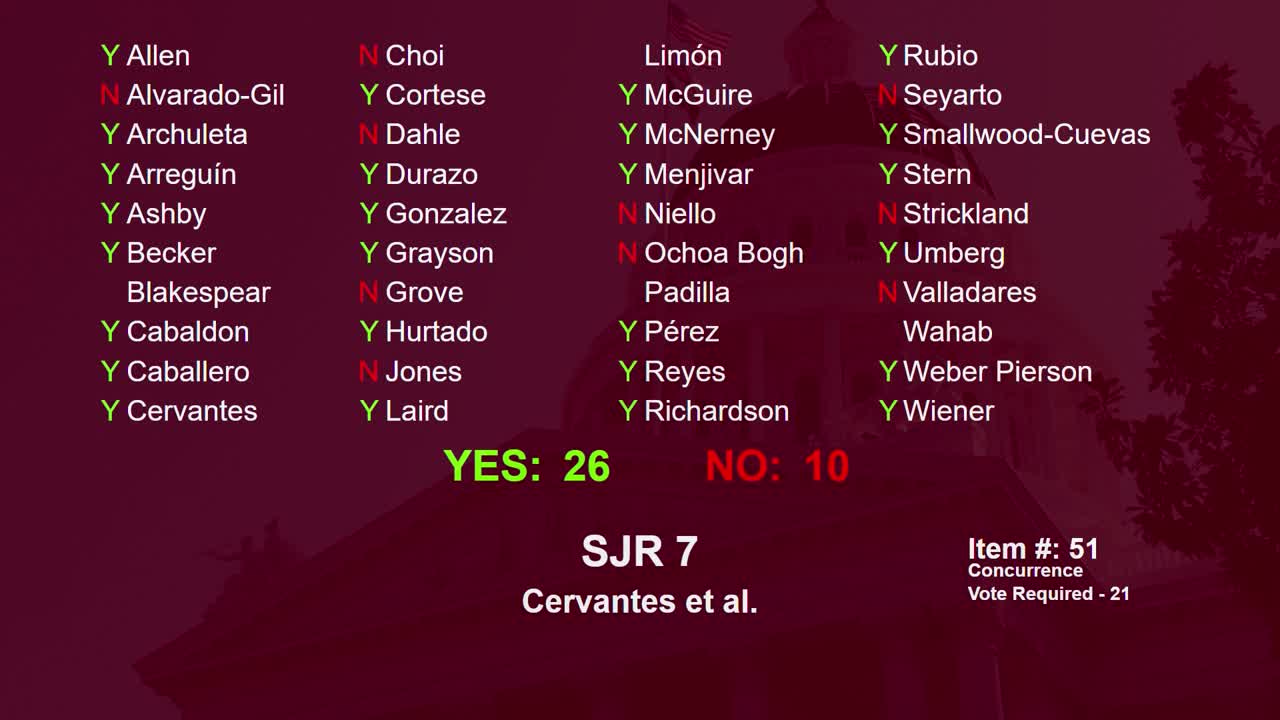 2MIN
Senate Floor
 5MIN
Senate Standing Committee on Judiciary
 6MIN
Senate Standing Committee on Natural Resources and Water
 47SEC
Assembly Floor
 3MIN
Assembly Standing Committee on Judiciary
 9MIN
Assembly Standing Committee on Water, Parks, and Wildlife
Bill Author