AB 19: Education expenses: Education Choice and Parental Empowerment Act of 2025.
- Session Year: 2025-2026
- House: Assembly
- Latest Version Date: 2025-03-28
Current Status:
Failed
(2026-02-02: From committee: Filed with the Chief Clerk pursuant to Joint Rule 56.)
Introduced
In Committee
Awaiting First Chamber Vote
Passed First Chamber
In Committee
Awaiting Second Chamber Vote
Passed Second Chamber
Enacted
What does this bill do?
The bill creates a state Education Savings Account (ESA) program that gives parents deposits to pay tuition and other school-related costs for their K–12 children, and later for college or vocational expenses. It sets up an ESA Trust and board, defines which public and private schools can receive ESA funds, limits early eligibility by family income before expanding to all students, sets the first deposit at $18,500 (adjusted annually), and caps post‑high‑school ESA balances at $50,000; it also requires the state to adjust minimum school funding and share ESA costs with local districts. The bill would make ESA withdrawals tax‑free and allow state tax deductions for ESA contributions if voters approve a related constitutional amendment.
The summary is provided by generative AI which can make mistakes. For original language, please view the details in the table below.
(1)Existing law establishes a system of elementary and secondary education in this state. This system consists of the public and private schools that provide instruction in kindergarten and in grades 1 to 12, inclusive. Existing law establishes a system of higher education in this state, consisting of 4 segments: the University of California, under the administration of the Regents of the University of California; the California State University, under the administration of the Trustees of the California State University; the California Community Colleges, under the administration of the Board of Governors of the California Community Colleges; and independent institutions of higher education.
This bill would state the intent of the Legislature to enact subsequent legislation, to be known as the Education Choice and Parental Empowerment Act of 2025, to empower parents to send their children to better performing schools by providing them with education savings accounts.This bill would enact the Education Choice and Parental Empowerment Act of 2025 and establish the Education Savings Account (ESA) Trust, to be known as the ESA Trust, as a fund within the State Treasury to be administered by the ESA Trust Board. For the 202728 to 203031, inclusive, school years, the bill would authorize certain children eligible to be enrolled in kindergarten or any of grades 1 to 12, inclusive, to establish an ESA, based on parent or guardian income. The bill, beginning with the 203132 school year, would authorize every child eligible to be enrolled in kindergarten or any of grades 1 to 12, inclusive, to establish an ESA. The bill would credit a deposit amount to the account of every eligible student enrolled in an eligible school for tuition, elementary and secondary eligible education expenses, and undergraduate or graduate eligible education expenses, as defined. The bill would specify the deposit amounts for the 202728 school year, and would require the Department of Finance, beginning on July 1, 2028, to determine the ESA deposit amount annually for the upcoming school year, as provided. The bill would require the Controller to transfer an amount of money from the General Fund to the ESA Trust in those amounts.
The bill would specify the membership of the ESA Trust Board and would vest the ESA Trust Board with certain powers and duties. The bill would establish 2 accounts within the ESA Trust, the ESA Trust Program Account and the ESA Trust Administrative Account, and would continuously appropriate the moneys in the program account to the ESA Trust Board for purposes of the bill, thereby making an appropriation.
The bill would require the Superintendent of Public Instruction to establish a procedure for the parents and legal guardians of eligible students to apply to establish an ESA and submit an executed participation agreement. The bill would authorize the ESA Trust Board to disburse funds from ESAs to eligible schools. The bill would define eligible school as a campus of the California Community Colleges, the California State University, and the University of California, a full-time private school accredited by, or, except as provided, awaiting accreditation from, a regional accrediting agency recognized by the state or the United States Department of Education, a private college or university, a public college or university, or a vocational educational or training institution, as specified. The bill would specify the procedures for participating eligible schools to receive funds disbursed by the ESA Trust Board. Once an eligible student graduates from high school or obtains a high school equivalency certification, the bill would impose a $50,000 cap on the balance in any ESA available for an eligible students use for tuition, undergraduate or graduate eligible education expenses, or expenses associated with vocational education. The bill would require the Department of Finance to adjust this limit annually for inflation using the California Consumer Price Index.
(2)The Classroom Instructional Improvement and Accountability Act, an initiative approved by the voters as Proposition 98 at the November 8, 1988, statewide general election, amended the California Constitution to, among other things, set forth a formula for computing the minimum amount of revenues that the state is required to appropriate for the support of school districts and community college districts based on one of 3 tests in any given fiscal year, one of which is based on the percentage of General Fund revenues appropriated for school districts and community college districts, respectively, in the 198687 fiscal year, and 2 of which are based on, among other things, changes in enrollment.
This bill would require the Legislature to recalculate that minimum education funding guarantee by including eligible students not enrolled in a public elementary or secondary school before the operative date of the act in those minimum funding guarantee calculations based on average daily attendance, as provided. The bill would also require the costs of providing ESA deposit amounts for eligible students to be apportioned between the General Fund and the public school district in which those eligible students reside in the same ratio of General Fund and local property tax revenue that would have been used to educate those eligible students in their public school district.
(3)The Personal Income Tax Law, in modified conformity with federal law, generally defines gross income as income from whatever source derived, except as specifically excluded, and provides various exclusions from gross income, and deductions from income, for purposes of computing tax liability.
This bill, for taxable years beginning on or after January 1, 2026, would exclude from gross income any amounts received as distribution from an Education Savings Account, as defined, as part of a participation agreement, as defined.
This bill, for taxable years beginning on or after January 1, 2026, would also allow a deduction in an amount equal to the amount contributed by a taxpayer to an Education Savings Account.
Existing law requires a bill authorizing a new tax expenditure to contain, among other things, specific goals, purposes, and objectives the tax expenditure will achieve, detailed performance indicators, and data collection requirements.
This bill would state the intent of the Legislature to include additional information required for any bill authorizing a new tax expenditure.
(4)These provisions would become operative on January 1, 2027, only if Assembly Constitutional Amendment ____ of the 202526 Regular Session is approved by the voters at the statewide general election on November 3, 2026.
Existing law establishes a system of elementary and secondary education in this state. This system consists of the public and private schools that provide instruction in kindergarten and in grades 1 to 12, inclusive. Existing law establishes a system of higher education in this state, consisting of 4 segments: the University of California, under the administration of the Regents of the University of California; the California State University, under the administration of the Trustees of the California State University; the California Community Colleges, under the administration of the Board of Governors of the California Community Colleges; and independent institutions of higher education.
This bill would state the intent of the Legislature to enact subsequent legislation, to be known as the Education Choice and Parental Empowerment Act of 2025, to empower parents to send their children to better performing schools by providing them with education savings accounts.
This article shall be known, and may be cited, as the Education Choice and Parental Empowerment Act of 2025.
69995.01.For purposes of this article, the following definitions apply:
(a)Account beneficiary means the eligible student for whom an ESA was established by the ESA Trust Board.
(b)Administrative account means the account established within the ESA Trust pursuant to subdivision (f) of Section 69995.02 from which the costs of administering the ESA Trust are paid.
(c)Costs of administration means the actual costs of the ESA Trust Board to administer ESAs, subject to the limit established in subdivision (d) of Section 69995.03.
(d)Elementary and secondary eligible education expenses means the expenses typically associated with the education of a pupil enrolled in a public elementary or secondary school or an eligible student enrolled in an eligible school, other than tuition, including, but not limited to, books, school supplies and equipment, academic tutoring, academic testing fees, special needs services of a special needs account beneficiary, transportation to and from school, and school functions. Expenses incurred by an eligible student to attend a community college before high school graduation, including tuition, are elementary and secondary eligible education expenses.
(e)Eligible school means any of the following:
(1)A campus of the California Community Colleges, the California State University, or the University of California.
(2)A private full-time day school, as described in Section 48222, operating in the state and accredited by a regional accrediting agency recognized by the state or the United States Department of Education, or a school that has applied for that accreditation, but the application is pending, and the school has not been denied accreditation in the prior two years by the same accrediting agency, that has filed an application with the Superintendent pursuant to Section 69995.09.
(3)A private college or university accredited by a regional accrediting agency recognized by the state or the United States Department of Education.
(4)A public college or university accredited by a regional accrediting agency recognized by the state that operates it or the United States Department of Education.
(5)A vocational education or training institution accredited by a regional accrediting agency recognized by the state or the United States Department of Education and operating in California.
(f)Eligible student means a child eligible to enroll in a public elementary or secondary school and enrolled in an eligible school, except as follows:
(1)For the 202728 and 202829 school years, a child is an eligible student only if the childs parent or guardians taxable income is less than sixty-five thousand dollars ($65,000) per year for a single filer or one hundred twenty thousand dollars ($120,000) per year for dual filers.
(2)For the 202930 and 203031 school years, a child is an eligible student only if the childs parent or guardians taxable income is less than one hundred thirty thousand dollars ($130,000) per year for a single filer or two hundred fifty thousand dollars ($250,000) per year for dual filers.
(g)ESA means Education Savings Account.
(h)ESA deposit amount means the amount calculated pursuant to subdivision (d) of Section 69995.02.
(i)ESA Trust means the Education Savings Account Trust established by subdivision (a) of Section 69995.02.
(j)ESA Trust Board means the Education Savings Account Trust Board established by subdivision (a) of Section 69995.03.
(k)Participation agreement means the uniform contract created by the ESA Trust Board that must be executed by the ESA Trust Board and the parent or legal guardian of an eligible student that directs the ESA Trust Board to disburse funds to an eligible school on behalf of the account beneficiary.
(l)Program account means the account created in the ESA Trust pursuant to subdivision (f) of Section 69995.02 from which moneys transferred from the General Fund, investment earnings, and other grants, gifts, or appropriations are maintained and segregated into ESAs for eligible students.
(m)Tuition means the amount charged by an eligible school to enroll a pupil or student at the school for a particular grade level and registration fees associated with application and enrollment.
(n)Unclaimed funds means funds remaining in an ESA that are not disbursed to an eligible school after the eligible student becomes either ineligible or attains 30 years of age, whichever comes first.
(o)Undergraduate or graduate eligible education expenses means the expenses typically associated with the education of an undergraduate or graduate student in an eligible school, other than tuition, including, but not limited to, books, school supplies and equipment, academic tutoring, special needs services of a special needs student, any additional school fees, and room and board.
69995.02.(a)There is hereby established an instrumentality of the State of California to be known as the Education Savings Account Trust.
(b)Every eligible student whose parent or guardian desires to enroll the child in an eligible school, may establish an ESA pursuant to this article.
(c)Every eligible student enrolled in an eligible school shall be entitled to a credit to the childs ESA for tuition, elementary and secondary eligible education expenses, and undergraduate or graduate eligible education expenses.
(d)The ESA deposit amount for the 202728 school year shall be eighteen thousand five hundred dollars ($18,500). Beginning July 1, 2028, the Department of Finance shall adjust the ESA deposit amount annually by the same percentage required for the support of school districts in the same fiscal year, pursuant to Section 8 of Article XVI of the California Constitution.
(e)Each school year, the Controller shall transfer an amount of moneys from the General Fund to the ESA Trust equal to the ESA deposit amount determined pursuant to subdivision (d) multiplied by the number of ESAs established pursuant to subdivision (b). The ESA deposit amount for an individual student may be adjusted for an ESA established after the beginning of the school year and for a partial school year pursuant to an application submitted pursuant to subdivision (b) of Section 69995.04. The Controller shall make at least three transfers to the ESA Trust during each fiscal year, with the first transfer occurring on August 1 and the last transfer occurring on or before June 15. The Controller shall adjust the amount of moneys transferred from the General Fund to the ESA Trust to ensure that the total amount of moneys transferred during the school year equals the amount required to be transferred pursuant to this article. The Controller shall report the total amount of moneys transferred from the General Fund to the ESA Trust pursuant to this article to the Department of Finance and the Legislature on or before June 15 of each year. This article does not prohibit the Legislature from appropriating additional funds to the ESA Trust.
(f)The ESA Trust is hereby established as a fund in the State Treasury. The ESA Trust Program Account and the ESA Trust Administrative Account are hereby established as accounts within the ESA Trust. Notwithstanding Section 13340 of the Government Code, the program account is hereby continuously appropriated, without regard to fiscal years, to the ESA Trust Board for purposes of this article. Moneys in the administrative account shall be available for expenditure, upon appropriation, for the purposes specified in this article. Moneys in the ESA Trust shall only be used for purposes of this article and shall not be taken, used, borrowed, or collateralized for any other purpose.
(g)Any unit of federal, state, or local government, or any other person, firm, partnership, or corporation, may make a grant, gift, or other appropriation for deposit into the administrative account, the program account, or the ESA of any individual account beneficiary.
69995.03.(a)The purposes, powers, and duties of the ESA Trust are vested in, and shall be exercised by, the Education Savings Account Trust Board, which is hereby established.
(b)The ESA Trust Board shall consist of the following members:
(1)The members of the Scholarshare Investment Board as provided in subparagraph (B) of paragraph (2) of subdivision (a) of Section 69984.
(2)The Superintendent.
(c)The ESA Trust Board shall have all the necessary powers and duties provided to the Scholarshare Investment Board under Article 19 (commencing with Section 69980), including, but not limited to, all of the following:
(1)The power to invest moneys in the ESA Trust for the benefit of the ESA Trust and account beneficiaries.
(2)The duty to publicly report investments and investment performance.
(3)The duty to distribute funds from ESAs and audit the ESAs to ensure that all funds disbursed to eligible schools are used by and for the account beneficiary and in furtherance of the act.
(4)The power to accept any grants, gifts, appropriations, and other moneys from any unit of federal, state, or local government or any other person, firm, partnership, or corporation for deposit into the administrative account, the program account, or the ESA of any individual account beneficiary.
(5)The duty to return unclaimed funds to the state for the benefit of elementary and secondary education, postsecondary education, or vocational education, upon appropriation by the Legislature.
(6)The power to adopt regulations to implement this article.
(d)Moneys transferred by the Controller pursuant to subdivision (e) of Section 69995.02 shall be allocated by the ESA Trust Board to the program account and administrative account. All moneys allocated to the program account shall be promptly invested and accounted for separately for each individual ESA. All costs of administration, including investment management fees, of the ESA Trust shall be paid out of the administrative account, which shall not exceed, on an annual basis, 1 percent of the total amount of moneys in the program account.
69995.04.(a)The Superintendent shall create an online application for a parent or legal guardian to request that an ESA be established for an eligible student and submit an executed participation agreement pursuant to this article. The Superintendent shall also accept applications and executed participation agreements submitted by mail.
(b)The deadline for submitting an application and executed participation agreement for the first school year for which an ESA is to be established for an eligible student shall be April 1 of the previous school year. The Superintendent shall establish at least one additional opportunity and deadline for a parent or legal guardian to submit an application and executed participation agreement during the school year. The ESA deposit amount for an ESA established during a school year shall be less than the full ESA deposit amount established pursuant to subdivision (d) of Section 69995.02.
(c)The parent or legal guardian of an eligible student shall identify the eligible student as the account beneficiary of the ESA and execute the participation agreement.
(d)Once an application and participation agreement have been submitted, the Superintendent shall confirm that the child is enrolled in an eligible school and the participation agreement shall be transmitted to the eligible school.
(e)So long as the account beneficiary remains eligible to receive the ESA deposit amount and to direct the expenditure of funds pursuant to this article, no additional application or participation agreement shall be required. However, an application and participation agreement shall be amended by the parent or legal guardian if the account beneficiary enrolls in a different eligible school.
(f)The Superintendent shall create an online process for a parent or legal guardian, public school district, eligible school, or any other person to report that a child is no longer eligible or is no longer enrolled in an eligible school. Upon receipt of this information, the Superintendent shall confirm the eligibility status of the child by providing adequate notice to the parent or legal guardian of the child and to the school, and an opportunity for each to be heard. If the Superintendent determines that a child is no longer eligible, that determination may be appealed by the parent or legal guardian on behalf of the child pursuant to the administrative adjudication procedures described in Chapter 4.5 (commencing with Section 11400) of Part 1 of Division 3 of Title 2 of the Government Code.
69995.05.The Superintendent shall do all of the following:
(a)Create an online application for a school to become eligible to receive funds from an ESA established pursuant to this article.
(b)Publish and periodically update on its internet website a list of eligible schools by name and address.
(c)Provide contact information for each eligible school on its internet website.
(d)Post the tuition and other eligible education expenses charged for each grade level at an eligible school on its internet website.
69995.06.The ESA Trust Board shall do all of the following:
(a)Establish an ESA within the program account for each eligible student who has requested an account from the Superintendent.
(b)Enter into participation agreements pursuant to this article.
(c)Credit each ESA with the appropriate ESA deposit amount for each eligible student.
(d)Credit investment earnings of the program account to each ESA, as appropriate.
(e)Provide parents and legal guardians of account beneficiaries with the ability to securely review online ESA activity, including ESA deposits or credits, ESA investment earnings, and ESA disbursements to an eligible school on behalf of the account beneficiary.
(f)Protect the privacy of parents, legal guardians, and account beneficiaries.
(g)(1)Pursuant to the terms of an executed participation agreement, and except as provided in paragraph (2), disburse funds on behalf of an account beneficiary to an eligible school on a monthly basis.
(2)Notwithstanding paragraph (1), the ESA Trust Board may enter into an agreement with an eligible school to provide for a different disbursement schedule.
(h)Randomly audit funds disbursed from ESAs to ensure student eligibility, student enrollment, student attendance, and school eligibility.
(i)Withhold any ineligible disbursement made to an eligible school from any future disbursements.
(j)Create a uniform participation agreement for use by the Superintendent, the ESA Trust Board, and the parents and legal guardians of eligible students. An eligible school identified in a participation agreement shall be a third-party beneficiary of an executed participation agreement.
69995.07.The ESA Trust Board shall adopt regulations to implement this article.
69995.08.(a)The ESA Trust Board shall only disburse funds from an ESA to an eligible school.
(b)The state shall not limit the number of eligible schools or the number of students enrolled in an eligible school. The state shall not impose conditions on the eligibility of a private school, college, or university to receive funds, other than conditions based on any of the following:
(1)Periodic certification that an eligible student is enrolled and attending the eligible school.
(2)Periodic certification that the amount disbursed from an ESA is only used for tuition and eligible education expenses.
(3)Accreditation required to obtain status as an eligible school pursuant to paragraph (2) of subdivision (e) of Section 69995.01.
(4)Public disclosure of the receipt and expenditure of ESA funds as required by the ESA Trust Board.
(5)The general health and safety standards applicable to the facilities of all private schools operating in the state.
(c)Once an eligible student graduates from high school or obtains a high school equivalency certificate pursuant to Section 51425, the maximum balance in an ESA and available for an eligible students use for tuition, undergraduate or graduate eligible education expenses, or expenses associated with vocational education, shall be fifty thousand dollars ($50,000). Any amount in an ESA that exceeds this limit shall be treated as unclaimed funds pursuant to paragraph (5) of subdivision (c) of Section 69995.03. The Department of Finance shall adjust this limit annually for inflation using the California Consumer Price Index.
69995.09.(a)The California Community Colleges, the California State University, and the University of California, and each campus, branch, and function thereof, shall accept funds from an ESA to pay for the tuition and eligible educational expenses of an account beneficiary who is admitted to the college or university.
(b)A private full-time day school, including a private college or university, may become an eligible school by filing an application with the Superintendent. A private full-time day school, including a private college or university, that becomes an eligible school may accept funds from an ESA for the tuition and eligible educational expenses of an account beneficiary who is admitted to the eligible school.
(c)A vocational education or training school may become an eligible school by filing an application with the Superintendent. A vocational education or training school may accept funds from an ESA for the tuition and eligible educational expenses of an account beneficiary who is admitted to the eligible school.
69995.10.(a)Notwithstanding Section 69995.02, and except as provided in subdivision (b), the child of a parent or legal guardian who chooses to educate the child at home pursuant to an affidavit filed pursuant to Section 33190 and in lieu of enrolling in an eligible school shall not be entitled to establish an ESA pursuant to this article. This article does not prohibit the state from offering financial aid for education-related expenses to the parents or legal guardians of homeschooled children ineligible for an ESA.
(b)Notwithstanding subdivision (a), the parent or legal guardian of a child enrolled in an eligible school to facilitate homeschooling may establish an ESA for the child pursuant to this article.
69995.11.(a)An eligible school shall not share, refund, or rebate any funds received from an ESA with or to the parent, legal guardian, or eligible student in any manner.
(b)The ESA Trust Board may terminate and suspend an ESA and participation agreement if the parent, legal guardian, or eligible student fails to comply with the terms of the participation agreement with the intent to defraud or misuse the funds distributed on behalf of an account beneficiary upon notice to the parent or legal guardian and an opportunity to be heard. If the ESA Trust Board terminates or suspends an ESA, that determination may be appealed by the parent, legal guardian, or eligible student pursuant to the administrative adjudication procedures described in Chapter 4.5 (commencing with Section 11400) of Part 1 of Division 3 of Title 2 of the Government Code.
69995.12.The Legislature shall provide for the allocation of costs associated with this article as follows:
(a)For the cost of providing an ESA deposit amount for an eligible student not enrolled in a public elementary or secondary school before the operative date of this article, the Legislature shall rebase, as necessary, the minimum funding guarantee for school districts, as provided in Section 8 of Article XVI of the California Constitution, to include such eligible students in the definition of average daily attendance as defined in Section 8.1 of Article XVI of the California Constitution.
(b)For the costs of providing an ESA deposit amount for an eligible student, the cost for that ESA deposit amount shall be apportioned between the General Fund and the public school district in which the eligible student resides, in the same ratio of General Fund and local property tax revenue that would have been used to educate that eligible student in the students public school district. The Legislature shall provide for the transfer of funds from a school district to the state as necessary to carry out this provision.
69995.13.This article shall become operative on January 1, 2027, only if Assembly Constitutional Amendment ____ of the 202526 Regular Session is approved by the voters at the statewide general election on November 3, 2026.
SEC. 2.Section 17132.2 is added to the Revenue and Taxation Code, to read:17132.2.(a)For taxable years beginning on or after January 1, 2026, gross income shall not include distributions from an Education Savings Account pursuant to a participation agreement.
(b)For purposes of this section, the following definitions shall apply:
(1)Education Savings Account means an education savings account established under the Education Choice and Parental Empowerment Act of 2025 (Article 19.2 (commencing with Section 69995) of Chapter 2 of Part 42 of Division 5 of Title 3 of the Education Code).
(2)Participation agreement has the same meaning as that term is defined in subdivision (k) of Section 69995.01 of the Education Code.
(c)It is the intent of the Legislature to comply with the requirements of Section 41.
(d)This section shall become operative on January 1, 2027, only if Assembly Constitutional Amendment ____ of the 202526 Regular Session is approved by the voters at the statewide general election on November 3, 2026.
SEC. 3.Section 17210 is added to the Revenue and Taxation Code, to read:17210.(a)For taxable years beginning on or after January 1, 2026, there shall be allowed as a deduction an amount equal to the amount contributed by a taxpayer to an Education Savings Account.
(b)For purposes of this section, Education Savings Account means an education savings account established under the Education Choice and Parental Empowerment Act of 2025 (Article 19.2 (commencing with Section 69995) of Chapter 2 of Part 42 of Division 5 of Title 3 of the Education Code).
(c)It is the intent of the Legislature to comply with the requirements of Section 41.
(d)This section shall become operative on January 1, 2027, only if Assembly Constitutional Amendment ____ of the 202526 Regular Session is approved by the voters at the statewide general election on November 3, 2026.
SECTION 1.It is the intent of the Legislature to enact subsequent legislation, to be known as the Education Choice and Parental Empowerment Act of 2025, to empower parents to send their children to better performing schools by providing them with education savings accounts.It is the intent of the Legislature to enact subsequent legislation, to be known as the Education Choice and Parental Empowerment Act of 2025, to empower parents to send their children to better performing schools by providing them with education savings accounts.
|
Date
|
Status
|
|---|---|
| Feb 2, 2026 | From committee: Filed with the Chief Clerk pursuant to Joint Rule 56. |
| Jan 31, 2026 | Died pursuant to Art. IV, Sec. 10(c) of the Constitution. |
| Apr 28, 2025 | In committee: Set, second hearing. Held under submission. |
| Apr 21, 2025 | In committee: Set, first hearing. Referred to suspense file. |
| Apr 1, 2025 | Re-referred to Com. on REV. & TAX. |
| Mar 28, 2025 | From committee chair, with author's amendments: Amend, and re-refer to Com. on REV. & TAX. Read second time and amended. |
| Mar 28, 2025 | Referred to Coms. on REV. & TAX. and ED. |
| Dec 3, 2024 | From printer. May be heard in committee January 2. |
| Dec 2, 2024 | Read first time. To print. |
This list shows positions taken on this bill by organizations on the date displayed, which is linked to the original source.
Positions by individuals are not included.
|
Organization
|
Position
|
Date
|
|---|---|---|
| California Catholic Conference | ** Support | |
| California Federation Of Teachers | ** Against | |
| California School Employees Association | ** Against | |
| California State PTA | ** Against | |
| Church State Council | ** Against |
Date of Hearing: April 28, 2025
ASSEMBLY COMMITTEE ON REVENUE AND TAXATION
Mike Gipson, Chair
ABPCA Bill Id:AB 19 (
Author:DeMaio) – As Amended Ver:March 28, 2025
SUSPENSE
2/3 vote. Fiscal Committee.
SUBJECT: Education expenses: Education Choice and Parental Empowerment Act of 2025
SUMMARY: Enacts, subject to the approval of an unspecified Assembly Constitutional Amendment by the voters at the statewide general election on November 3, 2026, the Education Choice and Parental Empowerment Act of 2025. Specifically, this bill:
- Defines all of the following terms:
- "Account beneficiary" is the eligible student for whom an ESA was established by the ESA Trust Board.
- "Administrative account" is the account established within the ESA Trust from which the costs of administering the ESA Trust are paid.
- "Costs of administration" are the actual costs of the ESA Trust Board to administer ESAs, subject to the limit established in Education Code (EDC) Section 69995.03(d).
- "Elementary and secondary eligible education expenses" are the expenses typically associated with the education of a pupil enrolled in a public elementary or secondary school or an eligible student enrolled in an eligible school, other than tuition, including, but not limited to, books, school supplies and equipment, academic tutoring, academic testing fees, special needs services of a special needs account beneficiary, transportation to and from school, and school functions. Expenses incurred by an eligible student to attend a community college before high school graduation, including tuition, are elementary and secondary eligible education expenses.
- "Eligible school" is any of the following:
- A campus of the California Community Colleges, the California State University, or the University of California;
- A private full-time day school, as described in EDC Section 48222, operating in the state and accredited by a regional accrediting agency recognized by the state or the United States Department of Education, or a school that has applied for that accreditation, but the application is pending, and the school has not been denied accreditation in the prior two years by the same accrediting agency, that has filed an application with the Superintendent pursuant to EDC Section 69995.09;
- A private college or university accredited by a regional accrediting agency recognized by the state or the United States Department of Education;
- A public college or university accredited by a regional accrediting agency recognized by the state that operates it or the United States Department of Education; or,
- A vocational education or training institution accredited by a regional accrediting agency recognized by the state or the United States Department of Education and operating in California.
- "Eligible student" is a child eligible to enroll in a public elementary or secondary school and enrolled in an eligible school, except as follows:
- For the 2027–28 and 2028–29 school years, a child is an eligible student only if the child's parent or guardian's taxable income is less than $65,000 per year for a single filer or $120,000 per year for dual filers; and,
- For the 2029–30 and 2030–31 school years, a child is an eligible student only if the child's parent or guardian's taxable income is less than $130,000 per year for a single filer or $250,000 per year for dual filers.
- For the 2027–28 and 2028–29 school years, a child is an eligible student only if the child's parent or guardian's taxable income is less than $65,000 per year for a single filer or $120,000 per year for dual filers; and,
- "ESA" is an Education Savings Account.
- "ESA deposit account" is the amount calculated pursuant to EDC Section 69995.02(d).
- "ESA trust" is the Education Savings Account Trust established by EDC Section 69995.02(a).
- "ESA trust board" is the Education Savings Account Trust Board established by EDC Section 69995.03(a).
- "Participation agreement" is the uniform contract created by the ESA Trust Board that must be executed by the ESA Trust Board and the parent or legal guardian of an eligible student that directs the ESA Trust Board to disburse funds to an eligible school on behalf of the account beneficiary.
- "Program account" is the account created in the ESA Trust pursuant to EDC Section 69995.02(f) from which moneys transferred from the General Fund, investment earnings, and other grants, gifts, or appropriations are maintained and segregated into ESAs for eligible students.
- "Tuition" is the amount charged by an eligible school to enroll a pupil or student at the school for a particular grade level and registration fees associated with application and enrollment.
- "Unclaimed funds" are funds remaining in an ESA that are not disbursed to an eligible school after the eligible student becomes either ineligible or attains 30 years of age, whichever comes first.
- "Undergraduate or graduate eligible education expenses" are the expenses typically associated with the education of an undergraduate or graduate student in an eligible school, other than tuition, including, but not limited to, books, school supplies and equipment, academic tutoring, special needs services of a special needs student, any additional school fees, and room and board.
- Establishes the Education Savings Account Trust (ESA Trust) in the State Treasury, as well as the ESA Trust Program Account (Program Account) and the ESA Trust Administrative Account (Administrative Account) within the ESA Trust, and provides for all of the following:
- Every eligible student whose parent or guardian desires to enroll the child in an eligible school, may establish an ESA;
- Every eligible student enrolled in an eligible school is entitled to a credit to the child's ESA for tuition, elementary and secondary eligible education expenses, and undergraduate or graduate eligible education expenses;
- The ESA deposit amount for the 2027-28 school year is $18,500 and requires, beginning July 1, 2028, the Department of Finance to adjust the ESA deposit amount annually by the same percentage required for the support of school districts in the same fiscal year, pursuant to the Proposition 98 minimum funding guarantee;
- Any unit of federal, state, or local government, or any other person, firm, partnership, or corporation, may make a grant, gift, or other appropriation for deposit into the Administrative Account, the Program Account, or the ESA of any individual account beneficiary;
- Requires the State Controller to do all of the following:
- Transfer, each school year, an amount of money from the General Fund to the ESA Trust equal to the ESA deposit amount multiplied by the number of ESAs established by parents and guardians. The ESA deposit amount for an individual student may be adjusted for an ESA established after the beginning of the school year and for a partial school year;
- Make at least three transfers to the ESA Trust during each fiscal year, with the first transfer occurring on August 1 and the last transfer occurring on or before June 15;
- Adjust the amount of moneys transferred from the General Fund to the ESA Trust to ensure that the total amount of moneys transferred during the school year equals the amount required to be transferred pursuant to this bill;
- Report the total amount of moneys transferred from the General Fund to the ESA Trust pursuant to this bill to the Department of Finance and the Legislature on or before June 15 of each year. This bill does not prohibit the Legislature from appropriating additional funds to the ESA Trust.
- Requires the Legislature to provide for the allocation of costs as follows:
- For the cost of providing an ESA deposit amount for an eligible student not enrolled in a public elementary or secondary school before the operative date of this bill, the Legislature must rebase, as necessary, the Proposition 98 minimum funding guarantee for school districts to include such students in the definition of “average daily attendance” as defined in Section 8.1 of Article XVI of the California Constitution; and,
- For the costs of providing an ESA deposit amount for an eligible student, the cost for that ESA deposit amount must be apportioned between the General Fund and the public school district in which the eligible student resides, in the same ratio of General Fund and local property tax revenue that would have been used to educate that eligible student in the student’s public school district. The Legislature must provide for the transfer of funds from a school district to the state as necessary to carry out this provision.
- Establishes the Education Savings Account Trust Board (Board), which consists of the members of the Scholarshare Investment Board and the Superintendent of Public Instruction, and has all of the following powers and duties provided to the Scholarshare Investment Board, including but not limited to, all of the following:
- The power to invest moneys in the ESA Trust for the benefit of the ESA Trust and account beneficiaries;
- The duty to publicly report investments and investment performance;
- The duty to distribute funds from ESAs and audit the ESAs to ensure that all funds disbursed to eligible schools are used by and for the account beneficiary and in furtherance of the purposes established by this bill;
- The power to accept any grants, gifts, appropriations, and other moneys from any unit of federal, state, or local government or any other person, firm, partnership, or corporation for deposit into the administrative account, the program account, or the ESA of any individual account beneficiary;
- The duty to return unclaimed funds to the state for the benefit of elementary and secondary education, postsecondary education, or vocational education, upon appropriation by the Legislature; and,
- The power to adopt regulations to implement the provisions of this bill.
- Requires the Board to do all of the following:
- Establish an ESA within the Program Account for each eligible student who has requested an account from the Superintendent;
- Enter into participation agreements;
- Credit each ESA with the appropriate ESA deposit amount for each eligible student;
- Credit investment earnings of the program account to each ESA, as appropriate;
- Provide parents and legal guardians of account beneficiaries with the ability to securely review online ESA activity, including ESA deposits or credits, ESA investment earnings, and ESA disbursements to an eligible school on behalf of the account beneficiary;
- Protect the privacy of parents, legal guardians, and account beneficiaries;
- Disburse funds on behalf of an account beneficiary to an eligible school on a monthly basis pursuant to an executed participation agreement;
- Randomly audit funds disbursed from ESAs to ensure student eligibility, student enrollment, student attendance, and school eligibility;
- Withhold any ineligible disbursement made to an eligible school from any future disbursements; and,
- Create a uniform participation agreement for use by the Superintendent, the ESA Trust Board, and the parents and legal guardians of eligible students. An eligible school identified in a participation agreement must be a third-party beneficiary of an executed participation agreement.
- Requires that moneys transferred by the State Controller be allocated by the Board to the Program Account and Administrative Account. All moneys allocated to the program account must be promptly invested and accounted for separately for each individual ESA. All costs of administration, including investment management fees, of the ESA Trust must be paid out of the administrative account, which shall not exceed, on an annual basis, 1% of the total amount of moneys in the Program Account.
- Requires the Superintendent to do all of the following:
- Create an online application for a school to become eligible to receive funds from an ESA;
- Publish and periodically update on its internet website a list of eligible schools by name and address;
- Provide contact information for each eligible school on its internet website; and,
- Post the tuition and other eligible education expenses charged for each grade level at an eligible school on its internet website.
- Requires the California Community Colleges, California State University, University of California, and each of their campuses to accept funds from an ESA to pay for the tuition and eligible educational expenses of an account beneficiary who is admitted to the college or university.
- Allows private full-time day schools, including private colleges and universities, and vocational education or training schools to become an eligible school by filing an application with the Superintendent and allows these institutions to accept ESA funds for admitted students.
- Provides that, once a student graduates from high school or obtains a high school equivalency certificate, the maximum balance in an ESA and available for an eligible student’s use for tuition, undergraduate or graduate eligible education expenses, or expenses associated with vocational education is limited to $50,000. Any amount in an ESA that exceeds this limit would be treated as unclaimed funds.
- Prohibits an eligible school from sharing, refunding, or rebating any funds received from an ESA with or to the parent, legal guardian, or eligible student in any manner.
- Allows the Board to terminate and suspend an ESA participation agreement if the parent, legal guardian, or eligible student fails to comply with the terms of the participation agreement with the intent to defraud or misuse the funds distributed on their behalf.
- Excludes from gross income, for taxable years beginning on or after January 1, 2026, for purposes of the Personal Income Tax (PIT) Law, distributions from an ESA made pursuant to a participation agreement.
- Allows a miscellaneous itemized deduction, for taxable years beginning on or after January 1, 2026, under the PIT Law, in an amount equal to the amount contributed by a taxpayer to an ESA.
- States the intent of the Legislature to comply with the requirements of Revenue and Taxation Code (R&TC) Section 41.
- Provides that all of the above shall become operative on January 1, 2027, only if an unspecified Assembly Constitutional Amendment is approved by the voters at the statewide general election on November 3, 2026.
EXISTING LAW:
- Requires the state to spend a minimum amount of funding on school districts and community colleges every fiscal year, based on specific calculations built on a percentage of General Fund revenues or prior-year education appropriations, enrollment, and economic growth. (California Constitution, Article XVI, Section 8, subdivision (b).)
- Provides for all of the following:
- A base grant of the following amounts per average daily attendance (ADA) in 2023-24:
- $10,951 for grades TK-3, which includes a 10.4% grade span adjustment for class size reduction;
- $10,069 for grades 4-6;
- $10,367 for grades 7-8; and
- $12,327 for grades 9-12, which includes a 2.6% grade span adjustment for college and career readiness.
- A supplemental grant equal to 20% of the base grant for each pupil identified as either low income, an English learner, or in foster care (unduplicated pupils).
- A concentration grant based on the number of unduplicated pupils in excess of 65% of the district or charter school total enrollment.
- A base grant of the following amounts per average daily attendance (ADA) in 2023-24:
- Requires, upon full implementation of the Local Control Funding Formula (LCFF), as a condition of receiving funds, school districts to maintain an average class enrollment for each schoolsite for kindergarten and grades 1 to 3, inclusive, of not more than 24 pupils, unless a collectively bargained alternative ratio is agreed to by the district. (EDC Section 42238.02)
FISCAL EFFECT: The Franchise Tax Board estimates that the tax provisions of this bill alone would result in General Fund revenue losses of $14 million in fiscal year (FY) 2026-27 and $38 million in FY 2027-28. Additional non-tax related costs to the state are estimated to total several billions of dollars annually.
COMMENTS:
- The author has provided the following statement in support of this bill:
The Education Choice and Parental Empowerment Act is a necessary piece of legislation that will give parents the freedom and choice of where their kids are educated. Currently, many parents worry about the quality and attention their children receives in the public schools, but do not have the financial flexibility to enroll them elsewhere. Education Savings Accounts would offer parents many more viable options for their child's schooling, while encouraging healthy competition with the public school system.
- Writing in support of this bill, the California Catholic Conference notes, in part:
AB 19 introduces Education Savings Accounts (ESAs) for eligible K-12 students, initially based on family income and expanding to include all students by the 2031–32 school year. These accounts will empower families by helping cover tuition and educational expenses at a wide range of eligible schools, including public, accredited private, and vocational institutions. The bill prudently sets a cap of $50,000 on ESA balances after high school graduation, with inflation adjustments, to ensure long-term viability and responsible use of funds.
Importantly, this bill also amends the Classroom Instructional Improvement and Accountability Act to ensure equitable funding. It accounts for students not previously enrolled in public schools and fairly allocates ESA funding costs between the General Fund and relevant districts. Additionally, starting in 2026, ESA distributions will be excluded from gross income, and contributions to ESAs will be tax-deductible—an essential incentive for families investing in their children's futures.
- Writing in opposition to this bill, the California Federation of Teachers (CFT) notes, in part:
School voucher programs have been demonstrated to disproportionately help more affluent households rather than the purported benefits to low-income households. They essentially serve to provide a discount to households that already participate in private schools. Furthermore, what is typically described as "parent choice" is really the choice of the private school to enroll certain populations while discriminating against others--further segregating schools between socioeconomic classes.
Taking public dollars to fund private school tuition is a short-sighted maneuver that further threatens the financial stability of our public school system. John Adams said, "The whole people must take upon themselves the education of the whole people, and must be willing to bear the expenses of it. There should not be a district of one mile square, without a school in it, not founded by a charitable individual, but maintained at the expense of the people themselves". School vouchers are a direct threat to this basic principle, by robbing the ability to provide education and giving it to a smaller, elite population.
- Committee Staff Comments:
- Double-referred: This bill was double referred to the Assembly Committee on Education.
- What is a "tax expenditure"? Existing law provides various credits, deductions, exclusions, and exemptions for particular taxpayer groups. In the late 1960s, U.S. Treasury officials began arguing that these features of the tax law should be referred to as "expenditures" since they are generally enacted to accomplish some governmental purpose and there is a determinable cost associated with each (in the form of foregone revenues).
As the Department of Finance notes in its annual Tax Expenditure Report, there are several key differences between tax expenditures and direct expenditures. First, tax expenditures are typically reviewed less frequently than direct expenditures. Second, there is generally no control over the amount of revenue losses associated with any given tax expenditure. Finally, it should also be noted that, once enacted, it takes a two-thirds vote to rescind an existing tax expenditure absent a sunset date. This effectively results in a "one-way ratchet" whereby tax expenditures can be conferred by majority vote, but cannot be rescinded, irrespective of their efficacy or cost, without a supermajority vote.
- Is this a voucher program? Voucher programs generally allow public funds to be used for private school tuition. ESAs are a type of voucher program, but they are structured differently in that, in addition to private school tuition, ESA funds can be used to purchase other educational services, such as tutoring, textbooks, or online course fees. Under this bill, the state would "rebase" the amount of funding currently apportioned to local educational agencies as required by the Proposition 98 Guarantee to include private school students and award vouchers to parents who could then use the funding to cover tuition and other services at an eligible public or private school. The policy changes and state and local mechanisms required to implement this bill and its companion constitutional amendment are very complex and would profoundly change how public (and private) education is currently funded. Given that no one knows how many parents and schools would apply for vouchers or move their children from public to private schools, it is difficult to assess the impact of this bill with any meaningful precision.
- Voucher programs in other states: The first publicly funded voucher program in the country was started in Milwaukee in 1990 - the Milwaukee Parental Choice Program. Currently, there are 25 voucher programs in 14 states, including the District of Columbia. The number of voucher programs has grown steadily since 2010, as has the scope of existing programs.
- Is this a voucher program? Voucher programs generally allow public funds to be used for private school tuition. ESAs are a type of voucher program, but they are structured differently in that, in addition to private school tuition, ESA funds can be used to purchase other educational services, such as tutoring, textbooks, or online course fees. Under this bill, the state would "rebase" the amount of funding currently apportioned to local educational agencies as required by the Proposition 98 Guarantee to include private school students and award vouchers to parents who could then use the funding to cover tuition and other services at an eligible public or private school. The policy changes and state and local mechanisms required to implement this bill and its companion constitutional amendment are very complex and would profoundly change how public (and private) education is currently funded. Given that no one knows how many parents and schools would apply for vouchers or move their children from public to private schools, it is difficult to assess the impact of this bill with any meaningful precision.
Almost all states have eligibility requirements for their voucher programs, with the most common being students with a documented disability or meeting household income requirements. Other eligibility requirements include attending a low-performing school or district, living in certain geographic regions, or some combination thereof.[1] There are two states, Arizona and Nevada, which have ESA programs that do not include eligibility requirements. Arizona expanded their already existing ESA program to be universal in 2017, which will phase in over a few years and be capped at 30,000 student participants. Nevada created its universal program in 2013, but the program is on hold following a 2015 court decision declaring the funding mechanism unconstitutional and program funding has not been restored.
Since the passage of Proposition 98, the voters of California have had two opportunities to vote for tax-funded school vouchers—Proposition 174 in 1993 and Proposition 38 in 2000. Both propositions received about 30% voter support.
- Existing school choice options for California parents: There are two main groups of parents in California already exercising alternative school choice—those that send their children to private school and those that access public school options such as charter schools, magnet schools, or cross-town transfer programs. While the author states that this bill would give parents the option of moving their children from their assigned school to any other accredited school that best meets their needs, state law already provides the following public school options:
- Charter Schools. There are over 1,200 public charter schools in the state that provide instruction in any combination of Kindergarten through grades 12. Parents, teachers, or community members may initiate charter petitions, which include the specific goals and operating procedures for the charter school. While most charter schools offer traditional, classroom-based instruction, about 20% offer some form of independent study, such as distance learning or home study.
- Magnet Schools. Magnet schools are designed by local authorities to attract parents, guardians, and students who are free to choose the school in which they enroll. These programs and schools are established by district governing boards that can make a wide range of choices depending on their local needs and resources. Magnet schools and programs include those that provide unique instruction in the arts, various sciences, and career education. Others reflect a district strategy to achieve racial and ethnic balance. When one or more magnets are established at a particular school, students from across the district may select a magnet with available space.
- District of Choice (DOC) Program. This program allows a student to transfer to any district that has deemed itself a DOC and agreed to accept a specified number of transfers. DOC may not use a selective admissions process. Transfer students generally do not need the consent of their home districts.
- Interdistrict Permits. These allow a student to transfer from one district to another district provided both districts consent to the transfer and the student meets any locally determined conditions. Districts receiving these transfer students may require students to meet certain attendance and/or academic standards.
- Parental employment transfers. These allow a student to transfer into a district if at least one parent is employed within the boundaries of that district and that district has chosen to accept parental employment transfers. Transfer students generally do not need the consent of their home districts.
- The Open Enrollment Act. This option, for low-performing schools, allows a student attending a school with low performance on state tests to transfer to another school inside or outside the district that has a higher level of performance and space available. Transfer students generally do not need the consent of their home districts.
Beyond the public school options, about 7.5% of California students are enrolled in private schools, a proportion that has gradually dropped over the past two decades from about 10%. Interestingly, these are the families that would immediately benefit from this bill because, even though they have already chosen to send their kids to private school, they would be eligible for the same voucher as all other parents.
- Voucher programs face legal challenges: Several state or local voucher programs across the country have faced legal challenges, often centered on the separation of church and state debate: specifically, whether sending public funds to sectarian private schools contradicts the Establishment Clause of the U.S. Constitution's First Amendment and a series of approximately 36 state constitutional amendments which prohibit the respective state from providing public funds to religious schools (collectively known as the Blaine Amendments). The outcomes of these challenges have been a mix of upholding the programs and finding them unconstitutional.[2]
- Creates new costs of between $4 to $6 billion: This bill is substantially similar to a recent proposed constitutional and statutory initiative related to funding for students attending private schools (A.G. File No. 21-0011, Amendment #1). In its analysis of that initiative, the Legislative Analyst's Office states the following:
- Voucher programs face legal challenges: Several state or local voucher programs across the country have faced legal challenges, often centered on the separation of church and state debate: specifically, whether sending public funds to sectarian private schools contradicts the Establishment Clause of the U.S. Constitution's First Amendment and a series of approximately 36 state constitutional amendments which prohibit the respective state from providing public funds to religious schools (collectively known as the Blaine Amendments). The outcomes of these challenges have been a mix of upholding the programs and finding them unconstitutional.[2]
This measure would affect the state budget and the budgets of public schools. The magnitude of these effects largely depends on (1) the number of participating students, and (2) how public and private schools respond to the measure.
The 471,000 students who already attend private schools likely would be the first students to register for this program. In addition, some of the 84,000 students currently attending homeschool probably would switch to participating private schools. Since these students currently receive no state funding, their participation represents an additional cost to the state. Participation probably would be less than 100 percent, however, on the lower end, if 308,000 students participated (representing 60 percent of current private school students and 30 percent of homeschool students switching to private schools), the annual state cost at full implementation would be about $4 billion. On the high end, if 462,000 students participated (representing 90 percent of current private school students and 45 percent of homeschool students switching), the annual state cost would be about $6 billion. The state generally would pay for these costs through reductions to funding for public schools (as the measure allows) and/or reductions to other state programs supported by the state General Fund.
- Who stands to benefit? This bill limits eligibility for purposes of opening an ESA account based on the taxable income of the child's parent or guardian, which is $65,000 for single filers and $120,000 for joint filers for the 2027-2029 school years. This income limitation amount increases to $130,000 for single filers and $250,000 for joint filers starting with the 2029 school year. This bill does not, however, limit the availability of the deduction or income exclusion based on gross income.
- Who stands to benefit? This bill limits eligibility for purposes of opening an ESA account based on the taxable income of the child's parent or guardian, which is $65,000 for single filers and $120,000 for joint filers for the 2027-2029 school years. This income limitation amount increases to $130,000 for single filers and $250,000 for joint filers starting with the 2029 school year. This bill does not, however, limit the availability of the deduction or income exclusion based on gross income.
As a miscellaneous deduction, the deduction for amounts contributed to an ESA would only be available to taxpayers who itemize deductions when filing their taxes. Filers claiming the standard deduction would not be able to claim the deduction created by this bill. In California, just over 15% of filers itemized deductions in 2020.[3] The Tax Cuts and Jobs Act of 2017 significantly reduced the number of taxpayers in California who itemize their taxes because it increased the standard deduction and significantly limited the state and local tax (SALT) deduction, which was one of the most common itemized deductions claimed in California.
- Deductions tend to benefit higher income households: A deduction is generally more valuable to high-income taxpayers because the "value" of a deduction varies with the marginal tax rate (or tax bracket) of the taxpayer. For example, an individual taxpayer in a 10% tax bracket would receive a tax benefit of $10 on a $100 deduction. In contrast, a taxpayer in a 25% tax bracket would save $25 in taxes for every $100 deducted from income. Thus, assuming the same level of deductions, high-income taxpayers, presumably with a greater ability to pay taxes, would receive a greater tax benefit from the proposed deduction than lower income taxpayers.
- Other policy considerations: When considering the creation of a state-funded ESA system, many more factors must be considered beyond what is described above. The funding impact of this bill is difficult to assess—the Proposition 98 Guarantee would be "rebased" to include private school student ADA but public funding would then be diverted away from traditional public schools to parents that currently enroll their children in private schools. It is unclear whether including private school student attendance in the calculation of the Proposition 98 Guarantee would cover the costs of funding these students' ESAs. If not, the result would be less per-pupil state aid available to public school districts and charter schools.
- Deductions tend to benefit higher income households: A deduction is generally more valuable to high-income taxpayers because the "value" of a deduction varies with the marginal tax rate (or tax bracket) of the taxpayer. For example, an individual taxpayer in a 10% tax bracket would receive a tax benefit of $10 on a $100 deduction. In contrast, a taxpayer in a 25% tax bracket would save $25 in taxes for every $100 deducted from income. Thus, assuming the same level of deductions, high-income taxpayers, presumably with a greater ability to pay taxes, would receive a greater tax benefit from the proposed deduction than lower income taxpayers.
Other policy considerations include, but are not limited to, the way in which the rights of students with disabilities would continue to be protected, whether low-income parents would receive a voucher amount that could cover private school tuition (the cost of which would likely rise as a result of this bill), whether private schools should be required to administer state testing for student outcome comparison purposes, what level of accountability private schools would be subjected to by state taxpayers, and whether parents would face admissions discrimination within an unregulated voucher system.
- Committee's tax expenditure policy: Both R&TC Section 41 and Committee policy require any tax expenditure bill to outline specific goals, purposes, and objectives that the tax expenditure will achieve, along with detailed performance indicators for the Legislature to use when measuring whether the tax expenditure meets those stated goals, purposes, and objectives. A tax expenditure bill will not be eligible for a Committee vote unless it has complied with these requirements.
In its current form, this bill states the intent of the Legislature to comply with Section 41, but does not state the goal of the tax expenditures or the performance indicators that the Legislature would use to evaluate whether the expenditures were achieving their goal.
In addition to the R&TC Section 41 requirements, this Committee's policy also requires that all tax expenditure proposals contain an appropriate sunset provision to be eligible for a vote. According to this policy, an "appropriate sunset provision" means five years, except in the case of a tax expenditure measure providing relief to California veterans, in which case "appropriate sunset provision" means ten years. This bill, as currently drafted, does not comply with the Committee's policy on sunset dates.
Because this bill does not comply with both Section 41 and the Committee's sunset provision policy, it is ineligible for a vote in this Committee in its current form.
- Related legislation: SB 64 (Grove) is substantially similar to this bill and establishes the School Choice Flex Account Act. SB 64 is currently pending in the Senate Committee on Education.
- Prior legislation: SB 292 (Grove), of the 2023-24 Legislative Session, would have established the Education Savings Account Act of 2024 only if a Senate Constitutional Amendment 5 (Grove) was approved as part of the November 2024 election. This bill died in the Senate Education Committee by a vote of 2 to 4, with 1 No Vote Recorded.
REGISTERED SUPPORT / OPPOSITION:
Support
California Catholic Conference
Opposition
California School Employees Association
California State PTA
California Federation of Teachers
Church State Council
Analysis Prepared by: Wesley Whitaker / REV. & TAX. / (916) 319-2098
Erwin, 50-State Comparison: Private School Choice, Education Commission of the States (January 24, 2024). https://www.ecs.org/50-state-comparison-private-school-choice-2024/. ↑
Schultz, School Vouchers, Free Speech Center at Middle Tennessee State University. (Updated April 18, 2025.) https://firstamendment.mtsu.edu/article/school-vouchers/. ↑
Villanova, Where Americans Write Off the Most in Taxes – 2023 Study, SmartAsset (April 6, 2023). https://smartasset.com/data-studies/where-americans-write-off-the-most-in-taxes-2023. ↑
Date of Hearing: April 21, 2025
ASSEMBLY COMMITTEE ON REVENUE AND TAXATION
Mike Gipson, Chair
ABPCA Bill Id:AB 19 (
Author:DeMaio) – As Amended Ver:March 28, 2025
2/3 vote. Fiscal Committee.
SUBJECT: Education expenses: Education Choice and Parental Empowerment Act of 2025
SUMMARY: Enacts, subject to the approval of an unspecified Assembly Constitutional Amendment by the voters at the statewide general election on November 3, 2026, the Education Choice and Parental Empowerment Act of 2025. Specifically, this bill:
- Defines all of the following terms:
- "Account beneficiary" is the eligible student for whom an ESA was established by the ESA Trust Board.
- "Administrative account" is the account established within the ESA Trust from which the costs of administering the ESA Trust are paid.
- "Costs of administration" are the actual costs of the ESA Trust Board to administer ESAs, subject to the limit established in Education Code (EDC) Section 69995.03(d).
- "Elementary and secondary eligible education expenses" are the expenses typically associated with the education of a pupil enrolled in a public elementary or secondary school or an eligible student enrolled in an eligible school, other than tuition, including, but not limited to, books, school supplies and equipment, academic tutoring, academic testing fees, special needs services of a special needs account beneficiary, transportation to and from school, and school functions. Expenses incurred by an eligible student to attend a community college before high school graduation, including tuition, are elementary and secondary eligible education expenses.
- "Eligible school" is any of the following:
- A campus of the California Community Colleges, the California State University, or the University of California;
- A private full-time day school, as described in EDC Section 48222, operating in the state and accredited by a regional accrediting agency recognized by the state or the United States Department of Education, or a school that has applied for that accreditation, but the application is pending, and the school has not been denied accreditation in the prior two years by the same accrediting agency, that has filed an application with the Superintendent pursuant to EDC Section 69995.09;
- A private college or university accredited by a regional accrediting agency recognized by the state or the United States Department of Education;
- A public college or university accredited by a regional accrediting agency recognized by the state that operates it or the United States Department of Education; or,
- A vocational education or training institution accredited by a regional accrediting agency recognized by the state or the United States Department of Education and operating in California.
- "Eligible student" is a child eligible to enroll in a public elementary or secondary school and enrolled in an eligible school, except as follows:
- For the 2027–28 and 2028–29 school years, a child is an eligible student only if the child's parent or guardian's taxable income is less than $65,000 per year for a single filer or $120,000 per year for dual filers; and,
- For the 2029–30 and 2030–31 school years, a child is an eligible student only if the child's parent or guardian's taxable income is less than $130,000 per year for a single filer or $250,000 per year for dual filers.
- For the 2027–28 and 2028–29 school years, a child is an eligible student only if the child's parent or guardian's taxable income is less than $65,000 per year for a single filer or $120,000 per year for dual filers; and,
- "ESA" is an Education Savings Account.
- "ESA deposit account" is the amount calculated pursuant to EDC Section 69995.02(d).
- "ESA trust" is the Education Savings Account Trust established by EDC Section 69995.02(a).
- "ESA trust board" is the Education Savings Account Trust Board established by EDC Section 69995.03(a).
- "Participation agreement" is the uniform contract created by the ESA Trust Board that must be executed by the ESA Trust Board and the parent or legal guardian of an eligible student that directs the ESA Trust Board to disburse funds to an eligible school on behalf of the account beneficiary.
- "Program account" is the account created in the ESA Trust pursuant to EDC Section 69995.02(f) from which moneys transferred from the General Fund, investment earnings, and other grants, gifts, or appropriations are maintained and segregated into ESAs for eligible students.
- "Tuition" is the amount charged by an eligible school to enroll a pupil or student at the school for a particular grade level and registration fees associated with application and enrollment.
- "Unclaimed funds" are funds remaining in an ESA that are not disbursed to an eligible school after the eligible student becomes either ineligible or attains 30 years of age, whichever comes first.
- "Undergraduate or graduate eligible education expenses" are the expenses typically associated with the education of an undergraduate or graduate student in an eligible school, other than tuition, including, but not limited to, books, school supplies and equipment, academic tutoring, special needs services of a special needs student, any additional school fees, and room and board.
- Establishes the Education Savings Account Trust (ESA Trust) in the State Treasury, as well as the ESA Trust Program Account (Program Account) and the ESA Trust Administrative Account (Administrative Account) within the ESA Trust, and provides for all of the following:
- Every eligible student whose parent or guardian desires to enroll the child in an eligible school, may establish an ESA;
- Every eligible student enrolled in an eligible school is entitled to a credit to the child's ESA for tuition, elementary and secondary eligible education expenses, and undergraduate or graduate eligible education expenses;
- The ESA deposit amount for the 2027-28 school year is $18,500 and requires, beginning July 1, 2028, the Department of Finance to adjust the ESA deposit amount annually by the same percentage required for the support of school districts in the same fiscal year, pursuant to the Proposition 98 minimum funding guarantee;
- Any unit of federal, state, or local government, or any other person, firm, partnership, or corporation, may make a grant, gift, or other appropriation for deposit into the Administrative Account, the Program Account, or the ESA of any individual account beneficiary;
- Requires the State Controller to do all of the following:
- Transfer, each school year, an amount of money from the General Fund to the ESA Trust equal to the ESA deposit amount multiplied by the number of ESAs established by parents and guardians. The ESA deposit amount for an individual student may be adjusted for an ESA established after the beginning of the school year and for a partial school year;
- Make at least three transfers to the ESA Trust during each fiscal year, with the first transfer occurring on August 1 and the last transfer occurring on or before June 15;
- Adjust the amount of moneys transferred from the General Fund to the ESA Trust to ensure that the total amount of moneys transferred during the school year equals the amount required to be transferred pursuant to this bill;
- Report the total amount of moneys transferred from the General Fund to the ESA Trust pursuant to this bill to the Department of Finance and the Legislature on or before June 15 of each year. This bill does not prohibit the Legislature from appropriating additional funds to the ESA Trust.
- Requires the Legislature to provide for the allocation of costs as follows:
- For the cost of providing an ESA deposit amount for an eligible student not enrolled in a public elementary or secondary school before the operative date of this bill, the Legislature must rebase, as necessary, the Proposition 98 minimum funding guarantee for school districts to include such students in the definition of “average daily attendance” as defined in Section 8.1 of Article XVI of the California Constitution; and,
- For the costs of providing an ESA deposit amount for an eligible student, the cost for that ESA deposit amount must be apportioned between the General Fund and the public school district in which the eligible student resides, in the same ratio of General Fund and local property tax revenue that would have been used to educate that eligible student in the student’s public school district. The Legislature must provide for the transfer of funds from a school district to the state as necessary to carry out this provision.
- Establishes the Education Savings Account Trust Board (Board), which consists of the members of the Scholarshare Investment Board and the Superintendent of Public Instruction, and has all of the following powers and duties provided to the Scholarshare Investment Board, including but not limited to, all of the following:
- The power to invest moneys in the ESA Trust for the benefit of the ESA Trust and account beneficiaries;
- The duty to publicly report investments and investment performance;
- The duty to distribute funds from ESAs and audit the ESAs to ensure that all funds disbursed to eligible schools are used by and for the account beneficiary and in furtherance of the purposes established by this bill;
- The power to accept any grants, gifts, appropriations, and other moneys from any unit of federal, state, or local government or any other person, firm, partnership, or corporation for deposit into the administrative account, the program account, or the ESA of any individual account beneficiary;
- The duty to return unclaimed funds to the state for the benefit of elementary and secondary education, postsecondary education, or vocational education, upon appropriation by the Legislature; and,
- The power to adopt regulations to implement the provisions of this bill.
- Requires the Board to do all of the following:
- Establish an ESA within the Program Account for each eligible student who has requested an account from the Superintendent;
- Enter into participation agreements;
- Credit each ESA with the appropriate ESA deposit amount for each eligible student;
- Credit investment earnings of the program account to each ESA, as appropriate;
- Provide parents and legal guardians of account beneficiaries with the ability to securely review online ESA activity, including ESA deposits or credits, ESA investment earnings, and ESA disbursements to an eligible school on behalf of the account beneficiary;
- Protect the privacy of parents, legal guardians, and account beneficiaries;
- Disburse funds on behalf of an account beneficiary to an eligible school on a monthly basis pursuant to an executed participation agreement;
- Randomly audit funds disbursed from ESAs to ensure student eligibility, student enrollment, student attendance, and school eligibility;
- Withhold any ineligible disbursement made to an eligible school from any future disbursements; and,
- Create a uniform participation agreement for use by the Superintendent, the ESA Trust Board, and the parents and legal guardians of eligible students. An eligible school identified in a participation agreement must be a third-party beneficiary of an executed participation agreement.
- Requires that moneys transferred by the State Controller be allocated by the Board to the Program Account and Administrative Account. All moneys allocated to the program account must be promptly invested and accounted for separately for each individual ESA. All costs of administration, including investment management fees, of the ESA Trust must be paid out of the administrative account, which shall not exceed, on an annual basis, 1% of the total amount of moneys in the Program Account.
- Requires the Superintendent to do all of the following:
- Create an online application for a school to become eligible to receive funds from an ESA;
- Publish and periodically update on its internet website a list of eligible schools by name and address;
- Provide contact information for each eligible school on its internet website; and,
- Post the tuition and other eligible education expenses charged for each grade level at an eligible school on its internet website.
- Requires the California Community Colleges, California State University, University of California, and each of their campuses to accept funds from an ESA to pay for the tuition and eligible educational expenses of an account beneficiary who is admitted to the college or university.
- Allows private full-time day schools, including private colleges and universities, and vocational education or training schools to become an eligible school by filing an application with the Superintendent and allows these institutions to accept ESA funds for admitted students.
- Provides that, once a student graduates from high school or obtains a high school equivalency certificate, the maximum balance in an ESA and available for an eligible student’s use for tuition, undergraduate or graduate eligible education expenses, or expenses associated with vocational education is limited to $50,000. Any amount in an ESA that exceeds this limit would be treated as unclaimed funds.
- Prohibits an eligible school from sharing, refunding, or rebating any funds received from an ESA with or to the parent, legal guardian, or eligible student in any manner.
- Allows the Board to terminate and suspend an ESA participation agreement if the parent, legal guardian, or eligible student fails to comply with the terms of the participation agreement with the intent to defraud or misuse the funds distributed on their behalf.
- Excludes from gross income, for taxable years beginning on or after January 1, 2026, for purposes of the Personal Income Tax (PIT) Law, distributions from an ESA made pursuant to a participation agreement.
- Allows a miscellaneous itemized deduction, for taxable years beginning on or after January 1, 2026, under the PIT Law, in an amount equal to the amount contributed by a taxpayer to an ESA.
- States the intent of the Legislature to comply with the requirements of Revenue and Taxation Code (R&TC) Section 41.
- Provides that all of the above shall become operative on January 1, 2027, only if an unspecified Assembly Constitutional Amendment is approved by the voters at the statewide general election on November 3, 2026.
EXISTING LAW:
- Requires the state to spend a minimum amount of funding on school districts and community colleges every fiscal year, based on specific calculations built on a percentage of General Fund revenues or prior-year education appropriations, enrollment, and economic growth. (California Constitution, Article XVI, Section 8, subdivision (b).)
- Provides for all of the following:
- A base grant of the following amounts per average daily attendance (ADA) in 2023-24:
- $10,951 for grades TK-3, which includes a 10.4% grade span adjustment for class size reduction;
- $10,069 for grades 4-6;
- $10,367 for grades 7-8; and
- $12,327 for grades 9-12, which includes a 2.6% grade span adjustment for college and career readiness.
- A supplemental grant equal to 20% of the base grant for each pupil identified as either low income, an English learner, or in foster care (unduplicated pupils).
- A concentration grant based on the number of unduplicated pupils in excess of 65% of the district or charter school total enrollment.
- A base grant of the following amounts per average daily attendance (ADA) in 2023-24:
- Requires, upon full implementation of the Local Control Funding Formula (LCFF), as a condition of receiving funds, school districts to maintain an average class enrollment for each schoolsite for kindergarten and grades 1 to 3, inclusive, of not more than 24 pupils, unless a collectively bargained alternative ratio is agreed to by the district. (EDC Section 42238.02)
FISCAL EFFECT: The Franchise Tax Board estimates that the tax provisions of this bill alone would result in General Fund revenue losses of $14 million in fiscal year (FY) 2026-27 and $38 million in FY 2027-28. Additional non-tax related costs to the state are estimated to total several billions of dollars annually.
COMMENTS:
- The author has provided the following statement in support of this bill:
The Education Choice and Parental Empowerment Act is a necessary piece of legislation that will give parents the freedom and choice of where their kids are educated. Currently, many parents worry about the quality and attention their children receives in the public schools, but do not have the financial flexibility to enroll them elsewhere. Education Savings Accounts would offer parents many more viable options for their child's schooling, while encouraging healthy competition with the public school system.
- Writing in support of this bill, the California Catholic Conference notes, in part:
AB 19 introduces Education Savings Accounts (ESAs) for eligible K-12 students, initially based on family income and expanding to include all students by the 2031–32 school year. These accounts will empower families by helping cover tuition and educational expenses at a wide range of eligible schools, including public, accredited private, and vocational institutions. The bill prudently sets a cap of $50,000 on ESA balances after high school graduation, with inflation adjustments, to ensure long-term viability and responsible use of funds.
Importantly, this bill also amends the Classroom Instructional Improvement and Accountability Act to ensure equitable funding. It accounts for students not previously enrolled in public schools and fairly allocates ESA funding costs between the General Fund and relevant districts. Additionally, starting in 2026, ESA distributions will be excluded from gross income, and contributions to ESAs will be tax-deductible—an essential incentive for families investing in their children's futures.
- Writing in opposition to this bill, the California Federation of Teachers (CFT) notes, in part:
School voucher programs have been demonstrated to disproportionately help more affluent households rather than the purported benefits to low-income households. They essentially serve to provide a discount to households that already participate in private schools. Furthermore, what is typically described as "parent choice" is really the choice of the private school to enroll certain populations while discriminating against others--further segregating schools between socioeconomic classes.
Taking public dollars to fund private school tuition is a short-sighted maneuver that further threatens the financial stability of our public school system. John Adams said, "The whole people must take upon themselves the education of the whole people, and must be willing to bear the expenses of it. There should not be a district of one mile square, without a school in it, not founded by a charitable individual, but maintained at the expense of the people themselves". School vouchers are a direct threat to this basic principle, by robbing the ability to provide education and giving it to a smaller, elite population.
- Committee Staff Comments:
- Double-referred: This bill was double referred to the Assembly Committee on Education.
- What is a "tax expenditure"? Existing law provides various credits, deductions, exclusions, and exemptions for particular taxpayer groups. In the late 1960s, U.S. Treasury officials began arguing that these features of the tax law should be referred to as "expenditures" since they are generally enacted to accomplish some governmental purpose and there is a determinable cost associated with each (in the form of foregone revenues).
As the Department of Finance notes in its annual Tax Expenditure Report, there are several key differences between tax expenditures and direct expenditures. First, tax expenditures are typically reviewed less frequently than direct expenditures. Second, there is generally no control over the amount of revenue losses associated with any given tax expenditure. Finally, it should also be noted that, once enacted, it takes a two-thirds vote to rescind an existing tax expenditure absent a sunset date. This effectively results in a "one-way ratchet" whereby tax expenditures can be conferred by majority vote, but cannot be rescinded, irrespective of their efficacy or cost, without a supermajority vote.
- Is this a voucher program? Voucher programs generally allow public funds to be used for private school tuition. ESAs are a type of voucher program, but they are structured differently in that, in addition to private school tuition, ESA funds can be used to purchase other educational services, such as tutoring, textbooks, or online course fees. Under this bill, the state would "rebase" the amount of funding currently apportioned to local educational agencies as required by the Proposition 98 Guarantee to include private school students and award vouchers to parents who could then use the funding to cover tuition and other services at an eligible public or private school. The policy changes and state and local mechanisms required to implement this bill and its companion constitutional amendment are very complex and would profoundly change how public (and private) education is currently funded. Given that no one knows how many parents and schools would apply for vouchers or move their children from public to private schools, it is difficult to assess the impact of this bill with any meaningful precision.
- Voucher programs in other states: The first publicly funded voucher program in the country was started in Milwaukee in 1990 - the Milwaukee Parental Choice Program. Currently, there are 25 voucher programs in 14 states, including the District of Columbia. The number of voucher programs has grown steadily since 2010, as has the scope of existing programs.
- Is this a voucher program? Voucher programs generally allow public funds to be used for private school tuition. ESAs are a type of voucher program, but they are structured differently in that, in addition to private school tuition, ESA funds can be used to purchase other educational services, such as tutoring, textbooks, or online course fees. Under this bill, the state would "rebase" the amount of funding currently apportioned to local educational agencies as required by the Proposition 98 Guarantee to include private school students and award vouchers to parents who could then use the funding to cover tuition and other services at an eligible public or private school. The policy changes and state and local mechanisms required to implement this bill and its companion constitutional amendment are very complex and would profoundly change how public (and private) education is currently funded. Given that no one knows how many parents and schools would apply for vouchers or move their children from public to private schools, it is difficult to assess the impact of this bill with any meaningful precision.
Almost all states have eligibility requirements for their voucher programs, with the most common being students with a documented disability or meeting household income requirements. Other eligibility requirements include attending a low-performing school or district, living in certain geographic regions, or some combination thereof.[1] There are two states, Arizona and Nevada, which have ESA programs that do not include eligibility requirements. Arizona expanded their already existing ESA program to be universal in 2017, which will phase in over a few years and be capped at 30,000 student participants. Nevada created its universal program in 2013, but the program is on hold following a 2015 court decision declaring the funding mechanism unconstitutional and program funding has not been restored.
Since the passage of Proposition 98, the voters of California have had two opportunities to vote for tax-funded school vouchers—Proposition 174 in 1993 and Proposition 38 in 2000. Both propositions received about 30% voter support.
- Existing school choice options for California parents: There are two main groups of parents in California already exercising alternative school choice—those that send their children to private school and those that access public school options such as charter schools, magnet schools, or cross-town transfer programs. While the author states that this bill would give parents the option of moving their children from their assigned school to any other accredited school that best meets their needs, state law already provides the following public school options:
- Charter Schools. There are over 1,200 public charter schools in the state that provide instruction in any combination of Kindergarten through grades 12. Parents, teachers, or community members may initiate charter petitions, which include the specific goals and operating procedures for the charter school. While most charter schools offer traditional, classroom-based instruction, about 20% offer some form of independent study, such as distance learning or home study.
- Magnet Schools. Magnet schools are designed by local authorities to attract parents, guardians, and students who are free to choose the school in which they enroll. These programs and schools are established by district governing boards that can make a wide range of choices depending on their local needs and resources. Magnet schools and programs include those that provide unique instruction in the arts, various sciences, and career education. Others reflect a district strategy to achieve racial and ethnic balance. When one or more magnets are established at a particular school, students from across the district may select a magnet with available space.
- District of Choice (DOC) Program. This program allows a student to transfer to any district that has deemed itself a DOC and agreed to accept a specified number of transfers. DOC may not use a selective admissions process. Transfer students generally do not need the consent of their home districts.
- Interdistrict Permits. These allow a student to transfer from one district to another district provided both districts consent to the transfer and the student meets any locally determined conditions. Districts receiving these transfer students may require students to meet certain attendance and/or academic standards.
- Parental employment transfers. These allow a student to transfer into a district if at least one parent is employed within the boundaries of that district and that district has chosen to accept parental employment transfers. Transfer students generally do not need the consent of their home districts.
- The Open Enrollment Act. This option, for low-performing schools, allows a student attending a school with low performance on state tests to transfer to another school inside or outside the district that has a higher level of performance and space available. Transfer students generally do not need the consent of their home districts.
Beyond the public school options, about 7.5% of California students are enrolled in private schools, a proportion that has gradually dropped over the past two decades from about 10%. Interestingly, these are the families that would immediately benefit from this bill because, even though they have already chosen to send their kids to private school, they would be eligible for the same voucher as all other parents.
- Voucher programs face legal challenges: Several state or local voucher programs across the country have faced legal challenges, often centered on the separation of church and state debate: specifically, whether sending public funds to sectarian private schools contradicts the Establishment Clause of the U.S. Constitution's First Amendment and a series of approximately 36 state constitutional amendments which prohibit the respective state from providing public funds to religious schools (collectively known as the Blaine Amendments). The outcomes of these challenges have been a mix of upholding the programs and finding them unconstitutional.[2]
- Creates new costs of between $4 to $6 billion: This bill is substantially similar to a recent proposed constitutional and statutory initiative related to funding for students attending private schools (A.G. File No. 21-0011, Amendment #1). In its analysis of that initiative, the Legislative Analyst's Office states the following:
- Voucher programs face legal challenges: Several state or local voucher programs across the country have faced legal challenges, often centered on the separation of church and state debate: specifically, whether sending public funds to sectarian private schools contradicts the Establishment Clause of the U.S. Constitution's First Amendment and a series of approximately 36 state constitutional amendments which prohibit the respective state from providing public funds to religious schools (collectively known as the Blaine Amendments). The outcomes of these challenges have been a mix of upholding the programs and finding them unconstitutional.[2]
This measure would affect the state budget and the budgets of public schools. The magnitude of these effects largely depends on (1) the number of participating students, and (2) how public and private schools respond to the measure.
The 471,000 students who already attend private schools likely would be the first students to register for this program. In addition, some of the 84,000 students currently attending homeschool probably would switch to participating private schools. Since these students currently receive no state funding, their participation represents an additional cost to the state. Participation probably would be less than 100 percent, however, on the lower end, if 308,000 students participated (representing 60 percent of current private school students and 30 percent of homeschool students switching to private schools), the annual state cost at full implementation would be about $4 billion. On the high end, if 462,000 students participated (representing 90 percent of current private school students and 45 percent of homeschool students switching), the annual state cost would be about $6 billion. The state generally would pay for these costs through reductions to funding for public schools (as the measure allows) and/or reductions to other state programs supported by the state General Fund.
- Who stands to benefit? This bill limits eligibility for purposes of opening an ESA account based on the taxable income of the child's parent or guardian, which is $65,000 for single filers and $120,000 for joint filers for the 2027-2029 school years. This income limitation amount increases to $130,000 for single filers and $250,000 for joint filers starting with the 2029 school year. This bill does not, however, limit the availability of the deduction or income exclusion based on gross income.
- Who stands to benefit? This bill limits eligibility for purposes of opening an ESA account based on the taxable income of the child's parent or guardian, which is $65,000 for single filers and $120,000 for joint filers for the 2027-2029 school years. This income limitation amount increases to $130,000 for single filers and $250,000 for joint filers starting with the 2029 school year. This bill does not, however, limit the availability of the deduction or income exclusion based on gross income.
As a miscellaneous deduction, the deduction for amounts contributed to an ESA would only be available to taxpayers who itemize deductions when filing their taxes. Filers claiming the standard deduction would not be able to claim the deduction created by this bill. In California, just over 15% of filers itemized deductions in 2020.[3] The Tax Cuts and Jobs Act of 2017 significantly reduced the number of taxpayers in California who itemize their taxes because it increased the standard deduction and significantly limited the state and local tax (SALT) deduction, which was one of the most common itemized deductions claimed in California.
- Deductions tend to benefit higher income households: A deduction is generally more valuable to high-income taxpayers because the "value" of a deduction varies with the marginal tax rate (or tax bracket) of the taxpayer. For example, an individual taxpayer in a 10% tax bracket would receive a tax benefit of $10 on a $100 deduction. In contrast, a taxpayer in a 25% tax bracket would save $25 in taxes for every $100 deducted from income. Thus, assuming the same level of deductions, high-income taxpayers, presumably with a greater ability to pay taxes, would receive a greater tax benefit from the proposed deduction than lower income taxpayers.
- Other policy considerations: When considering the creation of a state-funded ESA system, many more factors must be considered beyond what is described above. The funding impact of this bill is difficult to assess—the Proposition 98 Guarantee would be "rebased" to include private school student ADA but public funding would then be diverted away from traditional public schools to parents that currently enroll their children in private schools. It is unclear whether including private school student attendance in the calculation of the Proposition 98 Guarantee would cover the costs of funding these students' ESAs. If not, the result would be less per-pupil state aid available to public school districts and charter schools.
- Deductions tend to benefit higher income households: A deduction is generally more valuable to high-income taxpayers because the "value" of a deduction varies with the marginal tax rate (or tax bracket) of the taxpayer. For example, an individual taxpayer in a 10% tax bracket would receive a tax benefit of $10 on a $100 deduction. In contrast, a taxpayer in a 25% tax bracket would save $25 in taxes for every $100 deducted from income. Thus, assuming the same level of deductions, high-income taxpayers, presumably with a greater ability to pay taxes, would receive a greater tax benefit from the proposed deduction than lower income taxpayers.
Other policy considerations include, but are not limited to, the way in which the rights of students with disabilities would continue to be protected, whether low-income parents would receive a voucher amount that could cover private school tuition (the cost of which would likely rise as a result of this bill), whether private schools should be required to administer state testing for student outcome comparison purposes, what level of accountability private schools would be subjected to by state taxpayers, and whether parents would face admissions discrimination within an unregulated voucher system.
- Committee's tax expenditure policy: Both R&TC Section 41 and Committee policy require any tax expenditure bill to outline specific goals, purposes, and objectives that the tax expenditure will achieve, along with detailed performance indicators for the Legislature to use when measuring whether the tax expenditure meets those stated goals, purposes, and objectives. A tax expenditure bill will not be eligible for a Committee vote unless it has complied with these requirements.
In its current form, this bill states the intent of the Legislature to comply with Section 41, but does not state the goal of the tax expenditures or the performance indicators that the Legislature would use to evaluate whether the expenditures were achieving their goal.
In addition to the R&TC Section 41 requirements, this Committee's policy also requires that all tax expenditure proposals contain an appropriate sunset provision to be eligible for a vote. According to this policy, an "appropriate sunset provision" means five years, except in the case of a tax expenditure measure providing relief to California veterans, in which case "appropriate sunset provision" means ten years. This bill, as currently drafted, does not comply with the Committee's policy on sunset dates.
Because this bill does not comply with both Section 41 and the Committee's sunset provision policy, it is ineligible for a vote in this Committee in its current form.
- Related legislation: SB 64 (Grove) is substantially similar to this bill and establishes the School Choice Flex Account Act. SB 64 is currently pending in the Senate Committee on Education.
- Prior legislation: SB 292 (Grove), of the 2023-24 Legislative Session, would have established the Education Savings Account Act of 2024 only if a Senate Constitutional Amendment 5 (Grove) was approved as part of the November 2024 election. This bill died in the Senate Education Committee by a vote of 2 to 4, with 1 No Vote Recorded.
REGISTERED SUPPORT / OPPOSITION:
Support
California Catholic Conference
Opposition
California School Employees Association
California State PTA
California Federation of Teachers
Church State Council
Analysis Prepared by: Wesley Whitaker / REV. & TAX. / (916) 319-2098
Erwin, 50-State Comparison: Private School Choice, Education Commission of the States (January 24, 2024). https://www.ecs.org/50-state-comparison-private-school-choice-2024/. ↑
Schultz, School Vouchers, Free Speech Center at Middle Tennessee State University. (Updated April 18, 2025.) https://firstamendment.mtsu.edu/article/school-vouchers/. ↑
Villanova, Where Americans Write Off the Most in Taxes – 2023 Study, SmartAsset (April 6, 2023). https://smartasset.com/data-studies/where-americans-write-off-the-most-in-taxes-2023. ↑
Discussed in Hearing
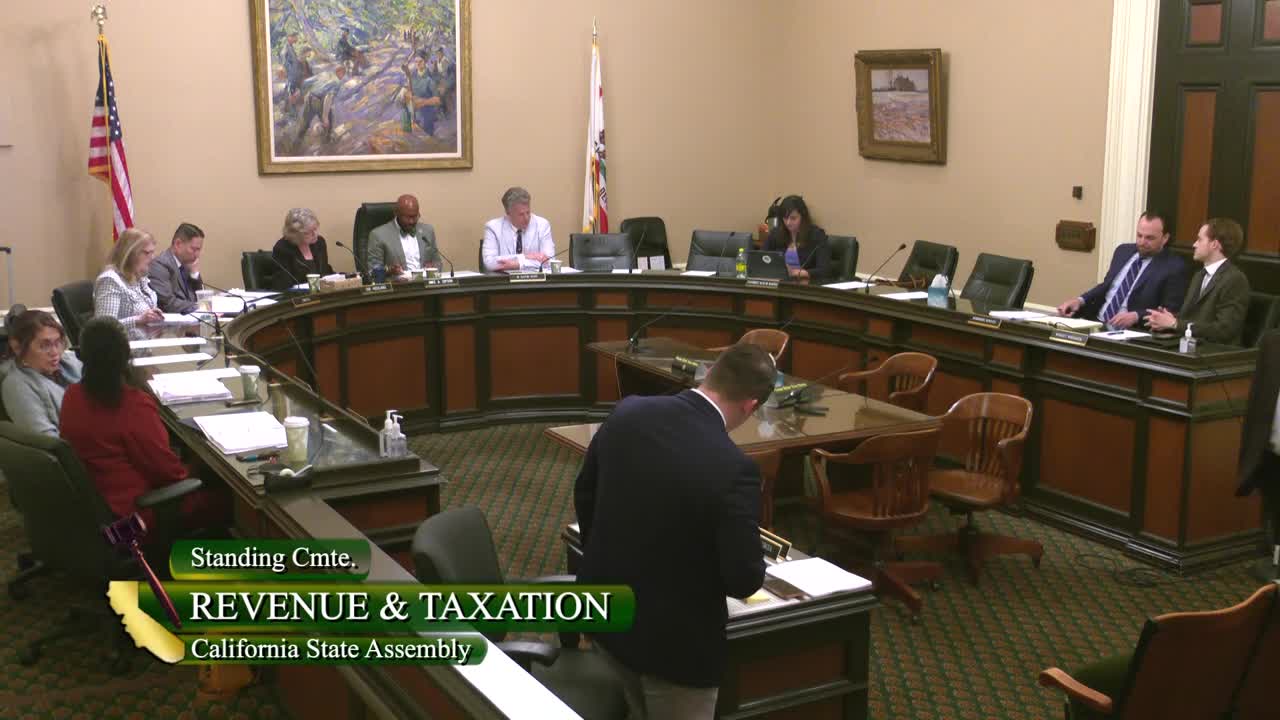 7MIN
Assembly Standing Committee on Revenue and Taxation
Bill Author

Bill Co-Author(s):