AB 1905: Juveniles: custodial interrogation.
- Session Year: 2025-2026
- House: Assembly
- Latest Version Date: 2026-09-27
Current Status:
Passed
(2026-09-27: Chaptered by Secretary of State - Chapter 559, Statutes of 2026.)
Introduced
In Committee
Awaiting First Chamber Vote
Passed First Chamber
In Committee
Awaiting Second Chamber Vote
Passed Second Chamber
Enacted
What does this bill do?
This bill bars police and people working undercover or as agents of police from trying to get statements or information from someone who was 17 or younger when the offense happened and is under 26 while in custody. If officers violate this rule, courts must consider that failure when deciding whether those statements can be used as evidence and when judging the officer’s credibility. An exception allows limited questioning if officers reasonably believe it is necessary to stop an imminent threat to life, and the questioning must end once the threat is resolved.
The summary is provided by generative AI which can make mistakes. For original language, please view the details in the table below.
Existing law prohibits law enforcement officers from employing threats, physical harm, deception, or psychologically manipulative interrogation tactics, as specified, during a custodial interrogation of a person 17 years of age or younger.
This bill would prohibit a law enforcement officer from seeking statements or information while working undercover, or by individuals working in collaboration with, or acting as agents of, law enforcement, from a person who was 17 years of age or younger during the commission of crime and who is under 26 years of age while in custody. The bill would direct a court to consider any willful failure of a law enforcement officer in violation of these provisions in determining the credibility of that law enforcement officer. The bill would specify that these provisions do not apply to the admissibility of statements or information provided to an officer or individuals working in collaboration with law enforcement that were sought to protect against an imminent threat to life.
Existing law prohibits law enforcement officers from employing threats, physical harm, deception, or psychologically manipulative interrogation tactics, as specified, during a custodial interrogation of a person 17 years of age or younger.
This bill would prohibit a law enforcement officer from seeking statements or information while working undercover, or by individuals working in collaboration with, or acting as agents of, law enforcement, from a person who was 17 years of age or younger during the commission of crime and who is under 26 years of age while in custody. The bill would direct a court to consider any willful failure of a law enforcement officer in violation of these provisions in determining the credibility of that law enforcement officer.
Existing law prohibits law enforcement officers from employing threats, physical harm, deception, or psychologically manipulative interrogation tactics, as specified, during a custodial interrogation of a person 17 years of age or younger.
This bill would prohibit a law enforcement officer from seeking statements or information while working undercover, or by individuals working in collaboration with, or acting as agents of, law enforcement, from a person who was 17 years of age or younger during the commission of crime and who is in custody. The bill would direct a court to consider any willful failure of a law enforcement officer in violation of these provisions in determining the credibility of that law enforcement officer.
(a)A law enforcement officer shall not seek to obtain information or statements from a person when both of the following apply:
(1)The person was 17 years of age or younger at the time the crime was committed and under 26 years of age at the time of custody.
(2)The person is in custody and the information or statements are sought by law enforcement officers working undercover or by individuals working in collaboration with, or acting as agents of, law enforcement.
(b)The court shall, in adjudicating the admissibility of statements obtained in violation of subdivision (a), consider the effect of failure to comply with subdivision (a) and, additionally, shall consider any willful violation of subdivision (a) in determining the credibility of a law enforcement officer under Section 780 of the Evidence Code.
(c)Subdivision (b) shall only apply to a statement obtained on or after January 1, 2027.
(d)(1)This section shall not apply to the admissibility of statements of, or information from, a person 17 years of age or younger if both of the following criteria are met:
(A)The officer or individuals working in collaboration with law enforcement who obtained statements or information reasonably believed the information they sought was necessary to protect against an imminent threat to life.
(B)The officer or individuals working in collaboration with law enforcement limited their questions to those that were reasonably necessary to obtain information about the imminent threat.
(2)(A)Questioning initiated more than 24 hours, but less than 48 hours after receiving credible information concerning the imminent threat is presumed not necessary absent a showing of good cause and continued exigent circumstances.
(B)Questioning initiated more than 48 hours after receiving credible information concerning the imminent threat shall be presumed not necessary.
(e)Any operation conducted pursuant to subdivision (d) shall terminate immediately once the threat has been resolved or neutralized, or sufficient information has been obtained to address the imminent threat. In no event shall the operation continue for any other purpose, including, investigation of any crime that is not the imminent threat.
(a)A law enforcement officer shall not seek to obtain information or statements from a person when both of the following apply:
(1)The person was 17 years of age or younger at the time the crime was committed. committed and under 26 years of age at the time of custody.
(2)The person is in custody and the information or statements are sought by law enforcement officers working undercover or by individuals working in collaboration with, or acting as agents of, law enforcement.
(b)The court shall, in adjudicating the admissibility of statements obtained in violation of subdivision (a), consider the effect of failure to comply with subdivision (a) and, additionally, shall consider any willful violation of subdivision (a) in determining the credibility of a law enforcement officer under Section 780 of the Evidence Code.
(c)Subdivision (b) shall only apply to a statement obtained on or after January 1, 2027.
(a)A law enforcement officer shall not seek to obtain information or statements from a person when both of the following apply:
(1)The person was 17 years of age or younger at the time the crime was committed.
(2)The person is in custody and the information or statements are sought by law enforcement officers working undercover or by individuals working in collaboration with, or acting as agents of, law enforcement.
(b)The court shall, in adjudicating the admissibility of statements obtained in violation of subdivision (a), consider the effect of failure to comply with subdivision (a) and, additionally, shall consider any willful violation of subdivision (a) in determining the credibility of a law enforcement officer under Section 780 of the Evidence Code.
REVISIONS: HeadingLine 3.|
Date
|
Status
|
|---|---|
| Sep 27, 2026 | Chaptered by Secretary of State - Chapter 559, Statutes of 2026. |
| Sep 27, 2026 | Approved by the Governor. |
| Aug 31, 2026 | Enrolled and presented to the Governor at 4 p.m. |
| Aug 25, 2026 | Senate amendments concurred in. To Engrossing and Enrolling. (Ayes 51. Noes 15.). |
| Aug 25, 2026 | Senate amendments concurred in. To Engrossing and Enrolling. (Ayes 51. Noes 15. Page 6506.). |
| Aug 25, 2026 | In Assembly. Concurrence in Senate amendments pending. |
| Aug 25, 2026 | Read third time. Passed. Ordered to the Assembly. (Ayes 25. Noes 12.). |
| Aug 5, 2026 | Read second time. Ordered to third reading. |
| Aug 4, 2026 | Read third time and amended. Ordered to second reading. |
| Jul 2, 2026 | Read second time. Ordered to third reading. |
| Jul 1, 2026 | From committee: Do pass. (Ayes 5. Noes 1.) (June 30). |
| Jun 10, 2026 | Referred to Com. on PUB. S. |
| May 28, 2026 | In Senate. Read first time. To Com. on RLS. for assignment. |
| May 27, 2026 | Read third time. Passed. Ordered to the Senate. (Ayes 49. Noes 16.) |
| May 27, 2026 | Read third time. Passed. Ordered to the Senate. (Ayes 49. Noes 16. Page 5438.) |
| May 27, 2026 | Read third time. Passed. Ordered to the Senate. |
| May 22, 2026 | Read third time and amended. Ordered to third reading. (Page 5272.) |
| May 22, 2026 | Read third time and amended. Ordered to third reading. |
| Mar 19, 2026 | Read second time. Ordered to third reading. |
| Mar 18, 2026 | From committee: Do pass. (Ayes 7. Noes 0.) (March 17). |
| Mar 18, 2026 | Coauthors revised. |
| Mar 2, 2026 | Referred to Com. on PUB. S. |
| Feb 13, 2026 | From printer. May be heard in committee March 15. |
| Feb 12, 2026 | Read first time. To print. |
|
Date
|
Description
|
Location
|
Votes
|
|
|---|---|---|---|---|
| Aug 25, 2026 | AB 1905 Schultz Concurrence in Senate Amendments | Assembly Floor |
Passed |
|
| Aug 25, 2026 | Assembly 3rd Reading AB1905 Schultz et al. By Wiener | Senate Floor |
Passed |
|
| Jun 30, 2026 | Do pass | Senate Standing Committee on Public Safety |
Passed |
|
| May 27, 2026 | AB 1905 Schultz Assembly Third Reading | Assembly Floor |
Passed |
|
| Mar 17, 2026 | Do pass. | Assembly Standing Committee on Public Safety |
Passed |
This list shows positions taken on this bill by organizations on the date displayed, which is linked to the original source.
Positions by individuals are not included.
|
Organization
|
Position
|
Date
|
|---|---|---|
| Aclu California Action | ** Support | |
| Alliance for Children's Rights | ** Support | |
| California Attorneys For Criminal Justice | ** Support | |
| California Innocence Coalition | ** Support | |
| California Public Defenders Association | ** Support | |
| California State Sheriff's Association | ** Against | |
| California State Sheriffs’ Association | ** Against | |
| California Youth Defender Center | ** Support | |
| Californians for Safety and Justice (CSJ) | ** Support | |
| Communities United for Restorative Youth Justice (CURYJ) | ** Support | |
| Courage California | ** Support | |
| Ella Baker Center For Human Rights | ** Support | |
| Felony Murder Elimination Project | ** Support | |
| Friends Committee On Legislation Of California | ** Support | |
| Initiate Justice | ** Support | |
| Justice2jobs Coalition | ** Support | |
| LA Defensa | ** Support | |
| Local 148 Los Angeles County Public Defender’s Union | ** Support | |
| Los Angeles County District Attorney’s Office | ** Against | |
| Los Angeles County Professional Peace Officers Association | ** Against | |
| Peace Officers Research Association Of California | ** Against | |
| Riverside County Sheriff’s Office | ** Against | |
| San Bernardino County Sheriff’s Department | ** Against | |
| San Diego County Sheriff’s Office | ** Against | |
| San Francisco Public Defender | ** Support | |
| San Quentin Skunkworks | ** Support | |
| Silicon Valley De-Bug | ** Support | |
| Sister Warriors Freedom Coalition | ** Support | |
| Smart Justice California | ** Support |
CONCURRENCE IN SENATE AMENDMENTS
CSA1 Bill Id:AB 1905
Author:(Schultz)
As Amended Ver:August 4, 2026
Majority vote
SUMMARY
Prohibits a law enforcement officer or individuals working in collaboration with or acting as agents of law enforcement from seeking statements or information while working undercover from a person who was 17 years of age or younger during the commission of crime, and under 26 years of age at the time of custody, and who is in custody.
Senate Amendments
- States this prohibition does not apply to the admissibility of statements of, or information from, a person 17 years age or younger if both of the following criteria are met:
- The officer or individual working in collaboration with law enforcement who obtained statements or information, reasonably believed the information they sought was necessary to protect against an imminent threat to life.
- The officer or individuals working in collaboration with law enforcement limited their questions to those that were reasonably necessary to obtain information about the imminent threat.
- Provides that questioning initiated more than 24 hours, but less than 48 hours after receiving credible information concerning the imminent threat is presumed not necessarily absent a showing of good cause and continued exigent circumstances. Questioning initiated more than 48 hours after receiving credible information concerning the imminent threat shall be presumed not necessary.
- Requires that any operation conducted based on an imminent threat be terminated immediately once the threat has been resolved or neutralized, or sufficient information has been obtained to address the imminent threat. In no event shall the operation continue for any other purpose, including investigation of any crime that is not the imminent threat.
COMMENTS
As passed by the Assembly: This bill prohibited a law enforcement officer or individuals working in collaboration with or acting as agents of law enforcement from seeking statements or information while working undercover from a person who was 17 years of age or younger during the commission of crime, and under 26 years of age at the time of custody, and who is in custody.
Major Provisions
- Stated that a law enforcement officer may not seek to obtain any information or statements from a person when both of the following apply:
- The person was 17 years of age or younger at the time the crime was committed and under 26 years of age at the time of custody.
- The person is in custody, and the information or statements are sought by law enforcement officers working undercover or by individuals working in collaboration with, or acting as an agent of, law enforcement.
- Required the court to consider the effect of any willful violation of law enforcement in obtaining or seeking a statement from a juvenile while in custody and in determination of the officer's credibility.
- Provided that the above applies only to statements made on or after January 1, 2027.
According to the Author
"Young people are uniquely vulnerable during custodial interactions with law enforcement. Research and case experience consistently demonstrate that juveniles are more susceptible to pressure, manipulation, and deception, particularly when they may be unaware they are speaking with someone acting on behalf of law enforcement. California has taken important steps to safeguard youth during interrogations, yet gaps remain when undercover tactics are used in custodial settings. Without clear statutory limits, courts are often left to determine after the fact whether statements were obtained in a manner consistent with constitutional protections. Recent appellate guidance underscores the risks associated with these practices. Clear rules help ensure that statements relied upon in court are both credible and lawfully obtained, while reducing costly litigation over admissibility.
"AB 1905 strengthens protections for young people in custody by prohibiting law enforcement from using undercover officers or agents to obtain statements from individuals who were 17 years of age or younger at the time of alleged offense. By establishing clear guardrails around custodial questioning, the bill promotes fairness, reduces the risk of unreliable statements, and supports the integrity of the justice system."
Arguments in Support
According to the California Innocence Coalition, "Both anecdotal and numerical data supports the fact that juveniles are more susceptible to pressure, manipulation, and deception, especially when they are unaware they are speaking with someone acting on behalf of law enforcement. California legislation, although establishing some safeguards for young people during interrogations, does not currently address some aspects of undercover tactics in custodial settings during interrogation. AB 1905, a bill that would help fill some gaps in addressing this problem, provides clear rules that would help ensure that statements admitted in court are both credible and lawfully obtained, ultimately supporting the integrity of the justice system, as well as reducing costly litigation over admissibility.
"In the 2026 case People v. Zapata, law enforcement utilized undercover agents in an operation to elicit incriminating statements from a suspect in a holding cell. The suspect had been falsely told that a witness identified him, and that he would be charged with murder; the suspect then confessed to the alleged crime. The California Court of Appeal ultimately reversed the conviction, ruling that the statements were inadmissible due to the encounter being deemed a custodial interrogation and lacking the presence of an attorney. People v. Zapata ruled in this way for an adult suspect, undermining confidence in the credibility of prosecutions based on coerced statements, especially those given by the more vulnerable young and non-adult population.
"AB 1905 would act to counter these coercive tactics from law enforcement; AB 1905 would prohibit law enforcement from seeking statements from individuals who were 17 years or younger at the time of the alleged offense while using undercover officers or agents during custody. The bill would also provide clear, statewide guidance that prevents constitutionally questionable interrogation practices before they occur and would direct courts to consider violations when determining admissibility. Additionally, AB 1905 would require courts to weigh willful violations when assessing an officer's credibility. Ultimately, the bill promotes reliable evidence, fair proceedings, and public trust in the justice system."
Arguments in Opposition
According to the California State Sheriff's Association, "The materials offered in support of this bill reference "young people" and the assertion that they are "uniquely vulnerable during custodial interactions with law enforcement." The problem is that AB 1905's reach is not limited to young people. Rather, it applies to any person who was under 18 years of age at the time of the crime. This means that not only does this bill apply to an interrogation of a person who just turned 18 years old and who, only a few days prior, had been 17 years old at the time of the crime, but also, for example, an interrogation of a 40-year-old person relative to a 23-year-old crime. In either case, the bill attempts to limit law enforcement from seeking valuable evidence from adults in custody based on the notion that "young people" deserve a higher level of protection when it comes to interrogations.
"Further, the recent appellate case cited in the bill's fact sheet (People v. Zapata) reads more as a Miranda case than a Perkins case without any indication that the defendant was a juvenile at the time of the commission of the crime or resulting interrogation. While Zapata involved a defendant being the subject of a Perkins operation (where law enforcement officers or inmates seek to obtain information while acting as inmates), the main issue noted by the court is that Zapata's admission of guilt was obtained after he had invoked his Miranda rights. The problem is this bill uses Zapata as justification for its passage despite the fact that Zapata does not appear to have been a juvenile at the time of interrogation and that further regulation of Perkins operations is not necessarily the main motivator of the court's ruling.
"Additionally, as it relates to actual juveniles, the Legislature enacted AB 2644 in 2022, which prohibits a law enforcement officer from employing threats, physical harm, deception, or psychologically manipulative interrogation tactics during a custodial interrogation of a person 17 years of age or younger. These protections already exist and further limitations on Perkins operations do not seem justified."
FISCAL COMMENTS
Unknown. This bill is keyed non-fiscal by the Legislative Counsel.
VOTES:
ASM PUBLIC SAFETY: 7-0-2
YES: Schultz, Mark González, Haney, Harabedian, Nguyen, Ramos, Sharp-Collins
ABS, ABST OR NV: Alanis, Lackey
ASSEMBLY FLOOR: 49-16-15
YES: Addis, Aguiar-Curry, Ahrens, Arambula, Ávila Farías, Bauer-Kahan, Bennett, Berman, Boerner, Bonta, Bryan, Calderon, Caloza, Carrillo, Connolly, Elhawary, Fong, Gabriel, Garcia, Mark González, Haney, Harabedian, Hart, Irwin, Jackson, Kalra, Krell, Lee, Lowenthal, McKinnor, Muratsuchi, Nguyen, Ortega, Papan, Pellerin, Quirk-Silva, Ramos, Ransom, Rogers, Schultz, Sharp-Collins, Solache, Stefani, Valencia, Ward, Wicks, Wilson, Zbur, Rivas
NO: Alanis, Bains, Castillo, Chen, Davies, DeMaio, Dixon, Ellis, Gallagher, Jeff Gonzalez, Hadwick, Johnson, Macedo, Patterson, Sanchez, Tangipa
ABS, ABST OR NV: Alvarez, Flora, Gipson, Hoover, Lackey, Pacheco, Patel, Petrie-Norris, Celeste Rodriguez, Michelle Rodriguez, Blanca Rubio, Schiavo, Soria, Ta, Wallis
UPDATED
VERSION: August 4, 2026
CONSULTANT: Kimberly Horiuchi / PUB. S. / (916) 319-3744 FN: 0004129
SENATE RULES COMMITTEE Office of Senate Floor Analyses (916) 651-4171 | AB 1905 |
THIRD READING
Bill No: AB 1905
Author: Schultz (D), et al.
Amended: 8/3/26 in Senate
Vote: 21
SENATE PUBLIC SAFETY COMMITTEE: 5-1, 6/30/26
AYES: Arreguín, Caballero, Cortese, Pérez, Wiener
NOES: Seyarto
ASSEMBLY FLOOR: 49-16, 5/27/26 - See last page for vote
SUBJECT: Juveniles: custodial interrogation
SOURCE: California Innocence Coalition
California Public Defenders Association
DIGEST:
This bill 1) prohibits a law enforcement officer from seeking to obtain information or statements from a person who was 17 or younger at the time the crime was committed and under 26 at the time of custody, and the information or statements are sought by undercover officers or informants; and 2) requires the court to consider a violation of this prohibition in adjudicating the admissibility of statements obtained and determining the credibility of an officer.
Senate Floor Amendments of 8/3/26 specify that the prohibition on undercover law enforcement officers or informants seeking statements or information from a person in custody who is under 26 and who was under 18 at the time of the crime does not apply when the officer or informant reasonably believed the information sought was necessary to protect against an imminent threat to life and the questions were limited to those reasonably necessary to obtain information about the imminent threat, as specified.
ANALYSIS:
Existing law:
- Provides that persons may not be compelled in a criminal case to be a witness against themselves. (California Constitution [Cal. Const.], Article [art.] I, § 15.)
- Requires, prior to a custodial interrogation, and before the waiver of any Miranda rights, a youth 17 years of age or younger shall consult with legal counsel in person, by telephone, or by video conference. Prohibits waiver of the consultation. (Welfare and Institutions [Welf. & Inst.] Code, § 625.6, subd. (a).)
- Requires the court, in adjudicating the admissibility of statements of a youth 17 years of age or younger made during or after a custodial interrogation, to consider the effect of failure to comply with the consultation requirement, as well as any willful violation in determining the credibility of a law enforcement officer. (Welf. & Inst. Code, § 625.6, subd. (b).)
- Specifies that the consultation requirement does not apply to the admissibility of statements of a youth 17 years of age or younger if both of the following criteria are met:
- The officer who questioned the youth reasonably believed the information he or she sought was necessary to protect life or property from an imminent threat; and
- The officer’s questions were limited to those questions that were reasonably necessary to obtain that information. (Welf. & Inst. Code, § 625.6, subd. (c).)
- Exempts probation officers from complying with the consultation requirement in their normal course of duties, as specified. (Welf. & Inst. Code, § 625.6, subd. (d).)
- Prohibits a law enforcement officer from employing threats, physical harm, deception, or psychologically manipulative interrogation tactics during a custodial interrogation of a person 17 years of age or younger relating to the commission of a misdemeanor or felony. (Welf. & Inst. Code, § 625.7, subd. (a).)
- Requires that a minor taken into a place of confinement be advised of the right to make at least two phone calls, one completed to a parent or guardian, or a responsible relative, or employer and one to an attorney. (Welf. & Inst. Code, § 627, subd. (b).)
- Requires the custodial interrogation of a juvenile suspected of committing murder to be electronically recorded in its entirety. (Welf. & Inst. Code, § 626.8, see also Penal [Pen.] Code, § 859.5.)
- Provides that when a minor is taken into temporary custody before a probation officer, and it is alleged that the minor has violated a law defining a crime, the probation officer must advise the minor that anything the minor says can be used against him, and advise the minor of their constitutional rights, including the right to remain silent and the right to counsel. (Welf. & Inst. Code, § 627.5.)
This bill:
- Prohibits a law enforcement officer from seeking to obtain information or statements from a person when both of the following apply:
- The person was 17 years of age or younger at the time the crime was committed and under 26 years of age at the time of custody.
- The person is in custody and the information or statements are sought by law enforcement officers working undercover or by individuals working in collaboration with, or acting as agents of, law enforcement.
- Requires the court to consider, in adjudicating the admissibility of statements obtained in violation of the above prohibition, the effect of failure to comply with that prohibition and, additionally, to consider any willful violation in determining the credibility of a law enforcement officer.
- Provides that its provisions only apply to a statement obtained on or after January 1, 2027.
Background
“Miranda warnings” are a series of admonitions that are typically given by police before interrogating a suspect of a crime. The purpose of Miranda warnings is to advise people who have been arrested of their constitutional right against self-incrimination. They are the product of the landmark Supreme Court decision Miranda v. Arizona (1966) 384 U.S. 436. In deciding that case, the Supreme Court imposed specific, constitutional requirements for the advice an officer must provide prior to engaging in custodial interrogation and held that statements taken without these warnings are inadmissible against the defendant in a criminal case. Specifically, the Court held that prior to any questioning, the suspect must be warned that he has a right to remain silent, that any statement made may be used as evidence against him, and that he has a right to the presence of an attorney, either retained or appointed. (Id. at p. 444.)
In order for Miranda warnings to apply, an individual must be subjected to “custodial interrogation.” A suspect is “in custody” if a reasonable person in a similar situation would not feel free to end the interrogation and leave. (Miranda, supra, 384 U.S. at p. 444.) Custody does not require a person to be at the police station, or in handcuffs, or in the back of a police car, but rather that the police have deprived the suspect of his or her freedom of action in some significant way. (Ibid.) An “interrogation” is “any words or actions on the part of officers (other than those normally attendant to arrest and custody) that the officer should know are reasonably likely to elicit an incriminating response from the suspect.” (Rhode Island v. Innis (1980) 446 U.S. 291, 301.) Such questioning can be in the form of an officer asking the suspect direct questions, or it can be indirect in the form of comments or actions by the officer that the officer should know are likely to produce an incriminating reply. (Ibid)
In an extension of the Court’s holding in Miranda, the U.S. Supreme Court ruled in Illinois v. Perkins (hereinafter “Perkins”) (1990) 496 U.S. 292, that while Miranda forbids coercion, it does not prohibit mere strategic deception by taking advantage of a suspect’s misplaced trust in someone thought to be a fellow inmate. (Perkins, 496 U.S. at p. 299.) In Perkins, two undercover agents posing as inmates were placed in defendant’s cell to investigate a murder. One agent asked defendant if he had ever killed anyone. Defendant then proceeded to describe the murder at length. The Court held Miranda warnings were not required because the discussion between the suspect and undercover agent did not implicate the concerns underlying Miranda, because there is no element of police coercion.
However, as part of a concurrence that formed the basis for the plurality judgment of the Court in Perkins, Justice Brennan focused on the fact that the defendant in Perkins had not invoked his right to remain silent or to an attorney before making statements to the undercover police officer – only that the undercover officer was not required to issue the warning before attempting to illicit a statement. (See Perkins, 496 U.S. at 300, fn. *; Edwards v. Arizona (1981) 451 U.S. 477, 482 (holding a waiver of rights must be knowing, intelligent, and voluntary).) However, if Perkins had invoked, the issue would be whether he waived that right.
In People v. Orozco, the court agreed that, even where the defendant invokes their right to counsel pursuant to Miranda, defendant’s statements to his girlfriend, who was acting as an agent of law enforcement, did not warrant exclusion because the statements were not made in a custodial setting and the element of coercion was not present. (People v. Orozco (2019) 32 Cal.App.5th 802, 814.) In that case, since the girlfriend was free to disclose any information the defendant shared, the fact that the police had contacted her about eliciting a statement from the defendant did not result in a Miranda violation.
In contrast to Orozco, however, the Court in People v. Zapata excluded the defendant’s statements which were elicited by sheriff deputies posing as inmates after Zapata invoked his right to counsel. (People v. Zapata, 118 Cal. App. 5th 529.) In Zapata, the critical fact was that the defendant did not waive his rights and was then questioned by sheriff deputies posing as inmates in jail. (Zapata, 118 Cal.App. 5th at pp. 541-542.) Therefore, Zapata’s Miranda rights were violated, and the statements were suppressed. However, the outcome may have been different if the police had used third parties to illicit a statement rather than doing it themselves.
Perkins operations, while useful in obtaining incriminating statements, can also constitute a violation of defendant’s rights against self-incrimination. This is especially true for young people who may feel compelled to “brag” or make incriminating statements even when they did not commit the crime simply to impress the listener.
Specific Concerns Interrogating Youth. A growing body of research indicates that adolescents are less capable of understanding their constitutional rights than their adult counterparts, and also that they are more prone to falsely confessing to a crime they did not commit. (See Luna, Juvenile False Confessions: Juvenile Psychology, Police Interrogation Tactics, And Prosecutorial Discretion (2018) 18 Nev. L.J. 291, <https://scholars.law.unlv.edu/cgi/viewcontent.cgi?article=1733&
context=nlj .) The research suggests that “[b]ecause adolescents are more impulsive, are easily influenced by others (especially by figures of authority), are more sensitive to rewards (especially immediate rewards), and are less able to weigh in on the long-term consequences of their actions, they become more receptive to coercion.” (Id. at p. 297, citing various scientific journals.) The context of custodial interrogation is believed to exacerbate these risks. In fact, prior research has shown that 35 percent of proven false confessions were obtained from suspects under the age of 18. (Drizin & Leo, The Problem of False Confessions in the Post-DNA World (2004) 82 N. C. L. Rev. 891, pp. 906-907, available at <https://scholarship.law.unc.edu/nclr/vol82/iss3/3/ .)
In recognition of the susceptibility of youth to making false confessions, the Legislature enacted SB 395 (Lara, Chapter 681, Statutes of 2017), which required minors under the age of 16 to consult with an attorney prior to any custodial interrogation by a police officer. SB 203 (Bradford, Chapter 335, Statutes of 2020), expanded the protections from custodial interrogation to 16 and 17 year olds. Most recently, AB 2644 (Holden, Chapter 289, Statutes of 2022), prohibited law enforcement officers from employing threats, physical harm, deception, or psychologically manipulative interrogation tactics during a custodial interrogation of a person under 18. As originally introduced, AB 2644 applied to individuals up to 25 years old.
The proponents of this bill assert that individuals in custody who are up to 26 should also receive some protections from interrogation or other law enforcement tactics to gather information while in custody because research has found that cognitive development continues into the mid-20s. It is well-documented that the prefrontal cortex—the part of the brain responsible for executive functions such as focus, long-term planning, and impulse control—matures last, until after age 25. (See Ellen Barlow, Under the Hood of the Adolescent Brain (Oct. 17, 2014), available at <https://hms.harvard.edu/news/under-hood-adolescent-brain ; Johnson, et al., Adolescent Maturity and the Brain: The Promise and Pitfalls of Neuroscience Research in Adolescent Health Policy, Journal of Adolescent Health (Sept. 2009), available at <https://pmc.ncbi.nlm.nih.gov/articles/PMC2892678/ .) In large part due to the research on brain development, Youth Offender Parole eligibility was expanded in 2017 to include individuals who committed their crime prior to age 26. (AB 1308, Stone, Chapter 675, Statutes of 2017.) In the context of juvenile justice, young adults up to age 25 are considered “transitional age youth.” (See Pen. Code, § 1000.7, which established a deferred entry of judgment pilot program allowing certain defendants who committed their crime between 18-24 to be housed in a juvenile facility and receive supportive services in lieu of serving time in a county jail.)
This bill prohibits a law enforcement officer from seeking to obtain information or statements from a person when both of the following apply:
- The person was 17 years of age or younger at the time the crime was committed and under 26 years of age at the time of custody.
- The person is in custody and the information or statements are sought by law enforcement officers working undercover or by individuals working in collaboration with, or acting as agents of, law enforcement.
This bill additionally requires the court to consider, in adjudicating the admissibility of statements obtained in violation of the prohibition, the effect of failure to comply with that prohibition and, additionally, to consider any willful violation in determining the credibility of a law enforcement officer. The provisions only apply to a statement obtained on or after January 1, 2027.
FISCAL EFFECT: Appropriation: No Fiscal Com.: No Local: No
SUPPORT: (Verified 8/3/26)
California Innocence Coalition (co-source)
California Public Defenders Association (co-source)
ACLU California Action
California Attorneys for Criminal Justice
Ella Baker Center for Human Rights
Felony Murder Elimination Project
Initiate Justice
Justice2Jobs Coalition
La Defensa
Local 148 Los Angeles County Public Defender’s Union
San Quentin Skunkworks
Smart Justice California
OPPOSITION: (Verified 8/3/26)
California State Sheriffs’ Association
Los Angeles County District Attorney’s Office
Los Angeles County Professional Peace Officers Association
Peace Officers Research Association of California
Riverside County Sheriff’s Office
San Bernardino County Sheriff’s Department
San Diego County Sheriff’s Office
ASSEMBLY FLOOR: 49-16, 5/27/26
AYES: Addis, Aguiar-Curry, Ahrens, Arambula, Ávila Farías, Bauer-Kahan, Bennett, Berman, Boerner, Bonta, Bryan, Calderon, Caloza, Carrillo, Connolly, Elhawary, Fong, Gabriel, Garcia, Mark González, Haney, Harabedian, Hart, Irwin, Jackson, Kalra, Krell, Lee, Lowenthal, McKinnor, Muratsuchi, Nguyen, Ortega, Papan, Pellerin, Quirk-Silva, Ramos, Ransom, Rogers, Schultz, Sharp-Collins, Solache, Stefani, Valencia, Ward, Wicks, Wilson, Zbur, Rivas
NOES: Alanis, Bains, Castillo, Chen, Davies, DeMaio, Dixon, Ellis, Gallagher, Jeff Gonzalez, Hadwick, Johnson, Macedo, Patterson, Sanchez, Tangipa
NO VOTE RECORDED: Alvarez, Flora, Gipson, Hoover, Lackey, Pacheco, Patel, Petrie-Norris, Celeste Rodriguez, Michelle Rodriguez, Blanca Rubio, Schiavo, Soria, Ta, Wallis
Prepared by: Stephanie Jordan / PUB. S. /
8/5/26 16:20:49
SENATE RULES COMMITTEE Office of Senate Floor Analyses (916) 651-4171 | AB 1905 |
THIRD READING
Bill No: AB 1905
Author: Schultz (D), et al.
Amended: 5/22/26 in Assembly
Vote: 21
SENATE PUBLIC SAFETY COMMITTEE: 5-1, 6/30/26
AYES: Arreguín, Caballero, Cortese, Pérez, Wiener
NOES: Seyarto
ASSEMBLY FLOOR: 49-16, 5/27/26 - See last page for vote
SUBJECT: Juveniles: custodial interrogation
SOURCE: California Public Defenders Association; California Innocence Coalition
DIGEST:
This bill prohibits a law enforcement officer from seeking to obtain information or statements from a person who was 17 or younger at the time the crime was committed and under 26 at the time of custody, and the information or statements are sought by undercover officers or informants; and requires the court to consider a violation of this prohibition in adjudicating the admissibility of statements obtained and determining the credibility of an officer.
ANALYSIS:
Existing law:
- Provides that persons may not be compelled in a criminal case to be a witness against themselves. (California Constitution [Cal. Const.], Article [art.] I, § 15.)
- Requires, prior to a custodial interrogation, and before the waiver of any Miranda rights, a youth 17 years of age or younger shall consult with legal counsel in person, by telephone, or by video conference. Prohibits waiver of the consultation. (Welfare and Institutions [Welf. & Inst.] Code, § 625.6, subd. (a).)
- Requires the court, in adjudicating the admissibility of statements of a youth 17 years of age or younger made during or after a custodial interrogation, to consider the effect of failure to comply with the consultation requirement, as well as any willful violation in determining the credibility of a law enforcement officer. (Welf. & Inst. Code, § 625.6, subd. (b).)
- Specifies that the consultation requirement does not apply to the admissibility of statements of a youth 17 years of age or younger if both of the following criteria are met:
- The officer who questioned the youth reasonably believed the information he or she sought was necessary to protect life or property from an imminent threat; and
- The officer’s questions were limited to those questions that were reasonably necessary to obtain that information. (Welf. & Inst. Code, § 625.6, subd. (c).)
- Exempts probation officers from complying with the consultation requirement in their normal course of duties, as specified. (Welf. & Inst. Code, § 625.6, subd. (d).)
- Prohibits a law enforcement officer from employing threats, physical harm, deception, or psychologically manipulative interrogation tactics during a custodial interrogation of a person 17 years of age or younger relating to the commission of a misdemeanor or felony. (Welf. & Inst. Code, § 625.7, subd. (a).)
- Requires that a minor taken into a place of confinement be advised of the right to make at least two phone calls, one completed to a parent or guardian, or a responsible relative, or employer and one to an attorney. (Welf. & Inst. Code, § 627, subd. (b).)
- Requires the custodial interrogation of a juvenile suspected of committing murder to be electronically recorded in its entirety. (Welf. & Inst. Code, § 626.8, see also Penal [Pen.] Code, § 859.5.)
- Provides that when a minor is taken into temporary custody before a probation officer, and it is alleged that the minor has violated a law defining a crime, the probation officer must advise the minor that anything the minor says can be used against him, and advise the minor of their constitutional rights, including the right to remain silent and the right to counsel. (Welf. & Inst. Code, § 627.5.)
This bill:
- Prohibits a law enforcement officer from seeking to obtain information or statements from a person when both of the following apply:
- The person was 17 years of age or younger at the time the crime was committed and under 26 years of age at the time of custody.
- The person is in custody and the information or statements are sought by law enforcement officers working undercover or by individuals working in collaboration with, or acting as agents of, law enforcement.
- Requires the court to consider, in adjudicating the admissibility of statements obtained in violation of the above prohibition, the effect of failure to comply with that prohibition and, additionally, to consider any willful violation in determining the credibility of a law enforcement officer.
- Provides that its provisions only apply to a statement obtained on or after January 1, 2027.
Background
“Miranda warnings” are a series of admonitions that are typically given by police before interrogating a suspect of a crime. The purpose of Miranda warnings is to advise people who have been arrested of their constitutional right against self-incrimination. They are the product of the landmark Supreme Court decision Miranda v. Arizona (1966) 384 U.S. 436. In deciding that case, the Supreme Court imposed specific, constitutional requirements for the advice an officer must provide prior to engaging in custodial interrogation and held that statements taken without these warnings are inadmissible against the defendant in a criminal case. Specifically, the Court held that prior to any questioning, the suspect must be warned that he has a right to remain silent, that any statement made may be used as evidence against him, and that he has a right to the presence of an attorney, either retained or appointed. (Id. at p. 444.)
In order for Miranda warnings to apply, an individual must be subjected to “custodial interrogation.” A suspect is “in custody” if a reasonable person in a similar situation would not feel free to end the interrogation and leave. (Miranda, supra, 384 U.S. at p. 444.) Custody does not require a person to be at the police station, or in handcuffs, or in the back of a police car, but rather that the police have deprived the suspect of his or her freedom of action in some significant way. (Ibid.) An “interrogation” is “any words or actions on the part of officers (other than those normally attendant to arrest and custody) that the officer should know are reasonably likely to elicit an incriminating response from the suspect.” (Rhode Island v. Innis (1980) 446 U.S. 291, 301.) Such questioning can be in the form of an officer asking the suspect direct questions, or it can be indirect in the form of comments or actions by the officer that the officer should know are likely to produce an incriminating reply. (Ibid)
In an extension of the Court’s holding in Miranda, the U.S. Supreme Court ruled in Illinois v. Perkins (hereinafter “Perkins”) (1990) 496 U.S. 292, that while Miranda forbids coercion, it does not prohibit mere strategic deception by taking advantage of a suspect’s misplaced trust in someone thought to be a fellow inmate. (Perkins, 496 U.S. at p. 299.) In Perkins, two undercover agents posing as inmates were placed in defendant’s cell to investigate a murder. One agent asked defendant if he had ever killed anyone. Defendant then proceeded to describe the murder at length. The Court held Miranda warnings were not required because the discussion between the suspect and undercover agent did not implicate the concerns underlying Miranda, because there is no element of police coercion.
However, as part of a concurrence that formed the basis for the plurality judgment of the Court in Perkins, Justice Brennan focused on the fact that the defendant in Perkins had not invoked his right to remain silent or to an attorney before making statements to the undercover police officer – only that the undercover officer was not required to issue the warning before attempting to illicit a statement. (See Perkins, 496 U.S. at 300, fn. *; Edwards v. Arizona (1981) 451 U.S. 477, 482 (holding a waiver of rights must be knowing, intelligent, and voluntary).) However, if Perkins had invoked, the issue would be whether he waived that right.
In People v. Orozco, the court agreed that, even where the defendant invokes their right to counsel pursuant to Miranda, defendant’s statements to his girlfriend, who was acting as an agent of law enforcement, did not warrant exclusion because the statements were not made in a custodial setting and the element of coercion was not present. (People v. Orozco (2019) 32 Cal.App.5th 802, 814.) In that case, since the girlfriend was free to disclose any information the defendant shared, the fact that the police had contacted her about eliciting a statement from the defendant did not result in a Miranda violation.
In contrast to Orozco, however, the Court in People v. Zapata excluded the defendant’s statements which were elicited by sheriff deputies posing as inmates after Zapata invoked his right to counsel. (People v. Zapata, 118 Cal. App. 5th 529.) In Zapata, the critical fact was that the defendant did not waive his rights and was then questioned by sheriff deputies posing as inmates in jail. (Zapata, 118 Cal.App. 5th at pp. 541-542.) Therefore, Zapata’s Miranda rights were violated, and the statements were suppressed. However, the outcome may have been different if the police had used third parties to illicit a statement rather than doing it themselves.
Perkins operations, while useful in obtaining incriminating statements, can also constitute a violation of defendant’s rights against self-incrimination. This is especially true for young people who may feel compelled to “brag” or make incriminating statements even when they did not commit the crime simply to impress the listener.
Specific Concerns Interrogating Youth
A growing body of research indicates that adolescents are less capable of understanding their constitutional rights than their adult counterparts, and also that they are more prone to falsely confessing to a crime they did not commit. (See Luna, Juvenile False Confessions: Juvenile Psychology, Police Interrogation Tactics, And Prosecutorial Discretion (2018) 18 Nev. L.J. 291, <https://scholars.law.unlv.edu/cgi/viewcontent.cgi?article=1733&
context=nlj .) The research suggests that “[b]ecause adolescents are more impulsive, are easily influenced by others (especially by figures of authority), are more sensitive to rewards (especially immediate rewards), and are less able to weigh in on the long-term consequences of their actions, they become more receptive to coercion.” (Id. at p. 297, citing various scientific journals.) The context of custodial interrogation is believed to exacerbate these risks. In fact, prior research has shown that 35 percent of proven false confessions were obtained from suspects under the age of 18. (Drizin & Leo, The Problem of False Confessions in the Post-DNA World (2004) 82 N. C. L. Rev. 891, pp. 906-907, available at <https://scholarship.law.unc.edu/nclr/vol82/iss3/3/ .)
In recognition of the susceptibility of youth to making false confessions, the Legislature enacted SB 395 (Lara, Chapter 681, Statutes of 2017), which required minors under the age of 16 to consult with an attorney prior to any custodial interrogation by a police officer. SB 203 (Bradford, Chapter 335, Statutes of 2020), expanded the protections from custodial interrogation to 16 and 17 year olds. Most recently, AB 2644 (Holden, Chapter 289, Statutes of 2022), prohibited law enforcement officers from employing threats, physical harm, deception, or psychologically manipulative interrogation tactics during a custodial interrogation of a person under 18. As originally introduced, AB 2644 applied to individuals up to 25 years old.
The proponents of this bill assert that individuals in custody who are up to 26 should also receive some protections from interrogation or other law enforcement tactics to gather information while in custody because research has found that cognitive development continues into the mid-20s. It is well-documented that the prefrontal cortex—the part of the brain responsible for executive functions such as focus, long-term planning, and impulse control—matures last, until after age 25. (See Ellen Barlow, Under the Hood of the Adolescent Brain (Oct. 17, 2014), available at <https://hms.harvard.edu/news/under-hood-adolescent-brain ; Johnson, et al., Adolescent Maturity and the Brain: The Promise and Pitfalls of Neuroscience Research in Adolescent Health Policy, Journal of Adolescent Health (Sept. 2009), available at <https://pmc.ncbi.nlm.nih.gov/articles/PMC2892678/ .) In large part due to the research on brain development, Youth Offender Parole eligibility was expanded in 2017 to include individuals who committed their crime prior to age 26. (AB 1308, Stone, Chapter 675, Statutes of 2017.) In the context of juvenile justice, young adults up to age 25 are considered “transitional age youth.” (See Pen. Code, § 1000.7, which established a deferred entry of judgment pilot program allowing certain defendants who committed their crime between 18-24 to be housed in a juvenile facility and receive supportive services in lieu of serving time in a county jail.)
This bill prohibits a law enforcement officer from seeking to obtain information or statements from a person when both of the following apply:
- The person was 17 years of age or younger at the time the crime was committed and under 26 years of age at the time of custody.
- The person is in custody and the information or statements are sought by law enforcement officers working undercover or by individuals working in collaboration with, or acting as agents of, law enforcement.
This bill additionally requires the court to consider, in adjudicating the admissibility of statements obtained in violation of the prohibition, the effect of failure to comply with that prohibition and, additionally, to consider any willful violation in determining the credibility of a law enforcement officer. The provisions only apply to a statement obtained on or after January 1, 2027.
FISCAL EFFECT: Appropriation: No Fiscal Com.: No Local: No
SUPPORT: (Verified 7/1/26)
California Public Defenders Association (co-source)
California Innocence Coalition (co-source)
ACLU California Action
California Attorneys for Criminal Justice
Ella Baker Center for Human Rights
Felony Murder Elimination Project
Initiate Justice
Justice2Jobs Coalition
La Defensa
Local 148 Los Angeles County Public Defender’s Union
San Quentin Skunkworks
Smart Justice California
OPPOSITION: (Verified 7/1/26)
California State Sheriffs’ Association
Los Angeles County District Attorney’s Office
Los Angeles County Professional Peace Officers Association
Peace Officers Research Association of California
San Bernardino County Sheriff’s Department
San Diego County Sheriff’s Office
ASSEMBLY FLOOR: 49-16, 5/27/26
AYES: Addis, Aguiar-Curry, Ahrens, Arambula, Ávila Farías, Bauer-Kahan, Bennett, Berman, Boerner, Bonta, Bryan, Calderon, Caloza, Carrillo, Connolly, Elhawary, Fong, Gabriel, Garcia, Mark González, Haney, Harabedian, Hart, Irwin, Jackson, Kalra, Krell, Lee, Lowenthal, McKinnor, Muratsuchi, Nguyen, Ortega, Papan, Pellerin, Quirk-Silva, Ramos, Ransom, Rogers, Schultz, Sharp-Collins, Solache, Stefani, Valencia, Ward, Wicks, Wilson, Zbur, Rivas
NOES: Alanis, Bains, Castillo, Chen, Davies, DeMaio, Dixon, Ellis, Gallagher, Jeff Gonzalez, Hadwick, Johnson, Macedo, Patterson, Sanchez, Tangipa
NO VOTE RECORDED: Alvarez, Flora, Gipson, Hoover, Lackey, Pacheco, Patel, Petrie-Norris, Celeste Rodriguez, Michelle Rodriguez, Blanca Rubio, Schiavo, Soria, Ta, Wallis
Prepared by: Stephanie Jordan / PUB. S. /
7/30/26 14:49:21
SENATE COMMITTEE ON PUBLIC SAFETY
Senator Jesse Arreguín, Chair
2025 - 2026 Regular
Bill No: AB 1905 Hearing Date: June 30, 2026
Author: | Schultz | ||
Version: | May 22, 2026 | ||
Urgency: | No | Fiscal: | No |
Consultant: | SJ | ||
Subject: Juveniles: custodial interrogation
HISTORY
Source: California Public Defenders Association
California Innocence Coalition
Prior Legislation: AB 2644 (Holden), Ch. 289, Stats. of 2022
SB 203 (Bradford), Chapter 335, Stats. of 2020
SB 395 (Lara), Ch. 681, Stats. of 2017
SB 1052 (Lara), vetoed, 2016
Support: ACLU California Action; California Attorneys for Criminal Justice; Ella Baker Center for Human Rights; Felony Murder Elimination Project; Initiate Justice; Justice2Jobs Coalition; La Defensa; Local 148 Los Angeles County Public Defender’s Union; San Quentin Skunkworks; Smart Justice California
Opposition: California State Sheriffs’ Association; Los Angeles County District Attorney’s Office; Los Angeles County Professional Peace Officers Association; Peace Officers Research Association of California
Assembly Floor Vote: 49 - 16
PURPOSE
The purpose of this bill is to prohibit a law enforcement officer from seeking to obtain information or statements from a person who was 17 or younger at the time the crime was committed and under 26 at the time of custody, and the information or statements are sought by undercover officers or informants; and require the court to consider a violation of this prohibition in adjudicating the admissibility of statements obtained and determining the credibility of an officer.
Existing law provides that persons may not be compelled in a criminal case to be a witness against themselves. (Cal. Const., art. I, § 15.)
Existing law requires, prior to a custodial interrogation, and before the waiver of any Miranda rights, a youth 17 years of age or younger shall consult with legal counsel in person, by telephone, or by video conference. Prohibits waiver of the consultation. (Welf. and Inst. Code, § 625.6, subd. (a).)
Existing law requires the court, in adjudicating the admissibility of statements of a youth 17 years of age or younger made during or after a custodial interrogation, to consider the effect of failure to comply with the consultation requirement, as well as any willful violation in determining the credibility of a law enforcement officer. (Welf. and Inst. Code, § 625.6, subd. (b).)
Existing law specifies that the consultation requirement does not apply to the admissibility of statements of a youth 17 years of age or younger if both of the following criteria are met:
- The officer who questioned the youth reasonably believed the information he or she sought was necessary to protect life or property from an imminent threat; and
- The officer’s questions were limited to those questions that were reasonably necessary to obtain that information. (Welf. and Inst. Code, § 625.6, subd. (c).)
Existing law exempts probation officers from complying with the consultation requirement in their normal course of duties, as specified. (Welf. and Inst. Code, § 625.6, subd. (d).)
Existing law prohibits a law enforcement officer from employing threats, physical harm, deception, or psychologically manipulative interrogation tactics during a custodial interrogation of a person 17 years of age or younger relating to the commission of a misdemeanor or felony. (Welf. and Inst. Code, § 625.7, subd. (a).)
Existing law requires that a minor taken into a place of confinement be advised of the right to make at least two phone calls, one completed to a parent or guardian, or a responsible relative, or employer and one to an attorney. (Welf. & Inst. Code, § 627, subd. (b).)
Existing law requires the custodial interrogation of a juvenile suspected of committing murder to be electronically recorded in its entirety. (Welf. & Inst. Code, § 626.8, see also Pen. Code, § 859.5.)
Existing law provides that when a minor is taken into temporary custody before a probation officer, and it is alleged that the minor has violated a law defining a crime, the probation officer must advise the minor that anything the minor says can be used against him, and advise the minor of their constitutional rights, including the right to remain silent and the right to counsel. (Welf. & Inst. Code, § 627.5.)
This bill prohibits a law enforcement officer from seeking to obtain information or statements from a person when both of the following apply:
- The person was 17 years of age or younger at the time the crime was committed and under 26 years of age at the time of custody.
- The person is in custody and the information or statements are sought by law enforcement officers working undercover or by individuals working in collaboration with, or acting as agents of, law enforcement.
This bill requires the court to consider, in adjudicating the admissibility of statements obtained in violation of the above prohibition, the effect of failure to comply with that prohibition and, additionally, to consider any willful violation in determining the credibility of a law enforcement officer.
This bill provides that its provisions only apply to a statement obtained on or after January 1, 2027.
COMMENTS
- Need For This Bill
According to the author:
Young people are uniquely vulnerable during custodial interactions with law enforcement. Research and case experience consistently demonstrate that juveniles are more susceptible to pressure, manipulation, and deception, particularly when they are unaware they are speaking with someone acting on behalf of law enforcement. California has taken important steps to safeguard youth during interrogations, yet gaps remain when undercover tactics are used in custodial settings. Without clear statutory limits, courts are often left to determine after the fact whether statements were obtained in a manner consistent with constitutional protections. Recent appellate guidance underscores the risks associated with these practices. Clear rules help ensure that statements relied upon in court are both credible and lawfully obtained, while reducing costly litigation over admissibility.
AB 1905 strengthens protections for young people in custody by prohibiting law enforcement from using undercover officers or agents to obtain statements from individuals who were 17 years of age or younger at the time of the alleged offense and 26 or younger while in custody.
This bill focuses on addressing these vulnerabilities among young people in custody who are 26 years old and younger, reflecting the definition of youth in Penal Code § 1016.7 and neuroscientific research. By establishing clear guardrails around custodial questioning, the bill promotes fairness, reduces the risk of unreliable statements, and supports the integrity of the justice system.
- Custodial Interrogations and Miranda Warnings
“Miranda warnings” are a series of admonitions that are typically given by police before interrogating a suspect of a crime. The purpose of Miranda warnings is to advise people who have been arrested of their constitutional right against self-incrimination. They are the product of the landmark Supreme Court decision Miranda v. Arizona (1966) 384 U.S. 436. In deciding that case, the Supreme Court imposed specific, constitutional requirements for the advice an officer must provide prior to engaging in custodial interrogation and held that statements taken without these warnings are inadmissible against the defendant in a criminal case. Specifically, the Court held that prior to any questioning, the suspect must be warned that he has a right to remain silent, that any statement made may be used as evidence against him, and that he has a right to the presence of an attorney, either retained or appointed. (Id. at p. 444.)
In order for Miranda warnings to apply, an individual must be subjected to “custodial interrogation.” A suspect is “in custody” if a reasonable person in a similar situation would not feel free to end the interrogation and leave. (Miranda, supra, 384 U.S. at p. 444.) Custody does not require a person to be at the police station, or in handcuffs, or in the back of a police car, but rather that the police have deprived the suspect of his or her freedom of action in some significant way. (Ibid.) An “interrogation” is “any words or actions on the part of officers (other than those normally attendant to arrest and custody) that the officer should know are reasonably likely to elicit an incriminating response from the suspect.” (Rhode Island v. Innis (1980) 446 U.S. 291, 301.) Such questioning can be in the form of an officer asking the suspect direct questions, or it can be indirect in the form of comments or actions by the officer that the officer should know are likely to produce an incriminating reply. (Ibid)
- Illinois v. Perkins
In an extension of the Court’s holding in Miranda, the U.S. Supreme Court ruled in Illinois v. Perkins (hereinafter “Perkins”) (1990) 496 U.S. 292, that while Miranda forbids coercion, it does not prohibit mere strategic deception by taking advantage of a suspect’s misplaced trust in someone thought to be a fellow inmate. (Perkins, 496 U.S. at p. 299.) In Perkins, two undercover agents posing as inmates were placed in defendant’s cell to investigate a murder. One agent asked defendant if he had ever killed anyone. Defendant then proceeded to describe the murder at length. The Court held Miranda warnings were not required because the discussion between the suspect and undercover agent did not implicate the concerns underlying Miranda, because there is no element of police coercion.
However, as part of a concurrence that formed the basis for the plurality judgment of the Court in Perkins, Justice Brennan focused on the fact that the defendant in Perkins had not invoked his right to remain silent or to an attorney before making statements to the undercover police officer – only that the undercover officer was not required to issue the warning before attempting to illicit a statement. (See Perkins, 496 U.S. at 300, fn. *; Edwards v. Arizona (1981) 451 U.S. 477, 482 (holding a waiver of rights must be knowing, intelligent, and voluntary).) However, if Perkins had invoked, the issue would be whether he waived that right.
In People v. Orozco, the court agreed that, even where the defendant invokes their right to counsel pursuant to Miranda, defendant’s statements to his girlfriend, who was acting as an agent of law enforcement, did not warrant exclusion because the statements were not made in a custodial setting and the element of coercion was not present. (People v. Orozco (2019) 32 Cal.App.5th 802, 814.) In that case, since the girlfriend was free to disclose any information the defendant shared, the fact that the police had contacted her about eliciting a statement from the defendant did not result in a Miranda violation.
In contrast to Orozco, however, the Court in People v. Zapata excluded the defendant’s statements which were elicited by sheriff deputies posing as inmates after Zapata invoked his right to counsel. (People v. Zapata, 118 Cal. App. 5th 529.) In Zapata, the critical fact was that the defendant did not waive his rights and was then questioned by sheriff deputies posing as inmates in jail. (Zapata, 118 Cal.App. 5th at pp. 541-542.) Therefore, Zapata’s Miranda rights were violated, and the statements were suppressed. However, the outcome may have been different if the police had used third parties to illicit a statement rather than doing it themselves.
Perkins operations, while useful in obtaining incriminating statements, can also constitute a violation of defendant’s rights against self-incrimination. This is especially true for young people who may feel compelled to “brag” or make incriminating statements even when they did not commit the crime simply to impress the listener.
- Specific Concerns Interrogating Youth
A growing body of research indicates that adolescents are less capable of understanding their constitutional rights than their adult counterparts, and also that they are more prone to falsely confessing to a crime they did not commit. (See Luna, Juvenile False Confessions: Juvenile Psychology, Police Interrogation Tactics, And Prosecutorial Discretion (2018) 18 Nev. L.J. 291, <https://scholars.law.unlv.edu/cgi/viewcontent.cgi?article=1733&
context=nlj>.) The research suggests that “[b]ecause adolescents are more impulsive, are easily influenced by others (especially by figures of authority), are more sensitive to rewards (especially immediate rewards), and are less able to weigh in on the long-term consequences of their actions, they become more receptive to coercion.” (Id. at p. 297, citing various scientific journals.) The context of custodial interrogation is believed to exacerbate these risks. In fact, prior research has shown that 35 percent of proven false confessions were obtained from suspects under the age of 18. (Drizin & Leo, The Problem of False Confessions in the Post-DNA World (2004) 82 N. C. L. Rev. 891, pp. 906-907, available at <https://scholarship.law.unc.edu/nclr/vol82/iss3/3/>.)
In recognition of the susceptibility of youth to making false confessions, the Legislature enacted SB 395 (Lara), Chapter 681, Statutes of 2017, which required minors under the age of 16 to consult with an attorney prior to any custodial interrogation by a police officer. SB 203 (Bradford), Chapter 335, Statutes of 2020, expanded the protections from custodial interrogation to 16 and 17 year olds. Most recently, AB 2644 (Holden), Chapter 289, Statutes of 2022, prohibited law enforcement officers from employing threats, physical harm, deception, or psychologically manipulative interrogation tactics during a custodial interrogation of a person under 18. As originally introduced, AB 2644 applied to individuals up to 25 years old.
The proponents of this bill assert that individuals in custody who are up to 26 should also receive some protections from interrogation or other law enforcement tactics to gather information while in custody because research has found that cognitive development continues into the mid-20s. It is well-documented that the prefrontal cortex—the part of the brain responsible for executive functions such as focus, long-term planning, and impulse control—matures last, until after age 25. (See Ellen Barlow, Under the Hood of the Adolescent Brain (Oct. 17, 2014), available at <https://hms.harvard.edu/news/under-hood-adolescent-brain>; Johnson, et al., Adolescent Maturity and the Brain: The Promise and Pitfalls of Neuroscience Research in Adolescent Health Policy, Journal of Adolescent Health (Sept. 2009), available at <https://pmc.ncbi.nlm.nih.gov/articles/PMC2892678/>.) In large part due to the research on brain development, Youth Offender Parole eligibility was expanded in 2017 to include individuals who committed their crime prior to age 26. (AB 1308 (Stone), Chapter 675, Statutes of 2017.) In the context of juvenile justice, young adults up to age 25 are considered “transitional age youth.” (See Pen. Code, § 1000.7, which established a deferred entry of judgment pilot program allowing certain defendants who committed their crime between 18-24 to be housed in a juvenile facility and receive supportive services in lieu of serving time in a county jail.)
- Effect of This Bill
This bill prohibits a law enforcement officer from seeking to obtain information or statements from a person when both of the following apply:
- The person was 17 years of age or younger at the time the crime was committed and under 26 years of age at the time of custody.
- The person is in custody and the information or statements are sought by law enforcement officers working undercover or by individuals working in collaboration with, or acting as agents of, law enforcement.
This bill additionally requires the court to consider, in adjudicating the admissibility of statements obtained in violation of the prohibition, the effect of failure to comply with that prohibition and, additionally, to consider any willful violation in determining the credibility of a law enforcement officer.
The provisions only apply to a statement obtained on or after January 1, 2027.
- Argument in Support
The California Innocence Coalition, one of the bill’s co-sponsors, writes:
California has long recognized that youth differ from adults. In recent years, in recognition of the unique vulnerabilities of young people, the courts and this Legislature have sought to ensure young people are afforded counsel prior to any custodial interrogation (SB 395 (2017) and SB 203 (2020).) Moreover, law enforcement is prohibited from using deceptive or coercive tactics when interrogating young people (AB 2644 (2024).
Case law has also recognized the vulnerabilities of youth to police coercion tactics. In 2015, the Court of Appeal, in In re Elias V, 237 Cal.App.4th 568, held that statements obtained from a 13 year old boy were involuntary based on coercive police conduct. The court noted the danger of false confessions is real, and is the leading cause of error in wrongful convictions-- from 14-25 percent, and a disproportionate number of false confession cases involve youth:
An extensive body of literature demonstrates that juveniles are “more suggestible than adults, may easily be influenced by questioning from authority figures, and may provide inaccurate reports when questioned in a leading, repeated and suggestive fashion.” (In re Elias V., supra at p. 573 (citations omitted).
Unfortunately, a gap in current Miranda protections has allowed investigative practices to develop that may undermine the safeguards intended for vulnerable youth. Increasingly, law enforcement agencies have used undercover informants placed in detention settings to speak with young people outside the formal interrogation process. Because these interactions occur through third parties rather than officers themselves, they can fall outside existing legislative limits on deception and manipulation.
In some cases, young people are housed with older individuals who are cooperating with law enforcement and encouraged to engage them in conversation about the alleged offense. These informants may use a variety of tactics to elicit statements, and the interactions are not always recorded. As a result, youth may make statements without the protections that would typically apply during a formal interrogation.
A.B. 1905 is carefully tailored to ensure vulnerable youth, who have been recognized as the most susceptible to deceptive or coercive techniques, and against whom these tactics are most likely to encourage false confessions are afforded protections against manipulative undercover operations. Law enforcement should not be using proxies against youth to thwart the constitutional protections of Miranda by utilizing the very tactics the Legislature has prohibited to reduce the likelihood of coerced, false confessions. This bill ensures the continued protection of youth from coercion and deception, helps ensure fairness, and protects against false confessions.
- Argument in Opposition
According to the California State Sheriffs’ Association:
The materials offered in support of this bill reference “young people” and the assertion that they are “uniquely vulnerable during custodial interactions with law enforcement.” The problem is that AB 1905’s reach is not limited to minors. Rather, it applies to any person who was under 18 years of age at the time of the crime and under 26 years of age at the time of custody. This means that not only does this bill apply to an interrogation of a person who just turned 18 years old and who, only a few days prior, had been 17 years old at the time of the crime, but also, for example, an interrogation of a 25-year-old person relative to an eight-year-old crime. In either case, the bill attempts to limit law enforcement from seeking valuable evidence from adults in custody based on the notion that “young people” deserve a higher level of protection when it comes to interrogations.
Further, the recent appellate case cited in the bill’s fact sheet (People v. Zapata) reads more as a Miranda case than a Perkins case without any indication that the defendant was a juvenile at the time of the commission of the crime or resulting interrogation. While Zapata involved a defendant being the subject of a Perkins operation (where law enforcement officers or inmates seek to obtain information while acting as inmates), the main issue noted by the court is that Zapata’s admission of guilt was obtained after he had invoked his Miranda rights. The problem is this bill uses Zapata as justification for its passage despite the fact that Zapata does not appear to have been a juvenile at the time of interrogation and that further regulation of Perkins operations is not necessarily the main motivator of the court’s ruling.
Additionally, as it relates to actual juveniles, the Legislature enacted AB 2644 in 2022, which prohibits a law enforcement officer from employing threats, physical harm, deception, or psychologically manipulative interrogation tactics during a custodial interrogation of a person 17 years of age or younger. These protections already exist and further limitations on Perkins operations do not seem justified.
-- END --
ASSEMBLY THIRD READING
ATR Bill Id:AB 1905
Author:(Schultz)
As Introduced Ver:May 22, 2026
Majority vote
SUMMARY
Prohibits a law enforcement officer or individuals working in collaboration with or acting as agents of law enforcement from seeking statements or information while working undercover from a person who was 17 years of age or younger during the commission of crime, and under 26 years of age at the time of custody, and who is in custody.
Major Provisions
- States a law enforcement officer may not seek to obtain any information or statements from a person when both of the following apply:
- The person was 17 years of age or younger at the time the crime was committed and under 26 years of age at the time of custody.
- The person is in custody, and the information or statements are sought by law enforcement officers working undercover or by individuals working in collaboration with, or acting as an agent of, law enforcement.
- Requires the court to consider the effect of any willful violation of law enforcement in obtaining or seeking a statement from a juvenile while in custody and in determination of the officer's credibility.
- Provides that the above applies only to statements made on or after January 1, 2027.
COMMENTS
According to the Author
"Young people are uniquely vulnerable during custodial interactions with law enforcement. Research and case experience consistently demonstrate that juveniles are more susceptible to pressure, manipulation, and deception, particularly when they may be unaware they are speaking with someone acting on behalf of law enforcement. California has taken important steps to safeguard youth during interrogations, yet gaps remain when undercover tactics are used in custodial settings. Without clear statutory limits, courts are often left to determine after the fact whether statements were obtained in a manner consistent with constitutional protections. Recent appellate guidance underscores the risks associated with these practices. Clear rules help ensure that statements relied upon in court are both credible and lawfully obtained, while reducing costly litigation over admissibility.
"AB 1905 strengthens protections for young people in custody by prohibiting law enforcement from using undercover officers or agents to obtain statements from individuals who were 17 years of age or younger at the time of alleged offense. By establishing clear guardrails around custodial questioning, the bill promotes fairness, reduces the risk of unreliable statements, and supports the integrity of the justice system."
Arguments in Support
According to the California Innocence Coalition, "Both anecdotal and numerical data supports the fact that juveniles are more susceptible to pressure, manipulation, and deception, especially when they are unaware they are speaking with someone acting on behalf of law enforcement. California legislation, although establishing some safeguards for young people during interrogations, does not currently address some aspects of undercover tactics in custodial settings during interrogation. AB 1905, a bill that would help fill some gaps in addressing this problem, provides clear rules that would help ensure that statements admitted in court are both credible and lawfully obtained, ultimately supporting the integrity of the justice system, as well as reducing costly litigation over admissibility.
"In the 2026 case People v. Zapata, law enforcement utilized undercover agents in an operation to elicit incriminating statements from a suspect in a holding cell. The suspect had been falsely told that a witness identified him, and that he would be charged with murder; the suspect then confessed to the alleged crime. The California Court of Appeal ultimately reversed the conviction, ruling that the statements were inadmissible due to the encounter being deemed a custodial interrogation and lacking the presence of an attorney. People v. Zapata ruled in this way for an adult suspect, undermining confidence in the credibility of prosecutions based on coerced statements, especially those given by the more vulnerable young and non-adult population.
"AB 1905 would act to counter these coercive tactics from law enforcement; AB 1905 would prohibit law enforcement from seeking statements from individuals who were 17 years or younger at the time of the alleged offense while using undercover officers or agents during custody. The bill would also provide clear, statewide guidance that prevents constitutionally questionable interrogation practices before they occur and would direct courts to consider violations when determining admissibility. Additionally, AB 1905 would require courts to weigh willful violations when assessing an officer's credibility. Ultimately, the bill promotes reliable evidence, fair proceedings, and public trust in the justice system."
Arguments in Opposition
According to the California State Sheriff's Association, "The materials offered in support of this bill reference "young people" and the assertion that they are "uniquely vulnerable during custodial interactions with law enforcement." The problem is that AB 1905's reach is not limited to young people. Rather, it applies to any person who was under 18 years of age at the time of the crime. This means that not only does this bill apply to an interrogation of a person who just turned 18 years old and who, only a few days prior, had been 17 years old at the time of the crime, but also, for example, an interrogation of a 40-year-old person relative to a 23-year-old crime. In either case, the bill attempts to limit law enforcement from seeking valuable evidence from adults in custody based on the notion that "young people" deserve a higher level of protection when it comes to interrogations.
"Further, the recent appellate case cited in the bill's fact sheet (People v. Zapata) reads more as a Miranda case than a Perkins case without any indication that the defendant was a juvenile at the time of the commission of the crime or resulting interrogation. While Zapata involved a defendant being the subject of a Perkins operation (where law enforcement officers or inmates seek to obtain information while acting as inmates), the main issue noted by the court is that Zapata's admission of guilt was obtained after he had invoked his Miranda rights. The problem is this bill uses Zapata as justification for its passage despite the fact that Zapata does not appear to have been a juvenile at the time of interrogation and that further regulation of Perkins operations is not necessarily the main motivator of the court's ruling.
"Additionally, as it relates to actual juveniles, the Legislature enacted AB 2644 in 2022, which prohibits a law enforcement officer from employing threats, physical harm, deception, or psychologically manipulative interrogation tactics during a custodial interrogation of a person 17 years of age or younger. These protections already exist and further limitations on Perkins operations do not seem justified."
FISCAL COMMENTS
Unknown. This bill is keyed non-fiscal by the Legislative Counsel.
VOTES
ASM PUBLIC SAFETY: 7-0-2
YES: Schultz, Mark González, Haney, Harabedian, Nguyen, Ramos, Sharp-Collins
ABS, ABST OR NV: Alanis, Lackey
UPDATED
VERSION: May 22, 2026
CONSULTANT: Kimberly Horiuchi / PUB. S. / (916) 319-3744 FN: 0003119
ASSEMBLY THIRD READING
ATR Bill Id:AB 1905
Author:(Schultz)
As Introduced Ver:February 12, 2026
Majority vote
SUMMARY
Prohibits a law enforcement officer or individuals working in collaboration with or acting as agents of law enforcement from seeking statements or information while working undercover from a person who was 17 years of age or younger during the commission of crime and who is in custody.
Major Provisions
- States a law enforcement officer may not seek to obtain any information or statements from a person when both of the following apply:
- The person was 17 years of age or younger at the time the crime was committed.
- The person is in custody, and the information or statements are sought by law enforcement officers working undercover or by individuals working in collaboration with, or acting as an agent of, law enforcement.
- Requires the court to consider the effect of any willful violation of law enforcement in obtaining or seeking a statement from a juvenile while in custody and in determination of the officer's credibility.
COMMENTS
According to the Author
"Young people are uniquely vulnerable during custodial interactions with law enforcement. Research and case experience consistently demonstrate that juveniles are more susceptible to pressure, manipulation, and deception, particularly when they may be unaware they are speaking with someone acting on behalf of law enforcement. California has taken important steps to safeguard youth during interrogations, yet gaps remain when undercover tactics are used in custodial settings. Without clear statutory limits, courts are often left to determine after the fact whether statements were obtained in a manner consistent with constitutional protections. Recent appellate guidance underscores the risks associated with these practices. Clear rules help ensure that statements relied upon in court are both credible and lawfully obtained, while reducing costly litigation over admissibility.
"AB 1905 strengthens protections for young people in custody by prohibiting law enforcement from using undercover officers or agents to obtain statements from individuals who were 17 years of age or younger at the time of alleged offense. By establishing clear guardrails around custodial questioning, the bill promotes fairness, reduces the risk of unreliable statements, and supports the integrity of the justice system."
Arguments in Support
According to the California Innocence Coalition, "Both anecdotal and numerical data supports the fact that juveniles are more susceptible to pressure, manipulation, and deception, especially when they are unaware they are speaking with someone acting on behalf of law enforcement. California legislation, although establishing some safeguards for young people during interrogations, does not currently address some aspects of undercover tactics in custodial settings during interrogation. AB 1905, a bill that would help fill some gaps in addressing this problem, provides clear rules that would help ensure that statements admitted in court are both credible and lawfully obtained, ultimately supporting the integrity of the justice system, as well as reducing costly litigation over admissibility.
"In the 2026 case People v. Zapata, law enforcement utilized undercover agents in an operation to elicit incriminating statements from a suspect in a holding cell. The suspect had been falsely told that a witness identified him, and that he would be charged with murder; the suspect then confessed to the alleged crime. The California Court of Appeal ultimately reversed the conviction, ruling that the statements were inadmissible due to the encounter being deemed a custodial interrogation and lacking the presence of an attorney. People v. Zapata ruled in this way for an adult suspect, undermining confidence in the credibility of prosecutions based on coerced statements, especially those given by the more vulnerable young and non-adult population.
"AB 1905 would act to counter these coercive tactics from law enforcement; AB 1905 would prohibit law enforcement from seeking statements from individuals who were 17 years or younger at the time of the alleged offense while using undercover officers or agents during custody. The bill would also provide clear, statewide guidance that prevents constitutionally questionable interrogation practices before they occur and would direct courts to consider violations when determining admissibility. Additionally, AB 1905 would require courts to weigh willful violations when assessing an officer's credibility. Ultimately, the bill promotes reliable evidence, fair proceedings, and public trust in the justice system."
Arguments in Opposition
According to the California State Sheriff's Association, "The materials offered in support of this bill reference "young people" and the assertion that they are "uniquely vulnerable during custodial interactions with law enforcement." The problem is that AB 1905's reach is not limited to young people. Rather, it applies to any person who was under 18 years of age at the time of the crime. This means that not only does this bill apply to an interrogation of a person who just turned 18 years old and who, only a few days prior, had been 17 years old at the time of the crime, but also, for example, an interrogation of a 40-year-old person relative to a 23-year-old crime. In either case, the bill attempts to limit law enforcement from seeking valuable evidence from adults in custody based on the notion that "young people" deserve a higher level of protection when it comes to interrogations.
"Further, the recent appellate case cited in the bill's fact sheet (People v. Zapata) reads more as a Miranda case than a Perkins case without any indication that the defendant was a juvenile at the time of the commission of the crime or resulting interrogation. While Zapata involved a defendant being the subject of a Perkins operation (where law enforcement officers or inmates seek to obtain information while acting as inmates), the main issue noted by the court is that Zapata's admission of guilt was obtained after he had invoked his Miranda rights. The problem is this bill uses Zapata as justification for its passage despite the fact that Zapata does not appear to have been a juvenile at the time of interrogation and that further regulation of Perkins operations is not necessarily the main motivator of the court's ruling.
"Additionally, as it relates to actual juveniles, the Legislature enacted AB 2644 in 2022, which prohibits a law enforcement officer from employing threats, physical harm, deception, or psychologically manipulative interrogation tactics during a custodial interrogation of a person 17 years of age or younger. These protections already exist and further limitations on Perkins operations do not seem justified."
FISCAL COMMENTS
Unknown. This bill is keyed non-fiscal by the Legislative Counsel.
VOTES
ASM PUBLIC SAFETY: 7-0-2
YES: Schultz, Mark González, Haney, Harabedian, Nguyen, Ramos, Sharp-Collins
ABS, ABST OR NV: Alanis, Lackey
UPDATED
VERSION: February 12, 2026
CONSULTANT: Kimberly Horiuchi / PUB. S. / (916) 319-3744 FN: 0002312
Date of Hearing:
Counsel: Kimberly Horiuchi
ASSEMBLY COMMITTEE ON
Nick Schultz, Chair
ABPCA Bill Id:
Author:() – As Ver:
SUMMARY:
Prohibits a law enforcement officer or individuals working in collaboration with or acting as agents of law enforcement from seeking statements or information while working undercover from a person who was 17 years of age or younger during the commission of crime and who is in custody. Specifically, this bill:
- States a law enforcement officer may not seek to obtain any information or statements from a person when both of the following apply:
- The person was 17 years of age or younger at the time the crime was committed.
- The person is in custody, and the information or statements are sought by law enforcement officers working undercover or by individuals working in collaboration with, or acting as an agent of, law enforcement.
- The person was 17 years of age or younger at the time the crime was committed.
- Requires the court to consider the effect of any willful violation of law enforcement in obtaining or seeking a statement from a juvenile while in custody and in determination of the officer’s credibility.
EXISTING LAW:
- States that persons may not be compelled in a criminal case to be a witness against themselves. (Cal. Const., Art. I, Sec. 15.)
- Requires, prior to a custodial interrogation, and before the waiver of any Miranda rights, a youth 17 years of age or younger shall consult with legal counsel in person, by telephone, or by video conference. Prohibits waiver of the consultation. (Welf. and Inst. Code, § 625.6, subd. (a).)
- Requires the court, in adjudicating the admissibility of statements of a youth 17 years of age or younger made during or after a custodial interrogation, to consider the effect of failure to comply with the consultation requirement, as well as any willful violation in determining the credibility of a law enforcement officer. (Welf. and Inst. Code, § 625.6, subd. (b).)
- Specifies that the consultation requirement does not apply to the admissibility of statements of a youth 17 years of age or younger if both of the following criteria are met:
- The officer who questioned the youth reasonably believed the information he or she sought was necessary to protect life or property from an imminent threat; and
- The officer’s questions were limited to those questions that were reasonably necessary to obtain that information. (Welf. and Inst. Code, § 625.6, subd. (c).)
- The officer who questioned the youth reasonably believed the information he or she sought was necessary to protect life or property from an imminent threat; and
- Exempts probation officers from complying with the consultation requirement in their normal course of duties, as specified. (Welf. and Inst. Code, § 625.6, subd. (d).)
- Provides that when a minor is taken into a place of confinement the minor shall be advised of the right to make at least two telephone calls, one completed to a parent or guardian, or a responsible relative, or employer and one to an attorney. (Welf. & Inst. Code, § 627.)
- Requires the custodial interrogation of a juvenile suspected of committing murder to be electronically recorded in its entirety. (Welf. & Inst. Code, § 626.8, see also Pen. Code, § 859.5.)
- States that when a minor is taken into temporary custody before a probation officer, and it is alleged that the minor has violated a law defining a crime, the probation officer must advise the minor that anything the minor says can be used against him, and shall advise the minor of their constitutional rights, including the right to remain silent and the right to counsel. (Welf. & Inst. Code, § 627.5.)
FISCAL EFFECT:
Unknown
COMMENTS:
- Author's Statement: According to the author, “Young people are uniquely vulnerable during custodial interactions with law enforcement. Research and case experience consistently demonstrate that juveniles are more susceptible to pressure, manipulation, and deception, particularly when they may be unaware they are speaking with someone acting on behalf of law enforcement. California has taken important steps to safeguard youth during interrogations, yet gaps remain when undercover tactics are used in custodial settings. Without clear statutory limits, courts are often left to determine after the fact whether statements were obtained in a manner consistent with constitutional protections. Recent appellate guidance underscores the risks associated with these practices. Clear rules help ensure that statements relied upon in court are both credible and lawfully obtained, while reducing costly litigation over admissibility.
“AB 1905 strengthens protections for young people in custody by prohibiting law enforcement from using undercover officers or agents to obtain statements from individuals who were 17 years of age or younger at the time of alleged offense. By establishing clear guardrails around custodial questioning, the bill promotes fairness, reduces the risk of unreliable statements, and supports the integrity of the justice system.”
- Miranda v. Arizona: Virtually all Americans are familiar with Miranda given its ubiquity in film and television. (Miranda v. Arizona (1966) 384 U.S. 436 (hereinafter Miranda.) In Miranda, the United States Supreme Court held that the prosecution may not use statements, whether exculpatory or inculpatory, stemming from custodial interrogation of the defendant unless it demonstrates that procedural safeguards, effective to secure the privilege against self-incrimination, were used.
In the absence of other fully effective means to inform accused persons of their right to silence and to ensure a continuous opportunity to exercise it, the following measures are required. Before any questioning begins, the accused must be warned that: (a) they have a right to remain silent; (b) any statement they make may be used as evidence against them in a court of law; (c) they have the a right to consult with an attorney and to have the attorney with them during interrogation; and (d) if they cannot afford an attorney, one will be appointed at public expense. (Miranda, supra, 384 U.S. at 444; See 2 California Criminal Defense Practice § 30.20.) The warnings need not be given in the precise language set forth in Miranda, so long as the warnings that are given satisfy the Miranda requirements when taken in their totality. (Duckworth v. Eagan (1989) 492 U.S. 195, 203–205.)
The obligation of a law enforcement officer to advise a person of their Miranda rights arises only before they are subjected to a custodial interrogation. (People v. Mickey (1991) 54 Cal.3d 612, 648-649.) A custodial interrogation is a “questioning initiated by law enforcement officers after a person has been taken into custody or otherwise deprived of his freedom of action in any significant way.” (Miranda, supra, 384 U.S. at p. 444.)
In determining whether a custodial interrogation took place, the court makes two inquiries: (a) what were the circumstances surrounding the interrogation; and (b) given those circumstances, would a reasonable person have felt he or she was not at liberty to terminate the interrogation and leave. (People v. Ochoa (1998) 19 Cal.4th 353, 401-402.)
In Rhode Island v. Innis (1980) 466 U.S. 291, the U.S. Supreme Court clarified Miranda in cases where a defendant may make a statement outside of an ordinary interrogation. The Court held that an “interrogation” may be either “express questioning or its functional equivalent.” (Innis, 466 U.S. at 301-302.) “Interrogation” refers also “to any words or actions on the part of the police (other than those normally attendant to arrest and custody) that the police should know are reasonably likely to elicit an incriminating response from the suspect. The latter portion of this definition focuses primarily upon the perceptions of the suspect, rather than the intent of the police.” (Ibid.)
However, “since the police surely cannot be held accountable for the unforeseeable results of their words or actions, the definition of interrogation can extend only to words or actions on the part of police officers that they should have known were reasonably likely to elicit an incriminating response.” (Innis, 466 U.S. at 302.)
- Illinois v. Perkins: In an extension of the Court’s holding in Miranda, the U.S. Supreme Court ruled in Illinois v. Perkins (hereinafter “Perkins”) (1990) 496 U.S. 292, that while Miranda forbids coercion, it does not prohibit mere strategic deception by taking advantage of a suspect's misplaced trust in someone thought to be a fellow prisoner. (Perkins, 496 U.S. at 299.) In Perkins, two undercover agents posing as prisoners were placed in defendant's cell to investigate a murder. One agent asked defendant if he had ever killed anyone. Defendant then proceeded to describe the murder at length. The Court held Miranda warnings were not required because the discussion between the suspect and undercover agent did not implicate the concerns underlying Miranda, because there is no element of police coercion.
However, as part of a concurrence that formed the basis for the plurality judgment of the Court in Perkins, Justice Brennan focused on the fact that the defendant in Perkins had not invoked his right to remain silent or to an attorney before making statements to the undercover police officer – only that the undercover officer was not required to issue the warning before attempting to illicit a statement. (See Perkins, 496 U.S. at 300, fn. *; Edwards v. Arizona (1981) 451 U.S. 477, 482 (holding a waiver of rights must be knowing, intelligent, and voluntary).) However, if Perkins had invoked, the issue would be whether he waived that right.
In People v. Orozco, the court agreed that, even where the defendant invokes their right to counsel pursuant to Miranda, defendant’s statements to his girlfriend, who was acting as an agent of law enforcement, did not warrant exclusion because the statements were not made in a custodial setting and the element of coercion was not present. (People v. Orozco (2019) 32 Cal.App.5th 802, 813.) In that case, since the girlfriend was free to disclose any information the defendant shared, the fact that the police had contacted her about eliciting a statement from the defendant did not result in a Miranda violation.
In contrast to Orozco, however, the Court in People v. Zapata excluded the defendant’s statements which were elicited by sheriff deputies posing as inmates after Zapata invoked his right to counsel. (People v. Zapata, Feb. 10, 2026, No. D084024) ___Cal.App.5th___ [2026 Cal. App. LEXIS 88, at *1].) In Zapata, the critical fact was that the defendant did not waive his rights and was then questioned by sheriff deputies posing as inmates in jail. (Zapata, 2026 Cal.App. LEXIS 88 at 16.) Therefore, Zapata’s Miranda rights were violated, and the statements were suppressed. However, the outcome may have been different if the police had used third parties to illicit a statement rather than doing it themselves.
Perkins operations, while useful in obtaining incriminating statements, can also constitute a violation of defendant’s rights against self-incrimination. This is especially true for juveniles. Young people are uniquely susceptible to influence, and coercion and the credibility of their statements should be viewed with skepticism. Young people may feel compelled to “brag” or make incriminating statements even when they did not commit the crime simply to appear “tough” or to impress the listener.
- Juvenile Interrogations: Beginning in 2018, police were prohibited from questioning a child 15 years of age or younger without consulting with an attorney.[1] In the early 2000s, more and more courts and legislatures began recognizing that adolescent brain development affects a young person’s ability to make decisions. According to Harvard University, Center for Law, Brain, & Behavior, in its studies on Juvenile Justice & Adolescent Brain stated:
Scientists know that the adolescent brain is still developing, that it is highly subject to reward- and peer-influence, and that its rate of development varies widely across the population. They have developed basic tools that offer data with which to judge the potential for juvenile desistance, recidivism, and rehabilitation.
With its ability to examine the workings of the teenage brain, neuroscience is improving our understanding of adolescents, and potentially, juvenile offenders. Through their window into the brain, neuroscientists understand, for example, that adolescents mature at markedly varied rates. The presumed trajectory of brain development, demonstrated in existing “bright line” age cut offs for voting, military service, and drinking, however, is not reflective of this variability in brain maturity. Similarly, neuroimaging research by CLBB faculty (Somerville, 2010) clarifies that it is teenagers’ heightened vulnerability to reward that drives risky behavior, contrary to longstanding beliefs that teenagers are unable to gauge risks. They can often recognize risks, but incomplete development of brain mechanisms related to modulation of impulsive behavior reduces their tendency to heed those risks.[2]
After mandating that juveniles be granted access to an attorney before questioning, the Legislature expanded application of the original statute to any person under the age of 18.[3] Welfare and Institutions Code section 625.6 states, in part:
Prior to a custodial interrogation, and before the waiver of any Miranda rights, a youth 17 years of age or younger shall consult with legal counsel in person, by telephone, or by video conference. The consultation may not be waived. (Welf. & Instit. Code, § 625.6, subd. (a).)
This statutory right is, of course, above and beyond what Miranda requires, since Miranda does not require the right to an attorney before any questioning, only that you be advised of your right to an attorney before being subjected to a “custodial interrogation.” Miranda, of course, mandates that any statements made in violation of Miranda must be excluded from trial since it is a violation of the 5th Amendment right against self-incrimination.
But, since the right of a juvenile to consult an attorney before even being advised of their rights is not required as a matter of constitutional law, it begs the question: what is the remedy if officers simply ignore the law and question a juvenile anyway? Must the statement be excluded?
Welfare and Institutions Code section 625.6, subdivision (b) states “the court shall, in adjudicating the admissibility of statements of a youth 17 years of age or younger made during or after a custodial interrogation, consider the effect of failure to comply…” with the requirements of the statute.
The court in In re Anthony L. (2019) 43 Cal.App.5th 438, held that since the 2018 amendment did not specify exclusion as a remedy, it was not required.
Under Cal. Const., art. I, § 28, subd. (f)(2), relevant evidence may be excluded only if exclusion is required by the United States Constitution or a statute enacted by two-thirds of each house of the Legislature. Under California law, issues relating to the suppression of statements made during a custodial interrogation must be reviewed under federal constitutional standards. The Truth-in-Evidence provision supersedes statutorily created exclusionary rules. (In re Anthony L. (2019) 43 Cal.App.5th 438, 449.)
Since juveniles are not entitled to consult with an attorney before being read their rights as a matter of the 5th Amendment right against self-incrimination, exclusion is not mandatory. California’s Truth-in-Evidence law mandates that all relevant evidence is admissible unless a contrary statute is passed by a two-thirds vote. This bill includes the same language. Therefore, it is presumed that since there is no stated exclusion in the bill, the courts will not be obligated to exclude a juvenile’s statements if the officers just ignore the statute.
- Retroactivity: Retroactivity[4] means whether a change in sentencing or constitutional interpretation should be applied to cases where the penalty may already be imposed and appeals exhausted. As a general matter, Penal Code section 3 states “No part of it (meaning the codes) is retroactive, unless expressly so declared.” If retroactivity is not specified, the law is not applied retroactively.
However, beginning in 1965, if a defendant’s case is still pending at the time of the change and the law seeks to lessen a criminal penalty, they may be eligible for application of the new law. (In re Estrada (1965) 63 Cal.2d 740, 746 (hereinafter “Estrada”).) This is known as the “final judgement rule.”
Estrada and other cases since 1965 have held “new laws that reduce the punishment for a crime are presumptively to be applied to defendants whose judgments are not yet final.” (People v. Conley (2016) 63 Cal.4th 646, 656, citing Estrada, 63 Cal.2d at 746).).
The Estrada presumption [of retroactivity] stems from our understanding that when the Legislature determines a lesser punishment is appropriate for a particular offense or class of people, it generally does not wish the previous, greater punishment—which it now deems too severe—to apply going forward. We presume the Legislature intends the reduced penalty to be used instead in all cases in which there is no judgment or a nonfinal one, and in which it is constitutionally permissible for the new law to control. (People v. Padilla (2022) 13 Cal.5th 152, 162, emphasis added.)
Finality is broadly construed by the courts but generally means where a criminal proceeding has not yet reached final disposition in the highest court authorized to review it. (People v. Esquivel (2021) 11 Cal.5th 671, 677.)
Recently, we held that “a convicted defendant who [was] placed on probation after imposition of sentence [was] suspended, and who [did] not timely appeal from the order granting probation, [could] take advantage of ameliorative statutory amendments that [took] effect during a later appeal from a judgment revoking probation and imposing sentence.” We reasoned that the defendant's “prosecution had not been ‘reduced to final judgment at the time the ameliorative legislation was enacted as the criminal proceeding … [meaning it] ha[d] not yet reached final disposition in the highest court authorized to review it (Internal citations omitted).” (People v. Esquivel, supra, 11 Cal.5th at 677, citing People v. McKenzie (2020) 9 Cal.5th 40, 43-45.)[5]
The proposed legislation is not a reduction in penalty, but rather a possible requirement of criminal procedure in the interrogation of juveniles. If a court determines that Estrada does not apply, the change will only apply prospectively.
If a defendant is pending appeal from, for example, a court’s refusal to suppress a juvenile’s statements in a Perkins operation, and Estrada is not applied, this legislative change would be of no use. If the author intends this change to be applicable to those pending appeal, it could specify that application should apply to those pending “final judgment” pursuant to Estrada.[6]
- Argument in Support: According to the California Innocence Coalition, “Both anecdotal and numerical data supports the fact that juveniles are more susceptible to pressure, manipulation, and deception, especially when they are unaware they are speaking with someone acting on behalf of law enforcement. California legislation, although establishing some safeguards for young people during interrogations, does not currently address some aspects of undercover tactics in custodial settings during interrogation. AB 1905, a bill that would help fill some gaps in addressing this problem, provides clear rules that would help ensure that statements admitted in court are both credible and lawfully obtained, ultimately supporting the integrity of the justice system, as well as reducing costly litigation over admissibility.
“In the 2026 case People v. Zapata, law enforcement utilized undercover agents in an operation to elicit incriminating statements from a suspect in a holding cell. The suspect had been falsely told that a witness identified him, and that he would be charged with murder; the suspect then confessed to the alleged crime. The California Court of Appeal ultimately reversed the conviction, ruling that the statements were inadmissible due to the encounter being deemed a custodial interrogation and lacking the presence of an attorney. People v. Zapata ruled in this way for an adult suspect, undermining confidence in the credibility of prosecutions based on coerced statements, especially those given by the more vulnerable young and non-adult population.
“AB 1905 would act to counter these coercive tactics from law enforcement; AB 1905 would prohibit law enforcement from seeking statements from individuals who were 17 years or younger at the time of the alleged offense while using undercover officers or agents during custody. The bill would also provide clear, statewide guidance that prevents constitutionally questionable interrogation practices before they occur and would direct courts to consider violations when determining admissibility. Additionally, AB 1905 would require courts to weigh willful violations when assessing an officer’s credibility. Ultimately, the bill promotes reliable evidence, fair proceedings, and public trust in the justice system.”
- Argument in Opposition: According to the California State Sheriff’s Association: “The materials offered in support of this bill reference “young people” and the assertion that they are “uniquely vulnerable during custodial interactions with law enforcement.” The problem is that AB 1905’s reach is not limited to young people. Rather, it applies to any person who was under 18 years of age at the time of the crime. This means that not only does this bill apply to an interrogation of a person who just turned 18 years old and who, only a few days prior, had been 17 years old at the time of the crime, but also, for example, an interrogation of a 40-year-old person relative to a 23-year-old crime. In either case, the bill attempts to limit law enforcement from seeking valuable evidence from adults in custody based on the notion that “young people” deserve a higher level of protection when it comes to interrogations.
“Further, the recent appellate case cited in the bill’s fact sheet (People v. Zapata) reads more as a Miranda case than a Perkins case without any indication that the defendant was a juvenile at the time of the commission of the crime or resulting interrogation. While Zapata involved a defendant being the subject of a Perkins operation (where law enforcement officers or inmates seek to obtain information while acting as inmates), the main issue noted by the court is that Zapata’s admission of guilt was obtained after he had invoked his Miranda rights. The problem is this bill uses Zapata as justification for its passage despite the fact that Zapata does not appear to have been a juvenile at the time of interrogation and that further regulation of Perkins operations is not necessarily the main motivator of the court’s ruling.
“Additionally, as it relates to actual juveniles, the Legislature enacted AB 2644 in 2022, which prohibits a law enforcement officer from employing threats, physical harm, deception, or psychologically manipulative interrogation tactics during a custodial interrogation of a person 17 years of age or younger. These protections already exist and further limitations on Perkins operations do not seem justified.
- Prior Legislation:
- SB 395 (Lara), Chapter 681, Statutes of 2018, requires that a youth 15 years of age or younger consult with counsel prior to a custodial interrogation and before waiving their constitutional right against self-incrimination and right to counsel.
- SB 203 (Bradford), Chapter 335, Statutes of 2020, requires that prior to any custodial interrogation and before a waiver of any Miranda rights, a youth of 17 years or younger must consult with legal counsel in person, by telephone, or by video conference.
- SB 1052 (Lara), of the 2015-2016 Legislative Session, was similar to this bill in that it would have required that a youth under the age of 18 consult with counsel prior to a custodial interrogation and before waiving a right against self-incrimination and right to counsel. SB 1052 was vetoed by Governor Brown.
- SB 395 (Lara), Chapter 681, Statutes of 2018, requires that a youth 15 years of age or younger consult with counsel prior to a custodial interrogation and before waiving their constitutional right against self-incrimination and right to counsel.
REGISTERED SUPPORT / OPPOSITION:
Support
ACLU California Action
Alliance for Children's Rights
California Attorneys for Criminal Justice
California Innocence Coalition
California Public Defenders Association
California Youth Defender Center
Californians for Safety and Justice (CSJ)
Communities United for Restorative Youth Justice (CURYJ)
Courage California
Ella Baker Center for Human Rights
Friends Committee on Legislation of California
Initiate Justice
Justice2jobs Coalition
LA Defensa
Local 148 Los Angeles County Public Defender's Union
San Francisco Public Defender
Silicon Valley De-bug
Sister Warriors Freedom Coalition
Smart Justice California, a Project of Beyond Impact
Opposition
California State Sheriffs' Association
Analysis Prepared by:
See SB 395 (Lara), Chapter 681, Statutes of 2017. ↑
White Paper on the Science of Late Adolescence: A Guide for Judges, Attorneys, and Policy Makers, Harvard University, Center for Juvenile Justice & Adolescent Brain, https://clbb.mgh.harvard.edu/juvenilejustice/ ↑
SB 203 (Bradford), Chapter 335, Statutes of 2020. ↑
The California Supreme Court in People v. Burgos (2024) 16 Cal.5th 1 ruled that a defendant was not eligible for a bifurcated trial on a gang enhancement pursuant to Penal Code section 1109, as enacted in 2021 (Stats. 2021, ch. 699, § 5.) The Court correctly rejected Estrada as applied to the defendant’s case because Penal Code section 1109 was not a criminal penalty reduction, but rather a “prophylactic rule of criminal procedure….” Accordingly, the general rule rejecting retroactivity unless otherwise specified by the statute controlled. In his concurrence, Justice Gorban asked the Legislature to consider the retroactive application of new laws, particularly where the statute is not a clear reduction of a criminal penalty, and to express their intent regarding whether any changes in that kind of legislation should be applied retroactively. ↑
See also Padilla, supra, 13 Cal.5th at 161 (holding that “non-final” includes any case remanded following a habeas petition.) ↑
The committee surveyed prosecutors and public defenders from multiple counties, and all reported never seeing this in a criminal case – meaning an instance where a court reduced a felony to a misdemeanor at a time not explicitly outlined in the statute. Therefore, it seems unlikely this will arise as a retroactivity issue. ↑
Discussed in Hearing
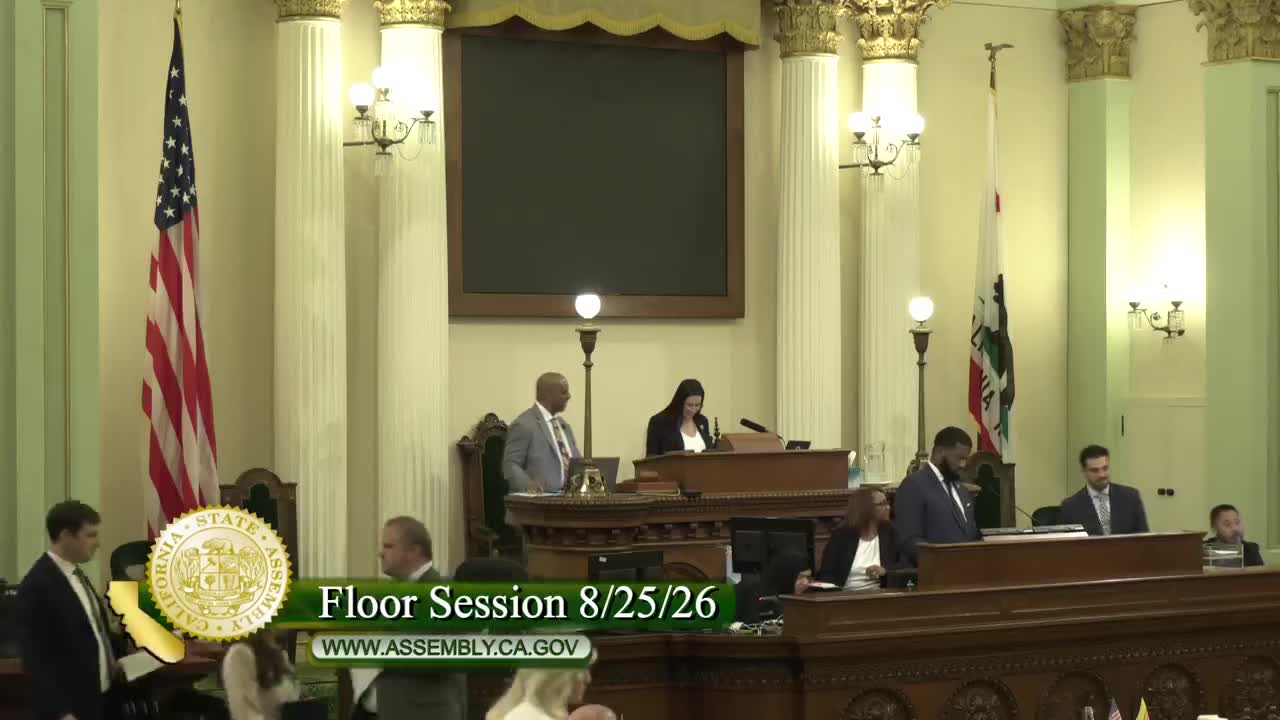 4MIN
Assembly Floor
 2MIN
Senate Floor
 15MIN
Senate Standing Committee on Public Safety
 19MIN
Assembly Standing Committee on Public Safety
Bill Author