AB 1945: Municipal utility districts: prepay option: termination of service.
- Session Year: 2025-2026
- House: Assembly
- Latest Version Date: 2026-09-18
Current Status:
Passed
(2026-09-18: Chaptered by Secretary of State - Chapter 278, Statutes of 2026.)
Introduced
In Committee
Awaiting First Chamber Vote
Passed First Chamber
In Committee
Awaiting Second Chamber Vote
Passed Second Chamber
Enacted
The Municipal Utility District Act establishes the formation of a municipal utility district for the provision of light, heat, water, or power within the districts jurisdiction. The act prohibits a district furnishing light, heat, water, or power from terminating residential service on account of nonpayment of a delinquent account unless the district provides a notice of delinquency and an opportunity to cure, as provided.
This bill would authorize districts to offer customers the option of electronically receiving the required notice of delinquency, as specified. The bill would authorize districts furnishing service to fewer than 100,000 customers to offer residential customers a prepay option, as defined, for electrical service if certain conditions are met, including, among other things, that the district provides the customer with information on returning to standard billing and issues automated low-balance alerts to the customer before suspending the customers electrical service, as provided. The bill would specify that the requirement to provide a notice of delinquency does not apply to customers participating in the prepay option.
The Municipal Utility District Act establishes the formation of a municipal utility district for the provision of light, heat, water, or power within the districts jurisdiction. The act prohibits a district furnishing light, heat, water, or power from terminating residential service on account of nonpayment of a delinquent account unless the district provides a notice of delinquency and an opportunity to cure, as provided.
This bill would authorize districts to offer customers the option of electronically receiving the required notice of delinquency, as specified. The bill would authorize districts furnishing service to fewer than 100,000 customers to offer residential customers a prepay option, as defined, for electrical service if certain conditions are met, including, among other things, that the district provides the customer with information on returning to standard billing and issues automated low-balance alerts to the customer before suspending the customers electrical service, as provided. The bill would specify that the requirement to provide a notice requirement before termination of residential service of a customer delinquency does not apply to customers participating in the prepay option.
The Municipal Utility District Act establishes the formation of a municipal utility district for the provision of light, heat, water, or power within the districts jurisdiction. The act prohibits a district furnishing light, heat, water, or power from terminating residential service on account of nonpayment of a delinquent account unless the district provides a notice of delinquency and an opportunity to cure, as provided.
This bill would authorize districts furnishing electrical service to less than 100,000 customers to offer customers the option of electronically receiving the required notice of delinquency, as specified. The bill would also authorize those districts furnishing service to fewer than 100,000 customers to offer customers a prepay option option, as defined, for electrical service if certain conditions are met. met, including, among other things, that the district provides the customer with information on returning to standard billing and issues automated low-balance alerts to the customer before suspending the customers electrical service, as provided. The bill would specify that the notice requirement before termination of residential service of a customer does not apply to customers participating in the prepay option.
The Municipal Utility District Act establishes the formation of a municipal utility district for the provision of light, heat, water, or power within the districts jurisdiction. The act prohibits a district furnishing light, heat, water, or power from terminating residential service on account of nonpayment of a delinquent account unless the district provides a notice of delinquency and an opportunity to cure, as provided.
This bill would authorize districts furnishing electrical service to less than 100,000 customers to offer customers the option of electronically receiving the required notice of delinquency, as specified. The bill would also authorize those districts to offer customers a prepay option for electrical service if certain conditions are met. The bill would specify that the notice requirement before termination of residential service of a customer does not apply to customers participating in the prepay option.
(a)A district furnishing light, heat, water, or power shall not terminate residential service on account of nonpayment of a delinquent account unless the district first gives notice of the delinquency and impending termination, at least 10 days before the proposed termination, by means of a notice mailed, postage prepaid, to the customer to whom the service is billed not earlier than 19 days from the date of mailing the districts bill for services, and the 10-day period shall not commence until 5 days after the mailing of the notice.
(b)Every district shall make a reasonable attempt to contact an adult person residing at the premises of the customer by telephone or personal contact, at least 24 hours before any termination of service, except that, whenever telephone or personal contact cannot be accomplished, the district shall give, by mail, in person, or by posting in a conspicuous location at the premises, a notice of termination of service, at least 48 hours prior to termination.
(c)Every district shall make available to its residential customers who are 65 years of age or older, or who are dependent adults as defined in Section 15610.23 of the Welfare and Institutions Code, a third-party notification service, whereby the district will attempt to notify a person designated by the customer to receive notification when the customers account is past due and subject to termination. The notification shall include information on what is required to prevent termination of service. The residential customer shall make a request for third-party notification on a form provided by the district, and shall include the written consent of the designated third party. The third-party notification does not obligate the third party to pay the overdue charges, nor shall it prevent or delay termination of service.
(d)(1)Every notice of termination of service pursuant to subdivision (a) shall include all of the following information:
(A)The name and address of the customer whose account is delinquent.
(B)The amount of the delinquency.
(C)The date by which payment or arrangements for payment is required to avoid termination.
(D)The procedure by which the customer may initiate a complaint or request an investigation concerning service or charges, except that, if the bill for service contains a description of that procedure, the notice pursuant to subdivision (a) is not required to contain that information.
(E)The procedure by which the customer may request amortization of the unpaid charges.
(F)The procedure for the customer to obtain information on the availability of financial assistance, including private, local, state, or federal sources, if applicable.
(G)The telephone number of a representative of the district who can provide additional information or institute arrangements for payment.
(2)Every notice of termination of service pursuant to subdivision (b) shall include the items of information specified in paragraph (1).
(3)All written notices shall be in a clear and legible format.
(e)If a residential customer fails to comply with an amortization agreement, the district shall not terminate service without giving notice to the customer at least 48 hours before termination of the conditions the customer is required to meet to avoid termination, but the notice does not entitle the customer to further investigation by the district.
(f)A termination of service shall not be effected without compliance with this section. Any service wrongfully terminated shall be restored without charge for the restoration of service, and a notation of the restoration shall be mailed to the customer at the customers billing address.
(g)A district may offer customers the option of receiving notices required by this section, except for notices pursuant to subdivision (b), solely by email, text message, app-based notification, or other electronic method as specified by the customer.
(h)This section does not apply to a customer participating in a prepay program pursuant to Section 12823.2.
SEC. 2.Section 12823.2 is added to the Public Utilities Code, to read:12823.2.(a)A district furnishing electrical service to fewer than 100,000 customers may offer residential customers a prepay option for electrical service if all of the following conditions are met:
(1)(A)For a customer that is a new residential applicant applying for electrical service on or after January 1, 2027, the customer has paid the deposit under a decision of a district described in Section 12822.6.
(B)A customer that has a current deposit held by the district shall be eligible to participate in the prepay option.
(2)The customer affirmatively opts into the district-approved prepay option with informed written consent.
(3)The district provides the customer with all information related to the mechanisms and policies to return to standard billing and provides information on any differences in consumer protection rules between the prepay option and standard billing.
(4)The district provides access to usage and account balance information.
(5)The district issues automated low-balance alerts to the customer before service suspension at least 10 days before the forecasted service suspension and again 24 hours before the forecasted service suspension, based on the districts best estimates of the customers electrical service usage.
(6)The customer retains the right to exit the prepay option and return to standard billing pursuant to a policy adopted by the board.
(7)(A)Before converting a customer whose account is in arrears to a prepay option, the district shall offer the customer the opportunity to participate in an arrearage payment plan. A customer who elects to participate in and complies with the arrearage payment plan shall not be converted to prepay service while the customer remains in compliance with the plan, except as specified in subparagraph (B).
(B)Notwithstanding subparagraph (A), a customer that is participating in, and in compliance with, an arrearage payment plan may elect to convert to prepay service only if their deposit is equal to, or greater than, the amount of the delinquency. Upon conversion to prepay service, the district shall apply the customers deposit to the amount of their delinquency and any remainder of the deposit shall be applied as a credit to the customers account.
(8)The prepay option requires the district to refund to the customer any unexpended balance from the customers account within 10 business days after the customer has terminated electrical service and the district has withdrawn payment for the customers final bill.
(9)(A)The district deposits into a separate fund all revenue collected from customers that have opted into the prepay option.
(B)Except as provided in paragraph (8), any amounts that have been deposited into the separate fund that are associated with electrical service that has not been provided shall not be transferred or expended from the separate fund.
(10)The district adopts a policy to minimize service disruptions to customers who elect to participate in the prepay option and who are 65 years of age or older, customers who are medically vulnerable, and customers who are dependent adults, as defined in Section 15610.23 of the Welfare and Institutions Code.
(b)Section 12823.1 does not apply to the termination of electrical service for nonpayment of a delinquent account for a customer participating in a prepay option pursuant to subdivision (a).
(c)For purposes of this section, prepay option means a payment option offered by a district to its customers pursuant to subdivision (a) that enables the customers to make a payment for a specified amount of electrical service before that service is rendered.
(a)A district furnishing light, heat, water, or power shall not terminate residential service on account of nonpayment of a delinquent account unless the district first gives notice of the delinquency and impending termination, at least 10 days before the proposed termination, by means of a notice mailed, postage prepaid, to the customer to whom the service is billed not earlier than 19 days from the date of mailing the districts bill for services, and the 10-day period shall not commence until 5 days after the mailing of the notice.
(b)Every district shall make a reasonable attempt to contact an adult person residing at the premises of the customer by telephone or personal contact, at least 24 hours before any termination of service, except that, whenever telephone or personal contact cannot be accomplished, the district shall give, by mail, in person, or by posting in a conspicuous location at the premises, a notice of termination of service, at least 48 hours prior to termination.
(c)Every district shall make available to its residential customers who are 65 years of age or older, or who are dependent adults as defined in Section 15610.23 of the Welfare and Institutions Code, a third-party notification service, whereby the district will attempt to notify a person designated by the customer to receive notification when the customers account is past due and subject to termination. The notification shall include information on what is required to prevent termination of service. The residential customer shall make a request for third-party notification on a form provided by the district, and shall include the written consent of the designated third party. The third-party notification does not obligate the third party to pay the overdue charges, nor shall it prevent or delay termination of service.
(d)(1)Every notice of termination of service pursuant to subdivision (a) shall include all of the following information:
(A)The name and address of the customer whose account is delinquent.
(B)The amount of the delinquency.
(C)The date by which payment or arrangements for payment is required to avoid termination.
(D)The procedure by which the customer may initiate a complaint or request an investigation concerning service or charges, except that, if the bill for service contains a description of that procedure, the notice pursuant to subdivision (a) is not required to contain that information.
(E)The procedure by which the customer may request amortization of the unpaid charges.
(F)The procedure for the customer to obtain information on the availability of financial assistance, including private, local, state, or federal sources, if applicable.
(G)The telephone number of a representative of the district who can provide additional information or institute arrangements for payment.
(2)Every notice of termination of service pursuant to subdivision (b) shall include the items of information specified in paragraph (1).
(3)All written notices shall be in a clear and legible format.
(e)If a residential customer fails to comply with an amortization agreement, the district shall not terminate service without giving notice to the customer at least 48 hours before termination of the conditions the customer is required to meet to avoid termination, but the notice does not entitle the customer to further investigation by the district.
(f)A termination of service shall not be effected without compliance with this section. Any service wrongfully terminated shall be restored without charge for the restoration of service, and a notation of the restoration shall be mailed to the customer at the customers billing address.
(g)A district may offer customers the option of receiving notices required by this section, except for notices pursuant to subdivision (b), solely by email, text message, app-based notification, or other electronic method as specified by the customer.
(h)This section does not apply to a customer participating in a prepay program pursuant to Section 12823.2.
SEC. 2.Section 12823.2 is added to the Public Utilities Code, to read:12823.2.(a)A district furnishing electrical service to fewer than 100,000 customers may offer residential customers a prepay option for electrical service if all of the following conditions are met:
(1)(A)For a customer that is a new residential applicant applying for electrical service on or after January 1, 2027, the customer has paid the deposit under a decision of a district described in Section 12822.6.
(B)A customer that has a current deposit held by the district shall be eligible to participate in the prepay option.
(2)The customer affirmatively opts into the district-approved prepay option with informed written consent.
(3)The district provides the customer with all information related to the mechanisms and policies to return to standard billing and provides information on any differences in consumer protection rules between the prepay option and standard billing.
(4)The district provides access to usage and account balance information.
(5)The district issues automated low-balance alerts to the customer before service suspension at least 10 days before the forecasted service suspension and again 24 hours before the forecasted service suspension, based on the districts best estimates of the customers electrical service usage.
(6)The customer retains the right to exit the prepay option and return to standard billing pursuant to a policy adopted by the board.
(7)(A)Before converting a customer whose account is in arrears to a prepay option, the district shall offer the customer the opportunity to participate in an arrearage payment plan. A customer who elects to participate in and complies with the arrearage payment plan shall not be converted to prepay service while the customer remains in compliance with the plan. plan, except as specified in subparagraph (B).
(B)Notwithstanding subparagraph (A), a customer that is participating in, and in compliance with, an arrearage payment plan may elect to convert to prepay service only if their deposit is equal to, or greater than, the amount of the delinquency. Upon conversion to prepay service, the district shall apply the customers deposit to the amount of their delinquency and any remainder of the deposit shall be applied as a credit to the customers account.
(8)The prepay option requires the district to refund to the customer any unexpended balance from the customers account within 10 business days after the customer has terminated electrical service and the district has withdrawn payment for the customers final bill.
(9)(A)The district deposits into a separate fund all revenue collected from customers that have opted into the prepay option.
(B)Except as provided in paragraph (8), any amounts that have been deposited into the separate fund that are associated with electrical service that has not been provided shall not be transferred or expended from the separate fund.
(10)The district adopts a policy to minimize service disruptions to customers who elect to participate in the prepay option and who are 65 years of age or older, customers who are medically vulnerable, and customers who are dependent adults, as defined in Section 15610.23 of the Welfare and Institutions Code.
(b)Section 12823.1 does not apply to the termination of electrical service for nonpayment of a delinquent account for a customer participating in a prepay option pursuant to subdivision (a).
(c)For purposes of this section, prepay option means a payment option offered by a district to its customers pursuant to subdivision (a) that enables the customers to make a payment for a specified amount of electrical service before that service is rendered.
(a)A district furnishing light, heat, water, or power shall not terminate residential service on account of nonpayment of a delinquent account unless the district first gives notice of the delinquency and impending termination, at least 10 days before the proposed termination, by means of a notice mailed, postage prepaid, to the customer to whom the service is billed not earlier than 19 days from the date of mailing the districts bill for services, and the 10-day period shall not commence until 5 days after the mailing of the notice.
(b)Every district shall make a reasonable attempt to contact an adult person residing at the premises of the customer by telephone or personal contact, at least 24 hours before any termination of service, except that, whenever telephone or personal contact cannot be accomplished, the district shall give, by mail, in person, or by posting in a conspicuous location at the premises, a notice of termination of service, at least 48 hours prior to termination.
(c)Every district shall make available to its residential customers who are 65 years of age or older, or who are dependent adults as defined in Section 15610.23 of the Welfare and Institutions Code, a third-party notification service, whereby the district will attempt to notify a person designated by the customer to receive notification when the customers account is past due and subject to termination. The notification shall include information on what is required to prevent termination of service. The residential customer shall make a request for third-party notification on a form provided by the district, and shall include the written consent of the designated third party. The third-party notification does not obligate the third party to pay the overdue charges, nor shall it prevent or delay termination of service.
(d)(1)Every notice of termination of service pursuant to subdivision (a) shall include all of the following information:
(A)The name and address of the customer whose account is delinquent.
(B)The amount of the delinquency.
(C)The date by which payment or arrangements for payment is required to avoid termination.
(D)The procedure by which the customer may initiate a complaint or request an investigation concerning service or charges, except that, if the bill for service contains a description of that procedure, the notice pursuant to subdivision (a) is not required to contain that information.
(E)The procedure by which the customer may request amortization of the unpaid charges.
(F)The procedure for the customer to obtain information on the availability of financial assistance, including private, local, state, or federal sources, if applicable.
(G)The telephone number of a representative of the district who can provide additional information or institute arrangements for payment.
(2)Every notice of termination of service pursuant to subdivision (b) shall include the items of information specified in paragraph (1).
(3)All written notices shall be in a clear and legible format.
(e)If a residential customer fails to comply with an amortization agreement, the district shall not terminate service without giving notice to the customer at least 48 hours before termination of the conditions the customer is required to meet to avoid termination, but the notice does not entitle the customer to further investigation by the district.
(f)A termination of service shall not be effected without compliance with this section. Any service wrongfully terminated shall be restored without charge for the restoration of service, and a notation of the restoration shall be mailed to the customer at the customers billing address.
(g)A district may offer customers the option of receiving notices required by this section, except for notices pursuant to subdivision (b), solely by email, text message, app-based notification, or other electronic method as specified by the customer.
(h)This section does not apply to a customer participating in a prepay program pursuant to Section 12823.2.
SEC. 2.Section 12823.2 is added to the Public Utilities Code, to read:12823.2.(a)A district furnishing electrical service to fewer than 100,000 customers may offer residential customers a prepay option for electrical service if all of the following conditions are met:
(1)(A)For a customer that is a new residential applicant applying for electrical service on or after January 1, 2027, the customer has paid the deposit under a decision of a district described in Section 12822.6.
(B)A customer that has a current deposit held by the district shall be eligible to participate in the prepay option.
(1)(2)The customer affirmatively opts into the district-approved prepay option with informed written consent.
(2)(3)The district provides the customer with all information related to the mechanisms and policies to return to standard billing and provides information on any differences in consumer protection rules between the prepay option and standard billing.
(3)(4)The district provides access to usage and account balance information.
(4)(5)The district issues automated low-balance alerts to the customer before service suspension at least 10 days before the forecasted service suspension and again 24 hours before the forecasted service suspension, based on the districts best estimates of the customers electrical service usage.
(5)(6)The customer retains the right to exit the prepay option and return to standard billing pursuant to a policy adopted by the board.
(6)Before the prepay option takes effect, and if the customer has eligibility for an arrearage payment plan offered by the district, the district offers the customer an opportunity to participate in an arrearage payment plan.(7)Before converting a customer whose account is in arrears to a prepay option, the district shall offer the customer the opportunity to participate in an arrearage payment plan. A customer who elects to participate in and complies with the arrearage payment plan shall not be converted to prepay service while the customer remains in compliance with the plan.
(7)(8)The prepay option requires the district to refund to the customer any unexpended balance from the customers account within 10 business days after the customer has terminated electrical service and the district has withdrawn payment for the customers final bill.
(8)(9)(A)The district deposits into a separate fund all revenue collected from customers that have opted into the prepay option.
(B)Except as provided in paragraph (7), (8), any amounts that have been deposited into the separate fund that are associated with electrical service that has not been provided shall not be transferred or expended from the separate fund.
(9)(10)The district adopts a policy to minimize service disruptions to residential customers who elect to participate in the prepay option and who are 65 years of age or older, customers who are medically vulnerable, and customers who are dependent adults, as defined in Section 15610.23 of the Welfare and Institutions Code.
(b)Section 12823.1 does not apply to the termination of electrical service for nonpayment of a delinquent account for a customer participating in a prepay option pursuant to subdivision (a).
(c)For purposes of this section, prepay option means a payment option offered by a district to its customers pursuant to subdivision (a) that enables the customers to make a payment for a specified amount of electrical service before that service is rendered.
(a)A district furnishing light, heat, water, or power shall not terminate residential service on account of nonpayment of a delinquent account unless the district first gives notice of the delinquency and impending termination, at least 10 days before the proposed termination, by means of a notice mailed, postage prepaid, to the customer to whom the service is billed not earlier than 19 days from the date of mailing the districts bill for services, and the 10-day period shall not commence until 5 days after the mailing of the notice.
(b)Every district shall make a reasonable attempt to contact an adult person residing at the premises of the customer by telephone or personal contact, at least 24 hours before any termination of service, except that, whenever telephone or personal contact cannot be accomplished, the district shall give, by mail, in person, or by posting in a conspicuous location at the premises, a notice of termination of service, at least 48 hours prior to termination.
(c)Every district shall make available to its residential customers who are 65 years of age or older, or who are dependent adults as defined in Section 15610.23 of the Welfare and Institutions Code, a third-party notification service, whereby the district will attempt to notify a person designated by the customer to receive notification when the customers account is past due and subject to termination. The notification shall include information on what is required to prevent termination of service. The residential customer shall make a request for third-party notification on a form provided by the district, and shall include the written consent of the designated third party. The third-party notification does not obligate the third party to pay the overdue charges, nor shall it prevent or delay termination of service.
(d)(1)Every notice of termination of service pursuant to subdivision (a) shall include all of the following information:
(A)The name and address of the customer whose account is delinquent.
(B)The amount of the delinquency.
(C)The date by which payment or arrangements for payment is required to avoid termination.
(D)The procedure by which the customer may initiate a complaint or request an investigation concerning service or charges, except that, if the bill for service contains a description of that procedure, the notice pursuant to subdivision (a) is not required to contain that information.
(E)The procedure by which the customer may request amortization of the unpaid charges.
(F)The procedure for the customer to obtain information on the availability of financial assistance, including private, local, state, or federal sources, if applicable.
(G)The telephone number of a representative of the district who can provide additional information or institute arrangements for payment.
(2)Every notice of termination of service pursuant to subdivision (b) shall include the items of information specified in paragraph (1).
(3)All written notices shall be in a clear and legible format.
(e)If a residential customer fails to comply with an amortization agreement, the district shall not terminate service without giving notice to the customer at least 48 hours before termination of the conditions the customer is required to meet to avoid termination, but the notice does not entitle the customer to further investigation by the district.
(f)A termination of service shall not be effected without compliance with this section. Any service wrongfully terminated shall be restored without charge for the restoration of service, and a notation of the restoration shall be mailed to the customer at the customers billing address.
(g)A district furnishing electrical service to less than 100,000 customers may offer customers the option of receiving notices required by this section section, except for notices pursuant to subdivision (b), solely by electronic mail, email, text message, app-based notification, or other electronic method as specified by the customer.
(h)This section does not apply to a customer participating in a prepay program pursuant to Section 12823.2.
SEC. 2.Section 12823.2 is added to the Public Utilities Code, to read:12823.2.(a)A district furnishing electrical service to less fewer than 100,000 customers may offer customers a prepay option for electrical service if all of the following conditions are met:
(1)The customer affirmatively opts into a the district-approved prepay program option with informed written consent.
(2)The district provides the customer with all information related to the mechanisms and policies to return to standard billing and provides information on any differences in consumer protection rules between the prepay option and standard billing.
(2)(3)The district provides electronic access to usage and account balance information.
(3)(4)The district issues automated low-balance alerts to the customer before service suspension. suspension at least 10 days before the forecasted service suspension and again 24 hours before the forecasted service suspension, based on the districts best estimates of the customers electrical service usage.
(4)(5)The customer retains the right to exit the prepay option and return to standard billing pursuant to the a policy adopted by the board.
(6)Before the prepay option takes effect, and if the customer has eligibility for an arrearage payment plan offered by the district, the district offers the customer an opportunity to participate in an arrearage payment plan.
(7)The prepay option requires the district to refund to the customer any unexpended balance from the customers account within 10 business days after the customer has terminated electrical service and the district has withdrawn payment for the customers final bill.
(8)(A)The district deposits into a separate fund all revenue collected from customers that have opted into the prepay option.
(B)Except as provided in paragraph (7), any amounts that have been deposited into the separate fund that are associated with electrical service that has not been provided shall not be transferred or expended from the separate fund.
(9)The district adopts a policy to minimize service disruptions to residential customers who elect to participate in the prepay option and who are 65 years of age or older, customers who are medically vulnerable, and customers who are dependent adults, as defined in Section 15610.23 of the Welfare and Institutions Code.
(b)Section 12823.1 does not apply to the termination of electrical service for nonpayment of a delinquent account for a customer participating in a prepay option pursuant to subdivision (a).
(c)For purposes of this section, prepay option means a payment option offered by a district to its customers pursuant to subdivision (a) that enables the customers to make a payment for a specified amount of electrical service before that service is rendered.
(a)A district furnishing light, heat, water, or power shall not terminate residential service on account of nonpayment of a delinquent account unless the district first gives notice of the delinquency and impending termination, at least 10 days before the proposed termination, by means of a notice mailed, postage prepaid, to the customer to whom the service is billed not earlier than 19 days from the date of mailing the districts bill for services, and the 10-day period shall not commence until five 5 days after the mailing of the notice.
(b)Every district shall make a reasonable attempt to contact an adult person residing at the premises of the customer by telephone or personal contact, at least 24 hours before any termination of service, except that, whenever telephone or personal contact cannot be accomplished, the district shall give, by mail, in person, or by posting in a conspicuous location at the premises, a notice of termination of service, at least 48 hours prior to termination.
(c)Every district shall make available to its residential customers who are 65 years of age or older, or who are dependent adults as defined in Section 15610.23 of the Welfare and Institutions Code, a third-party notification service, whereby the district will attempt to notify a person designated by the customer to receive notification when the customers account is past due and subject to termination. The notification shall include information on what is required to prevent termination of service. The residential customer shall make a request for third-party notification on a form provided by the district, and shall include the written consent of the designated third party. The third-party notification does not obligate the third party to pay the overdue charges, nor shall it prevent or delay termination of service.
(d)(1)Every notice of termination of service pursuant to subdivision (a) shall include all of the following information:
(A)The name and address of the customer whose account is delinquent.
(B)The amount of the delinquency.
(C)The date by which payment or arrangements for payment is required to avoid termination.
(D)The procedure by which the customer may initiate a complaint or request an investigation concerning service or charges, except that, if the bill for service contains a description of that procedure, the notice pursuant to subdivision (a) is not required to contain that information.
(E)The procedure by which the customer may request amortization of the unpaid charges.
(F)The procedure for the customer to obtain information on the availability of financial assistance, including private, local, state, or federal sources, if applicable.
(G)The telephone number of a representative of the district who can provide additional information or institute arrangements for payment.
(2)Every notice of termination of service pursuant to subdivision (b) shall include the items of information specified in paragraph (1).
(3)All written notices shall be in a clear and legible format.
(e)If a residential customer fails to comply with an amortization agreement, the district shall not terminate service without giving notice to the customer at least 48 hours before termination of the conditions the customer is required to meet to avoid termination, but the notice does not entitle the customer to further investigation by the district.
(f)A termination of service shall not be effected without compliance with this section. Any service wrongfully terminated shall be restored without charge for the restoration of service, and a notation of the restoration shall be mailed to the customer at the customers billing address.
(g)A district furnishing electrical service to less than 100,000 customers may offer customers the option of receiving electronic notices required by this section solely by electronic mail, text message, app-based notification, or other electronic method as specified by the customer.
(h)This section does not apply to a customer participating in a prepay program pursuant to Section 12823.2.
SEC. 2.Section 12823.2 is added to the Public Utilities Code, to read:12823.2.(a)A district furnishing electrical service to less than 100,000 customers may offer customers a prepay option for electrical service if all of the following conditions are met:
(1)The customer affirmatively opts into a district-approved prepay program with informed written consent.
(2)The district provides electronic access to usage and account balance information.
(3)The district issues automated low-balance alerts to the customer before service suspension.
(4)The customer retains the right to exit the prepay option and return to standard billing pursuant to the policy adopted by the board.
(b)Section 12823.1 does not apply to the termination of service for nonpayment of a delinquent account for a customer participating in a prepay option pursuant to subdivision (a).
(a)A district furnishing light, heat, water, or power shall not terminate residential service on account of nonpayment of a delinquent account unless the district first gives notice of the delinquency and impending termination, at least 10 days prior to before the proposed termination, by means of a notice mailed, postage prepaid, to the customer to whom the service is billed not earlier than 19 days from the date of mailing the districts bill for services, and the 10-day period shall not commence until five days after the mailing of the notice.
(b)Every district shall make a reasonable attempt to contact an adult person residing at the premises of the customer by telephone or personal contact, at least 24 hours prior to before any termination of service, except that, whenever telephone or personal contact cannot be accomplished, the district shall give, by mail, in person, or by posting in a conspicuous location at the premises, a notice of termination of service, at least 48 hours prior to termination.
(c)Every district shall make available to its residential customers who are 65 years of age or older, or who are dependent adults as defined in Section 15610.23 of the Welfare and Institutions Code, a third-party notification service, whereby the district will attempt to notify a person designated by the customer to receive notification when the customers account is past due and subject to termination. The notification shall include information on what is required to prevent termination of service. The residential customer shall make a request for third-party notification on a form provided by the district, and shall include the written consent of the designated third party. The third-party notification does not obligate the third party to pay the overdue charges, nor shall it prevent or delay termination of service.
(d)(1)Every notice of termination of service pursuant to subdivision (a) shall include all of the following information:
(1)(A)The name and address of the customer whose account is delinquent.
(2)(B)The amount of the delinquency.
(3)(C)The date by which payment or arrangements for payment is required in order to avoid termination.
(4)(D)The procedure by which the customer may initiate a complaint or request an investigation concerning service or charges, except that, if the bill for service contains a description of that procedure, the notice pursuant to subdivision (a) is not required to contain that information.
(5)(E)The procedure by which the customer may request amortization of the unpaid charges.
(6)(F)The procedure for the customer to obtain information on the availability of financial assistance, including private, local, state, or federal sources, if applicable.
(7)(G)The telephone number of a representative of the district who can provide additional information or institute arrangements for payment.
Every(2)Every notice of termination of service pursuant to subdivision (b) shall include the items of information specified in paragraphs (1), (2), (3), (6), and (7). paragraph (1).
All(3)All written notices shall be in a clear and legible format.
(e)If a residential customer fails to comply with an amortization agreement, the district shall not terminate service without giving notice to the customer at least 48 hours prior to before termination of the conditions the customer is required to meet to avoid termination, but the notice does not entitle the customer to further investigation by the district.
(f)A termination of service shall not be effected without compliance with this section. Any service wrongfully terminated shall be restored without charge for the restoration of service, and a notation thereof of the restoration shall be mailed to the customer at the customers billing address.
(g)A district furnishing electrical service to less than 100,000 customers may offer customers the option of receiving electronic notices required by this section solely by electronic mail, text message, app-based notification, or other method as specified by the customer.
(h)This section does not apply to a customer participating in a prepay program pursuant to Section 12823.2.
SEC. 2.Section 12823.2 is added to the Public Utilities Code, to read:12823.2.(a)A district furnishing electrical service to less than 100,000 customers may offer customers a prepay option for electrical service if all of the following conditions are met:
(1)The customer affirmatively opts into a district-approved prepay program with informed written consent.
(2)The district provides electronic access to usage and account balance information.
(3)The district issues automated low-balance alerts to the customer before service suspension.
(4)The customer retains the right to exit the prepay option and return to standard billing pursuant to the policy adopted by the board.
(b)Section 12823.1 does not apply to the termination of service for nonpayment of a delinquent account for a customer participating in a prepay option pursuant to subdivision (a).
|
Date
|
Status
|
|---|---|
| Sep 18, 2026 | Chaptered by Secretary of State - Chapter 278, Statutes of 2026. |
| Sep 18, 2026 | Approved by the Governor. |
| Sep 8, 2026 | Enrolled and presented to the Governor at 3:30 p.m. |
| Aug 28, 2026 | Senate amendments concurred in. To Engrossing and Enrolling. (Ayes 76. Noes 0.). |
| Aug 28, 2026 | Senate amendments concurred in. To Engrossing and Enrolling. (Ayes 76. Noes 0. Page 6779.). |
| Aug 25, 2026 | In Assembly. Concurrence in Senate amendments pending. |
| Aug 25, 2026 | Read third time. Passed. Ordered to the Assembly. (Ayes 40. Noes 0. Page 5786.). |
| Aug 25, 2026 | Read third time. Passed. Ordered to the Assembly. (Ayes 38. Noes 0.). |
| Aug 24, 2026 | Read second time. Ordered to third reading. |
| Aug 21, 2026 | Read third time and amended. Ordered to second reading. |
| Jun 25, 2026 | Read second time and amended. Ordered to third reading. |
| Jun 24, 2026 | From committee: Amend, and do pass as amended. (Ayes 7. Noes 0.) (June 23). |
| May 13, 2026 | Referred to Com. on L. GOV. |
| May 5, 2026 | In Senate. Read first time. To Com. on RLS. for assignment. |
| May 4, 2026 | Read third time. Passed. Ordered to the Senate. (Ayes 73. Noes 0.) |
| May 4, 2026 | Read third time. Passed. Ordered to the Senate. (Ayes 73. Noes 0. Page 4918.) |
| May 4, 2026 | Read third time. Passed. Ordered to the Senate. |
| Apr 27, 2026 | Read second time. Ordered to Consent Calendar. |
| Apr 23, 2026 | From committee: Do pass. To Consent Calendar. (Ayes 18. Noes 0.) (April 22). |
| Apr 20, 2026 | Re-referred to Com. on U. & E. |
| Apr 16, 2026 | From committee: Do pass and re-refer to Com. on U. & E. (Ayes 10. Noes 0.) (April 15). Re-referred to Com. on U. & E. |
| Apr 16, 2026 | From committee chair, with author's amendments: Amend, and re-refer to Com. on U. & E. Read second time and amended. |
| Mar 17, 2026 | Re-referred to Com. on L. GOV. |
| Mar 16, 2026 | From committee chair, with author's amendments: Amend, and re-refer to Com. on L. GOV. Read second time and amended. |
| Mar 2, 2026 | Referred to Com. on L. GOV. |
| Feb 14, 2026 | From printer. May be heard in committee March 16. |
| Feb 13, 2026 | Read first time. To print. |
|
Date
|
Description
|
Location
|
Votes
|
|
|---|---|---|---|---|
| Aug 28, 2026 | AB 1945 Hadwick Concurrence in Senate Amendments | Assembly Floor |
Passed |
|
| Aug 25, 2026 | Assembly 3rd Reading AB1945 Hadwick et al. By Niello | Senate Floor |
Passed |
|
| Jun 23, 2026 | Do pass as amended | Senate Standing Committee on Local Government |
Passed |
|
| May 4, 2026 | AB 1945 Hadwick Consent Calendar Second Day Regular Session | Assembly Floor |
Passed |
|
| Apr 22, 2026 | Do pass. To Consent Calendar. | Assembly Standing Committee on Utilities and Energy |
Passed |
|
| Apr 15, 2026 | Do pass and be re-referred to the Committee on [Utilities and Energy] | Assembly Standing Committee on Local Government |
Passed |
This list shows positions taken on this bill by organizations on the date displayed, which is linked to the original source.
Positions by individuals are not included.
|
Organization
|
Position
|
Date
|
|---|---|---|
| California Municipal Utilities Association | ** Support | |
| Golden State Power Cooperative | ** Support | |
| Lassen Municipal Utility District | ** Support | |
| Northern California Power Agency | ** Support |
CONCURRENCE IN SENATE AMENDMENTS
CSA1 Bill Id:AB 1945
Author:(Hadwick)
As Amended Ver:August 21, 2026
Majority vote
SUMMARY
Authorizes a municipal utility district (MUD) providing electrical service to less than 100,000 customers to offer a prepay option for electrical service.
Senate Amendments
- Limit prepay option to residential customers.
- Provide, in addition to other conditions that must be met for a prepay option to be offered to customers, that for a customer that is a new residential applicant applying for electrical service on or before January 1, 2027, the customer has paid the deposit, as specified. A customer that has a current deposit held by the district shall be eligible to participate in the prepay option.
- Clarify that a customer who elects to participate in and complies with the arrearage plan shall not be converted to prepay service while the customer remains in compliance with the plan.
- Clarify that, notwithstanding 3), above, a customer that is participating in, and in compliance with, an arrearage payment plan may elect to convert to prepay service only if their deposit is equal to, or greater than, the amount of the delinquency. Upon conversion to prepay service, the district shall apply the customer's deposit to the amount of the delinquency and any remainder of the deposit shall be applied as a credit to the customer's account.
- Make other technical changes.
COMMENTS
- MUDs. Governed by the MUD Act, there are five MUDs statewide: East Bay, Lassen, Sacramento, South Placer, and Southern San Joaquin. MUDs can provide various utility services, including electricity, water, sewer, garbage disposal, transportation, and communications. Currently, only Sacramento Municipal Utility District (SMUD) and Lassen Municipal Utility District provide electrical service in the State. SMUD delivers power to over 1.5 million customers and LMUD serves approximately 10,000 customers. LMUD was created by the voters in 1986. Prior to this vote, the area received electric service from CP National Corporation (CPN). On May 10, 1988, LMUD acquired electrical facilities from CPN. LMUD is governed by five members elected by the voters.
The MUD Act allows MUDs furnishing light, heat, water, or power to terminate residential service due to nonpayment of a delinquent account, but it requires a robust notification process prior to termination of a service. First, the MUD must give notice of delinquency and impending termination, at least 10 days prior to the proposed termination, by means of a mailed notice to the customer to whom the service is billed no earlier than 19 days from the date of mailing the MUD's bill for services. The 10-day period must not start until 5 days after mailing the notice of termination.
MUDs are also required to make a reasonable attempt to contact an adult residing at the premises of the customer, by telephone or personal contact, at least 24 hours prior to any termination of service. If telephone or personal contact cannot be accomplished, the MUD must give, by mail, in person, or by posting, a notice of termination of service, at least 48 hours prior to termination. For customers who are 65 years of age or older and dependent adults, a MUD must make available a third-party notification service. Each notice must also contain certain information.
- Prepay Programs. While it appears no MUD currently provides a prepay program for electrical service, other types of electrical providers do. For instance, the Truckee Donner Public Utility District currently operates "pay-as-you-go" prepaid services. The Truckee Donner website explains that the customer may set the payment plan and the amounts that fit their budget. There are no late, connection or reconnection fees. If a subsequent payment is made, the power will be reconnected. If an account balance is running low, the customer will receive an alert by text, email, or via the district's mobile app. If the account balance falls below zero, service will be subject to disconnection at any time. There is no traditional bill once a month and usage is calculated on a daily basis.
According to the Author
"Assembly Bill 1945 gives rural, low-income ratepayers another tool to manage household energy costs. In Lassen County, customers have asked for a voluntary prepay option so they can pay for electricity in advance, track usage more closely, and avoid the financial shock of a larger monthly bill or costly stop-and-start service fees. Current law does not give Lassen Municipal Utility District clear authority to offer that option. AB 1945 preserves traditional billing, requires informed consent and customer safeguards, and expands consumer choice for communities that want more flexibility in how they pay for essential utility service."
Arguments in Support
According to LMUD, the sponsors of this bill, "As a Municipal Utility District committed to affordability, transparency, and inclusion, LMUD recognizes the growing demand for flexible billing options. Pre-pay service models are common throughout the electric industry. They allow customers to pay for service in advance, monitor their usage, and avoid deposits, late fees, or untimely suspension of service. These programs are especially beneficial for income-challenged customers and customers seeking greater control over their energy budgets.
"The current language in the Public Utilities Code presents a significant barrier to implementing pre-pay programs. The PUC's mandatory mail notification procedures prior to service suspension are incompatible with the automated, opt-in nature of pre-pay service. LMUD believes that customers who voluntarily choose pre-pay should be exempt from these requirements, provided that LMUD offers clear disclosures, usage tracking, and proactive low-balance alerts.
"This amendment would not only modernize LMUD's operations—it would also align with California's broader energy affordability goals, including recent initiatives to reduce costs, expand customer choice, and support equitable access to affordable energy."
Arguments in Opposition
None on file.
FISCAL COMMENTS
None.
VOTES:
ASM LOCAL GOVERNMENT: 10-0-0
YES: Carrillo, Ta, Johnson, Pacheco, Ramos, Ransom, Blanca Rubio, Stefani, Ward, Wilson
ASM UTILITIES AND ENERGY: 18-0-0
YES: Petrie-Norris, Patterson, Boerner, Calderon, Chen, Davies, Mark González, Harabedian, Hart, Irwin, Kalra, Papan, Rogers, Schiavo, Schultz, Ta, Wallis, Zbur
ASSEMBLY FLOOR: 73-0-7
YES: Addis, Aguiar-Curry, Ahrens, Alanis, Alvarez, Ávila Farías, Bains, Bauer-Kahan, Berman, Boerner, Bonta, Bryan, Calderon, Carrillo, Castillo, Connolly, Davies, DeMaio, Dixon, Elhawary, Ellis, Fong, Gabriel, Gallagher, Garcia, Gipson, Jeff Gonzalez, Mark González, Hadwick, Haney, Harabedian, Hart, Hoover, Irwin, Jackson, Johnson, Kalra, Krell, Lackey, Lee, Lowenthal, Macedo, McKinnor, Muratsuchi, Nguyen, Ortega, Pacheco, Papan, Patel, Patterson, Pellerin, Petrie-Norris, Quirk-Silva, Ramos, Ransom, Celeste Rodriguez, Michelle Rodriguez, Rogers, Blanca Rubio, Sanchez, Schiavo, Schultz, Sharp-Collins, Solache, Soria, Stefani, Ta, Tangipa, Valencia, Ward, Wicks, Zbur, Rivas
ABS, ABST OR NV: Arambula, Bennett, Caloza, Chen, Flora, Wallis, Wilson
UPDATED
VERSION: August 21, 2026
CONSULTANT: Jimmy MacDonald / L. GOV. / (916) 319-3958 FN: 0004122
SENATE RULES COMMITTEE Office of Senate Floor Analyses (916) 651-4171 | AB 1945 |
THIRD READING
Bill No: AB 1945
Author: Hadwick (R), et al.
Amended: 8/21/26 in Senate
Vote: 21
SENATE LOCAL GOVERNMENT COMMITTEE: 7-0, 6/23/26
AYES: Durazo, Choi, Arreguín, Ashby, Cervantes, Laird, Seyarto
ASSEMBLY FLOOR: 73-0, 5/4/26 (Consent) - See last page for vote
SUBJECT: Municipal utility districts: termination of service
SOURCE: Lassen Municipal Utility District
DIGEST:
This bill authorizes a municipal utility district (MUD) providing electrical service to fewer than 100,000 residential customers to offer a prepay option for electrical service.
Senate Floor Amendments of 8/21/26 clarify if a customer is in arrears and the district holds a deposit, the customer can switch to prepay if the deposit covers the delinquency.
ANALYSIS:
Existing law:
- Specifies that a MUD furnishing light, heat, water, or power shall not terminate residential service on account of nonpayment of a delinquent account unless the district first gives notice of the delinquency and impending termination, at least 10 days prior to the proposed termination, by means of a notice mailed, postage prepaid, to the customer to whom the service is billed not earlier than 19 days from the date of mailing the district’s bill for services, and the 10-day period shall not commence until five days after the mailing of the notice.
- Provides that every MUD shall make a reasonable attempt to contact an adult person residing at the premises of the customer by telephone or personal contact, at least 24 hours prior to any termination of service, except that, whenever telephone or personal contact cannot be accomplished, the MUD shall give, by mail, in person, or by posting in a conspicuous location at the premises, a notice of termination of service, at least 48 hours prior to termination.
- Specifies that every MUD shall make available to its residential customers who are 65 years of age or older, or who are dependent adults, as defined, a third-party notification service, whereby the district will attempt to notify a person designated by the customer to receive notification when the customer’s account is past due and subject to termination. The notification shall include information on what is required to prevent termination of service. The residential customer shall make a request for third-party notification on a form provided by the MUD, and shall include the written consent of the designated third party. The third-party notification does not obligate the third party to pay the overdue charges, nor shall it prevent or delay termination of service.
- Provides that every notice of termination of service pursuant to 1), above, shall include all of the following information:
- The name and address of the customer whose account is delinquent;
- The amount of the delinquency;
- The date by which payment or arrangements for payment is required in order to avoid termination;
- The procedure by which the customer may initiate a complaint or request an investigation concerning service or charges, except that, if the bill for service contains a description of that procedure, the notice pursuant to 1), above, is not required to contain that information;
- The procedure by which the customer may request amortization of the unpaid charges;
- The procedure for the customer to obtain information on the availability of financial assistance, including private, local, state, or federal sources, if applicable;
- The telephone number of a representative of the district who can provide additional information or institute arrangements for payment.
- Specifies that every notice of termination of service pursuant to 2), above, shall include the items of information in a), b),(c), f), and g) of 4).
- Requires all written notices to be in a clear and legible format.
- Provides that, if a residential customer fails to comply with an amortization agreement, the district shall not terminate service without giving notice to the customer at least 48 hours prior to termination of the conditions the customer is required to meet to avoid termination, but the notice does not entitle the customer to further investigation by the district.
- Specifies that a termination of service shall not be affected without compliance with 1) through 7), above. Any service wrongfully terminated shall be restored without charge for the restoration of service, and a notation thereof shall be mailed to the customer at the customer’s billing address.
This bill:
- Authorizes a MUD furnishing electrical service to less than 100,000 customers to offer residential customers a prepay option for electrical service if all of the following conditions are met.
- The customer that is a new residential applicant applying for electrical service on or after January 1, 2027, the customer has paid the deposit under a decision of a district, as specified.
- A customer that has a current deposit held by the district shall be eligible to participate in the prepay option.
- The customer affirmatively opts into a MUD-approved prepay program with informed written consent.
- The MUD provides the customer with all information on how to return to standard billing and what differences exist between the prepay option and standard billing with regard to consumer protection rules.
- The MUD provides access to usage and account balance information.
- The MUD issues automated low-balance alerts to the customer before service suspension, at least 10 days and 24 hours before service is anticipated to end.
- The customer retains the right to exit the prepay option and return to standard billing pursuant to the policy adopted by the board.
- The MUD offers the customer an opportunity to participate in an arrearage payment plan, before converting the customer whose account is in arrears to a prepay option. A customer who elects to participate in and complies with the arrearage payment plan must not be converted to prepay service while the customer remains in compliance with the plan.
- Notwithstanding (g), a customer that is participating in, and in compliance with, an arrearage payment plan may elect to convert to prepay only if their deposit is equal to or greater than, the amount of the delinquency;
- Upon conversion to prepay service, the district must apply the customer’s deposit to the amount of their delinquency and any remainder of the deposit must be applied as a credit to the customer’s account.
- The prepay option requires the MUD to refund to the customer any unexpended balance from the customer’s account within 10 business days after termination of service, as specified.
- The MUD keeps prepay program revenue in a separate fund, and does not spend revenue prematurely (until electrical service is provided).
- The MUD adopts a policy to minimize service disruptions to vulnerable residential customers, as specified, that participate in the program.
- The customer that is a new residential applicant applying for electrical service on or after January 1, 2027, the customer has paid the deposit under a decision of a district, as specified.
- Defines “prepay option” to mean a payment option offered by a district to its customers that enables the customer to make a payment for a specified amount of electrical service before that service is provided.
- Provides that statutory requirements regarding notifications of termination of service do not apply to customers participating in the prepay option.
- Authorizes a MUD to offer customers the option of receiving notices for the termination of service of delinquent accounts solely by electronic mail, text message, app-based notification, or other electronic method as specified by the customer, except for the final notification of imminent disconnection requiring either a telephone call or personal contact at least 24-48 hours prior to termination.
- Makes numerous technical and clarifying changes.
Background
Municipal Utility Districts. Municipal Utility Districts (MUDs) are special districts that provide their customers with a variety of utility services, including electricity, water, sewer, garbage disposal, transportation, and communications. There are five MUDs in California: East Bay, Lassen, Sacramento, South Placer, and Southern San Joaquin.
The MUD Act allows MUDs furnishing light, heat, water, or power to terminate residential service due to nonpayment of a delinquent account, but it requires a robust notification process prior to termination of a service. First, the MUD must give notice of delinquency and impending termination, at least 10 days prior to the proposed termination, by means of a mailed notice to the customer to whom the service is billed no earlier than 19 days from the date of mailing the MUD’s bill for services. The 10-day period cannot start until 5 days after mailing the notice of termination.
MUDs are also required to make a reasonable attempt to contact an adult residing at the premises of the customer, by telephone or personal contact, at least 24 hours prior to any termination of service. If telephone or personal contact cannot be accomplished, the MUD must give, by mail, in person, or by posting, a notice of termination of service, at least 48 hours prior to termination. For customers who are 65 years of age or older and dependent adults, a MUD must make available a third-party notification service. Each notice must also contain certain information.
Establishing service. When establishing utility service, a MUD may require a customer to provide a deposit based on the customer’s creditworthiness. Customers with limited or no credit history may be required to pay a deposit before service is initiated. Current law prohibits MUDs from requiring a deposit that exceeds the estimated charges of two billing cycles or three times the average monthly bill. Once a customer establishes service, under traditional billing, the customer receives a bill after service has been provided and are given a specified period of time to pay.
Electric Prepay Programs. Prepay is an alternative payment option in which consumers buy a dollar amount of electricity, and service providers deduct energy usage from that balance as it is used. The concept of the prepay option is similar to a cell phone prepaid service. According to a report from U.S. Department of Energy, “Experience with prepay to date has revealed some early benefits, along with areas of concern. Many utilities with prepay report positive benefits for both their operations and their consumers, including improved relationships with consumers, energy savings, and high consumer satisfaction.”
Lassen Municipal Utility District. Currently, only Sacramento Municipal Utility District (SMUD) and Lassen Municipal Utility District (LMUD) provide electrical service in the State. SMUD delivers power to over 1.5 million customers and LMUD serves approximately 10,000 customers. Lassen County’s poverty rate is approximately 15.6%, roughly in line with the statewide average.[1] LMUD offers several assistance programs to help customers manage utility costs during those periods of financial hardship. LMUD offers:
- Winter Energy Assistance Rate, which provides a discount to income-eligible customers; and
- Low Income Home Energy Assistance Program, which is funded by the Federal Department of Human Services and offers financial assistance to offset costs of heating and cooling homes and help homes become more energy-efficient.
LMUD’s current deposit policy is if the new customer’s credit history is not acceptable or verified, the new customer is required to pay a deposit equal to a two-months of average consumption with a minimum of $200
Comments
According to the author, “Assembly Bill 1945 gives rural, low-income ratepayers another tool to manage household energy costs. In Lassen County, customers have asked for a voluntary prepay option so they can pay for electricity in advance, track usage more closely, and avoid the financial shock of a larger monthly bill or costly stop-and-start service fees. Current law does not give Lassen Municipal Utility District clear authority to offer that option. AB 1945 preserves traditional billing, requires informed consent and customer safeguards, and expands consumer choice for communities that want more flexibility in how they pay for essential utility service.”
FISCAL EFFECT: Appropriation: No Fiscal Com.: No Local: No
SUPPORT: (Verified 8/21/26)
Lassen Municipal Utility District (source)
California Municipal Utilities Association
Golden State Power Cooperative
Northern California Power Agency
OPPOSITION: (Verified 8/21/26)
None received
ASSEMBLY FLOOR: 73-0, 5/4/26
AYES: Addis, Aguiar-Curry, Ahrens, Alanis, Alvarez, Ávila Farías, Bains, Bauer-Kahan, Berman, Boerner, Bonta, Bryan, Calderon, Carrillo, Castillo, Connolly, Davies, DeMaio, Dixon, Elhawary, Ellis, Fong, Gabriel, Gallagher, Garcia, Gipson, Jeff Gonzalez, Mark González, Hadwick, Haney, Harabedian, Hart, Hoover, Irwin, Jackson, Johnson, Kalra, Krell, Lackey, Lee, Lowenthal, Macedo, McKinnor, Muratsuchi, Nguyen, Ortega, Pacheco, Papan, Patel, Patterson, Pellerin, Petrie-Norris, Quirk-Silva, Ramos, Ransom, Celeste Rodriguez, Michelle Rodriguez, Rogers, Blanca Rubio, Sanchez, Schiavo, Schultz, Sharp-Collins, Solache, Soria, Stefani, Ta, Tangipa, Valencia, Ward, Wicks, Zbur, Rivas
NO VOTE RECORDED: Arambula, Bennett, Caloza, Chen, Flora, Wallis, Wilson
Prepared by: Itzel Vargas / L. GOV. / (916) 651-4119
8/24/26 11:31:56
**** END ****
https://inequality.stanford.edu/sites/default/files/PovertyinCA19.pdf ↑
SENATE RULES COMMITTEE Office of Senate Floor Analyses (916) 651-4171 | AB 1945 |
THIRD READING
Bill No: AB 1945
Author: Hadwick (R), et al.
Amended: 6/25/26 in Senate
Vote: 21
SENATE LOCAL GOVERNMENT COMMITTEE: 7-0, 6/23/26
AYES: Durazo, Choi, Arreguín, Ashby, Cervantes, Laird, Seyarto
ASSEMBLY FLOOR: 73-0, 5/4/26 (Consent) - See last page for vote
SUBJECT: Municipal utility districts: termination of service
SOURCE: Lassen Municipal Utility District
DIGEST:
This bill authorizes a municipal utility district (MUD) providing electrical service to fewer than 100,000 residential customers to offer a prepay option for electrical service.
ANALYSIS:
Existing law:
- Specifies that a MUD furnishing light, heat, water, or power shall not terminate residential service on account of nonpayment of a delinquent account unless the district first gives notice of the delinquency and impending termination, at least 10 days prior to the proposed termination, by means of a notice mailed, postage prepaid, to the customer to whom the service is billed not earlier than 19 days from the date of mailing the district’s bill for services, and the 10-day period shall not commence until five days after the mailing of the notice.
- Provides that every MUD shall make a reasonable attempt to contact an adult person residing at the premises of the customer by telephone or personal contact, at least 24 hours prior to any termination of service, except that, whenever telephone or personal contact cannot be accomplished, the MUD shall give, by mail, in person, or by posting in a conspicuous location at the premises, a notice of termination of service, at least 48 hours prior to termination.
- Specifies that every MUD shall make available to its residential customers who are 65 years of age or older, or who are dependent adults, as defined, a third-party notification service, whereby the district will attempt to notify a person designated by the customer to receive notification when the customer’s account is past due and subject to termination. The notification shall include information on what is required to prevent termination of service. The residential customer shall make a request for third-party notification on a form provided by the MUD, and shall include the written consent of the designated third party. The third-party notification does not obligate the third party to pay the overdue charges, nor shall it prevent or delay termination of service.
- Provides that every notice of termination of service pursuant to 1), above, shall include all of the following information:
- The name and address of the customer whose account is delinquent;
- The amount of the delinquency;
- The date by which payment or arrangements for payment is required in order to avoid termination;
- The procedure by which the customer may initiate a complaint or request an investigation concerning service or charges, except that, if the bill for service contains a description of that procedure, the notice pursuant to 1), above, is not required to contain that information;
- The procedure by which the customer may request amortization of the unpaid charges;
- The procedure for the customer to obtain information on the availability of financial assistance, including private, local, state, or federal sources, if applicable;
- The telephone number of a representative of the district who can provide additional information or institute arrangements for payment.
- Specifies that every notice of termination of service pursuant to 2), above, shall include the items of information in a), b),(c), f), and g) of 4).
- Requires all written notices to be in a clear and legible format.
- Provides that, if a residential customer fails to comply with an amortization agreement, the district shall not terminate service without giving notice to the customer at least 48 hours prior to termination of the conditions the customer is required to meet to avoid termination, but the notice does not entitle the customer to further investigation by the district.
- Specifies that a termination of service shall not be affected without compliance with 1) through 7), above. Any service wrongfully terminated shall be restored without charge for the restoration of service, and a notation thereof shall be mailed to the customer at the customer’s billing address.
This bill:
- Authorizes a MUD furnishing electrical service to less than 100,000 customers to offer residential customers a prepay option for electrical service if all of the following conditions are met.
- The customer that is a new residential applicant applying for electrical service on or after January 1, 2027, the customer has paid the deposit under a decision of a district, as specified.
- A customer that has a current deposit held by the district shall be eligible to participate in the prepay option.
- The customer affirmatively opts into a MUD-approved prepay program with informed written consent.
- The MUD provides the customer with all information on how to return to standard billing and what differences exist between the prepay option and standard billing with regard to consumer protection rules.
- The MUD provides access to usage and account balance information.
- The MUD issues automated low-balance alerts to the customer before service suspension, at least 10 days and 24 hours before service is anticipated to end.
- The customer retains the right to exit the prepay option and return to standard billing pursuant to the policy adopted by the board.
- The MUD offers the customer an opportunity to participate in an arrearage payment plan, before converting the customer whose account is in arrears to a prepay option. A customer who elects to participate in and complies with the arrearage payment plan must not be converted to prepay service while the customer remains in compliance with the plan.
- The prepay option requires the MUD to refund to the customer any unexpended balance from the customer’s account within 10 business days after termination of service, as specified.
- The MUD keeps prepay program revenue in a separate fund, and does not spend revenue prematurely (until electrical service is provided).
- The MUD adopts a policy to minimize service disruptions to vulnerable residential customers, as specified, that participate in the program.
- The customer that is a new residential applicant applying for electrical service on or after January 1, 2027, the customer has paid the deposit under a decision of a district, as specified.
- Defines “prepay option” to mean a payment option offered by a district to its customers that enables the customer to make a payment for a specified amount of electrical service before that service is provided.
- Provides that statutory requirements regarding notifications of termination of service do not apply to customers participating in the prepay option.
- Authorizes a MUD to offer customers the option of receiving notices for the termination of service of delinquent accounts solely by electronic mail, text message, app-based notification, or other electronic method as specified by the customer, except for the final notification of imminent disconnection requiring either a telephone call or personal contact at least 24-48 hours prior to termination.
- Makes numerous technical and clarifying changes.
Background
Municipal Utility Districts. Municipal Utility Districts (MUDs) are special districts that provide their customers with a variety of utility services, including electricity, water, sewer, garbage disposal, transportation, and communications. There are five MUDs in California: East Bay, Lassen, Sacramento, South Placer, and Southern San Joaquin.
The MUD Act allows MUDs furnishing light, heat, water, or power to terminate residential service due to nonpayment of a delinquent account, but it requires a robust notification process prior to termination of a service. First, the MUD must give notice of delinquency and impending termination, at least 10 days prior to the proposed termination, by means of a mailed notice to the customer to whom the service is billed no earlier than 19 days from the date of mailing the MUD’s bill for services. The 10-day period cannot start until 5 days after mailing the notice of termination.
MUDs are also required to make a reasonable attempt to contact an adult residing at the premises of the customer, by telephone or personal contact, at least 24 hours prior to any termination of service. If telephone or personal contact cannot be accomplished, the MUD must give, by mail, in person, or by posting, a notice of termination of service, at least 48 hours prior to termination. For customers who are 65 years of age or older and dependent adults, a MUD must make available a third-party notification service. Each notice must also contain certain information.
Establishing service. When establishing utility service, a MUD may require a customer to provide a deposit based on the customer’s creditworthiness. Customers with limited or no credit history may be required to pay a deposit before service is initiated. Current law prohibits MUDs from requiring a deposit that exceeds the estimated charges of two billing cycles or three times the average monthly bill. Once a customer establishes service, under traditional billing, the customer receives a bill after service has been provided and are given a specified period of time to pay.
Electric Prepay Programs. Prepay is an alternative payment option in which consumers buy a dollar amount of electricity, and service providers deduct energy usage from that balance as it is used. The concept of the prepay option is similar to a cell phone prepaid service. According to a report from U.S. Department of Energy, “Experience with prepay to date has revealed some early benefits, along with areas of concern. Many utilities with prepay report positive benefits for both their operations and their consumers, including improved relationships with consumers, energy savings, and high consumer satisfaction.”
Lassen Municipal Utility District. Currently, only Sacramento Municipal Utility District (SMUD) and Lassen Municipal Utility District (LMUD) provide electrical service in the State. SMUD delivers power to over 1.5 million customers and LMUD serves approximately 10,000 customers. Lassen County’s poverty rate is approximately 15.6%, roughly in line with the statewide average.[1] LMUD offers several assistance programs to help customers manage utility costs during those periods of financial hardship. LMUD offers:
- Winter Energy Assistance Rate, which provides a discount to income-eligible customers; and
- Low Income Home Energy Assistance Program, which is funded by the Federal Department of Human Services and offers financial assistance to offset costs of heating and cooling homes and help homes become more energy-efficient.
LMUD’s current deposit policy is if the new customer’s credit history is not acceptable or verified, the new customer is required to pay a deposit equal to a two-months of average consumption with a minimum of $200
Comments
According to the author, “Assembly Bill 1945 gives rural, low-income ratepayers another tool to manage household energy costs. In Lassen County, customers have asked for a voluntary prepay option so they can pay for electricity in advance, track usage more closely, and avoid the financial shock of a larger monthly bill or costly stop-and-start service fees. Current law does not give Lassen Municipal Utility District clear authority to offer that option. AB 1945 preserves traditional billing, requires informed consent and customer safeguards, and expands consumer choice for communities that want more flexibility in how they pay for essential utility service.”
FISCAL EFFECT: Appropriation: No Fiscal Com.: No Local: No
SUPPORT: (Verified 6/29/26)
Lassen Municipal Utility District (Sponsor)
California Municipal Utilities Association
Golden State Power Cooperative
Northern California Power Agency
OPPOSITION: (Verified 6/29/26)
None received
ASSEMBLY FLOOR: 73-0, 5/4/26
AYES: Addis, Aguiar-Curry, Ahrens, Alanis, Alvarez, Ávila Farías, Bains, Bauer-Kahan, Berman, Boerner, Bonta, Bryan, Calderon, Carrillo, Castillo, Connolly, Davies, DeMaio, Dixon, Elhawary, Ellis, Fong, Gabriel, Gallagher, Garcia, Gipson, Jeff Gonzalez, Mark González, Hadwick, Haney, Harabedian, Hart, Hoover, Irwin, Jackson, Johnson, Kalra, Krell, Lackey, Lee, Lowenthal, Macedo, McKinnor, Muratsuchi, Nguyen, Ortega, Pacheco, Papan, Patel, Patterson, Pellerin, Petrie-Norris, Quirk-Silva, Ramos, Ransom, Celeste Rodriguez, Michelle Rodriguez, Rogers, Blanca Rubio, Sanchez, Schiavo, Schultz, Sharp-Collins, Solache, Soria, Stefani, Ta, Tangipa, Valencia, Ward, Wicks, Zbur, Rivas
NO VOTE RECORDED: Arambula, Bennett, Caloza, Chen, Flora, Wallis, Wilson
Prepared by: Itzel Vargas / L. GOV. / (916) 651-4119
6/29/26 13:14:50
**** END ****
https://inequality.stanford.edu/sites/default/files/PovertyinCA19.pdf ↑
SENATE COMMITTEE ON LOCAL GOVERNMENT
Senator María Elena Durazo, Chair
2025 - 2026 Regular
Bill No: | AB 1945 | Hearing Date: | 6/23/26 |
Author: | Hadwick | Fiscal: | No |
Version: | 4/16/26 | Consultant: | Vargas |
Municipal utility districts: termination of service
Authorizes a municipal utility district providing electrical service to fewer than 100,000 customers to offer a prepay option for electrical service.
Background
Municipal Utility Districts. Municipal Utility Districts (MUDs) are special districts that provide their customers with a variety of utility services, including electricity, water, sewer, garbage disposal, transportation, and communications. There are five MUDs in California: East Bay, Lassen, Sacramento, South Placer, and Southern San Joaquin.
The MUD Act allows MUDs furnishing light, heat, water, or power to terminate residential service due to nonpayment of a delinquent account, but it requires a robust notification process prior to termination of a service. First, the MUD must give notice of delinquency and impending termination, at least 10 days prior to the proposed termination, by means of a mailed notice to the customer to whom the service is billed no earlier than 19 days from the date of mailing the MUD’s bill for services. The 10-day period cannot start until 5 days after mailing the notice of termination.
MUDs are also required to make a reasonable attempt to contact an adult residing at the premises of the customer, by telephone or personal contact, at least 24 hours prior to any termination of service. If telephone or personal contact cannot be accomplished, the MUD must give, by mail, in person, or by posting, a notice of termination of service, at least 48 hours prior to termination. For customers who are 65 years of age or older and dependent adults, a MUD must make available a third-party notification service. Each notice must also contain certain information.
Establishing service. When establishing utility service, a MUD may require a customer to provide a deposit based on the customer’s creditworthiness. Customers with limited or no credit history may be required to pay a deposit before service is initiated. Current law prohibits MUDs from requiring a deposit that exceeds the estimated charges of two billing cycles or three times the average monthly bill. Once a customer establishes service, under traditional billing, the customer receives a bill after service has been provided and are given a specified period of time to pay.
Electric Prepay Programs. Prepay is an alternative payment option in which consumers buy a dollar amount of electricity, and service providers deduct energy usage from that balance as it is used. The concept of the prepay option is similar to a cell phone prepaid service. According to a report from U.S. Department of Energy, “Experience with prepay to date has revealed some early benefits, along with areas of concern. Many utilities with prepay report positive benefits for both their operations and their consumers, including improved relationships with consumers, energy savings, and high consumer satisfaction.”
Lassen Municipal Utility District. Currently, only Sacramento Municipal Utility District (SMUD) and Lassen Municipal Utility District (LMUD) provide electrical service in the State. SMUD delivers power to over 1.5 million customers and LMUD serves approximately 10,000 customers. Lassen County’s poverty rate is approximately 15.6%, roughly in line with the statewide average.[1] LMUD offers several assistance programs to help customers manage utility costs during those periods of financial hardship. LMUD offers:
- Winter Energy Assistance Rate, which provides a discount to income-eligible customers; and
- Low Income Home Energy Assistance Program, which is funded by the Federal Department of Human Services and offers financial assistance to offset costs of heating and cooling homes and help homes become more energy-efficient.
LMUD’s current deposit policy is if the new customer’s credit history is not acceptable or verified, the new customer is required to pay a deposit equal to a two-months of average consumption with a minimum of $200. This raises barriers for some customers establishing and maintaining utility service. To address this issue, LMUD wants to offer a prepay service program as an alternative payment option to its customers in lieu of paying a large deposit.
Proposed Law
Assembly Bill 1945 authorizes a MUD supplying electrical service to fewer than 100,000 customers to offer its customers a prepay option for electrical service if the following conditions are met:
- The customer affirmatively opts into a MUD-approved prepay program with informed written consent;
- The MUD provides the customer with all information related to the mechanisms and policies to return to standard billing and provides information on any differences in consumer protection rules between the prepay option and standard billing;
- The MUD provides access to usage and account balance information;
- The MUD issues automated low-balance alerts to the customer before suspension at least 10 days and 24 hours before the forecasted service suspension;
- The customer retains the right to exit the prepay option and return to standard billing;
- The MUD offers a customer who is eligible to participate in an arrearage payment plan the ability to participate in the payment plan, as long as it is before the prepay option takes effect;
- The MUD refunds the customer any unexpected balance from the customer’s account within 10 business days after the customer has terminated electrical service and the MUD has withdrawn payment for the customer’s final bill;
- The MUD deposits into a separate fund all revenue collected from customers that have opted into the prepay option and the MUD does not spend revenue prematurely until electrical service is provided; and
- The MUD adopts a policy to minimize disruptions to vulnerable customers who elect to participate in the prepay option.
AB 1945 defines “prepay option” to mean a payment option offered by the district to its customers that enables the customers to make a payment for a specified amount of electrical service before that service is provided.
AB 1945 also allows MUDs to offer customers the option of receiving notices for the termination of service of delinquent accounts via email, text, app-based notification, or other electronic method, except for the final notification 24 hours prior to service being terminated. The bill provides that requirements regarding notifications of termination of service do not apply to customers that opt-in for the prepay option.
AB 1945 makes additional technical and conforming changes.
Comments
1. Purpose of the bill. According to the author, “Assembly Bill 1945 gives rural, low-income ratepayers another tool to manage household energy costs. In Lassen County, customers have asked for a voluntary prepay option so they can pay for electricity in advance, track usage more closely, and avoid the financial shock of a larger monthly bill or costly stop-and-start service fees. Current law does not give Lassen Municipal Utility District clear authority to offer that option. AB 1945 preserves traditional billing, requires informed consent and customer safeguards, and expands consumer choice for communities that want more flexibility in how they pay for essential utility service.”
2. Eligibility. New customers may struggle to start utility service due to high deposit requirements. LMUD’s current deposit policy is $200 or higher depending on the average consumption of the residence. AB 1945 intends to address this barrier by providing an alternative payment option for customers who may have difficulty paying an upfront deposit. Currently, the bill does not limit eligibility to customers facing this barrier and instead makes prepay programs available to all residential customers. As a result, customers who can readily afford a deposit, including higher-income households, may also benefit from an alternative payment structure. In some cases, the greatest beneficiaries could be owners of second homes or vacation properties who do not occupy their residences year-round. Because these customers may have extended periods with little or no electricity usage, a prepay program could allow them more flexibility, especially during periods the property is unoccupied. Expanding eligibility to all residential customers could therefore extend the program beyond its stated purpose of helping customers facing deposit related barriers to establish service. The Committee may wish to consider amending AB 1945 to more closely align eligibility for the pre-pay program with the population it is intended to assist.
3. Let’s be clear. AB 1945 states that before the prepay option takes effect, and if the customer has eligibility for an arrearage payment plan offered by the district, the district must offer an opportunity to participate in an arrearage payment plan. The intent of this provision is that for customers behind on their utility bills, rather than automatically cutting their service and only providing prepay service as an option, the MUD first needs to provide the customer with an opportunity to join an arrearage payment plan to enable them to retain on traditional billing. To ensure the bill’s text matches its intent, the Committee may wish to consider amending AB 1945 to instead provide that:
- Before converting a residential customer to prepay service, the district shall offer the customer the opportunity to participate in an arrearage payment plan. A customer who elects to participate in and complies with the arrearage payment plan shall not be converted to prepay service while the customer remains in compliance with the plan.
Assembly Actions
Assembly Local Government Committee: 10-0
Assembly Utilities and Energy Committee: 18-0
Assembly Floor: 73-0
Support and Opposition
(6/19/2026)
Support: Lassen Municipal Utility District (Sponsor)
California Municipal Utilities Association
Golden State Power Cooperative
Northern California Power Agency
Opposition: None Submitted
-- END --
https://inequality.stanford.edu/sites/default/files/PovertyinCA19.pdf ↑
Date of Hearing: April 22, 2026
ASSEMBLY COMMITTEE ON UTILITIES AND ENERGY
Cottie Petrie-Norris, Chair
ABPCA Bill Id:AB 1945 (
Author:Hadwick) – As Amended Ver:April 16, 2026
SUBJECT: Municipal utility districts: termination of service
SUMMARY: Authorizes the Lassen Municipal Utility District to offer a prepay option for electrical service, and waives certain disconnection outreach requirements for customers that participate in the prepay option. Specifically, this bill:
- Authorizes a municipal utility district (MUD) furnishing electrical service to less than 100,000 customers to offer customers a prepay option for electrical service if all of the following conditions are met:
- The customer affirmatively opts into a MUD-approved prepay program with informed written consent.
- The MUD provides the customer with all information on how to return to standard billing and what differences exist between the prepay option and standard billing with regard to consumer protection rules.
- The MUD provides access to usage and account balance information.
- The MUD issues automated low-balance alerts to the customer before service suspension, at least 10 days and 24 hours before service is anticipated to end.
- The customer retains the right to exit the prepay option and return to standard billing pursuant to the policy adopted by the board.
- The MUD offers the customer an opportunity to participate in an arrearage payment plan, if available and eligible.
- The prepay option requires the MUD to refund to the customer any unexpended balance from the customer’s account within 10 business days after termination of service, as specified.
- The MUD keeps prepay program revenue in a separate fund, and does not spend revenue prematurely (until electrical service is provided).
- The MUD adopts a policy to minimize service disruptions to vulnerable residential customers, as specified, that participate in the program.
- Defines “prepay option” to mean a payment option offered by a district to its customers that enables the customer to make a payment for a specified amount of electrical service before that service is provided.
- Provides that statutory requirements regarding notifications of termination of service do not apply to customers participating in the prepay option.
- Authorizes a MUD to offer customers the option of receiving notices for the termination of service of delinquent accounts solely by electronic mail, text message, app-based notification, or other electronic method as specified by the customer, except for the final notification of imminent disconnection requiring either a telephone call or personal contact at least 24-48 hours prior to termination.
- Makes numerous technical and clarifying changes.
- Prohibits a MUD – furnishing light, heat, water, or power – from terminating residential service for nonpayment unless it first mails the customer a delinquency and termination notice at least 10 days before the proposed termination date, no earlier than 19 days after the original bill was mailed, with the 10-day period beginning five days after the notice is mailed. (Public Utilities Code § 12823.1)
- Requires a MUD to make a reasonable attempt to contact an adult resident by telephone or in person at least 24 hours before termination; if contact cannot be made, the MUD must instead provide written notice – by mail, in person, or posted conspicuously at the premises – at least 48 hours before termination. (Public Utilities Code § 12823.1(b))
- Requires MUDs to offer residential customers who are 65 or older, or who are dependent adults, a third-party notification service through which the district attempts to notify a customer-designated contact when the account is past due and subject to termination, including information on how to prevent termination. The customer must request the service on a MUD-provided form with the third party's written consent. The third party has no obligation to pay overdue charges, and the notification does not prevent or delay termination. (Public Utilities Code § 12823.1(c))
- Requires that every notice of termination of service be clearly written with sufficient information, as specified (Public Utilities Code § 12823.1 (d)).
- Provides that, if a residential customer fails to comply with an amortization agreement, the district shall not terminate service without giving notice to the customer at least 48 hours prior to termination of the conditions the customer is required to meet to avoid termination, but the notice does not entitle the customer to further investigation by the district. (Public Utilities Code § 12823.1(e))
- Mandates any service wrongfully terminated – i.e., did not follow the above requirements – shall be restored without charge for the restoration of service, and a notation thereof shall be mailed to the customer at the customer’s billing address. (Public Utilities Code § 12823.1(f))
FISCAL EFFECT: Unknown. This bill is keyed fiscal and will be referred to the Assembly Committee on Appropriations for its review.
BACKGROUND:
MUDs – Governed by the MUD Act, there are five MUDs statewide: East Bay, Lassen, Sacramento, South Placer, and Southern San Joaquin. MUDs can provide various utility services, including electricity, water, sewer, garbage disposal, transportation, and communications. Currently, only Sacramento Municipal Utility District (SMUD) and Lassen Municipal Utility District provide electrical service in the State. SMUD delivers power to over 1.5 million customers and LMUD serves approximately 10,000 customers. Therefore, the prepay option in this bill is currently limited to just LMUD.
LMUD was created by the voters in 1986. Prior to this vote, the area received electric service from CP National Corporation (CPN). On May 10, 1988, LMUD acquired electrical facilities from CPN. LMUD is governed by 5 members elected by the voters.
The MUD Act allows MUDs furnishing light, heat, water, or power to terminate residential service due to nonpayment of a delinquent account, but it requires a robust notification process prior to termination of a service, as specified in the “existing law” section above.
Electric Prepay Programs – The concept of the prepay option in this bill is similar to a cell phone prepaid service: namely, a customer loads money onto their account in advance of service; and when that balance runs out, service stops until they add more funds. This bill largely applies that same model to residential electricity, with the key difference being that losing cell service is often an inconvenience, while losing power can have serious consequences for health and safety.
While it appears no MUD currently provides a prepay program for electrical service, other types of electrical providers do. For instance, the Truckee Donner Public Utility District currently operates a “pay-as-you-go” prepaid service. The Truckee Donner website explains that the customer may set the payment plan and the amounts that fit their budget. There are no late, connection, or reconnection fees. If a subsequent payment is made, the power will be reconnected. If an account balance is running low, the customer will receive an alert by text, email, or via the district’s mobile app. If the account balance falls below zero, service will be subject to disconnection at any time. There is no traditional bill once a month and usage is calculated daily.
COMMENTS:
- Author’s Statement. According to the author, “Assembly Bill 1945 gives rural, low-income ratepayers another tool to manage household energy costs. In Lassen County, customers have asked for a voluntary prepay option so they can pay for electricity in advance, track usage more closely, and avoid the financial shock of a larger monthly bill or costly stop-and-start service fees. Current law does not give Lassen Municipal Utility District clear authority to offer that option. AB 1945 preserves traditional billing, requires informed consent and customer safeguards, and expands consumer choice for communities that want more flexibility in how they pay for essential utility service.”
- Purpose of Bill. Sponsored by LMUD, this bill authorizes MUDs serving fewer than 100,000 customers to offer an opt-in prepay program for electrical service. Customers must provide informed written consent to enroll, and the MUD must provide electronic access to usage and balance information, along with automated low-balance alerts before any service suspension. The author motivates this prepay program as being needed due to the lower-income population of LMUD and the high service fees – sometimes exceeding hundreds of dollars – LMUD must charge to have customers energized. This bill provides an alternate path to electric service that is cheaper and faster up-front.
- Waiver of Consumer Protections. Existing law requires robust notification prior to shutting off service. MUDs must give notice of delinquency and impending termination, at least 10 days prior to the proposed termination, by means of a mailed notice to the customer. The 10-day period must not start until 5 days after mailing the notice of termination. Additionally, MUDs must also make a reasonable attempt to contact an adult residing at the customer’s premises at least 24 hours prior to any termination of service and must take additional steps if the customer is over 65 years of age or a dependent adult.
This bill’s most significant policy question is whether prepay participants receive adequate protection in lieu of the standard termination notification requirements. Under existing law, customers are entitled to a multi-notice process before disconnection. Under the prepay model, service suspends automatically when the balance hits zero. The automated alerts (10 days and 24 hours before anticipated suspension) are intended to substitute for that process, but this is a weaker safeguard, particularly for low-income customers who may lack the funds to replenish their balance in time. The bill makes an acknowledgement toward this in requiring the MUD to disclose to customers prior to signing up for a prepay option any differences in consumer protection rules between the prepay option and standard billing. Whether customers without power would be able to meaningfully act on this information – or would simply prioritize restoring power expeditiously – is an open question.
- Equity Concerns with Vulnerable Customers. The bill requires the MUD to adopt a policy to minimize disruptions to vulnerable residential customers, but the language is fairly broad. The author notes the purpose of the legislation is to target low-income households in rural communities, with Lassen County having a 17.2% poverty rate. The author notes, “a voluntary prepay option will benefit some lower-income customers who prefer to manage utility spending in smaller increments rather than absorb a larger monthly bill. It would also avoid costly start and stop service fees from being levied on customers.”
The population the bill is designed to help – low-income customers in a high-poverty rural community – is also the population most exposed to the bill's core tradeoff. Prepay programs shift the responsibility of managing account balances onto the customer, and low-income households may be less able to absorb a sudden shortfall. The author's framing that the prepay option helps customers avoid the financial shock of a large monthly bill is reasonable, but it assumes customers can consistently replenish their balance in small increments. Households facing income volatility (a missed paycheck, an unexpected expense) may find that knowing their balance is low does not resolve the problem if funds are unavailable.
This raises a question about the adequacy of the consumer protections built into the bill. Under standard billing, a customer who falls behind benefits from a notice process before disconnection, including requirements for personal contact if other forms of contact have been exhausted. Under the prepay model, service suspends automatically when the balance is exhausted, and required notifications are limited to “automated low-balance alerts” at least 10 days before service suspension. The bill also requires the MUD to adopt a policy minimizing disruptions to vulnerable customers, but without specifics on what that policy must include. Rather, consumer protections are largely left to the MUD's discretion. The author may wish to consider whether additional specificity is warranted given the demographics of the intended customer base.
- Just Lassen? Although LMUD is the sponsor and the intended beneficiary, the bill applies to any MUD serving fewer than 100,000 customers. While unlikely, any future MUD offering electrical service under that threshold could use this authority.
- Double Referral. This bill is double referred. It was first heard in the Assembly Committee on Local Government on April 15, 2026, where it passed on a 10-0 vote.
REGISTERED SUPPORT / OPPOSITION:
Support
California Municipal Utilities Association
Lassen Municipal Utility District
Northern California Power Agency
Opposition
None on file.
Analysis Prepared by: Laura Shybut / U. & E. / (916) 319-2083
Date of Hearing: April 15, 2026
ASSEMBLY COMMITTEE ON LOCAL GOVERNMENT
Juan Carrillo, Chair
ABPCA Bill Id:AB 1945 (
Author:Hadwick) – As Amended Ver:March 16, 2026
SUBJECT: Municipal utility districts: termination of service.
SUMMARY: Authorizes a municipal utility district (MUD) providing electrical service to less than 100,000 customers to offer a prepay option for electrical service. Specifically, this bill:
- Authorizes a district furnishing electrical service to less than 100,000 customers to offer customers a prepay option for electrical service if all of the following conditions are met:
- The customer affirmatively opts into a MUD-approved prepay program with informed written consent.
- The MUD provides electronic access to usage and account balance information.
- The MUD issues automated low-balance alerts to the customer before service suspension.
- The customer retains the right to exit the prepay option and return to standard billing pursuant to the policy adopted by the board.
- Provides that existing termination of service notification requirements do not apply to the termination of service for nonpayment of a delinquent account for a customer participating in a prepay option pursuant to 1), above.
- Authorizes a MUD furnishing electrical service to less than 100,000 customers to offer customers the option of receiving notices for the termination of service of delinquent accounts solely by electronic mail, text message, app-based notification, or other electronic method as specified by the customer.
- Makes numerous technical and clarifying changes.
EXISTING LAW:
- Specifies that a MUD furnishing light, heat, water, or power shall not terminate residential service on account of nonpayment of a delinquent account unless the district first gives notice of the delinquency and impending termination, at least 10 days prior to the proposed termination, by means of a notice mailed, postage prepaid, to the customer to whom the service is billed not earlier than 19 days from the date of mailing the district’s bill for services, and the 10-day period shall not commence until five days after the mailing of the notice [Public Utilities Code (PUC) § 12823.1].
- Provides that every MUD shall make a reasonable attempt to contact an adult person residing at the premises of the customer by telephone or personal contact, at least 24 hours prior to any termination of service, except that, whenever telephone or personal contact cannot be accomplished, the MUD shall give, by mail, in person, or by posting in a conspicuous location at the premises, a notice of termination of service, at least 48 hours prior to termination (PUC § 12823.1).
- Specifies that every MUD shall make available to its residential customers who are 65 years of age or older, or who are dependent adults, as defined, a third-party notification service, whereby the district will attempt to notify a person designated by the customer to receive notification when the customer’s account is past due and subject to termination. The notification shall include information on what is required to prevent termination of service. The residential customer shall make a request for third-party notification on a form provided by the MUD, and shall include the written consent of the designated third party. The third-party notification does not obligate the third party to pay the overdue charges, nor shall it prevent or delay termination of service (PUC § 12823.1).
- Provides that every notice of termination of service pursuant to 1), above, shall include all of the following information (PUC § 12823.1):
- The name and address of the customer whose account is delinquent.
- The amount of the delinquency.
- The date by which payment or arrangements for payment is required in order to avoid termination.
- The procedure by which the customer may initiate a complaint or request an investigation concerning service or charges, except that, if the bill for service contains a description of that procedure, the notice pursuant to 1), above, is not required to contain that information.
- The procedure by which the customer may request amortization of the unpaid charges.
- The procedure for the customer to obtain information on the availability of financial assistance, including private, local, state, or federal sources, if applicable.
- The telephone number of a representative of the district who can provide additional information or institute arrangements for payment.
- The name and address of the customer whose account is delinquent.
- Specifies that every notice of termination of service pursuant to 2), above, shall include the items of information in a), b),(c), f), and g) of 4), above (PUC § 12823.1).
- Requires all written notices to be in a clear and legible format (PUC § 12823.1).
- Provides that, if a residential customer fails to comply with an amortization agreement, the district shall not terminate service without giving notice to the customer at least 48 hours prior to termination of the conditions the customer is required to meet to avoid termination, but the notice does not entitle the customer to further investigation by the district (PUC § 12823.1).
- Specifies that a termination of service shall not be affected without compliance with 1) through 7), above. Any service wrongfully terminated shall be restored without charge for the restoration of service, and a notation thereof shall be mailed to the customer at the customer’s billing address (PUC § 12823.1).
FISCAL EFFECT: None.
COMMENTS:
- MUDs. Governed by the MUD Act, there are five MUDs statewide: East Bay, Lassen, Sacramento, South Placer, and Southern San Joaquin. MUDs can provide various utility services, including electricity, water, sewer, garbage disposal, transportation, and communications. Currently, only Sacramento Municipal Utility District (SMUD) and Lassen Municipal Utility District provide electrical service in the State. SMUD delivers power to over 1.5 million customers and LMUD serves approximately 10,000 customers. LMUD was created by the voters in 1986. Prior to this vote, the area received electric service from CP National Corporation (CPN). On May 10, 1988, LMUD acquired electrical facilities from CPN. LMUD is governed by 5 members elected by the voters.
The MUD Act allows MUDs furnishing light, heat, water, or power to terminate residential service due to nonpayment of a delinquent account, but it requires a robust notification process prior to termination of a service. First, the MUD must give notice of delinquency and impending termination, at least 10 days prior to the proposed termination, by means of a mailed notice to the customer to whom the service is billed no earlier than 19 days from the date of mailing the MUD’s bill for services. The 10-day period must not start until 5 days after mailing the notice of termination.
MUDs are also required to make a reasonable attempt to contact an adult residing at the premises of the customer, by telephone or personal contact, at least 24 hours prior to any termination of service. If telephone or personal contact cannot be accomplished, the MUD must give, by mail, in person, or by posting, a notice of termination of service, at least 48 hours prior to termination. For customers who are 65 years of age or older and dependent adults, a MUD must make available a third-party notification service. Each notice must also contain certain information.
- Prepay Programs. While it appears no MUD currently provides a prepay program for electrical service, other types of electrical providers do. For instance, the Truckee Donner Public Utility District currently operates “pay-as-you-go” prepaid services. The Truckee Donner website explains that the customer may set the payment plan and the amounts that fit their budget. There are no late, connection or reconnection fees. If a subsequent payment is made, the power will be reconnected. If an account balance is running low, the customer will receive an alert by text, email, or via the district’s mobile app. If the account balance falls below zero, service will be subject to disconnection at any time. There is no traditional bill once a month and usage is calculated on a daily basis.
- Bill Summary. This bill allows MUDs that provide service to less than 100,000 customers to offer a prepay option for electrical service. The customer must affirmatively opt into the prepay program with informed written consent and the MUD must provide electronic access to usage and account balance information. The MUD must also issue automated low-balance alerts to the customer before service suspension, and the customer retains the right to exit the prepay option and return to standard billing according to the policy adopted by the board of the MUD. This bill also exempts the MUD from existing notification requirements for termination of service for those that participate in the prepay option. Lastly, this bill allows a MUD providing service to less than 1000,000 customers to offer the option of receiving service termination notices solely by electronic mail, text message, app-based notification, or other electronic method specified by the customer. LMUD is the sponsor of this bill.
- Author’s Statement. According to the author, “Assembly Bill 1945 gives rural, low-income ratepayers another tool to manage household energy costs. In Lassen County, customers have asked for a voluntary prepay option so they can pay for electricity in advance, track usage more closely, and avoid the financial shock of a larger monthly bill or costly stop-and-start service fees. Current law does not give Lassen Municipal Utility District clear authority to offer that option. AB 1945 preserves traditional billing, requires informed consent and customer safeguards, and expands consumer choice for communities that want more flexibility in how they pay for essential utility service.”
- Policy Considerations. The Committee may wish to consider the following:
- What is a “Prepay Option”. While prepay programs already exist, there is no current definition in MUD law of what “prepay option” means. In order to ensure clarity of what is meant by prepay option, the Committee may wish to consider if a clear definition should be added to this bill.
- Refunds. This bill does not currently provide for a process if a customer purchases electricity, but either wants a refund or to transition back to standard service prior to using all of the purchased electricity. Additionally, this bill does not account for the refunds or the management of funds collected from purchases under the prepay program. Does this revenue go into a separate fund until the electricity has actually been provided? Can the MUD spend the revenue prior to the electricity being used by the customer? What happens if this revenue has been expended by the MUD and then the customer wants a refund? Given these questions, the Committee may wish to consider if additional clarity is needed.
- Notification. Existing law requires robust notification prior to shutting off service. MUDs must give notice of delinquency and impending termination, at least 10 days prior to the proposed termination, by means of a mailed notice to the customer. The 10-day period must not start until 5 days after mailing the notice of termination. Additionally, MUDs must also make a reasonable attempt to contact an adult residing at the premises of the customer at least 24 hours prior to any termination of service and must take additional steps if the customer is over 65 years of age or a dependent adult.
- What is a “Prepay Option”. While prepay programs already exist, there is no current definition in MUD law of what “prepay option” means. In order to ensure clarity of what is meant by prepay option, the Committee may wish to consider if a clear definition should be added to this bill.
While this bill would require MUDs to provide low-balance alerts, it would otherwise exempt the prepay option from these existing notification requirements. The Committee may wish to consider if electronic low-balance alerts are sufficient notification prior to electricity shutoff, especially for the most vulnerable of customers.
- Committee Amendments. In order to respond to the policy considerations above, the Committee may wish to amend the bill as follows:
12823.1. (g) A district furnishing electrical service to less than 100,000 customers may offer customers the option of receiving notices required by this section section, except for notices pursuant to subdivision (b), solely by electronic mail, email, text message, app-based notification, or other electronic method as specified by the customer.
12823.2. (a) A district furnishing electrical service to less fewer than 100,000 customers may offer customers a prepay option for electrical service if all of the following conditions are met:
(1) The customer affirmatively opts into a the district-approved prepay program option with informed written consent.
(2) The district provides the customer with all information related to the mechanisms and policies to return to standard billing and provides information on any differences in consumer protection rules between the prepay option and standard billing.
(3) The district provides electronic access to usage and account balance information.
(4) The district issues automated low-balance alerts to the customer before service suspension. suspension at least 10 days before the forecasted service suspension and again 24 hours before the forecasted service suspension, based on the district’s best estimates of the customer’s electrical service usage.
(5) The customer retains the right to exit the prepay option and return to standard billing pursuant to the a policy adopted by the board.
(6) Before the prepay option takes effect, and if the customer has eligibility for an arrearage payment plan offered by the district, the district offers the customer an opportunity to participate in an arrearage payment plan.
(7) The prepay option requires the district to refund to the customer any unexpended balance from the customer’s account within 10 business days after the customer has terminated electrical service and the district has withdrawn payment for the customer’s final bill.
(8) (A) The district deposits into a separate fund all revenue collected from customers that have opted into the prepay option.
(B) Except as provided in paragraph (7), any amounts that have been deposited into the separate fund that are associated with electrical service that has not been provided shall not be transferred or expended from the separate fund.
(9) The district adopts a policy to minimize service disruptions to residential customers who elect to participate in the prepay option and who are 65 years of age or older, customers who are medically vulnerable, and customers who are dependent adults, as defined in Section 15610.23 of the Welfare and Institutions Code.
(b) Section 12823.1 does not apply to the termination of electrical service for nonpayment of a delinquent account for a customer participating in a prepay option pursuant to subdivision (a).
(c) For purposes of this section, “prepay option” means a payment option offered by a district to its customers pursuant to subdivision (a) that enables the customers to make a payment for a specified amount of electrical service before that service is rendered.
- Arguments in Support. According to LMUD, the sponsors of this bill, “As a Municipal Utility District committed to affordability, transparency, and inclusion, LMUD recognizes the growing demand for flexible billing options. Pre-pay service models are common throughout the electric industry. They allow customers to pay for service in advance, monitor their usage, and avoid deposits, late fees, or untimely suspension of service. These programs are especially beneficial for income-challenged customers and customers seeking greater control over their energy budgets.
“The current language in the Public Utilities Code presents a significant barrier to implementing pre-pay programs. The PUC‘s mandatory mail notification procedures prior to service suspension are incompatible with the automated, opt-in nature of pre-pay service. LMUD believes that customers who voluntarily choose pre-pay should be exempt from these requirements, provided that LMUD offers clear disclosures, usage tracking, and proactive low-balance alerts.
“This amendment would not only modernize LMUD’s operations—it would also align with California’s broader energy affordability goals, including recent initiatives to reduce costs, expand customer choice, and support equitable access to affordable energy.”
- Arguments in Opposition. None on file.
- Double-referral. This bill has been double referred to the Assembly Committee on Utilities and Energy.
REGISTERED SUPPORT / OPPOSITION:
Support
Lassen Municipal Utility District [SPONSOR]
Northern California Power Agency
Opposition
None on file
Analysis Prepared by: Jimmy MacDonald / L. GOV. / (916) 319-3958
Discussed in Hearing
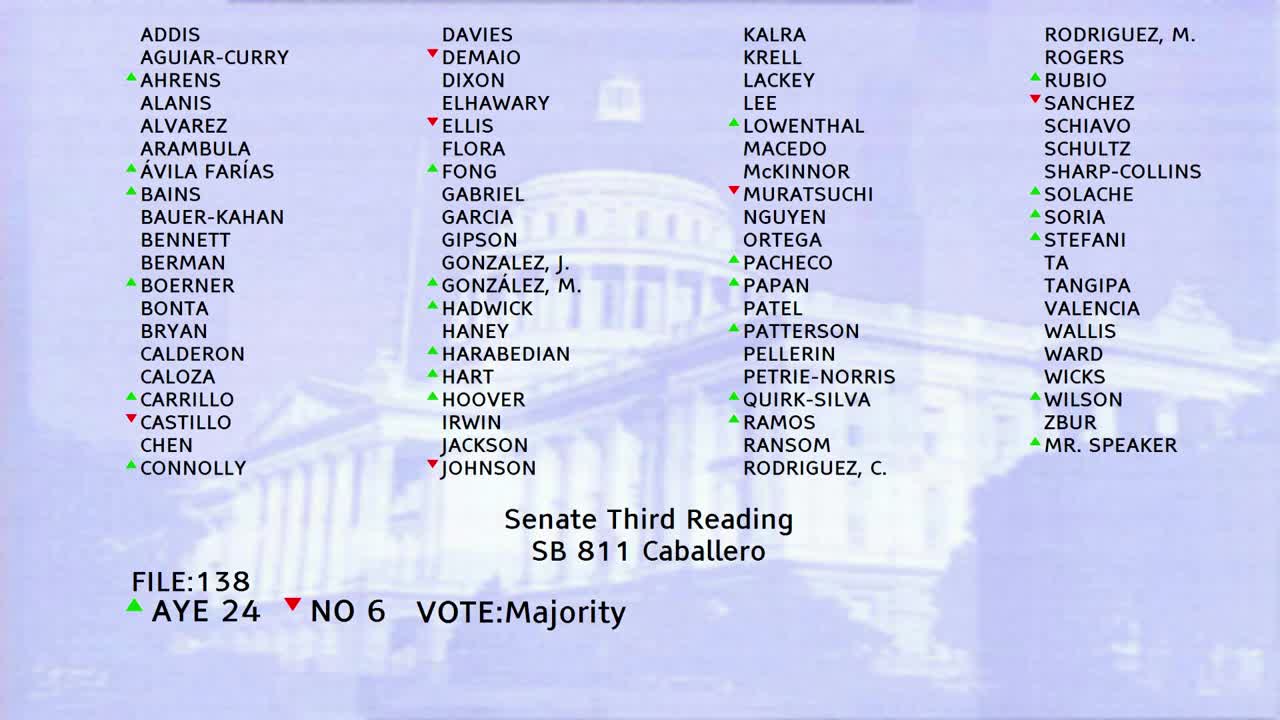 55SEC
Assembly Floor
 1MIN
Senate Floor
 5MIN
Senate Standing Committee on Local Government
 6MIN
Assembly Standing Committee on Local Government
Bill Author