AB 2113: Aviation: unmanned aircraft systems: ticketed entertainment events and amusement parks.
- Session Year: 2025-2026
- House: Assembly
- Latest Version Date: 2026-09-20
Current Status:
Passed
(2026-09-20: Chaptered by Secretary of State - Chapter 383, Statutes of 2026.)
Introduced
In Committee
Awaiting First Chamber Vote
Passed First Chamber
In Committee
Awaiting Second Chamber Vote
Passed Second Chamber
Enacted
What does this bill do?
The bill bans flying drones within 400 feet of outdoor ticketed entertainment events or amusement parks, affecting drone operators and venue operators. Flights are allowed if the operator has the venue's consent, is a venue employee on official business, is a utility or transportation agency worker on duty, or holds an FAA authorization for beyond‑visual‑line‑of‑sight commercial operations and follows federal rules. Violating the rule is an infraction with a $500 fine, and emergency personnel (firefighters, police, medical workers) may still use drones while performing emergency duties.
The summary is provided by generative AI which can make mistakes. For original language, please view the details in the table below.
Existing federal law regulates aviation safety and airspace efficiency for manned and unmanned aircraft. Existing law makes it a misdemeanor to impede police officers, firefighters, emergency medical, or other emergency personnel or military personnel in the performance of their duties by operating an unmanned aerial vehicle at the scene of an emergency. Existing law makes it a misdemeanor to use an unmanned aircraft system to invade a persons privacy, as specified. Existing law prohibits operating an unmanned aircraft system on or above the grounds of a state prison, jail, or juvenile hall, as specified.
This bill would prohibit the operation of an unmanned aircraft within 400 feet of an outdoor ticketed entertainment event or an amusement park, except under specified circumstances. The bill would make a violation of this prohibition an infraction punishable by a fine of $500. By creating a new crime, the bill would impose a state-mandated local program.
The California Constitution requires the state to reimburse local agencies and school districts for certain costs mandated by the state. Statutory provisions establish procedures for making that reimbursement.
This bill would provide that no reimbursement is required by this act for a specified reason.
Existing federal law regulates aviation safety and airspace efficiency for manned and unmanned aircraft. Existing law makes it a misdemeanor to impede police officers, firefighters, emergency medical, or other emergency personnel or military personnel in the performance of their duties by operating an unmanned aerial vehicle at the scene of an emergency. Existing law makes it a misdemeanor to use an unmanned aircraft system to invade a persons privacy, as specified. Existing law prohibits operating an unmanned aircraft system on or above the grounds of a state prison, jail, or juvenile hall, as specified.
This bill would prohibit the operation of an unmanned aircraft within 400 feet of an outdoor ticketed entertainment event, event or an amusement park, except under specified circumstances. The bill would make a violation of this prohibition an infraction punishable by a fine of $500. By creating a new crime, the bill would impose a state-mandated local program.
The California Constitution requires the state to reimburse local agencies and school districts for certain costs mandated by the state. Statutory provisions establish procedures for making that reimbursement.
This bill would provide that no reimbursement is required by this act for a specified reason.
Existing federal law regulates aviation safety and airspace efficiency for manned and unmanned aircraft. Existing law makes it a misdemeanor to impede police officers, firefighters, emergency medical, or other emergency personnel or military personnel in the performance of their duties by operating an unmanned aerial vehicle at the scene of an emergency. Existing law makes it a misdemeanor to use an unmanned aircraft system to invade a persons privacy, as specified. Existing law prohibits operating an unmanned aircraft system on or above the grounds of a state prison, jail, or juvenile hall, as specified.
This bill would prohibit the operation of an unmanned aircraft within 400 feet of an outdoor ticketed entertainment event, except under specified circumstances. The bill would make a violation of this prohibition an infraction punishable by a fine of $500. By creating a new crime, the bill would impose a state-mandated local program.
The California Constitution requires the state to reimburse local agencies and school districts for certain costs mandated by the state. Statutory provisions establish procedures for making that reimbursement.
This bill would provide that no reimbursement is required by this act for a specified reason.
Existing federal law regulates aviation safety and airspace efficiency for manned and unmanned aircraft. Existing law makes it a misdemeanor to impede police officers, firefighters, emergency medical, or other emergency personnel or military personnel in the performance of their duties by operating an unmanned aerial vehicle at the scene of an emergency. Existing law makes it a misdemeanor to use an unmanned aircraft system to invade a persons privacy, as specified. Existing law prohibits operating an unmanned aircraft system on or above the grounds of a state prison, jail, or juvenile hall, as specified.
This bill would prohibit the operation of an unmanned aircraft within a 400-foot radius of, or above, a 400 feet of an outdoor ticketed entertainment event, except under specified circumstances. The bill would make a violation of this prohibition an infraction punishable by a fine of $500. By creating a new crime, the bill would impose a state-mandated local program.
The California Constitution requires the state to reimburse local agencies and school districts for certain costs mandated by the state. Statutory provisions establish procedures for making that reimbursement.
This bill would provide that no reimbursement is required by this act for a specified reason.
Existing federal law regulates aviation safety and airspace efficiency for manned and unmanned aircraft. Existing law makes it a misdemeanor to impede police officers, firefighters, emergency medical, or other emergency personnel or military personnel in the performance of their duties by operating an unmanned aerial vehicle at the scene of an emergency. Existing law makes it a misdemeanor to use an unmanned aircraft system to invade a persons privacy, as specified. Existing law prohibits operating an unmanned aircraft system on or above the grounds of a state prison, jail, or juvenile hall, as specified.
This bill would prohibit the operation of an unmanned aircraft system within 400 feet a 400-foot radius of, or above, a ticketed entertainment event, except under specified circumstances. The bill would make a violation of this prohibition an infraction punishable by a fine of $500. By creating a new crime, the bill would impose a state-mandated local program.
The California Constitution requires the state to reimburse local agencies and school districts for certain costs mandated by the state. Statutory provisions establish procedures for making that reimbursement.
This bill would provide that no reimbursement is required by this act for a specified reason.
Existing federal law regulates aviation safety and airspace efficiency for manned and unmanned aircraft. Existing law makes it a misdemeanor to impede police officers, firefighters, emergency medical, or other emergency personnel or military personnel in the performance of their duties by operating an unmanned aerial vehicle at the scene of an emergency. Existing law makes it a misdemeanor to use an unmanned aircraft system to invade a persons privacy, as specified. Existing law prohibits operating an unmanned aircraft system on or above the grounds of a state prison, jail, or juvenile hall, as specified.
This bill would prohibit the operation of an unmanned aircraft system within 400 feet of, or above, a ticketed entertainment event, except under specified circumstances. The bill would make a violation of this prohibition an infraction punishable by a fine of $500. By creating a new crime, the bill would impose a state-mandated local program.
The California Constitution requires the state to reimburse local agencies and school districts for certain costs mandated by the state. Statutory provisions establish procedures for making that reimbursement.
This bill would provide that no reimbursement is required by this act for a specified reason.
The Legislature finds and declares all of the following:
(a)New and emerging technologies, including unmanned aircraft (drones), pose an evolving risk to public safety, particularly at large-scale live entertainment and sporting events involving dense crowds that are central to the states economy and the enjoyment of its residents.
(b)The continued vitality of outdoor live entertainment and major sporting events in the state depends on the ability to protect attendees, artists, athletes, and event personnel from any risks that may be posed by unauthorized or unsafe drone operations.
(c)The state is home to marquee events and upcoming global gatherings, including the 2028 Olympic and Paralympic Games, 2026 FIFA World Cup, Super Bowl LX, and major live entertainment festivals such as Coachella Valley Music and Arts Festival, BottleRock Napa Valley, La Onda, Stagecoach Festival, Beyond Wonderland SoCal, Aftershock Festival, and numerous other events that attract hundreds of thousands of attendees annually.
SEC. 2.Part 1.5 (commencing with Section 21750) is added to Division 9 of the Public Utilities Code, to read:1.5.Unmanned Aircraft Systems21750.For purposes of this part, all of the following definitions apply:
(a)Amusement park means a permanent facility or park, open to the public, that includes one or more amusement rides or attractions, and is classified within North American Industry Classification System (NAICS) Code 713110 by the NAICS Association.
(b)Ticketed entertainment event means any professional music, sporting, or performing arts event that meets both of the following requirements:
(1)It is held in an entertainment venue with the capacity to hold 1,000 or more attendees with gated entries or barriers that prevent access to the general public.
(2)It is not covered by Federal Aviation Administration restrictions.
(c)Unmanned aircraft has the same meaning as defined in Section 853.5 of the Government Code.
(d)Venue operator means any person who owns, operates, manages, or controls an entertainment venue or amusement park.
21752.(a)It is unlawful to operate an unmanned aircraft within 400 feet of an outdoor ticketed entertainment event or amusement park.
(b)Subdivision (a) does not apply to a person who operates an unmanned aircraft under the following circumstances:
(1)The person (A) has obtained consent from the venue operator for the ticketed entertainment event or amusement park, or (B) is an employee of the entertainment venue where the ticketed entertainment event is held, or of the amusement park, and is conducting official business.
(2)The person is an employee of a water, sewer, electrical, telephone, cable, or other regulated utility service provider, or a federal, state, or local transportation agency, including the Department of Transportation, and is conducting official business.
(3)The person holds a certificate, waiver, or other authorization issued by the Federal Aviation Administration to operate an unmanned aircraft, is operating for a commercial purpose, is authorized to conduct commercial operations beyond visual line of sight using unmanned aircraft, and is operating in compliance with all applicable federal regulations and the terms of that authorization. This paragraph does not authorize the capture with intent to distribute copyrighted images or video of a ticketed entertainment event or amusement park without authorization from the venue operator.
(c)A violation of this section is an infraction. Each violation of this section shall be punishable by a fine of five hundred dollars ($500).
(d)This section shall not be interpreted to prohibit a firefighter, peace officer, medical personnel, or other public agency emergency personnel in the performance of their fire suppression, law enforcement, or emergency response duties from using an unmanned aircraft within 400 feet of an outdoor ticketed entertainment event or amusement park.
SEC. 3.No reimbursement is required by this act pursuant to Section 6 of Article XIIIB of the California Constitution because the only costs that may be incurred by a local agency or school district will be incurred because this act creates a new crime or infraction, eliminates a crime or infraction, or changes the penalty for a crime or infraction, within the meaning of Section 17556 of the Government Code, or changes the definition of a crime within the meaning of Section 6 of Article XIIIB of the California Constitution.
The Legislature finds and declares all of the following:
(a)New and emerging technologies, including unmanned aircraft (drones), pose an evolving risk to public safety, particularly at large-scale live entertainment and sporting events involving dense crowds that are central to the states economy and the enjoyment of its residents.
(b)The continued vitality of outdoor live entertainment and major sporting events in the state depends on the ability to protect attendees, artists, athletes, and event personnel from any risks that may be posed by unauthorized or unsafe drone operations.
(c)The state is home to marquee events and upcoming global gatherings, including the 2028 Olympic and Paralympic Games, 2026 FIFA World Cup, Super Bowl LX, and major live entertainment festivals such as Coachella Valley Music and Arts Festival, BottleRock Napa Valley, La Onda, Stagecoach Festival, Beyond Wonderland SoCal, Aftershock Festival, and numerous other events that attract hundreds of thousands of attendees annually.
SEC. 2.Part 1.5 (commencing with Section 21750) is added to Division 9 of the Public Utilities Code, to read:1.5.Unmanned Aircraft Systems21750.For purposes of this part, the following definitions apply:
(a)Amusement park means a permanent facility or park, open to the public, that includes one or more amusement rides or attractions, and is classified within North American Industry Classification System (NAICS) Code 713110 by the NAICS Association.
(a)(b)Ticketed entertainment event means any professional music, sporting, or performing arts event that meets all both of the following requirements:
(1)It is held in an entertainment venue with the capacity to hold 1,000 or more attendees with gated entries or barriers that prevent access to the general public.
(2)A revocable license that has been issued by the venue operator of the entertainment venue is required for attendance at the event.(3)(2)It is not covered by Federal Aviation Administration restrictions.
(b)(c)Unmanned aircraft has the same meaning as defined in Section 853.5 of the Government Code.
(c)(d)Venue operator means any person who owns, operates, manages, or controls an entertainment venue. venue or amusement park.
21752.(a)It is unlawful to operate an unmanned aircraft within 400 feet of an outdoor ticketed entertainment event. event or amusement park.
(b)Subdivision (a) does not apply to a person who operates an unmanned aircraft under either of the following circumstances:
(1)The person (A) has obtained consent from the venue operator for the ticketed entertainment event, event or amusement park, or (B) is an employee of the entertainment venue where the ticketed entertainment event is held held, or of the amusement park, and is conducting official business.
(2)The person is an employee of a water, sewer, electrical, telephone, cable, or other regulated utility service provider provider, or a federal, state, or local transportation agency, including the Department of Transportation, and is conducting official business.
(3)The person holds a certificate, waiver, or other authorization issued by the Federal Aviation Administration to operate an unmanned aircraft, is operating for a commercial purpose, is authorized to conduct commercial operations beyond visual line of sight using unmanned aircraft, and is operating in compliance with all applicable federal regulations and the terms of that authorization. This paragraph does not authorize the capture with intent to distribute copyrighted images or video of a ticketed entertainment event or amusement park without authorization from the venue operator.
(c)A violation of this section is an infraction. Each violation of this section shall be punishable by a fine of five hundred dollars ($500).
(d)This section shall not be interpreted to prohibit a firefighter, peace officer, medical personnel, or other public agency emergency personnel in the performance of their fire suppression, law enforcement, or emergency response duties from using an unmanned aircraft within 400 feet of an outdoor ticketed entertainment event. event or amusement park.
SEC. 3.No reimbursement is required by this act pursuant to Section 6 of Article XIIIB of the California Constitution because the only costs that may be incurred by a local agency or school district will be incurred because this act creates a new crime or infraction, eliminates a crime or infraction, or changes the penalty for a crime or infraction, within the meaning of Section 17556 of the Government Code, or changes the definition of a crime within the meaning of Section 6 of Article XIIIB of the California Constitution.
The Legislature finds and declares all of the following:
(a)New and emerging technologies, including unmanned aircraft (drones), pose an evolving risk to public safety, particularly at large-scale live entertainment and sporting events involving dense crowds that are central to the states economy and the enjoyment of its residents.
(b)The continued vitality of outdoor live entertainment and major sporting events in the state depends on the ability to protect attendees, artists, athletes, and event personnel from any risks that may be posed by unauthorized or unsafe drone operations.
(c)The state is home to marquee events and upcoming global gatherings, including the 2028 Summer Olympics, Olympic and Paralympic Games, 2026 FIFA World Cup, Super Bowl LX, and major live entertainment festivals such as Coachella Valley Music and Arts Festival, BottleRock Napa Valley, La Onda, Stagecoach Festival, Beyond Wonderland SoCal, Aftershock Festival, and numerous other events that attract hundreds of thousands of attendees annually.
SEC. 2.Part 1.5 (commencing with Section 21750) is added to Division 9 of the Public Utilities Code, to read:1.5.Unmanned Aircraft Systems21750.For purposes of this part, the following definitions apply:
(a)Ticketed entertainment event means any professional music, sporting, or performing arts event that meets all of the following requirements:
(1)It is held in an entertainment venue with the capacity to hold 1,000 or more attendees with gated entries or barriers that prevent access to the general public.
(2)A revocable license that has been issued by the venue operator of the entertainment venue is required for attendance at the event.
(3)It is not covered by Federal Aviation Administration restrictions.
(b)Unmanned aircraft has the same meaning as defined in Section 853.5 of the Government Code.
(c)Venue operator means any person who owns, operates, manages, or controls an entertainment venue.
21752.(a)It is unlawful to operate an unmanned aircraft within 400 feet of an outdoor ticketed entertainment event.
(b)Subdivision (a) does not apply to a person who operates an unmanned aircraft under either of the following circumstances:
(1)The person (A) has obtained consent from the venue operator for the ticketed entertainment event, or (B) is an employee of the entertainment venue where the ticketed entertainment event is held and is conducting official business.
(2)The person is an employee of a water, sewer, electrical, telephone, cable, or other regulated utility service provider and is conducting official business.
(c)A violation of this section is an infraction. Each violation of this section shall be punishable by a fine of five hundred dollars ($500).
(d)This section shall not be interpreted to prohibit a firefighter, peace officer, medical personnel, or other emergency personnel in the performance of their fire suppression, law enforcement, or emergency response duties from using an unmanned aircraft within 400 feet of an outdoor ticketed entertainment event.
SEC. 3.No reimbursement is required by this act pursuant to Section 6 of Article XIIIB of the California Constitution because the only costs that may be incurred by a local agency or school district will be incurred because this act creates a new crime or infraction, eliminates a crime or infraction, or changes the penalty for a crime or infraction, within the meaning of Section 17556 of the Government Code, or changes the definition of a crime within the meaning of Section 6 of Article XIIIB of the California Constitution.
The Legislature finds and declares all of the following:
(a)New and emerging technologies, including unmanned aircraft (drones), pose an evolving risk to public safety, particularly at large-scale live entertainment and sporting events involving dense crowds that are central to the states economy and the enjoyment of its residents.
(b)The continued vitality of outdoor live entertainment and major sporting events in the state depends on the ability to protect attendees, artists, athletes, and event personnel from the any risks that may be posed by unauthorized or unsafe drone operations.
(c)While federal authorities historically maintain jurisdiction over national airspace and temporary flight restrictions, they may not always be positioned to respond quickly to unauthorized drone activity occurring at live entertainment venues, stadiums, or other large public gatherings.(d)In practice, many large events rely on the local familiarity and venue-specific expertise of local law enforcement agencies to oversee public safety operations. Empowering local law enforcement to take appropriate and timely action in response to unauthorized drone operations within restricted airspace will enhance crowd safety and reduce the risk of harm.(e)Effective communication among the Federal Aviation Administration, state agencies, municipalities, and local law enforcement is necessary to ensure that temporary flight restrictions are properly requested, implemented, communicated, and enforced.(f)(c)The state is home to marquee events and upcoming global gatherings, including the 2028 Summer Olympics, 2026 FIFA World Cup, Super Bowl LX, and major live entertainment festivals such as Coachella Valley Music and Arts Festival, BottleRock Napa Valley, La Onda, Stagecoach Festival, Beyond Wonderland SoCal, Aftershock Festival, and numerous other events that attract hundreds of thousands of attendees annually.
(g)State action is necessary to protect the public safety and the economic ecosystem of outdoor live events and to preserve cultural relevance of California outdoor venues. Establishing clear regulation of drones and comprehensive protocols for local law enforcement ensures the long-term vitality of outdoor live events in the state.SEC. 2.Part 1.5 (commencing with Section 21750) is added to Division 9 of the Public Utilities Code, to read:1.5.Unmanned Aircraft Systems21750.For purposes of this part, the following definitions apply:
(a)Ticketed entertainment event means any professional music, sporting, or performing arts event held that meets all of the following requirements:
(1)It is held in an entertainment venue with the capacity to hold 1,000 or more attendees with gated entries or barriers that prevent access to the general public and in which a public.
(2)A revocable license that has been issued by the venue operator of the entertainment venue is required for attendance at the event.
(3)It is not covered by Federal Aviation Administration restrictions.
(b)Unmanned aircraft has the same meaning as defined in Section 853.5 of the Government Code.
(c)Venue operator means any person who owns, operates, manages, or controls an entertainment venue.
21752.(a)It is unlawful to operate an unmanned aircraft within a 400-foot radius of, or above, a 400 feet of an outdoor ticketed entertainment event.
(b)Subdivision (a) does not apply to a person who operates an unmanned aircraft under any either of the following circumstances:
(1)The person (A) has obtained consent by from the venue operator for the ticketed entertainment event, or (B) is an employee of the entertainment venue where the ticketed entertainment event is held and is conducting official business.
(2)The person is authorized by federal regulations adopted by the Federal Aviation Administration to operate an unmanned aircraft and is operating the unmanned aircraft in a lawful manner and consistent with those federal regulations.(3)(2)The person is an employee of a water, sewer, electrical, telephone, cable, or other regulated utility service provider and is conducting official business.
(c)A violation of this section is an infraction. Each violation of this section shall be punishable by a fine of five hundred dollars ($500).
SEC. 3.No reimbursement is required by this act pursuant to Section 6 of Article XIIIB of the California Constitution because the only costs that may be incurred by a local agency or school district will be incurred because this act creates a new crime or infraction, eliminates a crime or infraction, or changes the penalty for a crime or infraction, within the meaning of Section 17556 of the Government Code, or changes the definition of a crime within the meaning of Section 6 of Article XIIIB of the California Constitution.
The Legislature finds and declares all of the following:
(a)New and emerging technologies, including unmanned aircraft systems (drones), pose an evolving risk to public safety, particularly at large-scale live entertainment and sporting events involving dense crowds that are central to the states economy and the enjoyment of its residents.
(b)The continued vitality of outdoor live entertainment and major sporting events in the state depends on the ability to protect attendees, artists, athletes, and event personnel from the risks posed by unauthorized or unsafe drone operations.
(c)While federal authorities historically maintain jurisdiction over national airspace and temporary flight restrictions, they may not always be positioned to respond quickly to unauthorized drone activity occurring at live entertainment venues, stadiums, or other large public gatherings.
(d)In practice, many large events rely on the local familiarity and venue-specific expertise of local law enforcement agencies to oversee public safety operations. Empowering local law enforcement to take appropriate and timely action in response to unauthorized drone operations within restricted airspace will enhance crowd safety and reduce the risk of harm.
(e)Effective communication among the Federal Aviation Administration, state agencies, municipalities, and local law enforcement is necessary to ensure that temporary flight restrictions are properly requested, implemented, communicated, and enforced.
(f)The state is home to marquee events and upcoming global gatherings, including the 2028 Summer Olympics, 2026 FIFA World Cup, Super Bowl LX, and major live entertainment festivals such as Coachella Valley Music and Arts Festival, BottleRock Napa Valley, La Onda, Stagecoach Festival, Beyond Wonderland SoCal, Aftershock Festival, and numerous other events that attract hundreds of thousands of attendees annually.
(g)State action is necessary to protect the public safety and the economic ecosystem of outdoor live events and to preserve cultural relevance of California outdoor venues. Establishing clear regulation of drones and comprehensive protocols for local law enforcement ensures the long-term vitality of outdoor live events in the state.
SEC. 2.Part 1.5 (commencing with Section 21750) is added to Division 9 of the Public Utilities Code, to read:1.5.Unmanned Aircraft Systems21750.For purposes of this part, the following definitions apply:
(a)Ticketed entertainment event means any music, sporting, or performing arts event held in a location an entertainment venue with gated entries or barriers that prevent access to the general public and in which a revocable license that has been issued by an owner, operator, or lessee the venue operator of that property the entertainment venue is required for attendance at the event.
(b)(1)Unmanned aircraft system means a powered, aerial vehicle that meets all of the following requirements: aircraft has the same meaning as defined in Section 853.5 of the Government Code.
(A)It does not carry a human operator and is operated without the possibility of direct human intervention from within or on the aircraft.(B)It uses aerodynamic forces to provide vehicle lift.(C)It can fly autonomously or be piloted remotely.(D)It can be expendable or recoverable.(2)An unmanned aircraft system does not include a satellite.(c)Venue operator means any person who owns, operates, manages, or controls an entertainment venue.
21752.(a)It is unlawful to operate an unmanned aircraft system within 400 feet a 400-foot radius of, or above, a ticketed entertainment event.
(b)Subdivision (a) does not apply to a person who operates an unmanned aircraft system under any of the following circumstances:
(1)The person (A) has obtained consent by any person with legal authority over the venue operator for the ticketed entertainment event. event, or (B) is an employee of the entertainment venue where the ticketed entertainment event is held and is conducting official business.
(2)The person is authorized by federal regulations adopted by the Federal Aviation Administration to operate an unmanned aircraft system and is operating that system the unmanned aircraft in a lawful manner and consistent with those federal regulations.
(3)The person is an employee of the property where the ticketed entertainment event is held and is conducting official business.(4)(3)The person is an employee of a water, sewer, electrical, telephone, cable, or other regulated utility service provider and is conducting official business.
(5)The person is an owner of private property who is operating an unmanned aircraft system that they own above that property, provided that the operation is consistent with federal regulations and is not used for commercial purposes, to convey or communicate a message, or to record for purposes of commercial broadcasting or publication, monitor, or otherwise interfere in any way with the ticketed entertainment event.(c)A violation of this section is an infraction. Each violation of this section shall be punishable by a fine of five hundred dollars ($500).
SEC. 3.No reimbursement is required by this act pursuant to Section 6 of Article XIIIB of the California Constitution because the only costs that may be incurred by a local agency or school district will be incurred because this act creates a new crime or infraction, eliminates a crime or infraction, or changes the penalty for a crime or infraction, within the meaning of Section 17556 of the Government Code, or changes the definition of a crime within the meaning of Section 6 of Article XIIIB of the California Constitution.
The Legislature finds and declares all of the following:
(a)New and emerging technologies, including unmanned aircraft systems (drones), pose an evolving risk to public safety, particularly at large-scale live entertainment and sporting events involving dense crowds that are central to the states economy and the enjoyment of its residents.
(b)The continued vitality of outdoor live entertainment and major sporting events in the state depends on the ability to protect attendees, artists, athletes, and event personnel from the risks posed by unauthorized or unsafe drone operations.
(c)While federal authorities historically maintain jurisdiction over national airspace and temporary flight restrictions, they may not always be positioned to respond quickly to unauthorized drone activity occurring at live entertainment venues, stadiums, or other large public gatherings.
(d)In practice, many large events rely on the local familiarity and venue-specific expertise of local law enforcement agencies to oversee public safety operations. Empowering local law enforcement to take appropriate and timely action in response to unauthorized drone operations within restricted airspace will enhance crowd safety and reduce the risk of harm.
(e)Effective communication among the Federal Aviation Administration, state agencies, municipalities, and local law enforcement is necessary to ensure that temporary flight restrictions are properly requested, implemented, communicated, and enforced.
(f)The state is home to marquee events and upcoming global gatherings, including the 2028 Summer Olympics, 2026 FIFA World Cup, Super Bowl LX, and major live entertainment festivals such as Coachella Valley Music and Arts Festival, BottleRock Napa Valley, La Onda, Stagecoach Festival, Beyond Wonderland SoCal, Aftershock Festival, and numerous other events that attract hundreds of thousands of attendees annually.
(g)State action is necessary to protect the public safety and the economic ecosystem of outdoor live events and to preserve cultural relevance of California outdoor venues. Establishing clear regulation of drones and comprehensive protocols for local law enforcement ensures the long-term vitality of outdoor live events in the state.
SEC. 2.Part 1.5 (commencing with Section 21750) is added to Division 9 of the Public Utilities Code, to read:1.5.Unmanned Aircraft Systems21750.For purposes of this part, the following definitions apply:
(a)Ticketed entertainment event means any music, sporting, or performing arts event held in a location with gated entries or barriers that prevent access to the general public and in which a revocable license that has been issued by an owner, operator, or lessee of that property is required for attendance at the event.
(b)(1)Unmanned aircraft system means a powered, aerial vehicle that meets all of the following requirements:
(A)It does not carry a human operator and is operated without the possibility of direct human intervention from within or on the aircraft.
(B)It uses aerodynamic forces to provide vehicle lift.
(C)It can fly autonomously or be piloted remotely.
(D)It can be expendable or recoverable.
(2)An unmanned aircraft system does not include a satellite.
21752.(a)It is unlawful to operate an unmanned aircraft system within 400 feet of, or above, a ticketed entertainment event.
(b)Subdivision (a) does not apply to a person who operates an unmanned aircraft system under any of the following circumstances:
(1)The person has obtained consent by any person with legal authority over the ticketed entertainment event.
(2)The person is authorized by federal regulations to operate an unmanned aircraft system and is operating that system in a lawful manner and consistent with federal regulations.
(3)The person is an employee of the property where the ticketed entertainment event is held and is conducting official business.
(4)The person is an employee of a water, sewer, electrical, telephone, cable, or other regulated utility service provider and is conducting official business.
(5)The person is an owner of private property who is operating an unmanned aircraft system that they own above that property, provided that the operation is consistent with federal regulations and is not used for commercial purposes, to convey or communicate a message, or to record for purposes of commercial broadcasting or publication, monitor, or otherwise interfere in any way with the ticketed entertainment event.
(c)A violation of this section is an infraction. Each violation of this section shall be punishable by a fine of five hundred dollars ($500).
SEC. 3.No reimbursement is required by this act pursuant to Section 6 of Article XIIIB of the California Constitution because the only costs that may be incurred by a local agency or school district will be incurred because this act creates a new crime or infraction, eliminates a crime or infraction, or changes the penalty for a crime or infraction, within the meaning of Section 17556 of the Government Code, or changes the definition of a crime within the meaning of Section 6 of Article XIIIB of the California Constitution.
|
Date
|
Status
|
|---|---|
| Sep 20, 2026 | Chaptered by Secretary of State - Chapter 383, Statutes of 2026. |
| Sep 20, 2026 | Approved by the Governor. |
| Sep 4, 2026 | Enrolled and presented to the Governor at 4 p.m. |
| Aug 27, 2026 | Senate amendments concurred in. To Engrossing and Enrolling. (Ayes 76. Noes 0.). |
| Aug 27, 2026 | Senate amendments concurred in. To Engrossing and Enrolling. (Ayes 76. Noes 0. Page 6723.). |
| Aug 27, 2026 | In Assembly. Concurrence in Senate amendments pending. |
| Aug 26, 2026 | Read third time. Passed. Ordered to the Assembly. (Ayes 39. Noes 0.). |
| Aug 24, 2026 | Read second time. Ordered to third reading. |
| Aug 20, 2026 | Read third time and amended. Ordered to second reading. |
| Aug 11, 2026 | Read second time. Ordered to third reading. |
| Aug 10, 2026 | From committee: Be ordered to second reading pursuant to Senate Rule 28.8. |
| Aug 4, 2026 | From committee chair, with author's amendments: Amend, and re-refer to committee. Read second time, amended, and re-referred to Com. on APPR. |
| Jul 29, 2026 | In committee: Hearing postponed by committee. |
| Jul 1, 2026 | From committee: Do pass and re-refer to Com. on APPR. (Ayes 6. Noes 0.) (June 30). Re-referred to Com. on APPR. |
| Jun 18, 2026 | Read second time and amended. Re-referred to Com. on PUB. S. |
| Jun 17, 2026 | From committee: Amend, and do pass as amended and re-refer to Com. on PUB. S. (Ayes 11. Noes 0.) (June 16). |
| Jun 3, 2026 | Referred to Coms. on JUD. and PUB. S. |
| May 18, 2026 | In Senate. Read first time. To Com. on RLS. for assignment. |
| May 18, 2026 | Read third time. Passed. Ordered to the Senate. (Ayes 72. Noes 0.) |
| May 18, 2026 | Read third time. Passed. Ordered to the Senate. (Ayes 72. Noes 0. Page 5135.) |
| May 14, 2026 | Read second time. Ordered to third reading. |
| May 13, 2026 | From committee: Do pass. (Ayes 15. Noes 0.) (May 13). |
| May 6, 2026 | In committee: Hearing postponed by committee. |
| Apr 21, 2026 | From committee: Do pass and re-refer to Com. on APPR. (Ayes 9. Noes 0.) (April 21). Re-referred to Com. on APPR. |
| Apr 13, 2026 | Re-referred to Com. on A.,E.,S., & T. |
| Apr 9, 2026 | Read second time and amended. |
| Apr 8, 2026 | From committee: Amend, and do pass as amended and re-refer to Com. on A.,E.,S., & T. with recommendation: To Consent Calendar. (Ayes 15. Noes 0.) (April 7). |
| Apr 6, 2026 | Re-referred to Com. on P. & C.P. |
| Mar 26, 2026 | From committee chair, with author's amendments: Amend, and re-refer to Com. on P. & C.P. Read second time and amended. |
| Mar 18, 2026 | In committee: Set, first hearing. Hearing canceled at the request of author. |
| Mar 9, 2026 | Referred to Coms. on P. & C.P. and A.,E.,S., & T. |
| Feb 19, 2026 | From printer. May be heard in committee March 21. |
| Feb 18, 2026 | Read first time. To print. |
|
Date
|
Description
|
Location
|
Votes
|
|
|---|---|---|---|---|
| Aug 27, 2026 | AB 2113 McKinnor Concurrence in Senate Amendments | Assembly Floor |
Passed |
|
| Aug 26, 2026 | Assembly 3rd Reading AB2113 McKinnor et al. By Richardson | Senate Floor |
Passed |
|
| Jun 30, 2026 | Do pass, but first be re-referred to the Committee on [Appropriations] | Senate Standing Committee on Public Safety |
Passed |
|
| Jun 16, 2026 | Do pass as amended, but first amend, and re-refer to the Committee on [Public Safety] | Senate Standing Committee on Judiciary |
Passed |
|
| May 18, 2026 | AB 2113 McKinnor Assembly Third Reading | Assembly Floor |
Passed |
|
| May 13, 2026 | Do pass. | Assembly Standing Committee on Appropriations |
Passed |
|
| Apr 21, 2026 | Do pass and be re-referred to the Committee on [Appropriations] | Assembly Standing Committee on Arts, Entertainment, Sports, and Tourism |
Passed |
|
| Apr 7, 2026 | Do pass as amended, and be re-referred to the Committee on [Arts, Entertainment, Sports, and Tourism] with recommendation: To Consent Calendar | Assembly Standing Committee on Privacy and Consumer Protection |
Passed |
This list shows positions taken on this bill by organizations on the date displayed, which is linked to the original source.
Positions by individuals are not included.
|
Organization
|
Position
|
Date
|
|---|---|---|
| Anschutz | ** Support | |
| Anschutz Entertainment Group | ** Support | |
| BottleRock Napa Valley | ** Support | |
| California Attractions And Parks Association | ** Support | |
| Forty Niners Football Company | ** Support | |
| Forty Niners Football Company LLC | ** Support | |
| Insomniac | ** Support | |
| Live Nation | ** Support | |
| Live Nation Entertainment | ** Support | |
| Peace Officers Research Association Of California | ** Support | |
| San Francisco Forty-Niners | ** Support | |
| Technet | ** Against |
Date of Hearing: April 7, 2026
Fiscal:
ASSEMBLY COMMITTEE ON PRIVACY AND CONSUMER PROTECTION
Rebecca Bauer-Kahan, Chair
ABPCA Bill Id:AB 2113 (
Author:McKinnor) – As Amended Ver:March 26, 2026
PROPOSED AMENDMENTS
SUBJECT: Aviation: unmanned aircraft systems: ticketed entertainment events
SYNOPSIS
Along with all the other advances in technology in recent years, there has been a rapid proliferation of robotic devices and drones. As with all technology, as it advances it often becomes more affordable, leading to more widespread use. There are several policy considerations related to the proliferation of these devices; this bill addresses the flying of drones over live entertainment events. Specifically, except in certain narrow circumstances, this bill makes it illegal to fly a drone within 400 feet of a live entertainment event.
As currently drafted, the bill applies to any entertainment event, regardless of size, that requires a ticket for entry. Conceivably, this could include a ballet recital for young children, a high school football game, a local musical act at a small club, or a Bad Bunny stadium concert. The proposed Committee amendments narrow the scope of the bill to apply to professional music, sporting, or performing arts events that are held in an outdoor venue capable of accommodating 1,000 or more attendees. In addition, the amendments remove an exemption that would have allowed most legal drone operators, including recreational operators, to continue to operate their drones within the restricted area. Finally, the amendments make several other clarifying changes as enumerated in Comment #5.
This bill is sponsored by Live Nation Entertainment and enjoys the support of the San Francisco Forty-Niners. If passed by this Committee, this bill will next be heard by the Arts, Entertainment, Sports, and Tourism Committee.
EXISTING LAW:
- Defines the following terms:
- “Unmanned aircraft” means an aircraft that is operated without the possibility of direct human intervention from within or on the aircraft. (Gov. Code § 853.5(a).)
- “Unmanned aircraft system” means an unmanned aircraft and associated elements, including but not limited to, communication links and the components that control the uncrewed aircraft, which are required for the pilot in command to operate safely and efficiently in the national airspace system. (Gov. Code § 853.5(b).)
- Provides that a person who knowingly and intentionally operates an unmanned aircraft system on or above the grounds of a state prison, a jail, or a juvenile hall, camp, or ranch is guilty of an infraction, punishable by a fine of $500. (Gov. Code, § 4577 (a).)
- Makes it a misdemeanor to use an unmanned aircraft system to look through a hole or opening into the interior of specified areas in which the occupant has a reasonable expectation of privacy with the intent to invade the privacy of a person inside. (Pen. Code, § 647(j)(1).)
- Vests, pursuant to federal law, the Federal Aviation Administration (FAA) with the authority to regulate airspace use, management and efficiency, air traffic control, safety, navigational facilities, and aircraft noise. (49 U.S.C. §§ 40103, 44502, and 44701-44735.)
- Requires the FAA, under the FAA Modernization and Reform Act of 2012, to safely integrate unmanned aircraft system (UAS) operation into the national airspace system and to develop and implement certification requirements for the operation of UAS in the national airspace system. (Public Law Number 112-095.)
- Requires, under FAA rules, federal registration of a UAS before its first flight outdoors for any UAS weighing more than 0.55 pounds (250 grams) and less than 55 pounds (25 kilos). Upon registration, UAS owners receive a Certificate of Aircraft Registration/Proof of Ownership along with a unique identification number, which must be marked or affixed to the UAS. (14 CFR Parts 1, 45, 47, 48, 91, and 375.)
- Permits commercial UAS flight over unpopulated areas if safety conditions are met, as specified. (14 CFR Part 107.)
THIS BILL:
- Makes is unlawful to operate an unmanned aircraft within a 400-foot radius of a live entertainment event except in the following circumstances:
- The person has obtained consent from the venue operator.
- The person is an employee of the venue where the event is being held and is conducting official business.
- The person is authorized by federal regulations adopted by the FAA to operate unmanned aircraft and is operating the aircraft in a lawful manner consistent with the regulations.
- The person is an employee of a public utility, as defined, and is conducting official business.
- Makes it an infraction to violate the bill, punishable by a fine of five hundred dollars.
- Defines the following terms:
- “Ticketed entertainment event” means any music, sporting, or performing arts event held in an entertainment venue with restricted entry that prevents access to the general public, unless the person has been issued a revocable license to enter by the venue operator.
- “Unmanned aircraft” has the same meaning as defined in Section 853.5 of the Government Code (see “Existing Law” above).
- “Venue operator” means any person who owns, operates, manages, or controls an entertainment venue.
COMMENTS:
1) Author’s statement. According to the author:
AB 2113 is intended to protect public safety at large, ticketed entertainment events by establishing clear limits on the operation of unmanned aircraft systems (drones) over these venues. With California hosting some of the world’s largest concerts, sporting events, and festivals, unauthorized drones pose real risks to attendees, performers, and event personnel. While federal authorities oversee national airspace, local law enforcement often has the best knowledge and capacity to respond quickly to threats at individual venues. This bill empowers local authorities with a clear statutory framework, balancing safety, privacy, and access, to ensure that California’s live entertainment and sporting events remain safe, vibrant, and accessible for all residents and visitors.
2) Background. Drones—termed “unmanned aircraft” and “unmanned aircraft systems” in the Government Code—are increasingly used by government, businesses, and private individuals for a variety of purposes, including law enforcement surveillance, monitoring wildfires, package delivery, search and rescue efforts, or simply for fun. Many drones, whether professional or recreational, come equipped with a camera allowing them to record everything they fly over, including live entertainment events.
As recreational drones have become more affordable in recent years, they have become more ubiquitous. The author argues that this proliferation has created new public safety challenges, particularly at large, ticketed entertainment events that draw dense crowds. Outdoor concerts, sporting events, and festivals often host tens of thousands of attendees in confined spaces, where unauthorized drone operations pose risks of injury, disruption, and interference with emergency response efforts.
3) FAA drone pilot requirements. To legally fly a drone for recreational purposes in the United States, a person is required to register their drone, pass an aeronautical knowledge and safety test, and carry proof of passage when flying. These requirements apply to anyone flying a recreational drone that weighs 250 grams (0.55 lbs) or more. For people flying drones under 55 pounds for non-recreational purposes, additional requirements apply, including a requirement to obtain a remote pilot certification, which allows operators to fly drones for work or business.[1]
4) FAA restrictions. The FAA currently prohibits the flying of drones over certain restricted areas, such as airports. In addition, some jurisdictions have created “No Drone Zones” that prohibit the taking off and landing of drones in restricted areas. The FAA provides No Drone Zone signs that can be used by these governments to identify areas where there are local flight restrictions. They do not, however, restrict a person from flying a drone over the area.[2]
The FAA also prohibits the flying of drones in and around sports stadiums beginning one hour before and ending one hour after the scheduled time of any normal or post-season event for any of the following:
- Major League Baseball
- National Football League
- NCAA Division One Football
- NASCAR Sprint Cup, Indy Car, and Champ Series races[3]
National Security Special Events. In addition to the stadium restrictions, the FAA establishes temporary flight restrictions (TFR) for certain events that the federal government designates as National Security Special Events. These restrictions apply to both drones and planes. The only exceptions are for emergency, public safety, and military aircraft. During Super Bowl LX at Levi Stadium in Santa Clara, the FAA issued a TFR that restricted air traffic during the week leading up to the game and the game itself. On the day of the game, the TFR had “a 30-nautical-mile outer ring and a more restrictive 10-nautical-mile inner core.”[4]
The FAA and the Federal Bureau of Investigation (FBI) coordinated to enforce several TFRs during the week of the Super Bowl, with special restrictions for drones. These restrictions for drone operators included a no-fly zone within 30 nautical miles and 18,000 feet above Levi Stadium during the game.[5]
This bill proposes a more limited 400-foot restriction. However, it applies that restriction to all entertainment venues and all live entertainment and sports events, including high school sports that require an attendee to obtain a ticket to enter the game.
5) Amendments. The author has agreed to accept the following clarifying amendments:
SECTION 1. The Legislature finds and declares all of the following:
(a) New and emerging technologies, including unmanned aircraft (drones), pose an evolving risk to public safety, particularly at large-scale live entertainment and sporting events involving dense crowds that are central to the state’s economy and the enjoyment of its residents.
(b) The continued vitality of outdoor live entertainment and major sporting events in the state depends on the ability to protect attendees, artists, athletes, and event personnel from the any risks that may be posed by unauthorized or unsafe drone operations.
(c) While federal authorities historically maintain jurisdiction over national airspace and temporary flight restrictions, they may not always be positioned to respond quickly to unauthorized drone activity occurring at live entertainment venues, stadiums, or other large public gatherings.
(d) In practice, many large events rely on the local familiarity and venue-specific expertise of local law enforcement agencies to oversee public safety operations. Empowering local law enforcement to take appropriate and timely action in response to unauthorized drone operations within restricted airspace will enhance crowd safety and reduce the risk of harm.
(e) Effective communication among the Federal Aviation Administration, state agencies, municipalities, and local law enforcement is necessary to ensure that temporary flight restrictions are properly requested, implemented, communicated, and enforced.
(f) The state is home to marquee events and upcoming global gatherings, including the 2028 Summer Olympics, 2026 FIFA World Cup, Super Bowl LX, and major live entertainment festivals such as Coachella Valley Music and Arts Festival, BottleRock Napa Valley, La Onda, Stagecoach Festival, Beyond Wonderland SoCal, Aftershock Festival, and numerous other events that attract hundreds of thousands of attendees annually.
(g) State action is necessary to protect the public safety and the economic ecosystem of outdoor live events and to preserve cultural relevance of California outdoor venues. Establishing clear regulation of drones and comprehensive protocols for local law enforcement ensures the long-term vitality of outdoor live events in the state.
SECTION 2.
21750. For purposes of this part, the following definitions apply:
- “Ticketed entertainment event” means any professional music, sporting, or performing arts event that meets all of the following requirements:
- It is held in an entertainment venue with the capacity to hold 1,000 or more attendees with gated entries or barriers that prevent access to the general public.
- A revocable license that has been issued by the venue operator of the entertainment venue is required for attendance at the event.
- It is not covered by Federal Aviation Administration restrictions.
(b) “Unmanned aircraft” has the same meaning as defined in Section 853.5 of the Government Code.
(c) “Venue operator” means any person who owns, operates, manages, or controls an entertainment venue.
21752. (a) It is unlawful to operate an unmanned aircraft within a 400-foot radius of, or above, a 400 feet of an outdoor, ticketed entertainment event.
(b) Subdivision (a) does not apply to a person who operates an unmanned aircraft under any of the following circumstances:
(1) The person (A) has obtained consent by from the venue operator for the ticketed entertainment event, or (B) is an employee of the entertainment venue where the ticketed entertainment event is held and is conducting official business.
(2) The person is authorized by federal regulations adopted by the Federal Aviation Administration to operate an unmanned aircraft and is operating the unmanned aircraft in a lawful manner and consistent with those federal regulations.
(3) The person is an employee of a water, sewer, electrical, telephone, cable, or other regulated utility service provider and is conducting official business.
(c) A violation of this section is an infraction. Each violation of this section shall be punishable by a fine of five hundred dollars ($500).
ARGUMENTS IN SUPPORT: Live Nation Entertainment, sponsors of the bill, write in support:
Live events are an integral part of California’s economy, attracting millions of visitors each year and driving tens of millions in local economic impact across the state. Live Nation alone produces hundreds of outdoor concerts each year at amphitheaters, stadiums, and other open spaces in California. The safety of our guests is a priority for us, as it is for all other event organizers across the state. That requires understanding the ever evolving of technology that bad actors may use, including drones and other unmanned aerial vehicles. Drone usage has skyrocketed in recent years (160% increase since 2019 according to the FAA). Like many of our colleagues in other live events, we have experienced a growing number of unauthorized drone incursions at outdoor festivals, stadiums, and amphitheaters.
Despite that, under current rules and regulations many high-density events such as outdoor festivals and concerts are excluded from existing prohibitions on unauthorized drone use, despite facing comparable security risks to the highest profile of gatherings. As a result, AB 2113 will dramatically improve the safety of live events by enacting an outright ban on operating unauthorized drones and other unmanned aircraft over large crowds at ticketed entertainment events.
We look forward to working closely with state and local law enforcement agencies across the state as they exercise this authority to help create safer events for staff, artists, and fans alike.
In addition, the San Francisco Forty-Niners note:
The rapid growth of personal drone use has created new public safety challenges, particularly at large outdoor concerts and sporting events. Unauthorized drone operations over these gatherings pose serious risks of injury, disruption, and interference with emergency response efforts. While federal authorities regulate national airspace, local law enforcement agencies are responsible for managing crowd safety at these events and currently lack clear state-level statutory authority specifically addressing personal drone operations in close proximity to ticketed venues.
REGISTERED SUPPORT / OPPOSITION:
Support
Live Nation Entertainment (Sponsor)
Forty Niners Football Company LLC, a Delaware Limited Liability Company
Opposition
None on file.
Analysis Prepared by: Julie Salley / P. & C.P. / (916) 319-2200
https://www.faa.gov/uas/resources/community_engagement/no_drone_zone ↑
https://www.faa.gov/uas/getting_started/where_can_i_fly/airspace_restrictions/sports_stadiums ↑
https://www.faa.gov/newsroom/super-bowl-lx-what-general-aviation-pilots-need-know ↑
https://www.faa.gov/newsroom/faa-and-fbi-announce-strict-no-drone-zones-super-bowl-lx ↑
CONCURRENCE IN SENATE AMENDMENTS
CSA1 Bill Id:AB 2113
Author:(McKinnor)
As Amended Ver:August 20, 2026
Majority vote
SUMMARY
This bill makes it unlawful to operate an unmanned aircraft (UA) within 400 feet of an outdoor ticketed entertainment venue or amusement park, except as specified, and makes a violation an infraction punishable by a fine of $500.
Senate Amendments
- Clarifies that the section does not prohibit a firefighter, peace officer, medical personnel, or other emergency personnel in the performance of their fire suppression, law enforcement, or emergency response duties from using an unmanned aircraft within 400 feet of an outdoor ticketed entertainment event.
- Adds amusement parks to the prohibited venues.
- Exempts a professional drone pilot that holds a certificate, waiver, or other authorization issued by the Federal Aviation Administration to operate an unmanned aircraft, is operating for a commercial purpose, is authorized to conduct commercial operations beyond visual line of sight using unmanned aircraft and is operating in compliance with all applicable federal regulations and the terms of that authorization.
- Clarifies that professional drone pilots are prohibited from capturing video of images with the intent to distribute copyrighted images or video of a ticketed entertainment event or amusement park without authorization from the venue operator.
COMMENTS
Drones—termed “unmanned aircraft” and “unmanned aircraft systems” in the Government Code—are increasingly used by government, businesses, and private individuals for a variety of purposes, including law enforcement surveillance, monitoring wildfires, package delivery, search and rescue efforts, or simply for fun. Many drones, whether professional or recreational, come equipped with a camera allowing them to record everything they fly over, including live entertainment events.
As recreational drones have become more affordable in recent years, they have become more ubiquitous. The author argues that this proliferation has created new public safety challenges, particularly at large, ticketed entertainment events that draw dense crowds. Outdoor concerts, sporting events, and festivals often host tens of thousands of attendees in confined spaces, where unauthorized drone operations may pose risks of injury, disruption, and interference with emergency response efforts.
National Security Special Events. In addition to the stadium restrictions, the FAA establishes temporary flight restrictions (TFR) for certain events that the federal government designates as National Security Special Events. These restrictions apply to both drones and planes. The only exceptions are for emergency, public safety, and military aircraft. During Super Bowl LX at Levi Stadium in Santa Clara, the FAA issued a TFR that restricted air traffic during the week leading up to the game and the game itself. On the day of the game, the TFR had "a 30-nautical-mile outer ring and a more restrictive 10-nautical-mile inner core."
The FAA and the Federal Bureau of Investigation (FBI) coordinated to enforce several TFRs during the week of the Super Bowl, with special restrictions for drones. These restrictions for drone operators included a no-fly zone within 30 nautical miles and 18,000 feet above Levi Stadium during the game.
According to the Author
AB 2113 is intended to protect public safety at large, ticketed entertainment events by establishing clear limits on the operation of unmanned aircraft systems (drones) over these venues. With California hosting some of the world’s largest concerts, sporting events, and festivals, unauthorized drones pose real risks to attendees, performers, and event personnel. While federal authorities oversee national airspace, local law enforcement often has the best knowledge and capacity to respond quickly to threats at individual venues. This bill empowers local authorities with a clear statutory framework, balancing safety, privacy, and access, to ensure that California’s live entertainment and sporting events remain safe, vibrant, and accessible for all residents and visitors.
Arguments in Support
Live Nation, the sponsor of the bill, writes in support stating:
Live events are an integral part of California’s economy, attracting millions of visitors each year and driving tens of millions in local economic impact across the state. Live Nation alone produces hundreds of outdoor concerts each year at amphitheaters, stadiums, and other open spaces in California. The safety of our guests is a priority for us, as it is for all other event organizers across the state. That requires understanding the ever evolving of technology that bad actors may use, including drones and other unmanned aerial vehicles. Drone usage has skyrocketed in recent years (160% increase since 2019 according to the FAA[Fn. Omitted]). Like many of our colleagues in other live events, we have experienced a growing number of unauthorized drone incursions at outdoor festivals, stadiums, and amphitheaters.
Despite that, under current rules and regulations many high-density events such as outdoor festivals and concerts are excluded from existing prohibitions on unauthorized drone use, despite facing comparable security risks to the highest profile of gatherings. As a result, AB 2113 will dramatically improve the safety of live events by enacting an outright ban on operating unauthorized drones and other unmanned aircraft over large crowds at ticketed entertainment events.
Arguments in Opposition
None on file.
FISCAL COMMENTS
According to the Appropriations Committee:
No new state costs. Costs incurred by local agencies will be because the bill creates a new crime or infraction and do not represent state-reimbursable local costs.
VOTES:
ASM PRIVACY AND CONSUMER PROTECTION: 15-0-0
YES: Lowenthal, Macedo, Bryan, DeMaio, Hart, Hoover, Irwin, McKinnor, Ortega, Patterson, Pellerin, Petrie-Norris, Ward, Wicks, Wilson
ASM ARTS, ENTERTAINMENT, SPORTS, AND TOURISM: 9-0-0
YES: Ward, Lackey, Elhawary, Jeff Gonzalez, McKinnor, Ortega, Quirk-Silva, Valencia, Zbur
ASM APPROPRIATIONS: 15-0-0
YES: Wicks, Hoover, Bauer-Kahan, Calderon, Caloza, Ellis, Fong, Mark González, Krell, Pacheco, Pellerin, Sharp-Collins, Solache, Ta, Tangipa
ASSEMBLY FLOOR: 72-0-8
YES: Addis, Aguiar-Curry, Ahrens, Alanis, Alvarez, Arambula, Ávila Farías, Bains, Bauer-Kahan, Bennett, Berman, Boerner, Bonta, Bryan, Caloza, Carrillo, Castillo, Chen, Connolly, Davies, DeMaio, Elhawary, Ellis, Flora, Fong, Gabriel, Garcia, Gipson, Jeff Gonzalez, Mark González, Hadwick, Haney, Harabedian, Hart, Hoover, Irwin, Jackson, Johnson, Kalra, Krell, Lackey, Lowenthal, Macedo, McKinnor, Muratsuchi, Nguyen, Ortega, Pacheco, Papan, Patel, Patterson, Pellerin, Petrie-Norris, Ramos, Ransom, Michelle Rodriguez, Rogers, Blanca Rubio, Sanchez, Schiavo, Schultz, Sharp-Collins, Solache, Soria, Ta, Tangipa, Valencia, Wallis, Ward, Wilson, Zbur, Rivas
ABS, ABST OR NV: Calderon, Dixon, Gallagher, Lee, Quirk-Silva, Celeste Rodriguez, Stefani, Wicks
SENATE FLOOR: 40-0-0
YES: Allen, Alvarado-Gil, Archuleta, Arreguín, Ashby, Becker, Blakespear, Cabaldon, Caballero, Cervantes, Choi, Cortese, Dahle, Durazo, Gonzalez, Grayson, Grove, Hurtado, Jones, Laird, Limón, McGuire, McNerney, Menjivar, Niello, Ochoa Bogh, Padilla, Pérez, Reyes, Richardson, Rubio, Seyarto, Smallwood-Cuevas, Stern, Strickland, Umberg, Valladares, Wahab, Weber Pierson, Wiener
UPDATED
VERSION: August 20, 2026
CONSULTANT: Julie Salley / P. & C.P. / (916) 319-2200 FN: 0004349
SENATE RULES COMMITTEE Office of Senate Floor Analyses (916) 651-4171 | AB 2113 |
THIRD READING
Bill No: AB 2113
Author: McKinnor (D), et al.
Amended: 8/20/26 in Senate
Vote: 21
SENATE JUDICIARY COMMITTEE: 11-0, 6/16/26
AYES: Umberg, Niello, Allen, Caballero, Durazo, Laird, Reyes, Stern, Valladares, Wahab, Wiener
NO VOTE RECORDED: Ashby, Weber Pierson
SENATE PUBLIC SAFETY COMMITTEE: 6-0, 6/30/26
AYES: Arreguín, Seyarto, Caballero, Cortese, Pérez, Wiener
SENATE APPROPRIATIONS COMMITTEE: Senate Rule 28.8
ASSEMBLY FLOOR: 72-0, 5/18/26 - See last page for vote
SUBJECT: Aviation: unmanned aircraft systems: ticketed entertainment events and amusement parks
SOURCE: Live Nation Entertainment
DIGEST:
This bill makes it unlawful to operate an unmanned aircraft (UA) within 400 feet of an outdoor ticketed entertainment venue or amusement park, except as specified, and makes a violation an infraction punishable by a fine of $500.
Senate floor amendments of 8/20/26 make a nonsubstantive change and add a co-author.
ANALYSIS:
Existing federal law:
- Requires the Federal Aviation Administration (FAA), under the FAA Modernization and Reform Act of 2012, to safely integrate unmanned aircraft system (UAS) operation into the national airspace system and to develop and implement certification requirements for the operation of UAS in the national airspace system. (Pub. Law 112-095.)
- Requires, under FAA rules, federal registration of a UAS before its first flight outdoors for any UAS weighing more than 0.55 pounds (250 grams) and less than 55 pounds (25 kilos). Upon registration, UAS owners receive a Certificate of Aircraft Registration/Proof of Ownership along with a unique identification number, which must be marked or affixed to the UAS. (14 Code of Federal Regulations (C.F.R.) Parts 1, 45, 47, 48, 91, and 375.)
- Permits commercial UAS flight over unpopulated areas if safety conditions are met, as specified. (14 C.F.R. Part 107.)
- Restricts UAs operation within a 3-nautical-mile radius and up to 3,000 feet above ground level (AGL) of any stadium with a seating capacity of 30,000 or more. (14 C.F.R. § 99.7.)
Existing state law:
- Defines unmanned aircraft and unmanned aircraft systems as follows:
- “Unmanned aircraft” means an aircraft that is operated without the possibility of direct human intervention from within or on the aircraft;
- “Unmanned aircraft system” means an unmanned aircraft and associated elements, including, but not limited to, communication links and the components that control the unmanned aircraft that are required for the pilot in command to operate safely and efficiently in the national airspace system. (Government (Gov.) Code § 853.5.)
- Provides that a person who knowingly and intentionally operates an unmanned aircraft system on or above the grounds of a state prison, a jail, or a juvenile hall, camp, or ranch is guilty of an infraction, punishable by a fine of $500. (Gov. Code, § 4577 (a).)
- Makes it a misdemeanor to use an unmanned aircraft system to look through a hole or opening into the interior of specified areas in which the occupant has a reasonable expectation of privacy with the intent to invade the privacy of a person inside. (Penal (Pen.) Code, § 647(j)(1).)
This bill:
- Makes it unlawful to operate an unmanned aircraft within 400 feet of an outdoor ticketed entertainment event.
- This prohibition does not apply to a person who (A) has obtained consent from the venue operator for the ticketed entertainment event or amusement park; or (B) is an employee of the entertainment venue or amusement park where the ticketed entertainment event is held, or the amusement park, and is conducting official business.
- This prohibition does not apply to a person who is an employee of a water, sewer, electrical, telephone, cable, or other regulated utility service provider, or a federal, state, or local transportation agency, including the Department of Transportation, and is conducting official business.
- The person holds a certificate, waiver, or other authorization issued by the Federal Aviation Administration to operate an unmanned aircraft, is operating for a commercial purpose, is authorized to conduct commercial operations beyond visual line of sight using unmanned aircraft, and is operating in compliance with all applicable federal regulations and the terms of that authorization. This paragraph does not authorize the capture with intent to distribute copyrighted images or video of a ticketed entertainment event or amusement park without authorization from the venue operator.
- Provides that the provisions are not to be interpreted to prohibit a firefighter, peace officer, medical personnel, or other public agency emergency personnel in the performance of their fire suppression, law enforcement, or emergency response duties from using an unmanned aircraft within 400 feet of an outdoor ticketed entertainment event or amusement park.
- Makes a violation of this provision an infraction, which is a crime. Each violation is punishable by a fine of five hundred dollars ($500).
- Defines the following terms for these purposes.
- “Amusement Park” means a permanent facility or park, open to the public, that includes one or more amusement rides or attractions, and is classified within North American Industry Classification System (NAICS) Code 713110 by the NAICS Association.
- “Ticketed entertainment event” means any professional music, sporting, or performing arts event held that meets both of the following requirements:
- it is held in an entertainment venue with the capacity to hold 1,000 or more attendees with gated entries or barriers that prevent access to the general public;
- it is not covered by FAA restrictions.
- “Unmanned aircraft” has the same meaning as defined in Section 853.5 of the Government Code.
- “Venue operator” means any person who owns, operates, manages, or controls an entertainment venue.
Comments
UAs are becoming more popular and ubiquitous in society. They are used by governments for public safety and law enforcement purposes, and by businesses and journalists for professional purposes. They are also used by individuals for recreation. Many UAs are equipped with a camera that allows recording and photos to be taken when they are flown. The Federal Aviation Administration (FAA) has forecasted that by 2027, the commercial drone fleet will be around 955,000 and the recreation fleet roughly 1.82 million.[1] The author argues that the proliferation of drone use creates safety concerns at ticketed entertainment events and that his bill will alleviate that issue by enacting precise limitations on their operation within a ticketed entertainment event.
Existing federal law provides regulations for flying drones under the Small Unmanned Aircraft Systems regulations in Part 107 of Title 14 of the Code of Federal Regulations. Under these regulations, UAs are restricted from operating within a within a 3-nautical-mile radius and up to 3,000 feet above ground level (AGL) of any stadium with a seating capacity of 30,000 or more. (14 C.F.R. § 99.7.) These regulations apply to Major League Baseball games, regular or post-season National Football League games, or NCAA Division I football games, as well as major motor speedway events. This temporary restriction “applies to the entire U.S. domestic National Airspace System, and takes effect starting one hour before the scheduled event time until one hour after the event concludes.”[2] The FAA has also established temporary flight restrictions over stadiums hosting FIFA World Cup 2026 matches and related events.[3] Violations of FAA regulations can lead to fines of up to $100,000, confiscation of the UA, and federal criminal charges.[4]
The restriction under this bill is more limited than the FAA regulations described above at 400 feet within an outdoor ticketed entertainment event. The bill applies to any professional music, sporting, or performing arts event that is held outdoors where the venue has a capacity of 1,000 or more attendees and has gated barriers that prevent access to the general public, requires a ticket for attendance, and is not covered by FAA restrictions. The bill also applies to amusement parks. Exceptions to the prohibition are if the person has obtained consent from the venue or amusment to operate a UA or the person is an employee of a water, sewer, electrical, telephone, cable, or other regulated utility service provider, or a federal, state, or local transportation agency, and is conducting official business. The bill also provides that is not to be interpreted to prohibit a firefighter, peace officer, medical personnel, or other public agency emergency personnel in the performance of their fire suppression, law enforcement, or emergency response duties from using an unmanned aircraft within 400 feet of an outdoor ticketed entertainment event or amusement park.
FISCAL EFFECT: Appropriation: No Fiscal Com.: Yes Local: Yes
Live Nation Entertainment (source)
Anschutz Entertainment Group
BottleRock Napa Valley
Forty Niners Football Company
Insomniac
Peace Officers Research Association of California
OPPOSITION: (Verified 8/10/26)
None received
ARGUMENTS IN SUPPORT: The author writes:
AB 2113 is intended to protect public safety at large, ticketed entertainment events by establishing clear limits on the operation of unmanned aircraft systems (drones) over these venues. With California hosting some of the world’s largest concerts, sporting events, and festivals, unauthorized drones pose real risks to attendees, performers, and event personnel. While federal authorities oversee national airspace, local law enforcement often has the best knowledge and capacity to respond quickly to threats at individual venues. This bill empowers local authorities with a clear statutory framework, balancing safety, privacy, and access, to ensure that California’s live entertainment and sporting events remain safe, vibrant, and accessible for all residents and visitors.”
Live Nation, the sponsor of the bill, writes in support stating:
Live events are an integral part of California’s economy, attracting millions of
visitors each year and driving tens of millions in local economic impact across the state. Live Nation alone produces hundreds of outdoor concerts each year at
amphitheaters, stadiums, and other open spaces in California. The safety of our
guests is a priority for us, as it is for all other event organizers across the state. That requires understanding the ever evolving of technology that bad actors may use, including drones and other unmanned aerial vehicles. Drone usage has skyrocketed in recent years (160% increase since 2019 according to the FAA[Fn. Omitted]). Like many of our colleagues in other live events, we have experienced a growing number of unauthorized drone incursions at outdoor festivals, stadiums, and amphitheaters.
Despite that, under current rules and regulations many high-density events such as outdoor festivals and concerts are excluded from existing prohibitions on
unauthorized drone use, despite facing comparable security risks to the highest
profile of gatherings. As a result, AB 2113 will dramatically improve the safety of live events by enacting an outright ban on operating unauthorized drones and other unmanned aircraft over large crowds at ticketed entertainment events.
ASSEMBLY FLOOR: 72-0, 5/18/26
AYES: Addis, Aguiar-Curry, Ahrens, Alanis, Alvarez, Arambula, Ávila Farías, Bains, Bauer-Kahan, Bennett, Berman, Boerner, Bonta, Bryan, Caloza, Carrillo, Castillo, Chen, Connolly, Davies, DeMaio, Elhawary, Ellis, Flora, Fong, Gabriel, Garcia, Gipson, Jeff Gonzalez, Mark González, Hadwick, Haney, Harabedian, Hart, Hoover, Irwin, Jackson, Johnson, Kalra, Krell, Lackey, Lowenthal, Macedo, McKinnor, Muratsuchi, Nguyen, Ortega, Pacheco, Papan, Patel, Patterson, Pellerin, Petrie-Norris, Ramos, Ransom, Michelle Rodriguez, Rogers, Blanca Rubio, Sanchez, Schiavo, Schultz, Sharp-Collins, Solache, Soria, Ta, Tangipa, Valencia, Wallis, Ward, Wilson, Zbur, Rivas
NO VOTE RECORDED: Calderon, Dixon, Gallagher, Lee, Quirk-Silva, Celeste Rodriguez, Stefani, Wicks
Prepared by: Amanda Mattson / JUD. / (916) 651-4113
8/24/26 14:02:08
**** END ****
U.S. Govt. Accountability Off., Drone Operations, available at https://www.gao.gov/drone-operations. ↑
FAA, Can I fly a model aircraft or UAS over a stadium or sporting events for hobby or recreation?, available at https://www.faa.gov/faq/can-i-fly-model-aircraft-or-uas-over-stadium-or-sporting-events-hobby-or-recreation. ↑
FAA, FAA Establishes ‘No Drone Zones’ for FIFA World Cup 2026 Stadiums, Fan Events and Base Camps, available at https://www.faa.gov/newsroom/faa-establishes-no-drone-zones-fifa-world-cup-2026-stadiums-fan-events-and-base-camps. ↑
Ibid. ↑
SENATE RULES COMMITTEE Office of Senate Floor Analyses (916) 651-4171 | AB 2113 |
THIRD READING
Bill No: AB 2113
Author: McKinnor (D)
Amended: 8/4/26 in Senate
Vote: 21
SENATE JUDICIARY COMMITTEE: 11-0, 6/16/26
AYES: Umberg, Niello, Allen, Caballero, Durazo, Laird, Reyes, Stern, Valladares, Wahab, Wiener
NO VOTE RECORDED: Ashby, Weber Pierson
SENATE PUBLIC SAFETY COMMITTEE: 6-0, 6/30/26
AYES: Arreguín, Seyarto, Caballero, Cortese, Pérez, Wiener
SENATE APPROPRIATIONS COMMITTEE: Senate Rule 28.8
ASSEMBLY FLOOR: 72-0, 5/18/26 - See last page for vote
SUBJECT: Aviation: unmanned aircraft systems: ticketed entertainment events and amusement parks
SOURCE: Live Nation Entertainment
DIGEST:
This bill makes it unlawful to operate an unmanned aircraft (UA) within 400 feet of an outdoor ticketed entertainment venue or amusement park, except as specified, and makes a violation an infraction punishable by a fine of $500.
ANALYSIS:
Existing federal law:
- Requires the Federal Aviation Administration (FAA), under the FAA Modernization and Reform Act of 2012, to safely integrate unmanned aircraft system (UAS) operation into the national airspace system and to develop and implement certification requirements for the operation of UAS in the national airspace system. (Pub. Law 112-095.)
- Requires, under FAA rules, federal registration of a UAS before its first flight outdoors for any UAS weighing more than 0.55 pounds (250 grams) and less than 55 pounds (25 kilos). Upon registration, UAS owners receive a Certificate of Aircraft Registration/Proof of Ownership along with a unique identification number, which must be marked or affixed to the UAS. (14 Code of Federal Regulations (C.F.R.) Parts 1, 45, 47, 48, 91, and 375.)
- Permits commercial UAS flight over unpopulated areas if safety conditions are met, as specified. (14 C.F.R. Part 107.)
- Restricts UAs operation within a 3-nautical-mile radius and up to 3,000 feet above ground level (AGL) of any stadium with a seating capacity of 30,000 or more. (14 C.F.R. § 99.7.)
Existing state law:
- Defines unmanned aircraft and unmanned aircraft systems as follows:
- “Unmanned aircraft” means an aircraft that is operated without the possibility of direct human intervention from within or on the aircraft;
- “Unmanned aircraft system” means an unmanned aircraft and associated elements, including, but not limited to, communication links and the components that control the unmanned aircraft that are required for the pilot in command to operate safely and efficiently in the national airspace system. (Government (Gov.) Code § 853.5.)
- Provides that a person who knowingly and intentionally operates an unmanned aircraft system on or above the grounds of a state prison, a jail, or a juvenile hall, camp, or ranch is guilty of an infraction, punishable by a fine of $500. (Gov. Code, § 4577 (a).)
- Makes it a misdemeanor to use an unmanned aircraft system to look through a hole or opening into the interior of specified areas in which the occupant has a reasonable expectation of privacy with the intent to invade the privacy of a person inside. (Penal (Pen.) Code, § 647(j)(1).)
This bill:
- Makes it unlawful to operate an unmanned aircraft within 400 feet of an outdoor ticketed entertainment event.
- This prohibition does not apply to a person who (A) has obtained consent from the venue operator for the ticketed entertainment event or amusement park; or (B) is an employee of the entertainment venue or amusement park where the ticketed entertainment event is held, or the amusement park, and is conducting official business.
- This prohibition does not apply to a person who is an employee of a water, sewer, electrical, telephone, cable, or other regulated utility service provider, or a federal, state, or local transportation agency, including the Department of Transportation, and is conducting official business.
- The person holds a certificate, waiver, or other authorization issued by the Federal Aviation Administration to operate an unmanned aircraft, is operating for a commercial purpose, is authorized to conduct commercial operations beyond visual line of sight using unmanned aircraft, and is operating in compliance with all applicable federal regulations and the terms of that authorization. This paragraph does not authorize the capture with intent to distribute copyrighted images or video of a ticketed entertainment event or amusement park without authorization from the venue operator.
- Provides that the provisions are not to be interpreted to prohibit a firefighter, peace officer, medical personnel, or other public agency emergency personnel in the performance of their fire suppression, law enforcement, or emergency response duties from using an unmanned aircraft within 400 feet of an outdoor ticketed entertainment event or amusement park.
- Makes a violation of this provision an infraction, which is a crime. Each violation is punishable by a fine of five hundred dollars ($500).
- Defines the following terms for these purposes.
- “Amusement Park” means a permanent facility or park, open to the public, that includes one or more amusement rides or attractions, and is classified within North American Industry Classification System (NAICS) Code 713110 by the NAICS Association.
- “Ticketed entertainment event” means any professional music, sporting, or performing arts event held that meets both of the following requirements:
- it is held in an entertainment venue with the capacity to hold 1,000 or more attendees with gated entries or barriers that prevent access to the general public;
- it is not covered by FAA restrictions.
- “Unmanned aircraft” has the same meaning as defined in Section 853.5 of the Government Code.
- “Venue operator” means any person who owns, operates, manages, or controls an entertainment venue.
Comments
UAs are becoming more popular and ubiquitous in society. They are used by governments for public safety and law enforcement purposes, and by businesses and journalists for professional purposes. They are also used by individuals for recreation. Many UAs are equipped with a camera that allows recording and photos to be taken when they are flown. The Federal Aviation Administration (FAA) has forecasted that by 2027, the commercial drone fleet will be around 955,000 and the recreation fleet roughly 1.82 million.[1] The author argues that the proliferation of drone use creates safety concerns at ticketed entertainment events and that this bill will alleviate that issue by enacting precise limitations on their operation within a ticketed entertainment event.
Existing federal law provides regulations for flying drones under the Small Unmanned Aircraft Systems regulations in Part 107 of Title 14 of the Code of Federal Regulations. Under these regulations, UAs are restricted from operating within a within a 3-nautical-mile radius and up to 3,000 feet above ground level (AGL) of any stadium with a seating capacity of 30,000 or more. (14 C.F.R. § 99.7.) These regulations apply to Major League Baseball games, regular or post-season National Football League games, or NCAA Division I football games, as well as major motor speedway events. This temporary restriction “applies to the entire U.S. domestic National Airspace System, and takes effect starting one hour before the scheduled event time until one hour after the event concludes.”[2] The FAA has also established temporary flight restrictions over stadiums hosting FIFA World Cup 2026 matches and related events.[3] Violations of FAA regulations can lead to fines of up to $100,000, confiscation of the UA, and federal criminal charges.[4]
The restriction under this bill is more limited than the FAA regulations described above at 400 feet within an outdoor ticketed entertainment event. This bill applies to any professional music, sporting, or performing arts event that is held outdoors where the venue has a capacity of 1,000 or more attendees and has gated barriers that prevent access to the general public, requires a ticket for attendance, and is not covered by FAA restrictions. This bill also applies to amusement parks. Exceptions to the prohibition are if the person has obtained consent from the venue or amusement to operate a UA or the person is an employee of a water, sewer, electrical, telephone, cable, or other regulated utility service provider, or a federal, state, or local transportation agency, and is conducting official business. This bill also provides that is not to be interpreted to prohibit a firefighter, peace officer, medical personnel, or other public agency emergency personnel in the performance of their fire suppression, law enforcement, or emergency response duties from using an unmanned aircraft within 400 feet of an outdoor ticketed entertainment event or amusement park.
FISCAL EFFECT: Appropriation: No Fiscal Com.: Yes Local: Yes
Live Nation Entertainment (source)
Anschutz Entertainment Group
BottleRock Napa Valley
Forty Niners Football Company
Insomniac
OPPOSITION: (Verified 8/10/26)
None received
ARGUMENTS IN SUPPORT: The author writes:
AB 2113 is intended to protect public safety at large, ticketed entertainment events by establishing clear limits on the operation of unmanned aircraft systems (drones) over these venues. With California hosting some of the world’s largest concerts, sporting events, and festivals, unauthorized drones pose real risks to attendees, performers, and event personnel. While federal authorities oversee national airspace, local law enforcement often has the best knowledge and capacity to respond quickly to threats at individual venues. This bill empowers local authorities with a clear statutory framework, balancing safety, privacy, and access, to ensure that California’s live entertainment and sporting events remain safe, vibrant, and accessible for all residents and visitors.”
Live Nation, the sponsor of the bill, writes in support stating:
Live events are an integral part of California’s economy, attracting millions of
visitors each year and driving tens of millions in local economic impact across the state. Live Nation alone produces hundreds of outdoor concerts each year at
amphitheaters, stadiums, and other open spaces in California. The safety of our
guests is a priority for us, as it is for all other event organizers across the state. That requires understanding the ever evolving of technology that bad actors may use, including drones and other unmanned aerial vehicles. Drone usage has skyrocketed in recent years (160% increase since 2019 according to the FAA[Fn. Omitted]). Like many of our colleagues in other live events, we have experienced a growing number of unauthorized drone incursions at outdoor festivals, stadiums, and amphitheaters.
Despite that, under current rules and regulations many high-density events such as outdoor festivals and concerts are excluded from existing prohibitions on
unauthorized drone use, despite facing comparable security risks to the highest
profile of gatherings. As a result, AB 2113 will dramatically improve the safety of live events by enacting an outright ban on operating unauthorized drones and other unmanned aircraft over large crowds at ticketed entertainment events.
ASSEMBLY FLOOR: 72-0, 5/18/26
AYES: Addis, Aguiar-Curry, Ahrens, Alanis, Alvarez, Arambula, Ávila Farías, Bains, Bauer-Kahan, Bennett, Berman, Boerner, Bonta, Bryan, Caloza, Carrillo, Castillo, Chen, Connolly, Davies, DeMaio, Elhawary, Ellis, Flora, Fong, Gabriel, Garcia, Gipson, Jeff Gonzalez, Mark González, Hadwick, Haney, Harabedian, Hart, Hoover, Irwin, Jackson, Johnson, Kalra, Krell, Lackey, Lowenthal, Macedo, McKinnor, Muratsuchi, Nguyen, Ortega, Pacheco, Papan, Patel, Patterson, Pellerin, Petrie-Norris, Ramos, Ransom, Michelle Rodriguez, Rogers, Blanca Rubio, Sanchez, Schiavo, Schultz, Sharp-Collins, Solache, Soria, Ta, Tangipa, Valencia, Wallis, Ward, Wilson, Zbur, Rivas
NO VOTE RECORDED: Calderon, Dixon, Gallagher, Lee, Quirk-Silva, Celeste Rodriguez, Stefani, Wicks
Prepared by: Amanda Mattson / JUD. / (916) 651-4113
8/12/26 16:18:57
U.S. Govt. Accountability Off., Drone Operations, available at https://www.gao.gov/drone-operations. ↑
FAA, Can I fly a model aircraft or UAS over a stadium or sporting events for hobby or recreation?, available at https://www.faa.gov/faq/can-i-fly-model-aircraft-or-uas-over-stadium-or-sporting-events-hobby-or-recreation. ↑
FAA, FAA Establishes ‘No Drone Zones’ for FIFA World Cup 2026 Stadiums, Fan Events and Base Camps, available at https://www.faa.gov/newsroom/faa-establishes-no-drone-zones-fifa-world-cup-2026-stadiums-fan-events-and-base-camps. ↑
Ibid. ↑
SENATE COMMITTEE ON PUBLIC SAFETY
Senator Jesse Arreguín, Chair
2025 - 2026 Regular
Bill No: AB 2113 Hearing Date: June 30, 2026
Author: | McKinnor | ||
Version: | June 18, 2026 | ||
Urgency: | No | Fiscal: | Yes |
Consultant: | ML | ||
Subject: Aviation: unmanned aircraft systems: ticketed entertainment events
HISTORY
Source: Live Nation Entertainment
Prior Legislation: None known
Support: Insomniac
Opposition: None known
Assembly Floor Vote: 72 - 0
PURPOSE
The purpose of this bill is to make it unlawful to operate an unmanned aircraft (UA) within 400 feet of an outdoor ticketed entertainment event, except as specified, and to make a violation an infraction punishable by a fine of $500.
Existing federal law requires the Federal Aviation Administration (FAA), under the FAA Modernization and Reform Act of 2012, to safely integrate unmanned aircraft system (UAS) operation into the national airspace system and to develop and implement certification requirements for the operation of UAS in the national airspace system. (Pub. Law 112-095.)
Existing federal law requires, under FAA rules, federal registration of a UAS before its first flight outdoors for any UAS weighing more than 0.55 pounds (250 grams) and less than 55 pounds (25 kilos). Requires that upon registration, UAS owners receive a Certificate of Aircraft Registration/Proof of Ownership along with a unique identification number, which must be marked or affixed to the UAS. (14 C.F.R. Parts 1, 45, 47, 48, 91, and 375.)
Existing federal law permits commercial UAS flight over unpopulated areas if safety conditions are met, as specified. (14 C.F.R. Part 107.)
Existing federal law restricts UAS operation within a 3-nautical-mile radius and up to 3,000 feet above ground level (AGL) of any stadium with a seating capacity of 30,000 or more. (14 C.F.R. § 99.7.)
Existing state law defines unmanned aircraft and unmanned aircraft systems as follows:
- “Unmanned aircraft” means an aircraft that is operated without the possibility of direct human intervention from within or on the aircraft;
- “Unmanned aircraft system” means an UA and associated elements, including, but not limited to, communication links and the components that control the UA that are required for the pilot in command to operate safely and efficiently in the national airspace system. (Gov. Code, § 853.5.)
Existing state law states that a person who knowingly and intentionally operates an UAS on or above the grounds of a state prison, a jail, or a juvenile hall, camp, or ranch is guilty of an infraction, punishable by a fine of $500. (Gov. Code, § 4577, subd. (a).)
Existing state law makes it a misdemeanor to use an unmanned aircraft system to look through a hole or opening into the interior of specified areas in which the occupant has a reasonable expectation of privacy with the intent to invade the privacy of a person inside. (Pen. Code, § 647, subd. (j)(1).)
This bill makes it unlawful to operate an unmanned aircraft within 400 feet of an outdoor ticketed entertainment event.
- This prohibition does not apply to a person who has obtained consent from the venue operator for the ticketed entertainment event, or is an employee of the entertainment venue where the ticketed entertainment event is held and is conducting official business.
- This prohibition does not apply to a person who is an employee of a water, sewer, electrical, telephone, cable, or other regulated utility service provider and is conducting official business.
This bill makes a violation of this provision is an infraction, which is a crime, punishable by a fine of $500.
This bill defines the following terms for these purposes:
- “Ticketed entertainment event” means any professional music, sporting, or performing arts event held that meets all of the following requirements:
- It is held in an entertainment venue with the capacity to hold 1,000 or more attendees with gated entries or barriers that prevent access to the general public;
- A revocable license that has been issued by the venue operator of the entertainment venue is required for attendance at the event;
- It is not covered by FAA restrictions.
- “Unmanned aircraft” means an aircraft that is operated without the possibility of direct human intervention from within or on the aircraft.
- “Venue operator” means any person who owns, operates, manages, or controls an entertainment venue.
- “Ticketed entertainment event” means any professional music, sporting, or performing arts event held that meets all of the following requirements:
COMMENTS
- Need for This Bill
The author writes:
AB 2113 is intended to protect public safety at large, ticketed entertainment events by establishing clear limits on the operation of unmanned aircraft systems (drones) over these venues. With California hosting some of the world’s largest concerts, sporting events, and festivals, unauthorized drones pose real risks to attendees, performers, and event personnel. While federal authorities oversee national airspace, local law enforcement often has the best knowledge and capacity to respond quickly to threats at individual venues. This bill empowers local authorities with a clear statutory framework, balancing safety, privacy, and access, to ensure that California’s live entertainment and sporting events remain safe, vibrant, and accessible for all residents and visitors.
- Existing Law
Existing federal law provides regulations for flying drones under the Small Unmanned Aircraft Systems regulations in Part 107 of Title 14 of the Code of Federal Regulations. Under these regulations, UAs are restricted from operating within a within a 3-nautical-mile radius and up to 3,000 feet above ground level (AGL) of any stadium with a seating capacity of 30,000 or more. (14 C.F.R. § 99.7.) These regulations apply to Major League Baseball games, regular or post-season National Football League games, or NCAA Division I football games, as well as major motor speedway events. This temporary restriction “applies to the entire U.S. domestic National Airspace System, and takes effect starting one hour before the scheduled event time until one hour after the event concludes.”[1] The FAA has also established temporary flight restrictions over stadiums hosting FIFA World Cup 2026 matches and related events.[2] Violations of FAA regulations can lead to fines of up to $100,000, confiscation of the UA, and federal criminal charges.[3]
- Effect of This Bill
This bill makes it unlawful to operate an unmanned aircraft within 400 feet of an outdoor ticketed entertainment event. A violation of this provision an infraction, which is a crime, punishable by a fine of $500.
The restriction under this bill is more limited than the FAA regulations described above at 400 feet within an outdoor ticketed entertainment event. The bill applies to any professional music, sporting, or performing arts event that is held outdoors where the venue has a capacity of 1,000 or more attendees and has gated barriers that prevent access to the general public, requires a ticket for attendance, and is not covered by FAA restrictions. Exceptions to the prohibition are if the person has obtained consent from the venue to operate a UA or the person is an employee of a water, sewer, electrical, telephone, cable, or other regulated utility service provider and is conducting official business.
Additionally, the author accepted amendments proposed by the Senate Judiciary Committee that state that the statute “will not be interpreted to prohibit a firefighter, peace officer, medical personnel, or other emergency personnel, in the performance of their fire suppression, law enforcement, or emergency response duties, from using an unmanned aircraft within 400 feet of an outdoor ticketed entertainment event.”
- Argument in Support
Live Nation Entertainment writes:
Live events are an integral part of California’s economy, attracting millions of visitors each year and driving tens of millions in local economic impact across the state. Live Nation alone produces hundreds of outdoor concerts each year at amphitheaters, stadiums, and other open spaces in California. The safety of our guests is a priority for us, as it is for all other event organizers across the state. That requires understanding the ever evolving of technology that bad actors may use, including drones and other unmanned aerial vehicles. Drone usage has skyrocketed in recent years (160% increase since 2019 according to the FAA). Like many of our colleagues in other live events, we have experienced a growing number of unauthorized drone incursions at outdoor festivals, stadiums, and amphitheaters.
Despite that, under current rules and regulations many high-density events such as outdoor festivals and concerts are excluded from existing prohibitions on unauthorized drone use, despite facing comparable security risks to the highest profile of gatherings. As a result, AB 2113 will dramatically improve the safety of live events by enacting an outright ban on operating unauthorized drones and other unmanned aircraft over large crowds at ticketed entertainment events.
-- END --
Federal Aviation Admin., Can I fly a model aircraft or UAS over a stadium or sporting events for hobby or recreation? <https://www.faa.gov/faq/can-i-fly-model-aircraft-or-uas-over-stadium-or-sporting-events-hobby-or-recreation> [as of June 20, 2026]. ↑
Federal Aviation Admin., FAA Establishes ‘No Drone Zones’ for FIFA World Cup 2026 Stadiums, Fan Events and Base Camps <https://www.faa.gov/newsroom/faa-establishes-no-drone-zones-fifa-world-cup-2026-stadiums-fan-events-and-base-camps> [as of June 20, 2026]. ↑
Ibid. ↑
Senator Thomas Umberg, Chair
2025-2026 Regular Session
Bill No: AB 2113 (Author:McKinnor)
Version: April 9, 2026
Hearing Date: June 16, 2026
Fiscal: Yes
Urgency: No
Consultant: AM
SUBJECT
Aviation: unmanned aircraft systems: ticketed entertainment events
DIGEST
This bill makes it unlawful to operate an unmanned aircraft (UA) within 400 feet of an outdoor ticketed entertainment event, except as specified, and makes a violation an infraction punishable by a fine of $500.
EXECUTIVE SUMMARY
UAs are becoming more popular and ubiquitous in society. They are used by governments for public safety and law enforcement purposes, and by businesses and journalists for professional purposes. They are also used by individuals for recreation. Many UAs are equipped with a camera that allows recording and photos to be taken when they are flown. The Federal Aviation Administration (FAA) has forecasted that by 2027, the commercial drone fleet will be around 955,000 and the recreation fleet roughly 1.82 million.[1] The author argues that the proliferation of drone use creates safety concerns at ticketed entertainment events and that his bill will alleviate that issue by enacting precise limitations on their operation within a ticketed entertainment event.
The bill is sponsored by Live Nation Entertainment and supported by organizations that put on outdoor ticketed entertainment events. No timely opposition was received by the Committee. Should this bill pass this Committee, it will next be referred to the Senate Public Safety Committee.
PROPOSED CHANGES TO THE LAW
Existing federal law:
- Requires the Federal Aviation Administration (FAA), under the FAA Modernization and Reform Act of 2012, to safely integrate unmanned aircraft system (UAS) operation into the national airspace system and to develop and implement certification requirements for the operation of UAS in the national airspace system. (Pub. Law 112-095.)
- Requires, under FAA rules, federal registration of a UAS before its first flight outdoors for any UAS weighing more than 0.55 pounds (250 grams) and less than 55 pounds (25 kilos). Upon registration, UAS owners receive a Certificate of Aircraft Registration/Proof of Ownership along with a unique identification number, which must be marked or affixed to the UAS. (14 C.F.R. Parts 1, 45, 47, 48, 91, and 375.)
- Permits commercial UAS flight over unpopulated areas if safety conditions are met, as specified. (14 C.F.R. Part 107.)
- Restricts UAs operation within a 3-nautical-mile radius and up to 3,000 feet above ground level (AGL) of any stadium with a seating capacity of 30,000 or more. (14 C.F.R. § 99.7.)
Existing state law:
- Defines unmanned aircraft and unmanned aircraft systems as follows:
- “Unmanned aircraft” means an aircraft that is operated without the possibility of direct human intervention from within or on the aircraft;
- “Unmanned aircraft system” means an unmanned aircraft and associated elements, including, but not limited to, communication links and the components that control the unmanned aircraft that are required for the pilot in command to operate safely and efficiently in the national airspace system. (Gov. Code § 853.5.)
- Provides that a person who knowingly and intentionally operates an unmanned aircraft system on or above the grounds of a state prison, a jail, or a juvenile hall, camp, or ranch is guilty of an infraction, punishable by a fine of $500. (Gov. Code, § 4577 (a).)
- Makes it a misdemeanor to use an unmanned aircraft system to look through a hole or opening into the interior of specified areas in which the occupant has a reasonable expectation of privacy with the intent to invade the privacy of a person inside. (Pen. Code, § 647(j)(1).)
This bill:
- Makes it unlawful to operate an unmanned aircraft within 400 feet of an outdoor ticketed entertainment event.
- This prohibition does not apply to a person who (A) has obtained consent from the venue operator for the ticketed entertainment event, or (B) is an employee of the entertainment venue where the ticketed entertainment event is held and is conducting official business.
- This prohibition does not apply to a person who is an employee of a water, sewer, electrical, telephone, cable, or other regulated utility service provider and is conducting official business.
- Makes a violation of this provision an infraction, which is a crime. Each violation is punishable by a fine of five hundred dollars ($500).
- Defines the following terms for these purposes.
- “Ticketed entertainment event” means any professional music, sporting, or performing arts event held that meets all of the following requirements:
- it is held in an entertainment venue with the capacity to hold 1,000 or more attendees with gated entries or barriers that prevent access to the general public;
- a revocable license that has been issued by the venue operator of the entertainment venue is required for attendance at the event;
- it is not covered by FAA restrictions.
- “Unmanned aircraft” has the same meaning as defined in Section 853.5 of the Government Code.
- “Venue operator” means any person who owns, operates, manages, or controls an entertainment venue.
- “Ticketed entertainment event” means any professional music, sporting, or performing arts event held that meets all of the following requirements:
COMMENTS
- Stated need for the bill
The author writes:
AB 2113 is intended to protect public safety at large, ticketed entertainment events by establishing clear limits on the operation of unmanned aircraft systems (drones) over these venues. With California hosting some of the world’s largest concerts, sporting events, and festivals, unauthorized drones pose real risks to attendees, performers, and event personnel. While federal authorities oversee national airspace, local law enforcement often has the best knowledge and capacity to respond quickly to threats at individual venues. This bill empowers local authorities with a clear statutory framework, balancing safety, privacy, and access, to ensure that California’s live entertainment and sporting events remain safe, vibrant, and accessible for all residents and visitors.”
- UAs and ticketed entertainment events
Existing federal law provides regulations for flying drones under the Small Unmanned Aircraft Systems regulations in Part 107 of Title 14 of the Code of Federal Regulations. Under these regulations, UAs are restricted from operating within a within a 3-nautical-mile radius and up to 3,000 feet above ground level (AGL) of any stadium with a seating capacity of 30,000 or more. (14 C.F.R. § 99.7.) These regulations apply to Major League Baseball games, regular or post-season National Football League games, or NCAA Division I football games, as well as major motor speedway events. This temporary restriction “applies to the entire U.S. domestic National Airspace System, and takes effect starting one hour before the scheduled event time until one hour after the event concludes.”[2] The FAA has also established temporary flight restrictions over stadiums hosting FIFA World Cup 2026 matches and related events.[3] Violations of FAA regulations can lead to fines of up to $100,000, confiscation of the UA, and federal criminal charges.[4]
The restriction under this bill is more limited than the FAA regulations described above at 400 feet within an outdoor ticketed entertainment event. The bill applies to any professional music, sporting, or performing arts event that is held outdoors where the venue has a capacity of 1,000 or more attendees and has gated barriers that prevent access to the general public, requires a ticket for attendance, and is not covered by FAA restrictions. Exceptions to the prohibition are if the person has obtained consent from the venue to operate a UA or the person is an employee of a water, sewer, electrical, telephone, cable, or other regulated utility service provider and is conducting official business.
- Amendment[5]
The bill does not currently contain an exception for emergency responders. To ensure there is no confusion, the author has agreed to amend the bill to clarify that it does not prohibit emergency responders from using an UA within 400 feet of an outdoor ticketed entertainment event in their emergency response duties. The specific amendment is:
This section shall not be interpreted to prohibit a firefighter, peace officer, medical personnel, or other emergency personnel in the performance of their fire suppression, law enforcement, or emergency response duties from using an unmanned aircraft within 400 feet of an outdoor ticketed entertainment event.
- Stakeholder statements
Live Nation, the sponsor of the bill, writes in support stating:
Live events are an integral part of California’s economy, attracting millions of visitors each year and driving tens of millions in local economic impact across the state. Live Nation alone produces hundreds of outdoor concerts each year at amphitheaters, stadiums, and other open spaces in California. The safety of our guests is a priority for us, as it is for all other event organizers across the state. That requires understanding the ever evolving of technology that bad actors may use, including drones and other unmanned aerial vehicles. Drone usage has skyrocketed in recent years (160% increase since 2019 according to the FAA[Fn. Omitted]). Like many of our colleagues in other live events, we have experienced a growing number of unauthorized drone incursions at outdoor festivals, stadiums, and amphitheaters.
Despite that, under current rules and regulations many high-density events such as outdoor festivals and concerts are excluded from existing prohibitions on unauthorized drone use, despite facing comparable security risks to the highest profile of gatherings. As a result, AB 2113 will dramatically improve the safety of live events by enacting an outright ban on operating unauthorized drones and other unmanned aircraft over large crowds at ticketed entertainment events.
SUPPORT
Live Nation Entertainment (sponsor)
Anschutz
BottleRock Napa Valley
Forty Niners Football Company
OPPOSITION
None received
RELATED LEGISLATION
Pending Legislation: None known.
Prior Legislation: None known.
PRIOR VOTES
Assembly Floor (Ayes 72, Noes 0)
Assembly Appropriations Committee (Ayes 15, Noes 0)
Assembly Arts, Entertainment, Sports, and Tourism Committee (Ayes 9, Noes 0)
Assembly Privacy and Consumer Protection Committee (Ayes 15, Noes 0)
**************
U.S. Govt. Accountability Off., Drone Operations, available at https://www.gao.gov/drone-operations. ↑
FAA, Can I fly a model aircraft or UAS over a stadium or sporting events for hobby or recreation?, available at https://www.faa.gov/faq/can-i-fly-model-aircraft-or-uas-over-stadium-or-sporting-events-hobby-or-recreation. ↑
FAA, FAA Establishes ‘No Drone Zones’ for FIFA World Cup 2026 Stadiums, Fan Events and Base Camps, available at https://www.faa.gov/newsroom/faa-establishes-no-drone-zones-fifa-world-cup-2026-stadiums-fan-events-and-base-camps. ↑
Ibid. ↑
The amendments may include nonsubstantive changes as identified by Legislative Counsel. ↑
ASSEMBLY THIRD READING
ATR Bill Id:AB 2113
Author:(McKinnor)
As Amended Ver:April 9, 2026
Majority vote
SUMMARY
This bill prohibits the operation of an unmanned aircraft within 400 feet of an outdoor ticketed entertainment event.
Major Provisions
- Prohibits the operation of an unmanned aircraft within 400 feet of an outdoor ticketed entertainment event, except under the following circumstances:
- The person has obtained consent from the venue operator for the ticketed event.
- The person is an employee of the entertainment venue where the ticketed entertainment event is held and is conducting official business.
- The person is an employee of a water, sewer, electrical, telephone, cable, or other regulated utility service provider and is conducting official business.
- Allows each violation to be an infraction punishable by a fine of $500.
- Defines a "Ticketed entertainment event" as any professional music, sporting, or performing arts event held that meets all of the following requirements:
- It is held in an entertainment venue with the capacity to hold 1,000 or more attendees with gated entries or barriers that prevent access to the general public.
- A revocable license that has been issued by the venue operator of the entertainment venue is required for attendance at the event.
- It is not covered by Federal Aviation Administration restrictions.
COMMENTS
Background. Drones—termed "unmanned aircraft" and "unmanned aircraft systems" in the Government Code—are increasingly used by government, businesses, and private individuals for a variety of purposes, including law enforcement surveillance, monitoring wildfires, package delivery, search and rescue efforts, or simply for fun. Many drones, whether professional or recreational, come equipped with a camera allowing them to record everything they fly over, including live entertainment events.
As recreational drones have become more affordable in recent years, they have become more ubiquitous. The author argues that this proliferation has created new public safety challenges, particularly at large, ticketed entertainment events that draw dense crowds. Outdoor concerts, sporting events, and festivals often host tens of thousands of attendees in confined spaces, where unauthorized drone operations pose risks of injury, disruption, and interference with emergency response efforts.
FAA drone pilot requirements. To legally fly a drone for recreational purposes in the United States, a person is required to register their drone, pass an aeronautical knowledge and safety test, and carry proof of passage when flying. These requirements apply to anyone flying a recreational drone that weighs 250 grams (0.55 lbs) or more. For people flying drones under 55 pounds for non-recreational purposes, additional requirements apply, including a requirement to obtain a remote pilot certification, which allows operators to fly drones for work or business.[1]
FAA restrictions. The FAA currently prohibits the flying of drones over certain restricted areas, such as airports. In addition, some jurisdictions have created "No Drone Zones" that prohibit the taking off and landing of drones in restricted areas. The FAA provides No Drone Zone signs that can be used by these governments to identify areas where there are local flight restrictions. They do not, however, restrict a person from flying a drone over the area.[2]
The FAA also prohibits the flying of drones in and around sports stadiums beginning one hour before and ending one hour after the scheduled time of any normal or post-season event for any of the following:
- Major League Baseball
- National Football League
- NCAA Division One Football
- NASCAR Sprint Cup, Indy Car, and Champ Series races[3]
National Security Special Events. In addition to the stadium restrictions, the FAA establishes temporary flight restrictions (TFR) for certain events that the federal government designates as National Security Special Events. These restrictions apply to both drones and planes. The only exceptions are for emergency, public safety, and military aircraft. During Super Bowl LX at Levi Stadium in Santa Clara, the FAA issued a TFR that restricted air traffic during the week leading up to the game and the game itself. On the day of the game, the TFR had "a 30-nautical-mile outer ring and a more restrictive 10-nautical-mile inner core."[4]
The FAA and the Federal Bureau of Investigation (FBI) coordinated to enforce several TFRs during the week of the Super Bowl, with special restrictions for drones. These restrictions for drone operators included a no-fly zone within 30 nautical miles and 18,000 feet above Levi Stadium during the game.[5]
This bill proposes a more limited 400-foot restriction. However, it applies that restriction to all entertainment venues and all live entertainment and sports events, including high school sports that require an attendee to obtain a ticket to enter the game.
According to the Author
"AB 2113 is intended to protect public safety at large, ticketed entertainment events by establishing clear limits on the operation of unmanned aircraft systems (drones) over these venues. With California hosting some of the world's largest concerts, sporting events, and festivals, unauthorized drones pose real risks to attendees, performers, and event personnel. While federal authorities oversee national airspace, local law enforcement often has the best knowledge and capacity to respond quickly to threats at individual venues. This bill empowers local authorities with a clear statutory framework, balancing safety, privacy, and access, to ensure that California's live entertainment and sporting events remain safe, vibrant, and accessible for all residents and visitors."
Arguments in Support
Live Nation Entertainment, sponsors of the bill, write in support:
Live events are an integral part of California's economy, attracting millions of visitors each year and driving tens of millions in local economic impact across the state. Live Nation alone produces hundreds of outdoor concerts each year at amphitheaters, stadiums, and other open spaces in California. The safety of our guests is a priority for us, as it is for all other event organizers across the state. That requires understanding the ever evolving of technology that bad actors may use, including drones and other unmanned aerial vehicles. Drone usage has skyrocketed in recent years (160% increase since 2019 according to the FAA). Like many of our colleagues in other live events, we have experienced a growing number of unauthorized drone incursions at outdoor festivals, stadiums, and amphitheaters.
Despite that, under current rules and regulations many high-density events such as outdoor festivals and concerts are excluded from existing prohibitions on unauthorized drone use, despite facing comparable security risks to the highest profile of gatherings. As a result, AB 2113 will dramatically improve the safety of live events by enacting an outright ban on operating unauthorized drones and other unmanned aircraft over large crowds at ticketed entertainment events.
We look forward to working closely with state and local law enforcement agencies across the state as they exercise this authority to help create safer events for staff, artists, and fans alike.
In addition, the San Francisco Forty-Niners note:
The rapid growth of personal drone use has created new public safety challenges, particularly at large outdoor concerts and sporting events. Unauthorized drone operations over these gatherings pose serious risks of injury, disruption, and interference with emergency response efforts. While federal authorities regulate national airspace, local law enforcement agencies are responsible for managing crowd safety at these events and currently lack clear state-level statutory authority specifically addressing personal drone operations in close proximity to ticketed venues.
Arguments in Opposition
TechNet, writing in opposition, argues:
We respectfully request amendments to ensure the bill does not inadvertently restrict legitimate, federally authorized drone operations that provide significant public and economic benefits. Specifically, we recommend including a clear exemption for drones operating pursuant to authorization by the Federal Aviation Administration (FAA), including those engaged in commercial activities under established federal frameworks.
As currently drafted, the bill could create ambiguity for operators who are compliant with FAA regulations and operating under lawful authority, including those supporting critical services. Drones for example, are increasingly being used for a variety of purposes from infrastructure inspection, emergency response support, utility monitoring, construction, real estate, or even media and film events. In such cases, these operations are conducted under strict federal safety standards and in coordination with relevant authorities.
AB 2113 prohibits the use of drones within 400 feet of an outdoor ticketed venue with the capacity to hold 1,000 or more attendees. However, in more dense and urban areas, this creates a significant concern regarding the commercial use of drones by the neighboring commercial entities to a venue. While the bill allows for an exemption of drones being used by employees of a utility service provider on conducting official business, it would still prohibit the use of drones in other commercial settings.
For example, in an urban and dense location of an outdoor venue, any neighboring commercial use of drones would be limited. Petco Park in San Diego, Oracle Park in San Francisco, the Oakland Coliseum are in various dense urban settings and drone use would be limited for their immediate neighbors.
If any of the hotels or condominiums immediately around Petco Park needed to use a drone to conduct an infrastructure inspection, they would be prohibited from doing so if there was an event happening at Petco Park. Any active construction in the immediate vicinity of a venue would also be prohibited from using a drone. Sacramento is building an urban soccer specific stadium, if the stadium is completed first and begins hosting events, any of the following construction in the immediate vicinity would be prohibited from using a drone. Additionally, use of drones by first responders in the immediate vicinity of a ticketed event could be prohibited as well under this language.
FISCAL COMMENTS
No new state costs. Costs incurred by local agencies will be because the bill creates a new crime or infraction and do not represent state-reimbursable local costs.
VOTES
ASM PRIVACY AND CONSUMER PROTECTION: 15-0-0
YES: Lowenthal, Macedo, Bryan, DeMaio, Hart, Hoover, Irwin, McKinnor, Ortega, Patterson, Pellerin, Petrie-Norris, Ward, Wicks, Wilson
ASM ARTS, ENTERTAINMENT, SPORTS, AND TOURISM: 9-0-0
YES: Ward, Lackey, Elhawary, Jeff Gonzalez, McKinnor, Ortega, Quirk-Silva, Valencia, Zbur
ASM APPROPRIATIONS: 15-0-0
YES: Wicks, Hoover, Bauer-Kahan, Calderon, Caloza, Ellis, Fong, Mark González, Krell, Pacheco, Pellerin, Sharp-Collins, Solache, Ta, Tangipa
UPDATED
VERSION: April 9, 2026
CONSULTANT: Julie Salley / P. & C.P. / (916) 319-2200 FN: 0002562
https://www.faa.gov/uas/recreational_flyers ↑
https://www.faa.gov/uas/resources/community_engagement/no_drone_zone ↑
https://www.faa.gov/uas/getting_started/where_can_i_fly/airspace_restrictions/sports_stadiums ↑
https://www.faa.gov/newsroom/super-bowl-lx-what-general-aviation-pilots-need-know ↑
https://www.faa.gov/newsroom/faa-and-fbi-announce-strict-no-drone-zones-super-bowl-lx ↑
Date of Hearing: May 13, 2026
ASSEMBLY COMMITTEE ON APPROPRIATIONS
Buffy Wicks, Chair
ABPCA Bill Id:AB 2113
Author:(McKinnor) – As Amended Ver:April 9, 2026
Policy Committee: | Privacy and Consumer Protection | Vote: | 15 - 0 |
Arts, Entertainment, Sports, and Tourism | 9 - 0 | ||
|
|
Urgency: No State Mandated Local Program: Yes Reimbursable: No
SUMMARY:
This bill prohibits operating a drone within 400 feet of an outdoor ticketed entertainment event unless a person has permission from the event venue operator, is a venue employee performing official duties, or is a utility worker performing official duties. The bill establishes a fine of $500 per violation.
FISCAL EFFECT:
No new state costs. Costs incurred by local agencies will be because the bill creates a new crime or infraction and do not represent state-reimbursable local costs.
COMMENTS:
- Purpose. According to the author:
While federal authorities oversee national airspace, local law enforcement often has the best knowledge and capacity to respond quickly to threats at individual venues. This bill empowers local authorities with a clear statutory framework, balancing safety, privacy, and access, to ensure that California’s live entertainment and sporting events remain safe, vibrant, and accessible for all residents and visitors.
- Background. The Federal Aviation Administration (FAA) uses the term “unmanned aircraft systems” (UAS) to refer to vehicles commonly known as drones. UAS come in a variety of shapes and sizes and serve diverse purposes. Although not always thought of when the word “drone” is used, hobby-size airplanes and helicopters that are equipped with digital cameras are becoming more and more affordable for the average consumer. This hobby aircraft may be used for pure novelty, surveying one’s yard, or even checking to see the condition of a roof. If a drone meets the definition of “model aircraft,” and operates within specified parameters, the operator does not need specific authorization from the FAA to fly it.
The FAA prohibits drone flying in and around sports stadiums during events held by Major League Baseball, the National Football League, NCAA Division I Football, NASCAR Sprint Cup, Indy Car, and Champ Series races. However, live events such as concerts held in stadiums and amphitheaters or other outdoor spaces in California are not included in the FAA’s prohibition.
Analysis Prepared by: Aaron Heredia / APPR. / (916) 319-2081
Date of Hearing: April 21, 2026
ASSEMBLY COMMITTEE ON ARTS, ENTERTAINMENT, SPORTS, AND TOURISM
Christopher M. Ward, Chair
ABPCA Bill Id:AB 2113 (
Author:McKinnor) – As Amended Ver:April 9, 2026
SUBJECT: Aviation: unmanned aircraft systems: ticketed entertainment events
SUMMARY: AB 2113 prohibits the operation of an unmanned aircraft within 400 feet of an outdoor ticketed entertainment event.
Specifically, this bill:
- Prohibits the operation of an unmanned aircraft within 400 feet of an outdoor ticketed entertainment event, except under the following circumstances:
- The person has obtained consent from the venue operator for the ticketed event.
- The person is an employee of the entertainment venue where the ticketed entertainment event is held and is conducting official business.
- The person is an employee of a water, sewer, electrical, telephone, cable, or other regulated utility service provider and is conducting official business.
- Allows each violation to be an infraction punishable by a fine of $500.
- Defines a “Ticketed entertainment event” as any professional music, sporting, or performing arts event held that meets all of the following requirements:
- It is held in an entertainment venue with the capacity to hold 1,000 or more attendees with gated entries or barriers that prevent access to the general public.
- A revocable license that has been issued by the venue operator of the entertainment venue is required for attendance at the event.
- It is not covered by Federal Aviation Administration restrictions.
EXISTING LAW:
- Defines the following terms:
- “Unmanned aircraft” means an aircraft that is operated without the possibility of direct human intervention from within or on the aircraft. (Government Code (GOV) Section 853.5(a))
- “Unmanned aircraft system” means an unmanned aircraft and associated elements, including but not limited to, communication links and the components that control the uncrewed aircraft, which are required for the pilot in command to operate safely and efficiently in the national airspace system. (GOV 853.5(b))
- Provides that a person who knowingly and intentionally operates an unmanned aircraft system on or above the grounds of a state prison, a jail, or a juvenile hall, camp, or ranch is guilty of an infraction, punishable by a fine of $500. (GOV 4577 (a))
- Makes it a misdemeanor to use an unmanned aircraft system to look through a hole or opening into the interior of specified areas in which the occupant has a reasonable expectation of privacy with the intent to invade the privacy of a person inside. (Penal Code, § 647(j)(1))
- Vests, pursuant to federal law, the Federal Aviation Administration (FAA) with the authority to regulate airspace use, management and efficiency, air traffic control, safety, navigational facilities, and aircraft noise. (49 U.S.C. §§ 40103, 44502, and 44701-44735.)
- Requires the FAA, under the FAA Modernization and Reform Act of 2012, to safely integrate unmanned aircraft system (UAS) operation into the national airspace system and to develop and implement certification requirements for the operation of UAS in the national airspace system. (Public Law Number 112-095.)
- Requires, under FAA rules, federal registration of a UAS before its first flight outdoors for any UAS weighing more than 0.55 pounds (250 grams) and less than 55 pounds (25 kilos). Upon registration, UAS owners receive a Certificate of Aircraft Registration/Proof of Ownership along with a unique identification number, which must be marked or affixed to the UAS. (14 CFR Parts 1, 45, 47, 48, 91, and 375.)
Permits commercial UAS flight over unpopulated areas if safety conditions are met, as specified. (14 CFR Part 107.)
FISCAL EFFECT: Unknown. This measure has been keyed fiscal by Legislative Counsel.
COMMENTS:
- Author’s statement. According to the author, “AB 2113 is intended to protect public safety at large, ticketed entertainment events by establishing clear limits on the operation of unmanned aircraft systems (drones) over these venues. With California hosting some of the world’s largest concerts, sporting events, and festivals, unauthorized drones pose real risks to attendees, performers, and event personnel. While federal authorities oversee national airspace, local law enforcement often has the best knowledge and capacity to respond quickly to threats at individual venues. This bill empowers local authorities with a clear statutory framework, balancing safety, privacy, and access, to ensure that California’s live entertainment and sporting events remain safe, vibrant, and accessible for all residents and visitors.”
- Background. The rapid growth in the use and accessibility of unmanned aircraft systems (UAS), commonly known as drones, has created new public safety risks at large-scale ticketed entertainment events such as concerts, festivals, and sporting events. These events often involve tens of thousands of attendees gathered in confined outdoor venues, making them particularly vulnerable to disruption or harm from unauthorized drone activity.
Currently, there is no clear state-level restriction specifically addressing drone operations directly above or immediately adjacent to ticketed entertainment events. While federal authorities regulate national airspace and may issue temporary flight restrictions for certain major events, these restrictions are not always consistently requested, implemented, or easily enforced in real time. As a result, unauthorized drones have appeared over concerts, festivals, and sporting events, creating safety concerns for attendees, performers, athletes, and event staff.
Unauthorized drone operations can pose several risks, including the potential for drones to malfunction and fall into crowds, interfere with event operations or security planning, or be used to carry harmful payloads. Event organizers and local law enforcement are often responsible for maintaining on-the-ground safety but currently lack a clear state-level enforcement mechanism specifically addressing drone activity over these types of events.
- FAA Restrictions. The FAA currently prohibits the flying of drones over certain restricted areas, such as airports. In addition, some jurisdictions have created “No Drone Zones” that prohibit the taking off and landing of drones in restricted areas. The FAA provides No Drone Zone signs that can be used by these governments to identify areas where there are local flight restrictions. They do not, however, restrict a person from flying a drone over the area.
The FAA also prohibits the flying of drones in and around sports stadiums beginning one hour before and ending one hour after the scheduled time of any normal or post-season event for any of the following:
- Major League Baseball
- National Football League
- NCAA Division One Football
- NASCAR Sprint Cup, Indy Car, and Champ Series races
- National Security Special Events. In addition to the stadium restrictions, the FAA establishes temporary flight restrictions (TFR) for certain events that the federal government designates as National Security Special Events. These restrictions apply to both drones and planes. The only exceptions are for emergency, public safety, and military aircraft. During Super Bowl LX at Levi Stadium in Santa Clara, the FAA issued a TFR that restricted air traffic during the week leading up to the game and the game itself. On the day of the game, the TFR had “a 30-nautical-mile outer ring and a more restrictive 10-nautical-mile inner core.”
The FAA and the Federal Bureau of Investigation (FBI) coordinated to enforce several TFRs during the week of the Super Bowl, with special restrictions for drones. These restrictions for drone operators included a no-fly zone within 30 nautical miles and 18,000 feet above Levi Stadium during the game.
- Arguments in support. According to Live Nation Entertainment in support, “Live events are an integral part of California’s economy, attracting millions of visitors each year and driving tens of millions in local economic impact across the state. Live Nation alone produces hundreds of outdoor concerts each year at amphitheaters, stadiums, and other open spaces in California. The safety of our guests is a priority for us, as it is for all other event organizers across the state. That requires understanding the ever-evolving technology that bad actors may use, including drones and other unmanned aerial vehicles. Drone usage has skyrocketed in recent years (160% increase since 2019 according to the FAA). Like many of our colleagues in other live events, we have experienced a growing number of unauthorized drone incursions at outdoor festivals, stadiums, and amphitheaters.
“Despite that, under current rules and regulations many high-density events such as outdoor festivals and concerts are excluded from existing prohibitions on unauthorized drone use, despite facing comparable security risks to the highest profile of gatherings. As a result, AB 2113 will dramatically improve the safety of live events by enacting an outright ban on operating unauthorized drones and other unmanned aircraft over large crowds at ticketed entertainment events.”
- Double-referral. This measure was first referred to the Assembly Committee on Privacy and Consumer Protection, where it passed on a 15-0 vote (Consent).
- Amendments and policy considerations. The Committee received a letter of support from the California Attractions and Parks Association that recommended extending the provisions of this bill to include outdoor amusement parks as well. This change could be considered, potentially in the future as separate legislation, as California’s amusement parks are also vital to the tourism and entertainment industries. Additionally, some of these parks do not require a ticket in order to have access, including Pacific Park at Santa Monica Pier, Belmont Park in San Diego, and Santa Cruz Beach Boardwalk.
- Prior and related legislation:
- AB 1749 (Dixon), of the current legislative session, would prohibit the use of a drone to knowingly or recklessly interfere with wildfire suppression efforts or related emergency response efforts, and would authorize the Attorney General, a county counsel, or a city attorney to bring civil actions, as specified, for each violation. Currently with the Assembly Appropriations Committee.
- AB 2043 (Calderon), of the current legislative session, would require the California Office of Emergency Services (OES) to establish and lead the Countering Unmanned Aircraft Systems Task Force to develop a statewide strategy to protect mass gatherings, critical infrastructure, and other soft targets from attacks by unmanned aircraft systems. Additionally, this bill defines the task force’s purpose, primary objective, goals, and the specific methods it may use to achieve them. Currently with the Assembly Appropriations Committee.
- AB 1680 (Rodriguez), Chapter 817, Statutes of 2016, made it a misdemeanor to use a drone to impede specified emergency personnel in the performance of their duties while coping with an emergency.
- SB 168 (Gaines), of the 2015-2016 Legislative Session, would have made it a misdemeanor to operate a UAS, in a manner that prevents or delays the extinguishment of a fire, or in any way interferes with the efforts of firefighters to control, contain, or extinguish a fire. SB 168 was vetoed by the Governor.
- SB 271 (Gaines), of the 2015-2016 Legislative Session, would have made it an infraction to knowingly and intentionally operate a UAS on the grounds of, or less than 350 feet above ground level within the airspace overlaying, a public school providing instruction in kindergarten or grades 1 to 12, inclusive, during school hours and without the written permission of the school principal or higher authority, or his or her designee, or equivalent school authority. SB 271 was vetoed by Governor.
- SB 170 (Gaines), of the 2015-2016 Legislative Session, would have created a felony crime for the use of a UAS to deliver contraband into a prison or county jail, and create a misdemeanor crime for the use of UAS over a prison to capture images of a prison. SB 170 was vetoed by the Governor.
REGISTERED SUPPORT / OPPOSITION:
Support
Forty Niners Football Company LLC, a Delaware Limited Liability Company
Live Nation Entertainment
Support if amended
California Attractions and Parks Association
Opposition
None on file.
Analysis Prepared by: Brian V. Anderson, Jr. / A.,E.,S., & T. / (916) 319-3450
Date of Hearing: April 7, 2026
Fiscal:
ASSEMBLY COMMITTEE ON PRIVACY AND CONSUMER PROTECTION
Rebecca Bauer-Kahan, Chair
ABPCA Bill Id:AB 2113 (
Author:McKinnor) – As Amended Ver:March 26, 2025
PROPOSED AMENDMENTS
SUBJECT: Aviation: unmanned aircraft systems: ticketed entertainment events
SYNOPSIS
Along with all the other advances in technology in recent years, there has been a rapid proliferation of robotic devices and drones. As with all technology, as it advances it often becomes more affordable, leading to more widespread use. There are several policy considerations related to the proliferation of these devices; this bill addresses the flying of drones over live entertainment events. Specifically, except in certain narrow circumstances, this bill makes it illegal to fly a drone within 400 feet of a live entertainment event.
As currently drafted, the bill applies to any entertainment event, regardless of size, that requires a ticket for entry. Conceivably, this could include a ballet recital for young children, a high school football game, a local musical act at a small club, or a Bad Bunny stadium concert. The proposed Committee amendments narrow the scope of the bill to apply to professional music, sporting, or performing arts events that are held in an outdoor venue capable of accommodating 1,000 or more attendees. In addition, the amendments remove an exemption that would have allowed most legal drone operators, including recreational operators, to continue to operate their drones within the restricted area. Finally, the amendments make several other clarifying changes as enumerated in Comment #5.
This bill is sponsored by Live Nation Entertainment and enjoys the support of the San Francisco Forty-Niners. If passed by this Committee, this bill will next be heard by the Arts, Entertainment, Sports, and Tourism Committee.
EXISTING LAW:
- Defines the following terms:
- “Unmanned aircraft” means an aircraft that is operated without the possibility of direct human intervention from within or on the aircraft. (Gov. Code § 853.5(a).)
- “Unmanned aircraft system” means an unmanned aircraft and associated elements, including but not limited to, communication links and the components that control the uncrewed aircraft, which are required for the pilot in command to operate safely and efficiently in the national airspace system. (Gov. Code § 853.5(b).)
- Provides that a person who knowingly and intentionally operates an unmanned aircraft system on or above the grounds of a state prison, a jail, or a juvenile hall, camp, or ranch is guilty of an infraction, punishable by a fine of $500. (Gov. Code, § 4577 (a).)
- Makes it a misdemeanor to use an unmanned aircraft system to look through a hole or opening into the interior of specified areas in which the occupant has a reasonable expectation of privacy with the intent to invade the privacy of a person inside. (Pen. Code, § 647(j)(1).)
- Vests, pursuant to federal law, the Federal Aviation Administration (FAA) with the authority to regulate airspace use, management and efficiency, air traffic control, safety, navigational facilities, and aircraft noise. (49 U.S.C. §§ 40103, 44502, and 44701-44735.)
- Requires the FAA, under the FAA Modernization and Reform Act of 2012, to safely integrate unmanned aircraft system (UAS) operation into the national airspace system and to develop and implement certification requirements for the operation of UAS in the national airspace system. (Public Law Number 112-095.)
- Requires, under FAA rules, federal registration of a UAS before its first flight outdoors for any UAS weighing more than 0.55 pounds (250 grams) and less than 55 pounds (25 kilos). Upon registration, UAS owners receive a Certificate of Aircraft Registration/Proof of Ownership along with a unique identification number, which must be marked or affixed to the UAS. (14 CFR Parts 1, 45, 47, 48, 91, and 375.)
- Permits commercial UAS flight over unpopulated areas if safety conditions are met, as specified. (14 CFR Part 107.)
THIS BILL:
- Makes is unlawful to operate an unmanned aircraft within a 400-foot radius of a live entertainment event except in the following circumstances:
- The person has obtained consent from the venue operator.
- The person is an employee of the venue where the event is being held and is conducting official business.
- The person is authorized by federal regulations adopted by the FAA to operate unmanned aircraft and is operating the aircraft in a lawful manner consistent with the regulations.
- The person is an employee of a public utility, as defined, and is conducting official business.
- Makes it an infraction to violate the bill, punishable by a fine of five hundred dollars.
- Defines the following terms:
- “Ticketed entertainment event” means any music, sporting, or performing arts event held in an entertainment venue with restricted entry that prevents access to the general public, unless the person has been issued a revocable license to enter by the venue operator.
- “Unmanned aircraft” has the same meaning as defined in Section 853.5 of the Government Code (see “Existing Law” above).
- “Venue operator” means any person who owns, operates, manages, or controls an entertainment venue.
COMMENTS:
1) Author’s statement. According to the author:
AB 2113 is intended to protect public safety at large, ticketed entertainment events by establishing clear limits on the operation of unmanned aircraft systems (drones) over these venues. With California hosting some of the world’s largest concerts, sporting events, and festivals, unauthorized drones pose real risks to attendees, performers, and event personnel. While federal authorities oversee national airspace, local law enforcement often has the best knowledge and capacity to respond quickly to threats at individual venues. This bill empowers local authorities with a clear statutory framework, balancing safety, privacy, and access, to ensure that California’s live entertainment and sporting events remain safe, vibrant, and accessible for all residents and visitors.
2) Background. Drones—termed “unmanned aircraft” and “unmanned aircraft systems” in the Government Code—are increasingly used by government, businesses, and private individuals for a variety of purposes, including law enforcement surveillance, monitoring wildfires, package delivery, search and rescue efforts, or simply for fun. Many drones, whether professional or recreational, come equipped with a camera allowing them to record everything they fly over, including live entertainment events.
As recreational drones have become more affordable in recent years, they have become more ubiquitous. The author argues that this proliferation has created new public safety challenges, particularly at large, ticketed entertainment events that draw dense crowds. Outdoor concerts, sporting events, and festivals often host tens of thousands of attendees in confined spaces, where unauthorized drone operations pose risks of injury, disruption, and interference with emergency response efforts.
3) FAA drone pilot requirements. To legally fly a drone for recreational purposes in the United States, a person is required to register their drone, pass an aeronautical knowledge and safety test, and carry proof of passage when flying. These requirements apply to anyone flying a recreational drone that weighs 250 grams (0.55 lbs) or more. For people flying drones under 55 pounds for non-recreational purposes, additional requirements apply, including a requirement to obtain a remote pilot certification, which allows operators to fly drones for work or business.[1]
4) FAA restrictions. The FAA currently prohibits the flying of drones over certain restricted areas, such as airports. In addition, some jurisdictions have created “No Drone Zones” that prohibit the taking off and landing of drones in restricted areas. The FAA provides No Drone Zone signs that can be used by these governments to identify areas where there are local flight restrictions. They do not, however, restrict a person from flying a drone over the area.[2]
The FAA also prohibits the flying of drones in and around sports stadiums beginning one hour before and ending one hour after the scheduled time of any normal or post-season event for any of the following:
- Major League Baseball
- National Football League
- NCAA Division One Football
- NASCAR Sprint Cup, Indy Car, and Champ Series races[3]
National Security Special Events. In addition to the stadium restrictions, the FAA establishes temporary flight restrictions (TFR) for certain events that the federal government designates as National Security Special Events. These restrictions apply to both drones and planes. The only exceptions are for emergency, public safety, and military aircraft. During Super Bowl LX at Levi Stadium in Santa Clara, the FAA issued a TFR that restricted air traffic during the week leading up to the game and the game itself. On the day of the game, the TFR had “a 30-nautical-mile outer ring and a more restrictive 10-nautical-mile inner core.”[4]
The FAA and the Federal Bureau of Investigation (FBI) coordinated to enforce several TFRs during the week of the Super Bowl, with special restrictions for drones. These restrictions for drone operators included a no-fly zone within 30 nautical miles and 18,000 feet above Levi Stadium during the game.[5]
This bill proposes a more limited 400-foot restriction. However, it applies that restriction to all entertainment venues and all live entertainment and sports events, including high school sports that require an attendee to obtain a ticket to enter the game.
5) Amendments. The author has agreed to accept the following clarifying amendments:
SECTION 1. The Legislature finds and declares all of the following:
(a) New and emerging technologies, including unmanned aircraft (drones), pose an evolving risk to public safety, particularly at large-scale live entertainment and sporting events involving dense crowds that are central to the state’s economy and the enjoyment of its residents.
(b) The continued vitality of outdoor live entertainment and major sporting events in the state depends on the ability to protect attendees, artists, athletes, and event personnel from the any risks that may be posed by unauthorized or unsafe drone operations.
(c) While federal authorities historically maintain jurisdiction over national airspace and temporary flight restrictions, they may not always be positioned to respond quickly to unauthorized drone activity occurring at live entertainment venues, stadiums, or other large public gatherings.
(d) In practice, many large events rely on the local familiarity and venue-specific expertise of local law enforcement agencies to oversee public safety operations. Empowering local law enforcement to take appropriate and timely action in response to unauthorized drone operations within restricted airspace will enhance crowd safety and reduce the risk of harm.
(e) Effective communication among the Federal Aviation Administration, state agencies, municipalities, and local law enforcement is necessary to ensure that temporary flight restrictions are properly requested, implemented, communicated, and enforced.
(f) The state is home to marquee events and upcoming global gatherings, including the 2028 Summer Olympics, 2026 FIFA World Cup, Super Bowl LX, and major live entertainment festivals such as Coachella Valley Music and Arts Festival, BottleRock Napa Valley, La Onda, Stagecoach Festival, Beyond Wonderland SoCal, Aftershock Festival, and numerous other events that attract hundreds of thousands of attendees annually.
(g) State action is necessary to protect the public safety and the economic ecosystem of outdoor live events and to preserve cultural relevance of California outdoor venues. Establishing clear regulation of drones and comprehensive protocols for local law enforcement ensures the long-term vitality of outdoor live events in the state.
SECTION 2.
21750. For purposes of this part, the following definitions apply:
- “Ticketed entertainment event” means any professional music, sporting, or performing arts event that meets all of the following requirements:
- It is held in an entertainment venue with the capacity to hold 1,000 or more attendees with gated entries or barriers that prevent access to the general public.
- A revocable license that has been issued by the venue operator of the entertainment venue is required for attendance at the event.
- It is not covered by Federal Aviation Administration restrictions.
(b) “Unmanned aircraft” has the same meaning as defined in Section 853.5 of the Government Code.
(c) “Venue operator” means any person who owns, operates, manages, or controls an entertainment venue.
21752. (a) It is unlawful to operate an unmanned aircraft within a 400-foot radius of, or above, a 400 feet of an outdoor, ticketed entertainment event.
(b) Subdivision (a) does not apply to a person who operates an unmanned aircraft under any of the following circumstances:
(1) The person (A) has obtained consent by from the venue operator for the ticketed entertainment event, or (B) is an employee of the entertainment venue where the ticketed entertainment event is held and is conducting official business.
(2) The person is authorized by federal regulations adopted by the Federal Aviation Administration to operate an unmanned aircraft and is operating the unmanned aircraft in a lawful manner and consistent with those federal regulations.
(3) The person is an employee of a water, sewer, electrical, telephone, cable, or other regulated utility service provider and is conducting official business.
(c) A violation of this section is an infraction. Each violation of this section shall be punishable by a fine of five hundred dollars ($500).
ARGUMENTS IN SUPPORT: Live Nation Entertainment, sponsors of the bill, write in support:
Live events are an integral part of California’s economy, attracting millions of visitors each year and driving tens of millions in local economic impact across the state. Live Nation alone produces hundreds of outdoor concerts each year at amphitheaters, stadiums, and other open spaces in California. The safety of our guests is a priority for us, as it is for all other event organizers across the state. That requires understanding the ever evolving of technology that bad actors may use, including drones and other unmanned aerial vehicles. Drone usage has skyrocketed in recent years (160% increase since 2019 according to the FAA). Like many of our colleagues in other live events, we have experienced a growing number of unauthorized drone incursions at outdoor festivals, stadiums, and amphitheaters.
Despite that, under current rules and regulations many high-density events such as outdoor festivals and concerts are excluded from existing prohibitions on unauthorized drone use, despite facing comparable security risks to the highest profile of gatherings. As a result, AB 2113 will dramatically improve the safety of live events by enacting an outright ban on operating unauthorized drones and other unmanned aircraft over large crowds at ticketed entertainment events.
We look forward to working closely with state and local law enforcement agencies across the state as they exercise this authority to help create safer events for staff, artists, and fans alike.
In addition, the San Francisco Forty-Niners note:
The rapid growth of personal drone use has created new public safety challenges, particularly at large outdoor concerts and sporting events. Unauthorized drone operations over these gatherings pose serious risks of injury, disruption, and interference with emergency response efforts. While federal authorities regulate national airspace, local law enforcement agencies are responsible for managing crowd safety at these events and currently lack clear state-level statutory authority specifically addressing personal drone operations in close proximity to ticketed venues.
REGISTERED SUPPORT / OPPOSITION:
Support
Live Nation Entertainment (Sponsor)
Forty Niners Football Company LLC, a Delaware Limited Liability Company
Opposition
None on file.
Analysis Prepared by: Julie Salley / P. & C.P. / (916) 319-2200
https://www.faa.gov/uas/resources/community_engagement/no_drone_zone ↑
https://www.faa.gov/uas/getting_started/where_can_i_fly/airspace_restrictions/sports_stadiums ↑
https://www.faa.gov/newsroom/super-bowl-lx-what-general-aviation-pilots-need-know ↑
https://www.faa.gov/newsroom/faa-and-fbi-announce-strict-no-drone-zones-super-bowl-lx ↑
Discussed in Hearing
 55SEC
Assembly Floor
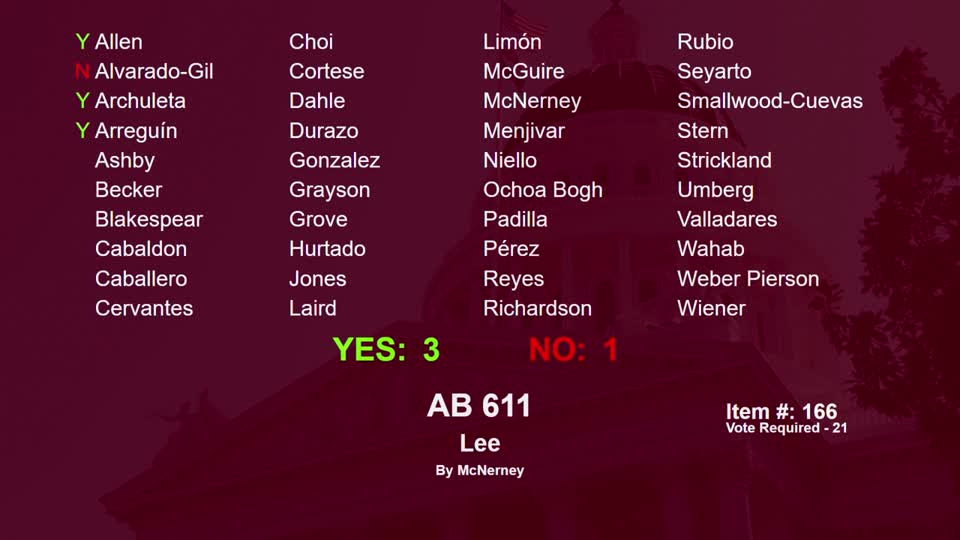 57SEC
Senate Floor
 6MIN
Senate Standing Committee on Public Safety
 7MIN
Senate Standing Committee on Judiciary
 1MIN
Assembly Floor
 14MIN
Assembly Standing Committee on Arts, Entertainment, Sports, and Tourism
Bill Author

Bill Co-Author(s):