AB 2230: Child daycare facilities.
- Session Year: 2025-2026
- House: Assembly
- Latest Version Date: 2026-08-30
Current Status:
Failed
(2026-09-20: Vetoed by Governor.)
Introduced
In Committee
Awaiting First Chamber Vote
Passed First Chamber
In Committee
Awaiting Second Chamber Vote
Passed Second Chamber
Enacted
Existing law, the California Child Day Care Facilities Act, provides for the licensure and regulation of child daycare facilities, including daycare centers and daycare homes, by the State Department of Social Services. Under existing law, any person who willfully or repeatedly violates this provision, as specified, is guilty of a misdemeanor. Existing law requires the licensee or administrator of a licensed child daycare facility, as applicable, to report to the State Department of Social Services and Attorney General any requests for information or access to the facility by an officer or employee of a law enforcement agency for the purpose of immigration enforcement.
This bill would, except as required by state or federal law or as required to administer a state or federally supported early care and learning program, prohibit employees of a licensed child daycare facility from providing voluntary consent to a law enforcement officer to enter a nonpublic area unless presented with a valid judicial warrant, judicial subpoena, or a court order or if exigent circumstances exist. The bill would provide that a violation of these provisions is not subject to a criminal, civil, or administrative penalty, and a licensee shall not be subject to a citation and would specify that these provisions do not prevent a child daycare facility from cooperating with law enforcement officers who are participating in a licensing inspection or investigation or investigating potentially criminal conduct discovered as the result of a licensing inspection or investigation conducted by the department.
Existing law, the California Child Day Care Facilities Act, provides for the licensure and regulation of child daycare facilities, including daycare centers and daycare homes, by the State Department of Social Services. Under existing law, any person who willfully or repeatedly violates this provision, as specified, is guilty of a misdemeanor. Existing law requires the licensee or administrator of a licensed child daycare facility, as applicable, to report to the State Department of Social Services and Attorney General any requests for information or access to the facility by an officer or employee of a law enforcement agency for the purpose of immigration enforcement.
This bill would, except as required by state or federal law or as required to administer a state or federally supported early care and learning program, prohibit employees of a licensed child daycare facility from providing voluntary consent to a law enforcement officer to enter a nonpublic area unless presented with a valid judicial warrant, judicial subpoena subpoena, or a court order or if exigent circumstances exist. The bill would provide that a violation of these provisions is not subject to a criminal, civil, or administrative penalty, and a licensee shall not be subject to a citation. citation and would specify that these provisions do not prevent a child daycare facility from cooperating with law enforcement officers who are participating in a licensing inspection or investigation or investigating potentially criminal conduct discovered as the result of a licensing inspection or investigation conducted by the department.
Existing law, the California Child Day Care Facilities Act, provides for the licensure and regulation of child daycare facilities, including daycare centers and daycare homes, by the State Department of Social Services. Under existing law, any person who willfully or repeatedly violates this provision, as specified, is guilty of a misdemeanor. Existing law requires the licensee or administrator of a licensed child daycare facility, as applicable, to report to the State Department of Social Services and Attorney General any requests for information or access to the facility by an officer or employee of a law enforcement agency for the purpose of immigration enforcement.
This bill would, except as required by state or federal law or as required to administer a state or federally supported early care and learning program, prohibit employees of a licensed child daycare facility from allowing an officer or employee of an agency conducting immigration enforcement providing voluntary consent to a law enforcement officer to enter a nonpublic area without being unless presented with a valid judicial warrant or warrant, judicial subpoena or a court order. By expanding the application of a crime, this bill would impose a state-mandated local program. order or if exigent circumstances exist. The bill would provide that a violation of these provisions is not subject to a criminal, civil, or administrative penalty, and a licensee shall not be subject to a citation.
The California Constitution requires the state to reimburse local agencies and school districts for certain costs mandated by the state. Statutory provisions establish procedures for making that reimbursement.This bill would provide that no reimbursement is required by this act for a specified reason.Existing law, the California Child Day Care Facilities Act, provides for the licensure and regulation of child daycare facilities, including daycare centers and daycare homes, by the State Department of Social Services. Under existing law, any person who willfully or repeatedly violates this provision, as specified, is guilty of a misdemeanor. Existing law requires the licensee or administrator of a licensed child daycare facility, as applicable, to report to the State Department of Social Services and Attorney General any requests for information or access to the facility by an officer or employee of a law enforcement agency for the purpose of immigration enforcement.
This bill would, except as required by state or federal law or as required to administer a state or federally supported early care and learning program, prohibit employees of a licensed child daycare facility from allowing an officer or employee of an agency conducting immigration enforcement to enter a nonpublic area without being presented with a valid judicial warrant or judicial subpoena or a court order. By expanding the application of a crime, this bill would impose a state-mandated local program.
This bill would provide that the provisions of this bill are severable.The California Constitution requires the state to reimburse local agencies and school districts for certain costs mandated by the state. Statutory provisions establish procedures for making that reimbursement.
This bill would provide that no reimbursement is required by this act for a specified reason.
Under existing law, it is a crime, punishable as either a misdemeanor or a felony, for a person in possession of a firearm, a peace officer, private guard, or security personnel, or any person wearing the uniform of a peace officer, guard, or security personnel, to be stationed in the immediate vicinity of, or posted at, a polling place without authorization from the appropriate elections official.
This bill would make that crime a felony, punishable by a fine up to $10,000 and imprisonment for 2, 3, or 5 years. The bill would also expand the crime to apply to any person who displays a uniform or other clothing or insignia that reasonably conveys an association with any local, state, or federal law enforcement agency. The bill would create an exception for a peace officer who is responding to a presently occurring violent crime, responding to an immediate threat to the life or health of others at the polling place, or casting a vote. The bill would prohibit an elections official from authorizing any agency or officer responsible for immigration enforcement or federal law enforcement to be stationed or posted in the immediate vicinity of a polling place. also apply that criminal prohibition to an officer or agent of a federal law enforcement agency or any person acting on behalf of a federal law enforcement agency. The bill would define immediate vicinity of a polling place for these purposes to mean a building in which a polling place is situated, and 100 feet from any entrance or exit to the building, a parking facility for the building, and the ingress or egress for a vehicle to the parking facility. By expanding the scope of an existing crime, this bill would impose a state-mandated local program.
Existing law, the California Child Day Care Facilities Act, provides for the licensure and regulation of child daycare facilities, including daycare centers and daycare homes, by the State Department of Social Services. Under existing law, any person who willfully or repeatedly violates this provision, as specified, is guilty of a misdemeanor. Existing law requires the licensee or administrator of a licensed child daycare facility, as applicable, to report to the State Department of Social Services and Attorney General any requests for information or access to the facility by an officer or employee of a law enforcement agency for the purpose of immigration enforcement.
This bill would, except as required by state or federal law, prohibit immigration enforcement personnel from being stationed within 100 feet of the entrance of a licensed child daycare facility, except if the immigration enforcement personnel is doing tasks related to the immigration enforcement personnels own children. The bill would make a violation of this provision by an immigration enforcement personnel a felony, punishable by a fine up to $10,000 and imprisonment for 2, 3, or 5 years. The bill would, except as required by state or federal law or as required to administer a state or federally supported early care and learning program, prohibit employees of a licensed child daycare facility from allowing an officer or employee of an agency conducting immigration enforcement to enter a nonpublic area without being presented with a valid judicial warrant or judicial subpoena or a court order. By creating a new expanding the application of a crime, this bill would impose a state-mandated local program.
This bill would provide that the provisions of this bill are severable.
The California Constitution requires the state to reimburse local agencies and school districts for certain costs mandated by the state. Statutory provisions establish procedures for making that reimbursement.
This bill would provide that no reimbursement is required by this act for a specified reason.
Under existing law, it is a crime, punishable as either a misdemeanor or a felony, for a person in possession of a firearm, a peace officer, private guard, or security personnel, or any person wearing the uniform of a peace officer, guard, or security personnel, to be stationed in the immediate vicinity of, or posted at, a polling place without authorization from the appropriate elections official.
This bill would make that crime a felony, punishable by a fine up to $10,000 and imprisonment for 2, 3, or 5 years. The bill would also expand the crime to apply to any person who displays a uniform or other clothing or insignia that reasonably conveys an association with any local, state, or federal law enforcement agency. The bill would create an exception for a peace officer who is responding to a presently occurring violent crime, responding to an immediate threat to the life or health of others at the polling place, or casting a vote. The bill would prohibit an elections official from authorizing any agency or officer responsible for immigration enforcement or federal law enforcement to be stationed or posted in the immediate vicinity of a polling place. By expanding the scope of an existing crime, this bill would impose a state-mandated local program.
Existing law, the California Child Day Care Facilities Act, provides for the licensure and regulation of child daycare facilities, including daycare centers and daycare homes, by the State Department of Social Services. Existing law requires the licensee or administrator of a licensed child daycare facility, as applicable, to report to the State Department of Social Services and Attorney General any requests for information or access to the facility by an officer or employee of a law enforcement agency for the purpose of immigration enforcement.
This bill would make it a felony, punishable by a fine up to $10,000 and imprisonment for 2, 3, or 5 years, for law enforcement personnel to enter a licensed child daycare facility or be would, except as required by state or federal law, prohibit immigration enforcement personnel from being stationed within 100 feet of the entrance of a licensed child daycare facility, except as specified. if the immigration enforcement personnel is doing tasks related to the immigration enforcement personnels own children. The bill would make a violation of this provision by an immigration enforcement personnel a felony, punishable by a fine up to $10,000 and imprisonment for 2, 3, or 5 years. The bill would, except as required by state or federal law or as required to administer a state or federally supported early care and learning program, prohibit employees of a licensed child daycare facility from allowing an officer or employee of an agency conducting immigration enforcement to enter a nonpublic area without being presented with a valid judicial warrant or judicial subpoena or a court order. By creating a new crime, this bill would impose a state-mandated local program.
This bill would provide that the provisions of this bill are severable.
The California Constitution requires the state to reimburse local agencies and school districts for certain costs mandated by the state. Statutory provisions establish procedures for making that reimbursement.
This bill would provide that no reimbursement is required by this act for a specified reason.
Under existing law, it is a crime, punishable as either a misdemeanor or a felony, for a person in possession of a firearm, a peace officer, private guard, or security personnel, or any person wearing the uniform of a peace officer, guard, or security personnel, to be stationed in the immediate vicinity of, or posted at, a polling place without authorization from the appropriate elections official.
This bill would make that crime a felony, punishable by a fine up to $10,000 and imprisonment for 2, 3, or 5 years. The bill would also expand the crime to apply to any person who displays a uniform or other clothing or insignia that reasonably conveys an association with any local, state, or federal law enforcement agency. The bill would create an exception for a peace officer who is responding to a presently occurring violent crime, responding to an immediate threat to the life or health of others at the polling place, or casting a vote. The bill would prohibit an elections official from authorizing any agency or officer responsible for immigration enforcement or federal law enforcement to be stationed or posted in the immediate vicinity of a polling place. By expanding the scope of an existing crime, this bill would impose a state-mandated local program.
Existing law, the California Child Day Care Facilities Act, provides for the licensure and regulation of child daycare facilities, including daycare centers and daycare homes, by the State Department of Social Services. Existing law requires the licensee or administrator of a licensed child daycare facility, as applicable, to report to the State Department of Social Services and Attorney General any requests for information or access to the facility by an officer or employee of a law enforcement agency for the purpose of immigration enforcement.
This bill would make it a felony, punishable by a fine up to $10,000 and imprisonment for 2, 3, or 5 years, for law enforcement personnel to enter a licensed child daycare facility or be stationed within 100 feet of the entrance of a licensed child daycare facility, except as specified. By creating a new crime, this bill would impose a state-mandated local program.
This bill would provide that the provisions of this bill are severable.
The California Constitution requires the state to reimburse local agencies and school districts for certain costs mandated by the state. Statutory provisions establish procedures for making that reimbursement.
This bill would provide that no reimbursement is required by this act for a specified reason.
Existing law sets forth the grounds and procedures for the issuance of a search warrant. Existing law defines a search warrant to refer to an order in writing, in the name of the people, signed by a magistrate, directed to a peace officer, commanding that peace officer to search for a person or persons, a thing or things, or personal property, and, in the case of a thing or things, or personal property, bring the thing or things, or the personal property, before the magistrate.This bill would make technical, nonsubstantive changes to that definition.Existing law sets forth the grounds and procedures for the issuance of a search warrant. Existing law defines a search warrant to refer to an order in writing, in the name of the people, signed by a magistrate, directed to a peace officer, commanding that peace officer to search for a person or persons, a thing or things, or personal property, and, in the case of a thing or things, or personal property, bring the thing or things, or the personal property, before the magistrate.
This bill would make technical, nonsubstantive changes to that definition.
The Legislature finds and declares all of the following:
(a)Since 2025, United States Immigration and Customs Enforcement officers have terrorized California residents, United States citizens, and noncitizens alike through untargeted arrests and brutality based on nothing more than subjects racial appearances, languages spoken, means of earning a living, and expression protected under the First Amendment to the United States Constitution.
(b)California is home to more than 10,000,000 immigrants, most of whom are naturalized United States citizens.
(c)Law enforcement activities, including immigration enforcement, in schools and childcare facilities have traumatized children and dissuaded hundreds of thousands of Hispanic and Asian children from attending school or utilizing childcare facilities.
(d)Ensuring that childcare facilities are safe and free from violence is a matter of statewide concern.
SEC. 2.Section 1596.7997 is added to the Health and Safety Code, to read:1596.7997.(a)Except as required by state or federal law or as required to administer a state or federally supported early care and learning program, employees of a licensed child daycare facility shall not provide voluntary consent to a law enforcement officer to enter a nonpublic area of a licensed child daycare facility unless presented with a valid judicial warrant, judicial subpoena, or a court order or if exigent circumstances exist. Any employee of a licensed child daycare facility shall, to the extent practicable, request a valid identification from a law enforcement officer seeking to enter a nonpublic area of a licensed child daycare facility. This subdivision does not apply to law enforcement officers who are complying with the requirements of the Child Abuse and Neglect Reporting Act pursuant to Article 2.5 (commencing with Section 11164) of Chapter 2 of Title 1 of Part 4 of the Penal Code. This subdivision shall not be construed to limit a licensed child daycare facilitys or employees right to consult with counsel or challenge the validity of a warrant, subpoena, or court order in a court of competent jurisdiction.
(b)A violation of this section is not subject to criminal, civil, or administrative penalty, and shall not result in a licensee being subject to citation under this act.
(c)This section does not prevent a child daycare facility from cooperating with law enforcement officers who are participating in a licensing inspection or investigation or investigating potentially criminal conduct discovered as the result of a licensing inspection or investigation conducted by the department.
The Legislature finds and declares all of the following:
(a)Since 2025, United States Immigration and Customs Enforcement officers have terrorized California residents, United States citizens, and noncitizens alike through untargeted arrests and brutality based on nothing more than subjects racial appearances, languages spoken, means of earning a living, and expression protected under the First Amendment to the United States Constitution.
(b)California is home to more than 10,000,000 immigrants, most of whom are naturalized United States citizens.
(c)Law enforcement activities, including immigration enforcement, in schools and childcare facilities have traumatized children and dissuaded hundreds of thousands of Hispanic and Asian children from attending school or utilizing childcare facilities.
(d)Ensuring that childcare facilities are safe and free from violence is a matter of statewide concern.
SEC. 2.Section 1596.7997 is added to the Health and Safety Code, to read:1596.7997.(a)Except as required by state or federal law or as required to administer a state or federally supported early care and learning program, employees of a licensed child daycare facility shall not allow an officer or employee of an agency conducting immigration enforcement provide voluntary consent to a law enforcement officer to enter a nonpublic area of a licensed child daycare facility without being unless presented with a valid judicial warrant or warrant, judicial subpoena, or a court order. order or if exigent circumstances exist. Any employee of a licensed child daycare facility shall, to the extent practicable, request a valid identification from an officer or employee of an agency conducting immigration enforcement a law enforcement officer seeking to enter a nonpublic area of a licensed child daycare facility. This subdivision does not apply to law enforcement officers who are complying with the requirements of the Child Abuse and Neglect Reporting Act pursuant to Article 2.5 (commencing with Section 11164) of Chapter 2 of Title 1 of Part 4 of the Penal Code. This subdivision shall not be construed to limit a licensed child daycare facilitys or employees right to consult with counsel or challenge the validity of a warrant, subpoena, or court order in a court of competent jurisdiction.
(b)A violation of this section is not subject to criminal, civil, or administrative penalty, and shall not result in a licensee being subject to citation under this act.
SEC. 3.No reimbursement is required by this act pursuant to Section 6 of Article XIIIB of the California Constitution because the only costs that may be incurred by a local agency or school district will be incurred because this act creates a new crime or infraction, eliminates a crime or infraction, or changes the penalty for a crime or infraction, within the meaning of Section 17556 of the Government Code, or changes the definition of a crime within the meaning of Section 6 of Article XIIIB of the California Constitution.The Legislature finds and declares all of the following:
(a)Since 2025, United States Immigration and Customs Enforcement officers have terrorized California residents, United States citizens, and noncitizens alike through untargeted arrests and brutality based on nothing more than subjects racial appearances, languages spoken, means of earning a living, and expression protected under the First Amendment to the United States Constitution.
(b)California is home to more than 10,000,000 immigrants, most of whom are naturalized United States citizens and are eligible to vote in all elections. citizens.
(c)Law enforcement activities, including immigration enforcement, in schools and childcare facilities have traumatized children and dissuaded hundreds of thousands of Hispanic and Asian children from attending school or utilizing childcare facilities.
(d)Political provocateurs, including advisors to the President of the United States, have suggested that United States Immigration and Customs Enforcement officers surround voting centers and polling locations in order to intimidate immigrants and others from exercising their constitutional right to vote.(e)(d)Ensuring that childcare facilities are safe and free from violence, and that all eligible voters have the opportunity to participate in elections free from intimidation and violence, are matters violence is a matter of statewide concern.
SEC. 2.Section 18544 of the Elections Code is amended to read:18544.(a)Any person in possession of a firearm, any uniformed law enforcement officer, private guard, or security personnel, or any person who is wearing a uniform of a law enforcement officer, guard, or security personnel, who is stationed in the immediate vicinity of, or posted at, a polling place without written authorization of the appropriate city or county elections official, is punishable by a fine not exceeding ten thousand dollars ($10,000), by imprisonment pursuant to subdivision (h) of Section 1170 of the Penal Code for 16 months or two or three years, or in a county jail not exceeding one year, or by both that fine and imprisonment.(b)This section does not apply to any of the following:(1)An unarmed uniformed guard or security personnel who is at the polling place to cast a vote.(2)A peace officer who is conducting official business in the course of their public employment or who is at the polling place to cast a vote.(3)A private guard or security personnel hired or arranged for by a city or county elections official.(4)A private guard or security personnel hired or arranged for by the owner or manager of the facility or property in which the polling place is located if the guard or security personnel is not hired or arranged solely for the day on which an election is held.(c)Notwithstanding Section 18546, for purposes of this section immediate vicinity includes a building in which a polling place is situated, and 100 feet from any entrance or exit to the building, a parking facility for the building, and the ingress or egress for a vehicle to the parking facility.(d)For purposes of this section, law enforcement officer means either of the following:(1)A peace officer as defined in Section 830 of the Penal Code.(2)An officer or agent of a federal law enforcement agency or any person acting on behalf of a federal law enforcement agency.SEC. 3.SEC. 2.Section 1596.7997 is added to the Health and Safety Code, to read:1596.7997.Except as required by state or federal law or as required to administer a state or federally supported early care and learning program, employees of a licensed child daycare facility shall not allow an officer or employee of an agency conducting immigration enforcement to enter a nonpublic area of a licensed child daycare facility without being presented with a valid judicial warrant or judicial subpoena, or a court order. Any employee of a licensed child daycare facility shall, to the extent practicable, request a valid identification from an officer or employee of an agency conducting immigration enforcement seeking to enter a nonpublic area of a licensed child daycare facility. This subdivision shall not be construed to limit a licensed child daycare facilitys or employees right to consult with counsel or challenge the validity of a warrant, subpoena, or court order in a court of competent jurisdiction.
SEC. 4.The provisions of this act are severable. If any provision of this act or its application is held invalid, that invalidity shall not affect other provisions or applications that can be given effect without the invalid provision or application.SEC. 5.SEC. 3.No reimbursement is required by this act pursuant to Section 6 of Article XIIIB of the California Constitution because the only costs that may be incurred by a local agency or school district will be incurred because this act creates a new crime or infraction, eliminates a crime or infraction, or changes the penalty for a crime or infraction, within the meaning of Section 17556 of the Government Code, or changes the definition of a crime within the meaning of Section 6 of Article XIIIB of the California Constitution.
The Legislature finds and declares all of the following:
(a)Since 2025, United States Immigration and Customs Enforcement officers have terrorized California residents, United States citizens, and noncitizens alike through untargeted arrests and brutality based on nothing more than subjects racial appearances, languages spoken, means of earning a living, and expression protected under the First Amendment to the United States Constitution.
(b)California is home to more than 10,000,000 immigrants, most of whom are naturalized United States citizens and are eligible to vote in all elections.
(c)Law enforcement activities, including immigration enforcement, in schools and childcare facilities have traumatized children and dissuaded hundreds of thousands of Hispanic and Asian children from attending school or utilizing childcare facilities.
(d)Political provocateurs, including advisors to the President of the United States, have suggested that United States Immigration and Customs Enforcement officers surround voting centers and polling locations in order to intimidate immigrants and others from exercising their constitutional right to vote.
(e)Ensuring that childcare facilities are safe and free from violence, and that all eligible voters have the opportunity to participate in elections free from intimidation and violence, are matters of statewide concern.
SEC. 2.Section 18544 of the Elections Code is amended to read:18544.(a)Any person in possession of a firearm, any uniformed peace law enforcement officer, private guard, or security personnel, or any person who is wearing or displaying a uniform or other clothing or insignia that reasonably conveys an association with any local, state, or federal law enforcement agency, a uniform of a law enforcement officer, guard, or security personnel, who is stationed in the immediate vicinity of, or posted at, a polling place without written authorization of the appropriate city or county elections official, is guilty of a felony, punishable by a fine not exceeding ten thousand dollars ($10,000) and ($10,000), by imprisonment pursuant to subdivision (h) of Section 1170 of the Penal Code for two, three, or five years. 16 months or two or three years, or in a county jail not exceeding one year, or by both that fine and imprisonment.
(b)This section does not apply to any of the following:
(1)An unarmed uniformed guard or security personnel who is at the polling place to cast a vote.
(2)A peace officer who is doing any of the following: conducting official business in the course of their public employment or who is at the polling place to cast a vote.
(A)Responding to a presently occurring violent crime.(B)Responding to an immediate threat to the life or health of others at the polling place.(C)Casting a vote.(3)A private guard or security personnel hired or arranged for by a city or county elections official.
(4)A private guard or security personnel hired or arranged for by the owner or manager of the facility or property in which the polling place is located if the guard or security personnel is not hired or arranged solely for the day on which an election is held.
(c)An elections official shall not authorize any agency or officer responsible for immigration enforcement or federal law enforcement to be stationed or posted in the immediate vicinity of a polling place. An authorization issued by an elections official in violation of this section is null and void, and the existence of an unlawful authorization is not a defense to a criminal charge brought pursuant to this section.(d)(c)Notwithstanding Section 18546, for purposes of this section immediate vicinity includes a building in which a polling place is situated, and 100 feet from any entrance or exit to the building, a parking facility for the building, and the ingress or egress for a vehicle to the parking facility.
(d)For purposes of this section, law enforcement officer means either of the following:
(1)A peace officer as defined in Section 830 of the Penal Code.
(2)An officer or agent of a federal law enforcement agency or any person acting on behalf of a federal law enforcement agency.
SEC. 3.Section 1596.7997 is added to the Health and Safety Code, to read:1596.7997.(a)(1)Except as required by state or federal law, immigration enforcement personnel shall not be stationed within 100 feet of the entrance of a licensed child daycare facility, except if the immigration enforcement personnel is doing tasks related to the immigration enforcement personnels own children.(2)Except1596.7997.Except as required by state or federal law or as required to administer a state or federally supported early care and learning program, employees of a licensed child daycare facility shall not allow an officer or employee of an agency conducting immigration enforcement to enter a nonpublic area of a licensed child daycare facility without being presented with a valid judicial warrant or judicial subpoena, or a court order. Any employee of a licensed child daycare facility shall, to the extent practicable, request a valid identification from an officer or employee of an agency conducting immigration enforcement seeking to enter a nonpublic area of a licensed child daycare facility. This subdivision shall not be construed to limit a licensed child daycare facilitys or employees right to consult with counsel or challenge the validity of a warrant, subpoena, or court order in a court of competent jurisdiction.
(b)An immigration enforcement personnel who violates subdivision (a) is guilty of a felony, punishable by a fine not exceeding ten thousand dollars ($10,000) and by imprisonment pursuant to subdivision (h) of Section 1170 of the Penal Code for two, three, or five years.SEC. 4.The provisions of this act are severable. If any provision of this act or its application is held invalid, that invalidity shall not affect other provisions or applications that can be given effect without the invalid provision or application.
SEC. 5.No reimbursement is required by this act pursuant to Section 6 of Article XIIIB of the California Constitution because the only costs that may be incurred by a local agency or school district will be incurred because this act creates a new crime or infraction, eliminates a crime or infraction, or changes the penalty for a crime or infraction, within the meaning of Section 17556 of the Government Code, or changes the definition of a crime within the meaning of Section 6 of Article XIIIB of the California Constitution.
The Legislature finds and declares all of the following:
(a)Since 2025, United States Immigration and Customs Enforcement officers have terrorized California residents, United States citizens, and noncitizens alike through untargeted arrests and brutality based on nothing more than subjects racial appearances, languages spoken, means of earning a living, and expression protected under the First Amendment to the United States Constitution.
(b)California is home to more than 10,000,000 immigrants, most of whom are naturalized United States citizens and are eligible to vote in all elections.
(c)Law enforcement activities, including immigration enforcement, in schools and childcare facilities have traumatized children and dissuaded hundreds of thousands of Hispanic and Asian children from attending school or utilizing childcare facilities.
(d)Political provocateurs, including advisors to the President of the United States, have suggested that United States Immigration and Customs Enforcement officers surround voting centers and polling locations in order to intimidate immigrants and others from exercising their constitutional right to vote.
(e)Ensuring that childcare facilities are safe and free from violence, and that all eligible voters have the opportunity to participate in elections free from intimidation and violence, are matters of statewide concern.
SEC. 2.Section 18544 of the Elections Code is amended to read:18544.(a)Any person in possession of a firearm, any uniformed peace officer, private guard, or security personnel, or any person who is wearing or displaying a uniform or other clothing or insignia that reasonably conveys an association with any local, state, or federal law enforcement agency, guard, or security personnel, who is stationed in the immediate vicinity of, or posted at, a polling place without written authorization of the appropriate city or county elections official, is guilty of a felony, punishable by a fine not exceeding ten thousand dollars ($10,000) and by imprisonment pursuant to subdivision (h) of Section 1170 of the Penal Code for two, three, or five years.
(b)This section does not apply to any of the following:
(1)An unarmed uniformed guard or security personnel who is at the polling place to cast a vote.
(2)A peace officer who is doing any of the following:
(A)Responding to a presently occurring violent crime.
(B)Responding to an immediate threat to the life or health of others at the polling place.
(C)Casting a vote.
(3)A private guard or security personnel hired or arranged for by a city or county elections official.
(4)A private guard or security personnel hired or arranged for by the owner or manager of the facility or property in which the polling place is located if the guard or security personnel is not hired or arranged solely for the day on which an election is held.
(c)An elections official shall not authorize any agency or officer responsible for immigration enforcement or federal law enforcement to be stationed or posted in the immediate vicinity of a polling place. An authorization issued by an elections official in violation of this section is null and void, and the existence of an unlawful authorization is not a defense to a criminal charge brought pursuant to this section.
(d)Notwithstanding Section 18546, for purposes of this section immediate vicinity includes a building in which a polling place is situated, and 100 feet from any entrance or exit to the building, a parking facility for the building, and the ingress or egress for a vehicle to the parking facility.
SEC. 3.Section 1596.7997 is added to the Health and Safety Code, to read:1596.7997.(a)(1)Except as required by state or federal law, law enforcement personnel shall not enter a licensed child daycare facility or immigration enforcement personnel shall not be stationed within 100 feet of the entrance of a licensed child daycare facility, except if the law enforcement personnel is doing any of the following: immigration enforcement personnel is doing tasks related to the immigration enforcement personnels own children.
(A)Responding to a presently occurring violent crime.(B)Responding to an immediate threat to life or health of others at the child daycare facility.(C)Tasks related to the law enforcement personnels own children.(2)The prohibition in paragraph (1) applies to immigration enforcement.(2)Except as required by state or federal law or as required to administer a state or federally supported early care and learning program, employees of a licensed child daycare facility shall not allow an officer or employee of an agency conducting immigration enforcement to enter a nonpublic area of a licensed child daycare facility without being presented with a valid judicial warrant or judicial subpoena, or a court order. Any employee of a licensed child daycare facility shall, to the extent practicable, request a valid identification from an officer or employee of an agency conducting immigration enforcement seeking to enter a nonpublic area of a licensed child daycare facility. This subdivision shall not be construed to limit a licensed child daycare facilitys or employees right to consult with counsel or challenge the validity of a warrant, subpoena, or court order in a court of competent jurisdiction.
(b)A person An immigration enforcement personnel who violates subdivision (a) is guilty of a felony, punishable by a fine not exceeding ten thousand dollars ($10,000) and by imprisonment pursuant to subdivision (h) of Section 1170 of the Penal Code for two, three, or five years.
(c)For purposes of this section, law enforcement personnel includes, but is not limited to, all United States Immigration and Customs Enforcement personnel and United States Customs and Border Protection personnel.SEC. 4.The provisions of this act are severable. If any provision of this act or its application is held invalid, that invalidity shall not affect other provisions or applications that can be given effect without the invalid provision or application.
SEC. 5.No reimbursement is required by this act pursuant to Section 6 of Article XIIIB of the California Constitution because the only costs that may be incurred by a local agency or school district will be incurred because this act creates a new crime or infraction, eliminates a crime or infraction, or changes the penalty for a crime or infraction, within the meaning of Section 17556 of the Government Code, or changes the definition of a crime within the meaning of Section 6 of Article XIIIB of the California Constitution.
The Legislature finds and declares all of the following:
(a)Since 2025, United States Immigration and Customs Enforcement officers have terrorized California residents, United States citizens, and noncitizens alike through untargeted arrests and brutality based on nothing more than subjects racial appearances, languages spoken, means of earning a living, and expression protected under the First Amendment to the United States Constitution.
(b)California is home to more than 10,000,000 immigrants, most of whom are naturalized United States citizens and are eligible to vote in all elections.
(c)Law enforcement activities, including immigration enforcement, in schools and childcare facilities have traumatized children and dissuaded hundreds of thousands of Hispanic and Asian children from attending school or utilizing childcare facilities.
(d)Political provocateurs, including advisors to the President of the United States, have suggested that United States Immigration and Customs Enforcement officers surround voting centers and polling locations in order to intimidate immigrants and others from exercising their constitutional right to vote.
(e)Ensuring that childcare facilities are safe and free from violence, and that all eligible voters have the opportunity to participate in elections free from intimidation and violence, are matters of statewide concern.
SEC. 2.Section 18544 of the Elections Code is amended to read:18544.(a)Any person in possession of a firearm or firearm, any uniformed peace officer, private guard, or security personnel personnel, or any person who is wearing or displaying a uniform of a peace officer, or other clothing or insignia that reasonably conveys an association with any local, state, or federal law enforcement agency, guard, or security personnel, who is stationed in the immediate vicinity of, or posted at, a polling place without written authorization of the appropriate city or county elections official is official, is guilty of a felony, punishable by a fine not exceeding ten thousand dollars ($10,000), ($10,000) and by imprisonment pursuant to subdivision (h) of Section 1170 of the Penal Code for 16 months or two or three years, or in a county jail not exceeding one year, or by both that fine and imprisonment. two, three, or five years.
(b)This section shall does not apply to any of the following:
(1)An unarmed uniformed guard or security personnel who is at the polling place to cast his or her a vote.
(2)A peace officer who is conducting official business in the course of his or her public employment or who is at the polling place to cast his or her vote. doing any of the following:
(A)Responding to a presently occurring violent crime.
(B)Responding to an immediate threat to the life or health of others at the polling place.
(C)Casting a vote.
(3)A private guard or security personnel hired or arranged for by a city or county elections official.
(4)A private guard or security personnel hired or arranged for by the owner or manager of the facility or property in which the polling place is located if the guard or security personnel is not hired or arranged solely for the day on which an election is held.
(c)An elections official shall not authorize any agency or officer responsible for immigration enforcement or federal law enforcement to be stationed or posted in the immediate vicinity of a polling place. An authorization issued by an elections official in violation of this section is null and void, and the existence of an unlawful authorization is not a defense to a criminal charge brought pursuant to this section.
(d)Notwithstanding Section 18546, for purposes of this section immediate vicinity includes a building in which a polling place is situated, and 100 feet from any entrance or exit to the building, a parking facility for the building, and the ingress or egress for a vehicle to the parking facility.
SEC. 3.Section 1596.7997 is added to the Health and Safety Code, to read:1596.7997.(a)(1)Except as required by state or federal law, law enforcement personnel shall not enter a licensed child daycare facility or be stationed within 100 feet of the entrance of a licensed child daycare facility, except if the law enforcement personnel is doing any of the following:
(A)Responding to a presently occurring violent crime.
(B)Responding to an immediate threat to life or health of others at the child daycare facility.
(C)Tasks related to the law enforcement personnels own children.
(2)The prohibition in paragraph (1) applies to immigration enforcement.
(b)A person who violates subdivision (a) is guilty of a felony, punishable by a fine not exceeding ten thousand dollars ($10,000) and by imprisonment pursuant to subdivision (h) of Section 1170 of the Penal Code for two, three, or five years.
(c)For purposes of this section, law enforcement personnel includes, but is not limited to, all United States Immigration and Customs Enforcement personnel and United States Customs and Border Protection personnel.
SEC. 4.The provisions of this act are severable. If any provision of this act or its application is held invalid, that invalidity shall not affect other provisions or applications that can be given effect without the invalid provision or application.
SEC. 5.No reimbursement is required by this act pursuant to Section 6 of Article XIIIB of the California Constitution because the only costs that may be incurred by a local agency or school district will be incurred because this act creates a new crime or infraction, eliminates a crime or infraction, or changes the penalty for a crime or infraction, within the meaning of Section 17556 of the Government Code, or changes the definition of a crime within the meaning of Section 6 of Article XIIIB of the California Constitution.
SECTION 1.Section 1523 of the Penal Code is amended to read:1523.A search warrant is an order in writing, in the name of the people, signed by a magistrate, directed to a peace officer, commanding that peace officer to search for a person or persons, a thing or things, or personal property, and, in the case of a thing or things, or personal property, bring the thing or things, or the personal property, before the magistrate.A search warrant is an order in writing, in the name of the people, signed by a magistrate, directed to a peace officer, commanding him or her that peace officer to search for a person or persons, a thing or things, or personal property, and, in the case of a thing or things things, or personal property, bring the same thing or things, or the personal property, before the magistrate.
|
Date
|
Status
|
|---|---|
| Sep 20, 2026 | Vetoed by Governor. |
| Sep 3, 2026 | Enrolled and presented to the Governor at 4 p.m. |
| Aug 26, 2026 | Senate amendments concurred in. To Engrossing and Enrolling. (Ayes 62. Noes 12.). |
| Aug 26, 2026 | Senate amendments concurred in. To Engrossing and Enrolling. (Ayes 62. Noes 12. Page 6580.). |
| Aug 25, 2026 | In Assembly. Concurrence in Senate amendments pending. |
| Aug 25, 2026 | Read third time. Passed. Ordered to the Assembly. (Ayes 31. Noes 6. Page 5785.). |
| Aug 25, 2026 | Read third time. Passed. Ordered to the Assembly. (Ayes 30. Noes 5.). |
| Aug 24, 2026 | Read second time. Ordered to third reading. |
| Aug 21, 2026 | Read third time and amended. Ordered to second reading. |
| Jun 30, 2026 | Read second time. Ordered to third reading. |
| Jun 29, 2026 | From committee: Do pass. (Ayes 5. Noes 0.) (June 29). |
| Jun 22, 2026 | From committee chair, with author's amendments: Amend, and re-refer to committee. Read second time, amended, and re-referred to Com. on HUMAN S. |
| Jun 16, 2026 | Withdrawn from committee. |
| Jun 16, 2026 | Re-referred to Com. on HUMAN S. |
| Jun 12, 2026 | Withdrawn from committee. |
| Jun 12, 2026 | Re-referred to Com. on PUB. S. |
| Jun 11, 2026 | In committee: Hearing postponed by committee. |
| Jun 11, 2026 | From committee chair, with author's amendments: Amend, and re-refer to committee. Read second time, amended, and re-referred to Com. on E. & C.A. |
| Jun 10, 2026 | Referred to Coms. on E. & C.A., PUB. S. and HUMAN S. |
| May 28, 2026 | In Senate. Read first time. To Com. on RLS. for assignment. |
| May 27, 2026 | Read third time. Passed. Ordered to the Senate. (Ayes 60. Noes 15.) |
| May 27, 2026 | Read third time. Passed. Ordered to the Senate. (Ayes 60. Noes 15. Page 5431.) |
| May 27, 2026 | Read third time. Passed. Ordered to the Senate. |
| May 18, 2026 | Read second time. Ordered to third reading. |
| May 14, 2026 | From committee: Do pass. (Ayes 11. Noes 3.) (May 14). |
| May 6, 2026 | In committee: Set, first hearing. Referred to APPR. suspense file. |
| Apr 27, 2026 | Re-referred to Com. on APPR. |
| Apr 23, 2026 | Read second time and amended. |
| Apr 22, 2026 | From committee: Amend, and do pass as amended and re-refer to Com. on APPR. (Ayes 7. Noes 0.) (April 21). |
| Apr 15, 2026 | From committee: Do pass and re-refer to Com. on PUB. S. (Ayes 6. Noes 2.) (April 15). Re-referred to Com. on PUB. S. |
| Apr 15, 2026 | From committee: Do pass and re-refer to Com. on ELECTIONS. (Ayes 5. Noes 1.) (April 14). Re-referred to Com. on ELECTIONS. |
| Apr 8, 2026 | Re-referred to Com. on HUM. S. |
| Apr 7, 2026 | From committee chair, with author's amendments: Amend, and re-refer to Com. on HUM. S. Read second time and amended. |
| Apr 6, 2026 | Assembly Rule 56 suspended. (Page 4467.) |
| Apr 6, 2026 | Assembly Rule 56 suspended. |
| Apr 6, 2026 | (Pending re-refer to Com. on ELECTIONS) |
| Mar 24, 2026 | Re-referred to Com. on HUM. S. |
| Mar 23, 2026 | Referred to Coms. on HUM. S., ELECTIONS and PUB. S. |
| Mar 23, 2026 | From committee chair, with author's amendments: Amend, and re-refer to Com. on HUM. S. Read second time and amended. |
| Feb 20, 2026 | From printer. May be heard in committee March 22. |
| Feb 19, 2026 | Read first time. To print. |
|
Date
|
Description
|
Location
|
Votes
|
|
|---|---|---|---|---|
| Aug 26, 2026 | AB 2230 Ávila Farías Concurrence in Senate Amendments | Assembly Floor |
Passed |
|
| Aug 25, 2026 | Assembly 3rd Reading AB2230 Ávila Farías By Becker | Senate Floor |
Passed |
|
| Jun 29, 2026 | Do pass | Senate Standing Committee on Human Services |
Passed |
|
| May 27, 2026 | AB 2230 Ávila Farías Assembly Third Reading | Assembly Floor |
Passed |
|
| May 14, 2026 | Do pass. | Assembly Standing Committee on Appropriations |
Passed |
|
| Apr 21, 2026 | Do pass as amended and be re-referred to the Committee on [Appropriations] | Assembly Standing Committee on Public Safety |
Passed |
|
| Apr 15, 2026 | Do pass and be re-referred to the Committee on [Public Safety] | Assembly Standing Committee on Elections |
Passed |
|
| Apr 14, 2026 | Do pass and be re-referred to the Committee on [Elections] | Assembly Standing Committee on Human Services |
Passed |
This list shows positions taken on this bill by organizations on the date displayed, which is linked to the original source.
Positions by individuals are not included.
|
Organization
|
Position
|
Date
|
|---|---|---|
| California Democratic Party | ** Support | |
| First 5 Association Of California | ** Support | |
| Fresno Unified School District | ** Support |
GOVERNOR'S VETO
GV Bill Id:AB 2230
Author:(Ávila Farías)
As Enrolled Ver:August 30, 2026
2/3 vote
SUMMARY
Prohibits employees of a licensed child daycare facility from providing voluntary consent to a law enforcement officer to enter a nonpublic area of a licensed child daycare facility unless presented with a valid judicial warrant, judicial subpoena, or a court order or if exigent circumstances exist. Requires an employee of a licensed child daycare facility to request valid information from a law enforcement officer seeking to enter a nonpublic area of a licensed child daycare facility.
Senate Amendments
- Updated that a licensed daycare facility employee shall not provide voluntary consent to a law enforcement officer to enter a nonpublic area of a licensed child daycare facility instead of prohibiting employees from allowing an officer or employee of an agency conducting immigration enforcement to enter a nonpublic area of a licensed child daycare facility.
- Clarified that the bill does not apply to law enforcement officers who are complying with the requirements of the Child Abuse and Neglect Reporting Act.
- Specified that violation of this section is not subject to criminal, civil, or administrative penalty, and shall not result in a licensee being subject to citation under this act.
- Removed all provisions related to polling places.
Governor’s Veto Message
To the Members of the California State Assembly:
I am returning Assembly Bill 2230 without my signature.
This bill would prohibit employees of a child daycare facility licensed by the California Department of Social Services (CDSS) from providing voluntary consent to a law enforcement officer to enter a nonpublic area of the facility unless presented with valid documentation.
Immigration enforcement actions, coupled with anti-immigrant online rhetoric targeting providers, have created climate of fear for childcare providers, and for the children and families for whom they provide care. In recognition of this cruel reality, I signed legislation last year (AB 495, Rodriguez) to strengthen protections, increase preparedness, and provide clear guidance for caregivers and daycare facilities. These resources are helping providers today become knowledgeable about how to respond to an immigration enforcement action.
While I appreciate the author's intent to further protect our children and providers, this bill takes the wrong approach. By broadly prohibiting employees of a licensed child daycare facility from providing voluntary consent to any law enforcement officer, this bill places an undue burden on providers to validate the legality of the officer's action or verify specific legal documents, likely in the middle of a frightening and overwhelming experience.
Further, this bill may have the unintended effect of hindering normal licensing investigation and enforcement operations. CDSS is responsible for protecting the health and safety of children in its licensed facilities and often works with law enforcement agencies to fulfill that duty. There could be a myriad of legitimate reasons for law enforcement to visit a facility completely unrelated to immigration enforcement, and this bill unnecessarily complicates those situations.
For these reasons I am unable to sign this bill.
COMMENTS
Background: Federal Policy on Immigration Enforcement at Protected Locations. Since 1993, the federal government has maintained policies discouraging immigration enforcement at "sensitive locations," including schools, places of worship, and early childhood programs such as licensed childcare, preschool, and Head Start programs. In 2011, the U.S. Department of Homeland Security (DHS) reaffirmed this policy, stating that enforcement actions at these locations should only occur under exigent circumstances, when operations lead to such locations, or with prior approval. In October 2021, DHS issued updated guidance establishing "protected areas," which expanded the list of sensitive locations to include social service providers and places where children gather, like playgrounds. Under this policy, immigration agents were prohibited from conducting enforcement actions in or near these locations except in limited circumstances and were instructed to avoid actions that could deter individuals from accessing these services.
However, on January 20, 2025, the Trump administration rescinded the protected areas policy, eliminating restrictions on immigration enforcement at locations like early childhood programs, schools, and churches.[1] A January 21, 2025, memo stated that the federal law prohibits state and local interference with lawful immigration actions.[2] A DHS spokesperson further stated immigration officers would no longer be restricted from making arrests in schools or churches, asserting that prior protections allowed "criminals" to avoid arrest and that officers should be trusted to use "common sense."[3] Since the rescission of the protected areas policy, news reports have documented immigration enforcement activity around schools, hospitals, and other sites previously designated as protected areas.
Concerns about immigration enforcement near childcare facilities and schools have been linked to decreased school attendance, reduced participation in early childhood programs, and broader economic instability when parents miss work or lose employment due to fear of enforcement activity. [4] Early childhood programs often provide not only education and care, but also connections to nutrition programs, health services, and family support services, meaning reduced participation can affect both children's development and family stability. In some documented cases, Immigration and Customs Enforcement (ICE) officers have detained parents after they dropped their children off at school, reinforcing concerns among families that educational settings may not be safe from enforcement activity.
California Attorney General Guidance to Childcare Facilities on Immigration Enforcement. The AG's Early Childhood Education and Child Care Providers Guidance and Model Policies[5] released on April 1, 2026, explains that although federal policy no longer restricts immigration enforcement at protected locations, childcare facilities and providers are still protected under California law, including the California Immigrant Worker Protection Act established through AB 450 (Chiu), Chapter 492, Statutes of 2017. This law prohibits employers from voluntarily consenting to immigration enforcement agents entering nonpublic areas of a workplace unless the agent presents a judicial warrant or federal law requires access. Voluntary consent must be truly voluntary and cannot be the result of coercion or intimidation. Staff are allowed to verify warrants and consult legal counsel before complying, and providers are not required to assist immigration enforcement agents with searches, entry into nonpublic areas, or the physical apprehension of individuals.
The guidance also explains that the Fourth Amendment to the U.S. Constitution protects homes and businesses, including childcare facilities, from unreasonable searches and seizures. Whether law enforcement officers may enter an area depends on whether there is a reasonable expectation of privacy. Public areas are open to the general public and generally have a lower expectation of privacy, while nonpublic areas, such as classrooms, offices, staff-only areas, and childcare spaces, generally require a judicial warrant, consent, or limited exceptions such as exigent circumstances. Exigent circumstances are emergency, time-sensitive situations where officers reasonably believe someone may be in danger, a suspect may escape, or evidence may be destroyed. Officers may also seize items in "plain view" if they are lawfully present in the area and the items are clearly visible and believed to be related to illegal activity.
The AG guidance further explains the importance for childcare providers to understand the differences between immigration enforcement documents, including administrative warrants, judicial warrants, subpoenas, court orders, and notices to appear because these documents provide different levels of legal authority. For example, an ICE administrative warrant does not authorize entry into nonpublic areas or access to records, while a federal judicial warrant issued by a judge may authorize entry, search, or arrest. Subpoenas may request documents but generally do not require immediate compliance and may be challenged in court, and a notice to appear begins immigration court proceedings but does not authorize arrest, search, or access, to facilities or records.
According to the Author
"ICE has terrorized California residents, U.S. citizens and non-citizens alike, through untargeted arrests and brutality based on nothing more than a person's racial appearance, language spoken, occupation, and exercise of First Amendment-protected expression.
"Political provocateurs, including advisors to the President of the United States, have suggested that ICE agents will be ordered to surround vote centers and polling locations to intimidate immigrants and others from exercising their constitutional right to vote. We've also seen children held hostage and used as bait to lure family members from their homes.
"Exercising your constitutionally guaranteed right to vote should not be discouraged by a rogue federal organization whose task is to sow fear, intimidation and violence in California communities. Families do not deserve to face fear, uncertainty, and potential disruptions to their children's education and lives. Childcare facilities should remain safe locations where all children, regardless of immigration status, can learn and thrive without fear of enforcement actions.
"[This bill] will ensure that childcare facilities and voting centers are free from violence and intimidation by prohibiting ICE agents from surrounding or entering these spaces."
Arguments in Support
According to First 5 Association of California, "[This bill] takes a measured and practical step to address these harms. As amended, the bill prohibits employees of licensed child daycare facilities from allowing immigration enforcement officers to enter nonpublic areas of a facility without a valid judicial warrant, judicial subpoena, or court order, except as required by state or federal law or to administer a state or federally supported early care and learning program. It also asks facility staff, to the extent practicable, to request valid identification from any immigration enforcement officer seeking entry to a nonpublic area, and it preserves the right of facilities to consult counsel or to challenge the validity of any warrant or court order. These provisions give providers clear, lawful guidance for protecting the children and families in their care while respecting legitimate legal process. Enforcement activity at or near child care facilities is a direct barrier to families accessing the early learning programs their children need. For these reasons, First 5 Association of California respectfully urges your support of [this bill]."
Arguments in Opposition
None on file.
FISCAL COMMENTS
This bill was keyed non-fiscal by the Legislative Counsel.
VOTES
ASM HUMAN SERVICES: 5-1-1
YES: Lee, Calderon, Elhawary, Jackson, Solache
NO: Tangipa
ABS, ABST OR NV: Castillo
ASM ELECTIONS: 6-2-0
YES: Pellerin, Bennett, Berman, Elhawary, Solache, Stefani
NO: Gallagher, Johnson
ASM PUBLIC SAFETY: 7-0-2
YES: Schultz, Mark González, Haney, Harabedian, Nguyen, Ramos, Sharp-Collins
ABS, ABST OR NV: Alanis, Lackey
ASM APPROPRIATIONS: 11-3-1
YES: Wicks, Aguiar-Curry, Calderon, Caloza, Fong, Mark González, Krell, Pacheco, Pellerin, Sharp-Collins, Solache
NO: Dixon, Ta, Tangipa
ABS, ABST OR NV: Hoover
ASSEMBLY FLOOR: 60-15-5
YES: Addis, Aguiar-Curry, Ahrens, Alvarez, Arambula, Ávila Farías, Bains, Bauer-Kahan, Bennett, Berman, Boerner, Bonta, Bryan, Calderon, Caloza, Carrillo, Connolly, Elhawary, Fong, Gabriel, Garcia, Gipson, Mark González, Haney, Harabedian, Hart, Irwin, Jackson, Kalra, Krell, Lee, Lowenthal, McKinnor, Muratsuchi, Nguyen, Ortega, Pacheco, Papan, Patel, Pellerin, Petrie-Norris, Quirk-Silva, Ramos, Ransom, Michelle Rodriguez, Rogers, Blanca Rubio, Schiavo, Schultz, Sharp-Collins, Solache, Soria, Stefani, Valencia, Wallis, Ward, Wicks, Wilson, Zbur, Rivas
NO: Chen, DeMaio, Dixon, Ellis, Flora, Gallagher, Hadwick, Hoover, Johnson, Lackey, Macedo, Patterson, Sanchez, Ta, Tangipa
ABS, ABST OR NV: Alanis, Castillo, Davies, Jeff Gonzalez, Celeste Rodriguez
SENATE FLOOR: 31-6-3
YES: Allen, Archuleta, Arreguín, Ashby, Becker, Blakespear, Cabaldon, Caballero, Cervantes, Cortese, Durazo, Gonzalez, Grayson, Hurtado, Laird, Limón, McGuire, McNerney, Menjivar, Ochoa Bogh, Padilla, Pérez, Reyes, Richardson, Rubio, Smallwood-Cuevas, Stern, Umberg, Wahab, Weber Pierson, Wiener
NO: Alvarado-Gil, Choi, Dahle, Jones, Seyarto, Strickland
ABS, ABST OR NV: Grove, Niello, Valladares
ASSEMBLY FLOOR: 62-12-5
YES: Addis, Aguiar-Curry, Ahrens, Alvarez, Arambula, Ávila Farías, Bains, Bauer-Kahan, Bennett, Berman, Boerner, Bonta, Bryan, Calderon, Caloza, Carrillo, Connolly, Davies, Elhawary, Fong, Gabriel, Garcia, Gipson, Mark González, Haney, Harabedian, Hart, Irwin, Jackson, Kalra, Krell, Lee, Lowenthal, McKinnor, Muratsuchi, Nguyen, Ortega, Pacheco, Papan, Patel, Pellerin, Petrie-Norris, Quirk-Silva, Ramos, Ransom, Celeste Rodriguez, Michelle Rodriguez, Rogers, Blanca Rubio, Schiavo, Schultz, Sharp-Collins, Solache, Soria, Stefani, Valencia, Wallis, Ward, Wicks, Wilson, Zbur, Rivas
NO: Chen, DeMaio, Dixon, Ellis, Hadwick, Johnson, Lackey, Macedo, Patterson, Sanchez, Ta, Tangipa
ABS, ABST OR NV: Alanis, Castillo, Flora, Jeff Gonzalez, Hoover
UPDATED
VERSION: August 30, 2026
CONSULTANT: Bri-Ann Hernández-Mengual / HUM. S. / (916) 319-2089 FN: 0004597
https://www.dhs.gov/sites/default/files/2025-03/25_0120_S1_enforcement-actions-in-near-protected-areas.pdf ↑
https://www.washingtonpost.com/documents/2f9af176-72c5-458a-adc4-91327aa80d11.pdf?itid=hp-top-table-high_p001_f002 ↑
https://www.dhs.gov/news/2025/01/21/statement-dhs-spokesperson-directives-expanding-law-enforcement-and-ending-abuse ↑
https://www.clasp.org/wp-content/uploads/2025/01/2025_safespacesguide-v3_April-Final.pdf ↑
https://oag.ca.gov/system/files/media/ece-childcare-guidance-model-policies-public.pdf ↑
CONCURRENCE IN SENATE AMENDMENTS
CSA1 Bill Id:AB 2230
Author:(Ávila Farías)
As Amended Ver:August 21, 2026
Majority vote
SUMMARY
Prohibits employees of a licensed child daycare facility from providing voluntary consent to a law enforcement officer to enter a nonpublic area of a licensed child daycare facility unless presented with a valid judicial warrant, judicial subpoena, or a court order or if exigent circumstances exist. Requires an employee of a licensed child daycare facility to request valid information from a law enforcement officer seeking to enter a nonpublic area of a licensed child daycare facility.
Senate Amendments
- Update that a licensed daycare facility employee shall not provide voluntary consent to a law enforcement officer to enter a nonpublic area of a licensed child daycare facility instead of prohibiting employees from allowing an officer or employee of an agency conducting immigration enforcement to enter a nonpublic area of a licensed child daycare facility.
- Clarify that the bill does not apply to law enforcement officers who are complying with the requirements of the Child Abuse and Neglect Reporting Act.
- Specify that violation of this section is not subject to criminal, civil, or administrative penalty, and shall not result in a licensee being subject to citation under this act.
- Remove all provisions related to polling places.
COMMENTS
Background: Federal Policy on Immigration Enforcement at Protected Locations. Since 1993, the federal government has maintained policies discouraging immigration enforcement at "sensitive locations," including schools, places of worship, and early childhood programs such as licensed childcare, preschool, and Head Start programs. In 2011, the U.S. Department of Homeland Security (DHS) reaffirmed this policy, stating that enforcement actions at these locations should only occur under exigent circumstances, when operations lead to such locations, or with prior approval. In October 2021, DHS issued updated guidance establishing "protected areas," which expanded the list of sensitive locations to include social service providers and places where children gather, like playgrounds. Under this policy, immigration agents were prohibited from conducting enforcement actions in or near these locations except in limited circumstances and were instructed to avoid actions that could deter individuals from accessing these services.
However, on January 20, 2025, the Trump administration rescinded the protected areas policy, eliminating restrictions on immigration enforcement at locations like early childhood programs, schools, and churches.[1] A January 21, 2025, memo stated that the federal law prohibits state and local interference with lawful immigration actions.[2] A DHS spokesperson further stated immigration officers would no longer be restricted from making arrests in schools or churches, asserting that prior protections allowed "criminals" to avoid arrest and that officers should be trusted to use "common sense."[3] Since the rescission of the protected areas policy, news reports have documented immigration enforcement activity around schools, hospitals, and other sites previously designated as protected areas.
Concerns about immigration enforcement near childcare facilities and schools have been linked to decreased school attendance, reduced participation in early childhood programs, and broader economic instability when parents miss work or lose employment due to fear of enforcement activity. [4] Early childhood programs often provide not only education and care, but also connections to nutrition programs, health services, and family support services, meaning reduced participation can affect both children's development and family stability. In some documented cases, Immigration and Customs Enforcement (ICE) officers have detained parents after they dropped their children off at school, reinforcing concerns among families that educational settings may not be safe from enforcement activity.
California Attorney General Guidance to Childcare Facilities on Immigration Enforcement. The AG's Early Childhood Education and Child Care Providers Guidance and Model Policies[5] released on April 1, 2026, explains that although federal policy no longer restricts immigration enforcement at protected locations, childcare facilities and providers are still protected under California law, including the California Immigrant Worker Protection Act established through AB 450 (Chiu), Chapter 492, Statutes of 2017. This law prohibits employers from voluntarily consenting to immigration enforcement agents entering nonpublic areas of a workplace unless the agent presents a judicial warrant or federal law requires access. Voluntary consent must be truly voluntary and cannot be the result of coercion or intimidation. Staff are allowed to verify warrants and consult legal counsel before complying, and providers are not required to assist immigration enforcement agents with searches, entry into nonpublic areas, or the physical apprehension of individuals.
The guidance also explains that the Fourth Amendment to the U.S. Constitution protects homes and businesses, including childcare facilities, from unreasonable searches and seizures. Whether law enforcement officers may enter an area depends on whether there is a reasonable expectation of privacy. Public areas are open to the general public and generally have a lower expectation of privacy, while nonpublic areas, such as classrooms, offices, staff-only areas, and childcare spaces, generally require a judicial warrant, consent, or limited exceptions such as exigent circumstances. Exigent circumstances are emergency, time-sensitive situations where officers reasonably believe someone may be in danger, a suspect may escape, or evidence may be destroyed. Officers may also seize items in "plain view" if they are lawfully present in the area and the items are clearly visible and believed to be related to illegal activity.
The AG guidance further explains the importance for childcare providers to understand the differences between immigration enforcement documents, including administrative warrants, judicial warrants, subpoenas, court orders, and notices to appear because these documents provide different levels of legal authority. For example, an ICE administrative warrant does not authorize entry into nonpublic areas or access to records, while a federal judicial warrant issued by a judge may authorize entry, search, or arrest. Subpoenas may request documents but generally do not require immediate compliance and may be challenged in court, and a notice to appear begins immigration court proceedings but does not authorize arrest, search, or access, to facilities or records.
According to the Author
"ICE has terrorized California residents, U.S. citizens and non-citizens alike, through untargeted arrests and brutality based on nothing more than a person's racial appearance, language spoken, occupation, and exercise of First Amendment-protected expression.
"Political provocateurs, including advisors to the President of the United States, have suggested that ICE agents will be ordered to surround vote centers and polling locations to intimidate immigrants and others from exercising their constitutional right to vote. We've also seen children held hostage and used as bait to lure family members from their homes.
"Exercising your constitutionally guaranteed right to vote should not be discouraged by a rogue federal organization whose task is to sow fear, intimidation and violence in California communities. Families do not deserve to face fear, uncertainty, and potential disruptions to their children's education and lives. Childcare facilities should remain safe locations where all children, regardless of immigration status, can learn and thrive without fear of enforcement actions.
"[This bill] will ensure that childcare facilities and voting centers are free from violence and intimidation by prohibiting ICE agents from surrounding or entering these spaces."
Arguments in Support
According to First 5 Association of California, "[This bill] takes a measured and practical step to address these harms. As amended, the bill prohibits employees of licensed child daycare facilities from allowing immigration enforcement officers to enter nonpublic areas of a facility without a valid judicial warrant, judicial subpoena, or court order, except as required by state or federal law or to administer a state or federally supported early care and learning program. It also asks facility staff, to the extent practicable, to request valid identification from any immigration enforcement officer seeking entry to a nonpublic area, and it preserves the right of facilities to consult counsel or to challenge the validity of any warrant or court order. These provisions give providers clear, lawful guidance for protecting the children and families in their care while respecting legitimate legal process. Enforcement activity at or near child care facilities is a direct barrier to families accessing the early learning programs their children need. For these reasons, First 5 Association of California respectfully urges your support of [this bill]."
Arguments in Opposition
None on file.
FISCAL COMMENTS
This bill was keyed non-fiscal by the Legislative Counsel.
VOTES:
ASM HUMAN SERVICES: 5-1-1
YES: Lee, Calderon, Elhawary, Jackson, Solache
NO: Tangipa
ABS, ABST OR NV: Castillo
ASM ELECTIONS: 6-2-0
YES: Pellerin, Bennett, Berman, Elhawary, Solache, Stefani
NO: Gallagher, Johnson
ASM PUBLIC SAFETY: 7-0-2
YES: Schultz, Mark González, Haney, Harabedian, Nguyen, Ramos, Sharp-Collins
ABS, ABST OR NV: Alanis, Lackey
ASM APPROPRIATIONS: 11-3-1
YES: Wicks, Aguiar-Curry, Calderon, Caloza, Fong, Mark González, Krell, Pacheco, Pellerin, Sharp-Collins, Solache
NO: Dixon, Ta, Tangipa
ABS, ABST OR NV: Hoover
ASSEMBLY FLOOR: 60-15-5
YES: Addis, Aguiar-Curry, Ahrens, Alvarez, Arambula, Ávila Farías, Bains, Bauer-Kahan, Bennett, Berman, Boerner, Bonta, Bryan, Calderon, Caloza, Carrillo, Connolly, Elhawary, Fong, Gabriel, Garcia, Gipson, Mark González, Haney, Harabedian, Hart, Irwin, Jackson, Kalra, Krell, Lee, Lowenthal, McKinnor, Muratsuchi, Nguyen, Ortega, Pacheco, Papan, Patel, Pellerin, Petrie- Norris, Quirk-Silva, Ramos, Ransom, Michelle Rodriguez, Rogers, Blanca Rubio, Schiavo, Schultz, Sharp-Collins, Solache, Soria, Stefani, Valencia, Wallis, Ward, Wicks, Wilson, Zbur, Rivas
NO: Chen, DeMaio, Dixon, Ellis, Flora, Gallagher, Hadwick, Hoover, Johnson, Lackey, Macedo, Patterson, Sanchez, Ta, Tangipa
ABS, ABST OR NV: Alanis, Castillo, Davies, Jeff Gonzalez, Celeste Rodriguez
UPDATED
VERSION: August 21, 2026
CONSULTANT: Bri-Ann Hernandez-Mengual / HUM. S. / (916) 319-2089 FN: 0003326
https://www.dhs.gov/sites/default/files/2025-03/25_0120_S1_enforcement-actions-in-near-protected-areas.pdf ↑
https://www.washingtonpost.com/documents/2f9af176-72c5-458a-adc4-91327aa80d11.pdf?itid=hp-top-table-high_p001_f002 ↑
https://www.dhs.gov/news/2025/01/21/statement-dhs-spokesperson-directives-expanding-law-enforcement-and-ending-abuse ↑
https://www.clasp.org/wp-content/uploads/2025/01/2025_safespacesguide-v3_April-Final.pdf ↑
https://oag.ca.gov/system/files/media/ece-childcare-guidance-model-policies-public.pdf ↑
SENATE RULES COMMITTEE Office of Senate Floor Analyses (916) 651-4171 | AB 2230 |
THIRD READING
Bill No: AB 2230
Author: Ávila Farías (D)
Amended: 8/21/26 in Senate
Vote: 21
SENATE HUMAN SERVICES COMMITTEE: 5-0, 6/29/26
AYES: Becker, Ochoa Bogh, Laird, Pérez, Weber Pierson
ASSEMBLY FLOOR: 60-15, 5/27/26 - See last page for vote
SUBJECT: Child daycare facilities
SOURCE: Author
DIGEST:
This bill 1) prohibits employees of a licensed child daycare facility from providing voluntary consent to a law enforcement officer to enter a nonpublic area of a licensed child daycare facility unless presented with a valid judicial warrant, judicial subpoena, or a court order or if exigent circumstances exist; and 2) requires employees of a licensed child daycare facility to request valid information from a law enforcement officer seeking to enter a nonpublic area of a licensed child daycare facility.
Senate Floor Amendments of 8/21/26 specify that this bill does not prevent a child care facility from cooperating with law enforcement officers participating in a licensing inspection or investigation or investigating potential criminal conduct discovered as the result of a licensing inspection or investigation conducted by the Child Care and Development Services (CDSS).
ANALYSIS:
Existing law:
- Provides that the right of the people to be secure in their persons, houses, papers, and effects, against unreasonable searches and seizures, shall not be violated, and no warrants shall issue, but upon probable cause, supported by Oath or affirmation, and particularly describing the place to be searched, and the persons or things to be seized. (Fourth Amendment of the United States Constitution)
- Establishes the Child Care and Development Services Act to provide a comprehensive, coordinated, and cost-effective system of child care and development services for children from infancy to 13 years of age and their parents, including a full range of supervision, health, and support services through full- and part-time programs. (Welfare and Institutions Code § 10207 et seq.)
- Establishes the California Child Day Care Facilities Act to create a separate licensing category for child daycare centers and family day care homes within the existing licensing structure at CDSS. (Health and Safety Code [HSC] §1596.70 et seq.)
- Defines “child daycare facility” to mean a facility that provides nonmedical care to children under 18 years of age in need of personal services, supervision, or assistance essential for sustaining the activities of daily living or for the protection of the individual on less than a 24-hour basis. Child daycare facilities include daycare centers, employer-sponsored child care centers, and family daycare homes. (HSC § 1596.750)
- Defines “daycare center” as a child daycare facility other than a family day care home, and includes infant centers, preschools, extended day care facilities, and schoolage child care centers, and includes child care centers with a single license. (HSC § 1596.76)
- Defines “family daycare home” as a facility that regularly provides care, protection, and supervision for 14 or fewer children, in the provider’s own home, for periods of less than 24 hours per day, while the parents or guardians are away, and is either a large family day care home or a small family day care home, as defined. (HSC § 1596.78)
- Prohibits any person or entity operating a child daycare facility from providing care or supervision without a valid license from the CDSS. (22 California Code of Regulations § 101156(a))
- Requires the licensee or administrator of a licensed child daycare facility to report to CDSS and the Attorney General any requests for information or access to the facility by an officer or employee of a law enforcement agency for the purpose of immigration enforcement. Prohibits a licensee or administrator from providing personal information, as defined, of staff, children in care, or their relatives and family members. (HSC § 1597.640(b)(1)(A))
- Requires the Attorney General, by April 1, 2026, in consultation with the appropriate stakeholders, as specified, to publish model policies limiting assistance with immigration enforcement at licensed child daycare facilities to the fullest extent possible consistent with federal and state law, and ensuring that those facilities remain safe and accessible to all California residents, regardless of immigration status. Requires the Attorney General to consider certain issues when developing the model policies, as specified. (HSC § 1597.640(f))
- Requires CDSS to inform licensed child daycare facilities of the model policies published by the Attorney General. Requires a licensed child daycare facility to ensure parents or authorized representatives of children in care are aware of the model policies published by the Attorney General. (HSC § 1597.640(g))
- Requires a licensed child daycare facility to provide a child’s parent or authorized representative with information about how to access the model policies as best practices guidance. Requires CDSS to inform licensed child daycare facilities of any revisions or updates to the model updates. Requires any information, policies, or guidance provided by facilities to parents or authorized representatives to be revised as necessary, as specified. (HSC § 1597.640(h))
This bill:
- Makes findings and declarations about untargeted arrests and brutality by United States Immigration and Customs Enforcement officers and the need to ensure child care facilities are safe and free from violence.
- Prohibits employees of a licensed child daycare facility, except as required by state or federal law or as required to administer a state or federally supported early care and learning program, from providing voluntary consent to a law enforcement officer to enter a nonpublic area of a licensed child daycare facility unless presented with a valid judicial warrant, judicial subpoena, or a court order or if exigent circumstances exist.
- Requires any employee of a licensed child daycare facility, to the extent practicable, to request a valid identification from a law enforcement officer seeking to enter a nonpublic area of a licensed child daycare facility.
- Provides that 2) and 3) above do not apply to law enforcement officers who are complying with the requirements of the Child Abuse and Neglect Reporting Act.
- Provides that 2) and 3) above shall not be construed to limit a licensed child daycare facility or employee’s right to consult with counsel or challenge the validity of a warrant, subpoena, or court order in a court of competent jurisdiction.
- Provides that a violation of this act is not subject to criminal, civil, or administrative penalty, and shall not result in a licensee being subject to citation under this act.
- Provides that this act does not prevent a child care facility from cooperating with law enforcement officers who are participating in a licensing inspection or investigation or investigating potentially criminal conduct discovered as the result of a licensing inspection conducted by CDSS.
Background
Purpose of the Bill. According to the author, “ICE has terrorized California residents, U.S. citizens and non-citizens alike, through untargeted arrests and brutality based on nothing more than a person’s racial appearance, language spoken, occupation, and exercise of First Amendment-protected expression. As a result, we’ve seen children held hostage and used as bait to lure family members from their homes. Families do not deserve to face fear, uncertainty, and potential disruptions to their children’s education and lives. Childcare facilities should remain safe locations where all children, regardless of immigration status, can learn and thrive without fear of enforcement actions. AB 2230 will ensure that childcare facilities are free from violence and intimidation by prohibiting ICE agents from entering these spaces without a valid judicial warrant.”
Subsidized Child Care in California. California’s subsidized child care system is designed to provide assistance for income eligible parents and guardians who are working, in training, seeking employment, incapacitated, or in need of respite. Subsidized child care is available through a number of programs, which are provided at either a licensed family child care home, a licensed child care center, or at a license-exempt provider’s home.
Families are considered income eligible for subsidized child care programs if the family’s adjusted monthly income is at or below 85 percent of the State Median Income, adjusted for family size, as calculated by the Department of Finance. However, the number of income eligible children exceeds the amount of funding available for subsidized care. According to the Legislative Analyst’s Office, the 2025–26 state budget provided $7.4 billion for child care programs and $2.8 billion for State Preschool. According to the California Budget and Policy Center, only 11% of children eligible for subsidized child care received services in 2022.
Child Care Facilities. A family child care home is a child care business that is operated in the licensee’s own home. Statute defines a child care center as a child care facility other than a family child care home. Child care centers are usually located in commercial buildings. Child care centers may have multiple classrooms, enabling them to serve more children than family child care homes. State law requires family child care homes and child care centers to be licensed to operate. Licensing statutes and regulations dictate various requirements for family child care homes and child care centers, including teacher-to-child ratios, maximum capacity, health and safety requirements, and employee training requirements, among others. If a licensee is found to be in violation of licensing requirements, they will receive a citation and may be subject to a fine.
As of April 2026, there were 44,256 licensed child care facilities (including both family child care homes and child care centers) with a total capacity to serve 1,093,002 children. This represents a 2% year-over-year increase in the number of facilities and a 1% year-over-year increase in capacity to serve children.
Early Childhood Education and Child Care Providers Guidance and Model Policies. On April 1, 2026, the Office of the Attorney General published guidance and model policies for child care providers to keep child care facilities safe and accessible to all children and families in California, regardless of immigration status. The guidance includes several chapters to address the questions related to immigration enforcement for child care providers. The guidance also includes a detailed appendix with examples of warrants, subpoenas, and other enforcement documents; a summary of confidentiality laws; a “know your rights” guide for families; a quick reference best practices checklist and a quick reference requirements checklist; and a list of resources.
The model guidelines cover several key topics related to this bill, including voluntary consent, what constitutes a nonpublic space, and what constitutes an exigent circumstance. According to the model guidelines:
- Voluntary consent depends on the specific circumstances of the interaction between an employer and the immigration enforcement agent. Courts look at the words and actions of both parties to decide if consent was voluntary. For consent to be voluntary, it cannot be the result of duress or coercion, meaning you cannot force or intimidate someone into consenting using violence or threats, whether direct or implied.
- Unless part of the child care facility is open to the general public, the entire facility is considered a nonpublic space. Nonpublic spaces generally have greater protection from warrantless searches. All child care facilities (whether based in a home, center, or school) should post signs clearly identifying the nonpublic areas of their premises. For home-based providers, your entire facility is likely to be nonpublic space. For center and school-based providers, public space is only those parts of your facility where anyone can enter without permission, such as an entry or lobby area. However, these may still be nonpublic if you restrict access, for example, if they are locked and require approval for entry.
- In urgent “exigent” situations, immigration and law enforcement agents may enter a facility without a judicial warrant. An exigent circumstance is a time-sensitive situation in which an agent believes that people or evidence may disappear, or that someone may be harmed before they can obtain a judicial warrant. An agent entering an area due to exigent circumstances must limit searches and seizures to investigating the urgent incident.
This bill would prohibit employees of a licensed child daycare facility from providing voluntary consent to a law enforcement officer to enter a nonpublic area of the facility unless presented with valid documentation or if exigent circumstances exist. This bill would additionally require employees of a licensed child daycare facility to request valid identification from a law enforcement officer seeking to enter a nonpublic area of a licensed child daycare facility.
Comments
This bill seeks to reinforce the Fourth Amendment right to be free from unreasonable search and seizure at licensed child care facilities. On June 6, 2025, U.S. Immigration and Customs Enforcement (ICE) conducted a series of immigration raids across the Los Angeles area, leading to dozens of arrests. According to the Los Angeles Times, almost three-quarters had no criminal convictions, and more than half had never been charged with a crime. Additionally, a survey of 330 Mexican citizens in local detention centers found that half of respondents had lived in the U.S. for at least 10 years. In some cases, ICE has detained U.S. citizens. These indiscriminate acts of profiling by ICE agents have caused heightened anxiety in immigrant communities and communities of color.
Fears about immigration enforcement are especially relevant to family child care providers, many of whom are immigrants. According to a 2025 survey by the UC Berkeley Center for the Study of Child Care Employment, 44% of family child care providers were born in another country, and only 18% of those surveyed were white. This bill would ensure that both licensed and license-exempt family child care providers have access to information and training about their Fourth Amendment rights.
This bill builds upon recent legislation to require licensed child care facilities to adopt model policies developed by the Attorney General and to prohibit local educational agencies from allowing immigration enforcement officer to enter nonpublic areas of a schoolsite without valid documentation.
Related/Prior Legislation
AB 2379 (Solache) would require CDSS to notify all licensed and license-exempt family daycare home providers of a person’s right under the Fourth Amendment of the United States Constitution. AB 2379 would require CDSS to designate a statewide entity to develop and provide a training program and require licensed family daycare home providers to complete this training within 12 months. The bill is pending on the Senate Floor.
AB 49 (Muratsuchi, Chapter 122, Statutes of 2025) prohibited local educational agencies from allowing immigration enforcement officers to enter nonpublic areas of a schoolsite without providing a valid judicial warrant, judicial subpoena, or court order.
AB 495 (Celeste Rodriguez, Chapter 664, Statutes of 2025) established the Family Preparedness Plan Act of 2025, which, in part, required licensed child daycare facilities to adopt model policies developed by the Attorney General regarding interaction with immigration enforcement authorities and required the Attorney General to develop those model policies.
AB 450 (Chiu, Chapter 492, Statutes of 2017) prohibited an employer from providing access to a federal government immigration enforcement agent to any non-public areas of a place of labor if the agent does not have a warrant.
FISCAL EFFECT: Appropriation: No Fiscal Com.: No Local: No
SUPPORT: (Verified 8/21/26)
California Democratic Party
First 5 Association of California
Fresno Unified School District
OPPOSITION: (Verified 8/21/26)
None received
ASSEMBLY FLOOR: 60-15, 5/27/26
AYES: Addis, Aguiar-Curry, Ahrens, Alvarez, Arambula, Ávila Farías, Bains, Bauer-Kahan, Bennett, Berman, Boerner, Bonta, Bryan, Calderon, Caloza, Carrillo, Connolly, Elhawary, Fong, Gabriel, Garcia, Gipson, Mark González, Haney, Harabedian, Hart, Irwin, Jackson, Kalra, Krell, Lee, Lowenthal, McKinnor, Muratsuchi, Nguyen, Ortega, Pacheco, Papan, Patel, Pellerin, Petrie-Norris, Quirk-Silva, Ramos, Ransom, Michelle Rodriguez, Rogers, Blanca Rubio, Schiavo, Schultz, Sharp-Collins, Solache, Soria, Stefani, Valencia, Wallis, Ward, Wicks, Wilson, Zbur, Rivas
NOES: Chen, DeMaio, Dixon, Ellis, Flora, Gallagher, Hadwick, Hoover, Johnson, Lackey, Macedo, Patterson, Sanchez, Ta, Tangipa
NO VOTE RECORDED: Alanis, Castillo, Davies, Jeff Gonzalez, Celeste Rodriguez
Prepared by: Diana Dominguez / HUMAN S. / (916) 651-1524
8/24/26 11:36:55
**** END ****
SENATE RULES COMMITTEE Office of Senate Floor Analyses (916) 651-4171 | AB 2230 |
THIRD READING
Bill No: AB 2230
Author: Ávila Farías (D)
Amended: 6/22/26 in Senate
Vote: 21
SENATE HUMAN SERVICES COMMITTEE: 5-0, 6/29/26
AYES: Becker, Ochoa Bogh, Laird, Pérez, Weber Pierson
ASSEMBLY FLOOR: 60-15, 5/27/26 - See last page for vote
SUBJECT: Child daycare facilities
SOURCE: Author
DIGEST:
This bill prohibits employees of a licensed child daycare facility from providing voluntary consent to a law enforcement officer to enter a nonpublic area of a licensed child daycare facility unless presented with a valid judicial warrant, judicial subpoena, or a court order or if exigent circumstances exist. This bill would require employees of a licensed child daycare facility to request valid information from a law enforcement officer seeking to enter a nonpublic area of a licensed child daycare facility.
ANALYSIS:
Existing law:
- Provides that the right of the people to be secure in their persons, houses, papers, and effects, against unreasonable searches and seizures, shall not be violated, and no warrants shall issue, but upon probable cause, supported by Oath or affirmation, and particularly describing the place to be searched, and the persons or things to be seized. (Fourth Amendment of the United States Constitution)
- Establishes the Child Care and Development Services Act to provide a comprehensive, coordinated, and cost-effective system of child care and development services for children from infancy to 13 years of age and their parents, including a full range of supervision, health, and support services through full- and part-time programs. (Welfare and Institutions Code § 10207 et seq.)
- Establishes the California Child Day Care Facilities Act to create a separate licensing category for child daycare centers and family day care homes within the existing licensing structure at CDSS. (Health and Safety Code [HSC] §1596.70 et seq.)
- Defines “child daycare facility” to mean a facility that provides nonmedical care to children under 18 years of age in need of personal services, supervision, or assistance essential for sustaining the activities of daily living or for the protection of the individual on less than a 24-hour basis. Child daycare facilities include daycare centers, employer-sponsored child care centers, and family daycare homes. (HSC § 1596.750)
- Defines “daycare center” as a child daycare facility other than a family day care home, and includes infant centers, preschools, extended day care facilities, and schoolage child care centers, and includes child care centers with a single license. (HSC § 1596.76)
- Defines “family daycare home” as a facility that regularly provides care, protection, and supervision for 14 or fewer children, in the provider’s own home, for periods of less than 24 hours per day, while the parents or guardians are away, and is either a large family day care home or a small family day care home, as defined. (HSC § 1596.78)
- Prohibits any person or entity operating a child daycare facility from providing care or supervision without a valid license from the California Department of Social Services (CDSS). (22 California Code of Regulations § 101156(a))
- Requires the licensee or administrator of a licensed child daycare facility to report to CDSS and the Attorney General any requests for information or access to the facility by an officer or employee of a law enforcement agency for the purpose of immigration enforcement. Prohibits a licensee or administrator from providing personal information, as defined, of staff, children in care, or their relatives and family members. (HSC § 1597.640(b)(1)(A))
- Requires the Attorney General, by April 1, 2026, in consultation with the appropriate stakeholders, as specified, to publish model policies limiting assistance with immigration enforcement at licensed child daycare facilities to the fullest extent possible consistent with federal and state law, and ensuring that those facilities remain safe and accessible to all California residents, regardless of immigration status. Requires the Attorney General to consider certain issues when developing the model policies, as specified. (HSC § 1597.640(f))
- Requires CDSS to inform licensed child daycare facilities of the model policies published by the Attorney General. Requires a licensed child daycare facility to ensure parents or authorized representatives of children in care are aware of the model policies published by the Attorney General. (HSC § 1597.640(g))
- Requires a licensed child daycare facility to provide a child’s parent or authorized representative with information about how to access the model policies as best practices guidance. Requires CDSS to inform licensed child daycare facilities of any revisions or updates to the model updates. Requires any information, policies, or guidance provided by facilities to parents or authorized representatives to be revised as necessary, as specified. (HSC § 1597.640(h))
This bill:
- Makes findings and declarations about untargeted arrests and brutality by United States Immigration and Customs Enforcement officers and the need to ensure child care facilities are safe and free from violence.
- Prohibits employees of a licensed child daycare facility, except as required by state or federal law or as required to administer a state or federally supported early care and learning program, from providing voluntary consent to a law enforcement officer to enter a nonpublic area of a licensed child daycare facility unless presented with a valid judicial warrant, judicial subpoena, or a court order or if exigent circumstances exist.
- Requires any employee of a licensed child daycare facility, to the extent practicable, to request a valid identification from a law enforcement officer seeking to enter a nonpublic area of a licensed child daycare facility.
- Provides that 2) and 3) above do not apply to law enforcement officers who are complying with the requirements of the Child Abuse and Neglect Reporting Act.
- Provides that 2) and 3) above shall not be construed to limit a licensed child daycare facility or employee’s right to consult with counsel or challenge the validity of a warrant, subpoena, or court order in a court of competent jurisdiction.
- Provides that a violation of this act is not subject to criminal, civil, or administrative penalty, and shall not result in a licensee being subject to citation under this act.
Background
Purpose of the Bill. According to the author, “ICE has terrorized California residents, U.S. citizens and non-citizens alike, through untargeted arrests and brutality based on nothing more than a person’s racial appearance, language spoken, occupation, and exercise of First Amendment-protected expression. As a result, we’ve seen children held hostage and used as bait to lure family members from their homes. Families do not deserve to face fear, uncertainty, and potential disruptions to their children’s education and lives. Childcare facilities should remain safe locations where all children, regardless of immigration status, can learn and thrive without fear of enforcement actions. AB 2230 will ensure that childcare facilities are free from violence and intimidation by prohibiting ICE agents from entering these spaces without a valid judicial warrant.”
Subsidized Child Care in California. California’s subsidized child care system is designed to provide assistance for income eligible parents and guardians who are working, in training, seeking employment, incapacitated, or in need of respite. Subsidized child care is available through a number of programs, which are provided at either a licensed family child care home, a licensed child care center, or at a license-exempt provider’s home.
Families are considered income eligible for subsidized child care programs if the family’s adjusted monthly income is at or below 85 percent of the State Median Income, adjusted for family size, as calculated by the Department of Finance. However, the number of income eligible children exceeds the amount of funding available for subsidized care. According to the Legislative Analyst’s Office, the 2025–26 state budget provided $7.4 billion for child care programs and $2.8 billion for State Preschool. According to the California Budget and Policy Center, only 11% of children eligible for subsidized child care received services in 2022.
Child Care Facilities. A family child care home is a child care business that is operated in the licensee’s own home. Statute defines a child care center as a child care facility other than a family child care home. Child care centers are usually located in commercial buildings. Child care centers may have multiple classrooms, enabling them to serve more children than family child care homes. State law requires family child care homes and child care centers to be licensed to operate. Licensing statutes and regulations dictate various requirements for family child care homes and child care centers, including teacher-to-child ratios, maximum capacity, health and safety requirements, and employee training requirements, among others. If a licensee is found to be in violation of licensing requirements, they will receive a citation and may be subject to a fine.
As of April 2026, there were 44,256 licensed child care facilities (including both family child care homes and child care centers) with a total capacity to serve 1,093,002 children. This represents a 2% year-over-year increase in the number of facilities and a 1% year-over-year increase in capacity to serve children.
Early Childhood Education and Child Care Providers Guidance and Model Policies. On April 1, 2026, the Office of the Attorney General published guidance and model policies for child care providers to keep child care facilities safe and accessible to all children and families in California, regardless of immigration status. The guidance includes several chapters to address the questions related to immigration enforcement for child care providers. The guidance also includes a detailed appendix with examples of warrants, subpoenas, and other enforcement documents; a summary of confidentiality laws; a “know your rights” guide for families; a quick reference best practices checklist and a quick reference requirements checklist; and a list of resources.
The model guidelines cover several key topics related to this bill, including voluntary consent, what constitutes a nonpublic space, and what constitutes an exigent circumstance. According to the model guidelines:
- Voluntary consent depends on the specific circumstances of the interaction between an employer and the immigration enforcement agent. Courts look at the words and actions of both parties to decide if consent was voluntary. For consent to be voluntary, it cannot be the result of duress or coercion, meaning you cannot force or intimidate someone into consenting using violence or threats, whether direct or implied.
- Unless part of the child care facility is open to the general public, the entire facility is considered a nonpublic space. Nonpublic spaces generally have greater protection from warrantless searches. All child care facilities (whether based in a home, center, or school) should post signs clearly identifying the nonpublic areas of their premises. For home-based providers, your entire facility is likely to be nonpublic space. For center and school-based providers, public space is only those parts of your facility where anyone can enter without permission, such as an entry or lobby area. However, these may still be nonpublic if you restrict access, for example, if they are locked and require approval for entry.
- In urgent “exigent” situations, immigration and law enforcement agents may enter a facility without a judicial warrant. An exigent circumstance is a time-sensitive situation in which an agent believes that people or evidence may disappear, or that someone may be harmed before they can obtain a judicial warrant. An agent entering an area due to exigent circumstances must limit searches and seizures to investigating the urgent incident.
This bill would prohibit employees of a licensed child daycare facility from providing voluntary consent to a law enforcement officer to enter a nonpublic area of the facility unless presented with valid documentation or if exigent circumstances exist. This bill would additionally require employees of a licensed child daycare facility to request valid identification from a law enforcement officer seeking to enter a nonpublic area of a licensed child daycare facility.
Comments
This bill seeks to reinforce the Fourth Amendment right to be free from unreasonable search and seizure at licensed child care facilities. On June 6, 2025, U.S. Immigration and Customs Enforcement (ICE) conducted a series of immigration raids across the Los Angeles area, leading to dozens of arrests. According to the Los Angeles Times, almost three-quarters had no criminal convictions, and more than half had never been charged with a crime. Additionally, a survey of 330 Mexican citizens in local detention centers found that half of respondents had lived in the U.S. for at least 10 years. In some cases, ICE has detained U.S. citizens. These indiscriminate acts of profiling by ICE agents have caused heightened anxiety in immigrant communities and communities of color.
Fears about immigration enforcement are especially relevant to family child care providers, many of whom are immigrants. According to a 2025 survey by the UC Berkeley Center for the Study of Child Care Employment, 44% of family child care providers were born in another country, and only 18% of those surveyed were white. This bill would ensure that both licensed and license-exempt family child care providers have access to information and training about their Fourth Amendment rights.
This bill builds upon recent legislation to require licensed child care facilities to adopt model policies developed by the Attorney General and to prohibit local educational agencies from allowing immigration enforcement officer to enter nonpublic areas of a schoolsite without valid documentation.
Related/Prior Legislation
AB 2379 (Solache) would require CDSS to notify all licensed and license-exempt family daycare home providers of a person’s right under the Fourth Amendment of the United States Constitution. AB 2379 would require CDSS to designate a statewide entity to develop and provide a training program and require licensed family daycare home providers to complete this training within 12 months. AB 2379 is pending in Senate Public Safety Committee.
AB 49 (Muratsuchi, Chapter 122, Statutes of 2025) prohibited local educational agencies from allowing immigration enforcement officers to enter nonpublic areas of a schoolsite without providing a valid judicial warrant, judicial subpoena, or court order.
AB 495 (Celeste Rodriguez, Chapter 664, Statutes of 2025) established the Family Preparedness Plan Act of 2025, which, in part, required licensed child daycare facilities to adopt model policies developed by the Attorney General regarding interaction with immigration enforcement authorities and required the Attorney General to develop those model policies.
AB 450 (Chiu, Chapter 492, Statutes of 2017) prohibited an employer from providing access to a federal government immigration enforcement agent to any non-public areas of a place of labor if the agent does not have a warrant.
FISCAL EFFECT: Appropriation: No Fiscal Com.: No Local: No
SUPPORT: (Verified 6/30/26)
First 5 Association of California
Fresno Unified School District
OPPOSITION: (Verified 6/30/26)
None received
ASSEMBLY FLOOR: 60-15, 5/27/26
AYES: Addis, Aguiar-Curry, Ahrens, Alvarez, Arambula, Ávila Farías, Bains, Bauer-Kahan, Bennett, Berman, Boerner, Bonta, Bryan, Calderon, Caloza, Carrillo, Connolly, Elhawary, Fong, Gabriel, Garcia, Gipson, Mark González, Haney, Harabedian, Hart, Irwin, Jackson, Kalra, Krell, Lee, Lowenthal, McKinnor, Muratsuchi, Nguyen, Ortega, Pacheco, Papan, Patel, Pellerin, Petrie-Norris, Quirk-Silva, Ramos, Ransom, Michelle Rodriguez, Rogers, Blanca Rubio, Schiavo, Schultz, Sharp-Collins, Solache, Soria, Stefani, Valencia, Wallis, Ward, Wicks, Wilson, Zbur, Rivas
NOES: Chen, DeMaio, Dixon, Ellis, Flora, Gallagher, Hadwick, Hoover, Johnson, Lackey, Macedo, Patterson, Sanchez, Ta, Tangipa
NO VOTE RECORDED: Alanis, Castillo, Davies, Jeff Gonzalez, Celeste Rodriguez
Prepared by: Diana Dominguez / HUMAN S. / (916) 651-1524
7/1/26 16:55:11
**** END ****
SENATE COMMITTEE ON HUMAN SERVICES
Senator Becker, Chair
2025 - 2026 Regular
Bill No: | AB 2230 | ||
Author: | Ávila Farías | ||
Version: | June 22, 2026 | Hearing Date: | June 29, 2026 |
Urgency: | No | Fiscal: | No |
Consultant: | Diana Dominguez | ||
Subject: Child daycare facilities
SUMMARY
This bill would prohibit employees of a licensed child daycare facility from providing voluntary consent to a law enforcement officer to enter a nonpublic area of a licensed child daycare facility unless presented with a valid judicial warrant, judicial subpoena, or a court order or if exigent circumstances exist. This bill would require employees of a licensed child daycare facility to request valid identification from a law enforcement officer seeking to enter a nonpublic area of a licensed child daycare facility.
ABSTRACT
Existing Law:
- Provides that the right of the people to be secure in their persons, houses, papers, and effects, against unreasonable searches and seizures, shall not be violated, and no warrants shall issue, but upon probable cause, supported by Oath or affirmation, and particularly describing the place to be searched, and the persons or things to be seized. (Fourth Amendment of the United States Constitution)
- Establishes the Child Care and Development Services Act to provide a comprehensive, coordinated, and cost-effective system of child care and development services for children from infancy to 13 years of age and their parents, including a full range of supervision, health, and support services through full- and part-time programs. (Welfare and Institutions 10207 et seq.)
- Establishes the California Child Day Care Facilities Act to create a separate licensing category for child daycare centers and family day care homes within the existing licensing structure at CDSS. (Health and Safety Code [HSC] 1596.70 et seq.)
- Defines “child daycare facility” to mean a facility that provides nonmedical care to children under 18 years of age in need of personal services, supervision, or assistance essential for sustaining the activities of daily living or for the protection of the individual on less than a 24-hour basis. Child daycare facilities include daycare centers, employer-sponsored child care centers, and family daycare homes. (HSC 1596.750)
- Defines “daycare center” as a child daycare facility other than a family day care home, and includes infant centers, preschools, extended day care facilities, and schoolage child care centers, and includes child care centers with a single license. (HSC 1596.76)
- Defines “family daycare home” as a facility that regularly provides care, protection, and supervision for 14 or fewer children, in the provider’s own home, for periods of less than 24 hours per day, while the parents or guardians are away, and is either a large family day care home or a small family day care home, as defined. (HSC 1596.78)
- Prohibits any person or entity operating a child daycare facility from providing care or supervision without a valid license from CDSS. (22 California Code of Regulations 101156(a))
- Requires the licensee or administrator of a licensed child daycare facility to report to CDSS and the Attorney General any requests for information or access to the facility by an officer or employee of a law enforcement agency for the purpose of immigration enforcement. Prohibits a licensee or administrator from providing personal information, as defined, of staff, children in care, or their relatives and family members. (HSC 1597.640(b)(1)(A))
- Requires the Attorney General, by April 1, 2026, in consultation with the appropriate stakeholders, as specified, to publish model policies limiting assistance with immigration enforcement at licensed child daycare facilities to the fullest extent possible consistent with federal and state law, and ensuring that those facilities remain safe and accessible to all California residents, regardless of immigration status. Requires the Attorney General to consider certain issues when developing the model policies, as specified. (HSC 1597.640(f))
- Requires CDSS to inform licensed child daycare facilities of the model policies published by the Attorney General. Requires a licensed child daycare facility to ensure parents or authorized representatives of children in care are aware of the model policies published by the Attorney General. (HSC 1597.640(g))
- Requires a licensed child daycare facility to provide a child’s parent or authorized representative with information about how to access the model policies as best practices guidance. Requires CDSS to inform licensed child daycare facilities of any revisions or updates to the model updates. Requires any information, policies, or guidance provided by facilities to parents or authorized representatives to be revised as necessary, as specified. (HSC 1597.640(h))
This Bill:
- Makes findings and declarations about untargeted arrests and brutality by United States Immigration and Customs Enforcement officers and the need to ensure child care facilities are safe and free from violence.
- Prohibits employees of a licensed child daycare facility, except as required by state or federal law or as required to administer a state or federally supported early care and learning program, from providing voluntary consent to a law enforcement officer to enter a nonpublic area of a licensed child daycare facility unless presented with a valid judicial warrant, judicial subpoena, or a court order or if exigent circumstances exist.
- Requires any employee of a licensed child daycare facility, to the extent practicable, to request a valid identification from a law enforcement officer seeking to enter a nonpublic area of a licensed child daycare facility.
- Provides that 2) and 3) above do not apply to law enforcement officers who are complying with the requirements of the Child Abuse and Neglect Reporting Act.
- Provides that 2) and 3) above shall not be construed to limit a licensed child daycare facility or employee’s right to consult with counsel or challenge the validity of a warrant, subpoena, or court order in a court of competent jurisdiction.
- Provides that a violation of this act is not subject to criminal, civil, or administrative penalty, and shall not result in a licensee being subject to citation under this act.
FISCAL IMPACT
According to the Assembly Appropriations Committee:
Ongoing cost pressures (Trial Court Trust Fund, General Fund) of an unknown but potentially significant amount to the courts in additional workload resulting from the new prohibitions provided in this bill. Actual costs will depend on the number of cases filed and the amount of court time needed to resolve each case. It generally costs approximately $1,000 to operate a courtroom for one hour. Although courts are not funded on the basis of workload, increased pressure on the Trial Court Trust Fund may create a demand for increased funding for courts from the General Fund. The state budget provides annual General Fund backfills to the Trial Court Trust Fund to offset revenue reductions. This backfill was $117.3 million in 2025-26.
The Legislative Analyst’s Office recently warned of General Fund structural deficits of around $35 billion per year in the 2027-28 fiscal year and ongoing.
BACKGROUND AND DISCUSSION
Purpose of the Bill:
According to the author, “ICE has terrorized California residents, U.S. citizens and non-citizens alike, through untargeted arrests and brutality based on nothing more than a person’s racial appearance, language spoken, occupation, and exercise of First Amendment-protected expression. As a result, we’ve seen children held hostage and used as bait to lure family members from their homes.
“Families do not deserve to face fear, uncertainty, and potential disruptions to their children’s education and lives. Childcare facilities should remain safe locations where all children, regardless of immigration status, can learn and thrive without fear of enforcement actions.
“AB 2230 will ensure that childcare facilities are free from violence and intimidation by prohibiting ICE agents from entering these spaces without a valid judicial warrant.”
Subsidized Child Care in California
California’s subsidized child care system is designed to provide assistance for income eligible parents and guardians who are working, in training, seeking employment, incapacitated, or in need of respite. Subsidized child care is available through a number of programs, which are provided at either a licensed family child care home, a licensed child care center, or at a license-exempt provider’s home.
Families are considered income eligible for subsidized child care programs if the family’s adjusted monthly income is at or below 85 percent of the State Median Income, adjusted for family size, as calculated by the Department of Finance. However, the number of income eligible children exceeds the amount of funding available for subsidized care. According to the Legislative Analyst’s Office, the 2025–26 state budget provided $7.4 billion for child care programs and $2.8 billion for State Preschool.[1] According to the California Budget and Policy Center, only 11% of children eligible for subsidized child care received services in 2022.[2]
Child Care Facilities
A family child care home is a child care business that is operated in the licensee’s own home. Statute defines a child care center as a child care facility other than a family child care home. Child care centers are usually located in commercial buildings. Child care centers may have multiple classrooms, enabling them to serve more children than family child care homes. State law requires family child care homes and child care centers to be licensed to operate. Licensing statutes and regulations dictate various requirements for family child care homes and child care centers, including teacher-to-child ratios, maximum capacity, health and safety requirements, and employee training requirements, among others. If a licensee is found to be in violation of licensing requirements, they will receive a citation and may be subject to a fine.
As of April 2026, there were 44,256 licensed child care facilities (including both family child care homes and child care centers) with a total capacity to serve 1,093,002 children.[3] This represents a 2% year-over-year increase in the number of facilities and a 1% year-over-year increase in capacity to serve children.
Early Childhood Education and Child Care Providers Guidance and Model Policies
On April 1, 2026, the Office of the Attorney General published guidance and model policies for child care providers to keep child care facilities safe and accessible to all children and families in California, regardless of immigration status.[4] The guidance includes several chapters to address the questions related to immigration enforcement for child care providers. The guidance also includes a detailed appendix with examples of warrants, subpoenas, and other enforcement documents; a summary of confidentiality laws; a “know your rights” guide for families; a quick reference best practices checklist and a quick reference requirements checklist; and a list of resources.
The model guidelines cover several key topics related to this bill, including voluntary consent, what constitutes a nonpublic space, and what constitutes an exigent circumstance. According to the model guidelines:
- Voluntary consent depends on the specific circumstances of the interaction between an employer and the immigration enforcement agent. Courts look at the words and actions of both parties to decide if consent was voluntary. For consent to be voluntary, it cannot be the result of duress or coercion, meaning you cannot force or intimidate someone into consenting using violence or threats, whether direct or implied.
- Unless part of the child care facility is open to the general public, the entire facility is considered a nonpublic space. Nonpublic spaces generally have greater protection from warrantless searches. All child care facilities (whether based in a home, center, or school) should post signs clearly identifying the nonpublic areas of their premises. For home-based providers, your entire facility is likely to be nonpublic space. For center and school-based providers, public space is only those parts of your facility where anyone can enter without permission, such as an entry or lobby area. However, these may still be nonpublic if you restrict access, for example, if they are locked and require approval for entry.
- In urgent “exigent” situations, immigration and law enforcement agents may enter a facility without a judicial warrant. An exigent circumstance is a time-sensitive situation in which an agent believes that people or evidence may disappear, or that someone may be harmed before they can obtain a judicial warrant. An agent entering an area due to exigent circumstances must limit searches and seizures to investigating the urgent incident.
This bill would prohibit employees of a licensed child daycare facility from providing voluntary consent to a law enforcement officer to enter a nonpublic area of the facility unless presented with valid documentation or if exigent circumstances exist. This bill would additionally require employees of a licensed child daycare facility to request valid identification from a law enforcement officer seeking to enter a nonpublic area of a licensed child daycare facility.
Related/Prior Legislation:
AB 2379 (Solache) would require CDSS to notify all licensed and license-exempt family daycare home providers of a person’s right under the Fourth Amendment of the United States Constitution. AB 2379 would require CDSS to designate a statewide entity to develop and provide a training program and require licensed family daycare home providers to complete this training within 12 months. AB 2379 is pending in Senate Public Safety Committee.
AB 49 (Muratsuchi, Chapter 122, Statutes of 2025) prohibited local educational agencies from allowing immigration enforcement officers to enter nonpublic areas of a schoolsite without providing a valid judicial warrant, judicial subpoena, or court order.
AB 495 (Celeste Rodriguez, Chapter 664, Statutes of 2025) established the Family Preparedness Plan Act of 2025, which, in part, required licensed child daycare facilities to adopt model policies developed by the Attorney General regarding interaction with immigration enforcement authorities and required the Attorney General to develop those model policies.
AB 450 (Chiu, Chapter 492, Statutes of 2017) prohibited an employer from providing access to a federal government immigration enforcement agent to any non-public areas of a place of labor if the agent does not have a warrant.
COMMENTS
This bill seeks to reinforce the Fourth Amendment right to be free from unreasonable search and seizure at licensed child care facilities. On June 6, 2025, U.S. Immigration and Customs Enforcement (ICE) conducted a series of immigration raids across the Los Angeles area, leading to dozens of arrests. According to the Los Angeles Times, almost three-quarters had no criminal convictions, and more than half had never been charged with a crime.[5] Additionally, a survey of 330 Mexican citizens in local detention centers found that half of respondents had lived in the U.S. for at least 10 years.[6] In some cases, ICE has detained U.S. citizens. These indiscriminate acts of profiling by ICE agents have caused heightened anxiety in immigrant communities and communities of color.
Fears about immigration enforcement are especially relevant to family child care providers, many of whom are immigrants. According to a 2025 survey by the UC Berkeley Center for the Study of Child Care Employment, 44% of family child care providers were born in another country, and only 18% of those surveyed were white.[7] This bill would ensure that both licensed and license-exempt family child care providers have access to information and training about their Fourth Amendment rights.
This bill builds upon recent legislation to require licensed child care facilities to adopt model policies developed by the Attorney General and to prohibit local educational agencies from allowing immigration enforcement officer to enter nonpublic areas of a schoolsite without valid documentation.
PRIOR VOTES
Assembly Floor: | 60 - 15 |
Assembly Appropriations Committee: | 11 - 3 |
Assembly Human Services Committee: | 5 - 1 |
POSITIONS
Support:
First 5 Association of California
Fresno Unified School District
Oppose:
None received
-- END --
https://lao.ca.gov/Publications/Report/5088 ↑
https://calbudgetcenter.org/resources/californias-child-care-system-serves-only-a-fraction-of-eligible-children/ ↑
https://cdss.ca.gov/Portals/9/CCLD/CCLD%20Data/heat-maps-and-language.pdf ↑
https://oag.ca.gov/system/files/media/ece-childcare-guidance-model-policies-public.pdf ↑
https://www.latimes.com/california/story/2025-07-16/ice-arrests-accelerate-socal-june ↑
Ibid. ↑
https://cscce.berkeley.edu/publications/data-snapshot/californias-ece-workforce-in-eight-charts/ ↑
ASSEMBLY THIRD READING
ATR Bill Id:AB 2230
Author:(Ávila Farías)
As Amended Ver:April 23, 2026
Majority vote
SUMMARY
Expands the crime of a uniformed peace officer, private guard, or security personnel being stationed in the immediate vicinity of a polling place without written authorization to include an officer or agent of a federal law enforcement agency, as specified. Prohibits licensed child daycare facility employees from allowing an officer or employee of an agency conducting immigration enforcement to enter a nonpublic area without a judicial warrant, subpoena, or a court order.
Major Provisions
- Expands the prohibition against a person in possession of a firearm or any uniformed peace officer, private guard, or security personnel or any person who is wearing a uniform of a peace officer, guard, or security personnel, being stationed in the immediate vicinity of, or posted at, a polling place without written authorization of the appropriate city or county elections official, to include any uniformed "law enforcement officer" or person wearing a uniform of a "law enforcement officer."
- Defines "law enforcement officer" to mean either a peace officer, as defined, or an officer or agent of a federal law enforcement agency or any person acting on behalf of a federal law enforcement agency.
- Provides, notwithstanding the definition of "immediate facility" that generally applies to voter intimidation crimes, "immediate vicinity," for purposes of the above offense, includes a building in which a polling place is situated, and 100 feet from any entrance or exit to the building, a parking facility for the building, and the ingress or egress for a vehicle to the parking facility.
- Prohibits, except as required by state or federal law or as required to administer a state or federally supported early care and learning program, employees of a licensed child daycare facility from allowing an officer or employee of an agency conducting immigration enforcement enter a nonpublic area of a licensed child daycare facility without being presented with a valid judicial warrant or judicial subpoena, or a court order.
- Requires any employee of a licensed child daycare facility, to the extent practicable, to request valid identification from an officer or employee of an agency conducting immigration enforcement seeking to enter a nonpublic area of a licensed child daycare facility. Provides that this provision shall not be construed to limit a licensed child daycare facility's or employee's right to consult with counsel or challenge the validity of a warrant, subpoena, or court order in a court of competent jurisdiction.
- Provides that these provisions are severable and that if any provision of this act or its application is held invalid, that invalidity shall not affect other provisions or applications that can be given effect without the invalid provision or application.
COMMENTS
Background: Federal Policy on Immigration Enforcement at Protected Locations. Since 1993, the federal government has maintained policies discouraging immigration enforcement at "sensitive locations," including schools, places of worship, and early childhood programs such as licensed childcare, preschool, and Head Start programs. In 2011, DHS reaffirmed this policy, stating that enforcement actions at these locations should only occur under exigent circumstances, when operations lead to such locations, or with prior approval. In October 2021, the U.S. Department of Homeland Security (DHS) issued updated guidance establishing "protected areas," which expanded the list of sensitive locations to include social service providers and places where children gather, like playgrounds. Under this policy, immigration agents were prohibited from conducting enforcement actions in or near these locations except in limited circumstances and were instructed to avoid actions that could deter individuals from accessing these services.
However, on January 20, 2025, the Trump administration rescinded the protected areas policy, eliminating restrictions on immigration enforcement at locations like early childhood programs, schools, and churches.[1] A January 21, 2025, memo stated that the federal law prohibits state and local interference with lawful immigration actions.[2] A DHS spokesperson further stated immigration officers would no longer be restricted from making arrests in schools or churches, asserting that prior protections allowed "criminals" to avoid arrest and that officers should be trusted to use "common sense."[3] Since the rescission of the protected areas policy, news reports have documented immigration enforcement activity around schools, hospitals, and other sites previously designated as protected areas.
Concerns about immigration enforcement near childcare facilities and schools have been linked to decreased school attendance, reduced participation in early childhood programs, and broader economic instability when parents miss work or lose employment due to fear of enforcement activity. [4] Early childhood programs often provide not only education and care, but also connections to nutrition programs, health services, and family support services, meaning reduced participation can affect both children's development and family stability. In some documented cases, ICE officers have detained parents after they dropped their children off at school, reinforcing concerns among families that educational settings may not be safe from enforcement activity.
California Attorney General Guidance to Childcare Facilities on Immigration Enforcement. The AG's Early Childhood Education and Child Care Providers Guidance and Model Policies[5] released on April 1, 2026, explains that although federal policy no longer restricts immigration enforcement at protected locations, childcare facilities and providers are still protected under California law, including the California Immigrant Worker Protection Act established through AB 450 (Chiu), Chapter 492, Statutes of 2017. This law prohibits employers from voluntarily consenting to immigration enforcement agents entering nonpublic areas of a workplace unless the agent presents a judicial warrant or federal law requires access. Voluntary consent must be truly voluntary and cannot be the result of coercion or intimidation. Staff are allowed to verify warrants and consult legal counsel before complying, and providers are not required to assist immigration enforcement agents with searches, entry into nonpublic areas, or the physical apprehension of individuals.
The guidance also explains that the Fourth Amendment to the U.S. Constitution protects homes and businesses, including childcare facilities, from unreasonable searches and seizures. Whether law enforcement officers may enter an area depends on whether there is a reasonable expectation of privacy. Public areas are open to the general public and generally have a lower expectation of privacy, while nonpublic areas, such as classrooms, offices, staff-only areas, and childcare spaces, generally require a judicial warrant, consent, or limited exceptions such as exigent circumstances. Exigent circumstances are emergency, time-sensitive situations where officers reasonably believe someone may be in danger, a suspect may escape, or evidence may be destroyed. Officers may also seize items in "plain view" if they are lawfully present in the area and the items are clearly visible and believed to be related to illegal activity.
The AG guidance further explains the importance for childcare providers to understand the differences between immigration enforcement documents, including administrative warrants, judicial warrants, subpoenas, court orders, and notices to appear because these documents provide different levels of legal authority. For example, an ICE administrative warrant does not authorize entry into nonpublic areas or access to records, while a federal judicial warrant issued by a judge may authorize entry, search, or arrest. Subpoenas may request documents but generally do not require immediate compliance and may be challenged in court, and a notice to appear begins immigration court proceedings but does not authorize arrest, search, or access, to facilities or records.
This bill builds on these protections by prohibiting childcare facility employees from allowing immigration enforcement officers to enter nonpublic areas without a judicial warrant, subpoena, or court order, while requiring staff to request officer identification.
According to the Author
"ICE has terrorized California residents, U.S. citizens and non-citizens alike, through untargeted arrests and brutality based on nothing more than a person's racial appearance, language spoken, occupation, and exercise of First Amendment-protected expression.
"Political provocateurs, including advisors to the President of the United States, have suggested that ICE agents will be ordered to surround vote centers and polling locations to intimidate immigrants and others from exercising their constitutional right to vote. We've also seen children held hostage and used as bait to lure family members from their homes.
"Exercising your constitutionally guaranteed right to vote should not be discouraged by a rogue federal organization whose task is to sow fear, intimidation and violence in California communities. Families do not deserve to face fear, uncertainty, and potential disruptions to their children's education and lives. Childcare facilities should remain safe locations where all children, regardless of immigration status, can learn and thrive without fear of enforcement actions.
"[This bill] will ensure that childcare facilities and voting centers are free from violence and intimidation by prohibiting ICE agents from surrounding or entering these spaces."
Arguments in Support
None on file.
Arguments in Opposition
None on file.
FISCAL COMMENTS
According to the Assembly Appropriations Committee on May 6, 2026:
Ongoing cost pressures (Trial Court Trust Fund, General Fund) of an unknown but potentially significant amount to the courts in additional workload resulting from the new prohibitions provided in this bill. Actual costs will depend on the number of cases filed and the amount of court time needed to resolve each case. It generally costs approximately $1,000 to operate a courtroom for one hour. Although courts are not funded on the basis of workload, increased pressure on the Trial Court Trust Fund may create a demand for increased funding for courts from the General Fund. The state budget provides annual General Fund backfills to the Trial Court Trust Fund to offset revenue reductions. This backfill was $117.3 million in 2025-26.
The Legislative Analyst's Office recently warned of General Fund structural deficits of around $35 billion per year in the 2027-28 fiscal year and ongoing.
VOTES
ASM HUMAN SERVICES: 5-1-1
YES: Lee, Calderon, Elhawary, Jackson, Solache
NO: Tangipa
ABS, ABST OR NV: Castillo
ASM ELECTIONS: 6-2-0
YES: Pellerin, Bennett, Berman, Elhawary, Solache, Stefani
NO: Gallagher, Johnson
ASM PUBLIC SAFETY: 7-0-2
YES: Schultz, Mark González, Haney, Harabedian, Nguyen, Ramos, Sharp-Collins
ABS, ABST OR NV: Alanis, Lackey
ASM APPROPRIATIONS: 11-3-1
YES: Wicks, Aguiar-Curry, Calderon, Caloza, Fong, Mark González, Krell, Pacheco, Pellerin, Sharp-Collins, Solache
NO: Dixon, Ta, Tangipa
ABS, ABST OR NV: Hoover
UPDATED
VERSION: April 23, 2026
CONSULTANT: Bri-Ann Hernández-Mengual / HUM. S. / (916) 319-2089 FN: 0002811
https://www.dhs.gov/sites/default/files/2025-03/25_0120_S1_enforcement-actions-in-near-protected-areas.pdf ↑
https://www.washingtonpost.com/documents/2f9af176-72c5-458a-adc4-91327aa80d11.pdf?itid=hp-top-table-high_p001_f002 ↑
https://www.dhs.gov/news/2025/01/21/statement-dhs-spokesperson-directives-expanding-law-enforcement-and-ending-abuse ↑
https://www.clasp.org/wp-content/uploads/2025/01/2025_safespacesguide-v3_April-Final.pdf ↑
https://oag.ca.gov/system/files/media/ece-childcare-guidance-model-policies-public.pdf ↑
Date of Hearing: May 6, 2026
ASSEMBLY COMMITTEE ON APPROPRIATIONS
Buffy Wicks, Chair
ABPCA Bill Id:AB 2230
Author:(Ávila Farías) – As Amended Ver:April 23, 2026
Policy Committee: | Human Services | Vote: | 5 - 1 |
Elections | 6 - 2 | ||
Public Safety | 7 - 0 |
Urgency: No State Mandated Local Program: Yes Reimbursable: No
SUMMARY:
This bill expands the crime of a uniformed peace officer, private guard, or security personnel being stationed in the immediate vicinity of a polling place without written authorization to include an officer or agent of a federal law enforcement agency, as specified.
This bill also prohibits an employee of a licensed child daycare facility from allowing an officer or employee of an agency conducting immigration enforcement to enter a nonpublic area without being presented with a valid judicial warrant or judicial subpoena or a court order.
Specifically, this bill:
- Expands the prohibition against a person in possession of a firearm or any uniformed peace officer, private guard, or security personnel or any person who is wearing a uniform of a peace officer, guard, or security personnel, being stationed in the immediate vicinity of, or posted at, a polling place without written authorization of the appropriate city or county elections official, to include any uniformed “law enforcement officer” or person wearing a uniform of a “law enforcement officer.”
- Defines “law enforcement officer” to mean either a peace officer, as defined, or an officer or agent of a federal law enforcement agency or any person acting on behalf of a federal law enforcement agency.
- Provides, notwithstanding the definition of “immediate facility” that generally applies to voter intimidation crimes, “immediate vicinity,” for purposes of the above offense, includes a building in which a polling place is situated, and 100 feet from any entrance or exit to the building, a parking facility for the building, and the ingress or egress for a vehicle to the parking facility.
- Prohibits, except as required by state or federal law or as required to administer a state or federally supported early care and learning program, employees of a licensed child daycare facility from allowing an officer or employee of an agency conducting immigration enforcement to enter a nonpublic area of a licensed child daycare facility without being presented with a valid judicial warrant or judicial subpoena, or a court order.
- Requires an employee of a licensed child daycare facility, to the extent practicable, to request a valid identification from an officer or employee of an agency conducting immigration enforcement seeking to enter a nonpublic area of a licensed child daycare facility.
Ongoing cost pressures (Trial Court Trust Fund, General Fund) of an unknown but potentially significant amount to the courts in additional workload resulting from the new prohibitions provided in this bill. Actual costs will depend on the number of cases filed and the amount of court time needed to resolve each case. It generally costs approximately $1,000 to operate a courtroom for one hour. Although courts are not funded on the basis of workload, increased pressure on the Trial Court Trust Fund may create a demand for increased funding for courts from the General Fund. The state budget provides annual General Fund backfills to the Trial Court Trust Fund to offset revenue reductions. This backfill was $117.3 million in 2025-26.
The Legislative Analyst’s Office recently warned of General Fund structural deficits of around $35 billion per year in the 2027-28 fiscal year and ongoing.
COMMENTS:
- Purpose. According to the author:
ICE has terrorized California residents, U.S. citizens and non-citizens alike, through untargeted arrests and brutality based on nothing more than a person’s racial appearance, language spoken, occupation, and exercise of First Amendment-protected expression. Exercising your constitutionally guaranteed right to vote should not be discouraged by a rogue federal organization whose task is to sow fear, intimidation and violence in California communities. Families do not deserve to face fear, uncertainty, and potential disruptions to their children’s education and lives. Childcare facilities should remain safe locations where all children, regardless of immigration status, can learn and thrive without fear of enforcement actions. [This bill] will ensure that childcare facilities and voting centers are free from violence and intimidation by prohibiting ICE agents from surrounding or entering these spaces.
- Background. Protected Locations. In October 2021, the Department of Homeland Security (DHS) issued updated guidance establishing “protected areas,” which expanded the list of sensitive locations to include social service providers and places where children gather, like playgrounds. Under this policy, immigration agents were prohibited from conducting enforcement actions in or near these locations except in limited circumstances and were instructed to avoid actions that could deter individuals from accessing these services.
On January 20, 2025, the Trump administration rescinded the protected areas policy, eliminating restrictions on immigration enforcement at locations like early childhood programs, schools, and churches and a follow-up memo stated that federal law prohibits state and local interference with lawful immigration actions. A DHS spokesperson further stated immigration officers would no longer be restricted from making arrests in schools or churches, asserting that prior protections allowed “criminals” to avoid arrest and that officers should be trusted to use “common sense.” Since the rescission of the protected areas policy, news reports have documented immigration enforcement activity around schools, hospitals, and other sites previously designated as protected areas.
On April 1, 2026, the California Attorney General released guidance to childcare facilities explaining that although federal policy no longer restricts immigration enforcement at protected locations, childcare facilities and providers are still protected under California law.
This bill builds on existing protections by prohibiting childcare facility employees from allowing immigration enforcement officers to enter nonpublic areas without a judicial warrant, subpoena, or court order.
Polling Places. In addition, ahead of this year’s midterm elections, and even though federal law prohibits federal troops or law enforcement from interfering with voting, numerous media outlets have reported that Trump administration allies have floated the possibility that federal immigration agents could interfere at polling sites this fall. In response to these reports, media outlets have reported that the White House and a top Department of Homeland Security official have stated that there are no plans to deploy US Immigration and Customs Enforcement agents to polling sites. Nonetheless, those reports have raised concerns over voter intimidation and voter turnout.
The Legislature has taken steps to ensure there are laws in place to protect election workers and voters. This bill builds on existing protections by prohibiting federal immigration enforcement from being stationed near or entering polling places.
Constitutional Issues. As discussed in the Public Safety Committee’s analysis, this bill raises constitutional issues, including Supremacy Clause concerns. The analysis notes this bill is somewhat similar to a provision found in AB 450 (Chiu), Chapter 492, Statutes of 2017, that prohibits an employee of a licensed child daycare facility from voluntarily consenting to federal immigration enforcement’s entry into nonpublic areas of their place of business. The analysis notes it is possible this similarity could make this bill vulnerable to the same type of intergovernmental immunity challenge that the District Court stated was likely to succeed on the merits in United States v. California (E.D. Cal. 2018) 314 F.Supp.3d 1077, 1096.) However, the analysis also noted this bill is notably distinguishable, and while it is difficult to predict the outcome of a potential legal challenge to this bill, it is reasonable to believe this provision would survive constitutional scrutiny.
To the extent the bill is challenged in court, any defense costs would be borne by the California Department of Justice.
- Related Legislation. AB 2379 (Solache), of this legislative session, requires CDSS to notify licensed and license-exempt family daycare home providers of Fourth Amendment rights related to searches, seizures, and immigration enforcement interactions and to establish a multilingual training program on those rights. AB 2379 is pending in this committee.
Analysis Prepared by: Jennifer Swenson / APPR. / (916) 319-2081
Date of Hearing:
Counsel: Ilan Zur
ASSEMBLY COMMITTEE ON
Nick Schultz, Chair
ABPCA Bill Id:
Author:() – As Ver:
As Proposed to be Amended in Committee
SUMMARY:
Expands the crime of a uniformed peace officer, private guard, or security personnel being stationed in the immediate vicinity of a polling place without written authorization to include an officer or agent of a federal law enforcement agency, as specified. Specifically, this bill:
- Expands the prohibition against a person in possession of a firearm or any uniformed peace officer, private guard, or security personnel or any person who is wearing a uniform of a peace officer, guard, or security personnel, being stationed in the immediate vicinity of, or posted at, a polling place without written authorization of the appropriate city or county elections official, to include any uniformed “law enforcement officer” or person wearing a uniform of a “law enforcement officer.”
- Defines “law enforcement officer” to mean either of the following:
- A peace officer as defined.
- An officer or agent of a federal law enforcement agency or any person acting on behalf of a federal law enforcement agency.
- Provides that, notwithstanding the definition of “immediate facility” that generally applies to voter intimidation crimes, “immediate vicinity,” for purposes of the above offense, includes a building in which a polling place is situated, and 100 feet from any entrance or exit to the building, a parking facility for the building, and the ingress or egress for a vehicle to the parking facility.
- Prohibits, except as required by state or federal law or as required to administer a state or federally supported early care and learning program, employees of a licensed child daycare facility from allowing an officer or employee of an agency conducting immigration enforcement to enter a nonpublic area of a licensed child daycare facility without being presented with a valid judicial warrant or judicial subpoena, or a court order.
- Requires an employee of a licensed child daycare facility, to the extent practicable, to request a valid identification from an officer or employee of an agency conducting immigration enforcement seeking to enter a nonpublic area of a licensed child daycare facility.
- Specifies that this shall not be construed to limit a licensed child daycare facility’s or employee’s right to consult with counsel or challenge the validity of a warrant, subpoena, or court order in a court of competent jurisdiction.
- Includes a severability clause.
EXISTING STATE LAW:
- Makes it a felony to interfere with the officers holding an election or conducting a canvass, as to prevent the election or canvass from being fairly held and lawfully conducted, or with the voters lawfully exercising their rights of voting at an election, punishable by imprisonment for 16 months or two or three years. (Elec. Code, § 18502, subd. (a).)
- Makes it a felony to make use of or threaten to make use of any force, violence, or tactic of coercion or intimidation, to induce or compel any other person to vote or refrain from voting at any election or to vote or refrain from voting for any particular person or measure at any election as specified, punishable as a felony by 16 months or two or three years. (Elec. Code, § 18540, subd. (a).)
- Makes it a felony for any person to hire or arrange for any other person to make use of or threaten to make use of any force, violence, or tactic of coercion or intimidation, to induce or compel any other person to vote or refrain from voting at any election or to vote or refrain from voting for any particular person or measure at any election, as specified, punishable by 16 months or two or three years. (Elec. Code, § 18540, subd. (b).)
- Prohibits a person from, with the intent of dissuading another person from voting, within a 100-foot limit of the entrance to a building containing a polling place, as specified, from engaging in certain conduct, such as soliciting a vote, speaking to a voter about marking the voter’s ballot, or placing a sign relating to the voter’s qualifications, and punishes this offense as an alternate-felony misdemeanor (wobbler) punishable by imprisonment for up to 12 months in county jail or by 16 months, or two or three years in state prison, and as a felony if a person conspires to commit this offense. (Elec. Code, § 18541, subd. (a) & (d).)
- Prohibits a person, with the intent of dissuading another person from voting, from, within the immediate vicinity of a voter in line to cast a ballot or drop off a ballot, soliciting a vote, speaking to a voter about marking the voter’s ballot, or disseminating visible or audible electioneering information, and punishes this offense as wobbler, punishable by up to one year in county jail or by 16 months, or two or three years in state prison, and as a felony if a person conspires to violate this offense. (Elec. Code, § 18541, subd. (c) & (d).)
- Prohibits a person from knowingly challenging a person’s right to vote without probable cause or on fraudulent or spurious grounds, or from engaging in mass, indiscriminate, and groundless challenging of voters solely for the purpose of preventing voters from voting or to delay the process of voting, or from fraudulently advising any person that they are not eligible to vote or is not registered to vote when in fact that person is eligible or is registered, and punishes this offense as a wobbler by up to one year in county jail, or by 16 months, or two or three years in state prison, and as a felony if a person conspires to violate this offense. (Elec. Code, § 18543.)
- Punishes any person in possession of a firearm or any uniformed peace officer, private guard, or security personnel or any person who is wearing a uniform of a peace officer, guard, or security personnel, who is stationed in the immediate vicinity of, or posted at, a polling place without written authorization of the appropriate city or county elections official by a fine of up to $10,000, as a wobbler by imprisonment for up to one year in county jail or 16 months, or two or three years, or by both that fine and imprisonment. (Elec. Code, § 18544, subd. (a).)
- Specified that the offense described in the immediately preceding paragraph does not apply to any of the following:
- An unarmed uniformed guard or security personnel who is at the polling place to cast their vote.
- A peace officer who is conducting official business in the course of their public employment or who is at the polling place to cast their vote.
- A private guard or security personnel hired or arranged for by a city or county elections official.
- A private guard or security personnel hired or arranged for by the owner or manager of the facility or property in which the polling place is located, if the guard or security personnel is not hired or arranged solely for the day on which an election is held. (Elec. Code, § 18544, subd. (b).)
- Punishes any person who hires or arranges for any other person in possession of a firearm or any uniformed law enforcement officer, private guard, or security personnel or any person who is wearing a uniform of a law enforcement officer, guard, or security personnel, to be stationed in the immediate vicinity of, or posted at, a polling place or a county elections office without written authorization of the appropriate elections official or written authorization by a federal court order, as a wobbler by imprisonment in a county jail for up to one year, up to a $10,000 fine, or by both that fine and imprisonment, or by imprisonment for sixteen months, or two or three years and by a fine up to $10,000. (Elec. Code, § 18545, subd. (a).)
- Defines “law enforcement officer,” for purposes of the above crime, to mean a peace officer, as defined, or an officer or agent of a federal law enforcement agency, or any person acting on behalf of a federal law enforcement agency. (Elec. Code, § 18545, subd. (c).)
- Defines “immediate vicinity,” for purposes of the above crimes related to intimidation of voters, to mean “the area within a distance of 100 feet from the room or rooms in which the voters are signing the roster and casting ballots.” (Elec. Code, § 18546, subd. (b).)
- Prohibits, except as otherwise required by federal law, a public and private employer, or person acting on behalf of the employer, from providing voluntary consent to an immigration enforcement agent to enter any nonpublic area of a place of labor, unless the agent provides a judicial warrant, and specifies civil penalties, enforceable by the Labor Commissioner or the Attorney General (AG), for an employer who violates this prohibition. (Gov. Code, § 7285.1.)
- Provides that the above prohibition does not preclude an employer from taking the agent to a nonpublic area, where employees are not present, to verify whether the agent has a warrant, provided that no consent to search the nonpublic areas is given in the process. (Gov. Code, § 7285.1, subd. (c).)
- Prohibits, except as otherwise required by federal law, a public or private employer from providing voluntary consent to an immigration enforcement agent to access, review, or obtain the employer’s employee records without a subpoena or judicial warrant, except for access to I-9 employment eligibility verification forms or other documents for which a Notice of Inspection has been provided to the employer, and establishes specified civil penalties for a violation of this prohibition. (Gov. Code, § 7285.2.)
- Establishes protections for licensed child daycare facilities against immigration enforcement actions, as follows:
- Prohibits, except as required by state or federal law or as required to administer a state or federally supported educational program, licensed child daycare facilities from collecting information or documents regarding the citizenship or immigration status of children or their family members, as specified. (Health & Saf. Code, § 1597.640, subd. (a).)
- Requires a licensee or administrator of a licensed child daycare facility, as applicable, to report to the State Department of Social Services and Attorney General any requests for information or access to the facility by an officer or employee of a law enforcement agency, for the purpose of immigration enforcement. (Health & Saf. Code, § 1597.640, subd. (b)(1)(A).)
- Requires the Attorney General, by April 1, 2026, in consultation with the appropriate stakeholders, to publish model policies limiting assistance with immigration enforcement at licensed child daycare facilities and license-exempt California state preschool program facilities to the fullest extent possible consistent with federal and state law, and ensuring that those facilities remain safe and accessible to all California residents, regardless of immigration status. The Attorney General shall, at a minimum, consider all of the following issues when developing the model policies:
- Procedures related to requests for access to facility grounds for purposes related to immigration enforcement.
- Procedures for facility employees to notify the licensee or administrator of the facility, as applicable, if an individual requests or gains access to facility grounds for purposes related to immigration enforcement.
- Procedures for responding to requests for personal information about children or their family members for purposes of immigration enforcement. (Health & Saf. Code, § 1597.640, subd. (f)(1).)
- Provides that, notwithstanding the rulemaking provisions of the Administrative Procedure Act, the Department of Justice may implement, interpret, or make specific this section without taking any regulatory action. (Health & Saf. Code, § 1597.640, subd. (f)(2).)
- Requires the State Department of Social Services to inform licensed child daycare facilities, and the State Department of Education to inform license-exempt California state preschool program facilities, of the model policies published by the Attorney General. (Health & Saf. Code, § 1597.640, subd. (g).)
EXISTING FEDERAL LAW
- Prohibits a person, whether acting under color of law or otherwise, from intimidating, threatening, or coercing any person, or attempting to intimidate, threaten, or coerce any person for voting or attempting to vote, as specified. (52 U.S.C. § 10307, subd. (b).)
- Prohibits a person employed in any administrative position by the United States, or any department of agency thereof, in connection with any activity which is financed by loans or grants made by the United States, from using their official authority for the purposes of interfering with or affecting the election of any candidate to specified elective offices, and punishes this offense by imprisonment for up to one year. (18 U.S.C. § 595.)
FISCAL EFFECT:
Unknown
COMMENTS:
- Author's Statement: According to the author, “ICE has terrorized California residents, U.S. citizens and non-citizens alike, through untargeted arrests and brutality based on nothing more than a person’s racial appearance, language spoken, occupation, and exercise of First Amendment-protected expression.
“Political provocateurs, including advisors to the President of the United States, have suggested that ICE agents will be ordered to surround vote centers and polling locations to intimidate immigrants and others from exercising their constitutional right to vote. We’ve also seen children held hostage and used as bait to lure family members from their homes.
“Exercising your constitutionally guaranteed right to vote should not be discouraged by a rogue federal organization whose task is to sow fear, intimidation and violence in California communities. Families do not deserve to face fear, uncertainty, and potential disruptions to their children’s education and lives. Childcare facilities should remain safe locations where all children, regardless of immigration status, can learn and thrive without fear of enforcement actions.
“AB 2230 will ensure that childcare facilities and voting centers are free from violence and intimidation by prohibiting ICE agents from surrounding or entering these spaces.”
- Background:
- Rescission of the DHS Sensitive Locations Memo
DHS previously had standing guidance prohibiting immigration authorities from conducting enforcement actions in certain “sensitive locations,” including schools, hospitals, and churches, unless exigent circumstances existed, prior approval was obtained, or other law enforcement actions had led officers to a sensitive location, as specified.[1] In 2021, the Biden Administration issued a memo expanding these sensitive places to include, as pertains to this bill, social service establishments, such as a crisis center, domestic violence shelter, victims services center, child advocacy center, supervised visitation center, family justice center, community-based organization, facility that serves disabled persons, homeless shelter, drug or alcohol counseling and treatment facility, or food bank or pantry or other establishment distributing food or other essentials of life to people in need.[2] In justifying the directive, the memo stated the “need to consider the fact that an enforcement action taken near – and not necessarily in—the protected area can have the same restraining impact on an individual’s access to the protected area itself. … The fundamental question is whether our enforcement action would restrain people from accessing the protected area to receive essential services or engage in essential activities.”[3]
On January 21, 2025, acting DHS Secretary Benjamin Huffman rescinded the Biden directive stating that it “thwart[ed] law enforcement in or near so-called ‘sensitive’ areas.”[4] On January 31, 2025, DHS issued a new directive stating they were “not issuing rules regarding where immigration laws are permitted to be enforced. Instead… the ICE Director charges Assistant Field Office Directors and Assistant Special Agents in Charge with responsibility for making case-by-case determinations regarding whether, where, and when to conduct an immigration enforcement action in or near a protected area.”[5] In March, ICE reverted to the 2021 policy, but only in relation to places of worship. (Ibid.)
- Increased Federal Immigration Enforcement
President Trump vowed to carry out the largest deportation program in U.S. history during his second term. The White House previously set a goal of 1 million annual deportations.[6] On January 20, 2025, the President issued an order titled “Protecting the American People Against Invasion.” The order states that “[i]t is the policy of the United States to faithfully execute the immigration laws against all inadmissible and removable aliens, particularly those aliens who threaten the safety or security of the American people. Further, it is the policy of the United States to achieve the total and efficient enforcement of those laws, including through lawful incentives and detention capabilities.”[7] Notable provisions of this order include: 1) directing the Department of Homeland Security (DHS) to set enforcement priorities, emphasizing criminal histories; 2) establishing Homeland Security Task Forces in each state; 3) requiring all noncitizens to register with DHS, with civil and criminal penalties for failure to register; 4) directing DHS to collect all civil fines and penalties from undocumented individuals, such as for unlawful entry or attempted unlawful entry; 5) expanding the use of expedited removal; 6) building more detention facilities; 7) encouraging federal/state cooperation, as specified; 8) encouraging voluntary departure, as specified; 9) limiting access to humanitarian parole and Temporary Protected Status; 10) directing the U.S. AG and DHS to ensure that “sanctuary” jurisdictions do not receive access to federal funds; 11) reviewing federal grants to non-profits assisting undocumented persons and denying public benefits to undocumented persons; and 12) hiring more U.S. Immigration and Customs Enforcement (ICE) and Customs and Border Patrol (CBP) officers.[8]
On July 4, 2025, President Trump signed the One Big Beautiful (OBB) Act, a massive domestic policy bill that, among other provisions, allocates more than $170 billion for immigration enforcement through 2029.[9]
Immigration arrests have significantly increased since President Trump’s second term began.[10] ICE removals in California were substantially similar to the numbers from the previous year in the first few months of Trump’s second term; however, beginning in the summer, removals significantly ramped up.[11] Data indicates that ICE deported at least 8,250 people from California in the first nine months of 2025.[12] From June 6 to June 22, 2025, federal immigration enforcement teams arrested 1,618 immigrants for deportation in Los Angeles and the surrounding Southern California regions.[13] In response to the protests, President Trump deployed National Guard troops and Marines to L.A. over the objections of state officials.[14] In September and October of 2025, federal immigration officers arrested more than twice as many people in the region of San Diego as they did in the entirety of 2024.[15]
Such aggressive immigration enforcement efforts have resulted in an uptick in immigration-enforcement-related deaths, including the January 24, 2026, shooting of Alex Pretti by U.S. Customs and Border Protection (CBP) officers.[16] Recent reporting found that it is the deadliest year for those in immigration detention in over two decades.[17] Since October 23rd, 2025, more people have died in ICE custody than in the entire prior fiscal year.[18] The rapid increase in immigration arrests has contributed to overcrowding, unsanitary conditions, and issues related to healthcare and food access in detention centers.[19]
Ahead of this year’s midterm elections, there have been reports that federal immigration agents could be placed at polling sites this fall.[20] In response to these reports, DHS has stated that ICE agents will not be patrolling polling places during the midterms.[21] Those reports, however, have raised concerns over voter intimidation and voter turnout. The California Attorney General’s office similarly reports that
- Effect of this bill: This bill makes changes to California’s law relating to polling places, as well as licensed child daycare facilities. Regarding polling places, existing law prohibits any person in possession of a firearm, any uniformed peace officer, private guard, or security personnel, or any person who is wearing a uniform of such persons, from being stationed in the immediate vicinity of a polling place without the written authorization of a specified elections official. This offense is a wobbler punishable by imprisonment for up to one year in county jail, 16 months, or two or three years. (Elec. Code, § 18544, subd. (a).) This offense does not apply to a peace officer, unarmed guard or security personnel who is casting their vote, a peace officer conducting official business in the course of their public employment, a private guard or security personnel hired or arranged by a city or county elections official, or a guard or security personnel hired or arranged by the owner or manager of the facility or property if they are not hired solely for the day of the election. (Elec. Code, § 18544, subd. (b).) This statute is substantially similar to a separate statute, which punishes any person who hires or arranges for any of the above persons to be stationed in the immediate vicinity of the polling place without written authorization. (Elec. Code, § 18545, subd. (a) & (c).) This statute is similarly punishable as a wobbler. Last year, SB 851 (Cervantes), Chapter 238, Statutes of 2025, expanded this prohibition against hiring or arranging for specified prohibited persons to be stationed at a polling place to apply to federal law enforcement officers. It additionally modified the provision requiring written authorization from an elections official to also allow for written authorization by a federal court order. (Elec. Code, § 18545, subd. (a).)
This bill similarly expands the prohibition against specified personnel being posted in the immediate vicinity of a polling place to apply to federal officers. Like SB 851 (Cervantes), Chapter 238, Statutes of 2025, it expands this offense to include a uniformed “law enforcement officer,” or a person wearing a uniform of a “law enforcement officer,” which it defines to include a peace officer, as defined, as well as an officer or agent of a federal law enforcement agency or any person acting on behalf of a federal law enforcement agency. Notably, SB 851 also created a new avenue for otherwise prohibited personnel to receive authorization to be stationed at a polling place - written authorization by a federal court order. To promote consistency between the crime of specified personnel being stationed in the immediate vicinity of a polling place and the crime of hiring or arranging for such a person to be stationed, the author may wish to consider whether to add a similar provision permitting authorization by federal court order to this bill.
Additionally, this bill defines “immediate vicinity” to include a building in which a polling place is situated, and 100 feet from any entrance or exit to the building, a parking facility for the building, and the ingress or egress for a vehicle to the parking facility. Currently, several crimes related to intimidation of voters, including the crimes of soliciting a vote, speaking to a voter about marking the voter’s ballot, disseminating visible or audible electioneering information, stationing of certain persons in a polling place without written authorization, and the hiring or arranging of such persons to be stationed, all use the same definition of “immediate vicinity” (“the area within a distance of 100 feet from the room or rooms in which the voters are signing the roster and casting ballots”). (Elec. Code, § 18546, subd. (b). See also Elec. Code, § 18541, subd. (c); 18544; 18545.) This bill would establish a broader definition of “immediate vicinity” for the specific crime of specified persons being stationed in the immediate vicinity of a polling place without written authorization. To promote equal application and consistency in the law, the author may wish to reconcile these conflicting definitions.
Regarding childcare facilities, this bill prohibits, except as required by state or federal law or as required to administer a state or federally supported early care and learning program, employees of a licensed child daycare facility from allowing an officer or employee of an agency conducting immigration enforcement to enter a nonpublic area of a licensed child daycare facility without being presented with a valid judicial warrant or judicial subpoena, or a court order. It additionally requires an employee of a licensed child daycare facility, to the extent practicable, to request a valid identification from an officer or employee of an agency conducting immigration enforcement seeking to enter a nonpublic area of a licensed child daycare facility. It further states that this shall not be construed to limit a licensed child daycare facility or an employee’s right to consult with counsel or challenge the validity of a warrant, subpoena, or court order in a court of competent jurisdiction.
As discussed more below, existing law already prohibits employers from providing voluntary consent to an immigration enforcement agent to enter a nonpublic area of a place of labor. Specifically, current law prohibits, except as otherwise required by federal law, a public and private employer, or person acting on behalf of the employer, from providing voluntary consent to an immigration enforcement agent to enter any nonpublic area of a place of labor, unless the agent provides a judicial warrant. (Gov. Code, § 7285.1.) This prohibition does not preclude an employer from taking the agent to a nonpublic area, where employees are not present, to verify whether the agent has a warrant, provided that no consent to search the nonpublic areas is given in the process. (Gov. Code, § 7285.1, subd. (c).) Given that this provision applies generally to employers and persons acting on behalf of employers, establishing a similar access restriction, specific to employees of licensed child daycare facilities, may be somewhat duplicative of existing law.
- Constitutional Concern: In 2017, the California Legislature took significant steps to limit state and local cooperation with federal immigration enforcement officers. Particularly, the Legislature enacted SB 54 (De Leon), Chapter 495, Statutes of 2017, also known as the California Values Act, which limited the use of state and local resources for the purposes of immigration enforcement. More relevant to this bill, the Legislature also enacted AB 450 (Chiu), Chapter 492, Statutes of 2017, which prohibited an employer from providing access to a federal government immigration enforcement agent to any non-public areas of a place of labor if the agent does not have a warrant. Particularly, AB 450 prohibited, except as otherwise required by federal law, a public or private employer or person acting on their behalf from providing voluntary consent to an immigration enforcement agent to enter any nonpublic area of a place of labor, unless the agent provides a judicial warrant. (Gov. Code, § 7285.1, subds. (b)-(c).) It also outlined civil penalties of $2,000-$5,000 for the first violation, and $5,000-$10,000 for each subsequent violation, enforceable by the Labor Commissioner or AG, for an employer who violates this prohibition. (Ibid.)
This bill is somewhat similar to AB 450 in that it prohibits, except as required by state or federal law, employees of a licensed child daycare facility from allowing an officer of an agency conducting immigration enforcement to enter a nonpublic area of a licensed child daycare facility without a valid judicial warrant or judicial subpoena, or a court order.
A prior U.S. District Court case has suggested that this type of bill could be vulnerable to a legal challenge. In 2018, the Trump administration challenged SB 54 and AB 450 in District Court. Specifically, the Trump Administration challenged AB 450’s constitutionality as applied to private employers only, arguing that the bill was preempted by federal law and violated the doctrine of intergovernmental immunity. (United States v. California (E.D. Cal. 2018) 314 F.Supp.3d 1077, 1096.) The doctrine of intergovernmental immunity, derived from the Supremacy Clause of the Constitution, makes a state regulation invalid if it “regulates the United States directly or discriminates against the Federal Government or those with whom it deals.” (N.D. v. United States (1990) 495 U.S. 423, 435.) The district court did not reach a conclusion on the issue of preemption, but it did find that the Trump Administration was likely to succeed on the issue of intergovernmental immunity. (United States v. California, supra, 314 F.Supp.3d. at p. 1096.) In particular, the court held that “a law which imposes monetary penalties on an employer solely because that employer voluntarily consents to federal immigration enforcement’s entry into nonpublic areas of their place of business or access to their employment records impermissibly discriminates against those who choose to deal with the Federal Government.” (Ibid.)
The District Court proceeded to find that the provisions of AB 450 that prohibited employers from providing voluntary consent to an immigration agent to enter a nonpublic area of a place of labor and from re-verifying the employment eligibility of current employees when not required by federal law impermissibly infringed on the sovereignty of the U.S. However, the District Court found that SB 54, as well as the employee notice provision of AB 450 (requiring employers to provide notice to their employees of any impending I-9, or other employment record, inspection within 72 hours of receiving notice of that inspection) were not preempted by federal law. (United States v. California, supra, 314 F.Supp.3d. at p. 1086.)
The Trump Administration appealed this ruling. On appeal, the Ninth Circuit found that the district court properly concluded that AB 450's employee-notice provisions did not violate the doctrine of intergovernmental immunity and were not preempted by federal law. (United States v. California (9th Cir. 2019) 921 F.3d 865, 881-882.) The District Court’s finding that the Trump Administration’s intergovernmental immunity claim pertaining to imposing monetary penalties on an employer who consents to immigration agents entering into non-public areas of a business was likely to succeed on the merits was not a matter on appeal. Further, the Ninth Circuit upheld SB 54, citing that because federal immigration law is silent on the role of state or local governments in immigration enforcement, and SB 54 was focused on state and local agencies, the law was not preempted. (United States v. California, supra, 921 F.3d, at p. 887.) In particular, they stated, “SB 54 does not directly conflict with any obligations that the INA or other federal statutes impose on state or local governments, because federal law does not actually mandate any state action[.]” (Ibid.) The administration appealed the Ninth Circuit ruling but the Supreme Court denied the request, leaving the decision untouched.
AB 2230 is somewhat similar to AB 450’s provision that prohibits an employee of a licensed child daycare facility from voluntarily consenting to federal immigration enforcement’s entry into nonpublic areas of their place of business. It’s possible this could make this bill vulnerable to the same type of intergovernmental immunity challenge that the District Court stated was likely to succeed on the merits in United States v. California (E.D. Cal. 2018) 314 F.Supp.3d 1077, 1096.) However, this bill is distinguishable for several reasons, most notably, the district court in U.S. v. California specifically discussed the imposition of civil penalties for a violation of AB 450 as a factor in why that law violated the Supremacy Clause. Here, this bill does not include any such penalties. Additionally, this bill contains several qualifiers to avoid conflicts with existing federal or state law. Most notably, the bill’s obligations apply “[e]xcept as required by state or federal law or as required to administer a state or federally supported early care and learning program.” Therefore, to the extent state or federal law requires an employee of a child daycare facility to provide immigration agents with access to the non-public areas of the facility without a valid judicial warrant, this bill’s requirements will not apply. Further, the requirement that the employee must request valid identification from the officer seeking to enter a nonpublic area of the facility only applies “to the extent practicable,” suggesting this bill may be more akin to guidance, rather than a mandate. Thus, while it is difficult to predict the outcome of a potential legal challenge to this bill, it is reasonable to believe this provision would survive constitutional scrutiny.
- Argument in Support: None submitted.
- Argument in Opposition: None submitted.
- Related Legislation:
- SB 884 (Umberg), among other things, would prohibit a federal, state, or local law enforcement officers from arresting any person within 200 feet of a polling location on Election Day, except for crimes related to disrupting the operation of the polling location. SB 884 is pending a hearing in the Senate Committee on Elections and Constitutional Amendments.
- Prior Legislation:
- AB 495 (Celeste Rodriguez), Chapter 664, Statutes of 2025, among other things, required the Attorney General, by April 1, 2026, in consultation with appropriate stakeholders, to publish model policies limiting assistance with immigration enforcement at licensed child day care facilities and license-exempt state preschool program facilities and requires all California state preschool programs to adopt the model policies, or equivalent policies, as soon as possible, but no later than July 1, 2026.
- SB 851 (Cervantes), Chapter 238, Statutes of 2025, expended the crime of hiring or arranging for any person in possession of a firearm or any uniformed officer to be stationed in the immediate vicinity of, or posted at a polling place without authorization of the appropriate elections official, so that it includes an officer or agent of a federal law enforcement agency and exempts a person is being stationed at a polling place or county elections official’s office pursuant to a federal court order.
- AB 2642 (Berman), Chapter 533, Statutes of 2024, prohibited a person from intimidating, threatening, or coercing, or attempting to intimidate, threaten, or coerce, any other person for engaging in specified election-related activities, and authorizes an aggrieved person, an officer holding an election or conducting a canvass, or the Attorney General (AG) to file a civil action to enforce those prohibitions.
- SB 485 (Becker), Chapter 611, Statutes of 2023, established additional specificity for penal provisions within the Elections Code as it pertains to a person who interferes with the officers holding an election, officers conducting a canvass, or with voters lawfully exercising their rights of voting at an election.
- SB 1131 (Newman), Chapter 554, Statutes of 2022, among other things, required a county elections official, upon application of a qualified worker, to make confidential that qualified worker’s residence address, telephone number, and email address appearing on the affidavit of registration, as provided.
- SB 35 (Umberg), Chapter 318, Statutes of 2021, among other things, prohibited a person from engaging in electioneering and prescribed political activities within the immediate vicinity of a voter in line to cast a ballot or drop off a VBM ballot, as specified.
REGISTERED SUPPORT / OPPOSITION:
Support
None submitted.
Opposition
None submitted.
Analysis Prepared by:
U.S. Immigration and Customs Enforcement, Memorandum: Enforcement Actions at or Focused on Sensitive Locations (Oct. 24, 2011), available at: https://www.ice.gov/doclib/ero-outreach/pdf/10029.2-policy.pdf ↑
Id. at p. 45. ↑
Ibid. ↑
U.S. Department of Homeland Security, Statement from a DHS Spokesperson on Directives Expanding Law Enforcement and Ending the Abuse of Humanitarian Parole, January 21, 2025 available at: https://www.dhs.gov/news/2025/01/21/statement-dhs-spokesperson-directives-expanding-law-enforcement-and-ending-abuse. ↑
U.S. Department of Homeland Security, ICE Directive Common Sense Enforcement Actions in or Near Protected Areas, January 31, 2025 available at: https://www.ice.gov/about-ice/ero/protected-areas. ↑
Politico, Trump got $170 billion for immigration. Now he has to enact it (July 5, 2025), available at: https://www.politico.com/news/2025/07/05/trump-got-170-billion-for-immigration-now-he-has-to-enact-it-00439785 ↑
The White House, Protecting the American People Against Invasion (Jan. 20, 2025), available at: https://www.whitehouse.gov/presidential-actions/2025/01/protecting-the-american-people-against-invasion/ ↑
Ibid. ↑
Explainer, One Big Beautiful Bill Act: Immigration Provisions (July 7, 2025), available at: https://forumtogether.org/article/one-big-beautiful-bill-act-immigration-provisions/ ↑
Albert Sun, Immigration Arrests Are Up Sharply in Every State. Here Are the Numbers, New York Times (June 27, 2025), available at: https://www.nytimes.com/interactive/2025/06/27/us/ice-arrests-trump.html ↑
Mathew Miranda, ICE deportations in California surged in the thousands as 2025 went on, Sacramento Bee (Jan. 12, 2026), available at: https://www.sacbee.com/news/california/article314213552.html ↑
Ibid. ↑
Andrea Castillo, More than 1600 immigrants detained in Southern California this month, DHS says, Los Angeles Times (June 25, 2025), available at: https://www.latimes.com/politics/story/2025-06-25/more-than-1-600-immigrants-detained-in-southern-california-this-month-dhs-says ↑
Bill Hutchinson, LA protests timeline: How ICE raids sparked demonstrations and Trump to send in the military, ABC News (June 11, 2025), available at: https://abcnews.go.com/US/timeline-ice-raids-sparked-la-protests-prompted-trump/story?id=122688437.) ↑
Fry and Uzcategui-Ligget, Immigration Arrests surge by 1,500% in San Diego: ‘I feel the temperature rising’, Cal Matters (Jan. 29, 2026), available at: https://calmatters.org/justice/2026/01/san-diego-immigration-arrest-surge/ ↑
David McSwane, Two CBP Agents Identified in Alex Pretti Shooting, ProPublica (Feb. 1, 2026), available at: https://www.propublica.org/article/alex-pretti-shooting-cbp-agents-identified-jesus-ochoa-raymundo-gutierrez ↑
Bustillo and Mukherjee, Immigration detention on track for deadliest fiscal year since 2004, NPR (March 10, 2026), available at: https://www.npr.org/2026/03/10/g-s1-111238/immigration-detention-deaths-custody ↑
Ibid. ↑
Ibid. ↑
Gabe Cohen, ICE agents have been deployed to airports. Are the polls next? (March 25, 2026), available at: https://www.cnn.com/2026/03/25/politics/ice-agents-polling-places-bannon ↑
Miles Parks, ICE won’t be at polling places this year, a Trump DHS official promises (Feb. 25, 2026), available at: https://www.npr.org/2026/02/25/nx-s1-5726768/ice-agents-midterm-elections ↑
Date of Hearing: April 15, 2026
ASSEMBLY COMMITTEE ON ELECTIONS
Gail Pellerin, Chair
ABPCA Bill Id:AB 2230 (
Author:Ávila Farías) – As Amended Ver:April 7, 2026
SUBJECT: Immigration enforcement: polling places and child daycare facilities.
SUMMARY: Expands an existing crime that makes it illegal for any person with a firearm, or a uniformed officer, to be stationed in the immediate vicinity of a polling place without authorization from the appropriate elections official, to include any person who displays a uniform or other clothing or insignia that reasonably conveys an association with any local, state, or federal law enforcement agency. Makes a violation of that crime a felony, punishable by a fine and imprisonment, as specified. Prohibits immigration enforcement personnel from being stationed within 100 feet of the entrance of a licensed child daycare facility. Makes a violation of that crime a felony, punishable by a fine and imprisonment, as specified. Specifically, this bill:
- Expands an existing crime that makes it illegal for a person in possession of a firearm, or a uniformed officer, to be stationed in the immediate vicinity of, or posted at, a polling place without authorization from the appropriate elections official, to include any person who displays a uniform or other clothing or insignia that reasonably conveys an association with any local, state, or federal law enforcement agency. Increases the potential penalty by making a violation of this crime a felony, punishable by a fine and by imprisonment for 2, 3, or 5 years, instead of a misdemeanor or felony, punishable by a fine, and by imprisonment for 16 months or 2 or 3 years, or in a county jail not exceeding 1 year, or by both a fine and imprisonment.
- Creates an exception and provides that the prohibition in #1 does not apply to a peace officer who is responding to a presently occurring violent crime, responding to an immediate threat to the life or health of others at the polling place, or casting a vote, instead of exempting a peace officer who is conducting official business in the course of their public employment or who is at the polling place to cast their vote.
- Prohibits an elections official from authorizing any agency or officer responsible for immigration enforcement or federal law enforcement to be stationed or posted in the immediate vicinity of a polling place. Provides that such an authorization issued by an elections official is null and void, and the existence of an unlawful authorization is not a defense to a criminal charge brought pursuant to this bill. Defines, for the purposes of this bill, “immediate vicinity” to include a building in which a polling place is situated, and 100 feet from any entrance or exit to the building, a parking facility for the building, and the ingress or egress for a vehicle to the parking facility.
- Prohibits, except as required by existing state or federal law, immigration enforcement personnel from being stationed within 100 feet of the entrance of a licensed child daycare facility, except if the immigration enforcement personnel is doing tasks related to the personnel’s own children. Makes a violation of this crime a felony, punishable for a fine up to $10,000 and imprisonment for 2, 3, or 5 years, for immigration enforcement personnel to be stationed within 100 feet of the entrance of a licensed child daycare facility.
- Prohibits, except as required by existing state or federal law or as required to administer a state or federally supported early care and learning program, employees of a licensed child daycare facility from allowing an officer or employee of an agency conducting immigration enforcement to enter a nonpublic area of a licensed child daycare facility without being presented with a valid judicial warrant or judicial subpoena, or a court order. Requires any employee of a licensed child daycare facility, to the extent practicable, to request a valid identification from an officer or employee of an agency conducting immigration enforcement seeking to enter a nonpublic area of a licensed child daycare facility. Provides that these provisions shall not be construed to limit a licensed child daycare facility’s or employee’s right to consult with counsel or challenge the validity of a warrant, subpoena, or court order in a court of competent jurisdiction.
- Contains a severability clause.
- Makes various findings and declarations.
EXISTING LAW:
- Provides that voters have a right to cast a secret ballot free from intimidation. (Elections Code § 2300(a)(4))
- Makes it a felony for a person to interfere with the officers holding an election or conducting a canvass, or with the voters lawfully exercising their rights of voting at an election, as to prevent the election or canvass from being fairly held and lawfully conducted. Provides that “voting at an election” includes, but is not limited to, voting in person at a polling place or at the office of the elections official, including satellite locations, and voting by mail and returning a voted ballot. (Elections Code §18502)
- Makes it a felony for a person to make use of or threaten to make use of any force, violence, or tactic of coercion or intimidation, or to hire or arrange for another person to do so, to induce or compel any other person to vote or refrain from voting at any election or to vote or refrain from voting for any particular person or measure at any election, or because any person voted or refrained from voting at any election or voted or refrained from voting for any particular person or measure at any election. Provides that “voting at any election” includes, but is not limited to, voting in person at a polling place or at the office of the elections official, including satellite locations, and voting by mail and returning a voted ballot. (Elections Code §18540)
- Makes it a crime punishable by a fine, by imprisonment in county jail or in state prison, or by both a fine and imprisonment, for a person in possession of a firearm or any uniformed peace officer, private guard, or security personnel or any person who is wearing a uniform of a peace officer, guard, or security personnel, to be stationed in the immediate vicinity of, or posted at, a polling place without written authorization of the appropriate city or county elections official. Provides that this prohibition does not apply to any of the following:
- An unarmed uniformed guard or security personnel who is at the polling place to cast their vote;
- A peace officer who is conducting official business in the course of their public employment or who is at the polling place to cast their vote;
- A private guard or security personnel hired or arranged for by a city or county elections official; and,
- A private guard or security personnel hired or arranged for by the owner or manager of the facility or property in which the polling place is located if the guard or security personnel is not hired or arranged solely for the day on which an election is held. Defines “immediate vicinity” to mean the area within 100 feet of the room or rooms in which the voters are signing the roster and casting ballots. (Elections Code §§18544, 18546(b))
- An unarmed uniformed guard or security personnel who is at the polling place to cast their vote;
- Makes it a crime punishable by a fine, by imprisonment in county jail or in state prison, or by both a fine and imprisonment, for a person to hire or arrange for any person in possession of a firearm or any uniformed law enforcement officer, private guard, or security personnel or any person who is wearing a uniform of a law enforcement officer, guard, or security personnel, to be stationed in the immediate vicinity of, or posted at, a polling place or a county elections office without written authorization of the appropriate elections official or written authorization by a federal court order. Defines “immediate vicinity” to mean the area within 100 feet of the room or rooms in which the voters are signing the roster and casting ballots. Provides, for purposes of this section, that “law enforcement officer” means either of the following:
- A peace officer as defined in existing law.
- An officer or agent of a federal law enforcement agency or any person acting on behalf of a federal law enforcement agency. (Elections Code §§18545, 18546(b))
- Defines a “child day care facility” to mean a facility that provides nonmedical care to children under 18 years of age in need of personal services, supervision, or assistance essential for sustaining the activities of daily living or for the protection of the individual on less than a 24-hour basis. Provides that a child day care facility includes day care centers, employer-sponsored child care centers, and family day care homes. (Health and Safety Code §1596.750)
- Establishes the California Child Day Care Facilities Act and provides for the licensure and regulation of child daycare facilities, including daycare centers and daycare homes, by the State Department of Social Services. (Health and Safety Code §§1596.70, et al.)
- Requires the licensee or administrator of a licensed child daycare facility, as applicable, to report to the State Department of Social Services and Attorney General any requests for information or access to the facility by an officer or employee of a law enforcement agency, for the purpose of immigration enforcement. Prohibits a licensee or administrator from providing the personal information of staff, children in care, or their relatives and family members, except that a licensee or administrator of a licensed child daycare facility may provide to the State Department of Social Services and Attorney General (AG) documentation that the licensee or administrator has received from an officer or employee of a law enforcement agency that includes that personal information. (Health and Safety Code §1597.640(b)(1)(A))
EXISTING FEDERAL LAW:
- Prohibits a person from intimidating, threatening, or coercing another person to vote, or attempting to do so, for voting or attempting to vote, or for urging or aiding any person to vote or attempt to vote. (52 U.S.C. §10307(b))
- Prohibits a person from intimidating, threatening, or coercing another person, or attempting to do so, with the purpose of interfering with a person’s right to vote in federal elections. (52 U.S.C. §10101(b))
- Makes it a crime punishable by a fine, imprisonment, or both, for a person to knowingly and willfully intimidate, threaten, or coerce any person, or attempt to do so, for registering to vote, or voting, or for urging or aiding anyone to vote or register to vote in federal elections. (52 U.S.C. §20511(1))
- Makes it a crime punishable by a fine, imprisonment, or both for a person to intimidate, threaten, or coerce a person, or attempt to do so, for the purpose of interfering with that person’s right to vote or to vote as they may choose in federal elections. (18 U.S.C. §594)
- Makes it a crime punishable by a fine, imprisonment, or both, and by disqualification from holding any office of honor, profit, or trust under the United States (US), for an officer of the armed forces or member of the civil, military, or naval service of the US, to be present at federal polling places unless specifically posted to repel armed enemies. (18 U.S.C. §592)
- Makes it a crime for a member of the armed forces to prevent someone from voting “by force, threat, intimidation, advice, or otherwise,” or to interfere “in any manner with an election officer’s discharge of his duties.” (18 U.S.C. §593)
- Makes it a crime for “a person employed in any administrative position by the US, or by any department or agency thereof,” to use their “official authority for the purpose of interfering with, or affecting” a federal election. (18 U.S.C. §595)
FISCAL EFFECT: Unknown. State-mandated local program; contains a crimes and infractions disclaimer.
COMMENTS:
- Purpose of the Bill: According to the author:
ICE has terrorized California residents, U.S. citizens and non-citizens alike, through untargeted arrests and brutality based on nothing more than a person’s racial appearance, language spoken, occupation, and exercise of First Amendment-protected expression.
Political provocateurs, including advisors to the President of the United States, have suggested that ICE agents will be ordered to surround vote centers and polling locations to intimidate immigrants and others from exercising their constitutional right to vote. We’ve also seen children held hostage and used as bait to lure family members from their homes.
Exercising your constitutionally guaranteed right to vote should not be discouraged by a rogue federal organization whose task is to sow fear, intimidation and violence in California communities. Families do not deserve to face fear, uncertainty, and potential disruptions to their children’s education and lives. Childcare facilities should remain safe locations where all children, regardless of immigration status, can learn and thrive without fear of enforcement actions.
AB 2230 will ensure that childcare facilities and voting centers are free from violence and intimidation by prohibiting ICE agents from surrounding or entering these spaces.
- Current Protections in California: As described above, many provisions of existing law seek to protect voters from bad actors interfering with the election process. However, due to escalating hostility and acrimonious discourse surrounding elections over the years, the Legislature has taken steps to ensure there are laws in place to protect election workers and voters. For example, SB 35 (Umberg), Chapter 318, Statues of 2021, expanded laws that prohibit electioneering and political activities near voting sites, and prohibits activities related to deceptive unofficial ballot collection containers.
SB 1131 (Newman), Chapter 554, Statutes of 2022, allows individuals who face threats or acts of violence or harassment because of their work for public entities (including election workers) to participate in an existing address confidentiality program for reproductive health care service providers, employees, volunteers, and patients. SB 1131 additionally allows employees and contractors of state or local election officials who face life-threatening circumstances to have their voter registration information made confidential.
SB 485 (Becker), Chapter 611, Statutes of 2023, expanded an existing crime that makes it a felony to interfere with the officers conducting an election or canvass, or a voter exercising their right to vote, and clarified the law to ensure the applicability of the term “officers holding an election or conducting a canvass” includes elections officials and their permanent staff, temporary workers and volunteers.
AB 2642 (Berman), Chapter 533, Statutes of 2024, prohibits a person from intimidating, threatening, or coercing, or attempting to intimidate, threaten, or coerce, any other person for engaging in specified election-related activities, and authorizes an aggrieved person, an officer holding an election or conducting a canvass, or the AG to file a civil action to enforce those prohibitions. Additionally, AB 2642 created a presumption that a person who openly carries a firearm or imitation firearm while interacting with or observing specified election-related activities, is presumed to have engaged in prohibited intimidation, as specified.
Last year, SB 851 (Cervantes), Chapter 238, Statutes of 2025, sought to address potential federal inference in California’s elections. Among the provisions of the bill, SB 851 expanded an existing crime and made it illegal to hire or arrange for an officer or agent of a federal law enforcement agency, or any person acting on behalf of a federal law enforcement agency, to be stationed in the immediate vicinity of, or posted at a polling place without authorization of the appropriate elections official or written authorization by a federal court. Additionally, SB 851 expanded this crime to include a person who hires or arranges specified persons, including a federal law enforcement officer or agent, to be stationed in the immediate vicinity of or at a county elections office.
According to the author, this bill will additionally strengthen existing law by prohibiting federal immigration enforcement from being stationed near or entering polling places. Specifically, this bill expands an existing crime and makes it illegal for any person displaying a uniform or other clothing or insignia that reasonably conveys an association with any local, state, or federal law enforcement agency to be stationed in the immediate vicinity of a polling place without written authorization by an elections official. This bill makes a violation of that crime a felony, punishable by a fine and imprisonment of 2, 3, or 5 years. Additionally, this bill prohibits an elections official from authorizing any agency or officer responsible for immigration enforcement or federal law enforcement to be stationed or posted in the immediate vicinity of a polling place, as specified.
- Inconsistent Elections Code Provisions: As mentioned above, last year SB 851 (Cervantes) amended Elections Code Section 18545 to make it illegal to hire or arrange for an officer or agent of a federal law enforcement agency or any person acting on behalf of a federal law enforcement agency officer to be stationed in the immediate vicinity of a polling place or a county elections officials’ office without authorization of the appropriate elections official or written authorization by a federal court. Part of SB 851’s intent was to make it illegal to hire or arrange federal immigration officers or a person acting on behalf of a federal enforcement agency to be stationed in the immediate vicinity of a polling place or county elections official’s office.
This bill establishes a different standard in Elections Code Section 18544. It explicitly prohibits an elections official from authorizing any agency or officer responsible for immigration enforcement or federal law enforcement to be stationed in the immediate vicinity of a polling place. Additionally, this bill broadens the meaning of “immediate vicinity” to include areas within 100 feet of any building entrance or exit, parking facility for the building, and any vehicle entrance or exit for those parking facilities. These restrictions, however, do not apply to individuals who hire or arrange for a person in possession of a firearm or uniformed law enforcement to be stationed at a voting location or a county elections official’s office. - Penalty Provisions: This bill deletes the 16 months, or 2 or 3 year sentencing penalty in Elections Code Section 18544(a), however it continues to reference Penal Code Section 1170(h). This may create potential inconsistencies with other related Election Code penalty provisions, such as Sections 18540 and 18545, which still rely on Penal Code Section 1170(h) sentencing scheme.
The author, at a minimum, may wish to consider amending the bill to fix the code reference. - Federal Interference in Elections and Other States: State and local elections officials run elections and have primary responsibility for ensuring the safety and security of polling places. The presence of law enforcement at the polls can be intimidating, so election officials work hand in hand with state and local law enforcement to ensure they are prepared to respond appropriately in the event of emergencies without needlessly causing intimidation.
Ahead of this year’s midterm elections, and even though federal law prohibits federal troops or law enforcement from interfering with voting, numerous media outlets have reported that Trump administration allies have floated the possibility that federal immigration agents could interfere at polling sites this fall. In response to these reports, media outlets have also reported that the White House and a top Department of Homeland Security official have stated that there are no plans to deploy US Immigration and Customs Enforcement (ICE) agents to polling sites.
Those reports, however, have raised concerns over voter intimidation and voter turnout, and a few states have taken action. For instance, earlier this year, a new state law in New Mexico – SB 264 – includes language modeled after existing federal law that prohibits the ordering, bringing or keeping of officers in the civil, military or naval service of the US at any place where an election is being held. The bill allows the AG, Secretary of State, a county clerk, or a voter to bring a civil action in district court to enforce its provisions and strengthens existing offenses in the election code.
Additionally, this year legislation was introduced in Virginia – HB 650 – which prohibits certain federal civil immigration enforcement activities in certain protected areas including within 40 feet of any polling place or building used as a meeting place for the local electoral board while the electoral board meets to ascertain the results of an election, among other provisions. Connecticut also introduced legislation – SB 397– which is intended to increase oversight of federal law enforcement agents, such as ICE, by allowing citizens to sue them in state court for constitutional rights violations.
Alternatively, a bill in Arizona – SB 1570 – requires county recorders and each county board of supervisors, notwithstanding any other law and for the 2026 general election only, to enter into a written agreement with a federal immigration law enforcement agency to provide for a federal immigration law enforcement presence at each location in Arizona where ballots are cast or deposited.
- Related Legislation: SB 884 (Umberg) prohibits a federal, state, or local law enforcement officer from arresting any person within 200 feet of a polling place on Election Day, except for a crime related to disrupting the operation of the polling place, among other provisions.
- Triple Referral: This bill has also been referred to the Assembly Human Services Committee and the Assembly Public Safety Committee. It was scheduled to be heard in the Assembly Human Services Committee on April 14, 2026—the day before its scheduled hearing in this committee. It will be heard in this committee on April 15 contingent upon this committee’s receipt of the bill from the Human Services Committee.
If approved by this committee, the bill will next be referred to the Assembly Public Safety Committee. Due to impending committee deadlines and the bill’s referral to another policy committee, staff recommends that no amendments be made at this time. Should the committee wish to propose amendments, staff recommends approving the bill without amendments today, with the author committing to adopt those amendments after the bill’s passage from this committee.
This analysis focuses on policy issues within the jurisdiction of the Assembly Elections Committee. Issues falling under the jurisdiction of the Assembly Human Services and Public Safety Committees will be addressed more fully by those committees.
REGISTERED SUPPORT / OPPOSITION:
Support
None on file.
Opposition
None on file.
Analysis Prepared by: Nichole Becker / ELECTIONS / (916) 319-2094
Date of Hearing: April 14, 2026
ASSEMBLY COMMITTEE ON HUMAN SERVICES
Alex Lee, Chair
ABPCA Bill Id:AB 2230 (
Author:Ávila Farías) – As Amended Ver:April 7, 2026
SUBJECT: Immigration enforcement: polling places and child daycare facilities
SUMMARY: Expands the prohibition on unauthorized persons stationed at polling places to include any person displaying a uniform, clothing, or insignia that reasonably conveys an association with a local, state, or federal law enforcement agency and revises the penalty for such violations. Prohibits licensed child daycare facility employees from allowing immigration enforcement from entering a licensed child daycare facility without a judicial warrant, subpoena, or a court order. Prohibits immigration enforcement personnel from being stationed within 100 feet of a licensed child daycare facility except in tasks related to the immigration enforcement personnel’s own children. Provides that immigration enforcement personnel who commit a violation are guilty of a felony punishable by a fine of up to $10,000 and imprisonment of two, three, or five years. Specifically, this bill:
- Expands the prohibition on being stationed in the immediate vicinity of, or posted at, a polling place without written authorization from the appropriate city or county elections official to include any person displaying a uniform or other clothing or insignia that reasonably conveys an association with a local, state, or federal law enforcement agency, in addition to uniformed peace officers, private guards, and security personnel already specified in existing law.
- Revises the penalty for a violation of 1) above, by removing the existing penalties of imprisonment for 16 months or two or three years pursuant to existing law, imprisonment in a county jail for up to one year, or both a fine and imprisonment, and instead makes the violation a felony punishable by imprisonment for two, three, or five years, in addition to the existing $10,000 fine.
- Clarifies that provisions related to the prohibition on specified persons at a polling place do not apply to a peace officer who is responding to a presently occurring violent crime or responding to an immediate threat to the life or health of others at the polling place.
- Prohibits an elections official from authorizing any agency or officer responsible for immigration enforcement or federal law enforcement to be stationed or posted in the immediate vicinity of a polling place. Provides that an authorization issued by an elections official in violation of these provisions is null and void, and the existence of an unlawful authorization is not a defense to a criminal charge brought pursuant to these provisions.
- Provides that, notwithstanding existing law, for purposes of these provisions, “immediate vicinity” includes a building in which a polling place is situated, and 100 feet from any entrance or exit to the building, a parking facility for the building, and the ingress or egress for a vehicle to the parking facility.
- Prohibits, except as required by state or federal law, immigration enforcement personnel from being stationed within 100 feet of the entrance of a licensed child daycare facility, except if the immigration enforcement personnel are doing tasks related to the immigration enforcement personnel’s own children.
- Prohibits, except as required by state or federal law or as required to administer a state or federally supported early care and learning program, employees of a licensed child daycare facility to not allow an officer or employee of an agency conducting immigration enforcement enter a nonpublic area of a licensed child daycare facility without being presented with a valid judicial warrant or judicial subpoena, or a court order. Requires any employee of a licensed child daycare facility, to the extent practicable, to request a valid identification from an officer or employee of an agency conducting immigration enforcement seeking to enter a nonpublic area of a licensed child daycare facility. Provides that this provision shall not be construed to limit a licensed child daycare facility’s or employee’s right to consult with counsel or challenge the validity of a warrant, subpoena, or court order in a court of competent jurisdiction.
- Provides that immigration enforcement personnel who violate 6) and 7) above, are guilty of a felony, punishable by a fine not exceeding $10,000 and by imprisonment for two, three, or five years.
- Provides that these provisions are severable and that if any provision of this act or its application is held invalid, that invalidity shall not affect other provisions or applications that can be given effect without the invalid provision or application.
- Provides that no reimbursement is required by this act because the only costs that may be incurred by a local agency or school district will be incurred because this act creates a new crime or infraction, eliminates a crime or infraction, or changes the penalty for a crime or infraction, or changes the definition of a crime within the meaning of the California Constitution.
- Makes the following findings and declarations:
- Since 2025, United States (U.S.) Immigration and Customs Enforcement (ICE) officers have terrorized California residents, U.S. citizens, and noncitizens alike through untargeted arrests and brutality based on nothing more than subjects’ racial appearances, languages spoken, means of earning a living, and expression protected under the First Amendment to the U.S. Constitution;
- California is home to more than 10,000,000 immigrants, most of whom are naturalized U.S. citizens and are eligible to vote in all elections;
- Law enforcement activities, including immigration enforcement, in schools and childcare facilities have traumatized children and dissuaded hundreds of thousands of Hispanic and Asian children from attending school or utilizing childcare facilities;
- Political provocateurs, including advisors to the President of the U.S., have suggested that U.S. ICE officers surround voting centers and polling locations in order to intimidate immigrants and others from exercising their constitutional right to vote; and,
- Ensuring that childcare facilities are safe and free from violence, and that all eligible voters have the opportunity to participate in elections free from intimidation and violence, are matters of statewide concern.
- Makes technical and conforming changes.
EXISTING LAW:
- Establishes the Child Care and Development Services Act to provide childcare and development services as part of a coordinated, comprehensive, and cost-effective system serving children from birth to 13 years of age and their parents, including a full range of supervision, health, and support services through full- and part-time programs. (Welfare and Institutions Code [WIC] § 10207 et seq.)
- States legislative intent that all families have access to childcare and development services, through resource and referral services where appropriate, and regardless of demographic background or special needs, and that families are provided the opportunity to attain financial stability through employment while maximizing growth and development of their children and enhancing their parenting skills through participation in childcare and development programs. (WIC § 10207.5)
- Specifies the purposes of the California Child Day Care Facilities Act, which include streamlining the administration of childcare licensing and thereby increasing the efficiency and effectiveness of this system; and, encouraging the development of licensing staff with knowledge and understanding of children and childcare needs. (Health and Safety Code [HSC] § 1596.73)
- Requires the owner, operator, or administrator of a licensed child daycare facility, as applicable, to report to the California Department of Social Services (CDSS) and Attorney General (AG) any requests for information or access to the facility by an officer or employee of a law enforcement agency for the purpose of enforcing the immigration laws in a manner that ensures the confidentiality and privacy of any potentially identifying information. (HSC § 1597.640(b)(1)(A))
- Requires the AG by April 1, 2026, in consultation with the appropriate stakeholders, to publish model policies limiting assistance with immigration enforcement at licensed child daycare facilities, to the fullest extent possible consistent with federal and state law and ensuring that daycare facilities remain safe and accessible to all California residents, regardless of immigration status. Requires the AG to, at a minimum, consider all of the following issues when developing the model policies:
- Procedures related to requests for access to facility grounds for purposes related to immigration enforcement;
- Procedures for daycare facility employees to notify the owner, operator, or administrator of the facility, as applicable, if an individual requests or gains access to facility grounds for purposes related to immigration enforcement; and,
- Procedures for responding to requests for personal information about children or their family members for purposes of immigration enforcement. (HSC § 1597.640(f)(1))
- Requires CDSS to inform licensed child daycare facilities and the California Department of Education (CDE) to inform license-exempt California State Preschool Program (CSPP) facilities of the AG’s model policies. (HSC § 1597.640(g)(1))
- Requires a licensed child daycare facility and license-exempt CSPP facilities to ensure parents or authorized representatives of children in care are aware of the model policies published by the AG, including, but not limited to, how to obtain a copy of the model policies. (HSC § 1597.640(g)(3))
- Requires CDSS to inform licensed child daycare facilities and CDE to inform license-exempt CSPP facilities of any revisions or updates to the model policies when the applicable department is notified by the AG of updates to the model policies. (HSC § 1597.640(h)(2))
- Prohibits local educational agencies (LEAs) from collecting information or documents on pupil or family immigration status and prohibits immigration enforcement officers from entering nonpublic school areas without a valid judicial warrant, subpoena, or court order, and requires school staff to request officer identification before entry. (Education Code § 234.7(a))
- Provides that any person who in any manner interferes with the officers holding an election or conducting a canvass, as to prevent the election or canvass from being fairly held and lawfully conducted, or with the voters lawfully exercising their rights of voting at an election, is punishable by imprisonment for 16 months or two or three years. (Elections Code [ELEC] § 18502(a))
- Provides that every person who makes use of, hires or arranges, or threatens to make use of force, violence, or tactic of coercion or intimidation, to induce or compel any other person to vote or refrain from voting at any election or to vote or refrain from voting for any particular person or measure at any election, or because any person voted or refrained from voting at any election or voted or refrained from voting for any particular person or measure at any election is guilty of a felony punishable by imprisonment pursuant to 13) below, for 16 months or two or three years. (ELEC § 18540)
- Prohibits any person in possession of a firearm of any uniformed peace officer, private guard, or security personnel or any person who is wearing a uniform of a peace officer, guard, or security personnel, who is stationed in the immediate vicinity of, or posted at, a polling place without written authorization of the appropriate city or county elections is punishable by a fine not exceeding $10,000, by imprisonment, for 16 months or two or three years, or in a county jail not exceeding one year, or by both that fine and imprisonment. (ELEC § 18544(a))
- Exempts the prohibition in 12) above, from applying to: an unarmed uniformed guard or security personnel present to vote; a peace officer conducting official duties or present to vote; a private guard or security personnel hired by a city or county elections official; or, a private guard or security personnel hired by the owner or manager of the facility where the polling place is located if the guard is not hired solely for the day of the election. (ELEC § 18544(b))
- Provides that any person who hires or arranges for any other person in possession of a firearm or any uniformed law enforcement officer, private guard, or security personnel or any person who is wearing a uniform of a law enforcement officer, guard, or security personnel, to be stationed in the immediate vicinity of, or posted at, a polling place or a county elections office without written authorization of the appropriate elections official or written authorization by a federal court order is punishable imprisonment in a county jail for a period not to exceed one year, by a fine not to exceed $10,000, or by both that fine and imprisonment, or by imprisonment pursuant to 15) below, and by a fine not to exceed $10,000. (ELEC § 18545(a))
- Requires that, except in specified cases involving serious or violent felony convictions, sex offender registration, or sentence enhancements, in which case the sentence must be served in state prison, a felony punishable by imprisonment without a specified term is punishable by 16 months, or two or three years in county jail. (Penal Code § 1170(h))
FISCAL EFFECT: Unknown, this bill has not been analyzed by a fiscal committee.
COMMENTS: This analysis only discusses policy issues germane to the jurisdiction of the Assembly Committee on Human Services.
Background: California’s Immigrant Population. California is home to the largest immigrant population in the U.S., with nearly 11 million immigrants residing in the state, representing about 28% of the state’s total population. According to the Public Policy Institute of California, the vast majority of immigrants in California are lawfully present residents, and in 2023, about 80% of documented immigrants were either naturalized citizens or had other legal statuses, such as lawful permanent residents or visa holders, down from 83% in 2022[1] Almost half (44%) of California children have at least one immigrant parent.
Licensed Childcare. The California Child Day Care Facilities Act governs the licensure, maintenance, and operation of childcare centers and family childcare homes (FCCHs) in the state. This law and the associated regulations found in Title 22 of the California Code of Regulations establish, among other things, health and safety requirements, staff-to-child ratios, and provider training requirements. CDSS’ Community Care Licensing Division licenses and monitors childcare facilities. FCCHs are operated in a provider’s home and provide care to as many as 14 children in a family-like setting, while centers are typically located in commercial buildings, schools, religious facilities, or public buildings and serve larger groups of children. CDSS reports that 128,879 Californian children were enrolled in FCCHs with an additional 93,705 served in a center as of October 2025.
Federal Policy on Immigration Enforcement at Protected Locations. Since 1993, the federal government has maintained policies discouraging immigration enforcement at “sensitive locations,” including schools, places of worship, and early childhood programs such as licensed childcare, preschool, and Head Start programs. In 2011, DHS reaffirmed this policy, stating that enforcement actions at these locations should only occur under exigent circumstances, when operations lead to such locations, or with prior approval.
In October 2021, the U.S. Department of Homeland Security (DHS) issued updated guidance establishing “protected areas,” which expanded the list of sensitive locations to include social service providers and places where children gather, like playgrounds. Under this policy, immigration agents were prohibited from conducting enforcement actions in or near these locations except in limited circumstances and were instructed to avoid actions that could deter individuals from accessing these services.
However, on January 20, 2025, the Trump administration rescinded the protected areas policy, eliminating restrictions on immigration enforcement at locations like early childhood programs, schools, and churches.[2] A January 21, 2025, memo stated that the federal law prohibits state and local interference with lawful immigration actions.[3] A DHS spokesperson further stated immigration officers would no longer be restricted from making arrests in schools or churches, asserting that prior protections allowed “criminals” to avoid arrest and that officers should be trusted to use “common sense.”[4] Since the rescission of the protected areas policy, news reports have documented immigration enforcement activity around schools, hospitals, and other sites previously designated as protected areas.
Concerns about immigration enforcement near childcare facilities and schools have been linked to decreased school attendance, reduced participation in early childhood programs, and broader economic instability when parents miss work or lose employment due to fear of enforcement activity. [5] Early childhood programs often provide not only education and care, but also connections to nutrition programs, health services, and family support services, meaning reduced participation can affect both children’s development and family stability. In some documented cases, ICE officers have detained parents after they dropped their children off at school, reinforcing concerns among families that educational settings may not be safe from enforcement activity. A report by the Center for American Progress found that children of undocumented parents internalize a sense of vulnerability from an early age,[6] particularly when families avoid schools, childcare, or public services due to fear of deportation. While early childhood programs provide safe and supportive environments for children to learn and grow while parents work or attend school, these benefits depend on families feeling safe enough to enroll and participate.
State Policy on Immigration Enforcement in Schools and Childcare Facilities. California has enacted several policies related to immigration enforcement in educational settings to ensure schools and childcare programs remain safe and accessible regardless of immigration status.
AB 669 (O’Donnell), Chapter 493, Statutes of 2017, required the AG to develop model policies limiting cooperation with immigration enforcement for K-12 schools and required local educational agencies to adopt those policies.
AB 495 (C. Rodriguez), Chapter 664, Statutes of 2025, later extended similar requirements to licensed childcare facilities and license-exempt CSPPs, including prohibiting facilities from collecting immigration status information, requiring reporting of immigration enforcement requests for access or information, strengthening family preparedness requirements to ensure continuity of care if a parent becomes unavailable, and requiring the AG to develop model policies limiting assistance with immigration enforcement at childcare facilities by April 1, 2026.
California Attorney General Guidance to Childcare Facilities on Immigration Enforcement. The AG’s Early Childhood Education and Child Care Providers Guidance and Model Policies[7] released on April 1, 2026, explains that although federal policy no longer restricts immigration enforcement at protected locations, childcare facilities and providers are still protected under California law, including the California Immigrant Worker Protection Act established through AB 450 (Chiu), Chapter 492, Statutes of 2017. This law prohibits employers from voluntarily consenting to immigration enforcement agents entering nonpublic areas of a workplace unless the agent presents a judicial warrant or federal law requires access. Voluntary consent must be truly voluntary and cannot be the result of coercion or intimidation, staff are allowed to verify warrants and consult legal counsel before complying, and providers are not required to assist immigration enforcement agents with searches, entry into nonpublic areas, or the physical apprehension of individuals.
The guidance also explains that the Fourth Amendment to the U.S. Constitution protects homes and businesses, including childcare facilities, from unreasonable searches and seizures. Whether law enforcement officers may enter an area depends on whether there is a reasonable expectation of privacy. Public areas are open to the general public and generally have a lower expectation of privacy, while nonpublic areas, such as classrooms, offices, staff-only areas, and childcare spaces, generally require a judicial warrant, consent, or limited exceptions such as exigent circumstances. Exigent circumstances are emergency, time-sensitive situations where officers reasonably believe someone may be in danger, a suspect may escape, or evidence may be destroyed. Officers may also seize items in “plain view” if they are lawfully present in the area and the items are clearly visible and believed to be related to illegal activity.
The AG guidance further explains the importance for childcare providers to understand the differences between immigration enforcement documents, including administrative warrants, judicial warrants, subpoenas, court orders, and notices to appear because these documents provide different levels of legal authority. For example, an ICE administrative warrant does not authorize entry into nonpublic areas or access to records, while a federal judicial warrant issued by a judge may authorize entry, search, or arrest. Subpoenas may request documents but generally do not require immediate compliance and may be challenged in court, and a notice to appear begins immigration court proceedings but does not authorize arrest, search, or access, to facilities or records.
This bill builds on these protections by prohibiting immigration enforcement personnel from being stationed within 100 feet of a licensed daycare facility, except in limited circumstances, and prohibits childcare facility employees from allowing immigration enforcement officers to enter nonpublic areas without a judicial warrant, subpoena, or court order, while requiring staff to request officer identification. Violations by immigration enforcement personnel related to childcare facilities are likewise made punishable as a felony with a fine of up to $10,000 and imprisonment for two, three, or five years.
Author’s Statement: According to the Author, “ICE has terrorized California residents, U.S. citizens and non-citizens alike, through untargeted arrests and brutality based on nothing more than a person’s racial appearance, language spoken, occupation, and exercise of First Amendment-protected expression.
“Political provocateurs, including advisors to the President of the United States, have suggested that ICE agents will be ordered to surround vote centers and polling locations to intimidate immigrants and others from exercising their constitutional right to vote. We’ve also seen children held hostage and used as bait to lure family members from their homes.
“Exercising your constitutionally guaranteed right to vote should not be discouraged by a rogue federal organization whose task is to sow fear, intimidation and violence in California communities. Families do not deserve to face fear, uncertainty, and potential disruptions to their children’s education and lives. Childcare facilities should remain safe locations where all children, regardless of immigration status, can learn and thrive without fear of enforcement actions.
“[This bill] will ensure that childcare facilities and voting centers are free from violence and intimidation by prohibiting ICE agents from surrounding or entering these spaces.”
Equity Implications: Immigrant families and mixed-status households may be more likely to avoid childcare facilities if they fear immigration enforcement activity near those facilities. When families avoid childcare due to these concerns, children may lose access to early learning opportunities, and parents may lose the ability to work or attend school, disproportionately impacting low-income families and immigrant communities. In addition, immigrants make up a significant portion of the childcare workforce, particularly among family childcare home providers, meaning enforcement activity or individuals appearing to be law enforcement near childcare facilities may also affect providers themselves. Limiting law enforcement presence near licensed childcare facilities may therefore help ensure that families feel safe accessing care, supporting both child development and workforce participation.
Arguments in Support: None on file.
Arguments in Opposition: None on file.
Triple referral: Should this bill pass out of this committee, it will be referred to the Assembly Committee on Elections and the Assembly Committee on Public Safety.
RELATED AND PRIOR LEGISLATION:
AB 2379 (Solache, Carrillo) of the current legislative session, requires CDSS to notify licensed and license-exempt family daycare home providers of Fourth Amendment rights related to searches, seizures, and immigration enforcement interactions and to establish a multilingual training program on those rights. AB 2379 is set to be heard by the Assembly Committee on Human Services on April 14, 2026.
AB 2600 (Bonta) of the current legislative session, requires the state to provide legal counsel to every covered individual who is not otherwise represented, beginning at specified stages of immigration custody or proceedings, among other things. AB 2600 is set to be heard by the Assembly Committee on Human Services on April 14, 2026.
AB 495 (C. Rodriguez), Chapter 664, Statutes of 2025, see comments above.
AB 49 (Muratsuchi), Chapter 122, Statutes of 2025, established the California Safe Haven Schools Act and prohibits, except as required by state or federal law, school officials and employees of an LEA from allowing an officer or employee of an agency conducting immigration enforcement to enter a school site without providing a valid judicial warrant or court order. Prohibits LEAs from providing information about pupils, their families, teachers, and school employees, to immigration authorities.
AB 450 (Chiu), Chapter 492, Statutes of 2017, see comments above.
AB 699 (O’Donnell), Chapter 493, Statutes of 2017, see comments above.
SB 54 (de León), Chapter 495, Statutes of 2017, limited state and local law enforcement involvement in federal immigration enforcement. Required the AG to publish model policies restricting immigration enforcement at specified public facilities to keep them accessible regardless of immigration status. Required public schools, health facilities, and courthouses to adopt the model policy or an equivalent policy.
REGISTERED SUPPORT / OPPOSITION:
Support
None on file.
Opposition
None on file.
Analysis Prepared by: Bri-Ann Hernández-Mengual / HUM. S. / (916) 319-2089
https://www.ppic.org/publication/immigrants-in-california/ ↑
https://www.dhs.gov/sites/default/files/2025-03/25_0120_S1_enforcement-actions-in-near-protected-areas.pdf ↑
https://www.washingtonpost.com/documents/2f9af176-72c5-458a-adc4-91327aa80d11.pdf?itid=hp-top-table-high_p001_f002 ↑
https://www.dhs.gov/news/2025/01/21/statement-dhs-spokesperson-directives-expanding-law-enforcement-and-ending-abuse ↑
https://www.clasp.org/wp-content/uploads/2025/01/2025_safespacesguide-v3_April-Final.pdf ↑
https://www.americanprogress.org/wp-content/uploads/sites/2/2012/08/DrebyImmigrationFamiliesFINAL.pdf ↑
https://oag.ca.gov/system/files/media/ece-childcare-guidance-model-policies-public.pdf ↑
Discussed in Hearing
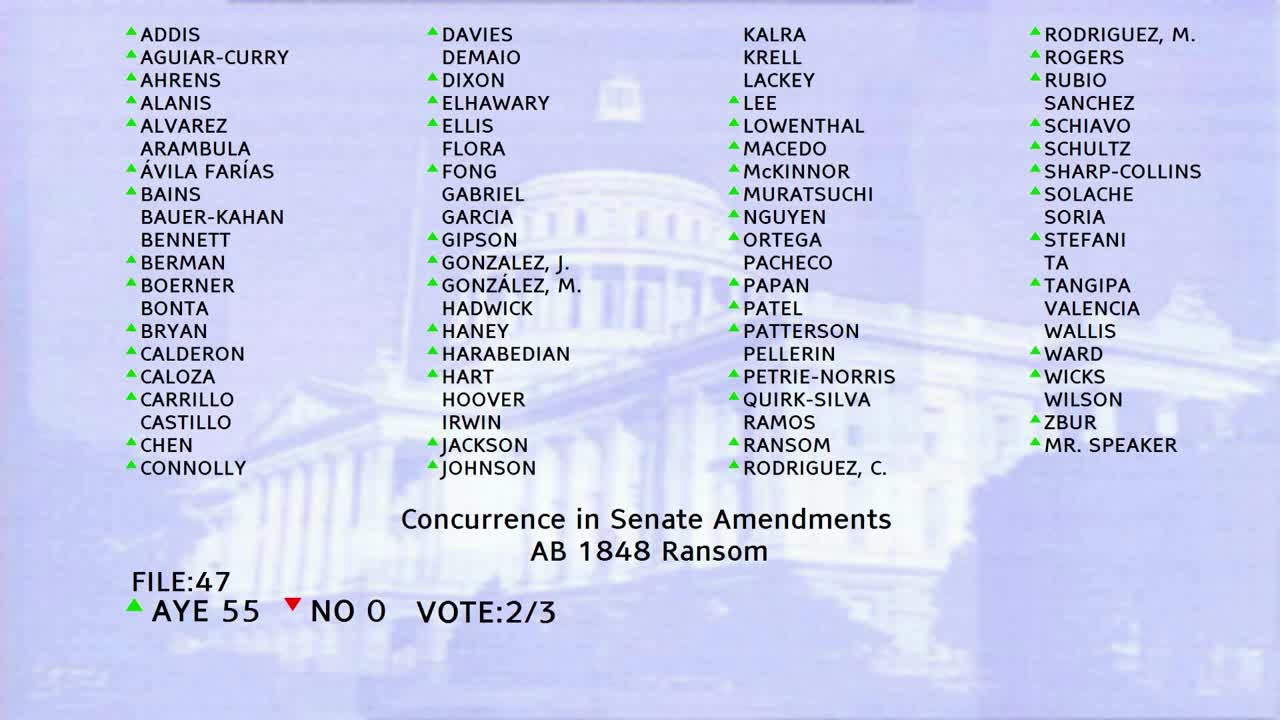 1MIN
Assembly Floor
 2MIN
Senate Floor
 9MIN
Senate Standing Committee on Human Services
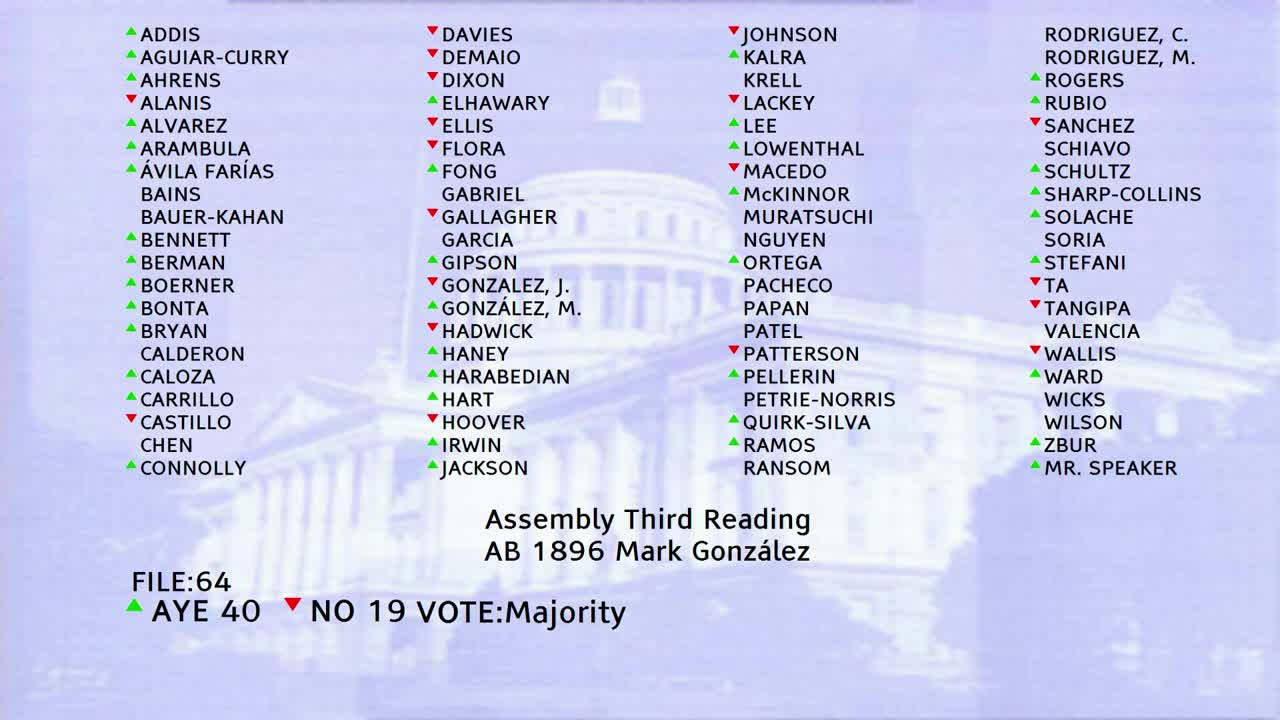 35MIN
Assembly Floor
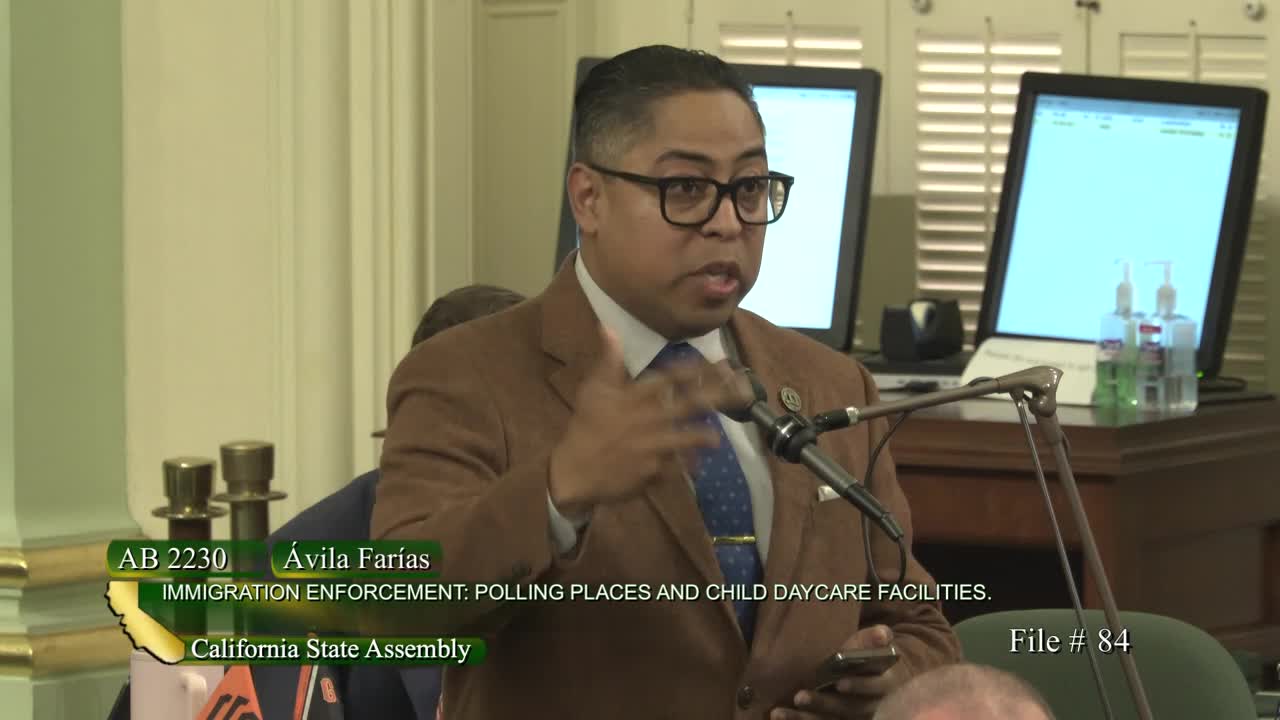 11MIN
Assembly Floor
 5MIN
Assembly Standing Committee on Public Safety
 23MIN
Assembly Standing Committee on Elections
 4MIN
Assembly Standing Committee on Human Services
Bill Author
Bill Co-Author(s):