AB 232: Natural disasters: catastrophe savings accounts: personal income tax.
- Session Year: 2025-2026
- House: Assembly
- Latest Version Date: 2025-04-11
Current Status:
Failed
(2026-02-02: From committee: Filed with the Chief Clerk pursuant to Joint Rule 56.)
Introduced
In Committee
Awaiting First Chamber Vote
Passed First Chamber
In Committee
Awaiting Second Chamber Vote
Passed Second Chamber
Enacted
The Personal Income Tax Law, in modified conformity with federal income tax laws, allows various deductions from gross income in calculating adjusted gross income.
This bill, for taxable years beginning on or after January 1, 2025, 2026, and before January 1, 2030, 2031, would allow a deduction from adjusted gross income for amounts contributed by an individual homeowner a qualified taxpayer, as defined, to a catastrophe savings account, in accordance with specified provisions. The bill would define catastrophe savings account to mean a regular savings account or money market account with a financial institution that, among other requirements, is established to pay for the qualified catastrophe expenses, as defined, of a qualified taxpayer establishing the account, as provided. The bill would subject a qualified taxpayer to a specified penalty if they use a distribution from a catastrophe savings account to cover an expense other than a qualified catastrophe expense.
The Personal Income Tax Law, in conformity with federal income tax law, generally defines gross income as income from whatever source derived, except as specifically excluded, and provides various exclusions from gross income.
This bill, for taxable years beginning on or after January 1, 2025, 2026, and before January 1, 2030, 2031, would provide an exclusion from gross income for interest income earned by a catastrophe savings account. account until December 1, 2030.
Existing law requires any bill authorizing a new tax expenditure, as defined, to include tax credits, deductions, exclusions, or exemptions, to contain, among other things, specific goals, purposes, and objectives that the tax credit will achieve, detailed performance indicators, and data collection requirements.
This bill would include findings and reporting requirements in compliance with this requirement.
This bill would take effect immediately as a tax levy.
Existing law provides for the formation and regulation of state-organized banks and state-certified credit unions by the Department of Financial Protection and Innovation.
This bill, until January 1, 2030, would authorize a homeowner to establish one catastrophe savings account that, among other things, has the specified purpose of covering the amount of insurance deductibles and other uninsured portions of risks of loss from wildfire, flood, or earthquake. The bill would require distributions from a catastrophe savings account to be used to cover qualified catastrophe expenses, defined as expenses paid or incurred due to damage to or loss of a homeowners primary residence caused by a wildfire, flood, or earthquake that has been declared by the Governor to be an emergency. The bill would impose penalties on homeowners who use a distribution to cover an expense other than a qualified catastrophe expense, unless specified exceptions apply. The bill would require the penalty to be determined and collected by the Commissioner of Financial Protection and Innovation, and deposited in the Financial Protection Fund.
The Personal Income Tax Law, in modified conformity with federal income tax laws, allows various deductions from gross income in calculating adjusted gross income.
This bill, for taxable years beginning on or after January 1, 2025, and before January 1, 2030, would allow a deduction from adjusted gross income for amounts contributed by an individual homeowner to a catastrophe savings account, in accordance with specified provisions.
The Personal Income Tax Law, in conformity with federal income tax law, generally defines gross income as income from whatever source derived, except as specifically excluded, and provides various exclusions from gross income.
This bill, for taxable years beginning on or after January 1, 2025, and before January 1, 2030, would provide an exclusion from gross income for interest income earned by a catastrophe savings account.
Existing law requires any bill authorizing a new tax expenditure, as defined, to include tax credits, deductions, exclusions, or exemptions, to contain, among other things, specific goals, purposes, and objectives that the tax credit will achieve, detailed performance indicators, and data collection requirements.
This bill would include findings and reporting requirements in compliance with this requirement.
This bill would take effect immediately as a tax levy.
(a)Section 62 of the Internal Revenue Code, relating to adjusted gross income defined, shall apply, except as otherwise provided.
(b)Section 62(a)(2)(D) of the Internal Revenue Code, relating to certain expenses of elementary and secondary school teachers, shall not apply.
(c)Section 62(a)(21) of the Internal Revenue Code, relating to attorneys attorneys fees relating to awards to whistleblowers, shall not apply.
(d)For each taxable year beginning on or after January 1, 2025, 2026, and before January 1, 2030, 2031, Section 62(a) of the Internal Revenue Code, relating to the general rule, is modified to provide that the deduction under Section 17207.15 shall be allowed in determining adjusted gross income.
SEC. 3.SEC. 2.Section 17141.8 is added to the Revenue and Taxation Code, to read:17141.8.(a)For each taxable year beginning on or after January 1, 2025, 2026, and before January 1, 2030, 2031, gross income does not include interest income earned by a catastrophe savings account established pursuant to Division 21 (commencing with Section 60000) of the Financial Code. Section 17207.15.
(b)This section shall become inoperative on December 1, 2030.
(c)Any interest that accrues to a catastrophe savings account after December 1, 2030, shall be included as gross income.
SEC. 4.SEC. 3.Section 17207.15 is added to the Revenue and Taxation Code, to read:17207.15.(a)For each taxable year beginning on or after January 1, 2025, 2026, and before January 1, 2030, 2031, there shall be allowed as a deduction the amount contributed by an individual homeowner a qualified taxpayer to a catastrophe savings account established pursuant to Division 21 (commencing with Section 60000) of the Financial Code, in accordance with subdivision (b). this section.
(b)(1)The total amount that may be contributed to a catastrophe savings account in a taxable year shall not exceed the following:
(A)In the case of an individual whose qualified deductible is not more than one thousand dollars ($1,000), two thousand dollars ($2,000).(B)(A)In the case of an individual whose qualified deductible is more than one thousand dollars ($1,000), the amount equal to the lesser of a qualified taxpayer whose primary residence is insured, fifteen thousand dollars ($15,000) or twice the amount of the homeowners qualified deductible. ($15,000).
(C)(B)In the case of an individual who chooses not to obtain insurance on their primary residence, a qualified taxpayer whose primary residence is not insured, two hundred fifty thousand dollars ($250,000), but in no event shall exceed the value of the individual homeowners primary residence. ($250,000).
(2)If a homeowner qualified taxpayer contributes in excess of the limits provided in paragraph (1), the homeowner qualified taxpayer shall withdraw the amount of the excess contributions and include that amount in income for purposes of Section 17041 in the year of withdrawal.
(c)For purposes of this section, qualified the following definitions apply:
(1)Catastrophe savings account means a regular savings account or money market account with a financial institution that meets all of the following requirements:
(A)Is designated as a catastrophe savings account by the account holder.
(B)Is established by a qualified taxpayer, or by qualified taxpayers who are spouses, for the exclusive benefit of a qualified taxpayer establishing the account.
(C)Is the only catastrophe savings account established by the qualified taxpayer.
(D)Is established by a residential property owner in this state for their primary residence.
(E)The written governing instrument creating the account provides for both of the following:
(i)All contributions to the account are required to be in cash.
(ii)The account is established to pay, pursuant to the requirements of this section, for the qualified catastrophe expenses of a qualified taxpayer establishing the account.
(2)Qualified catastrophe expenses means either of the following:
(A)Expenses paid or incurred due to damage to or loss of a homeowners primary residence caused by a wildfire, flood, or earthquake that has been declared by the Governor to be an emergency, including a qualified deductible of a homeowners insurance policy.
(B)Expenses paid or incurred by a homeowner to incorporate property-level mitigation efforts, as provided in subparagraph (B) of paragraph (1) of subdivision (d) of Section 2644.9 of Title 10 of the California Code of Regulations, to their primary residence.
(3)Qualified deductible means the deductible for the individuals homeowners insurance policy for a homeowners primary residence.
(4)Qualified taxpayer means an individual, or a married couple if filing a joint return, who owns a primary residence in this state.
(d)A distribution from a catastrophe savings account shall be used to cover qualified catastrophe expenses. If a qualified taxpayer uses a distribution from a catastrophe savings account to cover an expense other than a qualified catastrophe expense, the qualified taxpayer shall be subject to a penalty of 2.5 percent of the amount improperly distributed.
(d)(e)(1)For purposes of complying with Section 41, as it applies to the deduction allowed by this section, the Legislature finds and declares as follows:
(A)California is not immune from natural disasters such as wildfires, floods, and earthquakes.
(B)California must seek a multiprong multipronged approach to address natural disasters which includes public- and private-market options and personal responsibility.
(C)The promotion of financial resiliency benefits cities, counties, consumers, and policyholders.
(D)Catastrophe savings accounts are intended to assist consumers in paying for expenses incurred or related to a major natural disaster.
(E)The catastrophe savings accounts would foster pre-event mitigation and postevent recovery from catastrophes by accumulating funds that can be used to supplement insurance coverage and offset the costs of remediation and repair.
(2)The performance indicator indicators for the Legislature to use in determining if the deduction achieves its stated purpose is the include all of the following:
(A)The number of taxpayers allowed a deduction pursuant to this section.
(B)The average amount of the deduction allowed pursuant to this section.
(C)The total amount of deductions allowed pursuant to this section.
(3)(A)By May 1, 2026, 2028, and annually thereafter, the Franchise Tax Board shall submit a report to the Legislature, in accordance with Section 9795 of the Government Code, detailing the number of taxpayers allowed a deduction pursuant to this section. performance indicators listed in paragraph (2).
(B)The disclosure provisions of this paragraph shall be treated as an exception to Section 19542.
(e)(f)This section shall become inoperative on December 1, 2030. 2031.
SEC. 5.SEC. 4.This act provides for a tax levy within the meaning of Article IV of the California Constitution and shall go into immediate effect.
For purposes of this division, the following definitions apply:
(a)Catastrophe Savings Account means a regular savings account or money market account established by a residential property insurance policyholder in this state to cover the deductible for a policy that covers wildfire, flood, or earthquake for the policyholders primary residence or by an individual to cover uninsured losses for the homeowners primary residence from a wildfire, flood, or earthquake.
(b)Qualified catastrophe expenses mean expenses paid or incurred due to damage to or loss of a homeowners primary residence caused by a wildfire, flood, or earthquake that has been declared by the Governor to be an emergency.
60010.(a)A homeowner may establish no greater than one catastrophe savings account. A catastrophe savings account shall be labeled as a catastrophe savings account, and the specified purpose of the account shall be to cover the amount of insurance deductibles and other uninsured portions of risks of loss from wildfire, flood, or earthquake.
(b)(1)A distribution from a catastrophe savings account shall be used to cover qualified catastrophe expenses. If a homeowner uses a distribution from a catastrophe savings account to cover an expense other than a qualified catastrophe expense, the homeowner shall be subject to a penalty to be determined and collected by the Commissioner of Financial Protection and Innovation, and deposited in the Financial Protection Fund.
(2)The penalty imposed by this subdivision shall not apply if either of the following apply at the time the distribution is made:
(A)The homeowner no longer owns a primary residence.
(B)The homeowner is at least 70 years of age and did not obtain insurance on their primary residence.
(c)A catastrophe savings account is not subject to attachment, levy, garnishment, or legal process in this state.
60020.This division shall become inoperative on January 1, 2030.
SEC. 2.Section 17072 of the Revenue and Taxation Code is amended to read:17072.(a)Section 62 of the Internal Revenue Code, relating to adjusted gross income defined, shall apply, except as otherwise provided.
(b)Section 62(a)(2)(D) of the Internal Revenue Code, relating to certain expenses of elementary and secondary school teachers, shall not apply.
(c)Section 62(a)(21) of the Internal Revenue Code, relating to attorneys fees relating to awards to whistleblowers, shall not apply.
(d)For each taxable year beginning on or after January 1, 2025, and before January 1, 2030, Section 62(a) of the Internal Revenue Code, relating to the general rule, is modified to provide that the deduction under Section 17207.15 shall be allowed in determining adjusted gross income.
SEC. 3.Section 17141.8 is added to the Revenue and Taxation Code, to read:17141.8.(a)For each taxable year beginning on or after January 1, 2025, and before January 1, 2030, gross income does not include interest income earned by a catastrophe savings account established pursuant to Division 21 (commencing with Section 60000) of the Financial Code.
(b)This section shall become inoperative on December 1, 2030.
SEC. 4.Section 17207.15 is added to the Revenue and Taxation Code, to read:17207.15.(a)For each taxable year beginning on or after January 1, 2025, and before January 1, 2030, there shall be allowed as a deduction the amount contributed by an individual homeowner to a catastrophe savings account established pursuant to Division 21 (commencing with Section 60000) of the Financial Code, in accordance with subdivision (b).
(b)(1)The total amount that may be contributed to a catastrophe savings account shall not exceed the following:
(A)In the case of an individual whose qualified deductible is not more than one thousand dollars ($1,000), two thousand dollars ($2,000).
(B)In the case of an individual whose qualified deductible is more than one thousand dollars ($1,000), the amount equal to the lesser of fifteen thousand dollars ($15,000) or twice the amount of the homeowners qualified deductible.
(C)In the case of an individual who chooses not to obtain insurance on their primary residence, two hundred fifty thousand dollars ($250,000), but in no event shall exceed the value of the individual homeowners primary residence.
(2)If a homeowner contributes in excess of the limits provided in paragraph (1), the homeowner shall withdraw the amount of the excess contributions and include that amount in income for purposes of Section 17041 in the year of withdrawal.
(c)For purposes of this section, qualified deductible means the deductible for the individuals homeowners policy for a homeowners primary residence.
(d)(1)For purposes of complying with Section 41, as it applies to the deduction allowed by this section, the Legislature finds and declares as follows:
(A)California is not immune from natural disasters such as wildfires, floods, and earthquakes.
(B)California must seek a multiprong approach to address natural disasters which includes public- and private-market options and personal responsibility.
(C)The promotion of financial resiliency benefits cities, counties, consumers, and policyholders.
(D)Catastrophe savings accounts are intended to assist consumers in paying for expenses incurred or related to a major natural disaster.
(E)The catastrophe savings accounts would foster pre-event mitigation and postevent recovery by accumulating funds that can be used to supplement insurance coverage and offset the costs of remediation and repair.
(2)The performance indicator for the Legislature to use in determining if the deduction achieves its stated purpose is the number of taxpayers allowed a deduction pursuant to this section.
(3)(A)By May 1, 2026, and annually thereafter, the Franchise Tax Board shall submit a report to the Legislature, in accordance with Section 9795 of the Government Code, detailing the number of taxpayers allowed a deduction pursuant to this section.
(B)The disclosure provisions of this paragraph shall be treated as an exception to Section 19542.
(e)This section shall become inoperative on December 1, 2030.
SEC. 5.This act provides for a tax levy within the meaning of Article IV of the California Constitution and shall go into immediate effect.
REVISIONS: HeadingLine 2.|
Date
|
Status
|
|---|---|
| Feb 2, 2026 | From committee: Filed with the Chief Clerk pursuant to Joint Rule 56. |
| Jan 31, 2026 | Died pursuant to Art. IV, Sec. 10(c) of the Constitution. |
| May 23, 2025 | In committee: Held under submission. |
| May 21, 2025 | In committee: Set, first hearing. Referred to APPR. suspense file. |
| May 21, 2025 | Joint Rule 62(a), file notice suspended. (Page 1627.) |
| May 14, 2025 | In committee: Hearing postponed by committee. |
| May 6, 2025 | From committee: Do pass and re-refer to Com. on APPR. (Ayes 7. Noes 0.) (May 5). Re-referred to Com. on APPR. |
| Apr 21, 2025 | In committee: Set, first hearing. Referred to suspense file. |
| Apr 21, 2025 | Re-referred to Com. on REV. & TAX. |
| Apr 11, 2025 | From committee chair, with author's amendments: Amend, and re-refer to Com. on REV. & TAX. Read second time and amended. |
| Mar 3, 2025 | Coauthors revised. |
| Mar 3, 2025 | From committee: Do pass and re-refer to Com. on REV. & TAX. (Ayes 8. Noes 0.) (March 3). Re-referred to Com. on REV. & TAX. |
| Feb 10, 2025 | Referred to Coms. on B. & F. and REV. & TAX. |
| Jan 14, 2025 | From printer. May be heard in committee February 13. |
| Jan 13, 2025 | Read first time. To print. |
|
Date
|
Description
|
Location
|
Votes
|
|
|---|---|---|---|---|
| May 5, 2025 | Do pass and be re-referred to the Committee on [Appropriations] | Assembly Standing Committee on Revenue and Taxation |
Passed |
|
| Mar 3, 2025 | Do pass and be re-referred to the Committee on [Revenue and Taxation] | Assembly Standing Committee on Banking and Finance |
Passed |
This list shows positions taken on this bill by organizations on the date displayed, which is linked to the original source.
Positions by individuals are not included.
|
Organization
|
Position
|
Date
|
|---|---|---|
| American Property Casualty Insurance Association | ** Support | |
| California Apartment Association | ** Support | |
| California Association Of Realtors | ** Support | |
| California Bankers Association | ** Support | |
| California Building Industry Association | ** Support | |
| Insurance Commissioner Ricardo Lara / California Department of Insurance | ** Support | |
| Little Hoover Commission | ** Support | |
| Personal Insurance Federation Of California | ** Support |
Date of Hearing: May 21, 2025
ASSEMBLY COMMITTEE ON APPROPRIATIONS
Buffy Wicks, Chair
ABPCA Bill Id:AB 232
Author:(Calderon) – As Amended Ver:April 11, 2025
Policy Committee: | Banking and Finance | Vote: | 8 - 0 |
Revenue and Taxation | 7 - 0 | ||
|
|
Urgency: No State Mandated Local Program: No Reimbursable: No
SUMMARY:
This bill allows, under the Personal Income Tax (PIT) law, an above-the-line deduction for contributions to a catastrophe savings account (CSA) and excludes any interest accruing to the account from gross income.
Specifically, this bill:
- Allows, for taxable years beginning on or after January 1, 2026, and before January 1, 2031, an above-the-line deduction equal to the amount contributed by a qualified taxpayer to a CSA, subject to certain annual limitations depending on whether the qualified taxpayer’s primary residence is insured.
- Excludes from gross income, for taxable years beginning on or after January 1, 2026, and before January 1, 2031, any gains accruing during the taxable year to a CSA.
- Provides that any distribution from a catastrophe savings account must be for qualified catastrophe expenses, and imposes a penalty of 2.5% on any amount improperly distributed.
- Declares the goals and performance indicators of this tax expenditure and requires the Franchise Tax Board (FTB) to annually report certain performance data to the Legislature.
FISCAL EFFECT:
- General Fund (GF) revenue loss of approximately $15 million in fiscal year (FY) 2025-26, $60 million in FY 2026-27, and $110 million in FY 2027-28. By decreasing PIT revenue, this bill also likely decreases Proposition 98 GF spending by approximately 40% of the revenue loss (the exact amount depends on the specific amount of the annual Proposition 98 guarantee).
- Costs of an unknown amount to the FTB to administer the deduction and exclusion and provide the annual report (GF).
COMMENTS:
- Purpose. According to the author:
[AB] 232 provides homeowners a proactive method to protect their homes by authorizing tax exempt savings accounts to be utilized for home-hardening and disaster recovery expenses. As these catastrophic events become more frequent, California must ensure homeowners are equipped with all available tools to plan for wildfire, flooding, and other extreme weather events.
This bill is supported by Insurance Commissioner Ricardo Lara, the Little Hoover Commission, and banking, housing, and insurance industry groups.
- Tax-advantaged Savings Accounts. Federal and state law authorizes several types of retirement savings plans that allow reduced or deferred income taxes to encourage workers to save for retirement. Generally, federal law imposes a 10% withdrawal penalty on an early distribution from an individual retirement account (IRA), with a similar 2.5% penalty under state law. This bill creates a separate tax-advantaged savings mechanism for a residential property owner to pay for pre-disaster property-level mitigation efforts for the owner’s primary residence, as well as post-disaster losses that are not covered by insurance. Similar to the existing deduction for contributions to a qualifying IRA, this bill allows a taxpayer an above-the-line deduction equal to the amount contributed to a CSA in that taxable year. This bill also provides a gross income exclusion for interest earned on amount saved in a CSA. This bill does not explicitly provide an income exclusion when money is withdrawn from a CSA, even for a qualified expense, so such amounts would likely be included in the taxpayer’s adjusted gross income in the taxable year of withdrawal.
Generally, state conformity with federal tax rules promotes greater simplicity and eases administration of complex tax laws. This bill would bring California further out of conformity with federal law, as any income excluded by this bill would still be subject to federal income tax. The Assembly Revenue and Taxation Committee’s analysis of this bill also notes:
As currently drafted, this bill would allow an income exclusion on interest earned on contributions made in excess of the stated limits, as well as an income exclusion for interest earned on funds from the [CSA] are used for non-qualified expenses. The author may wish to consider amending the bill to disallow these tax benefits when a taxpayer does not comply with limitations established by this bill.
- Prior Legislation. AB 1865 (Jim Patterson), of the 2023-24 Legislative Session, would have established a homeownership savings account and provided a gross income exclusion for investment gains accruing to the account and the withdrawal of funds used for the purchase of residential property. AB 1865 was held on this committee’s suspense file.
Analysis Prepared by: Irene Ho / APPR. / (916) 319-2081
Date of Hearing: May 5, 2025
ASSEMBLY COMMITTEE ON REVENUE AND TAXATION
Mike Gipson, Chair
ABPCA Bill Id:AB 232 (
Author:Calderon) – As Amended Ver:April 11, 2025
SUSPENSE
Majority vote. Tax levy. Fiscal committee.
SUBJECT: Natural disasters: catastrophe savings accounts: personal income tax
SUMMARY: Allows, under the Personal Income Tax (PIT) Law, an above-the-line deduction for contributions to a "catastrophe savings account" by a "qualified taxpayer" and excludes any interest accruing to the account from gross income, as specified. Specifically, this bill:
- Allows, for taxable years beginning on or after January 1, 2026, and before January 1, 2031, an above-the-line deduction equal to the amount contributed by a "qualified taxpayer" to a "catastrophe savings account", subject to the following annual limitations:
- For a "qualified taxpayer" whose primary residence is insured, $15,000; and,
- For a "qualified taxpayer" whose primary residence is not insured, $250,000.
- Excludes from gross income, for taxable years beginning on or after January 1, 2026, and before January 1, 2031, any gains accruing during the taxable year to a "catastrophe savings account" whose beneficiary is a "qualified taxpayer".
- Defines all of the following terms:
- "Catastrophe savings account" is a regular savings account or money market account with a financial institution that meets all of the following requirements:
- Is designated as a catastrophe savings account by the account holder;
- Is established by a "qualified taxpayer", or by "qualified taxpayers" who are spouses, for the exclusive benefit of the "qualified taxpayer" establishing the account;
- Is the only catastrophe savings account established by the "qualified taxpayer";
- Is established by a residential property owner in this state for their primary residence; and,
- The written governing instrument creating the account provides for both of the following:
- All contributions to the account are required to be in cash; and,
- The account is established to pay for the qualified catastrophe expenses of a "qualified taxpayer" establishing the account.
- "Qualified taxpayer" is an individual, or a married couple if filing a joint return, who owns a primary residence in California.
- "Qualified catastrophe expenses" are either of the following:
- Expenses paid or incurred due to damage to or loss of a homeowner's primary residence caused by a wildfire, flood, or earthquake that has been declared by the Governor to be an emergency, including a qualified deductible of a homeowners insurance policy; and,
- Expenses paid or incurred by a homeowner to incorporate property-level mitigation efforts, as provided in the California Department of Insurance (CDI) Safer from Wildfire regulations adopted under Title 10 of the California Code of Regulations (CCR), Section 2644.9(d)(1)(B), to their primary residence.
- "Qualified deductible" is the deductible for the individual's homeowner's insurance policy for a homeowner's primary residence.
- "Catastrophe savings account" is a regular savings account or money market account with a financial institution that meets all of the following requirements:
- Provides for all of the following:
- Any contributions in excess of the prescribed limits must be withdrawn and included in gross income in the year of the withdrawal;
- Any interest that accrues to a catastrophe savings account after December 1, 2030, must be included as gross income; and,
- Any distribution from a catastrophe savings account must be used to cover qualified catastrophe expenses.
- Imposes a penalty of 2.5% of any amount improperly distributed from a catastrophe savings account to cover an expense other than a qualified catastrophe expense.
- Finds and declares the following for the purposes of satisfying the requirements of Revenue and Taxation Code (R&TC) Section 41:
- The specific goals, purposes, and objectives of this bill are to foster pre-event mitigation and postevent recovery from catastrophes by enabling taxpayers to accumulate funds that can be used to supplement insurance coverage and offset the costs of remediation and repair.
- The performance indicators for the Legislature to use in determining if the deduction achieves its stated purpose include all of the following:
- The number of taxpayers allowed a deduction;
- The average amount of the deduction allowed; and,
- The total amount of deductions allowed.
- To measure whether this bill achieves its intended purpose, the Franchise Tax Board (FTB) shall submit a report to the Legislature no later than May 1, 2028, and annually thereafter, detailing the performance indicators listed above.
- Sunsets the deduction and income exclusion's statutory provisions on December 1, 2031.
- Takes immediate effect as a tax levy.
EXISTING LAW:
- Conforms generally to federal law, which provides that gross income includes all income from whatever source derived unless expressly excluded. (Internal Revenue Code (IRC) Section 61 and R&TC Section 17071.) Gross income includes compensation for services, business income, gain from selling property, interest, rents, royalties, dividends, and pensions.
- Provides for various types of tax-advantaged savings accounts under federal law, including Individual Retirement Accounts (IRAs) and Qualified Tuition Programs (also known as 529 college savings plans), to which state law generally conforms. (IRC Sections 401, 457, 529 et seq. and R&TC Sections 17140.3 and 17501.5.)
- Allows an above-the-line deduction for qualified IRA contributions to which state law conforms. (IRC Section 62(a) and R&TC Section 17072.)
- Allows an itemized deduction equal to the amount of interest a taxpayer pays on a mortgage secured by their principal or secondary residence, subject to certain limitations. (IRC Section 163(h) and R&TC Section 17201.)
- Requires any bill authorizing a new tax expenditure to contain all of the following:
- Specific goals, purposes, and objectives that the tax expenditure will achieve;
- Detailed performance indicators for the Legislature to use when measuring whether the tax expenditure meets the goals, purposes, and objectives stated in the bill; and,
- Data collection requirements to enable the Legislature to determine whether the tax expenditure is meeting, failing to meet, or exceeding those specific goals, purposes, and objectives. The requirements shall include the specific data and baseline measurements to be collected and remitted in each year the expenditure is in effect, for the Legislature to measure the change in performance indicators, and the specific taxpayers, state agencies, or other entities required to collect and remit data. (R&TC Section 41.)
FISCAL EFFECT: The FTB estimates General Fund (GF) revenue losses of $15 million in fiscal year (FY) 2025-26, $60 million in FY 2026-27, and $110 million in FY 2027-28.
COMMENTS:
- The author has provided the following statement in support of this bill:
Assembly bill 232 provides homeowners a proactive method to protect their homes by authorizing tax exempt savings accounts to be utilized for home-hardening and disaster recovery expenses. As these catastrophic events become more frequent, California must ensure homeowners are equipped with all available tools to plan for wildfire, flooding, and other extreme weather events. By allowing homeowners to set aside pre-tax dollars to cover disaster-related costs, this bill empowers Californians to take control of their financial preparedness and safeguard their futures.
- In support of this bill, Insurance Commissioner Ricardo Lara notes, in part:
Catastrophe savings accounts are a practical solution to help homeowners prepare for disaster-related expenses and reduce financial stress during emergencies. These accounts encourage proactive savings by offering tax deductions for contributions and exclusions for interest income, while simultaneously imposing penalties on misuse to ensure funds are used as intended. With wildfires continuing to pose a significant threat to all Californians, these accounts can help homeowners cover high deductibles or uninsured losses, enabling quicker recovery time and easing the strain on public disaster relief resources. Catastrophe savings accounts can also address gaps in preparedness for other risks, such as flood damage and earthquake losses. By encouraging individuals to save for their own recovery while maintaining traditional insurance these accounts work alongside existing coverage and promote a focus on preparedness without diminishing the importance of adequate insurance protection. Together, they create stronger financial security for Californians facing the growing threats of climate-intensified disasters.
- Committee Staff Comments:
- What is a "tax expenditure"? Existing law provides various credits, deductions, exclusions, and exemptions for particular taxpayer groups. In the late 1960s, U.S. Treasury officials began arguing that these features of the tax law should be referred to as "expenditures" since they are generally enacted to accomplish some governmental purpose and there is a determinable cost associated with each (in the form of foregone revenues).
As the Department of Finance notes in its annual Tax Expenditure Report, there are several key differences between tax expenditures and direct expenditures. First, tax expenditures are typically reviewed less frequently than direct expenditures. Second, there is generally no control over the amount of revenue losses associated with any given tax expenditure. Finally, it should also be noted that, once enacted, it takes a two-thirds vote to rescind an existing tax expenditure absent a sunset date. This effectively results in a "one-way ratchet" whereby tax expenditures can be conferred by majority vote, but cannot be rescinded, irrespective of their efficacy or cost, without a supermajority vote.
- Homeowners insurance in California: Proposition 103, passed by California voters in November 1988, was intended to protect consumers from arbitrary insurance rates and practices, to encourage a competitive marketplace, and to ensure that insurance is fair, available, and affordable for all Californians. Proposition 103 instituted a regulatory system where the Insurance Commissioner must approve a rate applied for by an insurer before its use, known as the "prior approval" system, before an insurer can implement property and casualty insurance rates.
In 2017 and 2018, California experienced two of the most destructive wildfire seasons in state history, which resulted in California insurers paying a record of $15.4 billion in losses in 2017 and $13.6 billion in 2018. After two straight years of insurers paying out $1.85 in losses for every $1 of premium earned, the California Department of Insurance approved 71 rate increase requests from 50 different companies in 2019. Damage resulting from winter storms in subsequent years has continued to strain the property insurance market, with several major insurers stopping issuance of new policies or exiting the state altogether.[1]
The 2025 fires in Los Angeles have further exacerbated the property insurance crisis in multiple ways. While damage totals are still being calculated, it is estimated the fires resulted in the destruction or damage of tens of billions of dollars in property. Claims for insured properties are still being filed and will likely also total in the tens of billions of dollars. Additionally, many properties that were damaged or destroyed were already insured by the California FAIR Plan, the state's insurer of last resort, potentially jeopardizing the Plan's future solvency. - California FAIR Plan: The FAIR Plan was established after the riots and brush fires of the 1960s and provides basic property insurance to consumers when coverage in the voluntary market is unavailable. Every property insurance company licensed in California becomes a FAIR Plan member as a condition of doing business in California. Roughly 44% of FAIR Plan policies cover properties in California's urban areas while the rest are in the wildland urban interface (WUI) and properties are eligible for coverage regardless of wildfire exposure. The FAIR Plan is not a state agency and not state- or taxpayer-funded; it is funded primarily through the policies it sells to customers.[2]
- Homeowners insurance in California: Proposition 103, passed by California voters in November 1988, was intended to protect consumers from arbitrary insurance rates and practices, to encourage a competitive marketplace, and to ensure that insurance is fair, available, and affordable for all Californians. Proposition 103 instituted a regulatory system where the Insurance Commissioner must approve a rate applied for by an insurer before its use, known as the "prior approval" system, before an insurer can implement property and casualty insurance rates.
As of February 11, 2025, the FAIR Plan reported that it had paid more than $914 million to policy holders, including advance payments, to cover claims related to the Palisades and Eaton fires. The massive destruction in Los Angeles prompted the FAIR Plan's Accounting and Governing subcommittees to each recommend an assessment of $1 billion – the first assessment on insurers in more than 30 years, according to Insurance Commissioner Ricardo Lara – to enable the FAIR Plan to access additional available layers of reinsurance and maintain operations.[3] Generally, assessments are based on an insurer's market share of dwelling and commercial policies from two years ago, which means that property insurance policyholders that are not customers of the FAIR Plan may see their insurance costs increase.
- What would this bill do? AB 232 would create a new type of tax-advantaged savings account that residential property owners could use to pay for pre-disaster property-level mitigation efforts for their primary residence and post-disaster losses that are not covered by insurance. Similar to the existing deduction for contributions to qualifying IRAs like a 401k, taxpayers would be allowed an above-the-line deduction equal to the amount they contributed to a catastrophe savings account in that taxable year. This "front-end" benefit allows taxpayers to reduce their adjusted gross income (AGI) while growing their savings. Taxpayers whose primary residence is insured would be able to deduct up to $15,000 annually in contributions while taxpayers whose primary residence is not insured would be able to deduct up to $250,000 annually. This bill also provides an income exclusion for the interest earned on amounts saved in a catastrophe savings account, meaning that taxpayers would be able to grow their savings tax-free by leveraging compounding interest.
- What expenses qualify? This bill creates two broad categories for qualifying catastrophe expenses. First, expenses paid or incurred due to damage to or loss of a homeowner's primary residence caused by a wildfire, flood, or earthquake that has been declared by the Governor to be an emergency, including a qualified deductible of a homeowners insurance policy, are considered qualified expenses.
Second, the types of pre-disaster property-level mitigation efforts that qualify as an eligible expense under this bill are outlined in CDI's Safer from Wildfire regulations and include both of the following:
- What would this bill do? AB 232 would create a new type of tax-advantaged savings account that residential property owners could use to pay for pre-disaster property-level mitigation efforts for their primary residence and post-disaster losses that are not covered by insurance. Similar to the existing deduction for contributions to qualifying IRAs like a 401k, taxpayers would be allowed an above-the-line deduction equal to the amount they contributed to a catastrophe savings account in that taxable year. This "front-end" benefit allows taxpayers to reduce their adjusted gross income (AGI) while growing their savings. Taxpayers whose primary residence is insured would be able to deduct up to $15,000 annually in contributions while taxpayers whose primary residence is not insured would be able to deduct up to $250,000 annually. This bill also provides an income exclusion for the interest earned on amounts saved in a catastrophe savings account, meaning that taxpayers would be able to grow their savings tax-free by leveraging compounding interest.
- Measures addressing the immediate surroundings of the home, including the clearing of vegetation and debris from under decks and areas within 5 feet of the home, incorporating only noncombustible materials into improvements like fences, removing combustible structures, and compliance with state and local defensible space requirements; and,
- Building hardening measures, including the installation of a Class-A Fire Rated Roof, enclosed eaves, fire-resistant vents, multipane windows, and at least 6 inches of noncombustible vertical clearance at the bottom of the exterior surface of the home, measured from the ground up.
Additionally, similar to existing law governing IRAs and 529 accounts, this bill imposes a penalty of 2.5% on amounts withdrawn that are not used for qualified expenses.
- What happens when money is withdrawn? As currently drafted, this bill does not explicitly provide an income exclusion when money in a catastrophe savings account are withdrawn, which is sometimes referred to as a "back-end" benefit. As such, amounts that are withdrawn, even if used for a qualifying expense, likely would be included in the taxpayer's AGI in the taxable year of withdrawal.
- Tax advantaged savings accounts: As described above, both state and federal law provide for various types of tax-advantaged savings accounts that are intended to encourage saving for future expenses, such as retirement or pursuing higher education. Under these existing savings regimes, the tax benefit is provided either on the "front-end" in the form of a deduction, or on the "back-end" in the form of a gross income exclusion when disbursements are made for certain expenses. While there may be various trade-offs associated with each kind of account, taxpayers generally have to choose whether they pay taxes now or wait until later, but they cannot avoid their savings being subject to income taxes at some point.
- What happens when money is withdrawn? As currently drafted, this bill does not explicitly provide an income exclusion when money in a catastrophe savings account are withdrawn, which is sometimes referred to as a "back-end" benefit. As such, amounts that are withdrawn, even if used for a qualifying expense, likely would be included in the taxpayer's AGI in the taxable year of withdrawal.
There is only one type of tax-advantaged savings account recognized in federal law that offers the rare "triple benefit" of providing a deduction for contributions, tax-free growth on interest, and tax-free distributions: health savings accounts (HSAs). California law does not conform to the IRC provisions relating to HSAs and the Legislature has repeatedly rejected efforts that would have brought the state into full or partial conformity.
To benefit from an HSA, a taxpayer must be enrolled in a high-deductible health plan — meaning a deductible that is at least $3,000 for a family and that applies to virtually all services except preventive care — in order to save for out-of-pocket health expenses. HSAs have been criticized for encouraging enrollment in low-quality health plans, as well as for disproportionately benefitting wealthier taxpayers while providing no assistance to middle- and low-income taxpayers.[4] In fact, HSAs are seen by some financial planners as just another tool to save for retirement that can drastically reduce an individual's tax liability.[5]
- Evidence from other states: Alabama, Mississippi, and South Carolina are the only other states that currently recognize catastrophe savings accounts and they are structured similarly to HSAs. Even with these generous tax benefits, very few taxpayers in these states are actually claiming the deductions associated with contributions to a catastrophe savings account. According to reporting by E&E News, in 2022, "just 0.02% of income tax returns in Mississippi and 0.03% of returns in Alabama claimed the deduction, according to state data, even as hurricanes and other storms pummel the Southeast year after year."[6]
One reason for the lack of uptake for these accounts in other states is likely due to the lack of a corresponding tax benefit in federal law. A state income tax benefit may not be enough of an incentive to motivate people to create an account, and they may not have disposable income on hand to fund it. The catastrophe savings account concept was first introduced in Congress in 2014 and most recently by Senator Rick Scott of Florida.[7]
For more information about the impact of recent disasters on the residential property insurance market and the California FAIR Plan, please refer to the Assembly Committee on Insurance's recent Oversight Hearings.
- Committee's tax expenditure policy: Both R&TC Section 41 and Committee policy require any tax expenditure bill to outline specific goals, purposes, and objectives that the tax expenditure will achieve, along with detailed performance indicators for the Legislature to use when measuring whether the tax expenditure meets those stated goals, purposes, and objectives. A tax expenditure bill will not be eligible for a Committee vote unless it has complied with these requirements.
In its current form, this bill states that the deduction is designed to foster pre-event mitigation and postevent recovery from catastrophes by enabling taxpayers to accumulate funds that can be used to supplement insurance coverage and offset the costs of remediation and repair. In addition, this bill provides that the deduction's effectiveness shall be measured by the number of taxpayers claiming the deduction, the average amount of deductions allowed, and the total amounts deducted.
In addition to the R&TC Section 41 requirements, this Committee's policy also requires that all tax expenditure proposals contain an appropriate sunset provision to be eligible for a vote. According to this policy, an "appropriate sunset provision" means five years, except in the case of a tax expenditure measure providing relief to California veterans, in which case "appropriate sunset provision" means ten years. This bill, as currently drafted, complies with the Committee's policy on sunset dates.
- Implementation considerations:
- Lack of federal conformity: As described above, this bill proposes a deduction and income exclusion that have no counterpart in the Federal tax code. In general, state conformity with federal law promotes greater simplicity and eases administration of complex tax laws. This bill would bring California further out of conformity with federal law as the deduction created by this bill could not be claimed on a Federal return. In the absence of similar federal treatment, taxpayers may need to keep separate accounting for state and federal tax purposes.
- Penalties and improper distributions: As currently drafted, this bill would allow an income exclusion on interest earned on contributions made in excess of the stated limits, as well as an income exclusion for interest earned on funds from the catastrophe savings account are used for non-qualified expenses. The author may wish to consider amending the bill to disallow these tax benefits when a taxpayer does not comply with limitations established by this bill.
- Lack of federal conformity: As described above, this bill proposes a deduction and income exclusion that have no counterpart in the Federal tax code. In general, state conformity with federal law promotes greater simplicity and eases administration of complex tax laws. This bill would bring California further out of conformity with federal law as the deduction created by this bill could not be claimed on a Federal return. In the absence of similar federal treatment, taxpayers may need to keep separate accounting for state and federal tax purposes.
- Related legislation:
- AB 1354 (Wallis) would allow a credit for amounts paid in residential property insurance premiums, as specified. AB 1354 is currently pending in this Committee.
- AB 389 (Wallis) would allow a credit of up to $400 per year and $2,000 cumulatively for specified home hardening measures. AB 389 is currently pending on this Committee's Suspense File.
- AB 1354 (Wallis) would allow a credit for amounts paid in residential property insurance premiums, as specified. AB 1354 is currently pending in this Committee.
- Prior legislation: AB 1865 (Jim Patterson), of the 2023-24 Legislative Session, would have established homeownership savings accounts and provided gross income exclusions for investment gains accruing to the accounts and the withdrawal of funds for the purchase of a residential property, as specified. AB 1865 was held on the Assembly Appropriation Committee's Suspense File.
- Implementation considerations:
REGISTERED SUPPORT / OPPOSITION:
Support
California Apartment Association
California Association of Realtors
California Bankers Association
California Building Industry Association
Insurance Commissioner Ricardo Lara / California Department of Insurance
Little Hoover Commission
Personal Insurance Federation of California
Opposition
None on file
Analysis Prepared by: Wesley Whitaker / REV. & TAX. / (916) 319-2098
"Joint Informational Hearing: Wildfire Insurance: Risk, Resiliency & Recovery." Assembly Committee on Insurance and Select Committee on Wildfire Prevention. October 9, 2023. https://ains.assembly.ca.gov/sites/ains.assembly.ca.gov/files/10.9.23%20Final%20Committee%20background.pdf. ↑
"Oversight Hearing: The California FAIR Plan." Assembly Committee on Insurance. March 13, 2024. https://ains.assembly.ca.gov/system/files/2024-03/asm-ins-fair-plan-background-final_0.pdf. ↑
Jergler, Don. "California Approves FAIR Plan Request to Assess Insurers $1B for Wildfire Claims." Insurance Journal. February 11, 2025. https://www.insurancejournal.com/news/west/2025/02/11/811676.htm. ↑
Lukens, Gideon. "Expanding Health Savings Accounts Would Boost Tax Shelters, Not Access to Care." Center on Budget and Policy Priorities. June 22, 2023. https://www.cbpp.org/research/health/expanding-health-savings-accounts-would-boost-tax-shelters-not-access-to-care. ↑
Adams, Riley. "What is an HSA? The Ultimate Tax Shelter to Save Money." Young and the Invested. January 13, 2025. https://youngandtheinvested.com/what-is-hsa/. ↑
Ellfeldt, Avery. "States offer tax-free disaster savings accounts. Nobody cares." E&E News by Politico. August 6, 2024. https://www.eenews.net/articles/states-offer-tax-free-disaster-savings-accounts-nobody-cares/. ↑
"Proposal to allow disaster savings accounts gains traction." ABA Banking Journal. November 25, 2024. https://bankingjournal.aba.com/2024/11/proposal-to-allow-disaster-savings-accounts-gains-traction/. ↑
Date of Hearing: April 21, 2025
ASSEMBLY COMMITTEE ON REVENUE AND TAXATION
Mike Gipson, Chair
ABPCA Bill Id:AB 232 (
Author:Calderon) – As Amended Ver:April 11, 2025
Majority vote. Tax levy. Fiscal committee.
SUBJECT: Natural disasters: catastrophe savings accounts: personal income tax
SUMMARY: Allows, under the Personal Income Tax (PIT) Law, an above-the-line deduction for contributions to a "catastrophe savings account" by a "qualified taxpayer" and excludes any interest accruing to the account from gross income, as specified. Specifically, this bill:
- Allows, for taxable years beginning on or after January 1, 2026, and before January 1, 2031, an above-the-line deduction equal to the amount contributed by a "qualified taxpayer" to a "catastrophe savings account", subject to the following annual limitations:
- For a "qualified taxpayer" whose primary residence is insured, $15,000; and,
- For a "qualified taxpayer" whose primary residence is not insured, $250,000.
- Excludes from gross income, for taxable years beginning on or after January 1, 2026, and before January 1, 2031, any gains accruing during the taxable year to a "catastrophe savings account" whose beneficiary is a "qualified taxpayer".
- Defines all of the following terms:
- "Catastrophe savings account" is a regular savings account or money market account with a financial institution that meets all of the following requirements:
- Is designated as a catastrophe savings account by the account holder;
- Is established by a "qualified taxpayer", or by "qualified taxpayers" who are spouses, for the exclusive benefit of the "qualified taxpayer" establishing the account;
- Is the only catastrophe savings account established by the "qualified taxpayer";
- Is established by a residential property owner in this state for their primary residence; and,
- The written governing instrument creating the account provides for both of the following:
- All contributions to the account are required to be in cash; and,
- The account is established to pay for the qualified catastrophe expenses of a "qualified taxpayer" establishing the account.
- "Qualified taxpayer" is an individual, or a married couple if filing a joint return, who owns a primary residence in California.
- "Qualified catastrophe expenses" are either of the following:
- Expenses paid or incurred due to damage to or loss of a homeowner's primary residence caused by a wildfire, flood, or earthquake that has been declared by the Governor to be an emergency, including a qualified deductible of a homeowners insurance policy; and,
- Expenses paid or incurred by a homeowner to incorporate property-level mitigation efforts, as provided in the California Department of Insurance (CDI) Safer from Wildfire regulations adopted under Title 10 of the California Code of Regulations (CCR), Section 2644.9(d)(1)(B), to their primary residence.
- "Qualified deductible" is the deductible for the individual's homeowner's insurance policy for a homeowner's primary residence.
- "Catastrophe savings account" is a regular savings account or money market account with a financial institution that meets all of the following requirements:
- Provides for all of the following:
- Any contributions in excess of the prescribed limits must be withdrawn and included in gross income in the year of the withdrawal;
- Any interest that accrues to a catastrophe savings account after December 1, 2030, must be included as gross income; and,
- Any distribution from a catastrophe savings account must be used to cover qualified catastrophe expenses.
- Imposes a penalty of 2.5% of any amount improperly distributed from a catastrophe savings account to cover an expense other than a qualified catastrophe expense.
- Finds and declares the following for the purposes of satisfying the requirements of Revenue and Taxation Code (R&TC) Section 41:
- The specific goals, purposes, and objectives of this bill are to foster pre-event mitigation and postevent recovery from catastrophes by enabling taxpayers to accumulate funds that can be used to supplement insurance coverage and offset the costs of remediation and repair.
- The performance indicators for the Legislature to use in determining if the deduction achieves its stated purpose include all of the following:
- The number of taxpayers allowed a deduction;
- The average amount of the deduction allowed; and,
- The total amount of deductions allowed.
- To measure whether this bill achieves its intended purpose, the Franchise Tax Board (FTB) shall submit a report to the Legislature no later than May 1, 2028, and annually thereafter, detailing the performance indicators listed above.
- Sunsets the deduction and income exclusion's statutory provisions on December 1, 2031.
- Takes immediate effect as a tax levy.
EXISTING LAW:
- Conforms generally to federal law, which provides that gross income includes all income from whatever source derived unless expressly excluded. (Internal Revenue Code (IRC) Section 61 and R&TC Section 17071.) Gross income includes compensation for services, business income, gain from selling property, interest, rents, royalties, dividends, and pensions.
- Provides for various types of tax-advantaged savings accounts under federal law, including Individual Retirement Accounts (IRAs) and Qualified Tuition Programs (also known as 529 college savings plans), to which state law generally conforms. (IRC Sections 401, 457, 529 et seq. and R&TC Sections 17140.3 and 17501.5.)
- Allows an above-the-line deduction for qualified IRA contributions to which state law conforms. (IRC Section 62(a) and R&TC Section 17072.)
- Allows an itemized deduction equal to the amount of interest a taxpayer pays on a mortgage secured by their principal or secondary residence, subject to certain limitations. (IRC Section 163(h) and R&TC Section 17201.)
- Requires any bill authorizing a new tax expenditure to contain all of the following:
- Specific goals, purposes, and objectives that the tax expenditure will achieve;
- Detailed performance indicators for the Legislature to use when measuring whether the tax expenditure meets the goals, purposes, and objectives stated in the bill; and,
- Data collection requirements to enable the Legislature to determine whether the tax expenditure is meeting, failing to meet, or exceeding those specific goals, purposes, and objectives. The requirements shall include the specific data and baseline measurements to be collected and remitted in each year the expenditure is in effect, for the Legislature to measure the change in performance indicators, and the specific taxpayers, state agencies, or other entities required to collect and remit data. (R&TC Section 41.)
FISCAL EFFECT: The FTB estimates General Fund (GF) revenue losses of $15 million in fiscal year (FY) 2025-26, $60 million in FY 2026-27, and $110 million in FY 2027-28.
COMMENTS:
- The author has provided the following statement in support of this bill:
Assembly bill 232 provides homeowners a proactive method to protect their homes by authorizing tax exempt savings accounts to be utilized for home-hardening and disaster recovery expenses. As these catastrophic events become more frequent, California must ensure homeowners are equipped with all available tools to plan for wildfire, flooding, and other extreme weather events. By allowing homeowners to set aside pre-tax dollars to cover disaster-related costs, this bill empowers Californians to take control of their financial preparedness and safeguard their futures.
- In support of this bill, Insurance Commissioner Ricardo Lara notes, in part:
Catastrophe savings accounts are a practical solution to help homeowners prepare for disaster-related expenses and reduce financial stress during emergencies. These accounts encourage proactive savings by offering tax deductions for contributions and exclusions for interest income, while simultaneously imposing penalties on misuse to ensure funds are used as intended. With wildfires continuing to pose a significant threat to all Californians, these accounts can help homeowners cover high deductibles or uninsured losses, enabling quicker recovery time and easing the strain on public disaster relief resources. Catastrophe savings accounts can also address gaps in preparedness for other risks, such as flood damage and earthquake losses. By encouraging individuals to save for their own recovery while maintaining traditional insurance these accounts work alongside existing coverage and promote a focus on preparedness without diminishing the importance of adequate insurance protection. Together, they create stronger financial security for Californians facing the growing threats of climate-intensified disasters.
- Committee Staff Comments:
- What is a "tax expenditure"? Existing law provides various credits, deductions, exclusions, and exemptions for particular taxpayer groups. In the late 1960s, U.S. Treasury officials began arguing that these features of the tax law should be referred to as "expenditures" since they are generally enacted to accomplish some governmental purpose and there is a determinable cost associated with each (in the form of foregone revenues).
As the Department of Finance notes in its annual Tax Expenditure Report, there are several key differences between tax expenditures and direct expenditures. First, tax expenditures are typically reviewed less frequently than direct expenditures. Second, there is generally no control over the amount of revenue losses associated with any given tax expenditure. Finally, it should also be noted that, once enacted, it takes a two-thirds vote to rescind an existing tax expenditure absent a sunset date. This effectively results in a "one-way ratchet" whereby tax expenditures can be conferred by majority vote, but cannot be rescinded, irrespective of their efficacy or cost, without a supermajority vote.
- Homeowners insurance in California: Proposition 103, passed by California voters in November 1988, was intended to protect consumers from arbitrary insurance rates and practices, to encourage a competitive marketplace, and to ensure that insurance is fair, available, and affordable for all Californians. Proposition 103 instituted a regulatory system where the Insurance Commissioner must approve a rate applied for by an insurer before its use, known as the "prior approval" system, before an insurer can implement property and casualty insurance rates.
In 2017 and 2018, California experienced two of the most destructive wildfire seasons in state history, which resulted in California insurers paying a record of $15.4 billion in losses in 2017 and $13.6 billion in 2018. After two straight years of insurers paying out $1.85 in losses for every $1 of premium earned, the California Department of Insurance approved 71 rate increase requests from 50 different companies in 2019. Damage resulting from winter storms in subsequent years has continued to strain the property insurance market, with several major insurers stopping issuance of new policies or exiting the state altogether.[1]
The 2025 fires in Los Angeles have further exacerbated the property insurance crisis in multiple ways. While damage totals are still being calculated, it is estimated the fires resulted in the destruction or damage of tens of billions of dollars in property. Claims for insured properties are still being filed and will likely also total in the tens of billions of dollars. Additionally, many properties that were damaged or destroyed were already insured by the California FAIR Plan, the state's insurer of last resort, potentially jeopardizing the Plan's future solvency. - California FAIR Plan: The FAIR Plan was established after the riots and brush fires of the 1960s and provides basic property insurance to consumers when coverage in the voluntary market is unavailable. Every property insurance company licensed in California becomes a FAIR Plan member as a condition of doing business in California. Roughly 44% of FAIR Plan policies cover properties in California's urban areas while the rest are in the wildland urban interface (WUI) and properties are eligible for coverage regardless of wildfire exposure. The FAIR Plan is not a state agency and not state- or taxpayer-funded; it is funded primarily through the policies it sells to customers.[2]
- Homeowners insurance in California: Proposition 103, passed by California voters in November 1988, was intended to protect consumers from arbitrary insurance rates and practices, to encourage a competitive marketplace, and to ensure that insurance is fair, available, and affordable for all Californians. Proposition 103 instituted a regulatory system where the Insurance Commissioner must approve a rate applied for by an insurer before its use, known as the "prior approval" system, before an insurer can implement property and casualty insurance rates.
As of February 11, 2025, the FAIR Plan reported that it had paid more than $914 million to policy holders, including advance payments, to cover claims related to the Palisades and Eaton fires. The massive destruction in Los Angeles prompted the FAIR Plan's Accounting and Governing subcommittees to each recommend an assessment of $1 billion – the first assessment on insurers in more than 30 years, according to Insurance Commissioner Ricardo Lara – to enable the FAIR Plan to access additional available layers of reinsurance and maintain operations.[3] Generally, assessments are based on an insurer's market share of dwelling and commercial policies from two years ago, which means that property insurance policyholders that are not customers of the FAIR Plan may see their insurance costs increase.
- What would this bill do? AB 232 would create a new type of tax-advantaged savings account that residential property owners could use to pay for pre-disaster property-level mitigation efforts for their primary residence and post-disaster losses that are not covered by insurance. Similar to the existing deduction for contributions to qualifying IRAs like a 401k, taxpayers would be allowed an above-the-line deduction equal to the amount they contributed to a catastrophe savings account in that taxable year. This "front-end" benefit allows taxpayers to reduce their adjusted gross income (AGI) while growing their savings. Taxpayers whose primary residence is insured would be able to deduct up to $15,000 annually in contributions while taxpayers whose primary residence is not insured would be able to deduct up to $250,000 annually. This bill also provides an income exclusion for the interest earned on amounts saved in a catastrophe savings account, meaning that taxpayers would be able to grow their savings tax-free by leveraging compounding interest.
- What expenses qualify? This bill creates two broad categories for qualifying catastrophe expenses. First, expenses paid or incurred due to damage to or loss of a homeowner's primary residence caused by a wildfire, flood, or earthquake that has been declared by the Governor to be an emergency, including a qualified deductible of a homeowners insurance policy, are considered qualified expenses.
Second, the types of pre-disaster property-level mitigation efforts that qualify as an eligible expense under this bill are outlined in CDI's Safer from Wildfire regulations and include both of the following:
- What would this bill do? AB 232 would create a new type of tax-advantaged savings account that residential property owners could use to pay for pre-disaster property-level mitigation efforts for their primary residence and post-disaster losses that are not covered by insurance. Similar to the existing deduction for contributions to qualifying IRAs like a 401k, taxpayers would be allowed an above-the-line deduction equal to the amount they contributed to a catastrophe savings account in that taxable year. This "front-end" benefit allows taxpayers to reduce their adjusted gross income (AGI) while growing their savings. Taxpayers whose primary residence is insured would be able to deduct up to $15,000 annually in contributions while taxpayers whose primary residence is not insured would be able to deduct up to $250,000 annually. This bill also provides an income exclusion for the interest earned on amounts saved in a catastrophe savings account, meaning that taxpayers would be able to grow their savings tax-free by leveraging compounding interest.
- Measures addressing the immediate surroundings of the home, including the clearing of vegetation and debris from under decks and areas within 5 feet of the home, incorporating only noncombustible materials into improvements like fences, removing combustible structures, and compliance with state and local defensible space requirements; and,
- Building hardening measures, including the installation of a Class-A Fire Rated Roof, enclosed eaves, fire-resistant vents, multipane windows, and at least 6 inches of noncombustible vertical clearance at the bottom of the exterior surface of the home, measured from the ground up.
Additionally, similar to existing law governing IRAs and 529 accounts, this bill imposes a penalty of 2.5% on amounts withdrawn that are not used for qualified expenses.
- What happens when money is withdrawn? As currently drafted, this bill does not explicitly provide an income exclusion when money in a catastrophe savings account are withdrawn, which is sometimes referred to as a "back-end" benefit. As such, amounts that are withdrawn, even if used for a qualifying expense, likely would be included in the taxpayer's AGI in the taxable year of withdrawal.
- Tax advantaged savings accounts: As described above, both state and federal law provide for various types of tax-advantaged savings accounts that are intended to encourage saving for future expenses, such as retirement or pursuing higher education. Under these existing savings regimes, the tax benefit is provided either on the "front-end" in the form of a deduction, or on the "back-end" in the form of a gross income exclusion when disbursements are made for certain expenses. While there may be various trade-offs associated with each kind of account, taxpayers generally have to choose whether they pay taxes now or wait until later, but they cannot avoid their savings being subject to income taxes at some point.
- What happens when money is withdrawn? As currently drafted, this bill does not explicitly provide an income exclusion when money in a catastrophe savings account are withdrawn, which is sometimes referred to as a "back-end" benefit. As such, amounts that are withdrawn, even if used for a qualifying expense, likely would be included in the taxpayer's AGI in the taxable year of withdrawal.
There is only one type of tax-advantaged savings account recognized in federal law that offers the rare "triple benefit" of providing a deduction for contributions, tax-free growth on interest, and tax-free distributions: health savings accounts (HSAs). California law does not conform to the IRC provisions relating to HSAs and the Legislature has repeatedly rejected efforts that would have brought the state into full or partial conformity.
To benefit from an HSA, a taxpayer must be enrolled in a high-deductible health plan — meaning a deductible that is at least $3,000 for a family and that applies to virtually all services except preventive care — in order to save for out-of-pocket health expenses. HSAs have been criticized for encouraging enrollment in low-quality health plans, as well as for disproportionately benefitting wealthier taxpayers while providing no assistance to middle- and low-income taxpayers.[4] In fact, HSAs are seen by some financial planners as just another tool to save for retirement that can drastically reduce an individual's tax liability.[5]
- Evidence from other states: Alabama, Mississippi, and South Carolina are the only other states that currently recognize catastrophe savings accounts and they are structured similarly to HSAs. Even with these generous tax benefits, very few taxpayers in these states are actually claiming the deductions associated with contributions to a catastrophe savings account. According to reporting by E&E News, in 2022, "just 0.02% of income tax returns in Mississippi and 0.03% of returns in Alabama claimed the deduction, according to state data, even as hurricanes and other storms pummel the Southeast year after year."[6]
One reason for the lack of uptake for these accounts in other states is likely due to the lack of a corresponding tax benefit in federal law. A state income tax benefit may not be enough of an incentive to motivate people to create an account, and they may not have disposable income on hand to fund it. The catastrophe savings account concept was first introduced in Congress in 2014 and most recently by Senator Rick Scott of Florida.[7]
For more information about the impact of recent disasters on the residential property insurance market and the California FAIR Plan, please refer to the Assembly Committee on Insurance's recent Oversight Hearings.
- Committee's tax expenditure policy: Both R&TC Section 41 and Committee policy require any tax expenditure bill to outline specific goals, purposes, and objectives that the tax expenditure will achieve, along with detailed performance indicators for the Legislature to use when measuring whether the tax expenditure meets those stated goals, purposes, and objectives. A tax expenditure bill will not be eligible for a Committee vote unless it has complied with these requirements.
In its current form, this bill states that the deduction is designed to foster pre-event mitigation and postevent recovery from catastrophes by enabling taxpayers to accumulate funds that can be used to supplement insurance coverage and offset the costs of remediation and repair. In addition, this bill provides that the deduction's effectiveness shall be measured by the number of taxpayers claiming the deduction, the average amount of deductions allowed, and the total amounts deducted.
In addition to the R&TC Section 41 requirements, this Committee's policy also requires that all tax expenditure proposals contain an appropriate sunset provision to be eligible for a vote. According to this policy, an "appropriate sunset provision" means five years, except in the case of a tax expenditure measure providing relief to California veterans, in which case "appropriate sunset provision" means ten years. This bill, as currently drafted, complies with the Committee's policy on sunset dates.
- Implementation considerations:
- Lack of federal conformity: As described above, this bill proposes a deduction and income exclusion that have no counterpart in the Federal tax code. In general, state conformity with federal law promotes greater simplicity and eases administration of complex tax laws. This bill would bring California further out of conformity with federal law as the deduction created by this bill could not be claimed on a Federal return. In the absence of similar federal treatment, taxpayers may need to keep separate accounting for state and federal tax purposes.
- Penalties and improper distributions: As currently drafted, this bill would allow an income exclusion on interest earned on contributions made in excess of the stated limits, as well as an income exclusion for interest earned on funds from the catastrophe savings account are used for non-qualified expenses. The author may wish to consider amending the bill to disallow these tax benefits when a taxpayer does not comply with limitations established by this bill.
- Lack of federal conformity: As described above, this bill proposes a deduction and income exclusion that have no counterpart in the Federal tax code. In general, state conformity with federal law promotes greater simplicity and eases administration of complex tax laws. This bill would bring California further out of conformity with federal law as the deduction created by this bill could not be claimed on a Federal return. In the absence of similar federal treatment, taxpayers may need to keep separate accounting for state and federal tax purposes.
- Related legislation:
- AB 1354 (Wallis) would allow a credit for amounts paid in residential property insurance premiums, as specified. AB 1354 is currently pending in this Committee.
- AB 389 (Wallis) would allow a credit of up to $400 per year and $2,000 cumulatively for specified home hardening measures. AB 389 is currently pending on this Committee's Suspense File.
- AB 1354 (Wallis) would allow a credit for amounts paid in residential property insurance premiums, as specified. AB 1354 is currently pending in this Committee.
- Prior legislation: AB 1865 (Jim Patterson), of the 2023-24 Legislative Session, would have established homeownership savings accounts and provided gross income exclusions for investment gains accruing to the accounts and the withdrawal of funds for the purchase of a residential property, as specified. AB 1865 was held on the Assembly Appropriation Committee's Suspense File.
- Implementation considerations:
REGISTERED SUPPORT / OPPOSITION:
Support
California Apartment Association
California Association of Realtors
California Bankers Association
California Building Industry Association
Insurance Commissioner Ricardo Lara / California Department of Insurance
Little Hoover Commission
Personal Insurance Federation of California
Opposition
None on file
Analysis Prepared by: Wesley Whitaker / REV. & TAX. / (916) 319-2098
"Joint Informational Hearing: Wildfire Insurance: Risk, Resiliency & Recovery." Assembly Committee on Insurance and Select Committee on Wildfire Prevention. October 9, 2023. https://ains.assembly.ca.gov/sites/ains.assembly.ca.gov/files/10.9.23%20Final%20Committee%20background.pdf. ↑
"Oversight Hearing: The California FAIR Plan." Assembly Committee on Insurance. March 13, 2024. https://ains.assembly.ca.gov/system/files/2024-03/asm-ins-fair-plan-background-final_0.pdf. ↑
Jergler, Don. "California Approves FAIR Plan Request to Assess Insurers $1B for Wildfire Claims." Insurance Journal. February 11, 2025. https://www.insurancejournal.com/news/west/2025/02/11/811676.htm. ↑
Lukens, Gideon. "Expanding Health Savings Accounts Would Boost Tax Shelters, Not Access to Care." Center on Budget and Policy Priorities. June 22, 2023. https://www.cbpp.org/research/health/expanding-health-savings-accounts-would-boost-tax-shelters-not-access-to-care. ↑
Adams, Riley. "What is an HSA? The Ultimate Tax Shelter to Save Money." Young and the Invested. January 13, 2025. https://youngandtheinvested.com/what-is-hsa/. ↑
Ellfeldt, Avery. "States offer tax-free disaster savings accounts. Nobody cares." E&E News by Politico. August 6, 2024. https://www.eenews.net/articles/states-offer-tax-free-disaster-savings-accounts-nobody-cares/. ↑
"Proposal to allow disaster savings accounts gains traction." ABA Banking Journal. November 25, 2024. https://bankingjournal.aba.com/2024/11/proposal-to-allow-disaster-savings-accounts-gains-traction/. ↑
Date of Hearing: April 21, 2025
ASSEMBLY COMMITTEE ON REVENUE AND TAXATION
Mike Gipson, Chair
ABPCA Bill Id:AB 232 (
Author:Calderon) – As Amended Ver:April 11, 2025
Majority vote. Tax levy. Fiscal committee.
SUBJECT: Natural disasters: catastrophe savings accounts: personal income tax
SUMMARY: Allows, under the Personal Income Tax (PIT) Law, an above-the-line deduction for contributions to a "catastrophe savings account" by a "qualified taxpayer" and excludes any interest accruing to the account from gross income, as specified. Specifically, this bill:
- Allows, for taxable years beginning on or after January 1, 2026, and before January 1, 2031, an above-the-line deduction equal to the amount contributed by a "qualified taxpayer" to a "catastrophe savings account", subject to the following annual limitations:
- For a "qualified taxpayer" whose primary residence is insured, $15,000; and,
- For a "qualified taxpayer" whose primary residence is not insured, $250,000.
- Excludes from gross income, for taxable years beginning on or after January 1, 2026, and before January 1, 2031, any gains accruing during the taxable year to a "catastrophe savings account" whose beneficiary is a "qualified taxpayer".
- Defines all of the following terms:
- "Catastrophe savings account" is a regular savings account or money market account with a financial institution that meets all of the following requirements:
- Is designated as a catastrophe savings account by the account holder;
- Is established by a "qualified taxpayer", or by "qualified taxpayers" who are spouses, for the exclusive benefit of the "qualified taxpayer" establishing the account;
- Is the only catastrophe savings account established by the "qualified taxpayer";
- Is established by a residential property owner in this state for their primary residence; and,
- The written governing instrument creating the account provides for both of the following:
- All contributions to the account are required to be in cash; and,
- The account is established to pay for the qualified catastrophe expenses of a "qualified taxpayer" establishing the account.
- "Qualified taxpayer" is an individual, or a married couple if filing a joint return, who owns a primary residence in California.
- "Qualified catastrophe expenses" are either of the following:
- Expenses paid or incurred due to damage to or loss of a homeowner's primary residence caused by a wildfire, flood, or earthquake that has been declared by the Governor to be an emergency, including a qualified deductible of a homeowners insurance policy; and,
- Expenses paid or incurred by a homeowner to incorporate property-level mitigation efforts, as provided in the California Department of Insurance (CDI) Safer from Wildfire regulations adopted under Title 10 of the California Code of Regulations (CCR), Section 2644.9(d)(1)(B), to their primary residence.
- "Qualified deductible" is the deductible for the individual's homeowner's insurance policy for a homeowner's primary residence.
- "Catastrophe savings account" is a regular savings account or money market account with a financial institution that meets all of the following requirements:
- Provides for all of the following:
- Any contributions in excess of the prescribed limits must be withdrawn and included in gross income in the year of the withdrawal;
- Any interest that accrues to a catastrophe savings account after December 1, 2030, must be included as gross income; and,
- Any distribution from a catastrophe savings account must be used to cover qualified catastrophe expenses.
- Imposes a penalty of 2.5% of any amount improperly distributed from a catastrophe savings account to cover an expense other than a qualified catastrophe expense.
- Finds and declares the following for the purposes of satisfying the requirements of Revenue and Taxation Code (R&TC) Section 41:
- The specific goals, purposes, and objectives of this bill are to foster pre-event mitigation and postevent recovery from catastrophes by enabling taxpayers to accumulate funds that can be used to supplement insurance coverage and offset the costs of remediation and repair.
- The performance indicators for the Legislature to use in determining if the deduction achieves its stated purpose include all of the following:
- The number of taxpayers allowed a deduction;
- The average amount of the deduction allowed; and,
- The total amount of deductions allowed.
- To measure whether this bill achieves its intended purpose, the Franchise Tax Board (FTB) shall submit a report to the Legislature no later than May 1, 2028, and annually thereafter, detailing the performance indicators listed above.
- Sunsets the deduction and income exclusion's statutory provisions on December 1, 2031.
- Takes immediate effect as a tax levy.
EXISTING LAW:
- Conforms generally to federal law, which provides that gross income includes all income from whatever source derived unless expressly excluded. (Internal Revenue Code (IRC) Section 61 and R&TC Section 17071.) Gross income includes compensation for services, business income, gain from selling property, interest, rents, royalties, dividends, and pensions.
- Provides for various types of tax-advantaged savings accounts under federal law, including Individual Retirement Accounts (IRAs) and Qualified Tuition Programs (also known as 529 college savings plans), to which state law generally conforms. (IRC Sections 401, 457, 529 et seq. and R&TC Sections 17140.3 and 17501.5.)
- Allows an above-the-line deduction for qualified IRA contributions to which state law conforms. (IRC Section 62(a) and R&TC Section 17072.)
- Allows an itemized deduction equal to the amount of interest a taxpayer pays on a mortgage secured by their principal or secondary residence, subject to certain limitations. (IRC Section 163(h) and R&TC Section 17201.)
- Requires any bill authorizing a new tax expenditure to contain all of the following:
- Specific goals, purposes, and objectives that the tax expenditure will achieve;
- Detailed performance indicators for the Legislature to use when measuring whether the tax expenditure meets the goals, purposes, and objectives stated in the bill; and,
- Data collection requirements to enable the Legislature to determine whether the tax expenditure is meeting, failing to meet, or exceeding those specific goals, purposes, and objectives. The requirements shall include the specific data and baseline measurements to be collected and remitted in each year the expenditure is in effect, for the Legislature to measure the change in performance indicators, and the specific taxpayers, state agencies, or other entities required to collect and remit data. (R&TC Section 41.)
FISCAL EFFECT: The FTB estimates General Fund (GF) revenue losses of $15 million in fiscal year (FY) 2025-26, $60 million in FY 2026-27, and $110 million in FY 2027-28.
COMMENTS:
- The author has provided the following statement in support of this bill:
Assembly bill 232 provides homeowners a proactive method to protect their homes by authorizing tax exempt savings accounts to be utilized for home-hardening and disaster recovery expenses. As these catastrophic events become more frequent, California must ensure homeowners are equipped with all available tools to plan for wildfire, flooding, and other extreme weather events. By allowing homeowners to set aside pre-tax dollars to cover disaster-related costs, this bill empowers Californians to take control of their financial preparedness and safeguard their futures.
- In support of this bill, Insurance Commissioner Ricardo Lara notes, in part:
Catastrophe savings accounts are a practical solution to help homeowners prepare for disaster-related expenses and reduce financial stress during emergencies. These accounts encourage proactive savings by offering tax deductions for contributions and exclusions for interest income, while simultaneously imposing penalties on misuse to ensure funds are used as intended. With wildfires continuing to pose a significant threat to all Californians, these accounts can help homeowners cover high deductibles or uninsured losses, enabling quicker recovery time and easing the strain on public disaster relief resources. Catastrophe savings accounts can also address gaps in preparedness for other risks, such as flood damage and earthquake losses. By encouraging individuals to save for their own recovery while maintaining traditional insurance these accounts work alongside existing coverage and promote a focus on preparedness without diminishing the importance of adequate insurance protection. Together, they create stronger financial security for Californians facing the growing threats of climate-intensified disasters.
- Committee Staff Comments:
- What is a "tax expenditure"? Existing law provides various credits, deductions, exclusions, and exemptions for particular taxpayer groups. In the late 1960s, U.S. Treasury officials began arguing that these features of the tax law should be referred to as "expenditures" since they are generally enacted to accomplish some governmental purpose and there is a determinable cost associated with each (in the form of foregone revenues).
As the Department of Finance notes in its annual Tax Expenditure Report, there are several key differences between tax expenditures and direct expenditures. First, tax expenditures are typically reviewed less frequently than direct expenditures. Second, there is generally no control over the amount of revenue losses associated with any given tax expenditure. Finally, it should also be noted that, once enacted, it takes a two-thirds vote to rescind an existing tax expenditure absent a sunset date. This effectively results in a "one-way ratchet" whereby tax expenditures can be conferred by majority vote, but cannot be rescinded, irrespective of their efficacy or cost, without a supermajority vote.
- Homeowners insurance in California: Proposition 103, passed by California voters in November 1988, was intended to protect consumers from arbitrary insurance rates and practices, to encourage a competitive marketplace, and to ensure that insurance is fair, available, and affordable for all Californians. Proposition 103 instituted a regulatory system where the Insurance Commissioner must approve a rate applied for by an insurer before its use, known as the "prior approval" system, before an insurer can implement property and casualty insurance rates.
In 2017 and 2018, California experienced two of the most destructive wildfire seasons in state history, which resulted in California insurers paying a record of $15.4 billion in losses in 2017 and $13.6 billion in 2018. After two straight years of insurers paying out $1.85 in losses for every $1 of premium earned, the California Department of Insurance approved 71 rate increase requests from 50 different companies in 2019. Damage resulting from winter storms in subsequent years has continued to strain the property insurance market, with several major insurers stopping issuance of new policies or exiting the state altogether.[1]
The 2025 fires in Los Angeles have further exacerbated the property insurance crisis in multiple ways. While damage totals are still being calculated, it is estimated the fires resulted in the destruction or damage of tens of billions of dollars in property. Claims for insured properties are still being filed and will likely also total in the tens of billions of dollars. Additionally, many properties that were damaged or destroyed were already insured by the California FAIR Plan, the state's insurer of last resort, potentially jeopardizing the Plan's future solvency. - California FAIR Plan: The FAIR Plan was established after the riots and brush fires of the 1960s and provides basic property insurance to consumers when coverage in the voluntary market is unavailable. Every property insurance company licensed in California becomes a FAIR Plan member as a condition of doing business in California. Roughly 44% of FAIR Plan policies cover properties in California's urban areas while the rest are in the wildland urban interface (WUI) and properties are eligible for coverage regardless of wildfire exposure. The FAIR Plan is not a state agency and not state- or taxpayer-funded; it is funded primarily through the policies it sells to customers.[2]
- Homeowners insurance in California: Proposition 103, passed by California voters in November 1988, was intended to protect consumers from arbitrary insurance rates and practices, to encourage a competitive marketplace, and to ensure that insurance is fair, available, and affordable for all Californians. Proposition 103 instituted a regulatory system where the Insurance Commissioner must approve a rate applied for by an insurer before its use, known as the "prior approval" system, before an insurer can implement property and casualty insurance rates.
As of February 11, 2025, the FAIR Plan reported that it had paid more than $914 million to policy holders, including advance payments, to cover claims related to the Palisades and Eaton fires. The massive destruction in Los Angeles prompted the FAIR Plan's Accounting and Governing subcommittees to each recommend an assessment of $1 billion – the first assessment on insurers in more than 30 years, according to Insurance Commissioner Ricardo Lara – to enable the FAIR Plan to access additional available layers of reinsurance and maintain operations.[3] Generally, assessments are based on an insurer's market share of dwelling and commercial policies from two years ago, which means that property insurance policyholders that are not customers of the FAIR Plan may see their insurance costs increase.
- What would this bill do? AB 232 would create a new type of tax-advantaged savings account that residential property owners could use to pay for pre-disaster property-level mitigation efforts for their primary residence and post-disaster losses that are not covered by insurance. Similar to the existing deduction for contributions to qualifying IRAs like a 401k, taxpayers would be allowed an above-the-line deduction equal to the amount they contributed to a catastrophe savings account in that taxable year. This "front-end" benefit allows taxpayers to reduce their adjusted gross income (AGI) while growing their savings. Taxpayers whose primary residence is insured would be able to deduct up to $15,000 annually in contributions while taxpayers whose primary residence is not insured would be able to deduct up to $250,000 annually. This bill also provides an income exclusion for the interest earned on amounts saved in a catastrophe savings account, meaning that taxpayers would be able to grow their savings tax-free by leveraging compounding interest.
- What expenses qualify? This bill creates two broad categories for qualifying catastrophe expenses. First, expenses paid or incurred due to damage to or loss of a homeowner's primary residence caused by a wildfire, flood, or earthquake that has been declared by the Governor to be an emergency, including a qualified deductible of a homeowners insurance policy, are considered qualified expenses.
Second, the types of pre-disaster property-level mitigation efforts that qualify as an eligible expense under this bill are outlined in CDI's Safer from Wildfire regulations and include both of the following:
- What would this bill do? AB 232 would create a new type of tax-advantaged savings account that residential property owners could use to pay for pre-disaster property-level mitigation efforts for their primary residence and post-disaster losses that are not covered by insurance. Similar to the existing deduction for contributions to qualifying IRAs like a 401k, taxpayers would be allowed an above-the-line deduction equal to the amount they contributed to a catastrophe savings account in that taxable year. This "front-end" benefit allows taxpayers to reduce their adjusted gross income (AGI) while growing their savings. Taxpayers whose primary residence is insured would be able to deduct up to $15,000 annually in contributions while taxpayers whose primary residence is not insured would be able to deduct up to $250,000 annually. This bill also provides an income exclusion for the interest earned on amounts saved in a catastrophe savings account, meaning that taxpayers would be able to grow their savings tax-free by leveraging compounding interest.
- Measures addressing the immediate surroundings of the home, including the clearing of vegetation and debris from under decks and areas within 5 feet of the home, incorporating only noncombustible materials into improvements like fences, removing combustible structures, and compliance with state and local defensible space requirements; and,
- Building hardening measures, including the installation of a Class-A Fire Rated Roof, enclosed eaves, fire-resistant vents, multipane windows, and at least 6 inches of noncombustible vertical clearance at the bottom of the exterior surface of the home, measured from the ground up.
Additionally, similar to existing law governing IRAs and 529 accounts, this bill imposes a penalty of 2.5% on amounts withdrawn that are not used for qualified expenses.
- What happens when money is withdrawn? As currently drafted, this bill does not explicitly provide an income exclusion when money in a catastrophe savings account are withdrawn, which is sometimes referred to as a "back-end" benefit. As such, amounts that are withdrawn, even if used for a qualifying expense, likely would be included in the taxpayer's AGI in the taxable year of withdrawal.
- Tax advantaged savings accounts: As described above, both state and federal law provide for various types of tax-advantaged savings accounts that are intended to encourage saving for future expenses, such as retirement or pursuing higher education. Under these existing savings regimes, the tax benefit is provided either on the "front-end" in the form of a deduction, or on the "back-end" in the form of a gross income exclusion when disbursements are made for certain expenses. While there may be various trade-offs associated with each kind of account, taxpayers generally have to choose whether they pay taxes now or wait until later, but they cannot avoid their savings being subject to income taxes at some point.
- What happens when money is withdrawn? As currently drafted, this bill does not explicitly provide an income exclusion when money in a catastrophe savings account are withdrawn, which is sometimes referred to as a "back-end" benefit. As such, amounts that are withdrawn, even if used for a qualifying expense, likely would be included in the taxpayer's AGI in the taxable year of withdrawal.
There is only one type of tax-advantaged savings account recognized in federal law that offers the rare "triple benefit" of providing a deduction for contributions, tax-free growth on interest, and tax-free distributions: health savings accounts (HSAs). California law does not conform to the IRC provisions relating to HSAs and the Legislature has repeatedly rejected efforts that would have brought the state into full or partial conformity.
To benefit from an HSA, a taxpayer must be enrolled in a high-deductible health plan — meaning a deductible that is at least $3,000 for a family and that applies to virtually all services except preventive care — in order to save for out-of-pocket health expenses. HSAs have been criticized for encouraging enrollment in low-quality health plans, as well as for disproportionately benefitting wealthier taxpayers while providing no assistance to middle- and low-income taxpayers.[4] In fact, HSAs are seen by some financial planners as just another tool to save for retirement that can drastically reduce an individual's tax liability.[5]
- Evidence from other states: Alabama, Mississippi, and South Carolina are the only other states that currently recognize catastrophe savings accounts and they are structured similarly to HSAs. Even with these generous tax benefits, very few taxpayers in these states are actually claiming the deductions associated with contributions to a catastrophe savings account. According to reporting by E&E News, in 2022, "just 0.02% of income tax returns in Mississippi and 0.03% of returns in Alabama claimed the deduction, according to state data, even as hurricanes and other storms pummel the Southeast year after year."[6]
One reason for the lack of uptake for these accounts in other states is likely due to the lack of a corresponding tax benefit in federal law. A state income tax benefit may not be enough of an incentive to motivate people to create an account, and they may not have disposable income on hand to fund it. The catastrophe savings account concept was first introduced in Congress in 2014 and most recently by Senator Rick Scott of Florida.[7]
For more information about the impact of recent disasters on the residential property insurance market and the California FAIR Plan, please refer to the Assembly Committee on Insurance's recent Oversight Hearings.
- Committee's tax expenditure policy: Both R&TC Section 41 and Committee policy require any tax expenditure bill to outline specific goals, purposes, and objectives that the tax expenditure will achieve, along with detailed performance indicators for the Legislature to use when measuring whether the tax expenditure meets those stated goals, purposes, and objectives. A tax expenditure bill will not be eligible for a Committee vote unless it has complied with these requirements.
In its current form, this bill states that the deduction is designed to foster pre-event mitigation and postevent recovery from catastrophes by enabling taxpayers to accumulate funds that can be used to supplement insurance coverage and offset the costs of remediation and repair. In addition, this bill provides that the deduction's effectiveness shall be measured by the number of taxpayers claiming the deduction, the average amount of deductions allowed, and the total amounts deducted.
In addition to the R&TC Section 41 requirements, this Committee's policy also requires that all tax expenditure proposals contain an appropriate sunset provision to be eligible for a vote. According to this policy, an "appropriate sunset provision" means five years, except in the case of a tax expenditure measure providing relief to California veterans, in which case "appropriate sunset provision" means ten years. This bill, as currently drafted, complies with the Committee's policy on sunset dates.
- Implementation considerations:
- Lack of federal conformity: As described above, this bill proposes a deduction and income exclusion that have no counterpart in the Federal tax code. In general, state conformity with federal law promotes greater simplicity and eases administration of complex tax laws. This bill would bring California further out of conformity with federal law as the deduction created by this bill could not be claimed on a Federal return. In the absence of similar federal treatment, taxpayers may need to keep separate accounting for state and federal tax purposes.
- Penalties and improper distributions: As currently drafted, this bill would allow an income exclusion on interest earned on contributions made in excess of the stated limits, as well as an income exclusion for interest earned on funds from the catastrophe savings account are used for non-qualified expenses. The author may wish to consider amending the bill to disallow these tax benefits when a taxpayer does not comply with limitations established by this bill.
- Lack of federal conformity: As described above, this bill proposes a deduction and income exclusion that have no counterpart in the Federal tax code. In general, state conformity with federal law promotes greater simplicity and eases administration of complex tax laws. This bill would bring California further out of conformity with federal law as the deduction created by this bill could not be claimed on a Federal return. In the absence of similar federal treatment, taxpayers may need to keep separate accounting for state and federal tax purposes.
- Related legislation:
- AB 1354 (Wallis) would allow a credit for amounts paid in residential property insurance premiums, as specified. AB 1354 is currently pending in this Committee.
- AB 389 (Wallis) would allow a credit of up to $400 per year and $2,000 cumulatively for specified home hardening measures. AB 389 is currently pending on this Committee's Suspense File.
- AB 1354 (Wallis) would allow a credit for amounts paid in residential property insurance premiums, as specified. AB 1354 is currently pending in this Committee.
- Prior legislation: AB 1865 (Jim Patterson), of the 2023-24 Legislative Session, would have established homeownership savings accounts and provided gross income exclusions for investment gains accruing to the accounts and the withdrawal of funds for the purchase of a residential property, as specified. AB 1865 was held on the Assembly Appropriation Committee's Suspense File.
- Implementation considerations:
REGISTERED SUPPORT / OPPOSITION:
Support
California Apartment Association
California Association of Realtors
California Bankers Association
California Building Industry Association
Insurance Commissioner Ricardo Lara / California Department of Insurance
Little Hoover Commission
Personal Insurance Federation of California
Opposition
None on file
Analysis Prepared by: Wesley Whitaker / REV. & TAX. / (916) 319-2098
"Joint Informational Hearing: Wildfire Insurance: Risk, Resiliency & Recovery." Assembly Committee on Insurance and Select Committee on Wildfire Prevention. October 9, 2023. https://ains.assembly.ca.gov/sites/ains.assembly.ca.gov/files/10.9.23%20Final%20Committee%20background.pdf. ↑
"Oversight Hearing: The California FAIR Plan." Assembly Committee on Insurance. March 13, 2024. https://ains.assembly.ca.gov/system/files/2024-03/asm-ins-fair-plan-background-final_0.pdf. ↑
Jergler, Don. "California Approves FAIR Plan Request to Assess Insurers $1B for Wildfire Claims." Insurance Journal. February 11, 2025. https://www.insurancejournal.com/news/west/2025/02/11/811676.htm. ↑
Lukens, Gideon. "Expanding Health Savings Accounts Would Boost Tax Shelters, Not Access to Care." Center on Budget and Policy Priorities. June 22, 2023. https://www.cbpp.org/research/health/expanding-health-savings-accounts-would-boost-tax-shelters-not-access-to-care. ↑
Adams, Riley. "What is an HSA? The Ultimate Tax Shelter to Save Money." Young and the Invested. January 13, 2025. https://youngandtheinvested.com/what-is-hsa/. ↑
Ellfeldt, Avery. "States offer tax-free disaster savings accounts. Nobody cares." E&E News by Politico. August 6, 2024. https://www.eenews.net/articles/states-offer-tax-free-disaster-savings-accounts-nobody-cares/. ↑
"Proposal to allow disaster savings accounts gains traction." ABA Banking Journal. November 25, 2024. https://bankingjournal.aba.com/2024/11/proposal-to-allow-disaster-savings-accounts-gains-traction/. ↑
Date of Hearing: March 3, 2025
ASSEMBLY COMMITTEE ON BANKING AND FINANCE
Avelino Valencia, Chair
ABPCA Bill Id:AB 232 (
Author:Calderon) – As Introduced Ver:January 13, 2025
SUBJECT: Natural disasters: catastrophe savings accounts: personal income tax
SUMMARY: Establishes a catastrophe savings account (CSA) for the purposes of covering certain emergency-related expenses. Provides, for taxable years 2025 through 2029, certain state tax benefits on CSA contributions and earnings.
Specifically, this bill:
- Makes the following definitions:
- A CSA is a regular savings account or money market account established by a residential property insurance policyholder to cover the deductible for a policy that covers wildfire, flood, or earthquake for the policyholder’s primary residence or by an individual to cover uninsured losses for the homeowner’s primary residence from a wildfire, flood, or earthquake.
- Qualified catastrophe expenses are expenses paid or incurred due to damage to or loss of a homeowner’s primary residence caused by a wildfire, flood, or earthquake that has been declared by the Governor to be an emergency.
- Authorizes a homeowner to establish a CSA for the purpose of covering the amount of insurance deductibles and other uninsured portions of risks of loss from wildfire, flood, or earthquake.
- Allows CSA distributions to cover qualified catastrophe expenses and levies a penalty on a homeowner, to be determined by the Department of Financial Protection and Innovation (DFPI), who uses CSA funds for an uncovered purpose.
- Provides, for taxable years 2025 through 2029, a state gross income exclusion for interest income earned by a CSA.
- Provides, for taxable years 2025 through 2029, an income deduction for amounts contributed to a CSA. This deduction is capped as follows:
- For an individual whose homeowner’s policy deductible (qualified deductible) is $1,000 or less, the deduction is capped at $2,000.
- For an individual whose qualified deductible is more than $1,000, deduction is capped at the lesser of $15,000 or twice the amount of the qualified deductible.
- For an individual who chooses not to obtain insurance on their primary residence, the deduction is capped at 250,000 but cannot exceed the value of the individual homeowner’s primary residence.
- Requires the Franchise Tax Board (FTB) to submit a report to the Legislature detailing the number of taxpayers allowed a CSA deduction.
EXISTING LAW:
Provides for two types of IRAs under federal law, to which state law automatically conforms: traditional IRAs and Roth IRAs. The total amount of qualified contributions to both are not generally deductible or excludible from income under federal or state law.
FISCAL EFFECT: Unknown. This bill is keyed Fiscal by Legislative Counsel.
COMMENTS:
- Purpose.
According to the author:
Assembly bill 232 provides homeowners a proactive method to protect their homes by authorizing tax exempt savings accounts to be utilized for disaster recovery expenses. As these catastrophic events become more frequent, California must ensure homeowners are equipped with all available tools to plan for wildfire, flooding, and other extreme weather events.
- Background: Tax advantaged savings accounts.
Tax-advantaged savings accounts encourage certain behavior, such as setting aside money for college, retirement, or health expenses, in exchange for a tax benefit. At the federal level, tax-advantaged savings accounts are some of the largest benefits provided through the federal tax code. Examples include retirement accounts such as the 401(k) and the individual retirement account (IRA) as well as 529 college saving accounts or health savings accounts (HSAs).
Tax-advantaged savings accounts are offered by private sector actors such as investment managers, brokerage services, banks, or other types of financial services companies. These providers typically generate income from fees assessed on customers, though fee levels can vary significantly by company and product. In the case of banks and other depository institutions that take deposits, an additional benefit from accounts such as HSAs is the availability of stable deposits that banks rely on for their other activities.
The below table from the Congressional Research Service (CRS) highlights the different ways these accounts can work. Some accounts offer tax benefits based on contributions into the account, whereas others offer tax benefits on the growth and earnings of the account.[1] And some, like HSAs, offer a dual tax benefit for both contributions and growth.
The above table highlights federal tax benefits only. States can conform to federal tax rules regarding these types of accounts, but may not necessarily do so. For example, California law conforms to federal law with regards to traditional retirement accounts, but not for HSAs. Thus, some accounts offer both federal and state tax benefits whereas others may only provide federal or state tax benefits.
- Critiques of tax-advantaged savings accounts.
Evidence is mixed on the effectiveness of using tax policy to encourage household saving. For example, some research suggests that the non-tax features of these accounts, such as automatic enrollment, are more powerful in encouraging savings than the tax savings. [2]
Another criticism of tax-advantaged savings accounts is that higher-income households receive a greater benefit than lower-income households. Generally, these accounts allow participants to lower their taxable income through either deductions or income exclusions, which results in a more generous tax break for higher-income households at higher tax brackets. As a hypothetical, if someone with an annual taxable income of $200,000 uses a tax-advantaged account to further reduce their taxable income by $5,000, they would save $1,600 on federal taxes. In contrast, someone with just $40,000 in taxable income would save just $600 on federal taxes even if they contributed the same amount into the account.
- Early lessons from Los Angeles wildfires and similar disasters
The January 2025 Los Angeles wildfires destroyed more than 16,000 structures and has led to widespread hardship for victims and the surrounding communities. According to an analysis by the Los Angeles Times, real estate losses from the two largest fires – Palisades and Eaton – could exceed $30 billion, and the fires caused the displacement of approximately 13,000 households.
The full scale of the harm caused by the Los Angeles fires are not yet fully known, but recent experiences from other recent fires suggest that homeowners will face significant unexpected costs in rebuilding. First, while displaced homeowners receive rent stipends, as a practical matter managing the process of rebuilding and living in a temporary location ends up being far more costly than expected. Second, households may be underinsured, meaning their insurance policy will not cover the full cost of rebuilding their destroyed home. According to studies of regions affected by fires, most homeowners do not have enough coverage to rebuild their house after a total loss, leading them to sell their property instead of rebuilding their home.[3] The incidence of underinsurance complicates our full understanding of what will happen next as homeowners consider their options, with many facing significant new costs well beyond their insurance policy deductible.
- Emergency savings and household preparedness
The financial uncertainty faced by families who have lost their hopes to a natural disaster is worsened by how unprepared many families are for unexpected emergencies. According to data from the Federal Reserve, as of 2023 just a little more than half (54%) of Americans emergency savings that would sustain them for three months.[4] A 2022 analysis by the Consumer Financial Protection Bureau, using a different data set than the Federal Reserve, found that a quarter of consumers have no emergency savings whatsoever.[5] The CFPB also concludes that families with no emergency savings have greater financial constraints, such as poorer credit, higher debt levels and little access to credit (either because they have exhausted their credit limit or do not have a credit card). The CFPB concludes that savings alone cannot prepare families for sudden financial shocks:
Although a savings buffer can help consumers weather financial emergencies—from individual shocks like a sudden car repair or larger-scale shocks like a pandemic or natural disaster—this analysis also highlights that even consumers with some savings may struggle to meet financial obligations and goals. Savings is just one strategy. While consumers with even small amounts of savings are better able to weather financial shocks, our findings suggest it should be coupled with strategies that address other elements of a consumer’s financial condition: their credit health (e.g., credit scores), debt level, as well as their income.
One takeaway from CFPB’s analysis is that we should set appropriate expectations on how much a households can set aside for natural disaster-related expense. While financial education and literacy can play an important role in whether someone saves money for an emergency, generally the limiting factor is a lack of discretionary income to set aside. Given the choice between paying urgent bills and saving for an unknown future event, a rationale person would choose the former.
- What does this bill do?
AB 232 creates a state-level CSA to help homeowners defray the expenses of a catastrophe such as a wildfire or earthquake through reduced state income taxes. These expenses include whatever deductible owed by the accountholder and any eligible uninsured amounts. Accountholders would receive dual state tax benefits from participating, similar to federal tax benefits offered through an HSA. Specifically, accountholders could deduct their contributions into the CSA from their income, thus lowering the amount of their income subject to California income tax. And, the passive interest earnings from the CSA also grow untaxed.
The CSA proposed by this bill is similar to program seen in a handful of other states. Three states — South Carolina, Mississippi and Alabama — have enacted state-level CSAs. There have also been federal efforts to pass similar legislation in Congress. Most recently, the Residential Emergency Asset Accumulation Deferred Taxation Yield (READY) Account Act would have established a similar tax-advantaged account with federal income tax benefits.[6] Unlike the CSA established by AB 232, the READY Account Act contains more generous use of account funds, including on mitigation to prevent flood damage such as installing flood walls.
- Policy considerations.
AB 232 proposes new type of savings account meant to help households defray the high costs associated with catastrophic events such as wildfires or earthquakes. Given the recency and severity of the Los Angeles fires, this proposal is timely and worth considering. However, the proposed CSA will be limited in its effectiveness absent a comparable federal law. And, the author may wish to consider additional ways to ensure that, if state funds are going to subsidize these costs, such funds are also directed to lower-income households. The author may wish to consider the following:
- CSA participation is likely to be low.
The experiences of the other states with CSAs indicate that relatively few Californians will participate in a similar program. According to an analysis by Politico, in 2022 just 734 out of 2.1 million Alabama tax returns reported CSA deductions, and 258 out of 1.6 million Mississippi returns reported CSA deductions.[7]
One reason why CSAs in other states are failing to gain steam is that their state-only income tax benefits are fairly modest and may not be sufficient to attract participation. A Californian who participates in a CSA under AB 232 would not be able to deduct their account contributions from their federal taxes, and interest gained on the CSA balance would also be subject to federal tax.
Another reason CSAs are struggling to gain traction may just be human nature. People have a difficult time grasping the likelihood of a natural disaster and their actual financial risks, and other tax-advantaged savings accounts such as a retirement account may be a more appropriate use of their savings. After all, most households will need money in retirement, while far fewer households will need emergency funds for a natural disaster.
- Those who participate in a CSA are less likely to need the tax benefit.
In addition to the likely low overall participation rate, those who do participate are likely to be higher income households with more discretionary income. AB 232’s proposed CSA will struggle with the same internal contradiction as other tax-advantaged accounts (discussed in Comment #3): the tax benefits are most lucrative for higher-income households, and these households are more likely to already be setting funds aside for the account’s intended purpose. In contrast, households without emergency savings, typically lower-income households with limited discretionary income, likely have a better, more urgent use of their money.
- DFPI may not be the most appropriate department to administer CSA policy
AB 232 requires DFPI – California’s state financial services regulator – to collect a penalty from a homeowner who misuses CSA funds. DFPI may not be the appropriate department for this role for a number of reasons. First, this bill contains limits on contributions based on the homeowner’s insurance policy and deductible, and DFPI may not have adequate expertise in this area that would make them effective in identifying misuse. Second, other departments, such as the Franchise Tax Board (FTB), may have existing administrative processes to determine the appropriate use of tax-advantaged savings account distributions, which would allow them to more easily implement the bill’s provisions.
REGISTERED SUPPORT / OPPOSITION:
Support
Insurance Commissioner Ricardo Lara / California Department of Insurance (Sponsor)
American Property Casualty Insurance Association
California Association of Realtors
Little Hoover Commission (org & Economy Comm.)
Opposition
None received.
Analysis Prepared by: Luke Reidenbach / B. & F. / (916) 319-3081
https://crsreports.congress.gov/product/pdf/R/R47492 ↑
https://crsreports.congress.gov/product/pdf/R/R47492 ↑
https://papers.ssrn.com/sol3/papers.cfm?abstract_id=5057551 ↑
https://www.federalreserve.gov/consumerscommunities/sheddataviz/emergency-savings.html ↑
https://files.consumerfinance.gov/f/documents/cfpb_mem_emergency-savings-financial-security_report_2022-3.pdf ↑
https://www.rickscott.senate.gov/2024/10/sen-rick-scott-announces-ready-account-act-to-provide-tax-free-savings-accounts-for-disaster-mitigation-and-response ↑
https://www.eenews.net/articles/states-offer-tax-free-disaster-savings-accounts-nobody-cares/ ↑
Discussed in Hearing
 6MIN
Assembly Standing Committee on Revenue and Taxation
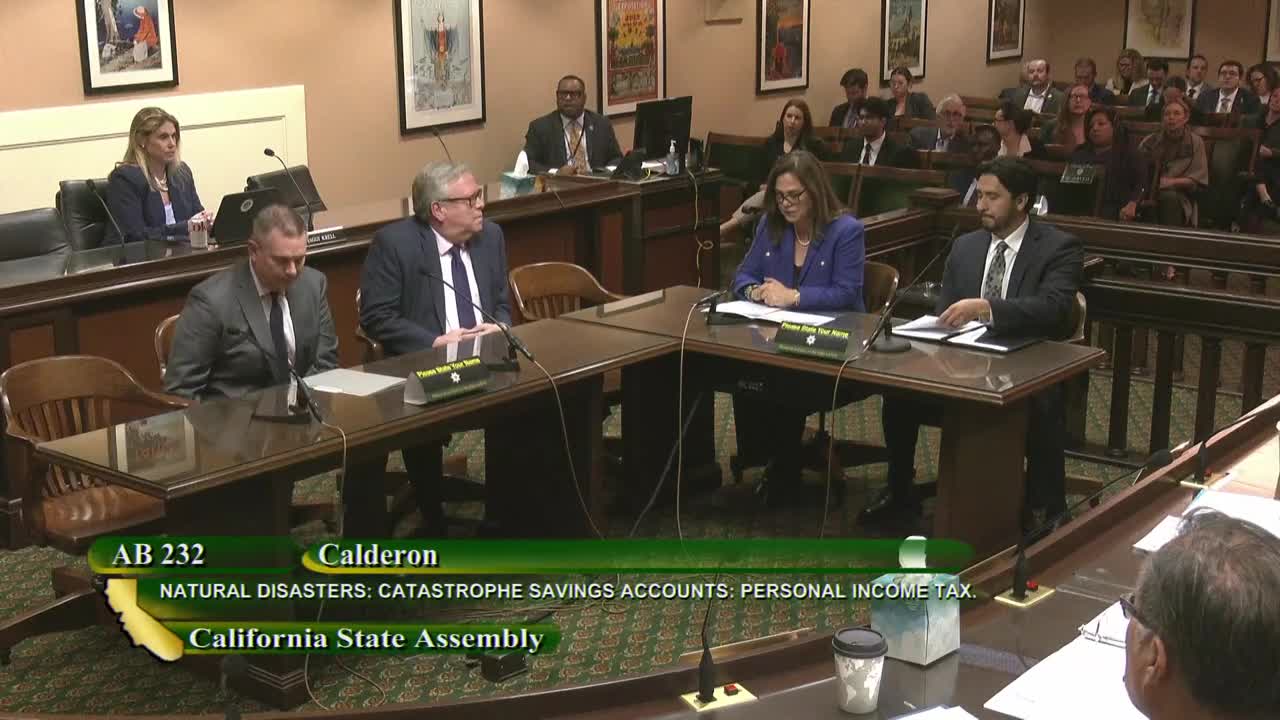 6MIN
Assembly Standing Committee on Banking and Finance

Bill Co-Author(s):