AB 2391: Health care: workforce training programs.
- Session Year: 2025-2026
- House: Assembly
- Latest Version Date: 2026-04-09
Current Status:
In Progress
(2026-05-14: Joint Rule 62(a), file notice suspended. (Page 5030.))
Introduced
In Committee
Awaiting First Chamber Vote
Passed First Chamber
In Committee
Awaiting Second Chamber Vote
Passed Second Chamber
Enacted
Existing law, the Song-Brown Health Care Workforce Training Act, declares the intent of the Legislature to increase the number of students and residents receiving quality education and training in specified primary care specialties and as primary care physicians assistants, primary care nurse practitioners, and registered nurses.
This bill would require the Department of Health Care Access and Information to maintain a New Nursing Graduate Support and Placement Program to award program grants to community college associate degree of nursing programs, through which support grants would be awarded to recent graduates for loan repayment assistance, relocation, transportation, housing assistance, childcare, and other financial support. The bill would specify grant eligibility criteria for community colleges and recent graduates. The bill would require the department to consider labor standards of hospital sites that employ support grant applicants when determining grant distribution. Under the bill, the program would be funded by a redirection of an unspecified amount provided annually Implementation of these provisions would be contingent upon appropriation by the Legislature.
This bill would also express the intent of the Legislature that funding for to support and strengthen existing programs that train registered nurses be increased, beginning in the 202728 fiscal year, by an unspecified amount upon appropriation by the Legislature. The bill would specify that unencumbered funds that were appropriated for under the Song-Brown Health Care Workforce Training Act in the Budget Act of 2026 may be used for capacity building and equipment in the 202728 fiscal year, upon appropriation by the Legislature. Act.
Existing law, the Song-Brown Health Care Workforce Training Act, declares the intent of the Legislature to increase the number of students and residents receiving quality education and training in specified primary care specialties and as primary care physicians assistants, primary care nurse practitioners, and registered nurses.
This bill would make technical, nonsubstantive changes to those provisions.This bill would require the Department of Health Care Access and Information to maintain a New Nursing Graduate Support and Placement Program to award program grants to community college associate degree of nursing programs, through which support grants would be awarded to recent graduates for loan repayment assistance, relocation, transportation, housing assistance, childcare, and other financial support. The bill would specify grant eligibility criteria for community colleges and recent graduates. The bill would require the department to consider labor standards of hospital sites that employ support grant applicants when determining grant distribution. Under the bill, the program would be funded by a redirection of an unspecified amount provided annually upon appropriation by the Legislature.
This bill would express the intent of the Legislature that funding for programs that train registered nurses be increased, beginning in the 202728 fiscal year, by an unspecified amount upon appropriation by the Legislature. The bill would specify that unencumbered funds that were appropriated for the Song-Brown Health Care Workforce Training Act in the Budget Act of 2026 may be used for capacity building and equipment in the 202728 fiscal year, upon appropriation by the Legislature.
Existing law, the Song-Brown Health Care Workforce Training Act, declares the intent of the Legislature to increase the number of students and residents receiving quality education and training in specified primary care specialties and as primary care physicians assistants, primary care nurse practitioners, and registered nurses.
This bill would make technical, nonsubstantive changes to those provisions.
For purposes of this article:
(a)Department means the Department of Health Care Access and Information.
(b)Program means the New Nursing Graduate Support and Placement Program established pursuant to Section 128076.
(c)Program development includes activities related to collaborations between the office of the Chancellor of the California Community Colleges and the department.
(d)Recent graduate means an individual who is either of the following:
(1)Currently enrolled and in the last semester of a community college associate degree of nursing program.
(2)Graduated from a community college associate degree of nursing program within the past three years.
(e)Support grant means a grant that is direct gift aid to recent graduates.
(f)Underserved area means an area with high need for registered nurses and may include medically underserved areas as designated by the federal Health Resources and Services Administration, rural areas, areas with a high number of Medi-Cal patients, or an underserved area as designated by the department.
128076.(a)The department shall maintain a New Nursing Graduate Support and Placement Program for the purposes of providing funding to community college associate degree of nursing programs to do all of the following:
(1)Improve employment outcomes and provide support for recent graduates.
(2)Ensure equitable access to the nursing profession and remove employment barriers for associate degree of nursing program graduates.
(3)Increase the number of registered nurses to provide direct care to the people of California, especially in underserved areas and populations.
(4)Facilitate postlicensure job placements in underserved areas for recent graduates in coordination with labor organizations that represent direct care registered nurses.
(5)Provide support grants to recent graduates for loan repayment assistance, relocation, transportation, housing assistance, childcare, and other financial support as determined by the department to incentivize employment of recent graduates in underserved areas.
(b)The department may award program grants to community college districts with associate degree of nursing programs pursuant to this section. Program grants shall be used only for purposes in subdivision (a), including for loan repayment assistance, housing assistance, childcare, transportation, or relocation.
(c)To qualify for program grants, a community college associate degree of nursing program shall commit to implement a comprehensive program of postlicensure job placements and administration of support grants to recent graduates.
(d)Before awarding a program grant, the department shall develop both of the following:
(1)Criteria for determining if hospital sites meet the registered nursing workforce needs of the states rural and underserved areas, in collaboration with community college associate degree of nursing programs.
(2)Structure for a program to provide support grants for recent graduates, including application criteria, prescribing the form and regulating the submission of applications, determining the eligibility of applicants, and awarding the support grants.
(e)As a condition of receiving a program grant, a community college district, in collaboration with community college associate degree of nursing programs, shall, at a minimum, do all of the following:
(1)Partner with labor organizations representing direct care registered nurses to develop an outreach plan to prospective hospital sites based on labor standards described in subdivision (f).
(2)Select hospital sites that best demonstrate the ability to provide workplaces with labor standards described in subdivision (f) and to meet the needs of rural and underserved areas based on criteria developed pursuant to subdivision (d).
(3)Enter into agreements with selected hospital sites for placing recent graduates.
(4)Incentivize postlicensure employment in underserved areas by providing a renewable support grant to recent graduates.
(5)Facilitate postlicensure employment by holding at least two on-campus events per academic year at which selected hospital sites may conduct interviews of recent graduates.
(6)Report to the chancellors office on a date determined by the office of the Chancellor of the California Community Colleges all of the following data for each academic year:
(A)The number of recent graduates who secured postlicensure employment through their clinical placements.
(B)The number of recent graduates who secured postlicensure employment through the job placement program and not through their clinical placements.
(C)The number of recent graduates who did not secure employment postlicensure through either their clinical placements or the job placement program.
(f)For the purposes of determining grant distribution pursuant to this section, the department shall consider all of the following labor standards of hospital sites that employ support grant applicants:
(1)If the hospital sites registered nurses are represented by a labor organization.
(2)If the hospital site provides fair compensation to registered nurses, which may be measured by using wage estimates for registered nurses as produced by the Occupational Employment and Wage Statistics program under the Employment Development Department.
(3)If the hospital site provides strong retention practices.
(4)If the hospital site does not use restrictive employment terms, including sign-on bonuses that require repayment if employment ends before the contract term.
128077.(a)To qualify for a support grant pursuant to this article, an applicant shall be either be currently enrolled and in the last semester of a community college associate degree of nursing program or have graduated from a community college associate degree of nursing program within the past three years.
(b)A support grant recipient may use a support grant for purposes that include housing assistance, childcare, transportation, or relocation. The amount of a support grant award for each recent graduate shall be at least ____ dollars ($____), not to exceed ____ dollars ($____).
(c)If the number of qualified applicants in a year exceeds the number of support grants to be awarded, the department, in consultation with community college district districts with associate degree of nursing programs, shall consider the following factors in granting priority when awarding support grants:
(1)Financial need, as shown on a standardized financial needs assessment used by community college associate degree of nursing programs.
(2)Life experiences or special circumstances, as described in subdivision (b) of Section 78261.5 of the Education Code.
(3)Living in an underserved area.
128078.(a)It is the intent of the Legislature that the program be funded, beginning in the 202728 fiscal year, by a redirection of ____ dollars ($____) provided annually upon appropriation by the Legislature. Unencumbered funds that were appropriated in the Budget Act of 2026 may be used for capacity building and equipment in the 202728 fiscal year, upon appropriation by the Legislature.(b)Up to ____ percent of the funds appropriated for this program may be used for statewide administration, program development, program evaluation, and program accountability. As used in this article, program development includes, but is not limited to, activities related to collaborations between the office of the chancellor and the Department of Health Care Access and Information.128078.Implementation of this article shall be contingent upon appropriation by the Legislature.
SEC. 2.Section 128200 of the Health and Safety Code is amended to read:128200.(a)This article shall be known, and may be cited, as the Song-Brown Health Care Workforce Training Act.
(b) (1)The Legislature hereby finds and declares that physicians engaged in family medicine are in very short supply in California. The current emphasis placed on specialization in medical education has resulted in a shortage of physicians trained to provide comprehensive primary health care to families. The Legislature hereby declares that it regards the furtherance of a greater supply of competent family physicians to be a public purpose of great importance and further declares the establishment of the program pursuant to this article to be a desirable, necessary, and economical method of increasing the number of family physicians to provide needed medical services to the people of California. The Legislature further declares that it is to the benefit of the state to assist in increasing the number of competent family physicians graduated by colleges and universities of this state to provide primary health care services to families within the state.
(2)The Legislature finds that the shortage of family physicians can be improved by the placing of a higher priority by public and private medical schools, hospitals, and other health care delivery systems in this state, on the recruitment and improved training of medical students and residents to meet the need for family physicians. To help accomplish this goal, each medical school in California is encouraged to organize a strong family medicine program or department. It is the intent of the Legislature that the programs or departments be headed by a physician who possesses specialty certification in the field of family medicine, and has broad clinical experience in the field of family medicine.
(3)The Legislature further finds that encouraging the training of primary care physicians assistants and primary care nurse practitioners will assist in making primary health care services more accessible to the citizenry, and will, in conjunction with the training of family physicians, lead to an improved health care delivery system in California.
(4)Community hospitals in general and rural community hospitals in particular, as well as other health care delivery systems, are encouraged to develop family medicine residencies in affiliation or association with accredited medical schools, to help meet the need for family physicians in geographical areas of the state with recognized family primary health care needs. Utilization of expanded resources beyond university-based teaching hospitals should be emphasized, including facilities in rural areas wherever possible.
(5)The Legislature also finds and declares that nurses are in very short supply in California. The Legislature hereby declares that it regards the furtherance of a greater supply of nurses to be a public purpose of great importance and further declares the expansion of the program pursuant to this article to include nurses to be a desirable, necessary, and economical method of increasing the number of nurses to provide needed nursing services to the people of California.
(c)It is the intent of the Legislature to provide for a program designed primarily to increase the number of students and residents receiving quality education and training in the primary care specialties of family medicine, internal medicine, obstetrics and gynecology, and pediatrics and as primary care physicians assistants, primary care nurse practitioners, and registered nurses and to maximize the delivery of primary care family physician services to specific areas of California where there is a recognized unmet priority need. This program is intended to be implemented through contracts with accredited medical schools, teaching health centers, programs that train primary care physicians assistants, programs that train primary care nurse practitioners, programs that train registered nurses, hospitals, and other health care delivery systems based on per-student or per-resident capitation formulas. It is further intended by the Legislature that the programs will be professionally and administratively accountable so that the maximum cost-effectiveness will be achieved in meeting the professional training standards and criteria set forth in this article and Article 2 (commencing with Section 128250).
(d)It is the intent of the Legislature that funding for programs that train registered nurses be increased, beginning in the 202728 fiscal year, by a redirection of ____ dollars ($____) upon appropriation by the Legislature. Unencumbered funds that were appropriated for purposes of this act in the Budget Act of 2026 may be used for capacity building and equipment in the 202728 fiscal year, upon appropriation by the Legislature.(d)It is the intent of the Legislature to support and strengthen existing programs that train registered nurses under this article, and to ensure that these programs are appropriately supported to meet the states nursing workforce needs, including in rural and medically underserved communities.
For purposes of this article:
(a)Department means the Department of Health Care Access and Information.
(b)Program means the New Nursing Graduate Support and Placement Program established pursuant to Section 128076.
(c)Program development includes activities related to collaborations between the office of the Chancellor of the California Community Colleges and the department.
(d)Recent graduate means an individual who is either of the following:
(1)Currently enrolled and in the last semester of a community college associate degree of nursing program.
(2)Graduated from a community college associate degree of nursing program within the past three years.
(e)Support grant means a grant that is direct gift aid to recent graduates.
(f)Underserved area means an area with high need for registered nurses and may include medically underserved areas as designated by the federal Health Resources and Services Administration, rural areas, areas with high number of Medi-Cal patients, or an underserved area as designated by the department.
128076.(a)The department shall maintain a New Nursing Graduate Support and Placement Program for the purposes of providing funding to community college associate degree of nursing programs to do all of the following:
(1)Improve employment outcomes and provide support for recent graduates.
(2)Ensure equitable access to the nursing profession and remove employment barriers for associate degree of nursing program graduates.
(3)Increase the number of registered nurses to provide direct care to the people of California, especially in underserved areas and populations.
(4)Facilitate postlicensure job placements in underserved areas for recent graduates in coordination with labor organizations that represent direct care registered nurses.
(5)Provide support grants to recent graduates for loan repayment assistance, relocation, transportation, housing assistance, childcare, and other financial support as determined by the department to incentivize employment of recent graduates in underserved areas.
(b)The department may award program grants to community college districts with associate degree of nursing programs pursuant to this section. Program grants shall be used only for purposes in subdivision (a), including for loan repayment assistance, housing assistance, childcare, transportation, or relocation.
(c)To qualify for program grants, a community college associate degree of nursing program shall commit to implement a comprehensive program of postlicensure job placements and administration of support grants to recent graduates.
(d)Before awarding a program grant, the department shall develop both of the following:
(1)Criteria for determining if hospital sites meet the registered nursing workforce needs of the states rural and underserved areas, in collaboration with community college associate degree of nursing programs.
(2)Structure for a program to provide support grants for recent graduates, including application criteria, prescribing the form and regulating the submission of applications, determining the eligibility of applicants, and awarding the support grants.
(e)As a condition of receiving a program grant, a community college district, in collaboration with community college associate degree of nursing programs, shall, at a minimum, do all of the following:
(1)Partner with labor organizations representing direct care registered nurses to develop an outreach plan to prospective hospital sites based on labor standards described in subdivision (f).
(2)Select hospital sites that best demonstrate the ability to provide workplaces with labor standards described in subdivision (f) and to meet the needs of rural and underserved areas based on criteria developed pursuant to subdivision (d).
(3)Enter into agreements with selected hospital sites for placing recent graduates.
(4)Incentivize postlicensure employment in underserved areas by providing a renewable support grant to recent graduates.
(5)Facilitate postlicensure employment by holding at least two on-campus events per academic year at which selected hospital sites may conduct interviews of recent graduates.
(6)Report to the chancellors office on a date determined by the office of the Chancellor of the California Community Colleges all of the following data for each academic year:
(A)The number of recent graduates who secured postlicensure employment through their clinical placements.
(B)The number of recent graduates who secured postlicensure employment through the job placement program and not through their clinical placements.
(C)The number of recent graduates who did not secure employment postlicensure through either their clinical placements or the job placement program.
(f)For the purposes of determining grant distribution pursuant to this section, the department shall consider all of the following labor standards of hospital sites that employ support grant applicants:
(1)If the hospital sites registered nurses are represented by a labor organization.
(2)If the hospital site provides fair compensation to registered nurses, which may be measured by using wage estimates for registered nurses as produced by the Occupational Employment and Wage Statistics program under the Employment Development Department.
(3)If the hospital site provides strong retention practices.
(4)If the hospital site does not use restrictive employment terms, including sign-on bonuses that require repayment if employment ends before the contract term.
128077.(a)To qualify for a support grant pursuant to this article, an applicant shall be either be currently enrolled and in the last semester of a community college associate degree of nursing program or have graduated from a community college associate degree of nursing program within the past three years.
(b)A support grant recipient may use a support grant for purposes that include housing assistance, childcare, transportation, or relocation. The amount of a support grant award for each recent graduate shall be at least ____ dollars ($____), not to exceed ____ dollars ($____).
(c)If the number of qualified applicants in a year exceeds the number of support grants to be awarded, the department, in consultation with community college district with associate degree of nursing programs, shall consider the following factors in granting priority when awarding support grants:
(1)Financial need, as shown on a standardized financial needs assessment used by community college associate degree of nursing programs.
(2)Life experiences or special circumstances, as described in subdivision (b) of Section 78261.5 of the Education Code.
(3)Living in an underserved area.
128078.(a)It is the intent of the Legislature that the program be funded, beginning in the 202728 fiscal year, by a redirection of ____ dollars ($____) provided annually upon appropriation by the Legislature. Unencumbered funds that were appropriated in the Budget Act of 2026 may be used for capacity building and equipment in the 202728 fiscal year, upon appropriation by the Legislature.
(b)Up to ____ percent of the funds appropriated for this program may be used for statewide administration, program development, program evaluation, and program accountability. As used in this article, program development includes, but is not limited to, activities related to collaborations between the office of the chancellor and the Department of Health Care Access and Information.
SECTION 1.SEC. 2.Section 128200 of the Health and Safety Code is amended to read:128200.(a)This article shall be known, and may be cited, as the Song-Brown Health Care Workforce Training Act.
(b) (1)The Legislature hereby finds and declares that physicians engaged in family medicine are in very short supply in California. The current emphasis placed on specialization in medical education has resulted in a shortage of physicians trained to provide comprehensive primary health care to families. The Legislature hereby declares that it regards the furtherance of a greater supply of competent family physicians to be a public purpose of great importance and further declares the establishment of the program pursuant to this article to be a desirable, necessary, and economical method of increasing the number of family physicians to provide needed medical services to the people of California. The Legislature further declares that it is to the benefit of the state to assist in increasing the number of competent family physicians graduated by colleges and universities of this state to provide primary health care services to families within the state.
(2)The Legislature finds that the shortage of family physicians can be improved by the placing of a higher priority by public and private medical schools, hospitals, and other health care delivery systems in this state, on the recruitment and improved training of medical students and residents to meet the need for family physicians. To help accomplish this goal, each medical school in California is encouraged to organize a strong family medicine program or department. It is the intent of the Legislature that the programs or departments be headed by a physician who possesses specialty certification in the field of family medicine, and has broad clinical experience in the field of family medicine.
(3)The Legislature further finds that encouraging the training of primary care physicians assistants and primary care nurse practitioners will assist in making primary health care services more accessible to the citizenry, and will, in conjunction with the training of family physicians, lead to an improved health care delivery system in California.
(4)Community hospitals in general and rural community hospitals in particular, as well as other health care delivery systems, are encouraged to develop family medicine residencies in affiliation or association with accredited medical schools, to help meet the need for family physicians in geographical areas of the state with recognized family primary health care needs. Utilization of expanded resources beyond university-based teaching hospitals should be emphasized, including facilities in rural areas wherever possible.
(5)The Legislature also finds and declares that nurses are in very short supply in California. The Legislature hereby declares that it regards the furtherance of a greater supply of nurses to be a public purpose of great importance and further declares the expansion of the program pursuant to this article to include nurses to be a desirable, necessary, and economical method of increasing the number of nurses to provide needed nursing services to the people of California.
(c)It is the intent of the Legislature to provide for a program designed primarily to increase the number of students and residents receiving quality education and training in the primary care specialties of family medicine, internal medicine, obstetrics and gynecology, and pediatrics and as primary care physicians assistants, primary care nurse practitioners, and registered nurses and to maximize the delivery of primary care family physician services to specific areas of California where there is a recognized unmet priority need. This program is intended to be implemented through contracts with accredited medical schools, teaching health centers, programs that train primary care physicians assistants, programs that train primary care nurse practitioners, programs that train registered nurses, hospitals, and other health care delivery systems based on per-student or per-resident capitation formulas. It is further intended by the Legislature that the programs will be professionally and administratively accountable so that the maximum cost-effectiveness will be achieved in meeting the professional training standards and criteria set forth in this article and Article 2 (commencing with Section 128250).
(d)It is the intent of the Legislature that funding for programs that train registered nurses be increased, beginning in the 202728 fiscal year, by a redirection of ____ dollars ($____) upon appropriation by the Legislature. Unencumbered funds that were appropriated for purposes of this act in the Budget Act of 2026 may be used for capacity building and equipment in the 202728 fiscal year, upon appropriation by the Legislature.
(a)This article shall be known known, and may be cited cited, as the Song-Brown Health Care Workforce Training Act.
(b) (1)The Legislature hereby finds and declares that physicians engaged in family medicine are in very short supply in California. The current emphasis placed on specialization in medical education has resulted in a shortage of physicians trained to provide comprehensive primary health care to families. The Legislature hereby declares that it regards the furtherance of a greater supply of competent family physicians to be a public purpose of great importance and further declares the establishment of the program pursuant to this article to be a desirable, necessary, and economical method of increasing the number of family physicians to provide needed medical services to the people of California. The Legislature further declares that it is to the benefit of the state to assist in increasing the number of competent family physicians graduated by colleges and universities of this state to provide primary health care services to families within the state.
(2)The Legislature finds that the shortage of family physicians can be improved by the placing of a higher priority by public and private medical schools, hospitals, and other health care delivery systems in this state, on the recruitment and improved training of medical students and residents to meet the need for family physicians. To help accomplish this goal, each medical school in California is encouraged to organize a strong family medicine program or department. It is the intent of the Legislature that the programs or departments be headed by a physician who possesses specialty certification in the field of family medicine, and has broad clinical experience in the field of family medicine.
(3)The Legislature further finds that encouraging the training of primary care physicians assistants and primary care nurse practitioners will assist in making primary health care services more accessible to the citizenry, and will, in conjunction with the training of family physicians, lead to an improved health care delivery system in California.
(4)Community hospitals in general and rural community hospitals in particular, as well as other health care delivery systems, are encouraged to develop family medicine residencies in affiliation or association with accredited medical schools, to help meet the need for family physicians in geographical areas of the state with recognized family primary health care needs. Utilization of expanded resources beyond university-based teaching hospitals should be emphasized, including facilities in rural areas wherever possible.
(5)The Legislature also finds and declares that nurses are in very short supply in California. The Legislature hereby declares that it regards the furtherance of a greater supply of nurses to be a public purpose of great importance and further declares the expansion of the program pursuant to this article to include nurses to be a desirable, necessary, and economical method of increasing the number of nurses to provide needed nursing services to the people of California.
(6)(c)It is the intent of the Legislature to provide for a program designed primarily to increase the number of students and residents receiving quality education and training in the primary care specialties of family medicine, internal medicine, obstetrics and gynecology, and pediatrics and as primary care physicians assistants, primary care nurse practitioners, and registered nurses and to maximize the delivery of primary care family physician services to specific areas of California where there is a recognized unmet priority need. This program is intended to be implemented through contracts with accredited medical schools, teaching health centers, programs that train primary care physicians assistants, programs that train primary care nurse practitioners, programs that train registered nurses, hospitals, and other health care delivery systems based on per-student or per-resident capitation formulas. It is further intended by the Legislature that the programs will be professionally and administratively accountable so that the maximum cost-effectiveness will be achieved in meeting the professional training standards and criteria set forth in this article and Article 2 (commencing with Section 128250).
|
Date
|
Status
|
|---|---|
| May 14, 2026 | In committee: Held under submission. |
| May 14, 2026 | Joint Rule 62(a), file notice suspended. |
| May 14, 2026 | Joint Rule 62(a), file notice suspended. (Page 5030.) |
| May 13, 2026 | In committee: Set, first hearing. Referred to APPR. suspense file. |
| Apr 22, 2026 | From committee: Do pass and re-refer to Com. on APPR. (Ayes 8. Noes 1.) (April 21). Re-referred to Com. on APPR. |
| Apr 13, 2026 | Re-referred to Com. on HIGHER ED. |
| Apr 9, 2026 | Read second time and amended. |
| Apr 8, 2026 | From committee: Amend, and do pass as amended and re-refer to Com. on HIGHER ED. with recommendation: To Consent Calendar. (Ayes 16. Noes 0.) (April 7). |
| Mar 17, 2026 | Re-referred to Com. on HEALTH. |
| Mar 16, 2026 | From committee chair, with author's amendments: Amend, and re-refer to Com. on HEALTH. Read second time and amended. |
| Mar 16, 2026 | Referred to Coms. on HEALTH and HIGHER ED. |
| Feb 21, 2026 | From printer. May be heard in committee March 23. |
| Feb 20, 2026 | Read first time. To print. |
|
Date
|
Description
|
Location
|
Votes
|
|
|---|---|---|---|---|
| Apr 21, 2026 | Do pass and be re-referred to the Committee on [Appropriations] | Assembly Standing Committee on Higher Education |
Passed |
|
| Apr 7, 2026 | Do pass as amended, and be re-referred to the Committee on [Higher Education] with recommendation: To Consent Calendar | Assembly Standing Committee on Health |
Passed |
This list shows positions taken on this bill by organizations on the date displayed, which is linked to the original source.
Positions by individuals are not included.
|
Organization
|
Position
|
Date
|
|---|---|---|
| California Nurses Association | ** Support |
ASSEMBLY COMMITTEE ON APPROPRIATIONS
Buffy Wicks, Chair
ABPCA Bill Id:AB 2391
Author:(Ahrens) – As Amended Ver:April 9, 2026
Policy Committee: | Health | Vote: | 16 - 0 |
Higher Education | 8 - 1 | ||
|
|
Urgency: No State Mandated Local Program: No Reimbursable: No
SUMMARY:
This bill requires, upon appropriation by the Legislature, the Department of Health Care Access and Information (HCAI) to maintain a New Nursing Graduate Support and Placement (NNSP) Program to award grants to community college associate degree of nursing (ADN) programs, through which support grants would be awarded to recent graduates for loan repayment assistance, relocation, transportation, housing assistance, childcare, and other financial support.
FISCAL EFFECT:
General Fund cost pressure of an unknown amount, potentially millions or tens of millions of dollars, to fund grants to ADN programs. The amount would depend on the size and number of awards.
HCAI estimates annual General Fund costs of about $726,000 for four staff to develop the program and applicant eligibility criteria, award program grants, collect data, and develop annual program reports. Costs for HCAI to administer the NNSP program would also depend, to some extent, on the number of grants and number of grant applications.
The Legislative Analyst’s Office recently warned of General Fund structural deficits of around $35 billion per year in the 2027-28 fiscal year and ongoing
COMMENTS:
- Purpose. This bill is sponsored by California Nurses Association. According to the author:
[This bill] strengthens California’s nursing workforce by addressing a critical gap between education and employment and helping ensure that newly licensed nurses can serve the communities that need them most. As a community college graduate and former Trustee on the Foothill-De Anza Community College District Board, I have seen firsthand how California Community Colleges create accessible pathways to stable, well-paying careers. For many economically disadvantaged individuals, community college can be the only feasible option for attaining a degree.
Community college nursing programs train nearly half of California’s new nurses each year. Yet many of these graduates face barriers to securing employment, even as hospitals in rural and medically underserved communities struggle to recruit and retain nurses. This is not a shortage of nurses. It is a challenge of workforce transition and distribution. [This bill] addresses this gap by supporting job placement and providing financial support to overcome barriers such as relocation, housing, and childcare, helping connect new nurses to available positions in rural and medically underserved regions. By strengthening the pathway from community college nursing education to community care, this bill expands economic opportunity, supports a diverse workforce, and helps ensure communities across California have the nurses needed to provide safe patient care.
- Background. An ADN is a two-year undergraduate program offered at community colleges and vocational schools. ADN training provides foundational nursing knowledge and hands-on clinical experience, focusing on patient care, communication, critical thinking, and decision-making skills. A graduate of an ADN program is eligible to take the exam to become licensed as an RN and begin working in healthcare settings. ADN programs are generally more affordable and allow quicker entry into the workforce compared to a Bachelor of Science in Nursing (BSN). An RN is a licensed healthcare professional who has completed an approved nursing program (ADN, BSN, or RN diploma) and passed the NCLEX-RN exam.
According to the 2021-22 California Board of Registered Nursing Annual School Report, ADN programs produce a large share of newly licensed RNs each year. California has a large number of licensed nurses relative to those actively working: there are more than 560,000 registered nurses, but only about 326,000 are actively working in nursing roles. According to data from HCAI, in 2025, 50 counties were projected to face a shortage of one or more nursing role groups, with the highest shortages in the Northern & Sierra, Central Coast, and Los Angeles County regions.
Analysis Prepared by: Allegra Kim / APPR. / (916) 319-2081
Date of Hearing: April 21, 2026
ASSEMBLY COMMITTEE ON HIGHER EDUCATION
Mike Fong, Chair
ABPCA Bill Id:AB 2391 (
Author:Ahrens) – As Amended Ver:April 9, 2026
SUBJECT: Health care: workforce training programs
SUMMARY: Requires, upon appropriation by the Legislature, the Department of Health Care Access and Information (HCAI) to maintain a New Nursing Graduate Support and Placement (NNSP) Program to award program grants to community college associate degree of nursing (ADN) programs, through which support grants would be awarded to recent graduates for loan repayment assistance, relocation, transportation, housing assistance, childcare, and other financial support. Specifies grant eligibility criteria for community colleges and recent graduates, requires the department to consider labor standards of hospital sites that employ support grant applicants when determining grant distribution. Specifically, this bill:
- Requires HCAI to maintain an NNSP Program to provide funding to community college associate degree of nursing programs to do all of the following:
- Improve employment outcomes and provide support for recent graduates;
- Ensure equitable access to the nursing profession and remove employment barriers for associate degree of nursing program graduates;
- Increase the number of registered nurses (RN) to provide direct care to the people of California, especially in underserved areas and populations;
- Facilitate post-licensure job placements in underserved areas for recent graduates in coordination with labor organizations that represent direct care RNs; and,
- Provide support grants to recent graduates for loan repayment assistance, relocation, transportation, housing assistance, childcare, and other financial support as determined by HCAI to incentivize employment of recent graduates in underserved areas.
- Authorizes HCAI to award NNSP Program grants to community college districts with associate degree of nursing programs pursuant to this section. Requires the grants to be used only for purposes of 1) above.
- Requires, to qualify for program grants, a community college associate degree of nursing program to commit to implement a comprehensive program of post-licensure job placements and administration of support grants to recent graduates.
- Requires HCAI, before awarding a grant, to develop both of the following:
- Criteria for determining if hospital sites meet the RN workforce needs of the state’s rural and underserved areas, in collaboration with community college associate degree of nursing programs; and,
- Structure for a program to provide support grants for recent graduates, including application criteria, prescribing the form and regulating the submission of applications, determining the eligibility of applicants, and awarding the support grants.
- Requires, as a condition of receiving a NNSP Program grant, a community college district, in collaboration with community college associate degree of nursing programs, to, at a minimum, do all of the following:
- Partner with labor organizations representing direct care RNs to develop an outreach plan to prospective hospital sites based on labor standards described in 6) below;
- Select hospital sites that best demonstrate the ability to provide workplaces with labor standards and to meet the needs of rural and underserved areas based on criteria developed pursuant to 4) above;
- Enter into agreements with selected hospital sites for placing recent graduates;
- Incentivize post-licensure employment in underserved areas by providing a renewable support grant to recent graduates;
- Facilitate post-licensure employment by holding at least two on-campus events per academic year at which selected hospital sites may conduct interviews of recent graduates; and,
- Report to the Chancellor’s Office on a date determined by the office of the Chancellor of the California Community Colleges (CCC) all of the following data for each academic year:
- The number of recent graduates who secured post-licensure employment through their clinical placements;
- The number of recent graduates who secured post-licensure employment through the job placement program and not through their clinical placements; and,
- The number of recent graduates who did not secure employment post-licensure through either their clinical placements or the job placement program.
- Requires HCAI, for the purposes of determining grant distribution pursuant to this bill, to consider all of the following labor standards of hospital sites that employ support grant applicants:
- If the hospital site’s RNs are represented by a labor organization;
- If the hospital site provides fair compensation to RNs, which may be measured by using wage estimates for RNs as produced by the Occupational Employment and Wage Statistics program under the Employment Development Department;
- If the hospital site provides strong retention practices; and,
- If the hospital site does not use restrictive employment terms, including sign-on bonuses that require repayment if employment ends before the contract term.
- Requires an applicant, to qualify for a support grant pursuant to this bill, to be either be currently enrolled and in the last semester of a community college associate degree of nursing program or have graduated from a community college associate degree of nursing program within the past three years.
- Authorizes a support grant recipient to use the grant for purposes that include housing assistance, childcare, transportation, or relocation.
- Requires HCAI, if the number of qualified applicants in a year exceeds the number of support grants to be awarded, in consultation with community college district with associate degree of nursing programs, to consider the following factors in granting priority when awarding support grants:
- Financial need, as shown on a standardized financial needs assessment used by community college associate degree of nursing programs;
- Life experiences or special circumstances, including, but not limited to low family income, the need to work, and difficult personal and family situations or circumstances; and,
- Living in an underserved area.
- States that it is the intent of the Legislature to support and strengthen existing programs that train registered nurses under this article, and to ensure that these programs are appropriately supported to meet the state’s nursing workforce needs, including in rural and medically underserved communities.
- Defines the following for purposes of this bill:
- “Program” means the NNSP Program.
- “Program development” to include activities related to collaborations between the office of the Chancellor of the CCC and HCAI.
- “Recent graduate” to mean an individual who is either of the following:
- Currently enrolled and in the last semester of a community college associate degree of nursing program; or,
- Graduated from a community college associate degree of nursing program within the past three years.
- “Support grant” to mean a grant that is direct gift aid to recent graduates.
- “Underserved area” to mean an area with high need for RNs and allows the definition to include medically underserved areas as designated by the federal Health Resources and Services Administration, rural areas, areas with high number of Medi-Cal patients, or an underserved area as designated by HCAI.
EXISTING LAW:
- Establishes HCAI to, among other functions, collect, analyze, and publish data about healthcare workforce and health professional training, identify areas of health workforce shortages, and provide scholarships, loan repayments, and grants to students, graduates, and institutions providing direct patient care in areas of unmet need. (Health and Safety Code (HSC) Section 127000 and Section 127825, et seq.)
- Establishes the Song-Brown Health Care Workforce Training Act to increase the supply of family physicians, primary care physician’s assistants, and primary care nurse practitioners and nurses to provide needed medical services to the people of California. (HSC Section 128200)
- Defines the following for purposes of 2) above:
- “Family physician” to mean a primary care physician and surgeon who is prepared to and renders continued comprehensive and preventative health care services to individuals and families and who has received specialized training in an approved family medicine residency for three years after graduation from an accredited medical school;
- “Primary care physician” to mean a physician who is prepared to and renders continued comprehensive and preventative health care services, and has received specialized training in the areas of internal medicine, obstetrics and gynecology, or pediatrics;
- “Graduate medical education” to mean residency programs for education or training in one or more specialties or subspecialties following graduation from medical school;
- “Health professions education and training” to mean any formal organized education or training undertaken for the purpose of gaining knowledge and skills necessary to practice a specific health profession or to provide a role in a health care setting. Health professions education and training includes any type of health professions training program, including shadowing programs, participating in rotations, affiliation agreements, and accredited or accreditation-eligible programs, at any educational level, including certificate, undergraduate, graduate, professional, or postgraduate, and in any clinical discipline, excluding graduate medical education;
- “Programs that train postgraduate primary care physician’s assistants” to mean a program that provides postgraduate fellowships for clinical training in primary care. Programs shall be affiliated with a community-based ambulatory patient care center within underserved communities;
- “Programs that train primary care physician’s assistants” to mean a program that has been approved for the training of primary care physician assistants;
- “Programs that train postgraduate primary care nurse practitioners” to mean a program that provides postgraduate fellowships for clinical training in primary care. Requires programs to be affiliated with a community-based ambulatory patient care center within underserved communities;
- “Programs that train primary care nurse practitioners” to mean a program that is operated by a California school of medicine or nursing, or that is authorized by the Regents of the University of California (UC) or by the Trustees of the California State University (CSU), or that is approved by the Board of Registered Nursing;
- “Programs that train registered nurses” to means a program that is operated by a California school of nursing and approved by the Board of Registered Nursing, or that is authorized by the Regents of the UC, the Trustees of the CSU, or the Board of Governors of the California Community Colleges (CCC), and that is approved by the Board of Registered Nursing;
- “Programs that train midwives” to mean program that train certified nurse-midwives and programs that train licensed midwives;
- “Teaching health center” to mean a community-based ambulatory patient care center that operates a primary care residency program. Community-based ambulatory patient care settings include, but are not limited to, federally qualified health centers, community mental health centers, rural health clinics, health centers operated by the Indian Health Service, an Indian tribe or tribal organization, or an urban Indian organization, and entities receiving funds under Title X of the federal Public Health Service Act, (Public Law 91-572). (HSC Section 128205)
- Authorizes the Board of Governors of the CCC to award grants to community college districts with associate degree nursing programs to expand enrollment, reduce program attrition, or both. Requires funds to be used only for purposes of expanding enrollment, providing diagnostic assessments, and offering pre-entry coursework to prospective nursing students and diagnostic assessments and supportive services to enrolled nursing students. Defines supportive services to include, but not be limited to, tutoring, case management, mentoring, and counseling services. Authorizes funds to also be used to develop alternative delivery models such as part-time, evening, weekend, and summer program offerings. Requires, to qualify for these funds, a community college associate degree nursing program to do either of the following:
- Have a program attrition rate, as determined by the Board of Registered Nursing’s Annual School Report or the Information Program Data System of the chancellor’s office, of 15% or less for the year before application for funding; or,
- Commit to implement a comprehensive program of diagnostic assessment, pre-nursing enrollment preparation, and program-based support to enrolled students. (Education Code Section 78261, et seq.)
FISCAL EFFECT: Unknown.
COMMENTS: Double referral. This measure was heard by the Assembly Committee on Health on April 8, 2026, and passed with a 16-0 vote.
Purpose. According to the author, “AB 2391 strengthens California’s nursing workforce by addressing a critical gap between education and employment and helping ensure that newly licensed nurses can serve the communities that need them most. As a community college graduate and former Trustee on the Foothill-De Anza Community College District Board, I have seen firsthand how California Community Colleges create accessible pathways to stable, well-paying careers. For many economically disadvantaged individuals, community college can be the only feasible option for attaining a degree.”
The author continues that “Community college nursing programs train nearly half of California’s new nurses each year. Yet many of these graduates face barriers to securing employment, even as hospitals in rural and medically underserved communities struggle to recruit and retain nurses. This is not a shortage of nurses. It is a challenge of workforce transition and distribution. AB 2391 addresses this gap by supporting job placement and providing financial support to overcome barriers such as relocation, housing, and childcare, helping connect new nurses to available positions in rural and medically underserved regions. By strengthening the pathway from community college nursing education to community care, this bill expands economic opportunity, supports a diverse workforce, and helps ensure communities across California have the nurses needed to provide safe patient care.”
Background. RNs play a crucial role in healthcare by providing patient care, education, and support across various medical settings. RNs assess patient health, monitor vital signs, and provide direct care to patients who are ill, injured, or recovering. They administer medications, perform medical procedures, and assist with daily living activities. RNs collaborate with physicians and other healthcare professionals to develop and implement patient care plans. They ensure that all aspects of a patient's care are coordinated effectively. RNs educate patients and their families about health conditions, treatment options, and preventive care. They help patients understand their diagnoses and manage their health effectively. RNs maintain detailed records of patients' medical histories, treatment plans, and progress. RNs act as advocates for their patients, ensuring that their needs and preferences are respected in the healthcare process. They help patients navigate the healthcare system and provide support during often difficult times.
Nursing Degrees. An Associate Degree in Nursing (ADN) is a two-year undergraduate program offered at community colleges and vocational schools. It provides foundational nursing knowledge and hands-on clinical experience, focusing on patient care, communication, critical thinking, and decision-making skills. Graduates of an ADN program are eligible to take the NCLEX-RN exam to become licensed as an RN and begin working in healthcare settings. ADN programs are generally more affordable and allow quicker entry into the workforce compared to a Bachelor of Science in Nursing (BSN). An RN is a licensed healthcare professional who has completed an approved nursing program (ADN, BSN, or RN diploma) and passed the NCLEX-RN exam. The RN designation refers to the professional status, not the degree itself. RNs provide direct patient care, administer medications, educate patients and families, and collaborate with other healthcare professionals.
History of the Song-Brown Program. The Song-Brown Program, housed in HCAI, funds institutions that train primary care health professionals to provide healthcare in California’s Medically Underserved Areas. Competitive proposals demonstrate a commitment to Song-Brown goals and demonstrated success in meeting the three statutory priorities: i) attracting and admitting underrepresented groups in medicine and those from underserved communities; ii) training students in underserved areas; and, iii) placing graduates in underserved areas. Currently accredited family practice residency programs, physician assistant/family nurse practitioner programs, and registered nurse programs can apply for funding.
According to a 2019 California Health Care Foundation brief, the Song-Brown Program was established in 1973 with the passage of the Song-Brown Family Physician Training Act (sponsored by Senator Alfred Song and Assemblymember Willie L. Brown Jr.) in the wake of the creation of the new board-certified specialty of family practice, designed to train physicians to provide high-quality primary care. In 2014, the range of physician primary care residency programs eligible to apply for Song-Brown funding was permanently expanded to include family medicine, internal medicine, obstetrics/gynecology, and pediatrics. Physician assistant (PA) programs have also been eligible to apply for Song-Brown funds since its inception, while family nurse practitioner (FNP) programs were added in 1977 and RN programs were added in 2005. As of 2019, roughly 87% of the funding went toward primary care residency programs, while the remaining 13% of funds were split between the FNP/PA and RN programs.
Song-Brown RN specific funding. The Song-Brown program also provides funding to support RN education in California. Eligible programs may receive $15,000 per filled first-year student slot, up to $900,000 for existing slots; up to $30,000 per filled first-year student slot, up to $600,000 for expansion slots; and, grants up to $1,000,000 for establishing new RN programs. In total, the program has awarded a total of $16.9 million to expand nursing education across California. These funds are aimed at addressing healthcare disparities and increasing access to quality nursing education in underserved areas.
RN workforce. According to the 2021-2022 California Board of Registered Nursing Annual School Report, ADN programs produce a large share of newly licensed RNs each year, however, California has a large number of licensed nurses relative to those actively working. California licenses more than 560,000 registered nurses with only about 326,000 actively working in nursing roles. The 2025 HCAI data visualization, “Supply and Demand Modeling for California’s Nursing Workforce” notes that in 2025, 50 counties are projected to face a shortage of one or more nursing role groups, with the highest shortages in the Northern & Sierra, Central Coast, and Los Angeles County regions, as defined by the California Health Interview Survey (CHIS). The projected statewide shortage of Registered Nurses for 2025 is low at just over -6%, with an estimated need for 18,793 additional providers to meet forecasted demand. Certain CHIS regions, like Northern & Sierra, face a projected shortage of more than 25%, while the Sacramento Area faces a projected surplus of nearly 11%, indicating a maldistribution of providers within the state. By 2033, it is projected that 50 counties will face a -5% shortage or more of Registered Nurses. The overall statewide shortage will increase to just under -17%, resulting in a need for 61,141 additional providers to meet future demand. As noted by the author, one of the stated goals of this bill is to address this challenge of workforce distribution by supporting job placement and providing financial support to overcome barriers such as relocation, housing, and childcare, helping connect new nurses to available positions in rural and medically underserved regions.
Arguments in support. According to the California Nurses Association (CNA), “California currently lacks a coordinated workforce strategy to support newly licensed RNs as they enter the profession and to address persistent staffing challenges in rural and underserved regions. While the state has made significant investments in nursing education and training, these efforts are largely concentrated on pre-licensure programs and do not address the barriers new nurses face when transitioning into the workforce. As a result, many newly licensed nurses struggle to secure employment, even as hospitals in rural and medically underserved communities face ongoing challenges recruiting and retaining sufficient staff to provide safe patient care.”
CNA continues, noting that “California’s community colleges operate 77 ADN programs that train nearly half of all newly licensed RNs each year and provide an accessible and affordable pathway into the profession, particularly for students from low-income, rural, and underrepresented communities. The state has invested significantly in expanding this pipeline through programs such as the California Community Colleges Nursing Enrollment Growth and Retention Program, which has produced strong outcomes, including high student retention, program completion, and first-time licensure pass rates. These investments demonstrate that California can successfully prepare a qualified nursing workforce. However, the state’s investments are largely concentrated on education and training and do not address the transition from graduation to employment.”
Prior legislation. AB 2529 (Davies) of 2022 would have added programs that train certified nurse-midwives (CNMs) and licensed midwives (LMs) to the list of programs eligible to contract with the state under Song-Brown. AB 2529 was not heard in the Senate Appropriations Committee.
AB 921 (Bonta) of 2023 would have required HCAI to establish a mentorship program to connect eligible students enrolled in a relevant undergraduate program or in an HCAI-approved behavioral health certification program with concrete resources and mentorship that will convert the educational experience to sustained employment. AB 921 was held in the Assembly Appropriations Committee.
REGISTERED SUPPORT / OPPOSITION:
Support
California Nurses Association
Opposition
None on file.
Analysis Prepared by: Kevin J. Powers / HIGHER ED. / (916) 319-3960
Date of Hearing: April 7, 2026
ASSEMBLY COMMITTEE ON HEALTH
Mia Bonta, Chair
ABPCA Bill Id:AB 2391
Author:(Ahrens) – As Amended Ver:March 16, 2026
SUBJECT: Health care: workforce training programs.
SUMMARY: Requires the Department of Health Care Access and Information (HCAI) to maintain a New Nursing Graduate Support and Placement Program (NNSP Program) to award program grants to community college associate degree of nursing programs, through which support grants would be awarded to recent graduates for loan repayment assistance, relocation, transportation, housing assistance, childcare, and other financial support. Specifies grant eligibility criteria for community colleges and recent graduates. Requires HCAI to consider labor standards of hospital sites that employ support grant applicants when determining grant distribution. Funds the program with a redirection of an unspecified amount provided annually upon appropriation by the Legislature. Expresses the intent of the Legislature that funding for registered nurse (RN) training programs be increased in the 2027-28 fiscal year. Specifically, this bill:
- Requires HCAI to maintain an NNSP Program to providing funding to community college associate degree of nursing programs to do all of the following:
- Improve employment outcomes and provide support for recent graduates;
- Ensure equitable access to the nursing profession and remove employment barriers for associate degree of nursing program graduates;
- Increase the number of RNs to provide direct care to the people of California, especially in underserved areas and populations;
- Facilitate post-licensure job placements in underserved areas for recent graduates in coordination with labor organizations that represent direct care RNs; and,
- Provide support grants to recent graduates for loan repayment assistance, relocation, transportation, housing assistance, childcare, and other financial support as determined by HCAI to incentivize employment of recent graduates in underserved areas.
- Authorizes HCAI to award NNSP Program grants to community college districts with associate degree of nursing programs pursuant to this section. Requires the grants to be used only for purposes of 1) above, including for loan repayment assistance, housing assistance, childcare, transportation, or relocation.
- Requires, to qualify for program grants, a community college associate degree of nursing program to commit to implement a comprehensive program of post-licensure job placements and administration of support grants to recent graduates.
- Requires HCAI, before awarding a grant, to develop both of the following:
- Criteria for determining if hospital sites meet the RN workforce needs of the state’s rural and underserved areas, in collaboration with community college associate degree of nursing programs; and,
- Structure for a program to provide support grants for recent graduates, including application criteria, prescribing the form and regulating the submission of applications, determining the eligibility of applicants, and awarding the support grants.
- Requires, as a condition of receiving a NNSP Program grant, a community college district, in collaboration with community college associate degree of nursing programs, to, at a minimum, do all of the following:
- Partner with labor organizations representing direct care RNs to develop an outreach plan to prospective hospital sites based on labor standards described in 6) below;
- Select hospital sites that best demonstrate the ability to provide workplaces with labor standards and to meet the needs of rural and underserved areas based on criteria developed pursuant to 4) above;
- Enter into agreements with selected hospital sites for placing recent graduates;
- Incentivize post-licensure employment in underserved areas by providing a renewable support grant to recent graduates;
- Facilitate post-licensure employment by holding at least two on-campus events per academic year at which selected hospital sites may conduct interviews of recent graduates; and,
- Report to the chancellor’s office on a date determined by the office of the Chancellor of the California Community Colleges (CCC) all of the following data for each academic year:
- The number of recent graduates who secured post-licensure employment through their clinical placements;
- The number of recent graduates who secured post-licensure employment through the job placement program and not through their clinical placements; and,
- The number of recent graduates who did not secure employment post-licensure through either their clinical placements or the job placement program.
- Requires HCAI, for the purposes of determining grant distribution pursuant to this bill, to consider all of the following labor standards of hospital sites that employ support grant applicants:
- If the hospital site’s RNs are represented by a labor organization;
- If the hospital site provides fair compensation to RNs, which may be measured by using wage estimates for RNs as produced by the Occupational Employment and Wage Statistics program under the Employment Development Department;
- If the hospital site provides strong retention practices; and,
- If the hospital site does not use restrictive employment terms, including sign-on bonuses that require repayment if employment ends before the contract term.
- Requires an applicant, to qualify for a support grant pursuant to this bill, to be either be currently enrolled and in the last semester of a community college associate degree of nursing program or have graduated from a community college associate degree of nursing program within the past three years.
- Authorizes a support grant recipient to use a support grant for purposes that include housing assistance, childcare, transportation, or relocation. Requires the amount of a support grant award for each recent graduate to be an unspecified amount, not to exceed an unspecified amount.
- Requires HCAI, if the number of qualified applicants in a year exceeds the number of support grants to be awarded, in consultation with community college district with associate degree of nursing programs, to consider the following factors in granting priority when awarding support grants:
- Financial need, as shown on a standardized financial needs assessment used by community college associate degree of nursing programs;
- Life experiences or special circumstances, including, but not limited to low family income, the need to work, and difficult personal and family situations or circumstances; and,
- Living in an underserved area.
- States that it is the intent of the Legislature that the program be funded, beginning in the 2027–28 fiscal year, by a redirection of an unspecified amount of funds provided annually upon appropriation by the Legislature. Authorizes unencumbered funds that were appropriated in the Budget Act of 2026 to be used for capacity building and equipment in the 2027–28 fiscal year, upon appropriation by the Legislature.
- Authorizes an unspecified percentage of the funds appropriated for this program to be used for statewide administration, program development, program evaluation, and program accountability. Defines “program development” to include, but not be limited to, activities related to collaborations between the office of the Community College Chancellor and HCAI.
- States that it is the intent of the Legislature that funding for Song-Brown Health Care Workforce Training Act programs that train registered nurses be increased, beginning in the 2027–28 fiscal year, by a redirection of an unspecified amount upon appropriation by the Legislature. Authorizes unencumbered funds that were appropriated for purposes of this bill in the Budget Act of 2026 to be used for capacity building and equipment in the 2027–28 fiscal year, upon appropriation by the Legislature.
- Defines the following for purposes of this bill:
- “Program” means the NNSP Program.
- “Program development” to include activities related to collaborations between the office of the Chancellor of the CCC and HCAI.
- “Recent graduate” to mean an individual who is either of the following:
- Currently enrolled and in the last semester of a community college associate degree of nursing program; or,
- Graduated from a community college associate degree of nursing program within the past three years.
- “Support grant” to mean a grant that is direct gift aid to recent graduates.
- “Underserved area” to mean an area with high need for RNs and allows the definition to include medically underserved areas as designated by the federal Health Resources and Services Administration, rural areas, areas with high number of Medi-Cal patients, or an underserved area as designated by HCAI.
EXISTING LAW:
- Establishes HCAI to, among other functions, collect, analyze, and publish data about healthcare workforce and health professional training, identify areas of health workforce shortages, and provide scholarships, loan repayments, and grants to students, graduates, and institutions providing direct patient care in areas of unmet need. [Health and Safety Code (HSC) § 127000, § 127825, et seq.]
- Establishes the Song-Brown Health Care Workforce Training Act to increase the supply of family physicians, primary care physician’s assistants, and primary care nurse practitioners and nurses to provide needed medical services to the people of California. [HSC § 128200]
- Defines the following for purposes of 2) above:
- “Family physician” to mean a primary care physician and surgeon who is prepared to and renders continued comprehensive and preventative health care services to individuals and families and who has received specialized training in an approved family medicine residency for three years after graduation from an accredited medical school;
- “Primary care physician” to mean a physician who is prepared to and renders continued comprehensive and preventative health care services, and has received specialized training in the areas of internal medicine, obstetrics and gynecology, or pediatrics;
- “Graduate medical education” to mean residency programs for education or training in one or more specialties or subspecialties following graduation from medical school;
- “Health professions education and training” to mean any formal organized education or training undertaken for the purpose of gaining knowledge and skills necessary to practice a specific health profession or to provide a role in a health care setting. Health professions education and training includes any type of health professions training program, including shadowing programs, participating in rotations, affiliation agreements, and accredited or accreditation-eligible programs, at any educational level, including certificate, undergraduate, graduate, professional, or postgraduate, and in any clinical discipline, excluding graduate medical education;
- “Programs that train postgraduate primary care physician’s assistants” to mean a program that provides postgraduate fellowships for clinical training in primary care. Programs shall be affiliated with a community-based ambulatory patient care center within underserved communities;
- “Programs that train primary care physician’s assistants” to mean a program that has been approved for the training of primary care physician assistants;
- “Programs that train postgraduate primary care nurse practitioners” to mean a program that provides postgraduate fellowships for clinical training in primary care. Requires programs to be affiliated with a community-based ambulatory patient care center within underserved communities;
- “Programs that train primary care nurse practitioners” to mean a program that is operated by a California school of medicine or nursing, or that is authorized by the Regents of the University of California or by the Trustees of the California State University, or that is approved by the Board of Registered Nursing;
- “Programs that train registered nurses” to means a program that is operated by a California school of nursing and approved by the Board of Registered Nursing, or that is authorized by the Regents of the University of California, the Trustees of the California State University, or the Board of Governors of the California Community Colleges, and that is approved by the Board of Registered Nursing;
- “Programs that train midwives” to mean program that train certified nurse-midwives and programs that train licensed midwives;
- “Teaching health center” to mean a community-based ambulatory patient care center that operates a primary care residency program. Community-based ambulatory patient care settings include, but are not limited to, federally qualified health centers, community mental health centers, rural health clinics, health centers operated by the Indian Health Service, an Indian tribe or tribal organization, or an urban Indian organization, and entities receiving funds under Title X of the federal Public Health Service Act, (Public Law 91-572). [HSC § 128205]
- Authorizes the Board of Governors of the CCC to award grants to community college districts with associate degree nursing programs to expand enrollment, reduce program attrition, or both. Requires funds to be used only for purposes of expanding enrollment, providing diagnostic assessments, and offering pre-entry coursework to prospective nursing students and diagnostic assessments and supportive services to enrolled nursing students. Defines supportive services to include, but not be limited to, tutoring, case management, mentoring, and counseling services. Authorizes funds to also be used to develop alternative delivery models such as part-time, evening, weekend, and summer program offerings. Requires, to qualify for these funds, a community college associate degree nursing program to do either of the following:
- Have a program attrition rate, as determined by the Board of Registered Nursing’s Annual School Report or the Information Program Data System of the chancellor’s office, of 15% or less for the year before application for funding; or,
- Commit to implement a comprehensive program of diagnostic assessment, pre-nursing enrollment preparation, and program-based support to enrolled students. [Education Code § 78261, et seq.]
FISCAL EFFECT: Unknown. This bill has not been analyzed by a fiscal committee.
COMMENTS:
- PURPOSE OF THIS BILL. According to the author, this bill strengthens California’s nursing workforce by addressing a critical gap between education and employment and helping ensure that newly licensed nurses can serve the communities that need them most. The author states that community college nursing programs train nearly half of California’s new nurses each year. Yet many of these graduates’ face barriers to securing employment, even as hospitals in rural and medically underserved communities struggle to recruit and retain nurses. This is not a shortage of nurses. It is a challenge of workforce transition and distribution. The author notes that this bill addresses this gap by supporting job placement and providing financial support to overcome barriers such as relocation, housing, and childcare, helping connect new nurses to available positions in rural and medically underserved regions. By strengthening the pathway from community college nursing education to community care, the author concludes that this bill expands economic opportunity, supports a diverse workforce, and helps ensure communities across California have the nurses needed to provide safe patient care.
- BACKGROUND. RNs play a crucial role in healthcare by providing patient care, education, and support across various medical settings. RNs assess patient health, monitor vital signs, and provide direct care to patients who are ill, injured, or recovering. They administer medications, perform medical procedures, and assist with daily living activities. RNs collaborate with physicians and other healthcare professionals to develop and implement patient care plans. They ensure that all aspects of a patient's care are coordinated effectively. RNs educate patients and their families about health conditions, treatment options, and preventive care. They help patients understand their diagnoses and manage their health effectively. RNs maintain detailed records of patients' medical histories, treatment plans, and progress. RNs act as advocates for their patients, ensuring that their needs and preferences are respected in the healthcare process. They help patients navigate the healthcare system and provide support during often difficult times.
- Nursing Degrees. An Associate Degree in Nursing (ADN) is a two-year undergraduate program offered at community colleges and vocational schools. It provides foundational nursing knowledge and hands-on clinical experience, focusing on patient care, communication, critical thinking, and decision-making skills. Graduates of an ADN program are eligible to take the NCLEX-RN exam to become licensed as an RN and begin working in healthcare settings. ADN programs are generally more affordable and allow quicker entry into the workforce compared to a Bachelor of Science in Nursing (BSN). An RN is a licensed healthcare professional who has completed an approved nursing program (ADN, BSN, or RN diploma) and passed the NCLEX-RN exam. The RN designation refers to the professional status, not the degree itself. RNs provide direct patient care, administer medications, educate patients and families, and collaborate with other healthcare professionals.
- History of the Song-Brown Program. The Song-Brown Program, housed in HCAI, funds institutions that train primary care health professionals to provide healthcare in California’s Medically Underserved Areas. Competitive proposals demonstrate a commitment to Song-Brown goals and demonstrated success in meeting the three statutory priorities: i) attracting and admitting underrepresented groups in medicine and those from underserved communities; ii) training students in underserved areas; and, iii) placing graduates in underserved areas. Currently accredited family practice residency programs, physician assistant/family nurse practitioner programs and registered nurse programs can apply for funding.
According to a 2019 California Health Care Foundation brief, the Song-Brown Program was established in 1973 with the passage of the Song-Brown Family Physician Training Act (sponsored by Senator Alfred Song and Assemblymember Willie L. Brown Jr.) in the wake of the creation of the new board-certified specialty of family practice, designed to train physicians to provide high-quality primary care. In 2014, the range of physician primary care residency programs eligible to apply for Song-Brown funding was permanently expanded to include family medicine, internal medicine, obstetrics/gynecology, and pediatrics. Physician assistant (PA) programs have also been eligible to apply for Song-Brown funds since its inception, while family nurse practitioner (FNP) programs were added in 1977 and RN programs were added in 2005. As of 2019, roughly 87% of the funding went toward primary care residency programs, while the remaining 13% of funds were split between the FNP/PA and RN programs.
- Song-Brown RN specific funding. The Song-Brown program also provides funding to support RN education in California. Eligible programs may receive $15,000 per filled first-year student slot, up to $900,000 for existing slots; up to $30,000 per filled first-year student slot, up to $600,000 for expansion slots; and, grants up to $1,000,000 for establishing new RN programs. In total, the program has awarded a total of $16.9 million to expand nursing education across California. These funds are aimed at addressing healthcare disparities and increasing access to quality nursing education in underserved areas.
- Current Status of Song-Brown funding. Funding for the Song-Brown Program has historically been composed of appropriations from the California General Fund and an annual allocation from the California Health Data and Planning Fund (fees assessed on California hospitals, skilled nursing facilities, and long-term care facilities. Song-Brown funding is limited and therefore competitive; not every qualified primary care training program that applies is awarded a contract.
Song-Brown has had ongoing General Fund (GF) of $33 million since 2017 with $2.725 million in RN education funds coming out of the California Health Data and Planning Fund Data Fund (Data Fund). Currently, all funds for Song-Brown have been encumbered, expended, or obligated except for $200,000 from GF and $253,000 from the Data Fund.
- RN workforce. According to the 2021-2022 California Board of Registered Nursing Annual School Report, ADN programs produce a large share of newly licensed RNs each year, however, California has a large number of licensed nurses relative to those actively working. California licenses more than 560,000 registered nurses with only about 326,000 actively working in nursing roles. The 2025 HCAI data visualization, “Supply and Demand Modeling for California’s Nursing Workforce” notes that in 2025, 50 counties are projected to face a shortage of one or more nursing role groups, with the highest shortages in the Northern & Sierra, Central Coast, and Los Angeles County regions, as defined by the California Health Interview Survey (CHIS). The projected statewide shortage of Registered Nurses for 2025 is low at just over -6%, with an estimated need for 18,793 additional providers to meet forecasted demand. Certain CHIS regions, like Northern & Sierra, face a projected shortage of more than 25%, while the Sacramento Area faces a projected surplus of nearly 11%, indicating a maldistribution of providers within the state. By 2033, it is projected that 50 counties will face a -5% shortage or more of Registered Nurses. The overall statewide shortage will increase to just under -17%, resulting in a need for 61,141 additional providers to meet future demand. As noted by the author, one of the stated goals of this bill is to address this challenge of workforce distribution by supporting job placement and providing financial support to overcome barriers such as relocation, housing, and childcare, helping connect new nurses to available positions in rural and medically underserved regions.
- SUPPORT. The California Nurses Association (CNA) is the sponsor of this bill and states that California currently lacks a coordinated workforce strategy to support newly licensed RNs as they enter the profession and to address persistent staffing challenges in rural and underserved regions. CNA notes that while the state has made significant investments in nursing education and training, these efforts are largely concentrated on pre-licensure programs and do not address the barriers new nurses face when transitioning into the workforce. As a result, many newly licensed nurses struggle to secure employment, even as hospitals in rural and medically underserved communities face ongoing challenges recruiting and retaining sufficient staff to provide safe patient care. CNA contends that this bill addresses the lack of supports for new nursing graduates transitioning into the workforce by establishing a statewide NNSP Program, administered by HCAI in coordination with the CCC Chancellor’s Office. The program supports job placement pathways and provides targeted financial assistance to help newly licensed RNs from community college ADN programs enter the workforce and practice in underserved communities. CNA argues, that for nurses, this bill addresses the realities of chronic employer-driven understaffing and unsafe working conditions that continue to strain the profession, particularly in rural and underserved communities and that research shows that safe nurse staffing levels are directly associated with improved patient outcomes, including lower mortality, fewer complications, and reduced hospital readmissions. When hospitals fail to recruit and retain sufficient staff, nurses face increased workloads and patients face greater risks of delayed or unsafe care. CNA concludes that by supporting the placement of newly licensed nurses into high-need settings, and prioritizing facilities with strong labor standards, this bill helps strengthen RN staffing, improve working conditions, and support the delivery of safe, high-quality care.
- PREVIOUS LEGISLATION.
- AB 2529 (Davies) of 2022 would have added programs that train certified nurse-midwives (CNMs) and licensed midwives (LMs) to the list of programs eligible to contract with the state under Song-Brown. AB 2529 was not heard in the Senate Appropriations Committee.
- AB 921 (Bonta) of 2023 would have required HCAI to establish a mentorship program to connect eligible students enrolled in a relevant undergraduate program or in an HCAI-approved behavioral health certification program with concrete resources and mentorship that will convert the educational experience to sustained employment. AB 921 was held in the Assembly Appropriations Committee.
- DOUBLE REFERRAL. This bill is double-referred, upon passage of this committee, it will be referred to the Assembly Committee on Higher Education.
- SUGGESTED AMENDMENTS. As currently drafted this bill would, upon appropriation by the Legislature, require HCAI to implement the NNSP Program and redirect an unspecified amount of funds from the Song-Brown Program for that purpose. The Song-Brown Program is already an overprescribed, competitive program for facilities training primary care providers and RNs. The Committee may wish to amend the “unspecified” language out of the bill and encourage the author to continue to work with HCAI to identify an alternative funding source.
REGISTERED SUPPORT / OPPOSITION:
Support
California Nurses Association (sponsor)
Opposition
None on file
Analysis Prepared by: Lara Flynn / HEALTH / (916) 319-2097
Discussed in Hearing
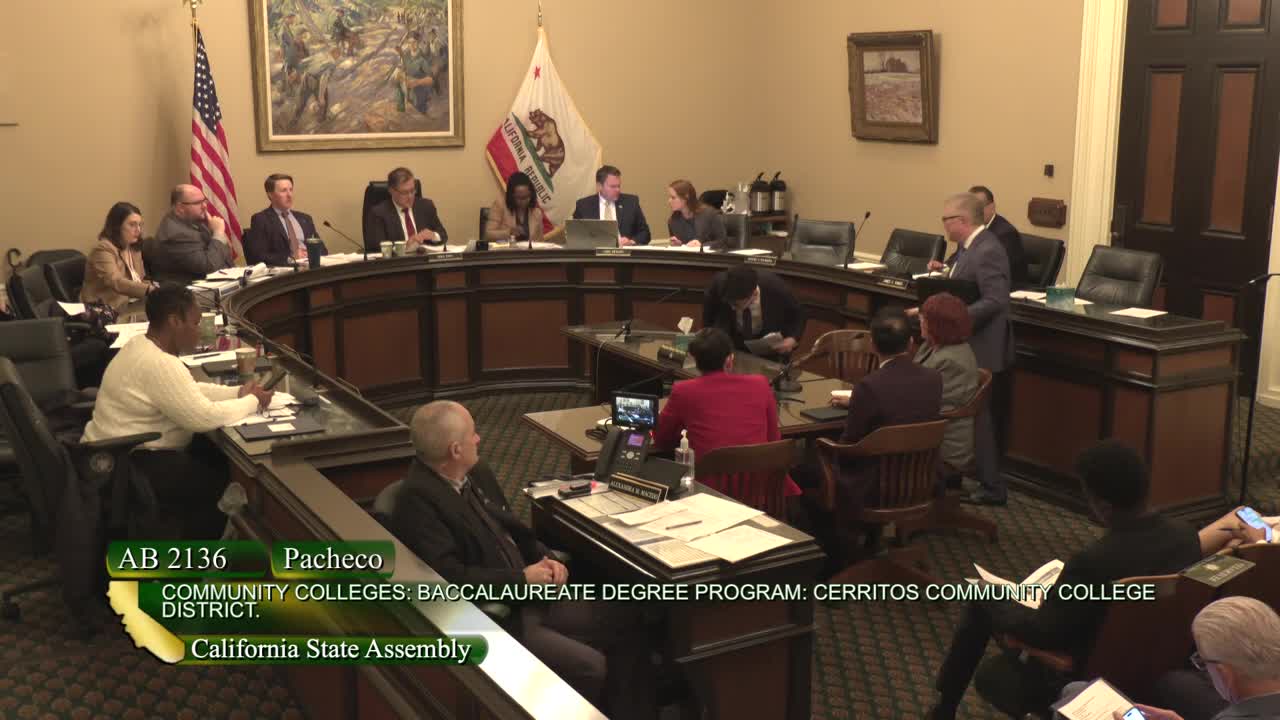 7MIN
Assembly Standing Committee on Higher Education
Bill Author

Bill Co-Author(s):