AB 2458: Energy: appliance standards and cost-effective measures.
- Session Year: 2025-2026
- House: Assembly
- Latest Version Date: 2026-08-31
Current Status:
Passed
(2026-08-31: Chaptered by Secretary of State - Chapter 171, Statutes of 2026.)
Introduced
In Committee
Awaiting First Chamber Vote
Passed First Chamber
In Committee
Awaiting Second Chamber Vote
Passed Second Chamber
Enacted
What does this bill do?
The bill expands California’s appliance efficiency law so manufacturers must certify that new appliances meet state efficiency standards before those appliances can be rented, leased, imported, distributed, or offered for any of those transactions in the state, not just sold. It applies to new appliances the State Energy Commission regulates for significant energy or water use and covers transactions regardless of the seller’s location, including internet, phone, and mail orders.
The summary is provided by generative AI which can make mistakes. For original language, please view the details in the table below.
Existing law requires the State Energy Resources Conservation and Development Commission (Energy Commission) to prescribe, by regulation, standards for minimum levels of operating efficiency, and authorizes the Energy Commission to prescribe other cost-effective measures, to promote the use of energy- and water-efficient appliances whose use requires a significant amount of energy or water. Existing law prohibits the sale, and the offering for sale, of new appliances unless their manufacturers certify that they comply with the standards in effect at the time the appliances are manufactured. Existing law defines sold or offered for sale in the state to mean any sale of or offer to sell an appliance for end use in the state, regardless of the sellers physical location.
This bill would expand the above-described provisions to also include the rental, importation, distribution, or lease of, or an offer for the rental, importation, distribution, or lease of, those appliances, as provided.
The commission shall, after one or more public hearings, do all of the following to reduce the wasteful, uneconomic, inefficient, or unnecessary consumption of energy, including the energy associated with the use of water, and to manage energy loads to help maintain electrical grid reliability:
(a)(1)Prescribe, by regulation, lighting, insulation, climate control system, and other building design and construction standards that increase efficiency in the use of energy and water for new residential and new nonresidential buildings. The commission shall periodically update the standards and adopt any revision that, in its judgment, it deems necessary. Six months after the commission certifies an energy conservation manual pursuant to subdivision (c) of Section 25402.1, a city, county, city and county, or state agency shall not issue a permit for a building unless the building satisfies the standards prescribed by the commission pursuant to this subdivision or subdivision (b) that are in effect on the date an application for a building permit is filed. Water efficiency standards adopted pursuant to this subdivision shall be demonstrated by the commission to be necessary to save energy.
(2)Before adopting a water efficiency standard for residential buildings, the Department of Housing and Community Development and the commission shall issue a joint finding whether the standard (A) is equivalent or superior in performance, in safety, and for the protection of life, health, and general welfare to standards in Title 24 of the California Code of Regulations and (B) does not unreasonably or unnecessarily impact the ability of Californians to purchase or rent affordable housing, as determined by taking account of the overall benefit derived from water efficiency standards. This subdivision does not in any way reduce the authority of the Department of Housing and Community Development to adopt standards and regulations pursuant to the State Housing Law (Part 1.5 (commencing with Section 17910) of Division 13 of the Health and Safety Code).
(3)Water efficiency standards and water conservation design standards adopted pursuant to this subdivision and subdivision (b) shall be consistent with the legislative findings of this division to ensure and maintain a reliable supply of electrical energy and be equivalent to or superior to the performance, safety, and protection of life, health, and general welfare standards contained in Title 24 of the California Code of Regulations. The commission shall consult with the members of the coordinating council as established in Section 18926 of the Health and Safety Code in the development of these standards.
(b)(1)Prescribe, by regulation, energy and water conservation design standards for new residential and new nonresidential buildings. The standards shall be performance standards and shall be promulgated in terms of energy consumption per gross square foot of floorspace, but may also include devices, systems, and techniques required to conserve energy and water. The commission shall periodically review the standards and adopt any revision that, in its judgment, it deems necessary. A building that satisfies the standards prescribed pursuant to this subdivision need not comply with the standards prescribed pursuant to subdivision (a). Water conservation design standards adopted pursuant to this subdivision shall be demonstrated by the commission to be necessary to save energy. Before adopting a water conservation design standard for residential buildings, the Department of Housing and Community Development and the commission shall issue a joint finding whether the standard (A) is equivalent or superior in performance, in safety, and for the protection of life, health, and general welfare to standards in Title 24 of the California Code of Regulations, and (B) does not unreasonably or unnecessarily impact the ability of Californians to purchase or rent affordable housing, as determined by taking account of the overall benefit derived from the water conservation design standards. This subdivision does not in any way reduce the authority of the Department of Housing and Community Development to adopt standards and regulations pursuant to the State Housing Law (Part 1.5 (commencing with Section 17910) of Division 13 of the Health and Safety Code).
(2)To increase public participation and improve the efficacy of the standards adopted pursuant to subdivision (a) and this subdivision, the commission shall, before publication of the notice of proposed action required by Section 18935 of the Health and Safety Code, involve parties who would be subject to the proposed regulations in public meetings regarding the proposed regulations. All potential affected parties shall be provided advance notice of these meetings and given an opportunity to provide written or oral comments. During these public meetings, the commission shall receive and take into consideration input from all parties concerning the parties design recommendations, cost considerations, and other factors that would affect consumers and California businesses of the proposed standard. The commission shall take into consideration before the start of the notice of proposed action any input provided during these public meetings.
(3)The standards adopted or revised pursuant to subdivision (a) and this subdivision shall be cost effective when taken in their entirety and when amortized over the economic life of the structure compared with historic practice. When determining cost-effectiveness, the commission shall consider the value of the water or energy saved, the impact on product efficacy for the consumer, and the life-cycle cost of complying with the standard. The commission shall consider other relevant factors, as required by Sections 18930 and 18935 of the Health and Safety Code, including, but not limited to, the impact on housing costs, the total statewide costs and benefits of the standard over its lifetime, the economic impact on California businesses, and any alternative approaches and their associated costs.
(c)(1)(A)(i)Prescribe, by regulation, standards for minimum levels of operating efficiency, based on a reasonable use pattern, and may prescribe other cost-effective measures, including incentive programs, fleet averaging, energy and water consumption labeling not preempted by federal labeling law, and consumer education programs, to promote the use of energy- and water-efficient appliances whose use, as determined by the commission, requires a significant amount of energy or water on a statewide basis. The minimum levels of operating efficiency shall be based on feasible and attainable efficiencies or feasible improved efficiencies that will reduce the energy or water consumption growth rates. The standards for minimum levels of operating efficiency shall become effective no sooner than one year after the date of adoption or revision, unless the commission adopts a finding of good cause in which case the standards may become effective sooner than one year after the date of adoption or revision. A new appliance manufactured on or after the effective date of the standards or other cost-effective measures shall not be sold, rented, imported, distributed, or leased, or offered for sale, rental, importation, distribution, or lease, in the state, unless it is certified by the manufacturer of the appliance to be in compliance with the standards or other cost-effective measures. The standards or other cost-effective measures shall be drawn so that they do not result in any added total costs for consumers over the designed life of the appliances concerned. Sold, rented, imported, distributed, or leased, or offered for sale, rental, importation, distribution, or lease, in the state means any sale of, offer to sell, or other transaction specified in this paragraph, that involves an appliance for end use in the state, regardless of the sellers, offerers, renters, importers, distributors, or lessors physical location, and includes, without limitation, internet, telephone, and mail order transactions. For purposes of this section, the Uniform Commercial CodeSales (Division 2 (commencing with Section 2101) of the Commercial Code) does not define sold or offered for sale or determine where sales or offers for sale occur.
(ii)In making a finding of good cause for purposes of a standard becoming effective sooner than one year after the date of adoption or revision pursuant to clause (i), the commission shall consider, among other things, the following factors:
(I)The availability of products on the market that meet the proposed standard.
(II)The impact of an earlier effective date on manufacturers.
(III)The health and safety benefits of an earlier effective date.
(IV)The impact on innovation resulting from a one-year delay between the date of adoption or revision and the effective date of the standard.
(V)The concerns raised by comments, provided to the commission pursuant to subparagraph (B), for an earlier effective date.
(B)To increase public participation and improve the efficacy of the standards adopted pursuant to this subdivision, the commission shall, before publication of the notice of proposed action required by Section 18935 of the Health and Safety Code, involve parties who would be subject to the proposed regulations in public meetings regarding the proposed regulations. All potential affected parties shall be provided advance notice of these meetings and given an opportunity to provide written or oral comments. During these public meetings, the commission shall receive and take into consideration input from all parties concerning the parties design recommendations, cost considerations, and other factors that would affect consumers and California businesses of the proposed standard. The commission shall take into consideration before the start of the notice of proposed action any input provided during these public meetings.
(C)The standards adopted or revised pursuant to this subdivision shall not result in any added total costs for consumers over the designed life of the appliances concerned. When determining cost-effectiveness, the commission shall consider the value of the water or energy saved, the impact on product efficacy for the consumer, and the life-cycle cost to the consumer of complying with the standard. The commission shall consider other relevant factors, as required by Sections 11346.5 and 11357 of the Government Code, including, but not limited to, the impact on housing costs, the total statewide costs and benefits of the standard over its lifetime, the economic impact on California businesses, and any alternative approaches and their associated costs.
(2)A new appliance, except for a plumbing fitting, regulated under paragraph (1), that is manufactured on or after July 1, 1984, shall not be sold, rented, imported, distributed, or leased, or offered for sale, rental, importation, distribution, or lease, in the state, unless the date of the manufacture is permanently displayed in an accessible place on that appliance.
(3)During the period of five years after the commission has adopted a standard for a particular appliance under paragraph (1), an increase or decrease in the minimum level of operating efficiency required by the standard for that appliance shall not become effective, unless the commission adopts other cost-effective measures for that appliance.
(4)Neither the commission nor any other state agency shall take any action to decrease any standard adopted under this subdivision on or before June 30, 1985, prescribing minimum levels of operating efficiency or other energy conservation measures for any appliance, unless the commission finds by a four-fifths vote that a decrease is of benefit to ratepayers, and that there is significant evidence of changed circumstances. At least one year before the adoption or amendment of a standard for an appliance, the commission shall notify the Legislature of its intent, and the justification to adopt or amend a standard for the appliance. Notwithstanding paragraph (3) and this paragraph, the commission may do any of the following:
(A)Increase the minimum level of operating efficiency in an existing standard up to the level of the National Voluntary Consensus Standards 90, adopted by the American Society of Heating, Refrigerating and Air-Conditioning Engineers or, for appliances not covered by that standard, up to the level established in a similar nationwide consensus standard.
(B)Change the measure or rating of efficiency of any standard, if the minimum level of operating efficiency remains substantially the same.
(C)Adjust the minimum level of operating efficiency in an existing standard to reflect changes in test procedures that the standards require manufacturers to use in certifying compliance, if the minimum level of operating efficiency remains substantially the same.
(D)Readopt a standard preempted, enjoined, or otherwise found legally defective by an administrative agency or a lower court, if final legal action determines that the standard is valid and if the standard that is readopted is not more stringent than the standard that was found to be defective or preempted.
(E)Adopt or amend any existing or new standard at any level of operating efficiency, if the Governor has declared an energy emergency as described in Section 8558 of the Government Code.
(d)Recommend minimum standards of efficiency for the operation of a new facility at a particular site that are technically and economically feasible. A site and related facility shall not be certified pursuant to Chapter 6 (commencing with Section 25500), unless the applicant certifies that standards recommended by the commission have been considered, which certification shall include a statement specifying the extent to which conformance with the recommended standards will be achieved.
(e)(1)Adopt, by regulation, and periodically update, standards for appliances to facilitate the deployment of flexible demand technologies. These regulations may include labeling provisions to promote the use of appliances with flexible demand capabilities. The flexible demand appliance standards shall be based on feasible and attainable efficiencies or feasible improvements that will enable appliance operations to be scheduled, shifted, or curtailed to enhance grid reliability, reduce emissions of greenhouse gases associated with electricity generation, or both enhancement and reduction. The standards shall become effective no sooner than one year after the date of their adoption or updating.
(2)In adopting the flexible demand appliance standards, the commission shall consider the National Institute of Standards and Technologys reliability and cybersecurity protocols, or other cybersecurity protocols that are equally or more protective, and shall adopt, at a minimum, the North American Electric Reliability Corporations Critical Infrastructure Protection standards.
(3)The flexible demand appliance standards shall be cost effective. When determining cost-effectiveness, solely for purposes of this subdivision, the commission may consider, as appropriate, the cost of flexible demand appliances compared to nonflexible demand appliances, the value of increased or decreased emissions of greenhouse gases associated with the timing of an appliances use, the life-cycle cost to the consumer from using a product that complies with the standard, and the life-cycle costs and benefits to consumers, including the ability to conserve energy and better align consumer and electrical system demand. The commission shall consider other relevant factors, as required by Sections 11346.5 and 11357 of the Government Code, including, but not limited to, the impact on housing costs, the total statewide costs and benefits of the standard over its lifetime, the economic impact on California businesses, and alternative approaches and their associated costs.
(4)The commission shall consult with the Public Utilities Commission, load-serving entities, and local publicly owned electric utilities to better align the flexible demand appliance standards with demand response programs administered by the state and load-serving entities and local publicly owned electric utilities and to incentivize the deployment of flexible demand appliances.
(5)The flexible demand appliance standards shall prioritize all of the following:
(A)Appliances that can more conveniently have their electrical demand controlled by load-management technology and third-party load-management programs.
(B)Appliances with load-management technology options that are readily available.
(C)Appliances that have a user-friendly interface and follow a straightforward setup and connection process, such as remote setup by means of an internet website or application.
(D)Appliances with load-management technology options that follow simple standards for third-party direct operation of the appliances.
(E)Appliances that are interoperable or open source.
(6)On or before January 1, 2021, and as necessary thereafter, the commission shall include as part of each integrated energy policy report adopted pursuant to Chapter 4 (commencing with Section 25300) a description of any actions it has taken pursuant to this subdivision and the flexible demand appliance standards cost to consumers.
(7)For purposes of this subdivision, all of the following definitions apply:
(A)Flexible demand means the capability to schedule, shift, or curtail the electrical demand of a load-serving entitys customer or a local publicly owned electric utilitys customer through direct action by the customer or through action by a third party, the load-serving entity, or a grid balancing authority, with the customers consent.
(B)Load-serving entity has the same meaning as defined in Section 380 of the Public Utilities Code.
(C)Local publicly owned electric utility has the same meaning as defined in Section 224.3 of the Public Utilities Code.
The commission shall, after one or more public hearings, do all of the following to reduce the wasteful, uneconomic, inefficient, or unnecessary consumption of energy, including the energy associated with the use of water, and to manage energy loads to help maintain electrical grid reliability:
(a)(1)Prescribe, by regulation, lighting, insulation, climate control system, and other building design and construction standards that increase efficiency in the use of energy and water for new residential and new nonresidential buildings. The commission shall periodically update the standards and adopt any revision that, in its judgment, it deems necessary. Six months after the commission certifies an energy conservation manual pursuant to subdivision (c) of Section 25402.1, a city, county, city and county, or state agency shall not issue a permit for a building unless the building satisfies the standards prescribed by the commission pursuant to this subdivision or subdivision (b) that are in effect on the date an application for a building permit is filed. Water efficiency standards adopted pursuant to this subdivision shall be demonstrated by the commission to be necessary to save energy.
(2)Before adopting a water efficiency standard for residential buildings, the Department of Housing and Community Development and the commission shall issue a joint finding whether the standard (A) is equivalent or superior in performance, in safety, and for the protection of life, health, and general welfare to standards in Title 24 of the California Code of Regulations and (B) does not unreasonably or unnecessarily impact the ability of Californians to purchase or rent affordable housing, as determined by taking account of the overall benefit derived from water efficiency standards. This subdivision does not in any way reduce the authority of the Department of Housing and Community Development to adopt standards and regulations pursuant to the State Housing Law (Part 1.5 (commencing with Section 17910) of Division 13 of the Health and Safety Code).
(3)Water efficiency standards and water conservation design standards adopted pursuant to this subdivision and subdivision (b) shall be consistent with the legislative findings of this division to ensure and maintain a reliable supply of electrical energy and be equivalent to or superior to the performance, safety, and protection of life, health, and general welfare standards contained in Title 24 of the California Code of Regulations. The commission shall consult with the members of the coordinating council as established in Section 18926 of the Health and Safety Code in the development of these standards.
(b)(1)Prescribe, by regulation, energy and water conservation design standards for new residential and new nonresidential buildings. The standards shall be performance standards and shall be promulgated in terms of energy consumption per gross square foot of floorspace, but may also include devices, systems, and techniques required to conserve energy and water. The commission shall periodically review the standards and adopt any revision that, in its judgment, it deems necessary. A building that satisfies the standards prescribed pursuant to this subdivision need not comply with the standards prescribed pursuant to subdivision (a). Water conservation design standards adopted pursuant to this subdivision shall be demonstrated by the commission to be necessary to save energy. Before adopting a water conservation design standard for residential buildings, the Department of Housing and Community Development and the commission shall issue a joint finding whether the standard (A) is equivalent or superior in performance, in safety, and for the protection of life, health, and general welfare to standards in Title 24 of the California Code of Regulations, and (B) does not unreasonably or unnecessarily impact the ability of Californians to purchase or rent affordable housing, as determined by taking account of the overall benefit derived from the water conservation design standards. This subdivision does not in any way reduce the authority of the Department of Housing and Community Development to adopt standards and regulations pursuant to the State Housing Law (Part 1.5 (commencing with Section 17910) of Division 13 of the Health and Safety Code).
(2)To increase public participation and improve the efficacy of the standards adopted pursuant to subdivision (a) and this subdivision, the commission shall, before publication of the notice of proposed action required by Section 18935 of the Health and Safety Code, involve parties who would be subject to the proposed regulations in public meetings regarding the proposed regulations. All potential affected parties shall be provided advance notice of these meetings and given an opportunity to provide written or oral comments. During these public meetings, the commission shall receive and take into consideration input from all parties concerning the parties design recommendations, cost considerations, and other factors that would affect consumers and California businesses of the proposed standard. The commission shall take into consideration before the start of the notice of proposed action any input provided during these public meetings.
(3)The standards adopted or revised pursuant to subdivision (a) and this subdivision shall be cost effective when taken in their entirety and when amortized over the economic life of the structure compared with historic practice. When determining cost-effectiveness, the commission shall consider the value of the water or energy saved, the impact on product efficacy for the consumer, and the life-cycle cost of complying with the standard. The commission shall consider other relevant factors, as required by Sections 18930 and 18935 of the Health and Safety Code, including, but not limited to, the impact on housing costs, the total statewide costs and benefits of the standard over its lifetime, the economic impact on California businesses, and any alternative approaches and their associated costs.
(c)(1)(A)(i)Prescribe, by regulation, standards for minimum levels of operating efficiency, based on a reasonable use pattern, and may prescribe other cost-effective measures, including incentive programs, fleet averaging, energy and water consumption labeling not preempted by federal labeling law, and consumer education programs, to promote the use of energy- and water-efficient appliances whose use, as determined by the commission, requires a significant amount of energy or water on a statewide basis. The minimum levels of operating efficiency shall be based on feasible and attainable efficiencies or feasible improved efficiencies that will reduce the energy or water consumption growth rates. The standards for minimum levels of operating efficiency shall become effective no sooner than one year after the date of adoption or revision, unless the commission adopts a finding of good cause in which case the standards may become effective sooner than one year after the date of adoption or revision. A new appliance manufactured on or after the effective date of the standards or other cost-effective measures shall not be sold sold, rented, imported, distributed, or leased, or offered for sale sale, rental, importation, distribution, or lease, in the state, unless it is certified by the manufacturer of the appliance to be in compliance with the standards or other cost-effective measures. The standards or other cost-effective measures shall be drawn so that they do not result in any added total costs for consumers over the designed life of the appliances concerned. Sold Sold, rented, imported, distributed, or leased, or offered for sale sale, rental, importation, distribution, or lease, in the state means any sale of or of, offer to sell sell, or other transaction specified in this paragraph, that involves an appliance for end use in the state, regardless of the sellers sellers, offerers, renters, importers, distributors, or lessors physical location, and includes, without limitation, internet, telephone, and mail order transactions. For purposes of this section, the Uniform Commercial CodeSales (Division 2 (commencing with Section 2101) of the Commercial Code) does not define sold or offered for sale or determine where sales or offers for sale occur.
(ii)In making a finding of good cause for purposes of a standard becoming effective sooner than one year after the date of adoption or revision pursuant to clause (i), the commission shall consider, among other things, the following factors:
(I)The availability of products on the market that meet the proposed standard.
(II)The impact of an earlier effective date on manufacturers.
(III)The health and safety benefits of an earlier effective date.
(IV)The impact on innovation resulting from a one-year delay between the date of adoption or revision and the effective date of the standard.
(V)The concerns raised by comments, provided to the commission pursuant to subparagraph (B), for an earlier effective date.
(B)To increase public participation and improve the efficacy of the standards adopted pursuant to this subdivision, the commission shall, before publication of the notice of proposed action required by Section 18935 of the Health and Safety Code, involve parties who would be subject to the proposed regulations in public meetings regarding the proposed regulations. All potential affected parties shall be provided advance notice of these meetings and given an opportunity to provide written or oral comments. During these public meetings, the commission shall receive and take into consideration input from all parties concerning the parties design recommendations, cost considerations, and other factors that would affect consumers and California businesses of the proposed standard. The commission shall take into consideration before the start of the notice of proposed action any input provided during these public meetings.
(C)The standards adopted or revised pursuant to this subdivision shall not result in any added total costs for consumers over the designed life of the appliances concerned. When determining cost-effectiveness, the commission shall consider the value of the water or energy saved, the impact on product efficacy for the consumer, and the life-cycle cost to the consumer of complying with the standard. The commission shall consider other relevant factors, as required by Sections 11346.5 and 11357 of the Government Code, including, but not limited to, the impact on housing costs, the total statewide costs and benefits of the standard over its lifetime, the economic impact on California businesses, and any alternative approaches and their associated costs.
(2)A new appliance, except for a plumbing fitting, regulated under paragraph (1), that is manufactured on or after July 1, 1984, shall not be sold, rented, imported, distributed, or leased, or offered for sale, rental, importation, distribution, or lease, in the state, unless the date of the manufacture is permanently displayed in an accessible place on that appliance.
(3)During the period of five years after the commission has adopted a standard for a particular appliance under paragraph (1), an increase or decrease in the minimum level of operating efficiency required by the standard for that appliance shall not become effective, unless the commission adopts other cost-effective measures for that appliance.
(4)Neither the commission nor any other state agency shall take any action to decrease any standard adopted under this subdivision on or before June 30, 1985, prescribing minimum levels of operating efficiency or other energy conservation measures for any appliance, unless the commission finds by a four-fifths vote that a decrease is of benefit to ratepayers, and that there is significant evidence of changed circumstances. At least one year before the adoption or amendment of a standard for an appliance, the commission shall notify the Legislature of its intent, and the justification to adopt or amend a standard for the appliance. Notwithstanding paragraph (3) and this paragraph, the commission may do any of the following:
(A)Increase the minimum level of operating efficiency in an existing standard up to the level of the National Voluntary Consensus Standards 90, adopted by the American Society of Heating, Refrigerating and Air-Conditioning Engineers or, for appliances not covered by that standard, up to the level established in a similar nationwide consensus standard.
(B)Change the measure or rating of efficiency of any standard, if the minimum level of operating efficiency remains substantially the same.
(C)Adjust the minimum level of operating efficiency in an existing standard to reflect changes in test procedures that the standards require manufacturers to use in certifying compliance, if the minimum level of operating efficiency remains substantially the same.
(D)Readopt a standard preempted, enjoined, or otherwise found legally defective by an administrative agency or a lower court, if final legal action determines that the standard is valid and if the standard that is readopted is not more stringent than the standard that was found to be defective or preempted.
(E)Adopt or amend any existing or new standard at any level of operating efficiency, if the Governor has declared an energy emergency as described in Section 8558 of the Government Code.
(d)Recommend minimum standards of efficiency for the operation of a new facility at a particular site that are technically and economically feasible. A site and related facility shall not be certified pursuant to Chapter 6 (commencing with Section 25500), unless the applicant certifies that standards recommended by the commission have been considered, which certification shall include a statement specifying the extent to which conformance with the recommended standards will be achieved.
(e)(1)Adopt, by regulation, and periodically update, standards for appliances to facilitate the deployment of flexible demand technologies. These regulations may include labeling provisions to promote the use of appliances with flexible demand capabilities. The flexible demand appliance standards shall be based on feasible and attainable efficiencies or feasible improvements that will enable appliance operations to be scheduled, shifted, or curtailed to enhance grid reliability, reduce emissions of greenhouse gases associated with electricity generation, or both enhancement and reduction. The standards shall become effective no sooner than one year after the date of their adoption or updating.
(2)In adopting the flexible demand appliance standards, the commission shall consider the National Institute of Standards and Technologys reliability and cybersecurity protocols, or other cybersecurity protocols that are equally or more protective, and shall adopt, at a minimum, the North American Electric Reliability Corporations Critical Infrastructure Protection standards.
(3)The flexible demand appliance standards shall be cost effective. When determining cost-effectiveness, solely for purposes of this subdivision, the commission may consider, as appropriate, the cost of flexible demand appliances compared to nonflexible demand appliances, the value of increased or decreased emissions of greenhouse gases associated with the timing of an appliances use, the life-cycle cost to the consumer from using a product that complies with the standard, and the life-cycle costs and benefits to consumers, including the ability to conserve energy and better align consumer and electric electrical system demand. The commission shall consider other relevant factors, as required by Sections 11346.5 and 11357 of the Government Code, including, but not limited to, the impact on housing costs, the total statewide costs and benefits of the standard over its lifetime, the economic impact on California businesses, and alternative approaches and their associated costs.
(4)The commission shall consult with the Public Utilities Commission, load-serving entities, and local publicly owned electric utilities to better align the flexible demand appliance standards with demand response programs administered by the state and load-serving entities and local publicly owned electric utilities and to incentivize the deployment of flexible demand appliances.
(5)The flexible demand appliance standards shall prioritize all of the following:
(A)Appliances that can more conveniently have their electrical demand controlled by load-management technology and third-party load-management programs.
(B)Appliances with load-management technology options that are readily available.
(C)Appliances that have a user-friendly interface and follow a straightforward setup and connection process, such as remote setup by means of an internet website or application.
(D)Appliances with load-management technology options that follow simple standards for third-party direct operation of the appliances.
(E)Appliances that are interoperable or open source.
(6)On or before January 1, 2021, and as necessary thereafter, the commission shall include as part of each integrated energy policy report adopted pursuant to Chapter 4 (commencing with Section 25300) a description of any actions it has taken pursuant to this subdivision and the flexible demand appliance standards cost to consumers.
(7)For purposes of this subdivision, all of the following definitions apply:
(A)Flexible demand means the capability to schedule, shift, or curtail the electrical demand of a load-serving entitys customer or a local publicly owned electric utilitys customer through direct action by the customer or through action by a third party, the load-serving entity, or a grid balancing authority, with the customers consent.
(B)Load-serving entity has the same meaning as defined in Section 380 of the Public Utilities Code.
(C)Local publicly owned electric utility has the same meaning as defined in Section 224.3 of the Public Utilities Code.
|
Date
|
Status
|
|---|---|
| Aug 31, 2026 | Chaptered by Secretary of State - Chapter 171, Statutes of 2026. |
| Aug 31, 2026 | Approved by the Governor. |
| Aug 25, 2026 | Enrolled and presented to the Governor at 4 p.m. |
| Aug 19, 2026 | In Assembly. Ordered to Engrossing and Enrolling. |
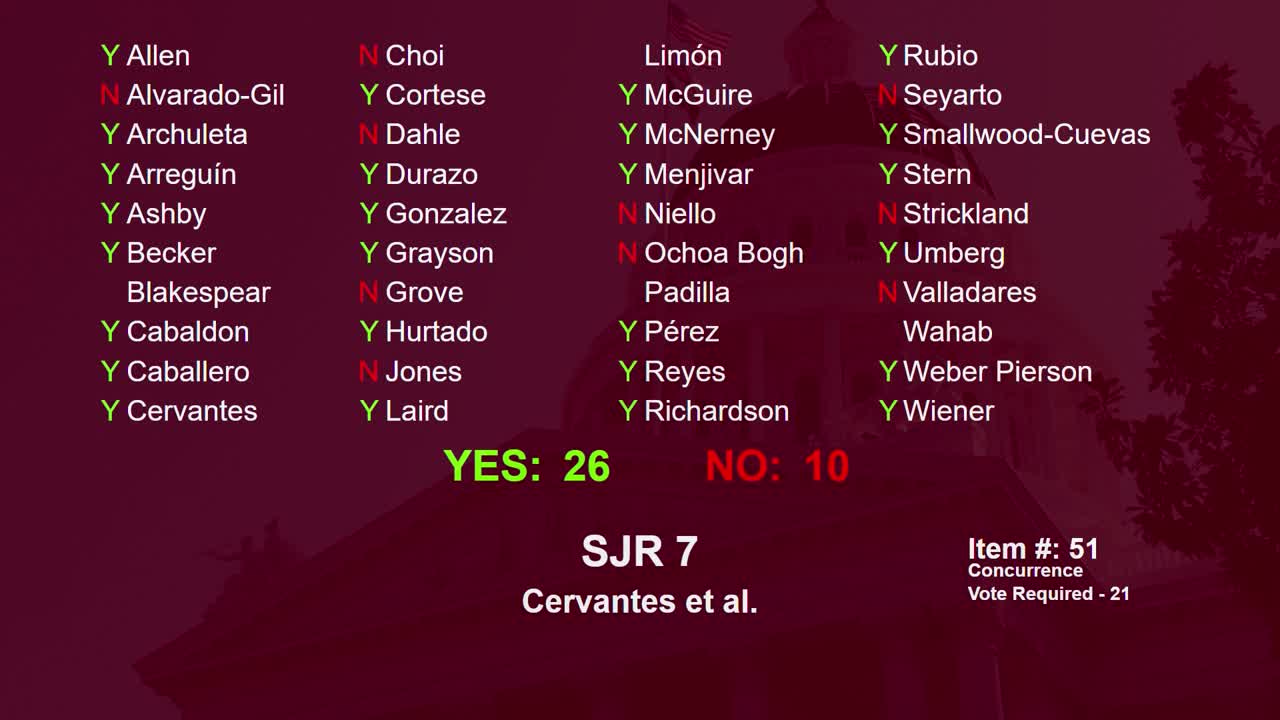
| Aug 19, 2026 | Read third time. Passed. Ordered to the Assembly. (Ayes 38. Noes 0.). |
| Aug 19, 2026 | Read third time. Passed. Ordered to the Assembly. (Ayes 38. Noes 0. Page 5544.). |
| Jun 23, 2026 | Read second time. Ordered to third reading. |
| Jun 22, 2026 | From committee: Be ordered to second reading pursuant to Senate Rule 28.8. |
| Jun 9, 2026 | From committee: Do pass and re-refer to Com. on APPR. (Ayes 16. Noes 0.) (June 8). Re-referred to Com. on APPR. |
| May 20, 2026 | Referred to Com. on E., U & C. |
| May 7, 2026 | In Senate. Read first time. To Com. on RLS. for assignment. |
| May 7, 2026 | Read third time. Passed. Ordered to the Senate. (Ayes 66. Noes 0.) |
| May 7, 2026 | Read third time. Passed. Ordered to the Senate. (Ayes 66. Noes 0. Page 4967.) |
| Apr 30, 2026 | Read second time. Ordered to Consent Calendar. |
| Apr 29, 2026 | From committee: Do pass. To Consent Calendar. (Ayes 14. Noes 0.) (April 29). |
| Apr 9, 2026 | From committee: Do pass and re-refer to Com. on APPR. with recommendation: To Consent Calendar. (Ayes 17. Noes 0.) (April 8). Re-referred to Com. on APPR. |
| Mar 9, 2026 | Referred to Com. on U. & E. |
| Feb 21, 2026 | From printer. May be heard in committee March 23. |
| Feb 20, 2026 | Read first time. To print. |
|
Date
|
Description
|
Location
|
Votes
|
|
|---|---|---|---|---|
| Aug 19, 2026 | Assembly 3rd Reading AB2458 Bennett By Allen | Senate Floor |
Passed |
|
| Jun 8, 2026 | Do pass, but first be re-referred to the Committee on [Appropriations] | Senate Standing Committee on Energy, Utilities and Communications |
Passed |
|
| May 7, 2026 | AB 2458 Bennett Consent Calendar Second Day Regular Session | Assembly Floor |
Passed |
|
| Apr 29, 2026 | Do pass. To Consent Calendar. | Assembly Standing Committee on Appropriations |
Passed |
|
| Apr 8, 2026 | Do pass and be re-referred to the Committee on [Appropriations] with recommendation: To Consent Calendar | Assembly Standing Committee on Utilities and Energy |
Passed |
This list shows positions taken on this bill by organizations on the date displayed, which is linked to the original source.
Positions by individuals are not included.
|
Organization
|
Position
|
Date
|
|---|---|---|
| Appliance Standards Awareness Project | ** Support | |
| california efficiency + demand management council | ** Support | |
| California State Association Of Electrical Workers | ** Support | |
| Ceres | ** Support | |
| Coalition of California Utility Employees | ** Support | |
| Consumer Federation of America | ** Support | |
| International Association Of Plumbing & Mechanical Officials | ** Support | |
| Pacific Gas And Electric Company | ** Support | |
| Southern California Edison | ** Support |
SENATE RULES COMMITTEE Office of Senate Floor Analyses (916) 651-4171 | AB 2458 |
THIRD READING
Bill No: AB 2458
Author: Bennett (D)
Introduced: 2/20/26
Vote: 21
SENATE ENERGY, U. & C. COMMITTEE: 16-0, 6/8/26
AYES: Allen, Ochoa Bogh, Archuleta, Arreguín, Ashby, Becker, Caballero, Dahle, Gonzalez, Grove, McNerney, Reyes, Richardson, Rubio, Strickland, Wahab
NO VOTE RECORDED: Hurtado
SENATE APPROPRIATIONS COMMITTEE: Senate Rule 28.8
ASSEMBLY FLOOR: 66-0, 5/7/26 (Consent) - See last page for vote
SUBJECT: Energy: appliance standards and cost-effective measures
SOURCE: Author
DIGEST:
This bill extends the California Energy Commission’s (CEC’s) water and energy appliance efficiency standards to appliances that are sold, rented, imported, distributed, or leased, or offered for sale, rental, importation, distribution, or lease.
ANALYSIS:
Existing law:
- Requires the CEC to establish building and appliance standards to reduce the wasteful, uneconomic, inefficient, or unnecessary consumption of energy, including the energy associated with the use of water. (Public Resources Code §25402)
- Requires the CEC to establish appliance efficiency standards based on a reasonable use pattern. The CEC may prescribe other cost-effective measures, including incentive programs, fleet averaging, energy and water consumption labeling not preempted by federal labeling law, and consumer education programs, to promote the use of energy and water efficient appliances whose use requires a significant amount of energy or water use on a statewide basis. An appliance manufactured on or after the effective date of these standards may not be sold or offered for sale in California unless it complies with the standards. (Public Resources Code §25402)
- Prohibits appliance standards from resulting in any added total costs for consumers over the designed life of the appliances concerned. When determining cost-effectiveness, the CEC must consider the value of the water or energy saved, impact on product efficacy for the consumer, and the life cycle cost to the consumer of complying with the standard. The CEC must consider other relevant factors, including, but not limited to, the impact on housing costs, the total statewide costs and benefits of the standard over its lifetime, economic impact on California businesses, and alternative approaches and their associated costs. (Public Resources Code §25402)
- Prohibits appliance standards adopted by the CEC to take effect sooner than one year after the adoption date unless the CEC makes a specified finding of good cause substantiating the need for a sooner implementation date. (Public Resources Code §25402)
- Requires the CEC to adopt appliance standards to facilitate the deployment of flexible demand technologies. These standards may include labeling provisions to promote the use of appliances with flexible demand capabilities. The flexible demand appliance standards shall be based on feasible and attainable efficiencies or feasible improvements that will enable appliance operations to be scheduled, shifted, or curtailed to enhance grid reliability, reduce emissions of greenhouse gases associated with electricity generation, or both enhancement and reduction. (Public resources Code §25402)
- Authorizes the CEC to adopt regulations establishing an administrative enforcement process for violation of the CEC’s appliance standards. Existing law allows the CEC to assess a civil money penalty for violations up to $2,500 for each violation. Penalties assessed for appliance efficiency violations are deposited into the CEC’s Appliance Efficiency Enforcement Subaccount and fund the CEC’s appliance efficiency enforcement activities upon appropriation by the Legislature. (Public Resources Code §25402.11)
This bill extends the CEC’s water and energy appliance efficiency standards to appliances that are sold, rented, imported, distributed, or leased, or offered for sale, rental, importation, distribution, or lease.
Background
The CEC’s appliance efficiency standards can provide consumer and ratepayer savings. Both the federal Department of Energy (DOE) and the CEC maintain authority to set efficiency standards for appliances. Federal appliance efficiency standards are mandatory baseline requirements that apply nationally, and they cannot be superseded by state standards. However, states may set standards for appliances that the DOE does not regulate. Energy efficiency standards for appliances have been a core component of California’s energy conservation strategy since the enactment of the Warren-Alquist Act, which established the CEC in 1974. Improved energy and water efficiency can provide consumers with savings by reducing utility bill costs through lower energy and water consumption. In addition to direct bill reductions, increased energy and water efficiency standards can also reduce the need for new energy infrastructure and procurements by lowering overall load increases over time. Between 1973 to 2006, California’s electrical load growth remained largely flat while national electricity demand grew by 50%. This flat trend was attributed to increased use of energy efficient appliances following the implementation of California’s appliance standards.
Bill is aimed at ensuring consistency between demand response and efficiency standards. Prior legislation (SB 49, Skinner, Chapter 697, Statutes of 2019) expanded the CEC’s authority to establish appliance standards to enable the CEC to set standards that facilitate the use of demand response technologies, such as smart thermostats. While existing law does not specifically limit the CEC’s demand response standards to solely to appliances purchased outright, existing statute limits the CEC’s overall efficiency standards to only those appliances sold or offered for sale in the state. Several other states extend appliance efficiency standards to appliances that are leased or rented in addition to those appliances sold in the state. States that apply efficiency standards to leased or rented appliances include New York, Colorado, Washington, Nevada, Rhode Island, Hawaii, Vermont, and the District of Columbia. California’s appliance efficiency standards are enforced on retailers. In the absence of California’s efficiency standards applying to rented or leased appliances, entities may be able to circumvent the CEC’s efficiency standards by arguing that appliances rented or leased are “distributed” in the state rather than “sold” in California. This loophole may create an uneven regulatory space for appliances retailed in California and businesses, including out-of-state businesses, that rent to individuals in California.
Bill may primarily impact commercial food service appliances. While this bill does not apply to a specific type of appliance, the CEC is in the process of considering new standards for certain commercial food service appliances, including commercial dishwashers. The CEC estimates that new standards for commercial dishwashers could save the state 399 gigawatt hours of electricity, 18 million therms of gas, 2.62 billion gallons of water, and $199.3 million in utility costs per year when the full stock of commercial dishwashers are switched to more efficient models. Few appliances in the residential sector are leased or rented; however, the CEC estimates that approximately 50% of commercial dishwashers are leased. The CEC estimates that potentially more than 90% of appliances impacted by regulations that extend to leased or rented appliances would be commercial appliances.
Related/Prior Legislation
SB 1063 (Skinner, Chapter 362, Statutes of 2022) authorized the CEC to implement adopted appliance standards without a one-year waiting period if the CEC first makes a specified good cause finding for the faster implementation date.
SB 49 (Skinner, Chapter 697, Statutes of 2019) modified the CEC’s appliance energy efficiency regulatory authority to allow the CEC to establish appliance efficiency standards that facilitate the deployment of flexible demand technologies. The bill also required the California Natural Resources Agency to conduct an assessment of upgrades to the State Water Resources Development System that would support California’s climate goals.
FISCAL EFFECT: Appropriation: No Fiscal Com.: Yes Local: No
SUPPORT: (Verified 6/23/26)
Appliance Standards Awareness Project
California Efficiency + Demand Management Council
California State Association of Electrical Workers
Ceres
Coalition of California Utility Employees
Consumer Federation of America
International Association of Plumbing & Mechanical Officials
Pacific Gas and Electric Company
Southern California Edison
OPPOSITION: (Verified 6/23/26)
None received
ARGUMENTS IN SUPPORT: According to the author:
Flexible demand appliances provide users with the ability to schedule or shift their electricity usage. This allows an appliance to be in use at a time when renewables are abundant, and energy costs are low. Although the Energy Commission has established flexible demand standards and efficiency standards for appliances sold in California, it does not have authority to ensure that these common sense standards apply to appliances that are rented or leased. AB 2458 allows the Energy Commission to apply their existing regulations to all appliances used in California which will ultimately provide commercial appliance users a means by which to reduce their energy costs.
ASSEMBLY FLOOR: 66-0, 5/7/26
AYES: Addis, Aguiar-Curry, Ahrens, Alanis, Alvarez, Ávila Farías, Bains, Bauer-Kahan, Bennett, Berman, Boerner, Bryan, Calderon, Caloza, Carrillo, Castillo, Connolly, Davies, DeMaio, Dixon, Elhawary, Ellis, Fong, Gabriel, Garcia, Gipson, Jeff Gonzalez, Mark González, Hadwick, Haney, Harabedian, Jackson, Johnson, Kalra, Krell, Lackey, Lee, Lowenthal, Macedo, McKinnor, Muratsuchi, Nguyen, Ortega, Pacheco, Patel, Patterson, Pellerin, Quirk-Silva, Ramos, Ransom, Michelle Rodriguez, Rogers, Blanca Rubio, Sanchez, Schiavo, Schultz, Sharp-Collins, Solache, Soria, Stefani, Ta, Tangipa, Ward, Wilson, Zbur, Rivas
NO VOTE RECORDED: Arambula, Bonta, Chen, Flora, Gallagher, Hart, Hoover, Irwin, Papan, Petrie-Norris, Celeste Rodriguez, Valencia, Wallis, Wicks
Prepared by: Sarah Smith / E., U. & C. / (916) 651-4107
6/24/26 16:35:06
**** END ****
SENATE COMMITTEE ON ENERGY, UTILITIES AND COMMUNICATIONS
Senator Benjamin Allen, Chair
2025 - 2026 Regular
Bill No: Hearing Date: 6/8/2026
Author: | |||
Version: | Introduced | ||
Urgency: | Fiscal: | ||
Consultant: | |||
SUBJECT:
DIGEST: This bill extends the California Energy Commission’s (CEC’s) water and energy appliance efficiency standards to appliances that are sold, rented, imported, distributed, or leased, or offered for sale, rental, importation, distribution, or lease.
ANALYSIS:
Existing law:
- Requires the CEC to establish building and appliance standards to reduce the wasteful, uneconomic, inefficient, or unnecessary consumption of energy, including the energy associated with the use of water. (Public Resources Code §25402)
- Requires the CEC to establish appliance efficiency standards based on a reasonable use pattern. The CEC may prescribe other cost-effective measures, including incentive programs, fleet averaging, energy and water consumption labeling not preempted by federal labeling law, and consumer education programs, to promote the use of energy and water efficient appliances whose use requires a significant amount of energy or water use on a statewide basis. An appliance manufactured on or after the effective date of these standards may not be sold or offered for sale in California unless it complies with the standards. (Public Resources Code §25402)
- Prohibits appliance standards from resulting in any added total costs for consumers over the designed life of the appliances concerned. When determining cost-effectiveness, the CEC must consider the value of the water or energy saved, impact on product efficacy for the consumer, and the life cycle cost to the consumer of complying with the standard. The CEC must consider other relevant factors, including, but not limited to, the impact on housing costs, the total statewide costs and benefits of the standard over its lifetime, economic impact on California businesses, and alternative approaches and their associated costs. (Public Resources Code §25402)
- Prohibits appliance standards adopted by the CEC to take effect sooner than one year after the adoption date unless the CEC makes a specified finding of good cause substantiating the need for a sooner implementation date. (Public Resources Code §25402)
- Requires the CEC to adopt appliance standards to facilitate the deployment of flexible demand technologies. These standards may include labeling provisions to promote the use of appliances with flexible demand capabilities. The flexible demand appliance standards shall be based on feasible and attainable efficiencies or feasible improvements that will enable appliance operations to be scheduled, shifted, or curtailed to enhance grid reliability, reduce emissions of greenhouse gases associated with electricity generation, or both enhancement and reduction. (Public resources Code §25402)
- Authorizes the CEC to adopt regulations establishing an administrative enforcement process for violation of the CEC’s appliance standards. Existing law allows the CEC to assess a civil money penalty for violations up to $2,500 for each violation. Penalties assessed for appliance efficiency violations are deposited into the CEC’s Appliance Efficiency Enforcement Subaccount and fund the CEC’s appliance efficiency enforcement activities upon appropriation by the Legislature. (Public Resources Code §25402.11)
This bill extends the CEC’s water and energy appliance efficiency standards to appliances that are sold, rented, imported, distributed, or leased, or offered for sale, rental, importation, distribution, or lease.
Background
The CEC’s appliance efficiency standards can provide consumer and ratepayer savings. Both the federal Department of Energy (DOE) and the CEC maintain authority to set efficiency standards for appliances. Federal appliance efficiency standards are mandatory baseline requirements that apply nationally, and they cannot be superseded by state standards. However, states may set standards for appliances that the DOE does not regulate. Energy efficiency standards for appliances have been a core component of California’s energy conservation strategy since the enactment of the Warren-Alquist Act, which established the CEC in 1974. Improved energy and water efficiency can provide consumers with savings by reducing utility bill costs through lower energy and water consumption. In addition to direct bill reductions, increased energy and water efficiency standards can also reduce the need for new energy infrastructure and procurements by lowering overall load increases over time. Between 1973 to 2006, California’s electrical load growth remained largely flat while national electricity demand grew by 50%. This flat trend was attributed to increased use of energy efficient appliances following the implementation of California’s appliance standards.
Bill is aimed at ensuring consistency between demand response and efficiency standards. Prior legislation (SB 49, Skinner, Chapter 697, Statutes of 2019) expanded the CEC’s authority to establish appliance standards to enable the CEC to set standards that facilitate the use of demand response technologies, such as smart thermostats. While existing law does not specifically limit the CEC’s demand response standards to solely to appliances purchased outright, existing statute limits the CEC’s overall efficiency standards to only those appliances sold or offered for sale in the state. Several other states extend appliance efficiency standards to appliances that are leased or rented in addition to those appliances sold in the state. States that apply efficiency standards to leased or rented appliances include New York, Colorado, Washington, Nevada, Rhode Island, Hawaii, Vermont, and the District of Columbia. California’s appliance efficiency standards are enforced on retailers. In the absence of California’s efficiency standards applying to rented or lease appliances, entities may be able to circumvent the CEC’s efficiency standards by arguing that appliances rented or leased are “distributed” in the state rather than “sold” in California. This loophole may create an uneven regulatory space for appliances retailed in California and businesses, including out-of-state businesses, that rent to individuals in California.
Bill may primarily impact commercial food service appliances. While this bill does not apply to a specific type of appliance, the CEC is in the process of considering new standards for certain commercial food service appliances, including commercial dishwashers. The CEC estimates that new standards for commercial dishwashers could save the state 399 gigawatt hours of electricity, 18 million therms of gas, 2.62 billion gallons of water, and $199.3 million in utility costs per year when the full stock of commercial dishwashers are switched to more efficient models. Few appliances in the residential sector are leased or rented; however, the CEC estimates that approximately 50% of commercial dishwashers are leased. The CEC estimates that potentially more than 90% of appliances impacted by regulations that extend to leased or rented appliances would be commercial appliances.
Prior/Related Legislation
SB 1063 (Skinner, Chapter 362, Statutes of 2022) authorized the CEC to implement adopted appliance standards without a one-year waiting period if the CEC first makes a specified good cause finding for the faster implementation date.
SB 49 (Skinner, Chapter 697, Statutes of 2019) modified the CEC’s appliance energy efficiency regulatory authority to allow the CEC to establish appliance efficiency standards that facilitate the deployment of flexible demand technologies. The bill also required the California Natural Resources Agency to conduct an assessment of upgrades to the State Water Resources Development System that would support California’s climate goals.
FISCAL EFFECT: Appropriation: Fiscal Com.: Local:
SUPPORT:
California Efficiency + Demand Management Council
California State Association of Electrical Workers
Ceres
Coalition of California Utility Employees
International Association of Plumbing & Mechanical Officials
Pacific Gas and Electric Company
Southern California Edison
OPPOSITION:
None received
ARGUMENTS IN SUPPORT: According to the author:
Flexible demand appliances provide users with the ability to schedule or shift their electricity usage. This allows an appliance to be in use at a time when renewables are abundant, and energy costs are low. Although the Energy Commission has established flexible demand standards and efficiency standards for appliances sold in California, it does not have authority to ensure that these common sense standards apply to appliances that are rented or leased. AB 2458 allows the Energy Commission to apply their existing regulations to all appliances used in California which will ultimately provide commercial appliance users a means by which to reduce their energy costs.
-- END --
Date of Hearing: April 29, 2026
ASSEMBLY COMMITTEE ON APPROPRIATIONS
Buffy Wicks, Chair
ABPCA Bill Id:AB 2458
Author:(Bennett) – As Introduced Ver:February 20, 2026
Policy Committee: | Utilities and Energy | Vote: | 17 - 0 |
|
| ||
|
|
Urgency: No State Mandated Local Program: No Reimbursable: No
SUMMARY:
This bill expands authority in existing law provided to the California Energy Commission (CEC) to establish standards for minimum levels of energy and water operating efficiency applicable to appliances sold in the state to additionally apply to appliances rented, imported, distributed or leased in the state.
FISCAL EFFECT:
Minor, absorbable costs to the CEC to extend its existing efficiency regulations to appliances that are rented, imported, distributed or leased in the state.
COMMENTS:
Existing law authorizes the CEC to adopt standards for minimum levels of operating efficiency for appliances the use of which requires a significant amount of energy or water and empowers the CEC to enforce those standards. The law provides that a new appliance manufactured on or after the effective date of CEC’s standards is not to be sold or offered for sale in California, unless it is certified by the manufacturer of the appliance to comply with CEC’s standards. The law, however, says nothing about appliances to be rented, imported, distributed or leased in California. The author intends this bill to allow the CEC to apply its existing appliance regulations to “all appliances used in California which will ultimately provide commercial appliance users a means by which to reduce their energy costs.”
Analysis Prepared by: Jay Dickenson / APPR. / (916) 319-2081
Date of Hearing: April 8, 2026
ASSEMBLY COMMITTEE ON UTILITIES AND ENERGY
Cottie Petrie-Norris, Chair
ABPCA Bill Id:AB 2458 (
Author:Bennett) – As Introduced Ver:February 20, 2026
SUBJECT: Energy: appliance standards and cost-effective measures
SUMMARY: Existing law requires the California Energy Commission (CEC) to adopt appliance efficiency standards and prohibits the sale or offering for sale of appliances in California unless those appliances comply with applicable standards and are certified to the CEC. This bill extends those requirements to appliances that are rented, leased, imported, or distributed, or offered for rent, lease, importation, or distribution.
EXISTING LAW:
- Requires the CEC to prescribe, by regulation, standards for minimum levels of operating efficiency for appliances whose use requires a significant amount of energy or water and authorizes the CEC to prescribe other cost-effective energy and water efficiency measures. (Public Resources Code § 25402)
- Authorizes the CEC to establish flexible demand appliance standards for appliances that are capable of scheduling or shifting their electricity usage in response to grid signals, for appliances sold or offered for sale in California. (Public Resources Code § 25402.4)
- Requires the CEC to adopt the Title 20 Appliance Efficiency Regulations, which currently apply to appliances sold or offered for sale in California and set minimum energy and water efficiency standards for a wide range of residential and commercial products. Public Resources Code § 25402 (c)(1)
- States that the existing Flexible Demand Appliance Standards apply to new appliances sold or offered for sale, rented, imported, distributed, or leased for use in California — a broader scope than the Appliance Efficiency Regulations, which is the regulatory inconsistency this bill addresses. (California Code of Regulations, Title 20, § 1690)
- Authorizes the CEC's Office of Compliance and Enforcement (OCAE) to operate the Title 20 Appliance Efficiency Standards Compliance Assistance and Enforcement Program, which administers and enforces California's appliance efficiency standards against noncompliant manufacturers and distributors. (Public Resources Code § 25402.11 et seq.)
FISCAL EFFECT: Unknown. This bill is keyed fiscal and will be referred to the Committee on Appropriations for review.
BACKGROUND:
California's Appliance Efficiency Program – The CEC adopted California's first appliance efficiency regulation in 1977, making California a national leader on appliance standards decades before significant federal action.[1] Since then, the Appliance Efficiency Program has saved Californians tens of billions of dollars in utility costs. Specifically, according to the CEC, recently adopted appliance efficiency standards saved California households and businesses $14.7 billion in 2025 alone. Savings come from standards applied across lighting, televisions, battery chargers, and other products, and have grown steadily year over year as more standards have taken effect.
Flexible Demand Appliance – A flexible demand appliance is one capable of scheduling or shifting its electricity usage in response to real-time signals from the electricity grid. Rather than drawing power whenever it is turned on, a flexible demand appliance can delay its operation to periods when renewable energy is abundant and electricity is cheap. For example, running a commercial dishwasher cycle during midday solar generation hours rather than at peak demand. Other examples include emergence of smart thermostats, heat pump water heaters with load shifting capability, electric vehicle charging systems and automated demand response-enabled HVACs. These technologies create a two-way connection between equipment and the grid, reducing customer electricity costs by shifting load away from peak periods and helping California manage grid reliability and reduce system costs.[2] In 2019, SB 49 (Skinner, Chapter 697, Statutes of 2019) authorized the CEC to establish flexible demand standards. However, the scope of those standards, like the broader Appliance Efficiency Regulations, applies only to appliances sold or offered for sale, leaving rented and leased appliances outside the regulatory framework.
Shifting Market for Appliances – California’s electrification policy and financing innovation supports the supply chain for most appliances to follow a manufacturer – distributor – contractor – installation model. In this service model, end users often have limited control over equipment selection while providers increasingly offer “Equipment-as-a-service” bundling installation, maintenance and sometimes energy optimization into a single offering. Moreover, capital cost constraints and rapid technology turnover make the lease model for most commercial equipment more preferred due to the bundled service (maintenance, repairs and replacement cycles) built into leasing contracts that are generally preferred by customers to avoid lost revenue during equipment downtime. With this, equipment is increasingly being leased or rented as opposed to traditional direct sale to customers. This market shift creates misalignment for the current standards that are triggered by point-of-sale transactions rather than equipment installation or use over time.
COMMENTS:
- Author’s Statement. According to the author, “Flexible demand appliances provide users with the ability to schedule or shift their electricity usage. This allows an appliance to be in use at a time when renewables are abundant, and energy costs are low. Although the Energy Commission has established flexible demand standards for appliances sold in California, it does not have authority to ensure that these common sense standards apply to appliances that are rented or leased. AB 2458 allows the Energy Commission to apply their existing regulations to all appliances used in California which will ultimately provide commercial appliance users a means by which to reduce their energy costs.”
- Targeted Change. This bill expands the scope of the CEC’s Appliance Efficiency Regulations to apply not only to appliances sold or offered for sale, but also to those that are rented, leased, distributed, or imported for use in California. The bill does not establish new efficiency standards, direct the CEC to adopt specific efficiency levels, or create new compliance processes. Instead, it ensures that when the CEC adopts an efficiency standard for a given appliance category, that standard applies to all covered appliances used in California, regardless of how they enter the market. This change is particularly relevant in sectors where leasing is common. For example, in the commercial dishwasher market, where about 50% of units are leased and roughly 10,000 units are sold in California each year, the bill would expand the share of appliances subject to CEC standards, which may increase associated energy, water, and utility cost savings.
- The Bill that Pays for Itself. For 16 of the 21 dishwasher types analyzed by the CEC, the efficiency upgrade pays for itself in under two and a half years. After that, the savings on electricity, gas, and water continue over the remaining life of the machine, which ranges from 12 to 20 years, depending on the type. The lifetime benefit-to-cost ratio ranges from 1.4 to 15.1, meaning total utility savings are approximately 1.4 to 15 times the incremental cost of meeting the standard. Statewide, those savings add up. The CEC estimates that efficiency standards for commercial dishwashers could save California about $199.3 million annually, along with 399 GWh of electricity, 18 million therms of gas, and 2.62 billion gallons of water. However, those estimates assume the standard applies to the full market. Roughly half of California’s commercial dishwashers are leased, and under current law, leased equipment is not required to meet these standards. Therefore, AB 2458 seeks to extend those standards to leased equipment, ensuring the full savings are realized across the entire market.
- Prior Legislation.
SB 49 (Skinner, Chapter 697, Statutes of 2019) authorized the CEC to establish flexible demand appliance standards — the most significant prior expansion of CEC appliance efficiency authority. SB 49 created the legal framework for flexible demand standards, but applied those standards only to appliances sold or offered for sale.
AB 32 (Nunez, Chapter 488, Statutes of 2006), the California Global Warming Solutions Act, designated CARB as the state agency responsible for monitoring and regulating greenhouse gas emissions and required CARB to prepare a Scoping Plan for achieving maximum technologically feasible and cost-effective GHG reductions.
REGISTERED SUPPORT / OPPOSITION:
Support
Appliance Standards Awareness Project
California Efficiency + Demand Management Council
California State Association of Electrical Workers
Ceres
Coalition of California Utility Employees
Consumer Federation of America
Edison International and Affiliates, Including Southern California Edison
Pacific Gas and Electric Company
Opposition
None on file.
Analysis Prepared by: Lina V. Malova / U. & E. / (916) 319-2083
CEC; “Appliance Efficiency Program: Outreach and Education”; https://www.energy.ca.gov/programs-and-topics/programs/appliance-efficiency-program-outreach-and-education ↑
California Energy Commission, Flexible Demand Appliance Standards, describing appliances that can shift electricity use in response to grid conditions to support reliability and integrate renewable energy, https://www.energy.ca.gov/proceedings/active-proceedings/flexible-demand-appliances/flexible-demand-appliance-standards ↑
Discussed in Hearing
 1MIN
Senate Floor
 5MIN
Senate Standing Committee on Energy, Utilities and Communications
Bill Author

Bill Co-Author(s):