AB 2472: Emergency services: catastrophic plans.
- Session Year: 2025-2026
- House: Assembly
- Latest Version Date: 2026-03-09
Current Status:
In Progress
(2026-05-14: In committee: Held under submission.)
Introduced
In Committee
Awaiting First Chamber Vote
Passed First Chamber
In Committee
Awaiting Second Chamber Vote
Passed Second Chamber
Enacted
Existing law, the California Emergency Services Act, establishes the Office of Emergency Services (OES) within the office of the Governor, and sets forth its powers and duties, including responsibility for addressing natural, technological, or manmade disasters and emergencies, including activities necessary to prevent, respond to, recover from, and mitigate the effects of emergencies and disasters to people and property.
This bill would require OES, in consultation with relevant state and local agencies, to develop catastrophic plans, as described.
(a)The Office of Emergency Services, in consultation with relevant state and local agencies, shall develop catastrophic plans.
(b)For purposes of this section, catastrophic plans include the following disaster response plans developed by the Office of Emergency Services or the Federal Emergency Management Agency, or both:
(1)Northern California Catastrophic Flood Response Plan.
(2)Bay Area Earthquake Plan.
(3)California Cascadia Subduction Zone Earthquake and Tsunami Response Plan.
(4)Southern California Catastrophic Earthquake Plan.
(5)Catastrophic Wildfires in the Wildland Urban Interface.
(6)Pandemic Influenza incident plan. Incident Plan.
(7)Chemical, Biological, Radiological, Nuclear, Explosive Incident Plan.
(a)The Office of Emergency Services, in consultation with relevant state and local agencies, shall develop catastrophic plans.
(b)For purposes of this section, catastrophic plans include the following disaster response plans developed by the Office of Emergency Services or the Federal Emergency Management Agency, or both:
(1)Northern California Catastrophic Flood Response Plan.
(2)Bay Area Earthquake Plan.
(3)California Cascadia Subduction Zone Earthquake and Tsunami Response Plan.
(4)Southern California Catastrophic Earthquake Plan.
(5)Catastrophic Wildfires in the Wildland Urban Interface.
(6)Pandemic Influenza incident plan.
(7)Chemical, Biological, Radiological, Nuclear, Explosive Incident Plan.
|
Date
|
Status
|
|---|---|
| May 14, 2026 | In committee: Held under submission. |
| Apr 15, 2026 | In committee: Set, first hearing. Referred to APPR. suspense file. |
| Mar 24, 2026 | From committee: Do pass and re-refer to Com. on APPR. (Ayes 6. Noes 0.) (March 23). Re-referred to Com. on APPR. |
| Mar 10, 2026 | Re-referred to Com. on E.M. |
| Mar 9, 2026 | From committee chair, with author's amendments: Amend, and re-refer to Com. on E.M. Read second time and amended. |
| Mar 9, 2026 | Referred to Com. on E.M. |
| Feb 21, 2026 | From printer. May be heard in committee March 23. |
| Feb 20, 2026 | Read first time. To print. |
|
Date
|
Description
|
Location
|
Votes
|
|
|---|---|---|---|---|
| Mar 23, 2026 | Do pass and be re-referred to the Committee on [Appropriations] | Assembly Standing Committee on Emergency Management |
Passed |
This list shows positions taken on this bill by organizations on the date displayed, which is linked to the original source.
Positions by individuals are not included.
Date of Hearing: April 15, 2026
ASSEMBLY COMMITTEE ON APPROPRIATIONS
Buffy Wicks, Chair
ABPCA Bill Id:AB 2472
Author:(Committee on Emergency Management) – As Amended Ver:March 9, 2026
Policy Committee: | Emergency Management | Vote: | 6 - 0 |
|
| ||
|
|
Urgency: No State Mandated Local Program: No Reimbursable: No
SUMMARY:
This bill requires the Office of Emergency Services (OES) to develop seven catastrophic plans.
Specifically, this bill requires OES to consult with relevant state and local agencies to develop the following plans, which may also include such plans developed by the Federal Emergency Management Agency (FEMA): (1) Northern California Catastrophic Flood Response Plan, (2) Bay Area Earthquake Plan, (3) California Cascadia Subduction Zone Earthquake and Tsunami Response Plan, (4) Southern California Catastrophic Earthquake Plan, (5) Catastrophic Wildfires in the Wildland Urban Interface (WUI), (6) Pandemic Incident Plan, and (7) Chemical, Biological, Radiological, Nuclear, Explosive (CBRNE) Incident Plan.
FISCAL EFFECT:
Costs of approximately $1.8 million annually to OES for seven positions, as well as contract costs, to create the specified catastrophic plans and update the plans every three to five years (General Fund).
The Legislative Analyst’s Office recently warned of General Fund structural deficits of around $35 billion per year in the 2027-28 fiscal year and ongoing.
COMMENTS:
- Purpose. The author notes that “the state has already developed four catastrophic disaster plans to supplement the State Emergency Plan (SEP),” but “other significant threats face California” as evidenced by the Palisades and Eaton fires and COVID-19 pandemic. According to the author:
These disasters underscore the urgent need to integrate catastrophic planning for Wildfires in the [WUI], Pandemic Incidents, and [CBRNE] Incidents. Additionally, this bill will ensure the pandemic and CBRNE plans recommended by [OES] and FEMA in the California Catastrophic Incident Base Plan: Concept of Operations (CONOP) report will finally be implemented. This bill will ensure our emergency management systems are prepared to swiftly and effectively prepare, respond, and recover from future catastrophes.
- Catastrophic Plans. Existing law tasks OES with the state’s emergency and disaster response services for natural, technological, or man-made disasters and emergencies, including responsibility for activities necessary to prevent, respond to, recover from, and mitigate the effects of emergencies and disasters to people and property. To fulfill this charge, OES undertakes numerous activities, including preparation and maintenance of the SEP, which describes methods for conducting emergency operations, the process for rendering mutual aid, emergency services of government agencies, how resources are mobilized, how the public is informed, and how continuity of government is maintained during an emergency.
OES also has a Catastrophic Incident Base Plan, which establishes the concept of operations for how state and federal officials will coordinate for all types of catastrophic disasters, in addition to four specific catastrophic plans: (a) Northern California Catastrophic Flood Response Plan, (b) Bay Area Earthquake Plan, (c) California Cascadia Subduction Zone Earthquake and Tsunami Response Plan, and (c) Southern California Catastrophic Earthquake Plan. This bill codifies the existence of these four catastrophic plans in statute, thus requiring OES to continuously update the plans, and requires OES to develop three new catastrophic plans: (a) Catastrophic Wildfires in the WUI, (b) Pandemic Incident Plan, and (c) CBRNE Incident Plan.
- Related Legislation. AB 1284 (Committee on Emergency Management) requires OES and local agencies to develop state and regional recovery frameworks for California’s catastrophic plans, including a new plan for Catastrophic Wildfires in the WUI. AB 1284 was held on this committee’s suspense file.
- Prior Legislation. AB 1567 (Rodriguez), of the 2021-22 Legislative Session, was substantively similar to AB 1284. AB 1567 was held on this committee’s suspense file.
Analysis Prepared by: Irene Ho / APPR. / (916) 319-2081
Date of Hearing: March 23, 2026
ASSEMBLY COMMITTEE ON EMERGENCY MANAGEMENT
Rhodesia Ransom, Chair
ABPCA Bill Id:AB 2472 (
Author:Committee on Emergency Management) – As Amended Ver:March 9, 2026
SUBJECT: Emergency services: catastrophic plans
SUMMARY: Codifies the California Office of Emergency Services’ (Cal OES) four existing catastrophic plans and requires Cal OES to develop three new catastrophic plans for: Catastrophic Wildfires in the Wildland Urban Interface; Pandemic Incidents; and Chemical, Biological, Radiological, Nuclear, Explosive Incidents. Specifically, this bill:
- Requires Cal OES, in consultation with relevant agencies, to develop the following catastrophic plans, as specified,:
- Northern California Catastrophic Flood Response Plan.
- Bay Area Earthquake Plan.
- California Cascadia Subduction Zone Earthquake and Tsunami Response Plan.
- Southern California Catastrophic Earthquake Plan.
- Catastrophic Wildfires in the Wildland Urban Interface.
- Pandemic Incident Plan.
- Chemical, Biological, Radiological, Nuclear, Explosive Incident Plan.
EXISTING LAW:
- Establishes the California Office of Emergency Services (Cal OES) within the office of the Governor and makes Cal OES responsible for the state’s emergency and disaster response services for natural, technological, or manmade disasters and emergencies. (Gov. Code § 8550)
- Authorizes the Governor to proclaim a state of emergency and local officials and local governments to proclaim a local emergency, when specified conditions of disaster or extreme peril to the safety of persons and property exist, and authorizes the Governor or the appropriate local government to exercise certain powers in response to that emergency. (Gov. Code § 8558)
- Defines “state of emergency” and “local emergency” to mean a duly proclaimed existence of conditions of disaster or of extreme peril to the safety of persons and property within the state or territorial limits of a local government caused by, among other things, a sudden and severe energy shortage. (Gov. Code § 8558)
- Requires the Standardized Emergency Management System (SEMS) for managing multiagency and multijurisdictional responses to emergencies in California. State agencies are required to use SEMS and local government entities must use SEMS in order to be eligible for any reimbursement of response-related costs under the state’s disaster assistance programs. (Gov. Code § 8607)
- Requires Cal OES to complete and after-action report within 180 days after each declared disaster. (Gov. Code § 8607)
- Establishes the FIRESCOPE Program, under Cal OES, to maintain and enhance the efficiency and effectiveness of managing multiagency firefighting resources in responding to an incident, as specified. (Health and Safety Code § 13071)
FISCAL EFFECT: Unknown. A fiscal committee has not heard this bill.
COMMENTS:
Author Statement:
“Given the vast array of natural disaster risks our communities face, prioritizing catastrophic planning is not just important, it is imperative. While the state has already developed four catastrophic disaster plans to supplement the State Emergency Plan (SEP), other significant threats face California. Over the past decade, we have endured multiple catastrophic and record-breaking disasters, including the Palisades and Eaton fires in Los Angeles and the COVID-19 pandemic. These disasters underscore the urgent need to integrate catastrophic planning for Wildfires in the Wildland Urban Interface, Pandemic Incidents, and Chemical, Biological, Radiological, Nuclear, Explosive (CBRNE) Incidents. Additionally, this bill will ensure the pandemic and CBRNE plans recommended by Cal OES and FEMA in the California Catastrophic Incident Base Plan: Concept of Operations (CONOP) report will finally be implemented. This bill will ensure our emergency management systems are prepared to swiftly and effectively prepare, respond, and recover from future catastrophes.”
Equity Impact:
“Crises do not impact all communities equally; low-income residents, rural communities, people with disabilities, older adults, linguistically isolated households, and incarcerated populations face heightened exposure, reduced access to timely emergency information, and slower recovery. [1] A 2019 California State Auditor report revealed how several counties in California were not adequately prepared to protect vulnerable residents, in particular those with access and functional needs, from the deadliest wildfires the state had seen at that time.[2] The same issues highlighted by the 2019 audit were observed in the 2025 Eaton Fires, with inadequate emergency planning and response for older residents and people with disabilities. Statewide catastrophic emergency planning will improve coordination, ensure consistent preparedness standards, and level protections across all jurisdictions and populations.”
Background:
California is the most disaster-prone state within the nation, vulnerable to wildfires, floods, earthquakes, and tsunamis across the state. In written testimony provided to the House of Representatives Committee on Appropriations in 2022, California’s OES Director stated, “the State of California arguably faces the most complex and severe disaster conditions in the nation and these challenges and complexities grow in magnitude each year. In the past decade, California has experienced every conceivable type of natural and manmade disaster including drought, earthquake, flood, catastrophic wildfire, mudslides, dam failure, cyber security attacks, oil spills, natural gas leak, civil unrest, terrorism, and tsunami. However, the COVID-19 pandemic has put our emergency management system to the test.” More recently, the 2025 Los Angeles Wildfires further strained emergency management systems and revealed inconsistencies in emergency preparedness and response.
There are four Catastrophic Plans. They include the Northern California Catastrophic Flood Response Plan, the Bay Area Earthquake Plan, the Cascadia Subduction Zone Earthquake and Tsunami Response Plan, and the Southern California Catastrophic Earthquake Response Plan.[3] There are no current Catastrophic Plans related to wildfires, pandemics, or chemical, biological, radiological, nuclear, or explosive incidents, which this bill would create, in addition to codifying the four existing Catastrophic Plans. Cal OES trains and exercises for the scenarios outlined in these plans and works with FEMA to update them every five years, ensuring that state and federal agencies are aligned when disaster strikes.
California Catastrophic Incident Base Plan: Concept of Operations (CONOP):
In coordination with the U.S. Department of Homeland Security (DHS) and the Federal Emergency Management Agency (FEMA, Region IX), Cal OES developed the California Catastrophic Incident Base Plan: Concept of Operations (CONOP) in 2008 for the joint Federal and State response to, and recovery from, a catastrophic incident in the State of California. [4] The CONOP underscores that catastrophic events can also overwhelm state and local response capabilities, necessitating immediate federal-state integration and synchronized emergency operations. As outlined by DHS in CONOP, California is also a potential target for international terrorism because of its economic importance, population, media industry, and international reputation among other reasons.4 Notably, although the California CONOP explicitly recommended the development of catastrophic-level pandemic planning and CBRNE incident planning frameworks, these formal, statewide catastrophic plans were never created.
Natural, Technological, or Manmade Disasters and Emergencies:
California faces an escalating threat from natural, technological, and human-caused disasters, with climate change acting as a major force multiplier that intensifies the frequency, scale, and complexity of emergencies statewide. Rising temperatures, prolonged drought, extreme precipitation, sea-level rise, and record-breaking heat waves are accelerating life-threatening historic wildfires, vanishing Sierra snowpacks, stressing water and energy systems, degrading air quality, and increasing risks to public health and critical infrastructure are all major intensifiers of disasters. These issues demonstrate that California’s climate emergencies are growing with frequency and intensity. California faces heightened risks of mass casualties, large-scale infrastructure failure, economic disruption, community displacement, and irreversible ecological damage.
Wildfires:
Wildfires are a severe and growing threat to lives, property, and infrastructure in California. The confluence of a changing climate, urbanization, and constraints on forest management increases the urgency to address this threat. According to data from CAL FIRE, 18 of California’s 20 most destructive fires have occurred in the past decade.[5] Collectively, these fires have resulted in 231 deaths and the loss of 66, 810 structures (homes, outbuildings, and commercial properties). While fewer wildfires threatened California in 2023 due to the increased number of weather events and atmospheric rivers, the vegetative growth from the significant rainfall contributed to devastating wildfires in 2024 and 2025. In 2024, the Park Fire became the fourth-largest fire in California’s history. Despite aggressive initial attack suppression efforts, the fire rapidly expanded, ultimately consuming 429,603 acres across Butte and Tehama counties. The Park Fire led to the destruction of 713 structures and damage to 57 others, prompting widespread evacuations and the temporary closure of Lassen Volcanic National Park.[6]
In January 2025, Los Angeles County experienced the second and third most destructive fires in California history: the Palisades Fire and Eaton Fire. The University of California, Los Angeles (UCLA) estimated the fires’ total property and capital losses could range between $76 billion and $131 billion, with insured losses estimated up to $45 billion.[7] At its height, the fires placed an estimated 331,335 people on an evacuation advisory, with nearly 192,000 residents facing mandatory evacuation and roughly 140,000 subject to warnings. The Eaton Fire resulted in 9,413 buildings being destroyed, 1,074 structures damaged, and 19 confirmed civilian fatalities. The Palisades Fire resulted in 6,833 structures destroyed, 973 structures damaged, and 12 confirmed civilian fatalities. The blazes burned a combined 37,728 acres and leveled entire communities in the Pacific Palisades and Altadena neighborhoods of LA County.
Earthquakes:
The United States Geological Survey estimates a 72% probability that at least one earthquake of Magnitude 6.7 or greater, capable of causing widespread damage, will strike the San Francisco Bay Area before 2044. For the Los Angeles region, the same model forecasts a 60-percent probability that an earthquake of Magnitude 6.7 or greater will occur before 2044.[8]
Strong earthquakes of Magnitude 6 to 6.9 strike California, on average, once every two to three years. An earthquake of this size, such as the 1994 Northridge Earthquake (Magnitude 6.7) or the 1983 Coalinga Earthquake (Magnitude 6.7), is capable of causing significant damage if the epicenter is near a densely populated area. Major earthquakes (Magnitude 7 to 7.9) occur in California about once every 10 years. According to the Federal Emergency Management Agency’s (FEMA) modeling for major earthquake scenarios in the Bay Area and Southern California, violent shaking in densely populated areas could result in over 50,000 displaced households and over 30,000 individuals requiring short-term shelter.[9]
Tsunamis:
Tsunamis, though less frequent than other hazards, still pose a significant risk to California’s coastal communities, ports, and critical maritime infrastructure. Cal OES notes that tsunamis can arrive within minutes after a major offshore earthquake, leaving limited time for warning, evacuation, and emergency response, particularly in near-source events. State agencies continue to map inundation zones, improve evacuation planning, strengthen public warning systems, and enhance resilience at ports and harbors to mitigate potential impacts.
Flooding:
California has experienced destructive flood events throughout its history. Though the last water year with major, widespread flooding was 1997 (the New Year’s Day floods, when 120,000 people were evacuated and 23,000 homes and businesses flooded), there have been several recent local flood disasters, such as the Oroville Spillway in 2017, the Pajaro flood in 2023, and the Russian River floods in early 2025. Since 1992, every county in California has been declared a federal disaster area at least once for a flooding event.[10] Estimates suggest more than 7.3 million people and structures valued at nearly $600 billion statewide are located in areas with at least a 1-in-500 probability of flooding in any given year. In the Central Valley alone, nearly one in three residents and crops worth approximately $6 billion are located in areas at risk of flooding.[11]
Pandemics:
Pandemics represent one of the most complex and far-reaching catastrophic threats due to their capacity to overwhelm healthcare systems, disrupt essential services, destabilize economies, and cause large-scale mortalities across jurisdictions. The World Health Organization’s Pandemic Influenza Preparedness (PIP) Framework adopted in 2011 underscored the global importance of coordinated virus surveillance, equitable vaccine access, and international preparedness planning to mitigate pandemic risks.[12] In early 2020, Coronavirus Disease 2019 (COVID-19), caused by SARS-CoV-2 virus, triggered a global pandemic that exposed catastrophic system failures and insufficient preparedness for a disaster at international scale, despite prior planning frameworks and warning indicators.[13] The CONOP similarly recognized pandemics as catastrophic events capable of degrading government operations, overwhelming response capacity, and requiring synchronized federal-state emergency coordination to sustain lifesaving and life-supporting functions.
According to the Centers for Disease Control and Prevention (CDC), COVID-19 demonstrated the devastating consequences of pandemic unpreparedness, resulting in over one million deaths in the United States, severe strain on hospital systems, prolonged school closures, workforce shortages, supply chain breakdowns, and long-term economic and social impacts.[14] While California enacted public health orders, vaccine distribution programs, and emergency medical surge measures, it also encountered challenges related to testing access, PPE shortages, data coordination, inconsistent local implementation, hospital capacity, behavioral health impacts, and inequitable health outcomes. Mortality, hospitalization, and economic hardship disproportionately affected older adults, low-income communities, essential workers, people with disabilities, and communities of color, reflecting pre-existing disparities in healthcare access, housing stability, and economic resilience.
Chemical, Biological, Radiological, Nuclear, Explosive (CBRNE) Incidents:
Weapons classified under CBRNE categories can result in mass casualties, mass destruction of critical infrastructure and ecological systems, and mass disruption to society. CBRNE incidents can be accidental or intentional. In a CBRNE event, time-sensitive decisions regarding evacuation, shelter-in-place orders, medical triage, and environmental decontamination can determine the scale of human and ecological harm. According to research published in the Disaster Medicine and Public Health Preparedness Journal, both “(a) public health and medical planning and response and (b) disaster medicine” have evolved dramatically since the terrorist attack on September 11, 2001. [15]
An example of a CBRNE incident in California is when the San Onofre Nuclear Generating Station (SONGS) in San Diego County was permanently shut down and decommissioned in 2013 due to severe, unexpected damage to new steam generator tubes that caused a small radioactive leak in early 2012.[16] Additionally, on July 18, 2025, three Los Angeles County sheriff’s deputies died as the result of an explosion at the Biscailuz Center Training Academy, highlighting the dangers technicians and CBRNE professionals face even under controlled conditions.
Emergency Preparedness and Response:
Cal OES is responsible for addressing natural, technological, or manmade disasters and emergencies, and preparing the State to prevent, respond to, quickly recover from, and mitigate the effects of both intentional and natural disasters. As part of their overall preparedness mission, Cal OES is required to develop a State Emergency Plan (SEP) and State Hazard Mitigation Plan (SHMP); maintain the Standardized Emergency Management System (SEMS) and the Emergency Management Mutual Aid System (EMMA); and assist counties with their local Emergency Operation Plans (EOP). Cal OES, in coordination with FEMA and local partners, has developed four Catastrophic Plans to augment the State Emergency Plan.
State Emergency Plan:
The SEP describes how response to natural or human-caused emergencies occur in California. The plan is a requirement of the California Emergency Services Act (ESA), and describes methods for conducting emergency operations, the process for rendering mutual aid, emergency services of government agencies, how resources are mobilized, how the public is informed, and how continuity of government is maintained during emergencies. The SEP further describes hazard mitigation, as well as emergency preparedness for disasters. The SEP defines Emergency Support Functions (ESF) which are discipline-specific groups that develop functional annexes to set goals, objectives, operational concepts, capabilities, organization structures, and related policies and procedures. Under the SEP, there are 18 ESFs led by a state agency and represent an alliance of state government and other stakeholders with similar functional responsibilities.[17].
Prior and Related Legislation:
AB 1284 (Committee on Emergency Management, 2025) would have required the Office of Emergency Services (OES) to develop state recovery frameworks for California’s catastrophic plans and require OES to develop a new catastrophic plan for wildfires (Held in the Assembly Committee Appropriations).
AB 2594 (Committee on Emergency Management, 2024) would have required the Office of Emergency Services (OES) to prepare a gap analysis of the state’s mutual aid systems beginning January 1, 2025, and every two years thereafter (Held in the Assembly Committee Appropriations).
AB 1567 (Rodriguez, 2021) would have required the California Office of Emergency Services (Cal OES) to develop a state recovery framework and assist local governments in the development of regional recovery frameworks for California’s catastrophic plans (Held in the Assembly Committee on Appropriations).
AB 1071 (Rodriguez, 2021) would have required the Office of Emergency Services to biennially convene key personnel and agencies that have emergency management roles and responsibilities to participate in tabletop exercises to evaluate responses to various simulated disaster situations. (Held in the Senate Committee on Appropriations).
REGISTERED SUPPORT / OPPOSITION:
Support
None on file.
Opposition
None on file.
Analysis Prepared by: Ugbad Farah / E.M. / (916) 319-3802
Policy Brief: Equitable Emergency Response Strategies for California (2024), Public Health Advocates ↑
California Is Not Adequately Prepared to Protect Its Most Vulnerable Residents From Natural Disasters, https://information.auditor.ca.gov/pdfs/reports/2019-103.pdf ↑
Catastrophic Planning, https://www.caloes.ca.gov/office-of-the-director/operations/planning-preparedness-prevention/planning-preparedness/catastrophic-planning/ ↑
Catastrophic Incident Base Plan, Concept of Operations (CONOP) https://www.caloes.ca.gov/wp-content/uploads/Preparedness/Documents/CA-Catastrophic-Incident-Base-Plan-Conops.pdf ↑
Statistics, CAL FIRE https://www.fire.ca.gov/our-impact/statistics ↑
Park Fire Incidenthttps://www.fire.ca.gov/incidents/2024/7/24/park-fire ↑
Economic Impact of the Los Angeles Wildfires, https://www.anderson.ucla.edu/about/centers/ucla-anderson-forecast/economic-impact-los-angeles-wildfires ↑
What is the probability that an earthquake will occur in the Los Angeles Area? In the San Francisco Bay area? https://www.usgs.gov/faqs/what-probability-earthquake-will-occur-los-angeles-area-san-francisco-bay-area ↑
FEMA Hazus Program, https://www.fema.gov/flood-maps/products-tools/hazus ↑
Main Types of Disasters and Associated Trends, https://lao.ca.gov/Publications/Report/3918 ↑
The 2021-22 Budget: Department of Water Resources, https://lao.ca.gov/Publications/Report/4725 ↑
Pandemic Influenza Preparedness (PIP) Framework, https://www.who.int/initiatives/pandemic-influenza-preparedness-framework ↑
National Pandemic Strategy, https://www.cdc.gov/pandemic-flu/php/national-strategy/index.html ↑
Surveillance and Data Analytics, https://www.cdc.gov/covid/php/surveillance/index.html ↑
Chemical, Biological, Radiological, Nuclear, and Explosive (CBRNE) Science and the CBRNE Science Medical Operations Science Support Expert (CMOSSE), https://www.cambridge.org/core/journals/disaster-medicine-and-public-health-preparedness/article/abs/chemical-biological-radiological-nuclear-and-explosive-cbrne-science-and-the-cbrne-science-medical-operations-science-support-expert-cmosse/F9476A9DD5369BBEF59966417279B808 ↑
KPBS Special Coverage: Trouble At San Onofre, https://www.kpbs.org/news/san-onofre/ ↑
California Emergency Support Functions, https://www.caloes.ca.gov/office-of-the-director/operations/planning-preparedness-prevention/planning-preparedness/california-emergency-plan-emergency-support-functions/ ↑
Discussed in Hearing
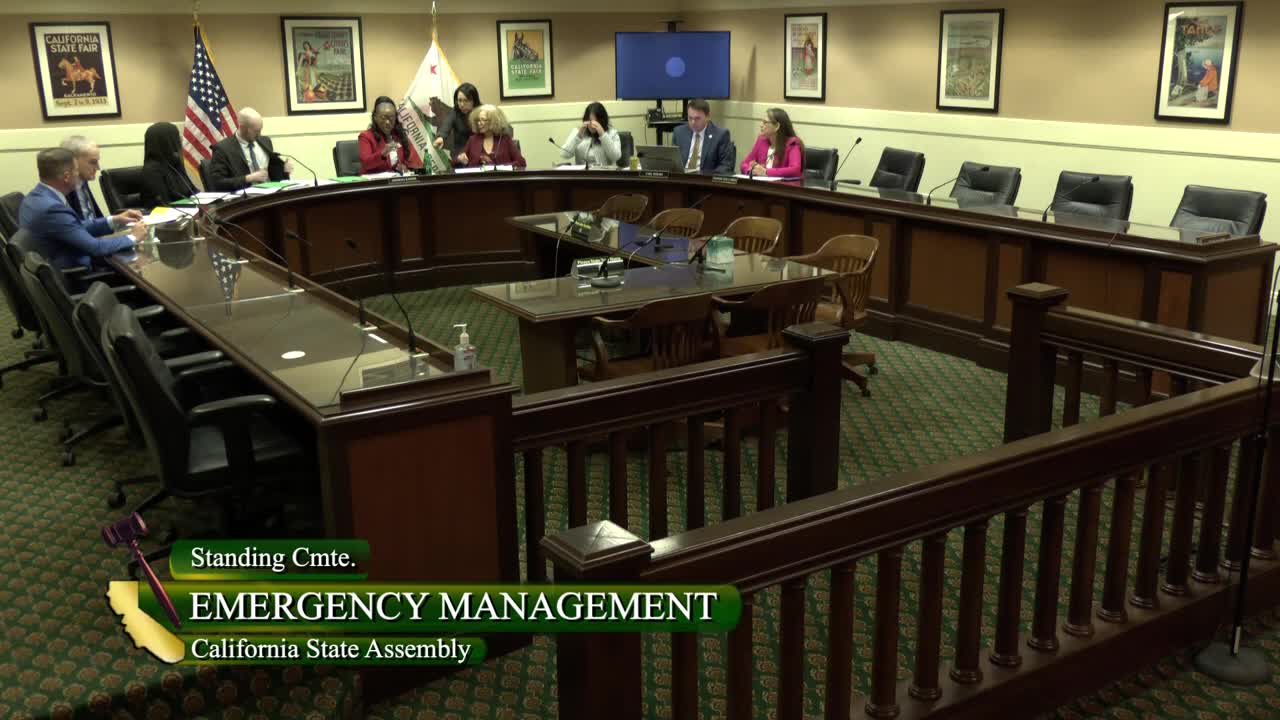 7MIN
Assembly Standing Committee on Emergency Management
Bill Author
Bill Co-Author(s):