AB 2499: Health care coverage: claims payments.
- Session Year: 2025-2026
- House: Assembly
- Latest Version Date: 2026-09-30
Current Status:
Passed
(2026-09-30: Chaptered by Secretary of State - Chapter 945, Statutes of 2026.)
Introduced
In Committee
Awaiting First Chamber Vote
Passed First Chamber
In Committee
Awaiting Second Chamber Vote
Passed Second Chamber
Enacted
What does this bill do?
The bill requires health plans and insurers to accept electronic medical records and other supporting documents when providers submit claims and to allow file sizes large enough for typical medical paperwork. Plans and insurers must confirm receipt electronically and cannot deny, pend, or delay a claim just because their systems can’t accept documents that otherwise meet requirements, and any state or federal standards about file size or capacity will control.
The summary is provided by generative AI which can make mistakes. For original language, please view the details in the table below.
Existing law, the Knox-Keene Health Care Service Plan Act of 1975, provides for the licensure and regulation of health care service plans by the Department of Managed Health Care and makes a willful violation of the act a crime. Existing law provides for the regulation of health insurers by the Department of Insurance.
Existing law requires a health care service plan or health insurer to reimburse a complete claim or a portion thereof within 30 calendar days after receipt of the claim, or, if a claim or portion thereof does not meet the criteria for a complete claim or the criteria for coverage under the plan or insurance contract, to notify the claimant in writing that the claim or portion thereof is contested or denied as soon as practicable, but no later than 30 calendar days after receipt of the claim by the plan or insurer.
This bill would, commencing May 26, 2028, require a plan or insurer to accept electronic medical records and supporting documentation necessary to process a claim through a standard electronic submission method, as specified, and would prohibit a plan or insurer from denying, pending, or delaying a claim solely because the plans or insurers systems are unable to accept documentation that otherwise meets the plans or insurers requirements. The bill would specify that if a state or federal standard is adopted that is specific to file size, number, or other capacity requirements for claims-related supporting documentation submissions, that standard would apply.
Because a willful violation of these provisions by a health care service plan would be a crime, the bill would impose a state-mandated local program.
The California Constitution requires the state to reimburse local agencies and school districts for certain costs mandated by the state. Statutory provisions establish procedures for making that reimbursement.
This bill would provide that no reimbursement is required by this act for a specified reason.
Existing law, the Knox-Keene Health Care Service Plan Act of 1975, provides for the licensure and regulation of health care service plans by the Department of Managed Health Care and makes a willful violation of the act a crime. Existing law provides for the regulation of health insurers by the Department of Insurance.
Existing law requires a health care service plan or health insurer to reimburse a complete claim or a portion thereof within 30 calendar days after receipt of the claim, or, if a claim or portion thereof does not meet the criteria for a complete claim or the criteria for coverage under the plan or insurance contract, to notify the claimant in writing that the claim or portion thereof is contested or denied as soon as practicable, but no later than 30 calendar days after receipt of the claim by the plan or insurer.
This bill would, commencing May 26, 2028, require a plan or insurer to accept electronic medical records and supporting documentation necessary to process a claim through a standard electronic submission method, as defined, specified, and would prohibit a plan or insurer from denying, pending, or delaying a claim solely because the plans or insurers systems are unable to accept documentation that otherwise meets the plans or insurers requirements. The bill would specify that if a state or federal standard is adopted that is specific to file size, number, or other capacity requirements for claims-related supporting documentation submissions, that standard would apply.
Because a willful violation of these provisions by a health care service plan would be a crime, the bill would impose a state-mandated local program.
The California Constitution requires the state to reimburse local agencies and school districts for certain costs mandated by the state. Statutory provisions establish procedures for making that reimbursement.
This bill would provide that no reimbursement is required by this act for a specified reason.
Existing law, the Knox-Keene Health Care Service Plan Act of 1975, provides for the licensure and regulation of health care service plans by the Department of Managed Health Care and makes a willful violation of the act a crime. Existing law provides for the regulation of health insurers by the Department of Insurance.
Existing law requires a health care service plan or health insurer to reimburse a complete claim or a portion thereof within 30 calendar days after receipt of the claim, or, if a claim or portion thereof does not meet the criteria for a complete claim or the criteria for coverage under the plan or insurance contract, to notify the claimant in writing that the claim or portion thereof is contested or denied as soon as practicable, but no later than 30 calendar days after receipt of the claim by the plan or insurer.
This bill would would, commencing May 26, 2028, require a plan or insurer to accept electronic medical records and supporting documentation necessary to process a claim through a standard electronic submission method, as defined, and would prohibit a plan or insurer from denying, pending, or delaying a claim solely because the plans or insurers systems are unable to accept documentation that otherwise meets the plans or insurers requirements. The bill would specify that if a state or federal standard is adopted that is specific to file size, number, or other capacity requirements for claims-related supporting documentation submissions, that standard would apply.
Because a willful violation of these provisions by a health care service plan would be a crime, the bill would impose a state-mandated local program.
The California Constitution requires the state to reimburse local agencies and school districts for certain costs mandated by the state. Statutory provisions establish procedures for making that reimbursement.
This bill would provide that no reimbursement is required by this act for a specified reason.
Existing law, the Knox-Keene Health Care Service Plan Act of 1975, provides for the licensure and regulation of health care service plans by the Department of Managed Health Care and makes a willful violation of the act a crime. Existing law provides for the regulation of health insurers by the Department of Insurance.
Existing law requires a health care service plan or health insurer to reimburse a complete claim or a portion thereof within 30 calendar days after receipt of the claim, or, if a claim or portion thereof does not meet the criteria for a complete claim or the criteria for coverage under the plan or insurance contract, to notify the claimant in writing that the claim or portion thereof is contested or denied as soon as practicable, but no later than 30 calendar days after receipt of the claim by the plan or insurer.
This bill would require a plan or insurer to accept electronic medical records and supporting documentation necessary to process a claim through a standard electronic submission method, as defined, and would prohibit a plan or insurer from denying, pending, or delaying a claim solely because the plans or insurers systems are unable to accept documentation that otherwise meets the plans or insurers requirements.
Because a willful violation of these provisions by a health care service plan would be a crime, the bill would impose a state-mandated local program.
The California Constitution requires the state to reimburse local agencies and school districts for certain costs mandated by the state. Statutory provisions establish procedures for making that reimbursement.
This bill would provide that no reimbursement is required by this act for a specified reason.
Under existing law, the California Occupational Safety and Health Act of 1973, the Division of Occupational Safety and Health investigates complaints that a workplace is not safe and may issue orders necessary to ensure employee safety. Under existing law, certain violations of those provisions or a standard, order, or special order authorized by those provisions are a crime.Existing law establishes the Department of Corrections and Rehabilitation and sets forth its powers and duties regarding the administration of correctional facilities and the care and custody of inmates.This bill, Adriennes Act, would require the division, by July 1, 2027, to submit a rulemaking proposal for the Occupational Safety and Health Standards Boards review and adoption, specifically applicable to workers in any prison or institution under the jurisdiction of the Department of Corrections and Rehabilitation, as specified. Because a violation of the standard would be a crime, this bill would impose a state-mandated local program.This bill would make related findings and declarations.The California Constitution requires the state to reimburse local agencies and school districts for certain costs mandated by the state. Statutory provisions establish procedures for making that reimbursement.This bill would provide that no reimbursement is required by this act for a specified reason.Under existing law, the California Occupational Safety and Health Act of 1973, the Division of Occupational Safety and Health investigates complaints that a workplace is not safe and may issue orders necessary to ensure employee safety. Under existing law, certain violations of those provisions or a standard, order, or special order authorized by those provisions are a crime.
Existing law establishes the Department of Corrections and Rehabilitation and sets forth its powers and duties regarding the administration of correctional facilities and the care and custody of inmates. Existing law establishes the Office of Emergency Services within the office of the Governor. Existing law requires the Office of Emergency Services to be responsible for the states emergency and disaster response services for natural, technological, or manmade disasters and emergencies.
This bill, Adriennes Act, would require the division, by July 1, 2027, to submit a rulemaking proposal for the Occupational Safety and Health Standards Boards review and adoption, specifically applicable to workers in any prison or institution under the jurisdiction of the Department of Corrections and Rehabilitation, as specified. Because a violation of the standard would be a crime, this bill would impose a state-mandated local program.
This bill would require the department to comply with these provisions and any order, rule, or regulation adopted by the Occupational Safety and Health Standards Board pursuant to them. Because this bill would expand the definition of an existing crime, this bill would impose a state-mandated local program.This bill would also adopt the Climate Justice in Prisons Emergency Response Act, which would require the department to take various actions at specified times, relating to climate control and working conditions in prisons, including, among other things, establishing and implementing minimum interim relief measures during excessive weather events and establishing a working group consisting of representatives from various entities, including community-based organizations and an incarcerated person advisory council. The bill would require the department, subject to an appropriation by the Legislature, to implement a plan to ensure that living quarters, work areas, and recreational spaces at correctional facilities are equipped with specified cooling systems and to install shade structures at facilities that have the greatest exposure to excessive heat. The bill would require the department, by July 1, 2027, to establish a Temperature Monitoring and Data Transparency Pilot Program in at least 3 prisons that represent distinct climate zones. Under the program, the bill would require the department to collect certain temperature data and provide weekly and quarterly summary data, from digital sensors installed at the prisons, to the Office of the Inspector General, the Division of Occupational Safety and Health, and the appropriate policy and budget committees of the Legislature, as specified. The bill would require the department to establish a monitoring system that includes data collection and reporting mechanisms in order to carry out the provisions of the act.This bill would make related findings and declarations.
The California Constitution requires the state to reimburse local agencies and school districts for certain costs mandated by the state. Statutory provisions establish procedures for making that reimbursement.
This bill would provide that no reimbursement is required by this act for a specified reason.
Under existing law, the California Occupational Safety and Health Act of 1973, the Division of Occupational Safety and Health investigates complaints that a workplace is not safe and may issue orders necessary to ensure employee safety. Under existing law, certain violations of those provisions or a standard, order, or special order authorized by those provisions are a crime.
Existing law establishes the Department of Corrections and Rehabilitation and sets forth its powers and duties regarding the administration of correctional facilities and the care and custody of inmates. Existing law establishes the Office of Emergency Services within the office of the Governor. Existing law requires the Office of Emergency Services to be responsible for the states emergency and disaster response services for natural, technological, or manmade disasters and emergencies.
This bill bill, Adriennes Act, would require the division, by July 1, 2027, to submit a rulemaking proposal for the Occupational Safety and Health Standards Boards review and adoption, specifically applicable to workers in any prison or institution under the jurisdiction of the Department of Corrections and Rehabilitation, as specified.
This bill would require the department to comply with these provisions and any order, rule, or regulation adopted by the Occupational Safety and Health Standards Board pursuant to them. Because this bill would expand the definition of an existing crime, this bill would impose a state-mandated local program.
This bill would also adopt the Climate Justice in Prisons Emergency Response Act, which would require the department to take various actions at specified times, relating to climate control and working conditions in prisons, including, among other things, establishing and implementing minimum interim relief measures during excessive weather events and establishing a working group consisting of representatives from various entities, including community-based organizations and an incarcerated person advisory council. The bill would require the department, subject to an appropriation by the Legislature, to implement a plan to ensure that living quarters, work areas, and recreational spaces at correctional facilities are equipped with specified cooling systems and to install shade structures at facilities that have the greatest exposure to excessive heat. The bill would require the department, by July 1, 2027, to establish a Temperature Monitoring and Data Transparency Pilot Program in at least 3 prisons that represent distinct climate zones. Under the program, the bill would require the department to collect certain temperature data and provide weekly and quarterly summary data, from digital sensors installed at the prisons, to the Office of the Inspector General, the Division of Occupational Safety and Health, and the appropriate policy and budget committees of the Legislature, as specified. The bill would require the department to establish a monitoring system that includes data collection and reporting mechanisms in order to carry out the provisions of the act.
This bill would make related findings and declarations.
The California Constitution requires the state to reimburse local agencies and school districts for certain costs mandated by the state. Statutory provisions establish procedures for making that reimbursement.
This bill would provide that no reimbursement is required by this act for a specified reason.
Under existing law, the California Occupational Safety and Health Act of 1973, the Division of Occupational Safety and Health investigates complaints that a workplace is not safe and may issue orders necessary to ensure employee safety. Under existing law, certain violations of those provisions or a standard, order, or special order authorized by those provisions are a crime.
Existing law establishes the Department of Corrections and Rehabilitation and sets forth its powers and duties regarding the administration of correctional facilities and the care and custody of inmates. Existing law establishes the Office of Emergency Services within the office of the Governor. Existing law requires the Office of Emergency Services to be responsible for the states emergency and disaster response services for natural, technological, or manmade disasters and emergencies.
This bill would require the division, by July 1, 2027, to submit a rulemaking proposal for the Occupational Safety and Health Standards Boards review and adoption, specifically applicable to workers in any prison or institution under the jurisdiction of the Department of Corrections and Rehabilitation, as specified.
This bill would require the department to comply with these provisions and any order, rule, or regulation adopted by the Occupational Safety and Health Standards Board pursuant to them. Because this bill would expand the definition of an existing crime, this bill would impose a state-mandated local program.
This bill would also adopt the Climate Justice in Prisons Emergency Response Act, which would require the department to take various actions at specified times, relating to climate control and working conditions in prisons, including, among other things, establishing and implementing minimum interim relief measures during excessive weather events and establishing a working group consisting of representatives from various entities, including community-based organizations and an incarcerated person advisory council. The bill would require the department, subject to an appropriation by the Legislature, to implement a plan to ensure that living quarters, work areas, and recreational spaces at correctional facilities are equipped with specified cooling systems and to install shade structures at facilities that have the greatest exposure to excessive heat. The bill would require the department, by July 1, 2027, to establish a Temperature Monitoring and Data Transparency Pilot Program in at least 3 prisons that represent distinct climate zones. Under the program, the bill would require the department to collect certain temperature data and provide weekly and quarterly summary data, from digital sensors installed at the prisons, to the Office of the Inspector General, the Division of Occupational Safety and Health, and the appropriate policy and budget committees of the Legislature, as specified. The bill would require the department to establish a monitoring system that includes data collection and reporting mechanisms in order to carry out the provisions of the act.
This bill would make related findings and declarations.
The California Constitution requires the state to reimburse local agencies and school districts for certain costs mandated by the state. Statutory provisions establish procedures for making that reimbursement.
This bill would provide that no reimbursement is required by this act for a specified reason.
(a)(1)A health care service plan, including a specialized health care service plan, shall reimburse a complete claim or portion thereof, whether in state or out of state, as soon as practicable, but no later than 30 calendar days after receipt of the claim by the health care service plan. If a claim or portion thereof does not meet the criteria for a complete claim or the criteria for coverage under the plan contract, the claimant shall be notified, in writing, that the claim or portion thereof is contested or denied, as soon as practicable, but no later than 30 calendar days after receipt of the claim by the health care service plan.
(2)The notice that a claim or portion thereof, is contested shall identify the portion of the claim that is contested, by procedure or revenue code, and the specific information needed from the provider to reconsider the claim, including any defect or impropriety or additional information needed to adjudicate the claim.
(3)The notice that a claim or portion thereof, is denied shall identify the portion of the claim that is denied, by procedure or revenue code, and the specific reasons for the denial including any defect or impropriety.
(4)If a complete claim is not reimbursed by delivery to the claimants address of record within 30 calendar days after receipt, interest shall accrue at a rate of 15 percent per annum beginning with the first calendar day after the 30-calendar-day period. A health care service plan shall automatically include in its payment of the claim all interest that has accrued pursuant to this section without requiring the claimant to submit a request for the interest amount. A plan failing to comply with this requirement shall pay the claimant a fee of the greater of an additional fifteen dollars ($15) or 10 percent of the accrued interest.
(5)For the purposes of this section, a claim, or portion thereof, is reasonably contested if the plan has not received the completed claim and all information necessary to determine payer liability for the claim, or has not been granted reasonable access to information concerning provider services. Information necessary to determine payer liability for the claim includes, but is not limited to, reports of investigations concerning fraud and misrepresentation, and necessary consents, releases, and assignments, a claim on appeal, or other information necessary for the plan to determine the medical necessity for the health care services provided. A plan may not contest a claim that is consistent with the procedure or revenue codes and services approved by prior authorization with appropriate documentation included on the claim.
(6)If a claim or portion thereof is contested on the basis that the plan has not received all information necessary to determine payer liability for the claim or portion thereof and notice has been provided pursuant to this section, the plan shall have 30 calendar days after receipt of this additional information to complete reconsideration of the claim. If a plan has received all of the information necessary to determine payer liability for a contested claim and has not reimbursed a claim it has determined to be payable within 30 calendar days of the receipt of that information, interest shall accrue and be payable at a rate of 15 percent per annum beginning with the first calendar day after the 30-calendar-day period.
(7)(A)Commencing May 26, 2028, a plan shall accept electronic medical records and supporting documentation necessary to process a claim through a standard electronic submission method, including establishing a file size limit sufficient to allow submission of typical medical documentation required to adjudicate claims. A plan shall confirm receipt electronically and shall not deny, pend, or delay a claim solely because the plans systems are unable to accept documentation that otherwise meets stated requirements.
(B)This paragraph does not prohibit a plan from denying, pending, or delaying a claim to the extent authorized under law. This paragraph does not apply during the period in which a plans ability to accept electronic medical records and supporting documentation is impacted by circumstances outside the plans reasonable control, including power outages, natural disasters, cybersecurity attacks, or similar incidents adversely impacting a plans ability to process an electronic submission.
(C)If a state or federal standard is adopted that is specific to file size, number, or other capacity requirements for claims-related supporting documentation submission, that standard shall apply.
(D)For purposes of this paragraph, electronic submission means submission through an electronic portal designated by the plan or an electronic submission in accordance with Section 130290 and applicable federal interoperability rules.
(b)Notwithstanding any other law, a specialized health care service plan that undertakes solely to arrange for the provision of vision care services may use a statistically reliable method to investigate suspected fraud and to recover overpayments made as a result of fraud only if the specialized health care service plan complies with this subdivision.
(1)A specialized health care service plans statistically reliable method, and how the specialized health care service plan intends to utilize that method to determine recovery of overpayments made as a result of fraud, shall be submitted to, and approved by, the department as elements of the specialized health care service plans antifraud plan established and approved pursuant to Section 1348. The specialized health care service plans utilization of a statistically reliable method shall help protect and promote the interests of enrollees and shall help ensure a stable health care delivery system. The statistically reliable method shall be consistent with direction provided by the International Standards for the Professional Practice of Internal Auditing and the guidance provided by the International Professional Practices Framework guide, which are both produced by the Institute of Internal Auditors.
(2)Pursuant to its antifraud plan established and approved pursuant to Section 1348, a specialized health care service plan shall provide a written notice of suspected fraud to a provider that includes, at a minimum, all of the following:
(A)A clear description of the specialized health care service plans statistically reliable methodology. The description shall include information that ensures that the sample size used to calculate the repayment amount is consistent with the professional guidance provided in the 2009 edition of the American Institute of Certified Public Accountants Audit Sampling Considerations of Circular A-133 Compliance Audits.
(B)A clear description of the universe of claims from which the statistical random sample was drawn and, if different, the universe of claims upon which the statistical analysis was applied to generate the recovery amount.
(C)A clear explanation of how the specialized health care service plans statistically reliable methodology was utilized in the specialized health care service plans findings of suspected fraud.
(D)Notice that a provider may dispute the specialized health care service plans findings within 45 working days from the date of receipt of the notice of suspected fraud.
(E)The following information for each of the claims in the statistical sample that was utilized in the specialized health care service plans findings:
(i)The claim number.
(ii)The name of the patient.
(iii)The date of service.
(iv)The date of payment.
(v)A clear explanation of the basis upon which the specialized health care service plan suspects the claim is fraudulent.
(3)A specialized health care service plan that undertakes solely to arrange for the provision of vision care services may use a statistically reliable method to recover overpayments made as a result of suspected fraud only if the universe of claims upon which the statistical analysis is performed consists only of those claims made between 365 days from the date of payment of the earliest in time claim and the date of payment of the latest in time claim. Notice shall be mailed to the provider no later than 60 days following the date of payment of the latest in time claim.
(4)If the provider contests the specialized health care service plans notice of suspected fraud, the provider, within 45 working days of the date of receipt of the notice of suspected fraud, shall send written notice to the specialized health care service plan stating the basis upon which the provider believes that the claims are not fraudulent. The specialized health care service plan shall receive and process this contested notice of suspected fraud as a provider dispute pursuant to subdivision (a) of this section, paragraph (1) of subdivision (h) of Section 1367, and the regulations promulgated thereunder.
(5)A specialized health care service plan may offset the amount the specialized health care service plan disclosed as overpaid to the provider in an uncontested notice of suspected fraud against the providers current claim submissions only if all of the following requirements are met:
(A)The provider fails to reimburse the specialized health care service plan within 45 working days from the date of receipt by the provider of the notice of suspected fraud.
(B)The specialized health care service plan sends written notice to the provider no less than 10 working days prior to withholding current claim payments in which the specialized health care service plan, at a minimum, states its intent to withhold current claim payments and identifies the claim payments that the specialized health care service plan intends to withhold.
(C)The withheld claim payments do not exceed the amount asserted by the specialized health care service plan to be owed to the specialized health care service plan in its notice of suspected fraud.
(6)This section does not limit or remove a specialized health care service plans obligation to comply with its antifraud plan established pursuant to Section 1348, or to limit or remove the specialized health care service plans obligation to comply with the requirements for claims subject to subdivision (a).
(7)This subdivision does not limit or remove a specialized health care service plans ability to recover overpayments as long as recovery is consistent with applicable law, including subdivision (a) and the regulations promulgated thereunder.
(8)This subdivision does not apply to claims submitted by a physician and surgeon for medical or surgical services that are outside the scope of practice of an optometrist pursuant to the Optometry Practice Act (Chapter 7 (commencing with Section 3000) of Division 2 of the Business and Professions Code).
(c)The obligation of a plan to comply with this section shall not be deemed to be waived when the plan requires its medical groups, independent practice associations, or other contracting entities to pay claims for covered services.
(d)The department may issue compliance guidance and amend regulations for consistency with this section. The guidance and amendments shall not be subject to the rulemaking provisions of the Administrative Procedure Act (Chapter 3.5 (commencing with Section 11340) of Part 1 of Division 3 of Title 2 of the Government Code) until December 31, 2027.
SEC. 2.Section 1371.35 of the Health and Safety Code is amended to read:1371.35.(a)(1)A health care service plan, including a specialized health care service plan, shall reimburse a complete claim or portion thereof, whether in state or out of state, as soon as practicable, but no later than 30 calendar days after receipt of the claim by the health care service plan. If a claim or portion thereof does not meet the criteria for a complete claim or the criteria for coverage under the plan contract, a health care service plan shall notify the claimant, in writing, that the claim or portion thereof is contested or denied, as soon as practicable, but no later than 30 calendar days after receipt of the claim by the health care service plan.
(2)The notice that a claim or portion thereof, is contested shall identify the portion of the claim that is contested, by procedure or revenue code, and the specific information needed from the provider to reconsider the claim, including any defect or impropriety or additional information needed to adjudicate the claim.
(3)The notice that a claim or portion thereof, is denied shall identify the portion of the claim that is denied, by procedure or revenue code, and the specific reasons for the denial, including any defect or impropriety.
(b)If a claim, or portion thereof, is not reimbursed by delivery to the claimants address of record within 30 calendar days after receipt, the plan shall pay interest at a rate of 15 percent per annum beginning with the first calendar day after the 30-calendar-day period. A health care service plan shall automatically include all interest that has accrued pursuant to this section in the payment made to the claimant, without requiring a request therefor. A plan failing to comply with this requirement shall pay the claimant the greater of an additional fifteen dollars ($15) or a fee of 10 percent of the accrued interest.
(c)For the purposes of this section, a claim, or portion thereof, is reasonably contested if the plan has not received the completed claim. A paper claim from an institutional provider shall be deemed complete upon submission of a legible emergency department report and a completed UB 92 or other format adopted by the National Uniform Billing Committee, and reasonable relevant information requested by the plan within 30 calendar days of receipt of the claim. An electronic claim from an institutional provider shall be deemed complete upon submission of an electronic equivalent to the UB 92 or other format adopted by the National Uniform Billing Committee, and reasonable relevant information requested by the plan within 30 calendar days of receipt of the claim. However, if the plan requests a copy of the emergency department report within the 30 calendar days after receipt of the electronic claim from the institutional provider, the plan may also request additional reasonable relevant information within 30 calendar days of receipt of the emergency department report, at which time the claim shall be deemed complete. A claim from a professional provider shall be deemed complete upon submission of a completed HCFA 1500 or its electronic equivalent or other format adopted by the National Uniform Billing Committee, and reasonable relevant information requested by the plan within 30 calendar days of receipt of the claim. The provider shall provide the plan reasonable relevant information within 10 working days of receipt of a written request that is clear and specific regarding the information sought. If, as a result of reviewing the reasonable relevant information, the plan requires further information, the plan shall have an additional 15 calendar days after receipt of the reasonable relevant information to request the further information, notwithstanding any time limit to the contrary in this section, at which time the claim shall be deemed complete.
(d)This section shall not apply to claims about which there is evidence of fraud and misrepresentation, to eligibility determinations, or in instances where the plan has not been granted reasonable access to information under the providers control. A plan shall specify, in a written notice sent to the provider within 30 calendar days of receipt of the claim, which, if any, of these exceptions applies to a claim.
(e)If a claim or portion thereof is contested on the basis that the plan has not received information reasonably necessary to determine payer liability for the claim or portion thereof, then the plan shall have 30 calendar days after receipt of this additional information to complete reconsideration of the claim. If a claim, or portion thereof, undergoing reconsideration is not reimbursed by delivery to the claimants address of record within 30 calendar days after receipt of the additional information, the plan shall pay interest at the rate of 15 percent per annum beginning with the first calendar day after the 30-calendar-day period. A health care service plan shall automatically include the interest due in the payment made to the claimant, without requiring a request therefor.
(f)(1)Commencing May 26, 2028, a plan shall accept electronic medical records and supporting documentation necessary to process a claim through standard electronic submission methods, including establishing a file size limit sufficient to allow submission of typical medical documentation required to adjudicate claims. A plan shall confirm receipt electronically and shall not deny, pend, or delay a claim solely because the plans systems are unable to accept documentation that otherwise meets stated requirements.
(2)This subdivision does not prohibit a plan from denying, pending, or delaying a claim to the extent authorized under law. This subdivision does not apply during the period in which a plans ability to accept electronic medical records and supporting documentation is impacted by circumstances outside the plans reasonable control, including power outages, natural disasters, cybersecurity attacks, or similar incidents adversely impacting a plans ability to process an electronic submission.
(3)If a state or federal standard is adopted that is specific to file size, number, or other capacity requirements for claims-related supporting documentation submission, that standard shall apply.
(4)For purposes of this subdivision, electronic submission means submission through an electronic portal designated by the plan or an electronic submission in accordance with Section 130290 and applicable federal interoperability rules.
(g)The obligation of the plan to comply with this section shall not be deemed to be waived when the plan requires its medical groups, independent practice associations, or other contracting entities to pay claims for covered services. This section shall not be construed to prevent a plan from assigning, by a written contract, the responsibility to pay interest and late charges pursuant to this section to medical groups, independent practice associations, or other entities.
(h)A plan shall not delay payment on a claim from a physician or other provider to await the submission of a claim from a hospital or other provider, without citing specific rationale as to why the delay was necessary and providing a monthly update regarding the status of the claim and the plans actions to resolve the claim, to the provider that submitted the claim.
(i)A health care service plan shall not request or require that a provider waive its rights pursuant to this section.
(j)This section shall not apply to capitated payments.
(k)This section shall apply only to claims for services rendered to a patient who was provided emergency services and care as defined in Section 1317.1 in the United States on or after September 1, 1999.
(l)This section shall not be construed to affect the rights or obligations of any person pursuant to Section 1371.
(m)This section shall not be construed to affect a written agreement, if any, of a provider to submit bills within a specified time period.
(n)The department may issue compliance guidance and amend regulations for consistency with this section. The guidance and amendments shall not be subject to the rulemaking provisions of the Administrative Procedure Act (Chapter 3.5 (commencing with Section 11340) of Part 1 of Division 3 of Title 2 of the Government Code) until December 31, 2027.
SEC. 3.Section 10123.13 of the Insurance Code is amended to read:10123.13.(a)Every insurer issuing group or individual policies of health insurance that cover hospital, medical, or surgical expenses, including those telehealth services covered by the insurer as defined in subdivision (a) of Section 2290.5 of the Business and Professions Code, shall reimburse a complete claim or portion thereof, whether in state or out of state, for those expenses as soon as practicable, but no later than 30 calendar days after receipt of the claim by the insurer, unless the insurer is contesting or denying the claim or a portion thereof, in which case the claimant shall be notified, in writing, that the claim is contested or denied, within 30 calendar days after receipt of the claim by the insurer. The notice that a claim is being contested or denied shall identify the portion of the claim that is contested or denied and the specific reasons including for each reason the factual and legal basis known at that time by the insurer for contesting or denying the claim. If the reason is based solely on facts or solely on law, the insurer is required to provide only the factual or the legal basis for its reason for contesting or denying the claim. The insurer shall provide a copy of the notice to each insured who received services pursuant to the claim that was contested or denied and to the insureds health care provider that provided the services at issue. The notice shall advise the provider who submitted the claim on behalf of the insured or pursuant to a contract for alternative rates of payment and the insured that either may seek review by the department of a claim that the insurer contested or denied, and the notice shall include the address, internet website address, and telephone number of the unit within the department that performs this review function. The notice to the provider may be included on either the explanation of benefits or remittance advice and shall also contain a statement advising the provider of its right to enter into the dispute resolution process described in Section 10123.137. The notice to the insured may also be included on the explanation of benefits.
(b)If an uncontested claim is not reimbursed by delivery to the claimants address of record within 30 calendar days after receipt, interest shall accrue at the rate of 15 percent per annum beginning with the first calendar day after the 30-calendar-day period. An insurer shall automatically include in its payment of the claim all interest that has accrued pursuant to this section without requiring the claimant to submit a request for the interest amount. An insurer failing to comply with this requirement shall pay the claimant a fee of the greater of an additional fifteen dollars ($15) or 10 percent of the accrued interest.
(c)(1)For purposes of this section, a claim, or portion thereof, is reasonably contested when the insurer has not received a completed claim and all information necessary to determine payer liability for the claim, or has not been granted reasonable access to information concerning provider services. Information necessary to determine liability for the claims includes, but is not limited to, reports of investigations concerning fraud and misrepresentation, and necessary consents, releases, and assignments, a claim on appeal, or other information necessary for the insurer to determine the medical necessity for the health care services provided to the claimant. An insurer may not contest a complete claim that is consistent with an approved prior authorization request if the prior authorization approval has been provided in the appropriate field on the claim.
(2)If an insurer has received all of the information necessary to determine payer liability for a contested claim and has not reimbursed a claim determined to be payable within 30 calendar days of receipt of that information, interest shall accrue and be payable at a rate of 15 percent per annum beginning with the first calendar day after the 30-calendar-day period.
(d)(1)Commencing May 26, 2028, an insurer shall accept electronic medical records and supporting documentation necessary to process a claim through standard electronic submission methods, including establishing a file size limit sufficient to allow submission of typical medical documentation required to adjudicate claims. An insurer shall confirm receipt electronically and shall not deny, pend, or delay a claim solely because the insurers systems are unable to accept documentation that otherwise meets stated requirements.
(2)This subdivision does not prohibit an insurer from denying, pending, or delaying a claim to the extent authorized under law. This subdivision does not apply during the period in which an insurers ability to accept electronic medical records and supporting documentation is impacted by circumstances outside the insurers reasonable control, including power outages, natural disasters, cybersecurity attacks, or similar incidents adversely impacting an insurers ability to process an electronic submission.
(3)If a state or federal standard is adopted that is specific to file size, number, or other capacity requirements for claims-related supporting documentation submission, that standard shall apply.
(4)For purposes of this subdivision, electronic submission means submission through an electronic portal designated by the insurer or an electronic submission in accordance with Section 130290 of the Health and Safety Code and applicable federal interoperability rules.
(e)The obligation of the insurer to comply with this section shall not be deemed to be waived when the insurer requires its contracting entities to pay claims for covered services.
(f)(1)The department may issue guidance and regulations relating to this section. The guidance and regulations shall not be subject to the rulemaking provisions of the Administrative Procedure Act (Chapter 3.5 (commencing with Section 11340) of Part 1 of Division 3 of Title 2 of the Government Code) until December 31, 2027.
(2)After January 1, 2028, the department may issue regulations relating to this section subject to the rulemaking provisions of the Administrative Procedure Act ((Chapter 3.5 commencing with Section 11340) of Part 1 of Division 3 of Title 2 of the Government Code) until December 31, 2030.
SEC. 4.Section 10123.147 of the Insurance Code is amended to read:10123.147.(a)Every insurer issuing group or individual policies of health insurance that cover hospital, medical, or surgical expenses, including those telehealth services covered by the insurer as defined in subdivision (a) of Section 2290.5 of the Business and Professions Code, shall reimburse a complete claim or portion thereof, whether in state or out of state, as soon as practicable, but no later than 30 calendar days after receipt of the complete claim by the insurer. However, an insurer may contest or deny a claim, or portion thereof, by notifying the claimant, in writing, that the claim is contested or denied, within 30 calendar days after receipt of the claim by the insurer. The notice that a claim, or portion thereof, is contested shall identify the portion of the claim that is contested, by procedure or revenue code, and the specific information needed from the provider to reconsider the claim. The notice that a claim, or portion thereof, is denied shall identify the portion of the claim that is denied, by procedure or revenue code, and the specific reasons for the denial, including the factual and legal basis known at that time by the insurer for each reason. If the reason is based solely on facts or solely on law, the insurer is required to provide only the factual or legal basis for its reason to deny the claim. The insurer shall provide a copy of the notice required by this subdivision to each insured who received services pursuant to the claim that was contested or denied and to the insureds health care provider that provided the services at issue. The notice required by this subdivision shall include a statement advising the provider who submitted the claim on behalf of the insured or pursuant to a contract for alternative rates of payment and the insured that either may seek review by the department of a claim that was contested or denied by the insurer and the address, internet website address, and telephone number of the unit within the department that performs this review function. The notice to the provider may be included on either the explanation of benefits or remittance advice and shall also contain a statement advising the provider of its right to enter into the dispute resolution process described in Section 10123.137. An insurer may delay payment of an uncontested portion of a complete claim for reconsideration of a contested portion of that claim so long as the insurer pays those charges specified in subdivision (b).
(b)If a complete claim or portion thereof that is neither contested nor denied is not reimbursed by delivery to the claimants address of record within the 30 calendar days after receipt, the insurer shall pay the greater of fifteen dollars ($15) per year or a rate of 15 percent per annum beginning with the first calendar day after the 30-calendar-day period. An insurer shall automatically include the fifteen dollars ($15) per year or interest due in the payment made to the claimant, without requiring a request therefor. An insurer failing to comply with this requirement shall pay the claimant the greater of an additional fifteen dollars ($15) or a fee of 10 percent of the accrued interest.
(c)For the purposes of this section, a claim or portion thereof, is reasonably contested if the insurer has not received the completed claim. A paper claim from an institutional provider shall be deemed complete upon submission of a legible emergency department report and a completed UB 92 or other format adopted by the National Uniform Billing Committee, and reasonable relevant information requested by the insurer within 30 calendar days of receipt of the claim. An electronic claim from an institutional provider shall be deemed complete upon submission of an electronic equivalent to the UB 92 or other format adopted by the National Uniform Billing Committee, and reasonable relevant information requested by the insurer within 30 calendar days of receipt of the claim. However, if the insurer requests a copy of the emergency department report within the 30 calendar days after receipt of the electronic claim from the institutional provider, the insurer may also request additional reasonable relevant information within 30 calendar days of receipt of the emergency department report, at which time the claim shall be deemed complete. A claim from a professional provider shall be deemed complete upon submission of a completed HCFA 1500 or its electronic equivalent or other format adopted by the National Uniform Billing Committee, and reasonable relevant information requested by the insurer within 30 calendar days of receipt of the claim. The provider shall provide the insurer reasonable relevant information within 10 working days of receipt of a written request that is clear and specific regarding the information sought. If, as a result of reviewing the reasonable relevant information, the insurer requires further information, the insurer shall have an additional 15 calendar days after receipt of the reasonable relevant information to request the further information, notwithstanding any time limit to the contrary in this section, at which time the claim shall be deemed complete.
(d)This section shall not apply to claims about which there is evidence of fraud and misrepresentation, to eligibility determinations, or in instances where the insurer has not been granted reasonable access to information under the providers control. An insurer shall specify, in a written notice to the provider within 30 calendar days of receipt of the claim, which, if any, of these exceptions applies to a claim.
(e)If a claim or portion thereof is contested on the basis that the insurer has not received information reasonably necessary to determine payer liability for the claim or portion thereof, then the insurer shall have 30 calendar days after receipt of this additional information to complete reconsideration of the claim. If a claim, or portion thereof, undergoing reconsideration is not reimbursed by delivery to the claimants address of record within the 30 calendar days after receipt of the additional information, the insurer shall pay interest at the rate of 15 percent per annum beginning with the first calendar day after the 30-calendar-day period. An insurer shall automatically include interest due in the payment made to the claimant, without requiring a request therefor.
(f)(1)Commencing May 26, 2028, an insurer shall accept electronic medical records and supporting documentation necessary to process a claim through standard electronic submission methods, including establishing a file size limit sufficient to allow submission of typical medical documentation required to adjudicate claims. An insurer shall confirm receipt electronically and shall not deny, pend, or delay a claim solely because the insurers systems are unable to accept documentation that otherwise meets stated requirements.
(2)This subdivision does not prohibit an insurer from denying, pending, or delaying a claim to the extent authorized under law. This subdivision does not apply during the period in which an insurers ability to accept electronic medical records and supporting documentation is impacted by circumstances outside the insurers reasonable control, including power outages, natural disasters, cybersecurity attacks, or similar incidents adversely impacting an insurers ability to process an electronic submission.
(3)If a state or federal standard is adopted that is specific to file size, number, or other capacity requirements for claims-related supporting documentation submission, that standard shall apply.
(4)For purposes of this subdivision, electronic submission means submission through an electronic portal designated by the insurer or an electronic submission in accordance with Section 130290 of the Health and Safety Code and applicable federal interoperability rules.
(g)An insurer shall not delay payment on a claim from a physician or other provider to await the submission of a claim from a hospital or other provider, without citing specific rationale as to why the delay was necessary and providing a monthly update regarding the status of the claim and the insurers actions to resolve the claim, to the provider that submitted the claim.
(h)An insurer shall not request or require that a provider waive its rights pursuant to this section.
(i)This section shall apply only to claims for services rendered to a patient who was provided emergency services and care as defined in Section 1317.1 of the Health and Safety Code in the United States on or after September 1, 1999.
(j)This section shall not be construed to affect the rights or obligations of any person pursuant to Section 10123.13.
(k)This section shall not be construed to affect a written agreement, if any, of a provider to submit bills within a specified time period.
(l)(1)The department may issue guidance and regulations relating to this section. The guidance and regulations shall not be subject to the rulemaking provisions of the Administrative Procedure Act (Chapter 3.5 (commencing with Section 11340) of Part 1 of Division 3 of Title 2 of the Government Code) until December 31, 2027.
(2)After January 1, 2028, the department may issue regulations relating to this section subject to the rulemaking provisions of the Administrative Procedure Act ((Chapter 3.5 commencing with Section 11340) of Part 1 of Division 3 of Title 2 of the Government Code) until December 31, 2030.
SEC. 5.No reimbursement is required by this act pursuant to Section 6 of Article XIIIB of the California Constitution because the only costs that may be incurred by a local agency or school district will be incurred because this act creates a new crime or infraction, eliminates a crime or infraction, or changes the penalty for a crime or infraction, within the meaning of Section 17556 of the Government Code, or changes the definition of a crime within the meaning of Section 6 of Article XIIIB of the California Constitution.
(a)(1)A health care service plan, including a specialized health care service plan, shall reimburse a complete claim or portion thereof, whether in state or out of state, as soon as practicable, but no later than 30 calendar days after receipt of the claim by the health care service plan. If a claim or portion thereof does not meet the criteria for a complete claim or the criteria for coverage under the plan contract, the claimant shall be notified, in writing, that the claim or portion thereof is contested or denied, as soon as practicable, but no later than 30 calendar days after receipt of the claim by the health care service plan.
(2)The notice that a claim or portion thereof, is contested shall identify the portion of the claim that is contested, by procedure or revenue code, and the specific information needed from the provider to reconsider the claim, including any defect or impropriety or additional information needed to adjudicate the claim.
(3)The notice that a claim or portion thereof, is denied shall identify the portion of the claim that is denied, by procedure or revenue code, and the specific reasons for the denial including any defect or impropriety.
(4)If a complete claim is not reimbursed by delivery to the claimants address of record within 30 calendar days after receipt, interest shall accrue at a rate of 15 percent per annum beginning with the first calendar day after the 30-calendar-day period. A health care service plan shall automatically include in its payment of the claim all interest that has accrued pursuant to this section without requiring the claimant to submit a request for the interest amount. A plan failing to comply with this requirement shall pay the claimant a fee of the greater of an additional fifteen dollars ($15) or 10 percent of the accrued interest.
(5)For the purposes of this section, a claim, or portion thereof, is reasonably contested if the plan has not received the completed claim and all information necessary to determine payer liability for the claim, or has not been granted reasonable access to information concerning provider services. Information necessary to determine payer liability for the claim includes, but is not limited to, reports of investigations concerning fraud and misrepresentation, and necessary consents, releases, and assignments, a claim on appeal, or other information necessary for the plan to determine the medical necessity for the health care services provided. A plan may not contest a claim that is consistent with the procedure or revenue codes and services approved by prior authorization with appropriate documentation included on the claim.
(6)If a claim or portion thereof is contested on the basis that the plan has not received all information necessary to determine payer liability for the claim or portion thereof and notice has been provided pursuant to this section, the plan shall have 30 calendar days after receipt of this additional information to complete reconsideration of the claim. If a plan has received all of the information necessary to determine payer liability for a contested claim and has not reimbursed a claim it has determined to be payable within 30 calendar days of the receipt of that information, interest shall accrue and be payable at a rate of 15 percent per annum beginning with the first calendar day after the 30-calendar-day period.
(7)(A)Commencing May 26, 2028, a plan shall accept electronic medical records and supporting documentation necessary to process a claim through a standard electronic submission method. method, including establishing a file size limit sufficient to allow submission of typical medical documentation required to adjudicate claims. A plan shall confirm receipt electronically and shall not deny, pend, or delay a claim solely because the plans systems are unable to accept documentation that otherwise meets stated requirements.
(B)This paragraph does not prohibit a plan from denying, pending, or delaying a claim to the extent authorized under law. This paragraph does not apply during the period in which a plans ability to accept electronic medical records and supporting documentation is impacted by circumstances outside the plans reasonable control, including power outages, natural disasters, cybersecurity attacks, or similar incidents adversely impacting a plans ability to process an electronic submission.
(C)If a state or federal standard is adopted that is specific to file size, number, or other capacity requirements for claims-related supporting documentation submission, that standard shall apply.
(D)For purposes of this paragraph, electronic submission means submission through an electronic portal designated by the plan or an electronic submission in accordance with Section 130290 and applicable federal interoperability rules.
(b)Notwithstanding any other law, a specialized health care service plan that undertakes solely to arrange for the provision of vision care services may use a statistically reliable method to investigate suspected fraud and to recover overpayments made as a result of fraud only if the specialized health care service plan complies with this subdivision.
(1)A specialized health care service plans statistically reliable method, and how the specialized health care service plan intends to utilize that method to determine recovery of overpayments made as a result of fraud, shall be submitted to, and approved by, the department as elements of the specialized health care service plans antifraud plan established and approved pursuant to Section 1348. The specialized health care service plans utilization of a statistically reliable method shall help protect and promote the interests of enrollees and shall help ensure a stable health care delivery system. The statistically reliable method shall be consistent with direction provided by the International Standards for the Professional Practice of Internal Auditing and the guidance provided by the International Professional Practices Framework guide, which are both produced by the Institute of Internal Auditors.
(2)Pursuant to its antifraud plan established and approved pursuant to Section 1348, a specialized health care service plan shall provide a written notice of suspected fraud to a provider that includes, at a minimum, all of the following:
(A)A clear description of the specialized health care service plans statistically reliable methodology. The description shall include information that ensures that the sample size used to calculate the repayment amount is consistent with the professional guidance provided in the 2009 edition of the American Institute of Certified Public Accountants Audit Sampling Considerations of Circular A-133 Compliance Audits.
(B)A clear description of the universe of claims from which the statistical random sample was drawn and, if different, the universe of claims upon which the statistical analysis was applied to generate the recovery amount.
(C)A clear explanation of how the specialized health care service plans statistically reliable methodology was utilized in the specialized health care service plans findings of suspected fraud.
(D)Notice that a provider may dispute the specialized health care service plans findings within 45 working days from the date of receipt of the notice of suspected fraud.
(E)The following information for each of the claims in the statistical sample that was utilized in the specialized health care service plans findings:
(i)The claim number.
(ii)The name of the patient.
(iii)The date of service.
(iv)The date of payment.
(v)A clear explanation of the basis upon which the specialized health care service plan suspects the claim is fraudulent.
(3)A specialized health care service plan that undertakes solely to arrange for the provision of vision care services may use a statistically reliable method to recover overpayments made as a result of suspected fraud only if the universe of claims upon which the statistical analysis is performed consists only of those claims made between 365 days from the date of payment of the earliest in time claim and the date of payment of the latest in time claim. Notice shall be mailed to the provider no later than 60 days following the date of payment of the latest in time claim.
(4)If the provider contests the specialized health care service plans notice of suspected fraud, the provider, within 45 working days of the date of receipt of the notice of suspected fraud, shall send written notice to the specialized health care service plan stating the basis upon which the provider believes that the claims are not fraudulent. The specialized health care service plan shall receive and process this contested notice of suspected fraud as a provider dispute pursuant to subdivision (a) of this section, paragraph (1) of subdivision (h) of Section 1367, and the regulations promulgated thereunder.
(5)A specialized health care service plan may offset the amount the specialized health care service plan disclosed as overpaid to the provider in an uncontested notice of suspected fraud against the providers current claim submissions only if all of the following requirements are met:
(A)The provider fails to reimburse the specialized health care service plan within 45 working days from the date of receipt by the provider of the notice of suspected fraud.
(B)The specialized health care service plan sends written notice to the provider no less than 10 working days prior to withholding current claim payments in which the specialized health care service plan, at a minimum, states its intent to withhold current claim payments and identifies the claim payments that the specialized health care service plan intends to withhold.
(C)The withheld claim payments do not exceed the amount asserted by the specialized health care service plan to be owed to the specialized health care service plan in its notice of suspected fraud.
(6)This section does not limit or remove a specialized health care service plans obligation to comply with its antifraud plan established pursuant to Section 1348, or to limit or remove the specialized health care service plans obligation to comply with the requirements for claims subject to subdivision (a).
(7)This subdivision does not limit or remove a specialized health care service plans ability to recover overpayments as long as recovery is consistent with applicable law, including subdivision (a) and the regulations promulgated thereunder.
(8)This subdivision does not apply to claims submitted by a physician and surgeon for medical or surgical services that are outside the scope of practice of an optometrist pursuant to the Optometry Practice Act (Chapter 7 (commencing with Section 3000) of Division 2 of the Business and Professions Code).
(c)The obligation of a plan to comply with this section shall not be deemed to be waived when the plan requires its medical groups, independent practice associations, or other contracting entities to pay claims for covered services.
(d)The department may issue compliance guidance and amend regulations for consistency with this section. The guidance and amendments shall not be subject to the rulemaking provisions of the Administrative Procedure Act (Chapter 3.5 (commencing with Section 11340) of Part 1 of Division 3 of Title 2 of the Government Code) until December 31, 2027.
SEC. 2.Section 1371.35 of the Health and Safety Code is amended to read:1371.35.(a)(1)A health care service plan, including a specialized health care service plan, shall reimburse a complete claim or portion thereof, whether in state or out of state, as soon as practicable, but no later than 30 calendar days after receipt of the claim by the health care service plan. If a claim or portion thereof does not meet the criteria for a complete claim or the criteria for coverage under the plan contract, a health care service plan shall notify the claimant, in writing, that the claim or portion thereof is contested or denied, as soon as practicable, but no later than 30 calendar days after receipt of the claim by the health care service plan.
(2)The notice that a claim or portion thereof, is contested shall identify the portion of the claim that is contested, by procedure or revenue code, and the specific information needed from the provider to reconsider the claim, including any defect or impropriety or additional information needed to adjudicate the claim.
(3)The notice that a claim or portion thereof, is denied shall identify the portion of the claim that is denied, by procedure or revenue code, and the specific reasons for the denial, including any defect or impropriety.
(b)If a claim, or portion thereof, is not reimbursed by delivery to the claimants address of record within 30 calendar days after receipt, the plan shall pay interest at a rate of 15 percent per annum beginning with the first calendar day after the 30-calendar-day period. A health care service plan shall automatically include all interest that has accrued pursuant to this section in the payment made to the claimant, without requiring a request therefor. A plan failing to comply with this requirement shall pay the claimant the greater of an additional fifteen dollars ($15) or a fee of 10 percent of the accrued interest.
(c)For the purposes of this section, a claim, or portion thereof, is reasonably contested if the plan has not received the completed claim. A paper claim from an institutional provider shall be deemed complete upon submission of a legible emergency department report and a completed UB 92 or other format adopted by the National Uniform Billing Committee, and reasonable relevant information requested by the plan within 30 calendar days of receipt of the claim. An electronic claim from an institutional provider shall be deemed complete upon submission of an electronic equivalent to the UB 92 or other format adopted by the National Uniform Billing Committee, and reasonable relevant information requested by the plan within 30 calendar days of receipt of the claim. However, if the plan requests a copy of the emergency department report within the 30 calendar days after receipt of the electronic claim from the institutional provider, the plan may also request additional reasonable relevant information within 30 calendar days of receipt of the emergency department report, at which time the claim shall be deemed complete. A claim from a professional provider shall be deemed complete upon submission of a completed HCFA 1500 or its electronic equivalent or other format adopted by the National Uniform Billing Committee, and reasonable relevant information requested by the plan within 30 calendar days of receipt of the claim. The provider shall provide the plan reasonable relevant information within 10 working days of receipt of a written request that is clear and specific regarding the information sought. If, as a result of reviewing the reasonable relevant information, the plan requires further information, the plan shall have an additional 15 calendar days after receipt of the reasonable relevant information to request the further information, notwithstanding any time limit to the contrary in this section, at which time the claim shall be deemed complete.
(d)This section shall not apply to claims about which there is evidence of fraud and misrepresentation, to eligibility determinations, or in instances where the plan has not been granted reasonable access to information under the providers control. A plan shall specify, in a written notice sent to the provider within 30 calendar days of receipt of the claim, which, if any, of these exceptions applies to a claim.
(e)If a claim or portion thereof is contested on the basis that the plan has not received information reasonably necessary to determine payer liability for the claim or portion thereof, then the plan shall have 30 calendar days after receipt of this additional information to complete reconsideration of the claim. If a claim, or portion thereof, undergoing reconsideration is not reimbursed by delivery to the claimants address of record within 30 calendar days after receipt of the additional information, the plan shall pay interest at the rate of 15 percent per annum beginning with the first calendar day after the 30-calendar-day period. A health care service plan shall automatically include the interest due in the payment made to the claimant, without requiring a request therefor.
(f)(1)Commencing May 26, 2028, a plan shall accept electronic medical records and supporting documentation necessary to process a claim through standard electronic submission methods. A plan shall maintain reasonable minimum technical standards, including a file size limit sufficient to allow submission of typical medical documentation required to adjudicate claims. methods, including establishing a file size limit sufficient to allow submission of typical medical documentation required to adjudicate claims. A plan shall confirm receipt electronically and shall not deny, pend, or delay a claim solely because the plans systems are unable to accept documentation that otherwise meets stated requirements.
(2)This subdivision does not prohibit a plan from denying, pending, or delaying a claim to the extent authorized under law. This subdivision does not apply during the period in which a plans ability to accept electronic medical records and supporting documentation is impacted by circumstances outside the plans reasonable control, including power outages, natural disasters, cybersecurity attacks, or similar incidents adversely impacting a plans ability to process an electronic submission.
(3)If a state or federal standard is adopted that is specific to file size, number, or other capacity requirements for claims-related supporting documentation submission, that standard shall apply.
(4)For purposes of this subdivision, electronic submission means submission through an electronic portal designated by the plan or an electronic submission in accordance with Section 130290 and applicable federal interoperability rules.
(g)The obligation of the plan to comply with this section shall not be deemed to be waived when the plan requires its medical groups, independent practice associations, or other contracting entities to pay claims for covered services. This section shall not be construed to prevent a plan from assigning, by a written contract, the responsibility to pay interest and late charges pursuant to this section to medical groups, independent practice associations, or other entities.
(h)A plan shall not delay payment on a claim from a physician or other provider to await the submission of a claim from a hospital or other provider, without citing specific rationale as to why the delay was necessary and providing a monthly update regarding the status of the claim and the plans actions to resolve the claim, to the provider that submitted the claim.
(i)A health care service plan shall not request or require that a provider waive its rights pursuant to this section.
(j)This section shall not apply to capitated payments.
(k)This section shall apply only to claims for services rendered to a patient who was provided emergency services and care as defined in Section 1317.1 in the United States on or after September 1, 1999.
(l)This section shall not be construed to affect the rights or obligations of any person pursuant to Section 1371.
(m)This section shall not be construed to affect a written agreement, if any, of a provider to submit bills within a specified time period.
(n)The department may issue compliance guidance and amend regulations for consistency with this section. The guidance and amendments shall not be subject to the rulemaking provisions of the Administrative Procedure Act (Chapter 3.5 (commencing with Section 11340) of Part 1 of Division 3 of Title 2 of the Government Code) until December 31, 2027.
SEC. 3.Section 10123.13 of the Insurance Code is amended to read:10123.13.(a)Every insurer issuing group or individual policies of health insurance that cover hospital, medical, or surgical expenses, including those telehealth services covered by the insurer as defined in subdivision (a) of Section 2290.5 of the Business and Professions Code, shall reimburse a complete claim or portion thereof, whether in state or out of state, for those expenses as soon as practicable, but no later than 30 calendar days after receipt of the claim by the insurer, unless the insurer is contesting or denying the claim or a portion thereof, in which case the claimant shall be notified, in writing, that the claim is contested or denied, within 30 calendar days after receipt of the claim by the insurer. The notice that a claim is being contested or denied shall identify the portion of the claim that is contested or denied and the specific reasons including for each reason the factual and legal basis known at that time by the insurer for contesting or denying the claim. If the reason is based solely on facts or solely on law, the insurer is required to provide only the factual or the legal basis for its reason for contesting or denying the claim. The insurer shall provide a copy of the notice to each insured who received services pursuant to the claim that was contested or denied and to the insureds health care provider that provided the services at issue. The notice shall advise the provider who submitted the claim on behalf of the insured or pursuant to a contract for alternative rates of payment and the insured that either may seek review by the department of a claim that the insurer contested or denied, and the notice shall include the address, internet website address, and telephone number of the unit within the department that performs this review function. The notice to the provider may be included on either the explanation of benefits or remittance advice and shall also contain a statement advising the provider of its right to enter into the dispute resolution process described in Section 10123.137. The notice to the insured may also be included on the explanation of benefits.
(b)If an uncontested claim is not reimbursed by delivery to the claimants address of record within 30 calendar days after receipt, interest shall accrue at the rate of 15 percent per annum beginning with the first calendar day after the 30-calendar-day period. An insurer shall automatically include in its payment of the claim all interest that has accrued pursuant to this section without requiring the claimant to submit a request for the interest amount. An insurer failing to comply with this requirement shall pay the claimant a fee of the greater of an additional fifteen dollars ($15) or 10 percent of the accrued interest.
(c)(1)For purposes of this section, a claim, or portion thereof, is reasonably contested when the insurer has not received a completed claim and all information necessary to determine payer liability for the claim, or has not been granted reasonable access to information concerning provider services. Information necessary to determine liability for the claims includes, but is not limited to, reports of investigations concerning fraud and misrepresentation, and necessary consents, releases, and assignments, a claim on appeal, or other information necessary for the insurer to determine the medical necessity for the health care services provided to the claimant. An insurer may not contest a complete claim that is consistent with an approved prior authorization request if the prior authorization approval has been provided in the appropriate field on the claim.
(2)If an insurer has received all of the information necessary to determine payer liability for a contested claim and has not reimbursed a claim determined to be payable within 30 calendar days of receipt of that information, interest shall accrue and be payable at a rate of 15 percent per annum beginning with the first calendar day after the 30-calendar-day period.
(d)(1)Commencing May 26, 2028, an insurer shall accept electronic medical records and supporting documentation necessary to process a claim through standard electronic submission methods. An insurer shall maintain reasonable minimum technical standards, including a file size limit sufficient to allow submission of typical medical documentation required to adjudicate claims. methods, including establishing a file size limit sufficient to allow submission of typical medical documentation required to adjudicate claims. An insurer shall confirm receipt electronically and shall not deny, pend, or delay a claim solely because the insurers systems are unable to accept documentation that otherwise meets stated requirements.
(2)This subdivision does not prohibit an insurer from denying, pending, or delaying a claim to the extent authorized under law. This subdivision does not apply during the period in which an insurers ability to accept electronic medical records and supporting documentation is impacted by circumstances outside the insurers reasonable control, including power outages, natural disasters, cybersecurity attacks, or similar incidents adversely impacting an insurers ability to process an electronic submission.
(3)If a state or federal standard is adopted that is specific to file size, number, or other capacity requirements for claims-related supporting documentation submission, that standard shall apply.
(4)For purposes of this subdivision, electronic submission means submission through an electronic portal designated by the insurer or an electronic submission in accordance with Section 130290 of the Health and Safety Code and applicable federal interoperability rules.
(e)The obligation of the insurer to comply with this section shall not be deemed to be waived when the insurer requires its contracting entities to pay claims for covered services.
(f)(1)The department may issue guidance and regulations relating to this section. The guidance and regulations shall not be subject to the rulemaking provisions of the Administrative Procedure Act (Chapter 3.5 (commencing with Section 11340) of Part 1 of Division 3 of Title 2 of the Government Code) until December 31, 2027.
(2)After January 1, 2028, the department may issue regulations relating to this section subject to the rulemaking provisions of the Administrative Procedure Act ((Chapter 3.5 commencing with Section 11340) of Part 1 of Division 3 of Title 2 of the Government Code) until December 31, 2030.
SEC. 4.Section 10123.147 of the Insurance Code is amended to read:10123.147.(a)Every insurer issuing group or individual policies of health insurance that cover hospital, medical, or surgical expenses, including those telehealth services covered by the insurer as defined in subdivision (a) of Section 2290.5 of the Business and Professions Code, shall reimburse a complete claim or portion thereof, whether in state or out of state, as soon as practicable, but no later than 30 calendar days after receipt of the complete claim by the insurer. However, an insurer may contest or deny a claim, or portion thereof, by notifying the claimant, in writing, that the claim is contested or denied, within 30 calendar days after receipt of the claim by the insurer. The notice that a claim, or portion thereof, is contested shall identify the portion of the claim that is contested, by procedure or revenue code, and the specific information needed from the provider to reconsider the claim. The notice that a claim, or portion thereof, is denied shall identify the portion of the claim that is denied, by procedure or revenue code, and the specific reasons for the denial, including the factual and legal basis known at that time by the insurer for each reason. If the reason is based solely on facts or solely on law, the insurer is required to provide only the factual or legal basis for its reason to deny the claim. The insurer shall provide a copy of the notice required by this subdivision to each insured who received services pursuant to the claim that was contested or denied and to the insureds health care provider that provided the services at issue. The notice required by this subdivision shall include a statement advising the provider who submitted the claim on behalf of the insured or pursuant to a contract for alternative rates of payment and the insured that either may seek review by the department of a claim that was contested or denied by the insurer and the address, internet website address, and telephone number of the unit within the department that performs this review function. The notice to the provider may be included on either the explanation of benefits or remittance advice and shall also contain a statement advising the provider of its right to enter into the dispute resolution process described in Section 10123.137. An insurer may delay payment of an uncontested portion of a complete claim for reconsideration of a contested portion of that claim so long as the insurer pays those charges specified in subdivision (b).
(b)If a complete claim or portion thereof that is neither contested nor denied is not reimbursed by delivery to the claimants address of record within the 30 calendar days after receipt, the insurer shall pay the greater of fifteen dollars ($15) per year or a rate of 15 percent per annum beginning with the first calendar day after the 30-calendar-day period. An insurer shall automatically include the fifteen dollars ($15) per year or interest due in the payment made to the claimant, without requiring a request therefor. An insurer failing to comply with this requirement shall pay the claimant the greater of an additional fifteen dollars ($15) or a fee of 10 percent of the accrued interest.
(c)For the purposes of this section, a claim or portion thereof, is reasonably contested if the insurer has not received the completed claim. A paper claim from an institutional provider shall be deemed complete upon submission of a legible emergency department report and a completed UB 92 or other format adopted by the National Uniform Billing Committee, and reasonable relevant information requested by the insurer within 30 calendar days of receipt of the claim. An electronic claim from an institutional provider shall be deemed complete upon submission of an electronic equivalent to the UB 92 or other format adopted by the National Uniform Billing Committee, and reasonable relevant information requested by the insurer within 30 calendar days of receipt of the claim. However, if the insurer requests a copy of the emergency department report within the 30 calendar days after receipt of the electronic claim from the institutional provider, the insurer may also request additional reasonable relevant information within 30 calendar days of receipt of the emergency department report, at which time the claim shall be deemed complete. A claim from a professional provider shall be deemed complete upon submission of a completed HCFA 1500 or its electronic equivalent or other format adopted by the National Uniform Billing Committee, and reasonable relevant information requested by the insurer within 30 calendar days of receipt of the claim. The provider shall provide the insurer reasonable relevant information within 10 working days of receipt of a written request that is clear and specific regarding the information sought. If, as a result of reviewing the reasonable relevant information, the insurer requires further information, the insurer shall have an additional 15 calendar days after receipt of the reasonable relevant information to request the further information, notwithstanding any time limit to the contrary in this section, at which time the claim shall be deemed complete.
(d)This section shall not apply to claims about which there is evidence of fraud and misrepresentation, to eligibility determinations, or in instances where the insurer has not been granted reasonable access to information under the providers control. An insurer shall specify, in a written notice to the provider within 30 calendar days of receipt of the claim, which, if any, of these exceptions applies to a claim.
(e)If a claim or portion thereof is contested on the basis that the insurer has not received information reasonably necessary to determine payer liability for the claim or portion thereof, then the insurer shall have 30 calendar days after receipt of this additional information to complete reconsideration of the claim. If a claim, or portion thereof, undergoing reconsideration is not reimbursed by delivery to the claimants address of record within the 30 calendar days after receipt of the additional information, the insurer shall pay interest at the rate of 15 percent per annum beginning with the first calendar day after the 30-calendar-day period. An insurer shall automatically include interest due in the payment made to the claimant, without requiring a request therefor.
(f)(1)Commencing May 26, 2028, an insurer shall accept electronic medical records and supporting documentation necessary to process a claim through standard electronic submission methods. An insurer shall maintain reasonable minimum technical standards, including a file size limit sufficient to allow submission of typical medical documentation required to adjudicate claims. methods, including establishing a file size limit sufficient to allow submission of typical medical documentation required to adjudicate claims. An insurer shall confirm receipt electronically and shall not deny, pend, or delay a claim solely because the insurers systems are unable to accept documentation that otherwise meets stated requirements.
(2)This subdivision does not prohibit an insurer from denying, pending, or delaying a claim to the extent authorized under law. This subdivision does not apply during the period in which an insurers ability to accept electronic medical records and supporting documentation is impacted by circumstances outside the insurers reasonable control, including power outages, natural disasters, cybersecurity attacks, or similar incidents adversely impacting an insurers ability to process an electronic submission.
(3)If a state or federal standard is adopted that is specific to file size, number, or other capacity requirements for claims-related supporting documentation submission, that standard shall apply.
(4)For purposes of this subdivision, electronic submission means submission through an electronic portal designated by the insurer or an electronic submission in accordance with Section 130290 of the Health and Safety Code and applicable federal interoperability rules.
(g)An insurer shall not delay payment on a claim from a physician or other provider to await the submission of a claim from a hospital or other provider, without citing specific rationale as to why the delay was necessary and providing a monthly update regarding the status of the claim and the insurers actions to resolve the claim, to the provider that submitted the claim.
(h)An insurer shall not request or require that a provider waive its rights pursuant to this section.
(i)This section shall apply only to claims for services rendered to a patient who was provided emergency services and care as defined in Section 1317.1 of the Health and Safety Code in the United States on or after September 1, 1999.
(j)This section shall not be construed to affect the rights or obligations of any person pursuant to Section 10123.13.
(k)This section shall not be construed to affect a written agreement, if any, of a provider to submit bills within a specified time period.
(l)(1)The department may issue guidance and regulations relating to this section. The guidance and regulations shall not be subject to the rulemaking provisions of the Administrative Procedure Act (Chapter 3.5 (commencing with Section 11340) of Part 1 of Division 3 of Title 2 of the Government Code) until December 31, 2027.
(2)After January 1, 2028, the department may issue regulations relating to this section subject to the rulemaking provisions of the Administrative Procedure Act ((Chapter 3.5 commencing with Section 11340) of Part 1 of Division 3 of Title 2 of the Government Code) until December 31, 2030.
SEC. 5.No reimbursement is required by this act pursuant to Section 6 of Article XIIIB of the California Constitution because the only costs that may be incurred by a local agency or school district will be incurred because this act creates a new crime or infraction, eliminates a crime or infraction, or changes the penalty for a crime or infraction, within the meaning of Section 17556 of the Government Code, or changes the definition of a crime within the meaning of Section 6 of Article XIIIB of the California Constitution.
(a)(1)A health care service plan, including a specialized health care service plan, shall reimburse a complete claim or portion thereof, whether in state or out of state, as soon as practicable, but no later than 30 calendar days after receipt of the claim by the health care service plan. If a claim or portion thereof does not meet the criteria for a complete claim or the criteria for coverage under the plan contract, the claimant shall be notified, in writing, that the claim or portion thereof is contested or denied, as soon as practicable, but no later than 30 calendar days after receipt of the claim by the health care service plan.
(2)The notice that a claim or portion thereof, is contested shall identify the portion of the claim that is contested, by procedure or revenue code, and the specific information needed from the provider to reconsider the claim, including any defect or impropriety or additional information needed to adjudicate the claim.
(3)The notice that a claim or portion thereof, is denied shall identify the portion of the claim that is denied, by procedure or revenue code, and the specific reasons for the denial including any defect or impropriety.
(4)If a complete claim is not reimbursed by delivery to the claimants address of record within 30 calendar days after receipt, interest shall accrue at a rate of 15 percent per annum beginning with the first calendar day after the 30-calendar-day period. A health care service plan shall automatically include in its payment of the claim all interest that has accrued pursuant to this section without requiring the claimant to submit a request for the interest amount. A plan failing to comply with this requirement shall pay the claimant a fee of the greater of an additional fifteen dollars ($15) or 10 percent of the accrued interest.
(5)For the purposes of this section, a claim, or portion thereof, is reasonably contested if the plan has not received the completed claim and all information necessary to determine payer liability for the claim, or has not been granted reasonable access to information concerning provider services. Information necessary to determine payer liability for the claim includes, but is not limited to, reports of investigations concerning fraud and misrepresentation, and necessary consents, releases, and assignments, a claim on appeal, or other information necessary for the plan to determine the medical necessity for the health care services provided. A plan may not contest a claim that is consistent with the procedure or revenue codes and services approved by prior authorization with appropriate documentation included on the claim.
(6)If a claim or portion thereof is contested on the basis that the plan has not received all information necessary to determine payer liability for the claim or portion thereof and notice has been provided pursuant to this section, the plan shall have 30 calendar days after receipt of this additional information to complete reconsideration of the claim. If a plan has received all of the information necessary to determine payer liability for a contested claim and has not reimbursed a claim it has determined to be payable within 30 calendar days of the receipt of that information, interest shall accrue and be payable at a rate of 15 percent per annum beginning with the first calendar day after the 30-calendar-day period.
(7)(A)A Commencing May 26, 2028, a plan shall accept electronic medical records and supporting documentation necessary to process a claim through a standard electronic submission method. A plan shall confirm receipt electronically and shall not deny, pend, or delay a claim solely because the plans systems are unable to accept documentation that otherwise meets stated requirements.
(B)This paragraph does not prohibit a plan from denying, pending, or delaying a claim to the extent authorized under law. This paragraph does not apply during the period in which a plans ability to accept electronic medical records and supporting documentation is impacted by circumstances outside the plans reasonable control, including power outages, natural disasters, cybersecurity attacks, or similar incidents adversely impacting a plans ability to process an electronic submission.
(C)If a state or federal standard is adopted that is specific to file size, number, or other capacity requirements for claims-related supporting documentation submission, that standard shall apply.
(B)(D)For purposes of this paragraph, electronic submission means submission through an electronic portal designated by the plan or an electronic submission in accordance with Section 130290 and applicable federal interoperability rules.
(b)Notwithstanding any other law, a specialized health care service plan that undertakes solely to arrange for the provision of vision care services may use a statistically reliable method to investigate suspected fraud and to recover overpayments made as a result of fraud only if the specialized health care service plan complies with this subdivision.
(1)A specialized health care service plans statistically reliable method, and how the specialized health care service plan intends to utilize that method to determine recovery of overpayments made as a result of fraud, shall be submitted to, and approved by, the department as elements of the specialized health care service plans antifraud plan established and approved pursuant to Section 1348. The specialized health care service plans utilization of a statistically reliable method shall help protect and promote the interests of enrollees and shall help ensure a stable health care delivery system. The statistically reliable method shall be consistent with direction provided by the International Standards for the Professional Practice of Internal Auditing and the guidance provided by the International Professional Practices Framework guide, which are both produced by the Institute of Internal Auditors.
(2)Pursuant to its antifraud plan established and approved pursuant to Section 1348, a specialized health care service plan shall provide a written notice of suspected fraud to a provider that includes, at a minimum, all of the following:
(A)A clear description of the specialized health care service plans statistically reliable methodology. The description shall include information that ensures that the sample size used to calculate the repayment amount is consistent with the professional guidance provided in the 2009 edition of the American Institute of Certified Public Accountants Audit Sampling Considerations of Circular A-133 Compliance Audits.
(B)A clear description of the universe of claims from which the statistical random sample was drawn and, if different, the universe of claims upon which the statistical analysis was applied to generate the recovery amount.
(C)A clear explanation of how the specialized health care service plans statistically reliable methodology was utilized in the specialized health care service plans findings of suspected fraud.
(D)Notice that a provider may dispute the specialized health care service plans findings within 45 working days from the date of receipt of the notice of suspected fraud.
(E)The following information for each of the claims in the statistical sample that was utilized in the specialized health care service plans findings:
(i)The claim number.
(ii)The name of the patient.
(iii)The date of service.
(iv)The date of payment.
(v)A clear explanation of the basis upon which the specialized health care service plan suspects the claim is fraudulent.
(3)A specialized health care service plan that undertakes solely to arrange for the provision of vision care services may use a statistically reliable method to recover overpayments made as a result of suspected fraud only if the universe of claims upon which the statistical analysis is performed consists only of those claims made between 365 days from the date of payment of the earliest in time claim and the date of payment of the latest in time claim. Notice shall be mailed to the provider no later than 60 days following the date of payment of the latest in time claim.
(4)If the provider contests the specialized health care service plans notice of suspected fraud, the provider, within 45 working days of the date of receipt of the notice of suspected fraud, shall send written notice to the specialized health care service plan stating the basis upon which the provider believes that the claims are not fraudulent. The specialized health care service plan shall receive and process this contested notice of suspected fraud as a provider dispute pursuant to subdivision (a) of this section, paragraph (1) of subdivision (h) of Section 1367, and the regulations promulgated thereunder.
(5)A specialized health care service plan may offset the amount the specialized health care service plan disclosed as overpaid to the provider in an uncontested notice of suspected fraud against the providers current claim submissions only if all of the following requirements are met:
(A)The provider fails to reimburse the specialized health care service plan within 45 working days from the date of receipt by the provider of the notice of suspected fraud.
(B)The specialized health care service plan sends written notice to the provider no less than 10 working days prior to withholding current claim payments in which the specialized health care service plan, at a minimum, states its intent to withhold current claim payments and identifies the claim payments that the specialized health care service plan intends to withhold.
(C)The withheld claim payments do not exceed the amount asserted by the specialized health care service plan to be owed to the specialized health care service plan in its notice of suspected fraud.
(6)This section does not limit or remove a specialized health care service plans obligation to comply with its antifraud plan established pursuant to Section 1348, or to limit or remove the specialized health care service plans obligation to comply with the requirements for claims subject to subdivision (a).
(7)This subdivision does not limit or remove a specialized health care service plans ability to recover overpayments as long as recovery is consistent with applicable law, including subdivision (a) and the regulations promulgated thereunder.
(8)This subdivision does not apply to claims submitted by a physician and surgeon for medical or surgical services that are outside the scope of practice of an optometrist pursuant to the Optometry Practice Act (Chapter 7 (commencing with Section 3000) of Division 2 of the Business and Professions Code).
(c)The obligation of a plan to comply with this section shall not be deemed to be waived when the plan requires its medical groups, independent practice associations, or other contracting entities to pay claims for covered services.
(d)The department may issue compliance guidance and amend regulations for consistency with this section. The guidance and amendments shall not be subject to the rulemaking provisions of the Administrative Procedure Act (Chapter 3.5 (commencing with Section 11340) of Part 1 of Division 3 of Title 2 of the Government Code) until December 31, 2027.
SEC. 2.Section 1371.35 of the Health and Safety Code is amended to read:1371.35.(a)(1)A health care service plan, including a specialized health care service plan, shall reimburse a complete claim or portion thereof, whether in state or out of state, as soon as practicable, but no later than 30 calendar days after receipt of the claim by the health care service plan. If a claim or portion thereof does not meet the criteria for a complete claim or the criteria for coverage under the plan contract, a health care service plan shall notify the claimant, in writing, that the claim or portion thereof is contested or denied, as soon as practicable, but no later than 30 calendar days after receipt of the claim by the health care service plan.
(2)The notice that a claim or portion thereof, is contested shall identify the portion of the claim that is contested, by procedure or revenue code, and the specific information needed from the provider to reconsider the claim, including any defect or impropriety or additional information needed to adjudicate the claim.
(3)The notice that a claim or portion thereof, is denied shall identify the portion of the claim that is denied, by procedure or revenue code, and the specific reasons for the denial, including any defect or impropriety.
(b)If a claim, or portion thereof, is not reimbursed by delivery to the claimants address of record within 30 calendar days after receipt, the plan shall pay interest at a rate of 15 percent per annum beginning with the first calendar day after the 30-calendar-day period. A health care service plan shall automatically include all interest that has accrued pursuant to this section in the payment made to the claimant, without requiring a request therefor. A plan failing to comply with this requirement shall pay the claimant the greater of an additional fifteen dollars ($15) or a fee of 10 percent of the accrued interest.
(c)For the purposes of this section, a claim, or portion thereof, is reasonably contested if the plan has not received the completed claim. A paper claim from an institutional provider shall be deemed complete upon submission of a legible emergency department report and a completed UB 92 or other format adopted by the National Uniform Billing Committee, and reasonable relevant information requested by the plan within 30 calendar days of receipt of the claim. An electronic claim from an institutional provider shall be deemed complete upon submission of an electronic equivalent to the UB 92 or other format adopted by the National Uniform Billing Committee, and reasonable relevant information requested by the plan within 30 calendar days of receipt of the claim. However, if the plan requests a copy of the emergency department report within the 30 calendar days after receipt of the electronic claim from the institutional provider, the plan may also request additional reasonable relevant information within 30 calendar days of receipt of the emergency department report, at which time the claim shall be deemed complete. A claim from a professional provider shall be deemed complete upon submission of a completed HCFA 1500 or its electronic equivalent or other format adopted by the National Uniform Billing Committee, and reasonable relevant information requested by the plan within 30 calendar days of receipt of the claim. The provider shall provide the plan reasonable relevant information within 10 working days of receipt of a written request that is clear and specific regarding the information sought. If, as a result of reviewing the reasonable relevant information, the plan requires further information, the plan shall have an additional 15 calendar days after receipt of the reasonable relevant information to request the further information, notwithstanding any time limit to the contrary in this section, at which time the claim shall be deemed complete.
(d)This section shall not apply to claims about which there is evidence of fraud and misrepresentation, to eligibility determinations, or in instances where the plan has not been granted reasonable access to information under the providers control. A plan shall specify, in a written notice sent to the provider within 30 calendar days of receipt of the claim, which, if any, of these exceptions applies to a claim.
(e)If a claim or portion thereof is contested on the basis that the plan has not received information reasonably necessary to determine payer liability for the claim or portion thereof, then the plan shall have 30 calendar days after receipt of this additional information to complete reconsideration of the claim. If a claim, or portion thereof, undergoing reconsideration is not reimbursed by delivery to the claimants address of record within 30 calendar days after receipt of the additional information, the plan shall pay interest at the rate of 15 percent per annum beginning with the first calendar day after the 30-calendar-day period. A health care service plan shall automatically include the interest due in the payment made to the claimant, without requiring a request therefor.
(f)(1)A Commencing May 26, 2028, a plan shall accept electronic medical records and supporting documentation necessary to process a claim through standard electronic submission methods. A plan shall maintain reasonable minimum technical standards, including a file size limit sufficient to allow submission of typical medical documentation required to adjudicate claims. A plan shall confirm receipt electronically and shall not deny, pend, or delay a claim solely because the plans systems are unable to accept documentation that otherwise meets stated requirements.
(2)This subdivision does not prohibit a plan from denying, pending, or delaying a claim to the extent authorized under law. This subdivision does not apply during the period in which a plans ability to accept electronic medical records and supporting documentation is impacted by circumstances outside the plans reasonable control, including power outages, natural disasters, cybersecurity attacks, or similar incidents adversely impacting a plans ability to process an electronic submission.
(3)If a state or federal standard is adopted that is specific to file size, number, or other capacity requirements for claims-related supporting documentation submission, that standard shall apply.
(2)(4)For purposes of this subdivision, electronic submission means submission through an electronic portal designated by the plan or an electronic submission in accordance with Section 130290 and applicable federal interoperability rules.
(g)The obligation of the plan to comply with this section shall not be deemed to be waived when the plan requires its medical groups, independent practice associations, or other contracting entities to pay claims for covered services. This section shall not be construed to prevent a plan from assigning, by a written contract, the responsibility to pay interest and late charges pursuant to this section to medical groups, independent practice associations, or other entities.
(h)A plan shall not delay payment on a claim from a physician or other provider to await the submission of a claim from a hospital or other provider, without citing specific rationale as to why the delay was necessary and providing a monthly update regarding the status of the claim and the plans actions to resolve the claim, to the provider that submitted the claim.
(i)A health care service plan shall not request or require that a provider waive its rights pursuant to this section.
(j)This section shall not apply to capitated payments.
(k)This section shall apply only to claims for services rendered to a patient who was provided emergency services and care as defined in Section 1317.1 in the United States on or after September 1, 1999.
(l)This section shall not be construed to affect the rights or obligations of any person pursuant to Section 1371.
(m)This section shall not be construed to affect a written agreement, if any, of a provider to submit bills within a specified time period.
(n)The department may issue compliance guidance and amend regulations for consistency with this section. The guidance and amendments shall not be subject to the rulemaking provisions of the Administrative Procedure Act (Chapter 3.5 (commencing with Section 11340) of Part 1 of Division 3 of Title 2 of the Government Code) until December 31, 2027.
SEC. 3.Section 10123.13 of the Insurance Code is amended to read:10123.13.(a)Every insurer issuing group or individual policies of health insurance that cover hospital, medical, or surgical expenses, including those telehealth services covered by the insurer as defined in subdivision (a) of Section 2290.5 of the Business and Professions Code, shall reimburse a complete claim or portion thereof, whether in state or out of state, for those expenses as soon as practicable, but no later than 30 calendar days after receipt of the claim by the insurer, unless the insurer is contesting or denying the claim or a portion thereof, in which case the claimant shall be notified, in writing, that the claim is contested or denied, within 30 calendar days after receipt of the claim by the insurer. The notice that a claim is being contested or denied shall identify the portion of the claim that is contested or denied and the specific reasons including for each reason the factual and legal basis known at that time by the insurer for contesting or denying the claim. If the reason is based solely on facts or solely on law, the insurer is required to provide only the factual or the legal basis for its reason for contesting or denying the claim. The insurer shall provide a copy of the notice to each insured who received services pursuant to the claim that was contested or denied and to the insureds health care provider that provided the services at issue. The notice shall advise the provider who submitted the claim on behalf of the insured or pursuant to a contract for alternative rates of payment and the insured that either may seek review by the department of a claim that the insurer contested or denied, and the notice shall include the address, internet website address, and telephone number of the unit within the department that performs this review function. The notice to the provider may be included on either the explanation of benefits or remittance advice and shall also contain a statement advising the provider of its right to enter into the dispute resolution process described in Section 10123.137. The notice to the insured may also be included on the explanation of benefits.
(b)If an uncontested claim is not reimbursed by delivery to the claimants address of record within 30 calendar days after receipt, interest shall accrue at the rate of 15 percent per annum beginning with the first calendar day after the 30-calendar-day period. An insurer shall automatically include in its payment of the claim all interest that has accrued pursuant to this section without requiring the claimant to submit a request for the interest amount. An insurer failing to comply with this requirement shall pay the claimant a fee of the greater of an additional fifteen dollars ($15) or 10 percent of the accrued interest.
(c)(1)For purposes of this section, a claim, or portion thereof, is reasonably contested when the insurer has not received a completed claim and all information necessary to determine payer liability for the claim, or has not been granted reasonable access to information concerning provider services. Information necessary to determine liability for the claims includes, but is not limited to, reports of investigations concerning fraud and misrepresentation, and necessary consents, releases, and assignments, a claim on appeal, or other information necessary for the insurer to determine the medical necessity for the health care services provided to the claimant. An insurer may not contest a complete claim that is consistent with an approved prior authorization request if the prior authorization approval has been provided in the appropriate field on the claim.
(2)If an insurer has received all of the information necessary to determine payer liability for a contested claim and has not reimbursed a claim determined to be payable within 30 calendar days of receipt of that information, interest shall accrue and be payable at a rate of 15 percent per annum beginning with the first calendar day after the 30-calendar-day period.
(d)(1)An Commencing May 26, 2028, an insurer shall accept electronic medical records and supporting documentation necessary to process a claim through standard electronic submission methods. An insurer shall maintain reasonable minimum technical standards, including a file size limit sufficient to allow submission of typical medical documentation required to adjudicate claims. An insurer shall confirm receipt electronically and shall not deny, pend, or delay a claim solely because the insurers systems are unable to accept documentation that otherwise meets stated requirements.
(2)This subdivision does not prohibit an insurer from denying, pending, or delaying a claim to the extent authorized under law. This subdivision does not apply during the period in which an insurers ability to accept electronic medical records and supporting documentation is impacted by circumstances outside the insurers reasonable control, including power outages, natural disasters, cybersecurity attacks, or similar incidents adversely impacting an insurers ability to process an electronic submission.
(3)If a state or federal standard is adopted that is specific to file size, number, or other capacity requirements for claims-related supporting documentation submission, that standard shall apply.
(2)(4)For purposes of this subdivision, electronic submission means submission through an electronic portal designated by the insurer or an electronic submission in accordance with Section 130290 of the Health and Safety Code and applicable federal interoperability rules.
(e)The obligation of the insurer to comply with this section shall not be deemed to be waived when the insurer requires its contracting entities to pay claims for covered services.
(f)(1)The department may issue guidance and regulations relating to this section. The guidance and regulations shall not be subject to the rulemaking provisions of the Administrative Procedure Act (Chapter 3.5 (commencing with Section 11340) of Part 1 of Division 3 of Title 2 of the Government Code) until December 31, 2027.
(2)After January 1, 2028, the department may issue regulations relating to this section subject to the rulemaking provisions of the Administrative Procedure Act ((Chapter 3.5 commencing with Section 11340) of Part 1 of Division 3 of Title 2 of the Government Code) until December 31, 2030.
SEC. 4.Section 10123.147 of the Insurance Code is amended to read:10123.147.(a)Every insurer issuing group or individual policies of health insurance that cover hospital, medical, or surgical expenses, including those telehealth services covered by the insurer as defined in subdivision (a) of Section 2290.5 of the Business and Professions Code, shall reimburse a complete claim or portion thereof, whether in state or out of state, as soon as practicable, but no later than 30 calendar days after receipt of the complete claim by the insurer. However, an insurer may contest or deny a claim, or portion thereof, by notifying the claimant, in writing, that the claim is contested or denied, within 30 calendar days after receipt of the claim by the insurer. The notice that a claim, or portion thereof, is contested shall identify the portion of the claim that is contested, by procedure or revenue code, and the specific information needed from the provider to reconsider the claim. The notice that a claim, or portion thereof, is denied shall identify the portion of the claim that is denied, by procedure or revenue code, and the specific reasons for the denial, including the factual and legal basis known at that time by the insurer for each reason. If the reason is based solely on facts or solely on law, the insurer is required to provide only the factual or legal basis for its reason to deny the claim. The insurer shall provide a copy of the notice required by this subdivision to each insured who received services pursuant to the claim that was contested or denied and to the insureds health care provider that provided the services at issue. The notice required by this subdivision shall include a statement advising the provider who submitted the claim on behalf of the insured or pursuant to a contract for alternative rates of payment and the insured that either may seek review by the department of a claim that was contested or denied by the insurer and the address, internet website address, and telephone number of the unit within the department that performs this review function. The notice to the provider may be included on either the explanation of benefits or remittance advice and shall also contain a statement advising the provider of its right to enter into the dispute resolution process described in Section 10123.137. An insurer may delay payment of an uncontested portion of a complete claim for reconsideration of a contested portion of that claim so long as the insurer pays those charges specified in subdivision (b).
(b)If a complete claim or portion thereof that is neither contested nor denied is not reimbursed by delivery to the claimants address of record within the 30 calendar days after receipt, the insurer shall pay the greater of fifteen dollars ($15) per year or a rate of 15 percent per annum beginning with the first calendar day after the 30-calendar-day period. An insurer shall automatically include the fifteen dollars ($15) per year or interest due in the payment made to the claimant, without requiring a request therefor. An insurer failing to comply with this requirement shall pay the claimant the greater of an additional fifteen dollars ($15) or a fee of 10 percent of the accrued interest.
(c)For the purposes of this section, a claim or portion thereof, is reasonably contested if the insurer has not received the completed claim. A paper claim from an institutional provider shall be deemed complete upon submission of a legible emergency department report and a completed UB 92 or other format adopted by the National Uniform Billing Committee, and reasonable relevant information requested by the insurer within 30 calendar days of receipt of the claim. An electronic claim from an institutional provider shall be deemed complete upon submission of an electronic equivalent to the UB 92 or other format adopted by the National Uniform Billing Committee, and reasonable relevant information requested by the insurer within 30 calendar days of receipt of the claim. However, if the insurer requests a copy of the emergency department report within the 30 calendar days after receipt of the electronic claim from the institutional provider, the insurer may also request additional reasonable relevant information within 30 calendar days of receipt of the emergency department report, at which time the claim shall be deemed complete. A claim from a professional provider shall be deemed complete upon submission of a completed HCFA 1500 or its electronic equivalent or other format adopted by the National Uniform Billing Committee, and reasonable relevant information requested by the insurer within 30 calendar days of receipt of the claim. The provider shall provide the insurer reasonable relevant information within 10 working days of receipt of a written request that is clear and specific regarding the information sought. If, as a result of reviewing the reasonable relevant information, the insurer requires further information, the insurer shall have an additional 15 calendar days after receipt of the reasonable relevant information to request the further information, notwithstanding any time limit to the contrary in this section, at which time the claim shall be deemed complete.
(d)This section shall not apply to claims about which there is evidence of fraud and misrepresentation, to eligibility determinations, or in instances where the insurer has not been granted reasonable access to information under the providers control. An insurer shall specify, in a written notice to the provider within 30 calendar days of receipt of the claim, which, if any, of these exceptions applies to a claim.
(e)If a claim or portion thereof is contested on the basis that the insurer has not received information reasonably necessary to determine payer liability for the claim or portion thereof, then the insurer shall have 30 calendar days after receipt of this additional information to complete reconsideration of the claim. If a claim, or portion thereof, undergoing reconsideration is not reimbursed by delivery to the claimants address of record within the 30 calendar days after receipt of the additional information, the insurer shall pay interest at the rate of 15 percent per annum beginning with the first calendar day after the 30-calendar-day period. An insurer shall automatically include interest due in the payment made to the claimant, without requiring a request therefor.
(f)(1)An Commencing May 26, 2028, an insurer shall accept electronic medical records and supporting documentation necessary to process a claim through standard electronic submission methods. An insurer shall maintain reasonable minimum technical standards, including a file size limit sufficient to allow submission of typical medical documentation required to adjudicate claims. An insurer shall confirm receipt electronically and shall not deny, pend, or delay a claim solely because the insurers systems are unable to accept documentation that otherwise meets stated requirements.
(2)This subdivision does not prohibit an insurer from denying, pending, or delaying a claim to the extent authorized under law. This subdivision does not apply during the period in which an insurers ability to accept electronic medical records and supporting documentation is impacted by circumstances outside the insurers reasonable control, including power outages, natural disasters, cybersecurity attacks, or similar incidents adversely impacting an insurers ability to process an electronic submission.
(3)If a state or federal standard is adopted that is specific to file size, number, or other capacity requirements for claims-related supporting documentation submission, that standard shall apply.
(2)(4)For purposes of this subdivision, electronic submission means submission through an electronic portal designated by the insurer or an electronic submission in accordance with Section 130290 of the Health and Safety Code and applicable federal interoperability rules.
(g)An insurer shall not delay payment on a claim from a physician or other provider to await the submission of a claim from a hospital or other provider, without citing specific rationale as to why the delay was necessary and providing a monthly update regarding the status of the claim and the insurers actions to resolve the claim, to the provider that submitted the claim.
(h)An insurer shall not request or require that a provider waive its rights pursuant to this section.
(i)This section shall apply only to claims for services rendered to a patient who was provided emergency services and care as defined in Section 1317.1 of the Health and Safety Code in the United States on or after September 1, 1999.
(j)This section shall not be construed to affect the rights or obligations of any person pursuant to Section 10123.13.
(k)This section shall not be construed to affect a written agreement, if any, of a provider to submit bills within a specified time period.
(l)(1)The department may issue guidance and regulations relating to this section. The guidance and regulations shall not be subject to the rulemaking provisions of the Administrative Procedure Act (Chapter 3.5 (commencing with Section 11340) of Part 1 of Division 3 of Title 2 of the Government Code) until December 31, 2027.
(2)After January 1, 2028, the department may issue regulations relating to this section subject to the rulemaking provisions of the Administrative Procedure Act ((Chapter 3.5 commencing with Section 11340) of Part 1 of Division 3 of Title 2 of the Government Code) until December 31, 2030.
SEC. 5.No reimbursement is required by this act pursuant to Section 6 of Article XIIIB of the California Constitution because the only costs that may be incurred by a local agency or school district will be incurred because this act creates a new crime or infraction, eliminates a crime or infraction, or changes the penalty for a crime or infraction, within the meaning of Section 17556 of the Government Code, or changes the definition of a crime within the meaning of Section 6 of Article XIIIB of the California Constitution.
(a)(1)A health care service plan, including a specialized health care service plan, shall reimburse a complete claim or portion thereof, whether in state or out of state, as soon as practicable, but no later than 30 calendar days after receipt of the claim by the health care service plan. If a claim or portion thereof does not meet the criteria for a complete claim or the criteria for coverage under the plan contract, the claimant shall be notified, in writing, that the claim or portion thereof is contested or denied, as soon as practicable, but no later than 30 calendar days after receipt of the claim by the health care service plan.
(2)The notice that a claim or portion thereof, is contested shall identify the portion of the claim that is contested, by procedure or revenue code, and the specific information needed from the provider to reconsider the claim, including any defect or impropriety or additional information needed to adjudicate the claim.
(3)The notice that a claim or portion thereof, is denied shall identify the portion of the claim that is denied, by procedure or revenue code, and the specific reasons for the denial including any defect or impropriety.
(4)If a complete claim is not reimbursed by delivery to the claimants address of record within 30 calendar days after receipt, interest shall accrue at a rate of 15 percent per annum beginning with the first calendar day after the 30-calendar-day period. A health care service plan shall automatically include in its payment of the claim all interest that has accrued pursuant to this section without requiring the claimant to submit a request for the interest amount. A plan failing to comply with this requirement shall pay the claimant a fee of the greater of an additional fifteen dollars ($15) or 10 percent of the accrued interest.
(5)For the purposes of this section, a claim, or portion thereof, is reasonably contested if the plan has not received the completed claim and all information necessary to determine payer liability for the claim, or has not been granted reasonable access to information concerning provider services. Information necessary to determine payer liability for the claim includes, but is not limited to, reports of investigations concerning fraud and misrepresentation, and necessary consents, releases, and assignments, a claim on appeal, or other information necessary for the plan to determine the medical necessity for the health care services provided. A plan may not contest a claim that is consistent with the procedure or revenue codes and services approved by prior authorization with appropriate documentation included on the claim.
(6)If a claim or portion thereof is contested on the basis that the plan has not received all information necessary to determine payer liability for the claim or portion thereof and notice has been provided pursuant to this section, the plan shall have 30 calendar days after receipt of this additional information to complete reconsideration of the claim. If a plan has received all of the information necessary to determine payer liability for a contested claim and has not reimbursed a claim it has determined to be payable within 30 calendar days of the receipt of that information, interest shall accrue and be payable at a rate of 15 percent per annum beginning with the first calendar day after the 30-calendar-day period.
(7)(A)A plan shall accept electronic medical records and supporting documentation necessary to process a claim through a standard electronic submission method. A plan shall maintain reasonable minimum technical standards, including a file size limit sufficient to allow submission of typical medical documentation required to adjudicate claims. A plan shall confirm receipt electronically and shall not deny, pend, or delay a claim solely because the plans systems are unable to accept documentation that otherwise meets stated requirements.
(B)For purposes of this paragraph, electronic submission means submission through an electronic portal designated by the plan or an electronic submission in accordance with Section 130290 and applicable federal interoperability rules.
(b)Notwithstanding any other law, a specialized health care service plan that undertakes solely to arrange for the provision of vision care services may use a statistically reliable method to investigate suspected fraud and to recover overpayments made as a result of fraud only if the specialized health care service plan complies with this subdivision.
(1)A specialized health care service plans statistically reliable method, and how the specialized health care service plan intends to utilize that method to determine recovery of overpayments made as a result of fraud, shall be submitted to, and approved by, the department as elements of the specialized health care service plans antifraud plan established and approved pursuant to Section 1348. The specialized health care service plans utilization of a statistically reliable method shall help protect and promote the interests of enrollees and shall help ensure a stable health care delivery system. The statistically reliable method shall be consistent with direction provided by the International Standards for the Professional Practice of Internal Auditing and the guidance provided by the International Professional Practices Framework guide, which are both produced by the Institute of Internal Auditors.
(2)Pursuant to its antifraud plan established and approved pursuant to Section 1348, a specialized health care service plan shall provide a written notice of suspected fraud to a provider that includes, at a minimum, all of the following:
(A)A clear description of the specialized health care service plans statistically reliable methodology. The description shall include information that ensures that the sample size used to calculate the repayment amount is consistent with the professional guidance provided in the 2009 edition of the American Institute of Certified Public Accountants Audit Sampling Considerations of Circular A-133 Compliance Audits.
(B)A clear description of the universe of claims from which the statistical random sample was drawn and, if different, the universe of claims upon which the statistical analysis was applied to generate the recovery amount.
(C)A clear explanation of how the specialized health care service plans statistically reliable methodology was utilized in the specialized health care service plans findings of suspected fraud.
(D)Notice that a provider may dispute the specialized health care service plans findings within 45 working days from the date of receipt of the notice of suspected fraud.
(E)The following information for each of the claims in the statistical sample that was utilized in the specialized health care service plans findings:
(i)The claim number.
(ii)The name of the patient.
(iii)The date of service.
(iv)The date of payment.
(v)A clear explanation of the basis upon which the specialized health care service plan suspects the claim is fraudulent.
(3)A specialized health care service plan that undertakes solely to arrange for the provision of vision care services may use a statistically reliable method to recover overpayments made as a result of suspected fraud only if the universe of claims upon which the statistical analysis is performed consists only of those claims made between 365 days from the date of payment of the earliest in time claim and the date of payment of the latest in time claim. Notice shall be mailed to the provider no later than 60 days following the date of payment of the latest in time claim.
(4)If the provider contests the specialized health care service plans notice of suspected fraud, the provider, within 45 working days of the date of receipt of the notice of suspected fraud, shall send written notice to the specialized health care service plan stating the basis upon which the provider believes that the claims are not fraudulent. The specialized health care service plan shall receive and process this contested notice of suspected fraud as a provider dispute pursuant to subdivision (a) of this section, paragraph (1) of subdivision (h) of Section 1367, and the regulations promulgated thereunder.
(5)A specialized health care service plan may offset the amount the specialized health care service plan disclosed as overpaid to the provider in an uncontested notice of suspected fraud against the providers current claim submissions only if all of the following requirements are met:
(A)The provider fails to reimburse the specialized health care service plan within 45 working days from the date of receipt by the provider of the notice of suspected fraud.
(B)The specialized health care service plan sends written notice to the provider no less than 10 working days prior to withholding current claim payments in which the specialized health care service plan, at a minimum, states its intent to withhold current claim payments and identifies the claim payments that the specialized health care service plan intends to withhold.
(C)The withheld claim payments do not exceed the amount asserted by the specialized health care service plan to be owed to the specialized health care service plan in its notice of suspected fraud.
(6)This section does not limit or remove a specialized health care service plans obligation to comply with its antifraud plan established pursuant to Section 1348, or to limit or remove the specialized health care service plans obligation to comply with the requirements for claims subject to subdivision (a).
(7)This subdivision does not limit or remove a specialized health care service plans ability to recover overpayments as long as recovery is consistent with applicable law, including subdivision (a) and the regulations promulgated thereunder.
(8)This subdivision does not apply to claims submitted by a physician and surgeon for medical or surgical services that are outside the scope of practice of an optometrist pursuant to the Optometry Practice Act (Chapter 7 (commencing with Section 3000) of Division 2 of the Business and Professions Code).
(c)The obligation of a plan to comply with this section shall not be deemed to be waived when the plan requires its medical groups, independent practice associations, or other contracting entities to pay claims for covered services.
(d)The department may issue compliance guidance and amend regulations for consistency with this section. The guidance and amendments shall not be subject to the rulemaking provisions of the Administrative Procedure Act (Chapter 3.5 (commencing with Section 11340) of Part 1 of Division 3 of Title 2 of the Government Code) until December 31, 2027.
SEC. 2.Section 1371.35 of the Health and Safety Code is amended to read:1371.35.(a)(1)A health care service plan, including a specialized health care service plan, shall reimburse a complete claim or portion thereof, whether in state or out of state, as soon as practicable, but no later than 30 calendar days after receipt of the claim by the health care service plan. If a claim or portion thereof does not meet the criteria for a complete claim or the criteria for coverage under the plan contract, a health care service plan shall notify the claimant, in writing, that the claim or portion thereof is contested or denied, as soon as practicable, but no later than 30 calendar days after receipt of the claim by the health care service plan.
(2)The notice that a claim or portion thereof, is contested shall identify the portion of the claim that is contested, by procedure or revenue code, and the specific information needed from the provider to reconsider the claim, including any defect or impropriety or additional information needed to adjudicate the claim.
(3)The notice that a claim or portion thereof, is denied shall identify the portion of the claim that is denied, by procedure or revenue code, and the specific reasons for the denial, including any defect or impropriety.
(b)If a claim, or portion thereof, is not reimbursed by delivery to the claimants address of record within 30 calendar days after receipt, the plan shall pay interest at a rate of 15 percent per annum beginning with the first calendar day after the 30-calendar-day period. A health care service plan shall automatically include all interest that has accrued pursuant to this section in the payment made to the claimant, without requiring a request therefor. A plan failing to comply with this requirement shall pay the claimant the greater of an additional fifteen dollars ($15) or a fee of 10 percent of the accrued interest.
(c)For the purposes of this section, a claim, or portion thereof, is reasonably contested if the plan has not received the completed claim. A paper claim from an institutional provider shall be deemed complete upon submission of a legible emergency department report and a completed UB 92 or other format adopted by the National Uniform Billing Committee, and reasonable relevant information requested by the plan within 30 calendar days of receipt of the claim. An electronic claim from an institutional provider shall be deemed complete upon submission of an electronic equivalent to the UB 92 or other format adopted by the National Uniform Billing Committee, and reasonable relevant information requested by the plan within 30 calendar days of receipt of the claim. However, if the plan requests a copy of the emergency department report within the 30 calendar days after receipt of the electronic claim from the institutional provider, the plan may also request additional reasonable relevant information within 30 calendar days of receipt of the emergency department report, at which time the claim shall be deemed complete. A claim from a professional provider shall be deemed complete upon submission of a completed HCFA 1500 or its electronic equivalent or other format adopted by the National Uniform Billing Committee, and reasonable relevant information requested by the plan within 30 calendar days of receipt of the claim. The provider shall provide the plan reasonable relevant information within 10 working days of receipt of a written request that is clear and specific regarding the information sought. If, as a result of reviewing the reasonable relevant information, the plan requires further information, the plan shall have an additional 15 calendar days after receipt of the reasonable relevant information to request the further information, notwithstanding any time limit to the contrary in this section, at which time the claim shall be deemed complete.
(d)This section shall not apply to claims about which there is evidence of fraud and misrepresentation, to eligibility determinations, or in instances where the plan has not been granted reasonable access to information under the providers control. A plan shall specify, in a written notice sent to the provider within 30 calendar days of receipt of the claim, which, if any, of these exceptions applies to a claim.
(e)If a claim or portion thereof is contested on the basis that the plan has not received information reasonably necessary to determine payer liability for the claim or portion thereof, then the plan shall have 30 calendar days after receipt of this additional information to complete reconsideration of the claim. If a claim, or portion thereof, undergoing reconsideration is not reimbursed by delivery to the claimants address of record within 30 calendar days after receipt of the additional information, the plan shall pay interest at the rate of 15 percent per annum beginning with the first calendar day after the 30-calendar-day period. A health care service plan shall automatically include the interest due in the payment made to the claimant, without requiring a request therefor.
(f)(1)A plan shall accept electronic medical records and supporting documentation necessary to process a claim through standard electronic submission methods. A plan shall maintain reasonable minimum technical standards, including a file size limit sufficient to allow submission of typical medical documentation required to adjudicate claims. A plan shall confirm receipt electronically and shall not deny, pend, or delay a claim solely because the plans systems are unable to accept documentation that otherwise meets stated requirements.
(2)For purposes of this subdivision, electronic submission means submission through an electronic portal designated by the plan or an electronic submission in accordance with Section 130290 and applicable federal interoperability rules.
(g)The obligation of the plan to comply with this section shall not be deemed to be waived when the plan requires its medical groups, independent practice associations, or other contracting entities to pay claims for covered services. This section shall not be construed to prevent a plan from assigning, by a written contract, the responsibility to pay interest and late charges pursuant to this section to medical groups, independent practice associations, or other entities.
(h)A plan shall not delay payment on a claim from a physician or other provider to await the submission of a claim from a hospital or other provider, without citing specific rationale as to why the delay was necessary and providing a monthly update regarding the status of the claim and the plans actions to resolve the claim, to the provider that submitted the claim.
(i)A health care service plan shall not request or require that a provider waive its rights pursuant to this section.
(j)This section shall not apply to capitated payments.
(k)This section shall apply only to claims for services rendered to a patient who was provided emergency services and care as defined in Section 1317.1 in the United States on or after September 1, 1999.
(l)This section shall not be construed to affect the rights or obligations of any person pursuant to Section 1371.
(m)This section shall not be construed to affect a written agreement, if any, of a provider to submit bills within a specified time period.
(n)The department may issue compliance guidance and amend regulations for consistency with this section. The guidance and amendments shall not be subject to the rulemaking provisions of the Administrative Procedure Act (Chapter 3.5 (commencing with Section 11340) of Part 1 of Division 3 of Title 2 of the Government Code) until December 31, 2027.
SEC. 3.Section 10123.13 of the Insurance Code is amended to read:10123.13.(a)Every insurer issuing group or individual policies of health insurance that cover hospital, medical, or surgical expenses, including those telehealth services covered by the insurer as defined in subdivision (a) of Section 2290.5 of the Business and Professions Code, shall reimburse a complete claim or portion thereof, whether in state or out of state, for those expenses as soon as practicable, but no later than 30 calendar days after receipt of the claim by the insurer, unless the insurer is contesting or denying the claim or a portion thereof, in which case the claimant shall be notified, in writing, that the claim is contested or denied, within 30 calendar days after receipt of the claim by the insurer. The notice that a claim is being contested or denied shall identify the portion of the claim that is contested or denied and the specific reasons including for each reason the factual and legal basis known at that time by the insurer for contesting or denying the claim. If the reason is based solely on facts or solely on law, the insurer is required to provide only the factual or the legal basis for its reason for contesting or denying the claim. The insurer shall provide a copy of the notice to each insured who received services pursuant to the claim that was contested or denied and to the insureds health care provider that provided the services at issue. The notice shall advise the provider who submitted the claim on behalf of the insured or pursuant to a contract for alternative rates of payment and the insured that either may seek review by the department of a claim that the insurer contested or denied, and the notice shall include the address, internet website address, and telephone number of the unit within the department that performs this review function. The notice to the provider may be included on either the explanation of benefits or remittance advice and shall also contain a statement advising the provider of its right to enter into the dispute resolution process described in Section 10123.137. The notice to the insured may also be included on the explanation of benefits.
(b)If an uncontested claim is not reimbursed by delivery to the claimants address of record within 30 calendar days after receipt, interest shall accrue at the rate of 15 percent per annum beginning with the first calendar day after the 30-calendar-day period. An insurer shall automatically include in its payment of the claim all interest that has accrued pursuant to this section without requiring the claimant to submit a request for the interest amount. An insurer failing to comply with this requirement shall pay the claimant a fee of the greater of an additional fifteen dollars ($15) or 10 percent of the accrued interest.
(c)(1)For purposes of this section, a claim, or portion thereof, is reasonably contested when the insurer has not received a completed claim and all information necessary to determine payer liability for the claim, or has not been granted reasonable access to information concerning provider services. Information necessary to determine liability for the claims includes, but is not limited to, reports of investigations concerning fraud and misrepresentation, and necessary consents, releases, and assignments, a claim on appeal, or other information necessary for the insurer to determine the medical necessity for the health care services provided to the claimant. An insurer may not contest a complete claim that is consistent with an approved prior authorization request if the prior authorization approval has been provided in the appropriate field on the claim.
(2)If an insurer has received all of the information necessary to determine payer liability for a contested claim and has not reimbursed a claim determined to be payable within 30 calendar days of receipt of that information, interest shall accrue and be payable at a rate of 15 percent per annum beginning with the first calendar day after the 30-calendar-day period.
(d)(1)An insurer shall accept electronic medical records and supporting documentation necessary to process a claim through standard electronic submission methods. An insurer shall maintain reasonable minimum technical standards, including a file size limit sufficient to allow submission of typical medical documentation required to adjudicate claims. An insurer shall confirm receipt electronically and shall not deny, pend, or delay a claim solely because the insurers systems are unable to accept documentation that otherwise meets stated requirements.
(2)For purposes of this subdivision, electronic submission means submission through an electronic portal designated by the insurer or an electronic submission in accordance with Section 130290 of the Health and Safety Code and applicable federal interoperability rules.
(e)The obligation of the insurer to comply with this section shall not be deemed to be waived when the insurer requires its contracting entities to pay claims for covered services.
(f)(1)The department may issue guidance and regulations relating to this section. The guidance and regulations shall not be subject to the rulemaking provisions of the Administrative Procedure Act (Chapter 3.5 (commencing with Section 11340) of Part 1 of Division 3 of Title 2 of the Government Code) until December 31, 2027.
(2)After January 1, 2028, the department may issue regulations relating to this section subject to the rulemaking provisions of the Administrative Procedure Act ((Chapter 3.5 commencing with Section 11340) of Part 1 of Division 3 of Title 2 of the Government Code) until December 31, 2030.
SEC. 4.Section 10123.147 of the Insurance Code is amended to read:10123.147.(a)Every insurer issuing group or individual policies of health insurance that cover hospital, medical, or surgical expenses, including those telehealth services covered by the insurer as defined in subdivision (a) of Section 2290.5 of the Business and Professions Code, shall reimburse a complete claim or portion thereof, whether in state or out of state, as soon as practicable, but no later than 30 calendar days after receipt of the complete claim by the insurer. However, an insurer may contest or deny a claim, or portion thereof, by notifying the claimant, in writing, that the claim is contested or denied, within 30 calendar days after receipt of the claim by the insurer. The notice that a claim, or portion thereof, is contested shall identify the portion of the claim that is contested, by procedure or revenue code, and the specific information needed from the provider to reconsider the claim. The notice that a claim, or portion thereof, is denied shall identify the portion of the claim that is denied, by procedure or revenue code, and the specific reasons for the denial, including the factual and legal basis known at that time by the insurer for each reason. If the reason is based solely on facts or solely on law, the insurer is required to provide only the factual or legal basis for its reason to deny the claim. The insurer shall provide a copy of the notice required by this subdivision to each insured who received services pursuant to the claim that was contested or denied and to the insureds health care provider that provided the services at issue. The notice required by this subdivision shall include a statement advising the provider who submitted the claim on behalf of the insured or pursuant to a contract for alternative rates of payment and the insured that either may seek review by the department of a claim that was contested or denied by the insurer and the address, internet website address, and telephone number of the unit within the department that performs this review function. The notice to the provider may be included on either the explanation of benefits or remittance advice and shall also contain a statement advising the provider of its right to enter into the dispute resolution process described in Section 10123.137. An insurer may delay payment of an uncontested portion of a complete claim for reconsideration of a contested portion of that claim so long as the insurer pays those charges specified in subdivision (b).
(b)If a complete claim or portion thereof that is neither contested nor denied is not reimbursed by delivery to the claimants address of record within the 30 calendar days after receipt, the insurer shall pay the greater of fifteen dollars ($15) per year or a rate of 15 percent per annum beginning with the first calendar day after the 30-calendar-day period. An insurer shall automatically include the fifteen dollars ($15) per year or interest due in the payment made to the claimant, without requiring a request therefor. An insurer failing to comply with this requirement shall pay the claimant the greater of an additional fifteen dollars ($15) or a fee of 10 percent of the accrued interest.
(c)For the purposes of this section, a claim or portion thereof, is reasonably contested if the insurer has not received the completed claim. A paper claim from an institutional provider shall be deemed complete upon submission of a legible emergency department report and a completed UB 92 or other format adopted by the National Uniform Billing Committee, and reasonable relevant information requested by the insurer within 30 calendar days of receipt of the claim. An electronic claim from an institutional provider shall be deemed complete upon submission of an electronic equivalent to the UB 92 or other format adopted by the National Uniform Billing Committee, and reasonable relevant information requested by the insurer within 30 calendar days of receipt of the claim. However, if the insurer requests a copy of the emergency department report within the 30 calendar days after receipt of the electronic claim from the institutional provider, the insurer may also request additional reasonable relevant information within 30 calendar days of receipt of the emergency department report, at which time the claim shall be deemed complete. A claim from a professional provider shall be deemed complete upon submission of a completed HCFA 1500 or its electronic equivalent or other format adopted by the National Uniform Billing Committee, and reasonable relevant information requested by the insurer within 30 calendar days of receipt of the claim. The provider shall provide the insurer reasonable relevant information within 10 working days of receipt of a written request that is clear and specific regarding the information sought. If, as a result of reviewing the reasonable relevant information, the insurer requires further information, the insurer shall have an additional 15 calendar days after receipt of the reasonable relevant information to request the further information, notwithstanding any time limit to the contrary in this section, at which time the claim shall be deemed complete.
(d)This section shall not apply to claims about which there is evidence of fraud and misrepresentation, to eligibility determinations, or in instances where the insurer has not been granted reasonable access to information under the providers control. An insurer shall specify, in a written notice to the provider within 30 calendar days of receipt of the claim, which, if any, of these exceptions applies to a claim.
(e)If a claim or portion thereof is contested on the basis that the insurer has not received information reasonably necessary to determine payer liability for the claim or portion thereof, then the insurer shall have 30 calendar days after receipt of this additional information to complete reconsideration of the claim. If a claim, or portion thereof, undergoing reconsideration is not reimbursed by delivery to the claimants address of record within the 30 calendar days after receipt of the additional information, the insurer shall pay interest at the rate of 15 percent per annum beginning with the first calendar day after the 30-calendar-day period. An insurer shall automatically include interest due in the payment made to the claimant, without requiring a request therefor.
(f)(1)An insurer shall accept electronic medical records and supporting documentation necessary to process a claim through standard electronic submission methods. An insurer shall maintain reasonable minimum technical standards, including a file size limit sufficient to allow submission of typical medical documentation required to adjudicate claims. An insurer shall confirm receipt electronically and shall not deny, pend, or delay a claim solely because the insurers systems are unable to accept documentation that otherwise meets stated requirements.
(2)For purposes of this subdivision, electronic submission means submission through an electronic portal designated by the insurer or an electronic submission in accordance with Section 130290 of the Health and Safety Code and applicable federal interoperability rules.
(g)An insurer shall not delay payment on a claim from a physician or other provider to await the submission of a claim from a hospital or other provider, without citing specific rationale as to why the delay was necessary and providing a monthly update regarding the status of the claim and the insurers actions to resolve the claim, to the provider that submitted the claim.
(h)An insurer shall not request or require that a provider waive its rights pursuant to this section.
(i)This section shall apply only to claims for services rendered to a patient who was provided emergency services and care as defined in Section 1317.1 of the Health and Safety Code in the United States on or after September 1, 1999.
(j)This section shall not be construed to affect the rights or obligations of any person pursuant to Section 10123.13.
(k)This section shall not be construed to affect a written agreement, if any, of a provider to submit bills within a specified time period.
(l)(1)The department may issue guidance and regulations relating to this section. The guidance and regulations shall not be subject to the rulemaking provisions of the Administrative Procedure Act (Chapter 3.5 (commencing with Section 11340) of Part 1 of Division 3 of Title 2 of the Government Code) until December 31, 2027.
(2)After January 1, 2028, the department may issue regulations relating to this section subject to the rulemaking provisions of the Administrative Procedure Act ((Chapter 3.5 commencing with Section 11340) of Part 1 of Division 3 of Title 2 of the Government Code) until December 31, 2030.
SEC. 5.No reimbursement is required by this act pursuant to Section 6 of Article XIIIB of the California Constitution because the only costs that may be incurred by a local agency or school district will be incurred because this act creates a new crime or infraction, eliminates a crime or infraction, or changes the penalty for a crime or infraction, within the meaning of Section 17556 of the Government Code, or changes the definition of a crime within the meaning of Section 6 of Article XIIIB of the California Constitution.
(a)(1)A health care service plan, including a specialized health care service plan, shall reimburse a complete claim or portion thereof, whether in state or out of state, as soon as practicable, but no later than 30 calendar days after receipt of the claim by the health care service plan. If a claim or portion thereof does not meet the criteria for a complete claim or the criteria for coverage under the plan contract, the claimant shall be notified, in writing, that the claim or portion thereof is contested or denied, as soon as practicable, but no later than 30 calendar days after receipt of the claim by the health care service plan.
(2)The notice that a claim or portion thereof, is contested shall identify the portion of the claim that is contested, by procedure or revenue code, and the specific information needed from the provider to reconsider the claim, including any defect or impropriety or additional information needed to adjudicate the claim.
(3)The notice that a claim or portion thereof, is denied shall identify the portion of the claim that is denied, by procedure or revenue code, and the specific reasons for the denial including any defect or impropriety.
(4)If a complete claim is not reimbursed by delivery to the claimants address of record within 30 calendar days after receipt, interest shall accrue at a rate of 15 percent per annum beginning with the first calendar day after the 30-calendar-day period. A health care service plan shall automatically include in its payment of the claim all interest that has accrued pursuant to this section without requiring the claimant to submit a request for the interest amount. A plan failing to comply with this requirement shall pay the claimant a fee of the greater of an additional fifteen dollars ($15) or 10 percent of the accrued interest.
(5)For the purposes of this section, a claim, or portion thereof, is reasonably contested if the plan has not received the completed claim and all information necessary to determine payer liability for the claim, or has not been granted reasonable access to information concerning provider services. Information necessary to determine payer liability for the claim includes, but is not limited to, reports of investigations concerning fraud and misrepresentation, and necessary consents, releases, and assignments, a claim on appeal, or other information necessary for the plan to determine the medical necessity for the health care services provided. A plan may not contest a claim that is consistent with the procedure or revenue codes and services approved by prior authorization with appropriate documentation included on the claim.
(6)If a claim or portion thereof is contested on the basis that the plan has not received all information necessary to determine payer liability for the claim or portion thereof and notice has been provided pursuant to this section, the plan shall have 30 calendar days after receipt of this additional information to complete reconsideration of the claim. If a plan has received all of the information necessary to determine payer liability for a contested claim and has not reimbursed a claim it has determined to be payable within 30 calendar days of the receipt of that information, interest shall accrue and be payable at a rate of 15 percent per annum beginning with the first calendar day after the 30-calendar-day period.
(7)(A)A plan shall accept electronic medical records and supporting documentation necessary to process a claim through a standard electronic submission method. A plan shall maintain reasonable minimum technical standards, including a file size limit sufficient to allow submission of typical medical documentation required to adjudicate claims. A plan shall confirm receipt electronically and shall not deny, pend, or delay a claim solely because the plans systems are unable to accept documentation that otherwise meets stated requirements.
(B)For purposes of this paragraph, electronic submission means submission through an electronic portal designated by the plan or an electronic submission in accordance with Section 130290 and applicable federal interoperability rules.
(b)Notwithstanding any other law, a specialized health care service plan that undertakes solely to arrange for the provision of vision care services may use a statistically reliable method to investigate suspected fraud and to recover overpayments made as a result of fraud only if the specialized health care service plan complies with this subdivision.
(1)A specialized health care service plans statistically reliable method, and how the specialized health care service plan intends to utilize that method to determine recovery of overpayments made as a result of fraud, shall be submitted to, and approved by, the department as elements of the specialized health care service plans antifraud plan established and approved pursuant to Section 1348. The specialized health care service plans utilization of a statistically reliable method shall help protect and promote the interests of enrollees and shall help ensure a stable health care delivery system. The statistically reliable method shall be consistent with direction provided by the International Standards for the Professional Practice of Internal Auditing and the guidance provided by the International Professional Practices Framework guide, which are both produced by the Institute of Internal Auditors.
(2)Pursuant to its antifraud plan established and approved pursuant to Section 1348, a specialized health care service plan shall provide a written notice of suspected fraud to a provider that includes, at a minimum, all of the following:
(A)A clear description of the specialized health care service plans statistically reliable methodology. The description shall include information that ensures that the sample size used to calculate the repayment amount is consistent with the professional guidance provided in the 2009 edition of the American Institute of Certified Public Accountants Audit Sampling Considerations of Circular A-133 Compliance Audits.
(B)A clear description of the universe of claims from which the statistical random sample was drawn and, if different, the universe of claims upon which the statistical analysis was applied to generate the recovery amount.
(C)A clear explanation of how the specialized health care service plans statistically reliable methodology was utilized in the specialized health care service plans findings of suspected fraud.
(D)Notice that a provider may dispute the specialized health care service plans findings within 45 working days from the date of receipt of the notice of suspected fraud.
(E)The following information for each of the claims in the statistical sample that was utilized in the specialized health care service plans findings:
(i)The claim number.
(ii)The name of the patient.
(iii)The date of service.
(iv)The date of payment.
(v)A clear explanation of the basis upon which the specialized health care service plan suspects the claim is fraudulent.
(3)A specialized health care service plan that undertakes solely to arrange for the provision of vision care services may use a statistically reliable method to recover overpayments made as a result of suspected fraud only if the universe of claims upon which the statistical analysis is performed consists only of those claims made between 365 days from the date of payment of the earliest in time claim and the date of payment of the latest in time claim. Notice shall be mailed to the provider no later than 60 days following the date of payment of the latest in time claim.
(4)If the provider contests the specialized health care service plans notice of suspected fraud, the provider, within 45 working days of the date of receipt of the notice of suspected fraud, shall send written notice to the specialized health care service plan stating the basis upon which the provider believes that the claims are not fraudulent. The specialized health care service plan shall receive and process this contested notice of suspected fraud as a provider dispute pursuant to subdivision (a) of this section, paragraph (1) of subdivision (h) of Section 1367, and the regulations promulgated thereunder.
(5)A specialized health care service plan may offset the amount the specialized health care service plan disclosed as overpaid to the provider in an uncontested notice of suspected fraud against the providers current claim submissions only if all of the following requirements are met:
(A)The provider fails to reimburse the specialized health care service plan within 45 working days from the date of receipt by the provider of the notice of suspected fraud.
(B)The specialized health care service plan sends written notice to the provider no less than 10 working days prior to withholding current claim payments in which the specialized health care service plan, at a minimum, states its intent to withhold current claim payments and identifies the claim payments that the specialized health care service plan intends to withhold.
(C)The withheld claim payments do not exceed the amount asserted by the specialized health care service plan to be owed to the specialized health care service plan in its notice of suspected fraud.
(6)This section does not limit or remove a specialized health care service plans obligation to comply with its antifraud plan established pursuant to Section 1348, or to limit or remove the specialized health care service plans obligation to comply with the requirements for claims subject to subdivision (a).
(7)This subdivision does not limit or remove a specialized health care service plans ability to recover overpayments as long as recovery is consistent with applicable law, including subdivision (a) and the regulations promulgated thereunder.
(8)This subdivision does not apply to claims submitted by a physician and surgeon for medical or surgical services that are outside the scope of practice of an optometrist pursuant to the Optometry Practice Act (Chapter 7 (commencing with Section 3000) of Division 2 of the Business and Professions Code).
(c)The obligation of a plan to comply with this section shall not be deemed to be waived when the plan requires its medical groups, independent practice associations, or other contracting entities to pay claims for covered services.
(d)The department may issue compliance guidance and amend regulations for consistency with this section. The guidance and amendments shall not be subject to the rulemaking provisions of the Administrative Procedure Act (Chapter 3.5 (commencing with Section 11340) of Part 1 of Division 3 of Title 2 of the Government Code) until December 31, 2027.
(e)This section shall become operative on January 1, 2026.SEC. 2.Section 1371.35 of the Health and Safety Code is amended to read:1371.35.(a)(1)A health care service plan, including a specialized health care service plan, shall reimburse a complete claim or portion thereof, whether in state or out of state, as soon as practicable, but no later than 30 calendar days after receipt of the claim by the health care service plan. If a claim or portion thereof does not meet the criteria for a complete claim or the criteria for coverage under the plan contract, a health care service plan shall notify the claimant, in writing, that the claim or portion thereof is contested or denied, as soon as practicable, but no later than 30 calendar days after receipt of the claim by the health care service plan.
(2)The notice that a claim or portion thereof, is contested shall identify the portion of the claim that is contested, by procedure or revenue code, and the specific information needed from the provider to reconsider the claim, including any defect or impropriety or additional information needed to adjudicate the claim.
(3)The notice that a claim or portion thereof, is denied shall identify the portion of the claim that is denied, by procedure or revenue code, and the specific reasons for the denial, including any defect or impropriety.
(b)If a claim, or portion thereof, is not reimbursed by delivery to the claimants address of record within 30 calendar days after receipt, the plan shall pay interest at a rate of 15 percent per annum beginning with the first calendar day after the 30-calendar-day period. A health care service plan shall automatically include all interest that has accrued pursuant to this section in the payment made to the claimant, without requiring a request therefor. A plan failing to comply with this requirement shall pay the claimant the greater of an additional fifteen dollars ($15) or a fee of 10 percent of the accrued interest.
(c)For the purposes of this section, a claim, or portion thereof, is reasonably contested if the plan has not received the completed claim. A paper claim from an institutional provider shall be deemed complete upon submission of a legible emergency department report and a completed UB 92 or other format adopted by the National Uniform Billing Committee, and reasonable relevant information requested by the plan within 30 calendar days of receipt of the claim. An electronic claim from an institutional provider shall be deemed complete upon submission of an electronic equivalent to the UB 92 or other format adopted by the National Uniform Billing Committee, and reasonable relevant information requested by the plan within 30 calendar days of receipt of the claim. However, if the plan requests a copy of the emergency department report within the 30 calendar days after receipt of the electronic claim from the institutional provider, the plan may also request additional reasonable relevant information within 30 calendar days of receipt of the emergency department report, at which time the claim shall be deemed complete. A claim from a professional provider shall be deemed complete upon submission of a completed HCFA 1500 or its electronic equivalent or other format adopted by the National Uniform Billing Committee, and reasonable relevant information requested by the plan within 30 calendar days of receipt of the claim. The provider shall provide the plan reasonable relevant information within 10 working days of receipt of a written request that is clear and specific regarding the information sought. If, as a result of reviewing the reasonable relevant information, the plan requires further information, the plan shall have an additional 15 calendar days after receipt of the reasonable relevant information to request the further information, notwithstanding any time limit to the contrary in this section, at which time the claim shall be deemed complete.
(d)This section shall not apply to claims about which there is evidence of fraud and misrepresentation, to eligibility determinations, or in instances where the plan has not been granted reasonable access to information under the providers control. A plan shall specify, in a written notice sent to the provider within 30 calendar days of receipt of the claim, which, if any, of these exceptions applies to a claim.
(e)If a claim or portion thereof is contested on the basis that the plan has not received information reasonably necessary to determine payer liability for the claim or portion thereof, then the plan shall have 30 calendar days after receipt of this additional information to complete reconsideration of the claim. If a claim, or portion thereof, undergoing reconsideration is not reimbursed by delivery to the claimants address of record within 30 calendar days after receipt of the additional information, the plan shall pay interest at the rate of 15 percent per annum beginning with the first calendar day after the 30-calendar-day period. A health care service plan shall automatically include the interest due in the payment made to the claimant, without requiring a request therefor.
(f)(1)A plan shall accept electronic medical records and supporting documentation necessary to process a claim through standard electronic submission methods. A plan shall maintain reasonable minimum technical standards, including a file size limit sufficient to allow submission of typical medical documentation required to adjudicate claims. A plan shall confirm receipt electronically and shall not deny, pend, or delay a claim solely because the plans systems are unable to accept documentation that otherwise meets stated requirements.
(2)For purposes of this subdivision, electronic submission means submission through an electronic portal designated by the plan or an electronic submission in accordance with Section 130290 and applicable federal interoperability rules.
(f)(g)The obligation of the plan to comply with this section shall not be deemed to be waived when the plan requires its medical groups, independent practice associations, or other contracting entities to pay claims for covered services. This section shall not be construed to prevent a plan from assigning, by a written contract, the responsibility to pay interest and late charges pursuant to this section to medical groups, independent practice associations, or other entities.
(g)(h)A plan shall not delay payment on a claim from a physician or other provider to await the submission of a claim from a hospital or other provider, without citing specific rationale as to why the delay was necessary and providing a monthly update regarding the status of the claim and the plans actions to resolve the claim, to the provider that submitted the claim.
(h)(i)A health care service plan shall not request or require that a provider waive its rights pursuant to this section.
(i)(j)This section shall not apply to capitated payments.
(j)(k)This section shall apply only to claims for services rendered to a patient who was provided emergency services and care as defined in Section 1317.1 in the United States on or after September 1, 1999.
(k)(l)This section shall not be construed to affect the rights or obligations of any person pursuant to Section 1371.
(l)(m)This section shall not be construed to affect a written agreement, if any, of a provider to submit bills within a specified time period.
(m)(n)The department may issue compliance guidance and amend regulations for consistency with this section. The guidance and amendments shall not be subject to the rulemaking provisions of the Administrative Procedure Act (Chapter 3.5 (commencing with Section 11340) of Part 1 of Division 3 of Title 2 of the Government Code) until December 31, 2027.
(n)This section shall become operative on January 1, 2026.SEC. 3.Section 10123.13 of the Insurance Code is amended to read:10123.13.(a)Every insurer issuing group or individual policies of health insurance that cover hospital, medical, or surgical expenses, including those telehealth services covered by the insurer as defined in subdivision (a) of Section 2290.5 of the Business and Professions Code, shall reimburse a complete claim or portion thereof, whether in state or out of state, for those expenses as soon as practicable, but no later than 30 calendar days after receipt of the claim by the insurer, unless the insurer is contesting or denying the claim or a portion thereof, in which case the claimant shall be notified, in writing, that the claim is contested or denied, within 30 calendar days after receipt of the claim by the insurer. The notice that a claim is being contested or denied shall identify the portion of the claim that is contested or denied and the specific reasons including for each reason the factual and legal basis known at that time by the insurer for contesting or denying the claim. If the reason is based solely on facts or solely on law, the insurer is required to provide only the factual or the legal basis for its reason for contesting or denying the claim. The insurer shall provide a copy of the notice to each insured who received services pursuant to the claim that was contested or denied and to the insureds health care provider that provided the services at issue. The notice shall advise the provider who submitted the claim on behalf of the insured or pursuant to a contract for alternative rates of payment and the insured that either may seek review by the department of a claim that the insurer contested or denied, and the notice shall include the address, internet website address, and telephone number of the unit within the department that performs this review function. The notice to the provider may be included on either the explanation of benefits or remittance advice and shall also contain a statement advising the provider of its right to enter into the dispute resolution process described in Section 10123.137. The notice to the insured may also be included on the explanation of benefits.
(b)If an uncontested claim is not reimbursed by delivery to the claimants address of record within 30 calendar days after receipt, interest shall accrue at the rate of 15 percent per annum beginning with the first calendar day after the 30-calendar-day period. An insurer shall automatically include in its payment of the claim all interest that has accrued pursuant to this section without requiring the claimant to submit a request for the interest amount. An insurer failing to comply with this requirement shall pay the claimant a fee of the greater of an additional fifteen dollars ($15) or 10 percent of the accrued interest.
(c)(1)For purposes of this section, a claim, or portion thereof, is reasonably contested when the insurer has not received a completed claim and all information necessary to determine payer liability for the claim, or has not been granted reasonable access to information concerning provider services. Information necessary to determine liability for the claims includes, but is not limited to, reports of investigations concerning fraud and misrepresentation, and necessary consents, releases, and assignments, a claim on appeal, or other information necessary for the insurer to determine the medical necessity for the health care services provided to the claimant. An insurer may not contest a complete claim that is consistent with an approved prior authorization request if the prior authorization approval has been provided in the appropriate field on the claim.
(2)If an insurer has received all of the information necessary to determine payer liability for a contested claim and has not reimbursed a claim determined to be payable within 30 calendar days of receipt of that information, interest shall accrue and be payable at a rate of 15 percent per annum beginning with the first calendar day after the 30-calendar-day period.
(d)(1)An insurer shall accept electronic medical records and supporting documentation necessary to process a claim through standard electronic submission methods. An insurer shall maintain reasonable minimum technical standards, including a file size limit sufficient to allow submission of typical medical documentation required to adjudicate claims. An insurer shall confirm receipt electronically and shall not deny, pend, or delay a claim solely because the insurers systems are unable to accept documentation that otherwise meets stated requirements.
(2)For purposes of this subdivision, electronic submission means submission through an electronic portal designated by the insurer or an electronic submission in accordance with Section 130290 of the Health and Safety Code and applicable federal interoperability rules.
(d)(e)The obligation of the insurer to comply with this section shall not be deemed to be waived when the insurer requires its contracting entities to pay claims for covered services.
(e)(f)(1)The department may issue guidance and regulations relating to this section. The guidance and regulations shall not be subject to the rulemaking provisions of the Administrative Procedure Act (Chapter 3.5 (commencing with Section 11340) of Part 1 of Division 3 of Title 2 of the Government Code) until December 31, 2027.
(2)After January 1, 2028, the department may issue regulations relating to this section subject to the rulemaking provisions of the Administrative Procedure Act ((Chapter 3.5 commencing with Section 11340) of Part 1 of Division 3 of Title 2 of the Government Code) until December 31, 2030.
(f)This section shall become operative on January 1, 2026.SEC. 4.Section 10123.147 of the Insurance Code is amended to read:10123.147.(a)Every insurer issuing group or individual policies of health insurance that cover hospital, medical, or surgical expenses, including those telehealth services covered by the insurer as defined in subdivision (a) of Section 2290.5 of the Business and Professions Code, shall reimburse a complete claim or portion thereof, whether in state or out of state, as soon as practicable, but no later than 30 calendar days after receipt of the complete claim by the insurer. However, an insurer may contest or deny a claim, or portion thereof, by notifying the claimant, in writing, that the claim is contested or denied, within 30 calendar days after receipt of the claim by the insurer. The notice that a claim, or portion thereof, is contested shall identify the portion of the claim that is contested, by procedure or revenue code, and the specific information needed from the provider to reconsider the claim. The notice that a claim, or portion thereof, is denied shall identify the portion of the claim that is denied, by procedure or revenue code, and the specific reasons for the denial, including the factual and legal basis known at that time by the insurer for each reason. If the reason is based solely on facts or solely on law, the insurer is required to provide only the factual or legal basis for its reason to deny the claim. The insurer shall provide a copy of the notice required by this subdivision to each insured who received services pursuant to the claim that was contested or denied and to the insureds health care provider that provided the services at issue. The notice required by this subdivision shall include a statement advising the provider who submitted the claim on behalf of the insured or pursuant to a contract for alternative rates of payment and the insured that either may seek review by the department of a claim that was contested or denied by the insurer and the address, internet website address, and telephone number of the unit within the department that performs this review function. The notice to the provider may be included on either the explanation of benefits or remittance advice and shall also contain a statement advising the provider of its right to enter into the dispute resolution process described in Section 10123.137. An insurer may delay payment of an uncontested portion of a complete claim for reconsideration of a contested portion of that claim so long as the insurer pays those charges specified in subdivision (b).
(b)If a complete claim or portion thereof that is neither contested nor denied is not reimbursed by delivery to the claimants address of record within the 30 calendar days after receipt, the insurer shall pay the greater of fifteen dollars ($15) per year or a rate of 15 percent per annum beginning with the first calendar day after the 30-calendar-day period. An insurer shall automatically include the fifteen dollars ($15) per year or interest due in the payment made to the claimant, without requiring a request therefor. An insurer failing to comply with this requirement shall pay the claimant the greater of an additional fifteen dollars ($15) or a fee of 10 percent of the accrued interest.
(c)For the purposes of this section, a claim or portion thereof, is reasonably contested if the insurer has not received the completed claim. A paper claim from an institutional provider shall be deemed complete upon submission of a legible emergency department report and a completed UB 92 or other format adopted by the National Uniform Billing Committee, and reasonable relevant information requested by the insurer within 30 calendar days of receipt of the claim. An electronic claim from an institutional provider shall be deemed complete upon submission of an electronic equivalent to the UB 92 or other format adopted by the National Uniform Billing Committee, and reasonable relevant information requested by the insurer within 30 calendar days of receipt of the claim. However, if the insurer requests a copy of the emergency department report within the 30 calendar days after receipt of the electronic claim from the institutional provider, the insurer may also request additional reasonable relevant information within 30 calendar days of receipt of the emergency department report, at which time the claim shall be deemed complete. A claim from a professional provider shall be deemed complete upon submission of a completed HCFA 1500 or its electronic equivalent or other format adopted by the National Uniform Billing Committee, and reasonable relevant information requested by the insurer within 30 calendar days of receipt of the claim. The provider shall provide the insurer reasonable relevant information within 10 working days of receipt of a written request that is clear and specific regarding the information sought. If, as a result of reviewing the reasonable relevant information, the insurer requires further information, the insurer shall have an additional 15 calendar days after receipt of the reasonable relevant information to request the further information, notwithstanding any time limit to the contrary in this section, at which time the claim shall be deemed complete.
(d)This section shall not apply to claims about which there is evidence of fraud and misrepresentation, to eligibility determinations, or in instances where the plan insurer has not been granted reasonable access to information under the providers control. An insurer shall specify, in a written notice to the provider within 30 calendar days of receipt of the claim, which, if any, of these exceptions applies to a claim.
(e)If a claim or portion thereof is contested on the basis that the insurer has not received information reasonably necessary to determine payer liability for the claim or portion thereof, then the insurer shall have 30 calendar days after receipt of this additional information to complete reconsideration of the claim. If a claim, or portion thereof, undergoing reconsideration is not reimbursed by delivery to the claimants address of record within the 30 calendar days after receipt of the additional information, the insurer shall pay interest at the rate of 15 percent per annum beginning with the first calendar day after the 30-calendar-day period. An insurer shall automatically include interest due in the payment made to the claimant, without requiring a request therefor.
(f)(1)An insurer shall accept electronic medical records and supporting documentation necessary to process a claim through standard electronic submission methods. An insurer shall maintain reasonable minimum technical standards, including a file size limit sufficient to allow submission of typical medical documentation required to adjudicate claims. An insurer shall confirm receipt electronically and shall not deny, pend, or delay a claim solely because the insurers systems are unable to accept documentation that otherwise meets stated requirements.
(2)For purposes of this subdivision, electronic submission means submission through an electronic portal designated by the insurer or an electronic submission in accordance with Section 130290 of the Health and Safety Code and applicable federal interoperability rules.
(f)(g)An insurer shall not delay payment on a claim from a physician or other provider to await the submission of a claim from a hospital or other provider, without citing specific rationale as to why the delay was necessary and providing a monthly update regarding the status of the claim and the insurers actions to resolve the claim, to the provider that submitted the claim.
(g)(h)An insurer shall not request or require that a provider waive its rights pursuant to this section.
(h)(i)This section shall apply only to claims for services rendered to a patient who was provided emergency services and care as defined in Section 1317.1 of the Health and Safety Code in the United States on or after September 1, 1999.
(i)(j)This section shall not be construed to affect the rights or obligations of any person pursuant to Section 10123.13.
(j)(k)This section shall not be construed to affect a written agreement, if any, of a provider to submit bills within a specified time period.
(k)(l)(1)The department may issue guidance and regulations relating to this section. The guidance and regulations shall not be subject to the rulemaking provisions of the Administrative Procedure Act (Chapter 3.5 (commencing with Section 11340) of Part 1 of Division 3 of Title 2 of the Government Code) until December 31, 2027.
(2)After January 1, 2028, the department may issue regulations relating to this section subject to the rulemaking provisions of the Administrative Procedure Act ((Chapter 3.5 commencing with Section 11340) of Part 1 of Division 3 of Title 2 of the Government Code) until December 31, 2030.
(l)This section shall become operative on January 1, 2026.SEC. 5.No reimbursement is required by this act pursuant to Section 6 of Article XIIIB of the California Constitution because the only costs that may be incurred by a local agency or school district will be incurred because this act creates a new crime or infraction, eliminates a crime or infraction, or changes the penalty for a crime or infraction, within the meaning of Section 17556 of the Government Code, or changes the definition of a crime within the meaning of Section 6 of Article XIIIB of the California Constitution.
All matter omitted in this version of the bill appears in the bill as amended in the Assembly, May 18, 2026. (JR11)This act shall be known as, and may be cited as, Adriennes Act.
SEC. 2.The Legislature finds and declares all of the following:
(a)Climate change has led to increased extreme weather events, including excessive heat, cold snaps, wildfires, floods, and poor air quality, all of which disproportionately affect vulnerable populations, including incarcerated individuals.
(b)Incarcerated individuals are often confined in facilities with outdated infrastructure and limited access to adequate ventilation, cooling, heating, or clean air, which can exacerbate the impacts of extreme weather.
(c)Incarcerated people in California are among the most vulnerable to heat-related illnesses, injuries, and death.
(d)Incarcerated people have few options to reduce the impact of hazardous heat, and these marginalized communities are often disproportionately susceptible to the effect of heat exposure, given preexisting health conditions.
(e)Structural racism manifests in persistently higher proportions and rates of incarcerated people being people of color.
(f)It is the responsibility of the State of California, through the Department of Corrections and Rehabilitation (CDCR), to ensure the health, safety, and humane treatment of incarcerated individuals, especially as climate change escalates the frequency of inclement and dangerous weather.(g)(f)Incarcerated workers are protected by health and safety rights under Title 8 of the California Code of Regulations. The Division of Occupational Safety and Health can and has cited state prisons for occupational safety and health standards violations.
(h)(g)Incarcerated workers may file complaints to the division if their health and safety rights are violated. This process is governed by Article 9 (commencing with Section 344.40) of Subchapter 2 of Chapter 3.2 of Division 1 of Title 8 of the California Code of Regulations.
(i)(h)The Division of Occupational Safety and Health is conducting research to develop a standard as published in the November 13, 2025, advisory committee meeting agenda publicly available on the agencys website.
(j)(i)The National Employment Law Project 2022 report, Workers Doing Time Must Be Protected by Safety Laws, found that incarcerated workers face numerous hazards, including heat-related illnesses. It is unacceptable that California is effectively excluding one of the most vulnerable populations from basic worker protections.
(k)The purpose of this act is to require CDCR to implement safety protocols and infrastructure improvements to protect the health and well-being of incarcerated individuals from the effects of extreme weather events related to climate change.(l)(j)It is the intent of the Legislature that the regulations adopted pursuant to Section 6720.1 of the Labor Code meet or exceed the safety and health standards of federal indoor heat and climate risk to workers.
(m)The Legislative Analysts Office has found that closing prisons can allow the state to avoid costly infrastructure improvements at those facilities and concentrate resources at remaining prisons, and has recommended that the state prioritize closure of certain prisons as a first step in managing prison infrastructure.(n)It is the intent of the Legislature that compliance with this act not be used as a justification for constructing new prisons or reopening prisons that have been closed, and that, consistent with recommendations from the Legislative Analysts Office, prison closure be considered as a primary strategy to reduce costs and achieve compliance with the climate resilience and worker safety requirements of this act.SEC. 3.Section 6720.1 is added to the Labor Code, to read:6720.1.(a)By July 1, 2027, the division shall submit a rulemaking proposal to the standards board, for the boards review and adoption, specifically applicable to workers in any prison or institution under the jurisdiction of the Department of Corrections and Rehabilitation.
(b)In preparing the proposed regulations, the division shall do all both of the following:
(1)Ensure the standards proposed and adopted pursuant to subdivision (a) are consistent with the requirements described in Chapter 19 (commencing with Section 7470) of Title 7 of Part 3 of the Penal Code and, adopted, as appropriate, may draw from, or build upon, the heat illness prevention standards set forth in Sections 3395 and 3396 of Title 8 of the California Code of Regulations.
(2)Provide regulatory protections for both of the following:
(A)Workers when the temperature or heat index in a work area equals or exceeds 85 degrees Fahrenheit.
(B)Workers when the indoor temperature or heat index equals or exceeds 80 degrees Fahrenheit if workers wear restrictive clothing or are exposed to high radiant heat, consistent with, and no less protective than, the framework for indoor heat illness prevention set for in Section 3396 of Title 8 of the California Code of Regulations, while tailored to the unique conditions of correctional facilities.
(3)Ensure the Department of Corrections and Rehabilitation establishes and implements effective policies for all of the following:(A)Protocols for the division to monitor indoor temperatures, inspect facilities, investigate heat-related incidents, and assess compliance with required standards.(B)Emergency response protocols for immediate action during extreme weather events, including hazard assessments, stop work orders, evacuation, and strategies to protect workers from exposure to harsh conditions.(C)Protocols to investigate and document heat-related illness incidents among workers.(D)Staff training and resources.(E)Appropriate and necessary worker hydration requirements.(F)Protocols for medical intervention.(G)Protocols for the Department of Corrections and Rehabilitation to monitor indoor temperatures, inspect facilities, investigate heat-related incidents, and assess compliance with required standards.(H)Annual reporting of heat-related illness incidents to the division in compliance with any reporting order, rule, or regulation adopted by the standards board.(I)Maintaining heat incident log records for all work-related serious heat-related incidents or fatalities, consistent with Section 342 of Title 8 of the California Code of Regulations.(J)Submitting an annual report to the division summarizing incidents of heat-related illnesses, cold exposure incidents, hydration efforts, and health monitoring practices for evaluation and compliance verification.(c)The division shall consider requiring that the Department of Corrections and Rehabilitation do all of the following:(1)Maintain comprehensive records of indoor climate condition monitoring, hydration provisions, and health assessments for incarcerated workers, making these records available for review during inspections by the division.(2)Maintain temperature and related climate condition records in a durable digital format, including weekly supervisory review and sign off, and retain those records for a minimum period sufficient to support inspections, enforcement, and public reporting.(3)Monitor maximum and minimum indoor temperatures.(4)Identify feasible improvements, including installing or upgrading infrastructure related to heating, ventilation, and air conditioning to protect workers.(d)The Department of Corrections and Rehabilitation shall comply with this section and any order, rule, or regulation adopted by the standards board pursuant to this section.(e)(c)For the purposes of this section, the following terms have the following meanings:
(1)Heat illness means a serious medical condition resulting from the bodys inability to cope with a particular heat load. It includes heat cramps, heat exhaustion, heat syncope, and heat stroke.
(2)Indoor means a space under a ceiling or overhead covering that restricts airflow and is enclosed along its entire perimeter by walls, doors, windows, dividers, or other barriers that restrict airflow, whether open or closed. All work areas that are not indoor are considered outdoor.
(f)The division shall carry out the duties described in this section within existing resources of the Department of Corrections and Rehabilitation and the Department of Industrial Relations unless additional resources are appropriated to comply with the requirements of this section.SEC. 4.Chapter 19 (commencing with Section 7470) is added to Title 7 of Part 3 of the Penal Code, to read:19.Climate Justice in Prisons Emergency Response Act7470.For the purposes of this chapter, the following terms have the following meanings:(a)Access and functional needs means the needs of individuals who are part of the access and functional needs population, as defined in Section 8593.3 of the Government Code.(b)Climate resilience measures means policies, procedures, and infrastructure upgrades that aim to reduce the adverse effects of climate change-related extreme weather on incarcerated individuals.(c)Excessive weather means weather conditions, including, but not limited to, extreme heat, extreme cold, wildfire smoke, flooding, or other weather-related events exacerbated by climate change.(d)Incarcerated individual means any person confined in a state prison or other facility under the jurisdiction of the Department of Corrections and Rehabilitation.7471.(a)The Department of Corrections and Rehabilitation shall do all of the following:(1)Consider issuing appropriate clothing during summer months, including issuing shorts as part of a standard uniform.(2)Identify the need for additional shade structures in yards and exercise areas as part of the plan required by paragraph (15) and, subject to appropriation by the Legislature, prioritize the installation of additional shade structures at facilities with the greatest exposure to excessive heat.(3)During excessive heat or wildfire smoke events, to the greatest extent practicable within existing resources, allow incarcerated individuals increased access to showers and personal fans. Fans shall not count toward an incarcerated persons appliance limit and multiple fans are allowed for each individual during excessive heat or wildfire smoke events.(4)Use data to activate interim relief measures pursuant to this section that are, when available, derived from temperature and air quality sensors deployed pursuant to paragraph (14), with manual observations used as only a supplemental source.(5)Require medical staff to conduct regular health assessments to identify individuals at greater risk for heat-related illnesses, including, but not limited to, the elderly or those with preexisting health conditions, and those on medications that increase the risk of heat-related illness.(6)Require medical staff to monitor symptoms of heat-related illnesses among incarcerated individuals and provide prompt medical attention as necessary.(7)Require medical staff to establish a protocol for documenting any heat-related illness, including the affected individuals symptoms and the treatment received.(8)By April 1, 2027, establish and implement minimum interim relief measures during excessive weather events, including, but not limited to, all of the following:(A)Standards for access to potable water and ice that ensure incarcerated individuals can frequently drink cool water, consistent with regulations adopted pursuant to Section 6720.1 of the Labor Code, and, until those regulations take effect, consistent with the provisions in Sections 3395 and 3396 of Title 8 of the California Code of Regulations, as applicable.(B)To the greatest extent practicable within existing resources, use of designated cooled indoor areas as respite spaces during excessive heat events, if those spaces are available.(C)Work and program modifications, including rest, recovery cycles to reduce heat strain that prioritize modifications for incarcerated workers and individuals with medical risk factors, and a stop work order. For the purposes of this subparagraph, medical risk factors include, but are not limited to, all of the following conditions:(i)Cardiovascular, metabolic, kidney, or chronic respiratory disease.(ii)Serious mental illness, cognitive impairment, or limited mobility.(iii)Pregnancy.(iv)History of heat-related illness.(v)Individuals taking medications or using substances known to impair heat tolerance, thermoregulation, or hydration, as identified by medical staff pursuant to paragraph (5) and consistent with the definition of personal risk factors for heat illness in Section 3396 of Title 8 of the California Code of Regulations.(vi)Conditions that affect the elderly.(D)Coordination of interim measures with medical screening and monitoring required by paragraph (5).(9)By May 1, 2027, establish a working group consisting of at least two representatives of community-based organizations who work with currently or formerly incarcerated individuals, a representative from the Division of Occupational Safety and Health, a representative from the Office of the Inspector General, a representative of an incarcerated person advisory council, and the Secretary of the Department of Corrections and Rehabilitation to ensure regular maintenance, upkeep, accessibility of use, and implementation of this chapter.(10)By July 1, 2027, develop and implement annual training for all staff on preventing, identifying, and managing heat-related illnesses, that meets all of the following requirements:(A)Recognizes the signs and symptoms of heat-related illness.(B)Includes protocols for responding to heat-related emergencies.(C)Includes best practices for maintaining safe conditions during extreme heat.(D)Includes reporting procedures.(11)By July 1, 2027, implement protocols to monitor air quality during wildfire events and other air quality emergencies. The department shall, pursuant to paragraph (15), identify and prioritize air filtration improvements needed to provide clean air to incarcerated individuals during poor air quality events. Interim protocols established pursuant to this paragraph shall include thresholds based on the Air Quality Index when measures are taken, including opening additional indoor smoke respite spaces, modifying or suspending outdoor activities, and deploying or upgrading available filtration equipment, to the greatest extent practicable within existing resources.(12)(A)With the use of existing resources, by July 1, 2027, establish a Temperature Monitoring and Data Transparency Pilot Program in no fewer than three prisons that represent distinct climate zones, that does all of the following:(i)Deploy continuous temperature, and where feasible, humidity and find particulate matter monitoring equipment in representative and priority living, working, and recreational areas, including units that house individuals at elevated medical risk.(ii)Collect and retain data sufficient to identify days and hours if indoor temperatures exceed 85 degrees Fahrenheit, or another threshold established by regulation pursuant to Section 6720.1 of the Labor Code.(iii)Provide weekly and quarterly summary data from digital sensors to the Office of the Inspector General, the Division of Occupational Safety and Health, and the appropriate policy and budget committees of the Legislature in compliance with Section 9795 of the Government Code.(iv)Publish, on at least a weekly basis, and quarterly, facility level data of temperature, and, if measured, fine particulate matter conditions derived from the monitoring equipment in a format accessible to incarcerated individuals, their families, and the public.(v)Establish quality assurance protocols for calibration, maintenance, and data validation of monitoring equipment and records, including periodic review by the Office of the Inspector General. The periodic review shall occur at intervals determined by that office, but not less frequently than once every two years for the duration of the pilot program.(B)The pilot program shall not include the design or installation of new mechanical air-cooling systems that are addressed through separate programs funded in the annual Budget Act.(C)The Department of Corrections and Rehabilitation may enter into memoranda of agreement with public universities, research institutions, or community-based organizations with relevant expertise to assist in the design, implementation, and evaluation of the pilot program.(D)The pilot program shall end after one year of data collection at three prisons.(13)(A)Beginning on January 1 of the calendar year following the calendar year that the department submits the phased plan required in paragraph (15), and each year thereafter, submit a report, in compliance with Section 9795 of the Government Code, to the Governor, the Legislature, and the Office of Emergency Services, detailing the progress in implementing climate resilience measures, the effectiveness of those measures and evacuation plans in response to extreme weather events, the number of climate hazards experienced at each facility under the jurisdiction of the department, and any additional resources required to protect incarcerated individuals from excessive weather.(B)The annual report shall also include, for each facility, all of the following data:(i)The number of days in the preceding calendar year where indoor temperatures in housing units exceeded the temperature thresholds described in paragraph (2) of subdivision (b) of Section 6720.1 of the Labor Code.(ii)The number of days that the indoor temperatures fell below a specified cold threshold, as determined by the Department of Corrections and Rehabilitation in consultation with the Division of Occupational Safety and Health.(C)The Department of Corrections and Rehabilitation shall make the data described in subparagraph (B) available to the public on the departments internet website.(14)By January 1, 2028, develop temperature monitoring protocols that include the use of temperature monitoring systems, that may include sensors that continuously measure and transmit data in representative living quarters, work areas, and recreational spaces. Deployment of these systems shall be prioritized in the pilot program established pursuant to paragraph (12).(15)(A)By January 1, 2028, submit to the Legislature and the Department of Finance, a phased plan to implement climate resilience measures in correctional facilities, including, but not limited to, improvements to heating, ventilation, air-conditioning systems, shade structures, and air filtration systems, that contains all of the following:(i)A facility-by-facility assessment of existing systems, including the age and condition of major heating, ventilation, and air-conditioning equipment.(ii)The estimated one-time and ongoing costs for implementing each of the following climate resilience measures:(I)At least one scenario that assumes no additional prison closures and at least one scenario that assumes the closure or partial closure of facilities with the highest per capita capital needs, consistent with this chapter.(II)Scenarios reflecting different implementation timelines, including an accelerated implementation period and a longer phased implementation period.(III)Scenarios that distinguish between minimum compliance focused on interim relief and targeted upgrades, and more extensive construction of heating, ventilation, air conditioning, filtration, and backup power.(iii)A prioritization schedule and proposed timelines for implementation that give priority to facilities and housing units at greatest risk of excessive weather events.(iv)An explanation of how the plan aligns with any 2025 or later statewide fiscal analysis of climate resilience or air-cooling needs in correctional facilities prepared by the Legislative Analysts Office, a public university, or both.(v)An assessment of the status and needs related to shade structures in yards and exercise areas, air filtration systems necessary to protect incarcerated individuals during poor air quality events, and infrastructure that supports flood and storm preparedness, together with cost estimates and prioritization for any proposed improvements.(vi)An assessment of the extent that existing and proposed heating, ventilation, and air-conditioning systems can feasibly comply with the California Building Standards Code (Title 24 of the California Code of Regulations) related to energy efficiency and indoor environmental quality.(vii)An assessment of current and proposed air filtration systems, including the feasibility of achieving a minimum efficiency reporting value of 13 or higher, where compatible with existing equipment and infrastructure, to reduce exposure to wildfire smoke and other airborne pollutants.(viii)An assessment of backup power systems necessary to maintain safe indoor temperatures and support critical medical care during grid outages or power disruptions associated with excessive weather events.(B)Implementation of capital improvements identified in this plan shall be subject to an appropriation by the Legislature.(16)By July 1, 2028, implement protocols for colder climates, including, but not limited to, climate-appropriate clothing and bedding. As part of the plan developed pursuant to paragraph (18), the department shall identify and prioritize necessary updates to heating, ventilation, and air-conditioning systems at correctional facilities. Implementation of heating, ventilation, and air-conditioning upgrades pursuant to this subdivision shall be subject to an appropriation by the Legislature.(17)By July 1, 2028, develop and implement a comprehensive flood and storm preparedness plan for all facilities, including those facilities in flood-prone areas, that includes both of the following:(A)Provisions for evacuation, emergency shelter, and access to clean water.(B)Identification of mutual aid triggers and coordination procedures with local governments and the Office of Emergency Services to secure additional shelter, transportation, and filtration resources during excessive weather events.(18)By July 1, 2028, develop and implement, consistent with paragraph (11) and subject to an appropriation by the Legislature, a plan to ensure that living quarters, work areas, and recreational spaces at correctional facilities are equipped over time with cooling systems, including, but not limited to, air conditioning and proper ventilation. Priority shall be given to facilities and housing units at greatest risk of excessive temperatures.(19)By July 1, 2028, establish and implement an emergency response and evacuation plan for each correctional facility to protect the safety of incarcerated individuals during extreme weather events. The department shall review and update the plan for each facility at least once every five years. The plan shall include all of the following:(A)Procedures for the safe and timely evacuation of incarcerated individuals in the event of natural disaster. A natural disaster includes, but is not limited to, a wildfire, flood, or severe storm. If guidance specific to correctional facilities is not available, the department shall base its plan on generally accepted emergency management standards, including any relevant federal guidance. The department shall update its plans when the Office of Emergency Services updates its guidance.(B)Procedures that are informed by, and to the extent practicable, consistent with guidance issued by the Office of Emergency Services, without limiting the departments authority to adopt procedures that provide greater protection if necessary, to protect incarcerated individuals.(C)Identification of, where feasible, prearranged transportation resources, including mutual-aid agreements or contracts for buses or other conveyances.(D)Designation of smoke-resilient shelter locations that meet the access and functional needs of incarcerated individuals who are older adults or who have disabilities, chronic conditions, or other vulnerabilities.(E)An assessment of at least one annual tabletop or functional exercise at each facility, conducted in coordination with the Office of Emergency Services and local emergency management partners.(b)If the Office of the Inspector General issues an audit, review, or set of recommendations related to temperature conditions, climate resilience, or emergency response to excessive weather in correctional facilities, the Department of Corrections and Rehabilitation shall, within 60 days of receipt, submit to the Office of the Inspector General and the appropriate policy and budget committees of the Legislature a corrective action plan describing how it will address the findings, and within six months from the date of the audit, a progress update on the implementation of that plan. The action plan and progress update shall be submitted in compliance with Section 9795 of the Government Code. The department shall send a copy of the plan and progress update to the Office of Emergency Services to inform statewide emergency planning.(c)Notwithstanding Section 6128 of the Penal Code or any other law, a communication from an incarcerated person or their legal representative, constituting a bona fide complaint or grievance relating to extreme temperature, extreme weather events, or noncompliance with evacuation plan requirements, shall not be dismissed, rejected, or ignored by reason of being deemed a singular occurrence or routine grievance.7472.(a)To the extent consistent with the annual Budget Act, the Department of Corrections and Rehabilitation shall contract with an independent third-party evaluator, including a public university or other research institution, to conduct a transparent monitoring and evaluation of any air-cooling pilot projects funded in the Budget Act for correctional facilities.(b)The evaluation shall include, but not be limited to, all of the following:(1)A comparison of temperature and humidity differentials between cells, common areas, and outdoor spaces in pilot and nonpilot housing units.(2)An assessment of the variability in compliance with any temperature thresholds or operational protocols adopted for the pilot program.(3)An identification of lessons learned and recommendations for prioritizing future investments in cooling, filtration, and other climate resilience measures.(c)The evaluators final report shall be submitted to the Governor, the Legislature, and the Office of Emergency Services in compliance with Section 9795 of the Government Code, and shall be made available to the public on the Department of Corrections and Rehabilitations internet website.7473.The Department of Corrections and Rehabilitation shall establish a monitoring system that includes data collection and reporting mechanisms for the purposes of this chapter.7474.(a)Nothing in this chapter shall be construed to require or encourage the construction or opening of new state prisons or reactivate a state prison facility that has been closed or placed in inactive status. For purposes of complying with this chapter, the Department of Corrections and Rehabilitation shall meet the requirements of this chapter through improvements to existing facilities.(b)In developing the plan described in paragraph (15) of subdivision (a) of Section 7471 and in submitting any budget requests to implement that plan, the department shall treat the closure or partial closure of existing prisons and housing units as a primary strategy for achieving compliance with this chapter in a fiscally responsible manner, before recommending major new capital investments in additional prison capacity.(c)Nothing in this section shall be construed to prohibit the department from deactivating housing units or entire facilities as a means of complying with the requirements of this chapter.(d)In developing the disaster response and emergency plans pursuant to paragraphs (16) to (19), inclusive, of subdivision (a) of Section 7471, and any other applicable law, the department shall consider planning and implementing the release of incarcerated persons, including through temporary furlough, as a harm mitigation strategy if necessary to avert extreme risk of death or grave bodily harm. In determining the necessity of a release or furloughs, the security classification of the incarcerated person affected shall be a factor taken into consideration, but that factor is not dispositive.SEC. 5.SEC. 4.No reimbursement is required by this act pursuant to Section 6 of Article XIIIB of the California Constitution because the only costs that may be incurred by a local agency or school district will be incurred because this act creates a new crime or infraction, eliminates a crime or infraction, or changes the penalty for a crime or infraction, within the meaning of Section 17556 of the Government Code, or changes the definition of a crime within the meaning of Section 6 of Article XIIIB of the California Constitution.
This act shall be known as, and may be cited as, Adriennes Act.
SECTION 1.SEC. 2.The Legislature finds and declares all of the following:
(a)Climate change has led to increased extreme weather events, including excessive heat, cold snaps, wildfires, floods, and poor air quality, all of which disproportionately affect vulnerable populations, including incarcerated individuals.
(b)Incarcerated individuals are often confined in facilities with outdated infrastructure and limited access to adequate ventilation, cooling, heating, or clean air, which can exacerbate the impacts of extreme weather.
(c)Incarcerated people in California are among the most vulnerable to heat-related illnesses, injuries, and death.
(d)Incarcerated people have few options to reduce the impact of hazardous heat, and these marginalized communities are often disproportionately susceptible to the effect of heat exposure, given preexisting health conditions.
(e)Structural racism manifests in persistently higher proportions and rates of incarcerated people being people of color.
(f)It is the responsibility of the State of California, through the Department of Corrections and Rehabilitation (CDCR), to ensure the health, safety, and humane treatment of incarcerated individuals, especially as climate change escalates the frequency of inclement and dangerous weather.
(g)Incarcerated workers are protected by health and safety rights under Title 8 of the California Code of Regulations. The Division of Occupational Safety and Health can and has cited state prisons for occupational safety and health standards violations.
(h)Incarcerated workers may file complaints to the division if their health and safety rights are violated. This process is governed by Article 9 (commencing with Section 344.40) of Subchapter 2 of Chapter 3.2 of Division 1 of Title 8 of the California Code of Regulations.
(i)The Division of Occupational Safety and Health is conducting research to develop a standard as published in the November 13, 2025, advisory committee meeting agenda publicly available on the agencys website.
(j)The National Employment Law Project 2022 report, Workers Doing Time Must Be Protected by Safety Laws, found that incarcerated workers face numerous hazards, including heat-related illnesses. It is unacceptable that California is effectively excluding one of the most vulnerable populations from basic worker protections.
(k)The purpose of this act is to require CDCR to implement safety protocols and infrastructure improvements to protect the health and well-being of incarcerated individuals from the effects of extreme weather events related to climate change.
(l)It is the intent of the Legislature that the regulations adopted pursuant to Section 6720.1 of the Labor Code meet or exceed the safety and health standards of federal indoor heat and climate risk to workers.
(m)The Legislative Analysts Office has found that closing prisons can allow the state to avoid costly infrastructure improvements at those facilities and concentrate resources at remaining prisons, and has recommended that the state prioritize closure of certain prisons as a first step in managing prison infrastructure.
(n)It is the intent of the Legislature that compliance with this act not be used as a justification for constructing new prisons or reopening prisons that have been closed, and that, consistent with recommendations from the Legislative Analysts Office, prison closure be considered as a primary strategy to reduce costs and achieve compliance with the climate resilience and worker safety requirements of this act.
SEC. 2.SEC. 3.Section 6720.1 is added to the Labor Code, to read:6720.1.(a)By July 1, 2027, the division shall submit a rulemaking proposal to the standards board, for the boards review and adoption, specifically applicable to workers in any prison or institution under the jurisdiction of the Department of Corrections and Rehabilitation.
(b)In preparing the proposed regulations, the division shall do all of the following:
(1)Ensure the standards proposed and adopted pursuant to subdivision (a) are consistent with the requirements described in Chapter 19 (commencing with Section 7470) of Title 7 of Part 3 of the Penal Code and, as appropriate, may draw from, or build upon, the heat illness prevention standards set forth in Sections 3395 and 3396 of Title 8 of the California Code of Regulations.
(2)Provide regulatory protections for both of the following:
(A)Workers when the temperature or heat index in a work area equals or exceeds 85 degrees Fahrenheit.
(B)Workers when the indoor temperature or heat index equals or exceeds 80 degrees Fahrenheit if workers wear restrictive clothing or are exposed to high radiant heat, consistent with, and no less protective than, the framework for indoor heat illness prevention set for in Section 3396 of Title 8 of the California Code of Regulations, while tailored to the unique conditions of correctional facilities.
(3)Ensure the Department of Corrections and Rehabilitation establishes and implements effective policies for all of the following:
(A)Protocols for the division to monitor indoor temperatures, inspect facilities, investigate heat-related incidents, and assess compliance with required standards.
(B)Emergency response protocols for immediate action during extreme weather events, including hazard assessments, stop work orders, evacuation, and strategies to protect workers from exposure to harsh conditions.
(C)Protocols to investigate and document heat-related illness incidents among workers.
(D)Staff training and resources.
(E)Appropriate and necessary worker hydration requirements.
(F)Protocols for medical intervention.
(G)Protocols for the Department of Corrections and Rehabilitation to monitor indoor temperatures, inspect facilities, investigate heat-related incidents, and assess compliance with required standards.
(H)Annual reporting of heat-related illness incidents to the division in compliance with any reporting order, rule, or regulation adopted by the standards board.
(I)Maintaining heat incident log records for all work-related serious heat-related incidents or fatalities, consistent with Section 342 of Title 8 of the California Code of Regulations.
(J)Submitting an annual report to the division summarizing incidents of heat-related illnesses, cold exposure incidents, hydration efforts, and health monitoring practices for evaluation and compliance verification.
(c)The division shall consider requiring that the Department of Corrections and Rehabilitation do all of the following:
(1)Maintain comprehensive records of indoor climate condition monitoring, hydration provisions, and health assessments for incarcerated workers, making these records available for review during inspections by the division.
(2)Maintain temperature and related climate condition records in a durable digital format, including weekly supervisory review and sign off, and retain those records for a minimum period sufficient to support inspections, enforcement, and public reporting.
(3)Monitor maximum and minimum indoor temperatures.
(4)Identify feasible improvements, including installing or upgrading infrastructure related to heating, ventilation, and air conditioning to protect workers.
(d)The Department of Corrections and Rehabilitation shall comply with this section and any order, rule, or regulation adopted by the standards board pursuant to this section.
(e)For the purposes of this section, the following terms have the following meanings:
(1)Heat illness means a serious medical condition resulting from the bodys inability to cope with a particular heat load. It includes heat cramps, heat exhaustion, heat syncope, and heat stroke.
(2)Indoor means a space under a ceiling or overhead covering that restricts airflow and is enclosed along its entire perimeter by walls, doors, windows, dividers, or other barriers that restrict airflow, whether open or closed. All work areas that are not indoor are considered outdoor.
(f)The division shall carry out the duties described in this section within existing resources of the Department of Corrections and Rehabilitation and the Department of Industrial Relations unless additional resources are appropriated to comply with the requirements of this section.
SEC. 3.SEC. 4.Chapter 19 (commencing with Section 7470) is added to Title 7 of Part 3 of the Penal Code, to read:19.Climate Justice in Prisons Emergency Response Act7470.For the purposes of this chapter, the following terms have the following meanings:
(a)Access and functional needs means the needs of individuals who are part of the access and functional needs population, as defined in Section 8593.3 of the Government Code.
(b)Climate resilience measures means policies, procedures, and infrastructure upgrades that aim to reduce the adverse effects of climate change-related extreme weather on incarcerated individuals.
(c)Excessive weather means weather conditions, including, but not limited to, extreme heat, extreme cold, wildfire smoke, flooding, or other weather-related events exacerbated by climate change.
(d)Incarcerated individual means any person confined in a state prison or other facility under the jurisdiction of the Department of Corrections and Rehabilitation.
7471.(a)The Department of Corrections and Rehabilitation shall do all of the following:
(1)Consider issuing appropriate clothing during summer months, including issuing shorts as part of a standard uniform.
(2)Identify the need for additional shade structures in yards and exercise areas as part of the plan required by paragraph (15) and, subject to appropriation by the Legislature, prioritize the installation of additional shade structures at facilities with the greatest exposure to excessive heat.
(3)During excessive heat or wildfire smoke events, to the greatest extent practicable within existing resources, allow incarcerated individuals increased access to showers and personal fans. Fans shall not count toward an incarcerated persons appliance limit and multiple fans are allowed for each individual during excessive heat or wildfire smoke events.
(4)Use data to activate interim relief measures pursuant to this section that are, when available, derived from temperature and air quality sensors deployed pursuant to paragraph (14), with manual observations used as only a supplemental source.
(5)Require medical staff to conduct regular health assessments to identify individuals at greater risk for heat-related illnesses, including, but not limited to, the elderly or those with preexisting health conditions, and those on medications that increase the risk of heat-related illness.
(6)Require medical staff to monitor symptoms of heat-related illnesses among incarcerated individuals and provide prompt medical attention as necessary.
(7)Require medical staff to establish a protocol for documenting any heat-related illness, including the affected individuals symptoms and the treatment received.
(8)By April 1, 2027, establish and implement minimum interim relief measures during excessive weather events, including, but not limited to, all of the following:
(A)Standards for access to potable water and ice that ensure incarcerated individuals can frequently drink cool water, consistent with regulations adopted pursuant to Section 6720.1 of the Labor Code, and, until those regulations take effect, consistent with the provisions in Sections 3395 and 3396 of Title 8 of the California Code of Regulations, as applicable.
(B)To the greatest extent practicable within existing resources, use of designated cooled indoor areas as respite spaces during excessive heat events, if those spaces are available.
(C)Work and program modifications, including rest, recovery cycles to reduce heat strain that prioritize modifications for incarcerated workers and individuals with medical risk factors, and a stop work order. For the purposes of this subparagraph, medical risk factors include, but are not limited to, all of the following conditions:
(i)Cardiovascular, metabolic, kidney, or chronic respiratory disease.
(ii)Serious mental illness, cognitive impairment, or limited mobility.
(iii)Pregnancy.
(iv)History of heat-related illness.
(v)Individuals taking medications or using substances known to impair heat tolerance, thermoregulation, or hydration, as identified by medical staff pursuant to paragraph (5) and consistent with the definition of personal risk factors for heat illness in Section 3396 of Title 8 of the California Code of Regulations.
(vi)Conditions that affect the elderly.
(D)Coordination of interim measures with medical screening and monitoring required by paragraph (5).
(9)By May 1, 2027, establish a working group consisting of at least two representatives of community-based organizations who work with currently or formerly incarcerated individuals, a representative from the Division of Occupational Safety and Health, a representative from the Office of the Inspector General, a representative of an incarcerated person advisory council, and the Secretary of the Department of Corrections and Rehabilitation to ensure regular maintenance, upkeep, accessibility of use, and implementation of this chapter.
(10)By July 1, 2027, develop and implement annual training for all staff on preventing, identifying, and managing heat-related illnesses, that meets all of the following requirements:
(A)Recognizes the signs and symptoms of heat-related illness.
(B)Includes protocols for responding to heat-related emergencies.
(C)Includes best practices for maintaining safe conditions during extreme heat.
(D)Includes reporting procedures.
(11)By July 1, 2027, implement protocols to monitor air quality during wildfire events and other air quality emergencies. The department shall, pursuant to paragraph (15), identify and prioritize air filtration improvements needed to provide clean air to incarcerated individuals during poor air quality events. Interim protocols established pursuant to this paragraph shall include thresholds based on the Air Quality Index when measures are taken, including opening additional indoor smoke respite spaces, modifying or suspending outdoor activities, and deploying or upgrading available filtration equipment, to the greatest extent practicable within existing resources.
(12)(A)With the use of existing resources, by July 1, 2027, establish a Temperature Monitoring and Data Transparency Pilot Program in no fewer than three prisons that represent distinct climate zones, that does all of the following:
(i)Deploy continuous temperature, and where feasible, humidity and find particulate matter monitoring equipment in representative and priority living, working, and recreational areas, including units that house individuals at elevated medical risk.
(ii)Collect and retain data sufficient to identify days and hours if indoor temperatures exceed 85 degrees Fahrenheit, or another threshold established by regulation pursuant to Section 6720.1 of the Labor Code.
(iii)Provide weekly and quarterly summary data from digital sensors to the Office of the Inspector General, the Division of Occupational Safety and Health, and the appropriate policy and budget committees of the Legislature in compliance with Section 9795 of the Government Code.
(iv)Publish, on at least a weekly basis, and quarterly, facility level data of temperature, and, if measured, fine particulate matter conditions derived from the monitoring equipment in a format accessible to incarcerated individuals, their families, and the public.
(v)Establish quality assurance protocols for calibration, maintenance, and data validation of monitoring equipment and records, including periodic review by the Office of the Inspector General. The periodic review shall occur at intervals determined by that office, but not less frequently than once every two years for the duration of the pilot program.
(B)The pilot program shall not include the design or installation of new mechanical air-cooling systems that are addressed through separate programs funded in the annual Budget Act.
(C)The Department of Corrections and Rehabilitation may enter into memoranda of agreement with public universities, research institutions, or community-based organizations with relevant expertise to assist in the design, implementation, and evaluation of the pilot program.
(D)The pilot program shall end after one year of data collection at three prisons.
(13)(A)Beginning on January 1 of the calendar year following the calendar year that the department submits the phased plan required in paragraph (15), and each year thereafter, submit a report, in compliance with Section 9795 of the Government Code, to the Governor, the Legislature, and the Office of Emergency Services, detailing the progress in implementing climate resilience measures, the effectiveness of those measures and evacuation plans in response to extreme weather events, the number of climate hazards experienced at each facility under the jurisdiction of the department, and any additional resources required to protect incarcerated individuals from excessive weather.
(B)The annual report shall also include, for each facility, all of the following data:
(i)The number of days in the preceding calendar year where indoor temperatures in housing units exceeded the temperature thresholds described in paragraph (2) of subdivision (b) of Section 6720.1 of the Labor Code.
(ii)The number of days that the indoor temperatures fell below a specified cold threshold, as determined by the Department of Corrections and Rehabilitation in consultation with the Division of Occupational Safety and Health.
(C)The Department of Corrections and Rehabilitation shall make the data described in subparagraph (B) available to the public on the departments internet website.
(14)By January 1, 2028, develop temperature monitoring protocols that include the use of temperature monitoring systems, that may include sensors that continuously measure and transmit data in representative living quarters, work areas, and recreational spaces. Deployment of these systems shall be prioritized in the pilot program established pursuant to paragraph (12).
(15)(A)By January 1, 2028, submit to the Legislature and the Department of Finance, a phased plan to implement climate resilience measures in correctional facilities, including, but not limited to, improvements to heating, ventilation, air-conditioning systems, shade structures, and air filtration systems, that contains all of the following:
(i)A facility-by-facility assessment of existing systems, including the age and condition of major heating, ventilation, and air-conditioning equipment.
(ii)The estimated one-time and ongoing costs for implementing each of the following climate resilience measures:
(I)At least one scenario that assumes no additional prison closures and at least one scenario that assumes the closure or partial closure of facilities with the highest per capita capital needs, consistent with this chapter.
(II)Scenarios reflecting different implementation timelines, including an accelerated implementation period and a longer phased implementation period.
(III)Scenarios that distinguish between minimum compliance focused on interim relief and targeted upgrades, and more extensive construction of heating, ventilation, air conditioning, filtration, and backup power.
(iii)A prioritization schedule and proposed timelines for implementation that give priority to facilities and housing units at greatest risk of excessive weather events.
(iv)An explanation of how the plan aligns with any 2025 or later statewide fiscal analysis of climate resilience or air-cooling needs in correctional facilities prepared by the Legislative Analysts Office, a public university, or both.
(v)An assessment of the status and needs related to shade structures in yards and exercise areas, air filtration systems necessary to protect incarcerated individuals during poor air quality events, and infrastructure that supports flood and storm preparedness, together with cost estimates and prioritization for any proposed improvements.
(vi)An assessment of the extent that existing and proposed heating, ventilation, and air-conditioning systems can feasibly comply with the California Building Standards Code (Title 24 of the California Code of Regulations) related to energy efficiency and indoor environmental quality.
(vii)An assessment of current and proposed air filtration systems, including the feasibility of achieving a minimum efficiency reporting value of 13 or higher, where compatible with existing equipment and infrastructure, to reduce exposure to wildfire smoke and other airborne pollutants.
(viii)An assessment of backup power systems necessary to maintain safe indoor temperatures and support critical medical care during grid outages or power disruptions associated with excessive weather events.
(B)Implementation of capital improvements identified in this plan shall be subject to an appropriation by the Legislature.
(16)By July 1, 2028, implement protocols for colder climates, including, but not limited to, climate-appropriate clothing and bedding. As part of the plan developed pursuant to paragraph (18), the department shall identify and prioritize necessary updates to heating, ventilation, and air-conditioning systems at correctional facilities. Implementation of heating, ventilation, and air-conditioning upgrades pursuant to this subdivision shall be subject to an appropriation by the Legislature.
(17)By July 1, 2028, develop and implement a comprehensive flood and storm preparedness plan for all facilities, including those facilities in flood-prone areas, that includes both of the following:
(A)Provisions for evacuation, emergency shelter, and access to clean water.
(B)Identification of mutual aid triggers and coordination procedures with local governments and the Office of Emergency Services to secure additional shelter, transportation, and filtration resources during excessive weather events.
(18)By July 1, 2028, develop and implement, consistent with paragraph (11) and subject to an appropriation by the Legislature, a plan to ensure that living quarters, work areas, and recreational spaces at correctional facilities are equipped over time with cooling systems, including, but not limited to, air conditioning and proper ventilation. Priority shall be given to facilities and housing units at greatest risk of excessive temperatures.
(19)By July 1, 2028, establish and implement an emergency response and evacuation plan for each correctional facility to protect the safety of incarcerated individuals during extreme weather events. The department shall review and update the plan for each facility at least once every five years. The plan shall include all of the following:
(A)Procedures for the safe and timely evacuation of incarcerated individuals in the event of natural disaster. A natural disaster includes, but is not limited to, a wildfire, flood, or severe storm. If guidance specific to correctional facilities is not available, the department shall base its plan on generally accepted emergency management standards, including any relevant federal guidance. The department shall update its plans when the Office of Emergency Services updates its guidance.
(B)Procedures that are informed by, and to the extent practicable, consistent with guidance issued by the Office of Emergency Services, without limiting the departments authority to adopt procedures that provide greater protection if necessary, to protect incarcerated individuals.
(C)Identification of, where feasible, prearranged transportation resources, including mutual-aid agreements or contracts for buses or other conveyances.
(D)Designation of smoke-resilient shelter locations that meet the access and functional needs of incarcerated individuals who are older adults or who have disabilities, chronic conditions, or other vulnerabilities.
(E)An assessment of at least one annual tabletop or functional exercise at each facility, conducted in coordination with the Office of Emergency Services and local emergency management partners.
(b)If the Office of the Inspector General issues an audit, review, or set of recommendations related to temperature conditions, climate resilience, or emergency response to excessive weather in correctional facilities, the Department of Corrections and Rehabilitation shall, within 60 days of receipt, submit to the Office of the Inspector General and the appropriate policy and budget committees of the Legislature a corrective action plan describing how it will address the findings, and within six months from the date of the audit, a progress update on the implementation of that plan. The action plan and progress update shall be submitted in compliance with Section 9795 of the Government Code. The department shall send a copy of the plan and progress update to the Office of Emergency Services to inform statewide emergency planning.
(c)Notwithstanding Section 6128 of the Penal Code or any other law, a communication from an incarcerated person or their legal representative, constituting a bona fide complaint or grievance relating to extreme temperature, extreme weather events, or noncompliance with evacuation plan requirements, shall not be dismissed, rejected, or ignored by reason of being deemed a singular occurrence or routine grievance.
7472.(a)To the extent consistent with the annual Budget Act, the Department of Corrections and Rehabilitation shall contract with an independent third-party evaluator, including a public university or other research institution, to conduct a transparent monitoring and evaluation of any air-cooling pilot projects funded in the Budget Act for correctional facilities.
(b)The evaluation shall include, but not be limited to, all of the following:
(1)A comparison of temperature and humidity differentials between cells, common areas, and outdoor spaces in pilot and nonpilot housing units.
(2)An assessment of the variability in compliance with any temperature thresholds or operational protocols adopted for the pilot program.
(3)An identification of lessons learned and recommendations for prioritizing future investments in cooling, filtration, and other climate resilience measures.
(c)The evaluators final report shall be submitted to the Governor, the Legislature, and the Office of Emergency Services in compliance with Section 9795 of the Government Code, and shall be made available to the public on the Department of Corrections and Rehabilitations internet website.
7473.The Department of Corrections and Rehabilitation shall establish a monitoring system that includes data collection and reporting mechanisms for the purposes of this chapter.
7474.(a)Nothing in this chapter shall be construed to require or encourage the construction or opening of new state prisons or reactivate a state prison facility that has been closed or placed in inactive status. For purposes of complying with this chapter, the Department of Corrections and Rehabilitation shall meet the requirements of this chapter through improvements to existing facilities.
(b)In developing the plan described in paragraph (15) of subdivision (a) of Section 7471 and in submitting any budget requests to implement that plan, the department shall treat the closure or partial closure of existing prisons and housing units as a primary strategy for achieving compliance with this chapter in a fiscally responsible manner, before recommending major new capital investments in additional prison capacity.
(c)Nothing in this section shall be construed to prohibit the department from deactivating housing units or entire facilities as a means of complying with the requirements of this chapter.
(d)In developing the disaster response and emergency plans pursuant to paragraphs (16) to (19), inclusive, of subdivision (a) of Section 7471, and any other applicable law, the department shall consider planning and implementing the release of incarcerated persons, including through temporary furlough, as a harm mitigation strategy if necessary to avert extreme risk of death or grave bodily harm. In determining the necessity of a release or furloughs, the security classification of the incarcerated person affected shall be a factor taken into consideration, but that factor is not dispositive.
SEC. 4.SEC. 5.No reimbursement is required by this act pursuant to Section 6 of Article XIIIB of the California Constitution because the only costs that may be incurred by a local agency or school district will be incurred because this act creates a new crime or infraction, eliminates a crime or infraction, or changes the penalty for a crime or infraction, within the meaning of Section 17556 of the Government Code, or changes the definition of a crime within the meaning of Section 6 of Article XIIIB of the California Constitution.
The Legislature finds and declares all of the following:
(a)Climate change has led to increased extreme weather events, including excessive heat, cold snaps, wildfires, floods, and poor air quality, all of which disproportionately affect vulnerable populations, including incarcerated individuals.
(b)Incarcerated individuals are often confined in facilities with outdated infrastructure and limited access to adequate ventilation, cooling, heating, or clean air, which can exacerbate the impacts of extreme weather.
(c)Incarcerated people in California are among the most vulnerable to heat-related illnesses, injuries, and death.
(d)Incarcerated people have few options to reduce the impact of hazardous heat, and these marginalized communities are often disproportionately susceptible to the effect of heat exposure, given preexisting health conditions.
(e)Structural racism manifests in persistently higher proportions and rates of incarcerated people being people of color.
(f)It is the responsibility of the State of California, through the Department of Corrections and Rehabilitation (CDCR), to ensure the health, safety, and humane treatment of incarcerated individuals, especially as climate change escalates the frequency of inclement and dangerous weather.
(g)Incarcerated workers are protected by health and safety rights under Title 8 of the California Code of Regulations. The Division of Occupational Safety and Health can and has cited state prisons for occupational safety and health standards violations.
(h)Incarcerated workers may file complaints to the division if their health and safety rights are violated. This process is governed by Article 9 (commencing with Section 344.40) of Subchapter 2 of Chapter 3.2 of Division 1 of Title 8 of the California Code of Regulations.
(i)The Division of Occupational Safety and Health is conducting research to develop a standard as published in the November 13, 2025, advisory committee meeting agenda publicly available on the agencys website.
(j)The National Employment Law Project 2022 report, Workers Doing Time Must Be Protected by Safety Laws, found that incarcerated workers face numerous hazards, including heat-related illnesses. It is unacceptable that California is effectively excluding one of the most vulnerable populations from basic worker protections.
(k)The purpose of this act is to require CDCR to implement safety protocols and infrastructure improvements to protect the health and well-being of incarcerated individuals from the effects of extreme weather events related to climate change.
(l)It is the intent of the Legislature that the regulations adopted pursuant to Section 6720.1 of the Labor Code meet or exceed the safety and health standards of federal indoor heat and climate risk to workers.
(m)The Legislative Analysts Office has found that closing prisons can allow the state to avoid costly infrastructure improvements at those facilities and concentrate resources at remaining prisons, and has recommended that the state prioritize closure of certain prisons as a first step in managing prison infrastructure.
(n)It is the intent of the Legislature that compliance with this act not be used as a justification for constructing new prisons or reopening prisons that have been closed, and that, consistent with recommendations from the Legislative Analysts Office, prison closure be considered as a primary strategy to reduce costs and achieve compliance with the climate resilience and worker safety requirements of this act.
SEC. 2.Section 6720.1 is added to the Labor Code, to read:6720.1.(a)By July 1, 2027, the division shall submit a rulemaking proposal to the standards board, for the boards review and adoption, specifically applicable to workers in any prison or institution under the jurisdiction of the Department of Corrections and Rehabilitation.
(b)In preparing the proposed regulations, the division shall do all of the following:
(1)Ensure the standards proposed and adopted pursuant to subdivision (a) are consistent with the requirements described in Chapter 19 (commencing with Section 7470) of Title 7 of Part 3 of the Penal Code and, as appropriate, may draw from, or build upon, the heat illness prevention standards set forth in Sections 3395 and 3396 of Title 8 of the California Code of Regulations.
(2)Provide regulatory protections for both of the following:
(A)Workers when the temperature or heat index in a work area equals or exceeds 85 degrees Fahrenheit.
(B)Workers when the indoor temperature or heat index equals or exceeds 80 degrees Fahrenheit if workers wear restrictive clothing or are exposed to high radiant heat, consistent with, and no less protective than, the framework for indoor heat illness prevention set for in Section 3396 of Title 8 of the California Code of Regulations, while tailored to the unique conditions of correctional facilities.
(3)Ensure the Department of Corrections and Rehabilitation establishes and implements effective policies for all of the following:
(A)Protocols for the division to monitor indoor temperatures, inspect facilities, investigate heat-related incidents, and assess compliance with required standards.
(B)Emergency response protocols for immediate action during extreme weather events, including hazard assessments, stop work orders, evacuation, and strategies to protect workers from exposure to harsh conditions.
(C)Protocols to investigate and document heat-related illness incidents among workers.
(D)Staff training and resources.
(E)Appropriate and necessary worker hydration requirements.
(F)Protocols for medical intervention.
(G)Protocols for the Department of Corrections and Rehabilitation to monitor indoor temperatures, inspect facilities, investigate heat-related incidents, and assess compliance with required standards.
(H)Annual reporting of heat-related illness incidents to the division in compliance with any reporting order, rule, or regulation adopted by the standards board.
(I)Maintaining heat incident log records for all work-related serious heat-related incidents or fatalities, consistent with Section 342 of Title 8 of the California Code of Regulations.
(J)Submitting an annual report to the division summarizing incidents of heat-related illnesses, cold exposure incidents, hydration efforts, and health monitoring practices for evaluation and compliance verification.
(c)The division shall consider requiring that the Department of Corrections and Rehabilitation do all of the following:
(1)Maintain comprehensive records of indoor climate condition monitoring, hydration provisions, and health assessments for incarcerated workers, making these records available for review during inspections by the division.
(2)Maintain temperature and related climate condition records in a durable digital format, including weekly supervisory review and sign off, and retain those records for a minimum period sufficient to support inspections, enforcement, and public reporting.
(3)Monitor maximum and minimum indoor temperatures.
(4)Identify feasible improvements, including installing or upgrading infrastructure related to heating, ventilation, and air conditioning to protect workers.
(d)The Department of Corrections and Rehabilitation shall comply with this section and any order, rule, or regulation adopted by the standards board pursuant to this section.
(e)For the purposes of this section, the following terms have the following meanings:
(1)Heat illness means a serious medical condition resulting from the bodys inability to cope with a particular heat load. It includes heat cramps, heat exhaustion, heat syncope, and heat stroke.
(2)Indoor means a space under a ceiling or overhead covering that restricts airflow and is enclosed along its entire perimeter by walls, doors, windows, dividers, or other barriers that restrict airflow, whether open or closed. All work areas that are not indoor are considered outdoor.
(f)The division shall carry out the duties described in this section within existing resources of the Department of Corrections and Rehabilitation and the Department of Industrial Relations unless additional resources are appropriated to comply with the requirements of this section.
SEC. 3.Chapter 19 (commencing with Section 7470) is added to Title 7 of Part 3 of the Penal Code, to read:19.Climate Justice in Prisons Emergency Response Act7470.For the purposes of this chapter, the following terms have the following meanings:
(a)Access and functional needs means the needs of individuals who are part of the access and functional needs population, as defined in Section 8593.3 of the Government Code.
(b)Climate resilience measures means policies, procedures, and infrastructure upgrades that aim to reduce the adverse effects of climate change-related extreme weather on incarcerated individuals.
(c)Excessive weather means weather conditions, including, but not limited to, extreme heat, extreme cold, wildfire smoke, flooding, or other weather-related events exacerbated by climate change.
(d)Incarcerated individual means any person confined in a state prison or other facility under the jurisdiction of the Department of Corrections and Rehabilitation.
7471.(a)The Department of Corrections and Rehabilitation shall do all of the following:
(1)Consider issuing appropriate clothing during summer months, including issuing shorts as part of a standard uniform.
(2)Identify the need for additional shade structures in yards and exercise areas as part of the plan required by paragraph (15) and, subject to appropriation by the Legislature, prioritize the installation of additional shade structures at facilities with the greatest exposure to excessive heat.
(3)During excessive heat or wildfire smoke events, to the greatest extent practicable within existing resources, allow incarcerated individuals increased access to showers and personal fans. Fans shall not count toward an incarcerated persons appliance limit and multiple fans are allowed for each individual during excessive heat or wildfire smoke events.
(4)Use data to activate interim relief measures pursuant to this section that are, when available, derived from temperature and air quality sensors deployed pursuant to paragraph (14), with manual observations used as only a supplemental source.
(5)Require medical staff to conduct regular health assessments to identify individuals at greater risk for heat-related illnesses, including, but not limited to, the elderly or those with preexisting health conditions, and those on medications that increase the risk of heat-related illness.
(6)Require medical staff to monitor symptoms of heat-related illnesses among incarcerated individuals and provide prompt medical attention as necessary.
(7)Require medical staff to establish a protocol for documenting any heat-related illness, including the affected individuals symptoms and the treatment received.
(8)By April 1, 2027, establish and implement minimum interim relief measures during excessive weather events, including, but not limited to, all of the following:
(A)Standards for access to potable water and ice that ensure incarcerated individuals can frequently drink cool water, consistent with regulations adopted pursuant to Section 6720.1 of the Labor Code, and, until those regulations take effect, consistent with the provisions in Sections 3395 and 3396 of Title 8 of the California Code of Regulations, as applicable.
(B)To the greatest extent practicable within existing resources, use of designated cooled indoor areas as respite spaces during excessive heat events, if those spaces are available.
(C)Work and program modifications, including rest, recovery cycles to reduce heat strain that prioritize modifications for incarcerated workers and individuals with medical risk factors, and a stop work order. For the purposes of this subparagraph, medical risk factors include, but are not limited to, all of the following conditions:
(i)Cardiovascular, metabolic, kidney, or chronic respiratory disease.
(ii)Serious mental illness, cognitive impairment, or limited mobility.
(iii)Pregnancy.
(iv)History of heat-related illness.
(v)Individuals taking medications or using substances known to impair heat tolerance, thermoregulation, or hydration, as identified by medical staff pursuant to paragraph (5) and consistent with the definition of personal risk factors for heat illness in Section 3396 of Title 8 of the California Code of Regulations.
(vi)Conditions that affect the elderly.
(D)Coordination of interim measures with medical screening and monitoring required by paragraph (5).
(9)By May 1, 2027, establish a working group consisting of at least two representatives of community-based organizations who work with currently or formerly incarcerated individuals, a representative from the Division of Occupational Safety and Health, a representative from the Office of the Inspector General, a representative of an incarcerated person advisory council, and the Secretary of the Department of Corrections and Rehabilitation to ensure regular maintenance, upkeep, accessibility of use, and implementation of this chapter.
(10)By July 1, 2027, develop and implement annual training for all staff on preventing, identifying, and managing heat-related illnesses, that meets all of the following requirements:
(A)Recognizes the signs and symptoms of heat-related illness.
(B)Includes protocols for responding to heat-related emergencies.
(C)Includes best practices for maintaining safe conditions during extreme heat.
(D)Includes reporting procedures.
(11)By July 1, 2027, implement protocols to monitor air quality during wildfire events and other air quality emergencies. The department shall, pursuant to paragraph (15), identify and prioritize air filtration improvements needed to provide clean air to incarcerated individuals during poor air quality events. Interim protocols established pursuant to this paragraph shall include thresholds based on the Air Quality Index when measures are taken, including opening additional indoor smoke respite spaces, modifying or suspending outdoor activities, and deploying or upgrading available filtration equipment, to the greatest extent practicable within existing resources.
(12)(A)With the use of existing resources, by July 1, 2027, establish a Temperature Monitoring and Data Transparency Pilot Program in no fewer than three prisons that represent distinct climate zones, that does all of the following:
(i)Deploy continuous temperature, and where feasible, humidity and find particulate matter monitoring equipment in representative and priority living, working, and recreational areas, including units that house individuals at elevated medical risk.
(ii)Collect and retain data sufficient to identify days and hours if indoor temperatures exceed 85 degrees Fahrenheit, or another threshold established by regulation pursuant to Section 6720.1 of the Labor Code.
(iii)Provide weekly and quarterly summary data from digital sensors to the Office of the Inspector General, the Division of Occupational Safety and Health, and the appropriate policy and budget committees of the Legislature in compliance with Section 9795 of the Government Code.
(iv)Publish, on at least a weekly basis, and quarterly, facility level data of temperature, and, if measured, fine particulate matter conditions derived from the monitoring equipment in a format accessible to incarcerated individuals, their families, and the public.
(v)Establish quality assurance protocols for calibration, maintenance, and data validation of monitoring equipment and records, including periodic review by the Office of the Inspector General. The periodic review shall occur at intervals determined by that office, but not less frequently than once every two years for the duration of the pilot program.
(B)The pilot program shall not include the design or installation of new mechanical air-cooling systems that are addressed through separate programs funded in the annual Budget Act.
(C)The Department of Corrections and Rehabilitation may enter into memoranda of agreement with public universities, research institutions, or community-based organizations with relevant expertise to assist in the design, implementation, and evaluation of the pilot program.
(D)The pilot program shall end after one year of data collection at three prisons.
(13)(A)Beginning on January 1 of the calendar year following the calendar year that the department submits the phased plan required in paragraph (15), and each year thereafter, submit a report, in compliance with Section 9795 of the Government Code, to the Governor, the Legislature, and the Office of Emergency Services, detailing the progress in implementing climate resilience measures, the effectiveness of those measures and evacuation plans in response to extreme weather events, the number of climate hazards experienced at each facility under the jurisdiction of the department, and any additional resources required to protect incarcerated individuals from excessive weather.
(B)The annual report shall also include, for each facility, all of the following data:
(i)The number of days in the preceding calendar year where indoor temperatures in housing units exceeded the temperature thresholds described in paragraph (2) of subdivision (b) of Section 6720.1 of the Labor Code.
(ii)The number of days that the indoor temperatures fell below a specified cold threshold, as determined by the Department of Corrections and Rehabilitation in consultation with the Division of Occupational Safety and Health.
(C)The Department of Corrections and Rehabilitation shall make the data described in subparagraph (B) available to the public on the departments internet website.
(14)By January 1, 2028, develop temperature monitoring protocols that include the use of temperature monitoring systems, that may include sensors that continuously measure and transmit data in representative living quarters, work areas, and recreational spaces. Deployment of these systems shall be prioritized in the pilot program established pursuant to paragraph (12).
(15)(A)By January 1, 2028, submit to the Legislature and the Department of Finance, a phased plan to implement climate resilience measures in correctional facilities, including, but not limited to, improvements to heating, ventilation, air-conditioning systems, shade structures, and air filtration systems, that contains all of the following:
(i)A facility-by-facility assessment of existing systems, including the age and condition of major heating, ventilation, and air-conditioning equipment.
(ii)The estimated one-time and ongoing costs for implementing each of the following climate resilience measures:
(I)At least one scenario that assumes no additional prison closures and at least one scenario that assumes the closure or partial closure of facilities with the highest per capita capital needs, consistent with this chapter.
(II)Scenarios reflecting different implementation timelines, including an accelerated implementation period and a longer phased implementation period.
(III)Scenarios that distinguish between minimum compliance focused on interim relief and targeted upgrades, and more extensive construction of heating, ventilation, air conditioning, filtration, and backup power.
(iii)A prioritization schedule and proposed timelines for implementation that give priority to facilities and housing units at greatest risk of excessive weather events.
(iv)An explanation of how the plan aligns with any 2025 or later statewide fiscal analysis of climate resilience or air-cooling needs in correctional facilities prepared by the Legislative Analysts Office, a public university, or both.
(v)An assessment of the status and needs related to shade structures in yards and exercise areas, air filtration systems necessary to protect incarcerated individuals during poor air quality events, and infrastructure that supports flood and storm preparedness, together with cost estimates and prioritization for any proposed improvements.
(vi)An assessment of the extent that existing and proposed heating, ventilation, and air-conditioning systems can feasibly comply with the California Building Standards Code (Title 24 of the California Code of Regulations) related to energy efficiency and indoor environmental quality.
(vii)An assessment of current and proposed air filtration systems, including the feasibility of achieving a minimum efficiency reporting value of 13 or higher, where compatible with existing equipment and infrastructure, to reduce exposure to wildfire smoke and other airborne pollutants.
(viii)An assessment of backup power systems necessary to maintain safe indoor temperatures and support critical medical care during grid outages or power disruptions associated with excessive weather events.
(B)Implementation of capital improvements identified in this plan shall be subject to an appropriation by the Legislature.
(16)By July 1, 2028, implement protocols for colder climates, including, but not limited to, climate-appropriate clothing and bedding. As part of the plan developed pursuant to paragraph (18), the department shall identify and prioritize necessary updates to heating, ventilation, and air-conditioning systems at correctional facilities. Implementation of heating, ventilation, and air-conditioning upgrades pursuant to this subdivision shall be subject to an appropriation by the Legislature.
(17)By July 1, 2028, develop and implement a comprehensive flood and storm preparedness plan for all facilities, including those facilities in flood-prone areas, that includes both of the following:
(A)Provisions for evacuation, emergency shelter, and access to clean water.
(B)Identification of mutual aid triggers and coordination procedures with local governments and the Office of Emergency Services to secure additional shelter, transportation, and filtration resources during excessive weather events.
(18)By July 1, 2028, develop and implement, consistent with paragraph (11) and subject to an appropriation by the Legislature, a plan to ensure that living quarters, work areas, and recreational spaces at correctional facilities are equipped over time with cooling systems, including, but not limited to, air conditioning and proper ventilation. Priority shall be given to facilities and housing units at greatest risk of excessive temperatures.
(19)By July 1, 2028, establish and implement an emergency response and evacuation plan for each correctional facility to protect the safety of incarcerated individuals during extreme weather events. The department shall review and update the plan for each facility at least once every five years. The plan shall include all of the following:
(A)Procedures for the safe and timely evacuation of incarcerated individuals in the event of natural disaster. A natural disaster includes, but is not limited to, a wildfire, flood, or severe storm. If guidance specific to correctional facilities is not available, the department shall base its plan on generally accepted emergency management standards, including any relevant federal guidance. The department shall update its plans when the Office of Emergency Services updates its guidance.
(B)Procedures that are informed by, and to the extent practicable, consistent with guidance issued by the Office of Emergency Services, without limiting the departments authority to adopt procedures that provide greater protection if necessary, to protect incarcerated individuals.
(C)Identification of, where feasible, prearranged transportation resources, including mutual-aid agreements or contracts for buses or other conveyances.
(D)Designation of smoke-resilient shelter locations that meet the access and functional needs of incarcerated individuals who are older adults or who have disabilities, chronic conditions, or other vulnerabilities.
(E)An assessment of at least one annual tabletop or functional exercise at each facility, conducted in coordination with the Office of Emergency Services and local emergency management partners.
(b)If the Office of the Inspector General issues an audit, review, or set of recommendations related to temperature conditions, climate resilience, or emergency response to excessive weather in correctional facilities, the Department of Corrections and Rehabilitation shall, within 60 days of receipt, submit to the Office of the Inspector General and the appropriate policy and budget committees of the Legislature a corrective action plan describing how it will address the findings, and within six months from the date of the audit, a progress update on the implementation of that plan. The action plan and progress update shall be submitted in compliance with Section 9795 of the Government Code. The department shall send a copy of the plan and progress update to the Office of Emergency Services to inform statewide emergency planning.
(c)Notwithstanding Section 6128 of the Penal Code or any other law, a communication from an incarcerated person or their legal representative, constituting a bona fide complaint or grievance relating to extreme temperature, extreme weather events, or noncompliance with evacuation plan requirements, shall not be dismissed, rejected, or ignored by reason of being deemed a singular occurrence or routine grievance.
7472.(a)To the extent consistent with the annual Budget Act, the Department of Corrections and Rehabilitation shall contract with an independent third-party evaluator, including a public university or other research institution, to conduct a transparent monitoring and evaluation of any air-cooling pilot projects funded in the Budget Act for correctional facilities.
(b)The evaluation shall include, but not be limited to, all of the following:
(1)A comparison of temperature and humidity differentials between cells, common areas, and outdoor spaces in pilot and nonpilot housing units.
(2)An assessment of the variability in compliance with any temperature thresholds or operational protocols adopted for the pilot program.
(3)An identification of lessons learned and recommendations for prioritizing future investments in cooling, filtration, and other climate resilience measures.
(c)The evaluators final report shall be submitted to the Governor, the Legislature, and the Office of Emergency Services in compliance with Section 9795 of the Government Code, and shall be made available to the public on the Department of Corrections and Rehabilitations internet website.
7473.The Department of Corrections and Rehabilitation shall establish a monitoring system that includes data collection and reporting mechanisms for the purposes of this chapter.
7474.(a)Nothing in this chapter shall be construed to require or encourage the construction or opening of new state prisons or reactivate a state prison facility that has been closed or placed in inactive status. For purposes of complying with this chapter, the Department of Corrections and Rehabilitation shall meet the requirements of this chapter through improvements to existing facilities.
(b)In developing the plan described in paragraph (15) of subdivision (a) of Section 7471 and in submitting any budget requests to implement that plan, the department shall treat the closure or partial closure of existing prisons and housing units as a primary strategy for achieving compliance with this chapter in a fiscally responsible manner, before recommending major new capital investments in additional prison capacity.
(c)Nothing in this section shall be construed to prohibit the department from deactivating housing units or entire facilities as a means of complying with the requirements of this chapter.
(d)In developing the disaster response and emergency plans pursuant to paragraphs (16) to (19), inclusive, of subdivision (a) of Section 7471, and any other applicable law, the department shall consider planning and implementing the release of incarcerated persons, including through temporary furlough, as a harm mitigation strategy if necessary to avert extreme risk of death or grave bodily harm. In determining the necessity of a release or furloughs, the security classification of the incarcerated person affected shall be a factor taken into consideration, but that factor is not dispositive.
SEC. 4.No reimbursement is required by this act pursuant to Section 6 of Article XIIIB of the California Constitution because the only costs that may be incurred by a local agency or school district will be incurred because this act creates a new crime or infraction, eliminates a crime or infraction, or changes the penalty for a crime or infraction, within the meaning of Section 17556 of the Government Code, or changes the definition of a crime within the meaning of Section 6 of Article XIIIB of the California Constitution.
REVISIONS: HeadingLine 2.|
Date
|
Status
|
|---|---|
| Sep 30, 2026 | Chaptered by Secretary of State - Chapter 945, Statutes of 2026. |
| Sep 30, 2026 | Approved by the Governor. |
| Sep 4, 2026 | Enrolled and presented to the Governor at 4 p.m. |
| Aug 27, 2026 | Senate amendments concurred in. To Engrossing and Enrolling. (Page 6733.). |
| Aug 27, 2026 | Senate amendments concurred in. To Engrossing and Enrolling. |
| Aug 27, 2026 | From committee: That the Senate amendments be concurred in. (Ayes 75. Noes 0.) (August 27). |
| Aug 26, 2026 | Joint Rule 62(a), file notice suspended. |
| Aug 26, 2026 | Joint Rule 62(a), file notice suspended. (Page 6563.) |
| Aug 26, 2026 | Re-referred to Com. on HEALTH. pursuant to Assembly Rule 77.2. |
| Aug 26, 2026 | In Assembly. Concurrence in Senate amendments pending. |
| Aug 25, 2026 | Read third time. Passed. Ordered to the Assembly. (Ayes 38. Noes 0.). |
| Aug 24, 2026 | Read second time. Ordered to third reading. |
| Aug 20, 2026 | Read third time and amended. Ordered to second reading. |
| Aug 4, 2026 | Read second time. Ordered to third reading. |
| Aug 3, 2026 | From committee: Be ordered to second reading pursuant to Senate Rule 28.8. |
| Jul 2, 2026 | Read second time and amended. Re-referred to Com. on APPR. |
| Jul 2, 2026 | From committee: Amend, and do pass as amended and re-refer to Com. on APPR. (Ayes 10. Noes 0.) (July 1). |
| Jun 22, 2026 | From committee chair, with author's amendments: Amend, and re-refer to committee. Read second time, amended, and re-referred to Com. on HEALTH. |
| Jun 15, 2026 | Re-referred to Com. on HEALTH. |
| Jun 12, 2026 | Withdrawn from committee. |
| Jun 12, 2026 | Re-referred to Com. on RLS. |
| Jun 11, 2026 | From committee chair, with author's amendments: Amend, and re-refer to committee. Read second time, amended, and re-referred to Com. on L., P.E. & R. |
| Jun 10, 2026 | Referred to Coms. on L., P.E. & R. and PUB. S. |
| Jun 1, 2026 | In Senate. Read first time. To Com. on RLS. for assignment. |
| May 28, 2026 | Read third time. Passed. Ordered to the Senate. (Ayes 59. Noes 13.) |
| May 28, 2026 | Read third time. Passed. Ordered to the Senate. (Ayes 59. Noes 13. Page 5538.) |
| May 19, 2026 | Read second time. Ordered to third reading. |
| May 18, 2026 | Read second time and amended. Ordered returned to second reading. |
| May 14, 2026 | From committee: Amend, and do pass as amended. (Ayes 11. Noes 3.) (May 14). |
| May 6, 2026 | In committee: Set, first hearing. Referred to APPR. suspense file. |
| Apr 23, 2026 | From committee: Do pass and re-refer to Com. on APPR. (Ayes 7. Noes 0.) (April 22). Re-referred to Com. on APPR. |
| Apr 14, 2026 | Re-referred to Com. on L. & E. |
| Apr 13, 2026 | From committee chair, with author's amendments: Amend, and re-refer to Com. on L. & E. Read second time and amended. |
| Mar 25, 2026 | From committee: Do pass and re-refer to Com. on L. & E. (Ayes 7. Noes 0.) (March 24). Re-referred to Com. on L. & E. |
| Mar 25, 2026 | Coauthors revised. |
| Mar 9, 2026 | Referred to Coms. on PUB. S. and L. & E. |
| Feb 21, 2026 | From printer. May be heard in committee March 23. |
| Feb 20, 2026 | Read first time. To print. |
|
Date
|
Description
|
Location
|
Votes
|
|
|---|---|---|---|---|
| Aug 27, 2026 | AB 2499 Gipson Concurrence in Senate Amendments | Assembly Floor |
Passed |
|
| Aug 27, 2026 | With recommendation: That Senate amendments be concurred in. | Assembly Standing Committee on Health |
Passed |
|
| Aug 25, 2026 | Assembly 3rd Reading AB2499 Gipson By Weber Pierson | Senate Floor |
Passed |
|
| Jul 1, 2026 | Do pass as amended, but first amend, and re-refer to the Committee on [Appropriations] | Senate Standing Committee on Health |
Passed |
|
| May 28, 2026 | AB 2499 Gipson Assembly Third Reading | Assembly Floor |
Passed |
|
| May 14, 2026 | Do pass as amended. | Assembly Standing Committee on Appropriations |
Passed |
|
| Apr 22, 2026 | Do pass and be re-referred to the Committee on [Appropriations] | Assembly Standing Committee on Labor and Employment |
Passed |
|
| Mar 24, 2026 | Do pass and be re-referred to the Committee on [Labor and Employment] | Assembly Standing Committee on Public Safety |
Passed |
This list shows positions taken on this bill by organizations on the date displayed, which is linked to the original source.
Positions by individuals are not included.
|
Organization
|
Position
|
Date
|
|---|---|---|
| 1 Private Individual | ** Support | |
| A New Way of Life Reentry Project | ** Support | |
| Aaaj- Asian Law Caucus | ** Support | |
| Aclu California Action | ** Support | |
| Adventist Health | ** Support | |
| All of Us or None | ** Support | |
| ALLIANCE OF CATHOLIC HEALTH CARE, INC. | ** Support | |
| American Federation Of State, County And Municipal Employees, Afl-Cio | ** Support | |
| Asian Law Caucus | ** Support | |
| Asian Prisoner Support Committee | ** Support | |
| Association Of California Life And Health Insurance Companies | ** Against | |
| Association of Dental Support Organizations | ** Support | |
| Bridges of Hope CA | ** Support | |
| Bridges of Hope California | ** Support | |
| California Association Of Health Plans | ** Against | |
| California Attorneys For Criminal Justice | ** Support | |
| California Civil Liberties Advocacy | ** Support | |
| California Medical Association | ** Support | |
| California Orthopedic Association | ** Support | |
| California Podiatric Medical Association | ** Support | |
| California Public Defenders Association | ** Support | |
| California Rural Legal Assistance Foundation | ** Support | |
| Californians for Safety and Justice | ** Support | |
| Californians for Safety and Justice (CSJ) | ** Support | |
| Camino Health Center | ** Support | |
| Communities United for Restorative Youth Justice | ** Support | |
| Community Interventions | ** Support | |
| Community Legal Services in East Palo Alto | ** Support | |
| Community Works West | ** Support | |
| Courage California | ** Support | |
| Ella Baker Center For Human Rights | ** Support | |
| Empowering Women Impacted by Incarceration | ** Support | |
| Felony Murder Elimination Project | ** Support | |
| Glide | ** Support | |
| Grip Training Institute | ** Support | |
| Harbor Community Health Centers | ** Support | |
| Healdsburg Hospital Community Board | ** Support | |
| Humboldt County Community Ministry Board | ** Support | |
| Initiate Justice | ** Support | |
| Just Cities Institute | ** Support | |
| Justice2jobs Coalition | ** Support | |
| LA Defensa | ** Support | |
| Land Together | ** Support | |
| Legal Aid At Work | ** Support | |
| Legal Services for Prisoners with Children | ** Support | |
| Loma Linda University Adventist Health Sciences Center | ** Support | |
| Oakland Privacy | ** Support | |
| Orange County Business Council | ** Support | |
| Petaluma Valley Hospital Community Board | ** Support | |
| Providence | ** Support | |
| Providence Little Company of Mary Foundation Board | ** Support | |
| Providence Mission Hospital Community Ministry Board | ** Support | |
| Providence Santa Rosa Memorial Hospital Foundation Board | ** Support | |
| Providence St. Joseph Health | ** Support | |
| Providence St. Mary Medical Center Community Ministry Board | ** Support | |
| Queen of the Valley Medical Center Community Board | ** Support | |
| Riverside All of Us or None | ** Support | |
| Rubicon Programs | ** Support | |
| Saint Joseph Hospital Community Ministry Board | ** Support | |
| Santa Clara County Wage Theft Coalition | ** Support | |
| Santa Rosa Memorial Hospital Community Board | ** Support | |
| Sister Warriors Freedom Coalition | ** Support | |
| Smart Justice California, a Project of Beyond Impact | ** Support | |
| St. Jude Medical Center Board of Trustees | ** Support | |
| The W. Haywood Burns Institute | ** Support | |
| transitions clinic network | ** Support | |
| VALLEY INDUSTRY AND COMMERCE ASSOCIATION | ** Support | |
| Worksafe | ** Support |
CONCURRENCE IN SENATE AMENDMENTS
CSA2 Bill Id:AB 2499
Author:(Gipson)
As Amended Ver:August 20, 2026
Majority vote
SUMMARY
Original Committee of Reference: PUB. S.
Requires, commencing May 26, 2028, a health plan or insurer to accept, and confirm, electronic medical records and supporting documentation necessary to process a claim through a standard electronic submission method, and prohibits a plan or insurer from denying, pending, or delaying a claim solely because the plan or insurer's systems are unable to accept documentation that otherwise meets state requirements.
Major Provisions
- Permits a plan to continue denying, pending, or delaying claims as otherwise authorized under existing law. Exempts the application of this bill to periods in which a plan or insurer's ability to accept electronic medical records and supporting documentation is impacted by circumstances outside their reasonable control, including power outages, natural disasters, cybersecurity attacks, or similar incidents.
- Requires a state or federal standard specific to file size, number, or other capacity requirements for claims-related supporting documentation submission, if adopted, to supersede the provisions of this bill.
Senate Amendments
Current Committee Recommendation: Concur
Delete the Assembly-approved version of this bill and instead require health plans and insurers to accept, and confirm, electronic medical records and supporting documentation necessary to process a claim through a standard electronic submission method.
COMMENTS
The 21st Century Cures Act and federal rules. This federal law was signed in 2016 and covers a wide range of topics from biomedical research to prevention and public health. According to a report by the Congressional Research Service, the law promotes the adoption and use of electronic health record technology. Final rules on the Cures Act seek to improve interoperability by requiring certified health information technology products to adopt new and updated vocabulary and content standards, including common clinical data composed of standardized data elements and improving health information systems to transmit, receive, and use standardized clinical documents. The Office of the National Coordinator (ONC) has developed an interoperability road map which discusses the payment and regulatory drivers for promoting interoperability, and policy and technical components of a fully interoperable nationwide health information infrastructure. Challenges identified were legal and governance barriers to trusted information exchange. According to the ONC, there is a Trusted Exchange Framework and Common Agreement which outlines a common set of principles, terms, and conditions to support the development of a common agreement that helps enable the nationwide exchange of electronic health information across disparate health information networks. It is designed to scale electronic health information exchange nationwide and help ensure the health information networks, health care providers, health plans, individuals, and many more stakeholders have secure access to their electronic health information. A 2020 Final Rule issued by the Centers for Medicare & Medicaid Services (CMS) indicates more than 95% of hospitals and 75% of office-based clinicians are utilizing certified health information technology, but challenges remain in creating a comprehensive, longitudinal view of a patient's health history.
Data exchange framework. California's data exchange framework requires acute and psychiatric hospitals, physician organizations and medical groups, skilled nursing facilities, health plans, clinical labs, and other health and social service organizations who voluntarily choose to participate, (participants/signatories) to sign the data exchange agreement and exchange health and human services information in real time starting on January 31, 2024. The data exchange framework is not a centralized data repository; instead, participants agree to follow rules to securely and appropriately exchange health and social services information to best serve patients and join a shared commitment to providing safe, effective, whole-person care across California. Existing law requires certain entities, including health plans and insurers, to sign the data sharing agreement and exchange health information or provide access to health information to and from every other required signatory. The data exchange law defines "health information" for health insurers and health care service plans as, "at a minimum, the data required to be shared under the federal CMS Interoperability and Patient Access regulations for public programs as contained in United States Department of Health and Human Services final rule." The CMS final rule requires entities to share adjudicated claims, encounter information, and clinical data contained in the United States Core Data for Interoperability.
Standards for Health Care Claims Attachments. A March 2026 CMS Fact Sheet on a Final Rule related to Administrative Simplification describes the first-ever Health Insurance Portability and Accountability Act- adopted standards for health care claims attachments, enabling the secure electronic exchange of health care claims-related supporting clinical documentation such as medical records, x-rays and imaging, clinical notes, telemedicine visit documentation, and laboratory results. The Final Rule also establishes requirements for electronic signatures to ensure health care claims attachment transactions are secure, authenticated, and compliant with federal standards. According to the fact sheet, eliminating manual processes such as faxing and mailing, are projected to save the health care industry roughly $781 million annually; reduce administrative burden; accelerate claims processing, ensure secure, authenticated electronic exchanges, and streamline workflows for both providers and payers. Compliance deadlines for these standards are set for 24 months from the effective date of the Final Rule, which was May 26, 2026. Amendments taken in the Senate Health Committee align the implementation of this bill with the compliance timelines for this Final Rule.
According to the Author
Health care providers are forced to spend valuable time and resources fighting bureaucratic delays instead of focusing on patient care. The author continues that when health plans and insurers fail to process claims efficiently because of outdated systems or unnecessary administrative hurdles, providers are left waiting for reimbursement for services they have already delivered. The author states that this bill strengthens California's prompt payment laws by holding health plans and insurers accountable, improving transparency in the claims process, and ensuring providers can submit the documentation necessary to receive timely payment. The author concludes that by cutting red tape and modernizing claims processing, this measure will help protect access to care, support the health care workforce, and ensure providers can continue serving communities across California.
Arguments in Support
Providence is the sponsor of this bill stating that caregivers must still fax or mail hundreds—and sometimes thousands—of pages of medical records to resolve claims when plans impose strict file-size limits or lack a workable electronic option. Providence continues that they have seen a more than 43% increase in manual touches per claim, creating unnecessary administrative burden, delayed claim resolution, and increased risks to protected health information. Providence argues that this bill offers a narrow, practical solution by requiring plans and insurers to accept electronic documentation required to process a claim through standard electronic submission methods. Providence continues that this bill preserves existing coverage rules, medical necessity standards, claims adjudication standards, and payer-liability review. Providence concludes that modernizing how providers submit records that plans request will reduce administrative waste, better protect patient information, avoid unnecessary claims delays, and allow caregivers to focus more time on patient care.
Arguments in Opposition
The California Association of Health Plans (CAHP) and the Association of California Life and Health Insurance Companies (ACLHIC) indicate it is unclear what specific problem this bill is attempting to solve as health plans already widely accept electronic claim submissions and have invested heavily in interoperable systems, provider portals, and clearinghouse infrastructure. CAHP and ACLHIC believe the vast majority of claims are submitted and adjudicated electronically today without issue. CAHP and ACLHIC argue that this bill is one-sided in its approach and should require providers to submit claims and/or prior authorization requests electronically using plan-designated portals or existing interoperability standards. CAHP and ACLHIC continue that ensuring providers fully embrace electronic prior authorization – just as plans have – will do far more to improve efficiency, transparency, and turnaround time for patients.
FISCAL COMMENTS
According to the Senate Appropriations Committee, pursuant to Senate Rule 28.8, negligible state costs.
VOTES
ASM PUBLIC SAFETY: 7-0-2
YES: Schultz, Alanis, Mark González, Harabedian, Nguyen, Ramos, Sharp-Collins
ABS, ABST OR NV: Haney, Lackey
ASM LABOR AND EMPLOYMENT: 7-0-0
YES: Ortega, Alanis, Chen, Elhawary, Kalra, Lee, Ward
ASM APPROPRIATIONS: 11-3-1
YES: Wicks, Aguiar-Curry, Calderon, Caloza, Fong, Mark González, Krell, Pacheco, Pellerin, Sharp-Collins, Solache
NO: Hoover, Dixon, Tangipa
ABS, ABST OR NV: Ta
ASSEMBLY FLOOR: 59-13-8
YES: Addis, Aguiar-Curry, Ahrens, Alanis, Alvarez, Arambula, Ávila Farías, Bains, Bauer-Kahan, Bennett, Berman, Boerner, Bonta, Bryan, Calderon, Caloza, Carrillo, Connolly, Davies, Fong, Gabriel, Garcia, Gipson, Mark González, Haney, Harabedian, Hart, Irwin, Jackson, Kalra, Krell, Lee, Lowenthal, McKinnor, Muratsuchi, Nguyen, Ortega, Pacheco, Papan, Patel, Pellerin, Petrie-Norris, Ramos, Ransom, Michelle Rodriguez, Rogers, Blanca Rubio, Schiavo, Schultz, Sharp-Collins, Solache, Soria, Stefani, Valencia, Ward, Wicks, Wilson, Zbur, Rivas
NO: DeMaio, Dixon, Ellis, Gallagher, Jeff Gonzalez, Hadwick, Hoover, Johnson, Macedo, Patterson, Sanchez, Tangipa, Wallis
ABS, ABST OR NV: Castillo, Chen, Elhawary, Flora, Lackey, Quirk-Silva, Celeste Rodriguez, Ta
SENATE FLOOR: 39-0-1
YES: Allen, Alvarado-Gil, Archuleta, Arreguín, Ashby, Becker, Blakespear, Cabaldon, Caballero, Cervantes, Choi, Cortese, Durazo, Gonzalez, Grayson, Grove, Hurtado, Jones, Laird, Limón, McGuire, McNerney, Menjivar, Niello, Ochoa Bogh, Padilla, Pérez, Reyes, Richardson, Rubio, Seyarto, Smallwood-Cuevas, Stern, Strickland, Umberg, Valladares, Wahab, Weber Pierson, Wiener
ABS, ABST OR NV: Dahle
ASM HEALTH: 13-0-3
YES: Bonta, Sanchez, Addis, Aguiar-Curry, Ahrens, Caloza, Jeff Gonzalez, Johnson, Patel, Patterson, Celeste Rodriguez, Schiavo, Stefani
ABS, ABST OR NV: Carrillo, Mark González, Sharp-Collins
UPDATED
VERSION: August 20, 2026
CONSULTANT: Riana King / HEALTH / (916) 319-2097 FN: 0004347
2499 SENATE RULES COMMITTEE Office of Senate Floor Analyses (916) 651-4171 | AB 2499 |
THIRD READING
Bill No: AB 2499
Author: Gipson (D)
Amended: 8/20/26 in Senate
Vote: 21
SENATE HEALTH COMMITTEE: 10-0, 7/1/26
AYES: Weber Pierson, Valladares, Caballero, Durazo, Gonzalez, Grove, Menjivar, Padilla, Pérez, Smallwood-Cuevas
NO VOTE RECORDED: Rubio
SENATE APPROPRIATIONS COMMITTEE: Senate Rule 28.8
ASSEMBLY FLOOR: 59-13, 5/28/26 - See last page for vote
SUBJECT: Health care coverage: claims payments
SOURCE: Providence St. Joseph Health
DIGEST:
This bill requires a health plan or insurer to accept, and confirm, electronic medical records and supporting documentation necessary to process a claim through a standard electronic submission method, and prohibits a plan or insurer from denying, pending, or delaying a claim solely because the plan’s or insurer’s systems are unable to accept documentation that otherwise meets state requirements, unless state or federal standards are adopted.
Senate Floor Amendments of 8/20/26 add that a “standard electronic submission method,” includes establishing a file size limit sufficient to allow submission of typical medical documentation required to adjudicate claims, and delete a requirement that a plan or insurer maintain reasonable minimum technical standards, including a file size limit sufficient to allow submission of typical medical documentation required to adjudicate claims.
ANALYSIS:
Existing law:
- Establishes the Department of Managed Health Care to regulate health plans under the Knox-Keene Health Care Service Plan Act of 1975 and the California Department of Insurance to regulate health and other insurers under the Insurance Code. [Health and Safety Code (HSC) §1340, et seq., and Insurance Code (INS) §106, et seq.]
- Establishes requirements and timelines for plans and insurers to reimburse a completed claim from health care providers [HSC §1371 and INS §10123.13]
- Establishes the California Health and Human Services Data Exchange Framework (data exchange framework) that includes a single data sharing agreement and common set of policies and procedures to leverage national standards for information exchange and data content and govern and require the exchange of health information among health care entities and government agencies in California. [HSC §130290, et. seq]
- Requires, by January 31, 2024, health care organizations such as hospitals, physician organizations, and skilled nursing organizations to exchange health information or provide access to health information to and from other required health care organizations in real time as specified by the Department of Health Care Access and Information pursuant to the data exchange framework data sharing agreement for treatment, payment, or health care operations with some exceptions for health care organizations, such as specified clinics, required to exchange or provide access to health information by July 1, 2026. [HSC §130290]
This bill:
- Requires, commencing May 26, 2028, a health plan or insurer to accept electronic medical records and supporting documentation necessary to process a claim through a standard electronic submission method.
- Requires a health plan or insurer to confirm receipt electronically and prohibits a plan/insurer from denying, pending, or delaying a claim solely because the plan/insurer’s systems are unable to accept documentation that otherwise meets stated requirements.
- Indicates that this bill does not prohibit a plan/insurer from denying, pending, or delaying a claim to the extent authorized under law, and the prohibition does not apply during a period in which a plan’s or insurer’s ability to accept electronic medical records and supporting documentation is impacted outside of the plan’s or insurer’s control, as specified.
- Requires if a state or federal standard is adopted that is specific to file size, number or other capacity requirements for claims related supporting documentation submission, that standard to apply.
- Defines “electronic submission” as submission through an electronic portal designated by the plan or an electronic submission in accordance with the data exchange framework and applicable federal interoperability rules.
Comments
According to the author:
Healthcare providers and health insurers spend countless hours and billions of dollars on claims processing. Many healthcare providers are still required to manually fax or mail patient health documents to health insurers due to system file size limitations. This administrative burden causes delays in patient care, increases the chance of inadvertently exposing protected health information (PHI), and draws healthcare resources away from direct patient care. This bill addresses that by modernizing how health insurers process claims in California. Right now, many health plans rely on outdated systems that make it hard for providers to submit the necessary information for care reimbursement. As a result, claims sit in limbo, offices spend extra time tracking down payments, and in some cases, patients get caught in the middle and their data is at risk. By modernizing the claims process, this bill would reduce patient confusion, cut down on delays that can slow down care, and protect PHI by moving away from paper-based and manual processes that create unnecessary risk. When claims move through the system smoothly, providers can focus on care, patients get clearer answers, and California’s healthcare system becomes more efficient, ensuring valuable healthcare resources are dedicated to directing patient care.
Background
21st Century Cures Act and federal rules. This federal law, specifically Title IV promotes the adoption and use of electronic health record technology. Final rules seek to improve interoperability by requiring certified health information technology products to adopt new and updated vocabulary and content standards, including common clinical data composed of standardized data elements and improving health information systems to transmit, receive, and use standardized clinical documents. Centers for Medicare & Medicaid Services (CMS) Interoperability and Patient Access regulations for public programs as contained in United States Department of Health and Human Services final rule. The CMS final rule requires entities to share adjudicated claims, encounter information, and clinical data contained in the United States Core Data for Interoperability.
Standards for Health Care Claims Attachments. A March 2026 CMS Fact Sheet on the Final Rule related to Administrative Simplification describes the first-ever Health Insurance Portability and Accountability Act- adopted standards for health care claims attachments, enabling the secure electronic exchange of health care claims-related supporting clinical documentation such as medical records, x-rays and imaging, clinical notes, telemedicine visit documentation and laboratory results. The rule also establishes requirements for electronic signatures to ensure health care claims attachment transactions are secure, authenticated, and compliant with federal standards. According to the fact sheet, eliminating manual processes such as faxing and mailing, are projected to save the health care industry roughly $781 million annually; reduce administrative burden; accelerate claims processing, ensure secure, authenticated electronic exchanges, and streamline workflows for both providers and payers. Compliance deadlines for these standards are set for 24 months from the effective date of the final rule, which was May 26, 2026.
Data exchange framework. California’s data exchange framework requires acute and psychiatric hospitals, physician organizations and medical groups, skilled nursing facilities, health plans, clinical labs, and other health and social service organizations who voluntarily choose to participate, (participants/signatories) to sign the data exchange agreement and exchange health and human services information in real time starting on January 31, 2024. The data exchange framework is not a centralized data repository; instead, it is when participants agree to follow rules of the road for securely and appropriately exchanging health and social services information to best serve patients and join a shared commitment to providing safe, effective, whole-person care across California. The law requires required signatories to the data sharing agreement, which includes health insurers and health plans, to exchange health information or provide access to health information to and from every other required signatory.
FISCAL EFFECT: Appropriation: No Fiscal Com.: Yes Local: Yes
SUPPORT: (Verified 8/19/26)
Providence St. Joseph Health (source)
Adventist Health
Alliance of Catholic Health Care, Inc.
Association of Dental Support Organizations
California Medical Association
California Orthopedic Association
California Podiatric Medical Association
Camino Health Center
Harbor Community Health Centers
Healdsburg Hospital Community Board
Humboldt County Community Ministry Board
Loma Linda University Adventist Health Sciences Center
Orange County Business Council
Petaluma Valley Hospital Community Board
Providence Little Company of Mary Foundation Board
Providence Mission Hospital Community Ministry Board
Providence Santa Rosa Memorial Hospital Foundation Board
Providence St. Mary Medical Center Community Ministry Board
Queen of the Valley Medical Center Community Board
Santa Rosa Memorial Hospital Community Board
St. Jude Medical Center Board of Trustees
Saint Joseph Hospital Community Ministry Board
Valley Industry and Commerce Association
OPPOSITION: (Verified 8/19/26)
Association of California Life & Health Insurance Companies
California Association of Health Plans
ARGUMENTS IN SUPPORT: Providence St. Joseph Health, this bill’s sponsor, writes this bill offers a narrow and practical solution by requiring plans and insurers to accept electronic medical records and supporting documentation necessary to process a claim through standard electronic submission methods, while preserving existing coverage rules, patient privacy, medical necessity standards, claims adjudication standards, and the ability of a plan or insurer to request information necessary to determine payer liability. This bill modernizes the method by which providers may submit records and documentation that plans insurers already request. The sponsors indicate that publicly available payer guidance illustrates that large payers have varying size limits per transaction, attachment limits, and rejection codes when attachments exceed certain limits. The sponsors indicate that a 100 MB cap is modest relative to ordinary business and consumer file-transfer tools which allow file uploads ranging from 1GB to several terabytes depending upon the platform. Adventist Health writes hospitals and care teams are often required to manually fax thousands of pages of medical records to payers due to restrictive file size limits or a lack of viable electronic submission systems, which divert clinical staff from patients. Additionally, Adventist Health indicates delays caused by lost, incomplete, or misfiled faxed documents can slow claims processing and reimbursement, creating administrative burdens that ultimately affect patients. By enabling fast, reliable electronic submissions, this bill will help ensure that claims are processed more efficiently. Transitioning away from fax-based systems enhances patient privacy protections by reducing the risk of misdirected faxes and unintended disclosures of sensitive health information.
ARGUMENTS IN OPPOSITION: The California Association of Health Plans (CAHP) and the Association of California Life and Health Insurance Companies (ACLHIC) indicate it is unclear what specific problem this bill is attempting to solve as health plans already widely accept electronic claim submissions and have invested heavily in interoperable systems, provider portals, and clearinghouse infrastructure. CAHP and ACLHIC believe the vast majority of claims are submitted and adjudicated electronically today without issue. CAHP and ACLHIC feel this bill is one sided and should require providers to submit claims and/or prior authorization requests electronically using plan-designated portals or existing interoperability standards. They are very concerned that this bill would prohibit them from denying, pending, or delaying claims when system limitations prevent the receipt of necessary documentation. CAHP and ACLHIC feel this creates risk of improper payments.
ASSEMBLY FLOOR: 59-13, 5/28/26
AYES: Addis, Aguiar-Curry, Ahrens, Alanis, Alvarez, Arambula, Ávila Farías, Bains, Bauer-Kahan, Bennett, Berman, Boerner, Bonta, Bryan, Calderon, Caloza, Carrillo, Connolly, Davies, Fong, Gabriel, Garcia, Gipson, Mark González, Haney, Harabedian, Hart, Irwin, Jackson, Kalra, Krell, Lee, Lowenthal, McKinnor, Muratsuchi, Nguyen, Ortega, Pacheco, Papan, Patel, Pellerin, Petrie-Norris, Ramos, Ransom, Michelle Rodriguez, Rogers, Blanca Rubio, Schiavo, Schultz, Sharp-Collins, Solache, Soria, Stefani, Valencia, Ward, Wicks, Wilson, Zbur, Rivas
NOES: DeMaio, Dixon, Ellis, Gallagher, Jeff Gonzalez, Hadwick, Hoover, Johnson, Macedo, Patterson, Sanchez, Tangipa, Wallis
NO VOTE RECORDED: Castillo, Chen, Elhawary, Flora, Lackey, Quirk-Silva, Celeste Rodriguez, Ta
Prepared by: Teri Boughton / HEALTH / (916) 651-4111
8/24/26 14:04:16
SENATE RULES COMMITTEE Office of Senate Floor Analyses (916) 651-4171 | AB 2499 |
THIRD READING
Bill No: AB 2499
Author: Gipson (D)
Amended: 7/2/26 in Senate
Vote: 21
SENATE HEALTH COMMITTEE: 10-0, 7/1/26
AYES: Weber Pierson, Valladares, Caballero, Durazo, Gonzalez, Grove, Menjivar, Padilla, Pérez, Smallwood-Cuevas
NO VOTE RECORDED: Rubio
ASSEMBLY FLOOR: 59-13, 5/28/26 - See last page for vote
SUBJECT: Health care coverage: claims payments
SOURCE: Providence St. Joseph Health
DIGEST:
This bill requires a health plan or insurer to accept, and confirm, electronic medical records and supporting documentation necessary to process a claim through a standard electronic submission method, and prohibits a plan or insurer from denying, pending, or delaying a claim solely because the plan’s or insurer’s systems are unable to accept documentation that otherwise meets state requirements, unless state or federal standards are adopted.
ANALYSIS:
Existing law:
- Establishes the Department of Managed Health Care to regulate health plans under the Knox-Keene Health Care Service Plan Act of 1975 and the California Department of Insurance to regulate health and other insurers under the Insurance Code. [Health and Safety Code (HSC) §1340, et seq., and Insurance Code (INS) §106, et seq.]
- Establishes requirements and timelines for plans and insurers to reimburse a completed claim from health care providers [HSC §1371 and INS §10123.13]
- Establishes the California Health and Human Services Data Exchange Framework (data exchange framework) that includes a single data sharing agreement and common set of policies and procedures to leverage national standards for information exchange and data content and govern and require the exchange of health information among health care entities and government agencies in California. [HSC §130290, et. seq]
- Requires, by January 31, 2024, health care organizations such as hospitals, physician organizations, and skilled nursing organizations to exchange health information or provide access to health information to and from other required health care organizations in real time as specified by the Department of Health Care Access and Information pursuant to the data exchange framework data sharing agreement for treatment, payment, or health care operations with some exceptions for health care organizations, such as specified clinics, required to exchange or provide access to health information by July 1, 2026. [HSC §130290]
This bill:
- Requires, commencing May 26, 2028, a health plan or insurer to accept electronic medical records and supporting documentation necessary to process a claim through a standard electronic submission method.
- Requires a health plan or insurer to confirm receipt electronically and prohibits a plan/insurer from denying, pending, or delaying a claim solely because the plan/insurer’s systems are unable to accept documentation that otherwise meets stated requirements.
- Indicates that this bill does not prohibit a plan/insurer from denying, pending, or delaying a claim to the extent authorized under law, and the prohibition does not apply during a period in which a plan’s or insurer’s ability to accept electronic medical records and supporting documentation is impacted outside of the plan’s or insurer’s control, as specified.
- Requires if a state or federal standard is adopted that is specific to file size, number or other capacity requirements for claims related supporting documentation submission, that standard to apply.
- Defines “electronic submission” as submission through an electronic portal designated by the plan or an electronic submission in accordance with the data exchange framework and applicable federal interoperability rules.
Comments
According to the author:
Healthcare providers and health insurers spend countless hours and billions of dollars on claims processing. Many healthcare providers are still required to manually fax or mail patient health documents to health insurers due to system file size limitations. This administrative burden causes delays in patient care, increases the chance of inadvertently exposing protected health information (PHI), and draws healthcare resources away from direct patient care. This bill addresses that by modernizing how health insurers process claims in California. Right now, many health plans rely on outdated systems that make it hard for providers to submit the necessary information for care reimbursement. As a result, claims sit in limbo, offices spend extra time tracking down payments, and in some cases, patients get caught in the middle and their data is at risk. By modernizing the claims process, this bill would reduce patient confusion, cut down on delays that can slow down care, and protect PHI by moving away from paper-based and manual processes that create unnecessary risk. When claims move through the system smoothly, providers can focus on care, patients get clearer answers, and California’s healthcare system becomes more efficient, ensuring valuable healthcare resources are dedicated to directing patient care.
Background
21st Century Cures Act and federal rules. This federal law, specifically, Title IV promotes the adoption and use of electronic health record technology. Final rules seek to improve interoperability by requiring certified health information technology products to adopt new and updated vocabulary and content standards, including common clinical data composed of standardized data elements and improving health information systems to transmit, receive, and use standardized clinical documents. Centers for Medicare & Medicaid Services (CMS) Interoperability and Patient Access regulations for public programs as contained in United States Department of Health and Human Services final rule. The CMS final rule requires entities to share adjudicated claims, encounter information, and clinical data contained in the United States Core Data for Interoperability.
Standards for Health Care Claims Attachments. A March 2026 CMS Fact Sheet on the Final Rule related to Administrative Simplification describes the first-ever Health Insurance Portability and Accountability Act- adopted standards for health care claims attachments, enabling the secure electronic exchange of health care claims-related supporting clinical documentation such as medical records, x-rays and imaging, clinical notes, telemedicine visit documentation and laboratory results. The rule also establishes requirements for electronic signatures to ensure health care claims attachment transactions are secure, authenticated, and compliant with federal standards. According to the fact sheet, eliminating manual processes such as faxing and mailing, are projected to save the health care industry roughly $781 million annually; reduce administrative burden; accelerate claims processing, ensure secure, authenticated electronic exchanges, and streamline workflows for both providers and payers. Compliance deadlines for these standards are set for 24 months from the effective date of the final rule, which was May 26, 2026.
Data exchange framework. California’s data exchange framework requires acute and psychiatric hospitals, physician organizations and medical groups, skilled nursing facilities, health plans, clinical labs, and other health and social service organizations who voluntarily choose to participate, (participants/signatories) to sign the data exchange agreement and exchange health and human services information in real time starting on January 31, 2024. The data exchange framework is not a centralized data repository; instead, it is when participants agree to follow rules of the road for securely and appropriately exchanging health and social services information to best serve patients and join a shared commitment to providing safe, effective, whole-person care across California. The law requires required signatories to the data sharing agreement, which includes health insurers and health plans, to exchange health information or provide access to health information to and from every other required signatory.
FISCAL EFFECT: Appropriation: No Fiscal Com.: Yes Local: Yes
Providence St. Joseph Health (source)
Adventist Health
Alliance of Catholic Health Care, Inc.
Association of Dental Support Organizations
California Medical Association
California Orthopedic Association
California Podiatric Medical Association
Camino Health Center
Harbor Community Health Centers
Healdsburg Hospital Community Board
Humboldt County Community Ministry Board
Loma Linda University Adventist Health Sciences Center
Orange County Business Council
Petaluma Valley Hospital Community Board
Providence Little Company of Mary Foundation Board
Providence Mission Hospital Community Ministry Board
Providence Santa Rosa Memorial Hospital Foundation Board
Providence St. Mary Medical Center Community Ministry Board
Queen of the Valley Medical Center Community Board
Santa Rosa Memorial Hospital Community Board
St. Jude Medical Center Board of Trustees
Saint Joseph Hospital Community Ministry Board
Valley Industry and Commerce Association
OPPOSITION: (Verified 8/3/26)
Association of California Life & Health Insurance Companies
California Association of Health Plans
ARGUMENTS IN SUPPORT:
Providence St. Joseph Health, this bill’s sponsor, writes this bill offers a narrow and practical solution by requiring plans and insurers to accept electronic medical records and supporting documentation necessary to process a claim through standard electronic submission methods, while preserving existing coverage rules, patient privacy, medical necessity standards, claims adjudication standards, and the ability of a plan or insurer to request information necessary to determine payer liability. This bill modernizes the method by which providers may submit records and documentation that plans insurers already request. The sponsors indicate that publicly available payer guidance illustrates that large payers have varying size limits per transaction, attachment limits, and rejection codes when attachments exceed certain limits. The sponsors indicate that a 100 MB cap is modest relative to ordinary business and consumer file-transfer tools which allow file uploads ranging from 1GB to several terabytes depending upon the platform. Adventist Health writes hospitals and care teams are often required to manually fax thousands of pages of medical records to payers due to restrictive file size limits or a lack of viable electronic submission systems, which divert clinical staff from patients. Additionally, Adventist Health indicates delays caused by lost, incomplete, or misfiled faxed documents can slow claims processing and reimbursement, creating administrative burdens that ultimately affect patients. By enabling fast, reliable electronic submissions, this bill will help ensure that claims are processed more efficiently. Transitioning away from fax-based systems enhances patient privacy protections by reducing the risk of misdirected faxes and unintended disclosures of sensitive health information.
ARGUMENTS IN OPPOSITION:
The California Association of Health Plans (CAHP) and the Association of California Life and Health Insurance Companies (ACLHIC) indicate it is unclear what specific problem this bill is attempting to solve as health plans already widely accept electronic claim submissions and have invested heavily in interoperable systems, provider portals, and clearinghouse infrastructure. CAHP and ACLHIC believe the vast majority of claims are submitted and adjudicated electronically today without issue. CAHP and ACLHIC feel this bill is one sided and should require providers to submit claims and/or prior authorization requests electronically using plan-designated portals or existing interoperability standards. They are very concerned that this bill would prohibit them from denying, pending, or delaying claims when system limitations prevent the receipt of necessary documentation. CAHP and ACLHIC feel this creates risk of improper payments.
ASSEMBLY FLOOR: 59-13, 5/28/26
AYES: Addis, Aguiar-Curry, Ahrens, Alanis, Alvarez, Arambula, Ávila Farías, Bains, Bauer-Kahan, Bennett, Berman, Boerner, Bonta, Bryan, Calderon, Caloza, Carrillo, Connolly, Davies, Fong, Gabriel, Garcia, Gipson, Mark González, Haney, Harabedian, Hart, Irwin, Jackson, Kalra, Krell, Lee, Lowenthal, McKinnor, Muratsuchi, Nguyen, Ortega, Pacheco, Papan, Patel, Pellerin, Petrie-Norris, Ramos, Ransom, Michelle Rodriguez, Rogers, Blanca Rubio, Schiavo, Schultz, Sharp-Collins, Solache, Soria, Stefani, Valencia, Ward, Wicks, Wilson, Zbur, Rivas
NOES: DeMaio, Dixon, Ellis, Gallagher, Jeff Gonzalez, Hadwick, Hoover, Johnson, Macedo, Patterson, Sanchez, Tangipa, Wallis
NO VOTE RECORDED: Castillo, Chen, Elhawary, Flora, Lackey, Quirk-Silva, Celeste Rodriguez, Ta
Prepared by: Teri Boughton / HEALTH / (916) 651-4111
8/5/26 15:12:47
**** END ****
SENATE COMMITTEE ON HEALTH
Senator Akilah Weber Pierson, Chair
BILL NO: AB 2499
AUTHOR: | Gipson | ||
VERSION: | June 22, 2026 | ||
HEARING DATE: | July 1, 2026 | ||
CONSULTANT: | Teri Boughton | ||
SUBJECT: Health care coverage: claims payments
SUMMARY:
- Requires a health plan or insurer to accept, and confirm, electronic medical records and supporting documentation necessary to process a claim through a standard electronic submission method, and prohibits a plan or insurer from denying, pending, or delaying a claim solely because the plan’s or insurer’s systems are unable to accept documentation that otherwise meets state requirements.
Existing law:
- Establishes the Department of Managed Health Care (DMHC) to regulate health plans under the Knox-Keene Health Care Service Plan Act of 1975 and the California Department of Insurance to regulate health and other insurers under the Insurance Code. [HSC §1340, et seq., and INS §106, et seq.]
- Requires plans and insurers to reimburse a completed claim within 30 calendar days after receipt, and notify a claimant, in writing, that the claim is contested or denied, as soon as practicable, but no later than 30 calendar days after receipt of the claim. Makes a claim reasonably contested if the plan has not received the completed claim and all information necessary to determine payer liability or the plan or insurer has not been granted reasonable access to information concerning provider services. [HSC §1371 and INS §10123.13]
- Requires, if a claim or portion of the claim is contested on the basis that the plan or insurer has not received all information necessary to determine payer liability for the claim, the plan or insurer has 30 calendar days after receipt of additional information to complete reconsideration of the claim. Requires, if a plan or insurer has not received all information to determine payer liability, and a notice has been provided, to have 30 calendar days after receipt of additional information to complete reconsideration of the claim. Requires, if the plan has received all the information and has not reimbursed a claim within 30 calendar days, interest to accrue. [HSC §1371 and INS §10123.13]
- Establishes the California Health and Human Services Data Exchange Framework (data exchange framework) that includes a single data sharing agreement and common set of policies and procedures to leverage national standards for information exchange and data content and govern and require the exchange of health information among health care entities and government agencies in California. [HSC §130290, et. seq]
- Requires, by January 31, 2024, health care organizations such as hospitals, physician organizations, and skilled nursing organizations to exchange health information or provide access to health information to and from other required health care organizations in real time as specified by the Department of Health Care Access and Information (HCAI) pursuant to the data exchange framework data sharing agreement for treatment, payment, or health care operations with some exceptions for health care organizations, such as specified clinics, required to exchange or provide access to health information by July 1, 2026. [HSC §130290]
- Defines “health information” to mean:
- For hospitals, skilled nursing facilities, clinical laboratories, and physician organizations and medical groups, all electronic health information as defined under federal regulation and held by the entity. Requires this information pursuant to this subparagraph to be at a minimum the information included in specified federal regulations as of April 15, 2025. In accordance with the data exchange framework data sharing agreement and policies and procedures, a signatory to the data sharing agreement is not required to share information that is not maintained by the entity; and,
- For health insurers and health plans, at a minimum, the data required to be shared under the federal Centers for Medicare and Medicaid Services (CMS) Interoperability and Patient Access regulations for public programs as contained in a specified federal rule as of April 15, 2025. [HSC §130290]
This bill:
- Requires a health plan or insurer to accept electronic medical records and supporting documentation necessary to process a claim through a standard electronic submission method.
- Requires a health plan or insurer to confirm receipt electronically and prohibits a plan/insurer from denying, pending, or delaying a claim solely because the plan/insurer’s systems are unable to accept documentation that otherwise meets stated requirements.
- Defines “electronic submission” as submission through an electronic portal designated by the plan or an electronic submission in accordance with the data exchange framework and applicable federal interoperability rules.
FISCAL EFFECT:
This bill has not been analyzed by a fiscal committee.
PRIOR VOTES:
Not relevant
COMMENTS:
- Author’s statement. According to the author, healthcare providers and health insurers spend countless hours and billions of dollars on claims processing. Many healthcare providers are still required to manually fax or mail patient health documents to health insurers due to system file size limitations. This administrative burden causes delays in patient care, increases the chance of inadvertently exposing protected health information (PHI), and draws healthcare resources away from direct patient care. This bill addresses that by modernizing how health insurers process claims in California. Right now, many health plans rely on outdated systems that make it hard for providers to submit the necessary information for care reimbursement. As a result, claims sit in limbo, offices spend extra time tracking down payments, and in some cases, patients get caught in the middle and their data is at risk. By modernizing the claims process, this bill would reduce patient confusion, cut down on delays that can slow down care, and protect PHI by moving away from paper-based and manual processes that create unnecessary risk. When claims move through the system smoothly, providers can focus on care, patients get clearer answers, and California’s healthcare system becomes more efficient, ensuring valuable healthcare resources are dedicated to directing patient care.
- 21st Century Cures Act and federal rules. This federal law was signed in 2016 and covers a wide range of topics from biomedical research to prevention and public health. According to a report by the Congressional Research Service, Title IV promotes the adoption and use of electronic health record technology. Final rules seek to improve interoperability by requiring certified health information technology products to adopt new and updated vocabulary and content standards, including common clinical data composed of standardized data elements and improving health information systems to transmit, receive, and use standardized clinical documents. The Office of the National Coordinator (ONC) has developed an interoperability road map which discusses the payment and regulatory drivers for promoting interoperability, and policy and technical components of a fully interoperable nationwide health information infrastructure. Challenges identified were legal and governance barriers to trusted information exchange. According to the federal ONC, there is a Trusted Exchange Framework and Common Agreement which outlines a common set of principles, terms, and conditions to support the development of a common agreement that helps enable the nationwide exchange of electronic health information across disparate health information networks. It is designed to scale electronic health information exchange nationwide and help ensure the health information networks, health care providers, health plans, individuals, and many more stakeholders have secure access to their electronic health information. A 2020 Final Rule issued by CMS indicates more than 95% of hospitals and 75% of office-based clinicians are utilizing certified health information technology, but challenges remain in creating a comprehensive, longitudinal view of a patient's health history.
- Data exchange framework. California’s data exchange framework requires acute and psychiatric hospitals, physician organizations and medical groups, skilled nursing facilities, health plans, clinical labs, and other health and social service organizations who voluntarily choose to participate, (participants/signatories) to sign the data exchange agreement and exchange health and human services information in real time starting on January 31, 2024. The data exchange framework is not a centralized data repository; instead, it is when participants agree to follow rules of the road for securely and appropriately exchanging health and social services information to best serve patients and join a shared commitment to providing safe, effective, whole-person care across California. The law requires required signatories to the data sharing agreement, which includes health insurers and health plans, to exchange health information or provide access to health information to and from every other required signatory. The date exchange law defines “health information” for health insurers and health care service plans as, “at a minimum, the data required to be shared under the federal CMS Interoperability and Patient Access regulations for public programs as contained in United States Department of Health and Human Services final rule. The CMS final rule requires entities to share adjudicated claims, encounter information, and clinical data contained in the United States Core Data for Interoperability.
- Standards for Health Care Claims Attachments. A March 2026 CMS Fact Sheet on a Final Rule related to Administrative Simplification describes the first-ever Health Insurance Portability and Accountability Act- adopted standards for health care claims attachments, enabling the secure electronic exchange of health care claims-related supporting clinical documentation such as medical records, x-rays and imaging, clinical notes, telemedicine visit documentation and laboratory results. The rule also establishes requirements for electronic signatures to ensure health care claims attachment transactions are secure, authenticated, and compliant with federal standards. According to the fact sheet, eliminating manual processes such as faxing and mailing, are projected to save the health care industry roughly $781 million annually; reduce administrative burden; accelerate claims processing, ensure secure, authenticated electronic exchanges, and streamline workflows for both providers and payers. Compliance deadlines for these standards are set for 24 months from the effective date of the final rule, which was May 26, 2026.
- Prior legislation. SB 660 (Menjivar, Chapter 325, Statutes of 2025) transfers the responsibility of the data exchange framework and data sharing agreement and its policies and procedures to HCAI. SB 660 also excludes from the requirement to exchange health information, gender affirming care, immigration or citizenship status, or place of birth.
AB 3275 (Soria and Robert Rivas, Chapter 763, Statutes of 2024) requires a health plan, including a Medi-Cal managed care plan, or a health insurer, including specialized health plans or insurers, to reimburse a complete claim or a portion thereof within 30 calendar days after receipt of the claim, or, if a claim or portion thereof does not meet the criteria for a complete claim or portion thereof, to notify the claimant as soon as practicable, but no later than 30 calendar days that the claim is contested or denied. AB 3275 authorizes DMHC or CDI to issue guidance and regulations related to this bill. AB 3275 exempts the guidance and amendments from the Administrative Procedure Act until December 31, 2027. AB 3275 requires a complaint made by an enrollee to a health plan about a delay or denial of a payment of a claim to be treated as a grievance subject to that grievance process.
AB 133 (Committee on Budget, Chapter 143, Statutes of 2021), among other provisions, establishes a process for developing the California Health and Human Services data exchange framework, including the components and milestones related to the stakeholder advisory group, establishing the data exchange framework; health care organization adoption of the data exchange framework; and, real-time health information exchange. - Support. Providence St. Joseph Health, this bill’s sponsor, writes this bill offers a narrow and practical solution by requiring plans and insurers to accept electronic medical records and supporting documentation necessary to process a claim through standard electronic submission methods, while preserving existing coverage rules, patient privacy, medical necessity standards, claims adjudication standards, and the ability of a plan or insurer to request information necessary to determine payer liability. This bill modernizes the method by which providers may submit records and documentation that plans insurers already request. The sponsors indicate that publicly available payer guidance illustrates that large payers have varying size limits per transaction, attachment limits, and rejection codes when attachments exceed certain limits. The sponsors indicates that a 100 MB cap is modest relative to ordinary business and consumer file-transfer tools which allow file uploads ranging from 1GB to several terabytes depending upon the platform. Adventist Health writes hospitals and care teams are often required to manually fax thousands of pages of medical records to payers due to restrictive file size limits or a lack of viable electronic submission systems, which divert clinical staff from patients. Additionally, Adventist Health indicates delays caused by lost, incomplete, or misfiled faxed documents can slow claims processing and reimbursement, creating administrative burdens that ultimately affect patients. By enabling fast, reliable electronic submissions, this bill will help ensure that claims are processed more efficiently. Transitioning away from fax-based systems enhances patient privacy protections by reducing the risk of misdirected faxes and unintended disclosures of sensitive health information.
- Opposition. The California Association of Health Plans (CAHP) and the Association of California Life and Health Insurance Companies (ACLHIC) indicate it is unclear what specific problem this bill is attempting to solve as health plans already widely accept electronic claim submissions and have invested heavily in interoperable systems, provider portals, and clearinghouse infrastructure. CAHP and ACLHIC believe the vast majority of claims are submitted and adjudicated electronically today without issue. CAHP and ACLHIC feel this bill is one sided and should require providers to submit claims and/or prior authorization requests electronically using plan-designated portals or existing interoperability standards. They are very concerned that this bill would prohibit them from denying, pending, or delaying claims when system limitations prevent the receipt of necessary documentation. CAHP and ACLHIC feel this creates risk of improper payments.
- Policy comments.
- This bill may be premature given that claims submission standards have only recently been released, and compliance is not required until May of 2028.
- In the near term it may be unwise and unreasonable to prevent plans from denying, pending, or delaying claims. Allowances should be made for unforeseen circumstances.
- Amendments. The Committee may wish to amend this bill as follows in response to the policy comments:
(7) (A) Commencing May 26, 2028, a plan shall accept electronic medical records and supporting documentation necessary to process a claim through a standard electronic submission method. A plan shall confirm receipt electronically and shall not deny, pend, or delay a claim solely because the plan’s systems are unable to accept documentation that otherwise meets stated requirements. This paragraph does prohibit a plan from denying, pending, or delaying a claim to the extent authorized under law. This paragraph shall not apply during the period in which a plan’s ability to accept electronic medical records and supporting documentation is impacted by circumstances outside the plan’s reasonable control, including power outages, natural disasters, or cybersecurity attacks or incidents adversely impacting a plan’s ability to process an electronic submission.
(B) For purposes of this paragraph, “electronic submission” means submission through an electronic portal designated by the plan or an electronic submission in accordance with Section 130290 and applicable federal interoperability rules.
(C) If a state or federal standard is adopted specific to file size, number, or other capacity requirements for claims-related supporting documentation submission, that standard shall apply.
SUPPORT AND OPPOSITION:
Support: Providence St. Joseph Health (sponsor)
Adventist Health
Alliance of Catholic Health Care, Inc.
California Orthopedic Association
California Podiatric Medical Association
Harbor Community Health Centers
Healdsburg Hospital Community Board
Humboldt County Community Ministry Board
Loma Linda University Adventist Health Sciences Center
Orange County Business Council
Petaluma Valley Hospital Community Board
Providence Little Company of Mary Foundation Board
Providence Mission Hospital Community Ministry Board
Providence St. Mary Medical Center Community Ministry Board
Queen of the Valley Medical Center Community Board
Santa Rosa Memorial Hospital Community Board
St. Jude Medical Center Board of Trustees
Saint Joseph Hospital Community Ministry Board
Valley Industry and Commerce Association
Oppose: Association of California Life & Health Insurance Companies
California Association of Health Plans
-- END --
ASSEMBLY THIRD READING
ATR Bill Id:AB 2499
Author:(Gipson)
As Amended Ver:May 18, 2026
Majority vote
SUMMARY
Require the Division of Occupational Safety and Health, by July 1, 2027, to submit a rulemaking proposal for the Occupational Safety and Health Standards Board's review and adoption, specifically applicable to workers in any prison or institution under the jurisdiction of the Department of Corrections and Rehabilitation, as specified.
Major Provisions
- Provides that, by July 1, 2027, the Division of Occupational Safety and Health ("division") shall submit a rulemaking proposal to the standards board, for the board's review and adoption, specifically applicable to workers in any prison or institution under the jurisdiction of the Department of Corrections and Rehabilitation (CDCR).
- Requires the division, in preparing the proposed regulations, to do both of the following:
- Ensure the standards proposed and adopted, as appropriate, draw from, or build upon, the heat illness prevention standards, as specified.
- Provide regulatory protections for both of the following:
- Workers when the temperature or heat index in a work area equals or exceeds 85 degrees Fahrenheit.
- Workers when the indoor temperature or heat index equals or exceeds 80 degrees Fahrenheit if workers wear restrictive clothing or are exposed to high radiant heat, consistent with, and no less protective than, the framework for indoor heat illness prevention set for in Section 3396 of Title 8 of the California Code of Regulations, while tailored to the unique conditions of correctional facilities.
- Defines the following terms have the following meanings:
- "Heat illness" means a serious medical condition resulting from the body's inability to cope with a particular heat load. It includes heat cramps, heat exhaustion, heat syncope, and heat stroke.
- "Indoor" means a space under a ceiling or overhead covering that restricts airflow and is enclosed along its entire perimeter by walls, doors, windows, dividers, or other barriers that restrict airflow, whether open or closed. All work areas that are not indoor are considered outdoor.
- Includes findings and declarations.
COMMENTS
According to the Author
"California has a responsibility to ensure that every individual in its care is housed in safe and humane conditions. As climate impacts intensify, dangerously high temperatures and poor air quality in our state prisons are putting lives at risk and exposing individuals to preventable harm. This measure establishes clear, enforceable standards to protect health, uphold basic dignity, and ensure accountability within our correctional system."
Arguments in Support
According to La Defensa, "Workers in California prisons do not receive adequate protection and are routinely subject to extreme weather. Recorded temperatures in CDCR facilities routinely reach 95 degrees Fahrenheit, sometimes for up to fifty days in a year. Many California prisons, some of which predate the Civil War, lack air conditioning, fans, and other basic climate mitigation technology. Subjecting incarcerated Californians to these climate conditions is cruel and unusual punishment, in clear violation of their Eighth Amendment rights under the United States Constitution. Worse, these worsening climate conditions are already leading to tragedy, such as the unnecessary death of Adrienne Boulware, who in 2024 passed away due to heat-related causes while incarcerated at the Central California Women's Facility.
"As temperatures continue to rise across the state, and extreme climate events become more frequent, incarceration in California prison will become a death sentence for any incarcerated people at risk of heat-related illness, especially the elderly, the disabled, and incarcerated workers. AB 2499 is urgently needed to strengthen protections for incarcerated people, and ensure that no more people incarcerated in California state prison pass away from preventable heat-related illnesses. Additionally, many CDCR facilities lack sufficient evacuation and disaster plans despite climate disasters such as wildfires, earthquakes, and heatwaves becoming more frequent and severe in recent years. This bill will require CDCR to develop life-saving disaster and evacuation protocols- instead of leaving incarcerated workers stranded inside facilities facing serious injury or death.
"Critically, this bill does not mandate costly infrastructure upgrades to prisons. Instead, it prioritizes low-cost remedies, compliance standards, and enhanced safety measures that can provide incarcerated Californians with the increased protections they need now, as extreme weather events continue to become more and more frequent with each passing day. These measures will provide crucial work site protections for everyone working in state prisons- including the tens of thousands of correctional officers, nurses, janitors, physicians, and incarcerated workers under CDCR's jurisdiction."
Arguments in Opposition
None submitted.
FISCAL COMMENTS
According to the Assembly Appropriations Committee:
- Costs of an unknown, but definitely significant amount, to CDCR for compliance with workplace standards established in Cal/OSHA regulations.
- Costs of approximately $750,000 to $1 million per year during the rulemaking process to Cal/OSHA and OSHSB collectively (Occupational Safety and Health Fund (OSFH)). Additionally, ongoing costs in the low millions of dollars to Cal/OSHA to enforce the rule, dependent on the number of complaints filed by covered workers (OSHF). Cal/OSHA will also incur likely absorbable costs to serve on the working group.
The Legislative Analyst's Office recently warned of GF structural deficits of around $35 billion per year in the 2027-28 fiscal year (FY) and ongoing.
VOTES
ASM PUBLIC SAFETY: 7-0-2
YES: Schultz, Alanis, Mark González, Harabedian, Nguyen, Ramos, Sharp-Collins
ABS, ABST OR NV: Haney, Lackey
ASM LABOR AND EMPLOYMENT: 7-0-0
YES: Ortega, Alanis, Chen, Elhawary, Kalra, Lee, Ward
ASM APPROPRIATIONS: 11-3-1
YES: Wicks, Aguiar-Curry, Calderon, Caloza, Fong, Mark González, Krell, Pacheco, Pellerin, Sharp-Collins, Solache
NO: Hoover, Dixon, Tangipa
ABS, ABST OR NV: Ta
UPDATED
VERSION: May 18, 2026
CONSULTANT: Andrew Ironside / PUB. S. / (916) 319-3744 FN: 0002929
Date of Hearing: May 6, 2026
ASSEMBLY COMMITTEE ON APPROPRIATIONS
Buffy Wicks, Chair
ABPCA Bill Id:AB 2499
Author:(Gipson) – As Amended Ver:April 13, 2026
Policy Committee: | Public Safety | Vote: | 7 - 0 |
Labor and Employment | 7 - 0 | ||
|
|
Urgency: No State Mandated Local Program: Yes Reimbursable: No
SUMMARY:
This bill requires the Department of Corrections and Rehabilitation (CDCR) to take various detailed actions regarding climate control and working conditions in prisons.
Specifically, this bill, among other provisions:
- Requires the Division of Occupational Safety and Health (Cal/OSHA) to submit, by July 1, 2027, a rulemaking proposal for the Occupational Safety and Health Standards Board’s (OSHSB’s) review and adoption applicable to workers in a prison or institution under CDCR jurisdiction and requires CDCR to comply with a related order, rule, or regulation adopted by OSHSB.
- Requires CDCR to take various detailed actions regarding climate control and working conditions in prisons and establish, by April 1, 2027, interim relief measures during excessive weather events.
- Requires CDCR to establish, by May 1, 2027, a working group consisting of certain representatives, including from Cal/OSHA, the Office of the Inspector General (OIG), and CDCR, to ensure implementation of relief measures.
- Requires CDCR to develop and implement, by July 1, 2027, annual training for all staff on preventing, identifying, and managing heat-related illnesses and protocols to monitor air quality during wildfire events and other air quality emergencies.
- Requires CDCR to establish with existing resources, by July 1, 2027, a Temperature Monitoring and Data Transparency Pilot Program in at least three prisons in distinct climate zones, under which CDCR must collect certain temperature data and provide weekly and quarterly summary data from digital sensors to the OIG, Cal/OSHA, and the Legislature.
- Requires CDCR to develop, by January 1, 2028, temperature monitoring protocols and a phased plan to implement climate resilience measures in correctional facilities submitted to the Legislature and Department of Finance (DOF).
- Requires CDCR to implement, by July 1, 2028, upon appropriation, implementation protocols for colder climates and a plan to ensure living quarters, work areas, and recreational spaces at correctional facilities are equipped with cooling systems, as well as other emergency response protocols.
FISCAL EFFECT:
- Likely costs in the tens of billions of dollars to CDCR for facility improvements to housing units and ancillary buildings, installation of temperature monitoring systems, installation and updating of heating and cooling systems, and installation of air filtration systems, among other required capital improvements (General Fund (GF)). In addition, CDCR will likely incur significant ongoing costs in staff workload to conduct monitoring, health assessments, and recordkeeping, and to update and implement policies in compliance with this bill (GF). If Cal/OSHA regulations are approved, CDCR will likely also incur unknown but significant costs for compliance with the workplace standards established in the regulations (GF).
- Costs of approximately $750,000 to $1 million per year during the rulemaking process to Cal/OSHA and OSHSB collectively (Occupational Safety and Health Fund (OSFH)). Additionally, ongoing costs in the low millions of dollars to Cal/OSHA to enforce the rule, dependent on the number of complaints filed by covered workers (OSHF). Cal/OSHA will also incur likely absorbable costs to serve on the working group.
- Absorbable costs to the OIG to receive and review temperature data and serve on the working group (GF).
The Legislative Analyst’s Office recently warned of GF structural deficits of around $35 billion per year in the 2027-28 fiscal year (FY) and ongoing.
COMMENTS:
- Purpose. According to the author:
California has a responsibility to ensure that every individual in its care is housed in safe and humane conditions. As climate impacts intensify, dangerously high temperatures and poor air quality in our state prisons are putting lives at risk and exposing individuals to preventable harm. This measure establishes clear, enforceable standards to protect health, uphold basic dignity, and ensure accountability within our correctional system.
This bill is sponsored by Worksafe and supported by civil rights, criminal justice reform, and legal aid groups.
- Background. Working Conditions. After years of development, in June 2024, OSHSB approved regulations that establish a heat illness prevention standard for indoor workplaces in California. The regulations apply to most workplaces where the indoor temperature reaches 82 degrees Fahrenheit and require employers covered by the regulations to prevent worker exposure to the risk of heat illness. However, these regulations do not apply to CDCR facilities. According to reporting by CalMatters, just before the regulations were expected to be approved, DOF withheld approval for the regulations because DOF revised estimates and determined it would cost “billions of dollars” for CDCR to comply with the regulations. OSHSB exempted CDCR from the 2024 regulations and indicated a separate rulemaking process to set heat standards for prisons and jails. This bill requires Cal/OSHA to submit a rulemaking proposal to OSHSB regarding heat standards for workers in CDCR facilities and lists numerous factors that must be considered by Cal/OSHA in drafting the proposal. This bill also requires CDCR to comply with any order, rule, or regulation adopted by OSHSB as a result of the proposed rulemaking.
Climate Control. CDCR operates 31 prisons across the state. According to CDCR:
Most of CDCR’s institutions were built at a time in which the comfort level of the incarcerated population was not a consideration or priority. As such, many housing units and support buildings throughout the state were originally equipped with only air handling units or evaporative cooling systems; neither of which are sufficient to provide adequate relief from excessive heat during summer months. Although there have been efforts to retrofit several housing units and various buildings used for rehabilitative programs at multiple institutions over the years, a significant number remain that require air-cooling upgrades or other alternatives to address rising indoor temperatures.
The Budget Act of 2025 included $17.6 million GF in FY 2025-26 and $20 million in FY 2026-27 to initiate an air cooling pilot program at three prisons to evaluate the effectiveness of various air cooling alternatives, as well as provisional budget bill language to report outcomes to the Legislature. This bill requires CDCR to take immediate and long-term steps to upgrade facilities to mitigate the effects of extreme weather related to climate change.
- Related Legislation. AB 1424 (C. Rodriguez) is similar to this bill, except this bill includes specific timelines for CDCR to implement even more detailed climate solutions. AB 1424 was held on this committee’s suspense file.
Analysis Prepared by: Irene Ho / APPR. / (916) 319-2081
Date of Hearing: April 22, 2026
ASSEMBLY COMMITTEE ON LABOR AND EMPLOYMENT
Liz Ortega, Chair
ABPCA Bill Id:AB 2499 (
Author:Gipson) – As Amended Ver:April 13, 2026
SUBJECT: Corrections: prison conditions
SUMMARY: Requires, by July 1, 2027, the Division of Safety and Health (Cal/OSHA) to submit a rulemaking proposal for the Occupational Safety and Health Standards Board’s (standards board) review and adoption, specifically applicable to workers in any prison or institution under the jurisdiction of the Department of Corrections and Rehabilitation (CDCR), as specified, as well as requires the CDCR to make infrastructure upgrades to its facilities to mitigate the effects of excessive weather and natural disasters. Specifically, this bill:
Labor Code Sections:
- Requires, by July 1, 2027, the Cal/OSHA to submit a rulemaking proposal to the standards board, for the board’s review and adoption, specifically applicable to workers in any prison or institution under the jurisdiction of the CDCR.
- Requires the Cal/OSHA, in preparing the proposed regulations, to do all of the following:
- Ensure the standards proposed and adopted pursuant to (1) above are consistent with the requirements described in (7)-(36) below and, as appropriate, authorizes the standards to draw from, or build upon, the existing heat illness prevention standards.
- Provide regulatory protections for both of the following:
- Workers when the temperature or heat index in a work area equals or exceeds 85 degrees Fahrenheit.
- Workers when the indoor temperature or heat index equals or exceeds 80 degrees Fahrenheit if workers wear restrictive clothing or are exposed to high radiant heat, consistent with, and no less protective than, the framework for indoor heat illness prevention set in the existing standard for other industries, while tailored to the unique conditions of correctional facilities.
- Ensure the CDCR establishes and implements effective policies for all of the following:
- Protocols for the Cal/OSHA to monitor indoor temperatures, inspect facilities, investigate heat-related incidents, and assess compliance with required standards.
- Emergency response protocols for immediate action during extreme weather events, including hazard assessments, stop work orders, evacuation, and strategies to protect workers from exposure to harsh conditions.
- Protocols to investigate and document heat-related illness incidents among workers.
- Staff training and resources.
- Appropriate and necessary worker hydration requirements.
- Protocols for medical intervention.
- Protocols for the CDCR to monitor indoor temperatures, inspect facilities, investigate heat-related incidents, and assess compliance with required standards.
- Annual reporting of heat-related illness incidents to the Cal/OSHA in compliance with any reporting order, rule, or regulation adopted by the standards board.
- Maintaining heat incident log records for all work-related serious heat-related incidents or fatalities, as specified.
- Submitting an annual report to the Cal/OSHA summarizing incidents of heat-related illnesses, cold exposure incidents, hydration efforts, and health monitoring practices for evaluation and compliance verification.
- Requires the Cal/OSHA to consider requiring that the CDCR do all of the following:
- Maintain comprehensive records of indoor climate condition monitoring, hydration provisions, and health assessments for incarcerated workers, making these records available for review during inspections by the division.
- Maintain temperature and related climate condition records in a durable digital format, including weekly supervisory review and sign off, and retain those records for a minimum period sufficient to support inspections, enforcement, and public reporting.
- Monitor maximum and minimum indoor temperatures.
- Identify feasible improvements, including installing or upgrading infrastructure related to heating, ventilation, and air conditioning (HVAC) to protect workers.
- Requires the CDCR to comply with the above requirements and any order, rule, or regulation adopted by the standards board pursuant to the above requirements.
- Defines certain terms, including “heat illness” and “indoor,” for the purposes of the above provisions.
- Requires the CDCR to carry out the above-described duties within existing resources of the CDCR and the Department of Industrial Relations (DIR) unless additional resources are appropriated.
Penal Code Sections:
- Requires the CDCR to do all of the following:
- Consider issuing appropriate clothing during summer months, including issuing shorts as part of a standard uniform.
- Identify the need for additional shade structures in yards and exercise areas as part of the plan, as specified, and, subject to appropriation by the Legislature, prioritize the installation of additional shade structures at facilities with the greatest exposure to excessive heat.
- During excessive heat or wildfire smoke events, to the greatest extent practicable within existing resources, allow incarcerated individuals increased access to showers and personal fans. Provides that fans shall not count towards an incarcerated person’s appliance limit and multiple fans are allowed for each individual during excessive heat or wildfire smoke events.
- Use data to activate interim relief measures that are, when available, derived from temperature and air quality sensors, as specified, with manual observations used as only a supplemental source.
- Require medical staff to conduct regular health assessments to identify individuals at greater risk for heat-related illnesses, including, but not limited to, the elderly or those with preexisting health conditions, and those on medications that increase the risk of heat-related illness.
- Require medical staff to monitor symptoms of heat-related illnesses among incarcerated individuals and provide prompt medical attention as necessary.
- Require medical staff to establish a protocol for documenting any heat-related illness, including the affected individual’s symptoms and the treatment received.
- Establish and implement, by April 1, 2027, minimum interim relief measures during excessive weather events, including, but not limited to, all of the following:
- Standards for access to potable water and ice that ensure incarcerated individuals can frequently drink cool water, as specified.
- To the greatest extent practicable within existing resources, use of designated cooled indoor areas as respite spaces during excessive heat events.
- Work and program modifications, including rest, recovery cycles to reduce heat strain that prioritize modifications for incarcerated workers and individuals with specified medical risk factors, and a stop work order.
- Coordination of interim measures with medical screening and monitoring.
- Requires the CDCR to establish a working group, by May 1, 2027, consisting of at least two representatives of community-based organizations who work with currently or formerly incarcerated individuals, a representative from the Cal/OSHA, a representative from the Office of the Inspector General (OIG), a representative of an incarcerated person advisory council, and the Secretary of the CDCR to ensure regular maintenance, upkeep, accessibility of use, and implementation of this chapter.
- Requires the CDCR, by July 1, 2027, to develop and implement annual training for all staff on preventing, identifying, and managing heat-related illnesses, that meets all of the following requirements:
- Recognizes the signs and symptoms of heat-related illness.
- Includes protocols for responding to heat-related emergencies.
- Includes best practices for maintaining safe conditions during extreme heat.
- Includes reporting procedures.
- Requires the CDCR, by July 1, 2027, to implement protocols to monitor air quality during wildfire events and other air quality emergencies.
- Requires the CDCR to identify and prioritize air filtration improvements needed to provide clean air to incarcerated individuals during poor air quality events.
- Requires interim protocols for monitoring air quality during wildfire events and other air quality emergencies to include thresholds based on the Air Quality Index when measures are taken, including opening additional indoor smoke respite spaces, modifying or suspending outdoor activities, and deploying or upgrading available filtration equipment, to the greatest extent practicable within existing resources.
- Requires the CDCR, with the use of existing resources, by July 1, 2027, to establish a Temperature Monitoring and Data Transparency Pilot Program in no fewer than three prisons that represent distinct climate zones, that does all of the following:
- Deploys continuous temperature and, where feasible, humidity and find particulate matter monitoring equipment in representative and priority living, working, and recreational areas, including units that house individuals at elevated medical risk.
- Collects and retains data sufficient to identify days and hours if indoor temperatures exceed 85 degrees Fahrenheit, or another threshold established by regulation, as specified.
- Provides weekly and quarterly summary data from digital sensors to the OIG, the Cal/OSHA, and the appropriate policy and budget committees of the Legislature, as specified.
- Publishes, on at least a weekly basis, and quarterly, facility level data of temperature, and, if measured, fine particulate matter conditions derived from the monitoring equipment in a format accessible to incarcerated individuals, their families, and the public.
- Establishes quality assurance protocols for calibration, maintenance, and data validation of monitoring equipment and records, including periodic review by the OIG. Requires the periodic review to occur at intervals determined by the OIG, but not less frequently than once every two years for the duration of the pilot program.
- Prohibits the pilot program from including the design or installation of new mechanical air-cooling systems that are addressed through separate programs funded in the annual Budget Act.
- Authorizes the CDCR to enter into memoranda of agreement with public universities, research institutions, or community-based organizations with relevant expertise to assist in the design, implementation, and evaluation of the pilot program.
- Requires the pilot program to end after one year of data collection at three prisons.
- Requires the CDCR, beginning on January 1 of the calendar year following the calendar year that the CDCR submits the phased plan, as specified, and each year thereafter, to submit a report to the Governor, the Legislature, and the Office of Emergency Services (OES), detailing the progress in implementing climate resilience measures, the effectiveness of those measures and evacuation plans in response to extreme weather events, the number of climate hazards experienced at each facility under the jurisdiction of the CDCR, and any additional resources required to protect incarcerated individuals from excessive weather.
- Requires the annual report to include, for each facility, all of the following data:
- The number of days in the preceding calendar year where indoor temperatures in housing units exceeded temperature thresholds, as specified.
- The number of days that the indoor temperatures fell below a specified cold threshold, as specified.
- Requires the CDCR to make this data available to the public on its website.
- Requires the annual report to include, for each facility, all of the following data:
- Requires the CDCR, by January 1, 2028, to develop temperature monitoring protocols that include the use of temperature monitoring systems, that may include sensors that continuously measure and transmit data in representative living quarters, work areas, and recreational spaces; and requires deployment of these systems to be prioritized in the pilot program, as specified above.
- Requires the CDCR, by January 1, 2028, to submit to the Legislature and the Department of Finance, a phased plan to implement climate resilience measures in correctional facilities, including, but not limited to, improvements to HVAC systems, shade structures, and air filtration systems, that contains all of the following:
- A facility-by-facility assessment of existing systems, including the age and condition of major HVAC equipment.
- The estimated one-time and ongoing costs for implementing each of the following climate resilience measures:
- At least one scenario that assumes no additional prison closures and at least one scenario that assumes the closure or partial closure of facilities with the highest per capita capital needs, consistent with this chapter.
- Scenarios reflecting different implementation timelines, including an accelerated implementation period and a longer phased implementation period.
- Scenarios that distinguish between minimum compliance focused on interim relief and targeted upgrades, and more extensive construction of HVAC, filtration, and backup power.
- A prioritization schedule and proposed timelines for implementation that give priority to facilities and housing units at greatest risk of excessive weather events.
- An explanation of how the plan aligns with any 2025 or later statewide fiscal analysis of climate resilience or air-cooling needs in correctional facilities prepared by the Legislative Analyst’s Office, a public university, or both.
- An assessment of the status and needs related to shade structures in yards and exercise areas, air filtration systems necessary to protect incarcerated individuals during poor air quality events, and infrastructure that supports flood and storm preparedness, together with cost estimates and prioritization for any proposed improvements.
- An assessment of the extent that existing and proposed HVAC systems can feasibly comply with the California Building Standards Code, as specified, related to energy efficiency and indoor environmental quality.
- An assessment of current and proposed air filtration systems, including the feasibility of achieving a minimum efficiency reporting value of 13 or higher, where compatible with existing equipment and infrastructure, to reduce exposure to wildfire smoke and other airborne pollutants.
- An assessment of backup power systems necessary to maintain safe indoor temperatures and support critical medical care during grid outages or power disruptions associated with excessive weather events.
- Requires implementation of capital improvements identified in the above plan to be subject to an appropriation by the Legislature.
- Requires the CDCR, by July 1, 2028, to implement protocols for colder climates, including, but not limited to, climate-appropriate clothing and bedding.
- Requires the CDCR, as part of the plan to ensure specified areas are equipped with cooling systems, as specified, to identify and prioritize necessary updates to HVAC systems at correctional facilities.
- Requires that implementation of HVAC upgrades be subject to an appropriation by the Legislature.
- Requires the CDCR, by July 1, 2028, to develop and implement a comprehensive flood and storm preparedness plan for all facilities, including those facilities in flood-prone areas, that includes provisions for evacuation, emergency shelter, and access to clean water; and identification of mutual aid triggers and coordination procedures with local governments and the OES to secure additional shelter, transportation, and filtration resources during excessive weather events.
- Requires the CDCR, by July 1, 2028, to develop and implement, as specified and subject to an appropriation by the Legislature, a plan to ensure that living quarters, work areas, and recreational spaces at correctional facilities are equipped over time with cooling systems, including, but not limited to, air conditioning and proper ventilation. Requires priority to be given to facilities and housing units at greatest risk of excessive temperatures.
- Requires the CDCR, by July 1, 2028, to establish and implement an emergency response and evacuation plan for each correctional facility to protect the safety of incarcerated individuals during extreme weather events.
- Requires the CDCR to review and update the above plan for each facility at least once every five years, and requires the plan to include all of the following:
- Procedures for the safe and timely evacuation of incarcerated individuals in the event of natural disaster.
- Provides that a natural disaster includes, but is not limited to, a wildfire, flood, or severe storm.
- Requires, if guidance specific to correctional facilities is not available, the CDCR to base its plan on generally accepted emergency management standards, including any relevant federal guidance.
- Requires the CDCR to update its plans when the OES updates its guidance.
- Procedures that are informed by, and to the extent practicable, consistent with guidance issued by OES, without limiting the CDCR’s authority to adopt procedures that provide greater if necessary, to protect incarcerated individuals.
- Identification of, where feasible, prearranged transportation resources, including mutual-aid agreements or contracts for buses or other conveyances.
- Designation of smoke-resilient shelter locations that meet the access and functional needs of incarcerated individuals who are older adults or who have disabilities, chronic conditions, or other vulnerabilities.
- An assessment of at least one annual tabletop or functional exercise at each facility, conducted in coordination with OES and local emergency management partners.
- Procedures for the safe and timely evacuation of incarcerated individuals in the event of natural disaster.
- Requires, if the OIG issues an audit, review, or set of recommendations related to temperature conditions, climate resilience, or emergency response to excessive weather in correctional facilities, the CDCR to, within 60 days of receipt, submit to the OIG and the appropriate policy and budget committees of the Legislature a corrective action plan describing how it will address the findings, and within six months from the date of the audit, a progress update on the implementation of that plan. Requires the CDCR to send a copy of the plan and progress update to OES to inform statewide emergency planning.
- Prohibits a communication from an incarcerated person or their legal representative, constituting a bona fide complaint or grievance relating to extreme temperature, extreme weather events, or noncompliance with evacuation plan requirements, from being dismissed, rejected, or ignored by reason of being deemed a singular occurrence or routine grievance.
- Requires the CDCR, to the extent consistent with the annual Budget Act, to contract with an independent third-party evaluator, including a public university or other research institution, to conduct a transparent monitoring and evaluation of any air-cooling pilot projects funded in the Budget Act for correctional facilities.
- Requires the evaluation to include, but not be limited to, all of the following:
- A comparison of temperature and humidity differentials between cells, common areas, and outdoor spaces in pilot and nonpilot housing units.
- An assessment of the variability in compliance with any temperature thresholds or operational protocols adopted for the pilot program.
- An identification of lessons learned and recommendations for prioritizing future investments in cooling, filtration, and other climate resilience measures.
- Requires the evaluator’s final report to be submitted to the Governor, the Legislature, and the OES and be made available on the CDCR’s website.
- Requires the evaluation to include, but not be limited to, all of the following:
- Requires the CDCR to establish a monitoring system that includes data collection and reporting mechanisms.
- Provides that nothing in (7)-(31) above shall be construed to require or encourage the construction or opening of new state prisons or reactivate a state prison facility that has been closed or placed in inactive status. Requires, instead, the CDCR to meet the requirements in (7)-(31) above through improvements to existing facilities.
- Requires, in developing the plan described in (19) above, the CDCR to treat the closure or partial closure of existing prisons and housing units as a primary strategy for achieving compliance in a fiscally responsible manner, before recommending major new capital investments in additional prison capacity.
- Provides that nothing in (7)-(31) above shall be construed to prohibit the CDCR from deactivating housing units or entire facilities as a means of complying with the requirements in (7)-(31) above.
- Requires the CDCR, in developing the disaster response and emergency plans, as specified, to consider planning and implementing the release of incarcerated persons, including through temporary furlough, as a harm mitigation strategy if necessary to avert extreme risk of death or grave bodily harm.
- Requires, in determining the necessity of a release or furloughs, the security classification of the incarcerated person affected to be a factor taken into consideration, but provides that factor is not dispositive.
- Defines certain terms for purposes of the penal code requirements above, including access and functional needs, climate resilience measures, and excessive weather.
- Makes related findings and declarations.
EXISTING LAW:
Note: this analysis only considers the Labor Code provisions. Please see the Assembly Public Safety analysis for information about the Penal Code sections.
- Establishes Cal/OSHA within the DIR to, among other things, propose, administer, and enforce occupational safety and health standards. Labor Code § 6300 et seq.
- Establishes the standards board, within the DIR, to promote, adopt, and maintain reasonable and enforceable standards that will ensure a safe and healthful workplace for workers. Labor Code § 140-147.6.
- Requires all employers to provide safe and healthful workplaces and working conditions, and allows for citations to be levied against employers that violate this requirement, as specified. Labor Code § 6400 et seq.
- Requires employers, with some exceptions, to establish, implement and maintain an effective Injury and Illness Prevention Program (IIPP) that includes, among other things, the following:
- A system for identifying workplace hazards, including scheduled periodic inspections to identify unsafe conditions and practices, as well as methods and procedures for correcting these in a timely manner;
- A training program designed to instruct employees in general safe and healthy work practices;
- A system for communicating with employees, including provisions that encourage employees to inform employers of hazards at the worksite without fear of reprisal. Labor Code § 6401.7.
- Requires, under the Cal/OSHA Heat Illness Prevention regulations (CA Code of Regulations, Title 8 § 3395), all employers with outdoor worksites to take the following steps to protect their employees from heat illnesses:
- Provide heat illness prevention training to all employees, including supervisors.
- Provide enough fresh water free of charge so that each employee can drink at least one quart per hour, or four eight-ounce glasses, for the entire shift.
- Provide access to shade and encourage employees to take a cool-down rest period in the shade for at least five minutes when an employee believes he or she needs a preventive recovery period.
- Develop and implement written procedures for complying with the heat illness prevention standard.
- Requires, under the Cal/OSHA Heat Illness Prevention in Indoor Places of Employment regulations (CA Code of Regulations, Title 8 § 3396), most employers with workplaces where the indoor temperature reaches 82 degrees Fahrenheit to take steps to protect their employees from heat illness:
- Providing employees with access to potable drinking water that is fresh, pure and suitably cool, and free of charge.
- Maintain one or more cool-down areas at all times when employees are present, and encourage employees to take preventative cool-down rests in a cool-down area when employees feel the need to do so to protect themselves from overheating.
- Measuring the temperature and heat index and recording whichever is greater, as well as identifying and evaluating all other environmental risk factors for heat illness.
- Implementing effective training and emergency response procedures.
- Establishing, implementing and maintaining an effective Heat Illness Prevention Plan, as specified.
FISCAL EFFECT: Unknown
COMMENTS: Note: this analysis only considers the Labor Code provisions. Please see the Assembly Public Safety Committee analysis for information about the Penal Code provisions.
In California, employers are required to take steps to protect workers from heat illness in both indoor and outdoor workplaces. Employers may be covered under both the indoor and outdoor heat illness prevention standards if they have both indoor and outdoor workplaces.
California’s heat illness prevention standard for outdoor workplaces was adopted in 2005. This standard requires employers to protect outdoor workers from heat-related illnesses by, among other things, providing water, shade, rest, and training.
In 2024, California adopted its heat illness prevention standard for indoor workplaces, which applies to most workplaces where the indoor temperature reaches 82 degrees Fahrenheit, and established required safety measures to prevent worker exposure to heat illness. However, when the standards board was finalizing its indoor heat standard, the Department of Finance estimated that implementing the standard at the CDCR’s facilities would cost the state billions of dollars. As a result, the CDCR’s facilities were exempted from the final regulation.
Although the indoor heat standard requirements currently do not apply to the CDCR, all employers are still required to prevent hazardous exposure to high indoor temperatures under the IIPP standard. All IIPPs must include effective procedures for hazard identification, evaluation and control, hazard correction, investigation of employee injuries and illnesses, and communication with employees about health and safety matters.
Similarly, while there is currently no specific standard on either the state or federal level applicable to workplaces that are cold or in which indoor or outdoor temperatures fall below a certain degree, in California, employers have a general duty to provide a safe workplace, including protecting employees from the hazards of extreme cold.
In March 2026, the Cal/OSHA released draft regulations applicable to indoor heat at the CDCR’s workplaces.[1] The draft language would require the CDCR to provide employees, including incarcerated workers, with drinking water and rest breaks in cool-down areas when indoor temperatures reach or exceed 87 degrees Fahrenheit. The CDCR would also be required to reduce temperatures in indoor work areas to below 87 degrees or limit workers’ exposure to heat, such as by changing their shifts. The proposal would waive many of the requirements where the CDCR can demonstrate that the measures are unfeasible or would imperil safety.
Author’s Statements:
According to the author, “California has a responsibility to ensure that every individual in its care is housed in safe and humane conditions. As climate impacts intensify, dangerously high temperatures and poor air quality in our state prisons are putting lives at risk and exposing individuals to preventable harm. This measure establishes clear, enforceable standards to protect health, uphold basic dignity, and ensure accountability within our correctional system.”
The author adds that the bill promotes equity solutions, per HR 39 (Gipson, 2021), in that “California’s prisons hold a population that is disproportionately Black and Latino — communities that have long faced over-policing, under-resourced neighborhoods, and health disparities before they ever reach a correctional facility. Once incarcerated, these individuals are entirely dependent on the state for their safety. They cannot leave when temperatures reach dangerous extremes. They cannot evacuate when wildfire smoke fills a housing unit. They have no meaningful recourse when CDCR’s emergency operations manual fails to plan for flooding or extreme heat. AB 2499 treats the mitigation of extreme climate conditions as what it is: a state obligation. By extending occupational safety law into prisons, mandating interim relief measures during extreme weather, and requiring health screening to identify individuals most vulnerable to heat illness, the bill provides the strongest protection to those who need them most.”
Arguments in Support
Legal Services for Prisoners with Children, sponsor of this measure, writes that “workers in California prisons do not receive adequate protection and are routinely subject to extreme weather. Recorded temperatures in CDCR facilities routinely reach 95 degrees Fahrenheit, sometimes for up to fifty days in a year. Many California prisons, some of which predate the Civil War, lack air conditioning, fans, and other basic climate mitigation technology.
Subjecting incarcerated Californians to these climate conditions is cruel and unusual punishment, in clear violation of their Eighth Amendment rights under the United States Constitution. Worse, these worsening climate conditions are already leading to tragedy, such as the unnecessary death of Adrienne Boulware, who in 2024 passed away due to heat-related causes while incarcerated at the Central California Women’s Facility.”
Arguments in Opposition
None on file.
Prior and Related Legislation
AB 1424 (Rodriguez) of 2025 would have required, by December 1, 2026, the Cal/OSHA to submit a rulemaking proposal for the standards board’s review and adoption, specifically applicable to workers in any prison or institution under the jurisdiction of the CDCR, as specified, as well as required the CDCR to make infrastructure upgrades to its facilities to mitigate the effects of excessive weather and natural disasters. Held in the Assembly Appropriations Committee.
SB 1167 (Mendoza), Chapter 839, Statutes of 2016 required the Cal/OSHA, by January 1, 2019, to propose to the standards board for the board’s review and adoption, a heat illness and injury prevention standard applicable to workers working in indoor places of employment, as specified.
AB 838 (Swanson) of 2009 would have required the standards board, by July 1, 2011, to adopt a standard for controlling the risk of occurrence of heat illness where employees work indoors. Vetoed by Governor Schwarzenegger.
AB 1045 (Richardson) of 2007 would have required the standards board to adopt a standard to protect workers from being exposed to excessive heat indoors. Vetoed by Governor Schwarzenegger.
AB 805 (Chu) of 2005 would have required the standards board to adopt two heat illness standards – an occupational safety and health standard for all employees at risk of heat illness by December 1, 2007; and a second standard for heat illness prevention and response for workers subject to specified wage orders by December 1, 2006. Died in the Senate Appropriations Committee.
REGISTERED SUPPORT / OPPOSITION:
Support
Legal Services for Prisoners With Children (Co-sponsor)
Worksafe (Co-sponsor)
A New Way of Life Reentry Project
All of US or None
American Federation of State, County and Municipal Employees, AFL-CIO
Asian Law Caucus
Asian Prisoner Support Committee
Bridges of Hope California
California Attorneys for Criminal Justice
California Civil Liberties Advocacy
California Public Defenders Association
California Rural Legal Assistance Foundation
Californians for Safety and Justice
Communities United for Restorative Youth Justice
Community Interventions
Community Legal Services in East Palo Alto
Community Works West
Courage California
Ella Baker Center for Human Rights
Empowering Women Impacted by Incarceration
Felony Murder Elimination Project
Glide
Grip Training Institute
Initiate Justice
Just Cities Institute
Land Together
Legal Aid At Work
Oakland Privacy
Riverside All of US or None
Rubicon Programs
Santa Clara County Wage Theft Coalition
Sister Warriors Freedom Coalition
Smart Justice California, a Project of Beyond Impact
The W. Haywood Burns Institute
Transitions Clinic Network
Opposition
None on file.
Analysis Prepared by: Erin Hickey / L. & E. /
https://www.dir.ca.gov/dosh/doshreg/heat-illness-corrections/ ↑
Date of Hearing:
Chief Counsel: Andrew Ironside
ASSEMBLY COMMITTEE ON
Nick Schultz, Chair
ABPCA Bill Id:
Author:() – As Ver:
SUMMARY:
Requires the California Department of Corrections and Rehabilitation (CDCR) to submit to the Legislature and the Department of Finance a phased plan to implement climate resilience measures in correctional facilities; to develop and implement annual training for all staff on preventing, identifying, and managing heat-related illnesses; and, with the use of existing resources, to establish a Temperature Monitoring and Data Transparency Pilot Program in no fewer than three prisons that represent distinct climate zones. Specifically, this bill:
- Requires the Department of Corrections and Rehabilitation (CDCR) to do all of the following:
- Consider issuing appropriate clothing during summer months, including issuing shorts as part of a standard uniform.
- Identify the need for additional shade structures in yards and exercise areas as part of the plan, as specified, and, subject to appropriation by the Legislature, prioritize the installation of additional shade structures at facilities with the greatest exposure to excessive heat.
- During excessive heat or wildfire smoke events, to the greatest extent practicable within existing resources, allow incarcerated individuals increased access to showers and personal fans. Fans shall not count towards an incarcerated person’s appliance limit and multiple fans are allowed for each individual during excessive heat or wildfire smoke events.
- Use data to activate interim relief measures that are, when available, derived from temperature and air quality sensors, as specified, with manual observations used as only a supplemental source.
- Require medical staff to conduct regular health assessments to identify individuals at greater risk for heat-related illnesses, including, but not limited to, the elderly or those with preexisting health conditions, and those on medications that increase the risk of heat-related illness.
- Require medical staff to monitor symptoms of heat-related illnesses among incarcerated individuals and provide prompt medical attention as necessary.
- Require medical staff to establish a protocol for documenting any heat-related illness, including the affected individual’s symptoms and the treatment received.
- By April 1, 2027, establish and implement minimum interim relief measures during excessive weather events, including, but not limited to, all of the following:
- Standards for access to potable water and ice that ensure incarcerated individuals can frequently drink cool water, as specified.
- To the greatest extent practicable within existing resources, use of designated cooled indoor areas as respite spaces during excessive heat events.
- Work and program modifications, including rest, recovery cycles to reduce heat strain that prioritize modifications for incarcerated workers and individuals with specified medical risk factors, and a stop work order.
- Coordination of interim measures with medical screening and monitoring.
- Standards for access to potable water and ice that ensure incarcerated individuals can frequently drink cool water, as specified.
- Consider issuing appropriate clothing during summer months, including issuing shorts as part of a standard uniform.
- Requires CDCR to establish a working group, by May 1, 2027, consisting of at least two representatives of community-based organizations who work with currently or formerly incarcerated individuals, a representative from the Division of Occupational Safety and Health, a representative from the Office of the Inspector General (OIG), a representative of an incarcerated person advisory council, and the Secretary of CDCR to ensure regular maintenance, upkeep, accessibility of use, and implementation of this chapter.
- Requires CDCR, by July 1, 2027, to develop and implement annual training for all staff on preventing, identifying, and managing heat-related illnesses, that meets all of the following requirements:
- Recognizes the signs and symptoms of heat-related illness.
- Includes protocols for responding to heat-related emergencies.
- Includes best practices for maintaining safe conditions during extreme heat.
- Includes reporting procedures.
- Recognizes the signs and symptoms of heat-related illness.
- Requires CDCR, by July 1, 2027, to implement protocols to monitor air quality during wildfire events and other air quality emergencies.
- Requires CDCR to identify and prioritize air filtration improvements needed to provide clean air to incarcerated individuals during poor air quality events.
- Requires interim protocols for monitoring air quality during wildfire events and other air quality emergencies to include thresholds based on the Air Quality Index when measures are taken, including opening additional indoor smoke respite spaces, modifying or suspending outdoor activities, and deploying or upgrading available filtration equipment, to the greatest extent practicable within existing resources.
- Requires CDCR, with the use of existing resources, by July 1, 2027, to establish a Temperature Monitoring and Data Transparency Pilot Program in no fewer than three prisons that represent distinct climate zones, that does all of the following:
- Deploy continuous temperature, and where feasible, humidity and find particulate matter monitoring equipment in representative and priority living, working, and recreational areas, including units that house individuals at elevated medical risk.
- Collect and retain data sufficient to identify days and hours if indoor temperatures exceed 85 degrees Fahrenheit, or another threshold established by regulation, as specified.
- Provide weekly and quarterly summary data from digital sensors to the OIG, the Division of Occupational Safety and Health, and the appropriate policy and budget committees of the Legislature, as specified.
- Publish, on at least a weekly basis, and quarterly, facility level data of temperature, and, if measured, fine particulate matter conditions derived from the monitoring equipment in a format accessible to incarcerated individuals, their families, and the public.
- Establish quality assurance protocols for calibration, maintenance, and data validation of monitoring equipment and records, including periodic review by the OIG. The periodic review shall occur at intervals determined by that office, but not less frequently than once every two years for the duration of the pilot program.
- Deploy continuous temperature, and where feasible, humidity and find particulate matter monitoring equipment in representative and priority living, working, and recreational areas, including units that house individuals at elevated medical risk.
- Provides that the pilot program shall not include the design or installation of new mechanical air-cooling systems that are addressed through separate programs funded in the annual Budget Act.
- Provides that CDCR may enter into memoranda of agreement with public universities, research institutions, or community-based organizations with relevant expertise to assist in the design, implementation, and evaluation of the pilot program.
- Provides that the pilot program shall end after one year of data collection at three prisons.
- Requires CDCR, beginning on January 1 of the calendar year following the calendar year that the department submits the phased plan, as specified, , and each year thereafter, to submit a report to the Governor, the Legislature, and the Office of Emergency Services (OES), detailing the progress in implementing climate resilience measures, the effectiveness of those measures and evacuation plans in response to extreme weather events, the number of climate hazards experienced at each facility under the jurisdiction of the department, and any additional resources required to protect incarcerated individuals from excessive weather.
- Requires the annual report to include, for each facility, all of the following data:
- The number of days in the preceding calendar year where indoor temperatures in housing units exceeded temperature thresholds, as specified.
- The number of days that the indoor temperatures fell below a specified cold threshold, as specified.
- The number of days in the preceding calendar year where indoor temperatures in housing units exceeded temperature thresholds, as specified.
- Requires CDCR to make this data available to the public on its internet website.
- Requires the annual report to include, for each facility, all of the following data:
- Requires CDCR, by January 1, 2028, to develop temperature monitoring protocols that include the use of temperature monitoring systems, that may include sensors that continuously measure and transmit data in representative living quarters, work areas, and recreational spaces; and requires deployment of these systems to be prioritized in the pilot program, as specified above.
- Requires CDCR, by January 1, 2028, to submit to the Legislature and the Department of Finance, a phased plan to implement climate resilience measures in correctional facilities, including, but not limited to, improvements to heating, ventilation, air-conditioning systems, shade structures, and air filtration systems, that contains all of the following:
- A facility-by-facility assessment of existing systems, including the age and condition of major heating, ventilation, and air-conditioning equipment.
- The estimated one-time and ongoing costs for implementing each of the following climate resilience measures:
- At least one scenario that assumes no additional prison closures and at least one scenario that assumes the closure or partial closure of facilities with the highest per capita capital needs, consistent with this chapter.
- Scenarios reflecting different implementation timelines, including an accelerated implementation period and a longer phased implementation period.
- Scenarios that distinguish between minimum compliance focused on interim relief and targeted upgrades, and more extensive construction of heating, ventilation, air conditioning, filtration, and backup power.
- At least one scenario that assumes no additional prison closures and at least one scenario that assumes the closure or partial closure of facilities with the highest per capita capital needs, consistent with this chapter.
- A prioritization schedule and proposed timelines for implementation that give priority to facilities and housing units at greatest risk of excessive weather events.
- An explanation of how the plan aligns with any 2025 or later statewide fiscal analysis of climate resilience or air-cooling needs in correctional facilities prepared by the Legislative Analyst’s Office, a public university, or both.
- An assessment of the status and needs related to shade structures in yards and exercise areas, air filtration systems necessary to protect incarcerated individuals during poor air quality events, and infrastructure that supports flood and storm preparedness, together with cost estimates and prioritization for any proposed improvements.
- An assessment of the extent that existing and proposed heating, ventilation, and air-conditioning systems can feasibly comply with the California Building Standards Code, as specified, related to energy efficiency and indoor environmental quality.
- An assessment of current and proposed air filtration systems, including the feasibility of achieving a minimum efficiency reporting value of 13 or higher, where compatible with existing equipment and infrastructure, to reduce exposure to wildfire smoke and other airborne pollutants.
- An assessment of backup power systems necessary to maintain safe indoor temperatures and support critical medical care during grid outages or power disruptions associated with excessive weather events.
- A facility-by-facility assessment of existing systems, including the age and condition of major heating, ventilation, and air-conditioning equipment.
- Provides that implementation of capital improvements identified in the above plan shall be subject to an appropriation by the Legislature.
- Requires CDCR, by July 1, 2028, to implement protocols for colder climates, including, but not limited to, climate-appropriate clothing and bedding.
- Requires CDCR, as part of the plan to ensure specified areas are equipped with cooling systems, as specified, to identify and prioritize necessary updates to heating, ventilation, and air-conditioning systems at correctional facilities.
- Provides that implementation of heating, ventilation, and air-conditioning upgrades shall be subject to an appropriation by the Legislature.
- Requires CDCR, by July 1, 2028, to develop and implement a comprehensive flood and storm preparedness plan for all facilities, including those facilities in flood-prone areas, that includes provisions for evacuation, emergency shelter, and access to clean water; and identification of mutual aid triggers and coordination procedures with local governments and the OES to secure additional shelter, transportation, and filtration resources during excessive weather events.
- Requires CDCR, by July 1, 2028, to develop and implement, as specified and subject to an appropriation by the Legislature, a plan to ensure that living quarters, work areas, and recreational spaces at correctional facilities are equipped over time with cooling systems, including, but not limited to, air conditioning and proper ventilation. Priority shall be given to facilities and housing units at greatest risk of excessive temperatures.
- Requires CDCR, by July 1, 2028, to establish and implement an emergency response and evacuation plan for each correctional facility to protect the safety of incarcerated individuals during extreme weather events.
- Requires CDCR to review and update the above plan for each facility at least once every five years, and requires the plan to include all of the following:
- Procedures for the safe and timely evacuation of incarcerated individuals in the event of natural disaster.
- Provides that a natural disaster includes, but is not limited to, a wildfire, flood, or severe storm.
- Provides that, if guidance specific to correctional facilities is not available, CDCR shall base its plan on generally accepted emergency management standards, including any relevant federal guidance.
- Requires CDCR to update its plans when the OES updates its guidance.
- Provides that a natural disaster includes, but is not limited to, a wildfire, flood, or severe storm.
- Procedures that are informed by, and to the extent practicable, consistent with guidance issued by OES, without limiting CDCR’s authority to adopt procedures that provide greater if necessary, to protect incarcerated individuals.
- Identification of, where feasible, prearranged transportation resources, including mutual-aid agreements or contracts for buses or other conveyances.
- Designation of smoke-resilient shelter locations that meet the access and functional needs of incarcerated individuals who are older adults or who have disabilities, chronic conditions, or other vulnerabilities.
- An assessment of at least one annual tabletop or functional exercise at each facility, conducted in coordination with OES and local emergency management partners.
- Procedures for the safe and timely evacuation of incarcerated individuals in the event of natural disaster.
- Provides that, if the OIG issues an audit, review, or set of recommendations related to temperature conditions, climate resilience, or emergency response to excessive weather in correctional facilities, CDCR shall, within 60 days of receipt, submit to the OIG and the appropriate policy and budget committees of the Legislature a corrective action plan describing how it will address the findings, and within six months from the date of the audit, a progress update on the implementation of that plan. CDCR shall send a copy of the plan and progress update to OES to inform statewide emergency planning.
- Provides that a communication from an incarcerated person or their legal representative, constituting a bona fide complaint or grievance relating to extreme temperature, extreme weather events, or noncompliance with evacuation plan requirements, shall not be dismissed, rejected, or ignored by reason of being deemed a singular occurrence or routine grievance.
- Requires CDCR, to the extent consistent with the annual Budget Act, to contract with an independent third-party evaluator, including a public university or other research institution, to conduct a transparent monitoring and evaluation of any air-cooling pilot projects funded in the Budget Act for correctional facilities.
- Requires the evaluation to include, but not be limited to, all of the following:
- A comparison of temperature and humidity differentials between cells, common areas, and outdoor spaces in pilot and nonpilot housing units.
- An assessment of the variability in compliance with any temperature thresholds or operational protocols adopted for the pilot program.
- An identification of lessons learned and recommendations for prioritizing future investments in cooling, filtration, and other climate resilience measures.
- A comparison of temperature and humidity differentials between cells, common areas, and outdoor spaces in pilot and nonpilot housing units.
- Requires the evaluator’s final report to be submitted to the Governor, the Legislature, and the OES and be made available CDCR’s internet website.
- Requires CDCR to establish a monitoring system that includes data collection and reporting mechanisms.
- Provides that the above shall not be construed to require or encourage the construction or opening of new state prisons or reactivate a state prison facility that has been closed or placed in inactive status.
- Requires CDCR to meet the requirements of the above through improvements to existing facilities.
- Provides that CDCR shall treat the closure or partial closure of existing prisons and housing units as a primary strategy for achieving compliance the above in a fiscally responsible manner, before recommending major new capital investments in additional prison capacity.
- Provides that the above shall be construed to prohibit CDCR from deactivating housing units or entire facilities as a means of complying with the above requirements.
- Requires CDCR, in developing the disaster response and emergency plans, as specified, to consider planning and implementing the release of incarcerated persons, including through temporary furlough, as a harm mitigation strategy if necessary to avert extreme risk of death or grave bodily harm.
- Provides that, in determining the necessity of a release or furloughs, the security classification of the incarcerated person affected shall be a factor taken into consideration, but that factor is not dispositive.
- Provides that, by July 1, 2027, the Division of Occupational Safety and Health (“division”) shall submit a rulemaking proposal to the standards board, for the board’s review and adoption, specifically applicable to workers in any prison or institution under the jurisdiction of CDCR.
- Requires the division, in preparing the proposed regulations, to do all of the following:
- Ensure the standards proposed and adopted pursuant to the above are consistent with the specified requirements and, as appropriate, may draw from, or build upon, the heat illness prevention standards, as specified.
- Provide regulatory protections for both of the following:
- Workers when the temperature or heat index in a work area equals or exceeds 85 degrees Fahrenheit.
- Workers when the indoor temperature or heat index equals or exceeds 80 degrees Fahrenheit if workers wear restrictive clothing or are exposed to high radiant heat, consistent with, and no less protective than, the framework for indoor heat illness prevention set for in Section 3396 of Title 8 of the California Code of Regulations, while tailored to the unique conditions of correctional facilities.
- Workers when the temperature or heat index in a work area equals or exceeds 85 degrees Fahrenheit.
- Ensure CDCR establishes and implements effective policies for all of the following:
- Protocols for the division to monitor indoor temperatures, inspect facilities, investigate heat-related incidents, and assess compliance with required standards.
- Emergency response protocols for immediate action during extreme weather events, including hazard assessments, stop work orders, evacuation, and strategies to protect workers from exposure to harsh conditions.
- Protocols to investigate and document heat-related illness incidents among workers.
- Staff training and resources.
- Appropriate and necessary worker hydration requirements.
- Protocols for medical intervention.
- Protocols for the Department of Corrections and Rehabilitation to monitor indoor temperatures, inspect facilities, investigate heat-related incidents, and assess compliance with required standards.
- Annual reporting of heat-related illness incidents to the division in compliance with any reporting order, rule, or regulation adopted by the standards board.
- Maintaining heat incident log records for all work-related serious heat-related incidents or fatalities, consistent with Section 342 of Title 8 of the California Code of Regulations.
- Submitting an annual report to the division summarizing incidents of heat-related illnesses, cold exposure incidents, hydration efforts, and health monitoring practices for evaluation and compliance verification.
- Protocols for the division to monitor indoor temperatures, inspect facilities, investigate heat-related incidents, and assess compliance with required standards.
- Ensure the standards proposed and adopted pursuant to the above are consistent with the specified requirements and, as appropriate, may draw from, or build upon, the heat illness prevention standards, as specified.
- Requires the division to consider requiring CDCR to do all of the following:
- Maintain comprehensive records of indoor climate condition monitoring, hydration provisions, and health assessments for incarcerated workers, making these records available for review during inspections by the division.
- Maintain temperature and related climate condition records in a durable digital format, including weekly supervisory review and sign off, and retain those records for a minimum period sufficient to support inspections, enforcement, and public reporting.
- Monitor maximum and minimum indoor temperatures.
- Identify feasible improvements, including installing or upgrading infrastructure related to heating, ventilation, and air conditioning to protect workers.
- Maintain comprehensive records of indoor climate condition monitoring, hydration provisions, and health assessments for incarcerated workers, making these records available for review during inspections by the division.
- Requires CDCR to comply with this section and any order, rule, or regulation adopted by the standards board pursuant to this section.
- Requires the division to carry out the duties described in this section within existing resources of CDCR and the Department of Industrial Relations unless additional resources are appropriated to comply with the requirements of this section.
- Defines the following terms have the following meanings:
- “Access and functional needs” means the needs of individuals who are part of the access and functional needs population, as defined.
- “Climate resilience measures” means policies, procedures, and infrastructure upgrades that aim to reduce the adverse effects of climate change-related extreme weather on incarcerated individuals.
- “Excessive weather” means weather conditions, including, but not limited to, extreme heat, extreme cold, wildfire smoke, flooding, or other weather-related events exacerbated by climate change.
- “Heat illness” means a serious medical condition resulting from the body’s inability to cope with a particular heat load. It includes heat cramps, heat exhaustion, heat syncope, and heat stroke.
- “Incarcerated individual” means any person confined in a state prison or other facility under the jurisdiction of the CDCR.
- “Indoor” means a space under a ceiling or overhead covering that restricts airflow and is enclosed along its entire perimeter by walls, doors, windows, dividers, or other barriers that restrict airflow, whether open or closed. All work areas that are not indoor are considered outdoor.
- “Access and functional needs” means the needs of individuals who are part of the access and functional needs population, as defined.
- Includes findings and declarations.
EXISTING LAW:
- Prohibits cruel and unusual punishment. (Cal. Const., art. I, § 17.)
- States that a person sentenced to imprisonment in a state prison may be deprived of such rights, and only such rights, as is reasonably related to legitimate penological interests. (Pen. Code, § 2600, subd. (a).)
- Provides that it shall be unlawful to use in the prisons, any cruel, corporal or unusual punishment or to inflict any treatment or allow any lack of care whatever which would injure or impair the health of the prisoner, inmate or person confined. (Pen. Code, § 2652.)
- Requires CDCR to provide each prisoner with a bed, sufficient covering of blankets, and with garments of substantial material and of distinctive manufacture, and with sufficient plain and wholesome food of such variety as may be most conducive to good health and that shall include the availability of plant-based meals. (Pen. Code, § 2084, subd. (a).)
- Allows CDCR wardens to make temporary rules and regulations, in case of emergency, to remain in force until CDCR otherwise provides. (Pen. Code, § 2086.)
- Requires CDCR to develop a voluntary work program and prescribe the rules and regulations regarding work and programming assignments for individuals incarcerated in facilities operated by CDCR. (Pen. Code, § 2700.)
FISCAL EFFECT:
Unknown
COMMENTS:
- Author's Statement: According to the author, “California has a responsibility to ensure that every individual in its care is housed in safe and humane conditions. As climate impacts intensify, dangerously high temperatures and poor air quality in our state prisons are putting lives at risk and exposing individuals to preventable harm. This measure establishes clear, enforceable standards to protect health, uphold basic dignity, and ensure accountability within our correctional system.”
- Need for this Bill: CDCR’s current infrastructure is inadequate to protect the persons in its custody from extreme weather. “Incarcerated people are distinctly vulnerable to climate hazards because they are entirely reliant upon CDCR for preparedness, response, and recovery.”[1] Last year, an incarcerated person at Central California Women’s Facility in Chowchilla died during a heat wave.[2] According to CDCR:
Most of CDCR’s institutions were built at a time in which the comfort level of the incarcerated population was not a consideration or priority. As such, many housing units and support buildings throughout the state were originally equipped with only air handling units or evaporative cooling systems; neither of which are sufficient to provide adequate relief from excessive heat during summer months. Although there have been efforts to retrofit several housing units and various buildings used for rehabilitative program at multiple institutions over the years, a significant number remain that require air-cooling upgrades or other alternatives to address rising indoor temperatures.[3]
Many CDCR facilities are located in locations where extreme weather and natural disasters are not uncommon.[4] Indeed, a number of factors make California prisons “uniquely unprepared for climate change.”[5] According to CDCR’s most recent annual report:
The 2025 Governor’s Budget includes a request for $23.6 million General Fund in 2025-26 and $45.4 million General Fund in 2026-27 for a pilot program to install and evaluate air cooling alternatives to improve indoor environments at CCWF, CMF, KVSP, and LAC. A subsequent analysis of the alternative used at the identified institutions will assist CDCR in developing a statewide effort to address the indoor temperatures at buildings that severely impact incarcerated individuals and staff.[6]
But CDCR’s actions may be insufficient. A recent report by the UCLA Luskin School of Public Affairs identified eight facilities that were prone to excessive heat.[7] In a survey of 600 people, “Eighty-seven percent of respondents said the yard they use most frequently has no shade covering, while 60% said they have never had access to air-conditioned rooms during extremely hot days. About half, 47%, said they never had increased access to showers during heat events.” [8]
Among other things, this bill would require CDCR to submit to the Legislature and the Department of Finance a phased plan to implement climate resilience measures in correctional facilities, which must include a facility-by-facility assessment of existing systems, including the age and condition of major heating, ventilation, and air-conditioning equipment; the estimated one-time and ongoing costs for implementing specified climate resilience measures; a prioritization schedule and proposed timelines for implementation that give priority to facilities and housing units at greatest risk of excessive weather events; an explanation of how the plan aligns with any 2025 or later statewide fiscal analysis of climate resilience or air-cooling needs in correctional facilities prepared by the Legislative Analyst’s Office, a public university, or both; an assessment of the status and needs related to shade structures in yards and exercise areas, air filtration systems necessary to protect incarcerated individuals during poor air quality events, and infrastructure that supports flood and storm preparedness, together with cost estimates and prioritization for any proposed improvements; an assessment of the extent that existing and proposed heating, ventilation, and air-conditioning systems can feasibly comply with the California Building Standards Code, as specified, related to energy efficiency and indoor environmental quality; an assessment of current and proposed air filtration systems, including the feasibility of achieving a minimum efficiency reporting value of 13 or higher, where compatible with existing equipment and infrastructure, to reduce exposure to wildfire smoke and other airborne pollutants; and an assessment of backup power systems necessary to maintain safe indoor temperatures and support critical medical care during grid outages or power disruptions associated with excessive weather events.
- Constitutional Prohibition Against Cruel and Unusual Punishment: The Eighth Amendment’s prohibition against cruel and unusual punishment protects prisoners from inhumane conditions of confinement. (Farmer v. Brennan (1994) 511 U.S. 825, 832.) Prison officials therefore have a “duty to ensure that prisoners are provided with adequate shelter, food, clothing, sanitation, medical care, and personal safety.” (Johnson v. Lewis (9th Cir. 2000) 217 F.3d 726, 731.)
Although routine discomforts in prison are inadequate to show a violation of the Eighth Amendment, “those deprivations denying the minimal civilized measure of life’s necessities are sufficiently grave to form the basis of an Eighth Amendment violation.” (Hudson v. McMillian (1992) 503 U.S. 1, 9.) “The circumstances, nature, and duration of a deprivation of these necessities must be considered in determining whether a constitutional violation has occurred.” (Johnson v. Lewis, supra, 217 F.3d at p. 731.)
As temperatures become more extreme, it is possible that the failure to upgrade CDCR facilities in the near future with, among other things, adequate heating and cooling systems will result in a court ruling that conditions in CDCR facilities violate the Eighth Amendment.[9] - Argument in Support: According to LA Defensa, “Workers in California prisons do not receive adequate protection and are routinely subject to extreme weather. Recorded temperatures in CDCR facilities routinely reach 95 degrees Fahrenheit, sometimes for up to fifty days in a year. Many California prisons, some of which predate the Civil War, lack air conditioning, fans, and other basic climate mitigation technology. Subjecting incarcerated Californians to these climate conditions is cruel and unusual punishment, in clear violation of their Eighth Amendment rights under the United States Constitution. Worse, these worsening climate conditions are already leading to tragedy, such as the unnecessary death of Adrienne Boulware, who in 2024 passed away due to heat-related causes while incarcerated at the Central California Women’s Facility.
“As temperatures continue to rise across the state, and extreme climate events become more frequent, incarceration in California prison will become a death sentence for any incarcerated people at risk of heat-related illness, especially the elderly, the disabled, and incarcerated workers. AB 2499 is urgently needed to strengthen protections for incarcerated people, and ensure that no more people incarcerated in California state prison pass away from preventable heat-related illnesses. Additionally, many CDCR facilities lack sufficient evacuation and disaster plans despite climate disasters such as wildfires, earthquakes, and heatwaves becoming more frequent and severe in recent years. This bill will require CDCR to develop life-saving disaster and evacuation protocols- instead of leaving incarcerated workers stranded inside facilities facing serious injury or death.
“Critically, this bill does not mandate costly infrastructure upgrades to prisons. Instead, it prioritizes low-cost remedies, compliance standards, and enhanced safety measures that can provide incarcerated Californians with the increased protections they need now, as extreme weather events continue to become more and more frequent with each passing day. These measures will provide crucial work site protections for everyone working in state prisons- including the tens of thousands of correctional officers, nurses, janitors, physicians, and incarcerated workers under CDCR’s jurisdiction.” - Related Legislation:
- AB 2259 (Ransom) would establish a pilot program at two CDCR facilities for the provision of mental health therapy either through virtual therapy or contracted license mental health providers. AB 2259 is pending hearing in this committee.
- AB 2593 (Elhawary) would prohibit a supervisor, administrator, or employee of CDCR from knowingly interfering with or refusing to implement health care prescribed or determined to be medically necessary by a licensed health care provider acting within the scope of their licensure that results in substantial emotional distress or serious bodily injury.
- AB 2259 (Ransom) would establish a pilot program at two CDCR facilities for the provision of mental health therapy either through virtual therapy or contracted license mental health providers. AB 2259 is pending hearing in this committee.
- Prior Legislation:
- AB 1424 (C. Rodriguez), of the 2025-2026 Legislative Session, would have
required CDCR to make infrastructure upgrades to CDCR facilities to mitigate the effects of excessive weather and natural disasters. AB 1424 was held in suspense in the Assembly Appropriations Committee.
- AB 701 (Ortega), of the 2025-2026 Legislative Session, would have required the Department of Justice (DOJ) to study the use of solitary confinement in all jails, prisons, and private detention facilities operating within the State of California. AB 701 was held in suspense in the Assembly Appropriations Committee.
- AB 280 (Holden), of the 2023-2024 Legislative Session, would have required all detention facilities to impose no limitation on services, treatment, or basic needs such as bedding, clothing and food for individuals in segregated confinement. AB 280 died on the inactive file in the Assembly.
- AB 353 (Jones-Sawyer), Chapter 429, Statutes of 2023, would require incarcerated persons to be permitted to shower at least every other day, unless access to a shower is prohibited as specified.
- AB 2321 (Jones-Sawyer), Chapter 781, Statutes of 2022, limits the use of juvenile room confinement and ensures that minors and wards confined at juvenile facilities are provided reasonable access to toilets at all hours.
- AB 2632 (Holden), of the 2021-2022 Legislative Session, would have required all detention facilities to impose no limitation on services, treatment, or basic needs such as bedding, clothing and food for individuals in segregated confinement. AB 2632 was vetoed.
- AB 701 (Ortega), of the 2025-2026 Legislative Session, would have required the Department of Justice (DOJ) to study the use of solitary confinement in all jails, prisons, and private detention facilities operating within the State of California. AB 701 was held in suspense in the Assembly Appropriations Committee.
REGISTERED SUPPORT / OPPOSITION:
Support
A New Way of Life Reentry Project
Aaaj- Asian Law Caucus
ACLU California Action
All of US or None (HQ)
American Federation of State, County and Municipal Employees, Afl-cio
Bridges of Hope CA
California Attorneys for Criminal Justice
California Civil Liberties Advocacy
California Public Defenders Association
Californians for Safety and Justice (CSJ)
Communities United for Restorative Youth Justice (CURYJ)
Community Legal Services in East Palo Alto
Community Works West
Courage California
Ella Baker Center for Human Rights
Empowering Women Impacted by Incarceration
Felony Murder Elimination Project
Glide
Initiate Justice
Justice2jobs Coalition
LA Defensa
Legal Aid At Work
Legal Services for Prisoners With Children
Oakland Privacy
Riverside All of US or None
Santa Clara County Wage Theft Coalition
Sister Warriors Freedom Coalition
Smart Justice California, a Project of Beyond Impact
The W. Haywood Burns Institute
Worksafe
1 Private Individual
Opposition
None submitted.
Analysis Prepared by:
https://ellabakercenter.org/wp-content/uploads/2023/06/Hidden-Hazards-Report-FINAL.pdf ↑
https://www.sacbee.com/news/california/article289867299.html ↑
CDCR, Master Plan: Annual Report For Calendar Year 2024 (Jan. 2025) at pp. 9-10. ↑
https://www.cdcr.ca.gov/green/cdcr-green/climate-change-adaptation/ ↑
California prisons remain unprepared for extreme heat - Los Angeles Times ↑
CDCR, Master Plan: Annual Report For Calendar Year 2024 (Jan. 2025) at pp. 9-10. ↑
California prisons remain unprepared for extreme heat - Los Angeles Times ↑
California prisons remain unprepared for extreme heat - Los Angeles Times ↑
Note, Violations of the Eighth Amendment: How Climate Change Is Creating Cruel and Unusual Punishment, 22 Hastings Environment L.J. 213 (Summer 2022). ↑
Discussed in Hearing
 8MIN
Assembly Standing Committee on Health
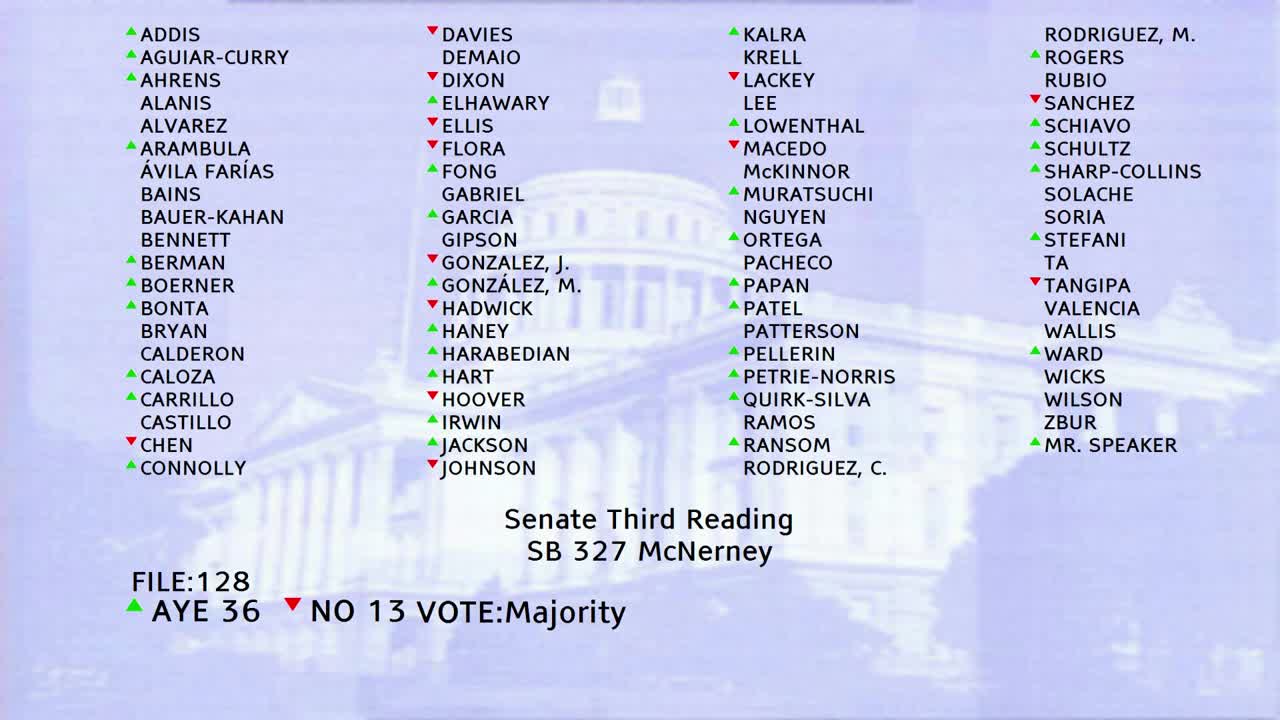 55SEC
Assembly Floor
 4MIN
Senate Floor
 11MIN
Senate Standing Committee on Health
 1MIN
Assembly Floor
 14MIN
Assembly Standing Committee on Labor and Employment
 24MIN
Assembly Standing Committee on Public Safety
Bill Author