AB 256: Crimes: intoxication and firearms.
- Session Year: 2025-2026
- House: Assembly
- Latest Version Date: 2026-01-05
Current Status:
Failed
(2026-02-02: From committee: Filed with the Chief Clerk pursuant to Joint Rule 56.)
Introduced
In Committee
Awaiting First Chamber Vote
Passed First Chamber
In Committee
Awaiting Second Chamber Vote
Passed Second Chamber
Enacted
What does this bill do?
The bill creates a new punishment for people who, while armed with a firearm during the commission or attempted commission of a felony, are under the influence of a controlled substance they are prohibited from possessing: an additional, consecutive one-year prison term. It also authorizes a search warrant to obtain a person’s blood, drawn in a reasonable medically approved manner, when that blood would tend to show a violation of this enhancement.
The summary is provided by generative AI which can make mistakes. For original language, please view the details in the table below.
Existing law imposes various sentence enhancements, consisting of additional and consecutive terms of imprisonment, including, among others, enhancements for being armed with a firearm during the commission of a felony. Existing law makes it a crime for a person to be unlawfully under the influence of cocaine, cocaine base, heroin, methamphetamine, or phencyclidine while in the immediate personal possession of a loaded, operable firearm, punishable by imprisonment in the county jail for up to one year or in the state prison for a first conviction, or in the state prison for 2, 3, or 4 years for a 2nd or subsequent conviction.
This bill would create an enhancement for any person who, while armed with a firearm in the commission or attempted commission of a felony, is under the influence of a controlled substance they are prohibited from possessing, as specified. The bill would make this enhancement punishable by an additional year of imprisonment in the county jail. The bill would also authorize a search warrant to be issued when a sample of the blood of a person constitutes evidence that tends to show a violation of this enhancement, and the sample will be drawn from the person in a reasonable, medically approved manner. By creating a new enhancement, this bill would impose a state-mandated local program.
The California Constitution requires the state to reimburse local agencies and school districts for certain costs mandated by the state. Statutory provisions establish procedures for making that reimbursement.
This bill would provide that no reimbursement is required by this act for a specified reason.
Existing law establishes that the state has a compelling interest in protecting its citizens from crimes involving firearms. Existing law generally regulates the manufacture, distribution, transportation, and importation of specified firearms.This bill would state the intent of the Legislature to enact legislation relating to crimes involving firearms.Existing law establishes that the state has a compelling interest in protecting its citizens from crimes involving firearms. Existing law generally regulates the manufacture, distribution, transportation, and importation of specified firearms.
This bill would state the intent of the Legislature to enact legislation relating to crimes involving firearms.
(a)A search warrant may be issued upon any of the following grounds:
(1)When the property was stolen or embezzled.
(2)When the property or things were used as the means of committing a felony.
(3)When the property or things are in the possession of a person with the intent to use them as a means of committing a public offense, or in the possession of another to whom that person may have delivered them for the purpose of concealing them or preventing them from being discovered.
(4)When the property or things to be seized consist of an item or constitute evidence that tends to show a felony has been committed, or tends to show that a particular person has committed a felony.
(5)When the property or things to be seized consist of evidence that tends to show that sexual exploitation of a child, in violation of Section 311.3, or possession of matter depicting sexual conduct of a person under 18 years of age, in violation of Section 311.11, has occurred or is occurring.
(6)When there is a warrant to arrest a person.
(7)When a provider of electronic communication service or remote computing service has records or evidence, as specified in Section 1524.3, showing that property was stolen or embezzled constituting a misdemeanor, or that property or things are in the possession of a person with the intent to use them as a means of committing a misdemeanor public offense, or in the possession of another to whom that person may have delivered them for the purpose of concealing them or preventing their discovery.
(8)When the property or things to be seized include an item or evidence that tends to show a violation of Section 3700.5 of the Labor Code or tends to show that a particular person has violated Section 3700.5 of the Labor Code.
(9)When the property or things to be seized include a firearm or other deadly weapon at the scene of, or at the premises occupied or under the control of the person arrested in connection with, a domestic violence incident involving a threat to human life or a physical assault as provided in Section 18250. This section does not affect warrantless seizures otherwise authorized by Section 18250.
(10)When the property or things to be seized include a firearm or other deadly weapon that is owned by, or in the possession of, or in the custody or control of, a person described in subdivision (a) of Section 8102 of the Welfare and Institutions Code.
(11)When the property or things to be seized include a firearm that is owned by, or in the possession of, or in the custody or control of, a person who is subject to the prohibitions regarding firearms or ammunition or both pursuant to Section 6389 of the Family Code, if a prohibited firearm or ammunition or both is possessed, owned, in the custody of, or controlled by a person against whom a protective order has been issued pursuant to Section 6218 of the Family Code, the person has been lawfully served with that order, and the person has failed to relinquish the firearm or ammunition or both as required by law.
(12)When the information to be received from the use of a tracking device constitutes evidence that tends to show that either a felony, a misdemeanor violation of the Fish and Game Code, or a misdemeanor violation of the Public Resources Code has been committed or is being committed, tends to show that a particular person has committed a felony, a misdemeanor violation of the Fish and Game Code, or a misdemeanor violation of the Public Resources Code, or is committing a felony, a misdemeanor violation of the Fish and Game Code, or a misdemeanor violation of the Public Resources Code, or will assist in locating an individual who has committed or is committing a felony, a misdemeanor violation of the Fish and Game Code, or a misdemeanor violation of the Public Resources Code. A tracking device search warrant issued pursuant to this paragraph shall be executed in a manner meeting the requirements specified in subdivision (b) of Section 1534.
(13)When a sample of the blood of a person constitutes evidence that tends to show a violation of Section 23140, 23152, or 23153 of the Vehicle Code and the person from whom the sample is being sought has refused an officers request to submit to, or has failed to complete, a blood test as required by Section 23612 of the Vehicle Code, and the sample will be drawn from the person in a reasonable, medically approved manner. This paragraph is not intended to abrogate a courts mandate to determine the propriety of the issuance of a search warrant on a case-by-case basis.
(14)Beginning January 1, 2016, the property or things to be seized are firearms or ammunition or both that are owned by, in the possession of, or in the custody or control of a person who is the subject of a gun violence restraining order that has been issued pursuant to Division 3.2 (commencing with Section 18100) of Title 2 of Part 6, if a prohibited firearm or ammunition or both is possessed, owned, in the custody of, or controlled by a person against whom a gun violence restraining order has been issued, the person has been lawfully served with that order, and the person has failed to relinquish the firearm as required by law.
(15)Beginning January 1, 2018, the property or things to be seized include a firearm that is owned by, or in the possession of, or in the custody or control of, a person who is subject to the prohibitions regarding firearms pursuant to Section 29800, 29805, 29815, 29820, or 29825, and the court has made a finding pursuant to subdivision (c) of Section 29810 that the person has failed to relinquish the firearm as required by law.
(16)When the property or things to be seized are controlled substances or a device, contrivance, instrument, or paraphernalia used for unlawfully using or administering a controlled substance pursuant to the authority described in Section 11472 of the Health and Safety Code.
(17)(A)When all of the following apply:
(i)A sample of the blood of a person constitutes evidence that tends to show a violation of subdivision (b), (c), (d), (e), or (f) of Section 655 of the Harbors and Navigation Code.
(ii)The person from whom the sample is being sought has refused an officers request to submit to, or has failed to complete, a blood test as required by Section 655.1 of the Harbors and Navigation Code.
(iii)The sample will be drawn from the person in a reasonable, medically approved manner.
(B)This paragraph is not intended to abrogate a courts mandate to determine the propriety of the issuance of a search warrant on a case-by-case basis.
(18)When the property or things to be seized consists of evidence that tends to show that a violation of paragraph (1), (2), or (3) of subdivision (j) of Section 647 has occurred or is occurring.
(19)(A)When the property or things to be seized are data, from a recording device installed by the manufacturer of a motor vehicle, that constitutes evidence that tends to show the commission of a felony or misdemeanor offense involving a motor vehicle, resulting in death or serious bodily injury to a person. The data accessed by a warrant pursuant to this paragraph shall not exceed the scope of the data that is directly related to the offense for which the warrant is issued.
(B)For the purposes of this paragraph, recording device has the same meaning as defined in subdivision (b) of Section 9951 of the Vehicle Code. The scope of the data accessible by a warrant issued pursuant to this paragraph shall be limited to the information described in subdivision (b) of Section 9951 of the Vehicle Code.
(C)For the purposes of this paragraph, serious bodily injury has the same meaning as defined in paragraph (4) of subdivision (f) of Section 243.
(20)When the property or things to be seized consists of evidence that tends to show that a violation of Section 647.9 has occurred or is occurring. Evidence to be seized pursuant to this paragraph shall be limited to evidence of a violation of Section 647.9 and shall not include evidence of a violation of a departmental rule or guideline that is not a public offense under California law.
(21)If the property to be seized includes ammunition and all of the following criteria are satisfied:
(A)The property is owned by, in the possession of, or in the custody or control of a person who is subject to the prohibition set forth in Section 8103 of the Welfare and Institutions Code.
(B)The person has been lawfully served with the order required by Section 8103 of the Welfare and Institutions Code.
(C)The person has failed to relinquish the ammunition as required by law.
(22)When the property or things to be seized include a firearm or ammunition or both that is owned by, or in the possession of, or in the custody or control of, a person who is subject to the prohibitions regarding firearms pursuant to Section 527.9 of the Code of Civil Procedure, the person has been lawfully served with that order, and the person has failed to relinquish the firearm or ammunition or both as required by law.
(23)When a sample of the blood of a person constitutes evidence that tends to show a violation of Section 12022.57, and the sample will be drawn from the person in a reasonable, medically approved manner. This paragraph is not intended to abrogate a courts mandate to determine the propriety of the issuance of a search warrant on a case-by-case basis.
(b)The property, things, person, or persons described in subdivision (a) may be taken on the warrant from a place or from a person in whose possession the property or things may be.
(c)Notwithstanding subdivision (a) or (b), a search warrant shall not be issued for documentary evidence in the possession or under the control of a person who is a lawyer as defined in Section 950 of the Evidence Code, a physician as defined in Section 990 of the Evidence Code, a psychotherapist as defined in Section 1010 of the Evidence Code, or a member of the clergy as defined in Section 1030 of the Evidence Code, and who is not reasonably suspected of engaging or having engaged in criminal activity related to the documentary evidence for which a warrant is requested unless the following procedure has been complied with:
(1)At the time of the issuance of the warrant, the court shall appoint a special master in accordance with subdivision (d) to accompany the person who will serve the warrant. Upon service of the warrant, the special master shall inform the party served of the specific items being sought and that the party shall have the opportunity to provide the items requested. If the party, in the judgment of the special master, fails to provide the items requested, the special master shall conduct a search for the items in the areas indicated in the search warrant.
(2)(A)If the party who has been served states that an item or items should not be disclosed, they shall be sealed by the special master and taken to court for a hearing.
(B)At the hearing, the party searched shall be entitled to raise an issue that may be raised pursuant to Section 1538.5 as well as a claim that the item or items are privileged, as provided by law. The hearing shall be held in the superior court. The court shall provide sufficient time for the parties to obtain counsel and make motions or present evidence. The hearing shall be held within three days of the service of the warrant unless the court makes a finding that the expedited hearing is impracticable. In that case, the matter shall be heard at the earliest possible time.
(C)If an item or items are taken to court for a hearing, a limitation of time prescribed in Chapter 2 (commencing with Section 799) of Title 3 shall be tolled from the time of the seizure until the final conclusion of the hearing, including an associated writ or appellate proceedings.
(3)The warrant shall, whenever practicable, be served during normal business hours. In addition, the warrant shall be served upon a party who appears to have possession or control of the items sought. If, after reasonable efforts, the party serving the warrant is unable to locate the person, the special master shall seal and return to the court, for determination by the court, an item that appears to be privileged as provided by law.
(d)(1)As used in this section, a special master is an attorney who is a member in good standing of the California State Bar and who has been selected from a list of qualified attorneys that is maintained by the State Bar particularly for the purposes of conducting the searches described in this section. These attorneys shall serve without compensation. A special master shall be considered a public employee, and the governmental entity that caused the search warrant to be issued shall be considered the employer of the special master and the applicable public entity, for purposes of Division 3.6 (commencing with Section 810) of Title 1 of the Government Code, relating to claims and actions against public entities and public employees. In selecting the special master, the court shall make every reasonable effort to ensure that the person selected has no relationship with any of the parties involved in the pending matter. Information obtained by the special master shall be confidential and may not be divulged except in direct response to inquiry by the court.
(2)In a case in which the magistrate determines that, after reasonable efforts have been made to obtain a special master, a special master is not available and would not be available within a reasonable period of time, the magistrate may direct the party seeking the order to conduct the search in the manner described in this section in lieu of the special master.
(e)A search conducted pursuant to this section by a special master may be conducted in a manner that permits the party serving the warrant or that partys designee to accompany the special master as the special master conducts the search. However, that party or that partys designee may not participate in the search nor shall they examine any of the items being searched by the special master except upon agreement of the party upon whom the warrant has been served.
(f)As used in this section, documentary evidence includes, but is not limited to, writings, documents, blueprints, drawings, photographs, computer printouts, microfilms, x-rays, files, diagrams, ledgers, books, tapes, audio and video recordings, films, and papers of any type or description.
(g)No warrant shall issue for an item or items described in Section 1070 of the Evidence Code.
(h)No warrant shall issue for an item or items that pertain to an investigation into a prohibited violation, as defined in Section 629.51.
(i)Notwithstanding any other law, no claim of attorney work product as described in Chapter 4 (commencing with Section 2018.010) of Title 4 of Part 4 of the Code of Civil Procedure shall be sustained where there is probable cause to believe that the lawyer is engaging or has engaged in criminal activity related to the documentary evidence for which a warrant is requested unless it is established at the hearing with respect to the documentary evidence seized under the warrant that the services of the lawyer were not sought or obtained to enable or aid anyone to commit or plan to commit a crime or a fraud.
(j)Nothing in this section is intended to limit an attorneys ability to request an in-camera hearing pursuant to the holding of the Supreme Court of California in People v. Superior Court (Laff) (2001) 25 Cal.4th 703.
(k)In addition to any other circumstance permitting a magistrate to issue a warrant for a person or property in another county, when the property or things to be seized consist of any item or constitute evidence that tends to show a violation of Section 530.5, the magistrate may issue a warrant to search a person or property located in another county if the person whose identifying information was taken or used resides in the same county as the issuing court.
(l)This section does not create a cause of action against a foreign or California corporation, its officers, employees, agents, or other specified persons for providing location information.
(m)This section shall become operative on January 1, 2026.
SEC. 2.Section 12022.57 is added to the Penal Code, to read:12022.57.(a)Any person who, while armed with a firearm in the commission or attempted commission of a felony, is under the influence of a controlled substance they are prohibited from possessing pursuant to Division 10 (commencing with Section 11000) of the Health and Safety Code, shall be punished by an additional and consecutive term of imprisonment pursuant to subdivision (h) of Section 1170 for one year.
(b)An enhancement charged pursuant to this section does not preclude prosecution under subdivision (e) of Section 11550 of the Health and Safety Code.
SEC. 3.No reimbursement is required by this act pursuant to Section 6 of Article XIIIB of the California Constitution because the only costs that may be incurred by a local agency or school district will be incurred because this act creates a new crime or infraction, eliminates a crime or infraction, or changes the penalty for a crime or infraction, within the meaning of Section 17556 of the Government Code, or changes the definition of a crime within the meaning of Section 6 of Article XIIIB of the California Constitution.
SECTION 1.It is the intent of the Legislature to enact legislation regarding crimes involving firearms.It is the intent of the Legislature to enact legislation regarding crimes involving firearms.
CORRECTIONS: TextPage 1.|
Date
|
Status
|
|---|---|
| Feb 2, 2026 | From committee: Filed with the Chief Clerk pursuant to Joint Rule 56. |
| Jan 31, 2026 | Died pursuant to Art. IV, Sec. 10(c) of the Constitution. |
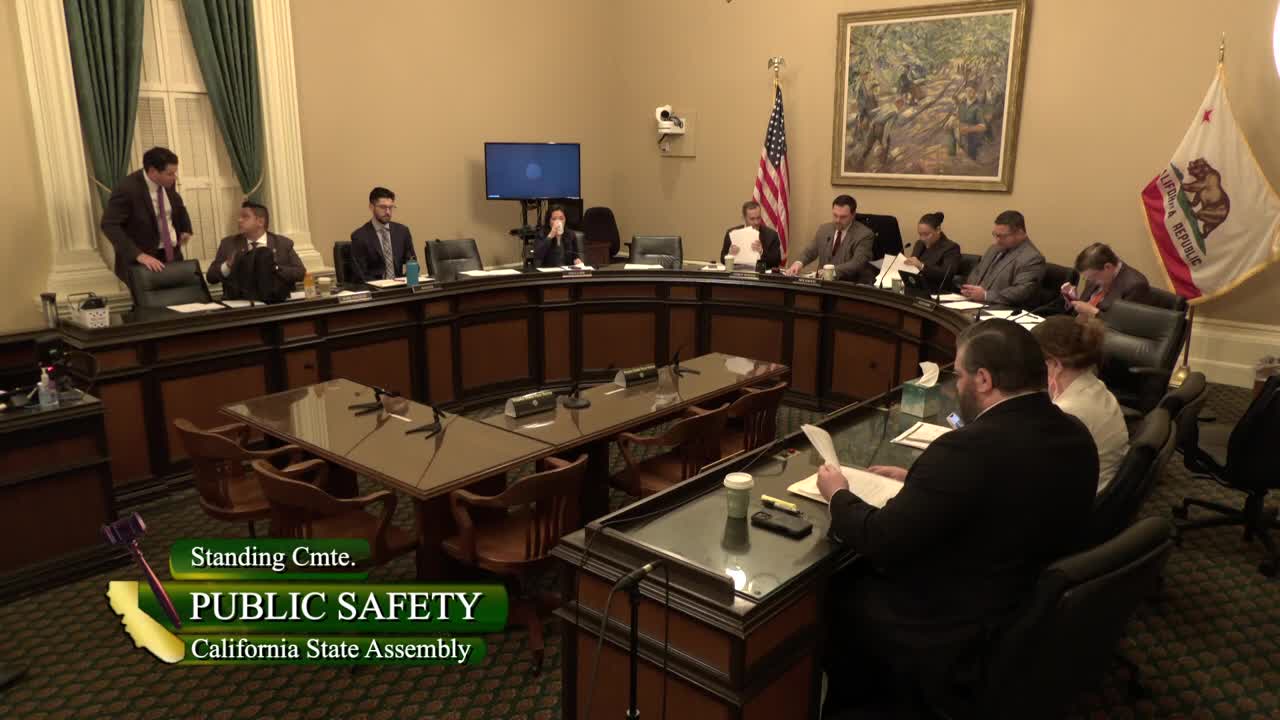
| Jan 13, 2026 | In committee: Set, first hearing. Failed passage. |
| Jan 6, 2026 | Re-referred to Com. on PUB. S. |
| Jan 5, 2026 | From committee chair, with author's amendments: Amend, and re-refer to Com. on PUB. S. Read second time and amended. |
| Jan 5, 2026 | Referred to Com. on PUB. S. |
| Jan 29, 2025 | Introduced measure version corrected. |
| Jan 17, 2025 | From printer. May be heard in committee February 16. |
| Jan 16, 2025 | Read first time. To print. |
|
Date
|
Description
|
Location
|
Votes
|
|
|---|---|---|---|---|
| Jan 13, 2026 | Do pass and be re-referred to the Committee on [Appropriations] | Assembly Standing Committee on Public Safety |
Failed |
This list shows positions taken on this bill by organizations on the date displayed, which is linked to the original source.
Positions by individuals are not included.
|
Organization
|
Position
|
Date
|
|---|---|---|
| Aclu California Action | ** Against | |
| California Public Defenders Association | ** Against | |
| Californians United for a Responsible Budget | ** Against | |
| Initiate Justice | ** Against | |
| Legal Services for Prisoners with Children | ** Against | |
| San Francisco Public Defender | ** Against | |
| Smart Justice California | ** Against | |
| Universidad Popular | ** Against |
Date of Hearing: January 13, 2026
Counsel: Dustin Weber
ASSEMBLY COMMITTEE ON
Nick Schultz, Chair
ABPCA Bill Id:
Author:() – As Ver:
SUMMARY:
Establishes a one-year sentencing enhancement for committing, or attempting to commit, a felony while armed with a firearm and under the influence of a controlled substance. Specifically, this bill:
- Establishes a one-year enhancement for any person who, while armed with a firearm and under the influence of a controlled substance they are not supposed to possess, commits a felony or attempts to commit a felony.
- States that a search warrant may be issued when a sample of the blood of a person constitutes evidence that tends to show a defined violation, with the sample required to be drawn from the person in a reasonable, medically approved manner.
- Provides that search warrants which may be issued under this subsection are not intended to abrogate a court’s mandate to determine the propriety of the issuance of a search warrant on a case-by-case basis.
- Requires a one-year enhancement for defined conduct be punished by an additional and consecutive term of imprisonment, as defined, for one year.
EXISTING FEDERAL LAW:
- States that the right of the people to be secure in their persons, houses, papers, and effects, against unreasonable searches and seizures, shall not be violated, and no warrants shall issue, but upon probable cause, supported by oath or affirmation, and particularly describing the place to be searched, and the persons or things to be seized. (U.S. Const. amend. IV.)
- Provides that a person is barred from shipping, transporting, receiving, or possessing firearms or ammunition who is an unlawful user of or addicted to any controlled substance, as defined. (18 U.S.C. 922(g)(3).)
EXISTING LAW:
- States that a search warrant may be issued when a sample of the blood of a person constitutes evidence that tends to show a defined violation and the person from whom the sample is being sought has refused an officer’s request to submit to, or has failed to complete, a blood test as required, and the sample will be drawn from the person in a reasonable, medically approved manner. This paragraph is not intended to abrogate a court’s mandate to determine the propriety of the issuance of a search warrant on a case-by-case basis. (Pen. Code, § 1524, subds. (a)(13), (a)(17).)
- Provides that a felony is a crime punishable with death, by imprisonment in the state prison, or, notwithstanding any other law, by imprisonment in a county jail under the provisions of subdivision (h) of Section 1170. (Pen. Code § 17, subd. (a).)
- States that a person who is armed with a firearm in the commission of a felony or attempted felony shall be punished by an additional and consecutive term of imprisonment, as defined, for one year, unless the arming is an element of that offense, except as provided.
- Provides that the above additional term shall apply to a person who is a principal in the commission of a felony or attempted felony if one or more of the principals is armed with a firearm, whether or not the person is personally armed with a firearm. (Pen. Code, § 12022, subd. (a)(1).)
- States that a person who personally uses a deadly or dangerous weapon in the commission of a felony or attempted felony shall be punished by an additional and consecutive term of imprisonment in the state prison for one year, unless use of a deadly or dangerous weapon is an element of that offense. (Pen. Code, § 12022, subd. (b)(1).)
- States that a person who is personally armed with a firearm in the commission of a violation or attempted violation of defined violations of the Controlled Substances Act (CSA) shall be punished by an additional and consecutive term of imprisonment in the state prison for three, four, or five years. (Pen. Code, § 12022, subd. (c)(1).)
- Provides that a person who is not personally armed with a firearm who, knowing that another principal is personally armed with a firearm, is a principal in the commission of an offense or attempted offense, as specified, shall be punished by an additional and consecutive term of imprisonment, as defined, for one, two, or three years, except as provided. (Pen. Code, § 12022, subd. (d).)
- States that any person who, during the commission or attempted commission of a felony, furnishes or offers to furnish a firearm to another for the purpose of aiding, abetting, or enabling that person or any other person to commit a felony shall, in addition and consecutive to the punishment prescribed by the felony or attempted felony of which the person has been convicted, be punished by an additional term of one, two, or three years in the state prison. (Pen. Code, § 12022.4.)
- Provides that any person who personally uses a firearm in the commission of a felony or attempted felony shall be punished by an additional and consecutive term of imprisonment in the state prison for 3, 4, or 10 years, unless use of a firearm is an element of that offense, except as provided. (Pen. Code, § 12022.5, subd. (a).)
- States that any person who personally uses an assault weapon, as specified, or a machinegun, as defined, in the commission of a felony or attempted felony, shall be punished by an additional and consecutive term of imprisonment in the state prison for 5, 6, or 10 years, except as provided. (Pen. Code, § 12022.5, subd. (b).)
- Provides that a person who, in the commission of a specified felony who personally uses a firearm, shall be punished by an additional and consecutive term of imprisonment in the state prison for 10 years, except as provided. The firearm need not be operable or loaded for this enhancement to apply. (Pen. Code, § 12022.53, subds. (b).)
- States that a person who, in the commission of a specified felony who personally and intentionally discharges a firearm, shall be punished by an additional and consecutive term of imprisonment in the state prison for 20 years, except as provided. (Pen. Code, § 12022.53, subds. (c).)
- Provides that a person who, in the commission of a specified felony who personally and intentionally discharges a firearm and proximately causes great bodily injury, as defined, or death, to a person other than an accomplice, shall be punished by an additional and consecutive term of imprisonment in the state prison for 25 years to life, except as provided. (Pen. Code, § 12022.53, subds. (d).)
- Specifies that any person who, with the intent to inflict great bodily injury or death, inflicts great bodily injury, as defined, or causes the death of a person, other than an occupant of a motor vehicle, as a result of discharging a firearm from a motor vehicle in the commission of a felony or attempted felony, shall be punished by an additional and consecutive term of imprisonment in the state prison for 5, 6, or 10 years. (Pen. Code, § 12022.55.)
- Specifies that every person who possesses any specified controlled substance, or any controlled substance, as defined and classified, which is a narcotic drug, unless upon the written prescription of a physician, dentist, podiatrist, or veterinarian licensed to practice in this state, shall be punished by imprisonment in a county jail for not more than one year, except that such person shall instead be punished for 16 months, 2, or 3 years if that person has one or more prior convictions for a defined offense or for an offense requiring registration, as defined, except as otherwise provided. (Health & Saf. Code, § 11350.)
- States that every person who possesses for sale or purchases for purposes of sale any defined controlled substance specified or any defined and classified controlled substance, which is a narcotic drug, shall be punished by imprisonment for two, three, or four years, except as provided. (Health & Saf. Code, § 11351.)
- States that every person who unlawfully possesses any amount of a substance containing cocaine base, a substance containing cocaine, a substance containing heroin, a substance containing methamphetamine, a substance containing fentanyl, a crystalline substance containing phencyclidine, a liquid substance containing phencyclidine, plant material containing phencyclidine, or a hand-rolled cigarette treated with phencyclidine while armed with a loaded, operable firearm is guilty of a felony punishable by imprisonment in the state prison for two, three, or four years. (Health & Saf. Code, § 11370.1, subd. (a).)
- Provides that any person convicted of a defined violation or conspiracy thereof, shall receive, in addition to any other punishment authorized by law, a full, separate, and consecutive three-year term for each prior felony conviction of, or for each prior felony conviction of conspiracy to violate, whether or not the prior conviction resulted in a term of imprisonment. (Health & Saf. Code, § 11370.1, subds. (b)-(c).)
- Defines “controlled substance,” as, unless otherwise specified, a drug, substance, or immediate precursor which is listed in any schedule, as defined. (Health & Saf. Code, § 11007.)
- Defines “armed with” to mean having available for immediate offensive or defensive use. (Health & Saf. Code, § 11370.1, subd. (a).)
- Defines “firearm” to mean a device, designed to be used as a weapon, from which is expelled through a barrel, a projectile by the force of an explosion or other form of combustion, and which includes the frame or receiver of the weapon, including both a completed frame or receiver, or a firearm precursor part. (Pen. Code, § 16520, subds. (a)-(b).) >
FISCAL EFFECT:
Unknown
COMMENTS:
- Author's Statement: According to the author, “Mass shootings have become a plague in the United States, and it is a constant debate as to why these crimes are being committed on such a frequent scale. This bill will add a year to crimes involving firearms if they are found to be using a controlled substance but will more importantly allow for blood toxicology screenings of these criminals that will show if there is a connection between the increased use of controlled substances and mass shootings.”
- Effect of the Bill: This bill would authorize a one-year sentence enhancement for any person who, while armed with a firearm and under the influence of a controlled substance they are prohibited from possessing, commits a felony or attempts to commit a felony.
Put simply, to qualify for the one-year sentence enhancement, a crime under this bill would require proving beyond a reasonable doubt that a person did three things: 1) The person during the act was armed with a firearm, 2) the person during the act was under the influence of a controlled substance they were prohibited from possessing, and 3) the person’s act was a felony or an attempt to commit a felony.
A person is armed with a firearm if they knowingly carry a firearm or have a firearm available as a means of offense or defense. (People v. Bland (1995) 10 Cal.4th 991, 998.) The ready access or availability of the firearm constitutes arming. (Ibid.) A burglar who leaves a firearm on a wall outside the garage of a home while entering the house is considered armed. (Ibid, see also People v. Garcia (1986) 183 Cal.App.3d 335, 340-51.). Likewise, a drug dealer who sold from his car with a loaded firearm in an unlocked compartment in the back of his car is also considered armed. (Ibid, see also People v. Searle (1989) 213 Cal.App.3d 1091, 1099.)
The term “under the influence” is slightly less clear but has sufficient development in relevant case law. “The term ‘under the influence’ differs for the purposes of section 23152, subdivision (a) of the Vehicle Code and Health and Safety Code section 11550. ‘[B]eing under the influence’ within the meaning of Health and Safety Code [] merely requires that the person be under the influence in any detectable manner.” (People v. Enriquez (6th Dist. 1996) 42 Cal.App.4th 661, 665.). In a statement echoed by our Supreme Court, “[t]he symptoms of being under the influence within the meaning of [section 11550] are not confined to those commensurate with misbehavior, nor to those which demonstrate impairment of physical or mental ability.” (Ibid, see also People v. Canty (2004) 32 Cal.4th 1266, 1278.)
Juries are also instructed in the definition of “under the influence” at trial. California’s jury instructions state that “[s]omeone is under the influence of a controlled substance if that person has taken or used a controlled substance that has appreciably affected the person’s nervous system, brain, or muscles or has created in the person a detectable abnormal mental or physical condition.” (CALCRIM. 2400.)
A controlled substance is “a drug, substance, or immediate precursor which is listed in any schedule,” unless otherwise specified or defined. (Health & Saf. Code, § 11007.)
A felony is a crime punishable with death, by imprisonment in the state prison, or, notwithstanding any other law, by imprisonment in a county jail under the provisions of subdivision (h) of Section 1170. (Pen. Code § 17, subd. (a).) There are more than 1,400 felonies in the California codes.[1] Under this bill, any person who commits one of these 1,400 offenses, or attempts to, while being armed with a firearm and under the influence of a controlled substance they are not supposed to possess, would be subject to a one-year enhancement. This includes a rather broad range of potential acts where an enhancement would be authorized.
Moreover, it is unclear why a sentence enhancement is justified for only being under the influence of a controlled substance the person is “not supposed to possess” and armed with a firearm during the commission or attempted commission of a felony. Surely, there is a cognizable and potentially serious public safety or public health risk from a person undertaking these acts regardless of whether the controlled substance for which they are under the influence is lawfully or unlawfully possessed. It is understandable for the law to treat these differently in certain contexts, but it is difficult to understand why the difference should exist for the conduct this bill is trying to penalize with an enhancement.
The author offers “mass shootings” as at least implied support in justifying the need for this law. It strains credulity that imposition of a one-year sentence enhancement would have any impact on mass shootings. Additionally, mass shootings in California are at an approximate 20-year low.[2] In 2025, California saw a 24 percent drop in mass shootings compared to 2024, which already was a 20 percent drop from 2023.[3] Mass shootings are undoubtedly a serious, daunting, and deadly public safety and public health problem, but using the issue of mass shootings as an imprimatur for advancing a law imposing a one-year sentence enhancement seems inapt.
There is also already a wealth of data on the connections between controlled substance use, and other behaviors, and crime. Previous programs have collected this data. A 2020 nationwide report found that two-thirds of mass shooters in some way communicated threatening or concerns messages before carrying out their attacks.[4] Nearly half had histories of violence with almost 40 percent having a history of domestic violence.[5] Likewise, almost half used firearms for which they were unauthorized to possess.[6] In the three years predating the report, they found approximately 25 percent subscribed to extremist or hateful viewpoints.[7] Another study found evidence of controlled substance use being associated with increased interpersonal violence and suicide.[8] But, the evidence regarding the relationship between specific substances and violence was mixed.[9]
In one an expansive study, where data was collected on 172 public mass shooters over 53 years and which of 166 psychosocial traits applied to each shooter, the most prominent psychosocial factors appear not to involve controlled substance use.[10] Rather, the most common factors identified were trauma, suicidality, crisis, mental health, motivation over time, and use of warning signs.[11] They found more than 30 percent experienced severe childhood trauma and were suicidal before or during the shooting, more than 50 percent had a mental health history, and more than 20 percent either studied mass shooters or left behind a legacy token like a manifesto.[12]
In addition to research, huge amounts of data was collected on drug use among arrestees in some fashion, in multiple locations across the country, from 1987-2013.[13] What began as the Drug Use Forecasting (DUF) program through the U.S. Department of Justice in 1987 became two successive programs named the Arrestee Drug Abuse Monitoring program (ADAM and ADAM II).[14] Arrestee participation was voluntary and data collected included urinalyses, interview responses, questionnaire responses, and details of the drug markets and transactions used.[15] A number of California cities participated in this program.[16]
Arguably, the data from the DUF and ADAM programs are outdated in 2026. The public having experienced yet another crisis in the capital and job markets and a pandemic in the past 12 years, it is understandable to want updated data on these issues. This bill’s approach to securing this data, however, appears more expensive and more punitive than needed, particularly given the availability of viable and successful methods. If the author’s most important object of this law is to improve our understanding of a possible link between controlled substance use and crime, or even just gun violence, it may be worth considering legislation that more directly aims to achieve that goal.
- The Fourth Amendment: The Fourth Amendment protects individuals from unlawful searches and seizures by government actors. (See U.S. Const. amend. IV.) Constitutional rights supersede any contrary provisions of state law. (U.S. Const. art. VI, cl. 2, see also Montgomery v. Louisiana (2016), 577 U.S. 190, 228.)
Taking a blood sample is governed by the Fourth Amendment. (Skinner v. Railway Labor Executives’ Assn. (1989), 489 U.S. 602, 616-617.) Blood draws are significant intrusions to the body. (Missouri v. McNeely (2013), 569 U.S. 141, 174, Roberts, C.J., dissenting.) A blood test is uniquely intrusive because it gives law enforcement authorities a sample that can be preserved and makes it possible to extract further information. (Birchfield v. North Dakota (2016) 579 U.S. 438, 464.) Even if the law enforcement agency is precluded from testing the blood for any purpose other than to measure BAC, the potential remains, and the blood draw could generate anxiety for the person tested. (Ibid.)
The author notes that “more importantly”, this bill will “allow for blood toxicology screenings that might show a connection between the increased use of controlled substances and mass shootings.” There are two nearly identical provisions already in the search warrant statute that provide for warrants under these conditions. (See Pen. Code §§ 1524, subds. (a)(13), (a)(17).) Those subsections, however, are tied to driving under the influence (DUI) and boating under the influence (BUI)—where intoxication is an element of the crime. Those subsections also critically include that a warrant for a blood test may issue only if the person has refused other alcohol concentration tests as all motorists are statutorily required to do in the State of California. (See Veh. Code § 23612, Harbors and Nav. Code § 655.1.) A refuse to comply clause is not present in this bill.
Automatic issuance of a search warrant for a blood draw could be constitutionally dubious under some fact patterns that give rise to prosecution under this bill. With so many potential felonies in California codes, it is perhaps overbroad to include all possible felony conduct as justifying issuance of a blood draw. For example, a person in California can be charged with a felony for attempting to marry someone who is already married. (Pen. Code, § 284.) A person in California can be charged with a felony for producing spurious heirs in estate inheritance claims. (Pen. Code, § 156.) Presenting a false claim to a public official is yet another possible felony in California. (Pen. Code, § 72.) Our Superintendent of State Printing must not have a conflict of interest during their employment because that, too, is a potential felony. (Pen. Code, § 99.) It is almost inconceivable that a one-year sentence enhancement is justified for this conduct even if the person is armed with a firearm and under the influence of a controlled substance. Authorizing a blood draw by statute under these conditions, and many others like them, present real constitutional concerns.
The Fourth Amendment is a vital protection of individual liberty against unlawful intrusions by the state into a person’s affairs. We have long been counseled against wading into unnecessary legal terrain. Indeed, as Montesquieu wrote centuries ago, “useless laws weaken necessary laws.”
- Sentence Enhancements: This bill would authorize sentence enhancements for those who, while armed with a firearm and under the influence of a controlled substance they are prohibited from possessing, commit a felony or attempt to commit a felony.
Enhancements have been widely used in California.[17] Indeed, already more than half of currently incarcerated women and more than two-thirds of currently incarcerated men have at least one sentence enhancement.[18] Sentence enhancements increase an individual’s prison sentence, which then increases the size of our prison population.[19] These enhancements are applied disproportionately to Black men.[20] A 2023 study found, “Black people are over-represented among the currently incarcerated with sentence enhancements while Hispanic people are slightly under-represented.[21] Among those without a sentence enhancement, 49% are Hispanic while 19% are Black.[22] Individuals serving a sentence with an enhancement are “overwhelmingly male.”[23]
Sentence enhancements increase the average sentence by nearly 2 years for all admissions.[24] Confinement length for those with a sentence enhancement is approximately 5 years longer compared to those without an enhancement.[25] Approximately 40 percent of prison admissions since 2015 have been lengthened by a sentence enhancement.[26]
There is also reason to doubt the effectiveness of enhancements. Reliable evidence shows increased penalties generally fail to deter criminal behavior.[27] Instead, data shows a rise in deterrence linked with the likelihood of being caught and the perception of being caught.[28] In contrast, the act of punishment and the length of punishment largely do not increase deterrence.[29]
The enhancement and conduct this bill addresses appears well covered by existing law. Among many others, the law already provides for enhancements for commission or attempted commission of a felony with a firearm (Pen. Code § 12022, subd. (a)(1)), commission or attempted commission of a defined violation of the CSA while armed with a firearm (Pen. Code § 12022, subd. (c)(1)), knowing another person is armed during commission or attempted commission of a felony (Pen. Code § 12022, subd. (d)), use of a firearm during commission or attempted commission of a felony (Pen. Code § 12022.53, subds. (b).), discharge of a firearm during commission or attempted commission of a felony (Pen. Code § 12022.53, subds. (c).), furnishing a firearm to another during commission or attempted commission of a felony (Pen. Code § 12022.4.). (See also Pen. Code § 12022.2, subd. (b)., Pen. Code § 12022.6., Pen. Code § 12022.65, subd. (a).) Enhancements under these statutes can extend up to 20 years. (See Pen. Code, § 12022.53, subds. (c).)
Enhancements are available for conduct relating to controlled substances as well. Violating or conspiring to violate defined sections of the Health and Safety Code with a prior felony conviction as well as enhancements based on the weight of specified substances in one’s possession. (Health & Saf. Code, § 11370.1, subd. (b)-(c); Health & Saf. Code, § 11370.4, subds. (c)(1)(A)-(I).). Not to mention the penalties for possession of defined controlled substances while in possession of a firearm. (Health & Saf. Code, § 11370.1, subd. (a).) With the number of enhancements already codified in California law for acts relating to firearms, use and possession of controlled substances, and commission or attempted commission of felonies, it is difficult to imagine the fact patterns for which conduct under only this law could be penalized.
Given the questionable effectiveness of enhancements on criminal deterrence, one might reasonably question whether this proposed enhancement would meaningfully deter people from committing the crime proposed in this bill.
- Costs of Incarceration: This bill would increase sentence lengths for those who, while armed with a firearm and under the influence of a controlled substance they are prohibited from possessing, commit a felony or attempt to commit a felony.
The effect of this bill, among other things, would produce longer terms of confinement. More people sentenced to county jails or state prisons for longer terms of confinement means larger carceral populations. In 2011, the U.S. Supreme Court ordered California to reduce its prison population because of overcrowding. (Brown, et al. v. Plata, et al. (2011) 463 U.S. 593.) The costs of incarcerating a person have also risen dramatically in recent years—from $91,000 per person in 2019 to $133,000 per person in 2024.[30]
The passage of Proposition 36 has caused the Legislative Analyst’s Office (LAO) to project an increase of more than 4,000 people in confinement over the next two years.[31] Higher carceral populations create the conditions for prison overcrowding. This bill would increase those projections. Therefore, one might reasonably question whether adding another sentence enhancement is sound public policy.
- U.S. v. Hemani: The U.S. Supreme Court will hear a case this term that is likely to have implications for this bill, specifically for the firearm and under the influence elements contained in the bill.
The Court is expected to hear oral arguments this March in U.S. v. Hemani.[32] In the petitioner’s brief requesting certiorari, which the Court ultimately granted, the question the Court is being asked to resolve is whether 18 U.S.C. 922(g)(3), the federal statute that
prohibits the possession of firearms by a person who “is an unlawful user of or addicted to any controlled substance,” violates the Second Amendment as applied to Hemani.[33]
The law captured in 18 U.S.C. 922(g)(3) is part of the Gun Control Act (GCA) (See 18 U.S.C. 922 et seq.) The GCA was originally passed in 1968.[34] The GCA includes categories of persons who are barred from shipping, transporting, receiving, or possessing firearms or ammunition, including those convicted of a crime punishable by imprisonment for a term exceeding one year, fugitives from justice, unlawful users of controlled substances, persons "adjudicated as a mental defective" or who have been committed to mental institutions, and persons subject to certain court orders relating to domestic violence or who have committed domestic violence misdemeanors among others.[35] Subsection (g)(3) defines the ban against those who are unlawful users of controlled substances. (See 18 U.S.C. 922(g)(3).)
The disposition in Hemani could impact this bill. If the Court decides to resolve the question presented purely as a matter of statutory law interpretation and/or invoke the constitutional avoidance doctrine,[36] this bill may not be impacted. If the Court, however, decides to address or resolve the controversy as a matter of constitutional law,[37] the restrictions in this bill could be impacted. Given the strong likelihood that the Court will issue a decision in this case before a version of this bill could get through the legislative process, the author may want to consider postponing consideration of this bill.
- Argument in Support: None submitted.
- Argument in Opposition: According to Universidad Popular, “From both a policy and community impact perspective, this proposal is unnecessary and unsupported by research.
“Creating an additional, duplicative enhancement does not fill a legal gap and instead contributes to excessive sentencing. The existing statute, Penal Code section 12022(a)(1), imposes a one-year sentence enhancement for individuals armed with a firearm during the commission of a felony, in addition to penalties associated with the underlying offense.
“Expanding sentence enhancements that already exist in law does not improve public safety and does not prevent future harm. Instead, it risks deepening cycles of incarceration that disproportionately impact low-income communities and communities of color, including the families Universidad Popular works alongside every day.
“AB 256 also represents a continued erosion of privacy protections embedded in California’s warrant statutes. Penal Code section 1524 was intentionally drafted with narrow limits to safeguard individuals from unnecessary government intrusion. Over time, repeated amendments have steadily expanded its scope beyond its original intent. Allowing additional warrantless or coerced bodily searches further undermines constitutional protections without clear public safety benefit.” - Prior Legislation:
- AB 991 (Essayli), of the 2025-2026 Legislative Session, would have made the provision relating to the dismissal of enhancements inapplicable to firearms-related enhancements, but would allow the court to dismiss these firearm-related enhancements pursuant to the court’s general authority to dismiss an action. AB 991 bill did not receive a hearing in the Assembly Public Safety Committee.
- AB 27 (Ta), of the 2023-2024 Legislative Session, would have prohibited courts from dismissing firearms enhancements. AB 27 bill was held in the Assembly Appropriations Committee.
- AB 337 (Essayli), of the 2023-24 Legislative Session, would have prohibited a court from striking an allegation or a finding that would make a crime punishable pursuant to those enhancement provisions, except that a court could strike or dismiss an enhancement when the person did not personally use or discharge the firearm or when the firearm was unloaded. AB 337 bill was held in the Assembly Appropriations Committee.
- AB 484 (Gabriel), of the 2023-24 Legislative Session, would have, until January 1, 2028, authorized the court, if a person takes, damages, or destroys property in the commission or attempted commission of a felony, with the intent to cause that taking, damage, or destruction, to impose an additional term of imprisonment of up to 2 years if the property loss exceeds $275,000, an additional term of imprisonment of up to 3 years if the property loss exceeds $1,750,000, or an additional term of imprisonment of up to 4 years if the property loss exceeds $4,400,000. AB 484 died in the Assembly Appropriations Committee.
- AB 1960 (Rivas), Chapter 220, Statutes of 2024, until January 1, 2030, creates sentencing enhancements for taking, damaging, or destroying property in the commission or attempted commission of a felony, as specified.
- AB 991 (Essayli), of the 2025-2026 Legislative Session, would have made the provision relating to the dismissal of enhancements inapplicable to firearms-related enhancements, but would allow the court to dismiss these firearm-related enhancements pursuant to the court’s general authority to dismiss an action. AB 991 bill did not receive a hearing in the Assembly Public Safety Committee.
REGISTERED SUPPORT / OPPOSITION:
Support
None submitted
Opposition
ACLU California Action
California Public Defender’s Association
Californians United for a Responsible Budget
Initiate Justice
Legal Services for Prisoners with Children
San Francisco Public Defender
Smart Justice California
Universidad Popular
Analysis Prepared by:
Nosewicz and Pickard, Felony Offenses and Sentencing Triads in California, Cal. Policy Lab (Oct. 2023) <https://www.capolicylab.org/wp-content/uploads/2023/12/Felony-Offenses-and-Sentencing-Triads-in-California.pdf> [as of Jan. 7, 2026]. ↑
California shooting marks 20-year low in US mass killings – but the bigger picture is complex, The Guardian (Dec. 2, 2025) https://www.theguardian.com/us-news/2025/dec/02/mass-killings-database> [as of Jan. 7, 2026]. ↑
Ibid. ↑
Mass Attacks in Public Spaces – 2019, United States Secret Service National Threat Assessment Center (2020) < https://www.secretservice.gov/sites/default/files/reports/2020-09/MAPS2019.pdf> [as of Jan. 7, 2026]. ↑
Ibid. ↑
Ibid. ↑
Ibid. ↑
McGinty, et al., The Relationship Between Controlled Substances and Violence, Epidemiologic Reviews (2016) <https://academic.oup.com/epirev/article-abstract/38/1/5/2754864?redirectedFrom=PDF> [as of Jan. 7, 2026]. ↑
Ibid. ↑
Peterson, J., A Multi-Level, Multi-Method Investigation of the Psycho-Social Life Histories of Mass Shooters, U.S. Department of Justice, Office of Justice Programs (Sept. 2021) <https://www.ojp.gov/pdffiles1/nij/grants/302101.pdf> [as of Jan. 7, 2026]. ↑
Ibid. ↑
Ibid. ↑
NIJ's Drugs and Crime Research: Arrestee Drug Abuse Monitoring Programs, U.S. Department of Justice’s National Institute of Justice (May 2012) <https://nij.ojp.gov/topics/articles/nijs-drugs-and-crime-research-arrestee-drug-abuse-monitoring-programs> [as of Jan. 7, 2026]. ↑
Ibid. ↑
Ibid. ↑
Ibid. ↑
Bird, et al., Sentence Enhancements in California, Cal. Policy Lab (Mar. 2023) <https://www.capolicylab.org/wp-content/uploads/2023/03/Sentence-Enhancements-in-California.pdf> [as of Jan. 9, 2026]. ↑
Ibid. ↑
Ibid. ↑
Ibid. ↑
Ibid. ↑
Ibid. ↑
Ibid. ↑
Ibid. ↑
Ibid. ↑
Ibid. ↑
Five Things About Deterrence (May 2016) National Institute of Justice <https://www.ojp.gov/pdffiles1/nij/247350.pdf> [as of Jan. 9, 2026]. ↑
Ibid. ↑
Ibid. ↑
Harris, et al., California’s Prison Population (Sept. 2024) Public Policy Institute of California <https://www.ppic.org/publication/californias-prison-population/> [as of Jan. 9, 2026]. ↑
The 2025-26 Budget: California Department of Corrections and Rehabilitation (Feb. 25, 2025) Legislative Analyst’s Office https://lao.ca.gov/Publications/Report/4986> [as of Jan. 9, 2026]. ↑
Supreme Court of the United States October 2025 Term, For the Session Beginning February 26, 2026, United States Supreme Court (Jan. 2, 2026) <https://www.supremecourt.gov/oral_arguments/argument_calendars/MonthlyArgumentCalFebruary2026.pdf> [as of Jan. 8, 2026]. ↑
Br. For Petitioner at I, U.S. v. Hemani, United States Supreme Court (June 2, 2025) <https://www.supremecourt.gov/DocketPDF/24/24-1234/362144/20250602174403309_HemaniPetition.pdf> [as of Jan. 8, 2026]. ↑
U.S. Gun Policy: Framework and Major Issues, United States Congress (Sept. 12, 2025) <https://www.congress.gov/crs-product/IF11038#:~:text=The%20GCA%20sets%20forth%20requirements,the%20FFL%27s%20state%20of%20business.> [as of Jan. 8, 2026]. ↑
Ibid. ↑
Willinger, A., Should Hemani be Decided as a Statutory Case? Duke Center for Firearms Law and Policy (Nov. 20, 2025) <https://firearmslaw.duke.edu/2025/11/should-hemani-be-decided-as-a-statutory-case> [as of Jan. 8, 2026]. ↑
Ibid. ↑
Discussed in Hearing
 14MIN
Assembly Standing Committee on Public Safety
Bill Author

Bill Co-Author(s):