AB 2760: Law enforcement: wearable electroshock devices.
- Session Year: 2025-2026
- House: Assembly
- Latest Version Date: 2026-09-29
Current Status:
Passed
(2026-09-29: Chaptered by Secretary of State - Chapter 749, Statutes of 2026.)
Introduced
In Committee
Awaiting First Chamber Vote
Passed First Chamber
In Committee
Awaiting Second Chamber Vote
Passed Second Chamber
Enacted
Existing law requires each law enforcement agency, on or before January 1, 2021, to maintain a policy that provides a minimum standard on the use of force. Existing law requires that the policy include, among other things, training standards and requirements relating to demonstrated knowledge and understanding of the law enforcement agencys use of force policy by officers, investigators, and supervisors. Existing law prohibits a law enforcement agency from authorizing the use of a carotid restraint or choke hold by any peace officer employed by that agency.
This bill would, until January 1, 2030, prohibit a law enforcement agency, including a federal law enforcement agency, from using a wearable electroshock device within the State of California. The bill would also prohibit a law enforcement agency from using state funds to purchase a wearable electroshock device. The bill would require a law enforcement agency to update their use of force policies to prohibit the use of a wearable electroshock device. By increasing the duties on local law enforcement, the bill would impose a state-mandated local program. The bill would require the Division of Law Enforcement within the Department of Justice to conduct a study on the safety and community impacts of wearable electroshock devices and provide recommendations for appropriate standards and safeguards for their use, and would require the department to report to the Legislature on the findings and recommendations of the study on or before January 1, 2029.
The California Constitution requires the state to reimburse local agencies and school districts for certain costs mandated by the state. Statutory provisions establish procedures for making that reimbursement.
This bill would provide that, if the Commission on State Mandates determines that the bill contains costs mandated by the state, reimbursement for those costs shall be made pursuant to the statutory provisions noted above.
Existing law requires each law enforcement agency, on or before January 1, 2021, to maintain a policy that provides a minimum standard on the use of force. Existing law requires that the policy include, among other things, training standards and requirements relating to demonstrated knowledge and understanding of the law enforcement agencys use of force policy by officers, investigators, and supervisors. Existing law prohibits a law enforcement agency from authorizing the use of a carotid restraint or choke hold by any peace officer employed by that agency.
This bill would would, until January 1, 2030, prohibit a law enforcement agency, including a federal law enforcement agency, from using a wearable electroshock device within the State of California. The bill would also prohibit a state or local law enforcement agency from using state funds to purchase a wearable electroshock device. The bill would require a state or local law enforcement agency to update their use of force policies to prohibit the use of a wearable electroshock device. By increasing the duties on local law enforcement, the bill would impose a state-mandated local program. The bill would require the Division of Law Enforcement within the Department of Justice to conduct a study on the safety and community impacts of wearable electroshock devices and provide recommendations for appropriate standards and safeguards for their use, and would require the department to report to the Legislature on the findings and recommendations of the study on or before January 1, 2029.
The California Constitution requires the state to reimburse local agencies and school districts for certain costs mandated by the state. Statutory provisions establish procedures for making that reimbursement.
This bill would provide that, if the Commission on State Mandates determines that the bill contains costs mandated by the state, reimbursement for those costs shall be made pursuant to the statutory provisions noted above.
Existing law requires each law enforcement agency, on or before January 1, 2021, to maintain a policy that provides a minimum standard on the use of force. Existing law requires that the policy include, among other things, training standards and requirements relating to demonstrated knowledge and understanding of the law enforcement agencys use of force policy by officers, investigators, and supervisors. Existing law prohibits a law enforcement agency from authorizing the use of a carotid restraint or choke hold by any peace officer employed by that agency.
This bill would prohibit a law enforcement agency, including a federal law enforcement agency, from using a wearable electroshock device within the State of California. The bill would also prohibit a state or local law enforcement agency from using state funds to purchase a wearable electroshock device. The bill would require a state or local law enforcement agency to update their use of force policies to prohibit the use of a wearable electroshock device. By increasing the duties on local law enforcement, the bill would impose a state-mandated local program.
The California Constitution requires the state to reimburse local agencies and school districts for certain costs mandated by the state. Statutory provisions establish procedures for making that reimbursement.
This bill would provide that, if the Commission on State Mandates determines that the bill contains costs mandated by the state, reimbursement for those costs shall be made pursuant to the statutory provisions noted above.
Existing law requires a board of supervisors to supervise the official conduct of all county officers and ensure that they faithfully perform their duties. Existing law authorizes a county, either by action of the board of supervisors or through a vote of county residents, to establish an office of the inspector general to assist the board of supervisors with these duties as they relate to the sheriff.This bill would authorize a county, either by action of the board of supervisors or through a vote of county residents, to establish an office of the inspector general to assist the board of supervisors with these duties as they relate to the county animal control department or the office of chief probation, as defined.Existing law requires a board of supervisors to supervise the official conduct of all county officers and ensure that they faithfully perform their duties. Existing law authorizes a county, either by action of the board of supervisors or through a vote of county residents, to establish an office of the inspector general to assist the board of supervisors with these duties as they relate to the sheriff.
This bill would authorize a county, either by action of the board of supervisors or through a vote of county residents, to establish an office of the inspector general to assist the board of supervisors with these duties as they relate to the county animal control department or the office of chief probation, as defined.
Existing law establishes the Office of Civil Rights, under the administration of the Government Operations Agency, with the purpose of working directly with school districts, county offices of education, and charter schools to prevent and address discrimination and bias, as described. Existing law requires the office to engage with and seek advice from specified coordinators on actions implemented by the office.This bill would make nonsubstantive changes to the latter provision.Existing law establishes the Office of Civil Rights, under the administration of the Government Operations Agency, with the purpose of working directly with school districts, county offices of education, and charter schools to prevent and address discrimination and bias, as described. Existing law requires the office to engage with and seek advice from specified coordinators on actions implemented by the office.
This bill would make nonsubstantive changes to the latter provision.
(a)A law enforcement agency shall not use a wearable electroshock device within the State of California.
(b)A law enforcement agency shall not use state funds to purchase a wearable electroshock device.
(c)Law enforcement agencies shall update their use of force policies to prohibit the use of a wearable electroshock device.
(d)For the purposes of this section, the following terms have the following meanings:
(1)Law enforcement agency means either of the following:
(A)Any department or agency of the state or any local government, special district, or other political subdivision thereof, that employs any peace officer, as described in Chapter 4.5 (commencing with Section 830) of Title 3 of Part 2 of the Penal Code.
(B)Any federal law enforcement agency.
(2)(A)Wearable electroshock device means a weapon that is designed to temporarily incapacitate a person through the controlled delivery of an electric shock and is designed to be worn as a glove.
(B)Wearable electroshock device does not mean a taser energy weapon, stun gun, or similar weapon that is designed to temporarily incapacitate a person through the controlled delivery of an electric shock, and is designed to be held in a manner similar to a pistol.
(e)(1)The Division of Law Enforcement in the Department of Justice, in consultation with relevant stakeholders, including, but not limited to, immigrants rights and social justice advocates, law enforcement, technology experts, and other affected parties as deemed necessary by the department, shall conduct a study on the safety and community impacts of wearable electroshock devices and provide recommendations for appropriate standards and safeguards for their use. The department shall report to the Legislature on the findings and recommendations of the study on or before January 1, 2029.
(2)A report to be submitted pursuant to this subdivision shall be submitted in compliance with Section 9795.
(f)This section shall remain in effect only until January 1, 2030, and as of that date is repealed.
SEC. 2.If the Commission on State Mandates determines that this act contains costs mandated by the state, reimbursement to local agencies and school districts for those costs shall be made pursuant to Part 7 (commencing with Section 17500) of Division 4 of Title 2 of the Government Code.
(a)A law enforcement agency, as defined in Section 7289, agency shall not use a wearable electroshock device, as defined in Section 13660 of the Penal Code, device within the State of California.
(b)A law enforcement agency, as defined in Section 7286.5, agency shall not use state funds to purchase a wearable electroshock device.
(c)Law enforcement agencies, as defined in Section 7286.5, agencies shall update their use of force policies to prohibit the use of a wearable electroshock device.
(d)For the purposes of this section, wearable includes any clothing or accessory item. the following terms have the following meanings:
(1)Law enforcement agency means either of the following:
(A)Any department or agency of the state or any local government, special district, or other political subdivision thereof, that employs any peace officer, as described in Chapter 4.5 (commencing with Section 830) of Title 3 of Part 2 of the Penal Code.
(B)Any federal law enforcement agency.
(2)(A)Wearable electroshock device means a weapon that is designed to temporarily incapacitate a person through the controlled delivery of an electric shock and is designed to be worn as a glove.
(B)Wearable electroshock device does not mean a taser energy weapon, stun gun, or similar weapon that is designed to temporarily incapacitate a person through the controlled delivery of an electric shock, and is designed to be held in a manner similar to a pistol.
(e)(1)The Division of Law Enforcement in the Department of Justice, in consultation with relevant stakeholders, including, but not limited to, immigrants rights and social justice advocates, law enforcement, technology experts, and other affected parties as deemed necessary by the department, shall conduct a study on the safety and community impacts of wearable electroshock devices and provide recommendations for appropriate standards and safeguards for their use. The department shall report to the Legislature on the findings and recommendations of the study on or before January 1, 2029.
(2)A report to be submitted pursuant to this subdivision shall be submitted in compliance with Section 9795.
(f)This section shall remain in effect only until January 1, 2030, and as of that date is repealed.
SEC. 2.If the Commission on State Mandates determines that this act contains costs mandated by the state, reimbursement to local agencies and school districts for those costs shall be made pursuant to Part 7 (commencing with Section 17500) of Division 4 of Title 2 of the Government Code.
CORRECTIONS: HeadingLine 6.(a)A law enforcement agency, as defined in Section 7289, shall not use a wearable electroshock device, as defined in Section 13660 of the Penal Code, within the State of California.
(b)A law enforcement agency, as defined in Section 7286.5, shall not use state funds to purchase a wearable electroshock device.
(c)Law enforcement agencies, as defined in Section 7286.5, shall update their use of force policies to prohibit the use of a wearable electroshock device.
(d)For the purposes of this section, wearable includes any clothing or accessory item.
SEC. 2.If the Commission on State Mandates determines that this act contains costs mandated by the state, reimbursement to local agencies and school districts for those costs shall be made pursuant to Part 7 (commencing with Section 17500) of Division 4 of Title 2 of the Government Code.
SECTION 1.Section 25303.7 of the Government Code is amended to read:25303.7.(a)(1)A county may create a sheriff oversight board, either by action of the board of supervisors or through a vote of county residents, comprised of civilians to assist the board of supervisors with its duties required pursuant to Section 25303 that relate to the sheriff.(2)The members of the sheriff oversight board shall be appointed by the board of supervisors. The board of supervisors shall designate one member to serve as the chairperson of the board.(3)The members of the oversight board shall have access to the personnel records of peace officers and custodial officers required for the performance of the commissions oversight duties. The oversight board shall maintain the confidentiality of these records consistent with Section 832.7 of the Penal Code.(b)(1)The chair of the sheriff oversight board shall issue a subpoena or subpoena duces tecum in accordance with Sections 1985 to 1985.4, inclusive, of the Code of Civil Procedure whenever the board deems it necessary or important to examine the following:(A)Any person as a witness upon any subject matter within the jurisdiction of the board.(B)Any officer of the county in relation to the discharge of their official duties on behalf of the sheriffs department.(C)Any books, papers, or documents in the possession of or under the control of a person or officer relating to the affairs of the sheriffs department.(2)A subpoena shall be served in accordance with Sections 1987 and 1988 of the Code of Civil Procedure.(3)(A)If a witness fails to attend, or in the case of a subpoena duces tecum, if an item is not produced as set forth therein, the chair or the chair authorized deputy issuing the subpoena upon proof of service thereof may certify the facts to the superior court in the county of the board.(B)The court shall thereupon issue an order directing the person to appear before the court and show cause why they should not be ordered to comply with the subpoena. The order and a copy of the certified statement shall be served on the person and the court shall have jurisdiction of the matter.(C)The same proceedings shall be had, the same penalties imposed, and the person charged may purge themself of the contempt in the same way as in a case of a person who has committed a contempt in the trial of a civil action before a superior court.(4)A sheriff oversight board may conduct closed sessions, consistent with Section 54957, to review confidential records obtained under this section or otherwise related to its oversight duties, if those sessions comply with applicable confidentiality laws, including, but not limited to, Section 832.7 of the Penal Code.(c)(1)A county, through action of the board of supervisors or vote by county residents, may establish an office of the inspector general, appointed by the board of supervisors, to assist the board of supervisors with its duties required pursuant to Section 25303 that relate to any of the following:(A)The sheriff.(B)The county animal control department, as defined in Section 31606 of the Food and Agricultural Code.(C)The office of chief probation appointed in accordance with Chapter 16 (commencing with Section 27770) of Part 3.(2)The inspector general shall have the independent authority to issue a subpoena or subpoena duces tecum subject to the procedure provided in subdivision (b).(3)The inspector general shall have access to the personnel records of peace officers and custodial officers required for the performance of the inspector generals oversight duties. The inspector general shall maintain the confidentiality of these records consistent with Section 832.7 of the Penal Code.(d)The exercise of powers under this section or other investigative functions performed by a board of supervisors, sheriff oversight board, or inspector general vested with oversight responsibility for the sheriff shall not be considered to obstruct the investigative functions of the sheriff.(a)(1)A county may create a sheriff oversight board, either by action of the board of supervisors or through a vote of county residents, comprised of civilians to assist the board of supervisors with its duties required pursuant to Section 25303 that relate to the sheriff.
(2)The members of the sheriff oversight board shall be appointed by the board of supervisors. The board of supervisors shall designate one member to serve as the chairperson of the board.
(3)The members of the oversight board shall have access to the personnel records of peace officers and custodial officers required for the performance of the commissions oversight duties. The oversight board shall maintain the confidentiality of these records consistent with Section 832.7 of the Penal Code.
(b)(1)The chair of the sheriff oversight board shall issue a subpoena or subpoena duces tecum in accordance with Sections 1985 to 1985.4, inclusive, of the Code of Civil Procedure whenever the board deems it necessary or important to examine the following:
(A)Any person as a witness upon any subject matter within the jurisdiction of the board.
(B)Any officer of the county in relation to the discharge of their official duties on behalf of the sheriffs department.
(C)Any books, papers, or documents in the possession of or under the control of a person or officer relating to the affairs of the sheriffs department.
(2)A subpoena shall be served in accordance with Sections 1987 and 1988 of the Code of Civil Procedure.
(3)(A)If a witness fails to attend, or in the case of a subpoena duces tecum, if an item is not produced as set forth therein, the chair or the chair authorized deputy issuing the subpoena upon proof of service thereof may certify the facts to the superior court in the county of the board.
(B)The court shall thereupon issue an order directing the person to appear before the court and show cause why they should not be ordered to comply with the subpoena. The order and a copy of the certified statement shall be served on the person and the court shall have jurisdiction of the matter.
(C)The same proceedings shall be had, the same penalties imposed, and the person charged may purge themself of the contempt in the same way as in a case of a person who has committed a contempt in the trial of a civil action before a superior court.
(4)A sheriff oversight board may conduct closed sessions, consistent with Section 54957, to review confidential records obtained under this section or otherwise related to its oversight duties, if those sessions comply with applicable confidentiality laws, including, but not limited to, Section 832.7 of the Penal Code.
(c)(1)A county, through action of the board of supervisors or vote by county residents, may establish an office of the inspector general, appointed by the board of supervisors, to assist the board of supervisors with its duties required pursuant to Section 25303 that relate to the any of the following:
(A)The sheriff.
(B)The county animal control department, as defined in Section 31606 of the Food and Agricultural Code.
(C)The office of chief probation appointed in accordance with Chapter 16 (commencing with Section 27770) of Part 3.
(2)The inspector general shall have the independent authority to issue a subpoena or subpoena duces tecum subject to the procedure provided in subdivision (b).
(3)The inspector general shall have access to the personnel records of peace officers and custodial officers required for the performance of the inspector generals oversight duties. The inspector general shall maintain the confidentiality of these records consistent with Section 832.7 of the Penal Code.
(d)The exercise of powers under this section or other investigative functions performed by a board of supervisors, sheriff oversight board, or inspector general vested with oversight responsibility for the sheriff shall not be considered to obstruct the investigative functions of the sheriff.
SECTION 1.Section 33801 of the Education Code is amended to read:33801.(a)The Office of Civil Rights is hereby established under the administration of the Government Operations Agency.(b)The Director of the Office of Civil Rights shall be appointed by the Governor and subject to confirmation by the Senate.(c)The purpose of the office is to work directly with local educational agencies to prevent and address discrimination and bias pursuant to Section 220.(d)The office shall engage with and seek advice from coordinators established pursuant to this chapter on actions implemented by the office.(a)The Office of Civil Rights is hereby established under the administration of the Government Operations Agency.
(b)The Director of the Office of Civil Rights shall be appointed by the Governor and subject to confirmation by the Senate.
(c)The purpose of the office is to work directly with local educational agencies to prevent and address discrimination and bias pursuant to Section 220.
(d)The office shall engage with and seek advice from coordinators established under pursuant to this chapter on actions implemented by this the office.
|
Date
|
Status
|
|---|---|
| Sep 29, 2026 | Chaptered by Secretary of State - Chapter 749, Statutes of 2026. |
| Sep 29, 2026 | Approved by the Governor. |
| Sep 15, 2026 | Enrolled and presented to the Governor at 3 p.m. |
| Aug 31, 2026 | In Assembly. Concurrence in Senate amendments pending. |
| Aug 31, 2026 | Measure version as amended on August 28 corrected. |
| Aug 31, 2026 | Senate amendments concurred in. To Engrossing and Enrolling. |
| Aug 31, 2026 | Senate amendments concurred in. To Engrossing and Enrolling. (Ayes 55. Noes 16. Page 7036.). |
| Aug 31, 2026 | Senate amendments concurred in. To Engrossing and Enrolling. (Ayes 55. Noes 16.). |
| Aug 31, 2026 | Read third time. Passed. Ordered to the Assembly. (Ayes 29. Noes 9.). |
| Aug 30, 2026 | Read second time. Ordered to third reading. |
| Aug 28, 2026 | Read third time and amended. Ordered to second reading. |
| Aug 28, 2026 | Read second time. Ordered to third reading. |
| Aug 27, 2026 | From committee: Do pass. (Ayes 4. Noes 2.) (August 27). |
| Aug 26, 2026 | From committee: Do pass and re-refer to Com. on APPR. (Ayes 5. Noes 1.) (August 26). Re-referred to Com. on APPR. |
| Aug 24, 2026 | Joint Rules 61 and 62 (a) suspended. (Ayes 30. Noes 9.) |
| Aug 24, 2026 | Read second time. Ordered to third reading. |
| Aug 24, 2026 | Re-referred to Com. on RLS. pursuant to Senate Rule 29.10 (c). |
| Aug 24, 2026 | Re-referred to Com. on PUB. S. |
| Aug 24, 2026 | Joint Rules 61 and 62 (a) suspended. (Ayes 30. Noes 9. Page 5703.) |
| Aug 21, 2026 | Read third time and amended. Ordered to second reading. |
| Jun 24, 2026 | Read second time. Ordered to third reading. |
| Jun 23, 2026 | From committee: Do pass. (Ayes 5. Noes 2.) (June 23). |
| Jun 16, 2026 | From committee: Do pass and re-refer to Com. on L. GOV. (Ayes 5. Noes 1.) (June 16). Re-referred to Com. on L. GOV. |
| Jun 3, 2026 | Referred to Coms. on PUB. S. and L. GOV. |
| May 27, 2026 | In Senate. Read first time. To Com. on RLS. for assignment. |
| May 26, 2026 | Read third time. Passed. Ordered to the Senate. (Ayes 51. Noes 7.) |
| May 26, 2026 | Read third time. Passed. Ordered to the Senate. |
| May 26, 2026 | Read third time. Passed. Ordered to the Senate. (Ayes 51. Noes 7. Page 5391.) |
| Apr 16, 2026 | Read second time. Ordered to third reading. |
| Apr 15, 2026 | From committee: Do pass. (Ayes 6. Noes 0.) (April 14). |
| Mar 23, 2026 | Re-referred to Com. on PUB. S. |
| Mar 19, 2026 | Referred to Com. on PUB. S. |
| Mar 19, 2026 | From committee chair, with author's amendments: Amend, and re-refer to Com. on PUB. S. Read second time and amended. |
| Feb 21, 2026 | From printer. May be heard in committee March 23. |
| Feb 20, 2026 | Read first time. To print. |
|
Date
|
Description
|
Location
|
Votes
|
|
|---|---|---|---|---|
| Aug 31, 2026 | AB 2760 Sharp-Collins Concurrence in Senate Amendments | Assembly Floor |
Passed |
|
| Aug 31, 2026 | Assembly 3rd Reading AB2760 Sharp-Collins et al. By Arreguín | Senate Floor |
Passed |
|
| Aug 27, 2026 | Do pass | Senate Standing Committee on Appropriations |
Passed |
|
| Aug 26, 2026 | Do pass, but first be re-referred to the Committee on [Appropriations] | Senate Standing Committee on Public Safety |
Passed |
|
| Jun 23, 2026 | Do pass | Senate Standing Committee on Local Government |
Passed |
|
| Jun 16, 2026 | Do pass, but first be re-referred to the Committee on [Local Government] | Senate Standing Committee on Public Safety |
Passed |
|
| May 26, 2026 | AB 2760 Sharp-Collins Assembly Third Reading | Assembly Floor |
Passed |
|
| Apr 14, 2026 | Do pass. | Assembly Standing Committee on Public Safety |
Passed |
This list shows positions taken on this bill by organizations on the date displayed, which is linked to the original source.
Positions by individuals are not included.
|
Organization
|
Position
|
Date
|
|---|---|---|
| Aclu California Action | ** Support | |
| All of US or None (HQ) | ** Support | |
| Alliance San Diego | ** Support | |
| Arcadia Police Officers' Association | ** Against | |
| Black Women Organized for Political Action (BWOPA) | ** Support | |
| Brea Police Association | ** Against | |
| Burbank Police Officers' Association | ** Against | |
| California Association of Black Lawyers | ** Support | |
| California Coalition for Sheriff Oversight (CCSO) | ** Support | |
| California Community Foundation | ** Support | |
| California Faculty Association | ** Support | |
| California Immigrant Policy Center | ** Support | |
| California Narcotic Officers' Association | ** Against | |
| California Nurses Association | ** Support | |
| California Police Chiefs Association | ** Against | |
| California Reserve Peace Officers Association | ** Against | |
| California State Sheriff's Association | ** Against | |
| California State Sheriffs’ Association | ** Against | |
| Californians for Safety and Justice | ** Support | |
| CFT – a Union of Educators & Classified Professionals, AFT, AFL-CIO | ** Support | |
| Chief Probation Officers' of California | ** Against | |
| Communities United for Restorative Youth Justice (CURYJ) | ** Support | |
| Corona Police Officers Association | ** Against | |
| County of San Diego Fourth District Supervisor Monica Montgomery Steppe | ** Support | |
| County of San Diego, Board of Supervisors - District One | ** Support | |
| Courage California | ** Support | |
| Disability Rights California | ** Support | |
| Drug Policy Alliance | ** Support | |
| Equality California | ** Support | |
| Friends Committee On Legislation Of California | ** Support | |
| Fullerton Police Officers' Association | ** Against | |
| Grace Institute - End Child Poverty in Ca | ** Support | |
| Justice2jobs Coalition | ** Support | |
| LA Defensa | ** Support | |
| Legal Aid At Work | ** Support | |
| Legal Services for Prisoners with Children | ** Support | |
| Monica Montgomery Steppe, County of San Diego Board of Supervisors District Four Supervisor | ** Support | |
| Monica Montgomery Steppe, Supervisor, County of San Diego | ** Support | |
| Murrieta Police Officers' Association | ** Against | |
| Newport Beach Police Association | ** Against | |
| Paloma Aguirre, Supervisor, County of San Diego | ** Support | |
| Palos Verdes Police Officers' Association | ** Against | |
| Partnership for the Advancement of New Americans | ** Support | |
| Peace Officers Research Association of California (PORAC) | ** Against | |
| Pillars of the Community | ** Support | |
| Placer County Deputy Sheriffs' Association | ** Against | |
| Pomona Police Officers' Association | ** Against | |
| Prosecutors Alliance Action | ** Support | |
| Riverside Police Officers' Association | ** Against | |
| Riverside Sheriffs' Association | ** Against | |
| Sacramento County Sheriff Jim Cooper | ** Against | |
| Secure Justice | ** Support | |
| Smart Justice California, a Project of Beyond Impact | ** Support | |
| Terra Lawson, San Diego County Board of Supervisors Chair | ** Support | |
| The David's Harp Foundation | ** Support | |
| United Domestic Workers/AFSCME Local 3930 | ** Support | |
| western center on law & poverty | ** Support |
CONCURRENCE IN SENATE AMENDMENTS
CSA1 Bill Id:AB 2760
Author:(Sharp-Collins, et al.)
As Amended Ver:August 28, 2026
Majority vote
SUMMARY
Prohibits any California law enforcement agency and any federal law enforcement agency from using a wearable electroshock device, as defined, within California.
Senate Amendments
- Delete the contents of the bill and replace it with the following:
- Prohibits any California state or local law enforcement agency and any federal law enforcement agency from using a wearable electroshock device, as defined, within California.
- Prohibits any California state or local law enforcement agency and any federal law enforcement agency from using state funds to purchase a wearable electroshock device.
- Requires California state or local law enforcement agencies and federal law enforcement agencies to update their use of force policies to prohibit the use of a wearable electroshock device.
- Defines "law enforcement agency" to mean any department or agency of the state or any local government, special district, or other political subdivision thereof, that employs any peace officer, as specified, or any federal law enforcement agency.
- Defines "wearable electroshock device" to mean a weapon that is designed to temporarily incapacitate a person through the controlled delivery of an electric shock and is designed to be worn as a glove. This does not include a taser, energy weapon, stun gun, or similar weapon that is designed to temporarily incapacitate a person through the controlled delivery of an electric shock, and is designed to be held in a manner similar to a pistol.
- Requires the Division of Law Enforcement in the Department of Justice (DOJ), in consultation with relevant stakeholders, including, but not limited to, immigrants' rights and social justice advocates, law enforcement, technology experts, and other affected parties as deemed necessary by the DOJ, to conduct a study on the safety and community impacts of wearable electroshock devices and provide recommendations for appropriate standards and safeguards for their use.
- Requires the DOJ to report to the Legislature, as specified, the findings and recommendations of the study on or before January 1, 2029.
- Repeal the provisions of this bill on January 1, 2030.
COMMENTS
As Passed by the Assembly: This bill authorized counties to establish an Office of the Inspector General (OIG) to assist the board of supervisors with duties as they relate to the county animal control or chief probation.
According to the Author
"Policymaking must evolve as we learn of new threats such as emerging technology that directly poses an immediate and unacceptable risk to public safety. As the federal presence in California grows and state and local law enforcement agencies consider adopting new technologies, we cannot wait for a tragedy to force us to act.
"Taser shock gloves are largely untested in real-world encounters, yet they are already being marketed to and considered by law enforcement agencies. In one tragic case, a man died after being repeatedly shocked with these gloves while in custody. Californians should never serve as test subjects for unproven law enforcement technology. There are also reports of these gloves being used by school resource officers despite clear guidance against use on children. These gloves are marketed as a solution to litigation over the use of excessive force based on optics, eliminating one of the key ways the public is able to keep law enforcement accountable. This bill is about drawing a clear line: public safety technology must be proven safe and accountable before it is deployed, not after someone is killed."
Arguments in Support
According to La Defensa, AB 2760 "prohibits state and local law enforcement agencies from purchasing, possessing, or using taser gloves and other substantially similar wearable conducted-energy devices.
"Unlike other conducted-energy weapons, these devices are concealed within a glove and can be activated during close physical contact, resulting in serious health risks from longer-than-recommended usage and a lack of accountability posed by challenges even seeing where the electrical shock was administered. This lack of visibility undermines meaningful oversight and complicates the review of use-of-force incidents.
"AB 2760 takes a proactive approach by preventing the adoption of a technology that raises significant public health and oversight concerns while offering no demonstrated benefit beyond existing law enforcement tools and de-escalation practices."
Arguments in Opposition
According to the California State Sheriff's Association, CSSA "remains opposed to Assembly Bill 2760, which has been gutted and amended to preclude a law enforcement agency from using a wearable electroshock device.
"By restricting when and under what conditions an officer may use certain tools, their response to a particular situation may end up being guided by choices about practices that feel acceptable or unacceptable to some instead of what measure is most appropriate in the context of the event. And when force options are removed from the spectrum of permissible responses, the ability to de-escalate a situation becomes more difficult.
"Also, all indications are that this bill is focused on federal immigration authorities and their enforcement practices. This is one of a number of measures that attempt to regulate federal practices and at the same time implicate state and local law enforcement. As we have already seen with bills enacted during this session, it is not uncommon for courts to eliminate such bills' application to federal entities, thereby leaving the measures to only apply to state and/or local agencies."
FISCAL COMMENTS
According to the Senate Appropriations Committee, "Unknown, potentially minor one-time costs to state and local law enforcement agencies (General Fund, local funds) to update their use of force policies to prohibit the use of a wearable electroshock device."
VOTES:
ASM PUBLIC SAFETY: 6-0-3
YES: Schultz, Alanis, Mark González, Haney, Harabedian, Sharp-Collins
ABS, ABST OR NV: Lackey, Nguyen, Ramos
ASSEMBLY FLOOR: 51-7-22
YES: Addis, Aguiar-Curry, Ahrens, Alvarez, Ávila Farías, Bains, Bauer-Kahan, Bennett, Berman, Boerner, Bonta, Bryan, Calderon, Caloza, Carrillo, Connolly, Elhawary, Fong, Gabriel, Gallagher, Garcia, Mark González, Haney, Harabedian, Hart, Irwin, Jackson, Kalra, Krell, Lee, Lowenthal, McKinnor, Ortega, Papan, Patel, Pellerin, Petrie-Norris, Quirk-Silva, Ransom, Rogers, Schiavo, Schultz, Sharp-Collins, Solache, Stefani, Wallis, Ward, Wicks, Wilson, Zbur, Rivas
NO: Castillo, Hadwick, Johnson, Macedo, Patterson, Sanchez, Tangipa
ABS, ABST OR NV: Alanis, Arambula, Chen, Davies, DeMaio, Dixon, Ellis, Flora, Gipson, Jeff Gonzalez, Hoover, Lackey, Muratsuchi, Nguyen, Pacheco, Ramos, Celeste Rodriguez, Michelle Rodriguez, Blanca Rubio, Soria, Ta, Valencia
UPDATED
VERSION: August 28, 2026
CONSULTANT: Ilan Zur / PUB. S. / (916) 319-3744 FN: 0004569
SENATE RULES COMMITTEE Office of Senate Floor Analyses (916) 651-4171 | AB 2760 |
THIRD READING
Bill No: AB 2760
Author: Sharp-Collins (D), Lee (D) and Schultz (D), et al.
Amended: 8/28/26 in Senate
Vote: 21
PRIOR SENATE VOTES NOT RELEVANT PURSUANT TO SENATE RULE 29.10(c)
SENATE PUBLIC SAFETY COMMITTEE: 5-1, 8/26/26
AYES: Arreguín, Caballero, Cortese, Pérez, Wiener
NOES: Seyarto
SENATE APPROPRIATIONS COMMITTEE: 4-2, 8/27/26
AYES: Cervantes, Cabaldon, Grayson, Wahab
NOES: Seyarto, Dahle
NO VOTE RECORDED: Richardson
ASSEMBLY FLOOR: Not relevant
SUBJECT: Law enforcement: wearable electroshock devices
SOURCE: Author
DIGEST:
This bill 1) prohibits law enforcement agencies, as defined, from using wearable electroshock devices, as defined, within the state of California; 2) prohibits a law enforcement agency from using funds to purchase wearable electroshock devices; and 3) requires law enforcement agencies to update their use of force policies to prohibit the use of wearable electroshock devices.
Senate Floor Amendments of 8/28/26 change the definition of “wearable electroshock device” to include “taser energy weapon” rather than “taser”; delete the term “and operated using a trigger finger” from the description of devices that are not “wearable electroshock devices”; add a requirement that the California Department of Justice Division of Law Enforcement conduct a study on the safety and community impacts of wearable electroshock devices to be completed by January 1, 2029; and add a sunset date for the bills provisions of January 1, 2030.
Senate Floor Amendments of 8/27/26 fix drafting errors, refine the bill’s definitions, and add co-authors.
Senate Floor Amendments of 8/21/26 delete the prior version of the bill and insert a new bill.
ANALYSIS:
Existing law:
- Declares the intent of the Legislature that the authority to use physical force, conferred on peace officers by existing law, is a serious responsibility that shall be exercised judiciously and with respect for human rights and dignity and for the sanctity of every human life, and that every person has a right to be free from excessive use of force by officers acting under color of law. (Penal (Pen.) Code, § 835a, subd. (a)(1).)
- Includes a legislative finding and declaration that the decision by a peace officer to use force shall be evaluated carefully and thoroughly, in a manner that reflects the gravity of that authority and the serious consequences of the use of force by peace officers, in order to ensure that officers use force consistent with law and agency policies. (Pen. Code, § 835a, subd. (a)(3).)
- Authorizes a peace officer who has reasonable cause to believe that a person to be arrested has committed a public offense to use objectively reasonable force to effect the arrest, to prevent escape, or to overcome resistance. (Pen. Code, § 835a, subd. (b).)
- Permits a peace officer who is authorized to make an arrest and who has stated their intention to do so to use all necessary means to effect the arrest if the person to be arrested either flees or forcibly resists. (Pen. Code, § 843.)
- Requires each law enforcement agency to maintain a policy that provides a minimum standard on the use of force which, among other elements, must include all of the following:
- A requirement that officers utilize de-escalation techniques, crisis intervention tactics, and other alternatives to force when feasible.
- A requirement that an officer may only use a level of force that they reasonably believe is proportional to the seriousness of the suspected offense or the reasonably perceived level of actual or threatened resistance.
- A requirement that officers immediately report potential excessive force to a superior officer when present and observing another officer using force that the officer believes to be beyond that which is necessary, as determined by an objectively reasonable officer under the circumstances based upon the totality of information actually known to the officer.
- A requirement that officers promptly provide, if properly trained, or otherwise promptly procure medical assistance for persons injured in a use of force incident, when reasonable and safe to do so.
- Training standards and requirements relating to demonstrated knowledge and understanding of the law enforcement agency’s use of force policy by officers, investigators, and supervisors.
- Training and guidelines regarding vulnerable populations, including, but not limited to, children, elderly persons, people who are pregnant, and people with physical, mental, and developmental disabilities. (Government (Gov.) Code, § 7286, subd. (b).)
- Prohibits a law enforcement agency from authorizing the use of a carotid restraint, as defined, by any peace officer employed by that agency. (Gov. Code, § 7286.5, subd. (a).)
- Prohibits a law enforcement agency from authorizing techniques or transport methods that involve a substantial risk of positional asphyxia. (Gov. Code, §7286.5, subd. (b).)
- Prohibits, generally, law enforcement agencies from using kinetic energy projectiles and chemical agents, as defined, to disperse any assembly, protest or demonstration. (Pen. Code, § 13652, subd. (a).)
- Prohibits peace officers who carry electroshock devices from holstering or carrying those devices on the same lateral side of the officer’s body as the officer’s primary firearm is holstered or otherwise carried. (Pen. Code, § 13660, subd. (a).)
- Defines “electroshock device” to mean a taser, stun gun, or similar weapon that is designed to temporarily incapacitate a person through the controlled delivery of an electric shock, and is designed to be held in a manner similar to a pistol and operated using a finger trigger. (Pen. Code, § 13660, subd. (b)(1).)
This bill:
- Prohibits a law enforcement agency—defined as any local agency that employs a peace officer, any law enforcement agency of another state, or any federal law enforcement agency—from using wearable electroshock devices, as defined, within the state of California.
- Prohibits a law enforcement agency—defined as any agency, department, or other entity of the state or any political subdivision thereof that employs any peace officer—from using funds to purchase wearable electroshock devices.
- Requires law enforcement agencies—defined as any agency, department, or other entity of the state or any political subdivision thereof—to update their use of force policies to prohibit the use of wearable electroshock devices.
- Defines “wearable,” for the purposes of this bill, to mean any clothing or accessory item.
- Defines, by cross reference to existing law, “electroshock device” to mean a taser, stun gun, or similar weapon that is designed to temporarily incapacitate a person through the controlled delivery of an electric shock, and is designed to be held in a manner similar to a pistol and operated using a finger trigger. (Pen. Code, § 13660, subd. (b)(1).)
Background
From the outset of President Trump’s second term, his Administration has expanded immigration enforcement and altered the immigration system at an unprecedented scale. ICE has used aggressive tactics in federal immigration enforcement during President Trump’s second term, especially here in California. Hundreds of federal agents conducted raids and immigration sweeps across Los Angeles, detaining and arresting individuals through “at large” arrests on the street, and often through blatant racial profiling. (Trump’s immigration crackdown upended life in California. It continues as the new year begins (Dec. 29, 2025) CalMatters https://calmatters.org/justice/2025/12/immigration-2025-year-in-review/ [as of Aug. 24, 2026].) Federal agents often conducted raids in civilian clothing or military uniforms, and often while masked, heavily armed, and without providing identification. There have also been numerous reports of federal agents using excessive force and causing injury and property damage while conducting these raids, as well as reports that agents have denied those detained access to legal counsel. Such tactics were used during Operation Metro Surge, a joint operation of ICE and Customs and Border Patrol (CBP) that took place throughout Minnesota (though primarily in the Twin Cities area) beginning in December 2025 and concluding early February 2026. During this operation, federal immigration officials employed harsh, confrontational, and arguably illegal tactics to make arrests, serve warrants, conduct raids and contain protesters. (Minneapolis, MN: Operation Metro Surge. Sanctuary Information, December 2025 (Dec. 2025) Immigrant Legal Resource Center https://www.ilrc.org/immigration-enforcement/federal-tracking/large-scale-raids/minneapolis-mn-operation-metro-surge [as of Aug. 24, 2026]; Judge Partially Blocks Operation Metro Surge Tactics Against Protesters in Minnesota (Jan. 17, 2024) JURIST News https://www.jurist.org/news/2026/01/judge-partially-blocks-operation-metro-surge-tactics-against-protesters-in-minnesota/ [as of Aug. 24, 2026].) Operation Metro Surge also resulted in the shooting of three civilians by federal immigration agents, two of which were fatal: the killings of Alex Pretti and Renee Good.
In August of 2026, DHS published plans to spend up to $20 million to supply ICE officers with gloves that can deliver electric shocks. (Sara Braun, Alarm over $20m plan to supply ICE officers with electric-shock gloves, The Guardian (Aug. 24, 2026) https://www.theguardian.com/us-news/2026/aug/24/ice-officers-electric-shock-gloves [as of Aug. 27, 2026].) Such gloves are already used across the country by various police departments and even in schools. (Wilkins, Horrified School District Pleads Police to Stop Using Electric Shock Torture Gloves on Students (Aug. 22, 2026) Futurism https://futurism.com/science-energy/school-district-police-electric-shock-torture-gloves [as of Aug. 24, 2026].) While the devices are marketed as nonlethal and safe for the heart, a pending lawsuit alleges a 43-year-old man died in 2024 after he was shocked 27 times with the gloves and 13 more times by a Taser at a jail in Richmond, Kentucky. (Foley, ICE's plan to give officers electric shock gloves draws outrage and fears of misuse (Aug. 13, 2026) PBS NewsHour https://www.pbs.org/newshour/nation/ices-plan-to-give-officers-electric-shock-gloves-draws-outrage-and-fears-of-misuse [as of Aug. 24, 2026].) An internal investigation found two of the glove shocks lasted 45 and 99 seconds apiece — far more than the manufacturer's recommended 15-second limit. The manufacturer notes that the devices can cause sudden death, increase in blood pressure, changes in blood chemistry, increase in respiration and heart rates, changes in heart rhythm, increase in adrenaline, and, the longer the exposure, the greater the potential risk. (Compliant Technologies, Gen 3 & Gen 4 G.L.O.V.E. Produce User Guide, Nov. 1, 2024, https://drive.google.com/file/d/1uee38Qfyr46ZqjUPzRs_axR7ITv3jQtM/view [as of Aug 27, 2026].)
In 1989, the U.S. Supreme Court set the standard for reasonable use of force in law enforcement. The general rule for how much force a law enforcement officer can use in response to a given situation is determined by a reasonableness test, requiring the careful balancing of the force against the countervailing government interest at stake. (Graham v. Connor (1989) 490 U.S. 386, 396.) The central question of this legal inquiry is whether the amount and type of force applied was reasonably necessary in light of the police need to prevent the subject from engaging in whatever conduct it was that they were engaging in at the time the force was used. Three important factors to that test are: 1) the severity of the crime at issue; 2) whether the suspect poses an immediate threat to the safety of the officers or others; and 3) whether the person is actively resisting arrest or attempting to evade arrest by flight.
In 2019, California refined its use of force statutes in order to provide clearer guidance to law enforcement and the public, specifically regarding when the use of deadly force is appropriate. Namely, AB 392 (Weber, Chapter 170, Statutes of 2019), specified the circumstances in which deadly force is and is not appropriate, and SB 230 (Caballero, Chapter 285, Statutes of 2019), required law enforcement agencies to update their training and policies with specific requirements regarding use of force, including a requirement that an officer may only use a level of force that they reasonably believe is proportional to the seriousness of the suspected offense or the reasonably perceived level of actual or threatened resistance. (Gov. Code, § 7286, subd. (b).)
This bill prohibits law enforcement agencies from using wearable electroshock devices within the state of California. This bill also prohibits a law enforcement agency from using funds to purchase wearable electroshock devices and requires law enforcement agencies to update their use of force policies to prohibit the use of wearable electroshock devices.
FISCAL EFFECT: Appropriation: No Fiscal Com.: Yes Local: Yes
The Senate Appropriations Committee writes:
“Unknown, potentially minor one-time costs to state and local law enforcement agencies (General Fund, local funds) to update their use of force policies to prohibit the use of a wearable electroshock device.”
SUPPORT: (Verified 8/28/26)
ACLU California Action
All of US or None (HQ)
Alliance San Diego
Black Women Organized for Political Action (BWOPA)
California Association of Black Lawyers
California Coalition for Sheriff Oversight (CCSO)
California Community Foundation
California Faculty Association
California Immigrant Policy Center
California Nurses Association
Californians for Safety and Justice
CFT – a Union of Educators & Classified Professionals, AFT, AFL-CIO
Communities United for Restorative Youth Justice (CURYJ)
County of San Diego Fourth District Supervisor Monica Montgomery Steppe
Courage California
Disability Rights California
Drug Policy Alliance
Equality California
Friends Committee on Legislation of California
Grace Institute - End Child Poverty in CA
Justice2Jobs Coalition
La Defensa
Legal Aid At Work
Legal Services for Prisoners With Children
Prosecutors Alliance Action
Secure Justice
Smart Justice California, a Project of Beyond Impact
United Domestic Workers/AFSCME Local 3930
Western Center on Law & Poverty
OPPOSITION: (Verified 8/28/26)
Arcadia Police Officers' Association
Brea Police Association
Burbank Police Officers' Association
California Narcotic Officers' Association
California Police Chiefs Association
California Reserve Peace Officers Association
California State Sheriffs' Association
Corona Police Officers Association
Fullerton Police Officers' Association
Murrieta Police Officers' Association
Newport Beach Police Association
Palos Verdes Police Officers Association
Peace Officers Research Association of California (PORAC)
Placer County Deputy Sheriffs' Association
Pomona Police Officers' Association
Riverside Police Officers Association
Riverside Sheriffs' Association
Sacramento County Sheriff Jim Cooper
Prepared by: Marshal Lawler / PUB. S. /916-651-4118
8/30/26 15:01:34
**** END ****
SENATE RULES COMMITTEE Office of Senate Floor Analyses (916) 651-4171 | AB 2760 |
THIRD READING
Bill No: AB 2760
Author: Sharp-Collins (D)
Amended: 8/21/26 in Senate
Vote: 21
PRIOR SENATE VOTES NOT RELEVANT PURSUANT TO SENATE RULE 29.10(c)
SENATE PUBLIC SAFETY COMMITTEE: 5-1, 8/26/26
AYES: Arreguín, Caballero, Cortese, Pérez, Wiener
NOES: Seyarto
SENATE APPROPRIATIONS COMMITTEE: 4-2, 8/27/26
AYES: Cervantes, Cabaldon, Grayson, Wahab
NOES: Seyarto, Dahle
NO VOTE RECORDED: Richardson
ASSEMBLY FLOOR: Not relevant
SUBJECT: Law enforcement: wearable electroshock devices
SOURCE: Author
DIGEST:
This bill 1) prohibits certain law enforcement agencies, as defined, from using wearable electroshock devices, as defined, within the state of California; 2) prohibits a law enforcement agency from using funds to purchase wearable electroshock devices; requires law enforcement agencies to update their use of force policies to prohibit the use of wearable electroshock devices; and 3) defines “wearable,” for the purposes of this bill, to mean any clothing or accessory item.
Senate Floor Amendments of 8/21/26 delete the prior version of the bill and insert a new bill.
ANALYSIS:
Existing law:
- Declares the intent of the Legislature that the authority to use physical force, conferred on peace officers by existing law, is a serious responsibility that shall be exercised judiciously and with respect for human rights and dignity and for the sanctity of every human life, and that every person has a right to be free from excessive use of force by officers acting under color of law. (Penal (Pen.) Code, § 835a, subd. (a)(1).)
- Includes a legislative finding and declaration that the decision by a peace officer to use force shall be evaluated carefully and thoroughly, in a manner that reflects the gravity of that authority and the serious consequences of the use of force by peace officers, in order to ensure that officers use force consistent with law and agency policies. (Pen. Code, § 835a, subd. (a)(3).)
- Authorizes a peace officer who has reasonable cause to believe that a person to be arrested has committed a public offense to use objectively reasonable force to effect the arrest, to prevent escape, or to overcome resistance. (Pen. Code, § 835a, subd. (b).)
- Permits a peace officer who is authorized to make an arrest and who has stated their intention to do so to use all necessary means to effect the arrest if the person to be arrested either flees or forcibly resists. (Pen. Code, § 843.)
- Requires each law enforcement agency to maintain a policy that provides a minimum standard on the use of force which, among other elements, must include all of the following:
- A requirement that officers utilize de-escalation techniques, crisis intervention tactics, and other alternatives to force when feasible.
- A requirement that an officer may only use a level of force that they reasonably believe is proportional to the seriousness of the suspected offense or the reasonably perceived level of actual or threatened resistance.
- A requirement that officers immediately report potential excessive force to a superior officer when present and observing another officer using force that the officer believes to be beyond that which is necessary, as determined by an objectively reasonable officer under the circumstances based upon the totality of information actually known to the officer.
- A requirement that officers promptly provide, if properly trained, or otherwise promptly procure medical assistance for persons injured in a use of force incident, when reasonable and safe to do so.
- Training standards and requirements relating to demonstrated knowledge and understanding of the law enforcement agency’s use of force policy by officers, investigators, and supervisors.
- Training and guidelines regarding vulnerable populations, including, but not limited to, children, elderly persons, people who are pregnant, and people with physical, mental, and developmental disabilities. (Government (Gov.) Code, § 7286, subd. (b).)
- Prohibits a law enforcement agency from authorizing the use of a carotid restraint, as defined, by any peace officer employed by that agency. (Gov. Code, § 7286.5, subd. (a).)
- Prohibits a law enforcement agency from authorizing techniques or transport methods that involve a substantial risk of positional asphyxia. (Gov. Code, §7286.5, subd. (b).)
- Prohibits, generally, law enforcement agencies from using kinetic energy projectiles and chemical agents, as defined, to disperse any assembly, protest or demonstration. (Pen. Code, § 13652, subd. (a).)
- Prohibits peace officers who carry electroshock devices from holstering or carrying those devices on the same lateral side of the officer’s body as the officer’s primary firearm is holstered or otherwise carried. (Pen. Code, § 13660, subd. (a).)
- Defines “electroshock device” to mean a taser, stun gun, or similar weapon that is designed to temporarily incapacitate a person through the controlled delivery of an electric shock, and is designed to be held in a manner similar to a pistol and operated using a finger trigger. (Pen. Code, § 13660, subd. (b)(1).)
This bill:
- Prohibits a law enforcement agency—defined as any local agency that employs a peace officer, any law enforcement agency of another state, or any federal law enforcement agency—from using wearable electroshock devices, as defined, within the state of California.
- Prohibits a law enforcement agency—defined as any agency, department, or other entity of the state or any political subdivision thereof that employs any peace officer—from using funds to purchase wearable electroshock devices.
- Requires law enforcement agencies—defined as any agency, department, or other entity of the state or any political subdivision thereof—to update their use of force policies to prohibit the use of wearable electroshock devices.
- Defines “wearable,” for the purposes of this bill, to mean any clothing or accessory item.
- Defines, by cross reference to existing law, “electroshock device” to mean a taser, stun gun, or similar weapon that is designed to temporarily incapacitate a person through the controlled delivery of an electric shock, and is designed to be held in a manner similar to a pistol and operated using a finger trigger. (Pen. Code, § 13660, subd. (b)(1).)
Background
From the outset of President Trump’s second term, his Administration has expanded immigration enforcement and altered the immigration system at an unprecedented scale. ICE has used aggressive tactics in federal immigration enforcement during President Trump’s second term, especially here in California. Hundreds of federal agents conducted raids and immigration sweeps across Los Angeles, detaining and arresting individuals through “at large” arrests on the street, and often through blatant racial profiling. (Trump’s immigration crackdown upended life in California. It continues as the new year begins (Dec. 29, 2025) CalMatters https://calmatters.org/justice/2025/12/immigration-2025-year-in-review/ [as of Aug. 24, 2026].) Federal agents often conducted raids in civilian clothing or military uniforms, and often while masked, heavily armed, and without providing identification. There have also been numerous reports of federal agents using excessive force and causing injury and property damage while conducting these raids, as well as reports that agents have denied those detained access to legal counsel. Such tactics were used during Operation Metro Surge, a joint operation of ICE and Customs and Border Patrol (CBP) that took place throughout Minnesota (though primarily in the Twin Cities area) beginning in December 2025 and concluding early February 2026. During this operation, federal immigration officials employed harsh, confrontational, and arguably illegal tactics to make arrests, serve warrants, conduct raids and contain protesters. (Minneapolis, MN: Operation Metro Surge. Sanctuary Information, December 2025 (Dec. 2025) Immigrant Legal Resource Center https://www.ilrc.org/immigration-enforcement/federal-tracking/large-scale-raids/minneapolis-mn-operation-metro-surge [as of Aug. 24, 2026]; Judge Partially Blocks Operation Metro Surge Tactics Against Protesters in Minnesota (Jan. 17, 2024) JURIST News https://www.jurist.org/news/2026/01/judge-partially-blocks-operation-metro-surge-tactics-against-protesters-in-minnesota/ [as of Aug. 24, 2026].) Operation Metro Surge also resulted in the shooting of three civilians by federal immigration agents, two of which were fatal: the killings of Alex Pretti and Renee Good.
In August of 2026, DHS published plans to spend up to $20 million to supply ICE officers with gloves that can deliver electric shocks. (Sara Braun, Alarm over $20m plan to supply ICE officers with electric-shock gloves, The Guardian (Aug. 24, 2026) https://www.theguardian.com/us-news/2026/aug/24/ice-officers-electric-shock-gloves [as of Aug. 27, 2026].) Such gloves are already used across the country by various police departments and even in schools. (Wilkins, Horrified School District Pleads Police to Stop Using Electric Shock Torture Gloves on Students (Aug. 22, 2026) Futurism https://futurism.com/science-energy/school-district-police-electric-shock-torture-gloves [as of Aug. 24, 2026].) While the devices are marketed as nonlethal and safe for the heart, a pending lawsuit alleges a 43-year-old man died in 2024 after he was shocked 27 times with the gloves and 13 more times by a Taser at a jail in Richmond, Kentucky. (Foley, ICE's plan to give officers electric shock gloves draws outrage and fears of misuse (Aug. 13, 2026) PBS NewsHour https://www.pbs.org/newshour/nation/ices-plan-to-give-officers-electric-shock-gloves-draws-outrage-and-fears-of-misuse [as of Aug. 24, 2026].) An internal investigation found two of the glove shocks lasted 45 and 99 seconds apiece — far more than the manufacturer's recommended 15-second limit. The manufacturer notes that the devices can cause sudden death, increase in blood pressure, changes in blood chemistry, increase in respiration and heart rates, changes in heart rhythm, increase in adrenaline, and, the longer the exposure, the greater the potential risk. (Compliant Technologies, Gen 3 & Gen 4 G.L.O.V.E. Produce User Guide, Nov. 1, 2024, https://drive.google.com/file/d/1uee38Qfyr46ZqjUPzRs_axR7ITv3jQtM/view [as of Aug 27, 2026].)
In 1989, the U.S. Supreme Court set the standard for reasonable use of force in law enforcement. The general rule for how much force a law enforcement officer can use in response to a given situation is determined by a reasonableness test, requiring the careful balancing of the force against the countervailing government interest at stake. (Graham v. Connor (1989) 490 U.S. 386, 396.) The central question of this legal inquiry is whether the amount and type of force applied was reasonably necessary in light of the police need to prevent the subject from engaging in whatever conduct it was that they were engaging in at the time the force was used. Three important factors to that test are: 1) the severity of the crime at issue; 2) whether the suspect poses an immediate threat to the safety of the officers or others; and 3) whether the person is actively resisting arrest or attempting to evade arrest by flight.
In 2019, California refined its use of force statutes in order to provide clearer guidance to law enforcement and the public, specifically regarding when the use of deadly force is appropriate. Namely, AB 392 (Weber, Chapter 170, Statutes of 2019), specified the circumstances in which deadly force is and is not appropriate, and SB 230 (Caballero, Chapter 285, Statutes of 2019), required law enforcement agencies to update their training and policies with specific requirements regarding use of force, including a requirement that an officer may only use a level of force that they reasonably believe is proportional to the seriousness of the suspected offense or the reasonably perceived level of actual or threatened resistance. (Gov. Code, § 7286, subd. (b).)
This bill prohibits certain law enforcement agencies from using wearable electroshock devices within the state of California. The bill applies this provision only to certain defined law enforcement agencies, specifically, any local agency that employs peace officers, any law enforcement agency of another state, or any federal law enforcement agency. Notably, this definition excludes California state law enforcement agencies from this provision. The definition cross referenced for this provision of the bill is the same as that used by SB 627 (Wiener, Chapter 125, Statutes of 2025), which sought to regulate the use of masks by law enforcement officers. Importantly, as discussed below, that bill was held to be unconstitutional because it failed to apply equally to state law enforcement agencies.
This bill also prohibits a law enforcement agency—defined by way of cross reference as any agency, department, or other entity of the state or any political subdivision thereof, that employs any peace officer—from using funds to purchase wearable electroshock devices, and it requires such law enforcement agencies to update their use of force policies to prohibit the use of wearable electroshock devices.
The bill defines, by cross reference, “electroshock device” to mean a taser, stun gun, or similar weapon that is designed to temporarily incapacitate a person through the controlled delivery of an electric shock, and is designed to be held in a manner similar to a pistol and operated using a finger trigger. Notably, this definition is likely inadequate to apply to electroshock gloves because such gloves are likely not designed to be held in a manner similar to a pistol or operated using a finger trigger.
The bill further defines “wearable,” for the purposes of this bill, to mean any clothing or accessory item. This definition may be overbroad, as it is unclear what is an “accessory item.” A taser or other electroshock device is arguably an “accessory item.” Thus, this bill would prohibit the use of tasers by many law enforcement agencies in California, which is likely not the intent of the bill.
Finally, this bill’s provisions apply to federal law enforcement agencies, and as discussed below, the regulation of federal agencies and officers is constitutionally questionable, specifically with regard to the Supremacy Clause of the U.S. Constitution. For an analysis of the constitutional issues, see the Senate Public Safety Committee analysis.
In order to survive constitutional challenge, this bill will need to be amended to apply equally to federal and state law enforcement agencies. Provided that change occurs, the success of a Supremacy Clause challenge to this bill may turn on whether the electroshock devices in question are so essential to federal law enforcement as to interfere with or control federal law enforcement functions.
The author intends to amend the bill’s language to address the Supremacy Clause concerns described above and to change the definition of “wearable electroshock device” to be more narrowly targeted at gloves. These amendments are anticipated to be taken in Appropriations, rather than in this committee, for reasons of timing. The amendments are copied below, with deletions in strikethrough and additions in italics:
SECTION 1. Section 7286.1 is added to the Government Code, to read:
7286.1. (a) A law enforcement agency, as defined in Section 7289, agency shall not use a wearable electroshock device, as defined in Section 13660 of the Penal Code, device within the State of California.
(b) A law enforcement agency, as defined in Section 7286.5, shall not use state funds to purchase a wearable electroshock device.
(c) Law enforcement agencies, as defined in Section 7286.5, shall update their use of force policies to prohibit the use of a wearable electroshock device.
(d) For the purposes of this section, “wearable” includes any clothing or accessory item.
(d) For the purposes of this section, the following terms have the following meanings:
(1) “Law enforcement agency” means either of the following:
(A) Any department or agency of the state or any local government, special district, or other political subdivision thereof, that employs any peace officer, as described in Chapter 4.5 (commencing with Section 830) of Title 3 of Part 2 of the Penal Code.
(B) Any federal law enforcement agency.
(2) (A) “Wearable electroshock device” means a weapon that is designed to temporarily incapacitate a person through the controlled delivery of an electric shock and is designed to be worn like a glove.
(B) “Wearable electroshock device” does not mean a taser, stun gun, or similar weapon that is designed to temporarily incapacitate a person through the controlled delivery of an electric shock, and is designed to be held in a manner similar to a pistol and operated using a finger trigger.
FISCAL EFFECT: Appropriation: No Fiscal Com.: Yes Local: Yes
The Senate Appropriations Committee writes:
Unknown, potentially minor one-time costs to state and local law enforcement agencies (General Fund, local funds) to update their use of force policies to prohibit the use of a wearable electroshock device.
SUPPORT: (Verified 8/27/26)
ACLU California Action
All of US or None (HQ)
Alliance San Diego
California Coalition for Sheriff Oversight (CCSO)
California Community Foundation
California Immigrant Policy Center
California Nurses Association
Californians for Safety and Justice
Communities United for Restorative Youth Justice (CURYJ)
Courage California
Disability Rights California
Drug Policy Alliance
Friends Committee on Legislation of California
Grace Institute - End Child Poverty in CA
Justice2Jobs Coalition
LA Defensa
Legal Aid At Work
Legal Services for Prisoners With Children
Prosecutors Alliance Action
Smart Justice California, a Project of Beyond Impact
OPPOSITION: (Verified 8/27/26)
Arcadia Police Officers' Association
Brea Police Association
Burbank Police Officers' Association
California Narcotic Officers' Association
California Police Chiefs Association
California Reserve Peace Officers Association
California State Sheriffs' Association
Corona Police Officers Association
Fullerton Police Officers' Association
Murrieta Police Officers' Association
Newport Beach Police Association
Palos Verdes Police Officers Association
Peace Officers Research Association of California (PORAC)
Placer County Deputy Sheriffs' Association
Pomona Police Officers' Association
Riverside Police Officers Association
Riverside Sheriffs' Association
Sacramento County Sheriff Jim Cooper
Prepared by: Marshal Lawler / PUB. S. /916-651-4118
8/27/26 20:00:45
**** END ****
SENATE COMMITTEE ON
Senator Sabrina Cervantes, Chair
2025 - 2026 Regular Session
AB 2760 (Sharp-Collins) - Law enforcement: wearable electroshock devices
Version: | Policy Vote: |
Urgency: | Mandate: |
Hearing Date: | Consultant: |
Bill Summary:
AB 2760 would prohibit a law enforcement agency, including a federal law enforcement agency, from using a wearable electroshock device.
Fiscal Impact:
Unknown, potentially minor one-time costs to state and local law enforcement agencies (General Fund, local funds) to update their use of force policies to prohibit the use of a wearable electroshock device.
Background:
As if straight out of a comic villain’s plotline, the company Compliant Technologies advertises its Generated Low Output Voltage Emitter, or G.L.O.V.E., as the “Force Multiplier” that operates “within the Force Continuum” as “The New Protocol in Peace Keeping”. Compliant Technologies describes the G.L.O.V.E. as:
The G.L.O.V.E. quickly transforms into a CD3 (Conductive Distraction and De-escalation Device) when used within the Force Continuum to supplement existing tools for law enforcement, corrections, security, EMS and the military. It is available as an "invisible partner" to enhance the user's effectiveness when operating within their agencies' already established tactics, techniques and procedures. This is why we call the G.L.O.V.E.[1]
According to Compliant Technologies, when used properly, these devices pose no immediate threat or significant health risk to the general population. Yet, the company recommends “avoiding use of these devices on the following higher risk portions of the population: the elderly, small children, pregnant women, and the severely handicapped”[2] (ignoring the obvious, that agents can not readily know if a person is pregnant, severely disabled, or otherwise high risk). Complaint technologies also notes that the devices can cause sudden death, increase in blood pressure, changes in blood chemistry, increase in respiration and heart rates, changes in heart rhythm, increase in adrenaline, and, the longer the exposure, the greater the potential risk.[3]
Following recent immigration enforcement operations by U.S. Immigration and Customs Enforcement (ICE), which have sparked major legal battles and investigations of excessive force used to gain “compliance,” ICE officers may soon be equipped with these G.L.O.V.E. devices. According to the Department of Homeland Security, ICE plans to spend up to $20 million to purchase the devices. It is unclear whether state and local law enforcement agencies currently, or plan to, arm their officers with G.L.O.V.Es or similar wearables.
Proposed Law:
- Prohibits law enforcement agencies, as defined, from using wearable electroshock devices, as defined, within the State of California.
- Prohibits law enforcement agencies from using state funds to purchase a wearable electroshock device.
- Requires law enforcement agencies to update their use of force policies to prohibit the use of a wearable electroshock device.
-- END --
SENATE COMMITTEE ON PUBLIC SAFETY
Senator Jesse Arreguín, Chair
2025 - 2026 Regular
Bill No: AB 2760 Hearing Date: August 26, 2026
Author: | Sharp-Collins | ||
Version: | August 21, 2026 | ||
Urgency: | No | Fiscal: | Yes |
Consultant: | ML | ||
Subject: Law enforcement: wearable electrochock devices
HISTORY
Source: Author
Prior Legislation: SB 627 (Wiener), Ch. 125, Stats. of 2025
AB 392 (Weber), Ch. 170, Stats. of 2019
SB 230 (Caballero), Ch. 285, Stats. of 2019
Support: Alliance San Diego; California Community Foundation; Courage California; Disability Rights California; Drug Policy Alliance; Justice2Jobs Coalition; La Defensa; Prosecutors Alliance Action
Opposition: Arcadia Police Officers’ Association; Brea Police Association; Burbank Police
Officers’ Association; California Narcotic Officers’ Association; California Police Chiefs Association; California Reserve Peace Officers Association; California State Sheriffs’ Association; Corona Police Officers Association; Fullerton Police Officers’ Association; Murrieta Police Officers’ Association; Newport Beach Police Association; Palos Verdes Police Officers Association; Placer County Deputy Sheriffs’ Association; Pomona Police Officers’ Association; Riverside Police Officers Association; Riverside Sheriffs’ Association; Sacramento County Sheriff Jim Cooper
Assembly Floor Vote: Not relevant
PURPOSE
The purpose of this bill is to prohibit certain law enforcement agencies, as defined, from using wearable electroshock devices, as defined, within the state of California; to prohibit a law enforcement agency from using funds to purchase wearable electroshock devices; and to require law enforcement agencies to update their use of force policies to prohibit the use of wearable electroshock devices.
Existing law declares the intent of the Legislature that the authority to use physical force, conferred on peace officers by existing law, is a serious responsibility that shall be exercised judiciously and with respect for human rights and dignity and for the sanctity of every human life, and that every person has a right to be free from excessive use of force by officers acting under color of law. (Pen. Code, § 835a, subd. (a)(1).)
Existing law includes a legislative finding and declaration that the decision by a peace officer to use force shall be evaluated carefully and thoroughly, in a manner that reflects the gravity of that authority and the serious consequences of the use of force by peace officers, in order to ensure that officers use force consistent with law and agency policies. (Pen. Code, § 835a, subd. (a)(3).)
Existing law authorizes a peace officer who has reasonable cause to believe that a person to be arrested has committed a public offense to use objectively reasonable force to effect the arrest, to prevent escape, or to overcome resistance. (Pen. Code, § 835a, subd. (b).)
Existing law permits a peace officer who is authorized to make an arrest and who has stated their intention to do so to use all necessary means to effect the arrest if the person to be arrested either flees or forcibly resists. (Pen. Code, § 843.)
Existing law requires each law enforcement agency to maintain a policy that provides a minimum standard on the use of force which, among other elements, must include all of the following:
- A requirement that officers utilize de-escalation techniques, crisis intervention tactics, and other alternatives to force when feasible.
- A requirement that an officer may only use a level of force that they reasonably believe is proportional to the seriousness of the suspected offense or the reasonably perceived level of actual or threatened resistance.
- A requirement that officers immediately report potential excessive force to a superior officer when present and observing another officer using force that the officer believes to be beyond that which is necessary, as determined by an objectively reasonable officer under the circumstances based upon the totality of information actually known to the officer.
- A requirement that officers promptly provide, if properly trained, or otherwise promptly procure medical assistance for persons injured in a use of force incident, when reasonable and safe to do so.
- Training standards and requirements relating to demonstrated knowledge and understanding of the law enforcement agency’s use of force policy by officers, investigators, and supervisors.
- Training and guidelines regarding vulnerable populations, including, but not limited to, children, elderly persons, people who are pregnant, and people with physical, mental, and developmental disabilities. (Gov. Code, § 7286, subd. (b).)
Existing law prohibits a law enforcement agency from authorizing the use of a carotid restraint, as defined, by any peace officer employed by that agency. (Gov. Code, § 7286.5, subd. (a).)
Existing law prohibits a law enforcement agency from authorizing techniques or transport methods that involve a substantial risk of positional asphyxia. (Gov. Code, §7286.5, subd. (b).)
Existing law generally prohibits law enforcement agencies from using kinetic energy projectiles and chemical agents, as defined, to disperse any assembly, protest or demonstration. (Pen. Code, § 13652, subd. (a).)
Existing law prohibits peace officers who carry electroshock devices from holstering or carrying those devices on the same lateral side of the officer’s body as the officer’s primary firearm is holstered or otherwise carried. (Pen. Code, § 13660, subd. (a).)
Existing law defines “electroshock device” to mean a taser, stun gun, or similar weapon that is designed to temporarily incapacitate a person through the controlled delivery of an electric shock, and is designed to be held in a manner similar to a pistol and operated using a finger trigger. (Pen. Code, § 13660, subd. (b)(1).)
This bill prohibits a law enforcement agency—defined as any local agency that employs a peace officer, any law enforcement agency of another state, or any federal law enforcement agency—from using wearable electroshock devices, as defined, within the state of California.
This bill prohibits a law enforcement agency—defined as any agency, department, or other entity of the state or any political subdivision thereof that employs any peace officer—from using funds to purchase wearable electroshock devices.
This bill requires law enforcement agencies—defined as any agency, department, or other entity of the state or any political subdivision thereof—to update their use of force policies to prohibit the use of wearable electroshock devices.
This bill defines “wearable,” for the purposes of this bill, to mean any clothing or accessory item.
This bill defines, by cross reference to existing law, “electroshock device” to mean a taser, stun gun, or similar weapon that is designed to temporarily incapacitate a person through the controlled delivery of an electric shock, and is designed to be held in a manner similar to a pistol and operated using a finger trigger.
COMMENTS
- Need for This Bill
The author writes:
Policymaking must evolve as we learn of new threats such as emerging technology that directly poses an immediate and unacceptable risk to public safety. As the federal presence in California grows and state and local law enforcement agencies consider adopting new technologies, we cannot wait for a tragedy to force us to act.
Taser shock gloves are largely untested in real-world encounters, yet they are already being marketed to and considered by law enforcement agencies. In one tragic case, a man died after being repeatedly shocked with these gloves while in custody. Californians should never serve as test subjects for unproven law enforcement technology. There are also reports of these gloves being used by school resource officers despite clear guidance against use on children. These gloves are marketed as a solution to litigation over the use of excessive force based on optics, eliminating one of the key ways the public is able to keep law enforcement accountable. This bill is about drawing a clear line: public safety technology must be proven safe and accountable before it is deployed, not after someone is killed.
- Immigration Enforcement Under President Trump’s Second Term
From the outset of President Trump’s second term, his Administration has expanded immigration enforcement and altered the immigration system at an unprecedented scale. This ramp-up of immigration enforcement has been accompanied by aggressive recruitment efforts, including attempts by federal immigration agencies to lure state peace officers. Immigrations and Customs Enforcement (ICE) has taken steps to significantly expand hiring, such as giving out $50,000 signing bonuses, offering student loan forgiveness, lowering the age limit for recruits from 21 to 18, and waiving the 37-year-old hiring cap, among others. (Ray & Sanchez, ICE expansion has outpaced accountability. What are the remedies? (Jan. 26, 2026) Brookings https://www.brookings.edu/articles/ice-expansion-has-outpaced-accountability-what-are-the-remedies/ [as of Aug. 24, 2026].) But amid this hiring surge, evidence has surfaced that ICE had misrepresented the rigor of its training for new officers, including legal training over whether they are permitted to use deadly force. According to a recent whistleblower account, training for new officers has been pared down to the point where it is “deficient, defective[,] and broken.” (ICE whistleblower accuses agency of ‘deficient, defective and broken’ training amid hiring surge (Feb. 23, 2026) The Hill https://thehill.com/homenews/administration/5751455-ice-officer-training-whistleblower/ [as of Aug. 24, 2026].) Moreover, a recent review by the Associated Press found that at least two dozen ICE employees and contractors have been charged with crimes since 2020, including 9 such instances in 2025 alone. (Takeaways from AP’s review of recent criminal cases against ICE employees and contractors (Feb. 10, 2026) Associated Press https://apnews.com/article/ice-agents-arrested-misconduct-abuse-corruption-charged-d3aeb8c20191fa357f87078fc169cc17 [as of Aug. 24, 2026].)
ICE has used aggressive tactics in federal immigration enforcement during President Trump’s second term, especially here in California. Hundreds of federal agents conducted raids and immigration sweeps across Los Angeles, detaining and arresting individuals through “at large” arrests on the street, and often through blatant racial profiling. (Trump’s immigration crackdown upended life in California. It continues as the new year begins (Dec. 29, 2025) CalMatters https://calmatters.org/justice/2025/12/immigration-2025-year-in-review/ [as of Aug. 24, 2026].) Federal agents often conducted raids in civilian clothing or military uniforms, and often while masked, heavily armed, and without providing identification. There have also been numerous reports of federal agents using excessive force and causing injury and property damage while conducting these raids, as well as reports that agents have denied those detained access to legal counsel. Such tactics were used during Operation Metro Surge, a joint operation of ICE and Customs and Border Patrol (CBP) that took place throughout Minnesota (though primarily in the Twin Cities area) beginning in December 2025 and concluding early February 2026. During this operation, federal immigration officials employed harsh, confrontational, and arguably illegal tactics to make arrests, serve warrants, conduct raids and contain protesters. (Minneapolis, MN: Operation Metro Surge. Sanctuary Information, December 2025 (Dec. 2025) Immigrant Legal Resource Center https://www.ilrc.org/immigration-enforcement/federal-tracking/large-scale-raids/minneapolis-mn-operation-metro-surge [as of Aug. 24, 2026]; Judge Partially Blocks Operation Metro Surge Tactics Against Protesters in Minnesota (Jan. 17, 2024) JURIST News https://www.jurist.org/news/2026/01/judge-partially-blocks-operation-metro-surge-tactics-against-protesters-in-minnesota/ [as of Aug. 24, 2026].) Operation Metro Surge also resulted in the shooting of three civilians by federal immigration agents, two of which were fatal: the killings of Alex Pretti and Renee Good.
In August of 2026, DHS published plans to spend up to $20 million to supply ICE officers with gloves that can deliver electric shocks. (Wilkins, Horrified School District Pleads Police to Stop Using Electric Shock Torture Gloves on Students (Aug. 22, 2026) Futurism https://futurism.com/science-energy/school-district-police-electric-shock-torture-gloves [as of Aug. 24, 2026].) Such gloves are already used across the country by various police departments and even in schools. (Wilkins, Horrified School District Pleads Police to Stop Using Electric Shock Torture Gloves on Students (Aug. 22, 2026) Futurism https://futurism.com/science-energy/school-district-police-electric-shock-torture-gloves [as of Aug. 24, 2026].) While the devices are marketed as nonlethal and safe for the heart, a pending lawsuit alleges a 43-year-old man died in 2024 after he was shocked 27 times with the gloves and 13 more times by a Taser at a jail in Richmond, Kentucky. (Foley, ICE's plan to give officers electric shock gloves draws outrage and fears of misuse (Aug. 13, 2026) PBS NewsHour https://www.pbs.org/newshour/nation/ices-plan-to-give-officers-electric-shock-gloves-draws-outrage-and-fears-of-misuse [as of Aug. 24, 2026].) An internal investigation found two of the glove shocks lasted 45 and 99 seconds apiece — far more than the manufacturer's recommended 15-second limit.
- Existing Law Governing Law Enforcement Use of Force
In 1989, the U.S. Supreme Court set the standard for reasonable use of force in law enforcement. The general rule for how much force a law enforcement officer can use in response to a given situation is determined by a reasonableness test, requiring the careful balancing of the force against the countervailing government interest at stake. (Graham v. Connor (1989) 490 U.S. 386, 396.) The central question of this legal inquiry is whether the amount and type of force applied was reasonably necessary in light of the police need to prevent the subject from engaging in whatever conduct it was that they were engaging in at the time the force was used. Three important factors to that test are: 1) the severity of the crime at issue; 2) whether the suspect poses an immediate threat to the safety of the officers or others; and 3) whether the person is actively resisting arrest or attempting to evade arrest by flight.
In 2019, California refined its use of force statutes in order to provide clearer guidance to law enforcement and the public, specifically regarding when the use of deadly force is appropriate. Namely, AB 392 (Weber), Chapter 170, Statutes of 2019, specified the circumstances in which deadly force is and is not appropriate, and SB 230 (Caballero), Chapter 285, Statutes of 2019, required law enforcement agencies to update their training and policies with specific requirements regarding use of force, including a requirement that an officer may only use a level of force that they reasonably believe is proportional to the seriousness of the suspected offense or the reasonably perceived level of actual or threatened resistance. (Gov. Code, § 7286, subd. (b).)
- Effect of This Bill
This bill prohibits certain law enforcement agencies from using wearable electroshock devices within the state of California. The bill applies this provision only to certain defined law enforcement agencies, specifically, any local agency that employs peace officers, any law enforcement agency of another state, or any federal law enforcement agency. Notably, this definition excludes California state law enforcement agencies from this provision. The definition cross referenced for this provision of the bill is the same as that used by SB 627 (Wiener), Chapter 125, Statutes of 2025, which sought to regulate the use of masks by law enforcement officers. Importantly, as discussed below, that bill was held to be unconstitutional because it failed to apply equally to state law enforcement agencies. The author may wish to consider using a different definition of “law enforcement agency” for this provision of the bill such that it applies to all law enforcement, including California state law enforcement, so that it has a greater chance of succeeding on constitutional grounds.
This bill also prohibits a law enforcement agency—defined by way of cross reference as any agency, department, or other entity of the state or any political subdivision thereof, that employs any peace officer—from using funds to purchase wearable electroshock devices, and it requires such law enforcement agencies to update their use of force policies to prohibit the use of wearable electroshock devices.
The bill defines, by cross reference, “electroshock device” to mean a taser, stun gun, or similar weapon that is designed to temporarily incapacitate a person through the controlled delivery of an electric shock, and is designed to be held in a manner similar to a pistol and operated using a finger trigger. Notably, this definition is likely inadequate to apply to electroshock gloves because such gloves are likely not designed to be held in a manner similar to a pistol or operated using a finger trigger. Thus, the author may consider amending the definition so that the bill applies only to “worn gloves or similar articles of clothing” that temporarily incapacitate a person through the controlled delivery of an electric shock.
The bill further defines “wearable,” for the purposes of this bill, to mean any clothing or accessory item. This definition may be overbroad, as it is unclear what is an “accessory item.” A taser or other electroshock device is arguably an “accessory item.” Thus, this bill prohibits the use of tasers by many law enforcement agencies in California, which is likely not the intent of the bill.
- Supremacy Clause Constitutional Issues
This bill’s provisions apply to federal law enforcement agencies, and as discussed below, the regulation of federal agencies and officers is constitutionally questionable, specifically with regard to the Supremacy Clause of the U.S. Constitution.
State laws that conflict with federal laws or attempt to regulate the federal government may be invalidated for several reasons. The Supremacy Clause of the U.S. Constitution provides that federal law “shall be the supreme Law of the Land; and the Judges in every State shall be bound thereby, any Thing in the Constitution or Laws of any State to the Contrary notwithstanding.” (U.S. Const., art. VI, cl. 2.) The doctrine of intergovernmental immunity is derived from the Supremacy Clause of the Constitution and demands that “the activities of the Federal Government are free from regulation by any state.” (United States v. California (9th Cir. 2019) 921 F.3d 865, 879.) This makes a state regulation invalid if it “regulates the United States directly or discriminates against the Federal Government or those with whom it deals.” (N.D. v. United States (1990) 495 U.S. 423, 435.) “A state or local law discriminates against the federal government if it treats someone else better than it treats the government.” (Boeing, supra, 768 F.3d at p. 842, quoting United States v. City of Arcata (9th Cir. 2010) 629 F.3d 986, 991.) However, it is well settled that generally applicable state laws can apply to federal entities. (See United States ex rel. Drury v. Lewis (1906) 200 U.S. 1, 7-8.)
A related doctrine is conflict preemption, whereby state laws that conflict with federal law are preempted, which “includes cases where compliance with both federal and state regulations is a physical impossibility, and those instances where the challenged state law stands as an obstacle to the accomplishment and execution of the full purposes and objectives of Congress.” (United States v. California, supra, 921 F.3d at pp. 878-879; Arizona v. United States (2012) 567 U.S. 387, 399.) For example, in United States v. California (2019) 921 F.3d 865, the Ninth Circuit Court of Appeals upheld the provisions of the California Values Act relating to law enforcement cooperation with ICE. The court of appeals had “no doubt that SB 54 makes the jobs of federal immigration authorities more difficult.” (Id. at p. 886.) But the court concluded that “this frustration does not constitute obstacle preemption,” because federal law “does not require any particular action on the part of California or its political subdivisions.” The court reasoned that “even if SB 54 obstructs federal immigration enforcement, the United States’ position that such obstruction is unlawful runs directly afoul of the Tenth Amendment and the anticommandeering rule,” and that “California has the right, pursuant to the anticommandeering rule, to refrain from assisting with federal efforts.” (Id. at pp. 888-891.) The court concluded that SB 54 does not violate the United States’ intergovernmental immunity for similar reasons.
The provisions of this bill seeking to regulate federal agencies and their agents will undoubtedly be subject legal challenge under the doctrines of intergovernmental immunity and conflict preemption. Though the outcome of such a claim is unclear and dependent on several factors, a recent decision from the U.S. District Court for the Central District of California, which assessed the constitutionality of SB 627 (Wiener), Chapter 125, Statutes of 2025, and SB 805 (Perez), Chapter 126, Statutes of 2025, provides some useful guidance. (United States of America v. State of California et al. (C.D.Cal. 2026) Case No. 2:25-cv-10999-CAS-AJRx <gov.uscourts.cacd.995805.63.029.pdf>.) SB 627 prohibited local and federal law enforcement officers from wearing certain facial coverings in the performance of their duties, and SB 805 required local, state, and federal officers to visibly display identification, including a name or badge number and their agency, when performing their duties. The court ultimately concluded, analyzing the statutes under the intergovernmental immunity doctrine, that:
[SB 805] does not violate the Supremacy Clause by directly regulating the federal government. Further, because it does not treat federal officers differently from state officers, [SB 805] does not discriminate against the federal government. […] With regard to SB 627 […] the United States has failed to demonstrate that the facial covering prohibition directly regulates the federal government. The Court finds that federal officers can perform their federal functions without wearing masks. However, because [SB 627] as presently enacted does not apply equally to all law enforcement officers in the state, it unlawfully discriminates against federal officers. Because such discrimination violates the Supremacy Clause, the Court is constrained to enjoin the facial covering prohibition. (Id. at pp. 29-30.)
Therefore, to survive constitutional challenge, this bill will need to be amended to apply equally to federal and state law enforcement agencies. Provided that change occurs, the success of a Supremacy Clause challenge to this bill may turn on whether the electroshock devices in question are so essential to federal law enforcement as to interfere with or control federal law enforcement functions. If they are as or less essential to such functions as the masking and identification practices at issue in U.S. v. State of California were, it is possible that the bill would survive a Supremacy Clause challenge.
- Amendments
The author intends to amend the bill’s language to address the Supremacy Clause concerns described above and to change the definition of “wearable electroshock device” to be more narrowly targeted at gloves. These amendments are anticipated to be taken in Appropriations, rather than in this committee, for reasons of timing. The amendments are copied below, with deletions in strikethrough and additions in italics:
SECTION 1. Section 7286.1 is added to the Government Code, to read:
7286.1. (a) A law enforcement agency, as defined in Section 7289, agency shall not use a wearable electroshock device, as defined in Section 13660 of the Penal Code, device within the State of California.
(b) A law enforcement agency, as defined in Section 7286.5, shall not use state funds to purchase a wearable electroshock device.
(c) Law enforcement agencies, as defined in Section 7286.5, shall update their use of force policies to prohibit the use of a wearable electroshock device.
(d) For the purposes of this section, “wearable” includes any clothing or accessory item.
(d) For the purposes of this section, the following terms have the following meanings:
(1) “Law enforcement agency” means either of the following:
(A) Any department or agency of the state or any local government, special district, or other political subdivision thereof, that employs any peace officer, as described in Chapter 4.5 (commencing with Section 830) of Title 3 of Part 2 of the Penal Code.
(B) Any federal law enforcement agency.
(2) (A) “Wearable electroshock device” means a weapon that is designed to temporarily incapacitate a person through the controlled delivery of an electric shock and is designed to be worn like a glove.
(B) “Wearable electroshock device” does not mean a taser, stun gun, or similar weapon that is designed to temporarily incapacitate a person through the controlled delivery of an electric shock, and is designed to be held in a manner similar to a pistol and operated using a finger trigger.
- Argument in Support
La Defensa writes:
Unlike other conducted-energy weapons, these devices are concealed within a glove and can be activated during close physical contact, resulting in serious health risks from longer-than-recommended usage and a lack of accountability posed by challenges even seeing where the electrical shock was administered. This lack of visibility undermines meaningful oversight and complicates the review of use-of-force incidents.
AB 2760 takes a proactive approach by preventing the adoption of a technology that raises significant public health and oversight concerns while offering no demonstrated benefit beyond existing law enforcement tools and de-escalation practices.
- Argument in Opposition
The California Police Chiefs Association writes:
… [A] categorical prohibition on an emerging less-lethal technology, absent sufficient evidence that the technology cannot be safely deployed under appropriate policies, training, and restrictions, is premature and represents the wrong policy approach.
California already has among the most comprehensive use-of-force laws in the nation. In 2019, the Legislature enacted SB 230 and AB 392, establishing extensive statutory requirements governing when and how force may be used. SB 230 requires every law enforcement agency to maintain a comprehensive use-of-force policy addressing de-escalation, proportionality, approved methods and devices for applying force, medical assistance, supervisory review, reporting, training, vulnerable populations, and the evaluation of use-of-force incidents. Importantly, SB 230 specifically requires agencies to maintain “comprehensive and specific guidelines regarding approved methods and devices available for the application of force.”
…
Less-lethal options can protect both officers and the public. Police officers routinely encounter individuals who are actively resisting, assaultive, or engaged in hand-to-hand combat with officers. These encounters can escalate rapidly and create significant risks of injury to officers, suspects, and bystanders. Technology that provides officers with another intermediate force option during close-contact encounters may, when appropriately deployed, allow an officer to gain control without resorting to strikes, impact weapons, conventional conducted-energy
weapons, or potentially higher levels of force.
-- END --
SENATE RULES COMMITTEE Office of Senate Floor Analyses (916) 651-4171 | AB 2760 |
THIRD READING
Bill No: AB 2760
Author: Sharp-Collins (D)
Amended: 3/19/26 in Assembly
Vote: 21
SENATE PUBLIC SAFETY COMMITTEE: 5-1, 6/16/26
AYES: Arreguín, Caballero, Cortese, Pérez, Wiener
NOES: Seyarto
SENATE LOCAL GOVERNMENT COMMITTEE: 5-2, 6/23/26
AYES: Durazo, Arreguín, Ashby, Cervantes, Laird
NOES: Choi, Seyarto
ASSEMBLY FLOOR: 51-7, 5/26/26 - See last page for vote
SUBJECT: County board of supervisors: inspector general
SOURCE: Author
DIGEST:
This bill authorizes counties to establish a county Office of the Inspector General (OIG) to assist the board of supervisors with oversight duties as they relate to county animal control departments or to the office of the chief county probation officer.
ANALYSIS:
Existing law:
- Creates the independent California OIG, which must not be a subdivision of any other governmental entity. Requires the Governor to appoint, subject to confirmation by the Senate, the Inspector General (IG) to a six-year term. States that the IG may not be removed from office during that term, except for good cause. (Penal (Pen.) Code, § 6125.)
- Makes the IG responsible for contemporaneous oversight of internal affairs investigations and the disciplinary process of the Department of Corrections and Rehabilitation (CDCR), as defined, under policies to be developed by the Inspector General. (Pen. Code, § 6126, subd. (a).)
- Authorizes a county to create a sheriff oversight board, composed of civilians, either by action of the board of supervisors or through a vote of county residents, to assist the board of supervisors with defined duties. (Government (Gov.) Code, § 25303.7, subd. (a)(1).)
- Requires that members of the sheriff oversight board be appointed by the board of supervisors. Requires that the board of supervisors designate one member to serve as the chairperson of the board. (Gov. Code, § 25303.7, subd. (a)(2).)
- Establishes that the members of the oversight board must have access to the personnel records of peace officers and custodial officers required for the performance of the board’s oversight duties. Requires that the oversight board maintain the confidentiality of these records, as defined. (Gov. Code, § 25303.7, subd. (a)(3).)
- Authorizes the chair of the sheriff oversight board to issue a subpoena or subpoena duces tecum whenever the board deems it necessary or important to examine the following:
- Any person as a witness upon any subject matter within the jurisdiction of the board.
- Any officer of the county in relation to the discharge of their official duties on behalf of the sheriff’s department.
- Any books, papers, or documents in the possession of or under the control of a person or officer relating to the affairs of the sheriff’s department. A subpoena must be served in accordance with defined procedures. (Gov. Code, § 25303.7, subd. (b)(1)-(2).)
- Provides that a sheriff oversight board may conduct closed sessions, consistent with defined law, to review confidential records obtained under this section or otherwise related to its oversight duties, if those sessions comply with applicable confidentiality laws. (Gov. Code, § 25303.7, subd. (b)(4).)
- Provides that a county, through action of the board of supervisors or vote by county residents, may establish an OIG, appointed by the board of supervisors, to assist the board of supervisors with its duties required pursuant to defined requirements that relate to the sheriff. (Gov. Code, § 25303.7, subd. (c)(1)(A).)
- Establishes that the IG must have the independent authority to issue a subpoena or subpoena duces tecum subject to defined procedures. (Gov. Code, § 25303.7, subd. (c)(2).)
- States the IG must have access to the personnel records of peace officers and custodial officers required for the performance of the inspector general’s oversight duties. Requires the IG to maintain the confidentiality of these records. (Gov. Code, § 25303.7, subd. (c)(3).)
- Specifies that the exercise of powers under this law or other investigative functions performed by a board of supervisors, sheriff oversight board, or inspector general vested with oversight responsibility for the sheriff must not be considered to obstruct the investigative functions of the sheriff. (Gov. Code, § 25303.7, subd. (d).)
- States that in counties with charters that provide for appointment and tenure of office for the chief probation officer, the provisions of the charter must control as to those matters and, in counties that have established or hereafter establish merit or civil service systems governing the methods of appointment and the tenure for the chief probation officer, the provisions of the merit or civil service systems must control as to those matters. (Gov. Code, § 27770, subd. (b).)
- Requires the chief probation officer to perform the following duties and discharge the following obligations:
- Community supervision of offenders subject to the jurisdiction of the juvenile court.
- Operation of juvenile halls.
- Operation of juvenile camps and ranches.
- Community supervision of individuals subject to probation.
- Community supervision of individuals subject to mandatory supervision.
- Community supervision of individuals subject to postrelease community supervision.
- Administration of community-based corrections programming.
- Serving as chair of the Community Corrections Partnership.
- Making recommendations to the court, including, but not limited to, pre-sentence investigative reports. (Gov. Code, § 27771, subd. (a).)
- Specifies that the chief probation officer may perform other duties and may accept appointment to the Board of State and Community Corrections and collect the per diem. (Gov. Code, § 27771, subd. (b).)
- Defines “animal control department” as the county or city animal control department. States that if the city or county does not have an animal control department, the term means whatever entity performs animal control functions. (Food & Agricultural Code, § 31606.)
This bill authorizes counties to establish an OIG to assist the board of supervisors with oversight duties as they to relate county animal control departments or the office of the chief county probation officer.
Background
Existing law authorizes any county, through action of the board of supervisors or vote by county residents, to establish a county OIG, appointed by the board of supervisors, to assist the board of supervisors with its oversight duties that relate to the sheriff. (Gov. Code, § 25303.7, subd. (c)(1)(A).) The IG has the independent authority to issue a subpoena or subpoena duces tecum subject to defined procedures. (Gov. Code, § 25303.7, subd. (c)(2).) Furthermore, the IG has access to the personnel records of peace officers and custodial officers required for the performance of the inspector general’s oversight duties. The IG must maintain the confidentiality of these records. (Gov. Code, § 25303.7, subd. (c)(3).)
In counties with charters that provide for appointment and tenure of office for the chief probation officer, the provisions of the charter must control as to those matters and, in counties that have established or hereafter establish merit or civil service systems governing the methods of appointment and the tenure for the chief probation officer, the provisions of the merit or civil service systems must control. (Gov. Code, § 27770, subd. (b).) The chief probation officer performs the following duties:
- Community supervision of offenders subject to the jurisdiction of the juvenile court.
- Operation of juvenile halls.
- Operation of juvenile camps and ranches.
- Community supervision of individuals subject to probation.
- Community supervision of individuals subject to mandatory supervision.
- Community supervision of individuals subject to postrelease community supervision.
- Administration of community-based corrections programming.
- Serving as chair of the Community Corrections Partnership.
- Making recommendations to the court, including, but not limited to, pre-sentence investigative reports. (Gov. Code, § 27771, subd. (a).)
The author notes that while police and sheriff departments are often subject to IG review, probation and animal control departments are not, despite their significant authority over vulnerable populations, justice-involved individuals, and animals.
Los Angeles (LA) County has recently subjected its county probation office to independent oversight. (Loudenback, J., Los Angeles County Probation Now Under Civilian Oversight, With Subpoena Power (Oct. 4, 2019) <https://imprintnews.org/los-angeles/los-angeles-county-probation-now-under-civilian-oversight-with-subpoena-power/38079 .) LA County’s oversight commission has the power to conduct unfettered, unannounced and publicly reported inspections of facilities where youth in the care of probation are being held; create a wholly independent grievance process; conduct investigations; and compel data, documents, and testimony. (Ibid.) One report from the Urban Peace Institute has made recommendations for comprehensive transparency and accountability measures for county probation departments that could involve creating “youth and community oversight bodies,” such as a county Inspector General. (Brown, N. Building Safety in Los Angeles: A Policy Agenda for Local Health and Safer Communities (Sept. 2022) <https://www.urbanpeaceinstitute.org/wp-content/uploads/2025/05/Building-Safety-in-Los-Angeles.pdf .)
This bill authorizes counties to establish an OIG to assist the board of supervisors with oversight duties as they to relate county animal control departments or the office of the chief county probation officer.
FISCAL EFFECT: Appropriation: No Fiscal Com.: No Local: No
SUPPORT: (Verified 6/24/26)
Monica Montgomery Steppe, County of San Diego Board of Supervisors District Four Supervisor
Terra Lawson, San Diego County Board of Supervisors Chair
County of San Diego, Board of Supervisors - District One
Partnership for the Advancement of New Americans
Pillars of the Community
The David's Harp Foundation
OPPOSITION: (Verified 6/24/26)
Chief Probation Officers' of California
Peace Officers Research Association of California
ARGUMENTS IN SUPPORT: San Diego District Four Supervisor Monica Montgomery Steppe writes:
Although the probation and animal control departments are under the direct purview of the Board of Supervisors, allowing the office of the inspector general to have oversight over these departments would be another much-needed tool to ensure that public safety is achieved in a transparent, fair, and equitable manner. My office often receives complaints from parents of youth in detention, and from animal rights activists regarding perceived wrongdoings within our local animal control, and we do not have the ability or capacity to investigate every complaint on our own.
Allowing the office of the inspector general to have this broader jurisdiction would greatly relieve this burden, particularly at a time when San Diego’s probation department is still under state investigation and complaints are numerous.
While our local Citizens Law Enforcement Review Board (CLERB) has the authority to investigate Probation, CLERB is often required to summarily dismiss those cases because they are unable to access records. Moreover, CLERB may only investigate if a complaint is filed, while the inspector general has the ability to conduct its own audits and inspections, or conduct an investigation, on its own initiative.
ARGUMENTS IN OPPOSITION: Chief Probation Officers of California write:
While County Probation Departments serve the counties in which they operate, they are also governed by a body of state laws ensuring both consistency and interoperability, which require extra care when considering new laws authorizing individual counties to implement standalone oversight authority to ensure these standalone practices are not in conflict with, or duplicative of, authority held by other entities.
Under existing law and practice Probation departments serve both the county governance structure and Board of Supervisors, and as an arm of the court. There is significant authority and inspection obligations covering juvenile facilities such as that held by the Board of State and Community Corrections, Juvenile Justice Commission, the grand jury, departments of public health, fire marshal, environmental health, and the OYCR ombudsperson.
Additionally, there is existing board of supervisors and court oversight, as well as various commissions, councils and subcommittees that engage in discussions looking at the delivery of services for persons ordered by the court to a term of probation.
We are not aware of any gaps in oversight or inspection given the current structure administered by the wide array of governmental entities cited above, and are concerned this bill will not address something that is missing in existing law and practice but instead will lead to confusion and delay in administration of existing oversight and inspection practices.
ASSEMBLY FLOOR: 51-7, 5/26/26
AYES: Addis, Aguiar-Curry, Ahrens, Alvarez, Ávila Farías, Bains, Bauer-Kahan, Bennett, Berman, Boerner, Bonta, Bryan, Calderon, Caloza, Carrillo, Connolly, Elhawary, Fong, Gabriel, Gallagher, Garcia, Mark González, Haney, Harabedian, Hart, Irwin, Jackson, Kalra, Krell, Lee, Lowenthal, McKinnor, Ortega, Papan, Patel, Pellerin, Petrie-Norris, Quirk-Silva, Ransom, Rogers, Schiavo, Schultz, Sharp-Collins, Solache, Stefani, Wallis, Ward, Wicks, Wilson, Zbur, Rivas
NOES: Castillo, Hadwick, Johnson, Macedo, Patterson, Sanchez, Tangipa
NO VOTE RECORDED: Alanis, Arambula, Chen, Davies, DeMaio, Dixon, Ellis, Flora, Gipson, Jeff Gonzalez, Hoover, Lackey, Muratsuchi, Nguyen, Pacheco, Ramos, Celeste Rodriguez, Michelle Rodriguez, Blanca Rubio, Soria, Ta, Valencia
Prepared by: Marshal Lawler / PUB. S. /
6/24/26 16:39:43
SENATE COMMITTEE ON LOCAL GOVERNMENT
Senator María Elena Durazo, Chair
2025 - 2026 Regular
Bill No: | AB 2760 | Hearing Date: | 6/23/26 |
Author: | Sharp-Collins | Fiscal: | No |
Version: | 3/19/26 | Consultant: | Peterson |
County board of supervisors: inspector general
Allows an inspector general to assist the county board of supervisors with oversight of the chief probation officer and department of animal control.
Background
County governance. Counties fall into two types: “general law” and “charter.” General law counties are organized according to the generally applicable laws for county governance established by the Legislature that set the number, appointment, and election procedures for county officials, including the board of supervisors.
Charter counties have greater leeway to determine their own governance structure, including to elect additional supervisors, appoint or elect additional officers, and select the length of their terms. A new charter, or the amendment of an existing charter, may be proposed by the board of supervisors, a charter commission, or an initiative petition. There are 14 charter counties: Alameda, Butte, El Dorado, Fresno, Los Angeles, Orange, Placer, Sacramento, San Bernardino, San Diego, San Francisco, San Mateo, Santa Clara, and Tehama. Most large counties are charter counties: eight of the ten largest counties by population have adopted charters.
All counties elect or appoint a variety of county officials. The California Constitution requires all counties to elect a sheriff, district attorney, assessor, and board of supervisors, and state law lists the officers general law counties must have. State law gives county boards of supervisors the authority to consolidate the duties of certain county offices by ordinance. Other county offices may be elected or appointed, like the public defender.
Duties of sheriff and coroner. Sheriffs have three primary duties: (1) police unincorporated areas, (2) operate the county jail, and (3) attend to and execute orders of the courts. In large counties, they manage thousands of employees, including both sworn peace officers and other non-sworn staff.
The county coroner is tasked with determining the circumstances, cause, and manner of certain deaths—such as deaths that are violent, sudden, or unusual, or potentially stem from criminal activity. Regardless of whether a county has a medical examiner, separate coroner, or sheriff-coroner, a medical professional always performs the forensic autopsy to determine the cause of death.
The board of supervisors in a county can enact an ordinance to consolidate the sheriff and coroner into a single elected office. Whether combined or separate offices, the sheriff and coroner must both be elected unless voters in that county allow for an appointed coroner. However, the board can, by ordinance, abolish the office of coroner and instead appoint a medical examiner to carry out the coroner’s duties. A medical examiner must be a licensed physician and surgeon specializing in pathology.
Other public safety offices. Counties typically have other law enforcement officials. For example, all 58 counties have a chief probation officer. Chief probation officers provide community supervision of offenders and offer post-release rehabilitation services to offenders under their care. Counties also have responsibility for ensuring the public health and safety issues related to animals in the county. In some counties, county public health departments carry out some of these public safety responsibilities. Other counties have animal control departments, some of them are run by the sheriff (such as in San Joaquin County) while others are separate county departments (such as in Los Angeles County).
Board oversight. County boards of supervisors generally supervise the official conduct of all county officers, including sheriffs. However, their oversight cannot obstruct investigative functions of the sheriff or district attorney. County boards or voters can create a civilian oversight board to assist with the board’s supervisorial duties. The board of supervisors appoints the civilian oversight board’s membership. County boards or voters can also create an inspector general’s office. Whether the county has a civilian oversight board or an inspector general, those offices generally have subpoena power and access to peace officer records.
While state law allows counties to create inspectors general to assist with the supervisorial duties over the sheriff’s office, state law does not grant inspectors general the authority to oversee chief probation officers or animal control departments. The author wants to grant inspectors general this authority.
Proposed Law
Assembly Bill 2760 allows a county to have its inspector general assist the county board of supervisors with oversight of the chief probation officer and department of animal control.
Comments
1. Purpose of the bill. According to the author, “AB 2760 is about crafting public safety that reflects the full scope of systems that shape people’s lives, beyond policing, including probation and animal control agencies that exercise authority with limited oversight. This bill takes a necessary step toward transparency and accountability by bringing these agencies under the independent review of the Office of Inspector General. At a time when Californians are demanding a more just and equitable system, AB 2760 ensures that oversight keeps pace with power, strengthens public trust, and moves us closer to an accountable public safety system.”
2. Why not? Some counties already have an inspector general to provide oversight over the sheriff’s office. AB 2760 allows a county to expand this oversight to cover probation and animal control. In the case of county probation offices, there are already various layers of oversight. According to the Chief Probation Officers of California, who oppose the measure, “Under existing law and practice Probation departments serve both the county governance structure and Board of Supervisors, and as an arm of the court. There is significant authority and inspection obligations covering juvenile facilities such as that held by the Board of State and Community Corrections, Juvenile Justice Commission, the grand jury, departments of public health, fire marshal, environmental health, and the [Office of Youth and Community Restoration] OYCR ombudsperson.”
3. Incoming! The Senate Rules Committee has ordered a double referral of AB 2760: first to the Committee on Public Safety, which approved the bill at its June 16th hearing on a vote of 5-1, and second to the Committee on Local Government.
Assembly Actions
Assembly Public Safety Committee: 6-0
Assembly Floor: 51-7
Support and Opposition
(6/19/2026)
Support: Paloma Aguirre, Supervisor, County of San Diego
Monica Montgomery Steppe, Supervisor, County of San Diego
Partnership for the Advancement of New Americans
Pillars of the Community
The David's Harp Foundation
One individual
Opposition: Chief Probation Officers' of California (CPOC)
Peace Officers Research Association of California (PORAC)
-- END --
SENATE COMMITTEE ON PUBLIC SAFETY
Senator Jesse Arreguín, Chair
2025 - 2026 Regular
Bill No: AB 2760 Hearing Date: June 16, 2026
Author: | Sharp-Collins | ||
Version: | March 19, 2026 | ||
Urgency: | No | Fiscal: | No |
Consultant: | ML | ||
Subject: County board of supervisors: inspector general
HISTORY
Source: Author
Prior Legislation: AB 1185 (McCarty), Ch. 342, Stats. of 2020
SB 112 (Committee on Budget), Ch. 364, Stats. of 2019
Support: Unknown
Opposition: Chief Probation Officers’ of California; Peace Officers Research Association of California
Assembly Floor Vote: 51 - 7
PURPOSE
The purpose of this bill is to authorize counties to establish a county Office of the Inspector General (OIG) to assist the board of supervisors with oversight duties as they relate to county animal control departments or to the office of the chief county probation officer.
Existing law creates the independent California OIG, which must not be a subdivision of any other governmental entity. Requires the Governor to appoint, subject to confirmation by the Senate, the Inspector General (IG) to a six-year term. States that the IG may not be removed from office during that term, except for good cause. (Pen. Code, § 6125.)
Existing law makes the IG responsible for contemporaneous oversight of internal affairs investigations and the disciplinary process of the Department of Corrections and Rehabilitation (CDCR), as defined, under policies to be developed by the Inspector General. (Pen. Code, § 6126, subd. (a).)
Existing law authorizes a county to create a sheriff oversight board, composed of civilians, either by action of the board of supervisors or through a vote of county residents, to assist the board of supervisors with defined duties. (Gov. Code, § 25303.7, subd. (a)(1).)
Existing law requires that members of the sheriff oversight board be appointed by the board of supervisors. Requires that the board of supervisors designate one member to serve as the chairperson of the board. (Gov. Code, § 25303.7, subd. (a)(2).)
Existing law establishes that the members of the oversight board must have access to the personnel records of peace officers and custodial officers required for the performance of the board’s oversight duties. Requires that the oversight board maintain the confidentiality of these records, as defined. (Gov. Code, § 25303.7, subd. (a)(3).)
Existing law authorizes the chair of the sheriff oversight board to issue a subpoena or subpoena duces tecum whenever the board deems it necessary or important to examine the following:
- Any person as a witness upon any subject matter within the jurisdiction of the board.
- Any officer of the county in relation to the discharge of their official duties on behalf of the sheriff’s department.
- Any books, papers, or documents in the possession of or under the control of a person or officer relating to the affairs of the sheriff’s department. A subpoena must be served in accordance with defined procedures. (Gov. Code, § 25303.7, subd. (b)(1)-(2).)
Existing law provides that a sheriff oversight board may conduct closed sessions, consistent with defined law, to review confidential records obtained under this section or otherwise related to its oversight duties, if those sessions comply with applicable confidentiality laws. (Gov. Code, § 25303.7, subd. (b)(4).)
Existing law provides that a county, through action of the board of supervisors or vote by county residents, may establish an OIG, appointed by the board of supervisors, to assist the board of supervisors with its duties required pursuant to defined requirements that relate to the sheriff. (Gov. Code, § 25303.7, subd. (c)(1)(A).)
Existing law establishes that the IG must have the independent authority to issue a subpoena or subpoena duces tecum subject to defined procedures. (Gov. Code, § 25303.7, subd. (c)(2).)
Existing law states the IG must have access to the personnel records of peace officers and custodial officers required for the performance of the inspector general’s oversight duties. Requires the IG to maintain the confidentiality of these records. (Gov. Code, § 25303.7, subd. (c)(3).)
Existing law specifies that the exercise of powers under this law or other investigative functions performed by a board of supervisors, sheriff oversight board, or inspector general vested with oversight responsibility for the sheriff must not be considered to obstruct the investigative functions of the sheriff. (Gov. Code, § 25303.7, subd. (d).)
Existing law states that in counties with charters that provide for appointment and tenure of office for the chief probation officer, the provisions of the charter must control as to those matters and, in counties that have established or hereafter establish merit or civil service systems governing the methods of appointment and the tenure for the chief probation officer, the provisions of the merit or civil service systems must control as to those matters. (Gov. Code, § 27770, subd. (b).)
Existing law requires the chief probation officer to perform the following duties and discharge the following obligations:
- Community supervision of offenders subject to the jurisdiction of the juvenile court.
- Operation of juvenile halls.
- Operation of juvenile camps and ranches.
- Community supervision of individuals subject to probation.
- Community supervision of individuals subject to mandatory supervision.
- Community supervision of individuals subject to postrelease community supervision.
- Administration of community-based corrections programming.
- Serving as chair of the Community Corrections Partnership.
- Making recommendations to the court, including, but not limited to, pre-sentence investigative reports. (Gov. Code, § 27771, subd. (a).)
Existing law specifies that the chief probation officer may perform other duties and may accept appointment to the Board of State and Community Corrections and collect the per diem. (Gov. Code, § 27771, subd. (b).)
Existing law defines “animal control department” as the county or city animal control department. States that if the city or county does not have an animal control department, the term means whatever entity performs animal control functions. (Food & Ag. Code, § 31606.)
This bill authorizes counties to establish an OIG to assist the board of supervisors with oversight duties as they to relate county animal control departments or the office of the chief county probation officer.
COMMENTS
- Need for This Bill
The author writes:
AB 2760 is about crafting public safety that reflects the full scope of systems that shape people’s lives, beyond policing, including probation and animal control agencies that exercise authority with limited oversight. This bill takes a necessary step toward transparency and accountability by bringing these agencies under the independent review of the Office of Inspector General. At a time when Californians are demanding a more just and equitable system, AB 2760 ensures that oversight keeps pace with power, strengthens public trust, and moves us closer to an accountable public safety system.
- County Inspectors General
Existing law authorizes any county, through action of the board of supervisors or vote by county residents, to establish a county OIG, appointed by the board of supervisors, to assist the board of supervisors with its oversight duties that relate to the sheriff. (Gov. Code, § 25303.7, subd. (c)(1)(A).) The IG has the independent authority to issue a subpoena or subpoena duces tecum subject to defined procedures. (Gov. Code, § 25303.7, subd. (c)(2).) Furthermore, the IG has access to the personnel records of peace officers and custodial officers required for the performance of the inspector general’s oversight duties. The IG must maintain the confidentiality of these records. (Gov. Code, § 25303.7, subd. (c)(3).)
- County Probation Departments
In counties with charters that provide for appointment and tenure of office for the chief probation officer, the provisions of the charter must control as to those matters and, in counties that have established or hereafter establish merit or civil service systems governing the methods of appointment and the tenure for the chief probation officer, the provisions of the merit or civil service systems must control. (Gov. Code, § 27770, subd. (b).) The chief probation officer performs the following duties:
- Community supervision of offenders subject to the jurisdiction of the juvenile court.
- Operation of juvenile halls.
- Operation of juvenile camps and ranches.
- Community supervision of individuals subject to probation.
- Community supervision of individuals subject to mandatory supervision.
- Community supervision of individuals subject to postrelease community supervision.
- Administration of community-based corrections programming.
- Serving as chair of the Community Corrections Partnership.
- Making recommendations to the court, including, but not limited to, pre-sentence investigative reports. (Gov. Code, § 27771, subd. (a).)
The author notes that while police and sheriff departments are often subject to IG review, probation and animal control departments are not, despite their significant authority over vulnerable populations, justice-involved individuals, and animals.
Los Angeles (LA) County has recently subjected its county probation office to independent oversight. (Loudenback, J., Los Angeles County Probation Now Under Civilian Oversight, With Subpoena Power (Oct. 4, 2019) <https://imprintnews.org/los-angeles/los-angeles-county-probation-now-under-civilian-oversight-with-subpoena-power/38079>.) LA County’s oversight commission has the power to conduct unfettered, unannounced and publicly reported inspections of facilities where youth in the care of probation are being held; create a wholly independent grievance process; conduct investigations; and compel data, documents, and testimony. (Ibid.) One report from the Urban Peace Institute has made recommendations for comprehensive transparency and accountability measures for county probation departments that could involve creating “youth and community oversight bodies,” such as a county Inspector General. (Brown, N. Building Safety in Los Angeles: A Policy Agenda for Local Health and Safer Communities (Sept. 2022) <https://www.urbanpeaceinstitute.org/wp-content/uploads/2025/05/Building-Safety-in-Los-Angeles.pdf>.)
This bill authorizes counties to establish an OIG to assist the board of supervisors with oversight duties as they to relate county animal control departments or the office of the chief county probation officer.
- Argument in Opposition
The Chief Probation Officers of California write:
While County Probation Departments serve the counties in which they operate, they are also governed by a body of state laws ensuring both consistency and interoperability, which require extra care when considering new laws authorizing individual counties to implement standalone oversight authority to ensure these standalone practices are not in conflict with, or duplicative of, authority held by other entities.
Under existing law and practice Probation departments serve both the county governance structure and Board of Supervisors, and as an arm of the court. There is significant authority and inspection obligations covering juvenile facilities such as that held by the Board of State and Community Corrections, Juvenile Justice Commission, the grand jury, departments of public health, fire marshal, environmental health, and the OYCR ombudsperson.
Additionally, there is existing board of supervisors and court oversight, as well as various commissions, councils and subcommittees that engage in discussions looking at the delivery of services for persons ordered by the court to a term of probation.
We are not aware of any gaps in oversight or inspection given the current structure administered by the wide array of governmental entities cited above, and are concerned this bill will not address something that is missing in existing law and practice but instead will lead to confusion and delay in administration of existing oversight and inspection practices.
-- END --
ASSEMBLY THIRD READING
ATR Bill Id:AB 2760
Author:(Sharp-Collins)
As Amended Ver:March 19, 2026
Majority vote
SUMMARY
Authorize counties to establish an Office of the Inspector General (OIG) to assist the board of supervisors with duties as they relate to the county animal control or chief probation.
Major Provisions
COMMENTS
According to the Author
"AB 2760 is about crafting public safety that reflects the full scope of systems that shape people's lives, beyond policing, including probation and animal control agencies that exercise authority with limited oversight. This bill takes a necessary step toward transparency and accountability by bringing these agencies under the independent review of the Office of Inspector General. At a time when Californians are demanding a more just and equitable system, AB 2760 ensures that oversight keeps pace with power, strengthens public trust, and moves us closer to an accountable public safety system."
Arguments in Support
None submitted.
Arguments in Opposition
According to the Chief Probation Officers of California, "While County Probation Departments serve the counties in which they operate, they are also governed by a body of state laws ensuring both consistency and interoperability, which require extra care when considering new laws authorizing individual counties to implement standalone oversight authority to ensure these standalone practices are not in conflict with, or duplicative of, authority held by other entities.
"Under existing law and practice Probation departments serve both the county governance structure and Board of Supervisors, and as an arm of the court. There is significant authority and inspection obligations covering juvenile facilities such as that held by the Board of State and Community Corrections, Juvenile Justice Commission, the grand jury, departments of public health, fire marshal, environmental health, and the OYCR ombudsperson.
"Additionally, there is existing board of supervisors and court oversight, as well as various commissions, councils and subcommittees that engage in discussions looking at the delivery of services for persons ordered by the court to a term of probation.
"We are not aware of any gaps in oversight or inspection given the current structure administered by the wide array of governmental entities cited above, and are concerned this bill will not address something that is missing in existing law and practice but instead will lead to confusion and delay in administration of existing oversight and inspection practices.
"Existing structures and processes already provide transparency and coordination, and therefore this bill creates further layers and duplication that is not necessary."
FISCAL COMMENTS
Unknown. This bill is keyed non-fiscal by the Legislative Counsel.
VOTES
ASM PUBLIC SAFETY: 6-0-3
YES: Schultz, Alanis, Mark González, Haney, Harabedian, Sharp-Collins
ABS, ABST OR NV: Lackey, Nguyen, Ramos
UPDATED
VERSION: March 19, 2026
CONSULTANT: Dustin Weber / PUB. S. / (916) 319-3744 FN: 0002369
Date of Hearing:
Counsel: Dustin Weber
ASSEMBLY COMMITTEE ON
Nick Schultz, Chair
ABPCA Bill Id:
Author:() – As Ver:
SUMMARY:
Authorize counties to establish an Office of the Inspector General (OIG) to assist the board of supervisors with duties as they relate to the county animal control or chief probation.
EXISTING LAW:
- Creates the independent OIG which shall not be a subdivision of any other governmental entity. The Governor shall appoint, subject to confirmation by the Senate, the Inspector General (IG) to a six-year term. The IG may not be removed from office during that term, except for good cause. (Pen. Code, § 6125.)
- Makes the IG responsible for contemporaneous oversight of internal affairs investigations and the disciplinary process of the Department of Corrections and Rehabilitation (CDCR), as defined, under policies to be developed by the Inspector General. (Pen. Code, § 6126, subd. (a).)
- States that a county may create a sheriff oversight board, either by action of the board of supervisors or through a vote of county residents, comprised of civilians to assist the board of supervisors with defined duties. (Gov. Code, § 25303.7, subd. (a)(1).)
- Provides that members of the sheriff oversight board shall be appointed by the board of supervisors. The board of supervisors shall designate one member to serve as the chairperson of the board. (Gov. Code, § 25303.7, subd. (a)(2).)
- Establishes that the members of the oversight board shall have access to the personnel records of peace officers and custodial officers required for the performance of the commission’s oversight duties. The oversight board shall maintain the confidentiality of these records, as defined. (Gov. Code, § 25303.7, subd. (a)(3).)
- Requires the chair of the sheriff oversight board to issue a subpoena or subpoena duces tecum whenever the board deems it necessary or important to examine the following:
- Any person as a witness upon any subject matter within the jurisdiction of the board.
- Any officer of the county in relation to the discharge of their official duties on behalf of the sheriff’s department.
- Any books, papers, or documents in the possession of or under the control of a person or officer relating to the affairs of the sheriff’s department. A subpoena shall be served in accordance with defined procedures. (Gov. Code, § 25303.7, subd. (b)(1)-(2).)
- Provides that a sheriff oversight board may conduct closed sessions, consistent with defined law, to review confidential records obtained under this section or otherwise related to its oversight duties, if those sessions comply with applicable confidentiality laws. (Gov. Code, § 25303.7, subd. (b)(4).)
- Provides that a county, through action of the board of supervisors or vote by county residents, may establish an OIG, appointed by the board of supervisors, to assist the board of supervisors with its duties required pursuant to defined requirements that relate to the sheriff. (Gov. Code, § 25303.7, subd. (c)(1)(A).)
- Establishes that the IG shall have the independent authority to issue a subpoena or subpoena duces tecum subject to defined procedures. (Gov. Code, § 25303.7, subd. (c)(2).)
- States the IG shall have access to the personnel records of peace officers and custodial officers required for the performance of the inspector general’s oversight duties. The IG shall maintain the confidentiality of these records. (Gov. Code, § 25303.7, subd. (c)(3).)
- Specifies that the exercise of powers under this law or other investigative functions performed by a board of supervisors, sheriff oversight board, or inspector general vested with oversight responsibility for the sheriff shall not be considered to obstruct the investigative functions of the sheriff. (Gov. Code, § 25303.7, subd. (d).)
- States that in counties with charters that provide for appointment and tenure of office for the chief probation officer, the provisions of the charter shall control as to those matters and, in counties that have established or hereafter establish merit or civil service systems governing the methods of appointment and the tenure for the chief probation officer, the provisions of the merit or civil service systems shall control as to those matters. (Gov. Code, § 27770, subd. (b).)
- Requires the chief probation officer to perform the following duties and discharge the following obligations:
- Community supervision of offenders subject to the jurisdiction of the juvenile court.
- Operation of juvenile halls.
- Operation of juvenile camps and ranches.
- Community supervision of individuals subject to probation.
- Community supervision of individuals subject to mandatory supervision.
- Community supervision of individuals subject to postrelease community supervision.
- Administration of community-based corrections programming.
- Serving as chair of the Community Corrections Partnership.
- Making recommendations to the court, including, but not limited to, pre-sentence investigative reports. (Gov. Code, § 27771, subd. (a).)
- Specifies that the chief probation officer may perform other duties and may accept appointment to the Board of State and Community Corrections and collect the per diem. (Gov. Code, § 27771, subd. (b).)
- Defines “animal control department” as the county or city animal control department. If the city or county does not have an animal control department, it means whatever entity performs animal control functions. (Food & Ag. Code, § 31606.)
FISCAL EFFECT:
Unknown
COMMENTS:
- Author's Statement: According to the author, “AB 2760 is about crafting public safety that reflects the full scope of systems that shape people’s lives, beyond policing, including probation and animal control agencies that exercise authority with limited oversight. This bill takes a necessary step toward transparency and accountability by bringing these agencies under the independent review of the Office of Inspector General. At a time when Californians are demanding a more just and equitable system, AB 2760 ensures that oversight keeps pace with power, strengthens public trust, and moves us closer to an accountable public safety system.”
- Effect of the Bill: AB 2760 would include county animal control welfare departments and chief county probation offices under the OIG.
The author notes, “Existing law does not consistently provide independent oversight of all public safety entities that exercise enforcement authority and directly impact community wellbeing.” The author mentions that it is common for police and sheriff departments to be subject to Inspector General review, but probation and animal control departments are not despite their significant authority over vulnerable populations and justice-involved individuals and animals. The author additionally states, “this gap creates inconsistencies in oversight, limits public trust, and increases the risk of unchecked practices.”
Establishing a mechanism for independent oversight of the offices of county chief probation officers and county animal welfare departments could help increase transparency. But there does not appear to be much precedent in California for making this change. Los Angeles (LA) County has subjected their county probation office to independent oversight.[1] LA County’s oversight commission has the power to “conduct unfettered, unannounced and publicly reported inspections” of facilities where youth in the care of probation are being held; the creation of a wholly independent grievance process; conduct investigations; and the capacity to compel data, documents and testimony.”[2] One report noted the unique role of probation in juvenile justice and the potential gains that can be realized with a reimagining of how juvenile justice is administered. [3] Part of the report’s reimagining of juvenile justice included transparency and accountability mechanisms, including recommendations for comprehensive transparency and accountability measures that could involve creating “youth and community oversight bodies.”[4]
The federal government has long enshrined in law the use of Inspectors General (IG). As of a 2023 report issued by the Congressional Research Service, a total of 74 IG’s have been created by statute and operate in the federal government.[5] IGs are meant to be independent, nonpartisan agency heads with direction to “prevent and detect waste, fraud, and abuse in the federal government.”[6] OIGs administer reviews of agency programs and operations, including audits, investigations, inspections, and evaluations, then issue findings and recommendations.[7] Similarly, California created their OIG through statute. (Pen. Code, § 6125.) California’s OIG is responsible for contemporaneous oversight of internal affairs investigations and the disciplinary process of CDCR. (Pen. Code, § 6126, subd. (a).) Part of our OIGs mission is to “serve as a model oversight agency that ensures transparency and accountability within California’s correctional system.”[8]
By subjecting specific agencies to the OIG, it is possible AB 2760 creates improved oversight, transparency, and accountability, which could then enhance public trust in these critical agencies.
- Argument in Support: None submitted
- Argument in Opposition: According to the Chief Probation Officers of California, “While County Probation Departments serve the counties in which they operate, they are also governed by a body of state laws ensuring both consistency and interoperability, which require extra care when considering new laws authorizing individual counties to implement standalone oversight authority to ensure these standalone practices are not in conflict with, or duplicative of, authority held by other entities.
“Under existing law and practice Probation departments serve both the county governance structure and Board of Supervisors, and as an arm of the court. There is significant authority and inspection obligations covering juvenile facilities such as that held by the Board of State and Community Corrections, Juvenile Justice Commission, the grand jury, departments of public health, fire marshal, environmental health, and the OYCR ombudsperson.
“Additionally, there is existing board of supervisors and court oversight, as well as various commissions, councils and subcommittees that engage in discussions looking at the delivery of services for persons ordered by the court to a term of probation.
“We are not aware of any gaps in oversight or inspection given the current structure administered by the wide array of governmental entities cited above, and are concerned this bill will not address something that is missing in existing law and practice but instead will lead to confusion and delay in administration of existing oversight and inspection practices.
“Existing structures and processes already provide transparency and coordination, and therefore this bill creates further layers and duplication that is not necessary.”
- Related Legislation:
- AB 1608 (Wilson) would, among other things, rename the office as the Office of the Inspector General, High-Speed Rail and revise the title of the Inspector General as the Inspector General of the High-Speed Rail. AB 1608 is pending hearing in the Assembly Appropriations Committee.
- AB 2407 (Macedo) would impose on the Inspector General the duty and responsibility to review financial disclosures and identify conflicts of interest for officials who make, or participate in making, decisions to execute contracts, or contract changes, for the High Speed Rail Authority. AB 2407 is pending hearing in the Assembly Transportation Committee.
- Prior Legislation:
- SB 1069 (Menjivar), Chapter 1012, Statutes of 2024, gave the Office of the Inspector General investigatory authority over all staff misconduct cases that involve sexual misconduct with an incarcerated person and would authorize the Office of the Inspector General to monitor and investigate a complaint that involves sexual misconduct with an incarcerated person.
- SB 1488 (Glazer), of the 2021-22 Legislative Session, would have revised the duties and responsibilities of the BART Inspector General by, among other things, requiring the Inspector General to engage in fraud prevention activities and provide recommendations to strengthen internal controls that will prevent or detect fraud, waste, or abuse. SB 1488 was vetoed by the Governor.
- AB 2699 (Ting), of the 2021-22 Legislative Session, would have would require the Office of the Inspector General’s reports to be posted to the Inspector General’s internet website and be made available to the public within 5 days of their release to the Governor and Legislature. AB 2699 was held on the Senate floor.
- SB 112 (Committee on Budget), Chapter 364, Statutes of 2019, expanded the authority of the Office of the Inspector General to audit and oversee correctional investigations and grievances, updates hiring restrictions, sets conduct standards, and provides funding for these oversight activities.
- SB 135 (Florez), of the 2003-04 Legislative Session, would have expanded the definition of peace officer to include the Inspector General and designated employees whose primary duty is investigating and reviewing veterans’ programs. SB 135 was held in the Senate Public Safety Committee.
REGISTERED SUPPORT / OPPOSITION:
Support
None submitted.
Opposition
Chief Probation Officers of California (CPOC)
Click here to enter text.
Analysis Prepared by:
Loudenback, J. Los Angeles County Probation Now Under Civilian Oversight, With Subpoena Power (Oct. 4, 2019) The Imprint <https://imprintnews.org/los-angeles/los-angeles-county-probation-now-under-civilian-oversight-with-subpoena-power/38079> [as of Apr. 8, 2019]. ↑
Ibid. ↑
Brown, N. Building Safety in Los Angeles: A Policy Agenda for Local Health and Safer Communities (Sept. 2022) Urban Peace Institute <https://www.urbanpeaceinstitute.org/wp-content/uploads/2025/05/Building-Safety-in-Los-Angeles.pdf> [as of Apr. 8, 2026]. ↑
Ibid. ↑
Wilhelm, B. Statutory Inspectors General in the Federal Government: A Primer (Nov. 13, 2023) <https://www.congress.gov/crs-product/R45450> [as of Apr. 8, 2026]. ↑
Ibid. ↑
Ibid. ↑
2025 Annual Report. (Mar. 2026) Office of the Inspector General <https://www.oig.ca.gov/wp-content/uploads/2026/03/2025-Annual-Report.pdf> [as of Apr. 8, 2026]. ↑
Discussed in Hearing
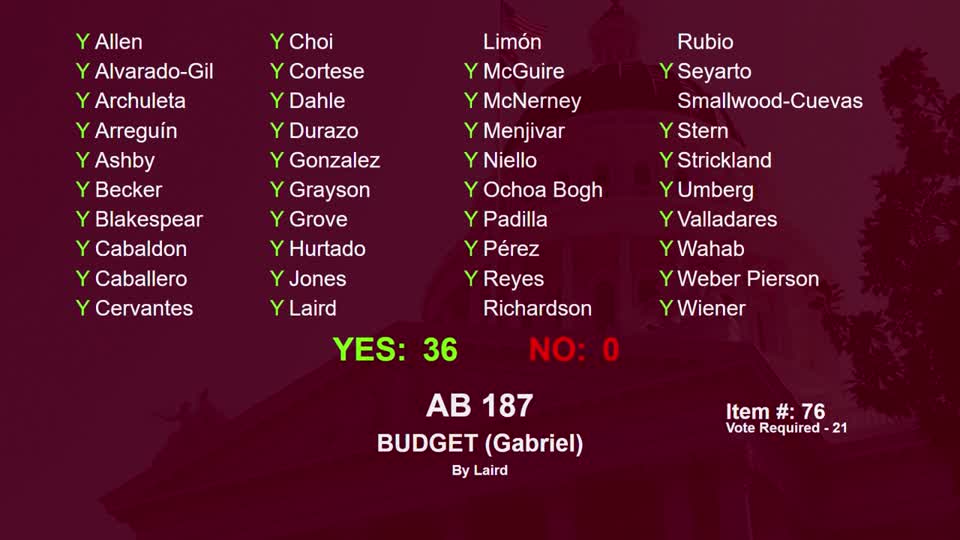 28MIN
Senate Floor
 20MIN
Assembly Floor
 9MIN
Senate Standing Committee on Appropriations
 21MIN
Senate Standing Committee on Public Safety
 15MIN
Senate Standing Committee on Local Government
 14MIN
Senate Standing Committee on Public Safety
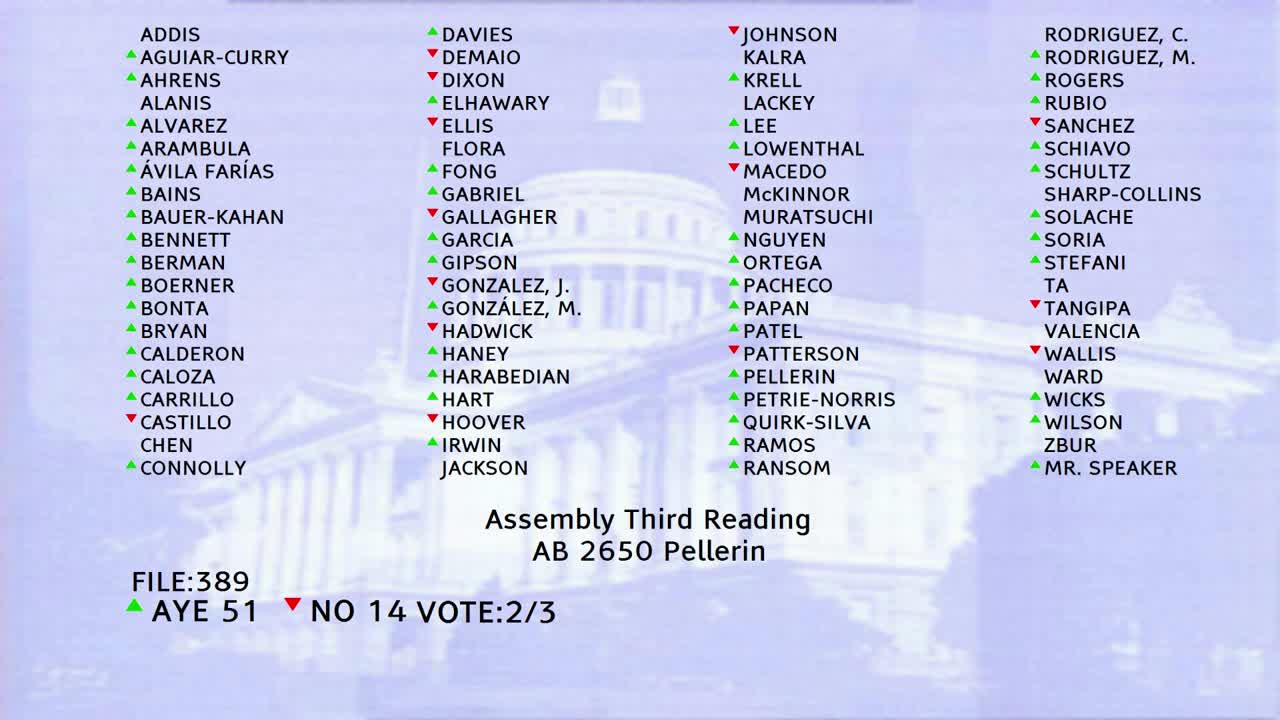 1MIN
Assembly Floor
 9MIN
Assembly Standing Committee on Public Safety



Bill Co-Author(s):