AB 297: Arson: penalties.
- Session Year: 2025-2026
- House: Assembly
- Latest Version Date: 2025-01-23
Current Status:
Failed
(2026-02-02: From committee: Filed with the Chief Clerk pursuant to Joint Rule 56.)
Introduced
In Committee
Awaiting First Chamber Vote
Passed First Chamber
In Committee
Awaiting Second Chamber Vote
Passed Second Chamber
Enacted
What does this bill do?
This bill allows courts to add 3, 4, or 5 extra years to the prison term of someone convicted of felony arson if they caused 500 or more acres of forest land to burn.
The summary is provided by generative AI which can make mistakes. For original language, please view the details in the table below.
Existing law requires that a person who is convicted of felony arson, in addition to the term of imprisonment for the felony, be punished by a 3-, 4-, or 5-year enhancement if one or more of any specified circumstances is found to be true, including that the defendant caused multiple structures to burn in a single violation.
This bill would additionally authorize the 3-, 4-, or 5-year enhancement for a person who proximately causes 500 or more acres of forest land to burn. By expanding the scope of the enhancement, this bill would impose a state-mandated local program.
The California Constitution requires the state to reimburse local agencies and school districts for certain costs mandated by the state. Statutory provisions establish procedures for making that reimbursement.
This bill would provide that no reimbursement is required by this act for a specified reason.
(a)Notwithstanding any other law, any person who is convicted of a felony violation of Section 451 shall be punished by a three-, four-, or five-year enhancement if one or more of the following circumstances is found to be true:
(1)The defendant has been previously convicted of a felony violation of Section 451 or 452.
(2)A firefighter, peace officer, or other emergency personnel suffered great bodily injury as a result of the offense. The additional term provided by this subdivision shall be imposed whenever applicable, including any instance in which when there is a violation of subdivision (a) of Section 451.
(3)The defendant proximately caused great bodily injury to more than one victim in any single violation of Section 451. The additional term provided by this subdivision shall be imposed whenever applicable, including any instance in which when there is a violation of subdivision (a) of Section 451.
(4)The defendant proximately caused multiple structures to burn in any a single violation of Section 451.
(5)The defendant committed arson as described in subdivision (a), (b), or (c) of Section 451 and the arson was caused by use of a device designed to accelerate the fire or delay ignition.
(6)The defendant proximately caused 500 or more acres of forest land to burn in a violation of Section 451.
(b)The additional term specified in subdivision (a) shall not be imposed unless the existence of any fact required under this section shall be is alleged in the accusatory pleading and either admitted by the defendant in open court or found to be true by the trier of fact.
SEC. 2.No reimbursement is required by this act pursuant to Section 6 of Article XIIIB of the California Constitution because the only costs that may be incurred by a local agency or school district will be incurred because this act creates a new crime or infraction, eliminates a crime or infraction, or changes the penalty for a crime or infraction, within the meaning of Section 17556 of the Government Code, or changes the definition of a crime within the meaning of Section 6 of Article XIIIB of the California Constitution.
|
Date
|
Status
|
|---|---|
| Feb 2, 2026 | From committee: Filed with the Chief Clerk pursuant to Joint Rule 56. |
| Jan 31, 2026 | Died pursuant to Art. IV, Sec. 10(c) of the Constitution. |
| Mar 4, 2025 | In committee: Set, first hearing. Failed passage. Reconsideration granted. |
| Feb 10, 2025 | Referred to Com. on PUB. S. |
| Jan 24, 2025 | From printer. May be heard in committee February 23. |
| Jan 23, 2025 | Read first time. To print. |
|
Date
|
Description
|
Location
|
Votes
|
|
|---|---|---|---|---|
| Mar 4, 2025 | Do pass and be re-referred to the Committee on [Appropriations] | Assembly Standing Committee on Public Safety |
Failed |
This list shows positions taken on this bill by organizations on the date displayed, which is linked to the original source.
Positions by individuals are not included.
|
Organization
|
Position
|
Date
|
|---|---|---|
| Aclu California Action | ** Against | |
| All of Us or None Los Angeles | ** Against | |
| Arcadia Police Officers' Association | ** Support | |
| Brea Police Association | ** Support | |
| Burbank Police Officers' Association | ** Support | |
| California Association of School Police Chiefs | ** Support | |
| California Attorneys For Criminal Justice | ** Against | |
| California Coalition of School Safety Professionals | ** Support | |
| California District Attorneys Association | ** Support | |
| California Narcotic Officers' Association | ** Support | |
| California Public Defenders Association | ** Against | |
| California Reserve Peace Officers Association | ** Support | |
| California State Sheriffs' Association | ** Support | |
| Californians United for a Responsible Budget | ** Against | |
| CLAREMONT POLICE OFFICERS ASSOCIATION | ** Support | |
| Courage California | ** Against | |
| Culver City Police Officers' Association | ** Support | |
| Ella Baker Center For Human Rights | ** Against | |
| Friends Committee On Legislation Of California | ** Against | |
| Fullerton Police Officers' Association | ** Support | |
| Initiate Justice | ** Against | |
| Initiate Justice Action | ** Against | |
| LA Defensa | ** Against | |
| Legal Services for Prisoners with Children | ** Against | |
| Local 148 La County Public Defenders Union | ** Against | |
| Los Angeles School Police Management Association | ** Support | |
| los angeles school police officers association | ** Support | |
| Murrieta Police Officers' Association | ** Support | |
| Newport Beach Police Association | ** Support | |
| Palos Verdes Police Officers Association | ** Support | |
| PLACER COUNTY DEPUTY SHERIFFS ASSOCIATION | ** Support | |
| Pomona Police Officers' Association | ** Support | |
| RIVERSIDE POLICE OFFICERS ASSOCIATION | ** Support | |
| Riverside Sheriffs' Association | ** Support | |
| Rubicon Programs | ** Against | |
| San Francisco Public Defender | ** Against | |
| Santa Ana Police Officers Association | ** Support | |
| Sister Warriors Freedom Coalition | ** Against | |
| Smart Justice California, a project of Tides Advocacy | ** Against |
Date of Hearing:
Counsel: Dustin Weber
ASSEMBLY COMMITTEE ON PUBLIC SAFETY
Nick Schultz, Chair
ABPCA Bill Id:AB 297
Author:(Hadwick) – As Introduced Ver:January 23, 2025
CORRECTED
SUMMARY:
Requires a three-, four-, or five-year enhancement for a person convicted of arson who proximately caused 500 or more acres of forest land to burn.
EXISTING LAW:
- Defines arson as willfully and maliciously setting fire to or burning or causing to be burned or aiding, counseling, or procuring the burning of, any structure, forest land, or property. (Pen. Code, § 451).
- Makes arson that causes great bodily injury a felony punishable by imprisonment in the state prison for five, seven, or nine years. (Pen. Code, § 451, subd. (a).)
- Makes arson that causes an inhabited structure or inhabited property to burn a felony punishable by imprisonment in the state prison for three, five, or eight years. (Pen. Code. § 451, subd. (b).)
- Makes arson of a structure or forest land a felony punishable by imprisonment in the state prison for two, four, or six years. (Pen. Code, § 451, subd. (c).)
- Makes arson of property a felony punishable by imprisonment in the state prison for 16 months, two years, or three years, not including a person burning or causing to be burned his or her own personal property unless there is an intent to defraud or there is injury to another person or another person’s structure, forest land, or property. (Pen. Code, § 451, subd. (d).)
- Authorizes a three-, four-, or five-year enhancement for a felony arson conviction if the defendant has a prior conviction for arson or unlawfully causing a fire; a specified first responder suffered great bodily injury as a result of the offense; the defendant proximately caused either great bodily injury to more than one victim or multiple structures to burn; or the defendant committed arson by use of a device designed to accelerate the fire or delay ignition. (Pen. Code, § 451, subd. (a)(1)-(5).)
- Requires confinement in state prison for five, seven, or nine years for any person who commits arson or unlawfully causes a fire during state of emergency. (Pen. Code, §§ 454, subds. (a)(2) & (b).)
- Authorizes one- to four-year sentence enhancements for property value loss between $50,000 and $3,000,000 when any person takes, damages, or destroys any property in the commission or attempted commission of a felony, or commits a felony receiving stolen property. (Pen. Code, § 12202.6, subd. (a)(1)-(4).)
- Makes aggravated arson punishable with 10 years to life if the person previously has been convicted of arson in the past 10 years or the fire caused losses in excess of $10,100,000, which includes the costs of fire suppression. (Pen. Code, § 451.5, subds. (a)(1)-(b).)
FISCAL EFFECT:
Unknown
COMMENTS:
- Author’s Statement: According to the author, “Attributed in part to arson, the Dixie Fire, which began on July 13, 2021 burned almost a million acres. It was the 2nd largest fire in California history. It happened in my backyard and my constituents are still recovering. The current penalties for willful arson do not equally consider the amount of forestland burned, the damage to the environment, and the costs to fight fires. Emissions from fires in 2021, started in part by arsonists, completely wiped out California’s progress to reduce greenhouse gas emissions, disproportionately hurting undeserved rural communities. These communities face devastating impacts during wildfire recovery, including poor air quality, economic loss, and displacement, while lacking the resources to recover as swiftly as wealthier, urban areas. The destruction of vital forestland also directly impacts their access to natural resources and exacerbates challenges to their livelihoods, including agriculture and tourism. This bill closes this loophole and holds arsonists accountable proportional to the harm that they have caused to our rural under resourced communities. Victims of arsonists deserve justice; this bill seeks to hold perpetrators accountable.”
- Effect of the Bill: This bill would authorize a three-, four-, or five-year enhancement for a person convicted of arson who proximately caused 500 or more acres of forestland to burn.
Penalties in this statutory scheme are already significant. Depending on the facts, an arson conviction carries anywhere from 16 months to nine years in state prison. (Pen. Code, § 451, subds. (a)-(d).) A person convicted of arson of forest land is already subject to up to six years in state prison. (Pen. Code, Code, § 451, subd. (c).) Arson that causes great bodily injury in punishable by imprisonment in state prison for up to nine years. (Pen. Code, § 451, subd. (a).) If more than one victim suffers great bodily injury, or if the arson proximately caused multiple structures to burn, the defendant is subject to up to a five-year enhancement. (Pen. Code, § 451.1, subds. (a)(3) & (4).) The same enhancement applies if the defendant has a prior felony conviction for arson or unlawfully causing a fire. (Pen. Code, § 451.1, subd. (a)(1).) The penalty for aggravated arson is 10 years to life (Pen. Code, § 451.5, subd. (c).)
Aggravated arson allows for one of the aggravating factors to be a measure of property damage. Under this law, a fire causing more than $10,100,000 of losses is a qualifying aggravating factor. (Pen. Code, § 451.5, subd. (a)(2)(A).) Proving a person committed arson and proving one of the qualifying aggravating factors is sufficient to convict on aggravated arson and secure a sentence of 10 years to life. (Pen. Code, § 451.5, subd. (c).)
California law already authorizes one- to four-year sentence enhancements for commission or attempted commission of a felony where the property damage is between $50,000 and $3,000,000. (Pen. Code, § 12202.6, subds. (a)(1)-(4).) Any fire that burns 500 or more acres is almost certainly going to cost at least $50,000 in property loss and can easily top the $3,000,000 mark, which would allow prosecutors to seek a four-year enhancement on top of the penalty for the arson conviction.
In fact, there was a relatively significant sentence imposed last year on Gary Maynard, who was responsible for setting a series of fires behind firefighters during the Dixie Fire in 2021.[1] Maynard faced up to 20 years in federal prison and a $250,000 fine.[2] Prosecuted by the US Department of Justice, his sentence ultimately included nearly five-and-a-half years in prison, more than $13,000 in restitution fines, and three years of supervised release.[3]
Given the availability and severity of existing laws, it is unclear whether additional penalties are warranted in this area of the law.
- Sentence Enhancements: This bill would authorize sentence enhancements for causing 500 or more acres to burn.
Enhancements have been widely used in California.[4] Indeed, more than half of currently incarcerated women and more than two-thirds of currently incarcerated men have at least one sentence enhancement.[5] Sentence enhancements increase an individual’s prison sentence, which then increases the size of our prison population.[6] Sentence enhancements are applied disproportionately to Black men.[7] A 2023 study found, “Black people are over-represented among the currently incarcerated with sentence enhancements while Hispanic people are slightly under-represented. Among those without a sentence enhancement, 49% are Hispanic while 19% are Black. Individuals serving a sentence with an enhancement are overwhelmingly male.”[8]
Sentence enhancements increase the average sentence by nearly 2 years for all admissions.[9] Confinement length for those with a sentence enhancement is approximately 5 years longer compared to those without an enhancement.[10] Approximately 40% of prison admissions since 2015 have sentences lengthened by a sentence enhancement.[11]
There is reason to doubt the effectiveness of enhancements. Reliable evidence shows increased penalties generally fail to deter criminal behavior.[12] Instead, data shows a rise in deterrence linked with the likelihood of being caught and the perception of being caught.[13] In contrast, the act of punishment and the length of punishment largely do not increase deterrence.[14]
Given the questionable effectiveness of enhancements on criminal deterrence, one might reasonably question whether this proposed enhancement would meaningfully deter people from committing arson or reduce the number of arsons each year.
- Costs of Incarceration: This bill would increase sentence lengths for burning of 500 or more acres of forest land. The effect of this change, among other things, would mean longer terms of confinement. More people sentenced to state prison for longer terms of confinement means larger prison populations. In 2011, the U.S. Supreme Court ordered California to reduce its prison population because of overcrowding. (Brown, et al. v. Plata, et al. (2011) 463 U.S. 593.) The costs of incarcerating a person have also risen dramatically in recent years—from $91,000 per person in 2019 to $133,000 per person in 2024.[15]
The passage of Proposition 36 has caused the Legislative Analyst’s Office (LAO) to project an increase of more than 4,000 people in confinement over the next two years.[16] Higher carceral populations create the conditions for prison overcrowding. Therefore, one might reasonably question whether adding more sentence enhancements is sound public policy.
- Proximate Causation Problems: This bill would authorize sentence enhancements for any person convicted of arson who is the proximate cause of 500 or more acres of forest land to burn.
Proximate causation is a confusing concept in the law. Courts have done their best to apply this murky requirement to the facts and law at issue, however, the law remains no clearer despite their efforts.
For more than half a century the concept of proximate cause has frustrated courts and misled jurors. The California Supreme Court in one case wrote, “Even courts and the legal community have struggled with the meaning of proximate causation.” (People v. Bland (2002) 28 Cal.4th 313, 334-335). In another case the court noted, “The misunderstanding engendered by the term ‘proximate cause’" has been documented. In a scholarly study of 14 jury instructions, [the instruction for proximate cause] produced proportionally the most misunderstanding among laypersons.” (Mitchell v. Gonzales (1991) 54 Cal.3d 1041, 1051.) As far back as the 1950s, an appeals court judge said, “The concept of proximate causation has given courts and commentators consummate difficulty and has in truth defied precise definition.” (State Comp. Ins. Fund v. Ind. Acc. Com. (1959) 176 Cal.App.2d 10, 20.)
Despite the misunderstanding, we charge juries with applying this concept knowing they do not understand it in the first place. This is not ideal. Adding another law to the books that lacks clarity, evades clear application, and demonstrably confuses the people responsible for rendering verdicts could lead to undesirable consequences.
- Argument in Support: According to the California District Attorneys Association, “Under existing law, a person convicted of felony arson may receive this enhancement if they have previously been convicted of certain arsons, caused great bodily injury, or destroyed multiple structures. However, large-scale wildfires devastate California’s environment, endanger communities, and place an enormous financial burden on state and local agencies. Recognizing the catastrophic impact of these crimes, AB 297 appropriately extends the sentencing enhancement to cases where arson results in significant destruction of forest land.
“California continues to experience increasingly severe wildfires, many of which are the result of deliberate acts of arson. Strengthening accountability for arsonists whose actions lead to large-scale devastation is an important step in protecting lives, property, and our natural resources.”
- Argument in Opposition: According to Initiate Justice, “Arson of a structure or forest land is already a felony punishable in state prison by two, four, or six years. Notably, felony arson of forest land (CPC 451(c)) does not require that an individual intend to burn or destroy forest land, other harm, or even start a fire. In re VV, 51 Cal. 4th 1020, 1023, 252 P.3d 979, 980 (2011) (Two youth were found guilty of felony arson of forest land where they ignited a firecracker “without intent to cause a fire or any other harm”) (emphasis added). Individuals with mental health conditions are disproportionately represented in individuals convicted of arson. AB 297 will waste California’s resources by increasing prison sentences largely for individuals with mental health conditions who may or may not have intent to cause harm, destroy property, or to even start a fire. AB 297 would also capture individuals who caused fires accidently and proximately caused forest land to burn because power companies failed to implement wildfire prevention plans or heed advice from firefighters to shut power lines. California should direct its limited resources to corporations that actually have the ability to prevent the start and spread of wildfires.
“The report to the California Legislature found that the new Office of Energy Infrastructure Safety approved utility companies’ wildfire prevention plans even when they were ‘seriously deficient.’ Included were plans by Pacific Gas & Electric, California’s largest utility, which was held responsible for sparking the state’s deadliest wildfire, the Camp Fire that killed 85 people in 2018. (Julie Cart, Audit: California utilities aren’t doing enough to reduce wildfire threats, CalMatters. March 24, 2022).
“While investigations continue regarding the causes and major amplifiers of the tragic Los Angeles fires that began in January 2025, fire radio traffic strongly suggests Edison live power lines impeded firefighting efforts. On January 8, firefighters were asking SoCal Edison to shut power off to a second neighborhood– Altadena.”
- Related Legislation: AB 336 (Wallis), would change the penalty for causing a fire by recklessly setting fire to, burning, or causing to be burned, any structure, forest land, or property from an alternate misdemeanor/felony to a straight felony. AB 336 is scheduled to be heard today in this committee.
- Prior Legislation:
- SB 1242 (Min), Chapter 173, Statutes of 2024, provides that for the crime of reckless fire setting, if the offense was carried out within a merchant’s premises in order to facilitate organized retail theft, it shall be a factor in aggravation at sentencing.
- SB 281 (McGuire), Chapter 706, Statutes of 2023, increases the dollar amount of property damages and other losses required to be an aggravating factor to $10,100,000, exclusive of damage to, or destruction of, inhabited dwellings and extend the operation of the former aggravated arson offense until January 1, 2029.
- SB 1242 (Min), Chapter 173, Statutes of 2024, provides that for the crime of reckless fire setting, if the offense was carried out within a merchant’s premises in order to facilitate organized retail theft, it shall be a factor in aggravation at sentencing.
REGISTERED SUPPORT / OPPOSITION:
Support
Arcadia Police Officers' Association
Brea Police Association
Burbank Police Officers' Association
California Association of School Police Chiefs
California Coalition of School Safety Professionals
California District Attorneys Association
California Narcotic Officers' Association
California Reserve Peace Officers Association
California State Sheriffs' Association
Claremont Police Officers Association
Culver City Police Officers' Association
Fullerton Police Officers' Association
Los Angeles School Police Management Association
Los Angeles School Police Officers Association
Murrieta Police Officers' Association
Newport Beach Police Association
Palos Verdes Police Officers Association
Placer County Deputy Sheriffs' Association
Pomona Police Officers' Association
Riverside Police Officers Association
Riverside Sheriffs' Association
Santa Ana Police Officers Association
Oppose
ACLU California Action
All of Us or None Los Angeles
California Attorneys for Criminal Justice
California Public Defenders Association (CPDA)
Californians United for A Responsible Budget
Courage California
Ella Baker Center for Human Rights
Friends Committee on Legislation of California
Initiate Justice
Initiate Justice Action
LA Defensa
Legal Services for Prisoners With Children
Local 148 LA County Public Defenders Union
Rubicon Programs
San Francisco Public Defender
Sister Warriors Freedom Coalition
Smart Justice California, a Project of Tides Advocacy
Analysis Prepared by:
Dustin Weber / PUB. S. / (916) 319-3744
“Former Professor Sentenced for Setting Multiple Fires Blocking in Firefighters Responding to the Dixie Fire” (May 30, 2024) U.S. Department of Justice <https://www.justice.gov/usao-edca/pr/former-professor-sentenced-setting-multiple-fires-blocking-firefighters-responding> [as of Feb. 27, 2025]. ↑
Downs, Former criminal justice college professor pleads guilty to setting fires near Dixie Fire (May 30, 2024) CBSNews.com <https://www.cbsnews.com/sacramento/news/former-criminal-justice-college-professor-pleads-guilty-to-setting-fires-near-dixie-fire/> [as of Feb. 27, 2025].) ↑
Ibid. ↑
Bird, et al., Sentence Enhancements in California, Cal. Policy Lab (Mar. 2023) <https://www.capolicylab.org/wp-content/uploads/2023/03/Sentence-Enhancements-in-California.pdf> [as of Feb. 25, 2025]. ↑
Ibid. ↑
Ibid. ↑
Ibid. ↑
Ibid. ↑
Ibid. ↑
Ibid. ↑
Ibid. ↑
Five Things About Deterrence (May 2016) National Institute of Justice <https://www.ojp.gov/pdffiles1/nij/247350.pdf> [as of Feb. 25, 2025]. ↑
Ibid. ↑
Ibid. ↑
Harris, et al., California’s Prison Population (Sept. 2024) Public Policy Institute of California <https://www.ppic.org/publication/californias-prison-population/> [as of Feb. 27, 2025]. ↑
The 2025-26 Budget: California Department of Corrections and Rehabilitation (Feb. 25, 2025) Legislative Analyst’s Office https://lao.ca.gov/Publications/Report/4986> [as of Feb. 26, 2026]. ↑
Discussed in Hearing
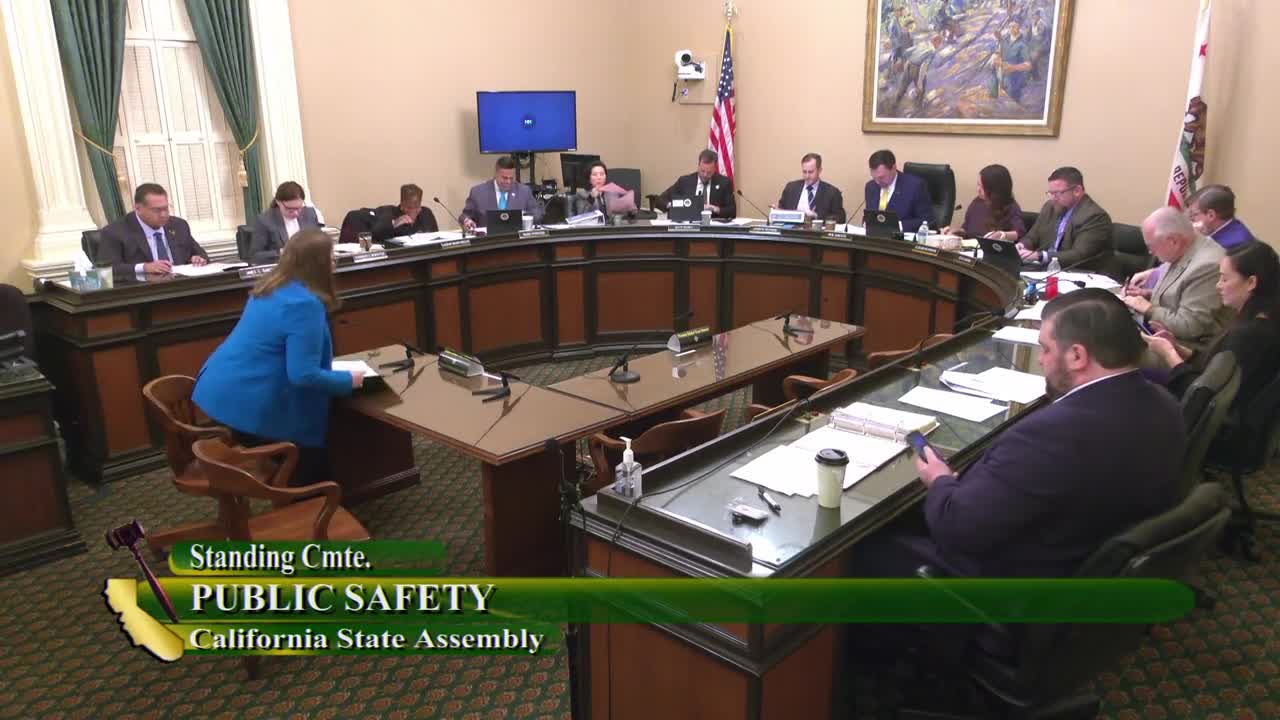 25MIN
Assembly Standing Committee on Public Safety


Bill Co-Author(s):