AB 330: Local Prepaid Mobile Telephony Services Collection Act.
- Session Year: 2025-2026
- House: Assembly
- Latest Version Date: 2025-10-10
Current Status:
Passed
(2025-10-10: Chaptered by Secretary of State - Chapter 553, Statutes of 2025.)
Introduced
In Committee
Awaiting First Chamber Vote
Passed First Chamber
In Committee
Awaiting Second Chamber Vote
Passed Second Chamber
Enacted
The Local Prepaid Mobile Telephony Services Collection Act, until January 1, 2026, suspends the authority of a city, county, or city and county to impose a utility user tax on the consumption of prepaid communications service and any charge that applies to prepaid mobile telephony service, as defined, on access to communication services or access to local 911 emergency telephone systems, and instead requires those taxes and charges to be applied during the period beginning January 1, 2016, and ending January 1, 2026, under any local ordinance to be at specified rates. The act requires that these local charges imposed by a city, county, or a city and county on prepaid mobile telephony services be collected from the prepaid consumer by a seller at the time of sale, as specified. Existing law requires that all local charges be collected and paid to the California Department of Tax and Fee Administration pursuant to the Fee Collection Procedures Law and be deposited into the Local Charges for Prepaid Mobile Telephony Services Fund, and be transmitted to the city, county, or city and county, as provided.
This bill would extend operation of the act until January 1, 2031. By extending the application of the Fee Collection Procedures Law, the violation of which is a crime, the bill would impose a state-mandated local program.
The act authorizes a consumer to rebut the presumed location of a retail transaction for purposes of the collection of the local charges by filing a claim and declaration under penalty of perjury.
By extending the act, this bill would expand the crime of perjury, thereby imposing a state-mandated local program.
The California Constitution requires the state to reimburse local agencies and school districts for certain costs mandated by the state. Statutory provisions establish procedures for making that reimbursement.
This bill would provide that no reimbursement is required by this act for a specified reason.
This part shall remain in effect only until January 1, 2031, and as of that date is repealed, unless a later enacted statute, that is enacted before January 1, 2031, deletes or extends that date.
SEC. 2.No reimbursement is required by this act pursuant to Section 6 of Article XIIIB of the California Constitution because the only costs that may be incurred by a local agency or school district will be incurred because this act creates a new crime or infraction, eliminates a crime or infraction, or changes the penalty for a crime or infraction, within the meaning of Section 17556 of the Government Code, or changes the definition of a crime within the meaning of Section 6 of Article XIIIB of the California Constitution.
This part shall remain in effect only until January 1, 2026, 2031, and as of that date is repealed, unless a later enacted statute, that is enacted before January 1, 2026, 2031, deletes or extends that date.
SEC. 2.No reimbursement is required by this act pursuant to Section 6 of Article XIIIB of the California Constitution because the only costs that may be incurred by a local agency or school district will be incurred because this act creates a new crime or infraction, eliminates a crime or infraction, or changes the penalty for a crime or infraction, within the meaning of Section 17556 of the Government Code, or changes the definition of a crime within the meaning of Section 6 of Article XIIIB of the California Constitution.
|
Date
|
Status
|
|---|---|
| Oct 10, 2025 | Chaptered by Secretary of State - Chapter 553, Statutes of 2025. |
| Oct 10, 2025 | Approved by the Governor. |
| Sep 15, 2025 | Enrolled and presented to the Governor at 4:30 p.m. |
| Sep 8, 2025 | In Assembly. Ordered to Engrossing and Enrolling. |
| Sep 8, 2025 | Read third time. Passed. Ordered to the Assembly. (Ayes 36. Noes 0. Page 2601.). |
| Jul 8, 2025 | Read second time. Ordered to third reading. |
| Jul 7, 2025 | From committee: Be ordered to second reading pursuant to Senate Rule 28.8. |
| Jun 25, 2025 | From committee: Do pass and re-refer to Com. on APPR. (Ayes 4. Noes 0.) (June 25). Re-referred to Com. on APPR. |
| Jun 11, 2025 | Referred to Com. on REV. & TAX. |
| Jun 3, 2025 | In Senate. Read first time. To Com. on RLS. for assignment. |
| Jun 2, 2025 | Read third time. Passed. Ordered to the Senate. (Ayes 63. Noes 2. Page 1819.) |
| May 27, 2025 | Read second time. Ordered to third reading. |
| May 23, 2025 | From committee: Do pass. (Ayes 11. Noes 0.) (May 23). |
| May 21, 2025 | Joint Rule 62(a), file notice suspended. (Page 1627.) |
| May 21, 2025 | In committee: Set, first hearing. Referred to APPR. suspense file. |
| May 14, 2025 | In committee: Hearing postponed by committee. |
| Apr 29, 2025 | From committee: Do pass and re-refer to Com. on APPR. (Ayes 5. Noes 0.) (April 28). Re-referred to Com. on APPR. |
| Mar 17, 2025 | In committee: Set, second hearing. Referred to REV. & TAX. suspense file. |
| Mar 10, 2025 | In committee: Set, first hearing. Hearing canceled at the request of author. |
| Feb 10, 2025 | Referred to Com. on REV. & TAX. |
| Jan 28, 2025 | From printer. May be heard in committee February 27. |
| Jan 27, 2025 | Read first time. To print. |
|
Date
|
Description
|
Location
|
Votes
|
|
|---|---|---|---|---|
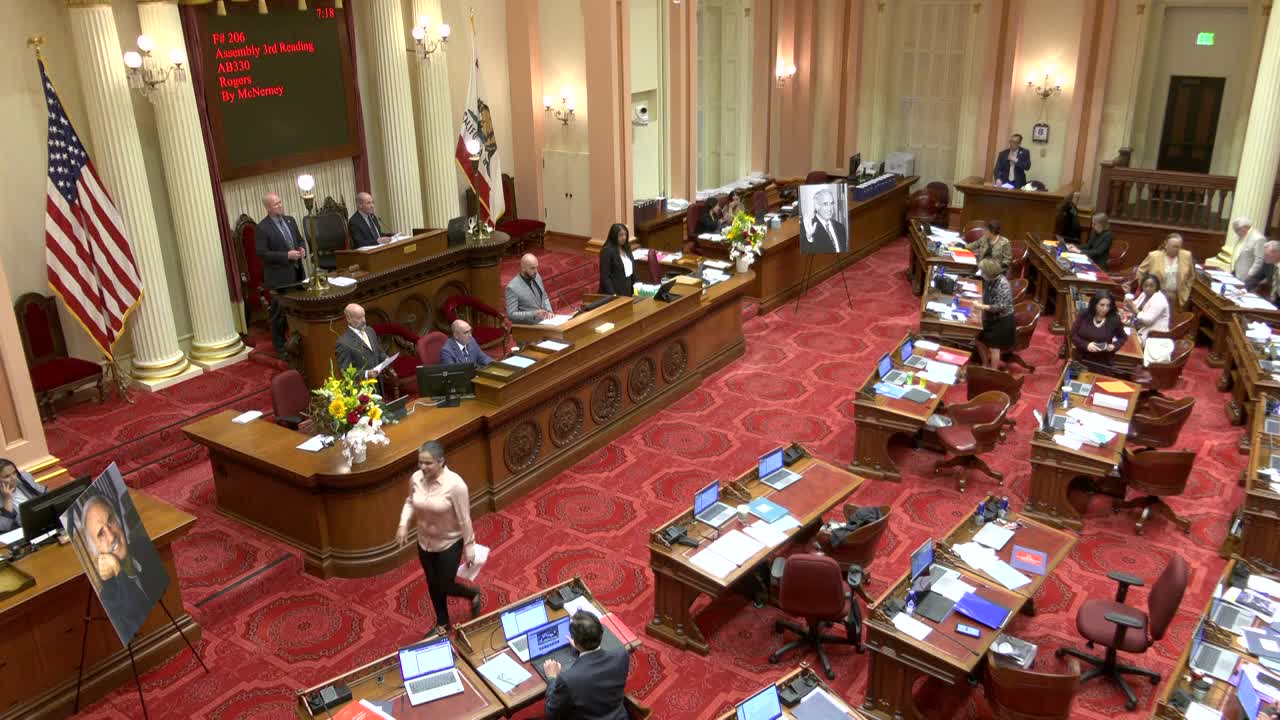
| Sep 8, 2025 | Assembly 3rd Reading AB330 Rogers By McNerney | Senate Floor |
Passed |
|
| Jun 25, 2025 | Do pass, but first be re-referred to the Committee on [Appropriations] | Senate Standing Committee on Revenue and Taxation |
Passed |
|
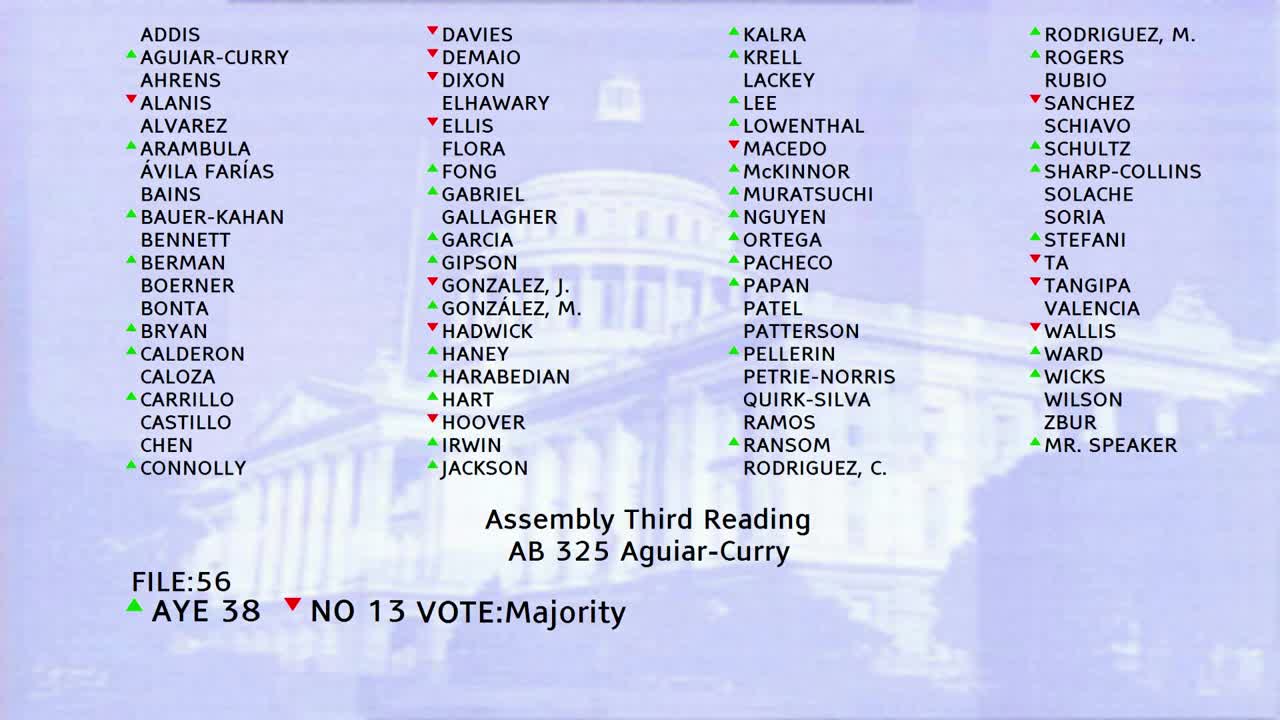
| Jun 2, 2025 | AB 330 Rogers Assembly Third Reading | Assembly Floor |
Passed |
|
| May 23, 2025 | Do pass. | Assembly Standing Committee on Appropriations |
Passed |
|
| Apr 28, 2025 | Do pass and be re-referred to the Committee on [Appropriations] | Assembly Standing Committee on Revenue and Taxation |
Passed |
This list shows positions taken on this bill by organizations on the date displayed, which is linked to the original source.
Positions by individuals are not included.
|
Organization
|
Position
|
Date
|
|---|---|---|
| California Contract Cities Association | ** Support | |
| Cellular Telecommunications Industry Association | ** Support | |
| City of Burbank/Burbank Redevelopment Agency | ** Support | |
| City Of Chula Vista | ** Support | |
| City of El Cerrito Mayor Carolyn Wysinger | ** Support | |
| City of Glendale | ** Support | |
| City Of Inglewood | ** Support | |
| City of Norwalk | ** Support | |
| City of Pico Rivera | ** Support | |
| City of Redwood City | ** Support | |
| County Of Alameda | ** Support | |
| CTIA | ** Support | |
| League Of California Cities | ** Support | |
| Muniservices | ** Support |
SENATE RULES COMMITTEE Office of Senate Floor Analyses (916) 651-1520 Fax: (916) 327-4478 | AB 330 |
THIRD READING
Bill No: AB 330
Author: Rogers (D)
Introduced: 1/27/25
Vote: 21
SENATE REVENUE AND TAXATION COMMITTEE: 4-0, 6/25/25
AYES: McNerney, Ashby, Grayson, Umberg
NO VOTE RECORDED: Valladares
SENATE APPROPRIATIONS COMMITTEE: Senate Rule 28.8
ASSEMBLY FLOOR: 63-2, 6/2/25 - See last page for vote
SUBJECT: Local Prepaid Mobile Telephony Services Collection Act
SOURCE: MuniServices
DIGEST:
This bill extends the sunset date of the Local Prepaid Mobile Telephony Services Collection Act from January 1, 2026, to January 1, 2031.
ANALYSIS:
Existing law:
- Authorizes local agencies to impose utility users’ taxes (UUTs), which are excise taxes imposed on the consumption of utility services, including electricity, gas, water, sewer, telephone, sanitation, and cable television.
- Requires a wireless telephone services carrier to remit UUT charges collected from a customer to the local jurisdiction where the customer primarily uses the phone.
- Enacts the Prepaid Mobile Telephony Services Surcharge Collections Act, which requires sellers of prepaid wireless telecommunications services to collect a fee measured as a percentage of the sales price, known as the Mobile Telephony Services (MTS) fee (AB 1717 (Perea, Chapter 885, Statutes of 2014)), comprised of two parts:
- The prepaid MTS surcharge, which adds together state fees charged by the California Public Utilities Commission (CPUC) to fund the state’s universal services fund among other CPUC charges, plus surcharges on telecommunications services determined by the Office of Emergency Services (OES) to fund the state’s 911 emergency response system.
- The Local Prepaid Mobile Telephony Services Collection Act, which created the second part of the MTS fee – the local charge – which adds together local UUTs and any charges to fund local 911 emergency fees that apply in the jurisdiction where the customer purchases the prepaid MTS services.
- Directs OES and CPUC to calculate the appropriate fee rate or rates for prepaid services, send the rate or rates appropriate for its purposes to the State Board of Equalization, now the California Department of Tax and Fee Administration (CDTFA), which then calculates the overall prepaid MTS surcharge rate.
- Allows sellers of prepaid wireless services to choose to pay the actual local UUT rate, or the one set by the Act.
- Provides that the MTS fee was the exclusive method for collecting UUTs, local 911 charges, or any other charge on prepaid wireless, and defines the scope of any tax or charge.
- Commenced collection of the MTS fee on January 1, 2016, directing sellers of prepaid wireless services to remit funds to the California Department of Tax and Fee Administration (CDTFA), which in turn distributes fee proceeds to the appropriate state or local agency.
- Exempts sellers with less than $15,000 in sales in the previous calendar year from the requirement to collect the MTS fee, and directs CDTFA to adjust the $15,000 threshold for inflation annually.
- Provides vendor compensation for indirect sellers, or those retailers who sell prepaid services but are not mobile telephony service or Voice over Internet Protocol providers, equal to 2% of the fees collected.
- Replaces the previous state 911 surcharge with a new monthly charge to fund the state’s 911 emergency response system (SB 96 (Committee on Budget and Fiscal Review, Chapter 54, Statutes of 2019)), effective on January 1, 2020, which:
- Maintained OES’s role determining the amount of the charge.
- Changes the measure of the charge to up to $0.80 per access line per month, instead of the previous cap of 1% of charges for services.
- Applies to sellers of prepaid MTS at the rate of up to $0.80 per retail transaction in California, paid by the consumer at the time of purchase.
- Extended the Local Prepaid Mobile Telephony Services Collection Act until January 1, 2021 (SB 344 (McGuire, Chapter 642, Statutes of 2019)), with some modifications.
- Extended the Local Prepaid Mobile Telephony Services Collection Act until January 1, 2026 (SB 1441 (McGuire, Chapter 179, Statutes of 2020)) and imports into the Act several administrative provisions previously part of the Prepaid Mobile Telephony Services Surcharge Collections Act, with some modifications:
This bill extends the sunset date of the Local Prepaid Mobile Telephony Services Collection Act from January 1, 2026, to January 1, 2031.
Background
Wireless telecommunications consumers who have contracts with carriers to provide wireless telephony services pay UUTs as part of their monthly bills, and the carrier remits these funds to the local jurisdiction where the consumer primarily uses the phone, if that jurisdiction imposes a UUT. However, prepaid wireless customers who purchase services from carriers in the form of prepaid cards do not have a similar ongoing contractual relationship with a carrier. Prior to 2014, collecting UUTs from prepaid customers was challenging. Customers typically purchased prepaid services from third-party retail outlets and paid in full before using the service, so no mechanism existed to collect ongoing charges from these prepaid customers.
MetroPCS v. Picker. On November 15, 2018, the United States District Court for the Northern District of California ruled that the Prepaid MTS Act, and the CPUC resolutions implementing the calculation of the Act’s fee, were preempted by federal law and unconstitutional under the Supremacy Clause (MetroPCS California, LLC v. Michael Picker et al, 348, F. Supp. 3d. 948). On August 14, 2020, the Ninth Circuit Court reversed the district court’s facial preemption ruling and remanded the case for further proceedings as applied to MetroPCS (MetroPCS California, LLC v. Picker et al, 970 F.3d 1106 (9th Cir. 2020)). On remand, the lower court permanently enjoined the CPUC from enforcing the Act’s fee against MetroPCS. (MetroPCS California, LLC v. Marybel Batjer, et al., No. 17-CV-05959-SI, N.D. Cal. Sept. 22, 2021; MetroPCS California, LLC v. Reynolds, No. 3:17-CV-05959-JD, N.D. Cal. Aug. 4, 2023). The Local Prepaid MTS charge was not challenged in this case.
Direct revenue. In jurisdictions that impose a UUT, a utility company generally collects the tax through the bills it sends to utility customers and remits the revenues to the local government that imposed the tax. Although a city or county can impose a UUT as a special tax, nearly all UUTs are imposed as general taxes. 156 cities, three counties (Alameda, Los Angeles, and Sacramento), and the City and County of San Francisco impose a UUT, which results in annual revenues of approximately $2.4 billion statewide.
As of 2025, 104 cities in 29 counties impose a Prepaid MTS Local charge, with most rates ranging from 1.5% to 9%, and San Francisco imposing a rate of 16.02%. In 2024, CDTFA distributed $1,277,264.20 to local agencies and incurred $637,616.33 in administrative costs. Year-over-year trends show a downward decline in revenues raised under the Local Act. For example, in 2016, the Local Act raised $10,109,145.68 but in 2023 only raised $1,253,374.33. The decline in revenue is strongly correlated with consumers shifting away from prepaid plans to postpaid plans, although other relevant factors may also be at play.
FISCAL EFFECT: Appropriation: No Fiscal Com.: Yes Local: Yes
Senate Rule 28.8
SUPPORT: (Verified 7/725)
MuniServices (Source)
California Contract Cities Association
Cellular Telecommunications Industry Association
City of Burbank/Burbank Redevelopment Agency
City of Chula Vista
City of El Cerrito Mayor Carolyn Wysinger
City of Glendale
City of Inglewood
City of Norwalk
City of Pico Rivera
City of Redwood City
County of Alameda
League of California Cities
OPPOSITION: (Verified 7/7/25)
None received
ARGUMENTS IN SUPPORT: According to the Author, “AB 330 will extend the sunset date of the Local Prepaid Mobile Telephony Services Collection Act (or MTS) to January 1, 2031. In Assembly District 2, Arcata (Humboldt County), Cloverdale (Sonoma County), and Sebastopol (Sonoma County) levy the Prepaid Mobile Telephony Services Surcharge. This extension allows local governments to continue collecting critical revenues from prepaid MTS. Without an extension, local governments would face a loss of these important funds, exacerbating existing financial pressures. AB 330 is vital to maintain financial stability for local governments and continue funding the services that support California’s communities.”
ASSEMBLY FLOOR: 63-2, 6/2/25
AYES: Addis, Aguiar-Curry, Ahrens, Alvarez, Arambula, Ávila Farías, Bains, Bauer-Kahan, Bennett, Berman, Boerner, Bonta, Bryan, Calderon, Caloza, Carrillo, Connolly, Davies, Elhawary, Fong, Gabriel, Garcia, Gipson, Jeff Gonzalez, Mark González, Haney, Harabedian, Hart, Irwin, Jackson, Kalra, Krell, Lee, Lowenthal, McKinnor, Muratsuchi, Nguyen, Ortega, Pacheco, Papan, Patel, Patterson, Pellerin, Petrie-Norris, Quirk-Silva, Ramos, Ransom, Celeste Rodriguez, Michelle Rodriguez, Rogers, Blanca Rubio, Schiavo, Schultz, Sharp-Collins, Solache, Soria, Stefani, Valencia, Ward, Wicks, Wilson, Zbur, Rivas
NOES: DeMaio, Ellis
NO VOTE RECORDED: Alanis, Castillo, Chen, Dixon, Flora, Gallagher, Hadwick, Hoover, Lackey, Macedo, Sanchez, Ta, Tangipa, Wallis
Prepared by: Haley Summers / REV. & TAX. / (916) 651-4117
7/8/25 16:38:47
**** END ****
SENATE COMMITTEE ON REVENUE AND TAXATION
Senator Jerry McNerney, Chair
2025 - 2026 Regular
Bill No: | AB 330 | Hearing Date: | 6/25/25 |
Author: | Rogers | Tax Levy: | No |
Version: | 1/27/25 | Fiscal: | Yes |
Consultant: | Summers | ||
Local Prepaid Mobile Telephony Services Collection Act
Extends the sunset date of the Local Prepaid Mobile Telephony Services Collection Act from January 1, 2026, to January 1, 2031.
Background
Utility users taxes (UUTs) are excise taxes imposed on consumers of utilities by cities and counties on the consumption of utility services, including electricity, gas, water, sewer, telephone, sanitation, and cable television. In jurisdictions that impose a UUT, a utility company generally collects the tax through the bills it sends to utility customers and remits the revenues to the local government that imposed the tax. Although a city or county can impose a UUT as a special tax, nearly all UUTs are imposed as general taxes. 156 cities, three counties (Alameda, Los Angeles, and Sacramento), and the City and County of San Francisco impose a UUT, which results in annual revenues of approximately $2.4 billion statewide.[1] Most UUTs apply to wireless telephone services, with the tax measured as a percentage of the carrier’s charges to the customer.
Wireless telecommunications consumers who have contracts with carriers to provide wireless telephony services pay UUTs as part of their monthly bills, and the carrier remits these funds to the local jurisdiction where the consumer primarily uses the phone, if that jurisdiction imposes a UUT. However, prepaid wireless customers who purchase services from carriers in the form of prepaid cards do not have a similar ongoing contractual relationship with a carrier. Prior to 2014, collecting UUTs from prepaid customers was challenging. Customers typically purchased prepaid services from third-party retail outlets and paid in full before using the service, so no mechanism existed to collect ongoing charges from these prepaid customers.
AB 1717. In 2014, the Legislature enacted the Prepaid Mobile Telephony Services Surcharge Collections Act, which required sellers of prepaid wireless telecommunications services to collect a fee measured as a percentage of the sales price, known as the Mobile Telephony Services (MTS) fee (AB 1717, Perea). The first component of the MTS fee is the prepaid MTS surcharge, which adds together fees charged by the California Public Utilities Commission (CPUC) to fund the state’s universal services fund among other CPUC charges, plus surcharges on telecommunications services determined by the Office of Emergency Services (OES) to fund the state’s 911 emergency response system. AB 1717 also enacted the Local Prepaid Mobile Telephony Services Collection Act (Local Act), which created the second part of the MTS fee – the local charge, which adds together local UUTs and any charges to fund local 911 emergency fees that apply in the jurisdiction where the customer purchases the prepaid MTS services.
AB 1717 directed OES and CPUC to calculate the appropriate fee rate or rates for prepaid services, send the rate or rates appropriate for its purposes to the State Board of Equalization, now the California Department of Tax and Fee Administration (CDTFA), which then calculated the overall prepaid MTS surcharge rate. CDTFA then added any applicable local charge, according to rates set in the bill, ranging from 0% to 9%, to approximate variable local UUT rates established by local agencies, plus any applicable local 911 and 988 charges. CDTFA then added the statewide and local rates together to determine the overall rate applicable to each transaction in each jurisdiction. Sellers could choose to pay the actual local UUT rate or pay the one set by the bill. AB 1717 provided that the MTS fee was the exclusive method for collecting UUTs, local 911 charges, or any other charge on prepaid wireless, as well as defining the scope of any tax or charge.
Sellers of prepaid wireless services began collecting the fee on January 1, 2016, remitting funds to CDTFA, which in turn distributed fee proceeds to the appropriate state or local agency. Sellers with less than $15,000 in sales in the previous calendar year, adjusted annually for inflation, were not required to collect the fee. The bill allowed vendor compensation for indirect sellers, or those retailers who sell prepaid services but are not mobile telephony service or voice over internet providers, equal to 2% of the fees collected. AB 1717 sunset both Acts on January 1, 2020.
MetroPCS v. Picker. In 2017, mobile telecommunications provider MetroPCS brought an action in the Northern District of California federal court against the California Public Utilities Commission (CPUC), contending that its calculation of its portion of the MTS fee impermissibly assesses interstate revenues in conflict with federal law. On November 15, 2018, the United States District Court for the Northern District of California declared that the Prepaid Collection Act and the CPUC resolutions implementing the calculation of its part of the fee were in conflict with federal law, and therefore preempted and unconstitutional under the Supremacy Clause (MetroPCS California, LLC v. Michael Picker et al, 348, F. Supp. 3d. 948). The decision enjoined state agencies from enforcing the Prepaid Mobile Telephony Services Surcharge Collections Act. However, the decision did not affect CDTFA’s administration of the local charge, which was not an issue in the case. As a result, on December 14, 2018, CDTFA notified prepaid MTS sellers to stop collecting the prepaid MTS surcharge.
On appeal, the Ninth Circuit reversed the district court’s facial pre-emption ruling on August 14, 2020, and remanded the case for further proceedings as applied to MetroPCS (MetroPCS California, LLC v. Picker et al, 970 F.3d 1106 (9th Cir. 2020)).[2] However, by that time, the prepaid MTS surcharge had already sunset in statute.
SB 96. In 2019, the Legislature approved SB 96 (Committee on Budget and Fiscal Review), which imposed a new monthly surcharge to replace the previous charge determined by OES to fund the state’s 911 emergency response system. SB 96 maintained OES’s role in determining the amount of the charge, up to $0.80 per access line per month, instead of the previous cap of 1% of charges for services. SB 96 also applied to sellers of prepaid MTS at the rate of up to $0.80 per retail transaction in California, paid by the consumer at the time of purchase. SB 96’s fee became effective January 1, 2020.
SB 344. As mentioned above, AB 1717 sunset both the Prepaid Mobile Telephony Services Surcharge Collections Act and the Local Act on January 1, 2020. While the federal court’s invalidation of the state fee precluded the Legislature from extending it without significant modifications, the Legislature extended the local component of the MTS fee for one year to January 1, 2021, with some changes (SB 344, McGuire, 2019). As a result, prepaid wireless retailers continue to collect the local charge, which is measured as a percentage of the sales price, as well as SB 96’s fee, effective in 2020, to fund 911 emergency response, which is measured as a flat amount per transaction.
SB 1441. The Local Act’s sunset date was extended by SB 1441 (McGuire, 2020) from January 1, 2021, to January 1, 2026. Additionally, because the Local Act explicitly referred to many key definitions and administrative provisions in the Prepaid Collection Act, SB 1441 added into the Local Act several provisions of law that were previously part of the Prepaid Mobile Telephony Services Surcharge Collections Act to ensure effective administration of the Local Act.
MuniServices wants to extend the sunset on the Local Act to January 1, 2031.
Proposed Law
Assembly Bill 330 extends the sunset date of the Local Prepaid Mobile Telephony Services Collection Act from January 1, 2026, to January 1, 2031.
State Revenue Impact
According to the CDTFA, AB 330 is estimated to generate approximately $1.84 million in revenue for calendar year 2026.
Comments
1. Purpose of the bill. According to the Author, “AB 330 will extend the sunset date of the Local Prepaid Mobile Telephony Services Collection Act (or MTS) to January 1, 2031. In Assembly District 2, Arcata (Humboldt County), Cloverdale (Sonoma County), and Sebastopol (Sonoma County) levy the Prepaid Mobile Telephony Services Surcharge. This extension allows local governments to continue collecting critical revenues from prepaid MTS. Without an extension, local governments would face a loss of these important funds, exacerbating existing financial pressures. AB 330 is vital to maintain financial stability for local governments and continue funding the services that support California’s communities.”
2. District revenue. As of 2025, 104 cities in 29 counties impose a charge under the Local Act, with most rates ranging from 1.5% to 9%, and San Francisco imposing a rate of 16.02%.[3] In 2024, CDTFA distributed $1,277,264.20 to local agencies and incurred $637,616.33 in administrative costs.[4] Year-over-year trends show a downward decline in revenues raised under the Local Act:
Year | Total Distributed |
2016 | $ 10,109,145.68 |
2017 | $ 7,429,324.94 |
2018 | $ 2,670,156.85 |
2019 | $ 2,603,806.62 |
2020 | $ 2,061,839.47 |
2021 | $ 1,465,527.48 |
2022 | $ 1,428,971.39 |
2023 | $ 1,253,374.33 |
The decline in revenue is strongly correlated with consumers shifting away from prepaid plans to postpaid plans, although other relevant factors may also be at play.[5]
3. Mandate. The California Constitution requires the state to reimburse local agencies for the costs of new or expanded state-mandated local programs. AB 330 states that no reimbursement is required pursuant to Section 6 of Article XIII B of the California Constitution, because the only costs that may be incurred by a local agency will be incurred because this act creates a new crime or changes an existing crime.
Assembly Actions
Assembly Revenue & Taxation Committee: 5-0
Assembly Appropriations Committee: 11-0
Assembly Floor: 63-0
Support and Opposition
(6/19/2025)
Support: MuniServices (Sponsor)
City of El Cerrito Mayor Carolyn Wysinger
California Contract Cities Association
Cellular Telecommunications Industry Association
City of Burbank/Burbank Redevelopment Agency
City of Chula Vista
City of Glendale
City of Inglewood
City of Norwalk
City of Pico Rivera
City of Redwood City
County of Alameda
League of California Cities
Opposition: None received.
-- END –
State Controller’s Office. (2024, November 15). California cities utility users tax revenue and rate: Fiscal Year 2022–23 (Including the City and County of San Francisco) [PDF]. State Controller’s Office. Retrieved from https://www.sco.ca.gov/Files-ARD-Local/LocRep/2022-23_City_UUT.pdf; State Controller’s Office. (2024, November 15). California counties utility users tax revenue and rate: Fiscal Year 2022–23 [PDF]. State Controller’s Office. Retrieved from https://www.sco.ca.gov/Files-ARD-Local/LocRep/2022-23_County_UUT.pdf ↑
On remand on August 4, 2023, the CPUC was permanently enjoined from enforcing CPUC resolutions for the prepaid MTS surcharge against MetroPCS. (MetroPCS California, LLC v. Marybel Batjer, et al., No. 17-CV-05959-SI, N.D. Cal. Sept. 22, 2021; MetroPCS California, LLC v. Reynolds, No. 3:17-CV-05959-JD, N.D. Cal. Aug. 4, 2023). ↑
California Department of Tax and Fee Administration. (2025, March). CDTFA‑105‑MTS: Prepaid MTS local charges [PDF]. Retrieved from https://www.cdtfa.ca.gov/formspubs/cdtfa105mts.pdf ↑
California Department of Tax and Fee Administration. (n.d.). Quarterly distribution of local MTS surcharges for UUT [Dataset]. Retrieved June 16, 2025, from https://www.cdtfa.ca.gov/dataportal/dataset.htm?url=LRBQtrDistMTSSurcharge ↑
Tridens. (2024, June 7). Postpaid mobile plans: A comprehensive overview in 2025. Tridens Technology. Retrieved June 16, 2025, from https://tridenstechnology.com/postpaid-mobile-plan/#:~:text=The%20percentage%20of%20postpaid%20subscribers,preference%20towards%20postpaid%20mobile%20plans ↑
ASSEMBLY THIRD READING
ATR Bill Id:AB 330
Author:(Rogers)
As Introduced Ver:January 27, 2025
Majority vote
SUMMARY
Extends the operation of the Local Prepaid Mobile Telephony Services (MTS) Collection Act ("Act") until January 1, 2031.
Major Provisions
- Extends the Act's sunset date from January 1, 2026, to January 1, 2031.
- Provides that no reimbursement is required by this bill pursuant to Section 6 of Article XIII B of the California Constitution for specified reasons.
COMMENTS
- Overview of the Act: The Act provides that, on and after January 1, 2016, a "local charge" imposed by a city or county on prepaid MTS must be collected from the consumer by the seller at the time of sale, provided the local government enters into a contract with the California Department of Tax and Fee Administration (CDTFA) for administrative purposes. (Revenue and Taxation Code (R&TC) Section 42101.5.) A "local charge", in turn, is defined to include both a utility user tax (UUT) and charges for access to communication services or to local "911" emergency telephone systems. (R&TC Section 42101(d).) If the local government enters into a contract with CDTFA, the existing UUT and access charge rates imposed by the local government on prepaid MTS are suspended. Instead, the simplified rates specified in the Act apply. CDTFA performs all functions incident to collection and administration of the city or county's local charges pursuant to the Fee Collection Procedures Law.
The Act also contains a so-called "vendor compensation" provision, which allows specified retailers to deduct and retain 2% of the amounts collected from prepaid consumers for local charges. (R&TC Section 42101.5(a)(2).) The amount of the local charge must be separately stated on any invoice, receipt, or other similar document provided to the prepaid consumer. (R&TC Section 42101.6(f).) Except as otherwise provided, if prepaid MTS are sold in combination with mobile data services or any other services or products that are not subject to the local charges for a single price, then the local charges apply to the entire price unless the seller can identify the mobile data services and other services or products from its books and records. (R&TC Section 42101.9.) Finally, the Act provides an exemption from the collection and remittance obligations for non-direct sellers with less than $15,000 in prepaid MTS sales in the previous calendar year. (R&TC Section 42101.7(a).)
CDTFA deposits all local charges in the Local Charges for Prepaid MTS Fund in the State Treasury. These moneys are held in trust for the local taxing jurisdictions, of which there are currently 107. Finally, the Act requires local governments to pay CDTFA's pro rata share of collection and administrative costs.
- To what exactly do local charges apply? Local charges apply to amounts charged for the following:
- Prepaid wireless airtime cards;
- Prepaid wireless cards compatible with pay-as-you-go cell phones;
- Prepaid wireless minutes;
- Prepaid wireless plans;
- Prepaid wireless refill or top-off cards;
- Prepaid wireless eCards;
- Prepaid mobile data or any other services when sold with any of the above;
- Any product or service (except a cell phone), when sold with prepaid MTS for a single non-itemized price; and,
- A cell phone sold with prepaid MTS for a single non-itemized price, as provided.
- What would this bill do? Currently, the Act is set to sunset on January 1, 2026. This bill would, very simply, extend operation of the Act until January 1, 2031.
According to the Author
The author has provided the following statement in support of this bill:
AB 330 will extend the sunset date of the Local Prepaid Mobile Telephony Services Collection Act (or MTS) to January 1, 2031. In Assembly District 2, Arcata (Humboldt County), Cloverdale (Sonoma County), and Sebastopol (Sonoma County) levy the Prepaid Mobile Telephony Services Surcharge. This extension allows local governments to continue collecting critical revenues from prepaid MTS. Without an extension, local governments would face a loss of these important funds, exacerbating existing financial pressures. AB 330 is vital to maintain financial stability for local governments and continue funding the services that support California's communities.
Arguments in Support
This bill is sponsored by Muniservices, which notes the following:
The Local Prepaid Mobile Telephony Services Collection Act ensures that local governments receive critical revenue from local 911 charges, local 988 charges, and Utility User Taxes (UUTs) on prepaid wireless telephone service. By requiring certain retailers to collect these surcharges and remit them to the California Department of Tax and Fee Administration (CDTFA) for distribution, the Act maintains revenue parity between postpaid and prepaid wireless consumers.
Notably, 104 cities and counties in California impose local charges on telecommunication services, underscoring the extensive dependence on these funds to support vital public services. Without an extension of this Act beyond its current expiration date of January 1, 2026, these local governments could face revenue shortfalls, jeopardizing funding for emergency response systems, suicide and crisis lifelines, and other essential community services. Many local jurisdictions are already confronting budgetary constraints, and the expiration of this Act would further strain their ability to provide critical public safety and infrastructure support.
AB 330 offers a fiscally responsible solution by preserving this essential revenue source without imposing any new taxes or fees on consumers. Additionally, the bill does not impact other charges collected or paid by wireless service providers, including those related to state-administered 911 and 988 programs or the California Public Utilities Commission.
Arguments in Opposition
None on file.
FISCAL COMMENTS
According to the Assembly Committee on Appropriations:
- Annual revenue gain of approximately $1.8 million each of the five years of the sunset extension (Local Charges for Prepaid MTS Fund).
- Annual costs of approximately $584,000 to the CDTFA by requiring continued administration of the MTS Act (Local Charges for Prepaid MTS Fund).
VOTES
ASM REVENUE AND TAXATION: 5-0-2
YES: Gipson, Bains, Garcia, McKinnor, Quirk-Silva
ABS, ABST OR NV: Ta, DeMaio
ASM APPROPRIATIONS: 11-0-4
YES: Wicks, Arambula, Calderon, Caloza, Elhawary, Fong, Mark González, Hart, Pacheco, Pellerin, Solache
ABS, ABST OR NV: Sanchez, Dixon, Ta, Tangipa
UPDATED
VERSION: January 27, 2025
CONSULTANT: M. David Ruff / REV. & TAX. / (916) 319-2098 FN: 0000514
Date of Hearing: May 21, 2025
ASSEMBLY COMMITTEE ON APPROPRIATIONS
Buffy Wicks, Chair
ABPCA Bill Id:AB 330
Author:(Rogers) – As Introduced Ver:January 27, 2025
Policy Committee: | Revenue and Taxation | Vote: | 5 - 0 |
|
| ||
|
|
Urgency: No State Mandated Local Program: Yes Reimbursable: No
SUMMARY:
This bill extends, by five years, the sunset date of the Local Prepaid Mobile Telephony Services (MTS) Collection Act (MTS Act) to January 1, 2031.
FISCAL EFFECT:
- Annual revenue gain of approximately $1.8 million each of the five years of the sunset extension (Local Charges for Prepaid MTS Fund).
- Annual costs of approximately $584,000 to the California Department of Tax and Fee Administration (CDTFA) by requiring continued administration of the MTS Act (Local Charges for Prepaid MTS Fund).
COMMENTS:
- Purpose. According to the author:
In Assembly District 2, Arcata (Humboldt County), Cloverdale (Sonoma County), and Sebastopol (Sonoma County) levy the Prepaid [MTS] Surcharge. This extension allows local governments to continue collecting critical revenues from prepaid MTS. Without an extension, local governments would face a loss of these important funds, exacerbating existing financial pressures.
This bill is sponsored by Muniservices and supported by the wireless communications industry and various local government entities.
- MTS Act. AB 1717 (Perea), Chapter 885, Statutes of 2014, enacted the MTS Act to simplify the collection and remittance of certain “local charges” imposed by a city or county on prepaid MTS by requiring collection from the consumer by the seller at the time of sale if the local government enters into a contract with CDTFA for administrative purposes. The MTS Act defines a “local charge” as a utility user tax and charges for access to communication services or local 911 emergency telephone systems, and imposes various uniform collection rules, including when to apply local charges to bundled transactions (e.g., when a cell phone is sold with prepaid MTS for a single non-itemized price). CDTFA deposits all local charges in the Local Charges for Prepaid MTS Fund, which are held in trust for the local taxing jurisdiction, of which there are currently 107. The MTS Act included a January 1, 2020, sunset date, which was most recently extended by SB 1441 (McGuire), Chapter 179, Statutes of 2020, until January 1, 2026. This bill extends the MTS Act’s sunset date another five years to January 1, 2031.
Analysis Prepared by: Irene Ho / APPR. / (916) 319-2081
Date of Hearing: April 28, 2025
ASSEMBLY COMMITTEE ON REVENUE AND TAXATION
Mike Gipson, Chair
ABPCA Bill Id:AB 330 (
Author:Rogers) – As Introduced Ver:January 27, 2025
SUSPENSE
Majority vote. Fiscal committee.
SUBJECT: Local Prepaid Mobile Telephony Services Collection Act
SUMMARY: Extends the operation of the Local Prepaid Mobile Telephony Services (MTS) Collection Act ("Act") until January 1, 2031. Specifically, this bill:
- Extends the Act's sunset date from January 1, 2026, to January 1, 2031.
- Provides that no reimbursement is required by this bill pursuant to Section 6 of Article XIII B of the California Constitution for specified reasons.
EXISTING LAW:
- Suspends, under the Act, the authority of a city, county, or city and county, to impose a utility user tax (UUT) on the consumption of prepaid communications service and any charge that applies to prepaid MTS, as defined, on access to communication services or access to local "911" emergency telephone systems. (Revenue and Taxation Code (R&TC) Section 42102.)
- Requires these taxes and charges to be applied during the period beginning January 1, 2016, and ending January 1, 2026, under any local ordinance to be at specified rates. (Id.)
- Requires that these local charges imposed by a city, county, or city and county on prepaid MTS be collected from the prepaid consumer by a seller at the time of sale, as specified. (R&TC Section 42101.5.)
- Requires that all local charges be collected and paid to the California Department of Tax and Fee Administration (CDTFA) pursuant to the Fee Collection Procedures Law and be deposited into the Local Charges for Prepaid MTS Fund, for transmittal to the city, county, or city and county, as provided. (R&TC Section 42103.)
FISCAL EFFECT: Based on quarterly revenue trends, this bill is estimated to generate approximately $1.84 million in revenue for calendar year 2026.
COMMENTS:
- The author has provided the following statement in support of this bill:
AB 330 will extend the sunset date of the Local Prepaid Mobile Telephony Services Collection Act (or MTS) to January 1, 2031. In Assembly District 2, Arcata (Humboldt County), Cloverdale (Sonoma County), and Sebastopol (Sonoma County) levy the Prepaid Mobile Telephony Services Surcharge. This extension allows local governments to continue collecting critical revenues from prepaid MTS. Without an extension, local governments would face a loss of these important funds, exacerbating existing financial pressures. AB 330 is vital to maintain financial stability for local governments and continue funding the services that support California's communities.
- This bill is sponsored by Muniservices, which notes the following:
The Local Prepaid Mobile Telephony Services Collection Act ensures that local governments receive critical revenue from local 911 charges, local 988 charges, and Utility User Taxes (UUTs) on prepaid wireless telephone service. By requiring certain retailers to collect these surcharges and remit them to the California Department of Tax and Fee Administration (CDTFA) for distribution, the Act maintains revenue parity between postpaid and prepaid wireless consumers.
Notably, 104 cities and counties in California impose local charges on telecommunication services, underscoring the extensive dependence on these funds to support vital public services. Without an extension of this Act beyond its current expiration date of January 1, 2026, these local governments could face revenue shortfalls, jeopardizing funding for emergency response systems, suicide and crisis lifelines, and other essential community services. Many local jurisdictions are already confronting budgetary constraints, and the expiration of this Act would further strain their ability to provide critical public safety and infrastructure support.
AB 330 offers a fiscally responsible solution by preserving this essential revenue source without imposing any new taxes or fees on consumers. Additionally, the bill does not impact other charges collected or paid by wireless service providers, including those related to state-administered 911 and 988 programs or the California Public Utilities Commission.
- This bill is supported by CTIA, which notes the following:
In 2014, the legislature, with overwhelming bi-partisan support, passed AB 1717 (Perea), to create a statewide system for retail point-of-sale collection of state and local taxes and fees imposed on prepaid wireless services. The existing provisions from AB 1717 expired on January 1, 2020. SB 344 (McGuire, 2019) extended the sunset date to January 1, 2021, and SB 1441 (McGuire, 2020) further extended the sunset to January 1, 2026.
More than 40 states have enacted prepaid wireless point-of-sale collection statutes in recognition of their importance to funding state and local programs. AB 330 ensures that the prepaid sector of the communications market will continue to equitably share in the responsibility of funding local 911 fees and providing critical revenue to cities and counties generated by local utility user taxes (UUTs).
Prepaid wireless services are offered on a "pay-as-you-go" basis with no required contracts, term volume commitments, overage charges, or credit checks. These important factors make prepaid services an important choice for customers who opt for the reliability, security, convenience, affordability and availability of prepaid services. AB 330 ensures the continued collection of local 911 fees and UUTs without interruption by extending the sunset.
- Committee Staff Comments:
- Overview of the Act: The Act provides that, on and after January 1, 2016, a "local charge" imposed by a city or county on prepaid MTS must be collected from the consumer by the seller at the time of sale, provided the local government enters into a contract with CDTFA for administrative purposes. (R&TC Section 42101.5.) A "local charge", in turn, is defined to include both a UUT and charges for access to communication services or to local "911" emergency telephone systems. (R&TC Section 42101(d).) If the local government enters into a contract with CDTFA, the existing UUT and access charge rates imposed by the local government on prepaid MTS are suspended. Instead, the simplified rates specified in the Act apply. CDTFA performs all functions incident to collection and administration of the city or county's local charges pursuant to the Fee Collection Procedures Law.
The Act also contains a so-called "vendor compensation" provision, which allows specified retailers[1] to deduct and retain 2% of the amounts collected from prepaid consumers for local charges. (R&TC Section 42101.5(a)(2).) The amount of the local charge must be separately stated on any invoice, receipt, or other similar document provided to the prepaid consumer. (R&TC Section 42101.6(f).) Except as otherwise provided, if prepaid MTS are sold in combination with mobile data services or any other services or products that are not subject to the local charges for a single price, then the local charges apply to the entire price unless the seller can identify the mobile data services and other services or products from its books and records. (R&TC Section 42101.9.) Finally, the Act provides an exemption from the collection and remittance obligations for non-direct sellers with less than $15,000 in prepaid MTS sales in the previous calendar year. (R&TC Section 42101.7(a).)
CDTFA deposits all local charges in the Local Charges for Prepaid MTS Fund in the State Treasury. These moneys are held in trust for the local taxing jurisdictions, of which there are currently 107. Finally, the Act requires local governments to pay CDTFA's pro rata share of collection and administrative costs.
- To what exactly do local charges apply? Local charges apply to amounts charged for the following:
- Prepaid wireless airtime cards;
- Prepaid wireless cards compatible with pay-as-you-go cell phones;
- Prepaid wireless minutes;
- Prepaid wireless plans;
- Prepaid wireless refill or top-off cards;
- Prepaid wireless eCards;
- Prepaid mobile data or any other services when sold with any of the above;
- Any product or service (except a cell phone), when sold with prepaid MTS for a single non-itemized price; and,
- A cell phone sold with prepaid MTS for a single non-itemized price, as provided.
- What would this bill do? Currently, the Act is set to sunset on January 1, 2026. This bill would, very simply, extend operation of the Act until January 1, 2031.
- Competing equities: AB 1717 (Perea), Chapter 885, Statutes of 2014, established the Act. The Act was designed, in part, to simplify the collection and remittance of local charges. It did so by establishing a "tiered method" for collecting UUTs (with rates ranging from 0 to 9%). This tiered structure was designed to ameliorate the administrative complexity that would necessarily be involved in collecting the multiple rates imposed by the numerous jurisdictions with UUT ordinances applicable to MTS. The Act also established a simplified method for collecting access and local 911 charges. Finally, the Act established rules for when to apply local charges to bundled transactions (e.g., when a cell phone is sold with prepaid MTS for a single non-itemized price.) While this simplified system has benefited the telecommunications industry and the local governments that rely on these revenues, there are, as with so many legislative enactments, potential tradeoffs to consider. Namely, individual purchasers of prepaid MTS may actually end up paying more in local charges under the Act than they would have owed under the pre-existing collection methodology, mainly because local charges are applied to the entire amount of many bundled transactions. It is worth considering that prepaid MTS are often purchased by individuals without access to the more traditional post-paid telecommunications offerings. In fact, according to the findings and declarations included in AB 1717, prepaid services "are often the only means by which persons with low incomes can obtain limited access to the telecommunications system."
- What happened to the state act? In addition to the Act, which governs local charges, AB 1717 (Perea), Chapter 885, Statutes of 2014, also established a Prepaid MTS Surcharge Collection Act ("State Act"). The State Act required end consumers of prepaid MTS to pay a "surcharge" set as a percentage of the sales price of each retail transaction. The surcharge, in turn, was set to fund California's universal service fund and certain CPUC fees. In MetroPCS California, LLC v. Picker, 348 F.Supp.3d 948 (2018), the United States District Court for the Northern District of California held that the State Act conflicted with federal law and was therefore preempted and unconstitutional.
- Prior legislation:
- SB 1441 (McGuire), Chapter 179, Statutes of 2020, extended operation of the Act until January 1, 2026, and made non-substantive changes to eliminate cross-references in the Act to the Prepaid MTS Surcharge Collection Act.
- SB 344 (McGuire), Chapter 642, Statutes of 2019, extended operation of the Act until January 1, 2021, and provided that local charges apply to the entire sales price unless the seller can identify the services or products that are not subject to local charges from its books and records kept in the ordinary course of business.
- SB 84 (Committee on Budget and Fiscal Review), Chapter 25, Statutes of 2015, among other things, exempted non-direct sellers, with de minimis sales of prepaid MTS of less than $15,000 during the previous calendar year, from collecting and remitting the prepaid MTS surcharge and local charge.
- AB 1717 (Perea), Chapter 885, Statutes of 2014, enacted the Prepaid MTS Surcharge Collection Act, which established a prepaid MTS surcharge based upon a percentage of the sales price of each retail transaction that occurs in this state for prepaid MTS, as defined. The prepaid MTS surcharge included the emergency telephone users surcharge, as defined, and Public Utilities Commission surcharges, as defined. The bill also enacted the Act to govern specified local charges.
- To what exactly do local charges apply? Local charges apply to amounts charged for the following:
REGISTERED SUPPORT / OPPOSITION:
Support
Muniservices (Sponsor)
California Contract Cities Association
City of Chula Vista
City of Glendale
City of Inglewood
City of Norwalk
City of Pico Rivera
City of Redwood City
County of Alameda
CTIA
League of California Cities
Mayor, City of El Cerrito
Opposition
None on file
Analysis Prepared by: M. David Ruff / REV. & TAX. / (916) 319-2098
Vendor compensation is not permitted for a "direct seller", which the Act defines as a prepaid MTS provider or services supplier that makes a sale of prepaid MTS directly to a prepaid consumer for any purpose other than resale in the regular course of business. Direct sellers generally include telephone corporations or an interconnected Voice over Internet Protocol service, which are regulated by the California Public Utilities Commission (PUC). ↑
Date of Hearing: March 17, 2025
ASSEMBLY COMMITTEE ON REVENUE AND TAXATION
Mike Gipson, Chair
ABPCA Bill Id:AB 330 (
Author:Rogers) – As Introduced Ver:January 27, 2025
Majority vote. Fiscal committee.
SUBJECT: Local Prepaid Mobile Telephony Services Collection Act
SUMMARY: Extends the operation of the Local Prepaid Mobile Telephony Services (MTS) Collection Act ("Act") until January 1, 2031. Specifically, this bill:
- Extends the Act's sunset date from January 1, 2026, to January 1, 2031.
- Provides that no reimbursement is required by this bill pursuant to Section 6 of Article XIII B of the California Constitution for specified reasons.
EXISTING LAW:
- Suspends, under the Act, the authority of a city, county, or city and county, to impose a utility user tax (UUT) on the consumption of prepaid communications service and any charge that applies to prepaid MTS, as defined, on access to communication services or access to local "911" emergency telephone systems. (Revenue and Taxation Code (R&TC) Section 42102.)
- Requires these taxes and charges to be applied during the period beginning January 1, 2016, and ending January 1, 2026, under any local ordinance to be at specified rates. (Id.)
- Requires that these local charges imposed by a city, county, or city and county on prepaid MTS be collected from the prepaid consumer by a seller at the time of sale, as specified. (R&TC Section 42101.5.)
- Requires that all local charges be collected and paid to the California Department of Tax and Fee Administration (CDTFA) pursuant to the Fee Collection Procedures Law and be deposited into the Local Charges for Prepaid MTS Fund, for transmittal to the city, county, or city and county, as provided. (R&TC Section 42103.)
FISCAL EFFECT: Based on quarterly revenue trends, this bill is estimated to generate approximately $1.84 million in revenue for calendar year 2026.
COMMENTS:
- The author has provided the following statement in support of this bill:
AB 330 will extend the sunset date of the Local Prepaid Mobile Telephony Services Collection Act (or MTS) to January 1, 2031. In Assembly District 2, Arcata (Humboldt County), Cloverdale (Sonoma County), and Sebastopol (Sonoma County) levy the Prepaid Mobile Telephony Services Surcharge. This extension allows local governments to continue collecting critical revenues from prepaid MTS. Without an extension, local governments would face a loss of these important funds, exacerbating existing financial pressures. AB 330 is vital to maintain financial stability for local governments and continue funding the services that support California's communities.
- This bill is sponsored by Muniservices, which notes the following:
The Local Prepaid Mobile Telephony Services Collection Act ensures that local governments receive critical revenue from local 911 charges, local 988 charges, and Utility User Taxes (UUTs) on prepaid wireless telephone service. By requiring certain retailers to collect these surcharges and remit them to the California Department of Tax and Fee Administration (CDTFA) for distribution, the Act maintains revenue parity between postpaid and prepaid wireless consumers.
Notably, 104 cities and counties in California impose local charges on telecommunication services, underscoring the extensive dependence on these funds to support vital public services. Without an extension of this Act beyond its current expiration date of January 1, 2026, these local governments could face revenue shortfalls, jeopardizing funding for emergency response systems, suicide and crisis lifelines, and other essential community services. Many local jurisdictions are already confronting budgetary constraints, and the expiration of this Act would further strain their ability to provide critical public safety and infrastructure support.
AB 330 offers a fiscally responsible solution by preserving this essential revenue source without imposing any new taxes or fees on consumers. Additionally, the bill does not impact other charges collected or paid by wireless service providers, including those related to state-administered 911 and 988 programs or the California Public Utilities Commission.
- This bill is supported by CTIA, which notes the following:
In 2014, the legislature, with overwhelming bi-partisan support, passed AB 1717 (Perea), to create a statewide system for retail point-of-sale collection of state and local taxes and fees imposed on prepaid wireless services. The existing provisions from AB 1717 expired on January 1, 2020. SB 344 (McGuire, 2019) extended the sunset date to January 1, 2021, and SB 1441 (McGuire, 2020) further extended the sunset to January 1, 2026.
More than 40 states have enacted prepaid wireless point-of-sale collection statutes in recognition of their importance to funding state and local programs. AB 330 ensures that the prepaid sector of the communications market will continue to equitably share in the responsibility of funding local 911 fees and providing critical revenue to cities and counties generated by local utility user taxes (UUTs).
Prepaid wireless services are offered on a "pay-as-you-go" basis with no required contracts, term volume commitments, overage charges, or credit checks. These important factors make prepaid services an important choice for customers who opt for the reliability, security, convenience, affordability and availability of prepaid services. AB 330 ensures the continued collection of local 911 fees and UUTs without interruption by extending the sunset.
- Committee Staff Comments:
- Overview of the Act: The Act provides that, on and after January 1, 2016, a "local charge" imposed by a city or county on prepaid MTS must be collected from the consumer by the seller at the time of sale, provided the local government enters into a contract with CDTFA for administrative purposes. (R&TC Section 42101.5.) A "local charge", in turn, is defined to include both a UUT and charges for access to communication services or to local "911" emergency telephone systems. (R&TC Section 42101(d).) If the local government enters into a contract with CDTFA, the existing UUT and access charge rates imposed by the local government on prepaid MTS are suspended. Instead, the simplified rates specified in the Act apply. CDTFA performs all functions incident to collection and administration of the city or county's local charges pursuant to the Fee Collection Procedures Law.
The Act also contains a so-called "vendor compensation" provision, which allows specified retailers[1] to deduct and retain 2% of the amounts collected from prepaid consumers for local charges. (R&TC Section 42101.5(a)(2).) The amount of the local charge must be separately stated on any invoice, receipt, or other similar document provided to the prepaid consumer. (R&TC Section 42101.6(f).) Except as otherwise provided, if prepaid MTS are sold in combination with mobile data services or any other services or products that are not subject to the local charges for a single price, then the local charges apply to the entire price unless the seller can identify the mobile data services and other services or products from its books and records. (R&TC Section 42101.9.) Finally, the Act provides an exemption from the collection and remittance obligations for non-direct sellers with less than $15,000 in prepaid MTS sales in the previous calendar year. (R&TC Section 42101.7(a).)
CDTFA deposits all local charges in the Local Charges for Prepaid MTS Fund in the State Treasury. These moneys are held in trust for the local taxing jurisdictions, of which there are currently 107. Finally, the Act requires local governments to pay CDTFA's pro rata share of collection and administrative costs.
- To what exactly do local charges apply? Local charges apply to amounts charged for the following:
- Prepaid wireless airtime cards;
- Prepaid wireless cards compatible with pay-as-you-go cell phones;
- Prepaid wireless minutes;
- Prepaid wireless plans;
- Prepaid wireless refill or top-off cards;
- Prepaid wireless eCards;
- Prepaid mobile data or any other services when sold with any of the above;
- Any product or service (except a cell phone), when sold with prepaid MTS for a single non-itemized price; and,
- A cell phone sold with prepaid MTS for a single non-itemized price, as provided.
- What would this bill do? Currently, the Act is set to sunset on January 1, 2026. This bill would, very simply, extend operation of the Act until January 1, 2031.
- Competing equities: AB 1717 (Perea), Chapter 885, Statutes of 2014, established the Act. The Act was designed, in part, to simplify the collection and remittance of local charges. It did so by establishing a "tiered method" for collecting UUTs (with rates ranging from 0 to 9%). This tiered structure was designed to ameliorate the administrative complexity that would necessarily be involved in collecting the multiple rates imposed by the numerous jurisdictions with UUT ordinances applicable to MTS. The Act also established a simplified method for collecting access and local 911 charges. Finally, the Act established rules for when to apply local charges to bundled transactions (e.g., when a cell phone is sold with prepaid MTS for a single non-itemized price.) While this simplified system has benefited the telecommunications industry and the local governments that rely on these revenues, there are, as with so many legislative enactments, potential tradeoffs to consider. Namely, individual purchasers of prepaid MTS may actually end up paying more in local charges under the Act than they would have owed under the pre-existing collection methodology, mainly because local charges are applied to the entire amount of many bundled transactions. It is worth considering that prepaid MTS are often purchased by individuals without access to the more traditional post-paid telecommunications offerings. In fact, according to the findings and declarations included in AB 1717, prepaid services "are often the only means by which persons with low incomes can obtain limited access to the telecommunications system."
- What happened to the state act? In addition to the Act, which governs local charges, AB 1717 (Perea), Chapter 885, Statutes of 2014, also established a Prepaid MTS Surcharge Collection Act ("State Act"). The State Act required end consumers of prepaid MTS to pay a "surcharge" set as a percentage of the sales price of each retail transaction. The surcharge, in turn, was set to fund California's universal service fund and certain CPUC fees. In MetroPCS California, LLC v. Picker, 348 F.Supp.3d 948 (2018), the United States District Court for the Northern District of California held that the State Act conflicted with federal law and was therefore preempted and unconstitutional.
- Prior legislation:
- SB 1441 (McGuire), Chapter 179, Statutes of 2020, extended operation of the Act until January 1, 2026, and made non-substantive changes to eliminate cross-references in the Act to the Prepaid MTS Surcharge Collection Act.
- SB 344 (McGuire), Chapter 642, Statutes of 2019, extended operation of the Act until January 1, 2021, and provided that local charges apply to the entire sales price unless the seller can identify the services or products that are not subject to local charges from its books and records kept in the ordinary course of business.
- SB 84 (Committee on Budget and Fiscal Review), Chapter 25, Statutes of 2015, among other things, exempted non-direct sellers, with de minimis sales of prepaid MTS of less than $15,000 during the previous calendar year, from collecting and remitting the prepaid MTS surcharge and local charge.
- AB 1717 (Perea), Chapter 885, Statutes of 2014, enacted the Prepaid MTS Surcharge Collection Act, which established a prepaid MTS surcharge based upon a percentage of the sales price of each retail transaction that occurs in this state for prepaid MTS, as defined. The prepaid MTS surcharge included the emergency telephone users surcharge, as defined, and Public Utilities Commission surcharges, as defined. The bill also enacted the Act to govern specified local charges.
- To what exactly do local charges apply? Local charges apply to amounts charged for the following:
REGISTERED SUPPORT / OPPOSITION:
Support
Muniservices (Sponsor)
City of Chula Vista
City of Inglewood
City of Pico Rivera
City of Redwood City
CTIA
League of California Cities
Mayor, City of El Cerrito
Opposition
None on file
Analysis Prepared by: M. David Ruff / REV. & TAX. / (916) 319-2098
Vendor compensation is not permitted for a "direct seller", which the Act defines as a prepaid MTS provider or services supplier that makes a sale of prepaid MTS directly to a prepaid consumer for any purpose other than resale in the regular course of business. Direct sellers generally include telephone corporations or an interconnected Voice over Internet Protocol service, which are regulated by the California Public Utilities Commission (PUC). ↑
Date of Hearing: March 10, 2025
ASSEMBLY COMMITTEE ON REVENUE AND TAXATION
Mike Gipson, Chair
ABPCA Bill Id:AB 330 (
Author:Rogers) – As Introduced Ver:January 27, 2025
Majority vote. Fiscal committee.
SUBJECT: Local Prepaid Mobile Telephony Services Collection Act
SUMMARY: Extends the operation of the Local Prepaid Mobile Telephony Services (MTS) Collection Act ("Act") until January 1, 2031. Specifically, this bill:
- Extends the Act's sunset date from January 1, 2026, to January 1, 2031.
- Provides that no reimbursement is required by this bill pursuant to Section 6 of Article XIII B of the California Constitution for specified reasons.
EXISTING LAW:
- Suspends, under the Act, the authority of a city, county, or city and county, to impose a utility user tax (UUT) on the consumption of prepaid communications service and any charge that applies to prepaid MTS, as defined, on access to communication services or access to local "911" emergency telephone systems. (Revenue and Taxation Code (R&TC) Section 42102.)
- Requires these taxes and charges to be applied during the period beginning January 1, 2016, and ending January 1, 2026, under any local ordinance to be at specified rates. (Id.)
- Requires that these local charges imposed by a city, county, or city and county on prepaid MTS be collected from the prepaid consumer by a seller at the time of sale, as specified. (R&TC Section 42101.5.)
- Requires that all local charges be collected and paid to the California Department of Tax and Fee Administration (CDTFA) pursuant to the Fee Collection Procedures Law and be deposited into the Local Charges for Prepaid MTS Fund, for transmittal to the city, county, or city and county, as provided. (R&TC Section 42103.)
FISCAL EFFECT: Based on quarterly revenue trends, this bill is estimated to generate approximately $1.84 million in revenue for calendar year 2026.
COMMENTS:
- The author has provided the following statement in support of this bill:
AB 330 will extend the sunset date of the Local Prepaid Mobile Telephony Services Collection Act (or MTS) to January 1, 2031. In Assembly District 2, Arcata (Humboldt County), Cloverdale (Sonoma County), and Sebastopol (Sonoma County) levy the Prepaid Mobile Telephony Services Surcharge. This extension allows local governments to continue collecting critical revenues from prepaid MTS. Without an extension, local governments would face a loss of these important funds, exacerbating existing financial pressures. AB 330 is vital to maintain financial stability for local governments and continue funding the services that support California's communities.
- This bill is sponsored by Muniservices, which notes the following:
The Local Prepaid Mobile Telephony Services Collection Act ensures that local governments receive critical revenue from local 911 charges, local 988 charges, and Utility User Taxes (UUTs) on prepaid wireless telephone service. By requiring certain retailers to collect these surcharges and remit them to the California Department of Tax and Fee Administration (CDTFA) for distribution, the Act maintains revenue parity between postpaid and prepaid wireless consumers.
Notably, 104 cities and counties in California impose local charges on telecommunication services, underscoring the extensive dependence on these funds to support vital public services. Without an extension of this Act beyond its current expiration date of January 1, 2026, these local governments could face revenue shortfalls, jeopardizing funding for emergency response systems, suicide and crisis lifelines, and other essential community services. Many local jurisdictions are already confronting budgetary constraints, and the expiration of this Act would further strain their ability to provide critical public safety and infrastructure support.
AB 330 offers a fiscally responsible solution by preserving this essential revenue source without imposing any new taxes or fees on consumers. Additionally, the bill does not impact other charges collected or paid by wireless service providers, including those related to state-administered 911 and 988 programs or the California Public Utilities Commission.
- This bill is supported by CTIA, which notes the following:
In 2014, the legislature, with overwhelming bi-partisan support, passed AB 1717 (Perea), to create a statewide system for retail point-of-sale collection of state and local taxes and fees imposed on prepaid wireless services. The existing provisions from AB 1717 expired on January 1, 2020. SB 344 (McGuire, 2019) extended the sunset date to January 1, 2021, and SB 1441 (McGuire, 2020) further extended the sunset to January 1, 2026.
More than 40 states have enacted prepaid wireless point-of-sale collection statutes in recognition of their importance to funding state and local programs. AB 330 ensures that the prepaid sector of the communications market will continue to equitably share in the responsibility of funding local 911 fees and providing critical revenue to cities and counties generated by local utility user taxes (UUTs).
Prepaid wireless services are offered on a "pay-as-you-go" basis with no required contracts, term volume commitments, overage charges, or credit checks. These important factors make prepaid services an important choice for customers who opt for the reliability, security, convenience, affordability and availability of prepaid services. AB 330 ensures the continued collection of local 911 fees and UUTs without interruption by extending the sunset.
- Committee Staff Comments:
- Overview of the Act: The Act provides that, on and after January 1, 2016, a "local charge" imposed by a city or county on prepaid MTS must be collected from the consumer by the seller at the time of sale, provided the local government enters into a contract with CDTFA for administrative purposes. (R&TC Section 42101.5.) A "local charge", in turn, is defined to include both a UUT and charges for access to communication services or to local "911" emergency telephone systems. (R&TC Section 42101(d).) If the local government enters into a contract with CDTFA, the existing UUT and access charge rates imposed by the local government on prepaid MTS are suspended. Instead, the simplified rates specified in the Act apply. CDTFA performs all functions incident to collection and administration of the city or county's local charges pursuant to the Fee Collection Procedures Law.
The Act also contains a so-called "vendor compensation" provision, which allows specified retailers[1] to deduct and retain 2% of the amounts collected from prepaid consumers for local charges. (R&TC Section 42101.5(a)(2).) The amount of the local charge must be separately stated on any invoice, receipt, or other similar document provided to the prepaid consumer. (R&TC Section 42101.6(f).) Except as otherwise provided, if prepaid MTS are sold in combination with mobile data services or any other services or products that are not subject to the local charges for a single price, then the local charges apply to the entire price unless the seller can identify the mobile data services and other services or products from its books and records. (R&TC Section 42101.9.) Finally, the Act provides an exemption from the collection and remittance obligations for non-direct sellers with less than $15,000 in prepaid MTS sales in the previous calendar year. (R&TC Section 42101.7(a).)
CDTFA deposits all local charges in the Local Charges for Prepaid MTS Fund in the State Treasury. These moneys are held in trust for the local taxing jurisdictions, of which there are currently 107. Finally, the Act requires local governments to pay CDTFA's pro rata share of collection and administrative costs.
- To what exactly do local charges apply? Local charges apply to amounts charged for the following:
- Prepaid wireless airtime cards;
- Prepaid wireless cards compatible with pay-as-you-go cell phones;
- Prepaid wireless minutes;
- Prepaid wireless plans;
- Prepaid wireless refill or top-off cards;
- Prepaid wireless eCards;
- Prepaid mobile data or any other services when sold with any of the above;
- Any product or service (except a cell phone), when sold with prepaid MTS for a single non-itemized price; and,
- A cell phone sold with prepaid MTS for a single non-itemized price, as provided.
- What would this bill do? Currently, the Act is set to sunset on January 1, 2026. This bill would, very simply, extend operation of the Act until January 1, 2031.
- Competing equities: AB 1717 (Perea), Chapter 885, Statutes of 2014, established the Act. The Act was designed, in part, to simplify the collection and remittance of local charges. It did so by establishing a "tiered method" for collecting UUTs (with rates ranging from 0 to 9%). This tiered structure was designed to ameliorate the administrative complexity that would necessarily be involved in collecting the multiple rates imposed by the numerous jurisdictions with UUT ordinances applicable to MTS. The Act also established a simplified method for collecting access and local 911 charges. Finally, the Act established rules for when to apply local charges to bundled transactions (e.g., when a cell phone is sold with prepaid MTS for a single non-itemized price.) While this simplified system has benefited the telecommunications industry and the local governments that rely on these revenues, there are, as with so many legislative enactments, potential tradeoffs to consider. Namely, individual purchasers of prepaid MTS may actually end up paying more in local charges under the Act than they would have owed under the pre-existing collection methodology, mainly because local charges are applied to the entire amount of many bundled transactions. It is worth considering that prepaid MTS are often purchased by individuals without access to the more traditional post-paid telecommunications offerings. In fact, according to the findings and declarations included in AB 1717, prepaid services "are often the only means by which persons with low incomes can obtain limited access to the telecommunications system."
- What happened to the state act? In addition to the Act, which governs local charges, AB 1717 (Perea), Chapter 885, Statutes of 2014, also established a Prepaid MTS Surcharge Collection Act ("State Act"). The State Act required end consumers of prepaid MTS to pay a "surcharge" set as a percentage of the sales price of each retail transaction. The surcharge, in turn, was set to fund California's universal service fund and certain CPUC fees. In MetroPCS California, LLC v. Picker, 348 F.Supp.3d 948 (2018), the United States District Court for the Northern District of California held that the State Act conflicted with federal law and was therefore preempted and unconstitutional.
- Prior legislation:
- SB 1441 (McGuire), Chapter 179, Statutes of 2020, extended operation of the Act until January 1, 2026, and made non-substantive changes to eliminate cross-references in the Act to the Prepaid MTS Surcharge Collection Act.
- SB 344 (McGuire), Chapter 642, Statutes of 2019, extended operation of the Act until January 1, 2021, and provided that local charges apply to the entire sales price unless the seller can identify the services or products that are not subject to local charges from its books and records kept in the ordinary course of business.
- SB 84 (Committee on Budget and Fiscal Review), Chapter 25, Statutes of 2015, among other things, exempted non-direct sellers, with de minimis sales of prepaid MTS of less than $15,000 during the previous calendar year, from collecting and remitting the prepaid MTS surcharge and local charge.
- AB 1717 (Perea), Chapter 885, Statutes of 2014, enacted the Prepaid MTS Surcharge Collection Act, which established a prepaid MTS surcharge based upon a percentage of the sales price of each retail transaction that occurs in this state for prepaid MTS, as defined. The prepaid MTS surcharge included the emergency telephone users surcharge, as defined, and Public Utilities Commission surcharges, as defined. The bill also enacted the Act to govern specified local charges.
- To what exactly do local charges apply? Local charges apply to amounts charged for the following:
REGISTERED SUPPORT / OPPOSITION:
Support
Muniservices (Sponsor)
City of Chula Vista
City of Inglewood
City of Redwood City
CTIA
League of California Cities
Mayor, City of El Cerrito
Opposition
None on file
Analysis Prepared by: M. David Ruff / REV. & TAX. / (916) 319-2098
Vendor compensation is not permitted for a "direct seller", which the Act defines as a prepaid MTS provider or services supplier that makes a sale of prepaid MTS directly to a prepaid consumer for any purpose other than resale in the regular course of business. Direct sellers generally include telephone corporations or an interconnected Voice over Internet Protocol service, which are regulated by the California Public Utilities Commission (PUC). ↑
Discussed in Hearing
 2MIN
Senate Floor
 5MIN
Senate Standing Committee on Revenue and Taxation
 49SEC
Assembly Floor
 4MIN
Assembly Standing Committee on Revenue and Taxation
Bill Author

Bill Co-Author(s):