AB 550: The California Endangered Species Act: take of species proposed for listing: renewable electrical generation facilities.
- Session Year: 2025-2026
- House: Assembly
- Latest Version Date: 2026-09-20
Current Status:
Passed
(2026-09-20: Chaptered by Secretary of State - Chapter 357, Statutes of 2026.)
Introduced
In Committee
Awaiting First Chamber Vote
Passed First Chamber
In Committee
Awaiting Second Chamber Vote
Passed Second Chamber
Enacted
The California Endangered Species Act prohibits the take of an endangered, threatened, or candidate species, except as specified. Under the act, the Department of Fish and Wildlife may authorize the take of listed species by certain entities through permits or memorandums of understanding for specified purposes. The act allows take of an endangered, threatened, or candidate species by permit if, among other things, the impact of the authorized take is minimized and fully mitigated.
This bill would also allow the department to authorize by permit the take of a species proposed for listing, as defined, if specified conditions are met. The bill would provide that if a species proposed for listing becomes listed as an endangered, threatened, or candidate species, further authorization or approval shall not be required for a take of that species, if specified conditions are met, including that the species proposed for listing was included as a covered species in a permit previously issued by the department for incidental take and that the incidental take is caused by a renewable electrical generation facility. The bill would require the department to, on or before January 31, 2033, compile and post a summary table on its internet website with specified information for calendar years 2027 to 2032, inclusive.
The California Endangered Species Act prohibits the taking of an endangered, threatened, or candidate species, except as specified. Under the act, the Department of Fish and Wildlife may authorize the take of listed species by certain entities through permits or memorandums of understanding for specified purposes. The act allows take of an endangered, threatened, or candidate species by permit if, among other things, the impact of the authorized take is fully minimized and mitigated.
This bill would also allow the department to authorize by permit the take of a species proposed for listing, as defined, if specified conditions are met. The bill would provide that if an at-risk species, as defined, a species proposed for listing becomes listed as an endangered, threatened, or candidate species, further authorization or approval shall not be required for a take of that species, if specified conditions are met, including that the potential listing of the at-risk species was anticipated in a permit previously issued by the department for the species proposed for listing was included as a covered species in a permit previously issued by the department for incidental take and that the incidental take is caused by a renewable electrical generation facility. The bill would authorize the department, in partnership with a permit applicant for an incidental take caused by a renewable electrical generation facility, to develop a research project that evaluates specified factors. The bill would authorize a research project reviewed and approved by the department to contribute to a renewable electrical generation projects mitigation, as provided. The bill would require the department to report to the Legislature specified information, including among other things, a report on each at-risk species authorized for take, as provided. The bill would require the department to, on or before January 31, 2033, compile and post a summary table on its internet website with specified information for calendar years 2027 to 2032, inclusive.
The California Endangered Species Act prohibits the taking of an endangered, threatened, or candidate species, except as specified. Under the act, the Department of Fish and Wildlife may authorize the take of listed species by certain entities through permits or memorandums of understanding for specified purposes. The act allows take by permit if, among other things, the impact of the authorized take is fully minimized and mitigated.
This bill would authorize the take, by permit, of declining or vulnerable species. The bill would also provide that an activity that results in a change in baseline conditions and specified renewable energy or decarbonization infrastructure projects are deemed fully mitigated.The California State Safe Harbor Agreement Program Act establishes a program to encourage landowners to manage their lands voluntarily, by means of state safe harbor agreements approved by the Department of Fish and Wildlife, to benefit endangered, threatened, or candidate species, or declining or vulnerable species. Under the act these agreements cannot reduce the existing populations of species present at the time of the baseline. The act defines baseline conditions, among other terms, and provides that for the purposes of establishing baseline conditions a qualified person that is not employed by the department may conduct habitat surveys, if that person has appropriate species expertise and has been approved by the department. This bill would provide that approval by the department of the qualified person can occur before or after the habitat survey is conducted by that person. The bill would also define change in baseline conditions.Under the act, the department may authorize acts that are or may become prohibited by specified law through an agreement if specified conditions are met, including, among others, that the take is incidental to an otherwise lawful activity.This bill would provide that lawful activity includes, but is not limited to, a change in baseline conditions.This bill would provide that if an at-risk species, as defined, becomes listed as an endangered, threatened, or candidate species, further authorization or approval shall not be required for a take of that species, if specified conditions are met, including that the potential listing of the at-risk species was anticipated in a permit previously issued by the department for incidental take caused by a renewable electrical generation facility. The bill would authorize the department, in partnership with a permit applicant for an incidental take caused by a renewable electrical generation facility, to develop a research project that evaluates specified factors. The bill would authorize a research project reviewed and approved by the department to contribute to a renewable electrical generation projects mitigation, as provided. The bill would require the department to report to the Legislature specified information, including among other things, a report on each at-risk species authorized for take, as provided.
The California Endangered Species Act prohibits the taking of an endangered, threatened, or candidate species, except as specified. Under the act, the Department of Fish and Wildlife may authorize the take of listed species by certain entities through permits or memorandums of understanding for specified purposes. The act allows take by permit if, among other things, the impact of the authorized take is fully minimized and mitigated.
This bill would authorize the take, by permit, of declining or vulnerable species. The bill would also provide that an activity that results in a change in baseline conditions and specified renewable energy or decarbonization infrastructure projects are deemed fully mitigated.
The California State Safe Harbor Agreement Program Act establishes a program to encourage landowners to manage their lands voluntarily, by means of state safe harbor agreements approved by the Department of Fish and Wildlife, to benefit endangered, threatened, or candidate species, or declining or vulnerable species. Under the act these agreements cannot reduce the existing populations of species present at the time of the baseline. The act defines baseline conditions, among other terms, and provides that for the purposes of establishing baseline conditions a qualified person that is not employed by the department may conduct habitat surveys, if that person has appropriate species expertise and has been approved by the department.
This bill would provide that approval by the department of the qualified person can occur before or after the habitat survey is conducted by that person. The bill would also define change in baseline conditions.
Under the act, the department may authorize acts that are or may become prohibited by specified law through an agreement if specified conditions are met, including, among others, that the take is incidental to an otherwise lawful activity.
This bill would provide that lawful activity includes, but is not limited to, a change in baseline conditions.
Existing law requires the Wildfire and Forest Resilience Task Force to develop a comprehensive implementation strategy to track and ensure the achievement of the goals and key actions identified in Californias Wildfire and Forest Resilience Action Plan issued by the task force in January 2021. Existing law requires the task force to submit, as part of the implementation strategy, a report to the appropriate policy and budget committees of the Legislature on progress made in achieving the goals and key actions identified in the states action plan, on state expenditures made to implement these key actions, and on additional resources and policy changes needed to achieve these goals and key actions, as provided.This bill would require the task force, on or before July 1, 2026, and annually thereafter, to compile and post on its internet website specified information relating to specified state and federal grant programs relating to fire prevention, as provided.Existing law requires the Wildfire and Forest Resilience Task Force to develop a comprehensive implementation strategy to track and ensure the achievement of the goals and key actions identified in Californias Wildfire and Forest Resilience Action Plan issued by the task force in January 2021. Existing law requires the task force to submit, as part of the implementation strategy, a report to the appropriate policy and budget committees of the Legislature on progress made in achieving the goals and key actions identified in the states action plan, on state expenditures made to implement these key actions, and on additional resources and policy changes needed to achieve these goals and key actions, as provided.
This bill would require the task force, on or before July 1, 2026, and annually thereafter, to compile and post on its internet website specified information relating to specified state and federal grant programs relating to fire prevention, as provided.
The Legislature finds and declares all of the following:
(a)California has created ambitious climate and energy goals to achieve a net zero carbon economy by 2045. The California Air Resources Board 2022 Scoping Plan for Achieving Carbon Neutrality calls for the state to cut air pollution by 71 percent and to reduce fossil fuel consumption by 86 percent.
(b)The 100 Percent Clean Energy Act of 2018 (Chapter 312 of the Statutes of 2018) updated the California Renewables Portfolio Standard Program (Article 16 (commencing with Section 399.11) of Chapter 2.3 of Part 1 of Division 1 of the Public Utilities Code) to ensure that by 2030 at least 60 percent of Californias electricity is renewable and for the state to provide 100 percent of its retail sales from zero-emission sources by 2045.
(c)It is the policy of the state to conserve, protect, restore, and enhance any endangered species or any threatened species and its habitat. The conservation, protection, and enhancement of these species and their habitats is of statewide concern.
(d)Certain species of fish, wildlife, and plants have been rendered endangered or threatened as a consequence of human activity, including climate change. All state agencies, boards, and commissions should seek to conserve endangered and threatened species.
(e)Clean energy projects often result in impacts to and the take of endangered species or threatened species, but clean energy projects can also help mitigate climate change, and advancing clean energy development in the state can in this way help protect endangered or threatened species.
(f)The states ambitious climate and energy goals will require a massive buildout of new clean energy projects. The state must nearly double its clean energy capacity over the next five years alone to stay on track with its goals.
(g)These goals may be achieved through a collaborative stewardship approach to protecting endangered or threatened species while catalyzing the development of clean energy.
SEC. 2.Section 2081 of the Fish and Game Code is amended to read:2081.The department may authorize acts that are otherwise prohibited pursuant to Section 2080, as follows:
(a)Through permits or memorandums of understanding, the department may authorize individuals, public agencies, universities, zoological gardens, and scientific or educational institutions, to import, export, take, or possess any endangered species, threatened species, or candidate species for scientific, educational, or management purposes.
(b)The department may authorize, by permit, the take of endangered species, threatened species, candidate species, and species proposed for listing, as defined in subdivision (c) of Section 2081.3, if all of the following conditions are met:
(1)The take is incidental to an otherwise lawful activity.
(2)The impacts of the authorized take shall be minimized and fully mitigated. The measures required to meet this obligation shall be roughly proportional in extent to the impact of the authorized taking on the species. Where various measures are available to meet this obligation, the measures required shall maintain the applicants objectives to the greatest extent possible. All required measures shall be capable of successful implementation. For purposes of this section only, impacts of taking include all impacts on the species that result from any act that would cause the proposed taking.
(3)(A)The applicant shall ensure adequate funding to implement the measures required by paragraph (2), and for monitoring compliance with, and effectiveness of, those measures.
(B)For purposes of this section, transportation funding identified in the State Highway System Management Plan shall be presumed to ensure adequate funding for the long-term maintenance of a habitat connectivity or wildlife corridor structure on the state highway system, but not for the habitat on or around the structure. To ensure adequate funding to maintain the habitat on or around the structure, the applicant shall provide an endowment.
(4)The department has sufficient information to determine the impact of the authorized take on, and compliance with paragraphs (2) and (3) for, the species proposed for listing.
(c)No permit may be issued pursuant to subdivision (b) if issuance of the permit would jeopardize the continued existence of the species. The department shall make this determination based on the best scientific and other information that is reasonably available, and shall include consideration of the species capability to survive and reproduce, and any adverse impacts of the taking on those abilities in light of (1) known population trends; (2) known threats to the species; and (3) reasonably foreseeable impacts on the species from other related projects and activities.
(d)The department shall adopt regulations to aid in the implementation of subdivision (b) and the requirements of Division 13 (commencing with Section 21000) of the Public Resources Code, with respect to authorization of take. The department may seek certification pursuant to Section 21080.5 of the Public Resources Code to implement subdivision (b).
(e)Commencing January 1, 2019, the department shall post each new permit issued pursuant to subdivision (b) on its internet website within 15 days of the effective date of the permit.
SEC. 3.Section 2081.3 is added to the Fish and Game Code, to read:2081.3.(a)If a species proposed for listing becomes listed as an endangered, threatened, or candidate species pursuant to this chapter, then further authorization or approval shall not be required for a take of that species proposed for listing, if all of the following conditions are met:
(1)The species proposed for listing was included as a covered species in a permit previously issued by the department pursuant to subdivision (b) of Section 2081 for incidental take.
(2)The incidental take is caused by a renewable electrical generation facility, as defined in Section 25741 of the Public Resources Code.
(3)The take is in compliance with the terms of Section 2081.
(b)On or before January 31, 2033, the department shall compile and post a summary table on its internet website that includes, at a minimum, all of the following information for calendar years 2027 to 2032, inclusive:
(1)The projects that included a species proposed for listing as a covered species in a take authorization pursuant to Section 2081, including identification of the species concerned and if the species proposed for listing advanced to candidacy or listing.
(2)Any additional relevant information as determined by the department.
(c)For purposes of this section, species proposed for listing means a species recommended by the department or petitioned by an interested party for listing as an endangered or threatened species pursuant to this chapter before the commission determines if the species will be designated as a candidate species.
The Legislature finds and declares all of the following:
(a)California has created ambitious climate and energy goals to achieve a net zero carbon economy by 2045. The California Air Resources Board 2022 Scoping Plan for Achieving Carbon Neutrality calls for the state to cut air pollution by 71 percent and to reduce fossil fuel consumption by 86 percent.
(b)The 100 Percent Clean Energy Act of 2018 (Chapter 312 of the Statutes of 2018) updated the California Renewables Portfolio Standard Program (Article 16 (commencing with Section 399.11) of Chapter 2.3 of Part 1 of Division 1 of the Public Utilities Code) to ensure that by 2030 at least 60 percent of Californias electricity is renewable and for the state to provide 100 percent of its retail sales from zero-emission sources by 2045.
(c)It is the policy of the state to conserve, protect, restore, and enhance any endangered species or any threatened species and its habitat. The conservation, protection, and enhancement of these species and their habitats is of statewide concern.
(d)Certain species of fish, wildlife, and plants have been rendered endangered or threatened as a consequence of human activity, including climate change. All state agencies, boards, and commissions should seek to conserve endangered and threatened species.
(e)Clean energy projects often result in impacts to and the take of endangered species or threatened species, but clean energy projects can also help mitigate climate change, and advancing clean energy development in the state can in this way help protect endangered or threatened species.
(f)The states ambitious climate and energy goals will require a massive buildout of new clean energy projects. The state must nearly double its clean energy capacity over the next five years alone to stay on track with its goals.
(g)These goals may be achieved through a collaborative stewardship approach to protecting endangered or threatened species while catalyzing the development of clean energy.
SEC. 2.Section 2081 of the Fish and Game Code is amended to read:2081.The department may authorize acts that are otherwise prohibited pursuant to Section 2080, as follows:
(a)Through permits or memorandums of understanding, the department may authorize individuals, public agencies, universities, zoological gardens, and scientific or educational institutions, to import, export, take, or possess any endangered species, threatened species, or candidate species for scientific, educational, or management purposes.
(b)The department may authorize, by permit, the take of endangered species, threatened species, and candidate species candidate species, and species proposed for listing, as defined in subdivision (c) of Section 2081.3, if all of the following conditions are met:
(1)The take is incidental to an otherwise lawful activity.
(2)The impacts of the authorized take shall be minimized and fully mitigated. The measures required to meet this obligation shall be roughly proportional in extent to the impact of the authorized taking on the species. Where various measures are available to meet this obligation, the measures required shall maintain the applicants objectives to the greatest extent possible. All required measures shall be capable of successful implementation. For purposes of this section only, impacts of taking include all impacts on the species that result from any act that would cause the proposed taking.
(3)(A)The applicant shall ensure adequate funding to implement the measures required by paragraph (2), and for monitoring compliance with, and effectiveness of, those measures.
(B)For purposes of this section, transportation funding identified in the State Highway System Management Plan shall be presumed to ensure adequate funding for the long-term maintenance of a habitat connectivity or wildlife corridor structure on the state highway system, but not for the habitat on or around the structure. To ensure adequate funding to maintain the habitat on or around the structure, the applicant shall provide an endowment.
(4)The department has sufficient information to determine the impact of the authorized take on, and compliance with paragraphs (2) and (3) for, the species proposed for listing.
(c)No permit may be issued pursuant to subdivision (b) if issuance of the permit would jeopardize the continued existence of the species. The department shall make this determination based on the best scientific and other information that is reasonably available, and shall include consideration of the species capability to survive and reproduce, and any adverse impacts of the taking on those abilities in light of (1) known population trends; (2) known threats to the species; and (3) reasonably foreseeable impacts on the species from other related projects and activities.
(d)The department shall adopt regulations to aid in the implementation of subdivision (b) and the requirements of Division 13 (commencing with Section 21000) of the Public Resources Code, with respect to authorization of take. The department may seek certification pursuant to Section 21080.5 of the Public Resources Code to implement subdivision (b).
(e)Commencing January 1, 2019, the department shall post each new permit issued pursuant to subdivision (b) on its internet website within 15 days of the effective date of the permit.
SEC. 2.SEC. 3.Section 2081.3 is added to the Fish and Game Code, to read:2081.3.(a)If an at-risk a species proposed for listing becomes listed as an endangered, threatened, or candidate species pursuant to this chapter, then further authorization or approval shall not be required for a take of that at-risk species, species proposed for listing, if both all of the following conditions are met:
(1)The potential listing of the at-risk species was anticipated species proposed for listing was included as a covered species in a permit previously issued by the department pursuant to subdivision (b) of Section 2081 for incidental take caused take.
(2)The incidental take is caused by a renewable electrical generation facility, as defined in Section 25741 of the Public Resources Code.
(2)(3)The take is in compliance with both the terms of Section 2081 and the terms of the permit described in paragraph (1). 2081.
(b)(1)The department may, in partnership with an applicant of a permit described in paragraph (1) of subdivision (a), develop a research project that evaluates all of the following:(A)The impact of the renewable electrical generation facilitys siting, design, and construction on the at-risk species and its habitat.(B)The take of an at-risk species.(C)Any other elements the department seeks to include.(2)Research projects that are reviewed and approved by the department may contribute towards a renewable electrical generation projects mitigation, pursuant to subdivision (b) of Section 2081, to the degree the department deems fit.(c)(1)On or before January 1, 2030, the department shall report to the Legislature, in compliance with Section 9795 of the Government Code, and directly transmit a copy of the report to the relevant policy and fiscal committees, regarding all of the following:(A)The projects that included an at-risk species in a take authorization pursuant to Section 2081 and each at risk-species authorized for take.(B)The effectiveness of this section for both species protection and project security.(C)The staff time and resources required to accomplish this section.(2)This subdivision shall become inoperative on January 1, 2034, pursuant to Section 10231.5 of the Government Code.(b)On or before January 31, 2033, the department shall compile and post a summary table on its internet website that includes, at a minimum, all of the following information for calendar years 2027 to 2032, inclusive:
(1)The projects that included a species proposed for listing as a covered species in a take authorization pursuant to Section 2081, including identification of the species concerned and if the species proposed for listing advanced to candidacy or listing.
(2)Any additional relevant information as determined by the department.
(d)(c)For purposes of this section, at-risk species includes species proposed species proposed for listing means a species recommended by the department or petitioned by an interested party for listing as an endangered or threatened species pursuant to this chapter, or species that the department determines may, in the near future, be candidate species or proposed for listing as an endangered or threatened species pursuant to this chapter. An at-risk species is not an endangered, threatened, or candidate species. before the commission determines if the species will be designated as a candidate species.
The Legislature finds and declares all of the following:
(a)California has created ambitious climate and energy goals to achieve a net zero carbon economy by 2045. The California Air Resources Board 2022 Scoping Plan for Achieving Carbon Neutrality calls for the state to cut air pollution by 71 percent and to reduce fossil fuel consumption by 86 percent.
(b)The 100 Percent Clean Energy Act of 2018 (Chapter 312 of the Statutes of 2018) updated the California Renewables Portfolio Standard Program (Article 16 (commencing with Section 399.11) of Chapter 2.3 of Part 1 of Division 1 of the Public Utilities Code) to ensure that by 2030 at least 60 percent of Californias electricity is renewable and for the state to provide 100 percent of its retail sales from zero-emission sources by 2045.
(c)It is the policy of the state to conserve, protect, restore, and enhance any endangered species or any threatened species and its habitat. The conservation, protection, and enhancement of these species and their habitats is of statewide concern.
(d)Certain species of fish, wildlife, and plants have been rendered endangered or threatened as a consequence of human activity, including climate change. All state agencies, boards, and commissions should seek to conserve endangered and threatened species.
(e)Clean energy projects can help mitigate climate change, and advancing clean energy development in the state can in this way help protect endangered or threatened species.
(f)The states ambitious climate and energy goals will require a massive buildout of new clean energy projects. The state must nearly double its clean energy capacity over the next five years alone to stay on track with its goals.
(g)This should These goals may be achieved through a collaborative stewardship approach to protecting endangered or threatened species while catalyzing the development of clean energy.
SEC. 2.Section 2081 of the Fish and Game Code is amended to read:2081.The department may authorize acts that are otherwise prohibited pursuant to Section 2080, as follows:(a)Through permits or memorandums of understanding, the department may authorize individuals, public agencies, universities, zoological gardens, and scientific or educational institutions, to import, export, take, or possess any endangered species, threatened species, or candidate species for scientific, educational, or management purposes.(b)The department may authorize, by permit, the take of endangered species, threatened species, candidate species, and declining or vulnerable species, as defined in Section 2089.4, should they become endangered species, threatened species, or candidate species, if all of the following conditions are met:(1)The take is incidental to an otherwise lawful activity.(2)The impacts of the authorized take shall be minimized and fully mitigated. The measures required to meet this obligation shall be roughly proportional in extent to the impact of the authorized taking on the species. Where various measures are available to meet this obligation, the measures required shall maintain the applicants objectives to the greatest extent possible. All required measures shall be capable of successful implementation. For purposes of this section only, impacts of taking include all impacts on the species that result from any act that would cause the proposed taking.(A)An activity constituting a change in baseline conditions as defined in Section 2089.4 shall be considered fully mitigated for purposes of this section.(B)A renewable energy or decarbonization infrastructure project that would result in incidental take shall be considered fully mitigated for the purposes of this section if all of the following conditions are met: (i)The project is reasonably expected to advance scientific understanding of the effects on relevant endangered, threatened, candidate, or declining or vulnerable species, as defined in Section 2089.4, should they become endangered species, threatened species, or candidate species, resulting from renewable energy or decarbonization infrastructure, including, but not limited to, research on the ways in which the siting, design, construction, and operation of those infrastructure projects can prevent the adverse impacts of climate change on species and their habitats. (ii)The research design is reviewed and approved by the department.(iii)A surety bond, letter of credit, insurance policy, corporate guarantee, or other form of financial assurance that is acceptable to the department, is provided to ensure the completion of the research.(3)(A)The applicant shall ensure adequate funding to implement the measures required by paragraph (2), and for monitoring compliance with, and effectiveness of, those measures.(B)For purposes of this section, transportation funding identified in the State Highway System Management Plan shall be presumed to ensure adequate funding for the long-term maintenance of a habitat connectivity or wildlife corridor structure on the state highway system, but not for the habitat on or around the structure. To ensure adequate funding to maintain the habitat on or around the structure, the applicant shall provide an endowment.(c)No permit may be issued pursuant to subdivision (b) if issuance of the permit would jeopardize the continued existence of the species. The department shall make this determination based on the best scientific and other information that is reasonably available, and shall include consideration of the species capability to survive and reproduce, and any adverse impacts of the taking on those abilities in light of (1) known population trends; (2) known threats to the species; and (3) reasonably foreseeable impacts on the species from other related projects and activities.(d)The department shall adopt regulations to aid in the implementation of subdivision (b) and the requirements of Division 13 (commencing with Section 21000) of the Public Resources Code, with respect to authorization of take. The department may seek certification pursuant to Section 21080.5 of the Public Resources Code to implement subdivision (b).(e)Commencing January 1, 2019, the department shall post each new permit issued pursuant to subdivision (b) on its internet website within 15 days of the effective date of the permit.SEC. 3.Section 2089.2 of the Fish and Game Code is amended to read:2089.2.(a)This article shall be known and may be cited as the California State Safe Harbor Agreement Program Act.(b)The Legislature finds that a key to the goals set forth in this article of conserving, protecting, restoring, and enhancing endangered, threatened, and candidate species, is their habitat. A significant portion of the states current and potential habitat for these species exists on property owned by private citizens, municipalities, tribes, and other nonfederal entities. Conservation efforts on these lands and waters are critical to help these declining species. Using a collaborative stewardship approach to these lands and waters will help ensure the success of these efforts.(c)The purpose of this article is to establish a program that will encourage landowners to manage their lands voluntarily to benefit endangered, threatened, or candidate species, or declining or vulnerable species, and not be subject to additional regulatory restrictions as a result of their conservation efforts.(d)This article does not relieve landowners of any legal obligation with respect to endangered, threatened, or candidate species existing on their land. The program established by this article is designed to increase species populations, create new habitats, and enhance existing habitats. Although this increase may be temporary or long term, California state safe harbor agreements shall not reduce, except as otherwise provided in this article, the existing populations of species present at the time the baseline is established by the department.SEC. 4.Section 2089.4 of the Fish and Game Code is amended to read:2089.4.As used in this article, the following definitions apply:(a)Agreement means a state safe harbor agreement approved by the department pursuant to this article. Agreement includes an agreement with an individual landowner and a programmatic agreement.(b)Baseline conditions means the existing estimated population size, the extent and quality of habitat, or both population size and the extent and quality of habitat, for the species on the land to be enrolled in the agreement that sustain seasonal or permanent use by the covered species. Baseline conditions shall be determined by the department, in consultation with the applicant, and shall be based on the best available science and objective scientific methodologies. For purposes of establishing baseline conditions, a qualified person that is not employed by the department may conduct habitat surveys, if that person has appropriate species expertise and is approved by the department before or after the habitat survey is conducted. (c)Change in baseline conditions means an impact on baseline conditions caused by new land use or development that may result in the take of endangered, threatened, candidate, or declining or vulnerable species during construction and where the new land use or development is reasonably expected to provide a net conservation benefit for the same species through the implementation of management actions over the course of the operational life of the new land use or development. (d)Declining or vulnerable species include candidate species, species proposed for listing as an endangered or threatened species pursuant to this chapter, or species that the department determines may, in the near future, be candidate species or proposed for listing as an endangered or threatened species pursuant to this chapter.(e)Department means the Department of Fish and Wildlife, acting through its director or their designee.(f)Landowner means any person or nonstate, state, or federal entity or entities that lawfully hold any interest in land or water to which they are committing to implement the requirements of this article.(g)Management actions means activities on the enrolled land or water that are reasonably expected by the department to provide a net benefit to the species or their habitat, or both.(h)Monitoring program means a program established or approved by the department in accordance with paragraph (6) of subdivision (a) of Section 2089.6.(i)Net conservation benefit means the cumulative benefits of the management activities identified in the agreement that provide for an increase in a species population or the enhancement, restoration, or maintenance of covered species suitable habitats within the enrolled property. Net conservation benefit shall take into account the length of the agreement, any offsetting adverse effects attributable to the incidental taking allowed by the agreement, and other mutually agreed upon factors. Net conservation benefits shall be sufficient to contribute either directly or indirectly to the recovery of the covered species. These benefits include, but are not limited to, reducing fragmentation and increasing the connectivity of habitats, maintaining or increasing populations, enhancing and restoring habitats, and buffering protected areas.(j)Programmatic agreement means a state safe harbor agreement issued to a governmental or nongovernmental program administrator. The program administrator for a programmatic agreement shall work with landowners and the department to implement the agreement. The program administrator and the department shall be responsible for ensuring compliance with the terms of the agreement.(k)Qualified person means a person with species expertise who has been approved by the department.(l)Return to baseline means, at the termination of an agreement, activities undertaken by the landowner to return the species population or extent or quality of habitat to baseline, excluding catastrophic events such as floods, unplanned fires, or earthquakes, and other factors mutually agreed upon before permit issuance and that are beyond the control of the landowner.SEC. 5.Section 2089.6 of the Fish and Game Code is amended to read:2089.6.(a)In addition to the other provisions of this article, the department may authorize acts that are or may become otherwise prohibited pursuant to Section 2000, 2080, or 2085 through an agreement, including a programmatic agreement, if all the following conditions are met:(1)The department receives a complete application containing all of the information described in Section 2089.8.(2)The take is incidental to an otherwise lawful activity, including, but not limited to, a change in baseline conditions.(3)The department finds that the implementation of the agreement is reasonably expected to provide a net conservation benefit to the species listed in the application. This finding shall be based, at a minimum, upon the determination that the agreement is of sufficient duration and has appropriate assurances to realize these benefits.(4)The take authorized by the agreement will not jeopardize the continued existence of the species. This determination shall be made based on the provisions of subdivision (c) of Section 2081.(5)The department finds that the landowner has agreed, to the maximum extent practicable, to avoid or minimize any incidental take authorized in the agreement, including returning to baseline.(6)The department has established or approved a monitoring program, based upon objective scientific methodologies, to provide information for the department to evaluate the effectiveness and efficiency of the agreement program, including whether the net conservation benefits set forth in the agreement are being achieved and whether the participating landowner is implementing the provisions of the agreement.(7)The department has determined that sufficient funding is ensured, for it or its contractors or agents, to determine baseline conditions on the property, and that there is sufficient funding for the landowner to carry out management actions and for monitoring for the duration of the agreement.(8)Implementation of the agreement will not be in conflict with any existing department-approved conservation or recovery programs for the species covered by the agreement.(b)If the species covered by an agreement is a declining or vulnerable species, and the species is subsequently listed as an endangered, threatened, or candidate species pursuant to this chapter, no further authorization or approval shall be required for take of the species in accordance with the agreement, regardless of the species change in status.SEC. 2.Section 2081.3 is added to the Fish and Game Code, to read:2081.3.(a)If an at-risk species becomes listed as an endangered, threatened, or candidate species pursuant to this chapter, then further authorization or approval shall not be required for a take of that at-risk species, if both of the following conditions are met:
(1)The potential listing of the at-risk species was anticipated in a permit previously issued by the department pursuant to subdivision (b) of Section 2081 for incidental take caused by a renewable electrical generation facility, as defined in Section 25741 of the Public Resources Code.
(2)The take is in compliance with both the terms of Section 2081 and the terms of the permit described in paragraph (1).
(b)(1)The department may, in partnership with an applicant of a permit described in paragraph (1) of subdivision (a), develop a research project that evaluates all of the following:
(A)The impact of the renewable electrical generation facilitys siting, design, and construction on the at-risk species and its habitat.
(B)The take of an at-risk species.
(C)Any other elements the department seeks to include.
(2)Research projects that are reviewed and approved by the department may contribute towards a renewable electrical generation projects mitigation, pursuant to subdivision (b) of Section 2081, to the degree the department deems fit.
(c)(1)On or before January 1, 2030, the department shall report to the Legislature, in compliance with Section 9795 of the Government Code, and directly transmit a copy of the report to the relevant policy and fiscal committees, regarding all of the following:
(A)The projects that included an at-risk species in a take authorization pursuant to Section 2081 and each at risk-species authorized for take.
(B)The effectiveness of this section for both species protection and project security.
(C)The staff time and resources required to accomplish this section.
(2)This subdivision shall become inoperative on January 1, 2034, pursuant to Section 10231.5 of the Government Code.
(d)For purposes of this section, at-risk species includes species proposed for listing as an endangered or threatened species pursuant to this chapter, or species that the department determines may, in the near future, be candidate species or proposed for listing as an endangered or threatened species pursuant to this chapter. An at-risk species is not an endangered, threatened, or candidate species.
The Legislature finds and declares all of the following:
(a)California has created ambitious climate and energy goals to achieve a net zero carbon economy by 2045. The California Air Resources Board 2022 Scoping Plan for Achieving Carbon Neutrality calls for the state to cut air pollution by 71 percent and to reduce fossil fuel consumption by 86 percent.
(b)The 100 Percent Clean Energy Act of 2018 (Chapter 312 of the Statutes of 2018) updated the California Renewables Portfolio Standard Program (Article 16 (commencing with Section 399.11) of Chapter 2.3 of Part 1 of Division 1 of the Public Utilities Code) to ensure that by 2030 at least 60 percent of Californias electricity is renewable and for the state to provide 100 percent of its retail sales from zero-emission sources by 2045.
(c)It is the policy of the state to conserve, protect, restore, and enhance any endangered species or any threatened species and its habitat. The conservation, protection, and enhancement of these species and their habitats is of statewide concern.
(d)Certain species of fish, wildlife, and plants have been rendered endangered or threatened as a consequence of human activity, including climate change. All state agencies, boards, and commissions should seek to conserve endangered and threatened species.
(e)Clean energy projects can help mitigate climate change, and advancing clean energy development in the state can in this way help protect endangered or threatened species.
(f)The states ambitious climate and energy goals will require a massive buildout of new clean energy projects. The state must nearly double its clean energy capacity over the next five years alone to stay on track with its goals.
(g)This should be achieved through a collaborative stewardship approach to protecting endangered or threatened species while catalyzing the development of clean energy.
SEC. 2.Section 2081 of the Fish and Game Code is amended to read:2081.The department may authorize acts that are otherwise prohibited pursuant to Section 2080, as follows:
(a)Through permits or memorandums of understanding, the department may authorize individuals, public agencies, universities, zoological gardens, and scientific or educational institutions, to import, export, take, or possess any endangered species, threatened species, or candidate species for scientific, educational, or management purposes.
(b)The department may authorize, by permit, the take of endangered species, threatened species, and candidate species candidate species, and declining or vulnerable species, as defined in Section 2089.4, should they become endangered species, threatened species, or candidate species, if all of the following conditions are met:
(1)The take is incidental to an otherwise lawful activity.
(2)The impacts of the authorized take shall be minimized and fully mitigated. The measures required to meet this obligation shall be roughly proportional in extent to the impact of the authorized taking on the species. Where various measures are available to meet this obligation, the measures required shall maintain the applicants objectives to the greatest extent possible. All required measures shall be capable of successful implementation. For purposes of this section only, impacts of taking include all impacts on the species that result from any act that would cause the proposed taking.
(A)An activity constituting a change in baseline conditions as defined in Section 2089.4 shall be considered fully mitigated for purposes of this section.
(B)A renewable energy or decarbonization infrastructure project that would result in incidental take shall be considered fully mitigated for the purposes of this section if all of the following conditions are met:
(i)The project is reasonably expected to advance scientific understanding of the effects on relevant endangered, threatened, candidate, or declining or vulnerable species, as defined in Section 2089.4, should they become endangered species, threatened species, or candidate species, resulting from renewable energy or decarbonization infrastructure, including, but not limited to, research on the ways in which the siting, design, construction, and operation of those infrastructure projects can prevent the adverse impacts of climate change on species and their habitats.
(ii)The research design is reviewed and approved by the department.
(iii)A surety bond, letter of credit, insurance policy, corporate guarantee, or other form of financial assurance that is acceptable to the department, is provided to ensure the completion of the research.
(3)(A)The applicant shall ensure adequate funding to implement the measures required by paragraph (2), and for monitoring compliance with, and effectiveness of, those measures.
(B)For purposes of this section, transportation funding identified in the State Highway System Management Plan shall be presumed to ensure adequate funding for the long-term maintenance of a habitat connectivity or wildlife corridor structure on the state highway system, but not for the habitat on or around the structure. To ensure adequate funding to maintain the habitat on or around the structure, the applicant shall provide an endowment.
(c)No permit may be issued pursuant to subdivision (b) if issuance of the permit would jeopardize the continued existence of the species. The department shall make this determination based on the best scientific and other information that is reasonably available, and shall include consideration of the species capability to survive and reproduce, and any adverse impacts of the taking on those abilities in light of (1) known population trends; (2) known threats to the species; and (3) reasonably foreseeable impacts on the species from other related projects and activities.
(d)The department shall adopt regulations to aid in the implementation of subdivision (b) and the requirements of Division 13 (commencing with Section 21000) of the Public Resources Code, with respect to authorization of take. The department may seek certification pursuant to Section 21080.5 of the Public Resources Code to implement subdivision (b).
(e)Commencing January 1, 2019, the department shall post each new permit issued pursuant to subdivision (b) on its internet website within 15 days of the effective date of the permit.
SEC. 3.Section 2089.2 of the Fish and Game Code is amended to read:2089.2.(a)This article shall be known and may be cited as the California State Safe Harbor Agreement Program Act.
(b)The Legislature finds that a key to the goals set forth in this article of conserving, protecting, restoring, and enhancing endangered, threatened, and candidate species, is their habitat. A significant portion of the states current and potential habitat for these species exists on property owned by private citizens, municipalities, tribes, and other nonfederal entities. Conservation efforts on these lands and waters are critical to help these declining species. Using a collaborative stewardship approach to these lands and waters will help ensure the success of these efforts.
(c)The purpose of this article is to establish a program that will encourage landowners to manage their lands voluntarily to benefit endangered, threatened, or candidate species, or declining or vulnerable species, and not be subject to additional regulatory restrictions as a result of their conservation efforts.
(d)This article does not relieve landowners of any legal obligation with respect to endangered, threatened, or candidate species existing on their land. The program established by this article is designed to increase species populations, create new habitats, and enhance existing habitats. Although this increase may be temporary or long term, California state safe harbor agreements shall not reduce reduce, except as otherwise provided in this article, the existing populations of species present at the time the baseline is established by the department.
SEC. 4.Section 2089.4 of the Fish and Game Code is amended to read:2089.4.As used in this article, the following definitions apply:
(a)Agreement means a state safe harbor agreement approved by the department pursuant to this article. Agreement includes an agreement with an individual landowner and a programmatic agreement.
(b)Baseline conditions means the existing estimated population size, the extent and quality of habitat, or both population size and the extent and quality of habitat, for the species on the land to be enrolled in the agreement that sustain seasonal or permanent use by the covered species. Baseline conditions shall be determined by the department, in consultation with the applicant, and shall be based on the best available science and objective scientific methodologies. For purposes of establishing baseline conditions, a qualified person that is not employed by the department may conduct habitat surveys, if that person has appropriate species expertise and has been is approved by the department. department before or after the habitat survey is conducted.
(c)Change in baseline conditions means an impact on baseline conditions caused by new land use or development that may result in the take of endangered, threatened, candidate, or declining or vulnerable species during construction and where the new land use or development is reasonably expected to provide a net conservation benefit for the same species through the implementation of management actions over the course of the operational life of the new land use or development.
(c)(d)Declining or vulnerable species include candidate species, species proposed for listing as an endangered or threatened species pursuant to this chapter, or species that the department determines may, in the near future, be candidate species or proposed for listing as an endangered or threatened species pursuant to this chapter.
(d)(e)Department means the Department of Fish and Wildlife, acting through its director or their designee.
(e)(f)Landowner means any person or nonstate, state, or federal entity or entities that lawfully hold any interest in land or water to which they are committing to implement the requirements of this article.
(f)(g)Management actions means activities on the enrolled land or water that are reasonably expected by the department to provide a net benefit to the species or their habitat, or both.
(g)(h)Monitoring program means a program established or approved by the department in accordance with paragraph (6) of subdivision (a) of Section 2089.6.
(h)(i)Net conservation benefit means the cumulative benefits of the management activities identified in the agreement that provide for an increase in a species population or the enhancement, restoration, or maintenance of covered species suitable habitats within the enrolled property. Net conservation benefit shall take into account the length of the agreement, any offsetting adverse effects attributable to the incidental taking allowed by the agreement, and other mutually agreed upon factors. Net conservation benefits shall be sufficient to contribute either directly or indirectly to the recovery of the covered species. These benefits include, but are not limited to, reducing fragmentation and increasing the connectivity of habitats, maintaining or increasing populations, enhancing and restoring habitats, and buffering protected areas.
(i)(j)Programmatic agreement means a state safe harbor agreement issued to a governmental or nongovernmental program administrator. The program administrator for a programmatic agreement shall work with landowners and the department to implement the agreement. The program administrator and the department shall be responsible for ensuring compliance with the terms of the agreement.
(j)(k)Qualified person means a person with species expertise who has been approved by the department.
(k)(l)Return to baseline means, at the termination of an agreement, activities undertaken by the landowner to return the species population or extent or quality of habitat to baseline, excluding catastrophic events such as floods, unplanned fires, or earthquakes, and other factors mutually agreed upon before permit issuance and that are beyond the control of the landowner.
SEC. 5.Section 2089.6 of the Fish and Game Code is amended to read:2089.6.(a)In addition to the other provisions of this article, the department may authorize acts that are or may become otherwise prohibited pursuant to Section 2000, 2080, or 2085 through an agreement, including a programmatic agreement, if all the following conditions are met:
(1)The department receives a complete application containing all of the information described in Section 2089.8.
(2)The take is incidental to an otherwise lawful activity. activity, including, but not limited to, a change in baseline conditions.
(3)The department finds that the implementation of the agreement is reasonably expected to provide a net conservation benefit to the species listed in the application. This finding shall be based, at a minimum, upon the determination that the agreement is of sufficient duration and has appropriate assurances to realize these benefits.
(4)The take authorized by the agreement will not jeopardize the continued existence of the species. This determination shall be made based on the provisions of subdivision (c) of Section 2081.
(5)The department finds that the landowner has agreed, to the maximum extent practicable, to avoid or minimize any incidental take authorized in the agreement, including returning to baseline.
(6)The department has established or approved a monitoring program, based upon objective scientific methodologies, to provide information for the department to evaluate the effectiveness and efficiency of the agreement program, including whether the net conservation benefits set forth in the agreement are being achieved and whether the participating landowner is implementing the provisions of the agreement.
(7)The department has determined that sufficient funding is ensured, for it or its contractors or agents, to determine baseline conditions on the property, and that there is sufficient funding for the landowner to carry out management actions and for monitoring for the duration of the agreement.
(8)Implementation of the agreement will not be in conflict with any existing department-approved conservation or recovery programs for the species covered by the agreement.
(b)If the species covered by an agreement is a declining or vulnerable species, and the species is subsequently listed as an endangered, threatened, or candidate species pursuant to this chapter, no further authorization or approval shall be required for take of the species in accordance with the agreement, regardless of the species change in status.
SECTION 1.The Legislature finds and declares all of the following:(a)Wildfires have been increasing in frequency and severity in California, resulting in loss of life and damage to public health, property, infrastructure, and ecosystems.(b)More than 2,000,000 California households, approximately one in four residential structures in California, are located within or in wildfire movement proximity of high or very high fire hazard severity zones identified on maps drawn by the Department of Forestry and Fire Protection.(c)In response to longer and more intense wildfire seasons, the State of California has developed a comprehensive approach to wildfire-related disaster preparedness, mitigation, and resilience. Californias Wildfire and Forest Resilience Action Plan lays out a detailed framework and associated implementation strategy and expenditure plan for establishing healthy and resilient forests and communities that can withstand and adapt to wildfire, drought, and climate change.(d)The state has invested nearly $3,000,000,000 since the 2019 Budget Act into programs and projects to improve forest health and resilience, create fuel breaks, harden homes and communities, and build resilient lifeline infrastructure to withstand wildfire disasters when they do occur.(e)The State of California administers multiple state and federal wildfire and forest resilience grant programs with the goal of preventing catastrophic wildfire.(f)Reducing the risk of catastrophic wildfire requires immense coordination between all levels of government, communities, and stakeholders as well as information and data sharing to maximize and leverage the whole of the multipronged wildfire and forest resilience response.SEC. 2.Section 4772 is added to the Public Resources Code, immediately following Section 4771, to read:4772.(a)For purposes of this section, program means any of the following programs:(1)The forestry assistance program established pursuant to Section 4792.(2)The comprehensive wildfire mitigation program established pursuant to Section 8654.4 of the Government Code.(3)The local assistance grant program for fire prevention and home hardening education activities established pursuant to Section 4124.5.(4)The departments grant programs not otherwise identified in paragraphs (1) to (3), inclusive, including, but not limited to, those grant programs related to wildfire prevention, forest health, forest legacy, urban and community forestry, forest health research, forest improvement, wildfire resilience, workforce and business development, and volunteer fire capacity.(5)The federal Building Resilient Infrastructure and Communities program.(6)The federal Hazard Mitigation Grant Program.(7)The federal Fire Management Assistance Grant Program.(8)The federal Community Wildfire Defense Grant program.(9)Any other relevant publicly funded grant program administered in California to benefit forest health and resilience, harden homes and communities, or prevent and mitigate wildfires, if information on the program is readily available.(b)On or before July 1, 2026, and every July 1 thereafter, the task force shall compile and post on its internet website all of the following information for each program, for each fiscal year in which the Legislature appropriated program funding or program projects occurred in the state, as applicable:(1)The amount of funding allocated from the program.(2)The list of recipients and subrecipients that received an allocation from the program, including the location of the project.(3)The amount of funding that has been encumbered by each recipient.(4)A brief description of the project, including the location, current status, and proposed schedule for the projects completion.(5)A brief description of the anticipated benefits of the project, which may include benefits for fire prevention and mitigation, habitat, forest resiliency, climate resiliency, public safety, or protection of important natural resources, including water quality and water supply.The Legislature finds and declares all of the following:
(a)Wildfires have been increasing in frequency and severity in California, resulting in loss of life and damage to public health, property, infrastructure, and ecosystems.
(b)More than 2,000,000 California households, approximately one in four residential structures in California, are located within or in wildfire movement proximity of high or very high fire hazard severity zones identified on maps drawn by the Department of Forestry and Fire Protection.
(c)In response to longer and more intense wildfire seasons, the State of California has developed a comprehensive approach to wildfire-related disaster preparedness, mitigation, and resilience. Californias Wildfire and Forest Resilience Action Plan lays out a detailed framework and associated implementation strategy and expenditure plan for establishing healthy and resilient forests and communities that can withstand and adapt to wildfire, drought, and climate change.
(d)The state has invested nearly $3,000,000,000 since the 2019 Budget Act into programs and projects to improve forest health and resilience, create fuel breaks, harden homes and communities, and build resilient lifeline infrastructure to withstand wildfire disasters when they do occur.
(e)The State of California administers multiple state and federal wildfire and forest resilience grant programs with the goal of preventing catastrophic wildfire.
(f)Reducing the risk of catastrophic wildfire requires immense coordination between all levels of government, communities, and stakeholders as well as information and data sharing to maximize and leverage the whole of the multipronged wildfire and forest resilience response.
SEC. 2.Section 4772 is added to the Public Resources Code, immediately following Section 4771, to read:4772.(a)For purposes of this section, program means any of the following programs:
(1)The forestry assistance program established pursuant to Section 4792.
(2)The comprehensive wildfire mitigation program established pursuant to Section 8654.4 of the Government Code.
(3)The local assistance grant program for fire prevention and home hardening education activities established pursuant to Section 4124.5.
(4)The departments grant programs not otherwise identified in paragraphs (1) to (3), inclusive, including, but not limited to, those grant programs related to wildfire prevention, forest health, forest legacy, urban and community forestry, forest health research, forest improvement, wildfire resilience, workforce and business development, and volunteer fire capacity.
(5)The federal Building Resilient Infrastructure and Communities program.
(6)The federal Hazard Mitigation Grant Program.
(7)The federal Fire Management Assistance Grant Program.
(8)The federal Community Wildfire Defense Grant program.
(9)Any other relevant publicly funded grant program administered in California to benefit forest health and resilience, harden homes and communities, or prevent and mitigate wildfires, if information on the program is readily available.
(b)On or before July 1, 2026, and every July 1 thereafter, the task force shall compile and post on its internet website all of the following information for each program, for each fiscal year in which the Legislature appropriated program funding or program projects occurred in the state, as applicable:
(1)The amount of funding allocated from the program.
(2)The list of recipients and subrecipients that received an allocation from the program, including the location of the project.
(3)The amount of funding that has been encumbered by each recipient.
(4)A brief description of the project, including the location, current status, and proposed schedule for the projects completion.
(5)A brief description of the anticipated benefits of the project, which may include benefits for fire prevention and mitigation, habitat, forest resiliency, climate resiliency, public safety, or protection of important natural resources, including water quality and water supply.
|
Date
|
Status
|
|---|---|
| Sep 20, 2026 | Chaptered by Secretary of State - Chapter 357, Statutes of 2026. |
| Sep 20, 2026 | Approved by the Governor. |
| Sep 3, 2026 | Enrolled and presented to the Governor at 4 p.m. |
| Aug 26, 2026 | Senate amendments concurred in. To Engrossing and Enrolling. (Ayes 79. Noes 0.). |
| Aug 26, 2026 | Senate amendments concurred in. To Engrossing and Enrolling. (Ayes 79. Noes 0. Page 6560.). |
| Aug 25, 2026 | In Assembly. Concurrence in Senate amendments pending. |
| Aug 25, 2026 | Read third time. Passed. Ordered to the Assembly. (Ayes 40. Noes 0. Page 5760.). |
| Aug 25, 2026 | Read third time. Passed. Ordered to the Assembly. (Ayes 38. Noes 0.). |
| Aug 13, 2026 | Read second time. Ordered to third reading. |
| Aug 13, 2026 | From committee: Do pass. (Ayes 6. Noes 0.) (August 13). |
| Aug 3, 2026 | In committee: Referred to APPR. suspense file. |
| Jun 25, 2026 | Read second time and amended. Re-referred to Com. on APPR. |
| Jun 24, 2026 | From committee: Amend, and do pass as amended and re-refer to Com. on APPR. (Ayes 6. Noes 0.) (June 23). |
| Jul 16, 2025 | In committee: Hearing postponed by committee. |
| Jun 11, 2025 | Referred to Com. on N.R. & W. |
| Jun 3, 2025 | In Senate. Read first time. To Com. on RLS. for assignment. |
| Jun 2, 2025 | Read third time. Passed. Ordered to the Senate. (Ayes 76. Noes 0. Page 1836.) |
| May 27, 2025 | Read second time. Ordered to third reading. |
| May 23, 2025 | From committee: Do pass. (Ayes 14. Noes 0.) (May 23). |
| May 14, 2025 | In committee: Set, first hearing. Referred to suspense file. |
| May 7, 2025 | Re-referred to Com. on APPR. |
| May 6, 2025 | Read second time and amended. |
| May 5, 2025 | From committee: Amend, and do pass as amended and re-refer to Com. on APPR. (Ayes 13. Noes 0.) (April 29). |
| Apr 10, 2025 | Re-referred to Com. on W. P., & W. pursuant to Assembly Rule 96. |
| Apr 8, 2025 | Re-referred to Com. on NAT. RES. |
| Apr 7, 2025 | From committee chair, with author's amendments: Amend, and re-refer to Com. on NAT. RES. Read second time and amended. |
| Feb 24, 2025 | Referred to Com. on NAT. RES. |
| Feb 12, 2025 | From printer. May be heard in committee March 14. |
| Feb 11, 2025 | Read first time. To print. |
|
Date
|
Description
|
Location
|
Votes
|
|
|---|---|---|---|---|
| Aug 26, 2026 | AB 550 Petrie-Norris Concurrence in Senate Amendments | Assembly Floor |
Passed |
|
| Aug 25, 2026 | Assembly 3rd Reading AB550 Petrie-Norris By Becker | Senate Floor |
Passed |
|
| Aug 13, 2026 | Do pass | Senate Standing Committee on Appropriations |
Passed |
|
| Aug 3, 2026 | Placed on suspense file | Senate Standing Committee on Appropriations |
Passed |
|
| Jun 23, 2026 | Do pass as amended, but first amend, and re-refer to the Committee on [Appropriations] | Senate Standing Committee on Natural Resources and Water |
Passed |
|
| Jun 2, 2025 | AB 550 Petrie-Norris Assembly Third Reading | Assembly Floor |
Passed |
|
| May 23, 2025 | Do pass. | Assembly Standing Committee on Appropriations |
Passed |
|
| Apr 29, 2025 | Do pass as amended and be re-referred to the Committee on [Appropriations] | Assembly Standing Committee on Water, Parks, and Wildlife |
Passed |
This list shows positions taken on this bill by organizations on the date displayed, which is linked to the original source.
Positions by individuals are not included.
|
Organization
|
Position
|
Date
|
|---|---|---|
| AES Clean Energy | ** Support | |
| American Clean Power California | ** Support | |
| American Clean Power – California | ** Support | |
| Anza-Borrego Foundation | ** Against | |
| Anza-Borrego Foundation (unless amended) | ** Against | |
| Arevon | ** Support | |
| Audubon California | ** Support | |
| Audubon California (unless amended) | ** Against | |
| Aypa Power | ** Support | |
| Aypa Power Development LLC | ** Support | |
| California Ecological Restoration Business Association (unless amended) | ** Against | |
| California Energy Storage Alliance | ** Support | |
| California Native Plant Society | ** Support | |
| California Native Plant Society (unless amended) | ** Against | |
| California Wind Energy Association | ** Support | |
| Center For Biological Diversity | ** Support | |
| Clearway Energry Group | ** Support | |
| Clearway Energy Group | ** Support | |
| Defenders Of Wildlife | ** Support | |
| EDF Power Solutions | ** Support | |
| EDP Renewables North America | ** Support | |
| Independent Energy Producers Association | ** Support | |
| Intersect Power | ** Support | |
| IPX Power | ** Support | |
| Large-Scale Solar Association | ** Support | |
| Leeward Renewable Energy | ** Support | |
| Longroad Environmental Management | ** Support | |
| Planning And Conservation League | ** Support | |
| SFV Alliance | ** Against | |
| Solar Energy Industry Association | ** Support | |
| Solar Energy Industry Associations | ** Support | |
| The Large-scale Solar Association | ** Support | |
| The Nature Conservancy | ** Support |
CONCURRENCE IN SENATE AMENDMENTS
CSA1 Bill Id:AB 550
Author:(Petrie-Norris)
As Amended Ver:June 25, 2026
Majority vote
SUMMARY
Allows the California Department of Fish and Wildlife (CDFW) to authorize by permit the take of a species-proposed-for-listing under the California Endangered Species Act (CESA), if specified conditions are met, and would provide that if a species-proposed-for-listing becomes listed as an endangered, threatened, or candidate species, further authorization or approval would not be required for take of that species.
Senate Amendments
- Allow CDFW to authorize, through an incidental take permit (ITP), the take of a species-proposed-for-listing, as defined, as long as CDFW has sufficient information to determine measures to minimize and fully mitigate the impact of the take and there is sufficient funding to accomplish those measures.
- Strike the ability for a research project to contribute toward mitigation requirements.
- Recast the reporting requirement to instead require, on or before January 31, 2033, CDFW to compile and post on its website the projects that include a species-proposed-for-listing in the ITP and any additional information CDFW determines to be relevant.
- Define a species-proposed-for-listing as a species that has been petitioned to be listed as endangered or threatened under CESA, before the species has been designated as a candidate species.
COMMENTS
CESA was enacted to prevent the extinction of fish, wildlife, and plant species and relies on scientific analysis to determine which species face extinction and then impose protections for those species that are in peril. The continued existence of a species may be threatened by any combination of habitat destruction, overexploitation, predation, competition, disease, or other natural or human-related activities. Species that are designated as "threatened" or "endangered" under CESA are referred to as "listed." CESA prohibits the "take" of a listed species, which means to hunt, pursue, catch, capture, or kill, or attempt to hunt, pursue, catch, capture, or kill. CDFW may issue permits under CESA to allow the "take" that is incidental to an otherwise legitimate activity. In California, species that are being considered for listing under CESA (i.e., candidate species) are afforded the same protections as listed species until the scientific evaluation is complete and the Fish and Game Commission makes a final decision regarding if the species should be listed or not.
ITPs are granted under CESA as exceptions to enable the otherwise prohibited take of a listed species during a lawful activity. Examples of "lawful activities" for which an ITP may be issued include infrastructure development, housing development, and scientific research. CDFW may not approve an ITP for a listed species if the activity for which the permit is sought would jeopardize the continued existence of the species. ITPs also require that the impacts to the listed species are minimized (i.e., activities that avoid take such as exclusion fencing, flagging habitat, and timing elements of projects to avoid species) and fully mitigated (e.g., acquisition, preservation, and/or enhancement of suitable habitat) using measures that are roughly proportional in extent to the impact on the species.
Since 2010, the Fish and Game Commission has received 40 petitions to list species under CESA. Of those, 22 petitions resulted in a listing and 13 are currently candidates (which includes the Western Joshua Tree, as well as the most recently proposed species: greater sage grouse, white sturgeon, bear lake buckwheat, morro manzanita, Western burrowing owl, Gerry's curl leaved monardella, and the Pacific pocket mouse).
According to the Author
"Under [CESA], protections apply not only to threatened and endangered species, but also to species designated as "candidates" for potential listing by the California Fish and Game Commission. Any "take" (e.g., catch, capture, or kill) of a candidate species is prohibited unless authorized by an [ITP] that fully mitigates the impact."
"Currently, when a species becomes a candidate, developers—such as those building housing or clean energy projects—must often pause work and undergo unexpected reviews and permitting at significant cost. This creates delays, adds uncertainty, and can impose unanticipated mitigation requirements. For renewable energy projects, delays in commercial operation can result in penalties as high as $100,000 per day—costs that ultimately affect ratepayers."
"Allowing developers to apply for ITPs before a species becomes a candidate would improve planning timelines, giving them a chance to conduct required species studies—often limited to specific seasons—and address mitigation requirements proactively. This change would reduce late-stage delays and provide more flexibility for compliance."
Arguments in Support
The Large-scale Solar Association, sponsors of this bill, write that "allowing project developers to seek ITPs in advance of a species moving to candidacy gives developers improved sightlines and better timing flexibility to prepare for the costs, species reviews, and mitigation requirements of an ITP. By making this small adjustment to allow for ITPs earlier in the process, developers would have more flexibility in addressing issues and avoiding late-stage project delays. In the clean energy context, late-stage project delays drive up the cost of electricity generation and threaten reliability targets – both of which impact ratepayers."
Arguments in Opposition
According to the SFV Alliance, writing in opposition: "This bill is narrowly tailored to just construction of Renewable energy projects. If it is solid in it's premise and the stated goal of protecting at-risk species and its habitats, it should be effective enough for all other construction processes including but not limited to; natural gas generation facilities, hydrogen potential generating project, nuclear generating facilities, new highway projects and building of all structures including single family homes. We ask the Author to amend the legislation to include all construction or for this [this bill to be rejected]."
FISCAL COMMENTS
- According to the Senate Appropriations Committee, this bill has the following fiscal impact:
- CDFW estimates ongoing costs of $224,000 in 2027-28 and $215,000 annually thereafter (Endangered Species Permitting Account or other special fund) to create a new permit, which would require development of application materials including paper and online forms, instructions and guidance materials, website updates, permit templates, education and outreach materials, and updated tracking metrics.
- CDFW notes that this bill would likely increase the number of [ITPs] issued by CDFW, but that the resulting revenue impacts (Endangered Species Permitting Account or other special fund) cannot be estimated since the future number of species proposed for listing is unknown.
VOTES:
ASM WATER, PARKS, AND WILDLIFE: 13-0-0
YES: Papan, Jeff Gonzalez, Alvarez, Ávila Farías, Bains, Bennett, Boerner, Caloza, Hart, Macedo, Celeste Rodriguez, Rogers, Tangipa
ASM APPROPRIATIONS: 14-0-1
YES: Wicks, Arambula, Calderon, Caloza, Dixon, Elhawary, Fong, Mark González, Hart, Pacheco, Pellerin, Solache, Ta, Tangipa
ABS, ABST OR NV: Sanchez
ASSEMBLY FLOOR: 76-0-3
YES: Addis, Aguiar-Curry, Ahrens, Alanis, Alvarez, Arambula, Ávila Farías, Bains, Bauer-Kahan, Bennett, Berman, Boerner, Bonta, Calderon, Caloza, Carrillo, Castillo, Chen, Connolly, Davies, DeMaio, Dixon, Elhawary, Ellis, Flora, Fong, Gabriel, Gallagher, Garcia, Gipson, Jeff Gonzalez, Mark González, Hadwick, Haney, Harabedian, Hart, Hoover, Irwin, Krell, Lackey, Lee, Lowenthal, Macedo, McKinnor, Muratsuchi, Nguyen, Ortega, Pacheco, Papan, Patel, Patterson, Pellerin, Petrie-Norris, Quirk-Silva, Ramos, Ransom, Celeste Rodriguez, Michelle Rodriguez, Rogers, Blanca Rubio, Sanchez, Schiavo, Schultz, Sharp-Collins, Solache, Soria, Stefani, Ta, Tangipa, Valencia, Wallis, Ward, Wicks, Wilson, Zbur, Rivas
ABS, ABST OR NV: Bryan, Jackson, Kalra
UPDATED
VERSION: June 25, 2026
CONSULTANT: Stephanie Mitchell / W., P., & W. / (916) 319-2096 FN: 0004154
SENATE RULES COMMITTEE Office of Senate Floor Analyses (916) 651-1520 Fax: (916) 327-4478 | AB 550 |
THIRD READING
Bill No: AB 550
Author: Petrie-Norris (D)
Amended: 6/25/26 in Senate
Vote: 21
SENATE NATURAL RES. & WATER COMMITTEE: 6-0, 6/23/26
AYES: Becker, Allen, Cabaldon, Grove, Laird, Stern
NO VOTE RECORDED: Seyarto
SENATE APPROPRIATIONS COMMITTEE: 6-0, 8/13/26
AYES: Cervantes, Cabaldon, Dahle, Grayson, Richardson, Wahab
NO VOTE RECORDED: Seyarto
ASSEMBLY FLOOR: 76-0, 6/2/25 - See last page for vote
SUBJECT: The California Endangered Species Act: take of species proposed for listing: renewable electrical generation facilities
SOURCE: Large-Scale Solar Association
DIGEST:
This bill authorizes the California Department of Fish and Wildlife (CDFW) to include a species proposed for listing, as defined, in an incidental take permit (ITP) for an endangered, threatened, and candidate species under the California Endangered Species Act (CESA), and provides that if a species proposed for listing becomes a candidate or listed species pursuant to CESA is a covered species under an ITP for a renewable energy generation facility than no additional permitting or authorization is required for take of that species, among other provisions, as provided.
ANALYSIS:
Existing law:
- Provides that fish and wildlife resources are held in trust for the people of California by and through CDFW (Fish and Game Code (FGC) §711.7).
- Provides, under CESA, for the listing and protection of species determined through biological scientific analysis to be endangered or threatened with extinction (FGC §§2070 et seq.).
- Requires the California Fish and Game Commission (commission) to establish a list of endangered and threatened species to which species may be added or removed upon the receipt of sufficient scientific information that action is warranted and further describes the process by which a listing occurs (FGC §§2070 et seq.).
- Defines endangered, threatened, and candidate species, all of which refer to native species or subspecies (FGC §§2062, 2067, 2068).
- Prohibits a person or public agency from importing into this state, exporting out of this state, or taking, possessing, purchasing, or selling within the state, any listed species or any part or product of the listed species (FGC §2080).
- Species that have been advanced to candidacy by the commission have the same protections as listed species until resolution of their candidacy.
- Defines “take” to mean hunt, pursue, catch, capture, or kill, or attempt to hunt, pursue, catch, capture, or kill (FGC §86).
- Prohibits the taking of an endangered species, threatened species, or candidate species listed pursuant to CESA unless CDFW authorizes the taking of the listed species under an ITP and if the taking is incidental to an otherwise lawful activity, the impacts are minimized and fully mitigated, and the issuance of the permit would not jeopardize the continued existence of the species (FGC §§2081, 2084).
- Allows the commission to authorize, subject to terms and conditions, and based on the best available scientific information, the taking of a candidate species (FGC § 2084).
This bill:
- Authorizes CDFW to include a species proposed for listing, as defined, in an ITP for an endangered, threatened, and candidate species. Requires that CDFW, in issuing the ITP including the species proposed for listing, has sufficient information to determine the impact of authorized take on, and compliance with, certain ITP requirements including that the take is minimized and fully mitigated, as specified.
- Provides that if a species proposed for listing becomes a candidate or listed species pursuant to CESA, then further authorization or approval shall not be required for take of that species, if all of the following conditions are met:
- The species proposed for listing was including as a covered species in an ITP previously issued by CDFW for incidental take caused by a renewable electrical generation facility, as defined; and
- The take is in compliance with the terms of Section 2081 of the Fish and Game Code (which allows CDFW to authorize the take of a CESA-listed species under specified conditions).
- Requires CDFW, on or before January 31, 2033, to compiled and post a summary table on its internet website that includes at least all of the following information for calendar years 2027 to 2032, inclusive:
- Projects that included a species proposed for listing as a covered species in take authorization, including identification of the species concerned and if the species proposed for listing advanced to candidacy or listing, as provided.
- Any additional relevant information, as provided.
- Defines “species proposed for listing” to mean a species recommended by the department or petitioned by an interested party for listing as an endangered or threatened under CESA
.before the commission determines if the species will be designated as a candidate species. - Makes multiple relevant legislative findings and declarations related to the need for this bill including noting that the state’s ambitious climate and energy goals will require a massive buildout of new clean energy projects, including nearly doubling its clean energy capacity over the next five years to stay on track with its goals.
[NOTE: See the Senate Natural Resources and Water Committee’s analysis for additional information.]
FISCAL EFFECT: Appropriation: No Fiscal Com.: Yes Local: No
According to the Senate Appropriations Committee:
- CDFW estimates ongoing costs of $224,000 in 2027-28 and $215,000 annually thereafter (Endangered Species Permitting Account or other special fund) to create a new permit, which would require development of application materials including paper and online forms, instructions and guidance materials, website updates, permit templates, education and outreach materials, and updated tracking metrics.
- CDFW notes that this bill would likely increase the number of incidental take permits issued by the department, but that the resulting revenue impacts (Endangered Species Permitting Account or other special fund) cannot be estimated since the future number of species proposed for listing is unknown.
SUPPORT: (Verified 8/13/26)
Large-scale Solar Association (source)
AES Clean Energy
American Clean Power – California
Arevon
Audubon California
Aypa Power
California Native Plant Society
California Wind Energy Association
Center for Biological Diversity
Clearway Energry Group
Defenders of Wildlife
Independent Energy Producers Association
Intersect Power
Leeward Renewable Energy
Longroad Environmental Management
Planning and Conservation League
Solar Energy Industry Associations
The Nature Conservancy
OPPOSITION: (Verified 8/13/26)
SFV Alliance
ARGUMENTS IN SUPPORT: According to the author, “Under the California Endangered Species Act (CESA), protections apply not only to threatened and endangered species, but also to species designated as “candidates” for potential listing by the California Fish and Game Commission. Any “take” (e.g., catch, capture, or kill) of a candidate species is prohibited unless authorized by an Incidental Take Permit (ITP) that fully mitigates the impact.”
“Currently, when a species becomes a candidate, developers—such as those building housing or clean energy projects—must often pause work and undergo unexpected reviews and permitting at significant cost. This creates delays, adds uncertainty, and can impose unanticipated mitigation requirements. For renewable energy projects, delays in commercial operation can result in penalties as high as $100,000 per day—costs that ultimately affect ratepayers.”
“Allowing developers to apply for ITPs before a species becomes a candidate would improve planning timelines, giving them a chance to conduct required species studies—often limited to specific seasons—and address mitigation requirements proactively. This change would reduce late-stage delays and provide more flexibility for compliance.”
The Large-Scale Solar Association adds “By making this small adjustment to allow for ITPs earlier in the process, developers would have more flexibility in addressing issues and avoiding late-stage project delays. In the clean energy context, late-stage project delays drive up the cost of electricity generation and threaten reliability targets – both of which impact ratepayers.”
ARGUMENTS IN OPPOSITION: According to the SFV Alliance, writing in opposition: “This bill is narrowly tailored to just construction of Renewable energy projects. If it is solid in it's premise and the stated goal of protecting at-risk species and its habitats, it should be effective enough for all other construction processes including but not limited to; natural gas generation facilities, hydrogen potential generating project, nuclear generating facilities, new highway projects and building of all structures including single family homes.”
“We ask the Author to amend the legislation to include all construction” or for the bill to be rejected.
ASSEMBLY FLOOR: 76-0, 6/2/25
AYES: Addis, Aguiar-Curry, Ahrens, Alanis, Alvarez, Arambula, Ávila Farías, Bains, Bauer-Kahan, Bennett, Berman, Boerner, Bonta, Calderon, Caloza, Carrillo, Castillo, Chen, Connolly, Davies, DeMaio, Dixon, Elhawary, Ellis, Flora, Fong, Gabriel, Gallagher, Garcia, Gipson, Jeff Gonzalez, Mark González, Hadwick, Haney, Harabedian, Hart, Hoover, Irwin, Krell, Lackey, Lee, Lowenthal, Macedo, McKinnor, Muratsuchi, Nguyen, Ortega, Pacheco, Papan, Patel, Patterson, Pellerin, Petrie-Norris, Quirk-Silva, Ramos, Ransom, Celeste Rodriguez, Michelle Rodriguez, Rogers, Blanca Rubio, Sanchez, Schiavo, Schultz, Sharp-Collins, Solache, Soria, Stefani, Ta, Tangipa, Valencia, Wallis, Ward, Wicks, Wilson, Zbur, Rivas
NO VOTE RECORDED: Bryan, Jackson, Kalra
Prepared by: Hunter Flynn / SFA / (916) 651-1520
8/17/26 14:04:46
**** END ****
SENATE RULES COMMITTEE Office of Senate Floor Analyses (916) 651-1520 Fax: (916) 327-4478 | AB 550 |
THIRD READING
Bill No: AB 550
Author: Petrie-Norris (D)
Amended: 6/25/26 in Senate
Vote: 21
SENATE NATURAL RES. & WATER COMMITTEE: 6-0, 6/23/26
AYES: Becker, Allen, Cabaldon, Grove, Laird, Stern
NO VOTE RECORDED: Seyarto
SENATE APPROPRIATIONS COMMITTEE: 6-0, 8/13/26
AYES: Cervantes, Cabaldon, Dahle, Grayson, Richardson, Wahab
NO VOTE RECORDED: Seyarto
ASSEMBLY FLOOR: 76-0, 6/2/25 - See last page for vote
SUBJECT: The California Endangered Species Act: take of species proposed for listing: renewable electrical generation facilities
SOURCE: Author
DIGEST:
This bill authorizes the California Department of Fish and Wildlife (CDFW) to include a species proposed for listing, as defined, in an incidental take permit (ITP) for an endangered, threatened, and candidate species under the California Endangered Species Act (CESA), and provides that if a species proposed for listing becomes a candidate or listed species pursuant to CESA is a covered species under an ITP for a renewable energy generation facility than no additional permitting or authorization is required for take of that species, among other provisions, as provided.
ANALYSIS:
Existing law:
- Provides that fish and wildlife resources are held in trust for the people of California by and through CDFW (Fish and Game Code (FGC) §711.7).
- Provides, under CESA, for the listing and protection of species determined through biological scientific analysis to be endangered or threatened with extinction (FGC §§2070 et seq.).
- Requires the California Fish and Game Commission (commission) to establish a list of endangered and threatened species to which species may be added or removed upon the receipt of sufficient scientific information that action is warranted and further describes the process by which a listing occurs (FGC §§2070 et seq.).
- Defines endangered, threatened, and candidate species, all of which refer to native species or subspecies (FGC §§2062, 2067, 2068).
- Prohibits a person or public agency from importing into this state, exporting out of this state, or taking, possessing, purchasing, or selling within the state, any listed species or any part or product of the listed species (FGC §2080).
- Species that have been advanced to candidacy by the commission have the same protections as listed species until resolution of their candidacy.
- Defines “take” to mean hunt, pursue, catch, capture, or kill, or attempt to hunt, pursue, catch, capture, or kill (FGC §86).
- Prohibits the taking of an endangered species, threatened species, or candidate species listed pursuant to CESA unless CDFW authorizes the taking of the listed species under an ITP and if the taking is incidental to an otherwise lawful activity, the impacts are minimized and fully mitigated, and the issuance of the permit would not jeopardize the continued existence of the species (FGC §§2081, 2084).
- Allows the commission to authorize, subject to terms and conditions, and based on the best available scientific information, the taking of a candidate species (FGC § 2084).
This bill:
- Authorizes CDFW to include a species proposed for listing, as defined, in an ITP for an endangered, threatened, and candidate species. Requires that CDFW, in issuing the ITP including the species proposed for listing, has sufficient information to determine the impact of authorized take on, and compliance with, certain ITP requirements including that the take is minimized and fully mitigated, as specified.
- Provides that if a species proposed for listing becomes a candidate or listed species pursuant to CESA, then further authorization or approval shall not be required for take of that species, if all of the following conditions are met:
- The species proposed for listing was including as a covered species in an ITP previously issued by CDFW for incidental take caused by a renewable electrical generation facility, as defined; and
- The take is in compliance with the terms of Section 2081 of the Fish and Game Code (which allows CDFW to authorize the take of a CESA-listed species under specified conditions).
- Requires CDFW, on or before January 31, 2033, to compiled and post a summary table on its internet website that includes at least all of the following information for calendar years 2027 to 2032, inclusive:
- Projects that included a species proposed for listing as a covered species in take authorization, including identification of the species concerned and if the species proposed for listing advanced to candidacy or listing, as provided.
- Any additional relevant information, as provided.
- Defines “species proposed for listing” to mean a species recommended by the department or petitioned by an interested party for listing as an endangered or threatened under CESA
.before the commission determines if the species will be designated as a candidate species. - Makes multiple relevant legislative findings and declarations related to the need for this bill including noting that the state’s ambitious climate and energy goals will require a massive buildout of new clean energy projects, including nearly doubling its clean energy capacity over the next five years to stay on track with its goals.
[NOTE: See the Senate Natural Resources and Water Committee’s analysis for additional information.]
FISCAL EFFECT: Appropriation: No Fiscal Com.: Yes Local: No
According to the Senate Appropriations Committee:
- CDFW estimates ongoing costs of $224,000 in 2027-28 and $215,000 annually thereafter (Endangered Species Permitting Account or other special fund) to create a new permit, which would require development of application materials including paper and online forms, instructions and guidance materials, website updates, permit templates, education and outreach materials, and updated tracking metrics.
- CDFW notes that this bill would likely increase the number of incidental take permits issued by the department, but that the resulting revenue impacts (Endangered Species Permitting Account or other special fund) cannot be estimated since the future number of species proposed for listing is unknown.
SUPPORT: (Verified 8/13/26)
AES Clean Energy
American Clean Power – California
Arevon
Audubon California
Aypa Power
California Native Plant Society
California Wind Energy Association
Center for Biological Diversity
Clearway Energry Group
Defenders of Wildlife
Independent Energy Producers Association
Intersect Power
Large-scale Solar Association
Leeward Renewable Energy
Longroad Environmental Management
Planning and Conservation League
Solar Energy Industry Associations
The Nature Conservancy
OPPOSITION: (Verified 8/13/26)
SFV Alliance
ARGUMENTS IN SUPPORT: According to the author, “Under the California Endangered Species Act (CESA), protections apply not only to threatened and endangered species, but also to species designated as “candidates” for potential listing by the California Fish and Game Commission. Any “take” (e.g., catch, capture, or kill) of a candidate species is prohibited unless authorized by an Incidental Take Permit (ITP) that fully mitigates the impact.”
“Currently, when a species becomes a candidate, developers—such as those building housing or clean energy projects—must often pause work and undergo unexpected reviews and permitting at significant cost. This creates delays, adds uncertainty, and can impose unanticipated mitigation requirements. For renewable energy projects, delays in commercial operation can result in penalties as high as $100,000 per day—costs that ultimately affect ratepayers.”
“Allowing developers to apply for ITPs before a species becomes a candidate would improve planning timelines, giving them a chance to conduct required species studies—often limited to specific seasons—and address mitigation requirements proactively. This change would reduce late-stage delays and provide more flexibility for compliance.”
The Large-Scale Solar Association adds “By making this small adjustment to allow for ITPs earlier in the process, developers would have more flexibility in addressing issues and avoiding late-stage project delays. In the clean energy context, late-stage project delays drive up the cost of electricity generation and threaten reliability targets – both of which impact ratepayers.”
ARGUMENTS IN OPPOSITION: According to the SFV Alliance, writing in opposition: “This bill is narrowly tailored to just construction of Renewable energy projects. If it is solid in it's premise and the stated goal of protecting at-risk species and its habitats, it should be effective enough for all other construction processes including but not limited to; natural gas generation facilities, hydrogen potential generating project, nuclear generating facilities, new highway projects and building of all structures including single family homes.”
“We ask the Author to amend the legislation to include all construction” or for the bill to be rejected.
ASSEMBLY FLOOR: 76-0, 6/2/25
AYES: Addis, Aguiar-Curry, Ahrens, Alanis, Alvarez, Arambula, Ávila Farías, Bains, Bauer-Kahan, Bennett, Berman, Boerner, Bonta, Calderon, Caloza, Carrillo, Castillo, Chen, Connolly, Davies, DeMaio, Dixon, Elhawary, Ellis, Flora, Fong, Gabriel, Gallagher, Garcia, Gipson, Jeff Gonzalez, Mark González, Hadwick, Haney, Harabedian, Hart, Hoover, Irwin, Krell, Lackey, Lee, Lowenthal, Macedo, McKinnor, Muratsuchi, Nguyen, Ortega, Pacheco, Papan, Patel, Patterson, Pellerin, Petrie-Norris, Quirk-Silva, Ramos, Ransom, Celeste Rodriguez, Michelle Rodriguez, Rogers, Blanca Rubio, Sanchez, Schiavo, Schultz, Sharp-Collins, Solache, Soria, Stefani, Ta, Tangipa, Valencia, Wallis, Ward, Wicks, Wilson, Zbur, Rivas
NO VOTE RECORDED: Bryan, Jackson, Kalra
Prepared by: Hunter Flynn / SFA / (916) 651-1520
8/15/26 16:23:58
**** END ****
SENATE COMMITTEE ON
Senator Sabrina Cervantes, Chair
2025 - 2026 Regular Session
AB 550 (Petrie-Norris) - The California Endangered Species Act: take of species proposed for listing: renewable electrical generation facilities
Version: | Policy Vote: |
Urgency: | Mandate: |
Hearing Date: | Consultant: |
Bill Summary:
This bill would allow the California Department of Fish and Wildlife (CDFW) to authorize by permit the take of a species proposed for listing, as defined, if specified conditions are met, and would provide that if a species proposed for listing becomes listed as an endangered, threatened, or candidate species, further authorization or approval would not be required for a take of that species, as specified.
Fiscal Impact:
- CDFW estimates ongoing costs of $224,000 in 2027-28 and $215,000 annually thereafter (Endangered Species Permitting Account or other special fund) to create a new permit, which would require development of application materials including paper and online forms, instructions and guidance materials, website updates, permit templates, education and outreach materials, and updated tracking metrics.
- CDFW notes that this bill would likely increase the number of incidental take permits issued by the department, but that the resulting revenue impacts (Endangered Species Permitting Account or other special fund) cannot be estimated since the future number of species proposed for listing is unknown.
Background:
The California Endangered Species Act (CESA). CESA was enacted to prevent the extinction of fish, wildlife, plant, and invertebrate species. CESA relies on scientific analysis to determine which species face extinction and impose protections for those species. The continued existence of a species may be threatened by any combination of habitat destruction, overexploitation, predation, competition, disease, or other natural or human-related activities. The overarching intent of CESA is to regulate and impose mitigation on activities that could contribute to the extinction of species. Species are referred to as “listed” if they have been designated as “threatened” or “endangered” by CESA.
CESA prohibits the “take” of a listed species, which means to hunt, pursue, catch, capture, or kill, or attempt to hunt, pursue, catch, capture, or kill. CDFW may issue permits under CESA to allow the “take” that is incidental to an otherwise legitimate activity. In California, species that are being considered for listing under CESA (i.e., candidate species) are afforded the same protections as listed species until the scientific evaluation is complete and the commission makes a final decision regarding if the species should be listed or not.
Under CESA, anyone can file a petition with the commission proposing the listing of a particular species. After the commission receives a CESA listing petition, CDFW is responsible for completing a petition evaluation that includes a recommendation on whether the petition contains sufficient scientific information to indicate the petitioned action is warranted. Once the CDFW evaluation is completed, the commission, at a public meeting, has to decide whether to accept the petition. If the petition is accepted, the species becomes a candidate species and receives CESA protections, as provided. CDFW then has to prepare a peer-reviewed species status report based upon the best scientific information available. Once the status report is completed, the commission has to decide at a public hearing whether to petitioned action is warranted. If yes, the species will be “listed” and afforded relevant protections. If no, the species is removed from candidacy.
According to the Assembly Water, Parks, and Wildlife Committee, since 2010, the commission has received 40 petitions. Of those, 22 petitions resulted in a listing and 13 are currently candidates (which includes the Western Joshua Tree, as well as the most recently proposed species: greater sage grouse, white sturgeon, bear lake buckwheat, morro manzanita, Western burrowing owl, Gerry’s curl leaved monardella, and the Pacific pocket mouse). It can take multiple years from the receipt of a completed petition to a final determination on whether to list the species is made by the commission.
Permitted take. Incidental take permits (ITPs) are exceptions under CESA to enable prohibited take, subject to certain conditions, for an otherwise lawful activity. Examples of “lawful activities” for which an ITP may be issued include infrastructure development, housing development, and scientific research. CDFW may not approve an ITP for a listed species if the activity for which the permit is sought would jeopardize the continued existence of the species. ITPs also require that the impacts to the listed species are minimized (i.e., activities that avoid take such as exclusion fencing, flagging habitat, and timing elements of projects to avoid species) and fully mitigated (e.g., acquisition, preservation, and/or enhancement of suitable habitat) using measures that are roughly proportional in extent to the impact on the species.
Proposed Law:
This bill would:
- Define a “species proposed for listing” as a species recommended by the department or petitioned by an interested party for listing as an endangered or threatened species before the commission determines if the species will be designated as a candidate species, as provided.
- Allow CDFW to authorize by permit the take of a species proposed for listing if all of the following conditions are met:
- The take is incidental to an otherwise lawful activity.
- The impacts of the authorized take are minimized and fully mitigated, as specified. The applicant must ensure adequate funding to implement the measures required, and for monitoring compliance with, and effectiveness of, those measures.
- The department has sufficient information to determine the impact of the authorized take on, and compliance with the above requirements for, the species proposed for listing.
- Provide that if a species proposed for listing becomes listed as an endangered, threatened, or candidate species, then further authorization or approval would not be required for a take of that species.
Related Legislation:
AB 1581 (Kalra, Chapter 681, Statutes of 2024) establishes the Restoration Management Permit, which requires restoration projects to provide a net conservation benefit above baseline conditions, and extends CDFW’s authority to issue a consistency determination on Safe Harbor agreements.
AB 3238 (Garcia, 2024) would have created exemptions from, and streamlining of, planning, environmental review, and environmental permitting processes for the development of electrical infrastructure projects, including Natural Community Conservation Plans.
-- END --
SENATE COMMITTEE ON NATURAL RESOURCES AND WATER
Senator Josh Becker, Chair
2025 - 2026 Regular
Bill No: AB Hearing Date: June 23, 2026
Author: | |||
Version: | Amended | ||
Urgency: | Fiscal: | ||
Consultant: | |||
Subject: The California Endangered Species Act: take of species: renewable electrical generation facilities
SUMMARY
This bill would provide that no additional permitting would be required for the take of an “at-risk” species by a renewable electrical generation facility in the event the at-risk species became a candidate or listed species under the California Endangered Species Act if the listing was anticipated and the take is in compliance with an incidental take permit, and would authorize a research project to contribute towards the renewable electrical generation facility’s required mitigation, as provided.
BACKGROUND AND EXISTING LAW
The California Department of Fish and Wildlife and Fish and Game Commission
Existing law establishes the California Department of Fish and Wildlife (CDFW) and the California Fish and Game Commission (commission) in the California Natural Resources Agency. CDFW’s mission statement is “to manage California’s diverse fish, wildlife, and plant resources, and the habitats upon which they depend, for their ecological values and for their use and enjoyment by the public.” In general CDFW implements and enforces the regulations set by the commission, as well as providing biological data and expertise to inform the commission’s decision-making process.
The California Endangered Species Act (CESA)
CESA was enacted to prevent the extinction of fish, wildlife, plant, and invertebrate species. CESA relies on scientific analysis to determine which species face extinction and imposes protections for those species. The continued existence of a species may be threatened by any combination of habitat destruction, overexploitation, predation, competition, disease, or other natural or human-related activities. The overarching intent of CESA is to regulate and impose mitigation on activities that could contribute to the extinction of species. Species are referred to as “listed” if they have been designated as “threatened” or “endangered” by CESA.
CESA prohibits the “take” of a listed species, which means to hunt, pursue, catch, capture, or kill, or attempt to hunt, pursue, catch, capture, or kill. CDFW may issue permits under CESA to allow “take” that is incidental to an otherwise legitimate activity. In California, species that are being considered for listing under CESA (i.e., candidate species) are afforded the same protections as listed species until the scientific evaluation is complete and the commission makes a final decision regarding if the species should be listed or not.
Under CESA, anyone can file a petition with the commission proposing the listing of a particular species. After the commission receives a CESA listing petition, CDFW is responsible for completing a petition evaluation that includes a recommendation on whether the petition contains sufficient scientific information to indicate the petitioned action is warranted. Once the CDFW evaluation is completed, the commission, at a public meeting, has to decide whether to accept the petition. If the petition is accepted, the species becomes a candidate species and receives CESA protections, as provided. CDFW then has to prepare a peer-reviewed species status report based upon the best scientific information available. Once the status report is completed, the commission has to decide at a public hearing whether the petitioned action is warranted. If yes, the species will be “listed” and afforded relevant protections. If no, the species is removed from candidacy.
According to the Assembly Water, Parks, and Wildlife Committee, since 2010, the commission has received 40 petitions. Of those, 22 petitions resulted in a listing and 13 are currently candidates (which includes the Western Joshua Tree, as well as the most recently proposed species: greater sage grouse, white sturgeon, bear lake buckwheat, morro manzanita, Western burrowing owl, Gerry’s curl leaved monardella, and the Pacific pocket mouse). It can take multiple years from the receipt of a completed petition to a final determination on whether to list the species is made by the commission.
Permitted take
Incidental take permits (ITPs) are exceptions under CESA to enable prohibited take, subject to certain conditions, for an otherwise lawful activity. Examples of “lawful activities” for which an ITP may be issued include infrastructure development, housing development, and scientific research. CDFW may not approve an ITP for a listed species if the activity for which the permit is sought would jeopardize the continued existence of the species. ITPs also require that the impacts to the listed species are minimized (i.e., activities that avoid take such as exclusion fencing, flagging habitat, and timing elements of projects to avoid species) and fully mitigated (e.g., acquisition, preservation, and/or enhancement of suitable habitat) using measures that are roughly proportional in extent to the impact on the species.
Existing law:
- Provides that fish and wildlife resources are held in trust for the people of California by and through CDFW (Fish and Game Code (FGC) §711.7).
- Provides, under CESA, for the listing and protection of species determined through biological scientific analysis to be endangered or threatened with extinction (FGC §§2070 et seq.).
- Requires the commission to establish a list of endangered and threatened species to which species may be added or removed upon the receipt of sufficient scientific information that action is warranted and further describe the process by which a listing occurs (FGC §§2070 et seq.).
- Defines endangered, threatened, and candidate species, all of which refer to native species or subspecies (FGC §§2062, 2067, 2068).
- Prohibits a person or public agency from importing into this state, exporting out of this state, or taking, possessing, purchasing, or selling within the state, any listed species or any part or product of the listed species (FGC §2080).
- Species that have been advanced to candidacy by the commission have the same protections as listed species until resolution of their candidacy.
- Defines “take” to mean hunt, pursue, catch, capture, or kill, or attempt to hunt, pursue, catch, capture, or kill (FGC §86).
- Prohibits the taking of an endangered species, threatened species, or candidate species listed pursuant to CESA unless CDFW authorizes the taking of the listed species under an ITP and if the taking is incidental to an otherwise lawful activity, the impacts are minimized and fully mitigated, and the issuance of the permit would not jeopardize the continued existence of the species (FGC §§2081, 2084).
- Allows the commission to authorize, subject to terms and conditions, and based on the best available scientific information, the taking of a candidate species (FGC § 2084).
PROPOSED LAW
This bill would:
- Define “at-risk” species to include species proposed for listing as an endangered or threatened species, or species that CDFW determines may, in the near future, be candidate species or proposed for listing as an endangered or threatened species. An at-risk species is not an endangered, threatened, or candidate species.
- Provide that if an at-risk species becomes a candidate or listed species pursuant to CESA, then further authorization or approval shall not be required for take of that at-risk species, if both of the following conditions are met:
- The potential listing of the at-risk species was anticipated in an ITP previously issued by CDFW for incidental take caused by a renewable electrical generation facility, as defined; and
- The take is in compliance with both the terms of Section 2081 of the Fish and Game Code (which allows CDFW to authorize the take of a CESA-listed species under specified conditions) and the terms of the ITP.
- Authorize CDFW, in partnership with an ITP applicant, to develop a research project that evaluates all of the following:
- The impact of the renewable electrical generation facility's siting, design, and construction on the at-risk species and its habitat; and
- The take of an at-risk species; and
- Any other elements CDFW seeks to include.
- Allow research projects reviewed and approved by CDFW to contribute towards a renewable electrical generation project's mitigation, as defined, to the degree CDFW deems fit.
- Require CDFW, by January 1, 2030, to report to the Legislature on the following:
- Renewable energy facility projects that included an at-risk species in a take authorization and each at risk-species authorized for take;
- The effectiveness of the new permitting requirements proposed herein for both species protection and project security; and
- The staff time and resources required to accomplish these new permitting requirements, as provided.
- Make multiple relevant legislative findings and declarations related to the need for the bill including noting that the state’s ambitious climate and energy goals will require a massive buildout of new clean energy projects, including nearly doubling its clean energy capacity over the next five years to stay on track with its goals.
ARGUMENTS IN SUPPORT
According to the author, “Under the California Endangered Species Act (CESA), protections apply not only to threatened and endangered species, but also to species designated as “candidates” for potential listing by the California Fish and Game Commission. Any “take” (e.g., catch, capture, or kill) of a candidate species is prohibited unless authorized by an Incidental Take Permit (ITP) that fully mitigates the impact.”
“Currently, when a species becomes a candidate, developers—such as those building housing or clean energy projects—must often pause work and undergo unexpected reviews and permitting at significant cost. This creates delays, adds uncertainty, and can impose unanticipated mitigation requirements. For renewable energy projects, delays in commercial operation can result in penalties as high as $100,000 per day—costs that ultimately affect ratepayers.”
“Allowing developers to apply for ITPs before a species becomes a candidate would improve planning timelines, giving them a chance to conduct required species studies—often limited to specific seasons—and address mitigation requirements proactively. This change would reduce late-stage delays and provide more flexibility for compliance.”
The Large-Scale Solar Association adds “By making this small adjustment to allow for ITPs earlier in the process, developers would have more flexibility in addressing issues and avoiding late-stage project delays. In the clean energy context, late-stage project delays drive up the cost of electricity generation and threaten reliability targets – both of which impact ratepayers.”
ARGUMENTS IN OPPOSITION
In a joint “oppose unless amended” letter, Defenders of Wildlife writes, “Our organizations support the rapid transition to clean energy, but we believe that compliance with California’s robust environmental laws is critical – and not antithetical – to preserving our resources while developing renewable energy projects.”
Defenders continues, “the bill needs to be amended to clarify what the standard is for the CDFW to determine whether an at-risk species was appropriately covered in a CESA permit. […] We would recommend that the bill is amended to make it clear that the standard to allow for the take of at-risk species is the fully mitigated standard under Fish and Game Code Section 2081.”
“Second, the bill needs to be amended to make it clear that CDFW cannot rely on scientific research to mitigate for the loss of habitat or death of a species. […] Allowing the destruction of habitat of an at-risk species and not mitigating it with conserved habitat would lead to a net loss of habitat – which is exactly what we do not need or want for species on the brink of being listed as threatened or endangered.”
Defenders further notes the importance of establishing a fee for the work required by CDFW’s effort to address “at risk” species, stating “It is likely that there will be substantial costs associated with CDFW including ‘at risk’ species into a take permit as it will require them to analyze how a project will impact species that may not be in the normal permit processes and that may have little biological information.”
COMMENTS
CESA’s fully mitigated standard. CESA’s fully mitigated standard for species subject to its protection is a hallmark standard. Recall that a species subject to CESA is at risk of extinction. While research, particularly research into how to mitigate for, determine, or address the impact of various activities on certain species, is an important endeavor, there is no guarantee that the outcome of the research will provide useful or implementable results to the benefit of the species at risk. Validated research may inform future permit requirements, but cannot meet the fully mitigated standard critical to the survival of species today.
The renewable electrical energy facility industry has undertaken interesting research related to understanding how to best address the disruption their industry causes to resident species.
While there are important benefits to permit streamlining efforts to combat the climate crisis, these should not come at the cost of upholding standards that are also intended to protect the environment from the climate crisis and ongoing human development.
There is a fair argument – if sufficient information about an at-risk species is known – that incorporating these species into an ITP with a requirement to meet the fully mitigated standard can provide some certainty to a permittee in the event the at-risk species advances to candidacy. Limiting the universe of at-risk species to those that have a petition pending for listing before the commission or that have been recommended for listing by CDFW increases the likelihood that sufficient information will be available to incorporate the at-risk species into an ITP under section 2081.
In view of this, the Committee may wish to amend the bill as follows:
- replace the definition of at-risk species with “species proposed for listing” which includes species recommended by CDFW for listing or that have been petitioned by an interested party prior to being designated as a candidate species;
- incorporate species proposed for listing into the ITP process;
- provide discretion to CDFW to not issue an ITP for a species proposed for listing if insufficient information is available;
- remove research as an option to meet the fully mitigated standard for a renewable electrical generation facility;
- add an online reporting requirement in 6 years to provide information on use of the new program; and
- make various conforming and clarifying changes. [Amendment #1]
Recent related legislation.
AB 1581 (Kalra, Chapter 681, Statutes of 2024) establishes the Restoration Management Permit, which requires restoration projects to provide a net conservation benefit above baseline conditions, and extends CDFW’s authority to issue a consistency determination on Safe Harbor agreements.
AB 3238 (Garcia, 2024) would have created exemptions from, and streamlining of, planning, environmental review, and environmental permitting processes for the development of electrical infrastructure projects, including Natural Community Conservation Plans. (This bill was held on the suspense file in the Senate Appropriations Committee.)
SUGGESTED AMENDMENTS
AMENDMENT 1
Amend the bill per the following mock-up:
SECTION 1. The Legislature finds and declares all of the following:
(a) California has created ambitious climate and energy goals to achieve a net zero carbon economy by 2045. The California Air Resources Board “2022 Scoping Plan for Achieving Carbon Neutrality” calls for the state to cut air pollution by 71 percent and to reduce fossil fuel consumption by 86 percent.
(b) The 100 Percent Clean Energy Act of 2018 (Chapter 312 of the Statutes of 2018) updated the California Renewables Portfolio Standard Program (Article 16 (commencing with Section 399.11) of Chapter 2.3 of Part 1 of Division 1 of the Public Utilities Code) to ensure that by 2030 at least 60 percent of California’s electricity is renewable and for the state to provide 100 percent of its retail sales from zero-emission sources by 2045.
(c) It is the policy of the state to conserve, protect, restore, and enhance any endangered species or any threatened species and its habitat. The conservation, protection, and enhancement of these species and their habitats is of statewide concern.
(d) Certain species of fish, wildlife, and plants have been rendered endangered or threatened as a consequence of human activity, including climate change. All state agencies, boards, and commissions should seek to conserve endangered and threatened species.
(e) Clean energy projects often result in impacts to and take of endangered or threatened species, but can also help mitigate climate change, and advancing clean energy development in the state can in this way help protect endangered or threatened species.
(f) The state’s ambitious climate and energy goals will require a massive buildout of new clean energy projects. The state must nearly double its clean energy capacity over the next five years alone to stay on track with its goals.
(g) These goals may be achieved through a collaborative stewardship approach to protecting endangered or threatened species while catalyzing the development of clean energy.
**ADD AND AMEND EXISTING FGC 2081 AS FOLLOWS:**
2081. The department may authorize acts that are otherwise prohibited pursuant to Section 2080, as follows:
(a) Through permits or memorandums of understanding, the department may authorize individuals, public agencies, universities, zoological gardens, and scientific or educational institutions, to import, export, take, or possess any endangered species, threatened species, or candidate species for scientific, educational, or management purposes.
(b) The department may authorize, by permit, the take of endangered species, threatened species, and candidate species, and species proposed for listing, as defined in subdivision (c) of section 2081.3, if all of the following conditions are met:
(1) The take is incidental to an otherwise lawful activity.
(2) The impacts of the authorized take shall be minimized and fully mitigated. The measures required to meet this obligation shall be roughly proportional in extent to the impact of the authorized taking on the species. Where various measures are available to meet this obligation, the measures required shall maintain the applicant’s objectives to the greatest extent possible. All required measures shall be capable of successful implementation. For purposes of this section only, impacts of taking include all impacts on the species that result from any act that would cause the proposed taking.
(3) (A) The applicant shall ensure adequate funding to implement the measures required by paragraph (2), and for monitoring compliance with, and effectiveness of, those measures.
(B) For purposes of this section, transportation funding identified in the State Highway System Management Plan shall be presumed to ensure adequate funding for the long-term maintenance of a habitat connectivity or wildlife corridor structure on the state highway system, but not for the habitat on or around the structure. To ensure adequate funding to maintain the habitat on or around the structure, the applicant shall provide an endowment.
(4) The department has sufficient information to determine the impact of the authorized take on, and compliance with paragraphs (2) and (3) for, the species proposed for listing.
(c) No permit may be issued pursuant to subdivision (b) if issuance of the permit would jeopardize the continued existence of the species. The department shall make this determination based on the best scientific and other information that is reasonably available, and shall include consideration of the species’ capability to survive and reproduce, and any adverse impacts of the taking on those abilities in light of (1) known population trends; (2) known threats to the species; and (3) reasonably foreseeable impacts on the species from other related projects and activities.
(d) The department shall adopt regulations to aid in the implementation of subdivision (b) and the requirements of Division 13 (commencing with Section 21000) of the Public Resources Code, with respect to authorization of take. The department may seek certification pursuant to Section 21080.5 of the Public Resources Code to implement subdivision (b).
(e) Commencing January 1, 2019, the department shall post each new permit issued pursuant to subdivision (b) on its internet website within 15 days of the effective date of the permit.
**
SEC. 2. Section 2081.3 is added to the Fish and Game Code, to read:
2081.3. (a) If an at-risk species a species proposed for listing becomes listed as an endangered, threatened, or candidate species pursuant to this chapter, then further authorization or approval shall not be required for a take of that species proposed for listing, at-risk species, if both of the following conditions are met:
(1) The species proposed for listing was included as a covered species potential listing of the at-risk species was anticipated in a permit previously issued by the department pursuant to subdivision (b) of Section 2081 for incidental take.
(2) The incidental take is caused by a renewable electrical generation facility, as defined in Section 25741 of the Public Resources Code.
(2) (3) The take is in compliance with both the terms of Section 2081, and the terms of the permit described in paragraph (1).
(b) (1) The department may, in partnership with an applicant of a permit described in paragraph (1) of subdivision (a), develop a research project that evaluates all of the following:
(A) The impact of the renewable electrical generation facility’s siting, design, and construction on the at-risk species and its habitat.
(B) The take of an at-risk species.
(C) Any other elements the department seeks to include.
(2) Research projects that are reviewed and approved by the department may contribute towards a renewable electrical generation project’s mitigation, pursuant to subdivision (b) of Section 2081, to the degree the department deems fit.
(c) (1) On or before January 1, 2030, the department shall report to the Legislature, in compliance with Section 9795 of the Government Code, and directly transmit a copy of the report to the relevant policy and fiscal committees, regarding all of the following:
(A) The projects that included an at-risk species in a take authorization pursuant to Section 2081 and each at risk-species authorized for take.
(B) The effectiveness of this section for both species protection and project security.
(C) The staff time and resources required to accomplish this section.
(2) This subdivision shall become inoperative on January 1, 2034, pursuant to Section 10231.5 of the Government Code.
(c) On or by January 31, 2033, the department shall compile and post a summary table on its internet website that includes, at a minimum, all of the following information for calendar years 2027 – 2032, inclusive:
(1) The projects that included a species proposed for listing as a covered species in a take authorization pursuant to Section 2081, including identification of the species concerned and whether the species proposed for listing advanced to candidacy or listing.
(2) Additional relevant information as determined by the department.
(d) For purposes of this section, “at-risk species” “species proposed for listing” means includes species proposed recommended by the department or petitioned by an interested party for listing as an endangered or threatened species pursuant to this chapter before the commission determines if the species will be designated as a candidate species. , or species that the department determines may, in the near future, be candidate species or proposed for listing as an endangered or threatened species pursuant to this chapter. An at-risk species is not an endangered, threatened, or candidate species.
SUPPORT
AES Clean Energy
American Clean Power – California
Arevon
Aypa Power
California Energy Storage Alliance
California Wind Energy Association
Clearway Energy Group
EDF Power Solutions
EDP Renewables North America
Independent Energy Producers Association
Intersect Power
IPX Power
Large-scale Solar Association
Leeward Renewable Energy
Longroad Environmental Management
Solar Energy Industry Association
OPPOSITION
Anza-Borrego Foundation (unless amended)
Audubon California (unless amended)
California Ecological Restoration Business Association (unless amended)
California Native Plant Society (unless amended)
Center for Biological Diversity (unless amended)
Defenders of Wildlife (unless amended)
Planning and Conservation League (unless amended)
-- END --
SENATE COMMITTEE ON NATURAL RESOURCES AND WATER
Senator Monique Limón, Chair
2025 - 2026 Regular
Bill No: AB Hearing Date: July 16, 2025
Author: | Petrie-Norris | ||
Version: | May 6, 2025 Amended | ||
Urgency: | No | Fiscal: | Yes |
Consultant: | Katharine Moore | ||
Subject: The California Endangered Species Act: take of species: renewable electrical generation facilities
SUMMARY
This bill would provide that no additional permitting would be required for the take of an “at-risk” species by a renewable electrical generation facility in the event the at-risk species became a candidate or listed species under the California Endangered Species Act if the listing was anticipated and the take is in compliance with an incidental take permit, and would authorize a research project to contribute towards the renewable electrical generation facility’s required mitigation, as provided.
BACKGROUND AND EXISTING LAW
The California Department of Fish and Wildlife and Fish and Game Commission
Existing law establishes the California Department of Fish and Wildlife (CDFW) and the California Fish and Game Commission (commission) in the California Natural Resources Agency. CDFW’s mission statement is “to manage California’s diverse fish, wildlife, and plant resources, and the habitats upon which they depend, for their ecological values and for their use and enjoyment by the public.” In general CDFW implements and enforces the regulations set by the commission, as well as providing biological data and expertise to inform the commission’s decision-making process.
The California Endangered Species Act (CESA)
CESA was enacted to prevent the extinction of fish, wildlife, plant, and invertebrate species. CESA relies on scientific analysis to determine which species face extinction and impose protections for those species. The continued existence of a species may be threatened by any combination of habitat destruction, overexploitation, predation, competition, disease, or other natural or human-related activities. The overarching intent of CESA is to regulate and impose mitigation on activities that could contribute to the extinction of species. Species are referred to as “listed” if they have been designated as “threatened” or “endangered” by CESA.
CESA prohibits the “take” of a listed species, which means to hunt, pursue, catch, capture, or kill, or attempt to hunt, pursue, catch, capture, or kill. CDFW may issue permits under CESA to allow the “take” that is incidental to an otherwise legitimate activity. In California, species that are being considered for listing under CESA (i.e., candidate species) are afforded the same protections as listed species until the scientific evaluation is complete and the commission makes a final decision regarding if the species should be listed or not.
Under CESA, anyone can file a petition with the commission proposing the listing of a particular species. After the commission receives a CESA listing petition, CDFW is responsible for completing a petition evaluation that includes a recommendation on whether the petition contains sufficient scientific information to indicate the petitioned action is warranted. Once the CDFW evaluation is completed, the commission, at a public meeting, has to decide whether to accept the petition. If the petition is accepted, the species becomes a candidate species and receives CESA protections, as provided. CDFW then has to prepare a peer-reviewed species status report based upon the best scientific information available. Once the status report is completed, the commission has to decide at a public hearing whether to petitioned action is warranted. If yes, the species will be “listed” and afforded relevant protections. If no, the species is removed from candidacy.
According to the Assembly Water, Parks, and Wildlife Committee, since 2010, the commission has received 40 petitions. Of those, 22 petitions resulted in a listing and 13 are currently candidates (which includes the Western Joshua Tree, as well as the most recently proposed species: greater sage grouse, white sturgeon, bear lake buckwheat, morro manzanita, Western burrowing owl, Gerry’s curl leaved monardella, and the Pacific pocket mouse). It can take multiple years from the receipt of a completed petition to a final determination on whether to list the species is made by the commission.
Permitted take
Incidental take permits (ITPs) are exceptions under CESA to enable prohibited take, subject to certain conditions, for an otherwise lawful activity. Examples of “lawful activities” for which an ITP may be issued include infrastructure development, housing development, and scientific research. CDFW may not approve an ITP for a listed species if the activity for which the permit is sought would jeopardize the continued existence of the species. ITPs also require that the impacts to the listed species are minimized (i.e., activities that avoid take such as exclusion fencing, flagging habitat, and timing elements of projects to avoid species) and fully mitigated (e.g., acquisition, preservation, and/or enhancement of suitable habitat) using measures that are roughly proportional in extent to the impact on the species.
Existing law:
- Provides that fish and wildlife resources are held in trust for the people of California by and through CDFW (Fish and Game Code (FGC) §711.7).
- Provides, under CESA, for the listing and protection of species determined through biological scientific analysis to be endangered or threatened with extinction (FGC §§2070 et seq.).
- Requires the commission to establish a list of endangered and threatened species to which species may be added or removed upon the receipt of sufficient scientific information that action is warranted and further describe the process by which a listing occurs (FGC §§2070 et seq.).
- Defines endangered, threatened, and candidate species, all of which refer to native species or subspecies (FGC §§2062, 2067, 2068).
- Prohibits a person or public agency from importing into this state, exporting out of this state, or taking, possessing, purchasing, or selling within the state, any listed species or any part or product of the listed species (FGC §2080).
- Species that have been advanced to candidacy by the commission have the same protections as listed species until resolution of their candidacy.
- Defines “take” to mean hunt, pursue, catch, capture, or kill, or attempt to hunt, pursue, catch, capture, or kill (FGC §86).
- Prohibits the taking of an endangered species, threatened species, or candidate species listed pursuant to CESA unless CDFW authorizes the taking of the listed species under an ITP and if the taking is incidental to an otherwise lawful activity, the impacts are minimized and fully mitigated, and the issuance of the permit would not jeopardize the continued existence of the species (FGC §§2081, 2084).
- Allows the commission to authorize, subject to terms and conditions, and based on the best available scientific information, the taking of a candidate species (FGC § 2084).
PROPOSED LAW
This bill would provide that no additional permitting would be required for the take of an “at-risk” species by a renewable electrical generation facility in the event the “at-risk” species became a candidate or listed species under CESA if the listing was anticipated and the take is in compliance with an ITP, and would authorize a research project to contribute towards the renewable electrical generation facility’s required mitigation, as provided.
Specifically, this bill would:
- Define “at-risk” species to include species proposed for listing as an endangered or threatened species, or species that CDFW determines may, in the near future, be candidate species or proposed for listing as an endangered or threatened species. An at-risk species is not an endangered, threatened, or candidate species.
- Provide that if an at-risk species becomes a candidate or listed species pursuant to CESA, then further authorization or approval shall not be required for take of that at-risk species, if both of the following conditions are met:
- The potential listing of the at-risk species was anticipated in an ITP previously issued by CDFW for incidental take caused by a renewable electrical generation facility, as defined; and
- The take is in compliance with both the terms of Section 2081 of the Fish and Game Code (which allows CDFW to authorize the take of a CESA-listed species under specified conditions) and the terms of the ITP.
- Authorize CDFW, in partnership with an ITP applicant, to develop a research project that evaluates all of the following:
- The impact of the renewable electrical generation facility's siting, design, and construction on the at-risk species and its habitat; and
- The take of an at-risk species; and
- Any other elements CDFW seeks to include.
- Allow research projects reviewed and approved by CDFW to contribute towards a renewable electrical generation project's mitigation, as defined, to the degree CDFW deems fit.
- Require CDFW, by January 1, 2030, to report to the Legislature on the following:
- Renewable energy facility projects that included an at-risk species in a take authorization and each at risk-species authorized for take;
- The effectiveness of the new permitting requirements proposed herein for both species protection and project security; and
- The staff time and resources required to accomplish these new permitting requirements, as provided.
- Make multiple relevant legislative findings and declarations related to the need for the bill including noting that the state’s ambitious climate and energy goals will require a massive buildout of new clean energy projects, including nearly doubling its clean energy capacity over the next five years to stay on track with its goals.
ARGUMENTS IN SUPPORT
According to the author, “Under the California Endangered Species Act (CESA), protections apply not only to threatened and endangered species, but also to species designated as “candidates” for potential listing by the California Fish and Game Commission. Any “take” (e.g., catch, capture, or kill) of a candidate species is prohibited unless authorized by an Incidental Take Permit (ITP) that fully mitigates the impact.”
“Currently, when a species becomes a candidate, developers—such as those building housing or clean energy projects—must often pause work and undergo unexpected reviews and permitting at significant cost. This creates delays, adds uncertainty, and can impose unanticipated mitigation requirements. For renewable energy projects, delays in commercial operation can result in penalties as high as $100,000 per day—costs that ultimately affect ratepayers.”
“Allowing developers to apply for ITPs before a species becomes a candidate would improve planning timelines, giving them a chance to conduct required species studies—often limited to specific seasons—and address mitigation requirements proactively. This change would reduce late-stage delays and provide more flexibility for compliance.”
The Large-Scale Solar Association adds “By making this small adjustment to allow for ITPs earlier in the process, developers would have more flexibility in addressing issues and avoiding late-stage project delays. In the clean energy context, late-stage project delays drive up the cost of electricity generation and threaten reliability targets – both of which impact ratepayers.”
ARGUMENTS IN OPPOSITION
In a joint “oppose unless amended” letter, Defenders of Wildlife writes, “Our organizations support the rapid transition to clean energy, but we believe that compliance with California’s robust environmental laws is critical – and not antithetical – to preserving our resources while developing renewable energy projects.”
Defenders continues “the bill needs to be amended to clarify what the standard is for the CDFW to determine whether an at-risk species was appropriately covered in a CESA permit. […] We would recommend that the bill is amended to make it clear that the standard to allow for the take of at-risk species is the fully mitigated standard under Fish and Game Code Section 2081.”
“Second, the bill needs to be amended to make it clear that CDFW cannot rely on scientific research to mitigate for the loss of habitat or death of a species. […] Allowing the destruction of habitat of an at-risk species and not mitigating it with conserved habitat would lead to a net loss of habitat – which is exactly what we do not need or want for species on the brink of being listed as threatened or endangered.”
Defenders further notes the important of establishing a fee for the work required by CDFW’s effort to address “at risk” species, stating “It is likely that there will be substantial costs associated with CDFW including ‘at risk’ species into a take permit as it will require them to analyze how a project will impact species that may not be in the normal permit processes and that may have little biological information.”
COMMENTS
CESA’s fully mitigated standard. CESA’s fully mitigated standard for species subject to its protection is a hallmark standard. Recall that a species subject to CESA is at risk of extinction. While research and particularly research into how to mitigate for, determine, or address the impact of various activities on certain species is an important endeavor, there is no guarantee that the outcome of the research will provide useful or implementable results to the benefit of the species at risk. Validated research may inform future permit requirements, but cannot meet the fully mitigated standard critical to the survival of species today.
The renewable electrical energy facility industry has undertaken interesting research related to understanding how to best address the disruption their industry causes to resident species.
While there are important benefits to permit streamlining efforts to combat the climate crisis, these should not come at the cost of upholding standards that are also intended to protect the environment from the climate crisis and ongoing human development.
There is a fair argument – if sufficient information about an at-risk species is known – that incorporating these species into an ITP with a requirement to meet the fully mitigated standard can provide some certainty to a permittee in the event the at-risk species advances to candidacy. Limiting the universe of at-risk species to those that have a petition pending for listing before the commission or that have been recommended for listing by CDFW increases the likelihood that sufficient information will be available to incorporate the at risk species into an ITP under section 2081.
In view of this, the Committee may wish to amend the bill to modify the definition of at-risk species, incorporate at-risk species into the ITP process, provide discretion to CDFW to not issue an ITP for an at-risk species if insufficient information is available, and remove research as an option to meet the fully mitigated standard for a renewable electrical generation facility. [Amendment #1]
Clarifying amendments. The Committee may wish to amend the bill to make a few minor changes to the legislative findings and declarations. [Amendment #2]
Recent related legislation.
AB 1581 (Kalra, Chapter 681, Statutes of 2024) establishes the Restoration Management Permit, which requires restoration projects to provide a net conservation benefit above baseline conditions, and extends CDFW’s authority to issue a consistency determination on Safe Harbor agreements.
AB 3238 (Garcia, 2024) would have created exemptions from, and streamlining of, planning, environmental review, and environmental permitting processes for the development of electrical infrastructure projects, including Natural Community Conservation Plans. (This bill was held on the suspense file in the Senate Appropriations Committee.)
SUGGESTED AMENDMENTS
AMENDMENT 1
Add and amend Fish and Game Code §2081 and amend Section 2, proposed Fish and Game Code §2081.3
2081. The department may authorize acts that are otherwise prohibited pursuant to Section 2080, as follows:
(a) Through permits or memorandums of understanding, the department may authorize individuals, public agencies, universities, zoological gardens, and scientific or educational institutions, to import, export, take, or possess any endangered species, threatened species, or candidate species for scientific, educational, or management purposes.
(b) The department may authorize, by permit, the take of endangered species, threatened species, and candidate species candidate species, and at-risk species, as defined in subdivision (c) of Section 2081.3, if all of the following conditions are met:
(1) The take is incidental to an otherwise lawful activity.
(2) The impacts of the authorized take shall be minimized and fully mitigated. The measures required to meet this obligation shall be roughly proportional in extent to the impact of the authorized taking on the species. Where various measures are available to meet this obligation, the measures required shall maintain the applicant’s objectives to the greatest extent possible. All required measures shall be capable of successful implementation. For purposes of this section only, impacts of taking include all impacts on the species that result from any act that would cause the proposed taking.
(3) (A) The applicant shall ensure adequate funding to implement the measures required by paragraph (2), and for monitoring compliance with, and effectiveness of, those measures.
(B) For purposes of this section, transportation funding identified in the State Highway System Management Plan shall be presumed to ensure adequate funding for the long-term maintenance of a habitat connectivity or wildlife corridor structure on the state highway system, but not for the habitat on or around the structure. To ensure adequate funding to maintain the habitat on or around the structure, the applicant shall provide an endowment.
(4) The department has sufficient information to determine the impact of authorized take on, and compliance with paragraphs (2) and (3) for, the at-risk species.
(c) No permit may be issued pursuant to subdivision (b) if issuance of the permit would jeopardize the continued existence of the species. The department shall make this determination based on the best scientific and other information that is reasonably available, and shall include consideration of the species’ capability to survive and reproduce, and any adverse impacts of the taking on those abilities in light of (1) known population trends; (2) known threats to the species; and (3) reasonably foreseeable impacts on the species from other related projects and activities.
(d) The department shall adopt regulations to aid in the implementation of subdivision (b) and the requirements of Division 13 (commencing with Section 21000) of the Public Resources Code, with respect to authorization of take. The department may seek certification pursuant to Section 21080.5 of the Public Resources Code to implement subdivision (b).
(e) Commencing January 1, 2019, the department shall post each new permit issued pursuant to subdivision (b) on its internet website within 15 days of the effective date of the permit.
2081.3. (a) If an at-risk species becomes listed as an endangered, threatened, or candidate species pursuant to this chapter, then further authorization or approval shall not be required for a take of that at-risk species, if both of the following conditions are met:
(1) The potential listing of the at-risk species was anticipated included in a permit previously issued by the department pursuant to subdivision (b) of Section 2081 for incidental take.
(2) The incidental take is caused by a renewable electrical generation facility, as defined in Section 25741 of the Public Resources Code.
(2)
(3) The take is in compliance with both the terms of Section 2081. and the terms of the permit described in paragraph (1).
(b) (1) The department may, in partnership with an applicant for of a permit for an at-risk species described in paragraph (1) of subdivision (a), develop a research project that evaluates all of the following:
(A) The impact of the renewable electrical generation facility’s siting, design, and construction on the at-risk species and its habitat.
(B) The take of an at-risk species.
(C) Any other elements the department seeks to include.
(2) Research projects that are reviewed and approved by the department may contribute towards a renewable electrical generation project’s mitigation, pursuant to subdivision (b) of Section 2081, to the degree the department deems fit.
(b) (c) (1) On or before January 1, 2030, the department shall report to the Legislature, in compliance with Section 9795 of the Government Code, and directly transmit a copy of the report to the relevant policy and fiscal committees, regarding all of the following:
(A) The projects that included an at-risk species in a take authorization pursuant to Section 2081 and each at risk-species authorized for take.
(B) The effectiveness of this section for both species protection and project security.
(C) The staff time and resources required to accomplish this section.
(2) This subdivision shall become inoperative on January 1, 2034, pursuant to Section 10231.5 of the Government Code.
(c) (d) For purposes of this section, “at-risk species” includes species recommended by the department or petitioned by an interested person proposed for listing as an endangered or threatened species pursuant to this chapter, or species that the department determines may, in the near future, be candidate species or proposed for listing as an endangered or threatened species pursuant to to this chapter Article 2 (commencing with Section 2070) before the commission determines if the species will be designated as a candidate species. An at-risk species is not an endangered, threatened, or candidate species.
AMENDMENT 2
Revise the legislative findings and declarations in subdivision (d) and (g) of Section 1 as follows:
[…]
(d) Certain species of fish, wildlife, and plants have been rendered endangered or threatened as a consequence of human activity, including climate change. All state agencies, boards, and commissions should seek to conserve endangered and threatened species.
[…]
(g) These goals may be achieved through a collaborative stewardship proactive approach to protecting potentially endangered or threatened species while catalyzing the development of clean energy.
SUPPORT
AES Clean Energy
American Clean Power – California
Arevon
Aypa Power
California Wind Energy Association
Clearway Energry Group
Independent Energy Producers Association
Intersect Power
Large-scale Solar Association
Leeward Renewable Energy
Longroad Environmental Management
Solar Energy Industry Associations
OPPOSITION
Anza-Borrego Foundation (unless amended)
Audubon California (unless amended)
California Ecological Restoration Business Association (unless amended)
California Native Plant Society (unless amended)
Center for Biological Diversity (unless amended)
Defenders of Wildlife (unless amended)
Planning and Conservation League (unless amended)
-- END --
ASSEMBLY THIRD READING
ATR Bill Id:AB 550
Author:(Petrie-Norris)
As Amended Ver:May 6, 2025
Majority vote
SUMMARY
Provides that if an at-risk species becomes listed as an endangered, threatened, or candidate species (listed species) pursuant to the California Endangered Species Act (CESA), then further authorization or approval shall not be required for a "take" of that at-risk species.
Major Provisions
- Provides that if an at-risk species becomes a listed species pursuant to CESA, then further authorization or approval shall not be required for a take of that at-risk species, if both of the following conditions are met:
- The potential listing of the at-risk species was anticipated in an incidental take permit (ITP) previously issued by the Department of Fish and Wildlife (CDFW) for incidental take caused by a renewable electrical generation facility, as defined; and
- The take is in compliance with both the terms of Section 2081 of the Fish and Game Code (which allows CDFW to authorize the take of a CESA-listed species under specified conditions) and the terms of the ITP.
- Authorizes CDFW, in partnership with an ITP applicant, to develop a research project that evaluates all of the following: a) the impact of the renewable electrical generation facility's siting, design, and construction on the at-risk species and its habitat; and b) the take of an at-risk species, and any other elements CDFW seeks to include.
- Allows research projects reviewed and approved by CDFW to contribute towards a renewable electrical generation project's mitigation, as defined, to the degree CDFW deems fit.
- Requires CDFW, by January 1, 2030, to report to the Legislature: a) the projects that included an at-risk species in a take authorization and each at risk-species authorized for take; b) the effectiveness of this bill for both species protection and project security; and c) the staff time and resources required to accomplish the requirements of this bill.
COMMENTS
CESA was enacted to prevent the extinction of fish, wildlife, and plant species and relies on scientific analysis to determine which species face extinction and then impose protections for those species that are in peril. The continued existence of a species may be threatened by any combination of habitat destruction, overexploitation, predation, competition, disease, or other natural or human-related activities. Species that are designated as "threatened" or "endangered" under CESA are referred to as "listed." CESA prohibits the "take" of a listed species, which means to hunt, pursue, catch, capture, or kill, or attempt to hunt, pursue, catch, capture, or kill. CDFW may issue permits under CESA to allow the "take" that is incidental to an otherwise legitimate activity. In California, species that are being considered for listing under CESA (i.e., candidate species) are afforded the same protections as listed species until the scientific evaluation is complete and the Fish and Game Commission makes a final decision regarding if the species should be listed or not.
ITPs are granted under CESA as exceptions to enable the otherwise prohibited take of a listed species during a lawful activity. Examples of "lawful activities" for which an ITP may be issued include infrastructure development, housing development, and scientific research. CDFW may not approve an ITP for a listed species if the activity for which the permit is sought would jeopardize the continued existence of the species. ITPs also require that the impacts to the listed species are minimized (i.e., activities that avoid take such as exclusion fencing, flagging habitat, and timing elements of projects to avoid species) and fully mitigated (e.g., acquisition, preservation, and/or enhancement of suitable habitat) using measures that are roughly proportional in extent to the impact on the species.
Since 2010, the Fish and Game Commission has received 40 petitions to list species under CESA. Of those, 22 petitions resulted in a listing and 13 are currently candidates (which includes the Western Joshua Tree, as well as the most recently proposed species: greater sage grouse, white sturgeon, bear lake buckwheat, morro manzanita, Western burrowing owl, Gerry's curl leaved monardella, and the Pacific pocket mouse).
According to the Author
"[This bill] includes a narrowly tailored set of commonsense reforms that prioritize positive outcomes over process. It accelerates the development of critical energy and infrastructure projects while maintaining the species and environmental protections Californians have enjoyed for decades.
[This bill] also addresses the costs and project delays caused by interruptions to projects already underway. Delays in project completion can result in liquidated damages reaching $100,000 per day – costs that invariably translate to increased ratepayer bills. By making commonsense procedural adjustments to some of California's essential species protections laws, developers will be able to avoid late-stage project delays without sacrificing environmental protections."
Arguments in Support
Energy developers write in support of this bill arguing that, "allowing project developers to seek ITPs in advance of a species moving to candidacy gives developers improved sightlines and better timing flexibility to prepare for the costs, species reviews, and mitigation requirements of an ITP." They also note that "because little is typically known about a newly listed candidate species, there is an elevated value in scientific research contributing towards a better understanding the species, its vulnerabilities, its population status, and its interaction with human development activities."
Arguments in Opposition
Several groups write with an "oppose unless amended position." They ask for clarification that the ITP standards for listed species also apply to at-risk species. They argue against the provision that allows research to be used as mitigation. They note that there has never been an instance in which scientific research has been allowed to substitute for the conservation of habitat in exchange for the take of a listed species. They also request that a provision be added to this bill that allows CDFW to collect fees to be able to authorize ITPs for at-risk species.
FISCAL COMMENTS
According to the Assembly Appropriations Committee:
Estimated ongoing annual costs to CDFW of an unknown but potentially significant amount, certainly in excess of $150,000, to fulfill the requirements of this bill (special fund such as the Endangered Species Permitting Account).
Under current law, CDFW requires ITP permit application fees to cover its cost of processing applications, permit development, and compliance monitoring. Absent explicit authorization for CDFW to collect a fee to include at-risk species in their permits, it is not clear if, and to what extent, existing fees would cover CDFW's increased staff costs likely to result from this bill.
In addition, while the authority to develop a research project in partnership with an ITP applicant is discretionary, CDFW would incur costs should it choose to exercise this authority. CDFW has historically not allowed research projects to count towards a project's mitigation requirements. Establishing appropriate and science-based standards to develop, review, and approve these types of projects will likely result in added staff workload costs for CDFW.
Finally, CDFW is likely to incur costs of an unknown amount for completing the required report to the Legislature. While reporting on the projects that included at an-risk species in a take authorization, each at-risk species authorized for take, and the staff time and resources required to implement this bill are all relatively straightforward, analyzing and reporting on the effectiveness of this bill's provisions for both species protection and project security is potentially more complex.
VOTES
ASM WATER, PARKS, AND WILDLIFE: 13-0-0
YES: Papan, Jeff Gonzalez, Alvarez, Ávila Farías, Bains, Bennett, Boerner, Caloza, Hart, Macedo, Celeste Rodriguez, Rogers, Tangipa
ASM APPROPRIATIONS: 14-0-1
YES: Wicks, Arambula, Calderon, Caloza, Dixon, Elhawary, Fong, Mark González, Hart, Pacheco, Pellerin, Solache, Ta, Tangipa
ABS, ABST OR NV: Sanchez
UPDATED
VERSION: May 6, 2025
CONSULTANT: Stephanie Mitchell / W., P., & W. / (916) 319-2096 FN: 0000669
Date of Hearing: May 14, 2025
ASSEMBLY COMMITTEE ON APPROPRIATIONS
Buffy Wicks, Chair
ABPCA Bill Id:AB 550
Author:(Petrie-Norris) – As Amended Ver:May 6, 2025
Policy Committee: | Water, Parks and Wildlife | Vote: | 13 - 0 |
|
| ||
|
|
Urgency: No State Mandated Local Program: No Reimbursable: No
SUMMARY:
This bill provides that if an at-risk species becomes listed as an endangered, threatened, or candidate species (listed species) pursuant to the California Endangered Species Act (CESA), then further authorization or approval shall not be required for a “take” of that at-risk species, if specified conditions are met.
Specifically, this bill, among other things:
1) Provides that if an at-risk species becomes a listed species pursuant to CESA, then further authorization or approval shall not be required for a take of that at-risk species, if both of the following conditions are met:
a) The potential listing of the at-risk species was anticipated in an incidental take permit (ITP) previously issued by the Department of Fish and Wildlife (DFW) for incidental take caused by a renewable electrical generation facility, as defined.
b) The take is in compliance with both the terms of Section 2081 of the Fish and Game Code (which allows DFW to authorize the take of a CESA-listed species under specified conditions) and the terms of the ITP.
2) Authorizes DFW, in partnership with an ITP applicant, to develop a research project that evaluates all of the following: (a) the impact of the renewable electrical generation facility’s siting, design, and construction on the at-risk species and its habitat, (b) the take of an at-risk species, and any other elements DFW seeks to include. Allows research projects reviewed and approved by DFW to contribute towards a renewable electrical generation project’s mitigation, as defined, to the degree DFW deems fit.
3) Requires DFW, by January 1, 2030, to report to the Legislature: (a) the projects that included an at-risk species in a take authorization and each at risk-species authorized for take, (b) the effectiveness of this bill for both species protection and project security, and (c) the staff time and resources required to accomplish the requirements of this bill.
FISCAL EFFECT:
DFW did not have a fiscal estimate available at the time this analysis was prepared. However, the committee estimates ongoing annual costs to DFW of an unknown but potentially significant amount, certainly in excess of $150,000, to fulfill the requirements of this bill (special fund such as the Endangered Species Permitting Account).
ITP permittees must implement species-specific minimization and avoidance measures, and fully mitigate the impacts of their project. Permitting take and preemptively issuing ITPs for declining and vulnerable species that are not yet considered under CESA would be new authority for the department. It is not clear to the committee what process DFW would need to undertake to anticipate the potential listing of an at-risk species in an ITP, but the process will likely require extensive species research to be able to prescribe appropriate avoidance, minimization, and mitigation measures. As noted below, as part of the CESA listing process, DFW must prepare status reviews for species designated as “candidates” by the Fish and Game Commission (FGC). These status reviews must be based on the best scientific information available to DFW, be scientifically peer-reviewed, and include a recommendation to FGC on whether listing is warranted.
Under current law, DFW requires ITP permit application fees to cover its cost of processing applications, permit development, and compliance monitoring. Absent explicit authorization for DFW to collect a fee to include at-risk species in their permits, it is not clear if, and to what extent, existing fees would cover DFW’s increased staff costs likely to result from this bill.
In addition, while the authority to develop a research project in partnership with an ITP applicant is discretionary, DFW would incur costs should it choose to exercise this authority. It is the committee’s understanding that DFW has historically not allowed research projects to count towards a project’s mitigation requirements. Establishing appropriate and science-based standards to develop, review, and approve these types of projects will likely result in added staff workload costs for the department.
Finally, DFW is likely to incur costs of an unknown amount for completing the required report to the Legislature. While reporting on the projects that included at an-risk species in a take authorization, each at-risk species authorized for take, and the staff time and resources required to implement the bill are all relatively straightforward, analyzing and reporting on the effectiveness of this bill’s provisions for both species protection and project security is potentially more complex.
COMMENTS:
1) Background. CESA. CESA is a state law that conserves and protects plant and animal species at risk of extinction. CESA relies on scientific analysis to determine which species face extinction and to impose protections for those species in peril. The continued existence of a species may be threatened by any combination of habitat destruction, overexploitation, predation, competition, disease, or other natural or human-related activities. Plant and animal species may be designated as threatened or endangered species under CESA after a formal listing process by FGC. Species that are designated as “threatened” or “endangered” under CESA are referred to as “listed.” CESA prohibits the “take” of a listed species, which means to hunt, pursue, catch, capture, or kill, or attempt to hunt, pursue, catch, capture, or kill.
After FGC receives a CESA listing petition with the required information, DFW is responsible for preparing a petition evaluation report that includes a recommendation on whether the petition contains sufficient scientific information to indicate the petitioned action may be warranted. After receiving DFW’s petition evaluation report, FGC must decide at a public meeting whether to accept the petition for consideration. If the petition is accepted, the species becomes a “candidate” species, and DFW begins preparing a peer-reviewed status report on the species that is based on the best scientific information available to DFW. As a candidate for listing, the species is temporarily afforded the same protections as a listed endangered or threatened species. After DFW’s status report is complete, FGC must decide at a public meeting whether the petitioned action is warranted.
Incidental Take Permits. DFW grants ITPs under CESA as exceptions to enable the otherwise prohibited take of a listed species during an otherwise lawful activity. Examples of “lawful activities” for which an ITP may be issued include infrastructure development, housing development, and scientific research. DFW may not approve an ITP for a listed species if the activity for which the permit is sought would jeopardize the continued existence of the species. ITPs also require that the impacts to the listed species are minimized and fully mitigated using measures roughly proportional in extent to the impact on the species. Since 2010, FGC has received 40 petitions. Of those, 22 petitions resulted in a listing and 13 are currently candidates.
At-Risk Species. For purposes of this bill, “at-risk species” is defined as including species “proposed for listing as an endangered or threatened species pursuant to this chapter, or species that the department determines may, in the near future, be candidate species or proposed for listing as an endangered or threatened species pursuant to this chapter.” The bill specifies that “at-risk species is not an endangered, threatened, or candidate species.”
2) Support and Opposition. A coalition of renewable energy associations writes in support:
Allowing project developers to seek ITPs in advance of a species moving to candidacy gives developers improved sightlines and better timing flexibility to prepare for the costs, species reviews, and mitigation requirements of an ITP. By making this small adjustment to allow for ITPs earlier in the process, developers would have more flexibility in addressing issues and avoiding late-stage project delays. In the clean energy context, late-stage project delays drive up the cost of electricity generation and threaten reliability targets – both of which impact ratepayers.
Writing in an oppose-unless-amended position, a coalition of environmental organizations requests that the bill be amended to (a) “make it clear that the standard to allow for the take of at-risk species is the fully mitigated standard under Fish and Game Code Section 2081,” (b) “make it clear that [DFW] cannot rely on scientific research to mitigate for the loss of habitat or death of a species,” and (c) allow DFW to collect a fee to include at-risk species in their permits. The coalition writes:
It is likely that there will be substantial costs associated with CDFW including “at risk” species into a take permit as it will require them to analyze how a project will impact species that may not be in the normal permit processes and that may have little biological information. According to the Service Based Budget review required by the Legislature, CDFW can meet only 40% of their mandated permitting requirements due to lack of funding. It would be a mistake to enact legislation that adds to their mandates without providing for them to be able to charge a fee to conduct this additional work.
Analysis Prepared by: Nikita Koraddi / APPR. / (916) 319-2081
Date of Hearing: April 29, 2025
ASSEMBLY COMMITTEE ON WATER, PARKS, AND WILDLIFE
Diane Papan, Chair
ABPCA Bill Id:AB 550 (
Author:Petrie-Norris) – As Amended Ver:April 7, 2025
SUBJECT: The California Endangered Species Act: the California State Safe Harbor Agreement Program Act
SUMMARY: This bill makes changes to the California Endangered Species Act (CESA) and the California Safe Harbor Act (SHA). Specifically, this bill:
- Allows the Department of Fish and Wildlife (CDFW) to authorize, by permit, under certain conditions, the take of declining or vulnerable species should they become endangered, threatened, or candidate species (listed species).
- Deems an activity “fully mitigated” for purposes of CESA if it obtains a SHA agreement that results in a “change in baseline conditions” per changes made by this bill.
- Deems a renewable energy or decarbonization infrastructure project to be “fully mitigated” for purposes of CESA if it includes a scientific research program that meets all the following conditions:
- The project is reasonably expected to advance scientific understanding of the effects on relevant listed species or declining or vulnerable species, should that species be listed, resulting from the project;
- The research design is reviewed and approved by CDFW; and
- A surety bond, letter of credit, insurance policy, corporate guarantee, or other form of financial assurance that is acceptable to CDFW is provided to ensure the completion of the research.
- Allows the reduction of listed species under SHA.
- Creates a new term and definition under SHA, “change in baseline conditions,” which means both:
- An impact on baseline conditions caused by new land use or development that may result in the take of a listed species, or declining or vulnerable species during construction; and
- Where the new land use or development is reasonably expected to provide a net conservation benefit for the same species through the implementation of management actions over the course of the operational life of the new land use or development.
- Clarifies that a change in baseline is considered incidental take for the purposes of CDFW’s authority to permit activities that otherwise prohibit the take of birds, mammals, fish, reptile, amphibians, or listed species.
- Makes a technical change to clarify that CDFW may approve an individual who has conducted a habitat survey either before or after the survey is conducted.
- Makes findings and declarations regarding the state’s climate and energy goals.
EXISTING LAW:
- Provides that fish and wildlife resources are held in trust for the people of California by and through DFW [Fish and Game Code (FGC) § 711.7].
- Declares that it is the policy of the state to conserve, protect, restore, and enhance any endangered species or any threatened species and its habitat and that it is the intent of the Legislature, consistent with conserving the species, to acquire lands for habitat for these species (FGC § 2052).
- Requires that mitigation measures or alternatives, that address impact to listed species, are roughly proportional to the extent of impact on those species and shall be capable of successful implementation. Notes that where various measures or alternatives are available to meet this obligation, the measures or alternatives required shall maintain the person’s objectives to the greatest extent possible (FGC § 2052.1).
- Finds that cooperation with the owners of land which is identified as habitat for endangered species and threatened species is essential for the conservation of those species and that it is the policy of this state to foster and encourage that cooperation (FGC § 2056).
- Defines endangered, threatened, and candidate species, to refer to native species or subspecies (FGC §§ 2062, 2067, and 2068).
- Requires the Fish and Game Commission (Commission) to establish a list of endangered and threatened species to which species may be added or removed upon the receipt of sufficient scientific information that action is warranted and further describe the process by which a listing occurs (FGC §§ 2070 et seq.).
- Prohibits the taking of an endangered species, threatened species, or candidate species listed pursuant to CESA unless CDFW authorizes the taking of the listed species under an Incidental Take Permit (ITP) and if the taking is incidental to an otherwise lawful activity, the impacts are minimized and fully mitigated, and the issuance of the permit would not jeopardize the continued existence of the species (FGC § 2081 and § 2084).
- Allows the Commission to authorize, subject to terms and conditions, and based on the best available scientific information, the taking of a candidate species (FGC § 2084).
- Establishes SHA and finds that the purpose of the SHA will be to encourage landowners to manage their lands voluntarily to benefit endangered, threatened, or candidate species, or declining or vulnerable species, and not be subject to additional regulatory restrictions as a result of their conservation efforts. Clarifies further that the SHA does not relieve landowners of any legal obligation with respect to listed or candidate species existing on their land because the SHA is designed to increase species populations and habitats and shall not reduce existing population of species present at the time baseline is established by CDFW (FGC § 2089.2).
- Authorizes CDFW to permit the take of certain species through a SHA agreement under certain conditions, including, that the take is incidental to an otherwise lawful activity and that the implementation of the SHA agreement will lead to a net conservation benefit, and describes the process for developing, executing, and revoking an agreement (FGC §§ 2089.4 et seq.).
FISCAL EFFECT: Unknown. This bill is keyed fiscal.
COMMENTS:
- Purpose of this bill. According to the author, “Many well intended protections of species and the environment are now overly time consuming, opaque, confusing, and seem to favor process over outcomes. Without question, some of these complexities are warranted. But for certain types of projects, it is questionable whether or not the benefits continue to outweigh the negative impacts like project delays and cost overruns.
[This bill] includes a narrowly tailored set of commonsense reforms that prioritize positive outcomes over process. It accelerates the development of critical energy and infrastructure projects while maintaining the species and environmental protections Californians have enjoyed for decades.
[This bill] also addresses the costs and project delays caused by interruptions to projects already underway. Delays in project completion can result in liquidated damages reaching $100,000 per day – costs that invariably translate to increased ratepayer bills. By making commonsense procedural adjustments to some of California’s essential species protections laws, developers will be able to avoid late-stage project delays without sacrificing environmental protections.”
- Background. CESA was enacted to prevent the extinction of fish, wildlife, and plant species and relies on scientific analysis to determine which species face extinction and then impose protections for those species that are in peril. The continued existence of a species may be threatened by any combination of habitat destruction, overexploitation, predation, competition, disease, or other natural or human-related activities. Species that are designated as “threatened” or “endangered” under CESA are referred to as “listed.” CESA prohibits the “take” of a listed species, which means to hunt, pursue, catch, capture, or kill, or attempt to hunt, pursue, catch, capture, or kill. CDFW may issue permits under CESA to allow the “take” that is incidental to an otherwise legitimate activity. In California, species that are being considered for listing under CESA (i.e., candidate species) are afforded the same protections as listed species until the scientific evaluation is complete and the Commission makes a final decision regarding if the species should be listed or not.
CESA: Incidental Take Permits. ITPs are granted under CESA as exceptions to enable the otherwise prohibited take of a listed species during an otherwise lawful activity. Examples of “lawful activities” for which an ITP may be issued include infrastructure development, housing development, and scientific research. CDFW may not approve an ITP for a listed species if the activity for which the permit is sought would jeopardize the continued existence of the species. ITPs also require that the impacts to the listed species are minimized (i.e., activities that avoid take such as exclusion fencing, flagging habitat, and timing elements of projects to avoid species) and fully mitigated (e.g., acquisition, preservation, and/or enhancement of suitable habitat) using measures that are roughly proportional in extent to the impact on the species.
Since 2010, the Commission has received 40 petitions. Of those, 22 petitions resulted in a listing and 13 are currently candidates (which includes the Western Joshua Tree, as well as the most recently proposed species: greater sage grouse, white sturgeon, bear lake buckwheat, morro manzanita, Western burrowing owl, Gerry’s curl leaved monardella, and the Pacific pocket mouse).
Safe Harbor Act Agreements. Collaboration with private landowners is critical to species recovery, as many declining species occur primarily or exclusively on private property. The purpose of SHA is to encourage landowners to manage their lands voluntarily to benefit a listed or candidate species, and not be subject to additional regulatory restrictions as a result of their conservation efforts. The program benefits both the species and the landowner. An SHA agreement is designed to increase the population of listed species through management actions, the creation of new habitats, and enhancements to existing habitats. Actions that have only a remote or highly speculative chance of benefiting those species do not qualify for an agreement. Landowners benefit because they may alter or modify their property, even if it results in the incidental take over a covered species, so long as the “baseline conditions” are maintained.
Baseline conditions are estimates of population size and habitat quality that are based on the best available science and methodologies. The SHA agreement includes management activities that are intended to increase population numbers above baseline to provide a “net conservation benefit.” The regulatory relief afforded by SHA agreements is relief only from new or additional restrictions that would impact species that exceed baseline conditions. SHA explicitly states that a SHA agreement “shall not reduce the existing populations of species present at the time the baseline is established by [CDFW]” (see Existing Law # 10).
- Policy considerations. It is critical that streamlining efforts to combat the climate crisis do not come at the cost of upholding standards that are also intended to protect the environment from the climate crisis and ongoing human development.
Allowing CDFW to permit take of species that are not yet considered under CESA would be new authority for CDFW and will likely require extensive species research to be able to prescribe appropriate avoidance, minimization, and mitigation measures. However, having an ITP in hand for a not-yet-listed species, may provide valuable security to renewable energy projects as they enter the construction phase of a project. It is unclear to Committee staff how wide spread the issue of a newly listed species interrupting construction is, or how well a project proponent may be able to predict which species may be listed in the future.
This bill makes significant amendments to SHA that would apply to any activity, not just a renewable energy project, and allow activities to reduce the population of listed species below baseline conditions. These changes would reduce the core protections of a SHA agreement and effectively allow any SHA to take a listed species without obtaining an ITP. It is not clear why this is desirable and it would have broad implications for existing and future SHA agreements, which encompass a broad array of agricultural and other activities.
- Proposed committee amendments. To clarify the scope of projects, CDFW permitting authority, and the use of research as mitigation for ITPs for not-yet-listed species, the author may wish to consider striking the contents of the bill and narrowing the bill to read as follows:
Section 2086 is added to the Fish and Game Code, to read:
(a) If an at-risk species becomes listed as an endangered, threatened, or candidate species pursuant to this chapter, and its potential listing was anticipated in a permit previously issued by the department under Section 2081 for incidental take caused by a renewable electrical generation facility, as defined in Section 25741 of the Public Resources Code, then no further authorization or approval shall be required for any take of that at-risk species occurring in compliance with the terms of both the permit and Section 2081.
(b) (1) The department may, in partnership with the applicant, develop a research project that evaluates the impact on the at-risk species and its habitat, siting, design, and construction of those infrastructure projects, take of an at-risk species, and any other elements the department may wish to require.
(2) Research projects that are reviewed and approved by the department may contribute towards the projects mitigation to the degree the department deems fit.
(c) On or before January 1, 2030, the department shall report to Legislature, in compliance with Section 9795 of the Government Code, and directly transmit a copy to the relevant policy and fiscal committees, regarding the projects that included an at-risk species in a Section 2081 take authorization, a report on each at-risk species so included, the effectiveness of this section for both species protection and project security, and the additional staff time and resources required to accomplish this section.
(d) “At-risk species” include species proposed for listing as an endangered or threatened species pursuant to this chapter, or species that the department determines may, in the near future, be candidate species or proposed for listing as an endangered or threatened species pursuant to this chapter. An at-risk species is not an endangered, threatened, or candidate species.
- Arguments in support. Energy developers write in support of this bill arguing that, “allowing project developers to seek ITPs in advance of a species moving to candidacy gives developers improved sightlines and better timing flexibility to prepare for the costs, species reviews, and mitigation requirements of an ITP.” They also note that “because little is typically known about a newly listed candidate species, there is an elevated value in scientific research contributing towards a better understanding the species, its vulnerabilities, its population status, and its interaction with human development activities.” Regarding the SHA provisions supporters write that “this would allow for projects that have a short-term impact on a protected species but a longer-term net benefit to that species to qualify for the [a SHA agreement], thereby incentivizing long-term land stewardship behaviors.”
- Arguments in opposition. Several groups write with an “oppose unless amended position.” They appreciate the author’s intent to support the rapid transition to clean energy and willingness to discuss this bill. They note that SHA agreements are “designed to encourage landowners to do ‘good projects’ on their lands without fear of future permitting obligations created by the increase in threatened and endangered species on their property. [SHA agreements are] not designed to be used as a permitting program for industrial projects that ‘take’ species.” They also argue against the provision that allows research to be used as mitigation. They note that there has never been an instance in which scientific research has been allowed to substitute for the conservation of habitat in exchange for the take of a listed species.
- Related legislation. AB 1581 (Kalra), Chapter 681, Statutes of 2024, establishes the Restoration Management Permit, which requires restoration projects to provide a net conservation benefit above baseline conditions, and extends CDFW’s authority to issue a consistency determination on SHA agreements.
AB 3238 (Garcia) of 2024, when heard by this Committee, would have created exemptions from, and streamlining of, planning, environmental review, and environmental permitting processes for the development of electrical infrastructure projects, including Natural Community Conservation Plans. AB 3238 was held in the Senate Appropriations Committee.
REGISTERED SUPPORT / OPPOSITION:
Support
AES Clean Energy
Arevon
Aypa Power Development LLC
California Wind Energy Association
Independent Energy Producers Association
Intersect Power
Large-scale Solar Association
Leeward Renewable Energy
Oppose Unless Amended
Anza-Borrego Foundation
Audubon California
California Native Plant Society
Center for Biological Diversity
Defenders of Wildlife
Planning and Conservation League
Analysis Prepared by: Stephanie Mitchell / W., P., & W. / (916) 319-2096
Date of Hearing: April 29, 2025
ASSEMBLY COMMITTEE ON WATER, PARKS, AND WILDLIFE
Diane Papan, Chair
ABPCA Bill Id:AB 550 (
Author:Petrie-Norris) – As Amended Ver:April 7, 2025
SUBJECT: The California Endangered Species Act: the California State Safe Harbor Agreement Program Act
SUMMARY: This bill makes changes to the California Endangered Species Act (CESA) and the California Safe Harbor Act (SHA). Specifically, this bill:
- Allows the Department of Fish and Wildlife (CDFW) to authorize, by permit, under certain conditions, the take of declining or vulnerable species should they become endangered, threatened, or candidate species (listed species).
- Deems an activity “fully mitigated” for purposes of CESA if it obtains a SHA agreement that results in a “change in baseline conditions” per changes made by this bill.
- Deems a renewable energy or decarbonization infrastructure project to be “fully mitigated” for purposes of CESA if it includes a scientific research program that meets all the following conditions:
- The project is reasonably expected to advance scientific understanding of the effects on relevant listed species or declining or vulnerable species, should that species be listed, resulting from the project;
- The research design is reviewed and approved by CDFW; and
- A surety bond, letter of credit, insurance policy, corporate guarantee, or other form of financial assurance that is acceptable to CDFW is provided to ensure the completion of the research.
- Allows the reduction of listed species under SHA.
- Creates a new term and definition under SHA, “change in baseline conditions,” which means both:
- An impact on baseline conditions caused by new land use or development that may result in the take of a listed species, or declining or vulnerable species during construction; and
- Where the new land use or development is reasonably expected to provide a net conservation benefit for the same species through the implementation of management actions over the course of the operational life of the new land use or development.
- Clarifies that a change in baseline is considered incidental take for the purposes of CDFW’s authority to permit activities that otherwise prohibit the take of birds, mammals, fish, reptile, amphibians, or listed species.
- Makes a technical change to clarify that CDFW may approve an individual who has conducted a habitat survey either before or after the survey is conducted.
- Makes findings and declarations regarding the state’s climate and energy goals.
EXISTING LAW:
- Provides that fish and wildlife resources are held in trust for the people of California by and through DFW [Fish and Game Code (FGC) § 711.7].
- Declares that it is the policy of the state to conserve, protect, restore, and enhance any endangered species or any threatened species and its habitat and that it is the intent of the Legislature, consistent with conserving the species, to acquire lands for habitat for these species (FGC § 2052).
- Requires that mitigation measures or alternatives, that address impact to listed species, are roughly proportional to the extent of impact on those species and shall be capable of successful implementation. Notes that where various measures or alternatives are available to meet this obligation, the measures or alternatives required shall maintain the person’s objectives to the greatest extent possible (FGC § 2052.1).
- Finds that cooperation with the owners of land which is identified as habitat for endangered species and threatened species is essential for the conservation of those species and that it is the policy of this state to foster and encourage that cooperation (FGC § 2056).
- Defines endangered, threatened, and candidate species, to refer to native species or subspecies (FGC §§ 2062, 2067, and 2068).
- Requires the Fish and Game Commission (Commission) to establish a list of endangered and threatened species to which species may be added or removed upon the receipt of sufficient scientific information that action is warranted and further describe the process by which a listing occurs (FGC §§ 2070 et seq.).
- Prohibits the taking of an endangered species, threatened species, or candidate species listed pursuant to CESA unless CDFW authorizes the taking of the listed species under an Incidental Take Permit (ITP) and if the taking is incidental to an otherwise lawful activity, the impacts are minimized and fully mitigated, and the issuance of the permit would not jeopardize the continued existence of the species (FGC § 2081 and § 2084).
- Allows the Commission to authorize, subject to terms and conditions, and based on the best available scientific information, the taking of a candidate species (FGC § 2084).
- Establishes SHA and finds that the purpose of the SHA will be to encourage landowners to manage their lands voluntarily to benefit endangered, threatened, or candidate species, or declining or vulnerable species, and not be subject to additional regulatory restrictions as a result of their conservation efforts. Clarifies further that the SHA does not relieve landowners of any legal obligation with respect to listed or candidate species existing on their land because the SHA is designed to increase species populations and habitats and shall not reduce existing population of species present at the time baseline is established by CDFW (FGC § 2089.2).
- Authorizes CDFW to permit the take of certain species through a SHA agreement under certain conditions, including, that the take is incidental to an otherwise lawful activity and that the implementation of the SHA agreement will lead to a net conservation benefit, and describes the process for developing, executing, and revoking an agreement (FGC §§ 2089.4 et seq.).
FISCAL EFFECT: Unknown. This bill is keyed fiscal.
COMMENTS:
- Purpose of this bill. According to the author, “Many well intended protections of species and the environment are now overly time consuming, opaque, confusing, and seem to favor process over outcomes. Without question, some of these complexities are warranted. But for certain types of projects, it is questionable whether or not the benefits continue to outweigh the negative impacts like project delays and cost overruns.
[This bill] includes a narrowly tailored set of commonsense reforms that prioritize positive outcomes over process. It accelerates the development of critical energy and infrastructure projects while maintaining the species and environmental protections Californians have enjoyed for decades.
[This bill] also addresses the costs and project delays caused by interruptions to projects already underway. Delays in project completion can result in liquidated damages reaching $100,000 per day – costs that invariably translate to increased ratepayer bills. By making commonsense procedural adjustments to some of California’s essential species protections laws, developers will be able to avoid late-stage project delays without sacrificing environmental protections.”
- Background. CESA was enacted to prevent the extinction of fish, wildlife, and plant species and relies on scientific analysis to determine which species face extinction and then impose protections for those species that are in peril. The continued existence of a species may be threatened by any combination of habitat destruction, overexploitation, predation, competition, disease, or other natural or human-related activities. Species that are designated as “threatened” or “endangered” under CESA are referred to as “listed.” CESA prohibits the “take” of a listed species, which means to hunt, pursue, catch, capture, or kill, or attempt to hunt, pursue, catch, capture, or kill. CDFW may issue permits under CESA to allow the “take” that is incidental to an otherwise legitimate activity. In California, species that are being considered for listing under CESA (i.e., candidate species) are afforded the same protections as listed species until the scientific evaluation is complete and the Commission makes a final decision regarding if the species should be listed or not.
CESA: Incidental Take Permits. ITPs are granted under CESA as exceptions to enable the otherwise prohibited take of a listed species during an otherwise lawful activity. Examples of “lawful activities” for which an ITP may be issued include infrastructure development, housing development, and scientific research. CDFW may not approve an ITP for a listed species if the activity for which the permit is sought would jeopardize the continued existence of the species. ITPs also require that the impacts to the listed species are minimized (i.e., activities that avoid take such as exclusion fencing, flagging habitat, and timing elements of projects to avoid species) and fully mitigated (e.g., acquisition, preservation, and/or enhancement of suitable habitat) using measures that are roughly proportional in extent to the impact on the species.
Since 2010, the Commission has received 40 petitions. Of those, 22 petitions resulted in a listing and 13 are currently candidates (which includes the Western Joshua Tree, as well as the most recently proposed species: greater sage grouse, white sturgeon, bear lake buckwheat, morro manzanita, Western burrowing owl, Gerry’s curl leaved monardella, and the Pacific pocket mouse).
Safe Harbor Act Agreements. Collaboration with private landowners is critical to species recovery, as many declining species occur primarily or exclusively on private property. The purpose of SHA is to encourage landowners to manage their lands voluntarily to benefit a listed or candidate species, and not be subject to additional regulatory restrictions as a result of their conservation efforts. The program benefits both the species and the landowner. An SHA agreement is designed to increase the population of listed species through management actions, the creation of new habitats, and enhancements to existing habitats. Actions that have only a remote or highly speculative chance of benefiting those species do not qualify for an agreement. Landowners benefit because they may alter or modify their property, even if it results in the incidental take over a covered species, so long as the “baseline conditions” are maintained.
Baseline conditions are estimates of population size and habitat quality that are based on the best available science and methodologies. The SHA agreement includes management activities that are intended to increase population numbers above baseline to provide a “net conservation benefit.” The regulatory relief afforded by SHA agreements is relief only from new or additional restrictions that would impact species that exceed baseline conditions. SHA explicitly states that a SHA agreement “shall not reduce the existing populations of species present at the time the baseline is established by [CDFW]” (see Existing Law # 10).
- Policy considerations. It is critical that streamlining efforts to combat the climate crisis do not come at the cost of upholding standards that are also intended to protect the environment from the climate crisis and ongoing human development.
Allowing CDFW to permit take of species that are not yet considered under CESA would be new authority for CDFW and will likely require extensive species research to be able to prescribe appropriate avoidance, minimization, and mitigation measures. However, having an ITP in hand for a not-yet-listed species, may provide valuable security to renewable energy projects as they enter the construction phase of a project. It is unclear to Committee staff how wide spread the issue of a newly listed species interrupting construction is, or how well a project proponent may be able to predict which species may be listed in the future.
This bill makes significant amendments to SHA that would apply to any activity, not just a renewable energy project, and allow activities to reduce the population of listed species below baseline conditions. These changes would reduce the core protections of a SHA agreement and effectively allow any SHA to take a listed species without obtaining an ITP. It is not clear why this is desirable and it would have broad implications for existing and future SHA agreements, which encompass a broad array of agricultural and other activities.
- Proposed committee amendments. To clarify the scope of projects, CDFW permitting authority, and the use of research as mitigation for ITPs for not-yet-listed species, the author may wish to consider narrowing the bill to read as follows:
Section 2086 is added to the Fish and Game Code, to read:
(a) If an at-risk species becomes listed as an endangered, threatened, or candidate species pursuant to this chapter, and its potential listing was anticipated in a permit previously issued by the department under Section 2081 for incidental take caused by a renewable electrical generation facility, as defined in Section 25741 of the Public Resources Code, then no further authorization or approval shall be required for any take of that at-risk species occurring in compliance with the terms of both the permit and Section 2081.
(b) (1) The department may, in partnership with the applicant, develop a research project that evaluates the impact on the at-risk species and its habitat, siting, design, and construction of those infrastructure projects, take of an at-risk species, and any other elements the department may wish to require.
(2) Research projects that are reviewed and approved by the department may contribute towards the projects mitigation to the degree the department deems fit.
(c) On or before January 1, 2030, the department shall report to Legislature, in compliance with Section 9795 of the Government Code, and directly transmit a copy to the relevant policy and fiscal committees, regarding the projects that included an at-risk species in a Section 2081 take authorization, a report on each at-risk species so included, the effectiveness of this section for both species protection and project security, and the additional staff time and resources required to accomplish this section.
(d) “At-risk species” include species proposed for listing as an endangered or threatened species pursuant to this chapter, or species that the department determines may, in the near future, be candidate species or proposed for listing as an endangered or threatened species pursuant to this chapter. An at-risk species is not an endangered, threatened, or candidate species.
- Arguments in support. Energy developers write in support of this bill arguing that, “allowing project developers to seek ITPs in advance of a species moving to candidacy gives developers improved sightlines and better timing flexibility to prepare for the costs, species reviews, and mitigation requirements of an ITP.” They also note that “because little is typically known about a newly listed candidate species, there is an elevated value in scientific research contributing towards a better understanding the species, its vulnerabilities, its population status, and its interaction with human development activities.” Regarding the SHA provisions supporters write that “this would allow for projects that have a short-term impact on a protected species but a longer-term net benefit to that species to qualify for the [a SHA agreement], thereby incentivizing long-term land stewardship behaviors.”
- Arguments in opposition. Several groups write with an “oppose unless amended position.” They appreciate the author’s intent to support the rapid transition to clean energy and willingness to discuss this bill. They note that SHA agreements are “designed to encourage landowners to do ‘good projects’ on their lands without fear of future permitting obligations created by the increase in threatened and endangered species on their property. [SHA agreements are] not designed to be used as a permitting program for industrial projects that ‘take’ species.” They also argue against the provision that allows research to be used as mitigation. They note that there has never been an instance in which scientific research has been allowed to substitute for the conservation of habitat in exchange for the take of a listed species.
- Related legislation. AB 1581 (Kalra), Chapter 681, Statutes of 2024, establishes the Restoration Management Permit, which requires restoration projects to provide a net conservation benefit above baseline conditions, and extends CDFW’s authority to issue a consistency determination on SHA agreements.
AB 3238 (Garcia) of 2024, when heard by this Committee, would have created exemptions from, and streamlining of, planning, environmental review, and environmental permitting processes for the development of electrical infrastructure projects, including Natural Community Conservation Plans. AB 3238 was held in the Senate Appropriations Committee.
REGISTERED SUPPORT / OPPOSITION:
Support
AES Clean Energy
Arevon
Aypa Power Development LLC
California Wind Energy Association
Independent Energy Producers Association
Intersect Power
Large-scale Solar Association
Leeward Renewable Energy
Oppose Unless Amended
Anza-Borrego Foundation
Audubon California
California Native Plant Society
Center for Biological Diversity
Defenders of Wildlife
Planning and Conservation League
Analysis Prepared by: Stephanie Mitchell / W., P., & W. / (916) 319-2096
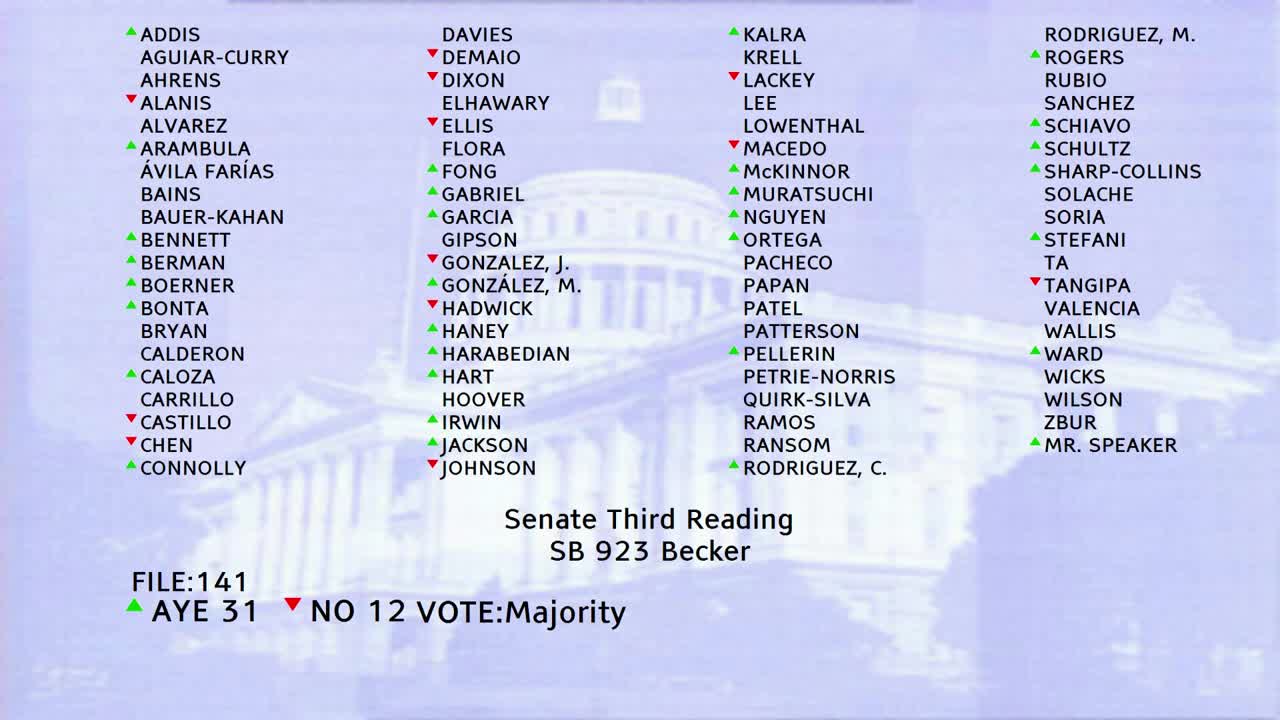
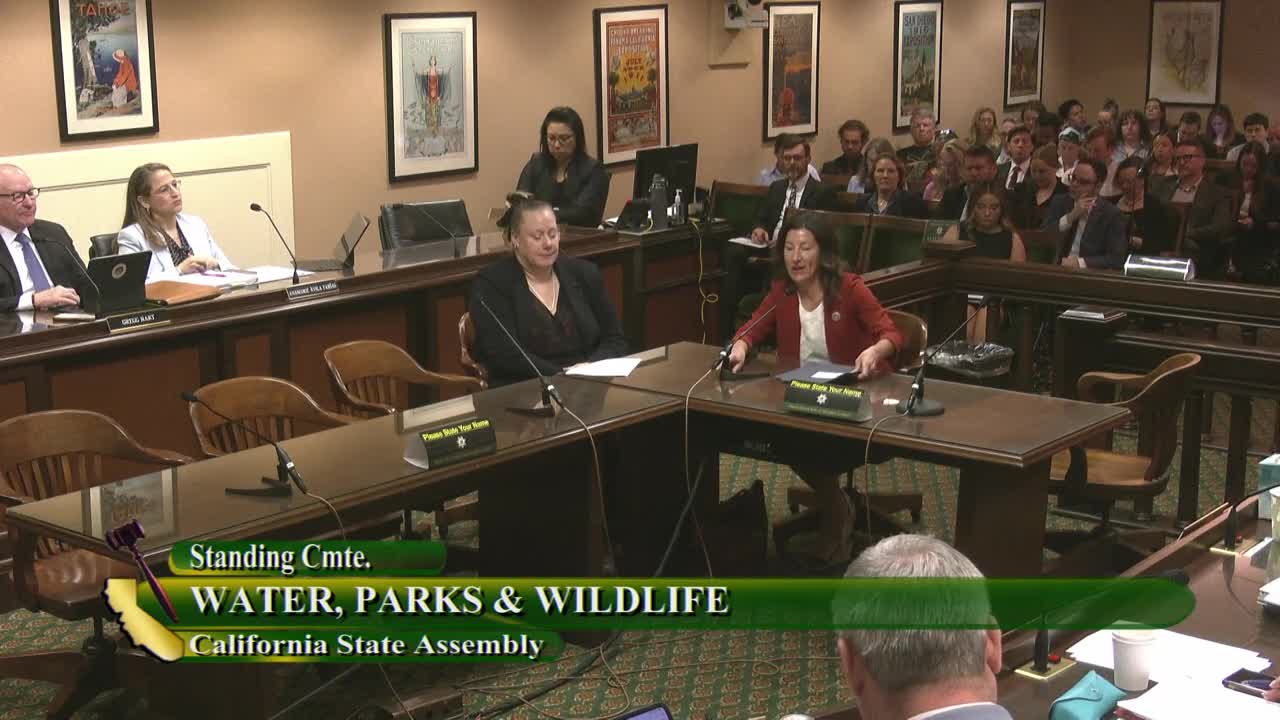
Bill Author

Bill Co-Author(s):