AB 556: Public postsecondary education: waiver of campus-based fees: veterans.
- Session Year: 2025-2026
- House: Assembly
- Latest Version Date: 2025-02-12
Current Status:
Failed
(2026-02-02: From committee: Filed with the Chief Clerk pursuant to Joint Rule 56.)
Introduced
In Committee
Awaiting First Chamber Vote
Passed First Chamber
In Committee
Awaiting Second Chamber Vote
Passed Second Chamber
Enacted
Existing law establishes the University of California, administered by the Regents of the University of California, the California State University, administered by the Trustees of the California State University, and the California Community Colleges, administered by the Board of Governors of the California Community Colleges, as the 3 segments of public postsecondary education in the state. The Donahoe Higher Education Act prohibits the campuses of those segments from charging mandatory systemwide tuition or fees to specified students who apply for a waiver, including a child of any veteran of the United States military who has a service-connected disability, has been killed in service, or has died of a service-connected disability, an undergraduate student who is a recipient of a Medal of Honor, or an undergraduate student who is a child of a recipient of a Medal of Honor and who is no more than 27 years old, if certain requirements are satisfied.
This bill would additionally prohibit the campuses of the 3 segments of public postsecondary education from charging those students any mandatory campus-based fees, as provided. To the extent the bill would add additional duties on community college districts, the bill would impose a state-mandated local program. The bill would apply to the campuses of the University of California only to the extent that the regents, by appropriate resolution, make it apply.
The California Constitution requires the state to reimburse local agencies and school districts for certain costs mandated by the state. Statutory provisions establish procedures for making that reimbursement.
This bill would provide that, if the Commission on State Mandates determines that the bill contains costs mandated by the state, reimbursement for those costs shall be made pursuant to the statutory provisions noted above.
(a)Notwithstanding Section 76300, a campus of the University of California, the California State University, or the California Community Colleges shall not charge any mandatory systemwide tuition or fees, including fees or any mandatory campus-based fees, including, but not limited to, enrollment fees, registration fees, differential fees, or incidental fees, student services fees, or technology fees, to any of the following:
(1)A dependent eligible to receive assistance under Article 2 (commencing with Section 890) of Chapter 4 of Division 4 of the Military and Veterans Code.
(2)(A)Any child of any veteran of the United States military who has a service-connected disability, has been killed in service, or has died of a service-connected disability, where the annual income of the child, including the value of any support received from a parent, does not exceed the state poverty level as defined in subdivision (d).
(B)Notwithstanding Section 893 of the Military and Veterans Code, the Department of Veterans Affairs may determine the eligibility for fee waivers for a child described in subparagraph (A).
(3)A dependent, or a surviving spouse who has not remarried, of any member of the California National Guard who, in the line of duty, and while in the active service of the state, was killed, died of a disability resulting from an event that occurred while in the active service of the state, or is permanently disabled as a result of an event that occurred while in the active service of the state. For the purposes of this paragraph, active service of the state refers to a member of the California National Guard activated pursuant to Section 146 of the Military and Veterans Code.
(4)(A)An undergraduate student who is a recipient of a Medal of Honor, commonly known as a Congressional Medal of Honor, or an undergraduate student who is a child of a recipient of a Medal of Honor and who is no more than 27 years old, if both of the following requirements are met:
(i)The undergraduate students annual income, including the value of any support received from a parent, does not exceed the state poverty level as defined in subdivision (d).
(ii)The recipient of the Medal of Honor who is or was the parent of the undergraduate student is, or at the time of the recipients death was, a California resident as determined pursuant to Chapter 1 (commencing with Section 68000) of Part 41.
(B)The Department of Veterans Affairs shall determine the eligibility of any applicant for a fee waiver under this paragraph.
(b)(1)Notwithstanding Section 76300, a campus of the University of California or the California State University shall not charge any mandatory systemwide tuition or fees, including enrollment fees, registration fees, differential fees, or incidental fees, to a current or former foster youth, if the current or former foster youth meets all of the following conditions:
(A)Is 25 years of age or younger.
(B)Has been in foster care for at least 12 consecutive months after reaching 10 years of age.
(C)Meets any of the following:
(i)Is under a current foster care placement order by the juvenile court.
(ii)Was under a foster care placement order by the juvenile court upon reaching 18 years of age.
(iii)Was adopted, or entered guardianship, from foster care.
(D)Completes and submits the Free Application for Federal Student Aid (FAFSA).
(E)Maintains a minimum grade point average and meets other conditions necessary for the student to be in good standing at the public postsecondary educational institution that the current or former foster youth attends, as determined by the appropriate public postsecondary segment.
(F)Meets the financial need requirements established for Cal Grant A awards under Chapter 1.7 (commencing with Section 69430) of Part 42.
(2)A student shall not have the students mandatory systemwide tuition or fees waived pursuant to this subdivision in excess of the equivalent of attendance in a four-year undergraduate program.
(3)The amount of a students tuition or fee waiver pursuant to this subdivision shall be reduced by any state or federal financial aid, including scholarships or grants, received by the student for the academic year or semester, or the equivalent, in which the student receives the tuition or fee waiver pursuant to this subdivision.
(c)A person who is eligible for a waiver of tuition or fees under this section may receive a waiver for each academic year during which the person applies for that waiver, but an eligible person may not receive a waiver of tuition or fees for a prior academic year.
(d)As used in this section, the state poverty level means annual household income that is less than the amount calculated for a single person with no dependents pursuant to Section 18501 of the Revenue and Tax Code.
(e)The waiver of tuition or fees under this section shall apply only to a person who is determined to be a resident of California pursuant to Chapter 1 (commencing with Section 68000) of Part 41.
(f)Subdivision (a) shall not apply to a dependent of a veteran within the meaning of paragraph (4) of subdivision (a) of Section 890 of the Military and Veterans Code.
(g)The provisions of this section shall not apply to the University of California except to the extent that the Regents of the University of California, by appropriate resolution, make a provision applicable.
SEC. 2.If the Commission on State Mandates determines that this act contains costs mandated by the state, reimbursement to local agencies and school districts for those costs shall be made pursuant to Part 7 (commencing with Section 17500) of Division 4 of Title 2 of the Government Code.
REVISIONS: HeadingLines 2 and 3. REVISIONS: HeadingLine 2.|
Date
|
Status
|
|---|---|
| Feb 2, 2026 | From committee: Filed with the Chief Clerk pursuant to Joint Rule 56. |
| Jan 31, 2026 | Died pursuant to Art. IV, Sec. 10(c) of the Constitution. |
| May 23, 2025 | In committee: Held under submission. |
| Apr 23, 2025 | In committee: Set, first hearing. Referred to suspense file. |
| Apr 9, 2025 | Coauthors revised. |
| Apr 9, 2025 | From committee: Do pass and re-refer to Com. on APPR. (Ayes 6. Noes 0.) (April 8). Re-referred to Com. on APPR. |
| Mar 19, 2025 | Coauthors revised. |
| Mar 19, 2025 | From committee: Do pass and re-refer to Com. on M. & V.A. (Ayes 8. Noes 0.) (March 18). Re-referred to Com. on M. & V.A. |
| Feb 24, 2025 | Referred to Coms. on HIGHER ED. and M. & V.A. |
| Feb 13, 2025 | From printer. May be heard in committee March 15. |
| Feb 12, 2025 | Read first time. To print. |
|
Date
|
Description
|
Location
|
Votes
|
|
|---|---|---|---|---|
| Apr 8, 2025 | Do pass and be re-referred to the Committee on [Appropriations] | Assembly Standing Committee on Military and Veterans Affairs |
Passed |
|
| Mar 18, 2025 | Do pass and be re-referred to the Committee on [Military and Veterans Affairs] | Assembly Standing Committee on Higher Education |
Passed |
This list shows positions taken on this bill by organizations on the date displayed, which is linked to the original source.
Positions by individuals are not included.
|
Organization
|
Position
|
Date
|
|---|---|---|
| American Legion, Department Of California | ** Support | |
| Amvets, Department Of California | ** Support | |
| California Association Of County Veterans Service Officers | ** Support | |
| California State University, Office Of The Chancellor | ** Against | |
| Military Officers Association Of America, California Council Of Chapters | ** Support |
Date of Hearing: April 23, 2025
ASSEMBLY COMMITTEE ON APPROPRIATIONS
Buffy Wicks, Chair
ABPCA Bill Id:AB 556
Author:(Patterson) – As Introduced Ver:February 12, 2025
Policy Committee: | Higher Education | Vote: | 8 - 0 |
Military and Veterans Affairs | 6 - 0 | ||
|
|
Urgency: No State Mandated Local Program: Yes Reimbursable: Yes
SUMMARY:
This bill prohibits campuses of the University of California (UC), the California State University (CSU), and the California Community Colleges (CCCs) from charging any mandatory “campus-based” fees, including student services fees or technology fees, to a military dependent student receiving the CalVet fee waiver.
FISCAL EFFECT:
- Ongoing cost of approximately $7 million and $19 million General Fund to the UC and CSU systems, respectively, associated with the student fee revenue loss from eligible students (4,158 and 9,079 students, respectively) currently receiving the CalVet fee waiver.
- Ongoing Proposition 98 General Fund costs of approximately $1.2 million to the CCCs associated with the student fee revenue loss from approximately 5,000 CCC students statewide currently receiving the CalVet fee waiver.
COMMENTS:
- Purpose. According to the author:
The issue in current law is that campus-based fees are not waived by the CalVet waiver. These costs are relatively high. According to the Legislative Analyst’s Office, the average campus fee is $232 at a California Community College, $1,604 at a University of California, and $1,782 at a California State University. These fees can bar families who are otherwise eligible from entering and benefiting from California’s higher education system. The families harmed by these fees are those who have already sacrificed so much to protect all Californians and Americans.
- Background.
Systemwide Tuition and Campus Based Fees. The UC, CSU, and CCC each assess mandatory systemwide student tuition and fees. The College Fee Wavier for Veteran Dependents waives these costs for recipients of the waiver. According to the Legislative Analyst’s Office (LAO), the largest non-state core fund source for UC and CSU is student tuition revenue. CSU and UC have tuition policies in place that generally raise tuition charges moderately each year. UC began raising its tuition charges in fiscal year (FY) 2022‑23, with CSU following in FY 2024‑25. Prior to having these policies, CSU and UC had held their resident undergraduate and graduate tuition charges flat for an extended period, with these charges raised once only since FY 2011‑12. In FY 2017‑18, CSU and UC raised resident tuition charges by 5% and 2.7%, respectively. In a few other years, UC also assessed small increases to its Student Services Fee.
Beyond tuition increases, tuition revenue also grows as enrollment increases. The LAO estimates total tuition revenue (accounting for increases in tuition charges and enrollment) will increase in FY 2025-26 by $188 million (5.4 percent) at CSU and $241 million (4.4 percent) at UC.
In addition to systemwide tuition, individual campuses often assess fees to support health centers and services, student unions, and student success programs. These fees may, and do, vary widely by campus. For example, CSU Channel Islands charges a campus fee of $1,075, while Cal Poly San Luis Obispo charges $6,077. In a January 2025 report, the LAO estimated campus fees will increase an average of $258 dollars at CCC campuses, $2,080 dollars at CSU campuses, and $1,812 on UC campuses in 2025-2026.
CalVet Fee Waiver. The California Department of Veterans Affairs (CalVet) administers the College Fee Waiver for Veteran Dependents (CalVet fee waiver), which waives mandatory system-wide tuition and fees at any CCC, CSU, or UC campus. This program does not cover the expense of books, parking, or room and board. The waiver defines an eligible recipient as the natural or adopted child or stepchild of a veteran with a service-connected disability or who died in service, the unmarried surviving spouse of a veteran, the spouse of a permanently disabled veteran, or a Medal of Honor recipient and their children.
Analysis Prepared by: Aaron Heredia / APPR. / (916) 319-2081
Date of Hearing: April 8, 2025
ASSEMBLY COMMITTEE ON MILITARY AND VETERANS AFFAIRS
Pilar Schiavo, Chair
ABPCA Bill Id:AB 556 (
Author:Patterson) – As Introduced Ver:February 12, 2025
SUBJECT: Public postsecondary education: waiver of campus-based fees: veterans.
SUMMARY: Adds mandatory campus-based fees to the fees a campus of the University of California (UC), the California State University (CSU), or the California Community Colleges (CCC) is prohibited from charging an eligible dependent of a veteran. Specifically, this bill:
- Prohibits a UC, CSU, or CCC campus from charging an eligible dependent of a veteran mandatory campus-based fees, including, but not limited to, student services fees or technology fees.
- Defines “dependent of a veteran” to mean the natural or adopted child of a veteran, or stepchild of a veteran as defined by the United States Department of Veterans Affairs (VA) for compensation purposes, the unmarried surviving spouse of a veteran, or the spouse of a totally disabled veteran.
EXISTING FEDERAL LAW establishes educational benefits for the spouse and children of both currently serving members of the Armed Forces of the United States and veterans, in such instances where the servicemember or veteran is permanently and totally disabled due to a service-connected disability, or died while on active duty or as a result of a service-connected disability. (38 U.S. Code Section 3500, et seq.)
EXISTING STATE LAW:
- Prohibits a campus of the UC, CSU, or CCC from charging an eligible dependent of a veteran tuition or fees, including enrollment fees, registration fees, differential fees, or incidental fees.
- Establishes UC as a public trust to be administered by the UC Regents; and, grants the UC Regents full powers of organization and government, subject only to such legislative control as may be necessary to insure security of its funds, compliance with the terms of its endowments, statutory requirements around competitive bidding and contracts, sales of property and the purchase of materials, goods and services. (Article IX, Section (9)(a) of the California Constitution)
- Establishes the Donahoe Higher Education Act, setting forth the mission of the UC, CSU, and CCC. (Education Code (EDC) Section 66010, et seq.)
- Confers upon the CSU Trustees the powers, duties, and functions for the management, administration, and control of the CSU system and provides that the CSU Trustees are responsible for the rule of government of their appointees and employees (EDC Sections 66606 and 89500, et seq.).
- Establishes the CCC, under the administration of the Board of Governors of the CCC, as one of the segments of public postsecondary education in this state. Requires the CCC to be comprised of community college districts. (EDC Section 70900)
- Prohibits campuses of those segments, under the Donahoe Higher Education Act, from charging mandatory systemwide tuition or fees to specified students who apply for a waiver, including a child of any veteran of the United States military who has a service-connected disability, has been killed in service, or has died of a service-connected disability, where the annual income of the child, including the value of any support received from a parent, does not exceed the national poverty level. (EDC Section 66025.3, et seq.)
- Establishes various educational benefits for dependents of veterans who were killed during military service or are totally disabled, as specified; defines “dependent of a veteran” to include the spouse of a totally disabled veteran; and prohibits a dependent of a veteran from receiving these educational benefits during the time the dependent is entitled to receive specified federal educational benefits or duplicative assistance from any other government source. (Military and Veterans Code (MVC) Section 890, et seq.)
FISCAL EFFECT: This bill has not been analyzed by a fiscal committee.
COMMENTS:
- PURPOSE OF THIS BILL. According to the author, to ensure that veterans and their families, who have made significant sacrifices for all Californians and Americans, receive the benefits they were promised. Veterans are promised a free education for their families if they die or are disabled, but many discover that, due to campus fees, veterans and their families are unable to attend college. This bill helps ensure veteran families, who struggle to pay campus-based fees, can still receive the education that was guaranteed to them.
- BACKGROUND.
- College Fee Waiver for Veteran Dependents. The California Department of Veterans Affairs (CalVet) administers the College Fee Waiver for Veteran Dependents, which waives mandatory system-wide tuition and fees at any CCC, CSU, or UC campus. This program does not cover the expense of books, parking, or room and board. There are four plans under which dependents of veterans may be eligible, Plans A, B C, and D.
- Plan A is restricted to:
The unmarried child of a veteran who is totally service-connected disabled or whose death was officially rated as service-connected is eligible. The child must be over 14 years old and under 27 years old to be eligible. If the child is a veteran, then the age limit is extended to age 30.
The spouse of a wartime veteran who is totally service-connected disabled is eligible. There are no age limit restrictions.
The unmarried surviving spouse of a wartime veteran whose death has been rated as service-connected is eligible. There are no age limit restrictions.
Any dependent of any veteran who has been declared missing in action, captured in the line of duty by hostile forces, or forcibly detained or interned in the line of duty by a foreign government or power is eligible.
The veteran must have served at least one day of active duty during a period of war as declared by the U.S. Congress, or during any time in which the veteran was awarded a campaign or expeditionary medal. Concurrent receipt of benefits under Plan A and VA Chapter 35 benefits is prohibited. - Plan B covers the child of a veteran who has a service-connected disability, or had a service-connected disability at the time of death, or died of service-related causes is eligible. The child's annual income, which includes the child's adjusted gross income, plus the value of support provided by a parent, may not exceed the annual income limit. The current academic year entitlement is based upon the previous calendar year's annual income.
Under Plan B, wartime service is not required and there are no specific age requirements. Children are the only dependents eligible under this plan. There is no prohibition against receiving concurrent VA Chapter 35 benefits. - Plan C covers any dependent of any member of the California National Guard, who in the line of duty while on active service to the state, was killed, died of a disability resulting from an event that occurred while in active service to the state, or is permanently disabled as a result of an event that occurred while in the service to the state is eligible. Surviving spouses who have not remarried are also eligible. "Active service to the state," for the purpose of this benefit, means a member of the California National Guard activated pursuant to Section 146 of the MVC.
- Plan D covers Medal of Honor recipients and children of Medal of Honor recipients under the age of 27 may qualify. Benefits under Plan D are limited to undergraduate studies only, and applicants are subject to both income and age restrictions. There is no prohibition against receiving concurrent VA Chapter 35 benefits.
- Plan A is restricted to:
- Federal Benefits. The VA administers education benefits for dependents and survivors of veterans. There are two main programs offering educational assistance to survivors and dependents of veterans. The Marine Gunnery Sergeant John David Fry Scholarship (Fry Scholarship) is for children and spouses of active duty servicemembers who died in the line of duty on or after September 11, 2001, or members of the Selected Reserve who died from a service-connected disability on or after September 11, 2001.
The Fry Scholarship provides up to 36 months of benefits, including: money for tuition (full in-state tuition costs at public schools and up to $ 28,937.09 per year for training at private or out-of-state schools); funding for housing; and, funding for books and supplies.
The Survivors' and Dependents' Educational Assistance (DEA) program, also called Chapter 35, offers education and training to qualified dependents of veterans who are permanently and totally disabled because of a service-related condition, or who died while on active duty or as a result of a service-related condition. DEA program recipients receive a monthly payment to help cover the cost of college or graduate degree programs, career training certificate courses, educational and career counseling, apprenticeships, and on-the-job training. The current rate of funding for DEA program recipients is $1,536 per month for 36 months.
The Fry Scholarship is not subject to the concurrent benefit prohibition, while the DEA is. - Campus Mandatory Fees (CMFs). According to CSU, the CMFs, paid in addition to the tuition, range from $1,075 for CSU Channel Islands in Ventura County to $6,084 at California Polytechnic State University, San Luis Obispo for 2024-25. The tuition for a full-time undergraduate is $6,084, so the total for tuition and CMFs ranges from $7,159 to $12,161. CMFs include fees for health facilities, health services, instructionally related activities, materials, services, and facilities, student success fee, student association fee, and student center fee.
- College Fee Waiver for Veteran Dependents. The California Department of Veterans Affairs (CalVet) administers the College Fee Waiver for Veteran Dependents, which waives mandatory system-wide tuition and fees at any CCC, CSU, or UC campus. This program does not cover the expense of books, parking, or room and board. There are four plans under which dependents of veterans may be eligible, Plans A, B C, and D.
- SUPPORT. The American Legion Department of California, AMVETS Department of California, and the Military Officers Association of America-California Council of Chapters all write in support that this bill addresses a critical gap in our current higher education system by ensuring that public state universities do not charge campus fees to students receiving CalVet fee waivers. Supporters argue that while eligible dependents and survivors of military and National Guard service members are exempt from tuition and systemwide fees, they remain vulnerable to additional financial burdens imposed by campus fees. These fees can impose significant hardship on families already coping with the economic impacts of military service, including funeral and medical expenses and reduced household income. The support asserts that this bill will ease the financial burden on qualifying veterans and their families, marking a significant move to recognize our veterans' sacrifices while fostering educational opportunities for their families.
- OPPOSITION. The CSU opposes the bill, highlighting its longstanding support for military veterans and their dependents and involvement with CalVet programs. CSU states that each of its 23 universities features a Veteran Success Center offering services such as career counseling, community engagement, and professional development opportunities that leverage their military experience, alongside special admissions considerations, priority registration, and academic credits for military courses. According to the CSU, in the Fall of 2023, they enrolled and supported more than 9,000 veterans and their dependents. CSU explains that mandatory campus-based fees are allocated for various student services, including student unions, Associated Students, and recreation and wellness centers. In many cases, these fees are voted upon by the students and cover the debt service costs to construct the facilities that provide the services students sought. CSU argues that eliminating the campus-based fees for those students receiving CalVet fee waivers would reduce total campus revenues by an estimated $19 million annually during a difficult period in which the Governor has proposed a $375 million cut to the CSU’s budget.
- DOUBLE REFERRAL. This bill is double referred, it passed the Assembly Committee on Higher Education by a vote of 8-0 on March 18, 2025.
- RELATED LEGISLATION.
- AB 264 (Carrillo) eliminates the prohibition on a child of a veteran, an unmarried surviving spouse of a veteran, or spouse of a disabled veteran, as defined, from receiving a tuition waiver from the state while also accessing other state or federal educational benefits. AB 264 is pending hearing in the Assembly Committee on Military and Veterans Affairs.
- AB 1509 (Committee on Military and Veterans Affairs) places the California State Accrediting Agency for Veterans Education under the authority of CalVet. Gives CalVet the ability to administer the program and promulgate, amend, and repeal regulations as necessary to operate the program in accordance with state and federal laws. AB 1509 is pending hearing in the Assembly Committee on Military and Veterans Affairs.
- SB 60 (Seyarto) prohibits the UC and CSU from imposing tuition or fees on dependents of service-injured veterans and Medal of Honor recipients for extended education courses. Expands the uses of the California Military Department GI Bill award to cover fees associated with extended education courses that count toward an undergraduate degree at CSU or UC. SB 60 passed the Senate Committee on Education by a vote of 7-0 on March 19, 2025, and is pending hearing in the Senate Committee on Military and Veterans Affairs.
- PREVIOUS LEGISLATION.
- AB 2736 (Carrillo) from 2024 was substantially similar to AB 264 in 6)a) above, which was vetoed by the Governor.
- AB 1606 (Ramos) of 2022 would have eliminated the Plan A prohibition against concurrent receipt of Chapter 35 education benefits, made spouses eligible under Plan B, and raised the income eligibility threshold under Plan B. AB 1606 was held in the Assembly Committee on Appropriations.
- AB 1745 (Soria), Chapter 695, Statutes of 2023, modified the annual income metric used to determine eligibility for the tuition waiver program for children of service-injured veterans attending a UC, CSU, or CCC campus.
REGISTERED SUPPORT / OPPOSITION:
Support
American Legion, Department of California
Amvets, Department of California
California Association of County Veterans Service Officers
Military Officers Association of America, California Council of Chapters
Opposition
California State University, Office of The Chancellor
Analysis Prepared by: Patty Patten / M. & V.A. / (916) 319-3550
Date of Hearing: March 18, 2025
ASSEMBLY COMMITTEE ON HIGHER EDUCATION
Mike Fong, Chair
ABPCA Bill Id:AB 556 (
Author:Patterson) – As Introduced Ver:February 12, 2025
[Note: This bill is doubled referred to the Assembly Committee on Military and Veterans
Affairs and will be heard by that Committee as it relates to issues under its jurisdiction.]
SUBJECT: Public postsecondary education: waiver of campus-based fees: veterans
SUMMARY: Specifies that a campus of the University of California (UC), the California State University (CSU), or the California Community Colleges (CCC) must not charge any mandatory campus-based fees to certain veterans and their dependents, as specified. Specifically, this bill:
- Specifies that a campus of the UC, the CSU, or the CCC must not charge any mandatory campus-based fees, including, but not limited to, enrollment fees, registration fees, differential fees, incidental fees, student services fees, or technology fees, to any of the following:
- An eligible dependent, defined as:
- The unmarried child of a veteran who is totally service-connected disabled, or whose death was officially rated as service-connected is eligible. The child must be over 14 years old and under 27 years old to be eligible. If the child is a veteran, then the age limit is extended to 30 years old;
- The spouse of a wartime veteran who is totally service-connected disabled is eligible. There are no age limit restrictions;
- The unmarried surviving spouse of a wartime veteran whose death has been rated as service-connected is eligible. There are no age limit restrictions; and,
- Any dependent of any veteran who has been declared missing in action, captured in the line of duty by hostile forces, or forcibly detained or interned in the line of duty by a foreign government or power is eligible.
- Any child of a veteran who has a service-connected disability, or had a service-connected disability at the time of death, or died of service-related causes is eligible., including the value of any support received from a parent, does not exceed the state poverty level, as specified;
- A dependent, or a surviving spouse who has not remarried, of any member of the California National Guard who, in the line of duty, and while in the active service of the state, was killed, died of a disability resulting from an event that occurred while in the active service of the state, or is permanently disabled as a result of an event that occurred while in the active service of the state; and,
- An undergraduate student who is a recipient of a Medal of Honor, commonly known as a Congressional Medal of Honor, or an undergraduate student who is a child of a recipient of a Medal of Honor and who is no more than 27 years old, if both of the following requirements are met:
- The undergraduate student’s annual income, including the value of any support received from a parent, does not exceed the state poverty level, as specified; and,
- The recipient of the Medal of Honor who is or was the parent of the undergraduate student is, or at the time of the recipient’s death was, a California resident.
- An eligible dependent, defined as:
EXISTING LAW:
Federal law. Establishes educational benefits for the spouse and children of both currently serving members of the Armed Forces of the United States and veterans, in such instances where the servicemember or veteran is permanently and totally disabled due to a service-connected disability, or died while on active duty or as a result of a service-connected disability. (38 U.S. Code Section 3500, et seq.)
State law.
- Establishes the UC as a public trust to be administered by the Regents of the UC; and, grants the Regents full powers of organization and government, subject only to such legislative control as may be necessary to insure security of its funds, compliance with the terms of its endowments, statutory requirements around competitive bidding and contracts, sales of property and the purchase of materials, goods and services (Article IX, Section (9)(a) of the California Constitution).
- Establishes the Donahoe Higher Education Act, setting forth the mission of the UC, CSU, and CCC (Education Code (EDC) Section 66010, et seq.).
- Confers upon the CSU Trustees the powers, duties, and functions with respect to the management, administration, control of the CSU system and provides that the Trustees are responsible for the rule of government of their appointees and employees (EDC Sections 66606 and 89500, et seq.).
- Establishes the CCC under the administration of the Board of Governors of the CCC, as one of the segments of public postsecondary education in this state. The CCC is comprised of community college districts (EDC Section 70900).
- The Donahoe Higher Education Act prohibits campuses of those segments from charging mandatory systemwide tuition or fees to specified students who apply for a waiver, including a child of any veteran of the United States military who has a service-connected disability, has been killed in service, or has died of a service-connected disability, where the annual income of the child, including the value of any support received from a parent, does not exceed the state poverty level, as defined. (EDC Section 66025.3, et seq.)
- Established the Working Families Student Fee Transparency and Accountability Act, which requires notice, consultation, and timeframe requirements for UC and CSU regarding the approval and implementation of student fee increases (EDC Section 66028, et seq.)
- Establishes various educational benefits for dependents of veterans who were killed during military service or are totally disabled, as specified; defines “dependent of a veteran” to include the spouse of a totally disabled veteran; and prohibits a dependent of a veteran from receiving these educational benefits during the time the dependent is entitled to receive specified federal educational benefits or duplicative duplicate assistance from any other government source. (Military and Veterans Code (MVC) Section 890, et seq.)
FISCAL EFFECT: Unknown.
COMMENTS: Purpose. According to the author, “The current College Fee Waiver for Veteran Dependents (CalVet waiver) has been a vital boost for the dependents and spouses of veterans or members of the National Guard disabled or killed in service as well as Medal of Honor recipients and their dependents. By waiving tuition and system-wide fees, California has been able to provide for a particularly vulnerable group of people.”
“The issue in current law is that campus-based fees are not waived by the CalVet waiver. These costs are relatively high. According to the Legislative Analyst’s Office, the average campus fee is $232 at a California Community College, $1,604 at a University of California, and $1,782 at a California State University. These fees can bar families who are otherwise eligible from entering and benefiting from California’s higher education system. The families harmed by these fees are those who have already sacrificed so much to protect all Californians and Americans.”
“Veterans and their families have sacrificed significantly in their service to the state and nation. This bill would allow veteran families to receive the education they were promised by preventing California public colleges from charging them campus-fees.”
College Fee Waiver for Veteran Dependents. The California Department of Veterans Affairs (CalVet) administers the College Fee Wavier for Veteran Dependents, which waives mandatory system-wide tuition and fees at any CCC, CSU, or UC campus. This program does not cover the expense of books, parking, room and board, or mandatory campus fees. There are four plans under which dependents of Veterans may be eligible, Plans A, B C, and D.
Plan A is restricted to:
- The unmarried child of a veteran who is totally service-connected disabled, or whose death was officially rated as service-connected is eligible. The child must be over 14 years old and under 27 years old to be eligible. If the child is a veteran, then the age limit is extended to 30 years old.
- The spouse of a wartime veteran who is totally service-connected disabled is eligible. There are no age limit restrictions.
- The unmarried surviving spouse of a wartime veteran whose death has been rated as service-connected is eligible. There are no age limit restrictions.
- Any dependent of any veteran who has been declared missing in action, captured in the line of duty by hostile forces, or forcibly detained or interned in the line of duty by a foreign government or power is eligible.
The veteran must have served at least one day of active duty during a period of war as declared by the U.S. Congress, or during any time in which the veteran was awarded a campaign or expeditionary medal. Concurrent receipt of benefits under Plan A and VA Chapter 35 benefits is prohibited.
Plan B covers the child of a veteran who has a service-connected disability, or had a service-connected disability at the time of death, or died of service-related causes is eligible. The child's annual income, which includes the child's adjusted gross income, plus the value of support provided by a parent, may not exceed the annual income limit. The current academic year entitlement is based upon the previous calendar year's annual income.
Under Plan B, wartime service is not required and there are no specific age requirements. Children are the only dependents eligible under this plan. There is no prohibition against receiving concurrent VA Chapter 35 benefits.
Plan C covers any dependent of any member of the California National Guard, who in the line of duty while on active service to the state, was killed, died of a disability resulting from an event that occurred while in active service to the state, or is permanently disabled as a result of an event that occurred while in the service to the state is eligible. Surviving spouses who have not remarried are also eligible. "Active service to the state," for the purpose of this benefit, means a member of the California National Guard activated pursuant to Section 146 of the MVC.
Plan D covers Medal of Honor recipients and children of Medal of Honor recipients under the age of 27 may qualify. Benefits under Plan D are limited to undergraduate studies only, and applicants are subject to both income and age restrictions. There is no prohibition against receiving concurrent VA Chapter 35 benefits.
Systemwide tuition. The UC, CSU, and CCC each assess mandatory systemwide student tuition and fees that, as noted above, are waived for recipients of the College Fee Wavier for Veteran Dependents. According to the LAO, the largest nonstate core fund source for UC and CSU is student tuition revenue. CSU and UC currently have tuition policies in place that generally raise tuition charges moderately each year. UC began raising its tuition charges in 2022‑23, with CSU following in 2024‑25. Prior to having these policies, CSU and UC had held their resident undergraduate and graduate tuition charges flat for an extended period, with these charges raised once only since 2011‑12. (In 2017‑18, CSU and UC raised resident tuition charges by 5% and 2.7%, respectively. In a few other years, UC also assessed small increases to its Student Services Fee.)
Beyond tuition increases, tuition revenue also grows as enrollment increases. Total tuition revenue (accounting for increases in tuition charges and enrollment) is estimated to rise $188 million (5.4 percent) at CSU and $241 million (4.4 percent) at UC in 2025‑26.
Campus fees. In addition to systemwide tuition, individual campuses often assess fees to support health centers and services, student unions, and student success programs. These fees can, and do, vary widely by campus. For example, CSU Channel Islands charges $1,075 dollars for their campus fees, while Cal Poly San Luis Obispo charges $6,077.00 dollars. According to a projection by the Legislative Analysts’ Office in January of 2025, campus fees are are expected to average $258 dollars at CCC campuses, $2,080 dollars at CSU campuses, and $1,812 in 2025-2026.
Arguments in support. The American Legion Department of California, AMVETS Department of California, and the Military Officers Association of America-California Council of Chapters jointly wrote a letter in support of AB 556 (Patterson), noting that “AB 556 addresses a critical gap in our current higher education system by ensuring that public state universities do not charge campus fees to students receiving CalVet fee waivers. Under existing law, while eligible dependents and survivors of military and National Guard service members are exempt from tuition and systemwide fees, they remain vulnerable to additional financial burdens imposed by campus fees. These fees, averaging from $232 at community colleges to $1,800 at California State Universities, can impose significant hardship on families already coping with the economic impacts of military service, including funeral and medical expenses and reduced household income.”
“By waiving these campus fees, AB 556 will alleviate financial strain for eligible veterans and their families and improve access to higher education. Easing this burden is essential for promoting long-term financial stability, as higher education is a key driver in enhancing economic opportunity and security. This legislation represents an important step toward honoring our veterans' sacrifices and supporting their families' educational aspirations.”
Arguments in opposition. CSU Chancellor’s Office wrote in opposition to AB 556, noting that “The CSU has long supported our military veterans and their dependents and has been engaged with the CalVet programs for many years. The program offers veterans, active-duty service members and their families access to programs and opportunities so they can achieve their personal and professional goals. Each of our 23 universities has a Veteran Success Center that helps military-connected students successfully navigate their college experience. These services include career counseling, community building and connecting students to professional development opportunities that leverage their military experience. CSU student veterans additionally receive special admissions consideration and priority registration, as well as academic credit for military courses and experience. In Fall 2023, the CSU is proud to have enrolled and supported more than 9,000 veterans and their dependents under the CalVet program. Our commitment to our students who have served their country in the armed services and their dependents is unwavering.”
“As proposed, AB 556 would prohibit the collection of mandatory campus-based fees from those that are eligible for a CalVet fee waiver. The mandatory campus-based fees are allocated for various student services, including student unions, Associated Students and recreation and wellness centers. In many cases, these fees are voted upon by the students and cover the debt service costs to construct the facilities which provide the services students sought. Using the campus-based fees currently assessed, this bill would reduce total campus revenues by an estimated $19 million annually during a difficult period in which the Governor has proposed a $375 million cut to the CSU’s budget.”
“The CSU, and its 23 universities, remain absolutely committed to working with our veterans and their families to provide the educational opportunities they desire. Unfortunately, AB 556 would create unintended consequences and jeopardize our university’s ability to deliver vital educational programming without the necessary resources to maintain those programs.”
REGISTERED SUPPORT / OPPOSITION:
Support
American Legion, Department of California
Amvets, Department of California
Military Officers Association of America, California Council of Chapters
Opposition
California State University, Office of the Chancellor
Analysis Prepared by: Kevin J. Powers / HIGHER ED. / (916) 319-3960
Discussed in Hearing
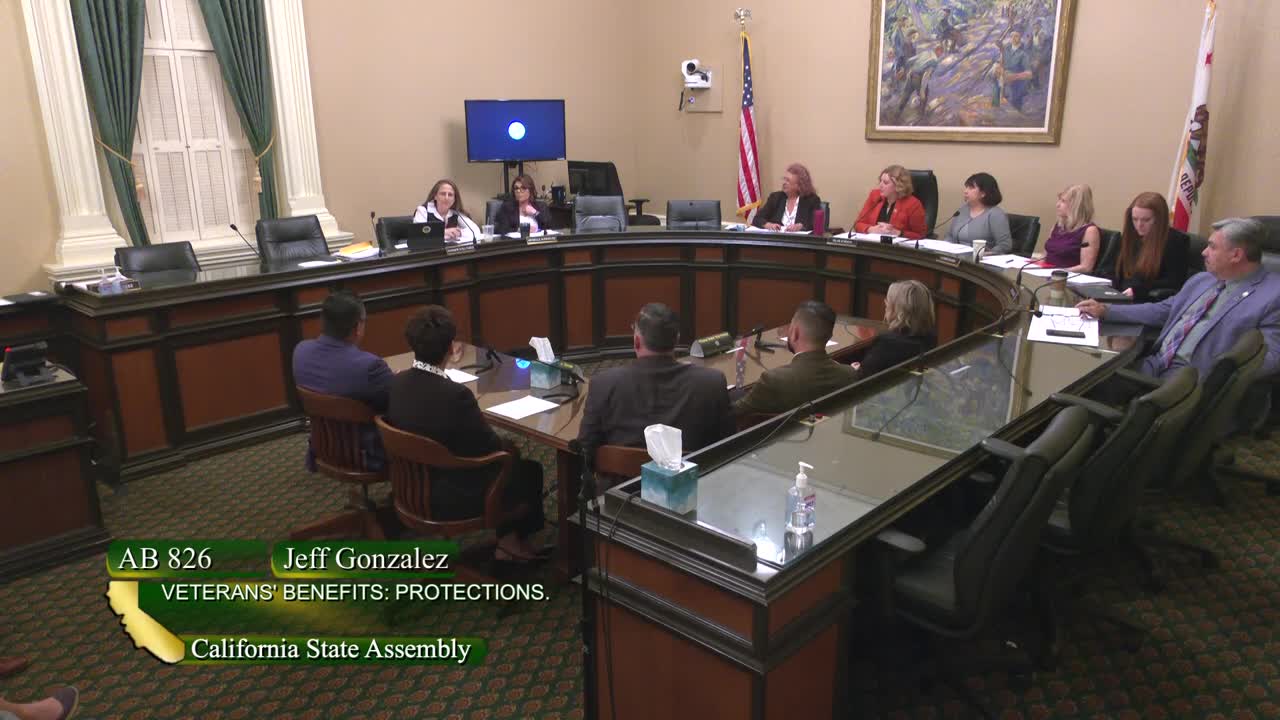 15MIN
Assembly Standing Committee on Military and Veterans Affairs
 9MIN
Assembly Standing Committee on Higher Education
Bill Author

Bill Co-Author(s):