AB 615: Power facilities: emergency response and action plans.
- Session Year: 2025-2026
- House: Assembly
- Latest Version Date: 2025-09-08
Current Status:
Failed
(2026-01-22: Consideration of Governor's veto stricken from file.)
Introduced
In Committee
Awaiting First Chamber Vote
Passed First Chamber
In Committee
Awaiting Second Chamber Vote
Passed Second Chamber
Enacted
Existing law requires an application to be filed with the State Energy Resources Conservation and Development Commission for certification of a site and related facility that includes an electrical transmission line or thermal powerplant, or both. Existing law requires the application to contain, among other information, a description of any electrical transmission lines, a map of the proposed route and existing transmission lines, justification for the proposed route, and a preliminary description of the effect of the proposed electrical transmission lines on the environment, ecology, and scenic, historic, and recreational values, as specified.
This bill would remove the requirement that the application include the information described above, and would require that the application also contain an emergency response and action plan, to be paid for by the applicant, that incorporates impacts to the surrounding areas in the event of an emergency and that would be conducted and coordinated with local emergency management agencies, unified program agencies, and local first response agencies.
Existing law authorizes a person proposing an energy storage system to file an application for certification with the commission in lieu of any permit, certificate, or similar document required by any state, local, or regional agency, or federal agency, as provided.
The bill would require that an application for an energy storage system also contain an emergency response and action plan, to be paid for by the applicant, that includes analysis and feedback from a local emergency management agency. The bill would require the commission to ensure an energy storage system that submits an application after January 1, 2026, complies with setback requirements that are at least as protective as the most recently published edition of the National Fire Protection Association (NFPA) 855, Standard for the Installation of Stationary Energy Storage Systems.
Existing law requires an application to be filed with the State Energy Resources Conservation and Development Commission for certification of a site and related facility which that includes an electric electrical transmission line or thermal powerplant, or both. Existing law requires the application to contain, among other things, safety and reliability information, including planned provisions for emergency operations and shutdowns, information, a description of any electrical transmission lines, a map of the proposed route and existing transmission lines, justification for the proposed route, and a preliminary description of the effect of the proposed electrical transmission lines on the environment, ecology, and scenic, historic, and recreational values, as specified. Existing law authorizes a person proposing an energy storage system to file an application for certification with the commission in lieu of any permit, certificate, or similar document required by any state, local, or regional agency, or federal agency, as provided.
This bill would remove the requirement that the application include the information described above, and would require that those applications the application also contain an emergency response and action plans, plan, to be paid for by the applicant, that incorporate incorporates impacts to the surrounding areas in the event of an emergency and that would be conducted and coordinated with local emergency management agencies, unified program agencies, and local first response agencies. The
Existing law authorizes a person proposing an energy storage system to file an application for certification with the commission in lieu of any permit, certificate, or similar document required by any state, local, or regional agency, or federal agency, as provided.
The bill would require that applications an application for an energy storage system also contain an emergency response and action plans, plan, to be paid for by the applicant, and that the plans include, as applicable, includes analysis and feedback from the a local emergency management agencies as to whether the proposed facilities require supplemental first responder capabilities and meet the National Fire Protection Association 855 Standard as it relates to setbacks, as specified. agency. The bill would require the commission to ensure an energy storage system that submits an application after January 1, 2026, complies with setback requirements that are at least as protective as the most recently published edition of the National Fire Protection Association (NFPA) 855, Standard for the Installation of Stationary Energy Storage Systems.
Existing law requires an application to be filed with the State Energy Resources Conservation and Development Commission for certification of a site and related facility which includes an electric transmission line or thermal powerplant, or both. Existing law requires the application to contain, among other things, safety and reliability information, including planned provisions for emergency operations and shutdowns, as specified. Existing law authorizes a person proposing an energy storage system to file an application for certification with the commission in lieu of any permit, certificate, or similar document required by any state, local, or regional agency, or federal agency, as provided.
This bill would require that those applications also contain emergency response and action plans, to be paid for by the applicant, that incorporate impacts to the surrounding areas in the event of an emergency and that would be conducted and coordinated with local emergency management agencies, unified program agencies, and local first response agencies. The bill would require that applications for an energy storage system also contain emergency response and action plans, to be paid for by the applicant, and that the plans include include, as applicable, analysis and feedback from the local emergency management agencies as to whether the proposed facilities require supplemental first responder capabilities and meet the National Fire Protection Association 855 Standard as it relates to setbacks, as specified.
Existing law requires an application to be filed with the State Energy Resources Conservation and Development Commission for certification of a site and related facility which includes an electric transmission line or thermal powerplant, or both. Existing law requires the application to contain, among other things, safety and reliability information, including planned provisions for emergency operations and shutdowns, as specified. Existing law authorizes a person proposing an energy storage system to file an application for certification with the commission in lieu of any permit, certificate, or similar document required by any state, local, or regional agency, or federal agency, as provided.
This bill would require the application to that those applications also contain an emergency response and action plan plans, to be paid for by the applicant, that incorporates incorporate impacts to the surrounding areas in the event of an emergency and that would be conducted and coordinated with local emergency management agencies, unified program agencies, and local first response agencies. The bill would require require that applications for an energy storage system also contain emergency response and action plans, to be paid for by the applicant, and that the plan plans include analysis and feedback from the local emergency management agencies as to whether the proposed facility requires facilities require supplemental first responder capabilities and meets meet National Fire Protection Association 855 Standard as it relates to setbacks, as specified. The bill would require the plan to be paid for by the applicant.
Existing law requires an application to be filed with the State Energy Resources Conservation and Development Commission for certification of a site and related facility which includes an electric transmission line or thermal powerplant, or both. Existing law requires the application to contain, among other things, safety and reliability information, including planned provisions for emergency operations and shutdowns, as specified.
This bill would require the application to also contain an emergency response and action plan that incorporates impacts to the surrounding areas in the event of an emergency and that would be conducted and coordinated with local emergency management agencies, unified program agencies, and local first response agencies. The bill would require that the plan include analysis and feedback from the local emergency management agencies as to whether the proposed facility requires supplemental first responder capabilities and meets National Fire Association 855 Standard as it relates to setbacks, as specified. The bill would require the plan to be paid for by the applicant.
The application shall contain all of the following information and any other information that the commission by regulation may require:
(a)A detailed description of the design, construction, and operation of the proposed facility.
(b)Safety and reliability information, including, in addition to documentation previously provided pursuant to Section 25511, planned provisions for emergency operations and shutdowns.
(c)Available site information, including maps and descriptions of present and proposed development and, as appropriate, geological, aesthetic, ecological, seismic, water supply, population, and load center data, and justification for the particular site proposed.
(d)Any other information relating to the design, operation, and siting of the facility that the commission may specify.
(e)A description of the facility, the cost of the facility, the fuel to be used, the source of fuel, fuel cost, plant service life and capacity factor, and generating cost per kilowatthour.
(f)(1)An emergency response and action plan that incorporates impacts to the surrounding areas in the event of an emergency which would be conducted and coordinated with local emergency management agencies, unified program agencies, and local first response agencies.
(2)The emergency response and action plan shall be paid for by the applicant.
(g)This section does not alter the authority of the Public Utilities Commission to regulate the rates, services, or safety practices of a public utility or generating asset owner subject to its jurisdiction.
SEC. 2.Section 25545.21 is added to the Public Resources Code, to read:25545.21.In addition to any other information that the commission requires, an application for an energy storage system shall contain all of the following information:
(a)An emergency response and action plan that incorporates impacts to the surrounding areas in the event of an emergency that would be conducted and coordinated with local emergency management agencies, unified program agencies, and local first response agencies.
(b)The emergency response and action plan shall include analysis and feedback from a local emergency management agency. The local emergency management agencys feedback may include analysis of whether greater setbacks would be recommended for the proposed facility.
(c)The emergency response and action plan shall be paid for by the applicant.
(d)This section does not alter the authority of the Public Utilities Commission to regulate the rates, services, or safety practices of a public utility or generating asset owner subject to its jurisdiction.
SEC. 3.Section 25545.22 is added to the Public Resources Code, to read:25545.22.For a facility that meets the requirements of paragraph (2) of subdivision (b) of Section 25545 and submits an application after January 1, 2026, the commission shall ensure that the facility complies with setback requirements that are at least as protective as the most recently published edition of the National Fire Protection Association (NFPA) 855, Standard for the Installation of Stationary Energy Storage Systems.
The application shall contain all of the following information and any other information that the commission by regulation may require:
(a)A detailed description of the design, construction, and operation of the proposed facility.
(b)Safety and reliability information, including, in addition to documentation previously provided pursuant to Section 25511, planned provisions for emergency operations and shutdowns.
(c)Available site information, including maps and descriptions of present and proposed development and, as appropriate, geological, aesthetic, ecological, seismic, water supply, population, and load center data, and justification for the particular site proposed.
(d)Any other information relating to the design, operation, and siting of the facility that the commission may specify.
(e)A description of the facility, the cost of the facility, the fuel to be used, the source of fuel, fuel cost, plant service life and capacity factor, and generating cost per kilowatthour.
(f)A description of any electric transmission lines, including the estimated cost of the proposed electric transmission line; a map in suitable scale of the proposed routing showing details of the rights-of-way in the vicinity of settled areas, parks, recreational areas, and scenic areas, and existing transmission lines within one mile of the proposed route; justification for the route, and a preliminary description of the effect of the proposed electric transmission line on the environment, ecology, and scenic, historic, and recreational values.(f)(1)An emergency response and action plan that incorporates impacts to the surrounding areas in the event of an emergency which would be conducted and coordinated with local emergency management agencies, unified program agencies, and local first response agencies.
(2)The emergency response and action plan shall be paid for by the applicant.
(g)This section does not alter the authority of the Public Utilities Commission to regulate the rates, services, or safety practices of a public utility or generating asset owner subject to its jurisdiction.
SECTION 1.Section 22545.17 is added to the Public Resources Code, to read:22545.17.SEC. 2.Section 25545.21 is added to the Public Resources Code, to read:25545.21.In addition to any other information that the commission requires, an application for an energy storage system shall contain all of the following information:
(a)An emergency response and action plan that incorporates impacts to the surrounding areas in the event of an emergency that would be conducted and coordinated with local emergency management agencies, unified program agencies, and local first response agencies.
(b)The emergency response and action plan shall include analysis and feedback from a local emergency management agency regarding whether the proposed facility requires supplemental first responder capabilities and meets the National Fire Protection Association 855 Standard as it relates to setbacks, as applicable. agency. The local emergency management agencys feedback may include analysis of whether greater setbacks would be recommended for the proposed facility.
(c)The emergency response and action plan shall be paid for by the applicant.
(d)This section does not alter the authority of the Public Utilities Commission to regulate the rates, services, or safety practices of a public utility or generating asset owner subject to its jurisdiction.
SEC. 3.Section 25545.22 is added to the Public Resources Code, to read:25545.22.For a facility that meets the requirements of paragraph (2) of subdivision (b) of Section 25545 and submits an application after January 1, 2026, the commission shall ensure that the facility complies with setback requirements that are at least as protective as the most recently published edition of the National Fire Protection Association (NFPA) 855, Standard for the Installation of Stationary Energy Storage Systems.
SEC. 2.Section 25520 of the Public Resources Code is amended to read:25520.The application shall contain all of the following information and any other information that the commission by regulation may require:(a)A detailed description of the design, construction, and operation of the proposed facility.(b)Safety and reliability information, including, in addition to documentation previously provided pursuant to Section 25511, planned provisions for emergency operations and shutdowns.(c)Available site information, including maps and descriptions of present and proposed development and, as appropriate, geological, aesthetic, ecological, seismic, water supply, population, and load center data, and justification for the particular site proposed.(d)Any other information relating to the design, operation, and siting of the facility that the commission may specify.(e)A description of the facility, the cost of the facility, the fuel to be used, the source of fuel, fuel cost, plant service life and capacity factor, and generating cost per kilowatthour.(f)A description of any electric transmission lines, including all of the following:(1)The estimated cost of the proposed electric transmission line.(2)A map in suitable scale of the proposed routing showing details of the rights-of-way in the vicinity of settled areas, parks, recreational areas, and scenic areas, and existing transmission lines within one mile of the proposed route.(3)Justification for the route, and a preliminary description of the effect of the proposed electric transmission line on the environment, ecology, and scenic, historic, and recreational values.(g)(1)An emergency response and action plan that incorporates impacts to the surrounding areas in the event of an emergency, that would be conducted and coordinated with local emergency management agencies, unified program agencies, and local first response agencies.(2)The emergency response and action plan shall be paid for by the applicant.In addition to any other information that the commission requires, an application for an energy storage system shall contain all of the following information:
(a)An emergency response and action plan that incorporates impacts to the surrounding areas in the event of an emergency that would be conducted and coordinated with local emergency management agencies, unified program agencies, and local first response agencies.
(b)The emergency response and action plan shall include analysis and feedback from a local emergency management agency regarding whether the proposed facility requires supplemental first responder capabilities and meets the National Fire Protection Association 855 Standard as it relates to setbacks. setbacks, as applicable. The local emergency management agencys feedback may include analysis of whether greater setbacks would be recommended for the proposed facility.
(c)The emergency response and action plan shall be paid for by the applicant.
SEC. 2.Section 25520 of the Public Resources Code is amended to read:25520.The application shall contain all of the following information and any other information that the commission by regulation may require:
(a)A detailed description of the design, construction, and operation of the proposed facility.
(b)Safety and reliability information, including, in addition to documentation previously provided pursuant to Section 25511, planned provisions for emergency operations and shutdowns.
(c)Available site information, including maps and descriptions of present and proposed development and, as appropriate, geological, aesthetic, ecological, seismic, water supply, population, and load center data, and justification for the particular site proposed.
(d)Any other information relating to the design, operation, and siting of the facility that the commission may specify.
(e)A description of the facility, the cost of the facility, the fuel to be used, the source of fuel, fuel cost, plant service life and capacity factor, and generating cost per kilowatthour.
(f)A description of any electric transmission lines, including all of the following:
(1)The estimated cost of the proposed electric transmission line.
(2)A map in suitable scale of the proposed routing showing details of the rights-of-way in the vicinity of settled areas, parks, recreational areas, and scenic areas, and existing transmission lines within one mile of the proposed route.
(3)Justification for the route, and a preliminary description of the effect of the proposed electric transmission line on the environment, ecology, and scenic, historic, and recreational values.
(g)(1)An emergency response and action plan that incorporates impacts to the surrounding areas in the event of an emergency, that would be conducted and coordinated with local emergency management agencies, unified program agencies, and local first response agencies.
(2)The emergency response and action plan shall be paid for by the applicant.
In addition to any other information that the commission requires, an application for an energy storage system shall contain all of the following information:
(a)An emergency response and action plan that incorporates impacts to the surrounding areas in the event of an emergency that would be conducted and coordinated with local emergency management agencies, unified program agencies, and local first response agencies.
(b)The emergency response and action plan shall include analysis and feedback from a local emergency management agency regarding whether the proposed facility requires supplemental first responder capabilities and meets National Fire Protection Association 855 Standard as it relates to setbacks. The local emergency management agencys feedback may include analysis of whether greater setbacks would be recommended for the proposed facility.
(c)The emergency response and action plan shall be paid for by the applicant.
SECTION 1.SEC. 2.Section 25520 of the Public Resources Code is amended to read:25520.The application shall contain all of the following information and any other information that the commission by regulation may require:
(a)A detailed description of the design, construction, and operation of the proposed facility.
(b)Safety and reliability information, including, in addition to documentation previously provided pursuant to Section 25511, planned provisions for emergency operations and shutdowns.
(c)Available site information, including maps and descriptions of present and proposed development and, as appropriate, geological, aesthetic, ecological, seismic, water supply, population, and load center data, and justification for the particular site proposed.
(d)Any other information relating to the design, operation, and siting of the facility that the commission may specify.
(e)A description of the facility, the cost of the facility, the fuel to be used, the source of fuel, fuel cost, plant service life and capacity factor, and generating cost per kilowatthour.
(f)A description of any electric transmission lines, including all of the following:
(1)The estimated cost of the proposed electric transmission line.
(2)A map in suitable scale of the proposed routing showing details of the rights-of-way in the vicinity of settled areas, parks, recreational areas, and scenic areas, and existing transmission lines within one mile of the proposed route.
(3)Justification for the route, and a preliminary description of the effect of the proposed electric transmission line on the environment, ecology, and scenic, historic, and recreational values.
(g)(1)An emergency response and action plan that incorporates impacts to the surrounding areas in the event of an emergency, that would be conducted and coordinated with local emergency management agencies, unified program agencies, and local first response agencies.
(2)The emergency response and action plan shall include analysis and feedback from a local emergency management agency regarding whether the proposed facility requires supplemental first responder capabilities and meets National Fire Protection Association 855 Standard as it relates to setbacks. The local emergency management agencys feedback may include analysis of whether greater setbacks would be recommended for the proposed facility.(3)(2)The emergency response and action plan shall be paid for by the applicant.
The application shall contain all of the following information and any other information that the commission by regulation may require:
(a)A detailed description of the design, construction, and operation of the proposed facility.
(b) Safety and reliability information, including, in addition to documentation previously provided pursuant to Section 25511, planned provisions for emergency operations and shutdowns.(c)Available site information, including maps and descriptions of present and proposed development and, as appropriate, geological, aesthetic, ecological, seismic, water supply, population, and load center data, and justification for the particular site proposed.
(d)Any other information relating to the design, operation, and siting of the facility that the commission may specify.
(e)A description of the facility, the cost of the facility, the fuel to be used, the source of fuel, fuel cost, plant service life and capacity factor, and generating cost per kilowatthour.
(f)A description of any electric transmission lines, including the all of the following:
(1)The estimated cost of the proposed electric transmission line; a line.
(2)A map in suitable scale of the proposed routing showing details of the rights-of-way in the vicinity of settled areas, parks, recreational areas, and scenic areas, and existing transmission lines within one mile of the proposed route; justification route.
(3)Justification for the route, and a preliminary description of the effect of the proposed electric transmission line on the environment, ecology, and scenic, historic, and recreational values.
(g)(1)An emergency response and action plan that incorporates impacts to the surrounding areas in the event of an emergency, that would be conducted and coordinated with local emergency management agencies, unified program agencies, and local first response agencies.
(2)The emergency response and action plan shall include analysis and feedback from a local emergency management agency regarding whether the proposed facility requires supplemental first responder capabilities and meets National Fire Protection Association 855 Standard as it relates to setbacks. The local emergency management agencys feedback may include analysis of whether greater setbacks would be recommended for the proposed facility.
(3)The emergency response and action plan shall be paid for by the applicant.
|
Date
|
Status
|
|---|---|
| Jan 22, 2026 | Consideration of Governor's veto stricken from file. |
| Oct 6, 2025 | Consideration of Governor's veto pending. |
| Oct 6, 2025 | Vetoed by Governor. |
| Sep 11, 2025 | Enrolled and presented to the Governor at 4 p.m. |
| Sep 4, 2025 | Senate amendments concurred in. To Engrossing and Enrolling. (Ayes 77. Noes 0. Page 2917.). |
| Sep 3, 2025 | In Assembly. Concurrence in Senate amendments pending. |
| Sep 3, 2025 | Read third time. Passed. Ordered to the Assembly. (Ayes 40. Noes 0. Page 2462.). |
| Aug 20, 2025 | Read second time. Ordered to third reading. |
| Aug 19, 2025 | From committee: Be ordered to second reading pursuant to Senate Rule 28.8. |
| Jul 14, 2025 | Read second time and amended. Re-referred to Com. on APPR. |
| Jul 10, 2025 | From committee: Amend, and do pass as amended and re-refer to Com. on APPR. (Ayes 16. Noes 0.) (July 7). |
| Jun 4, 2025 | Referred to Com. on E., U & C. |
| May 28, 2025 | In Senate. Read first time. To Com. on RLS. for assignment. |
| May 27, 2025 | Read third time. Passed. Ordered to the Senate. (Ayes 76. Noes 0. Page 1739.) |
| May 22, 2025 | Read second time. Ordered to Consent Calendar. |
| May 21, 2025 | From committee: Do pass. To Consent Calendar. (Ayes 15. Noes 0.) (May 21). |
| May 14, 2025 | In committee: Hearing postponed by committee. |
| May 6, 2025 | Re-referred to Com. on APPR. |
| May 5, 2025 | Read second time and amended. |
| May 1, 2025 | From committee: Amend, and do pass as amended and re-refer to Com. on APPR. with recommendation: To Consent Calendar. (Ayes 18. Noes 0.) (April 30). |
| Apr 23, 2025 | Re-referred to Com. on U. & E. |
| Apr 22, 2025 | From committee chair, with author's amendments: Amend, and re-refer to Com. on U. & E. Read second time and amended. |
| Apr 8, 2025 | From committee: Do pass and re-refer to Com. on U. & E. (Ayes 7. Noes 0.) (April 7). Re-referred to Com. on U. & E. |
| Mar 13, 2025 | Referred to Coms. on E.M and U. & E. |
| Feb 14, 2025 | From printer. May be heard in committee March 16. |
| Feb 13, 2025 | Read first time. To print. |
|
Date
|
Description
|
Location
|
Votes
|
|
|---|---|---|---|---|
| Sep 4, 2025 | AB 615 Davies Concurrence in Senate Amendments | Assembly Floor |
Passed |
|
| Sep 3, 2025 | Assembly 3rd Reading AB615 Davies et al. By Laird | Senate Floor |
Passed |
|
| Jul 7, 2025 | Do pass as amended, but first amend, and re-refer to the Committee on [Appropriations] | Senate Standing Committee on Energy, Utilities and Communications |
Passed |
|
| May 27, 2025 | AB 615 Davies Consent Calendar Second Day Regular Session | Assembly Floor |
Passed |
|
| May 21, 2025 | Do pass. To Consent Calendar. | Assembly Standing Committee on Appropriations |
Passed |
|
| Apr 30, 2025 | Do pass as amended, and be re-referred to the Committee on [Appropriations] with recommendation: To Consent Calendar | Assembly Standing Committee on Utilities and Energy |
Passed |
|
| Apr 7, 2025 | Do pass and be re-referred to the Committee on [Utilities and Energy] | Assembly Standing Committee on Emergency Management |
Passed |
This list shows positions taken on this bill by organizations on the date displayed, which is linked to the original source.
Positions by individuals are not included.
|
Organization
|
Position
|
Date
|
|---|---|---|
| California Professional Firefighters | ** Support | |
| City of San Juan Capistrano | ** Support | |
| County of Orange | ** Support | |
| Rural County Representatives of California | ** Support | |
| The City of Laguna Niguel | ** Support |
GOVERNOR'S VETO
GV Bill Id:AB 615
Author:(Davies)
As Enrolled Ver:September 8, 2025
2/3 vote
SUMMARY
- Requires the CEC to ensure that battery energy storage facilities that submit an application to the opt-in permitting process after January 1, 2026, comply with setback requirements that are at least as protective as those most recently published by the National Fire Protection Association (NFPA) 855, Standard for the Installation of Stationary Energy Storage Systems.
- Requires energy storage application submitted to the CEC for opt-in permitting to include an emergency response plan, as specified.
Governor's Veto Message
This bill would require battery energy storage facilities seeking a site certification permit from the California Energy Commission (CEC), in coordination with local emergency planning agencies, to develop an emergency response and action plan and require the CEC to confirm the project's compliance with the National Fire Protection Association (NFPA) 855 Standards.
I support the goal of ensuring the safety of battery energy storage facilities, which is why my Administration launched the California Battery Safety Collaborative in September 2024 to examine battery storage technologies and safety practices, particularly as California ramps up deployment of battery energy storage facilities. I remain committed to advancing additional measures to improve the safety of these facilities. That is also why I signed Senate Bill 38 (Laird) last year, which requires battery energy storage facility owners to develop emergency response plans in coordination with local agencies and to comply with the latest NFPA standards.
To that end, this bill is largely duplicative of existing requirements and mandates a new procedural requirement that risks delaying critical clean energy projects applying for permits through the CEC's site certification permitting programs, without providing the intended additional safety benefits.
COMMENTS
Energy Resources Conservation and Development Commission: The Energy Resources Conservation and Development Commission (commonly referred to as the California Energy Commission, or CEC) is responsible for forecasting energy supply and demand, developing and implementing energy conservation measures, conducting energy–related research and development programs, and siting major power plants.
Power Plant Licensing and Application for Certification: The CEC has the exclusive authority for licensing thermal power plants of 50 megawatts (MW) or larger, as well as related transmission lines, fuel supply lines, and other facilities. This would include, for example, any natural gas–fired, solar thermal, and geothermal plant that meets the 50 MW threshold, but would not include others, such as hydroelectric, solar photovoltaic, and onshore wind power.
A certificate issued by the CEC is in lieu of any permit, certificate, or similar document otherwise required by any state, local or regional agency, or federal agency to the extent permitted by federal law, and supersedes any applicable statute, ordinance, or regulation of any state, local, or regional agency, or federal agency to the extent permitted by federal law.
The application for certification (AFC) process, a certified regulatory program under the California Environmental Quality Act (CEQA), results in environmental assessment documents that are "functionally equivalent" to an environmental impact report (EIR). After licensing, the CEC is required to monitor compliance of the facility with all applicable federal, state, and local laws, as well as any conditions of certification imposed by the CEC.
Small Power Plant Exemption: The Small Power Plant Exemption (SPPE) program allows CEC to exempt thermal power plants that do not exceed 100 MW from its licensing authority. The CEC's review is pursuant to CEQA and California Code of Regulations, Title 20. The CEC can grant an exemption if it finds that the proposed facility would not create a substantial adverse impact on the environment or energy resources. As the lead agency under CEQA, the CEC prepares the appropriate CEQA document for the project (for example, a mitigated negative declaration or an EIR). If exemption is approved, the project developer is responsible for securing local, state, and federal permits to construct and operate the plant. Local and state agencies will consider the environmental document prepared by the CEC for any discretionary decisions subject to CEQA.
CEC's Opt-In Certification Process: CEC oversees the permitting of clean and renewable energy facilities, including solar photovoltaic, onshore wind, and energy storage systems, and facilities that produce or assemble clean energy technologies or their components. Under AB 205, the CEC is the lead CEQA agency for environmental review and permitting for any facility that elects to opt into the CEC's jurisdiction.
Types of facilities eligible to apply to the Opt-In Certification Program: The following types of facilities are eligible: solar photovoltaic or terrestrial wind electrical generating power plants generating 50 megawatts (MW) or greater; energy storage systems capable of storing 200 megawatt-hours (MWh) or more; stationary power plants 50 MW or greater using any source of thermal energy, excluding fossil or nuclear fuels; transmission lines associated with these generating and storage facilities; specified facilities that manufacture or assemble clean energy or storage technologies or related component; and hydrogen production facility (not derived from fossil fuel feedstock) and associated onsite storage and processing facilities.
Public input during the Opt-In Certification Program: According to the CEC, a key part of creating a safe and reliable electric system is ensuring that the review of these proposed facilities includes a process for public input. Within five days of each project application being deemed complete, the CEC sends an invitation to request consultations with California Native American tribes. Within 30 days, the CEC holds a public scoping and informational meeting. By day 150, the CEC posts a draft Environmental Impact Report (EIR), and within 30-60 days of posting the draft EIR, the CEC holds a public meeting on the draft EIR and provides 60 days for public comment. On or before the 270th day, the proposed project and final EIR will be brought to a CEC business meeting for license consideration.
NFPA 855 Standard for the Installation of Stationary Energy Storage Systems: NFPA Standard 855 provides insight into mitigating risks and helping to ensure all installations are performed appropriately, taking into account vital life safety considerations. The standard offers comprehensive criteria for the fire protection of energy storage system (ESS) installations based on the technology used, the setting where the technology is being installed, the size and separation of ESS installations, and the fire suppression and control systems in place.
Fire Codes and NFPA 855: While NFPA 855 is a standard and not a code, its provisions are enforced by NFPA 1, Fire Code, in which Chapter 52 provides an outline of requirements along with references to specific sections in NFPA 855. The International Fire Code (IFC) has its own provisions for ESS in Section 1207, which are largely harmonized with those in NFPA 855. The revision process for the 2026 edition of NFPA 855 is already underway, with 26 Task Groups addressing specific topics. The Task Groups comprise fire safety professionals, industry experts, and other interested parties, and they engage in robust debate of public inputs aimed at improving the standard. While locally adopted fire codes take precedence over NFPA 855, the depth of this standard make it a valuable resource for all Authorities Having Jurisdiction (AHJs).
According to the Author
California has become a global leader when it comes to our energy production and innovation. Our state provides our citizens with plenty of choice when it comes to getting their energy in the homes and communities. However, we must ensure that when we bring energy to a community in the form of a plant or facility, it is with the most abundance of safety measures taken. AB 615 is a common-sense measure to ensure that when a developer or manufacturer of an energy facility submits an application to operate a facility in our state, they include an emergency preparedness plan with the application. This will ensure the local community has all the knowledge and tools available to know how their communities will be protected in the worst-case scenario.
Arguments in Support
The California Professional Firefighters write in support, "As an integral part of our power grid, it is critical that power generation facilities are constructed with a stringent focus on safety and stability to ensure the uninterrupted transmission of power and the prevention of hazardous incidents. Fires and other emergencies at these facilities can be extremely dangerous for all involved and can result in the release of highly-toxic compounds to surrounding communities.
In order to prevent these emergencies and ensure that all parties are coordinated in their response, AB 615 requires that when a permit is filed for the construction of a power facility, the applicant must include an emergency response and action plan that has been reviewed by the responding emergency response agency. This ensures that the agencies tasked with protecting their communities in the event of an emergency are able to provide feedback in order to improve the preparedness of the facility as well as providing opportunities to collaborate and prepare for any eventuality."
The City of Laguna Niguel writes, "The City of Laguna Niguel is pleased to offer this letter of support for AB 615 (Davies). AB 615 would require applications for energy storage facilities submitted to the California Energy Commission to include an emergency response and action plan that incorporates impacts on the surrounding areas in the event of an emergency and must include recommendations and feedback from local first responders and emergency agencies to determine whether the proposed site is feasible or should be rejected for public safety reasons. Under current law, emergency response and action plans are not required to be completed until after the project is completed."
Arguments in Opposition
None on file.
FISCAL COMMENTS
According to the Assembly Committee on Appropriations, "Minor and absorbable costs to the CEC to review additional plans. The CEC notes it already has the authority to require emergency planning activities as part of the CEC's application review process and already considers state and local standards in the environmental review process."
VOTES
ASM EMERGENCY MANAGEMENT: 7-0-0
YES: Ransom, Hadwick, Arambula, Bains, Bennett, Calderon, DeMaio
ASM UTILITIES AND ENERGY: 18-0-0
YES: Petrie-Norris, Patterson, Boerner, Calderon, Chen, Davies, Fong, Mark González, Harabedian, Hart, Irwin, Papan, Rogers, Schiavo, Solache, Ta, Wallis, Zbur
ASM APPROPRIATIONS: 15-0-0
YES: Wicks, Sanchez, Arambula, Calderon, Caloza, Dixon, Elhawary, Fong, Mark González, Hart, Pacheco, Pellerin, Solache, Ta, Tangipa
ASSEMBLY FLOOR: 76-0-3
YES: Addis, Aguiar-Curry, Ahrens, Alanis, Alvarez, Arambula, Ávila Farías, Bains, Bauer-Kahan, Berman, Boerner, Bonta, Bryan, Calderon, Caloza, Carrillo, Castillo, Chen, Connolly, Davies, DeMaio, Dixon, Elhawary, Ellis, Flora, Fong, Gabriel, Gallagher, Garcia, Gipson, Mark González, Hadwick, Haney, Harabedian, Hart, Hoover, Irwin, Jackson, Kalra, Krell, Lackey, Lee, Lowenthal, Macedo, McKinnor, Muratsuchi, Ortega, Pacheco, Papan, Patel, Patterson, Pellerin, Petrie-Norris, Quirk-Silva, Ramos, Ransom, Celeste Rodriguez, Michelle Rodriguez, Rogers, Blanca Rubio, Sanchez, Schiavo, Schultz, Sharp-Collins, Solache, Soria, Stefani, Ta, Tangipa, Valencia, Wallis, Ward, Wicks, Wilson, Zbur, Rivas
ABS, ABST OR NV: Bennett, Jeff Gonzalez, Nguyen
SENATE FLOOR: 40-0-0
YES: Allen, Alvarado-Gil, Archuleta, Arreguín, Ashby, Becker, Blakespear, Cabaldon, Caballero, Cervantes, Choi, Cortese, Dahle, Durazo, Gonzalez, Grayson, Grove, Hurtado, Jones, Laird, Limón, McGuire, McNerney, Menjivar, Niello, Ochoa Bogh, Padilla, Pérez, Reyes, Richardson, Rubio, Seyarto, Smallwood-Cuevas, Stern, Strickland, Umberg, Valladares, Wahab, Weber Pierson, Wiener
ASSEMBLY FLOOR: 77-0-2
YES: Addis, Aguiar-Curry, Alanis, Alvarez, Arambula, Ávila Farías, Bains, Bauer-Kahan, Bennett, Berman, Boerner, Bonta, Bryan, Calderon, Caloza, Carrillo, Castillo, Chen, Connolly, Davies, DeMaio, Dixon, Elhawary, Ellis, Flora, Fong, Gabriel, Gallagher, Garcia, Gipson, Jeff Gonzalez, Mark González, Hadwick, Haney, Harabedian, Hart, Hoover, Irwin, Jackson, Kalra, Krell, Lackey, Lowenthal, Macedo, McKinnor, Muratsuchi, Nguyen, Ortega, Pacheco, Papan, Patel, Patterson, Pellerin, Petrie-Norris, Quirk-Silva, Ramos, Ransom, Celeste Rodriguez, Michelle Rodriguez, Rogers, Blanca Rubio, Sanchez, Schiavo, Schultz, Sharp-Collins, Solache, Soria, Stefani, Ta, Tangipa, Valencia, Wallis, Ward, Wicks, Wilson, Zbur, Rivas
ABS, ABST OR NV: Ahrens, Lee
UPDATED
VERSION: September 8, 2025
CONSULTANT: Mike Dayton / E.M. / (916) 319-3802 FN: 0002170
CONCURRENCE IN SENATE AMENDMENTS
CSA1 Bill Id:AB 615
Author:(Davies)
As Amended Ver:July 14, 2025
Majority vote
SUMMARY
1) Requires the California Energy Commission (CEC) to ensure that battery energy storage facilities that submit an application to the opt-in permitting process after January 1, 2026, comply with setback requirements that are at least as protective as those most recently published by the National Fire Protection Association (NFPA) 855, Standard for the Installation of Stationary Energy Storage Systems.
2) Requires energy storage application submitted to the CEC for opt-in permitting to include all the following information:
(a) An emergency response plan incorporating impacts to surrounding areas in the event of an emergency that would be conducted and coordinated with local emergency management agencies, unified program agencies, and local first response agencies. This bill specifies that this emergency response plan must be paid for by the applicant.
(b) Analysis and feedback on the emergency plan from a local emergency management agency. This feedback may include recommendations for greater setbacks for the proposed facility.
(c) Requires an application to the CEC for certification of a thermal powerplant to include an emergency response plan incorporating impacts to the surrounding areas in the event of an emergency, conducted and coordinated with local emergency management agencies, unified program agencies, and local first response agencies. This bill requires the applicant to pay for the emergency response plan.
Senate Amendments
- Requires the CEC to ensure that battery energy storage facilities that submit an application to the opt-in permitting process after January 1, 2026, comply with setback requirements that are at least as protective as those most recently published by the National Fire Protection Association (NFPA) 855, Standard for the Installation of Stationary Energy Storage Systems.
- Requires energy storage application submitted to the CEC for opt-in permitting to include an emergency response plan, as specified.
COMMENTS
Energy Resources Conservation and Development Commission: The Energy Resources Conservation and Development Commission (commonly referred to as the California Energy Commission, or CEC) is responsible for forecasting energy supply and demand, developing and implementing energy conservation measures, conducting energy–related research and development programs, and siting major power plants.
Power Plant Licensing and Application for Certification: The CEC has the exclusive authority for licensing thermal power plants of 50 megawatts (MW) or larger, as well as related transmission lines, fuel supply lines, and other facilities. This would include, for example, any natural gas–fired, solar thermal, and geothermal plant that meets the 50 MW threshold, but would not include others, such as hydroelectric, solar photovoltaic, and onshore wind power.
A certificate issued by the CEC is in lieu of any permit, certificate, or similar document otherwise required by any state, local or regional agency, or federal agency to the extent permitted by federal law, and supersedes any applicable statute, ordinance, or regulation of any state, local, or regional agency, or federal agency to the extent permitted by federal law.
The application for certification (AFC) process, a certified regulatory program under the California Environmental Quality Act (CEQA), results in environmental assessment documents that are "functionally equivalent" to an environmental impact report (EIR). After licensing, the CEC is required to monitor compliance of the facility with all applicable federal, state, and local laws, as well as any conditions of certification imposed by the CEC.
Small Power Plant Exemption: The Small Power Plant Exemption (SPPE) program allows CEC to exempt thermal power plants that do not exceed 100 MW from its licensing authority. The CEC's review is pursuant to CEQA and California Code of Regulations, Title 20. The CEC can grant an exemption if it finds that the proposed facility would not create a substantial adverse impact on the environment or energy resources. As the lead agency under CEQA, the CEC prepares the appropriate CEQA document for the project (for example, a mitigated negative declaration or an EIR). If exemption is approved, the project developer is responsible for securing local, state, and federal permits to construct and operate the plant. Local and state agencies will consider the environmental document prepared by the CEC for any discretionary decisions subject to CEQA.
CEC's Opt-In Certification Process: CEC oversees the permitting of clean and renewable energy facilities, including solar photovoltaic, onshore wind, and energy storage systems, and facilities that produce or assemble clean energy technologies or their components. Under AB 205, the CEC is the lead CEQA agency for environmental review and permitting for any facility that elects to opt into the CEC's jurisdiction.
Types of facilities eligible to apply to the Opt-In Certification Program: The following types of facilities are eligible: solar photovoltaic or terrestrial wind electrical generating power plants generating 50 megawatts (MW) or greater; energy storage systems capable of storing 200 megawatt-hours (MWh) or more; stationary power plants 50 MW or greater using any source of thermal energy, excluding fossil or nuclear fuels; transmission lines associated with these generating and storage facilities; specified facilities that manufacture or assemble clean energy or storage technologies or related component; and hydrogen production facility (not derived from fossil fuel feedstock) and associated onsite storage and processing facilities.
Public input during the Opt-In Certification Program: According to the CEC, a key part of creating a safe and reliable electric system is ensuring that the review of these proposed facilities includes a process for public input. Within five days of each project application being deemed complete, the CEC sends an invitation to request consultations with California Native American tribes. Within 30 days, the CEC holds a public scoping and informational meeting. By day 150, the CEC posts a draft Environmental Impact Report (EIR), and within 30-60 days of posting the draft EIR, the CEC holds a public meeting on the draft EIR and provides 60 days for public comment. On or before the 270th day, the proposed project and final EIR will be brought to a CEC business meeting for license consideration.
NFPA 855 Standard for the Installation of Stationary Energy Storage Systems: NFPA Standard 855 provides insight into mitigating risks and helping to ensure all installations are performed appropriately, taking into account vital life safety considerations. The standard offers comprehensive criteria for the fire protection of energy storage system (ESS) installations based on the technology used, the setting where the technology is being installed, the size and separation of ESS installations, and the fire suppression and control systems in place.
Fire Codes and NFPA 855: While NFPA 855 is a standard and not a code, its provisions are enforced by NFPA 1, Fire Code, in which Chapter 52 provides an outline of requirements along with references to specific sections in NFPA 855. The International Fire Code (IFC) has its own provisions for ESS in Section 1207, which are largely harmonized with those in NFPA 855. The revision process for the 2026 edition of NFPA 855 is already underway, with 26 Task Groups addressing specific topics. The Task Groups comprise fire safety professionals, industry experts, and other interested parties, and they engage in robust debate of public inputs aimed at improving the standard. While locally adopted fire codes take precedence over NFPA 855, the depth of this standard make it a valuable resource for all Authorities Having Jurisdiction (AHJs).
According to the Author
California has become a global leader when it comes to our energy production and innovation. Our state provides our citizens with plenty of choice when it comes to getting their energy in the homes and communities. However, we must ensure that when we bring energy to a community in the form of a plant or facility, it is with the most abundance of safety measures taken. AB 615 is a common-sense measure to ensure that when a developer or manufacturer of an energy facility submits an application to operate a facility in our state, they include an emergency preparedness plan with the application. This will ensure the local community has all the knowledge and tools available to know how their communities will be protected in the worst-case scenario.
Arguments in Support
The California Professional Firefighters write in support, "As an integral part of our power grid, it is critical that power generation facilities are constructed with a stringent focus on safety and stability to ensure the uninterrupted transmission of power and the prevention of hazardous incidents. Fires and other emergencies at these facilities can be extremely dangerous for all involved and can result in the release of highly-toxic compounds to surrounding communities.
In order to prevent these emergencies and ensure that all parties are coordinated in their response, AB 615 requires that when a permit is filed for the construction of a power facility, the applicant must include an emergency response and action plan that has been reviewed by the responding emergency response agency. This ensures that the agencies tasked with protecting their communities in the event of an emergency are able to provide feedback in order to improve the preparedness of the facility as well as providing opportunities to collaborate and prepare for any eventuality."
The City of Laguna Niguel writes, "The City of Laguna Niguel is pleased to offer this letter of support for AB 615 (Davies). AB 615 would require applications for energy storage facilities submitted to the California Energy Commission to include an emergency response and action plan that incorporates impacts on the surrounding areas in the event of an emergency and must include recommendations and feedback from local first responders and emergency agencies to determine whether the proposed site is feasible or should be rejected for public safety reasons. Under current law, emergency response and action plans are not required to be completed until after the project is completed."
Arguments in Opposition
None on file.
FISCAL COMMENTS
According to the Assembly Committee on Appropriations, "Minor and absorbable costs to the CEC to review additional plans. The CEC notes it already has the authority to require emergency planning activities as part of the CEC's application review process and already considers state and local standards in the environmental review process."
VOTES:
ASM EMERGENCY MANAGEMENT: 7-0-0
YES: Ransom, Hadwick, Arambula, Bains, Bennett, Calderon, DeMaio
ASM UTILITIES AND ENERGY: 18-0-0
YES: Petrie-Norris, Patterson, Boerner, Calderon, Chen, Davies, Fong, Mark González, Harabedian, Hart, Irwin, Papan, Rogers, Schiavo, Solache, Ta, Wallis, Zbur
ASM APPROPRIATIONS: 15-0-0
YES: Wicks, Sanchez, Arambula, Calderon, Caloza, Dixon, Elhawary, Fong, Mark González, Hart, Pacheco, Pellerin, Solache, Ta, Tangipa
ASSEMBLY FLOOR: 76-0-3
YES: Addis, Aguiar-Curry, Ahrens, Alanis, Alvarez, Arambula, Ávila Farías, Bains, Bauer-Kahan, Berman, Boerner, Bonta, Bryan, Calderon, Caloza, Carrillo, Castillo, Chen, Connolly, Davies, DeMaio, Dixon, Elhawary, Ellis, Flora, Fong, Gabriel, Gallagher, Garcia, Gipson, Mark González, Hadwick, Haney, Harabedian, Hart, Hoover, Irwin, Jackson, Kalra, Krell, Lackey, Lee, Lowenthal, Macedo, McKinnor, Muratsuchi, Ortega, Pacheco, Papan, Patel, Patterson, Pellerin, Petrie-Norris, Quirk-Silva, Ramos, Ransom, Celeste Rodriguez, Michelle Rodriguez, Rogers, Blanca Rubio, Sanchez, Schiavo, Schultz, Sharp-Collins, Solache, Soria, Stefani, Ta, Tangipa, Valencia, Wallis, Ward, Wicks, Wilson, Zbur, Rivas
ABS, ABST OR NV: Bennett, Jeff Gonzalez, Nguyen
SENATE FLOOR: 40-0-0
YES: Allen, Alvarado-Gil, Archuleta, Arreguín, Ashby, Becker, Blakespear, Cabaldon, Caballero, Cervantes, Choi, Cortese, Dahle, Durazo, Gonzalez, Grayson, Grove, Hurtado, Jones, Laird, Limón, McGuire, McNerney, Menjivar, Niello, Ochoa Bogh, Padilla, Pérez, Reyes, Richardson, Rubio, Seyarto, Smallwood-Cuevas, Stern, Strickland, Umberg, Valladares, Wahab, Weber Pierson, Wiener
UPDATED
VERSION: July 14, 2025
CONSULTANT: Mike Dayton / E.M. / (916) 319-3802 FN: 0001594
SENATE RULES COMMITTEE Office of Senate Floor Analyses (916) 651-1520 Fax: (916) 327-4478 | AB 615 |
THIRD READING
Bill No: AB 615
Author: Davies (R), et al.
Amended: 7/14/25 in Senate
Vote: 21
SENATE ENERGY, U. & C. COMMITTEE: 16-0, 7/7/25
AYES: Becker, Ochoa Bogh, Allen, Archuleta, Arreguín, Ashby, Caballero, Gonzalez, Grove, Hurtado, Limón, McNerney, Rubio, Stern, Strickland, Wahab
NO VOTE RECORDED: Dahle
SENATE APPROPRIATIONS COMMITTEE: Senate Rule 28.8
ASSEMBLY FLOOR: 76-0, 5/27/25 (Consent) - See last page for vote
SUBJECT: Power facilities: emergency response and action plans
SOURCE: Author
DIGEST:
This bill requires the California Energy Commission (CEC) to incorporate specified emergency response and action plan requirements into certification processes for thermal power plans and opt-in permitting for battery storage facilities. This bill also requires the CEC to incorporate specified fire safety setback requirements into the opt-in permitting process for battery storage facilities.
ANALYSIS:
Existing law:
- Establishes the CEC as the agency with exclusive authority to license thermal plants 50 megawatts (MW) or larger, exempt certain small thermal power plants up to 100 MW from its jurisdiction, and certify eligible renewable energy generation and energy storage (Opt-in Certification) and Department of Water Resources energy facilities. (Public Resources Code §25200 et seq. and 25500 et seq.)
- Establishes and vests the California Public Utilities Commission (CPUC) with regulatory authority over public utilities, including electrical corporations. (Article 12 of the California Constitution)
- Establishes the California Building Standards Commission (CBSC) within the Government Operations Agency, the California Building Standards Law, and sets forth its powers and duties, including approval and adoption of building standards and codification of those standards into the California Building Standards Code. (Health and Safety Code §18901 et seq.)
- Requires the State Fire Marshal, before the next triennial edition of the California Building Standards Code adopted after January 1, 2025, to propose to the CBSC updates to the fire standards relating to requirements for lithium-based battery systems. (Health and Safety Code §13110.3)
- Requires the CPUC to implement and enforce standards for the maintenance and operation of facilities for the generation and storage of electricity owned by an electrical corporation or located in the state to ensure their reliable operation. (Public Utilities Code §761.3)
- Authorizes the CPUC, after a hearing, to require every public utility to construct, maintain, and operate its line, plant, system, equipment, apparatus, tracks, and premises in a manner so as to promote and safeguard the health and safety of its employees, passengers, customers, and the public. (Public Utilities Code §768)
- Authorizes a person proposing an eligible facility, including an energy storage system that is capable of storing 200 megawatt-hours or more of energy, to file with the CEC an application for certification for the site and related facility, commonly referred to as the “AB 205 Opt-in Certification.” Provides that the certification issued by the CEC is in lieu of any permit, certificate, or similar document required by a state, local, or regional agency for the use of the site and related facility. (Public Resources Code §25545 et seq.)
- Requires the CPUC to direct the state’s three largest electrical corporations to file applications for programs and investments to accelerate widespread deployment of distributed energy storage systems for specified purposes and authorizes the CPUC to approve, or modify and approve, programs and investments of an electrical corporation in distributed energy storage systems with appropriate energy storage management systems. (Public Utilities Code §2838.2)
- Requires the CPUC to determine appropriate targets, if any, for each load-serving entity to procure viable and cost-effective energy storage systems to be achieved by December 31, 2015, and December 31, 2020. Requires the governing board of each local publicly owned electric utility to initiate a process to determine appropriate targets, if any, for the utility to procure viable and cost-effective energy storage systems to be achieved by December 31, 2016, and December 31, 2020. (Public Resources Code §2836)
This bill:
- Requires the CEC to ensure that battery energy storage facilities that submit an application to the opt-in permitting process after January 1, 2026, comply with setback requirements that are at least as protective as those most recently published by the National Fire Protection Association (NFPA) 855, Standard for the Installation of Stationary Energy Storage Systems.
- Requires energy storage application submitted to the CEC for opt-in permitting to include all the following information:
- An emergency response plan incorporating impacts to surrounding areas in the event of an emergency that would be conducted and coordinated with local emergency management agencies, unified program agencies, and local first response agencies. This bill specifies that this emergency response plan must be paid for by the applicant.
- Analysis and feedback on the emergency plan from a local emergency management agency. This feedback may include recommendations for greater setbacks for the proposed facility.
- Requires an application to the CEC for certification of a thermal powerplant to include an emergency response plan incorporating impacts to the surrounding areas in the event of an emergency, conducted and coordinated with local emergency management agencies, unified program agencies, and local first response agencies. This bill requires the applicant to pay for the emergency response plan.
Background
Recent safety incidents at battery storage facilities have raised concerns about emergency plans for battery-related incidents. This bill is one of several measures authored in recent years to address concerns about emergency plans and fire safety protocols at battery storage facilities. Several high-profile incidents at these facilities, particularly fires at facilities located at Moss Landing Harbor in Monterey, have raised questions as to whether existing emergency plans fully address safety issues posed by fires at battery storage sites. Below are descriptions of four recent incidents at battery storage facilities:
- On September 4, 2021, there was a safety incident at the Moss Landing Phase I, 300 MW lithium-ion battery energy system owned by Vistra Corporation that prompted an immediate shutoff of the facility. According to Vistra Corporation, an investigation found that smoke from a failed bearing in an air-handling unit in the building triggered a heat suppression system to improperly spray water on battery racks, causing damage and overheating.
- The same facility, though in a separate building, experienced a second incident on February 13, 2022, at its Phase II (100 MW) building. Following the incident, Vistra stated in a news release that there was early evidence that water hoses leaked and that some batteries short circuited, creating smoke in the building. Vistra subsequently decided to pause restart activities while they assess the Phase II incident and incorporate any learnings. Both Vistra-owned facilities have since been brought back on-line.
- On September 20, 2022, a separate incident occurred at a neighboring battery energy storage facility (182 MW) at Moss Landing, but owned by Pacific Gas & Electric (PG&E). The battery fire at the storage facility led to a shelter-in-place advisory for the neighboring community, including to a local recreational vehicle camp. According to news reports, the fire smoldered for five hours as emergency responders are advised to not extinguish a battery fire, but allow it to burn itself out.
- More recently, on January 16, 2025, a fire erupted in the Phase I Moss Landing facility (300 MW) operated by Vistra Corporation. The battery systems are made of lithium nickel manganese cobalt oxides (NMCs) and ignited in the concrete hall. The fire suppression system failed to distinguish the fire. Local authorities initiated evacuations of residents in the local community.
Some battery technologies have higher risks, but overall, safety incident rates for battery storage facilities are low and decreasing. Different battery types have different safety features, which requires unique consideration of the different types of facilities at each site. Even within the lithium-ion class of batteries, the chemistry in different types of battery components can influence the potential fire risks. The NMC batteries involved in the January 2025 fire at Moss Landing are known for their higher energy density; however, this higher energy capacity can contribute to higher risks of “thermal runaway,” a process in which an uncontrolled reaction within the battery generates excess heat, which can trigger combustion and fires. Despite these risks, battery storage facilities have not historically produced as many safety incidents or fires as natural gas facilities and electric power plants, and research indicates that recent technology advances and lessons learned have reduced incidents from battery storage facilities across the sector. Nevertheless, the Moss Landing fires underscored the need for more clear plans addressing local safety needs and protocols.
CPUC has already taken steps to increase safety oversight of battery storage facilities. Following the initial fires at the Vistra facilities, the Legislature passed SB 1383 (Hueso, Chapter 725, Statutes of 2022). SB 1383 expanded the CPUC’s oversight authority over energy storage systems. As part of its implementation of SB 1383, the CPUC updated General Order (GO) 167-B, which sets forth the maintenance and operation standards for electric generation facilities. The CPUC’s update extended the CPUC’s maintenance and operation standards and enforcement powers to energy storage systems owned by electrical corporations and third parties. The Legislature expanded safety requirements for battery storage facilities by passing SB 38 (Laird, Chapter 377, Chapter 2023), which required every battery energy storage facility in the state to have an emergency response plan covering the battery storage facility’s premises. In response to SB 1383 and SB 38, the CPUC adopted changes to GO 167-C, which include the following:
- Establishes standards for the maintenance and operation of energy storage systems.
- Applies emergency response and emergency action plan requirements to energy storage system owners.
- Requires owners of generation facilities to coordinate with local authorities in developing their emergency plans
- Establishes logbook standards for energy storage systems and renewable generating assets, and revise logbook standards for each generating asset
- Modifies maintenance and operation standards for generating assets
- Adds provisions to enhance safety and effectiveness of energy storage systems operation and maintenance.
Bill focuses on the CEC’s thermal powerplant siting and opt-in permitting duties. The CEC’s siting process is a functional equivalent of a California Environmental Quality Act review, and final approval of an application may be based on making changes or establishing strategies for mitigating a power plant’s impact to the environment and other local resources. As a result, the CEC’s certification process may include additional specifications for a power generation facility to address the facility’s impact on the surrounding area. This bill requires the CEC to incorporate emergency response plans that account for local emergency response needs into the powerplant siting process. This bill specifically establishes a mechanism by which local emergency response agencies can recommend greater setbacks for energy storage projects that would create more space between the energy storage facility and other local structures and resources. This bill also requires applicants for the CEC’s longstanding thermal powerplant certification process and the CEC’s newer opt-in non-fossil facility certification process to submit emergency response plans that address local emergency response coordination. Some power generators covered by this bill may also be subject to the CPUC’s safety requirements for electric generators. To the extent that power generation facility operators, including those for energy storage facilities, already outline local emergency response coordination in emergency response plans required by the CPUC, this bill may establish some duplicative requirements on generation facility developers.
NFPA 855 and its applicability to this bill and SB 283 (Laird, 2025). The NFPA 855 standard is a national standard that sets out mandatory requirements for energy storage system safety strategies. The standard applies to all energy storage technologies and includes technology-specific provisions for different types of energy storage systems. The standard provides guidelines and requirements for design, construction, installation, and operation of energy storage systems, focusing on preventing fires and explosions. While NFPA is a national standard, California’s mandatory fire codes are adopted at the state level by the Office of the State Fire Marshal.
Both this bill and SB 283 use NFPA 855 as a benchmark for energy storage safety requirements. SB 283 also establishes a framework in which an energy storage applicant for opt-in permitting must confer with and obtain input from local fire agencies on its emergency response plan required by the CPUC and document this discussion as part of the application to the CEC. While both this bill and SB 283 address the need for obtaining local input on emergency response plans, this bill specifically requires an energy storage siting applicant to submit an emergency response plan that addresses coordination between the energy storage facility operator and local emergency responders.
Related/Prior Legislation
SB 283 (Laird, 2025), establishes the Clean Energy Safety Act of 2025 and requires energy storage systems certified by the CEC or a local jurisdiction to comply with new fire safety standards and inspection requirements, as specified. The bill is currently pending in the Assembly Appropriations Committee.
AB 303 (Addis, 2025), prohibits permitting of battery energy storage facilities of specified sizes at within specified distances to sensitive areas and removes battery storage facilities within the CEC AB 205 opt-in permitting provisions. The bill is pending in the Assembly Utilities and Energy Committee.
AB 1285 (Committee on Emergency Management, 2025), requires the State Fire Marshal, in consultation with the Office of Emergency Services, to develop fire prevention, response, and recovery measures for utility grade lithium-ion battery storage facilities. The bill is pending in the Senate Appropriations Committee.
AB 434 (DeMaio, 2025), prohibits, until January 1, 2028, a public agency from authorizing the construction of a battery energy storage facility and requires the State Fire Marshal to adopt guidelines and minimum standards for the construction of a battery energy storage facility to prevent fires and protect nearby communities from any fire hazard posed by the facility, as specified. The bill is pending in the Assembly Utilities and Energy Committee.
AB 588 (Patel, 2025), would have required the State Fire Marshal to convene a lithium battery working group to identify those safety issues associated with lithium batteries and associated charging infrastructure, as specified. The bill was held in the Assembly Appropriations Committee.
SB 1152 (Limón, Chapter 781, Statutes of 2024) required the California State Fire Marshal, before the next triennial edition of the California Building Standards Code, to propose to the CSBC updates to the fire standards relating to requirements for lithium-based battery systems.
SB 38 (Laird, Chapter 377, Statutes of 2023) required each battery energy storage facility located in the state, and subject to specified safety requirements, to have an emergency response plan and emergency action plan that covers the premises of the battery energy storage facility.
AB 205 (Committee on Budget, Chapter 61, Statutes of 2022), expanded the CEC’s siting jurisdiction to include solar, wind and energy storage facilities that meet certain criteria in lieu of local permitting.
SB 1383 (Hueso, Chapter 725, Statutes of 2022) expanded the CPUC’s safety oversight of electric generating facilities to encompass energy storage facilities.
FISCAL EFFECT: Appropriation: No Fiscal Com.: Yes Local: No
SUPPORT: (Verified 8/18/25)
California Professional Firefighters
City of Laguna Niguel
City of San Juan Capistrano
County of Orange
Rural County Representatives of California
OPPOSITION: (Verified 8/18/25)
None received
ARGUMENTS IN SUPPORT: According to the author:
California has become a global leader when it comes to our energy production and innovation. Our state provides our citizens with plenty of choice when it comes to getting their energy in the homes and communities. However, we must ensure that when we bring energy to a community in the form of a plant or facility, it is with the most abundance of safety measures taken. AB 615 is a common-sense measure to ensure that when a developer or manufacturer of an energy facility submits an application to operate a facility in our state, they include an emergency preparedness plan with the application. This will ensure the local community has all the knowledge and tools available to know how their communities will be protected in the worst-case scenario.
ASSEMBLY FLOOR: 76-0, 5/27/25
AYES: Addis, Aguiar-Curry, Ahrens, Alanis, Alvarez, Arambula, Ávila Farías, Bains, Bauer-Kahan, Berman, Boerner, Bonta, Bryan, Calderon, Caloza, Carrillo, Castillo, Chen, Connolly, Davies, DeMaio, Dixon, Elhawary, Ellis, Flora, Fong, Gabriel, Gallagher, Garcia, Gipson, Mark González, Hadwick, Haney, Harabedian, Hart, Hoover, Irwin, Jackson, Kalra, Krell, Lackey, Lee, Lowenthal, Macedo, McKinnor, Muratsuchi, Ortega, Pacheco, Papan, Patel, Patterson, Pellerin, Petrie-Norris, Quirk-Silva, Ramos, Ransom, Celeste Rodriguez, Michelle Rodriguez, Rogers, Blanca Rubio, Sanchez, Schiavo, Schultz, Sharp-Collins, Solache, Soria, Stefani, Ta, Tangipa, Valencia, Wallis, Ward, Wicks, Wilson, Zbur, Rivas
NO VOTE RECORDED: Bennett, Jeff Gonzalez, Nguyen
Prepared by: Sarah Smith / E., U. & C. / (916) 651-4107
8/20/25 23:11:21
**** END ****
Date of Hearing: May 21, 2025
ASSEMBLY COMMITTEE ON APPROPRIATIONS
Buffy Wicks, Chair
ABPCA Bill Id:AB 615
Author:(Davies) – As Amended Ver:May 5, 2025
Policy Committee: | Emergency Management | Vote: | 7 - 0 |
Utilities and Energy | 18 - 0 | ||
|
|
Urgency: No State Mandated Local Program: No Reimbursable: No
SUMMARY:
This bill requires an application for an energy storage system or siting a power facility filed with the California Energy Commission (CEC) to include an emergency response and action plan paid for by the applicant.
The plan must address impacts to the system’s or facility’s surrounding areas in the event of an emergency. Additionally, a plan for an energy storage system must also include analysis from local emergency management agencies regarding whether the proposed system requires supplemental first responder capabilities and meets certain National Fire Protection Association (NFPA) standards related to setbacks.
FISCAL EFFECT:
Minor and absorbable costs to the CEC to review additional plans. The CEC notes it already has the authority to require emergency planning activities as part of the CEC’s application review process and already considers state and local standards in the environmental review process.
COMMENTS:
- Purpose. According to the author, “we must ensure that when we bring energy to a community in the form of a plant of facility, it is with the most abundance of safety measures taken.” The author contends this bill “will ensure the local community has all the knowledge and tools available to know how their communities will be protected in the worst-case scenario.” This bill is supported by the California Professional Firefighters and local government entities.
- Siting of Energy Facilities. The CEC has the exclusive authority for licensing thermal power plants of 50 megawatts (MWs) or larger, as well as related transmission lines, fuel supply lines, and other facilities. The certificate issued by the CEC is in lieu of any permit, certificate, or similar document otherwise required by another state, local, or federal agency, and supersedes any applicable statute, ordinance, or regulation, to the extent permitted by federal law.
Over the past several years, the deployment of battery storage systems has grown significantly in California, from 500 MW in 2019 to over 13,300 MW in 2024. SB 1383 (Hueso), Chapter 725, Statutes of 2022, expanded the California Public Utilities Commission’s (CPUC’s) electric generation facility standards to include oversight of energy storage facilities. SB 38 (Laird), Chapter 377, Statutes of 2023, required each battery energy storage facility subject to CPUC regulation to have an emergency response and action plan covering the facility’s premises. The CPUC and CEC are currently updating the inventory of battery storage facilities and determining how to identify facilities that do not meet current safety standards. This bill requires an application for an energy storage system or siting a power facility filed with the CEC to include an emergency response and action plan.
- Related Legislation. AB 303 (Addis) regulates the battery energy storage siting process for certain storage facilities, including a prohibition on siting near environmentally sensitive areas and sensitive receptors. AB 303 is pending hearing by the Assembly Utilities and Energy Committee.
SB 283 (Laird) requires the CPUC and the Office of the State Fire Marshal to review and consider the most recently published edition of certain NFPA standards for incorporation into the next update of the California Building Standards Code. SB 283 is pending on the Senate Appropriations Committee’s suspense file.
Analysis Prepared by: Irene Ho / APPR. / (916) 319-2081
Date of Hearing: April 30, 2025
ASSEMBLY COMMITTEE ON UTILITIES AND ENERGY
Cottie Petrie-Norris, Chair
ABPCA Bill Id:AB 615 (
Author:Davies) – As Amended Ver:April 22, 2025
SUBJECT: Power facilities: emergency response and action plans
SUMMARY: Requires that an application for an energy storage system provide an emergency response plan. Also, requires an application for siting a power facility to include a description of any transmission lines and an emergency response plan.
Specifically, this bill:
- Requires an application for an energy storage system shall contain an emergency response plan. The plan must meet the following requirements:
- Inclusion of an emergency response and action plan that incorporates impacts to the surrounding areas in the event of an emergency that would be conducted and coordinated with local emergency management agencies, unified program agencies, and local first response agencies.
- Analysis and feedback from a local emergency management agency regarding whether the proposed facility requires supplemental first responder capabilities and meets National Fire Protection Association 855 Standard as it relates to setbacks.
- The emergency response and action plan for energy storage shall be paid for by the applicant.
- Requires an application for siting a power facility to include a description of any electric transmission lines. This description must include all of the following:
- The estimated cost of the proposed electric transmission line.
- Justification for the route, and a preliminary description of the effect of the proposed electric transmission line on the environment, ecology, and scenic, historic, and recreational values.
- An emergency response and action plan that incorporates impacts to the surrounding areas in the event of an emergency, that would be conducted and coordinated with local emergency management agencies, unified program agencies, and local first response agencies.
- The emergency response and action plan for a power facility shall be paid for by the applicant.
EXISTING LAW:
- Requires the California Public Utilities Commission (CPUC) to direct electrical corporations to file applications for programs and investments to accelerate widespread deployment of distributed energy storage systems. (Public Utilities Code § 2838.2)
- Requires the CEC to undertake various actions to support the state’s clean energy and pollution reduction goals, including implementing the Long-Duration Energy Storage Program by providing financial incentives for projects to deploy innovative energy storage systems to the electrical grid for purposes of providing critical capacity and grid services. (Public Resources Code § 25640)
- Establishes a Renewable Energy Resources Program administered by the Energy Commission and defines a “renewable electrical generation facility” as a facility that uses biomass, solar thermal, photovoltaic, wind, geothermal, fuel cells using renewable fuels, small hydroelectric generation of 30 megawatts or less, digester gas, municipal solid waste conversion, landfill gas, ocean wave, ocean thermal, or tidal current and sets certain requirements for these facilities. (Public Resource Code § 25741)
- Establishes the California Energy Commission’s (CEC) power plant permitting process including requiring a description of the design of the facility, geological and ecological information about the site and safety and reliability information for the proposed power plant, among other provisions. (Public Resources Code § 25520)
- Establishes a certification of nonfossil-fueled power plants, energy storage facilities, and related facilities processes at the CEC that can be executed instead of local approval processes and to expedite permitting processes. (Public Resources Code § 25545)
- Establishes the Warren-Alquist State Energy Resources Conservation and Development Act which created the CEC to manage energy-related issues, and charged the Energy Commission with the responsibility to adopt and maintain Energy Efficiency Standards for new buildings and gave the authority to site power plants. (Public Resources Code § 25000)
- Requires that each battery energy storage facility located in the state have an emergency response plan that covers the premises of the battery energy storage facility and response procedures for an equipment malfunction or failure established in consultation with local emergency management agencies. It must include procedures that provide for the safety of the surrounding area and mechanisms for communication among other provisions. (Public Utilities Code § 761.3)
- Requires the State Fire Marshal, before the next triennial edition of the California Building Standards Code adopted after January 1, 2025, to propose updates to the fire standards relating to requirements for lithium-based battery systems. (Health and Safety Code §13110.3)
FISCAL EFFECT: Unknown. This bill is keyed fiscal and will be referred to the Assembly Committee on Appropriations for its review.
CONSUMER COST IMPACTS: Unknown.
BACKGROUND:
Energy Storage as a Tool to Reach Climate Goals – As California transitions to clean energy technologies, energy storage has become central to the state’s plans for grid resilience and resource adequacy. When supply is high and demand is low, excess energy can be stored for later use using batteries. When demand is high and supply is low, these batteries can discharge stored energy to the electric grid, shifting the daily peak load.[1] Due to its ability to discharge energy quickly when needed, energy storage can rapidly respond to changes on the electricity grid adding resiliency. Storage further enables the use of renewable energy technologies, like wind and solar, that experience “down-timing” during which energy cannot be produced. Storage can fill the gaps during down-times.[2]
Energy Storage in California – AB 2514 (Skinner, Chapter 469, Statutes of 2010) required the CPUC to open a proceeding to establish procurement targets for each investor-owned utility (IOU). It also required the governing board of each publicly owned utility (POU) to adopt energy storage system procurement targets and report their progress to the CEC. In 2013, the CPUC issued a decision in response to AB 2514 establishing the state’s first energy storage procurement target of 1,325 megawatts (MW) by 2020.[3] This legislation was the first of its kind in the United States.

Figure 1: California’s Growing Battery Storage Capacity[4] |
California is increasingly relying on energy storage technologies. In particular, lithium-ion stationary energy storage development in the state is accelerating rapidly. As shown in Figure 1, battery storage capacity has increased by nearly 20 times from 2019 to 2023, from 250 megawatts (MW) to 5,000 MW respectively. By 2045, capacity is projected to increase another 10 times to 52,000 MW, with lithium-ion batteries as the main type of storage.[5]Although lithium-ion batteries are the most recognized form of energy storage, today’s portfolio of storage technologies is fast changing.
Safety Incidents at the Moss Landing Harbor – There have been multiple safety incidents at separately owned battery energy storage facilities located at the Moss Landing Harbor location in Monterey County, one of the largest battery energy storage systems in the world.[6]
- On September 4, 2021, there was a safety incident at Vistra’s Moss Landing Phase I facility that prompted an immediate shutoff. An investigation found that smoke from a failed bearing in an air-handling unit triggered a heat suppression system to improperly spray water on battery racks, causing damage and overheating.[7]
- The same facility, experienced a second safety incident on February 13, 2022, at its Phase II building. Vistra stated in a news release that there was early evidence that water hoses leaked and that batteries short circuited, creating smoke in the building.[8]
- On September 20, 2022, a battery fire ignited at a PG&E owned Tesla energy storage facility at Moss Landing.[9] This led to a shelter-in-place advisory for the neighboring community, including a local recreational vehicle camp.
- On January 16, 2025, a fire started at the Vistra Battery Energy Storage Facility and soon engulfed the Phase 1 battery energy storage building. The massive fire and thermal runaway event burned for days, destroyed tens of thousands of lithium-ion batteries, and resulted in shelter-in place and evacuation orders.
Power Plant Licensing and Application for Certification – The CEC has the exclusive authority for licensing thermal power plants of 50 MW or larger, as well as related transmission lines, fuel supply lines, and other facilities. This would include, for example, any natural gas–fired, solar thermal, and geothermal plant that meets the 50 MW threshold, but would not include others, such as hydroelectric, solar photovoltaic, and onshore wind power.
A certificate issued by the CEC is in lieu of any permit, certificate, or similar document otherwise required by any state, local or regional agency, or federal agency to the extent permitted by federal law, and supersedes any applicable statute, ordinance, or regulation of any state, local, or regional agency, or federal agency to the extent permitted by federal law.
The application for certification (AFC) process, a certified regulatory program under the California Environmental Quality Act (CEQA), results in environmental assessment documents that are “functionally equivalent” to an environmental impact report (EIR). After licensing, the CEC is required to monitor compliance of the facility with all applicable federal, state, and local laws, as well as any conditions of certification imposed by the CEC.
Small Power Plant Exemption – The Small Power Plant Exemption (SPPE) program allows CEC to exempt from its licensing authority thermal power plants that do not exceed 100 MW. The CEC’s review is pursuant to CEQA and California Code of Regulations, Title 20. The CEC can grant an exemption if it finds that the proposed facility would not create a substantial adverse impact on the environment or energy resources. As the lead agency under CEQA, the CEC prepares the appropriate CEQA document for the project (for example, a mitigated negative declaration or an EIR). If exemption is approved, the project developer is responsible for securing local, state, and federal permits to construct and operate the plant. Local and state agencies will consider the environmental document prepared by the CEC for any discretionary decisions subject to CEQA.
CEC’s Opt-In Certification Process – CEC oversees the permitting of clean and renewable energy facilities. The following types of facilities are eligible: solar photovoltaic or terrestrial wind electrical generating power plants generating 50 megawatts (MW) or greater; energy storage systems capable of storing 200 megawatt-hours (MWh) or more; stationary power plants 50 MW or greater using any source of thermal energy, excluding fossil or nuclear fuels; transmission lines associated with these generating and storage facilities; specified facilities that manufacture or assemble clean energy or storage technologies or related component; and hydrogen production facility (not derived from fossil fuel feedstock) and associated onsite storage and processing facilities. Under AB 205, the CEC is the lead CEQA agency for environmental review and permitting for any facility that elects to opt into the CEC’s jurisdiction.
National Fire Protection Association 855 Standard (NFPA) – The NFPA defines the design, construction, installation commissioning, operation, maintenance, and decommissioning of stationary energy storage systems. It provides minimum requirements for mitigating the hazards associated with energy storage systems.
COMMENTS:
- Author’s Statement. According to the author: “California has become a global leader when it comes to our energy production and innovation. Our state provides our citizens with plenty of choice when it comes to getting their energy in their homes and communities. However, we must ensure that when we bring energy to a community in the form of a plant or facility, it is with the most abundance of safety measures taken. AB 615 is a common-sense measure to ensure that when a developer or manufacturer of an energy facility submits an application to operate a facility in our state, they include an emergency preparedness plan with the application. This will ensure the local community has all the knowledge and tools available to know how their communities will be protected in the worst-case scenario.”
- The Purpose of this Bill. With recent safety and public health emergencies at the Moss Landing battery facility, there has been increased scrutiny over emergency procedures implemented at large scale storage facilities and power plants. This bill mandates that emergency response plans are made during the application process to site this energy infrastructure.
- Ensuring Appropriate Safety Mandates Apply to Appropriate Storage. The authors mandate the use of NFPA 855 guidelines determine setbacks for energy storage systems. As technology for energy storage systems changes rapidly, it is important that mandates to follow NFPA 855 guidelines should only apply if the given technology is included. Therefore, the Committee recommends including clarifying language that NFPA 855 guidelines should be followed as applicable.
- Related Legislation.
AB 303 (Addis) regulates battery energy storage siting process for storage facilities capable of storing 200 megawatts or more. These provisions include battery storage setback sensitive area requirements and removal of storage facilities from the AB 205 permitting process. Prohibits battery siting in environmentally sensitive areas and sensitive receptors. These areas include coastal zones and habitats for endangered species, hospitals or prisons. Status: Pending in the Assembly Committee on Utilities and Energy
AB 588 (Patel) Requires the State Fire Marshal to convene a lithium battery working group to identify those safety issues associated with lithium batteries and associated charging infrastructure. Status: Pending hearing in the Assembly Committee on Emergency Management
AB 696 (Ransom) Requires the California Environmental Protection Agency to convene a Lithium-Ion Car battery Advisory Group to review and advise the Legislature on policies on handling and disposing of lithium-ion vehicle batteries. Status: Referred to the Assembly Committee on Appropriations suspense file
AB 841 (Patel) requires the State Fire Marshal, in consultation with the Division of Occupational Safety and Health, to convene a working group to make recommendations regarding personal protective equipment used in responding to lithium-ion battery fires, and provide a report with recommendations to the Legislature by September 1, 2026. Status: Pending hearing on the hearing on the Assembly Committee on Appropriation after passing out of the Assembly Committee on Labor and Employment (7-0-0) and the Assembly Committee on Emergency Management (7-0-0)
AB 1285 (Ransom) requires the State Fire Marshal, in consultation with the Office of Emergency Services, to develop fire prevention, response, and recovery measures for utility grade lithium-ion battery storage facilities. Status: Pending hearing in the Assembly Committee on Appropriations
SB 283 (Laird) Requires the CPUC and the Office of the State Fire Marshal to review and consider the most recently published edition of the National Fire Protection Association 855: Standard for the Installation of Stationary Energy Storage Systems for incorporation into the next update of the California Building Standards Code adopted after July 1, 2026. Status: Pending hearing in Senate Local Government Committee
- Prior Legislation.
SB 38 (Laird) requires each battery energy storage facility located in the state to have an emergency response plan and an evacuation plan that covers the premise of the battery energy storage facility. Status: Chapter 377, Statutes of 2023
SB 38 (Laird) requires each battery energy storage facility located in the state to have an emergency response plan and an evacuation plan that covers the premise of the battery energy storage facility. Status: Chapter 377, Statutes of 2023
SB 1383 (Hueso) requires the CPUC to implement and enforce standards for the maintenance and operation of electric storage facilities owned or contracted for by electrical corporations IOUs and requires the California Independent System Operator to maintain records of storage facility outages and provide those records to the CPUC on a daily basis. Status: Chapter 725, Statutes of 2022
SB 1383 (Hueso) requires the California Public Utilities Commission (CPUC) to implement and enforce standards for the maintenance and operation of electric storage facilities owned or contracted for by electrical corporations (IOUs) and requires the California Independent System Operator (CAISO) to maintain records of storage facility outages and provide those records to the CPUC on a daily basis. Status: Chapter 725, Statutes of 2022
SB 801 (Stern) required Southern California Edison to deploy 20 MW of energy storage in response to reliability needs. Additionally mandated the Los Angeles Department of Water and Power to identify 100 MW worth of energy storage procurement opportunities to address reliability concerns associated with the Aliso Canyon Natural Gas Storage Facility. Status: Chapter 814, Statutes of 2017.
AB 2514 (Skinner) requires the CPUC to determine appropriate targets, if any, for load serving entities to procure energy storage systems and requires load serving entities to meet any targets adopted by the CPUC by 2015 and 2020. Requires publicly owned utilities to set their own targets for the procurement of energy storage and meet those targets by 2016 and 2021. Status: Chapter 469, Statutes of 2010.
REGISTERED SUPPORT / OPPOSITION:
Support
City of Laguna Niguel
County of Orange
Support If Amended
City of San Juan Capistrano
Opposition
None on file.
Analysis Prepared by: Kristen Koenig / U. & E. / (916) 319-2083
Union of Concerned Scientists; “Energy Storage: How it Works and Its Role in an Equitable Clean Energy Future;” https://www.ucsusa.org/resources/how-energy-storage-works ↑
Ibid ↑
D. 13-10-040 ↑
Ibid ↑
CEC; “New Data Shows Growth in California’s Clean Electricity Portfolio and Battery Storage Capacity”; https://www.energy.ca.gov/news/2023-05/new-data-shows-growth-californias-clean-electricity-portfolio-and-battery#:~:text=According%20to%20the%20California%20Independent,to%205%20million%20California%20homes ↑
Monterey Weekly, “Even after two shutdowns, Vistra’s Moss Landing battery plant expects to nearly double”; https://www.montereycountyweekly.com/news/local_news/even-after-two-shutdowns-vistra-s-moss-landing-battery-plant-expects-to-nearly-double/article_4fb66e0c-9a5b-11ec-a940-97fe3a9f84cb.html ↑
Vistra Corp; “Vistra Announces Investigation Findings and Corrective Actions Related to Fall 2021 Incident at Moss Landing Energy Storage Facility”; https://investor.vistracorp.com/news?item=217 ↑
ETN News; “Vistra restarts Phase I and Phase II of Moss Landing Energy Storage Facility”; https://etn.news/energy-storage/vistra-restarts-phase-i-and-phase-ii-of-moss-landing-energy-storage-facility ↑
CNBC, “Tesla Megapack Battery Caught Fire at PG&E Substation in California”; https://www.cnbc.com/2022/09/20/tesla-megapack-battery-caught-fire-at-pge-substation-in-california.html ↑
Date of Hearing: April 7, 2025
ASSEMBLY COMMITTEE ON EMERGENCY MANAGEMENT
Rhodesia Ransom, Chair
ABPCA Bill Id:AB 615 (
Author:Davies) – As Introduced Ver:February 13, 2025
SUBJECT: Power facilities: emergency response and action plan
SUMMARY: Requires applications filed with the State Energy Resources Conservation and Development Commission (California Energy Commission) for certification of a site and related facility which includes an electric transmission line or thermal power plant, or both, to contain an emergency response and action plan that incorporates impacts to the surrounding areas, as specified. Specifically, this bill:
- Requires applications filed with the California Energy Commission (CEC) for certification of a site and related facility which includes an electric transmission line or thermal power plant, or both, to contain an emergency response and action plan that incorporates impacts to the surrounding areas in the event of an emergency, that would be conducted and coordinated with local emergency management agencies, unified program agencies, and local first response agencies.
- Requires the emergency response and action plan to include analysis and feedback from a local emergency management agency regarding whether the proposed facility requires supplemental first responder capabilities and meets National Fire Protection Association 855 Standard as it relates to setbacks.
- Provides the local emergency management agency’s feedback may include analysis of whether greater setbacks would be recommended for the proposed facility.
- Requires the applicant to pay for the emergency response and action plan.
EXISTING LAW:
- Under the Global Warming Solutions Act of 2006 and updates thereof, requires the California Air Resources Board (CARB) to ensure that statewide greenhouse gas (GHG) emissions are reduced to at least 40% below the 1990 level by 2030 (Health and Safety Code Section 38500)
- Under the California Climate Crisis Act, states that it is the policy of the state to achieve net zero GHG emissions no later than 2045, and to ensure that by 2045 statewide anthropogenic GHG emissions are reduced to at least 85% below the 1990 level. (Health and Safety Code Section 38562.2)
- Provides a variety of energy, transportation, water, and semiconductor projects eligible for expedited judicial review under the California Environmental Quality Act (CEQA). (Public Resources Code Section 21189.81)
- Provides the CEC's siting jurisdiction to include solar, wind and energy storage facilities that meet certain criteria. (Public Resource Code Section 25545)
- Establishes a Renewables Portfolio Standard Program requiring certain percentages of electricity retail sales to be served by renewable resources. (Public Utilities Code Section 399.11)
- States that is the goal of the state to procure 100% of electricity from eligible renewable energy resources and zero-carbon resources by December 31, 2045. (Public Utilities Code Section 454.53)
- Establishes a Renewable Energy Resources Program administered by the Energy Commission and defines a “renewable electrical generation facility” as a facility that uses biomass, solar thermal, photovoltaic, wind, geothermal, fuel cells using renewable fuels, small hydroelectric generation of 30 megawatts or less, digester gas, municipal solid waste conversion, landfill gas, ocean wave, ocean thermal, or tidal current and sets certain requirements for these facilities. (Public Resource Code Section 25741)
FISCAL EFFECT: Unknown. This bill has not been analyzed by a fiscal committee.
COMMENTS:
Purpose of the bill: According to the author, “California has become a global leader when it comes to our energy production and innovation. Our state provides our citizens with plenty of choice when it comes to getting their energy in the homes and communities. However, we must ensure that when we bring energy to a community in the form of a plant or facility, it is with the most abundance of safety measures taken. AB 615 is a common-sense measure to ensure that when a developer or manufacturer of an energy facility submits an application to operate a facility in our state, they include an emergency preparedness plan with the application. This will ensure the local community has all the knowledge and tools available to know how their communities will be protected in the worst-case scenario.”
Equity impact: According to the author’s staff, “This bill will ensure that any community that is not in a safe location will have a bigger say in energy infrastructure because it will require local first responder agencies to determine if facilities are in a safe spot.”
Energy Resources Conservation and Development Commission: The Energy Resources Conservation and Development Commission (commonly referred to as the California Energy Commission, or CEC) is responsible for forecasting energy supply and demand, developing and implementing energy conservation measures, conducting energy–related research and development programs, and siting major power plants.
Power Plant Licensing and Application for Certification: The CEC has the exclusive authority for licensing thermal power plants of 50 MW or larger, as well as related transmission lines, fuel supply lines, and other facilities. This would include, for example, any natural gas–fired, solar thermal, and geothermal plant that meets the 50 MW threshold, but would not include others, such as hydroelectric, solar photovoltaic, and onshore wind power.
A certificate issued by the CEC is in lieu of any permit, certificate, or similar document otherwise required by any state, local or regional agency, or federal agency to the extent permitted by federal law, and supersedes any applicable statute, ordinance, or regulation of any state, local, or regional agency, or federal agency to the extent permitted by federal law.
The application for certification (AFC) process, a certified regulatory program under the California Environmental Quality Act (CEQA), results in environmental assessment documents that are “functionally equivalent” to an environmental impact report (EIR). After licensing, the CEC is required to monitor compliance of the facility with all applicable federal, state, and local laws, as well as any conditions of certification imposed by the CEC.
Small Power Plant Exemption: The Small Power Plant Exemption (SPPE) program allows CEC to exempt from its licensing authority thermal power plants that do not exceed 100 MW. The CEC’s review is pursuant to CEQA and California Code of Regulations, Title 20. The CEC can grant an exemption if it finds that the proposed facility would not create a substantial adverse impact on the environment or energy resources. As the lead agency under CEQA, the CEC prepares the appropriate CEQA document for the project (for example, a mitigated negative declaration or an EIR). If exemption is approved, the project developer is responsible for securing local, state, and federal permits to construct and operate the plant. Local and state agencies will consider the environmental document prepared by the CEC for any discretionary decisions subject to CEQA.
CEC’s Opt-In Certification Process: CEC oversees the permitting of clean and renewable energy facilities, including solar photovoltaic, onshore wind, and energy storage systems, and facilities that produce or assemble clean energy technologies or their components. Under AB 205, the CEC is the lead CEQA agency for environmental review and permitting for any facility that elects to opt into the CEC’s jurisdiction.
Types of facilities eligible to apply to the Opt-In Certification Program: The following types of facilities are eligible: solar photovoltaic or terrestrial wind electrical generating power plants generating 50 megawatts (MW) or greater; energy storage systems capable of storing 200 megawatt-hours (MWh) or more; stationary power plants 50 MW or greater using any source of thermal energy, excluding fossil or nuclear fuels; transmission lines associated with these generating and storage facilities; specified facilities that manufacture or assemble clean energy or storage technologies or related component; and hydrogen production facility (not derived from fossil fuel feedstock) and associated onsite storage and processing facilities.
Public input during the Opt-In Certification Program: According to the CEC, a key part of creating a safe and reliable electric system is ensuring that the review of these proposed facilities includes a process for public input. Within five days of each project application being deemed complete, the CEC sends an invitation to request consultations with California Native American tribes. Within 30 days, the CEC holds a public scoping and informational meeting. By day 150, the CEC posts a draft Environmental Impact Report (EIR), and within 30-60 days of posting the draft EIR, the CEC holds a public meeting on the draft EIR and provides 60 days for public comment. On or before the 270th day, the proposed project and final EIR will be brought to a CEC business meeting for license consideration.
NFPA 855 Standard for the Installation of Stationary Energy Storage Systems: NFPA Standard 855 provides insight into mitigating risks and helping to ensure all installations are performed appropriately, taking into account vital life safety considerations. The standard offers comprehensive criteria for the fire protection of energy storage system (ESS) installations based on the technology used, the setting where the technology is being installed, the size and separation of ESS installations, and the fire suppression and control systems in place.
Fire Codes and NFPA 855: While NFPA 855 is a standard and not a code, its provisions are enforced by NFPA 1, Fire Code, in which Chapter 52 provides an outline of requirements along with references to specific sections in NFPA 855. The International Fire Code (IFC) has its own provisions for ESS in Section 1207, which are largely harmonized with those in NFPA 855. The revision process for the 2026 edition of NFPA 855 is already underway, with 26 Task Groups addressing specific topics. The Task Groups comprise fire safety professionals, industry experts, and other interested parties, and they engage in robust debate of public inputs aimed at improving the standard. While locally adopted fire codes take precedence over NFPA 855, the depth of this standard make it a valuable resource for all Authorities Having Jurisdiction (AHJs).
Authority Having Jurisdictions (AHJ) and NFPA 855: NFPA 855 includes a range of prescriptive requirements for metrics such as maximum energy and spacing between units. The standard also lists several submittals that must be made to the AHJ, including the following: hazard mitigation analysis, emergency response plan, details of all safety systems, and results of fire and explosion testing.
Explosion Control and Fire Suppression: NFPA 855 reflects the current best practice for preventing explosions and safely containing fires. The 2023 edition mandates fire suppression for all ESS, with exceptions only at the discretion of AHJs.
Proposed Battery Energy Storage System Project in City of San Juan Capistrano: Compass Energy Storage LLC proposes to construct, own, and operate an approximately 250-megawatt (MW) a battery energy storage system (BESS) facility in the City of San Juan Capistrano. The approximately 13-acre project site is located within the northern portion of the City of San Juan Capistrano, adjacent to Camino Capistrano and Interstate-5 to the east. The project would connect to the existing San Diego Gas & Electric (SDG&E) electric transmission system to transfer power to and from the proposed project. Electric energy would be transferred from the existing power grid to the project batteries for storage and from the project batteries to the power grid when additional electricity is needed.
In December of 2021, Compass Energy Storage submitted an entitlement application for the project to the City of San Juan Capistrano to initiate the permit process. The existing land use regulations for the proposed project site were not compatible with the development of a BESS facility. As such, the San Juan Capistrano City Council would need to prepare and approve a Rezone Study to establish a Community Development Plan to allow the proposed BESS facility to be developed. On November 1, 2022, the San Juan Capistrano City Council denied the initiation of a Rezone Study to create the proposed Community Development Plan.
In early 2023, Compass Energy Storage informed the City of San Juan Capistrano of its intention to forego the City review process and pursue state approval via the California Energy Commission, as allowed under state law designed to facilitate renewable energy projects. In February 2024, Compass Energy Storage formally withdrew its applications from the City of San Juan Capistrano. On April 18, 2024, the California Energy Commission notified the City of San Juan Capistrano of its receipt of an Opt-in Application for the Compass Energy Storage Project. The State of California's Opt-in Certification Program is a streamlined application process in which the Commission reviews the project proposal and can require the permitting of the proposed BESS facility.
According to the City of Laguna Niguel, “The proposed BESS facility utilizes lithium-iron batteries, which can pose a severe fire threat due to the site's approximated 1,500-foot distance from Laguna Niguel homes. The image below displays the history of active fires since 1950 surrounding the proposed project site. According to the Orange County Fire Authority (OCFA), lithium-iron batteries can cause explosions and emit toxic gasses within seconds if overheated. In addition, the Opt-in process through the California Energy Commission, which Compass Energy Storage is seeking permission to build, will limit local control and oversight of the project.
Arguments in support: The City of Laguna Niguel writes, “The City of Laguna Niguel is pleased to offer this letter of support for AB 615 (Davies). AB 615 would require applications for energy storage facilities submitted to the California Energy Commission to include an emergency response and action plan that incorporates impacts on the surrounding areas in the event of an emergency and must include recommendations and feedback from local first responders and emergency agencies to determine whether the proposed site is feasible or should be rejected for public safety reasons. Under current law, emergency response and action plans are not required to be completed until after the project is completed.”
Arguments in support if amended: The City of San Juan Capistrano writes, “On behalf of the City of San Juan Capistrano, thank you for introducing Assembly Bill (AB) 615, to require an applicant applying to the California Energy Commission (CEC) for the development of an energy storage facility, to submit an emergency response plan with the initial application. Under current law, an applicant only needs to describe how their project would influence the effectiveness of a local emergency response or evaluation plan with the initial application. For these reasons, the City of San Juan Capistrano supports AB 615, if amended to apply to pending applications, as previously discussed between city staff and your office on February 28th.”
Double referral: Should this bill be approved by the Assembly Committee on Emergency Management, it will be referred to the Assembly Committee on Utilities and Energy.
Related legislation: AB 303 (Addis) Prohibit the authorization of a development project that includes a battery energy storage system capable of storing 200 megawatthours or more of energy if the development project is located within 3,200 feet of a sensitive receptor or is located on an environmentally sensitive site, as specified. (Pending in the Assembly Committee on Utilities and Energy)
AB 434 (DeMaio) Prohibits, until January 1, 2028, a public agency from authorizing the construction of a battery energy storage facility, as defined and requires the State Fire Marshal to adopt guidelines and minimum standards for the construction of a battery energy storage facility to prevent fires and protect nearby communities from any fire hazard posed by the facility, as specified. (Pending in the Assembly Committee on Utilities and Energy)
AB 588 (Patel) Requires the State Fire Marshal to convene a lithium battery working group to identify those safety issues associated with lithium batteries and associated charging infrastructure, as specified. (Pending in the Assembly Committee on Emergency Management)
AB 696 (Ransom) Requires the California Environmental Protection Agency to convene a Lithium-Ion Car battery Advisory Group to review and advice the Legislature on policies on handling and disposing of lithium-ion vehicle batteries. (Pending in the Assembly Committee on Appropriations)
AB 841 (Patel) Requires the State Fire Marshal to develop, in consultation with the Division of Occupational Safety and Health, a working group to make recommendations regarding personal protective equipment used in responding to lithium-ion battery fires, as specified. (Set to be heard by the Assembly Committee on Emergency Management on April 7, 2025)
AB 1285 (Committee on Emergency Management) Requires the State Fire Marshal, in consultation with the Office of Emergency Services, to develop fire prevention, response, and recovery measures for utility grade lithium-ion battery storage facilities, as specified (Set to be heard by the Assembly Committee on Emergency Management on April 7, 2025)
SB 283 (Laird) Require the CPUC and the Office of the State Fire Marshal to review and consider the most recently published edition of the National Fire Protection Association (NFPA) 855, Standard for the Installation of Stationary Energy Storage Systems, for incorporation into the next update of the California Building Standards Code adopted after July 1, 2026. (Pending in Senate Energy, Utilities and Communications Committee)
Prior legislation: SB 38 (Laird, Chapter 377, Statutes of 2023) required each battery energy storage facility in the state and subject to regulation by the California Public Utilities Commission to have an emergency response and emergency action plan that covers the premise of the battery energy storage facility.
SB 1383 (Hueso, Chapter 725, Statutes of 2022) expanded the CPUC’s safety oversight of electric generating facilities to encompass energy storage facilities.
AB 2514 (Skinner, Chapter 469, Statutes of 2010) required the CPUC to determine appropriate targets for load serving entities to procure energy storage systems.
REGISTERED SUPPORT / OPPOSITION:
Support
City of Laguna Niguel
Support if Amended
City of San Juan Capistrano
Opposition
None on file.
Analysis Prepared by: Mike Dayton / E.M. / (916) 319-3802
Discussed in Hearing
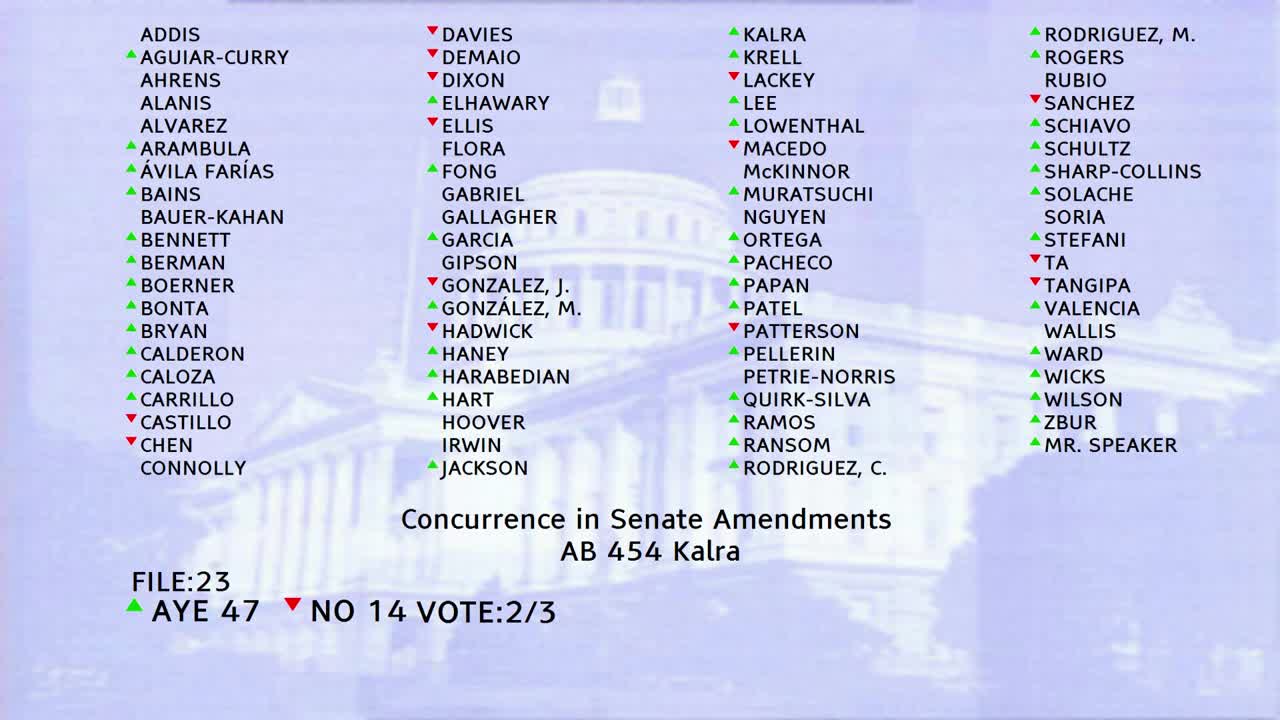 52SEC
Assembly Floor
 2MIN
Senate Floor
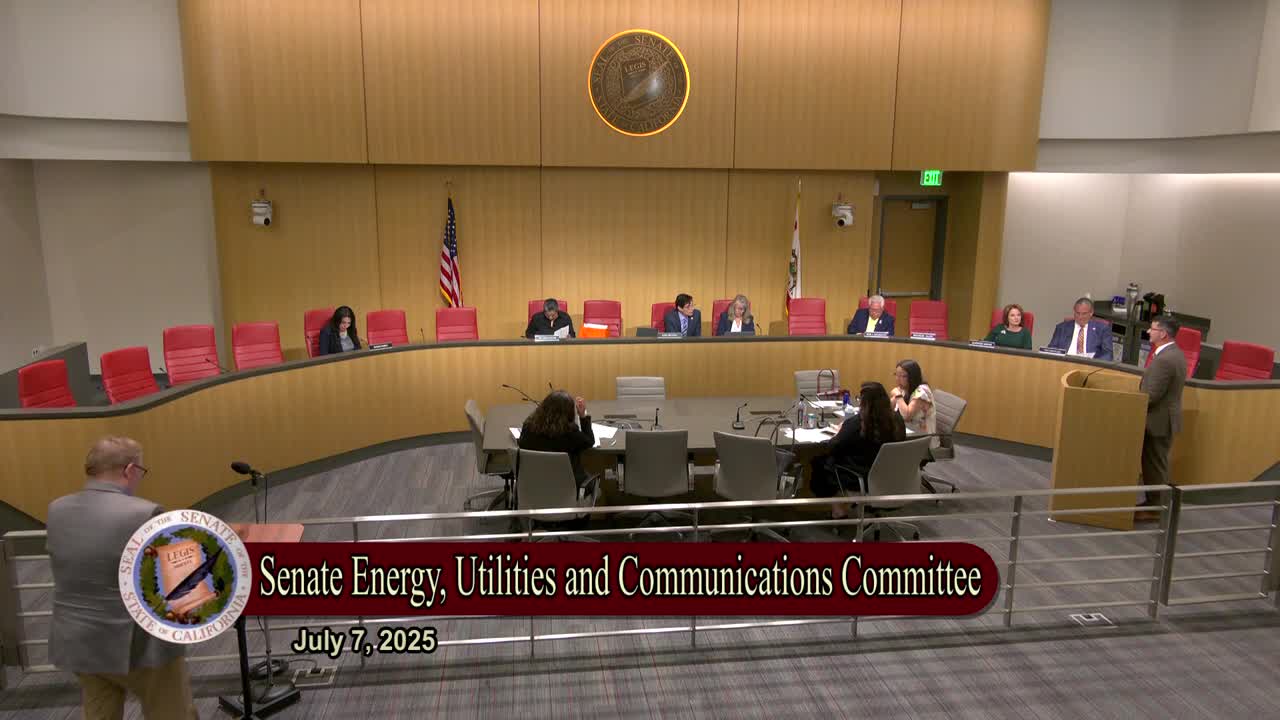 4MIN
Senate Standing Committee on Energy, Utilities and Communications
 4MIN
Assembly Standing Committee on Emergency Management
Bill Author