AB 653: Child abuse: mandated reporters: talent agents, managers, and coaches.
- Session Year: 2025-2026
- House: Assembly
- Latest Version Date: 2025-10-06
Current Status:
Passed
(2025-10-06: Chaptered by Secretary of State - Chapter 379, Statutes of 2025.)
Introduced
In Committee
Awaiting First Chamber Vote
Passed First Chamber
In Committee
Awaiting Second Chamber Vote
Passed Second Chamber
Enacted
Existing law, the Child Abuse and Neglect Reporting Act, requires a mandated reporter, as defined, to report whenever they, in their professional capacity or within the scope of their employment, have knowledge of or observed a child whom the mandated reporter knows or reasonably suspects has been the victim of child abuse or neglect. Failure by a mandated reporter to report an incident of known or reasonably suspected child abuse or neglect is a misdemeanor punishable by up to 6 months of confinement in a county jail, by a fine of $1,000, or by both that imprisonment and fine.
This bill would add an individual employed as a talent agent, talent manager, or talent coach, who provides services to a minor, to the list of individuals who are mandated reporters. By imposing the reporting requirements on a new class of persons, for whom failure to report specified conduct is a crime, this bill would impose a state-mandated local program.
This bill would incorporate additional changes to Section 11165.7 of the Penal Code proposed by SB 402 and SB 848, to be operative only if this bill and either or both of those bills are enacted and this bill is enacted last.
The California Constitution requires the state to reimburse local agencies and school districts for certain costs mandated by the state. Statutory provisions establish procedures for making that reimbursement.
This bill would provide that no reimbursement is required by this act for a specified reason.
Existing law, the Child Abuse and Neglect Reporting Act, requires a mandated reporter, as defined, to report whenever they, in their professional capacity or within the scope of their employment, have knowledge of or observed a child whom the mandated reporter knows or reasonably suspects has been the victim of child abuse or neglect. Failure by a mandated reporter to report an incident of known or reasonably suspected child abuse or neglect is a misdemeanor punishable by up to 6 months of confinement in a county jail, by a fine of $1,000, or by both that imprisonment and fine.
This bill would add an individual employed as a talent agent, talent manager, or talent coach, who provides services to a minor, to the list of individuals who are mandated reporters. By imposing the reporting requirements on a new class of persons, for whom failure to report specified conduct is a crime, this bill would impose a state-mandated local program.
The California Constitution requires the state to reimburse local agencies and school districts for certain costs mandated by the state. Statutory provisions establish procedures for making that reimbursement.
This bill would provide that no reimbursement is required by this act for a specified reason.
Existing law, the Child Abuse and Neglect Reporting Act, requires a mandated reporter, as defined, to report whenever they, in their professional capacity or within the scope of their employment, have knowledge of or observed a child whom the mandated reporter knows or reasonably suspects has been the victim of child abuse or neglect. Failure by a mandated reporter to report an incident of known or reasonably suspected child abuse or neglect is a misdemeanor punishable by up to 6 months of confinement in a county jail, by a fine of $1,000, or by both that imprisonment and fine.
This bill would add a an individual employed as a talent agent, talent manager, or talent coach, as defined, who provides services to a minor, to the list of individuals who are mandated reporters. By imposing the reporting requirements on a new class of persons, for whom failure to report specified conduct is a crime, this bill would impose a state-mandated local program.
The California Constitution requires the state to reimburse local agencies and school districts for certain costs mandated by the state. Statutory provisions establish procedures for making that reimbursement.
This bill would provide that no reimbursement is required by this act for a specified reason.
Existing law, the Child Abuse and Neglect Reporting Act, requires a mandated reporter, as defined, to report whenever they, in their professional capacity or within the scope of their employment, have knowledge of or observed a child whom the mandated reporter knows or reasonably suspects has been the victim of child abuse or neglect. Failure by a mandated reporter to report an incident of known or reasonably suspected child abuse or neglect is a misdemeanor punishable by up to 6 months of confinement in a county jail, by a fine of $1,000, or by both that imprisonment and fine.
This bill would add a talent agent, talent manager, or talent coach, as defined, who provides services to a minor, to the list of individuals who are mandated reporters. By imposing the reporting requirements on a new class of persons, for whom failure to report specified conduct is a crime, this bill would impose a state-mandated local program.
The California Constitution requires the state to reimburse local agencies and school districts for certain costs mandated by the state. Statutory provisions establish procedures for making that reimbursement.
This bill would provide that no reimbursement is required by this act for a specified reason.
Existing law, the Child Abuse and Neglect Reporting Act, requires a mandated reporter, as defined, to report whenever they, in their professional capacity or within the scope of their employment, have knowledge of or observed a child whom the mandated reporter knows or reasonably suspects has been the victim of child abuse or neglect. Failure by a mandated reporter to report an incident of known or reasonably suspected child abuse or neglect is a misdemeanor punishable by up to 6 months of confinement in a county jail, by a fine of $1,000, or by both that imprisonment and fine.
This bill would add a talent agent, talent manager, or talent coach, who provides services to a minor, to the list of individuals who are mandated reporters. By imposing the reporting requirements on a new class of persons, for whom failure to report specified conduct is a crime, this bill would impose a state-mandated local program.
The California Constitution requires the state to reimburse local agencies and school districts for certain costs mandated by the state. Statutory provisions establish procedures for making that reimbursement.
This bill would provide that no reimbursement is required by this act for a specified reason.
Existing law authorizes specified law enforcement and public safety officers and professionals to close an area where a menace to the public health or safety is created by a calamity, including a flood, storm, fire, earthquake, explosion, accident, or other disaster, and makes it a misdemeanor for a person to enter an area closed by law enforcement for this purpose.This bill would make a technical, nonsubstantive change to those provisions.Existing law authorizes specified law enforcement and public safety officers and professionals to close an area where a menace to the public health or safety is created by a calamity, including a flood, storm, fire, earthquake, explosion, accident, or other disaster, and makes it a misdemeanor for a person to enter an area closed by law enforcement for this purpose.
This bill would make a technical, nonsubstantive change to those provisions.
This act shall be known, and may be cited, as The Child Abuse Mandated Entertainment Reporter Act (CAMERA).
SEC. 2.Section 11165.7 of the Penal Code is amended to read:11165.7.(a)As used in this article, mandated reporter is defined as any of the following:
(1)A teacher.
(2)An instructional aide.
(3)A teachers aide or teachers assistant employed by a public or private school.
(4)A classified employee of a public school.
(5)An administrative officer or supervisor of child welfare and attendance, or a certificated pupil personnel employee of a public or private school.
(6)An administrator of a public or private day camp.
(7)An administrator or employee of a public or private youth center, youth recreation program, or youth organization.
(8)An administrator, board member, or employee of a public or private organization whose duties require direct contact and supervision of children, including a foster family agency.
(9)An employee of a county office of education or the State Department of Education whose duties bring the employee into contact with children on a regular basis.
(10)A licensee, an administrator, or an employee of a licensed child daycare facility or community care facility, except those licensed community care facilities exclusively serving adults and seniors.
(11)A Head Start program teacher.
(12)A licensing worker or licensing evaluator employed by a licensing agency, as defined in Section 11165.11.
(13)A public assistance worker.
(14)An employee of a childcare institution, including, but not limited to, foster parents, group home personnel, and personnel of residential care facilities.
(15)A social worker, probation officer, or parole officer.
(16)An employee of a school district police or security department.
(17)A person who is an administrator or presenter of, or a counselor in, a child abuse prevention program in a public or private school.
(18)A district attorney investigator, inspector, or local child support agency caseworker, unless the investigator, inspector, or caseworker is working with an attorney appointed pursuant to Section 317 of the Welfare and Institutions Code to represent a minor.
(19)A peace officer, as defined in Chapter 4.5 (commencing with Section 830) of Title 3 of Part 2, who is not otherwise described in this section.
(20)A firefighter, except for volunteer firefighters.
(21)A physician and surgeon, psychiatrist, psychologist, dentist, resident, intern, podiatrist, chiropractor, licensed nurse, dental hygienist, optometrist, marriage and family therapist, clinical social worker, professional clinical counselor, or any other person who is currently licensed under Division 2 (commencing with Section 500) of the Business and Professions Code.
(22)An emergency medical technician I or II, paramedic, or other person certified pursuant to Division 2.5 (commencing with Section 1797) of the Health and Safety Code.
(23)A psychological assistant registered pursuant to Section 2913 of the Business and Professions Code.
(24)A marriage and family therapist trainee, as defined in subdivision (c) of Section 4980.03 of the Business and Professions Code.
(25)An unlicensed associate marriage and family therapist registered under Section 4980.44 of the Business and Professions Code.
(26)A state or county public health employee who treats a minor for venereal disease or any other condition.
(27)A coroner.
(28)A medical examiner or other person who performs autopsies.
(29)A commercial film and photographic print or image processor as specified in subdivision (e) of Section 11166. As used in this article, commercial film and photographic print or image processor means a person who develops exposed photographic film into negatives, slides, or prints, or who makes prints from negatives or slides, or who prepares, publishes, produces, develops, duplicates, or prints any representation of information, data, or an image, including, but not limited to, any film, filmstrip, photograph, negative, slide, photocopy, videotape, video laser disc, computer hardware, computer software, computer floppy disk, data storage medium, CD-ROM, computer-generated equipment, or computer-generated image, for compensation. The term includes any employee of that person; it does not include a person who develops film or makes prints or images for a public agency.
(30)A child visitation monitor. As used in this article, child visitation monitor means a person who, for financial compensation, acts as a monitor of a visit between a child and another person when the monitoring of that visit has been ordered by a court of law.
(31)An animal control officer or humane society officer. For the purposes of this article, the following terms have the following meanings:
(A)Animal control officer means a person employed by a city, county, or city and county for the purpose of enforcing animal control laws or regulations.
(B)Humane society officer means a person appointed or employed by a public or private entity as a humane officer who is qualified pursuant to Section 14502 or 14503 of the Corporations Code.
(32)A clergy member, as specified in subdivision (d) of Section 11166. As used in this article, clergy member means a priest, minister, rabbi, religious practitioner, or similar functionary of a church, temple, or recognized denomination or organization.
(33)Any custodian of records of a clergy member, as specified in this section and subdivision (d) of Section 11166.
(34)An employee of any police department, county sheriffs department, county probation department, or county welfare department.
(35)An employee or volunteer of a Court Appointed Special Advocate program, as defined in Rule 5.655 of the California Rules of Court.
(36)A custodial officer, as defined in Section 831.5.
(37)A person providing services to a minor child under Section 12300 or 12300.1 of the Welfare and Institutions Code.
(38)An alcohol and drug counselor. As used in this article, an alcohol and drug counselor is a person providing counseling, therapy, or other clinical services for a state licensed or certified drug, alcohol, or drug and alcohol treatment program. However, alcohol or drug abuse, or both alcohol and drug abuse, is not, in and of itself, a sufficient basis for reporting child abuse or neglect.
(39)A clinical counselor trainee, as defined in subdivision (g) of Section 4999.12 of the Business and Professions Code.
(40)An associate professional clinical counselor registered under Section 4999.42 of the Business and Professions Code.
(41)An employee or administrator of a public or private postsecondary educational institution, whose duties bring the administrator or employee into contact with children on a regular basis, or who supervises those whose duties bring the administrator or employee into contact with children on a regular basis, as to child abuse or neglect occurring on that institutions premises or at an official activity of, or program conducted by, the institution. Nothing in this paragraph shall be construed as altering the lawyer-client privilege as set forth in Article 3 (commencing with Section 950) of Chapter 4 of Division 8 of the Evidence Code.
(42)An athletic coach, athletic administrator, or athletic director employed by any public or private school that provides any combination of instruction for kindergarten, or grades 1 to 12, inclusive.
(43)(A)A commercial computer technician as specified in subdivision (e) of Section 11166. As used in this article, commercial computer technician means a person who works for a company that is in the business of repairing, installing, or otherwise servicing a computer or computer component, including, but not limited to, a computer part, device, memory storage or recording mechanism, auxiliary storage recording or memory capacity, or any other material relating to the operation and maintenance of a computer or computer network system, for a fee. An employer who provides an electronic communications service or a remote computing service to the public shall be deemed to comply with this article if that employer complies with Section 2258A of Title 18 of the United States Code.
(B)An employer of a commercial computer technician may implement internal procedures for facilitating reporting consistent with this article. These procedures may direct employees who are mandated reporters under this paragraph to report materials described in subdivision (e) of Section 11166 to an employee who is designated by the employer to receive the reports. An employee who is designated to receive reports under this subparagraph shall be a commercial computer technician for purposes of this article. A commercial computer technician who makes a report to the designated employee pursuant to this subparagraph shall be deemed to have complied with the requirements of this article and shall be subject to the protections afforded to mandated reporters, including, but not limited to, those protections afforded by Section 11172.
(44)Any athletic coach, including, but not limited to, an assistant coach or a graduate assistant involved in coaching, at public or private postsecondary educational institutions.
(45)An individual certified by a licensed foster family agency as a certified family home, as defined in Section 1506 of the Health and Safety Code.
(46)An individual approved as a resource family, as defined in Section 1517 of the Health and Safety Code and Section 16519.5 of the Welfare and Institutions Code.
(47)A qualified autism service provider, a qualified autism service professional, or a qualified autism service paraprofessional, as defined in Section 1374.73 of the Health and Safety Code and Section 10144.51 of the Insurance Code.
(48)A human resource employee of a business subject to Part 2.8 (commencing with Section 12900) of Division 3 of Title 2 of the Government Code that employs minors. For purposes of this section, a human resource employee is the employee or employees designated by the employer to accept any complaints of misconduct as required by Chapter 6 (commencing with Section 12940) of Part 2.8 of Division 3 of Title 2 of the Government Code.
(49)An adult person whose duties require direct contact with and supervision of minors in the performance of the minors duties in the workplace of a business subject to Part 2.8 (commencing with Section 12900) of Division 3 of Title 2 of the Government Code is a mandated reporter of sexual abuse, as defined in Section 11165.1. Nothing in this paragraph shall be construed to modify or limit the persons duty to report known or suspected child abuse or neglect when the person is acting in some other capacity that would otherwise make the person a mandated reporter.
(50)An individual employed as a talent agent, talent manager, or talent coach, who provides services to a minor.
(b)Except as provided in paragraph (35) of subdivision (a), volunteers of public or private organizations whose duties require direct contact with and supervision of children are not mandated reporters but are encouraged to obtain training in the identification and reporting of child abuse and neglect and are further encouraged to report known or suspected instances of child abuse or neglect to an agency specified in Section 11165.9.
(c)(1)Except as provided in subdivision (d) and paragraph (2), employers are strongly encouraged to provide their employees who are mandated reporters with training in the duties imposed by this article. This training shall include training in child abuse and neglect identification and training in child abuse and neglect reporting. Whether or not employers provide their employees with training in child abuse and neglect identification and reporting, the employers shall provide their employees who are mandated reporters with the statement required pursuant to subdivision (a) of Section 11166.5.
(2)Employers subject to paragraphs (48) and (49) of subdivision (a) shall provide their employees who are mandated reporters with training in the duties imposed by this article. This training shall include training in child abuse and neglect identification and training in child abuse and neglect reporting. The training requirement may be met by completing the general online training for mandated reporters offered by the Office of Child Abuse Prevention in the State Department of Social Services.
(d)Pursuant to Section 44691 of the Education Code, school districts, county offices of education, state special schools and diagnostic centers operated by the State Department of Education, and charter schools shall annually train their employees and persons working on their behalf specified in subdivision (a) in the duties of mandated reporters under the child abuse reporting laws. The training shall include, but not necessarily be limited to, training in child abuse and neglect identification and child abuse and neglect reporting.
(e)(1)On and after January 1, 2018, pursuant to Section 1596.8662 of the Health and Safety Code, a childcare licensee applicant shall take training in the duties of mandated reporters under the child abuse reporting laws as a condition of licensure, and a childcare administrator or an employee of a licensed child daycare facility shall take training in the duties of mandated reporters during the first 90 days when that administrator or employee is employed by the facility.
(2)A person specified in paragraph (1) who becomes a licensee, administrator, or employee of a licensed child daycare facility shall take renewal mandated reporter training every two years following the date on which that person completed the initial mandated reporter training. The training shall include, but not necessarily be limited to, training in child abuse and neglect identification and child abuse and neglect reporting.
(f)Unless otherwise specifically provided, the absence of training shall not excuse a mandated reporter from the duties imposed by this article.
(g)Public and private organizations are encouraged to provide their volunteers whose duties require direct contact with and supervision of children with training in the identification and reporting of child abuse and neglect.
SEC. 2.1.Section 11165.7 of the Penal Code is amended to read:11165.7.(a)As used in this article, mandated reporter is defined as any of the following:
(1)A teacher.
(2)An instructional aide.
(3)A teachers aide or teachers assistant employed by a public or private school.
(4)A classified employee of a public school.
(5)An administrative officer or supervisor of child welfare and attendance, or a certificated pupil personnel employee of a public or private school.
(6)An administrator of a public or private day camp.
(7)An administrator or employee of a public or private youth center, youth recreation program, or youth organization.
(8)An administrator, board member, or employee of a public or private organization whose duties require direct contact and supervision of children, including a foster family agency.
(9)An employee of a county office of education or the State Department of Education whose duties bring the employee into contact with children on a regular basis.
(10)A licensee, an administrator, or an employee of a licensed child daycare facility or community care facility, except those licensed community care facilities exclusively serving adults and seniors.
(11)A Head Start program teacher.
(12)A licensing worker or licensing evaluator employed by a licensing agency, as defined in Section 11165.11.
(13)A public assistance worker.
(14)An employee of a childcare institution, including, but not limited to, foster parents, group home personnel, and personnel of residential care facilities.
(15)A social worker, probation officer, or parole officer.
(16)An employee of a school district police or security department.
(17)A person who is an administrator or presenter of, or a counselor in, a child abuse prevention program in a public or private school.
(18)A district attorney investigator, inspector, or local child support agency caseworker, unless the investigator, inspector, or caseworker is working with an attorney appointed pursuant to Section 317 of the Welfare and Institutions Code to represent a minor.
(19)A peace officer, as defined in Chapter 4.5 (commencing with Section 830) of Title 3 of Part 2, who is not otherwise described in this section.
(20)A firefighter, except for volunteer firefighters.
(21)A physician and surgeon, psychiatrist, psychologist, dentist, resident, intern, podiatrist, chiropractor, licensed nurse, dental hygienist, optometrist, marriage and family therapist, clinical social worker, professional clinical counselor, or any other person who is currently licensed under Division 2 (commencing with Section 500) of the Business and Professions Code.
(22)An emergency medical technician I or II, paramedic, or other person certified pursuant to Division 2.5 (commencing with Section 1797) of the Health and Safety Code.
(23)A psychological assistant registered pursuant to Section 2913 of the Business and Professions Code.
(24)A marriage and family therapist trainee, as defined in subdivision (c) of Section 4980.03 of the Business and Professions Code.
(25)An unlicensed associate marriage and family therapist registered under Section 4980.44 of the Business and Professions Code.
(26)A state or county public health employee who treats a minor for venereal disease or any other condition.
(27)A coroner.
(28)A medical examiner or other person who performs autopsies.
(29)A commercial film and photographic print or image processor as specified in subdivision (e) of Section 11166. As used in this article, commercial film and photographic print or image processor means a person who develops exposed photographic film into negatives, slides, or prints, or who makes prints from negatives or slides, or who prepares, publishes, produces, develops, duplicates, or prints any representation of information, data, or an image, including, but not limited to, any film, filmstrip, photograph, negative, slide, photocopy, videotape, video laser disc, computer hardware, computer software, computer floppy disk, data storage medium, CD-ROM, computer-generated equipment, or computer-generated image, for compensation. The term includes any employee of that person; it does not include a person who develops film or makes prints or images for a public agency.
(30)A child visitation monitor. As used in this article, child visitation monitor means a person who, for financial compensation, acts as a monitor of a visit between a child and another person when the monitoring of that visit has been ordered by a court of law.
(31)An animal control officer or humane society officer. For the purposes of this article, the following terms have the following meanings:
(A)Animal control officer means a person employed by a city, county, or city and county for the purpose of enforcing animal control laws or regulations.
(B)Humane society officer means a person appointed or employed by a public or private entity as a humane officer who is qualified pursuant to Section 14502 or 14503 of the Corporations Code.
(32)A clergy member, as specified in subdivision (d) of Section 11166. As used in this article, clergy member means a priest, minister, rabbi, religious practitioner, or similar functionary of a church, temple, or recognized denomination or organization.
(33)Any custodian of records of a clergy member, as specified in this section and subdivision (d) of Section 11166.
(34)An employee of any police department, county sheriffs department, county probation department, or county welfare department.
(35)An employee or volunteer of a Court Appointed Special Advocate program, as defined in Rule 5.655 of the California Rules of Court.
(36)A custodial officer, as defined in Section 831.5.
(37)A person providing services to a minor child under Section 12300 or 12300.1 of the Welfare and Institutions Code.
(38)An alcohol and drug counselor. As used in this article, an alcohol and drug counselor is a person providing counseling, therapy, or other clinical services for a state licensed or certified drug, alcohol, or drug and alcohol treatment program. However, alcohol or drug abuse, or both alcohol and drug abuse, is not, in and of itself, a sufficient basis for reporting child abuse or neglect.
(39)A clinical counselor trainee, as defined in subdivision (g) of Section 4999.12 of the Business and Professions Code.
(40)An associate professional clinical counselor registered under Section 4999.42 of the Business and Professions Code.
(41)An employee or administrator of a public or private postsecondary educational institution, whose duties bring the administrator or employee into contact with children on a regular basis, or who supervises those whose duties bring the administrator or employee into contact with children on a regular basis, as to child abuse or neglect occurring on that institutions premises or at an official activity of, or program conducted by, the institution. Nothing in this paragraph shall be construed as altering the lawyer-client privilege as set forth in Article 3 (commencing with Section 950) of Chapter 4 of Division 8 of the Evidence Code.
(42)An athletic coach, athletic administrator, or athletic director employed by any public or private school that provides any combination of instruction for kindergarten, or grades 1 to 12, inclusive.
(43)(A)A commercial computer technician as specified in subdivision (e) of Section 11166. As used in this article, commercial computer technician means a person who works for a company that is in the business of repairing, installing, or otherwise servicing a computer or computer component, including, but not limited to, a computer part, device, memory storage or recording mechanism, auxiliary storage recording or memory capacity, or any other material relating to the operation and maintenance of a computer or computer network system, for a fee. An employer who provides an electronic communications service or a remote computing service to the public shall be deemed to comply with this article if that employer complies with Section 2258A of Title 18 of the United States Code.
(B)An employer of a commercial computer technician may implement internal procedures for facilitating reporting consistent with this article. These procedures may direct employees who are mandated reporters under this paragraph to report materials described in subdivision (e) of Section 11166 to an employee who is designated by the employer to receive the reports. An employee who is designated to receive reports under this subparagraph shall be a commercial computer technician for purposes of this article. A commercial computer technician who makes a report to the designated employee pursuant to this subparagraph shall be deemed to have complied with the requirements of this article and shall be subject to the protections afforded to mandated reporters, including, but not limited to, those protections afforded by Section 11172.
(44)Any athletic coach, including, but not limited to, an assistant coach or a graduate assistant involved in coaching, at public or private postsecondary educational institutions.
(45)An individual certified by a licensed foster family agency as a certified family home, as defined in Section 1506 of the Health and Safety Code.
(46)An individual approved as a resource family, as defined in Section 1517 of the Health and Safety Code and Section 16519.5 of the Welfare and Institutions Code.
(47)A qualified autism service provider, a qualified autism service professional, or a qualified autism service paraprofessional as defined in Chapter 17 (commencing with Section 4999.200) of Division 2 of the Business and Professions Code.
(48)A human resource employee of a business subject to Part 2.8 (commencing with Section 12900) of Division 3 of Title 2 of the Government Code that employs minors. For purposes of this section, a human resource employee is the employee or employees designated by the employer to accept any complaints of misconduct as required by Chapter 6 (commencing with Section 12940) of Part 2.8 of Division 3 of Title 2 of the Government Code.
(49)An adult person whose duties require direct contact with and supervision of minors in the performance of the minors duties in the workplace of a business subject to Part 2.8 (commencing with Section 12900) of Division 3 of Title 2 of the Government Code is a mandated reporter of sexual abuse, as defined in Section 11165.1. Nothing in this paragraph shall be construed to modify or limit the persons duty to report known or suspected child abuse or neglect when the person is acting in some other capacity that would otherwise make the person a mandated reporter.
(50)An individual employed as a talent agent, talent manager, or talent coach, who provides services to a minor.
(b)Except as provided in paragraph (35) of subdivision (a), volunteers of public or private organizations whose duties require direct contact with and supervision of children are not mandated reporters but are encouraged to obtain training in the identification and reporting of child abuse and neglect and are further encouraged to report known or suspected instances of child abuse or neglect to an agency specified in Section 11165.9.
(c)(1)Except as provided in subdivision (d) and paragraph (2), employers are strongly encouraged to provide their employees who are mandated reporters with training in the duties imposed by this article. This training shall include training in child abuse and neglect identification and training in child abuse and neglect reporting. Whether or not employers provide their employees with training in child abuse and neglect identification and reporting, the employers shall provide their employees who are mandated reporters with the statement required pursuant to subdivision (a) of Section 11166.5.
(2)Employers subject to paragraphs (48) and (49) of subdivision (a) shall provide their employees who are mandated reporters with training in the duties imposed by this article. This training shall include training in child abuse and neglect identification and training in child abuse and neglect reporting. The training requirement may be met by completing the general online training for mandated reporters offered by the Office of Child Abuse Prevention in the State Department of Social Services.
(d)Pursuant to Section 44691 of the Education Code, school districts, county offices of education, state special schools and diagnostic centers operated by the State Department of Education, and charter schools shall annually train their employees and persons working on their behalf specified in subdivision (a) in the duties of mandated reporters under the child abuse reporting laws. The training shall include, but not necessarily be limited to, training in child abuse and neglect identification and child abuse and neglect reporting.
(e)(1)On and after January 1, 2018, pursuant to Section 1596.8662 of the Health and Safety Code, a childcare licensee applicant shall take training in the duties of mandated reporters under the child abuse reporting laws as a condition of licensure, and a childcare administrator or an employee of a licensed child daycare facility shall take training in the duties of mandated reporters during the first 90 days when that administrator or employee is employed by the facility.
(2)A person specified in paragraph (1) who becomes a licensee, administrator, or employee of a licensed child daycare facility shall take renewal mandated reporter training every two years following the date on which that person completed the initial mandated reporter training. The training shall include, but not necessarily be limited to, training in child abuse and neglect identification and child abuse and neglect reporting.
(f)Unless otherwise specifically provided, the absence of training shall not excuse a mandated reporter from the duties imposed by this article.
(g)Public and private organizations are encouraged to provide their volunteers whose duties require direct contact with and supervision of children with training in the identification and reporting of child abuse and neglect.
SEC. 2.2.Section 11165.7 of the Penal Code is amended to read:11165.7.(a)As used in this article, mandated reporter is defined as any of the following:
(1)An employee, volunteer, or governing board or body member of a school district, county office of education, charter school, or private school. For purposes of this paragraph, a volunteer is a person who is over 18 years of age and who interacts with pupils outside of the immediate supervision and control of the pupils parent or guardian or a school employee.
(2)An employee, volunteer, or board member of a public or private school, contractor to a school district, county office of education, charter school, state special school or diagnostic center operated by the State Department of Education, or private school whose duties require contact with or supervision of pupils at that school district, county office of education, charter school, state special school or diagnostic center operated by the State Department of Education, or private school. For purposes of this paragraph, a volunteer is a person who is over 18 years of age and who interacts with pupils outside of the immediate supervision and control of the pupils parent or guardian or a school employee.
(3)An employee or volunteer assigned to a state special school or diagnostic center operated by the State Department of Education. For purposes of this paragraph, a volunteer is a person who is over 18 years of age and who interacts with pupils outside of the immediate supervision and control of the pupils parent or guardian or a school employee.
(4)[Reserved]
(5)[Reserved]
(6)An administrator of a public or private day camp.
(7)An administrator or employee of a public or private youth center, youth recreation program, or youth organization.
(8)An administrator, board member, or employee of a public or private organization whose duties require direct contact and supervision of children, including a foster family agency.
(9)[Reserved]
(10)A licensee, an administrator, or an employee of a licensed child daycare facility or community care facility, except those licensed community care facilities exclusively serving adults and seniors.
(11)A Head Start program teacher.
(12)A licensing worker or licensing evaluator employed by a licensing agency, as defined in Section 11165.11.
(13)A public assistance worker.
(14)An employee of a childcare institution, including, but not limited to, foster parents, group home personnel, and personnel of residential care facilities.
(15)A social worker, probation officer, or parole officer.
(16)[Reserved]
(17)A person who is an administrator or presenter of, or a counselor in, a child abuse prevention program in a public or private school.
(18)A district attorney investigator, inspector, or local child support agency caseworker, unless the investigator, inspector, or caseworker is working with an attorney appointed pursuant to Section 317 of the Welfare and Institutions Code to represent a minor.
(19)A peace officer, as defined in Chapter 4.5 (commencing with Section 830) of Title 3 of Part 2, who is not otherwise described in this section.
(20)A firefighter, except for volunteer firefighters.
(21)A physician and surgeon, psychiatrist, psychologist, dentist, resident, intern, podiatrist, chiropractor, licensed nurse, dental hygienist, optometrist, marriage and family therapist, clinical social worker, professional clinical counselor, or any other person who is currently licensed under Division 2 (commencing with Section 500) of the Business and Professions Code.
(22)An emergency medical technician I or II, paramedic, or other person certified pursuant to Division 2.5 (commencing with Section 1797) of the Health and Safety Code.
(23)A psychological assistant registered pursuant to Section 2913 of the Business and Professions Code.
(24)A marriage and family therapist trainee, as defined in subdivision (c) of Section 4980.03 of the Business and Professions Code.
(25)An unlicensed associate marriage and family therapist registered under Section 4980.44 of the Business and Professions Code.
(26)A state or county public health employee who treats a minor for venereal disease or any other condition.
(27)A coroner.
(28)A medical examiner or other person who performs autopsies.
(29)A commercial film and photographic print or image processor as specified in subdivision (e) of Section 11166. As used in this article, commercial film and photographic print or image processor means a person who develops exposed photographic film into negatives, slides, or prints, or who makes prints from negatives or slides, or who prepares, publishes, produces, develops, duplicates, or prints any representation of information, data, or an image, including, but not limited to, any film, filmstrip, photograph, negative, slide, photocopy, videotape, video laser disc, computer hardware, computer software, computer floppy disk, data storage medium, CD-ROM, computer-generated equipment, or computer-generated image, for compensation. The term includes any employee of that person; it does not include a person who develops film or makes prints or images for a public agency.
(30)A child visitation monitor. As used in this article, child visitation monitor means a person who, for financial compensation, acts as a monitor of a visit between a child and another person when the monitoring of that visit has been ordered by a court of law.
(31)An animal control officer or humane society officer. For the purposes of this article, the following terms have the following meanings:
(A)Animal control officer means a person employed by a city, county, or city and county for the purpose of enforcing animal control laws or regulations.
(B)Humane society officer means a person appointed or employed by a public or private entity as a humane officer who is qualified pursuant to Section 14502 or 14503 of the Corporations Code.
(32)A clergy member, as specified in subdivision (d) of Section 11166. As used in this article, clergy member means a priest, minister, rabbi, religious practitioner, or similar functionary of a church, temple, or recognized denomination or organization.
(33)Any custodian of records of a clergy member, as specified in this section and subdivision (d) of Section 11166.
(34)An employee of any police department, county sheriffs department, county probation department, or county welfare department.
(35)An employee or volunteer of a Court Appointed Special Advocate program, as defined in Rule 5.655 of the California Rules of Court.
(36)A custodial officer, as defined in Section 831.5.
(37)A person providing services to a minor child under Section 12300 or 12300.1 of the Welfare and Institutions Code.
(38)An alcohol and drug counselor. As used in this article, an alcohol and drug counselor is a person providing counseling, therapy, or other clinical services for a state licensed or certified drug, alcohol, or drug and alcohol treatment program. However, alcohol or drug abuse, or both alcohol and drug abuse, is not, in and of itself, a sufficient basis for reporting child abuse or neglect.
(39)A clinical counselor trainee, as defined in subdivision (g) of Section 4999.12 of the Business and Professions Code.
(40)An associate professional clinical counselor registered under Section 4999.42 of the Business and Professions Code.
(41)An employee or administrator of a public or private postsecondary educational institution, whose duties bring the administrator or employee into contact with children on a regular basis, or who supervises those whose duties bring the administrator or employee into contact with children on a regular basis, as to child abuse or neglect occurring on that institutions premises or at an official activity of, or program conducted by, the institution. Nothing in this paragraph shall be construed as altering the lawyer-client privilege as set forth in Article 3 (commencing with Section 950) of Chapter 4 of Division 8 of the Evidence Code.
(42)An athletic coach, athletic administrator, or athletic director employed by any public or private school that provides any combination of instruction for kindergarten, or grades 1 to 12, inclusive.
(43)(A)A commercial computer technician as specified in subdivision (e) of Section 11166. As used in this article, commercial computer technician means a person who works for a company that is in the business of repairing, installing, or otherwise servicing a computer or computer component, including, but not limited to, a computer part, device, memory storage or recording mechanism, auxiliary storage recording or memory capacity, or any other material relating to the operation and maintenance of a computer or computer network system, for a fee. An employer who provides an electronic communications service or a remote computing service to the public shall be deemed to comply with this article if that employer complies with Section 2258A of Title 18 of the United States Code.
(B)An employer of a commercial computer technician may implement internal procedures for facilitating reporting consistent with this article. These procedures may direct employees who are mandated reporters under this paragraph to report materials described in subdivision (e) of Section 11166 to an employee who is designated by the employer to receive the reports. An employee who is designated to receive reports under this subparagraph shall be a commercial computer technician for purposes of this article. A commercial computer technician who makes a report to the designated employee pursuant to this subparagraph shall be deemed to have complied with the requirements of this article and shall be subject to the protections afforded to mandated reporters, including, but not limited to, those protections afforded by Section 11172.
(44)Any athletic coach, including, but not limited to, an assistant coach or a graduate assistant involved in coaching, at public or private postsecondary educational institutions.
(45)An individual certified by a licensed foster family agency as a certified family home, as defined in Section 1506 of the Health and Safety Code.
(46)An individual approved as a resource family, as defined in Section 1517 of the Health and Safety Code and Section 16519.5 of the Welfare and Institutions Code.
(47)A qualified autism service provider, a qualified autism service professional, or a qualified autism service paraprofessional, as defined in Section 1374.73 of the Health and Safety Code and Section 10144.51 of the Insurance Code.
(48)A human resource employee of a business subject to Part 2.8 (commencing with Section 12900) of Division 3 of Title 2 of the Government Code that employs minors. For purposes of this section, a human resource employee is the employee or employees designated by the employer to accept any complaints of misconduct as required by Chapter 6 (commencing with Section 12940) of Part 2.8 of Division 3 of Title 2 of the Government Code.
(49)An adult person whose duties require direct contact with and supervision of minors in the performance of the minors duties in the workplace of a business subject to Part 2.8 (commencing with Section 12900) of Division 3 of Title 2 of the Government Code is a mandated reporter of sexual abuse, as defined in Section 11165.1. Nothing in this paragraph shall be construed to modify or limit the persons duty to report known or suspected child abuse or neglect when the person is acting in some other capacity that would otherwise make the person a mandated reporter.
(50)An individual employed as a talent agent, talent manager, or talent coach, who provides services to a minor.
(b)Except as provided in paragraphs (1), (2), (3), and (35) of subdivision (a), volunteers of public or private organizations whose duties require direct contact with and supervision of children are not mandated reporters but are encouraged to obtain training in the identification and reporting of child abuse and neglect and are further encouraged to report known or suspected instances of child abuse or neglect to an agency specified in Section 11165.9.
(c)(1)Except as provided in subdivision (d) and paragraph (2), employers are strongly encouraged to provide their employees who are mandated reporters with training in the duties imposed by this article. This training shall include training in child abuse and neglect identification and training in child abuse and neglect reporting. Whether or not employers provide their employees with training in child abuse and neglect identification and reporting, the employers shall provide their employees who are mandated reporters with the statement required pursuant to subdivision (a) of Section 11166.5.
(2)Employers subject to paragraphs (48) and (49) of subdivision (a) shall provide their employees who are mandated reporters with training in the duties imposed by this article. This training shall include training in child abuse and neglect identification and training in child abuse and neglect reporting. The training requirement may be met by completing the general online training for mandated reporters offered by the Office of Child Abuse Prevention in the State Department of Social Services.
(d)Pursuant to Section 44691 of the Education Code, school districts, county offices of education, state special schools and diagnostic centers operated by the State Department of Education, charter schools, and, commencing July 1, 2026, private schools, shall annually train their employees and persons working on their behalf specified in subdivision (a) in the duties of mandated reporters under the child abuse reporting laws. The training shall include, but not necessarily be limited to, training in child abuse and neglect identification and child abuse and neglect reporting.
(e)(1)On and after January 1, 2018, pursuant to Section 1596.8662 of the Health and Safety Code, a childcare licensee applicant shall take training in the duties of mandated reporters under the child abuse reporting laws as a condition of licensure, and a childcare administrator or an employee of a licensed child daycare facility shall take training in the duties of mandated reporters during the first 90 days when that administrator or employee is employed by the facility.
(2)A person specified in paragraph (1) who becomes a licensee, administrator, or employee of a licensed child daycare facility shall take renewal mandated reporter training every two years following the date on which that person completed the initial mandated reporter training. The training shall include, but not necessarily be limited to, training in child abuse and neglect identification and child abuse and neglect reporting.
(f)Unless otherwise specifically provided, the absence of training shall not excuse a mandated reporter from the duties imposed by this article.
(g)Public and private organizations are encouraged to provide their volunteers whose duties require direct contact with and supervision of children with training in the identification and reporting of child abuse and neglect.
SEC. 2.3.Section 11165.7 of the Penal Code is amended to read:11165.7.(a)As used in this article, mandated reporter is defined as any of the following:
(1)An employee, volunteer, or governing board or body member of a school district, county office of education, charter school, or private school. For purposes of this paragraph, a volunteer is a person who is over 18 years of age and who interacts with pupils outside of the immediate supervision and control of the pupils parent or guardian or a school employee.
(2)An employee, volunteer, or board member of a public or private school, contractor to a school district, county office of education, charter school, state special school or diagnostic center operated by the State Department of Education, or private school whose duties require contact with or supervision of pupils at that school district, county office of education, charter school, state special school or diagnostic center operated by the State Department of Education, or private school. For purposes of this paragraph, a volunteer is a person who is over 18 years of age and who interacts with pupils outside of the immediate supervision and control of the pupils parent or guardian or a school employee.
(3)An employee or volunteer assigned to a state special school or diagnostic center operated by the State Department of Education. For purposes of this paragraph, a volunteer is a person who is over 18 years of age and who interacts with pupils outside of the immediate supervision and control of the pupils parent or guardian or a school employee.
(4)[Reserved]
(5)[Reserved]
(6)An administrator of a public or private day camp.
(7)An administrator or employee of a public or private youth center, youth recreation program, or youth organization.
(8)An administrator, board member, or employee of a public or private organization whose duties require direct contact and supervision of children, including a foster family agency.
(9)[Reserved]
(10)A licensee, an administrator, or an employee of a licensed child daycare facility or community care facility, except those licensed community care facilities exclusively serving adults and seniors.
(11)A Head Start program teacher.
(12)A licensing worker or licensing evaluator employed by a licensing agency, as defined in Section 11165.11.
(13)A public assistance worker.
(14)An employee of a childcare institution, including, but not limited to, foster parents, group home personnel, and personnel of residential care facilities.
(15)A social worker, probation officer, or parole officer.
(16)[Reserved]
(17)A person who is an administrator or presenter of, or a counselor in, a child abuse prevention program in a public or private school.
(18)A district attorney investigator, inspector, or local child support agency caseworker, unless the investigator, inspector, or caseworker is working with an attorney appointed pursuant to Section 317 of the Welfare and Institutions Code to represent a minor.
(19)A peace officer, as defined in Chapter 4.5 (commencing with Section 830) of Title 3 of Part 2, who is not otherwise described in this section.
(20)A firefighter, except for volunteer firefighters.
(21)A physician and surgeon, psychiatrist, psychologist, dentist, resident, intern, podiatrist, chiropractor, licensed nurse, dental hygienist, optometrist, marriage and family therapist, clinical social worker, professional clinical counselor, or any other person who is currently licensed under Division 2 (commencing with Section 500) of the Business and Professions Code.
(22)An emergency medical technician I or II, paramedic, or other person certified pursuant to Division 2.5 (commencing with Section 1797) of the Health and Safety Code.
(23)A psychological assistant registered pursuant to Section 2913 of the Business and Professions Code.
(24)A marriage and family therapist trainee, as defined in subdivision (c) of Section 4980.03 of the Business and Professions Code.
(25)An unlicensed associate marriage and family therapist registered under Section 4980.44 of the Business and Professions Code.
(26)A state or county public health employee who treats a minor for venereal disease or any other condition.
(27)A coroner.
(28)A medical examiner or other person who performs autopsies.
(29)A commercial film and photographic print or image processor as specified in subdivision (e) of Section 11166. As used in this article, commercial film and photographic print or image processor means a person who develops exposed photographic film into negatives, slides, or prints, or who makes prints from negatives or slides, or who prepares, publishes, produces, develops, duplicates, or prints any representation of information, data, or an image, including, but not limited to, any film, filmstrip, photograph, negative, slide, photocopy, videotape, video laser disc, computer hardware, computer software, computer floppy disk, data storage medium, CD-ROM, computer-generated equipment, or computer-generated image, for compensation. The term includes any employee of that person; it does not include a person who develops film or makes prints or images for a public agency.
(30)A child visitation monitor. As used in this article, child visitation monitor means a person who, for financial compensation, acts as a monitor of a visit between a child and another person when the monitoring of that visit has been ordered by a court of law.
(31)An animal control officer or humane society officer. For the purposes of this article, the following terms have the following meanings:
(A)Animal control officer means a person employed by a city, county, or city and county for the purpose of enforcing animal control laws or regulations.
(B)Humane society officer means a person appointed or employed by a public or private entity as a humane officer who is qualified pursuant to Section 14502 or 14503 of the Corporations Code.
(32)A clergy member, as specified in subdivision (d) of Section 11166. As used in this article, clergy member means a priest, minister, rabbi, religious practitioner, or similar functionary of a church, temple, or recognized denomination or organization.
(33)Any custodian of records of a clergy member, as specified in this section and subdivision (d) of Section 11166.
(34)An employee of any police department, county sheriffs department, county probation department, or county welfare department.
(35)An employee or volunteer of a Court Appointed Special Advocate program, as defined in Rule 5.655 of the California Rules of Court.
(36)A custodial officer, as defined in Section 831.5.
(37)A person providing services to a minor child under Section 12300 or 12300.1 of the Welfare and Institutions Code.
(38)An alcohol and drug counselor. As used in this article, an alcohol and drug counselor is a person providing counseling, therapy, or other clinical services for a state licensed or certified drug, alcohol, or drug and alcohol treatment program. However, alcohol or drug abuse, or both alcohol and drug abuse, is not, in and of itself, a sufficient basis for reporting child abuse or neglect.
(39)A clinical counselor trainee, as defined in subdivision (g) of Section 4999.12 of the Business and Professions Code.
(40)An associate professional clinical counselor registered under Section 4999.42 of the Business and Professions Code.
(41)An employee or administrator of a public or private postsecondary educational institution, whose duties bring the administrator or employee into contact with children on a regular basis, or who supervises those whose duties bring the administrator or employee into contact with children on a regular basis, as to child abuse or neglect occurring on that institutions premises or at an official activity of, or program conducted by, the institution. Nothing in this paragraph shall be construed as altering the lawyer-client privilege as set forth in Article 3 (commencing with Section 950) of Chapter 4 of Division 8 of the Evidence Code.
(42)An athletic coach, athletic administrator, or athletic director employed by any public or private school that provides any combination of instruction for kindergarten, or grades 1 to 12, inclusive.
(43)(A)A commercial computer technician as specified in subdivision (e) of Section 11166. As used in this article, commercial computer technician means a person who works for a company that is in the business of repairing, installing, or otherwise servicing a computer or computer component, including, but not limited to, a computer part, device, memory storage or recording mechanism, auxiliary storage recording or memory capacity, or any other material relating to the operation and maintenance of a computer or computer network system, for a fee. An employer who provides an electronic communications service or a remote computing service to the public shall be deemed to comply with this article if that employer complies with Section 2258A of Title 18 of the United States Code.
(B)An employer of a commercial computer technician may implement internal procedures for facilitating reporting consistent with this article. These procedures may direct employees who are mandated reporters under this paragraph to report materials described in subdivision (e) of Section 11166 to an employee who is designated by the employer to receive the reports. An employee who is designated to receive reports under this subparagraph shall be a commercial computer technician for purposes of this article. A commercial computer technician who makes a report to the designated employee pursuant to this subparagraph shall be deemed to have complied with the requirements of this article and shall be subject to the protections afforded to mandated reporters, including, but not limited to, those protections afforded by Section 11172.
(44)Any athletic coach, including, but not limited to, an assistant coach or a graduate assistant involved in coaching, at public or private postsecondary educational institutions.
(45)An individual certified by a licensed foster family agency as a certified family home, as defined in Section 1506 of the Health and Safety Code.
(46)An individual approved as a resource family, as defined in Section 1517 of the Health and Safety Code and Section 16519.5 of the Welfare and Institutions Code.
(47)A qualified autism service provider, a qualified autism service professional, or a qualified autism service paraprofessional as defined in Chapter 17 (commencing with Section 4999.200) of Division 2 of the Business and Professions Code.
(48)A human resource employee of a business subject to Part 2.8 (commencing with Section 12900) of Division 3 of Title 2 of the Government Code that employs minors. For purposes of this section, a human resource employee is the employee or employees designated by the employer to accept any complaints of misconduct as required by Chapter 6 (commencing with Section 12940) of Part 2.8 of Division 3 of Title 2 of the Government Code.
(49)An adult person whose duties require direct contact with and supervision of minors in the performance of the minors duties in the workplace of a business subject to Part 2.8 (commencing with Section 12900) of Division 3 of Title 2 of the Government Code is a mandated reporter of sexual abuse, as defined in Section 11165.1. Nothing in this paragraph shall be construed to modify or limit the persons duty to report known or suspected child abuse or neglect when the person is acting in some other capacity that would otherwise make the person a mandated reporter.
(50)An individual employed as a talent agent, talent manager, or talent coach, who provides services to a minor.
(b)Except as provided in paragraphs (1), (2), (3), and (35) of subdivision (a), volunteers of public or private organizations whose duties require direct contact with and supervision of children are not mandated reporters but are encouraged to obtain training in the identification and reporting of child abuse and neglect and are further encouraged to report known or suspected instances of child abuse or neglect to an agency specified in Section 11165.9.
(c)(1)Except as provided in subdivision (d) and paragraph (2), employers are strongly encouraged to provide their employees who are mandated reporters with training in the duties imposed by this article. This training shall include training in child abuse and neglect identification and training in child abuse and neglect reporting. Whether or not employers provide their employees with training in child abuse and neglect identification and reporting, the employers shall provide their employees who are mandated reporters with the statement required pursuant to subdivision (a) of Section 11166.5.
(2)Employers subject to paragraphs (48) and (49) of subdivision (a) shall provide their employees who are mandated reporters with training in the duties imposed by this article. This training shall include training in child abuse and neglect identification and training in child abuse and neglect reporting. The training requirement may be met by completing the general online training for mandated reporters offered by the Office of Child Abuse Prevention in the State Department of Social Services.
(d)Pursuant to Section 44691 of the Education Code, school districts, county offices of education, state special schools and diagnostic centers operated by the State Department of Education, charter schools, and, commencing July 1, 2026, private schools, shall annually train their employees and persons working on their behalf specified in subdivision (a) in the duties of mandated reporters under the child abuse reporting laws. The training shall include, but not necessarily be limited to, training in child abuse and neglect identification and child abuse and neglect reporting.
(e)(1)On and after January 1, 2018, pursuant to Section 1596.8662 of the Health and Safety Code, a childcare licensee applicant shall take training in the duties of mandated reporters under the child abuse reporting laws as a condition of licensure, and a childcare administrator or an employee of a licensed child daycare facility shall take training in the duties of mandated reporters during the first 90 days when that administrator or employee is employed by the facility.
(2)A person specified in paragraph (1) who becomes a licensee, administrator, or employee of a licensed child daycare facility shall take renewal mandated reporter training every two years following the date on which that person completed the initial mandated reporter training. The training shall include, but not necessarily be limited to, training in child abuse and neglect identification and child abuse and neglect reporting.
(f)Unless otherwise specifically provided, the absence of training shall not excuse a mandated reporter from the duties imposed by this article.
(g)Public and private organizations are encouraged to provide their volunteers whose duties require direct contact with and supervision of children with training in the identification and reporting of child abuse and neglect.
SEC. 3.(a)Section 2.1 of this bill incorporates amendments to Section 11165.7 of the Penal Code proposed by both this bill and Senate Bill 402. That section of this bill shall only become operative if (1) both bills are enacted and become effective on or before January 1, 2026, (2) each bill amends Section 11165.7 of the Penal Code, (3) Senate Bill 848 is not enacted or as enacted does not amend that section, and (4) this bill is enacted after Senate Bill 402, in which case Sections 2, 2.2 and 2.3 of this bill shall not become operative.
(b)Section 2.2 of this bill incorporates amendments to Section 11165.7 of the Penal Code proposed by both this bill and Senate Bill 848. That section of this bill shall only become operative if (1) both bills are enacted and become effective on or before January 1, 2026, (2) each bill amends Section 11165.7 of the Penal Code, (3) Senate Bill 402 is not enacted or as enacted does not amend that section, and (4) this bill is enacted after Senate Bill 848 in which case Sections 2, 2.1 and 2.3 of this bill shall not become operative.
(c)Section 2.3 of this bill incorporates amendments to Section 11165.7 of the Penal Code proposed by this bill, Senate Bill 402, and Senate Bill 848. That section of this bill shall only become operative if (1) all three bills are enacted and become effective on or before January 1, 2026, (2) all three bills amend Section 11165.7 of the Penal Code, and (3) this bill is enacted after Senate Bill 402 and Senate Bill 848, in which case Sections 2, 2.1 and 2.2 of this bill shall not become operative.
SEC. 4.No reimbursement is required by this act pursuant to Section 6 of Article XIIIB of the California Constitution because the only costs that may be incurred by a local agency or school district will be incurred because this act creates a new crime or infraction, eliminates a crime or infraction, or changes the penalty for a crime or infraction, within the meaning of Section 17556 of the Government Code, or changes the definition of a crime within the meaning of Section 6 of Article XIIIB of the California Constitution.
This act shall be known, and may be cited, as The Child Abuse Mandated Entertainment Reporter Act (CAMERA).
SEC. 2.Section 11165.7 of the Penal Code, as amended by Section 1 of Chapter 79 of the Statutes of 2025, is amended to read:11165.7.(a)As used in this article, mandated reporter is defined as any of the following:
(1)A teacher.
(2)An instructional aide.
(3)A teachers aide or teachers assistant employed by a public or private school.
(4)A classified employee of a public school.
(5)An administrative officer or supervisor of child welfare and attendance, or a certificated pupil personnel employee of a public or private school.
(6)An administrator of a public or private day camp.
(7)An administrator or employee of a public or private youth center, youth recreation program, or youth organization.
(8)An administrator, board member, or employee of a public or private organization whose duties require direct contact and supervision of children, including a foster family agency.
(9)An employee of a county office of education or the State Department of Education whose duties bring the employee into contact with children on a regular basis.
(10)A licensee, an administrator, or an employee of a licensed child daycare facility or community care facility, except those licensed community care facilities exclusively serving adults and seniors.
(11)A Head Start program teacher.
(12)A licensing worker or licensing evaluator employed by a licensing agency, as defined in Section 11165.11.
(13)A public assistance worker.
(14)An employee of a childcare institution, including, but not limited to, foster parents, group home personnel, and personnel of residential care facilities.
(15)A social worker, probation officer, or parole officer.
(16)An employee of a school district police or security department.
(17)A person who is an administrator or presenter of, or a counselor in, a child abuse prevention program in a public or private school.
(18)A district attorney investigator, inspector, or local child support agency caseworker, unless the investigator, inspector, or caseworker is working with an attorney appointed pursuant to Section 317 of the Welfare and Institutions Code to represent a minor.
(19)A peace officer, as defined in Chapter 4.5 (commencing with Section 830) of Title 3 of Part 2, who is not otherwise described in this section.
(20)A firefighter, except for volunteer firefighters.
(21)A physician and surgeon, psychiatrist, psychologist, dentist, resident, intern, podiatrist, chiropractor, licensed nurse, dental hygienist, optometrist, marriage and family therapist, clinical social worker, professional clinical counselor, or any other person who is currently licensed under Division 2 (commencing with Section 500) of the Business and Professions Code.
(22)An emergency medical technician I or II, paramedic, or other person certified pursuant to Division 2.5 (commencing with Section 1797) of the Health and Safety Code.
(23)A psychological assistant registered pursuant to Section 2913 of the Business and Professions Code.
(24)A marriage and family therapist trainee, as defined in subdivision (c) of Section 4980.03 of the Business and Professions Code.
(25)An unlicensed associate marriage and family therapist registered under Section 4980.44 of the Business and Professions Code.
(26)A state or county public health employee who treats a minor for venereal disease or any other condition.
(27)A coroner.
(28)A medical examiner or other person who performs autopsies.
(29)A commercial film and photographic print or image processor as specified in subdivision (e) of Section 11166. As used in this article, commercial film and photographic print or image processor means a person who develops exposed photographic film into negatives, slides, or prints, or who makes prints from negatives or slides, or who prepares, publishes, produces, develops, duplicates, or prints any representation of information, data, or an image, including, but not limited to, any film, filmstrip, photograph, negative, slide, photocopy, videotape, video laser disc, computer hardware, computer software, computer floppy disk, data storage medium, CD-ROM, computer-generated equipment, or computer-generated image, for compensation. The term includes any employee of that person; it does not include a person who develops film or makes prints or images for a public agency.
(30)A child visitation monitor. As used in this article, child visitation monitor means a person who, for financial compensation, acts as a monitor of a visit between a child and another person when the monitoring of that visit has been ordered by a court of law.
(31)An animal control officer or humane society officer. For the purposes of this article, the following terms have the following meanings:
(A)Animal control officer means a person employed by a city, county, or city and county for the purpose of enforcing animal control laws or regulations.
(B)Humane society officer means a person appointed or employed by a public or private entity as a humane officer who is qualified pursuant to Section 14502 or 14503 of the Corporations Code.
(32)A clergy member, as specified in subdivision (d) of Section 11166. As used in this article, clergy member means a priest, minister, rabbi, religious practitioner, or similar functionary of a church, temple, or recognized denomination or organization.
(33)Any custodian of records of a clergy member, as specified in this section and subdivision (d) of Section 11166.
(34)An employee of any police department, county sheriffs department, county probation department, or county welfare department.
(35)An employee or volunteer of a Court Appointed Special Advocate program, as defined in Rule 5.655 of the California Rules of Court.
(36)A custodial officer, as defined in Section 831.5.
(37)A person providing services to a minor child under Section 12300 or 12300.1 of the Welfare and Institutions Code.
(38)An alcohol and drug counselor. As used in this article, an alcohol and drug counselor is a person providing counseling, therapy, or other clinical services for a state licensed or certified drug, alcohol, or drug and alcohol treatment program. However, alcohol or drug abuse, or both alcohol and drug abuse, is not, in and of itself, a sufficient basis for reporting child abuse or neglect.
(39)A clinical counselor trainee, as defined in subdivision (g) of Section 4999.12 of the Business and Professions Code.
(40)An associate professional clinical counselor registered under Section 4999.42 of the Business and Professions Code.
(41)An employee or administrator of a public or private postsecondary educational institution, whose duties bring the administrator or employee into contact with children on a regular basis, or who supervises those whose duties bring the administrator or employee into contact with children on a regular basis, as to child abuse or neglect occurring on that institutions premises or at an official activity of, or program conducted by, the institution. Nothing in this paragraph shall be construed as altering the lawyer-client privilege as set forth in Article 3 (commencing with Section 950) of Chapter 4 of Division 8 of the Evidence Code.
(42)An athletic coach, athletic administrator, or athletic director employed by any public or private school that provides any combination of instruction for kindergarten, or grades 1 to 12, inclusive.
(43)(A)A commercial computer technician as specified in subdivision (e) of Section 11166. As used in this article, commercial computer technician means a person who works for a company that is in the business of repairing, installing, or otherwise servicing a computer or computer component, including, but not limited to, a computer part, device, memory storage or recording mechanism, auxiliary storage recording or memory capacity, or any other material relating to the operation and maintenance of a computer or computer network system, for a fee. An employer who provides an electronic communications service or a remote computing service to the public shall be deemed to comply with this article if that employer complies with Section 2258A of Title 18 of the United States Code.
(B)An employer of a commercial computer technician may implement internal procedures for facilitating reporting consistent with this article. These procedures may direct employees who are mandated reporters under this paragraph to report materials described in subdivision (e) of Section 11166 to an employee who is designated by the employer to receive the reports. An employee who is designated to receive reports under this subparagraph shall be a commercial computer technician for purposes of this article. A commercial computer technician who makes a report to the designated employee pursuant to this subparagraph shall be deemed to have complied with the requirements of this article and shall be subject to the protections afforded to mandated reporters, including, but not limited to, those protections afforded by Section 11172.
(44)Any athletic coach, including, but not limited to, an assistant coach or a graduate assistant involved in coaching, at public or private postsecondary educational institutions.
(45)An individual certified by a licensed foster family agency as a certified family home, as defined in Section 1506 of the Health and Safety Code.
(46)An individual approved as a resource family, as defined in Section 1517 of the Health and Safety Code and Section 16519.5 of the Welfare and Institutions Code.
(47)A qualified autism service provider, a qualified autism service professional, or a qualified autism service paraprofessional, as defined in Section 1374.73 of the Health and Safety Code and Section 10144.51 of the Insurance Code.
(48)A human resource employee of a business subject to Part 2.8 (commencing with Section 12900) of Division 3 of Title 2 of the Government Code that employs minors. For purposes of this section, a human resource employee is the employee or employees designated by the employer to accept any complaints of misconduct as required by Chapter 6 (commencing with Section 12940) of Part 2.8 of Division 3 of Title 2 of the Government Code.
(49)An adult person whose duties require direct contact with and supervision of minors in the performance of the minors duties in the workplace of a business subject to Part 2.8 (commencing with Section 12900) of Division 3 of Title 2 of the Government Code is a mandated reporter of sexual abuse, as defined in Section 11165.1. Nothing in this paragraph shall be construed to modify or limit the persons duty to report known or suspected child abuse or neglect when the person is acting in some other capacity that would otherwise make the person a mandated reporter.
(50)An individual employed as a talent agent, talent manager, or talent coach, who provides services to a minor.
(b)Except as provided in paragraph (35) of subdivision (a), volunteers of public or private organizations whose duties require direct contact with and supervision of children are not mandated reporters but are encouraged to obtain training in the identification and reporting of child abuse and neglect and are further encouraged to report known or suspected instances of child abuse or neglect to an agency specified in Section 11165.9.
(c)(1)Except as provided in subdivision (d) and paragraph (2), employers are strongly encouraged to provide their employees who are mandated reporters with training in the duties imposed by this article. This training shall include training in child abuse and neglect identification and training in child abuse and neglect reporting. Whether or not employers provide their employees with training in child abuse and neglect identification and reporting, the employers shall provide their employees who are mandated reporters with the statement required pursuant to subdivision (a) of Section 11166.5.
(2)Employers subject to paragraphs (48) and (49) of subdivision (a) shall provide their employees who are mandated reporters with training in the duties imposed by this article. This training shall include training in child abuse and neglect identification and training in child abuse and neglect reporting. The training requirement may be met by completing the general online training for mandated reporters offered by the Office of Child Abuse Prevention in the State Department of Social Services.
(d)Pursuant to Section 44691 of the Education Code, school districts, county offices of education, state special schools and diagnostic centers operated by the State Department of Education, and charter schools shall annually train their employees and persons working on their behalf specified in subdivision (a) in the duties of mandated reporters under the child abuse reporting laws. The training shall include, but not necessarily be limited to, training in child abuse and neglect identification and child abuse and neglect reporting.
(e)(1)On and after January 1, 2018, pursuant to Section 1596.8662 of the Health and Safety Code, a childcare licensee applicant shall take training in the duties of mandated reporters under the child abuse reporting laws as a condition of licensure, and a childcare administrator or an employee of a licensed child daycare facility shall take training in the duties of mandated reporters during the first 90 days when that administrator or employee is employed by the facility.
(2)A person specified in paragraph (1) who becomes a licensee, administrator, or employee of a licensed child daycare facility shall take renewal mandated reporter training every two years following the date on which that person completed the initial mandated reporter training. The training shall include, but not necessarily be limited to, training in child abuse and neglect identification and child abuse and neglect reporting.
(f)Unless otherwise specifically provided, the absence of training shall not excuse a mandated reporter from the duties imposed by this article.
(g)Public and private organizations are encouraged to provide their volunteers whose duties require direct contact with and supervision of children with training in the identification and reporting of child abuse and neglect.
SEC. 2.1.Section 11165.7 of the Penal Code is amended to read:11165.7.(a)As used in this article, mandated reporter is defined as any of the following:
(1)A teacher.
(2)An instructional aide.
(3)A teachers aide or teachers assistant employed by a public or private school.
(4)A classified employee of a public school.
(5)An administrative officer or supervisor of child welfare and attendance, or a certificated pupil personnel employee of a public or private school.
(6)An administrator of a public or private day camp.
(7)An administrator or employee of a public or private youth center, youth recreation program, or youth organization.
(8)An administrator, board member, or employee of a public or private organization whose duties require direct contact and supervision of children, including a foster family agency.
(9)An employee of a county office of education or the State Department of Education whose duties bring the employee into contact with children on a regular basis.
(10)A licensee, an administrator, or an employee of a licensed child daycare facility or community care facility, except those licensed community care facilities exclusively serving adults and seniors.
(11)A Head Start program teacher.
(12)A licensing worker or licensing evaluator employed by a licensing agency, as defined in Section 11165.11.
(13)A public assistance worker.
(14)An employee of a childcare institution, including, but not limited to, foster parents, group home personnel, and personnel of residential care facilities.
(15)A social worker, probation officer, or parole officer.
(16)An employee of a school district police or security department.
(17)A person who is an administrator or presenter of, or a counselor in, a child abuse prevention program in a public or private school.
(18)A district attorney investigator, inspector, or local child support agency caseworker, unless the investigator, inspector, or caseworker is working with an attorney appointed pursuant to Section 317 of the Welfare and Institutions Code to represent a minor.
(19)A peace officer, as defined in Chapter 4.5 (commencing with Section 830) of Title 3 of Part 2, who is not otherwise described in this section.
(20)A firefighter, except for volunteer firefighters.
(21)A physician and surgeon, psychiatrist, psychologist, dentist, resident, intern, podiatrist, chiropractor, licensed nurse, dental hygienist, optometrist, marriage and family therapist, clinical social worker, professional clinical counselor, or any other person who is currently licensed under Division 2 (commencing with Section 500) of the Business and Professions Code.
(22)An emergency medical technician I or II, paramedic, or other person certified pursuant to Division 2.5 (commencing with Section 1797) of the Health and Safety Code.
(23)A psychological assistant registered pursuant to Section 2913 of the Business and Professions Code.
(24)A marriage and family therapist trainee, as defined in subdivision (c) of Section 4980.03 of the Business and Professions Code.
(25)An unlicensed associate marriage and family therapist registered under Section 4980.44 of the Business and Professions Code.
(26)A state or county public health employee who treats a minor for venereal disease or any other condition.
(27)A coroner.
(28)A medical examiner or other person who performs autopsies.
(29)A commercial film and photographic print or image processor as specified in subdivision (e) of Section 11166. As used in this article, commercial film and photographic print or image processor means a person who develops exposed photographic film into negatives, slides, or prints, or who makes prints from negatives or slides, or who prepares, publishes, produces, develops, duplicates, or prints any representation of information, data, or an image, including, but not limited to, any film, filmstrip, photograph, negative, slide, photocopy, videotape, video laser disc, computer hardware, computer software, computer floppy disk, data storage medium, CD-ROM, computer-generated equipment, or computer-generated image, for compensation. The term includes any employee of that person; it does not include a person who develops film or makes prints or images for a public agency.
(30)A child visitation monitor. As used in this article, child visitation monitor means a person who, for financial compensation, acts as a monitor of a visit between a child and another person when the monitoring of that visit has been ordered by a court of law.
(31)An animal control officer or humane society officer. For the purposes of this article, the following terms have the following meanings:
(A)Animal control officer means a person employed by a city, county, or city and county for the purpose of enforcing animal control laws or regulations.
(B)Humane society officer means a person appointed or employed by a public or private entity as a humane officer who is qualified pursuant to Section 14502 or 14503 of the Corporations Code.
(32)A clergy member, as specified in subdivision (d) of Section 11166. As used in this article, clergy member means a priest, minister, rabbi, religious practitioner, or similar functionary of a church, temple, or recognized denomination or organization.
(33)Any custodian of records of a clergy member, as specified in this section and subdivision (d) of Section 11166.
(34)An employee of any police department, county sheriffs department, county probation department, or county welfare department.
(35)An employee or volunteer of a Court Appointed Special Advocate program, as defined in Rule 5.655 of the California Rules of Court.
(36)A custodial officer, as defined in Section 831.5.
(37)A person providing services to a minor child under Section 12300 or 12300.1 of the Welfare and Institutions Code.
(38)An alcohol and drug counselor. As used in this article, an alcohol and drug counselor is a person providing counseling, therapy, or other clinical services for a state licensed or certified drug, alcohol, or drug and alcohol treatment program. However, alcohol or drug abuse, or both alcohol and drug abuse, is not, in and of itself, a sufficient basis for reporting child abuse or neglect.
(39)A clinical counselor trainee, as defined in subdivision (g) of Section 4999.12 of the Business and Professions Code.
(40)An associate professional clinical counselor registered under Section 4999.42 of the Business and Professions Code.
(41)An employee or administrator of a public or private postsecondary educational institution, whose duties bring the administrator or employee into contact with children on a regular basis, or who supervises those whose duties bring the administrator or employee into contact with children on a regular basis, as to child abuse or neglect occurring on that institutions premises or at an official activity of, or program conducted by, the institution. Nothing in this paragraph shall be construed as altering the lawyer-client privilege as set forth in Article 3 (commencing with Section 950) of Chapter 4 of Division 8 of the Evidence Code.
(42)An athletic coach, athletic administrator, or athletic director employed by any public or private school that provides any combination of instruction for kindergarten, or grades 1 to 12, inclusive.
(43)(A)A commercial computer technician as specified in subdivision (e) of Section 11166. As used in this article, commercial computer technician means a person who works for a company that is in the business of repairing, installing, or otherwise servicing a computer or computer component, including, but not limited to, a computer part, device, memory storage or recording mechanism, auxiliary storage recording or memory capacity, or any other material relating to the operation and maintenance of a computer or computer network system, for a fee. An employer who provides an electronic communications service or a remote computing service to the public shall be deemed to comply with this article if that employer complies with Section 2258A of Title 18 of the United States Code.
(B)An employer of a commercial computer technician may implement internal procedures for facilitating reporting consistent with this article. These procedures may direct employees who are mandated reporters under this paragraph to report materials described in subdivision (e) of Section 11166 to an employee who is designated by the employer to receive the reports. An employee who is designated to receive reports under this subparagraph shall be a commercial computer technician for purposes of this article. A commercial computer technician who makes a report to the designated employee pursuant to this subparagraph shall be deemed to have complied with the requirements of this article and shall be subject to the protections afforded to mandated reporters, including, but not limited to, those protections afforded by Section 11172.
(44)Any athletic coach, including, but not limited to, an assistant coach or a graduate assistant involved in coaching, at public or private postsecondary educational institutions.
(45)An individual certified by a licensed foster family agency as a certified family home, as defined in Section 1506 of the Health and Safety Code.
(46)An individual approved as a resource family, as defined in Section 1517 of the Health and Safety Code and Section 16519.5 of the Welfare and Institutions Code.
(47)A qualified autism service provider, a qualified autism service professional, or a qualified autism service paraprofessional, paraprofessional as defined in Section 1374.73 of the Health and Safety Code and Section 10144.51 of the Insurance Chapter 17 (commencing with Section 4999.200) of Division 2 of the Business and Professions Code.
(48)A human resource employee of a business subject to Part 2.8 (commencing with Section 12900) of Division 3 of Title 2 of the Government Code that employs minors. For purposes of this section, a human resource employee is the employee or employees designated by the employer to accept any complaints of misconduct as required by Chapter 6 (commencing with Section 12940) of Part 2.8 of Division 3 of Title 2 of the Government Code.
(49)An adult person whose duties require direct contact with and supervision of minors in the performance of the minors duties in the workplace of a business subject to Part 2.8 (commencing with Section 12900) of Division 3 of Title 2 of the Government Code is a mandated reporter of sexual abuse, as defined in Section 11165.1. Nothing in this paragraph shall be construed to modify or limit the persons duty to report known or suspected child abuse or neglect when the person is acting in some other capacity that would otherwise make the person a mandated reporter.
(50)An individual employed as a talent agent, talent manager, or talent coach, who provides services to a minor.
(b)Except as provided in paragraph (35) of subdivision (a), volunteers of public or private organizations whose duties require direct contact with and supervision of children are not mandated reporters but are encouraged to obtain training in the identification and reporting of child abuse and neglect and are further encouraged to report known or suspected instances of child abuse or neglect to an agency specified in Section 11165.9.
(c)(1)Except as provided in subdivision (d) and paragraph (2), employers are strongly encouraged to provide their employees who are mandated reporters with training in the duties imposed by this article. This training shall include training in child abuse and neglect identification and training in child abuse and neglect reporting. Whether or not employers provide their employees with training in child abuse and neglect identification and reporting, the employers shall provide their employees who are mandated reporters with the statement required pursuant to subdivision (a) of Section 11166.5.
(2)Employers subject to paragraphs (48) and (49) of subdivision (a) shall provide their employees who are mandated reporters with training in the duties imposed by this article. This training shall include training in child abuse and neglect identification and training in child abuse and neglect reporting. The training requirement may be met by completing the general online training for mandated reporters offered by the Office of Child Abuse Prevention in the State Department of Social Services.
(d)Pursuant to Section 44691 of the Education Code, school districts, county offices of education, state special schools and diagnostic centers operated by the State Department of Education, and charter schools shall annually train their employees and persons working on their behalf specified in subdivision (a) in the duties of mandated reporters under the child abuse reporting laws. The training shall include, but not necessarily be limited to, training in child abuse and neglect identification and child abuse and neglect reporting.
(e)(1)On and after January 1, 2018, pursuant to Section 1596.8662 of the Health and Safety Code, a childcare licensee applicant shall take training in the duties of mandated reporters under the child abuse reporting laws as a condition of licensure, and a childcare administrator or an employee of a licensed child daycare facility shall take training in the duties of mandated reporters during the first 90 days when that administrator or employee is employed by the facility.
(2)A person specified in paragraph (1) who becomes a licensee, administrator, or employee of a licensed child daycare facility shall take renewal mandated reporter training every two years following the date on which that person completed the initial mandated reporter training. The training shall include, but not necessarily be limited to, training in child abuse and neglect identification and child abuse and neglect reporting.
(f)Unless otherwise specifically provided, the absence of training shall not excuse a mandated reporter from the duties imposed by this article.
(g)Public and private organizations are encouraged to provide their volunteers whose duties require direct contact with and supervision of children with training in the identification and reporting of child abuse and neglect.
SEC. 2.2.Section 11165.7 of the Penal Code is amended to read:11165.7.(a)As used in this article, mandated reporter is defined as any of the following:
(1)A teacher.(2)An instructional aide.(3)A teachers aide or teachers assistant employed by a public or private school.(4)A classified employee of a public school.(5)An administrative officer or supervisor of child welfare and attendance, or a certificated pupil personnel employee of a public or private school.(1)An employee, volunteer, or governing board or body member of a school district, county office of education, charter school, or private school. For purposes of this paragraph, a volunteer is a person who is over 18 years of age and who interacts with pupils outside of the immediate supervision and control of the pupils parent or guardian or a school employee.
(2)An employee, volunteer, or board member of a public or private school, contractor to a school district, county office of education, charter school, state special school or diagnostic center operated by the State Department of Education, or private school whose duties require contact with or supervision of pupils at that school district, county office of education, charter school, state special school or diagnostic center operated by the State Department of Education, or private school. For purposes of this paragraph, a volunteer is a person who is over 18 years of age and who interacts with pupils outside of the immediate supervision and control of the pupils parent or guardian or a school employee.
(3)An employee or volunteer assigned to a state special school or diagnostic center operated by the State Department of Education. For purposes of this paragraph, a volunteer is a person who is over 18 years of age and who interacts with pupils outside of the immediate supervision and control of the pupils parent or guardian or a school employee.
(4)[Reserved]
(5)[Reserved]
(6)An administrator of a public or private day camp.
(7)An administrator or employee of a public or private youth center, youth recreation program, or youth organization.
(8)An administrator, board member, or employee of a public or private organization whose duties require direct contact and supervision of children, including a foster family agency.
(9)An employee of a county office of education or the State Department of Education whose duties bring the employee into contact with children on a regular basis.(9)[Reserved]
(10)A licensee, an administrator, or an employee of a licensed child daycare facility or community care facility, except those licensed community care facilities exclusively serving adults and seniors.
(11)A Head Start program teacher.
(12)A licensing worker or licensing evaluator employed by a licensing agency, as defined in Section 11165.11.
(13)A public assistance worker.
(14)An employee of a childcare institution, including, but not limited to, foster parents, group home personnel, and personnel of residential care facilities.
(15)A social worker, probation officer, or parole officer.
(16)An employee of a school district police or security department.(16)[Reserved]
(17)A person who is an administrator or presenter of, or a counselor in, a child abuse prevention program in a public or private school.
(18)A district attorney investigator, inspector, or local child support agency caseworker, unless the investigator, inspector, or caseworker is working with an attorney appointed pursuant to Section 317 of the Welfare and Institutions Code to represent a minor.
(19)A peace officer, as defined in Chapter 4.5 (commencing with Section 830) of Title 3 of Part 2, who is not otherwise described in this section.
(20)A firefighter, except for volunteer firefighters.
(21)A physician and surgeon, psychiatrist, psychologist, dentist, resident, intern, podiatrist, chiropractor, licensed nurse, dental hygienist, optometrist, marriage and family therapist, clinical social worker, professional clinical counselor, or any other person who is currently licensed under Division 2 (commencing with Section 500) of the Business and Professions Code.
(22)An emergency medical technician I or II, paramedic, or other person certified pursuant to Division 2.5 (commencing with Section 1797) of the Health and Safety Code.
(23)A psychological assistant registered pursuant to Section 2913 of the Business and Professions Code.
(24)A marriage and family therapist trainee, as defined in subdivision (c) of Section 4980.03 of the Business and Professions Code.
(25)An unlicensed associate marriage and family therapist registered under Section 4980.44 of the Business and Professions Code.
(26)A state or county public health employee who treats a minor for venereal disease or any other condition.
(27)A coroner.
(28)A medical examiner or other person who performs autopsies.
(29)A commercial film and photographic print or image processor as specified in subdivision (e) of Section 11166. As used in this article, commercial film and photographic print or image processor means a person who develops exposed photographic film into negatives, slides, or prints, or who makes prints from negatives or slides, or who prepares, publishes, produces, develops, duplicates, or prints any representation of information, data, or an image, including, but not limited to, any film, filmstrip, photograph, negative, slide, photocopy, videotape, video laser disc, computer hardware, computer software, computer floppy disk, data storage medium, CD-ROM, computer-generated equipment, or computer-generated image, for compensation. The term includes any employee of that person; it does not include a person who develops film or makes prints or images for a public agency.
(30)A child visitation monitor. As used in this article, child visitation monitor means a person who, for financial compensation, acts as a monitor of a visit between a child and another person when the monitoring of that visit has been ordered by a court of law.
(31)An animal control officer or humane society officer. For the purposes of this article, the following terms have the following meanings:
(A)Animal control officer means a person employed by a city, county, or city and county for the purpose of enforcing animal control laws or regulations.
(B)Humane society officer means a person appointed or employed by a public or private entity as a humane officer who is qualified pursuant to Section 14502 or 14503 of the Corporations Code.
(32)A clergy member, as specified in subdivision (d) of Section 11166. As used in this article, clergy member means a priest, minister, rabbi, religious practitioner, or similar functionary of a church, temple, or recognized denomination or organization.
(33)Any custodian of records of a clergy member, as specified in this section and subdivision (d) of Section 11166.
(34)An employee of any police department, county sheriffs department, county probation department, or county welfare department.
(35)An employee or volunteer of a Court Appointed Special Advocate program, as defined in Rule 5.655 of the California Rules of Court.
(36)A custodial officer, as defined in Section 831.5.
(37)A person providing services to a minor child under Section 12300 or 12300.1 of the Welfare and Institutions Code.
(38)An alcohol and drug counselor. As used in this article, an alcohol and drug counselor is a person providing counseling, therapy, or other clinical services for a state licensed or certified drug, alcohol, or drug and alcohol treatment program. However, alcohol or drug abuse, or both alcohol and drug abuse, is not, in and of itself, a sufficient basis for reporting child abuse or neglect.
(39)A clinical counselor trainee, as defined in subdivision (g) of Section 4999.12 of the Business and Professions Code.
(40)An associate professional clinical counselor registered under Section 4999.42 of the Business and Professions Code.
(41)An employee or administrator of a public or private postsecondary educational institution, whose duties bring the administrator or employee into contact with children on a regular basis, or who supervises those whose duties bring the administrator or employee into contact with children on a regular basis, as to child abuse or neglect occurring on that institutions premises or at an official activity of, or program conducted by, the institution. Nothing in this paragraph shall be construed as altering the lawyer-client privilege as set forth in Article 3 (commencing with Section 950) of Chapter 4 of Division 8 of the Evidence Code.
(42)An athletic coach, athletic administrator, or athletic director employed by any public or private school that provides any combination of instruction for kindergarten, or grades 1 to 12, inclusive.
(43)(A)A commercial computer technician as specified in subdivision (e) of Section 11166. As used in this article, commercial computer technician means a person who works for a company that is in the business of repairing, installing, or otherwise servicing a computer or computer component, including, but not limited to, a computer part, device, memory storage or recording mechanism, auxiliary storage recording or memory capacity, or any other material relating to the operation and maintenance of a computer or computer network system, for a fee. An employer who provides an electronic communications service or a remote computing service to the public shall be deemed to comply with this article if that employer complies with Section 2258A of Title 18 of the United States Code.
(B)An employer of a commercial computer technician may implement internal procedures for facilitating reporting consistent with this article. These procedures may direct employees who are mandated reporters under this paragraph to report materials described in subdivision (e) of Section 11166 to an employee who is designated by the employer to receive the reports. An employee who is designated to receive reports under this subparagraph shall be a commercial computer technician for purposes of this article. A commercial computer technician who makes a report to the designated employee pursuant to this subparagraph shall be deemed to have complied with the requirements of this article and shall be subject to the protections afforded to mandated reporters, including, but not limited to, those protections afforded by Section 11172.
(44)Any athletic coach, including, but not limited to, an assistant coach or a graduate assistant involved in coaching, at public or private postsecondary educational institutions.
(45)An individual certified by a licensed foster family agency as a certified family home, as defined in Section 1506 of the Health and Safety Code.
(46)An individual approved as a resource family, as defined in Section 1517 of the Health and Safety Code and Section 16519.5 of the Welfare and Institutions Code.
(47)A qualified autism service provider, a qualified autism service professional, or a qualified autism service paraprofessional, as defined in Section 1374.73 of the Health and Safety Code and Section 10144.51 of the Insurance Code.
(48)A human resource employee of a business subject to Part 2.8 (commencing with Section 12900) of Division 3 of Title 2 of the Government Code that employs minors. For purposes of this section, a human resource employee is the employee or employees designated by the employer to accept any complaints of misconduct as required by Chapter 6 (commencing with Section 12940) of Part 2.8 of Division 3 of Title 2 of the Government Code.
(49)An adult person whose duties require direct contact with and supervision of minors in the performance of the minors duties in the workplace of a business subject to Part 2.8 (commencing with Section 12900) of Division 3 of Title 2 of the Government Code is a mandated reporter of sexual abuse, as defined in Section 11165.1. Nothing in this paragraph shall be construed to modify or limit the persons duty to report known or suspected child abuse or neglect when the person is acting in some other capacity that would otherwise make the person a mandated reporter.
(50)An individual employed as a talent agent, talent manager, or talent coach, who provides services to a minor.
(b)Except as provided in paragraph paragraphs (1), (2), (3), and (35) of subdivision (a), volunteers of public or private organizations whose duties require direct contact with and supervision of children are not mandated reporters but are encouraged to obtain training in the identification and reporting of child abuse and neglect and are further encouraged to report known or suspected instances of child abuse or neglect to an agency specified in Section 11165.9.
(c)(1)Except as provided in subdivision (d) and paragraph (2), employers are strongly encouraged to provide their employees who are mandated reporters with training in the duties imposed by this article. This training shall include training in child abuse and neglect identification and training in child abuse and neglect reporting. Whether or not employers provide their employees with training in child abuse and neglect identification and reporting, the employers shall provide their employees who are mandated reporters with the statement required pursuant to subdivision (a) of Section 11166.5.
(2)Employers subject to paragraphs (48) and (49) of subdivision (a) shall provide their employees who are mandated reporters with training in the duties imposed by this article. This training shall include training in child abuse and neglect identification and training in child abuse and neglect reporting. The training requirement may be met by completing the general online training for mandated reporters offered by the Office of Child Abuse Prevention in the State Department of Social Services.
(d)Pursuant to Section 44691 of the Education Code, school districts, county offices of education, state special schools and diagnostic centers operated by the State Department of Education, and charter schools charter schools, and, commencing July 1, 2026, private schools, shall annually train their employees and persons working on their behalf specified in subdivision (a) in the duties of mandated reporters under the child abuse reporting laws. The training shall include, but not necessarily be limited to, training in child abuse and neglect identification and child abuse and neglect reporting.
(e)(1)On and after January 1, 2018, pursuant to Section 1596.8662 of the Health and Safety Code, a childcare licensee applicant shall take training in the duties of mandated reporters under the child abuse reporting laws as a condition of licensure, and a childcare administrator or an employee of a licensed child daycare facility shall take training in the duties of mandated reporters during the first 90 days when that administrator or employee is employed by the facility.
(2)A person specified in paragraph (1) who becomes a licensee, administrator, or employee of a licensed child daycare facility shall take renewal mandated reporter training every two years following the date on which that person completed the initial mandated reporter training. The training shall include, but not necessarily be limited to, training in child abuse and neglect identification and child abuse and neglect reporting.
(f)Unless otherwise specifically provided, the absence of training shall not excuse a mandated reporter from the duties imposed by this article.
(g)Public and private organizations are encouraged to provide their volunteers whose duties require direct contact with and supervision of children with training in the identification and reporting of child abuse and neglect.
SEC. 2.3.Section 11165.7 of the Penal Code is amended to read:11165.7.(a)As used in this article, mandated reporter is defined as any of the following:
(1)A teacher.(2)An instructional aide.(3)A teachers aide or teachers assistant employed by a public or private school.(4)A classified employee of a public school.(5)An administrative officer or supervisor of child welfare and attendance, or a certificated pupil personnel employee of a public or private school.(1)An employee, volunteer, or governing board or body member of a school district, county office of education, charter school, or private school. For purposes of this paragraph, a volunteer is a person who is over 18 years of age and who interacts with pupils outside of the immediate supervision and control of the pupils parent or guardian or a school employee.
(2)An employee, volunteer, or board member of a public or private school, contractor to a school district, county office of education, charter school, state special school or diagnostic center operated by the State Department of Education, or private school whose duties require contact with or supervision of pupils at that school district, county office of education, charter school, state special school or diagnostic center operated by the State Department of Education, or private school. For purposes of this paragraph, a volunteer is a person who is over 18 years of age and who interacts with pupils outside of the immediate supervision and control of the pupils parent or guardian or a school employee.
(3)An employee or volunteer assigned to a state special school or diagnostic center operated by the State Department of Education. For purposes of this paragraph, a volunteer is a person who is over 18 years of age and who interacts with pupils outside of the immediate supervision and control of the pupils parent or guardian or a school employee.
(4)[Reserved]
(5)[Reserved]
(6)An administrator of a public or private day camp.
(7)An administrator or employee of a public or private youth center, youth recreation program, or youth organization.
(8)An administrator, board member, or employee of a public or private organization whose duties require direct contact and supervision of children, including a foster family agency.
(9)An employee of a county office of education or the State Department of Education whose duties bring the employee into contact with children on a regular basis.(9)[Reserved]
(10)A licensee, an administrator, or an employee of a licensed child daycare facility or community care facility, except those licensed community care facilities exclusively serving adults and seniors.
(11)A Head Start program teacher.
(12)A licensing worker or licensing evaluator employed by a licensing agency, as defined in Section 11165.11.
(13)A public assistance worker.
(14)An employee of a childcare institution, including, but not limited to, foster parents, group home personnel, and personnel of residential care facilities.
(15)A social worker, probation officer, or parole officer.
(16)An employee of a school district police or security department.(16)[Reserved]
(17)A person who is an administrator or presenter of, or a counselor in, a child abuse prevention program in a public or private school.
(18)A district attorney investigator, inspector, or local child support agency caseworker, unless the investigator, inspector, or caseworker is working with an attorney appointed pursuant to Section 317 of the Welfare and Institutions Code to represent a minor.
(19)A peace officer, as defined in Chapter 4.5 (commencing with Section 830) of Title 3 of Part 2, who is not otherwise described in this section.
(20)A firefighter, except for volunteer firefighters.
(21)A physician and surgeon, psychiatrist, psychologist, dentist, resident, intern, podiatrist, chiropractor, licensed nurse, dental hygienist, optometrist, marriage and family therapist, clinical social worker, professional clinical counselor, or any other person who is currently licensed under Division 2 (commencing with Section 500) of the Business and Professions Code.
(22)An emergency medical technician I or II, paramedic, or other person certified pursuant to Division 2.5 (commencing with Section 1797) of the Health and Safety Code.
(23)A psychological assistant registered pursuant to Section 2913 of the Business and Professions Code.
(24)A marriage and family therapist trainee, as defined in subdivision (c) of Section 4980.03 of the Business and Professions Code.
(25)An unlicensed associate marriage and family therapist registered under Section 4980.44 of the Business and Professions Code.
(26)A state or county public health employee who treats a minor for venereal disease or any other condition.
(27)A coroner.
(28)A medical examiner or other person who performs autopsies.
(29)A commercial film and photographic print or image processor as specified in subdivision (e) of Section 11166. As used in this article, commercial film and photographic print or image processor means a person who develops exposed photographic film into negatives, slides, or prints, or who makes prints from negatives or slides, or who prepares, publishes, produces, develops, duplicates, or prints any representation of information, data, or an image, including, but not limited to, any film, filmstrip, photograph, negative, slide, photocopy, videotape, video laser disc, computer hardware, computer software, computer floppy disk, data storage medium, CD-ROM, computer-generated equipment, or computer-generated image, for compensation. The term includes any employee of that person; it does not include a person who develops film or makes prints or images for a public agency.
(30)A child visitation monitor. As used in this article, child visitation monitor means a person who, for financial compensation, acts as a monitor of a visit between a child and another person when the monitoring of that visit has been ordered by a court of law.
(31)An animal control officer or humane society officer. For the purposes of this article, the following terms have the following meanings:
(A)Animal control officer means a person employed by a city, county, or city and county for the purpose of enforcing animal control laws or regulations.
(B)Humane society officer means a person appointed or employed by a public or private entity as a humane officer who is qualified pursuant to Section 14502 or 14503 of the Corporations Code.
(32)A clergy member, as specified in subdivision (d) of Section 11166. As used in this article, clergy member means a priest, minister, rabbi, religious practitioner, or similar functionary of a church, temple, or recognized denomination or organization.
(33)Any custodian of records of a clergy member, as specified in this section and subdivision (d) of Section 11166.
(34)An employee of any police department, county sheriffs department, county probation department, or county welfare department.
(35)An employee or volunteer of a Court Appointed Special Advocate program, as defined in Rule 5.655 of the California Rules of Court.
(36)A custodial officer, as defined in Section 831.5.
(37)A person providing services to a minor child under Section 12300 or 12300.1 of the Welfare and Institutions Code.
(38)An alcohol and drug counselor. As used in this article, an alcohol and drug counselor is a person providing counseling, therapy, or other clinical services for a state licensed or certified drug, alcohol, or drug and alcohol treatment program. However, alcohol or drug abuse, or both alcohol and drug abuse, is not, in and of itself, a sufficient basis for reporting child abuse or neglect.
(39)A clinical counselor trainee, as defined in subdivision (g) of Section 4999.12 of the Business and Professions Code.
(40)An associate professional clinical counselor registered under Section 4999.42 of the Business and Professions Code.
(41)An employee or administrator of a public or private postsecondary educational institution, whose duties bring the administrator or employee into contact with children on a regular basis, or who supervises those whose duties bring the administrator or employee into contact with children on a regular basis, as to child abuse or neglect occurring on that institutions premises or at an official activity of, or program conducted by, the institution. Nothing in this paragraph shall be construed as altering the lawyer-client privilege as set forth in Article 3 (commencing with Section 950) of Chapter 4 of Division 8 of the Evidence Code.
(42)An athletic coach, athletic administrator, or athletic director employed by any public or private school that provides any combination of instruction for kindergarten, or grades 1 to 12, inclusive.
(43)(A)A commercial computer technician as specified in subdivision (e) of Section 11166. As used in this article, commercial computer technician means a person who works for a company that is in the business of repairing, installing, or otherwise servicing a computer or computer component, including, but not limited to, a computer part, device, memory storage or recording mechanism, auxiliary storage recording or memory capacity, or any other material relating to the operation and maintenance of a computer or computer network system, for a fee. An employer who provides an electronic communications service or a remote computing service to the public shall be deemed to comply with this article if that employer complies with Section 2258A of Title 18 of the United States Code.
(B)An employer of a commercial computer technician may implement internal procedures for facilitating reporting consistent with this article. These procedures may direct employees who are mandated reporters under this paragraph to report materials described in subdivision (e) of Section 11166 to an employee who is designated by the employer to receive the reports. An employee who is designated to receive reports under this subparagraph shall be a commercial computer technician for purposes of this article. A commercial computer technician who makes a report to the designated employee pursuant to this subparagraph shall be deemed to have complied with the requirements of this article and shall be subject to the protections afforded to mandated reporters, including, but not limited to, those protections afforded by Section 11172.
(44)Any athletic coach, including, but not limited to, an assistant coach or a graduate assistant involved in coaching, at public or private postsecondary educational institutions.
(45)An individual certified by a licensed foster family agency as a certified family home, as defined in Section 1506 of the Health and Safety Code.
(46)An individual approved as a resource family, as defined in Section 1517 of the Health and Safety Code and Section 16519.5 of the Welfare and Institutions Code.
(47)A qualified autism service provider, a qualified autism service professional, or a qualified autism service paraprofessional, paraprofessional as defined in Section 1374.73 of the Health and Safety Code and Section 10144.51 of the Insurance Chapter 17 (commencing with Section 4999.200) of Division 2 of the Business and Professions Code.
(48)A human resource employee of a business subject to Part 2.8 (commencing with Section 12900) of Division 3 of Title 2 of the Government Code that employs minors. For purposes of this section, a human resource employee is the employee or employees designated by the employer to accept any complaints of misconduct as required by Chapter 6 (commencing with Section 12940) of Part 2.8 of Division 3 of Title 2 of the Government Code.
(49)An adult person whose duties require direct contact with and supervision of minors in the performance of the minors duties in the workplace of a business subject to Part 2.8 (commencing with Section 12900) of Division 3 of Title 2 of the Government Code is a mandated reporter of sexual abuse, as defined in Section 11165.1. Nothing in this paragraph shall be construed to modify or limit the persons duty to report known or suspected child abuse or neglect when the person is acting in some other capacity that would otherwise make the person a mandated reporter.
(50)An individual employed as a talent agent, talent manager, or talent coach, who provides services to a minor.
(b)Except as provided in paragraph paragraphs (1), (2), (3), and (35) of subdivision (a), volunteers of public or private organizations whose duties require direct contact with and supervision of children are not mandated reporters but are encouraged to obtain training in the identification and reporting of child abuse and neglect and are further encouraged to report known or suspected instances of child abuse or neglect to an agency specified in Section 11165.9.
(c)(1)Except as provided in subdivision (d) and paragraph (2), employers are strongly encouraged to provide their employees who are mandated reporters with training in the duties imposed by this article. This training shall include training in child abuse and neglect identification and training in child abuse and neglect reporting. Whether or not employers provide their employees with training in child abuse and neglect identification and reporting, the employers shall provide their employees who are mandated reporters with the statement required pursuant to subdivision (a) of Section 11166.5.
(2)Employers subject to paragraphs (48) and (49) of subdivision (a) shall provide their employees who are mandated reporters with training in the duties imposed by this article. This training shall include training in child abuse and neglect identification and training in child abuse and neglect reporting. The training requirement may be met by completing the general online training for mandated reporters offered by the Office of Child Abuse Prevention in the State Department of Social Services.
(d)Pursuant to Section 44691 of the Education Code, school districts, county offices of education, state special schools and diagnostic centers operated by the State Department of Education, and charter schools charter schools, and, commencing July 1, 2026, private schools, shall annually train their employees and persons working on their behalf specified in subdivision (a) in the duties of mandated reporters under the child abuse reporting laws. The training shall include, but not necessarily be limited to, training in child abuse and neglect identification and child abuse and neglect reporting.
(e)(1)On and after January 1, 2018, pursuant to Section 1596.8662 of the Health and Safety Code, a childcare licensee applicant shall take training in the duties of mandated reporters under the child abuse reporting laws as a condition of licensure, and a childcare administrator or an employee of a licensed child daycare facility shall take training in the duties of mandated reporters during the first 90 days when that administrator or employee is employed by the facility.
(2)A person specified in paragraph (1) who becomes a licensee, administrator, or employee of a licensed child daycare facility shall take renewal mandated reporter training every two years following the date on which that person completed the initial mandated reporter training. The training shall include, but not necessarily be limited to, training in child abuse and neglect identification and child abuse and neglect reporting.
(f)Unless otherwise specifically provided, the absence of training shall not excuse a mandated reporter from the duties imposed by this article.
(g)Public and private organizations are encouraged to provide their volunteers whose duties require direct contact with and supervision of children with training in the identification and reporting of child abuse and neglect.
SEC. 3.(a)Section 2.1 of this bill incorporates amendments to Section 11165.7 of the Penal Code proposed by both this bill and Senate Bill 402. That section of this bill shall only become operative if (1) both bills are enacted and become effective on or before January 1, 2026, (2) each bill amends Section 11165.7 of the Penal Code, (3) Senate Bill 848 is not enacted or as enacted does not amend that section, and (4) this bill is enacted after Senate Bill 402, in which case Sections 2, 2.2 and 2.3 of this bill shall not become operative.
(b)Section 2.2 of this bill incorporates amendments to Section 11165.7 of the Penal Code proposed by both this bill and Senate Bill 848. That section of this bill shall only become operative if (1) both bills are enacted and become effective on or before January 1, 2026, (2) each bill amends Section 11165.7 of the Penal Code, (3) Senate Bill 402 is not enacted or as enacted does not amend that section, and (4) this bill is enacted after Senate Bill 848 in which case Sections 2, 2.1 and 2.3 of this bill shall not become operative.
(c)Section 2.3 of this bill incorporates amendments to Section 11165.7 of the Penal Code proposed by this bill, Senate Bill 402, and Senate Bill 848. That section of this bill shall only become operative if (1) all three bills are enacted and become effective on or before January 1, 2026, (2) all three bills amend Section 11165.7 of the Penal Code, and (3) this bill is enacted after Senate Bill 402 and Senate Bill 848, in which case Sections 2, 2.1 and 2.2 of this bill shall not become operative.
SEC. 3. SEC. 4.No reimbursement is required by this act pursuant to Section 6 of Article XIIIB of the California Constitution because the only costs that may be incurred by a local agency or school district will be incurred because this act creates a new crime or infraction, eliminates a crime or infraction, or changes the penalty for a crime or infraction, within the meaning of Section 17556 of the Government Code, or changes the definition of a crime within the meaning of Section 6 of Article XIIIB of the California Constitution.
This act shall be known, and may be cited, as The Child Abuse Mandated Entertainment Reporter Act (CAMERA).
SEC. 2.Section 11165.7 of the Penal Code is amended to read:11165.7.(a)As used in this article, mandated reporter is defined as any of the following:(1)A teacher.(2)An instructional aide.(3)A teachers aide or teachers assistant employed by a public or private school.(4)A classified employee of a public school.(5)An administrative officer or supervisor of child welfare and attendance, or a certificated pupil personnel employee of a public or private school.(6)An administrator of a public or private day camp.(7)An administrator or employee of a public or private youth center, youth recreation program, or youth organization.(8)An administrator, board member, or employee of a public or private organization whose duties require direct contact and supervision of children, including a foster family agency.(9)An employee of a county office of education or the State Department of Education whose duties bring the employee into contact with children on a regular basis.(10)A licensee, an administrator, or an employee of a licensed community care or child daycare facility.(11)A Head Start program teacher.(12)A licensing worker or licensing evaluator employed by a licensing agency, as defined in Section 11165.11.(13)A public assistance worker.(14)An employee of a childcare institution, including, but not limited to, foster parents, group home personnel, and personnel of residential care facilities.(15)A social worker, probation officer, or parole officer.(16)An employee of a school district police or security department.(17)A person who is an administrator or presenter of, or a counselor in, a child abuse prevention program in a public or private school.(18)A district attorney investigator, inspector, or local child support agency caseworker, unless the investigator, inspector, or caseworker is working with an attorney appointed pursuant to Section 317 of the Welfare and Institutions Code to represent a minor.(19)A peace officer, as defined in Chapter 4.5 (commencing with Section 830) of Title 3 of Part 2, who is not otherwise described in this section.(20)A firefighter, except for volunteer firefighters.(21)A physician and surgeon, psychiatrist, psychologist, dentist, resident, intern, podiatrist, chiropractor, licensed nurse, dental hygienist, optometrist, marriage and family therapist, clinical social worker, professional clinical counselor, or any other person who is currently licensed under Division 2 (commencing with Section 500) of the Business and Professions Code.(22)An emergency medical technician I or II, paramedic, or other person certified pursuant to Division 2.5 (commencing with Section 1797) of the Health and Safety Code.(23)A psychological assistant registered pursuant to Section 2913 of the Business and Professions Code.(24)A marriage and family therapist trainee, as defined in subdivision (c) of Section 4980.03 of the Business and Professions Code.(25)An unlicensed associate marriage and family therapist registered under Section 4980.44 of the Business and Professions Code.(26)A state or county public health employee who treats a minor for venereal disease or any other condition.(27)A coroner.(28)A medical examiner or other person who performs autopsies.(29)A commercial film and photographic print or image processor as specified in subdivision (e) of Section 11166. As used in this article, commercial film and photographic print or image processor means a person who develops exposed photographic film into negatives, slides, or prints, or who makes prints from negatives or slides, or who prepares, publishes, produces, develops, duplicates, or prints any representation of information, data, or an image, including, but not limited to, any film, filmstrip, photograph, negative, slide, photocopy, videotape, video laser disc, computer hardware, computer software, computer floppy disk, data storage medium, CD-ROM, computer-generated equipment, or computer-generated image, for compensation. The term includes any employee of that person; it does not include a person who develops film or makes prints or images for a public agency.(30)A child visitation monitor. As used in this article, child visitation monitor means a person who, for financial compensation, acts as a monitor of a visit between a child and another person when the monitoring of that visit has been ordered by a court of law.(31)An animal control officer or humane society officer. For the purposes of this article, the following terms have the following meanings:(A)Animal control officer means a person employed by a city, county, or city and county for the purpose of enforcing animal control laws or regulations.(B)Humane society officer means a person appointed or employed by a public or private entity as a humane officer who is qualified pursuant to Section 14502 or 14503 of the Corporations Code.(32)A clergy member, as specified in subdivision (d) of Section 11166. As used in this article, clergy member means a priest, minister, rabbi, religious practitioner, or similar functionary of a church, temple, or recognized denomination or organization.(33)Any custodian of records of a clergy member, as specified in this section and subdivision (d) of Section 11166.(34)An employee of any police department, county sheriffs department, county probation department, or county welfare department.(35)An employee or volunteer of a Court Appointed Special Advocate program, as defined in Rule 5.655 of the California Rules of Court.(36)A custodial officer, as defined in Section 831.5.(37)A person providing services to a minor child under Section 12300 or 12300.1 of the Welfare and Institutions Code.(38)An alcohol and drug counselor. As used in this article, an alcohol and drug counselor is a person providing counseling, therapy, or other clinical services for a state licensed or certified drug, alcohol, or drug and alcohol treatment program. However, alcohol or drug abuse, or both alcohol and drug abuse, is not, in and of itself, a sufficient basis for reporting child abuse or neglect.(39)A clinical counselor trainee, as defined in subdivision (g) of Section 4999.12 of the Business and Professions Code.(40)An associate professional clinical counselor registered under Section 4999.42 of the Business and Professions Code.(41)An employee or administrator of a public or private postsecondary educational institution, whose duties bring the administrator or employee into contact with children on a regular basis, or who supervises those whose duties bring the administrator or employee into contact with children on a regular basis, as to child abuse or neglect occurring on that institutions premises or at an official activity of, or program conducted by, the institution. Nothing in this paragraph shall be construed as altering the lawyer-client privilege as set forth in Article 3 (commencing with Section 950) of Chapter 4 of Division 8 of the Evidence Code.(42)An athletic coach, athletic administrator, or athletic director employed by any public or private school that provides any combination of instruction for kindergarten, or grades 1 to 12, inclusive.(43)(A)A commercial computer technician as specified in subdivision (e) of Section 11166. As used in this article, commercial computer technician means a person who works for a company that is in the business of repairing, installing, or otherwise servicing a computer or computer component, including, but not limited to, a computer part, device, memory storage or recording mechanism, auxiliary storage recording or memory capacity, or any other material relating to the operation and maintenance of a computer or computer network system, for a fee. An employer who provides an electronic communications service or a remote computing service to the public shall be deemed to comply with this article if that employer complies with Section 2258A of Title 18 of the United States Code.(B)An employer of a commercial computer technician may implement internal procedures for facilitating reporting consistent with this article. These procedures may direct employees who are mandated reporters under this paragraph to report materials described in subdivision (e) of Section 11166 to an employee who is designated by the employer to receive the reports. An employee who is designated to receive reports under this subparagraph shall be a commercial computer technician for purposes of this article. A commercial computer technician who makes a report to the designated employee pursuant to this subparagraph shall be deemed to have complied with the requirements of this article and shall be subject to the protections afforded to mandated reporters, including, but not limited to, those protections afforded by Section 11172.(44)Any athletic coach, including, but not limited to, an assistant coach or a graduate assistant involved in coaching, at public or private postsecondary educational institutions.(45)An individual certified by a licensed foster family agency as a certified family home, as defined in Section 1506 of the Health and Safety Code.(46)An individual approved as a resource family, as defined in Section 1517 of the Health and Safety Code and Section 16519.5 of the Welfare and Institutions Code.(47)A qualified autism service provider, a qualified autism service professional, or a qualified autism service paraprofessional, as defined in Section 1374.73 of the Health and Safety Code and Section 10144.51 of the Insurance Code.(48)A human resource employee of a business subject to Part 2.8 (commencing with Section 12900) of Division 3 of Title 2 of the Government Code that employs minors. For purposes of this section, a human resource employee is the employee or employees designated by the employer to accept any complaints of misconduct as required by Chapter 6 (commencing with Section 12940) of Part 2.8 of Division 3 of Title 2 of the Government Code.(49)An adult person whose duties require direct contact with and supervision of minors in the performance of the minors duties in the workplace of a business subject to Part 2.8 (commencing with Section 12900) of Division 3 of Title 2 of the Government Code is a mandated reporter of sexual abuse, as defined in Section 11165.1. Nothing in this paragraph shall be construed to modify or limit the persons duty to report known or suspected child abuse or neglect when the person is acting in some other capacity that would otherwise make the person a mandated reporter.(50)An individual employed as a talent agent, talent manager, or talent coach, who provides services to a minor.(b)Except as provided in paragraph (35) of subdivision (a), volunteers of public or private organizations whose duties require direct contact with and supervision of children are not mandated reporters but are encouraged to obtain training in the identification and reporting of child abuse and neglect and are further encouraged to report known or suspected instances of child abuse or neglect to an agency specified in Section 11165.9.(c)(1)Except as provided in subdivision (d) and paragraph (2), employers are strongly encouraged to provide their employees who are mandated reporters with training in the duties imposed by this article. This training shall include training in child abuse and neglect identification and training in child abuse and neglect reporting. Whether or not employers provide their employees with training in child abuse and neglect identification and reporting, the employers shall provide their employees who are mandated reporters with the statement required pursuant to subdivision (a) of Section 11166.5.(2)Employers subject to paragraphs (48) and (49) of subdivision (a) shall provide their employees who are mandated reporters with training in the duties imposed by this article. This training shall include training in child abuse and neglect identification and training in child abuse and neglect reporting. The training requirement may be met by completing the general online training for mandated reporters offered by the Office of Child Abuse Prevention in the State Department of Social Services.(d)Pursuant to Section 44691 of the Education Code, school districts, county offices of education, state special schools and diagnostic centers operated by the State Department of Education, and charter schools shall annually train their employees and persons working on their behalf specified in subdivision (a) in the duties of mandated reporters under the child abuse reporting laws. The training shall include, but not necessarily be limited to, training in child abuse and neglect identification and child abuse and neglect reporting.(e)(1)On and after January 1, 2018, pursuant to Section 1596.8662 of the Health and Safety Code, a childcare licensee applicant shall take training in the duties of mandated reporters under the child abuse reporting laws as a condition of licensure, and a childcare administrator or an employee of a licensed child daycare facility shall take training in the duties of mandated reporters during the first 90 days when that administrator or employee is employed by the facility.(2)A person specified in paragraph (1) who becomes a licensee, administrator, or employee of a licensed child daycare facility shall take renewal mandated reporter training every two years following the date on which that person completed the initial mandated reporter training. The training shall include, but not necessarily be limited to, training in child abuse and neglect identification and child abuse and neglect reporting.(f)Unless otherwise specifically provided, the absence of training shall not excuse a mandated reporter from the duties imposed by this article.(g)Public and private organizations are encouraged to provide their volunteers whose duties require direct contact with and supervision of children with training in the identification and reporting of child abuse and neglect.SEC. 2.Section 11165.7 of the Penal Code, as amended by Section 1 of Chapter 79 of the Statutes of 2025, is amended to read:11165.7.(a)As used in this article, mandated reporter is defined as any of the following:
(1)A teacher.
(2)An instructional aide.
(3)A teachers aide or teachers assistant employed by a public or private school.
(4)A classified employee of a public school.
(5)An administrative officer or supervisor of child welfare and attendance, or a certificated pupil personnel employee of a public or private school.
(6)An administrator of a public or private day camp.
(7)An administrator or employee of a public or private youth center, youth recreation program, or youth organization.
(8)An administrator, board member, or employee of a public or private organization whose duties require direct contact and supervision of children, including a foster family agency.
(9)An employee of a county office of education or the State Department of Education whose duties bring the employee into contact with children on a regular basis.
(10)A licensee, an administrator, or an employee of a licensed child daycare facility or community care facility, except those licensed community care facilities exclusively serving adults and seniors.
(11)A Head Start program teacher.
(12)A licensing worker or licensing evaluator employed by a licensing agency, as defined in Section 11165.11.
(13)A public assistance worker.
(14)An employee of a childcare institution, including, but not limited to, foster parents, group home personnel, and personnel of residential care facilities.
(15)A social worker, probation officer, or parole officer.
(16)An employee of a school district police or security department.
(17)A person who is an administrator or presenter of, or a counselor in, a child abuse prevention program in a public or private school.
(18)A district attorney investigator, inspector, or local child support agency caseworker, unless the investigator, inspector, or caseworker is working with an attorney appointed pursuant to Section 317 of the Welfare and Institutions Code to represent a minor.
(19)A peace officer, as defined in Chapter 4.5 (commencing with Section 830) of Title 3 of Part 2, who is not otherwise described in this section.
(20)A firefighter, except for volunteer firefighters.
(21)A physician and surgeon, psychiatrist, psychologist, dentist, resident, intern, podiatrist, chiropractor, licensed nurse, dental hygienist, optometrist, marriage and family therapist, clinical social worker, professional clinical counselor, or any other person who is currently licensed under Division 2 (commencing with Section 500) of the Business and Professions Code.
(22)An emergency medical technician I or II, paramedic, or other person certified pursuant to Division 2.5 (commencing with Section 1797) of the Health and Safety Code.
(23)A psychological assistant registered pursuant to Section 2913 of the Business and Professions Code.
(24)A marriage and family therapist trainee, as defined in subdivision (c) of Section 4980.03 of the Business and Professions Code.
(25)An unlicensed associate marriage and family therapist registered under Section 4980.44 of the Business and Professions Code.
(26)A state or county public health employee who treats a minor for venereal disease or any other condition.
(27)A coroner.
(28)A medical examiner or other person who performs autopsies.
(29)A commercial film and photographic print or image processor as specified in subdivision (e) of Section 11166. As used in this article, commercial film and photographic print or image processor means a person who develops exposed photographic film into negatives, slides, or prints, or who makes prints from negatives or slides, or who prepares, publishes, produces, develops, duplicates, or prints any representation of information, data, or an image, including, but not limited to, any film, filmstrip, photograph, negative, slide, photocopy, videotape, video laser disc, computer hardware, computer software, computer floppy disk, data storage medium, CD-ROM, computer-generated equipment, or computer-generated image, for compensation. The term includes any employee of that person; it does not include a person who develops film or makes prints or images for a public agency.
(30)A child visitation monitor. As used in this article, child visitation monitor means a person who, for financial compensation, acts as a monitor of a visit between a child and another person when the monitoring of that visit has been ordered by a court of law.
(31)An animal control officer or humane society officer. For the purposes of this article, the following terms have the following meanings:
(A)Animal control officer means a person employed by a city, county, or city and county for the purpose of enforcing animal control laws or regulations.
(B)Humane society officer means a person appointed or employed by a public or private entity as a humane officer who is qualified pursuant to Section 14502 or 14503 of the Corporations Code.
(32)A clergy member, as specified in subdivision (d) of Section 11166. As used in this article, clergy member means a priest, minister, rabbi, religious practitioner, or similar functionary of a church, temple, or recognized denomination or organization.
(33)Any custodian of records of a clergy member, as specified in this section and subdivision (d) of Section 11166.
(34)An employee of any police department, county sheriffs department, county probation department, or county welfare department.
(35)An employee or volunteer of a Court Appointed Special Advocate program, as defined in Rule 5.655 of the California Rules of Court.
(36)A custodial officer, as defined in Section 831.5.
(37)A person providing services to a minor child under Section 12300 or 12300.1 of the Welfare and Institutions Code.
(38)An alcohol and drug counselor. As used in this article, an alcohol and drug counselor is a person providing counseling, therapy, or other clinical services for a state licensed or certified drug, alcohol, or drug and alcohol treatment program. However, alcohol or drug abuse, or both alcohol and drug abuse, is not, in and of itself, a sufficient basis for reporting child abuse or neglect.
(39)A clinical counselor trainee, as defined in subdivision (g) of Section 4999.12 of the Business and Professions Code.
(40)An associate professional clinical counselor registered under Section 4999.42 of the Business and Professions Code.
(41)An employee or administrator of a public or private postsecondary educational institution, whose duties bring the administrator or employee into contact with children on a regular basis, or who supervises those whose duties bring the administrator or employee into contact with children on a regular basis, as to child abuse or neglect occurring on that institutions premises or at an official activity of, or program conducted by, the institution. Nothing in this paragraph shall be construed as altering the lawyer-client privilege as set forth in Article 3 (commencing with Section 950) of Chapter 4 of Division 8 of the Evidence Code.
(42)An athletic coach, athletic administrator, or athletic director employed by any public or private school that provides any combination of instruction for kindergarten, or grades 1 to 12, inclusive.
(43)(A)A commercial computer technician as specified in subdivision (e) of Section 11166. As used in this article, commercial computer technician means a person who works for a company that is in the business of repairing, installing, or otherwise servicing a computer or computer component, including, but not limited to, a computer part, device, memory storage or recording mechanism, auxiliary storage recording or memory capacity, or any other material relating to the operation and maintenance of a computer or computer network system, for a fee. An employer who provides an electronic communications service or a remote computing service to the public shall be deemed to comply with this article if that employer complies with Section 2258A of Title 18 of the United States Code.
(B)An employer of a commercial computer technician may implement internal procedures for facilitating reporting consistent with this article. These procedures may direct employees who are mandated reporters under this paragraph to report materials described in subdivision (e) of Section 11166 to an employee who is designated by the employer to receive the reports. An employee who is designated to receive reports under this subparagraph shall be a commercial computer technician for purposes of this article. A commercial computer technician who makes a report to the designated employee pursuant to this subparagraph shall be deemed to have complied with the requirements of this article and shall be subject to the protections afforded to mandated reporters, including, but not limited to, those protections afforded by Section 11172.
(44)Any athletic coach, including, but not limited to, an assistant coach or a graduate assistant involved in coaching, at public or private postsecondary educational institutions.
(45)An individual certified by a licensed foster family agency as a certified family home, as defined in Section 1506 of the Health and Safety Code.
(46)An individual approved as a resource family, as defined in Section 1517 of the Health and Safety Code and Section 16519.5 of the Welfare and Institutions Code.
(47)A qualified autism service provider, a qualified autism service professional, or a qualified autism service paraprofessional, as defined in Section 1374.73 of the Health and Safety Code and Section 10144.51 of the Insurance Code.
(48)A human resource employee of a business subject to Part 2.8 (commencing with Section 12900) of Division 3 of Title 2 of the Government Code that employs minors. For purposes of this section, a human resource employee is the employee or employees designated by the employer to accept any complaints of misconduct as required by Chapter 6 (commencing with Section 12940) of Part 2.8 of Division 3 of Title 2 of the Government Code.
(49)An adult person whose duties require direct contact with and supervision of minors in the performance of the minors duties in the workplace of a business subject to Part 2.8 (commencing with Section 12900) of Division 3 of Title 2 of the Government Code is a mandated reporter of sexual abuse, as defined in Section 11165.1. Nothing in this paragraph shall be construed to modify or limit the persons duty to report known or suspected child abuse or neglect when the person is acting in some other capacity that would otherwise make the person a mandated reporter.
(50)An individual employed as a talent agent, talent manager, or talent coach, who provides services to a minor.
(b)Except as provided in paragraph (35) of subdivision (a), volunteers of public or private organizations whose duties require direct contact with and supervision of children are not mandated reporters but are encouraged to obtain training in the identification and reporting of child abuse and neglect and are further encouraged to report known or suspected instances of child abuse or neglect to an agency specified in Section 11165.9.
(c)(1)Except as provided in subdivision (d) and paragraph (2), employers are strongly encouraged to provide their employees who are mandated reporters with training in the duties imposed by this article. This training shall include training in child abuse and neglect identification and training in child abuse and neglect reporting. Whether or not employers provide their employees with training in child abuse and neglect identification and reporting, the employers shall provide their employees who are mandated reporters with the statement required pursuant to subdivision (a) of Section 11166.5.
(2)Employers subject to paragraphs (48) and (49) of subdivision (a) shall provide their employees who are mandated reporters with training in the duties imposed by this article. This training shall include training in child abuse and neglect identification and training in child abuse and neglect reporting. The training requirement may be met by completing the general online training for mandated reporters offered by the Office of Child Abuse Prevention in the State Department of Social Services.
(d)Pursuant to Section 44691 of the Education Code, school districts, county offices of education, state special schools and diagnostic centers operated by the State Department of Education, and charter schools shall annually train their employees and persons working on their behalf specified in subdivision (a) in the duties of mandated reporters under the child abuse reporting laws. The training shall include, but not necessarily be limited to, training in child abuse and neglect identification and child abuse and neglect reporting.
(e)(1)On and after January 1, 2018, pursuant to Section 1596.8662 of the Health and Safety Code, a childcare licensee applicant shall take training in the duties of mandated reporters under the child abuse reporting laws as a condition of licensure, and a childcare administrator or an employee of a licensed child daycare facility shall take training in the duties of mandated reporters during the first 90 days when that administrator or employee is employed by the facility.
(2)A person specified in paragraph (1) who becomes a licensee, administrator, or employee of a licensed child daycare facility shall take renewal mandated reporter training every two years following the date on which that person completed the initial mandated reporter training. The training shall include, but not necessarily be limited to, training in child abuse and neglect identification and child abuse and neglect reporting.
(f)Unless otherwise specifically provided, the absence of training shall not excuse a mandated reporter from the duties imposed by this article.
(g)Public and private organizations are encouraged to provide their volunteers whose duties require direct contact with and supervision of children with training in the identification and reporting of child abuse and neglect.
SEC. 3.No reimbursement is required by this act pursuant to Section 6 of Article XIIIB of the California Constitution because the only costs that may be incurred by a local agency or school district will be incurred because this act creates a new crime or infraction, eliminates a crime or infraction, or changes the penalty for a crime or infraction, within the meaning of Section 17556 of the Government Code, or changes the definition of a crime within the meaning of Section 6 of Article XIIIB of the California Constitution.
This act shall be known, and may be cited, as The Child Abuse Mandated Entertainment Reporter Act (CAMERA).
SEC. 2.Section 11165.7 of the Penal Code is amended to read:11165.7.(a)As used in this article, mandated reporter is defined as any of the following:
(1)A teacher.
(2)An instructional aide.
(3)A teachers aide or teachers assistant employed by a public or private school.
(4)A classified employee of a public school.
(5)An administrative officer or supervisor of child welfare and attendance, or a certificated pupil personnel employee of a public or private school.
(6)An administrator of a public or private day camp.
(7)An administrator or employee of a public or private youth center, youth recreation program, or youth organization.
(8)An administrator, board member, or employee of a public or private organization whose duties require direct contact and supervision of children, including a foster family agency.
(9)An employee of a county office of education or the State Department of Education whose duties bring the employee into contact with children on a regular basis.
(10)A licensee, an administrator, or an employee of a licensed community care or child daycare facility.
(11)A Head Start program teacher.
(12)A licensing worker or licensing evaluator employed by a licensing agency, as defined in Section 11165.11.
(13)A public assistance worker.
(14)An employee of a childcare institution, including, but not limited to, foster parents, group home personnel, and personnel of residential care facilities.
(15)A social worker, probation officer, or parole officer.
(16)An employee of a school district police or security department.
(17)A person who is an administrator or presenter of, or a counselor in, a child abuse prevention program in a public or private school.
(18)A district attorney investigator, inspector, or local child support agency caseworker, unless the investigator, inspector, or caseworker is working with an attorney appointed pursuant to Section 317 of the Welfare and Institutions Code to represent a minor.
(19)A peace officer, as defined in Chapter 4.5 (commencing with Section 830) of Title 3 of Part 2, who is not otherwise described in this section.
(20)A firefighter, except for volunteer firefighters.
(21)A physician and surgeon, psychiatrist, psychologist, dentist, resident, intern, podiatrist, chiropractor, licensed nurse, dental hygienist, optometrist, marriage and family therapist, clinical social worker, professional clinical counselor, or any other person who is currently licensed under Division 2 (commencing with Section 500) of the Business and Professions Code.
(22)An emergency medical technician I or II, paramedic, or other person certified pursuant to Division 2.5 (commencing with Section 1797) of the Health and Safety Code.
(23)A psychological assistant registered pursuant to Section 2913 of the Business and Professions Code.
(24)A marriage and family therapist trainee, as defined in subdivision (c) of Section 4980.03 of the Business and Professions Code.
(25)An unlicensed associate marriage and family therapist registered under Section 4980.44 of the Business and Professions Code.
(26)A state or county public health employee who treats a minor for venereal disease or any other condition.
(27)A coroner.
(28)A medical examiner or other person who performs autopsies.
(29)A commercial film and photographic print or image processor as specified in subdivision (e) of Section 11166. As used in this article, commercial film and photographic print or image processor means a person who develops exposed photographic film into negatives, slides, or prints, or who makes prints from negatives or slides, or who prepares, publishes, produces, develops, duplicates, or prints any representation of information, data, or an image, including, but not limited to, any film, filmstrip, photograph, negative, slide, photocopy, videotape, video laser disc, computer hardware, computer software, computer floppy disk, data storage medium, CD-ROM, computer-generated equipment, or computer-generated image, for compensation. The term includes any employee of that person; it does not include a person who develops film or makes prints or images for a public agency.
(30)A child visitation monitor. As used in this article, child visitation monitor means a person who, for financial compensation, acts as a monitor of a visit between a child and another person when the monitoring of that visit has been ordered by a court of law.
(31)An animal control officer or humane society officer. For the purposes of this article, the following terms have the following meanings:
(A)Animal control officer means a person employed by a city, county, or city and county for the purpose of enforcing animal control laws or regulations.
(B)Humane society officer means a person appointed or employed by a public or private entity as a humane officer who is qualified pursuant to Section 14502 or 14503 of the Corporations Code.
(32)A clergy member, as specified in subdivision (d) of Section 11166. As used in this article, clergy member means a priest, minister, rabbi, religious practitioner, or similar functionary of a church, temple, or recognized denomination or organization.
(33)Any custodian of records of a clergy member, as specified in this section and subdivision (d) of Section 11166.
(34)An employee of any police department, county sheriffs department, county probation department, or county welfare department.
(35)An employee or volunteer of a Court Appointed Special Advocate program, as defined in Rule 5.655 of the California Rules of Court.
(36)A custodial officer, as defined in Section 831.5.
(37)A person providing services to a minor child under Section 12300 or 12300.1 of the Welfare and Institutions Code.
(38)An alcohol and drug counselor. As used in this article, an alcohol and drug counselor is a person providing counseling, therapy, or other clinical services for a state licensed or certified drug, alcohol, or drug and alcohol treatment program. However, alcohol or drug abuse, or both alcohol and drug abuse, is not, in and of itself, a sufficient basis for reporting child abuse or neglect.
(39)A clinical counselor trainee, as defined in subdivision (g) of Section 4999.12 of the Business and Professions Code.
(40)An associate professional clinical counselor registered under Section 4999.42 of the Business and Professions Code.
(41)An employee or administrator of a public or private postsecondary educational institution, whose duties bring the administrator or employee into contact with children on a regular basis, or who supervises those whose duties bring the administrator or employee into contact with children on a regular basis, as to child abuse or neglect occurring on that institutions premises or at an official activity of, or program conducted by, the institution. Nothing in this paragraph shall be construed as altering the lawyer-client privilege as set forth in Article 3 (commencing with Section 950) of Chapter 4 of Division 8 of the Evidence Code.
(42)An athletic coach, athletic administrator, or athletic director employed by any public or private school that provides any combination of instruction for kindergarten, or grades 1 to 12, inclusive.
(43)(A)A commercial computer technician as specified in subdivision (e) of Section 11166. As used in this article, commercial computer technician means a person who works for a company that is in the business of repairing, installing, or otherwise servicing a computer or computer component, including, but not limited to, a computer part, device, memory storage or recording mechanism, auxiliary storage recording or memory capacity, or any other material relating to the operation and maintenance of a computer or computer network system, for a fee. An employer who provides an electronic communications service or a remote computing service to the public shall be deemed to comply with this article if that employer complies with Section 2258A of Title 18 of the United States Code.
(B)An employer of a commercial computer technician may implement internal procedures for facilitating reporting consistent with this article. These procedures may direct employees who are mandated reporters under this paragraph to report materials described in subdivision (e) of Section 11166 to an employee who is designated by the employer to receive the reports. An employee who is designated to receive reports under this subparagraph shall be a commercial computer technician for purposes of this article. A commercial computer technician who makes a report to the designated employee pursuant to this subparagraph shall be deemed to have complied with the requirements of this article and shall be subject to the protections afforded to mandated reporters, including, but not limited to, those protections afforded by Section 11172.
(44)Any athletic coach, including, but not limited to, an assistant coach or a graduate assistant involved in coaching, at public or private postsecondary educational institutions.
(45)An individual certified by a licensed foster family agency as a certified family home, as defined in Section 1506 of the Health and Safety Code.
(46)An individual approved as a resource family, as defined in Section 1517 of the Health and Safety Code and Section 16519.5 of the Welfare and Institutions Code.
(47)A qualified autism service provider, a qualified autism service professional, or a qualified autism service paraprofessional, as defined in Section 1374.73 of the Health and Safety Code and Section 10144.51 of the Insurance Code.
(48)A human resource employee of a business subject to Part 2.8 (commencing with Section 12900) of Division 3 of Title 2 of the Government Code that employs minors. For purposes of this section, a human resource employee is the employee or employees designated by the employer to accept any complaints of misconduct as required by Chapter 6 (commencing with Section 12940) of Part 2.8 of Division 3 of Title 2 of the Government Code.
(49)An adult person whose duties require direct contact with and supervision of minors in the performance of the minors duties in the workplace of a business subject to Part 2.8 (commencing with Section 12900) of Division 3 of Title 2 of the Government Code is a mandated reporter of sexual abuse, as defined in Section 11165.1. Nothing in this paragraph shall be construed to modify or limit the persons duty to report known or suspected child abuse or neglect when the person is acting in some other capacity that would otherwise make the person a mandated reporter.
(50)A An individual employed as a talent agent, talent manager, or talent coach, who provides services to a minor. For the purposes of this paragraph, the following terms have the following meanings:
(A)Talent agent means an individual whose employment duties include procuring, offering, promising, or attempting to procure employment or engagements for an artist or performer.(B)Talent manager means an individual whose employment duties include managing, advising, or guiding the career of artists or performers.(C)Talent coach means an individual whose employment duties include developing skills in clients within the entertainment industry, including, but not limited to, an acting coach, voice coach, or dialogue coach.(b)Except as provided in paragraph (35) of subdivision (a), volunteers of public or private organizations whose duties require direct contact with and supervision of children are not mandated reporters but are encouraged to obtain training in the identification and reporting of child abuse and neglect and are further encouraged to report known or suspected instances of child abuse or neglect to an agency specified in Section 11165.9.
(c)(1)Except as provided in subdivision (d) and paragraph (2), employers are strongly encouraged to provide their employees who are mandated reporters with training in the duties imposed by this article. This training shall include training in child abuse and neglect identification and training in child abuse and neglect reporting. Whether or not employers provide their employees with training in child abuse and neglect identification and reporting, the employers shall provide their employees who are mandated reporters with the statement required pursuant to subdivision (a) of Section 11166.5.
(2)Employers subject to paragraphs (48) and (49) of subdivision (a) shall provide their employees who are mandated reporters with training in the duties imposed by this article. This training shall include training in child abuse and neglect identification and training in child abuse and neglect reporting. The training requirement may be met by completing the general online training for mandated reporters offered by the Office of Child Abuse Prevention in the State Department of Social Services.
(d)Pursuant to Section 44691 of the Education Code, school districts, county offices of education, state special schools and diagnostic centers operated by the State Department of Education, and charter schools shall annually train their employees and persons working on their behalf specified in subdivision (a) in the duties of mandated reporters under the child abuse reporting laws. The training shall include, but not necessarily be limited to, training in child abuse and neglect identification and child abuse and neglect reporting.
(e)(1)On and after January 1, 2018, pursuant to Section 1596.8662 of the Health and Safety Code, a childcare licensee applicant shall take training in the duties of mandated reporters under the child abuse reporting laws as a condition of licensure, and a childcare administrator or an employee of a licensed child daycare facility shall take training in the duties of mandated reporters during the first 90 days when that administrator or employee is employed by the facility.
(2)A person specified in paragraph (1) who becomes a licensee, administrator, or employee of a licensed child daycare facility shall take renewal mandated reporter training every two years following the date on which that person completed the initial mandated reporter training. The training shall include, but not necessarily be limited to, training in child abuse and neglect identification and child abuse and neglect reporting.
(f)Unless otherwise specifically provided, the absence of training shall not excuse a mandated reporter from the duties imposed by this article.
(g)Public and private organizations are encouraged to provide their volunteers whose duties require direct contact with and supervision of children with training in the identification and reporting of child abuse and neglect.
SEC. 3.No reimbursement is required by this act pursuant to Section 6 of Article XIIIB of the California Constitution because the only costs that may be incurred by a local agency or school district will be incurred because this act creates a new crime or infraction, eliminates a crime or infraction, or changes the penalty for a crime or infraction, within the meaning of Section 17556 of the Government Code, or changes the definition of a crime within the meaning of Section 6 of Article XIIIB of the California Constitution.
This act shall be known, and may be cited, as The Child Abuse Mandated Entertainment Reporter Act (CAMERA).
SEC. 2.Section 11165.7 of the Penal Code is amended to read:11165.7.(a)As used in this article, mandated reporter is defined as any of the following:
(1)A teacher.
(2)An instructional aide.
(3)A teachers aide or teachers assistant employed by a public or private school.
(4)A classified employee of a public school.
(5)An administrative officer or supervisor of child welfare and attendance, or a certificated pupil personnel employee of a public or private school.
(6)An administrator of a public or private day camp.
(7)An administrator or employee of a public or private youth center, youth recreation program, or youth organization.
(8)An administrator, board member, or employee of a public or private organization whose duties require direct contact and supervision of children, including a foster family agency.
(9)An employee of a county office of education or the State Department of Education whose duties bring the employee into contact with children on a regular basis.
(10)A licensee, an administrator, or an employee of a licensed community care or child daycare facility.
(11)A Head Start program teacher.
(12)A licensing worker or licensing evaluator employed by a licensing agency, as defined in Section 11165.11.
(13)A public assistance worker.
(14)An employee of a childcare institution, including, but not limited to, foster parents, group home personnel, and personnel of residential care facilities.
(15)A social worker, probation officer, or parole officer.
(16)An employee of a school district police or security department.
(17)A person who is an administrator or presenter of, or a counselor in, a child abuse prevention program in a public or private school.
(18)A district attorney investigator, inspector, or local child support agency caseworker, unless the investigator, inspector, or caseworker is working with an attorney appointed pursuant to Section 317 of the Welfare and Institutions Code to represent a minor.
(19)A peace officer, as defined in Chapter 4.5 (commencing with Section 830) of Title 3 of Part 2, who is not otherwise described in this section.
(20)A firefighter, except for volunteer firefighters.
(21)A physician and surgeon, psychiatrist, psychologist, dentist, resident, intern, podiatrist, chiropractor, licensed nurse, dental hygienist, optometrist, marriage and family therapist, clinical social worker, professional clinical counselor, or any other person who is currently licensed under Division 2 (commencing with Section 500) of the Business and Professions Code.
(22)An emergency medical technician I or II, paramedic, or other person certified pursuant to Division 2.5 (commencing with Section 1797) of the Health and Safety Code.
(23)A psychological assistant registered pursuant to Section 2913 of the Business and Professions Code.
(24)A marriage and family therapist trainee, as defined in subdivision (c) of Section 4980.03 of the Business and Professions Code.
(25)An unlicensed associate marriage and family therapist registered under Section 4980.44 of the Business and Professions Code.
(26)A state or county public health employee who treats a minor for venereal disease or any other condition.
(27)A coroner.
(28)A medical examiner or other person who performs autopsies.
(29)A commercial film and photographic print or image processor as specified in subdivision (e) of Section 11166. As used in this article, commercial film and photographic print or image processor means a person who develops exposed photographic film into negatives, slides, or prints, or who makes prints from negatives or slides, or who prepares, publishes, produces, develops, duplicates, or prints any representation of information, data, or an image, including, but not limited to, any film, filmstrip, photograph, negative, slide, photocopy, videotape, video laser disc, computer hardware, computer software, computer floppy disk, data storage medium, CD-ROM, computer-generated equipment, or computer-generated image, for compensation. The term includes any employee of that person; it does not include a person who develops film or makes prints or images for a public agency.
(30)A child visitation monitor. As used in this article, child visitation monitor means a person who, for financial compensation, acts as a monitor of a visit between a child and another person when the monitoring of that visit has been ordered by a court of law.
(31)An animal control officer or humane society officer. For the purposes of this article, the following terms have the following meanings:
(A)Animal control officer means a person employed by a city, county, or city and county for the purpose of enforcing animal control laws or regulations.
(B)Humane society officer means a person appointed or employed by a public or private entity as a humane officer who is qualified pursuant to Section 14502 or 14503 of the Corporations Code.
(32)A clergy member, as specified in subdivision (d) of Section 11166. As used in this article, clergy member means a priest, minister, rabbi, religious practitioner, or similar functionary of a church, temple, or recognized denomination or organization.
(33)Any custodian of records of a clergy member, as specified in this section and subdivision (d) of Section 11166.
(34)An employee of any police department, county sheriffs department, county probation department, or county welfare department.
(35)An employee or volunteer of a Court Appointed Special Advocate program, as defined in Rule 5.655 of the California Rules of Court.
(36)A custodial officer, as defined in Section 831.5.
(37)A person providing services to a minor child under Section 12300 or 12300.1 of the Welfare and Institutions Code.
(38)An alcohol and drug counselor. As used in this article, an alcohol and drug counselor is a person providing counseling, therapy, or other clinical services for a state licensed or certified drug, alcohol, or drug and alcohol treatment program. However, alcohol or drug abuse, or both alcohol and drug abuse, is not, in and of itself, a sufficient basis for reporting child abuse or neglect.
(39)A clinical counselor trainee, as defined in subdivision (g) of Section 4999.12 of the Business and Professions Code.
(40)An associate professional clinical counselor registered under Section 4999.42 of the Business and Professions Code.
(41)An employee or administrator of a public or private postsecondary educational institution, whose duties bring the administrator or employee into contact with children on a regular basis, or who supervises those whose duties bring the administrator or employee into contact with children on a regular basis, as to child abuse or neglect occurring on that institutions premises or at an official activity of, or program conducted by, the institution. Nothing in this paragraph shall be construed as altering the lawyer-client privilege as set forth in Article 3 (commencing with Section 950) of Chapter 4 of Division 8 of the Evidence Code.
(42)An athletic coach, athletic administrator, or athletic director employed by any public or private school that provides any combination of instruction for kindergarten, or grades 1 to 12, inclusive.
(43)(A)A commercial computer technician as specified in subdivision (e) of Section 11166. As used in this article, commercial computer technician means a person who works for a company that is in the business of repairing, installing, or otherwise servicing a computer or computer component, including, but not limited to, a computer part, device, memory storage or recording mechanism, auxiliary storage recording or memory capacity, or any other material relating to the operation and maintenance of a computer or computer network system, for a fee. An employer who provides an electronic communications service or a remote computing service to the public shall be deemed to comply with this article if that employer complies with Section 2258A of Title 18 of the United States Code.
(B)An employer of a commercial computer technician may implement internal procedures for facilitating reporting consistent with this article. These procedures may direct employees who are mandated reporters under this paragraph to report materials described in subdivision (e) of Section 11166 to an employee who is designated by the employer to receive the reports. An employee who is designated to receive reports under this subparagraph shall be a commercial computer technician for purposes of this article. A commercial computer technician who makes a report to the designated employee pursuant to this subparagraph shall be deemed to have complied with the requirements of this article and shall be subject to the protections afforded to mandated reporters, including, but not limited to, those protections afforded by Section 11172.
(44)Any athletic coach, including, but not limited to, an assistant coach or a graduate assistant involved in coaching, at public or private postsecondary educational institutions.
(45)An individual certified by a licensed foster family agency as a certified family home, as defined in Section 1506 of the Health and Safety Code.
(46)An individual approved as a resource family, as defined in Section 1517 of the Health and Safety Code and Section 16519.5 of the Welfare and Institutions Code.
(47)A qualified autism service provider, a qualified autism service professional, or a qualified autism service paraprofessional, as defined in Section 1374.73 of the Health and Safety Code and Section 10144.51 of the Insurance Code.
(48)A human resource employee of a business subject to Part 2.8 (commencing with Section 12900) of Division 3 of Title 2 of the Government Code that employs minors. For purposes of this section, a human resource employee is the employee or employees designated by the employer to accept any complaints of misconduct as required by Chapter 6 (commencing with Section 12940) of Part 2.8 of Division 3 of Title 2 of the Government Code.
(49)An adult person whose duties require direct contact with and supervision of minors in the performance of the minors duties in the workplace of a business subject to Part 2.8 (commencing with Section 12900) of Division 3 of Title 2 of the Government Code is a mandated reporter of sexual abuse, as defined in Section 11165.1. Nothing in this paragraph shall be construed to modify or limit the persons duty to report known or suspected child abuse or neglect when the person is acting in some other capacity that would otherwise make the person a mandated reporter.
(50)A talent agent, talent manager, or talent coach, who provides services to a minor. For the purposes of this paragraph, the following terms have the following meanings:
(A)Talent agent means an individual whose employment duties include procuring, offering, promising, or attempting to procure employment or engagements for an artist or performer.
(B)Talent manager means an individual whose employment duties include managing, advising, or guiding the career of artists or performers.
(C)Talent coach means an individual whose employment duties include developing skills in clients within the entertainment industry, including, but not limited to, an acting coach, voice coach, or dialogue coach.
(b)Except as provided in paragraph (35) of subdivision (a), volunteers of public or private organizations whose duties require direct contact with and supervision of children are not mandated reporters but are encouraged to obtain training in the identification and reporting of child abuse and neglect and are further encouraged to report known or suspected instances of child abuse or neglect to an agency specified in Section 11165.9.
(c)(1)Except as provided in subdivision (d) and paragraph (2), employers are strongly encouraged to provide their employees who are mandated reporters with training in the duties imposed by this article. This training shall include training in child abuse and neglect identification and training in child abuse and neglect reporting. Whether or not employers provide their employees with training in child abuse and neglect identification and reporting, the employers shall provide their employees who are mandated reporters with the statement required pursuant to subdivision (a) of Section 11166.5.
(2)Employers subject to paragraphs (48) and (49) of subdivision (a) shall provide their employees who are mandated reporters with training in the duties imposed by this article. This training shall include training in child abuse and neglect identification and training in child abuse and neglect reporting. The training requirement may be met by completing the general online training for mandated reporters offered by the Office of Child Abuse Prevention in the State Department of Social Services.
(d)Pursuant to Section 44691 of the Education Code, school districts, county offices of education, state special schools and diagnostic centers operated by the State Department of Education, and charter schools shall annually train their employees and persons working on their behalf specified in subdivision (a) in the duties of mandated reporters under the child abuse reporting laws. The training shall include, but not necessarily be limited to, training in child abuse and neglect identification and child abuse and neglect reporting.
(e)(1)On and after January 1, 2018, pursuant to Section 1596.8662 of the Health and Safety Code, a childcare licensee applicant shall take training in the duties of mandated reporters under the child abuse reporting laws as a condition of licensure, and a childcare administrator or an employee of a licensed child daycare facility shall take training in the duties of mandated reporters during the first 90 days when that administrator or employee is employed by the facility.
(2)A person specified in paragraph (1) who becomes a licensee, administrator, or employee of a licensed child daycare facility shall take renewal mandated reporter training every two years following the date on which that person completed the initial mandated reporter training. The training shall include, but not necessarily be limited to, training in child abuse and neglect identification and child abuse and neglect reporting.
(f)Unless otherwise specifically provided, the absence of training shall not excuse a mandated reporter from the duties imposed by this article.
(g)Public and private organizations are encouraged to provide their volunteers whose duties require direct contact with and supervision of children with training in the identification and reporting of child abuse and neglect.
SEC. 3.No reimbursement is required by this act pursuant to Section 6 of Article XIIIB of the California Constitution because the only costs that may be incurred by a local agency or school district will be incurred because this act creates a new crime or infraction, eliminates a crime or infraction, or changes the penalty for a crime or infraction, within the meaning of Section 17556 of the Government Code, or changes the definition of a crime within the meaning of Section 6 of Article XIIIB of the California Constitution.
This act shall be known, and may be cited, as The Child Abuse Mandated Entertainment Reporter Act (CAMERA).
SEC. 2.Section 11165.7 of the Penal Code is amended to read:11165.7.(a)As used in this article, mandated reporter is defined as any of the following:
(1)A teacher.
(2)An instructional aide.
(3)A teachers aide or teachers assistant employed by a public or private school.
(4)A classified employee of a public school.
(5)An administrative officer or supervisor of child welfare and attendance, or a certificated pupil personnel employee of a public or private school.
(6)An administrator of a public or private day camp.
(7)An administrator or employee of a public or private youth center, youth recreation program, or youth organization.
(8)An administrator, board member, or employee of a public or private organization whose duties require direct contact and supervision of children, including a foster family agency.
(9)An employee of a county office of education or the State Department of Education whose duties bring the employee into contact with children on a regular basis.
(10)A licensee, an administrator, or an employee of a licensed community care or child daycare facility.
(11)A Head Start program teacher.
(12)A licensing worker or licensing evaluator employed by a licensing agency, as defined in Section 11165.11.
(13)A public assistance worker.
(14)An employee of a childcare institution, including, but not limited to, foster parents, group home personnel, and personnel of residential care facilities.
(15)A social worker, probation officer, or parole officer.
(16)An employee of a school district police or security department.
(17)A person who is an administrator or presenter of, or a counselor in, a child abuse prevention program in a public or private school.
(18)A district attorney investigator, inspector, or local child support agency caseworker, unless the investigator, inspector, or caseworker is working with an attorney appointed pursuant to Section 317 of the Welfare and Institutions Code to represent a minor.
(19)A peace officer, as defined in Chapter 4.5 (commencing with Section 830) of Title 3 of Part 2, who is not otherwise described in this section.
(20)A firefighter, except for volunteer firefighters.
(21)A physician and surgeon, psychiatrist, psychologist, dentist, resident, intern, podiatrist, chiropractor, licensed nurse, dental hygienist, optometrist, marriage and family therapist, clinical social worker, professional clinical counselor, or any other person who is currently licensed under Division 2 (commencing with Section 500) of the Business and Professions Code.
(22)An emergency medical technician I or II, paramedic, or other person certified pursuant to Division 2.5 (commencing with Section 1797) of the Health and Safety Code.
(23)A psychological assistant registered pursuant to Section 2913 of the Business and Professions Code.
(24)A marriage and family therapist trainee, as defined in subdivision (c) of Section 4980.03 of the Business and Professions Code.
(25)An unlicensed associate marriage and family therapist registered under Section 4980.44 of the Business and Professions Code.
(26)A state or county public health employee who treats a minor for venereal disease or any other condition.
(27)A coroner.
(28)A medical examiner or other person who performs autopsies.
(29)A commercial film and photographic print or image processor as specified in subdivision (e) of Section 11166. As used in this article, commercial film and photographic print or image processor means a person who develops exposed photographic film into negatives, slides, or prints, or who makes prints from negatives or slides, or who prepares, publishes, produces, develops, duplicates, or prints any representation of information, data, or an image, including, but not limited to, any film, filmstrip, photograph, negative, slide, photocopy, videotape, video laser disc, computer hardware, computer software, computer floppy disk, data storage medium, CD-ROM, computer-generated equipment, or computer-generated image, for compensation. The term includes any employee of that person; it does not include a person who develops film or makes prints or images for a public agency.
(30)A child visitation monitor. As used in this article, child visitation monitor means a person who, for financial compensation, acts as a monitor of a visit between a child and another person when the monitoring of that visit has been ordered by a court of law.
(31)An animal control officer or humane society officer. For the purposes of this article, the following terms have the following meanings:
(A)Animal control officer means a person employed by a city, county, or city and county for the purpose of enforcing animal control laws or regulations.
(B)Humane society officer means a person appointed or employed by a public or private entity as a humane officer who is qualified pursuant to Section 14502 or 14503 of the Corporations Code.
(32)A clergy member, as specified in subdivision (d) of Section 11166. As used in this article, clergy member means a priest, minister, rabbi, religious practitioner, or similar functionary of a church, temple, or recognized denomination or organization.
(33)Any custodian of records of a clergy member, as specified in this section and subdivision (d) of Section 11166.
(34)An employee of any police department, county sheriffs department, county probation department, or county welfare department.
(35)An employee or volunteer of a Court Appointed Special Advocate program, as defined in Rule 5.655 of the California Rules of Court.
(36)A custodial officer, as defined in Section 831.5.
(37)A person providing services to a minor child under Section 12300 or 12300.1 of the Welfare and Institutions Code.
(38)An alcohol and drug counselor. As used in this article, an alcohol and drug counselor is a person providing counseling, therapy, or other clinical services for a state licensed or certified drug, alcohol, or drug and alcohol treatment program. However, alcohol or drug abuse, or both alcohol and drug abuse, is not, in and of itself, a sufficient basis for reporting child abuse or neglect.
(39)A clinical counselor trainee, as defined in subdivision (g) of Section 4999.12 of the Business and Professions Code.
(40)An associate professional clinical counselor registered under Section 4999.42 of the Business and Professions Code.
(41)An employee or administrator of a public or private postsecondary educational institution, whose duties bring the administrator or employee into contact with children on a regular basis, or who supervises those whose duties bring the administrator or employee into contact with children on a regular basis, as to child abuse or neglect occurring on that institutions premises or at an official activity of, or program conducted by, the institution. Nothing in this paragraph shall be construed as altering the lawyer-client privilege as set forth in Article 3 (commencing with Section 950) of Chapter 4 of Division 8 of the Evidence Code.
(42)An athletic coach, athletic administrator, or athletic director employed by any public or private school that provides any combination of instruction for kindergarten, or grades 1 to 12, inclusive.
(43)(A)A commercial computer technician as specified in subdivision (e) of Section 11166. As used in this article, commercial computer technician means a person who works for a company that is in the business of repairing, installing, or otherwise servicing a computer or computer component, including, but not limited to, a computer part, device, memory storage or recording mechanism, auxiliary storage recording or memory capacity, or any other material relating to the operation and maintenance of a computer or computer network system, for a fee. An employer who provides an electronic communications service or a remote computing service to the public shall be deemed to comply with this article if that employer complies with Section 2258A of Title 18 of the United States Code.
(B)An employer of a commercial computer technician may implement internal procedures for facilitating reporting consistent with this article. These procedures may direct employees who are mandated reporters under this paragraph to report materials described in subdivision (e) of Section 11166 to an employee who is designated by the employer to receive the reports. An employee who is designated to receive reports under this subparagraph shall be a commercial computer technician for purposes of this article. A commercial computer technician who makes a report to the designated employee pursuant to this subparagraph shall be deemed to have complied with the requirements of this article and shall be subject to the protections afforded to mandated reporters, including, but not limited to, those protections afforded by Section 11172.
(44)Any athletic coach, including, but not limited to, an assistant coach or a graduate assistant involved in coaching, at public or private postsecondary educational institutions.
(45)An individual certified by a licensed foster family agency as a certified family home, as defined in Section 1506 of the Health and Safety Code.
(46)An individual approved as a resource family, as defined in Section 1517 of the Health and Safety Code and Section 16519.5 of the Welfare and Institutions Code.
(47)A qualified autism service provider, a qualified autism service professional, or a qualified autism service paraprofessional, as defined in Section 1374.73 of the Health and Safety Code and Section 10144.51 of the Insurance Code.
(48)A human resource employee of a business subject to Part 2.8 (commencing with Section 12900) of Division 3 of Title 2 of the Government Code that employs minors. For purposes of this section, a human resource employee is the employee or employees designated by the employer to accept any complaints of misconduct as required by Chapter 6 (commencing with Section 12940) of Part 2.8 of Division 3 of Title 2 of the Government Code.
(49)An adult person whose duties require direct contact with and supervision of minors in the performance of the minors duties in the workplace of a business subject to Part 2.8 (commencing with Section 12900) of Division 3 of Title 2 of the Government Code is a mandated reporter of sexual abuse, as defined in Section 11165.1. Nothing in this paragraph shall be construed to modify or limit the persons duty to report known or suspected child abuse or neglect when the person is acting in some other capacity that would otherwise make the person a mandated reporter.
(50)A talent agent, talent manager, or talent coach, who provides services to a minor.
(b)Except as provided in paragraph (35) of subdivision (a), volunteers of public or private organizations whose duties require direct contact with and supervision of children are not mandated reporters but are encouraged to obtain training in the identification and reporting of child abuse and neglect and are further encouraged to report known or suspected instances of child abuse or neglect to an agency specified in Section 11165.9.
(c)(1)Except as provided in subdivision (d) and paragraph (2), employers are strongly encouraged to provide their employees who are mandated reporters with training in the duties imposed by this article. This training shall include training in child abuse and neglect identification and training in child abuse and neglect reporting. Whether or not employers provide their employees with training in child abuse and neglect identification and reporting, the employers shall provide their employees who are mandated reporters with the statement required pursuant to subdivision (a) of Section 11166.5.
(2)Employers subject to paragraphs (48) and (49) of subdivision (a) shall provide their employees who are mandated reporters with training in the duties imposed by this article. This training shall include training in child abuse and neglect identification and training in child abuse and neglect reporting. The training requirement may be met by completing the general online training for mandated reporters offered by the Office of Child Abuse Prevention in the State Department of Social Services.
(d)Pursuant to Section 44691 of the Education Code, school districts, county offices of education, state special schools and diagnostic centers operated by the State Department of Education, and charter schools shall annually train their employees and persons working on their behalf specified in subdivision (a) in the duties of mandated reporters under the child abuse reporting laws. The training shall include, but not necessarily be limited to, training in child abuse and neglect identification and child abuse and neglect reporting.
(e)(1)On and after January 1, 2018, pursuant to Section 1596.8662 of the Health and Safety Code, a childcare licensee applicant shall take training in the duties of mandated reporters under the child abuse reporting laws as a condition of licensure, and a childcare administrator or an employee of a licensed child daycare facility shall take training in the duties of mandated reporters during the first 90 days when that administrator or employee is employed by the facility.
(2)A person specified in paragraph (1) who becomes a licensee, administrator, or employee of a licensed child daycare facility shall take renewal mandated reporter training every two years following the date on which that person completed the initial mandated reporter training. The training shall include, but not necessarily be limited to, training in child abuse and neglect identification and child abuse and neglect reporting.
(f)Unless otherwise specifically provided, the absence of training shall not excuse a mandated reporter from the duties imposed by this article.
(g)Public and private organizations are encouraged to provide their volunteers whose duties require direct contact with and supervision of children with training in the identification and reporting of child abuse and neglect.
SEC. 3.No reimbursement is required by this act pursuant to Section 6 of Article XIIIB of the California Constitution because the only costs that may be incurred by a local agency or school district will be incurred because this act creates a new crime or infraction, eliminates a crime or infraction, or changes the penalty for a crime or infraction, within the meaning of Section 17556 of the Government Code, or changes the definition of a crime within the meaning of Section 6 of Article XIIIB of the California Constitution.
SECTION 1.Section 409.5 of the Penal Code is amended to read:409.5.(a)When a menace to the public health or safety is created by a calamity, including a flood, storm, fire, earthquake, explosion, accident, or other disaster, officers of the Department of the California Highway Patrol, police departments, marshals office or sheriffs office, an officer or employee of the Department of Forestry and Fire Protection designated a peace officer by subdivision (g) of Section 830.2, an officer or employee of the Department of Parks and Recreation designated a peace officer by subdivision (f) of Section 830.2, an officer or employee of the Department of Fish and Wildlife designated a peace officer under subdivision (e) of Section 830.2, and a publicly employed full-time lifeguard or publicly employed full-time marine safety officer while acting in a supervisory position in the performance of their official duties, may close the area where the menace exists for the duration of the menace by means of ropes, markers, or guards to all persons not authorized by the lifeguard or officer to enter or remain within the enclosed area. If the calamity creates an immediate menace to the public health, the local health officer may close the area where the menace exists pursuant to the conditions set forth in this section.(b)Officers of the Department of the California Highway Patrol, police departments, marshals office or sheriffs office, officers of the Department of Fish and Wildlife designated as peace officers by subdivision (e) of Section 830.2, or officers of the Department of Forestry and Fire Protection designated as peace officers by subdivision (g) of Section 830.2 may close the immediate area surrounding any emergency field command post or any other command post activated for the purpose of abating a calamity enumerated in this section or a riot or other civil disturbance to all unauthorized persons pursuant to the conditions set forth in this section whether or not the field command post or other command post is located near the actual calamity or riot or other civil disturbance.(c)An unauthorized person who willfully and knowingly enters an area closed pursuant to subdivision (a) or (b) and who willfully remains within the area after receiving notice to evacuate or leave shall be guilty of a misdemeanor.(d)(1)This section shall not prevent a duly authorized representative of a news service, newspaper, or radio or television station or network from entering the areas closed pursuant to this section.(2)This subdivision does not authorize a duly authorized representative of a news service, newspaper, or radio or television station or network to facilitate the entry of a person into, or facilitate the transport of a person within, an area closed, unless for the safety of the person, pursuant to this section if that person is not a duly authorized representative of a news service, newspaper, or radio or television station or network.(e)This section shall not prevent an individual who holds a valid livestock pass identification document, pursuant to Section 2350 of the Food and Agricultural Code, from entering the areas closed pursuant to this section, unless a peace officer identified in subdivision (a) finds that the disaster is of such a nature that it would be unsafe for the documentholder to enter or that the presence of the documentholder would interfere with disaster response.(a)When a menace to the public health or safety is created by a calamity calamity, including a flood, storm, fire, earthquake, explosion, accident, or other disaster, officers of the Department of the California Highway Patrol, police departments, marshals office or sheriffs office, an officer or employee of the Department of Forestry and Fire Protection designated a peace officer by subdivision (g) of Section 830.2, an officer or employee of the Department of Parks and Recreation designated a peace officer by subdivision (f) of Section 830.2, an officer or employee of the Department of Fish and Wildlife designated a peace officer under subdivision (e) of Section 830.2, and a publicly employed full-time lifeguard or publicly employed full-time marine safety officer while acting in a supervisory position in the performance of their official duties, may close the area where the menace exists for the duration of the menace by means of ropes, markers, or guards to all persons not authorized by the lifeguard or officer to enter or remain within the enclosed area. If the calamity creates an immediate menace to the public health, the local health officer may close the area where the menace exists pursuant to the conditions set forth in this section.
(b)Officers of the Department of the California Highway Patrol, police departments, marshals office or sheriffs office, officers of the Department of Fish and Wildlife designated as peace officers by subdivision (e) of Section 830.2, or officers of the Department of Forestry and Fire Protection designated as peace officers by subdivision (g) of Section 830.2 may close the immediate area surrounding any emergency field command post or any other command post activated for the purpose of abating a calamity enumerated in this section or a riot or other civil disturbance to all unauthorized persons pursuant to the conditions set forth in this section whether or not the field command post or other command post is located near the actual calamity or riot or other civil disturbance.
(c)An unauthorized person who willfully and knowingly enters an area closed pursuant to subdivision (a) or (b) and who willfully remains within the area after receiving notice to evacuate or leave shall be guilty of a misdemeanor.
(d)(1)This section shall not prevent a duly authorized representative of a news service, newspaper, or radio or television station or network from entering the areas closed pursuant to this section.
(2)This subdivision does not authorize a duly authorized representative of a news service, newspaper, or radio or television station or network to facilitate the entry of a person into, or facilitate the transport of a person within, an area closed, unless for the safety of the person, pursuant to this section if that person is not a duly authorized representative of a news service, newspaper, or radio or television station or network.
(e)This section shall not prevent an individual who holds a valid livestock pass identification document, pursuant to Section 2350 of the Food and Agricultural Code, from entering the areas closed pursuant to this section, unless a peace officer identified in subdivision (a) finds that the disaster is of such a nature that it would be unsafe for the documentholder to enter or that the presence of the documentholder would interfere with disaster response.
|
Date
|
Status
|
|---|---|
| Oct 6, 2025 | Chaptered by Secretary of State - Chapter 379, Statutes of 2025. |
| Oct 6, 2025 | Approved by the Governor. |
| Sep 24, 2025 | Enrolled and presented to the Governor at 3 p.m. |
| Sep 13, 2025 | Senate amendments concurred in. To Engrossing and Enrolling. (Ayes 75. Noes 0. Page 3496.). |
| Sep 13, 2025 | Joint Rules 61(a)(14) and 51(a)(4) suspended. (Ayes 59. Noes 20. Page 3413.) |
| Sep 12, 2025 | In Assembly. Concurrence in Senate amendments pending. |
| Sep 11, 2025 | Read third time. Passed. Ordered to the Assembly. (Ayes 40. Noes 0. Page 2932.). |
| Sep 9, 2025 | Ordered to special consent calendar. |
| Sep 8, 2025 | Read second time. Ordered to third reading. |
| Sep 4, 2025 | Read third time and amended. Ordered to second reading. |
| Sep 2, 2025 | Read second time. Ordered to third reading. |
| Aug 29, 2025 | Read second time and amended. Ordered returned to second reading. |
| Aug 29, 2025 | From committee: Amend, and do pass as amended. (Ayes 7. Noes 0.) (August 29). |
| Jul 14, 2025 | In committee: Referred to APPR. suspense file. |
| Jul 2, 2025 | From committee: Do pass and re-refer to Com. on APPR. with recommendation: To Consent Calendar. (Ayes 6. Noes 0.) (July 1). Re-referred to Com. on APPR. |
| Jun 18, 2025 | Referred to Com. on PUB. S. |
| Jun 5, 2025 | In Senate. Read first time. To Com. on RLS. for assignment. |
| Jun 4, 2025 | Read third time. Passed. Ordered to the Senate. (Ayes 77. Noes 0. Page 2079.) |
| May 27, 2025 | Read second time. Ordered to third reading. |
| May 23, 2025 | Read second time and amended. Ordered returned to second reading. |
| May 23, 2025 | From committee: Amend, and do pass as amended. (Ayes 14. Noes 0.) (May 23). |
| May 23, 2025 | Assembly Rule 63 suspended. (Ayes 51. Noes 16. Page 1644.) |
| Apr 30, 2025 | In committee: Set, first hearing. Referred to suspense file. |
| Apr 23, 2025 | From committee: Do pass and re-refer to Com. on APPR. with recommendation: To Consent Calendar. (Ayes 9. Noes 0.) (April 22). Re-referred to Com. on APPR. |
| Apr 22, 2025 | Re-referred to Com. on PUB. S. |
| Apr 21, 2025 | From committee chair, with author's amendments: Amend, and re-refer to Com. on PUB. S. Read second time and amended. |
| Mar 25, 2025 | Re-referred to Com. on PUB. S. |
| Mar 24, 2025 | Referred to Com. on PUB. S. |
| Mar 24, 2025 | From committee chair, with author's amendments: Amend, and re-refer to Com. on PUB. S. Read second time and amended. |
| Feb 14, 2025 | From printer. May be heard in committee March 16. |
| Feb 13, 2025 | Read first time. To print. |
|
Date
|
Description
|
Location
|
Votes
|
|
|---|---|---|---|---|
| Sep 13, 2025 | AB 653 Lackey Concurrence in Senate Amendments | Assembly Floor |
Passed |
|
| Sep 11, 2025 | Special Consent AB653 Lackey et al. By Grove | Senate Floor |
Passed |
|
| Aug 29, 2025 | Do pass as amended | Senate Standing Committee on Appropriations |
Passed |
|
| Jul 14, 2025 | Placed on suspense file | Senate Standing Committee on Appropriations |
Passed |
|
| Jul 1, 2025 | Do pass, but first be re-referred to the Committee on [Appropriations] with the recommendation: To Consent Calendar | Senate Standing Committee on Public Safety |
Passed |
|
| Jun 4, 2025 | AB 653 Lackey Assembly Third Reading | Assembly Floor |
Passed |
|
| May 23, 2025 | Do pass as amended. | Assembly Standing Committee on Appropriations |
Passed |
|
| Apr 22, 2025 | Do pass and be re-referred to the Committee on [Appropriations] with recommendation: To Consent Calendar | Assembly Standing Committee on Public Safety |
Passed |
This list shows positions taken on this bill by organizations on the date displayed, which is linked to the original source.
Positions by individuals are not included.
|
Organization
|
Position
|
Date
|
|---|---|---|
| 11:11 Media Impact | ** Support | |
| Arcadia Police Officers' Association | ** Support | |
| Association Of Talent Agents | ** Support | |
| Brea Police Association | ** Support | |
| Burbank Police Officers' Association | ** Support | |
| California Association For Health, Physical Education, Recreation & Dance | ** Support | |
| California Association of School Police Chiefs | ** Support | |
| California Coalition of School Safety Professionals | ** Support | |
| California Narcotic Officers' Association | ** Support | |
| California Reserve Peace Officers Association | ** Support | |
| Claremont Police Officers' Association | ** Support | |
| Corona Police Officers Association | ** Support | |
| Culver City Police Officers' Association | ** Support | |
| Fullerton Police Officers' Association | ** Support | |
| Los Angeles School Police Management Association | ** Support | |
| los angeles school police officers association | ** Support | |
| Murrieta Police Officers' Association | ** Support | |
| National Association of Voice Actors | ** Support | |
| Newport Beach Police Association | ** Support | |
| Palos Verdes Police Officers' Association | ** Support | |
| PLACER COUNTY DEPUTY SHERIFFS ASSOCIATION | ** Support | |
| Pomona Police Officers' Association | ** Support | |
| Riverside Police Officers' Association | ** Support | |
| Riverside Sheriffs' Association | ** Support | |
| Screen Actors Guild-American Federation of Television and Radio Artists (SAG-Aftra) | ** Support | |
| Unsilenced | ** Support |
CONCURRENCE IN SENATE AMENDMENTS
CSA1 Bill Id:AB 653
Author:(Lackey and Blanca Rubio)
As Amended Ver:September 4, 2025
Majority vote
SUMMARY
Makes individuals employed as talent agents, talent managers, and talent coaches who provide services to minors mandated reporters.
Senate Amendments
Double joints this bill with SB 402 (Valladares) and SB 848 (Perez) in order to avoid chaptering issues.
COMMENTS
As passed by the Assembly: This bill made individuals employed as talent agents, talent managers, and talent coaches who provide services to minors mandated reporters.
According to the Author
"AB 653 is an important child protection measure for children in the entertainment industry. This bill creates a greater safeguard by having talent agents, talent managers and talent coaches be mandated reporters. No child should ever be subjected to any form of abuse, and this bill creates a system to protect them from it."
Arguments in Support
According to the Screen Actors Guild-American Federation of Television and Radio Artists (SAG-AFTRA), "AB 653 would add talent agents, talent managers and talent coaches who work with children in the entertainment industry to be mandated reporters.
"California has a strong history of creating child protection measures such as having an extended list of professionals who are mandated reporters, however, there is a gap for similar obligations in the entertainment industry. Every child has the right to feel safe and protected, especially child performers who face unique vulnerabilities such as long hours, high-pressure environments, and close interactions with adults in power. Over the last few years, more and more former child performers are coming forward with their stories about how they were abused by director or other artists during their childhood. The one thing they all have in common is that they had no one to turn to with an obligation to report the abuse.
"AB 653 changes this by requiring talent agents, talent managers, and talent coaches to be mandated reporters. By including them in the long list of mandated reporters, they will be required to report whenever they have knowledge of or observe a child suspected to be a victim of child abuse or neglect."
Arguments in Opposition
None submitted.
FISCAL COMMENTS
According to the Senate Appropriations Committee:
- Unknown, potentially significant costs to the state funded trial court system (Trial Court Trust Fund, General Fund) to adjudicate additional crimes. Defendants are constitutionally guaranteed certain rights during criminal proceedings, including the right to a jury trial and the right to counsel (at public expense if the defendants are unable to afford the costs of representation). The fiscal impact of this bill to the courts will depend on many unknowns, including the numbers of people charged with an offense and the factors unique to each case. An eight-hour court day costs approximately $10,500 in staff in workload. This is a conservative estimate, based on the hourly rate of court personnel including at minimum the judge, clerk, bailiff, court reporter, jury administrator, administrative staff, and jury per-diems. If court days exceed 10, costs to the trial courts could reach hundreds of thousands of dollars. While the courts are not funded on a workload basis, an increase in workload could result in delayed court services and would put pressure on the General Fund to fund additional staff and resources and to increase the amount appropriated to backfill for trial court operations.
- Unknown, potentially significant costs (local funds) to the counties to incarcerate an additional category of people who are required, but may fail to report. The average annual cost to incarcerate one person in county jail varies by county, but likely ranges from $70,000 to $90,000 per year. For example, in 2021, Los Angeles County budgeted $1.3 billion for jail spending, including $89,580 per incarcerated person. Actual incarceration costs to counties will depend on the number of convictions and the length of each sentence. Generally, county incarceration costs are not reimbursable state mandates pursuant to Proposition 30 (2012).
VOTES:
ASM PUBLIC SAFETY: 9-0-0
YES: Schultz, Alanis, Mark González, Haney, Harabedian, Lackey, Nguyen, Ramos, Sharp-Collins
ASM APPROPRIATIONS: 14-0-1
YES: Wicks, Arambula, Calderon, Caloza, Dixon, Elhawary, Fong, Mark González, Hart, Pacheco, Pellerin, Solache, Ta, Tangipa
ABS, ABST OR NV: Sanchez
ASSEMBLY FLOOR: 77-0-2
YES: Addis, Aguiar-Curry, Ahrens, Alanis, Alvarez, Arambula, Ávila Farías, Bains, Bauer-Kahan, Berman, Boerner, Bonta, Bryan, Calderon, Caloza, Carrillo, Castillo, Chen, Connolly, Davies, DeMaio, Dixon, Elhawary, Ellis, Flora, Fong, Gabriel, Gallagher, Garcia, Gipson, Jeff Gonzalez, Mark González, Hadwick, Haney, Harabedian, Hart, Hoover, Irwin, Jackson, Kalra, Krell, Lackey, Lowenthal, Macedo, McKinnor, Muratsuchi, Nguyen, Ortega, Pacheco, Papan, Patel, Patterson, Pellerin, Petrie-Norris, Quirk-Silva, Ramos, Ransom, Celeste Rodriguez, Michelle Rodriguez, Rogers, Blanca Rubio, Sanchez, Schiavo, Schultz, Sharp-Collins, Solache, Soria, Stefani, Ta, Tangipa, Valencia, Wallis, Ward, Wicks, Wilson, Zbur, Rivas
ABS, ABST OR NV: Bennett, Lee
UPDATED
VERSION: September 4, 2025
CONSULTANT: Dustin Weber / PUB. S. / (916) 319-3744 FN: 0002058
SENATE RULES COMMITTEE Office of Senate Floor Analyses (916) 651-1520 Fax: (916) 327-4478 | AB 653 |
THIRD READING
Bill No: AB 653
Author: Lackey (R) and Blanca Rubio (D), et al.
Amended: 9/4/25 in Senate
Vote: 21
SENATE PUBLIC SAFETY COMMITTEE: 6-0, 7/1/25
AYES: Arreguín, Seyarto, Caballero, Gonzalez, Pérez, Wiener
SENATE APPROPRIATIONS COMMITTEE: 7-0, 8/29/25
AYES: Caballero, Seyarto, Cabaldon, Dahle, Grayson, Richardson, Wahab
ASSEMBLY FLOOR: 77-0, 6/4/25 - See last page for vote
SUBJECT: Child abuse: mandated reporters: talent agents, managers, and coaches
SOURCE: 11:11 Media Impact
DIGEST:
This bill makes talent agents, talent managers, and talent coaches working with minors mandated reporters under the Child Abuse and Neglect Reporting Act (CANRA).
Senate Floor Amendments of 9/4/25 double joint this bill with SB 402 (Valladeres) and SB 848 (Perez) to avoid chaptering out issues.
ANALYSIS:
Existing Law:
- Establishes CANRA and states that the intent and purpose of the Act is to protect children from abuse and neglect. (Penal (Pen.) Code, § 11164.)
- Defines "child" under CANRA to mean person under the age of 18 years. (Pen. Code, § 11165.)
- Defines "child abuse or neglect" under CANRA to include physical injury or death inflicted by other than accidental means upon a child by another person, sexual abuse as defined, neglect as defined, the willful harming or injuring of a child or the endangering of the person or health of a child as defined, and unlawful corporal punishment or injury, as defined. (Pen. Code, § 11165.6.)
- Enumerates close to 50 categories of mandatory child abuse reporters. Specific occupations that are mandated reporters include, but are not limited to, teachers, athletic coaches, social workers, peace officers, firefighters, physicians, psychologists, psychiatrists, emergency medical technicians, licensed family therapists, child visitation monitors, and clergy. (Pen. Code, § 11165.7, subd. (a).)
- Requires a mandated reporter to make a report to a specified agency whenever the mandated reporter, in their professional capacity or within the scope of their employment, has knowledge of or observes a child whom the mandated reporter knows or reasonably suspects has been the victim of child abuse or neglect to report that incident immediately to a specified child protection agency by telephone, and further requires a written report be sent within 36 hours. (Pen. Code, §11166, subd. (a).)
- States that, unless otherwise specifically provided, the absence of training shall not excuse a mandated reporter from the duties imposed by the CANRA. (Pen. Code, § 11165.7, subd. (f).)
- Makes it a misdemeanor for a mandated reporter to fail to report an incident of known or reasonably suspected child abuse or neglect as required by the CANRA. The offense is punishable by up to six months confinement in a county jail, or by a fine of $1,000, or by both. (Pen. Code, § 11166, subd. (c).)
- States that if a mandated reporter intentionally conceals his or her failure to report an incident known by the mandated reporter to be abuse or severe neglect, the failure to report is a continuing offense until a specified agency discovers the offense. (Pen. Code, § 11166, subd. (c).)
This bill adds talent agents, talent managers, or talent coaches providing services to a minor to the list of mandated reporters of child abuse and neglect.
Background
California’s mandated reporter statutes require that certain individuals who, in a professional capacity or within the scope of employment, have knowledge of or observe a child whom the mandated reporter knows or reasonably suspects has been the victim of child abuse or neglect to make an immediate report to a law enforcement agency, as specified. The statute defines what constitutes reasonable suspicion and lists 49 specific categories of employees that are defined as mandated reporters, including teachers, coaches, child care workers, social workers and probation officers, firefighters, specific medical personnel, commercial film and photographic image processors, and others. It requires that mandated reporters be trained about their responsibilities and duties to report, including specifying that the first report must be made by telephone and a subsequent written report must be made within 36 hours of receiving information about the incident. (Pen. Code, §§ 11165.7 & 11166.) The penalty for a mandated reporter who fails to report an incident in a timely manner is up to six months in jail and a fine of up to $1,000, or both. (Pen. Code, § 11166, subd. (c).)
This bill makes an individual employed as a talent agent, talent manager, or talent coach who provides services to a minor a mandated reporter under CANRA.
FISCAL EFFECT: Appropriation: No Fiscal Com.: Yes Local: Yes
According to the Senate Appropriations Committee:
Unknown, potentially significant costs to the state funded trial court system (Trial Court Trust Fund, General Fund) to adjudicate additional crimes. Defendants are constitutionally guaranteed certain rights during criminal proceedings, including the right to a jury trial and the right to counsel (at public expense if the defendants are unable to afford the costs of representation). The fiscal impact of this bill to the courts will depend on many unknowns, including the numbers of people charged with an offense and the factors unique to each case. An eight-hour court day costs approximately $10,500 in staff in workload. This is a conservative estimate, based on the hourly rate of court personnel including at minimum the judge, clerk, bailiff, court reporter, jury administrator, administrative staff, and jury per-diems.
Unknown, potentially significant costs (local funds) to the counties to incarcerate an additional category of people who are required, but may fail to report. The average annual cost to incarcerate one person in county jail varies by county, but likely ranges from $70,000 to $90,000 per year. For example, in 2021, Los Angeles County budgeted $1.3 billion for jail spending, including $89,580 per incarcerated person. Actual incarceration costs to counties will depend on the number of convictions and the length of each sentence. Generally, county incarceration costs are not reimbursable state mandates pursuant to Proposition 30 (2012).
SUPPORT: (Verified 9/4/25)
11:11 Media Impact (source)
Arcadia Police Officers' Association
Association of Talent Agents
Brea Police Association
Burbank Police Officers' Association
California Association for Health, Physical Education, Recreation & Dance
California Association of School Police Chiefs
California Coalition of School Safety Professionals
California Narcotic Officers' Association
California Reserve Peace Officers Association
Claremont Police Officers Association
Corona Police Officers Association
Culver City Police Officers' Association
Fullerton Police Officers' Association
Los Angeles School Police Management Association
Los Angeles School Police Officers Association
Murrieta Police Officers' Association
National Association of Voice Actors
Newport Beach Police Association
Palos Verdes Police Officers Association
Placer County Deputy Sheriffs' Association
Pomona Police Officers' Association
Riverside Police Officers Association
Riverside Sheriffs' Association
SAG-AFTRA
Unsilenced
OPPOSITION: (Verified 9/4/25)
None received
ARGUMENTS IN SUPPORT:
According to 11:11 Media Impact:
California has long led the nation in child protection laws, including an extensive list of professionals required to report suspected child abuse. Yet, notably absent from this list are key figures in the entertainment industry—despite their regular and often unsupervised interactions with children.
Children working in entertainment face unique vulnerabilities: long hours, high-pressure environments, and close interactions with adults in positions of power. In recent years, a growing number of former child performers have bravely come forward with stories of abuse. A common thread among them is the absence of a trusted adult who was obligated to intervene or report the abuse.
AB 653 helps change that. By adding talent agents, managers, and coaches to the roster of mandated reporters, California can ensure that these professionals are legally required to report suspected child abuse or neglect—offering children in entertainment another critical layer of protection.
ASSEMBLY FLOOR: 77-0, 6/4/25
AYES: Addis, Aguiar-Curry, Ahrens, Alanis, Alvarez, Arambula, Ávila Farías, Bains, Bauer-Kahan, Berman, Boerner, Bonta, Bryan, Calderon, Caloza, Carrillo, Castillo, Chen, Connolly, Davies, DeMaio, Dixon, Elhawary, Ellis, Flora, Fong, Gabriel, Gallagher, Garcia, Gipson, Jeff Gonzalez, Mark González, Hadwick, Haney, Harabedian, Hart, Hoover, Irwin, Jackson, Kalra, Krell, Lackey, Lowenthal, Macedo, McKinnor, Muratsuchi, Nguyen, Ortega, Pacheco, Papan, Patel, Patterson, Pellerin, Petrie-Norris, Quirk-Silva, Ramos, Ransom, Celeste Rodriguez, Michelle Rodriguez, Rogers, Blanca Rubio, Sanchez, Schiavo, Schultz, Sharp-Collins, Solache, Soria, Stefani, Ta, Tangipa, Valencia, Wallis, Ward, Wicks, Wilson, Zbur, Rivas
NO VOTE RECORDED: Bennett, Lee
Prepared by: Sandy Uribe / PUB. S. /
9/8/25 21:18:46
**** END ****
SENATE RULES COMMITTEE Office of Senate Floor Analyses (916) 651-1520 Fax: (916) 327-4478 | AB 653 |
THIRD READING
Bill No: AB 653
Author: Lackey (R) and Blanca Rubio (D), et al.
Amended: 8/29/25 in Senate
Vote: 21
SENATE PUBLIC SAFETY COMMITTEE: 6-0, 7/1/25
AYES: Arreguín, Seyarto, Caballero, Gonzalez, Pérez, Wiener
SENATE APPROPRIATIONS COMMITTEE: 7-0, 8/29/25
AYES: Caballero, Seyarto, Cabaldon, Dahle, Grayson, Richardson, Wahab
ASSEMBLY FLOOR: 77-0, 6/4/25 - See last page for vote
SUBJECT: Child abuse: mandated reporters: talent agents, managers, and coaches
SOURCE: 11:11 Media Impact
DIGEST:
This bill makes talent agents, talent managers, and talent coaches working with minors mandated reporters under the Child Abuse and Neglect Reporting Act (CANRA).
ANALYSIS:
Existing Law:
- Establishes CANRA and states that the intent and purpose of the Act is to protect children from abuse and neglect. (Penal (Pen.) Code, § 11164.)
- Defines "child" under CANRA to mean person under the age of 18 years. (Pen. Code, § 11165.)
- Defines "child abuse or neglect" under CANRA to include physical injury or death inflicted by other than accidental means upon a child by another person, sexual abuse as defined, neglect as defined, the willful harming or injuring of a child or the endangering of the person or health of a child as defined, and unlawful corporal punishment or injury, as defined. (Pen. Code, § 11165.6.)
- Enumerates close to 50 categories of mandatory child abuse reporters. Specific occupations that are mandated reporters include, but are not limited to, teachers, athletic coaches, social workers, peace officers, firefighters, physicians, psychologists, psychiatrists, emergency medical technicians, licensed family therapists, child visitation monitors, and clergy. (Pen. Code, § 11165.7, subd. (a).)
- Requires a mandated reporter to make a report to a specified agency whenever the mandated reporter, in their professional capacity or within the scope of their employment, has knowledge of or observes a child whom the mandated reporter knows or reasonably suspects has been the victim of child abuse or neglect to report that incident immediately to a specified child protection agency by telephone, and further requires a written report be sent within 36 hours. (Pen. Code, §11166, subd. (a).)
- States that, unless otherwise specifically provided, the absence of training shall not excuse a mandated reporter from the duties imposed by the CANRA. (Pen. Code, § 11165.7, subd. (f).)
- Makes it a misdemeanor for a mandated reporter to fail to report an incident of known or reasonably suspected child abuse or neglect as required by the CANRA. The offense is punishable by up to six months confinement in a county jail, or by a fine of $1,000, or by both. (Pen. Code, § 11166, subd. (c).)
- States that if a mandated reporter intentionally conceals his or her failure to report an incident known by the mandated reporter to be abuse or severe neglect, the failure to report is a continuing offense until a specified agency discovers the offense. (Pen. Code, § 11166, subd. (c).)
This bill adds talent agents, talent managers, or talent coaches providing services to a minor to the list of mandated reporters of child abuse and neglect.
Background
California’s mandated reporter statutes require that certain individuals who, in a professional capacity or within the scope of employment, have knowledge of or observe a child whom the mandated reporter knows or reasonably suspects has been the victim of child abuse or neglect to make an immediate report to a law enforcement agency, as specified. The statute defines what constitutes reasonable suspicion and lists 49 specific categories of employees that are defined as mandated reporters, including teachers, coaches, child care workers, social workers and probation officers, firefighters, specific medical personnel, commercial film and photographic image processors, and others. It requires that mandated reporters be trained about their responsibilities and duties to report, including specifying that the first report must be made by telephone and a subsequent written report must be made within 36 hours of receiving information about the incident. (Pen. Code, §§ 11165.7 & 11166.) The penalty for a mandated reporter who fails to report an incident in a timely manner is up to six months in jail and a fine of up to $1,000, or both. (Pen. Code, § 11166, subd. (c).)
This bill makes an individual employed as a talent agent, talent manager, or talent coach who provides services to a minor a mandated reporter under CANRA.
FISCAL EFFECT: Appropriation: No Fiscal Com.: Yes Local: Yes
According to the Senate Appropriations Committee:
Unknown, potentially significant costs to the state funded trial court system (Trial Court Trust Fund, General Fund) to adjudicate additional crimes. Defendants are constitutionally guaranteed certain rights during criminal proceedings, including the right to a jury trial and the right to counsel (at public expense if the defendants are unable to afford the costs of representation). The fiscal impact of this bill to the courts will depend on many unknowns, including the numbers of people charged with an offense and the factors unique to each case. An eight-hour court day costs approximately $10,500 in staff in workload. This is a conservative estimate, based on the hourly rate of court personnel including at minimum the judge, clerk, bailiff, court reporter, jury administrator, administrative staff, and jury per-diems.
Unknown, potentially significant costs (local funds) to the counties to incarcerate an additional category of people who are required, but may fail to report. The average annual cost to incarcerate one person in county jail varies by county, but likely ranges from $70,000 to $90,000 per year. For example, in 2021, Los Angeles County budgeted $1.3 billion for jail spending, including $89,580 per incarcerated person. Actual incarceration costs to counties will depend on the number of convictions and the length of each sentence. Generally, county incarceration costs are not reimbursable state mandates pursuant to Proposition 30 (2012).
SUPPORT: (Verified 8/29/2025)
11:11 Media Impact (source)
Arcadia Police Officers' Association
Association of Talent Agents
Brea Police Association
Burbank Police Officers' Association
California Association for Health, Physical Education, Recreation & Dance
California Association of School Police Chiefs
California Coalition of School Safety Professionals
California Narcotic Officers' Association
California Reserve Peace Officers Association
Claremont Police Officers Association
Corona Police Officers Association
Culver City Police Officers' Association
Fullerton Police Officers' Association
Los Angeles School Police Management Association
Los Angeles School Police Officers Association
Murrieta Police Officers' Association
National Association of Voice Actors
Newport Beach Police Association
Palos Verdes Police Officers Association
Placer County Deputy Sheriffs' Association
Pomona Police Officers' Association
Riverside Police Officers Association
Riverside Sheriffs' Association
SAG-AFTRA
Unsilenced
OPPOSITION: (Verified 8/29/2025)
None received
ARGUMENTS IN SUPPORT:
According to 11:11 Media Impact:
California has long led the nation in child protection laws, including an extensive list of professionals required to report suspected child abuse. Yet, notably absent from this list are key figures in the entertainment industry—despite their regular and often unsupervised interactions with children.
Children working in entertainment face unique vulnerabilities: long hours, high-pressure environments, and close interactions with adults in positions of power. In recent years, a growing number of former child performers have bravely come forward with stories of abuse. A common thread among them is the absence of a trusted adult who was obligated to intervene or report the abuse.
AB 653 helps change that. By adding talent agents, managers, and coaches to the roster of mandated reporters, California can ensure that these professionals are legally required to report suspected child abuse or neglect—offering children in entertainment another critical layer of protection.
ASSEMBLY FLOOR: 77-0, 6/4/25
AYES: Addis, Aguiar-Curry, Ahrens, Alanis, Alvarez, Arambula, Ávila Farías, Bains, Bauer-Kahan, Berman, Boerner, Bonta, Bryan, Calderon, Caloza, Carrillo, Castillo, Chen, Connolly, Davies, DeMaio, Dixon, Elhawary, Ellis, Flora, Fong, Gabriel, Gallagher, Garcia, Gipson, Jeff Gonzalez, Mark González, Hadwick, Haney, Harabedian, Hart, Hoover, Irwin, Jackson, Kalra, Krell, Lackey, Lowenthal, Macedo, McKinnor, Muratsuchi, Nguyen, Ortega, Pacheco, Papan, Patel, Patterson, Pellerin, Petrie-Norris, Quirk-Silva, Ramos, Ransom, Celeste Rodriguez, Michelle Rodriguez, Rogers, Blanca Rubio, Sanchez, Schiavo, Schultz, Sharp-Collins, Solache, Soria, Stefani, Ta, Tangipa, Valencia, Wallis, Ward, Wicks, Wilson, Zbur, Rivas
NO VOTE RECORDED: Bennett, Lee
Prepared by: Sandy Uribe / PUB. S. /
9/2/25 18:04:41
**** END ****
SENATE COMMITTEE ON
Senator Anna Caballero, Chair
2025 - 2026 Regular Session
AB 653 (Lackey) - Child abuse: mandated reporters: talent agents, managers, and coaches
Version: | Policy Vote: |
Urgency: | Mandate: |
Hearing Date: | Consultant: |
Bill Summary:
Designates talent agents, managers, and coaches working with minors as mandated reporters of child abuse or neglect.
*********** ANALYSIS ADDENDUM – SUSPENSE FILE ***********
The following information is revised to reflect amendments
adopted by the committee on August 29, 2025
Fiscal Impact:
- Unknown, potentially significant costs to the state funded trial court system (Trial Court Trust Fund, General Fund) to adjudicate additional crimes. Defendants are constitutionally guaranteed certain rights during criminal proceedings, including the right to a jury trial and the right to counsel (at public expense if the defendants are unable to afford the costs of representation). The fiscal impact of this bill to the courts will depend on many unknowns, including the numbers of people charged with an offense and the factors unique to each case. An eight-hour court day costs approximately $10,500 in staff in workload. This is a conservative estimate, based on the hourly rate of court personnel including at minimum the judge, clerk, bailiff, court reporter, jury administrator, administrative staff, and jury per-diems. If court days exceed 10, costs to the trial courts could reach hundreds of thousands of dollars. While the courts are not funded on a workload basis, an increase in workload could result in delayed court services and would put pressure on the General Fund to fund additional staff and resources and to increase the amount appropriated to backfill for trial court operations.
- Unknown, potentially significant costs (local funds) to the counties to incarcerate an additional category of people who are required, but may fail to report. The average annual cost to incarcerate one person in county jail varies by county, but likely ranges from $70,000 to $90,000 per year. For example, in 2021, Los Angeles County budgeted $1.3 billion for jail spending, including $89,580 per incarcerated person. Actual incarceration costs to counties will depend on the number of convictions and the length of each sentence. Generally, county incarceration costs are not reimbursable state mandates pursuant to Proposition 30 (2012).
Author Amendments:
Make technical nonsubstantive changes to address chaptering issues.
-- END --
SENATE COMMITTEE ON APPROPRIATIONS
Senator Anna Caballero, Chair
2025 - 2026 Regular Session
AB 653 (Lackey) - Child abuse: mandated reporters: talent agents, managers, and coaches
Version: May 23, 2025 | Policy Vote: PUB. S. 6 - 0 |
Urgency: No | Mandate: Yes |
Hearing Date: July 14, 2025 | Consultant: Liah Burnley |
Bill Summary:
AB 653 designates talent agents, managers, and coaches working with minors as mandated reporters of child abuse or neglect.
Fiscal Impact:
- Unknown, potentially significant costs to the state funded trial court system (Trial Court Trust Fund, General Fund) to adjudicate additional crimes. Defendants are constitutionally guaranteed certain rights during criminal proceedings, including the right to a jury trial and the right to counsel (at public expense if the defendants are unable to afford the costs of representation). The fiscal impact of this bill to the courts will depend on many unknowns, including the numbers of people charged with an offense and the factors unique to each case. An eight-hour court day costs approximately $10,500 in staff in workload. This is a conservative estimate, based on the hourly rate of court personnel including at minimum the judge, clerk, bailiff, court reporter, jury administrator, administrative staff, and jury per-diems. If court days exceed 10, costs to the trial courts could reach hundreds of thousands of dollars. While the courts are not funded on a workload basis, an increase in workload could result in delayed court services and would put pressure on the General Fund to fund additional staff and resources and to increase the amount appropriated to backfill for trial court operations.
- Unknown, potentially significant costs (local funds) to the counties to incarcerate an additional category of people who are required, but may fail to report. The average annual cost to incarcerate one person in county jail varies by county, but likely ranges from $70,000 to $90,000 per year. For example, in 2021, Los Angeles County budgeted $1.3 billion for jail spending, including $89,580 per incarcerated person. Actual incarceration costs to counties will depend on the number of convictions and the length of each sentence. Generally, county incarceration costs are not reimbursable state mandates pursuant to Proposition 30 (2012).
Background:
Current law makes it mandatory for people working in certain professions to report known or reasonably suspected child abuse or neglect, including teachers, social workers, peace officers, physicians, and clergy members, among many others listed in Penal Code section 11165.7. Such people are referred to as “mandatory reporters.” A mandated reporter may make a report of abuse or neglect to a police or sheriff’s department, county probation department, or county welfare department.
A mandatory reporter’s failure to report an incident of known or reasonably suspected child abuse or neglect is a misdemeanor punishable by up to six months confinement in a county jail, a fine of $1,000, or by both imprisonment and a fine.
Proposed Law:
Adds talent agents, managers, and coaches who work with minors to the list of mandated reporters in Penal Code section 11165.7.
-- END --
ASSEMBLY THIRD READING
ATR Bill Id:AB 653
Author:(Lackey and Blanca Rubio)
As Amended Ver:May 23, 2025
Majority vote
SUMMARY
Makes individuals employed as talent agents, talent managers, and talent coaches working with minors mandated reporters.
COMMENTS
According to the Author
"AB 653 is an important child protection measure for children in the entertainment industry. This bill creates a greater safeguard by having talent agents, talent managers and talent coaches be mandated reporters. No child should ever be subjected to any form of abuse, and this bill creates a system to protect them from it."
Arguments in Support
According to the Screen Actors Guild-American Federation of Televison and Radio Artists (SAG-AFTRA), "AB 653 would add talent agents, talent managers and talent coaches who work with children in the entertainment industry to be mandated reporters.
"California has a strong history of creating child protection measures such as having an extended list of professionals who are mandated reporters, however, there is a gap for similar obligations in the entertainment industry. Every child has the right to feel safe and protected, especially child performers who face unique vulnerabilities such as long hours, high-pressure environments, and close interactions with adults in power. Over the last few years, more and more former child performers are coming forward with their stories about how they were abused by director or other artists during their childhood. The one thing they all have in common is that they had no one to turn to with an obligation to report the abuse.
"AB 653 changes this by requiring talent agents, talent managers, and talent coaches to be mandated reporters. By including them in the long list of mandated reporters, they will be required to report whenever they have knowledge of or observe a child suspected to be a victim of child abuse or neglect."
Arguments in Opposition
None submitted
FISCAL COMMENTS
According to the Assembly Appropriations Committee:
- Cost pressures (Trial Court Trust Fund, General Fund) of an unknown but potentially significant amount to the courts to adjudicate violations of the misdemeanor expanded by this bill. A defendant charged with a misdemeanor is entitled to a jury trial and, if the defendant is indigent, legal representation provided by the government. Actual court costs will depend on the number of violations and the amount of court time needed to adjudicate each case. Although courts are not funded on the basis of workload, increased pressure on the Trial Court Trust Fund may create a demand for increased funding for courts from the General Fund. The fiscal year 2024-25 state budget provides $37.3 million ongoing General Fund to backfill declining revenue to the Trial Court Trust Fund.
- Non-reimbursable costs to the counties to incarcerate people convicted of failure to make a mandated report. Although county incarceration costs are not subject to reimbursement by the state, overcrowding in county jails creates cost pressure on the General Fund because the state has historically granted new funding to counties to offset overcrowding resulting from public safety realignment.
VOTES
ASM PUBLIC SAFETY: 9-0-0
YES: Schultz, Alanis, Mark González, Haney, Harabedian, Lackey, Nguyen, Ramos, Sharp-Collins
ASM APPROPRIATIONS: 14-0-1
YES: Wicks, Arambula, Calderon, Caloza, Dixon, Elhawary, Fong, Mark González, Hart, Pacheco, Pellerin, Solache, Ta, Tangipa
ABS, ABST OR NV: Sanchez
UPDATED
VERSION: May 23, 2025
CONSULTANT: Dustin Weber / PUB. S. / (916) 319-3744 FN: 0000758
Date of Hearing: April 30, 2025
ASSEMBLY COMMITTEE ON APPROPRIATIONS
Buffy Wicks, Chair
ABPCA Bill Id:AB 653
Author:(Lackey) – As Amended Ver:April 21, 2025
Policy Committee: | Public Safety | Vote: | 9 - 0 |
|
| ||
|
|
Urgency: No State Mandated Local Program: Yes Reimbursable: No
SUMMARY:
This bill designates talent agents, managers, and coaches working with minors as mandated reporters of child abuse or neglect.
FISCAL EFFECT:
- Cost pressures (Trial Court Trust Fund, General Fund) of an unknown but potentially significant amount to the courts to adjudicate violations of the misdemeanor expanded by this bill. A defendant charged with a misdemeanor is entitled to a jury trial and, if the defendant is indigent, legal representation provided by the government. Actual court costs will depend on the number of violations and the amount of court time needed to adjudicate each case. Although courts are not funded on the basis of workload, increased pressure on the Trial Court Trust Fund may create a demand for increased funding for courts from the General Fund. The fiscal year 2024-25 state budget provides $37.3 million ongoing General Fund to backfill declining revenue to the Trial Court Trust Fund.
- Non-reimbursable costs to the counties to incarcerate people convicted of failure to make a mandated report. Although county incarceration costs are not subject to reimbursement by the state, overcrowding in county jails creates cost pressure on the General Fund because the state has historically granted new funding to counties to offset overcrowding resulting from public safety realignment.
COMMENTS:
- Purpose. According to the author:
AB 653 is an important child protection measure for children in the entertainment industry. This bill creates a greater safeguard by having talent agents, talent managers and talent coaches be mandated reporters. No child should ever be subjected to any form of abuse, and this bill creates a system to protect them from it.
- Background. Current law makes it mandatory for people working in certain professions to report known or reasonably suspected child abuse or neglect, including teachers, social workers, peace officers, physicians, and clergy members, among many others listed in Penal Code section 11165.7. Such people are commonly referred to as “mandatory reporters.” A mandated reporter may make a report of abuse or neglect to a police or sheriff’s department, county probation department, or county welfare department. A mandatory reporter’s failure to report an incident of known or reasonably suspected child abuse or neglect is a misdemeanor punishable by up to six months confinement in a county jail, a fine of $1,000, or by both imprisonment and a fine.
This bill add talent agents, managers, and coaches who work with minors to the list of mandated reporters in Penal Code section 11165.7.
Analysis Prepared by: Annika Carlson / APPR. / (916) 319-2081
Date of Hearing: April 22, 2025
Counsel: Dustin Weber
ASSEMBLY COMMITTEE ON
Nick Schultz, Chair
ABPCA Bill Id:
Author:() – As Ver:
SUMMARY:
Makes talent agents, talent managers, and talent coaches working with minors mandated reporters. Specifically, this bill:
- Adds a talent agent, talent manager, or talent coach, who provides services to a minor, to the list of individuals defined as mandated reporters.
- Defines “talent agent” as an individual whose employment duties include procuring, offering, promising, or attempting to procure employment or engagements for an artist or performer.
- Defines “talent manager” as an individual whose employment duties include managing, advising, or guiding the career of artists or performers.
- Defines “talent coach” as an individual whose employment duties include developing skills in clients within the entertainment industry, including, but not limited to, an acting coach, voice coach, or dialogue coach.
EXISTING LAW:
- Defines mandatory reporter to include:
- A teacher.
- An instructional aide.
- A teacher’s aide or teacher’s assistant employed by a public or private school.
- A classified employee of a public school.
- An administrative officer or supervisor of child welfare and attendance, or a certificated pupil personnel employee of a public or private school.
- An administrator of a public or private day camp.
- An administrator or employee of a public or private youth center, youth recreation program, or youth organization.
- An administrator, board member, or employee of a public or private organization whose duties require direct contact and supervision of children, including a foster family agency.
- An employee of a county office of education or the State Department of Education whose duties bring the employee into contact with children on a regular basis.
- A licensee, an administrator, or an employee of a licensed community care or child daycare facility.
- A Head Start program teacher.
- A licensing worker or licensing evaluator employed by a licensing agency, as defined.
- A public assistance worker.
- An employee of a childcare institution, including, but not limited to, foster parents, group home personnel, and personnel of residential care facilities.
- A social worker, probation officer, or parole officer.
- An employee of a school district police or security department.
- A person who is an administrator or presenter of, or a counselor in, a child abuse prevention program in a public or private school.
- A district attorney investigator, inspector, or local child support agency caseworker, unless the investigator, inspector, or caseworker is working with an attorney appointed to represent a minor, as specified.
- A peace officer, as specified.
- A firefighter, except for volunteer firefighters.
- A physician and surgeon, psychiatrist, psychologist, dentist, resident, intern, podiatrist, chiropractor, licensed nurse, dental hygienist, optometrist, marriage and family therapist, clinical social worker, professional clinical counselor, or any other person who is currently licensed, as specified.
- An emergency medical technician I or II, paramedic, or other specified certified persons.
- A registered psychological assistant, as specified.
- A marriage and family therapist trainee, as defined.
- An registered unlicensed associate marriage and family therapist, as specified.
- A state or county public health employee who treats a minor for venereal disease or any other condition.
- A coroner.
- A medical examiner or other person who performs autopsies.
- A commercial film and photographic print or image processor, as specified.
- A child visitation monitor, as specified.
- An animal control officer or humane society officer.
- A clergy member, as specified.
- Any custodian of records of a clergy member, as specified.
- An employee of any police department, county sheriff’s department, county probation department, or county welfare department.
- An employee or volunteer of a Court Appointed Special Advocate program, as defined.
- A custodial officer, as defined.
- A person providing services to a minor child, as specified.
- An alcohol and drug counselor.
- A clinical counselor trainee, as defined.
- An registered associate professional clinical counselor, as defined.
- An employee or administrator of a public or private postsecondary educational institution, whose duties bring the administrator or employee into contact with children on a regular basis, or who supervises those whose duties bring the administrator or employee into contact with children on a regular basis, as to child abuse or neglect occurring on that institution’s premises or at an official activity of, or program conducted by, the institution.
- An athletic coach, athletic administrator, or athletic director employed by any public or private school that provides any combination of instruction for kindergarten, or grades one to 12, inclusive.
- A commercial computer technician, as specified.
- Any athletic coach, including, but not limited to, an assistant coach or a graduate assistant involved in coaching, at public or private postsecondary educational institutions.
- An individual certified by a licensed foster family agency as a certified family home, as defined.
- An individual approved as a resource family, as defined.
- A qualified autism service provider, a qualified autism service professional, or a qualified autism service paraprofessional, as defined.
- A human resource employee of a business that employs minors, as specified.
- An adult person whose duties require direct contact with and supervision of minors in the performance of the minors’ duties in the workplace of a business, as specified, is a mandated reporter of sexual abuse. (Pen. Code, § 11165.7, subd. (a).)
- States that volunteers of public or private organizations whose duties require direct contact with and supervision of children are not mandated reporters but are encouraged to obtain training in the identification and reporting of child abuse and neglect and are further encouraged to report known or suspected instances of child abuse or neglect to a specified agency. (Pen. Code, § 11165.7, subd. (b).)
- Provides that employers are strongly encouraged to provide their employees who are mandated reporters with training in the imposed duties, as specified, including training in child abuse and neglect identification and training in child abuse and neglect reporting. Whether or not employers provide their employees with training in child abuse and neglect identification and reporting, the employers shall provide their employees who are mandated reporters with the statement required as specified. (Pen. Code, § 11165.7, subd. (c)(1).)
- Requires specified employers to provide their employees who are mandated reporters with training in the imposed duties , including training in child abuse and neglect identification and training in child abuse and neglect reporting. The training requirement may be met by completing the general online training for mandated reporters offered by the Office of Child Abuse Prevention in the State Department of Social Services. (Pen. Code, § 11165.7, subd. (c)(2).)
- Requires school districts, county offices of education, state special schools and diagnostic centers operated by the State Department of Education, and charter schools, to annually train their employees and persons working on their behalf in the duties of mandated reporters under the child abuse reporting laws, including, but not necessarily limited to, training in child abuse and neglect identification and child abuse and neglect reporting. (Pen. Code, § 11165.7, subd. (d).)
- Requires a childcare licensee applicant to take training in the duties of mandated reporters under the child abuse reporting laws as a condition of licensure, and a childcare administrator or an employee of a licensed child daycare facility to take training in the duties of mandated reporters during the first 90 days when that administrator or employee is employed by the facility. (Pen. Code, § 11165.7, subd. (e)(1).)
- Requires specified persons who become licensees, administrators, or employees of a licensed child daycare facility to take renewal mandated reporter training every two years following the date on which they completed the initial mandated reporter training including, but not necessarily limited to, training in child abuse and neglect identification and child abuse and neglect reporting. (Pen. Code, § 11165.7, subd. (e)(2).)
- Provides that the absence of training shall not excuse a mandated reporter from their duties. (Pen. Code, § 11165.7, subd. (f).)
- States that public and private organizations are encouraged to provide their volunteers whose duties require direct contact with and supervision of children with training in the identification and reporting of child abuse and neglect. (Pen. Code, § 11165.7, subd. (g).)
- States that a mandated reporter who fails to report an incident of known or reasonably suspected child abuse or neglect as required by this section is guilty of a misdemeanor punishable by up to six months confinement in a county jail or by a fine of one thousand dollars ($1,000) or by both that imprisonment and fine. (Pen. Code, § 11166, subd. (c).)
- Defines the term “child abuse or neglect” as physical injury or death inflicted by other than accidental means upon a child by another person, sexual abuse, the willful harming or injuring of a child or the endangering of the person or health of a child, and unlawful corporal punishment or injury, all as defined. Child abuse or neglect does not include a mutual affray between minors. Child abuse or neglect does not include an injury caused by reasonable and necessary force used by a peace officer acting within the course and scope of his or her employment as a peace officer. (Pen. Code, § 11165.6.)
- Defines “neglect” as the negligent treatment or the maltreatment of a child by a person responsible for the child’s welfare under circumstances indicating harm or threatened harm to the child’s health or welfare. The term includes both acts and omissions on the part of the responsible person. (Pen. Code, § 11165.2.)
- Defines “severe neglect” as the negligent failure of a person having the care or custody of a child to protect the child from severe malnutrition or medically diagnosed nonorganic failure to thrive. Severe neglect also means those situations of neglect where any person having the care or custody of a child willfully causes or permits the person or health of the child to be placed in a situation such that their person or health is endangered, as defined, including the intentional failure to provide adequate food, clothing, shelter, or medical care. (Pen. Code, § 11165.2, subd. (a).)
- Defines “general neglect” means the negligent failure of a person having the care or custody of a child to provide adequate food, clothing, shelter, medical care, or supervision where no physical injury to the child has occurred but the child is at substantial risk of suffering serious physical harm or illness. General neglect does not include a parent’s economic disadvantage. (Pen. Code, § 11165.2, subd. (b).)
FISCAL EFFECT:
Unknown
COMMENTS:
- Author's Statement: According to the author, “AB 653 is an important child protection measure for children in the entertainment industry. This bill creates a greater safeguard by having talent agents, talent managers and talent coaches be mandated reporters. No child should ever be subjected to any form of abuse, and this bill creates a system to protect them from it.”
- Effect of this Bill: This bill would create a 50th group of mandated reporters of child abuse or neglect. It is not clear whether another defined classification is necessary. The Child Abuse and Neglect Reporting Act (CANRA) permits any person that is not a mandated reporter, who has knowledge of, or reasonably suspects that a child has been a victim of child abuse or neglect to report the known or suspected instance of child abuse or neglect. (Pen. Code, § 11166, subd. (g).) The Penal Code mandates that the identity of “all persons” who report shall be confidential and may be disclosed only to specified agencies, prosecutors, and counsel in connection with investigations of child abuse and child dependency proceedings. (Pen. Code, § 11167, subd. (d)(1).) State law also specifically prohibits an investigator of a report from disclosing the identity to the subject of an investigation and prohibits any agency from disclosing the identity of any person who reports to that person’s employer, except with the employee’s consent or by court order. (Pen. Code, §§ 11167, subds. (e) & (d)(2).) There are known issues, however, with relying on the discretionary and inexperienced authority of untrained people to report child abuse or neglect.[1]
Even in the most well-intended cases of child abuse and neglect reporting, one significant flaw is that the general public is not trained on what specifically to report.[2] Lay people have a higher probability of making baseless reports simply because they do not understand the signs and definitions of child maltreatment.[3] With this risk, it is arguably valuable to include certain additional groups of people as mandated reporters, since inclusion as reporters would require training and a nondiscretionary duty to report suspicions of child abuse and neglect.
This bill appears to expand the responsibilities of talent personnel. Here, the law states, “An adult person whose duties require direct contact with and supervision of minors in the performance of the minors’ duties in the workplace…is a mandated reporter of sexual abuse, as defined.” (Pen. Code, § 11165.5, subd. (a)(49).) The law goes on to state that “[n]othing in this paragraph shall be construed to modify or limit the person’s duty to report known or suspected child abuse or neglect when the person is acting in some other capacity that would otherwise make the person a mandated reporter.” (Ibid.) Based on the law, as currently written, an adult talent manager would be a mandatory reporter as to sexual abuse only, but not necessarily to abuse or neglect, unless that same talent manager otherwise already qualified as a mandatory reporter under some other provision of law.. This bill could help clarify the reporting responsibilities of talent personnel working with minors.
- The Child Abuse and Neglect Reporting Act (CANRA): This bill would add another classification of mandated reporters under CANRA. CANRA was enacted to address the problem where many instances of child abuse were going unreported. (B.H. v. County of San Bernardino (2015) 62 Cal.4th 168, 190.) Oftentimes, reporting by third parties is the only way the proper authorities become aware of an incident of child abuse. (Ibid.) The mandatory reporting statute was renamed the Child Abuse and Neglect Reporting Act (CANRA) in 1987. (Matthews v. Becerra (2019) 8 Cal.5th 756, 763.)
The law imposes duties on mandated reporters to report known or suspected instances of child abuse within defined periods and specifies further details of an individual’s reporting obligations. (B.H., supra, at p. 193.) CANRA categorizes reports of child abuse and neglect into three areas: unfounded, inconclusive, and substantiated. (In re D.P. (2023) 14 Cal.5th 266, 279.) Mandated reporters’ reporting duties are governed by an objective standard. (B.H., supra, at p. 193.) In other words, “the duty to report arises not on the basis of the mandated reporter's personal assessment of the facts known, but on the basis of what a reasonable person would suspect based on those facts.” (Ibid.) The existence of sufficiently suspicious circumstances produces the mandatory duty to report the circumstances to a designated outside agency. (Ibid.) The outside agency receiving the report is required to investigate suspected abuse and make a determination of whether abuse occurred. (Ibid.) CANRA also imposes on law enforcement agencies the duty to cross-report reports they receive from other agencies. (Id. at p. 190.)
CANRA identifies over 40 separate categories of mandated reporters. (Pen. Code, § 11165.7, subd. (a)(1)-(49).) Failure to make the required report is a misdemeanor. (Pen. Code, § 11166, subd. (c).) This bill would create a 50th category of mandatory reporters, which would include talent representatives who work with minors, specifically talent coaches, talent agents, and talent managers.
- Argument in Support: According to the Screen Actors Guild-American Federation of Televison and Radio Artists (SAG-AFTRA), “AB 653 would add talent agents, talent managers and talent coaches who work with children in the entertainment industry to be mandated reporters.
“California has a strong history of creating child protection measures such as having an extended list of professionals who are mandated reporters, however, there is a gap for similar obligations in the entertainment industry. Every child has the right to feel safe and protected, especially child performers who face unique vulnerabilities such as long hours, high-pressure environments, and close interactions with adults in power. Over the last few years, more and more former child performers are coming forward with their stories about how they were abused by director or other artists during their childhood. The one thing they all have in common is that they had no one to turn to with an obligation to report the abuse.
“AB 653 changes this by requiring talent agents, talent managers, and talent coaches to be mandated reporters. By including them in the long list of mandated reporters, they will be required to report whenever they have knowledge of or observe a child suspected to be a victim of child abuse or neglect.”
- Related Legislation: AB 871 (Stefani) requires a financial institution to provide annual training to its mandated reporters on how to report suspected financial abuse of an elder or a dependent adult to both local and federal authorities, as specified. AB 871 is set to be heard in the Assembly Banking and Finance Committee.
- Prior Legislation:
- AB 391 (Jones-Sawyer), Chapter 434, Statutes of 2023, requires an agency receiving a report from a nonmandated reporter to ask the reporter to provide specified information, including their name, telephone number, and the information that gave rise to the knowledge or reasonable suspicion of child abuse or neglect.
- AB 1028 (McKinnor), of the 2023-24 Legislative Session, would have required a health practitioner who suspects that a patient has suffered physical injury that is caused by domestic violence, as defined, to, among other things, provide brief counseling, education, or other support. AB 1028 was held in the Senate Appropriations Committee.
- AB 3127 (McKinnor), of the 2023-24 Legislative Session, would have required a health practitioner who suspects that a patient has suffered physical injury that is caused by domestic violence, as defined, to provide brief counseling and a referral to local and national domestic violence or sexual violence advocacy services, as specified. AB 3127 was held in the Senate Appropriations Committee.
REGISTERED SUPPORT / OPPOSITION:
Support
Sag-aftra
Opposition
None submitted.
Analysis Prepared by:
Worley and Melton, Mandated Reporting Laws and Child Maltreatment: The Evolution of a Flawed Policy Response (2013) American Psychological Association <https://psycnet.apa.org/record/2012-23088-013> [as of Apr. 16, 2025]. ↑
Ibid. ↑
Ibid. ↑
Discussed in Hearing
View Older Hearings
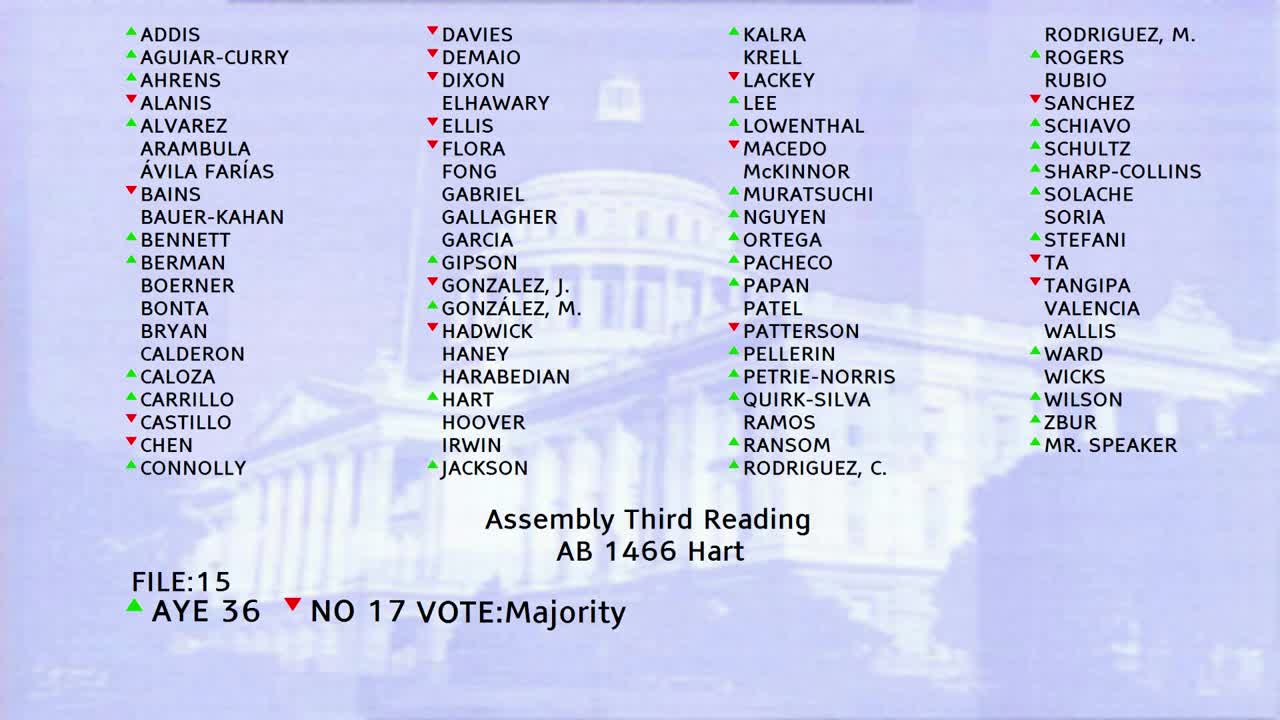


Bill Co-Author(s):