AB 971: State Property: San Pasqual Battlefield State Park.
- Session Year: 2025-2026
- House: Assembly
- Latest Version Date: 2025-03-28
Current Status:
Failed
(2026-02-02: From committee: Filed with the Chief Clerk pursuant to Joint Rule 56.)
Introduced
In Committee
Awaiting First Chamber Vote
Passed First Chamber
In Committee
Awaiting Second Chamber Vote
Passed Second Chamber
Enacted
Existing law authorizes the Director of General Services to execute grants to real property belonging to the state in the name and upon behalf of the state, whenever the sale or exchange of real property is authorized or contemplated by law, if no other state agency is specifically authorized and directed to execute the grants.
This bill would require the director to quitclaim to the San Pasqual Band of Mission Indians, at no cost to the tribe, all interests of the state in the land that it owns within the San Pasqual Battlefield State Park, consisting of 3 parcels of land totaling approximately 3.68 acres.
This bill would encourage the City of San Diego to transfer to the San Pasqual Band of Mission Indians all of the citys interests in the land the city owns within the San Pasqual Battlefield State Park, and if the city agrees to the transfer, would require the state, at no cost to the tribe, to relinquish or transfer to the San Pasqual Band of Mission Indians all rights and interests that the state has in those lands through lease, permit, or otherwise, and to take any and all other actions necessary to effectuate the citys transfer of the land to the San Pasqual Band of Mission Indians.
This bill would make legislative findings and declarations as to the necessity of a special statute for the San Pasqual Band of Mission Indians.
This bill would make legislative findings and declarations related to a gift of public funds.
Existing law governs various interactions between the state and federally recognized Native American tribes within the state. Existing law encourages and authorizes state agencies to cooperate with federally recognized California Indian tribes on matters of economic development and improvement for the tribes.This bill would state the intent of the Legislature to enact legislation to return ancestral land to the San Pasqual Band of Mission Indians.Existing law governs various interactions between the state and federally recognized Native American tribes within the state. Existing law encourages and authorizes state agencies to cooperate with federally recognized California Indian tribes on matters of economic development and improvement for the tribes.
This bill would state the intent of the Legislature to enact legislation to return ancestral land to the San Pasqual Band of Mission Indians.
(a)The Legislature finds and declares all of the follows:
(1)The San Pasqual Band of Mission Indians ancestral lands are located in the San Pasqual Valley. The tribe and its people were forcibly and wrongfully removed from those lands due to prior local, state, and federal actions. The San Pasqual Band of Mission Indians initially owned this land after the Mexican government established a civil pueblo for the tribe in 1835. The San Pasqual Band of Mission Indians were the only California tribe with this designation when the United States obtained the territory in 1848. As a result, the San Pasqual Band of Mission Indians were the lawful owners of the San Pasqual Valley when California became a state.
(2)In 1870, the United States government granted the land to the San Pasqual Band of Mission Indians as a reservation. However, that reservation was rescinded a year later in 1871.
(3)In 1981, the United States Congress passed the Mission Indian Relief Act of 1891 intending to establish a reservation for the San Pasqual Band of Mission Indians on the lands that it occupied at the time, which were in the fertile San Pasqual Valley, located in Township 12. However, the reservation was sited incorrectly in Township 11, and the tribe was forcibly removed from the fertile San Pasqual Valley to the rocky, barren land in Township 11, where the reservation is currently located.
(4)Currently, a small portion of the San Pasqual Valley in Township 12 is set aside for the San Pasqual Battlefield State Park. That state park has been closed for years and there is no designated date to reopen it. A small portion of the land in the state park is owned by the state and the remaining portion is owned by the City of San Diego. The state has interests in the land owned by the City of San Diego by virtue of a lease agreement and permits.
(5)The San Pasqual Band of Mission Indians wishes to have its ancestral lands returned to it. A tribal cemetery is located within those lands and the tribe intends to utilize the lands to operate a park open to the public that will celebrate the San Pasqual Band of Mission Indians history and its contributions to the community.
(6)Executive Order No. N-15-19 apologizes on behalf of the citizens of the State of California to all California Native Americans for the many instances of violence, maltreatment and neglect California inflicted on tribes. Governor Newsoms Statement of Administration Policy on Native American Ancestral Lands mandates that the state support and work cooperatively with California tribes that are interested in acquiring natural lands in excess of State needs.
(b)Therefore, in recognition of the states past wrongdoings concerning the violence, maltreatment and neglect California inflicted on tribes and in furtherance of its policy to assist tribes interested in acquiring natural lands in excess of State needs, the Legislature intends to do both of the following:
(1)Return to the San Pasqual Band of Mission Indians the land the state owns within the San Pasqual Battlefield State Park.
(2)Encourage the City of San Diego to return to the San Pasqual Band of Mission Indians the land the city owns within the San Pasqual Battlefield State Park. Further, to the extent the City of San Diego agrees to return the land it owns to the San Pasqual Band of Mission Indians, the state intends to transfer or renounce all state interests in the citys lands in order to effectuate the transfer of land to the San Pasqual Band of Mission Indians.
SEC. 2.Section 14673.14 is added to the Government Code, to read:14673.14.(a)Notwithstanding Section 11011.1, the Department of General Services shall quitclaim to the San Pasqual Band of Mission Indians, at no cost to the tribe, all interests of the state in the land that it owns within the San Pasqual Battlefield State Park, consisting of three parcels of land totaling approximately 3.68 acres.
(b)(1)The state encourages the City of San Diego to transfer to the San Pasqual Band of Mission Indians all of the citys interests in the land the city owns within the San Pasqual Battlefield State Park.
(2)If the City of San Diego agrees to transfer the land that it owns within the San Pasqual Battlefield State Park to the San Pasqual Band of Mission Indians, the state shall, at no cost to the tribe, relinquish or transfer to the San Pasqual Band of Mission Indians all rights and interests that the state has in those lands through lease, permit, or otherwise, and take any and all other actions necessary to effectuate the City of San Diegos transfer of the land to the San Pasqual Band of Mission Indians.
SEC. 3.The Legislature finds and declares that a special statute is necessary and that a general statute cannot be made applicable within the meaning of Section 16 of Article IV of the California Constitution because of the unique circumstances surrounding the history of the ancestral lands of the San Pasqual Band of Mission Indians and the states attempt rectify the recognized wrongs of the state by returning the land to the San Pasqual Band of Mission Indians.
SEC. 4.The Legislature finds and declares that the addition of Section 14673.14 to the Government Code by this act serves a public purpose of attempting to rectify the recognized wrongs of the state in discriminating against Native Americans and to heal the relationship between the state and the San Pasqual Band of Mission Indians, and also serves a public purpose of allowing the San Pasqual Band of Mission Indians to operate a public park to educate the public on the tribes history and contributions to the community, and for all of these reasons, does not constitute a gift of public funds within the meaning of Section 6 of Article XVI of the California Constitution.
SECTION 1.It is the intent of the Legislature to enact legislation to return ancestral land to the San Pasqual Band of Mission Indians.It is the intent of the Legislature to enact legislation to return ancestral land to the San Pasqual Band of Mission Indians.
|
Date
|
Status
|
|---|---|
| Feb 2, 2026 | From committee: Filed with the Chief Clerk pursuant to Joint Rule 56. |
| Jan 31, 2026 | Died pursuant to Art. IV, Sec. 10(c) of the Constitution. |
| May 23, 2025 | In committee: Held under submission. |
| May 14, 2025 | In committee: Set, first hearing. Referred to APPR. suspense file. |
| Apr 30, 2025 | From committee: Do pass and re-refer to Com. on APPR. (Ayes 19. Noes 0.) (April 30). Re-referred to Com. on APPR. |
| Apr 1, 2025 | Re-referred to Com. on G.O. |
| Mar 28, 2025 | From committee chair, with author's amendments: Amend, and re-refer to Com. on G.O. Read second time and amended. |
| Mar 28, 2025 | Referred to Com. on G.O. |
| Feb 21, 2025 | From printer. May be heard in committee March 23. |
| Feb 20, 2025 | Read first time. To print. |
|
Date
|
Description
|
Location
|
Votes
|
|
|---|---|---|---|---|
| Apr 30, 2025 | Do pass and be re-referred to the Committee on [Appropriations] | Assembly Standing Committee on Governmental Organization |
Passed |
This list shows positions taken on this bill by organizations on the date displayed, which is linked to the original source.
Positions by individuals are not included.
|
Organization
|
Position
|
Date
|
|---|---|---|
| San Pasqual Band of Mission Indians | ** Support |
Date of Hearing: May 14, 2025
ASSEMBLY COMMITTEE ON APPROPRIATIONS
Buffy Wicks, Chair
ABPCA Bill Id:AB 971
Author:(Alvarez) – As Amended Ver:March 28, 2025
Policy Committee: | Governmental Organization | Vote: | 19 - 0 |
|
| ||
|
|
Urgency: No State Mandated Local Program: No Reimbursable: No
SUMMARY:
This bill requires the Department of General Services (DGS) director to quitclaim to the San Pasqual Band of Mission Indians all interests of the state in San Pasqual Battlefield State Park.
Specifically, this bill:
- Requires the DGS director to quitclaim to the San Pasqual Band of Mission Indians, at no cost to the tribe, all of the state’s land interests within San Pasqual Battlefield State Park (SPB Park).
- Encourages the City of San Diego to transfer to the San Pasqual Band of Mission Indians all of the city’s land interests within SPB Park. If the city agrees to the transfer, the state must relinquish or transfer, at no cost to the tribe, all rights and interests of the state in the land through lease, permit, or other holdings. The state must take all other actions necessary to effectuate the city’s transfer of land to the tribe.
FISCAL EFFECT:
- One-time revenue loss of an unknown amount, potentially in excess of $150,000, to the state by quitclaiming SPB Park at no cost to the tribe, thus foregoing a future sale of the property by the state (General Fund). At the time this analysis was prepared, the committee did not know the current estimated value of the property.
To the extent there is deferred maintenance on the property, requiring the state to quitclaim SPB Park may also result in potential one-time costs and ongoing cost savings of an unknown amount to the Department of Parks and Recreation (State Parks), as State Parks may need to undertake maintenance activities prior to the transfer, but would no longer need to continue maintenance afterward.
- One-time costs of approximately $60,000 to DGS to prepare title reports and process the transfer (General Fund). DGS notes that it would recover these costs from State Parks.
COMMENTS:
- Purpose. According to the author:
AB 971 is a critical step toward justice for the San Pasqual Band of Mission Indians, whose ancestral lands in the San Pasqual Valley were stripped from them through a legacy of state and federal failures. This bill rectifies a historic wrong by returning state-owned parcels within the [SPB Park] – land that holds profound cultural and spiritual significance, including a tribal cemetery – to the Tribe at no cost.
This bill is sponsored by the San Pasqual Band of Mission Indians.
- Background. SPB Park. SPB Park, located in the San Pasqual Valley, includes trails, an outdoor amphitheater, a visitor center, and the San Diego Archeology Center. The park is currently closed to the public, with no designated reopening date. A small portion of the land in the state park, three parcels totaling approximately 3.68 acres, is owned by the state and the remaining portion is owned by the City of San Diego.
Return of Native American Ancestral Lands. On September 25, 2020, Governor Newsom issued a Statement of Administration Policy that stated:
[I]t is the policy of this administration to encourage every State agency, department, board and commission subject to my executive control to seek opportunities to support California tribes’ co-management of and access to natural lands that are within a California tribe’s ancestral land and under the ownership or control of the State of California, and to work cooperatively with California tribes that are interested in acquiring natural lands in excess of State needs.
On April 26, 2024, Governor Newsom announced the state awarded more than $100 million in funding appropriated as part of the fiscal years 2022-23 and 2023-24 state budgets for 33 tribal land projects, including ancestral land return. This bill requires DGS to quitclaim to the San Pasqual Band of Mission Indians all interests of the state in SPB Park.
- Related Legislation. AB 1485 (Macedo) exempts the transfer of a deed that makes effective a tribal land return transaction from the local documentary transfer tax. AB 1485 is pending hearing by this committee.
Analysis Prepared by: Irene Ho / APPR. / (916) 319-2081
Date of Hearing: April 30, 2025
ASSEMBLY COMMITTEE ON GOVERNMENTAL ORGANIZATION
Blanca Rubio, Chair
ABPCA Bill Id:AB 971 (
Author:Alvarez) – As Amended Ver:March 28, 2025
SUBJECT: State Property: San Pasqual Battlefield State Park
SUMMARY: This bill would require the Department of General Services (DGS) to quitclaim to the San Pasqual Band of Mission Indians (Tribe), at no cost to the Tribe, all interests of the state in the land that it owns within the San Pasqual Battlefield State Park, consisting of 3 parcels of land totaling approximately 3.68 acres. This bill would encourage the City of San Diego (City) to transfer to the Tribe all of the city’s interests in the land the city owns within the San Pasqual Battlefield State Park, and if the City agrees to the transfer, would require the state, at no cost to the Tribe, to relinquish or transfer to the Tribe all rights and interests that the state has in those lands through lease, permit, or otherwise, and to take any and all other actions necessary to effectuate the city’s transfer of the land to the Tribe. Specifically, this bill:
1) Provides the DGS shall quitclaim to the Tribe, at no cost to the tribe, all interests of the state in the land that it owns within the San Pasqual Battlefield State Park, consisting of three parcels of land totaling approximately 3.68 acres.
2) Provides the state encourages the City of San Diego to transfer to the Tribe all of the city’s interests in the land the city owns within the San Pasqual Battlefield State Park.
3) Provides, if the City agrees to transfer the land that it owns within the San Pasqual Battlefield State Park to the Tribe, the state shall, at no cost to the Tribe, relinquish or transfer to the Tribe all rights and interests that the state has in those lands through lease, permit, or otherwise, and take any and all other actions necessary to effectuate the City’s transfer of the land to the Tribe.
4) Makes legislative findings and declarations as to the necessity of a special statute for the Tribe.
5) Makes legislative findings and declarations related to a gift of public funds.
EXISTING LAW:
1) Establishes DGS, which is under the control of the Director of DGS, within the Government Operations Agency, and requires the director to perform various functions and duties with respect to property within the state, including entering into lease agreements.
2) Authorizes DGS, subject to legislative approval, to sell, lease, exchange, or transfer various specified properties for current market value, upon such other terms and conditions DGS determines are in the best interest of the state.
3) Authorizes DGS, with the consent of the state agency concerned, to let for any period of time any real property or interest in real property that belongs to the state, when DGS deems the letting serves a beneficial public purpose limited to the development of housing, including permanent supportive or traditional housing and emergency shelters or park and recreation facilities. Under this section, DGS is authorized to enter into leases at less than market value provided that the cost of administering the lease is recovered. (Government Code § 14671.2)
4) Requires DGS to create a digitized inventory of all excess state land, create screening tools for prioritizing affordable housing development on excess state land, and issue requests for proposals and select affordable housing developments on excess state land, as described.
5) Establishes criteria for state agencies to use in determining and reporting excess lands. A state agency must report land as surplus that is:
- Not currently utilized, or is underutilized, for any existing or ongoing programs;
- Land for which the agency cannot identify a specific utilization relative to future needs;
- Land not identified by the state agency within its master plan for facility development.
6) Establishes the Government-to-Government Consultation Act, which encourages the state and its agencies to consult on a government-to-government basis with federally and non-federally recognized tribes, as specified, to allow tribal officials the opportunity to provide meaningful and timely input in the development of policies, processes, programs, and projects that have tribal implications. (Government Code §11019.81.)
7) Encourages and authorizes all state agencies to cooperate with federally recognized California Indian tribes on matters of economic development and improvement for the tribes. (Government Code § 11019.8)
8) Establishes a goal of the state to conserve at least 30% of California’s lands and coastal waters by 2030. In implementing this goal, requires CNRA to prioritize supporting tribal engagement and leadership, among other priorities. (Public Resources Code § 71450 and § 71451, respectively)
FISCAL EFFECT: This bill is keyed fiscal by Legislative Counsel.
COMMENTS:
Purpose of the bill. According to the author, this bill “AB 971 is a critical step toward justice for the San Pasqual Band of Mission Indians, whose ancestral lands in the San Pasqual Valley were stripped from them through a legacy of state and federal failures. This bill rectifies a historic wrong by returning state-owned parcels within the San Pasqual Battlefield State Park—land that holds profound cultural and spiritual significance, including a tribal cemetery—to the Tribe at no cost. For too long, this park has sat closed and unused, a symbol of erasure rather than education. By transferring these 3.68 acres, we honor the tribe’s unbroken connection to this land and align with California’s commitment to reconciliation with Native communities.”
The author further states that, “the Tribe envisions a public park that celebrates their history and contributions—a space for healing and learning that benefits all Californians. This bill is not just about land; it’s about seizing this opportunity to turn empty promises into meaningful progress and demonstrate that California’s path forward includes honoring its past.”
Background.
The San Pasqual Band of Mission Indians is a federally recognized Native American tribe located in northeastern San Diego County, California, near Valley Center. The Tribe is part of the larger Kumeyaay cultural group, which traditionally inhabited the regions of present-day southern California and Baja California, Mexico. The Tribe’s history is deeply connected to the early mission system in California, particularly Mission San Diego de Alcalá, which was established by Spanish settlers in the late 1700s. After the mission system was secularized, many Native peoples, including the Kumeyaay, faced displacement and disruption of their traditional ways of life.
The Tribe’s culture is deeply rooted in Kumeyaay traditions, language, and customs. Historically, they inhabited the mountainous regions, valleys, and deserts of southern California and northern Baja California. Today, the Tribe operates under a tribal government led by elected officials who oversee its affairs, including the management of the reservation, economic development, and social services for tribal members. Their economic initiatives include various businesses and enterprises, with the San Pasqual Casino serving as a vital source of revenue. Beyond economic growth, the Tribe remains dedicated to preserving its cultural heritage, promoting environmental stewardship, and ensuring educational opportunities for future generations.
Like many Native American tribes, the Tribe has faced challenges related to sovereignty, land rights, and environmental concerns. They continue to advocate for the recognition of their rights and work towards improving the quality of life for their people.
According to the legislative findings and declarations in the bill, “The San Pasqual Band of Mission Indian’s ancestral lands are located in the San Pasqual Valley. The Tribe and its people were forcibly and wrongfully removed from those lands due to prior local, state, and federal actions. The Tribe initially owned this land after the Mexican government established a civil pueblo for the Tribe in 1835. The Tribe were the only California tribe with this designation when the United States obtained the territory in 1848. As a result, the Tribe were the lawful owners of the San Pasqual Valley when California became a state.
In 1870, the United States government granted the land to the Tribe as a reservation. However, that reservation was rescinded a year later in 1871. In 1981, the United States Congress passed the Mission Indian Relief Act of 1891 intending to establish a reservation for the Tribe on the lands that it occupied at the time, which were in the fertile San Pasqual Valley, located in Township 12. However, the reservation was sited incorrectly in Township 11, and the Tribe was forcibly removed from the fertile San Pasqual Valley to the rocky, barren land in Township 11, where the reservation is currently located.
Currently, a small portion of the San Pasqual Valley in Township 12 is set aside for the San Pasqual Battlefield State Park. That state park has been closed for years and there is no designated date to reopen it. A small portion of the land in the state park is owned by the state and the remaining portion is owned by the City of San Diego. The state has interests in the land owned by the City of San Diego by virtue of a lease agreement and permits.”
The author states that “the Tribe wishes to have its ancestral lands returned to it. A tribal cemetery is located within those lands and the tribe intends to utilize the lands to operate a park open to the public that will celebrate the Tribe’s history and its contributions to the community.”
California Acts to Redress Historical Inequities. California is home to more people of Native American heritage than any other US state, and there are currently 109 federally recognized tribes in the state and several non-federally recognized tribes petitioning for federal recognition through the Bureau of Indian Affairs. These tribes collectively maintain nearly 100 separate reservations or Rancherias across the state. Federally recognized tribes have a unique government-to-government relationship with local, state, and federal entities, and are recognized as sovereign nations. These tribes can create their own laws, governmental structure, and enrollment or membership rules for the land and citizens of their nation.
On June 18, 2019, Governor Newsom issued EO N-15-19 acknowledging and apologizing on behalf of the state for the historical “violence, exploitation, dispossession and the attempted destruction of tribal communities” which dislocated California Native Americans from their ancestral land and sacred practices and establishes the California Truth and Healing Council. The destructive impacts of this forceful separation persist today, and meaningful, reparative action from the state can begin to address these wrongs in an effort to heal its relationship with California Native Americans. In addition, the order reaffirms and incorporates by reference the principles of government-to-government engagement established by EO B-10-11.
Statement of Administration Policy - Native American Ancestral Lands. On September 25, 2020, Governor Newsom issued a Statement of Administration Policy stating that EO N-15-19 reaffirms and incorporates by reference the principles of government-to-government engagement established by EO B-10-11 (“it is the policy of the administration that every state agency and department subject to executive control is to encourage communication and consultation with California Native American tribes”). The State continues to work with California tribes on a government-to-government basis to address issues concerning Native American tribal self-government and tribal trust resources.
The statement further stated, “Consistent with the goals of such EOs, and in the spirit of truth and healing in recognition of past harms done to California Native American communities, it is the policy of this administration to encourage every State agency, department, board and commission subject to my executive control to seek opportunities to support California tribes’ co-management of and access to natural lands that are within a California tribe’s ancestral land and under the ownership or control of the State of California, and to work cooperatively with California tribes that are interested in acquiring natural lands in excess of State needs. Any action taken in accordance with this Policy shall: (i) comply with all applicable laws and regulations, including those governing surplus and excess lands; (ii) occur in consultation with California tribes pursuant to EOs N-15-19 and B-10-11; and (iii) not conflict with the Governor’s stated policy priorities, such as housing and homelessness and climate action.” [1]
Other related action. On October 7, 2020, Governor Newsom issued Executive Order No. N-82-20, which directed the California Natural Resources Agency (CNRA) to collaborate with tribal partners to incorporate tribal expertise and traditional ecological knowledge to better understand our biodiversity and the threats it faces. As a result, CNRA appointed an assistant Secretary for Tribal Affairs to help cultivate and ensure the participation and inclusion of tribal governments and communities within the work of CNRA, supporting the effective integration of these governments’ and communities’ interests in environmental policymaking. The assistant also works to further support and expand the CNRA’s effort to institutionalize tribal consultation practices into its program planning,
Last year, the Legislature appropriated an additional $10 million for the TNBSP by authorizing SB 867 (Allen), Chapter 83, and Statutes of 2024. These appropriations augmented a separate allocation to the CNRA of $175 million across fiscal years 2022-23 and 2023-24 to support nature-based conservancy solutions generally. As a result, the CNRA has announced nearly $108 million available to fund 33 projects and support the return of approximately 39,000 acres of land to California Native American tribes. In December 2023, the CNRA dispersed the first sum of money through the TNBSP to the Hoopa Valley Tribe, located in northwestern California, to support their purchase of 10,395 acres of forested land on Hupa Mountain.
San Pasqual Battlefield State Park. The San Pasqual Battlefield State Historic Park spans 50 acres just east of the San Diego Zoo Safari Park, located on San Pasqual Valley Road, eight miles east of Escondido along Highway 78. The park highlights the rich cultural history of the San Pasqual Valley, featuring exhibits on the Kumeyaay people, the region’s Indigenous inhabitants, as well as a film about the battle. Recognizing the Kumeyaay ancestral land on which the park sits, California State Parks is collaborating closely with the Tribe to integrate their history, culture, and traditional ecological knowledge into the visitor center, trails, and programs.
Visitors can explore the Battlefield Monument Trail, a scenic 1.5-mile route leading to the San Pasqual Battlefield Monument, erected in 1925. A shorter nature trail offers a moderate hike through the park's chaparral landscape. The San Pasqual Battlefield Volunteer Association brings history to life through reenactments and educational programs, highlighted by the annual Battle Day event, held on the first Sunday of December. Currently, this State Park remains closed to the public.
In support. The San Pasqual Band of Mission Indians writes, “This bill aims to return ancestral land, currently named the San Pasqual Battlefield State Park and partially owned by the State, back to the Tribe. Our ancestors lived for thousands of years in the valley carved by the Santa Ysabel Creek, where modern Highway 78 now winds, near the present site of the San Diego Zoo’s Wild Animal Park. Some of this ancestral homeland that was taken from us eventually became property of the State of California in what is now known as San Pasqual Battlefield State Park. This State Park has not been in operation for many years and remains closed to this day. We believe that this return of ancestral land back to San Pasqual is in line with the Governor’s and Legislature’s commitment to ensure the protection and wellbeing of California’s first people, our cultures, and our lands.”
Related legislation. AB 98 (Jackson of 2025. This bill would require the Director of DGS to quitclaim to the City of Moreno Valley, at no cost to the city, all interests of the state in 11 parcels of land located within the Lake Perris Fairgrounds that consist mainly of undeveloped open-space land. The bill would require the City of Moreno Valley to use the land to conduct wildfire mitigation to ensure fire protection for residents and businesses, to increase open-space opportunities, and any other similar use the City of Moreno Valley deems necessary. (Assembly Committee on Governmental Organization)
AB 1485 (Macedo) of 2025. This bill would provide that property used exclusively for the preservation of specified natural resources or open-space lands, until a specified provision is repealed or until January 1, 2031, whichever is earlier, property may be owned and operated by a federally recognized Indian tribe or wholly owned subsidiary of a federally recognized Indian tribe meeting certain requirements. (Assembly Committee on Revenue and Taxation)
SB 461 (Padilla) of 2025. This bill would authorize the Director of the DGS to sell or lease to the City of Imperial, all or any part of the California Highway Patrol El Centro Area office, as specified. (Senate Committee on Appropriations)
Prior legislation. AB 1284 (Ramos), Chapter 657, Statutes of 2024. Encouraged the California Natural Resources Agency and its departments, boards, conservancies, and commissions to enter into cogovernance and comanagement agreements with federally recognized tribes for the purposes of shared responsibility, decision-making, and partnership in resource management and conservation within a tribe’s ancestral lands and waters, as defined.
AB 1635 (Ward) of 2024. By December 1, 2028. This bill would have required the DGS to negotiate and execute a legally binding ground lease for the Hillcrest property (DMV facilities) in San Diego, as defined, to allow for the development of housing development projects. (Died on Senate inactive file)
SB 536 (S. Rubio), Chapter 768, Statutes of 2024. Authorized the Director of DGS to sell or lease property, known as the Department of Corrections and Rehabilitation Heman G. Stark Youth Correctional Facility, located in the City of Chino, in the County of San Bernardino, to the City of Chino at fair market value upon terms and conditions the Director determines are in the best interests of the state.
SB 572 (Smallwood-Cuevas), Chapter 770, Statutes of 2024. Authorized the DGS to sell, upon terms and conditions the director determines are in the best interest of the state, all or any part of approximately 59,200 square feet of property, located at 5401 Crenshaw Boulevard, Los Angeles for purposes of redeveloping the property as an affordable housing or mixed-used housing project.
SB 958 (Dodd), Chapter 988, Statutes of 2024. Authorized the DGS to sell or exchange, at fair market value, the property known as Camp Coombs in the County of Napa to the County of Napa or the Napa County Regional and Open Space District by January 1, 2026, as specified.
SB 1336 (Archuleta), Chapter 473, Statutes of 2024. Authorized the DGS, with the consent of the Department of State Hospitals, to lease to a nonprofit corporation or local government, seven buildings located at Metropolitan State Hospital in the City of Norwalk for the purposes of providing housing or facilities, including adult and youth interim housing.
AB 349 (Ramos), Chapter 325, Statutes of 2023. Authorized the DGS, with the consent of DSH, to lease a building at Patton State Hospital to a nonprofit corporation or local government for purpose of providing services to elderly persons and providing housing to homeless individuals and providing mental health services to those individuals.
AB 2233 (Quirk-Silva), Chapter 438, Statutes of 2022. Required DGS to develop a plan to facilitate development of affordable housing on state-owned excess land, as specified.
SB 561 (Dodd), Chapter 446, Statutes of 2022. Required the DGS, in consultation with the California Department of Housing and Community Development, to develop criteria to evaluate the suitability of excess state-owned parcels for affordable housing, as specified.
AB 518 (Calderon), Chapter 43, Statutes of 2020. Authorized the DGS, until January 1,
2025, to sell the Southern Youth Correctional Reception Center and Clinic to the City of Norwalk at fair market value upon terms and conditions the DGS determines are in the best interest of the state.
AB 653 (Bloom), Chapter 263, Statutes of 2019. Authorized the DGS, with the approval of the Adjutant General, to lease, for a term of 25 years, approximately 1.3 acres of the real property of the real property located at 1300 Federal Avenue, Los Angeles, California, known as the West Los Angeles National Guard Armory to the County of Los Angeles.
AB 1164 (Gloria), Chapter 822, Statutes of 2019. Allowed the Director of the DGS to declare a property known as the San Diego State Building surplus in order to permit its disposal by the DGS.
AB 166 (Gaines), Chapter 211, Statutes of 2015. Authorized the DGS, with the consent of CDCR, to enter into a long-term lease for land on the grounds of the California State Prison at Folsom for a non-state funded peace officers memorial and museum.
REGISTERED SUPPORT / OPPOSITION:
Support
San Pasqual Band of Mission Indians
Opposition
None on file
Analysis Prepared by: Eric Johnson / G.O. / (916) 319-2531
https://www.gov.ca.gov/wp-content/uploads/2020/09/9.25.20-Native-Ancestral-Lands-Policy.pdf ↑
Discussed in Hearing
 8MIN
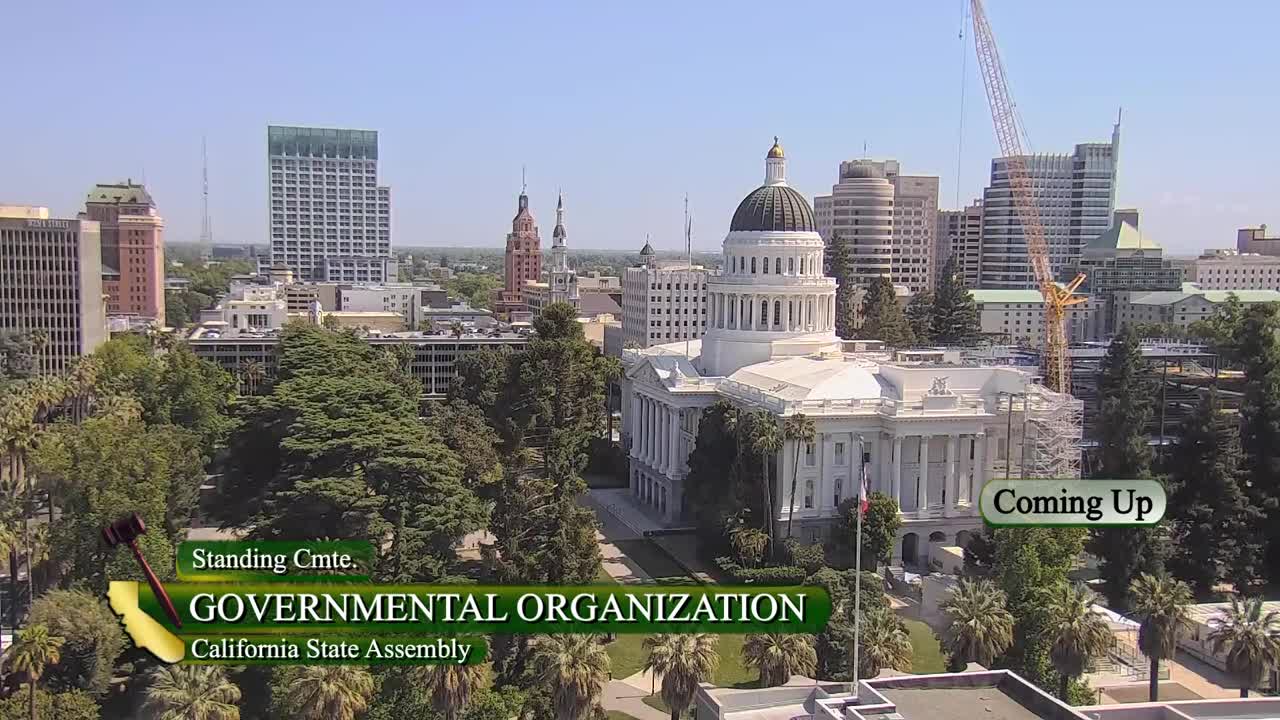
Assembly Standing Committee on Governmental Organization
Bill Author
Bill Co-Author(s):