AB 998: Household hazardous waste: vape pens.
- Session Year: 2025-2026
- House: Assembly
- Latest Version Date: 2025-07-17
Current Status:
In Progress
(2025-08-29: In committee: Held under submission.)
Introduced
In Committee
Awaiting First Chamber Vote
Passed First Chamber
In Committee
Awaiting Second Chamber Vote
Passed Second Chamber
Enacted
Under existing law, the Department of Toxic Substances Control generally regulates the management and handling of hazardous waste and hazardous materials. Existing law authorizes certain entities to operate household hazardous waste collection facilities, as defined, under permits issued by the department. A violation of the hazardous waste control laws is a crime.
Existing law requires hazardous waste transported to a household hazardous waste collection facility to be transported by specified entities, and imposes conditions on the transport of hazardous waste to a household hazardous waste collection facility, including, among others, that the hazardous waste transported not exceed certain volume and weight requirements and that the hazardous waste be transported in closed containers. Existing law defines household hazardous waste to mean hazardous waste generated incidental to owning or maintaining a place of residence, and to not include waste generated in the course of operating a business concern at a residence.Under this bill, a vape pen confiscated by a school as contraband is presumed to have been generated by a household and does not lose its status as household hazardous waste when properly managed and disposed of at a household hazardous waste collection facility or through a household hazardous waste collection program. The bill would impose the above-described conditions relating to the transport of hazardous waste on a school, as defined, or its contractor, transporting confiscated vape pens to a household hazardous waste collection facility. This bill would, until January 1, 2029, require the department to evaluate opportunities to increase safety and convenience related to the management and disposal of vape pens confiscated from students by a school, as provided, and identify any recommendations that require future legislative action. The bill would authorize a household hazardous waste collection facility to conduct physical treatment activities involving the disassembly of household hazardous waste to separate batteries, valves, electronic components and other parts containing liquids or gases, including, but not limited to, the disassembly of vape pens, in a manner that does not result in the unauthorized release of hazardous materials. The bill would make related conforming changes.
Existing law authorizes a public agency, or its contractor, to conduct a materials exchange program at a household hazardous waste collection facility to make reusable household hazardous products or materials available to recipients, as a part of its household hazardous waste collection program, if the public agency, or its contractor, complies with specified requirements.
The bill would prohibit a public agency, or its contractor, from including vape pens in a materials exchange program.
Because a violation of these provisions would be a crime, the bill would impose a state-mandated local program.
The California Constitution requires the state to reimburse local agencies and school districts for certain costs mandated by the state. Statutory provisions establish procedures for making that reimbursement.
This bill would provide that no reimbursement is required by this act for a specified reason.
Under existing law, the Department of Toxic Substances Control generally regulates the management and handling of hazardous waste and hazardous materials. Existing law authorizes certain entities to operate household hazardous waste collection facilities, as defined, under permits issued by the department. A violation of the hazardous waste control laws is a crime.
Existing law requires hazardous waste transported to a household hazardous waste collection facility to be transported by specified entities, and imposes conditions on the transport of hazardous waste to a household hazardous waste collection facility, including, among others, that the hazardous waste transported not exceed certain volume and weight requirements and that the hazardous waste be transported in closed containers. Existing law defines household hazardous waste to mean hazardous waste generated incidental to owning or maintaining a place of residence, and to not include waste generated in the course of operating a business concern at a residence.
Under this bill, a vape pen confiscated by a school as contraband is presumed to have been generated by a household and does not lose its status as household hazardous waste when properly managed and disposed of at a household hazardous waste collection facility or through a household hazardous waste collection program. The bill would impose the above-described conditions relating to the transport of hazardous waste on a school, as defined, or its contractor, transporting confiscated vape pens to a household hazardous waste collection facility. The bill would authorize a household hazardous waste collection facility to conduct physical treatment activities involving the disassembly of household hazardous waste to separate batteries, valves, electronic components and other parts containing liquids or gases, including, but not limited to, the disassembly of vape pens, in a manner that does not result in the unauthorized release of hazardous materials. The bill would make related conforming changes.
Existing law authorizes a public agency, or its contractor, to conduct a materials exchange program at a household hazardous waste collection facility to make reusable household hazardous products or materials available to recipients, as a part of its household hazardous waste collection program, if the public agency, or its contractor, complies with specified requirements.
The bill would prohibit a public agency, or its contractor, from including vape pens in a materials exchange program.
Because a violation of these provisions would be a crime, the bill would impose a state-mandated local program.
(2)Existing law requires the Department of Toxic Substances Control to establish an identification number certification system to annually verify the accuracy of information related to generators, transporters, and facilities authorized to treat, store, or dispose of hazardous waste. Existing law requires each entity issued an identification number to provide or verify specified information upon request, including, among others, contact information and information relating to the entitys hazardous waste activities. Existing law, the California Integrated Waste Management Act of 1989, requires the Department of Resources Recycling and Recovery, in consultation with the Department of Toxic Substances Control, to prepare guidelines and a state policy to guide the efforts of local agencies to provide household hazardous waste collection, recycling, and disposal programs. Existing regulations require a public agency that is responsible for household hazardous waste management to annually submit to the Department of Resources Recycling and Recovery a specified form containing contact information, program information, and information relating to material collection and disposition. This bill would require the Department of Toxic Substances Control and the Department of Resources Recycling and Recovery to jointly develop a consolidated reporting document for household hazardous waste collection facilities to use to submit a single annual report to both departments to comply with the reporting requirements described above.(3)TheThe California Constitution requires the state to reimburse local agencies and school districts for certain costs mandated by the state. Statutory provisions establish procedures for making that reimbursement.
This bill would provide that no reimbursement is required by this act for a specified reason.
(1)Under existing law, the Department of Toxic Substances Control generally regulates the management and handling of hazardous waste and hazardous materials. Existing law authorizes certain entities to operate household hazardous waste collection facilities, as defined, under permits issued by the department. A violation of the hazardous waste control laws is a crime.
Existing law requires hazardous waste transported to a household hazardous waste collection facility to be transported by specified entities, and imposes conditions on the transport of hazardous waste to a household hazardous waste collection facility, including, among others, that the hazardous waste transported not exceed certain volume and weight requirements and that the hazardous waste be transported in closed containers. Existing law defines household hazardous waste to mean hazardous waste generated incidental to owning or maintaining a place of residence, and to not include waste generated in the course of operating a business concern at a residence.
Under this bill, a vape pen confiscated by a school as contraband is presumed to have been generated by a household and does not lose its status as household hazardous waste when properly managed and disposed of at a household hazardous waste collection facility or through a household hazardous waste collection program. The bill would impose the above-described conditions relating to the transport of hazardous waste on a school, as defined, or its contractor, transporting confiscated vape pens to a household hazardous waste collection facility. The bill would authorize a household hazardous waste collection facility to conduct physical treatment activities involving the disassembly of household hazardous waste to separate batteries, valves, electronic components and other parts containing liquids or gases, including, but not limited to, the disassembly of vape pens, in a manner that does not result in the unauthorized release of hazardous materials. The bill would make related conforming changes.
Existing law authorizes a public agency, or its contractor, to conduct a materials exchange program at a household hazardous waste collection facility to make reusable household hazardous products or materials available to recipients, as a part of its household hazardous waste collection program, if the public agency, or its contractor, complies with specified requirements.
The bill would prohibit a public agency, or its contractor, from including vape pens in a materials exchange program.
Because a violation of these provisions would be a crime, the bill would impose a state-mandated local program.
(2)Existing law requires the Department of Toxic Substances Control to establish an identification number certification system to annually verify the accuracy of information related to generators, transporters, and facilities authorized to treat, store, or dispose of hazardous waste. Existing law requires each entity issued an identification number to provide or verify specified information upon request, including, among others, contact information and information relating to the entitys hazardous waste activities.
Existing law, the California Integrated Waste Management Act of 1989, requires the Department of Resources Recycling and Recovery, in consultation with the Department of Toxic Substances Control, to prepare guidelines and a state policy to guide the efforts of local agencies to provide household hazardous waste collection, recycling, and disposal programs. Existing regulations require a public agency that is responsible for household hazardous waste management to annually submit to the Department of Resources Recycling and Recovery a specified form containing contact information, program information, and information relating to material collection and disposition.
This bill would require the Department of Toxic Substances Control and the Department of Resources Recycling and Recovery to jointly develop a consolidated reporting document for household hazardous waste collection facilities to use to submit a single annual report to both departments to comply with the reporting requirements described above.
The(3)The California Constitution requires the state to reimburse local agencies and school districts for certain costs mandated by the state. Statutory provisions establish procedures for making that reimbursement.
This bill would provide that no reimbursement is required by this act for a specified reason.
Under existing law, the Department of Toxic Substances Control generally regulates the management and handling of hazardous waste and hazardous materials. Existing law authorizes certain entities to operate household hazardous waste collection facilities, as defined, under permits issued by the department. A violation of the hazardous waste control laws is a crime.
Existing law requires hazardous waste transported to a household hazardous waste collection facility to be transported by specified entities, and imposes conditions on the transport of hazardous waste to a household hazardous waste collection facility, including, among others, that the hazardous waste transported not exceed certain volume and weight requirements and that the hazardous waste be transported in closed containers. Existing law defines household hazardous waste to mean hazardous waste generated incidental to owning or maintaining a place of residence, and to not include waste generated in the course of operating a business concern at a residence.
Under this bill, a vape pen confiscated by a school as contraband is presumed to have been generated by a household and does not lose its status as household hazardous waste when properly managed and disposed of at a household hazardous waste collection facility or through a household hazardous waste collection program. The bill would impose the above-described conditions relating to the transport of hazardous waste on a school, as defined, or its contractor, transporting confiscated vape pens to a household hazardous waste collection facility. The bill would authorize a household hazardous waste collection facility to conduct physical treatment activities involving the disassembly of household hazardous waste to separate batteries, valves, electronic components and other parts containing liquids or gases, including, but not limited to, the disassembly of vape pens, in a manner that does not result in the unauthorized release of hazardous materials. The bill would make related conforming changes.
Existing law authorizes a public agency, or its contractor, to conduct a materials exchange program at a household hazardous waste collection facility to make reusable household hazardous products or materials available to recipients, as a part of its household hazardous waste collection program, if the public agency, or its contractor, complies with specified requirements.
The bill would prohibit a public agency, or its contractor, from including vape pens in a materials exchange program.
Because a violation of these provisions would be a crime, the bill would impose a state-mandated local program.
The California Constitution requires the state to reimburse local agencies and school districts for certain costs mandated by the state. Statutory provisions establish procedures for making that reimbursement.
This bill would provide that no reimbursement is required by this act for a specified reason.
(a)The department shall evaluate opportunities to increase safety and convenience related to the management and disposal of vape pens confiscated from students by a school. The evaluation shall ensure consistency with the federal Resource Conservation and Recovery Act and may include, but need not be limited to, the potential designation of confiscated vape pens as universal wastes. The department shall identify any recommendations that require future legislative action.
(b)This section shall remain in effect only until January 1, 2029, and as of that date is repealed.
SEC. 6.SEC. 2.Section 25218.8 of the Health and Safety Code is amended to read:25218.8.(a)Except as provided in subdivision (b), a hazardous waste facilities permit shall be obtained for the operation of a household hazardous waste collection facility.
(b)A hazardous waste facilities permit is not required for the operation of a recycle-only household hazardous waste collection facility if all of the following conditions are met:
(1)The facility accepts only the following recyclable household hazardous waste materials for subsequent transport to an authorized recycling facility:
(A)Latex paint.
(B)Used oil.
(C)Used oil filters.
(D)Antifreeze.
(E)Spent lead-acid batteries.
(F)Household hazardous waste that is designated as a universal waste pursuant to this chapter or the regulations adopted by the department.
(G)Oil-based paint accepted pursuant to the requirements in Section 25217.2.1.
(2)No hazardous wastes or other materials are handled at the facility other than the materials specified in paragraph (1).
(3)The materials are transported to the collection facility by either of the following:
(A)The person who generated the material.
(i)Another person may transport the waste to the household hazardous waste collection facility on behalf of an individual who generated the waste, provided the individual who generated the waste is unable or unavailable to transport the waste, for reasons, including, but not limited to, death, illness, or disability.
(ii)The person transporting waste on behalf of an individual pursuant to clause (i) shall provide a certification or signed statement to the household hazardous waste collection facility at the time of delivery attesting to the circumstances under which the person is delivering the other persons waste. The person shall also verify that the person is not receiving compensation for their services, and is not employed by an organization, whether for profit or not for profit, that provides a household hazardous waste transportation service.
(iii)A person transporting waste on behalf of an individual pursuant to clause (i) is subject to the same transportation limits that otherwise apply to the household.
(B)The authorized curbside household hazardous waste collection program or other household hazardous waste programs and sources, including load checking sources.
(4)The materials transported to the facility are transported in accordance with Section 25218.5.
(5)The materials collected are not stored at the facility for more than 180 days, except that less than one ton of spent lead-acid batteries may be stored at the facility for up to one year. More than one ton of spent lead-acid batteries shall not be stored at the facility for more than 180 days.
(6)The materials collected are managed in accordance with the hazardous waste labeling, containerization, emergency response, and personnel training requirements of this chapter.
(7)The facility is in compliance with Section 25218.2.
(c)A household hazardous waste collection facility may conduct physical treatment activities involving the disassembly of household hazardous waste to separate batteries, valves, electronic components, and other parts containing liquids or gases, including, but not limited to, the disassembly of vape pens, in a manner that does not result in the unauthorized release of hazardous materials.
SEC. 7.SEC. 3.Section 25218.12 of the Health and Safety Code is amended to read:25218.12.(a)A public agency, or its contractor, may conduct a materials exchange program as a part of its household hazardous waste collection program if the public agency, or its contractor, does all of the following:
(1)Determines which reusable household hazardous products or materials are suitable and acceptable for distribution to a recipient in accordance with a quality assurance plan prepared by the public agency, or its contractor.
(2)Instructs a recipient to use the product or material in a manner consistent with the instructions on the label.
(b)If a recipient that is a commercial entity intends to distribute a reusable household hazardous product or material to another recipient or end user, the public agency, or its contractor, shall do all of the following:
(1)Require the commercial entity to provide the following information, with a signed statement certifying the accuracy of the information under penalty of perjury:
(A)The commercial entitys legal name, address, and telephone number.
(B)Documentation supporting that the commercial entity has a known market or markets, or disposition, for any products or materials received, and a detailed description of that known market or markets, or disposition.
(C)A declaration that the commercial entity intends to distribute the reusable household hazardous product or material for its originally intended purpose.
(D)An explanation of how the commercial entity intends to dispose of any household hazardous products or materials it receives that remain unused.
(2)Require the commercial entity to provide the public agency with an annual report, by September 1 of each year, for the period between July 1 of the prior year and June 30 of the current year, that provides a detailed accounting for the products or materials it received. The detailed accounting shall include a list of recipients or end users to whom the commercial entity distributed a product or material, the amount and type of product or material distributed to the recipient or end user, the amount and type of product or material that is awaiting distribution, and the amount, type, and disposition of any product or material that the commercial entity was unable to sell or donate.
(3)Immediately discontinue providing reusable household hazardous products or materials to the commercial entity if the commercial entity cannot verify its compliance with paragraph (1) or (2).
(c)If the recipient of a reusable household hazardous product or material is a business or employer, the recipient shall be responsible for obtaining any written information necessary for compliance with the Hazardous Substances Information and Training Act (Chapter 2.5 (commencing with Section 6360) of Part 1 of Division 5 of the Labor Code).
(d)A recipient of a reusable household hazardous product or material shall do all of the following:
(1)Use the reusable household hazardous product or material in conformance with its label, and use appropriate personal protection.
(2)Manage unused reusable household hazardous products or materials as hazardous waste, as required by applicable California law, or as required by any applicable law in the state in which the product or material is discarded.
(e)Transportation of a reusable household hazardous product or material by a public agency, or its contractor, or by a recipient, shall be in compliance with all applicable shipping requirements of the United States Department of Transportation.
(f)A public agency, or its contractor, shall not include vape pens in a materials exchange program.
SEC. 8.SEC. 4.No reimbursement is required by this act pursuant to Section 6 of Article XIIIB of the California Constitution because the only costs that may be incurred by a local agency or school district will be incurred because this act creates a new crime or infraction, eliminates a crime or infraction, or changes the penalty for a crime or infraction, within the meaning of Section 17556 of the Government Code, or changes the definition of a crime within the meaning of Section 6 of Article XIIIB of the California Constitution.
(a)For purposes of this section, the following definitions shall apply:
(1)Door-to-door household hazardous waste collection program or household hazardous waste residential pickup service has the same meaning as defined in subdivision (b) of Section 25218.1.
(2)Household hazardous waste has the same meaning as defined in subdivision (d) of Section 25218.1.
(3)Public agency has the same meaning as defined in subdivision (j) of Section 25218.1.
(4)Registered hazardous waste transporter or transporter means a person who holds a valid registration issued by the department pursuant to Section 25163.
(5)VSQG wastes means hazardous waste generated by a very small quantity generator, as defined in Section 25218.1.
(b)In lieu of the requirements imposed upon a generator pursuant to subdivision (b) of Section 25160 and the regulations adopted by the department pursuant to Section 25161, a registered hazardous waste transporter operating a door-to-door household hazardous waste collection program or household hazardous waste residential pickup service may use the manifesting procedure specified in subdivision (c) if the transporter complies with the requirements of subdivisions (d) and (e).
(c)A registered hazardous waste transporter operating a door-to-door household hazardous waste collection program or household hazardous waste residential pickup service shall comply with all of the following manifesting procedures when transporting household hazardous waste:
(1)A separate manifest shall be completed by each vehicle driver with respect to each transport vehicle operated by that driver for each date.
(2)The transporter shall complete both the generators section and the transporters section of the manifest in the following manner:
(A)In completing the generators section of the manifest, the transporter shall use the name, identification number, address, and telephone number of the public agency operating the door-to-door household hazardous waste collection program.
(B)In completing the transporters section of the manifest, the transporter shall use the transporters own name, identification number, terminal address, and telephone number.
(C)The generators and transporters sections shall be completed before commencing each days collection. The driver may sign for the generator.
(3)(A)The transporter shall attach legible receipts to the front of the manifest for each quantity of household hazardous waste that is received from a household. The receipts shall be used to determine the total volume of household hazardous waste in the vehicle.
(B)After the household hazardous waste is delivered, the receipts shall be maintained with the transporters copy of the manifest.
(C)The transporter shall provide a copy of the manifest to the public agency authorizing the door-to-door household hazardous waste collection program.
(D)A public agency shall retain each manifest submitted pursuant to this paragraph for at least three years. The public agency shall also retain the manifest during the course of any unresolved enforcement action regarding a regulated activity or as requested by the department or a certified unified program agency.
(4)Each receipt specified in paragraph (3) shall have the residential address from which the household hazardous waste was received, the date received, the manifest number, the volume or quantity of household hazardous waste received, the type of household hazardous waste received, the public agency name and phone number, and the drivers signature.
(5)The transporter shall enter the total volume or quantity of each type of household hazardous waste transported on the manifest at the change of each date, change of driver, or change of transport vehicle. The total volume or quantity shall be the cumulative amount of each type of household hazardous waste collected from the generators listed on the individual receipts.
(6)The transporter shall submit a generator copy of the manifest to the department within 30 days of each shipment.
(7)The transporter shall retain a copy of the manifest and all receipts for each manifest at a location within the state for three years. This transporter shall also retain the manifest during the course of any unresolved enforcement action regarding a regulated activity or as requested by the department or a certified unified program agency.
(8)(A)The transporter shall submit all copies of the manifest to the designated facility.
(B)A representative of the designated hazardous waste facility that receives the household hazardous waste shall sign and date the manifest, return two copies to the transporter, retain one copy, and send the original to the department within 30 days of receipt.
(9)A transporter shall comply with all other requirements of Sections 25160 and 25161, unless expressly exempted pursuant to this section.
(d)A registered hazardous waste transporter operating a door-to-door household hazardous waste collection program or household hazardous waste residential pickup service shall comply with all of the following requirements:
(1)A separate manifest shall be initiated for each jurisdiction, such as from each city or each county, from which household hazardous waste is collected, using the identification number of the public agency operating the door-to-door household hazardous waste collection program in that jurisdiction.
(2)(A)Only used oil, latex paint, and antifreeze that are household hazardous wastes that are collected from individual residents may be separately bulked on the vehicle, if the original containers are appropriately managed.
(B)A transporter collecting household hazardous wastes from multiple jurisdictions may consolidate those wastes at the time they are collected only if there is a written agreement among all of the jurisdictions and the transporter that wastes from multiple jurisdictions may be consolidated.
(3)The transporter operating the door-to-door household hazardous waste collection program or household hazardous waste residential pickup service shall not collect VSQG wastes or mix household hazardous waste with VSQG wastes in the same vehicle or at the same time as conducting the residential door-to-door household hazardous waste collection or household hazardous waste residential pickup service.
(4)(A)The transporter shall conduct all door-to-door or residential pickup operations to minimize potential harm to the public, operators, haulers, and the environment.
(B)All associated collection personnel, contractors, and emergency response personnel who will be handling the hazardous waste shall use all required personal protective and safety equipment during operating hours, as specified in Title 8 of the California Code of Regulations.
(C)The transporter shall allow only those persons trained in hazardous waste management, including personnel loading or unloading waste from transport vehicles, to handle the household hazardous waste.
(D)The transporter shall make available, upon request, to local, state, or federal agencies, the job titles, job descriptions, and personnel training records maintained for each person handling hazardous waste, in the same manner as a hazardous waste facility operator, as specified in subdivision (d) of Section 66264.16 of Title 22 of the California Code of Regulations.
(e)(1)A transporter operating a door-to-door household hazardous waste collection program or household hazardous waste residential pickup service using the manifesting procedure specified in this section shall submit quarterly reports to the department 30 days after the end of each quarter. The transporter shall submit the first quarterly report on October 31, 2012, covering the July to September 2012 period, and the transporter shall submit a report every three months thereafter. Except as otherwise specified in paragraph (2), the quarterly report shall be submitted in an electronic format provided by the department.
(2)A transporter that uses the manifesting procedure specified in this section for less than 1,000 tons per calendar year may apply to the department to continue submitting paper format reports.
(3)For each transporters name, terminal address, and identification number, the quarterly report shall include the following information for each generator for each manifest:
(A)The name of the public agency authorizing the door-to-door household hazardous waste collection program or household hazardous waste residential pickup service for each manifest.
(B)The date of the shipment.
(C)The manifest number.
(D)The volume or quantity of each waste stream received, its California and RCRA waste code, and the waste stream category listed.
(4)The department shall make all of the information in the quarterly reports submitted pursuant to this subdivision available to the public through its usual means of disclosure.
SEC. 2.Section 25205.16 of the Health and Safety Code is amended to read:25205.16.(a)The department shall establish an identification number certification system to annually verify the accuracy of information related to generators, transporters, and facilities authorized to treat, store, or dispose of hazardous waste. Each entity issued an identification number shall provide or verify the information specified in paragraphs (1) to (9), inclusive, when requested by the department. The system shall include the provision or verification of all of the following information:(1)The name, mailing address, facsimile number, fictitious business name, federal employer number, California Department of Tax and Fee Administration identification number, SIC code, email address, if available, and telephone number of the firm or organization engaged in hazardous waste activities.(2)The name, mailing address, facsimile number, and telephone number of the owner of the firm or organization.(3)The name, title, mailing address, facsimile number, and telephone number of a contact person for the firm or organization.(4)The identification number assigned to the firm or organization.(5)The site location address or description associated with the firm or organizations identification number provided in paragraph (4).(6)The number of employees of the firm or organization.(7)If the firm or organization is a generator, a statement of whether the generator produces RCRA hazardous waste or non-RCRA hazardous waste.(8)An identification of any of the following hazardous waste activities in which the firm or organization is engaged:(A)Generation.(B)Transportation.(C)Onsite treatment, storage, or disposal.(9)The waste codes associated with the four largest hazardous waste streams, by volume, of the firm or organization. The federal waste code shall be verified for RCRA hazardous waste and the California waste code shall be verified for non-RCRA hazardous waste.(b)Any generator, transporter, and facility operator who fails to comply with this section, or who fails to provide information required by the department to verify the accuracy of hazardous waste activity data, shall be subject to suspension of any and all identification numbers assigned to the generator, transporter, or facility operator and to any other authorized enforcement action.(c)The department, in collaboration with the Department of Resources Recycling and Recovery, shall develop a consolidated reporting document for household hazardous waste collection facilities to use to submit a single annual report to both departments for purposes of complying with the reporting requirements in this section and Section 18751.2.2 of Title 14 of the California Code of Regulations. SEC. 3.SEC. 2.Section 25217 of the Health and Safety Code is amended to read:25217.For purposes of this article, the following definitions shall apply:
(a)Consolidation location means a location to which recyclable latex paint or oil-based paint initially collected at a collection location is transported.
(b)Oil-based paint means a paint that contains drying oil, oil varnish, or oil-modified resin as the basic vehicle ingredient.
(c)Paint includes both oil-based paint and recyclable latex paint that is collected in accordance with this article.
(d)Recyclable latex paint means any water-based latex paint, still in liquid form, that is transferred for purposes of being recycled.
(e)VSQG means a very small quantity generator, as specified in Section 25218.1.
SEC. 4.SEC. 3.Section 25217.2 of the Health and Safety Code is amended to read:25217.2.(a)Recyclable latex paint may be accepted at any location, including, but not limited to, a permanent household hazardous waste collection facility in accordance with subdivision (b), if all of the following conditions are met:
(1)The location manages the recyclable latex paint in accordance with all applicable latex paint product management procedures specified by federal, state, or local law or regulation that include, at a minimum, that the recyclable latex paint is stored and handled in a manner that minimizes the chance of exposing the handler and the environment to potentially hazardous constituents that may be in, or have been incidentally added to, the recyclable latex paint.
(2)The recyclable latex paint is still in liquid form and is in its original packaging or is in a closed container that is clearly labeled.
(3)Any latex paint that is accepted as recyclable by the location and that is later discovered to be nonrecyclable shall be deemed to be a waste generated at the location where the discovery is made and the latex paint shall be managed as a waste in accordance with this chapter.
(4)If the recyclable latex paint is not excluded or exempted from regulation under Chapter I (commencing with Section 1.1) of Title 40 of the Code of Federal Regulations, the location meets all applicable federal requirements.
(5)The recyclable latex paint is stored for no longer than 180 days.
(b)(1)For purposes of this subdivision the following definitions shall apply:
(A)Permanent household hazardous waste collection facility has the same meaning as defined in subdivision (h) of Section 25218.1.
(B)VSQG means a very small quantity generator, as specified in Section 25218.1.
(2)A permanent household hazardous waste collection facility that is authorized to accept hazardous waste from a VSQG pursuant to Section 25218.3 may accept recyclable latex paint from any generator in accordance with this article if the permanent household hazardous waste collection facility does all of the following:
(A)Complies with subdivision (a).
(B)Sends the recyclable latex paint, for recycling, to a latex paint recycling facility operating pursuant to this article.
(C)Maintains a monthly log of the volume of latex paint collected from each generator and submits that information annually with the report submitted pursuant to Section 25218.9 for household hazardous waste collected from household hazardous waste generators.
(3)A permanent household hazardous waste collection facility that takes the actions specified in paragraph (2) is not subject to the weight and volume limits on the amount of recyclable latex paint that may be accepted, pursuant to subdivision (b) of Section 25218.3.
(4)A permanent household waste collection facility may take the action specified in paragraph (2) notwithstanding a permit condition imposed upon the facility, a regulation adopted by the department to ensure a household hazardous waste collection facility does not accept hazardous waste from a commercial generator other than a VSQG, or the status of the generator.
SEC. 5.SEC. 4.Section 25218.1 of the Health and Safety Code is amended to read:25218.1.For purposes of this article, the following terms have the following meanings:
(a)Curbside household hazardous waste collection program means a collection service authorized by a public agency that is operated in accordance with Section 25163 and subdivision (d) of Section 25218.5 and that collects one or more of the following types of household hazardous waste:
(1)Latex paint.
(2)Used oil.
(3)Used oil filters.
(4)Household hazardous waste that is designated as a universal waste pursuant to this chapter or the regulations adopted by the department.
(b)Door-to-door household hazardous waste collection program or household hazardous waste residential pickup service means a household hazardous waste service that meets all of the following requirements:
(1)The program or service is operated by a public agency or its contractor.
(2)The program or service is operated in accordance with subdivision (e) of Section 25218.5.
(3)The program or service collects household hazardous waste from individual residences and transports that waste in an inspected and certified hazardous waste transport vehicle operated by a registered hazardous waste transporter, to either of the following:
(A)An authorized household hazardous waste collection facility.
(B)A hazardous waste facility, as defined in Section 66260.10 of Title 22 of the California Code of Regulations.
(c)Household means a single detached residence or a single unit of a multiple residence unit and all appurtenant structures.
(d)(1)Household hazardous waste means hazardous waste generated incidental to owning or maintaining a place of residence.
(2)Household hazardous waste does not include waste generated in the course of operating a business concern at a residence.
(3)Notwithstanding paragraph (2), a vape pen confiscated by a school as contraband shall be presumed to have been generated by a household and shall not lose its status as household hazardous waste when properly managed and disposed of at a household hazardous waste collection facility or through a household hazardous waste collection program.
(e)Household hazardous waste collection facility means a facility operated by a public agency, or its contractor, for the purpose of collecting, handling, treating, storing, recycling, or disposing of household hazardous waste. The operation of a household hazardous waste collection facility may include accepting hazardous waste from very small quantity generators if that acceptance is authorized pursuant to Section 25218.3. Household hazardous waste collection facilities include permanent household hazardous waste collection facilities, temporary household hazardous waste collection facilities, recycle-only household hazardous waste collection facilities, curbside household hazardous waste collection programs, door-to-door household hazardous waste collection program or household hazardous waste residential pickup service, and mobile household hazardous waste collection facilities.
(f)Materials exchange program means a program conducted at a household hazardous waste collection facility that makes reusable household hazardous products or materials available to recipients.
(g)Mobile household hazardous waste collection facility means a portable structure within which a household hazardous waste collection facility is operated and that meets all of the following conditions:
(1)The facility is operated not more than four times in any one calendar year at the same location.
(2)The facility is operated not more than three consecutive weeks within a two-month period at the same location.
(3)Upon the termination of operations, all equipment, materials, and waste are removed from the site within 144 hours.
(h)Permanent household hazardous waste collection facility means a permanent or semipermanent structure at a fixed location that meets both of the following conditions:
(1)The facility is operated at the same location on a continuous, regular schedule.
(2)The hazardous waste stored at the facility is removed within one year after collection.
(i)Person authorized by the public agency means an employee of a public agency or a person from whom services are contracted by the public agency.
(j)Public agency means a state or federal agency, county, city, or district.
(k)Quality assurance plan means a written protocol prepared by a public agency, or its contractor, that is designed to ensure that reusable household hazardous products or materials that are collected by a household hazardous waste collection facility are evaluated to verify that the products or materials can be made available through a materials exchange program operated by that household hazardous waste collection facility.
(l)Recipient means a person, as defined in Section 25118, including, but not limited to, a commercial entity, that accepts a reusable household hazardous product or material from a public agency, or its contractor, operating a materials exchange program pursuant to this article and that intends to use the product or material for its originally intended purpose or has a known market or disposition for the product or material.
(m)Recyclable household hazardous waste material means any of the following:
(1)Latex paint.
(2)Used oil.
(3)Used oil filters.
(4)Antifreeze.
(5)Spent lead-acid batteries.
(6)Household hazardous waste that is designated as a universal waste pursuant to this chapter or the regulations adopted by the department, except a universal waste for which the department determines, by regulation, that there is no readily available authorized recycling facility capable of accepting and recycling that waste.
(n)Recycle-only household hazardous waste collection facility means a household hazardous waste collection facility that is operated in accordance with Section 25218.8 and accepts for recycling only recyclable household hazardous waste materials.
(o)Reusable household hazardous product or material means a container of household hazardous product, or a container of household hazardous material received at a household hazardous waste collection facility that is determined, in accordance with a quality assurance plan, to be suitable and acceptable for distribution in a materials exchange program at a household hazardous waste collection facility operating pursuant to this article.
(p)School includes both of the following:
(1)A public school, including a charter school, or a private school that serves pupils in kindergarten or any of grades 1 to 12, inclusive.
(2)A local educational agency, as defined in Section 56026.3 of the Education Code.
(q)Temporary household hazardous waste collection facility means a household hazardous waste collection facility that meets both of the following conditions:
(1)The facility is operated not more than once for a period of not more than two days in any one month at the same location.
(2)Upon termination of operations, all equipment, materials, and waste are removed from the site within 144 hours.
(r)Vape pen means an electronic device that is powered by one or more removable or embedded batteries and that delivers solely, or a combination of, nicotine, cannabis, or other vaporized liquids to the person inhaling from the device, including, but not limited to, an electronic cigarette, cigar, pipe, or hookah.
(s)Very small quantity generator or VSQG means a generator that meets the criteria specified in Section 262.13 of Title 40 of the Code of Federal Regulations.
SEC. 6.SEC. 5.Section 25218.5 of the Health and Safety Code is amended to read:25218.5.(a)(1)Except as provided in paragraph (2), hazardous waste transported to a household hazardous waste collection facility shall be transported by any of the following:
(A)The individual or VSQG who generated the waste.
(i)Another person may transport the waste to the household hazardous waste collection facility on behalf of an individual who generated the waste, provided the individual who generated the waste is unable or unavailable to transport the waste, for reasons, including, but not limited to, death, illness, or disability.
(ii)The person transporting waste on behalf of an individual pursuant to clause (i) shall provide a certification or signed statement to the household hazardous waste collection facility at the time of delivery attesting to the circumstances under which the person is delivering the other persons waste. The person shall also verify that the person is not receiving compensation for their services, and is not employed by an organization, whether for profit or not for profit, that provides a household hazardous waste transportation service.
(iii)A person transporting waste on behalf of an individual pursuant to clause (i) is subject to the same transportation limits that otherwise apply to the household.
(B)A curbside household hazardous waste collection program.
(C)A mobile household hazardous waste collection facility, a temporary or permanent household hazardous waste collection facility, or a recycle-only household hazardous waste collection facility.
(D)A door-to-door household hazardous waste collection program.
(E)A household hazardous waste residential pickup service.
(F)A registered hazardous waste transporter carrying hazardous waste generated by a VSQG.
(G)A public agency, contractor of a public agency, or a registered hazardous waste transporter carrying hazardous waste from a solid waste facility or operation, including, but not limited to, a solid waste landfill loadcheck program or a transfer station loadcheck program, under agreement with the household hazardous waste collection facility.
(H)A public agency, contractor of a public agency, or a registered hazardous waste transporter, under agreement with the household hazardous waste collection facility, operating under a contract with a public agency to transport hazardous wastes that were disposed of in violation of this chapter, and that are being removed by, or are being removed under the oversight of, the public agency, provided no more than 55 gallons or 500 pounds are being transported, and the hazardous wastes were not originally disposed of in violation of this chapter by that public agency.
(I)A school or its contractor, including a registered hazardous waste transporter, transporting vape pens confiscated as contraband at a school facility.
(2)Spent batteries that are received and transported pursuant to Section 25216.1 may be transported to a household hazardous waste collection facility from a collection location or an intermediate collection location.
(3)Notwithstanding Section 25218.4, a registered hazardous waste transporter or mobile household hazardous waste collection facility transporting hazardous waste to a household hazardous waste collection facility shall comply with subdivision (f) of Section 25163.
(b)An individual transporting household hazardous waste generated by that individual, a school or its contractor transporting vape pens confiscated as contraband at a school facility, and a VSQG transporting hazardous waste generated by the VSQG to a household hazardous waste collection facility shall meet all of the following conditions:
(1)(A)Except as provided in subparagraphs (B) and (C) and Section 25218.5.1, the total amount of household hazardous waste transported by an individual or hazardous waste transported by a VSQG to a household hazardous waste collection facility shall not exceed a total liquid volume of five gallons or a total dry weight of 50 pounds. If the hazardous waste transported is both liquid and nonliquid, the total amount transported shall not exceed a combined weight of 50 pounds.
(B)Subparagraph (A) does not apply to spent batteries that are collected by a collection location or intermediate collection location pursuant to Section 25216.1 and transported to a household hazardous waste collection facility.
(C)A VSQG may transport up to 27 gallons or 220 pounds, but not more than 100 kilograms, per month to a household hazardous waste collection facility, if all of the following conditions are met:
(i)The hazardous waste being transported was generated by that VSQG.
(ii)The VSQG contacts the household hazardous waste collection facility before each delivery to confirm that the facility will accept the hazardous waste.
(iii)The household hazardous waste collection facility provides oral, written, or electronic instructions to the VSQG before each delivery on proper packing for the safe transportation of the specific hazardous waste being transported.
(iv)The VSQG or employees of the VSQG transport the hazardous waste in a vehicle owned or leased and operated by the VSQG.
(D)The limits in this subdivision do not apply to recyclable latex paints or oil-based paints transported to a household hazardous waste collection facility.
(2)The household hazardous waste and VSQG hazardous waste that is transported shall be in closed containers and packed in a manner that prevents the containers from tipping, spilling, or breaking during transport.
(3)Different household hazardous wastes or different VSQG hazardous wastes shall not be mixed within a container before or during transport.
(4)If the hazardous waste is an extremely hazardous waste or an acutely hazardous waste, the total amount transported by a VSQG shall not exceed 2.2 pounds.
(c)(1)Except as provided in paragraph (2), the total combined volume or weight of used oil filters and antifreeze transported to a recycle-only household hazardous waste collection facility by any one individual shall not exceed a total liquid volume of 10 gallons or a total dry weight of 100 pounds. Up to two spent lead-acid batteries may be transported at the same time and not more than 20 gallons of used oil may be transported in the same vehicle if the volume of each individual container does not exceed 5 gallons.
(2)Paragraph (1) does not apply to spent batteries that are collected by a collection location or intermediate collection location pursuant to Section 25216.1 and transported to a household hazardous waste collection facility.
(d)A curbside household hazardous waste collection program shall meet all of the following conditions:
(1)Not more than a total combined weight of 10 pounds of used oil filters shall be collected from a single residence at one time.
(2)Not more than five gallons of used oil shall be collected from a single residence at one time, and the volume of each individual container collected shall not exceed five gallons.
(3)The volume of each individual container of architectural paint collected shall not exceed five gallons.
(4)Hazardous waste containing mercury shall not be collected by a curbside household hazardous waste collection program unless the waste is contained in secure packaging that prevents breakage and spillage.
(5)Fluorescent light tubes that are four feet or greater in length shall not be collected by a curbside household hazardous waste collection program.
(6)The transported household hazardous waste shall be in closed containers and packed in a manner that prevents the containers from tipping, spilling, or breaking during transport.
(7)Different household hazardous wastes shall not be mixed within a container before or during transport.
(e)A door-to-door household hazardous waste collection program or household hazardous waste residential pickup service shall meet all of the following conditions:
(1)The transported household hazardous waste shall be in closed containers and packed in a manner that prevents the containers from tipping, spilling, or breaking during transport.
(2)Different household hazardous wastes shall not be mixed within a container before or during transport.
(3)(A)A door-to-door household hazardous waste collection program or household hazardous waste residential pickup service is exempt from the requirements of Section 25160 regarding the use of a manifest when transporting household hazardous waste collected from individual residences to an authorized hazardous waste collection facility. In lieu of a manifest, a receipt shall be issued for the household hazardous waste collected from an individual residence, and a copy of the receipt shall be retained by the public agency for a period of at least three years.
(B)If household hazardous waste is transported to a hazardous waste facility, as defined in Section 66260.10 of Title 22 of the California Code of Regulations, the consolidated manifesting procedures specified in Section 25160.8 shall be used by the public agency or its contractor.
(f)Notwithstanding Section 25218.4, a permanent household hazardous waste collection facility, a mobile household hazardous waste collection facility, a temporary household hazardous waste collection facility, a recycle-only household hazardous waste collection facility, or a solid waste load checking program operating under an agreement with a household hazardous waste collection facility that transports household hazardous waste from the collection facility to a household hazardous waste collection facility pursuant to subdivision (a) shall comply with subdivision (f) of Section 25163 and paragraph (1) of subdivision (d) of Section 25160.
(g)(1)Except as provided in paragraph (2), a door-to-door household hazardous waste collection program or household hazardous waste residential pickup service shall not be deemed to be a household hazardous waste collection facility for purposes of this chapter if it is operated in conjunction with an authorized household hazardous waste collection facility.
(2)A door-to-door household hazardous waste collection program or household hazardous waste residential pickup service, under which household hazardous waste is collected from households in one jurisdiction and transported to an authorized household hazardous waste collection facility in another jurisdiction, shall be deemed a household hazardous waste collection facility for purposes of this chapter and shall submit the notification required in Section 25218.2 to each Certified Unified Program Agency in whose jurisdiction the household hazardous waste is collected.
SEC. 7.SEC. 6.Section 25218.8 of the Health and Safety Code is amended to read:25218.8.(a)Except as provided in subdivision (b), a hazardous waste facilities permit shall be obtained for the operation of a household hazardous waste collection facility.
(b)A hazardous waste facilities permit is not required for the operation of a recycle-only household hazardous waste collection facility if all of the following conditions are met:
(1)The facility accepts only the following recyclable household hazardous waste materials for subsequent transport to an authorized recycling facility:
(A)Latex paint.
(B)Used oil.
(C)Used oil filters.
(D)Antifreeze.
(E)Spent lead-acid batteries.
(F)Household hazardous waste that is designated as a universal waste pursuant to this chapter or the regulations adopted by the department.
(G)Oil-based paint accepted pursuant to the requirements in Section 25217.2.1.
(2)No hazardous wastes or other materials are handled at the facility other than the materials specified in paragraph (1).
(3)The materials are transported to the collection facility by either of the following:
(A)The person who generated the material.
(i)Another person may transport the waste to the household hazardous waste collection facility on behalf of an individual who generated the waste, provided the individual who generated the waste is unable or unavailable to transport the waste, for reasons, including, but not limited to, death, illness, or disability.
(ii)The person transporting waste on behalf of an individual pursuant to clause (i) shall provide a certification or signed statement to the household hazardous waste collection facility at the time of delivery attesting to the circumstances under which the person is delivering the other persons waste. The person shall also verify that the person is not receiving compensation for their services, and is not employed by an organization, whether for profit or not for profit, that provides a household hazardous waste transportation service.
(iii)A person transporting waste on behalf of an individual pursuant to clause (i) is subject to the same transportation limits that otherwise apply to the household.
(B)The authorized curbside household hazardous waste collection program or other household hazardous waste programs and sources, including load checking sources.
(4)The materials transported to the facility are transported in accordance with Section 25218.5.
(5)The materials collected are not stored at the facility for more than 180 days, except that less than one ton of spent lead-acid batteries may be stored at the facility for up to one year. More than one ton of spent lead-acid batteries shall not be stored at the facility for more than 180 days.
(6)The materials collected are managed in accordance with the hazardous waste labeling, containerization, emergency response, and personnel training requirements of this chapter.
(7)The facility is in compliance with Section 25218.2.
(c)A household hazardous waste collection facility may conduct physical treatment activities involving the disassembly of household hazardous waste to separate batteries, valves, electronic components, and other parts containing liquids or gases, including, but not limited to, the disassembly of vape pens, in a manner that does not result in the unauthorized release of hazardous materials.
SEC. 8.SEC. 7.Section 25218.12 of the Health and Safety Code is amended to read:25218.12.(a)A public agency, or its contractor, may conduct a materials exchange program as a part of its household hazardous waste collection program if the public agency, or its contractor, does all of the following:
(1)Determines which reusable household hazardous products or materials are suitable and acceptable for distribution to a recipient in accordance with a quality assurance plan prepared by the public agency, or its contractor.
(2)Instructs a recipient to use the product or material in a manner consistent with the instructions on the label.
(b)If a recipient that is a commercial entity intends to distribute a reusable household hazardous product or material to another recipient or end user, the public agency, or its contractor, shall do all of the following:
(1)Require the commercial entity to provide the following information, with a signed statement certifying the accuracy of the information under penalty of perjury:
(A)The commercial entitys legal name, address, and telephone number.
(B)Documentation supporting that the commercial entity has a known market or markets, or disposition, for any products or materials received, and a detailed description of that known market or markets, or disposition.
(C)A declaration that the commercial entity intends to distribute the reusable household hazardous product or material for its originally intended purpose.
(D)An explanation of how the commercial entity intends to dispose of any household hazardous products or materials it receives that remain unused.
(2)Require the commercial entity to provide the public agency with an annual report, by September 1 of each year, for the period between July 1 of the prior year and June 30 of the current year, that provides a detailed accounting for the products or materials it received. The detailed accounting shall include a list of recipients or end users to whom the commercial entity distributed a product or material, the amount and type of product or material distributed to the recipient or end user, the amount and type of product or material that is awaiting distribution, and the amount, type, and disposition of any product or material that the commercial entity was unable to sell or donate.
(3)Immediately discontinue providing reusable household hazardous products or materials to the commercial entity if the commercial entity cannot verify its compliance with paragraph (1) or (2).
(c)If the recipient of a reusable household hazardous product or material is a business or employer, the recipient shall be responsible for obtaining any written information necessary for compliance with the Hazardous Substances Information and Training Act (Chapter 2.5 (commencing with Section 6360) of Part 1 of Division 5 of the Labor Code).
(d)A recipient of a reusable household hazardous product or material shall do all of the following:
(1)Use the reusable household hazardous product or material in conformance with its label, and use appropriate personal protection.
(2)Manage unused reusable household hazardous products or materials as hazardous waste, as required by applicable California law, or as required by any applicable law in the state in which the product or material is discarded.
(e)Transportation of a reusable household hazardous product or material by a public agency, or its contractor, or by a recipient, shall be in compliance with all applicable shipping requirements of the United States Department of Transportation.
(f)A public agency, or its contractor, shall not include vape pens in a materials exchange program.
SEC. 9.Section 47110 is added to the Public Resources Code, to read:47110.The department, in collaboration with the Department of Toxic Substances Control, shall develop a consolidated reporting document for household hazardous waste collection facilities to use to submit a single annual report to both departments for purposes of complying with the reporting requirements in Section 18751.2.2 of Title 14 of the California Code of Regulations and Section 25205.16 of the Health and Safety Code.SEC. 10.SEC. 8.No reimbursement is required by this act pursuant to Section 6 of Article XIIIB of the California Constitution because the only costs that may be incurred by a local agency or school district will be incurred because this act creates a new crime or infraction, eliminates a crime or infraction, or changes the penalty for a crime or infraction, within the meaning of Section 17556 of the Government Code, or changes the definition of a crime within the meaning of Section 6 of Article XIIIB of the California Constitution.
(a)For purposes of this section, the following definitions shall apply:
(1)Door-to-door household hazardous waste collection program or household hazardous waste residential pickup service has the same meaning as defined in subdivision (b) of Section 25218.1.
(2)Household hazardous waste has the same meaning as defined in subdivision (d) of Section 25218.1.
(3)Public agency has the same meaning as defined in subdivision (j) of Section 25218.1.
(4)Registered hazardous waste transporter or transporter means a person who holds a valid registration issued by the department pursuant to Section 25163.
(5)VSQG wastes means hazardous waste generated by a very small quantity generator, as defined in Section 25218.1.
(b)In lieu of the requirements imposed upon a generator pursuant to subdivision (b) of Section 25160 and the regulations adopted by the department pursuant to Section 25161, a registered hazardous waste transporter operating a door-to-door household hazardous waste collection program or household hazardous waste residential pickup service may use the manifesting procedure specified in subdivision (c) if the transporter complies with the requirements of subdivisions (d) and (e).
(c)A registered hazardous waste transporter operating a door-to-door household hazardous waste collection program or household hazardous waste residential pickup service shall comply with all of the following manifesting procedures when transporting household hazardous waste:
(1)A separate manifest shall be completed by each vehicle driver with respect to each transport vehicle operated by that driver for each date.
(2)The transporter shall complete both the generators section and the transporters section of the manifest in the following manner:
(A)In completing the generators section of the manifest, the transporter shall use the name, identification number, address, and telephone number of the public agency operating the door-to-door household hazardous waste collection program.
(B)In completing the transporters section of the manifest, the transporter shall use the transporters own name, identification number, terminal address, and telephone number.
(C)The generators and transporters sections shall be completed before commencing each days collection. The driver may sign for the generator.
(3)(A)The transporter shall attach legible receipts to the front of the manifest for each quantity of household hazardous waste that is received from a household. The receipts shall be used to determine the total volume of household hazardous waste in the vehicle.
(B)After the household hazardous waste is delivered, the receipts shall be maintained with the transporters copy of the manifest.
(C)The transporter shall provide a copy of the manifest to the public agency authorizing the door-to-door household hazardous waste collection program.
(D)A public agency shall retain each manifest submitted pursuant to this paragraph for at least three years. The public agency shall also retain the manifest during the course of any unresolved enforcement action regarding a regulated activity or as requested by the department or a certified unified program agency.
(4)Each receipt specified in paragraph (3) shall have the residential address from which the household hazardous waste was received, the date received, the manifest number, the volume or quantity of household hazardous waste received, the type of household hazardous waste received, the public agency name and phone number, and the drivers signature.
(5)The transporter shall enter the total volume or quantity of each type of household hazardous waste transported on the manifest at the change of each date, change of driver, or change of transport vehicle. The total volume or quantity shall be the cumulative amount of each type of household hazardous waste collected from the generators listed on the individual receipts.
(6)The transporter shall submit a generator copy of the manifest to the department within 30 days of each shipment.
(7)The transporter shall retain a copy of the manifest and all receipts for each manifest at a location within the state for three years. This transporter shall also retain the manifest during the course of any unresolved enforcement action regarding a regulated activity or as requested by the department or a certified unified program agency.
(8)(A)The transporter shall submit all copies of the manifest to the designated facility.
(B)A representative of the designated hazardous waste facility that receives the household hazardous waste shall sign and date the manifest, return two copies to the transporter, retain one copy, and send the original to the department within 30 days of receipt.
(9)A transporter shall comply with all other requirements of Sections 25160 and 25161, unless expressly exempted pursuant to this section.
(d)A registered hazardous waste transporter operating a door-to-door household hazardous waste collection program or household hazardous waste residential pickup service shall comply with all of the following requirements:
(1)A separate manifest shall be initiated for each jurisdiction, such as from each city or each county, from which household hazardous waste is collected, using the identification number of the public agency operating the door-to-door household hazardous waste collection program in that jurisdiction.
(2)(A)Only used oil, latex paint, and antifreeze that are household hazardous wastes that are collected from individual residents may be separately bulked on the vehicle, if the original containers are appropriately managed.
(B)A transporter collecting household hazardous wastes from multiple jurisdictions may consolidate those wastes at the time they are collected only if there is a written agreement among all of the jurisdictions and the transporter that wastes from multiple jurisdictions may be consolidated.
(3)The transporter operating the door-to-door household hazardous waste collection program or household hazardous waste residential pickup service shall not collect VSQG wastes or mix household hazardous waste with VSQG wastes in the same vehicle or at the same time as conducting the residential door-to-door household hazardous waste collection or household hazardous waste residential pickup service.
(4)(A)The transporter shall conduct all door-to-door or residential pickup operations to minimize potential harm to the public, operators, haulers, and the environment.
(B)All associated collection personnel, contractors, and emergency response personnel who will be handling the hazardous waste shall use all required personal protective and safety equipment during operating hours, as specified in Title 8 of the California Code of Regulations.
(C)The transporter shall allow only those persons trained in hazardous waste management, including personnel loading or unloading waste from transport vehicles, to handle the household hazardous waste.
(D)The transporter shall make available, upon request, to local, state, or federal agencies, the job titles, job descriptions, and personnel training records maintained for each person handling hazardous waste, in the same manner as a hazardous waste facility operator, as specified in subdivision (d) of Section 66264.16 of Title 22 of the California Code of Regulations.
(e)(1)A transporter operating a door-to-door household hazardous waste collection program or household hazardous waste residential pickup service using the manifesting procedure specified in this section shall submit quarterly reports to the department 30 days after the end of each quarter. The transporter shall submit the first quarterly report on October 31, 2012, covering the July to September 2012 period, and the transporter shall submit a report every three months thereafter. Except as otherwise specified in paragraph (2), the quarterly report shall be submitted in an electronic format provided by the department.
(2)A transporter that uses the manifesting procedure specified in this section for less than 1,000 tons per calendar year may apply to the department to continue submitting paper format reports.
(3)For each transporters name, terminal address, and identification number, the quarterly report shall include the following information for each generator for each manifest:
(A)The name of the public agency authorizing the door-to-door household hazardous waste collection program or household hazardous waste residential pickup service for each manifest.
(B)The date of the shipment.
(C)The manifest number.
(D)The volume or quantity of each waste stream received, its California and RCRA waste code, and the waste stream category listed.
(4)The department shall make all of the information in the quarterly reports submitted pursuant to this subdivision available to the public through its usual means of disclosure.
SEC. 2.Section 25205.16 of the Health and Safety Code is amended to read:25205.16.(a)The department shall establish an identification number certification system to annually verify the accuracy of information related to generators, transporters, and facilities authorized to treat, store, or dispose of hazardous waste. Each entity issued an identification number shall provide or verify the information specified in paragraphs (1) to (9), inclusive, when requested by the department. The system shall include the provision or verification of all of the following information:
(1)The name, mailing address, facsimile number, fictitious business name, federal employer number, California Department of Tax and Fee Administration identification number, SIC code, email address, if available, and telephone number of the firm or organization engaged in hazardous waste activities.
(2)The name, mailing address, facsimile number, and telephone number of the owner of the firm or organization.
(3)The name, title, mailing address, facsimile number, and telephone number of a contact person for the firm or organization.
(4)The identification number assigned to the firm or organization.
(5)The site location address or description associated with the firm or organizations identification number provided in paragraph (4).
(6)The number of employees of the firm or organization.
(7)If the firm or organization is a generator, a statement of whether the generator produces RCRA hazardous waste or non-RCRA hazardous waste.
(8)An identification of any of the following hazardous waste activities in which the firm or organization is engaged:
(A)Generation.
(B)Transportation.
(C)Onsite treatment, storage, or disposal.
(9)The waste codes associated with the four largest hazardous waste streams, by volume, of the firm or organization. The federal waste code shall be verified for RCRA hazardous waste and the California waste code shall be verified for non-RCRA hazardous waste.
(b)Any generator, transporter, and facility operator who fails to comply with this section, or who fails to provide information required by the department to verify the accuracy of hazardous waste activity data, shall be subject to suspension of any and all identification numbers assigned to the generator, transporter, or facility operator and to any other authorized enforcement action.
(c)This section shall become operative on January 1, 2022.(c)The department, in collaboration with the Department of Resources Recycling and Recovery, shall develop a consolidated reporting document for household hazardous waste collection facilities to use to submit a single annual report to both departments for purposes of complying with the reporting requirements in this section and Section 18751.2.2 of Title 14 of the California Code of Regulations.
SEC. 2.SEC. 3.Section 25217 of the Health and Safety Code is amended to read:25217.For purposes of this article, the following definitions shall apply:
(a)Consolidation location means a location to which recyclable latex paint or oil-based paint initially collected at a collection location is transported.
(b)Oil-based paint means a paint that contains drying oil, oil varnish, or oil-modified resin as the basic vehicle ingredient.
(c)Paint includes both oil-based paint and recyclable latex paint that is collected in accordance with this article.
(d)Recyclable latex paint means any water-based latex paint, still in liquid form, that is transferred for purposes of being recycled.
(e)VSQG means a very small quantity generator, as specified in Section 25218.1.
SEC. 3.SEC. 4.Section 25217.2 of the Health and Safety Code is amended to read:25217.2.(a)Recyclable latex paint may be accepted at any location, including, but not limited to, a permanent household hazardous waste collection facility in accordance with subdivision (b), if all of the following conditions are met:
(1)The location manages the recyclable latex paint in accordance with all applicable latex paint product management procedures specified by federal, state, or local law or regulation that include, at a minimum, that the recyclable latex paint is stored and handled in a manner that minimizes the chance of exposing the handler and the environment to potentially hazardous constituents that may be in, or have been incidentally added to, the recyclable latex paint.
(2)The recyclable latex paint is still in liquid form and is in its original packaging or is in a closed container that is clearly labeled.
(3)Any latex paint that is accepted as recyclable by the location and that is later discovered to be nonrecyclable shall be deemed to be a waste generated at the location where the discovery is made and the latex paint shall be managed as a waste in accordance with this chapter.
(4)If the recyclable latex paint is not excluded or exempted from regulation under Chapter I (commencing with Section 1.1) of Title 40 of the Code of Federal Regulations, the location meets all applicable federal requirements.
(5)The recyclable latex paint is stored for no longer than 180 days.
(b)(1)For purposes of this subdivision the following definitions shall apply:
(A)Permanent household hazardous waste collection facility has the same meaning as defined in subdivision (h) of Section 25218.1.
(B)VSQG means a very small quantity generator, as specified in Section 25218.1.
(2)A permanent household hazardous waste collection facility that is authorized to accept hazardous waste from a VSQG pursuant to Section 25218.3 may accept recyclable latex paint from any generator in accordance with this article if the permanent household hazardous waste collection facility does all of the following:
(A)Complies with subdivision (a).
(B)Sends the recyclable latex paint, for recycling, to a latex paint recycling facility operating pursuant to this article.
(C)Maintains a monthly log of the volume of latex paint collected from each generator and submits that information annually with the report submitted pursuant to Section 25218.9 for household hazardous waste collected from household hazardous waste generators.
(3)A permanent household hazardous waste collection facility that takes the actions specified in paragraph (2) is not subject to the weight and volume limits on the amount of recyclable latex paint that may be accepted, pursuant to subdivision (b) of Section 25218.3.
(4)A permanent household waste collection facility may take the action specified in paragraph (2) notwithstanding a permit condition imposed upon the facility, a regulation adopted by the department to ensure a household hazardous waste collection facility does not accept hazardous waste from a commercial generator other than a VSQG, or the status of the generator.
SEC. 4.SEC. 5.Section 25218.1 of the Health and Safety Code is amended to read:25218.1.For purposes of this article, the following terms have the following meanings:
(a)Curbside household hazardous waste collection program means a collection service authorized by a public agency that is operated in accordance with Section 25163 and subdivision (d) of Section 25218.5 and that collects one or more of the following types of household hazardous waste:
(1)Latex paint.
(2)Used oil.
(3)Used oil filters.
(4)Household hazardous waste that is designated as a universal waste pursuant to this chapter or the regulations adopted by the department.
(b)Door-to-door household hazardous waste collection program or household hazardous waste residential pickup service means a household hazardous waste service that meets all of the following requirements:
(1)The program or service is operated by a public agency or its contractor.
(2)The program or service is operated in accordance with subdivision (e) of Section 25218.5.
(3)The program or service collects household hazardous waste from individual residences and transports that waste in an inspected and certified hazardous waste transport vehicle operated by a registered hazardous waste transporter, to either of the following:
(A)An authorized household hazardous waste collection facility.
(B)A hazardous waste facility, as defined in Section 66260.10 of Title 22 of the California Code of Regulations.
(c)Household means a single detached residence or a single unit of a multiple residence unit and all appurtenant structures.
(d)(1)Household hazardous waste means hazardous waste generated incidental to owning or maintaining a place of residence.
(2)Household hazardous waste does not include waste generated in the course of operating a business concern at a residence.
(3)Notwithstanding paragraph (2), a vape pen confiscated by a school as contraband shall be presumed to have been generated by a household and shall not lose its status as household hazardous waste when properly managed and disposed of at a household hazardous waste collection facility or through a household hazardous waste collection program.
(e)Household hazardous waste collection facility means a facility operated by a public agency, or its contractor, for the purpose of collecting, handling, treating, storing, recycling, or disposing of household hazardous waste. The operation of a household hazardous waste collection facility may include accepting hazardous waste from very small quantity generators if that acceptance is authorized pursuant to Section 25218.3. Household hazardous waste collection facilities include permanent household hazardous waste collection facilities, temporary household hazardous waste collection facilities, recycle-only household hazardous waste collection facilities, curbside household hazardous waste collection programs, door-to-door household hazardous waste collection program or household hazardous waste residential pickup service, and mobile household hazardous waste collection facilities.
(f)Materials exchange program means a program conducted at a household hazardous waste collection facility that makes reusable household hazardous products or materials available to recipients.
(g)Mobile household hazardous waste collection facility means a portable structure within which a household hazardous waste collection facility is operated and that meets all of the following conditions:
(1)The facility is operated not more than four times in any one calendar year at the same location.
(2)The facility is operated not more than three consecutive weeks within a two-month period at the same location.
(3)Upon the termination of operations, all equipment, materials, and waste are removed from the site within 144 hours.
(h)Permanent household hazardous waste collection facility means a permanent or semipermanent structure at a fixed location that meets both of the following conditions:
(1)The facility is operated at the same location on a continuous, regular schedule.
(2)The hazardous waste stored at the facility is removed within one year after collection.
(i)Person authorized by the public agency means an employee of a public agency or a person from whom services are contracted by the public agency.
(j)Public agency means a state or federal agency, county, city, or district.
(k)Quality assurance plan means a written protocol prepared by a public agency, or its contractor, that is designed to ensure that reusable household hazardous products or materials that are collected by a household hazardous waste collection facility are evaluated to verify that the products or materials can be made available through a materials exchange program operated by that household hazardous waste collection facility.
(l)Recipient means a person, as defined in Section 25118, including, but not limited to, a commercial entity, that accepts a reusable household hazardous product or material from a public agency, or its contractor, operating a materials exchange program pursuant to this article and that intends to use the product or material for its originally intended purpose or has a known market or disposition for the product or material.
(m)Recyclable household hazardous waste material means any of the following:
(1)Latex paint.
(2)Used oil.
(3)Used oil filters.
(4)Antifreeze.
(5)Spent lead-acid batteries.
(6)Household hazardous waste that is designated as a universal waste pursuant to this chapter or the regulations adopted by the department, except a universal waste for which the department determines, by regulation, that there is no readily available authorized recycling facility capable of accepting and recycling that waste.
(n)Recycle-only household hazardous waste collection facility means a household hazardous waste collection facility that is operated in accordance with Section 25218.8 and accepts for recycling only recyclable household hazardous waste materials.
(o)Reusable household hazardous product or material means a container of household hazardous product, or a container of household hazardous material received at a household hazardous waste collection facility that is determined, in accordance with a quality assurance plan, to be suitable and acceptable for distribution in a materials exchange program at a household hazardous waste collection facility operating pursuant to this article.
(p)School includes a charter school or school district. both of the following:
(1)A public school, including a charter school, or a private school that serves pupils in kindergarten or any of grades 1 to 12, inclusive.
(2)A local educational agency, as defined in Section 56026.3 of the Education Code.
(q)Temporary household hazardous waste collection facility means a household hazardous waste collection facility that meets both of the following conditions:
(1)The facility is operated not more than once for a period of not more than two days in any one month at the same location.
(2)Upon termination of operations, all equipment, materials, and waste are removed from the site within 144 hours.
(r)Vape pen means an electronic device that is powered by one or more removable or embedded batteries and that delivers solely, or a combination of, nicotine, cannabis, or other vaporized liquids to the person inhaling from the device, including, but not limited to, an electronic cigarette, cigar, pipe, or hookah.
(s)Very small quantity generator or VSQG means a generator that meets the criteria specified in Section 262.13 of Title 40 of the Code of Federal Regulations.
SEC. 5.SEC. 6.Section 25218.5 of the Health and Safety Code is amended to read:25218.5.(a)(1)Except as provided in paragraph (2), hazardous waste transported to a household hazardous waste collection facility shall be transported by any of the following:
(A)The individual or VSQG who generated the waste.
(i)Another person may transport the waste to the household hazardous waste collection facility on behalf of an individual who generated the waste, provided the individual who generated the waste is unable or unavailable to transport the waste, for reasons reasons, including, but not limited to, death, illness, or disability.
(ii)The person transporting waste on behalf of an individual pursuant to clause (i) shall provide a certification or signed statement to the household hazardous waste collection facility at the time of delivery attesting to the circumstances under which the person is delivering the other persons waste. The person shall also verify that the person is not receiving compensation for their services, and is not employed by an organization, whether for profit or not for profit, that provides a household hazardous waste transportation service.
(iii)A person transporting waste on behalf of an individual pursuant to clause (i) is subject to the same transportation limits that otherwise apply to the household.
(B)A curbside household hazardous waste collection program.
(C)A mobile household hazardous waste collection facility, a temporary or permanent household hazardous waste collection facility, or a recycle-only household hazardous waste collection facility.
(D)A door-to-door household hazardous waste collection program.
(E)A household hazardous waste residential pickup service.
(F)A registered hazardous waste transporter carrying hazardous waste generated by a VSQG.
(G)A public agency, contractor of a public agency, or a registered hazardous waste transporter carrying hazardous waste from a solid waste facility or operation, including, but not limited to, a solid waste landfill loadcheck program or a transfer station loadcheck program, under agreement with the household hazardous waste collection facility.
(H)A public agency, contractor of a public agency, or a registered hazardous waste transporter, under agreement with the household hazardous waste collection facility, operating under a contract with a public agency to transport hazardous wastes that were disposed of in violation of this chapter, and that are being removed by, or are being removed under the oversight of, the public agency, provided no more than 55 gallons or 500 pounds are being transported, and the hazardous wastes were not originally disposed of in violation of this chapter by that public agency.
(I)A school or its contractor, including a registered hazardous waste transporter, transporting vape pens confiscated as contraband at a school facility.
(2)Spent batteries that are received and transported pursuant to Section 25216.1 may be transported to a household hazardous waste collection facility from a collection location or an intermediate collection location.
(3)Notwithstanding Section 25218.4, a registered hazardous waste transporter or mobile household hazardous waste collection facility transporting hazardous waste to a household hazardous waste collection facility shall comply with subdivision (f) of Section 25163.
(b)An individual transporting household hazardous waste generated by that individual, a school or its contractor transporting vape pens confiscated as contraband at a school facility, and a VSQG transporting hazardous waste generated by the VSQG to a household hazardous waste collection facility shall meet all of the following conditions:
(1)(A)Except as provided in subparagraphs (B) and (C) and Section 25218.5.1, the total amount of household hazardous waste transported by an individual or hazardous waste transported by a VSQG to a household hazardous waste collection facility shall not exceed a total liquid volume of five gallons or a total dry weight of 50 pounds. If the hazardous waste transported is both liquid and nonliquid, the total amount transported shall not exceed a combined weight of 50 pounds.
(B)Subparagraph (A) does not apply to spent batteries that are collected by a collection location or intermediate collection location pursuant to Section 25216.1 and transported to a household hazardous waste collection facility.
(C)A VSQG may transport up to 27 gallons or 220 pounds, but not more than 100 kilograms, per month to a household hazardous waste collection facility, if all of the following conditions are met:
(i)The hazardous waste being transported was generated by that VSQG.
(ii)The VSQG contacts the household hazardous waste collection facility before each delivery to confirm that the facility will accept the hazardous waste.
(iii)The household hazardous waste collection facility provides oral, written, or electronic instructions to the VSQG before each delivery on proper packing for the safe transportation of the specific hazardous waste being transported.
(iv)The VSQG or employees of the VSQG transport the hazardous waste in a vehicle owned or leased and operated by the VSQG.
(D)The limits in this subdivision do not apply to recyclable latex paints or oil-based paints transported to a household hazardous waste collection facility.
(2)The household hazardous waste and VSQG hazardous waste that is transported shall be in closed containers and packed in a manner that prevents the containers from tipping, spilling, or breaking during transport.
(3)Different household hazardous wastes or different VSQG hazardous wastes shall not be mixed within a container before or during transport.
(4)If the hazardous waste is an extremely hazardous waste or an acutely hazardous waste, the total amount transported by a VSQG shall not exceed 2.2 pounds.
(c)(1)Except as provided in paragraph (2), the total combined volume or weight of used oil filters and antifreeze transported to a recycle-only household hazardous waste collection facility by any one individual shall not exceed a total liquid volume of 10 gallons or a total dry weight of 100 pounds. Up to two spent lead-acid batteries may be transported at the same time and not more than 20 gallons of used oil may be transported in the same vehicle if the volume of each individual container does not exceed five 5 gallons.
(2)Paragraph (1) does not apply to spent batteries that are collected by a collection location or intermediate collection location pursuant to Section 25216.1 and transported to a household hazardous waste collection facility.
(d)A curbside household hazardous waste collection program shall meet all of the following conditions:
(1)Not more than a total combined weight of 10 pounds of used oil filters shall be collected from a single residence at one time.
(2)Not more than five gallons of used oil shall be collected from a single residence at one time, and the volume of each individual container collected shall not exceed five gallons.
(3)The volume of each individual container of architectural paint collected shall not exceed five gallons.
(4)Hazardous waste containing mercury shall not be collected by a curbside household hazardous waste collection program unless the waste is contained in secure packaging that prevents breakage and spillage.
(5)Fluorescent light tubes that are four feet or greater in length shall not be collected by a curbside household hazardous waste collection program.
(6)The transported household hazardous waste shall be in closed containers and packed in a manner that prevents the containers from tipping, spilling, or breaking during transport.
(7)Different household hazardous wastes shall not be mixed within a container before or during transport.
(e)A door-to-door household hazardous waste collection program or household hazardous waste residential pickup service shall meet all of the following conditions:
(1)The transported household hazardous waste shall be in closed containers and packed in a manner that prevents the containers from tipping, spilling, or breaking during transport.
(2)Different household hazardous wastes shall not be mixed within a container before or during transport.
(3)(A)A door-to-door household hazardous waste collection program or household hazardous waste residential pickup service is exempt from the requirements of Section 25160 regarding the use of a manifest when transporting household hazardous waste collected from individual residences to an authorized hazardous waste collection facility. In lieu of a manifest, a receipt shall be issued for the household hazardous waste collected from an individual residence, and a copy of the receipt shall be retained by the public agency for a period of at least three years.
(B)If household hazardous waste is transported to a hazardous waste facility, as defined in Section 66260.10 of Title 22 of the California Code of Regulations, the consolidated manifesting procedures specified in Section 25160.8 shall be used by the public agency or its contractor.
(f)Notwithstanding Section 25218.4, a permanent household hazardous waste collection facility, a mobile household hazardous waste collection facility, a temporary household hazardous waste collection facility, a recycle-only household hazardous waste collection facility, or a solid waste load checking program operating under an agreement with a household hazardous waste collection facility that transports household hazardous waste from the collection facility to a household hazardous waste collection facility pursuant to subdivision (a) shall comply with subdivision (f) of Section 25163 and paragraph (1) of subdivision (d) of Section 25160.
(g)(1)Except as provided in paragraph (2), a door-to-door household hazardous waste collection program or household hazardous waste residential pickup service shall not be deemed to be a household hazardous waste collection facility for purposes of this chapter if it is operated in conjunction with an authorized household hazardous waste collection facility.
(2)A door-to-door household hazardous waste collection program or household hazardous waste residential pickup service, under which household hazardous waste is collected from households in one jurisdiction and transported to an authorized household hazardous waste collection facility in another jurisdiction, shall be deemed a household hazardous waste collection facility for purposes of this chapter and shall submit the notification required in Section 25218.2 to each Certified Unified Program Agency in whose jurisdiction the household hazardous waste is collected.
SEC. 6.SEC. 7.Section 25218.8 of the Health and Safety Code is amended to read:25218.8.(a)Except as provided in subdivision (b), a hazardous waste facilities permit shall be obtained for the operation of a household hazardous waste collection facility.
(b)A hazardous waste facilities permit is not required for the operation of a recycle-only household hazardous waste collection facility if all of the following conditions are met:
(1)The facility accepts only the following recyclable household hazardous waste materials for subsequent transport to an authorized recycling facility:
(A)Latex paint.
(B)Used oil.
(C)Used oil filters.
(D)Antifreeze.
(E)Spent lead-acid batteries.
(F)Household hazardous waste that is designated as a universal waste pursuant to this chapter or the regulations adopted by the department.
(G)Oil-based paint accepted pursuant to the requirements in Section 25217.2.1.
(2)No hazardous wastes or other materials are handled at the facility other than the materials specified in paragraph (1).
(3)The materials are transported to the collection facility by either of the following:
(A)The person who generated the material.
(i)Another person may transport the waste to the household hazardous waste collection facility on behalf of an individual who generated the waste, provided the individual who generated the waste is unable or unavailable to transport the waste, for reasons reasons, including, but not limited to, death, illness, or disability.
(ii)The person transporting waste on behalf of an individual pursuant to clause (i) shall provide a certification or signed statement to the household hazardous waste collection facility at the time of delivery attesting to the circumstances under which the person is delivering the other persons waste. The person shall also verify that the person is not receiving compensation for their services, and is not employed by an organization, whether for profit or not for profit, that provides a household hazardous waste transportation service.
(iii)A person transporting waste on behalf of an individual pursuant to clause (i) is subject to the same transportation limits that otherwise apply to the household.
(B)The authorized curbside household hazardous waste collection program or other household hazardous waste programs and sources, including load checking sources.
(4)The materials transported to the facility are transported in accordance with Section 25218.5.
(5)The materials collected are not stored at the facility for more than 180 days, except that less than one ton of spent lead-acid batteries may be stored at the facility for up to one year. More than one ton of spent lead-acid batteries shall not be stored at the facility for more than 180 days.
(6)The materials collected are managed in accordance with the hazardous waste labeling, containerization, emergency response, and personnel training requirements of this chapter.
(7)The facility is in compliance with Section 25218.2.
(c)A household hazardous waste collection facility may conduct physical treatment activities involving the disassembly of household hazardous waste to separate batteries, valves, electronic components, and other parts containing liquids or gases, including, but not limited to, the disassembly of vape pens, in a manner that does not result in the unauthorized release of hazardous materials.
SEC. 7.SEC. 8.Section 25218.12 of the Health and Safety Code is amended to read:25218.12.(a)A public agency, or its contractor, may conduct a materials exchange program as a part of its household hazardous waste collection program if the public agency, or its contractor, does all of the following:
(1)Determines which reusable household hazardous products or materials are suitable and acceptable for distribution to a recipient in accordance with a quality assurance plan prepared by the public agency, or its contractor.
(2)Instructs a recipient to use the product or material in a manner consistent with the instructions on the label.
(b)If a recipient that is a commercial entity intends to distribute a reusable household hazardous product or material to another recipient or end user, the public agency, or its contractor, shall do all of the following:
(1)Require the commercial entity to provide the following information, with a signed statement certifying the accuracy of the information under penalty of perjury:
(A)The commercial entitys legal name, address, and telephone number.
(B)Documentation supporting that the commercial entity has a known market or markets, or disposition, for any products or materials received, and a detailed description of that known market or markets, or disposition.
(C)A declaration that the commercial entity intends to distribute the reusable household hazardous product or material for its originally intended purpose.
(D)An explanation of how the commercial entity intends to dispose of any household hazardous products or materials it receives that remain unused.
(2)Require the commercial entity to provide the public agency with an annual report, by September 1 of each year, for the period between July 1 of the prior year and June 30 of the current year, that provides a detailed accounting for the products or materials it received. The detailed accounting shall include a list of recipients or end users to whom the commercial entity distributed a product or material, the amount and type of product or material distributed to the recipient or end user, the amount and type of product or material that is awaiting distribution, and the amount, type, and disposition of any product or material that the commercial entity was unable to sell or donate.
(3)Immediately discontinue providing reusable household hazardous products or materials to the commercial entity if the commercial entity cannot verify its compliance with paragraph (1) or (2).
(c)If the recipient of a reusable household hazardous product or material is a business or employer, the recipient shall be responsible for obtaining any written information necessary for compliance with the Hazardous Substances Information and Training Act (Chapter 2.5 (commencing with Section 6360) of Part 1 of Division 5 of the Labor Code).
(d)A recipient of a reusable household hazardous product or material shall do all of the following:
(1)Use the reusable household hazardous product or material in conformance with its label, and use appropriate personal protection.
(2)Manage unused reusable household hazardous products or materials as hazardous waste, as required by applicable California law, or as required by any applicable law in the state in which the product or material is discarded.
(e)Transportation of a reusable household hazardous product or material by a public agency, or its contractor, or by a recipient, shall be in compliance with all applicable shipping requirements of the United States Department of Transportation.
(f)A public agency, or its contractor, shall not include vape pens in a materials exchange program.
SEC. 9.Section 47110 is added to the Public Resources Code, to read:47110.The department, in collaboration with the Department of Toxic Substances Control, shall develop a consolidated reporting document for household hazardous waste collection facilities to use to submit a single annual report to both departments for purposes of complying with the reporting requirements in Section 18751.2.2 of Title 14 of the California Code of Regulations and Section 25205.16 of the Health and Safety Code.
SEC. 8.SEC. 10.No reimbursement is required by this act pursuant to Section 6 of Article XIIIB of the California Constitution because the only costs that may be incurred by a local agency or school district will be incurred because this act creates a new crime or infraction, eliminates a crime or infraction, or changes the penalty for a crime or infraction, within the meaning of Section 17556 of the Government Code, or changes the definition of a crime within the meaning of Section 6 of Article XIIIB of the California Constitution.
(a)For purposes of this section, the following definitions shall apply:
(1)Door-to-door household hazardous waste collection program or household hazardous waste residential pickup service has the same meaning as defined in subdivision (b) of Section 25218.1.
(2)Household hazardous waste has the same meaning as defined in subdivision (d) of Section 25218.1.
(3)Public agency has the same meaning as defined in subdivision (j) of Section 25218.1.
(4)Registered hazardous waste transporter or transporter means a person who holds a valid registration issued by the department pursuant to Section 25163.
(5)VSQG wastes means hazardous waste generated by a very small quantity generator, as defined in subdivision (q) of Section 25218.1.
(b)In lieu of the requirements imposed upon a generator pursuant to subdivision (b) of Section 25160 and the regulations adopted by the department pursuant to Section 25161, a registered hazardous waste transporter operating a door-to-door household hazardous waste collection program or household hazardous waste residential pickup service may use the manifesting procedure specified in subdivision (c) if the transporter complies with the requirements of subdivisions (d) and (e).
(c)A registered hazardous waste transporter operating a door-to-door household hazardous waste collection program or household hazardous waste residential pickup service shall comply with all of the following manifesting procedures when transporting household hazardous waste:
(1)A separate manifest shall be completed by each vehicle driver with respect to each transport vehicle operated by that driver for each date.
(2)The transporter shall complete both the generators section and the transporters section of the manifest in the following manner:
(A)In completing the generators section of the manifest, the transporter shall use the name, identification number, address, and telephone number of the public agency operating the door-to-door household hazardous waste collection program.
(B)In completing the transporters section of the manifest, the transporter shall use the transporters own name, identification number, terminal address, and telephone number.
(C)The generators and transporters sections shall be completed before commencing each days collection. The driver may sign for the generator.
(3)(A)The transporter shall attach legible receipts to the front of the manifest for each quantity of household hazardous waste that is received from a household. The receipts shall be used to determine the total volume of household hazardous waste in the vehicle.
(B)After the household hazardous waste is delivered, the receipts shall be maintained with the transporters copy of the manifest.
(C)The transporter shall provide a copy of the manifest to the public agency authorizing the door-to-door household hazardous waste collection program.
(D)A public agency shall retain each manifest submitted pursuant to this paragraph for at least three years. The public agency shall also retain the manifest during the course of any unresolved enforcement action regarding a regulated activity or as requested by the department or a certified unified program agency.
(4)Each receipt specified in paragraph (3) shall have the residential address from which the household hazardous waste was received, the date received, the manifest number, the volume or quantity of household hazardous waste received, the type of household hazardous waste received, the public agency name and phone number, and the drivers signature.
(5)The transporter shall enter the total volume or quantity of each type of household hazardous waste transported on the manifest at the change of each date, change of driver, or change of transport vehicle. The total volume or quantity shall be the cumulative amount of each type of household hazardous waste collected from the generators listed on the individual receipts.
(6)The transporter shall submit a generator copy of the manifest to the department within 30 days of each shipment.
(7)The transporter shall retain a copy of the manifest and all receipts for each manifest at a location within the state for three years. This transporter shall also retain the manifest during the course of any unresolved enforcement action regarding a regulated activity or as requested by the department or a certified unified program agency.
(8)(A)The transporter shall submit all copies of the manifest to the designated facility.
(B)A representative of the designated hazardous waste facility that receives the household hazardous waste shall sign and date the manifest, return two copies to the transporter, retain one copy, and send the original to the department within 30 days of receipt.
(9)A transporter shall comply with all other requirements of Sections 25160 and 25161, unless expressly exempted pursuant to this section.
(d)A registered hazardous waste transporter operating a door-to-door household hazardous waste collection program or household hazardous waste residential pickup service shall comply with all of the following requirements:
(1)A separate manifest shall be initiated for each jurisdiction, such as from each city or each county, from which household hazardous waste is collected, using the identification number of the public agency operating the door-to-door household hazardous waste collection program in that jurisdiction.
(2)(A)Only used oil, latex paint, and antifreeze that are household hazardous wastes that are collected from individual residents may be separately bulked on the vehicle, if the original containers are appropriately managed.
(B)A transporter collecting household hazardous wastes from multiple jurisdictions may consolidate those wastes at the time they are collected only if there is a written agreement among all of the jurisdictions and the transporter that wastes from multiple jurisdictions may be consolidated.
(3)The transporter operating the door-to-door household hazardous waste collection program or household hazardous waste residential pickup service shall not collect VSQG wastes or mix household hazardous waste with VSQG wastes in the same vehicle or at the same time as conducting the residential door-to-door household hazardous waste collection or household hazardous waste residential pickup service.
(4)(A)The transporter shall conduct all door-to-door or residential pickup operations to minimize potential harm to the public, operators, haulers, and the environment.
(B)All associated collection personnel, contractors, and emergency response personnel who will be handling the hazardous waste shall use all required personal protective and safety equipment during operating hours, as specified in Title 8 of the California Code of Regulations.
(C)The transporter shall allow only those persons trained in hazardous waste management, including personnel loading or unloading waste from transport vehicles, to handle the household hazardous waste.
(D)The transporter shall make available, upon request, to local, state, or federal agencies, the job titles, job descriptions, and personnel training records maintained for each person handling hazardous waste, in the same manner as a hazardous waste facility operator, as specified in subdivision (d) of Section 66264.16 of Title 22 of the California Code of Regulations.
(e)(1)A transporter operating a door-to-door household hazardous waste collection program or household hazardous waste residential pickup service using the manifesting procedure specified in this section shall submit quarterly reports to the department 30 days after the end of each quarter. The transporter shall submit the first quarterly report on October 31, 2012, covering the July to September 2012 period, and the transporter shall submit a report every three months thereafter. Except as otherwise specified in paragraph (2), the quarterly report shall be submitted in an electronic format provided by the department.
(2)A transporter that uses the manifesting procedure specified in this section for less than 1,000 tons per calendar year may apply to the department to continue submitting paper format reports.
(3)For each transporters name, terminal address, and identification number, the quarterly report shall include the following information for each generator for each manifest:
(A)The name of the public agency authorizing the door-to-door household hazardous waste collection program or household hazardous waste residential pickup service for each manifest.
(B)The date of the shipment.
(C)The manifest number.
(D)The volume or quantity of each waste stream received, its California and RCRA waste code, and the waste stream category listed.
(4)The department shall make all of the information in the quarterly reports submitted pursuant to this subdivision available to the public through its usual means of disclosure.
SEC. 2.Section 25217 of the Health and Safety Code is amended to read:25217.For purposes of this article, the following definitions shall apply:
(a)Consolidation location means a location to which recyclable latex paint or oil-based paint initially collected at a collection location is transported.
(b)Oil-based paint means a paint that contains drying oil, oil varnish, or oil-modified resin as the basic vehicle ingredient.
(c)Paint includes both oil-based paint and recyclable latex paint that is collected in accordance with this article.
(d)Recyclable latex paint means any water-based latex paint, still in liquid form, that is transferred for purposes of being recycled.
(e)VSQG means a very small quantity generator, as specified in subdivision (q) of Section 25218.1.
SEC. 3.Section 25217.2 of the Health and Safety Code is amended to read:25217.2.(a)Recyclable latex paint may be accepted at any location, including, but not limited to, a permanent household hazardous waste collection facility in accordance with subdivision (b), if all of the following conditions are met:
(1)The location manages the recyclable latex paint in accordance with all applicable latex paint product management procedures specified by federal, state, or local law or regulation that include, at a minimum, that the recyclable latex paint is stored and handled in a manner that minimizes the chance of exposing the handler and the environment to potentially hazardous constituents that may be in, or have been incidentally added to, the recyclable latex paint.
(2)The recyclable latex paint is still in liquid form and is in its original packaging or is in a closed container that is clearly labeled.
(3)Any latex paint that is accepted as recyclable by the location and that is later discovered to be nonrecyclable shall be deemed to be a waste generated at the location where the discovery is made and the latex paint shall be managed as a waste in accordance with this chapter.
(4)If the recyclable latex paint is not excluded or exempted from regulation under Chapter I (commencing with Section 1.1) of Title 40 of the Code of Federal Regulations, the location meets all applicable federal requirements.
(5)The recyclable latex paint is stored for no longer than 180 days.
(b)(1)For purposes of this subdivision the following definitions shall apply:
(A)Permanent household hazardous waste collection facility has the same meaning as defined in subdivision (h) of Section 25218.1.
(B)VSQG means a very small quantity generator, as specified in subdivision (q) of Section 25218.1.
(2)A permanent household hazardous waste collection facility that is authorized to accept hazardous waste from a VSQG pursuant to Section 25218.3 may accept recyclable latex paint from any generator in accordance with this article if the permanent household hazardous waste collection facility does all of the following:
(A)Complies with subdivision (a).
(B)Sends the recyclable latex paint, for recycling, to a latex paint recycling facility operating pursuant to this article.
(C)Maintains a monthly log of the volume of latex paint collected from each generator and submits that information annually with the report submitted pursuant to Section 25218.9 for household hazardous waste collected from household hazardous waste generators.
(3)A permanent household hazardous waste collection facility that takes the actions specified in paragraph (2) is not subject to the weight and volume limits on the amount of recyclable latex paint that may be accepted, pursuant to subdivision (b) of Section 25218.3.
(4)A permanent household waste collection facility may take the action specified in paragraph (2) notwithstanding a permit condition imposed upon the facility, a regulation adopted by the department to ensure a household hazardous waste collection facility does not accept hazardous waste from a commercial generator other than a VSQG, or the status of the generator.
SEC. 4.Section 25218.1 of the Health and Safety Code is amended to read:25218.1.For purposes of this article, the following terms have the following meanings:
(a)Curbside household hazardous waste collection program means a collection service authorized by a public agency that is operated in accordance with Section 25163 and subdivision (d) of Section 25218.5 and that collects one or more of the following types of household hazardous waste:
(1)Latex paint.
(2)Used oil.
(3)Used oil filters.
(4)Household hazardous waste that is designated as a universal waste pursuant to this chapter or the regulations adopted by the department.
(b)Door-to-door household hazardous waste collection program or household hazardous waste residential pickup service means a household hazardous waste service that meets all of the following requirements:
(1)The program or service is operated by a public agency or its contractor.
(2)The program or service is operated in accordance with subdivision (e) of Section 25218.5.
(3)The program or service collects household hazardous waste from individual residences and transports that waste in an inspected and certified hazardous waste transport vehicle operated by a registered hazardous waste transporter, to either of the following:
(A)An authorized household hazardous waste collection facility.
(B)A hazardous waste facility, as defined in Section 66260.10 of Title 22 of the California Code of Regulations.
(c)Household means a single detached residence or a single unit of a multiple residence unit and all appurtenant structures.
(d)(1)Household hazardous waste means hazardous waste generated incidental to owning or maintaining a place of residence. Household
(2)Household hazardous waste does not include waste generated in the course of operating a business concern at a residence.
(3)Notwithstanding paragraph (2), a vape pen confiscated by a school as contraband shall be presumed to have been generated by a household and shall not lose its status as household hazardous waste when properly managed and disposed of at a household hazardous waste collection facility or through a household hazardous waste collection program.
(e)Household hazardous waste collection facility means a facility operated by a public agency, or its contractor, for the purpose of collecting, handling, treating, storing, recycling, or disposing of household hazardous waste. The operation of a household hazardous waste collection facility may include accepting hazardous waste from very small quantity generators if that acceptance is authorized pursuant to Section 25218.3. Household hazardous waste collection facilities include permanent household hazardous waste collection facilities, temporary household hazardous waste collection facilities, recycle-only household hazardous waste collection facilities, curbside household hazardous waste collection programs, door-to-door household hazardous waste collection program or household hazardous waste residential pickup service, and mobile household hazardous waste collection facilities.
(f)Materials exchange program means a program conducted at a household hazardous waste collection facility that makes reusable household hazardous products or materials available to recipients.
(g)Mobile household hazardous waste collection facility means a portable structure within which a household hazardous waste collection facility is operated and that meets all of the following conditions:
(1)The facility is operated not more than four times in any one calendar year at the same location.
(2)The facility is operated not more than three consecutive weeks within a two-month period at the same location.
(3)Upon the termination of operations, all equipment, materials, and waste are removed from the site within 144 hours.
(h)Permanent household hazardous waste collection facility means a permanent or semipermanent structure at a fixed location that meets both of the following conditions:
(1)The facility is operated at the same location on a continuous, regular schedule.
(2)The hazardous waste stored at the facility is removed within one year after collection.
(i)Person authorized by the public agency means an employee of a public agency or a person from whom services are contracted by the public agency.
(j)Public agency means a state or federal agency, county, city, or district.
(k)Quality assurance plan means a written protocol prepared by a public agency, or its contractor, that is designed to ensure that reusable household hazardous products or materials that are collected by a household hazardous waste collection facility are evaluated to verify that the products or materials can be made available through a materials exchange program operated by that household hazardous waste collection facility.
(l)Recipient means a person, as defined in Section 25118, including, but not limited to, a commercial entity, that accepts a reusable household hazardous product or material from a public agency, or its contractor, operating a materials exchange program pursuant to this article and that intends to use the product or material for its originally intended purpose or has a known market or disposition for the product or material.
(m)Recyclable household hazardous waste material means any of the following:
(1)Latex paint.
(2)Used oil.
(3)Used oil filters.
(4)Antifreeze.
(5)Spent lead-acid batteries.
(6)Household hazardous waste that is designated as a universal waste pursuant to this chapter or the regulations adopted by the department, except a universal waste for which the department determines, by regulation, that there is no readily available authorized recycling facility capable of accepting and recycling that waste.
(n)Recycle-only household hazardous waste collection facility means a household hazardous waste collection facility that is operated in accordance with Section 25218.8 and accepts for recycling only recyclable household hazardous waste materials.
(o)Reusable household hazardous product or material means a container of household hazardous product, or a container of household hazardous material received at a household hazardous waste collection facility that is determined, in accordance with a quality assurance plan, to be suitable and acceptable for distribution in a materials exchange program at a household hazardous waste collection facility operating pursuant to this article.
(p)School includes a charter school or school district.
(p)(q)Temporary household hazardous waste collection facility means a household hazardous waste collection facility that meets both of the following conditions:
(1)The facility is operated not more than once for a period of not more than two days in any one month at the same location.
(2)Upon termination of operations, all equipment, materials, and waste are removed from the site within 144 hours.
(r)Vape pen means an electronic device that delivers nicotine, cannabis, or other vaporized liquids to the person inhaling from the device, including, but not limited to, an electronic cigarette, cigar, pipe, or hookah.
(q)(s)Very small quantity generator or VSQG means a generator that meets the criteria specified in Section 262.13 of Title 40 of the Code of Federal Regulations.
SEC. 5.Section 25218.5 of the Health and Safety Code is amended to read:25218.5.(a)(1)Except as provided in paragraph (2), hazardous waste transported to a household hazardous waste collection facility shall be transported by any of the following:
(A)The individual or VSQG who generated the waste.
(i)Another person may transport the waste to the household hazardous waste collection facility on behalf of an individual who generated the waste, provided the individual who generated the waste is unable or unavailable to transport the waste, for reasons including, but not limited to, death, illness, or disability.
(ii)The person transporting waste on behalf of an individual pursuant to clause (i) shall provide a certification or signed statement to the household hazardous waste collection facility at the time of delivery attesting to the circumstances under which the person is delivering the other persons waste. The person shall also verify that the person is not receiving compensation for their services, and is not employed by an organization, whether for profit or not for profit, that provides a household hazardous waste transportation service.
(iii)A person transporting waste on behalf of an individual pursuant to clause (i) is subject to the same transportation limits that otherwise apply to the household.
(B)A curbside household hazardous waste collection program.
(C)A mobile household hazardous waste collection facility, a temporary or permanent household hazardous waste collection facility, or a recycle-only household hazardous waste collection facility.
(D)A door-to-door household hazardous waste collection program.
(E)A household hazardous waste residential pickup service.
(F)A registered hazardous waste transporter carrying hazardous waste generated by a VSQG.
(G)A public agency, contractor of a public agency, or a registered hazardous waste transporter carrying hazardous waste from a solid waste facility or operation, including, but not limited to, a solid waste landfill loadcheck program or a transfer station loadcheck program, under agreement with the household hazardous waste collection facility.
(H)A public agency, contractor of a public agency, or a registered hazardous waste transporter, under agreement with the household hazardous waste collection facility, operating under a contract with a public agency to transport hazardous wastes that were disposed of in violation of this chapter, and that are being removed by, or are being removed under the oversight of, the public agency, provided no more than 55 gallons or 500 pounds are being transported, and the hazardous wastes were not originally disposed of in violation of this chapter by that public agency.
(I)A school or its contractor, including a registered hazardous waste transporter, transporting vape pens confiscated as contraband at a school facility.
(2)Spent batteries that are received and transported pursuant to Section 25216.1 may be transported to a household hazardous waste collection facility from a collection location or an intermediate collection location.
(3)Notwithstanding Section 25218.4, a registered hazardous waste transporter or mobile household hazardous waste collection facility transporting hazardous waste to a household hazardous waste collection facility shall comply with subdivision (f) of Section 25163.
(b)An individual transporting household hazardous waste generated by that individual individual, a school or its contractor transporting vape pens confiscated as contraband at a school facility, and a VSQG transporting hazardous waste generated by the VSQG to a household hazardous waste collection facility shall meet all of the following conditions:
(1)(A)Except as provided in subparagraphs (B) and (C) and Section 25218.5.1, the total amount of household hazardous waste transported by an individual or hazardous waste transported by a VSQG to a household hazardous waste collection facility shall not exceed a total liquid volume of five gallons or a total dry weight of 50 pounds. If the hazardous waste transported is both liquid and nonliquid, the total amount transported shall not exceed a combined weight of 50 pounds.
(B)Subparagraph (A) does not apply to spent batteries that are collected by a collection location or intermediate collection location pursuant to Section 25216.1 and transported to a household hazardous waste collection facility.
(C)A VSQG may transport up to 27 gallons or 220 pounds, but not more than 100 kilograms, per month to a household hazardous waste collection facility, if all of the following conditions are met:
(i)The hazardous waste being transported was generated by that VSQG.
(ii)The VSQG contacts the household hazardous waste collection facility before each delivery to confirm that the facility will accept the hazardous waste.
(iii)The household hazardous waste collection facility provides oral, written, or electronic instructions to the VSQG before each delivery on proper packing for the safe transportation of the specific hazardous waste being transported.
(iv)The VSQG or employees of the VSQG transport the hazardous waste in a vehicle owned or leased and operated by the VSQG.
(D)The limits in this subdivision do not apply to recyclable latex paints or oil-based paints transported to a household hazardous waste collection facility.
(2)The household hazardous waste and VSQG hazardous waste that is transported shall be in closed containers and packed in a manner that prevents the containers from tipping, spilling, or breaking during transport.
(3)Different household hazardous wastes or different VSQG hazardous wastes shall not be mixed within a container before or during transport.
(4)If the hazardous waste is an extremely hazardous waste or an acutely hazardous waste, the total amount transported by a VSQG shall not exceed 2.2 pounds.
(c)(1)Except as provided in paragraph (2), the total combined volume or weight of used oil filters and antifreeze transported to a recycle-only household hazardous waste collection facility by any one individual shall not exceed a total liquid volume of 10 gallons or a total dry weight of 100 pounds. Up to two spent lead-acid batteries may be transported at the same time and not more than 20 gallons of used oil may be transported in the same vehicle if the volume of each individual container does not exceed five gallons.
(2)Paragraph (1) does not apply to spent batteries that are collected by a collection location or intermediate collection location pursuant to Section 25216.1 and transported to a household hazardous waste collection facility.
(d)A curbside household hazardous waste collection program shall meet all of the following conditions:
(1)Not more than a total combined weight of 10 pounds of used oil filters shall be collected from a single residence at one time.
(2)Not more than five gallons of used oil shall be collected from a single residence at one time, and the volume of each individual container collected shall not exceed five gallons.
(3)The volume of each individual container of architectural paint collected shall not exceed five gallons.
(4)Hazardous waste containing mercury shall not be collected by a curbside household hazardous waste collection program unless the waste is contained in secure packaging that prevents breakage and spillage.
(5)Fluorescent light tubes that are four feet or greater in length shall not be collected by a curbside household hazardous waste collection program.
(6)The transported household hazardous waste shall be in closed containers and packed in a manner that prevents the containers from tipping, spilling, or breaking during transport.
(7)Different household hazardous wastes shall not be mixed within a container before or during transport.
(e)A door-to-door household hazardous waste collection program or household hazardous waste residential pickup service shall meet all of the following conditions:
(1)The transported household hazardous waste shall be in closed containers and packed in a manner that prevents the containers from tipping, spilling, or breaking during transport.
(2)Different household hazardous wastes shall not be mixed within a container before or during transport.
(3)(A)A door-to-door household hazardous waste collection program or household hazardous waste residential pickup service is exempt from the requirements of Section 25160 regarding the use of a manifest when transporting household hazardous waste collected from individual residences to an authorized hazardous waste collection facility. In lieu of a manifest, a receipt shall be issued for the household hazardous waste collected from an individual residence, and a copy of the receipt shall be retained by the public agency for a period of at least three years.
(B)If household hazardous waste is transported to a hazardous waste facility, as defined in Section 66260.10 of Title 22 of the California Code of Regulations, the consolidated manifesting procedures specified in Section 25160.8 shall be used by the public agency or its contractor.
(f)Notwithstanding Section 25218.4, a permanent household hazardous waste collection facility, a mobile household hazardous waste collection facility, a temporary household hazardous waste collection facility, a recycle-only household hazardous waste collection facility, or a solid waste load checking program operating under an agreement with a household hazardous waste collection facility that transports household hazardous waste from the collection facility to a household hazardous waste collection facility pursuant to subdivision (a) shall comply with subdivision (f) of Section 25163 and paragraph (1) of subdivision (d) of Section 25160.
(g)(1)Except as provided in paragraph (2), a door-to-door household hazardous waste collection program or household hazardous waste residential pickup service shall not be deemed to be a household hazardous waste collection facility for purposes of this chapter if it is operated in conjunction with an authorized household hazardous waste collection facility.
(2)A door-to-door household hazardous waste collection program or household hazardous waste residential pickup service, under which household hazardous waste is collected from households in one jurisdiction and transported to an authorized household hazardous waste collection facility in another jurisdiction, shall be deemed a household hazardous waste collection facility for purposes of this chapter and shall submit the notification required in Section 25218.2 to each Certified Unified Program Agency in whose jurisdiction the household hazardous waste is collected.
SEC. 6.Section 25218.8 of the Health and Safety Code is amended to read:25218.8.(a)Except as provided in subdivision (b), a hazardous waste facilities permit shall be obtained for the operation of a household hazardous waste collection facility.
(b)A hazardous waste facilities permit is not required for the operation of a recycle-only household hazardous waste collection facility if all of the following conditions are met:
(1)The facility accepts only the following recyclable household hazardous waste materials for subsequent transport to an authorized recycling facility:
(A)Latex paint.
(B)Used oil.
(C)Used oil filters.
(D)Antifreeze.
(E)Spent lead-acid batteries.
(F)Household hazardous waste that is designated as a universal waste pursuant to this chapter or the regulations adopted by the department.
(G)Oil-based paint accepted pursuant to the requirements in Section 25217.2.1.
(2)No hazardous wastes or other materials are handled at the facility other than the materials specified in paragraph (1).
(3)The materials are transported to the collection facility by either of the following:
(A)The person who generated the material.
(i)Another person may transport the waste to the household hazardous waste collection facility on behalf of an individual who generated the waste, provided the individual who generated the waste is unable or unavailable to transport the waste, for reasons including, but not limited to, death, illness, or disability.
(ii)The person transporting waste on behalf of an individual pursuant to clause (i) shall provide a certification or signed statement to the household hazardous waste collection facility at the time of delivery attesting to the circumstances under which the person is delivering the other persons waste. The person shall also verify that the person is not receiving compensation for their services, and is not employed by an organization, whether for profit or not for profit, that provides a household hazardous waste transportation service.
(iii)A person transporting waste on behalf of an individual pursuant to clause (i) is subject to the same transportation limits that otherwise apply to the household.
(B)The authorized curbside household hazardous waste collection program or other household hazardous waste programs and sources, including load checking sources.
(4)The materials transported to the facility are transported in accordance with Section 25218.5.
(5)The materials collected are not stored at the facility for more than 180 days, except that less than one ton of spent lead-acid batteries may be stored at the facility for up to one year. More than one ton of spent lead-acid batteries shall not be stored at the facility for more than 180 days.
(6)The materials collected are managed in accordance with the hazardous waste labeling, containerization, emergency response, and personnel training requirements of this chapter.
(7)The facility is in compliance with Section 25218.2.
(c)A household hazardous waste collection facility may conduct physical treatment activities involving the disassembly of household hazardous waste to separate batteries, valves, electronic components, and other parts containing liquids or gases, including, but not limited to, the disassembly of vape pens, in a manner that does not result in the unauthorized release of hazardous materials.
SEC. 7.Section 25218.12 of the Health and Safety Code is amended to read:25218.12.(a)A public agency, or its contractor, may conduct a materials exchange program as a part of its household hazardous waste collection program if the public agency, or its contractor, does all of the following:
(1)Determines which reusable household hazardous products or materials are suitable and acceptable for distribution to a recipient in accordance with a quality assurance plan prepared by the public agency, or its contractor.
(2)Instructs a recipient to use the product or material in a manner consistent with the instructions on the label.
(b)If a recipient that is a commercial entity intends to distribute a reusable household hazardous product or material to another recipient or end user, the public agency, or its contractor, shall do all of the following:
(1)Require the commercial entity to provide the following information, with a signed statement certifying the accuracy of the information under penalty of perjury:
(A)The commercial entitys legal name, address, and telephone number.
(B)Documentation supporting that the commercial entity has a known market or markets, or disposition, for any products or materials received, and a detailed description of that known market or markets, or disposition.
(C)A declaration that the commercial entity intends to distribute the reusable household hazardous product or material for its originally intended purpose.
(D)An explanation of how the commercial entity intends to dispose of any household hazardous products or materials it receives that remain unused.
(2)Require the commercial entity to provide the public agency with an annual report, by September 1 of each year, for the period between July 1 of the prior year and June 30 of the current year, that provides a detailed accounting for the products or materials it received. The detailed accounting shall include a list of recipients or end users to whom the commercial entity distributed a product or material, the amount and type of product or material distributed to the recipient or end user, the amount and type of product or material that is awaiting distribution, and the amount, type, and disposition of any product or material that the commercial entity was unable to sell or donate.
(3)Immediately discontinue providing reusable household hazardous products or materials to the commercial entity if the commercial entity cannot verify its compliance with paragraph (1) or (2).
(c)If the recipient of a reusable household hazardous product or material is a business or employer, the recipient shall be responsible for obtaining any written information necessary for compliance with the Hazardous Substances Information and Training Act (Chapter 2.5 (commencing with Section 6360) of Part 1 of Division 5 of the Labor Code).
(d)A recipient of a reusable household hazardous product or material shall do all of the following:
(1)Use the reusable household hazardous product or material in conformance with its label, and use appropriate personal protection.
(2)Manage unused reusable household hazardous products or materials as hazardous waste, as required by applicable California law, or as required by any applicable law in the state in which the product or material is discarded.
(e)Transportation of a reusable household hazardous product or material by a public agency, or its contractor, or by a recipient, shall be in compliance with all applicable shipping requirements of the United States Department of Transportation.
(f)A public agency, or its contractor, shall not include vape pens in a materials exchange program.
SEC. 8.No reimbursement is required by this act pursuant to Section 6 of Article XIIIB of the California Constitution because the only costs that may be incurred by a local agency or school district will be incurred because this act creates a new crime or infraction, eliminates a crime or infraction, or changes the penalty for a crime or infraction, within the meaning of Section 17556 of the Government Code, or changes the definition of a crime within the meaning of Section 6 of Article XIIIB of the California Constitution.
|
Date
|
Status
|
|---|---|
| Aug 29, 2025 | In committee: Held under submission. |
| Aug 18, 2025 | In committee: Referred to suspense file. |
| Jul 17, 2025 | Read second time and amended. Re-referred to Com. on APPR. |
| Jul 16, 2025 | From committee: Amend, and do pass as amended and re-refer to Com. on APPR. with recommendation: To Consent Calendar. (Ayes 8. Noes 0.) (July 16). |
| Jun 18, 2025 | Referred to Com. on E.Q. |
| Jun 5, 2025 | In Senate. Read first time. To Com. on RLS. for assignment. |
| Jun 4, 2025 | Read third time. Passed. Ordered to the Senate. (Ayes 77. Noes 0. Page 2069.) |
| May 27, 2025 | Read second time. Ordered to third reading. |
| May 23, 2025 | Read second time and amended. Ordered returned to second reading. |
| May 23, 2025 | From committee: Amend, and do pass as amended. (Ayes 14. Noes 0.) (May 23). |
| May 23, 2025 | Assembly Rule 63 suspended. (Ayes 51. Noes 16. Page 1644.) |
| May 14, 2025 | In committee: Set, first hearing. Referred to APPR. suspense file. |
| Apr 30, 2025 | From committee: Do pass and re-refer to Com. on APPR. (Ayes 7. Noes 0.) (April 29). Re-referred to Com. on APPR. |
| Apr 21, 2025 | Re-referred to Com. on E.S & T.M. |
| Apr 10, 2025 | From committee chair, with author's amendments: Amend, and re-refer to Com. on E.S & T.M. Read second time and amended. |
| Mar 10, 2025 | Referred to Com. on E.S & T.M. |
| Feb 21, 2025 | From printer. May be heard in committee March 23. |
| Feb 20, 2025 | Read first time. To print. |
|
Date
|
Description
|
Location
|
Votes
|
|
|---|---|---|---|---|
| Aug 18, 2025 | Placed on suspense file | Senate Standing Committee on Appropriations |
Passed |
|
| Jul 16, 2025 | Do pass as amended, but first amend, and re-refer to the Committee on [Appropriations] with the recommendation: To Consent Calendar | Senate Standing Committee on Environmental Quality |
Passed |
|
| Jun 4, 2025 | AB 998 Hadwick Assembly Third Reading | Assembly Floor |
Passed |
|
| May 23, 2025 | Do pass as amended. | Assembly Standing Committee on Appropriations |
Passed |
|
| Apr 29, 2025 | Do pass and be re-referred to the Committee on [Appropriations] | Assembly Standing Committee on Environmental Safety and Toxic Materials |
Passed |
This list shows positions taken on this bill by organizations on the date displayed, which is linked to the original source.
Positions by individuals are not included.
|
Organization
|
Position
|
Date
|
|---|---|---|
| Alameda County Office Of Education | ** Support | |
| ALAMEDA; COUNTY OF | ** Support | |
| Association Of California School Administrators | ** Support | |
| California Product Stewardship Council | ** Support | |
| California State Association Of Counties | ** Support | |
| Californians Against Waste | ** Support | |
| City of Santa Maria | ** Support | |
| City of Thousand Oaks | ** Support | |
| County Of Alameda | ** Support | |
| Del Norte Solid Waste Management Authority | ** Support | |
| Los Angeles County Sanitation Districts | ** Support | |
| Los Angeles Unified School District | ** Support | |
| National Stewardship Action Council | ** Support | |
| Rethink Waste | ** Support | |
| Rural County Representatives of California | ** Support | |
| Swana California Chapters Legislative Task Force | ** Support | |
| Tehama County Solid Waste Management Agency | ** Support |
SENATE COMMITTEE ON
Senator Anna Caballero, Chair
2025 - 2026 Regular Session
AB 998 (Hadwick) - Household hazardous waste: vape pens
Version: | Policy Vote: |
Urgency: | Mandate: |
Hearing Date: | Consultant: |
Bill Summary:
This bill would, until January 1, 2029, require the Department of Toxic Substances Control (DTSC) to evaluate opportunities to increase safety and convenience related to the management and disposal of vape pens confiscated from students by a school, as provided, and identify any recommendations that require future legislative action.
Fiscal Impact:
- Unknown but potentially significant ongoing costs, until January 1, 2029, (Hazardous Waste Control Account or other special fund) for DTSC to consider alternative options for safe vape management and to possibly support any increases in enforcement action against violators of the bill's requirements.
Background:
Hazardous waste is waste that could be dangerous to human health or the environment. Waste is deemed to be hazardous if it appears on a RCRA hazardous wastes list or exhibits one of the four characteristics of a hazardous waste: ignitability, corrosivity, reactivity, or toxicity. However, materials can be hazardous wastes even if they are not specifically listed or do not exhibit any characteristic of a hazardous waste. Hazardous wastes are prohibited from being disposed of in the trash, and must be properly transported and disposed of at permitted treatment, storage, and disposal facilities or at a recycling facility.
Universal waste. Universal waste comes primarily from consumer products containing mercury, lead, cadmium and other substances that are hazardous to human health and the environment. These items cannot be discarded in household trash nor disposed of in landfills. Examples of universal waste are batteries, fluorescent tubes, and many electronic devices. Under both state and federal law and regulation, universal wastes are authorized to be managed in a less stringent manner than hazardous waste.
California’s Universal Waste Rule allows individuals and businesses to transport, handle, and recycle certain common hazardous wastes, termed universal wastes, in a manner that differs from the requirements for most hazardous wastes. The more relaxed requirements for managing universal wastes were adopted to ensure that they are managed safely and are not disposed of in the trash. The universal waste requirements are also less complex and easier to comply with, thereby increasing compliance.
Environmental impacts of disposable vapes. Disposable vapes are a ‘double-whammy’ in terms of environmental impact because they are used for a short time before becoming electronic waste and because they contain acutely toxic materials making them hazardous waste. Vapes, also known as e-cigarettes, are handheld battery powered electronic devices with heated metal coils that vaporize a liquid containing nicotine or cannabis products, known as e-liquid. Vapes can be reusable, wherein new cartridges containing nicotine or cannabis and other flavorants can be replaced when they are empty, or they can be single use, wherein the cartridges are not refillable or replaceable, and the entire vape is thrown out as waste once the initial cartridge is empty. According to a 2023 report, "Vape waste: The environmental harms of disposable vapes," the United States Public Interest Research Group (USPIRG) Education Fund, sale of single use brands of vapes increased following the Food and Drug Administration’s (FDA) crackdown on flavored nicotine e-liquid cartridges for reusable vapes in 2020. The FDA’s decision prohibited the sale of flavored pre-filled nicotine vape cartridges exemplified by popular brand JUUL, but didn’t mention disposable vapes.
Electronic waste produced from disposable vapes includes both the circuit boards and lithium ion batteries that power the device. These boards contain heavy metals and cannot be landfilled at the end of their (short) lives. Lithium batteries can catch fire, especially when damaged. When placed in household trash and recycling bins, lithium batteries often get damaged by trash compactors and can cause fires during transportation and at waste and recycling facilities.”
Vape waste cannot be recycled with other plastics because the substance is defined by the U.S. EPA as an acute hazardous waste.
Vapes in schools. In 2024, e-cigarettes were the most commonly used tobacco product among middle and high school students in the United States . According to the CDC, 1.63 million youths 18 and younger used vapes across the US (or 5.9%), This includes 410,000 (3.5%) middle school students and 1.21 million (7.8%) high school students. The frequency of use of vapes are very high for about a third of this population: 38.4% used an e-cigarette on at least 20 of the last 30 days, and 26.3% used an e-cigarette every day .
Since youths spend at a minimum 4 hours per day five days a week in school (and the majority spend far more time than the statutorily required minimum in California classrooms), vaping in schools is common. A study from 2020 by the NIH found that, in a state-wide survey of 7,938 staff from 255 middle and high schools, 31.9% of staff reported seeing students vaping at schools the last 30 days. 11.9% of teachers reported catching a student vaping during class .
Proposed Law:
This bill would, until January 1, 2029, require DTSC to evaluate opportunities to increase safety and convenience related to the management and disposal of vape pens confiscated from students by a school, as provided, and identify any recommendations that require future legislative action. The bill would authorize a household hazardous waste collection facility to conduct physical treatment activities involving the disassembly of household hazardous waste to separate batteries, valves, electronic components and other parts containing liquids or gases, including, but not limited to, the disassembly of vape pens, in a manner that does not result in the unauthorized release of hazardous materials. This bill would prohibit a public agency, or its contractor, from including vape pens in a materials exchange program.
Related Legislation:
AB 1894 (L. Rivas Chapter 390, Statutes of 2022) prohibits, commencing July 1, 2024, cannabis cartridges and integrated cannabis vaporizers packages from implying the product is disposable and adds advertisement and marketing requirements.
-- END --
SENATE COMMITTEE ON ENVIRONMENTAL QUALITY
Senator Blakespear, Chair
2025 - 2026 Regular
Bill No: AB 998
Author: | Hadwick | ||
Version: | 5/23/2025 | Hearing Date: | 7/16/2025 |
Urgency: | No | Fiscal: | Yes |
Consultant: | Brynn Cook | ||
SUBJECT: Household hazardous waste: vape pens
DIGEST: This bill authorizes a school to transport and manage confiscated vape pens as household hazardous waste (HHW), and authorizes a HHW collection facility to disassemble HHW, including separating batteries, valves and electronic components.
ANALYSIS:
Existing federal law:
- Establishes the Resource Conservation and Recovery Act (RCRA) to authorize the United States Environmental Protection Agency (US EPA) to manage hazardous and non-hazardous wastes throughout the wastes' life cycle. (42 United States Code (U.S.C.) § 6901 et seq.)
Existing state law
- Establishes the Hazardous Waste Control Law (HWCL) to authorize the DTSC to regulate the management of hazardous wastes in California. (Health and Safety Code (HSC) § 25100 et seq.)
- Defines "hazardous waste" as waste, that, because of its quantity, concentration, or physical, chemical, or infectious characteristics:
- Causes, or significantly contributes to, an increase in mortality or an increase in serious irreversible, or incapacitating reversible, illness; or,
- Poses a substantial present or potential hazard to human health or the environment, due to factors including, but not limited to, carcinogenicity, acute toxicity, chronic toxicity, bio accumulative properties, or persistence in the environment, when improperly treated, stored, transported, disposed of, or otherwise managed. (HSC § 25141(b))
- Defines "household hazardous waste" as hazardous waste generated incidental to owning or maintaining a place of residence, but does not include waste generated in the course of operating a business at a residence. (HSC § 25218.1(e))
- Establishes that counties and cities will provide services for the collection of HHW and that the state will provide an expedited and streamlined regulatory structure to facilitate the collection of HHW. (HSC § 25218)
This bill:
- Provides that a vape pen confiscated by a school as contraband shall be presumed to have been generated by a household and shall not lose its status as HHW when properly managed and disposed of at a household hazardous waste collection facility or through a household hazardous waste collection program.
- Authorizes a school or its contractor, including a registered hazardous waste transporter transporting vape pens confiscated as contraband at a school facility, to transport vape pens to a HHW collection facility.
- Authorizes, a HHW collection facility to conduct physical treatment activities involving the disassembly of HHW to separate batteries, valves, electronic components, and other parts containing liquids or gases, including, but not limited to, the disassembly of vape pens, in a manner that does not result in the unauthorized release of hazardous materials.
- Prohibits a public agency, or its contractor, from including vape pens in a materials exchange program.
- Defines "household hazardous waste" as hazardous waste generated incidental to owning or maintaining a place of residence.
- Defines "school" as a public, private, or charter school serving K-12 or a local education agency as defined in Section 56026.3 of the Education Code.
- Defines "vape pen" as an electronic device that is powered by one or more removable or embedded batteries and that delivers solely, or a combination of, nicotine, cannabis, or other vaporized liquids to the person inhaling from the device, including, but not limited to, an electronic cigarette, cigar, pipe, or hookah.
Background
- What is hazardous waste? Hazardous waste is waste that could be dangerous to human health or the environment. Waste is deemed to be hazardous if it appears on a RCRA hazardous wastes list or exhibits one of the four characteristics of a hazardous waste: ignitability, corrosivity, reactivity, or toxicity. However, materials can be hazardous wastes even if they are not specifically listed or do not exhibit any characteristic of a hazardous waste. Hazardous wastes are prohibited from being disposed of in the trash, and must be properly transported and disposed of at permitted treatment, storage, and disposal facilities or at a recycling facility.
- Universal waste. Universal waste comes primarily from consumer products containing mercury, lead, cadmium and other substances that are hazardous to human health and the environment. These items cannot be discarded in household trash nor disposed of in landfills. Examples of universal waste are batteries, fluorescent tubes, and many electronic devices. Under both state and federal law and regulation, universal wastes are authorized to be managed in a less stringent manner than hazardous waste.
California’s Universal Waste Rule allows individuals and businesses to transport, handle, and recycle certain common hazardous wastes, termed universal wastes, in a manner that differs from the requirements for most hazardous wastes. The more relaxed requirements for managing universal wastes were adopted to ensure that they are managed safely and are not disposed of in the trash. The universal waste requirements are also less complex and easier to comply with, thereby increasing compliance.
- Household Hazardous Waste collection. Many common household products are also hazardous, and when these products are discarded, they become "HHW." Common HHW includes, but is not limited to, antifreeze, glue and adhesives, pesticides, used oil, batteries, electronic wastes, and household cleaners. In California, HHW is prohibited from being disposed of in the trash, down the drain, or by abandonment, and must be disposed of through a HHW Program. Most HHW programs are run by local government agencies such as a city or county.
- Environmental impacts of disposable vapes. Disposable vapes are a ‘double-whammy’ in terms of environmental impact because they are used for a short time before becoming electronic waste and because they contain acutely toxic materials making them hazardous waste. Vapes, also known as e-cigarettes, are handheld battery powered electronic devices with heated metal coils that vaporize a liquid containing nicotine or cannabis products, known as e-liquid. Vapes can be reusable, wherein new cartridges containing nicotine or cannabis and other flavorants can be replaced when they are empty, or they can be single use, wherein the cartridges are not refillable or replaceable, and the entire vape is thrown out as waste once the initial cartridge is empty. According to a 2023 report, "Vape waste: The environmental harms of disposable vapes," the United States Public Interest Research Group (USPIRG) Education Fund, sale of single use brands of vapes increased following the Food and Drug Administration’s (FDA) crackdown on flavored nicotine e-liquid cartridges for reusable vapes in 2020. The FDA’s decision prohibited the sale of flavored pre-filled nicotine vape cartridges exemplified by popular brand JUUL, but didn’t mention disposable vapes. According to the USPIRG study:
“This sin of omission created a gray market and by March [2023] sales of disposable products increased to 11.9 million units a month and have overtaken cartridges market share at 53% of vape sales. At this rate, we throw out 4.5 disposable vapes per second.”
According to CalEPA’s website, ‘Nicotine is toxic. Liquid nicotine in e-cigarettes can be easily absorbed by the skin, potentially causing nicotine poisoning with symptoms that include difficulty breathing, fainting, or seizures. Nicotine can also harm fish and other aquatic organisms.
Electronic waste produced from disposable vapes includes both the circuit boards and lithium ion batteries that power the device. These boards contain heavy metals and cannot be landfilled at the end of their (short) lives. Lithium batteries can catch fire, especially when damaged. When placed in household trash and recycling bins, lithium batteries often get damaged by trash compactors and can cause fires during transportation and at waste and recycling facilities.”
Vape waste cannot be recycled with other plastics because the substance is defined by the U.S. EPA as an acute hazardous waste.
- Vapes in schools. In 2024, e-cigarettes were the most commonly used tobacco product among middle and high school students in the United States[1]. According to the CDC, 1.63 million youths 18 and younger used vapes across the US (or 5.9%), This includes 410,000 (3.5%) middle school students and 1.21 million (7.8%) high school students. The frequency of use of vapes are very high for about a third of this population: 38.4% used an e-cigarette on at least 20 of the last 30 days, and 26.3% used an e-cigarette every day[2].
Since youths spend at a minimum 4 hours per day five days a week in school (and the majority spend far more time than the statutorily required minimum in California classrooms), vaping in schools is common. A study from 2020 by the NIH found that, in a state-wide survey of 7,938 staff from 255 middle and high schools, 31.9% of staff reported seeing students vaping at schools the last 30 days. 11.9% of teachers reported catching a student vaping during class[3].
- U.S. EPA guidance to managing vapes in schools. The United States Environmental Protection Agency (US EPA) released guidance to schools and businesses on how to properly manage e-cigarettes (including vape pens). The guidance for properly storing the vape pens is simple:
- Place each vape should in a sealed plastic bag to prevent the batteries from short-circuiting and catching fire.
- Place each individual lithium battery in a separate clear, sealed plastic bag to prevent the batteries from short-circuiting and catching fire.
- Place nicotine e-liquid vials, cartridges, and pods in a clear, sealed plastic bag.
However, once the vapes have been prepped for removal, the next step for actually disposing of this hazardous waste is less clear. According to the guidance:
“The options that your school or business has for disposing of your hazardous waste depend on how much hazardous waste your school or business generates per calendar month. [U.S.] EPA established three RCRA hazardous waste generator categories - very small, small, and large quantity generators. You must count ALL the hazardous waste that your school or business generates on site in a calendar month – not just the e-cigarettes and e-liquids – in determining your RCRA generator category. Your disposal options will depend on: the RCRA generator category of your school or business, and whether your school or business is a healthcare facility (e.g., retail pharmacy or vape shop) or has an on-site healthcare facility (e.g., nurse’s office or clinic)."
Comments
- Purpose of Bill. According to the author, "With the popularity of vaping on the rise, many students are bringing vapes to schools. These products are considered contraband by school officials and, often times, principals have drawers full of vapes that students bring from home. Schools encounter difficulty disposing of these vapes, stemming from uncertainty surrounding proper disposal. AB 998 allows schools to utilize existing Household Hazardous Waste Collection Facilities (HHWCF) to safely recycle vapes and takes the burden off of teachers and school administrators, so they can focus on educating our children. This bill also consolidates reporting requirements that CalRecycle and the CA Department of Toxic Substances Control have on the HHWCF, removing duplicative reporting measures and increasing government efficiency."
- Disposing of vapes: HHW at home, hazardous at school? U.S. EPA guidance on vape disposal cautions vape owners not to throw vapes in trash, but instead treat them as HHW. That involves contacting the local HHW facility to dispose of the vapes with them.
However, when vapes are located at schools, they are considered hazardous waste, and EPA guidance for disposing of vapes from schools applies. The vape pens are bagged separately and bundled in with the rest of the hazardous waste generated by the school; the amount of hazardous waste from a school determines if they are classified as Small Quantity Generators (VSQGs), Small Quantity Generators (SQGs), or Large Quantity Generators (LQGs).
When vapes are treated as hazardous waste instead of HHW, the required handling, transportation, storage, and management of that vape pen is more intensive than if it were classified as HHW. AB 998 makes the argument that a vape pen confiscated at a school should be considered HHW when properly managed and disposed of at a HHW collection facility. This is the same waste designation that disposable vapes face if they are used in homes.
However, schools are not classified as "households" under federal regulation (40 CFR 261.4 (b)(1)). Therefore, the authorization for schools to treat vape pens as HHW will likely conflict with federal regulations. California is not authorized to classify a material or product as less hazardous than the Federal government.
To resolve this conflict with federal law, the author and committee may wish to strike the provisions of the bill that require vapes confiscated at schools to be considered HHW, and instead require DTSC to develop a study to evaluate how to manage vape pens at schools that are consistent with federal law, and to specifically evaluate classifying confiscated vapes at schools as universal waste and develop recommendations for future legislation.
- Who picks up the tab for vape disposal? The costs of properly managing disposable vapes, which are nearly-single use and become toxic and electronic hazardous waste, are significant. Not every HHW facility will accept vapes because they may not be able to or have capacity to manage these acutely toxic products.
Even if vape pens were classified as HHW, it is unclear how schools would pay for their disposal. According to guidance on disposing of vape pens by the California Youth Advocacy network, Proposition 99 and 56 funds cannot be used to pay for disposal of vape waste[4]. In other words, cost of disposal, rather than waste classification, may be the limiting factor in ensuring that vape pens are probably disposed of.
The author and committee may wish to specify that the study described in comment 2 also include a consideration of pathways for schools to pay for confiscated vape disposal.
- Staff recommends the committee adopt the bolded amendments contained in comments 2 and 3 above.
Related/Prior Legislation
AB 1894 (L. Rivas Chapter 390, Statutes of 2022) prohibits, commencing July 1, 2024, cannabis cartridges and integrated cannabis vaporizers packages from implying the product is disposable and adds advertisement and marketing requirements.
SOURCE: Author
SUPPORT:
Alameda County Office of Education
Alameda; County of
Californians Against Waste
City of Thousand Oaks
Los Angeles County Sanitation Districts
OPPOSITION:
None received
-- END --
Park-Lee E, Jamal A, Cowan H, et al. Notes from the field: e-cigarette and nicotine pouch use among middle and high school students—United States, 2024. MMWR Morb Mortal Wkly Rep. 2024;73(35):774-778. ↑
Jamal A, Park-Lee, E, Birdsey J, et al. Tobacco product use among middle and high school students — National Youth Tobacco Survey, United States. MMWR Morb Mortal Wkly Rep. 2024;73(41):917–924. ↑
Cole AG, Lienemann BA, Sun J, Chang J, Zhu SH. California School Staff Reports of Seeing Students Vaping at School and Disciplinary Actions. J Sch Nurs. 2024 Dec;40(6):618-629. doi: 10.1177/10598405221127694. Epub 2022 Sep 27. PMID: 36168212; PMCID: PMC11558945. ↑
Providing Guidance on Safe Disposal of Vape Waste at K-12 Schools in California. Developed by CYAN in partnership with the Orange County Department of Education’s Tobacco-Use Prevention Education (TUPE) Capacity Building Project ↑
ASSEMBLY THIRD READING
ATR Bill Id:AB 998
Author:(Hadwick)
As Amended Ver:May 23, 2025
Majority vote
SUMMARY
Authorizes a school to transport and manage confiscated vape pens as household hazardous waste (HHW). Authorizes a HHW collection facility to disassemble HHW, including separating batteries, valves and electronic components.
Major Provisions
N/A
COMMENTS
Hazardous waste management: Hazardous waste is a waste with properties that make it potentially dangerous or harmful to human health or the environment. In regulatory terms, a waste is hazardous if it appears on a federal Resource Conservation and Recovery Act (RCRA) hazardous wastes list or exhibits one of the four characteristics of a hazardous waste: ignitability, corrosivity, reactivity, or toxicity. However, materials can be hazardous wastes even if they are not specifically listed or do not exhibit any characteristic of a hazardous waste. Hazardous wastes are prohibited from being disposed of in the trash, and must be properly transported and disposed of at permitted treatment, storage, and disposal facilities or at a recycling facility.
Universal waste: California's Universal Waste Rule allows individuals and businesses to transport, handle, and recycle certain common hazardous wastes, termed universal wastes, in a manner that differs from the requirements for most hazardous wastes. These more relaxed requirements for managing universal wastes were adopted to ensure that universal wastes are managed safely and are not disposed of in the trash. These universal waste requirements are also less complex and easier to comply with than hazardous waste requirements, thereby increasing compliance.
HHW collection: Many common household products are also hazardous, and when these products are discarded, they become HHW. Common HHW includes, but is not limited to, antifreeze, glue and adhesives, pesticides, used oil, batteries, electronic wastes, and household cleaners. In California, HHW is prohibited from being disposed of in the trash, down the drain, or by abandonment, and must be disposed of through a HHW Program. Most HHW programs are run by local government agencies such as a city or county.
US EPA guidance to schools and business: The United States Environmental Protection Agency (US EPA) released guidance to schools and businesses on how to manage e-cigarettes (including vape pens). The guidance states:
"E-cigarettes contain nicotine and lithium batteries, making them hazardous waste under RCRA. Nicotine is acutely toxic. Liquid nicotine in e-cigarettes can be easily absorbed by the skin, potentially causing nicotine poisoning with symptoms that include difficulty breathing, fainting, or seizures. Nicotine can also harm fish and other aquatic organisms. Nicotine e-liquid is an acute hazardous waste with the RCRA hazardous waste code P075 (nicotine, & salts).
Lithium batteries can catch fire, especially when damaged. When placed in trash and recycling bins, lithium batteries often get damaged by trash compactors and can cause fires during transportation and at waste and recycling facilities. Most lithium batteries, when discarded, would likely be considered ignitable and reactive hazardous waste."
Environmental impacts of disposable vapes: In the 2023 report, "Vape waste: The environmental harms of disposable vapes," the United States Public Interest Research Group Education Fund states:
"One product stands apart as being particularly harmful to our environment and public health—disposable vapes. Vapes, also known as e-cigarettes, are handheld battery powered electronic devices with heated metal coils that vaporize a liquid containing nicotine or cannabis products, known as e-liquid. Nicotine is the famously addictive stimulant found in tobacco that gives smokers a dopamine hit, and makes quitting difficult. Much has been made of the public health harms of disposable vapes, but this report aims to understand their effects as hazardous electronic waste.
It doesn't make any sense to manufacture electronics with rechargeable batteries, ship them across the world, and throw them out within a few days. Disposable vapes are single-use products powered by the same rechargeable lithium-ion batteries used in electric cars and iPhones. However, unlike traditional vapes, they're designed to be thrown out after use. That's because while some can be recharged with a USB cable, once they run out of the included e-liquid they can't be refilled.
After the Food and Drug Administration's (FDA) February 2020 crackdown on flavored nicotine e-liquid cartridges for reusable vapes, sales of disposable brands increased 196.2% by March 2023, according to the CDC Foundation. The FDA's decision prohibited the sale of flavored pre-filled nicotine vape cartridges exemplified by popular brand JUUL, but didn't mention disposable vapes. This sin of omission created a gray market and by March [2023] sales of disposable products increased to 11.9 million units a month and have overtaken cartridges market share at 53% of vape sales. At this rate, we throw out 4.5 disposable vapes per second.
Electronic waste produced from disposable vapes includes both the circuit boards and lithium ion batteries that power the device. These boards contain some of the heavy metals mentioned above, which can leach into the groundwater. Due to the nicotine e-liquid used in these products, vape waste can't be recycled with other plastics because the substance is defined by the [US] EPA as an acute hazardous waste."
Interaction with federal law/regulation: AB 998 provides that a vape pen confiscated by a school as contraband shall be presumed to have been generated by a household and shall not lose its status as HHW when properly managed and disposed of at a HHW collection facility. However schools are not classified as a "household" under federal regulation; therefore the authorization for schools to treat vape pens as HHW could be in conflict with federal regulations. The author and proponents are aware of this potential conflict and are communicating with US EPA. This potential conflict should be resolved before this bill is sent to the Governor.
This bill: AB 998 authorizes schools to take vape pens, confiscated at the school, to a HHW collection facility. The overall goal of the bill is to help schools safely and conveniently dispose of vape pens confiscated at their school. This bill authorizes a HHW collection facility to conduct specified physical treatment: separating batteries, valves and electronic components of vape pens.
According to the Author
"With the popularity of vaping on the rise, many students are bringing vapes to schools. These products are considered contraband by school officials and, often times, principals have drawers full of vapes that students bring from home. Schools encounter difficulty disposing of these vapes, stemming from uncertainty surrounding proper disposal. AB 998 allows schools to utilize existing Household Hazardous Waste Collection Facilities (HHWCF) to safely recycle vapes and takes the burden off of teachers and school administrators, so they can focus on educating our children."
Arguments in Support
According to the Rural County Representatives of California, "Assembly Bill 998 seeks to reduce regulatory barriers and program implementation costs for local HHW collection facilities. It also provides another regulatory pathway for schools to safely manage vapes confiscated from students. Local governments are responsible for the collection, processing, recycling and disposal of solid waste, including the operation of local HHW collection facilities. These local programs provide important public services and prevent improper disposal of hazardous waste."
Arguments in Opposition
None on file.
FISCAL COMMENTS
According to the Assembly Appropriations Committee, enactment of this bill could cost DTSC an unknown, but likely absorbable, amount.
VOTES
ASM ENVIRONMENTAL SAFETY AND TOXIC MATERIALS: 7-0-0
YES: Connolly, Ellis, Bauer-Kahan, Castillo, Lee, McKinnor, Papan
ASM APPROPRIATIONS: 14-0-1
YES: Wicks, Arambula, Calderon, Caloza, Dixon, Elhawary, Fong, Mark González, Hart, Pacheco, Pellerin, Solache, Ta, Tangipa
ABS, ABST OR NV: Sanchez
UPDATED
VERSION: May 23, 2025
CONSULTANT: Josh Tooker / E.S. & T.M. / (916) 319-3965 FN: 0000662
Date of Hearing: May 14, 2025
ASSEMBLY COMMITTEE ON APPROPRIATIONS
Buffy Wicks, Chair
ABPCA Bill Id:AB 998
Author:(Hadwick) – As Amended Ver:April 10, 2025
Policy Committee: | Environmental Safety and Toxic Materials | Vote: | 7 - 0 |
|
| ||
|
|
Urgency: No State Mandated Local Program: Yes Reimbursable: No
SUMMARY:
This bill authorizes a school to transport and manage confiscated vape pens as household hazardous waste (HHW) and requires the Department of Toxic Substances Control (DTSC), in collaboration with the Department of Resources Recycling and Recovery (CalRecycle), to develop a consolidated reporting document for HHW collection facilities.
Specifically, this bill, among other things:
1) Requires DTSC, in collaboration with CalRecycle, to develop a consolidated reporting document for HHW collection facilities to submit a single annual report to both departments for purposes of complying with existing applicable reporting requirements for HHW.
2) Provides that a vape pen confiscated by a school as contraband shall be presumed to have been generated by a household and shall not lose its status as HHW when properly managed and disposed of at an HHW collection facility or through an HHW collection program.
3) Authorizes a school or its contractor, including a registered hazardous waste transporter transporting vape pens confiscated as contraband at a school facility, to transport vape pens to an HHW collection facility.
4) Authorizes an HHW collection facility to conduct physical treatment activities involving the disassembly of HHW to separate batteries, valves, electronic components, and other parts containing liquids or gases, including the disassembly of vape pens, in a manner that does not result in the unauthorized release of hazardous materials.
5) Prohibits a public agency, or its contractor, from including vape pens in a materials exchange program.
FISCAL EFFECT:
1) One-time and ongoing contracting, IT, and staffing costs of an unknown amount, possibly in the low- to mid-hundreds of thousands of dollars, for DTSC to develop a consolidated reporting system for HHW facilities.
For its part, DTSC estimates initial costs of $2.5 million in year one for five new positions to implement the data collection requirements of this bill. DTSC reports these costs would decrease in year two to $1 million ongoing for three positions for operations and maintenance (Hazardous Waste Control Account (HWCA)). DTSC contends it would need to upgrade and update its Electronic Verification Questionnaire system to accommodate the data required by CalRecycle’s annual report. According to DTSC, the contract work associated with this expansion is a large one-time cost that would include the development of a registration portal, data collection, and reporting – followed by system licensing, system integration, analytics, testing, training, security, and compliance.
HWCA supports DTSC’s regulatory oversight via the Generation and Handling (G&H) fee. The G&H fee rate is annually adjusted by the Board of Environmental Safety to generate sufficient revenues to support the department’s operations. DTSC contends the additional resources required to implement this bill may necessitate a 3% fee increase in the G&H fee.
2) CalRecycle reports minor and absorbable costs.
COMMENTS:
1) Purpose. According to the author:
With the popularity of vaping on the rise, many students are bringing vapes to schools. These products are considered contraband by school officials and, often times, principals have drawers full of vapes that students bring from home. Schools encounter difficulty disposing of these vapes, stemming from uncertainty surrounding proper disposal. AB 998 allows schools to utilize existing Household Hazardous Waste Collection Facilities (HHWCF) to safely recycle vapes and takes the burden off of teachers and school administrators, so they can focus on educating our children.
This bill also consolidates reporting requirements that CalRecycle and the CA Department of Toxic Substances Control have on the HHWCF, removing duplicative reporting measures and increasing government efficiency.
2) Background. Many common household products that are hazardous become HHW when they are discarded. In California, HHW is prohibited from being disposed of in the trash, down the drain, or by abandonment, and must be disposed of through an HHW program. Most HHW programs are run by local government agencies such as a city or county.
Single-use and refillable vapes are commonly found in the waste stream and must be managed as hazardous waste because they contain residual chemicals, batteries, and electronic components and can cause fires. Schools often confiscate vape pens that students bring from home. This bill is sponsored by the Rural County Representatives of California (RCRC), which notes that while a student or parent can dispose of a vape pen as HHW at an HHW collection facility, it is not clear that a school can because the school is not a household and often generates too much hazardous waste to qualify as a “very small quantity generator.” RCRC writes: “The school’s action to take possession of contraband vape pens, especially when acting in loco parentis, should not change the vape pen’s categorization as HHW,” and believes that this bill provides “another convenient pathway for schools to safely dispose of confiscated vapes by deeming those devices confiscated from students to be HHW, which can continue to be taken to and managed by HHW collection facilities.”
As noted in the Assembly Environmental Safety and Toxic Materials Committee’s analysis of this bill, because a school is not classified as a "household" under federal regulations, the authorization in this bill for a school to treat a vape pen as HHW could be in conflict with federal regulations. The author and proponents are aware of this potential conflict and report they are communicating with the U.S. Environmental Protection Agency to try and resolve it.
RCRC also contends it is unclear whether an HHW facility is allowed to disassemble vape pens to separate the batteries and electronic components from the cartridge under its existing permit. DTSC considers any change in the physical, chemical, or biological composition of hazardous waste to be hazardous waste “treatment.” RCRC argues that commonsense activities like disassembling a device to remove a battery should not constitute “treatment” and HHW facilities should be allowed to safely disassemble HHW to separate and appropriately manage the different components of those devices without having to obtain much more expensive and burdensome hazardous waste treatment facility permits. This bill allows HHW collection facilities to safely disassemble HHW, including vapes.
Finally, RCRC reports that HHW facilities have long been required to submit a “Form 303” to CalRecycle disclosing the types and quantities of HHW collected at each facility on a fiscal year basis. As part of a recent budget package to stabilize DTSC’s funding, the Legislature created a new requirement for each hazardous waste generator to submit an annual report containing specified information to DTSC on a calendar year basis. This means that HHW collection facilities must now submit nearly identical information to two different state agencies covering slightly different reporting periods. To address this duplicative reporting requirement, this bill requires CalRecycle and DTSC to develop a consolidated reporting document that HHW collection facilities can use to submit a single annual report to both agencies.
Analysis Prepared by: Nikita Koraddi / APPR. / (916) 319-2081
Date of Hearing: April 29, 2025
ASSEMBLY COMMITTEE ON ENVIRONMENTAL SAFETY AND TOXIC MATERIALS
Damon Connolly, Chair
ABPCA Bill Id:AB 998 (
Author:Hadwick) – As Amended Ver:April 10, 2025
SUBJECT: Household hazardous waste
SUMMARY: Authorizes a school to transport and manage confiscated vape pens as household hazardous waste (HHW). Authorizes a HHW collection facility to disassemble HHW, including separating batteries, valves and electronic components. Specifically, this bill:
1) Requires the Department of Toxic Substances Control (DTSC), in collaboration with the Department of Resources Recycling and Recovery (CalRecycle), to develop a consolidated reporting document for HHW collection facilities to submit a single annual report to both DTSC and CalRecycle for purposes of complying with existing applicable reporting requirements for HHW.
2) Defines "household hazardous waste" as hazardous waste generated incidental to owning or maintaining a place of residence.
3) Provides that a vape pen confiscated by a school as contraband shall be presumed to have been generated by a household and shall not lose its status as HHW when properly managed and disposed of at a household hazardous waste collection facility or through a household hazardous waste collection program.
4) Defines "school" as both of the following:
a) A public school, including a charter school, or a private school that serves pupils in kindergarten or any of grades 1 to 12, inclusive; or,
b) A local educational agency, as defined in Section 56026.3 of the Education Code.
5) Defines "vape pen" as an electronic device that is powered by one or more removable or embedded batteries and that delivers solely, or a combination of, nicotine, cannabis, or other vaporized liquids to the person inhaling from the device, including, but not limited to, an electronic cigarette, cigar, pipe, or hookah.
6) Authorizes a school or its contractor, including a registered hazardous waste transporter transporting vape pens confiscated as contraband at a school facility, to transport vape pens to a HHW collection facility.
7) Authorizes, a HHW collection facility to conduct physical treatment activities involving the disassembly of HHW to separate batteries, valves, electronic components, and other parts containing liquids or gases, including, but not limited to, the disassembly of vape pens, in a manner that does not result in the unauthorized release of hazardous materials.
8) Prohibits a public agency, or its contractor, from including vape pens in a materials exchange program.
EXISTING LAW:
- Establishes the federal Resource Conservation and Recovery Act (RCRA) to authorize the United States Environmental Protection Agency (US EPA) to manage hazardous and non-hazardous wastes throughout the wastes' life cycle. (42 United States Code (U.S.C.) § 6901 et seq.)
- Establishes the Hazardous Waste Control Law (HWCL) to authorize the DTSC to regulate the management of hazardous wastes in California. (Health and Safety Code (HSC) § 25100 et seq.)
- Defines "waste" as any solid, liquid, semisolid, or contained gaseous discarded material. (HSC § 25124)
- Defines "hazardous waste" as waste, that, because of its quantity, concentration, or physical, chemical, or infectious characteristics:
- Causes, or significantly contributes to, an increase in mortality or an increase in serious irreversible, or incapacitating reversible, illness; or,
- Poses a substantial present or potential hazard to human health or the environment, due to factors including, but not limited to, carcinogenicity, acute toxicity, chronic toxicity, bio accumulative properties, or persistence in the environment, when improperly treated, stored, transported, disposed of, or otherwise managed. (HSC § 25141(b))
- Defines "household hazardous waste" as hazardous waste generated incidental to owning or maintaining a place of residence, but does not include waste generated in the course of operating a business at a residence. (HSC § 25218.1(e))
- Establishes that counties and cities will provide services for the collection of HHW and that the state will provide an expedited and streamlined regulatory structure to facilitate the collection of HHW. (HSC § 25218)
FISCAL EFFECT: Unknown.
COMMENTS:
Need for the bill: According to the author, "With the popularity of vaping on the rise, many students are bringing vapes to schools. These products are considered contraband by school officials and, often times, principals have drawers full of vapes that students bring from home. Schools encounter difficulty disposing of these vapes, stemming from uncertainty surrounding proper disposal. AB 998 allows schools to utilize existing Household Hazardous Waste Collection Facilities (HHWCF) to safely recycle vapes and takes the burden off of teachers and school administrators, so they can focus on educating our children. This bill also consolidates reporting requirements that CalRecycle and the CA Department of Toxic Substances Control have on the HHWCF, removing duplicative reporting measures and increasing government efficiency."
Hazardous waste management: Hazardous waste is a waste with properties that make it potentially dangerous or harmful to human health or the environment. In regulatory terms, a waste is hazardous if it appears on a RCRA hazardous wastes list or exhibits one of the four characteristics of a hazardous waste: ignitability, corrosivity, reactivity, or toxicity. However, materials can be hazardous wastes even if they are not specifically listed or do not exhibit any characteristic of a hazardous waste. Hazardous wastes are prohibited from being disposed of in the trash, and must be properly transported and disposed of at permitted treatment, storage, and disposal facilities or at a recycling facility.
Universal waste: Universal waste comes primarily from consumer products containing mercury, lead, cadmium and other substances that are hazardous to human health and the environment. These items cannot be discarded in household trash nor disposed of in landfills. Examples of universal waste are batteries, fluorescent tubes, and many electronic devices. Under both state and federal law and regulation, universal wastes are authorized to be managed in a less stringent manner than hazardous waste.
California’s Universal Waste Rule allows individuals and businesses to transport, handle, and recycle certain common hazardous wastes, termed universal wastes, in a manner that differs from the requirements for most hazardous wastes. The more relaxed requirements for managing universal wastes were adopted to ensure that they are managed safely and are not disposed of in the trash. The universal waste requirements are also less complex and easier to comply with, thereby increasing compliance.
HHW collection: Many common household products are also hazardous, and when these products are discarded, they become "HHW." Common HHW includes, but is not limited to, antifreeze, glue and adhesives, pesticides, used oil, batteries, electronic wastes, and household cleaners. In California, HHW is prohibited from being disposed of in the trash, down the drain, or by abandonment, and must be disposed of through a HHW Program. Most HHW programs are run by local government agencies such as a city or county.
US EPA guidance to schools and business: The United States Environmental Protection Agency (US EPA) released guidance to schools and businesses on how to manage e-cigarettes (including vape pens). The guidance states:
"E-cigarettes contain nicotine and lithium batteries, making them hazardous waste under RCRA. Nicotine is acutely toxic. Liquid nicotine in e-cigarettes can be easily absorbed by the skin, potentially causing nicotine poisoning with symptoms that include difficulty breathing, fainting, or seizures. Nicotine can also harm fish and other aquatic organisms. Nicotine e-liquid is an acute hazardous waste with the RCRA hazardous waste code P075 (nicotine, & salts).
Lithium batteries can catch fire, especially when damaged. When placed in trash and recycling bins, lithium batteries often get damaged by trash compactors and can cause fires during transportation and at waste and recycling facilities. Most lithium batteries, when discarded, would likely be considered ignitable and reactive hazardous waste.
Schools and Businesses can safely dispose of e-cigarettes and components by following these three steps:
1) Place each individual e-cigarette in a separate clear, sealed plastic bag to prevent the batteries from short-circuiting and catching fire.
2) Place each individual lithium battery in a separate clear, sealed plastic bag to prevent the batteries from short-circuiting and catching fire.
3) Place nicotine e-liquid vials, cartridges, and pods in a clear, sealed plastic bag. You can combine multiple items in the same bag.
The options that your school or business has for disposing of your hazardous waste depend on how much hazardous waste your school or business generates per calendar month.
[US] EPA established three RCRA hazardous waste generator categories - very small, small, and large quantity generators. You must count ALL the hazardous waste that your school or business generates on site in a calendar month – not just the e-cigarettes and e-liquids – in determining your RCRA generator category. Your disposal options will depend on: the RCRA generator category of your school or business, and whether your school or business is a healthcare facility (e.g., retail pharmacy or vape shop) or has an on-site healthcare facility (e.g., nurse’s office or clinic)."
Environmental impacts of disposable vapes: In the 2023 report, "Vape waste: The environmental harms of disposable vapes," the United States Public Interest Research Group Education Fund states:
"One product stands apart as being particularly harmful to our environment and public health—disposable vapes. Vapes, also known as e-cigarettes, are handheld battery powered electronic devices with heated metal coils that vaporize a liquid containing nicotine or cannabis products, known as e-liquid. Nicotine is the famously addictive stimulant found in tobacco that gives smokers a dopamine hit, and makes quitting difficult. Much has been made of the public health harms of disposable vapes, but this report aims to understand their effects as hazardous electronic waste.
It doesn’t make any sense to manufacture electronics with rechargeable batteries, ship them across the world, and throw them out within a few days. Disposable vapes are single-use products powered by the same rechargeable lithium-ion batteries used in electric cars and iPhones. However, unlike traditional vapes, they’re designed to be thrown out after use. That’s because while some can be recharged with a USB cable, once they run out of the included e-liquid they can’t be refilled.
After the Food and Drug Administration’s (FDA) February 2020 crackdown on flavored nicotine e-liquid cartridges for reusable vapes, sales of disposable brands increased 196.2% by March 2023, according to the CDC Foundation. The FDA’s decision prohibited the sale of flavored pre-filled nicotine vape cartridges exemplified by popular brand JUUL, but didn’t mention disposable vapes. This sin of omission created a gray market and by March [2023] sales of disposable products increased to 11.9 million units a month and have overtaken cartridges market share at 53% of vape sales. At this rate, we throw out 4.5 disposable vapes per second.
Electronic waste produced from disposable vapes includes both the circuit boards and lithium ion batteries that power the device. These boards contain some of the heavy metals mentioned above, which can leach into the groundwater. Due to the nicotine e-liquid used in these products, vape waste can’t be recycled with other plastics because the substance is defined by the [US] EPA as an acute hazardous waste."
Interaction with federal law/regulation: AB 998 provides that a vape pen confiscated by a school as contraband shall be presumed to have been generated by a household and shall not lose its status as HHW when properly managed and disposed of at a HHW collection facility. However schools are not classified as a "household" under federal regulation (40 CFR 261.4 (b)(1)). Therefore the authorization for schools to treat vape pens as HHW could be in conflict with federal regulations. The author and proponents are aware of this potential conflict and are communicating with the US EPA. This potential conflict should be resolved before this bill is sent to the Governor.
This bill: AB 998 authorizes schools to take vape pens, confiscated at the school, to a HHW collection facility. The overall goal of the bill is to help schools safely and conveniently dispose of vape pens confiscated at their school. This bill authorizes a HHW collection facility to conduct specified physical treatment: separating batteries, valves and electronic components of vape pens. Lastly, this bill requires DTSC and CalRecycle to develop one uniform household hazardous waste collection reporting form. Currently, DTSC and CalRecycle each have their own HHW reporting form and AB 998 seeks to consolidate this to simplify reporting for HHW collection facilities.
Arguments in support: According to the Rural County Representatives of California, "Assembly Bill 998 seeks to reduce regulatory barriers and program implementation costs for local HHW collection facilities. It also provides another regulatory pathway for schools to safely manage vapes confiscated from students. Local governments are responsible for the collection, processing, recycling and disposal of solid waste, including the operation of local HHW collection facilities. These local programs provide important public services and prevent improper disposal of hazardous waste."
Arguments in opposition: None on file.
Related legislation:
1) AB 2481 (Smith, Chapter 499, Statutes of 2022). Made various changes to the statutory requirements for the transportation of hazardous waste and the operation of HHW collection facilities.
2) SB 552 (Archuleta, Chapter 481, Statutes of 2019). Authorized the use of consolidated manifests in the transportation of HHW in door-to-door HHW collection programs.
3) SB 726 (Caballero, Chapter 485, Statutes of 2019). Authorized a public agency’s contractor to conduct HHW materials exchange programs.
REGISTERED SUPPORT / OPPOSITION:
Support
Association of California School Administrators
California Product Stewardship Council
California State Association of Counties
Californians Against Waste
City of Santa Maria
County of Alameda
Del Norte Solid Waste Management Authority
Los Angeles Unified School District
National Stewardship Action Council
Rethink Waste
Rural County Representatives of California
Swana California Chapters Legislative Task Force
Tehama County Solid Waste Management Agency
Opposition
None on file.
Analysis Prepared by: Josh Tooker / E.S. & T.M. / (916) 319-3965
Discussed in Hearing
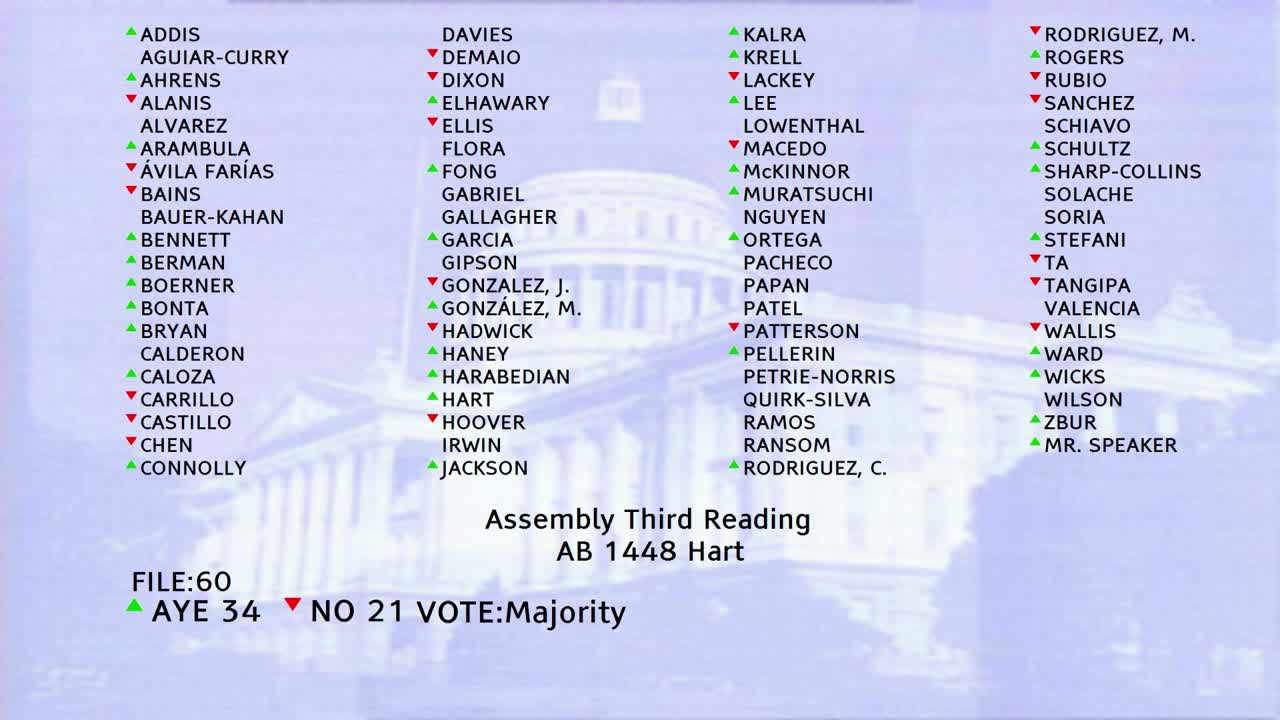 1MIN
Assembly Floor
 6MIN
Assembly Standing Committee on Environmental Safety and Toxic Materials
Bill Author

Bill Co-Author(s):