SB 1223: Fairs: contracting.
- Session Year: 2025-2026
- House: Senate
- Latest Version Date: 2026-09-30
Current Status:
Passed
(2026-09-30: Chaptered by Secretary of State. Chapter 1018, Statutes of 2026.)
Introduced
In Committee
Awaiting First Chamber Vote
Passed First Chamber
In Committee
Awaiting Second Chamber Vote
Passed Second Chamber
Enacted
Existing law governs fairs in this state, including the California Exposition and State Fair, district agricultural associations, county and district fairs, and citrus fruit fairs. Existing law establishes various requirements applicable to contracts of fairs.
This bill would prohibit a fair from issuing any invitation to bid or request for proposal, in connection with the awarding of a contract, for services to any person or entity, in a manner that limits the bidding directly or indirectly to any one bidder, except as specified. The bill would make any contract awarded in violation of this prohibition void.
Existing law governs fairs in this state, including the California Exposition and State Fair, district agricultural associations, county and district fairs, and citrus fruit fairs. Existing law establishes various requirements applicable to contracts of fairs.
This bill would prohibit a fair from issuing any invitation to bid or request for proposal, in connection with the awarding of a contract, for services to any person or entity, in a manner that limits the bidding directly or indirectly to any one bidder. bidder, except as specified. The bill would make any contract awarded in violation of this prohibition void.
Existing law governs fairs in this state, including the California Exposition and State Fair, district agricultural associations, county and district fairs, and citrus fruit fairs. Existing law establishes various requirements applicable to contracts of fairs.
This bill would prohibit a fair from issuing any invitation to bid or request for proposal, in connection with the awarding of a contract, for services to any person or entity, in a manner that limits the bidding directly or indirectly to any one bidder. The bill would make any contract awarded in violation of this prohibition void.
(a)A fair shall not issue any invitation to bid or request for proposal, in connection with the awarding of a contract, for services to any person or entity, in a manner that limits the bidding directly or indirectly to any one bidder.
(b)Subdivision (a) does not apply in cases of an emergency, as defined in Section 1102 of the Public Contract Code, where a contract is necessary for the immediate preservation of the public health, welfare, or safety, or protection of fair property, or to any contract with a musician or musical group for the purpose of a live performance event.
(c)Any contract awarded in violation of subdivision (a) shall be void.
(d)For purposes of this section, fair means a fair as defined in Section 3101, 3102, 3103, or 3104.
(a)A fair shall not issue any invitation to bid or request for proposal, in connection with the awarding of a contract, for services to any person or entity, in a manner that limits the bidding directly or indirectly to any one bidder.
(b)Subdivision (a) does not apply in cases of an emergency, as defined in Section 1102 of the Public Contract Code, where a contract is necessary for the immediate preservation of the public health, welfare, or safety, or protection of fair property, or to any contract with a musician or musical group for the purpose of a live performance event.
(b)(c)Any contract awarded in violation of subdivision (a) shall be void.
(c)(d)For purposes of this section, fair means a fair as defined in Section 3101, 3102, 3103, or 3104.
(a)A fair shall not issue any invitation to bid or request for proposal, in connection with the awarding of a contract, for services to any person or entity, in a manner that limits the bidding directly or indirectly to any one bidder.
(b)Any contract awarded in violation of subdivision (a) shall be void.
(c)For purposes of this section, fair means a fair as defined in Section 3101, 3102, 3103, or 3104.
|
Date
|
Status
|
|---|---|
| Sep 30, 2026 | Chaptered by Secretary of State. Chapter 1018, Statutes of 2026. |
| Sep 30, 2026 | Approved by the Governor. |
| Sep 3, 2026 | Enrolled and presented to the Governor at 3 p.m. |
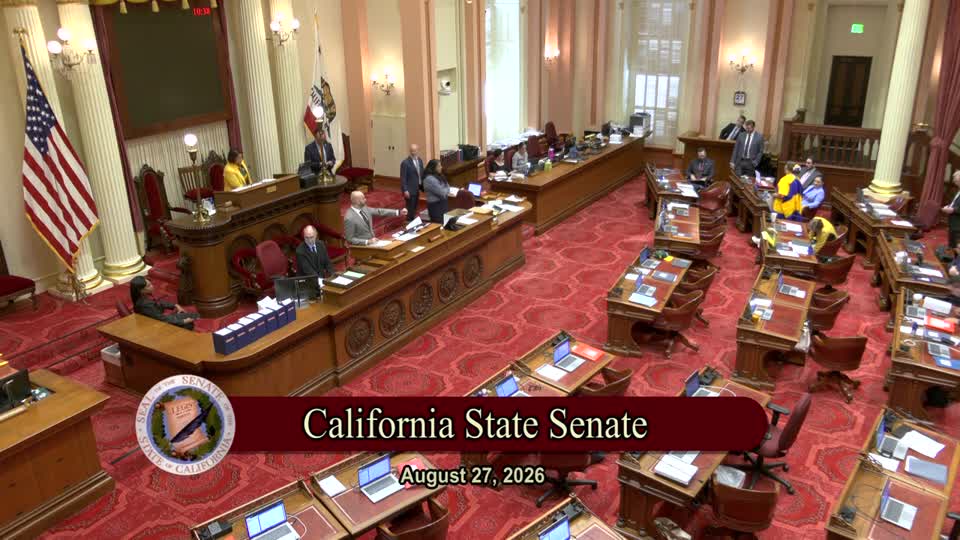
| Aug 27, 2026 | Assembly amendments concurred in. (Ayes 40. Noes 0.) Ordered to engrossing and enrolling. |
| Aug 27, 2026 | Assembly amendments concurred in. (Ayes 40. Noes 0. Page 5944.) Ordered to engrossing and enrolling. |
| Aug 26, 2026 | In Senate. Concurrence in Assembly amendments pending. |
| Aug 26, 2026 | Read third time. Passed. (Ayes 79. Noes 0. Page 6552.) Ordered to the Senate. |
| Aug 26, 2026 | Read third time. Passed. Ordered to the Senate. |
| Aug 18, 2026 | Read third time and amended. |
| Aug 18, 2026 | Ordered to third reading. |
| Jul 2, 2026 | Read second time. Ordered to third reading. |
| Jul 1, 2026 | From committee: Do pass. (Ayes 11. Noes 0.) (July 1). |
| Jun 17, 2026 | From committee: Do pass and re-refer to Com. on APPR. (Ayes 8. Noes 0.) (June 17). Re-referred to Com. on APPR. |
| May 26, 2026 | Referred to Com. on AGRI. |
| May 20, 2026 | In Assembly. Read first time. Held at Desk. |
| May 19, 2026 | Read third time. Passed. (Ayes 39. Noes 0.) Ordered to the Assembly. |
| May 19, 2026 | Read third time. Passed. (Ayes 39. Noes 0. Page 4337.) Ordered to the Assembly. |
| May 5, 2026 | Read second time. Ordered to third reading. |
| May 4, 2026 | From committee: Be ordered to second reading pursuant to Senate Rule 28.8. |
| Apr 24, 2026 | Set for hearing May 4. |
| Apr 21, 2026 | From committee: Do pass and re-refer to Com. on APPR. (Ayes 4. Noes 0.) (April 21). Re-referred to Com. on APPR. |
| Apr 21, 2026 | From committee: Do pass and re-refer to Com. on APPR. (Ayes 4. Noes 0. Page 3971.) (April 21). Re-referred to Com. on APPR. |
| Apr 8, 2026 | Set for hearing April 21. |
| Mar 4, 2026 | Referred to Com. on AGRI. |
| Feb 20, 2026 | From printer. May be acted upon on or after March 22. |
| Feb 19, 2026 | Introduced. Read first time. To Com. on RLS. for assignment. To print. |
|
Date
|
Description
|
Location
|
Votes
|
|
|---|---|---|---|---|
| Aug 27, 2026 | Unfinished Business SB1223 Padilla Concurrence | Senate Floor |
Passed |
|
| Aug 26, 2026 | SB 1223 Padilla Senate Third Reading By Connolly | Assembly Floor |
Passed |
|
| Jul 1, 2026 | Do pass. | Assembly Standing Committee on Appropriations |
Passed |
|
| Jun 17, 2026 | Do pass and be re-referred to the Committee on [Appropriations] | Assembly Standing Committee on Agriculture |
Passed |
|
| May 19, 2026 | Senate 3rd Reading SB1223 Padilla | Senate Floor |
Passed |
|
| Apr 21, 2026 | Do pass, but first be re-referred to the Committee on [Appropriations] | Senate Standing Committee on Agriculture |
Passed |
This list shows positions taken on this bill by organizations on the date displayed, which is linked to the original source.
Positions by individuals are not included.
SENATE RULES COMMITTEE Office of Senate Floor Analyses (916) 651-4171 | SB 1223 |
UNFINISHED BUSINESS
Bill No: SB 1223
Author: Padilla (D)
Amended: 8/18/26
Vote: 21
SENATE AGRICULTURE COMMITTEE: 4-0, 4/21/26
AYES: Caballero, Alvarado-Gil, McNerney, Padilla
NO VOTE RECORDED: Ashby
SENATE APPROPRIATIONS COMMITTEE: Senate Rule 28.8
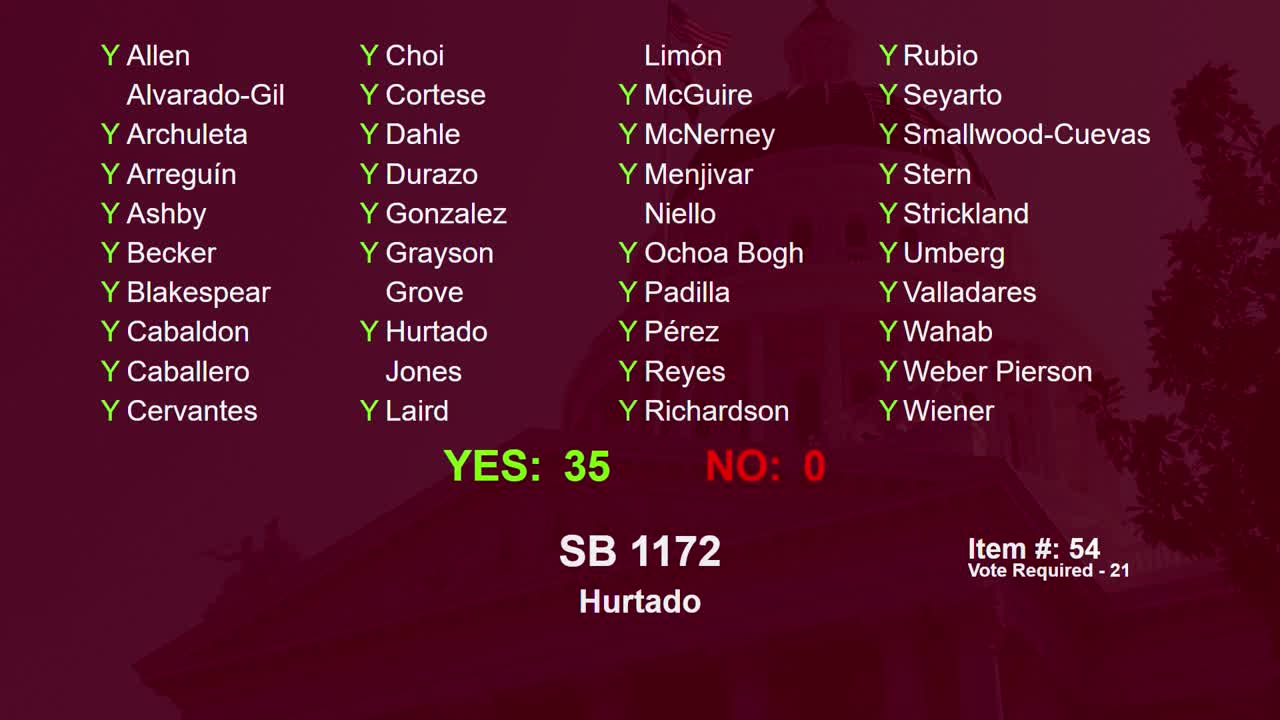
SENATE FLOOR: 39-0, 5/19/26
AYES: Allen, Alvarado-Gil, Archuleta, Arreguín, Ashby, Becker, Blakespear, Cabaldon, Caballero, Cervantes, Choi, Cortese, Dahle, Durazo, Gonzalez, Grayson, Grove, Hurtado, Jones, Laird, Limón, McGuire, McNerney, Menjivar, Ochoa Bogh, Padilla, Pérez, Reyes, Richardson, Rubio, Seyarto, Smallwood-Cuevas, Stern, Strickland, Umberg, Valladares, Wahab, Weber Pierson, Wiener
NO VOTE RECORDED: Niello
ASSEMBLY FLOOR: 79-0, 8/26/26 - See last page for vote
SUBJECT: Fairs: contracting
SOURCE: Author
DIGEST:
This bill prohibits a fair from issuing any invitation to bid or request for proposal, in connection with the awarding of a contract, for services to any person or entity, in a manner that limits the bidding directly or indirectly to any one bidder. The bill makes any contract awarded in violation of this prohibition void.
Assembly Amendments
clarify exemptions for emergencies, as defined in Section 1102 of the Public Contract Code, when a contract is necessary for the immediate preservation of public health, welfare, or safety, or the protection of property, as well as contracts with musicians or musical groups for live performance events.
ANALYSIS:
Existing law:
- Establishes the California Department of Food and Agriculture (CDFA) Fairs & Expositions (F&E) Branch. The F&E provides fiscal and policy oversight of the network of California fairs (Food and Agricultural (FAC) Code Section 3001-4703).
- Defines “fair,” or “state-designated fairground,” to mean:
- The California Exposition and State Fair in the City of Sacramento and those fairs specified in Sections 3102, 3103, and 3104 that may receive financial support or are otherwise governed pursuant to this chapter. These fairs may also be referred to as part of the “network of California fairs.”
- A nonprofit organization that holds an annual fair pursuant to Section 4163 may elect to be a member of the network of California fairs on terms and conditions mutually agreed upon by the department and the nonprofit organization.
- A joint powers agency that holds an annual fair pursuant to Section 4171 may elect to be a member of the network of California fairs on terms and conditions mutually agreed upon by the department and the joint powers agency (FAC Section 3101).
- Defines the district agricultural associations and their locations (FAC Section 3102).
- Defines the county fairs and their locations (FAC Section 3103).
- Defines the citrus fruit fairs and their locations (FAC Section 3104).
- States the board must establish and publish competitive bidding procedures for the award of a procurement or contract involving an expenditure of more than $100,000.
- States the competitive bidding procedures shall include, but not be limited to:
- Requirements for submission of bids and accompanying documentation
- Guidelines for the use of requests for proposals (RFP), invitations to bid, or other methods of bidding
- A bid protest procedure (FAC Section 4051(b)(1)).
- Mandates that any change of the RFP rules must be communicated to all vendors (California Public Contract Code Section 12104.5).
- Prohibits a state agency from drafting an RFP on a public contract for services to be rendered to the state in a way that directly or indirectly limits bidding to any one bidder. Any contract awarded in violation of subdivision (a) shall be void (Public Contract Code Section 10339(a) and (b)).
- The Department of General Services (DGS) shall prescribe the following:
- The conditions under which a contract may be awarded without competition, and the methods and criteria which shall be used in determining the reasonableness of contract costs when a contract is awarded without competition.
- Any special requirements for evaluating multiple-year contracts which the department deems necessary to protect the financial interest of the state.
- For contracts of less than twenty thousand dollars ($20,000), the conditions under which some or all of the provisions of this article may be waived in order to assist agencies in obtaining services and consultant services in a efficient and timely manner (Public Contract Code Section 10348).
- The California Department of General Services State Administrative Manual (SAM) exempts from competitive bidding public entertainment contracts for state-sponsored fairs and expositions (SAM Section 1233, Management Memo 03-10).
This bill:
- Adds Section 3107 to the Food and Agricultural Code to state:
- A fair shall not issue any invitation to bid or request for proposal, in connection with the awarding of a contract, for services to any person or entity, in a manner that limits the bidding directly or indirectly to any one bidder.
- Any contract awarded in violation of subdivision (a) shall be void.
- Provides exemptions to this code emergencies, as defined in Section 1102 of the Public Contract Code, when a contract is necessary for the immediate preservation of public health, welfare, or safety, or the protection of property, as well as contracts with musicians or musical groups for live performance events.
FISCAL EFFECT: Appropriation: No Fiscal Com.: Yes Local: No
This bill passed out of the Senate Committee on Appropriations via Senate Rule 28.8.
SUPPORT: (Verified 8/26/26)
None received
OPPOSITION: (Verified 8/26/26)
None received
ARGUMENTS IN SUPPORT: According to the author:
According to the author:
“California’s fairs are a tradition that brings communities together each year to celebrate and enjoy local agriculture, food, and entertainment. In order for these fairs to operate, they manage millions of dollars in contracts each year to provide rides, food vendors, and other services.
Recent investigations have revealed that competitive bidding requirements do not apply to state fairs. Bids are being written in a way that applies only to a single contractor, opening the door to favoritism and corruption. SB 1223 would prohibit a fair from issuing a request for proposal or invitation to bid that is written in a way that applies only to one party, helping to protect competitive bidding in fair contracts.”
ASSEMBLY FLOOR: 79-0, 8/26/26
AYES: Addis, Aguiar-Curry, Ahrens, Alanis, Alvarez, Arambula, Ávila Farías, Bains, Bauer-Kahan, Bennett, Berman, Boerner, Bonta, Bryan, Calderon, Caloza, Carrillo, Castillo, Chen, Connolly, Davies, DeMaio, Dixon, Elhawary, Ellis, Flora, Fong, Gabriel, Garcia, Gipson, Jeff Gonzalez, Mark González, Hadwick, Haney, Harabedian, Hart, Hoover, Irwin, Jackson, Johnson, Kalra, Krell, Lackey, Lee, Lowenthal, Macedo, McKinnor, Muratsuchi, Nguyen, Ortega, Pacheco, Papan, Patel, Patterson, Pellerin, Petrie-Norris, Quirk-Silva, Ramos, Ransom, Celeste Rodriguez, Michelle Rodriguez, Rogers, Blanca Rubio, Sanchez, Schiavo, Schultz, Sharp-Collins, Solache, Soria, Stefani, Ta, Tangipa, Valencia, Wallis, Ward, Wicks, Wilson, Zbur, Rivas
Prepared by: Reichel Everhart / AGRI. / (916) 651-1508
10/23/26 14:55:51
**** END ****
SENATE RULES COMMITTEE Office of Senate Floor Analyses (916) 651-4171 | SB 1223 |
UNFINISHED BUSINESS
Bill No: SB 1223
Author: Padilla (D)
Amended: 8/18/26
Vote: 21
SENATE AGRICULTURE COMMITTEE: 4-0, 4/21/26
AYES: Caballero, Alvarado-Gil, McNerney, Padilla
NO VOTE RECORDED: Ashby
SENATE APPROPRIATIONS COMMITTEE: Senate Rule 28.8
SENATE FLOOR: 39-0, 5/19/26
AYES: Allen, Alvarado-Gil, Archuleta, Arreguín, Ashby, Becker, Blakespear, Cabaldon, Caballero, Cervantes, Choi, Cortese, Dahle, Durazo, Gonzalez, Grayson, Grove, Hurtado, Jones, Laird, Limón, McGuire, McNerney, Menjivar, Ochoa Bogh, Padilla, Pérez, Reyes, Richardson, Rubio, Seyarto, Smallwood-Cuevas, Stern, Strickland, Umberg, Valladares, Wahab, Weber Pierson, Wiener
NO VOTE RECORDED: Niello
ASSEMBLY FLOOR: Passed, 8/26/26
SUBJECT: Fairs: contracting
SOURCE: Author
DIGEST:
This bill would prohibit a fair from issuing any invitation to bid or request for proposal, in connection with the awarding of a contract, for services to any person or entity, in a manner that limits the bidding directly or indirectly to any one bidder. The bill would make any contract awarded in violation of this prohibition void.
Assembly Amendments
Clarify exemptions for emergencies, as defined in Section 1102 of the Public Contract Code, when a contract is necessary for the immediate preservation of public health, welfare, or safety, or the protection of property, as well as contracts with musicians or musical groups for live performance events.
ANALYSIS:
Existing law:
- Establishes the California Department of Food and Agriculture (CDFA) Fairs & Expositions (F&E) Branch. The F&E provides fiscal and policy oversight of the network of California fairs (Food and Agricultural (FAC) Code Section 3001-4703).
- Defines “fair,” or “state-designated fairground,” to mean:
- The California Exposition and State Fair in the City of Sacramento and those fairs specified in Sections 3102, 3103, and 3104 that may receive financial support or are otherwise governed pursuant to this chapter. These fairs may also be referred to as part of the “network of California fairs.”
- A nonprofit organization that holds an annual fair pursuant to Section 4163 may elect to be a member of the network of California fairs on terms and conditions mutually agreed upon by the department and the nonprofit organization.
- A joint powers agency that holds an annual fair pursuant to Section 4171 may elect to be a member of the network of California fairs on terms and conditions mutually agreed upon by the department and the joint powers agency (FAC Section 3101).
- Defines the district agricultural associations and their locations (FAC Section 3102).
- Defines the county fairs and their locations (FAC Section 3103).
- Defines the citrus fruit fairs and their locations (FAC Section 3104).
- States the board must establish and publish competitive bidding procedures for the award of a procurement or contract involving an expenditure of more than $100,000.
- States the competitive bidding procedures shall include, but not be limited to:
- Requirements for submission of bids and accompanying documentation
- Guidelines for the use of requests for proposals (RFP), invitations to bid, or other methods of bidding
- A bid protest procedure (FAC Section 4051(b)(1)).
- Mandates that any change of the RFP rules must be communicated to all vendors (California Public Contract Code Section 12104.5).
- Prohibits a state agency from drafting an RFP on a public contract for services to be rendered to the state in a way that directly or indirectly limits bidding to any one bidder. Any contract awarded in violation of subdivision (a) shall be void (Public Contract Code Section 10339(a) and (b)).
- The Department of General Services (DGS) shall prescribe the following:
- The conditions under which a contract may be awarded without competition, and the methods and criteria which shall be used in determining the reasonableness of contract costs when a contract is awarded without competition.
- Any special requirements for evaluating multiple-year contracts which the department deems necessary to protect the financial interest of the state.
- For contracts of less than twenty thousand dollars ($20,000), the conditions under which some or all of the provisions of this article may be waived in order to assist agencies in obtaining services and consultant services in a efficient and timely manner (Public Contract Code Section 10348).
- The California Department of General Services State Administrative Manual (SAM) exempts from competitive bidding public entertainment contracts for state-sponsored fairs and expositions (SAM Section 1233, Management Memo 03-10).
This bill:
- Adds Section 3107 to the Food and Agricultural Code to state:
- A fair shall not issue any invitation to bid or request for proposal, in connection with the awarding of a contract, for services to any person or entity, in a manner that limits the bidding directly or indirectly to any one bidder.
- Any contract awarded in violation of subdivision (a) shall be void.
- Provides exemptions to this code emergencies, as defined in Section 1102 of the Public Contract Code, when a contract is necessary for the immediate preservation of public health, welfare, or safety, or the protection of property, as well as contracts with musicians or musical groups for live performance events.
FISCAL EFFECT: Appropriation: No Fiscal Com.: Yes Local: No
This bill passed out of the Senate Committee on Appropriations via Senate Rule 28.8.
SUPPORT: (Verified 8/26/26)
None received
OPPOSITION: (Verified 8/26/26)
None received
ARGUMENTS IN SUPPORT: According to the author:
According to the author:
“California’s fairs are a tradition that brings communities together each year to celebrate and enjoy local agriculture, food, and entertainment. In order for these fairs to operate, they manage millions of dollars in contracts each year to provide rides, food vendors, and other services.
Recent investigations have revealed that competitive bidding requirements do not apply to state fairs. Bids are being written in a way that applies only to a single contractor, opening the door to favoritism and corruption. SB 1223 would prohibit a fair from issuing a request for proposal or invitation to bid that is written in a way that applies only to one party, helping to protect competitive bidding in fair contracts.”
Prepared by: Reichel Everhart / AGRI. / (916) 651-1508
8/26/26 15:48:54
**** END ****
SENATE THIRD READING
STR Bill Id:SB 1223
Author:(Padilla)
As Introduced Ver:February 19, 2026
Majority vote
SUMMARY
This bill would prohibit a fair from issuing an invitation to bid or request for proposal (RFP), in connection with the awarding of a contract, for services to any person or entity, in a manner that limits the bidding directly or indirectly to any one bidder. This bill would make any contract awarded in violation of this prohibition void.
Major Provisions
Adds Section 3107 to the Food and Agricultural Code (FAC) to state:
1) A fair shall not issue any invitation to bid or request for proposal, in connection with the awarding of a contract, for services to any person or entity, in a manner that limits the bidding directly or indirectly to any one bidder.
2) Any contract awarded in violation of 1) shall be void.
COMMENTS
County fairs in California are vital, year-round economic drivers while also serving as hubs for agricultural education and innovation. Fairs serve as essential gathering places for community and display local agriculture, from livestock to cornstalk, encouraging people to learn where their food comes from and to buy locally. Many fairs are also part of the state's emergency response network.
Most county fairs operate as District Agricultural Associations (DAAs), and for vendor contracts above certain thresholds they are generally required to go through an RFP process under Public Contract Code Section (PCC) 10300 et seq. and related state contracting policy. Those rules are intended to keep the bidding competitive. The California Department of Food and Agriculture's (CDFA) Fair and Exposition Branch, in the Division of Marketing Services, oversees the fiscal and policy side of the state's 77 fairs—54 DAAs plus county-owned fairs—all of which are subject to those procurement requirements.
The author's office points to two lawsuits brought by Talley Amusements, Inc. (Talley), a Texas-based carnival midway company that supplies rides, games, and food concessions, as the reason this bill is needed. Both cases center on the same alleged conduct: fair officials adjusting a bidder's evaluation score after bids were submitted.
Del Mar Fairgrounds (22nd DAA). On July 28, 2021, Talley sued the Del Mar Fair, alleging the 22nd DAA interfered with its contract and violated the federal Civil Rights Act (42 U.S.C. Section 1983) by changing scores—revising a bidder's numerical rating after the fact based on updated information, pricing, or non-cost factors. The fair settled in 2024, paying Talley $500,000 and guaranteeing it a spot at the San Diego County Fair through 2029.
Orange County Fairgrounds (32nd DAA). On June 18, 2024, after the Orange County Fair awarded its master carnival contract to Ray Cammack Shows, Talley sued the 32nd DAA, alleging corruption, favoritism, and bid-rigging in the 2021 selection, again claiming officials changed scores during the bid process. Talley sought a temporary injunction under PCC 10339, but the Orange County Superior Court denied it, finding that PCC 10339 did not apply to the contract. The Fourth District Court of Appeal, Division Three, upheld that decision, holding that PCC 10339 did not reach the contract because it was not for services rendered to the state.
According to the Author
According to the author, California's fairs are a tradition that brings communities together each year to celebrate and enjoy local agriculture, food, and entertainment. In order for these fairs to operate, they manage millions of dollars in contracts each year to provide rides, food vendors, and other services.
Recent investigations have revealed that competitive bidding requirements do not apply to state fairs. Bids are being written in a way that applies only to a single contractor, opening the door to favoritism and corruption. SB 1223 would prohibit a fair from issuing a request for proposal or invitation to bid that is written in a way that applies only to one party, helping to protect competitive bidding in fair contracts.
Arguments in Support
None on file.
Arguments in Opposition
None on file.
FISCAL COMMENTS
CDFA, which oversees the state's network of fairs, anticipates minor and absorbable costs.
VOTES
SENATE FLOOR: 39-0-1
YES: Allen, Alvarado-Gil, Archuleta, Arreguín, Ashby, Becker, Blakespear, Cabaldon, Caballero, Cervantes, Choi, Cortese, Dahle, Durazo, Gonzalez, Grayson, Grove, Hurtado, Jones, Laird, Limón, McGuire, McNerney, Menjivar, Ochoa Bogh, Padilla, Pérez, Reyes, Richardson, Rubio, Seyarto, Smallwood-Cuevas, Stern, Strickland, Umberg, Valladares, Wahab, Weber Pierson, Wiener
ABS, ABST OR NV: Niello
ASM AGRICULTURE: 8-0-0
YES: Soria, Hadwick, Aguiar-Curry, Alanis, Connolly, Jeff Gonzalez, Irwin, Ransom
ASM APPROPRIATIONS: 11-0-4
YES: Wicks, Hoover, Arambula, Caloza, Dixon, Fong, Mark González, Krell, Pacheco, Solache, Ta
ABS, ABST OR NV: Calderon, Pellerin, Sharp-Collins, Tangipa
UPDATED
VERSION: February 19, 2026
CONSULTANT: Dylan Lomanto / AGRI. / (916) 319-2084 FN: 0003276
Date of Hearing: July 1, 2026
ASSEMBLY COMMITTEE ON APPROPRIATIONS
Buffy Wicks, Chair
SBPCA Bill Id:SB 1223
Author:(Padilla) – As Introduced Ver:February 19, 2026
Policy Committee: | Agriculture | Vote: | 8 - 0 |
|
| ||
|
|
Urgency: No State Mandated Local Program: No Reimbursable: No
SUMMARY:
This bill prohibits a fair, as defined, from issuing any invitation to bid or request for proposal (RFP), in connection with the awarding of a contract, for services to any person or entity, in a manner that limits the bidding directly or indirectly to any one bidder. The bill makes any contract awarded in violation of this prohibition void.
FISCAL EFFECT:
The California Department of Food and Agriculture (CDFA), which oversees the state’s network of fairs, anticipates minor and absorbable costs.
COMMENTS:
1) Purpose. According to the author:
Recent investigations have revealed that competitive bidding requirements do not apply to state fairs. Bids are being written in a way that applies only to a single contractor, opening the door to favoritism and corruption. SB 1223 would prohibit a fair from issuing a request for proposal or invitation to bid that is written in a way that applies only to one party, helping to protect competitive bidding in fair contracts.
2) Background. Current law establishes a network of California-designated fairs, composed of 52 district agricultural associations (DAAs), 23 county fairs, two citrus fruit fairs, and the California Exposition and State Fair. Fairs are most known for their annual fairs, but they also operate year-round, offering agricultural education and environmental leadership, and host events like trade shows, concerts, and private events that generate millions of dollars in state and local revenues. Many fairs are also part of the state’s emergency response network. The Division of Fairs and Expositions within CDFA provides fiscal and policy oversight for the network of California fairs.
Prior to 2009, funding for California fairs was supported by licensing fees imposed on horse racing wagers. SBx2 16 (Ashburn), Chapter 12, Statutes of 2009, ended this practice and provided a continuous General Fund appropriation of $32 million for fairs, until this appropriation was eliminated in fiscal year (FY) 2011-12. AB 1499 (Gray), Chapter 798, Statutes of 2017, provided a new mechanism for funding fairs by requiring the California Department of Tax and Fee Administration to develop a form to segregate sales at state-designated fairs and annually report to the Department of Finance the total gross receipts segregated the prior FY. An amount equal to 2% of such reported receipts must then be included in the next annual Governor’s budget for CDFA to allocate to the fairs. However, the actual transfer of designated General Fund revenue to the Fair and Exposition (F&E) Fund is still subject to legislative appropriation during the budget process. Also, while transfers from gross receipts comprise the primary revenue source for the F&E Fund, the fund also includes revenues from other sources, such as horse racing handles, loan principal and interest payments, and proceeds from sales of real property. The fiscal year 2025-26 budget included a transfer (from sales tax revenue) of approximately $4.9 million to the F&E Fund.
A 2025 Los Angeles (LA) Times investigation found fraud and theft are rife at California’s county fairs. According to the investigation, workers from at least four fairs have been prosecuted in the last few years for theft and bribery, with more than $1 million in public funds stolen. The LA Times also reported that recent state audits “have called out more than a dozen fairs…for violating state policies by handing out money without signed agreements of competitive bidding.” For example, in 2024, the San Diego County Fair paid Talley Amusements (a carnival company) $500,000 to settle a lawsuit that alleged fair officials had engaged in bid-rigging. A San Diego County judge wrote that evidence he reviewed “supports an inference of ‘favoritism,’ ‘fraud,’ and ‘corruption’ as to the award of public contracts, although no such definitive findings are made herein.”
According to the author’s office, the courts have found that state law requiring competitive bids for public contracts does not apply to state fairs as the court treats revenue-sharing and commercial operating agreements separate from procurement contracts because the courts distinguish between the state buying services and a private company using public property to generate revenue. In the Talley case, the court found that midway operators, such as Talley Amusements, do not provide services to the state itself but rather to the public attending the fair.
The author argues “this technicality opens the door to favoritism and invites corruption by allowing bids to be written in a way that applies to a single contractor,” and that this bill helps protect competitive bidding in fair contracts, “allowing the best bidder at the best price an equitable chance of securing contracts.”
Analysis Prepared by: Nikita Koraddi / APPR. / (916) 319-2081
Date of Hearing: June 17, 2026
ASSEMBLY COMMITTEE ON AGRICULTURE
Esmeralda Soria, Chair
SBPCA Bill Id:SB 1223
Author:(Padilla) – As Introduced Ver:February 19, 2026
SENATE VOTE: 39-0
SUBJECT: Fairs: contracting
SUMMARY: This bill would prohibit a fair from issuing any invitation to bid or request for proposal, in connection with the awarding of a contract, for services to any person or entity, in a manner that limits the bidding directly or indirectly to any one bidder. The bill would make any contract awarded in violation of this prohibition void. Specifically, this bill:
Adds Section 3107 to the Food and Agricultural Code to state:
- A fair shall not issue any invitation to bid or request for proposal, in connection with the awarding of a contract, for services to any person or entity, in a manner that limits the bidding directly or indirectly to any one bidder.
- Any contract awarded in violation of subdivision (a) shall be void.
EXISTING LAW:
- Establishes the California Department of Food and Agriculture (CDFA) Fairs & Expositions (F&E) Branch. F&E provides fiscal and policy oversight of the network of California fairs (Food and Agricultural (FAC) Code Section 3001-4703).
- States the competitive bidding procedures shall include, but not be limited to:
- Requirements for submission of bids and accompanying documentation.
- Guidelines for the use of requests for proposals (RFP), invitations to bid, or other methods of bidding.
- A bid protest procedure (FAC Section 4051(b)(1)).
FISCAL EFFECT: Unknown
COMMENTS: County fairs in California are vital, year-round economic drivers while also serving as hubs for agricultural education and innovation. Fairs serve as essential gathering places for community and display local agriculture, from livestock to cornstalk, encouraging people to learn where their food comes from and to buy locally.
California county fairs, often operating as District Agricultural Associations (DAAs), are generally required to use Request for Proposals (RFP) processes for vendor contracts over certain thresholds, typically following California Public Contract Code Section 10300 et seq. and state contracting policies, often overseen by CDFA. These procurement rules ensure competitive bidding for services and goods.
CDFA’s F&E Branch within the CDFAs Division of Marketing Services provides fiscal and policy oversight of the network of California fairs. The Branch oversees 77 fairs (54 DAAs and county-owned fairs), which must follow state procurement regulations.
The author’s office has referenced two lawsuits filed by Talley Amusements, Incorporated (Talley Amusements) vs The 22nd DAA, located in San Diego as examples of why the bill is needed. Below is a summary of both suits:
Lawsuit #1: Del Mar Fairgrounds: On July 28, 2021, Talley Amusements, a Texas-based carnival midway company that provides rides, games, and food for fairs filed a complaint alleging the Del Mar Fair in San Diego provided intentional interference with a contract.
Talley Amusements filed a complaint against the fair, run by the 22nd DAA. The complaint alleged the DAA violated the Federal Civil Rights Act (42 USC Section 1983). The complaint alleged the DAA intentionally and negligently interfered with the economic relationship between Talley Amusements, Incorporated and the Del Mar Fair by changing scores, which is the process of adjusting a bidder’s numerical evaluation score based on revisions to information, pricing, or to non-cost factors.
In 2024, Del Mar Fairgrounds settled the case by providing $500,000 settlement to Talley Amusements and guaranteeing Talley Amusements will have a spot at the San Diego County Fair for the next five years (until 2029).
Lawsuit #2: Orange County Fairgrounds: Talley Amusements, Incorporated vs the 32nd DAA: On June 18, 2024, Talley Amusements, filed a complaint against the 32nd DAA that oversees the Orange County Fair, where the master contract for the fair was awarded to Ray Cammack Shows (RCS). Talley Amusements, Incorporated alleged “corruption, favoritism, and bid-rigging” during the Fair’s selection process of a master carnival operator for the 2021 county fair, stating fairground executives changed scores in the 2021 bid process, resulting in their losing the master contract to RCS. Talley Amusements requested a temporary injunction pursuant to a violation of Public Contract Code 10339 and the Superior Court of Orange County denied the injunction, stating Public Contract Code 10339 did not apply to this particular contract. Talley Amusements appealed to the State’s Fourth Appellate District Division Three. The Court upheld the lower court’s decision, stating that section 10339 did not apply to the contract at issue because it was not a contract for services to be rendered to the state.
According to the author, California’s fairs are a tradition that brings communities together each year to celebrate and enjoy local agriculture, food, and entertainment. In order for these fairs to operate, they manage millions of dollars in contracts each year to provide rides, food vendors, and other services.
Recent investigations have revealed that competitive bidding requirements do not apply to state fairs. Bids are being written in a way that applies only to a single contractor, opening the door to favoritism and corruption. SB 1223 would prohibit a fair from issuing a request for proposal or invitation to bid that is written in a way that applies only to one party, helping to protect competitive bidding in fair contracts.
REGISTERED SUPPORT / OPPOSITION:
Support
None on file
Opposition
None on file
Analysis Prepared by: Victor Francovich / AGRI. / (916) 319-2084
SENATE RULES COMMITTEE Office of Senate Floor Analyses (916) 651-4171 | SB 1223 |
THIRD READING
Bill No: SB 1223
Author: Padilla (D)
Introduced: 2/19/26
Vote: 21
SENATE AGRICULTURE COMMITTEE: 4-0, 4/21/26
AYES: Caballero, Alvarado-Gil, McNerney, Padilla
NO VOTE RECORDED: Ashby
SENATE APPROPRIATIONS COMMITTEE: Senate Rule 28.8
SUBJECT: Fairs: contracting
SOURCE: Author
DIGEST:
This bill would prohibit a fair from issuing any invitation to bid or request for proposal, in connection with the awarding of a contract, for services to any person or entity, in a manner that limits the bidding directly or indirectly to any one bidder. The bill would make any contract awarded in violation of this prohibition void.
ANALYSIS:
Existing law:
- Establishes the California Department of Food and Agriculture (CDFA) Fairs & Expositions (F&E) Branch. The F&E provides fiscal and policy oversight of the network of California fairs. Among other things, the F&E determines the requirements for competitive bidding procedures to provide services for fairs. Existing law states the competitive bidding procedures shall include, but not be limited to:
- Requirements for submission of bids and accompanying documentation
- Guidelines for the use of requests for proposals (RFP), invitations to bid, or other methods of bidding
- A bid protest procedure
- Prohibits a state agency from drafting an RFP on a public contract for services to be rendered to the state in a way that directly or indirectly limits bidding to any one bidder and states any contract awarded in violation of this requirement shall be rendered void.
This bill states a fair shall not issue any invitation to bid or request for proposal, in connection with the awarding of a contract, for services to any person or entity, in a manner that limits the bidding directly or indirectly to any one bidder and any contract awarded in violation of this shall be void.
FISCAL EFFECT: Appropriation: No Fiscal Com.: Yes Local: No
SUPPORT: (Verified 5/4/26)
None received
OPPOSITION: (Verified 5/4/26)
None received
ARGUMENTS IN SUPPORT: According to the author:
California’s fairs are a tradition that brings communities together each year to celebrate and enjoy local agriculture, food, and entertainment. In order for these fairs to operate, they manage millions of dollars in contracts each year to provide rides, food vendors, and other services.
Recent investigations have revealed that competitive bidding requirements do not apply to state fairs. Bids are being written in a way that applies only to a single contractor, opening the door to favoritism and corruption. SB 1223 would prohibit a fair from issuing a request for proposal or invitation to bid that is written in a way that applies only to one party, helping to protect competitive bidding in fair contracts.
Prepared by: Reichel Everhart / AGRI. / (916) 651-1508
5/5/26 15:55:45
**** END ****
SENATE COMMITTEE ON AGRICULTURE
Senator Anna Caballero, Chair
2025 - 2026 Regular
Bill No: SB 1223 Hearing Date: 4/21/2026
Author: | Padilla | ||
Version: | 2/19/26 | ||
Urgency: | No | Fiscal: | Yes |
Consultant: | Reichel Everhart | ||
Subject: Fairs: contracting
SUMMARY
:
This bill would prohibit a fair from issuing any invitation to bid or request for proposal, in connection with the awarding of a contract, for services to any person or entity, in a manner that limits the bidding directly or indirectly to any one bidder. The bill would make any contract awarded in violation of this prohibition void.
BACKGROUND AND EXISTING LAW
:
Existing law:
- Establishes the California Department of Food and Agriculture (CDFA) Fairs & Expositions (F&E) Branch. The F&E provides fiscal and policy oversight of the network of California fairs (Food and Agricultural (FAC) Code Section 3001-4703).
- Defines “fair,” or “state-designated fairground,” to mean:
- The California Exposition and State Fair in the City of Sacramento and those fairs specified in Sections 3102, 3103, and 3104 that may receive financial support or are otherwise governed pursuant to this chapter. These fairs may also be referred to as part of the “network of California fairs.”
- A nonprofit organization that holds an annual fair pursuant to Section 4163 may elect to be a member of the network of California fairs on terms and conditions mutually agreed upon by the department and the nonprofit organization.
- A joint powers agency that holds an annual fair pursuant to Section 4171 may elect to be a member of the network of California fairs on terms and conditions mutually agreed upon by the department and the joint powers agency (FAC Section 3101).
- Defines the district agricultural associations and their locations (FAC Section 3102).
- Defines the county fairs and their locations (FAC Section 3103).
- Defines the citrus fruit fairs and their locations (FAC Section 3104).
- States the board must establish and publish competitive bidding procedures for the award of a procurement or contract involving an expenditure of more than $100,000.
- States the competitive bidding procedures shall include, but not be limited to:
- Requirements for submission of bids and accompanying documentation
- Guidelines for the use of requests for proposals (RFP), invitations to bid, or other methods of bidding
- A bid protest procedure (FAC Section 4051(b)(1)).
- Mandates that any change of the RFP rules must be communicated to all vendors (California Public Contract Code Section 12104.5).
- Prohibits a state agency from drafting an RFP on a public contract for services to be rendered to the state in a way that directly or indirectly limits bidding to any one bidder. Any contract awarded in violation of subdivision (a) shall be void (Public Contract Code Section 10339(a) and (b)).
- The Department of General Services (DGS) shall prescribe the following:
- The conditions under which a contract may be awarded without competition, and the methods and criteria which shall be used in determining the reasonableness of contract costs when a contract is awarded without competition.
- Any special requirements for evaluating multiple-year contracts which the department deems necessary to protect the financial interest of the state.
- For contracts of less than twenty thousand dollars ($20,000), the conditions under which some or all of the provisions of this article may be waived in order to assist agencies in obtaining services and consultant services in a efficient and timely manner (Public Contract Code Section 10348).
- The California Department of General Services State Administrative Manual (SAM) exempts from competitive bidding public entertainment contracts for state-sponsored fairs and expositions (SAM Section 1233, Management Memo 03-10).
PROPOSED LAW
:
This bill:
- Adds Section 3107 to the Food and Agricultural Code to state:
- A fair shall not issue any invitation to bid or request for proposal, in connection with the awarding of a contract, for services to any person or entity, in a manner that limits the bidding directly or indirectly to any one bidder.
- Any contract awarded in violation of subdivision (a) shall be void.
ARGUMENTS IN SUPPORT:
According to the author:
“California’s fairs are a tradition that brings communities together each year to celebrate and enjoy local agriculture, food, and entertainment. In order for these fairs to operate, they manage millions of dollars in contracts each year to provide rides, food vendors, and other services.
Recent investigations have revealed that competitive bidding requirements do not apply to state fairs. Bids are being written in a way that applies only to a single contractor, opening the door to favoritism and corruption. SB 1223 would prohibit a fair from issuing a request for proposal or invitation to bid that is written in a way that applies only to one party, helping to protect competitive bidding in fair contracts.”
ARGUMENTS IN OPPOSITION:
None received.
COMMENTS
:
County fairs in California are vital, year-round economic drivers while also serving as hubs for agricultural education and innovation. Fairs serve as essential gathering places for community and display local agriculture, from livestock to cornstalk, encouraging people to learn where their food comes from and to buy locally.
California county fairs, often operating as District Agricultural Associations (DAAs), are generally required to use Request for Proposals (RFP) processes for vendor contracts over certain thresholds, typically following California Public Contract Code Section 10300 et seq. and state contracting policies, often overseen by the California Department of Food & Agriculture (CDFA). These procurement rules ensure competitive bidding for services and goods.
CDFA Fairs & Expositions (F&E) Branch: The Department of Food and Agriculture (CDFA) Fairs & Expositions (F&E) Branch within the CDFAs Division of Marketing Services provides fiscal and policy oversight of the network of California fairs. The Branch oversees 77 fairs (54 DAAs and county-owned fairs), which must follow state procurement regulations.
The author’s office has referenced two lawsuits filed by Talley Amusements, Incorporated (Talley Amusements) vs The 22nd DAA, located in San Diego as examples of why the bill is needed. Below is a brief summary of both suits:
Lawsuit #1: Del Mar Fairgrounds: On July 28, 2021, Talley Amusements, a Texas-based carnival midway company that provides rides, games, and food for fairs filed a complaint alleging the Del Mar Fair in San Diego provided intentional interference with a contract.
Talley Amusements filed a complaint against the fair, run by the 22nd DAA. The complaint alleged the DAA violated the Federal Civil Rights Act (42 USC Section 1983). The complaint alleged the DAA intentionally and negligently interfered with the economic relationship between Talley Amusements, Incorporated and the Del Mar Fair by changing scores, which is the process of adjusting a bidder’s numerical evaluation score based on revisions to information, pricing, or to non-cost factors.
In 2024, Del Mar Fairgrounds settled the case by providing $500,000 settlement to Talley Amusements and guaranteeing Talley Amusements will have a spot at the San Diego County Fair for the next five years (until 2029).
Lawsuit #2: Orange County Fairgrounds: Talley Amusements, Incorporated vs the 32nd DAA: On June 18, 2024, Talley Amusements, filed a complaint against the 32nd DAA that oversees the Orange County Fair, where the master contract for the fair was awarded to Ray Cammack Shows (RCS). Talley Amusements, Incorporated alleged “corruption, favoritism, and bid-rigging” during the Fair’s selection process of a master carnival operator for the 2021 county fair, stating fairground executives changed scores in the 2021 bid process, resulting in their losing the master contract to RCS. Talley Amusements requested a temporary injunction pursuant to a violation of Public Contract Code 10339 and the Superior Court of Orange County denied the injunction, stating Public Contract Code 10339 did not apply to this particular contract. Talley Amusements appealed to the State’s Fourth Appellate District Division Three. The Court upheld the lower court’s decision, stating that section 10339 did not apply to the contract at issue because it was not a contract for services to be rendered to the state.
RELATED LEGISLATION
:
N/A
SUPPORT
:
None received.
OPPOSITION
:
None received
-- END --
Bill Author
Bill Co-Author(s):